US8889857B2 - Phosphine-ligated palladium sulfonate palladacycles - Google Patents
Phosphine-ligated palladium sulfonate palladacycles Download PDFInfo
- Publication number
- US8889857B2 US8889857B2 US13/799,620 US201313799620A US8889857B2 US 8889857 B2 US8889857 B2 US 8889857B2 US 201313799620 A US201313799620 A US 201313799620A US 8889857 B2 US8889857 B2 US 8889857B2
- Authority
- US
- United States
- Prior art keywords
- alkyl
- certain embodiments
- aryl
- relates
- precatalyst
- Prior art date
- Legal status (The legal status is an assumption and is not a legal conclusion. Google has not performed a legal analysis and makes no representation as to the accuracy of the status listed.)
- Active
Links
- 0 *[Pd]1(C)NC2=C(C([1*])=C([1*])C([1*])=C2[1*])C2=C([1*])C([1*])=C([1*])C([1*])=C21 Chemical compound *[Pd]1(C)NC2=C(C([1*])=C([1*])C([1*])=C2[1*])C2=C([1*])C([1*])=C([1*])C([1*])=C21 0.000 description 47
- MIOPJNTWMNEORI-UHFFFAOYSA-M CC1(C)C2CCC1(CS(=O)(=O)[O-])C(=O)C2 Chemical compound CC1(C)C2CCC1(CS(=O)(=O)[O-])C(=O)C2 MIOPJNTWMNEORI-UHFFFAOYSA-M 0.000 description 3
- SKJWASPPRYYCBP-UHFFFAOYSA-N CC1(C)C2=CC=CC(P(C3=CC=CC=C3)C3=CC=CC=C3)=C2OC2=C1C=CC=C2P(C1=CC=CC=C1)C1=CC=CC=C1.CC1=C(C2=C(C(C)C)C=C(C(C)C)C=C2C(C)C)C=CC=C1.CC1=C(C2=C(C(C)C)C=C(C(C)C)C=C2C(C)C)C=CC=C1.CC1=C(C2=C(P(C3CCCCC3)C3CCCCC3)C=CC=C2)C(CO)=CC=C1.CC1=CC=C(CO)C(C2=C(C(C)C)C=C(C(C)C)C=C2C(C)C)=C1P(C1CCCCC1)C1CCCCC1.CC1=CC=CC(C)=C1C1=C(P(C2CCCCC2)C2CCCCC2)C=CC=C1.CNCC1=CC=CC=C1C1=C(C)C=CC=C1.CNCC1=CC=CC=C1C1=C(C)C=CC=C1.COC1=CC=C(CO)C(C2=C(C(C)C)C=C(C(C)C)C=C2C(C)C)=C1C.COC1=CC=C(CO)C(C2=C(C(C)C)C=C(C(C)C)C=C2C(C)C)=C1C Chemical compound CC1(C)C2=CC=CC(P(C3=CC=CC=C3)C3=CC=CC=C3)=C2OC2=C1C=CC=C2P(C1=CC=CC=C1)C1=CC=CC=C1.CC1=C(C2=C(C(C)C)C=C(C(C)C)C=C2C(C)C)C=CC=C1.CC1=C(C2=C(C(C)C)C=C(C(C)C)C=C2C(C)C)C=CC=C1.CC1=C(C2=C(P(C3CCCCC3)C3CCCCC3)C=CC=C2)C(CO)=CC=C1.CC1=CC=C(CO)C(C2=C(C(C)C)C=C(C(C)C)C=C2C(C)C)=C1P(C1CCCCC1)C1CCCCC1.CC1=CC=CC(C)=C1C1=C(P(C2CCCCC2)C2CCCCC2)C=CC=C1.CNCC1=CC=CC=C1C1=C(C)C=CC=C1.CNCC1=CC=CC=C1C1=C(C)C=CC=C1.COC1=CC=C(CO)C(C2=C(C(C)C)C=C(C(C)C)C=C2C(C)C)=C1C.COC1=CC=C(CO)C(C2=C(C(C)C)C=C(C(C)C)C=C2C(C)C)=C1C SKJWASPPRYYCBP-UHFFFAOYSA-N 0.000 description 2
- BAIWHDJPAHHHCO-UHFFFAOYSA-N CC1=C(C2=C(C(C)C)C=C(C(C)C)C=C2C(C)C)C=CC=C1.CC1=C(C2=C(C(C)C)C=C(C(C)C)C=C2C(C)C)C=CC=C1.CC1=C(C2=C(P(C3CCCCC3)C3CCCCC3)C=CC=C2)C(CO)=CC=C1.CC1=CC=C(CO)C(C2=C(C(C)C)C=C(C(C)C)C=C2C(C)C)=C1P(C1CCCCC1)C1CCCCC1.CC1=CC=CC(C)=C1C1=C(P(C2CCCCC2)C2CCCCC2)C=CC=C1.CNCC1=CC=CC=C1C1=C(C)C=CC=C1.CNCC1=CC=CC=C1C1=C(C)C=CC=C1 Chemical compound CC1=C(C2=C(C(C)C)C=C(C(C)C)C=C2C(C)C)C=CC=C1.CC1=C(C2=C(C(C)C)C=C(C(C)C)C=C2C(C)C)C=CC=C1.CC1=C(C2=C(P(C3CCCCC3)C3CCCCC3)C=CC=C2)C(CO)=CC=C1.CC1=CC=C(CO)C(C2=C(C(C)C)C=C(C(C)C)C=C2C(C)C)=C1P(C1CCCCC1)C1CCCCC1.CC1=CC=CC(C)=C1C1=C(P(C2CCCCC2)C2CCCCC2)C=CC=C1.CNCC1=CC=CC=C1C1=C(C)C=CC=C1.CNCC1=CC=CC=C1C1=C(C)C=CC=C1 BAIWHDJPAHHHCO-UHFFFAOYSA-N 0.000 description 2
- AGRIMXKMJDJFEF-UHFFFAOYSA-N C.C.CC.CC.CC.CC(F)(F)F.C[Si](C)(C)C(F)(F)F Chemical compound C.C.CC.CC.CC.CC(F)(F)F.C[Si](C)(C)C(F)(F)F AGRIMXKMJDJFEF-UHFFFAOYSA-N 0.000 description 1
- OIQAUCPSKCZSOP-UHFFFAOYSA-N C.C.CC.CC.CC.COC Chemical compound C.C.CC.CC.CC.COC OIQAUCPSKCZSOP-UHFFFAOYSA-N 0.000 description 1
- WUHVTRUOVFCMLH-UHFFFAOYSA-N C.CC.CC.CC.CCl.[Ar].[Ar] Chemical compound C.CC.CC.CC.CCl.[Ar].[Ar] WUHVTRUOVFCMLH-UHFFFAOYSA-N 0.000 description 1
- FFLPBHZJSMZYFR-UHFFFAOYSA-N C.CC1(C)C2=CC=CC(P(C3=CC=CC=C3)C3=CC=CC=C3)=C2OC2=C1C=CC=C2P(C1=CC=CC=C1)C1=CC=CC=C1.CC1=C(C2=C(C(C)C)C=C(C(C)C)C=C2C(C)C)C=CC=C1.CC1=C(C2=C(C(C)C)C=C(C(C)C)C=C2C(C)C)C=CC=C1.CC1=C(C2=C(P(C3CCCCC3)C3CCCCC3)C=CC=C2)C(CO)=CC=C1.CC1=CC=CC(C)=C1C1=C(P(C2CCCCC2)C2CCCCC2)C=CC=C1.CNCC1=CC=CC=C1C1=C(C)C=CC=C1.CNCC1=CC=CC=C1C1=C(C)C=CC=C1.COC1=CC=C(CO)C(C2=C(C(C)C)C=C(C(C)C)C=C2C(C)C)=C1C Chemical compound C.CC1(C)C2=CC=CC(P(C3=CC=CC=C3)C3=CC=CC=C3)=C2OC2=C1C=CC=C2P(C1=CC=CC=C1)C1=CC=CC=C1.CC1=C(C2=C(C(C)C)C=C(C(C)C)C=C2C(C)C)C=CC=C1.CC1=C(C2=C(C(C)C)C=C(C(C)C)C=C2C(C)C)C=CC=C1.CC1=C(C2=C(P(C3CCCCC3)C3CCCCC3)C=CC=C2)C(CO)=CC=C1.CC1=CC=CC(C)=C1C1=C(P(C2CCCCC2)C2CCCCC2)C=CC=C1.CNCC1=CC=CC=C1C1=C(C)C=CC=C1.CNCC1=CC=CC=C1C1=C(C)C=CC=C1.COC1=CC=C(CO)C(C2=C(C(C)C)C=C(C(C)C)C=C2C(C)C)=C1C FFLPBHZJSMZYFR-UHFFFAOYSA-N 0.000 description 1
- BHPTZFJAZXFCLQ-UHFFFAOYSA-N C.CC1=C(C)C(C)=C(C2=C(C(C)C)C=C(C(C)C)C=C2C(C)C)C(C)=C1C.CC1=C(C)C(C)=C(C2=C(C(C)C)C=C(C(C)C)C=C2C(C)C)C(C)=C1C.COC1=C(C)C(C)=C(C2=C(C(C)C)C=C(C(C)C)C=C2C(C)C)C(C)=C1C.COC1=C(C)C(C)=C(C2=C(C(C)C)C=C(C(C)C)C=C2C(C)C)C(C)=C1C.COC1=CC=C(C)C(C2=C(C(C)C)C=C(C(C)C)C=C2C(C)C)=C1C.COC1=CC=C(C)C(C2=C(C3CCCCC3)C=C(C3CCCCC3)C=C2C2CCCCC2)=C1C.COC1=CC=C(C)C(C2=C(C3CCCCC3)C=C(C3CCCCC3)C=C2C2CCCCC2)=C1C.COC1=CC=C(CO)C(C2=C(C(C)C)C=C(C(C)C)C=C2C(C)C)=C1C.COC1=CC=C(CO)C(C2=C(C(C)C)C=C(C(C)C)C=C2C(C)C)=C1C.COC1=CC=C(CO)C(C2=C(C(C)C)C=C(C(C)C)C=C2C(C)C)=C1C Chemical compound C.CC1=C(C)C(C)=C(C2=C(C(C)C)C=C(C(C)C)C=C2C(C)C)C(C)=C1C.CC1=C(C)C(C)=C(C2=C(C(C)C)C=C(C(C)C)C=C2C(C)C)C(C)=C1C.COC1=C(C)C(C)=C(C2=C(C(C)C)C=C(C(C)C)C=C2C(C)C)C(C)=C1C.COC1=C(C)C(C)=C(C2=C(C(C)C)C=C(C(C)C)C=C2C(C)C)C(C)=C1C.COC1=CC=C(C)C(C2=C(C(C)C)C=C(C(C)C)C=C2C(C)C)=C1C.COC1=CC=C(C)C(C2=C(C3CCCCC3)C=C(C3CCCCC3)C=C2C2CCCCC2)=C1C.COC1=CC=C(C)C(C2=C(C3CCCCC3)C=C(C3CCCCC3)C=C2C2CCCCC2)=C1C.COC1=CC=C(CO)C(C2=C(C(C)C)C=C(C(C)C)C=C2C(C)C)=C1C.COC1=CC=C(CO)C(C2=C(C(C)C)C=C(C(C)C)C=C2C(C)C)=C1C.COC1=CC=C(CO)C(C2=C(C(C)C)C=C(C(C)C)C=C2C(C)C)=C1C BHPTZFJAZXFCLQ-UHFFFAOYSA-N 0.000 description 1
- WZEQOGXAUPGBPD-UHFFFAOYSA-N C.CC1C[Pd](NC2=C(C3=CC=CC=C3)C=CC=C2)C1C.CC1C[Pd](NC2=C(C3=CC=CC=C3)C=CC=C2)C1C.NC1=C(C2=CC=CC=C2)C=CC=C1 Chemical compound C.CC1C[Pd](NC2=C(C3=CC=CC=C3)C=CC=C2)C1C.CC1C[Pd](NC2=C(C3=CC=CC=C3)C=CC=C2)C1C.NC1=C(C2=CC=CC=C2)C=CC=C1 WZEQOGXAUPGBPD-UHFFFAOYSA-N 0.000 description 1
- HXYJWJWBJCQCEJ-UHFFFAOYSA-N C1=CC2=C(N=C1)C1=C(C=CC=N1)C=C2.CN1[C]N([Ar])cc1.CNC1CCCCC1NC Chemical compound C1=CC2=C(N=C1)C1=C(C=CC=N1)C=C2.CN1[C]N([Ar])cc1.CNC1CCCCC1NC HXYJWJWBJCQCEJ-UHFFFAOYSA-N 0.000 description 1
- ROFMFERDQSXCML-UHFFFAOYSA-N C=[Al]N(CC1)CN1[Al]=C Chemical compound C=[Al]N(CC1)CN1[Al]=C ROFMFERDQSXCML-UHFFFAOYSA-N 0.000 description 1
- JKNACQCGKAUJIG-UHFFFAOYSA-M CC.CC.CF.COS(=O)(=O)C(F)(F)F.F[Cs].[Ar].[Ar] Chemical compound CC.CC.CF.COS(=O)(=O)C(F)(F)F.F[Cs].[Ar].[Ar] JKNACQCGKAUJIG-UHFFFAOYSA-M 0.000 description 1
- UQAFKCDLUFFZFO-UHFFFAOYSA-N CC1(C)C2=CC=CC(P(C3=CC=CC=C3)C3=CC=CC=C3)=C2OC2=C1C=CC=C2P(C1=CC=CC=C1)C1=CC=CC=C1.CC1=C(C2=C(C(C)C)C=C(C(C)C)C=C2C(C)C)C=CC=C1.CC1=C(C2=C(C(C)C)C=C(C(C)C)C=C2C(C)C)C=CC=C1.CC1=C(C2=C(P(C3CCCCC3)C3CCCCC3)C=CC=C2)C(CO)=CC=C1.CC1=CC=CC(C)=C1C1=C(P(C2CCCCC2)C2CCCCC2)C=CC=C1.CNCC1=CC=CC=C1C1=C(C)C=CC=C1.CNCC1=CC=CC=C1C1=C(C)C=CC=C1.COC1=CC=C(CO)C(C2=C(C(C)C)C=C(C(C)C)C=C2C(C)C)=C1P(C1CCCCC1)C1CCCCC1 Chemical compound CC1(C)C2=CC=CC(P(C3=CC=CC=C3)C3=CC=CC=C3)=C2OC2=C1C=CC=C2P(C1=CC=CC=C1)C1=CC=CC=C1.CC1=C(C2=C(C(C)C)C=C(C(C)C)C=C2C(C)C)C=CC=C1.CC1=C(C2=C(C(C)C)C=C(C(C)C)C=C2C(C)C)C=CC=C1.CC1=C(C2=C(P(C3CCCCC3)C3CCCCC3)C=CC=C2)C(CO)=CC=C1.CC1=CC=CC(C)=C1C1=C(P(C2CCCCC2)C2CCCCC2)C=CC=C1.CNCC1=CC=CC=C1C1=C(C)C=CC=C1.CNCC1=CC=CC=C1C1=C(C)C=CC=C1.COC1=CC=C(CO)C(C2=C(C(C)C)C=C(C(C)C)C=C2C(C)C)=C1P(C1CCCCC1)C1CCCCC1 UQAFKCDLUFFZFO-UHFFFAOYSA-N 0.000 description 1
- PBDBZSGCAHKWOH-UHFFFAOYSA-N CC1=C(C)C(C)=C(C2=C(C(C)C)C=C(C(C)C)C=C2C(C)C)C(C)=C1C.CC1=C(C)C(C)=C(C2=C(C(C)C)C=C(C(C)C)C=C2C(C)C)C(C)=C1C.COC1=C(C)C(C)=C(C2=C(C(C)C)C=C(C(C)C)C=C2C(C)C)C(C)=C1C.COC1=C(C)C(C)=C(C2=C(C(C)C)C=C(C(C)C)C=C2C(C)C)C(C)=C1C.COC1=CC=C(C)C(C2=C(C(C)C)C=C(C(C)C)C=C2C(C)C)=C1C.COC1=CC=C(C)C(C2=C(C3CCCCC3)C=C(C3CCCCC3)C=C2C2CCCCC2)=C1C.COC1=CC=C(C)C(C2=C(C3CCCCC3)C=C(C3CCCCC3)C=C2C2CCCCC2)=C1C.COC1=CC=C(CO)C(C2=C(C(C)C)C=C(C(C)C)C=C2C(C)C)=C1C.COC1=CC=C(CO)C(C2=C(C(C)C)C=C(C(C)C)C=C2C(C)C)=C1C.COC1=CC=C(CO)C(C2=C(C(C)C)C=C(C(C)C)C=C2C(C)C)=C1P(C1CCCCC1)C1CCCCC1 Chemical compound CC1=C(C)C(C)=C(C2=C(C(C)C)C=C(C(C)C)C=C2C(C)C)C(C)=C1C.CC1=C(C)C(C)=C(C2=C(C(C)C)C=C(C(C)C)C=C2C(C)C)C(C)=C1C.COC1=C(C)C(C)=C(C2=C(C(C)C)C=C(C(C)C)C=C2C(C)C)C(C)=C1C.COC1=C(C)C(C)=C(C2=C(C(C)C)C=C(C(C)C)C=C2C(C)C)C(C)=C1C.COC1=CC=C(C)C(C2=C(C(C)C)C=C(C(C)C)C=C2C(C)C)=C1C.COC1=CC=C(C)C(C2=C(C3CCCCC3)C=C(C3CCCCC3)C=C2C2CCCCC2)=C1C.COC1=CC=C(C)C(C2=C(C3CCCCC3)C=C(C3CCCCC3)C=C2C2CCCCC2)=C1C.COC1=CC=C(CO)C(C2=C(C(C)C)C=C(C(C)C)C=C2C(C)C)=C1C.COC1=CC=C(CO)C(C2=C(C(C)C)C=C(C(C)C)C=C2C(C)C)=C1C.COC1=CC=C(CO)C(C2=C(C(C)C)C=C(C(C)C)C=C2C(C)C)=C1P(C1CCCCC1)C1CCCCC1 PBDBZSGCAHKWOH-UHFFFAOYSA-N 0.000 description 1
- HTRMQUYIYZMLDW-UHFFFAOYSA-N CC1=C(C)C(C)=C(C2=C(C(C)C)C=C(C(C)C)C=C2C(C)C)C(C)=C1C.CC1=C(N(C)C)C=CC=C1.CC1=CC=C(CO)C(C2=C(C(C)C)C=C(C(C)C)C=C2C(C)C)=C1C.CC1=CC=CC2=C1OC1=C(P(C3=CC=CC=C3)C3=CC=CC=C3)C=CC=C1C2(C)C.COC1=CC=C(CO)C(C2=C(C(C)C)C=C(C(C)C)C=C2C(C)C)=C1C.COC1=CC=C(CO)C(C2=C(C(C)C)C=C(C(C)C)C=C2C(C)C)=C1C Chemical compound CC1=C(C)C(C)=C(C2=C(C(C)C)C=C(C(C)C)C=C2C(C)C)C(C)=C1C.CC1=C(N(C)C)C=CC=C1.CC1=CC=C(CO)C(C2=C(C(C)C)C=C(C(C)C)C=C2C(C)C)=C1C.CC1=CC=CC2=C1OC1=C(P(C3=CC=CC=C3)C3=CC=CC=C3)C=CC=C1C2(C)C.COC1=CC=C(CO)C(C2=C(C(C)C)C=C(C(C)C)C=C2C(C)C)=C1C.COC1=CC=C(CO)C(C2=C(C(C)C)C=C(C(C)C)C=C2C(C)C)=C1C HTRMQUYIYZMLDW-UHFFFAOYSA-N 0.000 description 1
- HEYNVJFRAMWRJG-UHFFFAOYSA-N CC1=C(C)C(C)=C(C2=C(C(C)C)C=C(C(C)C)C=C2C(C)C)C(C)=C1C.CC1=CC=C(CO)C(C2=C(C(C)C)C=C(C(C)C)C=C2C(C)C)=C1C.CC1=CC=CC2=C1OC1=C(P(C3=CC=CC=C3)C3=CC=CC=C3)C=CC=C1C2(C)C.COC1=CC=C(CO)C(C2=C(C(C)C)C=C(C(C)C)C=C2C(C)C)=C1C.COC1=CC=C(CO)C(C2=C(C(C)C)C=C(C(C)C)C=C2C(C)C)=C1C Chemical compound CC1=C(C)C(C)=C(C2=C(C(C)C)C=C(C(C)C)C=C2C(C)C)C(C)=C1C.CC1=CC=C(CO)C(C2=C(C(C)C)C=C(C(C)C)C=C2C(C)C)=C1C.CC1=CC=CC2=C1OC1=C(P(C3=CC=CC=C3)C3=CC=CC=C3)C=CC=C1C2(C)C.COC1=CC=C(CO)C(C2=C(C(C)C)C=C(C(C)C)C=C2C(C)C)=C1C.COC1=CC=C(CO)C(C2=C(C(C)C)C=C(C(C)C)C=C2C(C)C)=C1C HEYNVJFRAMWRJG-UHFFFAOYSA-N 0.000 description 1
- AVMURDQXTRLWPP-UHFFFAOYSA-N CC1CC[Pd]12NC1=C(C=CC=C1)C1=CC=CC=C12.CC1CC[Pd]12NC1=C(C=CC=C1)C1=CC=CC=C12 Chemical compound CC1CC[Pd]12NC1=C(C=CC=C1)C1=CC=CC=C12.CC1CC[Pd]12NC1=C(C=CC=C1)C1=CC=CC=C12 AVMURDQXTRLWPP-UHFFFAOYSA-N 0.000 description 1
- BXGMOZLWAJGBEI-UHFFFAOYSA-L CC1CC[Pd]12OC1=C(C=CC=C1)C1=CC=CC=C12.CC1CC[Pd]12OC1=C(C=CC=C1)C1=CC=CC=C12 Chemical compound CC1CC[Pd]12OC1=C(C=CC=C1)C1=CC=CC=C12.CC1CC[Pd]12OC1=C(C=CC=C1)C1=CC=CC=C12 BXGMOZLWAJGBEI-UHFFFAOYSA-L 0.000 description 1
- QYYKTIPIFLEPNM-UHFFFAOYSA-N CC1C[Pd](NC2=C(C3=CC=CC=C3)C=CC=C2)C1C.CC1C[Pd](NC2=C(C3=CC=CC=C3)C=CC=C2)C1C.NC1=C(C2=CC=CC=C2)C=CC=C1 Chemical compound CC1C[Pd](NC2=C(C3=CC=CC=C3)C=CC=C2)C1C.CC1C[Pd](NC2=C(C3=CC=CC=C3)C=CC=C2)C1C.NC1=C(C2=CC=CC=C2)C=CC=C1 QYYKTIPIFLEPNM-UHFFFAOYSA-N 0.000 description 1
- NMNNEOHJYGGMCX-UHFFFAOYSA-O CC1C[Pd](NC2=C(C3=CC=CC=C3)C=CC=C2)C1C.CC1C[Pd](NC2=C(C3=CC=CC=C3)C=CC=C2)C1C.[CH3-].[NH3+]C1=C(C2=CC=CC=C2)C=CC=C1 Chemical compound CC1C[Pd](NC2=C(C3=CC=CC=C3)C=CC=C2)C1C.CC1C[Pd](NC2=C(C3=CC=CC=C3)C=CC=C2)C1C.[CH3-].[NH3+]C1=C(C2=CC=CC=C2)C=CC=C1 NMNNEOHJYGGMCX-UHFFFAOYSA-O 0.000 description 1
- RRVPGNVHHHMHAJ-UHFFFAOYSA-N CC1C[Pd]2(CCCC3=CC=CC=C32)C1C.CC1C[Pd]2(CCCC3=CC=CC=C32)C1C Chemical compound CC1C[Pd]2(CCCC3=CC=CC=C32)C1C.CC1C[Pd]2(CCCC3=CC=CC=C32)C1C RRVPGNVHHHMHAJ-UHFFFAOYSA-N 0.000 description 1
- MWXBKYPKCXQDMY-UHFFFAOYSA-M C[Pd]1(OOOSC(F)(F)F)NC2=C(C=CC=C2)C2=CC=CC=C21 Chemical compound C[Pd]1(OOOSC(F)(F)F)NC2=C(C=CC=C2)C2=CC=CC=C21 MWXBKYPKCXQDMY-UHFFFAOYSA-M 0.000 description 1
- GYSMDSDUGJBLHE-UHFFFAOYSA-N O=S(=O)=O.[H]C1=CC=C(C)C(C2=C(P(C3CCCCC3)C3CCCCC3)C=CC=C2)=C1C Chemical compound O=S(=O)=O.[H]C1=CC=C(C)C(C2=C(P(C3CCCCC3)C3CCCCC3)C=CC=C2)=C1C GYSMDSDUGJBLHE-UHFFFAOYSA-N 0.000 description 1
- MUPQPKYLUBQIPA-UHFFFAOYSA-N O=S(=O)=O.[H]C1=CC=C(OC)C(C2=C(P(C3CCCCC3)C3CCCCC3)C=CC=C2)=C1C Chemical compound O=S(=O)=O.[H]C1=CC=C(OC)C(C2=C(P(C3CCCCC3)C3CCCCC3)C=CC=C2)=C1C MUPQPKYLUBQIPA-UHFFFAOYSA-N 0.000 description 1
- DGEZNRSVGBDHLK-UHFFFAOYSA-N c1cc(ccc2cccnc22)c2nc1 Chemical compound c1cc(ccc2cccnc22)c2nc1 DGEZNRSVGBDHLK-UHFFFAOYSA-N 0.000 description 1
Images


Classifications
-
- C—CHEMISTRY; METALLURGY
- C07—ORGANIC CHEMISTRY
- C07F—ACYCLIC, CARBOCYCLIC OR HETEROCYCLIC COMPOUNDS CONTAINING ELEMENTS OTHER THAN CARBON, HYDROGEN, HALOGEN, OXYGEN, NITROGEN, SULFUR, SELENIUM OR TELLURIUM
- C07F15/00—Compounds containing elements of Groups 8, 9, 10 or 18 of the Periodic Table
- C07F15/0006—Compounds containing elements of Groups 8, 9, 10 or 18 of the Periodic Table compounds of the platinum group
- C07F15/006—Palladium compounds
-
- C—CHEMISTRY; METALLURGY
- C07—ORGANIC CHEMISTRY
- C07B—GENERAL METHODS OF ORGANIC CHEMISTRY; APPARATUS THEREFOR
- C07B37/00—Reactions without formation or introduction of functional groups containing hetero atoms, involving either the formation of a carbon-to-carbon bond between two carbon atoms not directly linked already or the disconnection of two directly linked carbon atoms
- C07B37/04—Substitution
-
- C—CHEMISTRY; METALLURGY
- C07—ORGANIC CHEMISTRY
- C07F—ACYCLIC, CARBOCYCLIC OR HETEROCYCLIC COMPOUNDS CONTAINING ELEMENTS OTHER THAN CARBON, HYDROGEN, HALOGEN, OXYGEN, NITROGEN, SULFUR, SELENIUM OR TELLURIUM
- C07F15/00—Compounds containing elements of Groups 8, 9, 10 or 18 of the Periodic Table
- C07F15/0006—Compounds containing elements of Groups 8, 9, 10 or 18 of the Periodic Table compounds of the platinum group
- C07F15/0086—Platinum compounds
-
- C—CHEMISTRY; METALLURGY
- C07—ORGANIC CHEMISTRY
- C07F—ACYCLIC, CARBOCYCLIC OR HETEROCYCLIC COMPOUNDS CONTAINING ELEMENTS OTHER THAN CARBON, HYDROGEN, HALOGEN, OXYGEN, NITROGEN, SULFUR, SELENIUM OR TELLURIUM
- C07F9/00—Compounds containing elements of Groups 5 or 15 of the Periodic Table
- C07F9/02—Phosphorus compounds
- C07F9/28—Phosphorus compounds with one or more P—C bonds
Definitions
- Transition metal catalyst complexes play important roles in many areas of chemistry. Catalyst complexes are recognized to be influenced by the characteristics of the transition metal and those of the associated ligands. For example, structural features of the ligands can influence reaction rate, regioselectivity, and stereoselectivity in reactions involving the catalyst complexes. For example, in coupling reactions, electron-withdrawing ligands can be expected to slow oxidative addition to, and speed reductive elimination from, the metal center; and, conversely, electron-rich ligands can be expected to speed oxidative addition to, and slow reductive elimination from, the metal center.
- Tris(dibenzylideneacetone)dipalladium(0) Pd 2 (dba) 3
- Pd 2 (dba) 3 Tris(dibenzylideneacetone)dipalladium(0)
- Pd 2 (dba) 3 Tris(dibenzylideneacetone)dipalladium(0)
- Pd(OAc) 2 a Pd(II) salt, such as Pd(OAc) 2 , which circumvents problems of precatalyst instability, requires in situ reduction in order to generate the active Pd(0) complex.
- precatalyst scaffolds constituting the source of Pd and phosphine ligand were developed. See FIG. 1 . These precatalysts formed the active, monoligated Pd complex under mild conditions and without the need for exogenous additives.
- precatalyst 1 can be problematic.
- the three-step preparation of precatalyst 1 involves the handling of sensitive organometallic intermediates and is not amenable to large-scale production.
- precatalyst 1 is prone to decomposition in solution after a few hours and is not compatible with bulkier ligands, such as tBuBrettPhos, RockPhos, AdBrettPhos, and Me 4 tBuXPhos. See FIG. 10 .
- Precatalyst 2 which can be prepared relatively simply, is not widely suitable; for example, it cannot be formed with bulkier ligands, such as BrettPhos, tBuXPhos, tBuBrettPhos, RockPhos, AdBrettPhos, and Me 4 tBuXPhos; additionally, it does not exhibit prolonged stability in solution.
- bulkier ligands such as BrettPhos, tBuXPhos, tBuBrettPhos, RockPhos, AdBrettPhos, and Me 4 tBuXPhos
- the invention relates to a precatalyst of formula I
- X is a non-coordinating anion
- R 1 is H, alkyl, haloalkyl, hydroxy, alkoxy, aryloxy, aryl, or halo;
- L is a trialkylphosphine, triarylphosphine, dialkylarylphosphine, alkyldiarylphosphine, bis(phosphine), phosphoramide, amine, bis(amine), or N-heterocyclic carbene.
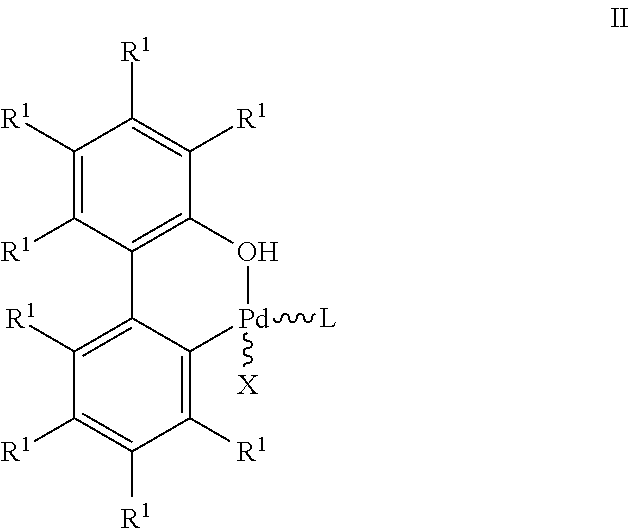
- the invention relates to a precatalyst of formula II
- X is a non-coordinating anion
- R 1 is H, alkyl, haloalkyl, hydroxy, alkoxy, aryloxy, aryl, or halo;
- L is a trialkylphosphine, triarylphosphine, dialkylarylphosphine, alkyldiarylphosphine, bis(phosphine), phosphoramide, amine, bis(amine), or N-heterocyclic carbene.
- the invention relates to a precatalyst of formula III
- X is a non-coordinating anion
- R 1 is H, alkyl, haloalkyl, hydroxy, alkoxy, aryloxy, aryl, or halo;
- L is a trialkylphosphine, triarylphosphine, dialkylarylphosphine, alkyldiarylphosphine, bis(phosphine), phosphoramide, amine, bis(amine), or N-heterocyclic carbene; and
- R 2 is alkyl, haloalkyl or aryl.
- the invention relates to a precatalyst of formula VII
- X is a non-coordinating anion
- R 1 is H, alkyl, haloalkyl, hydroxy, alkoxy, aryloxy, aryl, or halo;
- L is a trialkylphosphine, triarylphosphine, dialkylarylphosphine, alkyldiarylphosphine, bis(phosphine), phosphoramide, amine, bis(amine), or N-heterocyclic carbene; and
- R y is H, alkyl, haloalkyl or aryl.
- the invention relates to any one of the aforementioned precatalysts, wherein X is selected from the group consisting of boron tetrafluoride, tetraarylborates (such as B(C 6 F 5 ) 4 ⁇ and (B[3,5-(CF 3 ) 2 C 6 H 3 ] 4 ) ⁇ ), hexafluoroantimonate, phosphorus tetrafluoride, phosphorus hexafluoride, alkylsulfonate, haloalkylsulfonate, arylsulfonate, perchlorate, bis(alkylsulfonyl)amide, bis(fluoroalkylsulfonyl)amide, bis(arylsulfonyl)amide, (fluoroalkylsulfonyl)(fluoroalkylcarbonyl)amide, nitrate, nitrite, sulfate, hydrogensulf
- the invention relates to a dimer of formula IX
- X is a non-coordinating anion
- R 1 is H, alkyl, haloalkyl, hydroxy, alkoxy, aryloxy, aryl, or halo.
- the invention relates to a dimer of formula X
- X is a non-coordinating anion
- R 1 is H, alkyl, haloalkyl, hydroxy, alkoxy, aryloxy, aryl, or halo.
- the invention relates to a dimer of formula XI
- X is a non-coordinating anion
- R 1 is H, alkyl, haloalkyl, hydroxy, alkoxy, aryloxy, aryl, or halo;
- R 2 is alkyl, haloalkyl or aryl.
- the invention relates to a dimer of formula XV
- X is a non-coordinating anion
- R 1 is H, alkyl, haloalkyl, hydroxy, alkoxy, aryloxy, aryl, or halo;
- R y is H, alkyl, haloalkyl or aryl.
- the invention relates to any one of the aforementioned dimers
- X is selected from the group consisting of boron tetrafluoride, tetraarylborates (such as B(C 6 F 5 ) 4 ⁇ and (B[3,5-(CF 3 ) 2 C 6 H 3 ] 4 ) ⁇ ), hexafluoroantimonate, phosphorus tetrafluoride, phosphorus hexafluoride, alkylsulfonate, haloalkylsulfonate, arylsulfonate, perchlorate, bis(alkylsulfonyl)amide, bis(fluoroalkylsulfonyl)amide, bis(arylsulfonyl)amide, (fluoroalkylsulfonyl)(fluoroalkylcarbonyl)amide, nitrate, nitrite, sulfate, hydrogensulfate, alkyl sulfate, aryl sulfate, carbonate, bicarbon
- FIG. 1 depicts two known precatalysts.
- the stereochemistry at Pd in the precatalysts is cis or trans.
- FIG. 2 depicts a palladium sulfonate dimer of the invention.
- the stereochemistry at Pd in the dimer is cis or trans.
- FIG. 3 depicts a palladium sulfonate dimer of the invention.
- the stereochemistry at Pd in the dimer is cis or trans.
- FIG. 4 depicts a palladium sulfonate dimer of the invention.
- the stereochemistry at Pd in the dimer is cis or trans.
- FIG. 5 depicts a palladium sulfonate dimer of the invention.
- the stereochemistry at Pd in the dimer is cis or trans.
- FIG. 6 depicts a general procedure to synthesize a 2-aminobiphenylpalladium mesylate precatalyst of the invention from a palladium sulfonate dimer of the invention.
- the stereochemistry at Pd in the precatalyst and in the dimer is cis or trans.
- FIG. 7 depicts an exemplary synthesis of a 2-aminobiphenylpalladium mesylate precatalyst from a palladium sulfonate dimer of the invention.
- the stereochemistry at Pd in the precatalyst and in the dimer is cis or trans.
- FIG. 8 tabulates as function of the ligand used the yields of various 2-aminobiphenylpalladium mesylate precatalysts of the invention formed from the corresponding palladium sulfonate dimer.
- FIG. 9 depicts an exemplary synthesis of a 2-aminobiphenylpalladium triflate precatalyst from a palladium triflate dimer of the invention.
- the stereochemistry at Pd in the precatalyst and in the dimer is cis or trans.
- FIG. 11 depicts various ligands that may be used to prepare the precatalysts of the invention.
- FIG. 12 depicts two palladium sulfonate dimers of the invention.
- the stereochemistry at Pd in the dimers is cis or trans.
- FIG. 13 depicts an exemplary synthesis of a 2-aminobiphenylpalladium sulfonate precatalyst from [1,1′-biphenyl]-2-amine.
- the stereochemistry at Pd in the precatalyst and in the dimer is cis or trans.
- FIG. 14 depicts the arylation of primary amines using a precatalyst of the invention.
- Reaction conditions aryl chloride (1 mmol), amine (1.2 mmol), NaOt-Bu, (1.2 mmol), OMsBrettPhos precatalyst (0.01-0.5%), BrettPhos ligand (0.01-0.5%), dioxane (1 mL) 100° C.;
- b aryl iodide (1 mmol), amine (1.4 mmol), NaOt-Bu, (1.4 mmol), toluene (1 mL) 100° C.;
- c Cs 2 CO 3 was used as the base;
- d t-BuOH was used as the solvent.
- Yields represent an average isolated yield based on at least two runs.
- FIG. 15 depicts the arylation of secondary amines using a precatalyst of the invention. Reaction conditions: aryl chloride (1 mmol), amine (1.2 mmol), NaOt-Bu, (1.2 mmol), THF (1 mL) 85° C.; b OMsXPhos precatalyst and XPhos was used; c ArBr was used. Yields represent an average isolated yield based on two runs.
- FIG. 16 depicts Suzuki-Miyaura coupling of unstable boronic acids using a precatalyst of the invention. Reaction conditions: aryl chloride (1 mmol), boronic acid (1.5 mmol), precatalyst (2%), THF (2 mL), 0.5 M K 3 PO 4 (4 mL). Yields represent an average isolated yield based on two runs.
- FIG. 17 depicts the arylation of primary amides using a precatalyst of the invention. Reaction conditions: aryl chloride (1 mmol), amide (1.2 mmol), K 3 PO 4 (1.4 mmoll), precatalyst (1 mol %), tBuOH (2 mL), 110° C., 1.5 h. Yield represents an average isolated yield based on two runs.
- FIG. 18 depicts the fluorination of aryl triflates using a precatalyst of the invention. Reaction conditions: aryl triflate (1 mmol), cesium fluoride (2 mmol), toluene (5 mL) 130° C.; b cyclohexane (5 mL), 120° C. Yield represents an average isolated yield based on two runs.
- FIG. 19 depicts an exemplary synthesis of a 2-aminobiphenylpalladium hexafluorophosphate precatalyst from a dimer.
- the stereochemistry at Pd in the precatalyst and in the dimer is cis or trans.
- FIG. 20 depicts an exemplary synthesis of a 2-aminobiphenylpalladium tetrafluoroborate precatalyst from a dimer.
- the stereochemistry at Pd in the precatalyst and in the dimer is cis or trans.
- FIG. 21 depicts an exemplary synthesis of a precatalyst from N-phenyl-[1,1′-biphenyl]-2-amine.
- the stereochemistry at Pd in the precatalyst and in the dimer is cis or trans.
- FIG. 22 depicts an exemplary synthesis of various precatalysts of the invention.
- the stereochemistry at Pd in the precatalyst and in the dimer is cis or trans.
- FIG. 23 depicts the amidation of aryl chlorides using a precatalyst of the invention. Reaction conditions: K 3 PO 4 and 1% precatalyst, in tBuOH at 110° C.
- FIG. 24 depicts the fluorination of aryl triflates using a precatalyst of the invention.
- FIG. 25 depicts the arylation of phenols using a precatalyst of the invention.
- FIG. 26 depicts the arylation of alcohols using a precatalyst of the invention.
- FIG. 27 depicts the trifluoromethylation of aryl triflates and an aryl chloride using precatalysts of the invention.
- the invention relates to a palladium sulfonate precatalyst.
- the synthesis of the precatalysts may be easily accomplished from commercially available starting materials.
- the precatalysts incorporate any of a wide range of phosphine ligands.
- the precatalysts are markedly stable in solution. In certain embodiments, the precatalysts are stable in solution for greater than about one month.
- the invention relates to a precatalyst of formula I
- X is a non-coordinating anion
- R 1 is H, alkyl, haloalkyl, hydroxy, alkoxy, aryloxy, aryl, or halo;
- L is a trialkylphosphine, triarylphosphine, dialkylarylphosphine, alkyldiarylphosphine, bis(phosphine), phosphoramide, amine, bis(amine), or N-heterocyclic carbene.
- the invention relates to a precatalyst of formula II
- X is a non-coordinating anion
- R 1 is H, alkyl, haloalkyl, hydroxy, alkoxy, aryloxy, aryl, or halo;
- L is a trialkylphosphine, triarylphosphine, dialkylarylphosphine, alkyldiarylphosphine, bis(phosphine), phosphoramide, amine, bis(amine), or N-heterocyclic carbene.
- the invention relates to a precatalyst of formula III
- X is a non-coordinating anion
- R 1 is H, alkyl, haloalkyl, hydroxy, alkoxy, aryloxy, aryl, or halo;
- L is a trialkylphosphine, triarylphosphine, dialkylarylphosphine, alkyldiarylphosphine, bis(phosphine), phosphoramide, amine, bis(amine), or N-heterocyclic carbene; and
- R 2 is alkyl, haloalkyl or aryl.
- the invention relates to a precatalyst of formula IV
- X is a non-coordinating anion
- L is a trialkylphosphine, triarylphosphine, dialkylarylphosphine, alkyldiarylphosphine, bis(phosphine), phosphoramide, amine, bis(amine), or N-heterocyclic carbene.
- the invention relates to a precatalyst of formula V
- X is a non-coordinating anion
- L is a trialkylphosphine, triarylphosphine, dialkylarylphosphine, alkyldiarylphosphine, bis(phosphine), phosphoramide, amine, bis(amine), or N-heterocyclic carbene.
- the invention relates to a precatalyst of formula VI
- X is a non-coordinating anion
- L is a trialkylphosphine, triarylphosphine, dialkylarylphosphine, alkyldiarylphosphine, bis(phosphine), phosphoramide, amine, bis(amine), or N-heterocyclic carbene; and
- R 2 is alkyl, haloalkyl or aryl.
- the invention relates to a precatalyst of formula VII
- X is a non-coordinating anion
- R 1 is H, alkyl, haloalkyl, hydroxy, alkoxy, aryloxy, aryl, or halo;
- L is a trialkylphosphine, triarylphosphine, dialkylarylphosphine, alkyldiarylphosphine, bis(phosphine), phosphoramide, amine, bis(amine), or N-heterocyclic carbene; and
- R y is H, alkyl, haloalkyl or aryl.
- the invention relates to a precatalyst of formula VIII
- X is a non-coordinating anion
- L is a trialkylphosphine, triarylphosphine, dialkylarylphosphine, alkyldiarylphosphine, bis(phosphine), phosphoramide, amine, bis(amine), or N-heterocyclic carbene; and
- R y is H, alkyl, haloalkyl or aryl.
- the invention relates to a precatalyst of any one of formulae I, II, III, IV, V, VI, VII, or VIII, wherein L is a ligand described in U.S. Pat. No. 7,858,784, which is hereby incorporated by reference in its entirety.
- the invention relates to a precatalyst of any one of formulae I, II, III, IV, V, VI, VII, or VIII, wherein L is a ligand described in U.S. Patent Application Publication No. 2011/0015401, which is hereby incorporated by reference in its entirety.
- the invention relates to a precatalyst of any one of formulae I, II, III, IV, V, VI, VII, or VIII, wherein L is selected from the group consisting of
- TEDA tetramethylethylenediamine
- the invention relates to a precatalyst of any one of formulae I, II, III, IV, V, VI, VII, or VIII, wherein L is
- R 3 is H or alkyl.
- the invention relates to any one of the aforementioned precatalysts, wherein L is selected from the group consisting of PPh 3 , Ph 2 P—CH 3 , PhP(CH 3 ) 2 , P(o-tol) 3 , PCy 3 , P(tBu) 3 , BINAP, dppb, dppe, dppf, dppp,
- R x is alkyl, aralkyl, cycloalkyl, or aryl
- X 1 is CH or N
- R 3 is H or alkyl
- R 4 is H, alkoxy, or alkyl
- R 5 is alkyl or aryl
- n 1, 2, 3, or 4.
- the invention relates to any one of the aforementioned precatalysts, wherein X is selected from the group consisting of boron tetrafluoride, tetraarylborates (such as B(C 6 F 5 ) 4 ⁇ and (B[3,5-(CF 3 ) 2 C 6 H 3 ] 4 ) ⁇ ), hexafluoroantimonate, phosphorus tetrafluoride, phosphorus hexafluoride, alkylsulfonate, haloalkylsulfonate, arylsulfonate, perchlorate, bis(alkylsulfonyl)amide, bis(fluoroalkylsulfonyl)amide, bis(arylsulfonyl)amide, (fluoroalkylsulfonyl)(fluoroalkylcarbonyl)amide, nitrate, nitrite, sulfate, hydrogensulf
- the invention relates to any one of the aforementioned precatalysts, wherein X is alkylsulfonate; and the alkyl is substituted alkyl. In certain embodiments, the invention relates to any one of the aforementioned precatalysts, wherein X is alkylsulfonate; and the alkyl is unsubstituted alkyl.
- the invention relates to any one of the aforementioned precatalysts, wherein X is alkylsulfonate; and the alkyl is methyl, ethyl, propyl, or butyl. In certain embodiments, the invention relates to any one of the aforementioned precatalysts, wherein X is alkylsulfonate; and the alkyl is methyl or ethyl.
- the invention relates to any one of the aforementioned precatalysts, wherein X is haloalkylsulfonate. In certain embodiments, the invention relates to any one of the aforementioned precatalysts, wherein X is fluoroalkylsulfonate.
- the invention relates to any one of the aforementioned precatalysts, wherein X is fluoromethylsulfonate. In certain embodiments, the invention relates to any one of the aforementioned precatalysts, wherein X is trifluoromethylsulfonate.
- the invention relates to any one of the aforementioned precatalysts, wherein X is cycloalkylalkylsulfonate. In certain embodiments, the invention relates to any one of the aforementioned precatalysts, wherein X is
- the invention relates to any one of the aforementioned precatalysts, wherein X is arylsulfonate; and the aryl is substituted aryl. In certain embodiments, the invention relates to any one of the aforementioned precatalysts, wherein X is arylsulfonate; and the aryl is unsubstituted aryl.
- the invention relates to any one of the aforementioned precatalysts, wherein X is phenylsulfonate. In certain embodiments, the invention relates to any one of the aforementioned precatalysts, wherein X is methylphenylsulfonate. In certain embodiments, the invention relates to any one of the aforementioned precatalysts, wherein X is p-toluenesulfonate.
- the invention relates to any one of the aforementioned precatalysts, wherein R 1 is H or alkyl. In certain embodiments, the invention relates to any one of the aforementioned precatalysts, wherein R 1 is H.
- the invention relates to any one of the aforementioned precatalysts, wherein R 2 is substituted alkyl. In certain embodiments, the invention relates to any one of the aforementioned precatalysts, wherein R 2 is unsubstituted alkyl.
- the invention relates to any one of the aforementioned precatalysts, wherein R 2 is methyl, ethyl, propyl, or butyl.
- the invention relates to any one of the aforementioned precatalysts, wherein R 2 is substituted aryl. In certain embodiments, the invention relates to any one of the aforementioned precatalysts, wherein R 2 is unsubstituted aryl.
- the invention relates to any one of the aforementioned precatalysts, wherein R 2 is phenyl.
- the invention relates to a compound selected from the group consisting of:
- L is selected from the group consisting of PPh 3 , P(o-tol) 3 , PCy 3 , P(tBu) 3 , BINAP, dppf, dppp,
- the invention relates to a compound of the following structure:
- L is selected from the group consisting of PPh 3 , P(o-tol) 3 , PCy 3 , P(tBu) 3 , BINAP, dppf, dppp,
- the invention relates to a compound of the following structure:
- L is selected from the group consisting of
- the invention relates to a compound of any one of the following structures:
- R is H, alkyl, or aryl
- L is any one of the aforementioned ligands.
- the invention relates to a compound of any one of the following structures:
- R is H, alkyl, or aryl
- L is any one of the aforementioned ligands.
- the invention relates to a compound of any one of the following structures:
- R is H, alkyl, or aryl
- L is any one of the aforementioned ligands.
- the invention relates to a dimer of formula IX
- X is a non-coordinating anion
- R 1 is H, alkyl, haloalkyl, hydroxy, alkoxy, aryloxy, aryl, or halo.
- the invention relates to a dimer of formula X
- X is a non-coordinating anion
- R 1 is H, alkyl, haloalkyl, hydroxy, alkoxy, aryloxy, aryl, or halo.
- the invention relates to a dimer of formula XI
- X is a non-coordinating anion
- R 1 is H, alkyl, haloalkyl, hydroxy, alkoxy, aryloxy, aryl, or halo;
- R 2 is alkyl, haloalkyl or aryl.
- the invention relates to a dimer of formula XII
- X is a non-coordinating anion
- the invention relates to a dimer of formula XIII
- X is a non-coordinating anion
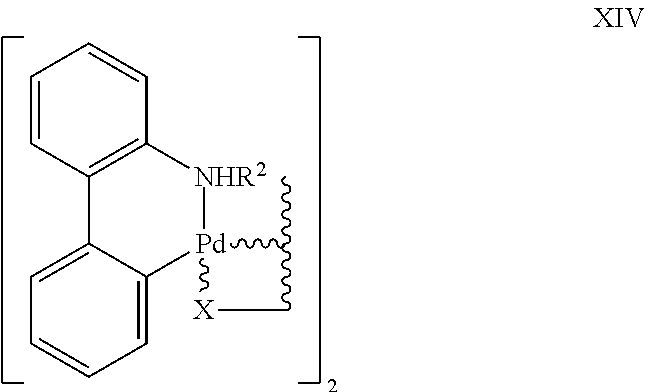
- the invention relates to a dimer of formula XIV
- X is a non-coordinating anion
- R 2 is alkyl, haloalkyl or aryl.
- the invention relates to a dimer of formula XV
- X is a non-coordinating anion
- R 1 is H, alkyl, haloalkyl, hydroxy, alkoxy, aryloxy, aryl, or halo;
- R y is H, alkyl, haloalkyl or aryl.
- the invention relates to a dimer of formula XVI
- X is a non-coordinating anion
- R y is H, alkyl, haloalkyl or aryl.
- the invention relates to any one of the aforementioned dimers, wherein X is selected from the group consisting of boron tetrafluoride, tetraarylborates (such as B(C 6 F 5 ) 4 ⁇ and (B[3,5-(CF 3 ) 2 C 6 H 3 ] 4 ) ⁇ ), hexafluoroantimonate, phosphorus tetrafluoride, phosphorus hexafluoride, alkylsulfonate, haloalkylsulfonate, arylsulfonate, perchlorate, bis(alkylsulfonyl)amide, bis(fluoroalkylsulfonyl)amide, bis(arylsulfonyl)amide, (fluoroalkylsulfonyl)(fluoroalkylcarbonyl)amide, nitrate, nitrite, sulfate, hydrogensulfate, alkyl
- the invention relates to any one of the aforementioned dimers, wherein X is alkylsulfonate; and the alkyl is substituted alkyl. In certain embodiments, the invention relates to any one of the aforementioned dimers, wherein X is alkylsulfonate; and the alkyl is unsubstituted alkyl.
- the invention relates to any one of the aforementioned dimers, wherein X is alkylsulfonate; and the alkyl is methyl, ethyl, propyl, or butyl. In certain embodiments, the invention relates to any one of the aforementioned dimers, wherein X is alkylsulfonate; and the alkyl is methyl or ethyl.
- the invention relates to any one of the aforementioned dimers, wherein X is haloalkylsulfonate. In certain embodiments, the invention relates to any one of the aforementioned dimers, wherein X is fluoroalkylsulfonate.
- the invention relates to any one of the aforementioned dimers, wherein X is fluoromethylsulfonate. In certain embodiments, the invention relates to any one of the aforementioned dimers, wherein X is trifluoromethylsulfonate.
- the invention relates to any one of the aforementioned dimers, wherein X is cycloalkylalkylsulfonate. In certain embodiments, the invention relates to any one of the aforementioned dimers, wherein X is
- the invention relates to any one of the aforementioned dimers, wherein X is arylsulfonate; and the aryl is substituted aryl. In certain embodiments, the invention relates to any one of the aforementioned dimers, wherein X is arylsulfonate; and the aryl is unsubstituted aryl.
- the invention relates to any one of the aforementioned dimers, wherein X is phenylsulfonate. In certain embodiments, the invention relates to any one of the aforementioned dimers, wherein X is methylphenylsulfonate. In certain embodiments, the invention relates to any one of the aforementioned dimers, wherein X is p-toluenesulfonate.
- the invention relates to any one of the aforementioned dimers, wherein R 1 is H or alkyl. In certain embodiments, the invention relates to any one of the aforementioned dimers, wherein R 1 is H.
- the invention relates to any one of the aforementioned dimers, wherein R 2 is substituted alkyl. In certain embodiments, the invention relates to any one of the aforementioned dimers, wherein R 2 is unsubstituted alkyl.
- the invention relates to any one of the aforementioned dimers, wherein R 2 is methyl, ethyl, propyl, or butyl.
- the invention relates to any one of the aforementioned dimers, wherein R 2 is substituted aryl. In certain embodiments, the invention relates to any one of the aforementioned dimers, wherein R 2 is unsubstituted aryl.
- the invention relates to any one of the aforementioned dimers, wherein R 2 is phenyl.
- the invention relates to a method of Scheme 1:
- the precatalyst is any one of the aforementioned precatalysts
- Ar is aryl or heteroaryl
- q 0, 1, 2, 3, or 4;
- R 6 is alkoxy, alkyl ester, alkylcarbonyl, hydroxyalkyl, cyano, halo, amino, cycloalkyl, aryl, haloalkyl, nitro, hydroxy, alkoxy, aryloxy, or alkyl;
- R 7 is aryl, heteroaryl, aralkyl, heteroaralkyl, alkyl, cycloalkyl.
- the invention relates to any one of the aforementioned methods, wherein temperature 1 is from about 50° C. to about 150° C. In certain embodiments, the invention relates to any one of the aforementioned methods, wherein temperature 1 is about 55° C., about 60° C., about 65° C., about 70° C., about 75° C., about 80° C., about 85° C., about 90° C., about 95° C., about 100° C., about 105° C., about 110° C., about 115° C., about 120° C., about 125° C., about 130° C., about 135° C., about 140° C., or about 145° C.
- the invention relates to a method of Scheme 2:
- the precatalyst is any one of the aforementioned precatalysts
- Ar is aryl or heteroaryl
- q 0, 1, 2, 3, or 4;
- R 6 is alkoxy, alkyl ester, alkylcarbonyl, hydroxyalkyl, cyano, halo, amino, cycloalkyl, aryl, haloalkyl, nitro, hydroxy, alkoxy, aryloxy, or alkyl;
- R 7 is alkyl, aralkyl, aryl, or heteroaryl
- R 8 is alkyl, aralkyl, aryl, or heteroaryl, or, R 7 and R 8 , taken together, form a cycloalkyl or heterocycloalkyl ring;
- the invention relates to any one of the aforementioned methods, wherein temperature 2 is from about 40° C. to about 120° C. In certain embodiments, the invention relates to any one of the aforementioned methods, wherein temperature 2 is about 45° C., about 50° C., about 55° C., about 60° C., about 65° C., about 70° C., about 75° C., about 80° C., about 85° C., about 90° C., about 95° C., about 100° C., about 105° C., about 110° C., or about 115° C.
- the invention relates to a method of Scheme 3:
- the precatalyst is any one of the aforementioned precatalysts
- Ar is aryl or heteroaryl
- q 0, 1, 2, 3, or 4;
- R 6 is alkoxy, alkyl ester, alkylcarbonyl, hydroxyalkyl, cyano, halo, amino, cycloalkyl, aryl, haloalkyl, nitro, hydroxy, alkoxy, aryloxy, or alkyl;
- Ar 1 is aryl or heteroaryl.
- the invention relates to any one of the aforementioned methods, wherein temperature 3 is from about 10° C. to about 60° C. In certain embodiments, the invention relates to any one of the aforementioned methods, wherein temperature 3 is about 15° C., about 20° C., about 25° C., about 30° C., about 35° C., about 40° C., about 45° C., or about 50° C.
- the invention relates to a method of Scheme 4:
- the precatalyst is any one of the aforementioned precatalysts
- q 0, 1, 2, 3, or 4;
- R 6 is alkoxy, alkyl ester, alkylcarbonyl, hydroxyalkyl, cyano, halo, amino, cycloalkyl, aryl, haloalkyl, nitro, hydroxy, alkoxy, aryloxy, or alkyl;
- R 9 is aralkyl, heteroaralkyl, aryl, heteroaryl, or cycloalkyl.
- the invention relates to any one of the aforementioned methods, wherein temperature 4 is from about 60° C. to about 160° C. In certain embodiments, the invention relates to any one of the aforementioned methods, wherein temperature 4 is about 65° C., about 70° C., about 75° C., about 80° C., about 85° C., about 90° C., about 95° C., about 100° C., about 105° C., about 110° C., about 115° C., about 120° C., about 125° C., about 130° C., about 135° C., about 140° C., about 145° C., about 150° C., or about 155° C.
- the invention relates to a method of Scheme 5:
- the precatalyst is any one of the aforementioned precatalysts
- q 0, 1, 2, 3, or 4;
- R 6 is alkoxy, alkyl ester, alkylcarbonyl, hydroxyalkyl, cyano, halo, amino, cycloalkyl, aryl, haloalkyl, nitro, hydroxy, alkoxy, aryloxy, or alkyl.
- the invention relates to any one of the aforementioned methods, wherein temperature 5 is from about 70° C. to about 190° C. In certain embodiments, the invention relates to any one of the aforementioned methods, wherein temperature 5 is about 75° C., about 80° C., about 85° C., about 90° C., about 95° C., about 100° C., about 105° C., about 110° C., about 115° C., about 120° C., about 125° C., about 130° C., about 135° C., about 140° C., about 145° C., about 150° C., about 155° C., about 160° C., about 165° C., about 170° C., about 175° C., or about 180° C.
- the invention relates to a method of Scheme 8:
- the precatalyst is any one of the aforementioned precatalysts
- X 2 is halo
- Ar 1 is aryl or heteroaryl
- Ar 2 is aryl or heteroaryl, which is optionally substituted with 1, 2, 3, or 4 R 11 ;
- q 0, 1, 2, 3, or 4;
- R 6 is alkoxy, alkyl ester, alkylcarbonyl, hydroxyalkyl, cyano, halo, amino, cycloalkyl, aryl, haloalkyl, nitro, hydroxy, alkoxy, aryloxy, or alkyl;
- R 11 is alkoxy, alkyl ester, alkylcarbonyl, hydroxyalkyl, cyano, halo, amino, cycloalkyl, aryl, haloalkyl, nitro, hydroxy, alkoxy, aryloxy, alkyl, alkylthio, or cyanoalkyl.
- the invention relates to any one of the aforementioned methods, wherein temperature 8 is from about 10° C. to about 90° C. In certain embodiments, the invention relates to any one of the aforementioned methods, wherein temperature 8 is about 10° C., about 15° C., about 20° C., about 25° C., about 30° C., about 35° C., about 40° C., about 45° C., about 50° C., about 55° C., about 60° C., about 65° C., about 70° C., about 75° C., about 80° C., about 85° C., or about 90° C.
- the invention relates to a method of Scheme 9:
- the precatalyst is any one of the aforementioned precatalysts
- X 2 is halo
- Ar 1 is aryl or heteroaryl
- q 0, 1, 2, 3, or 4;
- R 6 is alkoxy, alkyl ester, alkylcarbonyl, hydroxyalkyl, cyano, halo, amino, cycloalkyl, aryl, haloalkyl, nitro, hydroxy, alkoxy, aryloxy, or alkyl;
- R 12 is alkyl or substituted alkyl (including but not liminted to aralkyl, fluoroalkylalkyl, or cycloalkylalkyl).
- the invention relates to any one of the aforementioned methods, wherein temperature 9 is from about 50° C. to about 160° C. In certain embodiments, the invention relates to any one of the aforementioned methods, wherein temperature 9 is about 50° C., about 55° C., about 60° C., about 65° C., about 70° C., about 75° C., about 80° C., about 85° C., about 90° C., about 95° C., about 100° C., about 105° C., about 110° C., about 115° C., about 120° C., about 125° C., about 130° C., about 135° C., about 140° C., about 145° C., about 150° C., about 155° C., or about 160° C.
- the invention relates to a method of Scheme 10:
- the precatalyst is any one of the aforementioned precatalysts
- X 3 is halo, triflate, or mesylate
- Ar 1 is aryl or heteroaryl
- q 0, 1, 2, 3, or 4;
- R 6 is alkoxy, alkyl ester, alkylcarbonyl, hydroxyalkyl, cyano, halo, amino, cycloalkyl, aryl, haloalkyl, nitro, hydroxy, alkoxy, aryloxy, or alkyl.
- the invention relates to any one of the aforementioned methods, wherein temperature 10 is from about 50° C. to about 160° C. In certain embodiments, the invention relates to any one of the aforementioned methods, wherein temperature 10 is about 50° C., about 55° C., about 60° C., about 65° C., about 70° C., about 75° C., about 80° C., about 85° C., about 90° C., about 95° C., about 100° C., about 105° C., about 110° C., about 115° C., about 120° C., about 125° C., about 130° C., about 135° C., about 140° C., about 145° C., about 150° C., about 155° C., or about 160° C.
- the invention relates to any one of the aforementioned methods, wherein base 1, base 2, base 3, base 4, base 8, or base 9 comprises t-butoxy, carbonate, or phosphate.
- the invention relates to any one of the aforementioned methods, wherein base 1, base 2, base 3, base 4, base 8, or base 9 is NaOt-Bu, Cs 2 CO 3 , K 2 CO 3 , or K 3 PO 4 .
- the invention relates to any one of the aforementioned methods, wherein solvent 1, solvent 2, solvent 3, or solvent 4 is a non-polar solvent or a polar aprotic solvent.
- the invention relates to any one of the aforementioned methods, wherein solvent 1, solvent 2, solvent 3, or solvent 4 is an ether or an alcohol.
- the invention relates to any one of the aforementioned methods, wherein solvent 1, solvent 2, solvent 3, or solvent 4 comprises dioxane, tetrahydrofuran, water, or tBuOH.
- the invention relates to any one of the aforementioned methods, wherein solvent 5 or solvent 9 is a non-polar solvent.
- the invention relates to any one of the aforementioned methods, wherein solvent 5 or solvent 9 comprises toluene.
- the invention relates to any one of the aforementioned methods, wherein solvent 8 is a non-polar solvent.
- the invention relates to any one of the aforementioned methods, wherein solvent 8 comprises toluene. In certain embodiments, the invention relates to any one of the aforementioned methods, wherein solvent 8 comprises toluene and dimethoxyether.
- the invention relates to any one of the aforementioned methods, wherein solvent 10 comprises dioxane and toluene. In certain embodiments, the invention relates to any one of the aforementioned methods, wherein solvent 10 comprises dioxane and toluene in a 1:1 ratio.
- the invention relates to any one of the aforementioned methods,
- precatalyst is present in an amount from about 0.005 mol % to about 10 mol %.
- the invention relates to any one of the aforementioned methods, wherein the precatalyst is present in about 0.005 mol %, about 0.01 mol %, about 0.05 mol %, about 0.1 mol %, about 0.5 mol %, about 1 mol %, about 2 mol %, about 3 mol %, about 4 mol %, or about 5 mol %.
- the invention relates to any one of the aforementioned methods, wherein L is present in an amount from about 0.005 mol % to about 10 mol %.
- the invention relates to any one of the aforementioned methods, wherein L is present in about 0.005 mol %, about 0.01 mol %, about 0.05 mol %, about 0.1 mol %, about 0.5 mol %, about 1 mol %, about 2 mol %, about 3 mol %, about 4 mol %, or about 5 mol %.
- the invention relates to a method of making any one of the aforementioned dimers, according to Scheme 6a
- X is a non-coordinating anion
- the invention relates to a method of making any one of the aforementioned dimers, according to Scheme 6b
- X is a non-coordinating anion
- the invention relates to a method of making any one of the aforementioned dimers, according to Scheme 6c
- X is a non-coordinating anion
- the invention relates to any one of the aforementioned methods, wherein the Pd(II) source is Pd(OAc) 2 .
- the invention relates to any one of the aforementioned methods, wherein the solvent is a non-polar solvent or a polar aprotic solvent. In certain embodiments, the invention relates to any one of the aforementioned methods, wherein the solvent is toluene. In certain embodiments, the invention relates to any one of the aforementioned methods, wherein the solvent is THF.
- the invention relates to any one of the aforementioned methods, wherein the reaction takes place at from about 25° C. to about 75° C. In certain embodiments, the invention relates to any one of the aforementioned methods, wherein the reaction takes place at about 25° C., about 30° C., about 35° C., about 40° C., about 45° C., about 50° C., about 55° C., about 60° C., about 65° C., about 70° C., or about 75° C.
- the invention relates to any one of the aforementioned methods, wherein the reaction is substantially complete after about 30 min, about 35 min, about 40 min, about 45 min, about 50 min, about 55 min, or about 60 min.
- the invention relates to a method of making any one of the aforementioned precatalysts, according to Scheme 7
- X is a non-coordinating anion
- L is a ligand as defined above.
- the invention relates to any one of the aforementioned methods,
- the solvent is a polar aprotic solvent.
- the invention relates to any one of the aforementioned methods, wherein the solvent is THF or CH 2 Cl 2 .
- the invention relates to any one of the aforementioned methods, wherein the reaction takes place at from about 10° C. to about 40° C. In certain embodiments, the invention relates to any one of the aforementioned methods, wherein the reaction takes place at about 15° C., about 20° C., about 25° C., about 30° C., or about 35° C.
- the invention relates to any one of the aforementioned methods, wherein the reaction is substantially complete after about 10 min, about 15 min, about 20 min, about 25 min, about 30 min, about 35 min, about 40 min, about 45 min, about 50 min, about 55 min, about 60 min, about 65 min, about 70 min, about 75 min, about 80 min, about 85 min, or about 90 min.
- the invention relates to any one of the aforementioned methods, wherein the reaction is substantially complete after about 2 h, about 3 h, about 4 h, about 5 h, about 6 h, about 7 h, about 8 h, about 9 h, about 10 h, about 11 h, or about 12 h.
- reaction temperature influences the speed of the reaction, as well as the stability of the reactants and catalyst.
- the reactions will usually be run at temperatures in the range of 25° C. to 300° C., more preferably in the range 25° C. to 150° C.
- the subject reactions are carried out in a liquid reaction medium.
- the reactions may be run without addition of solvent.
- the reactions may be run in an inert solvent, preferably one in which the reaction ingredients, including the catalyst, are substantially soluble.
- Suitable solvents include ethers such as diethyl ether, 1,2-dimethoxyethane, diglyme, t-butyl methyl ether, tetrahydrofuran, water and the like; halogenated solvents such as chloroform, dichloromethane, dichloroethane, chlorobenzene, and the like; aliphatic or aromatic hydrocarbon solvents such as benzene, xylene, toluene, hexane, pentane and the like; esters and ketones such as ethyl acetate, acetone, and 2-butanone; polar aprotic solvents, such as acetonitrile, dimethylsulfoxide, dimethylformamide and the like; or combinations of
- the invention also contemplates reaction in a biphasic mixture of solvents, in an emulsion or suspension, or reaction in a lipid vesicle or bilayer. In certain embodiments, it may be preferred to perform the catalyzed reactions in the solid phase with one of the reactants or a ligand anchored to a solid support.
- the reaction processes of the present invention can be conducted in continuous, semi-continuous or batch fashion and may involve a liquid recycle operation as desired.
- the processes of this invention are preferably conducted in batch fashion.
- the manner or order of addition of the reaction ingredients, precatalyst and solvent are also not generally critical to the success of the reaction, and may be accomplished in any conventional fashion.
- the base e.g., t-BuONa
- the base is the last ingredient to be added to the reaction mixture.
- the reaction can be conducted in a single reaction zone or in a plurality of reaction zones, in series or in parallel or it may be conducted batchwise or continuously in an elongated tubular zone or series of such zones.
- the materials of construction employed should be inert to the starting materials during the reaction and the fabrication of the equipment should be able to withstand the reaction temperatures and pressures.
- Means to introduce and/or adjust the quantity of starting materials or ingredients introduced batchwise or continuously into the reaction zone during the course of the reaction can be conveniently utilized in the processes especially to maintain the desired molar ratio of the starting materials.
- the reaction steps may be effected by the incremental addition of one of the starting materials to the other. Also, the reaction steps can be combined by the joint addition of the starting materials to the metal catalyst. When complete conversion is not desired or not obtainable, the starting materials can be separated from the product and then recycled back into the reaction zone.
- the processes may be conducted in either glass-lined, stainless steel or similar type reaction equipment.
- the reaction zone may be fitted with one or more internal and/or external heat exchanger(s) in order to control undue temperature fluctuations, or to prevent any possible “runaway” reaction temperatures.
- one or more of the reactants can be immobilized or incorporated into a polymer or other insoluble matrix by, for example, derivativation with one or more of substituents of the aryl group.
- alkyl refers to the radical of saturated aliphatic groups, including straight-chain alkyl groups, branched-chain alkyl groups, cycloalkyl (alicyclic) groups, alkyl substituted cycloalkyl groups, and cycloalkyl substituted alkyl groups.
- a straight chain or branched chain alkyl has 30 or fewer carbon atoms in its backbone (e.g., C 1 -C 30 for straight chain, C 3 -C 30 for branched chain), and more preferably 20 or fewer.
- preferred cycloalkyls have from 3-10 carbon atoms in their ring structure, and more preferably have 5, 6 or 7 carbons in the ring structure.
- aralkyl refers to an alkyl group substituted with an aryl group (e.g., an aromatic or heteroaromatic group).
- lower alkyl as used herein means an alkyl group, as defined above, but having from one to ten carbons, more preferably from one to six carbon atoms in its backbone structure.
- lower alkenyl and “lower alkynyl” have similar chain lengths but with at least two carbon atoms.
- Preferred alkyl groups are lower alkyls.
- a substituent designated herein as alkyl is a lower alkyl.
- aryl as used herein includes 5-, 6- and 7-membered aromatic groups that may include from zero to four heteroatoms, for example, benzene, naphthalene, anthracene, pyrene, pyrrole, furan, thiophene, imidazole, oxazole, thiazole, triazole, pyrazole, pyridine, pyrazine, pyridazine and pyrimidine, and the like.
- aryl heterocycles or “heteroaromatics”.
- the aromatic ring can be substituted at one or more ring positions with such substituents as described above, for example, halogen, azide, alkyl, aralkyl, alkenyl, alkynyl, cycloalkyl, hydroxyl, amino, nitro, sulfhydryl, imino, amido, phosphonate, phosphinate, carbonyl, carboxyl, silyl, ether, alkylthio, sulfonyl, sulfonamido, ketone, aldehyde, ester, heterocyclyl, aromatic or heteroaromatic moieties, —CF 3 , —CN, or the like.
- substituents as described above, for example, halogen, azide, alkyl, aralkyl, alkenyl, alkynyl, cycloalkyl, hydroxyl, amino, nitro, sulfhydryl, imino, amido, phosphonate,
- aryl also includes polycyclic ring systems having two or more cyclic rings in which two or more carbons are common to two adjoining rings (the rings are “fused rings”) wherein at least one of the rings is aromatic, e.g., the other cyclic rings can be cycloalkyls, cycloalkenyls, cycloalkynyls, aryls and/or heterocyclyls.
- Me, Et, Ph, Tf, Nf, Ts, Ms, and dba represent methyl, ethyl, phenyl, trifluoromethanesulfonyl, nonafluorobutanesulfonyl, p-toluenesulfonyl, methanesulfonyl, and dibenzylideneacetone, respectively.
- DCM dichloromethane
- rt room temperature, and may mean about 20° C., about 21° C., about 22° C., about 23° C., about 24° C., about 25° C., or about 26° C.
- THF stands for tetrahydrofuran
- BINAP 2,2′-bis(diphenylphosphino)-1,1′-binaphthyl
- dppf stands for 1,1′-bis(diphenylphosphino)ferrocene
- dppb stands for 1,4-bis(diphenylphosphinobutane
- dppp stands for 1,3-bis(diphenylphosphino)propane
- dppe stands for 1,2-bis(diphenylphosphino)ethane.
- ortho, meta and para apply to 1,2-, 1,3- and 1,4-disubstituted benzenes, respectively.
- 1,2-dimethylbenzene and ortho-dimethylbenzene are synonymous.
- heterocyclyl or “heterocyclic group” refer to 3- to 10-membered ring structures, more preferably 3- to 7-membered rings, whose ring structures include one to four heteroatoms. Heterocycles can also be polycycles.
- Heterocyclyl groups include, for example, thiophene, thianthrene, furan, pyran, isobenzofuran, chromene, xanthene, phenoxathiin, pyrrole, imidazole, pyrazole, isothiazole, isoxazole, pyridine, pyrazine, pyrimidine, pyridazine, indolizine, isoindole, indole, indazole, purine, quinolizine, isoquinoline, quinoline, phthalazine, naphthyridine, quinoxaline, quinazoline, cinnoline, pteridine, carbazole, carboline, phenanthridine, acridine, pyrimidine, phenanthroline, phenazine, phenarsazine, phenothiazine, furazan, phenoxazine, pyrrolidine, o
- the heterocyclic ring can be substituted at one or more positions with such substituents as described above, as for example, halogen, alkyl, aralkyl, alkenyl, alkynyl, cycloalkyl, hydroxyl, amino, nitro, sulfhydryl, imino, amido, phosphonate, phosphinate, carbonyl, carboxyl, silyl, ether, alkylthio, sulfonyl, ketone, aldehyde, ester, a heterocyclyl, an aromatic or heteroaromatic moiety, —CF 3 , —CN, or the like.
- substituents as described above, as for example, halogen, alkyl, aralkyl, alkenyl, alkynyl, cycloalkyl, hydroxyl, amino, nitro, sulfhydryl, imino, amido, phosphonate, phosphinate, carbonyl, carboxy
- non-coordinating anion relates to a negatively charged moiety that interacts weakly with cations.
- Non-coordinating anions are useful in studying the reactivity of electrophilic cations, and are commonly found as counterions for cationic metal complexes with an unsaturated coordination sphere.
- non-coordinating anions have a negative charge that is distributed symmetrically over a number of electronegative atoms. Salts of these anions are often soluble non-polar organic solvents, such as dichloromethane, toluene, or alkanes.
- polycyclyl or “polycyclic group” refer to two or more rings (e.g., cycloalkyls, cycloalkenyls, cycloalkynyls, aryls and/or heterocyclyls) in which two or more carbons are common to two adjoining rings, e.g., the rings are “fused rings”. Rings that are joined through non-adjacent atoms are termed “bridged” rings.
- Each of the rings of the polycycle can be substituted with such substituents as described above, as for example, halogen, alkyl, aralkyl, alkenyl, alkynyl, cycloalkyl, hydroxyl, amino, nitro, sulfhydryl, imino, amido, phosphonate, phosphinate, carbonyl, carboxyl, silyl, ether, alkylthio, sulfonyl, ketone, aldehyde, ester, a heterocyclyl, an aromatic or heteroaromatic moiety, —CF 3 , —CN, or the like.
- substituents as described above, as for example, halogen, alkyl, aralkyl, alkenyl, alkynyl, cycloalkyl, hydroxyl, amino, nitro, sulfhydryl, imino, amido, phosphonate, phosphinate, carbonyl, carboxyl, si
- heteroatom as used herein means an atom of any element other than carbon or hydrogen. Preferred heteroatoms are nitrogen, oxygen, sulfur and phosphorous.
- nitro means —NO 2 ;
- halogen designates —F, —Cl, —Br or —I;
- sulfhydryl means —SH;
- hydroxyl means —OH; and
- sulfonyl means —SO 2 —.
- amine and “amino” are art recognized and refer to both unsubstituted and substituted amines, e.g., a moiety that can be represented by the general formula:
- R 9 , R 10 and R′ 10 each independently represent a hydrogen, an alkyl, an alkenyl, —(CH 2 ) m —R 8 , or R 9 and R 10 taken together with the N atom to which they are attached complete a heterocycle having from 4 to 8 atoms in the ring structure;
- R 8 represents an aryl, a cycloalkyl, a cycloalkenyl, a heterocycle or a polycycle; and
- m is zero or an integer in the range of 1 to 8.
- only one of R 9 or R 10 can be a carbonyl, e.g., R 9 , R 10 and the nitrogen together do not form an imide.
- R 9 and R 10 each independently represent a hydrogen, an alkyl, an alkenyl, or —(CH 2 ) m —R 8 .
- alkylamine as used herein means an amine group, as defined above, having a substituted or unsubstituted alkyl attached thereto, i.e., at least one of R 9 and R 10 is an alkyl group.
- triflyl, tosyl, mesyl, and nonaflyl are art-recognized and refer to trifluoromethanesulfonyl, p-toluenesulfonyl, methanesulfonyl, and nonafluorobutanesulfonyl groups, respectively.
- triflate, tosylate, mesylate, and nonaflate are art-recognized and refer to trifluoromethanesulfonate ester, p-toluenesulfonate ester, methanesulfonate ester, and nonafluorobutanesulfonate ester functional groups and molecules that contain said groups, respectively.
- protecting group means temporary modifications of a potentially reactive functional group which protect it from undesired chemical transformations.
- protecting groups include esters of carboxylic acids, silyl ethers of alcohols, and acetals and ketals of aldehydes and ketones, respectively.
- the field of protecting group chemistry has been reviewed (Greene, T. W.; Wuts, P. G. M. Protective Groups in Organic Synthesis, 2 nd ed.; Wiley: New York, 1991).
- substitution or “substituted with” includes the implicit proviso that such substitution is in accordance with permitted valence of the substituted atom and the substituent, and that the substitution results in a stable compound, e.g., which does not spontaneously undergo transformation such as by rearrangement, cyclization, elimination, etc.
- the term “substituted” is contemplated to include all permissible substituents of organic compounds.
- the permissible substituents include acyclic and cyclic, branched and unbranched, carbocyclic and heterocyclic, aromatic and nonaromatic substituents of organic compounds.
- Illustrative substituents include, for example, those described hereinabove.
- the permissible substituents can be one or more and the same or different for appropriate organic compounds.
- the heteroatoms, such as nitrogen may have hydrogen substituents and/or any permissible substituents of organic compounds described herein which satisfy the valencies of the heteroatoms.
- the invention may be understood with reference to the following examples, which are presented for illustrative purposes only and which are non-limiting.
- the substrates utilized in these examples were either commercially available, or were prepared from commercially available reagents.
- a 24-mL test tube equipped with a magnetic stir bar and fitted with a teflon septum was charged with 2-aminobiphenyl (169 mg, 1.00 mmol, 1.00 eq) and p-toluenesulfonic acid monohydrate (192 mg, 1.00 mmol, 1.00 eq).
- the tube was sealed and then evacuated and backfilled with argon, followed by the addition of THF (5 mL).
- the resulting suspension was stirred at room temperature for 10 minutes, after which palladium acetate (224 mg, 1.00 mmol, 1.00 eq) was added and rinsed down the walls of the flask with the use of additional THF (2 mL). The mixture was then heated at 50° C.
- FIG. 8 tabulates the % yield of various precatalysts formed using the procedures outlined above.
- a test tube equipped with a magnetic stir bar and fitted with a Teflon screw-cap, was charged with ⁇ -Cl dimer (78 mg, 0.125 mmol, 0.50 eq) and KPF 6 (276 mg, 1.50 mmol, 3.00 eq).
- the tube was sealed and evacuated and backfilled with argon (this was repeated two times), after which acetonitrile (3 mL) and methanol (1 mL) was added.
- XPhos (238 mg, 0.50 mmol, 1.00 eq) was added and rinsed down the sides of the tube with additional acetonitrile and the mixture was stirred overnight.
- the reaction mixture was eluted through celite and the solvent was removed via rotary evaporation. The residue was then triturated with pentane.
- the resulting solid was isolated via filtration and further dried under vacuum. See FIG. 19 .
- a test tube equipped with a magnetic stir bar and fitted with a Teflon screw-cap, was charged with ⁇ -Cl dimer (78 mg, 0.125 mmol, 0.50 eq) and NaBF 4 (165 mg, 1.50 mmol, 3.00 eq).
- the tube was sealed and evacuated and backfilled with argon (this was repeated two times), after which acetonitrile (3 mL) and methanol (1 mL) was added.
- XPhos (238 mg, 0.50 mmol, 1.00 eq) was added and rinsed down the sides of the tube with additional acetonitrile and the mixture was stirred overnight.
- the reaction mixture was eluted through celite and the solvent was removed via rotary evaporation. The residue was then triturated with pentane.
- the resulting solid was isolated via filtration and further dried under vacuum. See FIG. 20 .
- a test tube equipped with a magnetic stir bar and fitted with a Teflon screw-cap, was charged with N-Phenyl-2-aminobiphenylpalladium mesylate dimer (446 mg, 0.50 mmol, 0.50 eq) and XPhos (476 mg, 1.00 mmol, 1.00 eq), followed by DCM (5 mL).
- the reaction was stirred at room temperature for 1 h. After completion, the reaction mixture was transferred to a scintillation vial and the solvent was removed under vacuum at room temperature. The residue was then triturated with pentane. The resulting solid was isolated via filtration and further dried under vacuum to provide the title compound as a yellow solid. See FIG. 21 .
- a test tube equipped with a magnetic stir bar and fitted with a Teflon screw-cap, was charged with N-methyl-2-aminobiphenylpalladium mesylate dimer (96 mg, 0.125 mmol, 0.50 eq) and XPhos (119 mg, 0.25 mmol, 1.00 eq), followed by DCM (5 mL).
- the reaction was stirred at room temperature for 1 h. After completion, the reaction mixture was transferred to a scintillation vial and the solvent was removed under vacuum at room temperature. The residue was then triturated with pentane. The resulting solid was isolated via filtration and further dried under vacuum to provide the title compound as an off-white solid.
Landscapes
- Chemical & Material Sciences (AREA)
- Organic Chemistry (AREA)
- Chemical Kinetics & Catalysis (AREA)
- Health & Medical Sciences (AREA)
- Life Sciences & Earth Sciences (AREA)
- Biochemistry (AREA)
- General Health & Medical Sciences (AREA)
- Molecular Biology (AREA)
- Organic Low-Molecular-Weight Compounds And Preparation Thereof (AREA)
- Low-Molecular Organic Synthesis Reactions Using Catalysts (AREA)
- Catalysts (AREA)
Abstract
Description

wherein, independently for each occurrence,
wherein, independently for each occurrence,

wherein, independently for each occurrence,

wherein, independently for each occurrence,

wherein, independently for each occurrence,

wherein, independently for each occurrence,

wherein, independently for each occurrence,

wherein, independently for each occurrence,

wherein, independently for each occurrence,

wherein, independently for each occurrence,

wherein, independently for each occurrence,

wherein, independently for each occurrence,

wherein, independently for each occurrence,

wherein, independently for each occurrence,

wherein, independently for each occurrence,

wherein, independently for each occurrence,

and tetramethylethylenediamine (TMEDA).

and R3 is H or alkyl.


or its salt,

or its salt,


or its enantiomer.

wherein L is selected from the group consisting of PPh3, P(o-tol)3, PCy3, P(tBu)3, BINAP, dppf, dppp,


wherein L is selected from the group consisting of PPh3, P(o-tol)3, PCy3, P(tBu)3, BINAP, dppf, dppp,


wherein L is selected from the group consisting of


wherein

wherein

wherein

wherein, independently for each occurrence,

wherein, independently for each occurrence,

wherein, independently for each occurrence,

wherein X is a non-coordinating anion.

wherein X is a non-coordinating anion.
wherein

wherein, independently for each occurrence,

wherein

or its enantiomer.

wherein,

wherein,

wherein,

wherein,

wherein,

wherein, independently for each occurrence,

wherein, independently for each occurrence,

wherein, independently for each occurrence,

wherein X is a non-coordinating anion.

wherein X is a non-coordinating anion.

wherein X is a non-coordinating anion.

wherein

wherein R9, R10 and R′10 each independently represent a hydrogen, an alkyl, an alkenyl, —(CH2)m—R8, or R9 and R10 taken together with the N atom to which they are attached complete a heterocycle having from 4 to 8 atoms in the ring structure; R8 represents an aryl, a cycloalkyl, a cycloalkenyl, a heterocycle or a polycycle; and m is zero or an integer in the range of 1 to 8. In preferred embodiments, only one of R9 or R10 can be a carbonyl, e.g., R9, R10 and the nitrogen together do not form an imide. In even more preferred embodiments, R9 and R10 (and optionally R′10) each independently represent a hydrogen, an alkyl, an alkenyl, or —(CH2)m—R8. Thus, the term “alkylamine” as used herein means an amine group, as defined above, having a substituted or unsubstituted alkyl attached thereto, i.e., at least one of R9 and R10 is an alkyl group.
Claims (6)


Priority Applications (2)
| Application Number | Priority Date | Filing Date | Title |
|---|---|---|---|
| US13/799,620 US8889857B2 (en) | 2012-06-08 | 2013-03-13 | Phosphine-ligated palladium sulfonate palladacycles |
| US14/521,727 US8981086B2 (en) | 2012-06-08 | 2014-10-23 | Phosphine-ligated palladium sulfonate palladacycles |
Applications Claiming Priority (2)
| Application Number | Priority Date | Filing Date | Title |
|---|---|---|---|
| US201261657377P | 2012-06-08 | 2012-06-08 | |
| US13/799,620 US8889857B2 (en) | 2012-06-08 | 2013-03-13 | Phosphine-ligated palladium sulfonate palladacycles |
Related Child Applications (1)
| Application Number | Title | Priority Date | Filing Date |
|---|---|---|---|
| US14/521,727 Division US8981086B2 (en) | 2012-06-08 | 2014-10-23 | Phosphine-ligated palladium sulfonate palladacycles |
Publications (2)
| Publication Number | Publication Date |
|---|---|
| US20130331566A1 US20130331566A1 (en) | 2013-12-12 |
| US8889857B2 true US8889857B2 (en) | 2014-11-18 |
Family
ID=49712427
Family Applications (2)
| Application Number | Title | Priority Date | Filing Date |
|---|---|---|---|
| US13/799,620 Active US8889857B2 (en) | 2012-06-08 | 2013-03-13 | Phosphine-ligated palladium sulfonate palladacycles |
| US14/521,727 Active US8981086B2 (en) | 2012-06-08 | 2014-10-23 | Phosphine-ligated palladium sulfonate palladacycles |
Family Applications After (1)
| Application Number | Title | Priority Date | Filing Date |
|---|---|---|---|
| US14/521,727 Active US8981086B2 (en) | 2012-06-08 | 2014-10-23 | Phosphine-ligated palladium sulfonate palladacycles |
Country Status (4)
| Country | Link |
|---|---|
| US (2) | US8889857B2 (en) |
| EP (1) | EP2859005B1 (en) |
| JP (2) | JP6294314B2 (en) |
| WO (1) | WO2013184198A1 (en) |
Cited By (2)
| Publication number | Priority date | Publication date | Assignee | Title |
|---|---|---|---|---|
| US11377420B2 (en) | 2019-06-24 | 2022-07-05 | Board Of Regents, The University Of Texas System | Compositions and methods for making donor-acceptor azetines |
| WO2026008871A1 (en) | 2024-07-05 | 2026-01-08 | RUHR-UNIVERSITäT BOCHUM | Organometallic compounds |
Families Citing this family (17)
| Publication number | Priority date | Publication date | Assignee | Title |
|---|---|---|---|---|
| US8563573B2 (en) | 2007-11-02 | 2013-10-22 | Vertex Pharmaceuticals Incorporated | Azaindole derivatives as CFTR modulators |
| US8802868B2 (en) | 2010-03-25 | 2014-08-12 | Vertex Pharmaceuticals Incorporated | Solid forms of (R)-1(2,2-difluorobenzo[D][1,3]dioxo1-5-yl)-N-(1-(2,3-dihydroxypropyl-6-fluoro-2-(1-hydroxy-2-methylpropan2-yl)-1H-Indol-5-yl)-Cyclopropanecarboxamide |
| RU2569678C2 (en) | 2010-04-22 | 2015-11-27 | Вертекс Фармасьютикалз Инкорпорейтед | Method for producing cycloalkylcarboxamido-indole compounds |
| PL3925607T5 (en) | 2014-04-15 | 2026-06-01 | Vertex Pharmaceuticals Incorporated | Pharmaceutical compositions for the treatment of cystic fibrosis transmembrane conductance regulator mediated diseases |
| EP3385270A4 (en) * | 2015-12-02 | 2020-01-22 | Sumitomo Chemical Company, Ltd | PROCESS FOR PRODUCING AROMATIC COMPOUND AND PALLADIUM COMPLEX |
| CN105618144B (en) * | 2016-03-10 | 2018-01-05 | 南京理工大学 | A kind of fluorine functional mesoporous silica gel loading palladium catalyst for two arylations of indoles and its preparation method and application |
| GB201604970D0 (en) | 2016-03-23 | 2016-05-04 | Syngenta Participations Ag | Improvements in or relating to organic compounds |
| EP3454981B1 (en) | 2016-05-10 | 2021-03-03 | Promega Corporation | Palladium catalysts with improved performance in biological environments |
| CN107537562B (en) * | 2016-06-24 | 2020-06-19 | 中国科学院大连化学物理研究所 | Phosphine-ionic liquid-containing organic copolymer heterogeneous catalyst, preparation and application thereof |
| CN107537575B (en) * | 2016-06-24 | 2020-05-05 | 中国科学院大连化学物理研究所 | Imidazolium salt organic polymer catalyst and preparation method and application thereof |
| WO2018106337A1 (en) | 2016-12-06 | 2018-06-14 | Dow Global Technologies Llc | Mono-ligated palladium catalyts, their synthesis and use in suzuki coupling |
| WO2018106336A1 (en) | 2016-12-06 | 2018-06-14 | Dow Global Technologies Llc | Mono-ligated palladium catalyts, their synthesis and use in suzuki coupling |
| WO2018106338A1 (en) | 2016-12-06 | 2018-06-14 | Dow Global Technologies Llc | Mono-ligated palladium catalysts, their synthesis and use in suzuki coupling |
| WO2020094440A1 (en) | 2018-11-07 | 2020-05-14 | Basf Se | Process for the synthesis of aryl hydrazines |
| WO2022204490A1 (en) * | 2021-03-25 | 2022-09-29 | Sigma-Aldrich Co. Llc | Novel ferrocene-based unsymmetrical ligands bearing bulky di(adamantly)phosphino motif and their metal catalysts |
| CN113019463B (en) * | 2021-05-25 | 2021-09-07 | 江苏欣诺科催化剂有限公司 | Palladium composite catalyst and preparation method and application thereof |
| CN114632552B (en) * | 2022-05-19 | 2022-08-02 | 苏州欣诺科生物科技有限公司 | Buchwald pre-catalyst, preparation method and application thereof |
Citations (1)
| Publication number | Priority date | Publication date | Assignee | Title |
|---|---|---|---|---|
| US20080064892A1 (en) | 2004-07-30 | 2008-03-13 | Heriot-Watt University | Palladacycles, Their Preparation and Catalytic Processes Involving Their Use as Catalyst, Especially Catalytic Carbonylation Processes |
Family Cites Families (2)
| Publication number | Priority date | Publication date | Assignee | Title |
|---|---|---|---|---|
| CN101952298B (en) * | 2007-12-12 | 2015-06-17 | 麻省理工学院 | Ligands for transition-metal-catalyzed cross-couplings, and methods of use thereof |
| US20110015401A1 (en) | 2009-07-13 | 2011-01-20 | Massachusetts Institute Of Technology | Metal-Catalyzed Carbon-Fluorine Bond Formation |
-
2013
- 2013-03-13 WO PCT/US2013/030779 patent/WO2013184198A1/en not_active Ceased
- 2013-03-13 US US13/799,620 patent/US8889857B2/en active Active
- 2013-03-13 JP JP2015516006A patent/JP6294314B2/en active Active
- 2013-03-13 EP EP13801013.7A patent/EP2859005B1/en active Active
-
2014
- 2014-10-23 US US14/521,727 patent/US8981086B2/en active Active
-
2017
- 2017-12-08 JP JP2017236262A patent/JP2018061956A/en not_active Withdrawn
Patent Citations (1)
| Publication number | Priority date | Publication date | Assignee | Title |
|---|---|---|---|---|
| US20080064892A1 (en) | 2004-07-30 | 2008-03-13 | Heriot-Watt University | Palladacycles, Their Preparation and Catalytic Processes Involving Their Use as Catalyst, Especially Catalytic Carbonylation Processes |
Non-Patent Citations (9)
Cited By (2)
| Publication number | Priority date | Publication date | Assignee | Title |
|---|---|---|---|---|
| US11377420B2 (en) | 2019-06-24 | 2022-07-05 | Board Of Regents, The University Of Texas System | Compositions and methods for making donor-acceptor azetines |
| WO2026008871A1 (en) | 2024-07-05 | 2026-01-08 | RUHR-UNIVERSITäT BOCHUM | Organometallic compounds |
Also Published As
| Publication number | Publication date |
|---|---|
| US8981086B2 (en) | 2015-03-17 |
| EP2859005B1 (en) | 2018-10-31 |
| JP6294314B2 (en) | 2018-03-14 |
| WO2013184198A1 (en) | 2013-12-12 |
| JP2018061956A (en) | 2018-04-19 |
| US20150045570A1 (en) | 2015-02-12 |
| JP2015527300A (en) | 2015-09-17 |
| EP2859005A4 (en) | 2016-02-17 |
| EP2859005A1 (en) | 2015-04-15 |
| US20130331566A1 (en) | 2013-12-12 |
Similar Documents
| Publication | Publication Date | Title |
|---|---|---|
| US8981086B2 (en) | Phosphine-ligated palladium sulfonate palladacycles | |
| US7858784B2 (en) | Ligands for transition-metal-catalyzed cross-couplings, and methods of use thereof | |
| EP2275395B1 (en) | Copper-catalyzed formation of carbon-carbon bonds | |
| DK1581467T3 (en) | LIGANDS FOR METALS AND IMPROVED METAL CATALYZED PROCEDURES BASED ON THERE | |
| TWI658031B (en) | Improved method for preparing chlorinated biphenylamine benzene and biphenylaniline | |
| KR20190106811A (en) | Blue and narrow band green and red emitting metal complexes | |
| Wang et al. | Pyrazolyl-functionalized 2-methylimidazolium-based ionic liquids and their palladium (II) complexes as recyclable catalysts | |
| US11530230B2 (en) | Compound of 3,3,3′,3′-tetramethyl-1,1′-spirobiindane-based phosphine ligand, and preparation method thereof | |
| US20110015401A1 (en) | Metal-Catalyzed Carbon-Fluorine Bond Formation | |
| EP1027316A1 (en) | Synthesis of aryl ethers, methods and reagents related thereto | |
| KR102658286B1 (en) | Buchwald-Hartwig arylation method for the preparation of tertiary aryl amines | |
| Zhang et al. | Highly efficient copper-catalyzed N-arylation of alkylamines with aryl iodides using phosphoramidite as ligand | |
| Karataş et al. | N-heterocyclic carbene palladium complexes with different N-coordinated ligands: Comparison of their catalytic activities in Suzuki-Miyaura and Mizoroki-Heck reactions | |
| Chang et al. | Preparation and application of indolyl secondary phosphine oxides in palladium complexes catalyzed Suzuki–Miyaura cross-coupling reaction | |
| US20080132698A1 (en) | Use of N-oxide compounds in coupling reactions | |
| US6888029B2 (en) | Transition-metal-catalyzed carbon-nitrogen bond-forming methods using carbene ligands | |
| JP2003183187A (en) | N-heterocyclic carbene complex and its use | |
| Karthik et al. | Dibenzofuran and dibenzothiophene based palladium (ii)/NHC catalysts–synthesis and applications in C–C bond formation | |
| CN104557725B (en) | A kind of method of the diaryl benzimidazole of one pot process 1,2 and its derivative | |
| US12358905B2 (en) | Methods for making thiazolypyrazole carboxylic acids and intermediates therefor | |
| CN104945434B (en) | (2 ﹣ bis- substitution phosphines phenyl) -1- alkyl-indols Phosphine ligands and its synthetic method and application | |
| WO2017193288A1 (en) | Synthesis of phosphine ligands bearing tunable linkage: methods of their use in catalysis | |
| Penn | Controlled α-Halogenation of Alkyl Sulfonamides and Development of Highly Active Bifunctional (Benz) Imidazolyl-Palladium Catalysts for Application in Sustainable Cross-Coupling Reactions | |
| CN120441551A (en) | Carbazolyl nitrogen heterocyclic carbene precursor compound, preparation and application thereof | |
| CN120040440A (en) | Chiral pyridine bisoxazoline ligand modified by pyridine ring C4-position alkyl derivative, and synthetic method and application thereof |
Legal Events
| Date | Code | Title | Description |
|---|---|---|---|
| AS | Assignment |
Owner name: NATIONAL INSTITUTES OF HEALTH (NIH), U.S. DEPT. OF Free format text: CONFIRMATORY LICENSE;ASSIGNOR:MASSACHUSETTS INSTITUTE OF TECHNOLOGY;REEL/FRAME:030342/0360 Effective date: 20130429 |
|
| AS | Assignment |
Owner name: MASSACHUSETTS INSTITUTE OF TECHNOLOGY, MASSACHUSET Free format text: ASSIGNMENT OF ASSIGNORS INTEREST;ASSIGNORS:BRUNO, NICHOLAS C.;BUCHWALD, STEPHEN L.;REEL/FRAME:030362/0883 Effective date: 20130430 |
|
| FEPP | Fee payment procedure |
Free format text: PAYOR NUMBER ASSIGNED (ORIGINAL EVENT CODE: ASPN); ENTITY STATUS OF PATENT OWNER: LARGE ENTITY |
|
| STCF | Information on status: patent grant |
Free format text: PATENTED CASE |
|
| MAFP | Maintenance fee payment |
Free format text: PAYMENT OF MAINTENANCE FEE, 4TH YEAR, LARGE ENTITY (ORIGINAL EVENT CODE: M1551) Year of fee payment: 4 |
|
| MAFP | Maintenance fee payment |
Free format text: PAYMENT OF MAINTENANCE FEE, 8TH YEAR, LARGE ENTITY (ORIGINAL EVENT CODE: M1552); ENTITY STATUS OF PATENT OWNER: LARGE ENTITY Year of fee payment: 8 |
|
| MAFP | Maintenance fee payment |
Free format text: PAYMENT OF MAINTENANCE FEE, 12TH YEAR, LARGE ENTITY (ORIGINAL EVENT CODE: M1553); ENTITY STATUS OF PATENT OWNER: LARGE ENTITY Year of fee payment: 12 |