US8885680B2 - Laser apparatus, extreme ultraviolet light generation system, and method for generating laser beam - Google Patents
Laser apparatus, extreme ultraviolet light generation system, and method for generating laser beam Download PDFInfo
- Publication number
- US8885680B2 US8885680B2 US13/805,300 US201213805300A US8885680B2 US 8885680 B2 US8885680 B2 US 8885680B2 US 201213805300 A US201213805300 A US 201213805300A US 8885680 B2 US8885680 B2 US 8885680B2
- Authority
- US
- United States
- Prior art keywords
- pulse
- laser beam
- controller
- laser
- energy
- Prior art date
- Legal status (The legal status is an assumption and is not a legal conclusion. Google has not performed a legal analysis and makes no representation as to the accuracy of the status listed.)
- Active, expires
Links
Images




Classifications
-
- H—ELECTRICITY
- H01—ELECTRIC ELEMENTS
- H01S—DEVICES USING THE PROCESS OF LIGHT AMPLIFICATION BY STIMULATED EMISSION OF RADIATION [LASER] TO AMPLIFY OR GENERATE LIGHT; DEVICES USING STIMULATED EMISSION OF ELECTROMAGNETIC RADIATION IN WAVE RANGES OTHER THAN OPTICAL
- H01S3/00—Lasers, i.e. devices using stimulated emission of electromagnetic radiation in the infrared, visible or ultraviolet wave range
- H01S3/005—Optical devices external to the laser cavity, specially adapted for lasers, e.g. for homogenisation of the beam or for manipulating laser pulses, e.g. pulse shaping
- H01S3/0057—Temporal shaping, e.g. pulse compression, frequency chirping
-
- H—ELECTRICITY
- H01—ELECTRIC ELEMENTS
- H01S—DEVICES USING THE PROCESS OF LIGHT AMPLIFICATION BY STIMULATED EMISSION OF RADIATION [LASER] TO AMPLIFY OR GENERATE LIGHT; DEVICES USING STIMULATED EMISSION OF ELECTROMAGNETIC RADIATION IN WAVE RANGES OTHER THAN OPTICAL
- H01S3/00—Lasers, i.e. devices using stimulated emission of electromagnetic radiation in the infrared, visible or ultraviolet wave range
- H01S3/10—Controlling the intensity, frequency, phase, polarisation or direction of the emitted radiation, e.g. switching, gating, modulating or demodulating
- H01S3/106—Controlling the intensity, frequency, phase, polarisation or direction of the emitted radiation, e.g. switching, gating, modulating or demodulating by controlling devices placed within the cavity
- H01S3/107—Controlling the intensity, frequency, phase, polarisation or direction of the emitted radiation, e.g. switching, gating, modulating or demodulating by controlling devices placed within the cavity using electro-optic devices, e.g. exhibiting Pockels or Kerr effect
-
- H—ELECTRICITY
- H01—ELECTRIC ELEMENTS
- H01S—DEVICES USING THE PROCESS OF LIGHT AMPLIFICATION BY STIMULATED EMISSION OF RADIATION [LASER] TO AMPLIFY OR GENERATE LIGHT; DEVICES USING STIMULATED EMISSION OF ELECTROMAGNETIC RADIATION IN WAVE RANGES OTHER THAN OPTICAL
- H01S3/00—Lasers, i.e. devices using stimulated emission of electromagnetic radiation in the infrared, visible or ultraviolet wave range
- H01S3/10—Controlling the intensity, frequency, phase, polarisation or direction of the emitted radiation, e.g. switching, gating, modulating or demodulating
- H01S3/13—Stabilisation of laser output parameters, e.g. frequency or amplitude
- H01S3/1305—Feedback control systems
-
- H—ELECTRICITY
- H01—ELECTRIC ELEMENTS
- H01S—DEVICES USING THE PROCESS OF LIGHT AMPLIFICATION BY STIMULATED EMISSION OF RADIATION [LASER] TO AMPLIFY OR GENERATE LIGHT; DEVICES USING STIMULATED EMISSION OF ELECTROMAGNETIC RADIATION IN WAVE RANGES OTHER THAN OPTICAL
- H01S3/00—Lasers, i.e. devices using stimulated emission of electromagnetic radiation in the infrared, visible or ultraviolet wave range
- H01S3/10—Controlling the intensity, frequency, phase, polarisation or direction of the emitted radiation, e.g. switching, gating, modulating or demodulating
- H01S3/13—Stabilisation of laser output parameters, e.g. frequency or amplitude
- H01S3/131—Stabilisation of laser output parameters, e.g. frequency or amplitude by controlling the active medium, e.g. by controlling the processes or apparatus for excitation
- H01S3/134—Stabilisation of laser output parameters, e.g. frequency or amplitude by controlling the active medium, e.g. by controlling the processes or apparatus for excitation in gas lasers
-
- H—ELECTRICITY
- H01—ELECTRIC ELEMENTS
- H01S—DEVICES USING THE PROCESS OF LIGHT AMPLIFICATION BY STIMULATED EMISSION OF RADIATION [LASER] TO AMPLIFY OR GENERATE LIGHT; DEVICES USING STIMULATED EMISSION OF ELECTROMAGNETIC RADIATION IN WAVE RANGES OTHER THAN OPTICAL
- H01S3/00—Lasers, i.e. devices using stimulated emission of electromagnetic radiation in the infrared, visible or ultraviolet wave range
- H01S3/23—Arrangements of two or more lasers not provided for in groups H01S3/02 - H01S3/22, e.g. tandem arrangements of separate active media
- H01S3/2308—Amplifier arrangements, e.g. MOPA
- H01S3/2316—Cascaded amplifiers
-
- H—ELECTRICITY
- H05—ELECTRIC TECHNIQUES NOT OTHERWISE PROVIDED FOR
- H05G—X-RAY TECHNIQUE
- H05G2/00—Apparatus or processes specially adapted for producing X-rays, not involving X-ray tubes, e.g. involving generation of a plasma
- H05G2/001—Production of X-ray radiation generated from plasma
- H05G2/008—Production of X-ray radiation generated from plasma involving an energy-carrying beam in the process of plasma generation
-
- H—ELECTRICITY
- H05—ELECTRIC TECHNIQUES NOT OTHERWISE PROVIDED FOR
- H05G—X-RAY TECHNIQUE
- H05G2/00—Apparatus or processes specially adapted for producing X-rays, not involving X-ray tubes, e.g. involving generation of a plasma
- H05G2/001—Production of X-ray radiation generated from plasma
- H05G2/008—Production of X-ray radiation generated from plasma involving an energy-carrying beam in the process of plasma generation
- H05G2/0082—Production of X-ray radiation generated from plasma involving an energy-carrying beam in the process of plasma generation the energy-carrying beam being a laser beam
- H05G2/0084—Control of the laser beam
-
- H—ELECTRICITY
- H01—ELECTRIC ELEMENTS
- H01S—DEVICES USING THE PROCESS OF LIGHT AMPLIFICATION BY STIMULATED EMISSION OF RADIATION [LASER] TO AMPLIFY OR GENERATE LIGHT; DEVICES USING STIMULATED EMISSION OF ELECTROMAGNETIC RADIATION IN WAVE RANGES OTHER THAN OPTICAL
- H01S3/00—Lasers, i.e. devices using stimulated emission of electromagnetic radiation in the infrared, visible or ultraviolet wave range
- H01S3/14—Lasers, i.e. devices using stimulated emission of electromagnetic radiation in the infrared, visible or ultraviolet wave range characterised by the material used as the active medium
- H01S3/22—Gases
- H01S3/223—Gases the active gas being polyatomic, i.e. containing two or more atoms
- H01S3/2232—Carbon dioxide (CO2) or monoxide [CO]
-
- H—ELECTRICITY
- H01—ELECTRIC ELEMENTS
- H01S—DEVICES USING THE PROCESS OF LIGHT AMPLIFICATION BY STIMULATED EMISSION OF RADIATION [LASER] TO AMPLIFY OR GENERATE LIGHT; DEVICES USING STIMULATED EMISSION OF ELECTROMAGNETIC RADIATION IN WAVE RANGES OTHER THAN OPTICAL
- H01S3/00—Lasers, i.e. devices using stimulated emission of electromagnetic radiation in the infrared, visible or ultraviolet wave range
- H01S3/23—Arrangements of two or more lasers not provided for in groups H01S3/02 - H01S3/22, e.g. tandem arrangements of separate active media
- H01S3/2308—Amplifier arrangements, e.g. MOPA
- H01S3/2325—Multi-pass amplifiers, e.g. regenerative amplifiers
- H01S3/235—Regenerative amplifiers
-
- H—ELECTRICITY
- H01—ELECTRIC ELEMENTS
- H01S—DEVICES USING THE PROCESS OF LIGHT AMPLIFICATION BY STIMULATED EMISSION OF RADIATION [LASER] TO AMPLIFY OR GENERATE LIGHT; DEVICES USING STIMULATED EMISSION OF ELECTROMAGNETIC RADIATION IN WAVE RANGES OTHER THAN OPTICAL
- H01S3/00—Lasers, i.e. devices using stimulated emission of electromagnetic radiation in the infrared, visible or ultraviolet wave range
- H01S3/23—Arrangements of two or more lasers not provided for in groups H01S3/02 - H01S3/22, e.g. tandem arrangements of separate active media
- H01S3/2375—Hybrid lasers
-
- H—ELECTRICITY
- H01—ELECTRIC ELEMENTS
- H01S—DEVICES USING THE PROCESS OF LIGHT AMPLIFICATION BY STIMULATED EMISSION OF RADIATION [LASER] TO AMPLIFY OR GENERATE LIGHT; DEVICES USING STIMULATED EMISSION OF ELECTROMAGNETIC RADIATION IN WAVE RANGES OTHER THAN OPTICAL
- H01S3/00—Lasers, i.e. devices using stimulated emission of electromagnetic radiation in the infrared, visible or ultraviolet wave range
- H01S3/23—Arrangements of two or more lasers not provided for in groups H01S3/02 - H01S3/22, e.g. tandem arrangements of separate active media
- H01S3/2383—Parallel arrangements
- H01S3/2391—Parallel arrangements emitting at different wavelengths
Definitions
- This disclosure relates to a laser apparatus, an extreme ultraviolet (EUV) light generation system, and a method for generating a laser beam.
- EUV extreme ultraviolet
- microfabrication with feature sizes at 60 nm to 45 nm, and further, microfabrication with feature sizes of 32 nm or less will be required.
- an exposure apparatus is expected to be developed, in which an apparatus for generating extreme ultraviolet light at a wavelength of approximately 13 nm is combined with a reduced projection reflective optical system.
- LPP Laser Produced Plasma
- DPP Discharge Produced Plasma
- SR Synchrotron Radiation
- a laser apparatus may include: a seed laser device configured to output a pulse laser beam; a pulse energy adjusting unit configured to vary pulse energy of the pulse laser beam; at least one amplifier for amplifying the pulse laser beam; at least one power source for varying an excitation intensity in the at least one amplifier; and a controller configured to control the pulse energy adjusting unit on a pulse-to-pulse basis for the pulse laser beam passing therethrough and to control the at least one power source for a group of multiple pulses of the pulse laser beam.
- An extreme ultraviolet light generation system may include: a laser apparatus including a seed laser device configured to output a pulse laser beam, a pulse energy adjusting unit configured to vary pulse energy of the pulse laser beam, at least one amplifier for amplifying the pulse laser beam, at least one power source for varying an excitation intensity in the at least one amplifier, and a controller configured to control the pulse energy adjusting unit on a pulse-to-pulse basis for the pulse laser beam passing therethrough and to control the at least one power source for a group of multiple pulses of the pulse laser beam; a chamber; a target supply unit mounted on the chamber and configured to supply a target material into the chamber; a focusing optical element for focusing a pulse laser beam from the laser apparatus in a predetermined region inside the chamber.
- a method according to yet another aspect of this disclosure for generating a laser beam in a laser apparatus which includes a seed laser device, a pulse energy adjusting unit, at least one amplifier, and at least one power source may include: controlling the pulse energy adjusting unit configured to vary pulse energy of a pulse laser beam on a pulse-to-pulse basis for the pulse laser beam from the seed laser device; and controlling the at least one power source configured to vary an excitation intensity in the at least one amplifier for a group of multiple pulses of the pulse laser beam.
- FIG. 1 schematically illustrates the configuration of an exemplary LPP type EUV light generation system.
- FIG. 2 schematically illustrates the configuration of a laser apparatus according to a first embodiment of this disclosure.
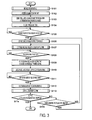
- FIG. 3 shows the overall operation of the laser apparatus shown in FIG. 2 .
- FIG. 4 shows an example of an initialization routine in Step S 101 of FIG. 3 .
- FIG. 5 shows an example of a control voltage value calculation routine in Step S 107 of FIG. 3 .
- FIG. 6 shows an example of the relationship between the control voltage values and corresponding transmittances according to the first embodiment.
- FIG. 7 shows an example of a seed pulse laser beam output control routine in Step S 110 of FIG. 3 .
- FIG. 8 shows a first example of an excitation intensity control routine in Step S 112 of FIG. 3 .
- FIG. 9 shows a second example of the excitation intensity control routine in Step S 112 of FIG. 3 .
- FIG. 10 shows a third example of the excitation intensity control routine in Step S 112 of FIG. 3 .
- FIG. 11 shows an example of a gain calculation routine in Step S 113 of FIG. 3 .
- FIG. 12 shows an example of the relationship between the excitation intensities and corresponding gains according to the first embodiment.
- FIG. 13 schematically illustrates the configuration of a laser apparatus according to a second embodiment of this disclosure.
- FIG. 14 schematically illustrates the configuration of a seed laser device according to the second embodiment.
- FIG. 15 schematically illustrates the configuration of a laser apparatus according to a third embodiment of this disclosure.
- FIG. 16 schematically illustrates the configuration of a laser apparatus according to a fourth embodiment of this disclosure.
- FIG. 17 shows another example of the gain calculation routine in Step S 113 of FIG. 3 according to the fourth embodiment.
- FIG. 18 schematically illustrates an example of an optical shutter which includes two polarizers and a Pockels cell.
- FIG. 19 shows an example of the relationship between the control voltage values of a high-voltage pulse to be applied to the Pockels cell and the corresponding transmittance of the optical shutter.
- FIG. 20 shows the relationship between a single pulse included in a pulse laser beam and the operation of an optical shutter according to one or more of the embodiments in this disclosure.
- FIG. 21 shows an example of signals inputted from a laser controller to an RF power source indicating excitation power to be supplied from the RF power source to an amplifier when a duty cycle is set to ⁇ /T.
- FIG. 22 shows the excitation power supplied to the amplifier from the RF power source in the case shown in FIG. 21 .
- FIG. 23 shows an RF voltage supplied to the amplifier from the RF power source in a potential control method.
- FIG. 24 schematically illustrates the configuration of an EUV light generation system according to a fifth embodiment of this disclosure.
- FIG. 25 shows the overall operation of the EUV light generation system shown in FIG. 24 .
- FIG. 26 shows an example of an initialization routine in Step S 301 of FIG. 25 .
- FIG. 27 shows an example of an energy instruction value calculation routine in Step S 303 of FIG. 25 .
- FIG. 28 shows an example of an EUV light generation control routine in Step S 306 of FIG. 25 .
- FIG. 29 schematically illustrates an example of the optical shutter.
- FIG. 30 schematically illustrates an example of a regenerative amplifier.
- FIG. 31 shows a beam path adjusting unit in one or more of the embodiments in this disclosure and an example of the arrangement of master oscillators with respect to the beam path adjusting unit.
- FIG. 32 shows an example of the relationship between the gain properties of each amplification line in an amplifier and pulse energy of each pulse laser beam to be transmitted through a corresponding optical shutter.
- FIG. 33 shows the pulse energy of each pulse laser beam amplified in accordance with the gain properties shown in FIG. 32 .
- FIG. 34 shows an example of the gain efficiency in multi-line amplification and single-line amplification.
- both short-term pulse energy control and mid-to-long-term pulse energy control can be achieved.
- energy of a pulse laser beam entering an amplifier may be controlled on a pulse-to-pulse basis (pulse-to-pulse energy control).
- excitation energy control in the mid-to-long-term pulse energy control, excitation energy to be supplied to an amplifier may be controlled in a mid-to-long term (excitation energy control).
- the term “plasma generation region” may refer to a three-dimensional space in which plasma is to be generated.
- burst operation may refer to an operation mode or state in which a pulse laser beam or pulse EUV light is outputted at a predetermined repetition rate during a predetermined period and the pulse laser beam or the pulsed EUV light is not outputted outside of the predetermined period.
- a direction or side closer to the seed laser device is referred to as “upstream,” and a direction or side closer to the plasma generation region is referred to as “downstream.”
- the “predetermined repetition rate” does not have to be a constant repetition rate but may, in some examples, be a substantially constant repetition rate.
- Z-direction is defined as the direction into which the laser beam travels.
- X-direction is perpendicular to Z-direction
- Y-direction is perpendicular to both Z-direction and X-direction.
- X-direction and Y-direction may be rotated as the direction into which the laser beam travels is changed. For example, when the direction into which the laser beam travels (Z-direction) changes within X-Z plane, X-direction is rotated in accordance with the change in Z-direction, but Y-direction remains unchanged.
- the “plane of incidence” refers to a plane perpendicular to the surface on which the laser beam is incident and containing the beam axis of the laser beam incident thereon.
- a polarization component perpendicular to the plane of incidence is referred to as the “S-polarization component,” and a polarization component parallel to the plane of incidence is referred to as the “P-polarization component.”
- FIG. 1 schematically illustrates the configuration of an exemplary laser produced plasma (LPP) type EUV light generation system.
- An EUV light generation system 1 may include at least one laser apparatus 3 .
- the EUV light generation system 1 may include a chamber 2 , a target supply unit (e.g., target generator 26 ), and so forth.
- the chamber 2 may be airtightly sealed.
- the target supply unit 26 may be mounted to the chamber 2 so as to pass through the wall of the chamber 2 , for example.
- a target material to be supplied by the target supply unit 26 may include, but is not limited to, tin, terbium, gadolinium, lithium, xenon, or any combination, alloy, or mixture thereof.
- the chamber 2 may have at least one through-hole formed in the wall thereof.
- the through-hole may be covered with a window 21 , and a pulse laser beam 32 may travel through the window 21 into the chamber 2 .
- An EUV collector mirror 23 having a spheroidal surface may be provided, for example, inside the chamber 2 .
- the EUV collector mirror 23 may have a multi-layered reflective film formed on the spheroidal surface thereof, and the reflective film may include, for example, molybdenum and silicon that is laminated in alternate layers.
- the EUV collector mirror 23 may have first and second foci, and may preferably be positioned such that the first focus lies in a plasma generation region 25 and the second focus lies in an intermediate focus (IF) region 292 defined by the specification of an exposure apparatus 6 .
- the EUV collector mirror 23 may have a through-hole 24 formed at the center thereof, and a pulse laser beam 33 may travel through the through-hole 24 .
- the EUV light generation system 1 may include an EUV light generation controller 5 and a target sensor 4 .
- the target sensor 4 may have an imaging function and may detect at least one of the presence, trajectory, and position of a target.
- the EUV light generation system 1 may further include a connection part 29 for allowing the interior of the chamber 2 and the interior of the exposure apparatus 6 to be in communication with each other.
- a wall 291 having an aperture may be provided inside the connection part 29 .
- the wall 291 may be positioned such that the second focus of the EUV collector mirror 23 lies in the aperture formed in the wall 291 .
- the EUV light generation system 1 may further include a laser beam direction control unit 34 , a laser beam focusing mirror 22 , and a target collector 28 for collecting a target 27 .
- the laser beam direction control unit 34 may include an optical element for defining the direction in which the laser beam travels and an actuator for adjusting the position and the orientation (or posture) of the optical element.
- a pulse laser beam 31 outputted from the laser apparatus 3 may pass through the laser beam direction control unit 34 and outputted therefrom as a pulse laser beam 32 after having its direction optionally adjusted.
- the pulse laser beam 32 may travel through the window 21 and enter the chamber 2 .
- the pulse laser beam 32 may travel inside the chamber 2 along at least one beam path from the laser apparatus 3 , be reflected by the laser beam focusing mirror 22 , and strike at least one target 27 as a pulse laser beam 33 .
- the target generator 26 may be configured to output the targets 27 toward the plasma generation region 25 inside the chamber 2 .
- the target 27 may be irradiated with at least one pulse of the pulse laser beam 33 .
- the target 27 which has been irradiated with the pulse laser beam 33 , may be turned into plasma, and rays of light 251 including EUV light 252 may be emitted from the plasma.
- the EUV light 252 may be reflected selectively by the EUV collector mirror 23 .
- the EUV light 252 reflected by the EUV collector mirror 23 may travel through the intermediate focus region 292 and be outputted to the exposure apparatus 6 .
- the target 27 may be irradiated with multiple pulses included in the pulse laser beam 33 .
- the EUV light generation controller 5 may integrally control the EUV light generation system 1 .
- the EUV light generation controller 5 may be configured to process image data of a droplet (i.e., target 27 ) captured by the target sensor 4 . Further, the EUV light generation controller 5 may control at least one of the timing at which the target 27 is outputted and the direction into which the target 27 is outputted (e.g., the timing at which and/or direction in which the target is outputted from target generator 26 ).
- the EUV light generation controller 5 may control, for example, at least one of the timing at which the laser apparatus 3 oscillates (e.g., by controlling laser apparatus 3 ), the direction in which the pulse laser beam 31 travels (e.g., by controlling laser beam direction control unit 34 ), and the position at which the pulse laser beam 33 is focused (e.g., by controlling laser apparatus 3 , laser beam direction control unit 34 , or the like). It will be appreciated that the various controls mentioned above are merely examples, and other controls may be added as necessary.
- the EUV light generation system 1 may be configured to output the EUV light 252 in pulses at a predetermined repetition rate.
- the outputted EUV light 252 may be used in the exposure apparatus 6 for an exposure of a photoresist on a wafer or the like.
- the exposure amount may preferably be controlled with high precision.
- the pulse energy of the pulse laser beam 31 outputted from the laser apparatus 3 can be controlled on a pulse-to-pulse basis (pulse-to-pulse energy control).
- the pulse energy of the EUV light 252 can be controlled on a pulse-to-pulse basis
- the exposure amount may be controlled with high precision.
- the pulse energy of the pulse laser beam 31 may need to be controlled within a wide dynamic range.
- the dynamic range may be a range within which the pulse energy can be controlled.
- the pulse energy of the EUV light 252 reflected by the EUV collector mirror 23 to be inputted into the exposure apparatus 6 may also decrease.
- the pulse energy of the pulse laser beam 31 outputted from the laser apparatus 3 may need to be increased.
- the pulse energy of the EUV light 252 emitted in the plasma generation region 25 may be increased, and in turn the pulse energy of the EUV light 252 reflected by the EUV collector mirror 23 to be inputted into the exposure apparatus 6 may be compensated.
- differences in exposure sensitivity of photoresists may also require the pulse energy of the EUV light 252 to be controlled in a wide dynamic range.
- the pulse energy of the EUV light 252 may need to be decreased. In that case, the pulse energy of the pulse laser beam 31 outputted from the laser apparatus 3 may also need to be decreased.
- the pulse-to-pulse energy control may be carried out by using an optical shutter (pulse energy adjusting unit).
- FIG. 2 schematically illustrates the configuration of the laser apparatus 3 A.
- the laser apparatus 3 A may include a laser controller 301 , a seed laser device 310 , an amplification unit 320 , and an energy monitor 330 .
- the laser controller 301 may include an energy controller 302 , a seed laser controller 303 , and an amplification controller 304 .
- the seed laser device 310 may include a master oscillator 311 and an optical shutter 340 .
- the optical shutter 340 may be provided between the master oscillator 311 and the amplification unit 320 .
- the amplification unit 320 may be provided downstream from the seed laser device 310 .
- the amplification unit 320 may include amplifiers 320 1 through 320 n and RF power sources 321 1 through 321 n connected to the respective amplifiers 320 1 through 320 n .
- the laser controller 301 may be connected to an external device, such as the EUV light generation controller 5 .
- the laser controller 301 may further be connected to the seed laser device 310 , the amplification unit 320 , and the energy monitor 330 .
- the energy controller 302 may be connected to the seed laser controller 303 and the amplification controller 304 .
- the seed laser controller 303 may be connected to the master oscillator 311 and the optical shutter 340 .
- the amplification controller 304 may be connected to the RF power sources 321 1 through 321 n .
- the energy monitor 330 may include a beam splitter 331 and an optical sensor 332 .
- the energy monitor 330 may be provided downstream from the downmost amplifier 320 n of the amplification unit 320 .
- the laser controller 301 may receive an energy instruction value Pt and a trigger signal S 1 from the EUV light generation controller 5 .
- the energy instruction value Pt may indicate pulse energy required for the pulse laser beam 31 in order to obtain the EUV light 252 having pulse energy required by the exposure apparatus 6 .
- the trigger signal S 1 may serve as a reference for a timing at which and a cycle in which the pulse laser beam 31 is to be outputted.
- the energy controller 302 may be configured to control the seed laser controller 303 based on the trigger signal S 1 from the EUV light generation controller 5 .
- the seed laser controller 303 may be configured to send an oscillation signal S 11 to the master oscillator 311 under the control of the energy controller 302 .
- the master oscillator 311 may be configured to oscillate in accordance with the oscillation signal S 11 . With this, a seed pulse laser beam L 0 may be outputted from the master oscillator 311 at a predetermined repetition rate.
- the seed laser controller 303 may include an internal trigger generator configured to output internal trigger signals at a predetermined repetition rate.
- the seed laser controller 303 may send the oscillation signal S 11 to the master oscillator 311 in accordance with the internal trigger signal. Then, the master oscillator 311 may oscillate in accordance with the oscillation signal S 11 . With this, the seed pulse laser beam L 0 may be outputted from the master oscillator 311 at a predetermined repetition rate.
- the beam splitter 331 of the energy monitor 330 may be positioned such that the pulse laser beam 31 from the amplification unit 320 is incident on the beam splitter 331 .
- the pulse laser beam 31 incident on the beam splitter 331 may be split thereby, and a split component of the pulse laser beam 31 may enter the optical sensor 332 .
- the optical sensor 332 may be configured to monitor the pulse energy of the split component of the pulse laser beam 31 .
- a value (detected energy value P) of the pulse energy detected by the optical sensor 332 may be sent to the energy controller 302 .
- the energy controller 302 may be configured to control the seed laser controller 303 based, for example, on the trigger signal S 1 , the energy instruction value Pt, and the detected energy value P. Alternatively, the energy controller 302 may be configured to control the seed laser controller 303 based, for example, on the internal trigger signal and an energy instruction initial value P 0 .
- the seed laser controller 303 may be configured to control, on a pulse-to-pulse basis, transmittance of the seed pulse laser beam L 0 through the optical shutter 340 under the control of the energy controller 302 . With this, the pulse energy of a seed pulse laser beam L 1 outputted from the seed laser device 310 may be controlled on a pulse-to-pulse basis. In this way, the optical shutter 340 may function as a pulse energy adjusting unit for varying the pulse energy of the seed pulse laser beam L 1 .
- the energy controller 302 may be configured to control the amplification controller 304 based, for example, on the trigger signal S 1 , the energy instruction value Pt, and the detected energy value P.
- the energy controller 302 may be configured to control the amplification controller 304 based, for example, on the internal trigger signal and the energy instruction initial value P 0 .
- the amplification controller 304 may be configured to control the excitation intensity in the amplifiers 320 1 through 320 n under the control of the energy controller 302 .
- the excitation intensity in the amplifiers 320 1 through 320 n may be controlled through control signals sent to the respective RF power sources 321 1 through 321 n from the amplification controller 304 .
- the laser controller 301 includes the energy controller 302 , the seed laser controller 303 , and the amplification controller 304 .
- the laser controller may be constituted by a single controller.
- both the pulse-to-pulse energy control short-term pulse energy control
- the excitation energy control mid-to-long-term pulse energy control
- the pulse energy of the seed pulse laser beam L 1 entering the amplification unit 320 may be controlled on a pulse-to-pulse basis.
- the pulse energy of the laser beam L 2 (and the pulse laser beam 31 ) may be controlled over a mid-to-long term.
- the pulse energy may be controlled in a wider dynamic range.
- FIG. 3 shows the overall operation of the laser apparatus 3 A.
- FIG. 4 shows an example of an initialization routine in Step S 101 of FIG. 3 .
- FIG. 5 shows an example of a control voltage value calculation routine in Step S 107 of FIG. 3 .
- FIG. 6 shows an example of the relationship between the control voltage values and corresponding transmittances according to the first embodiment.
- FIG. 7 shows an example of a seed pulse laser beam output control routine in Step S 110 of FIG. 3 .
- FIG. 8 shows a first example of an excitation intensity control routine in Step S 112 of FIG. 3 .
- FIG. 9 shows a second example of the excitation intensity control routine in Step S 112 of FIG. 3 .
- FIG. 4 shows an example of an initialization routine in Step S 101 of FIG. 3 .
- FIG. 5 shows an example of a control voltage value calculation routine in Step S 107 of FIG. 3 .
- FIG. 6 shows an example of the relationship between the control voltage values and corresponding transmittances according to the first
- FIG. 10 shows a third example of the excitation intensity control routine in Step S 112 of FIG. 3 .
- FIG. 11 shows an example of a gain calculation routine in Step S 113 of FIG. 3 .
- the description to follow will be given with a focus on the operation of the laser controller 301 .
- the laser controller 301 may first execute the initialization routine for setting an initial value in each parameter of this operation (Step S 101 ). Then, the laser controller 301 may turn on the RF power sources 321 1 through 321 n (Step S 102 ). With this, the amplification unit 320 may be started. The laser controller 301 may then send the oscillation signal S 11 to the master oscillator 311 in accordance with the internal triggers outputted at a predetermined repetition rate from the internal trigger generator (Step S 103 ). With this, the master oscillator 311 may oscillate on idle at a predetermined repetition rate.
- the laser controller 301 may be configured to retain the optical shutter 340 being closed (Step S 104 ). With this, the seed pulse laser beam L 0 from the master oscillator 311 may be blocked by the optical shutter 340 .
- the sequence of Steps 103 and 104 can be switched.
- the laser controller 301 may stand by until it receives the energy instruction value Pt from the EUV light generation controller 5 (Step S 105 ; NO). Upon receiving the energy instruction value Pt (Step S 105 ; YES), the laser controller 301 may set the received energy instruction value Pt as a target energy instruction value Pt (Step S 106 ). Subsequently, the laser controller 301 may execute the control voltage value calculation routine for calculating a control voltage value V of control voltage to be applied to the optical shutter 340 based on the energy instruction value Pt (Step S 107 ).
- the laser controller 301 may then stand by until it receives the trigger signal S 1 from the EUV light generation controller 5 (Step S 108 ; NO).
- the EUV light generation controller 5 may send the trigger signals 51 to the laser controller 301 at a predetermined repetition rate. While the laser controller 301 does not receive the trigger signal S 1 , the laser controller 301 may allow the master oscillator 311 to continue oscillating on idle based on the internal trigger signals.
- the laser controller 301 may stop sending the oscillation signal S 11 , which is based on the internal trigger signal, to the master oscillator 311 (Step S 109 ). With this, the master oscillator 311 may stop oscillating on idle.
- the laser controller 301 may execute the seed pulse laser beam output control routine for causing the seed laser device 310 to output the seed pulse laser beam L 0 (Step S 110 ).
- the laser controller 301 may stand by until it receives the detected energy value P of the pulse laser beam 31 from the energy monitor 330 (Step S 111 ; NO). Upon receiving the detected energy value P (Step S 111 ; YES), the laser controller 301 may execute the excitation intensity control routine for controlling the excitation intensity in the amplifiers 320 1 through 320 n (Step S 112 ). Then, the laser controller 301 may execute the gain calculation routine for calculating the gain in the amplification unit 320 (Step S 113 ).
- the laser controller 301 may determine whether or not the output of the pulse laser beam 31 is to be stopped (Step S 114 ). This determination may be made based on, for example, an instruction from the EUV light generation controller 5 .
- the laser controller 301 may terminate the operation shown in FIG. 3 .
- the laser controller 301 may determine whether or not it has received an updated energy instruction value Pt from the EUV light generation controller 5 (Step S 115 ).
- the laser controller 301 may return to Step S 106 and repeat the subsequent steps.
- the EUV light generation controller 5 may stop sending the trigger signal S 1 to the laser controller 301 .
- the laser controller 301 may control the master oscillator 310 to start oscillating on idle based on the internal trigger signal.
- the laser controller 301 may return to Step S 107 and repeat the subsequent steps.
- the EUV light generation controller 5 may stop sending the trigger signal S 1 to the laser controller 301 . In that case, the laser controller 301 may control the master oscillator 310 to start oscillating on idle based on the internal trigger signal.
- the laser controller 301 may load an energy instruction initial value P 0 , which is an initial value of the energy instruction value Pt (Step S 121 ).
- the laser controller 301 may then load a transmittance initial value Tr 0 , which is an initial value of transmittance Tr to be set to the optical shutter 340 (Step S 122 ).
- the laser controller 301 may then load excitation intensity initial values (initial duty cycle D 0 ), which are initial values of the excitation intensity to be set to the respective amplifiers 320 1 through 320 n (Step S 123 ).
- the laser controller 301 may then load a gain initial value G 0 , which is an initial value of a gain G of the amplification unit 320 (Step S 124 ).
- the laser controller 301 may load various delay times (Step S 125 ). These delay times may include an oscillation delay time T 1 , a shutter open delay time T 2 , and a shutter close delay time T 3 .
- the oscillation delay time T 1 may be a delay time set for an output of the oscillation signal S 11 with respect to an input of the trigger signal S 1 .
- the shutter open delay time T 2 may be a delay time set for the opening of the optical shutter 340 with respect to the input of the trigger signal S 1 .
- the shutter close delay time T 3 may be a delay time set for the closing of the optical shutter 340 with respect to the input of the trigger signal S 1 .
- the laser controller 301 may load a lower limit value Tmin and an upper limit value Tmax of a permissible range RT for the transmittance Tr of the optical shutter 340 as a permissible range for the pulse laser beam 31 (Step S 126 ).
- the laser controller 301 may load a lower limit value ⁇ Pmin and an upper limit value ⁇ Pmax of a permissible range RAP for a difference ⁇ P, which is a difference between the detected energy value P and the energy instruction value Pt, in Step S 126 .
- the laser controller 301 may load a lower limit value Vmin and an upper limit value Vmax of a permissible range RV for the control voltage value V in Step S 126 .
- the aforementioned various values may be loaded from a memory (not shown) or the like. Thereafter, the laser controller 301 may return to the operation shown in FIG. 3 .
- the energy instruction initial value P 0 may be used in place of the detected energy value P. Otherwise, the detected energy value P may have been obtained in Step S 111 (see FIG. 3 )
- the laser controller 301 may calculate the transmittance Tr required for the optical shutter 340 , using the difference ⁇ P (Step S 132 ).
- Required transmittance Trb may, for example, be obtained from Expressions (1) through (4) below.
- Pa G ⁇ Ps ⁇ Tra (1)
- Pb G ⁇ Ps ⁇ Trb (2)
- Trb Tra ⁇ P /( G ⁇ Ps ) (4)
- Ps is the pulse energy of the seed pulse laser beam L 0 from the master oscillator 311 ;
- Tra is the currently-set transmittance; and Trb is the required transmittance.
- Pa and Pb are the pulse energy of the pulse laser beam having passed through the amplification unit 320 in the cases of Tra and Trb, respectively; and G is the gain.
- the laser controller 301 may calculate the control voltage value V for satisfying the required transmittance Trb (Step S 133 ).
- the transmittance Tr and the control voltage value V may, for example, have the relationship shown in FIG. 6 .
- the data table may also be held in a memory (not shown) or the like, and the laser controller 301 may refer thereto as appropriate. Thereafter, the laser controller 301 may return to the operation shown in FIG. 3 .
- the laser controller 301 may reset a count value T of a timer (not shown) (Step S 141 ).
- the timer may start counting time immediately after it is reset.
- the laser controller 301 may stand by until the count value T of the timer reaches the oscillation delay time T 1 loaded in Step S 125 of FIG. 4 (Step S 142 ; NO).
- the laser controller 301 may send the oscillation signal S 11 to the master oscillator 311 (Step S 143 ).
- the master oscillator 311 may output the seed pulse laser beam L 0 .
- what may be common to both the oscillation signal S 11 of Step S 143 and the oscillation signal S 11 of Step S 103 is that they are sent from the seed laser controller 303 to the master oscillator 311 .
- the oscillation signal S 11 of Step S 143 is synchronized with the trigger signal S 1
- the oscillation signal S 11 of Step S 103 is synchronized with the internal trigger signal generated by the internal trigger generator of the seed laser controller 303 .
- the laser controller 301 may stand by until the count value T of the timer reaches the shutter open delay time T 2 loaded in Step S 125 of FIG. 4 (Step S 144 ; NO).
- the laser controller 301 may start sending an optical shutter switching signal S 41 to the optical shutter 340 for supplying the control voltage value V to the optical shutter 340 (Step S 145 ).
- the optical shutter 340 may be opened with the transmittance Tr corresponding to the control voltage value V.
- the laser controller 301 may stand by until the count value T of the timer reaches the shutter close delay time T 3 loaded in Step S 125 of FIG. 4 (Step S 146 ; NO).
- the laser controller 301 may stop sending the optical shutter switching signal S 41 to the optical shutter 340 (Step S 147 ). With this, the optical shutter 340 may be closed. Then, the laser controller 301 may return to the operation shown in FIG. 3 .
- the laser controller 301 may first increment a value n of a counter (not shown) by one (Step S 151 ).
- the counter (not shown) may be an integer counter, and the initial value thereof may be set to zero. Then, the laser controller 301 may calculate a cumulative total value Tsum of the transmittance Tr (Step S 152 ).
- the laser controller 301 may determine whether or not the value n of the counter has reached a preset base number J (Step S 153 ). When the value n has not reached the base number J (Step S 153 ; NO), the laser controller 301 may return to the operation shown in FIG. 3 . On the other hand, when the value n has reached the base number J (Step S 153 ; YES), the laser controller 301 may calculate an average value Tave of the transmittance Tr by dividing the cumulative total value Tsum by the value n (Step S 154 ).
- the laser controller 301 may determine whether or not the calculated average value Tave is smaller than the lower limit value Tmin of the permissible range RT loaded in Step S 126 of FIG. 4 (Step S 155 ).
- the laser controller 301 may adjust the duty cycle D of the excitation power W to be supplied to at least one of the amplifiers 320 1 through 320 n from the corresponding one or more of the RF power sources 321 1 through 321 n so that the excitation intensity in the amplification unit 320 is raised (Step S 156 ).
- An adjusting amount ⁇ D may be determined in advance through experiments or the like. Thereafter, the laser controller 301 may return to the operation shown in FIG. 3 .
- the laser controller 301 may then determine whether or not the average value Tave is greater than the upper limit value Tmax (Step S 157 ).
- the laser controller 301 may adjust the duty cycle D of the excitation power W to be supplied to at least one of the amplifiers 320 1 through 320 n from the corresponding one or more of the RF power sources 321 1 through 321 n so that the excitation intensity in the amplification unit 320 is lowered (Step S 158 ).
- the adjusting amount ⁇ D may be determined in advance through experiments or the like. Thereafter, the laser controller 301 may return to the operation shown in FIG. 3 .
- the laser controller 301 may retain the duty cycle D of the excitation power W (Step S 159 ). Thereafter, the laser controller 301 may return to the operation shown in FIG. 3 .
- the above operation is suitable for the mid-to-long-term pulse energy control.
- an average value of a larger number of sample values may be used, compared to the pulse-to-pulse energy control (short-term pulse energy control).
- the control voltage value V to be applied to the optical shutter 340 for obtaining the corresponding transmittance Tr may be used.
- the laser controller 301 may first increment a value n of a counter (not shown) by one (Step S 151 ).
- the counter may be an integer counter and the initial value thereof may be set to zero.
- the laser controller 301 may determine whether or not the value n of the counter has reached a preset base number J (Step S 153 ). When the value n has not reached the base number J (Step S 153 ; NO), the laser controller 301 may return to the operation shown in FIG. 3 . On the other hand, when the value n has reached the base number J (Step S 153 ; YES), the laser controller 301 may calculate an average value ⁇ Pave of the difference ⁇ P by dividing the cumulative total value ⁇ Psum by the value n (e.g., ⁇ Psum/n) (Step S 154 a ).
- the laser controller 301 may determine whether or not the calculated average value ⁇ Pave is greater than the upper limit value ⁇ Pmax of the permissible range RAP loaded in Step S 126 of FIG. 4 (Step S 155 a ).
- the laser controller 301 may adjust the duty cycle D of the excitation power W to be supplied to at least one of the amplifiers 320 1 through 320 n from the corresponding one or more of the RF power sources 321 1 through 321 n so that the excitation intensity in the amplification unit 320 is raised (Step S 156 ).
- the adjusting amount ⁇ D may be determined in advance through experiments or the like. Thereafter, the laser controller 301 may return to the operation shown in FIG. 3 .
- the laser controller 301 may then determine whether or not the average value ⁇ Pave is smaller than the lower limit value ⁇ Pmin (Step S 157 a ).
- the laser controller 301 may adjust the duty cycle D of the excitation power W to be supplied to at least one of the amplifiers 320 1 through 320 n from the corresponding one or more of the corresponding RF power sources 321 1 through 321 n so that the excitation intensity in the amplification unit 320 is lowered (Step S 158 ).
- the adjusting amount ⁇ D may be determined in advance through experiments or the like. Thereafter, the laser controller 301 may return to the operation shown in FIG. 3 .
- the laser controller 301 may retain the duty cycle D of the excitation power W (Step S 159 ). Thereafter, the laser controller 301 may return to the operation shown in FIG. 3 .
- the excitation intensity of the amplification unit 320 may be controlled based on the average value ⁇ Pave of the difference ⁇ P between the detected energy value P and the energy instruction value Pt.
- the laser controller 301 may first increment a value n of a counter (not shown) by one (Step S 151 ).
- the counter may be an integer counter, and the initial value thereof may be set to zero.
- the laser controller 301 may calculate a cumulative total value Vsum of the control voltage value V (Step S 152 b ).
- the laser controller 301 may determine whether or not the value n of the counter has reached a preset base number J (Step S 153 ). When the value n has not reached the base number J (Step S 153 ; NO), the laser controller 301 may return to the operation shown in FIG. 3 . On the other hand, when the value n has reached the base number J (Step S 153 ; YES), the laser controller 301 may calculate an average value Vave of the control voltage value V by dividing the cumulative total value Vsum by the value n (Step. S 154 b ).
- the laser controller 301 may determine whether or not the calculated average value Vave is smaller than the lower limit value Vmin of the permissible range RV loaded in Step S 126 of FIG. 4 (Step S 155 b ).
- the laser controller 301 may adjust the duty cycle D of the excitation power W to be supplied to at least one of the amplifiers 320 1 through 320 n from the corresponding one or more of the RF power sources 321 1 through 321 n so that the excitation intensity in the amplification unit 320 is raised (Step S 156 ).
- the adjusting amount ⁇ D may be determined in advance through experiments or the like. Thereafter, the laser controller 301 may return to the operation shown in FIG. 3 .
- the laser controller 301 may then determine whether or not the average value Vave is greater than the upper limit value Vmax (Step S 157 b ).
- the laser controller 301 may adjust the duty cycle D of the excitation power W to be supplied to at least one of the amplifiers 320 1 through 320 n from the corresponding one or more of the RF power sources 321 1 through 321 n so that the excitation intensity in the amplification unit 320 is lowered (Step S 158 ).
- the adjusting amount ⁇ D may be determined in advance through experiments or the like. Thereafter, the laser controller 301 may return to the operation shown in FIG. 3 .
- the laser controller 301 may retain the duty cycle D of the excitation power W (Step S 159 ). Thereafter, the laser controller 301 may return to the operation shown in FIG. 3 .
- the excitation intensity of the amplification unit 320 may be controlled based on the average value Vave of the control voltage value V to be applied to the optical shutter 340 .
- the laser controller 301 may load the excitation intensity (duty cycle D) currently set for the amplification unit 320 (or each of the amplifiers 320 1 through 320 n ) (Step S 161 ). Then, the laser controller 301 may calculate a gain G of the amplification unit 320 (or each of the amplifiers 320 1 through 320 n ) based on the loaded excitation intensity (duty cycle D) (Step S 162 ). Thereafter, the laser controller 301 may return to the operation shown in FIG. 3 .
- the excitation intensity (duty cycle D) and the gain G may, for example, have the relationship shown in FIG. 12 .
- FIG. 13 schematically illustrates the configuration of the laser apparatus 3 B.
- the laser apparatus 3 B may be similar in configuration to the laser apparatus 3 A shown in FIG. 2 except in that the seed laser device 310 of the laser apparatus 3 A is replaced by a seed laser device 310 B.
- FIG. 14 schematically illustrates the configuration of the seed laser device 310 B.
- the seed laser device 310 B may include the master oscillator 311 and an optical shutter 341 .
- the master oscillator 311 may include resonator mirrors 311 a and 311 b , a chamber 311 c , an RF power source 311 d , a polarization beam splitter 311 e , and a high-reflection mirror 311 f.
- the chamber 311 c may be arranged between the resonator mirrors 311 a and 311 b .
- the chamber 311 c may have input and output windows through which the seed pulse laser beam L 0 travels.
- the chamber 311 c may be filled with a gain medium containing CO 2 gas.
- a pair of discharge electrodes may be provided inside the chamber 311 c so as to face each other along a direction parallel to an optical path defined by the resonator mirrors 311 a and 311 b.
- the RF power source 311 d may be configured to supply the excitation power to the discharge electrodes in accordance with the oscillation signal S 11 from the laser controller 301 .
- the excitation power supplied to the discharge electrodes from the RF power source 311 d may be constant.
- the optical shutter 341 may include a Pockels cell 341 a and a power source 341 b .
- the Pockels cell 341 a may be provided inside the master oscillator 311 in the optical path between the resonator mirrors 311 a and 311 b .
- the power source 341 b may apply the control voltage to the Pockels cell 341 a at the control voltage value V in accordance with the optical shutter switching signal S 41 from the laser controller 301 . With this, the phase of the seed pulse laser beam L 0 passing through the Pockels cell 341 a may be modulated in accordance with the control voltage value V.
- the polarization beam splitter 311 e may be arranged in the beam path defined by the resonator mirrors 311 a and 311 b .
- the polarization beam splitter 311 e may transmit one polarization component and reflect the other polarization component of the seed pulse laser beam L 0 incident thereon.
- the component of the seed pulse laser beam L 0 reflected by the polarization beam splitter 311 e may then be incident on and be reflected by the high-reflection mirror 311 f and outputted from the seed laser device 310 B as the seed pulse laser beam L 1 .
- the phase of the seed pulse laser beam L 0 may be modulated using the optical shutter 341 and a component of the seed pulse laser beam L 0 may be outputted from the seed laser device 310 B. Accordingly, the pulse energy of the seed pulse laser beam L 1 outputted from the seed laser device 310 B may be controlled on a pulse-to-pulse basis.
- a laser apparatus 3 C according to a third embodiment will now be described in detail with reference to the drawings.
- FIG. 15 schematically illustrates the configuration of the laser apparatus 3 C.
- the amplification unit 320 and the energy monitor 330 of the laser apparatus 3 C may be similar to the amplification unit 320 and the energy monitor 330 of the laser device 3 A of the above-described embodiments, and they are not depicted in FIG. 15 .
- the laser apparatus 3 C may be similar in configuration to the laser apparatus 3 A shown in FIG. 2 except in that the seed laser device 310 of the laser apparatus 3 A is replaced by a seed laser device 310 C.
- the seed laser device 310 C may include a seed laser unit 311 C, a regenerative amplifier 317 , an RF power source 318 , and the optical shutter 340 .
- the optical shutter 340 and a signal line for transmitting the optical shutter switching signal S 41 can be omitted. Accordingly, these are illustrated in broken lines in FIG. 15 .
- the seed laser unit 311 C may include master oscillators 314 1 through 314 n , corresponding optical shutters 342 1 through 342 n , and a beam path adjusting unit 316 .
- Each of the master oscillators 314 1 through 314 n may, for example, include a quantum cascade laser.
- the optical shutters 342 1 through 342 n may be provided downstream from the respective master oscillators 314 1 through 314 n .
- the transmittance of each of the optical shutters 342 1 through 342 n may be controlled in accordance with the control voltage value V indicated by the optical shutter switching signals S 42 from the laser controller 301 .
- the control voltage value V indicated by each of the optical shutter switching signals S 42 may be the same or may differ from one another.
- the beam path adjusting unit 316 may be configured to and positioned so as to make the beam paths of the pulse laser beams outputted from the optical shutters 342 1 through 342 n substantially coincide with one another and may output as the seed pulse laser beam L 0 .
- the seed pulse laser beam L 0 outputted from the seed laser unit 311 C may then be amplified in the regenerative amplifier 317 .
- the optical shutter 340 may be arranged downstream from the regenerative amplifier 317 .
- each of the master oscillators 314 1 through 314 n may be configured to output a pulse laser beam at a wavelength contained in the gain bandwidth of the regenerative amplifier 317 and the amplification unit 320 .
- the master oscillators 314 1 through 314 n may oscillate at substantially the same wavelength or at respectively different wavelengths. Further, the master oscillators 314 1 through 314 n may respectively oscillate in a single-longitudinal mode or in a multi-longitudinal mode. In the description to follow, the master oscillators 314 1 through 314 n may each oscillate in a single-longitudinal mode and at respectively different wavelengths.
- the laser controller 301 may control the master oscillators 314 1 through 314 n to oscillate at a predetermined repetition rate. Further, the laser controller 301 may control the transmittance Trk (here, k being a number from 1 through n) of the respective optical shutters 342 1 through 342 n based on an instruction value from the EUV light generation controller 5 .
- the pulse laser beams outputted from the master oscillators 314 1 through 314 n may respectively enter the optical shutters 342 1 through 342 n , whereby the pulse energy of the pulse laser beams may be adjusted in accordance with the transmittance Trk set to the respective optical shutters 342 1 through 342 n .
- the beam paths of the pulse laser beams outputted from the respective optical shutters 342 1 through 342 n may be made to substantially coincide with one another by the beam path adjusting unit 316 and outputted from the beam path adjusting unit 316 as the seed pulse laser beam L 0 .
- the seed pulse laser beam L 0 a may then be amplified in the regenerative amplifier 317 .
- the laser controller 301 may be configured to control the transmittance Trk of at least one of the optical shutters 342 1 through 342 n on a pulse-to-pulse basis based on the energy instruction value Pt from the EUV light generation controller 5 . Further, the laser controller 301 may be configured to send a control signal to at least one of the RF power sources 321 1 through 321 n in order to control the excitation intensity in the corresponding one or more of the amplifiers 320 1 through 320 n based on the energy instruction value Pt from the EUV light generation controller 5 .
- the laser controller 301 may be configured to control the transmittance Trk of at least one of the optical shutters 342 1 through 342 n on a pulse-to-pulse basis based on the detected energy value P of the energy monitor 330 and the energy instruction value Pt from the EUV light generation controller 5 .
- the master oscillators 314 1 through 314 n and the regenerative amplifier 317 may be operated under a constant condition (e.g., a constant repetition rate, constant excitation intensity).
- the transmittance Tr of the optical shutter 340 may be controlled on a pulse-to-pulse basis.
- continuous wave (CW) CO 2 lasers configured to oscillate in a single-longitudinal mode may be used.
- the laser controller 301 may cause the master oscillators 314 1 through 314 n to oscillate in the continuous wave with constant output.
- the laser controller 301 may be configured to control the transmittance Trk and the open time of each of the optical shutters 342 1 through 342 n based on an instruction value from the EUV light generation controller 5 .
- the pulse energy of the pulse laser beams outputted from the respective master oscillators may be controlled on a pulse-to-pulse basis by the respective optical shutters, and the pulse energy of the seed pulse laser beam entering the amplification unit 320 may further be controlled on a pulse-to-pulse basis by the optical shutter 340 . Accordingly, the pulse energy of the pulse laser beam 31 amplified in the amplification unit 320 may be controlled in an even wider dynamic range.
- FIG. 16 schematically illustrates the configuration of a laser apparatus 3 D according to the fourth embodiment.
- the seed laser device in the laser apparatus 3 D may be similar to the seed laser device 310 C of the above-described third embodiment and therefore is not depicted in FIG. 16 .
- an amplification unit 320 D may include the amplifiers 320 1 through 320 n and the corresponding RF power sources 321 1 through 321 n .
- the laser controller 301 may send a control signal to at least one of the RF power sources 321 1 through 321 n through the amplification controller 304 (see FIG. 2 ) based on the energy instruction value Pt from the EUV light generation controller 5 so as to control the excitation intensity in the corresponding one or more of the amplifiers 320 1 through 320 n .
- the laser controller 301 may send a control signal to at least one of the RF power sources 321 1 through 321 n through the amplification controller 304 (see FIG. 2 ) based on the detected energy value P of the energy monitor 330 and the energy instruction value Pt from the EUV light generation controller 5 so as to control the excitation intensity of the corresponding one or more of the amplifiers 320 1 through 320 n .
- the amplification unit 320 D may include the multiple amplifiers 320 1 through 320 n , and controlling the excitation intensity of each of the amplifiers 320 1 through 320 n may allow the pulse energy of the pulse laser beam 31 to be controlled in a wider dynamic range, compared to the case of controlling the pulse energy by controlling a single amplifier.
- the operation of the laser apparatus 3 D may be similar to the operation described in relation to the first embodiment. Thus, the operation of the laser apparatus 3 D may basically be discussed with reference to the flow charts shown in FIGS. 3 through 10 . However, in the fourth embodiment, the gain calculation routine as shown in FIG. 11 may be replaced by the gain calculation routine as shown in FIG. 17 .
- the laser controller 301 may load the excitation intensity currently set for the amplifiers 320 1 through 320 n from a memory (not shown) (Step S 261 ).
- the excitation intensity may, for example, be duty cycles D 1 through Dn.
- the laser controller 301 may calculate gains G 1 through Gn of the amplifiers 320 1 through 320 n based on the loaded excitation intensity (duty cycles D 1 through Dn) (Step S 262 ).
- a function obtained using an approximation or the like from the relationship between the excitation intensity and the gain may be used. The relationship here may be obtained in advance through experiments or the like.
- the laser controller 301 may calculate the gain G of the entire amplification unit 320 from the calculated gains G 1 through Gn of the amplifiers 320 1 through 320 n (Step S 263 ). Thereafter, the laser controller 301 may return to the operation shown in FIG. 3 .
- the gain G of the entire amplification unit 320 may be obtained from Expression (5) below, where G 1 , G 2 , . . . , Gn express the gains of the respective amplifiers 320 1 through 320 n .
- G G 1 ⁇ G 2 ⁇ . . . ⁇ Gn (5) 5.
- optical shutter 340 will be discussed as the example; however, the following discussion may be applicable to the other optical shutters.
- FIG. 18 illustrates an example of the optical shutter 340 including two polarizers 340 a and 340 b and a Pockels cell 340 c .
- the optical shutter 340 may, for example, include two polarizers 340 a and 340 b , the Pockels cell 340 c , and a power source 340 d .
- the polarizer 340 a may be arranged, for example, to transmit a Y-polarization component of a pulse laser beam incident thereon and block an X-polarization component thereof.
- the polarizer 340 b may be arranged, for example, to transmit the X-polarization component of a pulse laser beam incident thereon and block the Y-polarization component thereof.
- the polarizers 340 a and 340 b may be arranged to transmit different polarization components.
- the polarizers 340 a and 340 b may be arranged so that the polarization directions of the pulse laser beam transmitted through the respective polarizers 340 a and 340 b may differ by 90 degrees.
- the optical shutter switching signal S 41 may be inputted to the power source 340 d from the laser controller 301 .
- the power source 340 d may apply a voltage S 61 to the Pockels cell 340 c .
- the voltage S 61 may have a pulse width (temporal duration) substantially equal to pulse width of the optical shutter switching signal S 41 .
- the Pockels cell 340 c may modulate the phase of the pulse laser beam passing therethrough while the voltage S 61 is being applied thereto.
- the seed pulse laser beam L 0 entering the optical shutter 340 may first be incident on the polarizer 340 a , and the Y-polarization component of the seed pulse laser beam L 0 may be transmitted through the polarizer 340 a .
- the Y-polarization component of the seed pulse laser beam L 0 may then enter the Pockels cell 340 c.
- the Y-polarization component having entered the Pockels cell 340 c may be outputted therefrom while being retained as a linearly-polarized (in Y-direction) seed pulse laser beam.
- This linearly-polarized seed pulse laser beam may then be incident on the polarizer 340 b and may be blocked by the polarizer 340 b .
- the seed pulse laser beam L 0 may be blocked by the optical shutter 340 while the voltage S 61 is not applied to the Pockels cell 340 c.
- the phase of the Y-polarization component of the seed pulse laser beam L 0 passing through the Pockels cell 340 c may be modulated in accordance with the voltage S 61 .
- This phase modulated component of the seed pulse laser beam L 0 may then be incident on the polarizer 340 b , and the X-polarization component thereof may be transmitted through the polarizer 340 b .
- the X-polarization component may be outputted from the optical shutter 340 as the seed pulse laser beam L 1 .
- FIG. 19 shows an example of the relationship between the control voltage value V of the voltage to be applied to the Pockels cell 340 c and the transmittance Tr of the optical shutter 340 .
- the control voltage value V and the transmittance Tr may exhibit a one-to-one correspondence. Accordingly, the control voltage value V may be calculated from the transmittance Tr required for the optical shutter 340 , and a voltage of this control voltage value v may be applied to the Pockels cell 340 c to achieve the required transmittance Tr. Controlling the transmittance Tr of the optical shutter 340 in this way may allow the pulse energy of the seed pulse laser beam L 1 to be controlled.
- the seed pulse laser beam L 1 with the pulse energy corresponding to the transmittance Tr (in turn corresponding to the control voltage value V) may be outputted from the optical shutter 340 .
- the pulse energy of the seed pulse laser beam L 1 may be adjusted.
- the optical shutter 340 may be used to suppress a self-oscillation beam and/or a returning beam from an amplifier or the like provided down stream from the optical shutter 340 in a case where the voltage is applied to the Pockels cell 340 c in synchronization with the seed pulse laser beam L 0 . Further, switching the optical shutter 340 on and off while allowing the master oscillator 311 to oscillate continually at a predetermined repetition rate may allow the seed pulse laser beam L 1 to be outputted in bursts.
- FIG. 20 shows an example of the relationship between a single pulse in the seed pulse laser beam L 0 and switching of the optical shutter 340 .
- a voltage with such a pulse width that can absorb some timing jitter of the seed pulse laser beam L 0 (for example, 40 ns) may preferably be applied to the Pockels cell 340 c of the optical shutter 340 .
- the pulse width of the voltage may preferably be set appropriately.
- a Pockels cell typically has a few-nanosecond-responsiveness; thus, it may be suitably used in an optical shutter for a laser apparatus where high-speed switching is often required.
- PWM pulse width modulation
- a duty cycle of voltage pulses may be modulated.
- the duty cycle D of the voltage pulses (excitation power W) supplied to the amplifiers 320 1 through 320 n from the corresponding RF power sources 321 1 through 321 n may be varied.
- the duty cycle means a ratio of a pulse width to a single cycle of a periodic pulse wave, and may be represented by Expression (6) below.
- D ⁇ /Ts (6)
- D is a duty cycle
- t is a pulse width
- Ts is the duration of a single cycle. For example, when the cycle Ts is 10 ⁇ s and the pulse width ⁇ is 1 ⁇ s, the duty cycle D turns out to be 0.1 (10%) based on Expression (6) above.
- FIG. 21 shows signals specifying the excitation power W inputted to the RF power sources 321 1 through 321 n from the laser controller 301 when the duty cycle D is ⁇ /Ts.
- FIG. 22 shows the excitation power W supplied to the amplifiers 320 1 through 320 n from the respective RF power sources 321 1 through 321 n in the case shown in FIG. 21 .
- rectangular-wave signals for example, may be inputted to the RF power sources 321 1 through 321 n from the laser controller 301 .
- the intermittent RF voltages as shown in FIG. 22 may be applied to the amplifiers 320 1 through 320 n from the respective RF power sources 321 1 through 321 n .
- the control of the excitation intensity may be achieved, for example, by varying the duty cycle D of the rectangular-wave signals. Controlling the duty cycle D of the RF voltage to be applied between a pair of electrodes in each of the amplifiers 320 1 through 320 n may in turn allow the excitation intensity of the gain medium included in the amplifiers 320 1 through 320 n to be controlled.
- the repetition rate of the pulse laser beam outputted from the master oscillator 311 is 100 kHz
- the repetition rate of pulse laser beam may preferably be synchronized with the PWM frequency.
- FIG. 23 shows the RF voltages applied to the amplifiers 320 1 through 320 n from the respective RF power sources 321 1 through 321 n in the potential control method.
- the amplitude of the RF voltage may be varied in accordance with the required excitation intensity.
- the amplitude of the RF voltage applied to the amplifiers 320 1 through 320 n from the respective RF power sources 321 1 through 321 n may be smaller during a given period than during a period outside thereof. With this, the excitation intensity during the given period may be lowered. In this way, controlling the amplitude of the RF voltage may allow the excitation energy supplied to the amplifiers 320 1 through 320 n per unit time to be controlled.
- FIG. 24 schematically illustrates the configuration of an EUV light generation system 1 A according to a fifth embodiment.
- the EUV light generation system 1 A may include the laser apparatus 3 A (see FIG. 2 ), the EUV light generation controller 5 , a relay optical system R 1 , the laser beam direction control unit 34 , and the chamber 2 .
- the chamber 2 may include the target generator 26 , a target controller 260 , the target collector 28 , the target sensor 4 , and an EUV light energy sensor 401 .
- the laser controller 301 of the laser apparatus 3 A may be connected to the EUV light generation controller 5 .
- the EUV light generation controller 5 may in turn be connected to the target controller 260 , the EUV light energy sensor 401 , and the exposure apparatus controller 61 .
- the EUV light generation controller 5 may receive an EUV light request signal requesting for the EUV light 252 and an EUV light energy instruction value Et specifying required energy of the EUV light 252 from the exposure apparatus controller 61 .
- the EUV light generation controller 5 may be configured to send a target output signal to the target generator 26 through the target controller 260 .
- the target sensor 4 may be configured to detect a target 27 passing through a predetermined position. Upon detecting the target 27 , the target sensor 4 may send a detection signal to the EUV light generation controller 5 through the target controller 260 .
- the EUV light generation controller 5 may be configured to send the energy instruction value Pt to the laser controller 301 based on the EUV light energy instruction value Et received from the exposure apparatus controller 61 .
- the EUV light generation controller 5 may be configured to send the energy instruction value Pt to the laser controller 301 based on a detected EUV light energy value E of the EUV light 252 received from the EUV light energy sensor 401 .
- the EUV light generation controller 5 may be configured to send a pulse laser beam request signal to the laser controller 301 based on the EUV light request signal received from the exposure apparatus controller 61 and/or the detection signal of the target 27 received from the target controller 260 . With this, the target 27 may be irradiated with the pulse laser beam 33 when the target 27 reaches the plasma generation region 25 .
- the laser controller 301 may be configured to send various signals, as described in the first embodiment, to the master oscillator 311 and the optical shutter 340 . With this, the pulse laser beam 31 may be outputted from the laser apparatus 3 A.
- the pulse laser beam 31 may be expanded in diameter by the relay optical system R 1 and outputted therefrom as the pulse laser beam 32 .
- the pulse laser beam 32 may pass through the laser beam direction control unit 34 , and enter the chamber 2 through the window 21 . Thereafter, the pulse laser beam 32 may be reflected by the laser beam focusing mirror 22 , and, as the pulse laser beam 33 , strike the target 27 in the plasma generation region 25 .
- the target 27 formed by a target material e.g., tin (Sn)
- the light 251 including the EUV light 252 may be emitted from the plasma.
- the pulse energy of the collected EUV light 252 may be detected by the EUV light energy sensor 401 .
- the detected EUV light energy value E may be sent to the EUV light generation controller 5 .
- FIG. 25 shows the overall operation of the EUV light generation system 1 A.
- FIG. 26 shows an example of an initialization routine in Step S 301 of FIG. 25 .
- FIG. 27 shows an example of an energy instruction value calculation routine in Step S 303 of FIG. 25 .
- FIG. 28 shows an example of an EUV light generation control routine in Step S 306 of FIG. 25 .
- the description to follow may focus on the operation of the EUV light generation controller 5 .
- the EUV light generation controller 5 may first execute the initialization routine for setting initial values of the parameters used in this operation (Step S 301 ). Then, the EUV light generation controller 5 may determine whether or not it has received the EUV light energy instruction value Et from the exposure apparatus controller 61 (Step S 302 ). When the EUV light energy instruction value Et has been received (Step S 302 ; YES), the EUV light generation controller 5 may execute the energy instruction value calculation routine for calculating the energy instruction value Pt required for the pulse laser beam 31 from the laser apparatus 3 A (Step S 303 ). The EUV light generation controller 5 may then send the calculated energy instruction value Pt to the laser controller 301 (Step S 304 ).
- the EUV light generation controller 5 may proceed to Step S 305 .
- the EUV light energy instruction value Et has not received (Step S 302 ; NO)
- the EUV light generation controller 5 may move from Step S 302 to Step S 305 .
- Step S 305 the EUV light generation controller 5 may determine whether or not it has received the EUV light request signal from the exposure apparatus controller 61 (Step S 305 ). When the EUV light request signal has not been received (Step S 305 ; NO), the EUV light generation controller 5 may return to Step S 302 . On the other hand, when the EUV light request signal has been received (Step S 305 ; YES), the EUV light generation controller may execute the EUV light generation control routine for controlling the generation of the EUV light 252 (Step S 306 ).
- the EUV light generation controller 5 may stand by until it receives the detected EUV light energy value E from the EUV light energy sensor 401 (Step S 307 ; NO). Upon receiving the Detected EUV light energy value E (Step S 307 ; YES), the EUV light generation controller 5 may determine whether or not the output of the EUV light 252 is to be stopped (Step S 308 ). When the output of the EUV light 252 is to be stopped (Step S 308 ; YES), the EUV light generation controller 5 may terminate this operation. On the other hand, when the output of the EUV light 252 is not to be stopped (Step S 308 ; NO), the EUV light generation controller 5 may return to Step S 302 .
- the EUV light generation controller 5 may load an EUV light energy instruction initial value E 0 , which is an initial value of the EUV light energy instruction value Et (Step S 321 ).
- the EUV light generation controller 5 may then load a delay time Dd of the target output signal to be sent to the target generator 26 with respect to a predetermined time (Step S 322 ).
- the predetermined time may, for example, be based on a reference clock generated by a reference clock generator (not shown).
- the EUV light generation controller 5 may then load a delay time Dp of the trigger signal S 1 to be sent to the laser controller 301 with respect to the predetermined time (Step S 323 ).
- the EUV light generation controller 5 may then load a proportionality constant h used to calculate the energy instruction value Pt from the EUV light energy instruction value Et (Step S 324 ). Thereafter, the EUV light generation controller 5 may return to the operation shown in FIG. 25 .
- the various values may be loaded from a memory (not shown) or the like.
- the EUV light energy instruction initial value E 0 may be used in place of the detected EUV light energy value E.
- the energy instruction value calculation routine is executed for the first time in this operation, the energy instruction value Pt may be set to a predetermined initial value. Thereafter, the EUV light generation controller 5 may return to the operation shown in FIG. 25 .
- the EUV light generation controller 5 may stand by until it receives the reference clock (Step S 341 ; NO). Upon receiving the reference clock (Step S 341 ; YES), the EUV light generation controller 5 may reset a count value T of a timer (not shown) (Step S 342 ). Then, the EUV light generation controller 5 may stand by until an elapsed time from the reference clock reaches the delay time Dd (Step S 343 ; NO).
- the EUV light generation controller 5 may send the target output signal to the target controller 260 (Step S 344 ). With this, the target controller 260 may control the target generator 26 to output the target 27 .
- the EUV light generation controller 5 may stand by until it receives a detection signal of the target 27 from the target controller 260 (Step S 345 ; NO). Upon receiving the detection signal (Step S 345 ; YES), the EUV light generation controller 5 may stand by until an elapsed time from the reference clock reaches the delay time Dp (Step S 346 ; NO). When the elapsed time reaches the delay time Dp (Step S 346 ; YES), the EUV light generation controller 5 may send the trigger signal S 1 to the laser controller 301 (Step S 347 ). With this, the laser controller 301 may control the laser apparatus 3 A to output the pulse laser beam 31 .
- FIG. 29 shows a variation of the above-described optical shutter 340 .
- an optical shutter 340 A may include, for example, two reflective polarizers 340 e and 340 f , the Pockels cell 340 c , and the power source 340 d .
- the reflective polarizers 340 e and 340 f Even with the reflective polarizers 340 e and 340 f , a similar function to that of the optical shutter 340 may be achieved by operating the optical shutter 340 A similarly to the optical shutter 340 .
- reflective polarizers 340 e and 340 f are used, an optical shutter which is more resistive to heat load may be obtained, compared to the case where transmissive polarizers are used.
- being resistive to heat load means that the optical shutter is less likely to be heated, or can be operated more stably against a rise in temperature thereof.
- FIG. 30 illustrates an example of the regenerative amplifier 317 .
- the regenerative amplifier 317 may include a polarization beam splitter 701 , a CO 2 gas amplification part 702 , Pockels cells 703 and 706 , a quarter-wave plate 704 , and resonator minors 705 and 707 .
- the polarization beam splitter 701 may be formed of a thin-film polarizer, for example.
- the polarization beam splitter 701 may be configured to reflect the S-polarization component of a pulse laser beam incident thereon and transmit the P-polarization component thereof.
- the seed pulse laser beam L 0 having entered the regenerative amplifier 317 may first be incident on the polarization beam splitter 701 mostly as the S-polarization component and be reflected thereby. With this, the seed pulse laser beam L 0 may be introduced into a resonator formed by the resonator minors 705 and 707 .
- the seed pulse laser beam L 0 introduced into the resonator may be amplified as it passes through the CO 2 gas amplification part 702 .
- the seed pulse laser beam L 0 may then pass through the Pockels cell 703 , to which a voltage is not applied, be transmitted through the quarter-wave plate 704 , be reflected by the resonator mirror 705 , and again be transmitted through the quarter-wave plate 704 .
- the seed pulse laser beam L 0 may then again pass through the Pockels cell 703 , to which a voltage is not applied.
- a predetermined voltage may be applied to the Pockels cell 703 from a power source (not shown).
- the Pockels cell 703 may give a quarter-wave phase shift to a pulse laser beam passing therethrough.
- the polarization direction of the seed pulse laser beam L 0 may be retained so as to be incident on the polarization beam splitter 701 mostly as the P-polarization component. Accordingly, the seed pulse laser beam L 0 may be trapped in the resonator.
- a predetermined voltage may be applied to the Pockels cell 706 from a power source (not shown).
- the seed pulse laser beam L 0 from the CO 2 gas amplification part 702 may be transmitted through the polarization beam splitter 701 and then be subjected to the quarter-wave phase shift when passing through the Pockels cell 706 , to which the predetermined voltage is applied.
- the seed pulse laser beam L 0 may be reflected by the resonator mirror 707 and pass through the Pockels cell 706 , to thereby be subjected to the quarter-wave phase shift.
- the seed pulse laser beam L 0 may be incident on the polarization beam splitter 701 mostly as the S-polarization component and be reflected by the polarization beam splitter 701 .
- the reflected component of the seed pulse laser beam L 0 may then be outputted from the regenerative amplifier 317 as a seed pulse laser beam L 0 a.
- FIG. 31 shows the beam path adjusting unit 316 and an example of the arrangement of master oscillators 314 1 through 314 n with respect to the beam path adjusting unit 316 .
- the optical shutters 342 1 through 342 n are not depicted to simplify the drawing.
- the beam path adjusting unit 316 may include a reflective grating 316 a .
- the master oscillators 314 1 through 314 n may be positioned with respect to the grating 316 a such that diffracted rays of the same order (e.g., ⁇ 1st order) of the respective pulse laser beams L 0 1 through L 0 n from the respective master oscillators 314 1 through 314 n are outputted at the same angle ⁇ in the same direction.
- the master oscillators 314 1 through 314 n may be positioned with respect to the grating 316 a so as to satisfy Expression (7) below.
- ⁇ 1 through ⁇ n are the central wavelengths of the respective pulse laser beam L 0 1 through L 0 n
- ⁇ is a diffraction angle
- ⁇ 1 through ⁇ n are incident angles of the respective pulse laser beam L 0 1 through L 0 n .
- Nm ⁇ ⁇ ⁇ 1 sin ⁇ ⁇ ⁇ ⁇ sin ⁇ ⁇ ⁇ 1
- Nm ⁇ ⁇ ⁇ 2 sin ⁇ ⁇ ⁇ ⁇ sin ⁇ ⁇ ⁇ 2
- Nm ⁇ ⁇ ⁇ n sin ⁇ ⁇ ⁇ ⁇ sin ⁇ ⁇ ⁇ n ( 7 )
- the beam paths of the seed pulse laser beams L 0 1 through L 0 n may be made to coincide with one another with ease through a compact optical element (i.e., grating 316 a ).
- a compact optical element i.e., grating 316 a
- the reflective grating 316 a is used.
- a transmissive grating may be used instead of the reflective grating 316 a.
- FIG. 32 shows an example of the relationship between the gain properties S 18 through S 30 of respective amplification lines P( 18 ) through P( 30 ) in the amplification unit 320 and the pulse energy of pulse laser beams L 1 1 through L 1 5 to be transmitted through the corresponding optical shutters 342 1 through 342 5 .
- FIG. 33 shows the pulse energy of amplified pulse laser beams L 2 1 through L 2 n .
- the transmittance of the optical shutters 342 1 through 342 5 may be adjusted in accordance with the gain properties S 18 through S 30 of the respective amplification lines P( 18 ) through P( 30 ).
- the pulse energy of the pulse laser beams L 2 1 through L 2 5 amplified in the respective amplification lines P( 20 ) through P( 28 ) may be substantially equal to one another.
- five master oscillators 314 1 through 314 5 and corresponding five optical shutters 342 1 through 342 5 may be used. This disclosure, however, is not limited thereto, and various modifications can be made in addition or alternatively to those described herein.
- Adjusting the pulse energy of the pulse laser beams L 1 1 through L 1 n by controlling the transmittance of the optical shutters 342 1 through 342 n may make it possible to control the pulse energy of the pulse laser beams L 2 1 through L 2 n .
- the pulse energy of the pulse laser beam 31 outputted from the laser apparatus 3 C may be adjusted to a desired value (e.g., a value requested in the energy instruction value Pt).
- FIG. 34 shows the gain efficiency in the multi-line amplification and the single-line amplification using the amplification unit 320 .
- a line C 1 shows the gain efficiency in a case of the single-line amplification using the amplification line P( 20 ).
- a line C 2 shows the gain efficiency in a case of the multi-line amplification using the amplification lines P( 20 ) through P( 28 ).
- the multi-line amplification can yield approximately 1.5 times more output pulse energy than the single-line amplification. This suggests that the multi-line amplification can yield a dynamic range which is 1.5 times wider than a dynamic range in the case of the single-line amplification.
- the output pulse energy in FIG. 34 is the pulse energy of the pulse laser beam 31 outputted from the laser apparatus 3 C.
Landscapes
- Physics & Mathematics (AREA)
- Electromagnetism (AREA)
- Optics & Photonics (AREA)
- Engineering & Computer Science (AREA)
- Plasma & Fusion (AREA)
- Automation & Control Theory (AREA)
- Exposure And Positioning Against Photoresist Photosensitive Materials (AREA)
- Lasers (AREA)
- Exposure Of Semiconductors, Excluding Electron Or Ion Beam Exposure (AREA)
Abstract
Description
Pa=G·Ps·Tra (1)
Pb=G·Ps·Trb (2)
ΔP=Pa−Pb=G·Ps·(Tra−Trb) (3)
Trb=Tra−ΔP/(G·Ps) (4)
Here, Ps is the pulse energy of the seed pulse laser beam L0 from the
G=G1·G2· . . . ·Gn (5)
5. Controlling Optical Shutter
D=τ/Ts (6)
Here, D is a duty cycle, t is a pulse width, and Ts is the duration of a single cycle. For example, when the cycle Ts is 10 μs and the pulse width τ is 1 μs, the duty cycle D turns out to be 0.1 (10%) based on Expression (6) above.
Claims (13)
Applications Claiming Priority (5)
| Application Number | Priority Date | Filing Date | Title |
|---|---|---|---|
| JP2011-075700 | 2011-03-30 | ||
| JP2011075700 | 2011-03-30 | ||
| JP2012004220A JP2012216768A (en) | 2011-03-30 | 2012-01-12 | Laser system, extreme-ultraviolet light generation system, and laser light generation method |
| JP2012-004220 | 2012-01-12 | ||
| PCT/IB2012/000409 WO2012131452A1 (en) | 2011-03-30 | 2012-03-05 | Laser apparatus, extreme ultraviolet light generation system, and method for generating laser team |
Publications (2)
| Publication Number | Publication Date |
|---|---|
| US20130099140A1 US20130099140A1 (en) | 2013-04-25 |
| US8885680B2 true US8885680B2 (en) | 2014-11-11 |
Family
ID=45955028
Family Applications (1)
| Application Number | Title | Priority Date | Filing Date |
|---|---|---|---|
| US13/805,300 Active 2032-03-29 US8885680B2 (en) | 2011-03-30 | 2012-03-05 | Laser apparatus, extreme ultraviolet light generation system, and method for generating laser beam |
Country Status (4)
| Country | Link |
|---|---|
| US (1) | US8885680B2 (en) |
| EP (1) | EP2692030A1 (en) |
| JP (1) | JP2012216768A (en) |
| WO (1) | WO2012131452A1 (en) |
Cited By (2)
| Publication number | Priority date | Publication date | Assignee | Title |
|---|---|---|---|---|
| US20140246607A1 (en) * | 2013-01-30 | 2014-09-04 | Kla-Tencor Corporation | Euv light source using cryogenic droplet targets in mask inspection |
| US20150076374A1 (en) * | 2013-03-14 | 2015-03-19 | Asml Netherlands B.V. | Target for extreme ultraviolet light source |
Families Citing this family (17)
| Publication number | Priority date | Publication date | Assignee | Title |
|---|---|---|---|---|
| US9000403B2 (en) * | 2013-02-15 | 2015-04-07 | Asml Netherlands B.V. | System and method for adjusting seed laser pulse width to control EUV output energy |
| JP6434404B2 (en) * | 2013-06-20 | 2018-12-05 | ギガフォトン株式会社 | Extreme ultraviolet light generation system |
| JP2015026668A (en) * | 2013-07-25 | 2015-02-05 | ギガフォトン株式会社 | Laser system, extreme ultraviolet light generation, and control method for laser device |
| WO2016002001A1 (en) * | 2014-07-01 | 2016-01-07 | ギガフォトン株式会社 | Laser device, euv generation system, and method for controlling laser device |
| JP6296927B2 (en) * | 2014-07-03 | 2018-03-20 | キヤノン株式会社 | Subject information acquisition device and laser device |
| WO2017149712A1 (en) * | 2016-03-02 | 2017-09-08 | ギガフォトン株式会社 | Laser device, and extreme ultraviolet light generation system |
| US9755396B1 (en) * | 2016-11-29 | 2017-09-05 | Asml Netherlands B.V. | EUV LPP source with improved dose control by combining pulse modulation and pulse control mode |
| WO2018105002A1 (en) * | 2016-12-05 | 2018-06-14 | ギガフォトン株式会社 | Laser device |
| JP7053993B2 (en) | 2018-03-28 | 2022-04-13 | 日亜化学工業株式会社 | Light source device |
| US11349569B2 (en) | 2018-10-26 | 2022-05-31 | Raytheon Company | Methods and apparatus for implementing an optical transceiver using a vapor cell |
| US11307395B2 (en) | 2019-05-23 | 2022-04-19 | Raytheon Company | Methods and apparatus for optical path length equalization in an optical cavity |
| WO2020256823A1 (en) | 2019-06-20 | 2020-12-24 | Raytheon Company | Methods and apparatus for tracking moving objects using symmetric phase change detection |
| US11159245B2 (en) | 2019-07-03 | 2021-10-26 | Raytheon Company | Methods and apparatus for cavity angle tuning for operating condition optimization |
| US11199754B2 (en) | 2019-07-15 | 2021-12-14 | Raytheon Company | Demodulator with optical resonator |
| US11431417B2 (en) * | 2019-09-26 | 2022-08-30 | Raytheon Company | Methods and apparatus for reception of low photon density optical signals |
| JP6793893B1 (en) | 2020-03-16 | 2020-12-02 | 三菱電機株式会社 | Laser amplifier and extreme ultraviolet light generator |
| JP7561043B2 (en) * | 2021-01-20 | 2024-10-03 | ギガフォトン株式会社 | Extreme ultraviolet light generation system and method for manufacturing electronic device |
Citations (29)
| Publication number | Priority date | Publication date | Assignee | Title |
|---|---|---|---|---|
| US4757268A (en) | 1985-05-22 | 1988-07-12 | Hughes Aircraft Company | Energy scalable laser amplifier |
| US20020085606A1 (en) | 1999-09-27 | 2002-07-04 | Ness Richard M. | Injection seeded laser with precise timing control |
| US6421363B1 (en) | 1998-03-17 | 2002-07-16 | Marek A. Osinski | Semiconductor lasers and amplifiers with grating-induced anisotropic waveguide |
| US20030031216A1 (en) | 2001-04-09 | 2003-02-13 | Fallon John P. | Control system for a two chamber gas discharge laser |
| US20050254531A1 (en) | 2004-05-12 | 2005-11-17 | Canon Kabushiki Kaisha | Light wavelength converting apparatus, control method of the same, and image projecting apparatus using the same |
| US7006547B2 (en) | 2004-03-31 | 2006-02-28 | Cymer, Inc. | Very high repetition rate narrow band gas discharge laser system |
| US20080095209A1 (en) | 2006-09-21 | 2008-04-24 | Komatsu Ltd., | Laser device for exposure device |
| US20080149862A1 (en) * | 2006-12-22 | 2008-06-26 | Cymer, Inc. | Laser produced plasma EUV light source |
| US20100053633A1 (en) * | 2008-09-04 | 2010-03-04 | Mitutoyo Corporation | Interferometer using polarization modulation |
| US20100078580A1 (en) * | 2008-09-26 | 2010-04-01 | Gigaphoton Inc. | Extreme ultraviolet light source device, laser light source device for extreme ultraviolet light source device and method for controlling saturable absorber used in extreme ultraviolet light source device |
| US20100117009A1 (en) * | 2008-11-06 | 2010-05-13 | Gigaphoton Inc. | Extreme ultraviolet light source device and control method for extreme ultraviolet light source device |
| US20100118900A1 (en) | 2008-11-13 | 2010-05-13 | Waarts Robert G | Generation of profiled light packets |
| US20100140514A1 (en) * | 2007-08-31 | 2010-06-10 | Cymer, Inc. | Gas management system for a laser-produced-plasma EUV light source |
| US20100171049A1 (en) * | 2009-01-06 | 2010-07-08 | Masato Moriya | Extreme ultraviolet light source apparatus |
| US20100193710A1 (en) * | 2008-10-16 | 2010-08-05 | Osamu Wakabayashi | Laser apparatus and extreme ultraviolet light source apparatus |
| US20100220756A1 (en) | 2009-02-27 | 2010-09-02 | Nowak Krzysztof | Laser apparatus and extreme ultraviolet light source apparatus |
| US20120217422A1 (en) * | 2011-02-24 | 2012-08-30 | Gigaphoton Inc. | Extreme ultraviolet light generation apparatus |
| US20120229889A1 (en) * | 2010-03-15 | 2012-09-13 | Takashi Suganuma | Regenerative amplifier, laser apparatus, and extreme ultraviolet light generation system |
| US20120243565A1 (en) * | 2011-03-22 | 2012-09-27 | Gigaphoton Inc. | Master oscillator, laser system, and laser light generation method |
| US20120292527A1 (en) * | 2011-05-20 | 2012-11-22 | Cymer, Inc. | Filter for Material Supply Apparatus |
| US20120307851A1 (en) * | 2010-02-19 | 2012-12-06 | Tsukasa Hori | System and method for generating extreme ultraviolet light |
| US20130032735A1 (en) * | 2010-12-20 | 2013-02-07 | Gigaphoton Inc | Laser apparatus and extreme ultraviolet light generation system including the laser apparatus |
| US20130051412A1 (en) * | 2011-02-25 | 2013-02-28 | Gigaphoton Inc | Laser apparatus, extreme ultraviolet light generation system including the laser apparatus, and method for controlling the laser apparatus |
| US20130114215A1 (en) * | 2011-03-30 | 2013-05-09 | Gigaphoton Inc. | Laser apparatus |
| US20130119232A1 (en) * | 2011-11-16 | 2013-05-16 | Gigaphoton Inc. | System and method for generating extreme ultraviolet light |
| US20130148674A1 (en) * | 2011-02-09 | 2013-06-13 | Gigaphoton Inc. | Laser apparatus, extreme ultraviolet light generation system, method for controlling the laser apparatus, and method for generating the extreme ultraviolet light |
| US20130153794A1 (en) * | 2010-11-25 | 2013-06-20 | Gigaphoton Inc. | Extreme ultraviolet light generation apparatus |
| US8569722B2 (en) * | 2010-03-11 | 2013-10-29 | Gigaphoton Inc. | Extreme ultraviolet light generation apparatus |
| US20140098830A1 (en) * | 2012-10-10 | 2014-04-10 | Gigaphoton Inc. | Extreme ultraviolet light generation system |
Family Cites Families (5)
| Publication number | Priority date | Publication date | Assignee | Title |
|---|---|---|---|---|
| JP3210957B2 (en) * | 1991-11-05 | 2001-09-25 | 俊彦 芳野 | Semiconductor laser light frequency modulation device and interference measurement device using the same |
| JP3775840B2 (en) * | 1995-12-28 | 2006-05-17 | 株式会社ニコン | Pulse X-ray irradiation device, X-ray reduction exposure device |
| JPH1197782A (en) * | 1997-09-24 | 1999-04-09 | Hamamatsu Photonics Kk | Solid-state laser device |
| JP2005026381A (en) * | 2003-06-30 | 2005-01-27 | Orc Mfg Co Ltd | Laser device |
| JP4223887B2 (en) * | 2003-08-11 | 2009-02-12 | 株式会社小松製作所 | Two-stage laser pulse energy control device and two-stage laser system |
-
2012
- 2012-01-12 JP JP2012004220A patent/JP2012216768A/en not_active Abandoned
- 2012-03-05 EP EP12714363.4A patent/EP2692030A1/en not_active Withdrawn
- 2012-03-05 US US13/805,300 patent/US8885680B2/en active Active
- 2012-03-05 WO PCT/IB2012/000409 patent/WO2012131452A1/en not_active Ceased
Patent Citations (34)
| Publication number | Priority date | Publication date | Assignee | Title |
|---|---|---|---|---|
| US4757268A (en) | 1985-05-22 | 1988-07-12 | Hughes Aircraft Company | Energy scalable laser amplifier |
| US6421363B1 (en) | 1998-03-17 | 2002-07-16 | Marek A. Osinski | Semiconductor lasers and amplifiers with grating-induced anisotropic waveguide |
| US20020085606A1 (en) | 1999-09-27 | 2002-07-04 | Ness Richard M. | Injection seeded laser with precise timing control |
| US20030031216A1 (en) | 2001-04-09 | 2003-02-13 | Fallon John P. | Control system for a two chamber gas discharge laser |
| US7006547B2 (en) | 2004-03-31 | 2006-02-28 | Cymer, Inc. | Very high repetition rate narrow band gas discharge laser system |
| US20050254531A1 (en) | 2004-05-12 | 2005-11-17 | Canon Kabushiki Kaisha | Light wavelength converting apparatus, control method of the same, and image projecting apparatus using the same |
| US20080095209A1 (en) | 2006-09-21 | 2008-04-24 | Komatsu Ltd., | Laser device for exposure device |
| US20080149862A1 (en) * | 2006-12-22 | 2008-06-26 | Cymer, Inc. | Laser produced plasma EUV light source |
| US20100140514A1 (en) * | 2007-08-31 | 2010-06-10 | Cymer, Inc. | Gas management system for a laser-produced-plasma EUV light source |
| US20100053633A1 (en) * | 2008-09-04 | 2010-03-04 | Mitutoyo Corporation | Interferometer using polarization modulation |
| US8476609B2 (en) * | 2008-09-26 | 2013-07-02 | Gigaphoton Inc. | Extreme ultraviolet light source device, laser light source device for extreme ultraviolet light source device, and method for controlling saturable absorber used in extreme ultraviolet light source device |
| US20100078580A1 (en) * | 2008-09-26 | 2010-04-01 | Gigaphoton Inc. | Extreme ultraviolet light source device, laser light source device for extreme ultraviolet light source device and method for controlling saturable absorber used in extreme ultraviolet light source device |
| US20100193710A1 (en) * | 2008-10-16 | 2010-08-05 | Osamu Wakabayashi | Laser apparatus and extreme ultraviolet light source apparatus |
| US20130187065A1 (en) * | 2008-11-06 | 2013-07-25 | Gigaphoton Inc. | Extreme ultraviolet light source device and control method for extreme ultraviolet light source device |
| US20100117009A1 (en) * | 2008-11-06 | 2010-05-13 | Gigaphoton Inc. | Extreme ultraviolet light source device and control method for extreme ultraviolet light source device |
| US8399870B2 (en) * | 2008-11-06 | 2013-03-19 | Gigaphoton Inc. | Extreme ultraviolet light source device and control method for extreme ultraviolet light source device |
| US20100118900A1 (en) | 2008-11-13 | 2010-05-13 | Waarts Robert G | Generation of profiled light packets |
| US20100171049A1 (en) * | 2009-01-06 | 2010-07-08 | Masato Moriya | Extreme ultraviolet light source apparatus |
| US20100220756A1 (en) | 2009-02-27 | 2010-09-02 | Nowak Krzysztof | Laser apparatus and extreme ultraviolet light source apparatus |
| US20120307851A1 (en) * | 2010-02-19 | 2012-12-06 | Tsukasa Hori | System and method for generating extreme ultraviolet light |
| US20140034852A1 (en) * | 2010-03-11 | 2014-02-06 | Gigaphoton Inc. | Extreme ultraviolet light generation apparatus |
| US8569722B2 (en) * | 2010-03-11 | 2013-10-29 | Gigaphoton Inc. | Extreme ultraviolet light generation apparatus |
| US20120229889A1 (en) * | 2010-03-15 | 2012-09-13 | Takashi Suganuma | Regenerative amplifier, laser apparatus, and extreme ultraviolet light generation system |
| US20130315272A1 (en) * | 2010-03-15 | 2013-11-28 | Gigaphoton Inc. | Regenerative amplifier, laser apparatus, and extreme ultraviolet light generation system |
| US20130153794A1 (en) * | 2010-11-25 | 2013-06-20 | Gigaphoton Inc. | Extreme ultraviolet light generation apparatus |
| US20130032735A1 (en) * | 2010-12-20 | 2013-02-07 | Gigaphoton Inc | Laser apparatus and extreme ultraviolet light generation system including the laser apparatus |
| US20130148674A1 (en) * | 2011-02-09 | 2013-06-13 | Gigaphoton Inc. | Laser apparatus, extreme ultraviolet light generation system, method for controlling the laser apparatus, and method for generating the extreme ultraviolet light |
| US20120217422A1 (en) * | 2011-02-24 | 2012-08-30 | Gigaphoton Inc. | Extreme ultraviolet light generation apparatus |
| US20130051412A1 (en) * | 2011-02-25 | 2013-02-28 | Gigaphoton Inc | Laser apparatus, extreme ultraviolet light generation system including the laser apparatus, and method for controlling the laser apparatus |
| US20120243565A1 (en) * | 2011-03-22 | 2012-09-27 | Gigaphoton Inc. | Master oscillator, laser system, and laser light generation method |
| US20130114215A1 (en) * | 2011-03-30 | 2013-05-09 | Gigaphoton Inc. | Laser apparatus |
| US20120292527A1 (en) * | 2011-05-20 | 2012-11-22 | Cymer, Inc. | Filter for Material Supply Apparatus |
| US20130119232A1 (en) * | 2011-11-16 | 2013-05-16 | Gigaphoton Inc. | System and method for generating extreme ultraviolet light |
| US20140098830A1 (en) * | 2012-10-10 | 2014-04-10 | Gigaphoton Inc. | Extreme ultraviolet light generation system |
Cited By (4)
| Publication number | Priority date | Publication date | Assignee | Title |
|---|---|---|---|---|
| US20140246607A1 (en) * | 2013-01-30 | 2014-09-04 | Kla-Tencor Corporation | Euv light source using cryogenic droplet targets in mask inspection |
| US9295147B2 (en) * | 2013-01-30 | 2016-03-22 | Kla-Tencor Corporation | EUV light source using cryogenic droplet targets in mask inspection |
| US20150076374A1 (en) * | 2013-03-14 | 2015-03-19 | Asml Netherlands B.V. | Target for extreme ultraviolet light source |
| US9155179B2 (en) * | 2013-03-14 | 2015-10-06 | Asml Netherlands B.V. | Target for extreme ultraviolet light source |
Also Published As
| Publication number | Publication date |
|---|---|
| WO2012131452A8 (en) | 2013-02-21 |
| WO2012131452A1 (en) | 2012-10-04 |
| JP2012216768A (en) | 2012-11-08 |
| EP2692030A1 (en) | 2014-02-05 |
| US20130099140A1 (en) | 2013-04-25 |
Similar Documents
| Publication | Publication Date | Title |
|---|---|---|
| US8885680B2 (en) | Laser apparatus, extreme ultraviolet light generation system, and method for generating laser beam | |
| US9318864B2 (en) | Laser beam output control with optical shutter | |
| US20130094529A1 (en) | Laser apparatus, method for generating laser beam, and extreme ultraviolet light generation system | |
| US11477877B2 (en) | Laser apparatus for generating extreme ultraviolet light | |
| US8811436B2 (en) | Laser apparatus, extreme ultraviolet light generation system including the laser apparatus, and method for controlling the laser apparatus | |
| US9570884B2 (en) | Laser apparatus, extreme ultraviolet light generation system, method for controlling the laser apparatus, and method for generating the extreme ultraviolet light | |
| JP5373814B2 (en) | Driving laser for EUV light source | |
| US8462425B2 (en) | Oscillator-amplifier drive laser with seed protection for an EUV light source | |
| US9713239B2 (en) | Laser produced plasma EUV light source | |
| US20160087389A1 (en) | Laser system, extreme ultraviolet light generation system, and method of controlling laser apparatus | |
| WO2013180885A1 (en) | System and method for protecting a seed laser in an euv light source with a bragg aom | |
| US9667019B2 (en) | Laser apparatus and extreme ultraviolet light generation system | |
| JP6434404B2 (en) | Extreme ultraviolet light generation system | |
| JP7545386B2 (en) | Optical Modulator Control |
Legal Events
| Date | Code | Title | Description |
|---|---|---|---|
| AS | Assignment |
Owner name: GIGAPHOTON INC., JAPAN Free format text: ASSIGNMENT OF ASSIGNORS INTEREST;ASSIGNORS:NAKARAI, HIROAKI;WAKABAYASHI, OSAMU;HOSHINO, HIDEO;SIGNING DATES FROM 20121127 TO 20121128;REEL/FRAME:033926/0667 |
|
| STCF | Information on status: patent grant |
Free format text: PATENTED CASE |
|
| MAFP | Maintenance fee payment |
Free format text: PAYMENT OF MAINTENANCE FEE, 4TH YEAR, LARGE ENTITY (ORIGINAL EVENT CODE: M1551) Year of fee payment: 4 |
|
| MAFP | Maintenance fee payment |
Free format text: PAYMENT OF MAINTENANCE FEE, 8TH YEAR, LARGE ENTITY (ORIGINAL EVENT CODE: M1552); ENTITY STATUS OF PATENT OWNER: LARGE ENTITY Year of fee payment: 8 |