US8877958B2 - Method to prepare beta-functionalized aliphatic esters - Google Patents
Method to prepare beta-functionalized aliphatic esters Download PDFInfo
- Publication number
- US8877958B2 US8877958B2 US13/881,853 US201113881853A US8877958B2 US 8877958 B2 US8877958 B2 US 8877958B2 US 201113881853 A US201113881853 A US 201113881853A US 8877958 B2 US8877958 B2 US 8877958B2
- Authority
- US
- United States
- Prior art keywords
- formula
- toluene
- atoms
- cod
- reaction
- Prior art date
- Legal status (The legal status is an assumption and is not a legal conclusion. Google has not performed a legal analysis and makes no representation as to the accuracy of the status listed.)
- Active, expires
Links
- 0 *OC(=O)CC(C)CCCC Chemical compound *OC(=O)CC(C)CCCC 0.000 description 9
- PTVSRINJXWDIKP-UHFFFAOYSA-N C=CCCC(=O)OCC Chemical compound C=CCCC(=O)OCC PTVSRINJXWDIKP-UHFFFAOYSA-N 0.000 description 9
- RJLJOXJZWMGEFD-UHFFFAOYSA-N C=CCCCC(=O)OCC Chemical compound C=CCCCC(=O)OCC RJLJOXJZWMGEFD-UHFFFAOYSA-N 0.000 description 5
- FXNFFCMITPHEIT-UHFFFAOYSA-N C=CCCCCCCCCC(=O)OCC Chemical compound C=CCCCCCCCCC(=O)OCC FXNFFCMITPHEIT-UHFFFAOYSA-N 0.000 description 2
- RNHNTXKQXJDDII-UHFFFAOYSA-N CC.[Ar]B([Ar])[Ar]CC1=CC=CC=C1 Chemical compound CC.[Ar]B([Ar])[Ar]CC1=CC=CC=C1 RNHNTXKQXJDDII-UHFFFAOYSA-N 0.000 description 2
- SIOKCOZEJYLCTD-UHFFFAOYSA-N CCCC(CC(=O)OCC)C1=CC=CC=C1 Chemical compound CCCC(CC(=O)OCC)C1=CC=CC=C1 SIOKCOZEJYLCTD-UHFFFAOYSA-N 0.000 description 2
- LVGKNOAMLMIIKO-QXMHVHEDSA-N CCCCCCCC/C=C\CCCCCCCC(=O)OCC Chemical compound CCCCCCCC/C=C\CCCCCCCC(=O)OCC LVGKNOAMLMIIKO-QXMHVHEDSA-N 0.000 description 2
- BGDGWOLZGTZTFO-UHFFFAOYSA-N CCOC(=O)CC(CC)N1CCC(C(=O)OCC)CC1 Chemical compound CCOC(=O)CC(CC)N1CCC(C(=O)OCC)CC1 BGDGWOLZGTZTFO-UHFFFAOYSA-N 0.000 description 2
- BDBGKYIBDXAVMX-UHFFFAOYSA-N C=CCC(C)C(=O)OCC Chemical compound C=CCC(C)C(=O)OCC BDBGKYIBDXAVMX-UHFFFAOYSA-N 0.000 description 1
- PUMURRNWNHHUFS-UHFFFAOYSA-N C=CCCCC(=O)OC(C)C Chemical compound C=CCCCC(=O)OC(C)C PUMURRNWNHHUFS-UHFFFAOYSA-N 0.000 description 1
- CYFCQMUHUOLHEJ-UHFFFAOYSA-N C=CCCCC(=O)OCC.CC1=CC=CC=C1 Chemical compound C=CCCCC(=O)OCC.CC1=CC=CC=C1 CYFCQMUHUOLHEJ-UHFFFAOYSA-N 0.000 description 1
- JPAFDEOSDNRTGP-UHFFFAOYSA-N CCC(=O)CC(CC)N1CCCCC1=O Chemical compound CCC(=O)CC(CC)N1CCCCC1=O JPAFDEOSDNRTGP-UHFFFAOYSA-N 0.000 description 1
- GXPREZSLTLCPSE-UHFFFAOYSA-N CCCC(CC(=O)OC(C)C)C1=CC=CC=C1 Chemical compound CCCC(CC(=O)OC(C)C)C1=CC=CC=C1 GXPREZSLTLCPSE-UHFFFAOYSA-N 0.000 description 1
- WTDYFPLCVVYMSD-UHFFFAOYSA-N CCCC(CC(=O)OCC)C1=CC=C(C)C=C1 Chemical compound CCCC(CC(=O)OCC)C1=CC=C(C)C=C1 WTDYFPLCVVYMSD-UHFFFAOYSA-N 0.000 description 1
- XKMNBBVVOKQMDM-UHFFFAOYSA-N CCCC(CC(=O)OCC)C1=CC=C(Cl)C=C1 Chemical compound CCCC(CC(=O)OCC)C1=CC=C(Cl)C=C1 XKMNBBVVOKQMDM-UHFFFAOYSA-N 0.000 description 1
- PSPYGBZZXCHMAL-UHFFFAOYSA-N CCCC(CC(=O)OCC)C1=CC=C2C=CC=CC2=C1 Chemical compound CCCC(CC(=O)OCC)C1=CC=C2C=CC=CC2=C1 PSPYGBZZXCHMAL-UHFFFAOYSA-N 0.000 description 1
- PEEWMCHAKVCMOZ-UHFFFAOYSA-N CCCC(CC(=O)OCC)C1=CC=CS1 Chemical compound CCCC(CC(=O)OCC)C1=CC=CS1 PEEWMCHAKVCMOZ-UHFFFAOYSA-N 0.000 description 1
- AWNIQMQADACLCJ-CMDGGOBGSA-N CCCCC/C=C/CCC(=O)OCC Chemical compound CCCCC/C=C/CCC(=O)OCC AWNIQMQADACLCJ-CMDGGOBGSA-N 0.000 description 1
- UNORIIHGIFCWOR-UHFFFAOYSA-N CCCCCCCC(CC(=O)OCC)C1=CC=CC=C1 Chemical compound CCCCCCCC(CC(=O)OCC)C1=CC=CC=C1 UNORIIHGIFCWOR-UHFFFAOYSA-N 0.000 description 1
- HAWJTJNQICRAGC-UHFFFAOYSA-N CCCCCCCCC(CC(=O)OCC)C1=CC=CC=C1 Chemical compound CCCCCCCCC(CC(=O)OCC)C1=CC=CC=C1 HAWJTJNQICRAGC-UHFFFAOYSA-N 0.000 description 1
- BCDHRIPBPOHBTH-UHFFFAOYSA-N CCCCCCCCC(CC(=O)OCC)N1CCCC1 Chemical compound CCCCCCCCC(CC(=O)OCC)N1CCCC1 BCDHRIPBPOHBTH-UHFFFAOYSA-N 0.000 description 1
- GOSYUTVVNYEGEQ-UHFFFAOYSA-N CCCCCCCCCCCCCCCC(CC(=O)OCC)C1=CC=CC=C1 Chemical compound CCCCCCCCCCCCCCCC(CC(=O)OCC)C1=CC=CC=C1 GOSYUTVVNYEGEQ-UHFFFAOYSA-N 0.000 description 1
- JJMYSKMXPPKTGD-UHFFFAOYSA-N CCCCCCCCCCCCCCCC(CC(=O)OCC)N1CCCC1 Chemical compound CCCCCCCCCCCCCCCC(CC(=O)OCC)N1CCCC1 JJMYSKMXPPKTGD-UHFFFAOYSA-N 0.000 description 1
- OQSJBRZLIJQHHT-UHFFFAOYSA-N CCCCNC(CC)CC(=O)OCC Chemical compound CCCCNC(CC)CC(=O)OCC OQSJBRZLIJQHHT-UHFFFAOYSA-N 0.000 description 1
- LEFMKRKZNAOXHP-UHFFFAOYSA-N CCOC(=O)C(C)C(CC)C1=CC=CC=C1 Chemical compound CCOC(=O)C(C)C(CC)C1=CC=CC=C1 LEFMKRKZNAOXHP-UHFFFAOYSA-N 0.000 description 1
- FLTSWHBPHUGGDZ-UHFFFAOYSA-N CCOC(=O)CC(CC)C1=CC=CC=C1 Chemical compound CCOC(=O)CC(CC)C1=CC=CC=C1 FLTSWHBPHUGGDZ-UHFFFAOYSA-N 0.000 description 1
- OWCQHGHUWSGNJT-UHFFFAOYSA-N CCOC(=O)CC(CC)N1CCC(C)CC1 Chemical compound CCOC(=O)CC(CC)N1CCC(C)CC1 OWCQHGHUWSGNJT-UHFFFAOYSA-N 0.000 description 1
- FBLQZOODAFLICQ-UHFFFAOYSA-N CCOC(=O)CC(CC)N1CCCC1 Chemical compound CCOC(=O)CC(CC)N1CCCC1 FBLQZOODAFLICQ-UHFFFAOYSA-N 0.000 description 1
- LNYWMVQDJBRFAB-UHFFFAOYSA-N CCOC(=O)CC(CC)N1CCCCC1 Chemical compound CCOC(=O)CC(CC)N1CCCCC1 LNYWMVQDJBRFAB-UHFFFAOYSA-N 0.000 description 1
- YJSLMWRMOAKTKA-UHFFFAOYSA-N CCOC(=O)CC(CC)NC1=CC=CC=C1 Chemical compound CCOC(=O)CC(CC)NC1=CC=CC=C1 YJSLMWRMOAKTKA-UHFFFAOYSA-N 0.000 description 1
- SRAXIRMBOGEOCD-UHFFFAOYSA-N CCOC(=O)CC(CC)NC1CCCCC1 Chemical compound CCOC(=O)CC(CC)NC1CCCCC1 SRAXIRMBOGEOCD-UHFFFAOYSA-N 0.000 description 1
Classifications
-
- C—CHEMISTRY; METALLURGY
- C07—ORGANIC CHEMISTRY
- C07C—ACYCLIC OR CARBOCYCLIC COMPOUNDS
- C07C67/00—Preparation of carboxylic acid esters
- C07C67/30—Preparation of carboxylic acid esters by modifying the acid moiety of the ester, such modification not being an introduction of an ester group
- C07C67/333—Preparation of carboxylic acid esters by modifying the acid moiety of the ester, such modification not being an introduction of an ester group by isomerisation; by change of size of the carbon skeleton
- C07C67/343—Preparation of carboxylic acid esters by modifying the acid moiety of the ester, such modification not being an introduction of an ester group by isomerisation; by change of size of the carbon skeleton by increase in the number of carbon atoms
- C07C67/347—Preparation of carboxylic acid esters by modifying the acid moiety of the ester, such modification not being an introduction of an ester group by isomerisation; by change of size of the carbon skeleton by increase in the number of carbon atoms by addition to unsaturated carbon-to-carbon bonds
-
- C—CHEMISTRY; METALLURGY
- C07—ORGANIC CHEMISTRY
- C07C—ACYCLIC OR CARBOCYCLIC COMPOUNDS
- C07C227/00—Preparation of compounds containing amino and carboxyl groups bound to the same carbon skeleton
- C07C227/04—Formation of amino groups in compounds containing carboxyl groups
- C07C227/06—Formation of amino groups in compounds containing carboxyl groups by addition or substitution reactions, without increasing the number of carbon atoms in the carbon skeleton of the acid
-
- C—CHEMISTRY; METALLURGY
- C07—ORGANIC CHEMISTRY
- C07C—ACYCLIC OR CARBOCYCLIC COMPOUNDS
- C07C227/00—Preparation of compounds containing amino and carboxyl groups bound to the same carbon skeleton
- C07C227/04—Formation of amino groups in compounds containing carboxyl groups
- C07C227/06—Formation of amino groups in compounds containing carboxyl groups by addition or substitution reactions, without increasing the number of carbon atoms in the carbon skeleton of the acid
- C07C227/08—Formation of amino groups in compounds containing carboxyl groups by addition or substitution reactions, without increasing the number of carbon atoms in the carbon skeleton of the acid by reaction of ammonia or amines with acids containing functional groups
-
- C—CHEMISTRY; METALLURGY
- C07—ORGANIC CHEMISTRY
- C07C—ACYCLIC OR CARBOCYCLIC COMPOUNDS
- C07C229/00—Compounds containing amino and carboxyl groups bound to the same carbon skeleton
- C07C229/02—Compounds containing amino and carboxyl groups bound to the same carbon skeleton having amino and carboxyl groups bound to acyclic carbon atoms of the same carbon skeleton
- C07C229/04—Compounds containing amino and carboxyl groups bound to the same carbon skeleton having amino and carboxyl groups bound to acyclic carbon atoms of the same carbon skeleton the carbon skeleton being acyclic and saturated
- C07C229/06—Compounds containing amino and carboxyl groups bound to the same carbon skeleton having amino and carboxyl groups bound to acyclic carbon atoms of the same carbon skeleton the carbon skeleton being acyclic and saturated having only one amino and one carboxyl group bound to the carbon skeleton
- C07C229/10—Compounds containing amino and carboxyl groups bound to the same carbon skeleton having amino and carboxyl groups bound to acyclic carbon atoms of the same carbon skeleton the carbon skeleton being acyclic and saturated having only one amino and one carboxyl group bound to the carbon skeleton the nitrogen atom of the amino group being further bound to acyclic carbon atoms or to carbon atoms of rings other than six-membered aromatic rings
- C07C229/12—Compounds containing amino and carboxyl groups bound to the same carbon skeleton having amino and carboxyl groups bound to acyclic carbon atoms of the same carbon skeleton the carbon skeleton being acyclic and saturated having only one amino and one carboxyl group bound to the carbon skeleton the nitrogen atom of the amino group being further bound to acyclic carbon atoms or to carbon atoms of rings other than six-membered aromatic rings to carbon atoms of acyclic carbon skeletons
-
- C—CHEMISTRY; METALLURGY
- C07—ORGANIC CHEMISTRY
- C07C—ACYCLIC OR CARBOCYCLIC COMPOUNDS
- C07C229/00—Compounds containing amino and carboxyl groups bound to the same carbon skeleton
- C07C229/02—Compounds containing amino and carboxyl groups bound to the same carbon skeleton having amino and carboxyl groups bound to acyclic carbon atoms of the same carbon skeleton
- C07C229/04—Compounds containing amino and carboxyl groups bound to the same carbon skeleton having amino and carboxyl groups bound to acyclic carbon atoms of the same carbon skeleton the carbon skeleton being acyclic and saturated
- C07C229/06—Compounds containing amino and carboxyl groups bound to the same carbon skeleton having amino and carboxyl groups bound to acyclic carbon atoms of the same carbon skeleton the carbon skeleton being acyclic and saturated having only one amino and one carboxyl group bound to the carbon skeleton
- C07C229/10—Compounds containing amino and carboxyl groups bound to the same carbon skeleton having amino and carboxyl groups bound to acyclic carbon atoms of the same carbon skeleton the carbon skeleton being acyclic and saturated having only one amino and one carboxyl group bound to the carbon skeleton the nitrogen atom of the amino group being further bound to acyclic carbon atoms or to carbon atoms of rings other than six-membered aromatic rings
- C07C229/14—Compounds containing amino and carboxyl groups bound to the same carbon skeleton having amino and carboxyl groups bound to acyclic carbon atoms of the same carbon skeleton the carbon skeleton being acyclic and saturated having only one amino and one carboxyl group bound to the carbon skeleton the nitrogen atom of the amino group being further bound to acyclic carbon atoms or to carbon atoms of rings other than six-membered aromatic rings to carbon atoms of carbon skeletons containing rings
-
- C—CHEMISTRY; METALLURGY
- C07—ORGANIC CHEMISTRY
- C07C—ACYCLIC OR CARBOCYCLIC COMPOUNDS
- C07C69/00—Esters of carboxylic acids; Esters of carbonic or haloformic acids
- C07C69/612—Esters of carboxylic acids having a carboxyl group bound to an acyclic carbon atom and having a six-membered aromatic ring in the acid moiety
-
- C—CHEMISTRY; METALLURGY
- C07—ORGANIC CHEMISTRY
- C07D—HETEROCYCLIC COMPOUNDS
- C07D211/00—Heterocyclic compounds containing hydrogenated pyridine rings, not condensed with other rings
- C07D211/04—Heterocyclic compounds containing hydrogenated pyridine rings, not condensed with other rings with only hydrogen or carbon atoms directly attached to the ring nitrogen atom
- C07D211/06—Heterocyclic compounds containing hydrogenated pyridine rings, not condensed with other rings with only hydrogen or carbon atoms directly attached to the ring nitrogen atom having no double bonds between ring members or between ring members and non-ring members
- C07D211/08—Heterocyclic compounds containing hydrogenated pyridine rings, not condensed with other rings with only hydrogen or carbon atoms directly attached to the ring nitrogen atom having no double bonds between ring members or between ring members and non-ring members with hydrocarbon or substituted hydrocarbon radicals directly attached to ring carbon atoms
- C07D211/18—Heterocyclic compounds containing hydrogenated pyridine rings, not condensed with other rings with only hydrogen or carbon atoms directly attached to the ring nitrogen atom having no double bonds between ring members or between ring members and non-ring members with hydrocarbon or substituted hydrocarbon radicals directly attached to ring carbon atoms with substituted hydrocarbon radicals attached to ring carbon atoms
- C07D211/34—Heterocyclic compounds containing hydrogenated pyridine rings, not condensed with other rings with only hydrogen or carbon atoms directly attached to the ring nitrogen atom having no double bonds between ring members or between ring members and non-ring members with hydrocarbon or substituted hydrocarbon radicals directly attached to ring carbon atoms with substituted hydrocarbon radicals attached to ring carbon atoms with hydrocarbon radicals, substituted by carbon atoms having three bonds to hetero atoms with at the most one bond to halogen, e.g. ester or nitrile radicals
-
- C—CHEMISTRY; METALLURGY
- C07—ORGANIC CHEMISTRY
- C07D—HETEROCYCLIC COMPOUNDS
- C07D211/00—Heterocyclic compounds containing hydrogenated pyridine rings, not condensed with other rings
- C07D211/04—Heterocyclic compounds containing hydrogenated pyridine rings, not condensed with other rings with only hydrogen or carbon atoms directly attached to the ring nitrogen atom
- C07D211/06—Heterocyclic compounds containing hydrogenated pyridine rings, not condensed with other rings with only hydrogen or carbon atoms directly attached to the ring nitrogen atom having no double bonds between ring members or between ring members and non-ring members
- C07D211/36—Heterocyclic compounds containing hydrogenated pyridine rings, not condensed with other rings with only hydrogen or carbon atoms directly attached to the ring nitrogen atom having no double bonds between ring members or between ring members and non-ring members with hetero atoms or with carbon atoms having three bonds to hetero atoms with at the most one bond to halogen, e.g. ester or nitrile radicals, directly attached to ring carbon atoms
- C07D211/60—Carbon atoms having three bonds to hetero atoms with at the most one bond to halogen, e.g. ester or nitrile radicals
- C07D211/62—Carbon atoms having three bonds to hetero atoms with at the most one bond to halogen, e.g. ester or nitrile radicals attached in position 4
-
- C—CHEMISTRY; METALLURGY
- C07—ORGANIC CHEMISTRY
- C07D—HETEROCYCLIC COMPOUNDS
- C07D211/00—Heterocyclic compounds containing hydrogenated pyridine rings, not condensed with other rings
- C07D211/04—Heterocyclic compounds containing hydrogenated pyridine rings, not condensed with other rings with only hydrogen or carbon atoms directly attached to the ring nitrogen atom
- C07D211/68—Heterocyclic compounds containing hydrogenated pyridine rings, not condensed with other rings with only hydrogen or carbon atoms directly attached to the ring nitrogen atom having one double bond between ring members or between a ring member and a non-ring member
- C07D211/72—Heterocyclic compounds containing hydrogenated pyridine rings, not condensed with other rings with only hydrogen or carbon atoms directly attached to the ring nitrogen atom having one double bond between ring members or between a ring member and a non-ring member with hetero atoms or with carbon atoms having three bonds to hetero atoms, with at the most one bond to halogen, directly attached to ring carbon atoms
- C07D211/74—Oxygen atoms
- C07D211/76—Oxygen atoms attached in position 2 or 6
-
- C—CHEMISTRY; METALLURGY
- C07—ORGANIC CHEMISTRY
- C07D—HETEROCYCLIC COMPOUNDS
- C07D295/00—Heterocyclic compounds containing polymethylene-imine rings with at least five ring members, 3-azabicyclo [3.2.2] nonane, piperazine, morpholine or thiomorpholine rings, having only hydrogen atoms directly attached to the ring carbon atoms
- C07D295/04—Heterocyclic compounds containing polymethylene-imine rings with at least five ring members, 3-azabicyclo [3.2.2] nonane, piperazine, morpholine or thiomorpholine rings, having only hydrogen atoms directly attached to the ring carbon atoms with substituted hydrocarbon radicals attached to ring nitrogen atoms
- C07D295/14—Heterocyclic compounds containing polymethylene-imine rings with at least five ring members, 3-azabicyclo [3.2.2] nonane, piperazine, morpholine or thiomorpholine rings, having only hydrogen atoms directly attached to the ring carbon atoms with substituted hydrocarbon radicals attached to ring nitrogen atoms substituted by carbon atoms having three bonds to hetero atoms with at the most one bond to halogen, e.g. ester or nitrile radicals
- C07D295/145—Heterocyclic compounds containing polymethylene-imine rings with at least five ring members, 3-azabicyclo [3.2.2] nonane, piperazine, morpholine or thiomorpholine rings, having only hydrogen atoms directly attached to the ring carbon atoms with substituted hydrocarbon radicals attached to ring nitrogen atoms substituted by carbon atoms having three bonds to hetero atoms with at the most one bond to halogen, e.g. ester or nitrile radicals with the ring nitrogen atoms and the carbon atoms with three bonds to hetero atoms attached to the same carbon chain, which is not interrupted by carbocyclic rings
- C07D295/15—Heterocyclic compounds containing polymethylene-imine rings with at least five ring members, 3-azabicyclo [3.2.2] nonane, piperazine, morpholine or thiomorpholine rings, having only hydrogen atoms directly attached to the ring carbon atoms with substituted hydrocarbon radicals attached to ring nitrogen atoms substituted by carbon atoms having three bonds to hetero atoms with at the most one bond to halogen, e.g. ester or nitrile radicals with the ring nitrogen atoms and the carbon atoms with three bonds to hetero atoms attached to the same carbon chain, which is not interrupted by carbocyclic rings to an acyclic saturated chain
-
- C07C2101/14—
-
- C—CHEMISTRY; METALLURGY
- C07—ORGANIC CHEMISTRY
- C07C—ACYCLIC OR CARBOCYCLIC COMPOUNDS
- C07C2601/00—Systems containing only non-condensed rings
- C07C2601/12—Systems containing only non-condensed rings with a six-membered ring
- C07C2601/14—The ring being saturated
Definitions
- the present invention pertains to a method for preparing ⁇ -functionalized carboxylic acid ester.
- isomerizing functionalizations are only known to a small extend, and these examples from the literature have in common that the trapping reaction takes place at the methyl terminus of the alkyl chain, see for example publications K. Y. Ghebreyessus, R. J. Angelici, Organometallics 2006, 25, 3040-3044.
- reaction sequences which allow obtaining the product in a one-pot reaction rather than using various different and cost generating reaction steps.
- the present invention therefore pertains to a method for preparing ⁇ -functionalized carboxylic acid esters according to formula (I)
- R represents an alkyl group with 1 to 8 C-atoms
- R′ stands for a hydrogen atom, or an alkyl moiety with 1 to 8 C-atoms
- n stands for zero, or a number of 1 to 20
- X represents either a group Ph-R′′ whereby R′′ represents an hydrogen atom or an alkyl group with 1 to 6 C-atoms, or an group R′′′′—N—R′′′, whereby R′′′ and R′′′′ stand independently for linear or branched or cyclic alkyls with 1 to 8 C-atoms, characterized in reacting in one-pot an unsaturated ester according to general formula (II)
- the method according to the present application is a catalytic one-pot method that allows the access of remote double bonds in olefinic esters for the reaction with nucleophiles into ⁇ -functionalized compounds. From a rapidly inter-converting pool of positional double bond isomers, only the ⁇ , ⁇ -unsaturated species is depleted by the conjugate addition reaction, and it is replenished by the other isomers with which it is in reversible equilibrium.
- a similar example would be the intra molecular case of the catalytic lactonization of unsaturated fatty acids developed earlier by our group. The development of this new tandem reaction was done by separate examination of the two sub-steps, as there are isomerization and conjugate addition.
- the substrate is a carboxylic acid ester (II) with one C—C double bond in the alkyl part of the acid.
- Preferred are olefinic acid esters (II) with at least 5 C-atoms in the acid part, up to 22 C-atoms. These compounds can be prepared by know methods and are commercially available.
- unsaturated acids obtained from natural sources, like oils and fats—in this regard oleic acid or elaidic acid are examples for such unsaturated acids.
- the reaction according to the present invention takes place in a solvent, which is preferably selected from benzene, toluene, chlorobenzene, diphenyl ether or blends of water and the forgoing solvents. It is possible to carry out the reaction under water-free conditions too.
- Preferred solvents are aromatic ones, and in particular toluene.
- Further preferred is the use of an organic solvent blended with water, whereby blends comprising from 60 to 90% toluene and 40 to 10% water are of advantage.
- the solvent is selected from toluene, or a blend of water and toluene in a weight ration of 1:25 to 1:10, and preferably of 1:20.
- a further condition to carry out the method is the absence of oxygen (O 2 ) during the reaction. Therefore, it is preferred to carry out the reaction under nitrogen (N 2 ) or argon (Ar) atmosphere, but under normal pressure.
- reaction need an elevated temperature in the range from 80 to 120° C., and more preferred from 100 to 110° C. to be carried out.
- Reaction time is depended from the amounts used, but typically it needs between 15 to 25 h to complete the reaction.
- the catalysts used are selected from Rh-containing catalysts, preferably comprising a Rh atom with an oxidation number +1. Especially proffered are complexes of Rh with various organic ligands.
- rhodium containing catalysts which are particularly selected from (i) Rh(acac)(COD), [Rh(OH)(COD)] 2 or [Rh(Cl)(COD)] 2 and most preferred together with (ii) a Biphephos or P(Oallyl) 3 ligand in molar amounts of (i):(ii) of 2:1 to 1:2, and preferably of 1:1.
- the second compound, used in the reaction is a nucelophile, selected from either a Boron compound (III), or a diamine (IV).
- Preferred boron compounds are selected from the group comprising PhB(OH) 2 , PhB(pin), PhBMIDA ester, PhBF 3 K, KB(4-ClC 6 H 4 ) 4 , NaB(2-naphthyl) 4 , NaB(4-tolyl) 4 , and KB(2-thienyl) 4 .
- Rh-complexes are well known and commercial available, see publication of A. Behr, D. Obst, A. Westfechtel, Eur. J. Lipid Sci. Technol. 2005, 107, 213-219.
- amines in particular cyclic diamines are used, like pyrrols, pyrrolines and pyrrolidines are selected.
- reaction itself can be carried out be simply blending the compelling compounds together and subsequently heat the blend to the reaction temperature. After the reaction is terminated, and cooled, the product could be isolated by known separation means, whereby chromatographic methods are preferred.
- the products obtained by the method according to the invention could be used to prepare cosmetic compositions.
- the use as oil phase or emollient is preferred.
- the compounds are suitable to solve various kinds of UV filters.
- Reactions were performed under a nitrogen atmosphere in oven-dried glassware containing a teflon-coated stirrer bar and dry septum.
- solvents were degassed by 45 min argon sparging before the reagents were mixed.
- Solvents were purified by standard procedures prior to use. All reactions were monitored by GC using n-dodecane as an internal standard. Response factors of the products with regard to n-dodecane were obtained experimentally by analyzing known quantities of the substances.
- GC analyses were carried out using an HP-5 capillary column (Phenyl Methyl Siloxane 30 m ⁇ 320 ⁇ 0.25, 100/2.3-30-300/3) and a time program beginning with 2 min at 60° C., followed by 30° C./min ramp to 300° C., then 3 min at this temp.
- Column chromatography was performed using a Combi Flash Companion-Chromatography-System (Isco-Systems) and RediSep packed columns (12 g).
- TLC analyses were performed on commercial 60 F 254 silica gel plates.
- NMR spectra were obtained on Bruker AMX 200, AMX 400 or on Bruker Avance 600 systems using CDCl 3 as solvent, with proton and carbon resonances at 200, 400 or 600 MHz and 51, 101 or 151 MHz, respectively. Mass spectral data were acquired on a GC-MS Saturn 2100 T (Varian). Commercial substrates were used as received unless otherwise stated. Non-commercial olefinic esters 1 were synthesized from the corresponding acids using standard esterification methods.
- ester 3 was obtained after flash column chromatography (SiO 2 , ethyl acetate-hexane or diethyl ether-hexane).
- Ethyl 3-phenylhexanoate (3a) Compound 3a was synthesized following the general procedure from ethyl 5-hexenoate (1a) (75.0 mg, 0.5 mmol) and sodium tetraphenylborate (2a) (343 mg, 1.0 mmol). Purification via flash column chromatography (SiO 2 , ethyl acetate-hexane 1:8) yielded 3a as a colorless liquid (98 mg, 89%).
Landscapes
- Chemical & Material Sciences (AREA)
- Organic Chemistry (AREA)
- Chemical Kinetics & Catalysis (AREA)
- Organic Low-Molecular-Weight Compounds And Preparation Thereof (AREA)
- Hydrogenated Pyridines (AREA)
- Low-Molecular Organic Synthesis Reactions Using Catalysts (AREA)
- Catalysts (AREA)
Abstract
Description

whereby R represents an alkyl group with 1 to 8 C-atoms, R′ stands for a hydrogen atom, or an alkyl moiety with 1 to 8 C-atoms, and n stands for zero, or a number of 1 to 20, and X represents either a group Ph-R″ whereby R″ represents an hydrogen atom or an alkyl group with 1 to 6 C-atoms, or an group R″″—N—R′″, whereby R′″ and R″″ stand independently for linear or branched or cyclic alkyls with 1 to 8 C-atoms, characterized in reacting in one-pot an unsaturated ester according to general formula (II)

whereby n, R and R′ have the same meaning as in formula (I), in the presence of either an a boron compound according to formula (III) where M represents an anion, and R″ has the same meaning as for formula (I),
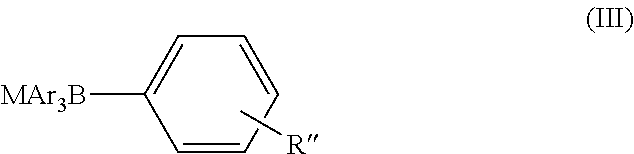
or an amine R′″—NH—R″″ (IV), whereby R′″ and R″″ have the same meaning as above and a rhodium containing catalyst, under an oxygen-free atmosphere at temperatures between 80-120° C. in a solvent.
 |
| Yield | ||||
| Entry | Ester | Borate | Product | (%)[b] |
| 1 |
 |
NaBPh4 (2a) |
 |
89 |
| 2 |
 |
2a |
 |
81 |
| 3 |
 |
2a |
 |
63 |
| 4 |
 |
2a |
 |
60 |
| 5 |
 |
2a |
 |
30 |
| 6 |
 |
2a |
 |
62 |
| 7 |
 |
2a |
 |
45 |
| 8 |
 |
KB(4- ClC6H4)4 (2b) |
 |
56[d] |
| 9 |
 |
NaB(2- naphthyl)4 (2c) |
 |
44 |
| 10 |
 |
NaB(4-tolyl)4 (2d) |
 |
92 |
| 11 |
 |
KB(2-thienyl)4 (2e) |
 |
0 |
| The reaction conditions were: 0.5 mmol enoate 1, 2.0 mmol tetraarylborate 2, Rh(acac)(COD) 0.015 mmol, BIPHEPHOS 0.015 mmol, toluene/water 3.0/0.15 mL, 100° C., 20 h, argon atmosphere. | ||||
| [a] N corresponds to the number of possible isomers. | ||||
| [b]isolated yields. | ||||
| [c] 0.03 mmol of catalyst were used. | ||||
| [d]2.0 equiv. of 18-crown-6 were added. | ||||
 |
| Entry | Ester | Product | Yield (%)[a] |
| 1 |
 |
 |
44 |
| 2 |
 |
 |
62 |
| 3 |
 |
 |
89 |
| 4 |
 |
 |
74 |
| 5 |
 |
 |
71 |
| 6 |
 |
 |
47 |
| 7 |
 |
 |
25 |
| 8 |
 |
 |
17 |
| 9 |
 |
 |
35[b] |
| 10 |
 |
 |
0 |
| reaction conditions: 0.5-1.0 mmol enoate 1, 5.0-10.0 mmol amine 4, Rh(acac)(CO)2 0.015 equiv., BIPHEPHOS 0.015 equiv., toluene 2.0 mL/mmol, 100° C., 20 h, argon atmosphere. | |||
| TABLE 1 |
 |
 |
| XnB—Ph 2 | Yield | |||
| Entry | Catalyst (mol %) | Ligand (mol %) | (equiv.) | (%) |
| 1 | [Rh(COD)Cl]2 (0.5) | Biphephos (1.0) | NaBPh4 (1.5) | 40 |
| 2 | [Rh(COD)Cl]2 (0.5) | Biphephos (1.0) | NaBPh4 (2.0) | 47 |
| 3 | — | Biphephos (1.0) | NaBPh4′(1.5) | 0 |
| 4 | [Rh(COD)Cl]2 (0.5) | — | NaBPh4′(1.5) | 0 |
| 5 | [Rh(OH)Cl)]2 (0.5) | Biphephos (1.0) | NaBPh4′(1.5) | 38 |
| 6 | Rh(COD)(acac) (1.0) | Biphephos (1.0) | NaBPh4′(1.5) | 57 |
| 7 | Rh(COD)(acac) (1.5) | Biphephos (1.5) | NaBPh4′(1.5) | 65 |
| 8 | Rh(COD)(acac) (1.5) | Biphephos (1.5) | NaBPh4 (2.0) | 91 |
| pin = Pinacol; | ||||
| MIDA = N-methyliminodiacetic acid boronate;. | ||||
Claims (8)


Applications Claiming Priority (4)
| Application Number | Priority Date | Filing Date | Title |
|---|---|---|---|
| EP10189314A EP2447245A1 (en) | 2010-10-28 | 2010-10-28 | A method to prepare beta-functionalized aliphatic esters |
| EP10189314 | 2010-10-28 | ||
| EPEP10189314 | 2010-10-28 | ||
| PCT/EP2011/004400 WO2012055455A1 (en) | 2010-10-28 | 2011-08-31 | A method to prepare beta - functionalized aliphatic esters |
Publications (2)
| Publication Number | Publication Date |
|---|---|
| US20130225852A1 US20130225852A1 (en) | 2013-08-29 |
| US8877958B2 true US8877958B2 (en) | 2014-11-04 |
Family
ID=43736144
Family Applications (1)
| Application Number | Title | Priority Date | Filing Date |
|---|---|---|---|
| US13/881,853 Active 2031-09-12 US8877958B2 (en) | 2010-10-28 | 2011-08-31 | Method to prepare beta-functionalized aliphatic esters |
Country Status (11)
| Country | Link |
|---|---|
| US (1) | US8877958B2 (en) |
| EP (2) | EP2447245A1 (en) |
| JP (1) | JP5806739B2 (en) |
| KR (1) | KR101872044B1 (en) |
| CN (1) | CN103180287B (en) |
| AU (1) | AU2011323015B2 (en) |
| BR (1) | BR112013010216A2 (en) |
| CA (1) | CA2815907A1 (en) |
| ES (1) | ES2648140T3 (en) |
| MX (1) | MX338234B (en) |
| WO (1) | WO2012055455A1 (en) |
Cited By (1)
| Publication number | Priority date | Publication date | Assignee | Title |
|---|---|---|---|---|
| DE102018215394A1 (en) * | 2018-09-11 | 2020-03-12 | Rheinisch-Westfälische Technische Hochschule Aachen | Process for the chemical conversion of sugars or sugar alcohols to glycols |
Family Cites Families (2)
| Publication number | Priority date | Publication date | Assignee | Title |
|---|---|---|---|---|
| JP4183153B2 (en) * | 1999-08-26 | 2008-11-19 | 三菱レイヨン株式会社 | Method for synthesizing optically active β-aryl ester compounds and amide compounds |
| TW200804269A (en) * | 2005-11-16 | 2008-01-16 | Astrazeneca Ab | Chemical process |
-
2010
- 2010-10-28 EP EP10189314A patent/EP2447245A1/en not_active Withdrawn
-
2011
- 2011-08-31 EP EP11752123.7A patent/EP2632888B1/en active Active
- 2011-08-31 US US13/881,853 patent/US8877958B2/en active Active
- 2011-08-31 BR BR112013010216A patent/BR112013010216A2/en active Search and Examination
- 2011-08-31 KR KR1020137010737A patent/KR101872044B1/en active Active
- 2011-08-31 CA CA2815907A patent/CA2815907A1/en not_active Abandoned
- 2011-08-31 JP JP2013535285A patent/JP5806739B2/en active Active
- 2011-08-31 CN CN201180051767.1A patent/CN103180287B/en active Active
- 2011-08-31 MX MX2013004682A patent/MX338234B/en active IP Right Grant
- 2011-08-31 WO PCT/EP2011/004400 patent/WO2012055455A1/en not_active Ceased
- 2011-08-31 ES ES11752123.7T patent/ES2648140T3/en active Active
- 2011-08-31 AU AU2011323015A patent/AU2011323015B2/en active Active
Non-Patent Citations (6)
Cited By (1)
| Publication number | Priority date | Publication date | Assignee | Title |
|---|---|---|---|---|
| DE102018215394A1 (en) * | 2018-09-11 | 2020-03-12 | Rheinisch-Westfälische Technische Hochschule Aachen | Process for the chemical conversion of sugars or sugar alcohols to glycols |
Also Published As
| Publication number | Publication date |
|---|---|
| EP2632888B1 (en) | 2017-08-23 |
| EP2632888A1 (en) | 2013-09-04 |
| RU2013124073A (en) | 2014-12-10 |
| KR20130126902A (en) | 2013-11-21 |
| ES2648140T3 (en) | 2017-12-28 |
| AU2011323015B2 (en) | 2016-06-09 |
| MX2013004682A (en) | 2013-05-17 |
| BR112013010216A2 (en) | 2016-09-13 |
| CA2815907A1 (en) | 2012-05-03 |
| WO2012055455A1 (en) | 2012-05-03 |
| CN103180287A (en) | 2013-06-26 |
| MX338234B (en) | 2016-04-08 |
| AU2011323015A1 (en) | 2013-05-23 |
| EP2447245A1 (en) | 2012-05-02 |
| JP2014505013A (en) | 2014-02-27 |
| KR101872044B1 (en) | 2018-06-27 |
| JP5806739B2 (en) | 2015-11-10 |
| US20130225852A1 (en) | 2013-08-29 |
| CN103180287B (en) | 2016-01-13 |
Similar Documents
| Publication | Publication Date | Title |
|---|---|---|
| Clavier et al. | Design and synthesis of new bidentate alkoxy-NHC ligands for enantioselective copper-catalyzed conjugate addition | |
| US7863458B2 (en) | Halogen-free ionic liquids | |
| EP2650276B1 (en) | Method for producing beta-fluoroalcohol | |
| ES2359837T3 (en) | METHOD FOR THE PRODUCTION OF OPTICALLY ACTIVE CARBONY COMPOUNDS. | |
| JPH01211551A (en) | Production of optically active alcohol and its derivative | |
| US9012690B2 (en) | Method for producing alcohol and/or amine from amide compound | |
| EP3153495B1 (en) | Method for producing carboxylic acid anhydride, and method for producing carboxylic acid ester | |
| KR20050089979A (en) | Method of deuterization | |
| EP2740719B1 (en) | Process for producing a-fluoroaldehydes | |
| CN103827079A (en) | The manufacture method of N-acyl aminotriol | |
| JP6018046B2 (en) | Process for the hydrogenation of ketoesters | |
| CN102952130A (en) | Method for chiral synthesis of (S,S)-2-8-diazabicyclononane | |
| EP2632888B1 (en) | A method to prepare beta-functionalized aliphatic esters | |
| US6187918B1 (en) | Catalysts for asymmetric addition of organozinc reagents to aldehydes and method for preparation | |
| US9937491B2 (en) | Method for preparing chiral ferrocene diphosphine ligand | |
| CN104437642B (en) | It is a kind of for catalyst of olefin metathesis reaction and preparation method thereof | |
| CN101298056A (en) | Asymmetric catalytic reaction catalyst and preparation and use thereof | |
| RU2575017C2 (en) | Method for obtaining beta-functionalised aliphatic esters | |
| EP3596038B1 (en) | Metal-catalyzed alkoxycarbonylation of a lactone | |
| Doran et al. | Neutral vs. cationic rhodium (I) complexes of bulky N-phosphino sulfinamide ligands: Coordination modes and its influence in the asymmetric hydrogenation of Z-MAC | |
| EP2799422B1 (en) | Method for producing carboxylic acid and alcohol by hydrolysis of ester | |
| WO2006088142A1 (en) | Catalyst for asymmetric synthesis, ligand for use therein, and process for producing optically active compound through asymmetric synthesis reaction using them | |
| CN120441420A (en) | A preparation method of chiral cis-cyclobutenediol | |
| JP2001253891A (en) | Phosphinyl group-containing N-substituted amino acid derivative and method for producing the same | |
| JPH06107598A (en) | Process for producing 4-oxo-5-alkylidene-2-cyclopentenecarboxylic acid derivative and novel compound |
Legal Events
| Date | Code | Title | Description |
|---|---|---|---|
| AS | Assignment |
Owner name: COGNIS IP MANAGEMENT GMBH, GERMANY Free format text: ASSIGNMENT OF ASSIGNORS INTEREST;ASSIGNORS:GOOSSEN, LUKAS J.;OHLMANN, DOMINIK;DIERKER, MARKUS;SIGNING DATES FROM 20130612 TO 20130701;REEL/FRAME:030868/0026 |
|
| STCF | Information on status: patent grant |
Free format text: PATENTED CASE |
|
| MAFP | Maintenance fee payment |
Free format text: PAYMENT OF MAINTENANCE FEE, 4TH YEAR, LARGE ENTITY (ORIGINAL EVENT CODE: M1551) Year of fee payment: 4 |
|
| MAFP | Maintenance fee payment |
Free format text: PAYMENT OF MAINTENANCE FEE, 8TH YEAR, LARGE ENTITY (ORIGINAL EVENT CODE: M1552); ENTITY STATUS OF PATENT OWNER: LARGE ENTITY Year of fee payment: 8 |
|
| MAFP | Maintenance fee payment |
Free format text: PAYMENT OF MAINTENANCE FEE, 12TH YEAR, LARGE ENTITY (ORIGINAL EVENT CODE: M1553); ENTITY STATUS OF PATENT OWNER: LARGE ENTITY Year of fee payment: 12 |