US8859931B2 - Plasma synthesis of nanopowders - Google Patents
Plasma synthesis of nanopowders Download PDFInfo
- Publication number
- US8859931B2 US8859931B2 US11/683,792 US68379207A US8859931B2 US 8859931 B2 US8859931 B2 US 8859931B2 US 68379207 A US68379207 A US 68379207A US 8859931 B2 US8859931 B2 US 8859931B2
- Authority
- US
- United States
- Prior art keywords
- quench
- reactant
- plasma
- quenching
- gas
- Prior art date
- Legal status (The legal status is an assumption and is not a legal conclusion. Google has not performed a legal analysis and makes no representation as to the accuracy of the status listed.)
- Active, expires
Links
Images




Classifications
-
- H—ELECTRICITY
- H05—ELECTRIC TECHNIQUES NOT OTHERWISE PROVIDED FOR
- H05H—PLASMA TECHNIQUE; PRODUCTION OF ACCELERATED ELECTRICALLY-CHARGED PARTICLES OR OF NEUTRONS; PRODUCTION OR ACCELERATION OF NEUTRAL MOLECULAR OR ATOMIC BEAMS
- H05H1/00—Generating plasma; Handling plasma
- H05H1/24—Generating plasma
- H05H1/26—Plasma torches
- H05H1/32—Plasma torches using an arc
- H05H1/42—Plasma torches using an arc with provisions for introducing materials into the plasma, e.g. powder or liquid
-
- B—PERFORMING OPERATIONS; TRANSPORTING
- B22—CASTING; POWDER METALLURGY
- B22F—WORKING METALLIC POWDER; MANUFACTURE OF ARTICLES FROM METALLIC POWDER; MAKING METALLIC POWDER; APPARATUS OR DEVICES SPECIALLY ADAPTED FOR METALLIC POWDER
- B22F9/00—Making metallic powder or suspensions thereof
- B22F9/02—Making metallic powder or suspensions thereof using physical processes
- B22F9/12—Making metallic powder or suspensions thereof using physical processes starting from gaseous material
-
- B—PERFORMING OPERATIONS; TRANSPORTING
- B22—CASTING; POWDER METALLURGY
- B22F—WORKING METALLIC POWDER; MANUFACTURE OF ARTICLES FROM METALLIC POWDER; MAKING METALLIC POWDER; APPARATUS OR DEVICES SPECIALLY ADAPTED FOR METALLIC POWDER
- B22F2202/00—Treatment under specific physical conditions
- B22F2202/13—Use of plasma
Definitions
- the present invention relates to the plasma synthesis of nanopowders using plasma technology. More specifically, but not exclusively, the present invention relates to a process and apparatus for the synthesis of nanopowders of various materials such as metals, alloys, ceramics and composites by induction plasma torch, direct current plasma torch or transferred arc plasma technology.
- High temperature plasma processing routes are based on the concept of heating the reactant precursors (in solid, liquid or vapor/gaseous form), to relatively high temperatures, followed by rapid cooling of the reaction products through their mixing with a cold gas stream as in the “high intensity turbulent quench technique” or through their contacting with a cold surface on which the nanoparticles form and deposit.
- a drawback of the use of traditional “cold-surface” condensation techniques is that the nature and the temperature of the condensation surface changes with the build-up of the condensed nanopowder layer.
- the use of a “highly turbulent gas quench zone” has been previously described by Boulos et al. in U.S. 20050217421 and U.S. 20030143153 filed on Mar. 25, 2005 and Dec. 6, 2002 respectively.
- U.S. Pat. No. 6,379,419 issued to Celik et al. on Apr. 30, 2002 discloses a transferred arc thermal plasma based vapor condensation method for the production of fine and ultra fine powders.
- the method calls upon a conventional two-step condensation (i.e. cooling) procedure including an indirect cooling step and a direct cooling step.
- the indirect cooling step involves a cooling surface whereas the direct cooling step involves the injection of a cooling fluid, liquid or gaseous, directly onto the vapor.
- the vapor laden stream of hot gas is first subjected to an indirect cooling or heating section providing for a control over the growth and crystallization of the particles, followed by a direct cooling section wherein the cooling is performed by injecting a fluid, liquid or gaseous, directly onto the vapor and aerosol laden stream.
- an indirect cooling or heating section providing for a control over the growth and crystallization of the particles
- a direct cooling section wherein the cooling is performed by injecting a fluid, liquid or gaseous, directly onto the vapor and aerosol laden stream.
- the present invention refers to a number of documents, the content of which is herein incorporated by reference in their entirety.
- the present invention relates to an improved process and apparatus for the preparation of nanopowders in which the particle morphology, the particle size distribution, and the agglomeration of particles is readily controlled and which process is easily scalable.
- the present invention relates to the plasma synthesis of nanopowders calling upon radio frequency (r.f.) inductively coupled plasma torch, direct current (d.c.) plasma torch or transferred arc plasma technology. More specifically, as broadly claimed, the present invention relates to an apparatus comprising: (a) a plasma source (i.e.
- high temperature precursor vaporization zone in which a superheated vapor is generated from a reactant material in the form of molten metal droplets or a molten metal pool of solid particles;
- a quenching chamber in which a renewable laminar “controlled temperature gaseous condensation front” is generated through the injection of a preheated quench gas in an upstream section of the quench zone, followed by the injection of progressively cooler quench gases in a downstream section of the quench zone, on which front the gaseous reactants/reaction products condense and nucleate; and
- a nanopowder collection zone in which a superheated vapor is generated from a reactant material in the form of molten metal droplets or a molten metal pool of solid particles.
- the present invention relates to an apparatus for producing nanopowders comprising:
- a plasma torch to generate a plasma flow and to produce a vapour from a reactant material supplied to the plasma torch;
- a quenching chamber mounted to the plasma torch downstream therefrom and in fluid communication with the plasma torch to receive the vapour from the plasma torch, the quenching chamber comprising an upstream hot quench section and a downstream cold quench section, the upstream hot quench section being configured to receive a preheated quench gas and to generate from said quench gas a renewable gaseous condensation front.
- the nucleation generates a nanopowder which is rapidly transported to a collection chamber (i.e. “collection zone”) by the moving gaseous condensation front.
- a collection chamber i.e. “collection zone”
- the moving gaseous condensation front by independently controlling the temperature and chemical composition of the renewable gaseous condensation front (for nucleating (i.e. condensing) the reactants/reaction products present in the plasma flow), excellent control of the chemistry, morphology, uniformity and particle size distribution of the resulting nanopowder could be achieved.
- the renewable controlled temperature gaseous condensation front offers close control over particle agglomeration since the front rapidly transports the nanopowders out of the quenching zone, thus reducing the possibility for generating larger particles through agglomeration.
- the apparatus of the present invention offers the additional advantages of being compact, scalable and simple to operate.
- the present invention relates to a process for the plasma synthesis of nanopowders using r.f. inductively coupled plasma, d.c. plasma or transferred arc plasma technology and calling upon a renewable “controlled temperature gaseous condensation front”, for example a laminar “controlled temperature gaseous condensation front” which serves to rapidly quench the reactants/reaction products present in the plasma flow.
- the present invention relates to a process for the plasma synthesis of nanopowders comprising;
- FIG. 1 a is a cross-sectional side-elevation view of an apparatus in accordance with an embodiment of the present invention, comprising an r.f. inductively coupled plasma reactor (i.e. high temperature precursor vaporization zone) and a quenching zone in a generally vertical configuration relative to one another.
- FIG. 1 b is a cross-sectional side-elevation view of an apparatus in accordance with a further embodiment of the present invention, comprising a transferred arc plasma reactor (i.e. high temperature precursor vaporization zone) and a temperature controlled quenching zone in a slanted configuration relative to one another.
- FIG. 1 a is a cross-sectional side-elevation view of an apparatus in accordance with an embodiment of the present invention, comprising an r.f. inductively coupled plasma reactor (i.e. high temperature precursor vaporization zone) and a quenching zone in a generally vertical configuration relative to one another.
- FIG. 1 b is a cross-sectional side-elev
- 1 c is a cross-sectional side-elevation view of an apparatus in accordance with a further embodiment of the present invention, comprising a transferred arc plasma reactor (i.e. high temperature precursor vaporization zone) and a quenching zone in a generally horizontal configuration relative to one another.
- a transferred arc plasma reactor i.e. high temperature precursor vaporization zone
- quenching zone in a generally horizontal configuration relative to one another.
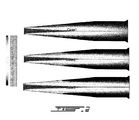
- FIG. 2 is an illustration of the temperature isocontours in the quenching zone of either of the plasma reactors of FIG. 1 using an Ar/H 2 plasma gas flow at 5000 K and a quench gas flow rate of 400 slpm, wherein the quench gas is at 700 K (Case 1), 1000 K (Case 2) and 1200 K (Case 3) respectively.
- FIG. 3 is an illustration of the flow stream lines in the quenching zone of either of the plasma reactors of FIG. 1 using an Ar/H 2 plasma gas flow at 5000 K and a quench gas flow rate of 400 slpm, wherein the quench gas is at 700 K (Case 1), 1000 K (Case 2) and 1200 K (Case 3) respectively.
- FIG. 4 is an illustration of the gas cooling rate isocontours in the quenching zone of either of the plasma reactors of FIG. 1 using an Ar/H 2 plasma gas flow at 5000 K and a quench gas flow rate of 400 slpm, wherein the quench gas is at 700 K (Case 1), 1000 K (Case 2) and 1200 K (Case 3) respectively.
- FIG. 5 is a graph illustrating temperature profiles along the centerline of the quenching zone of either of the plasma reactors of FIG. 1 using an Ar/H 2 plasma gas flow at 5000 K and a quench gas flow rate of 400 slpm, wherein the quench gas is at 700 K (Case 1), 1000 K (Case 2) and 1200 K (Case 3) respectively.
- FIG. 6 is a graph illustrating the gas cooling rate along the centerline of the quenching zone of either of the plasma reactors of FIG. 1 using an Ar/H 2 plasma gas flow at 5000 K and a quench gas flow rate of 400 slpm, wherein the quench gas is at 700 K (Case 1), 1000 K (Case 2) and 1200 K (Case 3) respectively.
- FIG. 7 is a Scanning Electron Microscope (SEM) micrograph of a copper nanopowder produced in accordance with the present invention (Transferred Arc: Plasma Gas: Ar 20 slpm, N 2 20 slpm; Arc current: 500 A; Power Level: 55 kW, Chamber Pressure: 66 kPa; Quench Flow (recycled argon and nitrogen): 3300 slpm; Passivation: Air 8 slpm).
- SEM Scanning Electron Microscope
- FIG. 8 is an X-Ray Diffraction Pattern of a copper nanopowder produced in accordance with the present invention.
- FIG. 9 is an X-Ray Diffraction Pattern of a copper oxide nanopowder produced in accordance with the present invention.
- SEM Scanning Electron Microscope
- the words “comprising” (and any form of comprising, such as “comprise” and “comprises”), “having” (and any form of having, such as “have” and “has”), “including” (and any form of including, such as “include” and “includes”) or “containing” (and any form of containing, such as “contain” and “contains”), are inclusive or open-ended and do not exclude additional, unrecited elements or process steps.
- the present invention relates to the plasma synthesis of nanopowders calling upon r.f. inductively coupled plasma, d.c. plasma or transferred arc plasma technology. More specifically, as broadly claimed, the present invention relates to a process for the plasma synthesis of nanopowders using r.f. inductively coupled plasma, d.c. plasma or transferred arc plasma technology comprising producing a renewable “controlled temperature gaseous condensation front”, for example a laminar “controlled temperature gaseous condensation front” which serves to rapidly quench the reactants/reaction products present in the plasma flow.
- the process of the present invention comprises the vaporization of a metallic feed (i.e. molten metal droplets or a molten metal pool maintained in a refractory ceramic crucible and heated by a d.c. transferred arc).
- a metallic feed i.e. molten metal droplets or a molten metal pool maintained in a refractory ceramic crucible and heated by a d.c. transferred arc.
- the vapors emerge from the vaporization zone (i.e. plasma torch or the transferred arc furnace) they are mixed with and transported by a stream of hot gas, composed of one or more plasma gases optionally mixed with an external, preheated, secondary sheath gas stream, from the vaporization zone to the quenching zone of the reactor (i.e. apparatus).
- the vapor laden stream of hot plasma gas is confronted by a renewable “controlled temperature gaseous condensation front” which can be generated through the uniform injection of a preheated quench gas across a porous metal or ceramic wall, or a perforated refractory wall of a quenching chamber.
- the temperature of the renewable “controlled temperature gaseous condensation front” can be controlled through a preheating of the quench gas upstream from the point of injection into the quench zone.
- the quenching chamber comprises a perforated refractory wall for injecting the preheated quench gas. Even though the use of a quenching chamber equipped with a porous metal or ceramic wall is within the scope of the present invention, a perforated refractory wall provides for a wider range of quench gas temperatures and optimal control of the condensation process.
- the process comprises producing a renewable “controlled temperature gaseous condensation front” as an effective means of controlling the uniformity and particle size distribution of the nanopowder produced.
- a renewable “controlled temperature gaseous condensation front” as an effective means of controlling the uniformity and particle size distribution of the nanopowder produced.
- an effective control can be exercised on the vapor condensation (i.e. nucleation) and thus the particle growth process, the morphology and the particle size distribution of the particles making up the nanopowder.
- the subsequent steps of the process comprise further cooling of the nanopowder and the gas stream, and the collection of the nanopowder in an appropriate filter.
- the subsequent cooling can be achieved using conventional cyclonic heat exchangers.
- the renewable, controlled temperature gaseous condensation front substantially eliminates the risk of powder condensation on the inner surfaces of the reactor, ensuring a more streamlined and continuous quenching zone in which the gaseous reactants/reaction products condense and nucleate.
- the process of the present invention comprises producing a renewable controlled temperature gaseous condensation front by means of injecting a preheated quench gas into a quenching zone comprising a quenching chamber equipped with either a perforated refractory wall or a porous metal or ceramic wall.
- the renewable controlled temperature gaseous condensation front provides for a continuous and stable condensation process.
- controlling the temperature profile along the centerline of the quenching zone provides for improved control over the physical characteristics (i.e. particle morphology, particle size and particle size distribution) of the nanopowder product.
- the process of the present invention provides for improved quality control of the nanopowder product as well as being scalable and simple to operate.
- FIG. 1 a , FIG. 1 b and FIG. 1 c show respective illustrative embodiments of an apparatus 10 a , 10 b and 10 c respectively, for producing nanopowders.
- the apparatus 10 a is an r.f inductively coupled plasma (i.e. high temperature precursor vaporization zone) reactor assembly and the apparatuses 10 b and 10 c are a d.c. transferred arc plasma (i.e. high temperature precursor vaporization zone) reactor assembly.
- the precursor vaporization takes place in-flight from liquid droplets formed through the melting of solid particles introduced into the center of the discharge 14 a using techniques well known to those of ordinary skill in the art.
- the precursor vaporization can also take place in flight from liquid droplets injected into the discharge.
- a central precursor vaporization zone 12 b in which a molten metal pool 14 b is maintained in a refractory crucible 16 b is vaporized or decomposed by means of the energy provided by a dc transferred arc plasma torch 18 b .
- the vaporization zone 12 b comprises a plurality of openings such as 20 b , 22 b , 24 b and 26 b . Opening 22 b serves to introduce the tip 28 b of the dc transferred arc plasma torch 18 b which also serves as the cathode in the transferred arc operation.
- a further opening 26 b serves to introduce the anode 30 b connection, which is subsequently immersed in the molten metal pool 14 b .
- the anode 30 b connection can be generated through the use of a further dc transferred arc plasma torch.
- a further opening 20 b provides for the continuous introduction of feed material, via a feed port 32 b into the vaporization zone 12 b such that the molten metal pool 14 b can be maintained at a substantially constant level.
- a further opening 24 b provides for the evacuation of the metal vapor laden plasma gas, optionally mixed with a torch sheath gas, to a quenching zone 34 b (which can be a quenching chamber for example) in fluid connection or communication with the vaporization zone 12 b .
- a quenching zone 34 b which can be a quenching chamber for example
- FIG. 1 c A non-limiting example of such other configurations is illustrated FIG. 1 c wherein the vaporization zone and quenching zones are in a generally horizontal configuration relative to one another.
- the metal vapor laden stream of hot plasma gas is confronted by a renewable controlled temperature gaseous condensation front, which is generated through the uniform injection of a preheated quench gas across a porous metal or ceramic wall or a perforated refractory wall ( 36 a , 36 b , 36 c ) of a quenching chamber (i.e. hot quench section 38 a , 38 b , 38 c ).
- the quench gas can be preheated to a desired condensation temperature, providing for an effective means of controlling the condensation conditions and thus the morphology, uniformity and particle size distribution of the nanopowder produced.
- a desired condensation temperature By maintaining the condensation temperature in the hot quench section ( 38 a , 38 b , 38 c ) of the quenching zone ( 34 a , 34 b , 34 c ) at a temperature below the melting point of the processed material, excessive particle agglomeration and deposition on the inner walls (i.e. surfaces) of the reactor ( 10 a , 10 b , 10 c ), is substantially avoided.
- Individual modules further downstream of the hot quench section ( 38 a , 38 b , 38 c ) of the quenching zone ( 34 a , 34 b , 34 c ) provide for the injection of additional quench gas at different temperatures and the establishment of a predetermined temperature gradient along the centerline of the quenching zone ( 34 a , 34 b , 34 c ).
- additional module i.e. cold quench section 40 a , 40 b , 40 c
- other configurations comprising a plurality of such cold quench sections are within the capacity of a skilled technician.
- Controlling the temperature profile along the centerline ( 42 a , 42 b , 42 c ) of the quenching zone ( 34 a , 34 b , 34 c ) provides for an improved control over the physical characteristics (i.e. particle morphology, particle size and particle size distribution) of the final nanopowder product.
- Controlling the chemistry of the cold quench gas, injected at different locations in the cold quench section provides for added means of controlling the chemistry of the nanopowders produced.
- FIG. 1 a , FIG. 1 b and FIG. 1 c further illustrate a hot quench gas inlet ( 44 a , 44 b , 44 c ) for feeding hot quench gas into the hot quench zone ( 38 a , 38 b , 38 c ) as well as a cold quench gas inlet ( 46 a , 46 b , 46 c ) feeding cold quench gas into the cold quench zone ( 40 a , 40 b , 40 c ).
- the hot quench gas inlet ( 44 a , 44 b , 44 c ) or cold quench gas inlets ( 46 a , 46 b , 46 c ) may also be used to feed a second reactant (such as an oxidizing gas, a carburizing agent, and a nitrating agent) into the quench zone ( 34 a , 34 b , 34 c ).
- a second reactant such as an oxidizing gas, a carburizing agent, and a nitrating agent
- the quench gas may further comprise an oxidizing gas such as oxygen.
- the metal vapor laden stream of hot plasma gas is confronted by a renewable controlled temperature gaseous condensation front further comprising oxygen, producing a nanopowder comprising an oxide of the precursor material.
- the quench gas may further comprise a carburizing agent such as acetylene or methane.
- the metal vapor laden stream of hot plasma gas is confronted by a renewable controlled temperature gaseous condensation front further comprising a carburizing agent, producing a nanopowder comprising a carbide of the precursor material.
- the quench gas may further comprise a nitriding agent such as ammonia.
- the metal vapor laden stream of hot plasma gas is confronted by a renewable controlled temperature gaseous condensation front further comprising a nitriding agent, producing a nanopowder comprising a nitride of the precursor material.
- a renewable controlled temperature gaseous condensation front further comprising a nitriding agent, producing a nanopowder comprising a nitride of the precursor material.
- Other quenching gas configurations are possible and are within the capacity of a skilled technician.
- the effectiveness of the controlled temperature gaseous condensation front in controlling the temperature field in the quench zone ( 34 a , 34 b , 34 c ) is further illustrated by the results depicted in FIGS. 2-6 .
- the results were obtained using experimental parameters typical of either r.f. or d.c. plasma evaporation, quenching zones operating at atmospheric pressure and using an argon/hydrogen (80/20% vol) plasma.
- the temperature of the metal vapor laden plasma gas at the exit of the high temperature precursor vaporization zone was set at 5000 K with a total gas flow rate of 90 slpm (11% vol. H 2 in the mixture).
- the quench gas flow rate was set at 400 slpm (pure Argon) and the quench gas injection temperatures were set at 700 K (Case 1), 1000 K (Case 2) and 1200 K (Case 3) respectively.
- Typical temperature isocontours, flow stream lines, and gas cooling rate isocontours as observed in the quenching zone are illustrated in FIGS. 2 , 3 , and 4 respectively.
- the core temperature of the plasma gases entering the quench section is relatively uniform at 5000 K.
- gaseous condensation fronts are generated in the hot section of the quenching chamber, depending on the temperature of the injected quench gas.
- increasing the quench gas temperature from 700 K to 1200 K significantly reduces the severity of the quench rate.
- increasing the quench gas temperature from 700 K to 1200 K reduces the plasma gas cooling rate which is of importance for a proper control over the vapor condensation process (i.e. nucleation) and thus the particle growth process, the particle morphology and the particle size and particle size distribution of the particles making up the nanopowder.
- the temperature of the gases along the centerline of the quenching zone drops-off more gradually with increasing quench gas temperatures.
- the effect of the quench gas temperature on the cooling rate of the plasma gases is significant.
- the results indicate that an increase of the quench gas temperature from 700 K to 1200 K, leads to a decrease of the maximum cooling rate form 6 ⁇ 10 5 K/s to 5 ⁇ 10 5 K/s.
- the location of the peak indicative of maximal plasma gas cooling rate is shifted in the downstream direction by about 0.1 meters.
- FIG. 7 A Scanning Electron Microscope (SEM) micrograph of a copper nanopowder produced in accordance with the present invention is illustrated in FIG. 7 .
- the mean particle size was measured to be 100 nm and the BET specific surface area was measured to be 6.72 m 2 /g.
- FIG. 8 An X-Ray Diffraction Pattern of a copper nanopowder produced in accordance with the present invention is illustrated in FIG. 8 .
- the diffraction pattern is indicative of a pure metallic copper powder.
- FIG. 9 An X-Ray Diffraction Pattern of a copper oxide nanopowder produced in accordance with the present invention is illustrated in FIG. 9 .
- the diffraction pattern is indicative of a pure metallic copper powder.
- FIG. 10 A Scanning Electron Microscope (SEM) micrograph of a copper oxide nanopowder produced in accordance with the present invention is illustrated in FIG. 10 .
- the BET specific surface area was measured to be 14.8 m 2 /g.
Landscapes
- Physics & Mathematics (AREA)
- Engineering & Computer Science (AREA)
- Plasma & Fusion (AREA)
- Spectroscopy & Molecular Physics (AREA)
- Manufacture Of Metal Powder And Suspensions Thereof (AREA)
- Physical Or Chemical Processes And Apparatus (AREA)
Abstract
Description
Claims (40)
Priority Applications (1)
| Application Number | Priority Date | Filing Date | Title |
|---|---|---|---|
| US11/683,792 US8859931B2 (en) | 2006-03-08 | 2007-03-08 | Plasma synthesis of nanopowders |
Applications Claiming Priority (2)
| Application Number | Priority Date | Filing Date | Title |
|---|---|---|---|
| US77996806P | 2006-03-08 | 2006-03-08 | |
| US11/683,792 US8859931B2 (en) | 2006-03-08 | 2007-03-08 | Plasma synthesis of nanopowders |
Publications (2)
| Publication Number | Publication Date |
|---|---|
| US20070221635A1 US20070221635A1 (en) | 2007-09-27 |
| US8859931B2 true US8859931B2 (en) | 2014-10-14 |
Family
ID=38469064
Family Applications (1)
| Application Number | Title | Priority Date | Filing Date |
|---|---|---|---|
| US11/683,792 Active 2030-05-07 US8859931B2 (en) | 2006-03-08 | 2007-03-08 | Plasma synthesis of nanopowders |
Country Status (2)
| Country | Link |
|---|---|
| US (1) | US8859931B2 (en) |
| CA (1) | CA2581806C (en) |
Cited By (5)
| Publication number | Priority date | Publication date | Assignee | Title |
|---|---|---|---|---|
| DE102019211921A1 (en) * | 2019-08-08 | 2021-02-11 | Schmid Silicon Technology Gmbh | Method and device for producing silicon-containing materials |
| US11198179B2 (en) | 2015-07-17 | 2021-12-14 | Ap&C Advanced Powders & Coating Inc. | Plasma atomization metal powder manufacturing processes and system therefor |
| US11235385B2 (en) | 2016-04-11 | 2022-02-01 | Ap&C Advanced Powders & Coating Inc. | Reactive metal powders in-flight heat treatment processes |
| US11749798B2 (en) | 2017-03-03 | 2023-09-05 | Hydro-Quebec | Nanoparticles comprising a core covered with a passivation layer, process for manufacture and uses thereof |
| US12420338B2 (en) | 2015-10-29 | 2025-09-23 | Ap&C Advanced Powders & Coatings Inc. | Metal powder atomization manufacturing processes |
Families Citing this family (38)
| Publication number | Priority date | Publication date | Assignee | Title |
|---|---|---|---|---|
| US9630162B1 (en) * | 2007-10-09 | 2017-04-25 | University Of Louisville Research Foundation, Inc. | Reactor and method for production of nanostructures |
| US9516734B2 (en) | 2009-03-24 | 2016-12-06 | Tekna Plasma Systems Inc. | Plasma reactor for the synthesis of nanopowders and materials processing |
| DE102011002183B4 (en) | 2010-10-15 | 2014-04-30 | Industrieanlagen- Betriebsgesellschaft mit beschränkter Haftung | Apparatus and method for plasma-based production of nanoscale particles and / or for coating surfaces |
| WO2012143024A1 (en) | 2011-04-20 | 2012-10-26 | Industrieanlagen-Betriebsgesellschaft Mbh | Device and method for the plasma-assisted production of nanoscale particles and/or for coating surfaces |
| JP5824906B2 (en) * | 2011-06-24 | 2015-12-02 | 昭栄化学工業株式会社 | Plasma device for producing metal powder and method for producing metal powder |
| JP5900510B2 (en) | 2011-12-06 | 2016-04-06 | 昭栄化学工業株式会社 | Plasma equipment for metal powder production |
| NO334282B1 (en) | 2012-04-27 | 2014-01-27 | Reactive Metal Particles As | Apparatus and method for making particulate matter |
| US9692039B2 (en) | 2012-07-24 | 2017-06-27 | Quantumscape Corporation | Nanostructured materials for electrochemical conversion reactions |
| US20150291439A1 (en) * | 2013-06-21 | 2015-10-15 | Nisshin Engineering Inc. | Method for producing cuprous oxide fine particles, cuprous oxide fine particles and method of producing conductor film |
| US9466830B1 (en) | 2013-07-25 | 2016-10-11 | Quantumscape Corporation | Method and system for processing lithiated electrode material |
| AT514555B1 (en) * | 2013-08-27 | 2015-02-15 | Fronius Int Gmbh | Method and device for generating a plasma jet |
| WO2015130831A1 (en) | 2014-02-25 | 2015-09-03 | Quantumscape Corporation | Hybrid electrodes with both intercalation and conversion materials |
| DE102014110802B3 (en) * | 2014-07-30 | 2015-12-31 | Ald Vacuum Technologies Gmbh | Production of nanopowders |
| WO2016025866A1 (en) | 2014-08-15 | 2016-02-18 | Quantumscape Corporation | Doped conversion materials for secondary battery cathodes |
| JP2016143533A (en) * | 2015-01-30 | 2016-08-08 | 中国電力株式会社 | Plasma spray apparatus |
| CA3009630C (en) * | 2015-12-16 | 2023-08-01 | Amastan Technologies Llc | Spheroidal dehydrogenated metals and metal alloy particles |
| US10987735B2 (en) | 2015-12-16 | 2021-04-27 | 6K Inc. | Spheroidal titanium metallic powders with custom microstructures |
| US10543534B2 (en) | 2016-11-09 | 2020-01-28 | Amastan Technologies Inc. | Apparatus and method for the production of quantum particles |
| CN107030292A (en) * | 2017-05-03 | 2017-08-11 | 江苏天楹环保能源成套设备有限公司 | A kind of multistage cooling prepares the plasma atomising device of metal dust |
| JP2019055365A (en) * | 2017-09-21 | 2019-04-11 | 太平洋セメント株式会社 | Spray pyrolysis equipment |
| US11130175B2 (en) * | 2018-01-18 | 2021-09-28 | The Boeing Company | Spherical metallic powder blends and methods for manufacturing the same |
| CN112654444A (en) | 2018-06-19 | 2021-04-13 | 6K有限公司 | Method for producing spheroidized powder from raw material |
| JP7223379B2 (en) * | 2018-09-03 | 2023-02-16 | 国立大学法人金沢大学 | Fine particle manufacturing apparatus and fine particle manufacturing method |
| US20240051833A1 (en) * | 2019-10-09 | 2024-02-15 | Tekna Plasma Systems Inc. | Nanosize powder advanced materials, method of manufacturing and of using same |
| CN114641462A (en) | 2019-11-18 | 2022-06-17 | 6K有限公司 | Unique raw material for spherical powder and manufacturing method |
| CN114728338B (en) * | 2019-11-18 | 2025-02-25 | 日清工程株式会社 | Device for producing microparticles and method for producing microparticles |
| CA3180426A1 (en) | 2020-06-25 | 2021-12-30 | Richard K. Holman | Microcomposite alloy structure |
| AU2021349358A1 (en) | 2020-09-24 | 2023-02-09 | 6K Inc. | Systems, devices, and methods for starting plasma |
| CA3196653A1 (en) | 2020-10-30 | 2022-05-05 | Sunil Bhalchandra BADWE | Systems and methods for synthesis of spheroidized metal powders |
| CN112658272B (en) * | 2020-12-16 | 2023-04-28 | 杭州电子科技大学 | High-cooling gradient plasma arc-gas atomization composite powder preparation device and method |
| CN112658271B (en) * | 2020-12-16 | 2023-04-25 | 杭州电子科技大学 | Efficient combined type gas atomization powder preparation device and method |
| AU2022206483A1 (en) | 2021-01-11 | 2023-08-31 | 6K Inc. | Methods and systems for reclamation of li-ion cathode materials using microwave plasma processing |
| WO2022212291A1 (en) | 2021-03-31 | 2022-10-06 | 6K Inc. | Systems and methods for additive manufacturing of metal nitride ceramics |
| CN114653322B (en) * | 2022-02-25 | 2023-10-20 | 山东铝谷产业技术研究院有限公司 | Device and process for preparing micro-nano powder |
| WO2023229928A1 (en) | 2022-05-23 | 2023-11-30 | 6K Inc. | Microwave plasma apparatus and methods for processing materials using an interior liner |
| US12040162B2 (en) | 2022-06-09 | 2024-07-16 | 6K Inc. | Plasma apparatus and methods for processing feed material utilizing an upstream swirl module and composite gas flows |
| WO2024044498A1 (en) | 2022-08-25 | 2024-02-29 | 6K Inc. | Plasma apparatus and methods for processing feed material utilizing a powder ingress preventor (pip) |
| US12195338B2 (en) | 2022-12-15 | 2025-01-14 | 6K Inc. | Systems, methods, and device for pyrolysis of methane in a microwave plasma for hydrogen and structured carbon powder production |
Citations (18)
| Publication number | Priority date | Publication date | Assignee | Title |
|---|---|---|---|---|
| US3839618A (en) * | 1972-01-03 | 1974-10-01 | Geotel Inc | Method and apparatus for effecting high-energy dynamic coating of substrates |
| US3914573A (en) * | 1971-05-17 | 1975-10-21 | Geotel Inc | Coating heat softened particles by projection in a plasma stream of Mach 1 to Mach 3 velocity |
| US4361441A (en) * | 1979-04-17 | 1982-11-30 | Plasma Holdings N.V. | Treatment of matter in low temperature plasmas |
| US4982067A (en) * | 1988-11-04 | 1991-01-01 | Marantz Daniel Richard | Plasma generating apparatus and method |
| US5144110A (en) * | 1988-11-04 | 1992-09-01 | Marantz Daniel Richard | Plasma spray gun and method of use |
| US5233153A (en) * | 1992-01-10 | 1993-08-03 | Edo Corporation | Method of plasma spraying of polymer compositions onto a target surface |
| US5851507A (en) * | 1996-09-03 | 1998-12-22 | Nanomaterials Research Corporation | Integrated thermal process for the continuous synthesis of nanoscale powders |
| US6254940B1 (en) * | 1996-07-11 | 2001-07-03 | University Of Cincinnati | Electrically assisted synthesis of particles and film with precisely controlled characteristic |
| US6372156B1 (en) * | 1999-08-19 | 2002-04-16 | Bechtel Bwxt Idaho, Llc | Methods of chemically converting first materials to second materials utilizing hybrid-plasma systems |
| US6379419B1 (en) * | 1998-08-18 | 2002-04-30 | Noranda Inc. | Method and transferred arc plasma system for production of fine and ultrafine powders |
| CA2445169A1 (en) | 2001-04-24 | 2002-10-31 | Tekna Plasma Systems Inc. | Plasma synthesis of titanium dioxide nanopowder and powder doping and surface modification process |
| US20030143153A1 (en) | 2001-04-24 | 2003-07-31 | Tekna Plasma Systems, Inc. | Plasma synthesis of metal oxide nanopowder and apparatus therefor |
| US20030145681A1 (en) * | 2002-02-05 | 2003-08-07 | El-Shall M. Samy | Copper and/or zinc alloy nanopowders made by laser vaporization and condensation |
| US20050120957A1 (en) * | 2002-01-08 | 2005-06-09 | Flame Spray Industries, Inc. | Plasma spray method and apparatus for applying a coating utilizing particle kinetics |
| US20050244693A1 (en) * | 2004-04-30 | 2005-11-03 | Strutt Peter R | Mestastable ceramic fuel cell and method of making same |
| US20050258149A1 (en) * | 2004-05-24 | 2005-11-24 | Yuri Glukhoy | Method and apparatus for manufacture of nanoparticles |
| CA2512317A1 (en) | 2004-07-20 | 2006-01-20 | E.I. Dupont De Nemours And Company | Process for making metal oxide nanoparticles |
| US20070029291A1 (en) | 2005-01-28 | 2007-02-08 | Tekna Plasma Systems Inc. | Induction plasma synthesis of nanopowders |
Family Cites Families (1)
| Publication number | Priority date | Publication date | Assignee | Title |
|---|---|---|---|---|
| DE10057396C1 (en) * | 2000-11-18 | 2002-04-04 | Karlsruhe Forschzent | Separation of e.g. biomolecules from dispersion or solution, employs magnetic particles onto which substance is sorbed, and electromagnet for their extraction |
-
2007
- 2007-03-08 US US11/683,792 patent/US8859931B2/en active Active
- 2007-03-08 CA CA2581806A patent/CA2581806C/en active Active
Patent Citations (19)
| Publication number | Priority date | Publication date | Assignee | Title |
|---|---|---|---|---|
| US3914573A (en) * | 1971-05-17 | 1975-10-21 | Geotel Inc | Coating heat softened particles by projection in a plasma stream of Mach 1 to Mach 3 velocity |
| US3839618A (en) * | 1972-01-03 | 1974-10-01 | Geotel Inc | Method and apparatus for effecting high-energy dynamic coating of substrates |
| US4361441A (en) * | 1979-04-17 | 1982-11-30 | Plasma Holdings N.V. | Treatment of matter in low temperature plasmas |
| US4982067A (en) * | 1988-11-04 | 1991-01-01 | Marantz Daniel Richard | Plasma generating apparatus and method |
| US5144110A (en) * | 1988-11-04 | 1992-09-01 | Marantz Daniel Richard | Plasma spray gun and method of use |
| US5233153A (en) * | 1992-01-10 | 1993-08-03 | Edo Corporation | Method of plasma spraying of polymer compositions onto a target surface |
| US6254940B1 (en) * | 1996-07-11 | 2001-07-03 | University Of Cincinnati | Electrically assisted synthesis of particles and film with precisely controlled characteristic |
| US5851507A (en) * | 1996-09-03 | 1998-12-22 | Nanomaterials Research Corporation | Integrated thermal process for the continuous synthesis of nanoscale powders |
| US6379419B1 (en) * | 1998-08-18 | 2002-04-30 | Noranda Inc. | Method and transferred arc plasma system for production of fine and ultrafine powders |
| US6372156B1 (en) * | 1999-08-19 | 2002-04-16 | Bechtel Bwxt Idaho, Llc | Methods of chemically converting first materials to second materials utilizing hybrid-plasma systems |
| CA2445169A1 (en) | 2001-04-24 | 2002-10-31 | Tekna Plasma Systems Inc. | Plasma synthesis of titanium dioxide nanopowder and powder doping and surface modification process |
| US20030143153A1 (en) | 2001-04-24 | 2003-07-31 | Tekna Plasma Systems, Inc. | Plasma synthesis of metal oxide nanopowder and apparatus therefor |
| US20050217421A1 (en) * | 2001-04-24 | 2005-10-06 | Tekna Plasma Systems, Inc. | Apparatus for plasma synthesis of metal oxide nanopowder |
| US20050120957A1 (en) * | 2002-01-08 | 2005-06-09 | Flame Spray Industries, Inc. | Plasma spray method and apparatus for applying a coating utilizing particle kinetics |
| US20030145681A1 (en) * | 2002-02-05 | 2003-08-07 | El-Shall M. Samy | Copper and/or zinc alloy nanopowders made by laser vaporization and condensation |
| US20050244693A1 (en) * | 2004-04-30 | 2005-11-03 | Strutt Peter R | Mestastable ceramic fuel cell and method of making same |
| US20050258149A1 (en) * | 2004-05-24 | 2005-11-24 | Yuri Glukhoy | Method and apparatus for manufacture of nanoparticles |
| CA2512317A1 (en) | 2004-07-20 | 2006-01-20 | E.I. Dupont De Nemours And Company | Process for making metal oxide nanoparticles |
| US20070029291A1 (en) | 2005-01-28 | 2007-02-08 | Tekna Plasma Systems Inc. | Induction plasma synthesis of nanopowders |
Non-Patent Citations (2)
| Title |
|---|
| Girshick et al., "Homogeneous nucleation of particles from the vapor phase in thermal plasma synthesis," Plasma Chem. and Plasma Processing, 9:355-369, 1989. |
| Okuyama et al., "Production of ultrafine metal oxide aerosol particles by thermal decomposition of metal alkoxide vapors," AlChE Journal, 32:2010-2019, 1988. |
Cited By (9)
| Publication number | Priority date | Publication date | Assignee | Title |
|---|---|---|---|---|
| US11198179B2 (en) | 2015-07-17 | 2021-12-14 | Ap&C Advanced Powders & Coating Inc. | Plasma atomization metal powder manufacturing processes and system therefor |
| US12420338B2 (en) | 2015-10-29 | 2025-09-23 | Ap&C Advanced Powders & Coatings Inc. | Metal powder atomization manufacturing processes |
| US11235385B2 (en) | 2016-04-11 | 2022-02-01 | Ap&C Advanced Powders & Coating Inc. | Reactive metal powders in-flight heat treatment processes |
| US11794247B2 (en) | 2016-04-11 | 2023-10-24 | AP&C Advanced Powders & Coatings, Inc. | Reactive metal powders in-flight heat treatment processes |
| US12337389B2 (en) | 2016-04-11 | 2025-06-24 | Ap&C Advanced Powders & Coatings Inc. | Reactive metal powders in-flight heat treatment processes |
| US12533729B2 (en) | 2016-04-11 | 2026-01-27 | AP&C Advanced Powders & Coatings, Inc. | Reactive metal powders in-flight heat treatment processes |
| US11749798B2 (en) | 2017-03-03 | 2023-09-05 | Hydro-Quebec | Nanoparticles comprising a core covered with a passivation layer, process for manufacture and uses thereof |
| DE102019211921A1 (en) * | 2019-08-08 | 2021-02-11 | Schmid Silicon Technology Gmbh | Method and device for producing silicon-containing materials |
| US12503364B2 (en) | 2019-08-08 | 2025-12-23 | Schmid Silicon Technology Gmbh | Method and apparatus for producing silicon-containing materials |
Also Published As
| Publication number | Publication date |
|---|---|
| US20070221635A1 (en) | 2007-09-27 |
| CA2581806A1 (en) | 2007-09-08 |
| CA2581806C (en) | 2012-06-26 |
Similar Documents
| Publication | Publication Date | Title |
|---|---|---|
| US8859931B2 (en) | Plasma synthesis of nanopowders | |
| US8013269B2 (en) | Induction plasma synthesis of nanopowders | |
| US9516734B2 (en) | Plasma reactor for the synthesis of nanopowders and materials processing | |
| KR100594562B1 (en) | Method for producing fine powder and ultra fine powder and transported arc plasma system for them | |
| US20120027955A1 (en) | Reactor and method for production of nanostructures | |
| Ishigaki et al. | Controlling the synthesis of TaC nanopowders by injecting liquid precursor into RF induction plasma | |
| CN104254417B (en) | Apparatus and method for producing particles | |
| US20090093553A1 (en) | Method for the production of suspensions of nanoparticulate solids | |
| Kakati et al. | Synthesis of titanium oxide and titanium nitride nano-particles with narrow size distribution by supersonic thermal plasma expansion | |
| US7438880B2 (en) | Production of high purity ultrafine metal carbide particles | |
| TW202506273A (en) | Rapid material synthesis reactor systems, methods, and devices | |
| CN101151214A (en) | Nanostructure zinc oxide and preparation method thereof | |
| Bouyer et al. | Thermal plasma processing of nanostructured Si-based ceramic materials | |
| Zaharieva et al. | Plasma-chemical synthesis of nanosized powders-nitrides, carbides, oxides, carbon nanotubes and fullerenes | |
| US20090042716A1 (en) | High Temperature Reactor for the Poduction of Nanophase WC/CO Powder | |
| Samokhin et al. | Characteristics of heat and mass transfer to the wall of a confined-jet plasma flow reactor in the processes of nanopowder preparation from metals and their compounds | |
| JP2025539908A (en) | Method and system for producing multi-metal alloy nanoparticles | |
| HK1205714B (en) | Apparatus and method for manufacturing particles |
Legal Events
| Date | Code | Title | Description |
|---|---|---|---|
| AS | Assignment |
Owner name: TEKNA PLASMA SYSTEMS INC., CANADA Free format text: ASSIGNMENT OF ASSIGNORS INTEREST;ASSIGNORS:BOULOS, MAHER I;JUREWICZ, JERZY;GUO, JIANYIN;AND OTHERS;SIGNING DATES FROM 20070413 TO 20070424;REEL/FRAME:019310/0336 Owner name: TEKNA PLASMA SYSTEMS INC., CANADA Free format text: ASSIGNMENT OF ASSIGNORS INTEREST;ASSIGNORS:BOULOS, MAHER I;JUREWICZ, JERZY;GUO, JIANYIN;AND OTHERS;REEL/FRAME:019310/0336;SIGNING DATES FROM 20070413 TO 20070424 |
|
| AS | Assignment |
Owner name: TEKNA PLASMA SYSTEMS INC., CANADA Free format text: CORRECTIVE ASSIGNMENT TO CORRECT THE ASSIGNOR'S NAME FROM --JIANYIN-- TO --JIAYIN-- PREVIOUSLY RECORDED ON REEL 019310 FRAME 0336;ASSIGNORS:BOULOS, MAHER I;JUREWICZ, JERZY;GUO, JIAYIN;AND OTHERS;REEL/FRAME:019427/0818;SIGNING DATES FROM 20070413 TO 20070424 Owner name: TEKNA PLASMA SYSTEMS INC., CANADA Free format text: CORRECTIVE ASSIGNMENT TO CORRECT THE ASSIGNOR'S NAME FROM --JIANYIN-- TO --JIAYIN-- PREVIOUSLY RECORDED ON REEL 019310 FRAME 0336. ASSIGNOR(S) HEREBY CONFIRMS THE ENTIRE RIGHT, TITLE AND INTEREST;ASSIGNORS:BOULOS, MAHER I;JUREWICZ, JERZY;GUO, JIAYIN;AND OTHERS;SIGNING DATES FROM 20070413 TO 20070424;REEL/FRAME:019427/0818 |
|
| STCF | Information on status: patent grant |
Free format text: PATENTED CASE |
|
| MAFP | Maintenance fee payment |
Free format text: PAYMENT OF MAINTENANCE FEE, 4TH YEAR, LARGE ENTITY (ORIGINAL EVENT CODE: M1551) Year of fee payment: 4 |
|
| MAFP | Maintenance fee payment |
Free format text: PAYMENT OF MAINTENANCE FEE, 8TH YEAR, LARGE ENTITY (ORIGINAL EVENT CODE: M1552); ENTITY STATUS OF PATENT OWNER: LARGE ENTITY Year of fee payment: 8 |
|
| MAFP | Maintenance fee payment |
Free format text: PAYMENT OF MAINTENANCE FEE, 12TH YEAR, LARGE ENTITY (ORIGINAL EVENT CODE: M1553); ENTITY STATUS OF PATENT OWNER: LARGE ENTITY Year of fee payment: 12 |