US8853538B2 - Cable connection structure and cable connection board - Google Patents
Cable connection structure and cable connection board Download PDFInfo
- Publication number
- US8853538B2 US8853538B2 US13/423,437 US201213423437A US8853538B2 US 8853538 B2 US8853538 B2 US 8853538B2 US 201213423437 A US201213423437 A US 201213423437A US 8853538 B2 US8853538 B2 US 8853538B2
- Authority
- US
- United States
- Prior art keywords
- protruding
- cable
- protruding part
- conducting body
- connecting electrode
- Prior art date
- Legal status (The legal status is an assumption and is not a legal conclusion. Google has not performed a legal analysis and makes no representation as to the accuracy of the status listed.)
- Active, expires
Links
Images




Classifications
-
- H—ELECTRICITY
- H01—ELECTRIC ELEMENTS
- H01R—ELECTRICALLY-CONDUCTIVE CONNECTIONS; STRUCTURAL ASSOCIATIONS OF A PLURALITY OF MUTUALLY-INSULATED ELECTRICAL CONNECTING ELEMENTS; COUPLING DEVICES; CURRENT COLLECTORS
- H01R12/00—Structural associations of a plurality of mutually-insulated electrical connecting elements, specially adapted for printed circuits, e.g. printed circuit boards [PCB], flat or ribbon cables, or like generally planar structures, e.g. terminal strips, terminal blocks; Coupling devices specially adapted for printed circuits, flat or ribbon cables, or like generally planar structures; Terminals specially adapted for contact with, or insertion into, printed circuits, flat or ribbon cables, or like generally planar structures
- H01R12/50—Fixed connections
- H01R12/59—Fixed connections for flexible printed circuits, flat or ribbon cables or like structures
- H01R12/594—Fixed connections for flexible printed circuits, flat or ribbon cables or like structures for shielded flat cable
- H01R12/598—Each conductor being individually surrounded by shield, e.g. multiple coaxial cables in flat structure
-
- H—ELECTRICITY
- H01—ELECTRIC ELEMENTS
- H01R—ELECTRICALLY-CONDUCTIVE CONNECTIONS; STRUCTURAL ASSOCIATIONS OF A PLURALITY OF MUTUALLY-INSULATED ELECTRICAL CONNECTING ELEMENTS; COUPLING DEVICES; CURRENT COLLECTORS
- H01R43/00—Apparatus or processes specially adapted for manufacturing, assembling, maintaining, or repairing of line connectors or current collectors or for joining electric conductors
- H01R43/02—Apparatus or processes specially adapted for manufacturing, assembling, maintaining, or repairing of line connectors or current collectors or for joining electric conductors for soldered or welded connections
- H01R43/0256—Apparatus or processes specially adapted for manufacturing, assembling, maintaining, or repairing of line connectors or current collectors or for joining electric conductors for soldered or welded connections for soldering or welding connectors to a printed circuit board
Definitions
- the present invention relates to a cable connection structure in which a cable is connected to a board, and a cable connection board.
- a medical endoscope enables an observation of a lesion site when an insertion unit is deeply inserted to an inside of a body and further enables an examination and a medical treatment in the inside of the body by using a treatment tool together depending on a necessity.
- an endoscope provided with an imaging device in which an imaging element such as a CCD is embedded at a distal end of the insertion unit.
- the endoscope is configured by embedding an imaging module on which an imaging device is mounted in the distal end part of the elongated insertion unit having flexibility and enables an observation and the like of a test site when the insertion unit is inserted in an inside of a body cavity.
- the distal end part of the insertion unit has been desired to be thinner, shorter, and smaller to ease a pain of a patient.
- an electronic endoscope provided with a signal wire fixation groove which fixes a signal wire of a cable on a circuit board in the vicinity of a signal wire connection terminal part is disclosed in Japanese Patent Application Laid-Open No. 2006-14906, for example.
- the alignment pitch of cables is generally a pitch aligned by a jig or a pitch aligned at a state where cables are in contact with each other by their outer coverings, and cables are fixed at the aligned state by a lamination and the like, for example.
- the board in a cable connection structure in which a cable and a board provided with a connecting electrode to which the cable is connected are connected, the board includes at least two protruding parts constituting a groove part in which a conducting body of the cable is arranged on the connecting electrode, the protruding parts include a fixed protruding part which does not fuse in soldering the conducting body onto the connecting electrode, and an extending direction of the conducting body arranged in the groove part is not aligned with an extending direction of the cable.
- FIG. 1 schematically shows a cable connection structure according to a first embodiment
- FIG. 2 is a cross-sectional view along a line A-A in the cable connection structure in FIG. 1 ;
- FIG. 3 schematically shows a cable connection structure according to a first modification of the first embodiment
- FIG. 4 schematically shows a cable connection structure according to a second embodiment
- FIG. 5 is a cross-sectional view along a line C-C in the cable connection structure in FIG. 4 ;
- FIG. 6 is an enlarged cross-sectional view along a line B-B in the cable connection structure in FIG. 4 ;
- FIG. 7 schematically shows a cable connection structure according to a first modification of the second embodiment
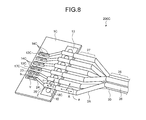
- FIG. 8 schematically shows a cable connection structure according to a second modification of the second embodiment
- FIG. 9 schematically shows a cable connection structure according to a third modification of the second embodiment
- FIG. 10 schematically shows a cable connection structure according to a fourth modification of the second embodiment
- FIG. 11 schematically shows a cable connection structure according to a fifth modification of the second embodiment
- FIG. 12 schematically shows a cable connection structure according to a third embodiment
- FIG. 13 schematically shows a cable connection structure according to a fourth embodiment.
- FIG. 1 schematically shows a cable connection structure 100 according to a first embodiment.
- FIG. 2 is a cross-sectional view along a line A-A in the cable connection structure 100 in FIG. 1 .
- the cable connection structure 100 according to the first embodiment is provided with a board 1 and a cable 2 connected to the board 1 as shown in FIG. 1 .
- the cable 2 is provided with a conducting body 21 as a core wire and an outer covering 22 as an insulating body provided in an outer circumference of the conducting body 21 .
- the board 1 is provided with a connecting electrode 10 to which the conducting body 21 of the cable 2 is connected. While the board 1 shown in FIG. 1 includes three connecting electrodes 10 , to which three respective cables 2 are connected, the number of connecting electrodes 10 is not limited thereto as long as the number of connecting electrodes 10 provided corresponds to the number of cables 2 to connect.
- each connecting electrode 10 two hemispherical protruding parts 11 are formed and arranged.
- the conducting body 21 of the cable 2 is arranged in a groove part 16 which is constituted by side surfaces of the two protruding parts 11 and a front surface of the connecting electrode 10 .
- the protruding part 11 is formed by arranging a bump such as a gold bump, a high-melting-point solder bump, or the like on the connecting electrode 10 .
- the high-melting-point solder bump means a bump formed of a solder (a solder of tin-lead system of Sn-90Pb composition, melting point, i.e., solidus temperature of which is 275 degrees C., for example) having a melting point substantially higher than an eutectic solder of tin-lead system, melting point of which is 184 degrees C. or a solder of tin-silver-copper system (of Sn-3.0Ag-0.5Cu composition, melting point of which is as high as 220 degrees C., for example) widely used as a lead-free solder.
- a solder a solder of tin-lead system of Sn-90Pb composition, melting point, i.e., solidus temperature of which is 275 degrees C., for example
- a solder of tin-silver-copper system of Sn-3.0Ag-0.5Cu composition, melting point of which is as high as 220 degrees
- the groove part 16 is formed so that an extending direction Y of the conducting body 21 arranged in the groove part 16 as shown in FIG. 1 is not aligned with an extending direction X of the cable 2 .
- the connecting electrode 10 and the protruding parts 11 are formed so that an alignment pitch b of the conducting bodies 21 becomes narrower than an alignment pitch a of the cables 2 in the first embodiment.
- the connecting electrode 10 and the protruding parts 11 are formed so that an alignment pitch b of the conducting bodies 21 becomes narrower than an alignment pitch a of the cables 2 in the first embodiment.
- a height R of the protruding part 11 is more than a diameter 2 r of the conducting body 21 of the cable 2 in the first embodiment.
- the fixation of the conducting body 21 can be performed easily.
- the height R of the protruding part 11 more than the diameter 2 r of the conducting body 21 stops a decent of the heating tool due to a contact with the protruding part 11 and allows starting heating at the height of the protruding part 11 . Therefore, it is possible to prevent the conducting body 21 from being subjected to a load and getting crushed and to suppress an occurrence of a connection failure by making the height R of the protruding part 11 more than the diameter 2 r of the conducting body 21 .
- a width W of the groove part 16 formed by at least two protruding parts 11 is equal to or less than the diameter 2 r of the conducting part 21 from a standpoint of preventing a misalignment in position of the conducting body 21 .
- the width W of the groove part 16 means a distance between two points where the conducting part 21 are in contact with the protruding parts 11 constituting the groove part 16 in the description of the present invention.
- the conducting part 21 comes to a state of not being in direct contact with the contacting electrode 10 when the width W is made shorter, the conducting part 21 can have an electrical continuity with the connecting electrode 10 via the protruding parts 11 even in this case.
- the conducting part 21 is in direct contact with the connecting electrode 10 .
- a degree of freedom of the layout in mounting the conducting body 21 onto the board 1 can be improved by making a connection to the board 1 so that the extending direction Y of the conducting body 21 of the cable 2 is not aligned with the extending direction X of the cable 2 in the manner described above.
- the board 1 and the cable connection structure 100 can be made small without making the conducting part 21 thinner.
- it becomes possible to stably connect a lot of cables in a small area which is suitable for a configuration of an endoscope and an ultrasound image system (ultrasound endoscope).
- a cable connection structure 100 A shown in FIG. 3 is exemplified.
- the connecting electrode 10 and the protruding parts 11 are formed so that the extending direction Y of the conducting body 21 is not aligned with the extending direction X of the cable 2 .
- the alignment pitch b of the conducting bodies 21 is the same as the alignment pitch a of the cables 2 since a bending direction of the conducting bodies 21 is the same.
- a degree of freedom of the layout in mounting the conducting body 21 onto the board 1 can be improved similarly to the cable connection structure 100 according to the first embodiment.
- a cable connection structure in which the alignment pitch b of the conducting bodies 21 is wider than the alignment pitch a of the cables 2 is exemplified.
- FIG. 4 schematically shows a cable connection structure 200 according to a second embodiment.
- FIG. 5 is a cross-sectional view along a line C-C in the cable connection structure 200 in FIG. 4 .
- FIG. 6 is an enlarged cross-sectional view along a line B-B in the cable connection structure 200 in FIG. 4 .
- the cable connection structure 200 according to the second embodiment is provided with a board 1 A and a coaxial cable 2 A connected to the board.
- the coaxial cable 2 A is provided with a center conducting body 23 as a core wire, an inner insulating body 24 provided in an outer circumference of the center conducting body 23 , an outer conducting body 25 as a shielded wire which covers an outer circumference of the inner insulating body 24 , and an outer insulating body 26 provided in an outer circumference of the outer conducting body 25 .
- the board 1 A is provided with a center conducting body connecting electrode 12 (a core wire connecting electrode) to which the center conducting body 23 is connected and an outer conducting body connecting electrode 13 (a shielded wire connecting electrode) to which the outer conducting body 25 is connected.
- a center conducting body connecting electrode 12 a core wire connecting electrode
- an outer conducting body connecting electrode 13 a shielded wire connecting electrode
- a first groove part 17 in which the center conducting body 23 to connect is arranged is formed by the hemispherical first protruding parts 14 and the center conducting body connecting electrode 12 .
- the first protruding part 14 is formed by a gold bump or a high-melting-point solder bump. It is preferable that a height R 1 of the first protruding part 14 is more than a diameter 2 r 1 of the center conducting body 23 . By making the height R 1 of the first protruding part 14 more than the diameter 2 r 1 of the center conducting body 23 , a positional regulation of the center conducting body 23 is performed easily.
- the height R 1 of the first protruding part 14 more than the diameter 2 r 1 of the center conducting body 23 allows preventing the center conducting body 23 from being subjected to a load and getting crushed and suppressing an occurrence of a connection failure.
- a width W 1 of the first groove part 17 formed by at least two first protruding parts 14 is approximately equal to the diameter 2 r 1 of the center conducting body 23 from a standpoint of preventing a misalignment in position of the center conducting body 23 .
- a hemispherical second protruding part 15 is formed on each outer conducting body connecting electrode 13 .
- the second protruding part 15 is formed in line at equally-spaced intervals on the outer conducting body connecting electrode 13 , the number of the second protruding part 15 being equivalent to the number obtained by adding one to the number of outer conducting bodies 25 which are connected to the board 1 A along a longitudinal direction of the outer conducting body connecting electrode 13 .
- a second groove part 18 is formed by the second protruding parts 15 arranged in line at equally-spaced intervals on the outer conducting body connecting electrode 13 and the outer conducting body connecting electrode 13 , the number of the second groove part 18 being equivalent to the number of outer conducting bodies 25 to connect.
- the second protruding part 15 is formed by a gold bump or a high-melting-point solder bump. It is preferable that a height R 2 of the second protruding part 15 is more than a diameter 2 r 2 of the outer conducting body 25 . By making the height R 2 of the second protruding part 15 more than the diameter 2 r 2 of the outer conducting body 25 , a positional regulation of the outer conducting body 25 is performed easily.
- the height R 2 of the second protruding part 15 more than the diameter 2 r 2 of the outer conducting body 25 allows preventing the outer conducting body 25 from being subjected to a load and getting crushed to prevent the inner insulating body 24 from being damaged and suppressing an occurrence of a connection failure.
- a width W 2 of the second groove part 18 formed by two second protruding parts 15 is approximately equal to the diameter 2 r 2 of the outer conducting body 25 from a standpoint of preventing a misalignment in position of the outer conducting body 25 .
- the first groove part 17 is formed so that the extending direction Y of the center conducting body 23 arranged in the first groove part 17 as shown in FIG. 4 is not aligned with the extending direction X of the coaxial cable 2 A.
- an extending direction Z of the outer conducting body 25 arranged in the second groove part 18 is aligned with the extending direction X of the coaxial cable 2 A.
- the center conducting body connecting electrode 12 and the first protruding parts 14 are formed so that the alignment pitch b of the center conducting bodies 23 is narrower than the alignment pitch a of the coaxial cables 2 A.
- the outer conducting body connecting electrode 13 and the second protruding parts 15 are formed so that an alignment pitch c of the outer conducting bodies 25 becomes the same as the alignment pitch a of the coaxial cables 2 A.
- the alignment pitch b of the center conducting bodies 23 can be made narrower than the alignment pitch a of the coaxial cables 2 A.
- a degree of freedom of the layout in mounting the center conducting body 23 on the board 1 A can be improved by making the connection to the board 1 A so that the extending direction Y of the center conducting body 23 of the coaxial cable 2 A is not aligned with the extending direction X of the coaxial cable 2 A in the manner described above.
- a mounting density of the members to be mounted on the board 1 A can be improved and the board 1 A and the cable connection structure 200 can be made small.
- a cable connection structure 200 B shown in FIG. 7 is exemplified.
- a center conducting body connecting electrode 12 B and the first protruding parts 14 are formed so that the extending direction Y of the center conducting body 23 is not aligned with the extending direction X of the coaxial cable 2 A and the alignment pitch b of the center conducting bodies 23 becomes wider than the alignment pitch a of the coaxial cables 2 A.
- the alignment pitch b of the center conducting bodies 23 by making the alignment pitch b of the center conducting bodies 23 wider than the alignment pitch a of the coaxial cables 2 A, an adverse effect caused by an interference between signals transmitted in respective cables can be suppressed.
- a cable connection structure 200 C shown in FIG. 8 is exemplified.
- the cable connection structure 200 C according to the second modification is provided with an assembled cable 30 and a board 1 C to which the assembled cable 30 is connected.
- the assembled cable 30 is a cable in which a plurality of coaxial cables 2 A are bundled and is provided with a cable aligning unit 27 and a cable bundling unit 28 .
- a first groove part 17 C is formed so that the extending direction Y of the center conducting body 23 is not aligned with the extending direction X of the coaxial cable 2 A and the alignment pitch b of the center conducting bodies 23 becomes narrower than the alignment pitch a of the coaxial cables 2 A, similarly to the second embodiment.
- three first protruding parts 14 C are formed in a zigzag manner along a direction in which the center conducting body 23 extends on the center conducting body connecting electrode 12 C.
- first protruding parts 14 C are formed in a manner that one locates at one side of the left and the right sides and two locates at the other one side of the left and the right sides, it is preferable that two first protruding parts 14 C are formed at a side where a more stress is imposed due to a bend of the center conducting body 23 .
- the center conducting body 23 of the coaxial cable 2 A at a right side seen from the assembled cable 30 is arranged in the first groove part 17 C in a manner that the inner insulating body 24 is bent rightward from a direction along which the outer conducting body 25 is aligned.
- two first protruding parts 14 C are formed at the left side of the center conducting body 23 since the center conducting body 23 goes back by itself to the left side.
- the second modification by making the alignment pitch b of the center conducting bodies 23 narrower than the alignment pitch a of the coaxial cables 2 A, a mounting density on the board 1 C can be improved and the board 1 C and the cable connection structure 200 C can be made small.
- a cable connection structure 200 D shown in FIG. 9 is exemplified.
- a center conducting body connecting electrode 12 D and first protruding parts 14 D are formed so that the extending direction Y of the center conducting body 23 is not aligned with the extending direction X of the coaxial cable 2 A and the alignment pitch b of the center conducting bodies 23 becomes wider than the alignment pitch a of the coaxial cables 2 A, similarly to the first modification.
- the center conducting body connecting electrode 12 D and the first protruding parts 14 D are formed so that a sum of a length of the exposed center conducting body 23 , a length of the exposed inner insulating body 24 , and a length of the exposed outer conducting body 25 is the same in respective coaxial cables 2 A, which is different from the first modification. While each of the center conducting body connecting electrodes 12 B is formed in parallel with the outer conducting body connecting electrode 13 and respective extending directions of the center conducting bodies 23 are parallel to each other in the first modification, the center conducting body connecting electrodes 12 D are formed in an arc shape as a whole in the third modification.
- the third modification is advantageous in that an adverse effect caused by an interference between signals transmitted in respective coaxial cables 2 A can be suppressed and uniform coaxial cables 2 A can be used since the sum of the length of the exposed center conducting body 23 , the length of the exposed inner insulating body 24 , and the length of the exposed outer conducting body 25 is the same in the respective coaxial cables 2 A connected to the board 1 D.
- a cable connection structure 200 E shown in FIG. 10 is exemplified.
- an outer conducting body connecting electrode 13 E and second protruding parts 15 E are formed so that the extending direction Z of the outer conducting body 25 is not aligned with the extending direction X of the coaxial cable 2 A and the alignment pitch c of the outer conducting bodies 25 becomes wider than the alignment pitch a of the coaxial cables 2 A.
- the outer conducting body connecting electrodes 13 E are formed in an arc shape so that the extending direction Z of the outer conducting body 25 is not aligned with the extending direction X of the coaxial cable 2 A.
- the center conducting body connecting electrodes 12 E are formed in an arc shape so that the extending direction Y of the center conducting body 23 is aligned with the extending direction Z of the outer conducting body 25 .
- the fourth modification by forming the center conducting body connecting electrodes 12 E and the outer conducting body connecting electrode 13 E in the arc shape, the sum of the length of the exposed center conducting body 23 , the length of the exposed inner insulating body 24 , and the length of the exposed outer conducting body 25 becomes the same in respective coaxial cables 2 A.
- This configuration is advantageous in that uniform coaxial cables 2 A can be used.
- an adverse effect caused by an interference between signals transmitted in respective coaxial cables 2 A can be suppressed since the alignment pitch c of the outer conducting bodies 25 is wider than the alignment pitch a of the coaxial cables 2 A in the fourth modification.
- a cable connection structure 200 F shown in FIG. 11 is exemplified.
- an outer conducting body connecting electrode 13 F and second protruding parts 15 F are formed so that the extending direction Z of the outer conducting body 25 is not aligned with the extending direction X of the coaxial cable 2 A, and a center conducting body connecting electrode 12 F and first protruding parts 14 F are formed so that the extending direction Y of the center conducting body 23 is not aligned with the extending direction Z of the outer conducting body 25 .
- the alignment pitch c of the outer conducting bodies 25 is wider than the alignment pitch a of the coaxial cables 2 A and the alignment pitch b of the center conducting bodies 23 is wider than the alignment pitch c of the outer conducting bodies 25 .
- the outer conducting body 25 is bent from the alignment direction X of the coaxial cable 2 A to the Z direction, arranged in a second groove part 18 F, and then connected and the center conducting body 23 is further bent from the extending direction Z of the outer conducting body to the Y direction, arranged in a first groove part 17 F, and then connected.
- the center conducting body connecting electrode 12 F and the outer conducting body connecting electrode 14 F in such a manner as described, the sum of the length of the exposed center conducting body 23 , the length of the exposed inner insulating body 24 , and the length of the exposed outer conducting body 25 is the same in respective coaxial cables 2 A.
- This configuration is advantageous in that uniform coaxial cables 2 A can be used.
- an adverse effect caused by an interference between signals transmitted in respective coaxial cables 2 A can be suppressed since the alignment pitch b of the center conducting bodies 23 is wider than the alignment pitch a of the coaxial cables 2 A in the fifth modification.
- protruding parts forming a groove part include a fixed protruding part and a fusing protruding part.
- FIG. 12 schematically shows a cable connection structure 300 according to the third embodiment.
- a board 1 G is provided with three center conducting body connecting electrodes 12 G 1 , 12 G 2 , and 12 G 3 and an outer conducting body connecting electrode 13 G.
- the first protruding part 14 and a first fusing protruding part 14 G are formed on each of the center conducting body connecting electrodes 12 G 1 and 12 G 3 .
- the first protruding part 14 is a fixed protruding part which is formed by a gold bump, a high-melting-point solder bump, or the like.
- the first fusing protruding part 14 G is formed by a solder bump and the like and made of a material which fuses in soldering.
- the solder bump means a bump formed by an eutectic solder of tin-lead system, melting point of which is 184 degrees C., a solder of tin-silver-copper system (of Sn-3.0Ag-0.5Cu composition, melting point of which is as high as 220 degrees C., for example) widely used as a lead-free solder, or a solder whose melting point or solidus temperature is lower than these solders.
- Two first fusing protruding parts 14 G are formed on the center conducting body connecting electrode 12 G 2 .
- the first protruding part 14 and the first fusing protruding part 14 G have the same diameter.
- the second protruding part 15 and a second fusing protruding part 15 G are formed on the outer conducting body connecting electrode 13 G.
- the second protruding part 15 is a fixed protruding part which is formed by a gold bump, a high-melting-point solder bump, or the like.
- the second fusing protruding part 15 G is a fusing protruding part formed by a solder bump and the like.
- inner two protruding parts are the second fusing protruding parts 15 G as the fusion protrusion part and outer two protruding parts are the second protruding parts 15 as the fixed protruding part.
- the second protruding part 15 and the second fusing protruding part 15 G have the same diameter and formed at equally-spaced intervals on the outer conducting body connecting electrode 13 G.
- first groove parts 17 G 1 to 17 G 3 are formed so that the extending direction Y of the center conducting bodies 23 arranged in the first groove parts 17 G 1 to 17 G 3 is not aligned with the extending direction X of the coaxial cable 2 A.
- the first groove parts 17 G 1 to 17 G 3 are formed so that the alignment pitch b of the center conducting bodies 23 becomes wider than the alignment pitch a of the coaxial cables 2 A.
- the inner insulating body 24 is bent from the extending direction X of the coaxial cable 2 A and connected to the board 1 G so that the alignment pitch b of the center conducting bodies 23 becomes wider than the alignment pitch a of the coaxial cable 2 A, a protruding part forming a wiring route is subjected to a stress.
- protruding parts which are subjected to the stress are formed by the fixed protruding parts (the first protruding part 14 and the second protruding part 15 ) and the other protruding parts are formed by the fusing protruding parts (the first fusing protruding part 14 G and the second fusing protruding part 15 G), so that a misalignment in position of the coaxial cable 2 A can be prevented and a process of supplying a joint member for jointing the coaxial cable 2 A onto the board 1 G can be eliminated.
- a degree of freedom of the layout in mounting the center conducting body 23 onto the board 1 G can be improved by making a connection to the board 1 G so that the extending direction Y of the center conducting body 23 of the coaxial cable 2 A is not aligned with the extending direction X of the coaxial cable 2 A, and an adverse effect caused by an interference between signals transmitted in respective coaxial cables 2 A can be suppressed since the alignment pitch b of the center conducting bodies 23 is wider than the alignment pitch a of the coaxial cables 2 A.
- protruding parts forming a groove part include the fixed protruding part and the fusing protruding part, and the fixed protruding part is formed in a size larger than the fusing protruding part.
- FIG. 13 schematically shows a cable connection structure 400 according to the fourth embodiment.
- a board 1 H is provided with three center conducting body connecting electrodes 12 H 1 , 12 H 2 , and 12 H 3 and an outer conducting body connecting electrode 13 H.
- a first protruding part 14 H and the first fusing protruding part 14 G are formed on each of the center conducting body connecting electrodes 12 H 1 to 12 H 3 .
- the first protruding part 14 H is a fixed protruding part which is formed by a gold bump, a high-melting-point solder bump, or the like.
- the first fusing protruding part 14 G is a solder bump made of a material which fuses in soldering.
- Two first fusing protruding parts 14 G are formed on the center conducting body connecting electrode 12 H 2 .
- the first protruding part 14 H is configured to be a bump having a larger diameter than the first fusing protruding part 14 G.
- a second protruding part 15 H and the second fusing protruding part 15 G are formed on the outer conducting body connecting electrode 13 H.
- the second protruding part 15 H is a fixed protruding part which is formed by a gold bump, a high-melting-point solder bump, or the like.
- the second fusing protruding part 15 G is a fusing protruding part formed by a solder bump and the like.
- the second protruding part 15 H is configured to be a bump having a larger diameter than the second fusing protruding part 15 G.
- outer two protruding parts are the second protruding parts 15 H as the fixed protruding part and inner two protruding parts are the second fusing protruding parts 15 G as the fusing protruding part.
- the second protruding part 15 H and the second fusing protruding part 15 G are arranged on the outer conducting body connecting electrode 13 G so that the alignment pitch c of the outer conducting bodies 25 is uniform.
- first groove parts 17 H 1 to 17 H 3 are formed so that the extending direction Y of the center conducting bodies 23 arranged in the first groove parts 17 H 1 to 17 H 3 is not aligned with the extending direction X of the coaxial cable 2 A, similarly to the third embodiment.
- the first groove parts 17 H 1 to 17 H 3 are formed so that the alignment pitch b of the center conducting bodies 23 becomes wider than the alignment pitch a of the coaxial cables 2 A.
- the inner insulating body 24 is bent from the extending direction X of the coaxial cable 2 A and connected to the board 1 H so that the alignment pitch b of the center conducting bodies 23 becomes wider than the alignment pitch a of the coaxial cables 2 A, a protruding part forming a wiring route is subjected to a stress.
- protruding parts which are subjected to the stress are formed by the fixed protruding parts (the first protruding part 14 H and the second protruding part 15 H) and the other protruding parts are formed by the fusing protruding parts (the first fusing protruding part 14 G and the second fusing protruding part 15 G), and additionally the first protruding part 14 H and the second protruding part 15 H as the fixed protruding part are formed to be larger in diameter than the first fusing protruding part 14 G and the second fusing protruding part 15 G as the fusing protruding part, respectively.
- This configuration allows preventing a misalignment in position of the coaxial cable 2 A and eliminating a process of supplying a joint member for jointing the coaxial cable 2 A onto the board 1 H.
- a degree of freedom of the layout in mounting the center conducting body 23 onto the board 1 H can be improved by making a connection to the board 1 H so that the extending direction Y of the center conducting body 23 of the coaxial cable 2 A is not aligned with the extending direction X of the coaxial cable 2 A, and an adverse effect caused by an interference between signals transmitted in respective coaxial cables 2 A can be suppressed since the alignment pitch b of the center conducting bodies 23 is wider than the alignment pitch a of the coaxial cables 2 A.
Landscapes
- Coupling Device And Connection With Printed Circuit (AREA)
- Multi-Conductor Connections (AREA)
- Instruments For Viewing The Inside Of Hollow Bodies (AREA)
- Endoscopes (AREA)
Abstract
Description
Claims (11)
Applications Claiming Priority (2)
| Application Number | Priority Date | Filing Date | Title |
|---|---|---|---|
| JP2011110651A JP5762820B2 (en) | 2011-05-17 | 2011-05-17 | Cable connection structure and cable connection board |
| JP2011-110651 | 2011-05-17 |
Publications (2)
| Publication Number | Publication Date |
|---|---|
| US20120292104A1 US20120292104A1 (en) | 2012-11-22 |
| US8853538B2 true US8853538B2 (en) | 2014-10-07 |
Family
ID=47174097
Family Applications (1)
| Application Number | Title | Priority Date | Filing Date |
|---|---|---|---|
| US13/423,437 Active 2032-11-30 US8853538B2 (en) | 2011-05-17 | 2012-03-19 | Cable connection structure and cable connection board |
Country Status (2)
| Country | Link |
|---|---|
| US (1) | US8853538B2 (en) |
| JP (1) | JP5762820B2 (en) |
Cited By (2)
| Publication number | Priority date | Publication date | Assignee | Title |
|---|---|---|---|---|
| US20160093985A1 (en) * | 2013-02-20 | 2016-03-31 | Foxconn Interconnect Technology Limited | High speed high density connector assembly |
| US20240006783A1 (en) * | 2020-12-16 | 2024-01-04 | Changchun Jetty Automotive Parts Corporation | Terminal assembly and method for fabrication thereof |
Families Citing this family (3)
| Publication number | Priority date | Publication date | Assignee | Title |
|---|---|---|---|---|
| CN106105407A (en) * | 2014-03-20 | 2016-11-09 | 奥林巴斯株式会社 | Cable connecting structure and endoscope apparatus |
| JP7324180B2 (en) | 2020-09-08 | 2023-08-09 | 富士フイルム株式会社 | ultrasound endoscope |
| WO2023228852A1 (en) * | 2022-05-27 | 2023-11-30 | 株式会社アイシン | Electronic device |
Citations (8)
| Publication number | Priority date | Publication date | Assignee | Title |
|---|---|---|---|---|
| US3743748A (en) * | 1972-02-02 | 1973-07-03 | Raychem Corp | Device for terminating a shielded cable to a printed circuit board and method of connecting a shielded cable to a printed circuit board utilizing the same |
| JPH04197334A (en) | 1990-11-29 | 1992-07-16 | Fuji Photo Optical Co Ltd | Wiring structure for solid image pick-up element in electronic endoscope |
| US5347711A (en) * | 1992-07-15 | 1994-09-20 | The Whitaker Corporation | Termination of multi-conductor electrical cables |
| US5710393A (en) * | 1995-05-17 | 1998-01-20 | The Whitaker Corporation | Modular array termination for multiconductor electrical cables |
| US6336827B1 (en) * | 1998-08-20 | 2002-01-08 | Fujitsu Takamisawa Component Ltd. | Balanced-transmission cable-and-connector unit |
| US6823587B2 (en) * | 2000-07-31 | 2004-11-30 | Tensolite Company | Method of making a cable structure for data signal transmission |
| JP2006014906A (en) | 2004-07-01 | 2006-01-19 | Pentax Corp | The tip of the electronic endoscope |
| US7696436B2 (en) * | 2007-11-14 | 2010-04-13 | Hitachi Cable, Ltd. | Multi-coaxial cable assembly and manufacturing method of the same |
Family Cites Families (4)
| Publication number | Priority date | Publication date | Assignee | Title |
|---|---|---|---|---|
| JP4168346B2 (en) * | 2004-12-07 | 2008-10-22 | 株式会社アドリンクス | Mounting structure of surface mount components |
| JP2008210563A (en) * | 2007-02-23 | 2008-09-11 | Sumitomo Electric Ind Ltd | Multi-core coaxial cable and method of manufacturing multi-core coaxial cable |
| JP5029566B2 (en) * | 2008-10-14 | 2012-09-19 | 日立電線株式会社 | Thin coaxial cable connection structure, wiring pattern forming method, cable harness, and printed wiring board |
| JP5350954B2 (en) * | 2009-09-17 | 2013-11-27 | オリンパス株式会社 | Mounting structure and assembly cable |
-
2011
- 2011-05-17 JP JP2011110651A patent/JP5762820B2/en active Active
-
2012
- 2012-03-19 US US13/423,437 patent/US8853538B2/en active Active
Patent Citations (8)
| Publication number | Priority date | Publication date | Assignee | Title |
|---|---|---|---|---|
| US3743748A (en) * | 1972-02-02 | 1973-07-03 | Raychem Corp | Device for terminating a shielded cable to a printed circuit board and method of connecting a shielded cable to a printed circuit board utilizing the same |
| JPH04197334A (en) | 1990-11-29 | 1992-07-16 | Fuji Photo Optical Co Ltd | Wiring structure for solid image pick-up element in electronic endoscope |
| US5347711A (en) * | 1992-07-15 | 1994-09-20 | The Whitaker Corporation | Termination of multi-conductor electrical cables |
| US5710393A (en) * | 1995-05-17 | 1998-01-20 | The Whitaker Corporation | Modular array termination for multiconductor electrical cables |
| US6336827B1 (en) * | 1998-08-20 | 2002-01-08 | Fujitsu Takamisawa Component Ltd. | Balanced-transmission cable-and-connector unit |
| US6823587B2 (en) * | 2000-07-31 | 2004-11-30 | Tensolite Company | Method of making a cable structure for data signal transmission |
| JP2006014906A (en) | 2004-07-01 | 2006-01-19 | Pentax Corp | The tip of the electronic endoscope |
| US7696436B2 (en) * | 2007-11-14 | 2010-04-13 | Hitachi Cable, Ltd. | Multi-coaxial cable assembly and manufacturing method of the same |
Cited By (2)
| Publication number | Priority date | Publication date | Assignee | Title |
|---|---|---|---|---|
| US20160093985A1 (en) * | 2013-02-20 | 2016-03-31 | Foxconn Interconnect Technology Limited | High speed high density connector assembly |
| US20240006783A1 (en) * | 2020-12-16 | 2024-01-04 | Changchun Jetty Automotive Parts Corporation | Terminal assembly and method for fabrication thereof |
Also Published As
| Publication number | Publication date |
|---|---|
| JP2012243465A (en) | 2012-12-10 |
| US20120292104A1 (en) | 2012-11-22 |
| JP5762820B2 (en) | 2015-08-12 |
Similar Documents
| Publication | Publication Date | Title |
|---|---|---|
| US8853538B2 (en) | Cable connection structure and cable connection board | |
| JP4366356B2 (en) | Image pickup module and image pickup module assembling method | |
| US10281711B2 (en) | Endoscope with retention member | |
| CN107887714B (en) | Cable connection structure and cable connector | |
| US8900007B2 (en) | Cable connector and cable assembly, and method of manufacturing cable assembly | |
| US10158188B2 (en) | Cable connection structure, ultrasonic probe, and ultrasonic endoscope system | |
| US6984150B2 (en) | Cable connector | |
| JP2009082504A (en) | Imaging apparatus and endoscope provided with the imaging apparatus | |
| WO2011010621A1 (en) | Coaxial-cable harness | |
| JP5128872B2 (en) | Signal transmission member, and imaging device and endoscope using the same | |
| JP5583372B2 (en) | Collective cable, electronic circuit module, and imaging device | |
| JP2020154304A (en) | Structure of endoscope device | |
| JP7803444B2 (en) | Electric wire connection structure, electric wire connection method, medical device, and method for manufacturing medical device | |
| US20240398218A1 (en) | Electronic assemblies for medical devices | |
| JP5722513B1 (en) | Electric unit and endoscope equipped with the same | |
| US10842365B2 (en) | Image pickup apparatus and endoscope | |
| US8889996B2 (en) | Cable connection structure and cable connection method | |
| JP5676026B2 (en) | Imaging device | |
| JP2011249870A (en) | Imaging apparatus | |
| JP2014158563A (en) | Endoscope, imaging device, and method for manufacturing imaging device | |
| JP2008010310A (en) | Flexible flat cable | |
| CN100536234C (en) | Cable connector assembly | |
| JP2007244747A (en) | Imaging device and method for assembling the imaging device | |
| JP4514505B2 (en) | Flat wiring material | |
| JP2018116809A (en) | connector |
Legal Events
| Date | Code | Title | Description |
|---|---|---|---|
| AS | Assignment |
Owner name: OLYMPUS CORPORATION, JAPAN Free format text: ASSIGNMENT OF ASSIGNORS INTEREST;ASSIGNOR:YAMADA, JUNYA;REEL/FRAME:027884/0422 Effective date: 20120223 |
|
| STCF | Information on status: patent grant |
Free format text: PATENTED CASE |
|
| AS | Assignment |
Owner name: OLYMPUS CORPORATION, JAPAN Free format text: CHANGE OF ADDRESS;ASSIGNOR:OLYMPUS CORPORATION;REEL/FRAME:039344/0502 Effective date: 20160401 |
|
| MAFP | Maintenance fee payment |
Free format text: PAYMENT OF MAINTENANCE FEE, 4TH YEAR, LARGE ENTITY (ORIGINAL EVENT CODE: M1551) Year of fee payment: 4 |
|
| MAFP | Maintenance fee payment |
Free format text: PAYMENT OF MAINTENANCE FEE, 8TH YEAR, LARGE ENTITY (ORIGINAL EVENT CODE: M1552); ENTITY STATUS OF PATENT OWNER: LARGE ENTITY Year of fee payment: 8 |
|
| MAFP | Maintenance fee payment |
Free format text: PAYMENT OF MAINTENANCE FEE, 12TH YEAR, LARGE ENTITY (ORIGINAL EVENT CODE: M1553); ENTITY STATUS OF PATENT OWNER: LARGE ENTITY Year of fee payment: 12 |