US8846713B2 - Fused heterocyclic compounds as phosphodiesterases (PDEs) inhibitors - Google Patents
Fused heterocyclic compounds as phosphodiesterases (PDEs) inhibitors Download PDFInfo
- Publication number
- US8846713B2 US8846713B2 US13/806,352 US201113806352A US8846713B2 US 8846713 B2 US8846713 B2 US 8846713B2 US 201113806352 A US201113806352 A US 201113806352A US 8846713 B2 US8846713 B2 US 8846713B2
- Authority
- US
- United States
- Prior art keywords
- group
- optionally substituted
- compound
- reaction
- ring
- Prior art date
- Legal status (The legal status is an assumption and is not a legal conclusion. Google has not performed a legal analysis and makes no representation as to the accuracy of the status listed.)
- Active
Links
- 0 *.*N1C(=O)[Y]C2=C1C=CC=C2 Chemical compound *.*N1C(=O)[Y]C2=C1C=CC=C2 0.000 description 65
- YFIKIKZHXPHBMM-UHFFFAOYSA-N *.CN1C(=O)[Y]C2=C1C=CC=C2 Chemical compound *.CN1C(=O)[Y]C2=C1C=CC=C2 YFIKIKZHXPHBMM-UHFFFAOYSA-N 0.000 description 9
- RLTDEUILIXNYAQ-UHFFFAOYSA-N CC1CCN(C)C1=O.CC1CCN(C)C1=O.CN1CCN(C)C1=O Chemical compound CC1CCN(C)C1=O.CC1CCN(C)C1=O.CN1CCN(C)C1=O RLTDEUILIXNYAQ-UHFFFAOYSA-N 0.000 description 6
- PXWQXDVMWMRICZ-UHFFFAOYSA-N CC1=C(N2C=CC(=O)C(C3=CC=NN3C3=CC=CC=C3)=N2)C=CC(N2C=CC=N2)=C1 Chemical compound CC1=C(N2C=CC(=O)C(C3=CC=NN3C3=CC=CC=C3)=N2)C=CC(N2C=CC=N2)=C1 PXWQXDVMWMRICZ-UHFFFAOYSA-N 0.000 description 5
- CYSGHNMQYZDMIA-UHFFFAOYSA-N CN(CCN1C)C1=O Chemical compound CN(CCN1C)C1=O CYSGHNMQYZDMIA-UHFFFAOYSA-N 0.000 description 5
- DGVAXZCXIVYLEF-UHFFFAOYSA-N C.CN1C(=O)CC2=C1N=CC=C2 Chemical compound C.CN1C(=O)CC2=C1N=CC=C2 DGVAXZCXIVYLEF-UHFFFAOYSA-N 0.000 description 4
- XACALQKUFQKPBV-UHFFFAOYSA-N CC1=NC2=C(C=CC=C2)C1.CC1=NC2=C(C=CC=C2)S1.CC1=NC2=C(N=CC=C2)N1 Chemical compound CC1=NC2=C(C=CC=C2)C1.CC1=NC2=C(C=CC=C2)S1.CC1=NC2=C(N=CC=C2)N1 XACALQKUFQKPBV-UHFFFAOYSA-N 0.000 description 4
- JRFDBVSKHNNCIC-UHFFFAOYSA-N CCN1C(=O)N(C2=CC=C(O/C3=N/C4=C(N=CC=C4)N3C)C=C2)C2=C1C(C)=CC=N2 Chemical compound CCN1C(=O)N(C2=CC=C(O/C3=N/C4=C(N=CC=C4)N3C)C=C2)C2=C1C(C)=CC=N2 JRFDBVSKHNNCIC-UHFFFAOYSA-N 0.000 description 4
- IROCNAOTOWWRGQ-UHFFFAOYSA-N CCN1C(=O)N(C2=CC=C(OC3=NC4=C(C=CC=C4)N3CCO)C=C2)C2=C1C=CC=N2 Chemical compound CCN1C(=O)N(C2=CC=C(OC3=NC4=C(C=CC=C4)N3CCO)C=C2)C2=C1C=CC=N2 IROCNAOTOWWRGQ-UHFFFAOYSA-N 0.000 description 4
- UAASPXXPALTEHK-UHFFFAOYSA-N CN1C2=C(C=CC=N2)/N=C\1OC1=CC=C(N2C(=O)C(C)(C)C3=C2N=CC=C3)C=C1 Chemical compound CN1C2=C(C=CC=N2)/N=C\1OC1=CC=C(N2C(=O)C(C)(C)C3=C2N=CC=C3)C=C1 UAASPXXPALTEHK-UHFFFAOYSA-N 0.000 description 4
- DKUDBGAISUIRBB-UHFFFAOYSA-N COC1=CN2C=CC=CC2=N1.COC1=NC2=CC=CC=C2N1C.COC1=NC2=CC=CN=C2N1C Chemical compound COC1=CN2C=CC=CC2=N1.COC1=NC2=CC=CC=C2N1C.COC1=NC2=CC=CN=C2N1C DKUDBGAISUIRBB-UHFFFAOYSA-N 0.000 description 4
- DVVHZCUDDUKFNH-UHFFFAOYSA-N CC(C)N1C(=O)N(C2=CC=C(O/C3=N/C4=C(N=CC=C4)N3C)C=C2)C2=C1C=CC=N2 Chemical compound CC(C)N1C(=O)N(C2=CC=C(O/C3=N/C4=C(N=CC=C4)N3C)C=C2)C2=C1C=CC=N2 DVVHZCUDDUKFNH-UHFFFAOYSA-N 0.000 description 3
- HJHMSEWEMDGGRN-FCHARDOESA-N CC.Cc1ccccc1.[2HH] Chemical compound CC.Cc1ccccc1.[2HH] HJHMSEWEMDGGRN-FCHARDOESA-N 0.000 description 3
- RBNSCJZYIXOOQV-UHFFFAOYSA-N CC1=CC2=C(C=C1)N(C)C=C2.CC1=CC2=C(C=C1)N(C)CC2.CC1=CC2=C(C=C1)N(C)N=C2 Chemical compound CC1=CC2=C(C=C1)N(C)C=C2.CC1=CC2=C(C=C1)N(C)CC2.CC1=CC2=C(C=C1)N(C)N=C2 RBNSCJZYIXOOQV-UHFFFAOYSA-N 0.000 description 3
- URLKBWYHVLBVBO-UHFFFAOYSA-N CC1=CC=C(C)C=C1 Chemical compound CC1=CC=C(C)C=C1 URLKBWYHVLBVBO-UHFFFAOYSA-N 0.000 description 3
- ADFSTLRRHDHJAP-UHFFFAOYSA-N CC1=CC=NC2=C1N(C)C(=O)N2C1=CC=C(OC2=NC3=C(N=CC=C3)N2C)C=C1 Chemical compound CC1=CC=NC2=C1N(C)C(=O)N2C1=CC=C(OC2=NC3=C(N=CC=C3)N2C)C=C1 ADFSTLRRHDHJAP-UHFFFAOYSA-N 0.000 description 3
- NGOGZCDPLWJEJB-UHFFFAOYSA-N CCN1C(=O)N(C2=CC=C(N3CCN4C3=NC3=C4N=CC=C3)C=C2)C2=C1C=CC=N2 Chemical compound CCN1C(=O)N(C2=CC=C(N3CCN4C3=NC3=C4N=CC=C3)C=C2)C2=C1C=CC=N2 NGOGZCDPLWJEJB-UHFFFAOYSA-N 0.000 description 3
- FBXPVWVKOSILBF-UHFFFAOYSA-N CCN1C(=O)N(C2=CC=C(O)C=C2)C2=C1C(C)=CC=N2 Chemical compound CCN1C(=O)N(C2=CC=C(O)C=C2)C2=C1C(C)=CC=N2 FBXPVWVKOSILBF-UHFFFAOYSA-N 0.000 description 3
- UOFQRSKEKDPUQY-UHFFFAOYSA-N CCN1C(=O)N(C2=CC=C(O/C3=N/C4=C(N=CC=C4)N3)C=C2)C2=C1C=CC=N2 Chemical compound CCN1C(=O)N(C2=CC=C(O/C3=N/C4=C(N=CC=C4)N3)C=C2)C2=C1C=CC=N2 UOFQRSKEKDPUQY-UHFFFAOYSA-N 0.000 description 3
- MEWLSJJSQMGZTB-UHFFFAOYSA-N CCN1C(=O)N(C2=CC=C(O/C3=N/C4=C(N=CC=C4)N3C)C=C2)C2=C1C=CC=N2 Chemical compound CCN1C(=O)N(C2=CC=C(O/C3=N/C4=C(N=CC=C4)N3C)C=C2)C2=C1C=CC=N2 MEWLSJJSQMGZTB-UHFFFAOYSA-N 0.000 description 3
- RKMLDJIJGXIGBF-UHFFFAOYSA-N CCN1C(=O)N(C2=CC=C(OC3=C/N4C=CC=C\C4=N\3)C=C2)C2=C1C=CC=N2 Chemical compound CCN1C(=O)N(C2=CC=C(OC3=C/N4C=CC=C\C4=N\3)C=C2)C2=C1C=CC=N2 RKMLDJIJGXIGBF-UHFFFAOYSA-N 0.000 description 3
- ADVGLAZTMRVFQS-UHFFFAOYSA-N CCN1C(=O)N(C2=CC=C(OC3=NC4=C(CCCC4)N3C)C=C2)C2=C1C=CC=N2 Chemical compound CCN1C(=O)N(C2=CC=C(OC3=NC4=C(CCCC4)N3C)C=C2)C2=C1C=CC=N2 ADVGLAZTMRVFQS-UHFFFAOYSA-N 0.000 description 3
- LXWTZJCQTINFEZ-UHFFFAOYSA-N CCN1C(=O)N(C2=CC=C(OC3=NC4=C(N=CC=C4)N3C)C=C2)C2=C1C=C(C)C=N2 Chemical compound CCN1C(=O)N(C2=CC=C(OC3=NC4=C(N=CC=C4)N3C)C=C2)C2=C1C=C(C)C=N2 LXWTZJCQTINFEZ-UHFFFAOYSA-N 0.000 description 3
- BXQABIOBEFRESA-UHFFFAOYSA-N CCN1C(=O)N(C2=CC=C(OCC3=CC=CC=C3)C=C2)C2=C1C(C)=CC=N2 Chemical compound CCN1C(=O)N(C2=CC=C(OCC3=CC=CC=C3)C=C2)C2=C1C(C)=CC=N2 BXQABIOBEFRESA-UHFFFAOYSA-N 0.000 description 3
- KHBLGDSUEOXRPU-UHFFFAOYSA-N CCN1C(=O)N(C2=CC=C3C(=C2)CCN3C2=NC3=C(C=CC=C3)N2)C2=C1C=CC=N2 Chemical compound CCN1C(=O)N(C2=CC=C3C(=C2)CCN3C2=NC3=C(C=CC=C3)N2)C2=C1C=CC=N2 KHBLGDSUEOXRPU-UHFFFAOYSA-N 0.000 description 3
- OPRQTBXCASFOHJ-UHFFFAOYSA-N O=C1NC2=C(N=CC=C2)N1C1=CC=C(O/C2=N/C3=CC=CC=C3N2)C=C1 Chemical compound O=C1NC2=C(N=CC=C2)N1C1=CC=C(O/C2=N/C3=CC=CC=C3N2)C=C1 OPRQTBXCASFOHJ-UHFFFAOYSA-N 0.000 description 3
- FUOKSBOLCMMROD-UHFFFAOYSA-N O=C1NC2=C(N=CN=C2)N1C1=CC=C(N/C2=N/C3=C(C=CC=C3)O2)C=C1 Chemical compound O=C1NC2=C(N=CN=C2)N1C1=CC=C(N/C2=N/C3=C(C=CC=C3)O2)C=C1 FUOKSBOLCMMROD-UHFFFAOYSA-N 0.000 description 3
- PMNOQLIAQXJPKA-UHFFFAOYSA-N C.C.C.C.C.C.C.C.CC1=C2N=CC=CC2=CC=C1.CC1=C2N=CNC2=CC=C1.CC1=COC2=C1N=CC=C2.CN1C=CN2C1=NC1=C2/C=C\C=C/1.CN1CCC2=C1N=CC=C2.CN1CCCCN2C1=NC1=C2/C=C\C=C/1.CN1CCCN2C1=NC1=C2/C=C\C=C/1.CN1CCN2C1=NC1=C2/C=C\C=C/1.CN1CCN2C1=NC1=C2/N=C\C=C/1.CN1N=CC2=C1N=CC=C2 Chemical compound C.C.C.C.C.C.C.C.CC1=C2N=CC=CC2=CC=C1.CC1=C2N=CNC2=CC=C1.CC1=COC2=C1N=CC=C2.CN1C=CN2C1=NC1=C2/C=C\C=C/1.CN1CCC2=C1N=CC=C2.CN1CCCCN2C1=NC1=C2/C=C\C=C/1.CN1CCCN2C1=NC1=C2/C=C\C=C/1.CN1CCN2C1=NC1=C2/C=C\C=C/1.CN1CCN2C1=NC1=C2/N=C\C=C/1.CN1N=CC2=C1N=CC=C2 PMNOQLIAQXJPKA-UHFFFAOYSA-N 0.000 description 2
- QGRBXAFKOAALOD-UHFFFAOYSA-N C.CN1C(=O)CC2=C1C=NC=C2 Chemical compound C.CN1C(=O)CC2=C1C=NC=C2 QGRBXAFKOAALOD-UHFFFAOYSA-N 0.000 description 2
- NJQAHOUUJIPECJ-UHFFFAOYSA-N CC(C)C1=C(N2C=CC(=O)C(C3=CC=NN3C3=CC=CC=C3)=N2)C=CC(N2C=CC=N2)=C1 Chemical compound CC(C)C1=C(N2C=CC(=O)C(C3=CC=NN3C3=CC=CC=C3)=N2)C=CC(N2C=CC=N2)=C1 NJQAHOUUJIPECJ-UHFFFAOYSA-N 0.000 description 2
- KSWSCSDYHYSTSP-UHFFFAOYSA-N CC(C)N1C(=O)N(C2=CC3=C(C=C2)N(C2=NC4=C(N=CC=C4)N2)CC3)C2=C1C=CC=N2 Chemical compound CC(C)N1C(=O)N(C2=CC3=C(C=C2)N(C2=NC4=C(N=CC=C4)N2)CC3)C2=C1C=CC=N2 KSWSCSDYHYSTSP-UHFFFAOYSA-N 0.000 description 2
- WJUGECNDQJAWEE-UHFFFAOYSA-N CC(C)N1C(=O)N(C2=CC=C(O/C3=N/C4=C(N=CC=C4)N3C)C=C2)C2=C1C=C(Cl)C=N2 Chemical compound CC(C)N1C(=O)N(C2=CC=C(O/C3=N/C4=C(N=CC=C4)N3C)C=C2)C2=C1C=C(Cl)C=N2 WJUGECNDQJAWEE-UHFFFAOYSA-N 0.000 description 2
- BCNBMSZKALBQEF-UHFFFAOYSA-N CC(CCN1C)C1=O Chemical compound CC(CCN1C)C1=O BCNBMSZKALBQEF-UHFFFAOYSA-N 0.000 description 2
- PKWSTGREPPLKMM-UHFFFAOYSA-N CC.CC.CN1N=CC2=C1N=CC=C2.CN1ccN2C3=CC=CC=C3N=C12.CNC1=NC2=CC=CC=C2O1.COC1=NC2=C(C=CC=N2)N1C.COC1=NC2=C(C=NC=C2)N1C.COC1=NC2=C(N=CC=C2)N1C.COC1=Nc2ccccc2N1C.COc1c(C)N2C=CC=CC2=N1 Chemical compound CC.CC.CN1N=CC2=C1N=CC=C2.CN1ccN2C3=CC=CC=C3N=C12.CNC1=NC2=CC=CC=C2O1.COC1=NC2=C(C=CC=N2)N1C.COC1=NC2=C(C=NC=C2)N1C.COC1=NC2=C(N=CC=C2)N1C.COC1=Nc2ccccc2N1C.COc1c(C)N2C=CC=CC2=N1 PKWSTGREPPLKMM-UHFFFAOYSA-N 0.000 description 2
- DCEVTKKKKMLZHG-UHFFFAOYSA-N CC1(C)C(=O)N(C2=CC=C(OC3=C/N4C=CC=C\C4=N\3)C=C2)C2=C1C=CC=N2 Chemical compound CC1(C)C(=O)N(C2=CC=C(OC3=C/N4C=CC=C\C4=N\3)C=C2)C2=C1C=CC=N2 DCEVTKKKKMLZHG-UHFFFAOYSA-N 0.000 description 2
- ADAUXAGSOYYFDC-UHFFFAOYSA-N CC1=C(C2=NN(C3=C(F)C=C(N4C=CC=N4)C=C3)C=CC2=O)N(C2=CC=CC(Cl)=C2)N=C1 Chemical compound CC1=C(C2=NN(C3=C(F)C=C(N4C=CC=N4)C=C3)C=CC2=O)N(C2=CC=CC(Cl)=C2)N=C1 ADAUXAGSOYYFDC-UHFFFAOYSA-N 0.000 description 2
- UAQIXOGMAPGMCQ-UHFFFAOYSA-N CC1=C(N2C(=O)N(CC3CC3)C3=C2N=CC=C3)C=CC(O/C2=N/C3=C(C=CC=C3)N2)=C1 Chemical compound CC1=C(N2C(=O)N(CC3CC3)C3=C2N=CC=C3)C=CC(O/C2=N/C3=C(C=CC=C3)N2)=C1 UAQIXOGMAPGMCQ-UHFFFAOYSA-N 0.000 description 2
- GNDQBGUVYQIQLO-UHFFFAOYSA-N CC1=CC2=C(C=C1)N(C)CC2 Chemical compound CC1=CC2=C(C=C1)N(C)CC2 GNDQBGUVYQIQLO-UHFFFAOYSA-N 0.000 description 2
- AMFFEEPDMFDUNE-UHFFFAOYSA-N CC1=CC2=C(N=C1)N(C1=CC=C(O/C3=N/C4=C(N=CC=C4)N3C)C=C1)C(=O)N2C(C)C Chemical compound CC1=CC2=C(N=C1)N(C1=CC=C(O/C3=N/C4=C(N=CC=C4)N3C)C=C1)C(=O)N2C(C)C AMFFEEPDMFDUNE-UHFFFAOYSA-N 0.000 description 2
- LMPHTCPJCHFFAC-UHFFFAOYSA-N CC1=CC=NC2=C1N(C(C)C)C(=O)N2C1=CC=C(O/C2=N/C3=C(N=CC=C3)N2C)C=C1 Chemical compound CC1=CC=NC2=C1N(C(C)C)C(=O)N2C1=CC=C(O/C2=N/C3=C(N=CC=C3)N2C)C=C1 LMPHTCPJCHFFAC-UHFFFAOYSA-N 0.000 description 2
- WLESGCRGFSXVMG-UHFFFAOYSA-N CC1=CC=NC2=C1NC(=O)N2C1=CC=C(O/C2=N/C3=CC=CC=C3N2)C=C1 Chemical compound CC1=CC=NC2=C1NC(=O)N2C1=CC=C(O/C2=N/C3=CC=CC=C3N2)C=C1 WLESGCRGFSXVMG-UHFFFAOYSA-N 0.000 description 2
- YLCFITBSJTYPQO-UHFFFAOYSA-N CC1=CC=NC2=C1NC(=O)N2C1=CC=C(OCC2=CC=CC=C2)C=C1 Chemical compound CC1=CC=NC2=C1NC(=O)N2C1=CC=C(OCC2=CC=CC=C2)C=C1 YLCFITBSJTYPQO-UHFFFAOYSA-N 0.000 description 2
- UHVGMWKIXIAUCS-UHFFFAOYSA-N CC1=CN2C=CC=CC2=N1.CC1=NC2=C(C=CC=C2)N1C.CC1=NC2=C(N=CC=C2)N1C Chemical compound CC1=CN2C=CC=CC2=N1.CC1=NC2=C(C=CC=C2)N1C.CC1=NC2=C(N=CC=C2)N1C UHVGMWKIXIAUCS-UHFFFAOYSA-N 0.000 description 2
- WMZMIYBWAKEKNL-UHFFFAOYSA-N CC1=NC2=C(C3=CC=C(N4C(=O)N(COCC[Si](C)(C)C)C5=C4N=CC=C5)C=C3)C=CC=C2N1CC1=CC=CC=C1 Chemical compound CC1=NC2=C(C3=CC=C(N4C(=O)N(COCC[Si](C)(C)C)C5=C4N=CC=C5)C=C3)C=CC=C2N1CC1=CC=CC=C1 WMZMIYBWAKEKNL-UHFFFAOYSA-N 0.000 description 2
- RKAXEIINQWABBJ-UHFFFAOYSA-N CC1=NC2=C(C=CC=C2)C1.CC1=NC2=C(N=CC=C2)N1.CC1=NC=CC=C1.CC1=NC=CC=N1.CC1=NC=CS1 Chemical compound CC1=NC2=C(C=CC=C2)C1.CC1=NC2=C(N=CC=C2)N1.CC1=NC=CC=C1.CC1=NC=CC=N1.CC1=NC=CS1 RKAXEIINQWABBJ-UHFFFAOYSA-N 0.000 description 2
- FQUPXIMNMDVDJV-UHFFFAOYSA-N CC1=NN(C2=CC=CC(OC(F)(F)F)=C2)C(C2=NN(C3=C(F)C=C(N4CCOC4=O)C=C3)C=CC2=O)=C1 Chemical compound CC1=NN(C2=CC=CC(OC(F)(F)F)=C2)C(C2=NN(C3=C(F)C=C(N4CCOC4=O)C=C3)C=CC2=O)=C1 FQUPXIMNMDVDJV-UHFFFAOYSA-N 0.000 description 2
- YSJFXOAYCQTBBW-UHFFFAOYSA-N CCC1=C(N2C=CC(=O)C(C3=CC=NN3C3=CC=CC=C3)=N2)C=CC(N2C=CC=N2)=C1 Chemical compound CCC1=C(N2C=CC(=O)C(C3=CC=NN3C3=CC=CC=C3)=N2)C=CC(N2C=CC=N2)=C1 YSJFXOAYCQTBBW-UHFFFAOYSA-N 0.000 description 2
- CDMARAGGTGQTDJ-UHFFFAOYSA-N CCCN1C(=O)N(C2=CC=C(O/C3=N/C4=C(N=CC=C4)N3C)C=C2)C2=C1C=CC=N2 Chemical compound CCCN1C(=O)N(C2=CC=C(O/C3=N/C4=C(N=CC=C4)N3C)C=C2)C2=C1C=CC=N2 CDMARAGGTGQTDJ-UHFFFAOYSA-N 0.000 description 2
- SXVBZIXOOJUUKB-UHFFFAOYSA-N CCCN1C(=O)N(C2=CC=C(OCC3=CC=CC=C3)C=C2)C2=C1C=CC=N2 Chemical compound CCCN1C(=O)N(C2=CC=C(OCC3=CC=CC=C3)C=C2)C2=C1C=CC=N2 SXVBZIXOOJUUKB-UHFFFAOYSA-N 0.000 description 2
- WBRUUZGCDISDEI-UHFFFAOYSA-N CCN1C(=O)N(C2=CC3=C(C=C2)N(C2=NC4=C(C=CC=C4)N2C)CC3)C2=C1C=CC=N2 Chemical compound CCN1C(=O)N(C2=CC3=C(C=C2)N(C2=NC4=C(C=CC=C4)N2C)CC3)C2=C1C=CC=N2 WBRUUZGCDISDEI-UHFFFAOYSA-N 0.000 description 2
- STIYDTMQPVKJMJ-UHFFFAOYSA-N CCN1C(=O)N(C2=CC3=C(C=C2)N(C2=NC4=C(N=CC=C4)N2)CC3)C2=C1C=CC=N2 Chemical compound CCN1C(=O)N(C2=CC3=C(C=C2)N(C2=NC4=C(N=CC=C4)N2)CC3)C2=C1C=CC=N2 STIYDTMQPVKJMJ-UHFFFAOYSA-N 0.000 description 2
- SOAFPMFGOJTXMK-UHFFFAOYSA-N CCN1C(=O)N(C2=CC3=C(C=C2)N(C2=NC=CS2)C=C3)C2=C1C=CC=N2 Chemical compound CCN1C(=O)N(C2=CC3=C(C=C2)N(C2=NC=CS2)C=C3)C2=C1C=CC=N2 SOAFPMFGOJTXMK-UHFFFAOYSA-N 0.000 description 2
- KIVCCNUQZJBAHB-UHFFFAOYSA-N CCN1C(=O)N(C2=CC3=CN(C4=NC=C(C)C=C4)N=C3C=C2)C2=C1C=CC=N2 Chemical compound CCN1C(=O)N(C2=CC3=CN(C4=NC=C(C)C=C4)N=C3C=C2)C2=C1C=CC=N2 KIVCCNUQZJBAHB-UHFFFAOYSA-N 0.000 description 2
- YRBMPZOFFGYWLE-UHFFFAOYSA-N CCN1C(=O)N(C2=CC=C(N3C=CN4C3=NC3=C4C=CC=C3)C=C2)C2=C1C=CC=N2 Chemical compound CCN1C(=O)N(C2=CC=C(N3C=CN4C3=NC3=C4C=CC=C3)C=C2)C2=C1C=CC=N2 YRBMPZOFFGYWLE-UHFFFAOYSA-N 0.000 description 2
- CXZVGMSIVNXGER-UHFFFAOYSA-N CCN1C(=O)N(C2=CC=C(N3CCN4C3=NC3=C4C=CC=C3)C=C2)C2=C1C=CC=N2 Chemical compound CCN1C(=O)N(C2=CC=C(N3CCN4C3=NC3=C4C=CC=C3)C=C2)C2=C1C=CC=N2 CXZVGMSIVNXGER-UHFFFAOYSA-N 0.000 description 2
- HZSCKBYUIDMSPQ-UHFFFAOYSA-N CCN1C(=O)N(C2=CC=C(N3N=CC4=C3N=CC=C4)C=C2)C2=C1C=CC=N2 Chemical compound CCN1C(=O)N(C2=CC=C(N3N=CC4=C3N=CC=C4)C=C2)C2=C1C=CC=N2 HZSCKBYUIDMSPQ-UHFFFAOYSA-N 0.000 description 2
- STESSRZTONKTOV-UHFFFAOYSA-N CCN1C(=O)N(C2=CC=C(O)C=C2)C2=C1C=C(C)C=N2 Chemical compound CCN1C(=O)N(C2=CC=C(O)C=C2)C2=C1C=C(C)C=N2 STESSRZTONKTOV-UHFFFAOYSA-N 0.000 description 2
- SZNDVFWUEXEZJL-UHFFFAOYSA-N CCN1C(=O)N(C2=CC=C(O)C=C2)C2=C1C=C(Cl)C=N2 Chemical compound CCN1C(=O)N(C2=CC=C(O)C=C2)C2=C1C=C(Cl)C=N2 SZNDVFWUEXEZJL-UHFFFAOYSA-N 0.000 description 2
- GMWIEMZIWBLPQI-UHFFFAOYSA-N CCN1C(=O)N(C2=CC=C(O)C=C2)C2=C1C=C(F)C=N2 Chemical compound CCN1C(=O)N(C2=CC=C(O)C=C2)C2=C1C=C(F)C=N2 GMWIEMZIWBLPQI-UHFFFAOYSA-N 0.000 description 2
- DUYADKRLCQTLSK-UHFFFAOYSA-N CCN1C(=O)N(C2=CC=C(O)C=C2)C2=C1C=CC=N2 Chemical compound CCN1C(=O)N(C2=CC=C(O)C=C2)C2=C1C=CC=N2 DUYADKRLCQTLSK-UHFFFAOYSA-N 0.000 description 2
- WCWKPGLBGZVHOE-UHFFFAOYSA-N CCN1C(=O)N(C2=CC=C(O/C3=N/C4=C(C=C(F)C(F)=C4)N3C)C=C2)C2=C1C=CC=N2 Chemical compound CCN1C(=O)N(C2=CC=C(O/C3=N/C4=C(C=C(F)C(F)=C4)N3C)C=C2)C2=C1C=CC=N2 WCWKPGLBGZVHOE-UHFFFAOYSA-N 0.000 description 2
- LRCXPAWXZQKZBV-UHFFFAOYSA-N CCN1C(=O)N(C2=CC=C(O/C3=N/C4=C(C=CC(F)=C4)N3C)C=C2)C2=C1C=CC=N2 Chemical compound CCN1C(=O)N(C2=CC=C(O/C3=N/C4=C(C=CC(F)=C4)N3C)C=C2)C2=C1C=CC=N2 LRCXPAWXZQKZBV-UHFFFAOYSA-N 0.000 description 2
- JXGIYALDEFDAJQ-UHFFFAOYSA-N CCN1C(=O)N(C2=CC=C(O/C3=N/C4=C(C=CC=C4)N3C)C=C2)C2=C1C=C(Cl)C=N2 Chemical compound CCN1C(=O)N(C2=CC=C(O/C3=N/C4=C(C=CC=C4)N3C)C=C2)C2=C1C=C(Cl)C=N2 JXGIYALDEFDAJQ-UHFFFAOYSA-N 0.000 description 2
- JTEQTYADOYGNIU-UHFFFAOYSA-N CCN1C(=O)N(C2=CC=C(O/C3=N/C4=C(C=CC=C4)N3C)C=C2)C2=C1C=C(F)C=N2 Chemical compound CCN1C(=O)N(C2=CC=C(O/C3=N/C4=C(C=CC=C4)N3C)C=C2)C2=C1C=C(F)C=N2 JTEQTYADOYGNIU-UHFFFAOYSA-N 0.000 description 2
- XNPDOUYLJGJQMK-UHFFFAOYSA-N CCN1C(=O)N(C2=CC=C(O/C3=N/C4=C(C=CC=C4)N3C)C=C2)C2=C1C=CC=N2 Chemical compound CCN1C(=O)N(C2=CC=C(O/C3=N/C4=C(C=CC=C4)N3C)C=C2)C2=C1C=CC=N2 XNPDOUYLJGJQMK-UHFFFAOYSA-N 0.000 description 2
- YZZYLWKEZOPVRG-UHFFFAOYSA-N CCN1C(=O)N(C2=CC=C(O/C3=N/C4=C(C=CC=C4)N3C)C=C2)C2=C1C=NC=N2 Chemical compound CCN1C(=O)N(C2=CC=C(O/C3=N/C4=C(C=CC=C4)N3C)C=C2)C2=C1C=NC=N2 YZZYLWKEZOPVRG-UHFFFAOYSA-N 0.000 description 2
- WEENHTTYFIYWDD-UHFFFAOYSA-N CCN1C(=O)N(C2=CC=C(O/C3=N/C4=C(C=CC=C4)N3CC(C)(C)O)C=C2)C2=C1C=CC=N2 Chemical compound CCN1C(=O)N(C2=CC=C(O/C3=N/C4=C(C=CC=C4)N3CC(C)(C)O)C=C2)C2=C1C=CC=N2 WEENHTTYFIYWDD-UHFFFAOYSA-N 0.000 description 2
- WVKXKGUMPSBPSI-UHFFFAOYSA-N CCN1C(=O)N(C2=CC=C(O/C3=N/C4=C(C=CC=N4)N3C)C=C2)C2=C1C=CC=N2 Chemical compound CCN1C(=O)N(C2=CC=C(O/C3=N/C4=C(C=CC=N4)N3C)C=C2)C2=C1C=CC=N2 WVKXKGUMPSBPSI-UHFFFAOYSA-N 0.000 description 2
- UHEABKFLDABPTG-UHFFFAOYSA-N CCN1C(=O)N(C2=CC=C(O/C3=N/C4=C(N=CC=C4)N3C)C=C2)C2=C1C(C(F)(F)F)=CC=N2 Chemical compound CCN1C(=O)N(C2=CC=C(O/C3=N/C4=C(N=CC=C4)N3C)C=C2)C2=C1C(C(F)(F)F)=CC=N2 UHEABKFLDABPTG-UHFFFAOYSA-N 0.000 description 2
- LYGZMGLVSOTPTR-UHFFFAOYSA-N CCN1C(=O)N(C2=CC=C(O/C3=N/C4=C(N=CC=C4)N3C)C=C2)C2=C1C=C(C#N)C=N2 Chemical compound CCN1C(=O)N(C2=CC=C(O/C3=N/C4=C(N=CC=C4)N3C)C=C2)C2=C1C=C(C#N)C=N2 LYGZMGLVSOTPTR-UHFFFAOYSA-N 0.000 description 2
- FLEZAEZDWAWPIO-UHFFFAOYSA-N CCN1C(=O)N(C2=CC=C(O/C3=N/C4=C(N=CC=C4)N3C)C=C2)C2=C1C=C(OC(F)F)C=N2 Chemical compound CCN1C(=O)N(C2=CC=C(O/C3=N/C4=C(N=CC=C4)N3C)C=C2)C2=C1C=C(OC(F)F)C=N2 FLEZAEZDWAWPIO-UHFFFAOYSA-N 0.000 description 2
- WTTJSVARLUWERS-UHFFFAOYSA-N CCN1C(=O)N(C2=CC=C(O/C3=N/C4=C(N=CC=C4)N3C)C=C2)C2=C1C=C(OCC(F)(F)F)C=N2 Chemical compound CCN1C(=O)N(C2=CC=C(O/C3=N/C4=C(N=CC=C4)N3C)C=C2)C2=C1C=C(OCC(F)(F)F)C=N2 WTTJSVARLUWERS-UHFFFAOYSA-N 0.000 description 2
- KLHMVJRUAXQYMS-UHFFFAOYSA-N CCN1C(=O)N(C2=CC=C(O/C3=N/C4=C(N=CC=C4)N3C)C=C2)C2=C1C=C(OCC(F)F)C=N2 Chemical compound CCN1C(=O)N(C2=CC=C(O/C3=N/C4=C(N=CC=C4)N3C)C=C2)C2=C1C=C(OCC(F)F)C=N2 KLHMVJRUAXQYMS-UHFFFAOYSA-N 0.000 description 2
- ZMYFWTOMVVKEGS-UHFFFAOYSA-N CCN1C(=O)N(C2=CC=C(O/C3=N/C4=C(N=CC=C4)N3C)C=C2)C2=NC=CC(CO)=C21 Chemical compound CCN1C(=O)N(C2=CC=C(O/C3=N/C4=C(N=CC=C4)N3C)C=C2)C2=NC=CC(CO)=C21 ZMYFWTOMVVKEGS-UHFFFAOYSA-N 0.000 description 2
- AYFJZYDLHNTQKE-UHFFFAOYSA-N CCN1C(=O)N(C2=CC=C(O/C3=N/C4=CC=CC=C4N3)C=C2)C2=C1C(C)=CC=N2 Chemical compound CCN1C(=O)N(C2=CC=C(O/C3=N/C4=CC=CC=C4N3)C=C2)C2=C1C(C)=CC=N2 AYFJZYDLHNTQKE-UHFFFAOYSA-N 0.000 description 2
- VTGRXCKGTZFIPH-UHFFFAOYSA-N CCN1C(=O)N(C2=CC=C(OC3=C/N4C=CC=C\C4=N\3)C=C2)C2=C1C=C(C)C=N2 Chemical compound CCN1C(=O)N(C2=CC=C(OC3=C/N4C=CC=C\C4=N\3)C=C2)C2=C1C=C(C)C=N2 VTGRXCKGTZFIPH-UHFFFAOYSA-N 0.000 description 2
- KHPCCFNORAWRAQ-UHFFFAOYSA-N CCN1C(=O)N(C2=CC=C(OC3=NC4=C(C=NC=C4)N3)C=C2)C2=C1C=CC=N2 Chemical compound CCN1C(=O)N(C2=CC=C(OC3=NC4=C(C=NC=C4)N3)C=C2)C2=C1C=CC=N2 KHPCCFNORAWRAQ-UHFFFAOYSA-N 0.000 description 2
- HAEPVWXKOAWYPH-UHFFFAOYSA-N CCN1C(=O)N(C2=CC=C(OC3=NC4=C(N=CC=C4)N3C)C=C2)C2=C1C=C(OC)C=N2 Chemical compound CCN1C(=O)N(C2=CC=C(OC3=NC4=C(N=CC=C4)N3C)C=C2)C2=C1C=C(OC)C=N2 HAEPVWXKOAWYPH-UHFFFAOYSA-N 0.000 description 2
- ALOBTJKJKOCTGY-UHFFFAOYSA-N CCN1C(=O)N(C2=CC=C(OC3=NC4=CC=CC=C4N3COCC[Si](C)(C)C)C=C2)C2=C1C=CC=N2 Chemical compound CCN1C(=O)N(C2=CC=C(OC3=NC4=CC=CC=C4N3COCC[Si](C)(C)C)C=C2)C2=C1C=CC=N2 ALOBTJKJKOCTGY-UHFFFAOYSA-N 0.000 description 2
- CTPXROMQNNGQMT-UHFFFAOYSA-N CCN1C(=O)N(C2=CC=C(OCC3=CC=CC=C3)C=C2)C2=C1C=C(OCC(F)(F)F)C=N2 Chemical compound CCN1C(=O)N(C2=CC=C(OCC3=CC=CC=C3)C=C2)C2=C1C=C(OCC(F)(F)F)C=N2 CTPXROMQNNGQMT-UHFFFAOYSA-N 0.000 description 2
- ZDEHZMZCXGKESO-UHFFFAOYSA-N CCN1C(=O)N(C2=CC=C(OCC3=CC=CC=C3)C=C2)C2=C1C=CC=N2 Chemical compound CCN1C(=O)N(C2=CC=C(OCC3=CC=CC=C3)C=C2)C2=C1C=CC=N2 ZDEHZMZCXGKESO-UHFFFAOYSA-N 0.000 description 2
- IVMVTZQIDGIRLA-UHFFFAOYSA-N CCN1C(=O)N(C2=CC=C3C(=C2)C=CN3C2=NC3=C(C=CC=C3)S2)C2=C1C=CC=N2 Chemical compound CCN1C(=O)N(C2=CC=C3C(=C2)C=CN3C2=NC3=C(C=CC=C3)S2)C2=C1C=CC=N2 IVMVTZQIDGIRLA-UHFFFAOYSA-N 0.000 description 2
- AJJTWKKDCVIFAX-UHFFFAOYSA-N CCN1C(=O)N(C2=CC=C3C(=C2)C=NN3C2=NC=C(C)C=C2)C2=C1C=CC=N2 Chemical compound CCN1C(=O)N(C2=CC=C3C(=C2)C=NN3C2=NC=C(C)C=C2)C2=C1C=CC=N2 AJJTWKKDCVIFAX-UHFFFAOYSA-N 0.000 description 2
- FEOHNMCVUVSHJA-UHFFFAOYSA-N CCOC(=O)CNC1=NC=CC=C1N Chemical compound CCOC(=O)CNC1=NC=CC=C1N FEOHNMCVUVSHJA-UHFFFAOYSA-N 0.000 description 2
- NWNHQAKCQSMOJN-UHFFFAOYSA-N CN(CC1=CC=CC=C1)C1=CC=CN=C1[N+](=O)[O-] Chemical compound CN(CC1=CC=CC=C1)C1=CC=CN=C1[N+](=O)[O-] NWNHQAKCQSMOJN-UHFFFAOYSA-N 0.000 description 2
- ZHQJIJUMPYNVAZ-UHFFFAOYSA-N CN(CCC1O)C1=O Chemical compound CN(CCC1O)C1=O ZHQJIJUMPYNVAZ-UHFFFAOYSA-N 0.000 description 2
- DMRMUDDEIAROAP-UHFFFAOYSA-N CN1C(OC2=CC=C(N3C(=O)N(C4CC4)C4=C3N=CC=C4)C=C2)=NC2=C1N=CC=C2 Chemical compound CN1C(OC2=CC=C(N3C(=O)N(C4CC4)C4=C3N=CC=C4)C=C2)=NC2=C1N=CC=C2 DMRMUDDEIAROAP-UHFFFAOYSA-N 0.000 description 2
- OETXGPZVSKTXRM-UHFFFAOYSA-N CN1C2=C(C=CC=C2)/N=C\1OC1=CC=C(N2C(=O)N(C(F)F)C3=C2N=CC=C3)C=C1 Chemical compound CN1C2=C(C=CC=C2)/N=C\1OC1=CC=C(N2C(=O)N(C(F)F)C3=C2N=CC=C3)C=C1 OETXGPZVSKTXRM-UHFFFAOYSA-N 0.000 description 2
- OTQWBBQQBALGCX-UHFFFAOYSA-N CN1C2=C(C=CC=N2)/N=C\1OC1=CC=C(N2C(=O)CC3=C2N=CC=C3)C=C1 Chemical compound CN1C2=C(C=CC=N2)/N=C\1OC1=CC=C(N2C(=O)CC3=C2N=CC=C3)C=C1 OTQWBBQQBALGCX-UHFFFAOYSA-N 0.000 description 2
- LPIUKBIVYAEUON-UHFFFAOYSA-N CN1C=NC2=C1C=CC=C2C1=CC=C(N2C(=O)N(COCC[Si](C)(C)C)C3=C2N=CC=C3)C=C1 Chemical compound CN1C=NC2=C1C=CC=C2C1=CC=C(N2C(=O)N(COCC[Si](C)(C)C)C3=C2N=CC=C3)C=C1 LPIUKBIVYAEUON-UHFFFAOYSA-N 0.000 description 2
- ZPRWIBLZWSOXHS-UHFFFAOYSA-N COC(=O)C1=C(C(F)(F)F)C=CN=C1F Chemical compound COC(=O)C1=C(C(F)(F)F)C=CN=C1F ZPRWIBLZWSOXHS-UHFFFAOYSA-N 0.000 description 2
- UOYWKRKPYYGGOV-UHFFFAOYSA-N COC1=C(N2C=CC(=O)C(C3=CC=NN3C3=CC=CC=C3)=N2)C=CC(N2CCC(C)C2=O)=C1 Chemical compound COC1=C(N2C=CC(=O)C(C3=CC=NN3C3=CC=CC=C3)=N2)C=CC(N2CCC(C)C2=O)=C1 UOYWKRKPYYGGOV-UHFFFAOYSA-N 0.000 description 2
- PGDFNWZAVDBUCC-UHFFFAOYSA-N COC1=C(N2C=CC(=O)C(C3=CC=NN3C3=CC=CC=C3)=N2)C=CC(N2CCCC(F)(F)C2)=C1 Chemical compound COC1=C(N2C=CC(=O)C(C3=CC=NN3C3=CC=CC=C3)=N2)C=CC(N2CCCC(F)(F)C2)=C1 PGDFNWZAVDBUCC-UHFFFAOYSA-N 0.000 description 2
- RAKCQDQUPPOTCH-UHFFFAOYSA-N COC1=C(N2C=CC(=O)C(C3=CC=NN3C3=CC=CC=C3)=N2)C=CC(N2CCOCC2)=C1 Chemical compound COC1=C(N2C=CC(=O)C(C3=CC=NN3C3=CC=CC=C3)=N2)C=CC(N2CCOCC2)=C1 RAKCQDQUPPOTCH-UHFFFAOYSA-N 0.000 description 2
- WGZGZJRFNXRTSF-UHFFFAOYSA-N NC1=C(NC2=CC=C(OCC3=CC=CC=C3)C=C2)N=CC(F)=C1 Chemical compound NC1=C(NC2=CC=C(OCC3=CC=CC=C3)C=C2)N=CC(F)=C1 WGZGZJRFNXRTSF-UHFFFAOYSA-N 0.000 description 2
- MBJRIFPFAYSFQL-UHFFFAOYSA-N NC1=CC=C(N2N=CC3=C2N=CC=C3)C=C1 Chemical compound NC1=CC=C(N2N=CC3=C2N=CC=C3)C=C1 MBJRIFPFAYSFQL-UHFFFAOYSA-N 0.000 description 2
- ZMYQVKUVIRNBNX-UHFFFAOYSA-N O=C1C=CN(C2=C(F)C(N3C=CC=N3)=CC=C2)N=C1C1=CC=NN1C1=CC=CC=C1 Chemical compound O=C1C=CN(C2=C(F)C(N3C=CC=N3)=CC=C2)N=C1C1=CC=NN1C1=CC=CC=C1 ZMYQVKUVIRNBNX-UHFFFAOYSA-N 0.000 description 2
- HZHWLPWOAQJTGW-UHFFFAOYSA-N O=C1C=CN(C2=C(F)C=C(C3=CC=CC=N3)C=C2)N=C1C1=CC=NN1C1=CC=CC(C(F)(F)F)=C1 Chemical compound O=C1C=CN(C2=C(F)C=C(C3=CC=CC=N3)C=C2)N=C1C1=CC=NN1C1=CC=CC(C(F)(F)F)=C1 HZHWLPWOAQJTGW-UHFFFAOYSA-N 0.000 description 2
- VAOYEWWSVIIMGF-UHFFFAOYSA-N O=C1C=CN(C2=C(F)C=C(C3=CC=NC=C3)C=C2)N=C1C1=CC=NN1C1=CC=CC=C1 Chemical compound O=C1C=CN(C2=C(F)C=C(C3=CC=NC=C3)C=C2)N=C1C1=CC=NN1C1=CC=CC=C1 VAOYEWWSVIIMGF-UHFFFAOYSA-N 0.000 description 2
- WBLHRSITHQXBDR-UHFFFAOYSA-N O=C1C=CN(C2=C(F)C=C(N3C=C(F)C(F)=C3)C=C2)N=C1C1=CC=NN1C1=CC=CC(C(F)(F)F)=C1 Chemical compound O=C1C=CN(C2=C(F)C=C(N3C=C(F)C(F)=C3)C=C2)N=C1C1=CC=NN1C1=CC=CC(C(F)(F)F)=C1 WBLHRSITHQXBDR-UHFFFAOYSA-N 0.000 description 2
- OZIUBVADMBUPTP-UHFFFAOYSA-N O=C1C=CN(C2=C(F)C=C(N3CCCC(F)(F)C3)C=C2)N=C1C1=CC=NN1C1=CC=CC=C1 Chemical compound O=C1C=CN(C2=C(F)C=C(N3CCCC(F)(F)C3)C=C2)N=C1C1=CC=NN1C1=CC=CC=C1 OZIUBVADMBUPTP-UHFFFAOYSA-N 0.000 description 2
- JURAOXRZBIKKEF-UHFFFAOYSA-N O=C1C=CN(C2=C(F)C=C(N3CCN(C(F)F)C3=O)C=C2)N=C1C1=CC=NN1C1=CC=CC=C1 Chemical compound O=C1C=CN(C2=C(F)C=C(N3CCN(C(F)F)C3=O)C=C2)N=C1C1=CC=NN1C1=CC=CC=C1 JURAOXRZBIKKEF-UHFFFAOYSA-N 0.000 description 2
- GVQXNCHDLDITSF-UHFFFAOYSA-N O=C1C=CN(C2=C(F)C=C(N3N=CC=C3OCC(F)(F)F)C=C2)N=C1C1=CC=NN1C1=CC=CC=C1 Chemical compound O=C1C=CN(C2=C(F)C=C(N3N=CC=C3OCC(F)(F)F)C=C2)N=C1C1=CC=NN1C1=CC=CC=C1 GVQXNCHDLDITSF-UHFFFAOYSA-N 0.000 description 2
- WVILYPSOUZVBLV-UHFFFAOYSA-N O=C1CC2=C(N=CC=C2)N1C1=CC=C(N/C2=N/C3=CC=CC=C3O2)C=C1 Chemical compound O=C1CC2=C(N=CC=C2)N1C1=CC=C(N/C2=N/C3=CC=CC=C3O2)C=C1 WVILYPSOUZVBLV-UHFFFAOYSA-N 0.000 description 2
- CKSMMYDWWMBYAB-UHFFFAOYSA-N O=C1CC2=C(N=CC=C2)N1C1=CC=C(OCC2=CC=CC=C2)C=C1 Chemical compound O=C1CC2=C(N=CC=C2)N1C1=CC=C(OCC2=CC=CC=C2)C=C1 CKSMMYDWWMBYAB-UHFFFAOYSA-N 0.000 description 2
- OJVYIYUGESHQTQ-UHFFFAOYSA-N O=C1CN(C2=CC=C(N3C(=O)NC4=C3N=CC=C4)C=C2)C2=NC3=CC=CC=C3N12 Chemical compound O=C1CN(C2=CC=C(N3C(=O)NC4=C3N=CC=C4)C=C2)C2=NC3=CC=CC=C3N12 OJVYIYUGESHQTQ-UHFFFAOYSA-N 0.000 description 2
- JTOMECYWUIATIU-UHFFFAOYSA-N O=C1CN(C2=CC=C(NC3=C([N+](=O)[O-])C=CC=N3)C=C2)C2=NC3=CC=CC=C3N12 Chemical compound O=C1CN(C2=CC=C(NC3=C([N+](=O)[O-])C=CC=N3)C=C2)C2=NC3=CC=CC=C3N12 JTOMECYWUIATIU-UHFFFAOYSA-N 0.000 description 2
- XEXAYBQQRVDECE-UHFFFAOYSA-N O=C1NC2=C(N=CC=C2)N1C1=CC=C(N2CCN3C4=CC=CC=C4N=C23)C=C1 Chemical compound O=C1NC2=C(N=CC=C2)N1C1=CC=C(N2CCN3C4=CC=CC=C4N=C23)C=C1 XEXAYBQQRVDECE-UHFFFAOYSA-N 0.000 description 2
- JUGWUXAXZIEKSU-UHFFFAOYSA-N O=C1NC2=C(N=CC=C2)N1C1=CC=C(N2N=CC3=C2N=CC=C3)C=C1 Chemical compound O=C1NC2=C(N=CC=C2)N1C1=CC=C(N2N=CC3=C2N=CC=C3)C=C1 JUGWUXAXZIEKSU-UHFFFAOYSA-N 0.000 description 2
- LKJCZUCPROVJSA-UHFFFAOYSA-N O=C1NC2=C(N=CC=C2)N1C1=CC=C(NC2=NC3=CC=CC=C3O2)C=C1 Chemical compound O=C1NC2=C(N=CC=C2)N1C1=CC=C(NC2=NC3=CC=CC=C3O2)C=C1 LKJCZUCPROVJSA-UHFFFAOYSA-N 0.000 description 2
- AXCDPIDGOOSOGI-UHFFFAOYSA-N O=C1NC2=C(N=CC=C2)N1C1=CC=C(O)C=C1 Chemical compound O=C1NC2=C(N=CC=C2)N1C1=CC=C(O)C=C1 AXCDPIDGOOSOGI-UHFFFAOYSA-N 0.000 description 2
- HXBMWWKZYUDZCN-UHFFFAOYSA-N O=C1NC2=C(N=CC=C2)N1C1=CC=C(OCC2=CC=CC=C2)C=C1 Chemical compound O=C1NC2=C(N=CC=C2)N1C1=CC=C(OCC2=CC=CC=C2)C=C1 HXBMWWKZYUDZCN-UHFFFAOYSA-N 0.000 description 2
- TVAIPJXJIJVQHM-UHFFFAOYSA-N O=C1OC2=C(N=CC=C2)N1C1=CC=C(N/C2=N/C3=CC=CC=C3O2)C=C1 Chemical compound O=C1OC2=C(N=CC=C2)N1C1=CC=C(N/C2=N/C3=CC=CC=C3O2)C=C1 TVAIPJXJIJVQHM-UHFFFAOYSA-N 0.000 description 2
- OCZCMANDRZKSLA-UHFFFAOYSA-N O=[N+]([O-])C1=C(NC2=CC=C(N/C3=N/C4=C(C=CC=C4)O3)C=C2)N=CC=C1 Chemical compound O=[N+]([O-])C1=C(NC2=CC=C(N/C3=N/C4=C(C=CC=C4)O3)C=C2)N=CC=C1 OCZCMANDRZKSLA-UHFFFAOYSA-N 0.000 description 2
- SIRRAQQGGCNHQB-UHFFFAOYSA-N [H]N1C(Cl)=NC2=C1N=CC=C2 Chemical compound [H]N1C(Cl)=NC2=C1N=CC=C2 SIRRAQQGGCNHQB-UHFFFAOYSA-N 0.000 description 2
- DYZFNGUCWQTHPP-UHFFFAOYSA-M *.*.*.*.C.C.C.C.C.C.C.CC.CC[W]C.ClC1=NC2=CC=CC=C2N1.NC1=C(NC2=CC=C(N3C[W]N4C5=CC=CC=C5N=C34)C=C2)C=CC=C1.NC1=CC=C(N2C[W]N3C4=CC=CC=C4N=C23)C=C1.NC1=CC=C([N+](=O)[O-])C=C1.O=C1NC2=C(C=CC=C2)N1C1=CC=C(N2C[W]N3C4=CC=CC=C4N=C23)C=C1.O=[N+]([O-])C1=C(Cl)C=CC=C1.O=[N+]([O-])C1=C(NC2=CC=C(N3C[W]N4C5=CC=CC=C5N=C34)C=C2)C=CC=C1.O=[N+]([O-])C1=CC=C(N/C2=N/C3=CC=CC=C3N2)C=C1.O=[N+]([O-])C1=CC=C(N2C[W]N3C4=CC=CC=C4N=C23)C=C1 Chemical compound *.*.*.*.C.C.C.C.C.C.C.CC.CC[W]C.ClC1=NC2=CC=CC=C2N1.NC1=C(NC2=CC=C(N3C[W]N4C5=CC=CC=C5N=C34)C=C2)C=CC=C1.NC1=CC=C(N2C[W]N3C4=CC=CC=C4N=C23)C=C1.NC1=CC=C([N+](=O)[O-])C=C1.O=C1NC2=C(C=CC=C2)N1C1=CC=C(N2C[W]N3C4=CC=CC=C4N=C23)C=C1.O=[N+]([O-])C1=C(Cl)C=CC=C1.O=[N+]([O-])C1=C(NC2=CC=C(N3C[W]N4C5=CC=CC=C5N=C34)C=C2)C=CC=C1.O=[N+]([O-])C1=CC=C(N/C2=N/C3=CC=CC=C3N2)C=C1.O=[N+]([O-])C1=CC=C(N2C[W]N3C4=CC=CC=C4N=C23)C=C1 DYZFNGUCWQTHPP-UHFFFAOYSA-M 0.000 description 1
- VVHISOXLLHGYQJ-UHFFFAOYSA-N *.C.CN1C(=O)N(C2=CC=C(N3C[W]N4C5=CC=CC=C5N=C34)C=C2)C2=C1C=CC=C2 Chemical compound *.C.CN1C(=O)N(C2=CC=C(N3C[W]N4C5=CC=CC=C5N=C34)C=C2)C2=C1C=CC=C2 VVHISOXLLHGYQJ-UHFFFAOYSA-N 0.000 description 1
- ISRWOPNYZKLTTL-UHFFFAOYSA-N C.C.C.C.C.C.C.C.C.C.CC1=C2N=CC=CC2=CC=C1.CC1=C2N=CNC2=CC=C1.CC1=COC2=C1N=CC=C2.CN1C=CN2C1=NC1=C2/C=C\C=C/1.CN1CCC2=C1N=CC=C2.CN1CCCCN2C1=NC1=C2/C=C\C=C/1.CN1CCCN2C1=NC1=C2/C=C\C=C/1.CN1CCN2C1=NC1=C2/C=C\C=C/1.CN1CCN2C1=NC1=C2/N=C\C=C/1.CN1N=CC2=C1N=CC=C2 Chemical compound C.C.C.C.C.C.C.C.C.C.CC1=C2N=CC=CC2=CC=C1.CC1=C2N=CNC2=CC=C1.CC1=COC2=C1N=CC=C2.CN1C=CN2C1=NC1=C2/C=C\C=C/1.CN1CCC2=C1N=CC=C2.CN1CCCCN2C1=NC1=C2/C=C\C=C/1.CN1CCCN2C1=NC1=C2/C=C\C=C/1.CN1CCN2C1=NC1=C2/C=C\C=C/1.CN1CCN2C1=NC1=C2/N=C\C=C/1.CN1N=CC2=C1N=CC=C2 ISRWOPNYZKLTTL-UHFFFAOYSA-N 0.000 description 1
- NATUQAMFQKVERE-UHFFFAOYSA-N C.CC1(C)C(=O)N(C2=CC=C(O/C3=N/C4=CC=CC=C4N3)C=C2)C2=C1C=CC=N2 Chemical compound C.CC1(C)C(=O)N(C2=CC=C(O/C3=N/C4=CC=CC=C4N3)C=C2)C2=C1C=CC=N2 NATUQAMFQKVERE-UHFFFAOYSA-N 0.000 description 1
- AFZVXBWZSKBUJR-UHFFFAOYSA-N C.CC1=C(N2C=CC(=O)C(C3=CC=NN3C3=CC=CC=C3)=N2)C=CC(N2CCNC2=O)=C1 Chemical compound C.CC1=C(N2C=CC(=O)C(C3=CC=NN3C3=CC=CC=C3)=N2)C=CC(N2CCNC2=O)=C1 AFZVXBWZSKBUJR-UHFFFAOYSA-N 0.000 description 1
- XJSGPDRIPXKNDK-UHFFFAOYSA-N C.CC1=CC2=C(C=C1)C(C)=CN2C.CC1=CC2=C(C=C1)C(C)=CO2.CC1=CC2=C(C=C1)C(C)=CS2.CC1=CC2=C(C=C1)C(C)=NC=C2.CC1=CC2=C(C=C1)C(C)=NN2C.CC1=CC2=C(C=C1)N(C)C(=O)C2(C)C.CC1=CC2=C(C=C1)N(C)C(=O)CC2.CC1=CC2=C(C=C1)N(C)C(=O)N2C.CC1=CC2=C(C=C1)N(C)C=C2.CC1=CC2=C(C=C1)N(C)C=N2.CC1=CC2=C(C=C1)N(C)CC2.CC1=CC2=C(C=C1)N(C)CCC2.CC1=CC2=C(C=C1)N(C)N=C2.CC1=CC2=CN=C(C)N2C=C1 Chemical compound C.CC1=CC2=C(C=C1)C(C)=CN2C.CC1=CC2=C(C=C1)C(C)=CO2.CC1=CC2=C(C=C1)C(C)=CS2.CC1=CC2=C(C=C1)C(C)=NC=C2.CC1=CC2=C(C=C1)C(C)=NN2C.CC1=CC2=C(C=C1)N(C)C(=O)C2(C)C.CC1=CC2=C(C=C1)N(C)C(=O)CC2.CC1=CC2=C(C=C1)N(C)C(=O)N2C.CC1=CC2=C(C=C1)N(C)C=C2.CC1=CC2=C(C=C1)N(C)C=N2.CC1=CC2=C(C=C1)N(C)CC2.CC1=CC2=C(C=C1)N(C)CCC2.CC1=CC2=C(C=C1)N(C)N=C2.CC1=CC2=CN=C(C)N2C=C1 XJSGPDRIPXKNDK-UHFFFAOYSA-N 0.000 description 1
- OHVCNAMPPQMGFE-UHFFFAOYSA-N C.O=C1C=CN(C2=C(F)C=C(N3CCNC3=O)C=C2)N=C1C1=CC=NN1C1=CC=CC=C1 Chemical compound C.O=C1C=CN(C2=C(F)C=C(N3CCNC3=O)C=C2)N=C1C1=CC=NN1C1=CC=CC=C1 OHVCNAMPPQMGFE-UHFFFAOYSA-N 0.000 description 1
- KTXIEKNBMNQFLX-UHFFFAOYSA-N C/C1=N/C2=CC=CC=C2C1.C/C1=N/C2=CC=CN=C2C1.CC1=CN2C=CC=CC2=N1.CC1=N/C2=CC=CC=C2/N=C\1.CC1=NC2=C(C=CC=C2)C1.CC1=NC2=C(C=CC=C2)O1.CC1=NC2=C(CCCC2)C1.CC1=NC2=CSC=C2N1.CC1=NN2C=CC=CC2=N1 Chemical compound C/C1=N/C2=CC=CC=C2C1.C/C1=N/C2=CC=CN=C2C1.CC1=CN2C=CC=CC2=N1.CC1=N/C2=CC=CC=C2/N=C\1.CC1=NC2=C(C=CC=C2)C1.CC1=NC2=C(C=CC=C2)O1.CC1=NC2=C(CCCC2)C1.CC1=NC2=CSC=C2N1.CC1=NN2C=CC=CC2=N1 KTXIEKNBMNQFLX-UHFFFAOYSA-N 0.000 description 1
- HAHYPSYCSYBZEF-UHFFFAOYSA-N CC(=O)CN1C2=C(C=CC=N2)/N=C\1NC1=CC=C([N+](=O)[O-])C=C1 Chemical compound CC(=O)CN1C2=C(C=CC=N2)/N=C\1NC1=CC=C([N+](=O)[O-])C=C1 HAHYPSYCSYBZEF-UHFFFAOYSA-N 0.000 description 1
- FKONOZOALUAVQU-UHFFFAOYSA-N CC(C)(C)N1CCN(C2=CC(F)=C(N3C=CC(=O)C(C4=CC=NN4C4=CC=CC=C4)=N3)C=C2)C1=O Chemical compound CC(C)(C)N1CCN(C2=CC(F)=C(N3C=CC(=O)C(C4=CC=NN4C4=CC=CC=C4)=N3)C=C2)C1=O FKONOZOALUAVQU-UHFFFAOYSA-N 0.000 description 1
- CDMLDPDBYDWIMO-UHFFFAOYSA-N CC(C)(C)OC(=O)CC1=CC(Cl)=CN=C1Cl Chemical compound CC(C)(C)OC(=O)CC1=CC(Cl)=CN=C1Cl CDMLDPDBYDWIMO-UHFFFAOYSA-N 0.000 description 1
- JSNLQWAGJJGYOB-UHFFFAOYSA-N CC(C)(C)OC(=O)N1CCC2=C1C=CC(N)=C2 Chemical compound CC(C)(C)OC(=O)N1CCC2=C1C=CC(N)=C2 JSNLQWAGJJGYOB-UHFFFAOYSA-N 0.000 description 1
- XAHXDZHKYXQFKW-UHFFFAOYSA-N CC(C)(C)OC(=O)N1CCC2=C1C=CC([N+](=O)[O-])=C2 Chemical compound CC(C)(C)OC(=O)N1CCC2=C1C=CC([N+](=O)[O-])=C2 XAHXDZHKYXQFKW-UHFFFAOYSA-N 0.000 description 1
- HIWSCWNSYJAQAU-UHFFFAOYSA-N CC(C)(C)OC(=O)N1CCC2=CC(N3C(=O)NC4=C3N=CC=C4)=CC=C21 Chemical compound CC(C)(C)OC(=O)N1CCC2=CC(N3C(=O)NC4=C3N=CC=C4)=CC=C21 HIWSCWNSYJAQAU-UHFFFAOYSA-N 0.000 description 1
- LZGNKIGZKURTDK-UHFFFAOYSA-N CC(C)(C)OC(=O)NC1=CC=C(O/C2=N/C3=CC=CC=C3N2COCC[Si](C)(C)C)C=C1 Chemical compound CC(C)(C)OC(=O)NC1=CC=C(O/C2=N/C3=CC=CC=C3N2COCC[Si](C)(C)C)C=C1 LZGNKIGZKURTDK-UHFFFAOYSA-N 0.000 description 1
- LXCUSLQMSRZJFK-UHFFFAOYSA-O CC(C)(C)OC(Nc(cc1)ccc1Oc1nc2ccccc2[n]1COCC[SH+](C)(C)C)=O Chemical compound CC(C)(C)OC(Nc(cc1)ccc1Oc1nc2ccccc2[n]1COCC[SH+](C)(C)C)=O LXCUSLQMSRZJFK-UHFFFAOYSA-O 0.000 description 1
- AOTFIGRUEBUUGW-UHFFFAOYSA-N CC(C)N1C(=O)N(C2=CC3=C(C=C2)N(C(=O)OC(C)(C)C)CC3)C2=C1C=CC=N2 Chemical compound CC(C)N1C(=O)N(C2=CC3=C(C=C2)N(C(=O)OC(C)(C)C)CC3)C2=C1C=CC=N2 AOTFIGRUEBUUGW-UHFFFAOYSA-N 0.000 description 1
- QKPPEDWCYYVNLM-UHFFFAOYSA-N CC(C)N1C(=O)N(C2=CC=C(O)C=C2)C2=C1C=C(Cl)C=N2 Chemical compound CC(C)N1C(=O)N(C2=CC=C(O)C=C2)C2=C1C=C(Cl)C=N2 QKPPEDWCYYVNLM-UHFFFAOYSA-N 0.000 description 1
- JTQMCOMGKSGNED-UHFFFAOYSA-N CC(C)N1C(=O)N(C2=CC=C(O)C=C2)C2=C1C=CC=N2 Chemical compound CC(C)N1C(=O)N(C2=CC=C(O)C=C2)C2=C1C=CC=N2 JTQMCOMGKSGNED-UHFFFAOYSA-N 0.000 description 1
- HEJRTXMWHDBFBG-UHFFFAOYSA-N CC(C)N1C(=O)N(C2=CC=C(O/C3=N/C4=CC=CC=C4N3)C=C2)C2=C1C=CC=N2 Chemical compound CC(C)N1C(=O)N(C2=CC=C(O/C3=N/C4=CC=CC=C4N3)C=C2)C2=C1C=CC=N2 HEJRTXMWHDBFBG-UHFFFAOYSA-N 0.000 description 1
- CPEIXRCWWFMFBO-UHFFFAOYSA-N CC(C)N1C(=O)N(C2=CC=C(O/C3=N/C4=CC=CC=C4N3C)C=C2)C2=C1C=CC=N2 Chemical compound CC(C)N1C(=O)N(C2=CC=C(O/C3=N/C4=CC=CC=C4N3C)C=C2)C2=C1C=CC=N2 CPEIXRCWWFMFBO-UHFFFAOYSA-N 0.000 description 1
- KCSNWVYYSCBGKK-UHFFFAOYSA-N CC(C)N1C(=O)N(C2=CC=C(OC3=CN4C=CC=CC4=N3)C=C2)C2=C1C=CC=N2 Chemical compound CC(C)N1C(=O)N(C2=CC=C(OC3=CN4C=CC=CC4=N3)C=C2)C2=C1C=CC=N2 KCSNWVYYSCBGKK-UHFFFAOYSA-N 0.000 description 1
- ONPQFKJLFMUUII-UHFFFAOYSA-N CC(C)N1C(=O)N(C2=CC=C(OCC3=CC=CC=C3)C=C2)C2=C1C=C(Cl)C=N2 Chemical compound CC(C)N1C(=O)N(C2=CC=C(OCC3=CC=CC=C3)C=C2)C2=C1C=C(Cl)C=N2 ONPQFKJLFMUUII-UHFFFAOYSA-N 0.000 description 1
- LBJISYRIUZYYJO-UHFFFAOYSA-N CC(C)N1C(=O)N(C2=CC=C(OCC3=CC=CC=C3)C=C2)C2=C1C=CC=N2 Chemical compound CC(C)N1C(=O)N(C2=CC=C(OCC3=CC=CC=C3)C=C2)C2=C1C=CC=N2 LBJISYRIUZYYJO-UHFFFAOYSA-N 0.000 description 1
- JOZWBWJKZZBGLY-VFXLICKSSA-N CC.CC1=CC=C(CCC2=NC3=[Y][Y]=[Y][Y]=C3[Y]=[Y]2)C=C1 Chemical compound CC.CC1=CC=C(CCC2=NC3=[Y][Y]=[Y][Y]=C3[Y]=[Y]2)C=C1 JOZWBWJKZZBGLY-VFXLICKSSA-N 0.000 description 1
- XTFQMNWHUYCHQK-UHFFFAOYSA-N CC1(C)C(=O)N(C2=CC=C(O)C=C2)C2=C1C=CC=N2 Chemical compound CC1(C)C(=O)N(C2=CC=C(O)C=C2)C2=C1C=CC=N2 XTFQMNWHUYCHQK-UHFFFAOYSA-N 0.000 description 1
- OYBPFSBDZAKVKD-UHFFFAOYSA-N CC1(C)C(=O)N(C2=CC=C(O/C3=N/C4=CC=CC=C4N3)C=C2)C2=C1C=CC=N2 Chemical compound CC1(C)C(=O)N(C2=CC=C(O/C3=N/C4=CC=CC=C4N3)C=C2)C2=C1C=CC=N2 OYBPFSBDZAKVKD-UHFFFAOYSA-N 0.000 description 1
- QOKHCFZYKNOJPR-UHFFFAOYSA-N CC1(C)C(=O)N(C2=CC=C(O/C3=N/C4=CC=CC=C4N3COCC[Si](C)(C)C)C=C2)C2=C1C=CC=N2 Chemical compound CC1(C)C(=O)N(C2=CC=C(O/C3=N/C4=CC=CC=C4N3COCC[Si](C)(C)C)C=C2)C2=C1C=CC=N2 QOKHCFZYKNOJPR-UHFFFAOYSA-N 0.000 description 1
- SCMZQIRXWSHKMV-UHFFFAOYSA-N CC1(C)C(=O)N(C2=CC=C(OC(=O)NC3=CC=CC=C3)C=C2)C2=C1C=CC=N2 Chemical compound CC1(C)C(=O)N(C2=CC=C(OC(=O)NC3=CC=CC=C3)C=C2)C2=C1C=CC=N2 SCMZQIRXWSHKMV-UHFFFAOYSA-N 0.000 description 1
- KPLUITGVGINVQW-UHFFFAOYSA-N CC1(C)C(=O)N(C2=CC=C(OCC3=CC=CC=C3)C=C2)C2=C1C=CC=N2 Chemical compound CC1(C)C(=O)N(C2=CC=C(OCC3=CC=CC=C3)C=C2)C2=C1C=CC=N2 KPLUITGVGINVQW-UHFFFAOYSA-N 0.000 description 1
- WFZPSKNZEFKKOE-UHFFFAOYSA-N CC1(C)CC(=O)N(C2=CC(F)=C(N3C=CC(=O)C(C4=CC=NN4C4=CC=CC=C4)=N3)C=C2)C1 Chemical compound CC1(C)CC(=O)N(C2=CC(F)=C(N3C=CC(=O)C(C4=CC=NN4C4=CC=CC=C4)=N3)C=C2)C1 WFZPSKNZEFKKOE-UHFFFAOYSA-N 0.000 description 1
- NVLZOOGSTIAXGE-UHFFFAOYSA-N CC1(C)CCC(=O)N1C1=CC(F)=C(N2C=CC(=O)C(C3=CC=NN3C3=CC=CC=C3)=N2)C=C1 Chemical compound CC1(C)CCC(=O)N1C1=CC(F)=C(N2C=CC(=O)C(C3=CC=NN3C3=CC=CC=C3)=N2)C=C1 NVLZOOGSTIAXGE-UHFFFAOYSA-N 0.000 description 1
- NBNJQGHBJUZBQY-UHFFFAOYSA-N CC1(C)CCN(C2=CC(F)=C(N3C=CC(=O)C(C4=CC=NN4C4=CC=CC=C4)=N3)C=C2)C1=O Chemical compound CC1(C)CCN(C2=CC(F)=C(N3C=CC(=O)C(C4=CC=NN4C4=CC=CC=C4)=N3)C=C2)C1=O NBNJQGHBJUZBQY-UHFFFAOYSA-N 0.000 description 1
- XMYZJLRSTXBSMF-UHFFFAOYSA-N CC1(C)CN(C2=CC(F)=C(N3C=CC(=O)C(C4=CC=NN4C4=CC=CC=C4)=N3)C=C2)C(=O)O1 Chemical compound CC1(C)CN(C2=CC(F)=C(N3C=CC(=O)C(C4=CC=NN4C4=CC=CC=C4)=N3)C=C2)C(=O)O1 XMYZJLRSTXBSMF-UHFFFAOYSA-N 0.000 description 1
- ZRIHDINBGZVNLD-UHFFFAOYSA-N CC1(C)COC(=O)N1C1=CC(F)=C(N2C=CC(=O)C(C3=CC=NN3C3=CC=CC=C3)=N2)C=C1 Chemical compound CC1(C)COC(=O)N1C1=CC(F)=C(N2C=CC(=O)C(C3=CC=NN3C3=CC=CC=C3)=N2)C=C1 ZRIHDINBGZVNLD-UHFFFAOYSA-N 0.000 description 1
- YFYLQEBGGGOJJY-UHFFFAOYSA-N CC1(C)OB(C2=CC=C(N3C(=O)N(COCC[Si](C)(C)C)C4=C3N=CC=C4)C=C2)OC1(C)C Chemical compound CC1(C)OB(C2=CC=C(N3C(=O)N(COCC[Si](C)(C)C)C4=C3N=CC=C4)C=C2)OC1(C)C YFYLQEBGGGOJJY-UHFFFAOYSA-N 0.000 description 1
- GWBLPKOEGPXXOJ-UHFFFAOYSA-N CC1(O)CCN(C2=CC(F)=C(N3C=CC(=O)C(C4=CC=NN4C4=CC=CC=C4)=N3)C=C2)CC1 Chemical compound CC1(O)CCN(C2=CC(F)=C(N3C=CC(=O)C(C4=CC=NN4C4=CC=CC=C4)=N3)C=C2)CC1 GWBLPKOEGPXXOJ-UHFFFAOYSA-N 0.000 description 1
- QHJZWXWXXVTGKB-UHFFFAOYSA-N CC1=C(C2=NN(C3=C(F)C=C(N4C=CC=N4)C=C3)C=CC2=O)N(C2=CC=CC(C(F)(F)F)=C2)N=C1 Chemical compound CC1=C(C2=NN(C3=C(F)C=C(N4C=CC=N4)C=C3)C=CC2=O)N(C2=CC=CC(C(F)(F)F)=C2)N=C1 QHJZWXWXXVTGKB-UHFFFAOYSA-N 0.000 description 1
- NMYPWZACCVOJAH-UHFFFAOYSA-N CC1=C(C2=NN(C3=C(F)C=C(N4C=CC=N4)C=C3)C=CC2=O)N(C2=CC=CC(OC(F)(F)F)=C2)N=C1 Chemical compound CC1=C(C2=NN(C3=C(F)C=C(N4C=CC=N4)C=C3)C=CC2=O)N(C2=CC=CC(OC(F)(F)F)=C2)N=C1 NMYPWZACCVOJAH-UHFFFAOYSA-N 0.000 description 1
- XRUPARFSXNCOSE-UHFFFAOYSA-N CC1=C(C2=NN(C3=C(F)C=C(N4C=CC=N4)C=C3)C=CC2=O)N(C2=CC=CC=C2)N=C1 Chemical compound CC1=C(C2=NN(C3=C(F)C=C(N4C=CC=N4)C=C3)C=CC2=O)N(C2=CC=CC=C2)N=C1 XRUPARFSXNCOSE-UHFFFAOYSA-N 0.000 description 1
- CJPXPPXYNUXHJS-UHFFFAOYSA-N CC1=C(N2C=CC(=O)C(C3=C(C)C=NN3C3=CC=CC(C(F)(F)F)=C3)=N2)C=CC(N2C=CC=N2)=C1 Chemical compound CC1=C(N2C=CC(=O)C(C3=C(C)C=NN3C3=CC=CC(C(F)(F)F)=C3)=N2)C=CC(N2C=CC=N2)=C1 CJPXPPXYNUXHJS-UHFFFAOYSA-N 0.000 description 1
- KAVYYHVMGSNSBT-UHFFFAOYSA-N CC1=C(N2C=CC(=O)C(C3=C(C)C=NN3C3=CC=CC(Cl)=C3)=N2)C=CC(N2C=CC=N2)=C1 Chemical compound CC1=C(N2C=CC(=O)C(C3=C(C)C=NN3C3=CC=CC(Cl)=C3)=N2)C=CC(N2C=CC=N2)=C1 KAVYYHVMGSNSBT-UHFFFAOYSA-N 0.000 description 1
- LDACWAGYBFWQQL-UHFFFAOYSA-N CC1=C(N2C=CC(=O)C(C3=C(C)C=NN3C3=CC=CC(OC(F)(F)F)=C3)=N2)C=CC(N2C=CC=N2)=C1 Chemical compound CC1=C(N2C=CC(=O)C(C3=C(C)C=NN3C3=CC=CC(OC(F)(F)F)=C3)=N2)C=CC(N2C=CC=N2)=C1 LDACWAGYBFWQQL-UHFFFAOYSA-N 0.000 description 1
- AJTABLIMHMMURS-UHFFFAOYSA-N CC1=C(N2C=CC(=O)C(C3=C(C)C=NN3C3=CC=CC=C3)=N2)C=CC(N2C=CC=N2)=C1 Chemical compound CC1=C(N2C=CC(=O)C(C3=C(C)C=NN3C3=CC=CC=C3)=N2)C=CC(N2C=CC=N2)=C1 AJTABLIMHMMURS-UHFFFAOYSA-N 0.000 description 1
- SAJUAKSNDXOJQA-UHFFFAOYSA-N CC1=C(N2C=CC(=O)C(C3=CC=NN3C3=CC=CC(C(F)(F)F)=C3)=N2)C=CC(C2=CC=CC=N2)=C1 Chemical compound CC1=C(N2C=CC(=O)C(C3=CC=NN3C3=CC=CC(C(F)(F)F)=C3)=N2)C=CC(C2=CC=CC=N2)=C1 SAJUAKSNDXOJQA-UHFFFAOYSA-N 0.000 description 1
- OZARQROFCVSKKF-UHFFFAOYSA-N CC1=C(N2C=CC(=O)C(C3=CC=NN3C3=CC=CC(C(F)(F)F)=C3)=N2)C=CC(C2=CN(C(F)F)N=C2)=C1 Chemical compound CC1=C(N2C=CC(=O)C(C3=CC=NN3C3=CC=CC(C(F)(F)F)=C3)=N2)C=CC(C2=CN(C(F)F)N=C2)=C1 OZARQROFCVSKKF-UHFFFAOYSA-N 0.000 description 1
- WRAKMTISMVRQHE-UHFFFAOYSA-N CC1=C(N2C=CC(=O)C(C3=CC=NN3C3=CC=CC(C(F)(F)F)=C3)=N2)C=CC(N2C=C(F)C(F)=C2)=C1 Chemical compound CC1=C(N2C=CC(=O)C(C3=CC=NN3C3=CC=CC(C(F)(F)F)=C3)=N2)C=CC(N2C=C(F)C(F)=C2)=C1 WRAKMTISMVRQHE-UHFFFAOYSA-N 0.000 description 1
- BNOAFPQNVVYJBK-UHFFFAOYSA-N CC1=C(N2C=CC(=O)C(C3=CC=NN3C3=CC=CC(C(F)(F)F)=C3)=N2)C=CC(N2C=CC=N2)=C1 Chemical compound CC1=C(N2C=CC(=O)C(C3=CC=NN3C3=CC=CC(C(F)(F)F)=C3)=N2)C=CC(N2C=CC=N2)=C1 BNOAFPQNVVYJBK-UHFFFAOYSA-N 0.000 description 1
- KKZKXKHALSOQAF-UHFFFAOYSA-N CC1=C(N2C=CC(=O)C(C3=CC=NN3C3=CC=CC(C(F)(F)F)=C3)=N2)C=CC(N2CCOC2=O)=C1 Chemical compound CC1=C(N2C=CC(=O)C(C3=CC=NN3C3=CC=CC(C(F)(F)F)=C3)=N2)C=CC(N2CCOC2=O)=C1 KKZKXKHALSOQAF-UHFFFAOYSA-N 0.000 description 1
- KSIMGYZMPKGMFX-UHFFFAOYSA-N CC1=C(N2C=CC(=O)C(C3=CC=NN3C3=CC=CC(C(F)(F)F)=C3)=N2)C=CC(N2N=CC=C2OC(F)F)=C1 Chemical compound CC1=C(N2C=CC(=O)C(C3=CC=NN3C3=CC=CC(C(F)(F)F)=C3)=N2)C=CC(N2N=CC=C2OC(F)F)=C1 KSIMGYZMPKGMFX-UHFFFAOYSA-N 0.000 description 1
- QOHGGNRBHWCBTG-UHFFFAOYSA-N CC1=C(N2C=CC(=O)C(C3=CC=NN3C3=CC=CC(Cl)=C3)=N2)C=CC(C2=CC=CC=N2)=C1 Chemical compound CC1=C(N2C=CC(=O)C(C3=CC=NN3C3=CC=CC(Cl)=C3)=N2)C=CC(C2=CC=CC=N2)=C1 QOHGGNRBHWCBTG-UHFFFAOYSA-N 0.000 description 1
- ZQFVXCXRCSXXHM-UHFFFAOYSA-N CC1=C(N2C=CC(=O)C(C3=CC=NN3C3=CC=CC(Cl)=C3)=N2)C=CC(C2=CN(C(F)F)N=C2)=C1 Chemical compound CC1=C(N2C=CC(=O)C(C3=CC=NN3C3=CC=CC(Cl)=C3)=N2)C=CC(C2=CN(C(F)F)N=C2)=C1 ZQFVXCXRCSXXHM-UHFFFAOYSA-N 0.000 description 1
- SSFVRTQJBIPCJI-UHFFFAOYSA-N CC1=C(N2C=CC(=O)C(C3=CC=NN3C3=CC=CC(Cl)=C3)=N2)C=CC(N2C=CC=N2)=C1 Chemical compound CC1=C(N2C=CC(=O)C(C3=CC=NN3C3=CC=CC(Cl)=C3)=N2)C=CC(N2C=CC=N2)=C1 SSFVRTQJBIPCJI-UHFFFAOYSA-N 0.000 description 1
- GHUJFLAHDLVDJX-UHFFFAOYSA-N CC1=C(N2C=CC(=O)C(C3=CC=NN3C3=CC=CC(Cl)=C3)=N2)C=CC(N2CCOC2=O)=C1 Chemical compound CC1=C(N2C=CC(=O)C(C3=CC=NN3C3=CC=CC(Cl)=C3)=N2)C=CC(N2CCOC2=O)=C1 GHUJFLAHDLVDJX-UHFFFAOYSA-N 0.000 description 1
- NDXDUDBNXLCRQG-UHFFFAOYSA-N CC1=C(N2C=CC(=O)C(C3=CC=NN3C3=CC=CC(Cl)=C3)=N2)C=CC(N2N=CC=C2OC(F)F)=C1 Chemical compound CC1=C(N2C=CC(=O)C(C3=CC=NN3C3=CC=CC(Cl)=C3)=N2)C=CC(N2N=CC=C2OC(F)F)=C1 NDXDUDBNXLCRQG-UHFFFAOYSA-N 0.000 description 1
- UOLZYUSRNJLCGM-UHFFFAOYSA-N CC1=C(N2C=CC(=O)C(C3=CC=NN3C3=CC=CC(OC(F)(F)F)=C3)=N2)C=CC(C2=CC=CC=N2)=C1 Chemical compound CC1=C(N2C=CC(=O)C(C3=CC=NN3C3=CC=CC(OC(F)(F)F)=C3)=N2)C=CC(C2=CC=CC=N2)=C1 UOLZYUSRNJLCGM-UHFFFAOYSA-N 0.000 description 1
- ACBAXPSBDMBKLR-UHFFFAOYSA-N CC1=C(N2C=CC(=O)C(C3=CC=NN3C3=CC=CC(OC(F)(F)F)=C3)=N2)C=CC(C2=CN(C(F)F)N=C2)=C1 Chemical compound CC1=C(N2C=CC(=O)C(C3=CC=NN3C3=CC=CC(OC(F)(F)F)=C3)=N2)C=CC(C2=CN(C(F)F)N=C2)=C1 ACBAXPSBDMBKLR-UHFFFAOYSA-N 0.000 description 1
- DNGMQQSJVYAMJG-UHFFFAOYSA-N CC1=C(N2C=CC(=O)C(C3=CC=NN3C3=CC=CC(OC(F)(F)F)=C3)=N2)C=CC(N2C=C(F)C(F)=C2)=C1 Chemical compound CC1=C(N2C=CC(=O)C(C3=CC=NN3C3=CC=CC(OC(F)(F)F)=C3)=N2)C=CC(N2C=C(F)C(F)=C2)=C1 DNGMQQSJVYAMJG-UHFFFAOYSA-N 0.000 description 1
- XVMVBGDCWWXEIE-UHFFFAOYSA-N CC1=C(N2C=CC(=O)C(C3=CC=NN3C3=CC=CC(OC(F)(F)F)=C3)=N2)C=CC(N2C=CC=N2)=C1 Chemical compound CC1=C(N2C=CC(=O)C(C3=CC=NN3C3=CC=CC(OC(F)(F)F)=C3)=N2)C=CC(N2C=CC=N2)=C1 XVMVBGDCWWXEIE-UHFFFAOYSA-N 0.000 description 1
- PBJHHLPDDBHDGW-UHFFFAOYSA-N CC1=C(N2C=CC(=O)C(C3=CC=NN3C3=CC=CC(OC(F)(F)F)=C3)=N2)C=CC(N2CCOC2=O)=C1 Chemical compound CC1=C(N2C=CC(=O)C(C3=CC=NN3C3=CC=CC(OC(F)(F)F)=C3)=N2)C=CC(N2CCOC2=O)=C1 PBJHHLPDDBHDGW-UHFFFAOYSA-N 0.000 description 1
- YSWPTYVTHZQLJJ-UHFFFAOYSA-N CC1=C(N2C=CC(=O)C(C3=CC=NN3C3=CC=CC(OC(F)(F)F)=C3)=N2)C=CC(N2N=CC=C2OC(F)F)=C1 Chemical compound CC1=C(N2C=CC(=O)C(C3=CC=NN3C3=CC=CC(OC(F)(F)F)=C3)=N2)C=CC(N2N=CC=C2OC(F)F)=C1 YSWPTYVTHZQLJJ-UHFFFAOYSA-N 0.000 description 1
- RJUWUAGKQWUHGG-UHFFFAOYSA-N CC1=C(N2C=CC(=O)C(C3=CC=NN3C3=CC=CC=C3)=N2)C=C(N2C=CC=N2)C=C1 Chemical compound CC1=C(N2C=CC(=O)C(C3=CC=NN3C3=CC=CC=C3)=N2)C=C(N2C=CC=N2)C=C1 RJUWUAGKQWUHGG-UHFFFAOYSA-N 0.000 description 1
- ABQGETRPRDMQPN-UHFFFAOYSA-N CC1=C(N2C=CC(=O)C(C3=CC=NN3C3=CC=CC=C3)=N2)C=CC(C2=CC=CC=N2)=C1 Chemical compound CC1=C(N2C=CC(=O)C(C3=CC=NN3C3=CC=CC=C3)=N2)C=CC(C2=CC=CC=N2)=C1 ABQGETRPRDMQPN-UHFFFAOYSA-N 0.000 description 1
- PABBHJXCWDZKMF-UHFFFAOYSA-N CC1=C(N2C=CC(=O)C(C3=CC=NN3C3=CC=CC=C3)=N2)C=CC(C2=CC=CN=C2)=C1 Chemical compound CC1=C(N2C=CC(=O)C(C3=CC=NN3C3=CC=CC=C3)=N2)C=CC(C2=CC=CN=C2)=C1 PABBHJXCWDZKMF-UHFFFAOYSA-N 0.000 description 1
- FDQNXSQKKUQZAZ-UHFFFAOYSA-N CC1=C(N2C=CC(=O)C(C3=CC=NN3C3=CC=CC=C3)=N2)C=CC(C2=CC=CN=N2)=C1 Chemical compound CC1=C(N2C=CC(=O)C(C3=CC=NN3C3=CC=CC=C3)=N2)C=CC(C2=CC=CN=N2)=C1 FDQNXSQKKUQZAZ-UHFFFAOYSA-N 0.000 description 1
- GIAKGKMDWSOUER-UHFFFAOYSA-N CC1=C(N2C=CC(=O)C(C3=CC=NN3C3=CC=CC=C3)=N2)C=CC(C2=CC=NC=C2)=C1 Chemical compound CC1=C(N2C=CC(=O)C(C3=CC=NN3C3=CC=CC=C3)=N2)C=CC(C2=CC=NC=C2)=C1 GIAKGKMDWSOUER-UHFFFAOYSA-N 0.000 description 1
- WWYDLZXPONANPJ-UHFFFAOYSA-N CC1=C(N2C=CC(=O)C(C3=CC=NN3C3=CC=CC=C3)=N2)C=CC(C2=CC=NC=N2)=C1 Chemical compound CC1=C(N2C=CC(=O)C(C3=CC=NN3C3=CC=CC=C3)=N2)C=CC(C2=CC=NC=N2)=C1 WWYDLZXPONANPJ-UHFFFAOYSA-N 0.000 description 1
- VCIXRSAQXBVEPY-UHFFFAOYSA-N CC1=C(N2C=CC(=O)C(C3=CC=NN3C3=CC=CC=C3)=N2)C=CC(C2=CN(C(F)F)N=C2)=C1 Chemical compound CC1=C(N2C=CC(=O)C(C3=CC=NN3C3=CC=CC=C3)=N2)C=CC(C2=CN(C(F)F)N=C2)=C1 VCIXRSAQXBVEPY-UHFFFAOYSA-N 0.000 description 1
- JVXLMJMXOYOCMH-UHFFFAOYSA-N CC1=C(N2C=CC(=O)C(C3=CC=NN3C3=CC=CC=C3)=N2)C=CC(C2=CN=CC=N2)=C1 Chemical compound CC1=C(N2C=CC(=O)C(C3=CC=NN3C3=CC=CC=C3)=N2)C=CC(C2=CN=CC=N2)=C1 JVXLMJMXOYOCMH-UHFFFAOYSA-N 0.000 description 1
- RZKJMQOQBBDXFM-UHFFFAOYSA-N CC1=C(N2C=CC(=O)C(C3=CC=NN3C3=CC=CC=C3)=N2)C=CC(C2=CN=CN=C2)=C1 Chemical compound CC1=C(N2C=CC(=O)C(C3=CC=NN3C3=CC=CC=C3)=N2)C=CC(C2=CN=CN=C2)=C1 RZKJMQOQBBDXFM-UHFFFAOYSA-N 0.000 description 1
- WSFHMIKTIGWNML-UHFFFAOYSA-N CC1=C(N2C=CC(=O)C(C3=CC=NN3C3=CC=CC=C3)=N2)C=CC(C2=NC=CC=N2)=C1 Chemical compound CC1=C(N2C=CC(=O)C(C3=CC=NN3C3=CC=CC=C3)=N2)C=CC(C2=NC=CC=N2)=C1 WSFHMIKTIGWNML-UHFFFAOYSA-N 0.000 description 1
- OGJJQWMEDZOUOE-UHFFFAOYSA-N CC1=C(N2C=CC(=O)C(C3=CC=NN3C3=CC=CC=C3)=N2)C=CC(C2CC2)=C1 Chemical compound CC1=C(N2C=CC(=O)C(C3=CC=NN3C3=CC=CC=C3)=N2)C=CC(C2CC2)=C1 OGJJQWMEDZOUOE-UHFFFAOYSA-N 0.000 description 1
- DIJRDUFNUHAXDZ-UHFFFAOYSA-N CC1=C(N2C=CC(=O)C(C3=CC=NN3C3=CC=CC=C3)=N2)C=CC(C2CCOCC2)=C1 Chemical compound CC1=C(N2C=CC(=O)C(C3=CC=NN3C3=CC=CC=C3)=N2)C=CC(C2CCOCC2)=C1 DIJRDUFNUHAXDZ-UHFFFAOYSA-N 0.000 description 1
- GIFDKSVVABCNDX-UHFFFAOYSA-N CC1=C(N2C=CC(=O)C(C3=CC=NN3C3=CC=CC=C3)=N2)C=CC(N2C3CCC2COC3)=C1 Chemical compound CC1=C(N2C=CC(=O)C(C3=CC=NN3C3=CC=CC=C3)=N2)C=CC(N2C3CCC2COC3)=C1 GIFDKSVVABCNDX-UHFFFAOYSA-N 0.000 description 1
- XYMUPACLHBCDOE-UHFFFAOYSA-N CC1=C(N2C=CC(=O)C(C3=CC=NN3C3=CC=CC=C3)=N2)C=CC(N2C=C(Cl)C=N2)=C1 Chemical compound CC1=C(N2C=CC(=O)C(C3=CC=NN3C3=CC=CC=C3)=N2)C=CC(N2C=C(Cl)C=N2)=C1 XYMUPACLHBCDOE-UHFFFAOYSA-N 0.000 description 1
- HXUMWCWKDXLFTI-UHFFFAOYSA-N CC1=C(N2C=CC(=O)C(C3=CC=NN3C3=CC=CC=C3)=N2)C=CC(N2CC3CCC(C2)O3)=C1 Chemical compound CC1=C(N2C=CC(=O)C(C3=CC=NN3C3=CC=CC=C3)=N2)C=CC(N2CC3CCC(C2)O3)=C1 HXUMWCWKDXLFTI-UHFFFAOYSA-N 0.000 description 1
- BQNJYNHLDXQLAL-UHFFFAOYSA-N CC1=C(N2C=CC(=O)C(C3=CC=NN3C3=CC=CC=C3)=N2)C=CC(N2CCC(C)(O)CC2)=C1 Chemical compound CC1=C(N2C=CC(=O)C(C3=CC=NN3C3=CC=CC=C3)=N2)C=CC(N2CCC(C)(O)CC2)=C1 BQNJYNHLDXQLAL-UHFFFAOYSA-N 0.000 description 1
- JKYSQWSVGNXJOV-UHFFFAOYSA-N CC1=C(N2C=CC(=O)C(C3=CC=NN3C3=CC=CC=C3)=N2)C=CC(N2CCC(F)(F)C2)=C1 Chemical compound CC1=C(N2C=CC(=O)C(C3=CC=NN3C3=CC=CC=C3)=N2)C=CC(N2CCC(F)(F)C2)=C1 JKYSQWSVGNXJOV-UHFFFAOYSA-N 0.000 description 1
- RADGKGAXLSAYQO-UHFFFAOYSA-N CC1=C(N2C=CC(=O)C(C3=CC=NN3C3=CC=CC=C3)=N2)C=CC(N2CCCOCC2)=C1 Chemical compound CC1=C(N2C=CC(=O)C(C3=CC=NN3C3=CC=CC=C3)=N2)C=CC(N2CCCOCC2)=C1 RADGKGAXLSAYQO-UHFFFAOYSA-N 0.000 description 1
- OLOGQWLOMBMZIU-UHFFFAOYSA-N CC1=C(N2C=CC(=O)C(C3=CC=NN3C3=CC=CC=C3)=N2)C=CC(N2CCN(C(F)F)C2=O)=C1 Chemical compound CC1=C(N2C=CC(=O)C(C3=CC=NN3C3=CC=CC=C3)=N2)C=CC(N2CCN(C(F)F)C2=O)=C1 OLOGQWLOMBMZIU-UHFFFAOYSA-N 0.000 description 1
- VXGNOGAOQQMMGO-UHFFFAOYSA-N CC1=C(N2C=CC(=O)C(C3=CC=NN3C3=CC=CC=C3)=N2)C=CC(N2CCNC2=O)=C1 Chemical compound CC1=C(N2C=CC(=O)C(C3=CC=NN3C3=CC=CC=C3)=N2)C=CC(N2CCNC2=O)=C1 VXGNOGAOQQMMGO-UHFFFAOYSA-N 0.000 description 1
- PCIWZCKIGOPRFZ-BGYRXZFFSA-N CC1=C(N2C=CC(=O)C(C3=CC=NN3C3=CC=CC=C3)=N2)C=CC(N2C[C@H](C)O[C@H](C)C2)=C1 Chemical compound CC1=C(N2C=CC(=O)C(C3=CC=NN3C3=CC=CC=C3)=N2)C=CC(N2C[C@H](C)O[C@H](C)C2)=C1 PCIWZCKIGOPRFZ-BGYRXZFFSA-N 0.000 description 1
- WCQPOQRATMHCLP-UHFFFAOYSA-N CC1=C(N2C=CC(=O)C(C3=CC=NN3C3=CC=CC=C3)=N2)C=CC(N2N=CC=C2OCC(F)(F)F)=C1 Chemical compound CC1=C(N2C=CC(=O)C(C3=CC=NN3C3=CC=CC=C3)=N2)C=CC(N2N=CC=C2OCC(F)(F)F)=C1 WCQPOQRATMHCLP-UHFFFAOYSA-N 0.000 description 1
- DJMGRQUGTNYLJW-UHFFFAOYSA-N CC1=C(N2C=CC(=O)C(C3=CC=NN3C3=CC=CC=C3)=N2)C=CC(N2N=CC=C2OCC2CC2)=C1 Chemical compound CC1=C(N2C=CC(=O)C(C3=CC=NN3C3=CC=CC=C3)=N2)C=CC(N2N=CC=C2OCC2CC2)=C1 DJMGRQUGTNYLJW-UHFFFAOYSA-N 0.000 description 1
- RUAZSXLMDPTFER-UHFFFAOYSA-N CC1=C(N2C=CC(=O)C(C3=CC=NN3C3=CC=CC=C3)=N2)C=CC=C1N1C=CC=N1 Chemical compound CC1=C(N2C=CC(=O)C(C3=CC=NN3C3=CC=CC=C3)=N2)C=CC=C1N1C=CC=N1 RUAZSXLMDPTFER-UHFFFAOYSA-N 0.000 description 1
- CZVVURVJZHZAFC-UHFFFAOYSA-N CC1=CC(N)=C(NC2=CC=C(OCC3=CC=CC=C3)C=C2)N=C1 Chemical compound CC1=CC(N)=C(NC2=CC=C(OCC3=CC=CC=C3)C=C2)N=C1 CZVVURVJZHZAFC-UHFFFAOYSA-N 0.000 description 1
- OVEYCKCNPUVRGK-UHFFFAOYSA-N CC1=CC([N+](=O)[O-])=C(NC2=CC=C(OCC3=CC=CC=C3)C=C2)N=C1 Chemical compound CC1=CC([N+](=O)[O-])=C(NC2=CC=C(OCC3=CC=CC=C3)C=C2)N=C1 OVEYCKCNPUVRGK-UHFFFAOYSA-N 0.000 description 1
- IOYGHSDGNZXTPJ-UHFFFAOYSA-N CC1=CC2=C(N=C1)N(C1=CC=C(O)C=C1)C(=O)N2C(C)C Chemical compound CC1=CC2=C(N=C1)N(C1=CC=C(O)C=C1)C(=O)N2C(C)C IOYGHSDGNZXTPJ-UHFFFAOYSA-N 0.000 description 1
- FKRPXTCXZUXKPB-UHFFFAOYSA-N CC1=CC2=C(N=C1)N(C1=CC=C(OCC3=CC=CC=C3)C=C1)C(=O)N2 Chemical compound CC1=CC2=C(N=C1)N(C1=CC=C(OCC3=CC=CC=C3)C=C1)C(=O)N2 FKRPXTCXZUXKPB-UHFFFAOYSA-N 0.000 description 1
- WPDFSXJHMIUGPD-UHFFFAOYSA-N CC1=CC2=C(N=C1)N(C1=CC=C(OCC3=CC=CC=C3)C=C1)C(=O)N2C(C)C Chemical compound CC1=CC2=C(N=C1)N(C1=CC=C(OCC3=CC=CC=C3)C=C1)C(=O)N2C(C)C WPDFSXJHMIUGPD-UHFFFAOYSA-N 0.000 description 1
- BABUWZPVLRUBSA-UHFFFAOYSA-N CC1=CC=C(C)C=C1.CC1=CN=C(C)C=C1.CC1=CN=C(C)C=C1.CC1=CN=C(C)C=N1.CC1=CN=C(C)N=C1.CC1=CN=C(C)N=C1.CC1=NN=C(C)C=C1 Chemical compound CC1=CC=C(C)C=C1.CC1=CN=C(C)C=C1.CC1=CN=C(C)C=C1.CC1=CN=C(C)C=N1.CC1=CN=C(C)N=C1.CC1=CN=C(C)N=C1.CC1=NN=C(C)C=C1 BABUWZPVLRUBSA-UHFFFAOYSA-N 0.000 description 1
- CZFHGVRYGQRHKN-UHFFFAOYSA-N CC1=CC=CC=N1.CC1=CC=CN=C1.CC1=NC=CC=N1.CC1=NC=CN1.CC1=NC=CS1 Chemical compound CC1=CC=CC=N1.CC1=CC=CN=C1.CC1=NC=CC=N1.CC1=NC=CN1.CC1=NC=CS1 CZFHGVRYGQRHKN-UHFFFAOYSA-N 0.000 description 1
- VZCYTIIWECKUSC-UHFFFAOYSA-N CC1=CC=CC=N1.CC1=CC=CN=C1.CC1=NC=CN1.CC1=NC=NS1 Chemical compound CC1=CC=CC=N1.CC1=CC=CN=C1.CC1=NC=CN1.CC1=NC=NS1 VZCYTIIWECKUSC-UHFFFAOYSA-N 0.000 description 1
- SLMMMJFEOVZABI-UHFFFAOYSA-N CC1=CC=CC=N1.CC1=CN2C=CC=CC2=N1.CC1=NC2=C(C=CC=C2)C1.CC1=NC2=C(C=CC=C2)O1.CC1=NC2=C(CCCC2)C1.CC1=NC2=CC=CC=C2C1.CC1=NC2=CC=CC=C2N=C1.CC1=NC2=CC=CN=C2C1.CC1=NC2=CCC=C2N1.CC1=NC=CN1.CC1=NC=NS1.CC1=NN2C=CC=CC2=N1 Chemical compound CC1=CC=CC=N1.CC1=CN2C=CC=CC2=N1.CC1=NC2=C(C=CC=C2)C1.CC1=NC2=C(C=CC=C2)O1.CC1=NC2=C(CCCC2)C1.CC1=NC2=CC=CC=C2C1.CC1=NC2=CC=CC=C2N=C1.CC1=NC2=CC=CN=C2C1.CC1=NC2=CCC=C2N1.CC1=NC=CN1.CC1=NC=NS1.CC1=NN2C=CC=CC2=N1 SLMMMJFEOVZABI-UHFFFAOYSA-N 0.000 description 1
- MQRYCEVONYQAAH-UHFFFAOYSA-N CC1=CC=CC=N1.CC1=CN2C=CC=CC2=N1.CC1=NC2=C(C=CC=C2)C1.CC1=NC2=C(C=CC=C2)O1.CC1=NC2=C(CCCC2)C1.CC1=NC2=CC=CC=C2C1.CC1=NC2=CC=CC=C2N=C1.CC1=NC2=CC=CN=C2C1.CC1=NC2=CSC=C2N1.CC1=NC=CN1.CC1=NC=NS1.CC1=NN2C=CC=CC2=N1 Chemical compound CC1=CC=CC=N1.CC1=CN2C=CC=CC2=N1.CC1=NC2=C(C=CC=C2)C1.CC1=NC2=C(C=CC=C2)O1.CC1=NC2=C(CCCC2)C1.CC1=NC2=CC=CC=C2C1.CC1=NC2=CC=CC=C2N=C1.CC1=NC2=CC=CN=C2C1.CC1=NC2=CSC=C2N1.CC1=NC=CN1.CC1=NC=NS1.CC1=NN2C=CC=CC2=N1 MQRYCEVONYQAAH-UHFFFAOYSA-N 0.000 description 1
- GGZWNYZQWMUBRB-UHFFFAOYSA-N CC1=CC=CC=N1.CC1=NC=CC=N1.CC1=NC=CS1 Chemical compound CC1=CC=CC=N1.CC1=NC=CC=N1.CC1=NC=CS1 GGZWNYZQWMUBRB-UHFFFAOYSA-N 0.000 description 1
- DSJPBDLHEPIRHY-UHFFFAOYSA-N CC1=CC=CC=N1.CC1=NC=CN1.CC1=NC=NS1 Chemical compound CC1=CC=CC=N1.CC1=NC=CN1.CC1=NC=NS1 DSJPBDLHEPIRHY-UHFFFAOYSA-N 0.000 description 1
- UOBCYTOUXLAABU-UHFFFAOYSA-N CC1=CC=NC(Cl)=C1N Chemical compound CC1=CC=NC(Cl)=C1N UOBCYTOUXLAABU-UHFFFAOYSA-N 0.000 description 1
- JNQDIJOFBMEKKH-UHFFFAOYSA-N CC1=CC=NC(Cl)=C1NC(=O)OC(C)(C)C Chemical compound CC1=CC=NC(Cl)=C1NC(=O)OC(C)(C)C JNQDIJOFBMEKKH-UHFFFAOYSA-N 0.000 description 1
- VIXQZLKBJVOZMZ-UHFFFAOYSA-N CC1=CC=NC(NC2=CC=C(OCC3=CC=CC=C3)C=C2)=C1N Chemical compound CC1=CC=NC(NC2=CC=C(OCC3=CC=CC=C3)C=C2)=C1N VIXQZLKBJVOZMZ-UHFFFAOYSA-N 0.000 description 1
- YKYIMYJGPUZHSM-UHFFFAOYSA-N CC1=CC=NC2=C1N(C(C)C)C(=O)N2C1=CC=C(OCC2=CC=CC=C2)C=C1 Chemical compound CC1=CC=NC2=C1N(C(C)C)C(=O)N2C1=CC=C(OCC2=CC=CC=C2)C=C1 YKYIMYJGPUZHSM-UHFFFAOYSA-N 0.000 description 1
- PAGFQNYECCNYSA-UHFFFAOYSA-N CC1=CC=NC2=C1N(C)C(=O)N2C1=CC=C(O)C=C1 Chemical compound CC1=CC=NC2=C1N(C)C(=O)N2C1=CC=C(O)C=C1 PAGFQNYECCNYSA-UHFFFAOYSA-N 0.000 description 1
- OWUDMHWWROCSPS-UHFFFAOYSA-N CC1=CC=NC2=C1N(C)C(=O)N2C1=CC=C(OCC2=CC=CC=C2)C=C1 Chemical compound CC1=CC=NC2=C1N(C)C(=O)N2C1=CC=C(OCC2=CC=CC=C2)C=C1 OWUDMHWWROCSPS-UHFFFAOYSA-N 0.000 description 1
- UUWXGFOBWKFAQE-UHFFFAOYSA-N CC1=CC=NC2=C1NC(=O)N2C1=CC=C(O/C2=N/C3=CC=CC=C3N2COCC[Si](C)(C)C)C=C1 Chemical compound CC1=CC=NC2=C1NC(=O)N2C1=CC=C(O/C2=N/C3=CC=CC=C3N2COCC[Si](C)(C)C)C=C1 UUWXGFOBWKFAQE-UHFFFAOYSA-N 0.000 description 1
- LWTOXULECPDGEI-UHFFFAOYSA-N CC1=CN2C=CC=CC2=N1.CC1=NC2=C(C=CC=C2)C1.CC1=NC2=C(C=CC=C2)O1.CC1=NC2=C(C=CC=C2)S1.CC1=NC2=C(N=CC=C2)N1.CC1=NC2=CN=CC=C2C1.CC1=NN2C=CC=CC2=C1 Chemical compound CC1=CN2C=CC=CC2=N1.CC1=NC2=C(C=CC=C2)C1.CC1=NC2=C(C=CC=C2)O1.CC1=NC2=C(C=CC=C2)S1.CC1=NC2=C(N=CC=C2)N1.CC1=NC2=CN=CC=C2C1.CC1=NN2C=CC=CC2=C1 LWTOXULECPDGEI-UHFFFAOYSA-N 0.000 description 1
- MEPIYUHQXRSDIY-UHFFFAOYSA-N CC1=CN=C(N2C=C3C=C(N)C=CC3=N2)C=C1 Chemical compound CC1=CN=C(N2C=C3C=C(N)C=CC3=N2)C=C1 MEPIYUHQXRSDIY-UHFFFAOYSA-N 0.000 description 1
- LWMOUCXZMHTXBY-UHFFFAOYSA-N CC1=CN=C(N2C=C3C=C(N4C(=O)NC5=C4N=CC=C5)C=CC3=N2)C=C1 Chemical compound CC1=CN=C(N2C=C3C=C(N4C(=O)NC5=C4N=CC=C5)C=CC3=N2)C=C1 LWMOUCXZMHTXBY-UHFFFAOYSA-N 0.000 description 1
- STMVZFJKEDBVBK-UHFFFAOYSA-N CC1=NC2=C(C3=CC=C(N4C(=O)NC5=C4N=CC=C5)C=C3)C=CC=C2N1CC1=CC=CC=C1 Chemical compound CC1=NC2=C(C3=CC=C(N4C(=O)NC5=C4N=CC=C5)C=C3)C=CC=C2N1CC1=CC=CC=C1 STMVZFJKEDBVBK-UHFFFAOYSA-N 0.000 description 1
- YHLXTGVWGKKWFN-UHFFFAOYSA-N CC1=NC2=C(C=CC=C2)C1.CC1=NC2=C(C=CC=C2)N1 Chemical compound CC1=NC2=C(C=CC=C2)C1.CC1=NC2=C(C=CC=C2)N1 YHLXTGVWGKKWFN-UHFFFAOYSA-N 0.000 description 1
- FYZMDJSWOAEQPM-UHFFFAOYSA-N CC1=NC2=C(C=CC=C2)C1.CC1=NC2=C(N=CC=C2)N1 Chemical compound CC1=NC2=C(C=CC=C2)C1.CC1=NC2=C(N=CC=C2)N1 FYZMDJSWOAEQPM-UHFFFAOYSA-N 0.000 description 1
- FSHTURWBRWEQPH-UHFFFAOYSA-N CC1=NC2=C(N=CC=C2)N1C Chemical compound CC1=NC2=C(N=CC=C2)N1C FSHTURWBRWEQPH-UHFFFAOYSA-N 0.000 description 1
- ZLQUGIGJRCVZTD-UHFFFAOYSA-N CC1=NN(C2=CC=CC(C(F)(F)F)=C2)C(C2=NN(C3=C(C)C=C(C4=CC=CC=N4)C=C3)C=CC2=O)=C1 Chemical compound CC1=NN(C2=CC=CC(C(F)(F)F)=C2)C(C2=NN(C3=C(C)C=C(C4=CC=CC=N4)C=C3)C=CC2=O)=C1 ZLQUGIGJRCVZTD-UHFFFAOYSA-N 0.000 description 1
- CEMZKOVMNNQEGZ-UHFFFAOYSA-N CC1=NN(C2=CC=CC(C(F)(F)F)=C2)C(C2=NN(C3=C(C)C=C(C4=CN(C(F)F)N=C4)C=C3)C=CC2=O)=C1 Chemical compound CC1=NN(C2=CC=CC(C(F)(F)F)=C2)C(C2=NN(C3=C(C)C=C(C4=CN(C(F)F)N=C4)C=C3)C=CC2=O)=C1 CEMZKOVMNNQEGZ-UHFFFAOYSA-N 0.000 description 1
- YIKCFVSPEVLLKZ-UHFFFAOYSA-N CC1=NN(C2=CC=CC(C(F)(F)F)=C2)C(C2=NN(C3=C(C)C=C(N4C=C(F)C(F)=C4)C=C3)C=CC2=O)=C1 Chemical compound CC1=NN(C2=CC=CC(C(F)(F)F)=C2)C(C2=NN(C3=C(C)C=C(N4C=C(F)C(F)=C4)C=C3)C=CC2=O)=C1 YIKCFVSPEVLLKZ-UHFFFAOYSA-N 0.000 description 1
- HVDWXHYJHUOJBU-UHFFFAOYSA-N CC1=NN(C2=CC=CC(C(F)(F)F)=C2)C(C2=NN(C3=C(C)C=C(N4C=CC=N4)C=C3)C=CC2=O)=C1 Chemical compound CC1=NN(C2=CC=CC(C(F)(F)F)=C2)C(C2=NN(C3=C(C)C=C(N4C=CC=N4)C=C3)C=CC2=O)=C1 HVDWXHYJHUOJBU-UHFFFAOYSA-N 0.000 description 1
- CAQBNVXCFNTMAX-UHFFFAOYSA-N CC1=NN(C2=CC=CC(C(F)(F)F)=C2)C(C2=NN(C3=C(C)C=C(N4CCOC4=O)C=C3)C=CC2=O)=C1 Chemical compound CC1=NN(C2=CC=CC(C(F)(F)F)=C2)C(C2=NN(C3=C(C)C=C(N4CCOC4=O)C=C3)C=CC2=O)=C1 CAQBNVXCFNTMAX-UHFFFAOYSA-N 0.000 description 1
- HVBYABPVINZOTL-UHFFFAOYSA-N CC1=NN(C2=CC=CC(C(F)(F)F)=C2)C(C2=NN(C3=C(C)C=C(N4N=CC=C4OC(F)F)C=C3)C=CC2=O)=C1 Chemical compound CC1=NN(C2=CC=CC(C(F)(F)F)=C2)C(C2=NN(C3=C(C)C=C(N4N=CC=C4OC(F)F)C=C3)C=CC2=O)=C1 HVBYABPVINZOTL-UHFFFAOYSA-N 0.000 description 1
- LFGNLNXCSMSTQR-UHFFFAOYSA-N CC1=NN(C2=CC=CC(C(F)(F)F)=C2)C(C2=NN(C3=C(F)C=C(C4=CC=CC=N4)C=C3)C=CC2=O)=C1 Chemical compound CC1=NN(C2=CC=CC(C(F)(F)F)=C2)C(C2=NN(C3=C(F)C=C(C4=CC=CC=N4)C=C3)C=CC2=O)=C1 LFGNLNXCSMSTQR-UHFFFAOYSA-N 0.000 description 1
- UHKSYNQLELTWIM-UHFFFAOYSA-N CC1=NN(C2=CC=CC(C(F)(F)F)=C2)C(C2=NN(C3=C(F)C=C(C4=CN(C(F)F)N=C4)C=C3)C=CC2=O)=C1 Chemical compound CC1=NN(C2=CC=CC(C(F)(F)F)=C2)C(C2=NN(C3=C(F)C=C(C4=CN(C(F)F)N=C4)C=C3)C=CC2=O)=C1 UHKSYNQLELTWIM-UHFFFAOYSA-N 0.000 description 1
- UFKAYJUNWLFIDG-UHFFFAOYSA-N CC1=NN(C2=CC=CC(C(F)(F)F)=C2)C(C2=NN(C3=C(F)C=C(N4C=C(F)C(F)=C4)C=C3)C=CC2=O)=C1 Chemical compound CC1=NN(C2=CC=CC(C(F)(F)F)=C2)C(C2=NN(C3=C(F)C=C(N4C=C(F)C(F)=C4)C=C3)C=CC2=O)=C1 UFKAYJUNWLFIDG-UHFFFAOYSA-N 0.000 description 1
- HKWGSQXSRUXAJS-UHFFFAOYSA-N CC1=NN(C2=CC=CC(C(F)(F)F)=C2)C(C2=NN(C3=C(F)C=C(N4C=CC=N4)C=C3)C=CC2=O)=C1 Chemical compound CC1=NN(C2=CC=CC(C(F)(F)F)=C2)C(C2=NN(C3=C(F)C=C(N4C=CC=N4)C=C3)C=CC2=O)=C1 HKWGSQXSRUXAJS-UHFFFAOYSA-N 0.000 description 1
- KTQZCKFYNSDJFX-UHFFFAOYSA-N CC1=NN(C2=CC=CC(C(F)(F)F)=C2)C(C2=NN(C3=C(F)C=C(N4CCOC4=O)C=C3)C=CC2=O)=C1 Chemical compound CC1=NN(C2=CC=CC(C(F)(F)F)=C2)C(C2=NN(C3=C(F)C=C(N4CCOC4=O)C=C3)C=CC2=O)=C1 KTQZCKFYNSDJFX-UHFFFAOYSA-N 0.000 description 1
- URAWPWGFTIJXDD-UHFFFAOYSA-N CC1=NN(C2=CC=CC(C(F)(F)F)=C2)C(C2=NN(C3=C(F)C=C(N4N=CC=C4OC(F)F)C=C3)C=CC2=O)=C1 Chemical compound CC1=NN(C2=CC=CC(C(F)(F)F)=C2)C(C2=NN(C3=C(F)C=C(N4N=CC=C4OC(F)F)C=C3)C=CC2=O)=C1 URAWPWGFTIJXDD-UHFFFAOYSA-N 0.000 description 1
- AVSMDFOYXLPBOQ-UHFFFAOYSA-N CC1=NN(C2=CC=CC(Cl)=C2)C(C2=NN(C3=C(C)C=C(C4=CC=CC=N4)C=C3)C=CC2=O)=C1 Chemical compound CC1=NN(C2=CC=CC(Cl)=C2)C(C2=NN(C3=C(C)C=C(C4=CC=CC=N4)C=C3)C=CC2=O)=C1 AVSMDFOYXLPBOQ-UHFFFAOYSA-N 0.000 description 1
- URSPVWQFXJHGKP-UHFFFAOYSA-N CC1=NN(C2=CC=CC(Cl)=C2)C(C2=NN(C3=C(C)C=C(C4=CN(C(F)F)N=C4)C=C3)C=CC2=O)=C1 Chemical compound CC1=NN(C2=CC=CC(Cl)=C2)C(C2=NN(C3=C(C)C=C(C4=CN(C(F)F)N=C4)C=C3)C=CC2=O)=C1 URSPVWQFXJHGKP-UHFFFAOYSA-N 0.000 description 1
- VPTPTZFHSPIBDP-UHFFFAOYSA-N CC1=NN(C2=CC=CC(Cl)=C2)C(C2=NN(C3=C(C)C=C(N4C=C(F)C(F)=C4)C=C3)C=CC2=O)=C1 Chemical compound CC1=NN(C2=CC=CC(Cl)=C2)C(C2=NN(C3=C(C)C=C(N4C=C(F)C(F)=C4)C=C3)C=CC2=O)=C1 VPTPTZFHSPIBDP-UHFFFAOYSA-N 0.000 description 1
- KVVMEQCQRWPGIN-UHFFFAOYSA-N CC1=NN(C2=CC=CC(Cl)=C2)C(C2=NN(C3=C(C)C=C(N4C=CC=N4)C=C3)C=CC2=O)=C1 Chemical compound CC1=NN(C2=CC=CC(Cl)=C2)C(C2=NN(C3=C(C)C=C(N4C=CC=N4)C=C3)C=CC2=O)=C1 KVVMEQCQRWPGIN-UHFFFAOYSA-N 0.000 description 1
- WLFXNSPPSBZTCC-UHFFFAOYSA-N CC1=NN(C2=CC=CC(Cl)=C2)C(C2=NN(C3=C(C)C=C(N4CCOC4=O)C=C3)C=CC2=O)=C1 Chemical compound CC1=NN(C2=CC=CC(Cl)=C2)C(C2=NN(C3=C(C)C=C(N4CCOC4=O)C=C3)C=CC2=O)=C1 WLFXNSPPSBZTCC-UHFFFAOYSA-N 0.000 description 1
- WCLXCJWWJFNUDK-UHFFFAOYSA-N CC1=NN(C2=CC=CC(Cl)=C2)C(C2=NN(C3=C(C)C=C(N4N=CC=C4OC(F)F)C=C3)C=CC2=O)=C1 Chemical compound CC1=NN(C2=CC=CC(Cl)=C2)C(C2=NN(C3=C(C)C=C(N4N=CC=C4OC(F)F)C=C3)C=CC2=O)=C1 WCLXCJWWJFNUDK-UHFFFAOYSA-N 0.000 description 1
- MZNWKMMQTHVPII-UHFFFAOYSA-N CC1=NN(C2=CC=CC(Cl)=C2)C(C2=NN(C3=C(F)C=C(C4=CC=CC=N4)C=C3)C=CC2=O)=C1 Chemical compound CC1=NN(C2=CC=CC(Cl)=C2)C(C2=NN(C3=C(F)C=C(C4=CC=CC=N4)C=C3)C=CC2=O)=C1 MZNWKMMQTHVPII-UHFFFAOYSA-N 0.000 description 1
- JVBPEXCFOLNEBX-UHFFFAOYSA-N CC1=NN(C2=CC=CC(Cl)=C2)C(C2=NN(C3=C(F)C=C(C4=CN(C(F)F)N=C4)C=C3)C=CC2=O)=C1 Chemical compound CC1=NN(C2=CC=CC(Cl)=C2)C(C2=NN(C3=C(F)C=C(C4=CN(C(F)F)N=C4)C=C3)C=CC2=O)=C1 JVBPEXCFOLNEBX-UHFFFAOYSA-N 0.000 description 1
- XQIXYPLUGWNSNH-UHFFFAOYSA-N CC1=NN(C2=CC=CC(Cl)=C2)C(C2=NN(C3=C(F)C=C(N4C=C(F)C(F)=C4)C=C3)C=CC2=O)=C1 Chemical compound CC1=NN(C2=CC=CC(Cl)=C2)C(C2=NN(C3=C(F)C=C(N4C=C(F)C(F)=C4)C=C3)C=CC2=O)=C1 XQIXYPLUGWNSNH-UHFFFAOYSA-N 0.000 description 1
- PAKJZWHHUAICCX-UHFFFAOYSA-N CC1=NN(C2=CC=CC(Cl)=C2)C(C2=NN(C3=C(F)C=C(N4C=CC=N4)C=C3)C=CC2=O)=C1 Chemical compound CC1=NN(C2=CC=CC(Cl)=C2)C(C2=NN(C3=C(F)C=C(N4C=CC=N4)C=C3)C=CC2=O)=C1 PAKJZWHHUAICCX-UHFFFAOYSA-N 0.000 description 1
- AKDYINSJIGLEFL-UHFFFAOYSA-N CC1=NN(C2=CC=CC(Cl)=C2)C(C2=NN(C3=C(F)C=C(N4CCOC4=O)C=C3)C=CC2=O)=C1 Chemical compound CC1=NN(C2=CC=CC(Cl)=C2)C(C2=NN(C3=C(F)C=C(N4CCOC4=O)C=C3)C=CC2=O)=C1 AKDYINSJIGLEFL-UHFFFAOYSA-N 0.000 description 1
- UWALRLLDCXZWAM-UHFFFAOYSA-N CC1=NN(C2=CC=CC(Cl)=C2)C(C2=NN(C3=C(F)C=C(N4N=CC=C4OC(F)F)C=C3)C=CC2=O)=C1 Chemical compound CC1=NN(C2=CC=CC(Cl)=C2)C(C2=NN(C3=C(F)C=C(N4N=CC=C4OC(F)F)C=C3)C=CC2=O)=C1 UWALRLLDCXZWAM-UHFFFAOYSA-N 0.000 description 1
- HYNUJHAEWVDJAR-UHFFFAOYSA-N CC1=NN(C2=CC=CC(OC(F)(F)F)=C2)C(C2=NN(C3=C(C)C=C(C4=CC=CC=N4)C=C3)C=CC2=O)=C1 Chemical compound CC1=NN(C2=CC=CC(OC(F)(F)F)=C2)C(C2=NN(C3=C(C)C=C(C4=CC=CC=N4)C=C3)C=CC2=O)=C1 HYNUJHAEWVDJAR-UHFFFAOYSA-N 0.000 description 1
- VPNNUBZUZQLXSE-UHFFFAOYSA-N CC1=NN(C2=CC=CC(OC(F)(F)F)=C2)C(C2=NN(C3=C(C)C=C(C4=CN(C(F)F)N=C4)C=C3)C=CC2=O)=C1 Chemical compound CC1=NN(C2=CC=CC(OC(F)(F)F)=C2)C(C2=NN(C3=C(C)C=C(C4=CN(C(F)F)N=C4)C=C3)C=CC2=O)=C1 VPNNUBZUZQLXSE-UHFFFAOYSA-N 0.000 description 1
- QTJRUOKUDFQRCT-UHFFFAOYSA-N CC1=NN(C2=CC=CC(OC(F)(F)F)=C2)C(C2=NN(C3=C(C)C=C(N4C=C(F)C(F)=C4)C=C3)C=CC2=O)=C1 Chemical compound CC1=NN(C2=CC=CC(OC(F)(F)F)=C2)C(C2=NN(C3=C(C)C=C(N4C=C(F)C(F)=C4)C=C3)C=CC2=O)=C1 QTJRUOKUDFQRCT-UHFFFAOYSA-N 0.000 description 1
- CXOYCJRSLMABML-UHFFFAOYSA-N CC1=NN(C2=CC=CC(OC(F)(F)F)=C2)C(C2=NN(C3=C(C)C=C(N4C=CC=N4)C=C3)C=CC2=O)=C1 Chemical compound CC1=NN(C2=CC=CC(OC(F)(F)F)=C2)C(C2=NN(C3=C(C)C=C(N4C=CC=N4)C=C3)C=CC2=O)=C1 CXOYCJRSLMABML-UHFFFAOYSA-N 0.000 description 1
- GAQDOGUORWAYGL-UHFFFAOYSA-N CC1=NN(C2=CC=CC(OC(F)(F)F)=C2)C(C2=NN(C3=C(C)C=C(N4CCOC4=O)C=C3)C=CC2=O)=C1 Chemical compound CC1=NN(C2=CC=CC(OC(F)(F)F)=C2)C(C2=NN(C3=C(C)C=C(N4CCOC4=O)C=C3)C=CC2=O)=C1 GAQDOGUORWAYGL-UHFFFAOYSA-N 0.000 description 1
- BHUOAAHYBOSCDU-UHFFFAOYSA-N CC1=NN(C2=CC=CC(OC(F)(F)F)=C2)C(C2=NN(C3=C(C)C=C(N4N=CC=C4OC(F)F)C=C3)C=CC2=O)=C1 Chemical compound CC1=NN(C2=CC=CC(OC(F)(F)F)=C2)C(C2=NN(C3=C(C)C=C(N4N=CC=C4OC(F)F)C=C3)C=CC2=O)=C1 BHUOAAHYBOSCDU-UHFFFAOYSA-N 0.000 description 1
- CTVQTFSZRBRQFA-UHFFFAOYSA-N CC1=NN(C2=CC=CC(OC(F)(F)F)=C2)C(C2=NN(C3=C(F)C=C(C4=CC=CC=N4)C=C3)C=CC2=O)=C1 Chemical compound CC1=NN(C2=CC=CC(OC(F)(F)F)=C2)C(C2=NN(C3=C(F)C=C(C4=CC=CC=N4)C=C3)C=CC2=O)=C1 CTVQTFSZRBRQFA-UHFFFAOYSA-N 0.000 description 1
- RPAPIVZKXLRSDY-UHFFFAOYSA-N CC1=NN(C2=CC=CC(OC(F)(F)F)=C2)C(C2=NN(C3=C(F)C=C(C4=CN(C(F)F)N=C4)C=C3)C=CC2=O)=C1 Chemical compound CC1=NN(C2=CC=CC(OC(F)(F)F)=C2)C(C2=NN(C3=C(F)C=C(C4=CN(C(F)F)N=C4)C=C3)C=CC2=O)=C1 RPAPIVZKXLRSDY-UHFFFAOYSA-N 0.000 description 1
- WAPZBZUOMDHTKY-UHFFFAOYSA-N CC1=NN(C2=CC=CC(OC(F)(F)F)=C2)C(C2=NN(C3=C(F)C=C(N4C=C(F)C(F)=C4)C=C3)C=CC2=O)=C1 Chemical compound CC1=NN(C2=CC=CC(OC(F)(F)F)=C2)C(C2=NN(C3=C(F)C=C(N4C=C(F)C(F)=C4)C=C3)C=CC2=O)=C1 WAPZBZUOMDHTKY-UHFFFAOYSA-N 0.000 description 1
- RUHFZQZOVNFXQB-UHFFFAOYSA-N CC1=NN(C2=CC=CC(OC(F)(F)F)=C2)C(C2=NN(C3=C(F)C=C(N4C=CC=N4)C=C3)C=CC2=O)=C1 Chemical compound CC1=NN(C2=CC=CC(OC(F)(F)F)=C2)C(C2=NN(C3=C(F)C=C(N4C=CC=N4)C=C3)C=CC2=O)=C1 RUHFZQZOVNFXQB-UHFFFAOYSA-N 0.000 description 1
- CXWVUSONRDCMNO-UHFFFAOYSA-N CC1=NN(C2=CC=CC(OC(F)(F)F)=C2)C(C2=NN(C3=C(F)C=C(N4N=CC=C4OC(F)F)C=C3)C=CC2=O)=C1 Chemical compound CC1=NN(C2=CC=CC(OC(F)(F)F)=C2)C(C2=NN(C3=C(F)C=C(N4N=CC=C4OC(F)F)C=C3)C=CC2=O)=C1 CXWVUSONRDCMNO-UHFFFAOYSA-N 0.000 description 1
- KNQUOCWZIYNUAE-UHFFFAOYSA-N CC1=NN(C2=CC=CC=C2)C(C2=NN(C3=C(C)C=C(C4=CC=CC=N4)C=C3)C=CC2=O)=C1 Chemical compound CC1=NN(C2=CC=CC=C2)C(C2=NN(C3=C(C)C=C(C4=CC=CC=N4)C=C3)C=CC2=O)=C1 KNQUOCWZIYNUAE-UHFFFAOYSA-N 0.000 description 1
- YLPGBCGBPRCAJJ-UHFFFAOYSA-N CC1=NN(C2=CC=CC=C2)C(C2=NN(C3=C(C)C=C(C4=CN(C(F)F)N=C4)C=C3)C=CC2=O)=C1 Chemical compound CC1=NN(C2=CC=CC=C2)C(C2=NN(C3=C(C)C=C(C4=CN(C(F)F)N=C4)C=C3)C=CC2=O)=C1 YLPGBCGBPRCAJJ-UHFFFAOYSA-N 0.000 description 1
- WJFUNJWNEKSLBY-UHFFFAOYSA-N CC1=NN(C2=CC=CC=C2)C(C2=NN(C3=C(C)C=C(N4C=C(F)C(F)=C4)C=C3)C=CC2=O)=C1 Chemical compound CC1=NN(C2=CC=CC=C2)C(C2=NN(C3=C(C)C=C(N4C=C(F)C(F)=C4)C=C3)C=CC2=O)=C1 WJFUNJWNEKSLBY-UHFFFAOYSA-N 0.000 description 1
- SBSPDUFMKXOQBW-UHFFFAOYSA-N CC1=NN(C2=CC=CC=C2)C(C2=NN(C3=C(C)C=C(N4C=CC=N4)C=C3)C=CC2=O)=C1 Chemical compound CC1=NN(C2=CC=CC=C2)C(C2=NN(C3=C(C)C=C(N4C=CC=N4)C=C3)C=CC2=O)=C1 SBSPDUFMKXOQBW-UHFFFAOYSA-N 0.000 description 1
- FCKBPIWSPJOEPJ-UHFFFAOYSA-N CC1=NN(C2=CC=CC=C2)C(C2=NN(C3=C(C)C=C(N4CCOC4=O)C=C3)C=CC2=O)=C1 Chemical compound CC1=NN(C2=CC=CC=C2)C(C2=NN(C3=C(C)C=C(N4CCOC4=O)C=C3)C=CC2=O)=C1 FCKBPIWSPJOEPJ-UHFFFAOYSA-N 0.000 description 1
- CPQJRTJASRALIR-UHFFFAOYSA-N CC1=NN(C2=CC=CC=C2)C(C2=NN(C3=C(C)C=C(N4N=CC=C4OC(F)F)C=C3)C=CC2=O)=C1 Chemical compound CC1=NN(C2=CC=CC=C2)C(C2=NN(C3=C(C)C=C(N4N=CC=C4OC(F)F)C=C3)C=CC2=O)=C1 CPQJRTJASRALIR-UHFFFAOYSA-N 0.000 description 1
- QLEDBTIYWDTTCK-UHFFFAOYSA-N CC1=NN(C2=CC=CC=C2)C(C2=NN(C3=C(F)C=C(C4=CC=CC=N4)C=C3)C=CC2=O)=C1 Chemical compound CC1=NN(C2=CC=CC=C2)C(C2=NN(C3=C(F)C=C(C4=CC=CC=N4)C=C3)C=CC2=O)=C1 QLEDBTIYWDTTCK-UHFFFAOYSA-N 0.000 description 1
- XREUGQOKBMEUHP-UHFFFAOYSA-N CC1=NN(C2=CC=CC=C2)C(C2=NN(C3=C(F)C=C(C4=CN(C(F)F)N=C4)C=C3)C=CC2=O)=C1 Chemical compound CC1=NN(C2=CC=CC=C2)C(C2=NN(C3=C(F)C=C(C4=CN(C(F)F)N=C4)C=C3)C=CC2=O)=C1 XREUGQOKBMEUHP-UHFFFAOYSA-N 0.000 description 1
- RYLRBTMKHYVKRO-UHFFFAOYSA-N CC1=NN(C2=CC=CC=C2)C(C2=NN(C3=C(F)C=C(N4C=C(F)C(F)=C4)C=C3)C=CC2=O)=C1 Chemical compound CC1=NN(C2=CC=CC=C2)C(C2=NN(C3=C(F)C=C(N4C=C(F)C(F)=C4)C=C3)C=CC2=O)=C1 RYLRBTMKHYVKRO-UHFFFAOYSA-N 0.000 description 1
- CUBSLRZJXSSHGQ-UHFFFAOYSA-N CC1=NN(C2=CC=CC=C2)C(C2=NN(C3=C(F)C=C(N4C=CC=N4)C=C3)C=CC2=O)=C1 Chemical compound CC1=NN(C2=CC=CC=C2)C(C2=NN(C3=C(F)C=C(N4C=CC=N4)C=C3)C=CC2=O)=C1 CUBSLRZJXSSHGQ-UHFFFAOYSA-N 0.000 description 1
- ILDOLMSWMOPSDL-UHFFFAOYSA-N CC1=NN(C2=CC=CC=C2)C(C2=NN(C3=C(F)C=C(N4CCOC4=O)C=C3)C=CC2=O)=C1 Chemical compound CC1=NN(C2=CC=CC=C2)C(C2=NN(C3=C(F)C=C(N4CCOC4=O)C=C3)C=CC2=O)=C1 ILDOLMSWMOPSDL-UHFFFAOYSA-N 0.000 description 1
- ZQSAZUOXOAZEPN-UHFFFAOYSA-N CC1=NN(C2=CC=CC=C2)C(C2=NN(C3=C(F)C=C(N4N=CC=C4OC(F)F)C=C3)C=CC2=O)=C1 Chemical compound CC1=NN(C2=CC=CC=C2)C(C2=NN(C3=C(F)C=C(N4N=CC=C4OC(F)F)C=C3)C=CC2=O)=C1 ZQSAZUOXOAZEPN-UHFFFAOYSA-N 0.000 description 1
- JENWOPGLQGTARO-UHFFFAOYSA-N CC1=NOC(C)=C1C1=CC(F)=C(N2C=CC(=O)C(C3=CC=NN3C3=CC=CC=C3)=N2)C=C1 Chemical compound CC1=NOC(C)=C1C1=CC(F)=C(N2C=CC(=O)C(C3=CC=NN3C3=CC=CC=C3)=N2)C=C1 JENWOPGLQGTARO-UHFFFAOYSA-N 0.000 description 1
- AMSRWWPJCBYVGD-UHFFFAOYSA-N CC1CCC(=O)N1C1=CC(F)=C(N2C=CC(=O)C(C3=CC=NN3C3=CC=CC=C3)=N2)C=C1 Chemical compound CC1CCC(=O)N1C1=CC(F)=C(N2C=CC(=O)C(C3=CC=NN3C3=CC=CC=C3)=N2)C=C1 AMSRWWPJCBYVGD-UHFFFAOYSA-N 0.000 description 1
- BORGXPWFAYLCSN-UHFFFAOYSA-N CC1CCN(C2=CC(F)=C(N3C=CC(=O)C(C4=CC=NN4C4=CC=CC=C4)=N3)C=C2)C1=O Chemical compound CC1CCN(C2=CC(F)=C(N3C=CC(=O)C(C4=CC=NN4C4=CC=CC=C4)=N3)C=C2)C1=O BORGXPWFAYLCSN-UHFFFAOYSA-N 0.000 description 1
- IJDNQMDRQITEOD-UHFFFAOYSA-N CCCC Chemical compound CCCC IJDNQMDRQITEOD-UHFFFAOYSA-N 0.000 description 1
- AOZUKNSJNKBRJV-UHFFFAOYSA-N CCCCN1C(OC2=CC=C(N3C(=O)N(CC)C4=C3N=CC=C4)C=C2)=NC2=C1C=CC=C2 Chemical compound CCCCN1C(OC2=CC=C(N3C(=O)N(CC)C4=C3N=CC=C4)C=C2)=NC2=C1C=CC=C2 AOZUKNSJNKBRJV-UHFFFAOYSA-N 0.000 description 1
- NADVQQODTUZLCY-UHFFFAOYSA-N CCCN1C(=O)N(C2=CC=C(O)C=C2)C2=C1C=CC=N2 Chemical compound CCCN1C(=O)N(C2=CC=C(O)C=C2)C2=C1C=CC=N2 NADVQQODTUZLCY-UHFFFAOYSA-N 0.000 description 1
- VPGDELVAQLRWPM-UHFFFAOYSA-O CCN(c1c(COC(C)=O)ccnc1N1c(cc2)ccc2O[SH+](C(C)C)(C(C)C)C(C)C)C1=O Chemical compound CCN(c1c(COC(C)=O)ccnc1N1c(cc2)ccc2O[SH+](C(C)C)(C(C)C)C(C)C)C1=O VPGDELVAQLRWPM-UHFFFAOYSA-O 0.000 description 1
- UMDSEBMGAACPGC-UHFFFAOYSA-N CCN1C(=O)N(C2=C(C)C=C(O/C3=N/C4=C(C=CC=C4)N3)C=C2)C2=C1C=CC=N2 Chemical compound CCN1C(=O)N(C2=C(C)C=C(O/C3=N/C4=C(C=CC=C4)N3)C=C2)C2=C1C=CC=N2 UMDSEBMGAACPGC-UHFFFAOYSA-N 0.000 description 1
- FDMLKUZLXURTPL-UHFFFAOYSA-N CCN1C(=O)N(C2=C(C)C=C(O/C3=N/C4=C(C=CC=C4)N3C)C=C2)C2=C1C=CC=N2 Chemical compound CCN1C(=O)N(C2=C(C)C=C(O/C3=N/C4=C(C=CC=C4)N3C)C=C2)C2=C1C=CC=N2 FDMLKUZLXURTPL-UHFFFAOYSA-N 0.000 description 1
- AWWWFZSUGBPZEO-UHFFFAOYSA-N CCN1C(=O)N(C2=CC(C)=C(O/C3=N/C4=C(C=CC=C4)N3)C=C2)C2=C1C=CC=N2 Chemical compound CCN1C(=O)N(C2=CC(C)=C(O/C3=N/C4=C(C=CC=C4)N3)C=C2)C2=C1C=CC=N2 AWWWFZSUGBPZEO-UHFFFAOYSA-N 0.000 description 1
- CGTSXSACEJVVHU-UHFFFAOYSA-N CCN1C(=O)N(C2=CC(C)=C(O/C3=N/C4=C(C=CC=C4)N3C)C=C2)C2=C1C=CC=N2 Chemical compound CCN1C(=O)N(C2=CC(C)=C(O/C3=N/C4=C(C=CC=C4)N3C)C=C2)C2=C1C=CC=N2 CGTSXSACEJVVHU-UHFFFAOYSA-N 0.000 description 1
- ZYEXLLAEVPFVEB-UHFFFAOYSA-N CCN1C(=O)N(C2=CC3=C(C=C2)N(C2=NC=CC=N2)C=C3)C2=C1C=CC=N2 Chemical compound CCN1C(=O)N(C2=CC3=C(C=C2)N(C2=NC=CC=N2)C=C3)C2=C1C=CC=N2 ZYEXLLAEVPFVEB-UHFFFAOYSA-N 0.000 description 1
- KBQREGFOVAPKNJ-UHFFFAOYSA-N CCN1C(=O)N(C2=CC=C(C(=O)/C3=N/C4=C(C=CC=C4)N3)C=C2)C2=C1C=CC=N2 Chemical compound CCN1C(=O)N(C2=CC=C(C(=O)/C3=N/C4=C(C=CC=C4)N3)C=C2)C2=C1C=CC=N2 KBQREGFOVAPKNJ-UHFFFAOYSA-N 0.000 description 1
- ZNWLTGWHOFKKAR-UHFFFAOYSA-N CCN1C(=O)N(C2=CC=C(C(=O)/C3=N/C4=C(C=CC=C4)N3C)C=C2)C2=C1C=CC=N2 Chemical compound CCN1C(=O)N(C2=CC=C(C(=O)/C3=N/C4=C(C=CC=C4)N3C)C=C2)C2=C1C=CC=N2 ZNWLTGWHOFKKAR-UHFFFAOYSA-N 0.000 description 1
- VGHWNPKQIXSTEI-UHFFFAOYSA-N CCN1C(=O)N(C2=CC=C(C(=O)/C3=N/C4=C(C=CC=C4)N3COCC[Si](C)(C)C)C=C2)C2=C1C=CC=N2 Chemical compound CCN1C(=O)N(C2=CC=C(C(=O)/C3=N/C4=C(C=CC=C4)N3COCC[Si](C)(C)C)C=C2)C2=C1C=CC=N2 VGHWNPKQIXSTEI-UHFFFAOYSA-N 0.000 description 1
- ZQYSOACLIHMKGZ-UHFFFAOYSA-N CCN1C(=O)N(C2=CC=C(C3=C4N=C(C)N(CC5=CC=CC=C5)C4=CC=C3)C=C2)C2=C1C=CC=N2 Chemical compound CCN1C(=O)N(C2=CC=C(C3=C4N=C(C)N(CC5=CC=CC=C5)C4=CC=C3)C=C2)C2=C1C=CC=N2 ZQYSOACLIHMKGZ-UHFFFAOYSA-N 0.000 description 1
- UDKHQMSGSNFUTG-UHFFFAOYSA-N CCN1C(=O)N(C2=CC=C(C3=C4N=C(C)NC4=CC=C3)C=C2)C2=C1C=CC=N2 Chemical compound CCN1C(=O)N(C2=CC=C(C3=C4N=C(C)NC4=CC=C3)C=C2)C2=C1C=CC=N2 UDKHQMSGSNFUTG-UHFFFAOYSA-N 0.000 description 1
- AKIUTLOJBSOPMU-UHFFFAOYSA-N CCN1C(=O)N(C2=CC=C(C3=C4N=CC=CC4=CC=C3)C=C2)C2=C1C=CC=N2 Chemical compound CCN1C(=O)N(C2=CC=C(C3=C4N=CC=CC4=CC=C3)C=C2)C2=C1C=CC=N2 AKIUTLOJBSOPMU-UHFFFAOYSA-N 0.000 description 1
- DJSAPJQPINLSJS-UHFFFAOYSA-N CCN1C(=O)N(C2=CC=C(C3=CC=CC4=C3N(C)C=N4)C=C2)C2=C1C=CC=N2 Chemical compound CCN1C(=O)N(C2=CC=C(C3=CC=CC4=C3N(C)C=N4)C=C2)C2=C1C=CC=N2 DJSAPJQPINLSJS-UHFFFAOYSA-N 0.000 description 1
- VZLRVUQSXCKJER-UHFFFAOYSA-N CCN1C(=O)N(C2=CC=C(C3=CC=CC4=C3N=CN4C)C=C2)C2=C1C=CC=N2 Chemical compound CCN1C(=O)N(C2=CC=C(C3=CC=CC4=C3N=CN4C)C=C2)C2=C1C=CC=N2 VZLRVUQSXCKJER-UHFFFAOYSA-N 0.000 description 1
- DMPVOIGXFMCXOS-UHFFFAOYSA-N CCN1C(=O)N(C2=CC=C(N(C)/C3=N/C4=C(C=C(F)C=C4)O3)C=C2)C2=C1C=CC=N2 Chemical compound CCN1C(=O)N(C2=CC=C(N(C)/C3=N/C4=C(C=C(F)C=C4)O3)C=C2)C2=C1C=CC=N2 DMPVOIGXFMCXOS-UHFFFAOYSA-N 0.000 description 1
- WZOMLNGHEHHDJR-UHFFFAOYSA-N CCN1C(=O)N(C2=CC=C(N)C=C2)C2=C1C=CC=N2 Chemical compound CCN1C(=O)N(C2=CC=C(N)C=C2)C2=C1C=CC=N2 WZOMLNGHEHHDJR-UHFFFAOYSA-N 0.000 description 1
- GFFJGVOZUUEKOH-UHFFFAOYSA-N CCN1C(=O)N(C2=CC=C(N/C3=N/C4=C(C=C(F)C=C4)O3)C=C2)C2=C1C=CC=N2 Chemical compound CCN1C(=O)N(C2=CC=C(N/C3=N/C4=C(C=C(F)C=C4)O3)C=C2)C2=C1C=CC=N2 GFFJGVOZUUEKOH-UHFFFAOYSA-N 0.000 description 1
- OKHWAXQRYVCSSZ-UHFFFAOYSA-N CCN1C(=O)N(C2=CC=C(NC3=NC4=CC=CC=C4N3)C=C2)C2=C1C=CC=N2 Chemical compound CCN1C(=O)N(C2=CC=C(NC3=NC4=CC=CC=C4N3)C=C2)C2=C1C=CC=N2 OKHWAXQRYVCSSZ-UHFFFAOYSA-N 0.000 description 1
- ODFUXNLQGXGQMQ-UHFFFAOYSA-N CCN1C(=O)N(C2=CC=C(O)C=C2)C2=C1C(C(F)(F)F)=CC=N2 Chemical compound CCN1C(=O)N(C2=CC=C(O)C=C2)C2=C1C(C(F)(F)F)=CC=N2 ODFUXNLQGXGQMQ-UHFFFAOYSA-N 0.000 description 1
- ICFHLHKMMXDGKS-UHFFFAOYSA-N CCN1C(=O)N(C2=CC=C(O)C=C2)C2=C1C(COC(C)=O)=CC=N2 Chemical compound CCN1C(=O)N(C2=CC=C(O)C=C2)C2=C1C(COC(C)=O)=CC=N2 ICFHLHKMMXDGKS-UHFFFAOYSA-N 0.000 description 1
- UBGDXTUQYWFSNA-UHFFFAOYSA-N CCN1C(=O)N(C2=CC=C(O)C=C2)C2=C1C=C(C#N)C=N2 Chemical compound CCN1C(=O)N(C2=CC=C(O)C=C2)C2=C1C=C(C#N)C=N2 UBGDXTUQYWFSNA-UHFFFAOYSA-N 0.000 description 1
- UGZKEVGFLBOBQS-UHFFFAOYSA-N CCN1C(=O)N(C2=CC=C(O)C=C2)C2=C1C=C(OC(F)F)C=N2 Chemical compound CCN1C(=O)N(C2=CC=C(O)C=C2)C2=C1C=C(OC(F)F)C=N2 UGZKEVGFLBOBQS-UHFFFAOYSA-N 0.000 description 1
- YCHNBXLSIMHZRJ-UHFFFAOYSA-N CCN1C(=O)N(C2=CC=C(O)C=C2)C2=C1C=C(OC)C=N2 Chemical compound CCN1C(=O)N(C2=CC=C(O)C=C2)C2=C1C=C(OC)C=N2 YCHNBXLSIMHZRJ-UHFFFAOYSA-N 0.000 description 1
- OFRIRHVLWXZDPP-UHFFFAOYSA-N CCN1C(=O)N(C2=CC=C(O/C3=N/C4=C(C=C(F)C=C4)N3C)C=C2)C2=C1C=CC=N2 Chemical compound CCN1C(=O)N(C2=CC=C(O/C3=N/C4=C(C=C(F)C=C4)N3C)C=C2)C2=C1C=CC=N2 OFRIRHVLWXZDPP-UHFFFAOYSA-N 0.000 description 1
- VDWAIEAVAOYEBY-UHFFFAOYSA-N CCN1C(=O)N(C2=CC=C(O/C3=N/C4=C(C=CC=C4)N3C)C(F)=C2)C2=C1C=CC=N2 Chemical compound CCN1C(=O)N(C2=CC=C(O/C3=N/C4=C(C=CC=C4)N3C)C(F)=C2)C2=C1C=CC=N2 VDWAIEAVAOYEBY-UHFFFAOYSA-N 0.000 description 1
- JYPXOKGIXPYWRR-UHFFFAOYSA-N CCN1C(=O)N(C2=CC=C(O/C3=N/C4=C(C=CC=C4)N3C)C=C2)C2=C1C=C(C#N)C=N2 Chemical compound CCN1C(=O)N(C2=CC=C(O/C3=N/C4=C(C=CC=C4)N3C)C=C2)C2=C1C=C(C#N)C=N2 JYPXOKGIXPYWRR-UHFFFAOYSA-N 0.000 description 1
- LCDDWZDCEPUREJ-UHFFFAOYSA-N CCN1C(=O)N(C2=CC=C(O/C3=N/C4=C(C=CC=C4)N3C)C=C2F)C2=C1C=CC=N2 Chemical compound CCN1C(=O)N(C2=CC=C(O/C3=N/C4=C(C=CC=C4)N3C)C=C2F)C2=C1C=CC=N2 LCDDWZDCEPUREJ-UHFFFAOYSA-N 0.000 description 1
- MXJWWXGUEIJMOU-UHFFFAOYSA-N CCN1C(=O)N(C2=CC=C(O/C3=N/C4=C(N=CC=C4)N3C)C=C2)C2=C1C=C(Cl)C=N2 Chemical compound CCN1C(=O)N(C2=CC=C(O/C3=N/C4=C(N=CC=C4)N3C)C=C2)C2=C1C=C(Cl)C=N2 MXJWWXGUEIJMOU-UHFFFAOYSA-N 0.000 description 1
- XQZZEXKQBHFNCL-UHFFFAOYSA-N CCN1C(=O)N(C2=CC=C(O/C3=N/C4=C(N=CC=C4)N3C)C=C2)C2=C1C=C(F)C=N2 Chemical compound CCN1C(=O)N(C2=CC=C(O/C3=N/C4=C(N=CC=C4)N3C)C=C2)C2=C1C=C(F)C=N2 XQZZEXKQBHFNCL-UHFFFAOYSA-N 0.000 description 1
- BXJUDMPDBXHCRR-UHFFFAOYSA-N CCN1C(=O)N(C2=CC=C(O/C3=N/C4=C(N=CC=C4)N3C)C=C2)C2=C1C=CC(C)=N2 Chemical compound CCN1C(=O)N(C2=CC=C(O/C3=N/C4=C(N=CC=C4)N3C)C=C2)C2=C1C=CC(C)=N2 BXJUDMPDBXHCRR-UHFFFAOYSA-N 0.000 description 1
- HTEVTYCXRYPWQS-UHFFFAOYSA-N CCN1C(=O)N(C2=CC=C(O/C3=N/C4=CC=C(C)C=C4N3)C=C2)C2=C1C=CC=N2 Chemical compound CCN1C(=O)N(C2=CC=C(O/C3=N/C4=CC=C(C)C=C4N3)C=C2)C2=C1C=CC=N2 HTEVTYCXRYPWQS-UHFFFAOYSA-N 0.000 description 1
- STXNDDDBBPREFY-UHFFFAOYSA-N CCN1C(=O)N(C2=CC=C(O/C3=N/C4=CC=CC(C)=C4N3)C=C2)C2=C1C=CC=N2 Chemical compound CCN1C(=O)N(C2=CC=C(O/C3=N/C4=CC=CC(C)=C4N3)C=C2)C2=C1C=CC=N2 STXNDDDBBPREFY-UHFFFAOYSA-N 0.000 description 1
- AQGZWVGEBWWQST-UHFFFAOYSA-N CCN1C(=O)N(C2=CC=C(O/C3=N/C4=CC=CC(F)=C4N3)C=C2)C2=C1C=CC=N2 Chemical compound CCN1C(=O)N(C2=CC=C(O/C3=N/C4=CC=CC(F)=C4N3)C=C2)C2=C1C=CC=N2 AQGZWVGEBWWQST-UHFFFAOYSA-N 0.000 description 1
- WXVMNRVBUZDTLC-UHFFFAOYSA-N CCN1C(=O)N(C2=CC=C(O/C3=N/C4=CC=CC=C4N3)C=C2)C2=C1C(OC)=CC=N2 Chemical compound CCN1C(=O)N(C2=CC=C(O/C3=N/C4=CC=CC=C4N3)C=C2)C2=C1C(OC)=CC=N2 WXVMNRVBUZDTLC-UHFFFAOYSA-N 0.000 description 1
- UABMKEDELFGVMF-UHFFFAOYSA-N CCN1C(=O)N(C2=CC=C(O/C3=N/C4=CC=CC=C4N3)C=C2)C2=C1C=CC(OC)=N2 Chemical compound CCN1C(=O)N(C2=CC=C(O/C3=N/C4=CC=CC=C4N3)C=C2)C2=C1C=CC(OC)=N2 UABMKEDELFGVMF-UHFFFAOYSA-N 0.000 description 1
- CXIXETPKGITSSJ-UHFFFAOYSA-N CCN1C(=O)N(C2=CC=C(O/C3=N/C4=CC=CC=C4N3)C=C2)C2=C1C=CC=N2.Cl Chemical compound CCN1C(=O)N(C2=CC=C(O/C3=N/C4=CC=CC=C4N3)C=C2)C2=C1C=CC=N2.Cl CXIXETPKGITSSJ-UHFFFAOYSA-N 0.000 description 1
- GLYXNDHUSTXLQJ-UHFFFAOYSA-N CCN1C(=O)N(C2=CC=C(O/C3=N/C4=CC=CC=C4N3COCC[Si](C)(C)C)C=C2)C2=C1C(C)=CC=N2 Chemical compound CCN1C(=O)N(C2=CC=C(O/C3=N/C4=CC=CC=C4N3COCC[Si](C)(C)C)C=C2)C2=C1C(C)=CC=N2 GLYXNDHUSTXLQJ-UHFFFAOYSA-N 0.000 description 1
- AHGZYSVKVQHUJW-UHFFFAOYSA-N CCN1C(=O)N(C2=CC=C(OC3=CC(C(F)(F)F)=CN3C)C=C2)C2=C1C=CC=N2 Chemical compound CCN1C(=O)N(C2=CC=C(OC3=CC(C(F)(F)F)=CN3C)C=C2)C2=C1C=CC=N2 AHGZYSVKVQHUJW-UHFFFAOYSA-N 0.000 description 1
- VIULCCGFNRLBJO-UHFFFAOYSA-N CCN1C(=O)N(C2=CC=C(OC3=N/N4C=CC=C\C4=N\3)C=C2)C2=C1C=CC=N2 Chemical compound CCN1C(=O)N(C2=CC=C(OC3=N/N4C=CC=C\C4=N\3)C=C2)C2=C1C=CC=N2 VIULCCGFNRLBJO-UHFFFAOYSA-N 0.000 description 1
- IULOCZCDPSKSIV-UHFFFAOYSA-N CCN1C(=O)N(C2=CC=C(OC3=NC(Br)=C(Br)N3C)C=C2)C2=C1C=CC=N2 Chemical compound CCN1C(=O)N(C2=CC=C(OC3=NC(Br)=C(Br)N3C)C=C2)C2=C1C=CC=N2 IULOCZCDPSKSIV-UHFFFAOYSA-N 0.000 description 1
- VQCHQCUHCYXSOH-UHFFFAOYSA-N CCN1C(=O)N(C2=CC=C(OC3=NC(Br)=NS3)C=C2)C2=C1C=CC=N2 Chemical compound CCN1C(=O)N(C2=CC=C(OC3=NC(Br)=NS3)C=C2)C2=C1C=CC=N2 VQCHQCUHCYXSOH-UHFFFAOYSA-N 0.000 description 1
- KVXMDKBNDXPUGW-UHFFFAOYSA-N CCN1C(=O)N(C2=CC=C(OC3=NC(C4=CC=CC=C4)=CN3C)C=C2)C2=C1C=CC=N2 Chemical compound CCN1C(=O)N(C2=CC=C(OC3=NC(C4=CC=CC=C4)=CN3C)C=C2)C2=C1C=CC=N2 KVXMDKBNDXPUGW-UHFFFAOYSA-N 0.000 description 1
- YHCADOVQKNQZIN-UHFFFAOYSA-N CCN1C(=O)N(C2=CC=C(OC3=NC(Cl)=C(Cl)N3C)C=C2)C2=C1C=CC=N2 Chemical compound CCN1C(=O)N(C2=CC=C(OC3=NC(Cl)=C(Cl)N3C)C=C2)C2=C1C=CC=N2 YHCADOVQKNQZIN-UHFFFAOYSA-N 0.000 description 1
- NKBCWTXVPCIOQF-UHFFFAOYSA-N CCN1C(=O)N(C2=CC=C(OC3=NC4=C(C=CC=C4)N3C(C)=O)C=C2)C2=C1C=CC=N2 Chemical compound CCN1C(=O)N(C2=CC=C(OC3=NC4=C(C=CC=C4)N3C(C)=O)C=C2)C2=C1C=CC=N2 NKBCWTXVPCIOQF-UHFFFAOYSA-N 0.000 description 1
- BDBVPYKSLNEEKL-UHFFFAOYSA-N CCN1C(=O)N(C2=CC=C(OC3=NC4=C(C=CC=C4)N3C)C=C2)C2=C1C=CC(C)=N2 Chemical compound CCN1C(=O)N(C2=CC=C(OC3=NC4=C(C=CC=C4)N3C)C=C2)C2=C1C=CC(C)=N2 BDBVPYKSLNEEKL-UHFFFAOYSA-N 0.000 description 1
- VBDIWTFPUDPGMJ-UHFFFAOYSA-N CCN1C(=O)N(C2=CC=C(OC3=NC4=C(C=NC=C4)N3COCC[Si](C)(C)C)C=C2)C2=C1C=CC=N2 Chemical compound CCN1C(=O)N(C2=CC=C(OC3=NC4=C(C=NC=C4)N3COCC[Si](C)(C)C)C=C2)C2=C1C=CC=N2 VBDIWTFPUDPGMJ-UHFFFAOYSA-N 0.000 description 1
- QLPKRPKXXXBYRP-UHFFFAOYSA-N CCN1C(=O)N(C2=CC=C(OC3=NC4=C(N=CC=C4)N3C)C=C2)C2=C1C(C)=CC=[N+]2[O-] Chemical compound CCN1C(=O)N(C2=CC=C(OC3=NC4=C(N=CC=C4)N3C)C=C2)C2=C1C(C)=CC=[N+]2[O-] QLPKRPKXXXBYRP-UHFFFAOYSA-N 0.000 description 1
- RQFQGCNSKVXVFT-UHFFFAOYSA-N CCN1C(=O)N(C2=CC=C(OC3=NC4=C(N=CC=C4)N3C)C=C2)C2=C1C(COC(C)=O)=CC=N2 Chemical compound CCN1C(=O)N(C2=CC=C(OC3=NC4=C(N=CC=C4)N3C)C=C2)C2=C1C(COC(C)=O)=CC=N2 RQFQGCNSKVXVFT-UHFFFAOYSA-N 0.000 description 1
- MIWOFRSCTUOMGR-UHFFFAOYSA-N CCN1C(=O)N(C2=CC=C(OC3=NC4=CC=CC=C4N=C3)C=C2)C2=C1C=CC=N2 Chemical compound CCN1C(=O)N(C2=CC=C(OC3=NC4=CC=CC=C4N=C3)C=C2)C2=C1C=CC=N2 MIWOFRSCTUOMGR-UHFFFAOYSA-N 0.000 description 1
- IIMIBILXPYJAMA-UHFFFAOYSA-N CCN1C(=O)N(C2=CC=C(OC3=NC4=CSC=C4N3)C=C2)C2=C1C=CC=N2 Chemical compound CCN1C(=O)N(C2=CC=C(OC3=NC4=CSC=C4N3)C=C2)C2=C1C=CC=N2 IIMIBILXPYJAMA-UHFFFAOYSA-N 0.000 description 1
- CHSXUFWUHRDJNS-UHFFFAOYSA-N CCN1C(=O)N(C2=CC=C(OC3=NC4=CSC=C4N3COCC[Si](C)(C)C)C=C2)C2=C1C=CC=N2 Chemical compound CCN1C(=O)N(C2=CC=C(OC3=NC4=CSC=C4N3COCC[Si](C)(C)C)C=C2)C2=C1C=CC=N2 CHSXUFWUHRDJNS-UHFFFAOYSA-N 0.000 description 1
- SFRVOUGWXSJVGI-UHFFFAOYSA-N CCN1C(=O)N(C2=CC=C(OC3=NC=C(C(F)(F)F)C=C3)C=C2)C2=C1C=CC=N2 Chemical compound CCN1C(=O)N(C2=CC=C(OC3=NC=C(C(F)(F)F)C=C3)C=C2)C2=C1C=CC=N2 SFRVOUGWXSJVGI-UHFFFAOYSA-N 0.000 description 1
- HJNXUPHTQUSFBH-UHFFFAOYSA-N CCN1C(=O)N(C2=CC=C(OC3=NC=C(Cl)C=C3)C=C2)C2=C1C=CC=N2 Chemical compound CCN1C(=O)N(C2=CC=C(OC3=NC=C(Cl)C=C3)C=C2)C2=C1C=CC=N2 HJNXUPHTQUSFBH-UHFFFAOYSA-N 0.000 description 1
- XYDDOPDCENWRDY-UHFFFAOYSA-N CCN1C(=O)N(C2=CC=C(OC3=NC=CN3C)C=C2)C2=C1C=CC=N2 Chemical compound CCN1C(=O)N(C2=CC=C(OC3=NC=CN3C)C=C2)C2=C1C=CC=N2 XYDDOPDCENWRDY-UHFFFAOYSA-N 0.000 description 1
- LUUWZHMFYXHVCA-UHFFFAOYSA-N CCN1C(=O)N(C2=CC=C(OCC3=CC=CC=C3)C=C2)C2=C1C(C(F)(F)F)=CC=N2 Chemical compound CCN1C(=O)N(C2=CC=C(OCC3=CC=CC=C3)C=C2)C2=C1C(C(F)(F)F)=CC=N2 LUUWZHMFYXHVCA-UHFFFAOYSA-N 0.000 description 1
- JYHXOGBGLLNGET-UHFFFAOYSA-N CCN1C(=O)N(C2=CC=C(OCC3=CC=CC=C3)C=C2)C2=C1C=C(C#N)C=N2 Chemical compound CCN1C(=O)N(C2=CC=C(OCC3=CC=CC=C3)C=C2)C2=C1C=C(C#N)C=N2 JYHXOGBGLLNGET-UHFFFAOYSA-N 0.000 description 1
- VTKLXBGIJTVGCH-UHFFFAOYSA-N CCN1C(=O)N(C2=CC=C(OCC3=CC=CC=C3)C=C2)C2=C1C=C(C)C=N2 Chemical compound CCN1C(=O)N(C2=CC=C(OCC3=CC=CC=C3)C=C2)C2=C1C=C(C)C=N2 VTKLXBGIJTVGCH-UHFFFAOYSA-N 0.000 description 1
- OZVJTIXVLVPQEL-UHFFFAOYSA-N CCN1C(=O)N(C2=CC=C(OCC3=CC=CC=C3)C=C2)C2=C1C=C(Cl)C=N2 Chemical compound CCN1C(=O)N(C2=CC=C(OCC3=CC=CC=C3)C=C2)C2=C1C=C(Cl)C=N2 OZVJTIXVLVPQEL-UHFFFAOYSA-N 0.000 description 1
- MAUJDTQSUSMZFH-UHFFFAOYSA-N CCN1C(=O)N(C2=CC=C(OCC3=CC=CC=C3)C=C2)C2=C1C=C(O)C=N2 Chemical compound CCN1C(=O)N(C2=CC=C(OCC3=CC=CC=C3)C=C2)C2=C1C=C(O)C=N2 MAUJDTQSUSMZFH-UHFFFAOYSA-N 0.000 description 1
- RTVPYBURTWBKDA-UHFFFAOYSA-N CCN1C(=O)N(C2=CC=C(OCC3=CC=CC=C3)C=C2)C2=C1C=C(OC(F)F)C=N2 Chemical compound CCN1C(=O)N(C2=CC=C(OCC3=CC=CC=C3)C=C2)C2=C1C=C(OC(F)F)C=N2 RTVPYBURTWBKDA-UHFFFAOYSA-N 0.000 description 1
- JPZXMDJZJROXQR-UHFFFAOYSA-N CCN1C(=O)N(C2=CC=C(OCC3=CC=CC=C3)C=C2)C2=C1C=C(OC)C=N2 Chemical compound CCN1C(=O)N(C2=CC=C(OCC3=CC=CC=C3)C=C2)C2=C1C=C(OC)C=N2 JPZXMDJZJROXQR-UHFFFAOYSA-N 0.000 description 1
- MLKHWONRXJVDLB-UHFFFAOYSA-N CCN1C(=O)N(C2=CC=C(OCC3=CC=CC=C3)C=C2)C2=C1C=C(OCC(F)F)C=N2 Chemical compound CCN1C(=O)N(C2=CC=C(OCC3=CC=CC=C3)C=C2)C2=C1C=C(OCC(F)F)C=N2 MLKHWONRXJVDLB-UHFFFAOYSA-N 0.000 description 1
- KHHHMSMWDJNUGK-UHFFFAOYSA-N CCN1C(=O)N(C2=CC=C(O[Si](C(C)C)(C(C)C)C(C)C)C=C2)C2=C1C(C)=CC=N2 Chemical compound CCN1C(=O)N(C2=CC=C(O[Si](C(C)C)(C(C)C)C(C)C)C=C2)C2=C1C(C)=CC=N2 KHHHMSMWDJNUGK-UHFFFAOYSA-N 0.000 description 1
- LNYAEHZQFFFXMF-UHFFFAOYSA-N CCN1C(=O)N(C2=CC=C(O[Si](C(C)C)(C(C)C)C(C)C)C=C2)C2=C1C(C)=CC=N2[O-] Chemical compound CCN1C(=O)N(C2=CC=C(O[Si](C(C)C)(C(C)C)C(C)C)C=C2)C2=C1C(C)=CC=N2[O-] LNYAEHZQFFFXMF-UHFFFAOYSA-N 0.000 description 1
- SHXMPOWFOLYABV-UHFFFAOYSA-N CCN1C(=O)N(C2=CC=C(O[Si](C(C)C)(C(C)C)C(C)C)C=C2)C2=C1C(COC(C)=O)=CC=N2 Chemical compound CCN1C(=O)N(C2=CC=C(O[Si](C(C)C)(C(C)C)C(C)C)C=C2)C2=C1C(COC(C)=O)=CC=N2 SHXMPOWFOLYABV-UHFFFAOYSA-N 0.000 description 1
- XXEQSXFPXHXIND-UHFFFAOYSA-N CCN1C(=O)N(C2=CC=C3C(=C2)C=CN3C2=NC3=C(C=CC=C3)N2)C2=C1C=CC=N2 Chemical compound CCN1C(=O)N(C2=CC=C3C(=C2)C=CN3C2=NC3=C(C=CC=C3)N2)C2=C1C=CC=N2 XXEQSXFPXHXIND-UHFFFAOYSA-N 0.000 description 1
- YEKRONOOCJPHOB-UHFFFAOYSA-N CCN1C(=O)N(C2=CC=C3C(=C2)CCN3C(=O)OC(C)(C)C)C2=C1C=CC=N2 Chemical compound CCN1C(=O)N(C2=CC=C3C(=C2)CCN3C(=O)OC(C)(C)C)C2=C1C=CC=N2 YEKRONOOCJPHOB-UHFFFAOYSA-N 0.000 description 1
- XFPAOLHLJOZJAW-UHFFFAOYSA-N CCN1C(=O)N(C2=CC=C3NCCC3=C2)C2=C1C=CC=N2 Chemical compound CCN1C(=O)N(C2=CC=C3NCCC3=C2)C2=C1C=CC=N2 XFPAOLHLJOZJAW-UHFFFAOYSA-N 0.000 description 1
- VNENDIMCSKVYLC-UHFFFAOYSA-N CCN1C2=C(C=CC=C2)/N=C\1OC1=CC=C(N2C(=O)C(C)(C)C3=C2N=CC=C3)C=C1 Chemical compound CCN1C2=C(C=CC=C2)/N=C\1OC1=CC=C(N2C(=O)C(C)(C)C3=C2N=CC=C3)C=C1 VNENDIMCSKVYLC-UHFFFAOYSA-N 0.000 description 1
- SHJMUAMMFQCFFA-UHFFFAOYSA-N CCOC(=O)/C1=C(OC2=CC=C(N3C(=O)N(CC)C4=C3N=CC(C)=C4)C=C2)/N=C2/C=CC=CN21 Chemical compound CCOC(=O)/C1=C(OC2=CC=C(N3C(=O)N(CC)C4=C3N=CC(C)=C4)C=C2)/N=C2/C=CC=CN21 SHJMUAMMFQCFFA-UHFFFAOYSA-N 0.000 description 1
- LSPVVZRXKIJPGU-UHFFFAOYSA-N CCOC(=O)/C1=C(OC2=CC=C(N3C(=O)N(CC)C4=C3N=CC=C4)C=C2)/N=C2/C=CC=CN21 Chemical compound CCOC(=O)/C1=C(OC2=CC=C(N3C(=O)N(CC)C4=C3N=CC=C4)C=C2)/N=C2/C=CC=CN21 LSPVVZRXKIJPGU-UHFFFAOYSA-N 0.000 description 1
- HAAYDCPYMCBKAP-UHFFFAOYSA-N CCOC(=O)C1=C(Cl)N=C2C=CC=CN21 Chemical compound CCOC(=O)C1=C(Cl)N=C2C=CC=CN21 HAAYDCPYMCBKAP-UHFFFAOYSA-N 0.000 description 1
- LDMUJLIBZZLUED-UHFFFAOYSA-N CCOC(=O)C1=C(OC2=CC=C(N3C(=O)C(C)(C)C4=C3N=CC=C4)C=C2)N=C2C=CC=CN21 Chemical compound CCOC(=O)C1=C(OC2=CC=C(N3C(=O)C(C)(C)C4=C3N=CC=C4)C=C2)N=C2C=CC=CN21 LDMUJLIBZZLUED-UHFFFAOYSA-N 0.000 description 1
- PKRMJWRINLRENF-UHFFFAOYSA-N CCOC(=O)C1=C(OC2=CC=C(N3C(=O)N(C(C)C)C4=C3N=CC=C4)C=C2)N=C2C=CC=CN21 Chemical compound CCOC(=O)C1=C(OC2=CC=C(N3C(=O)N(C(C)C)C4=C3N=CC=C4)C=C2)N=C2C=CC=CN21 PKRMJWRINLRENF-UHFFFAOYSA-N 0.000 description 1
- KFEUWAAOPKJGGW-UHFFFAOYSA-N CCOC(=O)C1=CC2=C(N=C1)C(C1=CC=C(N3C(=O)N(CC)C4=C3N=CC=C4)C=C1)=CO2 Chemical compound CCOC(=O)C1=CC2=C(N=C1)C(C1=CC=C(N3C(=O)N(CC)C4=C3N=CC=C4)C=C1)=CO2 KFEUWAAOPKJGGW-UHFFFAOYSA-N 0.000 description 1
- DOWALVDFIJCZNG-UHFFFAOYSA-N CCOC(=O)CN1C(=O)CC2=CC=CN=C21 Chemical compound CCOC(=O)CN1C(=O)CC2=CC=CN=C21 DOWALVDFIJCZNG-UHFFFAOYSA-N 0.000 description 1
- LIDQLQXMKXVJHH-UHFFFAOYSA-N CCOC(=O)CN1C(=O)N(C2=CC=C(N3CCN4C3=NC3=C4C=CC=C3)C=C2)C2=C1C=CC=N2 Chemical compound CCOC(=O)CN1C(=O)N(C2=CC=C(N3CCN4C3=NC3=C4C=CC=C3)C=C2)C2=C1C=CC=N2 LIDQLQXMKXVJHH-UHFFFAOYSA-N 0.000 description 1
- WMKFHTZEFHBELP-UHFFFAOYSA-N CCOC(=O)CN1C(Cl)=NC2=CC=CN=C21 Chemical compound CCOC(=O)CN1C(Cl)=NC2=CC=CN=C21 WMKFHTZEFHBELP-UHFFFAOYSA-N 0.000 description 1
- LQMSDDALVSKBPF-UHFFFAOYSA-N CCOC(=O)CN1C(OC2=CC=C(N3C(=O)N(CC)C4=C3N=CC=C4)C=C2)=NC2=C1C=CC=C2 Chemical compound CCOC(=O)CN1C(OC2=CC=C(N3C(=O)N(CC)C4=C3N=CC=C4)C=C2)=NC2=C1C=CC=C2 LQMSDDALVSKBPF-UHFFFAOYSA-N 0.000 description 1
- JWMHRAUUHFSEJO-UHFFFAOYSA-N CCOC(=O)CNC1=NC=CC=C1[N+](=O)[O-] Chemical compound CCOC(=O)CNC1=NC=CC=C1[N+](=O)[O-] JWMHRAUUHFSEJO-UHFFFAOYSA-N 0.000 description 1
- XSZYYYDAVLXBTL-UHFFFAOYSA-N CCOC(CN1C(Cl)=NC2=C1C=CC=C2)OCC Chemical compound CCOC(CN1C(Cl)=NC2=C1C=CC=C2)OCC XSZYYYDAVLXBTL-UHFFFAOYSA-N 0.000 description 1
- DCGADAYAUBYXED-UHFFFAOYSA-N CN(C(=O)OC1=CC=C(N2C(=O)C(C)(C)C3=C2N=CC=C3)C=C1)C1=CC=CC=C1 Chemical compound CN(C(=O)OC1=CC=C(N2C(=O)C(C)(C)C3=C2N=CC=C3)C=C1)C1=CC=CC=C1 DCGADAYAUBYXED-UHFFFAOYSA-N 0.000 description 1
- NCWDGZCMLBIBJE-UHFFFAOYSA-N CN(CC1=CC=CC=C1)C1=NC=CC=C1[N+](=O)[O-] Chemical compound CN(CC1=CC=CC=C1)C1=NC=CC=C1[N+](=O)[O-] NCWDGZCMLBIBJE-UHFFFAOYSA-N 0.000 description 1
- PIKWRIBNROHTRO-UHFFFAOYSA-N CN1C(=O)CC2=CC=CN=C21 Chemical compound CN1C(=O)CC2=CC=CN=C21 PIKWRIBNROHTRO-UHFFFAOYSA-N 0.000 description 1
- HSAMSSJLKURYFZ-UHFFFAOYSA-N CN1C(=O)N(C2=CC=C(N3CCN4C5=CC=CC=C5N=C34)C=C2)C2=C1C=CC=N2 Chemical compound CN1C(=O)N(C2=CC=C(N3CCN4C5=CC=CC=C5N=C34)C=C2)C2=C1C=CC=N2 HSAMSSJLKURYFZ-UHFFFAOYSA-N 0.000 description 1
- UUPRVXVWPXZJIX-UHFFFAOYSA-N CN1C(=O)N(C2=CC=C(NC3=NC4=C(C=CC=C4)O3)C=C2)C2=NC=CC=C21 Chemical compound CN1C(=O)N(C2=CC=C(NC3=NC4=C(C=CC=C4)O3)C=C2)C2=NC=CC=C21 UUPRVXVWPXZJIX-UHFFFAOYSA-N 0.000 description 1
- JWBRNYGXJYMMSI-UHFFFAOYSA-N CN1C(=O)NC2=NC=CC=C21 Chemical compound CN1C(=O)NC2=NC=CC=C21 JWBRNYGXJYMMSI-UHFFFAOYSA-N 0.000 description 1
- YPHGAEKALDRGJE-UHFFFAOYSA-N CN1C(Cl)=NC2=CC=CN=C21 Chemical compound CN1C(Cl)=NC2=CC=CN=C21 YPHGAEKALDRGJE-UHFFFAOYSA-N 0.000 description 1
- JMJQHMSHMXDHMI-UHFFFAOYSA-N CN1C(OC2=CC=C(N3C(=O)N(C(F)F)C4=C3N=CC=C4)C=C2)=NC2=C1N=CC=C2 Chemical compound CN1C(OC2=CC=C(N3C(=O)N(C(F)F)C4=C3N=CC=C4)C=C2)=NC2=C1N=CC=C2 JMJQHMSHMXDHMI-UHFFFAOYSA-N 0.000 description 1
- KXBYDJXXHVDFNP-UHFFFAOYSA-N CN1C(S(C)(=O)=O)=NC2=C1CCCC2 Chemical compound CN1C(S(C)(=O)=O)=NC2=C1CCCC2 KXBYDJXXHVDFNP-UHFFFAOYSA-N 0.000 description 1
- RLMLJAJPVNUEIQ-UHFFFAOYSA-N CN1C2=C(C=CC=C2)/N=C\1OC1=CC=C(Br)C=C1 Chemical compound CN1C2=C(C=CC=C2)/N=C\1OC1=CC=C(Br)C=C1 RLMLJAJPVNUEIQ-UHFFFAOYSA-N 0.000 description 1
- INSXBKZWIUEBIN-UHFFFAOYSA-N CN1C2=C(C=CC=C2)/N=C\1OC1=CC=C(N)C=C1 Chemical compound CN1C2=C(C=CC=C2)/N=C\1OC1=CC=C(N)C=C1 INSXBKZWIUEBIN-UHFFFAOYSA-N 0.000 description 1
- MBLXAOOHUUBLSD-UHFFFAOYSA-N CN1C2=C(C=CC=C2)/N=C\1OC1=CC=C(N2C(=O)C(C)(C)C3=C2N=CC=C3)C=C1 Chemical compound CN1C2=C(C=CC=C2)/N=C\1OC1=CC=C(N2C(=O)C(C)(C)C3=C2N=CC=C3)C=C1 MBLXAOOHUUBLSD-UHFFFAOYSA-N 0.000 description 1
- WJEWAQHDHFCLJT-UHFFFAOYSA-N CN1C2=C(C=CC=C2)/N=C\1OC1=CC=C(N2C(=O)N(C3CC3)C3=C2N=CC=C3)C=C1 Chemical compound CN1C2=C(C=CC=C2)/N=C\1OC1=CC=C(N2C(=O)N(C3CC3)C3=C2N=CC=C3)C=C1 WJEWAQHDHFCLJT-UHFFFAOYSA-N 0.000 description 1
- NYVWYLUPPWPHSB-UHFFFAOYSA-N CN1C2=C(C=CC=C2)/N=C\1OC1=CC=C(N2C(=O)N(CC(C)(C)O)C3=C2N=CC=C3)C=C1 Chemical compound CN1C2=C(C=CC=C2)/N=C\1OC1=CC=C(N2C(=O)N(CC(C)(C)O)C3=C2N=CC=C3)C=C1 NYVWYLUPPWPHSB-UHFFFAOYSA-N 0.000 description 1
- SUKDODRZNOKNAV-UHFFFAOYSA-N CN1C2=C(C=CC=C2)/N=C\1OC1=CC=C(N2C(=O)N(CCO)C3=C2N=CC=C3)C=C1 Chemical compound CN1C2=C(C=CC=C2)/N=C\1OC1=CC=C(N2C(=O)N(CCO)C3=C2N=CC=C3)C=C1 SUKDODRZNOKNAV-UHFFFAOYSA-N 0.000 description 1
- PDRQOOOOROAAEW-UHFFFAOYSA-N CN1C2=C(C=CC=C2)/N=C\1OC1=CC=C(N2C(=O)NC3=C2N=CN=C3)C=C1 Chemical compound CN1C2=C(C=CC=C2)/N=C\1OC1=CC=C(N2C(=O)NC3=C2N=CN=C3)C=C1 PDRQOOOOROAAEW-UHFFFAOYSA-N 0.000 description 1
- TXGFMSDUNLYXFA-UHFFFAOYSA-N CN1C2=C(C=CC=C2)/N=C\1OC1=CC=C(N=C(C2=CC=CC=C2)C2=CC=CC=C2)C=C1 Chemical compound CN1C2=C(C=CC=C2)/N=C\1OC1=CC=C(N=C(C2=CC=CC=C2)C2=CC=CC=C2)C=C1 TXGFMSDUNLYXFA-UHFFFAOYSA-N 0.000 description 1
- HXYZGTFDXRLRSR-UHFFFAOYSA-N CN1C2=C(C=CC=C2)/N=C\1OC1=CC=C(NC2=C(N)C=NC=N2)C=C1 Chemical compound CN1C2=C(C=CC=C2)/N=C\1OC1=CC=C(NC2=C(N)C=NC=N2)C=C1 HXYZGTFDXRLRSR-UHFFFAOYSA-N 0.000 description 1
- MMIANXVSQJRBDC-UHFFFAOYSA-N CN1C2=C(C=CC=C2)/N=C\1OC1=CC=C(NC2=C([N+](=O)[O-])C(Cl)=NC=N2)C=C1 Chemical compound CN1C2=C(C=CC=C2)/N=C\1OC1=CC=C(NC2=C([N+](=O)[O-])C(Cl)=NC=N2)C=C1 MMIANXVSQJRBDC-UHFFFAOYSA-N 0.000 description 1
- VUSHZROAPPFEGQ-UHFFFAOYSA-N CN1C2=C(C=CC=N2)/N=C\1OC1=CC=C(N2C(=O)C3(CCC3)C3=C2N=CC=C3)C=C1 Chemical compound CN1C2=C(C=CC=N2)/N=C\1OC1=CC=C(N2C(=O)C3(CCC3)C3=C2N=CC=C3)C=C1 VUSHZROAPPFEGQ-UHFFFAOYSA-N 0.000 description 1
- YGCJLTGKBGOELV-UHFFFAOYSA-N CN1C2=CC=CN=C2N=C1Cl Chemical compound CN1C2=CC=CN=C2N=C1Cl YGCJLTGKBGOELV-UHFFFAOYSA-N 0.000 description 1
- DTEXGEJZUVIVGK-UHFFFAOYSA-N CN1C2=NC=CC=C2N=C1S(C)(=O)=O Chemical compound CN1C2=NC=CC=C2N=C1S(C)(=O)=O DTEXGEJZUVIVGK-UHFFFAOYSA-N 0.000 description 1
- HFVCEJJAWOKDPO-UHFFFAOYSA-N CN1C=C(C2=CC(F)=C(N3C=CC(=O)C(C4=CC=NN4C4=CC=CC=C4)=N3)C=C2)C=N1 Chemical compound CN1C=C(C2=CC(F)=C(N3C=CC(=O)C(C4=CC=NN4C4=CC=CC=C4)=N3)C=C2)C=N1 HFVCEJJAWOKDPO-UHFFFAOYSA-N 0.000 description 1
- TZRRONMICPMDGT-UHFFFAOYSA-N CNC1=CC=CN=C1N Chemical compound CNC1=CC=CN=C1N TZRRONMICPMDGT-UHFFFAOYSA-N 0.000 description 1
- COANMWJRJDRXNS-UHFFFAOYSA-N CNC1=NC=CC=C1N Chemical compound CNC1=NC=CC=C1N COANMWJRJDRXNS-UHFFFAOYSA-N 0.000 description 1
- FKLGPEQDXSSSEQ-UHFFFAOYSA-N COC(=O)C1=C(C(F)(F)F)C=CN=C1NC1=CC=C(OCC2=CC=CC=C2)C=C1 Chemical compound COC(=O)C1=C(C(F)(F)F)C=CN=C1NC1=CC=C(OCC2=CC=CC=C2)C=C1 FKLGPEQDXSSSEQ-UHFFFAOYSA-N 0.000 description 1
- WOOSJCNDUPDUHS-UHFFFAOYSA-N COC1=C(N2C=CC(=O)C(C3=CC=NN3C3=CC=CC=C3)=N2)C=CC(C2=C(C)ON=C2C)=C1 Chemical compound COC1=C(N2C=CC(=O)C(C3=CC=NN3C3=CC=CC=C3)=N2)C=CC(C2=C(C)ON=C2C)=C1 WOOSJCNDUPDUHS-UHFFFAOYSA-N 0.000 description 1
- ISRBEIGGKMVHDD-UHFFFAOYSA-N COC1=C(N2C=CC(=O)C(C3=CC=NN3C3=CC=CC=C3)=N2)C=CC(C2=CCOCC2)=C1 Chemical compound COC1=C(N2C=CC(=O)C(C3=CC=NN3C3=CC=CC=C3)=N2)C=CC(C2=CCOCC2)=C1 ISRBEIGGKMVHDD-UHFFFAOYSA-N 0.000 description 1
- UXTRJXWLZHITDZ-UHFFFAOYSA-N COC1=C(N2C=CC(=O)C(C3=CC=NN3C3=CC=CC=C3)=N2)C=CC(C2=CN(C)N=C2)=C1 Chemical compound COC1=C(N2C=CC(=O)C(C3=CC=NN3C3=CC=CC=C3)=N2)C=CC(C2=CN(C)N=C2)=C1 UXTRJXWLZHITDZ-UHFFFAOYSA-N 0.000 description 1
- JNMCYEPCEKRKMM-UHFFFAOYSA-N COC1=C(N2C=CC(=O)C(C3=CC=NN3C3=CC=CC=C3)=N2)C=CC(C2=NC=CO2)=C1 Chemical compound COC1=C(N2C=CC(=O)C(C3=CC=NN3C3=CC=CC=C3)=N2)C=CC(C2=NC=CO2)=C1 JNMCYEPCEKRKMM-UHFFFAOYSA-N 0.000 description 1
- XFPLIYDQGFPXMS-UHFFFAOYSA-N COC1=C(N2C=CC(=O)C(C3=CC=NN3C3=CC=CC=C3)=N2)C=CC(C2=NC=CS2)=C1 Chemical compound COC1=C(N2C=CC(=O)C(C3=CC=NN3C3=CC=CC=C3)=N2)C=CC(C2=NC=CS2)=C1 XFPLIYDQGFPXMS-UHFFFAOYSA-N 0.000 description 1
- NSFPUDRBEOMNGC-UHFFFAOYSA-N COC1=C(N2C=CC(=O)C(C3=CC=NN3C3=CC=CC=C3)=N2)C=CC(N2C(=O)C=CN2C(F)F)=C1 Chemical compound COC1=C(N2C=CC(=O)C(C3=CC=NN3C3=CC=CC=C3)=N2)C=CC(N2C(=O)C=CN2C(F)F)=C1 NSFPUDRBEOMNGC-UHFFFAOYSA-N 0.000 description 1
- MZJWMJWEMXWJIS-UHFFFAOYSA-N COC1=C(N2C=CC(=O)C(C3=CC=NN3C3=CC=CC=C3)=N2)C=CC(N2C(=O)CCC2(C)C)=C1 Chemical compound COC1=C(N2C=CC(=O)C(C3=CC=NN3C3=CC=CC=C3)=N2)C=CC(N2C(=O)CCC2(C)C)=C1 MZJWMJWEMXWJIS-UHFFFAOYSA-N 0.000 description 1
- NEWVZJURZDBFJG-UHFFFAOYSA-N COC1=C(N2C=CC(=O)C(C3=CC=NN3C3=CC=CC=C3)=N2)C=CC(N2C(=O)CCC2C)=C1 Chemical compound COC1=C(N2C=CC(=O)C(C3=CC=NN3C3=CC=CC=C3)=N2)C=CC(N2C(=O)CCC2C)=C1 NEWVZJURZDBFJG-UHFFFAOYSA-N 0.000 description 1
- BPVNHUBSOWONGC-UHFFFAOYSA-N COC1=C(N2C=CC(=O)C(C3=CC=NN3C3=CC=CC=C3)=N2)C=CC(N2C(=O)OCC2(C)C)=C1 Chemical compound COC1=C(N2C=CC(=O)C(C3=CC=NN3C3=CC=CC=C3)=N2)C=CC(N2C(=O)OCC2(C)C)=C1 BPVNHUBSOWONGC-UHFFFAOYSA-N 0.000 description 1
- KTKYOYIVGZVIQY-UHFFFAOYSA-N COC1=C(N2C=CC(=O)C(C3=CC=NN3C3=CC=CC=C3)=N2)C=CC(N2C=C(F)C(F)=C2)=C1 Chemical compound COC1=C(N2C=CC(=O)C(C3=CC=NN3C3=CC=CC=C3)=N2)C=CC(N2C=C(F)C(F)=C2)=C1 KTKYOYIVGZVIQY-UHFFFAOYSA-N 0.000 description 1
- YJKGFMPHPLIKHF-UHFFFAOYSA-N COC1=C(N2C=CC(=O)C(C3=CC=NN3C3=CC=CC=C3)=N2)C=CC(N2C=C(F)C=N2)=C1 Chemical compound COC1=C(N2C=CC(=O)C(C3=CC=NN3C3=CC=CC=C3)=N2)C=CC(N2C=C(F)C=N2)=C1 YJKGFMPHPLIKHF-UHFFFAOYSA-N 0.000 description 1
- QPWWJGKLMQFCIL-UHFFFAOYSA-N COC1=C(N2C=CC(=O)C(C3=CC=NN3C3=CC=CC=C3)=N2)C=CC(N2C=CC=C2)=C1 Chemical compound COC1=C(N2C=CC(=O)C(C3=CC=NN3C3=CC=CC=C3)=N2)C=CC(N2C=CC=C2)=C1 QPWWJGKLMQFCIL-UHFFFAOYSA-N 0.000 description 1
- JPMJGYUTYDJRKS-UHFFFAOYSA-N COC1=C(N2C=CC(=O)C(C3=CC=NN3C3=CC=CC=C3)=N2)C=CC(N2C=CN=C2)=C1 Chemical compound COC1=C(N2C=CC(=O)C(C3=CC=NN3C3=CC=CC=C3)=N2)C=CC(N2C=CN=C2)=C1 JPMJGYUTYDJRKS-UHFFFAOYSA-N 0.000 description 1
- UXDDXPYTYHHKBU-UHFFFAOYSA-N COC1=C(N2C=CC(=O)C(C3=CC=NN3C3=CC=CC=C3)=N2)C=CC(N2CC(C)(C)CC2=O)=C1 Chemical compound COC1=C(N2C=CC(=O)C(C3=CC=NN3C3=CC=CC=C3)=N2)C=CC(N2CC(C)(C)CC2=O)=C1 UXDDXPYTYHHKBU-UHFFFAOYSA-N 0.000 description 1
- WXYLBAFWLOXBBJ-UHFFFAOYSA-N COC1=C(N2C=CC(=O)C(C3=CC=NN3C3=CC=CC=C3)=N2)C=CC(N2CC(C)(C)OC2=O)=C1 Chemical compound COC1=C(N2C=CC(=O)C(C3=CC=NN3C3=CC=CC=C3)=N2)C=CC(N2CC(C)(C)OC2=O)=C1 WXYLBAFWLOXBBJ-UHFFFAOYSA-N 0.000 description 1
- UYBFFZXXLRNQEL-UHFFFAOYSA-N COC1=C(N2C=CC(=O)C(C3=CC=NN3C3=CC=CC=C3)=N2)C=CC(N2CC(F)(F)C(F)(F)C2)=C1 Chemical compound COC1=C(N2C=CC(=O)C(C3=CC=NN3C3=CC=CC=C3)=N2)C=CC(N2CC(F)(F)C(F)(F)C2)=C1 UYBFFZXXLRNQEL-UHFFFAOYSA-N 0.000 description 1
- MNOQMEBHLDFRPN-UHFFFAOYSA-N COC1=C(N2C=CC(=O)C(C3=CC=NN3C3=CC=CC=C3)=N2)C=CC(N2CC(F)(F)C2)=C1 Chemical compound COC1=C(N2C=CC(=O)C(C3=CC=NN3C3=CC=CC=C3)=N2)C=CC(N2CC(F)(F)C2)=C1 MNOQMEBHLDFRPN-UHFFFAOYSA-N 0.000 description 1
- SBADSNRUKKKTMQ-UHFFFAOYSA-N COC1=C(N2C=CC(=O)C(C3=CC=NN3C3=CC=CC=C3)=N2)C=CC(N2CC(F)C2)=C1 Chemical compound COC1=C(N2C=CC(=O)C(C3=CC=NN3C3=CC=CC=C3)=N2)C=CC(N2CC(F)C2)=C1 SBADSNRUKKKTMQ-UHFFFAOYSA-N 0.000 description 1
- OLNWDNBGRRSOKP-UHFFFAOYSA-N COC1=C(N2C=CC(=O)C(C3=CC=NN3C3=CC=CC=C3)=N2)C=CC(N2CC3(CC3)OC2=O)=C1 Chemical compound COC1=C(N2C=CC(=O)C(C3=CC=NN3C3=CC=CC=C3)=N2)C=CC(N2CC3(CC3)OC2=O)=C1 OLNWDNBGRRSOKP-UHFFFAOYSA-N 0.000 description 1
- RIHOBQIQTYWFIR-UHFFFAOYSA-N COC1=C(N2C=CC(=O)C(C3=CC=NN3C3=CC=CC=C3)=N2)C=CC(N2CC=CC2)=C1 Chemical compound COC1=C(N2C=CC(=O)C(C3=CC=NN3C3=CC=CC=C3)=N2)C=CC(N2CC=CC2)=C1 RIHOBQIQTYWFIR-UHFFFAOYSA-N 0.000 description 1
- LQWQDQRCLNMOBP-UHFFFAOYSA-N COC1=C(N2C=CC(=O)C(C3=CC=NN3C3=CC=CC=C3)=N2)C=CC(N2CCC(C(F)(F)F)C2)=C1 Chemical compound COC1=C(N2C=CC(=O)C(C3=CC=NN3C3=CC=CC=C3)=N2)C=CC(N2CCC(C(F)(F)F)C2)=C1 LQWQDQRCLNMOBP-UHFFFAOYSA-N 0.000 description 1
- GFLABNMULYVUOZ-UHFFFAOYSA-N COC1=C(N2C=CC(=O)C(C3=CC=NN3C3=CC=CC=C3)=N2)C=CC(N2CCC(C)(C)C2=O)=C1 Chemical compound COC1=C(N2C=CC(=O)C(C3=CC=NN3C3=CC=CC=C3)=N2)C=CC(N2CCC(C)(C)C2=O)=C1 GFLABNMULYVUOZ-UHFFFAOYSA-N 0.000 description 1
- VTDIDJIKOBHREK-UHFFFAOYSA-N COC1=C(N2C=CC(=O)C(C3=CC=NN3C3=CC=CC=C3)=N2)C=CC(N2CCC(F)(F)CC2)=C1 Chemical compound COC1=C(N2C=CC(=O)C(C3=CC=NN3C3=CC=CC=C3)=N2)C=CC(N2CCC(F)(F)CC2)=C1 VTDIDJIKOBHREK-UHFFFAOYSA-N 0.000 description 1
- FEXRKROBZJIZHP-UHFFFAOYSA-N COC1=C(N2C=CC(=O)C(C3=CC=NN3C3=CC=CC=C3)=N2)C=CC(N2CCC2=O)=C1 Chemical compound COC1=C(N2C=CC(=O)C(C3=CC=NN3C3=CC=CC=C3)=N2)C=CC(N2CCC2=O)=C1 FEXRKROBZJIZHP-UHFFFAOYSA-N 0.000 description 1
- KJZXBUHFGSBKFL-UHFFFAOYSA-N COC1=C(N2C=CC(=O)C(C3=CC=NN3C3=CC=CC=C3)=N2)C=CC(N2CCCC2=O)=C1 Chemical compound COC1=C(N2C=CC(=O)C(C3=CC=NN3C3=CC=CC=C3)=N2)C=CC(N2CCCC2=O)=C1 KJZXBUHFGSBKFL-UHFFFAOYSA-N 0.000 description 1
- SRNHESFTKKKDBP-UHFFFAOYSA-N COC1=C(N2C=CC(=O)C(C3=CC=NN3C3=CC=CC=C3)=N2)C=CC(N2CCN(C(C)(C)C)C2=O)=C1 Chemical compound COC1=C(N2C=CC(=O)C(C3=CC=NN3C3=CC=CC=C3)=N2)C=CC(N2CCN(C(C)(C)C)C2=O)=C1 SRNHESFTKKKDBP-UHFFFAOYSA-N 0.000 description 1
- HAXZEHPEXLKFBF-UHFFFAOYSA-N COC1=C(N2C=CC(=O)C(C3=CC=NN3C3=CC=CC=C3)=N2)C=CC(N2CCOC2=O)=C1 Chemical compound COC1=C(N2C=CC(=O)C(C3=CC=NN3C3=CC=CC=C3)=N2)C=CC(N2CCOC2=O)=C1 HAXZEHPEXLKFBF-UHFFFAOYSA-N 0.000 description 1
- VBNPVHBDKPYRFJ-UHFFFAOYSA-N COC1=C(N2C=CC(=O)C(C3=CC=NN3C3=CC=CC=C3)=N2)C=CC(N2CCOCC2=O)=C1 Chemical compound COC1=C(N2C=CC(=O)C(C3=CC=NN3C3=CC=CC=C3)=N2)C=CC(N2CCOCC2=O)=C1 VBNPVHBDKPYRFJ-UHFFFAOYSA-N 0.000 description 1
- BKQUWRKHDIOZQL-UHFFFAOYSA-N COC1=C(N2C=CC(=O)C(C3=CC=NN3C3=CC=CC=C3)=N2)C=CC(N2N=CC=C2O)=C1 Chemical compound COC1=C(N2C=CC(=O)C(C3=CC=NN3C3=CC=CC=C3)=N2)C=CC(N2N=CC=C2O)=C1 BKQUWRKHDIOZQL-UHFFFAOYSA-N 0.000 description 1
- WCNKUQDLVMTSJH-UHFFFAOYSA-N COC1=C(N2C=CC(=O)C(C3=CC=NN3C3=CC=CC=C3)=N2)C=CC(N2N=CC=C2OC(F)F)=C1 Chemical compound COC1=C(N2C=CC(=O)C(C3=CC=NN3C3=CC=CC=C3)=N2)C=CC(N2N=CC=C2OC(F)F)=C1 WCNKUQDLVMTSJH-UHFFFAOYSA-N 0.000 description 1
- LIQLKPKZUHOAJT-UHFFFAOYSA-N COC1=CC=NC2=C1NC(=O)N2C1=CC=C(O/C2=N/C3=CC=CC=C3N2)C=C1 Chemical compound COC1=CC=NC2=C1NC(=O)N2C1=CC=C(O/C2=N/C3=CC=CC=C3N2)C=C1 LIQLKPKZUHOAJT-UHFFFAOYSA-N 0.000 description 1
- NXUZYSHKAPSWEG-UHFFFAOYSA-N COC1=CC=NN1C1=CC(C)=C(N2C=CC(=O)C(C3=CC=NN3C3=CC=CC=C3)=N2)C=C1 Chemical compound COC1=CC=NN1C1=CC(C)=C(N2C=CC(=O)C(C3=CC=NN3C3=CC=CC=C3)=N2)C=C1 NXUZYSHKAPSWEG-UHFFFAOYSA-N 0.000 description 1
- FTGWAFWAHUIMKX-UHFFFAOYSA-N COC1=CC=NN1C1=CC(F)=C(N2C=CC(=O)C(C3=CC=NN3C3=CC=CC=C3)=N2)C=C1 Chemical compound COC1=CC=NN1C1=CC(F)=C(N2C=CC(=O)C(C3=CC=NN3C3=CC=CC=C3)=N2)C=C1 FTGWAFWAHUIMKX-UHFFFAOYSA-N 0.000 description 1
- NQVWGMLXRJAZMV-UHFFFAOYSA-N COc(cc(cc1)N(CC2)CC2(F)F)c1N(C=C1)N=C(c2ccn[n]2-c2ccccc2)C1=O Chemical compound COc(cc(cc1)N(CC2)CC2(F)F)c1N(C=C1)N=C(c2ccn[n]2-c2ccccc2)C1=O NQVWGMLXRJAZMV-UHFFFAOYSA-N 0.000 description 1
- OTYVBIZHWZSRDW-UHFFFAOYSA-N COc(cc(cc1)N(CCO2)C2=O)c1N(C=C1)N=C(c2ccn[n]2-c2cccc(Cl)c2)C1=O Chemical compound COc(cc(cc1)N(CCO2)C2=O)c1N(C=C1)N=C(c2ccn[n]2-c2cccc(Cl)c2)C1=O OTYVBIZHWZSRDW-UHFFFAOYSA-N 0.000 description 1
- GDZCWIPREUOBDX-UHFFFAOYSA-N COc1c[n](cccc2)c2n1 Chemical compound COc1c[n](cccc2)c2n1 GDZCWIPREUOBDX-UHFFFAOYSA-N 0.000 description 1
- IGCJLYVPQJLIBH-UHFFFAOYSA-N COc1cc(N(CCN2)C2=O)ccc1N(C=C1)N=C(c2ccn[n]2-c2ccccc2)C1=O Chemical compound COc1cc(N(CCN2)C2=O)ccc1N(C=C1)N=C(c2ccn[n]2-c2ccccc2)C1=O IGCJLYVPQJLIBH-UHFFFAOYSA-N 0.000 description 1
- XPYLKDRDIJCSRP-UHFFFAOYSA-N CS(=O)(=O)C1=NC2=C(C=CN=C2)N1 Chemical compound CS(=O)(=O)C1=NC2=C(C=CN=C2)N1 XPYLKDRDIJCSRP-UHFFFAOYSA-N 0.000 description 1
- UITDSQOWWFIRPF-UHFFFAOYSA-N CS(=O)(=O)C1=NC2=C(CCCC2)N1 Chemical compound CS(=O)(=O)C1=NC2=C(CCCC2)N1 UITDSQOWWFIRPF-UHFFFAOYSA-N 0.000 description 1
- PXVMYICIDHNCHW-UHFFFAOYSA-N CS(=O)(=O)C1=NC2=CC=CN=C2N1 Chemical compound CS(=O)(=O)C1=NC2=CC=CN=C2N1 PXVMYICIDHNCHW-UHFFFAOYSA-N 0.000 description 1
- XTDRPJHTQUWBSM-UHFFFAOYSA-N CSC1=NC2=C(C=CN=C2)N1 Chemical compound CSC1=NC2=C(C=CN=C2)N1 XTDRPJHTQUWBSM-UHFFFAOYSA-N 0.000 description 1
- NTIMRKHEUXZGJI-UHFFFAOYSA-N CSC1=NC2=C(CCCC2)N1 Chemical compound CSC1=NC2=C(CCCC2)N1 NTIMRKHEUXZGJI-UHFFFAOYSA-N 0.000 description 1
- OBMVKVHPMYJVIU-UHFFFAOYSA-N CSC1=NC2=CC=CN=C2N1 Chemical compound CSC1=NC2=CC=CN=C2N1 OBMVKVHPMYJVIU-UHFFFAOYSA-N 0.000 description 1
- FGDLCHCOUJTPLQ-HDICACEKSA-N C[C@H]1CN(C2=CC(F)=C(N3C=CC(=O)C(C4=CC=NN4C4=CC=CC=C4)=N3)C=C2)C[C@@H](C)O1 Chemical compound C[C@H]1CN(C2=CC(F)=C(N3C=CC(=O)C(C4=CC=NN4C4=CC=CC=C4)=N3)C=C2)C[C@@H](C)O1 FGDLCHCOUJTPLQ-HDICACEKSA-N 0.000 description 1
- FMLUNKPUDNPPCF-UHFFFAOYSA-N C[N]1(CCC2CC2)CC1 Chemical compound C[N]1(CCC2CC2)CC1 FMLUNKPUDNPPCF-UHFFFAOYSA-N 0.000 description 1
- XKRJOVYEOKQNJW-UHFFFAOYSA-N C[S+](C)CCOC[n]1c(S(C)(=O)=O)nc2c1cccn2 Chemical compound C[S+](C)CCOC[n]1c(S(C)(=O)=O)nc2c1cccn2 XKRJOVYEOKQNJW-UHFFFAOYSA-N 0.000 description 1
- LFNZGEOFUSBUSZ-UHFFFAOYSA-N C[Si](C)(C)CCOCN1C(=O)N(C2=CC=C(C3=C4N=CC=CC4=CC=C3)C=C2)C2=C1C=CC=N2 Chemical compound C[Si](C)(C)CCOCN1C(=O)N(C2=CC=C(C3=C4N=CC=CC4=CC=C3)C=C2)C2=C1C=CC=N2 LFNZGEOFUSBUSZ-UHFFFAOYSA-N 0.000 description 1
- LYVDWQFRQIQATB-UHFFFAOYSA-N C[Si](C)(C)CCOCN1C(=O)N(C2=CC=C(O)C=C2)C2=C1C=CC=N2 Chemical compound C[Si](C)(C)CCOCN1C(=O)N(C2=CC=C(O)C=C2)C2=C1C=CC=N2 LYVDWQFRQIQATB-UHFFFAOYSA-N 0.000 description 1
- HWLJTJLVNBGBAN-UHFFFAOYSA-N C[Si](C)(C)CCOCN1C(=O)N(C2=CC=C(OCC3=CC=CC=C3)C=C2)C2=C1C=CC=N2 Chemical compound C[Si](C)(C)CCOCN1C(=O)N(C2=CC=C(OCC3=CC=CC=C3)C=C2)C2=C1C=CC=N2 HWLJTJLVNBGBAN-UHFFFAOYSA-N 0.000 description 1
- WDIDODSPOFJRID-UHFFFAOYSA-N C[Si](C)(C)CCOCN1C(=O)N(C2=CC=C(OS(C)(=O)=O)C=C2)C2=C1C=CC=N2 Chemical compound C[Si](C)(C)CCOCN1C(=O)N(C2=CC=C(OS(C)(=O)=O)C=C2)C2=C1C=CC=N2 WDIDODSPOFJRID-UHFFFAOYSA-N 0.000 description 1
- QDGXQQSUVZCQEK-UHFFFAOYSA-N C[Si](C)(C)CCOCN1C(S(C)(=O)=O)=NC2=C1C=CN=C2 Chemical compound C[Si](C)(C)CCOCN1C(S(C)(=O)=O)=NC2=C1C=CN=C2 QDGXQQSUVZCQEK-UHFFFAOYSA-N 0.000 description 1
- FIHGRQDTASHACL-UHFFFAOYSA-N C[Si](C)(C)CCOCN1C2=C(C=CC=C2)/N=C\1C(=O)C1=CC=C(N2C(=O)NC3=C2N=CC=C3)C=C1 Chemical compound C[Si](C)(C)CCOCN1C2=C(C=CC=C2)/N=C\1C(=O)C1=CC=C(N2C(=O)NC3=C2N=CC=C3)C=C1 FIHGRQDTASHACL-UHFFFAOYSA-N 0.000 description 1
- DIUPVXRDBDUYCN-UHFFFAOYSA-N C[Si](C)(C)CCOCN1C2=CC=CC=C2/N=C\1OC1=CC=C(N)C=C1 Chemical compound C[Si](C)(C)CCOCN1C2=CC=CC=C2/N=C\1OC1=CC=C(N)C=C1 DIUPVXRDBDUYCN-UHFFFAOYSA-N 0.000 description 1
- RHRODTJDHOVYMA-UHFFFAOYSA-N C[Si](C)(C)CCOCN1C2=CC=CC=C2/N=C\1OC1=CC=C(N2C(=O)NC3=C2N=CC=C3)C=C1 Chemical compound C[Si](C)(C)CCOCN1C2=CC=CC=C2/N=C\1OC1=CC=C(N2C(=O)NC3=C2N=CC=C3)C=C1 RHRODTJDHOVYMA-UHFFFAOYSA-N 0.000 description 1
- UGPIAGBISWUQFG-UHFFFAOYSA-N C[Si](C)(C)CCOCN1C2=CC=CN=C2N=C1S(C)(=O)=O Chemical compound C[Si](C)(C)CCOCN1C2=CC=CN=C2N=C1S(C)(=O)=O UGPIAGBISWUQFG-UHFFFAOYSA-N 0.000 description 1
- WCXXEFWDQAAGDX-UHFFFAOYSA-N Cc(cc1C(C(C=C2)=O)=NN2c(ccc(-[n](cc2F)cc2F)c2)c2OC)n[n]1-c1cccc(OC(F)(F)F)c1 Chemical compound Cc(cc1C(C(C=C2)=O)=NN2c(ccc(-[n](cc2F)cc2F)c2)c2OC)n[n]1-c1cccc(OC(F)(F)F)c1 WCXXEFWDQAAGDX-UHFFFAOYSA-N 0.000 description 1
- YKKHDZVEEZXPII-UHFFFAOYSA-N Cc(cc1C(C(C=C2)=O)=NN2c(ccc(-c2c[n](C(F)F)nc2)c2)c2OC)n[n]1-c1cccc(Cl)c1 Chemical compound Cc(cc1C(C(C=C2)=O)=NN2c(ccc(-c2c[n](C(F)F)nc2)c2)c2OC)n[n]1-c1cccc(Cl)c1 YKKHDZVEEZXPII-UHFFFAOYSA-N 0.000 description 1
- ZPSZPRWSBZYEDD-UHFFFAOYSA-N Cc(cc1C(C(C=C2)=O)=NN2c(ccc(-c2c[n](C(F)F)nc2)c2)c2OC)n[n]1-c1ccccc1 Chemical compound Cc(cc1C(C(C=C2)=O)=NN2c(ccc(-c2c[n](C(F)F)nc2)c2)c2OC)n[n]1-c1ccccc1 ZPSZPRWSBZYEDD-UHFFFAOYSA-N 0.000 description 1
- XDUPPYYDUCJKRJ-UHFFFAOYSA-N Cc(cc1C(C(C=C2)=O)=NN2c(ccc(N(CCO2)C2=O)c2)c2OC)n[n]1-c1ccccc1 Chemical compound Cc(cc1C(C(C=C2)=O)=NN2c(ccc(N(CCO2)C2=O)c2)c2OC)n[n]1-c1ccccc1 XDUPPYYDUCJKRJ-UHFFFAOYSA-N 0.000 description 1
- BZACBBRLMWHCNM-UHFFFAOYSA-N Cc1c[n](cccc2)c2n1 Chemical compound Cc1c[n](cccc2)c2n1 BZACBBRLMWHCNM-UHFFFAOYSA-N 0.000 description 1
- DSSYDSFNALVPLJ-UHFFFAOYSA-N NC1=C(CC2=CC=C(N/C3=N/C4=C(C=CC=C4)O3)C=C2)N=CN=C1 Chemical compound NC1=C(CC2=CC=C(N/C3=N/C4=C(C=CC=C4)O3)C=C2)N=CN=C1 DSSYDSFNALVPLJ-UHFFFAOYSA-N 0.000 description 1
- QTDXLAAAIASSJB-UHFFFAOYSA-N NC1=C(NC2=CC=C(N/C3=N/C4=C(C=CC=C4)O3)C=C2)N=CC=C1 Chemical compound NC1=C(NC2=CC=C(N/C3=N/C4=C(C=CC=C4)O3)C=C2)N=CC=C1 QTDXLAAAIASSJB-UHFFFAOYSA-N 0.000 description 1
- UOTZBRZAYBSNIC-UHFFFAOYSA-N NC1=C(NC2=CC=C(N3CC(=O)N4C5=CC=CC=C5N=C34)C=C2)N=CC=C1 Chemical compound NC1=C(NC2=CC=C(N3CC(=O)N4C5=CC=CC=C5N=C34)C=C2)N=CC=C1 UOTZBRZAYBSNIC-UHFFFAOYSA-N 0.000 description 1
- MSJHOKMQMDXTTQ-UHFFFAOYSA-N NC1=C(NC2=CC=C(N3CCN4C5=CC=CC=C5N=C34)C=C2)N=CC=C1 Chemical compound NC1=C(NC2=CC=C(N3CCN4C5=CC=CC=C5N=C34)C=C2)N=CC=C1 MSJHOKMQMDXTTQ-UHFFFAOYSA-N 0.000 description 1
- RIYSTXAWVWBEDI-UHFFFAOYSA-N NC1=C(NC2=CC=C(OCC3=CC=CC=C3)C=C2)N=CC=C1 Chemical compound NC1=C(NC2=CC=C(OCC3=CC=CC=C3)C=C2)N=CC=C1 RIYSTXAWVWBEDI-UHFFFAOYSA-N 0.000 description 1
- DKVOCGXYEMINRH-UHFFFAOYSA-N NC1=CC=C(N/C2=N/C3=C(C=CC=C3)O2)C=C1 Chemical compound NC1=CC=C(N/C2=N/C3=C(C=CC=C3)O2)C=C1 DKVOCGXYEMINRH-UHFFFAOYSA-N 0.000 description 1
- XFAZPWBYLQQEGV-UHFFFAOYSA-N NC1=CC=C(N2C(=O)CC3=C2N=CC=C3)C=C1 Chemical compound NC1=CC=C(N2C(=O)CC3=C2N=CC=C3)C=C1 XFAZPWBYLQQEGV-UHFFFAOYSA-N 0.000 description 1
- QOVFOYKYGAADDZ-UHFFFAOYSA-N NC1=CC=C(N2C(=O)OC3=C2N=CC=C3)C=C1 Chemical compound NC1=CC=C(N2C(=O)OC3=C2N=CC=C3)C=C1 QOVFOYKYGAADDZ-UHFFFAOYSA-N 0.000 description 1
- ICMKISLPSBZPSE-UHFFFAOYSA-N NC1=CC=C(N2CC(=O)N3C4=CC=CC=C4N=C23)C=C1 Chemical compound NC1=CC=C(N2CC(=O)N3C4=CC=CC=C4N=C23)C=C1 ICMKISLPSBZPSE-UHFFFAOYSA-N 0.000 description 1
- SMKKFDMFTLLHPI-UHFFFAOYSA-N NC1=CC=C(N2CCN3C2=NC2=C3N=CC=C2)C=C1 Chemical compound NC1=CC=C(N2CCN3C2=NC2=C3N=CC=C2)C=C1 SMKKFDMFTLLHPI-UHFFFAOYSA-N 0.000 description 1
- BRWBNSZUKMXJRW-UHFFFAOYSA-N NC1=CC=C(N2CCN3C4=CC=CC=C4N=C23)C=C1 Chemical compound NC1=CC=C(N2CCN3C4=CC=CC=C4N=C23)C=C1 BRWBNSZUKMXJRW-UHFFFAOYSA-N 0.000 description 1
- QJVFEBFVMXCXGR-UHFFFAOYSA-N NC1=CC=C(NC2=C([N+](=O)[O-])C=NC=N2)C=C1 Chemical compound NC1=CC=C(NC2=C([N+](=O)[O-])C=NC=N2)C=C1 QJVFEBFVMXCXGR-UHFFFAOYSA-N 0.000 description 1
- GWPQBRCKPDNQJM-UHFFFAOYSA-N O=C(O)C1=C(C(F)(F)F)C=CN=C1NC1=CC=C(OCC2=CC=CC=C2)C=C1 Chemical compound O=C(O)C1=C(C(F)(F)F)C=CN=C1NC1=CC=C(OCC2=CC=CC=C2)C=C1 GWPQBRCKPDNQJM-UHFFFAOYSA-N 0.000 description 1
- QFRQGLJLKQGCLT-UHFFFAOYSA-N O=C1C=CN(C2=C(Cl)C=C(N3C=CC=N3)C=C2)N=C1C1=CC=NN1C1=CC=CC=C1 Chemical compound O=C1C=CN(C2=C(Cl)C=C(N3C=CC=N3)C=C2)N=C1C1=CC=NN1C1=CC=CC=C1 QFRQGLJLKQGCLT-UHFFFAOYSA-N 0.000 description 1
- AXTUMEBOVJENCW-UHFFFAOYSA-N O=C1C=CN(C2=C(F)C=C(C3=CC=CC=N3)C=C2)N=C1C1=CC=NN1C1=CC=CC(Cl)=C1 Chemical compound O=C1C=CN(C2=C(F)C=C(C3=CC=CC=N3)C=C2)N=C1C1=CC=NN1C1=CC=CC(Cl)=C1 AXTUMEBOVJENCW-UHFFFAOYSA-N 0.000 description 1
- CGUCZKVHMKMHDI-UHFFFAOYSA-N O=C1C=CN(C2=C(F)C=C(C3=CC=CC=N3)C=C2)N=C1C1=CC=NN1C1=CC=CC(OC(F)(F)F)=C1 Chemical compound O=C1C=CN(C2=C(F)C=C(C3=CC=CC=N3)C=C2)N=C1C1=CC=NN1C1=CC=CC(OC(F)(F)F)=C1 CGUCZKVHMKMHDI-UHFFFAOYSA-N 0.000 description 1
- LBUQRJKJBAFELJ-UHFFFAOYSA-N O=C1C=CN(C2=C(F)C=C(C3=CC=CC=N3)C=C2)N=C1C1=CC=NN1C1=CC=CC=C1 Chemical compound O=C1C=CN(C2=C(F)C=C(C3=CC=CC=N3)C=C2)N=C1C1=CC=NN1C1=CC=CC=C1 LBUQRJKJBAFELJ-UHFFFAOYSA-N 0.000 description 1
- QAWSUHZOPNYCMY-UHFFFAOYSA-N O=C1C=CN(C2=C(F)C=C(C3=CC=CN=C3)C=C2)N=C1C1=CC=NN1C1=CC=CC=C1 Chemical compound O=C1C=CN(C2=C(F)C=C(C3=CC=CN=C3)C=C2)N=C1C1=CC=NN1C1=CC=CC=C1 QAWSUHZOPNYCMY-UHFFFAOYSA-N 0.000 description 1
- HVLDFDQZZGHMHV-UHFFFAOYSA-N O=C1C=CN(C2=C(F)C=C(C3=CC=CN=N3)C=C2)N=C1C1=CC=NN1C1=CC=CC=C1 Chemical compound O=C1C=CN(C2=C(F)C=C(C3=CC=CN=N3)C=C2)N=C1C1=CC=NN1C1=CC=CC=C1 HVLDFDQZZGHMHV-UHFFFAOYSA-N 0.000 description 1
- QLYOCPQMKIEAKX-UHFFFAOYSA-N O=C1C=CN(C2=C(F)C=C(C3=CC=NC=N3)C=C2)N=C1C1=CC=NN1C1=CC=CC=C1 Chemical compound O=C1C=CN(C2=C(F)C=C(C3=CC=NC=N3)C=C2)N=C1C1=CC=NN1C1=CC=CC=C1 QLYOCPQMKIEAKX-UHFFFAOYSA-N 0.000 description 1
- YRHZQQMGNSDIQS-UHFFFAOYSA-N O=C1C=CN(C2=C(F)C=C(C3=CCOCC3)C=C2)N=C1C1=CC=NN1C1=CC=CC=C1 Chemical compound O=C1C=CN(C2=C(F)C=C(C3=CCOCC3)C=C2)N=C1C1=CC=NN1C1=CC=CC=C1 YRHZQQMGNSDIQS-UHFFFAOYSA-N 0.000 description 1
- NZWSZBHSKLBEIC-UHFFFAOYSA-N O=C1C=CN(C2=C(F)C=C(C3=CN(C(F)F)N=C3)C=C2)N=C1C1=CC=NN1C1=CC=CC(C(F)(F)F)=C1 Chemical compound O=C1C=CN(C2=C(F)C=C(C3=CN(C(F)F)N=C3)C=C2)N=C1C1=CC=NN1C1=CC=CC(C(F)(F)F)=C1 NZWSZBHSKLBEIC-UHFFFAOYSA-N 0.000 description 1
- MEEDWAPLLVLBEC-UHFFFAOYSA-N O=C1C=CN(C2=C(F)C=C(C3=CN(C(F)F)N=C3)C=C2)N=C1C1=CC=NN1C1=CC=CC(Cl)=C1 Chemical compound O=C1C=CN(C2=C(F)C=C(C3=CN(C(F)F)N=C3)C=C2)N=C1C1=CC=NN1C1=CC=CC(Cl)=C1 MEEDWAPLLVLBEC-UHFFFAOYSA-N 0.000 description 1
- VGAOOHCOQBIGPO-UHFFFAOYSA-N O=C1C=CN(C2=C(F)C=C(C3=CN(C(F)F)N=C3)C=C2)N=C1C1=CC=NN1C1=CC=CC(OC(F)(F)F)=C1 Chemical compound O=C1C=CN(C2=C(F)C=C(C3=CN(C(F)F)N=C3)C=C2)N=C1C1=CC=NN1C1=CC=CC(OC(F)(F)F)=C1 VGAOOHCOQBIGPO-UHFFFAOYSA-N 0.000 description 1
- FZVHMRXYCPBMFE-UHFFFAOYSA-N O=C1C=CN(C2=C(F)C=C(C3=CN(C(F)F)N=C3)C=C2)N=C1C1=CC=NN1C1=CC=CC=C1 Chemical compound O=C1C=CN(C2=C(F)C=C(C3=CN(C(F)F)N=C3)C=C2)N=C1C1=CC=NN1C1=CC=CC=C1 FZVHMRXYCPBMFE-UHFFFAOYSA-N 0.000 description 1
- GIUWKGDNZOZQAB-UHFFFAOYSA-N O=C1C=CN(C2=C(F)C=C(C3=CN=CC=N3)C=C2)N=C1C1=CC=NN1C1=CC=CC=C1 Chemical compound O=C1C=CN(C2=C(F)C=C(C3=CN=CC=N3)C=C2)N=C1C1=CC=NN1C1=CC=CC=C1 GIUWKGDNZOZQAB-UHFFFAOYSA-N 0.000 description 1
- OVWZWFUUDXBFMZ-UHFFFAOYSA-N O=C1C=CN(C2=C(F)C=C(C3=CN=CN=C3)C=C2)N=C1C1=CC=NN1C1=CC=CC=C1 Chemical compound O=C1C=CN(C2=C(F)C=C(C3=CN=CN=C3)C=C2)N=C1C1=CC=NN1C1=CC=CC=C1 OVWZWFUUDXBFMZ-UHFFFAOYSA-N 0.000 description 1
- FVAKCXFSVQVSRV-UHFFFAOYSA-N O=C1C=CN(C2=C(F)C=C(C3=NC=CC=N3)C=C2)N=C1C1=CC=NN1C1=CC=CC=C1 Chemical compound O=C1C=CN(C2=C(F)C=C(C3=NC=CC=N3)C=C2)N=C1C1=CC=NN1C1=CC=CC=C1 FVAKCXFSVQVSRV-UHFFFAOYSA-N 0.000 description 1
- UDOGQWUCRDHOOS-UHFFFAOYSA-N O=C1C=CN(C2=C(F)C=C(C3=NC=CO3)C=C2)N=C1C1=CC=NN1C1=CC=CC=C1 Chemical compound O=C1C=CN(C2=C(F)C=C(C3=NC=CO3)C=C2)N=C1C1=CC=NN1C1=CC=CC=C1 UDOGQWUCRDHOOS-UHFFFAOYSA-N 0.000 description 1
- VYSYMWWGUDYVPH-UHFFFAOYSA-N O=C1C=CN(C2=C(F)C=C(C3=NC=CS3)C=C2)N=C1C1=CC=NN1C1=CC=CC=C1 Chemical compound O=C1C=CN(C2=C(F)C=C(C3=NC=CS3)C=C2)N=C1C1=CC=NN1C1=CC=CC=C1 VYSYMWWGUDYVPH-UHFFFAOYSA-N 0.000 description 1
- FMQKDNUSYMUIKS-UHFFFAOYSA-N O=C1C=CN(C2=C(F)C=C(C3CC3)C=C2)N=C1C1=CC=NN1C1=CC=CC=C1 Chemical compound O=C1C=CN(C2=C(F)C=C(C3CC3)C=C2)N=C1C1=CC=NN1C1=CC=CC=C1 FMQKDNUSYMUIKS-UHFFFAOYSA-N 0.000 description 1
- UTDXPNWEMYCHSV-UHFFFAOYSA-N O=C1C=CN(C2=C(F)C=C(C3CCOCC3)C=C2)N=C1C1=CC=NN1C1=CC=CC=C1 Chemical compound O=C1C=CN(C2=C(F)C=C(C3CCOCC3)C=C2)N=C1C1=CC=NN1C1=CC=CC=C1 UTDXPNWEMYCHSV-UHFFFAOYSA-N 0.000 description 1
- CYGGDEJQGRYFKZ-UHFFFAOYSA-N O=C1C=CN(C2=C(F)C=C(N3C(=O)C=CN3C(F)F)C=C2)N=C1C1=CC=NN1C1=CC=CC=C1 Chemical compound O=C1C=CN(C2=C(F)C=C(N3C(=O)C=CN3C(F)F)C=C2)N=C1C1=CC=NN1C1=CC=CC=C1 CYGGDEJQGRYFKZ-UHFFFAOYSA-N 0.000 description 1
- LWRGPMYYTUCBOR-UHFFFAOYSA-N O=C1C=CN(C2=C(F)C=C(N3C4CCC3COC4)C=C2)N=C1C1=CC=NN1C1=CC=CC=C1 Chemical compound O=C1C=CN(C2=C(F)C=C(N3C4CCC3COC4)C=C2)N=C1C1=CC=NN1C1=CC=CC=C1 LWRGPMYYTUCBOR-UHFFFAOYSA-N 0.000 description 1
- LCYGRUCWSWBLEL-UHFFFAOYSA-N O=C1C=CN(C2=C(F)C=C(N3C=C(Cl)C=N3)C=C2)N=C1C1=CC=NN1C1=CC=CC=C1 Chemical compound O=C1C=CN(C2=C(F)C=C(N3C=C(Cl)C=N3)C=C2)N=C1C1=CC=NN1C1=CC=CC=C1 LCYGRUCWSWBLEL-UHFFFAOYSA-N 0.000 description 1
- QNJYWIMTHJLRKW-UHFFFAOYSA-N O=C1C=CN(C2=C(F)C=C(N3C=C(F)C(F)=C3)C=C2)N=C1C1=CC=NN1C1=CC=CC(Cl)=C1 Chemical compound O=C1C=CN(C2=C(F)C=C(N3C=C(F)C(F)=C3)C=C2)N=C1C1=CC=NN1C1=CC=CC(Cl)=C1 QNJYWIMTHJLRKW-UHFFFAOYSA-N 0.000 description 1
- VSHNYVDJXBMDTI-UHFFFAOYSA-N O=C1C=CN(C2=C(F)C=C(N3C=C(F)C(F)=C3)C=C2)N=C1C1=CC=NN1C1=CC=CC(OC(F)(F)F)=C1 Chemical compound O=C1C=CN(C2=C(F)C=C(N3C=C(F)C(F)=C3)C=C2)N=C1C1=CC=NN1C1=CC=CC(OC(F)(F)F)=C1 VSHNYVDJXBMDTI-UHFFFAOYSA-N 0.000 description 1
- GYQPODAVZQIGAP-UHFFFAOYSA-N O=C1C=CN(C2=C(F)C=C(N3C=C(F)C(F)=C3)C=C2)N=C1C1=CC=NN1C1=CC=CC=C1 Chemical compound O=C1C=CN(C2=C(F)C=C(N3C=C(F)C(F)=C3)C=C2)N=C1C1=CC=NN1C1=CC=CC=C1 GYQPODAVZQIGAP-UHFFFAOYSA-N 0.000 description 1
- RGAOPZPKFKHJOW-UHFFFAOYSA-N O=C1C=CN(C2=C(F)C=C(N3C=C(F)C=N3)C=C2)N=C1C1=CC=NN1C1=CC=CC=C1 Chemical compound O=C1C=CN(C2=C(F)C=C(N3C=C(F)C=N3)C=C2)N=C1C1=CC=NN1C1=CC=CC=C1 RGAOPZPKFKHJOW-UHFFFAOYSA-N 0.000 description 1
- YEYHRFZOAKTBLE-UHFFFAOYSA-N O=C1C=CN(C2=C(F)C=C(N3C=CC=C3)C=C2)N=C1C1=CC=NN1C1=CC=CC=C1 Chemical compound O=C1C=CN(C2=C(F)C=C(N3C=CC=C3)C=C2)N=C1C1=CC=NN1C1=CC=CC=C1 YEYHRFZOAKTBLE-UHFFFAOYSA-N 0.000 description 1
- YARYOPVBFMVZPZ-UHFFFAOYSA-N O=C1C=CN(C2=C(F)C=C(N3C=CC=N3)C=C2)N=C1C1=CC=NN1C1=CC=CC(C(F)(F)F)=C1 Chemical compound O=C1C=CN(C2=C(F)C=C(N3C=CC=N3)C=C2)N=C1C1=CC=NN1C1=CC=CC(C(F)(F)F)=C1 YARYOPVBFMVZPZ-UHFFFAOYSA-N 0.000 description 1
- JJXPFFVXQHUDEM-UHFFFAOYSA-N O=C1C=CN(C2=C(F)C=C(N3C=CC=N3)C=C2)N=C1C1=CC=NN1C1=CC=CC(Cl)=C1 Chemical compound O=C1C=CN(C2=C(F)C=C(N3C=CC=N3)C=C2)N=C1C1=CC=NN1C1=CC=CC(Cl)=C1 JJXPFFVXQHUDEM-UHFFFAOYSA-N 0.000 description 1
- KIXJGIRUBARCCV-UHFFFAOYSA-N O=C1C=CN(C2=C(F)C=C(N3C=CC=N3)C=C2)N=C1C1=CC=NN1C1=CC=CC(OC(F)(F)F)=C1 Chemical compound O=C1C=CN(C2=C(F)C=C(N3C=CC=N3)C=C2)N=C1C1=CC=NN1C1=CC=CC(OC(F)(F)F)=C1 KIXJGIRUBARCCV-UHFFFAOYSA-N 0.000 description 1
- LZPHUJOGANUWBO-UHFFFAOYSA-N O=C1C=CN(C2=C(F)C=C(N3C=CC=N3)C=C2)N=C1C1=CC=NN1C1=CC=CC=C1 Chemical compound O=C1C=CN(C2=C(F)C=C(N3C=CC=N3)C=C2)N=C1C1=CC=NN1C1=CC=CC=C1 LZPHUJOGANUWBO-UHFFFAOYSA-N 0.000 description 1
- LMAMCYJXQDTTFB-UHFFFAOYSA-N O=C1C=CN(C2=C(F)C=C(N3C=CN=C3)C=C2)N=C1C1=CC=NN1C1=CC=CC=C1 Chemical compound O=C1C=CN(C2=C(F)C=C(N3C=CN=C3)C=C2)N=C1C1=CC=NN1C1=CC=CC=C1 LMAMCYJXQDTTFB-UHFFFAOYSA-N 0.000 description 1
- LRYJUZVQHASLQR-UHFFFAOYSA-N O=C1C=CN(C2=C(F)C=C(N3CC(F)(F)C(F)(F)C3)C=C2)N=C1C1=CC=NN1C1=CC=CC=C1 Chemical compound O=C1C=CN(C2=C(F)C=C(N3CC(F)(F)C(F)(F)C3)C=C2)N=C1C1=CC=NN1C1=CC=CC=C1 LRYJUZVQHASLQR-UHFFFAOYSA-N 0.000 description 1
- DTBVKHHISRGUNX-UHFFFAOYSA-N O=C1C=CN(C2=C(F)C=C(N3CC(F)(F)C3)C=C2)N=C1C1=CC=NN1C1=CC=CC=C1 Chemical compound O=C1C=CN(C2=C(F)C=C(N3CC(F)(F)C3)C=C2)N=C1C1=CC=NN1C1=CC=CC=C1 DTBVKHHISRGUNX-UHFFFAOYSA-N 0.000 description 1
- KMCAZACCCFETTI-UHFFFAOYSA-N O=C1C=CN(C2=C(F)C=C(N3CC(F)C3)C=C2)N=C1C1=CC=NN1C1=CC=CC=C1 Chemical compound O=C1C=CN(C2=C(F)C=C(N3CC(F)C3)C=C2)N=C1C1=CC=NN1C1=CC=CC=C1 KMCAZACCCFETTI-UHFFFAOYSA-N 0.000 description 1
- UDCSZUIKAOWHDS-UHFFFAOYSA-N O=C1C=CN(C2=C(F)C=C(N3CC4(CC4)OC3=O)C=C2)N=C1C1=CC=NN1C1=CC=CC=C1 Chemical compound O=C1C=CN(C2=C(F)C=C(N3CC4(CC4)OC3=O)C=C2)N=C1C1=CC=NN1C1=CC=CC=C1 UDCSZUIKAOWHDS-UHFFFAOYSA-N 0.000 description 1
- RECHZEJJLADPDX-UHFFFAOYSA-N O=C1C=CN(C2=C(F)C=C(N3CC4CCC(C3)O4)C=C2)N=C1C1=CC=NN1C1=CC=CC=C1 Chemical compound O=C1C=CN(C2=C(F)C=C(N3CC4CCC(C3)O4)C=C2)N=C1C1=CC=NN1C1=CC=CC=C1 RECHZEJJLADPDX-UHFFFAOYSA-N 0.000 description 1
- PIDGXGYCWCZXND-UHFFFAOYSA-N O=C1C=CN(C2=C(F)C=C(N3CC=CC3)C=C2)N=C1C1=CC=NN1C1=CC=CC=C1 Chemical compound O=C1C=CN(C2=C(F)C=C(N3CC=CC3)C=C2)N=C1C1=CC=NN1C1=CC=CC=C1 PIDGXGYCWCZXND-UHFFFAOYSA-N 0.000 description 1
- NQGYOHGTPIJLQK-UHFFFAOYSA-N O=C1C=CN(C2=C(F)C=C(N3CCC(C(F)(F)F)C3)C=C2)N=C1C1=CC=NN1C1=CC=CC=C1 Chemical compound O=C1C=CN(C2=C(F)C=C(N3CCC(C(F)(F)F)C3)C=C2)N=C1C1=CC=NN1C1=CC=CC=C1 NQGYOHGTPIJLQK-UHFFFAOYSA-N 0.000 description 1
- ARUCXDDGKVKYQM-UHFFFAOYSA-N O=C1C=CN(C2=C(F)C=C(N3CCC(F)(F)C3)C=C2)N=C1C1=CC=NN1C1=CC=CC=C1 Chemical compound O=C1C=CN(C2=C(F)C=C(N3CCC(F)(F)C3)C=C2)N=C1C1=CC=NN1C1=CC=CC=C1 ARUCXDDGKVKYQM-UHFFFAOYSA-N 0.000 description 1
- PVMQPNLWOBDDEV-UHFFFAOYSA-N O=C1C=CN(C2=C(F)C=C(N3CCC(F)(F)CC3)C=C2)N=C1C1=CC=NN1C1=CC=CC=C1 Chemical compound O=C1C=CN(C2=C(F)C=C(N3CCC(F)(F)CC3)C=C2)N=C1C1=CC=NN1C1=CC=CC=C1 PVMQPNLWOBDDEV-UHFFFAOYSA-N 0.000 description 1
- MSLVBTKUDBVQAG-UHFFFAOYSA-N O=C1C=CN(C2=C(F)C=C(N3CCC3=O)C=C2)N=C1C1=CC=NN1C1=CC=CC=C1 Chemical compound O=C1C=CN(C2=C(F)C=C(N3CCC3=O)C=C2)N=C1C1=CC=NN1C1=CC=CC=C1 MSLVBTKUDBVQAG-UHFFFAOYSA-N 0.000 description 1
- QBALDHMYGRQCTK-UHFFFAOYSA-N O=C1C=CN(C2=C(F)C=C(N3CCCC3=O)C=C2)N=C1C1=CC=NN1C1=CC=CC=C1 Chemical compound O=C1C=CN(C2=C(F)C=C(N3CCCC3=O)C=C2)N=C1C1=CC=NN1C1=CC=CC=C1 QBALDHMYGRQCTK-UHFFFAOYSA-N 0.000 description 1
- CSQAWWUEGGGMOL-UHFFFAOYSA-N O=C1C=CN(C2=C(F)C=C(N3CCCOCC3)C=C2)N=C1C1=CC=NN1C1=CC=CC=C1 Chemical compound O=C1C=CN(C2=C(F)C=C(N3CCCOCC3)C=C2)N=C1C1=CC=NN1C1=CC=CC=C1 CSQAWWUEGGGMOL-UHFFFAOYSA-N 0.000 description 1
- ZVMWFOBZWXXHQS-UHFFFAOYSA-N O=C1C=CN(C2=C(F)C=C(N3CCNC3=O)C=C2)N=C1C1=CC=NN1C1=CC=CC=C1 Chemical compound O=C1C=CN(C2=C(F)C=C(N3CCNC3=O)C=C2)N=C1C1=CC=NN1C1=CC=CC=C1 ZVMWFOBZWXXHQS-UHFFFAOYSA-N 0.000 description 1
- SVVSRGCBMJWTMX-UHFFFAOYSA-N O=C1C=CN(C2=C(F)C=C(N3CCOC3=O)C=C2)N=C1C1=CC=NN1C1=CC=CC(C(F)(F)F)=C1 Chemical compound O=C1C=CN(C2=C(F)C=C(N3CCOC3=O)C=C2)N=C1C1=CC=NN1C1=CC=CC(C(F)(F)F)=C1 SVVSRGCBMJWTMX-UHFFFAOYSA-N 0.000 description 1
- AUOBPMGWERBALZ-UHFFFAOYSA-N O=C1C=CN(C2=C(F)C=C(N3CCOC3=O)C=C2)N=C1C1=CC=NN1C1=CC=CC(Cl)=C1 Chemical compound O=C1C=CN(C2=C(F)C=C(N3CCOC3=O)C=C2)N=C1C1=CC=NN1C1=CC=CC(Cl)=C1 AUOBPMGWERBALZ-UHFFFAOYSA-N 0.000 description 1
- JJQATCDEXDWDGX-UHFFFAOYSA-N O=C1C=CN(C2=C(F)C=C(N3CCOC3=O)C=C2)N=C1C1=CC=NN1C1=CC=CC(OC(F)(F)F)=C1 Chemical compound O=C1C=CN(C2=C(F)C=C(N3CCOC3=O)C=C2)N=C1C1=CC=NN1C1=CC=CC(OC(F)(F)F)=C1 JJQATCDEXDWDGX-UHFFFAOYSA-N 0.000 description 1
- YPHRNOFHQOKVDE-UHFFFAOYSA-N O=C1C=CN(C2=C(F)C=C(N3CCOC3=O)C=C2)N=C1C1=CC=NN1C1=CC=CC=C1 Chemical compound O=C1C=CN(C2=C(F)C=C(N3CCOC3=O)C=C2)N=C1C1=CC=NN1C1=CC=CC=C1 YPHRNOFHQOKVDE-UHFFFAOYSA-N 0.000 description 1
- ALVZLAPKEUDXAI-UHFFFAOYSA-N O=C1C=CN(C2=C(F)C=C(N3CCOCC3)C=C2)N=C1C1=CC=NN1C1=CC=CC=C1 Chemical compound O=C1C=CN(C2=C(F)C=C(N3CCOCC3)C=C2)N=C1C1=CC=NN1C1=CC=CC=C1 ALVZLAPKEUDXAI-UHFFFAOYSA-N 0.000 description 1
- OIZGILRMOOCWNQ-UHFFFAOYSA-N O=C1C=CN(C2=C(F)C=C(N3CCOCC3=O)C=C2)N=C1C1=CC=NN1C1=CC=CC=C1 Chemical compound O=C1C=CN(C2=C(F)C=C(N3CCOCC3=O)C=C2)N=C1C1=CC=NN1C1=CC=CC=C1 OIZGILRMOOCWNQ-UHFFFAOYSA-N 0.000 description 1
- GYKGZZUSXCZVFP-UHFFFAOYSA-N O=C1C=CN(C2=C(F)C=C(N3N=CC=C3O)C=C2)N=C1C1=CC=NN1C1=CC=CC=C1 Chemical compound O=C1C=CN(C2=C(F)C=C(N3N=CC=C3O)C=C2)N=C1C1=CC=NN1C1=CC=CC=C1 GYKGZZUSXCZVFP-UHFFFAOYSA-N 0.000 description 1
- WGWQMTFLJLFVMI-UHFFFAOYSA-N O=C1C=CN(C2=C(F)C=C(N3N=CC=C3OC(F)F)C=C2)N=C1C1=CC=NN1C1=CC=CC(C(F)(F)F)=C1 Chemical compound O=C1C=CN(C2=C(F)C=C(N3N=CC=C3OC(F)F)C=C2)N=C1C1=CC=NN1C1=CC=CC(C(F)(F)F)=C1 WGWQMTFLJLFVMI-UHFFFAOYSA-N 0.000 description 1
- WKGCNLSUSAYWMG-UHFFFAOYSA-N O=C1C=CN(C2=C(F)C=C(N3N=CC=C3OC(F)F)C=C2)N=C1C1=CC=NN1C1=CC=CC(Cl)=C1 Chemical compound O=C1C=CN(C2=C(F)C=C(N3N=CC=C3OC(F)F)C=C2)N=C1C1=CC=NN1C1=CC=CC(Cl)=C1 WKGCNLSUSAYWMG-UHFFFAOYSA-N 0.000 description 1
- BJDFWCCBKYLCIN-UHFFFAOYSA-N O=C1C=CN(C2=C(F)C=C(N3N=CC=C3OC(F)F)C=C2)N=C1C1=CC=NN1C1=CC=CC(OC(F)(F)F)=C1 Chemical compound O=C1C=CN(C2=C(F)C=C(N3N=CC=C3OC(F)F)C=C2)N=C1C1=CC=NN1C1=CC=CC(OC(F)(F)F)=C1 BJDFWCCBKYLCIN-UHFFFAOYSA-N 0.000 description 1
- AIWMEUYCMGNSHY-UHFFFAOYSA-N O=C1C=CN(C2=C(F)C=C(N3N=CC=C3OC(F)F)C=C2)N=C1C1=CC=NN1C1=CC=CC=C1 Chemical compound O=C1C=CN(C2=C(F)C=C(N3N=CC=C3OC(F)F)C=C2)N=C1C1=CC=NN1C1=CC=CC=C1 AIWMEUYCMGNSHY-UHFFFAOYSA-N 0.000 description 1
- RXHNCTXZTSAZHT-UHFFFAOYSA-N O=C1C=CN(C2=C(F)C=C(N3N=CC=C3OCC3CC3)C=C2)N=C1C1=CC=NN1C1=CC=CC=C1 Chemical compound O=C1C=CN(C2=C(F)C=C(N3N=CC=C3OCC3CC3)C=C2)N=C1C1=CC=NN1C1=CC=CC=C1 RXHNCTXZTSAZHT-UHFFFAOYSA-N 0.000 description 1
- SLBKZSFTDDILGT-UHFFFAOYSA-N O=C1C=CN(C2=C(F)C=CC(N3C=CC=N3)=C2)N=C1C1=CC=NN1C1=CC=CC=C1 Chemical compound O=C1C=CN(C2=C(F)C=CC(N3C=CC=N3)=C2)N=C1C1=CC=NN1C1=CC=CC=C1 SLBKZSFTDDILGT-UHFFFAOYSA-N 0.000 description 1
- KYUCPIKOWRPKRZ-UHFFFAOYSA-N O=C1C=CN(C2=C(OC(F)F)C=C(N3C=CC=N3)C=C2)N=C1C1=CC=NN1C1=CC=CC=C1 Chemical compound O=C1C=CN(C2=C(OC(F)F)C=C(N3C=CC=N3)C=C2)N=C1C1=CC=NN1C1=CC=CC=C1 KYUCPIKOWRPKRZ-UHFFFAOYSA-N 0.000 description 1
- VRRMQPKBLRBLBU-UHFFFAOYSA-N O=C1C=CN(C2=C(OCC3CC3)C=C(N3C=CC=N3)C=C2)N=C1C1=CC=NN1C1=CC=CC=C1 Chemical compound O=C1C=CN(C2=C(OCC3CC3)C=C(N3C=CC=N3)C=C2)N=C1C1=CC=NN1C1=CC=CC=C1 VRRMQPKBLRBLBU-UHFFFAOYSA-N 0.000 description 1
- AYLRCOCRDOIZIV-UHFFFAOYSA-N O=C1CC2=C(N=CC=C2)N1C1=CC=C(N2CCC3=C2N=CC=C3)C=C1 Chemical compound O=C1CC2=C(N=CC=C2)N1C1=CC=C(N2CCC3=C2N=CC=C3)C=C1 AYLRCOCRDOIZIV-UHFFFAOYSA-N 0.000 description 1
- AEPBNFSKRWMCDO-UHFFFAOYSA-N O=C1CC2=C(N=CC=C2)N1C1=CC=C(OC2=C/N3C=CC=C\C3=N\2)C=C1 Chemical compound O=C1CC2=C(N=CC=C2)N1C1=CC=C(OC2=C/N3C=CC=C\C3=N\2)C=C1 AEPBNFSKRWMCDO-UHFFFAOYSA-N 0.000 description 1
- GVHYJOVHMBTDGD-UHFFFAOYSA-N O=C1CC2=C(N=CC=C2)N1C1=CC=C([N+](=O)[O-])C=C1 Chemical compound O=C1CC2=C(N=CC=C2)N1C1=CC=C([N+](=O)[O-])C=C1 GVHYJOVHMBTDGD-UHFFFAOYSA-N 0.000 description 1
- LBVWKUZQUWWPMI-UHFFFAOYSA-N O=C1CN(C2=CC=C([N+](=O)[O-])C=C2)C2=NC3=CC=CC=C3N12 Chemical compound O=C1CN(C2=CC=C([N+](=O)[O-])C=C2)C2=NC3=CC=CC=C3N12 LBVWKUZQUWWPMI-UHFFFAOYSA-N 0.000 description 1
- BZPJDZVWABDIDR-UHFFFAOYSA-N O=C1N(C2=CC=C(O)C=C2)C2=C(C=CC=N2)N1C(F)F Chemical compound O=C1N(C2=CC=C(O)C=C2)C2=C(C=CC=N2)N1C(F)F BZPJDZVWABDIDR-UHFFFAOYSA-N 0.000 description 1
- XXNOLDLSAFOOPH-UHFFFAOYSA-N O=C1N(C2=CC=C(O)C=C2)C2=C(C=CC=N2)N1C1CC1 Chemical compound O=C1N(C2=CC=C(O)C=C2)C2=C(C=CC=N2)N1C1CC1 XXNOLDLSAFOOPH-UHFFFAOYSA-N 0.000 description 1
- XYUQYUUEMKCUBV-UHFFFAOYSA-N O=C1N(C2=CC=C(OCC3=CC=CC=C3)C=C2)C2=C(C=CC=N2)N1C(F)F Chemical compound O=C1N(C2=CC=C(OCC3=CC=CC=C3)C=C2)C2=C(C=CC=N2)N1C(F)F XYUQYUUEMKCUBV-UHFFFAOYSA-N 0.000 description 1
- RGNVWHBCTIILBK-UHFFFAOYSA-N O=C1N(C2=CC=C(OCC3=CC=CC=C3)C=C2)C2=C(C=CC=N2)N1C1CC1 Chemical compound O=C1N(C2=CC=C(OCC3=CC=CC=C3)C=C2)C2=C(C=CC=N2)N1C1CC1 RGNVWHBCTIILBK-UHFFFAOYSA-N 0.000 description 1
- CTSAYLYCYJMRKU-UHFFFAOYSA-N O=C1N(C2=CC=CC=C2)CCN1C1=CC=C(N2C(=O)CC3=C2N=CC=C3)C=C1 Chemical compound O=C1N(C2=CC=CC=C2)CCN1C1=CC=C(N2C(=O)CC3=C2N=CC=C3)C=C1 CTSAYLYCYJMRKU-UHFFFAOYSA-N 0.000 description 1
- MDNCUQAUDPJXRU-UHFFFAOYSA-N O=C1N(CC(F)(F)F)C2=C(N=CC=C2)N1C1=CC=C(O/C2=N/C3=CC=CC=C3N2)C=C1 Chemical compound O=C1N(CC(F)(F)F)C2=C(N=CC=C2)N1C1=CC=C(O/C2=N/C3=CC=CC=C3N2)C=C1 MDNCUQAUDPJXRU-UHFFFAOYSA-N 0.000 description 1
- JCGNTWWZVOJJIV-UHFFFAOYSA-N O=C1N(CCO)C2=C(N=CC=C2)N1C1=CC=C(N2CCN3C2=NC2=C3C=CC=C2)C=C1 Chemical compound O=C1N(CCO)C2=C(N=CC=C2)N1C1=CC=C(N2CCN3C2=NC2=C3C=CC=C2)C=C1 JCGNTWWZVOJJIV-UHFFFAOYSA-N 0.000 description 1
- VOODPRRQSHYWDL-UHFFFAOYSA-N O=C1NC2=C(N=CC=C2)N1C1=CC=C(C2=C3N=CC=CC3=CC=C2)C=C1 Chemical compound O=C1NC2=C(N=CC=C2)N1C1=CC=C(C2=C3N=CC=CC3=CC=C2)C=C1 VOODPRRQSHYWDL-UHFFFAOYSA-N 0.000 description 1
- WTFBQFOOOTYMCF-UHFFFAOYSA-N O=C1NC2=C(N=CC=C2)N1C1=CC=C(N2CCCCN3C4=CC=CC=C4N=C23)C=C1 Chemical compound O=C1NC2=C(N=CC=C2)N1C1=CC=C(N2CCCCN3C4=CC=CC=C4N=C23)C=C1 WTFBQFOOOTYMCF-UHFFFAOYSA-N 0.000 description 1
- YECLZGOSSKDCGR-UHFFFAOYSA-N O=C1NC2=C(N=CC=C2)N1C1=CC=C(N2CCCN3C4=CC=CC=C4N=C23)C=C1 Chemical compound O=C1NC2=C(N=CC=C2)N1C1=CC=C(N2CCCN3C4=CC=CC=C4N=C23)C=C1 YECLZGOSSKDCGR-UHFFFAOYSA-N 0.000 description 1
- PIXAVIGXQRFQGR-UHFFFAOYSA-N O=C1NC2=C(N=CC=C2)N1C1=CC=C(N2CCN3C2=NC2=C3N=CC=C2)C=C1 Chemical compound O=C1NC2=C(N=CC=C2)N1C1=CC=C(N2CCN3C2=NC2=C3N=CC=C2)C=C1 PIXAVIGXQRFQGR-UHFFFAOYSA-N 0.000 description 1
- NPGPFZSBZJBPJI-UHFFFAOYSA-N O=C1NC2=C(N=CC=C2C(F)(F)F)N1C1=CC=C(OCC2=CC=CC=C2)C=C1 Chemical compound O=C1NC2=C(N=CC=C2C(F)(F)F)N1C1=CC=C(OCC2=CC=CC=C2)C=C1 NPGPFZSBZJBPJI-UHFFFAOYSA-N 0.000 description 1
- KVLKBLBRPYWWIZ-UHFFFAOYSA-N O=C1OC2=C(N=CC=C2)N1C1=CC=C([N+](=O)[O-])C=C1 Chemical compound O=C1OC2=C(N=CC=C2)N1C1=CC=C([N+](=O)[O-])C=C1 KVLKBLBRPYWWIZ-UHFFFAOYSA-N 0.000 description 1
- VVBZYWQLWSXSPC-UHFFFAOYSA-N O=[N+]([O-])C1=C(CC2=CC=C(N/C3=N/C4=C(C=CC=C4)O3)C=C2)N=CN=C1 Chemical compound O=[N+]([O-])C1=C(CC2=CC=C(N/C3=N/C4=C(C=CC=C4)O3)C=C2)N=CN=C1 VVBZYWQLWSXSPC-UHFFFAOYSA-N 0.000 description 1
- CPLTUVUVJVLHMF-UHFFFAOYSA-N O=[N+]([O-])C1=C(Cl)N=CN=C1 Chemical compound O=[N+]([O-])C1=C(Cl)N=CN=C1 CPLTUVUVJVLHMF-UHFFFAOYSA-N 0.000 description 1
- YCJLZUXDYDDOSH-UHFFFAOYSA-N O=[N+]([O-])C1=C(NC2=CC=C(N3CCN4C5=CC=CC=C5N=C34)C=C2)N=CC=C1 Chemical compound O=[N+]([O-])C1=C(NC2=CC=C(N3CCN4C5=CC=CC=C5N=C34)C=C2)N=CC=C1 YCJLZUXDYDDOSH-UHFFFAOYSA-N 0.000 description 1
- ZSHCUMOEYOWDRQ-UHFFFAOYSA-N O=[N+]([O-])C1=C(NC2=CC=C(OCC3=CC=CC=C3)C=C2)N=CC=C1 Chemical compound O=[N+]([O-])C1=C(NC2=CC=C(OCC3=CC=CC=C3)C=C2)N=CC=C1 ZSHCUMOEYOWDRQ-UHFFFAOYSA-N 0.000 description 1
- YYTCQXBEIZBURZ-UHFFFAOYSA-N O=[N+]([O-])C1=CC=C(N/C2=N/C3=C(N=CC=C3)N2CCO)C=C1 Chemical compound O=[N+]([O-])C1=CC=C(N/C2=N/C3=C(N=CC=C3)N2CCO)C=C1 YYTCQXBEIZBURZ-UHFFFAOYSA-N 0.000 description 1
- AZALJXVEIVZCFX-UHFFFAOYSA-N O=[N+]([O-])C1=CC=C(N/C2=N/C3=CC=CC=C3N2)C=C1 Chemical compound O=[N+]([O-])C1=CC=C(N/C2=N/C3=CC=CC=C3N2)C=C1 AZALJXVEIVZCFX-UHFFFAOYSA-N 0.000 description 1
- RXKZRFNBAQPRCO-UHFFFAOYSA-N O=[N+]([O-])C1=CC=C(N2CCN3C2=NC2=C3N=CC=C2)C=C1 Chemical compound O=[N+]([O-])C1=CC=C(N2CCN3C2=NC2=C3N=CC=C2)C=C1 RXKZRFNBAQPRCO-UHFFFAOYSA-N 0.000 description 1
- LUOVFMWWULKISQ-UHFFFAOYSA-N O=[N+]([O-])C1=CC=C(N2CCN3C4=CC=CC=C4N=C23)C=C1 Chemical compound O=[N+]([O-])C1=CC=C(N2CCN3C4=CC=CC=C4N=C23)C=C1 LUOVFMWWULKISQ-UHFFFAOYSA-N 0.000 description 1
- TVBHEYYCQMYCRB-UHFFFAOYSA-N O=[N+]([O-])C1=CC=C(N2N=CC3=C2N=CC=C3)C=C1 Chemical compound O=[N+]([O-])C1=CC=C(N2N=CC3=C2N=CC=C3)C=C1 TVBHEYYCQMYCRB-UHFFFAOYSA-N 0.000 description 1
- SCARFFIFMQUARC-UHFFFAOYSA-N SC1=NC2=C(C=CN=C2)N1 Chemical compound SC1=NC2=C(C=CN=C2)N1 SCARFFIFMQUARC-UHFFFAOYSA-N 0.000 description 1
- ZLYRPVTXHARSPL-UHFFFAOYSA-N SC1=NC2=NC=CC=C2N1 Chemical compound SC1=NC2=NC=CC=C2N1 ZLYRPVTXHARSPL-UHFFFAOYSA-N 0.000 description 1
- RRIZIJSVSUXIDV-UHFFFAOYSA-N [H]N([H])C1=CC=C2C(=C1)C=NN2C1=NC=C(C)C=C1 Chemical compound [H]N([H])C1=CC=C2C(=C1)C=NN2C1=NC=C(C)C=C1 RRIZIJSVSUXIDV-UHFFFAOYSA-N 0.000 description 1
- QHYLCUKKBNHORA-UHFFFAOYSA-N [H]N1C(=O)N(C2=CC=C3C(=C2)C=NN3C2=NC=C(C)C=C2)C2=C1C=CC=N2 Chemical compound [H]N1C(=O)N(C2=CC=C3C(=C2)C=NN3C2=NC=C(C)C=C2)C2=C1C=CC=N2 QHYLCUKKBNHORA-UHFFFAOYSA-N 0.000 description 1
- JQUNKEJOQPRPDB-UHFFFAOYSA-N [H]N1CCC2=C1C=CC(N1C(=O)N(C(C)C)C3=C1N=CC=C3)=C2 Chemical compound [H]N1CCC2=C1C=CC(N1C(=O)N(C(C)C)C3=C1N=CC=C3)=C2 JQUNKEJOQPRPDB-UHFFFAOYSA-N 0.000 description 1
Images


Classifications
-
- A—HUMAN NECESSITIES
- A61—MEDICAL OR VETERINARY SCIENCE; HYGIENE
- A61K—PREPARATIONS FOR MEDICAL, DENTAL OR TOILETRY PURPOSES
- A61K31/00—Medicinal preparations containing organic active ingredients
- A61K31/33—Heterocyclic compounds
- A61K31/395—Heterocyclic compounds having nitrogen as a ring hetero atom, e.g. guanethidine or rifamycins
- A61K31/435—Heterocyclic compounds having nitrogen as a ring hetero atom, e.g. guanethidine or rifamycins having six-membered rings with one nitrogen as the only ring hetero atom
- A61K31/4353—Heterocyclic compounds having nitrogen as a ring hetero atom, e.g. guanethidine or rifamycins having six-membered rings with one nitrogen as the only ring hetero atom ortho- or peri-condensed with heterocyclic ring systems
-
- A—HUMAN NECESSITIES
- A61—MEDICAL OR VETERINARY SCIENCE; HYGIENE
- A61K—PREPARATIONS FOR MEDICAL, DENTAL OR TOILETRY PURPOSES
- A61K31/00—Medicinal preparations containing organic active ingredients
- A61K31/33—Heterocyclic compounds
- A61K31/395—Heterocyclic compounds having nitrogen as a ring hetero atom, e.g. guanethidine or rifamycins
- A61K31/435—Heterocyclic compounds having nitrogen as a ring hetero atom, e.g. guanethidine or rifamycins having six-membered rings with one nitrogen as the only ring hetero atom
- A61K31/4353—Heterocyclic compounds having nitrogen as a ring hetero atom, e.g. guanethidine or rifamycins having six-membered rings with one nitrogen as the only ring hetero atom ortho- or peri-condensed with heterocyclic ring systems
- A61K31/4355—Heterocyclic compounds having nitrogen as a ring hetero atom, e.g. guanethidine or rifamycins having six-membered rings with one nitrogen as the only ring hetero atom ortho- or peri-condensed with heterocyclic ring systems the heterocyclic ring system containing a five-membered ring having oxygen as a ring hetero atom
-
- A—HUMAN NECESSITIES
- A61—MEDICAL OR VETERINARY SCIENCE; HYGIENE
- A61K—PREPARATIONS FOR MEDICAL, DENTAL OR TOILETRY PURPOSES
- A61K31/00—Medicinal preparations containing organic active ingredients
- A61K31/33—Heterocyclic compounds
- A61K31/395—Heterocyclic compounds having nitrogen as a ring hetero atom, e.g. guanethidine or rifamycins
- A61K31/435—Heterocyclic compounds having nitrogen as a ring hetero atom, e.g. guanethidine or rifamycins having six-membered rings with one nitrogen as the only ring hetero atom
- A61K31/4353—Heterocyclic compounds having nitrogen as a ring hetero atom, e.g. guanethidine or rifamycins having six-membered rings with one nitrogen as the only ring hetero atom ortho- or peri-condensed with heterocyclic ring systems
- A61K31/437—Heterocyclic compounds having nitrogen as a ring hetero atom, e.g. guanethidine or rifamycins having six-membered rings with one nitrogen as the only ring hetero atom ortho- or peri-condensed with heterocyclic ring systems the heterocyclic ring system containing a five-membered ring having nitrogen as a ring hetero atom, e.g. indolizine, beta-carboline
-
- A—HUMAN NECESSITIES
- A61—MEDICAL OR VETERINARY SCIENCE; HYGIENE
- A61K—PREPARATIONS FOR MEDICAL, DENTAL OR TOILETRY PURPOSES
- A61K31/00—Medicinal preparations containing organic active ingredients
- A61K31/33—Heterocyclic compounds
- A61K31/395—Heterocyclic compounds having nitrogen as a ring hetero atom, e.g. guanethidine or rifamycins
- A61K31/435—Heterocyclic compounds having nitrogen as a ring hetero atom, e.g. guanethidine or rifamycins having six-membered rings with one nitrogen as the only ring hetero atom
- A61K31/44—Non condensed pyridines; Hydrogenated derivatives thereof
- A61K31/4427—Non condensed pyridines; Hydrogenated derivatives thereof containing further heterocyclic ring systems
-
- A—HUMAN NECESSITIES
- A61—MEDICAL OR VETERINARY SCIENCE; HYGIENE
- A61K—PREPARATIONS FOR MEDICAL, DENTAL OR TOILETRY PURPOSES
- A61K31/00—Medicinal preparations containing organic active ingredients
- A61K31/33—Heterocyclic compounds
- A61K31/395—Heterocyclic compounds having nitrogen as a ring hetero atom, e.g. guanethidine or rifamycins
- A61K31/435—Heterocyclic compounds having nitrogen as a ring hetero atom, e.g. guanethidine or rifamycins having six-membered rings with one nitrogen as the only ring hetero atom
- A61K31/44—Non condensed pyridines; Hydrogenated derivatives thereof
- A61K31/4427—Non condensed pyridines; Hydrogenated derivatives thereof containing further heterocyclic ring systems
- A61K31/4439—Non condensed pyridines; Hydrogenated derivatives thereof containing further heterocyclic ring systems containing a five-membered ring with nitrogen as a ring hetero atom, e.g. omeprazole
-
- A—HUMAN NECESSITIES
- A61—MEDICAL OR VETERINARY SCIENCE; HYGIENE
- A61K—PREPARATIONS FOR MEDICAL, DENTAL OR TOILETRY PURPOSES
- A61K31/00—Medicinal preparations containing organic active ingredients
- A61K31/33—Heterocyclic compounds
- A61K31/395—Heterocyclic compounds having nitrogen as a ring hetero atom, e.g. guanethidine or rifamycins
- A61K31/435—Heterocyclic compounds having nitrogen as a ring hetero atom, e.g. guanethidine or rifamycins having six-membered rings with one nitrogen as the only ring hetero atom
- A61K31/44—Non condensed pyridines; Hydrogenated derivatives thereof
- A61K31/4427—Non condensed pyridines; Hydrogenated derivatives thereof containing further heterocyclic ring systems
- A61K31/444—Non condensed pyridines; Hydrogenated derivatives thereof containing further heterocyclic ring systems containing a six-membered ring with nitrogen as a ring heteroatom, e.g. amrinone
-
- A—HUMAN NECESSITIES
- A61—MEDICAL OR VETERINARY SCIENCE; HYGIENE
- A61K—PREPARATIONS FOR MEDICAL, DENTAL OR TOILETRY PURPOSES
- A61K31/00—Medicinal preparations containing organic active ingredients
- A61K31/33—Heterocyclic compounds
- A61K31/395—Heterocyclic compounds having nitrogen as a ring hetero atom, e.g. guanethidine or rifamycins
- A61K31/495—Heterocyclic compounds having nitrogen as a ring hetero atom, e.g. guanethidine or rifamycins having six-membered rings with two or more nitrogen atoms as the only ring heteroatoms, e.g. piperazine or tetrazines
- A61K31/4985—Pyrazines or piperazines ortho- or peri-condensed with heterocyclic ring systems
-
- A—HUMAN NECESSITIES
- A61—MEDICAL OR VETERINARY SCIENCE; HYGIENE
- A61K—PREPARATIONS FOR MEDICAL, DENTAL OR TOILETRY PURPOSES
- A61K31/00—Medicinal preparations containing organic active ingredients
- A61K31/33—Heterocyclic compounds
- A61K31/395—Heterocyclic compounds having nitrogen as a ring hetero atom, e.g. guanethidine or rifamycins
- A61K31/495—Heterocyclic compounds having nitrogen as a ring hetero atom, e.g. guanethidine or rifamycins having six-membered rings with two or more nitrogen atoms as the only ring heteroatoms, e.g. piperazine or tetrazines
- A61K31/50—Pyridazines; Hydrogenated pyridazines
- A61K31/5025—Pyridazines; Hydrogenated pyridazines ortho- or peri-condensed with heterocyclic ring systems
-
- A—HUMAN NECESSITIES
- A61—MEDICAL OR VETERINARY SCIENCE; HYGIENE
- A61K—PREPARATIONS FOR MEDICAL, DENTAL OR TOILETRY PURPOSES
- A61K31/00—Medicinal preparations containing organic active ingredients
- A61K31/33—Heterocyclic compounds
- A61K31/395—Heterocyclic compounds having nitrogen as a ring hetero atom, e.g. guanethidine or rifamycins
- A61K31/495—Heterocyclic compounds having nitrogen as a ring hetero atom, e.g. guanethidine or rifamycins having six-membered rings with two or more nitrogen atoms as the only ring heteroatoms, e.g. piperazine or tetrazines
- A61K31/505—Pyrimidines; Hydrogenated pyrimidines, e.g. trimethoprim
- A61K31/519—Pyrimidines; Hydrogenated pyrimidines, e.g. trimethoprim ortho- or peri-condensed with heterocyclic rings
-
- A—HUMAN NECESSITIES
- A61—MEDICAL OR VETERINARY SCIENCE; HYGIENE
- A61K—PREPARATIONS FOR MEDICAL, DENTAL OR TOILETRY PURPOSES
- A61K31/00—Medicinal preparations containing organic active ingredients
- A61K31/33—Heterocyclic compounds
- A61K31/395—Heterocyclic compounds having nitrogen as a ring hetero atom, e.g. guanethidine or rifamycins
- A61K31/495—Heterocyclic compounds having nitrogen as a ring hetero atom, e.g. guanethidine or rifamycins having six-membered rings with two or more nitrogen atoms as the only ring heteroatoms, e.g. piperazine or tetrazines
- A61K31/505—Pyrimidines; Hydrogenated pyrimidines, e.g. trimethoprim
- A61K31/519—Pyrimidines; Hydrogenated pyrimidines, e.g. trimethoprim ortho- or peri-condensed with heterocyclic rings
- A61K31/52—Purines, e.g. adenine
-
- A—HUMAN NECESSITIES
- A61—MEDICAL OR VETERINARY SCIENCE; HYGIENE
- A61K—PREPARATIONS FOR MEDICAL, DENTAL OR TOILETRY PURPOSES
- A61K31/00—Medicinal preparations containing organic active ingredients
- A61K31/33—Heterocyclic compounds
- A61K31/395—Heterocyclic compounds having nitrogen as a ring hetero atom, e.g. guanethidine or rifamycins
- A61K31/495—Heterocyclic compounds having nitrogen as a ring hetero atom, e.g. guanethidine or rifamycins having six-membered rings with two or more nitrogen atoms as the only ring heteroatoms, e.g. piperazine or tetrazines
- A61K31/505—Pyrimidines; Hydrogenated pyrimidines, e.g. trimethoprim
- A61K31/519—Pyrimidines; Hydrogenated pyrimidines, e.g. trimethoprim ortho- or peri-condensed with heterocyclic rings
- A61K31/52—Purines, e.g. adenine
- A61K31/522—Purines, e.g. adenine having oxo groups directly attached to the heterocyclic ring, e.g. hypoxanthine, guanine, acyclovir
-
- A—HUMAN NECESSITIES
- A61—MEDICAL OR VETERINARY SCIENCE; HYGIENE
- A61K—PREPARATIONS FOR MEDICAL, DENTAL OR TOILETRY PURPOSES
- A61K31/00—Medicinal preparations containing organic active ingredients
- A61K31/33—Heterocyclic compounds
- A61K31/395—Heterocyclic compounds having nitrogen as a ring hetero atom, e.g. guanethidine or rifamycins
- A61K31/55—Heterocyclic compounds having nitrogen as a ring hetero atom, e.g. guanethidine or rifamycins having seven-membered rings, e.g. azelastine, pentylenetetrazole
- A61K31/551—Heterocyclic compounds having nitrogen as a ring hetero atom, e.g. guanethidine or rifamycins having seven-membered rings, e.g. azelastine, pentylenetetrazole having two nitrogen atoms, e.g. dilazep
-
- A—HUMAN NECESSITIES
- A61—MEDICAL OR VETERINARY SCIENCE; HYGIENE
- A61P—SPECIFIC THERAPEUTIC ACTIVITY OF CHEMICAL COMPOUNDS OR MEDICINAL PREPARATIONS
- A61P25/00—Drugs for disorders of the nervous system
- A61P25/02—Drugs for disorders of the nervous system for peripheral neuropathies
-
- A—HUMAN NECESSITIES
- A61—MEDICAL OR VETERINARY SCIENCE; HYGIENE
- A61P—SPECIFIC THERAPEUTIC ACTIVITY OF CHEMICAL COMPOUNDS OR MEDICINAL PREPARATIONS
- A61P25/00—Drugs for disorders of the nervous system
- A61P25/14—Drugs for disorders of the nervous system for treating abnormal movements, e.g. chorea, dyskinesia
-
- A—HUMAN NECESSITIES
- A61—MEDICAL OR VETERINARY SCIENCE; HYGIENE
- A61P—SPECIFIC THERAPEUTIC ACTIVITY OF CHEMICAL COMPOUNDS OR MEDICINAL PREPARATIONS
- A61P25/00—Drugs for disorders of the nervous system
- A61P25/14—Drugs for disorders of the nervous system for treating abnormal movements, e.g. chorea, dyskinesia
- A61P25/16—Anti-Parkinson drugs
-
- A—HUMAN NECESSITIES
- A61—MEDICAL OR VETERINARY SCIENCE; HYGIENE
- A61P—SPECIFIC THERAPEUTIC ACTIVITY OF CHEMICAL COMPOUNDS OR MEDICINAL PREPARATIONS
- A61P25/00—Drugs for disorders of the nervous system
- A61P25/18—Antipsychotics, i.e. neuroleptics; Drugs for mania or schizophrenia
-
- A—HUMAN NECESSITIES
- A61—MEDICAL OR VETERINARY SCIENCE; HYGIENE
- A61P—SPECIFIC THERAPEUTIC ACTIVITY OF CHEMICAL COMPOUNDS OR MEDICINAL PREPARATIONS
- A61P25/00—Drugs for disorders of the nervous system
- A61P25/22—Anxiolytics
-
- A—HUMAN NECESSITIES
- A61—MEDICAL OR VETERINARY SCIENCE; HYGIENE
- A61P—SPECIFIC THERAPEUTIC ACTIVITY OF CHEMICAL COMPOUNDS OR MEDICINAL PREPARATIONS
- A61P25/00—Drugs for disorders of the nervous system
- A61P25/24—Antidepressants
-
- A—HUMAN NECESSITIES
- A61—MEDICAL OR VETERINARY SCIENCE; HYGIENE
- A61P—SPECIFIC THERAPEUTIC ACTIVITY OF CHEMICAL COMPOUNDS OR MEDICINAL PREPARATIONS
- A61P25/00—Drugs for disorders of the nervous system
- A61P25/28—Drugs for disorders of the nervous system for treating neurodegenerative disorders of the central nervous system, e.g. nootropic agents, cognition enhancers, drugs for treating Alzheimer's disease or other forms of dementia
-
- A—HUMAN NECESSITIES
- A61—MEDICAL OR VETERINARY SCIENCE; HYGIENE
- A61P—SPECIFIC THERAPEUTIC ACTIVITY OF CHEMICAL COMPOUNDS OR MEDICINAL PREPARATIONS
- A61P25/00—Drugs for disorders of the nervous system
- A61P25/30—Drugs for disorders of the nervous system for treating abuse or dependence
-
- A—HUMAN NECESSITIES
- A61—MEDICAL OR VETERINARY SCIENCE; HYGIENE
- A61P—SPECIFIC THERAPEUTIC ACTIVITY OF CHEMICAL COMPOUNDS OR MEDICINAL PREPARATIONS
- A61P25/00—Drugs for disorders of the nervous system
- A61P25/30—Drugs for disorders of the nervous system for treating abuse or dependence
- A61P25/32—Alcohol-abuse
-
- A—HUMAN NECESSITIES
- A61—MEDICAL OR VETERINARY SCIENCE; HYGIENE
- A61P—SPECIFIC THERAPEUTIC ACTIVITY OF CHEMICAL COMPOUNDS OR MEDICINAL PREPARATIONS
- A61P25/00—Drugs for disorders of the nervous system
- A61P25/30—Drugs for disorders of the nervous system for treating abuse or dependence
- A61P25/36—Opioid-abuse
-
- A—HUMAN NECESSITIES
- A61—MEDICAL OR VETERINARY SCIENCE; HYGIENE
- A61P—SPECIFIC THERAPEUTIC ACTIVITY OF CHEMICAL COMPOUNDS OR MEDICINAL PREPARATIONS
- A61P3/00—Drugs for disorders of the metabolism
- A61P3/04—Anorexiants; Antiobesity agents
-
- A—HUMAN NECESSITIES
- A61—MEDICAL OR VETERINARY SCIENCE; HYGIENE
- A61P—SPECIFIC THERAPEUTIC ACTIVITY OF CHEMICAL COMPOUNDS OR MEDICINAL PREPARATIONS
- A61P3/00—Drugs for disorders of the metabolism
- A61P3/06—Antihyperlipidemics
-
- A—HUMAN NECESSITIES
- A61—MEDICAL OR VETERINARY SCIENCE; HYGIENE
- A61P—SPECIFIC THERAPEUTIC ACTIVITY OF CHEMICAL COMPOUNDS OR MEDICINAL PREPARATIONS
- A61P3/00—Drugs for disorders of the metabolism
- A61P3/08—Drugs for disorders of the metabolism for glucose homeostasis
- A61P3/10—Drugs for disorders of the metabolism for glucose homeostasis for hyperglycaemia, e.g. antidiabetics
-
- A—HUMAN NECESSITIES
- A61—MEDICAL OR VETERINARY SCIENCE; HYGIENE
- A61P—SPECIFIC THERAPEUTIC ACTIVITY OF CHEMICAL COMPOUNDS OR MEDICINAL PREPARATIONS
- A61P43/00—Drugs for specific purposes, not provided for in groups A61P1/00-A61P41/00
-
- C—CHEMISTRY; METALLURGY
- C07—ORGANIC CHEMISTRY
- C07D—HETEROCYCLIC COMPOUNDS
- C07D401/00—Heterocyclic compounds containing two or more hetero rings, having nitrogen atoms as the only ring hetero atoms, at least one ring being a six-membered ring with only one nitrogen atom
- C07D401/14—Heterocyclic compounds containing two or more hetero rings, having nitrogen atoms as the only ring hetero atoms, at least one ring being a six-membered ring with only one nitrogen atom containing three or more hetero rings
-
- C—CHEMISTRY; METALLURGY
- C07—ORGANIC CHEMISTRY
- C07D—HETEROCYCLIC COMPOUNDS
- C07D403/00—Heterocyclic compounds containing two or more hetero rings, having nitrogen atoms as the only ring hetero atoms, not provided for by group C07D401/00
- C07D403/02—Heterocyclic compounds containing two or more hetero rings, having nitrogen atoms as the only ring hetero atoms, not provided for by group C07D401/00 containing two hetero rings
- C07D403/04—Heterocyclic compounds containing two or more hetero rings, having nitrogen atoms as the only ring hetero atoms, not provided for by group C07D401/00 containing two hetero rings directly linked by a ring-member-to-ring-member bond
-
- C—CHEMISTRY; METALLURGY
- C07—ORGANIC CHEMISTRY
- C07D—HETEROCYCLIC COMPOUNDS
- C07D403/00—Heterocyclic compounds containing two or more hetero rings, having nitrogen atoms as the only ring hetero atoms, not provided for by group C07D401/00
- C07D403/14—Heterocyclic compounds containing two or more hetero rings, having nitrogen atoms as the only ring hetero atoms, not provided for by group C07D401/00 containing three or more hetero rings
-
- C—CHEMISTRY; METALLURGY
- C07—ORGANIC CHEMISTRY
- C07D—HETEROCYCLIC COMPOUNDS
- C07D413/00—Heterocyclic compounds containing two or more hetero rings, at least one ring having nitrogen and oxygen atoms as the only ring hetero atoms
- C07D413/14—Heterocyclic compounds containing two or more hetero rings, at least one ring having nitrogen and oxygen atoms as the only ring hetero atoms containing three or more hetero rings
-
- C—CHEMISTRY; METALLURGY
- C07—ORGANIC CHEMISTRY
- C07D—HETEROCYCLIC COMPOUNDS
- C07D471/00—Heterocyclic compounds containing nitrogen atoms as the only ring hetero atoms in the condensed system, at least one ring being a six-membered ring with one nitrogen atom, not provided for by groups C07D451/00 - C07D463/00
- C07D471/02—Heterocyclic compounds containing nitrogen atoms as the only ring hetero atoms in the condensed system, at least one ring being a six-membered ring with one nitrogen atom, not provided for by groups C07D451/00 - C07D463/00 in which the condensed system contains two hetero rings
- C07D471/04—Ortho-condensed systems
-
- C—CHEMISTRY; METALLURGY
- C07—ORGANIC CHEMISTRY
- C07D—HETEROCYCLIC COMPOUNDS
- C07D471/00—Heterocyclic compounds containing nitrogen atoms as the only ring hetero atoms in the condensed system, at least one ring being a six-membered ring with one nitrogen atom, not provided for by groups C07D451/00 - C07D463/00
- C07D471/12—Heterocyclic compounds containing nitrogen atoms as the only ring hetero atoms in the condensed system, at least one ring being a six-membered ring with one nitrogen atom, not provided for by groups C07D451/00 - C07D463/00 in which the condensed system contains three hetero rings
- C07D471/14—Ortho-condensed systems
-
- C—CHEMISTRY; METALLURGY
- C07—ORGANIC CHEMISTRY
- C07D—HETEROCYCLIC COMPOUNDS
- C07D473/00—Heterocyclic compounds containing purine ring systems
-
- C—CHEMISTRY; METALLURGY
- C07—ORGANIC CHEMISTRY
- C07D—HETEROCYCLIC COMPOUNDS
- C07D473/00—Heterocyclic compounds containing purine ring systems
- C07D473/26—Heterocyclic compounds containing purine ring systems with an oxygen, sulphur, or nitrogen atom directly attached in position 2 or 6, but not in both
- C07D473/28—Oxygen atom
-
- C—CHEMISTRY; METALLURGY
- C07—ORGANIC CHEMISTRY
- C07D—HETEROCYCLIC COMPOUNDS
- C07D487/00—Heterocyclic compounds containing nitrogen atoms as the only ring hetero atoms in the condensed system, not provided for by groups C07D451/00 - C07D477/00
- C07D487/02—Heterocyclic compounds containing nitrogen atoms as the only ring hetero atoms in the condensed system, not provided for by groups C07D451/00 - C07D477/00 in which the condensed system contains two hetero rings
- C07D487/04—Ortho-condensed systems
-
- C—CHEMISTRY; METALLURGY
- C07—ORGANIC CHEMISTRY
- C07D—HETEROCYCLIC COMPOUNDS
- C07D495/00—Heterocyclic compounds containing in the condensed system at least one hetero ring having sulfur atoms as the only ring hetero atoms
- C07D495/02—Heterocyclic compounds containing in the condensed system at least one hetero ring having sulfur atoms as the only ring hetero atoms in which the condensed system contains two hetero rings
- C07D495/04—Ortho-condensed systems
-
- C—CHEMISTRY; METALLURGY
- C07—ORGANIC CHEMISTRY
- C07D—HETEROCYCLIC COMPOUNDS
- C07D498/00—Heterocyclic compounds containing in the condensed system at least one hetero ring having nitrogen and oxygen atoms as the only ring hetero atoms
- C07D498/02—Heterocyclic compounds containing in the condensed system at least one hetero ring having nitrogen and oxygen atoms as the only ring hetero atoms in which the condensed system contains two hetero rings
- C07D498/04—Ortho-condensed systems
-
- C—CHEMISTRY; METALLURGY
- C07—ORGANIC CHEMISTRY
- C07D—HETEROCYCLIC COMPOUNDS
- C07D498/00—Heterocyclic compounds containing in the condensed system at least one hetero ring having nitrogen and oxygen atoms as the only ring hetero atoms
- C07D498/02—Heterocyclic compounds containing in the condensed system at least one hetero ring having nitrogen and oxygen atoms as the only ring hetero atoms in which the condensed system contains two hetero rings
- C07D498/08—Bridged systems
-
- C—CHEMISTRY; METALLURGY
- C07—ORGANIC CHEMISTRY
- C07D—HETEROCYCLIC COMPOUNDS
- C07D519/00—Heterocyclic compounds containing more than one system of two or more relevant hetero rings condensed among themselves or condensed with a common carbocyclic ring system not provided for in groups C07D453/00 or C07D455/00
-
- C—CHEMISTRY; METALLURGY
- C07—ORGANIC CHEMISTRY
- C07F—ACYCLIC, CARBOCYCLIC OR HETEROCYCLIC COMPOUNDS CONTAINING ELEMENTS OTHER THAN CARBON, HYDROGEN, HALOGEN, OXYGEN, NITROGEN, SULFUR, SELENIUM OR TELLURIUM
- C07F7/00—Compounds containing elements of Groups 4 or 14 of the Periodic Table
- C07F7/02—Silicon compounds
- C07F7/08—Compounds having one or more C—Si linkages
- C07F7/10—Compounds having one or more C—Si linkages containing nitrogen having a Si-N linkage
Definitions
- the present invention relates to fused heterocyclic compounds.
- Phosphodiesterases are a superfamily of enzymes encoded by 21 genes and subdivided into 11 distinct families according to structural and functional properties. These enzymes metabolically inactivate the ubiquitous intracellular second messengers, cyclic adenosine monophosphate (cAMP) and cyclic guanosine monophosphate (cGMP); PDEs selectively catalyze the hydrolysis of the 3′-ester bond, forming the inactive 5′-monophosphate.
- cAMP cyclic adenosine monophosphate
- cGMP cyclic guanosine monophosphate
- the PDE families can be further classified into three groups: i) the cAMP-PDEs (PDE4, PDE7, PDE8), ii) the cGMP-PDEs (PDE5, PDE6 and PDE9), and iii) the dual-substrate PDEs (PDE1, PDE2, PDE3, PDE10 and PDE11).
- the cAMP and cGMP are involved in the regulation of virtually every physiological process such as pro-inflammatory mediator production and action, ion channel function, muscle relaxation, learning and memory formation, differentiation, apoptosis, lipogenesis, glycogenolysis and gluconeogenesis.
- these second messengers have important role in the regulation of synaptic transmission as well as in neuronal differentiation and survival (Nat. Rev. Drug Discov. 2006, vol. 5: 660-670).
- cAMP and cGMP are accompanied by activation of protein kinase A (PKA) and protein kinase G (PKG), which in turn phosphorylate a variety of substrates, including transcription factors, ion channels and receptors that regulate a variety of physiological processes.
- PKA protein kinase A
- PKG protein kinase G
- Intracellular cAMP and cGMP concentrations seem to be temporally, spatially, and functionally compartmentalized by regulation of adenyl and guanyl cyclases in response to extracellular signaling and their degradation by PDEs (Circ. Res. 2007, vol. 100(7): 950-966).
- PDEs provide the only means of degrading the cyclic nucleotides cAMP and cGMP in cells, thus PDEs play an essential role in cyclic nucleotide signaling. Thereby, PDEs could be promising targets for various therapeutic drugs.
- Phosphodiesterase 10A was discovered in 1999 by three independent groups (Proc. Natl. Acad. Sci. USA 1999, vol. 96: 8991-8996, J. Biol. Chem. 1999, vol. 274: 18438-18445, Gene 1999, vol. 234: 109-117). Expression studies have shown that PDE10A has the most restricted distribution within the all known PDE families; the PDE10A mRNA is highly expressed only in brain and testes (Eur. J. Biochem. 1999, vol. 266: 1118-1127, J. Biol. Chem. 1999, vol. 274: 18438-18445).
- MSNs medium spiny neurons
- striatum mRNA and protein of PDE10A are highly enriched in medium spiny neurons (MSNs) of the striatum
- MSNs are classified into two groups: the MSN that express D 1 dopamine receptors responsible for a direct (striatonigral) pathway and the MSN that express D 2 dopamine receptors responsible for an indirect (striatopallidal) pathway.
- the function of direct pathway is to plan and execution, while indirect pathway is to act as a brake on behavioral activation.
- PDE10A inhibitors could activate both of these pathways.
- the antipsychotic efficacy of current medications mainly derives from their activation of the indirect pathway in the striatum.
- PDE10A inhibitors are able to activate this pathway, this suggests that PDE10A inhibitors are promising as antipsychotic drugs.
- the excessive D 2 receptor antagonism in the brain by D 2 antagonists causes problems of extrapyramidal side effects and hyperprolactinaemia.
- the expression of PDE10A is limited to these striatal pathways in the brain, thus side effects by PDE10A inhibitors were expected to be weaker compared with current D 2 antagonists.
- PDE10A inhibitors would produce no prolactin elevation due to lack of D 2 receptor antagonism in the pituitary. Moreover, the presence of PDE10A in a direct pathway makes it likely that PDE10A inhibition will have some advantage over current D 2 antagonists; the direct pathway is thought to promote desired action, and activation of this pathway by PDE10A inhibitors may counteract extrapyramidal symptoms induced by excessive D 2 receptor antagonism. In addition, activation of this pathway could facilitate striatal-thalamic outflow, promoting the execution of procedural strategies.
- enhancement of second messenger levels without blockade of dopamine and/or other neurotransmitter receptors may also provide therapeutic advantages with fewer adverse side-effects compared with current antipsychotics (e.g., hyperprolactinaemia and weight gain).
- current antipsychotics e.g., hyperprolactinaemia and weight gain.
- PDE 10 inhibitor compounds represented by the formulae:
- PDE 10 inhibitor compounds represented by the formulae:
- PDE 10 inhibitor a compound represented by the formula:
- PDE 10 inhibitor a compound represented by the general formula
- PDE 10 inhibitor a compound represented by the general formula
- PDE phosphodiesterase
- the compound (I) or a prodrug thereof is also referred to the compound of the present invention.
- the present invention provides the following.
- ring A represents an optionally substituted 6-membered ring, any one or two of Z 1 to Z 4 represent —N ⁇ , and the others represent —CH ⁇ , Y represents an oxygen atom, a sulfur atom, an optionally substituted methylene group or —NR c — wherein R c represents a hydrogen atom or a substituent, and R represents
- R 2 is as defined in the aforementioned [1], provided that when ring B 2 is a benzene ring, ring D is not a benzene ring, or a salt thereof.
- R is (1) a group represented by the formula:
- R 3 ′′′ represents a hydrogen atom, a halogen atom, an optionally substituted C 1-4 alkyl group, or an optionally substituted C 1-4 alkoxy group
- Y 1 is as defined in the aforementioned [3], or a salt thereof.
- R 3a and R 3b represent the same or different a hydrogen atom, a halogen atom, cyano, an optionally substituted C 1-4 alkyl group or an optionally substituted C 1-4 alkoxy group, and R 4 represents an optionally substituted C 1-4 alkyl group, provided that when one of R 3a and R 3b is a hydrogen atom, the other is not a hydrogen atom, or a salt thereof.
- R 4 represents an optionally substituted C 1-4 alkyl group, provided that when one of R 3a and R 3b is a hydrogen atom, the other is not a hydrogen atom, or a salt thereof.
- R x represents a hydrogen atom or an optionally substituted C 1-6 alkyl group, or a salt thereof.
- R x represents a hydrogen atom or an optionally substituted C 1-6 alkyl group, or a salt thereof.
- ring A represents an optionally substituted 6-membered ring, any one or two of Z 1 to Z 4 represent —N ⁇ , and the others represent —CH ⁇ , Y represents an oxygen atom, a sulfur atom, an optionally substituted methylene group, or —NR c — wherein R c represents a hydrogen atom or a substituent, and R represents
- ring A represents an optionally substituted 6-membered ring, any one or two of Z 1 to Z 4 represent —N ⁇ , and the others represent —CH ⁇ , Y represents an oxygen atom, a sulfur atom, an optionally substituted methylene group, or —NR c — wherein R c represents a hydrogen atom or a substituent, and R′ represents
- R 1 is a phenyl group or a 5- to 10-membered heterocyclic group, each of which is optionally substituted
- L′ is a sulfur atom, —CO—, —NR a —, —CH 2 O—, —OCH 2 —, —NR a COO—, —OCONR a —, —NR a CONR b —, —NR a COCH 2 —, —CH 2 CONR a —, —NR a CO—, —CONR a —,
- R a and R b are the same or different and each is a hydrogen atom or an optionally substituted C 1-6 alkyl group
- R 1 ′ is an optionally substituted 5- to 10-membered heterocyclic group
- R 1 in combination optionally form a bi- or tri-cyclic fused heterocyclic group which is optionally substituted by 1 to 3 substitutents selected from (a) a halogen atom, (b) an optionally esterified carboxy group, and (c) an optionally substituted alkyl group
- ring B 1 is a benzene ring, a pyridine ring, a pyrimidine ring, a pyrazine ring or a pyridazine ring, each of which is optionally substituted, or
- R 2 is a phenyl group or a 5- to 10-membered heterocyclic group, each of which is optionally substituted
- ring B 2 is a benzene ring, a pyridine ring, a pyrimidine ring, a pyrazine ring or a pyridazine ring, each of which is optionally substituted
- ring D′ is optionally further substituted 5- or 6-membered heterocycle, or a salt thereof.
- FIG. 1 shows increase of cAMP ( FIG. 1A ) and cGMP ( FIG. 1B ) contents in the mouse striatum by oral administration of compounds. Sixty min after oral administration of the compounds, striatum was isolated from mice and then cAMP and cGMP contents were measured using EIA kits.
- FIG. 2 shows inhibition of MK-801-induced hyperlocomotion by compounds in mice.
- MK-801 0.3 mg/kg, s.c.
- halogen atom examples include fluorine, chlorine, bromine and iodine.
- halogenated or halogeno means the optionally presence of one or more (e.g., 1 to 3) halogen atoms as substituents.
- alkyl (group) examples include a C 1-6 alkyl (group).
- C 1-6 alkyl (group) examples include methyl, ethyl, propyl, isopropyl, butyl, isobutyl, sec-butyl, tert-butyl, pentyl, isopentyl, neopentyl, hexyl and the like.
- halogenated C 1-6 alkyl (group) means a C 1-6 alkyl (group) optionally substituted by halogen atom(s), and examples thereof include trifluoromethyl and the like.
- alkenyl (group) examples include a C 2-6 alkenyl (group).
- examples of the “C 2-6 alkenyl (group)” include vinyl, 1-propen-1-yl, 2-propen-1-yl, isopropenyl, 2-buten-1-yl, 4-penten-1-yl, 5-hexen-1-yl and the like.
- examples of the “alkynyl (group)” include a C 2-6 alkynyl group.
- examples of the “C 2-6 alkynyl (group)” include ethynyl, 1-propyn-1-yl, 2-propyn-1-yl, 4-pentyn-1-yl, 5-hexyn-1-yl and the like.
- examples of the “C 3-7 cycloalkyl-C 2-6 alkynyl (group)” include cyclopropylethynyl and the like.
- examples of the “C 3-7 cycloalkyl (group)” include cyclopropyl, cyclobutyl, cyclopentyl, cyclohexyl and the like.
- examples of the “C 6-14 aryl (group)” include phenyl, 1-naphthyl, 2-naphthyl, 2-biphenylyl, 3-biphenylyl, 4-biphenylyl, 2-anthryl and the like.
- examples of the “C 7-16 aralkyl (group)” include benzyl, phenethyl, diphenylmethyl, 1-naphthylmethyl, 2-naphthylmethyl, 2,2-diphenylethyl, 3-phenylpropyl, 4-phenylbutyl, 5-phenylpentyl, 2-biphenylylmethyl, 3-biphenylylmethyl, 4-biphenylylmethyl and the like.
- examples of the “C 6-14 aryl-C 2-6 alkenyl (group)” include styryl and the like.
- examples of the “carbocycle having 5 or 6 carbon atoms” include a C 5-6 cycloalkane (e.g., cyclopentane, cyclohexane), a C 5-6 cycloalkene (e.g., cyclopentene, cyclohexene), a C 5-6 cycloalkadiene (e.g., cyclopentadiene, cyclohexadiene) and a benzene ring.
- a C 5-6 cycloalkane e.g., cyclopentane, cyclohexane
- a C 5-6 cycloalkene e.g., cyclopentene, cyclohexene
- C 5-6 cycloalkadiene e.g., cyclopentadiene, cyclohexadiene
- benzene ring e.g., benzene ring
- examples of the “C 3-6 cycloalkane” include cyclopropane, cyclobutane, cyclohexane and cyclopentane.
- examples of the “5- or 6-membered heterocycle” include a 5- or 6-membered heterocycle containing, besides carbon atoms, 1 to 4 hetero atoms selected from a nitrogen atom, a sulfur atom and an oxygen atom.
- examples of the “5- or 6-membered heterocycle containing, besides carbon atoms, 1 to 4 hetero atoms selected from a nitrogen atom, a sulfur atom and an oxygen atom” include a pyrrolidine ring, a tetrahydrofuran ring, a tetrahydrothiophene ring, a piperidine ring, a tetrahydropyran ring, a morpholine ring, a thiomorpholine ring, a piperazine ring, a furan ring, a thiophene ring, a pyrrole ring, an oxazole ring, an isoxazole ring, a thiazole ring, an isothiazole ring, an imidazole ring, a pyrazole ring, a 1,2,3-oxadiazole ring, a 1,2,4-oxadiazole ring, a
- heterocyclic group (and the heterocyclic moiety of the substituent) is a non-aromatic heterocyclic group or a heteroaryl group (i.e., an aromatic heterocyclic group), and examples thereof include a 3- to 14-membered heterocyclic group containing 1 to 5 hetero atoms selected from a nitrogen atom, a sulfur atom and an oxygen atom.
- the “heterocyclic group” can be monocyclic, bicyclic or tricyclic.
- examples of the “3- to 14-membered heterocyclic group” include 3- to 14-membered aromatic heterocyclic groups containing 1 to hetero atoms selected from a nitrogen atom, a sulfur atom and an oxygen atom, such as pyrrolyl (e.g., 1-pyrrolyl, 2-pyrrolyl, 3-pyrrolyl), furyl (e.g., 2-furyl, 3-furyl), thienyl (e.g., 2-thienyl, 3-thienyl), pyrazolyl (e.g., 1-pyrazolyl, 3-pyrazolyl, 4-pyrazolyl), imidazolyl (e.g., 1-imidazolyl, 2-imidazolyl, 4-imidazolyl), isoxazolyl (e.g., 3-isoxazolyl, 4-isoxazolyl, 5-isoxazolyl), oxazolyl (e.g., 2-oxazolyl,
- examples of the “aromatic heterocyclic group” include those similar to the “3- to 14-membered aromatic heterocyclic group containing 1 to 5 hetero atoms selected from a nitrogen atom, a sulfur atom and an oxygen atom” exemplified above as the aforementioned “heterocyclic group”.
- non-aromatic heterocyclic group examples include those similar to the “3- to 14-membered saturated or unsaturated non-aromatic heterocyclic group containing 1 to 5 hetero atoms selected from a nitrogen atom, a sulfur atom and an oxygen atom” exemplified above as the aforementioned “heterocyclic group”.
- examples of the “saturated heterocyclic group” include a saturated heterocyclic group, from among the aforementioned “non-aromatic heterocyclic groups”, and specific examples thereof include tetrahydrofuryl, morpholinyl, thiomorpholinyl, piperidyl, pyrrolidinyl, piperazinyl and the like.
- examples of the “5- or 6-membered saturated heterocyclic group” include a 5- or 6-membered saturated heterocyclic group, from among the aforementioned “saturated heterocyclic groups”.
- alkoxy (group) examples include a C 1-6 alkoxy (group).
- examples of the “C 1-6 alkoxy (group)” include methoxy, ethoxy, propoxy, isopropoxy, butoxy, isobutoxy, sec-butoxy, pentyloxy, hexyloxy and the like.
- examples of the “C 3-7 cycloalkyloxy (group)” include cyclopropyloxy, cyclobutyloxy, cyclopentyloxy, cyclohexyloxy and the like.
- examples of the “C 6-14 aryloxy (group)” include phenyloxy, 1-naphthyloxy, 2-naphthyloxy and the like.
- examples of the “C 7-16 aralkyloxy (group)” include benzyloxy, phenethyloxy and the like.
- alkyl-carbonyloxy (group) examples include a C 1-6 alkyl-carbonyloxy (group).
- examples of the “C 1-6 alkyl-carbonyloxy (group)” include acetoxy, propionyloxy and the like.
- alkoxy-carbonyloxy (group) examples include a C 1-6 alkoxy-carbonyloxy (group).
- examples of the “C 1-6 alkoxy-carbonyloxy (group)” include methoxycarbonyloxy, ethoxycarbonyloxy, propoxycarbonyloxy, butoxycarbonyloxy and the like.
- examples of the “mono-alkyl-carbamoyloxy (group)” include a mono-C 1-6 alkyl-carbamoyloxy (group).
- examples of the “mono-C 1-6 alkyl-carbamoyloxy (group)” include methylcarbamoyloxy, ethylcarbamoyloxy and the like.
- examples of the “di-alkyl-carbamoyloxy (group)” include a di-C 1-6 alkyl-carbamoyloxy (group).
- examples of the “di-C 1-6 alkyl-carbamoyloxy (group)” include dimethylcarbamoyloxy, diethylcarbamoyloxy and the like.
- examples of the “C 6-14 aryl-carbonyloxy (group)” include benzoyloxy, naphthylcarbonyloxy and the like.
- examples of the “mono- or di-C 6-14 aryl-carbamoyl (group)” include phenylcarbamoyl, naphthylcarbamoyl and the like.
- examples of the “mono- or di-C 6-14 aryl-carbamoyloxy (group)” include phenylcarbamoyloxy, naphthylcarbamoyloxy and the like.
- heterocyclic moiety of the “heterocyclyl-oxy (group)” include those similar to the aforementioned “heterocyclic group”.
- specific examples of the “heterocyclyl-oxy (group)” include a 5- to 14-membered heterocyclyl-oxy (group) containing 1 to 5 hetero atoms selected from a nitrogen atom, a sulfur atom and an oxygen atom.
- examples of the aromatic heterocyclic moiety of the “aromatic heterocyclyl-oxy (group)” include those similar to the “aromatic heterocyclic group” exemplified as the aforementioned “heterocyclic group”.
- Specific examples of the “aromatic heterocyclyl-oxy (group)” include a 3- to 14-membered aromatic heterocyclyl-oxy containing 1 to 5 hetero atoms selected from a nitrogen atom, a sulfur atom and an oxygen atom.
- examples of the “C 1-6 alkylsulfonyloxy group” include methylsulfonyloxy, ethylsulfonyloxy and the like.
- halogeno C 1-6 alkylsulfonyloxy group examples include halogenomethylsulfonyloxy, halogenoethylsulfonyloxy and the like.
- alkylsulfanyl (group) examples include a C 1-6 alkylsulfanyl (group).
- C 1-6 alkylsulfanyl (group) examples include methylsulfanyl, ethylsulfanyl, propylsulfanyl, isopropylsulfanyl, butylsulfanyl, sec-butylsulfanyl, tert-butylsulfanyl and the like.
- examples of the “C 3-7 cycloalkylsulfanyl (group)” include cyclopropylsulfanyl, cyclobutylsulfanyl, cyclopentylsulfanyl, cyclohexylsulfanyl and the like.
- examples of the “C 6-14 arylsulfanyl (group)” include phenylsulfanyl, 1-naphthylsulfanyl, 2-naphthylsulfanyl and the like.
- examples of the “C 7-16 aralkylsulfanyl (group)” include benzylsulfanyl, phenethylsulfanyl and the like.
- heterocyclic moiety of the “heterocyclyl-sulfanyl (group)” include those similar to the aforementioned “heterocyclic group”.
- specific examples of the “heterocyclyl-sulfanyl (group)” include a 3- to 14-membered heterocyclyl-sulfanyl (group) containing 1 to 5 hetero atoms selected from a nitrogen atom, a sulfur atom and an oxygen atom.
- alkyl-carbonyl (group) examples include a C 1-6 alkyl-carbonyl.
- C 1-6 alkyl-carbonyl (group) examples include acetyl, propionyl, pivaloyl and the like.
- examples of the “C 3-7 cycloalkyl-carbonyl (group)” include cyclopropylcarbonyl, cyclopentylcarbonyl, cyclohexylcarbonyl and the like.
- examples of the “C 6-14 aryl-carbonyl (group)” include benzoyl, 1-naphthoyl, 2-naphthoyl and the like.
- examples of the “C 7-16 aralkyl-carbonyl (group)” include phenylacetyl, 3-phenylpropionyl and the like.
- heterocyclyl-carbonyl (group) examples include those similar to the above-mentioned “heterocyclic group”. Specific examples thereof include a 3- to 14-membered heterocyclyl-carbonyl (group) containing 1 to 5 hetero atoms selected from a nitrogen atom, a sulfur atom and an oxygen atom.
- More specific examples thereof include picolinoyl, nicotinoyl, isonicotinoyl, 2-thenoyl, 3-thenoyl, 2-furoyl, 3-furoyl, 4-morpholinylcarbonyl, 4-thiomorpholinylcarbonyl, aziridin-1-ylcarbonyl, aziridin-2-ylcarbonyl, azetidin-1-ylcarbonyl, azetidin-2-ylcarbonyl, pyrrolidin-1-ylcarbonyl, pyrrolidin-2-ylcarbonyl, pyrrolidin-3-ylcarbonyl, piperidin-1-ylcarbonyl, piperidin-2-ylcarbonyl, piperidin-3-ylcarbonyl, azepan-1-ylcarbonyl, azepan-2-ylcarbonyl, azepan-3-ylcarbonyl, azepan-4-ylcarbonyl, azocan-1-ylcarbony
- examples of the “optionally esterified carboxy (group)” include carboxy, optionally substituted alkoxy-carbonyl, optionally substituted C 6-14 aryloxy-carbonyl, optionally substituted C 7-16 aralkyloxy-carbonyl, optionally substituted silyloxy-carbonyl (e.g., trimethylsilyloxycarbonyl (TMS-O—CO—), triethylsilyloxycarbonyl (TES-O—CO—, tert-butyldimethylsilyloxycarbonyl (TBS-O—CO—), triisopropylsilyloxycarbonyl (TIPS-O—CO—), tert-butyldiphenylsilyloxycarbonyl (TBDPS-O—CO—)) and the like.
- TMS-O—CO— trimethylsilyloxycarbonyl
- TES-O—CO— triethylsilyloxycarbonyl
- TBS-O—CO— tert-
- alkoxy-carbonyl (group) examples include a C 1-6 alkoxy-carbonyl (group).
- examples of the “C 1-6 alkoxy-carbonyl (group)” include methoxycarbonyl, ethoxycarbonyl, propoxycarbonyl, tert-butoxycarbonyl and the like.
- examples of the “C 6-14 aryloxy-carbonyl (group)” include phenoxycarbonyl and the like.
- examples of the “C 7-16 aralkyloxy-carbonyl (group)” include benzyloxycarbonyl, phenethyloxycarbonyl and the like.
- alkylsulfonyl (group) examples include a C 1-6 alkylsulfonyl (group).
- examples of the “C 1-6 alkylsulfonyl (group)” include methylsulfonyl, ethylsulfonyl and the like.
- examples of the “C 3-7 cycloalkylsulfonyl (group)” include cyclopropylsulfonyl, cyclobutylsulfonyl, cyclopentylsulfonyl, cyclohexylsulfonyl and the like.
- examples of the “C 6-14 arylsulfonyl (group)” include phenylsulfonyl, 1-naphthylsulfonyl, 2-naphthylsulfonyl and the like.
- heterocyclic moiety of the “heterocyclyl-sulfonyl (group)” include those similar to the aforementioned “heterocyclic group”.
- specific examples of the “heterocyclyl-sulfonyl (group)” include a 3- to 14-membered heterocyclyl-sulfonyl (group) containing 1 to 5 hetero atoms selected from a nitrogen atom, a sulfur atom and an oxygen atom.
- alkylsulfinyl (group) examples include a C 1-6 alkylsulfinyl (group).
- C 1-6 alkylsulfinyl (group) examples include methylsulfinyl, ethylsulfinyl and the like.
- examples of the “C 3-7 cycloalkylsulfinyl (group)” include cyclopropylsulfinyl, cyclobutylsulfinyl, cyclopentylsulfinyl, cyclohexylsulfinyl and the like.
- examples of the “C 6-14 arylsulfinyl (group)” include phenylsulfinyl, 1-naphthylsulfinyl, 2-naphthylsulfinyl and the like.
- heterocyclic moiety of the “heterocyclyl-sulfinyl (group)” include those similar to the aforementioned “heterocyclic group”.
- specific examples of the “heterocyclyl-sulfinyl (group)” include a 3- to 14-membered heterocyclyl-sulfinyl (group) containing 1 to 5 hetero atoms selected from a nitrogen atom, a sulfur atom and an oxygen atom.
- alkyl-carbamoyl (group) examples include a mono- or di-C 1-6 alkyl-carbamoyl.
- examples of the “mono- or di-C 1-6 alkyl-carbamoyl (group)” include methylcarbamoyl, ethylcarbamoyl, propylcarbamoyl and the like.
- examples of the “mono- or di-alkylamino (group)” include a mono- or di-C 1-6 alkylamino (group).
- examples of the “mono- or di-C 1-6 alkylamino (group)” include methylamino, ethylamino, propylamino, dimethylamino, diethylamino and the like.
- alkyl-carbonylamino (group) examples include a mono- or di-C 1-6 alkyl-carbonylamino.
- examples of the “mono- or di-C 1-6 alkyl-carbonylamino (group)” include acetylamino, propionylamino, pivaloylamino and the like.
- examples of the “heterocyclyl (group)” of the “heterocyclyl-amino (group)” include those similar to the above-mentioned “heterocyclic group”.
- examples of the “heterocyclyl-amino (group)” include 2-pyridyl-amino and the like.
- examples of the “heterocyclyl-carbonyl” of the “heterocyclyl-carbonylamino (group)” include those similar to the above-mentioned “heterocyclyl-carbonyl”.
- examples of the “heterocyclyl-carbonylamino (group)” include pyridyl-carbonylamino.
- examples of the “heterocyclyl (group)” of the “heterocyclyl-oxycarbonylamino (group)” include those similar to the above-mentioned “heterocyclic group”.
- examples of the “heterocyclyl-oxycarbonylamino (group)” include 2-pyridyl-oxycarbonylamino.
- examples of the “heterocyclyl (group)” of the “heterocyclyl-sulfonylamino (group)” include those similar to the above-mentioned “heterocyclic group”.
- examples of the “heterocyclyl-sulfonylamino (group)” include 2-pyridyl-sulfonylamino and the like.
- alkoxy-carbonylamino (group) examples include a C 1-6 alkoxy-carbonylamino (group).
- examples of the “C 1-6 alkoxy-carbonylamino (group)” include methoxycarbonylamino, ethoxycarbonylamino, propoxycarbonylamino, butoxycarbonylamino and the like.
- alkylsulfonylamino (group) examples include a C 1-6 alkylsulfonylamino (group).
- examples of the “C 1-6 alkylsulfonylamino (group)” include methylsulfonylamino, ethylsulfonylamino and the like.
- examples of the “mono- or di-C 3-7 cycloalkylamino (group)” include cyclopropylamino, cyclopentylamino, cyclohexylamino and the like.
- examples of the “C 3-7 cycloalkyl-carbonylamino (group)” include cyclopropylcarbonylamino, cyclopentylcarbonylamino, cyclohexylcarbonylamino and the like.
- examples of the “C 3-8 cycloalkoxy-carbonylamino (group)” include cyclopropoxycarbonylamino, cyclopentyloxycarbonylamino, cyclohexyloxycarbonylamino and the like.
- examples of the “C 3-8 cycloalkylsulfonylamino (group)” include cyclopropylsulfonylamino, cyclopentylsulfonylamino, cyclohexylsulfonylamino and the like.
- examples of the “mono- or di-C 8-14 arylamino (group)” include phenylamino, diphenylamino and the like.
- examples of the “mono- or di-C 7-16 aralkylamino (group)” include benzylamino and the like.
- examples of the “C 6-14 aryl-carbonylamino (group)” include benzoylamino, naphthoylamino and the like.
- examples of the “C 6-14 arylsulfonylamino (group)” include phenylsulfonylamino, 2-naphthylsulfonylamino, 1-naphthylsulfonylamino and the like.
- an optionally substituted alkynyl group e.g., an optionally substituted C 3-7 cycloalkyl-C 2-6 alkynyl group
- an optionally substituted heterocyclyl-oxy group e.g., an optionally substituted aromatic heterocyclyl-oxy group
- an optionally substituted C 1-6 alkylsulfonyloxy group e.g., an optionally substituted halogeno C 1-6 alkylsulfonyloxy group
- an optionally substituted carbamoyl group e.g., an optionally substituted alkyl-carbamoyl and the like];
- alkyl-carbonylamino group e.g., a mono-(C 1-6 alkyl-carbonyl)-amino group
- the number of the substituents is preferably 0 (i.e., unsubstituted), or 1 or 2.
- the number of the substituents is more preferably 0 (i.e., unsubstituted).
- “optionally substituted alkylsulfonylamino group” include substituents selected from the following Substituent Group B.
- the number of the substituents is 1 to the maximum substitutable number, more preferably 1 to 3.
- “optionally substituted C 6-14 arylsulfonylamino group” include substituents selected from the following Substituent Group B and the following Substituent Group B′.
- the number of the substituents is 1 to the maximum substitutable number, more preferably 1 to 3, further more preferably 1.
- Substituent Group B consists of
- an optionally substituted C 6-14 aryl group (the C 6-14 aryl group is optionally substituted by 1 to 5 (preferably 1 to 3, more preferably 1) substituents selected from a halogen atom, hydroxy, cyano, amino, optionally halogenated C 1-6 alkyl by 1 to 3 halogen atoms, mono- or di-C 1-6 alkylamino, mono- or di-C 6-14 arylamino, mono- or di-C 7-16 aralkylamino, C 3-7 cycloalkyl, C 1-6 alkoxy, formyl, C 1-6 alkyl-carbonyl, C 3-7 cycloalkyl-carbonyl, C 6-14 aryl-carbonyl, C 7-16 aralkyl-carbonyl, C 1-6 alkoxy-carbonyl, C 6-14 aryloxy-carbonyl, C 7-16 aralkyloxy-carbonyl, C 1-6 alkylsulfanyl, C 1-6 alkyls
- heterocyclic group and the “heterocyclyl-” of the “heterocyclyl-alkyl” include those similar to the above-mentioned “heterocyclic group”]; (j) C 3-7 cycloalkyl; (k) an optionally substituted C 1-6 alkoxy group (the C 1-6 alkoxy group is optionally substituted by 1 to 5 (preferably 1 to 3, more preferably 1) substituents selected from a halogen atom, hydroxy, amino, mono- or di-C 1-6 alkylamino, mono- or di-C 6-14 arylamino, C 3-7 cycloalkyl, C 1-6 alkoxy, formyl, C 1-6 alkyl-carbonyl, C 3-7 cycloalkyl-carbonyl, C 6-14 aryl-carbonyl, C 7-16 aralkyl-carbonyl, C 1-6 alkoxy-carbonyl, C 6-14 aryloxy-carbonyl, C 7-16
- Substituent Group B′ consists of
- an optionally substituted C 1-6 alkyl group (the C 1-6 alkyl group is optionally substituted by 1 to 5 (preferably 1 to 3, more preferably 1) substituents selected from a halogen atom, hydroxy, cyano, amino, mono- or di-C 1-6 alkylamino, mono- or di-C 6-14 arylamino, mono- or di-C 7-16 aralkylamino, C 3-7 cycloalkyl, C 1-6 alkoxy, formyl, C 1-6 alkyl-carbonyl, C 3-7 cycloalkyl-carbonyl, C 6-14 aryl-carbonyl, C 7-16 aralkyl-carbonyl, C 1-6 alkoxy-carbonyl, C 6-14 aryloxy-carbonyl, C 7-16 aralkyloxy-carbonyl, C 1-6 alkylsulfanyl, C 1-6 alkylsulfinyl, C 1-6 alkylsulfonyl, carbam
- Ring A is an optionally substituted 6-membered ring.
- Z 1 or Z 2 is —N ⁇ and the others are —CH ⁇ ; or Z 1 and Z 3 are —N ⁇ and the others are —CH ⁇ .
- Z 1 is —N ⁇ and the others (i.e., Z 2 , Z 3 and Z 4 ) are —CH ⁇ ; or Z 1 and Z 3 are —N ⁇ and the others (i.e., Z 2 and Z 4 ) are —CH ⁇ .
- Z 1 is —N ⁇ and the others (i.e., Z 2 , Z 3 and Z 4 ) are —CH ⁇ .
- the nitrogen atom of —N ⁇ for Z 1 to Z 4 may be oxidized.
- Z 1 is —N ⁇ and the others (i.e., Z 2 , Z 3 and Z 4 ) are each —CH ⁇
- Z 2 , Z 3 and Z 4 are each —CH ⁇
- each symbol is as defined above, is also encompassed in the compound represented by the formula (I). Particularly, when Z 1 is —N ⁇ , the nitrogen atom of —N ⁇ for Z 1 is preferably oxidized.
- substituents of the “optionally substituted 6-membered ring” for ring A include substituents selected from the above-mentioned Substituent Group A.
- halogen atom cyano, an optionally substituted alkyl group, an optionally substituted alkoxy group and the like are preferable,
- a halogen atom, cyano, an optionally substituted C 1-6 alkyl group and an optionally substituted C 1-6 alkoxy group are more preferable,
- a halogen atom preferably a chlorine atom, a fluorine atom
- cyano a C 1-6 alkyl group (preferably methyl) optionally substituted by 1 to 3 substituents selected from the group consisting of (1) a halogen atom (preferably a fluorine atom), (2) hydroxy and (3) a C 1-6 alkyl-carbonyloxy group (preferably acetoxy), and a C 1-6 alkoxy group (preferably methoxy, ethoxy) optionally substituted by 1 to 3 halogen atoms (preferably a fluorine atom) are further more preferable, and a halogen atom (preferably a chlorine atom, a fluorine atom), cyano, methyl, hydroxymethyl, acetoxymethyl, trifluoromethyl, methoxy, difluoromethoxy, 2,2-difluoroethoxy and 2,2,2-trifluoroethoxy are particularly preferable.
- the number of the substituents of the “optionally substituted 6-membered ring” for ring A is 0 (i.e., unsubstituted), or 1 to 3, preferably 0, or 1 to 2, more preferably 0 or 1. When the number of the substituents is not less than 2, the respective substituents may be the same or different.
- Ring A is preferably a pyridine ring or a pyrimidine ring, each of which is optionally substituted by 1 to 3 substituents selected from a halogen atom, cyano, an optionally substituted alkyl group and an optionally substituted alkoxy group [preferably a halogen atom, cyano, an optionally substituted C 1-6 alkyl group and an optionally substituted C 1-6 alkoxy group, more preferably a halogen atom (preferably a chlorine atom, a fluorine atom), cyano, a C 1-6 alkyl group (preferably methyl) optionally substituted by 1 to 3 substituents selected from the group consisting of (1) a halogen atom (preferably a fluorine atom), (2) hydroxy, and (3) a C 1-6 alkyl-carbonyloxy group (preferably acetoxy), and a C 1-6 alkoxy group (preferably methoxy, ethoxy) optionally substituted by 1 to 3 halogen atoms (preferably
- ring A is preferably
- a pyridine ring which is optionally substituted by one substituent selected from (i) a C 1-6 alkyl group optionally substituted by 1 to 3 substituents selected from a halogen atom, hydroxy and a C 1-6 alkyl-carbonyloxy group (preferably methyl, trifluoromethyl, acetoxymethyl, hydroroxymethyl), (ii) a halogen atom (preferably chlorine, fluorine), (iii) cyano, and (iv) a C 1-4 alkoxy group optionally substituted by 1 to 3 halogen atoms (preferably methoxy, difluoromethoxy, difluoroethoxy, trifluoroethoxy) [preferably a pyridine ring which is optionally substituted by (1) a pyridine ring which is optionally substituted by one substituent selected from (i) a C 1-6 alkyl group optionally substituted by 1 to 3 substituents selected from a halogen atom and hydroxy (preferably methyl, triflu
- Y is an oxygen atom, a sulfur atom, an optionally substituted methylene group or —NR c —.
- Examples of the substituent of the “optionally substituted methylene group” for Y include substituents selected from the above-mentioned Substituent Group A.
- an optionally substituted alkyl group and the like are preferable.
- the number of the substituents of the “optionally substituted methylene group” for Y is 0 (i.e., unsubstituted), 1 or 2. When the number of the substituents is 2, the respective substituents may be the same or different.
- alkyl group of the “optionally substituted alkyl group” exemplified as the substituent of the “optionally substituted methylene group” for Y is preferably a C 1-6 alkyl group (preferably methyl) or the like.
- substituent of the “optionally substituted alkyl group” exemplified as the substituent of the “optionally substituted methylene group” for Y a halogen atom, a hydroxy group, a C 3-7 cycloalkyl group, an optionally substituted C 1-6 alkoxy group (e.g., a trimethylsilyl-C 1-6 alkoxy group), a C 1-6 alkoxy-carbonyl group and the like are preferable.
- the number of the substituents of the “optionally substituted alkyl group” exemplified as the substituent of the “optionally substituted methylene group” for Y is preferably 0 (i.e., unsubstituted), or 1 to 5, particularly preferably 0 (i.e., unsubstituted). When the number of the substituents is not less than 2, the respective substituents may be the same or different.
- a halogen atom e.g., a hydroxy group, a C 3-7 cycloalkyl group, an optionally substituted C 1-6 alkoxy group (e.g., a trimethylsilyl-C 1-6 alkoxy group), a C 1-6 alkoxy-carbonyl group and the like are preferable.
- the number of the substituents of the “optionally substituted C 3-6 cycloalkane” is preferably 0 (i.e., unsubstituted), or 1 to 5, particularly preferably 0 (i.e., unsubstituted). When the number of the substituents is not less than 2, the respective substituents may be the same or different.
- R c is a hydrogen atom or a substituent.
- Examples of the substituent for R c include substituents selected from the above-mentioned Substituent Group A.
- an optionally substituted alkyl group an optionally substituted C 3-7 cycloalkyl group and the like are preferable.
- alkyl group of the “optionally substituted alkyl group” exemplified as the substituent for R c is preferably a C 1-6 alkyl group (preferably methyl, ethyl, propyl, isopropyl, isobutyl) or the like.
- a halogen atom preferably a fluorine atom
- a hydroxy group preferably a C 3-7 cycloalkyl group (preferably cyclopropyl)
- an optionally substituted C 1-6 alkoxy group e.g., methoxy, ethoxy, a trimethylsilyl-C 1-6 alkoxy group (preferably trimethylsilyl-ethoxy)
- a C 1-6 alkoxy-carbonyl group preferably ethoxycarbonyl
- the number of the substituents of the “optionally substituted alkyl group” exemplified as the substituent for R c is preferably 0 (i.e., unsubstituted), or 1 to 5, more preferably 0 (i.e., unsubstituted), or 1 to 3. When the number of the substituents is not less than 2, the respective substituents may be the same or different.
- the “optionally substituted C 3-7 cycloalkyl group” exemplified as the substituent for R e is preferably cyclopropyl or the like.
- substituent of the “optionally substituted C 3-7 cycloalkyl group” exemplified as the substituent for R e a halogen atom, a hydroxy group, a C 3-7 cycloalkyl group, an optionally substituted C 1-6 alkoxy group (e.g., methoxy, ethoxy, a trimethylsilyl-C 1-6 alkoxy group), a C 1-6 alkoxy-carbonyl group and the like are preferable.
- the number of the substituents of the “optionally substituted C 3-7 cycloalkyl group” is preferably 0 (i.e., unsubstituted), or 1 to 5, particularly preferably 0 (i.e., unsubstituted). When the number of the substituents is not less than 2, the respective substituents may be the same or different.
- Y is preferably an oxygen atom, an optionally substituted methylene group, or —NR c — wherein R e is preferably a hydrogen atom, an optionally substituted alkyl group or an optionally substituted C 3-7 cycloalkyl group,
- R c is (i) a hydrogen atom, (ii) a C 1-6 alkyl group (preferably methyl, ethyl, propyl, isopropyl, isobutyl) optionally substituted by 1 to 3 (preferably 1 or 2) substituents selected from the group consisting of a halogen atom (preferably a fluorine atom), a hydroxy group, a C 3-7 cycloalkyl group (preferably cyclopropyl), an optionally substituted C 1-6 alkoxy group (e.g., methoxy, ethoxy, a trimethylsilyl-C 1-6 alkoxy group (
- Y is preferably —NR c — wherein R c is preferably an optionally substituted C 1-6 alkyl group, more preferably a C 1-6 alkyl group (preferably methyl, ethyl, propyl, isopropyl, isobutyl) optionally substituted by 1 to 3 substituents selected from the group consisting of a halogen atom (preferably a fluorine atom), a hydroxy group, a C 3-7 cycloalkyl group (preferably cyclopropyl), an optionally substituted C 1-6 alkoxy group (e.g., a trimethylsilyl-C 1-6 alkoxy group (preferably trimethylsilyl-ethoxy)) and a C 1-6 alkoxy-carbonyl group (preferably ethoxycarbonyl).
- R c is preferably an optionally substituted C 1-6 alkyl group, more preferably a C 1-6 alkyl group (preferably methyl, ethyl, propyl, iso
- Y is preferably —NR c — wherein R c is preferably an optionally substituted C 1-6 alkyl group, more preferably an optionally substituted C 1-4 alkyl group (preferably methyl, ethyl, propyl, isopropyl, isobutyl).
- Y is preferably a methylene group which is optionally substituted by 1 to 2 C 1-6 alkyl group(s) (preferably methyl), or —NR S — wherein R c is (1) a hydrogen atom, (2) a C 1-6 alkyl which is optionally substituted by 1 to 3 substituents selected from the group consisting of hydroxy and a halogen atom (preferably methyl, ethyl, propyl, isopropyl, hydroxymethyl, difluoromethyl), or (3) a C 3-7 cycloalkyl (preferably cyclopropyl).
- Examples of the “optionally substituted methylene group” for Y 1 include those similar to the “optionally substituted methylene group” for Y.
- Examples of the “substituent” of the “optionally substituted pyridine ring” for ring A 1 include those similar to the “substituent” of the “optionally substituted 6-membered ring” for ring A.
- Examples of the “substituent” for R d include those similar to the “substituent” for 12′.
- an optionally substituted alkyl group and the like are preferably.
- alkyl group of the “optionally substituted alkyl group” exemplified as the substituent for R d is preferably a C 1-6 alkyl group (preferably a C 1-4 alkyl group, more preferably methyl, ethyl, propyl, isopropyl, isobutyl) or the like.
- a halogen atom preferably a fluorine atom
- a hydroxy group e.g., a C 3-7 cycloalkyl group (preferably cyclopropyl)
- an optionally substituted C 1-6 alkoxy group e.g., a trimethylsilyl-C 1-6 alkoxy group (preferably trimethylsilyl-ethoxy)
- a C 1-6 alkoxy-carbonyl group preferably ethoxycarbonyl
- a halogen atom preferably a fluorine atom
- a hydroxy group an optionally substituted C 1-6 alkoxy group (e.g., methoxy, ethoxy, a trimethylsilyl-C 1-6 alkoxy group (preferably trimethylsilyl-ethoxy)
- a C 1-6 alkoxy-carbonyl group preferably ethoxycarbonyl
- the number of the substituents of the “optionally substituted alkyl group” exemplified as the substituent for R d is preferably 0 (i.e., unsubstituted), or 1 to 5, more preferably 0 (i.e., unsubstituted), or 1 to 3. When the number of the substituents is not less than 2, the respective substituents may be the same or different.
- Examples of the “substituent” of the “optionally substituted pyridine ring” for ring A 2 include those similar to the “substituent” of the “optionally substituted 6-membered ring” for ring A.
- the “optionally substituted C 1-6 alkyl group” for R 3 is preferably an optionally substituted C 1-4 alkyl group, more preferably a C 1-4 alkyl group (preferably methyl) optionally substituted by 1 to 3 halogen atoms (preferably a fluorine atom).
- the “optionally substituted C 1-6 alkoxy group” for R 3 is preferably an optionally substituted C 1-4 alkoxy group, more preferably a C 1-4 alkoxy group (preferably methoxy, ethoxy) optionally substituted by 1 to 3 halogen atoms (preferably a fluorine atom).
- R 3 is preferably a halogen atom (preferably a chlorine atom, a fluorine atom), cyano, C 1-6 alkyl (preferably C 1-4 alkyl, more preferably methyl) optionally substituted by 1 to 3 halogen atoms (preferably a fluorine atom), or C 1-6 alkoxy (preferably C 1-4 alkoxy, more preferably methoxy, ethoxy) optionally substituted by 1 to 3 halogen atoms (preferably a fluorine atom), particularly preferably a halogen atom (preferably a chlorine atom, a fluorine atom), cyano, trifluoromethyl, difluoromethoxy, 2,2-difluoroethoxy or 2,2,2-trifluoroethoxy.
- a halogen atom preferably a chlorine atom, a fluorine atom
- R 3 is preferably a hydrogen atom, a halogen atom (preferably a chlorine atom, a fluorine atom), cyano, an optionally substituted C 1-4 alkyl group or an optionally substituted C 1-4 alkoxy group, more preferably a hydrogen atom, a halogen atom (preferably a chlorine atom, a fluorine atom), an optionally substituted C 1-4 alkyl group or an optionally substituted C 1-4 alkoxy group.
- a halogen atom preferably a chlorine atom, a fluorine atom
- the “optionally substituted C 1-6 alkyl group” for R 4 ′ is preferably an optionally substituted C 1-4 alkyl group, more preferably a C 1-4 alkyl group (preferably methyl, ethyl, propyl, isopropyl, isobutyl) optionally substituted by 1 to 3 substituents selected from the group consisting of a halogen atom (preferably a fluorine atom), a hydroxy group, a C 3-7 cycloalkyl group (preferably cyclopropyl), an optionally substituted C 1-6 alkoxy group (preferably C 1-4 alkoxy) (e.g., methoxy, ethoxy, a trimethylsilyl-C 1-6 alkoxy group (preferably trimethylsilyl-ethoxy)), and a C 1-6 alkoxy-carbonyl group (preferably ethoxycarbonyl).
- a halogen atom preferably a fluorine atom
- a hydroxy group preferably hydroxy group
- R 4 ′ is preferably an optionally substituted C 1-6 alkyl group, more preferably an optionally substituted C 1-4 alkyl group.
- the “optionally substituted C 1-6 alkyl group” for R 3 ′′′′ or R 3 ′′′′′ is preferably an optionally substituted C 1-4 alkyl group, more preferably a C 1-4 alkyl group (preferably methyl) optionally substituted by 1 to 3 halogen atoms (preferably a fluorine atom).
- the “optionally substituted C 1-6 alkoxy group” for R 3 ′′′′ or R 3 ′′′′′ is preferably an optionally substituted C 1-4 alkoxy group, more preferably a C 1-4 alkoxy group (preferably methoxy, ethoxy) optionally substituted by 1 to 3 halogen atoms (preferably a fluorine atom).
- R 3 ′′′′ is preferably a hydrogen atom, a halogen atom, an optionally substituted C 1-6 alkyl group or an optionally substituted C 1-6 alkoxy group, more preferably a hydrogen atom or an optionally substituted C 1-6 alkyl group, further more preferably a hydrogen atom or an optionally substituted C 1-4 alkyl group (preferably methyl, hydroxymethly).
- R 3 ′′′′′ is preferably a hydrogen atom, a halogen atom, cyano, an optionally substituted C 1-6 alkyl group or an optionally substituted C 1-6 alkoxy group, more preferably a hydrogen atom, a halogen atom, cyano, an optionally substituted C 1-4 alkyl group or an optionally substituted C 1-4 alkoxy group.
- R 3 ′′ is preferably a hydrogen atom, a halogen atom, an optionally substituted C 1-4 alkyl group (preferably, methyl) or an optionally substituted C 1-4 alkoxy group (preferably, methoxy).
- the compound represented by the formula (I) or a salt thereof encompasses a compound represented by the formula
- Examples of the “5- to 10-membered heterocyclic group” of the “optionally substituted 5- to 10-membered heterocyclic group” for R 1 include a 5- to 10-membered heterocyclic group from among the “3- to 14-membered heterocyclic groups” exemplified above.
- a 5- or 6-membered monocyclic heterocyclic group a bicyclic fused heterocyclic group (preferably a 9- to 10-membered bicyclic fused heterocyclic group) and the like are preferable.
- the nitrogen atom(s) contained in the “5- to 10-membered heterocyclic group” of the “optionally substituted 5- to 10-membered heterocyclic group” for R 1 may be oxidized.
- the “5- or 6-membered monocyclic heterocyclic group” is preferably, for example, a 5- or 6-membered monocyclic nitrogen-containing aromatic heterocyclic group such as imidazolyl, pyridyl, pyridazinyl, pyrazinyl, pyrimidinyl, thiadiazolyl and the like.
- imidazolyl, pyridyl and thiadiazolyl are preferable, and the following groups:
- bicyclic fused heterocyclic group examples include (1) a fused heterocyclic group formed by condensation of a phenyl group with a 5- or 6-membered heterocycle, (2) a fused heterocyclic group formed by condensation of a 5- or 6-membered heterocyclic group with a carbocycle having 5 or 6 carbon atoms, and (3) a fused heterocyclic group formed by condensation of a 5- or 6-membered heterocyclic group with a 5- or 6-membered heterocycle.
- Examples of the substituent of the “phenyl group or 5- to 10-membered heterocyclic group, each of which is optionally substituted” for R 1 include substituents selected from the above-mentioned Substituent Group A.
- halogen atom preferably fluorine, bromine, chlorine
- the number of the substituents of the “phenyl group or 5- to 10-membered heterocyclic group, each of which is optionally substituted” for R 1 is preferably 0 (i.e., unsubstituted), or 1 to 3. When the number of the substituents is not less than 2, the respective substituents may be the same or different.
- R 1 is preferably a phenyl group, imidazolyl, pyridyl, thiadiazolyl (preferably the following group:
- R 1 is preferably
- Examples of the substituent of the “optionally substituted methylene group” for L include substituents selected from the above-mentioned Substituent Group A.
- the “optionally substituted methylene group” for L is preferably (unsubstituted) methylene.
- substituents of the “optionally substituted C 1-6 alkyl group” for R a include substituents selected from the above-mentioned Substituent Group A.
- R a is preferably a hydrogen atom, a C 1-6 alkyl group or the like, more preferably a hydrogen atom, methyl or the like.
- substituents of the “optionally substituted C 1-6 alkyl group” for R b include substituents selected from the above-mentioned Substituent Group A.
- R b is preferably a hydrogen atom, a C 1-6 alkyl group or the like, more preferably a hydrogen atom, methyl or the like.
- L is preferably an oxygen atom (—O—), —CO—, —NR a —, —NR a COO— wherein R a is preferably a hydrogen atom or a C 1-6 alkyl group (preferably methyl), or
- R a is a hydrogen atom or a C 1-6 alkyl group (preferably methyl), or the like, further more preferably an oxygen atom or the like.
- Examples of the “bi- or tri-cyclic fused heterocyclic group” of the “optionally substituted bi- or tri-cyclic fused heterocyclic group” formed by L and R 1 in combination include a bi- or tri-cyclic group, from among the aforementioned “3- to 14-membered heterocyclic groups containing 1 to 5 hetero atoms selected from a nitrogen atom, a sulfur atom and an oxygen atom”.
- bi- or tri-cyclic fused heterocyclic group is preferably the following group:
- substituents of the “optionally substituted bi- or tri-cyclic fused heterocyclic group” optionally formed by L and R 1 in combination include substituents selected from the aforementioned Substituent Group A and an oxo group.
- the number of the substituents of the “optionally substituted bi- or tri-cyclic fused heterocyclic group” optionally formed by L and R 1 in combination is preferably 0 (i.e., unsubstituted), or 1 to 3. When the number of the substituents is not less than 2, the respective substituents may be the same or different.
- the “optionally substituted bi- or tri-cyclic fused heterocyclic group” optionally formed by L and R 1 in combination is preferably
- R 1 -L— is preferably a group represented by the following formula:
- R 1 -L— is preferably a group represented by the following formula:
- the “optionally substituted C 1-6 alkyl group” for R x is preferably a C 1-6 alkyl group (preferably methyl, ethyl, butyl, isobutyl) optionally substituted by one or more (preferably 1 to 3) substituents selected from the group consisting of
- the number of the substituents is preferably 0 (i.e., unsubstituted), or 1 to 3, more preferably 0 (i.e., unsubstituted), or 1.
- the respective substituents may be the same or different.
- Examples of the substituent of the “benzene ring, pyridine ring, pyrimidine ring, pyrazine ring or pyridazine ring, each of which is optionally substituted” for ring B 1 include substituents selected from the above-mentioned Substituent Group A.
- halogen atom an optionally substituted alkyl group and the like are preferable,
- a halogen atom, an optionally substituted C 1-6 alkyl group and the like are more preferably, and
- halogen atom preferably a fluorine atom
- a C 1-6 alkyl group (preferably methyl) and the like are further more preferable.
- the number of the substituents of the “benzene ring, pyridine ring, pyrimidine ring, pyrazine ring or pyridazine ring, each of which is optionally substituted” for ring B 1 is preferably 0 (i.e., unsubstituted), or 1 to 3, more preferably 0 or 1.
- the respective substituents may be the same or different.
- Ring B 1 is preferably an optionally substituted benzene ring, more preferably a benzene ring optionally substituted by 1 to 3 substituents selected from the group consisting of a halogen atom and an optionally substituted alkyl group. [more preferably a halogen atom and an optionally substituted C 1-6 alkyl group, further more preferably a halogen atom (preferably a fluorine atom) and a C 1-6 alkyl group (preferably methyl), particularly preferably a halogen atom (preferably a fluorine atom)].
- the compound represented by the formula (I-1) or a salt thereof is preferably a compound wherein
- Z 1 is —N ⁇ and the others (i.e., Z 2 , Z 3 , and Z 4 ) are —CH ⁇ ; or Z 1 and Z 3 are —N ⁇ and the others (i.e., Z 2 and Z 4 ) are —CH ⁇ [preferably Z 1 is —N ⁇ and the others (i.e., Z 2 , Z 3 , and Z 4 ) are —CH ⁇ ];
- ring A is a pyridine ring or a pyrimidine ring, each of which is optionally substituted by 1 to 3 substituents selected from the group consisting of a halogen atom, cyano, an optionally substituted alkyl group and an optionally substituted alkoxy group [preferably a halogen atom, cyano, an optionally substituted C 1-6 alkyl group and an optionally substituted C 1-6 alkoxy group, further more preferably a halogen atom (preferably a chlorine atom, a fluorine atom), cyano, a C 1-6 alkyl group (preferably methyl) optionally substituted by 1 to 3 substituents selected from the group consisting of (1) a halogen atom (preferably a fluorine atom), (2) hydroxyl, and (3) C 1-6 alkyl-carbonyl group (preferably acetoxy), and a C 1-6 alkoxy group (preferably methoxy, ethoxy) optionally substituted by 1 to 3 halogen atom
- R a is a hydrogen atom or a C 1-6 alkyl group (preferably methyl)
- L and R 1 in combination optionally form a bi- or tri-cyclic fused heterocyclic group optionally substituted by 1 to 3 substituents selected from the group consisting of (a) a C 1-6 alkoxy-carbonyl group (preferably ethoxycarbonyl),
- ring B 1 is preferably an optionally substituted benzene ring, more preferably a benzene ring optionally substituted by 1 to 3 substituents selected from the group consisting of a halogen atom and an optionally substituted alkyl group [preferably a halogen atom and an optionally substituted C 1-6 alkyl group, more preferably a halogen atom (preferably a fluorine atom) and a C 1-6 alkyl group (preferably methyl)], or a salt thereof.
- a halogen atom and an optionally substituted alkyl group preferably a halogen atom and an optionally substituted C 1-6 alkyl group, more preferably a halogen atom (preferably a fluorine atom) and a C 1-6 alkyl group (preferably methyl)
- the compound represented by the formula (I-1) or a salt thereof is preferably a compound wherein
- Z 1 is —N ⁇
- Z 2 , Z 3 and Z 4 are —CH ⁇
- Y is —NR c — or a di-C 1-6 alkylmethylene group
- R c is a C 1-6 alkyl group optionally substituted by 1 to 3 substituents selected from the group consisting of a halogen atom, a hydroxy group, a C 3-7 cycloalkyl group, a trimethylsilyl-C 1-6 alkoxy group and a C 1-6 alkoxy-carbonyl group
- R 1 is a 5- to 10-membered heterocyclic group optionally substituted by 1 to 3 substituents selected from
- the compound represented by the formula (I-1) or a salt thereof is more preferably a compound wherein
- Z 1 is —N ⁇
- Z 2 , Z 3 and Z 4 are —CH ⁇
- Y is —NR c — wherein R c is a C 1-6 alkyl group, or a di-C 1-6 alkylmethylene group,
- R x is a hydrogen atom or a C 1-6 alkyl group
- L is an oxygen atom
- ring B 1 is a benzene ring
- R 2 is a phenyl group or a 5- to 10-membered heterocyclic group, each of which is optionally substituted
- ring B 2 is a benzene ring, a pyridine ring, a pyrimidine ring, a pyrazine ring or a pyridazine ring, each of which is optionally substituted
- ring D is an optionally further substituted 5- or 6-membered ring.
- Examples of the “5- to 10-membered heterocyclic group” of the “phenyl group or 5- to 10-membered heterocyclic group, each of which is optionally substituted” for R 2 include those similar to the “5- to 10-membered heterocyclic group” of the “optionally substituted 5- to 10-membered heterocyclic group” for R 1 .
- a 5- or 6-membered monocyclic heterocyclic group a bicyclic fused heterocyclic group (preferably a 9- or 10-membered bicyclic fused heterocyclic group) and the like are preferable.
- the “5- or 6-membered monocyclic heterocyclic group” is preferably, for example, a 5- or 6-membered monocyclic nitrogen-containing aromatic heterocyclic group such as imidazolyl, pyridyl, pyridazinyl, pyrazinyl, pyrimidinyl, thiazolyl and the like, (preferably pyridyl, pyrimidinyl, thiazolyl etc.).
- a 5- or 6-membered monocyclic nitrogen-containing aromatic heterocyclic group such as imidazolyl, pyridyl, pyridazinyl, pyrazinyl, pyrimidinyl, thiazolyl and the like, (preferably pyridyl, pyrimidinyl, thiazolyl etc.).
- a 5- or 6-membered monocyclic nitrogen-containing aromatic heterocyclic group such as imidazolyl, pyridyl, pyridazinyl, pyra
- bicyclic fused heterocyclic group examples include (1) a fused heterocyclic group formed by condensation of a phenyl group with a 5- or 6-membered heterocycle, (2) a fused heterocyclic group formed by condensation of a 5- or 6-membered heterocyclic group with a benzene ring, and (3) a fused heterocyclic group formed by condensation of a 5- or 6-membered heterocyclic group with a 5- or 6-membered heterocycle.
- Examples of the substituent of the “phenyl group or 5- to 10-membered heterocyclic group, each of which is optionally substituted” for R 2 include substituents selected from the above-mentioned Substituent Group A.
- an optionally substituted alkyl group and the like are preferable, a C 1-6 alkyl group and the like are more preferable, and methyl is further more preferable.
- the number of the substituents of the “phenyl group or 5- to 10-membered heterocyclic group, each of which is optionally substituted” for R 2 is preferably 0 (i.e., unsubstituted), or 1 to 3, more preferably 0 or 1. When the number of the substituents is not less than 2, the respective substituents may be the same or different.
- R 2 is preferably a 5- to 10-membered heterocyclic group (preferably the following group:
- substituents selected from an optionally substituted alkyl group preferably a C 1-6 alkyl group, more preferably methyl.
- Examples of the substituent of the “benzene ring, pyridine ring, pyrimidine ring, pyrazine ring or pyridazine ring, each of which is optionally substituted” for ring B 2 include substituents selected from the above-mentioned Substituent Group A.
- the number of the substituents is preferably 0 (i.e., unsubstituted), or 1 to 3, more preferably 0. When the number of the substituents is not less than 2, the respective substituents may be the same or different.
- Ring B 2 is preferably an optionally substituted benzene ring, more preferably a benzene ring.
- the “5- or 6-membered ring” of the “optionally further substituted 5- or 6-membered ring” for ring D is a carbocycle having 5 or 6 carbon atoms (e.g., benzene) or a 5- or 6-membered heterocycle (e.g., pyrrolidine, dihydropyrrole, dihydropyrazole).
- a pyrrolidine ring, a dihydropyrrole ring and a dihydropyrazole ring are preferable, and a pyrrolidine ring is more preferable.
- substituents of the “optionally further substituted 5- or 6-membered ring” for ring D include substituents selected from the above-mentioned Substituent Group A.
- an optionally substituted alkyl group and the like are preferable, a C 1-6 alkyl group and the like are more preferable, and methyl is further more preferable.
- the number of the substituents of the “optionally further substituted 5- or 6-membered ring” for ring D is preferably 0 (i.e., unsubstituted), or 1 to 3, more preferably 0 or 1, more preferably 0.
- the respective substituents may be the same or different.
- Ring D is preferably a pyrrolidine ring, a dihydropyrrole ring or a dihydropyrazole ring, each of which is optionally substituted, more preferably a pyrrolidine ring, a dihydropyrrole ring or a dihydropyrazole ring.
- R x1 or R x2 examples include those similar to the “optionally substituted C 1-6 alkyl group” exemplified as the substituent for ring D.
- Examples of the “optionally substituted C 1-6 alkyl group” for R x3 -R x5 include those similar to the “optionally substituted C 1-6 alkyl group” exemplified as the substituent for ring D.
- Examples of the substituent that the aforementioned ring-constituting atom(s) optionally further have include those similar to exemplified as the substituent for ring B 2 or ring D.
- the compound represented by the formula (I-2) or a salt thereof is preferably a compound wherein
- Z 1 is —N ⁇ and the others (i.e., Z 2 , Z 3 and Z 4 ) are —CH ⁇ ; or Z 1 and Z 3 are —N ⁇ and the others (i.e., Z 2 and Z 4 ) are —CH ⁇ [preferably Z 1 is —N ⁇ and the others (i.e., Z 2 , Z 3 and Z 4 ) are —CH ⁇ ];
- ring A is a pyridine ring or a pyrimidine ring, each of which is optionally substituted by 1 to 3 substituents selected from the group consisting of a halogen atom, cyano, an optionally substituted alkyl group and an optionally substituted alkoxy group [preferably a halogen atom, cyano, optionally substituted C 1-6 alkyl and optionally substituted C 1-6 alkoxy, more preferably a halogen atom (preferably a chlorine atom, a fluorine atom), cyano, C 1-6 alkyl (preferably methyl) optionally substituted by 1 to 3 halogen atoms (preferably a fluorine atom), and C 1-6 alkoxy (preferably methoxy, ethoxy) optionally substituted by 1 to 3 halogen atoms (preferably a fluorine atom)]; Y is an oxygen atom, an optionally substituted methylene group, or —NR c — wherein R c is preferably
- ring B 2 is an optionally substituted benzene ring (preferably a benzene ring); and ring D is a pyrrolidine ring, a dihydropyrrole ring or a dihydropyrazole ring, each of which is optionally substituted (preferably a pyrrolidine ring, a dihydropyrrole ring or a dihydropyrazole ring), or a salt thereof.
- the compound represented by the formula (I) or a salt thereof is preferably a compound (W-1) wherein
- Z 1 is —N ⁇ and the others (i.e., Z 2 , Z 3 and Z 4 ) are —CH ⁇ ; or Z 1 and Z 3 are —N ⁇ and the other (i.e., Z 2 and Z 4 ) are —CH ⁇ ;
- a pyridine ring which is optionally substituted by one substituent selected from (i) a C 1-6 alkyl group optionally substituted by 1 to 3 substituents selected from a halogen atom, hydroxy and a C 1-6 alkyl-carbonyloxy (preferably methyl, trifluoromethyl, acetoxymethyl, hydroroxymethyl), (ii) a halogen atom (preferably chlorine, fluorine), (iii) cyano, and (iv) a C 1-4 alkoxy optionally substituted by 1 to 3 halogen atoms (preferably methoxy, difluoromethoxy, difluoroethoxy, trifluoroethoxy), or (2) a pyrimidine ring, Y is a oxygen atom, a methylene group which is optionally substituted by 1 to 2 C 1-6 alkyl group(s) (preferably methyl) (the two substituents for the methylene group optionally form, together with the adjacent carbon atom, a C 3-6
- R f is absent or a hydrogen atom (when R f is absent, N(R f )—is ⁇ N—; R f is preferably absent);
- the compound represented by the formula (I) or a salt thereof is preferably a compound (W-2) wherein
- Z 1 is —N ⁇ and the others (i.e., Z 2 , Z 3 and Z 4 ) are —CH ⁇ ; or Z 1 and Z 3 are —N ⁇ and the other (i.e., Z 2 and Z 4 ) are —CH ⁇ ; ring A is
- a pyridine ring which is optionally substituted by one substituent selected from (i) a C 1-6 alkyl group optionally substituted by 1 to 3 substituents selected from a halogen atom or hydroxy (preferably methyl, trifluoromethyl, hydroxymethyl), (ii) a halogen atom (preferably chlorine, fluorine), (iii) cyano, and (iv) a C 1-4 alkoxy optionally substituted by 1 to 3 halogen atoms (preferably methoxy, difluoromethoxy, difluoroethoxy, trifluoroethoxy), or (2) a pyrimidine ring, Y is a methylene group which is optionally substituted by 1 to 2 C 1-6 alkyl group(s) (preferably methyl), or —NR c — wherein 12′ is (1) a hydrogen atom, (2) a C 1-6 alkyl which is optionally substituted by 1 to 3 substituents selected from the group consisting of hydroxy and a hal
- the compound represented by the formula (I) or a salt thereof is preferably a compound represented by the formula:
- the compound represented by the formula (I) or a salt thereof is preferably a compound wherein Z 1 is —N ⁇ and the others (i.e., Z 2 , Z 3 and Z 4 ) are —CH ⁇ ;
- ring A is a pyridine ring optionally substituted by a halogen atom, cyano, an optionally substituted alkyl group or an optionally substituted alkoxy group [preferably a halogen atom, cyano, optionally substituted C 1-6 alkyl or optionally substituted C 1-6 alkoxy, more preferably a halogen atom (preferably a chlorine atom, a fluorine atom), cyano, C 1-6 alkyl (preferably methyl) optionally substituted by 1 to 3 halogen atoms (preferably a fluorine atom), or C 1-6 alkoxy (preferably methoxy, ethoxy) optionally substituted by 1 to 3 halogen atoms (preferably a fluorine atom)]; Y is —NR c — wherein R c is preferably an optionally substituted alkyl group, more preferably a C 1-6 alkyl group (preferably methyl, ethyl, propyl, isopropyl, is
- the compound represented by the formula (I) or a salt thereof is preferably a compound wherein Z 1 is —N ⁇ and the others (i.e., Z 2 , Z 3 and Z 4 ) are —CH ⁇ ; or Z 1 and Z 3 are —N ⁇ and the others (i.e., Z 2 and Z 4 ) are —CH ⁇ ; or Z 1 and Z 4 are —N ⁇ and the others (i.e., Z 2 and Z 3 ) are —CH ⁇ ;
- ring A is a pyridine ring, a pyrimidine ring or a pyrazine ring, each of which is optionally substituted by 1 or 2 (preferably 1) substituents selected from a halogen atom, an optionally substituted C 1-6 alkyl group (preferably a C 1-2 alkyl group such as methyl, ethyl and the like) and an optionally substituted C 1-6 alkoxy (e.g., methoxy) [preferably a halogen atom (preferably a fluorine atom) and a methyl group];
- Y is —NR c — wherein R c is preferably a C 1-3 alkyl group (e.g., methyl, ethyl, isopropyl), preferably —N(—CH 2 CH 3 )—; and R is a group represented by the formula:
- a compound wherein ring A is a pyridine ring wherein Z 1 is —N ⁇ and the others (i.e., Z 2 , Z 3 and Z 4 ) are —CH ⁇ , and each of —CH ⁇ for Z 3 and Z 4 has one substituent instead of a hydrogen atom, or the one of —CH ⁇ for Z 3 and Z 4 has one substituent instead of a hydrogen atom, is preferable, and a compound wherein ring A is a pyridine ring wherein Z 1 is —N ⁇ and the others (i.e., Z 2 , Z 3 and Z 4 ) are —CH ⁇ , and —CH ⁇ for Z 4 has one substituent instead of a hydrogen atom, is more preferable.
- substituents examples include a halogen atom, an optionally substituted C 1-6 alkyl group (preferably a C 1-2 alkyl group such as methyl, ethyl and the like) and an optionally substituted C 1-6 alkoxy (e.g., methoxy) [preferable examples thereof include a halogen atom (preferably a fluorine atom) and a methyl group].
- the compound represented by the formula (I) or a salt thereof is preferably a compound represented by the formula (I′) or a salt thereof.
- metal salts for example, metal salts, ammonium salts, salts with organic bases, salts with inorganic acids, salts with organic acids, salts with basic or acidic amino acids can be included.
- metal salts for example, include alkali metal salts such as sodium salts, potassium salts and the like; alkali earth metal salts such as calcium salts, magnesium salts, barium salts and the like; aluminum salts and the like.
- salts with organic bases include salts with trimethylamine, triethylamine, pyridine, picoline, 2,6-lutidine, ethanolamine, diethanolamine, triethanolamine, cyclohexylamine, dicyclohexylamine, N,N′-dibenzylethylenediamine and the like.
- salts with inorganic acids include salts with hydrochloric acid, hydrobromic acid, nitric acid, sulfuric acid, phosphoric acid and the like.
- salts with organic acids include salts with formic acid, acetic acid, trifluoroacetic acid, phthalic acid, fumaric acid, oxalic acid, tartaric acid, maleic acid, citric acid, succinic acid, malic acid, methanesulfonic acid, benzenesulfonic acid, p-toluenesulfonic acid and the like.
- salts with basic amino acids include salts with arginine, lysine, ornithine and the like.
- salts with acidic amino acids include salts with aspartic acid, glutamic acid and the like. Among them, salts that are pharmacologically acceptable are preferable.
- inorganic salts including alkali metal salts (e.g., sodium salts, potassium salts etc.), alkali earth metal salts (e.g., calcium salts, magnesium salts, barium salts etc.) and the like, ammonium salts and the like are preferable.
- basic functional group for example, salts with inorganic acids such as hydrochloric acid, hydrobromic acid, nitric acid, sulfuric acid, phosphoric acid etc.
- organic acid such as acetic acid, phthalic acid, fumaric acid, oxalic acid, tartaric acid, maleic acid, citric acid, succinic acid, methanesulfonic acid, benzenesulfonic acid, p-toluenesulfonic acid etc. are preferable.
- compound (I) and a salt thereof are generally also referred to as the compound of the present invention.
- the compound (I) can be obtained in the crystal form. Either single crystalline form or crystalline mixture can be included in the compound (I).
- the compound of the formula (I) can be a pharmaceutically acceptable co-crystal or a co-crystal salt.
- co-crystal or “co-crystal salt” as used herein means a crystalline material composed of two or more unique solids at room temperature, each of which has distinctive physical characteristics such as structure, melting point, and heats of fusion, hygroscopicity, solubility, and stability.
- a co-crystal or a co-crystal salt can be obtained according to a per se known co-crystallization method.
- the compound (I) can be provided as a solvate (e.g., hydrate) or as a non-solvate and both are included in the compound (I).
- the compounds labeled with isotopes are also included in the compound (I).
- Compound (I) labeled or substituted with an isotope can be utilized as, for example, a tracer (PET tracer) used for Positron Emission Tomography (PET) and is useful in the fields of medical diagnosis and the like.
- PET tracer used for Positron Emission Tomography
- L 1 in compound (Ia) is a sulfur atom, an oxygen atom, an optionally substituted methylene group, —CO—, —NR a —, —CH 2 O—, —OCH 2 —, —NR a COO—, —OCONR a —, —NR a CONR b —, —NR a COCH 2 —, —CH 2 CONR a —, —NR a CO—, —CONR a —,
- the “optionally substituted methylene group” for L 1 means the same as the “optionally substituted methylene group” for L, L 2 in compound (Ia′) forms, together with R 1 , an optionally substituted bi- or tri-cyclic fused heterocyclic group, the “optionally substituted bi- or tri-cyclic fused heterocyclic group” formed by L 2 and R 1 in combination means the same as the “optionally substituted bi- or tri-cyclic fused heterocyclic group” optionally formed by L and R 1 , and other symbols are each as defined above.
- Compound (I) comprises compounds (Ia), (Ia′) and (Ib).
- the compound of the present invention and starting compounds therefor can be produced by a means known per se, for example, according to the methods shown by the following schemes and the like.
- the “room temperature” generally means 0-30° C.
- each symbol in the chemical structural formulas described in the schemes is, unless otherwise specified, as defined above.
- the compounds in the formulas also include the salts formed, and examples of such salts include those similar to the salts of compound (I) and the like.
- the compounds obtained in respective steps can be used for the next reaction in the form of a reaction mixture or as a crude product. They can also be isolated from a reaction mixture according to a conventional method, and can be easily purified by a separation means such as recrystallization, distillation, chromatography and the like. When the compounds in the formulas are commercially available, the commercially available products can be directly used.
- the corresponding precursor has the same substituent.
- the starting compound contains an amino group, a carboxy group, a hydroxy group or a heterocyclic group
- these groups may be protected with a protective group generally used in the peptide chemistry and the like.
- the target compound can be obtained by removing the protective group as necessary.
- the protective group can be introduced or removed by a method known per se, for example, the method described in “Protective Groups in Organic Synthesis, 3 rd Ed.” by Theodora W. Greene, Peter G. M. Wuts, Wiley-Interscience Corporation (1999) and the like.
- P 1 -P 3 are each a nitrogen-protective group of an amino group or an amide group, a hydroxy-protective group, a carboxy-protective group, or a hydrogen atom, and those known per se can be used.
- Examples of the nitrogen-protective group of an amino group or an amide group include a formyl group, and a C 1-6 alkyl-carbonyl group (e.g., acetyl, ethylcarbonyl etc.), a phenylcarbonyl group, a C 1-6 alkyl-oxycarbonyl group (e.g., methoxycarbonyl, ethoxycarbonyl, tert-butoxycarbonyl(Boc) etc.), an allyloxycarbonyl(Alloc) group, a phenyloxycarbonyl group, a fluorenylmethoxycarbonyl(Fmoc) group, a C 7-10 aralkyl-carbonyl group (e.g., benzylcarbonyl etc.), a C 7-10 aralkyl-oxycarbonyl group (e.g., benzyloxycarbonyl(Z) etc.), a C 7-10 aralkyl group (e.
- substituents examples include a phenyl group, a halogen atom (e.g., fluorine, chlorine, bromine, iodine etc.), a C 1-6 alkyl-carbonyl group (e.g., methylcarbonyl, ethylcarbonyl, butylcarbonyl etc.), a nitro group and the like.
- the number of the substituents is about 1 to 3.
- Examples of the carboxy-protective group include a C 1-6 alkyl group (e.g., methyl, ethyl, n-propyl, isopropyl, n-butyl, tert-butyl etc.), an allyl group, a benzyl group, a phenyl group, a trityl group, a tri C 1-6 alkylsilyl group and the like, each of which may have substituent(s).
- a C 1-6 alkyl group e.g., methyl, ethyl, n-propyl, isopropyl, n-butyl, tert-butyl etc.
- an allyl group e.g., methyl, ethyl, n-propyl, isopropyl, n-butyl, tert-butyl etc.
- an allyl group e.g., methyl, ethyl, n-prop
- substituents examples include a halogen atom (e.g., fluorine, chlorine, bromine, iodine etc.), a formyl group, a C 1-6 alkyl-carbonyl group (e.g., acetyl, ethylcarbonyl, butylcarbonyl etc.), a nitro group and the like.
- the number of the substituents is about 1 to 3.
- hydroxy-protective group examples include a C 1-6 alkyl group (e.g., methyl, ethyl, n-propyl, isopropyl, n-butyl, tert-butyl etc.), a C 7-10 aralkyl group (e.g., benzyl etc.), a formyl group, a C 1-6 alkyl-carbonyl group (e.g., acetyl, ethylcarbonyl etc.), a benzoyl group, a C 7-10 aralkyl-carbonyl group (e.g., benzylcarbonyl etc.), a tetrahydropyranyl group, a furyl group, a silyl group and the like, each of which may have substituent(s).
- a C 1-6 alkyl group e.g., methyl, ethyl, n-propyl, isopropyl, n-butyl,
- substituents examples include a halogen atom (e.g., fluorine, chlorine, bromine, iodine etc.), a C 1-6 alkyl group (e.g., methyl, ethyl, n-propyl etc.), a phenyl group, a C 7-10 aralkyl group (e.g., benzyl etc.), a C 1-6 alkoxy group (e.g., methoxy, ethoxy, n-propoxy etc.), a nitro group and the like.
- the number of the substituents is about 1 to 4.
- P 1 -P 3 include a tert-butylcarbamate group, a benzylcarbamate group, a benzyl group, a C 1-6 alkyl group (e.g., a methyl group, an ethyl group) and the like.
- P 1 -P 3 themselves can sometimes be the substituent of the compound of the present invention and, for example, a tert-butylcarbamate group, a benzylcarbamate group, a benzyl group, a C 1-6 alkyl group (e.g., a methyl group, an ethyl group) and the like can be mentioned.
- a halogen atom e.g., a chlorine atom, a bromine atom, an iodine atom etc.
- optionally halogenated C 1-6 alkylsulfonyloxy e.g., methanesulfonyloxy, ethanesulfonyloxy, trifluoromethanesulfonyloxy, trifluoroethanesulfonyloxy etc.
- C 6-10 arylsulfonyloxy optionally substituted by 1 to 3 C 1-6 alkyl groups (e.g., benzenesulfonyloxy, p-toluenesulfonyloxy etc.)
- optionally halogenated C 1-6 alkylsulfonyl e.g., methanesulfonyl, ethanesulfonyl, trifluoroethanesulfony
- X 1 -X 12 also include a substituent convertible to a leaving group, and the substituent can be converted to a leaving group by a reaction known per se in a desired step.
- X 1 -X 12 may be a methylthio group convertible to a methanesulfonyl group by an oxidation reaction.
- compound (I) contains optical isomer, stereoisomer, regioisomer, rotamer or tautomer, they are also encompassed in compound (I), and each can be obtained as a single isomer by a synthetic method and separation method known per se.
- compound (I) is an optically active form
- the racemate can be separated into (+) form and ( ⁇ ) form by a conventional optical resolution method.
- the method of optical resolution may be a method known per se, such as a fractional recrystallization method, a chiral column method, a diastereomer method etc. described in detail below.
- a method wherein a salt of a racemate with an optically active compound e.g., (+)-mandelic acid, ( ⁇ )-mandelic acid, (+)-tartaric acid, ( ⁇ )-tartaric acid, (+)-1-phenethylamine, ( ⁇ )-1-phenethylamine, cinchonine, ( ⁇ )-cinchonidine, brucine etc.
- an optically active compound e.g., (+)-mandelic acid, ( ⁇ )-mandelic acid, (+)-tartaric acid, ( ⁇ )-tartaric acid, (+)-1-phenethylamine, ( ⁇ )-1-phenethylamine, cinchonine, ( ⁇ )-cinchonidine, brucine etc.
- a method wherein a racemate or a salt thereof is applied to a column for separation of an optical isomer (a chiral column) to allow separation.
- a chiral column such as ENANTIO-OVM (manufactured by Tosoh Corporation), CHIRAL series (manufactured by Daicel Chemical Industries, Ltd.) and the like, and developed with water, various buffers (e.g., phosphate buffer, etc.) and organic solvents (e.g., ethanol, methanol, isopropanol, acetonitrile, trifluoroacetic acid, diethylamine etc.) solely or in admixture to separate the optical isomer.
- a chiral column such as CP-Chirasil-DeX CB (manufactured by GL Sciences Inc.) and the like is used to allow separation
- a method wherein a racemate is prepared into a diastereomeric mixture by chemical reaction with an optically active reagent which is made into a single substance by a typical separation means (e.g., a fractional recrystallization method, a chromatography method etc.) and the like, and is subjected to a chemical treatment such as hydrolysis and the like to separate an optically active reagent moiety, whereby an optical isomer is obtained.
- a typical separation means e.g., a fractional recrystallization method, a chromatography method etc.
- compound (I) when compound (I) contains hydroxy, or primary or secondary amino group within a molecule, the compound and an optically active organic acid (e.g., MTPA [ ⁇ -methoxy- ⁇ -(trifluoromethyl)phenylacetic acid], ( ⁇ )-menthoxyacetic acid etc.) and the like are subjected to condensation reaction to give diastereomers of the ester compound or the amide compound, respectively.
- an optically active organic acid e.g., MTPA [ ⁇ -methoxy- ⁇ -(trifluoromethyl)phenylacetic acid], ( ⁇ )-menthoxyacetic acid etc.
- each step described below can be performed without solvent, or by dissolving or suspending in an appropriate solvent, where two or more kinds of solvents may be used by mixing them at an appropriate ratio.
- solvent to be used in the manufacturing method of the compound of the present invention, the following solvents are specifically used.
- N,N-dimethylformamide N,N-dimethylacetamide
- hexamethylphosphoric triamide N-methylpyrrolidone, etc.
- metal alkoxides sodium methoxide, sodium ethoxide, potassium tert-butoxide, etc.
- alkali metal hydrides sodium hydride, potassium hydride, etc.
- metal amides sodium amide, lithiumdiisopropylamide, lithiumhexamethyl disilazide, etc.
- Compound (Ia) can be produced by scheme 1.
- the following compound (Ia-I) and compound (Ia-II) can also be produced by scheme 2.
- Compound (Ia′) can be produced by scheme 3.
- the following compound (Ia′-I) and compound (Ia′-II) can also be produced by scheme 4, and the following compound (Ia′-III) can also be produced by scheme 5.
- Compound (Ib) can be produced by scheme 6.
- compounds (Ib) the following compound (Ib-I) can also be produced by scheme 7.
- Compound (Ia-III) can be produced by scheme 8.
- these groups when the starting compound in each reaction has a hydroxy group, an amino group and the like, these groups may be appropriately subjected to a general protection and deprotection reactions (e.g., the reaction described in step 2).
- the protective groups may be selected, introduced or removed according to a method known per se, for example, the method described in “Protective Groups in Organic Synthesis, 3rd Ed.”, by Theodora W. Greene, Peter G. M. Wuts, Wiley-Interscience Corporation (1999), or a method analogous thereto and the like.
- a compound introduced with a nitro group instead of an amino group may be used as a starting compound, and after the reaction, the nitro group may be reduced to give a m desired amino group (e.g., the reaction described in step 7).
- compound (I) can also be produced by an appropriate combination of the reaction of each step shown by these schemes 1-8.
- X 1 -X 3 are each a leaving group, and the other symbols are as defined above.
- the compound of the present invention can be produced by subjecting compound (IIa) to a series of reaction steps of Steps 1, 2, 3, 2′ and 6.
- the compound can also be produced by subjecting compound (IIa) to a series of reaction steps in Steps 4, 2′ and 6.
- the compound can also be produced by subjecting compound (IIf) to a series of reaction steps in Steps 5, 2′ and 6.
- Compound (IIc) can be produced by subjecting compound (IIa) and compound (IIb) to a substitution reaction.
- Compound (IIa) is generally used in about 0.2-5.0 mol, preferably about 0.5-2.0 mol, per 1 mol of compound (IIb).
- This reaction is advantageously performed in a solvent inert to the reaction.
- solvent is not particularly limited as long as the reaction proceeds and, for example, solvents such as ethers, aromatic hydrocarbons, saturated hydrocarbons, amides, halogenated hydrocarbons, nitriles, sulfoxides, aromatic organic bases and the like or a mixed solvent thereof and the like are preferable.
- the reaction can be performed in the presence of a deoxidizer to remove the acidic substance from the reaction system.
- a deoxidizer for example, inorganic bases, basic salts, organic bases, metal alkoxides, alkali metal hydrides, metal amides and the like are used.
- the deoxidizer is generally used in about 0.05-20 mol, preferably about 1-10 mol, per 1 mol of compound (IIb).
- the reaction time varies depending on the reagent and solvent to be used, it is generally 10 min-72 hr, preferably 30 min-24 hr.
- the reaction temperature is generally 0-200° C., preferably 50-150° C.
- microwave irradiation may be performed to promote the reaction.
- Compound (IId) can be produced by removing the protective group (P 2 ) of compound (IIc). When P 2 is a hydrogen atom, this step can be omitted.
- the protective group can be removed according to a method known per se, for example, the method described in “Protective Groups in Organic Synthesis, 3rd Ed.” by Theodora W. Greene, Peter G. M. Wuts, Wiley-Interscience Corporation (1999), and the like. This reaction is advantageously performed in a solvent inert to the reaction.
- Such solvent is not particularly limited as long as the reaction proceeds and, for example, solvents such as alcohols, ethers, aromatic hydrocarbons, saturated hydrocarbons, amides, halogenated hydrocarbons, nitriles, sulfoxides, aromatic organic bases and the like or a mixed solvent thereof and the like are preferable.
- the reaction time varies depending on the reagent and solvent to be used, it is generally 10 min-72 hr, preferably 30 min-24 hr.
- the reaction temperature is generally 0-200° C., preferably 0-50° C.
- microwave irradiation may be performed to promote the reaction.
- Compound (IIe) can be produced by subjecting compound (IId) to a cyclization reaction.
- the reaction can be performed according to a manufacturing method known per se or a method analogous thereto and, for example, a method using a carbonating agent can be mentioned.
- the carbonating agent include 1,1′-carbonylbis(1H-imidazole), phosgene, triphosgene, diethyl carbonate, dimethyl carbonate, di-tert-butyl dicarbonate and the like.
- the reaction is considered to proceed via a reactive derivative of amine.
- the synthesis from compound (IId) to compound (IIe) sometimes proceeds via compound (IIc).
- the carbonating agent is generally used in about 0.2-5.0 mol, preferably about 0.5-2.0 mol, per 1 mol of compound (IId).
- a base can be used to promote the reaction.
- the base include inorganic bases, organic bases, metal alkoxides, alkali metal hydrides, metal amides and the like.
- the base is used in about 1.0-20 mol, preferably about 1.0-5.0 mol, per 1 mol of compound (IId). This reaction is advantageously performed in a solvent inert to the reaction.
- Such solvent is not particularly limited as long as the reaction proceeds and, for example, solvents such as ethers, aromatic hydrocarbons, saturated hydrocarbons, amides, halogenated hydrocarbons, nitriles, sulfoxides, aromatic organic bases and the like or a mixed solvent thereof and the like are preferable.
- the reaction time varies depending on the reagent and solvent to be used, it is generally 10 min-72 hr, preferably 30 min-24 hr.
- the reaction temperature is generally 0-200° C., preferably 0-100° C.
- microwave irradiation may be performed to promote the reaction.
- Compound (IIe) can also be produced by subjecting compound (IIa) and compound (IIb) to a condensation reaction. This reaction can also be performed according to a manufacturing method known per se, for example, the method described in Synlett, vol. 13, page 2083 (2006) and the like, or a method analogous thereto.
- Compound (IIa) is generally used in about 0.2-5.0 mol, preferably about 0.5-2.0 mol, per 1 mol of compound (IIb). This reaction is advantageously performed in a solvent inert to the reaction.
- Such solvent is not particularly limited as long as the reaction proceeds and, for example, solvents such as alcohols, ethers, aromatic hydrocarbons, saturated hydrocarbons, amides, halogenated hydrocarbons, nitriles, sulfoxides, aromatic organic bases and the like or a mixed solvent thereof and the like are preferable.
- a deoxidizer to remove the substance from the reaction system.
- inorganic bases, basic salts, organic bases, metal alkoxides, alkali metal hydrides, metal amides and the like are used.
- the deoxidizer is generally used in about 0.05-20 mol, preferably about 1-10 mol, per 1 mol of compound (IIb).
- basic salts, organic bases and the like can also be used to promote the reaction.
- Such basic salts, organic bases and the like are generally used in about 0.05-20 mol, preferably about 1-10 mol, per 1 mol of compound (IIb).
- the reaction time varies depending on the reagent and solvent to be used, it is generally 10 min-200 hr, preferably 30 min-48 hr.
- the reaction temperature is generally 0-200° C., preferably 50-150° C.
- microwave irradiation may be performed to promote the reaction.
- Compound (IIe) can be produced by subjecting compound (IIf) and compound (IIg) to a substitution reaction, or a coupling reaction in the presence of a metal catalyst.
- Compound (IIg) is used in about 0.5-20 mol, preferably about 0.8-10 mol, per 1 mol of compound (IIf).
- a metal complex having a variety of ligands is used and, for example, palladium compounds [e.g., palladium(II) acetate, tetrakis(triphenylphosphine)palladium(0), bis(triphenylphosphine)palladium(II) chloride, dichlorobis(triethylphosphine)palladium(0), tris(dibenzylideneacetone)dipalladium(0), complex of palladium(II) acetate and 1,1′-bis(diphenylphosphino)ferrocene, complex of [1,1-bis(diphenylphosphino)ferrocene]dichloropalladium(II) and dichloromethane, complex of tris(dibenzylideneacetone)dipalladium(0) and 2-dicyclohexylphosphino-2′-(N,N-dimethylamino)biphenyl(D
- the metal catalyst is used in about 0.0001-5 mol, preferably about 0.001-1 mol, per 1 mol of compound (IIf).
- This reaction is preferably performed in the presence of a base.
- the base include inorganic bases, organic bases, metal alkoxides, alkali metal hydrides, metal amides and the like.
- the base is used in about 1.0-20 mol, preferably about 1.0-5.0 mol, per 1 mol of compound (IIf).
- sodium iodide, potassium iodide and the like may be added. Such sodium iodide, potassium iodide and the like are used in about 0.05-100 mol, preferably about 0.1-50 mol, per 1 mol of compound (IIf).
- the reaction is preferably performed in an inert gas stream such as argon gas, nitrogen gas and the like.
- This reaction is advantageously performed in a solvent inert to the reaction.
- solvent is not particularly limited as long as the reaction proceeds and, for example, solvents such as alcohols, ethers, aromatic hydrocarbons, saturated hydrocarbons, amides, nitriles, sulfoxides, esters, water and the like or a mixed solvent thereof and the like are preferable.
- the reaction time varies depending on the reagent and solvent to be used, it is generally 10 min-100 hr, preferably 30 min-50 hr.
- the reaction temperature is ⁇ 10 to 250° C., preferably 50 to 150° C.
- microwave irradiation may be performed to promote the reaction.
- Compound (IIh) can be produced by removing the protective group (P 1 ) of compound (IIe). When P 1 is a hydrogen atom, this step can be omitted. This reaction may be performed according to a method similar to that of the above-mentioned (Step 2).
- Compound (Ia), which is the compound of the present invention, can be produced by subjecting compound (IIh) and R 1 —X 3 to a substitution reaction in the presence of a base.
- R 1 —X 3 is used in about 0.05-100 mol, preferably about 0.1-10 mol, per 1 mol of compound (IIh).
- the base include inorganic bases, basic salts, organic bases, metal amides, alkali metal hydrides and the like.
- the base is used in about 0.5-10.0 mol, preferably about 1.0-5.0 mol, per 1 mol of compound (IIh).
- sodium iodide, potassium iodide and the like may be added.
- Such sodium iodide, potassium iodide and the like are used in about 0.05-100 mol, preferably about 0.1-50 mol, per 1 mol of compound (IIh).
- This reaction is advantageously performed in a solvent inert to the reaction.
- the solvent is not particularly limited as long as the reaction proceeds and, for example, solvents such as ethers, aromatic hydrocarbons, saturated hydrocarbons, amides, halogenated hydrocarbons, nitriles, sulfoxides and the like or a mixed solvent thereof and the like are preferable.
- the reaction time varies depending on the reagent and solvent to be used, it is generally 10 min-100 hr, preferably 30 min-24 hr.
- the reaction temperature is generally ⁇ 20-250° C., preferably 0-230° C.
- microwave irradiation may be performed to promote the reaction.
- Compounds (IIa), (IIb), (IIc), (IId), (IIe), (IIf), (IIg) and (IIh) and R 1 —X 3 may be commercially available products, or can be produced according to a method known per se or a method analogous thereto.
- compound (IIa) can be produced according to the method described in Synlett, vol. 13, page 2083 (2006) and the like, or a method analogous thereto.
- Compound (IIf) can also be produced according to the method described in Tetrahedron Letters, vol. 47, page 7567 (1993), Journal of Medicinal Chemistry, vol. 10, page 2697 (1990) and the like, or a method analogous thereto.
- Compound (IIh) and R 1 —X 3 can also be produced by a known substituent conversion reaction, condensation reaction, oxidation reaction, reduction reaction and the like, which may be used alone or in a combination of two or more thereof. These reactions may be performed, for example, according to the method described in Shinjikken Kagaku Koza (Courses in Experimental Chemistry), vols. 14 and 15 (The Chemical Society of Japan ed.), ORGANIC FUNCTIONAL GROUP PREPARATIONS, 2nd edition, ACADEMIC PRESS, INC., (1989); Comprehensive Organic Transformations, VCH Publishers Inc. (1989) and the like.
- X 4 is a leaving group, and other symbols are as defined above.
- Compound (Ia-I) and compound (Ia-II), which are the compounds of the present invention, can be produced by subjecting compound (IIIa) to a series of reaction steps in Steps 1′, 7 and 3′, and Steps 1′, 7, 3′ and 8, respectively.
- Compound (IIIb) can be produced by reacting compound (IIIa) with compound (IIa′).
- Compound (IIIa) is generally used in about 0.2-5.0 mol, preferably about 0.5-2.0 mol, per 1 mol of compound (IIa′).
- This reaction is advantageously performed in a solvent inert to the reaction.
- the solvent is not particularly limited as long as the reaction proceeds and, for example, solvents such as ethers, aromatic hydrocarbons, saturated hydrocarbons, amides, halogenated hydrocarbons, nitriles, sulfoxides, aromatic organic bases and the like or a mixed solvent thereof and the like are preferable.
- the reaction can be performed in the presence of a deoxidizer to remove the substance from the reaction system.
- a deoxidizer for example, inorganic bases, basic salts, organic bases, metal alkoxides, alkali metal hydrides, metal amides and the like are used.
- the deoxidizer is generally used in about 0.05-20 mol, preferably about 0.1-10 mol, per 1 mol of compound (IIa′).
- basic salts, organic bases and the like can also be used to promote the reaction.
- Such basic salts, organic bases and the like are generally used in about 0.05-20 mol, preferably about 0.1-10 mol, per 1 mol of compound (IIa′).
- reaction time varies depending on the reagent and solvent to be used, it is generally 10 min-72 hr, preferably 30 min-24 hr.
- the reaction temperature is generally 0-200° C., preferably 50-150° C.
- microwave irradiation may be performed to promote the reaction.
- Compound (IIIc) can be produced by subjecting compound (IIIb) to a reduction reaction.
- This reaction can be performed according to a method known per se such as the method described in Shinjikken Kagaku Koza (Courses in Experimental Chemistry), vols. 14 and 15 (The Chemical Society of Japan ed.), ORGANIC FUNCTIONAL GROUP PREPARATIONS, 2nd edition, ACADEMIC PRESS, INC. (1989); Comprehensive Organic Transformations, VCH Publishers Inc. (1989) and the like, or a method analogous thereto.
- a method using a reducing agent can be mentioned.
- the reducing agent examples include zinc, tin chloride, and complexes of hydrogen and, for example, palladium-carbon, palladium hydroxide-carbon, rhodium-carbon, platinum-carbon, Raney-nickel or the like.
- the reducing agent is generally used in about 0.0001-100 mol, preferably about 0.01-10 mol, per 1 mol of compound (IIIb). This reaction is advantageously performed in a solvent inert to the reaction.
- Such solvent is not particularly limited as long as the reaction proceeds and, for example, solvents such as ethers, aromatic hydrocarbons, saturated hydrocarbons, amides, halogenated hydrocarbons, nitriles, sulfoxides, aromatic organic bases and the like or a mixed solvent thereof and the like are preferable.
- Compound (Ia-I), which is the compound of the present invention, can be produced by subjecting compound (IIIc) to a cyclization reaction.
- This reaction can be performed according to a manufacturing method known per se, for example, the method described in Australian Journal of Chemistry, vol. 4, page 775 (1982), Shinjikken Kagaku Koza (Courses in Experimental Chemistry), vols. 14 and 15 (The Chemical Society of Japan ed.), ORGANIC FUNCTIONAL GROUP PREPARATIONS, 2nd edition, ACADEMIC PRESS, INC. (1989); Comprehensive Organic Transformations, VCH Publishers Inc. (1989) and the like, or a method analogous thereto.
- a method using a carbonating agent can be mentioned.
- Examples of the carbonating agent include 1,1′-carbonylbis(1H-imidazole), phosgene, triphosgene, diethyl carbonate, dimethyl carbonate, di-tert-butyl dicarbonate, bis(2,5-dioxopyrrolidin-1-yl)carbonate and the like.
- the carbonating agent is generally used in about 0.2-5.0 mol, preferably about 0.5-2.0 mol, per 1 mol of compound (IIIc).
- a base can be used to promote the reaction. Examples of the base include inorganic bases, organic bases, metal alkoxides, alkali metal hydrides, metal amides and the like.
- the base is used in about 1.0-20 mol, preferably about 1.0-5.0 mol, per 1 mol of compound (IIIc).
- This reaction is advantageously performed in a solvent inert to the reaction.
- solvent is not particularly limited as long as the reaction proceeds and, for example, solvents such as alcohols, ethers, aromatic hydrocarbons, saturated hydrocarbons, amides, halogenated hydrocarbons, nitriles, sulfoxides, aromatic organic bases, water and the like or a mixed solvent thereof and the like are preferable.
- the reaction time varies depending on the reagent and solvent to be used, it is generally 10 min-72 hr, preferably 30 min-24 hr.
- the reaction temperature is generally 0-200° C., preferably 0-100° C.
- microwave irradiation may be performed to promote the reaction.
- Compound (Ia-II), which is the compound of the present invention, can be produced by reacting compound (Ia-I) with R d —X 4 in the presence of a base.
- the R d —X 4 is used in about 0.05-100 mol, preferably about 0.1-10 mol, per 1 mol of compound (Ia-I).
- the base include inorganic bases, basic salts, organic bases, metal amides and the like.
- the base is used in about 0.5-10.0 mol, preferably about 1.0-5.0 mol, per 1 mol of compound (Ia-I).
- sodium iodide, potassium iodide and the like may be added.
- Such sodium iodide, potassium iodide and the like are used in about 0.05-100 mol, preferably about 0.1-50 mol, per 1 mol of compound (Ia-I).
- This reaction is advantageously performed in a solvent inert to the reaction.
- solvent is not particularly limited as long as the reaction proceeds and, for example, solvents such as ethers, aromatic hydrocarbons, saturated hydrocarbons, amides, halogenated hydrocarbons, nitriles, sulfoxides and the like or a mixed solvent thereof and the like are preferable.
- the reaction time varies depending on the reagent and solvent to be used, it is generally 10 min-100 hr, preferably 30 min-24 hr.
- the reaction temperature is generally ⁇ 20 to 250° C., preferably 0 to 230° C.
- microwave irradiation may be performed to promote the reaction.
- Compounds (IIIc), (IIa′), (IIIb) and (IIIc) may be commercially available products, or can be produced according to a method known per se or a method analogous thereto.
- R d —X 4 may be a commercially available product, or can also be produced by a known substituent conversion reaction, condensation reaction, oxidation reaction, reduction reaction and the like, which may be used alone or in a combination of two or more thereof. These reactions may be performed according to, for example, the method described in Shinjikken Kagaku Koza (Courses in Experimental Chemistry), vols. 14 and (The Chemical Society of Japan ed.), ORGANIC FUNCTIONAL GROUP PREPARATIONS, 2nd edition, ACADEMIC PRESS, INC. (1989); Comprehensive Organic Transformations, VCH Publishers Inc. (1989) and the like.
- X 5 is a leaving group, and other symbols are as defined above.
- Compound (Ia′) which is the compound of the present invention, can be produced by subjecting compound (IVa) to the reaction step of Step 5′.
- Compound (Ia′) which is the compound of the present invention, can be produced by subjecting compound (IIf) and compound (IVa) to a substitution reaction in the presence of a metal catalyst as necessary.
- Compound (IIf) is used in about 0.5-20 mol, preferably about 0.8-10 mol, per 1 mol of compound (IVa).
- a metal complex having a variety of ligands is used and, for example, palladium compounds [e.g., palladium(II) acetate, tetrakis(triphenylphosphine)palladium(0), bis(triphenylphosphine)palladium(II) chloride, dichlorobis(triethylphosphine)palladium(0), tris(dibenzylideneacetone)dipalladium(0), complex of palladium(II) acetate and 1,1′-bis(diphenylphosphino)ferrocene, complex of [1,1′-bis(diphenylphosphino)ferrocene]dichloropalladium(II) and dichloromethane, complex of tris(dibenzylideneacetone)dipalladium(0) and 2-dicyclohexylphosphino-2′-(N,N-dimethylamino)biphenyl(
- the metal catalyst is used in about 0.0001-5 mol, preferably about 0.001-1 mol, per 1 mol of compound (IIf).
- This reaction is preferably performed in the presence of a base.
- the base include inorganic bases, organic bases, metal alkoxides, alkali metal hydrides, metal amides and the like.
- the base is used in about 1.0-20 mol, preferably about 1.0-5.0 mol, per 1 mol of compound (IIf).
- the reaction is preferably performed in an inert gas stream such as argon gas, nitrogen gas and the like.
- This reaction is advantageously performed in a solvent inert to the reaction.
- solvent is not particularly limited as long as the reaction proceeds and, for example, solvents such as alcohols, ethers, aromatic hydrocarbons, saturated hydrocarbons, amides, nitriles, sulfoxides, esters, water and the like or a mixed solvent thereof and the like are preferable.
- the reaction time varies depending on the reagent and solvent to be used, it is generally 10 min-100 hr, preferably 30 min-50 hr.
- the reaction temperature is ⁇ 10 to 250° C., preferably 50 to 150° C.
- microwave irradiation may be performed to promote the reaction.
- Compound (IIf) and compound (IVa) may be commercially available products, or can also be produced according to the method described in Shinjikken Kagaku Koza (Courses in Experimental Chemistry), vols. 14 and 15 (The Chemical Society of Japan ed.), ORGANIC FUNCTIONAL GROUP PREPARATIONS, 2nd edition, ACADEMIC PRESS, INC., (1989); Comprehensive Organic Transformations, VCH Publishers Inc. (1989), Heterocycles, vol. 4, page 799 (1985) and the like, or a method analogous thereto.
- W is an optionally substituted methylene group or a carbonyl group
- X 6 -X 8 are each a leaving group
- n is an integer of 1 to 5, and other symbols are as defined above.
- substituents that the “methylene group” of the “optionally substituted methylene group” for W may have include 1 or 2 substituent selected from substituent group A.
- Compound (Ia′-I) and compound (Ia′-II), which are the compounds of the present invention, can be produced by subjecting compound (Va) to a series of reaction steps in Steps 6′, 9, 7′, 1′′, 7′′ and 3′′, and Steps 6′, 9, 7′, 1′′, 7′′, 3′′ and 8′, respectively.
- Compound (Vb) can be produced by subjecting compound (Va) and compound (Vh) to a substitution reaction. This reaction may be performed according to a method similar to that in (Step 6) above.
- Compound (Vd) can be produced by subjecting compound (Vb) and compound (Vc) to a substitution reaction.
- Compound (Vc) is used in about 0.5-10.0 mol, preferably about 1.0-5.0 mol, per 1 mol of compound (Vb).
- This reaction can be performed in the presence of a base to promote the reaction.
- the base include inorganic bases, basic salts, organic bases, metal alkoxides, alkali metal hydrides, metal amides and the like.
- the base is used in about 0.5-10.0 mol, preferably 0.8-5.0 mol, per 1 mol of compound (Vb).
- sodium iodide, potassium iodide and the like may be added.
- Such sodium iodide, potassium iodide and the like are used in about 0.05-100 mol, preferably about 0.1-50 mol, per 1 mol of compound (Vc).
- This reaction is advantageously performed in a solvent inert to the reaction.
- solvent is not particularly limited as long as the reaction proceeds and, for example, solvents such as ethers, aromatic hydrocarbons, saturated hydrocarbons, amides, halogenated hydrocarbons, nitriles, sulfoxides and the like or a mixed solvent thereof and the like are preferable.
- the reaction time varies depending on the reagent and solvent to be used, it is generally 10 min-100 hr, preferably 30 min-24 hr.
- the reaction temperature is generally ⁇ 20 to 250° C., preferably 0 to 230° C.
- microwave irradiation may be performed to promote the reaction.
- Compound (Ve) can be produced by subjecting compound (Vd) to a reduction reaction. This reaction may be performed according to a method similar to that in the above-mentioned (Step 7).
- Compound (Vf) can be produced by reacting compound (Ve) with compound (IIa′). This reaction may be performed according to a method similar to that in the above-mentioned (Step 1′).
- Compound (Vg) can be produced by subjecting compound (Vf) to a reduction reaction. This reaction may be performed according to a method similar to that in the above-mentioned (Step 7).
- Compound (Ia′-I), which is the compound of the present invention, can be produced by subjecting compound (Vg) to a cyclization reaction.
- This reaction can be performed according to a manufacturing method known per se, for example, the method described in Bioorganic and Medicinal Chemistry Letters, vol. 6, page 1702 (2009); Journal of Medicinal Chemistry, vol. 13, page 3881 (2009); ORGANIC FUNCTIONAL GROUP PREPARATIONS, 2nd edition, ACADEMIC PRESS, INC., (1989); Comprehensive Organic Transformations, VCH Publishers Inc. (1989) and the like, or a method analogous thereto and, for example, a method using a carbonating agent can be mentioned.
- the carbonating agent examples include 1,1′-carbonylbis(1H-imidazole), phosgene, triphosgene, diethyl carbonate, dimethyl carbonate, di-tert-butyl dicarbonate and the like.
- the carbonating agent is generally used in about 0.2-5.0 mol, preferably about 0.5-2.0 mol, per 1 mol of compound (Vg).
- a deoxidizer to remove the substance from the reaction system.
- inorganic bases, basic salts, organic bases, metal alkoxides, alkali metal hydrides, metal amides and the like are used.
- the deoxidizer is generally used in about 0.2-10 mol, preferably about 0.5-6.0 mol, per 1 mol of compound (Vg).
- This reaction is advantageously performed in a solvent inert to the reaction.
- solvent is not particularly limited as long as the reaction proceeds and, for example, solvents such as ethers, aromatic hydrocarbons, saturated hydrocarbons, amides, halogenated hydrocarbons, nitriles, sulfoxides, aromatic organic bases and the like or a mixed solvent thereof and the like are preferable.
- the reaction time varies depending on the reagent and solvent to be used, it is generally 10 min-72 hr, preferably 30 min-24 hr.
- the reaction temperature is generally 0-200° C., preferably 0-100° C.
- microwave irradiation may be performed to promote the reaction.
- Compound (Ia′-II), which is the compound of the present invention, can be produced by reacting compound (Ia′-I) with R d —X 8 in the presence of a base. This reaction may be performed according to a method similar to that in the above-mentioned (Step 8).
- Compounds (Va), (Vb), (Vc), (Vd), (Ve), (Vf) and (Vg) and R d —X 8 may be commercially available products, or they can be produced according to a method known per se or a method analogous thereto.
- compound (Vc) can also be produced according to a known substituent conversion reaction, condensation reaction, oxidation reaction, reduction reaction and the like, which may be used alone or in a combination of two or more thereof. These reactions can also be performed according to, for example, the method described in Shinjikken Kagaku Koza (Courses in Experimental Chemistry), vols.
- X 9 is a leaving group, and other symbols are as defined above.
- Compound (Ia′-III), which is the compound of the present invention, can be produced by subjecting compound (IIh′) to a series of reaction steps in Steps 10 and 11.
- Compound (Ia′-III) can also be produced by subjecting compound (IIh′) to a series of reaction steps in Steps 10, 5′′ and 11′.
- Compound (VIa) can be produced by reacting compound (IIh′) with a trifluoromethanesulfonylating agent.
- the trifluoromethanesulfonylating agent include trifluoromethanesulfonylchloride, trifluoromethanesulfonic anhydride, N-phenylbis(trifluoromethanesulfonimide), N-(5-chloropyridin-2-yl)-1,1,1-trifluoro-N-[(trifluoromethyl)sulfonyl]methanesulfonamide and the like.
- the trifluoromethanesulfonylating agent is generally used in about 0.2-5.0 mol, preferably about 0.5-2.0 mol, per 1 mol of compound (IIh′).
- bases such as basic salts, organic bases and the like can be used to promote the reaction.
- the base is generally used in about 0.2-20.0 mol, preferably about 0.5-10.0 mol, per 1 mol of compound (IIh′). This reaction is advantageously performed in a solvent inert to the reaction.
- Such solvent is not particularly limited as long as the reaction proceeds and, for example, solvents such as ethers, aromatic hydrocarbons, saturated hydrocarbons, amides, halogenated hydrocarbons, nitriles, sulfoxides, aromatic organic bases and the like or a mixed solvent thereof and the like are preferable.
- solvents such as ethers, aromatic hydrocarbons, saturated hydrocarbons, amides, halogenated hydrocarbons, nitriles, sulfoxides, aromatic organic bases and the like or a mixed solvent thereof and the like are preferable.
- the reaction time varies depending on the reagent and solvent to be used, it is generally 10 min-72 hr, preferably 30 min-24 hr.
- the reaction temperature is generally 0-100° C., preferably 0-70° C.
- Compound (VIc) can be produced by condensing compound (VIa) and 4,4,5,5-tetramethyl-1,3,2-dioxaborolane.
- the condensation reaction is performed by reacting compound (VIa) with 4,4,5,5-tetramethyl-1,3,2-dioxaborolane in the presence of a metal catalyst.
- the 4,4,5,5-tetramethyl-1,3,2-dioxaborolane is used in about 0.1-10 mol, preferably about 0.8-2.0 mol, per 1 mol of compound (VIa).
- palladium compound e.g., palladium(II) acetate, tetrakis(triphenylphosphine)palladium(0), bis(triphenylphosphine)palladium(II) chloride, dichlorobis(triethylphosphine)palladium(0), tris(dibenzylideneacetone)dipalladium(0), complex of palladium(II) acetate and 1,1′-bis(diphenylphosphino)ferrocene, complex of [1,1′-bis(diphenylphosphino)ferrocene]dichloropalladium(II) and dichloromethane, complex of tris(dibenzylideneacetone)dipalladium(0) and 2-dicyclohexylphosphino-2′-(N,N-dimethylamino)biphenyl(DavePhos), 2-dicyclohexylphosphino-2′
- the metal catalyst is used in about 0.000001-5.0 mol, preferably about 0.0001-1.0 mol, per 1 mol of compound (VIa).
- This reaction is generally performed in the presence of a base.
- the base include inorganic bases, basic salts, organic bases, metal alkoxides, alkali metal hydrides, metal amides and the like.
- the base is used in about 1.0-20 mol, preferably about 1.0-5.0 mol, per 1 mol of compound (VIa).
- the reaction is preferably performed, for example, in an inert gas stream such as argon gas, nitrogen gas and the like. This reaction is advantageously performed in a solvent inert to the reaction.
- Such solvent is not particularly limited as long as the reaction proceeds and, for example, solvents such as ethers, aromatic hydrocarbons, saturated hydrocarbons, amides, halogenated hydrocarbons, nitriles, esters, water and the like or a mixed solvent thereof and the like are preferable.
- the reaction time varies depending on the reagent and solvent to be used, it is generally 1 min-200 hr, preferably 5 min-100 hr.
- the reaction temperature is ⁇ 10 to 250° C., preferably 0 to 150° C.
- microwave irradiation may be performed to promote the reaction.
- Compound (Ia′-III), which is the compound of the present invention, can be produced by condensing compound (VIa) and compound (VIb).
- the condensation reaction is performed by reacting compound (VIa) with compound (VIb) in the presence of a metal catalyst.
- Compound (VIb) is used in about 0.1-10 mol, preferably about 0.8-2.0 mol, per 1 mol of compound (VIa).
- palladium compound e.g., palladium(II) acetate, tetrakis(triphenylphosphine)palladium(0), bis(triphenylphosphine)palladium(II) chloride, dichlorobis(triethylphosphine)palladium(0), tris(dibenzylideneacetone)dipalladium(0), complex of palladium(II) acetate and 1,1′-bis(diphenylphosphino)ferrocene, complex of [1,1′-bis(diphenylphosphino)ferrocene]dichloropalladium(II) and dichloromethane, complex of tris(dibenzylideneacetone)dipalladium(0) and 2-dicyclohexylphosphino-2′-(N,N-dimethylamino)biphenyl(DavePhos), 2-dicyclohexylphosphino-2′
- the metal catalyst is used in about 0.000001-5.0 mol, preferably about 0.0001-1.0 mol, per 1 mol of compound (VIa).
- This reaction is generally performed in the presence of a base.
- the base include inorganic bases, basic salts and the like.
- the base is used in about 1.0-20 mol, preferably about 1.0-5.0 mol, per 1 mol of compound (VIa).
- the reaction is preferably performed, for example, in inert gas stream such as argon gas, nitrogen gas and the like. This reaction is advantageously performed in a solvent inert to the reaction.
- Such solvent is not particularly limited as long as the reaction proceeds and, for example, solvents such as alcohols, ethers, aromatic hydrocarbons, saturated hydrocarbons, amides, halogenated hydrocarbons, nitriles, esters, water and the like or a mixed solvent thereof and the like are preferable.
- the reaction time varies depending on the reagent and solvent to be used, it is generally 1 min-200 hr, preferably 5 min-100 hr.
- the reaction temperature is ⁇ 10 to 250° C., preferably 0 to 150° C.
- microwave irradiation may be performed to promote the reaction.
- Compound which is the compound of the present invention can be produced by reacting compound (VIc) with Ar—X 9 in the presence of a base and a metal catalyst. This reaction may be performed according to a method similar to that in the above-mentioned (Step 11).
- Compounds (IIh′), (VIa), (VIb) and (VIc) and Ar—X 9 may be commercially available products, or can also be produced according to a method known per se or a method analogous thereto.
- X 10 is a leaving group, and other symbols are as defined above.
- Compound (Ib), which is the compound of the present invention, can be produced by subjecting compound (VIIa) to the reaction step of Step 5′′′.
- Compound (Ib) which is the compound of the present invention, can be produced by reacting compound (VIIa) with compound (IIf) in the presence of a base and a metal catalyst. This reaction may be performed according to a method similar to that in the above-mentioned (Step 5).
- Compound (VIIa) and compound (IIf) may be commercially available products, or can also be produced according to a method known per se or a method analogous thereto.
- X n and X 12 are each a leaving group, and other symbols are as defined above.
- Compound (Ib-I), which is the compound of the present invention, can be produced by subjecting compound (VIIIa) to the reaction steps in Steps 4′, 8′′, 2′′ and 6′′′.
- Compound (VIIIb) can be produced by subjecting compound (VIIIa) and compound (IIa′′) to a condensation reaction, or to a coupling reaction in the presence of a metal catalyst. This reaction can also be performed according to a manufacturing method known per se, the method described in Synlett, vol. 13, page 2083 (2006) and the like, or a method analogous thereto.
- Compound (IIa′′) is generally used in about 0.2-5.0 mol, preferably about 0.5-2.0 mol, per 1 mol of compound (VIIIa).
- a metal complex having a variety of ligands is used and, for example, palladium compounds [e.g., palladium(II) acetate, tetrakis(triphenylphosphine)palladium(0), bis(triphenylphosphine)palladium(II) chloride, dichlorobis(triethylphosphine)palladium(0), tris(dibenzylideneacetone)dipalladium(0), complex of palladium(II) acetate and 1,1′-bis(diphenylphosphino)ferrocene, complex of [1,1′-bis(diphenylphosphino)ferrocene]dichloropalladium(II) and dichloromethane, complex of tris(dibenzylideneacetone)dipalladium(0) and 2-dicyclohexylphosphino-2′-(N,N-dimethylamino)biphenyl(
- the metal catalyst is used in about 0.0001-5 mol, preferably about 0.001-1 mol, per 1 mol of compound (IIf).
- This reaction is preferably performed in the presence of a base.
- the base include inorganic bases, organic bases, metal alkoxides, alkali metal hydrides, metal amides and the like.
- This reaction is advantageously performed in a solvent inert to the reaction.
- solvent is not particularly limited as long as the reaction proceeds and, for example, solvents such as alcohols, ethers, aromatic hydrocarbons, saturated hydrocarbons, amides, halogenated hydrocarbons, nitriles, sulfoxides, aromatic organic bases and the like or a mixed solvent thereof and the like are preferable.
- the reaction can be performed in the presence of a deoxidizer to remove the substance from the reaction system.
- a deoxidizer for example, inorganic bases, basic salts, organic bases, metal alkoxides, alkali metal hydrides, metal amides and the like are used.
- the deoxidizer is generally used in about 0.05-20 mol, preferably about 1-10 mol, per 1 mol of compound (VIIIa).
- basic salts, organic bases and the like can be used to promote the reaction.
- Such basic salts, organic bases and the like are generally used in about 0.05-20 mol, preferably about 1-10 mol, per 1 mol of compound (VIIIa).
- reaction time varies depending on the reagent and solvent to be used, it is generally 10 min-200 hr, preferably 30 min-48 hr.
- the reaction temperature is generally 0-200° C., preferably 50-150° C.
- microwave irradiation may be performed to promote the reaction.
- Compound (VIIIc) can be produced by reacting compound (VIIIb) with R d —X 11 in the presence of a base. This reaction can be performed according to a method similar to that in the above-mentioned (Step 8).
- Compound (VIIId) can be produced by removing the protective group (P 3 ) of compound (VIIIc). When P 3 is a hydrogen atom, this step can be omitted. This reaction can be performed according to a method similar to that in the above-mentioned (Step 2).
- Compound (Ib-I), which is the compound of the present invention, can be produced by reacting compound (VIIId) with R 2 —X 12 in the presence of a base. This reaction may be performed according to a method similar to that in the above-mentioned (Step 6).
- Compounds (VIIIa), (IIa′′), (VIIIb), (VIIIc) and (VIIId), and R d —X 11 and R 2 —X 12 may be commercially available products, or can also be produced according to a method known per se or a method analogous thereto.
- Compound (Ia-III) which is the compounds of the present invention, can be produced by subjecting compound (IIIa′) to a series of reaction steps in Steps 1′′′, 7′′′, 3′′′, 8′′′, 2′′′, and 6′′′.
- Compound (IIIb′) can be produced by reacting compound (IIIa′) with compound (IIa′).
- Compound (IIIa′) is generally used in about 0.2-5.0 mol, preferably about 0.5-2.0 mol, per 1 mol of compound (IIa′).
- This reaction is advantageously performed in a solvent inert to the reaction.
- the solvent is not particularly limited as long as the reaction proceeds and, for example, solvents such as ethers, aromatic hydrocarbons, saturated hydrocarbons, amides, halogenated hydrocarbons, nitriles, sulfoxides, aromatic organic bases and the like or a mixed solvent thereof and the like are preferable.
- the reaction can be performed in the presence of a deoxidizer to remove the substance from the reaction system.
- a deoxidizer for example, inorganic bases, basic salts, organic bases, metal alkoxides, alkali metal hydrides, metal amides and the like are used.
- the deoxidizer is generally used in about 0.05-20 mol, preferably about 0.1-10 mol, per 1 mol of compound (IIa′).
- basic salts, organic bases and the like can also be used to promote the reaction.
- Such basic salts, organic bases and the like are generally used in about 0.05-20 mol, preferably about 0.1-10 mol, per 1 mol of compound (IIa′).
- reaction time varies depending on the reagent and solvent to be used, it is generally 10 min-72 hr, preferably 30 min-24 hr.
- the reaction temperature is generally 0-200° C., preferably 50-150° C.
- microwave irradiation may be performed to promote the reaction.
- Compound (IIIc′) can be produced by subjecting compound (IIIb′) to a reduction reaction.
- This reaction can be performed according to a method known per se such as the method described in Shinjikken Kagaku Koza (Courses in Experimental Chemistry), vols. 14 and 15 (The Chemical Society of Japan ed.), ORGANIC FUNCTIONAL GROUP PREPARATIONS, 2nd edition, ACADEMIC PRESS, INC. (1989); Comprehensive Organic Transformations, VCH Publishers Inc. (1989) and the like, or a method analogous thereto.
- a method using a reducing agent can be mentioned.
- the reducing agent examples include zinc, tin chloride, and complexes of hydrogen and, for example, palladium-carbon, palladium hydroxide-carbon, rhodium-carbon, platinum-carbon, Raney-nickel or the like.
- the reducing agent is generally used in about 0.0001-100 mol, preferably about 0.01-10 mol, per 1 mol of compound (IIIb′). This reaction is advantageously performed in a solvent inert to the reaction.
- Such solvent is not particularly limited as long as the reaction proceeds and, for example, solvents such as ethers, aromatic hydrocarbons, saturated hydrocarbons, amides, halogenated hydrocarbons, nitriles, sulfoxides, aromatic organic bases and the like or a mixed solvent thereof and the like are preferable.
- Compound (IIIe) can be produced by subjecting compound (IIIc′) to a cyclization reaction.
- This reaction can be produced according to a manufacturing method known per se, for example, the method described in Australian Journal of Chemistry, vol. 4, page 775 (1982), Shinjikken Kagaku Koza (Courses in Experimental Chemistry), vols. 14 and 15 (The Chemical Society of Japan ed.), ORGANIC FUNCTIONAL GROUP PREPARATIONS, 2nd edition, ACADEMIC PRESS, INC. (1989); Comprehensive Organic Transformations, VCH Publishers Inc. (1989) and the like, or a method analogous thereto.
- a method using a carbonating agent can be mentioned.
- Examples of the carbonating agent include 1,1′-carbonylbis(1H-imidazole), phosgene, triphosgene, diethyl carbonate, dimethyl carbonate, di-tert-butyl dicarbonate, bis(2,5-dioxopyrrolidin-1-yl)carbonate and the like.
- the carbonating agent is generally used in about 0.2-5.0 mol, preferably about 0.5-2.0 mol, per 1 mol of compound (IIIc′).
- a base can be used to promote the reaction. Examples of the base include inorganic bases, organic bases, metal alkoxides, alkali metal hydrides, metal amides and the like.
- the base is used in about 1.0-20 mol, preferably about 1.0-5.0 mol, per 1 mol of compound (IIIc′).
- This reaction is advantageously performed in a solvent inert to the reaction.
- solvent is not particularly limited as long as the reaction proceeds and, for example, solvents such as alcohols, ethers, aromatic hydrocarbons, saturated hydrocarbons, amides, halogenated hydrocarbons, nitriles, sulfoxides, aromatic organic bases, water and the like or a mixed solvent thereof and the like are preferable.
- the reaction time varies depending on the reagent and solvent to be used, it is generally 10 min-72 hr, preferably 30 min-24 hr.
- the reaction temperature is generally 0-200° C., preferably 0-100° C.
- microwave irradiation may be performed to promote the reaction.
- Compound (IIIf) can be produced by reacting compound (IIIe) with R d —X 13 in the presence of a base.
- R d —X 13 is used in about 0.05-100 mol, preferably about 0.1-10 mol, per 1 mol of compound (IIIe).
- the base include inorganic bases, basic salts, organic bases, metal amides and the like.
- the base is used in about 0.5-10.0 mol, preferably about 1.0-5.0 mol, per 1 mol of compound (IIIe).
- sodium iodide, potassium iodide and the like may be added.
- Such sodium iodide, potassium iodide and the like are used in about 0.05-100 mol, preferably about 0.1-50 mol, per 1 mol of compound (IIIe).
- This reaction is advantageously performed in a solvent inert to the reaction.
- solvent is not particularly limited as long as the reaction proceeds and, for example, solvents such as ethers, aromatic hydrocarbons, saturated hydrocarbons, amides, halogenated hydrocarbons, nitriles, sulfoxides and the like or a mixed solvent thereof and the like are preferable.
- the reaction time varies depending on the reagent and solvent to be used, it is generally 10 min-100 hr, preferably 30 min-24 hr.
- the reaction temperature is generally ⁇ 20 to 250° C., preferably 0 to 230° C.
- microwave irradiation may be performed to promote the reaction.
- Compound (IIIg) can be produced by removing the protective group (P 1 ) of compound (IIIf). When P 1 is a hydrogen atom, this step can be omitted. This reaction may be performed according to a method similar to that of the above-mentioned (Step 2).
- Compound (Ia-III), which is the compound of the present invention, can be produced by subjecting compound (IIIg) and R 1 —X 14 to a substitution reaction in the presence of a base.
- R 1 -R 14 is used in about 0.05-100 mol, preferably about 0.1-10 mol, per 1 mol of compound (IIIg).
- the base include inorganic bases, basic salts, organic bases, metal amides, alkali metal hydrides and the like.
- the base is used in about 0.5-10.0 mol, preferably about 1.0-5.0 mol, per 1 mol of compound (IIIg). This reaction is advantageously performed in a solvent inert to the reaction.
- the solvent is not particularly limited as long as the reaction proceeds and, for example, solvents such as ethers, aromatic hydrocarbons, saturated hydrocarbons, amides, halogenated hydrocarbons, nitriles, sulfoxides and the like or a mixed solvent thereof and the like are preferable.
- the reaction time varies depending on the reagent and solvent to be used, it is generally 10 min-100 hr, preferably 30 min-24 hr.
- the reaction temperature is generally-20-250° C., preferably 0-230° C.
- microwave irradiation may be performed to promote the reaction.
- Compounds (IIIa′), (IIa′), (IIIb′), (IIIc′), (IIIe), (IIIf) and (IIIg) may be commercially available products, or can be produced according to a method known per se or a method analogous thereto.
- R d —X 13 and R 1 -X 14 may be commercially available products, or can also be produced by a known substituent conversion reaction, condensation reaction, oxidation reaction, reduction reaction and the like, which may be used alone or in a combination of two or more thereof. These reactions may be performed according to, for example, the method described in Shinjikken Kagaku Koza (Courses in Experimental Chemistry), vols. 14 and 15 (The Chemical Society of Japan ed.), ORGANIC FUNCTIONAL GROUP PREPARATIONS, 2nd edition, ACADEMIC PRESS, INC. (1989); Comprehensive Organic Transformations, VCH Publishers Inc. (1989) and the like.
- Compound (I) obtained by the above-mentioned methods can be isolated and purified by, for example, general separation means such as recrystallization, distillation, chromatography and the like.
- general separation means such as recrystallization, distillation, chromatography and the like.
- the thus-obtained compound (I) of the present invention when it is in a free form, it can be converted to a salt thereof by a known method or a comparable method (e.g., neutralization etc.).
- compound (I) can be synthesized by known protection and deprotection reactions, acylation reaction, alkylation reaction, hydrogenation reaction, oxidation reaction, reduction reaction, carbon chain extension reaction, substituent exchanging reactions and the like, which may be used alone or in a combination of two or more thereof.
- Compound (I) may be used as a prodrug.
- a prodrug of compound (I) means a compound converted to compound (I) by a reaction due to an enzyme, a gastric acid, etc. under the physiological condition in the living body, that is, a compound converted to compound (I) by oxidation, reduction, hydrolysis, etc. due to an enzyme, a compound converted to compound (I) by hydrolysis etc. due to gastric acid, and the like.
- a prodrug of compound (I) may be a compound obtained by subjecting an amino group in compound (I) to an acylation, alkylation or phosphorylation (e.g., a compound obtained by subjecting an amino group in compound (I) to eicosanoylation, alanylation, pentylaminocarbonylation, (5-methyl-2-oxo-1,3-dioxolen-4-yl)methoxycarbonylation, tetrahydrofuranylation, pyrrolidylmethylation, pivaloyloxymethylation or tert-butylation, etc.); a compound obtained by subjecting a hydroxy group in compound (I) to acylation, alkylation, phosphorylation or boration (e.g., a compound obtained by subjecting a hydroxy group in the compound (I) to acetylation, palmitoylation, propanoylation, pivaloylation, succinylation, fumarylation, alanylation or dimethyla
- any one of these compounds can be produced from compound (I) by a method known per se.
- a prodrug of compound (I) may also be a compound converted into compound (I) under physiological conditions, such as those described in IYAKUHIN no KAIHATSU (Development of Pharmaceuticals), Vol. 7, Design of Molecules, p. 163-198, Published by HIROKAWA SHOTEN (1990).
- the compound of the present invention has an excellent PDE10A inhibitory activity and is useful for the following diseases and symptoms in mammals (e.g., humans, cows, horses, dogs, cats, monkeys, mice, rats, etc. particularly in humans):
- psychotic disorder e.g., brief psychotic disorder, shared psychotic disorder
- a major depressive disorder superimposed on a psychotic disorder comprising a delusional disorder or schizophrenia;
- hypoglycemia-induced neurodegeneration
- learning disorder e.g., reading disorder, mathematics disorder, or a disorder of written expression
- bipolar disorders comprising bipolar I disorder, and bipolar II disorder;
- schizophrenia e.g., paranoid schizophrenia, disorganized schizophrenia, catatonic schizophrenia, undifferentiated schizophrenia, residual schizophrenia
- NIDDM non-insulin dependent diabetes mellitus
- the compound of the present invention is useful for preventing or treating schizophrenia.
- the compound of the present invention demonstrates excellent metabolic stability, superior therapeutic effects on the aforementioned diseases are expected even at a low dosage.
- the compound of the present invention shows low toxicity and can be administered safely, as it is, or in a dosage form which is manufactured according to a per se known method for manufacturing pharmaceutical formulations (e.g., methods described in Japanese Pharmacopoeia) such as tablets (inclusive of sugar coated tablet, film coated tablet, sublingual tablet, orally disintegrable tablet, and buccal), pills, powders, granules, capsules (inclusive of soft capsule, and microcapsule), troches, syrups, liquid dosage forms, emulsions, controlled-release preparations (e.g., quick-release preparation, sustained-release preparation, sustained-release microcapsule), aerosols, films (e.g., orally disintegrable film, adhesive film for application to oral-cavity mucosa), injections (e.g., subcutaneous injection, intravenous injection, intramuscular injection, intraperitoneal injection), drip infusion, percutaneous absorbent, ointment, lotion, patch, suppositories (e.g., rectal s
- the compound of the present invention can be administered orally or non-orally (e.g., including local, rectal and venous routes).
- a pharmaceutical acceptable carrier common organic or inorganic carrier substances are used as formulation raw materials.
- Carriers are added as vehicles, lubricants, binders and disintegrants in the solid formulations; and as solvents, solubilizing agents, suspending agents, isotonization agents, buffers and soothing agents in the liquid formulations.
- formulation additives such as antiseptics, antioxidants, colorants, sweeteners, etc. can be used.
- the vehicles are as follows: lactose, sucrose, D-mannitol, D-sorbitol, starch, ⁇ -starch, dextrin, crystalline cellulose, low-substituted hydroxypropyl cellulose, sodium carboxymethylcellulose, gum Arabic, pullulan, light silicic anhydride, synthetic aluminum silicate and magnesium metasilicic aluminate.
- lubricants include magnesium stearate, calcium stearate, talc and colloidal silica.
- binders are as follows: ⁇ -starch, sucrose, gelatin, gum Arabic, methylcellulose, carboxymethylcellulose, sodium carboxymethylcellulose, crystalline cellulose, D-mannitol, trehalose, dextrin, pullulan, hydroxypropylcellulose, hydroxypropyl methyl cellulose and polyvinylpyrrolidone.
- disintegrants are as follows: lactose, sucrose, starch, carboxymethylcellulose, calcium carboxymethylcellulose, croscarmellose sodium, sodium carboxymethyl starch, light silicic anhydride and low-substituted hydroxypropylcellulose.
- solvents are as follows: water for injection, physiological saline, Linger solution, alcohol, propylene glycol, polyethylene glycol, sesame oil, corn oil, olive oil and cottonseed oil.
- solubilizing agents are as follows: polyethylene glycol, propylene glycol, D-mannitol, trehalose, benzylbenzoate, ethanol, tris-aminomethane, cholesterol, triethanolamine, sodium carbonate, sodium citrate, sodium salicylate and sodium acetate.
- suspending agents are as follows: surfactants such as stearyl triethanolamine, sodium lauryl sulfate, laurylamino propionic acid, lecithin, benzalkonium chloride, benzethonium chloride, and glycerin monostearate; hydrophilic polymers such as polyvinyl alcohol, polyvinyl pyrrolidone, sodium carboxymethylcellulose, methylcellulose, hydroxymethyl cellulose, hydroxyethyl cellulose and hydroxypropyl cellulose; polysorbates, and polyoxyethylene-hardened castor oil.
- surfactants such as stearyl triethanolamine, sodium lauryl sulfate, laurylamino propionic acid, lecithin, benzalkonium chloride, benzethonium chloride, and glycerin monostearate
- hydrophilic polymers such as polyvinyl alcohol, polyvinyl pyrrolidone, sodium carboxymethylcellulose, methylcellulose, hydroxymethyl
- isotonization agents include sodium chloride, glycerin, D-mannitol, D-sorbitol and glucose.
- buffers include buffer solutions of phosphates, acetates, carbonates and citrates.
- the soothing agents include benzyl alcohol.
- antiseptics include para-oxybenzoic acid esters, chlorobutanol, benzyl alcohol, phenethyl alcohol, dehydroacetic acid and sorbic acid.
- antioxidants include sulfites and ascorbates.
- the colorants include water soluble edible tar dyes (e.g., edible dyes such as Food Red No. 2 and No. 3, Food Yellow No. 4 and No. 5, Food Blue No. 1 and 2); water insoluble lake dyes (e.g., aluminum salts of the aforementioned water soluble edible tar dyes), natural dyes (e.g., ⁇ -carotene, chlorophyll, red iron oxide).
- water soluble edible tar dyes e.g., edible dyes such as Food Red No. 2 and No. 3, Food Yellow No. 4 and No. 5, Food Blue No. 1 and 2
- water insoluble lake dyes e.g., aluminum salts of the aforementioned water soluble edible tar dyes
- natural dyes e.g., ⁇ -carotene, chlorophyll, red iron oxide
- sweeteners include sodium saccharin, dipotassium glycyrrhizate, aspartame and stevia.
- compositions of the present invention can be manufactured by the common methods in the field of formulation technology, for example, methods listed in the Japanese pharmacopoeia. Specific manufacturing methods for formulations are described in detail below.
- the content of the compound of the present invention in the medical compositions of the present invention varies based on the dosage forms, dosages of the compound of the present invention, etc.
- the content approximately ranges from 0.01 to 100 wt % and preferably from 0.1 to 95 wt % relative to the entire amount of the composition.
- the dosage of the compound of the present invention depends upon injection targets, administration routes, target diseases, symptoms, etc.
- a single dose ranges from approximately 0.1 to 20 mg/kg bodyweight, preferably from approximately 0.2 to 10 mg/kg bodyweight, further preferably from approximately 0.5 to 10 mg/kg bodyweight, and this dosage is preferably administered once daily or several times daily (e.g., 3 times).
- the compounds can be administered as the sole active agent or in combination with other pharmaceutical agents such as other agents used in the treatment of psychosis, especially schizophrenia and bipolar disorder, obsessive-compulsive disorder, major depression, Parkinson's disease, Alzheimer's disease, cognitive impairment and/or memory loss, e.g., nicotinic ⁇ 7 agonists, nicotinic ⁇ 7 partial agonists, nicotinic ⁇ 7 positive allosteric modulators, PDE2 inhibitors, PDE4 inhibitors, PDE5 inhibitors, other PDE inhibitors, calcium channel blockers, muscarinic m1 and m2 modulators, adenosine receptor modulators, ampakines, Glycine transporter 1 inhibitors, NMDA-R modulators, mGluR modulators, dopamine modulators, serotonin modulators, selective serotonin reuptake inhibitors, serotonin and norepinephrine reuptake inhibitors, norepinephrine and
- Drugs suitable in combination with the compounds of the present invention include, but are not limited to, other suitable schizophrenia drugs such as Haloperidol, Clozapine, Olanzapine, Risperidone, Aripiprazole, Ziprasidone, Paliperidone, and Quetiapine fumarate; bipolar disorder drugs, including, but not limited to, Lithium, Olanzapine, Aripiprazole, and Valproic acid; Parkinson's disease drugs, including, but not limited to, Levodopa, Bromocriptine, Pergolide, Pramipexole, Tolcapone, Procyclidine, Trihexyphenidyl, and Benztropine; agents used in the treatment of major depression, including, but not limited to, Amitriptyline, Protriptyline, Desipramine, Nortriptyline, Paroxetine, Fluoxetine, Sertraline, Bupropion, Escitalopram, Mirtazapine, Venlafaxine, Duloxetine;
- agonists, antagonists such as Rosiglitazone, Troglitazone and Pioglitazone
- insulin secretagogues e.g., sulfonylurea drugs, such as Glyburide, Glimepiride, Chlopropamide, Tolbutamide, and Glipizide, and non-sulfonyl secretagogues
- ⁇ -glucosidase inhibitors such as Acarbose, Miglitol, and Voglibose
- insulin sensitizers such as the PPAR- ⁇ agonists, e.g., the glitazones; biguanides, PTP-1B inhibitors, DPP-IV inhibitors, and llbeta-HSD inhibitors
- hepatic glucose output lowering compounds such as glucagon antagonists and metformin, e.g., Glucophage and Glucophage XR
- insulin and insulin derivatives both long and short acting forms and formulations of insulin
- the form of administration of concomitant drugs with the compound of the present invention is not particularly limited and is acceptable as long as the compound of the present invention is combined with concomitant drugs at the time of administration. Examples of such forms of administration are as follows:
- a concomitant drug and the compound of the present invention can be administered at the same time, but the compound of the present invention can be administered after a concomitant drug is administered or after the compound of the present invention is administered, a concomitant drug can be administered.
- the time difference depends upon the active ingredients to be administered, drug forms and methods of administration.
- the compound of the present invention can be administered within 1 min to 3 days, preferably within 10 min to 1 day and more preferably within 15 min to 1 hour after the concomitant drug is administered.
- a concomitant drug can be administered within 1 min to 1 day, preferably within 10 min. to 6 hours and more preferably within 15 min to 1 hour after the compound of the present invention is administered.
- a daily dosage as a concomitant drug depends upon dosages, administration subjects, administration routes, target diseases, symptoms, etc.
- a normal daily dosage ranges from about 0.1 to 20 mg/kg bodyweight, preferably from about 0.2 to 10 mg/kg bodyweight and more preferably from about 0.5 to 10 mg/kg bodyweight. It is preferable that this dosage is administered once daily to several times daily (e.g., 3 times).
- the respective dosages can be reduced within a safe range with consideration of the opposite effects of the respective drugs.
- the concomitant agent of the present invention exhibits low toxicity.
- the compound of the present invention or(and) the aforementioned concomitant drug can be combined with a pharmaceutically acceptable carrier according to the known method to prepare a medical composition such as tablets (including sugar-coated tablets and film-coated tablets), powder agents, granular agents, capsules (including soft capsules), liquids, injection solutions, suppositories, sustained-release agents, etc.
- a medical composition such as tablets (including sugar-coated tablets and film-coated tablets), powder agents, granular agents, capsules (including soft capsules), liquids, injection solutions, suppositories, sustained-release agents, etc.
- These compositions can be administered safely orally or non-orally (e.g., including local, rectal and venous routes).
- the pharmaceutically acceptable carriers that can be used for manufacturing the concomitant agent of the present invention can be the same as those used in the medical composition of the present invention as mentioned above.
- a mixing ratio between the compound of the present invention and a concomitant drug in the concomitant agent of the present invention can be selected appropriately based on the administration subjects, administration routes and diseases.
- the aforementioned concomitant drugs can be combined at an appropriate proportion if two or more drugs are combined.
- a dosage of the concomitant drug can be selected appropriately based on the dosages used clinically.
- a mixing ratio between the compound of the present invention and a concomitant drug can be selected appropriately based on the administration subjects, administration routes, target diseases, symptoms, combinations, etc.
- a concomitant drug can be used in an amount ranging from 0.01 to 100 parts by weight relative to 1 part by weight of the compound of the present invention.
- the content of the compound of the present invention in the concomitant agent of the present invention varies with the drug form of formulations. Generally, it is present in a range from about 0.01 to 99.9 wt %, preferably from about 0.1 to 50 wt % and more preferably from about 0.5 to wt % relative to the entire formula.
- the content of a concomitant drug in the concomitant agent of the present invention varies with the drug form of formulations. Generally it is present in a range from about 0.01 to 99.9 wt %, preferably from about 0.1 to 50 wt % and more preferably from about 0.5 to 20 wt % relative to the entire formula.
- the content of an additive such as carriers in the concomitant agent of the present invention varies with the drug form of formulations. Generally it is present in a range from about 1 to 99.99 wt % and preferably from about 10 to 90 wt % relative to the entire formula.
- a dosage less than the aforementioned dosages may be sufficient or it may be necessary to administer at a dosage exceeding the range.
- the “room temperature” in the following Reference Examples and Examples is generally about 10° C. to about 35° C. in the yield means mol/mol %, % of solvent used for chromatography means % by volume, and % used for others means wt %.
- % of solvent used for chromatography means % by volume, and % used for others means wt %.
- OH and NH protons and the like that cannot be identified since they are broad bands are not recorded in the data.
- silica gel chromatography Kiesselgel 60 manufactured by Merck & Co., Inc. was used, and Chromatorex NH manufactured by Fuji Silysia Chemical Ltd. was used in basic silica gel chromatography.
- the columns were reversed phase YMC CombiPrep Pro C18, S-5 ⁇ m, 19 ⁇ 50 mm. A gradient elution was used (flow rate 20 mL/min), typically starting with 5% acetonitrile/95% water and progressing to 100% acetonitrile over a Period of 7 minutes. All solvents contained 0.1% trifluoroacetic acid (TFA).
- TFA trifluoroacetic acid
- Mass spectrometric analysis was performed according to liquid chromatography/mass spectroscopy (LCMS) methods.
- the method employed a Waters LC-MS System (Agilent HP1100 HPLC and a Micromass ZMD mass spectrometer for the LCMS instrument, a CAPCELL PAK C18, UG120, S-3 ⁇ m, 1.5 ⁇ 35 mm for the chromatography column), and a solvent system that was a 5-95% gradient of acetonitrile in water with 0.04% TFA over a 3.60 min period (flow rate 0.5 mL/min molecular weight range 200-800; cone Voltage 20 V; column temperature 40° C.). All masses were reported as those of the protonated parent ions.
- N-(1,3-benzoxazol-2-yl)-N′-(3-nitropyridin-2-yl)benzene-1,4-diamine (0.330 g) in methanol (20 mL) was treated with palladium on carbon (0.060 g, 10% wt on activated carbon) and the mixture was hydrogenated (1 atm H 2 ) for 1 h. After this time, the reaction mixture was filtered through diatomaceous earth. The filtrate was concentrated under reduced pressure to afford N 2 -[4-(1,3-benzoxazol-2-ylamino)phenyl]pyridine-2,3-diamine (0.294 g) as a yellow solid.
Landscapes
- Health & Medical Sciences (AREA)
- Chemical & Material Sciences (AREA)
- Organic Chemistry (AREA)
- General Health & Medical Sciences (AREA)
- Medicinal Chemistry (AREA)
- Pharmacology & Pharmacy (AREA)
- Life Sciences & Earth Sciences (AREA)
- Animal Behavior & Ethology (AREA)
- Public Health (AREA)
- Veterinary Medicine (AREA)
- Epidemiology (AREA)
- Bioinformatics & Cheminformatics (AREA)
- Engineering & Computer Science (AREA)
- Chemical Kinetics & Catalysis (AREA)
- General Chemical & Material Sciences (AREA)
- Nuclear Medicine, Radiotherapy & Molecular Imaging (AREA)
- Neurosurgery (AREA)
- Biomedical Technology (AREA)
- Neurology (AREA)
- Psychiatry (AREA)
- Diabetes (AREA)
- Addiction (AREA)
- Hematology (AREA)
- Obesity (AREA)
- Psychology (AREA)
- Hospice & Palliative Care (AREA)
- Emergency Medicine (AREA)
- Pain & Pain Management (AREA)
- Endocrinology (AREA)
- Child & Adolescent Psychology (AREA)
- Pharmaceuticals Containing Other Organic And Inorganic Compounds (AREA)
- Nitrogen Condensed Heterocyclic Rings (AREA)
- Plural Heterocyclic Compounds (AREA)
- Nitrogen And Oxygen Or Sulfur-Condensed Heterocyclic Ring Systems (AREA)
Abstract

Description

were disclosed in WO2008/004117 Pamphlet.
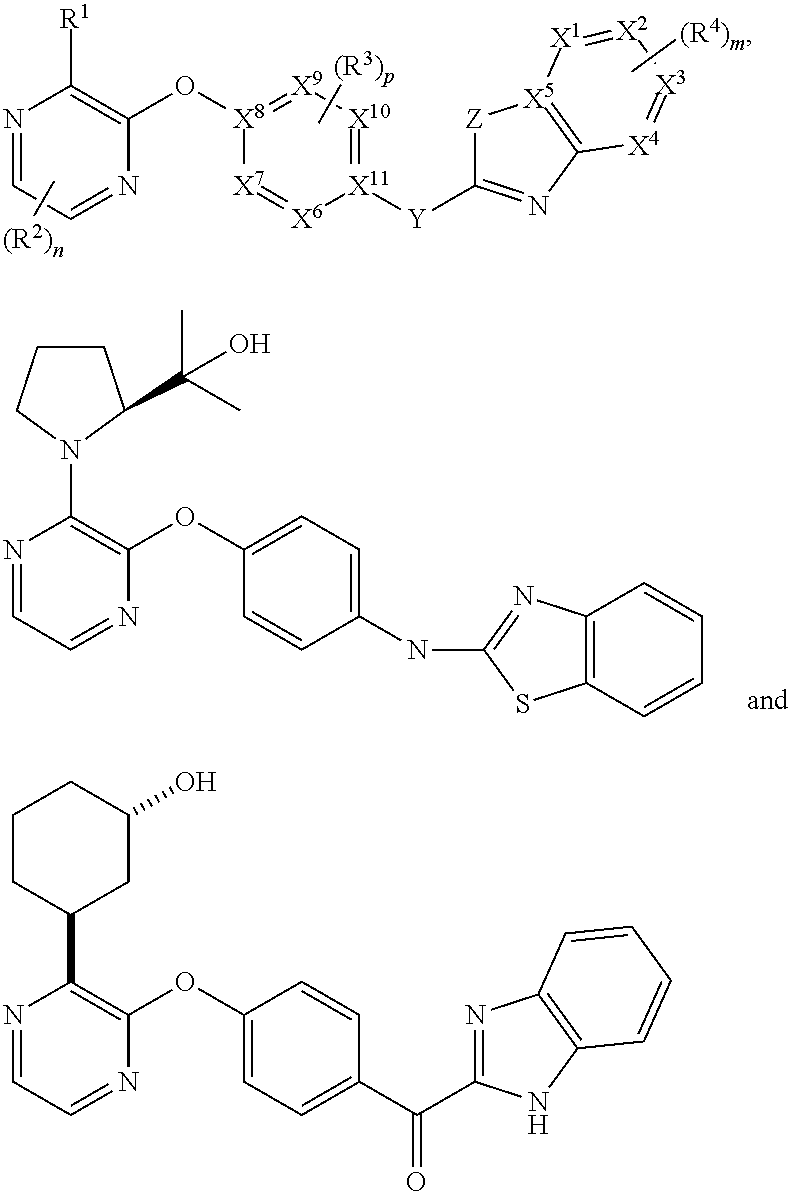
were disclosed in WO2010/0057121 Pamphlet.

were also disclosed in WO2010/57126 Pamphlet.


was disclosed in WO2006/072828 Pamphlet.

was also disclosed in WO2008/001182 Pamphlet.

was also disclosed in WO2010/090737 Pamphlet.

wherein
ring A represents an optionally substituted 6-membered ring, any one or two of Z1 to Z4 represent —N═, and the others
represent —CH═,
Y represents an oxygen atom, a sulfur atom, an optionally substituted methylene group or —NRc— wherein Rc represents a hydrogen atom or a substituent, and
R represents
-
- (1) a group represented by the formula:

-
-
- wherein
- R1 is a phenyl group or a 5- to 10-membered heterocyclic group, each of which is optionally substituted,
- L is a sulfur atom, an oxygen atom, an optionally substituted methylene group, —CO—, —NRa—, —CH2O—, —OCH2—, —NRaCOO—, —OCONRa—, —NRaCONRb—, —NRaCOCH2—, —CH2CONRa—, —NRaCO—, —CONRa—,
-

-
-
-
- wherein
- Ra and Rb are the same or different and each is a hydrogen atom or an optionally substituted C1-6 alkyl group, or
- L and R1 in combination optionally fault an optionally substituted bi- or tri-cyclic fused heterocyclic group, and ring B1 is a benzene ring, a pyridine ring, a pyrimidine ring, a pyrazine ring or a pyridazine ring, each of which is optionally substituted, or
-
- (2) a group represented by the formula:
-

-
-
- wherein
- R2 is a phenyl group or a 5- to 10-membered heterocyclic group, each of which is optionally substituted,
- ring B2 is a benzene ring, a pyridine ring, a pyrimidine ring, a pyrazine ring or a pyridazine ring, each of which is optionally substituted, and
- ring D is an optionally further substituted 5- or 6-membered ring,
provided that
-
- 3,3′-benzene-1,4-diylbis(1,3-dihydro-2H-imidazo[4,5-b]pyridin-2-one),
- 1-cyclohexyl-3-(4-{[4-(methylsulfonyl)piperazin-1-yl]methyl}phenyl)-1,3-dihydro-2H-imidazo[4,5-b]pyridin-2-one,
- 3-(4-phenoxyphenyl)-1,3-dihydro-2H-imidazo[4,5-b]pyridin-2-one,
- 3,3′-benzene-1,4-diylbis(1,3-dihydro-2H-imidazo[4,5-c]pyridin-2-one), and
- 3-[8-(4-methylpiperazin-1-yl)naphthalen-2-yl]-1,3-dihydro-2H-imidazo[4,5-b]pyridin-2-one
are excluded,
or a salt thereof.
[1′] The compound of the aforementioned [1], wherein R is
(1) a group represented by the formula:

wherein each symbol is as defined in the aforementioned [1], or
(2) a group represented by the formula:

wherein ring B2 is a benzene ring, a pyridine ring, a pyrimidine ring, a pyrazine ring or a pyridazine ring, each of which is optionally substituted, and
ring D is an optionally further substituted 5- or 6-membered ring,
R2 is as defined in the aforementioned [1],
provided that when ring B2 is a benzene ring, ring D is not a benzene ring,
or a salt thereof.
[1″] The compound of the aforementioned [1], wherein R is
(1) a group represented by the formula:

-
- wherein
- R1 is a phenyl group or a 5- to 10-membered heterocyclic group, each of which is optionally substituted,
- L is a sulfur atom, an oxygen atom, an optionally substituted methylene group, —CO—, —NRa—, —CH2O—, —OCH2—, —NRaCOO—, —OCONRa—, —NRaCONRb—, —NRaCOCH2—, —CH2CONRa—, —NRaCO—, —CONRa—,

-
-
- wherein
- Ra and Rb are as defined in the aforementioned [1], or
- L and R1 in combination optionally form an optionally substituted bi- or tri-cyclic fused heterocyclic group, and ring B1 is a benzene ring, a pyridine ring, a pyrimidine ring, a pyrazine ring or a pyridazine ring, each of which is optionally substituted,
- provided that when L is an oxygen atom, R1 is not an optionally substituted phenyl, or
(2) a group represented by the formula:
-

-
- wherein each symbol is as defined in the aforementioned [1], or a salt thereof.
[2] The compound of the aforementioned [1], wherein any one of Z1 to Z4 is —N═, and the others are —CH═,
or a salt thereof.
[3] The compound of the aforementioned [1], wherein the partial structure of the formula (I):
- wherein each symbol is as defined in the aforementioned [1], or a salt thereof.

is a group represented by the formula:

-
- wherein
- Y1 is an optionally substituted methylene group or —NRc— wherein Rc is a hydrogen atom or a substituent, and
- ring A1 is an optionally substituted pyridine ring, or
a group represented by the formula:

-
- wherein
- Y2 is —NRd— wherein Rd is a substituent, and
- ring A2 is an optionally substituted pyridine ring,
or a salt thereof.
[4] The compound of the aforementioned [1], wherein L is an oxygen atom, or —NRa— wherein Ra is a hydrogen atom or an optionally substituted C1-6 alkyl group, or
L and R1 in combination optionally form an optionally substituted bi- or tri-cyclic fused heterocyclic group, or a salt thereof.
[5] The compound of the aforementioned [3], wherein the partial structure of formula (I):

is a group represented by the formula:

wherein ring A1 and Y1 are as defined in the aforementioned [3], or a salt thereof.
[6] The compound of the aforementioned [3], wherein the partial structure of formula of formula (I):

is a group represented by the formula:

wherein
the R3′″ represents a hydrogen atom, a halogen atom, an optionally substituted C1-4 alkyl group, or an optionally substituted C1-4 alkoxy group, and
Y1 is as defined in the aforementioned [3],
or a salt thereof.
[7] The compound of the aforementioned [3], wherein the partial structure of formula (I):

is a group represented by the formula:

wherein
R3a and R3b represent the same or different a hydrogen atom, a halogen atom, cyano, an optionally substituted C1-4 alkyl group or an optionally substituted C1-4 alkoxy group, and
R4 represents an optionally substituted C1-4 alkyl group, provided that when one of R3a and R3b is a hydrogen atom, the other is not a hydrogen atom,
or a salt thereof.
[8] The compound of the aforementioned [1], wherein ring B1 is an optionally substituted benzene ring, or a salt thereof.
[9] The compound of the aforementioned [1], wherein R1 is a 5- to 10-membered heterocyclic group which is optionally substituted, or a salt thereof.
[10] The compound of the aforementioned [9], wherein the 5- to 10-membered heterocyclic group which is optionally substituted is a group represented by the formula:

wherein Rx represents a hydrogen atom or an optionally substituted C1-6 alkyl group,
or a salt thereof.
[11] 1-Ethyl-6-methyl-3-{4-[(3-methyl-3H-imidazo[4,5-b]pyridin-2-yl)oxy]phenyl}-1,3-dihydro-2H-imidazo[4,5-b]pyridin-2-one, or a salt thereof.
[12] 1-Ethyl-6-methoxy-3-{4-[(3-methyl-3H-imidazo[4,5-b]pyridin-2-yl)oxy]phenyl}-1,3-dihydro-2H-imidazo[4,5-b]pyridin-2-one, or a salt thereof.
[13] 1-Ethyl-7-methyl-3-{4-[(3-methyl-3H-imidazo[4,5-b]pyridin-2-yl)oxy]phenyl}-1,3-dihydro-2H-imidazo[4,5-b]pyridin-2-one, or a salt thereof.
[14] 6-Methyl-1-(1-methylethyl)-3-{4-[(3-methyl-3H-imidazo[4,5-b]pyridin-2-yl)oxy]phenyl}-1,3-dihydro-2H-imidazo[4,5-b]pyridin-2-one, or a salt thereof.
[15] 1-Ethyl-6-fluoro-3-{4-[(3-methyl-3H-imidazo[4,5b]pyridin-2-yl)oxy]phenyl}-1,3-dihydro-2H-imidazo[4,5-b]pyridin-2-one, or a salt thereof.
[16] 1,7-Dimethyl-3-{4-[(3-methyl-3H-imidazo[4,5-b]pyridin-2-yl)oxy]phenyl}-1,3-dihydro-2H-imidazo[4,5-b]pyridin-2-one, or a salt thereof.
[17] 1-Ethyl-7-(hydroxymethyl)-3-{4-[(3-methyl-3H-imidazo[4,5-b]pyridin-2-yl)oxy]phenyl}-1,3-dihydro-2H-imidazo[4,5-b]pyridin-2-one, or a salt thereof.
[18] A medicament comprising the compound of the aforementioned [1], or a salt thereof.
[19] The medicament of the aforementioned [18], which is a phosphodiesterase 10A inhibitor.
[20] The medicament of the aforementioned [18], which is an agent for the prophylaxis or treatment of schizophrenia.
[21] A method for preventing or treating schizophrenia in a mammal, which comprises administering an effective amount of a compound represented by the formula (I):

wherein
ring A represents an optionally substituted 6-membered ring, any one or two of Z1 to Z4 represent —N═, and the others represent —CH═,
Y represents an oxygen atom, a sulfur atom, an optionally substituted methylene group, or —NRc— wherein Rc represents a hydrogen atom or a substituent, and
R represents
-
- (1) a group represented by the formula:

-
-
- to wherein
- R1 is a phenyl group or a 5- to 10-membered heterocyclic group, each of which is optionally substituted,
- L is a sulfur atom, an oxygen atom, an optionally substituted methylene group, —CO—, —NRa—, —CH2O—, —OCH2—, —NRaCOO—, —OCONRa—, —NRaCONRb—, —NRaCOCH2—, —CH2CONRa—, —NRaCO—, —CONRa—,
-

-
-
-
- wherein
- Ra and Rb are the same or different and each is a hydrogen atom or an optionally substituted C1-6 alkyl group, or
- L and R1 in combination optionally form an optionally substituted bi- or tri-cyclic fused heterocyclic group, and ring B1 is a benzene ring, a pyridine ring, a pyrimidine ring, a pyrazine ring or a pyridazine ring, each of which is optionally substituted, or
-
- (2) a group represented by the formula:
-

-
-
- wherein
- R2 is a phenyl group or a 5- to 10-membered heterocyclic group, each of which is optionally substituted,
- ring B2 is a benzene ring, a pyridine ring, a pyrimidine ring, a pyrazine ring or a pyridazine ring, each of which is optionally substituted, and
- ring D is an optionally further substituted 5- or 6-membered ring,
to the mammal.
[22] Use of a compound represented by the formula (I):
-

wherein each symbol is as defined above,
or salt thereof for the production of an agent for the prophylaxis or treatment of schizophrenia.
[23] A compound represented by the formula (I):

wherein each symbol is as defined above,
or salt thereof for use in the prophylaxis or treatment of schizophrenia.
[24] Use of a compound represented by the formula (I):

wherein each symbol is as defined above,
or a salt thereof for use in the prophylaxis or treatment of schizophrenia.
[25] A compound represented by the formula (I′):

wherein
ring A represents an optionally substituted 6-membered ring, any one or two of Z1 to Z4 represent —N═, and the others represent —CH═,
Y represents an oxygen atom, a sulfur atom, an optionally substituted methylene group, or —NRc— wherein Rc represents a hydrogen atom or a substituent, and
R′ represents
-
- (1) a group represented by the formula:

wherein
R1 is a phenyl group or a 5- to 10-membered heterocyclic group, each of which is optionally substituted,
L′ is a sulfur atom, —CO—, —NRa—, —CH2O—, —OCH2—, —NRaCOO—, —OCONRa—, —NRaCONRb—, —NRaCOCH2—, —CH2CONRa—, —NRaCO—, —CONRa—,

wherein
Ra and Rb are the same or different and each is a hydrogen atom or an optionally substituted C1-6 alkyl group,
R1′ is an optionally substituted 5- to 10-membered heterocyclic group, or
L and R1 in combination optionally form a bi- or tri-cyclic fused heterocyclic group which is optionally substituted by 1 to 3 substitutents selected from (a) a halogen atom, (b) an optionally esterified carboxy group, and
(c) an optionally substituted alkyl group, and
ring B1 is a benzene ring, a pyridine ring, a pyrimidine ring, a pyrazine ring or a pyridazine ring, each of which is optionally substituted, or
-
- (2) a group represented by the formula:

wherein
R2 is a phenyl group or a 5- to 10-membered heterocyclic group, each of which is optionally substituted,
ring B2 is a benzene ring, a pyridine ring, a pyrimidine ring, a pyrazine ring or a pyridazine ring, each of which is optionally substituted, and
ring D′ is optionally further substituted 5- or 6-membered heterocycle,
or a salt thereof.
(f) an optionally substituted C6-14 aryloxy group (the C6-14 aryloxy group is optionally substituted by 1 to 5 (preferably 1 to 3, more preferably 1) substituents selected from a halogen atom, hydroxy, cyano, amino, optionally halogenated C1-6 alkyl by 1 to 3 halogen atoms, mono- or di-C1-6 alkylamino, mono- or di-C6-14 arylamino, mono- or di-C7-16 aralkylamino, C3-7 cycloalkyl, C1-6 alkoxy, formyl, C1-6 alkyl-carbonyl, C3-7 cycloalkyl-carbonyl, C6-14 aryl-carbonyl, C7-16 aralkyl-carbonyl, C1-6 alkoxy-carbonyl, C6-14 aryloxy-carbonyl, C7-16 aralkyloxy-carbonyl, C1-6 alkylsulfanyl, C1-6 alkylsulfinyl, C1-6 alkylsulfonyl, carbamoyl, thiocarbamoyl, mono- or di-C1-6 alkyl-carbamoyl, mono- or di-C6-14 aryl-carbamoyl and the like);
(g) an optionally substituted C7-16 aralkyloxy group (the C7-16 aralkyloxy group is optionally substituted by 1 to 5 (preferably 1 to 3, more preferably 1) substituents selected from a halogen atom, hydroxy, cyano, amino, optionally halogenated C1-6 alkyl by 1 to 3 halogen atoms, mono- or di-C1-6 alkylamino, mono- or di-C6-14 arylamino, mono- or di-C7-16 aralkylamino, C3-7 cycloalkyl, C1-6 alkoxy, formyl, C1-6 alkyl-carbonyl, C3-7 cycloalkyl-carbonyl, C6-14 aryl-carbonyl, C7-16 aralkyl-carbonyl, C1-6 alkoxy-carbonyl, C6-14 aryloxy-carbonyl, C7-16 aralkyloxy-carbonyl, C1-6 alkylsulfanyl, C1-6 alkylsulfinyl, C1-6 alkylsulfonyl, carbamoyl, thiocarbamoyl, mono- or di-C1-6 alkyl-carbamoyl, mono- or di-C6-14 aryl-carbamoyl and the like);
(h) an optionally substituted 5- to 10-membered heterocyclic group containing 1 to 4 hetero atoms selected from a nitrogen atom, a sulfur atom and an oxygen atom (e.g., furyl, pyridyl, thienyl, 1-pyrrolidinyl, 1-piperidyl, 4-piperidyl, piperazinyl, 1-morpholinyl, 4-thiomorpholinyl, 1-azepanyl, 1-azocanyl, 1-azonanyl, 3,4-dihydroisoquinolin-2-yl and the like) (the heterocyclic group is optionally substituted by 1 to 5 (preferably 1 to 3, more preferably 1) substituents selected m from a halogen atom, hydroxy, cyano, amino, optionally halogenated C1-6 alkyl by 1 to 3 halogen atoms, mono- or di-C1-6 alkylamino, mono- or di-C6-14 arylamino, mono- or di-C7-16 aralkylamino, C3-7 cycloalkyl, C1-6 alkoxy, formyl, C1-6 alkyl-carbonyl, C3-7 cycloalkyl-carbonyl, C6-14 aryl-carbonyl, C7-16 aralkyl-carbonyl, C1-6 alkoxy-carbonyl, C6-14 aryloxy-carbonyl, C7-16 aralkyloxy-carbonyl, C1-6 alkylsulfanyl, C1-6 alkylsulfinyl, C1-6 alkylsulfonyl, carbamoyl, thiocarbamoyl, mono- or di-C1-6 alkyl-carbamoyl, mono- or di-C6-14 aryl-carbamoyl and the like);
(i) an optionally substituted amino group [e.g., an amino group optionally substituted by 1 or 2 substituent(s) selected from the group consisting of C1-6 alkyl, C2-6 alkenyl, C6-14 aryl, C7-16 aralkyl, a heterocyclic group and heterocyclyl-alkyl (the C1-6 alkyl, C2-6 alkenyl, C6-14 aryl, C7-16 aralkyl, heterocyclic group and heterocyclyl-alkyl are each optionally substituted by 1 to 5 (preferably 1 to 3, more preferably 1) substituents selected from a halogen atom, hydroxy, cyano, amino, C1-6 alkyl optionally halogenated by 1 to 3 halogen atoms (which is not a substituent for alkyl and alkenyl), mono- or di-C1-6 alkylamino, mono- or di-C6-14 arylamino, mono- or di-C7-16 aralkylamino, C3-7 cycloalkyl, C1-6 alkoxy, formyl, C1-6 alkyl-carbonyl, C3-7 cycloalkyl-carbonyl, C6-14 aryl-carbonyl, C7-16 aralkyl-carbonyl, C1-6 alkoxy-carbonyl, C3-7 cycloalkyloxy-carbonyl, C6-14 aryloxy-carbonyl, C7-16 aralkyloxy-carbonyl, C1-6 alkylsulfanyl, C3-7 cycloalkylsulfanyl, C1-6 alkylsulfinyl, C3-7 cycloalkylsulfinyl, C1-6 alkylsulfonyl, C3-7 cycloalkylsulfonyl, carbamoyl, thiocarbamoyl, mono- or di-C1-6 alkyl-carbamoyl, mono- or di-C6-14 aryl-carbamoyl and the like). Examples of the “heterocyclic group” and the “heterocyclyl-” of the “heterocyclyl-alkyl” include those similar to the above-mentioned “heterocyclic group”];
(j) C3-7 cycloalkyl;
(k) an optionally substituted C1-6 alkoxy group (the C1-6 alkoxy group is optionally substituted by 1 to 5 (preferably 1 to 3, more preferably 1) substituents selected from a halogen atom, hydroxy, amino, mono- or di-C1-6 alkylamino, mono- or di-C6-14 arylamino, C3-7 cycloalkyl, C1-6 alkoxy, formyl, C1-6 alkyl-carbonyl, C3-7 cycloalkyl-carbonyl, C6-14 aryl-carbonyl, C7-16 aralkyl-carbonyl, C1-6 alkoxy-carbonyl, C6-14 aryloxy-carbonyl, C7-16 aralkyloxy-carbonyl, C1-6 alkylsulfanyl, C1-6 alkylsulfinyl, C1-6 alkylsulfonyl, carbamoyl, thiocarbamoyl, mono- or di-C1-6 alkyl-carbamoyl, mono- or di-C6-14 aryl-carbamoyl, trimethylsilyl (TMS) and the like);
(l) a formyl group;
(m) a C1-6 alkyl-carbonyl group (e.g., acetyl);
(n) a C3-7 cycloalkyl-carbonyl group;
(o) a C6-14 aryl-carbonyl group;
(p) a C7-16 aralkyl-carbonyl group;
(q) a C1-6 alkoxy-carbonyl group;
(r) a C6-14 aryloxy-carbonyl group;
(s) a C7-16 aralkyloxy-carbonyl group;
(t) a C1-6 alkylsulfanyl group;
(u) a C1-6 alkylsulfinyl group;
(v) a C1-6 alkylsulfonyl group;
(w) a carbamoyl group;
(x) a thiocarbamoyl group;
(y) a mono-C1-6 alkyl-carbamoyl group (e.g., methylcarbamoyl, ethylcarbamoyl and the like);
(z) a di-C1-6 alkyl-carbamoyl group (e.g., dimethylcarbamoyl, diethylcarbamoyl, ethylmethylcarbamoyl and the like);
(aa) a mono- or di-C6-14 aryl-carbamoyl group (e.g., phenylcarbamoyl, 1-naphthylcarbamoyl, 2-naphthylcarbamoyl and the like);
(bb) a mono- or di-(5- to 7-membered heterocyclyl containing 1 to 4 hetero atoms selected from a nitrogen atom, a sulfur atom and an oxygen atom)-carbamoyl group (e.g., 2-pyridylcarbamoyl, 3-pyridylcarbamoyl, 4-pyridylcarbamoyl, 2-thienylcarbamoyl, 3-thienylcarbamoyl and the like); and
(cc) a C1-6 alkyl-carbonyloxy group (e.g., acetoxy and the like).
(b) an optionally substituted C2-6 alkenyl group (the C2-6 alkenyl group is optionally substituted by 1 to 5 (preferably 1 to 3, more preferably 1) substituents selected from a halogen atom, hydroxy, cyano, amino, mono- or di-C1-6 alkylamino, mono- or di-C6-14 arylamino, mono- or di-C7-16 aralkylamino, C3-7 cycloalkyl, C1-6 alkoxy, formyl, C1-6 alkyl-carbonyl, C3-7 cycloalkyl-carbonyl, C6-14 aryl-carbonyl, C7-16 aralkyl-carbonyl, C1-6 alkoxy-carbonyl, C6-14 aryloxy-carbonyl, C7-16 aralkyloxy-carbonyl, C1-6 alkylsulfanyl, C1-6 alkylsulfinyl, C1-6 alkylsulfonyl, carbamoyl, thiocarbamoyl, mono- or di-C1-6 alkyl-carbamoyl, mono- or di-C6-14 aryl-carbamoyl and the like); and
(c) an optionally substituted C2-6 alkynyl group (the C2-6 alkynyl group is optionally substituted by 1 to 5 (preferably 1 to 3, more preferably 1) substituents selected from a halogen atom, hydroxy, cyano, amino, mono- or di-C1-6 alkylamino, mono- or di-C6-14 arylamino, mono- or di-C7-16 aralkylamino, C3-7 cycloalkyl, C1-6 alkoxy, formyl, C1-6 alkyl-carbonyl, C3-7 cycloalkyl-carbonyl, C6-14 aryl-carbonyl, C7-16 aralkyl-carbonyl, C1-6 alkoxy-carbonyl, C6-14 aryloxy-carbonyl, C7-16 aralkyloxy-carbonyl, C1-6 alkylsulfanyl, C1-6 alkylsulfinyl, C1-6 alkylsulfonyl, carbamoyl, thiocarbamoyl, mono- or di-C1-6 alkyl-carbamoyl, mono- or di-C6-14 aryl-carbamoyl and the like).

wherein each symbol is as defined above, is also encompassed in the compound represented by the formula (I). Particularly, when Z1 is —N═, the nitrogen atom of —N═ for Z1 is preferably oxidized.
a halogen atom (preferably a chlorine atom, a fluorine atom), cyano, methyl, hydroxymethyl, acetoxymethyl, trifluoromethyl, methoxy, difluoromethoxy, 2,2-difluoroethoxy and 2,2,2-trifluoroethoxy are particularly preferable.
[preferably a pyridine ring which is optionally substituted by (1) a pyridine ring which is optionally substituted by one substituent selected from (i) a C1-6 alkyl group optionally substituted by 1 to 3 substituents selected from a halogen atom and hydroxy (preferably methyl, trifluoromethyl, hydroxymethyl), (ii) a halogen atom (preferably chlorine, fluorine), (iii) cyano, and (iv) a C1-4 alkoxy optionally substituted by 1 to 3 halogen atoms (preferably methoxy, difluoromethoxy, difluoroethoxy, trifluoroethoxy)], or (2) a pyrimidine ring.
particularly preferably —NRc— wherein Rc is preferably a C1-6 alkyl group (preferably methyl, ethyl, propyl, isopropyl, isobutyl), a diC1-6 alkylmethylene group (preferably dimethylmethylene group) or the like, more preferably —NRc— wherein Rc is preferably a C1-6 alkyl group (preferably methyl, ethyl, isopropyl).

is preferably, for example, a group represented by the formula:

-
- wherein
- Y1 is an optionally substituted methylene group, or —NRc— wherein Rc is a hydrogen atom or a substituent, and ring A1 is an optionally substituted pyridine ring, or
a group represented by the formula:

-
- wherein
- Y2 is —NRd— wherein Rd is a substituent, and ring A2 is an optionally substituted pyridine ring.

is more preferably a group represented by the formula:

wherein each symbol is as defined above, further more
-
- preferably a group represented by the formula:

-
- wherein
- R3 is a hydrogen atom, a halogen atom, cyano, an optionally substituted C1-6 alkyl group or an optionally substituted C1-6 alkoxy group, and
- Y1 is as defined above.

is particularly preferably a group represented by the formula:

-
- wherein
- R3′″ is a hydrogen atom, a halogen atom, an optionally substituted C1-6 alkyl group (preferably an optionally substituted C1-4 alkyl group) or an optionally substituted C1-6 alkoxy group (preferably an optionally substituted C1-4 alkoxy group), and
- Y1 is as defined above.

is preferably

-
- wherein
- R4′ is an optionally substituted C1-6 alkyl group, and
- R3 is as defined above.

is preferably a group represented by the formula:

-
- wherein
- R3″″ and R3′″″ represent the same or different a hydrogen atom, a halogen atom, cyano, an optionally substituted C1-6 alkyl group or an optionally substituted C1-6 alkoxy group, and
R4′ is as defined above.

is preferably a group represented by the formula:

-
- wherein
- R3a and R3b represent the same or different a hydrogen atom, a halogen atom, cyano, an optionally substituted C1-4 alkyl group or an optionally substituted C1-4 alkoxy group, and
- R4 represents an optionally substituted C1-4 alkyl group, provided that when one of R3a and R3b is a hydrogen atom, the other is not a hydrogen atom, and
more preferably a group represented by the formula:

-
- wherein
- R3′ represents a hydrogen atom, or an optionally substituted C1-4 alkyl group (preferably, methyl, hydroxymethly),
- R3″ represents a hydrogen atom, a halogen atom, cyano, an optionally substituted C1-4 alkyl group or an optionally substituted C1-4 alkoxy group, and
- R4 represents an optionally substituted C1-4 alkyl group, provided that when one of R3′ and R3″ is a hydrogen atom, the other is not a hydrogen atom.

or
(2) a group represented by the formula:


wherein
-
- R1 is a phenyl group or a 5- to 10-membered heterocyclic group, each of which is optionally substituted,
- L is a sulfur atom (—S—), an oxygen atom (—O—), an optionally substituted methylene group, —CO—, —NRa—, —CH2O—, —OCH2—, —NRaCOO—, —OCONRa—, —NRaCONRb—, —NRaCOCH2—, —CH2CONRa—, —NRaCO—, —CONRa—,

-
-
- wherein
- Ra and Rb are the same or different and each is a hydrogen atom or an optionally substituted C1-6 alkyl group, or
- L and R1 in combination optionally form an optionally substituted bi- or tri-cyclic fused heterocyclic group, and ring B1 is a benzene ring, a pyridine ring, a pyrimidine ring, a pyrazine ring or a pyridazine ring, each of which is optionally substituted.
-

and the like are more preferable, and the following groups:

are particularly preferable.

-
- wherein Rf is absent or a hydrogen atom (when Rf is absent,
- N(Rf)— is ═N—; Rf is preferably absent),

and the like are preferable, and the following groups:

and the like are more preferable.
-
- (i) a halogen atom (preferably a fluorine atom),
- (ii) a hydroxy group, and
- (iii) an optionally substituted C1-6 alkoxy group (e.g., a C1-6 alkoxy group (preferably ethoxy) optionally substituted by trimethylsilyl),
(d) a C6-14 aryl group (preferably phenyl),
(e) a C1-6 alkyl-carbonyl group (preferably acetyl), and the like are more preferable.

or the like, each of which is optionally substituted by 1 to 3 substituents selected from the group consisting of
-
- (a) a halogen atom,
- (b) an optionally esterified carboxy group,
- (c) an optionally substituted alkyl group,
- (d) an optionally substituted C6-14 aryl group, and
- (e) an optionally substituted alkyl-carbonyl group
- [preferably
- (a) a halogen atom (preferably fluorine, bromine, chlorine),
- (b) a C1-6 alkoxy-carbonyl group (preferably ethoxycarbonyl),
- (c) a C1-6 alkyl group (preferably methyl, ethyl, butyl, isobutyl) optionally substituted by one or more (preferably 1 to 3) substituents selected from the group consisting of
- (i) a halogen atom (preferably fluorine),
- (ii) a hydroxy group, and
- (iii) an optionally substituted C1-6 alkoxy group (e.g., a C1-6 alkoxy group (preferably ethoxy) optionally substituted by trimethylsilyl),
- (d) a C6-14 aryl group (preferably phenyl), and
- (e) a C1-6 alkyl-carbonyl group (preferably acetyl)].

-
- wherein
- Rx is a hydrogen atom or an optionally substituted C1-6 alkyl group (preferably a C1-6 alkyl group),
or the like.

more preferably an oxygen atom or —NRa— wherein Ra is a hydrogen atom or a C1-6 alkyl group (preferably methyl), or the like,
further more preferably an oxygen atom or the like.

is a moiety represented by the formula:
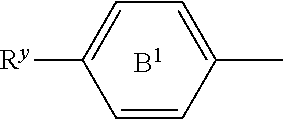
-
- wherein
- Ry is an optionally substituted bi- or tri-cyclic fused heterocyclic group, and
- B1 is as defined above.


-
- wherein
- X is —CH2—, —NH—, an oxygen atom or a sulfur atom,
- X′ is ═CH— or ═N—, and
- Rf is absent or a hydrogen atom (when Rf is absent, N(Rf)— is ═N—; Rf is preferably absent),
or the like, more preferably the following group:


each of which is optionally substituted by 1 to 3 substituents selected from the group consisting of
-
- (a) a C1-6 alkoxy-carbonyl group (preferably ethoxycarbonyl),
- (b) C1-6 alkyl group (preferably methyl) optionally substituted by C6-14 aryl group(s) (preferably phenyl), and
- (c) an oxo group.
R1-L—
is preferably a group represented by the following formula:


-
- wherein
- Rf is absent or a hydrogen atom (when Rf is absent, —N(Rf)— is ═N—; Rf is preferably absent);
- Rz is (i) a hydrogen atom, (ii) a C1-4 alkyl group optionally substituted by one substituent selected from (1) a hydroxy group (preferably, methyl, ethyl, hydroxyethyl, buthyl, hydroxyisobutyl) and (2) a C1-4 alkoxy group optionally substituted by trimethylsilyl (preferably, trimethylsilylmethoxy), or (iii) a C1-6 alkyl-carbonyl group (preferably, acetyl);
- Rw1 is a halogen atom (preferably, fluorine);
- m is 0 to 2;
- Rw2 is a hydrogen atom or a methyl group;
- Rw3 is a hydrogen atom or a C1-2 alkoxy-carbonyl group (preferably, ethoxycarbonyl);
- Rw4 is a hydrogen atom or benzyl;
- Rw5 is a hydrogen atom or methyl;
- Rw6 is a hydrogen atom, a halogen atom (preferably, fluorine, chlorine), or a C1-6 alkyl group optionally substituted by 1 to 3 halogen atoms (preferably, trifluoromethyl);
- Rw7 is a C1-6 alkoxyl-carbonyl group (preferably, ethoxycarbonyl);
- Rw8 is a halogen atom (preferably, chlorine, bromine), or a C1-6 alkyl group optionally substituted by 1 to 3 halogen atoms (preferably, trifluoromethyl);
- n is 0 to 2;
- Rw9 is a hydrogen atom or a halogen atom (preferably, bromine);
more preferably a group represented by the following formula:
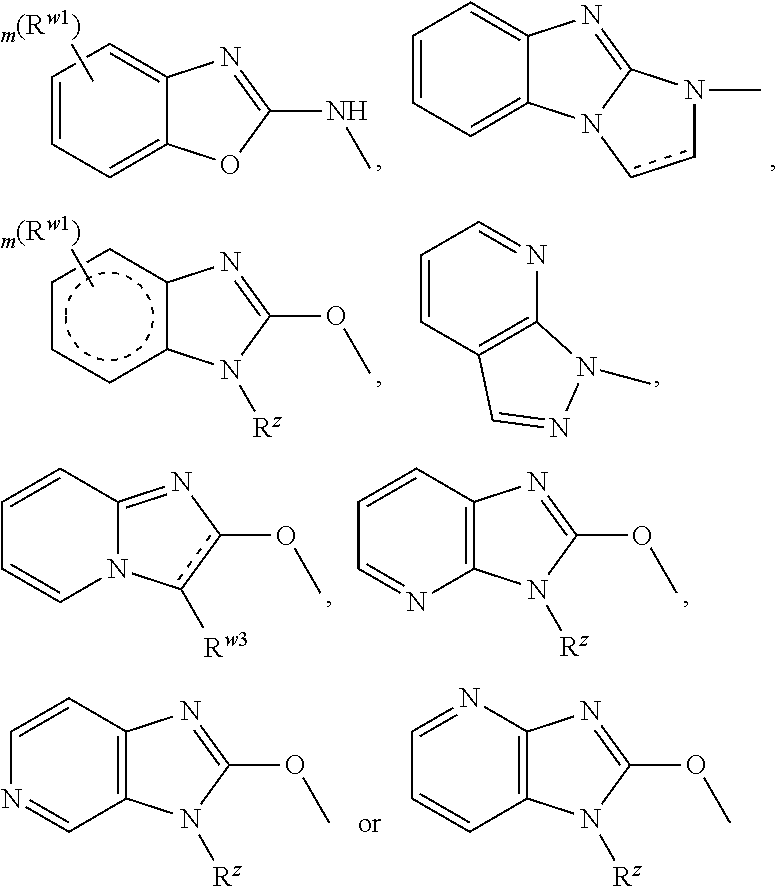
-
- wherein
- Rw1 is a halogen atom (preferably, fluorine);
- m is 0 to 1;
- Rz is (i) a hydrogen atom, (ii) a C1-4 alkyl group optionally substituted by one hydroxy group (preferably, methyl, hydroxyethyl, hydroxyisobutyl) and
- Rw3 is a hydrogen atom or a C1-2 alkoxy-carbonyl group (preferably, ethoxycarbonyl).
- wherein
R1-L—
is preferably a group represented by the following formula:

-
- wherein
- Rx is an optionally substituted C1-6 alkyl group,
each of which is further optionally substituted.
-
- (i) a halogen atom (preferably a fluorine atom),
- (ii) a hydroxy group, and
- (iii) an optionally substituted C1-6 alkoxy group (e.g., a C1-6 alkoxy group (preferably ethoxy) optionally substituted by trimethylsilyl),
more preferably a C1-6 alkyl group (preferably methyl, ethyl, butyl, isobutyl) optionally substituted by one or more (preferably 1 to 3) substituents selected from the group consisting of - (i) a hydroxy group, and
- (ii) an optionally substituted C1-6 alkoxy group (e.g., a C1-6 alkoxy group (preferably ethoxy) optionally substituted by trimethylsilyl).

-
- wherein
- R″ is an optionally substituted C1-6 alkyl group,
optionally further has,
(a) a halogen atom,
(b) an optionally esterified carboxy group,
(c) an optionally substituted alkyl group,
(d) an optionally substituted C6-14 aryl group,
(e) an optionally substituted alkyl-carbonyl group,
and the like are preferable, and
(a) a halogen atom (preferably fluorine),
(b) a C1-6 alkoxy-carbonyl group (preferably ethoxycarbonyl),
(c) a C1-6 alkyl group (preferably methyl)
and the like are more preferable.

(i.e., the moiety other than the substituent) is preferably

or the like, more preferably

Y is an oxygen atom, an optionally substituted methylene group, or —NRc— wherein Rc is preferably a hydrogen atom, an optionally substituted alkyl group or an optionally substituted C3-7 cycloalkyl group
{preferably
an oxygen atom,
a methylene group optionally substituted by 1 or 2 C1-6 alkyl groups (preferably methyl) (the two substituents for the methylene group optionally form, together with the adjacent carbon atom, a C3-6 cycloalkane (preferably cyclobutane)), or —NRc— wherein Rc is preferably (i) a hydrogen atom, (ii) a C1-6 alkyl group (e.g., methyl, ethyl, propyl, isopropyl, isobutyl) optionally substituted by 1 to 3 substituents selected from the group consisting of a halogen atom (preferably a fluorine atom), a hydroxy group, a C3-7 cycloalkyl group (preferably cyclopropyl), an optionally substituted C1-6 alkoxy group (e.g., methoxy, ethoxy, a trimethylsilyl-C1-6 alkoxy group (preferably trimethylsilyl-ethoxy)), and an C1-6 alkoxy-carbonyl group (preferably ethoxycarbonyl), or (iii) a C3-7 cycloalkyl group (preferably cyclopropyl)};
R1 is a phenyl group or a 5- to 10-membered heterocyclic group [preferably imidazolyl, pyridyl, thiadiazolyl (preferably the following group:

each of which is optionally substituted by 1 to 3 substituents selected from the group consisting of
-
- (a) a halogen atom,
- (b) an optionally esterified carboxy group,
- (c) an optionally substituted alkyl group,
- (d) an optionally substituted C6-14 aryl group, and
- (e) an optionally substituted alkyl-carbonyl group
- [preferably
- (a) a halogen atom (preferably fluorine, bromine, chlorine),
- (b) a C1-6 alkoxy-carbonyl group (preferably ethoxycarbonyl),
- (c) a C1-6 alkyl group (preferably methyl, ethyl, butyl, isobutyl) optionally substituted by one or more (preferably 1 to 3) substituents selected from the group consisting of
- (i) a halogen atom (preferably fluorine),
- (ii) a hydroxy group, and
- (iii) an optionally substituted C1-6 alkoxy group (e.g., a C1-6 alkoxy group (preferably ethoxy) optionally substituted by trimethylsilyl),
- (d) a C6-14 aryl group (preferably phenyl), and
- (e) a C1-6 alkyl-carbonyl group (preferably acetyl)];
L is an oxygen atom (—O—), —CO—, —NRa—, —NRaCOO— wherein Ra is preferably a hydrogen atom or a C1-6 alkyl group (preferably methyl), or

[preferably an oxygen atom, or —NRa— wherein Ra is a hydrogen atom or a C1-6 alkyl group (preferably methyl)); or
L and R1 in combination optionally form a bi- or tri-cyclic fused heterocyclic group optionally substituted by 1 to 3 substituents selected from the group consisting of (a) a C1-6 alkoxy-carbonyl group (preferably ethoxycarbonyl),
-
- (b) a C1-6 alkyl group (preferably methyl) optionally substituted by C6-14 aryl group(s) (preferably phenyl), and
- (c) an oxo group
(preferably

and
ring B1 is preferably an optionally substituted benzene ring, more preferably a benzene ring optionally substituted by 1 to 3 substituents selected from the group consisting of a halogen atom and an optionally substituted alkyl group [preferably a halogen atom and an optionally substituted C1-6 alkyl group, more preferably a halogen atom (preferably a fluorine atom) and a C1-6 alkyl group (preferably methyl)],
or a salt thereof.
-
- (a) a halogen atom,
- (b) a C1-6 alkoxy-carbonyl group,
- (c) a C1-6 alkyl group optionally substituted by one or more (preferably 1 to 3) substituents selected from the group consisting of
- (i) a hydroxy group, and
- (ii) an optionally substituted C1-6 alkoxy group (e.g., a C1-6 alkoxy group optionally substituted by trimethylsilyl), and
- (d) a C1-6 alkyl-carbonyl group;
L is an oxygen atom, or —NRa— wherein Ra is a hydrogen atom or a C1-6 alkyl group, or
L and R1 in combination optionally form a bi- or tri-cyclic fused heterocyclic group optionally substituted by 1 to 3 substituents selected from the group consisting of - (a) a halogen atom,
- (b) a C1-6 alkyl group optionally substituted by C6-14 aryl group(s), and
- (c) an oxo group, and
ring B1 is a benzene ring,
or a salt thereof.


R2 is a phenyl group or a 5- to 10-membered heterocyclic group, each of which is optionally substituted,
ring B2 is a benzene ring, a pyridine ring, a pyrimidine ring, a pyrazine ring or a pyridazine ring, each of which is optionally substituted, and
ring D is an optionally further substituted 5- or 6-membered ring.

and the like are preferable, and the following group:

are more preferable.

and the like are preferable, and the following group:

are more preferable.
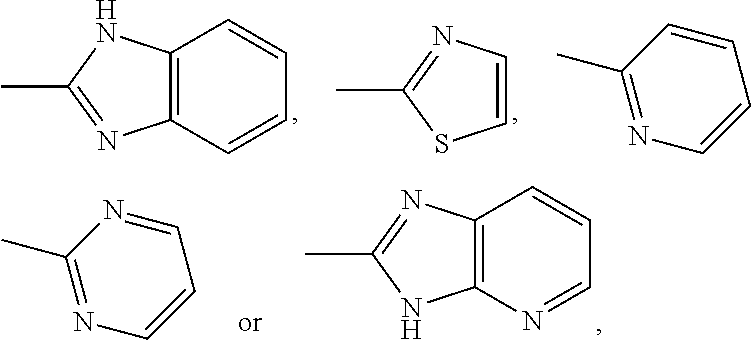
more preferably the following group:

further more preferably the following group:

optionally substituted by 1 to 3 (preferably 1) substituents selected from an optionally substituted alkyl group (preferably a C1-6 alkyl group, more preferably methyl).

is preferably a structure represented by the formula:


is preferably

-
- wherein
- Rx1 and Rx2 are the same or different and each is a hydrogen atom or an optionally substituted C1-6 alkyl group,
- Rx3-Rx5 are each a hydrogen atom or an optionally substituted C1-6 alkyl group, and
- the ring-constituting atom(s) optionally further have substituent(s),
and the like, more preferably

-
- wherein the ring-constituting atom(s) optionally further have substituent(s),
further more preferably
- wherein the ring-constituting atom(s) optionally further have substituent(s),

particularly preferably

Y is an oxygen atom, an optionally substituted methylene group, or —NRc— wherein Rc is preferably a hydrogen atom, an optionally substituted alkyl group or an optionally substituted C3-7 cycloalkyl group
{preferably an oxygen atom, a methylene group optionally substituted by 1 or 2 C1-6 alkyl group(s) (preferably methyl) (the two substituents for the methylene group optionally form, together with the adjacent carbon atom, a C3-6 cycloalkane (preferably cyclobutane)), or —NRc— wherein Rc is preferably (i) a hydrogen atom, (ii) a C1-6 alkyl group (preferably methyl, ethyl, propyl, isopropyl, isobutyl) optionally substituted by 1 to 3 substituents selected from the group consisting of a halogen atom (preferably a fluorine atom), a hydroxy group, a C3-7 cycloalkyl group (preferably cyclopropyl), an optionally substituted C1-6 alkoxy group (e.g., a trimethylsilyl-C1-6 alkoxy group (preferably trimethylsilyl-ethoxy)), and a C1-6 alkoxy-carbonyl group (preferably ethoxycarbonyl), or (iii) a C3-7 cycloalkyl group (preferably cyclopropyl)};
R2 is a 5- to 10-membered heterocyclic group (preferably the following group:

optionally substituted by 1 to 3 (preferably 1) substituents selected from an optionally substituted alkyl group (preferably a C1-6 alkyl group, more preferably methyl);
ring B2 is an optionally substituted benzene ring (preferably a benzene ring); and
ring D is a pyrrolidine ring, a dihydropyrrole ring or a dihydropyrazole ring, each of which is optionally substituted (preferably a pyrrolidine ring, a dihydropyrrole ring or a dihydropyrazole ring),
or a salt thereof.
(2) a pyrimidine ring,
Y is a oxygen atom, a methylene group which is optionally substituted by 1 to 2 C1-6 alkyl group(s) (preferably methyl) (the two substituents for the methylene group optionally form, together with the adjacent carbon atom, a C3-6 cycloalkane (preferably cyclobutane)), or wherein Rc is (1) a hydrogen atom, (2) a C1-6 alkyl group which is optionally substituted by 1 to 3 (preferably 1 or 2) substituents selected from the group consisting of (i) a C1-6 alkoxy group optionally substituted by trimethylsilyl, and (ii) a halogen atom (preferably methyl, ethyl, propyl, isopropyl, trimethylsilyl-ethoxy-methyl, difluoromethyl), or (3) a C3-7 cycloalkyl (preferably cyclopropyl),
R is
(1) a group represented by the formula:

-
- wherein
- the partial structure:
R1-L— - is a group represented by the following formula:


-
- wherein
-
- Rz is (i) a hydrogen atom, (ii) a C1-4 alkyl group optionally substituted by one substituent selected from (1) a hydroxy group (preferably methyl, ethyl, hydroxyethyl, buthyl, hydroxyisobutyl) and (2) a C1-4 alkoxy group optionally substituted by trimethylsilyl (preferably trimethylsilylmethoxy), or (iii) a C1-6 alkyl-carbonyl group (preferably acetyl);
- Rw1 is a halogen atom (preferably fluorine);
- m is 0 to 2;
- Rw2 is a hydrogen atom or a methyl group;
- Rw3 is a hydrogen atom or a C1-2 alkoxy-carbonyl group (preferably ethoxycarbonyl);
- Rw4 is a hydrogen atom or benzyl;
- Rw5 is a hydrogen atom or methyl;
- Rw6 is a hydrogen atom, a halogen atom (preferably fluorine, chlorine), or a C1-6 alkyl group optionally substituted by 1 to 3 halogen atoms (preferably trifluoromethyl);
- Rw7 is a C1-6 alkoxyl-carbonyl group (preferably ethoxycarbonyl);
- Rw8 is a halogen atom (preferably chlorine, bromine), or a C1-6 alkyl optionally substituted by 1 to 3 halogen atoms (preferably trifluoromethyl);
- n is 0 to 2; and
- Rw9 is a hydrogen atom or a halogen atom (preferably bromine); and
- ring B1 is a benzene ring optionally substituted by one halogen atom (preferably fluorine); or
(2) a group represented by the formula:

-
- wherein
- R2 is a 5- to 10-membered heterocyclic group (preferably the following group:

-
- optionally substituted by one C1-6 alkyl group (preferably methyl);
- ring B2 is a benzene ring; and
- ring D is a pyrrolidine ring, a dihydropyrrole ring, a dihydropirazole ring, (i.e., the partial structure of the formula:

-
- is

or a salt thereof.
(2) a pyrimidine ring,
Y is a methylene group which is optionally substituted by 1 to 2 C1-6 alkyl group(s) (preferably methyl), or —NRc— wherein 12′ is (1) a hydrogen atom, (2) a C1-6 alkyl which is optionally substituted by 1 to 3 substituents selected from the group consisting of hydroxy and a halogen atom (preferably methyl, ethyl, propyl, isopropyl, hydroxymethyl, difluoromethyl), or
(3) a C3-7 cycloalkyl (preferably cyclopropyl),
R is
(1) a group represented by the formula:

-
- wherein
- the partial structure:
R1-L— - is a group represented by the following formula:

-
-
- wherein
- Rw1 is a halogen atom (preferably fluorine);
- m is 0 to 1;
- Rz is (i) a hydrogen atom, (ii) a C1-4 alkyl group optionally substituted by one hydroxy (preferably methyl, hydroxyethyl, hydroxyisobutyl); and
- Rw3 is a hydrogen atom or a C1-2 alkoxy-carbonyl group (preferably, ethoxycarbonyl), and
- ring B1 is a benzene ring; or
(2) a group represented by the formula:
-

-
- wherein
- R2 is a 5- to 10-membered heterocyclic group (preferably the is following group:

-
- optionally substituted by one C1-6 alkyl group (preferably methyl); and
- the partial structure of the formula:

-
- is

or a salt thereof.

-
- wherein
- R3′ is a hydrogen atom, or a C1-6 alkyl which may optionally be substituted by one hydroxy (i.e., methyl, hydroxymethyl);
- R3″ is a hydrogen atom, a halogen atom (preferably fluorine), a C1-6 alkyl group (preferably methyl) or a C1-6 alkoxy group (preferably methoxy);
- R4 is a C1-6 alkyl group (preferably methyl, ethyl, isopropyl);
or a salt thereof.
Y is —NRc— wherein Rc is preferably an optionally substituted alkyl group, more preferably a C1-6 alkyl group (preferably methyl, ethyl, propyl, isopropyl, isobutyl) optionally substituted by 1 to 3 substituents selected from the group consisting of a halogen atom (preferably a fluorine atom), a hydroxy group, a C3-7 cycloalkyl group (preferably cyclopropyl), an optionally substituted C1-6 alkoxy group (e.g., a trimethylsilyl-C1-6 alkoxy group (preferably trimethylsilyl-ethoxy)) and a C1-6 alkoxy-carbonyl group (preferably ethoxycarbonyl)]; and
R is
(1) a group represented by the formula:

-
- wherein
- the partial structure:
R1-L— - is a group represented by the following formula:

-
-
- wherein
- Rx is an optionally substituted C1-6 alkyl group [preferably a C1-6 alkyl group (preferably methyl, ethyl, butyl, isobutyl) optionally substituted by 1 to 3 substituents selected from the group consisting of (i) a hydroxy group and (ii) an optionally substituted C1-6 alkoxy group (e.g., a C1-6 alkoxy group (preferably ethoxy) optionally substituted by trimethylsilyl)]; and
- ring B1 is an optionally substituted benzene ring [preferably a benzene ring optionally substituted by 1 to 3 substituents selected from the group consisting of a halogen atom and an optionally substituted alkyl group (preferably a halogen atom and an optionally substituted C1-6 alkyl group, more preferably a halogen atom (preferably a fluorine atom) and a C1-6 alkyl group (preferably methyl))], or
(2) a group represented by the formula:
-

-
- wherein,
- R2 is a 5- to 10-membered heterocyclic group (preferably the following group:

-
- optionally substituted by 1 to 3 (preferably 1) substituents selected from an optionally substituted alkyl group (preferably a C1-6 alkyl group, more preferably methyl);
- ring B2 is an optionally substituted benzene ring (preferably a benzene ring); and
- ring D is a pyrrolidine ring, a pyrrole ring or a pyrazole ring, each of which is optionally substituted (preferably a pyrrolidine ring, a pyrrole ring or a pyrazole ring),
or a salt thereof.
Y is —NRc— wherein Rc is preferably a C1-3 alkyl group (e.g., methyl, ethyl, isopropyl), preferably —N(—CH2CH3)—; and
R is a group represented by the formula:

-
- wherein
- the partial structure:
R1-L— - is a group represented by the following formula:

-
-
- wherein
- Rx is an optionally substituted C1-6 alkyl group [preferably a C1-6 alkyl group (preferably methyl, ethyl, butyl, isobutyl) optionally substituted by 1 to 3 substituents selected from the group consisting of (i) a hydroxy group and (ii) an optionally substituted C1-6 alkoxy group (e.g., methoxy)]; and
- ring B1 is an optionally substituted benzene ring [preferably a benzene ring optionally substituted by one substituent selected from the group consisting of a halogen to atom and an optionally substituted C1-6 alkyl group, more preferably a halogen atom (preferably a fluorine atom) and a C1-6 alkyl group (preferably methyl)] or a pyridine ring [more preferably a benzene ring],
or a salt thereof.
-
- 1-ethyl-6-methyl-3-{4-[(3-methyl-3H-imidazo[4,5-b]pyridin-2-yl)oxy]phenyl}-1,3-dihydro-2H-imidazo[4,5-b]pyridin-2-one, or a salt thereof;
- 1-ethyl-6-methoxy-3-{4-[(3-methyl-3H-imidazo[4,5-b]pyridin-2-yl)oxy]phenyl}-1,3-dihydro-2H-imidazo[4,5-b]pyridin-2-one, or a salt thereof;
- 1-ethyl-7-methyl-3-{4-[(3-methyl-3H-imidazo[4,5-b]pyridin-2-yl)oxy]phenyl}-1,3-dihydro-2H-imidazo[4,5-b]pyridin-2-one, or a salt thereof;
- 6-methyl-1-(1-methylethyl)-3-{4-[(3-methyl-3H-imidazo[4,5-b]pyridin-2-yl)oxy]phenyl}-1,3-dihydro-2H-imidazo[4,5-b]pyridin-2-one, or a salt thereof;
- 1-ethyl-6-fluoro-3-{4-[(3-methyl-3H-imidazo[4,5-b]pyridin-2-yl)oxy]phenyl}-1,3-dihydro-2H-imidazo[4,5-b]pyridin-2-one, or a salt thereof;
- 1,7-dimethyl-3-{4-[(3-methyl-3H-imidazo[4,5-b]pyridin-2-yl)oxy]phenyl}-1,3-dihydro-2H-imidazo[4,5-b]pyridin-2-one, or a salt thereof; and
- 1-ethyl-7-(hydroxymethyl)-3-{4-[(3-methyl-3H-imidazo[4,5-b]pyridin-2-yl)oxy]phenyl}-1,3-dihydro-2H-imidazo[4,5-b]pyridin-2-one, or a salt thereof
are preferable.

wherein
L1 in compound (Ia) is a sulfur atom, an oxygen atom, an optionally substituted methylene group, —CO—, —NRa—, —CH2O—, —OCH2—, —NRaCOO—, —OCONRa—, —NRaCONRb—, —NRaCOCH2—, —CH2CONRa—, —NRaCO—, —CONRa—,

the “optionally substituted methylene group” for L1 means the same as the “optionally substituted methylene group” for L, L2 in compound (Ia′) forms, together with R1, an optionally substituted bi- or tri-cyclic fused heterocyclic group, the “optionally substituted bi- or tri-cyclic fused heterocyclic group” formed by L2 and R1 in combination means the same as the “optionally substituted bi- or tri-cyclic fused heterocyclic group” optionally formed by L and R1, and other symbols are each as defined above.
metal alkoxides:
sodium methoxide, sodium ethoxide, potassium tert-butoxide, etc.
alkali metal hydrides:
sodium hydride, potassium hydride, etc.
metal amides:
sodium amide, lithiumdiisopropylamide, lithiumhexamethyl disilazide, etc.

wherein X1-X3 are each a leaving group, and the other symbols are as defined above.

wherein X4 is a leaving group, and other symbols are as defined above.

wherein X5 is a leaving group, and other symbols are as defined above.


wherein W is an optionally substituted methylene group or a carbonyl group, X6-X8 are each a leaving group, n is an integer of 1 to 5, and other symbols are as defined above. Examples of the substituent that the “methylene group” of the “optionally substituted methylene group” for W may have include 1 or 2 substituent selected from substituent group A.

wherein X9 is a leaving group, and other symbols are as defined above.

wherein X10 is a leaving group, and other symbols are as defined above.

wherein Xn and X12 are each a leaving group, and other symbols are as defined above.

wherein X13 and X14 are each a leaving group, and the other symbols are as defined above.
-
- s: singlet
- d: doublet
- dd: doublet of doublets
- dt: doublet of triplets
- t: triplet
- tt: triplet of triplets
- td: triplet of doublets
- q: quartet
- septet: septet
- m: multiplet
- br: broad
- J: coupling constant
- Hz: Hertz
- CDCl3: deuterated chloroform
- DMSO-d6: deuterated dimethyl sulfoxide
- 1H NMR: proton nuclear magnetic resonance
- HPLC: high performance liquid chromatography
- THF: tetrahydrofuran
- DMF: N,N-dimethylformamide
- DMSO: dimethyl sulfoxide
- DMA: N,N-dimethylacetamide
- DIEA: diisopropylethylamine
- NMP: N-methylpyrrolidone
- Boc2O: di-tert-butyl dicarbonate
- DMAP: 4-dimethylaminopyridine
- TEA: triethylamine
- NaHMDS: sodiumbis(trimethylsilyl)amide
- mCPBA: meta-chloroperbenzoic acid
- DMTMM: 4-(4,6-dimethoxy-1,3,5-triazin-2-yl)-4-methylmorpholinium chloride n-hydrate
- CDI: 1,1′-carbonylbis(1H-imidazole)
- DBU: 1,8-diazabicyclo[5.4.0]-7-undecene
- Pd(Ph3P)4: tetrakis(triphenylphosphine)palladium(0)
- Pd2(dba)3: tris(dibenzylideneacetone)dipalladium(0)
- TBAF: tetra-n-butylammonium fluoride
- TMEDA: tetramethylethylenediamine
- IPE: diisopropyl ether
- DME: 1,2-dimethoxyethane
- DIPEA: N,N-diisopropylethylamine
- LC-MS: liquid chromatography-mass spectrometry spectrum
- ESI: electrospray-ionization method
- aq.: aqueous solution
- sat.: saturated
- rt: room temperature


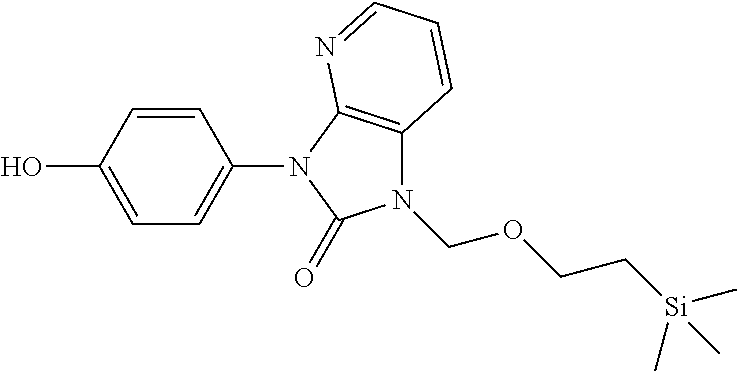


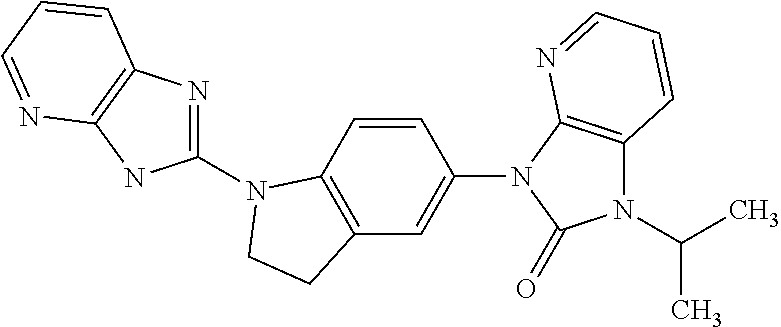


| TABLE 1 | ||||||
| Ex- | ||||||
| am- | Reffered | Raw | ||||
| ple | Example | Material, | ||||
| No. | MS | STRUCTURE | SALT | Name | No. | Conditions |
| 14 | 345 |
 |
9-[4-(1,3- benzoxazol-2- ylamino)phenyl]- 7,9-dihydro-8H- purin-8-one | 1 | 4-chloro-5- nitropyrimidine | |
| 15 | 383 |
 |
3-[4-(3,4- dihydropyrimido [1,2- a]benzimidazol- 1(2H)- yl)phenyl]-1,3- dihydro-2H- imidazo[4,5- b]pyridin-2-one | 2 | 1,3- dibromopropane | |
| 16 | 397 |
 |
3-[4-(2,3,4,5- tetrahydro-1H- [1,3]diazepino[1, 2- a]benzimidazol- 1-yl)phenyl]-1,3- dihydro-2H- imidazo[4,5- b]pyridin-2-one | 2 | 1,4-diiodobutane | |
| 17 | 358 |
 |
3-[4-(1,3- benzoxazol-2- ylamino)phenyl]- 1-methyl-1,3- dihydro-2H- imidazo[4,5- b]pyridin-2- |
12c, 3, 1c, 1a | 12c) tert-butyl 2- chloropyridin-3- ylcarbamate, 4- nitroaniline | |
| 18 | 502.1 |
 |
1-ethyl-3-{4-[(1- {[2- (trimethylsilyl) ethoxy)methyl]- 1H- benzimidazol-2- yl)oxy]phenyl}- 1,3-dihydro-2H- imidazo[4,5- b]pyridin-2-one | 12d | 3-{4-[(1-{[2- (trimethylsilyl) ethoxy]methyl}- 1H-benzimidazol- 2- yl)oxy]phenyl}- 1,3-dihydro-2H- imidazo[4,5- b]pyridin-2-one | |
| 19 | 386.2 |
 |
1-ethyl-3-{4-[(1- methyl-1H- benzimidazol-2- yl)oxy]phenyl}- 1,3-dihydro-2H- imidazo[4,5- b]pyridin-2- |
3 | 3-[4-(1H- benzimidazol-2- yloxy)phenyl]-1- ethyl-1,3- dihydro-2H- imidazo[4,5- b]pyridin-2-one hydrochloride | |
| 20 | 371.3 |
 |
3-[4-(1H- benzimidazol-2- ylamino)phenyl]- 1-ethyl-1,3- dihydro-2H- imidazo[4,5- b]pyridin-2-one | — | 3-(4- aminophenyl)-1- ethyl-1,3- dihydro-2H- imidazo[4,5- b]pyridin-2-one, phenylenedia- mine, 1,1′- thiocarbonyldi- imidazole, N,N′- dicyclohexyl- carbodiimide | |
| TABLE 2 | ||||||
| Ex- | ||||||
| am- | Reffered | |||||
| ple | Example | |||||
| No. | MS | STRUCTURE | SALT | Name | No. | Raw Material |
| 21 | 400.1 |
 |
3-{4-[(1-methyl-1H- benzimidazol-2- yl)oxy]phenyl}-1-(1- methylethyl)-1,3- dihydro- 2H-imidazo[4,5- b]pyridin-2- |
3 | 3-[4-(1H- benzimidazol-2- yloxy)phenyl]-1-(1- methylethyl)-1,3- dihydro-2H- imidazo[4,5- b]pyridin-2-one | |
| 22 | 386.0 |
 |
HCl | 3-[4-(1H- benzimidazol- 2-yloxy)phenyl]-1-(1- methylethyl)-1,3- dihydro- 2H-imidazo[4,5- b]pyridin-2- |
3, 1c, 7e, 8 | 3) 3-[4- (benzyloxy)phenyl]- 1,3-dihydro-2H- imidazo[4,5-b]pyridin- 2-one, 2-iodopropane |
| 23 | 426.1 |
 |
HCl | 3-[4-(1H- benzimidazol- 2-yloxy)phenyl]-1- (2,2,2-trifluoroethyl)- 1,3-dihydro-2H- imidazo[4,5- b]pyridin-2- one hydrochloride | 22 | 2-lodo-1,1,1- trifluoroethane |
| 24 | 397.1 |
 |
3-[4-(2,3-dihydro-1H- imidazo[1,2- a]benzimidazol-1- yl)phenyl]-1-ethyl- 1,3-dihydro-2H- imidazo[4,5- b]pyridin- 2-one | 12d | 3-[4-(2,3-dihydro- 1H-imidazo[1,2- a]benzimidazol-1- yl)phenyl]-1,3- dihydro-2H- imidazo[4,5-b]pyridin- 2-one | |
| 25 | 455.3 |
 |
ethyl {3-[4-(2,3- dihydro-1H- imidazo[1,2- a]benzimidazol-1- yl)phenyl]-2-oxo- 2,3-dihydro-1H- imidazo[4,5- b]pyridin-1- yl} |
3 | ethyl bromoacetate | |
| 26 | 413 |
 |
3-[4-(2,3-dihydro- 1H-imidazo[1,2- a]benzimidazol-1- yl)phenyl]-1-(2- hydroxyethyl)-1,3- dihydro-2H- imidazo[4,5- b]pyridin-2-one | — | ethyl {3-[4-(2,3- dihydro-1H- imidazo[1,2- a]benzimidazol-1- yl)phenyl]-2- oxo-2,3-dihydro- 1H-imidazo[4,5- b]pyridin-1- yl}acetate, LAH | |
| 27 | 390.4 |
 |
1 -ethyl-3-{4-[(6- fluoro-1,3- benzoxazol-2- yl)amino]phenyl)- 1,3-dihydro-2H- imidazo[4,5- b]pyridin-2-one | 17 | 2-chloro-5- fluorobenzoxazol | |
| TABLE 3 | ||||||
| Ex- | ||||||
| am- | Reffered | |||||
| ple | Example | |||||
| No. | MS | STRUCTURE | SALT | Name | No. | Raw Material |
| 28 | 404.3 |
 |
1-ethyl-3-{4- [(6-fluoro-1,3- benzoxazol-2- yl)(methyl) amino]phenyl}- 1,3-dihydro-2H- imidazo[4,5- b)pyridin-2- |
3 | 1-ethyl-3- {4-[(6-fluoro- 1,3-benzoxazol-2- yl)amino]phenyl}- 1,3-dihydro-2H- imidazo[4,5- b]pyridin-2-one | |
| 29 | 422.3 |
 |
3-{4-[(5,6- difluoro-1-methyl- 1H-benzimidazol-2- yl)oxy]phenyl}-1- ethyl-1,3- dihydro-2H- imidazo[4,5- b]pyridin- 2-one | 7e | 2-chloro-5,6- difluoro-1-methyl- 1H-benzimidazole, 1-ethyl-3-(4- hydroxyphenyl)- 1,3-dihydro- 2H-imidazo[4,5- b]pyridin-2-one, NaH, DMF, microwave, 200° C. | |
| 30 | 444.4 |
 |
ethyl 2-[4-(1- ethyl-2-oxo- 1,2-dihydro-3H- imidazo[4,5- b]pyridin-3- yl)phenoxy]imidazo [1,2-a]pyridine-3- carboxylate | 7e | ethyl 2- chloroimidazo[1,2- a]pyridine-3- carboxylate | |
| 31 | 372.4 |
 |
1-ethyl-3-[4- (imidazo[1,2- a]pyridin-2- yloxy)phenyl]-1,3- dihydro-2H- imidazo[4,5- b]pyridin-2-one | — | ethyl 2-[4-(1- ethyl-2-oxo-1,2- dihydro-3H- imidazo[4,5- b]pyridin-3- yl)phenoxy]imi- dazo[1,2- a]pyridine-3- carboxylate, DMF, 200° C. | |
| 32 | 404 |
 |
1-ethyl-3-{4- [(6-fluoro-1-methyl- 1H-benzimidazol-2- yl)oxy]phenyl}-1,3- dihydro 2H-imidazo[4,5- b]pyridin-2-one | 29 | 2-chloro-6-fluoro- 1-methyl-1H- benzimidazole (US2003/166637), 1-ethyl-3-(4- hydroxyphenyl)- 1,3-dihydro-2H- imidazo[4,5- b]pyridin-2-one | |
| 33 | 404 |
 |
1-ethyl-3-{4- [(5-fluoro-1-methyl- 1H-benzimidazol-2- yl)oxy]phenyl)-1,3- dihydro- 2H-imidazo[4,5- b]pyridin-2-one | 29 | 2-chloro-5-fluoro-1- methyl-1H- benzimidazole, 1-ethyl-3-(4- hydroxyphenyl)- 1,3-dihydro-2H- imidazo[4,5- b]pyridin- 2-one | |
| 34 | 430.1 |
 |
1-(2-hydroxy-2- methylpropyl)-3- {4-[(1-methyl-1H- benzimidazol-2- yl)oxy]phenyl}- 1,3-dihydro-2H- imidazo[4,5- b]pyridin- 2-one | 25, 1c, 29 | 25) 3-[4- (benzyloxy)phenyl]- 1,3-dihydro-2H- imidazo[4,5-b]pyridin- 2-one 29) 2-chloro-1-methyl- 1H-benzimidazole, MeMgBr | |
| TABLE 4 | ||||||
| Ex- | ||||||
| am- | Reffered | |||||
| ple | Example | |||||
| No. | MS | STRUCTURE | SALT | Name | No. | Raw Material |
| 35 | 402.1 |
 |
1-(2-hydroxyethyl)- 3-{4-[(1-methyl-1H- benzimidazol-2- yl)oxy]phenyl}-1,3- dihydro-2H- imidazo[4,5-b]pyridin- 2-one | 25, 1c, 29, 26 | 25) 3-[4- (benzyloxy)phenyl]- 1,3-dihydro-2H- imidazo[4,5- b]pyridin- 2-one 29) 2-chloro-1- methyl-1H- benzimidazole | |
| 36 | 384.2 |
 |
1-ethyl-3-[4- (quinoxalin-2- yloxy)phenyl]-1,3- dihydro-2H- imidazo[4,5-b]pyridin- 2-one | 7e | 2-chloroquinoxaline, 1-ethyl-3-(4- hydroxyphenyl)- 1,3-dihydro-2H- imidazo[4,5- b]pyridin-2-one | |
| 37 | 428.5 |
 |
3-{4-[(1-butyl- 1H-benzimidazol-2- yl)oxy]phenyl}- 1-ethyl-1,3-dihydro- 2H-imidazo[4,5- b]pyridin-2-one | 7f | 1-ethyl-3-{4-[(1- {[2-(trimethylsilyl) ethoxy]methyl}-1H- benzimidazol- 2-yl)oxy]phenyl}- 1,3-dihydro-2H- imidazo[4,5- b]pyridin-2-one | |
| 38 | 414.4 |
 |
3-{4-[(1-acetyl-1H- benzimidazol-2- yl)oxy]phenyl}-1- ethyl-1,3-dihydro- 2H-imidazo[4,5- b]pyridin-2-one | — | 3-[4-(1H- benzimidazol-2- yloxy)phenyl]-1- ethyl-1,3- dihydro-2H- imidazo[4,5- b]pyridin- 2-one, acetyl chloride, triethyl amine,THF | |
| 39 | 416.5 |
 |
1-ethyl-3-(4-{[1-(2- hydroxyethyl)-1H- benzimidazol-2- yl]oxy}phenyl)-1,3- dihydro-2H- imidazo[4,5-b]pyridin- 2-one | 25, 26 | 3-[4-(1H- benzimidazol-2- yloxy)phenyl]-1- ethyl-1,3- dihydro-2H- imidazo[4,5-]pyridin- 2-one | |
| 40 | 444.4 |
 |
1-ethyl-3-(4-{[1-(2- hydroxy-2- methylpropyl)-1H- benzimidazol-2- yl]oxy}phenyl)-1,3- dihydro-2H- imidazo[4,5-b]pyridin- 2-one | 39 | ethyl {2-[4-(1- ethyl-2-oxo- 1,2-dihydro-3H- imidazo[4,5- b]pyridin-3- yl)phenoxy]-1H- benzimidazol-1- yl}acetate, MeMgBr, THF | |
| 41 | 386.3 |
 |
HCl | 3-[4-(1H- benzimidazol-2- yloxy)-3- methylphenyl]-1- ethyl-1,3-dihydro- 2H-imidazo[4,5- b]pyridin-2-one hydrochloride | 7a, 7b, 7c, 22 | 4-(benzyloxy)- 3-methylaniline |
| TABLE 5 | ||||||
| Ex- | ||||||
| am- | Reffered | |||||
| ple | Example | |||||
| No. | MS | MOLSTRUCTURE | SALT | NAME | No. | Raw Material |
| 42 | 400.1 |
 |
1-ethyl-3-{3-methyl- 4-[(1-methyl-1H- benzimidazol-2- yl)oxy]phenyl}-1,3- dihydro-2H- imidazo[4,5- b]pyridin-2- |
3 | 3-[4-(1H- benzimidazol- 2-yloxy)-3- methylphenyl]- 1-ethyl-1,3- dihydro-2H- imidazo[4,5- b]pyridin- 2-one | |
| 43 | 404.3 |
 |
1-ethyl-3-{3-fluoro- 4-[(1-methyl-1H- benzimidazol-2- yl)oxy]phenyl}- 1,3-dihydro-2H imidazo[4,5- b]pyridin-2- |
7a, 7b, 7c, 3, 1c, 7e | 7a) 4-(benzyloxy)- 3-fluoroaniline 7e) 1-methyl-2- (methylsulfonyl)-1H- benzimidazole | |
| 44 | 371.4 |
 |
1-[4-(2-oxo-3- phenylimidazolidin- 1-yl)phenyl]-1,3- dihydro-2H- pyrrolo[2,3-b]pyridin- 2-one | 5a then 5a | 5a) 1,4-diiodobenzene, 1-phenylimidazolidin- 2-one, then 5a) 1,3-dihydro- 2H-pyrrolo[2,3-b]pyridin- 2-one | |
| 45 | 329.4 |
 |
1-[4-(2,3-dihydro- 1H-pyrrolo[2,3- b]pyridin-1- yl)phenyl]-1,3- dihydro-2H- pyrrolo[2,3-b]pyridin- 2-one | 44 | 1,4-diiodobenzene, 2,3-dihydro-1H- pyrrolo[2,3- b]pyridine | |
| 46 | 373.3 |
 |
1-ethyl-3-[4- ([1,2,4]triazolo[1,5- a]pyridin-2- yloxy)phenyl]-1,3- dihydro-2H- imidazo[4,5-b]pyridin- 2-one | 29 | 1-ethyl-3-(4- hydroxyphenyl)-1,3- dihydro-2H- imidazo[4,5- b]pyridin-2-one, 2-chloro- [1,2,4]triazolo[1,5- a]pyridine | |
| 47 | 390.4 |
 |
1-ethyl-3-{4-[(7- fluoro-1H- benzimidazol-2- yl)oxy]phenyl}-1,3- dihydro-2H- imidazo[4,5-b]pyridin- 2-one | 29, 8 | 1-ethyl-3-(4- hydroxyphenyl)-1,3- dihydro-2H- imidazo[4,5- b]pyridin-2-one, 4-fluoro-2- (methylsulfonyl)-1-((2- (trimethylsilyl)ethoxy) methyl)-1H- benzo[d]imidazole | |
| 48 | 411.4 |
 |
1-ethyl-3-[1-(1- methyl-1H- benzimidazol-2-yl)- 2,3-dihydro-1H- indol-5-yl]-1,3- dihydro-2H- imidazo[4,5- b]pyridin-2- |
3 | 3-[1-(1H- benzimidazol-2-yl)- 2,3-dihydro-1H- indol-5-yl]-1- ethyl-1,3-dihydro-2H- imidazo[4,5- b]pyridin-2-one | |
| TABLE 6 | ||||||
| Ex- | ||||||
| am- | Reffered | |||||
| ple | Example | |||||
| No. | MS | MOLSTRUCTURE | SALT | NAME | No. | Raw Material |
| 49 | 386.3 |
 |
3-[4-(1H- benzimidazol-2- yloxy)-2- methylphenyl]-1- ethyl-1,3-dihydro- 2H-imidazo[4,5- b]pyridin-2-one | 7a, 7b, 7c, 22 | 4-(benzyloxy)- 2- |
|
| 50 | 412.3 |
 |
3-[4-(1H- benzimidazol-2- yloxy)-2- methylphenyl]-1- (cyclopropylmethyl)- 1,3-dihydro-2H- imidazo[4,5- b]pyridin-2-one | 49 | (bromomethyl) cyclopropane | |
| 51 | 400.4 |
 |
1-ethyl-3-{2- methyl-4-[(1-methyl- 1H-benzimidazol-2- yl)oxy]phenyl)-1,3- dihydro-2H- imidazo[4,5- b]pyridin-2- |
3 | 3-[4-(1H- benzimidazol-2- yloxy)-2- methylphenyl]- 1-ethyl-1,3- dihydro-2H- imidazo[4,5- b]pyridin-2-one | |
| 52 | 432.1 |
 |
3-[4-(1-benzyl-2 methyl-1H- benzimidazol-4- yl)phenyl]-1,3- dihydro-2H- imidazo[4,5- b]pyridin-2-one | 8 | 3-[4-(1-benzyl-2- methyl-1H- benzimidazol-4- yl)phenyl]-1- ([2-(trimethylsilyl) ethoxy]methyl)-1,3- dihydro-2H- imidazo[4,5-b]pyridin- 2-one | |
| 53 | 460.1 |
 |
3-[4-(1-benzyl-2- methyl-1H- benzimidazol-4- yl)phenyl]-1-ethyl- 1,3-dihydro- 2H-imidazo[4,5- b]pyridin-2-one | 12d | 3-[4-(1-benzyl-2- methyl-1H- benzimidazol-4- yl)phenyl]-1,3- dihydro-2H- imidazo[4,5-b]pyridin- 2-one | |
| 54 | 370.1 |
 |
1-ethyl-3-[4-(2- methyl-1H- benzimidazol-4- yl)phenyl]- 1,3-dihydro- 2H-imidazo[4,5- b]pyridin-2-one | 1c | 3-[4-(1-benzyl-2- methyl-1H- benzimidazol-4- yl)phenyl]-1- ethyl-1,3-dihydro- 2H-imidazo[4,5- b]pyridin-2-one | |
| 55 | 339.4 |
 |
3-(4-quinolin-8- ylphenyl)-1,3- dihydro-2H- imidazo[4,5- b]pyridin-2-one | 8 | 3-(4-quinolin-8- ylphenyl)-1-{[2- (trimethylsilyl) ethoxy]methyl}-1,3- dihydro-2H- imidazo[4,5- b]pyridin-2-one | |
| TABLE 7 | ||||||
| Ex- | ||||||
| am- | Reffered | |||||
| ple | Example | |||||
| No. | MS | MOLSTRUCTURE | SALT | NAME | No. | Raw Material |
| 56 | 367.3 |
 |
1-ethyl-3-(4- quinolin-8-ylphenyl)- 1,3-dihydro-2H- imidazo[4,5- b]pyridin-2-one | 8 | 3-(4-quinolin- 8-ylphenyl)-1- {[2-(trimethyl- silyl)ethoxy]methyl)- 1,3-dihydro-2H- imidazo[4,5- b]pyridin-2-one | |
| 57 | 399.2 |
 |
1-(4-[(1-ethyl-1H- benzimidazol-2- yl)oxy]phenyl}-3,3- dimethyl-1,3- dihydro-2H- pyrrolo[2,3-b]pyridin- 2-one | 9 | iodoethane | |
| 58 | 374.1 |
 |
4-(3,3-dimethyl-2-oxo- 2,3-dihydro- 1H-pyrrolo[2,3- b]pyridin-1- yl)phenyl phenylcarbamate | 9 | PHENYL ISOCYANATE | |
| 59 | 388.2 |
 |
4-(3,3-dimethyl-2- oxo-2,3-dihydro- 1H-pyrrolo[2,3- b]pyridin-1- yl)phenyl methyl(phenyl)carbamate | 9 | PHENYL ISOCYANATE | |
| 60 | 402.2 |
 |
2HCl | 3-[4-(1H- benzimidazol-2- yloxy)phenyl]-1- ethyl-5- methoxy-1,3- dihydro-2H- imidazo[4,5-b]pyridin 2-one | 7a, 7b, 7c, 22 | 4-(benzyl- oxy)laniline |
| 61 | 374.1 |
 |
2HCl | 3-[4-(1H- benzimidazol-2- yloxy)phenyl]- 7-methoxy- 1,3-dihydro- 2H-imidazo[4,5- b]pyridin-2-one | 7a, 7b, 7c, 22 | 4-(benzyl- oxy)laniline |
| 63 | 402.1 |
 |
2HCl | 3-[4-(1H- benzimidazo[-2- yloxy)phenyl]-1- ethyl-7-methoxy- 1,3-dihydro- 2H-imidazo[4,5- b]pyridin-2-one | 7a, 7b, 7c, 22 | 4-(benzyl- oxy)laniline |
| TABLE 8 | ||||||
| Ex- | Reffered | |||||
| ample | Example | |||||
| No. | MS | MOLSTRUCTURE | SALT | NAME | No. | Raw Material |
| 66 | 362 |
 |
1-ethyl-3-[1- (1,3-thiazol-2- yl)-1H-indol- 5-yl]-1,3- dihydro-2H- imidazo[4,5- b]pyridin-2-one | 13f | 2-CHLORO- THIAZOLE | |
| 67 | 404.3 |
 |
1-ethyl-3-{2- fluoro-4-[(1- methyl-1H- benzimidazol-2- yl)oxy]phenyl}- 1,3-dihydro- 2H-imidazo[4,5- b]pyridin-2-one | 7a, 7b, 7c, 22 | 4-(benzyloxy)- 2-fluorolaniline | |
| 68 | 412.3 |
 |
3-[1-(1,3- benzothiazol-2- yl)-1H-indol- 5-yl]-1-ethyl- 1,3-dihydro-2H- imidazo[4,5- b]pyridin-2-one | 13f | 2-Chloro- benzothiazole | |
| 73 | 367.3 |
 |
3-{4-[(5- chloropyridin-2- yl)oxy]phenyl}- 1-ethyl-1,3- dihydro-2H- imidazo[4,5-b]pyridin- 2-one | 75 | 2,5-DICHLORO- PYRIDINE | |
| 74 | 401.3 |
 |
1-ethyl-3-(4- {[5-(trifluoro- methyl)pyridin-2- yl]oxy}phenyl)- 1,3-dihydro-2H- imidazo[4,5- b]pyridin-2-one | 75 | 2-CHLORO-5- TRIFLUORO- METHYLPYRIDINE | |
| 76 | 412 |
 |
1-ethyl-3-{4- [(1-methyl-4-phenyl- 1H-imidazol-2- yl)oxy]phenyl}-1,3- dihydro-2H- imidazo[4,5-b]pyridin- 2-one | 75 | 4-phenyl-1H- imidazole-2-thiol | |
| TABLE 9 | ||||||
| Ex- | Reffered | |||||
| ample | Example | |||||
| No. | MS | MOLSTRUCTURE | SALT | NAME | No. | Raw Material |
| 77 | 486.1 |
 |
3-{4-[(1-{[2- (trimethyl- silyl)ethoxy]methyl}- 1H-benzimidazol-2- yl)carbonyl]phenyl}- 1,3-dihydro-2H imidazo[4,5- b]pyridin-2-one | 7a, 7b, 7c, 22 | tert-butyl 4- aminobenzoate | |
| 78 | 472.1 |
 |
3-[4-(1-methyl-1H- benzimidazol-4- yl)phenyl]-1-{[2- (trimethyl- silyl)ethoxy]methyl}- 1,3-dihydro-2H- imidazo[4,5-b]pyridin- 2-one | 12d | 4-bromo-1- methyl-1H- benzimidazole | |
| 79 | 514.3 |
 |
1-ethyl-3-{4-[(1-{[2- (trimethyl- silyl)ethoxy]methyl}- 1H-benzimidazol-2- yl)carbonyl]phenyl}- 1,3-dihydro-2H- imidazo[4,5- b]pyridin-2-one | 7a, 7b, 7c, 22 | tert-butyl 4- aminobenzoate | |
| 80 | 384.1 |
 |
3-[4-(1H- benzimidazol-2- ylcarbonyl)phenyl]- 1-ethyl- 1,3-dihydro-2H- imidazo[4,5-b]pyridin- 2-one | 7a, 7b, 7c, 22 | tert-butyl 4- aminobenzoate | |
| 81 | 370.2 |
 |
1-ethyl-3-[4-(1- methyl-1H- benzimidazol-7- yl)phenyl]- 1,3-dihydro- 2H-imidazo[4,5- b]pyridin-2-one | 12d | 7-bromo-1- methyl-1H- benzimidazole | |
| 82 | 370.2 |
 |
1-ethyl-3-[4-(1- methyl-1H- benzimidazol-4- yl)phenyl]- 1,3-dihydro-2H- imidazo[4,5-b]pyridin- 2-one | 12d | 4-bromo-1- methyl-1H- benzimidazole | |
| 83 | 396.2 |
 |
1-ethyl-3-{4-[(1- methyl-1H- benzimidazol-2- yl)carbonyl]phenyl}- 1,3-dihydro-2H- imidazo[4,5- b]pyridin-2-one | 7a, 7b, 7c, 22 | tert-butyl 4- aminobenzoate | |
| TABLE 10 | ||||||
| Ex- | ||||||
| am- | Reffered | |||||
| ple | Example | |||||
| No. | MS | MOLSTRUCTURE | SALT | NAME | No. | Raw Material |
| 84 | 429.2 |
 |
ethyl 3-[4-(1-ethyl- 2-oxo-1,2- dihydro-3H- imidazo[4,5- b]pyridin-3- yl)phenyl]furo[3,2- b]pyridine-6- carboxylate | 12d | ethyl 3- bromofuro[3,2- b]pyridine-6- carboxylate | |
| 87 | 443.2 |
 |
ethyl 2-[4-(3,3- dimethyl-2-oxo- 2,3-dihydro-1H- pyrrolo[2,3- b]pyridin- 1-yl)phenoxy] imidazo[1,2- a]pyridine-3- carboxylate | 75 | ethyl 2- chloroimidazo[1,2- a]pyridine-3- carboxylate | |
| 88 | 405.1 |
 |
3-{4-[(4,5-dichloro- 1-methyl-1H- imidazol-2- yl)oxy]phenyl}-1- ethyl-1,3-dihydro- 2H-imidazo[4,5- b]pyridin-2-one | 75 | 2,4,5-trichloro- 1-methyl-1H- imidazole | |
| 89 | 386 |
 |
HCl | 1-ethyl-3-{4-[(7- methyl-1H- benzimidazol-2- yl)oxy]phenyl}-1,3- dihydro-2H- imidazo[4,5- b]pyridin- 2-one | 75 | 7-methyl-2- (methylsulfonyl)- 1H-benzimidazole |
| 90 | 386.2 |
 |
HCl | 1-ethyl-3-{4-[(6- methyl-1H- benzimidazol-2- yl)oxy]phenyl}-1,3- dihydro-2H- imidazo[4,5- b]pyridin- 2-one | 75 | 6-methyl-2- (methylsulfonyl)- 1H-benzimidazole |
| 91 | 404.2 |
 |
1-ethyl-3-(4-{[1- methyl-4- (trifluoromethyl)- 1H-imidazol-2- yl]oxy}phenyl)- 1,3-dihydro-2H- imidazo[4,5- b]pyridin-2-one | 75 | 4-(trifluoro- methyl)- 1H-imidazole- 2-thiol | |
| 92 | 494.1 |
 |
3-{4-[(4,5-dibromo- 1-methyl-1H- imidazol-2- yl)oxy]phenyl}-1- ethyl-1,3- dihydro-2H- imidazo[4,5- b]pyridin-2-one | 75 | 2,4,5-tribromo- 1-methyl- 1H-imidazole | |
| TABLE 11 | ||||||
| Ex- | Reffered | |||||
| ample | Example | |||||
| No. | MS | MOLSTRUCTURE | SALT | NAME | No. | Raw Material |
| 93 | 336.1 |
 |
1-ethyl-3-{4- [(1-methyl-1H- imidazol-2- yl)oxy]phenyl}- 1,3-dihydro-2H- imidazo[4,5-b]pyridin- 2-one | 75 | 2-bromo-1- methyl-1H- imidazole | |
| 94 | 358.1 |
 |
1-{4-[(3-methyl- 3H-imidazo[4,5- b]pyridin-2- yl)oxy]phenyl}- 1,3-dihydro-2H- pyrrolo[2,3-b]pyridin- 2-one | 5, 75 | 4-bromo- phenol | |
| 95 | 396.2 |
 |
1′-{4-[(3-methyl- 3H-imidazo[4,5- b]pyridin-2- yl)oxy]phenyl}spiro [cyclobutane-1,3′- pyrrolo[2,3- b]pyridin]-2′(1′H)-one | 5, 75 | 4-bromo- phenol | |
| 96 | 386.2 |
 |
3,3-dimethyl-1-{4- [(3-methyl-3H- imidazo[4,5- b]pyridin- 2-yl)oxy]phenyl}- 1,3-dihydro-2H- pyrrolo[2,3- b]pyridin-2-one | 5, 75 | 4-bromo- phenol | |
| 104 | 400.3 |
 |
1-ethyl-5-methyl-3- {4-[(1-methyl- 1H-benzimidazol- 2-yl)oxy]phenyl}- 1,3-dihydro-2H- imidazo[4,5- b]pyridin-2-one | 7a, 7b, 7c, 22 | 4-(benzyl- oxy)laniline | |
| 105 | 401.3 |
 |
1-ethyl-5-methyl-3- {4-[(3-methyl-3H- imidazo[4,5- b]pyridin-2- yl)oxy]phenyl}- 1,3-dihydro-2H- imidazo[4,5- b]pyridin-2-one | 7a, 7b, 7c, 22 | 4-(benzyl- oxy)laniline | |
| 110 | 420 |
 |
3-{4-[(3-bromo- 1,2,4-thiadiazol- 5-yl)oxy]phenyl}- 1-ethyl-1,3- dihydro-2H- imidazo[4,5- b]pyridin-2-one | 7a, 7b, 7c, 22 | 4-(benzyl- oxy)laniline | |
| TABLE 12 | ||||||
| Ex- | ||||||
| am- | Reffered | |||||
| ple | Example | Raw | ||||
| No. | MS | MOLSTRUCTURE | SALT | NAME | No. | Material |
| 111 | 508.2 |
 |
1-ethyl-3-{4-[(1- {[2-(trimethyl- silyl)ethoxy] methyl}- 1H-thieno[3,4- d]imidazol- 2-yl)oxy]phenyl}- 1,3-dihydro-2H- imidazo[4,5- b]pyridin- 2-one | 7a, 7b, 7c, 22 | 4-(benzyl- oxy)laniline | |
| 113 | 378.1 |
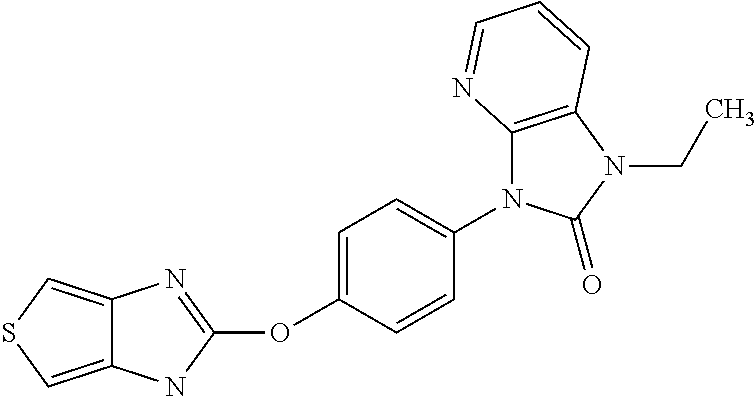 |
1-ethyl-3-[4-(1H- thieno[3,4- d]imidazol-2- yloxy)phenyl]-1,3- dihydro-2H- imidazo[4,5- b]pyridin-2-one | 7a, 7b, 7c, 22 | 4-(benzyl- oxy)laniline | |
| 114 | 503.2 |
 |
1-ethyl-3-{4-[(3- {[2-(trimethyl- silyl)ethoxy] methyl}- 3H-imidazo[4,5- c]pyridin-2- yl)oxy]phenyl}- 1,3-dihydro-2H- imidazo[4,5- b]pyridin-2-one | 7a, 7b, 7c, 22 | 4-(benzyl- oxy)laniline | |
| 116 | 458.1 |
 |
ethyl 2-{4-[1-(1- methylethyl)-2- oxo-1,2- dihydro-3H- imidazo[4,5- b]pyridin-3- yl]phenoxy} imidazo[1,2- a]pyridine-3- carboxylate | 7a, 7b, 7c, 22 | 4-(benzyl- oxy)laniline | |
| 117 | 386 |
 |
3-[4-(imidazo[1,2- a]pyridin-2- yloxy)phenyl]-1- (1-methylethyl)- 1,3-dihydro-2H- imidazo[4,5- b]pyridin- 2-one | 7a, 7b, 7c, 22 | 4-(benzyl- oxy)laniline | |
| 131 | 357 |
 |
1-ethyl-3-(1- pyrimidin-2-yl- 1H-indol-5-yl)- 1,3-dihydro- 2H-imidazo[4,5- b]pyridin-2-one | 69 | 2-chloro- pyrimidine | |
| TABLE 13 | ||
| Ref. | ||
| Ex. | ||
| No. | compound | compound name |
| 1 |
 |
1-[2-fluoro-4- (morpholin-4- yl)phenyl]-3-(1- phenyl-1H-pyrazol-5- yl)pyridazin-4(1H)- one |
| 2 |
 |
1-[2-methoxy-4- (morpholin-4- yl)phenyl]-3-(1- phenyl-1H-pyrazol-5- yl)pyridazin-4(1H)- |
| 3 |
 |
1-[2-fluoro-4- (3,3,4,4- tetrafluoropyrrolidin- 1-yl)phenyl]-3-(1- phenyl-1H-pyrazol-5- yl)pyridazin-4(1H)- one |
| 4 |
 |
1-[2-methoxy-4- (3,3,4,4- tetrafluoropyrrolidin- 1-yl)phenyl]-3-(1- phenyl-1H-pyrazol-5- yl)pyridazin-4(1H)- one |
| 5 |
 |
1-[4-(4,4- difluoropiperidin-1- yl)-2-fluorophenyl]- 3-(1-phenyl-1H- pyrazol-5- yl)pyridazin-4(1H)- one |
| 6 |
 |
1-[4-(4,4- difluoropiperidin-1- yl)-2- methoxyphenyl]-3-(1- phenyl-1H-pyrazol-5- yl)pyridazin-4(1H)- one |
| 7 |
 |
1-[4-(3,6-dihydro- 2H-pyran-4-yl)-2- fluorophenyl]-3-(1- phenyl-1H-pyrazol-5- yl)pyridazin-4(1H)- one |
| 8 |
 |
1-[4-(3,6-dihydro- 2H-pyran-4-yl)-2- methoxyphenyl]-3-(1- phenyl-1H-pyrazol-5- yl)pyridazin-4(1H)- one |
| TABLE 14 | ||
| 9 |
 |
1-[2-fluoro-4- (tetrahydro-2H- pyran-4-yl)phenyl]- 3-(1-phenyl- 1H-pyrazol-5- yl)pyridazin-4(1H)- one |
| 10 |
 |
1-[2-methoxy-4- (tetrahydro-2H- pyran-4-yl)phenyl]- 3-(1-phenyl- 1H-pyrazol-5- yl)pyridazin-4(1H)- one |
| 11 |
 |
1-[4-(3,3-difluoro- pyrrolidin-1-yl)- 2-fluorophenyl]- 3-(1-phenyl- 1H-pyrazol-5- yl)pyridazin-4(1H)- one |
| 12 |
 |
1-[4-(3,3-difluoro- pyrrolidin-1-yl)- 2-methoxyphenyl]- 3-(1-phenyl- 1H-pyrazol-5- yl)pyridazin-4(1H)- one |
| 13 |
 |
1-[2-fluoro-4-(1H- pyrazol-1- yl)phenyl]-3-(1- phenyl-1H- pyrazol-5- yl)pyridazin- 4(1H)-one |
| 14 |
 |
1-[2-methoxy-4-(1H- pyrazol-1- yl)phenyl]-3-(1- phenyl-1H- pyrazol-5- yl)pyridazin- 4(1H)-one |
| 15 |
 |
1-{4-[1-(difluoro- methyl)-1H- pyrazol-4-yl]-2- fluorophenyl}-3-(1- phenyl-1H-pyrazol- 5-yl)pyridazin- 4(1H)-one |
| 16 |
 |
1-{4-[1-(difluoro- methyl)-1H- pyrazol-4-yl]-2- methoxyphenyl}-3-(1- phenyl-1H-pyrazol- 5-yl)pyridazin- 4(1H)-one |
| TABLE 15 | ||||
| 17 |
 |
1-[4-(3,5- dimethylisoxazol- 4-yl)-2- fluorophenyl]-3- (1-phenyl-1H- pyrazol-5- yl)pyridazin- 4(1H)-one | ||
| 18 |
 |
1-[4-(3,5- dimethylisoxazol- 4-yl)-2- methoxyphenyl]- 3-(1-phenyl-1H- pyrazol-5- yl)pyridazin- 4(1H)-one | ||
| 19 |
 |
1-[2-fluoro-4-(1- methyl-1H- pyrazol-4- yl)phenyl]-3-(1- phenyl-1H- pyrazol-5- yl)pyridazin- 4(1H)-one | ||
| 20 |
 |
1-[2-methoxy-4- (1-methyl-1H- pyrazol-4- yl)phenyl]-3-(1- phenyl-1H- pyrazol-5- yl)pyridazin- 4(1H)-one | ||
| 21 |
 |
1-[2-fluoro-4-(2- oxo-1,3- oxazolidin-3- yl)phenyl]-3-(1- phenyl-1H- pyrazol-5- yl)pyridazin- 4(1H)-one | ||
| 22 |
 |
1-[2-methoxy-4- (2-oxo-1,3- oxazolidin-3- yl)phenyl]-3-(1- phenyl-1H- pyrazol-5- yl)pyridazin- 4(1H)-one | ||
| 23 |
 |
1-[4-(5,5- dimethyl-2-oxo- 1,3-oxazolidin-3- yl)-2- fluorophenyl]-3- (1-phenyl-1H- pyrazol-5- yl)pyridazin- 4(1H)-one | ||
| 24 |
 |
1-[4-(5,5- dimethyl-2-oxo- 1,3-oxazolidin-3- yl)-2- methoxyphenyl]- 3-(1-phenyl-1H- pyrazol-5- yl)pyridazin- 4(1H)-one | ||
| 25 |
 |
1-[4-(4,4- dimethyl-2-oxo- 1,3-oxazolidin-3- yl)-2- fluorophenyl]-3- (1-phenyl-1H- pyrazol-5- yl)pyridazin- 4(1H)-one | ||
| TABLE 16 | ||||
| 26 |
 |
1-[4-(4,4- dimethyl-2-oxo- 1,3-oxazolidin-3- yl)-2- methoxyphenyl]- 3-(1-phenyl-1H- pyrazol-5- yl)pyridazin- 4(1H)-one | ||
| 27 |
 |
1-[2-fluoro-4-(2- oxopyrrolidin-1- yl)phenyl]-3-(1- phenyl-1H- pyrazol-5- yl)pyridazin- 4(1H)-one | ||
| 28 |
 |
1-[2-methoxy-4- (2-oxopyrrolidin- 1-yl)phenyl]-3- (1-phenyl-1H- pyrazol-5- yl)pyridazin- 4(1H)-one | ||
| 29 |
 |
1-[4-(4,4- dimethyl-2- oxopyrrolidin-1- yl)-2- fluorophenyl]-3- (1-phenyl-1H- pyrazol-5- yl)pyridazin- 4(1H)-one | ||
| 30 |
 |
1-[4-(4,4- dimethyl-2- oxopyrrolidin-1- yl)-2- methoxyphenyl]- 3-(1-phenyl-1H- pyrazol-5- yl)pyridazin- 4(1H)-one | ||
| 31 |
 |
1-[4-(2,2- dimethyl-5- oxopyrrolidin-1- yl)-2- fluorophenyl]-3- (1-phenyl-1H- pyrazol-5- yl)pyridazin- 4(1H)-one | ||
| 32 |
 |
1-[4-(2,2- dimethyl-5- oxopyrrolidin-1- yl)-2- methoxyphenyl]- 3-(1-phenyl-1H- pyrazol-5- yl)pyridazin- 4(1H)-one | ||
| 33 |
 |
1-[4-(3,3- dimethyl-2- oxopyrrolidin-1- yl)-2- fluorophenyl]-3- (1-phenyl-1H- pyrazol-5- yl)pyridazin- 4(1H)-one | ||
| 34 |
 |
1-[4-(3,3- dimethyl-2- oxopyrrolidin-1- yl)-2- methoxyphenyl]- 3-(1-phenyl-1H- pyrazol-5- yl)pyridazin- 4(1H)-one | ||
| TABLE 17 | ||||
| 35 |
 |
1-[2-fluoro-4-(3- methyl-2- oxopyrrolidin-1- yl)phenyl]-3-(1- phenyl-1H-pyrazol- 5-yl)pyridazin- 4(1H)-one | ||
| 36 |
 |
1-[2-methoxy-4-(3- methyl-2- oxopyrrolidin-1- yl)phenyl]-3-(1- phenyl-1H-pyrazol- 5-yl)pyridazin- 4(1H)-one | ||
| 37 |
 |
1-[2-fluoro-4-(2- methyl-5- oxopyrrolidin-1- yl)phenyl]-3-(1- phenyl-1H-pyrazol- 5-yl)pyridazin- 4(1H)-one | ||
| 38 |
 |
1-[2-methoxy-4-(2- methyl-5- oxopyrrolidin-1- yl)phenyl]-3-(1- phenyl-1H-pyrazol- 5-yl)pyridazin- 4(1H)-one | ||
| 39 |
 |
6-{3-fluoro-4-[4- oxo-3-(1-phenyl- 1H-pyrazol-5- yl)pyridazin-1(4H)- yl]phenyl}-4-oxa-6- azaspiro[2,4]heptan- 5-one | ||
| 40 |
 |
6-{3-methoxy-4-[4- oxo-3-(1-phenyl- 1H-pyrazol-5- yl)pyridazin-1(4H)- yl]phenyl}-4-oxa-6- azaspiro[2,4]heptan- 5-one | ||
| 41 |
 |
1-[4-(3-tert-butyl-2- oxoimidazolidin-1- yl)-2-fluorophenyl]- 3-(1-phenyl-1H- pyrazol-5- yl)pyridazin-4(1H)- one | ||
| 42 |
 |
1-[4-(3-tert-butyl-2- oxoimidazolidin-1- yl)-2- methoxyphenyl]-3- (1-phenyl-1H- pyrazol-5- yl)pyridazin-4(1H)- one | ||
| TABLE 18 | ||||
| 43 |
 |
1-[2-fluoro-4-(2- oxoimidazolidin-1- yl)phenyl]-3-(1- phenyl-1H-pyrazol- 5-yl)pyridazin- 4(1H)-one | ||
| 44 |
 |
1-[2-methoxy-4-(2- oxoimidazolidin-1- yl)phenyl]-3-(1- phenyl-1H-pyrazol- 5-yl)pyridazin- 4(1H)-one | ||
| 45 |
 |
1-[2-fluoro-4-(3- methyl-2-oxo- imidazolidin-1- yl)phenyl]-3-(1- phenyl-1H-pyrazol- 5-yl)pyridazin- 4(1H)-one | ||
| 46 |
 |
1-[2-methoxy-4-(3- methyl-2-oxo- imidazolidin-1- yl)phenyl]-3-(1- phenyl-1H-pyrazol- 5-yl)pyridazin- 4(1H)-one | ||
| 47 |
 |
1-{4-[3-(difluoro- methyl)-2-oxo- imidazolidin-1-yl]- 2-fluorophenyl}- 3-(1-phenyl-1H- pyrazol-5- yl)pyridazin-4(1H)- one | ||
| 48 |
 |
1-{4-[3-(difluoro- methyl)-2-oxo- imidazolidin-1-yl]- 2-methoxyphenyl}- 3-(1-phenyl-1H- pyrazol-5- yl)pyridazin-4(1H)- one | ||
| 49 |
 |
1-[4-(4-chloro-1H- pyrazol-1-yl)-2- fluorophenyl]-3- (1-phenyl-1H- pyrazol-5- yl)pyridazin- 4(1H)- |
||
| 50 |
 |
1-[4-(4-chloro-1H- pyrazol-1-yl)-2- methoxyphenyl]-3- (1-phenyl-1H- pyrazol-5- yl)pyridazin- 4(1H)-one | ||
| TABLE 19 | ||
| 51 |
 |
1-[2-fluoro-4-(4- fluoro-1H-pyrazol- 1-yl)phenyl]-3-(1- phenyl-1H- pyrazol-5- yl)pyridazin- 4(1H)-one |
| 52 |
 |
1-[4-(4-fluoro-1H- pyrazol-1-yl)-2- methoxyphenyl]-3- (1-phenyl-1H- pyrazol-5- yl)pyridazin- 4(1H)-one |
| 53 |
 |
1-[2-fluoro-4-(5- hydroxy-1H- pyrazol-1- yl)phenyl]-3-(1- phenyl-1H- pyrazol-5- yl)pyridazin- 4(1H)-one |
| 54 |
 |
1-[4-(5-hydroxy- 1H-pyrazol-1-yl)- 2-methoxyphenyl]- 3-(1-phenyl-1H- pyrazol-5- yl)pyridazin- 4(1H)-one |
| 55 |
 |
1-{4-[5- (difluoromethoxy)- 1H-pyrazol-1-yl]- 2-fluorophenyl}-3- (1-phenyl-1H- pyrazol-5- yl)pyridazin- 4(1H)-one |
| 56 |
 |
1-{4-[5- (difluoromethoxy)- 1H-pyrazol-1-yl]- 2- methoxyphenyl}- 3-(1-phenyl-1H- pyrazol-5- yl)pyridazin- 4(1H)-one |
| 57 |
 |
1-{4-[2- (difluoromethyl)- 5-oxo-2,5-dihydro- 1H-pyrazol-1-yl]- 2-fluorophenyl}-3- (1-phenyl-1H- pyrazol-5- yl)pyridazin- 4(1H)-one |
| 58 |
 |
1-{4-[2- (difluoromethyl)- 5-oxo-2,5-dihydro- 1H-pyrazol-1-yl]- 2- methoxyphenyl}- 3-(1-phenyl-1H- pyrazol-5- yl)pyridazin- 4(1H)-one |
| TABLE 20 | ||||
| 59 |
 |
1-[2-fluoro-4- (1H-pyrrol-1- yl)phenyl]-3-(1- phenyl-1H- pyrazol-5- yl)pyridazin- 4(1H)-one | ||
| 60 |
 |
1-[2-methoxy-4- (1H-pyrrol-1- yl)phenyl]-3-(1- phenyl-1H- pyrazol-5- yl)pyridazin- 4(1H)-one | ||
| 61 |
 |
1-[4-(3,4- difluoro-1H- pyrrolo-1-yl)-2- fluorophenyl]-3- (1-phenyl-1H- pyrazol-5- yl)pyridazin- 4(1H)-one | ||
| 62 |
 |
1-[4-(3,4- difluoro-1H- pyrrolo-1-yl)-2- methoxyphenyl]- 3-(1-phenyl-1H- pyrazol-5- yl)pyridazin- 4(1H)-one | ||
| 63 |
 |
1-[2-fluoro-4- (1,3-oxazol-2- yl)phenyl]-3-(1- phenyl-1H- pyrazol-5- yl)pyridazin- 4(1H)-one | ||
| 64 |
 |
1-[2-methoxy-4- (1,3-oxazol-2- yl)phenyl]-3-(1- phenyl-1H- pyrazol-5- yl)pyridazin- 4(1H)-one | ||
| 65 |
 |
1-[2-fluoro-4- (1,3-thiazol-2- yl)phenyl]-3-(1- phenyl-1H- pyrazol-5- yl)pyridazin- 4(1H)-one | ||
| 66 |
 |
1-[2-methoxy-4- (1,3-thiazol-2- yl)phenyl]-3-(1- phenyl-1H- pyrazol-5- yl)pyridazin- 4(1H)-one | ||
| 67 |
 |
1-[2-fluoro-4- (1H-imidazol-1- yl)phenyl]-3-(1- phenyl-1H- pyrazol-5- yl)pyridazin- 4(1H)-one | ||
| TABLE 21 | ||
| 68 |
 |
1-[4-(1H-imidazol-1-yl)-2- methoxyphenyl]-3-(1- phenyl-1H-pyrazol-5- yl)pyridazin-4(1H)-one |
| 69 |
 |
1-{2-fluoro-4-[3- (trifluoromethyl)pyrrolidin- 1-yl]phenyl}-3-(1-phenyl- 1H-pyrazol-5-yl)pyridazin- 4(1H)-one |
| 70 |
 |
1-{2-methoxy-4-[3- (trifluoromethyl)pyrrolidin- 1-yl]phenyl}-3-(1-phenyl- 1H-pyrazol-5-yl)pyridazin- 4(1H)-one |
| 71 |
 |
1-[4-(2,5-dihydro-1H- pyrrolo-1-yl)-2- fluorophenyl]-3-(1-phenyl- 1H-pyrazol-5-yl)pyridazin- 4(1H)-one |
| 72 |
 |
1-[4-(2,5-dihydro-1H- pyrrolo-1-yl)-2- methoxyphenyl]-3-(1- phenyl-1H-pyrazol-5- yl)pyridazin-4(1H)-one |
| 73 |
 |
1-[4-(3,3-difluoropiperidin- 1-yl)-2-fluorophenyl]-3-(1- phenyl-1H-pyrazol-5- yl)pyridazin-4(1H)-one |
| 74 |
 |
1-[4-(3,3-difluoropiperidin- 1-yl)-2-methoxyphenyl]-3- (1-phenyl-1H-pyrazol-5- yl)pyridazin-4(1H)-one |
| 75 |
 |
4-{3-fluoro-4-[4-oxo-3-(1- phenyl-1H-pyrazol-5- yl)pyridazin-1(4H)- yl]phenyl}morpholin-3-one |
| 76 |
 |
4-{3-methoxy-4-[4-oxo-3- (1-phenyl-1H-pyrazol-5- yl)pyridazin-1(4H)- yl]phenyl}morpholin-3-one |
| TABLE 22 | ||||
| 77 |
 |
1-[4-(3,3- difluoroazetidin- 1-yl)-2- fluorophenyl]-3- (1-phenyl-1H- pyrazol-5- yl)pyridazin- 4(1H)-one | ||
| 78 |
 |
1-[4-(3,3- difluoroazetidin- 1-yl)-2- methoxyphenyl]- 3-(1-phenyl-1H- pyrazol-5- yl)pyridazin- 4(1H)-one | ||
| 79 |
 |
1-[2-fluoro-4-(3- fluoroazetidin-1- yl)phenyl]-3-(1- phenyl-1H- pyrazol-5- yl)pyridazin- 4(1H)-one | ||
| 80 |
 |
1-[4-(3- fluoroazetidin-1- yl)-2- methoxyphenyl]- 3-(1-phenyl-1H- pyrazol-5- yl)pyridazin- 4(1H)-one | ||
| 81 |
 |
1-[2-fluoro-4-(2- oxoazetidin-1- yl)phenyl]-3-(1- phenyl-1H- pyrazol-5- yl)pyridazin- 4(1H)-one | ||
| 82 |
 |
1-[2-methoxy-4- (2-oxoazetidin-1- yl)phenyl]-3-(1- phenyl-1H- pyrazol-5- yl)pyridazin- 4(1H)-one | ||
| 83 |
 |
1-[4-(3,3- difluoropiperidin- 1-yl)-2- fluorophenyl]-3- (1-phenyl-1H- pyrazol-5- yl)pyridazin- 4(1H)-one | ||
| 84 |
 |
1-[4-(3,3- difluoropiperidin- 1-yl)-2- methoxyphenyl]- 3-(1-phenyl-1H- pyrazol-5- yl)pyridazin- 4(1H)-one | ||
| 85 |
 |
1-(4-cyclopropyl- 2-fluorophenyl)- 3-(1-phenyl-1H- pyrazol-5- yl)pyridazin- 4(1H)-one | ||
| TABLE 23 | ||
| 86 |
 |
1-(4-cyclopropyl-2- methoxyphenyl)-3-(1- phenyl-1H-pyrazol-5- yl)pyridazin-4(1H)-one |
| 87 |
 |
1-[2-fluoro-4-(pyridin- 2-yl)phenyl]-3-(1- phenyl-1H-pyrazol-5- yl)pyridazin-4(1H)-one |
| 88 |
 |
1-[2-methoxy-4-(pyridin- 2-yl)phenyl]-3-(1- phenyl-1H-pyrazol-5- yl)pyridazin-4(1H)-one |
| 89 |
 |
1-[2-fluoro-4-(pyridin- 3-yl)phenyl]-3-(1- phenyl-1H-pyrazol- 5-yl)pyridazin-4(1H)-one |
| 90 |
 |
1-[2-methoxy-4-(pyridin- 3-yl)phenyl]-3-(1- phenyl-1H-pyrazol- 5-yl)pyridazin-4(1H)-one |
| 91 |
 |
1-[2-fluoro-4-(pyridin- 4-yl)phenyl]-3-(1- phenyl-1H-pyrazol-5- yl)pyridazin-4(1H)-one |
| 92 |
 |
1-[2-methoxy-4-(pyridin- 4-yl)phenyl]-3-(1- phenyl-1H-pyrazol-5- yl)pyridazin-4(1H)-one |
| 93 |
 |
1-{4-[(2R,6S)-2,6- dimethylmorpholin-4- yl]-2-fluorophenyl}-3- (1-phenyl-1H-pyrazol- 5-yl)pyridazin-4(1H)-one |
| 94 |
 |
1-{4-[(2R,6S)-2,6- dimethylmorpholin-4- yl]-2-methoxyphenyl}-3- (1-phenyl-1H-pyrazol- 5-yl)pyridazin-4(1H)-one |
| TABLE 24 | ||
| 95 |
 |
1-[2-fluoro-4-(8-oxa-3- azabicyclo[3.2.1]octa-3- yl)phenyl]-3-(1-phenyl- 1H-pyrazol-5- yl)pyridazin-4(1H)-one |
| 96 |
 |
1-[2-methoxy-4-(8-oxa-3- azabicyclo[3.2.1]octa-3- yl)phenyl]-3-(1-phenyl- 1H-pyrazol-5- yl)pyridazin-4(1H)-one |
| 97 |
 |
1-[2-fluoro-4-(1,4- oxazepan-4-yl)phenyl]- 3-(1-phenyl-1H- pyrazol-5-yl)pyridazin- 4(1H)-one |
| 98 |
 |
1-[2-methoxy-4-(1,4- oxazepan-4-yl)phenyl]- 3-(1-phenyl-1H- pyrazol-5-yl)pyridazin- 4(1H)-one |
| 99 |
 |
1-{4-[5-(cyclopropyl- methoxy)-1H-pyrazol- 1-yl]-2-fluorophenyl}- 3-(1-phenyl-1H-pyrazol- 5-yl)pyridazin-4(1H)- |
| 100 |
 |
1-{4-[5-(cyclopropyl- methoxy)-1H-pyrazol- 1-yl]-2-methoxyphenyl}- 3-(1-phenyl-1H-pyrazol- 5-yl)pyridazin-4(1H)-one |
| 101 |
 |
1-{2-fluoro-4-[5-(2,2,2- trifluoroethoxy)-1H- pyrazol-1-yl]phenyl}- 3-(1-phenyl-1H- pyrazol-5-yl)pyridazin- 4(1H)-one |
| 102 |
 |
1-{2-methoxy-4-[5-(2,2,2- trifluoroethoxy)-1H- pyrazol-1-yl]phenyl}- 3-(1-phenyl-1H- pyrazol-5-yl)pyridazin- 4(1H)-one |
| 103 |
 |
1-[2-fluoro-4-(5-methoxy- 1H-pyrazol-1-yl)phenyl]- 3-(1-phenyl-1H-pyrazol- 5-yl)pyridazin-4(1H)-one |
| TABLE 25 | ||
| 104 |
 |
1-[2-methoxy-4-(5-methoxy- 1H-pyrazol-1-yl)phenyl]-3- (1-phenyl-1H-pyrazol-5- yl)pyridazin-4(1H)-one |
| 105 |
 |
1-[2-fluoro-4-(4-hydroxy-4- methylpiperidin-1-yl)phenyl]-3- (1-phenyl-1H-pyrazol-5- yl)pyridazin-4(1H)-one |
| 106 |
 |
1-[4-(4-hydroxy-4- methylpiperidin-1-yl)-2- methoxyphenyl]-3-(1-phenyl- 1H-pyrazol-5-yl)pyridazin- 4(1H)-one |
| 107 |
 |
1-[2-fluoro-4-(pyrimidin-2- yl)phenyl]-3-(1-phenyl-1H- pyrazol-5-yl)pyridazin-4(1H)-one |
| 108 |
 |
1-[2-methoxy-4-(pyrimidin-2- yl)phenyl]-3-(1-phenyl-1H- pyrazol-5-yl)pyridazin-4(1H)-one |
| 109 |
 |
1-[2-fluoro-4-(pyrazin-2- yl)phenyl]-3-(1-phenyl-1H- pyrazol-5-yl)pyridazin-4(1H)-one |
| 110 |
 |
1-[2-methoxy-4-(pyrazin-2- yl)phenyl]-3-(1-phenyl-1H- pyrazol-5-yl)pyridazin-4(1H)-one |
| 111 |
 |
1-[2-fluoro-4-(pyrimidin-5- yl)phenyl]-3-(1-phenyl-1H- pyrazol-5-yl)pyridazin-4(1H)-one |
| TABLE 26 | ||
| 112 |
 |
1-[2-methoxy-4- (pyrimidin-5- yl)phenyl]-3-(1- phenyl-1H-pyrazol- 5-yl)pyridazin- 4(1H)-one |
| 113 |
 |
1-[2-fluoro-4- (pyrimidin-4- yl)phenyl]-3- (1-phenyl-1H- pyrazol-5- yl)pyridazin- 4(1H)-one |
| 114 |
 |
1-[2-methoxy-4- (pyrimidin-4- yl)phenyl]-3- (1-phenyl-1H- pyrazol-5- yl)pyridazin- 4(1H)-one |
| 115 |
 |
1-[2-fluoro-4- (pyridazin-3- yl)phenyl]-3-(1- phenyl-1H- pyrazol-5- yl)pyridazin- 4(1H)-one |
| 116 |
 |
1-[2-methoxy-4- (pyridazin-3- yl)phenyl]-3- (1-phenyl-1H- pyrazol-5- yl)pyridazin- 4(1H)-one |
| 117 |
 |
1-[2-fluoro-3-(1H- pyrazol-1- yl)phenyl]-3-(1- phenyl-1H-pyrazol- 5-yl)pyridazin- 4(1H)-one |
| 118 |
 |
1-[2-methoxy-3- (1H-pyrazol-1- yl)phenyl]-3-(1- phenyl-1H- pyrazol-5- yl)pyridazin- 4(1H)-one |
| 119 |
 |
1-[2-fluoro-5-(1H- pyrazol-1- yl)phenyl]-3- (1-phenyl-1H- pyrazol-5- yl)pyridazin- 4(1H)-one |
| 120 |
 |
1-[2-methoxy-5-(1H- pyrazol-1-yl)phenyl]- 3-(1-phenyl-1H- pyrazol-5- yl)pyridazin- 4(1H)-one |
| TABLE 27 | ||
| 121 |
 |
3-[1-(3-chlorophenyl)-1H-pyrazol- 5-yl]-1-[2-fluoro-4-(1H-pyrazol- 1-yl)phenyl]pyridazin-4(1H)-one |
| 122 |
 |
3-[1-(3-chlorophenyl)-1H-pyrazol- 5-yl]-1-[2-methoxy-4-(1H-pyrazol- 1-yl)phenyl]pyridazin-4(1H)-one |
| 123 |
 |
1-[2-fluoro-4-(1H-pyrazol-1- yl)phenyl]-3-{1-[3- (trifluoromethyl)phenyl]-1H- pyrazol-5-yl}pyridazin-4(1H)-one |
| 124 |
 |
1-[2-methoxy-4-(1H-pyrazol-1- yl)phenyl]-3-{1-[3- (trifluoromethyl)phenyl]-1H- pyrazol-5-yl}pyridazin-4(1H)-one |
| 125 |
 |
1-[2-fluoro-4-(1H-pyrazol-1- yl)phenyl]-3-{1-[3- (trifluoromethoxy)phenyl]-1H- pyrazol-5-yl}pyridazin-4(1H)-one |
| 126 |
 |
1-[2-methoxy-4-(1H-pyrazol-1- yl)phenyl]-3-{1-[3- (trifluoromethoxy)phenyl]-1H- pyrazol-5-yl}pyridazin-4(1H)-one |
| 127 |
 |
1-[2-fluoro-4-(1H-pyrazol-1- yl)phenyl]-3-(3-methyl-1-phenyl- 1H-pyrazol-5-yl)pyridazin-4(1H)- one |
| 128 |
 |
1-[2-methoxy-4-(1H-pyrazol-1- yl)phenyl]-3-(3-methyl-1-phenyl- 1H-pyrazol-5-yl)pyridazin-4(1H)- one |
| 129 |
 |
3-[1-(3-chlorophenyl)-3-methyl- 1H-pyrazol-5-yl]-1-[2-fluoro-4- (1H-pyrazol-1- yl)phenyl]pyridazin-4(1H)-one |
| TABLE 28 | ||
| 130 |
 |
3-[1-(3-chlorophenyl)-3-methyl- 1H-pyrazol-5-yl]-1-[2-methoxy-4- (1H-pyrazol-1- yl)phenyl]pyridazin-4(1H)-one |
| 131 |
 |
1-[2-fluoro-4-(1H-pyrazol-1- yl)phenyl]-3-{3-methyl-1-[3- (trifluoromethyl)phenyl]-1H- pyrazol-5-yl}pyridazin-4(1H)-one |
| 132 |
 |
1-[2-methoxy-4-(1H-pyrazol-1- yl)phenyl]-3-{3-methyl-1-[3- (trifluoromethyl)phenyl]-1H- pyrazol-5-yl}pyridazin-4(1H)-one |
| 133 |
 |
1-[2-fluoro-4-(1H-pyrazol-1- yl)phenyl]-3-{3-methyl-1-[3- trifluoromethoxy)phenyl]-1H- pyrazol-5-yl}pyridazin-4(1H)-one |
| 134 |
 |
1-[2-methoxy-4-(1H-pyrazol-1- yl)phenyl]-3-{3-methyl-1-[3- (trifluoromethoxy)phenyl]-1H- pyrazol-5-yl}pyridazin-4(1H)-one |
| 135 |
 |
1-[2-fluoro-4-(1H-pyrazol-1- yl)phenyl]-3-(4-methyl-1-phenyl- 1H-pyrazol-5-yl)pyridazin-4(1H)- one |
| 136 |
 |
1-[2-methoxy-4-(1H-pyrazol-1- yl)phenyl]-3-(4-methyl-1-phenyl- 1H-pyrazol-5-yl)pyridazin-4(1H)- one |
| 137 |
 |
3-[1-(3-chlorophenyl)-4-methyl- 1H-pyrazol-5-yl]-1-[2-fluoro-4- (1H-pyrazol-1- yl)phenyl]pyridazin-4(1H)-one |
| TABLE 29 | ||
| 138 |
 |
3-[1-(3-chlorophenyl)-4-methyl- 1H-pyrazol-5-yl]-1-[2-methoxy-4- (1H-pyrazol-1- yl)phenyl]pyridazin-4(1H)-one |
| 139 |
 |
1-[2-fluoro-4-(1H-pyrazol-1- yl)phenyl]-3-{4-methyl-1-[3- (trifluoromethyl)phenyl]-1H- pyrazol-5-yl}pyridazin-4(1H)-one |
| 140 |
 |
1-[2-methoxy-4-(1H-pyrazol-1- yl)phenyl]-3-{4-methyl-1-[3- (trifluoromethyl)phenyl]-1H- pyrazol-5-yl}pyridazin-4(1H)-one |
| 141 |
 |
1-[2-fluoro-4-(1H-pyrazol-1- yl)phenyl]-3-{4-methyl-1-[3- (trifluoromethoxy)phenyl]-1H- pyrazol-5-yl}pyridazin-4(1H)-one |
| 142 |
 |
1-[2-methoxy-4-(1H-pyrazol-1- yl)phenyl]-3-{4-methyl-1-[3- (trifluoromethoxy)phenyl]-1H- pyrazol-5-yl}pyridazin-4(1H)-one |
| 143 |
 |
1-[2-chloro-4-(1H-pyrazol-1- yl)phenyl]-3-(1-phenyl-1H- pyrazol-5-yl)pyridazin-4(1H)-one |
| 144 |
 |
3-(1-phenyl-1H-pyrazol-5-yl)-1- [4-(1H-pyrazol-1-yl)-2- (trifluoromethyl)phenyl]pyridazin- 4(1H)-one |
| 145 |
 |
3-(1-phenyl-1H-pyrazol-5-yl)-1- [4-(1H-pyrazol-1-yl)-2- (trifluoromethoxy)phenyl]pyridazin- 4(1H)-one |
| 146 |
 |
1-[2-ethoxy-4-(1H-pyrazol-1- yl)phenyl]-3-(1-phenyl-1H- pyrazol-5-yl)pyridazin-4(1H)-one |
| TABLE 30 | ||
| 147 |
 |
1-[2-(difluoromethoxy)-4-(1H- pyrazol-1-yl)phenyl]-3-(1-phenyl- 1H-pyrazol-5-yl)pyridazin-4(1H)- one |
| 148 |
 |
1-[2-(cyclopropylmethoxy)-4-(1H- pyrazol-1-yl)phenyl]-3-(1-phenyl- 1H-pyrazol-5-yl)pyridazin-4(1H)- one |
| 149 |
 |
1-[2-methyl-4-(1H-pyrazol-1- yl)phenyl]-3-(1-phenyl-1H- pyrazol-5-yl)pyridazin-4(1H)-one |
| 150 |
 |
1-[2-ethyl-4-(1H-pyrazol-1- yl)phenyl]-3-(1-phenyl-1H- pyrazol-5-yl)pyridazin-4(1H)-one |
| 151 |
 |
1-[2-(1-methylethyl)-4-(1H- pyrazol-1-yl)phenyl]-3-(1-phenyl- 1H-pyrazol-5-yl)pyridazin-4(1H)- one |
| 152 |
 |
1-[2-fluoro-4-(3-oxa-8- azabicyclo[3.2.1]oct-8- yl)phenyl]-3-(1-phenyl-1H- pyrazol-5-yl)pyridazin-4(1H)-one |
| 153 |
 |
1-[2-methoxy-4-(3-oxa-8- azabicyclo[3.2.1]oct-8- yl)phenyl]-3-(1-phenyl-1H- pyrazol-5-yl)pyridazin-4(1H)-one |
| 154 |
 |
3-[1-(3-chlorophenyl)-1H-pyrazol- 5-yl]-1-[2-fluoro-4-(2-oxo-1,3- oxazolidin-3-yl)phenyl]pyridazin- 4(1H)-one |
| 155 |
 |
3-[1-(3-chlorophenyl)-1H-pyrazol- 5-yl]-1-[2-methoxy-4-(2-oxo-1,3- oxazolidin-3-yl)phenyl]pyridazin- 4(1H)-one |
| TABLE 31 | ||
| 156 |
 |
1-[2-fluoro-4-(2-oxo-1,3- oxazolidin-3-yl)phenyl]-3-{1-[3- (trifluoromethyl)phenyl]-1H- pyrazol-5-yl}pyridazin-4(1H)-one |
| 157 |
 |
1-[2-methoxy-4-(2-oxo-1,3- oxazolidin-3-yl)phenyl]-3-{1-[3- (trifluoromethyl)phenyl]-1H- pyrazol-5-yl}pyridazin-4(1H)-one |
| 158 |
 |
1-[2-fluoro-4-(2-oxo-1,3- oxazolidin-3-yl)phenyl]-3-{1-[3- (trifluoromethoxy)phenyl]-1H- pyrazol-5-yl}pyridazin-4(1H)-one |
| 159 |
 |
1-[2-methoxy-4-(2-oxo-1,3- oxazolidin-3-yl)phenyl]-3-{1-[3- (trifluoromethoxy)phenyl]-1H- pyrazol-5-yl}pyridazin-4(1H)-one |
| 160 |
 |
1-[2-fluoro-4-(2-oxo-1,3- oxazolidin-3-yl)phenyl]-3-(3- methyl-1-phenyl-1H-pyrazol-5- yl)pyridazin-4(1H)-one |
| 161 |
 |
1-[2-methoxy-4-(2-oxo-1,3- oxazolidin-3-yl)phenyl]-3-(3- methyl-1-phenyl-1H-pyrazol-5- yl)pyridazin-4(1H)-one |
| 162 |
 |
3-[1-(3-chlorophenyl)-3-methyl- 1H-pyrazol-5-yl]-1-[2-fluoro-4- (2-oxo-1,3-oxazolidin-3- yl)phenyl]pyridazin-4(1H)-one |
| 163 |
 |
3-[1-(3-chlorophenyl)-3-methyl- 1H-pyrazol-5-yl]-1-[2-methoxy-4- (2-oxo-1,3-oxazolidin-3- yl)phenyl]pyridazin-4(1H)-one |
| TABLE 32 | ||
| 164 |
 |
1-[2-fluoro-4-(2-oxo-1,3- oxazolidin-3-yl)phenyl]-3-{3- methyl-1-[3- (trifluoromethyl)phenyl]-1H- pyrazol-5-yl}pyridazin-4(1H)-one |
| 165 |
 |
1-[2-methoxy-4-(2-oxo-1,3- oxazolidin-3-yl)phenyl]-3-{3- methyl-1-[3- (trifluoromethyl)phenyl]-1H- pyrazol-5-yl}pyridazin-4(1H)-one |
| 166 |
 |
1-[2-fluoro-4-(2-oxo-1,3- oxazolidin-3-yl)phenyl]-3-{3- methyl-1-[3- (trifluoromethoxy)phenyl]-1H- pyrazol-5-yl}pyridazin-4(1H)-one |
| 167 |
 |
1-[2-methoxy-4-(2-oxo-1,3- oxazolidin-3-yl)phenyl]-3-{3- methyl-1-[3- (trifluoromethoxy)phenyl]-1H- pyrazol-5-yl}pyridazin-4(1H)-one |
| 168 |
 |
3-[1-(3-chlorophenyl)-1H-pyrazol- 5-yl]-1-{4-[1-(difluoromethyl)- 1H-pyrazol-4-yl]-2- fluorophenyl}pyridazin-4(1H)-one |
| 169 |
 |
3-[1-(3-chlorophenyl)-1H-pyrazol- 5-yl]-1-{4-[1-(difluoromethyl)- 1H-pyrazol-4-yl]-2- methoxyphenyl}pyridazin-4(1H)-one |
| 170 |
 |
1-{4-[1-(difluoromethyl)-1H- pyrazol-4-yl]-2-fluorophenyl}-3- {1-[3-(trifluoromethyl)phenyl]- 1H-pyrazol-5-yl}pyridazin-4(1H)- one |
| 171 |
 |
1-{4-[1-(difluoromethyl)-1H- pyrazol-4-yl]-2-methoxyphenyl}-3- {1-[3-(trifluoromethyl)phenyl]- 1H-pyrazol-5-yl}pyridazin-4(1H)- one |
| TABLE 33 | ||
| 172 |
 |
1-{4-[1-(difluoromethyl)-1H- pyrazol-4-yl]-2-fluorophenyl}-3- {1-[3-(trifluoromethoxy)phenyl]- 1H-pyrazol-5-yl}pyridazin-4(1H)- one |
| 173 |
 |
1-{4-[1-(difluoromethyl)-1H- pyrazol-4-yl]-2-methoxyphenyl}-3- {1-[3-(trifluoromethoxy)phenyl]- 1H-pyrazol-5-yl}pyridazin-4(1H)- one |
| 174 |
 |
1-{4-[1-(difluoromethyl)-1H- pyrazol-4-yl]-2-fluorophenyl}-3- (3-methyl-1-phenyl-1H-pyrazol-5- yl)pyridazin-4(1H)-one |
| 175 |
 |
1-{4-[1-(difluoromethyl)-1H- pyrazol-4-yl]-2-methoxyphenyl}-3- (3-methyl-1-phenyl-1H-pyrazol-5- yl)pyridazin-4(1H)-one |
| 176 |
 |
3-[1-(3-chlorophenyl)-3-methyl- 1H-pyrazol-5-yl]-1-{4-[1- (difluoromethyl)-1H-pyrazol-4- yl]-2-fluorophenyl}pyridazin- 4(1H)-one |
| 177 |
 |
3-[1-(3-chlorophenyl)-3-methyl- 1H-pyrazol-5-yl]-1-{4-[1- (difluoromethyl)-1H-pyrazol-4- yl]-2-methoxyphenyl}pyridazin- 4(1H)-one |
| 178 |
 |
1-{4-[1-(difluoromethyl)-1H- pyrazol-4-yl]-2-fluorophenyl}-3- {3-methyl-1-[3- (trifluoromethyl)phenyl]-1H- pyrazol-5-yl}pyridazin-4(1H)-one |
| TABLE 34 | ||
| 179 |
 |
1-{4-[1-(difluoromethyl)-1H- pyrazol-4-yl]-2-methoxyphenyl}-3- {3-methyl-1-[3- (trifluoromethyl)phenyl]-1H- pyrazol-5-yl}pyridazin-4(1H)-one |
| 180 |
 |
1-{4-[1-(difluoromethyl)-1H- pyrazol-4-yl]-2-fluorophenyl}-3- {3-methyl-1-[3- (trifluoromethoxy)phenyl]-1H- pyrazol-5-yl}pyridazin-4(1H)-one |
| 181 |
 |
1-{4-[1-(difluoromethyl)-1H- pyrazol-4-yl]-2-methoxyphenyl}-3- {3-methyl-1-[3- (trifluoromethoxy)phenyl]-1H- pyrazol-5-yl}pyridazin-4(1H)-one |
| 182 |
 |
3-[1-(3-chlorophenyl)-1H-pyrazol- 5-yl]-1-[4-(3,4-difluoro-1H- pyrrol-1-yl)-2- fluorophenyl]pyridazin-4(1H)-one |
| 183 |
 |
3-[1-(3-chlorophenyl)-1H-pyrazol- 5yl]-1-[4-(3,4-difluoro-1H- pyrrol-1-yl)-2- methoxyphenyl]pyridazin-4(1H)-one |
| 184 |
 |
1-[4-(3,4-difluoro-1H-pyrrol-1- yl)-2-fluorophenyl]-3-{1-[3- (trifluoromethyl)phenyl]-1H- pyrazol-5-yl}pyridazin-4(1H)-one |
| 185 |
 |
1-[4-(3,4-difluoro-1H-pyrrol-1- yl)-2-methoxyphenyl]-3-{1-[3- (trifluoromethyl)phenyl]-1H- pyrazol-5-yl}pyridazin-4(1H)-one |
| 186 |
 |
1-[4-(3,4-difluoro-1H-pyrrol-1- yl)-2-fluorophenyl]-3-{1-[3- (trifluoromethoxy)phenyl]-1H- pyrazol-5-yl}pyridazin-4(1H)-one |
| TABLE 35 | ||
| 187 |
 |
1-[4-(3,4-difluoro-1H-pyrrol-1- yl)-2-methoxyphenyl]-3-{1-[3- (trifluoromethoxy)phenyl]-1H- pyrazol-5-yl}pyridazin-4(1H)-one |
| 188 |
 |
1-[4-(3,4-difluoro-1H-pyrrol-1- yl)-2-fluorophenyl]-3-(3-methyl- 1-phenyl-1H-pyrazol-5- yl)pyridazin-4(1H)-one |
| 189 |
 |
1-[4-(3,4-difluoro-1H-pyrrol-1- yl)-2-methoxyphenyl]-3-(3-methyl- 1-phenyl-1H-pyrazol-5- yl)pyridazin-4(1H)-one |
| 190 |
 |
3-[1-(3-chlorophenyl)-3-methyl- 1H-pyrazol-5-yl]-1-[4-(3,4- difluoro-1H-pyrrol-1-yl)-2- fluorophenyl]pyridazin-4(1H)-one |
| 191 |
 |
3-[1-(3-chlorophenyl)-3-methyl- 1H-pyrazol-5-yl]-1-[4-(3,4- difluoro-1H-pyrrol-1-yl)-2- methoxyphenyl]pyridazin-4(1H)-one |
| 192 |
 |
1-[4-(3,4-difluoro-1H-pyrrol-1- yl)-2-fluorophenyl]-3-{3-methyl- 1-[3-(trifluoromethyl)phenyl]-1H- pyrazol-5-yl}pyridazin-4(1H)-one |
| 193 |
 |
1-[4-(3,4-difluoro-1H-pyrrol-1- yl)-2-methoxyphenyl]-3-{3-methyl- 1-[3-(trifluoromethyl)phenyl]-1H- pyrazol-5-yl}pyridazin-4(1H)-one |
| 194 |
 |
1-[4-(3,4-difluoro-1H-pyrrol-1- yl)-2-fluorophenyl]-3-{3-methyl- 1-[3-(trifluoromethoxy)phenyl]- 1H-pyrazol-5-yl}pyridazin-4(1H)- one |
| TABLE 36 | ||
| 195 |
 |
1-[4-(3,4-difluoro-1H-pyrrol-1- yl)-2-methoxyphenyl]-3-{3-methyl- 1-[3-(trifluoromethoxy)phenyl]- 1H-pyrazol-5-yl}pyridazin-4(1H)- one |
| 196 |
 |
3-[1-(3-chlorophenyl)-1H-pyrazol- 5-yl]-1-{4-[5-(difluoromethoxy)- 1H-pyrazol-1-yl]-2- fluorophenyl}pyridazin-4(1H)-one |
| 197 |
 |
3-[1-(3-chlorophenyl)-1H-pyrazol- 5-yl]-1-{4-[5-(difluoromethoxy)- 1H-pyrazol-1-yl]-2- methoxyphenyl}pyridazin-4(1H)-one |
| 198 |
 |
1-{4-[5-(difluoromethoxy)-1H- pyrazol-1-yl]-2-fluorophenyl}-3- {1-[3-(trifluoromethyl)phenyl]- 1H-pyrazol-5-yl)pyridazin-4(1H)- one |
| 199 |
 |
1-{4-[5-(difluoromethoxy)-1H- pyrazol-1-yl]-2-methoxyphenyl}-3- {1-[3-(trifluoromethyl)phenyl]- 1H-pyrazol-5-yl}pyridazin-4(1H)- |
| 200 |
 |
1-{4-[5-(difluoromethoxy)-1H- pyrazol-1-yl]-2-fluorophenyl}-3- {1-[3-(trifluoromethoxy)phenyl]- 1H-pyrazol-5-yl}pyridazin-4(1H)- one |
| 201 |
 |
1-{4-[5-(difluoromethoxy)-1H- pyrazol-1-yl]-2-methoxyphenyl}-3- {1-[3-(trifluoromethoxy)phenyl]- 1H-pyrazol-5-yl}pyridazin-4(1H)- one |
| 202 |
 |
1-{4-[5-(difluoromethoxy)-1H- pyrazol-1-yl]-2-fluorophenyl}-3- (3-methyl-1-phenyl-1H-pyrazol-5- yl)pyridazin-4(1H)-one |
| 203 |
 |
1-{4-[5-(difluoromethoxy)-1H- pyrazol-1-yl]-2-methoxyphenyl}-3- (3-methyl-1-phenyl-1H-pyrazol-5- yl)pyridazin-4(1H)-one |
| TABLE 37 | ||
| 204 |
 |
3-[1-(3-chlorophenyl)-3-methyl- 1H-pyrazol-5-yl]-1-{4-[5- (difluoromethoxy)-1H-pyrazol-1- yl]-2-fluorophenyl}pyridazin- 4(1H)-one |
| 205 |
 |
3-[1-(3-chlorophenyl)-3-methyl- 1H-pyrazol-5-yl]-1-{4-[5- (difluoromethoxy)-1H-pyrazol-1- yl]-2-methoxyphenyl}pyridazin- 4(1H)-one |
| 206 |
 |
1-{4-[5-(difluoromethoxy)-1H- pyrazol-1-yl]-2-fluorophenyl}-3- {3-methyl-1-[3- (trifluoromethyl)phenyl]-1H- pyrazol-5-yl}pyridazin-4(1H)-one |
| 207 |
 |
1-{4-[5-(difluoromethoxy)-1H- pyrazol-1-yl]-2-methoxyphenyl}-3- {3-methyl-1-[3- (trifluoromethyl)phenyl]-1H- pyrazol-5-yl}pyridazin-4(1H)-one |
| 208 |
 |
1-{4-[5-(difluoromethoxy)-1H- pyrazol-1-yl]-2-fluorophenyl}-3- {3-methyl-1-[3- (trifluoromethoxy)phenyl]-1H- pyrazol-5-yl}pyridazin-4(1H)-one |
| 209 |
 |
1-{4-[5-(difluoromethoxy)-1H- pyrazol-1-yl]-2-methoxyphenyl}-3- {3-methyl-1-[3- (trifluoromethoxy)phenyl]-1H- pyrazol-5-yl}pyridazin-4(1H)-one |
| 210 |
 |
3-[1-(3-chlorophenyl)-1H-pyrazol- 5-yl]-1-[2-fluoro-4-(pyridin-2- yl)phenyl]pyridazin-4(1H)-one |
| 211 |
 |
3-[1-(3-chlorophenyl)-1H-pyrazol- 5-yl]-1-[2-methoxy-4-(pyridin-2- yl)phenyl]pyridazin-4(1H)-one |
| TABLE 38 | ||
| 212 |
 |
1-[2-fluoro-4-(pyridin-2- yl)phenyl]-3-{1-[3- (trifluoromethyl)phenyl]-1H- pyrazol-5-yl}pyridazin-4(1H)-one |
| 213 |
 |
1-[2-methoxy-4-(pyridin-2- yl)phenyl]-3-{1-[3- (trifluoromethyl)phenyl]-1H- pyrazol-5-yl}pyridazin-4(1H)-one |
| 214 |
 |
1-[2-fluoro-4-(pyridin-2- yl)phenyl]-3-{1-[3- (trifluoromethoxy)phenyl]-1H- pyrazol-5-yl)pyridazin-4(1H)-one |
| 215 |
 |
1-[2-methoxy-4-(pyridin-2- yl)phenyl]-3-{1-[3- (trifluoromethoxy)phenyl]-1H- pyrazol-5-yl}pyridazin-4(1H)-one |
| 216 |
 |
1-[2-fluoro-4-(pyridin-2- yl)phenyl]-3-(3-methyl-1-phenyl- 1H-pyrazol-5-yl)pyridazin-4(1H)- one |
| 217 |
 |
1-[2-methoxy-4-(pyridin-2- yl)phenyl]-3-(3-methyl-1-phenyl- 1H-pyrazol-5-yl)pyridazin-4(1H)- one |
| 218 |
 |
3-[1-(3-chlorophenyl)-3-methyl- 1H-pyrazol-5-yl]-1-[2-fluoro-4- (pyridin-2-yl)phenyl]pyridazin- 4(1H)-one |
| 219 |
 |
3-[1-(3-chlorophenyl)-3-methyl- 1H-pyrazol-5-yl]-1-[2-methoxy-4- (pyridin-2-yl)phenyl]pyridazin- 4(1H)-one |
| 220 |
 |
1-[2-fluoro-4-(pyridin-2- yl)phenyl]-3-{3-methyl-1-[3- (trifluoromethyl)phenyl]-1H- pyrazol-5-yl}pyridazin-4(1H)-one |
| TABLE 39 | ||
| 221 |
 |
1-[2-methoxy-4-(pyridin-2- yl)phenyl]-3-{3-methyl-1-[3- (trifluoromethyl)phenyl]-1H- pyrazol-5-yl}pyridazin-4(1H)-one |
| 222 |
 |
1-[2-fluoro-4-(pyridin-2- yl)phenyl]-3-{3-methyl-1-[3- (trifluoromethoxy)phenyl]-1H- pyrazol-5-yl}pyridazin-4(1H)-one |
| 223 |
 |
1-[2-methoxy-4-(pyridin-2- yl)phenyl]-3-{3-methyl-1-[3- (trifluoromethoxy)phenyl]-1H- pyrazol-5-yl}pyridazin-4(1H)-one |
| TABLE 40 | |||||
| Percent | Percent | Percent | |||
| Ex. | inhibition | inhibition | inhibition | ||
| No. | (10 μM) | (1 μM) | (0.1 μM) | ||
| 1 | 100 | 98 | |||
| 2 | 103 | 104 | |||
| 3 | 99 | ||||
| 8 | 98 | ||||
| 9 | 99 | 99 | |||
| 12 | 99 | 93 | |||
| 13 | 101 | 100 | |||
| 24 | 98 | ||||
| 27 | 102 | ||||
| 31 | 98 | 99 | |||
| 39 | 101 | 100 | |||
| 40 | 101 | 99 | |||
| 48 | 100 | 96 | |||
| 64 | 101 | 100 | |||
| 65 | 101 | 100 | |||
| 71 | 97 | 99 | |||
| 72 | 110 | 104 | |||
| 75 | 101 | 98 | |||
| 85 | 99 | 95 | |||
| 86 | 98 | 97 | |||
| 97 | 98 | 97 | |||
| 98 | 101 | 99 | |||
| 99 | 105 | 100 | |||
| 100 | 100 | 99 | |||
| 101 | 99 | 101 | |||
| 102 | 106 | 99 | |||
| 103 | 103 | 101 | |||
| 106 | 102 | 103 | |||
| 107 | 102 | 103 | |||
| 108 | 102 | 100 | |||
| 109 | 102 | 99 | |||
| 112 | 98 | 99 | |||
| 115 | 97 | 100 | |||
| 118 | 104 | 102 | |||
| 119 | 103 | 99 | |||
| 120 | 106 | 109 | |||
| 121 | 99 | 103 | |||
| 122 | 107 | 109 | |||
| 123 | 101 | 96 | |||
| 124 | 99 | 99 | |||
| 125 | 101 | 99 | |||
| 126 | 100 | 98 | |||
| 127 | 101 | 101 | |||
| 128 | 91 | 94 | |||
| 129 | 96 | 89 | |||
| 130 | 98 | 95 | |||
| 132 | 107 | 104 | |||
| 133 | 101 | 104 | |||
| 134 | 104 | 101 | |||
| 135 | 99 | 94 | |||
| 136 | 98 | 81 | |||
| 137 | 98 | 88 | |||
| 138 | 105 | 93 | |||
| (1) Compound of Example 1 | 10.0 g | ||
| (2) Lactose | 70.0 g | ||
| (3) Cornstarch | 50.0 g | ||
| (4) Soluble starch | 7.0 g | ||
| (5) Magnesium stearate | 3.0 g | ||
Claims (2)
Priority Applications (1)
| Application Number | Priority Date | Filing Date | Title |
|---|---|---|---|
| US13/806,352 US8846713B2 (en) | 2010-06-24 | 2011-06-22 | Fused heterocyclic compounds as phosphodiesterases (PDEs) inhibitors |
Applications Claiming Priority (4)
| Application Number | Priority Date | Filing Date | Title |
|---|---|---|---|
| US35812110P | 2010-06-24 | 2010-06-24 | |
| US42284510P | 2010-12-14 | 2010-12-14 | |
| US13/806,352 US8846713B2 (en) | 2010-06-24 | 2011-06-22 | Fused heterocyclic compounds as phosphodiesterases (PDEs) inhibitors |
| PCT/US2011/041443 WO2011163355A1 (en) | 2010-06-24 | 2011-06-22 | Fused heterocyclic compounds as phosphodiesterases (pdes) inhibitors |
Related Parent Applications (1)
| Application Number | Title | Priority Date | Filing Date |
|---|---|---|---|
| PCT/US2011/041443 A-371-Of-International WO2011163355A1 (en) | 2010-06-24 | 2011-06-22 | Fused heterocyclic compounds as phosphodiesterases (pdes) inhibitors |
Related Child Applications (1)
| Application Number | Title | Priority Date | Filing Date |
|---|---|---|---|
| US14/253,139 Division US9226921B2 (en) | 2010-06-24 | 2014-04-15 | Fused heterocyclic compounds as phosphodiesterases (PDES) inhibitors |
Publications (2)
| Publication Number | Publication Date |
|---|---|
| US20130172328A1 US20130172328A1 (en) | 2013-07-04 |
| US8846713B2 true US8846713B2 (en) | 2014-09-30 |
Family
ID=44317888
Family Applications (4)
| Application Number | Title | Priority Date | Filing Date |
|---|---|---|---|
| US13/806,352 Active US8846713B2 (en) | 2010-06-24 | 2011-06-22 | Fused heterocyclic compounds as phosphodiesterases (PDEs) inhibitors |
| US13/166,212 Expired - Fee Related US8563575B2 (en) | 2010-06-24 | 2011-06-22 | Fused heterocyclic compounds |
| US13/944,370 Expired - Fee Related US8940758B2 (en) | 2010-06-24 | 2013-07-17 | Fused heterocyclic compounds |
| US14/253,139 Active US9226921B2 (en) | 2010-06-24 | 2014-04-15 | Fused heterocyclic compounds as phosphodiesterases (PDES) inhibitors |
Family Applications After (3)
| Application Number | Title | Priority Date | Filing Date |
|---|---|---|---|
| US13/166,212 Expired - Fee Related US8563575B2 (en) | 2010-06-24 | 2011-06-22 | Fused heterocyclic compounds |
| US13/944,370 Expired - Fee Related US8940758B2 (en) | 2010-06-24 | 2013-07-17 | Fused heterocyclic compounds |
| US14/253,139 Active US9226921B2 (en) | 2010-06-24 | 2014-04-15 | Fused heterocyclic compounds as phosphodiesterases (PDES) inhibitors |
Country Status (28)
| Country | Link |
|---|---|
| US (4) | US8846713B2 (en) |
| EP (1) | EP2585462B1 (en) |
| JP (1) | JP5739526B2 (en) |
| KR (1) | KR101875238B1 (en) |
| CN (1) | CN103153995B (en) |
| AR (1) | AR081976A1 (en) |
| AU (1) | AU2011270994B2 (en) |
| BR (1) | BR112012032087A2 (en) |
| CA (1) | CA2803156C (en) |
| CL (1) | CL2012003602A1 (en) |
| CO (1) | CO6670576A2 (en) |
| CR (1) | CR20130024A (en) |
| DO (1) | DOP2012000318A (en) |
| EA (1) | EA022705B1 (en) |
| EC (1) | ECSP13012405A (en) |
| GE (1) | GEP201606507B (en) |
| IL (1) | IL223631A (en) |
| MA (1) | MA34385B1 (en) |
| MX (1) | MX341446B (en) |
| MY (1) | MY165585A (en) |
| NZ (1) | NZ605889A (en) |
| PE (1) | PE20130346A1 (en) |
| PH (1) | PH12012502549A1 (en) |
| SG (1) | SG186341A1 (en) |
| TN (1) | TN2012000614A1 (en) |
| TW (1) | TWI546302B (en) |
| UY (1) | UY33463A (en) |
| WO (1) | WO2011163355A1 (en) |
Cited By (1)
| Publication number | Priority date | Publication date | Assignee | Title |
|---|---|---|---|---|
| US20140113932A1 (en) * | 2011-06-22 | 2014-04-24 | Katsuhiko Yamamoto | Crystal of fused heterocyclic compound |
Families Citing this family (24)
| Publication number | Priority date | Publication date | Assignee | Title |
|---|---|---|---|---|
| WO2012033149A1 (en) | 2010-09-10 | 2012-03-15 | 塩野義製薬株式会社 | Hetero ring-fused imidazole derivative having ampk activating effect |
| CA2827724A1 (en) | 2011-02-18 | 2012-08-23 | Allergan, Inc. | Substituted 6,7-dialkoxy-3-isoquinolinol derivatives as inhibitors of phosphodiesterase 10 (pde10a) |
| SG192941A1 (en) * | 2011-02-25 | 2013-09-30 | Merck Sharp & Dohme | Novel cyclic azabenzimidazole derivatives useful as anti-diabetic agents |
| WO2012124782A1 (en) | 2011-03-16 | 2012-09-20 | 武田薬品工業株式会社 | Condensed heterocyclic compound |
| US9806270B2 (en) | 2011-03-25 | 2017-10-31 | Udc Ireland Limited | 4H-imidazo[1,2-a]imidazoles for electronic applications |
| WO2014071044A1 (en) | 2012-11-01 | 2014-05-08 | Allergan, Inc. | Substituted 6,7-dialkoxy-3-isoquinoline derivatives as inhibitors of phosphodiesterase 10 (pde10a) |
| US9200016B2 (en) | 2013-12-05 | 2015-12-01 | Allergan, Inc. | Substituted 6, 7-dialkoxy-3-isoquinoline derivatives as inhibitors of phosphodiesterase 10 (PDE 10A) |
| ES2865330T3 (en) | 2015-04-29 | 2021-10-15 | Janssen Pharmaceutica Nv | Azabenzimidazoles and their use as AMPA receptor modulators |
| AR105025A1 (en) * | 2015-06-19 | 2017-08-30 | Astellas Pharma Inc | IMIDAZODIAZEPIN COMPOUND |
| KR20190043437A (en) | 2017-10-18 | 2019-04-26 | 씨제이헬스케어 주식회사 | Heterocylic compound as a protein kinase inhibitor |
| CA3089414A1 (en) * | 2018-01-29 | 2019-08-01 | Shijiazhuang Sagacity New Drug Development Company, Ltd. | Crystal form of 1h-imidazo[4,5-b]pyridine-2(3h)-one compound and preparation process therefor |
| EP3594206A1 (en) | 2018-07-09 | 2020-01-15 | Abivax | Phenyl-n-quinoline derivatives for treating a rna virus infection |
| EP3594205A1 (en) | 2018-07-09 | 2020-01-15 | Abivax | Phenyl-n-aryl derivatives for treating a rna virus infection |
| KR102195348B1 (en) | 2018-11-15 | 2020-12-24 | 에이치케이이노엔 주식회사 | Novel compound as a protein kinase inhibitor, and the pharmaceutical composition comprising thereof |
| AR119140A1 (en) | 2019-06-13 | 2021-11-24 | Pi Industries Ltd | FUSED HETEROCYCLIC COMPOUNDS AND THEIR USE AS PEST CONTROL AGENTS |
| EP4048664A1 (en) * | 2019-10-25 | 2022-08-31 | Gilead Sciences, Inc. | Glp-1r modulating compounds |
| ES3016132T3 (en) | 2020-01-29 | 2025-05-08 | Gilead Sciences Inc | Glp-1r modulating compounds |
| EP3901152A1 (en) * | 2020-04-23 | 2021-10-27 | F. Hoffmann-La Roche AG | Kv3 enhancers for the treatment of cognitive disorders |
| EP4247804A1 (en) | 2020-11-20 | 2023-09-27 | Gilead Sciences, Inc. | Polyheterocyclic glp-1 r modulating compounds |
| EP4304712A1 (en) | 2021-03-11 | 2024-01-17 | Gilead Sciences, Inc. | Glp-1r modulating compounds |
| WO2022192428A1 (en) | 2021-03-11 | 2022-09-15 | Gilead Sciences, Inc. | Glp-1r modulating compounds |
| IL306110A (en) | 2021-04-21 | 2023-11-01 | Gilead Sciences Inc | Carboxybenzimidazole GLP-1R modulatory compounds |
| WO2024086061A2 (en) * | 2022-10-18 | 2024-04-25 | Merck Sharp & Dohme Llc | Novel kv3 channel modulators |
| TW202530189A (en) | 2023-09-29 | 2025-08-01 | 日商第一三共股份有限公司 | 3-Phenylpropylamine derivatives |
Citations (20)
| Publication number | Priority date | Publication date | Assignee | Title |
|---|---|---|---|---|
| US4144341A (en) * | 1975-05-28 | 1979-03-13 | Merck & Co., Inc. | Imidazo pyridine-2-ones and pharmaceutical compositions and methods of treatment utilizing same |
| WO1994021619A1 (en) | 1993-03-16 | 1994-09-29 | Pfizer Inc. | Naphthalene derivatives |
| EP0701819A2 (en) | 1994-09-14 | 1996-03-20 | Pfizer Inc. | Novel compositions containing sertraline and a 5-HT1D receptor agonist or antagonist |
| WO2000043394A1 (en) | 1999-01-26 | 2000-07-27 | Ústav Experimentální Botaniky Av Cr | Substituted nitrogen heterocyclic derivatives and pharmaceutical use thereof |
| WO2001049688A1 (en) | 2000-01-07 | 2001-07-12 | Universitaire Instelling Antwerpen | Purine derivatives, process for their preparation and use thereof |
| WO2004043913A2 (en) | 2002-11-08 | 2004-05-27 | Trimeris, Inc. | Hetero-substituted benzimidazole compounds and antiviral uses thereof |
| WO2006038111A1 (en) | 2004-10-07 | 2006-04-13 | Pfizer Products Inc. | Benzoimidazole derivatives useful as antiproliferative agents |
| WO2006072828A2 (en) | 2005-01-07 | 2006-07-13 | Pfizer Products Inc. | Heteroaromatic quinoline compounds and their use as pde10 inhibitors |
| WO2007093364A1 (en) | 2006-02-15 | 2007-08-23 | Sanofi-Aventis | Azacyclyl-substituted aryldihydroisoquinolinones, process for their preparation and their use as medicaments |
| WO2008001182A1 (en) | 2006-06-26 | 2008-01-03 | Pfizer Products Inc. | Tricyclic heteroaryl compounds as pde10 inhibitors |
| WO2008004117A1 (en) | 2006-07-06 | 2008-01-10 | Pfizer Products Inc. | Selective azole pde10a inhibitor compounds |
| WO2008129994A1 (en) | 2007-04-18 | 2008-10-30 | Kissei Pharmaceutical Co., Ltd. | Nitrogenated fused ring derivative, pharmaceutical composition comprising the same, and use of the same for medical purposes |
| US20090042890A1 (en) | 2006-10-19 | 2009-02-12 | Deborah Sue Mortensen | Heteroaryl compounds, compositions thereof, and methods of treatment therewith |
| WO2010021693A2 (en) | 2008-08-18 | 2010-02-25 | Yale University | Mif modulators |
| WO2010057126A1 (en) | 2008-11-14 | 2010-05-20 | Amgen Inc. | Pyridine and pyrimidine derivatives as phosphodiesterase 10 inhibitors |
| WO2010057121A1 (en) | 2008-11-14 | 2010-05-20 | Amgen Inc. | Pyrazine compounds as phosphodiesterase 10 inhibitors |
| US20100197651A1 (en) | 2009-02-05 | 2010-08-05 | Takahiko Taniguchi | Pyridazinone compounds |
| US20100267714A1 (en) | 2008-08-18 | 2010-10-21 | Jorgensen William L | Mif modulators |
| US20120004261A1 (en) | 2008-08-18 | 2012-01-05 | Yale University | Mif modulators |
| WO2012033149A1 (en) | 2010-09-10 | 2012-03-15 | 塩野義製薬株式会社 | Hetero ring-fused imidazole derivative having ampk activating effect |
Family Cites Families (3)
| Publication number | Priority date | Publication date | Assignee | Title |
|---|---|---|---|---|
| IL147309A0 (en) * | 1999-07-21 | 2002-08-14 | Fujisawa Pharmaceutical Co | Benzimidazolone derivatives and pharmaceutical compositions containg the same |
| US9169310B2 (en) | 2010-06-24 | 2015-10-27 | Zealand Pharma A/S | Glucagon analogues |
| PT3012258T (en) | 2010-06-24 | 2018-12-14 | Gilead Sciences Inc | PHARMACEUTICAL COMPOSITION UNDERSTANDING A PIRAZOLE [1,5-A] PYRIMIDINE DERIVATIVE AS AN ANTIVIRAL AGENT |
-
2011
- 2011-06-22 WO PCT/US2011/041443 patent/WO2011163355A1/en not_active Ceased
- 2011-06-22 US US13/806,352 patent/US8846713B2/en active Active
- 2011-06-22 EA EA201390022A patent/EA022705B1/en not_active IP Right Cessation
- 2011-06-22 NZ NZ605889A patent/NZ605889A/en not_active IP Right Cessation
- 2011-06-22 MX MX2012015098A patent/MX341446B/en active IP Right Grant
- 2011-06-22 MA MA35573A patent/MA34385B1/en unknown
- 2011-06-22 PH PH1/2012/502549A patent/PH12012502549A1/en unknown
- 2011-06-22 PE PE2012002493A patent/PE20130346A1/en active IP Right Grant
- 2011-06-22 UY UY0001033463A patent/UY33463A/en not_active Application Discontinuation
- 2011-06-22 SG SG2012091898A patent/SG186341A1/en unknown
- 2011-06-22 CN CN201180040666.4A patent/CN103153995B/en active Active
- 2011-06-22 JP JP2013516730A patent/JP5739526B2/en active Active
- 2011-06-22 EP EP11728745.8A patent/EP2585462B1/en active Active
- 2011-06-22 CA CA2803156A patent/CA2803156C/en not_active Expired - Fee Related
- 2011-06-22 MY MYPI2012005598A patent/MY165585A/en unknown
- 2011-06-22 BR BR112012032087A patent/BR112012032087A2/en not_active IP Right Cessation
- 2011-06-22 TW TW100121762A patent/TWI546302B/en not_active IP Right Cessation
- 2011-06-22 AU AU2011270994A patent/AU2011270994B2/en not_active Ceased
- 2011-06-22 US US13/166,212 patent/US8563575B2/en not_active Expired - Fee Related
- 2011-06-22 GE GEAP201112970A patent/GEP201606507B/en unknown
- 2011-06-22 AR ARP110102167A patent/AR081976A1/en unknown
- 2011-06-22 KR KR1020137001949A patent/KR101875238B1/en not_active Expired - Fee Related
-
2012
- 2012-12-13 IL IL223631A patent/IL223631A/en active IP Right Grant
- 2012-12-19 TN TNP2012000614A patent/TN2012000614A1/en unknown
- 2012-12-19 DO DO2012000318A patent/DOP2012000318A/en unknown
- 2012-12-20 CL CL2012003602A patent/CL2012003602A1/en unknown
-
2013
- 2013-01-21 CR CR20130024A patent/CR20130024A/en unknown
- 2013-01-22 CO CO13011489A patent/CO6670576A2/en active IP Right Grant
- 2013-01-24 EC ECSP13012405 patent/ECSP13012405A/en unknown
- 2013-07-17 US US13/944,370 patent/US8940758B2/en not_active Expired - Fee Related
-
2014
- 2014-04-15 US US14/253,139 patent/US9226921B2/en active Active
Patent Citations (39)
| Publication number | Priority date | Publication date | Assignee | Title |
|---|---|---|---|---|
| US4144341A (en) * | 1975-05-28 | 1979-03-13 | Merck & Co., Inc. | Imidazo pyridine-2-ones and pharmaceutical compositions and methods of treatment utilizing same |
| WO1994021619A1 (en) | 1993-03-16 | 1994-09-29 | Pfizer Inc. | Naphthalene derivatives |
| EP0701819A2 (en) | 1994-09-14 | 1996-03-20 | Pfizer Inc. | Novel compositions containing sertraline and a 5-HT1D receptor agonist or antagonist |
| US5597826A (en) | 1994-09-14 | 1997-01-28 | Pfizer Inc. | Compositions containing sertraline and a 5-HT1D receptor agonist or antagonist |
| US6552192B1 (en) | 1999-01-26 | 2003-04-22 | Ustau Experimentalni Botaniky Av-Cr | Substituted nitrogen heterocyclic derivatives and pharmaceutical use thereof |
| WO2000043394A1 (en) | 1999-01-26 | 2000-07-27 | Ústav Experimentální Botaniky Av Cr | Substituted nitrogen heterocyclic derivatives and pharmaceutical use thereof |
| US20030191086A1 (en) | 1999-01-26 | 2003-10-09 | Ustav Experimentalni Botaniky Av Cr | Substituted nitrogen heterocyclic derivatives and pharmaceutical use thereof |
| WO2001049688A1 (en) | 2000-01-07 | 2001-07-12 | Universitaire Instelling Antwerpen | Purine derivatives, process for their preparation and use thereof |
| US20030187261A1 (en) | 2000-01-07 | 2003-10-02 | Libor Havlicek | Purine derivatives, process for their preparation and use thereof |
| WO2004043913A2 (en) | 2002-11-08 | 2004-05-27 | Trimeris, Inc. | Hetero-substituted benzimidazole compounds and antiviral uses thereof |
| US20040166137A1 (en) | 2002-11-08 | 2004-08-26 | Lackey John William | Hetero-substituted benzimidazole compounds and antiviral uses thereof |
| WO2006038111A1 (en) | 2004-10-07 | 2006-04-13 | Pfizer Products Inc. | Benzoimidazole derivatives useful as antiproliferative agents |
| US20100016353A1 (en) | 2004-10-07 | 2010-01-21 | Kirk Russell Henne | Benzoimidazole derivatives useful as antiproliferative agents |
| US7429665B2 (en) | 2005-01-07 | 2008-09-30 | Pfizer Inc | Heteroaromatic quinoline compounds |
| US20060154931A1 (en) | 2005-01-07 | 2006-07-13 | Pfizer Inc | Heteroaromatic quinoline compounds |
| WO2006072828A2 (en) | 2005-01-07 | 2006-07-13 | Pfizer Products Inc. | Heteroaromatic quinoline compounds and their use as pde10 inhibitors |
| US20090264403A1 (en) | 2006-02-15 | 2009-10-22 | Sanofi-Aventis | Novel azacyclyl-substituted aryldihydroisoquinolinones, process for their preparation and their use as medicaments |
| WO2007093364A1 (en) | 2006-02-15 | 2007-08-23 | Sanofi-Aventis | Azacyclyl-substituted aryldihydroisoquinolinones, process for their preparation and their use as medicaments |
| WO2008001182A1 (en) | 2006-06-26 | 2008-01-03 | Pfizer Products Inc. | Tricyclic heteroaryl compounds as pde10 inhibitors |
| WO2008004117A1 (en) | 2006-07-06 | 2008-01-10 | Pfizer Products Inc. | Selective azole pde10a inhibitor compounds |
| US20080090834A1 (en) | 2006-07-06 | 2008-04-17 | Pfizer Inc | Selective azole pde10a inhibitor compounds |
| US20090042890A1 (en) | 2006-10-19 | 2009-02-12 | Deborah Sue Mortensen | Heteroaryl compounds, compositions thereof, and methods of treatment therewith |
| US20100112090A1 (en) | 2007-04-18 | 2010-05-06 | Kissei Pharmaceutical Co., Ltd | Nitrogenated fused ring derivative, pharmaceutical composition comprising the same, and use of the same for medical purposes |
| US8217069B2 (en) | 2007-04-18 | 2012-07-10 | Kissei Pharmaceutical Co., Ltd. | Nitrogenated fused ring derivative, pharmaceutical composition comprising the same, and use of the same for medical purposes |
| WO2008129994A1 (en) | 2007-04-18 | 2008-10-30 | Kissei Pharmaceutical Co., Ltd. | Nitrogenated fused ring derivative, pharmaceutical composition comprising the same, and use of the same for medical purposes |
| US20100267714A1 (en) | 2008-08-18 | 2010-10-21 | Jorgensen William L | Mif modulators |
| WO2010021693A2 (en) | 2008-08-18 | 2010-02-25 | Yale University | Mif modulators |
| US20120040974A1 (en) | 2008-08-18 | 2012-02-16 | Yale University | Mif modulators |
| US20120004261A1 (en) | 2008-08-18 | 2012-01-05 | Yale University | Mif modulators |
| US20100125062A1 (en) | 2008-11-14 | 2010-05-20 | Amen Inc. | Pyridine and pyrimidine derivatives as phosphodiesterase 10 inhibitors |
| US20110160182A1 (en) | 2008-11-14 | 2011-06-30 | Amgen Inc. | Pyrazine compounds as phosphodiesterase 10 inhibitors |
| US20110160202A1 (en) | 2008-11-14 | 2011-06-30 | Amgen Inc. | Pyrazine compounds as phosphodiesterase 10 inhibitors |
| US20100137278A1 (en) | 2008-11-14 | 2010-06-03 | Amgen Inc. | Pyrazine compounds as phosphodiesterase 10 inhibitors |
| WO2010057121A1 (en) | 2008-11-14 | 2010-05-20 | Amgen Inc. | Pyrazine compounds as phosphodiesterase 10 inhibitors |
| WO2010057126A1 (en) | 2008-11-14 | 2010-05-20 | Amgen Inc. | Pyridine and pyrimidine derivatives as phosphodiesterase 10 inhibitors |
| WO2010090737A1 (en) | 2009-02-05 | 2010-08-12 | Takeda Pharmaceutical Company Limited | Pyridazinone compounds |
| US20100197651A1 (en) | 2009-02-05 | 2010-08-05 | Takahiko Taniguchi | Pyridazinone compounds |
| WO2012033149A1 (en) | 2010-09-10 | 2012-03-15 | 塩野義製薬株式会社 | Hetero ring-fused imidazole derivative having ampk activating effect |
| AU2011299894A1 (en) | 2010-09-10 | 2013-03-21 | Shionogi & Co., Ltd. | Hetero ring-fused imidazole derivative having AMPK activating effect |
Non-Patent Citations (20)
| Title |
|---|
| Chemical Library (RN 392735-33-0 Registry), Feb. 15, 2002. |
| F. Menniti et al., "Phosphodiesterases in the CNS: targets for drug development", Nat. Rev. Drug Discov., vol. 5, pp. 660-670, Aug. 2006. |
| F. Menniti et al., "Phosphodiesterases in the CNS: targets for drug development", Nature, vol. 5, pp. 660-670, Aug. 2006. |
| International Search Report issued Oct. 12, 2011 in International (PCT) Application No. PCT/US2011/041443. |
| J. Kuethe et al., "Synthesis of Disubstituted Imidazo[4,5-b] yridine-2-ones" J. Org. Chem., vol. 69, pp. 7752-7754, 2004. |
| J. Kuethe et al., "Synthesis of Disubstituted Imidazo[4,5-b]pyridin-2-ones" J. Org. Chem., vol. 69, pp. 7752-7754, 2004. |
| J. Nakayama et al., "Expression cloning of a human alpha1,4-N-acetylglucosaminyltransferase that forms GlcNAcalpha1>4Ga1beta>R, a glycan specifically expressed in the gastric gland mucous cell-type mucin", Proc. Natl. Acad. Sci. USA, vol. 96, pp. 8991-8996, Aug. 1999. |
| J. Nakayama et al., "Expression cloning of a human alpha1,4-N-acetylglucosaminyltransferase that forms GlcNAcalpha1>4Galbeta>R, a glycan specifically expressed in the gastric gland mucous cell-type mucin", Proc. Natl. Acad. Sci. USA, vol. 96, pp. 8991-8996, Aug. 1999. |
| J. Nakayama et al., "Expression cloning of a human α1,4-N-acetylglucosaminyltransferase that forms GlcNAcα1>4Ga1β>R, a glycan specifically expressed in the gastric gland mucous cell-type mucin", Proc. Natl. Acad. Sci. USA, vol. 96, pp. 8991-8996, Aug. 1999. |
| J. Nakayama et al., "Expression cloning of a human α1,4-N-acetylglucosaminyltransferase that forms GlcNAcα1>4Galβ>R, a glycan specifically expressed in the gastric gland mucous cell-type mucin", Proc. Natl. Acad. Sci. USA, vol. 96, pp. 8991-8996, Aug. 1999. |
| K. Fujishige et al., "Cloning and Characterization of a Novel Human Phosphodiesterase That Hydrolyzes Both cAMP and cGMP (PDE10A)", The Journal of Biological Chemistry, vol. 274, No. 26, Issue of Jun. 25, pp. 18438-18445, 1999. |
| K. Fujishige et al., "Striatum- and testis-specific phosphodiesterase PDE10A Isolation and characterization of a rat PDE10A", Eur. J. Biochem., vol. 266, pp. 1118-1127, 1999. |
| K. Loughney et al., Isolation and characterization of PDE10A, a novel human 3', 5'-cyclic nucleotide phosphodiesterase, Gene, vol. 234, pp. 109-117, 1999. |
| K. Loughney et al., Isolation and characterization of PDE10A, a novel human 3′, 5′-cyclic nucleotide phosphodiesterase, Gene, vol. 234, pp. 109-117, 1999. |
| M. Houslay et al., "cAMP-Specific Phosphodiesterase-4 Enzymes in the Cardiovascular System: A Molecular Toolbox for Generating Compartmentalized cAMP Signaling", Circulation Research, vol. 100(7), pp. 950-966, 2007. |
| R. Clark et al., "Synthesis and Analgesic Activity of 1,3-Dihydro-3-(substituted phenyl)imidazo[ 4,5-b] yridine-2-ones and 3-(Substituted phenyl)-1,2,3-triazolo[4,5-b]pyridines", Imidazopyridinones and Triazolopyridines, Journal of Medicinal Chemistry, vol. 21, No. 9, 1978. |
| R. Clark et al., "Synthesis and Analgesic Activity of 1,3-Dihydro-3-(substituted phenyl)imidazo[ 4,5-b]pyridin-2-ones and 3-(Substituted phenyl)-1,2,3-triazolo[4,5-b]pyridines", Imidazopyridinones and Triazolopyridines, Journal of Medicinal Chemistry, vol. 21, No. 9, 1978. |
| T. Seeger et al., "Immunohistochemical localization of PDE10A in the rat brain", Brain Research, vol. 985, pp. 113-126, 2003. |
| Written Opinion issued Oct. 12, 2011 in International (PCT) Application No. PCT/US2011/041443. |
| Y. Yutilov et al., "Synthesis of 1- and 3-Substituted Imidazo[4,5-b]pyridine-2-ones", Russian Journal of Organic Chemistry, vol. 42, No. 6, pp. 897-900, 2006. |
Cited By (2)
| Publication number | Priority date | Publication date | Assignee | Title |
|---|---|---|---|---|
| US20140113932A1 (en) * | 2011-06-22 | 2014-04-24 | Katsuhiko Yamamoto | Crystal of fused heterocyclic compound |
| US9512118B2 (en) * | 2011-06-22 | 2016-12-06 | Takeda Pharmaceutical Company Limited | Crystal of fused heterocyclic compound |
Also Published As
Similar Documents
| Publication | Publication Date | Title |
|---|---|---|
| US8846713B2 (en) | Fused heterocyclic compounds as phosphodiesterases (PDEs) inhibitors | |
| US9029536B2 (en) | Fused heterocyclic compounds | |
| US20230312586A1 (en) | Heterobicyclic amides as inhibitors of cd38 | |
| US20160159808A1 (en) | Heterocyclic compound | |
| EP2513107B1 (en) | Heteroaromatic phenylimidazole derivatives as pde10a enzyme inhibitors | |
| US8883788B2 (en) | Fused heterocyclic ring compound | |
| EP2687529B1 (en) | Condensed heterocyclic compound | |
| WO2026044218A1 (en) | Heterocyclic compounds as modulators of tnfa activity |
Legal Events
| Date | Code | Title | Description |
|---|---|---|---|
| AS | Assignment |
Owner name: TAKEDA PHARMACEUTICAL COMPANY LIMITED, JAPAN Free format text: ASSIGNMENT OF ASSIGNORS INTEREST;ASSIGNORS:TANIGUCHI, TAKAHIKO;YOSHIKAWA, MASATO;MIURA, KASEI;AND OTHERS;SIGNING DATES FROM 20130114 TO 20130122;REEL/FRAME:029939/0293 |
|
| STCF | Information on status: patent grant |
Free format text: PATENTED CASE |
|
| MAFP | Maintenance fee payment |
Free format text: PAYMENT OF MAINTENANCE FEE, 4TH YEAR, LARGE ENTITY (ORIGINAL EVENT CODE: M1551) Year of fee payment: 4 |
|
| MAFP | Maintenance fee payment |
Free format text: PAYMENT OF MAINTENANCE FEE, 8TH YEAR, LARGE ENTITY (ORIGINAL EVENT CODE: M1552); ENTITY STATUS OF PATENT OWNER: LARGE ENTITY Year of fee payment: 8 |
|
| MAFP | Maintenance fee payment |
Free format text: PAYMENT OF MAINTENANCE FEE, 12TH YEAR, LARGE ENTITY (ORIGINAL EVENT CODE: M1553); ENTITY STATUS OF PATENT OWNER: LARGE ENTITY Year of fee payment: 12 |