US8835602B2 - Templates for nucleation and propagation of peptide secondary structure - Google Patents
Templates for nucleation and propagation of peptide secondary structure Download PDFInfo
- Publication number
- US8835602B2 US8835602B2 US12/550,977 US55097709A US8835602B2 US 8835602 B2 US8835602 B2 US 8835602B2 US 55097709 A US55097709 A US 55097709A US 8835602 B2 US8835602 B2 US 8835602B2
- Authority
- US
- United States
- Prior art keywords
- substituted
- group
- aralkyl
- aryl
- heteroaryl
- Prior art date
- Legal status (The legal status is an assumption and is not a legal conclusion. Google has not performed a legal analysis and makes no representation as to the accuracy of the status listed.)
- Expired - Fee Related, expires
Links
- 0 [1*]C1NC(=O)C([2*])N([3*])C([4*])C[Y]CC1=O Chemical compound [1*]C1NC(=O)C([2*])N([3*])C([4*])C[Y]CC1=O 0.000 description 22
- GKNPHGXMUODMAF-UWVGGRQHSA-N C[C@@H](C(NCCCBr)=O)NC([C@H](C)NC(OC(C)(C)C)=O)=O Chemical compound C[C@@H](C(NCCCBr)=O)NC([C@H](C)NC(OC(C)(C)C)=O)=O GKNPHGXMUODMAF-UWVGGRQHSA-N 0.000 description 2
- QNJXZTWWVPIPEP-YWUTZLAHSA-O C[C@H]([NH3+])C(=O)N[C@@H](C)C(=O)N[C@@H](C)C(=O)NCCCBr.O=CC(F)(F)F Chemical compound C[C@H]([NH3+])C(=O)N[C@@H](C)C(=O)N[C@@H](C)C(=O)NCCCBr.O=CC(F)(F)F QNJXZTWWVPIPEP-YWUTZLAHSA-O 0.000 description 2
- PSEXWBNYGWHDLK-UHFFFAOYSA-N BrCCC[N-]Br Chemical compound BrCCC[N-]Br PSEXWBNYGWHDLK-UHFFFAOYSA-N 0.000 description 1
- KACAHJGOOKMLHO-UHFFFAOYSA-N C.C.CC(C)(C)C=O[H]NC(C)(C)C Chemical compound C.C.CC(C)(C)C=O[H]NC(C)(C)C KACAHJGOOKMLHO-UHFFFAOYSA-N 0.000 description 1
- XQSLMOZLIMQPGE-NNRJEYRESA-N C=C1CNC(=O)[C@@H]2CCCN2CCCN1.C=C1NCCCN(C)[C@@H](C)C(=O)N[C@@H](C)C(=O)N[C@H]1C.C=C1NCCCN(C)[C@@H](C)C(=O)N[C@H]1C.C=C1NCCCN[C@@H](C)C(=O)N[C@@H](C)C(=O)N[C@H]1C.C=C1NCCCN[C@@H](C)C(=O)N[C@H]1C Chemical compound C=C1CNC(=O)[C@@H]2CCCN2CCCN1.C=C1NCCCN(C)[C@@H](C)C(=O)N[C@@H](C)C(=O)N[C@H]1C.C=C1NCCCN(C)[C@@H](C)C(=O)N[C@H]1C.C=C1NCCCN[C@@H](C)C(=O)N[C@@H](C)C(=O)N[C@H]1C.C=C1NCCCN[C@@H](C)C(=O)N[C@H]1C XQSLMOZLIMQPGE-NNRJEYRESA-N 0.000 description 1
- SVOZBTQXAFHHGB-UHFFFAOYSA-N CC(C(=O)O)N(C)CCCN.CC1C(=O)NCCCN1C.O=CC(F)(F)F Chemical compound CC(C(=O)O)N(C)CCCN.CC1C(=O)NCCCN1C.O=CC(F)(F)F SVOZBTQXAFHHGB-UHFFFAOYSA-N 0.000 description 1
- FQBQCBXXEWTDFT-UHFFFAOYSA-N CC(C(=O)O)N(C)CCCN.CCCCN(C)C(C)C(=O)O.O=CC(F)(F)F Chemical compound CC(C(=O)O)N(C)CCCN.CCCCN(C)C(C)C(=O)O.O=CC(F)(F)F FQBQCBXXEWTDFT-UHFFFAOYSA-N 0.000 description 1
- FIXGBOZPAGTSJE-UHFFFAOYSA-N CC(C)(C)CC[Y]NC(C)(C)C Chemical compound CC(C)(C)CC[Y]NC(C)(C)C FIXGBOZPAGTSJE-UHFFFAOYSA-N 0.000 description 1
- BVQUIIPMVYUMAU-NSHDSACASA-N CC(C)(C)OC(=O)N1CCC[C@H]1C(=O)NCC(=O)NCCCBr Chemical compound CC(C)(C)OC(=O)N1CCC[C@H]1C(=O)NCC(=O)NCCCBr BVQUIIPMVYUMAU-NSHDSACASA-N 0.000 description 1
- IKFAQEPPMGKPIO-NSHDSACASA-N CC(C)(C)OC(=O)N1CCC[C@H]1C(=O)NCC(=O)NCCCO Chemical compound CC(C)(C)OC(=O)N1CCC[C@H]1C(=O)NCC(=O)NCCCO IKFAQEPPMGKPIO-NSHDSACASA-N 0.000 description 1
- MQXDWFYXRQIFLV-UHFFFAOYSA-O CC(C)(C)OC(=O)NCCCBr.CC(C)(C)OC(=O)OC(=O)OC(C)(C)C.[Br-].[NH3+]CCCBr Chemical compound CC(C)(C)OC(=O)NCCCBr.CC(C)(C)OC(=O)OC(=O)OC(C)(C)C.[Br-].[NH3+]CCCBr MQXDWFYXRQIFLV-UHFFFAOYSA-O 0.000 description 1
- NOVHGVAFXHAWRY-UHFFFAOYSA-M CC(C)(C)OC(=O)NCCCBr.COC(=O)C(C)N(CCC[N-]C(=O)OC(C)(C)C)S(=O)(=O)C1=C([N+](=O)[O-])C=CC=C1.COC(=O)C(C)NS(=O)(=O)C1=C([N+](=O)[O-])C=CC=C1 Chemical compound CC(C)(C)OC(=O)NCCCBr.COC(=O)C(C)N(CCC[N-]C(=O)OC(C)(C)C)S(=O)(=O)C1=C([N+](=O)[O-])C=CC=C1.COC(=O)C(C)NS(=O)(=O)C1=C([N+](=O)[O-])C=CC=C1 NOVHGVAFXHAWRY-UHFFFAOYSA-M 0.000 description 1
- ZAOSVPLMYOIGOB-UHFFFAOYSA-N CC1=CN=CN1.CC1=CNC=N1 Chemical compound CC1=CN=CN1.CC1=CNC=N1 ZAOSVPLMYOIGOB-UHFFFAOYSA-N 0.000 description 1
- QNWVFVUIVRCDKP-UHFFFAOYSA-N CCCCN(C)C(C)C(=O)O.CCCCN(C)C(C)C(=O)OC Chemical compound CCCCN(C)C(C)C(=O)O.CCCCN(C)C(C)C(=O)OC QNWVFVUIVRCDKP-UHFFFAOYSA-N 0.000 description 1
- RELKZVYHXAPDHP-UHFFFAOYSA-M COC(=O)C(C)N(C)CCCO.COC(=O)C(C)NCCCO.O=COO[K].SC1=CC=CC=C1.[KH] Chemical compound COC(=O)C(C)N(C)CCCO.COC(=O)C(C)NCCCO.O=COO[K].SC1=CC=CC=C1.[KH] RELKZVYHXAPDHP-UHFFFAOYSA-M 0.000 description 1
- KEAGJSRVTDFPPH-JTQLQIEISA-N COC(=O)[C@H](C)N(CCCBr)S(=O)(=O)C1=C([N+](=O)[O-])C=CC=C1 Chemical compound COC(=O)[C@H](C)N(CCCBr)S(=O)(=O)C1=C([N+](=O)[O-])C=CC=C1 KEAGJSRVTDFPPH-JTQLQIEISA-N 0.000 description 1
- WCIFQVSVNLUXOX-DMGHAJBLSA-M COC(=O)[C@H](C)N(CCCNC(=O)[C@@H](C)NC(=O)[C@@H](C)NC(=O)OC(C)(C)C)S(=O)(=O)C1=CC=CC=C1[N+](=O)[O-].COC(=O)[C@H](C)NS(=O)(=O)C1=CC=CC=C1[N+](=O)[O-].C[C@@H](NC(=O)OC(C)(C)C)C(=O)N[C@H](C)C(=O)NCCCBr.O=COO[K].[KH] Chemical compound COC(=O)[C@H](C)N(CCCNC(=O)[C@@H](C)NC(=O)[C@@H](C)NC(=O)OC(C)(C)C)S(=O)(=O)C1=CC=CC=C1[N+](=O)[O-].COC(=O)[C@H](C)NS(=O)(=O)C1=CC=CC=C1[N+](=O)[O-].C[C@@H](NC(=O)OC(C)(C)C)C(=O)N[C@H](C)C(=O)NCCCBr.O=COO[K].[KH] WCIFQVSVNLUXOX-DMGHAJBLSA-M 0.000 description 1
- KRWPOGQDZNCNLK-YUMQZZPRSA-N COC(=O)[C@H](C)NC(=O)[C@H](C)NC(=O)OC(C)(C)C Chemical compound COC(=O)[C@H](C)NC(=O)[C@H](C)NC(=O)OC(C)(C)C KRWPOGQDZNCNLK-YUMQZZPRSA-N 0.000 description 1
- BRBQIZGZTMKIRC-VKHMYHEASA-N COC(=O)[C@H](C)[N-]Cl Chemical compound COC(=O)[C@H](C)[N-]Cl BRBQIZGZTMKIRC-VKHMYHEASA-N 0.000 description 1
- CBLQURRFHXFUIK-RNYSBVOVSA-N C[C@@H](C(=O)O)N(CCCNC(=O)[C@@H](C)NC(=O)[C@@H](C)N)S(=O)(=O)C1=CC=CC=C1[N+](=O)[O-].C[C@@H]1NC(=O)C2(CCCN(C)[C@@H](C)C(=O)N[C@H]2C)NC1=O.O=C(O)C(F)(F)F Chemical compound C[C@@H](C(=O)O)N(CCCNC(=O)[C@@H](C)NC(=O)[C@@H](C)N)S(=O)(=O)C1=CC=CC=C1[N+](=O)[O-].C[C@@H]1NC(=O)C2(CCCN(C)[C@@H](C)C(=O)N[C@H]2C)NC1=O.O=C(O)C(F)(F)F CBLQURRFHXFUIK-RNYSBVOVSA-N 0.000 description 1
- TVOFSADUKVPVCC-LBPRGKRZSA-N C[C@@H](C(=O)OC(C)(C)C)N(CCCBr)S(=O)(=O)C1=C([N+](=O)[O-])C=CC=C1 Chemical compound C[C@@H](C(=O)OC(C)(C)C)N(CCCBr)S(=O)(=O)C1=C([N+](=O)[O-])C=CC=C1 TVOFSADUKVPVCC-LBPRGKRZSA-N 0.000 description 1
- GLXDVBKKTNKOKJ-IUCAKERBSA-N C[C@@H](C(NCCCBr)=O)NC([C@H]1NCCC1)=O Chemical compound C[C@@H](C(NCCCBr)=O)NC([C@H]1NCCC1)=O GLXDVBKKTNKOKJ-IUCAKERBSA-N 0.000 description 1
- ZPDQVLHMDYZXEE-IUCAKERBSA-N C[C@@H](C(NCCCO)=O)NC([C@H]1NCCC1)=O Chemical compound C[C@@H](C(NCCCO)=O)NC([C@H]1NCCC1)=O ZPDQVLHMDYZXEE-IUCAKERBSA-N 0.000 description 1
- DPNVVPCIQULUMJ-CIUDSAMLSA-N C[C@@H]1NCCCNC(=O)[C@H](C)NC(=O)[C@H](C)NC1=O Chemical compound C[C@@H]1NCCCNC(=O)[C@H](C)NC(=O)[C@H](C)NC1=O DPNVVPCIQULUMJ-CIUDSAMLSA-N 0.000 description 1
- ZSAMZAHOTXBQFB-USNXXZSXSA-N C[C@@H]1NCCCNC(=O)[C@H](C)NC1=O.C[C@@H]1NCCCNC(=O)[C@H](C)NC1=O Chemical compound C[C@@H]1NCCCNC(=O)[C@H](C)NC1=O.C[C@@H]1NCCCNC(=O)[C@H](C)NC1=O ZSAMZAHOTXBQFB-USNXXZSXSA-N 0.000 description 1
- FOSZCVBSUDAXED-BFISQPCVSA-O C[C@@H]1NCCCNC(=O)[C@H](C)NC1=O.C[C@H](N)C(=O)N[C@@H](C)C(=O)NCCCBr.C[C@H](NC(=O)OC(C)(C)C)C(=O)N[C@@H](C)C(=O)NCCCBr.C[C@H](NC(=O)[C@H](C)[NH2+]C(=O)C(F)(F)F)C(=O)NCCCBr Chemical compound C[C@@H]1NCCCNC(=O)[C@H](C)NC1=O.C[C@H](N)C(=O)N[C@@H](C)C(=O)NCCCBr.C[C@H](NC(=O)OC(C)(C)C)C(=O)N[C@@H](C)C(=O)NCCCBr.C[C@H](NC(=O)[C@H](C)[NH2+]C(=O)C(F)(F)F)C(=O)NCCCBr FOSZCVBSUDAXED-BFISQPCVSA-O 0.000 description 1
- PDFBSEVZUFOWBT-USNXXZSXSA-N C[C@@H]1NCCCNC(=O)[C@H](C)NC1=O.C[C@H](NC(=O)[C@H](C)NC(=O)C(F)(F)F)C(=O)NCCCBr Chemical compound C[C@@H]1NCCCNC(=O)[C@H](C)NC1=O.C[C@H](NC(=O)[C@H](C)NC(=O)C(F)(F)F)C(=O)NCCCBr PDFBSEVZUFOWBT-USNXXZSXSA-N 0.000 description 1
- ZEUPGJBKJODHAY-USNXXZSXSA-N C[C@H](N)C(=O)N[C@@H](C)C(=O)NCCCBr.C[C@H](N)C(=O)N[C@@H](C)C(=O)NCCCO.O Chemical compound C[C@H](N)C(=O)N[C@@H](C)C(=O)NCCCBr.C[C@H](N)C(=O)N[C@@H](C)C(=O)NCCCO.O ZEUPGJBKJODHAY-USNXXZSXSA-N 0.000 description 1
- BMWMIAZTXKAXQO-WYKUXMJBSA-N C[C@H](N)C(=O)N[C@@H](C)C(=O)NCCCO.C[C@H]([N-]C(=O)OC(C)(C)C)C(=O)N[C@@H](C)C(=O)NCCCO.C[C@H]([NH3+])C(=O)N[C@@H](C)C(=O)NCCCO.O=CC(F)(F)F.[HH] Chemical compound C[C@H](N)C(=O)N[C@@H](C)C(=O)NCCCO.C[C@H]([N-]C(=O)OC(C)(C)C)C(=O)N[C@@H](C)C(=O)NCCCO.C[C@H]([NH3+])C(=O)N[C@@H](C)C(=O)NCCCO.O=CC(F)(F)F.[HH] BMWMIAZTXKAXQO-WYKUXMJBSA-N 0.000 description 1
- ZUAPWIBDCMBFNA-RJCPUDERSA-N C[C@H](NC(=O)OC(C)(C)C)C(=O)N[C@@H](C)C(=O)NCCCBr.C[C@H](NC(=O)OC(C)(C)C)C(=O)N[C@@H](C)C(=O)NCCCO.C[C@H](NC(=O)[C@H](C)NC(=O)OC(C)(C)C)C(=O)O.NCCCO Chemical compound C[C@H](NC(=O)OC(C)(C)C)C(=O)N[C@@H](C)C(=O)NCCCBr.C[C@H](NC(=O)OC(C)(C)C)C(=O)N[C@@H](C)C(=O)NCCCO.C[C@H](NC(=O)[C@H](C)NC(=O)OC(C)(C)C)C(=O)O.NCCCO ZUAPWIBDCMBFNA-RJCPUDERSA-N 0.000 description 1
- RQTJETGXQUTFJU-XWJJZLFOSA-N C[C@H](NC(=O)OC(C)(C)C)C(=O)N[C@@H](C)C(=O)NCCCBr.C[C@H](NC(=O)OC(C)(C)C)C(=O)N[C@@H](C)C(=O)N[C@@H](C)C(=O)NCCCBr.C[C@H](NC(=O)OC(C)(C)C)C(=O)O.C[C@H]([NH-])C(=O)N[C@@H](C)C(=O)NCCCBr.O=CC(F)(F)F Chemical compound C[C@H](NC(=O)OC(C)(C)C)C(=O)N[C@@H](C)C(=O)NCCCBr.C[C@H](NC(=O)OC(C)(C)C)C(=O)N[C@@H](C)C(=O)N[C@@H](C)C(=O)NCCCBr.C[C@H](NC(=O)OC(C)(C)C)C(=O)O.C[C@H]([NH-])C(=O)N[C@@H](C)C(=O)NCCCBr.O=CC(F)(F)F RQTJETGXQUTFJU-XWJJZLFOSA-N 0.000 description 1
- RSOIFOMLAHEEPO-KABGNHNBSA-P C[C@H](NC(=O)OC(C)(C)C)C(=O)N[C@@H](C)C(=O)NCCCBr.C[C@H](NC(=O)OC(C)(C)C)C(=O)N[C@@H](C)C(=O)N[C@@H](C)C(=O)NCCCBr.C[C@H](NC(=O)OC(C)(C)C)C(=O)O.C[C@H]([NH3+])C(=O)N[C@@H](C)C(=O)NCCCBr.C[C@H]([NH3+])C(=O)N[C@@H](C)C(=O)N[C@@H](C)C(=O)NCCCBr.O=CC(F)(F)F Chemical compound C[C@H](NC(=O)OC(C)(C)C)C(=O)N[C@@H](C)C(=O)NCCCBr.C[C@H](NC(=O)OC(C)(C)C)C(=O)N[C@@H](C)C(=O)N[C@@H](C)C(=O)NCCCBr.C[C@H](NC(=O)OC(C)(C)C)C(=O)O.C[C@H]([NH3+])C(=O)N[C@@H](C)C(=O)NCCCBr.C[C@H]([NH3+])C(=O)N[C@@H](C)C(=O)N[C@@H](C)C(=O)NCCCBr.O=CC(F)(F)F RSOIFOMLAHEEPO-KABGNHNBSA-P 0.000 description 1
- NNBZERQHMQJFKX-NKTAJXLHSA-N C[C@H](NC(=O)OC(C)(C)C)C(=O)N[C@@H](C)C(=O)NCCCBr.C[C@H]([N-]C(=O)OC(C)(C)C)C(=O)N[C@@H](C)C(=O)O.[Br-].[HH].[NH3+]CCCBr Chemical compound C[C@H](NC(=O)OC(C)(C)C)C(=O)N[C@@H](C)C(=O)NCCCBr.C[C@H]([N-]C(=O)OC(C)(C)C)C(=O)N[C@@H](C)C(=O)O.[Br-].[HH].[NH3+]CCCBr NNBZERQHMQJFKX-NKTAJXLHSA-N 0.000 description 1
- WQPKAVHQXMSISK-SRVKXCTJSA-N C[C@H](NC(=O)OC(C)(C)C)C(=O)N[C@@H](C)C(=O)N[C@@H](C)C(=O)NCCCBr Chemical compound C[C@H](NC(=O)OC(C)(C)C)C(=O)N[C@@H](C)C(=O)N[C@@H](C)C(=O)NCCCBr WQPKAVHQXMSISK-SRVKXCTJSA-N 0.000 description 1
- CKSMQDUZRKYXPP-SRVKXCTJSA-N C[C@H](NC(=O)OC(C)(C)C)C(=O)N[C@@H](C)C(=O)N[C@@H](C)C(=O)NCCCO Chemical compound C[C@H](NC(=O)OC(C)(C)C)C(=O)N[C@@H](C)C(=O)N[C@@H](C)C(=O)NCCCO CKSMQDUZRKYXPP-SRVKXCTJSA-N 0.000 description 1
- QVHJQCGUWFKTSE-YFKPBYRVSA-N C[C@H](NC(=O)OC(C)(C)C)C(=O)O Chemical compound C[C@H](NC(=O)OC(C)(C)C)C(=O)O QVHJQCGUWFKTSE-YFKPBYRVSA-N 0.000 description 1
- XUYSNHLCWWHCNM-FFNHTDCDSA-N C[C@H](NC(=O)[C@@H]1CCCN1)C(=O)NCCCBr.C[C@H](NC(=O)[C@@H]1CCCN1)C(=O)NCCCO.O Chemical compound C[C@H](NC(=O)[C@@H]1CCCN1)C(=O)NCCCBr.C[C@H](NC(=O)[C@@H]1CCCN1)C(=O)NCCCO.O XUYSNHLCWWHCNM-FFNHTDCDSA-N 0.000 description 1
- ATWKRNLTFWSFRO-BQBZGAKWSA-N C[C@H](NC(=O)[C@H](C)NC(=O)C(F)(F)F)C(=O)NCCCBr Chemical compound C[C@H](NC(=O)[C@H](C)NC(=O)C(F)(F)F)C(=O)NCCCBr ATWKRNLTFWSFRO-BQBZGAKWSA-N 0.000 description 1
- ZHXQNBJSILVMSH-YZEZXWBCSA-O C[C@H](NC(=O)[C@H](C)NS(=O)(=O)C1=C([N+](=O)[O-])C=CC=C1)C(=O)NCCCBr.C[C@H](NC(=O)[C@H](C)NS(=O)(=O)C1=C([N+](=O)[O-])C=CC=C1)C(=O)O.[Br-].[NH3+]CCCBr Chemical compound C[C@H](NC(=O)[C@H](C)NS(=O)(=O)C1=C([N+](=O)[O-])C=CC=C1)C(=O)NCCCBr.C[C@H](NC(=O)[C@H](C)NS(=O)(=O)C1=C([N+](=O)[O-])C=CC=C1)C(=O)O.[Br-].[NH3+]CCCBr ZHXQNBJSILVMSH-YZEZXWBCSA-O 0.000 description 1
- HVOAIZYBYCECGT-UHFFFAOYSA-N O=C(CNC(=O)C1CCCC1)NCCCO Chemical compound O=C(CNC(=O)C1CCCC1)NCCCO HVOAIZYBYCECGT-UHFFFAOYSA-N 0.000 description 1
- YNBQJKVDSVNODC-GRHHLOCNSA-N O=C(CNC(=O)[C@@H]1CCCN1)NCCCBr.O=C1CNC(=O)[C@@H]2CCCN2CCCN1 Chemical compound O=C(CNC(=O)[C@@H]1CCCN1)NCCCBr.O=C1CNC(=O)[C@@H]2CCCN2CCCN1 YNBQJKVDSVNODC-GRHHLOCNSA-N 0.000 description 1
- HOWJINVORAKGNY-QMMMGPOBSA-N O=C(CNC(=O)[C@@H]1CCCN1)NCCCO Chemical compound O=C(CNC(=O)[C@@H]1CCCN1)NCCCO HOWJINVORAKGNY-QMMMGPOBSA-N 0.000 description 1
- JTZXFKMRXNBCGU-QMMMGPOBSA-N O=C(CNC(=O)[C@@H]1CCCN1C(=O)C(F)(F)F)NCCCBr Chemical compound O=C(CNC(=O)[C@@H]1CCCN1C(=O)C(F)(F)F)NCCCBr JTZXFKMRXNBCGU-QMMMGPOBSA-N 0.000 description 1
Images


Classifications
-
- C—CHEMISTRY; METALLURGY
- C07—ORGANIC CHEMISTRY
- C07K—PEPTIDES
- C07K5/00—Peptides containing up to four amino acids in a fully defined sequence; Derivatives thereof
- C07K5/04—Peptides containing up to four amino acids in a fully defined sequence; Derivatives thereof containing only normal peptide links
- C07K5/08—Tripeptides
- C07K5/0802—Tripeptides with the first amino acid being neutral
- C07K5/0804—Tripeptides with the first amino acid being neutral and aliphatic
- C07K5/0806—Tripeptides with the first amino acid being neutral and aliphatic the side chain containing 0 or 1 carbon atoms, i.e. Gly, Ala
-
- C—CHEMISTRY; METALLURGY
- C07—ORGANIC CHEMISTRY
- C07K—PEPTIDES
- C07K5/00—Peptides containing up to four amino acids in a fully defined sequence; Derivatives thereof
- C07K5/04—Peptides containing up to four amino acids in a fully defined sequence; Derivatives thereof containing only normal peptide links
- C07K5/06—Dipeptides
- C07K5/06008—Dipeptides with the first amino acid being neutral
- C07K5/06017—Dipeptides with the first amino acid being neutral and aliphatic
- C07K5/06026—Dipeptides with the first amino acid being neutral and aliphatic the side chain containing 0 or 1 carbon atom, i.e. Gly or Ala
Definitions
- proteins Due to their essential role in the regulation of all physiological metabolic pathways, proteins can be useful drugs (as both agonists and/or antagonists) for the treatment of a variety of physiological disorders or diseases.
- the biological activity of proteins is often mediated by the distinct conformations that they exist in or are able to access.
- proteins exhibit structural motifs, known as secondary structure, which include various turn (e.g., gamma- and beta-turns), sheet (beta sheet) and helical (alpha helix and pi helix) conformations.
- secondary structure which include various turn (e.g., gamma- and beta-turns), sheet (beta sheet) and helical (alpha helix and pi helix) conformations.
- limitations in the size of molecules allowed into cells through naturally occurring non-invasive transduction pathways e.g., endocytosis
- short peptide sequences containing the functional domain(s) of the whole protein are preferred drug candidates.
- Proteins can also be the targets of small molecule drugs. Designing small molecule drugs often involves assaying the activity of the drug candidates against shorter peptide sequences containing the functional domain(s) of the whole protein target. In both cases, because short peptide sequences often lack sufficient binding interactions (e.g., hydrogen bonding interactions, solvophobic interactions, electrostatic interactions, disulphide bonds, etc.), they are unable to access the same native, folded conformations when removed from the whole protein, thereby limiting their usefulness as drugs or drug targets.
- binding interactions e.g., hydrogen bonding interactions, solvophobic interactions, electrostatic interactions, disulphide bonds, etc.
- novel compounds which constrain peptides in order to mimic their natural biologically active conformations.
- one or more hydrogen bonds are provided herein.
- Compounds including such hydrogen bond mimics are capable of mimicking a variety of a secondary peptide structures, including ⁇ -turns, ⁇ -turns, ⁇ -helical turns, and ⁇ -helical turns.
- the compounds of the present technology are also known herein as secondary structure mimics or templates for the nucleation and propagation of secondary structure.
- the compounds are useful as synthetic peptide drugs and as model targets for the design of small molecule drugs, as well as research tools for investigating the same. Also provided are methods of preparing the compounds and methods of using the compounds.
- FIG. 1A depicts the hydrogen bonding interactions that lead to the formation of a variety of secondary structures.
- FIG. 1B depicts an illustrative embodiment of a modified peptide, which can be prepared and cyclized according to the methods described herein to provide a variety of secondary structure mimics.
- references to a certain element such as hydrogen or H is meant to include all isotopes of that element.
- an R group is defined to include hydrogen or H, it also includes deuterium and tritium.
- Compounds comprising radioisotopes such as tritium, C 14 , P 32 and S 35 are thus within the scope of the technology. Procedures for inserting such labels into the compounds of the technology will be readily apparent to those skilled in the art based on the disclosure herein.
- substituted refers to an organic group as defined below (e.g., an alkyl group) in which one or more bonds to a hydrogen atom contained therein are replaced by a bond to non-hydrogen or non-carbon atoms.
- Substituted groups also include groups in which one or more bonds to a carbon(s) or hydrogen(s) atom are replaced by one or more bonds, including double or triple bonds, to a heteroatom.
- a substituted group is substituted with one or more substituents, unless otherwise specified.
- a substituted group is substituted with 1, 2, 3, 4, 5, or 6 substituents.
- substituent groups include: halogens (i.e., F, Cl, Br, and I); hydroxyls; alkoxy, alkenoxy, aryloxy, aralkyloxy, heterocyclyloxy, and heterocyclylalkoxy groups; carbonyls (oxo); carboxyls; esters; urethanes; oximes; hydroxylamines; alkoxyamines; aralkoxyamines; thiols; sulfides; sulfoxides; sulfones; sulfonyls; sulfonamides; amines; N-oxides; hydrazines; hydrazides; hydrazones; azides; amides; ureas; amidines; guanidines; enamines; imides; isocyanates; isothiocyanates; cyanates; thiocyanates; imines; nitro groups; nitriles (i.e., CN
- Substituted ring groups such as substituted cycloalkyl, aryl, heterocyclyl and heteroaryl groups also include rings and fused ring systems in which a bond to a hydrogen atom is replaced with a bond to a carbon atom. Therefore, substituted cycloalkyl, aryl, heterocyclyl and heteroaryl groups may also be substituted with substituted or unsubstituted alkyl, alkenyl, and alkynyl groups as defined below.
- Alkyl groups include straight chain and branched chain alkyl groups having from 1 to 12 carbon atoms, and typically from 1 to 10 carbons or, in some embodiments, from 1 to 8, 1 to 6, or 1 to 4 carbon atoms.
- straight chain alkyl groups include groups such as methyl, ethyl, n-propyl, n-butyl, n-pentyl, n-hexyl, n-heptyl, and n-octyl groups.
- branched alkyl groups include, but are not limited to, isopropyl, iso-butyl, sec-butyl, tert-butyl, neopentyl, isopentyl, and 2,2-dimethylpropyl groups.
- Representative substituted alkyl groups may be substituted one or more times with substituents such as those listed above, and include without limitation haloalkyl (e.g., trifluoromethyl), hydroxyalkyl, thioalkyl, aminoalkyl, carboxyalkyl, and the like.
- Cycloalkyl groups include mono-, bi- or tricyclic alkyl groups having from 3 to 14 carbon atoms in the ring(s), or, in some embodiments, 3 to 12, 3 to 10, 3 to 8, or 3, 4, 5, or 6 carbon atoms.
- Illustrative monocyclic cycloalkyl groups include, but not limited to, cyclopropyl, cyclobutyl, cyclopentyl, cyclohexyl, cycloheptyl, and cyclooctyl groups.
- the cycloalkyl group has 3 to 8 ring members, whereas in other embodiments the number of ring carbon atoms range from 3 to 5, 3 to 6, or 3 to 7.
- Bi- and tricyclic ring systems include both bridged cycloalkyl groups such as, but not limited to, adamantyl, and fused rings, such as, but not limited to, decalinyl, and the like.
- Substituted cycloalkyl groups may be substituted one or more times with, non-hydrogen and non-carbon groups as defined above.
- substituted cycloalkyl groups also include rings that are substituted with straight or branched chain alkyl groups as defined above.
- Representative substituted cycloalkyl groups may be mono-substituted or substituted more than once, such as, but not limited to, 2,2-, 2,3-, 2,4- 2,5- or 2,6-disubstituted cyclohexyl groups, which may be substituted with substituents such as those listed above.
- Cycloalkylalkyl groups are alkyl groups as defined above in which a hydrogen or carbon bond of an alkyl group is replaced with a bond to a cycloalkyl group as defined above.
- cycloalkylalkyl groups have from 4 to 16 carbon atoms, 4 to 12 carbon atoms, and typically 4 to 10 carbon atoms.
- Substituted cycloalkylalkyl groups may be substituted at the alkyl, the cycloalkyl or both the alkyl and cycloalkyl portions of the group.
- Representative substituted cycloalkylalkyl groups may be mono-substituted or substituted more than once, such as, but not limited to, mono-, di- or tri-substituted with substituents such as those listed above.
- Alkenyl groups include straight and branched chain alkyl groups as defined above, except that at least one double bond exists between two carbon atoms.
- alkenyl groups have from 2 to 12 carbon atoms, and typically from 2 to 10 carbons or, in some embodiments, from 2 to 8, 2 to 6, or 2 to 4 carbon atoms. Examples include, but are not limited to vinyl, allyl, —CH ⁇ CH(CH 3 ), —CH ⁇ C(CH 3 ) 2 , —C(CH 3 ) ⁇ CH 2 , —C(CH 3 ) ⁇ CH(CH 3 ), —C(CH 2 CH 3 ) ⁇ CH 2 , among others.
- Representative substituted alkenyl groups may be mono-substituted or substituted more than once, such as, but not limited to, mono-, di- or tri-substituted with substituents such as those listed above.
- Aryl groups are cyclic aromatic hydrocarbons that do not contain heteroatoms.
- Aryl groups herein include monocyclic, bicyclic and tricyclic ring systems.
- aryl groups include, but are not limited to, phenyl, azulenyl, heptalenyl, biphenyl, fluorenyl, phenanthrenyl, anthracenyl, indenyl, indanyl, pentalenyl, and naphthyl groups.
- aryl groups contain 6-14 carbons, and in others from 6 to 12 or even 6-10 carbon atoms in the ring portions of the groups.
- the aryl groups are phenyl or naphthyl.
- aryl groups includes groups containing fused rings, such as fused aromatic-aliphatic ring systems (e.g., indanyl, tetrahydronaphthyl, and the like), it does not include aryl groups that have other groups, such as alkyl or halo groups, bonded to one of the ring members. Rather, groups such as tolyl are referred to as substituted aryl groups.
- Representative substituted aryl groups may be mono-substituted or substituted more than once.
- monosubstituted aryl groups include, but are not limited to, 2-, 3-, 4-, 5-, or 6-substituted phenyl or naphthyl groups, which may be substituted with substituents such as those listed above.
- Aralkyl groups are alkyl groups as defined above in which a hydrogen or carbon bond of an alkyl group is replaced with a bond to an aryl group as defined above.
- aralkyl groups contain 7 to 16 carbon atoms, 7 to 14 carbon atoms, or 7 to 12 carbon atoms.
- Substituted aralkyl groups may be substituted at the alkyl, the aryl or both the alkyl and aryl portions of the group.
- Representative aralkyl groups include but are not limited to benzyl and phenethyl groups and fused (cycloalkylaryl)alkyl groups such as 4-indanylethyl.
- Representative substituted aralkyl groups may be substituted one or more times with substituents such as those listed above.
- Heterocyclyl groups include non-aromatic ring compounds containing 3 or more ring members, of which one or more is a heteroatom such as, but not limited to, N, O, and S. In some embodiments, the heterocyclyl group contains 1, 2, 3 or 4 heteroatoms. In some embodiments, heterocyclyl groups include mono-, bi- and tricyclic rings having 3 to 16 ring members, whereas other such groups have 3 to 6, 3 to 10, 3 to 12, or 3 to 14 ring members. Heterocyclyl groups encompass partially unsaturated and saturated ring systems, such as, for example, imidazolinyl and imidazolidinyl groups.
- heterocyclyl group includes fused ring species, including for example, hexahydropyrrolizine.
- the phrase also includes bridged polycyclic ring systems containing a heteroatom such as, but not limited to, quinuclidyl.
- the phrase does not include heterocyclyl groups that have other groups, such as alkyl, oxo or halo groups, bonded to one of the ring members. Rather, these are referred to as “substituted heterocyclyl groups”.
- Heterocyclyl groups include, but are not limited to, aziridinyl, azetidinyl, pyrrolidinyl, imidazolidinyl, pyrazolidinyl, thiazolidinyl, tetrahydrothiophenyl, tetrahydrofuranyl, dioxolyl, pyrrolinyl, imidazolyl, imidazolinyl, pyrazolinyl, thiazolinyl, piperidyl, piperazinyl, morpholinyl, thiomorpholinyl, tetrahydropyranyl, tetrahydrothiopyranyl, oxathiane, dithianyl, pyranyl, dihydropyridyl, dihydrodithiinyl, dihydrodithionyl, homopiperazinyl, quinuclidyl, indolinyl, indolizinyl, benzoxazin
- substituted heterocyclyl groups may be mono-substituted or substituted more than once, such as, but not limited to, morpholinyl groups, which are 2-, 3-, 4-, 5-, or 6-substituted, or disubstituted with various substituents such as those listed above.
- Heteroaryl groups are aromatic ring compounds containing 5 or more ring members, of which, one or more is a heteroatom such as, but not limited to, N, O, and S.
- Heteroaryl groups include, but are not limited to, groups such as pyrrolyl, pyrazolyl, triazolyl, tetrazolyl, oxazolyl, isoxazolyl, thiazolyl, pyridinyl, pyridazinyl, pyrimidinyl, pyrazinyl, thiophenyl, benzothiophenyl, furanyl, benzofuranyl, indolyl, azaindolyl (pyrrolopyridinyl), indazolyl, benzimidazolyl, imidazopyridinyl (azabenzimidazolyl), pyrazolopyridinyl, triazolopyridinyl, benzotriazolyl, benzoxazolyl, benzo
- Heteroaryl groups include fused ring compounds in which all rings are aromatic such as indolyl groups and include fused ring compounds in which only one of the rings is aromatic, such as 2,3-dihydro indolyl groups.
- heteroaryl groups includes fused ring compounds, the phrase does not include heteroaryl groups that have other groups bonded to one of the ring members, such as alkyl groups. Rather, heteroaryl groups with such substitution are referred to as “substituted heteroaryl groups.” Representative substituted heteroaryl groups may be substituted one or more times with various substituents such as those listed above.
- Heterocyclylalkyl groups are alkyl groups as defined above in which a hydrogen or carbon bond of an alkyl group is replaced with a bond to a heterocyclyl group as defined above. Substituted heterocyclylalkyl groups may be substituted at the alkyl, the heterocyclyl or both the alkyl and heterocyclyl portions of the group.
- Representative heterocyclyl alkyl groups include, but are not limited to, morpholin-4-yl-ethyl, piperazin-1-yl-methyl, tetrahydrofuran-2-yl-ethyl, and piperidinyl-propyl.
- Representative substituted heterocyclylalkyl groups may be substituted one or more times with substituents such as those listed above.
- Heteroaralkyl groups are alkyl groups as defined above in which a hydrogen or carbon bond of an alkyl group is replaced with a bond to a heteroaryl group as defined above. Substituted heteroaralkyl groups may be substituted at the alkyl, the heteroaryl or both the alkyl and heteroaryl portions of the group. Representative substituted heteroaralkyl groups may be substituted one or more times with substituents such as those listed above.
- Groups described herein having two or more points of attachment i.e., divalent, trivalent, or polyvalent
- divalent alkyl groups are alkylene groups
- divalent aryl groups are arylene groups
- divalent heteroaryl groups are divalent heteroarylene groups
- Substituted groups having a single point of attachment to the compound of the technology are not referred to using the “ene” designation.
- chloroethyl is not referred to herein as chloroethylene.
- Alkoxy and cycloalkoxy groups are hydroxyl groups (—OH) in which the bond to the hydrogen atom is replaced by a bond to a carbon atom of a substituted or unsubstituted alkyl group as defined above.
- linear alkoxy groups include but are not limited to methoxy, ethoxy, propoxy, butoxy, pentoxy, hexoxy, and the like.
- branched alkoxy groups include but are not limited to isopropoxy, sec-butoxy, tert-butoxy, isopentoxy, isohexoxy, and the like.
- cycloalkoxy groups include but are not limited to cyclopropyloxy, cyclobutyloxy, cyclopentyloxy, cyclohexyloxy, and the like.
- Representative substituted alkoxy groups may be substituted one or more times with substituents such as those listed above.
- aryloxy and arylalkoxy refer to, respectively, a substituted or unsubstituted aryl group bonded to an oxygen atom and a substituted or unsubstituted aralkyl group bonded to the oxygen atom at the alkyl. Examples include but are not limited to phenoxy, naphthyloxy, and benzyloxy. Representative substituted aryloxy and arylalkoxy groups may be substituted one or more times with substituents such as those listed above.
- esters refers to —COOR 30 groups.
- R 30 is a substituted or unsubstituted alkyl, cycloalkyl, alkenyl, alkynyl, aryl, aralkyl, heterocyclylalkyl or heterocyclyl group as defined herein.
- amide includes C- and N-amide groups, i.e., —C(O)NR 31 R 32 , and —NR 31 C(O)R 32 groups, respectively.
- R 31 and R 32 are independently hydrogen, or a substituted or unsubstituted alkyl, alkenyl, alkynyl, cycloalkyl, aryl, aralkyl, heterocyclylalkyl or heterocyclyl group as defined herein.
- Amido groups therefore include but are not limited to carbamoyl groups (—C(O)NH 2 ) and formamide groups (—NHC(O)H).
- Urethane groups include N- and O-urethane groups, i.e., —NR 33 C(O)OR 34 and —OC(O)NR 33 R 34 groups, respectively.
- R 33 and R 34 are independently a substituted or unsubstituted alkyl, alkenyl, alkynyl, cycloalkyl, aryl, aralkyl, heterocyclylalkyl, or heterocyclyl group as defined herein.
- R 33 may also be —H.
- amine refers to —NHR 35 and —NR 36 R 37 groups, wherein R 35 , R 36 and R 37 are independently hydrogen, or a substituted or unsubstituted alkyl, alkenyl, alkynyl, cycloalkyl, aryl, aralkyl, heterocyclylalkyl or heterocyclyl group as defined herein.
- the amine is NH 2 , methylamino, dimethylamino, ethylamino, diethylamino, propylamino, isopropylamino, phenylamino, or benzylamino.
- sulfonamido includes S- and N-sulfonamide groups, i.e., —SO 2 NR 38 R 39 and —NR 38 SO 2 R 39 groups, respectively.
- R 38 and R 39 are independently hydrogen, or a substituted or unsubstituted alkyl, alkenyl, alkynyl, cycloalkyl, aryl, aralkyl, heterocyclylalkyl, or heterocyclyl group as defined herein.
- Sulfonamido groups therefore include but are not limited to sulfamoyl groups (—SO 2 NH 2 ).
- thiol refers to —SH groups
- sulfides include —SR 40 groups
- sulfoxides include —S(O)R 41 groups
- sulfones include —SO 2 R 42 groups
- sulfonyls include —SO 2 OR 43 .
- R 40 , R 41 , R 42 , and R 43 are each independently a substituted or unsubstituted alkyl, cycloalkyl, alkenyl, alkynyl, aryl aralkyl, heterocyclyl or heterocyclylalkyl group as defined herein.
- urea refers to —NR 44 —C(O)—NR 45 R 46 groups.
- R 44 , R 45 , and R 46 groups are independently hydrogen, or a substituted or unsubstituted alkyl, alkenyl, alkynyl, cycloalkyl, aryl, aralkyl, heterocyclyl, or heterocyclylalkyl group as defined herein.
- amidine refers to —C(NR 47 )NR 48 R 49 and —NR 47 C(NR 48 )R 49 , wherein R 47 , R 48 , and R 49 are each independently hydrogen, or a substituted or unsubstituted alkyl, cycloalkyl, alkenyl, alkynyl, aryl aralkyl, heterocyclyl or heterocyclylalkyl group as defined herein.
- guanidine refers to —NR 50 C(NR 51 )NR 52 R 53 , wherein R 50 , R 51 , R 52 and R 53 are each independently hydrogen, or a substituted or unsubstituted alkyl, cycloalkyl, alkenyl, alkynyl, aryl aralkyl, heterocyclyl or heterocyclylalkyl group as defined herein.
- enamine refers to —C(R 54 ) ⁇ C(R 55 )NR 56 R 57 and —NR 54 C(R 55 ) ⁇ C(R 56 )R 57 , wherein R 54 , R 55 , R 56 and R 57 are each independently hydrogen, a substituted or unsubstituted alkyl, cycloalkyl, alkenyl, alkynyl, aryl aralkyl, heterocyclyl or heterocyclylalkyl group as defined herein.
- imide refers to —C(O)NR 58 C(O)R 59 , wherein R 58 and R 59 are each independently hydrogen, or a substituted or unsubstituted alkyl, cycloalkyl, alkenyl, alkynyl, aryl aralkyl, heterocyclyl or heterocyclylalkyl group as defined herein.
- the term “imine” refers to —CR 60 (NR 61 ) and —N(CR 60 R 61 ) groups, wherein R 60 and R 61 are each independently hydrogen or a substituted or unsubstituted alkyl, cycloalkyl, alkenyl, alkynyl, aryl aralkyl, heterocyclyl or heterocyclylalkyl group as defined herein, with the proviso that R 60 and R 61 are not both simultaneously hydrogen.
- leaving group refers to an atom or group of atoms which may be replaced by another atom or group of atoms (e.g., a nucleophile, such as an amine, thiol, carbanion, and the like) during a chemical reaction.
- a nucleophile such as an amine, thiol, carbanion, and the like
- Illustrative leaving groups are well known in the art and include, but are not limited to halogen groups (e.g., I, Br, F, Cl), sulfonate groups (e.g., mesylate, tosylate, triflate), substituted alkylsulfonate groups (e.g., haloalkylsulfonate); C 6 -aryloxy or substituted C 6 -aryloxy groups; acyloxy groups and the like.
- halogen groups e.g., I, Br, F, Cl
- sulfonate groups e.g., mesylate, tosylate, triflate
- substituted alkylsulfonate groups e.g., haloalkylsulfonate
- C 6 -aryloxy or substituted C 6 -aryloxy groups acyloxy groups and the like.
- protected with respect to hydroxyl groups, amine groups, carboxy groups, and thiol groups refers to forms of these functionalities that are protected from undesirable reaction by means of protecting groups.
- Protecting groups such as hydroxyl, amino, carboxy, and thiol protecting groups, are known to those skilled in the art and can be added or removed using well-known procedures such as those set forth in Protective Groups in Organic Synthesis, Greene, T. W.; Wuts, P. G. M., John Wiley & Sons, New York, N.Y., (3rd Edition, 1999).
- Hydroxyl groups may be protected as ethers, esters, and the like, including, but not limited to, substituted and unsubstituted ethyl, allyl, benzyl and silyl ethers, pyranyl ethers, and esters of substituted or unsubstituted acetate, benzoate and formate esters.
- Examples of protected hydroxyl groups include, but are not limited to, silyl ethers such as those obtained by reaction of a hydroxyl group with a reagent such as, but not limited to, t-butyldimethyl-chlorosilane, trimethylchlorosilane, triisopropylchlorosilane, triethylchlorosilane; substituted methyl and ethyl ethers such as, but not limited to methoxymethyl ether, methythiomethyl ether, benzyloxymethyl ether, t-butoxymethyl ether, 2-methoxyethoxymethyl ether, tetrahydropyranyl ethers, 1-ethoxyethyl ether, t-butyl ether, allyl ether, benzyl ether; esters such as, but not limited to, benzoyl, formate, acetate, trichloroacetate, and trifluoroacetate.
- Amino groups may be protected as substituted or unsubstituted amides, sulfonamides, carbamates, and the like, as well as silyl, alkyl, alkenyl and aralkyl amines.
- Amino-protecting groups also known as N-protecting groups
- acyl groups such as formyl, acetyl, propionyl, pivaloyl, t-butylacetyl, phenylacetyl, 2-chloroacetyl, 2-bromoacetyl, trifluoroacetyl, trichloroacetyl, phthalyl, o-nitrophenoxyacetyl, a-chlorobutyryl, benzoyl, 4-chlorobenzoyl, 4-bromobenzoyl, 4-nitrobenzoyl, and the like; sulfonyl groups such as benzenesulfonyl, 4-nitrobenzenesulonyl
- Typical amino-protecting groups include formyl, acetyl, benzoyl, pivaloyl, t-butylacetyl, phenylacetyl, phenylsulfonyl, 4-nitrobenzenesulfonyl, benzyl, 9-fluorenylmethyloxycarbonyl (Fmoc), t-butyloxycarbonyl (Boc) and benzyloxycarbonyl (Cbz).
- protected thiol groups include, but are not limited to, thioethers such as S-benzyl thioether, S-t-butylthioether, and S—4-picolyl thioether; substituted S-methyl derivatives such as hemithio, dithio and aminothio acetals; and others.
- thioethers such as S-benzyl thioether, S-t-butylthioether, and S—4-picolyl thioether
- substituted S-methyl derivatives such as hemithio, dithio and aminothio acetals
- carboxy protecting groups are C 1 to C 8 alkyl (e.g., methyl, ethyl or tertiary butyl and the like); haloalkyl, such as trichloroethyl and the like; alkenyl, such as allyl and the like; cycloalkyl and substituted derivatives thereof such as cyclohexyl, cyclopentyl and the like; cycloalkylalkyl and substituted derivatives thereof such as cyclohexylmethyl, cyclopentylmethyl and the like; arylalkyl, for example, phenethyl or benzyl and substituted derivatives thereof such as alkoxybenzyl or nitrobenzyl groups and the like; arylalkenyl, for example, phenylethenyl and the like; aryl and substituted derivatives thereof, for example, 5-indanyl and the like; dialkylaminoalkyl (e.g., dimethylamino
- Tautomers refers to isomeric forms of a compound that are in equilibrium with each other. The presence and concentrations of the isomeric forms will depend on the environment the compound is found in and may be different depending upon, for example, whether the compound is a solid or is in an organic or aqueous solution. For example, in aqueous solution, imidazoles may exhibit the following isomeric forms, which are referred to as tautomers of each other:
- Stereoisomers of compounds include all chiral, diastereomeric, and racemic forms of a structure, unless the specific stereochemistry is expressly indicated.
- compounds used in the present technology include enriched or resolved optical isomers at any or all asymmetric atoms as are apparent from the depictions.
- racemic and diastereomeric mixtures, as well as the individual optical isomers can be isolated or synthesized so as to be substantially free of their enantiomeric or diastereomeric partners, and these stereoisomers are all within the scope of the technology.
- compositions are considered within the scope of the present invention.
- pharmaceutically acceptable salts can be formed with inorganic acids (such as hydrochloric acid, sulfuric acid, and phosphoric acid), organic acids (e.g. formic acid, acetic acid, citric acid, succinic acid, trifluoroacetic acid, methanesulfonic acid, and p-toluenesulfonic acid) or acidic amino acids (such as aspartic acid and glutamic acid).
- inorganic acids such as hydrochloric acid, sulfuric acid, and phosphoric acid
- organic acids e.g. formic acid, acetic acid, citric acid, succinic acid, trifluoroacetic acid, methanesulfonic acid, and p-toluenesulfonic acid
- acidic amino acids such as aspartic acid and glutamic acid.
- such compound When such compound has an acidic group, such as for example, a carboxylic acid group, it can form salts with metals, such as alkali and earth alkali metals (e.g. Na + , Li + , K + , Ca 2+ , Mg 2+ , Zn 2+ ), ammonia or organic amines (e.g. triethylamine, pyridine, picoline, ethanolamine) or basic amino acids (e.g. arginine, lysine and ornithine).
- alkali and earth alkali metals e.g. Na + , Li + , K + , Ca 2+ , Mg 2+ , Zn 2+
- ammonia or organic amines e.g. triethylamine, pyridine, picoline, ethanolamine
- basic amino acids e.g. arginine, lysine and ornithine
- the compounds of the technology may exist as solvates, especially hydrates. Hydrates may form during manufacture of the compounds or compositions comprising the compounds, or hydrates may form over time due to the hygroscopic nature of the compounds.
- Compounds of the technology may exist as organic solvates as well, including DMF, ether, and alcohol solvates among others. The identification and preparation of any particular solvate is within the skill of the ordinary artisan of synthetic organic or medicinal chemistry.
- novel compounds which are peptide secondary structure mimics and are useful as peptide drugs and model peptide drug targets, and research tools.
- a group of compounds of Formula I is provided herein:
- Z is O or —NR 5
- X is —CR a R b —
- Y is —CR c R d —
- R a , R c , R b , and R d are independently —H or a substituted or unsubstituted alkyl or aralkyl group;
- R 1 at each occurrence is independently —H or a substituted or unsubstituted alkyl, cycloalkyl, cycloalkylalkyl, alkenyl, aryl, aralkyl, heterocyclyl, heterocyclylalkyl, heteroaryl, or heteroaralkyl group; or, R 1 together with the carbon to which it is attached and the adjacent nitrogen, forms a substituted or unsubstituted pyrrolidine, oxazolidine, thiazolidine, imidazolidine, or piperidine ring;
- R 2 at each occurrence is independently —H or a substituted or unsubstituted alkyl, cycloalkyl, cycloalkylalkyl, alkenyl, aryl, aralkyl, heterocyclyl, heterocyclylalkyl, heteroaryl or heteroaralkyl group; or R 2 and R 3 together with the atoms to which they are attached form a substituted or unsubstituted pyrrolidine, oxazolidine, thiazolidine, imidazolidine, or piperidine ring;
- R 3 at each occurrence is independently —H, —PG 3 , or a substituted or unsubstituted alkyl, cycloalkyl, cycloalkylalkyl, alkenyl, aryl, aralkyl, heterocyclyl, heterocyclylalkyl, heteroaryl or heteroaralkyl group; wherein PG 3 is an amino protecting group; or R 2 and R 3 together with the atoms to which they are attached form a substituted or unsubstituted pyrrolidine, oxazolidine, thiazolidine, imidazolidine, or piperidine ring;
- R 4 is —H, a substituted or unsubstituted alkyl, cycloalkyl, cycloalkylalkyl, alkenyl, aryl, aralkyl, heterocyclyl, heterocyclylalkyl, heteroaryl or heteroaralkyl group, or a —CHR 1 —NH—R 6 group;
- R 5 is a —H, a substituted or unsubstituted alkyl, aryl, aralkyl, heteroaryl or a heteroaralkyl group, or a —CHR 1 —C(O)—R 7 group;
- R 6 is —H, a substituted or unsubstituted alkyl, cycloalkyl, cycloalkylalkyl, alkenyl, aryl, aralkyl, heterocyclyl, heterocyclylalkyl, heteroaryl or heteroaralkyl group, —C(O)R 10 , —C(O)OR 10 , —[C(O)—CHR 1 —NH] m —R 10 , —[C(O)—CHR 1 —NH] m —C(O)R 10 , or —[C(O)—CHR 1 —NH] m —C(O)—OR 10 ;
- R 7 is a substituted or unsubstituted alkyl, cycloalkyl, cycloalkylalkyl, alkenyl, aryl, aralkyl, heterocyclyl, heterocyclylalkyl, heteroaryl or heteroaralkyl group, —OR 10 , —NR 10 R 10 , or —[NH—CHR 1 —C(O)] m —;
- R 10 at each occurrence is independently —H or a substituted or unsubstituted alkyl, cycloalkyl, cycloalkylalkyl, alkenyl, aryl, aralkyl, heterocyclyl, heterocyclylalkyl, heteroaryl or heteroaralkyl group;
- n is an integer from 0 to 20.
- R a is a substituted or unsubstituted C 1-6 alkyl group
- R c is a substituted or unsubstituted C 1-6 alkyl group
- both R a and R c are substituted or unsubstituted C 1-6 alkyl groups.
- R b is —H
- R d is —H
- both R b and R d are —H.
- X is CH 2 .
- Y is CH 2 .
- each of X and Y is CH 2 .
- R 1 at each occurrence and R 2 are independently —H, benzyl optionally substituted with one or more OH or halogen, imidazolylmethyl, indolylmethyl, or a C 1-6 alkyl group optionally substituted with one or more substituents selected from F, Cl, Br, I, OH, OPG 1 , SH, SPG 2 , NH 2 , NHPG 3 , C(O)OH, C(O)OPG 4 , C(O)NH 2 , or NHC(NH)NH 2 ; wherein PG 1 is a hydroxyl protecting group, PG 2 is a thiol protecting group, PG 3 is an amino protecting group, and PG 4 is a carboxyl protecting group.
- protecting groups are independently selected at each occurrence and that compatible protecting groups and, e.g., orthogonal protecting group strategies (where one protecting group may be selectively removed in the presence of another protecting group
- R 1 at each occurrence and R 2 are independently selected from the group consisting of —H, methyl, isopropyl, isobutyl, sec-butyl, hydroxymethyl, 1-hydroxyethyl, thiomethyl, 4-aminobutyl, 3-guanidinopropyl, benzyl, 4-hydroxybenzyl, indolylmethyl, methylthioethyl, carboxymethyl, carboxyethyl, carboxamidomethyl, carboxamidoethyl, and imidazolylmethyl.
- R 3 is —H or PG 3 .
- R 3 is an amino protecting group (PG 3 ) such as Phenylacetyl-(PhAc-), tert-butyloxycarbonyl-( t Boc-), 4-nitrobenzenesulfonyl (Nosyl) and fluoren-9-ylmethoxycarbonyl-(Fmoc-), etc. or a salt such as TFA or hydrohalide salts.
- PG 3 amino protecting group
- R 2 and R 3 together form an unsubstituted pyrrolidine group.
- R 4 is —H, R 5 is —H, or both R 4 and R 5 are —H.
- R 4 is a —CHR 1 —NH—R 6 group.
- R 6 is —H, —C(O)R 10 , —C(O)OR 10 , —[C(O)—CHR 1 —NH] m —R 10 , or —[C(O)—CHR 1 —NH] m —C(O)R 10 .
- R 5 is a —CHR 1 —C(O)—R 7 group.
- R 7 is —OR 10 , —NR 10 R 10 , or —[NH—CHR 1 —C(O)] m .
- Z is —NR 5 .
- n is 0, 1, 2, or 3.
- kits for making compounds of Formula I involve the synthesis of various modified peptides and cyclization of the modified peptides to form the secondary structure mimics, i.e., compounds of Formula I.
- the modified peptides, methods of making the modified peptides, and methods of cyclizing the modified peptides are described below.
- X, Y, Z, R 1 , R 2 , R 3 , R 4 , and n are defined as described above with respect to Formula I and J is a leaving group (L) or OH (the dashed line indicating a single bond) or an oxo group (the dashed line indicating a double bond).
- Illustrative leaving groups include halogen and sulfonyl groups such as, mesylate, tosylate, triflate, and the like.
- Compounds of Formula III are modified peptides, which are cyclized to form the compounds of Formula I, as further described below.
- the compound of Formula III is selected from the group of compounds of Formula IIIA:
- the compound of Formula III is selected from a group of compounds of Formula IIIB:
- the compound of Formula III is selected from a group of compounds of Formula IIIC:
- X, Y, R 1 , R 2 , R 3 , R 4 , R 5 , and n are defined as described above with respect to Formula I and L is a leaving group.
- Illustrative leaving groups include halogen and sulfonyl groups such as, mesylate, tosylate, triflate, and the like.
- Modified peptides of Formula III may be prepared as depicted in Schemes 1-3.
- X, Y, R 1 , R 2 , R 3 , R 4 , R 5 , and n are defined as described above with respect to Formula I, PG 3 is an amino-protecting group, and G is a halogen.
- the compound of Formula III (e.g., IIIA, where Z is NR 5 ) may be prepared by coupling the compound of Formula IV (wherein R 3 is PG 3 ) to a compound of Formula VA using standard peptide coupling procedures and reagents including, but not limited to, coupling agents, acid halides, active esters, mixed anhydride, and the like.
- R 3 is not a protecting group but the nitrogen to which it is attached bears an N-protecting group which may be removed after reaction to give a compound of Formula III.
- Boc-Ala-Ala-Ala-NH—(CH 2 ) 3 —Br may be prepared by the coupling reaction between Boc-Ala-Ala-OH with 1-amino-3-propylbromide hydrobromide in the presence of NMM, and ECF using THF as solvent.
- ECF is added to a cold solution of Boc-Ala-Ala-OH and NMM in THF under an inert atmosphere (e.g., nitrogen, argon) and stirred.
- a solution of 1-amino-3-propylbromide hydrobromide in a mixture of solvents such as THF and DMF is added followed by NMM.
- the cold solution can be warmed to a suitable temperature such as, for example, 25° C. or room temperature, and the reaction can continued for a suitable period of time to effect maximum yields.
- the reaction can be monitored by TLC and the product can be characterized using NMR.
- compounds of Formula III incorporating longer peptides can also be synthesized from shorter (di, tri, tetra, etc.) peptide amidoalkyl bromides by N-terminal extension, i.e., by coupling the free amine of the peptide amidoalkyl bromides with the free acids of the desired peptides.
- Boc-protected peptides can be converted to their TFA salts by reaction with trifluoroacetic acid and coupled with a second Boc-protected amino acid as shown in Scheme 2. The latter steps may be repeated to provide peptides of desired length.
- compounds of Formula IV may also be alkylated with compounds of Formula VB to provide compounds of Formula III (i.e., IIIA where Z is O).
- the amino-protecting group PG 3 may be removed (to give R 3 ⁇ H) or removed and replaced with another R 3 group by techniques known in the art (e.g., reductive amination with an aldehyde or ketone or acylation).
- a variety amino protecting groups may be used, including, but not limited to, Boc, Nosyl, Fmoc, and Cbz.
- R 3 is not a protecting group but the nitrogen to which it is attached bears an N-protecting group which may be removed after reaction to give a compound of Formula III.
- a nosyl-protected amino acid can be reacted with a dibromoalkane in presence of a base such as an alkali metal carbonate in a suitable solvent such as DMF.
- a base such as an alkali metal carbonate
- a suitable solvent such as DMF
- hydroxyl group of a compound of Formula VI may be converted to a halogen via standard techniques including, but not limited to, treatment with HBr, PBr 3 , POCl 3 , or PPh 3 and N-bromosuccinimide (NBS) to form compounds of Formula VA.
- NBS N-bromosuccinimide
- halo-propyl amino halide compounds of Formula VA can be synthesized by halogenation of 3-halo-1-propyl alcohol in accordance with the synthetic protocol disclosed in J. Org. Chem., 2008, 73:168-176 or J. Org. Chem., 2003, 68:2960, as described in Step 1 of Example 1, herein.
- compounds of Formula IV can be coupled with compounds of Formula VI to provide compounds of Formula VII using standard peptide coupling procedures and reagents, including, but not limited to, coupling agents, acid halides, active esters, mixed anhydride, and the like.
- the N-protected amino acid of Formula IV can be coupled with the amino-propyl alcohol of Formula VI using NMM in THF and ECF as described above.
- the peptide coupling in Scheme 5 may also be achieved by using other methods known in the art, e.g., Org. Biomol.
- the hydroxyl group of compounds of Formula VII may be oxidized.
- the hydroxyl group may be oxidized using the standard Swern oxidation protocol where oxalyl chloride and DMSO are mixed at ⁇ 78° C. in a solvent like dichloromethane and the alcohol and a base such as triethyl amine is added to it. The mixture is warmed to a temperature of about 25° C. Solvent extraction in solvents like ethyl acetate or DCM or ether, followed by purification in silica gel flash column chromatography will yield the desired oxidized (carbonyl) compound. For illustration only, the procedure disclosed in, for example, Tet.
- the hydroxyl group of compounds of Formula VII may be converted to a leaving group.
- the hydroxyl may be sulfonylated with an appropriate sulfonyl chloride or anhydride such as mesyl chloride, tosyl chloride or triflic anhydride, in the presence of a base.
- bases include tertiary amine (e.g., triethyl amine or diisopropyl ethylamine) or pyridine.
- the hydroxyl group may be converted to Br by exposing the compound of Formula IV to NBS and triphenylphosphine.
- This reaction for the conversion of an alcohol group to the bromide group can be conducted by dissolving the alcohol and PPh 3 in THF at a suitable temperature such as ⁇ 15° C. and adding to it a solution of NBS in THF. The reaction can be monitored by TLC and the product can be characterized by NMR and IR. Removal of the amino-protecting group PG 3 provides compounds of Formula IIIC. The amino-protecting group PG 3 may also be removed prior to oxidation or from compounds of Formula IV prior to coupling with compounds of Formula VI.
- the amino-protecting group PG 3 may be removed and replaced with another R 3 group by techniques known in the art (e.g., reductive amination with an aldehyde or ketone or acylation).
- R 3 is not a protecting group but the nitrogen to which it is attached bears an N-protecting group which may be removed after reaction to give a compound of Formula IIIB or IIIC.
- compounds of Formula VI can be synthesized from the corresponding amino acids using a standard protocol for reducing amino acids to amino alcohols such as, e.g., treatment with I 2 and NaBH 4 in THF, with complete retention of stereochemistry.
- a standard protocol for reducing amino acids to amino alcohols such as, e.g., treatment with I 2 and NaBH 4 in THF, with complete retention of stereochemistry.
- the process disclosed in J. Org. Chem., 1993, 58(13):3568-3571 can be used to convert the following amino acid to its corresponding amino alcohol in high yields by using NaBH 4 and I 2 in THF under refluxing conditions.
- Schemes I, II, and III each begin from compounds of Formula IV.
- Such compounds can be made by either standard peptide synthesis solution-phase methods employing standard protecting group strategies and coupling strategies or solid phase peptide synthesis (SPPS) methodology. (See Example 3.)
- the compounds of Formula III may be cyclized to form the secondary structure mimics described herein, i.e., the compounds of Formula I.
- the methods include cyclizing a compound of Formula III to produce a compound of Formula I:
- Z is O or NR 5
- X is —CR a R b —
- Y is —CR c R d —
- J is —OH, a leaving group or an oxo group, and the dashed line indicates a single bond to OH or the leaving group or indicates a double bond to the oxo group;
- R a , R c , R b , and R d are independently —H or a substituted or unsubstituted alkyl or aralkyl group;
- R 1 at each occurrence is independently —H or a substituted or unsubstituted alkyl, cycloalkyl, cycloalkylalkyl, alkenyl, aryl, aralkyl, heterocyclyl, heterocyclylalkyl, heteroaryl, or heteroaralkyl group; or, R 1 together with the carbon to which it is attached and the adjacent nitrogen, forms a substituted or unsubstituted pyrrolidine, oxazolidine, thiazolidine, imidazolidine, or piperidine ring;
- R 2 at each occurrence is independently —H or a substituted or unsubstituted alkyl, cycloalkyl, cycloalkylalkyl, alkenyl, aryl, aralkyl, heterocyclyl, heterocyclylalkyl, heteroaryl or heteroaralkyl group; or R 2 and R 3 together with the atoms to which they are attached form a substituted or unsubstituted pyrrolidine, oxazolidine, thiazolidine, imidazolidine, or piperidine ring;
- R 3 at each occurrence is independently —H, —PG 3 , or a substituted or unsubstituted alkyl, cycloalkyl, cycloalkylalkyl, alkenyl, aryl, aralkyl, heterocyclyl, heterocyclylalkyl, heteroaryl or heteroaralkyl group; wherein PG 3 is an amino protecting group; or R 2 and R 3 together with the atoms to which they are attached form a substituted or unsubstituted pyrrolidine, oxazolidine, thiazolidine, imidazolidine, or piperidine ring;
- R 4 is —H, a substituted or unsubstituted alkyl, cycloalkyl, cycloalkylalkyl, alkenyl, aryl, aralkyl, heterocyclyl, heterocyclylalkyl, heteroaryl or heteroaralkyl group, or a —CHR 1 —NH—R 6 group;
- R 5 is a —H, a substituted or unsubstituted alkyl, aryl, aralkyl, heteroaryl or a heteroaralkyl group, or a —CHR 1 —C(O)—R 7 group;
- R 6 is —H, a substituted or unsubstituted alkyl, cycloalkyl, cycloalkylalkyl, alkenyl, aryl, aralkyl, heterocyclyl, heterocyclylalkyl, heteroaryl or heteroaralkyl group, —C(O)R 10 , —C(O)OR 10 , —[C(O)—CHR 1 —NH] m —R 10 , —[C(O)—CHR 1 —NH] m —C(O)R 10 , or —[C(O)—CHR 1 —NH] m —C(O)—OR 10 ;
- R 7 is a substituted or unsubstituted alkyl, cycloalkyl, cycloalkylalkyl, alkenyl, aryl, aralkyl, heterocyclyl, heterocyclylalkyl, heteroaryl or heteroaralkyl group, —OR 10 , —NR 10 R 10 , or —[NH—CHR 1 —C(O)] m —;
- R 10 at each occurrence is independently —H or a substituted or unsubstituted alkyl, cycloalkyl, cycloalkylalkyl, alkenyl, aryl, aralkyl, heterocyclyl, heterocyclylalkyl, heteroaryl or heteroaralkyl group;
- n is an integer from 1 to 20;
- n is an integer from 0 to 20.
- the cyclization reaction can be effected by several methods in which the compound of Formula III is selected from a compound of Formula IIIA, IIIB, or IIIC.
- the cyclization reaction may be effected by intramolecular N-alkylation of compounds of, e.g., Formula IIIC, or reductive amination of compounds of, e.g., Formula IIIB.
- the N-alkylation can be effected by macrocyclic N-alkylation of nosyl amido peptides as in Scheme 7.
- cyclization may be effected by macrolactamization of N-protected ⁇ -sheet mimics as demonstrated in Scheme 8.
- the routes to protected ⁇ -turn mimics shown in the scheme may be extrapolated to synthesize larger cyclized peptide mimetics.
- nosyl-protected amides can be synthesized from nosyl chloride and an amine, in the presence of a base such as TEA, in a DCM solution as disclosed in Tet Lett., 2007, 4687-4690; or Org. Biomol. Chem., 2007, 1915-1923; or Bioorg. Med. Chem., 2003, 11:5461-5484.
- the synthesis can also be conducted using NsCl in NMM and DCM at 0° C. as disclosed in e.g. European Journal of Medicinal Chemistry, 2002, 37(7):573-584.
- the N-nosyl protected amino acid can be subjected to peptide coupling with the hydrohalide salt of methyl-2-aminopropionate using standard conditions known in the art.
- This N-nosyl protected amino alkoxide can then be converted to the corresponding N-nosyl protected amino acid using a suitable strong base such as LiOH.
- the N-protected amino acid can be subjected to amide coupling with an aminoalkyl alcohol.
- the N-nosyl-peptide can then be cyclized under Fukuyama-Mitsunobu N-alkylating conditions.
- Fukuyama-Mitsunobu protocol uses DIAD or DEAD and a trialkyl phosphine like PPh 3 in a suitable solvent like THF or DMF.
- the Fukuyama-Mitsunobu procedure disclosed in the following references can be used.
- N-nosyl protected peptides can be prepared as per the method disclosed in Scheme 8. Intermolecular N-alkylation may be accomplished for example by N-alkylation of N-nosyl protected amides with alkyl bromides, for example, as disclosed in Fukuyama T., Cheung M., Chung-Kuang Jow, Hidai Y., Kan T., Tet. Lett., 1997, 38:5831-5834. This can be effected by known methods such as reacting the N-nosyl protected alkoxy amino acid with an alkyl bromide in a solvent like DMF or CH 3 CN using a base such as K 2 CO 3 or Na 2 CO 3 .
- intermolecular N-alkylation may be accomplished, for example, by N-alkylation of N-Nosyl protected amides with alkyl alcohols.
- N-alkylation of N-Nosyl protected amides with alkyl alcohols For illustration only, the process disclosed in Cheung M., Chung-Kuang Jow, Hidai Y., Kan T., Tet. Lett., 1997, 38:5831-5834 can be used. This can be effected by the Fukuyama-Mitsunobu protocol where the N-nosyl amide is reacted with the alkyl alcohol in the presence of a trialkyl phosphine like PPh 3 and DIAD or DEAD in a solvent like THF or DMF.
- the Nosyl peptide can then be converted to the corresponding carboxylic acid using a base like LiOH in a mixture of solvents containing different proportions of MeOH and water. This compound can then be converted to the corresponding ammonium salt in the presence of a strong acid such as TFA (trifluoroacetic acid) in a solvent such as DCM.
- TFA trifluoroacetic acid
- DCM dimethyl methacrylate
- the N-nosyl amino acid thus prepared can be cyclized through macrolactamization under standard peptide coupling conditions, for example, in the presence of EDC and HOBT, in a solvent like THF or DMF.
- the formation of the Nosyl protected ⁇ -turn mimic can be confirmed by NMR. Nosyl deprotection using standard methods in the art will provide the ⁇ -turn mimic.
- Alkylation is 82% in presence of O—Si(Pr-i) 3 , amido ester.
- N-alkylation using Na 2 CO 3 , Bu 4 N + HSO 4 ⁇ , DMSO for 8 h at 30° C. is described in Synlett, 2006, (5):741-744.
- Bioorg. Med. Chem., 2003, 11(24):5461-5484 discloses the process using Cs 2 CO 3 , DMF, at r.t. to 60° C., overnight in bromo propyl alcohol.
- European Journal of Medicinal Chemistry, 2002, 37(7):573-584 describes N-alkylation using an amino alkyl bromide substrate with Cs 2 CO 3 and DMF for 30 min at r.t.
- Nosyl deprotection can be effected by standard methods known in the art e.g., using a thiol following the procedure described in: J. Am. Chem. Soc., 2004, 126:12252-12253.
- Other methods such as those disclosed in Bioorg. Med. Chem., 2003, 11:5461-5484, or Org. Biomol. Chem., 2008, 6:2158-2167, using PhSH, K 2 CO 3 , acetonitrile; European Journal of Medicinal Chemistry, 2002, 37(7):573-584, using PhSH, DIEA, DMF, 2-6 h; and Org. Biomol. Chem., 2007, 1915-1923, using HSCH 2 COOH, LiOH, DMF, r.t., can also be used for nosyl deprotection.
- traditional macrolactamization techniques may also be used to cyclize N-protected compounds to give of Formula I.
- a compound of Formula IX may be cyclized with a variety of coupling reagents at high dilution.
- the cyclization can be effected using the TFA salt of the peptide.
- Scheme 9 illustrates this procedure for conversion of TFA salt of the acyclic peptide to the cyclized product.
- the TFA salt can be prepared by the general procedure for Boc-deprotection by treating the Boc-protected compound to trifluoroacetic acid in a standard solvent such as DCM or DMF.
- This TFA salt can be converted in to the corresponding free amine by reacting it with a suitable base such as for e.g., sodium or potassium bicarbonate. On continuation of the reaction, the acyclic free amine is converted to the cyclized product in high purity and yield.
- the solvent is water, methanol, tetrahydrofuran, acetonitrile, or dimethylformamide.
- the base is sodium carbonate, sodium bicarbonate, potassium carbonate, or potassium bicarbonate.
- a buffer may be used with pH between 7-13 at millimolar concentrations such as 50 mM, 100 mM, 200 mM, 500 mM, 1 M or 2 M, using any of the standard polybasic, polyacidic, zwitter ionic or hydroxyl zwitter ionic buffers such as sodium phosphate, glycine, diglycine, sodium acetate, boric acid, TRIS, MOPS, succinic acid, MES, etc. that are known to buffer in the desired pH range.
- the buffers may or may not contain different other non-buffering salts like NaCl, MgSO 4 , MgCl 2 , or additives like EDTA, trifluoroethanol or ethanol, etc.
- reaction times and reaction temperatures may vary.
- the reaction time may be no more than about 2 hours, about 5 hours, about 10 hours, about 20, about 50 hours, about 100 hours, or about 200 hours.
- the reaction temperature is about 25° C. or about 35° C. or about 50° C. or about 70° C. or about 90° C.
- reaction yields are quite high. In some embodiments, the reaction yield is greater than about 75%, about 80%, greater than about 85%, greater than about 90%, greater than about 95%, greater than about 98%, or greater than about 99%. In other embodiments, the reaction yield is about 100%. Because by-products of the N-alkylation cyclization reaction are limited, separation of the desired product (the compounds of Formula I) is straightforward. By way of example only, the product may be recovered by filtering it from the reaction mixture.
- Cyclization by reductive amination may be accomplished by exposing compounds of Formula III to a reducing agent such as NaBH 3 CN, NaB(OAc) 3 H in the presence of an acid like acetic acid in a solvent like MeOH and in the presence of a dehydrating agent like 4A molecular sieves, or Na 2 SO 4 .
- a reducing agent such as NaBH 3 CN, NaB(OAc) 3 H
- an acid like acetic acid in a solvent like MeOH and in the presence of a dehydrating agent like 4A molecular sieves, or Na 2 SO 4 .
- the compound of Formula III is selected from a compound of Formula IIIA or a compound of Formula IIIC and the cyclization reaction involves intramolecular N-alkylation. In other embodiments, the compound of Formula III is selected from a compound of Formula IX and the cyclization reaction involves macrolactamization.
- FIG. 1A shows how hydrogen bond interactions in a linear peptide ( 100 ) lead to various illustrative secondary structures, including ⁇ -turns ( 104 ), ⁇ -turns ( 108 ), ⁇ -helices ( 112 ) and sheets and folds ( 116 ).
- FIG. 1B by modifying the amino nitrogen of different peptide bonds and subsequently cyclizing the modified peptide 120 using the disclosed reaction schemes, numerous secondary structure mimics may be achieved, including ⁇ -turns ( 124 ), ⁇ -turns ( 128 ), ⁇ -helices ( 132 ) and sheets and folds ( 136 ).
- Other secondary structure mimics not shown in FIG. 1 are also possible.
- the technology provides both beta-turn having variable sizes and bond angles and variable side chain constituents, and peptides containing such beta-turn mimetics internally or at either end or at the end, connecting both the termini.
- constrained beta-turn mimetics are made directly from native peptide sequences that are contained in natural agonists and antagonists, i.e., there is no need to first search for a drug lead.
- the natural sequence of the native peptide being mimicked in the biological system is itself the drug lead, and is constrained by this technology without mutation to any of its structural features. Hence, also, the molecular recognition surface of the natural substrate is completely retained.
- beta-turn mimetics or peptides containing the same, are conformationally restricted, and as such are useful for the design and synthesis of conformationally restricted antigens for making synthetic vaccines or for making antibodies for diagnostic purposes. Additionally, they are useful for mapping critical receptor-ligand interactions for purposes of designing nonpeptide therapeutics. They are useful not only for initial mapping, based upon which beta-turn mimetics bind the receptor, from knowledge of the natural peptide sequences that bind to the receptors or the biological target, but are also useful for subsequent investigation directed toward identification of molecular interactions and conformations critical to the binding.
- beta-turn mimetic represented by the structural formula Ala-Phe-Trp-Lys-Thr-Ala (SEQ ID NO: 32) (containing the Phe-Trp-Lys-Thr (SEQ ID NO: 28) tetrapeptide pharmacophore of Somatostatins) was found to bind to a receptor of interest, the significance of particular hydrogen bonds in its binding, for example between the side chain of Thr and either the carbonyl of the peptide of Trp or the carbonyl of the peptide of Phe, can easily be tested by preparing an analog of the beta-turn mimetic that cannot form these bonds, for example Ala-Phe-Trp-Lys-Ala-Ala (SEQ ID NO: 33).
- identification and significance of a particular conformation or topology or related structures that are essential for a specific biological activity can be determined by synthesizing different topological isomers of the constrained peptide. For example, five different topological dispositions of the same b-turn forming pharmacophore tetra peptide FWKT (SEQ ID NO: 28) in somatostatin hormones are responsible for activating the different human somatostatin receptors 1-5 and hence induce various responses in the G-protein signal cascade that result in several physiological functions including the regulation of growth hormone stimulation and insulin expression.
- constrained peptides that are structural analogues of sheet forming peptides with antimicrobial activity can be synthesized.
- the ⁇ -sheet forming cyclic decapeptide homodimer Gramicidin-S has two turns and an antiparallel ⁇ -sheet in it and is an excellent antimicrobial peptides.
- the natural peptide is digested in a very short time in the human system and hence nonpeptide analogues a of gramicidin-S are sort after.
- the technology can be used to synthesize several nonpeptide reverse turn/sheet analogues of the gramicidin-S as antimicrobial drug leads.
- Synthetic nonpeptide molecules can then be produced based upon information obtained from nuclear magnetic resonance (NMR) to determine binding interactions and bound-state conformations of these structures; and employing molecular modeling to interpret the NMR data and to predict improved synthetic nonpeptide structures.
- NMR nuclear magnetic resonance
- NMR conformational analysis for small peptide and peptide analog systems in solution is straightforward and well known in the art.
- Bax Two - Dimensional Nuclear Magnetic Resonance in Liquids , D. Reidel Publishing Co., Boston, 1982
- Wuthrich NMR of Proteins and Nucleic Acids , Wiley-Interscience, New York, 1986
- Ernst et al. Principles of Nuclear Magnetic Resonance in One and Two Dimensions , Oxford University Press, New York, 1987.
- NMR nuclear magnetic resonance
- computer-assisted molecular modeling allows the identification of ligand-receptor interactions required for binding. Identifying the interactions required for binding facilitates preparation of synthetic molecules that are capable of similar binding, and therefore of acting as agonists or antagonists. Once a single stable binding conformation is known, the design and preparation of a synthetic therapeutic molecule capable of acting as an agonists or antagonist is thus brought within the ability of one skilled in the art, without requiring undue experimentation.
- the technology provides synthetic therapeutic molecules capable of acting as agonists or antagonists, wherein such molecules are based upon structural features of a conformationally restricted beta-turn mimetic that is capable of binding to the receptor.
- Particularly likely candidates for the development of such therapeutics include synthetic molecules based upon one or more structural features of a binding conformation of a peptide hormone, lymphokine, growth factor, enzyme inhibitor, or viral binding protein.
- alpha-helix mimetics of this technology have broad utility in a variety of naturally occurring or synthetic peptides and proteins.
- the technology provides helical-turns of the type, 3 10 -helical, ⁇ -helical, ⁇ -helical, or larger helical motifs having both variable sizes and bond angles and variable side chain and backbone constituents.
- the peptides may contain such helical-turn mimetics internally, in one or multiple numbers, or at either end, i.e., the N- or the C-terminal, or for constraining a peptide end-to-end.
- the sequence of the native peptide being mimicked in the biological system is itself the drug lead and is constrained by this technology without mutation to any of its structural features. Hence, also, the molecular recognition surface of the natural substrate is completely retained.
- Such helical-turn mimetics, or peptides containing the same, are conformationally restricted, and as such are useful for the design and synthesis of conformationally restricted peptides that bind to specific protein or enzyme receptors inside or on the surface of cells and hence trigger a biological stimulus.
- the 72 GQVGRQLAIIGDDINR 87 (SEQ ID NO: 1) hexadecapeptide representing the BH3 helical domain of the Bak enzyme, binds to the Bcl-xl enzyme, which event is crucial for regulation and irreversible launch of apoptotic activity selectively in cancerous cells (for mechanistic studies see J.
- cell permeable derivatives of the STAT3 2 nd helix directly and specifically bind to STAT3 (and not STAT1) and potently induce apoptotic death in breast cancer cells (not normal breast cells and STAT3 deficient cells).
- Constrained helical analogues of the helix are good drug candidates and are tools for studying mechanism of STAT transcription factors (A.C.S. Chem. Biol., 2007, 2(12):799-809).
- the technology can be used to synthesize the contained helical analogues of the STAT 3-2 nd helical peptide.
- the technology can be used to synthesize constrained analogues of amphipathic helical peptides.
- Helical amphipathic peptides can self associate and perturb phospholipids bilayers, leading to functions like membrane fusion, channel formation, translocation of proteins. J. Cell Sci., 1998, 111:2171-2180, several amphipathic helices in toxins form channels in phospholipids bilayers e.g., bee-venom meletin, E. coli colicin toxin ( J. Biol. Chem., 1995, 270:1048-1056).
- the technology can be used to synthesize constrained helical analogues of pore forming helical peptides.
- a viral helical peptide FGFKDIIRAIRRIAVPVVSTLF (SEQ ID NO: 13) is the active helical pore-forming domain that deforms and perforates biological membranes. J. Biol. Chem., 2007, 282(28):10774-20784.
- the technology can be used to synthesize constrained helical analogues of antimicrobial peptides.
- Phylloseptins (12-20 a.a.s) exhibit antimicrobial activities against a wide range of pathogenic bacteria and fungi. They form helical structures. The helical arrangement allows them to intercalate into the bilayer interface and to develop antimicrobial activity by membrane permeablization. Peptides, 2008, 29:1633-1644.
- hSHP-I a short helical peptide has been reported with antimicrobial, anti tumor and immune stimulating activity.
- the technology can be applied for synthesizing constrained helical mimics of helical domains of motifs that recognize and bind to DNA, resulting in engineered switching on or off of gene expression in vivo in cells; inhibition of HIV-1 expression or disruption of the infectious cycle of infection by herpes simplex virus; activating expression of VEGF-A (Vascular endothelial growth factor-A) in monkey and human cell line and animal models; regulation of Zn-finger expression by small molecules.
- VEGF-A Vascular endothelial growth factor-A
- the helical domain peptides of the type ⁇ 1 QXXN 3 XXK 6 of Zn-finger motifs bind to a specific triplet nucleic acid sequence in DNA and regulate a number of gene expression related activities.
- Constrained heptapeptide helical analogues of the helical domain of Zn-finger motifs are known to bind to specific triplet nucleic acid sequences in DNA and regulate similar set of activities, for example, see J. Mol. Biol., 1995, 252:1-5; Nucl. Acids Res., 2005, 33(18):5978-5990; PNAS 1996, 93, 12834-12839. Note: the constrained helical heptapeptide will not require the Zn-binding helical sequence of the Zn-finger peptide motif for its stability.
- constrained RNA-binding helical peptides can be synthesized for regulation of transcription or translation of RNA.
- RRE Rev-response element
- the technology provides the constraining of peptide sequences made of either natural or unnatural amino acids.
- Table 1 lists illustrative peptides that can be modified with one or more hydrogen bond mimics disclosed herein to provide compounds of the technology. Table 1 also includes the biological targets that such compounds would act upon.
- N L Norleucine (BH3 cancer domain)- Zinc finger recognition Specific Proteins, 1992, 12: 101-104; helices- triplet base Proteins, 1992, 12: 272 recognition in (erratum) DNA 5 ⁇ 1 QSSNLQK 6 DNA J. Mol. Biol., 1995, 252, : 1-5 6 ⁇ 1 QSSDLQK 6 DNA Gene off/on, repair, 7 Met repressor DNA/RNA Gene Ann. New York Acad.
- the screening assay may be performed by (1) contacting a compound or a library (i.e., collection or group) of such compounds with a biological target of interest, such as a receptor, and allowing binding to occur between the compound or members of the library and the target, and (2) detecting the binding event by an appropriate assay, such as by the colorimetric assay disclosed by Lam et al. ( Nature, 1991, 354:82-84) or Griminski et al.
- the library members are in solution and the target is immobilized on a solid phase.
- the library may be immobilized on a solid phase and may be probed by contacting it with the target in solution.
- FTIR spectra were recorded in one of either a Perkin-Elmer IR spectrometer (PE Spectrum BX or PE Spectrum GX) or a JASCO IR spectrometer (FTIR-410). Mass spectra were recorded either on a Shimadzu GCMS-GC-17A or on a Waters Q-TOF Micromass Spectrometer.
- K 2 CO 3 (3.1 g, 22.46 mmol) and alanine (1 g, 11.23 mmol) were dissolved in minimum amount of water (8 ml) maintained at 0° C.
- Step VI Synthesis of Boc-Ala-Ala-NH—(CH 2 ) 3 —Br
- Step I Synthesis of TFA.Ala-Ala-NH—(CH 2 ) 3 —Br
- Step II Synthesis of Boc-Ala-Ala-Ala-NH—(CH 2 ) 3 —Br
- Step III Synthesis of TFA.Ala-Ala-Ala-NH—(CH 2 ) 3 —Br
- the desired compound (TFA.(Ala) 3 -NH—(CH 2 ) 3 —Br) was synthesized by the general procedure for Boc-deprotection (described earlier) of the corresponding Boc-protected peptide precursor.
- a typical experiment at 65 ⁇ mol scale was complete in 3.5 h and yielded the desired product (100%) without any purification after removal of solvent under high vacuum. The resulting residue was taken up directly for coupling in the next step.
- TLC MeOH:DCM 1:4; R f —0.53
- Step I Synthesis of Boc-Ala-Ala-NH—(CH 2 ) 3 —OH and Boc-Ala-Ala-Ala-NH—(CH 2 ) 3 —OH
- the desired compound was synthesized by the procedure of Example 4 using Boc-Ala-Ala-Ala-OH and H 2 N—(CH 2 ) 3 —OH except that the solvent was a mixture of THF and DMF (8 h). In a typical reaction of 4.59 mmol scale, the desired product was obtained in good yields, (1.401 gm, 79%) as a solid (m.p.—201° C.) after purification by silica gel flash column chromatography (MeOH:EtOAc—1:25). TLC (MeOH:DCM—1: 3; R f —0.53).
- Step II Synthesis of Boc-Ala-Ala-NH—(CH 2 ) 3 —Br and Boc-Ala-(Ala) 2 -NH—(CH 2 ) 3 —Br
- Step III Synthesis of TFA.Ala-Ala-Ala-NH—(CH 2 ) 3 —Br
- the desired compound (TFA.(Ala) 3 -NH—(CH 2 ) 3 —Br) was synthesized by the general procedure for Boc-deprotection (described earlier) of the corresponding Boc-protected peptide precursor.
- a typical experiment at 65 ⁇ mol scale was complete in 3.5 h and yielded the desired product (100%) without any purification after removal of solvent under high vacuum. The resulting residue was taken up directly for coupling in the next step.
- TLC MeOH:DCM 1:4; R f —0.53
- the spectra showed that the cyclized ⁇ -turn mimic exists in two distinct conformations in solution, with about 90% the peptides existing in the major conformation.
- the ratios of conformational populations can be calculated from the 1 H NMR spectra of the cyclized product.
- TFA (1 mL) was added to an ice cold solution of Boc-Ala-Ala-NH—(CH 2 ) 3 —OH (80 mg, 0.25 mmol) in DCM (9 mL) and stirred for 3.5 h, at which point TLC indicated complete consumption of the starting carbamate. The solvent was removed and the residue was concentrated under vacuum to yield the corresponding TFA salt in good yield (83 mg, 100%), as a solid (m.p. 163-164° C.) which was taken up directly for the next reaction. TLC (MeOH:DCM—1:3; R f —0.31).
- the desired compound (TFA.Ala-(Ala) 2 -NH—(CH 2 ) 3 —OH) was synthesized by the general procedure for Boc-deprotection (described in the previous example) of the corresponding Boc-protected peptide precursor.
- a typical experiment at 210 ⁇ mol scale was complete in 3.5 h and yielded the desired product (100%) as a solid (m.p.—183-184° C.) without any purification after removal of solvent under high vacuum. The resulting residue was taken up directly for the next step.
- TLC MeOH:DCM—1:9; R f —0.28).
- the desired compound (Boc-Pro-Gly-NH—(CH 2 ) 3 —Br) was synthesized by the general procedure for the NBS bromination (described earlier) of the corresponding alcohol precursor. A typical experiment at 0.85 mmol scale was complete in 45 min. and yielded the desired product (86%) after purification by silica gel flash column chromatography (EtOAc:Pet. Ether—4:1). TLC (MeOH:DCM—1:4; R f —0.53).
- the desired compound (TFA.Pro-Gly-NH—(CH 2 ) 3 —Br) was synthesized by the general procedure for Boc-deprotection (described earlier) of the corresponding Boc-protected peptide precursor.
- a typical experiment at 76 ⁇ mol scale was complete in 3.5 h and yielded the desired product (100%) without any purification after removal of solvent under high vacuum.
- TLC (MeOH:DCM—1:4; R f —0.41). The resulting residue was taken up directly for coupling in the next step.
- the desired compound (TFA.Pro-Gly-NH—(CH 2 ) 3 —OH) was synthesized by the general procedure for Boc-deprotection (described earlier) of the corresponding Boc-protected peptide precursor.
- a typical experiment at 300 ⁇ mol scale was complete in 3.5 h and yielded the desired product (100%) without any purification after removal of solvent under high vacuum. The resulting residue was taken up directly for coupling in the next step.
- nosyl-protected ⁇ -turn mimic can be deprotected either prior to cyclization or post cyclization using arylthiols and a base as demonstrated by the next reaction.
- the mixture was monitored for progress by TLC (developing system ethyl acetate/hexanes: 7:3) until complete consumption of the N-alkyl N-nosyl t-butyl alaninate (2 h). After completion of the reaction, the mixture was quenched with water (250 ⁇ L) and the DMF was evaporated under high vacuum. The resulting residue was acidified with 2 N HCl by stirring for 5 minutes at 25° C. and then washed with copious amounts of diethyl ether to remove all the organic impurities. The aqueous part was the basified to pH 8-9 with solid NaHCO 3 and thoroughly extracted with ethyl acetate.
- Step II Synthesis of N-Nosyl-N-alkyl-N′-Boc protected peptido ester
- Step III Synthesis of N-Nosyl N-alkyl N′-Boc protected peptido acid
- Step IV Synthesis of the TFA salt of N-Nosyl N-alkyl peptido amino acid
- Step V Macrolactamization of N-nosyl N-alkyl peptido amino acid
- a range includes each individual member.
- a group having 1-3 cells refers to groups having 1, 2, or 3 cells.
- a group having 1-5 cells refers to groups having 1, 2, 3, 4, or 5 cells, and so forth.
Landscapes
- Chemical & Material Sciences (AREA)
- Organic Chemistry (AREA)
- Health & Medical Sciences (AREA)
- Life Sciences & Earth Sciences (AREA)
- Biochemistry (AREA)
- Biophysics (AREA)
- General Health & Medical Sciences (AREA)
- Genetics & Genomics (AREA)
- Medicinal Chemistry (AREA)
- Molecular Biology (AREA)
- Proteomics, Peptides & Aminoacids (AREA)
- Pharmaceuticals Containing Other Organic And Inorganic Compounds (AREA)
Abstract

Description

are replaced with a covalent hydrogen bond mimic,

Compounds including such hydrogen bond mimics are capable of mimicking a variety of a secondary peptide structures, including γ-turns, β-turns, α-helical turns, and π-helical turns. Thus, the compounds of the present technology are also known herein as secondary structure mimics or templates for the nucleation and propagation of secondary structure. The compounds are useful as synthetic peptide drugs and as model targets for the design of small molecule drugs, as well as research tools for investigating the same. Also provided are methods of preparing the compounds and methods of using the compounds.


and stereoisomers, solvates, tautomers and pharmaceutically acceptable salts thereof, wherein


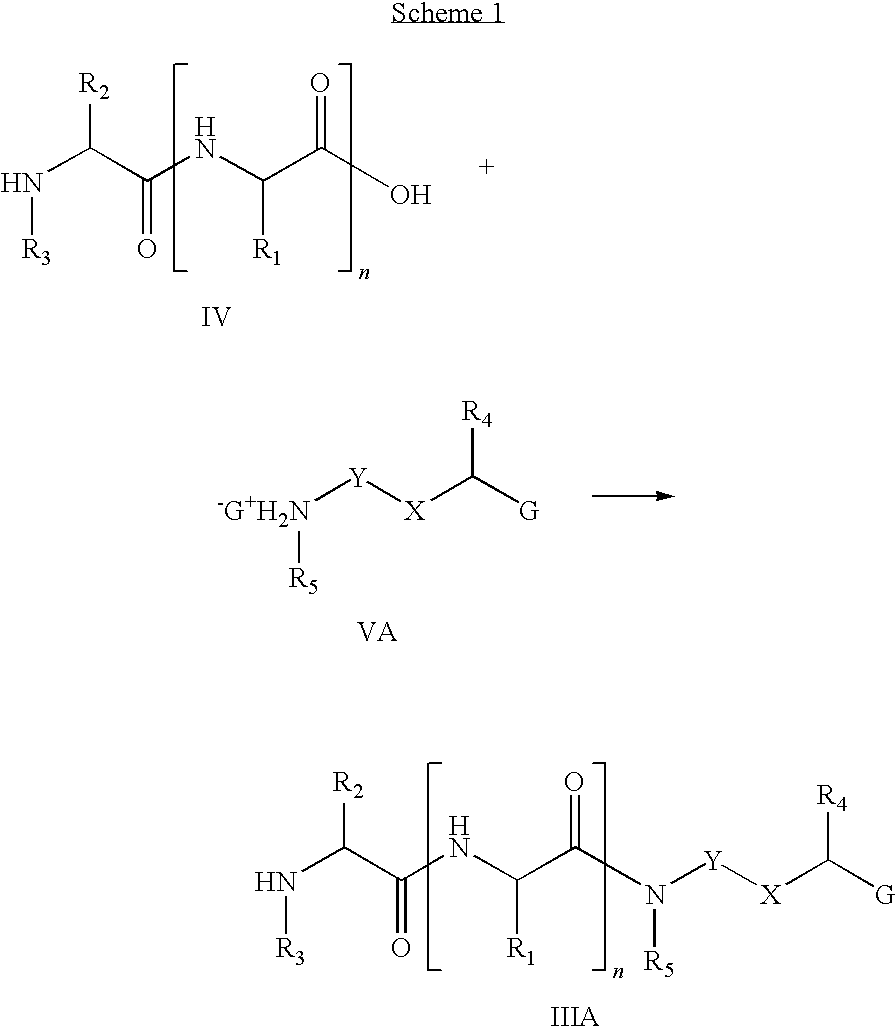


| TABLE 1 | |||||
| Seq | |||||
| ID. | Target | Therapeutic | |||
| No. | Peptide | Domain/Cell | target | Reference | |
| Helical |
| 1. | 72GQVGRQLAIIGDDINR87 | Bcl-xL/Bak | Cancer cells nti | J. Cell Biol., 2005, | |
| 2. | GQVGRQLAII | (BH3 | cancer | 168(5): 723-734; Science, | |
| 3. | GRQLAIIGDDINR | domain) - | 1997, 275: 983-986 | ||
| 4. | EDIIRNIARHLAQVGDSNLDRSIW | Bcl-xL/Bid | Cancer cells, nti | Science, 2004, 305: 1466-1470 | |
| NL = Norleucine | (BH3 | cancer | |||
| domain)- | |||||
| Zinc finger recognition | Specific | Proteins, 1992, 12: 101-104; | |||
| helices- | triplet base | Proteins, 1992, 12: 272 | |||
| recognition in | (erratum) | ||||
| DNA | |||||
| 5 | −1QSSNLQK6 | DNA | J. Mol. Biol., 1995, 252, : 1-5 | ||
| 6 | −1QSSDLQK6 | DNA | Gene off/on, | ||
| repair, | |||||
| 7 | Met repressor | DNA/RNA | Gene | Ann. New York Acad. Sci., 1994, 726: | |
| VKKITVSIXXXXISVTIKKV | (DNA/RNA) | 105-117; SEQ ID NO: 26 in Table 1 of | |||
| (X-any amino acid) | U.S. Pat. No. 7,202,332 B2 | ||||
| 8 | Arc repressor | DNA | Gene | Ann. Rev. Biochem,. 1984, 52: | |
| PQFNLRTXXTRLNFQP | (DNA/RNA) | 293-321 (general review); Specific | |||
| (X = any amino acid) | example in: SEQ ID No: 27 in Table | ||||
| 1 of U.S. Pat. No. 7,202,332 B2- | |||||
| Methods for preparing internally | |||||
| constrained peptides and | |||||
| peptidomimetics - SEQ ID NO: 27 | |||||
| Human ribosomal protein L7 | RRE (rev | (For review see the following: Int. | |||
| (HRP-L7) | response | Rev. Immun., 1999, 18(5-6): 429-448 | |||
| element) RNA | |||||
| 9 | ELKIKRLRKKFAQMLRKARRK | RRE of HIV-1 | Rev response | Eu. J. Biochem., 1997, 245: 549-556 | |
| (= ARM - Arg rich motif) | response | ||||
| (of HRP-L7) | of HIV-1 | ||||
| 10 | TRQARRNRRRRWRERQR | ||||
| STAT3 - 2nd helix | Cell-permeable | 5 | |||
| 11 | DTRYLEQLHKLYS | Cell | Apoptotic | A. C. S. Chem. Biol., 2007, | |
| membrane | peptides | 2(12): 799-809 | |||
| Amphipathic helical peptides | Antimicrobial | ||||
| 12 | FLSLIPHAINAVSAIAKHN-NH2 | Pathogenic | Phylloseptins - | Peptides, 2008, 29: 1633-1644 | |
| 38 | (c-terminal amide) | bacteria or | self association | ||
| 39 | FLSLIPHAINAVSTLVHHF-NH2 | fungi | & membrane | ||
| FLSLIPHAINAVSTLANHG-NH2 | permeablization | ||||
| 13 | FGFKDIIRAIRRIAVPVVSTLF | Deformation | Viral peptide | J. Biol. Chem. 2007, 282(28): | |
| (Pep-22) | and | 10774-10784 | |||
| preforation of | |||||
| biological | |||||
| membranes | |||||
| 14 | WDFFPAGDCFRKQYEDQLS | Ryanodine | Modulation of | Int. J. Cell Biol., 2006, 38(10): | |
| (CTT19S) | receptor Ca2+ | Homer | 1700-1715 | ||
| release | |||||
| channel | |||||
| 15 | KWKVFKKIEKVFSNIRDGI | Cell | anticancer | Inflammation, 2004, 28(6): 337-343 | |
| (CecropinA analogue) | membrane | ||||
| Short helical peptide-1 | Anti viral, tumor, | PCT-Int. Appl. (2007) | |||
| Immune | PIXXD2 WO2007142381, | ||||
| stimulating | AI 20071213 | ||||
| agent, | |||||
| 16 | SQETFSDLWKLLPENNV | P53/MDM2 | Mini Rev. Med. Chem., 2003, (3): | ||
| 257-270 | |||||
| 17 | QQLEEDLKGYLDWITQ | Calcium ion | SEQ ID NO: 15 in Table 1 of | ||
| channel (AID) | U.S. Pat. No. 7,202,332 | ||||
| 18 | RIARLEEKVK | Jun/Fos | SEQ ID NO: 16 in Table 1 of | ||
| U.S. Pat. No. 7,202,332 B2 | |||||
| 19 | Hex-RIARLEEKVK | Jun/Fos | SEQ ID NO: 17 in Table 1 of | ||
| U.S. Pat. No. 7,202,332 B2 | |||||
| 20 | ELASTANALRE | Jun/Fos | SEQ ID NO: 18 in Table 1 of | ||
| U.S. Pat. No. 7,202,332 B2 | |||||
| 21 | QVAQLKQKVA | Jun/Fos | SEQ ID NO: 19 in Table 1 of | ||
| U.S. Pat. No. 7,202,332 B2 | |||||
| 22 | ELASTANALREQVAQLKQKVAAY | Jun/Fos | SEQ ID NO: 20 in Table 1 of | ||
| U.S. Pat. No. 7,202,332 B2 | |||||
| 23 | RIARLEEKVKTLKAQN | Jun/Fos | SEQ ID NO: 21 in Table 1 of | ||
| U.S. Pat. No. 7,202,332 B2 | |||||
| 24 | EVAQLEDEKSALQ | Jun/Fos | SEQ ID NO: 22 in Table 1 of | ||
| U.S. Pat. No. 7,202,332 B2 | |||||
| 25 | WAAWDREINNYT | HIV gp41 | SEQ ID NO: 23 in Table 1 of | ||
| U.S. Pat. No. 7,202,332 B2 | |||||
| 26 | WAAWDREIN | HIV gp41 | SEQ ID NO: 24 in Table 1 of | ||
| U.S. Pat. No. 7,202,332 B2 | |||||
| 27 | GRKKRRNRRR | HIV TAR RNA | Proc. Natl. Acad. Sci. USA, 1994, | ||
| (carrier peptides or cell | 91: 8248-8252 | ||||
| penetrating peptides) | |||||
| N-terminal helical domain | MCRs - | J. Med. Chem., 1998, 41(14): | |||
| (22 a.a.) | melanocortin | 2614-2620 | |||
| receptors 1-5 | |||||
| β-turn/β-hairpin/β-sheet |
| Somatostatin | |||||
| 28 | FWKT | Human | G-protein | (Examples of analogues containing | |
| somatostatin | signal | FWKT (SEQ ID NO: 28)) J. Med. Chem., | |||
| receptor | cascade | 1998, 42: 919-929; 1146-1154; | |||
| 2175-2179; 2679-2685; 2686-2692; | |||||
| 4693-4705; J. Med. Chem., 2005, | |||||
| 48(21): 6643-6652; J. Med. Chem., | |||||
| 2008, 51(5): 1223-1230 | |||||
| 29 | FDWKT | Human | G-protein | PNAS USA 1998, 95, 1794-1799; PNAS | |
| somatostatin | cascade | USA 1998, 95, 10836-10841; Cancer | |||
| receptor | Res. 1998, 58, 4132-4137; J. Am. | ||||
| Chem. Soc. 1998, 120, 1368-1373; J. | |||||
| Med. Chem. 1998, 42-pages-919-929; | |||||
| 1146-1154; 2175-2179; 2679-2685; | |||||
| 2686-2692; 4693-4705; J. Med. Chem. | |||||
| 2008, 51(5), 1223-1230; J. Med. | |||||
| Chem. 2005, 48(21), 6643-6652 | |||||
| Gramidicin-S | Cell | Antimicrobial | For a few analogues of GS see: J. | ||
| membrane | Med. Chem. (ASAP) Jan. 8, 2009, DOI: | ||||
| 10, 1021/jm800886n; Biochem. 1987, | |||||
| 26(21), 6604-6612; | |||||
| 30 | Analogues of cyclo[DFPVOL]2 | Cell | Antimicrobial | Biophysical Journal, 2008, 95(7): | |
| membrane | 3306-3321; Peptide Science, 2007, | ||||
| 44: 255-256; Journal of Antibiotics, | |||||
| 2006, 59(6): 370-372 | |||||
| 34 | NPNA-Circumsporozite surface | T-cell epitope | J. Am. Chem. Soc., 1998, 120: | ||
| protein of the malarial | in multiple | 7439-7449 | |||
| parasite-P. falciparum- | antigen | ||||
| β-turn | peptide | ||||
| 35 | HFRW-pharmacophores in MSH | MCHs- | Pigmentation, | Peptides, 2005, 26(10): 1687-1689 | |
| and ACTH (G-protein coupled | hormones for | anti obesity, | |||
| receptors) | melanocortin | cardiovascular | |||
| receptors 1-5 | regulation | ||||
| Met repressor-β-sheet | dsDNA | DNA | Nature, 1992, 359(6394): 431-433; | ||
| peptides (in E. coli) | recognition | Nature, 1992, 359(6394): 387-393; | |||
| and Gene | J. Nol. Biol., 1992, 226(4): | ||||
| regulation | 1257-1270 | ||||
| γ-turn | |||||
| 31 | MpaYFQNCPDRG-NH2 | Antidiuretic, | For example of an analogue-Chem. | ||
| 36 | (Desmopressin)-Int. J. Pept. | treatment | Eur. J., 1999, 5(8): 2241-2253 | ||
| 561-574-a drug analogue of | of mild | ||||
| Vasopressin CFYQNCPRG-NH2 | haemophilia A, | ||||
| (a neurohypophyseal peptide | von Willebrand's | ||||
| hormone)-J. Am. Chem. Soc. | disease and | ||||
| 1953, 75, 4880 ± 4881 | thrombocyte | ||||
| Note the modified sequence. | disfunction | ||||
| 37 | GPG(R/Q)PGQ-β-hairpin; V3 | HIV-1 | Biochemistry, 2006, 45(13): | ||
| loop of gp120 (HIV-1) PND | 4284-4294 | ||||
| (principle Neutralizing | |||||
| domain) | |||||
| 40 | SQEPPISLDLTFHLLREMLEMAKAEQEAE | MCRs- | J. Med. Chem., 1998, 41(14): | ||
| QAALNRLLLEEA (N-terminal | melanocortin | 2614-2620 | |||
| helical domain of | receptors 1-5 | ||||
| Corticotropin releasing | |||||
| factor) | |||||
-
- ACN: Acetonitrile
- AcOH: Acetic acid
- Aib: α-aminoisobutyric acid
- Ala Alanine
- Boc: N-tert-Butoxycarbonyl
- Bop Benzotriazole-1-yl-oxy-tris-(dimethylamino)-phosphonium hexafluorophosphate
- Bn: Benzyl
- Bu: Butyl
- Cbz or Z: Benzoyloxycarbonyl
- DCC: Dicyclohexylcarbodiimide
- DCM Dichloromethane
- DEAD Diethyl azodicarboxylate
- DIAD Diisopropyl azodicarboxylate
- DIEA Diisopropylethylamine
- DIPEA Diisopropyl ethylamine
- DMAP: N,N-dimethyl-4-aminopyridine
- DMF: N,N-Dimethylformamide
- ECF Ethyl chloroformate
- Et: Ethyl
- EtOAc: Ethyl acetate
- EtOH: Ethanol
- Fmoc: Fluorenyl-methoxy-carbonyl
- HATU: O-(7-Azabenzotriazole-1-yl)-N,N,N′N′-tetramethyluronium hexafluorophosphate
- HBTU: O-(1H-Benzotriazole-1-yl)-N,N,N′,N′-tetramethyluronium hexafluorophosphate
- HOBt: 1-Hydroxybenzotriazole
- HOSu Hydroxy-succinimide
- HPLC: High Pressure Liquid Chromatography
- IPA: Iso-propyl alcohol
- K2CO3 Potassium carbonate
- LiOH Lithium hydroxide
- Me: Methyl
- MS (ESI): Electrospray ionization mass spectrometry
- Na2CO3 Sodium carbonate
- NaHCO3 Sodium bicarbonate
- Nosyl (Ns) 4-nitrobenzenesulfonyl
- NMM: N-Methylmorpholine
- NMR: Nuclear Magnetic Resonance
- Ph: Phenyl
- PPh3 Triphenyl phosphine
- PhSH Thiophenol
- r.t. Room temperature
- SLC: Side-chain linked
- SPPS: Solid phase peptide synthesis
- tBu: tert-butyl
- TFA: Trifluoroacetic acid
- THF: Tetrahydrofuran
- TLC Thin layer chromatography
Materials and Methods:


| TABLE 2 |
| Reaction conditions and yields for the |
| cyclization of H-Ala-Ala-NH—(CH2)3—Br |
| (at 25° C.) |
 |
| Scale | Equiv. | Consumption | Period | Yield | ||||
| No. | (mg) | Solvent | Base | (M) | (%) | (h) | Method | (%) |
| 1 | 10 | D2O | K2CO3 | 2 | 100 | 90 | NMR | >95 |
| 2 | 20 | D2O | NaHCO3 | 2 | 100 | 83 | |
100 |
| 3 | 400 | H2O | NaHCO3 | 2 | 100 | 89 | Column | >96 |
| 4 | 10 | CD3OD | K2CO3 | 2 | 100 | 93 | NMR | >95 |
| 5 | 200 | CH3OH | K2CO3 | 2 | 100* | 86 | NMR | >95 |
| 6 | 10 | CH3CN | K2CO3 | 2 | 100 | 80 | TLC | — |


Claims (20)


Applications Claiming Priority (2)
| Application Number | Priority Date | Filing Date | Title |
|---|---|---|---|
| IN505CH2009 | 2009-03-06 | ||
| IN505/CHE/2009 | 2009-03-06 |
Publications (2)
| Publication Number | Publication Date |
|---|---|
| US20100228004A1 US20100228004A1 (en) | 2010-09-09 |
| US8835602B2 true US8835602B2 (en) | 2014-09-16 |
Family
ID=42678818
Family Applications (1)
| Application Number | Title | Priority Date | Filing Date |
|---|---|---|---|
| US12/550,977 Expired - Fee Related US8835602B2 (en) | 2009-03-06 | 2009-08-31 | Templates for nucleation and propagation of peptide secondary structure |
Country Status (1)
| Country | Link |
|---|---|
| US (1) | US8835602B2 (en) |
Families Citing this family (3)
| Publication number | Priority date | Publication date | Assignee | Title |
|---|---|---|---|---|
| CN104066435A (en) * | 2011-12-21 | 2014-09-24 | 纽约大学 | Proteolytically resistant hydrogen bond surrogate helices |
| WO2017210489A1 (en) | 2016-06-01 | 2017-12-07 | M3 Biotechnology, Inc. | Compounds |
| CN114349713B (en) * | 2022-01-24 | 2023-08-01 | 曲阜师范大学 | Cyclic peptide compound and palladium catalyzed C-H alkylation method for constructing the cyclic peptide compound |
Citations (4)
| Publication number | Priority date | Publication date | Assignee | Title |
|---|---|---|---|---|
| US4703034A (en) | 1986-04-28 | 1987-10-27 | Merck & Co., Inc. | Novel cyclic tetrapeptide |
| US20060258646A1 (en) * | 2003-05-14 | 2006-11-16 | Tesfaye Biftu | 3-Amino-4-phenylbutanoic acid derivatives as dipeptidyl peptidase inhibitors for the treatment or prevention of diabetes |
| US7202332B2 (en) | 2004-05-27 | 2007-04-10 | New York University | Methods for preparing internally constrained peptides and peptidomimetics |
| WO2007142381A1 (en) | 2006-06-05 | 2007-12-13 | Seoul National University Industry Foundation | Human short helical peptide-1 which has antimicrobial, antitumor, and immune stimulating activity and uses thereof |
-
2009
- 2009-08-31 US US12/550,977 patent/US8835602B2/en not_active Expired - Fee Related
Patent Citations (4)
| Publication number | Priority date | Publication date | Assignee | Title |
|---|---|---|---|---|
| US4703034A (en) | 1986-04-28 | 1987-10-27 | Merck & Co., Inc. | Novel cyclic tetrapeptide |
| US20060258646A1 (en) * | 2003-05-14 | 2006-11-16 | Tesfaye Biftu | 3-Amino-4-phenylbutanoic acid derivatives as dipeptidyl peptidase inhibitors for the treatment or prevention of diabetes |
| US7202332B2 (en) | 2004-05-27 | 2007-04-10 | New York University | Methods for preparing internally constrained peptides and peptidomimetics |
| WO2007142381A1 (en) | 2006-06-05 | 2007-12-13 | Seoul National University Industry Foundation | Human short helical peptide-1 which has antimicrobial, antitumor, and immune stimulating activity and uses thereof |
Non-Patent Citations (133)
Also Published As
| Publication number | Publication date |
|---|---|
| US20100228004A1 (en) | 2010-09-09 |
Similar Documents
| Publication | Publication Date | Title |
|---|---|---|
| AU633872B2 (en) | Glycine derivatives | |
| US9963483B2 (en) | Process for producing self-assembling peptide derivatives | |
| ES2257066T3 (en) | INHIBITING PEPTIDES OF HEPATITIS C. | |
| US20060258868A1 (en) | Hepatitis c inhibitor peptide analogs | |
| US12115224B2 (en) | Polypeptide conjugates for intracellular delivery of stapled peptides | |
| DE68926804T2 (en) | Neuropeptide Y agonists and partial agonists | |
| US11292820B2 (en) | KV1.3 blockers | |
| US20150164974A1 (en) | Iap antagonists | |
| JP7274425B2 (en) | Homoditic cyclic peptides targeting α4β7 integrin | |
| CN103596584A (en) | Multi-substituted insulins | |
| WO2021041895A1 (en) | Stapled beta-catenin ligands | |
| CZ200226A3 (en) | Cyclic peptide derivatives as alfavbeta6 integrin inhibitors | |
| SK55895A3 (en) | Cyclopeptid,method of its preparation, its use and pharmaceutical agent containing it | |
| US20100228004A1 (en) | Templates for nucleation and propagation of peptide secondary structure | |
| Schmittberger et al. | Synthesis of the palmitoylated and prenylated C-terminal lipopeptides of the human R-and N-Ras proteins | |
| KR20090012306A (en) | Unnatural amino acids and neurotensin analogs thereof | |
| US8563686B2 (en) | Conformationally constrained peptide mimetics | |
| IE912975A1 (en) | Phosphonopyrrolidine- and piperidine-containing¹pseudopeptides of the statin type, a process for their¹preparation and their use as medicaments against¹retroviruses | |
| US20180264124A1 (en) | Drug complex | |
| AU4551500A (en) | Integrin receptor antagonists | |
| KR101412119B1 (en) | Biological stabilized par-2 activated peptides and pharmaceutical composition containing the same | |
| KR100460165B1 (en) | New LH-RH antagonist with improved effects | |
| US5807979A (en) | Synthetic, three-dimensionally stabilized polypeptide mimics of HIV | |
| CN113646324B (en) | Linear solution-phase pathway for WNT hexapeptides | |
| CA3160310A1 (en) | Polypeptide having mmp2-inhibitory effect |
Legal Events
| Date | Code | Title | Description |
|---|---|---|---|
| AS | Assignment |
Owner name: INDIAN INSTITUTE OF SCIENCE, INDIA Free format text: ASSIGNMENT OF ASSIGNORS INTEREST;ASSIGNOR:PRABHAKARAN, ERODE NAGARAJAN;REEL/FRAME:023971/0298 Effective date: 20090721 |
|
| STCF | Information on status: patent grant |
Free format text: PATENTED CASE |
|
| CC | Certificate of correction | ||
| MAFP | Maintenance fee payment |
Free format text: PAYMENT OF MAINTENANCE FEE, 4TH YEAR, LARGE ENTITY (ORIGINAL EVENT CODE: M1551) Year of fee payment: 4 |
|
| AS | Assignment |
Owner name: CRESTLINE DIRECT FINANCE, L.P., TEXAS Free format text: SECURITY INTEREST;ASSIGNOR:EMPIRE TECHNOLOGY DEVELOPMENT LLC;REEL/FRAME:048373/0217 Effective date: 20181228 |
|
| AS | Assignment |
Owner name: EMPIRE TECHNOLOGY DEVELOPMENT LLC, WASHINGTON Free format text: RELEASE BY SECURED PARTY;ASSIGNOR:CRESTLINE DIRECT FINANCE, L.P.;REEL/FRAME:049924/0794 Effective date: 20190501 |
|
| FEPP | Fee payment procedure |
Free format text: MAINTENANCE FEE REMINDER MAILED (ORIGINAL EVENT CODE: REM.); ENTITY STATUS OF PATENT OWNER: LARGE ENTITY |
|
| LAPS | Lapse for failure to pay maintenance fees |
Free format text: PATENT EXPIRED FOR FAILURE TO PAY MAINTENANCE FEES (ORIGINAL EVENT CODE: EXP.); ENTITY STATUS OF PATENT OWNER: LARGE ENTITY |
|
| STCH | Information on status: patent discontinuation |
Free format text: PATENT EXPIRED DUE TO NONPAYMENT OF MAINTENANCE FEES UNDER 37 CFR 1.362 |
|
| FP | Lapsed due to failure to pay maintenance fee |
Effective date: 20220916 |
|
| AS | Assignment |
Owner name: EMPIRE TECHNOLOGY DEVELOPMENT LLC, WASHINGTON Free format text: RELEASE OF SECURITY INTEREST IN PATENTS, RECORDED ON JANUARY 29, 2019 AT REEL 048373 FRAME 0217;ASSIGNOR:CRESTLINE DIRECT FINANCE, L.P., AS COLLATERAL AGENT;REEL/FRAME:072936/0464 Effective date: 20250616 |
|
| AS | Assignment |
Owner name: EMPIRE TECHNOLOGY DEVELOPMENT LLC, WASHINGTON Free format text: RELEASE OF SECURITY INTEREST IN PATENTS, RECORDED ON JULY 31, 2019 AT REEL 049924 FRAME 0794;ASSIGNOR:CRESTLINE DIRECT FINANCE, L.P., AS COLLATERAL AGENT;REEL/FRAME:075798/0763 Effective date: 20260616 |