US8821617B2 - Polyimide-co-polybenzoxazole copolymer, preparation method thereof, and gas separation membrane comprising the same - Google Patents
Polyimide-co-polybenzoxazole copolymer, preparation method thereof, and gas separation membrane comprising the same Download PDFInfo
- Publication number
- US8821617B2 US8821617B2 US12/920,268 US92026808A US8821617B2 US 8821617 B2 US8821617 B2 US 8821617B2 US 92026808 A US92026808 A US 92026808A US 8821617 B2 US8821617 B2 US 8821617B2
- Authority
- US
- United States
- Prior art keywords
- copolymer
- gas separation
- separation membrane
- pbo
- polyimide
- Prior art date
- Legal status (The legal status is an assumption and is not a legal conclusion. Google has not performed a legal analysis and makes no representation as to the accuracy of the status listed.)
- Expired - Fee Related, expires
Links
- PAPYBXZKUBDJBZ-UHFFFAOYSA-N CCC.CCC1=NC2=C(C=CC=C2)O1.C[Ar]1C(=O)N([Ar]N2C(=O)[Ar](CC3=NC4=C(C=CC=C4)O3)C2=O)C1=O.[Ar].[Ar].[Ar] Chemical compound CCC.CCC1=NC2=C(C=CC=C2)O1.C[Ar]1C(=O)N([Ar]N2C(=O)[Ar](CC3=NC4=C(C=CC=C4)O3)C2=O)C1=O.[Ar].[Ar].[Ar] PAPYBXZKUBDJBZ-UHFFFAOYSA-N 0.000 description 6
- TXKKAPGCNLHLMH-UHFFFAOYSA-N C.C1=CC2=C(C=C1)C1=C(C=CC=C1)/C=C\2.C1=CC2=C3C(=C1)/C=C\C=C/3C1=CC=C/C3=C\C=C/C2=C\13.C1=CC=C(CC2=CC=C(CC3=CC=CC=C3)C=C2)C=C1.C1=CC=C(CC2=CC=CC=C2)C=C1.C1=CC=C([Y]C2=CC=C(CC3=CC=C([Y]C4=CC=CC=C4)C=C3)C=C2)C=C1.C1=CC=C2C=CC=CC2=C1.C1=CC=CC=C1.C1=CC=CC=C1.C1=CC=CC=C1.C1=CC=CC=C1.C1=CC=CC=C1.C1=CC=CC=C1.C1=CC=CC=C1.C1=CCC=C1.CC.CC.CC.CC.CC.CC.CC.CC.CC.CC.CC.CC.CC.CC.CC.CC.CC.CC.CC.CC.CC.CC.CC.CC.CC Chemical compound C.C1=CC2=C(C=C1)C1=C(C=CC=C1)/C=C\2.C1=CC2=C3C(=C1)/C=C\C=C/3C1=CC=C/C3=C\C=C/C2=C\13.C1=CC=C(CC2=CC=C(CC3=CC=CC=C3)C=C2)C=C1.C1=CC=C(CC2=CC=CC=C2)C=C1.C1=CC=C([Y]C2=CC=C(CC3=CC=C([Y]C4=CC=CC=C4)C=C3)C=C2)C=C1.C1=CC=C2C=CC=CC2=C1.C1=CC=CC=C1.C1=CC=CC=C1.C1=CC=CC=C1.C1=CC=CC=C1.C1=CC=CC=C1.C1=CC=CC=C1.C1=CC=CC=C1.C1=CCC=C1.CC.CC.CC.CC.CC.CC.CC.CC.CC.CC.CC.CC.CC.CC.CC.CC.CC.CC.CC.CC.CC.CC.CC.CC.CC TXKKAPGCNLHLMH-UHFFFAOYSA-N 0.000 description 3
- ZEPHPGHHFODFBM-UHFFFAOYSA-N C.C1=CC2=C(C=C1)C1=C(C=CC=C1)/C=C\2.C1=CC2=C3C(=C1)/C=C\C=C/3C1=CC=C/C3=C\C=C/C2=C\13.C1=CC=C(CC2=CC=C(CC3=CC=CC=C3)C=C2)C=C1.C1=CC=C(CC2=CC=CC=C2)C=C1.C1=CC=C([Y]C2=CC=C(CC3=CC=C([Y]C4=CC=CC=C4)C=C3)C=C2)C=C1.C1=CC=C2C=CC=CC2=C1.C1=CC=CC=C1.C1=CC=CC=C1.C1=CC=CC=C1.C1=CC=CC=C1.C1=CC=CC=C1.C1=CC=CC=C1.C1=CC=CC=C1.C1=CCC=C1.CC.CC.CC.CC.CC.CC.CC.CC.CC.CC.CC.CC.CC.CC.CC.CC.CC.CC.CC.CC.CC.CC.CC.CC.CC.CC.CC.CC.CC.CC.CC.CC.CC.CC.CC.CC Chemical compound C.C1=CC2=C(C=C1)C1=C(C=CC=C1)/C=C\2.C1=CC2=C3C(=C1)/C=C\C=C/3C1=CC=C/C3=C\C=C/C2=C\13.C1=CC=C(CC2=CC=C(CC3=CC=CC=C3)C=C2)C=C1.C1=CC=C(CC2=CC=CC=C2)C=C1.C1=CC=C([Y]C2=CC=C(CC3=CC=C([Y]C4=CC=CC=C4)C=C3)C=C2)C=C1.C1=CC=C2C=CC=CC2=C1.C1=CC=CC=C1.C1=CC=CC=C1.C1=CC=CC=C1.C1=CC=CC=C1.C1=CC=CC=C1.C1=CC=CC=C1.C1=CC=CC=C1.C1=CCC=C1.CC.CC.CC.CC.CC.CC.CC.CC.CC.CC.CC.CC.CC.CC.CC.CC.CC.CC.CC.CC.CC.CC.CC.CC.CC.CC.CC.CC.CC.CC.CC.CC.CC.CC.CC.CC ZEPHPGHHFODFBM-UHFFFAOYSA-N 0.000 description 3
- GAEOZRNNXUPFNP-UHFFFAOYSA-N CC(C)(C)C1=CC=CC=C1.CC(C)(C1=CC=CC=C1)C(F)(F)F Chemical compound CC(C)(C)C1=CC=CC=C1.CC(C)(C1=CC=CC=C1)C(F)(F)F GAEOZRNNXUPFNP-UHFFFAOYSA-N 0.000 description 3
- PGNUQLXKNMJZLW-UHFFFAOYSA-N CC1=C(C)C(C(=O)C2=CC=CC=C2)=CC=C1C(=O)C1=CC=CC=C1.CC1=CC(C(=O)C2=CC=C(C(=O)C3=CC=CC(C)=C3)C=C2)=CC=C1.CC1=CC=C(C(=O)C2=CC=C(C(=O)C3=CC(C)=CC=C3)C=C2)C=C1.CC1=CC=C(C(=O)C2=CC=C(C(=O)C3=CC=C(C)C=C3)C=C2)C=C1.CC1=CC=C(C(=O)C2=CC=C(C(=O)C3=CC=CC(C)=C3)C=C2)C=C1.CC1=CC=C(C(=O)C2=CC=C(C(=O)C3=CC=CC(C)=C3)C=C2)C=C1.CC1=CC=C(C(=O)C2=CC=C(C(=O)C3=CC=CC=C3)C=C2)C=C1C.CC1=CC=C(C)S1.CC1=CC=C(OC2=CC=C(C(C)(C)C3=CC=C(OC4=CC=C(C)C=C4)C=C3)C=C2)C=C1.CC1=CC=CC(C(=O)C2=CC=C(C(=O)C3=CC=CC(C)=C3)C=C2)=C1.CC1=CN=C(C)C=N1.CC1=CN=CC(C)=N1.CC1=CSC(C)=C1 Chemical compound CC1=C(C)C(C(=O)C2=CC=CC=C2)=CC=C1C(=O)C1=CC=CC=C1.CC1=CC(C(=O)C2=CC=C(C(=O)C3=CC=CC(C)=C3)C=C2)=CC=C1.CC1=CC=C(C(=O)C2=CC=C(C(=O)C3=CC(C)=CC=C3)C=C2)C=C1.CC1=CC=C(C(=O)C2=CC=C(C(=O)C3=CC=C(C)C=C3)C=C2)C=C1.CC1=CC=C(C(=O)C2=CC=C(C(=O)C3=CC=CC(C)=C3)C=C2)C=C1.CC1=CC=C(C(=O)C2=CC=C(C(=O)C3=CC=CC(C)=C3)C=C2)C=C1.CC1=CC=C(C(=O)C2=CC=C(C(=O)C3=CC=CC=C3)C=C2)C=C1C.CC1=CC=C(C)S1.CC1=CC=C(OC2=CC=C(C(C)(C)C3=CC=C(OC4=CC=C(C)C=C4)C=C3)C=C2)C=C1.CC1=CC=CC(C(=O)C2=CC=C(C(=O)C3=CC=CC(C)=C3)C=C2)=C1.CC1=CN=C(C)C=N1.CC1=CN=CC(C)=N1.CC1=CSC(C)=C1 PGNUQLXKNMJZLW-UHFFFAOYSA-N 0.000 description 3
- WLRBUMSOXFJVIN-UHFFFAOYSA-N CC1=C(C)C(C2=CC=CC=C2)=CC=C1C1=CC=CC=C1.CC1=C2/C=C(C)\C=C3\C4=CC=CC5=CC=CC(=C54)C(=C23)C=C1.CC1=CC(C2=CC=CC=C2)=C(C)C=C1C1=CC=CC=C1.CC1=CC2=C3C(=C1)C=CC=C3/C1=C/C=C\C3=C(C)C=CC2=C31.CC1=CC=C(C2=CC(C)=CC=C2)C=C1.CC1=CC=C(C2=CC=C(C)C=C2)C=C1.CC1=CC=C(C2=CC=C(C3=CC(C)=CC=C3)C=C2)C=C1.CC1=CC=C(C2=CC=C(C3=CC=C(C)C=C3)C=C2)C=C1.CC1=CC=C(C2=CC=CC=C2C)C=C1.CC1=CC=C(OC2=CC(C)=CC=C2)C=C1.CC1=CC=C(OC2=CC=C(C)C=C2)C=C1.CC1=CC=C2C=CC=C3C2=C1C1=C2C(=C(C)C=C1)/C=C\C=C\32 Chemical compound CC1=C(C)C(C2=CC=CC=C2)=CC=C1C1=CC=CC=C1.CC1=C2/C=C(C)\C=C3\C4=CC=CC5=CC=CC(=C54)C(=C23)C=C1.CC1=CC(C2=CC=CC=C2)=C(C)C=C1C1=CC=CC=C1.CC1=CC2=C3C(=C1)C=CC=C3/C1=C/C=C\C3=C(C)C=CC2=C31.CC1=CC=C(C2=CC(C)=CC=C2)C=C1.CC1=CC=C(C2=CC=C(C)C=C2)C=C1.CC1=CC=C(C2=CC=C(C3=CC(C)=CC=C3)C=C2)C=C1.CC1=CC=C(C2=CC=C(C3=CC=C(C)C=C3)C=C2)C=C1.CC1=CC=C(C2=CC=CC=C2C)C=C1.CC1=CC=C(OC2=CC(C)=CC=C2)C=C1.CC1=CC=C(OC2=CC=C(C)C=C2)C=C1.CC1=CC=C2C=CC=C3C2=C1C1=C2C(=C(C)C=C1)/C=C\C=C\32 WLRBUMSOXFJVIN-UHFFFAOYSA-N 0.000 description 3
- XHBKNKZLHWPWKJ-UHFFFAOYSA-N CC1=C(C)C(OC2=CC=CC=C2)=CC=C1OC1=CC=CC=C1.CC1=CC(C(O)C2=CC=CC(C)=C2)=CC=C1.CC1=CC([Si](C)(C)C2=CC=CC(C)=C2)=CC=C1.CC1=CC=C(C(=O)CC2=CC(C)=CC=C2)C=C1.CC1=CC=C(C(=O)CC2=CC=CC=C2)C=C1C.CC1=CC=C(CC(=O)C2=CC=C(C)C=C2)C=C1.CC1=CC=C(OC2=CC=C(OC3=CC=C(C)C=C3)C=C2)C=C1.CC1=CC=C(OC2=CC=C(OC3=CC=CC(C)=C3)C=C2)C=C1.CC1=CC=C(OC2=CC=C(OC3=CC=CC=C3)C=C2)C=C1C.CC1=CC=C([Si](C)(C)C2=CC(C)=CC=C2)C=C1.CC1=CC=C([Si](C)(C)C2=CC=CC=C2)C=C1C Chemical compound CC1=C(C)C(OC2=CC=CC=C2)=CC=C1OC1=CC=CC=C1.CC1=CC(C(O)C2=CC=CC(C)=C2)=CC=C1.CC1=CC([Si](C)(C)C2=CC=CC(C)=C2)=CC=C1.CC1=CC=C(C(=O)CC2=CC(C)=CC=C2)C=C1.CC1=CC=C(C(=O)CC2=CC=CC=C2)C=C1C.CC1=CC=C(CC(=O)C2=CC=C(C)C=C2)C=C1.CC1=CC=C(OC2=CC=C(OC3=CC=C(C)C=C3)C=C2)C=C1.CC1=CC=C(OC2=CC=C(OC3=CC=CC(C)=C3)C=C2)C=C1.CC1=CC=C(OC2=CC=C(OC3=CC=CC=C3)C=C2)C=C1C.CC1=CC=C([Si](C)(C)C2=CC(C)=CC=C2)C=C1.CC1=CC=C([Si](C)(C)C2=CC=CC=C2)C=C1C XHBKNKZLHWPWKJ-UHFFFAOYSA-N 0.000 description 3
- YBTPTGRTXLDZIY-UHFFFAOYSA-N CC1=C(C)C2=C(C=C1)C1=C(C=CC=C1)C=C2.CC1=C(C)C=CC=C1.CC1=C2C3=C(C=C1)C1=C4C(=CC=C1)C=CC=C4/C3=C/C=C\2C.CC1=C2C=CC=C3C2=C(C=C1)C1=C2C(=C(C)C=C1)/C=C\C=C\32.CC1=CC2=C(C)C=CC=C2C=C1.CC1=CC2=C(C=C1)C1=C(C=C2)C(C)=CC=C1.CC1=CC2=C(C=C1)C1=C(C=C2)C=C(C)C=C1.CC1=CC2=C(C=C1)C1=C(C=CC(C)=C1)C=C2.CC1=CC2=C(C=C1)C1=C(C=CC=C1)C(C)=C2.CC1=CC2=C(C=C1)C1=C(C=CC=C1)C=C2C.CC1=CC=C(C)C=C1.CC1=CC=C2C3=C(C=CC=C13)C1=C3C(=C(C)C=C1)/C=C\C=C\23.CC1=CC=CC(C)=C1.CC1=CC=CC2=C(C)C=CC=C12.CC1=CC=CC2=CC=CC(C)=C12 Chemical compound CC1=C(C)C2=C(C=C1)C1=C(C=CC=C1)C=C2.CC1=C(C)C=CC=C1.CC1=C2C3=C(C=C1)C1=C4C(=CC=C1)C=CC=C4/C3=C/C=C\2C.CC1=C2C=CC=C3C2=C(C=C1)C1=C2C(=C(C)C=C1)/C=C\C=C\32.CC1=CC2=C(C)C=CC=C2C=C1.CC1=CC2=C(C=C1)C1=C(C=C2)C(C)=CC=C1.CC1=CC2=C(C=C1)C1=C(C=C2)C=C(C)C=C1.CC1=CC2=C(C=C1)C1=C(C=CC(C)=C1)C=C2.CC1=CC2=C(C=C1)C1=C(C=CC=C1)C(C)=C2.CC1=CC2=C(C=C1)C1=C(C=CC=C1)C=C2C.CC1=CC=C(C)C=C1.CC1=CC=C2C3=C(C=CC=C13)C1=C3C(=C(C)C=C1)/C=C\C=C\23.CC1=CC=CC(C)=C1.CC1=CC=CC2=C(C)C=CC=C12.CC1=CC=CC2=CC=CC(C)=C12 YBTPTGRTXLDZIY-UHFFFAOYSA-N 0.000 description 3
- ICTHDTAONQGFLL-UHFFFAOYSA-N CC1=C2C=CC=C3C2=C(C=C1)C1=C2C(=C(C)C=C1)/C(C)=C\C=C\32.CC1=CC2=C(C)C(C)=CC=C2C=C1.CC1=CC2=C(C=C1)C(C)=C(C)C1=C2C=CC=C1.CC1=CC2=C(C=C1)C1=C(C(C)=CC=C1)C(C)=C2.CC1=CC2=C(C=C1)C1=C(C=C2)C(C)=C(C)C=C1.CC1=CC2=C(C=C1)C1=C(C=CC=C1)C(C)=C2C.CC1=CC2=C(C=C1)C=CC1=C2C=CC(C)=C1C.CC1=CC2=C(C=CC=C2)C2=C1C(C)=C(C)C=C2.CC1=CC2=C3C(=C1C)/C=C\C=C/3C1=CC=CC3=C(C)C=CC2=C13.CC1=CC2=CC=C(C)C(C)=C2C=C1.CC1=CC=C(C)C(C)=C1.CC1=CC=CC(C)=C1C.CC1=CC=CC2=C(C)C(C)=CC=C12.CC1=CC=CC2=C(C)C=CC(C)=C12 Chemical compound CC1=C2C=CC=C3C2=C(C=C1)C1=C2C(=C(C)C=C1)/C(C)=C\C=C\32.CC1=CC2=C(C)C(C)=CC=C2C=C1.CC1=CC2=C(C=C1)C(C)=C(C)C1=C2C=CC=C1.CC1=CC2=C(C=C1)C1=C(C(C)=CC=C1)C(C)=C2.CC1=CC2=C(C=C1)C1=C(C=C2)C(C)=C(C)C=C1.CC1=CC2=C(C=C1)C1=C(C=CC=C1)C(C)=C2C.CC1=CC2=C(C=C1)C=CC1=C2C=CC(C)=C1C.CC1=CC2=C(C=CC=C2)C2=C1C(C)=C(C)C=C2.CC1=CC2=C3C(=C1C)/C=C\C=C/3C1=CC=CC3=C(C)C=CC2=C13.CC1=CC2=CC=C(C)C(C)=C2C=C1.CC1=CC=C(C)C(C)=C1.CC1=CC=CC(C)=C1C.CC1=CC=CC2=C(C)C(C)=CC=C12.CC1=CC=CC2=C(C)C=CC(C)=C12 ICTHDTAONQGFLL-UHFFFAOYSA-N 0.000 description 3
- VKTVJRYLVAZUOO-UHFFFAOYSA-N CC1=CC(C(=O)C2=CC=C(C(=O)C3=CC=C(C)C(C)=C3)C=C2)=CC=C1.CC1=CC(C)=C(C)S1.CC1=CC(C)=CC(C(=O)C2=CC=C(C(=O)C3=C(C)C=CC=C3)C=C2)=C1.CC1=CC(C)=CC(C(=O)C2=CC=C(C(=O)C3=CC=CC(C)=C3)C=C2)=C1.CC1=CC=C(C(=O)C2=CC=C(C(=O)C3=CC(C)=CC(C)=C3)C=C2)C=C1.CC1=CC=C(C(=O)C2=CC=C(C(=O)C3=CC=C(C)C(C)=C3)C=C2)C=C1.CC1=CC=C(C(=O)C2=CC=C(C(=O)C3=CC=CC=C3)C(C)=C2C)C=C1.CC1=CC=C(OC2=CC=C(C(C)(C)C3=CC=C(OC4=CC=C(C)C(C)=C4)C=C3)C=C2)C=C1.CC1=CC=CC(C(=O)C2=CC=C(C(=O)C3=CC(C)=CC(C)=C3)C=C2)=C1.CC1=CC=CC(C(=O)C2=CC=C(C(=O)C3=CC=C(C)C(C)=C3)C=C2)=C1.CC1=CSC(C)=C1C.CC1=NC(C)=C(C)N=C1.CC1=NC(C)=C(C)N=C1 Chemical compound CC1=CC(C(=O)C2=CC=C(C(=O)C3=CC=C(C)C(C)=C3)C=C2)=CC=C1.CC1=CC(C)=C(C)S1.CC1=CC(C)=CC(C(=O)C2=CC=C(C(=O)C3=C(C)C=CC=C3)C=C2)=C1.CC1=CC(C)=CC(C(=O)C2=CC=C(C(=O)C3=CC=CC(C)=C3)C=C2)=C1.CC1=CC=C(C(=O)C2=CC=C(C(=O)C3=CC(C)=CC(C)=C3)C=C2)C=C1.CC1=CC=C(C(=O)C2=CC=C(C(=O)C3=CC=C(C)C(C)=C3)C=C2)C=C1.CC1=CC=C(C(=O)C2=CC=C(C(=O)C3=CC=CC=C3)C(C)=C2C)C=C1.CC1=CC=C(OC2=CC=C(C(C)(C)C3=CC=C(OC4=CC=C(C)C(C)=C4)C=C3)C=C2)C=C1.CC1=CC=CC(C(=O)C2=CC=C(C(=O)C3=CC(C)=CC(C)=C3)C=C2)=C1.CC1=CC=CC(C(=O)C2=CC=C(C(=O)C3=CC=C(C)C(C)=C3)C=C2)=C1.CC1=CSC(C)=C1C.CC1=NC(C)=C(C)N=C1.CC1=NC(C)=C(C)N=C1 VKTVJRYLVAZUOO-UHFFFAOYSA-N 0.000 description 3
- PYVQUORPPARJPW-UHFFFAOYSA-N CC1=CC(C(=O)C2=CC=C(C)C(C)=C2)=CC=C1.CC1=CC(C(F)(F)C2=CC=C(C)C(C)=C2)=CC=C1.CC1=CC=C(C(=O)C2=C(C)C=CC=C2)C=C1C.CC1=CC=C(C(=O)C2=CC=C(C)C(C)=C2)C=C1.CC1=CC=C(C(C)(C)C2=CC=C(C)C(C)=C2)C=C1.CC1=CC=C(C(F)(F)C2=C(C)C=CC=C2)C=C1C.CC1=CC=C(C(F)(F)C2=C(C)C=CC=C2)C=C1C.CC1=CC=C(C(F)(F)C2=CC=C(C)C(C)=C2)C=C1.CC1=CC=C(C(F)(F)C2=CC=CC=C2C)C=C1C.CC1=CC=CC(C(=O)C2=CC=C(C)C(C)=C2)=C1.CC1=CC=CC(C(C)(C)C2=CC=C(C)C(C)=C2)=C1.CC1=CC=CC(C(F)(F)C2=CC=C(C)C(C)=C2)=C1 Chemical compound CC1=CC(C(=O)C2=CC=C(C)C(C)=C2)=CC=C1.CC1=CC(C(F)(F)C2=CC=C(C)C(C)=C2)=CC=C1.CC1=CC=C(C(=O)C2=C(C)C=CC=C2)C=C1C.CC1=CC=C(C(=O)C2=CC=C(C)C(C)=C2)C=C1.CC1=CC=C(C(C)(C)C2=CC=C(C)C(C)=C2)C=C1.CC1=CC=C(C(F)(F)C2=C(C)C=CC=C2)C=C1C.CC1=CC=C(C(F)(F)C2=C(C)C=CC=C2)C=C1C.CC1=CC=C(C(F)(F)C2=CC=C(C)C(C)=C2)C=C1.CC1=CC=C(C(F)(F)C2=CC=CC=C2C)C=C1C.CC1=CC=CC(C(=O)C2=CC=C(C)C(C)=C2)=C1.CC1=CC=CC(C(C)(C)C2=CC=C(C)C(C)=C2)=C1.CC1=CC=CC(C(F)(F)C2=CC=C(C)C(C)=C2)=C1 PYVQUORPPARJPW-UHFFFAOYSA-N 0.000 description 3
- URNGHACURRIZRB-UHFFFAOYSA-N CC1=CC(C(C)(C)C2=CC=C(C)C(C)=C2)=CC=C1.CC1=CC(C(C2=CC=C(C)C(C)=C2)(C(F)(F)F)C(F)(F)F)=CC=C1.CC1=CC(C(O)C2=CC=C(C)C(C)=C2)=CC=C1.CC1=CC(S(=O)(=O)C2=CC=C(C)C(C)=C2)=CC=C1.CC1=CC=C(C(C)(C)C2=C(C)C=CC=C2)C=C1C.CC1=CC=C(C(C2=C(C)C=CC=C2)(C(F)(F)F)C(F)(F)F)C=C1C.CC1=CC=C(C(C2=CC=C(C)C(C)=C2)(C(F)(F)F)C(F)(F)F)C=C1.CC1=CC=C(C(O)C2=CC=C(C)C(C)=C2)C=C1.CC1=CC=C(S(=O)(=O)C2=CC=C(C)C(C)=C2)C=C1.CC1=CC=CC(C(C2=CC=C(C)C(C)=C2)(C(F)(F)F)C(F)(F)F)=C1.CC1=CC=CC(C(O)C2=CC=C(C)C(C)=C2)=C1 Chemical compound CC1=CC(C(C)(C)C2=CC=C(C)C(C)=C2)=CC=C1.CC1=CC(C(C2=CC=C(C)C(C)=C2)(C(F)(F)F)C(F)(F)F)=CC=C1.CC1=CC(C(O)C2=CC=C(C)C(C)=C2)=CC=C1.CC1=CC(S(=O)(=O)C2=CC=C(C)C(C)=C2)=CC=C1.CC1=CC=C(C(C)(C)C2=C(C)C=CC=C2)C=C1C.CC1=CC=C(C(C2=C(C)C=CC=C2)(C(F)(F)F)C(F)(F)F)C=C1C.CC1=CC=C(C(C2=CC=C(C)C(C)=C2)(C(F)(F)F)C(F)(F)F)C=C1.CC1=CC=C(C(O)C2=CC=C(C)C(C)=C2)C=C1.CC1=CC=C(S(=O)(=O)C2=CC=C(C)C(C)=C2)C=C1.CC1=CC=CC(C(C2=CC=C(C)C(C)=C2)(C(F)(F)F)C(F)(F)F)=C1.CC1=CC=CC(C(O)C2=CC=C(C)C(C)=C2)=C1 URNGHACURRIZRB-UHFFFAOYSA-N 0.000 description 3
- WAWAJAHKPNOVJA-UHFFFAOYSA-N CC1=CC(C(C)(C)C2=CC=CC(C)=C2)=CC=C1.CC1=CC(C(C2=CC=CC(C)=C2)(C(F)(F)F)C(F)(F)F)=CC=C1.CC1=CC(S(=O)(=O)C2=CC=CC(C)=C2)=CC=C1.CC1=CC=C(C(C)(C)C2=CC=CC=C2)C=C1C.CC1=CC=C(C(C2=CC(C)=CC=C2)(C(F)(F)F)C(F)(F)F)C=C1.CC1=CC=C(C(C2=CC=C(C)C=C2)(C(F)(F)F)C(F)(F)F)C=C1.CC1=CC=C(C(C2=CC=CC=C2)(C(F)(F)F)C(F)(F)F)C=C1C.CC1=CC=C(C(O)C2=CC(C)=CC=C2)C=C1.CC1=CC=C(C(O)C2=CC=C(C)C=C2)C=C1.CC1=CC=C(C(O)C2=CC=CC=C2)C=C1C.CC1=CC=C(S(=O)(=O)C2=CC=CC=C2)C=C1C Chemical compound CC1=CC(C(C)(C)C2=CC=CC(C)=C2)=CC=C1.CC1=CC(C(C2=CC=CC(C)=C2)(C(F)(F)F)C(F)(F)F)=CC=C1.CC1=CC(S(=O)(=O)C2=CC=CC(C)=C2)=CC=C1.CC1=CC=C(C(C)(C)C2=CC=CC=C2)C=C1C.CC1=CC=C(C(C2=CC(C)=CC=C2)(C(F)(F)F)C(F)(F)F)C=C1.CC1=CC=C(C(C2=CC=C(C)C=C2)(C(F)(F)F)C(F)(F)F)C=C1.CC1=CC=C(C(C2=CC=CC=C2)(C(F)(F)F)C(F)(F)F)C=C1C.CC1=CC=C(C(O)C2=CC(C)=CC=C2)C=C1.CC1=CC=C(C(O)C2=CC=C(C)C=C2)C=C1.CC1=CC=C(C(O)C2=CC=CC=C2)C=C1C.CC1=CC=C(S(=O)(=O)C2=CC=CC=C2)C=C1C WAWAJAHKPNOVJA-UHFFFAOYSA-N 0.000 description 3
- GWHJZXXIDMPWGX-UHFFFAOYSA-N CC1=CC(C)=C(C)C=C1 Chemical compound CC1=CC(C)=C(C)C=C1 GWHJZXXIDMPWGX-UHFFFAOYSA-N 0.000 description 3
- OQPYJELZHPXMHQ-UHFFFAOYSA-N CC1=CC(C)=CC(C(O)C2=CC=CC(C)=C2)=C1.CC1=CC(OC2=CC=C(OC3=CC=C(C)C(C)=C3)C=C2)=CC=C1.CC1=CC([Si](C)(C)C2=CC=C(C)C(C)=C2)=CC=C1.CC1=CC=C(C(=O)CC2=C(C)C=CC=C2)C=C1C.CC1=CC=C(CC(=O)C2=CC=C(C)C(C)=C2)C=C1.CC1=CC=C(OC2=CC=C(OC3=CC=C(C)C(C)=C3)C=C2)C=C1.CC1=CC=C(OC2=CC=C(OC3=CC=CC=C3)C(C)=C2C)C=C1.CC1=CC=C([Si](C)(C)C2=CC=C(C)C(C)=C2)C=C1.CC1=CC=CC(CC(=O)C2=CC=C(C)C(C)=C2)=C1.CC1=CC=CC(OC2=CC=C(OC3=CC=C(C)C(C)=C3)C=C2)=C1.CC1=CC=CC([Si](C)(C)C2=CC=C(C)C(C)=C2)=C1 Chemical compound CC1=CC(C)=CC(C(O)C2=CC=CC(C)=C2)=C1.CC1=CC(OC2=CC=C(OC3=CC=C(C)C(C)=C3)C=C2)=CC=C1.CC1=CC([Si](C)(C)C2=CC=C(C)C(C)=C2)=CC=C1.CC1=CC=C(C(=O)CC2=C(C)C=CC=C2)C=C1C.CC1=CC=C(CC(=O)C2=CC=C(C)C(C)=C2)C=C1.CC1=CC=C(OC2=CC=C(OC3=CC=C(C)C(C)=C3)C=C2)C=C1.CC1=CC=C(OC2=CC=C(OC3=CC=CC=C3)C(C)=C2C)C=C1.CC1=CC=C([Si](C)(C)C2=CC=C(C)C(C)=C2)C=C1.CC1=CC=CC(CC(=O)C2=CC=C(C)C(C)=C2)=C1.CC1=CC=CC(OC2=CC=C(OC3=CC=C(C)C(C)=C3)C=C2)=C1.CC1=CC=CC([Si](C)(C)C2=CC=C(C)C(C)=C2)=C1 OQPYJELZHPXMHQ-UHFFFAOYSA-N 0.000 description 3
- HTEXLIPXDGUTDG-UHFFFAOYSA-N CC1=CC(CC2=CC=C(C)C(C)=C2)=CC=C1.CC1=CC=C(C(F)(F)C2=CC=C(C)C(C)=C2)C=C1.CC1=CC=C(CC2=C(C)C=CC=C2)C=C1C.CC1=CC=C(CC2=CC=C(C)C(C)=C2)C=C1.CC1=CC=C(OC2=C(C)C=CC=C2)C=C1C.CC1=CC=C(OC2=CC=CC=C2C)C=C1C.CC1=CC=C(SC2=C(C)C=CC=C2)C=C1C.CC1=CC=C(SC2=CC=C(C)C(C)=C2)C=C1.CC1=CC=C(SC2=CC=CC=C2C)C=C1C.CC1=CC=CC(C(F)(F)C2=CC=C(C)C(C)=C2)=C1.CC1=CC=CC(CC2=CC=C(C)C(C)=C2)=C1.CC1=CC=CC(SC2=CC=C(C)C(C)=C2)=C1 Chemical compound CC1=CC(CC2=CC=C(C)C(C)=C2)=CC=C1.CC1=CC=C(C(F)(F)C2=CC=C(C)C(C)=C2)C=C1.CC1=CC=C(CC2=C(C)C=CC=C2)C=C1C.CC1=CC=C(CC2=CC=C(C)C(C)=C2)C=C1.CC1=CC=C(OC2=C(C)C=CC=C2)C=C1C.CC1=CC=C(OC2=CC=CC=C2C)C=C1C.CC1=CC=C(SC2=C(C)C=CC=C2)C=C1C.CC1=CC=C(SC2=CC=C(C)C(C)=C2)C=C1.CC1=CC=C(SC2=CC=CC=C2C)C=C1C.CC1=CC=CC(C(F)(F)C2=CC=C(C)C(C)=C2)=C1.CC1=CC=CC(CC2=CC=C(C)C(C)=C2)=C1.CC1=CC=CC(SC2=CC=C(C)C(C)=C2)=C1 HTEXLIPXDGUTDG-UHFFFAOYSA-N 0.000 description 3
- DUFKDOSUPWDGJV-UHFFFAOYSA-N CC1=CC(CC2=CC=CC(C)=C2)=CC=C1.CC1=CC(OC2=CC=CC(C)=C2)=CC=C1.CC1=CC(SC2=CC=CC(C)=C2)=CC=C1.CC1=CC=C(C(F)(F)C2=CC(C)=CC=C2)C=C1.CC1=CC=C(C(F)(F)C2=CC=C(C)C=C2)C=C1.CC1=CC=C(CC2=CC(C)=CC=C2)C=C1.CC1=CC=C(CC2=CC=C(C)C=C2)C=C1.CC1=CC=C(CC2=CC=CC=C2)C=C1C.CC1=CC=C(OC2=CC=CC=C2)C=C1C.CC1=CC=C(SC2=CC(C)=CC=C2)C=C1.CC1=CC=C(SC2=CC=C(C)C=C2)C=C1.CC1=CC=C(SC2=CC=CC=C2)C=C1C Chemical compound CC1=CC(CC2=CC=CC(C)=C2)=CC=C1.CC1=CC(OC2=CC=CC(C)=C2)=CC=C1.CC1=CC(SC2=CC=CC(C)=C2)=CC=C1.CC1=CC=C(C(F)(F)C2=CC(C)=CC=C2)C=C1.CC1=CC=C(C(F)(F)C2=CC=C(C)C=C2)C=C1.CC1=CC=C(CC2=CC(C)=CC=C2)C=C1.CC1=CC=C(CC2=CC=C(C)C=C2)C=C1.CC1=CC=C(CC2=CC=CC=C2)C=C1C.CC1=CC=C(OC2=CC=CC=C2)C=C1C.CC1=CC=C(SC2=CC(C)=CC=C2)C=C1.CC1=CC=C(SC2=CC=C(C)C=C2)C=C1.CC1=CC=C(SC2=CC=CC=C2)C=C1C DUFKDOSUPWDGJV-UHFFFAOYSA-N 0.000 description 3
- GEQZMXXSNHNKJU-UHFFFAOYSA-N CC1=CC2=C3C(=C1)C=CC=C3/C1=C/C=C(/C)C3=C(C)C=CC2=C31.CC1=CC2=CC=CC3=C2C(=C1)/C1=C/C=C\C2=CC(C)=C(C)C3=C21.CC1=CC=C(C2=CC(C)=C(C3=CC=CC=C3)C=C2C)C=C1.CC1=CC=C(C2=CC=C(C)C(C)=C2)C=C1.CC1=CC=C(C2=CC=C(C3=CC(C)=C(C)C=C3)C=C2)C=C1.CC1=CC=C(C2=CC=C(C3=CC=CC=C3)C(C)=C2C)C=C1.CC1=CC=C(C2=CC=CC=C2C)C=C1C.CC1=CC=C(OC2=CC=C(C)C(C)=C2)C=C1.CC1=CC=C2C3=C(C=CC=C13)C1=C3C(=C(C)C(C)=C1)/C=C\C=C\23.CC1=CC=C2C3=C(C=CC=C13)C1=C3C(=CC(C)=C1C)/C=C\C=C\23.CC1=CC=CC(C2=CC=C(C)C(C)=C2)=C1.CC1=CC=CC(C2=CC=C(C3=CC=C(C)C(C)=C3)C=C2)=C1.CC1=CC=CC(OC2=CC=C(C)C(C)=C2)=C1 Chemical compound CC1=CC2=C3C(=C1)C=CC=C3/C1=C/C=C(/C)C3=C(C)C=CC2=C31.CC1=CC2=CC=CC3=C2C(=C1)/C1=C/C=C\C2=CC(C)=C(C)C3=C21.CC1=CC=C(C2=CC(C)=C(C3=CC=CC=C3)C=C2C)C=C1.CC1=CC=C(C2=CC=C(C)C(C)=C2)C=C1.CC1=CC=C(C2=CC=C(C3=CC(C)=C(C)C=C3)C=C2)C=C1.CC1=CC=C(C2=CC=C(C3=CC=CC=C3)C(C)=C2C)C=C1.CC1=CC=C(C2=CC=CC=C2C)C=C1C.CC1=CC=C(OC2=CC=C(C)C(C)=C2)C=C1.CC1=CC=C2C3=C(C=CC=C13)C1=C3C(=C(C)C(C)=C1)/C=C\C=C\23.CC1=CC=C2C3=C(C=CC=C13)C1=C3C(=CC(C)=C1C)/C=C\C=C\23.CC1=CC=CC(C2=CC=C(C)C(C)=C2)=C1.CC1=CC=CC(C2=CC=C(C3=CC=C(C)C(C)=C3)C=C2)=C1.CC1=CC=CC(OC2=CC=C(C)C(C)=C2)=C1 GEQZMXXSNHNKJU-UHFFFAOYSA-N 0.000 description 3
- URLKBWYHVLBVBO-UHFFFAOYSA-N CC1=CC=C(C)C=C1 Chemical compound CC1=CC=C(C)C=C1 URLKBWYHVLBVBO-UHFFFAOYSA-N 0.000 description 3
- YWYHGNUFMPSTTR-UHFFFAOYSA-N CC1=CC=C(OC2=CC=C(C)C=C2)C=C1 Chemical compound CC1=CC=C(OC2=CC=C(C)C=C2)C=C1 YWYHGNUFMPSTTR-UHFFFAOYSA-N 0.000 description 3
- PTRMAIUIYAGYGL-UHFFFAOYSA-N CC1=CC=CC=C1O.CCC.CCC.CCC1=NC2=C(C=CC=C2)O1.CN1C(=O)[Ar]([Ar]2C(=O)N([Ar]N3C(=O)[Ar]([Ar]4C(=O)N(C5=CC=CC=C5O)C4=O)C3=O)C2=O)C1=O.C[Ar]1C(=O)N([Ar]N2C(=O)[Ar](CC3=NC4=C(C=CC=C4)O3)C2=O)C1=O.[Ar].[Ar].[Ar].[Ar].[Ar].[Ar].[Ar].[Ar].[Ar] Chemical compound CC1=CC=CC=C1O.CCC.CCC.CCC1=NC2=C(C=CC=C2)O1.CN1C(=O)[Ar]([Ar]2C(=O)N([Ar]N3C(=O)[Ar]([Ar]4C(=O)N(C5=CC=CC=C5O)C4=O)C3=O)C2=O)C1=O.C[Ar]1C(=O)N([Ar]N2C(=O)[Ar](CC3=NC4=C(C=CC=C4)O3)C2=O)C1=O.[Ar].[Ar].[Ar].[Ar].[Ar].[Ar].[Ar].[Ar].[Ar] PTRMAIUIYAGYGL-UHFFFAOYSA-N 0.000 description 3
- IJDVKODGRUWLGA-UHFFFAOYSA-N C.C.C.CC1=CC=CC=C1O.CC1=CC=CC=C1O.CCC.CCC.CCC.CN1C(=O)[Ar]([Ar]2C(=O)N(C3=CC=CC=C3O)C2=O)C1=O.CN1C(=O)[Ar]([Ar]2C(=O)N([Ar]N3C(=O)[Ar]([Ar]4C(=O)N(C5=CC=CC=C5O)C4=O)C3=O)C2=O)C1=O.C[Ar]N1C(=O)[Ar]([Ar]2C(=O)N(C)C2=O)C1=O.NC1=C(O)C=CC=C1.NC1=C(O)C=CC=C1.N[Ar]N.O=C1OC(=O)[Ar]1[Ar]1C(=O)OC1=O.[Ar].[Ar].[Ar].[Ar].[Ar].[Ar].[Ar].[Ar].[Ar].[Ar].[Ar].[Ar].[Ar].[Ar].[Ar] Chemical compound C.C.C.CC1=CC=CC=C1O.CC1=CC=CC=C1O.CCC.CCC.CCC.CN1C(=O)[Ar]([Ar]2C(=O)N(C3=CC=CC=C3O)C2=O)C1=O.CN1C(=O)[Ar]([Ar]2C(=O)N([Ar]N3C(=O)[Ar]([Ar]4C(=O)N(C5=CC=CC=C5O)C4=O)C3=O)C2=O)C1=O.C[Ar]N1C(=O)[Ar]([Ar]2C(=O)N(C)C2=O)C1=O.NC1=C(O)C=CC=C1.NC1=C(O)C=CC=C1.N[Ar]N.O=C1OC(=O)[Ar]1[Ar]1C(=O)OC1=O.[Ar].[Ar].[Ar].[Ar].[Ar].[Ar].[Ar].[Ar].[Ar].[Ar].[Ar].[Ar].[Ar].[Ar].[Ar] IJDVKODGRUWLGA-UHFFFAOYSA-N 0.000 description 2
- MZYYKXUSRUUXBW-UHFFFAOYSA-N CC1=CC(C(=O)C2=CC=CC(C)=C2)=CC=C1.CC1=CC(C(F)(F)C2=CC=CC(C)=C2)=CC=C1.CC1=CC(C(F)(F)C2=CC=CC(C)=C2)=CC=C1.CC1=CC=C(C(=O)C2=CC(C)=CC=C2)C=C1.CC1=CC=C(C(=O)C2=CC=C(C)C=C2)C=C1.CC1=CC=C(C(=O)C2=CC=CC=C2)C=C1C.CC1=CC=C(C(C)(C)C2=CC(C)=CC=C2)C=C1.CC1=CC=C(C(C)(C)C2=CC=C(C)C=C2)C=C1.CC1=CC=C(C(F)(F)C2=CC(C)=CC=C2)C=C1.CC1=CC=C(C(F)(F)C2=CC=C(C)C=C2)C=C1.CC1=CC=C(C(F)(F)C2=CC=CC=C2)C=C1C.CC1=CC=C(C(F)(F)C2=CC=CC=C2)C=C1C Chemical compound CC1=CC(C(=O)C2=CC=CC(C)=C2)=CC=C1.CC1=CC(C(F)(F)C2=CC=CC(C)=C2)=CC=C1.CC1=CC(C(F)(F)C2=CC=CC(C)=C2)=CC=C1.CC1=CC=C(C(=O)C2=CC(C)=CC=C2)C=C1.CC1=CC=C(C(=O)C2=CC=C(C)C=C2)C=C1.CC1=CC=C(C(=O)C2=CC=CC=C2)C=C1C.CC1=CC=C(C(C)(C)C2=CC(C)=CC=C2)C=C1.CC1=CC=C(C(C)(C)C2=CC=C(C)C=C2)C=C1.CC1=CC=C(C(F)(F)C2=CC(C)=CC=C2)C=C1.CC1=CC=C(C(F)(F)C2=CC=C(C)C=C2)C=C1.CC1=CC=C(C(F)(F)C2=CC=CC=C2)C=C1C.CC1=CC=C(C(F)(F)C2=CC=CC=C2)C=C1C MZYYKXUSRUUXBW-UHFFFAOYSA-N 0.000 description 2
- FBLMLYZNNKABCR-UHFFFAOYSA-N CC1=CC=CC=C1O.CCC.CN1C(=O)[Ar]([Ar]2C(=O)N([Ar]N3C(=O)[Ar]([Ar]4C(=O)N(C5=CC=CC=C5O)C4=O)C3=O)C2=O)C1=O.[Ar].[Ar].[Ar].[Ar].[Ar].[Ar] Chemical compound CC1=CC=CC=C1O.CCC.CN1C(=O)[Ar]([Ar]2C(=O)N([Ar]N3C(=O)[Ar]([Ar]4C(=O)N(C5=CC=CC=C5O)C4=O)C3=O)C2=O)C1=O.[Ar].[Ar].[Ar].[Ar].[Ar].[Ar] FBLMLYZNNKABCR-UHFFFAOYSA-N 0.000 description 2
- AYRXNKXCGUCUSW-UHFFFAOYSA-N C.C.C.CC1=CC(C(C)(C2=CC=C(O)C(N3C(=O)C4=CC5=C(C=C4C3=O)C(=O)N(C)C5=O)=C2)C(F)(F)F)=CC=C1O.CC1=CC(C(C)(C2=CC=C(O)C(N3C(=O)C4=CC5=C(C=C4C3=O)C(=O)N(C3=CC=C(OC4=CC=C(N6C(=O)C7=CC=C(C8=CC9=C(C=C8)C(=O)N(C)C9=O)C=C7C6=O)C=C4)C=C3)C5=O)=C2)C(F)(F)F)=CC=C1O.CC1=CC=C(C2=NC3=CC=C(C(C)(C4=CCC5O/C(C6=CC=C(C7=CC8=C(C=C7)C(=O)N(C7=CC=C(OC9=CC=C(N%10C(=O)C%11=CC=C(C)C=C%11C%10=O)C=C9)C=C7)C8=O)C=C6)=N\C5=C4)C(F)(F)F)C=C3O2)C=C1.CC1=CC=C(OC2=CC=C(N3C(=O)C4=CC=C(C5=CC6=C(C=C5)C(=O)N(C)C6=O)C=C4C3=O)C=C2)C=C1.NC1=C(O)C=CC(C(C2=CC(N)=C(O)C=C2)(C(F)(F)F)C(F)(F)F)=C1.NC1=CC=C(N)C=C1.O=C1OC(=O)C2=CC(C3=CC4=C(C=C3)C(=O)OC4=O)=CC=C12 Chemical compound C.C.C.CC1=CC(C(C)(C2=CC=C(O)C(N3C(=O)C4=CC5=C(C=C4C3=O)C(=O)N(C)C5=O)=C2)C(F)(F)F)=CC=C1O.CC1=CC(C(C)(C2=CC=C(O)C(N3C(=O)C4=CC5=C(C=C4C3=O)C(=O)N(C3=CC=C(OC4=CC=C(N6C(=O)C7=CC=C(C8=CC9=C(C=C8)C(=O)N(C)C9=O)C=C7C6=O)C=C4)C=C3)C5=O)=C2)C(F)(F)F)=CC=C1O.CC1=CC=C(C2=NC3=CC=C(C(C)(C4=CCC5O/C(C6=CC=C(C7=CC8=C(C=C7)C(=O)N(C7=CC=C(OC9=CC=C(N%10C(=O)C%11=CC=C(C)C=C%11C%10=O)C=C9)C=C7)C8=O)C=C6)=N\C5=C4)C(F)(F)F)C=C3O2)C=C1.CC1=CC=C(OC2=CC=C(N3C(=O)C4=CC=C(C5=CC6=C(C=C5)C(=O)N(C)C6=O)C=C4C3=O)C=C2)C=C1.NC1=C(O)C=CC(C(C2=CC(N)=C(O)C=C2)(C(F)(F)F)C(F)(F)F)=C1.NC1=CC=C(N)C=C1.O=C1OC(=O)C2=CC(C3=CC4=C(C=C3)C(=O)OC4=O)=CC=C12 AYRXNKXCGUCUSW-UHFFFAOYSA-N 0.000 description 1
- ACIIKYJMAJPSBE-UHFFFAOYSA-N CC1=CC(C(=O)C2=CC=CC(C)=C2)=CC=C1.CC1=CC(C(F)(F)C2=CC=CC(C)=C2)=CC=C1.CC1=CC(C(F)(F)C2=CC=CC(C)=C2)=CC=C1.CC1=CC=C(C(=O)C2=CC(C)=CC=C2)C=C1.CC1=CC=C(C(=O)C2=CC=C(C)C=C2)C=C1.CC1=CC=C(C(=O)C2=CC=CC=C2)C=C1C.CC1=CC=C(C(C)(C)C2=CC(C)=CC=C2)C=C1.CC1=CC=C(C(C)(C)C2=CC=C(C)C=C2)C=C1.CC1=CC=C(C(F)(F)C2=CC(C)=CC=C2)C=C1.CC1=CC=C(C(F)(F)C2=CC=CC=C2)C=C1.CC1=CC=C(C(F)(F)C2=CC=CC=C2)C=C1C.CC1=CC=C(C(F)(F)C2=CC=CC=C2)C=C1C Chemical compound CC1=CC(C(=O)C2=CC=CC(C)=C2)=CC=C1.CC1=CC(C(F)(F)C2=CC=CC(C)=C2)=CC=C1.CC1=CC(C(F)(F)C2=CC=CC(C)=C2)=CC=C1.CC1=CC=C(C(=O)C2=CC(C)=CC=C2)C=C1.CC1=CC=C(C(=O)C2=CC=C(C)C=C2)C=C1.CC1=CC=C(C(=O)C2=CC=CC=C2)C=C1C.CC1=CC=C(C(C)(C)C2=CC(C)=CC=C2)C=C1.CC1=CC=C(C(C)(C)C2=CC=C(C)C=C2)C=C1.CC1=CC=C(C(F)(F)C2=CC(C)=CC=C2)C=C1.CC1=CC=C(C(F)(F)C2=CC=CC=C2)C=C1.CC1=CC=C(C(F)(F)C2=CC=CC=C2)C=C1C.CC1=CC=C(C(F)(F)C2=CC=CC=C2)C=C1C ACIIKYJMAJPSBE-UHFFFAOYSA-N 0.000 description 1
- TWROKKHHLWJXEH-UHFFFAOYSA-N CC1=CC=C(C2=NC3=CC=C(C(C)(C4=CC=C5O/C(C6=CC=C(C)C=C6)=N\C5=C4)C(F)(F)F)C=C3O2)C=C1.CC1=CC=C2C(=O)N(C3=CC=C(OC4=CC=C(N5C(=O)C6=C(C=C(C)C=C6)C5=O)C=C4)C=C3)C(=O)C2=C1 Chemical compound CC1=CC=C(C2=NC3=CC=C(C(C)(C4=CC=C5O/C(C6=CC=C(C)C=C6)=N\C5=C4)C(F)(F)F)C=C3O2)C=C1.CC1=CC=C2C(=O)N(C3=CC=C(OC4=CC=C(N5C(=O)C6=C(C=C(C)C=C6)C5=O)C=C4)C=C3)C(=O)C2=C1 TWROKKHHLWJXEH-UHFFFAOYSA-N 0.000 description 1
- OWASJXKTDNFYLG-UHFFFAOYSA-N CCC.CCC1=NC2=C(C=CC=C2)O1.CCC1=NC2=C(C=CC=C2)O1.C[Ar]1C(=O)N([Ar]N2C(=O)[Ar](C)C2=O)C1=O.[Ar].[Ar].[Ar] Chemical compound CCC.CCC1=NC2=C(C=CC=C2)O1.CCC1=NC2=C(C=CC=C2)O1.C[Ar]1C(=O)N([Ar]N2C(=O)[Ar](C)C2=O)C1=O.[Ar].[Ar].[Ar] OWASJXKTDNFYLG-UHFFFAOYSA-N 0.000 description 1
Images




Classifications
-
- C—CHEMISTRY; METALLURGY
- C08—ORGANIC MACROMOLECULAR COMPOUNDS; THEIR PREPARATION OR CHEMICAL WORKING-UP; COMPOSITIONS BASED THEREON
- C08G—MACROMOLECULAR COMPOUNDS OBTAINED OTHERWISE THAN BY REACTIONS ONLY INVOLVING UNSATURATED CARBON-TO-CARBON BONDS
- C08G73/00—Macromolecular compounds obtained by reactions forming a linkage containing nitrogen with or without oxygen or carbon in the main chain of the macromolecule, not provided for in groups C08G12/00 - C08G71/00
- C08G73/06—Polycondensates having nitrogen-containing heterocyclic rings in the main chain of the macromolecule
- C08G73/18—Polybenzimidazoles
-
- C—CHEMISTRY; METALLURGY
- C08—ORGANIC MACROMOLECULAR COMPOUNDS; THEIR PREPARATION OR CHEMICAL WORKING-UP; COMPOSITIONS BASED THEREON
- C08G—MACROMOLECULAR COMPOUNDS OBTAINED OTHERWISE THAN BY REACTIONS ONLY INVOLVING UNSATURATED CARBON-TO-CARBON BONDS
- C08G61/00—Macromolecular compounds obtained by reactions forming a carbon-to-carbon link in the main chain of the macromolecule
- C08G61/12—Macromolecular compounds containing atoms other than carbon in the main chain of the macromolecule
-
- B—PERFORMING OPERATIONS; TRANSPORTING
- B01—PHYSICAL OR CHEMICAL PROCESSES OR APPARATUS IN GENERAL
- B01D—SEPARATION
- B01D53/00—Separation of gases or vapours; Recovering vapours of volatile solvents from gases; Chemical or biological purification of waste gases, e.g. engine exhaust gases, smoke, fumes, flue gases, aerosols
- B01D53/22—Separation of gases or vapours; Recovering vapours of volatile solvents from gases; Chemical or biological purification of waste gases, e.g. engine exhaust gases, smoke, fumes, flue gases, aerosols by diffusion
- B01D53/228—Separation of gases or vapours; Recovering vapours of volatile solvents from gases; Chemical or biological purification of waste gases, e.g. engine exhaust gases, smoke, fumes, flue gases, aerosols by diffusion characterised by specific membranes
-
- C—CHEMISTRY; METALLURGY
- C08—ORGANIC MACROMOLECULAR COMPOUNDS; THEIR PREPARATION OR CHEMICAL WORKING-UP; COMPOSITIONS BASED THEREON
- C08G—MACROMOLECULAR COMPOUNDS OBTAINED OTHERWISE THAN BY REACTIONS ONLY INVOLVING UNSATURATED CARBON-TO-CARBON BONDS
- C08G61/00—Macromolecular compounds obtained by reactions forming a carbon-to-carbon link in the main chain of the macromolecule
-
- C—CHEMISTRY; METALLURGY
- C08—ORGANIC MACROMOLECULAR COMPOUNDS; THEIR PREPARATION OR CHEMICAL WORKING-UP; COMPOSITIONS BASED THEREON
- C08G—MACROMOLECULAR COMPOUNDS OBTAINED OTHERWISE THAN BY REACTIONS ONLY INVOLVING UNSATURATED CARBON-TO-CARBON BONDS
- C08G73/00—Macromolecular compounds obtained by reactions forming a linkage containing nitrogen with or without oxygen or carbon in the main chain of the macromolecule, not provided for in groups C08G12/00 - C08G71/00
- C08G73/06—Polycondensates having nitrogen-containing heterocyclic rings in the main chain of the macromolecule
- C08G73/10—Polyimides; Polyester-imides; Polyamide-imides; Polyamide acids or similar polyimide precursors
-
- C—CHEMISTRY; METALLURGY
- C08—ORGANIC MACROMOLECULAR COMPOUNDS; THEIR PREPARATION OR CHEMICAL WORKING-UP; COMPOSITIONS BASED THEREON
- C08J—WORKING-UP; GENERAL PROCESSES OF COMPOUNDING; AFTER-TREATMENT NOT COVERED BY SUBCLASSES C08B, C08C, C08F, C08G or C08H
- C08J5/00—Manufacture of articles or shaped materials containing macromolecular substances
- C08J5/20—Manufacture of shaped structures of ion-exchange resins
- C08J5/22—Films, membranes or diaphragms
-
- B—PERFORMING OPERATIONS; TRANSPORTING
- B01—PHYSICAL OR CHEMICAL PROCESSES OR APPARATUS IN GENERAL
- B01D—SEPARATION
- B01D2256/00—Main component in the product gas stream after treatment
- B01D2256/10—Nitrogen
-
- B—PERFORMING OPERATIONS; TRANSPORTING
- B01—PHYSICAL OR CHEMICAL PROCESSES OR APPARATUS IN GENERAL
- B01D—SEPARATION
- B01D2256/00—Main component in the product gas stream after treatment
- B01D2256/12—Oxygen
-
- B—PERFORMING OPERATIONS; TRANSPORTING
- B01—PHYSICAL OR CHEMICAL PROCESSES OR APPARATUS IN GENERAL
- B01D—SEPARATION
- B01D2256/00—Main component in the product gas stream after treatment
- B01D2256/22—Carbon dioxide
-
- B—PERFORMING OPERATIONS; TRANSPORTING
- B01—PHYSICAL OR CHEMICAL PROCESSES OR APPARATUS IN GENERAL
- B01D—SEPARATION
- B01D2256/00—Main component in the product gas stream after treatment
- B01D2256/24—Hydrocarbons
-
- B—PERFORMING OPERATIONS; TRANSPORTING
- B01—PHYSICAL OR CHEMICAL PROCESSES OR APPARATUS IN GENERAL
- B01D—SEPARATION
- B01D2257/00—Components to be removed
- B01D2257/10—Single element gases other than halogens
- B01D2257/102—Nitrogen
-
- B—PERFORMING OPERATIONS; TRANSPORTING
- B01—PHYSICAL OR CHEMICAL PROCESSES OR APPARATUS IN GENERAL
- B01D—SEPARATION
- B01D2257/00—Components to be removed
- B01D2257/10—Single element gases other than halogens
- B01D2257/104—Oxygen
-
- B—PERFORMING OPERATIONS; TRANSPORTING
- B01—PHYSICAL OR CHEMICAL PROCESSES OR APPARATUS IN GENERAL
- B01D—SEPARATION
- B01D2257/00—Components to be removed
- B01D2257/50—Carbon oxides
- B01D2257/504—Carbon dioxide
-
- B—PERFORMING OPERATIONS; TRANSPORTING
- B01—PHYSICAL OR CHEMICAL PROCESSES OR APPARATUS IN GENERAL
- B01D—SEPARATION
- B01D2257/00—Components to be removed
- B01D2257/70—Organic compounds not provided for in groups B01D2257/00 - B01D2257/602
- B01D2257/702—Hydrocarbons
- B01D2257/7022—Aliphatic hydrocarbons
-
- Y02C10/10—
-
- Y—GENERAL TAGGING OF NEW TECHNOLOGICAL DEVELOPMENTS; GENERAL TAGGING OF CROSS-SECTIONAL TECHNOLOGIES SPANNING OVER SEVERAL SECTIONS OF THE IPC; TECHNICAL SUBJECTS COVERED BY FORMER USPC CROSS-REFERENCE ART COLLECTIONS [XRACs] AND DIGESTS
- Y02—TECHNOLOGIES OR APPLICATIONS FOR MITIGATION OR ADAPTATION AGAINST CLIMATE CHANGE
- Y02C—CAPTURE, STORAGE, SEQUESTRATION OR DISPOSAL OF GREENHOUSE GASES [GHG]
- Y02C20/00—Capture or disposal of greenhouse gases
- Y02C20/40—Capture or disposal of greenhouse gases of CO2
-
- Y—GENERAL TAGGING OF NEW TECHNOLOGICAL DEVELOPMENTS; GENERAL TAGGING OF CROSS-SECTIONAL TECHNOLOGIES SPANNING OVER SEVERAL SECTIONS OF THE IPC; TECHNICAL SUBJECTS COVERED BY FORMER USPC CROSS-REFERENCE ART COLLECTIONS [XRACs] AND DIGESTS
- Y02—TECHNOLOGIES OR APPLICATIONS FOR MITIGATION OR ADAPTATION AGAINST CLIMATE CHANGE
- Y02P—CLIMATE CHANGE MITIGATION TECHNOLOGIES IN THE PRODUCTION OR PROCESSING OF GOODS
- Y02P20/00—Technologies relating to chemical industry
- Y02P20/151—Reduction of greenhouse gas [GHG] emissions, e.g. CO2
Definitions
- the present invention relates to a polyimide-polybenzoxazole copolymer, a method for preparing thereof and a gas separation membrane comprising the same. More specifically, the present invention relates to a polyimide-polybenzoxazole copolymer suitable for use in the preparation of gas separation membranes applicable to various types of gases in a variety of forms such as films, fibers and hollow fibers due to its superior gas permeability and gas selectivity, a method for preparing the copolymer and a gas separation membrane comprising the copolymer.
- Polyimides are high-performance macromolecules which are generally obtained via polycondensation of aromatic and/or alicylic dianhydride and diamine structures [E. Pinel, D. Brown, C. Bas, R. Mercier, N. D. Alberola, S. Neyertz. Chemical Influence of the dianhydride and the diamine structure on a series of copolyimides studied by molecular dynamics simulations. Macromolecules. 2002; 35:10198-209].
- high temperature polymers e.g., polybenzimidazole, polybenzoxazole and polybenzothiazole
- polybenzimidazole e.g., polybenzimidazole
- polybenzoxazole e.g., polybenzoxazole
- polybenzothiazole e.g., polybenzothiazole
- fluorinated polybenzoxazole membranes can be synthesized by solution cyclization techniques using mild solvents [W. D. Joseph, J. C. Abed, R. Mercier, J. E. McGrath. Synthesis and characterization of fluorinated polybenzoxazoles via solution cyclization techniques. Polymer. 1994; 35:5046-50].
- Their gas permeability increases according to the degree of cyclization of benzoxazole rings because increases in solubility and diffusivity coefficient are observed after cyclization [K. Okamoto, K. Tanaka, M. Muraoka, H. Kita, Y. Maruyama. Gas permeability and permselectivity of fluorinated polybenzoxazoles. J Polym Sci Pol Phys. 1992; 30:1215-21].
- Burns and Koros proposed a polymeric molecular sieve concept using ultrarigid polymers which exhibited entropic selectivity capabilities [R. L. Burns, W. J. Koros. Structure-property relationships for poly(pyrrolone-imide) gas separation membranes. Macromolecules. 2003; 36:2374-81].
- Poly(pyrrolone-imides) composed of open regions and bottleneck selective regions can mimic molecular sieves by tuning the polymeric matrix through the use of different monomer stoichiometry.
- the inventors of the present invention have conducted research based upon the fact that copolymerization of high temperature polymers and polyimides results in higher gas separation performance. As a result, the present inventors have disclosed polymer structures acting as permeable sites and considered incorporating the polymer structures into polyimide backbones.
- aromatic polymers interconnected with heterocyclic rings e.g., benzoxazole, benzothiazole and benzopyrrolone
- these materials have a flat and rigid rod structure with high torsional energy barriers to rotation between respective rings.
- An increase in rigidity of polymer backbones with high microporosity showed positive effects in improving gas separation performance.
- Ar 1 , Ar 2 ′ and Ar 3 ′ are each independently a bivalent C 5 -C 24 arylene group or a bivalent C 5 -C 24 heterocyclic ring, which is substituted or unsubstituted with at least one substituent selected from the group consisting of C 1 -C 10 alkyl, C 1 -C 10 alkoxy, C 1 -C 10 haloalkyl and C 1 -C 10 haloalkoxy, or two or more of which are fused together to form a condensation ring, or covalently bonded to each other via a functional group selected from the group consisting of O, S, C( ⁇ O), CH(OH), S( ⁇ O) 2 , Si(CH 3 ) 2 , (CH 2 ) p (in which 1 ⁇ p ⁇ 10), (CF 2 ) q , (in which 1 ⁇ q ⁇ 10), (CH 3 ) 2 , C(CF 3 ) 2 and C( ⁇ O)NH;
- Ar 2 and Ar 3 are identical or different, are each independently a trivalent C 5 -C 24 arylene group or a trivalent C 5 -C 24 heterocyclic ring, which is substituted or unsubstituted with at least one substituent selected from the group consisting of C 1 -C 10 alkyl, C 1 -C 10 alkoxy, C 1 -C 10 haloalkyl and C 1 -C 10 haloalkoxy, or two or more of which are fused together to form a condensation ring or covalently bonded to each other via a functional group selected from the group consisting of O, S, C( ⁇ O), CH(OH), S( ⁇ O) 2 , Si(CH 3 ) 2 , (CH 2 ) p (in which 1 ⁇ p ⁇ 10), (CF 2 ) q , (in which 1 ⁇ q ⁇ 10), C(CH 3 ) 2 , C(CF 3 ) 2 and C( ⁇ O)NH;
- Q is O, S, C( ⁇ O), CH(OH), S( ⁇ O) 2 , Si(CH 3 ) 2 , (CH 2 ) p (in which 1 ⁇ p ⁇ 10), (CF 2 ) q (in which 1 ⁇ q ⁇ 10), C(CH 3 ) 2 , C(CF 3 ) 2 , C( ⁇ O)NH, C(CH 3 )(CF 3 ), C 1 -C 6 alkyl-substituted phenyl or C 1 -C 6 haloalkyl-substituted phenyl in which Q is linked to opposite both phenyl rings in the position of m-m, m-p, p-m or p-p;
- n is an integer of 10 to 400.
- n is an integer of 10 to 400.
- Ar 1 , Ar 2 , Ar 2 ′, Ar 3 , Ar 3 ′, Q, m and n are defined as above.
- a gas separation membrane comprising the polyimide-polybenzoxazole copolymer of Formula 1.
- a method for preparing a gas separation membrane comprising the polyimide-poly(hydroxyimide) copolymer of Formula 1, comprising casting the polyimide-polybenzoxazole copolymer of Formula 2, followed by thermal treatment.
- a polyimide-poly(hydroxyimide) copolymer as an intermediate used for the preparation of the polyimide-polybenzoxazole copolymer.
- the polyimide-polybenzoxazole copolymer according to the present invention is simply prepared through thermal-rearrangement performed by thermally treating the polyimide-poly(hydroxyimide) copolymer as a precursor.
- the polyimide-polybenzoxazole copolymer thus prepared exhibits increased polymer backbone rigidity and improved fractional free volume.
- the present copolymer shows superior gas permeability and gas selectivity, thus being suitable for use in gas separation membranes in various forms such as films, fibers or hollow fibers. It is advantageous that the gas separation membrane thus prepared can endure harsh conditions such as long operation temperature, acidic conditions and high humidity due to the rigid polymer backbone present in the copolymer.
- FIG. 1 is FT-IR spectra of HPI-PI precursor membranes prepared at various copolymerization ratios
- FIG. 2 is FT-IR spectra of PBO-PI copolymer membranes prepared at various copolymerization ratios
- FIG. 3 is a TGA thermogram of HPI-PI precursor membranes prepared at various copolymerization ratios
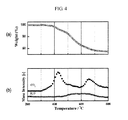
- FIG. 4 is a TGA-MS thermogram of an HPI-PI (10:0) precursor membrane
- FIG. 5 is a TGA-MS thermogram of an HPI-PI (5:5) precursor membrane
- FIG. 6 is a TGA-MS thermogram of an HPI-PI (0:10) precursor membrane
- FIG. 7 is UV/VIS spectra of HPI-PI precursor membranes according to various copolymerization ratios
- FIG. 8 is UV/VIS spectra of PBO-PI copolymer membranes prepared at various copolymerization ratios
- FIG. 9 is X-ray diffraction patterns of HPI-PI precursor membranes prepared at various copolymerization ratios
- FIG. 10 is X-ray diffraction patterns of PBO-PI copolymer membranes prepared at various copolymerization ratios
- FIG. 11 is N 2 adsorption/desorption isotherms of PBO-PI copolymer membranes prepared at various copolymerization ratios
- FIG. 12 is a graph showing a diffusion coefficient of PBO-PI copolymer membranes for O 2 , CO 2 , N 2 and CH 4 as single gases;
- FIG. 13 is a graph showing O 2 /N 2 permselectivity of the PBO-PI copolymer membrane and common polymers as a function of O 2 permeability
- FIG. 14 is a graph showing CO 2 /CH 4 permselectivity of the PBO-PI copolymer membrane and common polymers as a function of CO 2 permeability.
- the present invention is directed to a polyimide-polybenzoxazole copolymer (hereinafter, referred to as a ‘PBO-PI copolymer’) having repeating units represented by Formula 1 below:
- Ar 1 , Ar 1 ′ and Ar 3 ′ are each independently a bivalent C 5 -C 24 arylene group or a bivalent C 5 -C 24 heterocyclic ring which is substituted or unsubstituted with at least one substituent selected from the group consisting of C 1 -C 10 alkyl, C 1 -C 10 alkoxy, C 1 -C 10 haloalkyl and C 1 -C 10 haloalkoxy, or two or more of which are fused together to form a condensation ring, or covalently bonded to each other via a functional group selected from the group consisting of O, S, C( ⁇ O), CH(OH), S( ⁇ O) 2 , Si(CH 3 ) 2 , (CH 2 ) p (in which 1 ⁇ p ⁇ 10), (CF 2 ) q , (in which 1 ⁇ q ⁇ 10), C(CH 3 ) 2 , C(CF 3 ) 2 and C( ⁇ O)NH;
- Ar 2 and Ar 3 are identical or different, are each independently a trivalent C 5 -C 24 arylene group or a trivalent C 5 -C 24 heterocyclic ring which is substituted or unsubstituted with at least one substituent selected from the group consisting of C 1 -C 10 alkyl, C 1 -C 10 alkoxy, C 1 -C 10 haloalkyl and C 1 -C 10 haloalkoxy, or two or more of which are fused together to form a condensation ring, or covalently bonded to each other via a functional group selected from the group consisting of O, S, C( ⁇ O), CH(OH), S( ⁇ O) 2 , Si(CH 3 ) 2 , (CH 2 ) p (in which 1 ⁇ p ⁇ 10), (CF 2 ) q (in which 1 ⁇ q ⁇ 10), C(CH 3 ) 2 , C(CF 3 ) 2 and C( ⁇ O)NH;
- Q is O, S, C( ⁇ O), CH(OH), S( ⁇ O) 2 , Si(CH 3 ) 2 , (CH 2 ) p (in which 1 ⁇ p ⁇ 10), (CF 2 ) q (in which 1 ⁇ q ⁇ 10), C(CH 3 ) 2 , C(CF 3 ) 2 , C( ⁇ O)NH, C(CH 3 )(CF 3 ), or C 1 -C 6 alkyl-substituted phenyl or C 1 -C 6 haloalkyl-substituted phenyl in which Q is linked to opposite both phenyl rings in the position of m-m, m-p, p-m or p-p;
- n is an integer of 10 to 400.
- n is an integer of 10 to 400.
- Ar 1 , Ar 2 , Ar 2 ′, Ar 3 , and Ar 3 ′ may be the same arylene group or heterocyclic ring.
- Ar 1 , Ar 2 ′ and Ar 3 ′ are selected from the following compounds and the linkage position thereof includes all of o-, m- and p-positions.
- X is O, S, C( ⁇ O), CH(OH), S( ⁇ O) 2 , Si(CH 3 ) 2 , (CH 2 ) p (in which 1 ⁇ p ⁇ 10), (CF 2 ) q (in which 1 ⁇ q ⁇ 10), C(CH 3 ) 2 , C(CF 3 ) 2 , or C( ⁇ O)NH;
- Y is O, S or C( ⁇ O); and
- Z 1 , Z 2 and Z 3 are identical or different and are O, N or S.
- Ar 1 , Ar 2 ′ and Ar 3 ′ are selected from the following compounds:
- Ar 2 and Ar 3 are selected from the following compounds and the linkage position thereof includes all of o-, m- and p-positions.
- X is O, S, C( ⁇ O), CH(OH), S( ⁇ O) 2 , Si(CH 3 ) 2 , (CH 2 ) p (in which 1 ⁇ p ⁇ 10), (CF 2 ) q (in which 1 ⁇ q ⁇ 10), C(CH 3 ) 2 , C(CF 3 ) 2 , or C( ⁇ O)NH;
- Y is O, S or C( ⁇ O); and
- Z 1 , Z 2 and Z 3 are identical or different and are O, N or S.
- Ar 2 and Ar 3 are selected from the following compounds.
- Q is C(CH 3 ) 2 , C(CF 3 ) 2 , C( ⁇ O)NH, C(CH 3 )(CF 3 )
- Ar 1 is
- Ar 2 ′ and Ar 3 ′ are
- the physical properties of the PBO-PI copolymer represented by Formula 1 can be controlled by controlling a copolymerization ratio of PBO to PI blocks.
- the copolymerization ratio of PBO to PI (n:m) is adjusted to 1:9 to 9:1, more preferably, 2:8 to 8:2, most preferably, 3:7 to 7:3.
- This copolymerization ratio affects the morphology of the membrane for gas separation applications, as illustrated in the following. This morphological change is closely related to gas permeability and gas selectivity. For this reason, control over the copolymerization ratio is considerably important.
- the PBO-PI copolymer has a density of 1.10 to 1.37 g/cm 3 , a fractional free volume (FFV) of 0.10 to 0.30, and a d-spacing of 0.55 to 0.70 nm.
- FFV fractional free volume
- the present invention is directed to a method for preparing a polyimide-polybenzoxazole copolymer of Formula 1 by thermally treating a polyimide-poly(hydroxyimide) copolymer of Formula 2, as depicted in Reaction Scheme 1 below:
- Ar 1 , Ar 2 , Ar 2 ′, Ar 3 , Ar 3 ′, Q, m and n are defined as above.
- the poly(hydroxyimide)-polyimide copolymer (hereinafter, referred to as an ‘HPI-PI’) 2 as the precursor is converted into the PBO-PI copolymer 1 by thermal treatment.
- the conversion from the HPI-PI copolymer 2 to the PBO-PI copolymer 1 is carried out by removing CO 2 present in the poly(hydroxyimide).
- the PBO-PI copolymer 1 undergoes morphological change including reduced density, considerably increased fractional free volume (FFV) due to increased microcavity size and increased d-spacing, as compared to the precursor 2.
- FMV fractional free volume
- the PBO-PI copolymer 1 exhibits considerably high gas permeability, as compared to the precursor 2.
- Such a morphological property can be readily controlled by the design taking into consideration the characteristics (e.g., steric hindrance) of the functional groups, Ar 1 , Ar 2 , Ar 2 ′, Ar 3 , Ar 3 ′ and Q, present in the molecular structure and permeability and selectivity to various types of gases can thus be controlled.
- characteristics e.g., steric hindrance
- the thermal treatment is carried out at 150 to 500° C., preferably 350 to 450° C. for 5 minutes to 12 hours, preferably for 10 minutes to 2 hours under an inert atmosphere.
- the thermal treatment temperature is less than the level as defined the above, the thermal rearrangement is incomplete, thus remaining unreacted precursors, causing deterioration of purity.
- Increasing the thermal treatment temperature above the level defined above provides no particular advantage, thus being economically impractical. Accordingly, the thermal treatment is properly carried out within the temperature range as defined above.
- reaction conditions are properly designed by depending on Ar 1 , Ar 2 , Ar 2 ′, Ar 3 , Ar 3 ′ and Q, the functional groups of the precursor and specific conditions can be adequately selected and modified by those skilled in the art.
- the PBO-PI copolymer 1 is designed in the preparation process such that it has a desired molecular weight.
- the weight average molecular weight of the PBO-PI copolymer 1 is adjusted to 10,000 to 50,000 Da.
- the weight average molecular weight is less than 10,000 Da, physical properties of the copolymer are poor.
- the weight average molecular weight exceeds 50,000 Da, the copolymer is poorly soluble in the solvent, thus making it difficult to cast the polymeric membrane.
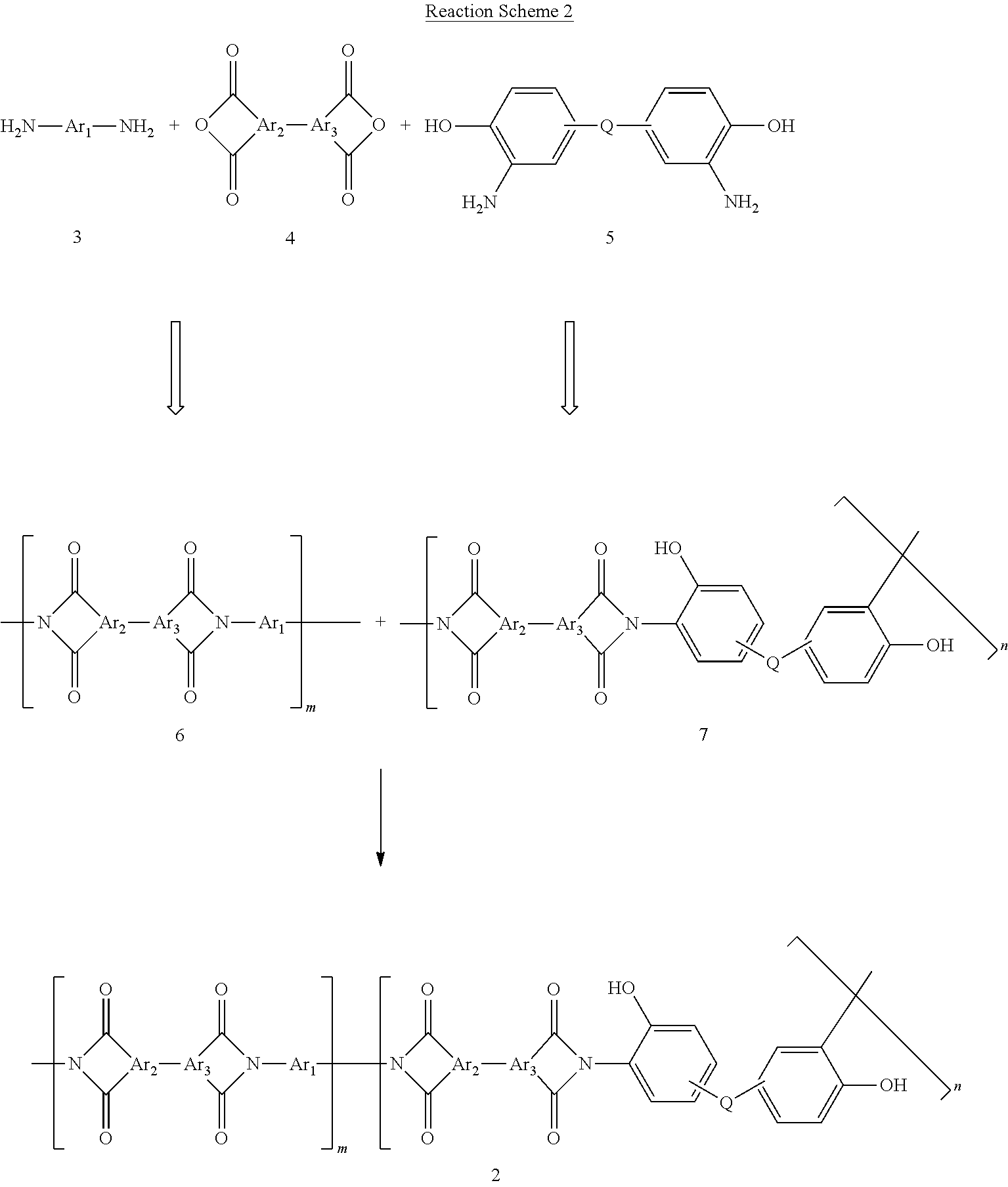
- the polyimide-poly(hydroxyimide) copolymer of Formula 2 is prepared by reacting the compounds of Formulae 3, 4 and 5 as monomers with one another, to prepare polyimide of Formula 6 and poly(hydroxyimide) of Formula 7, and copolymerizing the polyimide of Formula 6 with the poly(hydroxyimide) of Formula 7.
- Ar 1 , Ar 2 , Ar 3 , Q, m and n are defined as above.
- a diamine compound 3 and a hydroxy diamine compound 5 as monomers are reacted with an anhydride compound 4 to prepare polyimide 6 and poly(hydroxyimide) 7.
- the polyimide 6 is copolymerized with the poly(hydroxyimide) 7 to prepare an HPI-PI copolymer 2 as a precursor.
- the polymerization and copolymerization are carried out through a two-step process employing two reactors, or a one-step process employing controlled reaction conditions in one reactor.
- the polymerization and copolymerization are carried out at 0 to 80° C. for 30 minutes to 12 hours and reaction conditions may be properly controlled by those skilled in the art, depending on the type of the functional groups, i.e., Ar 1 , Ar 2 , Ar 2 ′, Ar 3 , Ar 3 ′ and Q.
- the level of copolymerization can be adequately controlled depending on the molar ratio of respective monomers used.
- the PBO-PI copolymer of Formula 8 is prepared through the process, as depicted in Reaction Scheme 3 below:
- 4,4′-oxydianiline (ODA) of Formula 9 is reacted with 3,3′,4,4′-biphenyltetracarboxylic dianhydride (BPDA) of Formula 10 to polymerize polyimide (PI) of Formula 12, and 2,2′-bis(3-amino-4-hydroxy-phenyl)hexafluoropropane (APAF) of Formula 11 is reacted with 3,3′,4,4′-biphenyltetracarboxylic dianhydride (BPDA) of Formula 10 to polymerize poly(hydroxyimide)(HPI) of Formula 13.
- ODA 4,4′-oxydianiline
- BPDA 3,3′,4,4′-biphenyltetracarboxylic dianhydride
- APAF 2,2′-bis(3-amino-4-hydroxy-phenyl)hexafluoropropane
- BPDA 3,3′,4,4′-biphenyltetracarboxylic dian
- polymers of Formulae 12 and 13 are copolymerized to prepare a poly(hydroxyimide)-polyimide copolymer (HPI-PI) precursor of Formula 14, and the precursor 14 is thermally treated to prepare a PBO-PI copolymer of Formula 8.
- HPI-PI poly(hydroxyimide)-polyimide copolymer
- the present invention is directed to a gas separation membrane comprising the polyimide-polybenzoxazole copolymer of Formula 1 below:
- Ar 1 , Ar 2 , Ar 2 ′, Ar 3 , Ar 3 ′, Q, m and n are defined as above.
- the PBO-PI copolymer contains a plurality of aromatic rings in the molecular structure thereof. For this reason, the PBO-PI copolymer has a structure in which copolymer chains are packed such that they are spaced from one another by a predetermined distance and has a rigid-rod structure due to its limited mobility.
- the gas separation membrane prepared from the copolymer can endure not only mild conditions, but also harsh conditions, e.g., long operation time, acidic conditions and high humidity.
- the PBO-PI copolymer has a specific surface area of over 0.1 and under 480 m 2 /g, a total pore volume of 0.0004 to 0.25 m 3 and a pore size of 21 to 40 ⁇ .
- the PBO-PI copolymer exhibits excellent permeability of CO 2 , O 2 , N 2 and CH 4 and superior selectivity for mixed gas pair of O 2 /N 2 , CO 2 /CH 4 , CO 2 /N 2 and N 2 /CH 4 .
- the PBO-PI copolymer membrane has well-connected microcavities and shows linear increases in volume, FFV and d-spacing with an increase of the copolymerization ratio of PBO present therein.
- the PBO-PI copolymer membrane surpasses the upper bound line of common polymers for gas separation membrane applications.
- the present invention is directed to a method for preparing a gas separation membrane comprising the PBO-PI copolymer of Formula 1, by casting the HPI-PI copolymer of Formula 2, followed by thermal treatment.
- Ar 1 , Ar 2 , Ar 2 ′, Ar 3 , Ar 3 ′, Q, m and n are defined as above.
- Ar 1 , Ar 2 , Ar 3 , Q, m and n are defined as above.
- HPI-PI copolymer precursor of Formula 2 is prepared as a solution, is coated or cast into films or fibers (in particular, hollow fibers), and is then subjected to thermal treatment to prepare the gas separation membrane comprising the PBO-PI copolymer of Formula 1.
- the gas separation membrane has advantages in that the gas separation membrane can be directly prepared from the precursor without using any additional dissolving process to prepare the separation membrane and can thus be readily prepared in various forms. Another advantage of the gas separation membrane is that physical properties can be controlled by addition of other additives, if necessary.
- a polyimide-polybenzoxazole (PBO-PI) copolymer represented by Formula 8 was prepared in the manner as depicted in Reaction Scheme 3 above.
- the mixture solution was allowed to react at 25° C. for 3 hours to polymerize polyimide (PI) and polyhydroxyimide (HPI) and was then further allowed to react at 250° C. for 24 hours to prepare a poly(hydroxyimide)-polyimide (HPI-PI) copolymer precursor.
- PI polyimide
- HPI polyhydroxyimide
- HPI-PI poly(hydroxyimide)-polyimide copolymer
- PBO-PI polyimide-polybenzoxazole copolymer
- HPI-PI precursor membrane and a PBO-PI copolymer membrane were prepared in the same manner as in Example 1 except that a molar ratio of ODA to APAF was controlled such that a copolymerization ratio of PBO to PI was adjusted to 2:8, to obtain the HPI-PI (2:8) precursor membrane and the PBO-PI (2:8) copolymer membrane.
- HPI-PI precursor membrane and a PBO-PI copolymer membrane were prepared in the same manner as in Example 1 except that a molar ratio of ODA to APAF was controlled such that a copolymerization ratio of PBO to PI was adjusted to 8:2, to obtain the HPI-PI (8:2) precursor membrane and the PBO-PI (8:2) copolymer membrane.
- a polyimide membrane with a ratio of PBO to PI of 0:10 was prepared in the same manner as in Example 1 except that only ODA was used as the diamine monomer.
- a polybenzoxazole membrane with a ratio of PBO to PI of 10:0 was prepared in the same manner as in Example 1 except that only APAF was used as the diamine monomer.
- the membranes were prepared as set forth in Table 1 below in accordance with the methods disclosed in the Examples and Comparative Examples. For these membranes, component analysis, physical properties and gas permeability were characterized.
- ATR-FTIR spectra were obtained using an Infrared Microspectrometer (IlluminatIR, SensIR Technologies, Danbury, Conn., USA).
- FIG. 1 is FT-IR spectra of HPI-PI precursor membranes prepared at various copolymerization ratios.
- FIG. 2 is FT-IR spectra of PBO-PI copolymer membranes prepared at various copolymerization ratios.
- imide peaks were observed at 1,778 cm ⁇ 1 ( ⁇ (C ⁇ O), in-phase, imide) and 1,705 cm ⁇ 1 ( ⁇ (C ⁇ O), out-of-phase, imide).
- C—H vibrations, out of the plane of the aromatic ring, from APAF functional group were observed at 986 cm ⁇ 1 and 963 cm ⁇ 1 corresponding to typical 1,2,4-tri substituted aromatic ring structure in the case of HPI-PI (10:0) and HPI-PI (5:5).
- characteristic benzoxazole peaks are observed at 1,550, 1,480 and 1,054 cm ⁇ 1 .
- the difference in C—H stretching bands due to the change in molar ratio of ODA and APAF was observed from the disappearance of stretching bands at 1,498 and 1,367 cm ⁇ 1 from ODA and appearance of the band at 1,474 cm ⁇ 1 from APAF.
- TGA-MS thermogravimetric analysis/mass spectroscopy
- FIG. 3 is a TGA thermogram of HPI-PI precursor membranes produced at various copolymerization ratios.
- the precursor membrane began to decompose at a thermal conversion temperature of 350 to 500° C.
- the decomposition product was subjected to MS to confirm the presence of CO 2 .
- FIGS. 4 to 6 are TGA-MS thermograms of HPI-PI precursor membranes prepared at various copolymerization ratios. Specifically, FIG. 4 is a TGA-MS thermogram of an HPI-PI (10:0) precursor membrane, FIG. 5 is a TGA-MS thermogram of an HPI-PI (5:5) precursor membrane, and FIG. 6 is a TGA-MS thermogram of an HPI-PI (0:10) precursor membrane.
- UV-VIS Ultraviolet-Visible
- the precursor and polymer membranes as set forth in Table 1 were subjected to UV-VIS spectroscopy using an S-3100 (Seoul, Korea) diode array type spectrophotometer to obtain UV-VIS spectra. At this time, UV irradiation was carried out using a mercury lamp without using any filter. The sample was allowed to cool in air during the UV irradiation.
- FIG. 7 is UV/VIS spectra of HPI-PI precursor membranes prepared at various copolymerization ratios.
- FIG. 8 is UV/VIS spectra of PBO-PI copolymer membranes prepared at various copolymerization ratios.
- the precursor and copolymer membranes absorb intense visible light due to their conjugated aromatic structure and intramolecular or intermolecular charge-transfer complexes (CTCs) created between or within the polymer chains, thus rendering polymer colors from pale yellow to dark brown.
- CTCs intramolecular or intermolecular charge-transfer complexes
- the precursor and polymer membranes as set forth in Table 1 above were subjected to X-ray diffraction using a wide angle X-ray diffractometer (D/MAX-2500, Rigaku, Japan) operating with a scanning rate 5°/min at 28 of 5 to 60°, to obtain X-ray diffraction patterns.
- D/MAX-2500 wide angle X-ray diffractometer
- FIG. 9 is X-ray diffraction patterns of HPI-PI precursor membranes prepared at various copolymerization ratios.
- FIG. 10 is X-ray diffraction patterns of PBO-PI copolymer membranes prepared at various copolymerization ratios.
- the precursor and copolymer membranes are amorphous, and as the APAF content increases, the peak center of 2 ⁇ shifts to lower values. In the case where the precursor and copolymer membranes are copolymerized in the same amount, 2 ⁇ of the copolymer membrane shifts to lower values.
- This shift behavior means that thermal conversion of HPI results in rearrangement of PBO molecules, causing an increase in d-spacing between the PBO molecules.
- the increase in d-spacing is attributed to the fact that bulky groups such as hexafluoroisopropylidene linkages present in APAF diamine affect this morphological change because of reduced intra- and interpolymeric chain interactions, resulting in loose polymer chain packaging and aggregates.
- V is the polymer specific volume and V W is the specific Van der Waals volume.
- the Van der Waals volume was estimated by a Cerius 4.2 program using a synthia module based on the work of J. Bicerano [J. Bicerano. Prediction of polymer properties, Third Edition. Marcel Dekker Inc. 2002].
- the d-spacing was calculated in accordance with Bragg's equation from X-ray diffraction pattern results of Experimental Example 4.
- FFV of PBO-PI (10:0) was two or more times higher than that of HPI-PI (10:0) due to the decrease in density of the PBO-PI series after thermal treatment.
- HPI-PI (0:10) and PBO-PI (0:10) do not show any significant difference in physical properties before and after the thermal treatment, because there is no space in which rearrangement of polymer structures induced by heterocyclic ring modification occurs.
- the PBO-PI (5:5) copolymer membrane according to the present invention has an FFV of 0.1559 and a d-spacing of 0.6447 nm.
- the FFV and d-spacing of the PBO-PI (5:5) copolymer membrane are in the range from those of PBO-PI (0:10) (i.e., PBO homopolymer) to those of PBO-PI (10:0) (i.e., PI homopolymer), and affect permeability and selectivity of the gas separation membrane.
- FIG. 11 is N 2 adsorption/desorption isotherms of PBO-PI copolymer membranes prepared at various copolymerization ratios.
- the pore volume of PBO-PI copolymer membranes was measured using a specific surface area and pore analyzer (ASAP2020, Micromeritics, Ga., USA). At this time, the copolymer membranes were transferred to pre-weighed analytic tubes which were capped with TransealTM to prevent permeation of oxygen and atmospheric moisture during transfers and weighing. The copolymer membranes were evacuated under dynamic vacuum up to 300° C. until an outgas rate was less than 2 mTorr/min. The results are shown in Table 3 below.
- the specific surface area and pore volume of the PBO-PI copolymer membranes were gradually increased from 0.1 to 480 m 2 /g and from 0.004 to 0.25 m 3 , respectively, as the amount of PBO present in the PBO-PI copolymer membrane increases. These values are higher than those of common polymers for separation membrane material applications, and comparable to conventional adsorbents such as activated carbon, zeolites and microporous alumina.
- the PBO-PI (10:0) i.e., PBO homopolymer
- PBO-PI (8:2), PBO-PI (5:5) and BO-PI (4:8) membranes have a large specific surface area and a small pore size, as compared to PBO-PI (8:2), PBO-PI (5:5) and BO-PI (4:8) membranes.
- the gas permeability of single gases such as CO 2 , O 2 , N 2 and CH 4 was measured by a time-lag method, which was carried out at various temperatures under a pressure of 760 Torr. Permselectivity of gas pair such as O 2 /N 2 and CO 2 /N 2 was calculated from the ratio of single gas permeability. The results are shown in FIG. 12 and Table 4.
- FIG. 12 is a graph showing a diffusion coefficient of PBO-PI copolymer membranes for O 2 , CO 2 , N 2 and CH 4 as single gases.
- FIG. 13 is a graph showing O 2 /N 2 permselectivity of the PBO-PI copolymer membrane and conventional polymers as a function of O 2 permeability.
- FIG. 14 is a graph showing CO 2 /CH 4 permselectivity of the PBO-PI copolymer membrane and conventional polymers as a function of CO 2 permeability.
- PET indicates poly(ethylene terephthalate)
- PSf indicates polysulfone
- CA indicates cellulose acetate
- PC indicates polycarbonate
- PS indicates polystyrene
- PPO indicates poly(phenylene oxide)
- PTMSP indicates poly(1-trimethylsilyl-1-propyne)
- PA indicates polyamide
- PI indicates polyimide
- PMP indicates poly(4-methyl-2-pentyne)
- PDMS indicates polydimethylsiloxane.
- the PBO-PI copolymer membrane according to the present invention has well-connected microcavities, which are linearly increased, as the amount of PBO present in the copolymer increases.
- PTMSP shows still higher O 2 and CO 2 permeability, it does not surpass the upper bound line owing to low gas selectivity.
- selectivity for important gas pair e.g., O 2 /N 2 and CO 2 /CH 4
- selectivity for important gas pair is much higher than that of PTMSP.
- the PBO-PI copolymer according to the present invention can readily rendered into gas separation membranes in various forms including flat-sheets, hollow fibers and organic-inorganic complexes from highly soluble precursors.
- the gas separation membrane thus prepared can endure harsh conditions such as long operation time, acidic conditions and high humidity due to the rigid polymer backbone thereof.
Landscapes
- Chemical & Material Sciences (AREA)
- Chemical Kinetics & Catalysis (AREA)
- Health & Medical Sciences (AREA)
- Medicinal Chemistry (AREA)
- Polymers & Plastics (AREA)
- Organic Chemistry (AREA)
- Engineering & Computer Science (AREA)
- Analytical Chemistry (AREA)
- General Chemical & Material Sciences (AREA)
- Oil, Petroleum & Natural Gas (AREA)
- Manufacturing & Machinery (AREA)
- Materials Engineering (AREA)
- Macromolecular Compounds Obtained By Forming Nitrogen-Containing Linkages In General (AREA)
- Separation Using Semi-Permeable Membranes (AREA)
Abstract
Description


Ar2′ and Ar3′ are

Ar2 and Ar3 are

and Q is C(CF3)2.


| TABLE 1 | |||
| Precursor | |||
| membranes | Polymer membranes | ||
| HPI:PI (0:10) | PBO-PI (0:10) | ||
| HPI:PI (2:8) | PBO-PI (2:8) | ||
| HPI:PI (5:5) | PBO-PI (5:5) | ||
| HPI:PI (8:2) | PBO-PI (8:2) | ||
| HPI:PI (10:0) | PBO-PI (10:0) | ||
| TABLE 2 | |||||
| Volume | |||||
| Type | Vw (cm3/g) | Density (g/cm3) | (V, cm3/g) | FFV (Vf) | d-spacing (nm) |
| HPI-PI(0:10) | 0.4979 | 1.3961 | 0.7163 | 0.0964 | 0.5419 |
| HPI-PI(5:5) | 0.4739 | 1.4200 | 0.7042 | 0.1251 | 0.5981 |
| HPI-PI(10:0) | 0.4563 | 1.4418 | 0.6936 | 0.1448 | 0.6155 |
| PBO-PI(0:10) | 0.4979 | 1.3873 | 0.7208 | 0.1020 | 0.5411 |
| PBO-PI(5:5) | 0.4799 | 1.3530 | 0.7391 | 0.1559 | 0.6447 |
| PBO-PI(10:0) | 0.4645 | 1.1267 | 0.8875 | 0.3196 | 0.7180 |
| TABLE 3 | ||||||
| PBO-PI | PBO-PI | PBO-PI | PBO-PI | PBO-PI | ||
| (10:0) | (8:2) | (5:5) | (2:8) | (0:10) | ||
| Specific surface area | 480 | 304 | 38 | 4 | 0.1 |
| (m2/g)(P/Po = 0.2) | |||||
| Pore volume | 0.25 | 0.18 | 0.02 | 0.004 | — |
| (m3) (P/Po = 0.97) | |||||
| Pore size (Å) | 20.87 | 22.98 | 22.78 | 37.81 | — |
| TABLE 4 | ||||||
| PBO-PI | PBO-PI | PBO-PI | ||||
| (10:0) | PBO-PI (2:8) | (5:5) | (8:2) | PBO-PI (0:10) | ||
| Permeability [Barrer] |
| CO2 | 0.69 | 11.41 | 251.87 | 388.90 | 1295.75 |
| O2 | 0.17 | 2.24 | 12.47 | 106.58 | 515.61 |
| N2 | 0.03 | 0.40 | 2.52 | 25.34 | 82.66 |
| CH4 | 0.02 | 0.30 | 1.81 | 20.08 | 33.52 |
| Permselectivity |
| O2/N2 | 5.4 | 5.7 | 4.9 | 4.2 | 6.2 |
| CO2/CH4 | 32.4 | 38.2 | 28.6 | 19.4 | 38.7 |
Claims (38)




Applications Claiming Priority (3)
| Application Number | Priority Date | Filing Date | Title |
|---|---|---|---|
| KR1020080018327A KR100932765B1 (en) | 2008-02-28 | 2008-02-28 | Polyimide-polybenzoxazole copolymer, preparation method thereof, and gas separation membrane comprising the same |
| KR10-2008-0018327 | 2008-02-28 | ||
| PCT/KR2008/001282 WO2009107889A1 (en) | 2008-02-28 | 2008-03-06 | Polyimide-co-polybenzoxazole copolymer, preparation method thereof, and gas separation membrane comprising the same |
Publications (2)
| Publication Number | Publication Date |
|---|---|
| US20110065823A1 US20110065823A1 (en) | 2011-03-17 |
| US8821617B2 true US8821617B2 (en) | 2014-09-02 |
Family
ID=41016254
Family Applications (1)
| Application Number | Title | Priority Date | Filing Date |
|---|---|---|---|
| US12/920,268 Expired - Fee Related US8821617B2 (en) | 2008-02-28 | 2008-03-06 | Polyimide-co-polybenzoxazole copolymer, preparation method thereof, and gas separation membrane comprising the same |
Country Status (5)
| Country | Link |
|---|---|
| US (1) | US8821617B2 (en) |
| KR (1) | KR100932765B1 (en) |
| CA (1) | CA2717037C (en) |
| RU (1) | RU2468040C2 (en) |
| WO (1) | WO2009107889A1 (en) |
Families Citing this family (23)
| Publication number | Priority date | Publication date | Assignee | Title |
|---|---|---|---|---|
| KR100932765B1 (en) | 2008-02-28 | 2009-12-21 | 한양대학교 산학협력단 | Polyimide-polybenzoxazole copolymer, preparation method thereof, and gas separation membrane comprising the same |
| CA2640517A1 (en) | 2008-05-19 | 2009-11-19 | Industry-University Cooperation Foundation, Hanyang University | Polyamic acids dope composition, preparation method of hollow fiber using the same and hollow fiber prepared therefrom |
| US8013103B2 (en) | 2008-10-10 | 2011-09-06 | Industry-University Cooperation Foundation, Hanyang University | Polymer compounds and a preparation method thereof |
| US8487064B2 (en) | 2008-10-10 | 2013-07-16 | Industry-University Cooperation Foundation, Hanyang University | Polymer compounds and a preparation method thereof |
| WO2012148360A1 (en) * | 2011-04-29 | 2012-11-01 | National University Of Singapore | Cardo-polybenzoxazole polymer/copolymer membranes for improved permeability and method for fabricating the same |
| KR101466918B1 (en) * | 2013-07-01 | 2014-12-04 | 한양대학교 산학협력단 | Membranes for flue gas separation comprising crosslinked thermally rearranged poly(benzoxazole-co-imide) and preparation method thereof |
| KR101571393B1 (en) | 2013-09-26 | 2015-11-24 | 한양대학교 산학협력단 | Thermally rearranged poly(benzoxazole-co-imide) separation membrane for membrane distillation and preparation method thereof |
| WO2015046774A1 (en) * | 2013-09-26 | 2015-04-02 | 한양대학교 산학협력단 | Thermally rearranged poly(benzoxazole-imide) copolymer separation membrane for membrane distillation and preparation method therefor |
| CN105848768B (en) * | 2013-11-15 | 2019-02-15 | 汉阳大学校产学协力团 | Membrane for flue gas separation comprising crosslinked, thermally rearranged poly(benzo*azole-co-imide) and method of making the same |
| US11130320B2 (en) * | 2014-07-11 | 2021-09-28 | Samsung Electronics Co., Ltd. | Transparent polymer film and electronic device including the same |
| KR102470600B1 (en) * | 2014-07-11 | 2022-11-24 | 삼성전자주식회사 | Transparent polymer film and electronic device including the same |
| WO2016164563A1 (en) * | 2015-04-07 | 2016-10-13 | Bruce Rittmann | Systems and methods of atmospheric carbon dioxide enrichment and delivery to photobioreactors via membrane carbonation |
| KR102251516B1 (en) | 2015-06-30 | 2021-05-12 | 코오롱인더스트리 주식회사 | Polyimide-polybenzoxazole precursor solution, polyimide-polybenzoxazole films, and process for producing thereof |
| CN105418921B (en) * | 2015-12-01 | 2017-06-16 | 吉林大学 | A kind of highly sulfonated crosslinkable polyimide, preparation method and its application in terms of PEM |
| KR101979690B1 (en) | 2016-07-19 | 2019-05-17 | 한양대학교 산학협력단 | Fluorinated crosslinked thermally rearranged gas separation membrane and preparation method thereof |
| KR20180065185A (en) | 2016-12-07 | 2018-06-18 | 한국과학기술연구원 | Self-healing polysilsesquioxanes and hybrid film using the same |
| KR102129316B1 (en) * | 2018-02-12 | 2020-07-02 | 한국기계연구원 | Organic-inorganic hybrid composite and method of manufacturing the same |
| US10870090B2 (en) | 2018-04-27 | 2020-12-22 | Incheon University Industry Academic Cooperation Foundation | Block copolymer, carbon dioxide gas separation membrane and method for manufacturing the same |
| KR102110450B1 (en) * | 2018-04-27 | 2020-05-14 | 인천대학교 산학협력단 | The block copolymer, carbon dioxide gas separation membrane and method for manufacturing the same |
| KR20180098198A (en) | 2018-08-23 | 2018-09-03 | 한국과학기술연구원 | Self-healing polysilsesquioxanes and hybrid film using the same |
| KR102115976B1 (en) | 2019-06-03 | 2020-05-27 | 한국과학기술연구원 | Self-healing polysilsesquioxanes and hybrid film using the same |
| CN112439319B (en) * | 2020-11-16 | 2022-10-14 | 中蓝晨光化工有限公司 | Solvent-resistant PBO nanofiltration membrane and preparation method thereof |
| CN120865676B (en) * | 2025-09-24 | 2025-12-16 | 华北电力大学(保定) | Modified PBO fiber reinforced epoxy resin composite material and preparation method and application thereof |
Citations (66)
| Publication number | Priority date | Publication date | Assignee | Title |
|---|---|---|---|---|
| US3899307A (en) | 1970-11-10 | 1975-08-12 | Dresser Ind | Resin bonded diamond wheels with copper and silicon carbide fillers |
| US3899309A (en) | 1972-07-20 | 1975-08-12 | Du Pont | Aromatic polyimide, polyester and polyamide separation membranes |
| US4820793A (en) | 1986-05-30 | 1989-04-11 | Central Glass Company, Limited | Method of preparing aromatic polyamides and polybenzoxazoles |
| JPH01159024A (en) | 1987-12-16 | 1989-06-22 | Central Glass Co Ltd | Gas separation membrane |
| US4931182A (en) | 1989-11-08 | 1990-06-05 | Air Products And Chemicals, Inc. | Membranes formed from unsaturated polyimides |
| US4978733A (en) | 1989-03-09 | 1990-12-18 | Hoechst Celanese Corp. | Polyamide-polyamide-polyimide and polybenzoxazole-polyamide-polyimide polymer having at least one fluorine-containing linking group |
| US4980447A (en) | 1989-03-09 | 1990-12-25 | Hoechst Celanese Corp. | Polyamide-polyimide and polybenzoxazole-polyimide polymer |
| US4981940A (en) | 1988-11-21 | 1991-01-01 | Chisso Corporation | Polyamide having a low elastic modulus and a process for producing the same |
| US5034026A (en) | 1990-04-20 | 1991-07-23 | The Dow Chemical Company | Polybenzazole polymers containing indan moieties |
| WO1991016123A1 (en) | 1990-04-20 | 1991-10-31 | The Dow Chemical Company | Porous polybenzoxazole and polybenzothiazole membranes |
| US5071948A (en) | 1989-03-09 | 1991-12-10 | Hoechst Celanese Corporation | Polyamide-polyimide and polybenzoxazole-polyimide polymer |
| US5076816A (en) | 1989-08-14 | 1991-12-31 | Institut Francais Du Petrole | Gas separation membrane |
| US5173561A (en) | 1990-07-24 | 1992-12-22 | Daychem Laboratories, Inc. | Heat resistant polyimide-benzoxazole polymers and composites thereof |
| WO1993002858A1 (en) | 1991-08-01 | 1993-02-18 | Hoechst Celanese Corporation | Sixeftm-durene polyimide hollow fibers |
| US5202412A (en) * | 1990-10-02 | 1993-04-13 | E. I. Du Pont De Nemours And Company | Polyimide copolymer precursors |
| US5262056A (en) | 1992-11-30 | 1993-11-16 | Board Of Regents, The University Of Texas System | Polyamides and polypyrrolones for fluid separation membranes |
| US5525436A (en) | 1994-11-01 | 1996-06-11 | Case Western Reserve University | Proton conducting polymers used as membranes |
| JPH08229366A (en) | 1995-01-11 | 1996-09-10 | Korea Res Inst Chem Technol | Preparation of asymmetric separation membrane for separatingwater/organic solvent or gas |
| US5558936A (en) | 1991-08-01 | 1996-09-24 | Hoechst Celanese Corp | High selectivity hollow fibers |
| JPH08243367A (en) | 1995-03-13 | 1996-09-24 | Dainippon Ink & Chem Inc | Method for manufacturing polyimide composite film |
| JPH08290046A (en) | 1995-02-24 | 1996-11-05 | Dainippon Ink & Chem Inc | Polyimidazopyrrolone hollow fiber composite membrane and method for producing the same |
| JPH08299769A (en) | 1995-05-10 | 1996-11-19 | Nok Corp | Porous ceramic composite hollow fiber membrane and its production |
| CN1139021A (en) | 1995-03-14 | 1997-01-01 | 普拉塞尔技术有限公司 | Fluid separation membranes prepared from blends of polymide polymers |
| US5591250A (en) | 1993-08-09 | 1997-01-07 | Gas Research Institute | Material and process for separating carbon dioxide from methane |
| US5716727A (en) | 1996-04-01 | 1998-02-10 | Case Western Reserve University | Proton conducting polymers prepared by direct acid casting |
| US5723086A (en) | 1992-12-07 | 1998-03-03 | Fraunhofer-Gesellschaft Zur Forderung Der Angewandten Forschung E.V. | Electrode membrane |
| US5725769A (en) | 1995-07-18 | 1998-03-10 | Bend Research, Inc. | Solvent-resistant microporous polymide membranes |
| US5753008A (en) | 1995-07-12 | 1998-05-19 | Bend Research, Inc. | Solvent resistant hollow fiber vapor permeation membranes and modules |
| US5837032A (en) | 1991-01-30 | 1998-11-17 | The Cynara Company | Gas separations utilizing glassy polymer membranes at sub-ambient temperatures |
| US5919892A (en) | 1994-10-31 | 1999-07-06 | The Dow Chemical Company | Polyamic acids and methods to convert polyamic acids into polyimidebenzoxazole films |
| US5985969A (en) | 1995-04-24 | 1999-11-16 | The Dow Chemical Company | Polyamic acid precursors and methods for preparing higher molecular weight polyamic acids and polyimidebenzoxazole |
| US6204356B1 (en) | 1998-09-29 | 2001-03-20 | Sumitomo Bakelite Company Limited | Polybenzoxazole resin and precursor thereof |
| JP2001348428A (en) | 1999-12-22 | 2001-12-18 | Toray Ind Inc | Polyamic acid composition, soluble polyimide composition and polybenzoxazole-polyimide composition |
| US6383258B1 (en) | 2000-12-19 | 2002-05-07 | L'air Liquide Societe Anonyme Pour L'etude Et L'exploitation Des Procedes Georges Claude | Copolyimide gas separation membranes |
| JP2003024755A (en) | 2001-07-16 | 2003-01-28 | Ube Ind Ltd | Method for producing asymmetric hollow fiber gas separation membrane |
| US6548621B1 (en) | 2001-10-25 | 2003-04-15 | Industrial Technology Research Institute | Synthesis of poly (imide-benzoxazole) copolymer |
| US20030164090A1 (en) | 1999-09-24 | 2003-09-04 | Yong Ding | Novel polyimide amic acid salts and polyimide membranes formed therefrom |
| US20040229166A1 (en) | 2003-03-11 | 2004-11-18 | Arch Specialty Chemicals, Inc. | Novel photosensitive resin compositions |
| US20040229160A1 (en) | 2003-03-11 | 2004-11-18 | Arch Specialty Chemicals, Inc. | Novel photosensitive resin compositions |
| US20040229167A1 (en) | 2003-03-11 | 2004-11-18 | Arch Specialty Chemicals, Inc. | Novel photosensitive resin compositions |
| US20040249110A1 (en) | 2003-03-11 | 2004-12-09 | Arcr Specialty Chemicals, Inc. | Novel photosensitive resin compositions |
| US20040253542A1 (en) | 2003-06-05 | 2004-12-16 | Arch Specialty Chemicals, Inc. | Novel positive photosensitive resin compositions |
| US20040253537A1 (en) | 2003-06-06 | 2004-12-16 | Arch Specialty Chemicals, Inc. | Novel photosensitive resin compositions |
| US6890626B1 (en) * | 1999-11-10 | 2005-05-10 | Pi R&D Co., Ltd. | Imide-benzoxazole polycondensate and process for producing the same |
| US20050181297A1 (en) | 2003-10-15 | 2005-08-18 | Arch Specialty Chemicals, Inc. | Novel photosensitive resin compositions |
| US20050242021A1 (en) | 2002-04-16 | 2005-11-03 | Pall Corporation | Hollow fibres |
| US20060004180A1 (en) | 2002-10-16 | 2006-01-05 | Hiroshi Itatani | Solution compositions of block copolyimides comprising pyromellitic dianhydride and process for production thereof |
| US20060011063A1 (en) | 2004-07-16 | 2006-01-19 | Honeywell International Inc. | High temperature gas separation membrane suitable for OBIGGS applications |
| KR20060085845A (en) | 2005-01-25 | 2006-07-28 | 한양대학교 산학협력단 | Porous organic polymer, preparation method thereof and gas separation membrane using same |
| WO2006080766A1 (en) | 2005-01-25 | 2006-08-03 | Industry-University Cooperation Foundation, Hanyang University | Acid or base-doped proton conducting polymer, preparation method thereof, polymer membrane using the same and fuel cell using the same |
| US20060216641A1 (en) | 2005-03-25 | 2006-09-28 | Fujifilm Electronic Materials U.S.A., Inc. | Novel photosensitive resin compositions |
| US20060275699A1 (en) | 2005-06-03 | 2006-12-07 | Fujifilm Electronic Materials U.S.A., Inc. | Novel photosensitive resin compositions |
| WO2007007051A1 (en) | 2005-07-08 | 2007-01-18 | The University Of Bath | Hollow fibres |
| US20070099111A1 (en) | 2005-08-17 | 2007-05-03 | Naiini Ahmad A | Novel positive photosensitive polybenzoxazole precursor compositions |
| JP2007136453A (en) | 2005-10-21 | 2007-06-07 | Morimura Kosan Kk | Fibrous filter screen |
| JP2007167852A (en) | 2006-12-25 | 2007-07-05 | Ube Ind Ltd | Gas separation membrane and method of using the same |
| WO2008131907A1 (en) | 2007-04-30 | 2008-11-06 | Teijin Aramid B.V. | Polybenzazoles and polybenzazole precursors |
| US20090111050A1 (en) | 2007-10-16 | 2009-04-30 | Naiini Ahmad A | Novel Photosensitive Resin Compositions |
| US20090197067A1 (en) | 2008-02-04 | 2009-08-06 | Fujifilm Electronic Materials U.S.A., Inc. | Novel Positive Photosensitive Resin Compositions |
| WO2009107889A1 (en) | 2008-02-28 | 2009-09-03 | Industry-University Cooperation Foundation, Hanyang University | Polyimide-co-polybenzoxazole copolymer, preparation method thereof, and gas separation membrane comprising the same |
| WO2009113747A1 (en) | 2008-03-12 | 2009-09-17 | Industry-University Cooperation Foundation, Hanyang University | Preparation method of polybenzoxazoles by thermal rearrangement, polybenzoxazoles prepared thereby, and gas separation membrane comprising the same |
| US20090282982A1 (en) | 2008-05-19 | 2009-11-19 | Iucf-Hyu (Industry-University Cooperation Foundation Hanyang University) | Hollow fiber, dope composition for forming hollow fiber, and method of preparing hollow fiber using the same |
| US20090286078A1 (en) | 2008-05-19 | 2009-11-19 | Industry-University Cooperation Foundation, Hanyang University | Polyimides dope composition, preparation method of hollow fiber using the same and hollow fiber prepared therefrom |
| WO2009142434A2 (en) | 2008-05-19 | 2009-11-26 | 한양대학교 산학협력단 | Hollow fiber, dope solution composition for forming a hollow fiber, and method for manufacturing a hollow fiber using the same |
| US20100099804A1 (en) | 2008-10-10 | 2010-04-22 | Industry-University Cooperation Foundation, Hanyang University | Polymer compounds and a preparation method thereof |
| US7745516B2 (en) | 2005-10-12 | 2010-06-29 | E. I. Du Pont De Nemours And Company | Composition of polyimide and sterically-hindered hydrophobic epoxy |
Family Cites Families (10)
| Publication number | Priority date | Publication date | Assignee | Title |
|---|---|---|---|---|
| SU681865A1 (en) * | 1977-07-14 | 1995-12-27 | С.С. Новиков | Copolymides |
| JPS6071023A (en) * | 1983-09-29 | 1985-04-22 | Sumitomo Electric Ind Ltd | gas selective permeable membrane |
| JPH0693987B2 (en) * | 1989-02-23 | 1994-11-24 | 宇部興産株式会社 | Gas separation membrane and gas separation method |
| US5438105A (en) * | 1990-04-27 | 1995-08-01 | Toho Rayon Co., Ltd. | Polyamic acid composite, polyimide composite and processes for producing the same |
| JPH0656992A (en) * | 1992-08-05 | 1994-03-01 | Unitika Ltd | Polyimide film |
| JPH07179605A (en) * | 1993-06-18 | 1995-07-18 | Shin Etsu Chem Co Ltd | Polyimide and manufacturing method thereof |
| JP3168827B2 (en) * | 1994-05-20 | 2001-05-21 | 信越化学工業株式会社 | Polyimide copolymer and method for producing the same |
| JPH09122461A (en) * | 1995-10-31 | 1997-05-13 | Nitto Denko Corp | Polyimide semi-permeable membrane |
| JPH1085571A (en) * | 1996-07-26 | 1998-04-07 | Dainippon Ink & Chem Inc | Separation membrane |
| RU2102128C1 (en) * | 1996-10-22 | 1998-01-20 | Институт нефтехимического синтеза им.А.В.Топчиева РАН | Method of diaphragm separation of gaseous mixtures |
-
2008
- 2008-02-28 KR KR1020080018327A patent/KR100932765B1/en not_active Expired - Fee Related
- 2008-03-06 CA CA2717037A patent/CA2717037C/en not_active Expired - Fee Related
- 2008-03-06 RU RU2010139427/04A patent/RU2468040C2/en active
- 2008-03-06 WO PCT/KR2008/001282 patent/WO2009107889A1/en not_active Ceased
- 2008-03-06 US US12/920,268 patent/US8821617B2/en not_active Expired - Fee Related
Patent Citations (72)
| Publication number | Priority date | Publication date | Assignee | Title |
|---|---|---|---|---|
| US3899307A (en) | 1970-11-10 | 1975-08-12 | Dresser Ind | Resin bonded diamond wheels with copper and silicon carbide fillers |
| US3899309A (en) | 1972-07-20 | 1975-08-12 | Du Pont | Aromatic polyimide, polyester and polyamide separation membranes |
| US4820793A (en) | 1986-05-30 | 1989-04-11 | Central Glass Company, Limited | Method of preparing aromatic polyamides and polybenzoxazoles |
| JPH01159024A (en) | 1987-12-16 | 1989-06-22 | Central Glass Co Ltd | Gas separation membrane |
| US4981940A (en) | 1988-11-21 | 1991-01-01 | Chisso Corporation | Polyamide having a low elastic modulus and a process for producing the same |
| US5071948A (en) | 1989-03-09 | 1991-12-10 | Hoechst Celanese Corporation | Polyamide-polyimide and polybenzoxazole-polyimide polymer |
| US4980447A (en) | 1989-03-09 | 1990-12-25 | Hoechst Celanese Corp. | Polyamide-polyimide and polybenzoxazole-polyimide polymer |
| US4978733A (en) | 1989-03-09 | 1990-12-18 | Hoechst Celanese Corp. | Polyamide-polyamide-polyimide and polybenzoxazole-polyamide-polyimide polymer having at least one fluorine-containing linking group |
| US5076816A (en) | 1989-08-14 | 1991-12-31 | Institut Francais Du Petrole | Gas separation membrane |
| US4931182A (en) | 1989-11-08 | 1990-06-05 | Air Products And Chemicals, Inc. | Membranes formed from unsaturated polyimides |
| US5034026A (en) | 1990-04-20 | 1991-07-23 | The Dow Chemical Company | Polybenzazole polymers containing indan moieties |
| WO1991016123A1 (en) | 1990-04-20 | 1991-10-31 | The Dow Chemical Company | Porous polybenzoxazole and polybenzothiazole membranes |
| JPH05506054A (en) | 1990-04-20 | 1993-09-02 | 東洋紡績株式会社 | Polybenzazole polymers containing indane moieties |
| US5173561A (en) | 1990-07-24 | 1992-12-22 | Daychem Laboratories, Inc. | Heat resistant polyimide-benzoxazole polymers and composites thereof |
| US5202412A (en) * | 1990-10-02 | 1993-04-13 | E. I. Du Pont De Nemours And Company | Polyimide copolymer precursors |
| US5837032A (en) | 1991-01-30 | 1998-11-17 | The Cynara Company | Gas separations utilizing glassy polymer membranes at sub-ambient temperatures |
| WO1993002858A1 (en) | 1991-08-01 | 1993-02-18 | Hoechst Celanese Corporation | Sixeftm-durene polyimide hollow fibers |
| US5558936A (en) | 1991-08-01 | 1996-09-24 | Hoechst Celanese Corp | High selectivity hollow fibers |
| US5262056A (en) | 1992-11-30 | 1993-11-16 | Board Of Regents, The University Of Texas System | Polyamides and polypyrrolones for fluid separation membranes |
| US5723086A (en) | 1992-12-07 | 1998-03-03 | Fraunhofer-Gesellschaft Zur Forderung Der Angewandten Forschung E.V. | Electrode membrane |
| US5591250A (en) | 1993-08-09 | 1997-01-07 | Gas Research Institute | Material and process for separating carbon dioxide from methane |
| US5919892A (en) | 1994-10-31 | 1999-07-06 | The Dow Chemical Company | Polyamic acids and methods to convert polyamic acids into polyimidebenzoxazole films |
| US5525436A (en) | 1994-11-01 | 1996-06-11 | Case Western Reserve University | Proton conducting polymers used as membranes |
| JPH08229366A (en) | 1995-01-11 | 1996-09-10 | Korea Res Inst Chem Technol | Preparation of asymmetric separation membrane for separatingwater/organic solvent or gas |
| US5868975A (en) | 1995-01-11 | 1999-02-09 | Korea Research Institute Of Chemical Technology | Method for preparing asymmetrical separation membrane for separating water/organic solvent or gas |
| JPH08290046A (en) | 1995-02-24 | 1996-11-05 | Dainippon Ink & Chem Inc | Polyimidazopyrrolone hollow fiber composite membrane and method for producing the same |
| JPH08243367A (en) | 1995-03-13 | 1996-09-24 | Dainippon Ink & Chem Inc | Method for manufacturing polyimide composite film |
| CN1139021A (en) | 1995-03-14 | 1997-01-01 | 普拉塞尔技术有限公司 | Fluid separation membranes prepared from blends of polymide polymers |
| US5985969A (en) | 1995-04-24 | 1999-11-16 | The Dow Chemical Company | Polyamic acid precursors and methods for preparing higher molecular weight polyamic acids and polyimidebenzoxazole |
| JPH08299769A (en) | 1995-05-10 | 1996-11-19 | Nok Corp | Porous ceramic composite hollow fiber membrane and its production |
| US5753008A (en) | 1995-07-12 | 1998-05-19 | Bend Research, Inc. | Solvent resistant hollow fiber vapor permeation membranes and modules |
| US5725769A (en) | 1995-07-18 | 1998-03-10 | Bend Research, Inc. | Solvent-resistant microporous polymide membranes |
| US5716727A (en) | 1996-04-01 | 1998-02-10 | Case Western Reserve University | Proton conducting polymers prepared by direct acid casting |
| US6099988A (en) | 1996-04-01 | 2000-08-08 | Case Western Reserve University | Proton conducting polymer electrolyte prepared by direct acid casting |
| US6204356B1 (en) | 1998-09-29 | 2001-03-20 | Sumitomo Bakelite Company Limited | Polybenzoxazole resin and precursor thereof |
| US20030164090A1 (en) | 1999-09-24 | 2003-09-04 | Yong Ding | Novel polyimide amic acid salts and polyimide membranes formed therefrom |
| US6890626B1 (en) * | 1999-11-10 | 2005-05-10 | Pi R&D Co., Ltd. | Imide-benzoxazole polycondensate and process for producing the same |
| JP2001348428A (en) | 1999-12-22 | 2001-12-18 | Toray Ind Inc | Polyamic acid composition, soluble polyimide composition and polybenzoxazole-polyimide composition |
| US6383258B1 (en) | 2000-12-19 | 2002-05-07 | L'air Liquide Societe Anonyme Pour L'etude Et L'exploitation Des Procedes Georges Claude | Copolyimide gas separation membranes |
| JP2003024755A (en) | 2001-07-16 | 2003-01-28 | Ube Ind Ltd | Method for producing asymmetric hollow fiber gas separation membrane |
| US6548621B1 (en) | 2001-10-25 | 2003-04-15 | Industrial Technology Research Institute | Synthesis of poly (imide-benzoxazole) copolymer |
| US20050242021A1 (en) | 2002-04-16 | 2005-11-03 | Pall Corporation | Hollow fibres |
| US20060004180A1 (en) | 2002-10-16 | 2006-01-05 | Hiroshi Itatani | Solution compositions of block copolyimides comprising pyromellitic dianhydride and process for production thereof |
| US20040229166A1 (en) | 2003-03-11 | 2004-11-18 | Arch Specialty Chemicals, Inc. | Novel photosensitive resin compositions |
| US20040229160A1 (en) | 2003-03-11 | 2004-11-18 | Arch Specialty Chemicals, Inc. | Novel photosensitive resin compositions |
| US20040229167A1 (en) | 2003-03-11 | 2004-11-18 | Arch Specialty Chemicals, Inc. | Novel photosensitive resin compositions |
| US20040249110A1 (en) | 2003-03-11 | 2004-12-09 | Arcr Specialty Chemicals, Inc. | Novel photosensitive resin compositions |
| US20040253542A1 (en) | 2003-06-05 | 2004-12-16 | Arch Specialty Chemicals, Inc. | Novel positive photosensitive resin compositions |
| US20040253537A1 (en) | 2003-06-06 | 2004-12-16 | Arch Specialty Chemicals, Inc. | Novel photosensitive resin compositions |
| US20050181297A1 (en) | 2003-10-15 | 2005-08-18 | Arch Specialty Chemicals, Inc. | Novel photosensitive resin compositions |
| US20060011063A1 (en) | 2004-07-16 | 2006-01-19 | Honeywell International Inc. | High temperature gas separation membrane suitable for OBIGGS applications |
| KR20060085845A (en) | 2005-01-25 | 2006-07-28 | 한양대학교 산학협력단 | Porous organic polymer, preparation method thereof and gas separation membrane using same |
| WO2006080766A1 (en) | 2005-01-25 | 2006-08-03 | Industry-University Cooperation Foundation, Hanyang University | Acid or base-doped proton conducting polymer, preparation method thereof, polymer membrane using the same and fuel cell using the same |
| US20060216641A1 (en) | 2005-03-25 | 2006-09-28 | Fujifilm Electronic Materials U.S.A., Inc. | Novel photosensitive resin compositions |
| US20060275699A1 (en) | 2005-06-03 | 2006-12-07 | Fujifilm Electronic Materials U.S.A., Inc. | Novel photosensitive resin compositions |
| WO2007007051A1 (en) | 2005-07-08 | 2007-01-18 | The University Of Bath | Hollow fibres |
| US20070099111A1 (en) | 2005-08-17 | 2007-05-03 | Naiini Ahmad A | Novel positive photosensitive polybenzoxazole precursor compositions |
| US7745516B2 (en) | 2005-10-12 | 2010-06-29 | E. I. Du Pont De Nemours And Company | Composition of polyimide and sterically-hindered hydrophobic epoxy |
| JP2007136453A (en) | 2005-10-21 | 2007-06-07 | Morimura Kosan Kk | Fibrous filter screen |
| JP2007167852A (en) | 2006-12-25 | 2007-07-05 | Ube Ind Ltd | Gas separation membrane and method of using the same |
| WO2008131907A1 (en) | 2007-04-30 | 2008-11-06 | Teijin Aramid B.V. | Polybenzazoles and polybenzazole precursors |
| US20090111050A1 (en) | 2007-10-16 | 2009-04-30 | Naiini Ahmad A | Novel Photosensitive Resin Compositions |
| US20090197067A1 (en) | 2008-02-04 | 2009-08-06 | Fujifilm Electronic Materials U.S.A., Inc. | Novel Positive Photosensitive Resin Compositions |
| WO2009107889A1 (en) | 2008-02-28 | 2009-09-03 | Industry-University Cooperation Foundation, Hanyang University | Polyimide-co-polybenzoxazole copolymer, preparation method thereof, and gas separation membrane comprising the same |
| WO2009113747A1 (en) | 2008-03-12 | 2009-09-17 | Industry-University Cooperation Foundation, Hanyang University | Preparation method of polybenzoxazoles by thermal rearrangement, polybenzoxazoles prepared thereby, and gas separation membrane comprising the same |
| US20090282982A1 (en) | 2008-05-19 | 2009-11-19 | Iucf-Hyu (Industry-University Cooperation Foundation Hanyang University) | Hollow fiber, dope composition for forming hollow fiber, and method of preparing hollow fiber using the same |
| US20090286904A1 (en) | 2008-05-19 | 2009-11-19 | Industry-University Cooperation Foundation, Hanyang University | Polyamic acids dope composition, preparation method of hollow fiber using the same and hollow fiber prepared therefrom |
| WO2009142434A2 (en) | 2008-05-19 | 2009-11-26 | 한양대학교 산학협력단 | Hollow fiber, dope solution composition for forming a hollow fiber, and method for manufacturing a hollow fiber using the same |
| US20090297850A1 (en) | 2008-05-19 | 2009-12-03 | Iucf-Hyu(Industry-University Cooperation Foundation Hanyang University) | Hollow fiber, dope composition for forming hollow fiber, and method of making hollow fiber using the same |
| US20090286078A1 (en) | 2008-05-19 | 2009-11-19 | Industry-University Cooperation Foundation, Hanyang University | Polyimides dope composition, preparation method of hollow fiber using the same and hollow fiber prepared therefrom |
| US8163071B2 (en) | 2008-05-19 | 2012-04-24 | Iucf-Hyu (Industry-University Cooperation Foundation Hanyang University) | Hollow fiber, dope composition for forming hollow fiber, and method of preparing hollow fiber using the same |
| US20100099804A1 (en) | 2008-10-10 | 2010-04-22 | Industry-University Cooperation Foundation, Hanyang University | Polymer compounds and a preparation method thereof |
Non-Patent Citations (43)
| Title |
|---|
| B. Jeong et al., Biodegradable block copolymers as injectable drug-delivery systems, Nature, 1997, 388, 860-862. |
| B.D. Freeman,Basis of Permeability/ Selectivity Tradeoff Relations in Polymeric Gas Separation Membranes, Macromolecules, 1999, 32, 375-380. |
| B.R. Wilks et al., Impact of Average Free-Volume Element Size on Transport in Stereoisomers of Polynorbornene. I. Properties at 35C, J. Polym. Sci. Part B: Polym. Phys. 2003, 41, 2185. |
| Blackburn, Victoria, What is a polymer chain?, WiseGeek Artical, 2003-2012 Conjecture Corporation. http://www.wisegeek.com/what-is-a-polymer-chain.htm. |
| Bruma et al., "Fluorinated Poly)benzoxzaole-Imide)s" Polymers for Advanced Technology, vol. 5, 535-540 (1993). |
| Chang Hyun Lee et al., "Highly proton conductive and highly reliable polybenzoxazole with peculiar microporous structure for high-temperature and water-free PEMFC systems", Desalination, Nov. 20, 2006, vol. 200, No. 1-3, pp. 664-665. |
| Chemicalland21, Benzoxazole Data Sheet; http://www.chemicalland21.com/industrialchem/organic/benzoxazole.htm. |
| Chen et al., "2,6-Diamino-4-phenylphenol (DAPP) copolymerized polyimides: synthesis and characterization" Polym. Int., 55:93-100 (2006). |
| D. A. Doyle et al, The Structure of the Potassium Channel: Molecular Basis of K+ Conduction and Selectivity, Science 1998, 280, 69-77. |
| D. Kozono et al., Aquaporin water channels: atomic structure and molecular dynamics meet clinical medicine, Invest. 2002, 109, 1395-1399. |
| H. Lin et al., Plasitcization-Ebhanced Hydrogen Purification Using Polymeric Membrane, Science 2006, 311, 639-642. |
| H.B. Park, C.H. Jung, Y. M. Lee et al, Polymers with Cavities Tuned for Fast Selective Transport of Small Molecules and Ions Science, Oct. 12, 2007, 318, pp. 254-258. |
| H.B. Park, et al., Fabrication and Characterization of Nanoporous Carbon/Silica Membranes, Adv. Mater. 2005, 17, 477-483. |
| Ho Bum Park et al, "Polymers with Cavities Tunes for Fast Selective Transport of Small Molecules and Ions", Science 318, Oct. 12, 2007, 254. |
| Ho Bum Park, et al., Polymers with cavities tuned for fast selective transport of small molecules and ions, Science, Oct. 12, 2007, vol. 318, pp. 254-258. |
| Jung, C.H. et al., Gas Permeation Properties of Hydroxy-Group Containing Polyimide Membranes, Macromolecular Research, Aug. 31, 2008, vol. 16, pp. 555-560. |
| K. Nagai et al, Poly[1-(trimethylsilyl)-1-propyne] and related polymers: synthesis, properties and functions, Polym. Sci. 2001, 26, 721-798. |
| Ken-Inchi Okamoto, et al., Gas Permeability and Permselectivity of Fluorinated Polybenzoxazoles, J. Polym. Sci. Part B., Polym Phys. 30, 1215-1221. |
| Khanna & Mueller, "New High Temperature Stable Positive Photoresists Based on Hydroxy Polyimides and Polyamides Containing the Hexafluroroisopropylidene (6-F) Linking Group" Polymer Engineering & Science, Jul. 1989, vol. 29, No. 14, 954-959. |
| Kim et al (Synthesis and Characterization of Soluble Polyimides Containing Trifluoromethyl Groups in their Backbone, Journal of Polymer Science Part B: Polymer Physics, vol. 42, 4303-4312, 2004). * |
| L.M. Robeson, Correlation of Separation Factor Versus Permability for Polymeric Membrane, J. Membr. Sci., 1991, 62, 165-185. |
| L.M. Robeson, The Upper Bound Revisited J. Membr Sci. 2008, 320, 390-400. |
| M. Niwa, Journal of Membrane Science, 2004, vol. 230, pp. 141-148. |
| M.A. Hickner et al., Alternative Polymer Systems for Proton Exchange Membrane (PEMs), Chem. Rev. 2004, 104, 4587-4612. |
| McKensie et al, "Synthesis and Characterization of New Fluorinated Poly(Imide Benzoxazole)s" High Performance Polymers, Sep. 1996, vol. 8, No. 3, 395-406. |
| Mercer, Frank W., et al., Synthesis and Characterization of New Fluorinated Poly(imide benzoxazole)s, High Performance Polymers, 1996, vol. 8, pp. 395-406. |
| Niwa M et al., Surface orientation effect of asymmetric polyimide hollow fibers on their gas trasnsport properties, Journal of Membrane Science 230 (2004), pp. 141-148. |
| P. Lightfoot et al., Crystal Structure of the Polymer Electrolyte Poly(ethylene oxide)3:LiCF3SO3, Science, 1993, 262, 883-885. |
| Preston et al, "New High-Temperature Polymers. VIII. Ordered Benzoxazole- and Benzothiazole-Imide Copolymers" Journal of Polymer Science, A-1, vol. 7, 283-296 (1969). |
| Ronghuan He, et al., Proton conductivity of phosphoric acid doped polybenzimidazole and its composites with inorganic proton conductors, Journal of Membrane Science, 2003, 226, 169-184. |
| Sundar and Mathias, "Novel Thermooxidatively Stable Poly (ether-imide-benzoxazole) and Poly (ester-imide-benzoxazole)" Journal of Polymer Science: Part A: Polymer Chemistry, vol. 32, 2825-2839 (1994). |
| Tseitlin et al. "Destruction of Polymers with Benzoxazole and Imide Fragments in the Main Chain" J. Polym. Sci.: Symposium. No. 42, 1305-1312 (1973). |
| Tullos et al., Thermal Conversion of Hydroxy-Containing Imides to Benzoxazoles: Polymer and Model Compound Study, Macromolecules, 32, pp. 3598-3612 (May 6, 1999). |
| Tullos, Gordon L. et al, Thermal Conversion of Hydroxy-Containing Imides to Benzoxazoles: Polymer and Model Compound Study, Macromolecules, Published on Web Jun. 5, 1999, vol. 32, pp. 3598-3612. |
| Ueda et al, "Synthesis of Poly(benzoxazole)s by Direct Polycondensation of Dicarboxylic Acids with 3,3′-Dihydroxybenzidine Dihydrochloride Using Phosphorous Pentoxide/Methanesulfonic Acid as Condensing Agent and Solvent" Journal of Polymer Science: Part A, Polymer Chemistry vol. 24, 1019-1026 (1986). |
| Ueda et al, "Synthesis of Poly(benzoxazole)s by Direct Polycondensation of Dicarboxylic Acids with 3,3'-Dihydroxybenzidine Dihydrochloride Using Phosphorous Pentoxide/Methanesulfonic Acid as Condensing Agent and Solvent" Journal of Polymer Science: Part A, Polymer Chemistry vol. 24, 1019-1026 (1986). |
| USPTO, Non-Final Rejection against U.S. Appl. No. 12/468,859 (Dec. 31, 2013). |
| USPTO, Office Action of U.S. Appl. No. 12/468,859 (Sep. 27, 2013). |
| V.J. Vasudevan, J.E. McGrath, Atomistic Modeling of Amorphous Aromatic Polybenzoxazoles, Macromolecules 1996, 29, 637-645. |
| W. J. Welsh, D. Bhaumik, J.E. Mark, Pheylene Group Rotations and Nonplanar Conformations in Some cis-and trans- Poly(benzobisoxazoles) and -Poly(benzobisthiazoles), Macromolecules 1981, 14, 947-950. |
| WiseGeek Article "What Is a Polymer Chain?" written by Victoria Blackburn and Industrial Chem Data Sheet (Nov. 10, 2013 ). |
| Wu et al, "Synthesis and Properties of Aromatic Polyimide, Poly(benzoxazole imide), and Poly(benzoxazole amide imide)" Journal of Applied Polymer Science, vol. 113, 2301-2312 (2009). |
| Z. Lai et al., Microstructural Optimization of a Zeolite Membrane for Organic Vapor Separation, Science 2003, 300, 456-460. |
Also Published As
| Publication number | Publication date |
|---|---|
| RU2468040C2 (en) | 2012-11-27 |
| RU2010139427A (en) | 2012-04-10 |
| CA2717037A1 (en) | 2009-09-03 |
| WO2009107889A1 (en) | 2009-09-03 |
| KR100932765B1 (en) | 2009-12-21 |
| CA2717037C (en) | 2013-07-09 |
| KR20090093029A (en) | 2009-09-02 |
| US20110065823A1 (en) | 2011-03-17 |
Similar Documents
| Publication | Publication Date | Title |
|---|---|---|
| US8821617B2 (en) | Polyimide-co-polybenzoxazole copolymer, preparation method thereof, and gas separation membrane comprising the same | |
| RU2478108C2 (en) | Polymer and method for production thereof | |
| US8618244B2 (en) | Preparation method of polybenzoxazoles by thermal rearrangement, polybenzoxazoles prepared thereby, and gas separation membrane comprising the same | |
| US8013103B2 (en) | Polymer compounds and a preparation method thereof | |
| Calle et al. | Design of gas separation membranes derived of rigid aromatic polyimides. 1. Polymers from diamines containing di-tert-butyl side groups | |
| US8642722B2 (en) | Preparation method of polybenzimidazole | |
| CA2950829C (en) | Method of producing a thermally rearranged pbx, thermally rearranged pbx and membrane | |
| KR100782959B1 (en) | Porous organic polymer, preparation method thereof and gas separation membrane using same | |
| US8487064B2 (en) | Polymer compounds and a preparation method thereof | |
| Matesanz-Nino et al. | Gas separation membranes obtained by partial pyrolysis of polyimides exhibiting polyethylene oxide moieties | |
| US20160271570A1 (en) | Crosslinked, thermally rearranged poly(benzoxazole-co-imide), gas separation membranes comprising the same and preparation method thereof | |
| US10040034B2 (en) | Membranes for flue gas separation comprising crosslinked, thermally rearranged poly(benzoxazole-co-imide) and preparation method thereof | |
| CA2666035C (en) | Method of preparing polybenzimidazole | |
| KR101389543B1 (en) | Preparation method of polybenzimidazole | |
| CA2640906C (en) | Polymer compounds and a preparation method thereof |
Legal Events
| Date | Code | Title | Description |
|---|---|---|---|
| AS | Assignment |
Owner name: INDUSTRY-UNIVERSITY COOPERATION FOUNDATION, HANYAN Free format text: ASSIGNMENT OF ASSIGNORS INTEREST;ASSIGNORS:LEE, YOUNG MOO;LEE, JAE-EUN;JUNG, CHUL-HO;AND OTHERS;REEL/FRAME:025430/0640 Effective date: 20100903 |
|
| FEPP | Fee payment procedure |
Free format text: PAYOR NUMBER ASSIGNED (ORIGINAL EVENT CODE: ASPN); ENTITY STATUS OF PATENT OWNER: LARGE ENTITY |
|
| STCF | Information on status: patent grant |
Free format text: PATENTED CASE |
|
| MAFP | Maintenance fee payment |
Free format text: PAYMENT OF MAINTENANCE FEE, 4TH YEAR, LARGE ENTITY (ORIGINAL EVENT CODE: M1551) Year of fee payment: 4 |
|
| FEPP | Fee payment procedure |
Free format text: MAINTENANCE FEE REMINDER MAILED (ORIGINAL EVENT CODE: REM.); ENTITY STATUS OF PATENT OWNER: LARGE ENTITY |
|
| LAPS | Lapse for failure to pay maintenance fees |
Free format text: PATENT EXPIRED FOR FAILURE TO PAY MAINTENANCE FEES (ORIGINAL EVENT CODE: EXP.); ENTITY STATUS OF PATENT OWNER: LARGE ENTITY |
|
| STCH | Information on status: patent discontinuation |
Free format text: PATENT EXPIRED DUE TO NONPAYMENT OF MAINTENANCE FEES UNDER 37 CFR 1.362 |
|
| FP | Lapsed due to failure to pay maintenance fee |
Effective date: 20220902 |