US8797137B2 - Soft magnetic powder, granulated powder, dust core, electromagnetic component, and method for producing dust core - Google Patents
Soft magnetic powder, granulated powder, dust core, electromagnetic component, and method for producing dust core Download PDFInfo
- Publication number
- US8797137B2 US8797137B2 US13/505,003 US201113505003A US8797137B2 US 8797137 B2 US8797137 B2 US 8797137B2 US 201113505003 A US201113505003 A US 201113505003A US 8797137 B2 US8797137 B2 US 8797137B2
- Authority
- US
- United States
- Prior art keywords
- soft magnetic
- dust core
- mass
- compact
- magnetic powder
- Prior art date
- Legal status (The legal status is an assumption and is not a legal conclusion. Google has not performed a legal analysis and makes no representation as to the accuracy of the status listed.)
- Active, expires
Links
Images


Classifications
-
- C—CHEMISTRY; METALLURGY
- C22—METALLURGY; FERROUS OR NON-FERROUS ALLOYS; TREATMENT OF ALLOYS OR NON-FERROUS METALS
- C22C—ALLOYS
- C22C38/00—Ferrous alloys, e.g. steel alloys
- C22C38/02—Ferrous alloys, e.g. steel alloys containing silicon
-
- B—PERFORMING OPERATIONS; TRANSPORTING
- B22—CASTING; POWDER METALLURGY
- B22F—WORKING METALLIC POWDER; MANUFACTURE OF ARTICLES FROM METALLIC POWDER; MAKING METALLIC POWDER; APPARATUS OR DEVICES SPECIALLY ADAPTED FOR METALLIC POWDER
- B22F1/00—Metallic powder; Treatment of metallic powder, e.g. to facilitate working or to improve properties
- B22F1/16—Metallic particles coated with a non-metal
-
- B—PERFORMING OPERATIONS; TRANSPORTING
- B22—CASTING; POWDER METALLURGY
- B22F—WORKING METALLIC POWDER; MANUFACTURE OF ARTICLES FROM METALLIC POWDER; MAKING METALLIC POWDER; APPARATUS OR DEVICES SPECIALLY ADAPTED FOR METALLIC POWDER
- B22F3/00—Manufacture of workpieces or articles from metallic powder characterised by the manner of compacting or sintering; Apparatus specially adapted therefor ; Presses and furnaces
- B22F3/02—Compacting only
-
- C—CHEMISTRY; METALLURGY
- C22—METALLURGY; FERROUS OR NON-FERROUS ALLOYS; TREATMENT OF ALLOYS OR NON-FERROUS METALS
- C22C—ALLOYS
- C22C38/00—Ferrous alloys, e.g. steel alloys
- C22C38/002—Ferrous alloys, e.g. steel alloys containing In, Mg, or other elements not provided for in one single group C22C38/001 - C22C38/60
-
- C—CHEMISTRY; METALLURGY
- C22—METALLURGY; FERROUS OR NON-FERROUS ALLOYS; TREATMENT OF ALLOYS OR NON-FERROUS METALS
- C22C—ALLOYS
- C22C38/00—Ferrous alloys, e.g. steel alloys
- C22C38/04—Ferrous alloys, e.g. steel alloys containing manganese
-
- C—CHEMISTRY; METALLURGY
- C22—METALLURGY; FERROUS OR NON-FERROUS ALLOYS; TREATMENT OF ALLOYS OR NON-FERROUS METALS
- C22C—ALLOYS
- C22C38/00—Ferrous alloys, e.g. steel alloys
- C22C38/06—Ferrous alloys, e.g. steel alloys containing aluminium
-
- C—CHEMISTRY; METALLURGY
- C22—METALLURGY; FERROUS OR NON-FERROUS ALLOYS; TREATMENT OF ALLOYS OR NON-FERROUS METALS
- C22C—ALLOYS
- C22C38/00—Ferrous alloys, e.g. steel alloys
- C22C38/08—Ferrous alloys, e.g. steel alloys containing nickel
-
- H—ELECTRICITY
- H01—ELECTRIC ELEMENTS
- H01F—MAGNETS; INDUCTANCES; TRANSFORMERS; SELECTION OF MATERIALS FOR THEIR MAGNETIC PROPERTIES
- H01F1/00—Magnets or magnetic bodies characterised by the magnetic materials therefor; Selection of materials for their magnetic properties
- H01F1/01—Magnets or magnetic bodies characterised by the magnetic materials therefor; Selection of materials for their magnetic properties of inorganic materials
- H01F1/03—Magnets or magnetic bodies characterised by the magnetic materials therefor; Selection of materials for their magnetic properties of inorganic materials characterised by their coercivity
- H01F1/12—Magnets or magnetic bodies characterised by the magnetic materials therefor; Selection of materials for their magnetic properties of inorganic materials characterised by their coercivity of soft-magnetic materials
- H01F1/14—Magnets or magnetic bodies characterised by the magnetic materials therefor; Selection of materials for their magnetic properties of inorganic materials characterised by their coercivity of soft-magnetic materials metals or alloys
- H01F1/20—Magnets or magnetic bodies characterised by the magnetic materials therefor; Selection of materials for their magnetic properties of inorganic materials characterised by their coercivity of soft-magnetic materials metals or alloys in the form of particles, e.g. powder
- H01F1/22—Magnets or magnetic bodies characterised by the magnetic materials therefor; Selection of materials for their magnetic properties of inorganic materials characterised by their coercivity of soft-magnetic materials metals or alloys in the form of particles, e.g. powder pressed, sintered, or bound together
- H01F1/24—Magnets or magnetic bodies characterised by the magnetic materials therefor; Selection of materials for their magnetic properties of inorganic materials characterised by their coercivity of soft-magnetic materials metals or alloys in the form of particles, e.g. powder pressed, sintered, or bound together the particles being insulated
-
- H—ELECTRICITY
- H01—ELECTRIC ELEMENTS
- H01F—MAGNETS; INDUCTANCES; TRANSFORMERS; SELECTION OF MATERIALS FOR THEIR MAGNETIC PROPERTIES
- H01F1/00—Magnets or magnetic bodies characterised by the magnetic materials therefor; Selection of materials for their magnetic properties
- H01F1/01—Magnets or magnetic bodies characterised by the magnetic materials therefor; Selection of materials for their magnetic properties of inorganic materials
- H01F1/03—Magnets or magnetic bodies characterised by the magnetic materials therefor; Selection of materials for their magnetic properties of inorganic materials characterised by their coercivity
- H01F1/12—Magnets or magnetic bodies characterised by the magnetic materials therefor; Selection of materials for their magnetic properties of inorganic materials characterised by their coercivity of soft-magnetic materials
- H01F1/14—Magnets or magnetic bodies characterised by the magnetic materials therefor; Selection of materials for their magnetic properties of inorganic materials characterised by their coercivity of soft-magnetic materials metals or alloys
- H01F1/20—Magnets or magnetic bodies characterised by the magnetic materials therefor; Selection of materials for their magnetic properties of inorganic materials characterised by their coercivity of soft-magnetic materials metals or alloys in the form of particles, e.g. powder
- H01F1/22—Magnets or magnetic bodies characterised by the magnetic materials therefor; Selection of materials for their magnetic properties of inorganic materials characterised by their coercivity of soft-magnetic materials metals or alloys in the form of particles, e.g. powder pressed, sintered, or bound together
- H01F1/24—Magnets or magnetic bodies characterised by the magnetic materials therefor; Selection of materials for their magnetic properties of inorganic materials characterised by their coercivity of soft-magnetic materials metals or alloys in the form of particles, e.g. powder pressed, sintered, or bound together the particles being insulated
- H01F1/26—Magnets or magnetic bodies characterised by the magnetic materials therefor; Selection of materials for their magnetic properties of inorganic materials characterised by their coercivity of soft-magnetic materials metals or alloys in the form of particles, e.g. powder pressed, sintered, or bound together the particles being insulated by macromolecular organic substances
-
- H—ELECTRICITY
- H01—ELECTRIC ELEMENTS
- H01F—MAGNETS; INDUCTANCES; TRANSFORMERS; SELECTION OF MATERIALS FOR THEIR MAGNETIC PROPERTIES
- H01F1/00—Magnets or magnetic bodies characterised by the magnetic materials therefor; Selection of materials for their magnetic properties
- H01F1/01—Magnets or magnetic bodies characterised by the magnetic materials therefor; Selection of materials for their magnetic properties of inorganic materials
- H01F1/03—Magnets or magnetic bodies characterised by the magnetic materials therefor; Selection of materials for their magnetic properties of inorganic materials characterised by their coercivity
- H01F1/12—Magnets or magnetic bodies characterised by the magnetic materials therefor; Selection of materials for their magnetic properties of inorganic materials characterised by their coercivity of soft-magnetic materials
- H01F1/33—Magnets or magnetic bodies characterised by the magnetic materials therefor; Selection of materials for their magnetic properties of inorganic materials characterised by their coercivity of soft-magnetic materials mixtures of metallic and non-metallic particles; metallic particles having oxide skin
-
- H—ELECTRICITY
- H01—ELECTRIC ELEMENTS
- H01F—MAGNETS; INDUCTANCES; TRANSFORMERS; SELECTION OF MATERIALS FOR THEIR MAGNETIC PROPERTIES
- H01F41/00—Apparatus or processes specially adapted for manufacturing or assembling magnets, inductances or transformers; Apparatus or processes specially adapted for manufacturing materials characterised by their magnetic properties
- H01F41/02—Apparatus or processes specially adapted for manufacturing or assembling magnets, inductances or transformers; Apparatus or processes specially adapted for manufacturing materials characterised by their magnetic properties for manufacturing cores, coils, or magnets
-
- H—ELECTRICITY
- H01—ELECTRIC ELEMENTS
- H01F—MAGNETS; INDUCTANCES; TRANSFORMERS; SELECTION OF MATERIALS FOR THEIR MAGNETIC PROPERTIES
- H01F41/00—Apparatus or processes specially adapted for manufacturing or assembling magnets, inductances or transformers; Apparatus or processes specially adapted for manufacturing materials characterised by their magnetic properties
- H01F41/02—Apparatus or processes specially adapted for manufacturing or assembling magnets, inductances or transformers; Apparatus or processes specially adapted for manufacturing materials characterised by their magnetic properties for manufacturing cores, coils, or magnets
- H01F41/0206—Manufacturing of magnetic cores by mechanical means
- H01F41/0246—Manufacturing of magnetic circuits by moulding or by pressing powder
-
- C—CHEMISTRY; METALLURGY
- C22—METALLURGY; FERROUS OR NON-FERROUS ALLOYS; TREATMENT OF ALLOYS OR NON-FERROUS METALS
- C22C—ALLOYS
- C22C2202/00—Physical properties
- C22C2202/02—Magnetic
-
- H—ELECTRICITY
- H01—ELECTRIC ELEMENTS
- H01F—MAGNETS; INDUCTANCES; TRANSFORMERS; SELECTION OF MATERIALS FOR THEIR MAGNETIC PROPERTIES
- H01F3/00—Cores, Yokes, or armatures
- H01F3/08—Cores, Yokes, or armatures made from powder
Definitions
- the present invention relates to a soft magnetic powder, a granulated powder obtained by granulation of the soft magnetic powder, a dust core using a granulated powder, an electromagnetic component using a dust core, and a method for producing a dust core.
- Inductors typical examples of which include choke coils, are used in energy conversion circuits, such as switching power sources and DC/DC converters.
- an inductor As a structural example of an inductor, there is known an inductor which includes a dust core obtained by firing a soft magnetic powder compact and a coil obtained by winding a winding wire around the dust core.
- the dust core is, for example, fabricated as follows (e.g., refer to PTL 1 or the like). First, a soft magnetic powder, which is an aggregate of composite magnetic particles, each including a soft magnetic particle and an insulating coating film provided on the surface thereof, is prepared. Then, the soft magnetic powder is compacted into a predetermined shape, and the resulting compact is heat-treated to produce a dust core. It is described that, in a dust core obtained by such a method, insulation between the soft magnetic particles is secured by insulating coating films of silicon oxide, and even when a large direct current is superimposed, the inductance is not decreased excessively.
- Iron loss is roughly represented by a sum of eddy current loss and hysteresis loss, and in particular, becomes noticeable in high-frequency use.
- the eddy current loss in the iron loss can be reduced by ensuring that there is insulation between the soft magnetic particles.
- the hysteresis loss can be reduced by adjusting the composition of the soft magnetic particles.
- Fe—Si—Al alloys i.e., sendust alloys, can reduce the hysteresis loss of dust cores and also can improve the relative magnetic permeability of dust cores, and therefore, they are suitably used as soft magnetic particles.
- the present invention has been achieved under the circumstances described above. It is an object of the present invention to provide a soft magnetic powder and a granulated powder used for obtaining a dust core having a low hysteresis loss, in particular, in a high temperature range.
- a soft magnetic powder of the present invention includes an aggregate of composite magnetic particles, each including a soft magnetic particle containing Fe, Si, and Al, and an insulating coating film disposed on the surface thereof, and satisfy the expressions (1) and (2) below: 27 ⁇ 2.5 a+b ⁇ 29 Expression (1) 6 ⁇ b ⁇ 9 Expression (2) where a character a represents the Si content (mass %) and a character b represents the Al content (mass %) in the soft magnetic particles.
- the soft magnetic powder having the constitution described above, it is possible to reduce the energy loss, in particular, the hysteresis loss in a high-temperature environment, of a dust core obtained using the soft magnetic powder.
- the energy loss in particular, the hysteresis loss in a high-temperature environment
- the hysteresis loss of the dust core can be further reduced.
- the O content is less than 0.2 mass % (including 0 mass %)
- the Mn content is 0.3 mass % or less (including 0 mass %)
- the Ni content is 0.3 mass % or less (including 0 mass %).
- the hysteresis loss in a high-temperature environment of a dust core obtained using the soft magnetic powder can be effectively reduced.
- the insulating coating film disposed on the surface of each soft magnetic particle includes an inorganic insulating layer composed of an inorganic substance containing Si and O.
- a granulated powder of the present invention is formed into a compact by pressing, the compact being fired into a fired body for forming a magnetic core, and includes the soft magnetic powder of the present invention described above and a molding resin which serves as a shape-retaining agent during forming to retain the shape of the compact.
- the granulated powder of the present invention is characterized in that the soft magnetic powder and the molding resin are combined into a granular form.
- the molding resin for example, an acrylic resin is preferable. In the case of the acrylic resin, deformability during forming and mechanical strength during forming can be achieved.
- the granulated powder may include a firing resin which reinforces the fired body after being fired.
- the soft magnetic powder, the firing resin, and the molding resin are combined into a granular form to constitute the granulated powder.
- the firing resin for example, a silicone resin is preferable. In the case of the silicone resin, both deformability during forming and mechanical strength after firing can be achieved.
- a dust core of the present invention includes a plurality of soft magnetic particles and an insulating layer interposed between the soft magnetic particles.
- the soft magnetic particles used in the dust core are characterized by containing Fe, Si, and Al and satisfying the expressions (1) and (2) below: 27 ⁇ 2.5 a+b ⁇ 29 Expression (1) 6 ⁇ b ⁇ 9 Expression (2) where a character a represents the Si content (mass %) and a character b represents the Al content (mass %).
- the dust core having the constitution described above has a low hysteresis loss in high-temperature ranges.
- a representing the Si content and b representing the Al content are further limited so as to satisfy the expressions (3) and (4) below: 978/35 ⁇ 18/7 a+b ⁇ 1023/35 Expression (3) 6.6 ⁇ b ⁇ 8.4 Expression (4)
- the O content is less than 0.2 mass % (including 0 mass %)
- the Mn content is 0.3 mass % or less (including 0 mass %)
- the Ni content is 0.3 mass % or less (including 0 mass %).
- the hysteresis loss of the dust core can be effectively reduced.
- the insulating layer includes an inorganic insulating layer containing Si and O and being disposed on the surface of each of the soft magnetic particles.
- the inorganic insulating layer is disposed on the surface of each particle, insulation between the soft magnetic particles can be secured. As a result, the eddy current loss of the dust core can be reduced.
- a dust core of the present invention is characterized by being obtained by forming by pressing the granulated powder of the present invention into a compact, and heat-treating the compact.
- a method for producing a dust core according to the present invention in which a compact is formed using a soft magnetic powder, and the compact is fired to produce a dust core the method being characterized by including a step of preparing the soft magnetic powder of the present invention, a step of mixing a molding resin for retaining the shape of the compact with the soft magnetic powder and forming a granulated powder, a step of compression-forming the granulated powder into a predetermined shape to produce a compact, and a step of firing the compact to produce a dust core.
- An electromagnetic component of the present invention is characterized by including the dust core of the present invention and a coil disposed outside the dust core, the coil being formed by winding a winding wire.
- the soft magnetic powder or the granulated powder of the present invention it is possible to obtain a dust core having a low hysteresis loss at high frequencies in a high-temperature operating environment and having a relatively high magnetic permeability.
- the method for producing a dust core of the present invention it is possible to easily produce a dust core which exhibits excellent properties at high frequencies in a high-temperature operating environment.
- the electromagnetic component of the present invention it is possible to constitute an inductor which exhibits excellent properties at high frequencies in a high-temperature operating environment.
- FIG. 1 is a graph showing the relationships between the Si content, the Al content, and the iron loss in dust cores fabricated in Example, in which the horizontal axis represents the Al content and the vertical axis represents the iron loss.
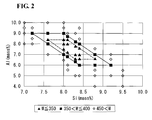
- FIG. 2 is a graph showing the relationships between the Si content, the Al content, and the iron loss in duct cores fabricated in Example, in which the horizontal axis represents the Si content and the vertical axis represents the Al content.
- a soft magnetic powder, a granulated powder, a dust core, and an electromagnetic component according to the present invention will be described below in that order.
- a soft magnetic powder of the present invention is an aggregate of composite magnetic particles, each including a soft magnetic particle and an insulating coating film disposed on the outer peripheral surface thereof.
- Soft magnetic particles are composed of an Fe—Si—Al-based alloy, i.e., a sendust alloy.
- a character a represents the Si content (mass %) and a character b represents the Al content (mass %).
- O in the soft magnetic particles can be a factor that increases the hysteresis loss of the soft magnetic particles. Therefore, its content in the soft magnetic particles is preferably less than 0.2 mass %.
- the O content in the soft magnetic particles is more preferably 0.1 mass % or less, and most preferably 0 mass %.
- the Mn content and the Ni content are each 0.3 mass % or less.
- Mn and Ni can be factors that increase the hysteresis loss of the soft magnetic particles. Therefore, each of the Mn content and the Ni content is more preferably 0.2 mass % or less, and most preferably 0 mass %.
- the soft magnetic particles are preferably produced by atomization, such as water atomization or gas atomization.
- Soft magnetic particles produced by water atomization have many irregularities on the surfaces of the particles, and therefore, because of interlocking of the irregularities, a fired body having high strength is easily obtained.
- soft magnetic particles produced by gas atomization have a substantially spherical particle shape, and therefore, the number of irregularities that may break through the insulating coating film is small, which is preferable.
- a natural oxide film may be formed on the surface of each of the soft magnetic particles.
- the insulating coating film includes an inorganic insulating layer, for example, composed of an inorganic substance containing Si and O.
- the inorganic insulating film covers the outer peripheral surface of each of the soft magnetic particles, and thereby, insulation between the soft magnetic powder particles is secured.
- the inorganic insulating layer containing Si and O has high hardness.
- the inorganic insulating layer is not broken by applied pressure when a compact is formed by compressing a granulated powder using the soft magnetic powder in the subsequent step, or is not decomposed by heat when the compact is fired.
- the inorganic substance containing Si and O for example, SiO 2 can be typically used, and the SiO 2 may contain at least one of SiO and Si 2 O 3 .
- a silicate such as sodium silicate (water glass)
- water glass examples of the inorganic insulating layer composed of an inorganic substance containing Si and O include a coating film formed by heat-treating a silicone resin in an atmosphere containing oxygen, and a coating film formed by coating with water glass.
- the thickness of the inorganic insulating layer is preferably set in the range of 20 nm to 1 ⁇ m.
- the thickness is preferably set in the range of 20 nm to 1 ⁇ m.
- the soft magnetic powder of the present invention is obtained by a production method mainly including steps of classification and insulating coating.
- the particle size of soft magnetic particles in a dust core is preferably in the range of about 40 to 150 ⁇ m.
- Use of a powder having such a particle size is effective in suppressing an increase in eddy current loss when used in a high-frequency range of 1 kHz or more. Accordingly, it is preferable to perform a classification process so that the prepared soft magnetic powder is an aggregate of soft magnetic particles having a predetermined particle size.
- the classification may be performed, typically, using a sieve having a predetermined mesh size.
- the soft magnetic powder which is an aggregate of classified soft magnetic particles, is mixed with an insulating material.
- the insulating material is preferably a low-molecular-weight silicone resin or an aqueous solution of a silicate, such as water glass.
- the mixing is suitably performed using a mixer or the like.
- the mixing amount of the insulating material is preferably selected depending on the specific surface area of soft magnetic particles to be mixed. By determining the mixing amount of the insulating material depending on the specific surface area of the soft magnetic particles, it is possible to produce composite magnetic particles, each including a soft magnetic particle and an insulating coating film with a predetermined thickness disposed on the outer peripheral surface of the soft magnetic particle.
- the mixing amounts of the soft magnetic particles and the insulating material are set, for example, such that the amount of the insulating material is about 0.02 to 1.8 mass % on the basis of the mixture of the two, more preferably 0.05 to 1.5 mass %, and still more preferably 0.1 to 1.0 mass %.
- the insulating material is a silicone resin
- the preferable heat treatment temperature is 400° C. to 1,000° C.
- the more preferable heat treatment temperature is 600° C. to 900° C.
- the preferable heat treatment time is about 30 minutes to 2 hours.
- the insulating material is an aqueous solution of a silicate
- only drying is performed at 50° C. to 100° C. after coating.
- the coating and granulation, which is the subsequent step may be performed in succession, and handling is easy in comparison with the silicone resin.
- the soft magnetic powder is further mixed with a molding resin and a firing resin to form a granulated powder.
- a molding resin and a firing resin to form a granulated powder.
- the firing resin may also be combined therewith.
- the molding resin is a resin for retaining the shape of a compact when the soft magnetic powder is compressed into the compact.
- the molding resin is preferably a thermoplastic resin.
- specific examples of the thermoplastic resin that can be used include, in addition to acrylic resins, polyvinyl alcohol, polyvinyl butyral, and polyethylene resins.
- the molding resin is eliminated at the time of firing the compact.
- the firing resin When a compact obtained by compressing the soft magnetic powder is fired into a fired body, the firing resin is converted into a ceramic-based compound and serves as a shape-retaining agent which retains the soft magnetic powder.
- a silicone resin is used as the firing resin. It is assumed that the silicone resin is converted to an amorphous shape-retaining agent containing Si, C, and O in the firing process as will be described later, and the silicone resin is not eliminated after being fired.
- a granulated powder is produced by mixing a soft magnetic powder, a molding resin, and as necessary, a firing resin, using a mixer or the like.
- unit particles of a granulated powder are formed, each unit particle usually including several particles of the soft magnetic powder combined by the molding resin (which may include the firing resin, as necessary).
- the molding resin and the firing resin may be adjusted to a solution having an adequate viscosity using an appropriate solvent before being mixed with the soft magnetic powder.
- the mixture of the soft magnetic powder and the molding resin (in the case where a firing resin is added, the mixture of the soft magnetic powder, the firing resin, and the molding resin) is preferably prepared by mixing such that the total of the resins to be added is 0.5 to 3 mass % of the mixture.
- the resin content By setting the resin content to be higher than or equal to the lower limit, the shape of the compact or fired body (i.e., dust core) can be sufficiently retained.
- the resin content to be lower than or equal to the upper limit, an appropriate amount of resin is contained in the mixture, and the density of the compact or dust core can be increased.
- a compact is an object in which the granulated powder is compacted into a predetermined shape. That is, the compact is in a state in which a soft magnetic powder is combined by a molding resin, and as necessary, by a firing resin. Since soft magnetic particles constituting the soft magnetic powder used are not substantially deformed by the pressure during forming, the inorganic insulating layer having high hardness formed on the outer periphery of each of the soft magnetic particles is also suppressed from being damaged.
- the shape of the compact may be selected depending on the shape of a magnetic core of an electromagnetic component.
- the compact is obtained by a method including a step of feeding a granulated powder into a die, and a step of pressing the granulated powder inside the die to form a compact.
- the pressure for pressing the granulated powder is preferably about 10 to 12 ton/cm 2 .
- the pressure for pressing the granulated powder is preferably about 10 to 12 ton/cm 2 .
- a dust core of the present invention includes the soft magnetic particles and an insulating layer interposed between the soft magnetic particles.
- the insulating layer interposed between the soft magnetic particles includes, as described above, an inorganic insulating layer composed of an inorganic substance containing Si and O disposed on the outer peripheral surface of each soft magnetic particle.
- the inorganic insulating layer on the surface of each particle remains substantially unchanged after being fired and secures insulation between soft magnetic powder particles reliably.
- an inorganic insulating layer (second layer) obtained by heat-treating the firing resin is further formed on the outer periphery of the inorganic insulating layer (first layer) disposed on the surface of each soft magnetic particle.
- the firing resin is a silicone resin
- the second layer obtained by heat-treating the firing resin is also composed of an inorganic substance containing Si and O.
- Such a dust core is obtained by heat-treating the compact described above.
- the heating temperature in the heat treatment is preferably set at 600° C. to 900° C. Furthermore, the heating time is suitably about 30 minutes to 2 hours.
- the soft magnetic powder constituting the compact before being fired has a large amount of strain introduced therein. By heat-treating the compact under the conditions described above, the strain can be sufficiently removed.
- the atmosphere of the heat treatment is an inert gas atmosphere, such as a nitrogen atmosphere, or a reduced-pressure atmosphere.
- An electromagnetic component of the present invention includes a magnetic core and a coil.
- the magnetic core includes the dust core described above.
- the magnetic core may be annular, rod-shaped, E-shaped, I-shaped, or the like.
- the coil is formed by winding a winding wire which includes a conductive wire and an insulating coating provided on the surface thereof.
- a winding wire having any of various cross-sectional shapes, such as a round or rectangular shape, can be used.
- a round wire may be helically wound to constitute a cylindrical coil
- a rectangular wire may be helically wound edgewise to constitute a rectangular columnar coil.
- the electromagnetic component may be formed by winding a winding wire around the outer periphery of the magnetic core, or by fitting an air core coil, which is helically wound in advance, in the outer periphery of the magnetic core.
- electromagnetic component examples include high-frequency choke coils, high-frequency tuning coils, bar antenna coils, power supply choke coils, power transformers, switching power transformers, reactors, and the like.
- a soft magnetic powder is an aggregate of soft magnetic particles.
- the soft magnetic particles constituting of the soft magnetic powders prepared had a substantially common average particle size of about 60 ⁇ m.
- each of the soft magnetic powders was mixed with a silicone resin using a mixer to form a silicone resin coating on each of the particles.
- the mixing amounts of the soft magnetic powder and the silicone resin were set such that the amount of the silicone resin was 0.3 mass % relative to the mixture of the two.
- the soft magnetic powder coated with the silicone resin was subjected to heat treatment in an air atmosphere at 180° C. ⁇ 1 hour to cure the resin. At this point, the silicone resin is not vitrified. Then, the soft magnetic powder coated with the silicone resin was passed through a sieve to loosen the agglomeration of particles.
- the resulting soft magnetic powder coated with the silicone resin was subjected to heat treatment in an air atmosphere at 600° C. ⁇ 1 hour to vitrify the silicone resin coating, thereby forming an inorganic insulating layer composed of an inorganic substance containing Si and O.
- the thickness of the inorganic insulating layer is about 120 nm.
- soft magnetic powders were produced, each being an aggregate of composite magnetic particles, on the surface of each of which an inorganic insulating coating film containing Si and O was provided.
- a molding resin and a firing resin were mixed with the resulting soft magnetic powder to produce a granulated powder.
- the mixing ratio of the soft magnetic powder, the molding resin, and the firing resin in the granulated powder were 100:1:0.5 (ratio by mass).
- An acrylic resin was used as the molding resin, and a silicone resin was used as the firing resin.
- the silicone resin is different from the silicone resin used for forming the inorganic insulating layer and is a high-molecular-weight silicone varnish mainly composed of polysiloxane.
- the granulated powder for each sample is fed into a die, followed by compression to produce a compact.
- the compressing pressure during compacting is 10 ton/cm 2 . At this compressing pressure, the soft magnetic particles are not substantially deformed during forming.
- the resulting compact is subjected to heat treatment in a nitrogen atmosphere at 800° C. ⁇ 1 hour to produce a dust core.
- the inorganic insulating coating film remains on the surfaces of particles without being decomposed, the molding resin is substantially eliminated, and the firing resin is converted to an amorphous material containing Si, C, and O.
- the test piece composed of the resulting dust core was ring-shaped with an outside diameter of 34 mm, an inside diameter of 20 mm, and a thickness of 5 mm.
- a winding wire was wound around each of the ring-shaped test pieces to obtain a measurement object in order to measure the magnetic properties of the test piece.
- the results are shown in Tables I and II.
- the evaluation results of the samples are shown using the following symbols in the right end column of each table:
- Iron loss is the sum of hysteresis loss and eddy current loss.
- the magnitude of the iron loss can be considered as the magnitude of the hysteresis loss.
- a soft magnetic powder having a composition of Fe-8.0 mass % Si-8.0 mass % Al (the contents of O, Mn, and Ni in the soft magnetic powder are each 0.01 mass %) and an aqueous solution containing, as a main component, potassium silicate were prepared.
- the average particle size of the soft magnetic powder was about 60 ⁇ m.
- the potassium silicate concentration in the aqueous solution was 30 mass %.
- the soft magnetic powder and the aqueous solution were mixed with a mixer, and thereby, an inorganic insulating layer mainly composed of potassium silicate was formed on the surface of each of soft magnetic particles.
- the mixing amounts of the soft magnetic powder and the aqueous solution were set such that the solid content in the aqueous solution was 0.3 mass % on the basis of the mixture of the two.
- a molding resin was mixed with the resulting soft magnetic powder to produce a granulated powder.
- the mixing ratio of the soft magnetic powder and the molding resin in the granulated powder was 100:1 (ratio by mass).
- An acrylic resin was used as the molding resin.
- the granulated powder was fed into a die, followed by compression to produce a compact.
- the compressing pressure during compacting is 10 ton/cm 2 .
- the resulting compact was subjected to heat treatment in a nitrogen atmosphere at 775° C. ⁇ 1 hour to produce a dust core.
- the test piece composed of the resulting dust core was ring-shaped with an outside diameter of 34 mm, an inside diameter of 20 mm, and a thickness of 5 mm.
- Example 69 A winding wire was wound around the resulting test piece to obtain a measurement object (Sample 69) in order to measure the magnetic properties of the test piece.
- the iron loss W1/100k@120° C. was measured on Sample 69 by the same method as that in Example 1.
- Table III the iron loss W1/100k@120° C. of Sample 69 is 350 or less, indicating that the energy loss of Sample 69 is low.
- the soft magnetic powder, the granulated powder, and the method for producing a dust core according to the present invention can be suitably used for obtaining dust cores used for various inductors.
- electromagnetic components of the present invention can be suitably used for high-frequency choke coils, high-frequency tuning coils, bar antenna coils, power supply choke coils, power transformers, switching power transformers, reactors, and the like.
Landscapes
- Chemical & Material Sciences (AREA)
- Engineering & Computer Science (AREA)
- Mechanical Engineering (AREA)
- Power Engineering (AREA)
- Materials Engineering (AREA)
- Metallurgy (AREA)
- Organic Chemistry (AREA)
- Dispersion Chemistry (AREA)
- Manufacturing & Machinery (AREA)
- Physics & Mathematics (AREA)
- Spectroscopy & Molecular Physics (AREA)
- Soft Magnetic Materials (AREA)
- Powder Metallurgy (AREA)
Abstract
Description
27≦2.5a+b≦29 Expression (1)
6≦b ≦9 Expression (2)
where a character a represents the Si content (mass %) and a character b represents the Al content (mass %) in the soft magnetic particles.
978/35≦18/7a+b≦1023/35 Expression (3)
6.6≦b≦8.4 Expression (4)
27≦2.5a+b≦29 Expression (1)
6≦b≦9 Expression (2)
where a character a represents the Si content (mass %) and a character b represents the Al content (mass %).
978/35≦18/7a+b≦1023/35 Expression (3)
6.6≦b≦8.4 Expression (4)
27≦2.5a+b≦29 Expression (1)
6≦b≦9 Expression (2)
where a character a represents the Si content (mass %) and a character b represents the Al content (mass %).
978/35≦18/7a+b≦1023/35 Expression (3)
6.6≦b≦8.4 Expression (4)
- Solid triangle (▴): iron loss W1/100k@120° C. of 350 or less
- Solid square (▪): iron loss W1/100k@120° C. of more than 350 and 400 or less
- Hollow diamond (⋄): iron loss W1/100k@120° C. of more than 400
(Iron loss)=(Hysteresis loss)+(Eddy current loss)
(Hysteresis loss)=(Hysteresis loss coefficient)×(Frequency)
(Eddy current loss)=(Eddy current loss coefficient)×(Frequency)
| TABLE I | |||||||
| Si | Al | O | Mn | Ni | W1/100k | ||
| Sample No. | (mass %) | (mass %) | (mass %) | (mass %) | (mass %) | (kW/m3) | |
| 1 | 7.0 | 8.0 | 0.01 | 0.01 | 0.01 | 701 | ⋄ |
| 2 | 7.0 | 9.0 | 0.01 | 0.01 | 0.01 | 543 | ⋄ |
| 3 | 7.0 | 9.5 | 0.01 | 0.01 | 0.01 | 509 | ⋄ |
| 4 | 7.0 | 10.0 | 0.01 | 0.01 | 0.01 | 562 | ⋄ |
| 5 | 7.2 | 8.0 | 0.01 | 0.01 | 0.01 | 668 | ⋄ |
| 6 | 7.2 | 8.5 | 0.01 | 0.01 | 0.01 | 440 | ⋄ |
| 7 | 7.2 | 9.0 | 0.01 | 0.01 | 0.01 | 381 | ▪ |
| 8 | 7.2 | 9.5 | 0.01 | 0.01 | 0.01 | 433 | ⋄ |
| 9 | 7.6 | 7.0 | 0.01 | 0.01 | 0.01 | 632 | ⋄ |
| 10 | 7.6 | 8.0 | 0.01 | 0.01 | 0.01 | 395 | ▪ |
| 11 | 7.6 | 8.4 | 0.01 | 0.01 | 0.01 | 347 | ▴ |
| 12 | 7.6 | 9.0 | 0.01 | 0.01 | 0.01 | 389 | ▪ |
| 13 | 7.6 | 10.0 | 0.01 | 0.01 | 0.01 | 515 | ⋄ |
| 14 | 8.0 | 6.5 | 0.01 | 0.01 | 0.01 | 440 | ⋄ |
| 15 | 8.0 | 7.0 | 0.01 | 0.01 | 0.01 | 386 | ▪ |
| 16 | 8.0 | 7.5 | 0.01 | 0.01 | 0.01 | 338 | ▴ |
| 17 | 8.0 | 8.0 | 0.01 | 0.01 | 0.01 | 321 | ▴ |
| 18 | 8.0 | 8.4 | 0.01 | 0.01 | 0.01 | 349 | ▴ |
| 19 | 8.0 | 9.0 | 0.01 | 0.01 | 0.01 | 399 | ▪ |
| 20 | 8.0 | 9.5 | 0.01 | 0.01 | 0.01 | 485 | ⋄ |
| 21 | 8.0 | 10.0 | 0.01 | 0.01 | 0.01 | 659 | ⋄ |
| 22 | 8.1 | 5.5 | 0.01 | 0.01 | 0.01 | 532 | ⋄ |
| 23 | 8.1 | 6.0 | 0.01 | 0.01 | 0.01 | 499 | ⋄ |
| 24 | 8.1 | 6.8 | 0.01 | 0.01 | 0.01 | 378 | ▪ |
| 25 | 8.1 | 7.2 | 0.01 | 0.01 | 0.01 | 339 | ▴ |
| 26 | 8.1 | 8.0 | 0.01 | 0.01 | 0.01 | 315 | ▴ |
| 27 | 8.1 | 8.4 | 0.01 | 0.01 | 0.01 | 345 | ▴ |
| 28 | 8.1 | 8.7 | 0.01 | 0.01 | 0.01 | 394 | ▪ |
| 29 | 8.1 | 9.0 | 0.01 | 0.01 | 0.01 | 422 | ⋄ |
| 30 | 8.3 | 5.0 | 0.01 | 0.01 | 0.01 | 681 | ⋄ |
| 31 | 8.3 | 6.3 | 0.01 | 0.01 | 0.01 | 392 | ▪ |
| 32 | 8.3 | 6.6 | 0.01 | 0.01 | 0.01 | 348 | ▴ |
| 33 | 8.3 | 7.0 | 0.01 | 0.01 | 0.01 | 312 | ▴ |
| 34 | 8.3 | 7.8 | 0.01 | 0.01 | 0.01 | 343 | ▴ |
| 35 | 8.3 | 8.2 | 0.01 | 0.01 | 0.01 | 381 | ▪ |
| TABLE II | |||||||
| Si | Al | O | Mn | Ni | W1/100k | ||
| Sample No. | (mass %) | (mass %) | (mass %) | (mass %) | (mass %) | (kw/m3) | Evaluation |
| 36 | 8.3 | 9.0 | 0.01 | 0.01 | 0.01 | 474 | ⋄ |
| 37 | 8.4 | 5.0 | 0.01 | 0.01 | 0.01 | 488 | ⋄ |
| 38 | 8.4 | 6.0 | 0.01 | 0.01 | 0.01 | 371 | ▪ |
| 39 | 8.4 | 6.6 | 0.01 | 0.01 | 0.01 | 336 | ▴ |
| 40 | 8.4 | 7.0 | 0.01 | 0.01 | 0.01 | 317 | ▴ |
| 41 | 8.4 | 7.6 | 0.01 | 0.01 | 0.01 | 340 | ▴ |
| 42 | 8.4 | 8.0 | 0.01 | 0.01 | 0.01 | 399 | ▪ |
| 43 | 8.4 | 8.5 | 0.01 | 0.01 | 0.01 | 502 | ⋄ |
| 44 | 8.4 | 9.5 | 0.01 | 0.01 | 0.01 | 598 | ⋄ |
| 45 | 8.8 | 4.0 | 0.01 | 0.01 | 0.01 | 586 | ⋄ |
| 46 | 8.8 | 5.0 | 0.01 | 0.01 | 0.01 | 522 | ⋄ |
| 47 | 8.8 | 5.5 | 0.01 | 0.01 | 0.01 | 421 | ⋄ |
| 48 | 8.8 | 6.0 | 0.01 | 0.01 | 0.01 | 377 | ▪ |
| 49 | 8.8 | 6.6 | 0.01 | 0.01 | 0.01 | 344 | ▴ |
| 50 | 8.8 | 7.0 | 0.01 | 0.01 | 0.01 | 398 | ▪ |
| 51 | 8.8 | 7.5 | 0.01 | 0.01 | 0.01 | 450 | ⋄ |
| 52 | 9.2 | 5.0 | 0.01 | 0.01 | 0.01 | 542 | ⋄ |
| 53 | 9.2 | 6.0 | 0.01 | 0.01 | 0.01 | 398 | ▪ |
| 54 | 9.2 | 6.5 | 0.01 | 0.01 | 0.01 | 479 | ⋄ |
| 55 | 9.2 | 7.0 | 0.01 | 0.01 | 0.01 | 545 | ⋄ |
| 56 | 9.5 | 4.0 | 0.01 | 0.01 | 0.01 | 641 | ⋄ |
| 57 | 9.5 | 5.0 | 0.01 | 0.01 | 0.01 | 589 | ⋄ |
| 58 | 9.5 | 5.5 | 0.01 | 0.01 | 0.01 | 612 | ⋄ |
| 59 | 8.0 | 8.0 | 0.1 | 0.01 | 0.01 | 342 | ▴ |
| 60 | 8.0 | 8.0 | 0.15 | 0.01 | 0.01 | 369 | ▪ |
| 61 | 8.0 | 8.0 | 0.19 | 0.01 | 0.01 | 384 | ▪ |
| 62 | 8.0 | 8.0 | 0.2 | 0.01 | 0.01 | 411 | ⋄ |
| 63 | 8.0 | 8.0 | 0.01 | 0.2 | 0.01 | 337 | ▴ |
| 64 | 8.0 | 8.0 | 0.01 | 0.3 | 0.01 | 398 | ▪ |
| 65 | 8.0 | 8.0 | 0.01 | 0.4 | 0.01 | 406 | ⋄ |
| 66 | 8.0 | 8.0 | 0.01 | 0.01 | 0.2 | 346 | ▴ |
| 67 | 8.0 | 8.0 | 0.01 | 0.01 | 0.3 | 397 | ▪ |
| 68 | 8.0 | 8.0 | 0.01 | 0.01 | 0.4 | 404 | ⋄ |
| TABLE III | |||||||
| Si | Al | O | Mn | Ni | W1/100k | ||
| Sample No | (mass %) | (mass %) | (mass %) | (mass %) | (mass %) | (kW/m3) | Evaluation |
| 69 | 8.0 | 8.0 | 0.01 | 0.01 | 0.01 | 310 | ▴ |
Claims (11)
978/35≦18/7a +b ≦1023/35and 6.6≦b≦8.4,
978/35≦18/7a +b ≦1023/35and 6.6≦b≦8.4,
Applications Claiming Priority (5)
| Application Number | Priority Date | Filing Date | Title |
|---|---|---|---|
| JP2010-123327 | 2010-05-28 | ||
| JP2010123327 | 2010-05-28 | ||
| JP2011094804A JP5374537B2 (en) | 2010-05-28 | 2011-04-21 | Soft magnetic powder, granulated powder, dust core, electromagnetic component, and method for manufacturing dust core |
| JP2011-094804 | 2011-04-21 | ||
| PCT/JP2011/061304 WO2011148826A1 (en) | 2010-05-28 | 2011-05-17 | Soft magnetic powder, powder granules, dust core, electromagnetic component, and method for producing dust core |
Publications (2)
| Publication Number | Publication Date |
|---|---|
| US20120229245A1 US20120229245A1 (en) | 2012-09-13 |
| US8797137B2 true US8797137B2 (en) | 2014-08-05 |
Family
ID=45003817
Family Applications (1)
| Application Number | Title | Priority Date | Filing Date |
|---|---|---|---|
| US13/505,003 Active 2031-08-27 US8797137B2 (en) | 2010-05-28 | 2011-05-17 | Soft magnetic powder, granulated powder, dust core, electromagnetic component, and method for producing dust core |
Country Status (6)
| Country | Link |
|---|---|
| US (1) | US8797137B2 (en) |
| EP (1) | EP2578338B1 (en) |
| JP (1) | JP5374537B2 (en) |
| KR (1) | KR101353827B1 (en) |
| CN (1) | CN102596453B (en) |
| WO (1) | WO2011148826A1 (en) |
Cited By (1)
| Publication number | Priority date | Publication date | Assignee | Title |
|---|---|---|---|---|
| US20210027940A1 (en) * | 2019-07-25 | 2021-01-28 | Seiko Epson Corporation | Magnetic powder, method for producing magnetic powder, powder magnetic core, and coil part |
Families Citing this family (15)
| Publication number | Priority date | Publication date | Assignee | Title |
|---|---|---|---|---|
| JP5892421B2 (en) * | 2012-02-16 | 2016-03-23 | 日立金属株式会社 | Metal powder, manufacturing method thereof, and dust core |
| JP6087708B2 (en) * | 2013-04-17 | 2017-03-01 | 株式会社神戸製鋼所 | Winding element manufacturing method |
| WO2014171105A1 (en) * | 2013-04-19 | 2014-10-23 | Jfeスチール株式会社 | Iron powder for dust core and insulation-coated iron powder for dust core |
| JP2015103719A (en) * | 2013-11-26 | 2015-06-04 | 住友電気工業株式会社 | Dust core, coil component, and manufacturing method of dust core |
| CA2974067C (en) * | 2015-02-09 | 2020-11-24 | Jfe Steel Corporation | Raw material powder for soft magnetic powder, and soft magnetic powder for dust core |
| JP6625334B2 (en) * | 2015-03-24 | 2019-12-25 | Ntn株式会社 | Manufacturing method of powder for magnetic core |
| JP6560091B2 (en) * | 2015-10-06 | 2019-08-14 | Ntn株式会社 | Dust core material, dust core, and manufacturing method thereof |
| JP6864498B2 (en) * | 2017-02-28 | 2021-04-28 | 山陽特殊製鋼株式会社 | A soft magnetic flat powder having high magnetic permeability and high weather resistance and a soft magnetic resin composition containing the same. |
| JP7428013B2 (en) | 2019-03-28 | 2024-02-06 | 新東工業株式会社 | Soft magnetic alloy powder, electronic parts and manufacturing method thereof |
| JP7314678B2 (en) | 2019-07-23 | 2023-07-26 | 新東工業株式会社 | SOFT MAGNETIC ALLOY POWDER AND ELECTRONIC COMPONENTS USING SAME |
| JP7049752B2 (en) * | 2019-12-06 | 2022-04-07 | 株式会社タムラ製作所 | Method for manufacturing dust compact and dust core |
| CN111243814A (en) * | 2020-01-17 | 2020-06-05 | 深圳市铂科新材料股份有限公司 | Copper sheet embedded soft magnetic powder core inductor and preparation method and application thereof |
| WO2021199970A1 (en) * | 2020-03-31 | 2021-10-07 | 株式会社村田製作所 | Coated soft magnetic alloy particles, powder magnetic core, magnetic application parts, and method for manufacturing coated soft magnetic alloy particles |
| KR102237022B1 (en) * | 2020-08-07 | 2021-04-08 | 주식회사 포스코 | Soft magnetic iron-based powder and its manufacturing method, soft magnetic component |
| WO2022186222A1 (en) * | 2021-03-05 | 2022-09-09 | パナソニックIpマネジメント株式会社 | Magnetic material, dust core, inductor and method for producing dust core |
Citations (10)
| Publication number | Priority date | Publication date | Assignee | Title |
|---|---|---|---|---|
| US6120916A (en) * | 1995-09-19 | 2000-09-19 | Thomson-Csf | Composite magnetic material with reduced permeability and losses |
| US20040209120A1 (en) * | 2000-04-28 | 2004-10-21 | Matsushita Electric Industrial Co., Ltd. | Composite magnetic body, and magnetic element and method of manufacturing the same |
| JP2004319652A (en) | 2003-04-15 | 2004-11-11 | Tamura Seisakusho Co Ltd | Core and method of manufacturing the same |
| JP2005142308A (en) | 2003-11-05 | 2005-06-02 | Daido Steel Co Ltd | Dust core |
| US20060066432A1 (en) * | 2003-07-10 | 2006-03-30 | Tsutomu Inuzuka | Magnetic element |
| JP2007012745A (en) | 2005-06-29 | 2007-01-18 | Sumitomo Electric Ind Ltd | Powder magnetic core and manufacturing method thereof |
| US20080044679A1 (en) * | 2005-09-21 | 2008-02-21 | Sumitomo Electric Industries, Inc. | Soft Magnetic Material, Powder Magnetic Core, Method for Manufacturing Soft Magnetic Material, and Method for Manufacturing Powder Magnetic Core |
| JP2008277775A (en) * | 2007-04-04 | 2008-11-13 | Hitachi Metals Ltd | Dust core and its manufacturing method |
| JP2009084645A (en) * | 2007-09-28 | 2009-04-23 | Kobe Steel Ltd | Soft magnetic steel member having excellent induction hardenability and cold forgeability, and high strength soft magnetic steel component |
| US20100033284A1 (en) * | 2005-02-28 | 2010-02-11 | Matsushita Electric Industrial Co., Ltd. | Resonance transformer and power supply unit employing it |
Family Cites Families (3)
| Publication number | Priority date | Publication date | Assignee | Title |
|---|---|---|---|---|
| SG78328A1 (en) * | 1997-12-25 | 2001-02-20 | Matsushita Electric Industrial Co Ltd | Magnetic composite article and manufacturing method of the same and soft magnetic powder of fe-al-si system alloy used in the composite article |
| JP4707054B2 (en) * | 2005-08-03 | 2011-06-22 | 住友電気工業株式会社 | Soft magnetic material, method for producing soft magnetic material, dust core, and method for producing dust core |
| JP5522173B2 (en) * | 2009-08-04 | 2014-06-18 | パナソニック株式会社 | Composite magnetic body and method for producing the same |
-
2011
- 2011-04-21 JP JP2011094804A patent/JP5374537B2/en active Active
- 2011-05-17 CN CN201180004383.4A patent/CN102596453B/en active Active
- 2011-05-17 WO PCT/JP2011/061304 patent/WO2011148826A1/en not_active Ceased
- 2011-05-17 KR KR1020127009707A patent/KR101353827B1/en not_active Expired - Fee Related
- 2011-05-17 US US13/505,003 patent/US8797137B2/en active Active
- 2011-05-17 EP EP11786525.3A patent/EP2578338B1/en active Active
Patent Citations (10)
| Publication number | Priority date | Publication date | Assignee | Title |
|---|---|---|---|---|
| US6120916A (en) * | 1995-09-19 | 2000-09-19 | Thomson-Csf | Composite magnetic material with reduced permeability and losses |
| US20040209120A1 (en) * | 2000-04-28 | 2004-10-21 | Matsushita Electric Industrial Co., Ltd. | Composite magnetic body, and magnetic element and method of manufacturing the same |
| JP2004319652A (en) | 2003-04-15 | 2004-11-11 | Tamura Seisakusho Co Ltd | Core and method of manufacturing the same |
| US20060066432A1 (en) * | 2003-07-10 | 2006-03-30 | Tsutomu Inuzuka | Magnetic element |
| JP2005142308A (en) | 2003-11-05 | 2005-06-02 | Daido Steel Co Ltd | Dust core |
| US20100033284A1 (en) * | 2005-02-28 | 2010-02-11 | Matsushita Electric Industrial Co., Ltd. | Resonance transformer and power supply unit employing it |
| JP2007012745A (en) | 2005-06-29 | 2007-01-18 | Sumitomo Electric Ind Ltd | Powder magnetic core and manufacturing method thereof |
| US20080044679A1 (en) * | 2005-09-21 | 2008-02-21 | Sumitomo Electric Industries, Inc. | Soft Magnetic Material, Powder Magnetic Core, Method for Manufacturing Soft Magnetic Material, and Method for Manufacturing Powder Magnetic Core |
| JP2008277775A (en) * | 2007-04-04 | 2008-11-13 | Hitachi Metals Ltd | Dust core and its manufacturing method |
| JP2009084645A (en) * | 2007-09-28 | 2009-04-23 | Kobe Steel Ltd | Soft magnetic steel member having excellent induction hardenability and cold forgeability, and high strength soft magnetic steel component |
Non-Patent Citations (4)
| Title |
|---|
| International Seach Report for PCT Application No. PCT/JP2011/061304 dated Aug. 23, 2011, pp. 1. |
| Korean Office Action for Corresponding Application No. 10-2012-7009707, mailed Sep. 26, 2013. |
| Yanagimoto et al. "Effect of Si and Al Content on Core Loss in Fe-Si-Al Powder Cores", IEEE Transactions on Magnetics, vol. 40, No. 3, pp. 1691-1694 (May 2004). |
| Yanagimoto et al. "Effect of Si and Al Content on Core Loss in Fe—Si—Al Powder Cores", IEEE Transactions on Magnetics, vol. 40, No. 3, pp. 1691-1694 (May 2004). |
Cited By (2)
| Publication number | Priority date | Publication date | Assignee | Title |
|---|---|---|---|---|
| US20210027940A1 (en) * | 2019-07-25 | 2021-01-28 | Seiko Epson Corporation | Magnetic powder, method for producing magnetic powder, powder magnetic core, and coil part |
| US11798738B2 (en) * | 2019-07-25 | 2023-10-24 | Seiko Epson Corporation | Magnetic powder, method for producing magnetic powder, powder magnetic core, and coil part |
Also Published As
| Publication number | Publication date |
|---|---|
| KR20120068914A (en) | 2012-06-27 |
| CN102596453B (en) | 2014-11-26 |
| WO2011148826A1 (en) | 2011-12-01 |
| JP5374537B2 (en) | 2013-12-25 |
| KR101353827B1 (en) | 2014-02-07 |
| EP2578338A4 (en) | 2017-04-19 |
| EP2578338B1 (en) | 2019-06-26 |
| EP2578338A1 (en) | 2013-04-10 |
| US20120229245A1 (en) | 2012-09-13 |
| JP2012009825A (en) | 2012-01-12 |
| CN102596453A (en) | 2012-07-18 |
Similar Documents
| Publication | Publication Date | Title |
|---|---|---|
| US8797137B2 (en) | Soft magnetic powder, granulated powder, dust core, electromagnetic component, and method for producing dust core | |
| JP5022999B2 (en) | Powder magnetic core and manufacturing method thereof | |
| KR101385756B1 (en) | Manufacturing methods of fe-based amorphous metallic powders and soft magnetic cores | |
| JPWO2009128425A1 (en) | Composite magnetic material and method for producing the same | |
| US6852174B2 (en) | Powder magnetic core | |
| JP2012077363A (en) | Method of producing powder for metallurgy, and method for production of powder magnetic core | |
| TW201511045A (en) | Compressed powder magnetic core and manufacturing method thereof | |
| JP2010245216A (en) | Magnetic powder material, granulated powder, molded body, sintered body for magnetic core, electromagnetic component, and method for producing sintered body for magnetic core | |
| JP2013098384A (en) | Dust core | |
| KR100374292B1 (en) | Composite metal powder for power factor correction having good dc biased characteristics and method of processing soft magnetic core by thereof using | |
| US12230426B2 (en) | Soft magnetic powder composition for inductor core and method of manufacturing inductor core using the composition | |
| JP2003217919A (en) | Dust core and high-frequency reactor using the same | |
| JP6213809B2 (en) | Powder magnetic core, coil component using the same, and method for manufacturing powder magnetic core | |
| JP2009259974A (en) | High-strength powder magnetic core, method of manufacturing high-strength powder magnetic core, choke coil, and method of manufacturing the same | |
| CN102693826B (en) | Powder magnetic core and manufacturing method thereof | |
| JP7418194B2 (en) | Manufacturing method of powder magnetic core | |
| JPWO2010038441A1 (en) | Composite magnetic material and manufacturing method thereof | |
| KR101607758B1 (en) | Soft magnetic material composition and manufacturing method thereof, magnetic core, and, coil type electronic component | |
| JP2010219161A (en) | Dust core and method of manufacturing the same | |
| EP1475808B1 (en) | Powder magnetic core and high frequency reactor using the same | |
| JP2010027871A (en) | Dust core and manufacturing method thereof | |
| US20020043303A1 (en) | Powder magnetic core | |
| JP4487025B2 (en) | Dust core | |
| JP7254449B2 (en) | Soft magnetic materials, dust cores, and inductors | |
| JP4723609B2 (en) | Dust core, dust core manufacturing method, choke coil and manufacturing method thereof |
Legal Events
| Date | Code | Title | Description |
|---|---|---|---|
| AS | Assignment |
Owner name: SUMITOMO ELECTRIC INDUSTRIES, LTD., JAPAN Free format text: ASSIGNMENT OF ASSIGNORS INTEREST;ASSIGNORS:WATANABE, ASAKO;MAEDA, TORU;REEL/FRAME:028139/0463 Effective date: 20120327 |
|
| STCF | Information on status: patent grant |
Free format text: PATENTED CASE |
|
| FEPP | Fee payment procedure |
Free format text: PAYOR NUMBER ASSIGNED (ORIGINAL EVENT CODE: ASPN); ENTITY STATUS OF PATENT OWNER: LARGE ENTITY |
|
| MAFP | Maintenance fee payment |
Free format text: PAYMENT OF MAINTENANCE FEE, 4TH YEAR, LARGE ENTITY (ORIGINAL EVENT CODE: M1551) Year of fee payment: 4 |
|
| MAFP | Maintenance fee payment |
Free format text: PAYMENT OF MAINTENANCE FEE, 8TH YEAR, LARGE ENTITY (ORIGINAL EVENT CODE: M1552); ENTITY STATUS OF PATENT OWNER: LARGE ENTITY Year of fee payment: 8 |
|
| MAFP | Maintenance fee payment |
Free format text: PAYMENT OF MAINTENANCE FEE, 12TH YEAR, LARGE ENTITY (ORIGINAL EVENT CODE: M1553); ENTITY STATUS OF PATENT OWNER: LARGE ENTITY Year of fee payment: 12 |