US8795924B2 - Crown ether containing PEM electrode - Google Patents
Crown ether containing PEM electrode Download PDFInfo
- Publication number
- US8795924B2 US8795924B2 US13/611,046 US201213611046A US8795924B2 US 8795924 B2 US8795924 B2 US 8795924B2 US 201213611046 A US201213611046 A US 201213611046A US 8795924 B2 US8795924 B2 US 8795924B2
- Authority
- US
- United States
- Prior art keywords
- membrane electrode
- electrode assembly
- cathode
- polymer
- layer
- Prior art date
- Legal status (The legal status is an assumption and is not a legal conclusion. Google has not performed a legal analysis and makes no representation as to the accuracy of the status listed.)
- Active
Links
- 0 C.C.C[1*]C(C)CC Chemical compound C.C.C[1*]C(C)CC 0.000 description 10
- MQDSEPJXSZVIEB-UHFFFAOYSA-N C=Cc(cc1)cc2c1OCCN(CCOCCOCC1)CCOCCOCCN1CCO2 Chemical compound C=Cc(cc1)cc2c1OCCN(CCOCCOCC1)CCOCCOCCN1CCO2 MQDSEPJXSZVIEB-UHFFFAOYSA-N 0.000 description 3
- CTHIUWAFTTZDGD-UHFFFAOYSA-N C1=CC=C2OCCOC3=C(C=CC=C3)OCCOCCOC2=C1.C1=CC=C2OCCOCCOC3=C(C=CC=C3)OCCOCCOC2=C1.C1=CC=C2OCCOCCOCCOCCOCCOC2=C1.CC(C)(C)C.CC(C)(C)C.CC(C)(C)C.CC(C)(C)C1COCCOCCOCCOCCO1.CC(C)(C)C1COCCOCCOCCOCCOCCO1.CC(C)(C)N1CCOCCOCCOCCOCC1 Chemical compound C1=CC=C2OCCOC3=C(C=CC=C3)OCCOCCOC2=C1.C1=CC=C2OCCOCCOC3=C(C=CC=C3)OCCOCCOC2=C1.C1=CC=C2OCCOCCOCCOCCOCCOC2=C1.CC(C)(C)C.CC(C)(C)C.CC(C)(C)C.CC(C)(C)C1COCCOCCOCCOCCO1.CC(C)(C)C1COCCOCCOCCOCCOCCO1.CC(C)(C)N1CCOCCOCCOCCOCC1 CTHIUWAFTTZDGD-UHFFFAOYSA-N 0.000 description 2
- CGZSAEJNWTUFOM-UHFFFAOYSA-N C=CC1=CC=C2OCCOCCOCCOCCOC3=C(C=C(C=C)C=C3)OCCOCCOCCOCCOC2=C1 Chemical compound C=CC1=CC=C2OCCOCCOCCOCCOC3=C(C=C(C=C)C=C3)OCCOCCOCCOCCOC2=C1 CGZSAEJNWTUFOM-UHFFFAOYSA-N 0.000 description 2
- HGUCJNWBKFPJRA-UHFFFAOYSA-N CC(C)(C)C1=CC=C(CN2CCOCCOCCOCCOCC2)C=C1.CC(C)(C)C1=CC=C(CN2CCOCCOCCOCCOCCOCC2)C=C1.CC(C)(C)C1=CC=C(COCC2COCCOCCOCCOCCO2)C=C1.CC(C)(C)C1=CC=C(COCC2COCCOCCOCCOCCOCCO2)C=C1.CC(C)(C)N1CCOCCOCCNCCOCCOCC1 Chemical compound CC(C)(C)C1=CC=C(CN2CCOCCOCCOCCOCC2)C=C1.CC(C)(C)C1=CC=C(CN2CCOCCOCCOCCOCCOCC2)C=C1.CC(C)(C)C1=CC=C(COCC2COCCOCCOCCOCCO2)C=C1.CC(C)(C)C1=CC=C(COCC2COCCOCCOCCOCCOCCO2)C=C1.CC(C)(C)N1CCOCCOCCNCCOCCOCC1 HGUCJNWBKFPJRA-UHFFFAOYSA-N 0.000 description 2
- UUGWAMYZBMRCMC-UHFFFAOYSA-N CC(C)(C)C1=CC=C2OCCN3CCOCCOCCN(CCOCC3)CCOC2=C1.CC(C)(C)C1=CC=C2OCCN3CCOCCOCCN(CCOCCOCC3)CCOC2=C1.CC(C)(C)C1=CC=C2OCCOCCOCCOCCOC2=C1.CC(C)(C)C1=CC=C2OCCOCCOCCOCCOCCOC2=C1.CC(C)(C)OCC1COCCOCCOCCOCCO1.CC(C)(C)OCC1COCCOCCOCCOCCOCCO1.CC(C)(C)OCC1COCCOCCOCCOCCOCCO1 Chemical compound CC(C)(C)C1=CC=C2OCCN3CCOCCOCCN(CCOCC3)CCOC2=C1.CC(C)(C)C1=CC=C2OCCN3CCOCCOCCN(CCOCCOCC3)CCOC2=C1.CC(C)(C)C1=CC=C2OCCOCCOCCOCCOC2=C1.CC(C)(C)C1=CC=C2OCCOCCOCCOCCOCCOC2=C1.CC(C)(C)OCC1COCCOCCOCCOCCO1.CC(C)(C)OCC1COCCOCCOCCOCCOCCO1.CC(C)(C)OCC1COCCOCCOCCOCCOCCO1 UUGWAMYZBMRCMC-UHFFFAOYSA-N 0.000 description 2
- GMDCIDJLRMNJCP-UHFFFAOYSA-N CC(C)(C)C1=CC=C2OCCN3CCOCCOCCN(CCOCC3)CCOC2=C1.CC(C)(C)CC1COCCN2CCOCCOCCN(CCOCC2)CCO1.CC(C)(C)N1CCOCCNCCOCCOCC1.CC(C)(C)N1CCOCCOCCOCCOCCOCC1.CC(C)(C)OCC1COCCN2CCOCCOCCN(CCOCC2)CCO1.CC(C)(C)OCC1COCCN2CCOCCOCCN(CCOCCOCC2)CCO1 Chemical compound CC(C)(C)C1=CC=C2OCCN3CCOCCOCCN(CCOCC3)CCOC2=C1.CC(C)(C)CC1COCCN2CCOCCOCCN(CCOCC2)CCO1.CC(C)(C)N1CCOCCNCCOCCOCC1.CC(C)(C)N1CCOCCOCCOCCOCCOCC1.CC(C)(C)OCC1COCCN2CCOCCOCCN(CCOCC2)CCO1.CC(C)(C)OCC1COCCN2CCOCCOCCN(CCOCCOCC2)CCO1 GMDCIDJLRMNJCP-UHFFFAOYSA-N 0.000 description 2
- UNMGNKFTTQYBMB-UHFFFAOYSA-N [H]C(=O)C1=CC(OCC(=O)O)=C(OCC(=O)O)C=C1 Chemical compound [H]C(=O)C1=CC(OCC(=O)O)=C(OCC(=O)O)C=C1 UNMGNKFTTQYBMB-UHFFFAOYSA-N 0.000 description 2
- JBXMVSFLLGHQTG-UHFFFAOYSA-N C.C.CCC(C)C Chemical compound C.C.CCC(C)C JBXMVSFLLGHQTG-UHFFFAOYSA-N 0.000 description 1
- OFZWAWRMLKSBAO-UHFFFAOYSA-N C.CC1(F)C(C)(F)C(F)(F)C1(F)F.CC1(F)C(F)(F)C(C)(F)C1(F)F Chemical compound C.CC1(F)C(C)(F)C(F)(F)C1(F)F.CC1(F)C(F)(F)C(C)(F)C1(F)F OFZWAWRMLKSBAO-UHFFFAOYSA-N 0.000 description 1
- ZKMGXQMDGGVGJU-UHFFFAOYSA-N C=CC1=CC=C2OCCN3CCOCCOCCN(CCOCC3)CCOC2=C1.C=CC1=CC=C2OCCN3CCOCCOCCN(CCOCCOCC3)CCOC2=C1 Chemical compound C=CC1=CC=C2OCCN3CCOCCOCCN(CCOCC3)CCOC2=C1.C=CC1=CC=C2OCCN3CCOCCOCCN(CCOCCOCC3)CCOC2=C1 ZKMGXQMDGGVGJU-UHFFFAOYSA-N 0.000 description 1
- ZZFCDIHBQRUIOD-UHFFFAOYSA-N C=CC1=CC=C2OCCN3CCOCCOCCN(CCOCCOCC3)CCOC2=C1.CC(=O)C1=CC=C(O)C(O)=C1 Chemical compound C=CC1=CC=C2OCCN3CCOCCOCCN(CCOCCOCC3)CCOC2=C1.CC(=O)C1=CC=C(O)C(O)=C1 ZZFCDIHBQRUIOD-UHFFFAOYSA-N 0.000 description 1
- ZAGUIKUTRQQXFR-UHFFFAOYSA-N C=CC1=CC=C2OCCOC3=C(C=C(C=C)C=C3)OCCOC2=C1 Chemical compound C=CC1=CC=C2OCCOC3=C(C=C(C=C)C=C3)OCCOC2=C1 ZAGUIKUTRQQXFR-UHFFFAOYSA-N 0.000 description 1
- MYDDYOANJGGJLA-UHFFFAOYSA-N C=CC1=CC=C2OCCOCCOCCOCCOC2=C1.C=CC1=CC=C2OCCOCCOCCOCCOCCOC2=C1 Chemical compound C=CC1=CC=C2OCCOCCOCCOCCOC2=C1.C=CC1=CC=C2OCCOCCOCCOCCOCCOC2=C1 MYDDYOANJGGJLA-UHFFFAOYSA-N 0.000 description 1
- HRXFSBNBMOMCMG-OKXCLTPOSA-N C=Cc1ccc2OCC/N=C/COCCOC/C=N/CCNc2c1 Chemical compound C=Cc1ccc2OCC/N=C/COCCOC/C=N/CCNc2c1 HRXFSBNBMOMCMG-OKXCLTPOSA-N 0.000 description 1
- QWWVHNYNDUHATO-UHFFFAOYSA-N CC(O)C1=CC=C2OCCOCCOCCOCCOC3=C(C=C(C(C)O)C=C3)OCCOCCOCCOCCOC2=C1 Chemical compound CC(O)C1=CC=C2OCCOCCOCCOCCOC3=C(C=C(C(C)O)C=C3)OCCOCCOCCOCCOC2=C1 QWWVHNYNDUHATO-UHFFFAOYSA-N 0.000 description 1
- ZBPJAZBQXQTGQZ-UHFFFAOYSA-N CC(c(cc1)cc(OCC(OC=C)=O)c1OCC(O)=O)=O Chemical compound CC(c(cc1)cc(OCC(OC=C)=O)c1OCC(O)=O)=O ZBPJAZBQXQTGQZ-UHFFFAOYSA-N 0.000 description 1
- KWRYLSXQHRUQDP-LMWFWVEUSA-N CC(c(cc1)cc(OCC/N=C/COCCOC2)c1NCCNC2OCCOC)=N Chemical compound CC(c(cc1)cc(OCC/N=C/COCCOC2)c1NCCNC2OCCOC)=N KWRYLSXQHRUQDP-LMWFWVEUSA-N 0.000 description 1
- UCQUAMAQHHEXGD-UHFFFAOYSA-N CC(c(cc1O)ccc1O)=O Chemical compound CC(c(cc1O)ccc1O)=O UCQUAMAQHHEXGD-UHFFFAOYSA-N 0.000 description 1
- OWBJIQKPDVVOSB-UHFFFAOYSA-N CC1=CC(C2CC(C)C3=CC=C(C=C3)C(C)C(C3=CC=C4OCCOCCOCCOCCOCCOC4=C3)CC(C3=C/C=C4\OCCOCCOCCOCCOCCO\C4=C\3)CC(C3=C/C=C4\OCCOCCOCCOCCOCCO\C4=C\3)CC(C3=C/C=C4\OCCOCCOCCOCCOCCO\C4=C\3)CC(C3=C/C=C4\OCCOCCOCCOCCOCCO\C4=C\3)CC(C3=C/C=C4\OCCOCCOCCOCCOCCO\C4=C\3)CC(C)C3=CC=C(C=C3)C(C)CC(C3=C/C=C4/OCCOCCOCCOCCOCCO/C4=C\3)CC(C3=C/C=C4\OCCOCCOCCOCCOCCO\C4=C\3)CC(C3=C/C=C4/OCCOCCOCCOCCOCCO/C4=C\3)C2)=CC=C1OCCOCCOCCOCCOCCO Chemical compound CC1=CC(C2CC(C)C3=CC=C(C=C3)C(C)C(C3=CC=C4OCCOCCOCCOCCOCCOC4=C3)CC(C3=C/C=C4\OCCOCCOCCOCCOCCO\C4=C\3)CC(C3=C/C=C4\OCCOCCOCCOCCOCCO\C4=C\3)CC(C3=C/C=C4\OCCOCCOCCOCCOCCO\C4=C\3)CC(C3=C/C=C4\OCCOCCOCCOCCOCCO\C4=C\3)CC(C3=C/C=C4\OCCOCCOCCOCCOCCO\C4=C\3)CC(C)C3=CC=C(C=C3)C(C)CC(C3=C/C=C4/OCCOCCOCCOCCOCCO/C4=C\3)CC(C3=C/C=C4\OCCOCCOCCOCCOCCO\C4=C\3)CC(C3=C/C=C4/OCCOCCOCCOCCOCCO/C4=C\3)C2)=CC=C1OCCOCCOCCOCCOCCO OWBJIQKPDVVOSB-UHFFFAOYSA-N 0.000 description 1
- BVMRUSFZRVHLFQ-UHFFFAOYSA-N CC1CC(C2=C/C=C3/OCCOCCOCCOCCOCCO/C3=C\2)CC(C2=C/C=C3\OCCOCCOCCOCCOCCO\C3=C\2)CC(C2=C/C=C3/OCCOCCOCCOCCOCCO/C3=C\2)CC(C2=C/C=C3\OCCOCCOCCOCCOCCO\C3=C\2)CC(C)C2=CC=C(C=C2)C(C)C(C2=CC=C3OCCOCCOCCOCCOCCOC3=C2)CC(C2=C/C=C3\OCCOCCOCCOCCOCCO\C3=C\2)CC(C2=C/C=C3\OCCOCCOCCOCCOCCO\C3=C\2)CC(C2=C/C=C3\OCCOCCOCCOCCOCCO\C3=C\2)CC(C2=C/C=C3\OCCOCCOCCOCCOCCO\C3=C\2)CC(C2=C/C=C3\OCCOCCOCCOCCOCCO\C3=C\2)CC(C)C2=CC=C1C=C2 Chemical compound CC1CC(C2=C/C=C3/OCCOCCOCCOCCOCCO/C3=C\2)CC(C2=C/C=C3\OCCOCCOCCOCCOCCO\C3=C\2)CC(C2=C/C=C3/OCCOCCOCCOCCOCCO/C3=C\2)CC(C2=C/C=C3\OCCOCCOCCOCCOCCO\C3=C\2)CC(C)C2=CC=C(C=C2)C(C)C(C2=CC=C3OCCOCCOCCOCCOCCOC3=C2)CC(C2=C/C=C3\OCCOCCOCCOCCOCCO\C3=C\2)CC(C2=C/C=C3\OCCOCCOCCOCCOCCO\C3=C\2)CC(C2=C/C=C3\OCCOCCOCCOCCOCCO\C3=C\2)CC(C2=C/C=C3\OCCOCCOCCOCCOCCO\C3=C\2)CC(C2=C/C=C3\OCCOCCOCCOCCOCCO\C3=C\2)CC(C)C2=CC=C1C=C2 BVMRUSFZRVHLFQ-UHFFFAOYSA-N 0.000 description 1
- GNCCNTBVSWTTKA-UHFFFAOYSA-N CCC(c(cc1)cc([O](=C)=C)c1[O](=C)=C)=O Chemical compound CCC(c(cc1)cc([O](=C)=C)c1[O](=C)=C)=O GNCCNTBVSWTTKA-UHFFFAOYSA-N 0.000 description 1
- UYSLEWNYQYSRGN-UHFFFAOYSA-N COC1=CC=C(C(C2=CC=C(OC3(F)C(F)(F)C(F)(F)C3(F)OC3=CC=C(C4=CC=C(OC5(F)C(C)(F)C(F)(F)C5(F)F)C(C(F)(F)C(F)(F)OC(F)(F)C(F)(F)S(=O)(=O)O)=C4)C=C3C(F)(F)C(F)(F)OC(F)(F)C(F)(F)S(=O)(=O)O)C=C2)(C(F)(F)F)C(F)(F)F)C=C1 Chemical compound COC1=CC=C(C(C2=CC=C(OC3(F)C(F)(F)C(F)(F)C3(F)OC3=CC=C(C4=CC=C(OC5(F)C(C)(F)C(F)(F)C5(F)F)C(C(F)(F)C(F)(F)OC(F)(F)C(F)(F)S(=O)(=O)O)=C4)C=C3C(F)(F)C(F)(F)OC(F)(F)C(F)(F)S(=O)(=O)O)C=C2)(C(F)(F)F)C(F)(F)F)C=C1 UYSLEWNYQYSRGN-UHFFFAOYSA-N 0.000 description 1
- XWRKEAFJPNEOMK-UHFFFAOYSA-N OCC1COCCN2CCOCCOCCN(CCOCCOCC2)CCO1 Chemical compound OCC1COCCN2CCOCCOCCN(CCOCCOCC2)CCO1 XWRKEAFJPNEOMK-UHFFFAOYSA-N 0.000 description 1
- JZFIYRLQCIMRCY-UHFFFAOYSA-N OCC1COCCN2CCOCCOCCN(CCOCCOCC2)CCO1.OCC1COCCOCCOCCOCCO1.OCC1COCCOCCOCCOCCOCCO1 Chemical compound OCC1COCCN2CCOCCOCCN(CCOCCOCC2)CCO1.OCC1COCCOCCOCCOCCO1.OCC1COCCOCCOCCOCCOCCO1 JZFIYRLQCIMRCY-UHFFFAOYSA-N 0.000 description 1
- AQFCLLOWMKPKPG-UHFFFAOYSA-N [H]C(=O)C1=CC=C2OCCOCCOCCOCCOC2=C1.[H]C(=O)C1=CC=C2OCCOCCOCCOCCOC3=C(C=C(C([H])=O)C=C3)OCCOCCOCCOCCOC2=C1 Chemical compound [H]C(=O)C1=CC=C2OCCOCCOCCOCCOC2=C1.[H]C(=O)C1=CC=C2OCCOCCOCCOCCOC3=C(C=C(C([H])=O)C=C3)OCCOCCOCCOCCOC2=C1 AQFCLLOWMKPKPG-UHFFFAOYSA-N 0.000 description 1
- DOMJCFQGDMISJY-UHFFFAOYSA-N [H]C(=O)C1=CC=C2OCCOCCOCCOCCOC3=C(C=C(C([H])=O)C=C3)OCCOCCOCCOCCOC2=C1 Chemical compound [H]C(=O)C1=CC=C2OCCOCCOCCOCCOC3=C(C=C(C([H])=O)C=C3)OCCOCCOCCOCCOC2=C1 DOMJCFQGDMISJY-UHFFFAOYSA-N 0.000 description 1
- JISMFISXMMESFR-UHFFFAOYSA-N [H]C(CO)(OC)C1=CC(OCC(=O)Cl)=C(OCC(=O)Cl)C=C1 Chemical compound [H]C(CO)(OC)C1=CC(OCC(=O)Cl)=C(OCC(=O)Cl)C=C1 JISMFISXMMESFR-UHFFFAOYSA-N 0.000 description 1
- VNYJIQDPRUMXQL-UHFFFAOYSA-N [H]C(CO)(OC)C1=CC(OCC(=O)OC)=C(OCC(=O)OC)C=C1 Chemical compound [H]C(CO)(OC)C1=CC(OCC(=O)OC)=C(OCC(=O)OC)C=C1 VNYJIQDPRUMXQL-UHFFFAOYSA-N 0.000 description 1
Images


Classifications
-
- C—CHEMISTRY; METALLURGY
- C08—ORGANIC MACROMOLECULAR COMPOUNDS; THEIR PREPARATION OR CHEMICAL WORKING-UP; COMPOSITIONS BASED THEREON
- C08F—MACROMOLECULAR COMPOUNDS OBTAINED BY REACTIONS ONLY INVOLVING CARBON-TO-CARBON UNSATURATED BONDS
- C08F8/00—Chemical modification by after-treatment
-
- H—ELECTRICITY
- H01—ELECTRIC ELEMENTS
- H01M—PROCESSES OR MEANS, e.g. BATTERIES, FOR THE DIRECT CONVERSION OF CHEMICAL ENERGY INTO ELECTRICAL ENERGY
- H01M8/00—Fuel cells; Manufacture thereof
- H01M8/10—Fuel cells with solid electrolytes
- H01M8/1004—Fuel cells with solid electrolytes characterised by membrane-electrode assemblies [MEA]
-
- C—CHEMISTRY; METALLURGY
- C08—ORGANIC MACROMOLECULAR COMPOUNDS; THEIR PREPARATION OR CHEMICAL WORKING-UP; COMPOSITIONS BASED THEREON
- C08F—MACROMOLECULAR COMPOUNDS OBTAINED BY REACTIONS ONLY INVOLVING CARBON-TO-CARBON UNSATURATED BONDS
- C08F112/00—Homopolymers of compounds having one or more unsaturated aliphatic radicals, each having only one carbon-to-carbon double bond, and at least one being terminated by an aromatic carbocyclic ring
- C08F112/02—Monomers containing only one unsaturated aliphatic radical
- C08F112/04—Monomers containing only one unsaturated aliphatic radical containing one ring
- C08F112/14—Monomers containing only one unsaturated aliphatic radical containing one ring substituted by hetero atoms or groups containing heteroatoms
-
- C—CHEMISTRY; METALLURGY
- C08—ORGANIC MACROMOLECULAR COMPOUNDS; THEIR PREPARATION OR CHEMICAL WORKING-UP; COMPOSITIONS BASED THEREON
- C08F—MACROMOLECULAR COMPOUNDS OBTAINED BY REACTIONS ONLY INVOLVING CARBON-TO-CARBON UNSATURATED BONDS
- C08F114/00—Homopolymers of compounds having one or more unsaturated aliphatic radicals, each having only one carbon-to-carbon double bond, and at least one being terminated by a halogen
- C08F114/16—Monomers containing bromine or iodine
-
- C—CHEMISTRY; METALLURGY
- C08—ORGANIC MACROMOLECULAR COMPOUNDS; THEIR PREPARATION OR CHEMICAL WORKING-UP; COMPOSITIONS BASED THEREON
- C08F—MACROMOLECULAR COMPOUNDS OBTAINED BY REACTIONS ONLY INVOLVING CARBON-TO-CARBON UNSATURATED BONDS
- C08F12/00—Homopolymers and copolymers of compounds having one or more unsaturated aliphatic radicals, each having only one carbon-to-carbon double bond, and at least one being terminated by an aromatic carbocyclic ring
- C08F12/02—Monomers containing only one unsaturated aliphatic radical
- C08F12/04—Monomers containing only one unsaturated aliphatic radical containing one ring
- C08F12/14—Monomers containing only one unsaturated aliphatic radical containing one ring substituted by hetero atoms or groups containing heteroatoms
- C08F12/22—Oxygen
-
- C—CHEMISTRY; METALLURGY
- C08—ORGANIC MACROMOLECULAR COMPOUNDS; THEIR PREPARATION OR CHEMICAL WORKING-UP; COMPOSITIONS BASED THEREON
- C08F—MACROMOLECULAR COMPOUNDS OBTAINED BY REACTIONS ONLY INVOLVING CARBON-TO-CARBON UNSATURATED BONDS
- C08F12/00—Homopolymers and copolymers of compounds having one or more unsaturated aliphatic radicals, each having only one carbon-to-carbon double bond, and at least one being terminated by an aromatic carbocyclic ring
- C08F12/02—Monomers containing only one unsaturated aliphatic radical
- C08F12/04—Monomers containing only one unsaturated aliphatic radical containing one ring
- C08F12/14—Monomers containing only one unsaturated aliphatic radical containing one ring substituted by hetero atoms or groups containing heteroatoms
- C08F12/26—Nitrogen
-
- C—CHEMISTRY; METALLURGY
- C08—ORGANIC MACROMOLECULAR COMPOUNDS; THEIR PREPARATION OR CHEMICAL WORKING-UP; COMPOSITIONS BASED THEREON
- C08F—MACROMOLECULAR COMPOUNDS OBTAINED BY REACTIONS ONLY INVOLVING CARBON-TO-CARBON UNSATURATED BONDS
- C08F12/00—Homopolymers and copolymers of compounds having one or more unsaturated aliphatic radicals, each having only one carbon-to-carbon double bond, and at least one being terminated by an aromatic carbocyclic ring
- C08F12/02—Monomers containing only one unsaturated aliphatic radical
- C08F12/32—Monomers containing only one unsaturated aliphatic radical containing two or more rings
-
- C—CHEMISTRY; METALLURGY
- C08—ORGANIC MACROMOLECULAR COMPOUNDS; THEIR PREPARATION OR CHEMICAL WORKING-UP; COMPOSITIONS BASED THEREON
- C08F—MACROMOLECULAR COMPOUNDS OBTAINED BY REACTIONS ONLY INVOLVING CARBON-TO-CARBON UNSATURATED BONDS
- C08F12/00—Homopolymers and copolymers of compounds having one or more unsaturated aliphatic radicals, each having only one carbon-to-carbon double bond, and at least one being terminated by an aromatic carbocyclic ring
- C08F12/34—Monomers containing two or more unsaturated aliphatic radicals
-
- C—CHEMISTRY; METALLURGY
- C08—ORGANIC MACROMOLECULAR COMPOUNDS; THEIR PREPARATION OR CHEMICAL WORKING-UP; COMPOSITIONS BASED THEREON
- C08F—MACROMOLECULAR COMPOUNDS OBTAINED BY REACTIONS ONLY INVOLVING CARBON-TO-CARBON UNSATURATED BONDS
- C08F8/00—Chemical modification by after-treatment
- C08F8/30—Introducing nitrogen atoms or nitrogen-containing groups
-
- H—ELECTRICITY
- H01—ELECTRIC ELEMENTS
- H01M—PROCESSES OR MEANS, e.g. BATTERIES, FOR THE DIRECT CONVERSION OF CHEMICAL ENERGY INTO ELECTRICAL ENERGY
- H01M4/00—Electrodes
- H01M4/86—Inert electrodes with catalytic activity, e.g. for fuel cells
- H01M4/8663—Selection of inactive substances as ingredients for catalytic active masses, e.g. binders, fillers
-
- H—ELECTRICITY
- H01—ELECTRIC ELEMENTS
- H01M—PROCESSES OR MEANS, e.g. BATTERIES, FOR THE DIRECT CONVERSION OF CHEMICAL ENERGY INTO ELECTRICAL ENERGY
- H01M4/00—Electrodes
- H01M4/86—Inert electrodes with catalytic activity, e.g. for fuel cells
- H01M4/90—Selection of catalytic material
- H01M4/92—Metals of platinum group
- H01M4/923—Compounds thereof with non-metallic elements
-
- Y—GENERAL TAGGING OF NEW TECHNOLOGICAL DEVELOPMENTS; GENERAL TAGGING OF CROSS-SECTIONAL TECHNOLOGIES SPANNING OVER SEVERAL SECTIONS OF THE IPC; TECHNICAL SUBJECTS COVERED BY FORMER USPC CROSS-REFERENCE ART COLLECTIONS [XRACs] AND DIGESTS
- Y02—TECHNOLOGIES OR APPLICATIONS FOR MITIGATION OR ADAPTATION AGAINST CLIMATE CHANGE
- Y02E—REDUCTION OF GREENHOUSE GAS [GHG] EMISSIONS, RELATED TO ENERGY GENERATION, TRANSMISSION OR DISTRIBUTION
- Y02E60/00—Enabling technologies; Technologies with a potential or indirect contribution to GHG emissions mitigation
- Y02E60/30—Hydrogen technology
- Y02E60/50—Fuel cells
Definitions
- the present invention relates to proton exchange membranes and electrodes for fuel cells with improved stability.
- Fuel cells are used as an electrical power source in many applications. In particular, fuel cells are proposed for use in automobiles to replace internal combustion engines.
- a commonly used fuel cell design uses a solid polymer electrolyte (“SPE”) membrane or proton exchange membrane (“PEM”) to provide ion transport between the anode and cathode.
- SPE solid polymer electrolyte
- PEM proton exchange membrane
- PEM fuel cells typically have a membrane electrode assembly (“MEA”) in which a solid polymer membrane has an anode catalyst on one face, and a cathode catalyst on the opposite face.
- MEA membrane electrode assembly
- the anode and cathode layers of a typical PEM fuel cell are formed of porous conductive materials, such as woven graphite, graphitized sheets, or carbon paper to enable the fuel and oxidant to disperse over the surface of the membrane facing the fuel- and oxidant-supply electrodes, respectively.
- Each electrode has finely divided catalyst particles (for example, platinum particles) supported on carbon particles to promote oxidation of hydrogen at the anode and reduction of oxygen at the cathode. Protons flow from the anode through the ionically conductive polymer membrane to the cathode where they combine with oxygen to form water which is discharged from the cell.
- the MEA is sandwiched between a pair of porous gas diffusion layers (“GDL”) which, in turn, are sandwiched between a pair of non-porous, electrically conductive elements or plates.
- GDL porous gas diffusion layers
- the plates function as current collectors for the anode and the cathode, and contain appropriate channels and openings formed therein for distributing the fuel cell's gaseous reactants over the surface of respective anode and cathode catalysts.
- the polymer electrolyte membrane of a PEM fuel cell must be thin, chemically stable, proton transmissive, non-electrically conductive and gas impermeable.
- fuel cells are provided in arrays of many individual fuel cells arranged in stacks in order to provide high levels of electrical power.
- the catalyst layers used in fuel cells work reasonably well, there is a need for improved fuel cell catalyst layers.
- the present invention solves one or more problems of the prior art by providing a membrane electrode assembly for a fuel cell.
- the membrane electrode assembly includes a proton conducting membrane having a first side and a second side.
- the membrane electrode assembly further includes an anode disposed over the first side of the proton conducting layer and a cathode catalyst layer disposed over the second side of the proton conducting layer.
- At least one of the anode catalyst layer and the cathode catalyst layer includes a first polymer having an ionophore. Characteristically, the ionophore is a cyclic polyether group.
- an ink for forming fuel cell catalyst layers includes a first polymer including cyclic polyether groups, a catalyst composition; and a solvent system.
- a fuel cell incorporating the membrane electrode assemblies set forth above is provided.
- the fuel cell includes a membrane electrode assembly interposed between an anode gas diffusion layer and a cathode gas diffusion layer.
- the resulting assembly is typically interposed between an anode flow field plate and a cathode flow field plate.
- FIG. 1 is a schematic illustration of a fuel cell that incorporates a PEM with a polymer including cyclic polyether groups;
- FIG. 2 provides a synthetic pathway for cyclic polyether compounds with the following: (i) ClH 2 CCOOH/K + ⁇ OBu-t; (ii) CH 3 OH/H + ; (iii) NaOH; (iv) oxalyl chloride or a. NaOH, b.
- FIG. 3 provides a synthetic pathway for cyclic polyether compounds with the following: Pathway 6.
- FIG. 4 provides components used in the preparation of cyclic polyethers (including isomers, such as meta- and para-);
- FIG. 5 provides components and reactions used in the preparation of cyclic polyethers (including isomers, such as meta- and para-);
- FIG. 6 provides components and reactions used in the preparation of cyclic polyethers (including isomers, such as meta- and para-);
- FIG. 7 provides a synthetic pathway for cyclic polyether compounds with the following: (i) Br 2 /Fe/CH 2 Cl 2 ; (ii) n-butyllithium/THF, ⁇ 30° C.; (iii) bipyridine; (iv) dimethoxymethane, acetyl chloride, methanol, and SnCl 4 in CH 2 Cl 2 ; (v) ortho-phenanthroline-4-amine; (vi) 1-aza-15-crown-5 in THF; (vii) 2-hydroxymethyl-15-crown-5 in THF with NaH; (viii) 2-hydroxymethyl[2.2.1]cryptand in THF with NaH, (ix) 1-aza-18-crown-6 in THF; (x) 2-hydroxymethyl-18-crown-6 in THF with NaH; (xi) 2-hydroxymethyl[2.2.2]cryptand in THF with NaH (It should be noted that the lower-ring structure analogs are also possible via this scheme);
- FIG. 8 provides a synthetic pathway for cyclic polyether compounds with the following: (i) TiCl 3 *AA/diethylaluminum chloride in toluene; (ii) 2-hydroxymethyl-18-crown-6 in THF with NaH; (iii) 2-hydroxymethyl[2.2.2]cryptand (It should be noted that the lower-ring structure analogs are also possible via this scheme);
- FIGS. 9A and 9B provide scanning electron microscope (SEM) images of a membrane electrode assembly at beginning of life and after 30,000 current-voltage (C-V) cycles of a baseline cathode without a cyclic crown additive;
- FIGS. 10A and 10B provide SEM images of a membrane electrode assembly with 5 wt % poly(vinylbenzo-18-crown-6) additive in the cathode at beginning of life and after 30,000 C-V cycles;
- FIGS. 11A and 11B provide 50-cm 2 active area fuel cell performance of a membrane electrode assembly with 5 wt. % poly(vinylbenzo-18-crown-6) additive in the cathode (A) and a catalyst mass activity plot at beginning of life (B);
- FIGS. 12A and 12B provide 50-cm 2 active area fuel cell performance of a membrane electrode assembly with 5 wt. % poly(vinylbenzo-18-crown-6) additive in the cathode (A) and a catalyst mass activity plot after 10,000 C-V cycles (B);
- FIGS. 13A and 13B provide 50-cm 2 active area fuel cell performance of a membrane electrode assembly with 5 wt. % poly(vinylbenzo-18-crown-6) additive in the cathode (A) and a catalyst mass activity plot after 30,000 C-V cycles (B);
- FIGS. 14A and 14B provide 50-cm 2 active area fuel cell performance of a baseline membrane electrode assembly without cyclic crown ether additive in the cathode (A) and a catalyst mass activity plot at beginning of life (B);
- FIGS. 15A and 15B provides 50-cm 2 active area fuel cell performance of a baseline membrane electrode assembly without cyclic crown ether additive in the cathode (A) and a catalyst mass activity plot after 10,000 C-V cycles (B);
- FIGS. 16A and 16B provide 50-cm 2 active area fuel cell performance of a baseline membrane electrode assembly without cyclic crown ether additive in the cathode (A) and a catalyst mass activity plot after 30,000 C-V cycles (B).
- percent, “parts of,” and ratio values are by weight;
- the term “polymer” includes “oligomer,” “copolymer,” “terpolymer,” and the like; the description of a group or class of materials as suitable or preferred for a given purpose in connection with the invention implies that mixtures of any two or more of the members of the group or class are equally suitable or preferred; molecular weights provided for any polymers refers to number average molecular weight; description of constituents in chemical terms refers to the constituents at the time of addition to any combination specified in the description, and does not necessarily preclude chemical interactions among the constituents of a mixture once mixed; the first definition of an acronym or other abbreviation applies to all subsequent uses herein of the same abbreviation and applies mutatis mutandis to normal grammatical variations of the initially defined abbreviation; and, unless expressly stated to the contrary, measurement of a property is determined by the same technique as previously or later referenced for the same property.
- Fuel cell 10 includes the membrane electrode assembly 12 which includes anode catalyst layer 14 , cathode catalyst layer 16 , and ion conducting membrane (i.e., proton exchange membrane) 20 .
- Proton (i.e., ion) conducting membrane 20 is interposed between anode catalyst layer 14 and cathode catalyst layer 16 with anode catalyst layer 14 disposed over the first side of proton conducting membrane 20 and cathode catalyst layer 16 disposed over the first side of proton conducting membrane 20 .
- anode catalyst layer 14 and cathode catalyst layer 16 includes a first polymer having cyclic polyether groups.
- fuel cell 10 also includes porous gas diffusion layers 22 and 24 .
- Gas diffusion layer 22 is disposed over anode catalyst layer 14 while gas diffusion layer 24 is disposed over cathode catalyst layer 16 .
- fuel cell 10 includes anode flow field plate 26 disposed over gas diffusion layer 22 and cathode flow field plate 28 disposed over gas diffusion layer 24 .
- the present embodiment includes a first polymer having cyclic polyether groups.
- the first polymer having cyclic polyether groups is part of a polymeric bead.
- the cyclic polyether groups are monocyclic or polycyclic (e.g., 2 rings) having 12 to 45 member rings.
- the cyclic polyether groups are monocyclic or polycyclic (e.g., 2 rings) having 12 to 42 member rings.
- the cyclic polyether groups are monocyclic or polycyclic (e.g, 2 rings) having 12 to 39 member rings.
- the cyclic polyether groups are monocyclic or polycyclic (e.g, 2 rings) having 12 to 36 member rings.
- each ring in the cyclic polyether groups is a multiple of three.
- suitable polymers having cyclic polyether groups include polymers or polymeric beads including crown ether or cryptand groups.
- one or more atoms in the polyether ring may be substituted by nitrogen atoms (azacrowns) or sulfur atoms (thiacrowns).
- the crown ether may also be substituted at any location along its polyether ring by any of a variety of groups known to those skilled in the art.
- the polymers having cyclic polyether groups are ionophores.
- Such ionophores work advantageously in three different ways.
- ionophores when added to ionomer solutions sequester metals ions which are initially present as impurities in the ionomers and the solvents.
- Some of the sequestered metal ions include the Fenton's active catalysts that form hydroxyl radical with hydrogen peroxide such as iron(II), nickel(II), cobalt(II) and copper ions.
- Other cations, such as aluminum(III), sodium, potassium, and the like, are also sequestered.
- these ions do not as readily form hydroxyl radicals by reaction with hydrogen peroxide in the membranes like the free ions such as Fe 2+ .
- Hydrogen peroxide is generated as a side reaction by the electrode catalyst during fuel cell operation, and hydroxyl radicals are known to cause chemical degradation failures in fuel cell membranes.
- the ionophores act as a chemical mitigant to prevent membrane degradation.
- these ionophores act to sequester metal ions that are introduced into the membranes as contaminants during fuel cell operation, and in particular, Fe 2+ generated from the reaction of acidic fuel cell by-products (such as HF) with stainless steel plates.
- the metal ionophore complexes prevent a parasitic, autocatalytic degradation due to Fe 2+ introduced during fuel cell operation.
- the ionophores with sequestered metal ions can be removed entirely from the ionomer coating solutions by centrifugation before the membrane is coated.
- the metal ions bind to the ionophores forming a complex which are removed by centrifugation.
- treatment of ionomer solutions can be used to purify ionomer solutions before electrode layer coating takes place. This separation process is especially advantageous when the ionophore-metal complexes are in the form of insoluble beads, fibers, particles precipitates, or sediments.
- the cyclic crown ether polymers sequester platinum and prevent its migration in the electrode layer to the membrane. In this way, the cyclic ethers stabilize the cathode layer and enhance durability and electrode life.
- membrane electrode assembly 12 includes an anode catalyst layer 14 and cathode catalyst layer 16 which include a polymer having cyclic polyether groups.
- Polymeric ionophores such as polymers having cyclic polyether groups are added to Pt on carbon with ionomer solutions before casting polyelectrolyte electrodes (i.e., catalyst layers) for fuel cells.
- the catalyst layers are formed by depositing a catalyst ink on ion conducting membrane 20 by direct spraying or coating in a shim frame.
- the catalyst layers are formed on a decal and transferred to ion conducting membrane 20 .
- a catalyst/ionomer ink can be coated on a gas diffusion medium substrate, which is known as a catalyst coated diffusion media (CCDM).
- the catalyst inks are typically prepared as a solution of a first polymer having polymers having cyclic polyether groups and second polymer which is a proton conducting polymer or ionomer (e.g. NAFION®), with particles of electrically conductive material, typically carbon, and particles of catalyst.
- the electrically conductive material e.g., carbon, is typically the catalyst support of the ink and the catalyst is typically a metal.
- the catalyst layer dispersion consists of a mixture of the precious metal catalyst supported on high surface carbon (e.g., Vulcan XC-72) the first polymer having polymers having cyclic polyether groups, and the second polymer (an ionomer solution such as NAFION® (DuPont Fluoroproducts, NC)) in a solvent.
- useful catalysts include, but are not limited to, metals such as platinum, palladium; and mixtures of metals platinum and molybdenum, platinum and cobalt, platinum and ruthenium, platinum and nickel, and platinum and tin.
- the second polymer is typically purchased as an ionomer in a solvent and at the desired initial concentration.
- the catalyst inks optionally contain polytetrafluoroethylene.
- the catalyst and catalyst support are dispersed in the ink by techniques such as ultrasonication or ball-milling.
- the average agglomerate size is in the range from 50 to 500 nm.
- the ink composition includes a catalyst composition in an amount of about 1 weight percent to 10 weight percent of the total weight of the catalyst composition.
- the catalyst composition includes catalytically active material on carbon (e.g., platinum on carbon) dispersed within an ionomer solution with a solvent. The amount of catalytically active material is present in an amount from about 5 weight percent to about 40 weight percent of the catalyst composition.
- the ink composition includes ionomers in an amount from about 5 weight percent to about 40 weight percent of the catalyst composition.
- the ink composition includes polymers having cyclic ether groups in an amount from about 0.005 weight percent to about 10 weight percent of the catalyst composition.
- the solvent makes up about 20 to 89.095 weight percent of the total weight of the ink composition.
- Useful solvents include, but are not limited to, alcohols (e.g., propanol, ethanol, methanol), water, or a mixture of water and alcohols. Characteristically, the solvents evaporate at room temperature.
- the catalyst inks are homogenized by ball-milling for about three days before coating on the PEM, decal substrate, or gas diffusion medium.
- the catalyst loading can be controlled by the thickness of the shim; for the Mayer wire-wound rod coating, the catalyst loading can be controlled by the wire number. Multiple coatings can be applied for higher catalyst loading, as needed.
- the solvents are dried in an oven to drive off the solvent and form the electrode.
- the catalyst/ionomer coated decal dries, the catalyst/ionomer is then transferred onto a PEM by hot press to form a MEA. The anode and cathode can be hot-pressed onto a PEM simultaneously.
- cyclic polyether groups used in the embodiments and variation set forth above include, but are not limited to, the following structures:
- the line crossed by a wiggly line in the chemical formulae represents the point of attachment of a chemical group to a polymer or other chemical group or structure.
- the first polymer having cyclic polyether groups is a polymer.
- the term polymer includes oligomers.
- such a polymer is a linear polymer.
- Such a linear polymer may be represented by the following formulae:
- R 1 is absent or a hydrocarbon group and CPG is a cyclic polyether group.
- CPG is a cyclic polyether group.
- the CPG is selected from the groups of formulae 1 through 24.
- hydrocarbon groups for R 1 include but are not limited to, C 1-20 alkyl groups, C 1-18 polyether groups, C 6-20 alkylaryl groups, C 6-20 aryl groups (e.g., phenyl, naphthyl, etc), C 1-10 alkyl groups, or C 1-5 alkyl groups.
- alkylaryl groups are groups in which an alkyl group is attached to an aromatic group (e.g., phenyl).
- the alkyl group is bonded to the polymeric backbone and the aromatic group to the cyclic polyether group or the aromatic group is bonded to the polymeric backbone and the alkyl group is bonded to the cyclic polyether group.
- substituted groups include substituted or unsubstituted alkyl groups as well as branched or unbranched groups. Examples of substituted groups have one or more hydrogen atoms replaced by Cl, F, Br, OH, NO 2 , —CN, and the like.
- the polymers having formulae (24) and (25) are formed by polymerization of compounds having formula (26) and (27) respectively:
- the first polymer having cyclic polyether groups is present in an amount from about 0.01 to about 10 weight percent of the total weight of the anode catalyst layer or the cathode catalyst layer. In another refinement, the first polymer having cyclic polyether groups is present in an amount from about 0.01 to about 5 weight percent of the total weight of the anode catalyst layer or the cathode catalyst layer. In still another refinement, the first polymer having cyclic polyether groups is present in an amount from about 0.02 to about 3 weight percent of the total weight of the anode catalyst layer or the cathode catalyst layer.
- the first polymer including cyclic polyether groups is a cyclic oligomer.
- cyclic oligomers may be formed from polymerization (e.g., emulsion polymerization) of compounds having formula 26 or 27 and a divinyl compound such as a compound described by formula 28:
- R 2 is a hydrocarbon group.
- suitable hydrocarbon groups for R 2 include, but are not limited to, C 1-20 alkyl groups, C 6-20 dialkylaryl groups, C 6-20 aryl groups (e.g., phenyl, naphthyl, etc), C 1-10 alkyl groups, or C 1-5 alkyl groups.
- a dialkylaryl group includes an aromatic ring with two alkyl groups bonded thereto.
- An example of such a cyclic oligomer has the following formula formulae (29A and 29B):
- the cyclic oligomer is formed by polymerization (e.g., emulsion polymerization) of a compound having formula 34 or 35, in the presence of a compound with the general formula 28.
- polymerization e.g., emulsion polymerization
- Compound 30 and divinylbenzene are examples of compounds having the generic formula 28.
- n and m are each independently an integer from 1 to 8.
- n and m are each independently an integer from 1 to 4.
- n and m are equal.
- Such polymerization may or may not be in the presence of a compound having formula 28.
- membrane electrode assembly 12 includes a second polymer having sulfonic acid groups.
- ion conducting polymers include, but are not limited to, perfluorosulfonic acid (PFSA) polymers, polymers having perfluorocyclobutyl (PFCB) moieties, and combinations thereof.
- Examples of useful PFSA polymers include a copolymer containing a polymerization unit based on a perfluorovinyl compound represented by: CF 2 ⁇ CF—(OCF 2 CFX 1 ) m —O r —(CF 2 ) q —SO 3 H where m represents an integer of from 0 to 3, q represents an integer of from 1 to 12, r represents 0 or 1, and X 1 represents a fluorine atom or a trifluoromethyl group and a polymerization unit based on tetrafluoroethylene.
- Suitable polymers including perfluorocyclobutyl moieties are disclosed in U.S. Pat. Pub. No. 2007/0099054, U.S. Pat. No.
- Alcohols are easily converted to compounds with vinyl groups, for example by reaction with 1-(chloromethyl)-3-vinylbenzene or 1-(chloromethyl)-4-vinylbenzene.
- An alternative synthesis routes to 2-hydroxymethyl-18-crown-6,2-hydroxymethyl-15-crown-5, and 2-hydroxymethyl-[2.2.2]cryptand are reported in a Ph. D. dissertation by David Alan Babb, “ Synthesis and Metal Ion Complexation of Synthetic Ionophores,” A Ph.D. Dissertation in Chemistry, Texas Tech University, December, 1985; the entire disclosure of which is hereby incorporated by reference.
- a bisvinylbenzo-macrocyle is also made in one step by the reaction of compound 36 with methyltriphenylphosphonium bromide and n-butyllithium in diethyl ether or tetrahydrofuran (the Wittig reaction).
- 4′-Vinylbenzo[2.2.2]cryptand and 4′-vinylbenzo[2.2.1]cryptand were prepared as shown in FIGS. 2 and 3 .
- the new vinylbenzo[2.2.2]cryptand (compound 36) and vinylbenzo[2.2.1]cryptand (compound 37) polymerize by radicals in emulsions.
- any known vinyl polymerization method is also possible including anionic, free radical and controlled free radical polymerization methods such as RAFT, nitroxyl mediated free radical, ATRP, and the like.
- Each of the vinylbenzyl compounds such as compounds 34, 35, 36, 37, and 38 are polymerized in emulsion with crosslinking dimers such as divinylbenzene or compound 30 to form nanoparticulate beads which are further purified by dialysis. These polymers are then added to ionomers to scavenge metal ions before the coating of electrode layers and to sequester migrating Pt(II) formed during fuel cell operation. Pt(II) is reduced back to Pt(0) by electrons at the cathode or by H 2 crossover gas.
- Polystyrene crosslinked with divinylbenzene in the form of beads, fibers, particulates and nanoparticles are functionalized with metal ionophores as shown in FIG. 7 . These materials are used as additives in fuel cell electrode layers and membrane electrode assemblies.
- Polyolefins are prepared by the Ziegler-Natta polymerization of 1-olefins and the polymerization proceeds with a variety of functional groups in FIG. 8 .
- undecylenyl iodide is polymerized and then the iodo group is replaced with ionophoric groups. These materials are added to ionomer coating solutions to form fuel cell membranes.
- a 50 wt. % solution of aqueous sodium hydroxide (5 mL) is added dropwise to a stirred solution of 5 g of compound 2 in methanol while keeping the temperature at less than 40° C.
- the mixture is left at 23° C. for 4 h, extracted with 100 mL ether, and acidified with dilute hydrochloric acid. After repeated extraction with CH 2 Cl 2 , drying of the combined organic layers over Na 2 SO 4 , filtration and evaporation, the diacid is obtained.
- the diacid (0.906 mmol) is dissolved in 20 mL of dry benzene and oxalyl chloride (10.7 g, 84 mmol) is added all at once.
- a small amount of pyridine (3 drops) is added as a catalyst which causes an immediate reaction.
- the flask is fitted with a drying tube and stirred for 48 h at 23° C.
- the mixture is then quickly filtered under nitrogen through a dry sintered glass Schlenk funnel, the solvent is evaporated in vacuo, and then co-evaporated once with dry benzene.
- the residue compound 43 is stirred under vacuum for 30 minutes and then used immediately after it is produced.
- the solution is evaporated in vacuo and the remaining solid is refluxed in a mixture of water (10 mL) and 6 N HCl (15 min) for 12 h. After cooling the solution to 23° C., 50 wt. % NaOH is added slowly with stirring to adjust the pH to 10 and the solution is evaporated in vacuo. The resulting precipitate is washed with 2 ⁇ 30 mL of MeOH. The washings are combined after filtration and Et 2 O is added to precipitate the inorganic salts by adding a small amount of Et 2 O, filtering the solution, collecting the filtrate and then adding more Et 2 O. This is done repeatedly, evaporating some solution to reduce the volume needed, until no more solid precipitated from solution.
- the methyl Grignard is made by adding MeI (17.5 g) and dry ether (50 mL) to 3 g Mg in dry ether (20 mL). After the Mg dissolves, 7 g of compound 46 in 400 mL of dry ether/100 mL of dry benzene are added dropwise. A white precipitate forms immediately. After complete addition, the mixture is heated 1 h at reflux, then cooled, and 15% aq NH 4 Cl solution is added until two layers form. The aqueous layer is extracted 4 times with 100 mL CHCl 3 . The Et 2 O and CHCl 3 layers are combined and dried. The residue is recrystallized from 500 mL ether to give 5 g of compound 47:
- Undecylenyl iodide (5 g), toluene (30 g), Et 2 AlCl (10 mL of a 1.8 M solution), TiCl 3 .AA (0.5 teaspoon, ⁇ 2 g), and 16 h at 25° C. are combined. After 16 h, the mixture is blended with methanol, and the filtered polymer is washed with water and then methanol. Other ratios used include: undecylenyl iodide (12 g), toluene (40 g), Et 2 AlCl (22 mL of a 1.8 M solution), TiCl 3 .AA (1 teaspoon), and then 16 h at 25° C.
- the flask is then equipped with a reflux condenser, a yellow Keck clamp, and a rubber suba seal septum for sparging the liquid with argon using a long needle for an argon gas inlet and another needle connected to a silicone oil bubbler for an exit.
- Argon is passed over the emulsion to replace the air and disperse the reactants for 30 minutes.
- the argon is removed and the mixture in the sealed flask is stirred in a 70° C. oil bath for 2 h, then at 95° C. (oil bath set temperature) for 16 h.
- the cooled emulsion is transferred to a dialysis tube (Spectropore) and dialyzed for 1 week with frequent water changes.
- poly(vinylbenzo-18-crown-6) After freeze-drying 0.9 g of poly(vinylbenzo-18-crown-6) is obtained in the form of 120 nm diameter white beads. These beads are added to ionomer solutions such as TCT891 (Tetramer Technologies, L.L.C.), NAFION® DE2020® (DuPont deNemours), IG100 (Asahi Glass), and the like, and are used in fuel cell electrode layers. One fuel cell test is performed with the beads remaining suspended in the ionomer solution before coating at 5 wt. % poly(vinylbenzo-18-crown-6) based on ionomer solids.
- TCT891 Tetramer Technologies, L.L.C.
- NAFION® DE2020® DuPont deNemours
- IG100 Asahi Glass
- TCT891 is a perfluorocyclobutane multi-block copolymer with perfluorosulfonic acid side groups available from Tetramer Technologies, LLC. The structure is shown below. The molar ratio of biphenyl to hexafluoroisopropylidene biphenyl moieties is 2 to 1, and the ion exchange capacity of the polymer is 1.55 meq H + /g ionomer.
- the overall number average molecular weight of the polymer by size exclusion chromatography is 60,000, while that of the biphenyl chains is about 8,000.
- the hexafluoroisopropylidene biphenyl groups are interspersed between the 8000-number average molecular weight biphenyl segments (about 9 groups) in a less defined way, because these are introduced individually during the polymerization instead of being added as an oligomer segment.
- the polydispersity of the polymer defined as weight average molecular weight divided by number average molecular weight, is 1.3.
- the polymer is soluble in alcohols (methanol, ethanol, 1-propanol and isopropanol) and in polar aprotic solvents such as N,N-dimethylacetamide, N,N-dimethylformamide, and N-methylpyrrolidone.
- alcohols methanol, ethanol, 1-propanol and isopropanol
- polar aprotic solvents such as N,N-dimethylacetamide, N,N-dimethylformamide, and N-methylpyrrolidone.
- the polymers which include cyclic polyether groups are used in an anode ink and in particular, a cathode ink, as an additive to form fuel cell anodes and cathodes.
- the synthesized poly(vinylbenzo-18-crown-6) is incorporated as an additive to the cathode ink solution at 5 wt. % based on ionomer weight to fabricate cathode electrodes with a target loading of ⁇ 0.2 mg Pt/cm 2 .
- Membrane-electrode-assemblies (MEAs) are made with the prepared cathode along with the standard anode with a loading of 0.05 mg Pt/cm 2 .
- the MEAs are tested for fuel cell performance (i.e., polarization curves) using H 2 /air (anode/cathode), cathode oxygen reduction reaction (ORR) kinetic activities using H 2 /O 2 (anode/cathode), and durability by voltage-current cycling (V-C cycling) at 80° C. Results are compared with MEAs made with standard cathode and anode.
- the cathode ink solution is prepared on a 40 g scale and the ingredients used in the formulation are listed in Table 1 as below.
- the mixture solution is ball-milled with ZrO 2 beads for 3 days before coating.
- Standard anode with 0.05 mg Pt/cm 2 is prepared from 20% Pt/V (graphite) and IG100 ionomer (Asahi Glass).
- the weight ratio of ionomer to carbon (I/C ratio) is fixed at 0.95 for the cathode and 0.6 for the anode to ensure good coating quality.
- Electrode inks are coated using a Meyer rod on poly(ethylene-tetrafluoroethylene) (ETFE) substrate and then decal transferred.
- the die-cut cathode- and anode-coated decals with an active area of 50 cm 2 were hot pressed onto the NAFION® 211 (25 ⁇ m, 1100 EW) membrane at 295° F. for 2 min at 0 lbs and 2 min at 5000 lbs.
- the 50-cm 2 catalyst coated membrane (CCM) is built with carbon paper coated with a proprietary microporous layer that serves as gas diffusion media (GDM), and with “dog-bone” flow-fields for small-scale (50-cm 2 active area) single-cell tests.
- GDM gas diffusion media
- FCPM Fuel cell performance
- FCPM Fuel cell performance
- stoichiometries 1.5 to 2.0 for H 2 and air at anode and cathode, respectively, (1.5/2.0 stoic, A/C) and 32% and 100% inlet relative humidity (RH in ).
- the current density is controlled sequentially at 0.05, 0.2, 0.4, 0.8, 1.0, 1.2, and 1.5 A ⁇ cm ⁇ 2 .
- Polarization curves are plotted in the format of cell voltage versus current density under 32% and 100% RH in , which is denoted as FCPM and Wet-FCPM, respectively.
- the cathode oxidation-reduction reaction (ORR) is tested under 100% RH in and 2.0/9.5 stoichiometries for H 2 and O 2 (A/C).
- the cell total pressure is maintained at 150 kPa abs .
- the current density is controlled sequentially at 0.02, 0.03, 0.05, 0.1, 0.2, and 0.4 A ⁇ cm ⁇ 2 .
- the catalytic activity of the cathode catalysts is evaluated at a high frequency resistance (HFR)-corrected voltage of 0.9 V vs. reference hydrogen electrode (RHE) at 80° C.
- HFR high frequency resistance
- RHE reference hydrogen electrode
- H 2 200 standard cm 3 , sccm
- N 2 50 sccm
- the cell voltage is swept at 50 mV ⁇ s ⁇ 1 between 0.6 and 1.0 V (RHE) in a triangle profile for up to 30,000 cycles.
- the MEAs are subjected to the cathode catalytic activity (H 2 /O 2 ) and the H 2 /air performance tests before voltage cycling designated the beginning of life, (BOL, 0 cycles), and then after 10,000 voltage cycles and then after 30,000 voltage cycles, designated the end of life (EOL) of voltage cycling.
- the test results are shown graphically in FIGS. 9-16 .
- Mass activity and the cell voltage at the current density of 1.5 A/cm 2 are summarized in Table 3.
- the sample MEA made with 5 wt. % poly(vinylbenzo-18-crown-6) in the cathode has a higher mass activity and fuel cell performance voltage than those of the baseline MEA (without polymeric crown additive) during all of the test stages.
- FIG. 9( b ) shows that the baseline MEA has a bright Pt-line at the membrane-cathode interface after being tested for 30,000 CV cycles; whereas, there is a much-less obvious Pt-line in the MEA with the poly(vinylbenzo-18-crown-6) additive in the cathode [ FIG. 10 ( b )].
- FIG. 9 provides cross-section images of baseline MEA at BOL (a) and after 30,000 C-V cycles (b).
- FIG. 10 provides cross-section images of MEA with 5 wt. % poly(vinylbenzo-18-crown-6) additive in the cathode at BOL (a) and after 30,000 C-V cycles (b).
- FIG. 11 provides small-scale (50-cm 2 active area) fuel cell performance of sample with 5 wt. % poly(vinylbenzo-18-crown-6) additive in the cathode (BOL) (a) and catalyst mass activity plot (BOL) (b).
- FIG. 12 provides small-scale fuel cell performance of sample with 5 wt.
- FIG. 13 provides small-scale fuel cell performance of sample with 5 wt. % poly(vinylbenzo-18-crown-6) additive in the cathode after 30,000 voltage cycles (a) and catalyst mass activity plot (b).
- FIG. 14 provides small-scale fuel cell performance of sample baseline (BOL) (a) and catalyst mass activity plot (b).
- FIG. 15 provides small-scale fuel cell performance of sample baseline after 10,000 voltage cycles (a) and catalyst mass activity plot (b).
- FIG. 16 provides small-scale fuel cell performance of the baseline sample after 30,000 voltage cycles (a) and catalyst mass activity (MA) plot (b).
Landscapes
- Chemical & Material Sciences (AREA)
- Chemical Kinetics & Catalysis (AREA)
- Health & Medical Sciences (AREA)
- Medicinal Chemistry (AREA)
- Polymers & Plastics (AREA)
- Organic Chemistry (AREA)
- General Chemical & Material Sciences (AREA)
- Electrochemistry (AREA)
- Engineering & Computer Science (AREA)
- Manufacturing & Machinery (AREA)
- Sustainable Development (AREA)
- Sustainable Energy (AREA)
- Life Sciences & Earth Sciences (AREA)
- Materials Engineering (AREA)
- Emergency Medicine (AREA)
- Inert Electrodes (AREA)
Abstract
Description


As used herein, the line crossed by a wiggly line in the chemical formulae represents the point of attachment of a chemical group to a polymer or other chemical group or structure.

where R1 is absent or a hydrocarbon group and CPG is a cyclic polyether group. When R1 is absent the polymer with formula (25) reduces to:

In a refinement, the CPG is selected from the groups of formulae 1 through 24. Examples of hydrocarbon groups for R1 include but are not limited to, C1-20 alkyl groups, C1-18 polyether groups, C6-20 alkylaryl groups, C6-20 aryl groups (e.g., phenyl, naphthyl, etc), C1-10 alkyl groups, or C1-5 alkyl groups. As used herein, alkylaryl groups are groups in which an alkyl group is attached to an aromatic group (e.g., phenyl). In such groups, the alkyl group is bonded to the polymeric backbone and the aromatic group to the cyclic polyether group or the aromatic group is bonded to the polymeric backbone and the alkyl group is bonded to the cyclic polyether group. It should be appreciated that these examples include substituted or unsubstituted alkyl groups as well as branched or unbranched groups. Examples of substituted groups have one or more hydrogen atoms replaced by Cl, F, Br, OH, NO2, —CN, and the like. In a refinement, the polymers having formulae (24) and (25) are formed by polymerization of compounds having formula (26) and (27) respectively:


where R2 is a hydrocarbon group. Examples of suitable hydrocarbon groups for R2 include, but are not limited to, C1-20 alkyl groups, C6-20 dialkylaryl groups, C6-20 aryl groups (e.g., phenyl, naphthyl, etc), C1-10 alkyl groups, or C1-5 alkyl groups. A dialkylaryl group includes an aromatic ring with two alkyl groups bonded thereto. An example of such a cyclic oligomer has the following formula formulae (29A and 29B):


where n and m are each independently an integer from 1 to 8. In a refinement, n and m are each independently an integer from 1 to 4. In a further refinement, n and m are equal. Such polymerization may or may not be in the presence of a
CF2═CF—(OCF2CFX1)m—Or—(CF2)q—SO3H
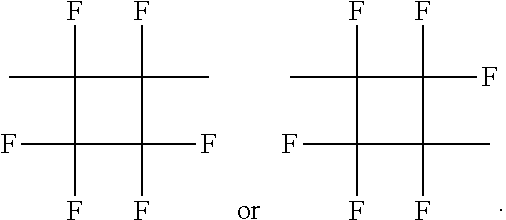
where m represents an integer of from 0 to 3, q represents an integer of from 1 to 12, r represents 0 or 1, and X1 represents a fluorine atom or a trifluoromethyl group and a polymerization unit based on tetrafluoroethylene. Suitable polymers including perfluorocyclobutyl moieties are disclosed in U.S. Pat. Pub. No. 2007/0099054, U.S. Pat. No. 7,897,691 issued Mar. 1, 2011; U.S. Pat. No. 7,897,692 issued Mar. 1, 2011; U.S. Pat. No. 7,888,433 issued Feb. 15, 2011, U.S. Pat. No. 7,897,693 issued Mar. 1, 2011; and U.S. Pat. No. 8,053,530 issued Nov. 8, 2011, the entire disclosures of which are hereby incorporated by reference. Examples of perfluorocyclobutyl moieties are:


Compound 41.

Compound 42.

Compound 43.


Polymers with this structure are further described in U.S. Pat. Nos. 7,897,691; 7,960,046; and 8,053,530.
| TABLE 1 |
| The cathode ink formulation with 5 wt. % additive of poly(vinylbenzo- |
| 18-crown-6) based on ionomer at a loading of 0.2 mg Pt/cm2. |
| Ingredients | Mass (g) | ||
| 30% PtCo/HSC Alloy Catalyst | 1.74 | ||
| ZrO2 Beads (5 mm) | 50.00 | ||
| H2O | 4.99 | ||
| EtOH | 29.29 | ||
| IG100 (28.62 wt % in EtOH:H2O = | 3.98 | ||
| 60.1:39.9) | |||
| Poly(vinylbenzo-18-crown-6) | 0.06 | ||
| Ink Total | 40.06 | ||
| TABLE 2 |
| The standard cathode ink formulation at a loading |
| of 0.2 mg Pt/cm2. |
| Ingredients | Mass (g) | ||
| 30% PtCo/HSC Alloy Catalyst | 1.74 | ||
| ZrO2 Beads (5 mm) | 50.00 | ||
| H2O | 4.99 | ||
| EtOH | 29.29 | ||
| IG100 (28.62 wt % in EtOH:H2O = | 3.98 | ||
| 60.1:39.9) | |||
| Ink Total | 40.00 | ||
MEA Preparation.
| TABLE 3 |
| Summary of testing results. |
| Actual | FCPM | |||
| Pt | Mass | Voltage | Wet-FCPM | |
| loading | Activity | at | Voltage at | |
| Sample Description | mg/cm2 | (A/mg) | 1.5 A/cm2 | 1.5 A/cm2 |
| NRE 211 with Cathode | 0.1709 | 0.488 | 0.547 | 0.621 |
| Additive (BOL) | ||||
| NRE 211 with Cathode | 0.1709 | 0.428 | 0.483 | 0.557 |
| Additive after 10k cycles | ||||
| NRE 211 with Cathode | 0.1709 | 0.298 | 0.371 | 0.439 |
| Additive (EOL) | ||||
| NRE 211 Baseline (BOL) | 0.1735 | 0.334 | 0.521 | 0.601 |
| NRE 211 Baseline after 10k | 0.1735 | 0.263 | 0.471 | 0.57 |
| cycles | ||||
| NRE 211 Baseline (EOL) | 0.1735 | 0.206 | 0.412 | 0.516 |
Claims (10)


Priority Applications (4)
| Application Number | Priority Date | Filing Date | Title |
|---|---|---|---|
| US13/611,046 US8795924B2 (en) | 2012-09-12 | 2012-09-12 | Crown ether containing PEM electrode |
| DE201310217840 DE102013217840A1 (en) | 2012-09-12 | 2013-09-06 | Crown ether-containing PEM electrode |
| CN201310414790.3A CN103682215A (en) | 2012-09-12 | 2013-09-12 | Crown ether containing PEM electrode |
| US14/445,855 US20150105239A1 (en) | 2012-09-12 | 2014-07-29 | Crown ether containing pem electrode |
Applications Claiming Priority (1)
| Application Number | Priority Date | Filing Date | Title |
|---|---|---|---|
| US13/611,046 US8795924B2 (en) | 2012-09-12 | 2012-09-12 | Crown ether containing PEM electrode |
Related Child Applications (1)
| Application Number | Title | Priority Date | Filing Date |
|---|---|---|---|
| US14/445,855 Division US20150105239A1 (en) | 2012-09-12 | 2014-07-29 | Crown ether containing pem electrode |
Publications (2)
| Publication Number | Publication Date |
|---|---|
| US20140072901A1 US20140072901A1 (en) | 2014-03-13 |
| US8795924B2 true US8795924B2 (en) | 2014-08-05 |
Family
ID=50153553
Family Applications (2)
| Application Number | Title | Priority Date | Filing Date |
|---|---|---|---|
| US13/611,046 Active US8795924B2 (en) | 2012-09-12 | 2012-09-12 | Crown ether containing PEM electrode |
| US14/445,855 Abandoned US20150105239A1 (en) | 2012-09-12 | 2014-07-29 | Crown ether containing pem electrode |
Family Applications After (1)
| Application Number | Title | Priority Date | Filing Date |
|---|---|---|---|
| US14/445,855 Abandoned US20150105239A1 (en) | 2012-09-12 | 2014-07-29 | Crown ether containing pem electrode |
Country Status (3)
| Country | Link |
|---|---|
| US (2) | US8795924B2 (en) |
| CN (1) | CN103682215A (en) |
| DE (1) | DE102013217840A1 (en) |
Families Citing this family (4)
| Publication number | Priority date | Publication date | Assignee | Title |
|---|---|---|---|---|
| KR101637711B1 (en) * | 2014-10-30 | 2016-07-07 | 현대자동차주식회사 | A process for separating an electrode in membrane-electrode assembly for fuel cells and apparatus using it |
| US11116793B2 (en) * | 2017-11-13 | 2021-09-14 | National University Corporation Hokkaido University | Modified metal nanoparticle comprising cyclic polyether and pharmaceutical composition |
| JP7416047B2 (en) * | 2019-03-13 | 2024-01-17 | Agc株式会社 | membrane electrode assembly |
| US11355771B2 (en) * | 2019-12-20 | 2022-06-07 | Robert Bosch Gmbh | Ion scavenging agent in fuel cell electrodes |
Citations (13)
| Publication number | Priority date | Publication date | Assignee | Title |
|---|---|---|---|---|
| US3668271A (en) * | 1967-10-02 | 1972-06-06 | Mobil Oil Corp | Hydrogenation of unsaturated hydrocarbons using ion exchange resin containing zero-valent metal as catalyst |
| US4572905A (en) * | 1982-02-26 | 1986-02-25 | Kureha Kagaku Kogyo Kabushiki Kaisha | Substrate for analyzing hydrophilic substances of low molecular weight |
| US4687598A (en) * | 1983-11-07 | 1987-08-18 | The United States Of America As Represented By The United States Department Of Energy | Electrode-active material for electrochemical batteries and method of preparation |
| US5916702A (en) * | 1997-08-15 | 1999-06-29 | Exxon Research And Engineering Co. | CO tolerant platinum-zinc fuel cell electrode |
| US20030186106A1 (en) * | 2001-05-15 | 2003-10-02 | David Frank | Fuel cell flow field plate |
| US20070099054A1 (en) | 2005-11-01 | 2007-05-03 | Fuller Timothy J | Sulfonated-perfluorocyclobutane polyelectrolyte membranes for fuel cells |
| US7888433B2 (en) | 2008-05-09 | 2011-02-15 | Gm Global Technology Operations, Inc. | Sulfonated-polyperfluoro-cyclobutane-polyphenylene polymers for PEM fuel cell applications |
| US7897691B2 (en) | 2008-05-09 | 2011-03-01 | Gm Global Technology Operations, Inc. | Proton exchange membranes for fuel cell applications |
| US7897693B2 (en) | 2008-05-09 | 2011-03-01 | Gm Global Technology Operations, Inc. | Proton conductive polymer electrolytes and fuel cells |
| US7897692B2 (en) | 2008-05-09 | 2011-03-01 | Gm Global Technology Operations, Inc. | Sulfonated perfluorocyclobutane block copolymers and proton conductive polymer membranes |
| US20110117472A1 (en) * | 2009-11-13 | 2011-05-19 | Gm Global Technology Operations, Inc. | Polymer dispersant addition to fuel cell electrode inks for improved manufacturability |
| US20110165459A1 (en) * | 2009-12-18 | 2011-07-07 | GM Global Technology Operations LLC | Lithium ion battery |
| US8053530B2 (en) | 2009-08-26 | 2011-11-08 | GM Global Technology Operations LLC | Polyelectrolyte membranes made of poly(perfluorocyclobutanes) with pendant perfluorosulfonic acid groups and blends with poly(vinylidene fluoride) |
Family Cites Families (6)
| Publication number | Priority date | Publication date | Assignee | Title |
|---|---|---|---|---|
| DE10007654A1 (en) * | 2000-02-19 | 2001-09-06 | Forschungszentrum Juelich Gmbh | Membrane for fuel cells |
| AU2002357324A1 (en) * | 2001-12-19 | 2003-07-09 | Polyfuel, Inc. | Printing of catalyst on the membrane of fuel cells |
| US7579116B2 (en) * | 2005-04-01 | 2009-08-25 | Gm Global Technology Operations, Inc. | Fluoride ion scavenger for fuel cell components |
| JP2008239647A (en) * | 2007-03-23 | 2008-10-09 | Toshiba Corp | POLYMER ELECTROLYTE MATERIAL, POLYMER ELECTROLYTE MATERIAL MANUFACTURING METHOD, POLYMER ELECTROLYTE COMPONENT, FUEL CELL, AND FUEL CELL MANUFACTURING METHOD |
| JP5340198B2 (en) * | 2009-02-26 | 2013-11-13 | 富士フイルム株式会社 | Dispersion composition |
| US8785054B2 (en) * | 2009-12-18 | 2014-07-22 | GM Global Technology Operations LLC | Lithium ion battery |
-
2012
- 2012-09-12 US US13/611,046 patent/US8795924B2/en active Active
-
2013
- 2013-09-06 DE DE201310217840 patent/DE102013217840A1/en not_active Withdrawn
- 2013-09-12 CN CN201310414790.3A patent/CN103682215A/en active Pending
-
2014
- 2014-07-29 US US14/445,855 patent/US20150105239A1/en not_active Abandoned
Patent Citations (14)
| Publication number | Priority date | Publication date | Assignee | Title |
|---|---|---|---|---|
| US3668271A (en) * | 1967-10-02 | 1972-06-06 | Mobil Oil Corp | Hydrogenation of unsaturated hydrocarbons using ion exchange resin containing zero-valent metal as catalyst |
| US4572905A (en) * | 1982-02-26 | 1986-02-25 | Kureha Kagaku Kogyo Kabushiki Kaisha | Substrate for analyzing hydrophilic substances of low molecular weight |
| US4687598A (en) * | 1983-11-07 | 1987-08-18 | The United States Of America As Represented By The United States Department Of Energy | Electrode-active material for electrochemical batteries and method of preparation |
| US5916702A (en) * | 1997-08-15 | 1999-06-29 | Exxon Research And Engineering Co. | CO tolerant platinum-zinc fuel cell electrode |
| US20030186106A1 (en) * | 2001-05-15 | 2003-10-02 | David Frank | Fuel cell flow field plate |
| US7960046B2 (en) | 2005-11-01 | 2011-06-14 | GM Global Technology Operations LLC | Sulfonated-perfluorocyclobutane polyelectrolyte membranes for fuel cells |
| US20070099054A1 (en) | 2005-11-01 | 2007-05-03 | Fuller Timothy J | Sulfonated-perfluorocyclobutane polyelectrolyte membranes for fuel cells |
| US7888433B2 (en) | 2008-05-09 | 2011-02-15 | Gm Global Technology Operations, Inc. | Sulfonated-polyperfluoro-cyclobutane-polyphenylene polymers for PEM fuel cell applications |
| US7897693B2 (en) | 2008-05-09 | 2011-03-01 | Gm Global Technology Operations, Inc. | Proton conductive polymer electrolytes and fuel cells |
| US7897692B2 (en) | 2008-05-09 | 2011-03-01 | Gm Global Technology Operations, Inc. | Sulfonated perfluorocyclobutane block copolymers and proton conductive polymer membranes |
| US7897691B2 (en) | 2008-05-09 | 2011-03-01 | Gm Global Technology Operations, Inc. | Proton exchange membranes for fuel cell applications |
| US8053530B2 (en) | 2009-08-26 | 2011-11-08 | GM Global Technology Operations LLC | Polyelectrolyte membranes made of poly(perfluorocyclobutanes) with pendant perfluorosulfonic acid groups and blends with poly(vinylidene fluoride) |
| US20110117472A1 (en) * | 2009-11-13 | 2011-05-19 | Gm Global Technology Operations, Inc. | Polymer dispersant addition to fuel cell electrode inks for improved manufacturability |
| US20110165459A1 (en) * | 2009-12-18 | 2011-07-07 | GM Global Technology Operations LLC | Lithium ion battery |
Non-Patent Citations (6)
| Title |
|---|
| Babb, D.A., "Synthesis and Metal Ion Complexation of Synthetic Ionophores," a Ph.D. Dissertation in Chemistry, Texas Tech University, Dec. 1985, 149 pgs. |
| Kopolow, S. et al., "Poly(vinylmacrocyclic polyethers), Synthesis and Cation Binding Properties," Macromolecules, 1973, 6, pp. 133-142. |
| Manecke, G. et al., "Polymere Kryptanden, 1," Makromol. Chem. 182, pp. 1973-1984 (1981). |
| Montanari, F. et al., "Hydroxymethyl Derivatives of 18-Crown-6 and [2.2.2]Cryptand: Versatile Intermediates for the Synthesis of Lipophilic and Polymer-Bonded Macrocyclic Ligands," J. Org. Chem., 1982, 47, pp. 1298-1302. |
| Smid, J. et al., "Synthesis of 4′-vinylbenzocrown ethers," Organic Preparation and Procedures Int., 1976, 8(4), pp. 193-196. |
| Smid, J. et al., "Synthesis of 4'-vinylbenzocrown ethers," Organic Preparation and Procedures Int., 1976, 8(4), pp. 193-196. |
Also Published As
| Publication number | Publication date |
|---|---|
| CN103682215A (en) | 2014-03-26 |
| US20140072901A1 (en) | 2014-03-13 |
| US20150105239A1 (en) | 2015-04-16 |
| DE102013217840A1 (en) | 2014-03-13 |
Similar Documents
| Publication | Publication Date | Title |
|---|---|---|
| KR101329494B1 (en) | Ion conducting membrane | |
| KR102168673B1 (en) | Carbazole-based anion exchange material, fuel cell electrode and membrane/electrode assembly comprising the same as a binder | |
| US7842775B2 (en) | Development and characterization of novel proton conducting aromatic polyether type copolymers bearing main and side chain pyridine groups | |
| US9786941B2 (en) | Metal ionophores in PEM membranes | |
| EP4317242A1 (en) | Fluorine-containing compound having sulfonic acid group and polymer electrolyte fuel cell | |
| EP2134768B1 (en) | Proton conducting aromatic polyether type copolymers bearing main and side chain pyridine groups and use thereof in proton exchange membrane fuel cells | |
| Sharma et al. | Ion selective redox active anion exchange membrane: improved performance of vanadium redox flow battery | |
| US8795924B2 (en) | Crown ether containing PEM electrode | |
| EP3021395A1 (en) | Electrolyte membrane, membrane-electrode assembly, and solid polymer fuel cell | |
| JP6478176B2 (en) | Compound containing aromatic ring and polymer electrolyte membrane using the same | |
| CN106663492B (en) | Including the nano composite membrane containing sulfonic polyhedral oligomeric silsesquioxane and its manufacturing method | |
| US20080241628A1 (en) | Membrane-electrode assembly for solid polymer electrolyte fuel cell | |
| US11312818B2 (en) | Polyphenylene compound | |
| TW200915647A (en) | Membrane-electrode assembly, method for producing the same and solid polymer fuel cell | |
| EP1619739B1 (en) | Membrane-electrode structure for solid polymer fuel cell and solid polymer fuel cell | |
| JP5324445B2 (en) | Development and characterization of novel proton conducting aromatic polyether type copolymers with main and side chain pyridine groups | |
| JP7420629B2 (en) | Polyelectrolyte | |
| US20080070093A1 (en) | Development and characterization of novel proton conducting aromatic polyether type copolymers bearing main and side chain pyridine groups | |
| KR20240170922A (en) | Polymer compound having a sulfonic acid group, catalyst composition comprising the compound, and solid polymer fuel cell | |
| JP2008004279A (en) | Composition for fuel cell, polymer electrolyte membrane for fuel cell using it, catalyst layer, or fuel cell | |
| KR20110117994A (en) | Dihydroxy monomer containing a multiple phenyl group, a proton conductive polymer prepared using the monomer, a polymer electrolyte membrane containing the polymer, and a fuel cell comprising the same | |
| JP2010010007A (en) | Membrane-electrode structure for solid polymer fuel cell | |
| CN118974977A (en) | Polymer compound having sulfonic acid group, catalyst composition containing the same, and solid polymer fuel cell | |
| JP2009026638A (en) | Solid polymer electrolyte | |
| WO2024204021A1 (en) | Catalyst composition comprising hydrocarbon ionomer and hydrophilic polymer, and polymer electrolyte fuel cell |
Legal Events
| Date | Code | Title | Description |
|---|---|---|---|
| AS | Assignment |
Owner name: GM GLOBAL TECHNOLOGY OPERATIONS LLC, MICHIGAN Free format text: ASSIGNMENT OF ASSIGNORS INTEREST;ASSIGNORS:FULLER, TIMOTHY J.;ZOU, LIJUN;MITCHELL, JAMES;AND OTHERS;REEL/FRAME:028945/0470 Effective date: 20120806 |
|
| AS | Assignment |
Owner name: WILMINGTON TRUST COMPANY, DELAWARE Free format text: SECURITY AGREEMENT;ASSIGNOR:GM GLOBAL TECHNOLOGY OPERATIONS LLC;REEL/FRAME:030694/0500 Effective date: 20101027 |
|
| FEPP | Fee payment procedure |
Free format text: PAYOR NUMBER ASSIGNED (ORIGINAL EVENT CODE: ASPN); ENTITY STATUS OF PATENT OWNER: LARGE ENTITY |
|
| STCF | Information on status: patent grant |
Free format text: PATENTED CASE |
|
| AS | Assignment |
Owner name: GM GLOBAL TECHNOLOGY OPERATIONS LLC, MICHIGAN Free format text: RELEASE BY SECURED PARTY;ASSIGNOR:WILMINGTON TRUST COMPANY;REEL/FRAME:034287/0415 Effective date: 20141017 |
|
| MAFP | Maintenance fee payment |
Free format text: PAYMENT OF MAINTENANCE FEE, 4TH YEAR, LARGE ENTITY (ORIGINAL EVENT CODE: M1551) Year of fee payment: 4 |
|
| MAFP | Maintenance fee payment |
Free format text: PAYMENT OF MAINTENANCE FEE, 8TH YEAR, LARGE ENTITY (ORIGINAL EVENT CODE: M1552); ENTITY STATUS OF PATENT OWNER: LARGE ENTITY Year of fee payment: 8 |
|
| FEPP | Fee payment procedure |
Free format text: MAINTENANCE FEE REMINDER MAILED (ORIGINAL EVENT CODE: REM.); ENTITY STATUS OF PATENT OWNER: LARGE ENTITY |