US8778305B2 - PSMA-binding agents and uses thereof - Google Patents
PSMA-binding agents and uses thereof Download PDFInfo
- Publication number
- US8778305B2 US8778305B2 US13/057,044 US200913057044A US8778305B2 US 8778305 B2 US8778305 B2 US 8778305B2 US 200913057044 A US200913057044 A US 200913057044A US 8778305 B2 US8778305 B2 US 8778305B2
- Authority
- US
- United States
- Prior art keywords
- radioisotope
- compounds
- iodine
- fluorine
- bromine
- Prior art date
- Legal status (The legal status is an assumption and is not a legal conclusion. Google has not performed a legal analysis and makes no representation as to the accuracy of the status listed.)
- Active, expires
Links
- 0 *[Y]CC(COC=O)NC(=O)NC(CCC)C(=O)OC Chemical compound *[Y]CC(COC=O)NC(=O)NC(CCC)C(=O)OC 0.000 description 14
- OEHRZWMGNXKUML-UHFFFAOYSA-N CC.CC.CC.CC(C)(C)C1=CC=NC=C1.CC(C)(C)C1=CN=CC=C1.CC(C)(C)C1=NC=CC=C1 Chemical compound CC.CC.CC.CC(C)(C)C1=CC=NC=C1.CC(C)(C)C1=CN=CC=C1.CC(C)(C)C1=NC=CC=C1 OEHRZWMGNXKUML-UHFFFAOYSA-N 0.000 description 5
- OFVHUALAYNDQRX-UHFFFAOYSA-N CC.CC(C)(C)C1=CC=CC=C1 Chemical compound CC.CC(C)(C)C1=CC=CC=C1 OFVHUALAYNDQRX-UHFFFAOYSA-N 0.000 description 3
- ZCXXOBXNPHHUFS-CTJNODLGSA-P C.C.C.C.C.C.C.C.C.O=C=O.O=C=O.O=C=O.O=C=O.O=C=O.[H]C(CCCCNC(=O)C1=CC=C(N/N=C\C2=CC=C(F)C=C2)C=C1)N([H])C(=O)N([H])C(CCC(=O)O)C(=O)O.[H]C(CCCCNC(=O)C1=CC=C(N/N=C\C2=CC=C([18F])C=C2)C=C1)N([H])C(=O)N([H])C(CCC(=O)O)C(=O)O.[H]C(CCCCNC(=O)C1=CC=C(N[NH3+])C=C1)N([H])C(=O)N([H])C(CCC(=O)O)C(=O)O.[H]N(C(=O)N([H])C(CCC(=O)OCC1=CC=C(OC)C=C1)C(=O)OCC1=CC=C(OC)C=C1)C(CCCCNC(=O)C1=CC=C(NNC(=O)OC(C)(C)C)C=C1)CC1=CC=C(OC)C=C1.[H]N(C(=O)N([H])C(CCC(=O)OCC1=CC=C(OC)C=C1)C(=O)OCC1=CC=C(OC)C=C1)C(CCCC[NH3+])CC1=CC=C(OC)C=C1 Chemical compound C.C.C.C.C.C.C.C.C.O=C=O.O=C=O.O=C=O.O=C=O.O=C=O.[H]C(CCCCNC(=O)C1=CC=C(N/N=C\C2=CC=C(F)C=C2)C=C1)N([H])C(=O)N([H])C(CCC(=O)O)C(=O)O.[H]C(CCCCNC(=O)C1=CC=C(N/N=C\C2=CC=C([18F])C=C2)C=C1)N([H])C(=O)N([H])C(CCC(=O)O)C(=O)O.[H]C(CCCCNC(=O)C1=CC=C(N[NH3+])C=C1)N([H])C(=O)N([H])C(CCC(=O)O)C(=O)O.[H]N(C(=O)N([H])C(CCC(=O)OCC1=CC=C(OC)C=C1)C(=O)OCC1=CC=C(OC)C=C1)C(CCCCNC(=O)C1=CC=C(NNC(=O)OC(C)(C)C)C=C1)CC1=CC=C(OC)C=C1.[H]N(C(=O)N([H])C(CCC(=O)OCC1=CC=C(OC)C=C1)C(=O)OCC1=CC=C(OC)C=C1)C(CCCC[NH3+])CC1=CC=C(OC)C=C1 ZCXXOBXNPHHUFS-CTJNODLGSA-P 0.000 description 1
- YHOHVGNZPBHIPG-BWSNHWPZSA-P C.C.C.C.C.C.C.C.C.O=C=O.O=C=O.O=C=O.O=C=O.O=C=O.[H]C(CCCCNC(=O)C1=CC=C(N/N=C\C2=CC=C(F)C=C2)N=C1)N([H])C(=O)N([H])C(CCC(=O)O)C(=O)O.[H]C(CCCCNC(=O)C1=CC=C(N/N=C\C2=CC=C([18F])C=C2)N=C1)N([H])C(=O)N([H])C(CCC(=O)O)C(=O)O.[H]C(CCCCNC(=O)C1=CC=C(N[NH3+])N=C1)N([H])C(=O)N([H])C(CCC(=O)O)C(=O)O.[H]N(C(=O)N([H])C(CCC(=O)OCC1=CC=C(OC)C=C1)C(=O)OCC1=CC=C(OC)C=C1)C(CCCCNC(=O)C1=CC=C(NNC(=O)OC(C)(C)C)N=C1)CC1=CC=C(OC)C=C1.[H]N(C(=O)N([H])C(CCC(=O)OCC1=CC=C(OC)C=C1)C(=O)OCC1=CC=C(OC)C=C1)C(CCCC[NH3+])CC1=CC=C(OC)C=C1 Chemical compound C.C.C.C.C.C.C.C.C.O=C=O.O=C=O.O=C=O.O=C=O.O=C=O.[H]C(CCCCNC(=O)C1=CC=C(N/N=C\C2=CC=C(F)C=C2)N=C1)N([H])C(=O)N([H])C(CCC(=O)O)C(=O)O.[H]C(CCCCNC(=O)C1=CC=C(N/N=C\C2=CC=C([18F])C=C2)N=C1)N([H])C(=O)N([H])C(CCC(=O)O)C(=O)O.[H]C(CCCCNC(=O)C1=CC=C(N[NH3+])N=C1)N([H])C(=O)N([H])C(CCC(=O)O)C(=O)O.[H]N(C(=O)N([H])C(CCC(=O)OCC1=CC=C(OC)C=C1)C(=O)OCC1=CC=C(OC)C=C1)C(CCCCNC(=O)C1=CC=C(NNC(=O)OC(C)(C)C)N=C1)CC1=CC=C(OC)C=C1.[H]N(C(=O)N([H])C(CCC(=O)OCC1=CC=C(OC)C=C1)C(=O)OCC1=CC=C(OC)C=C1)C(CCCC[NH3+])CC1=CC=C(OC)C=C1 YHOHVGNZPBHIPG-BWSNHWPZSA-P 0.000 description 1
- ODFKZWFKCQZSEQ-CGPWWHJTSA-P C.C.C.C.C.C.C.C.C.O=C=O.O=C=O.O=C=O.O=C=O.O=C=O.[H]C(CCCCNC(=O)CO/N=C/C1=CC=C(F)C=C1)N([H])C(=O)N([H])C(CCC(=O)O)C(=O)O.[H]C(CCCCNC(=O)CO/N=C/C1=CC=C([18F])C=C1)N([H])C(=O)N([H])C(CCC(=O)O)C(=O)O.[H]C(CCCCNC(=O)CO[NH3+])N([H])C(=O)N([H])C(CCC(=O)O)C(=O)O.[H]N(C(=O)N([H])C(CCC(=O)OCC1=CC=C(OC)C=C1)C(=O)OCC1=CC=C(OC)C=C1)C(CCCCNC(=O)CONC(=O)OC(C)(C)C)CC1=CC=C(OC)C=C1.[H]N(C(=O)N([H])C(CCC(=O)OCC1=CC=C(OC)C=C1)C(=O)OCC1=CC=C(OC)C=C1)C(CCCC[NH3+])CC1=CC=C(OC)C=C1 Chemical compound C.C.C.C.C.C.C.C.C.O=C=O.O=C=O.O=C=O.O=C=O.O=C=O.[H]C(CCCCNC(=O)CO/N=C/C1=CC=C(F)C=C1)N([H])C(=O)N([H])C(CCC(=O)O)C(=O)O.[H]C(CCCCNC(=O)CO/N=C/C1=CC=C([18F])C=C1)N([H])C(=O)N([H])C(CCC(=O)O)C(=O)O.[H]C(CCCCNC(=O)CO[NH3+])N([H])C(=O)N([H])C(CCC(=O)O)C(=O)O.[H]N(C(=O)N([H])C(CCC(=O)OCC1=CC=C(OC)C=C1)C(=O)OCC1=CC=C(OC)C=C1)C(CCCCNC(=O)CONC(=O)OC(C)(C)C)CC1=CC=C(OC)C=C1.[H]N(C(=O)N([H])C(CCC(=O)OCC1=CC=C(OC)C=C1)C(=O)OCC1=CC=C(OC)C=C1)C(CCCC[NH3+])CC1=CC=C(OC)C=C1 ODFKZWFKCQZSEQ-CGPWWHJTSA-P 0.000 description 1
- RUXZFIZSOUHWCQ-ZCURXIKYSA-N C.C.C.C.C.CCCC[Sn](CCCC)(CCCC)C1=CC(C(=O)NCCCCC(NC(=O)NC(CCC(=O)OCC2=CC=C(OC)C=C2)CC2=CC=C(OC)C=C2)C(=O)OCC2=CC=C(OC)C=C2)=CN=C1.CCCC[Sn](CCCC)(CCCC)C1=CN=CC(C(=O)ON2C(=O)CCC2=O)=C1.CCN(CC)CC.COC1=CC=C(COC(=O)CCC(CC2=CC=C(OC)C=C2)NC(=O)NC(CCCCN)C(=O)OCC2=CC=C(OC)C=C2)C=C1.COC1=CC=C(COC(=O)CCC(CC2=CC=C(OC)C=C2)NC(=O)NC(CCCCNC(=O)C2=CN=CC([125I])=C2)C(=O)OCC2=CC=C(OC)C=C2)C=C1.O=C=O.O=C=O.O=C=O.O=C=O.[H]C(CCC(=O)O)NC(=O)NC(CCCCNC(=O)C1=CN=CC([125I])=C1)C(=O)O Chemical compound C.C.C.C.C.CCCC[Sn](CCCC)(CCCC)C1=CC(C(=O)NCCCCC(NC(=O)NC(CCC(=O)OCC2=CC=C(OC)C=C2)CC2=CC=C(OC)C=C2)C(=O)OCC2=CC=C(OC)C=C2)=CN=C1.CCCC[Sn](CCCC)(CCCC)C1=CN=CC(C(=O)ON2C(=O)CCC2=O)=C1.CCN(CC)CC.COC1=CC=C(COC(=O)CCC(CC2=CC=C(OC)C=C2)NC(=O)NC(CCCCN)C(=O)OCC2=CC=C(OC)C=C2)C=C1.COC1=CC=C(COC(=O)CCC(CC2=CC=C(OC)C=C2)NC(=O)NC(CCCCNC(=O)C2=CN=CC([125I])=C2)C(=O)OCC2=CC=C(OC)C=C2)C=C1.O=C=O.O=C=O.O=C=O.O=C=O.[H]C(CCC(=O)O)NC(=O)NC(CCCCNC(=O)C1=CN=CC([125I])=C1)C(=O)O RUXZFIZSOUHWCQ-ZCURXIKYSA-N 0.000 description 1
- YEYYYDBIXLRNHH-UHFFFAOYSA-N C.C.C.CC.CC.CC.CC(C)(C)C1=CC=NC=C1.CC(C)(C)C1=CN=CC=C1.CC(C)(C)C1=NC=CC=C1 Chemical compound C.C.C.CC.CC.CC.CC(C)(C)C1=CC=NC=C1.CC(C)(C)C1=CN=CC=C1.CC(C)(C)C1=NC=CC=C1 YEYYYDBIXLRNHH-UHFFFAOYSA-N 0.000 description 1
- FTUCPHPUMLQJOX-JWZXICIRSA-P C.C.CCN(CC)CC.C[N+](C)(C)C1=CC=C(C(=O)OC2=C(F)C(F)=CC(F)=C2F)C=N1.[H]N(C(=O)N([H])C(CCC(=O)O)C(=O)O)C(CCCCNC(=O)C1=CN=C([N+](C)(C)C)C=C1)C(=O)O.[H]N(C(=O)N([H])C(CCC(=O)O)C(=O)O)C(CCCC[NH3+])C(=O)O.[H]N(C(=O)NC(CCC(=O)O)C(C)=O)C(CCCCNC(=O)C1=CC=C([18F])N=C1)C(=O)O Chemical compound C.C.CCN(CC)CC.C[N+](C)(C)C1=CC=C(C(=O)OC2=C(F)C(F)=CC(F)=C2F)C=N1.[H]N(C(=O)N([H])C(CCC(=O)O)C(=O)O)C(CCCCNC(=O)C1=CN=C([N+](C)(C)C)C=C1)C(=O)O.[H]N(C(=O)N([H])C(CCC(=O)O)C(=O)O)C(CCCC[NH3+])C(=O)O.[H]N(C(=O)NC(CCC(=O)O)C(C)=O)C(CCCCNC(=O)C1=CC=C([18F])N=C1)C(=O)O FTUCPHPUMLQJOX-JWZXICIRSA-P 0.000 description 1
- SSRRDMUTOCOEOZ-FFNUDZIZSA-M C.C1CCOC1.CN(C)C.C[N+](C)(C)C1=CC=C(C(=O)OC2=C(F)C(F)=CC(F)=C2F)C=N1.C[N+](C)(C)C1=CC=C(C(=O)OC2=C(F)C(F)=CC(F)=C2F)C=N1.C[Si](C)(C)OS(=O)(=O)FC(F)F.O=C(O)C1=CC=C(Cl)N=C1.O=C(OC1=C(F)C(F)=CC(F)=C1F)C1=CC=C(Cl)N=C1.O=C(OC1=C(F)C(F)=CC(F)=C1F)C1=CC=C([18F])N=C1.OC1=C(F)C(F)=CC(F)=C1F.[2H]C#C.[Cl-] Chemical compound C.C1CCOC1.CN(C)C.C[N+](C)(C)C1=CC=C(C(=O)OC2=C(F)C(F)=CC(F)=C2F)C=N1.C[N+](C)(C)C1=CC=C(C(=O)OC2=C(F)C(F)=CC(F)=C2F)C=N1.C[Si](C)(C)OS(=O)(=O)FC(F)F.O=C(O)C1=CC=C(Cl)N=C1.O=C(OC1=C(F)C(F)=CC(F)=C1F)C1=CC=C(Cl)N=C1.O=C(OC1=C(F)C(F)=CC(F)=C1F)C1=CC=C([18F])N=C1.OC1=C(F)C(F)=CC(F)=C1F.[2H]C#C.[Cl-] SSRRDMUTOCOEOZ-FFNUDZIZSA-M 0.000 description 1
- DPNUYWXFHVQUSA-KBFCHZLTSA-N C.CC1=CC=NC(N(C)C)=C1.CC1=CC=NC(N)=C1.CC1=CC=NC([18F])=C1.CC1=CC=NC([18F])=C1.CC1=CC=NC([N+](=O)[O-])=C1.CC1=CC=NC([N+](C)(C)C)=C1.CN(C)C1=CC(CBr)=CC=N1.COS(=O)(=O)C(F)(F)F.COS(=O)(=O)C(F)(F)F.C[N+](C)(C)C1=CC(CBr)=CC=N1.O=[N+]([O-])C1=CC(CBr)=CC=N1.[18F]C1=CC(CBr)=CC=N1 Chemical compound C.CC1=CC=NC(N(C)C)=C1.CC1=CC=NC(N)=C1.CC1=CC=NC([18F])=C1.CC1=CC=NC([18F])=C1.CC1=CC=NC([N+](=O)[O-])=C1.CC1=CC=NC([N+](C)(C)C)=C1.CN(C)C1=CC(CBr)=CC=N1.COS(=O)(=O)C(F)(F)F.COS(=O)(=O)C(F)(F)F.C[N+](C)(C)C1=CC(CBr)=CC=N1.O=[N+]([O-])C1=CC(CBr)=CC=N1.[18F]C1=CC(CBr)=CC=N1 DPNUYWXFHVQUSA-KBFCHZLTSA-N 0.000 description 1
- IZHGUVOCRWJVOU-XSNITCRKSA-N C.O=C=O.O=C=O.O=C=O.O=C=O.O=C=O.[H]C(CCCCNC(=O)C1=CC=C([18F])N=C1)NC(=O)NC(C)CCC(=O)O.[H]C(CCCCNC(=O)C1=CC=NC([18F])=C1)NC(=O)NC(C)CCC(=O)O.[H]C(CCCCNC(=O)C1=CN=C(N/N=C/C2=CC=C(C)C=C2)C=C1)NC(=O)NC(CCC(=O)O)C(=O)O.[H]C(CCCCNC(=O)C1=CN=CC([125I])=C1)NC(=O)NC(C)CCC(=O)O.[H]C(CSCC1=CC=NC([18F])=C1)NC(=O)NC(C)CCC(=O)O Chemical compound C.O=C=O.O=C=O.O=C=O.O=C=O.O=C=O.[H]C(CCCCNC(=O)C1=CC=C([18F])N=C1)NC(=O)NC(C)CCC(=O)O.[H]C(CCCCNC(=O)C1=CC=NC([18F])=C1)NC(=O)NC(C)CCC(=O)O.[H]C(CCCCNC(=O)C1=CN=C(N/N=C/C2=CC=C(C)C=C2)C=C1)NC(=O)NC(CCC(=O)O)C(=O)O.[H]C(CCCCNC(=O)C1=CN=CC([125I])=C1)NC(=O)NC(C)CCC(=O)O.[H]C(CSCC1=CC=NC([18F])=C1)NC(=O)NC(C)CCC(=O)O IZHGUVOCRWJVOU-XSNITCRKSA-N 0.000 description 1
- XJCPYDRQQMRNMG-UHFFFAOYSA-N CC(C)(C)C1=CC=C=NC=C1 Chemical compound CC(C)(C)C1=CC=C=NC=C1 XJCPYDRQQMRNMG-UHFFFAOYSA-N 0.000 description 1
- YGRSHGQANLBRHZ-UHFFFAOYSA-N CC(C)(C)C1=NN=NC1 Chemical compound CC(C)(C)C1=NN=NC1 YGRSHGQANLBRHZ-UHFFFAOYSA-N 0.000 description 1
- NRGGMCIBEHEAIL-UHFFFAOYSA-N CCc1ncccc1 Chemical compound CCc1ncccc1 NRGGMCIBEHEAIL-UHFFFAOYSA-N 0.000 description 1
- FNJAOFNTRLCAFE-NPZPZPELSA-N COC1=CC=C(COC(=O)CCC(CC2=CC=C(OC)C=C2)NC(=O)NC(CCCCN)C(=O)OCC2=CC=C(OC)C=C2)C=C1.COC1=CC=C(COC(=O)CCC(CC2=CC=C(OC)C=C2)NC(=O)NC(CS)C(=O)OCC2=CC=C(OC)C=C2)C=C1.NCCCC[C@@H](C=O)NCON[C@H](C=O)CCC(=O)O.O=C=O.O=C=O.O=C[C@H](CCC(=O)O)NOCN[C@H](C=O)CS Chemical compound COC1=CC=C(COC(=O)CCC(CC2=CC=C(OC)C=C2)NC(=O)NC(CCCCN)C(=O)OCC2=CC=C(OC)C=C2)C=C1.COC1=CC=C(COC(=O)CCC(CC2=CC=C(OC)C=C2)NC(=O)NC(CS)C(=O)OCC2=CC=C(OC)C=C2)C=C1.NCCCC[C@@H](C=O)NCON[C@H](C=O)CCC(=O)O.O=C=O.O=C=O.O=C[C@H](CCC(=O)O)NOCN[C@H](C=O)CS FNJAOFNTRLCAFE-NPZPZPELSA-N 0.000 description 1
- LILNWJHPCMMGBU-UHFFFAOYSA-N COC1=CC=C(COC(=O)CCC(NC(=O)NC(CCCCN)CC2=CC=C(OC)C=C2)C(=O)OCC2=CC=C(OC)C=C2)C=C1.O=C=O Chemical compound COC1=CC=C(COC(=O)CCC(NC(=O)NC(CCCCN)CC2=CC=C(OC)C=C2)C(=O)OCC2=CC=C(OC)C=C2)C=C1.O=C=O LILNWJHPCMMGBU-UHFFFAOYSA-N 0.000 description 1
- IKTVFOMMENQRHJ-LPBIYTADSA-N O=C(OC1=C(F)C(F)=CC(F)=C1F)C1=CC=C([18F])N=C1.[H]N(C(=O)N([H])C(CCC(=O)O)C(=O)O)C(CCCCNC(=O)C1=CC=C([18F])N=C1)C(=O)O.[H]N(C(=O)N([H])C(CCC(=O)OCC1=CC=C(OC)C=C1)C(=O)OCC1=CC=C(OC)C=C1)C(CCCCN)C(C)=O.[H]N(C(=O)N([H])C(CCC(=O)OCC1=CC=C(OC)C=C1)C(=O)OCC1=CC=C(OC)C=C1)C(CCCCNC(=O)C1=CC=C([18F])N=C1)C(C)=O Chemical compound O=C(OC1=C(F)C(F)=CC(F)=C1F)C1=CC=C([18F])N=C1.[H]N(C(=O)N([H])C(CCC(=O)O)C(=O)O)C(CCCCNC(=O)C1=CC=C([18F])N=C1)C(=O)O.[H]N(C(=O)N([H])C(CCC(=O)OCC1=CC=C(OC)C=C1)C(=O)OCC1=CC=C(OC)C=C1)C(CCCCN)C(C)=O.[H]N(C(=O)N([H])C(CCC(=O)OCC1=CC=C(OC)C=C1)C(=O)OCC1=CC=C(OC)C=C1)C(CCCCNC(=O)C1=CC=C([18F])N=C1)C(C)=O IKTVFOMMENQRHJ-LPBIYTADSA-N 0.000 description 1
- KEHSJUQCMWFEIF-UPPSABGESA-N O=C=O.O=C=O.O=C=O.O=C=O.O=C=O.[H]C(CCCCNC(=O)C1=CC=C([18F])N=C1)NC(=O)NC(CCC(=O)O)C(=O)O.[H]C(CCCCNC(=O)C1=CC=NC([18F])=C1)NC(=O)NC(CCC(=O)O)C(=O)O.[H]C(CCCCNC(=O)C1=CN=C(N/N=C/C2=CC=C([18F])C=C2)C=C1)NC(=O)NC(CCC(=O)O)C(=O)O.[H]C(CCCCNC(=O)C1=CN=CC([125I])=C1)NC(=O)NC(CCC(=O)O)C(=O)O.[H]C(CSCC1=CC=NC([18F])=C1)NC(=O)NC(CCC(=O)O)C(=O)O Chemical compound O=C=O.O=C=O.O=C=O.O=C=O.O=C=O.[H]C(CCCCNC(=O)C1=CC=C([18F])N=C1)NC(=O)NC(CCC(=O)O)C(=O)O.[H]C(CCCCNC(=O)C1=CC=NC([18F])=C1)NC(=O)NC(CCC(=O)O)C(=O)O.[H]C(CCCCNC(=O)C1=CN=C(N/N=C/C2=CC=C([18F])C=C2)C=C1)NC(=O)NC(CCC(=O)O)C(=O)O.[H]C(CCCCNC(=O)C1=CN=CC([125I])=C1)NC(=O)NC(CCC(=O)O)C(=O)O.[H]C(CSCC1=CC=NC([18F])=C1)NC(=O)NC(CCC(=O)O)C(=O)O KEHSJUQCMWFEIF-UPPSABGESA-N 0.000 description 1
- QQFUGFNOQIPFLB-QLHBEQGISA-N O=C=O.O=C=O.O=C=O.O=C=O.[H]C(CCCCNC(=O)C1=CC=C(N/N=C/C2=CC=C(C)C=C2)C=C1)NC(=O)NC(CCC(=O)O)C(=O)O.[H]C(CCCCNC(=O)CON=CC1=CC=C(C)C=C1)NC(=O)NC(CCC(=O)O)C(=O)O.[H]C(CCCSCC1=CC=NC([18F])=C1)NC(=O)NC(C)CCC(=O)O.[H]C(CCSCC1=CC([18F])=NC=C1)NC(=O)NC(CCC(=O)O)C(=O)O Chemical compound O=C=O.O=C=O.O=C=O.O=C=O.[H]C(CCCCNC(=O)C1=CC=C(N/N=C/C2=CC=C(C)C=C2)C=C1)NC(=O)NC(CCC(=O)O)C(=O)O.[H]C(CCCCNC(=O)CON=CC1=CC=C(C)C=C1)NC(=O)NC(CCC(=O)O)C(=O)O.[H]C(CCCSCC1=CC=NC([18F])=C1)NC(=O)NC(C)CCC(=O)O.[H]C(CCSCC1=CC([18F])=NC=C1)NC(=O)NC(CCC(=O)O)C(=O)O QQFUGFNOQIPFLB-QLHBEQGISA-N 0.000 description 1
- QACGJQZWTKYHKS-UHFFFAOYSA-N O=C=O.O=C=O.O=C=O.[H]C(CCCCNC(=O)C1=CC=C(C)C=C1)NC(=O)NC(C)CCC(=O)O.[H]C(CCCCNC(=O)C1=CC=C(F)C=C1)NC(=O)NC(CCC(=O)O)C(=O)O.[H]C(CCCCNC(=O)C1=CC=C(I)C=C1)NC(=O)NC(CCC(=O)O)C(=O)O Chemical compound O=C=O.O=C=O.O=C=O.[H]C(CCCCNC(=O)C1=CC=C(C)C=C1)NC(=O)NC(C)CCC(=O)O.[H]C(CCCCNC(=O)C1=CC=C(F)C=C1)NC(=O)NC(CCC(=O)O)C(=O)O.[H]C(CCCCNC(=O)C1=CC=C(I)C=C1)NC(=O)NC(CCC(=O)O)C(=O)O QACGJQZWTKYHKS-UHFFFAOYSA-N 0.000 description 1
- FVVHQXXCWQJLJH-WWJPQHJBSA-N O=C=O.O=C=O.[H]C(CCCCNC(=O)C1=CC=C([125I])C=C1)NC(=O)NC(CCC(=O)O)C(=O)O.[H]C(CCCCNC(=O)C1=CC=C([18F])C=C1)NC(=O)NC(C)CCC(=O)O Chemical compound O=C=O.O=C=O.[H]C(CCCCNC(=O)C1=CC=C([125I])C=C1)NC(=O)NC(CCC(=O)O)C(=O)O.[H]C(CCCCNC(=O)C1=CC=C([18F])C=C1)NC(=O)NC(C)CCC(=O)O FVVHQXXCWQJLJH-WWJPQHJBSA-N 0.000 description 1
- DFMDBVSPHOEGAE-GKMUABBRSA-N O=C=O.[H]C(CCSCC1=CC([18F])=NC=C1)NC(=O)NC(C)CCC(=O)O Chemical compound O=C=O.[H]C(CCSCC1=CC([18F])=NC=C1)NC(=O)NC(C)CCC(=O)O DFMDBVSPHOEGAE-GKMUABBRSA-N 0.000 description 1
Images


Classifications
-
- A—HUMAN NECESSITIES
- A61—MEDICAL OR VETERINARY SCIENCE; HYGIENE
- A61K—PREPARATIONS FOR MEDICAL, DENTAL OR TOILETRY PURPOSES
- A61K51/00—Preparations containing radioactive substances for use in therapy or testing in vivo
- A61K51/02—Preparations containing radioactive substances for use in therapy or testing in vivo characterised by the carrier, i.e. characterised by the agent or material covalently linked or complexing the radioactive nucleus
- A61K51/04—Organic compounds
- A61K51/041—Heterocyclic compounds
- A61K51/044—Heterocyclic compounds having nitrogen as a ring hetero atom, e.g. guanethidine, rifamycins
- A61K51/0455—Heterocyclic compounds having nitrogen as a ring hetero atom, e.g. guanethidine, rifamycins having six-membered rings with one nitrogen as the only ring hetero atom
-
- C—CHEMISTRY; METALLURGY
- C07—ORGANIC CHEMISTRY
- C07D—HETEROCYCLIC COMPOUNDS
- C07D213/00—Heterocyclic compounds containing six-membered rings, not condensed with other rings, with one nitrogen atom as the only ring hetero atom and three or more double bonds between ring members or between ring members and non-ring members
- C07D213/02—Heterocyclic compounds containing six-membered rings, not condensed with other rings, with one nitrogen atom as the only ring hetero atom and three or more double bonds between ring members or between ring members and non-ring members having three double bonds between ring members or between ring members and non-ring members
- C07D213/04—Heterocyclic compounds containing six-membered rings, not condensed with other rings, with one nitrogen atom as the only ring hetero atom and three or more double bonds between ring members or between ring members and non-ring members having three double bonds between ring members or between ring members and non-ring members having no bond between the ring nitrogen atom and a non-ring member or having only hydrogen or carbon atoms directly attached to the ring nitrogen atom
- C07D213/60—Heterocyclic compounds containing six-membered rings, not condensed with other rings, with one nitrogen atom as the only ring hetero atom and three or more double bonds between ring members or between ring members and non-ring members having three double bonds between ring members or between ring members and non-ring members having no bond between the ring nitrogen atom and a non-ring member or having only hydrogen or carbon atoms directly attached to the ring nitrogen atom with hetero atoms or with carbon atoms having three bonds to hetero atoms with at the most one bond to halogen, e.g. ester or nitrile radicals, directly attached to ring carbon atoms
- C07D213/78—Carbon atoms having three bonds to hetero atoms, with at the most one bond to halogen, e.g. ester or nitrile radicals
- C07D213/81—Amides; Imides
-
- A—HUMAN NECESSITIES
- A61—MEDICAL OR VETERINARY SCIENCE; HYGIENE
- A61K—PREPARATIONS FOR MEDICAL, DENTAL OR TOILETRY PURPOSES
- A61K51/00—Preparations containing radioactive substances for use in therapy or testing in vivo
- A61K51/02—Preparations containing radioactive substances for use in therapy or testing in vivo characterised by the carrier, i.e. characterised by the agent or material covalently linked or complexing the radioactive nucleus
- A61K51/04—Organic compounds
- A61K51/0402—Organic compounds carboxylic acid carriers, fatty acids
-
- A—HUMAN NECESSITIES
- A61—MEDICAL OR VETERINARY SCIENCE; HYGIENE
- A61K—PREPARATIONS FOR MEDICAL, DENTAL OR TOILETRY PURPOSES
- A61K9/00—Medicinal preparations characterised by special physical form
- A61K9/10—Dispersions; Emulsions
- A61K9/127—Synthetic bilayered vehicles, e.g. liposomes or liposomes with cholesterol as the only non-phosphatidyl surfactant
-
- A—HUMAN NECESSITIES
- A61—MEDICAL OR VETERINARY SCIENCE; HYGIENE
- A61P—SPECIFIC THERAPEUTIC ACTIVITY OF CHEMICAL COMPOUNDS OR MEDICINAL PREPARATIONS
- A61P35/00—Antineoplastic agents
-
- A—HUMAN NECESSITIES
- A61—MEDICAL OR VETERINARY SCIENCE; HYGIENE
- A61P—SPECIFIC THERAPEUTIC ACTIVITY OF CHEMICAL COMPOUNDS OR MEDICINAL PREPARATIONS
- A61P9/00—Drugs for disorders of the cardiovascular system
-
- A—HUMAN NECESSITIES
- A61—MEDICAL OR VETERINARY SCIENCE; HYGIENE
- A61P—SPECIFIC THERAPEUTIC ACTIVITY OF CHEMICAL COMPOUNDS OR MEDICINAL PREPARATIONS
- A61P9/00—Drugs for disorders of the cardiovascular system
- A61P9/10—Drugs for disorders of the cardiovascular system for treating ischaemic or atherosclerotic diseases, e.g. antianginal drugs, coronary vasodilators, drugs for myocardial infarction, retinopathy, cerebrovascula insufficiency, renal arteriosclerosis
-
- C—CHEMISTRY; METALLURGY
- C07—ORGANIC CHEMISTRY
- C07C—ACYCLIC OR CARBOCYCLIC COMPOUNDS
- C07C275/00—Derivatives of urea, i.e. compounds containing any of the groups, the nitrogen atoms not being part of nitro or nitroso groups
- C07C275/04—Derivatives of urea, i.e. compounds containing any of the groups, the nitrogen atoms not being part of nitro or nitroso groups having nitrogen atoms of urea groups bound to acyclic carbon atoms
- C07C275/06—Derivatives of urea, i.e. compounds containing any of the groups, the nitrogen atoms not being part of nitro or nitroso groups having nitrogen atoms of urea groups bound to acyclic carbon atoms of an acyclic and saturated carbon skeleton
- C07C275/16—Derivatives of urea, i.e. compounds containing any of the groups, the nitrogen atoms not being part of nitro or nitroso groups having nitrogen atoms of urea groups bound to acyclic carbon atoms of an acyclic and saturated carbon skeleton being further substituted by carboxyl groups
-
- C—CHEMISTRY; METALLURGY
- C07—ORGANIC CHEMISTRY
- C07C—ACYCLIC OR CARBOCYCLIC COMPOUNDS
- C07C275/00—Derivatives of urea, i.e. compounds containing any of the groups, the nitrogen atoms not being part of nitro or nitroso groups
- C07C275/04—Derivatives of urea, i.e. compounds containing any of the groups, the nitrogen atoms not being part of nitro or nitroso groups having nitrogen atoms of urea groups bound to acyclic carbon atoms
- C07C275/18—Derivatives of urea, i.e. compounds containing any of the groups, the nitrogen atoms not being part of nitro or nitroso groups having nitrogen atoms of urea groups bound to acyclic carbon atoms of a saturated carbon skeleton containing rings
-
- C—CHEMISTRY; METALLURGY
- C07—ORGANIC CHEMISTRY
- C07D—HETEROCYCLIC COMPOUNDS
- C07D213/00—Heterocyclic compounds containing six-membered rings, not condensed with other rings, with one nitrogen atom as the only ring hetero atom and three or more double bonds between ring members or between ring members and non-ring members
- C07D213/02—Heterocyclic compounds containing six-membered rings, not condensed with other rings, with one nitrogen atom as the only ring hetero atom and three or more double bonds between ring members or between ring members and non-ring members having three double bonds between ring members or between ring members and non-ring members
- C07D213/04—Heterocyclic compounds containing six-membered rings, not condensed with other rings, with one nitrogen atom as the only ring hetero atom and three or more double bonds between ring members or between ring members and non-ring members having three double bonds between ring members or between ring members and non-ring members having no bond between the ring nitrogen atom and a non-ring member or having only hydrogen or carbon atoms directly attached to the ring nitrogen atom
- C07D213/60—Heterocyclic compounds containing six-membered rings, not condensed with other rings, with one nitrogen atom as the only ring hetero atom and three or more double bonds between ring members or between ring members and non-ring members having three double bonds between ring members or between ring members and non-ring members having no bond between the ring nitrogen atom and a non-ring member or having only hydrogen or carbon atoms directly attached to the ring nitrogen atom with hetero atoms or with carbon atoms having three bonds to hetero atoms with at the most one bond to halogen, e.g. ester or nitrile radicals, directly attached to ring carbon atoms
- C07D213/61—Halogen atoms or nitro radicals
-
- C—CHEMISTRY; METALLURGY
- C07—ORGANIC CHEMISTRY
- C07D—HETEROCYCLIC COMPOUNDS
- C07D213/00—Heterocyclic compounds containing six-membered rings, not condensed with other rings, with one nitrogen atom as the only ring hetero atom and three or more double bonds between ring members or between ring members and non-ring members
- C07D213/02—Heterocyclic compounds containing six-membered rings, not condensed with other rings, with one nitrogen atom as the only ring hetero atom and three or more double bonds between ring members or between ring members and non-ring members having three double bonds between ring members or between ring members and non-ring members
- C07D213/04—Heterocyclic compounds containing six-membered rings, not condensed with other rings, with one nitrogen atom as the only ring hetero atom and three or more double bonds between ring members or between ring members and non-ring members having three double bonds between ring members or between ring members and non-ring members having no bond between the ring nitrogen atom and a non-ring member or having only hydrogen or carbon atoms directly attached to the ring nitrogen atom
- C07D213/60—Heterocyclic compounds containing six-membered rings, not condensed with other rings, with one nitrogen atom as the only ring hetero atom and three or more double bonds between ring members or between ring members and non-ring members having three double bonds between ring members or between ring members and non-ring members having no bond between the ring nitrogen atom and a non-ring member or having only hydrogen or carbon atoms directly attached to the ring nitrogen atom with hetero atoms or with carbon atoms having three bonds to hetero atoms with at the most one bond to halogen, e.g. ester or nitrile radicals, directly attached to ring carbon atoms
- C07D213/72—Nitrogen atoms
- C07D213/74—Amino or imino radicals substituted by hydrocarbon or substituted hydrocarbon radicals
-
- C—CHEMISTRY; METALLURGY
- C07—ORGANIC CHEMISTRY
- C07D—HETEROCYCLIC COMPOUNDS
- C07D213/00—Heterocyclic compounds containing six-membered rings, not condensed with other rings, with one nitrogen atom as the only ring hetero atom and three or more double bonds between ring members or between ring members and non-ring members
- C07D213/02—Heterocyclic compounds containing six-membered rings, not condensed with other rings, with one nitrogen atom as the only ring hetero atom and three or more double bonds between ring members or between ring members and non-ring members having three double bonds between ring members or between ring members and non-ring members
- C07D213/04—Heterocyclic compounds containing six-membered rings, not condensed with other rings, with one nitrogen atom as the only ring hetero atom and three or more double bonds between ring members or between ring members and non-ring members having three double bonds between ring members or between ring members and non-ring members having no bond between the ring nitrogen atom and a non-ring member or having only hydrogen or carbon atoms directly attached to the ring nitrogen atom
- C07D213/60—Heterocyclic compounds containing six-membered rings, not condensed with other rings, with one nitrogen atom as the only ring hetero atom and three or more double bonds between ring members or between ring members and non-ring members having three double bonds between ring members or between ring members and non-ring members having no bond between the ring nitrogen atom and a non-ring member or having only hydrogen or carbon atoms directly attached to the ring nitrogen atom with hetero atoms or with carbon atoms having three bonds to hetero atoms with at the most one bond to halogen, e.g. ester or nitrile radicals, directly attached to ring carbon atoms
- C07D213/78—Carbon atoms having three bonds to hetero atoms, with at the most one bond to halogen, e.g. ester or nitrile radicals
- C07D213/81—Amides; Imides
- C07D213/82—Amides; Imides in position 3
-
- C—CHEMISTRY; METALLURGY
- C07—ORGANIC CHEMISTRY
- C07F—ACYCLIC, CARBOCYCLIC OR HETEROCYCLIC COMPOUNDS CONTAINING ELEMENTS OTHER THAN CARBON, HYDROGEN, HALOGEN, OXYGEN, NITROGEN, SULFUR, SELENIUM OR TELLURIUM
- C07F7/00—Compounds containing elements of Groups 4 or 14 of the Periodic Table
- C07F7/22—Tin compounds
- C07F7/2208—Compounds having tin linked only to carbon, hydrogen and/or halogen
-
- C—CHEMISTRY; METALLURGY
- C07—ORGANIC CHEMISTRY
- C07B—GENERAL METHODS OF ORGANIC CHEMISTRY; APPARATUS THEREFOR
- C07B2200/00—Indexing scheme relating to specific properties of organic compounds
- C07B2200/05—Isotopically modified compounds, e.g. labelled
-
- Y—GENERAL TAGGING OF NEW TECHNOLOGICAL DEVELOPMENTS; GENERAL TAGGING OF CROSS-SECTIONAL TECHNOLOGIES SPANNING OVER SEVERAL SECTIONS OF THE IPC; TECHNICAL SUBJECTS COVERED BY FORMER USPC CROSS-REFERENCE ART COLLECTIONS [XRACs] AND DIGESTS
- Y02—TECHNOLOGIES OR APPLICATIONS FOR MITIGATION OR ADAPTATION AGAINST CLIMATE CHANGE
- Y02P—CLIMATE CHANGE MITIGATION TECHNOLOGIES IN THE PRODUCTION OR PROCESSING OF GOODS
- Y02P20/00—Technologies relating to chemical industry
- Y02P20/50—Improvements relating to the production of bulk chemicals
- Y02P20/55—Design of synthesis routes, e.g. reducing the use of auxiliary or protecting groups
Definitions
- the present invention relates generally to radioisotope labeled prostate specific membrane antigen (PSMA) binding compounds, chemical precursors of radioisotope labeled PSMA binding compounds and imaging methods using the radioisotope labeled compounds.
- PSMA prostate specific membrane antigen
- PCa Prostate cancer
- CT computed tomography
- MR magnetic resonance
- PET positron emission tomography
- Such newer methods that utilize molecular imaging may provide the biological readout necessary for understanding tumor physiology, enabling more accurate prognosis and therapeutic monitoring.
- Molecular imaging may provide a way to not only detect tumors in vivo, but also to provide information regarding the biology of the lesion, if a mechanism-specific agent is used. For example, [ 18 F]FDHT can be used to study the androgen receptor status of tumors (3).
- PCa is particularly difficult to detect using existing molecular imaging tracers. There are several reasons for this, including the relatively slow growth and metabolic rate of PCa compared to other malignancies as well as the small size of the organ and proximity to the urinary bladder, into which most radiopharmaceuticals are eventually excreted.
- PSMA prostate-specific membrane antigent
- the present invention satisfies the long standing and unmet need for new tissue-specific compounds for imaging prostate cancer and angiogenesis.
- the present invention in particular, provides imaging agents which differ from the prior art in modifications which were not previously known or suggested. Furthermore, the invention provides imaging agents that offer better contrast between target tissues and non-target tissues.
- the invention relates to compounds having the structure (I) shown below.
- Z is tetrazole or CO 2 Q; each Q is independently selected from hydrogen or a protecting group.
- X is fluorine, iodine, a radioisotope of fluorine, a radioisotope of iodine, chlorine, bromine, a radioisotope of bromine, a radioisotope of astatine, NO 2 , NH 2 , N + (R 2 ) 3 , Sn(R 2 ) 3 , Si(R 2 ) 3 , Hg(R 2 ), B(OH) 2 , —NHNH 2 , —NHN ⁇ CHR 3 , —NHNH—CH 2 R 3 ; n is 1, 2, 3, 4, or 5; Y is O, S, N(R′), C(O), NR′C(O), C(O)N(R′), OC(O), C(O)O, NR′C(O)NR′, NR′C(S)NR′, NR′S(O) 2 , S(CH 2 ) p , NR′(CH 2 ) p , O(
- m is 0, 1, 2, 3, 4, 5, or 6;
- Y is O, S, N(R′), C(O), NR′C(O), C(O)N(R′), OC(O), C(O)O, NR′C(O)NR′, NR′C(S)NR′, NR′S(O) 2 , S(CH 2 ) p , NR′(CH 2 ) p , O(CH 2 ) p , OC(O)CHR 8 NHC(O), NHC(O)CHR 8 NHC(O), or a covalent bond;
- p is 1, 2, or 3,
- R′ is H or C 1 -C 6 alkyl, and R 8 is alkyl, aryl or heteroaryl, each of which may be substituted;
- R is
- X′ is selected from the group consisting of NHNH 2 , —NHN ⁇ CHR 3 , and —NHNH—CH 2 R 3 ; wherein R 3 is alkyl, alkenyl, alkynyl, aryl, or heteroaryl each of which is substituted by fluorine, iodine, a radioisotope of fluorine, a radioisotope of iodine, chlorine, bromine, a radioisotope of bromine, or a radioisotope of astatine, NO 2 , NH 2 , N + (R 2 ) 3 , Sn(R 2 ) 3 , Si(R 2 ) 3 , Hg(R 2 ), or B(OH) 2 ; and n is 1, 2, 3, 4, or 5.
- m is 4, Y is NR′, and R is
- G is O, NR′ or a covalent bond;
- R′ is H or C 1 -C 6 alkyl;
- p is 1, 2, 3, or 4
- R 7 is selected from the group consisting of NH 2 , N ⁇ CHR 3 , NH—CH 2 R 3 , wherein R 3 is alkyl, alkenyl, alkynyl, aryl, or heteroaryl each of which is substituted by fluorine, iodine, a radioisotope of fluorine, a radioisotope of iodine, chlorine, bromine, a radioisotope of bromine, a radioisotope of astatine, NO 2 , NH 2 , N + (R 2 ) 3 , Sn(R 2 ) 3 , Si(R 2 ) 3 , Hg(R 2 ), or B(OH) 2 .
- Some compounds of the present invention interact with the prostate-specific membrane antigen (PSMA).
- PSMA prostate-specific membrane antigen
- the compounds may be suitable as imaging agents, diagnostic agents, and/or therapeutic agents.
- the radioisotope used in the compound is short-lived. Therefore, radioisotopically labeled compounds are prepared immediately or shortly before use, or only in sufficient quantity for administration. For this reason, the invention also includes precursors to radioisotopically labeled compounds, which may be chemically converted into the radioisotopically labeled compounds of the invention.
- FIG. 1 shows an overlay of the best poses for 3, 6 and 8 with the crystal ligand, i.e., 3 as it is co-crystallized with PSMA, in the presence of water molecule in the active site of PSMA (PDB ID: 3D7H). Dark spheres (zinc ions), light sphere (chloride ion).
- FIG. 2 shows an overlay of the best poses (3, 6 and 8) with the crystal ligand (3) in the absence of water molecule in the active site of PSMA. Dark sphere (zinc ions), light sphere (chloride ion).
- FIG. 3 shows [ 125 I]3 SPECT-CT in PCa tumor models (4 h postinjection). Note uptake within the PSMA+ PIP tumor only. Uptake within kidneys is due in large measure to the specific binding of [ 125 I]3 to renal cortex.
- FIG. 4 shows [ 18 F]6 PET coregistered to CT in PCa tumor models ( ⁇ 100 min postinjection). Note uptake within the PSMA+ PIP tumor only. Uptake within kidneys is due in large measure to the specific binding of [ 125 I]3 to renal cortex. There is more intense tumor uptake and less liver seen with this agent than with [ 125 I]3.
- FIG. 5 shows [ 125 I]8 SPECT-CT in PSMA+ LNCaP tumors (4 h postinjection). Note intense uptake within tumor. A similar result was obtained for PSMA+ PIP but not PSMA-flu tumors (data not shown). There is less renal and liver uptake with this agent than the halobenzoylated analogues, [ 125 I]3 and [ 18 F]6, respectively.
- Embodiments of the invention include compounds according to formula I, shown below:
- Z is tetrazole or CO 2 Q, and each Q is independently selected from hydrogen or a protecting group.
- m is 0, 1, 2, 3, 4, 5, or 6
- R is a pyridine ring selected from the group consisting of
- X is fluorine, iodine, a radioisotope of fluorine, a radioisotope of iodine, chlorine, bromine, a radioisotope of bromine, a radioisotope of astatine, NO 2 , NH 2 , N + (R 2 ) 3 , Sn(R 2 ) 3 , Si(R 2 ) 3 , Hg(R 2 ), B(OH) 2 , —NHNH 2 , —NHN ⁇ CHR 3 , —NHNH—CH 2 R 3 ; n is 1, 2, 3, 4, or 5; Y is O, S, N(R′), C(O), NR′C(O), C(O)N(R′), OC(O), C(O)O, NR′C(O)NR′, NR′C(S)NR′, NR′S(O) 2 , S(CH 2 ) p , NR′(CH 2 ) p , O(
- m is 0, 1, 2, 3, 4, 5, or 6;
- Y is O, S, N(R′), C(O), NR′C(O), C(O)N(R′), OC(O), C(O)O, NR′C(O)NR′, NR′C(S)NR′, NR′S(O) 2 , S(CH 2 ) p , NR′(CH 2 ) p , O(CH 2 ) p , OC(O)CHR 8 NHC(O), NHC(O)CHR 8 NHC(O), or a covalent bond;
- p is 1, 2, or 3;
- R′ is H or C 1 -C 6 alkyl;
- R 8 is alkyl, aryl or heteroaryl, each of which may be substituted;
- R is
- X′ is selected from the group consisting of NHNH 2 , —NHN ⁇ CHR 3 , and —NHNH—CH 2 R 3 ; wherein R 3 is alkyl, alkenyl, alkynyl, aryl, or heteroaryl each of which is substituted by fluorine, iodine, a radioisotope of fluorine, a radioisotope of iodine, chlorine, bromine, a radioisotope of bromine, or a radioisotope of astatine; NO 2 , NH 2 , N + (R 2 ) 3 , Sn(R 2 ) 3 , Si(R 2 ) 3 , Hg(R 2 ), or B(OH) 2 ; R 2 is C 1 -C 6 alkyl; n is 1, 2, 3, 4, or 5; or a pharmaceutically acceptable salt thereof.
- m is 4; Y is NR′; and R is
- G is O, NR′ or a covalent bond;
- R′ is H or C 1 -C 6 alkyl;
- p is 1, 2, 3, or 4
- R 7 is selected from the group consisting of NH 2 , N ⁇ CHR 3 , NH—CH 2 R 3 , wherein R 3 is alkyl, alkenyl, alkynyl, aryl, or heteroaryl each of which is substituted by fluorine, iodine, a radioisotope of fluorine, a radioisotope of iodine, bromine, a radioisotope of bromine, or a radioisotope of astatine; NO 2 , NH 2 , N + (R 2 ) 3 , Sn(R 2 ) 3 , Si(R 2 ) 3 , Hg(R 2 ), or B(OH) 2 ;
- R 2 is C 1 -C 6 alkyl; or a pharmaceutically acceptable salt thereof.
- the compounds herein described may have one or more asymmetric centers or planes.
- Compounds of the present invention containing an asymmetrically substituted atom may be isolated in optically active or racemic forms. It is well known in the art how to prepare optically active forms, such as by resolution of racemic forms (racemates), by asymmetric synthesis, or by synthesis from optically active starting materials. Resolution of the racemates can be accomplished, for example, by conventional methods such as crystallization in the presence of a resolving agent, or chromatography, using, for example a chiral HPLC column. Many geometric isomers of olefins, C ⁇ N double bonds, and the like can also be present in the compounds described herein, and all such stable isomers are contemplated in the present invention.
- Cis and trans geometric isomers of the compounds of the present invention are described and may be isolated as a mixture of isomers or as separated isomeric forms. All chiral (enantiomeric and diastereomeric), and racemic forms, as well as all geometric isomeric forms of a structure are intended, unless the specific stereochemistry or isomeric form is specifically indicated.
- the compounds herein described may have one or more charged atoms.
- the compounds may be zwitterionic, but may be neutral overall.
- Other embodiments may have one or more charged groups, depending on the pH and other factors.
- the compound may be associated with a suitable counter-ion.
- salts or exchange counter-ions can be prepared by reacting free acid forms of these compounds with a stoichiometric amount of the appropriate base (such as Na, Ca, Mg, or K hydroxide, carbonate, bicarbonate, or the like), or by reacting free base forms of these compounds with a stoichiometric amount of the appropriate acid.
- Counter-ions may be changed, for example, by ion-exchange techniques such as ion-exchange chromatography. All zwitterions, salts and counter-ions are intended, unless the counter-ion or salt is specifically indicated.
- the salt or counter-ion may be pharmaceutically acceptable, for administration to a subject. Pharmaceutically acceptable salts are discussed later.
- any variable occurs more than one time in any constituent or formula for a compound, its definition at each occurrence is independent of its definition at every other occurrence.
- a group is shown to be substituted with (X) n , where n is 1, 2, 3, 4, or 5, then said group may optionally be substituted with up to five X groups and each occurrence is selected independently from the definition of X.
- substituents and/or variables are permissible only if such combinations result in stable compounds.
- substituents of the various formulae are “substituted” or “may be substituted.”
- substituted means that any one or more hydrogens on the designated atom or group is replaced with a substituent, provided that the designated atom's normal valence is not exceeded, and that the substitution results in a stable compound.
- 2 hydrogens on an atom are replaced.
- the present invention is intended to include all isotopes (including radioisotopes) of atoms occurring in the present compounds.
- Suitable groups that may be present on a “substituted” group include e.g., halogen; cyano; hydroxyl; nitro; azido; amino; alkanoyl (such as a C 1 -C 6 alkanoyl group such as acyl or the like); carboxamido; alkyl groups (including cycloalkyl groups, having 1 to about 8 carbon atoms, for example 1, 2, 3, 4, 5, or 6 carbon atoms); alkenyl and alkynyl groups (including groups having one or more unsaturated linkages and from 2 to about 8, such as 2, 3, 4, 5 or 6, carbon atoms); alkoxy groups having one or more oxygen linkages and from 1 to about 8, for example 1, 2, 3, 4, 5 or 6 carbon atoms; aryloxy such as phenoxy; alkylthio groups including those having one
- benzyl arylalkoxy having 1 to 3 separate or fused rings and from 6 to about 18 ring carbon atoms (e.g. O-benzyl); or a saturated, unsaturated, or aromatic heterocyclic group having 1 to 3 separate or fused rings with 3 to about 8 members per ring and one or more N, O or S atoms, (e.g.
- alkyl is intended to include branched, straight-chain, and cyclic saturated aliphatic hydrocarbon groups.
- alkyl include, but are not limited to, methyl, ethyl, n-propyl, iso-propyl, n-butyl, sec-butyl, tent-butyl, n-pentyl, and sec-pentyl.
- alkyl groups are C 1 -C 6 alkyl groups or C 1 -C 4 alkyl groups. Particular alkyl groups are methyl, ethyl, propyl, butyl, and 3-pentyl.
- C 1 -C 6 alkyl as used herein means straight-chain, branched, or cyclic C 1 -C 6 hydrocarbons which are completely saturated and hybrids thereof such as (cycloalkyl)alkyl.
- Examples of C 1 -C 6 alkyl substituents include methyl (Me), ethyl (Et), propyl (including n-propyl (n-Pr, n Pr), iso-propyl (i-Pr, i Pr), and cyclopropyl (c-Pr, c Pr)), butyl (including n-butyl (n-Bu, n Bu), iso-butyl (i-Bu, i Bu), sec-butyl (s-Bu, 5 Bu), tert-butyl (t-Bu, t Bu), or cyclobutyl (c-Bu, c Bu)), and so forth.
- Cycloalkyl is intended to include saturated ring groups, such as cyclopropyl, cyclobutyl, cyclopentyl, or cyclohexyl. Cycloalkyl groups typically will have 3 to about 8 ring members.
- (cycloalkyl)alkyl cycloalkyl, and alkyl are as defined above, and the point of attachment is on the alkyl group. This term encompasses, but is not limited to, cyclopropylmethyl, cyclopentylmethyl, and cyclohexylmethyl.
- alkenyl is intended to include hydrocarbon chains of either a straight or branched configuration comprising one or more unsaturated carbon-carbon bonds, which may occur in any stable point along the chain, such as ethenyl and propenyl. Alkenyl groups typically will have 2 to about 8 carbon atoms, more typically 2 to about 6 carbon atoms.
- alkynyl is intended to include hydrocarbon chains of either a straight or branched configuration comprising one or more carbon-carbon triple bonds, which may occur in any stable point along the chain, such as ethynyl and propynyl. Alkynyl groups typically will have 2 to about 8 carbon atoms, more typically 2 to about 6 carbon atoms.
- haloalkyl is intended to include both branched and straight-chain saturated aliphatic hydrocarbon groups having the specified number of carbon atoms, substituted with 1 or more halogen atoms.
- haloalkyl include, but are not limited to, mono-, di-, or tri-fluoromethyl, mono-, di-, or tri-chloromethyl, mono-, di-, tri-, tetra-, or penta-fluoroethyl, and mono-, di-, tri-, tetra-, or penta-chloroethyl, etc.
- Typical haloalkyl groups will have 1 to about 8 carbon atoms, more typically 1 to about 6 carbon atoms.
- alkoxy represents an alkyl group as defined above attached through an oxygen bridge.
- alkoxy include, but are not limited to, methoxy, ethoxy, n-propoxy, i-propoxy, n-butoxy, 2-butoxy, t-butoxy, n-pentoxy, 2-pentoxy, 3-pentoxy, isopentoxy, neopentoxy, n-hexoxy, 2-hexoxy, 3-hexoxy, and 3-methylpentoxy.
- Alkoxy groups typically have 1 to about 8 carbon atoms, more typically 1 to about 6 carbon atoms.
- haloalkoxy represents a haloalkyl group as defined above with the indicated number of carbon atoms attached through an oxygen bridge. Haloalkoxy groups will have 1 to about 8 carbon atoms, more typically 1 to about 6 carbon atoms.
- alkylthio includes those groups having one or more thioether linkages and typically from 1 to about 8 carbon atoms, more typically 1 to about 6 carbon atoms.
- alkylsulfinyl includes those groups having one or more sulfoxide (SO) linkage groups and typically from 1 to about 8 carbon atoms, more typically 1 to about 6 carbon atoms.
- SO sulfoxide
- alkylsulfonyl includes those groups having one or more sulfonyl (SO 2 ) linkage groups and typically from 1 to about 8 carbon atoms, more typically 1 to about 6 carbon atoms.
- alkylamino includes those groups having one or more primary, secondary and/or tertiary amine groups and typically from 1 to about 8 carbon atoms, more typically 1 to about 6 carbon atoms.
- Halo or “halogen” refers to fluoro, chloro, bromo, or iodo; and “counter-ion” is used to represent a small, negatively charged species such as chloride, bromide, hydroxide, acetate, sulfate, and the like.
- carrier group is intended to mean any stable 3- to 7-membered monocyclic or bicyclic or 7-to 13-membered bicyclic or tricyclic group, any of which may be saturated, partially unsaturated, or aromatic.
- examples of such carbocycles include, but are not limited to, cyclopropyl, cyclobutyl, cyclopentyl, cyclohexyl, cycloheptyl, adamantyl, cyclooctyl, [3.3.0]bicyclooctanyl, [4.3.0]bicyclononanyl, [4.4.0]bicyclodecanyl, [2.2.2]bicyclooctanyl, fluorenyl, phenyl, naphthyl, indanyl, and tetrahydronaphthyl.
- aryl includes groups that contain 1 to 3 separate or fused rings and from 6 to about 18 ring atoms, without hetero atoms as ring members.
- Example os aryl groups include include but are not limited to phenyl, and naphthyl, including 1-naphthyl and 2-naphthyl.
- heterocyclic group is intended to include saturated, partially unsaturated, or unsaturated (aromatic) groups having 1 to 3 (possibly fused) rings with 3 to about 8 members per ring at least one ring containing an atom selected from N, O or S.
- the nitrogen and sulfur heteroatoms may optionally be oxidized.
- heterocycloalkyl is used to refer to saturated heterocyclic groups.
- a heterocyclic ring may be attached to its pendant group at any heteroatom or carbon atom that results in a stable structure.
- the heterocyclic rings described herein may be substituted on carbon or on a nitrogen atom if the resulting compound is stable.
- a nitrogen in the heterocycle may optionally be quaternized.
- heteroaryl is intended to include any stable 5-to 7-membered monocyclic or 10- to 14-membered bicyclic heterocyclic aromatic ring system which comprises carbon atoms and from 1 to 4 heteroatoms independently selected from the group consisting of N, O and S.
- the total number of S and O atoms in the aromatic heterocycle is not more than 2, and typically not more than 1.
- heteroaryl examples include, but are not limited to, those exemplified elsewhere herein and further include acridinyl, azocinyl, benzimidazolyl, benzofuranyl, benzothiofuranyl, benzothiophenyl, benzoxazolyl, benzthiazolyl, benztriazolyl, benztetrazolyl, benzisoxazolyl, benzisothiazolyl, benzimidazolinyl, carbazolyl, NH-carbazolyl, carbolinyl, chromanyl, chromenyl, cinnolinyl, decahydroquinolinyl, 2H.6HA,5,2-dithiazinyl, dihydrofuro[2,3-b]tetrahydrofuran, furanyl, furazanyl, imidazolidinyl, imidazolinyl, imidazolyl, 1H-indazolyl, indol
- heteroaryl groups include, but are not limited to, pyridinyl, pyrimidinyl, furanyl, thienyl, pyrrolyl, pyrazolyl, pyrrolidinyl, morpholinyl, piperidinyl, piperazinyl, and imidazolyl.
- Z is tetrazole or CO 2 Q.
- the tetrazole ring is attached through the carbon atom, as shown below.
- Q is a protecting group.
- a “protecting group” is a chemical substituent which can be selectively removed by readily available reagents which do not attack the regenerated functional group or other functional groups in the molecule. Suitable protecting groups may be found, for example in Wutz et al. (“Greene's Protective Groups in Organic Synthesis, Fourth Edition,” Wiley-Interscience, 2007). Protecting groups for protection of the carboxyl group, as described by Wutz et al. (pages 533-643), are used in certain embodiments. In some embodiments, the protecting group is removable by treatment with acid.
- protecting groups include but are not limited to, benzyl, p-methoxybenzyl (PMB), tertiary butyl ( t Bu), methoxymethyl (MOM), methoxyethoxymethyl (MEM), methylthiomethyl (MTM), tetrahydropyranyl (THP), tetrahydrofuranyl (THF), benzyloxymethyl (BOM), trimethylsilyl (TMS), triethylsilyl (TES), t-butyldimethylsilyl (TBDMS), and triphenylmethyl (trityl, Tr).
- PMB p-methoxybenzyl
- t Bu tertiary butyl
- MOM methoxymethyl
- MTM methoxyethoxymethyl
- THF tetrahydrofuranyl
- BOM benzyloxymethyl
- TMS trimethylsilyl
- TES triethylsilyl
- TDMS t-buty
- R 8 is alkyl, aryl or heteroaryl, each of which may be substituted.
- R 8 describes the sidechain of a natural or synthetic ⁇ -amino acid.
- Specific examples of R 8 include hydrogen, methyl (CH 3 ), isopropyl (CH(CH 3 ) 2 ), 2,2-dimethylethyl (CH 2 CH(CH3) 2 ), 2-methylpropyl (CH(CH 3 )CH 2 CH 3 ), phenyl, 4-hydroxyphenyl, hydroxymethyl (CH 2 OH), carboxymethyl (CH 2 CO 2 H), thiomethyl (CH 2 SH), imidazolylmethyl, indolylmethyl, and so forth.
- Certain embodiments include compounds according to formula I where Z is CO 2 Q. In other embodiments, Q is hydrogen. In some specific embodiments, Z is CO 2 Q and Q is hydrogen.
- Certain embodiments include compounds according to formula I, where m is 1, 2, 3, or 4.
- X is fluorine, iodine, a radioisotope of fluorine, a radioisotope of iodine, chlorine, bromine, a radioisotope of bromine, a radioisotope of astatine, NO 2 , NH 2 , N + (R 2 ) 3 , Sn(R 2 ) 3 , Si(R 2 ) 3 , Hg(R 2 ), B(OH) 2 , —NHNH 2 , —NHN ⁇ CHR 3 , —NHNH—CH 2 R 3 .
- n is 1.
- Each Q is independently selected from hydrogen or a protecting group;
- Z is tetrazole or CO 2 Q;
- Y is O, S, N(R′), C(O), NR′C(O), C(O)N(R′), OC(O), C(O)O, NR′C(O)NR′, NR′C(S)NR′, NR′S(O) 2 , S(CH 2 ) p , NR′(CH 2 ) p , O(CH 2 ) p , OC(O)CHR 8 NHC(O), NHC(O)CHR 8 NHC(O), or a covalent bond; wherein p is 1, 2, or 3, R′ is H or C 1 -C 6 alkyl, and R 8 is alkyl, aryl or heteroaryl, each of which may be substituted; R 2 is C 1 -C 6 alkyl; and R 3 is alkyl, alkenyl, alkynyl, aryl, or hetero
- R 3 is aryl, substituted by fluorine, iodine, a radioisotope of fluorine, a radioisotope of iodine, bromine, a radioisotope of bromine, or a radioisotope of astatine.
- R is a pyridine ring selected from the group consisting of
- X is fluorine, iodine, a radioisotope of fluorine, a radioisotope of iodine, chlorine, bromine, a radioisotope of bromine, a radioisotope of astatine, NO 2 , NH 2 , N + (R 2 ) 3 , Sn(R 2 ) 3 , Si(R 2 ) 3 , Hg(R 2 ), B(OH) 2 , —NHNH 2 , —NHN ⁇ CHR 3 , or —NHNH—CH 2 R 3 .
- R 2 is C 1 -C 6 alkyl; and R 3 is alkyl, alkenyl, alkynyl, aryl, or heteroaryl each of which is substituted by fluorine, iodine, a radioisotope of fluorine, a radioisotope of iodine, chlorine bromine, a radioisotope of bromine, or a radioisotope of astatine; NO 2 , NH 2 , N + (R 2 ) 3 , Sn(R 2 ) 3 , Si(R 2 ) 3 , Hg(R 2 ), or B(OH) 2 . In certain embodiments, n is 1.
- R 3 is aryl, substituted by fluorine, iodine, a radioisotope of fluorine, a radioisotope of iodine, bromine, a radioisotope of bromine, or a radioisotope of astatine.
- Specific embodiments include compounds having the structure shown above, where Z is CO 2 Q, Q is hydrogen, and m is 4.
- R is a pyridine ring selected from the group consisting of
- X is fluorine, iodine, a radioisotope of fluorine, a radioisotope of iodine, chlorine, bromine, a radioisotope of bromine, a radioisotope of astatine, NO 2 , NH 2 , N + (R 2 ) 3 , Sn(R 2 ) 3 , Si(R 2 ) 3 , Hg(R 2 ), B(OH) 2 , —NHNH 2 , —NHN ⁇ CHR 3 , —NHNH—CH 2 R 3 .
- R 2 is C 1 -C 6 alkyl; and R 3 is alkyl, alkenyl, alkynyl, aryl, or heteroaryl each of which is substituted by fluorine, iodine, a radioisotope of fluorine, a radioisotope of iodine, chlorine bromine, a radioisotope of bromine, or a radioisotope of astatine; NO 2 , NH 2 , N + (R 2 ) 3 , Sn(R 2 ) 3 , Si(R 2 ) 3 , Hg(R 2 ), or B(OH) 2 . In certain embodiments, n is 1.
- R 3 is aryl, substituted by fluorine, iodine, a radioisotope of fluorine, a radioisotope of iodine, bromine, a radioisotope of bromine, or a radioisotope of astatine.
- Specific embodiments include compounds having the structure shown above, where Z is CO 2 Q, Q is hydrogen, and m is 1, 2, or 3.
- X′ is selected from the group consisting of —NHNH 2 , —NHN ⁇ CHR 3 , —NHNH—CH 2 R 3 .
- R 3 is alkyl, alkenyl, alkynyl, aryl, or heteroaryl each of which is substituted by fluorine, iodine, a radioisotope of fluorine, a radioisotope of iodine, bromine, a radioisotope of bromine, or a radioisotope of astatine; NO 2 , NH 2 , N + (R 2 ) 3 , Sn(R 2 ) 3 , Si(R 2 ) 3 , Hg(R 2 ), B(OH) 2 .
- R 2 is C 1 -C 6 alkyl; and R 3 is alkyl, alkenyl, alkynyl, aryl, or heteroaryl each of which is substituted by fluorine, iodine, a radioisotope of fluorine, a radioisotope of iodine, chlorine bromine, a radioisotope of bromine, or a radioisotope of astatine; NO 2 , NH 2 , N + (R 2 ) 3 , Sn(R 2 ) 3 , Si(R 2 ) 3 , Hg(R 2 ), or B(OH) 2 .
- R 3 is aryl, substituted by fluorine, iodine, a radioisotope of fluorine, a radioisotope of iodine, bromine, a radioisotope of bromine, or a radioisotope of astatine.
- Specific embodiments include compounds where n is 1.
- Compounds according to this embodiment can be prepared, for example, from hydrazine substituted phenyl precursors, followed by derivatization with an alkyl, alkenyl, alkynyl, aryl, or heteroaryl reagent, each of which is substituted by fluorine, iodine, a radioisotope of fluorine, a radioisotope of iodine, chlorine bromine, a radioisotope of bromine, or a radioisotope of astatine NO 2 , NH 2 , N + (R 2 ) 3 , Sn(R 2 ) 3 , Si(R 2 ) 3 , Hg(R 2 ), and B(OH) 2 as illustrated in Scheme 2 below.
- R 7 can be selected from NH 2 , N ⁇ CHR 3 , and NH—CH 2 R 3 , wherein R 3 is alkyl, alkenyl, alkynyl, aryl, or heteroaryl, each of which is substituted by fluorine, iodine, a radioisotope of fluorine, a radioisotope of iodine, bromine, a radioisotope of bromine, a radioisotope of astatine, NO 2 , NH 2 , N + (R 2 ) 3 , Sn(R 2 ) 3 , Si(R 2 ) 3 , Hg(R 2 ), or B(OH) 2 , where R 2 is C 1 -C 6 alkyl.
- R 3 is aryl, substituted by fluorine, iodine, a radioisotope of fluorine, a radioisotope of iodine, chlorine, bromine, a radioisotope of bromine, or a radioisotope of astatine.
- G is O or NR′.
- Compounds according to this embodiment can be prepared, for example, by acylation of PMB protected Lys-C(O)-Glu with an acylating agent bearing a free or protected amine, followed by deprotection of the amine, if necessary, and derivatization with an alkyl, alkenyl, alkynyl, aryl, or heteroaryl reagent, each of which is substituted by fluorine, iodine, a radioisotope of fluorine, a radioisotope of iodine, chlorine, bromine, a radioisotope of bromine, or a radioisotope of astatine, NO 2 , NH 2 , N + (R 2 ) 3 , Sn(R 2 ) 3 , Si(R 2 ) 3 , Hg(R 2 ), or B(OH) 2 , as illustrated by Scheme 3 shown below.
- Radioisotope containing compounds of any embodiment of the present invention can be prepared with sufficient radiolabel to be used in imaging applications. In other words, the compounds can be prepared with radioisotope concentrations greater than natural abundance, when a particular radioisotope occurs naturally.
- Radiolabeled compounds may be used for diagnostic, imaging, or therapeutic purposes.
- some compounds e.g. those labeled with 125 I and 123 I, are designed for SPECT imaging, while some compounds, e.g. those labeled with 18 F and 124 I, are designed for PET imaging, and some radioisotopically labeled compounds may be used therapeutically.
- the suitability of a particular radioisotope for a particular purpose is well understood in the art.
- Other exemplary embodiments are compounds used as precursors for radiolabeled compounds, in which a substituent may be directly exchanged for a radioisotope in one or more steps.
- the terms “converted,” derivatized,” “exchanged,” or “reacted” are intended to encompass one or more steps.
- substituents that may be exchanged for radioisotopes include halogens, NO 2 , N + (R 2 ) 3 , Sn(R 2 ) 3 , Si(R 2 ) 3 , Hg(R 2 ), and B(OH) 2 .
- Other compounds are precursors which may be chemically reacted with a radioisotopically labeled reagent to produce a stable radioisotopically labeled compound.
- asymmetrical ureas used as precursors may be produced by the general scheme shown below, where R is the sidechain of a natural or synthetic amino acid, which bears a group that can be further derivatized.
- amino acids include lysine, cysteine, homocysteine, serine, threonine, tyrosine, phenylalanine and substituted phenylalanine.
- Substituted phenylalanine has the structure of phenylalanine where the phenyl sidechain is substituted by, for example, nitro, amino or halogen.
- Compounds of the present invention may be prepared, for example, by reaction of a protected urea precursor with a reagent substituted with a radioisotope or other substituent which may be converted or derivatized into a radioisotope containing compound.
- a protected urea precursor such as those described above may be reacted, for example with an activated benzoate or pyridine carboxylate.
- the synthesis of both the halobenzoate and pyridine carboxylate radionuclide-bearing precursors have been described (20)(21)(22)(23)(25)(37)(38).
- Pyridinecarboxylate 18 F precursors such as n-hydroxysuccinimide-activated pyridine carboxylates, can be prepared, for example, by the scheme shown below.
- 18 F pyridine precursors may be prepared by methods described by Olberg et al. (J. Labeled Compd. Radiopharm, vol. 52:Supplement 1, p. S160, 2009), shown below.
- An 18 F pyridinecarboxylate precursor may be used to prepare compounds according to the present invention, for example, according to the scheme shown below.
- a precursor may be prepared, which can then be converted into an 18 F-substituted compound.
- compounds may be prepared according to the scheme below.
- Other compounds may be produced from a suitable protected precursor, such as those discussed above, by reaction with bromomethyl pyridine compounds bearing radioisotope substituents, or substituents which may be converted to radioisotopes or derivatized with radioisotope containing compounds.
- a suitable protected precursor such as those discussed above
- substituents which may be converted to radioisotopes or derivatized with radioisotope containing compounds.
- the scheme below shows preparation of an exemplary compound from PMB protected precursor Cys-C(O)-Glu.
- Bromomethyl pyridine compounds such as 18 F, NO 2 or N(CH 3 ) 3 + substituted bromomethyl pyridine, suitable for preparation of compounds according to the present invention can be prepared, for example, according to the scheme shown below.
- Other compounds can be prepared, for example, from hydrazine (—NHNH 2 ) substituted pyridine precursors, followed by derivatization with an alkyl, alkenyl, alkynyl, aryl, or heteroaryl reagent each of which is substituted by fluorine, iodine, a radioisotope of fluorine, a radioisotope of iodine, chlorine, bromine, a radioisotope of bromine, or a radioisotope of astatine, NO 2 , NH 2 , N + (R 2 ) 3 , Sn(R 2 ) 3 , Si(R 2 ) 3 , Hg(R 2 ), and B(OH) 2 .
- hydrazine (—NHNH 2 ) substituted pyridine precursors followed by derivatization with an alkyl, alkenyl, alkynyl, aryl, or heteroaryl reagent each of which is substituted by fluorine,
- an aldehyde reagent may be reacted with the hydrazine substituent, as illustrated in Scheme 4 shown below.
- the resulting imine may also be reduced, for example, by sodium cyanoborohydride or other reducing agent, to produce a reduced compound.
- R 5 is hydrogen or p-methoxybenzyl; R 4 is selected from the group consisting of hydrogen,
- A is fluorine, iodine, a radioisotope of fluorine, a radioisotope of iodine, bromine, a radioisotope of bromine, a radioisotope of astatine, Sn(R 2 ) 3 , Si(R 2 ) 3 , or HgCl.
- Further embodiments include compounds according to the structure above, which comprise a radioisotope.
- One specific embodiment includes the compound having the formula shown below, also known as PMB protected Lys-C(O)-Glu.
- PMB is p-methoxybenzyl.
- Another specific embodiment includes the compound 2-[3-(5-amino-1-carboxy-pentyl)-ureido]-pentanedioic acid, also known as Lys-C(O)-Glu.
- Other exemplary embodiments include compounds shown below.
- Exemplary radioisotope containing compounds include the compounds shown below.
- inventions include methods of imaging one or more cells, organs or tissues comprising exposing cells to or administering to a subject an effective amount of a compound with an isotopic label suitable for imaging.
- the one or more organs or tissues include prostate tissue, kidney tissue, brain tissue, vascular tissue or tumor tissue.
- the imaging method is suitable for imaging studies of PSMA inhibitors, for example, by studying competitive binding of non-radiolabeled inhibitors.
- the imaging method is suitable for imaging of cancer, tumor or neoplasm.
- the cancer is selected from eye or ocular cancer, rectal cancer, colon cancer, cervical cancer, prostate cancer, breast cancer and bladder cancer, oral cancer, benign and malignant tumors, stomach cancer, liver cancer, pancreatic cancer, lung cancer, corpus uteri, ovary cancer, prostate cancer, testicular cancer, renal cancer, brain cancer (e.g., gliomas), throat cancer, skin melanoma, acute lymphocytic leukemia, acute myelogenous leukemia, Ewing's Sarcoma, Kaposi's Sarcoma, basal cell carcinoma and squamous cell carcinoma, small cell lung cancer, choriocarcinoma, rhabdomyosarcoma, angiosarcoma, hemangioendotheliom
- the imaging methods of the invention are suitable for imaging any physiological process or feature in which PSMA is involved. Typically, imaging methods are suitable for identification of areas of tissues or targets which express high concentrations of PSMA. Typical applications include imaging glutamateric neurotransmission, presynaptic glutamatergic neurotransmission, malignant tumors or cancers that express PSMA, prostate cancer (including metastasized prostate cancer), and angiogenesis. Essentially all solid tumors express PSMA in the neovasculture.
- methods of the present invention can be used to image nearly all solid tumors including lung, renal cell, glioblastoma, pancreas, bladder, sarcoma, melanoma, breast, colon, germ cell, pheochromocytoma, esophageal and stomach. Also, certain benign lesions and tissues including endometrium, schwannoma and Barrett's esophagus can be imaged according to the present invention.
- the methods of imaging angiogenesis provided by the present invention are suitable for use in imaging a variety of diseases and disorders in which angiogenesis takes place.
- Illustrative, non-limiting, examples include tumors, collagen vascular disease, cancer, stroke, vascular malformations, retinopathy.
- Methods of imaging angiogenesis provided by the present invention are also suitable for use in diagnosis and observation of normal tissue development.
- PSMA is frequently expressed in endothelial cells of capillary vessels in peritumoral and endotumoral areas of various malignancies such that compounds of the invention and methods of imaging using same are suitable for imaging such malignancies.
- the radiolabeled compound is stable in vivo.
- the radiolabeled compound is detected by positron emission tomography (PET) or single photon emission computed tomography (SPECT).
- PET positron emission tomography
- SPECT single photon emission computed tomography
- the invention provides a method wherein the subject is a human, rat, mouse, cat, dog, horse, sheep, cow, monkey, avian, or amphibian.
- the cell is in vivo or in vitro.
- Typical subjects to which compounds of the invention may be administered will be mammals, particularly primates, especially humans.
- livestock such as cattle, sheep, goats, cows, swine and the like; poultry such as chickens, ducks, geese, turkeys, and the like; and domesticated animals particularly pets such as dogs and cats.
- rodents e.g.
- mice, rats, hamsters), rabbits, primates, and swine such as inbred pigs and the like.
- body fluids and cell samples of the above subjects will be suitable for use such as mammalian, particularly primate such as human, blood, urine or tissue samples, or blood urine or tissue samples of the animals mentioned for veterinary applications.
- the compounds of the invention are excreted from tissues of the body quickly to prevent prolonged exposure to the radiation of the radiolabeled compound administered to the patient.
- compounds of the invention are eliminated from the body in less than about 24 hours. More typically, compounds of the invention are eliminated from the body in less than about 16 hours, 12 hours, 8 hours, 6 hours, 4 hours, 2 hours, 90 minutes, or 60 minutes. Exemplary compounds are eliminated in between about 60 minutes and about 120 minutes.
- the compounds bind strongly to the PSMA protein, for instance by incorporating structural features which reside in an accessory binding site.
- the 4-iodobenzoyl group resides in a hydrophobic pocket accessory to the Si binding site (39).
- compounds of the invention are stable in vivo such that substantially all, e.g., more than about 50%, 60%, 70%, 80%, or 90% of the injected compound is not metabolized by the body prior to excretion.
- Typical subjects to which compounds of the invention may be administered will be mammals, particularly primates, especially humans.
- a wide variety of subjects will be suitable, e.g. livestock such as cattle, sheep, goats, cows, swine and the like; poultry such as chickens, ducks, geese, turkeys, and the like; and domesticated animals particularly pets such as dogs and cats.
- rodents e.g.
- mice, rats, hamsters), rabbits, primates, and swine such as inbred pigs and the like.
- body fluids and cell samples of the above subjects will be suitable for use such as mammalian, particularly primate such as human, blood, urine or tissue samples, or blood urine or tissue samples of the animals mentioned for veterinary applications.
- tumor cells may express PSMA, such as prostate tumor cells or metastasized prostate tumor cells.
- a tumor may be treated by targeting adjacent or nearby cells which express PSMA. For example, vascular cells undergoing angiogenesis associated with a tumor may be targeted. Essentially all solid tumors express PSMA in the neovasculture.
- methods of the present invention can be used to treat nearly all solid tumors including lung, renal cell, glioblastoma, pancreas, bladder, sarcoma, melanoma, breast, colon, germ cell, pheochromocytoma, esophageal and stomach.
- certain benign lesions and tissues including endometrium, schwannoma and Barrett's esophagus can be treated according to the present invention.
- therapeutically effective radioisotopes include 131 I and 211 At.
- kits comprising a compound according to the invention.
- the kit provides packaged pharmaceutical compositions comprising a pharmaceutically acceptable carrier and a compound of the invention.
- the packaged pharmaceutical composition will comprise the reaction precursors necessary to generate the compound of the invention upon combination with a radiolabeled precursor.
- Other packaged pharmaceutical compositions provided by the present invention further comprise indicia comprising at least one of: instructions for preparing compounds according to the invention from supplied precursors, instructions for using the composition to image cells or tissues expressing PSMA, or instructions for using the composition to image glutamatergic neurotransmission in a patient suffering from a stress-related disorder, or instructions for using the composition to image prostate cancer.
- a kit according to the invention contains from about 1 to about 30 mCi of the radionuclide-labeled imaging agent described above, in combination with a pharmaceutically acceptable carrier.
- the imaging agent and carrier may be provided in solution or in lyophilized form.
- the kit may optionally contain a sterile and physiologically acceptable reconstitution medium such as water, saline, buffered saline, and the like.
- the kit may provide a compound of the invention in solution or in lyophilized form, and these components of the kit of the invention may optionally contain stabilizers such as NaCl, silicate, phosphate buffers, ascorbic acid, gentisic acid, and the like. Additional stabilization of kit components may be provided in this embodiment, for example, by providing the reducing agent in an oxidation-resistant form. Determination and optimization of such stabilizers and stabilization methods are well within the level of skill in the art.
- a kit provides a non-radiolabeled precursor to be combined with a radiolabeled reagent on-site.
- radioactive reagents include Na[ 125 I], Na[ 131 I], Na[ 123 I], Na[ 124 I], K[ 18 F], Na[ 76 Br], Na[ 75 Br], Na[ 211 At].
- Other radiolabeled reagents include activated radiolabeled benzoyl compounds, radiolabeled pyridine carboxylates, radiolabeled bromomethyl pyridine compounds, and radiolabeled aldehydes discussed previously.
- Imaging agents of the invention may be used in accordance with the methods of the invention by one of skill in the art. Images can be generated by virtue of differences in the spatial distribution of the imaging agents which accumulate at a site when contacted with PSMA.
- the spatial distribution may be measured using any means suitable for the particular label, for example, a gamma camera, a PET apparatus, a SPECT apparatus, and the like.
- the extent of accumulation of the imaging agent may be quantified using known methods for quantifying radioactive emissions.
- a particularly useful imaging approach employs more than one imaging agent to perform simultaneous studies.
- a detectably effective amount of the imaging agent of the invention is administered to a subject.
- “a detectably effective amount” of the imaging agent of the invention is defined as an amount sufficient to yield an acceptable image using equipment which is available for clinical use.
- a detectably effective amount of the imaging agent of the invention may be administered in more than one injection.
- the detectably effective amount of the imaging agent of the invention can vary according to factors such as the degree of susceptibility of the individual, the age, sex, and weight of the individual, idiosyncratic responses of the individual, and the dosimetry. Detectably effective amounts of the imaging agent of the invention can also vary according to instrument and film-related factors. Optimization of such factors is well within the level of skill in the art.
- the amount of imaging agent used for diagnostic purposes and the duration of the imaging study will depend upon the radionuclide used to label the agent, the body mass of the patient, the nature and severity of the condition being treated, the nature of therapeutic treatments which the patient has undergone, and on the idiosyncratic responses of the patient. Ultimately, the attending physician will decide the amount of imaging agent to administer to each individual patient and the duration of the imaging study.
- a “pharmaceutically acceptable carrier” refers to a biocompatible solution, having due regard to sterility, p[Eta], isotonicity, stability, and the like and can include any and all solvents, diluents (including sterile saline, Sodium Chloride Injection, Ringer's Injection, Dextrose Injection, Dextrose and Sodium Chloride Injection, Lactated Ringer's Injection and other aqueous buffer solutions), dispersion media, coatings, antibacterial and antifungal agents, isotonic agents, and the like.
- the pharmaceutically acceptable carrier may also contain stabilizers, preservatives, antioxidants, or other additives, which are well known to one of skill in the art, or other vehicle as known in the art.
- pharmaceutically acceptable salts refer to derivatives of the disclosed compounds wherein the parent compound is modified by making non-toxic acid or base salts thereof.
- pharmaceutically acceptable salts include, but are not limited to, mineral or organic acid salts of basic residues such as amines; alkali or organic salts of acidic residues such as carboxylic acids; and the like.
- the pharmaceutically acceptable salts include the conventional non-toxic salts or the quaternary ammonium salts of the parent compound formed, for example, from non-toxic inorganic or organic acids.
- conventional non-toxic acid salts include those derived from inorganic acids such as hydrochloric, hydrobromic, sulfuric, sulfamic, phosphoric, nitric and the like; and the salts prepared from organic acids such as acetic, propionic, succinic, glycolic, stearic, lactic, malic, tartaric, citric, ascorbic, pamoic, malefic, hydroxymaleic, phenylacetic, glutamic, benzoic, salicylic, mesylic, sulfanilic, 2-acetoxybenzoic, fumaric, toluenesulfonic, methanesulfonic, ethane disulfonic, oxalic, isethionic, HOOC—(CH 2 ) n —COOH where n is 0-4, and the like.
- inorganic acids such as hydrochloric, hydrobromic, sulfuric, sulfamic, phosphoric, nitric and the like
- the pharmaceutically acceptable salts of the present invention can be synthesized from a parent compound that contains a basic or acidic moiety by conventional chemical methods.
- such salts can be prepared by reacting free acid forms of these compounds with a stoichiometric amount of the appropriate base (such as Na, Ca, Mg, or K hydroxide, carbonate, bicarbonate, or the like), or by reacting free base forms of these compounds with a stoichiometric amount of the appropriate acid.
- Such reactions are typically carried out in water or in an organic solvent, or in a mixture of the two.
- non-aqueous media like ether, ethyl acetate, ethanol, isopropanol, or acetonitrile are used, where practicable. Lists of additional suitable salts may be found, e.g., in Remington's Pharmaceutical Sciences, 17th ed., Mack Publishing Company, Easton, Pa., p. 1418 (1985).
- High-resolution mass spectra were performed on a JEOL JMS-AX505HA mass spectrometer in the Mass Spectrometry Facility at the University of Notre Dame. HPLC purification of reference compounds was performed on a Waters 625 LC system with a Waters 490E multiwavelength UV/Vis detector (Milford, Mass.).
- [ 125 I]NaI was purchased from MP Biomedicals (Costa Mesa, Calif.).
- [ 18 F]Fluoride was produced by 18 MeV proton bombardment of a high pressure [ 18 O]H 2 O target using a General Electric PETtrace biomedical cyclotron (Milwaukee, Wis.).
- Solid-phase extraction cartridges (C 18 plus, Sep-Pak) were purchased from Waters Associates. Radioactivity was measured in a Capintec CRC-10R dose calibrator (Ramsey, N.J.). The specific radioactivity was calculated as the radioactivity eluting at the retention time of product during the semi-preparative HPLC purification divided by the mass corresponding to the area under the curve of the UV absorption.
- [ 125 I]3 was prepared via iododestannylation of the corresponding tri-n-butylstannyl precursor 4 followed by deprotection.
- [ 125 I]3 was isolated by HPLC (Econosil C18 10 ⁇ ., 250 ⁇ 4.6 mm, H 2 O/CH 3 CN/TFA (72/28/0.1), 1 mL/min). Reverse phase radio-HPLC purification of [ 125 I]3 was performed using a Waters 510 pump, Waters 490E variable wavelength UV/Vis detector at 254 nm and a Bioscan Flow Count PMT radioactivity detector (Washington, D.C.). The yields of this reaction were 65-80% (three separate determinations). Specific radioactivity was always >700 Ci/mmol (25.9 GBq/ ⁇ mol).
- N-hydroxysuccinimidyl-4-[ 18 F]iodobenzoate ([ 18 F]SFB) was prepared by a literature procedure (23) and purified by HPLC (Econosphere C18 10 ⁇ , 250 ⁇ 10 mm, H 2 O/CH 3 CN/TFA (75/25/0.1), 5 mL/min, product peak eluting at 19 min).
- the mean synthesis time was 180 min from the time of addition of [ 18 F]fluoride. Starting from 40 mCi [ 18 F]fluoride, the specific radioactivity of [ 18 F]6 was found to be 250-300 Ci/mmol (9.1-11.1 GBq/ ⁇ mol).
- [ 125 I]8 as prepared using iododestannylation of the corresponding tri-n-butylstannyl precursor 7 followed by deprotection.
- 7 0.05 mg, 0.047 ⁇ mol
- acetic acid [ 125 I]NaI
- N-chlorosuccinimide 0.1 mg, 0.749 ⁇ mol
- [ 125 I]8 was isolated by HPLC (Econosil C18 10 ⁇ ., 250 ⁇ 4.6 mm, H 2 O/CH 3 CN/TFA [85/15/0.1], 1 mL/min). Reverse phase radio-HPLC purification of [ 125 I]8 was performed using a Waters 510 pump, Waters 490E variable wavelength UV/Vis detector at 354 nm and a Bioscan Flow Count PMT radioactivity detector (Washington D.C.). The yields of this reaction were 59-75% (three separate determinations). Specific radioactivity was >2,000 Ci/mmol (74.0 GBq/ ⁇ mol) in each case.
- NAAG hydrolysis was performed essentially as described previously (26)(27) Briefly, LNCaP cell extracts were prepared by sonication in NAALADase buffer (50 mM Tris [pH 7.4] and 0.5% Triton X-100). Cell lysates were incubated with or without inhibitor at 37° C. for 10 min. Following the incubation the radiolabeled substrate N-acetyl-L-aspartyl-L-(3,4- 3 H)glutamate (NEN Life Science Products, Boston, Mass.) was added to a final concentration of 30 nM at 37° C. for 10-15 min. The reaction was stopped by the addition of an equal volume of ice-cold 100 mM sodium phosphate and 2 mM EDTA.
- PSMA activity was also determined using a fluorescence-based assay according to a previously reported procedure (29). Briefly, lysates of LNCaP cell extracts were incubated with inhibitor in the presence of 4 ⁇ M NAAG. The amount of reduced glutamate was measured by incubating with a working solution of the Amplex Red glutamic acid kit (Molecular Probes Inc., Eugene, Oreg., USA). The fluorescence was determined by reading with a VICTOR3V multilabel plate reader (Perkin Elmer Inc., Waltham, Mass., USA) with excitation at 490 nm and emission at 642 nm.
- the NAALADase inhibition assay was undertaken to determine the K i value for 3, 6 and 8 (26).
- the concentration of each compound was varied from 0.01 nM to 1000 nM against a fixed amount of [ 3 H]NAAG (30 nM).
- the NAALADase (PSMA) was prepared from LNCaP cell lysates. The percentage of the enzymatic cleavage product, [ 3 H]glutamate, produced was measured by scintillation counting and was plotted against the logarithmic concentration of the compound under study.
- the 3-D coordinates of GCPII for docking studies were prepared as GCPII crystal structures in complex with 2-PMPA (PDB ID: 2PVW) or compound 3 (PDB ID:3D7H) through a clean-up process implemented in Discovery Studio 2.0 (DS 2.0), which can correct for structural disorder, fix bond order and connectivity of amino acid residues.
- the CHARMm forcefield that was applied to the protein and the binding site for docking studies was obtained through an automated method by using the option of finding sites from receptor cavities.
- Two zinc ions and one chloride ion in the active site were typed as Zn 2+ and Cl ⁇ , with formal charges of +2 and ⁇ 1, respectively.
- Aromatic rings of 3, 6, and 8 provide ⁇ - ⁇ interactions with the guanidine functions of Arg 463 and Arg 534, leading to stabilization of the ligand within the subpocket.
- the nitrogen of the pyridine ring enables electrostatic interaction with the carboxylate of Asp 465 and hydrogen bonding with one water molecule.
- Docking results of PSMA without water molecules in the active site showed that the radionuclide-bearing moieties of 6 and 8 were outside of the subpocket and projected into the tunnel region ( FIG. 2 ) while the 4-iodophenyl group of 3 was projected into the subpocket. Based on in vitro PSMA inhibitory activities and molecular modeling studies, it appears that ligand interaction with the subpocket of the S1 binding site contributes more to binding affinity than interaction with the tunnel region.
- 3 and 8 assume similar conformations within the PSMA active site.
- the radionuclide-bearing moiety resides within the arginine patch region of the S1′ binding site in each case, however, that of 8 is not as deep within the pocket ( FIG. 1 ).
- Compound 3 has been co-crystallized with PSMA, and the binding conformation for that compound shows productive ⁇ - ⁇ stacking with Arg 463 and Arg 534 of the enzyme, whereas the pyridine moiety of 8 is unable to form a similarly productive ⁇ - ⁇ interaction.
- PC-3 PIP (PSMA + ) and PC-3 flu (PSMA ⁇ ) cell lines were obtained from Dr. Warren Heston (Cleveland Clinic) and were maintained as previously described (19). All cells were grown to 80-90% confluence before trypsinization and formulation in Hank's Balanced Salt Solution (HBSS, Sigma, St. Louis, Mo.) for implantation into mice.
- HBSS Hank's Balanced Salt Solution
- mice Male severe-combined immunodeficient (SCID) mice (Charles River Laboratories, Wilmington, Mass.) were implanted subcutaneously with 1-5 ⁇ 10 6 cells forward of each shoulder. PC-3 PIP cells were implanted behind the left shoulder and PC-3 flu cells were implanted behind the right shoulder. Mice were imaged or used in biodistribution assays when the tumor xenografts reached 3-5 mm in diameter.
- Xenograft-bearing SCID mice were injected via the tail vein with 74 Bq (2 ⁇ Ci) of [ 125 I]3.
- the heart, lungs, liver, stomach, pancreas, spleen, fat, kidney, muscle, small and large intestines, urinary bladder and PIP and flu tumors were quickly removed.
- a 0.1 mL sample of blood was also collected.
- the organs were weighed and the tissue radioactivity measured with an automated gamma counter (1282 Compugamma CS, Pharmacia/LKB Nuclear, Inc, Gaithersburg, Md.).
- the percent-injected dose per gram of tissue was calculated by comparison with samples of a standard dilution of the initial dose. All measurements were corrected for decay.
- Table 2 outlines the ex vivo rodent tissue distribution results of [ 125 I]3.
- the blood, kidney, urinary bladder, spleen and PSMA + PC-3 PIP tumor display high uptake at the initial, 30 min postinjection (p.i.) time point.
- the urinary bladder displays the highest uptake while the uptake in PSMA + PC-3 PIP tumor also achieves its highest absolute value.
- the kidney achieves its maximal uptake at 24 h p.i.
- the values noted in the kidney are largely due to specific binding rather than renal clearance, due to the expression of high amounts of PSMA in the proximal renal tubule (31)(32).
- Urinary bladder uptake represents excretion at all time points, i.e., there was no specific binding to bladder wall.
- Tumor uptake demonstrates a high degree of specificity represented by the PIP:flu ratio of 10:1 at 60 min and rising to 140:1 at 48 h.
- Radiopharmaceutical uptake within tumor relative to other organs also increases with time. Site-specific blockade studies were not performed as they were perceived to be redundant in light of the use of engineered (PC-3 PIP and PC-3 flu) tumors to determine binding specificity.
- Table 3 illustrates tissue uptake of [ 18 F]6.
- This radiopharmaceutical also displayed rapid, specific uptake within PSMA + PIP tumors (8.58 ⁇ 3.09% ID/g at 30 min. p.i.) and kidney (72.05 ⁇ 3.19% ID/g at 30 min. p.i.). Uptake in and washout from nonspecific tissues was low and fast, respectively. Only the liver and spleen display uptake values that rival those seen in PIP tumor. The spleen exhibits the highest uptake of any nonspecific tissue (12.67 ⁇ 0.36% ID/g at 30 min. p.i.), perhaps due to the presence of GCPIII, a close homolog of GCPII/PSMA (33). It is speculated that [ 18 F]6 may bind to GCPIII as well as to GCPII, as several other PSMA ligands have been shown to do so (34).
- PC-3 PIP and PC-3 flu xenograft-bearing SCID mice were injected via the tail vein with 74 KBq (2 ⁇ Ci) of [ 125 I]8.
- the heart, lungs, liver, stomach, pancreas, spleen, fat, kidney, muscle, small and large intestines, urinary bladder and PIP and flu tumors were quickly removed.
- a 0.1 mL sample of blood was also collected. All the organs were weighed and the tissue radioactivity measured with an automated gamma counter (1282 Compugamma CS, Pharmacia/LKB Nuclear, Inc, Gaithersburg, Md.). The % ID/g was calculated by comparison with samples of a standard dilution of the initial dose. All measurements were corrected for decay.
- Table 4 outlines the ex vivo rodent tissue distribution results of [ 125 I]8.
- the liver, spleen, kidney and PSMA + PC-3 PIP tumor displayed high uptake at the initial, 30 min p.i. time point.
- the kidney displayed the highest uptake while that in PSMA + PC-3 PIP tumor remained steady, showing a similar value to that at 30 min.
- the values noted in the kidney are largely due to specific binding rather than renal clearance, as for the other radiopharmaceuticals discussed above.
- Urinary bladder uptake represented excretion at all time points, i.e., there was no specific binding to bladder wall, while tumor uptake demonstrated a high degree of specificity represented by the PIP:flu uptake ratio of 18:1 at 30 min, rising to 48:1 at 24 h.
- the radiopharmaceutical uptake within tumor relative to other organs increases with time.
- 3 demonstrates only about twice the tumor uptake at 1 h p.i. as 6, while its affinity is about twenty-five times higher.
- the target to nontarget (PIP:flu) ratio for 6, however, is higher than for 3, reflecting lower nonspecific binding.
- Those target to nontarget ratios rise to approximately 140 at 48 hours p.i. for 3 and to 31 at 5 hours p.i. for 6.
- Compound 8 differs from 3 in that the aromatic ring is a pyridine and the iodine is substituted at the three-position. At one hour p.i.
- a single SCID mouse implanted with both a PC-3 PIP and a PC-3 flu xenograft was injected intravenously with 37 MBq (1 mCi) of [ 125 I]3 in saline.
- the mouse was anesthetized with isoflurane and maintained under 1% isoflurane in oxygen.
- the mouse was positioned on the X-SPECT (Gamma Medica, Northridge, Calif.) gantry and was scanned using two low energy, high-resolution pinhole collimators (Gamma Medica) rotating through 360° in 6° increments for 45 seconds per increment.
- the dwell time at each position was 5 minutes, such that a given bed position (or mouse organ) was revisited every 15 min.
- An energy window of 250-700 keV was used. Images were reconstructed using the FORE/2D-OSEM method (2 iterations, 16 subsets) and included corrections for radioactive decay, scanner dead time and scattered radiation.
- FIG. 4 shows the averaged results of the dynamic scan from 94-120 min p.i.
- the uptake pattern for [ 18 F]6 is very similar to that seen for [ 125 I]3: easily observed within PIP tumor, none within flu tumor, high renal uptake and a modest degree of liver uptake. That result was expected due to similar ClogD values for [ 18 F]6 ( ⁇ 5.64 at pH 7.4) and [ 125 I]3.
- the urinary bladder is visualized due to the continually accumulating presence of radioactive urine, however, specific binding to bladder wall was not demonstrated.
- a single SCID mouse implanted with a LNCaP xenograft was injected intravenously with 37 MBq (1 mCi) of [ 125 I]8 in saline.
- the mouse was anesthetized with isoflurane and maintained under 1% isoflurane in oxygen.
- the mouse was positioned on the X-SPECT (Gamma Medica, Northridge, Calif.) gantry and was scanned using two low energy, high-resolution pinhole collimators (Gamma Medica) rotating through 360° in 6° increments for 45 seconds per increment. All gamma images were reconstructed using Lunagem software (Gamma Medica, Northridge, Calif.).
- mice were then scanned by CT (X-SPECT) over a 4.6 cm field-of-view using a 600 ⁇ A, 50 kV beam.
- the SPECT and CT data were then coregistered using the supplier's software (Gamma Medica, Northridge, Calif.) and displayed using AMIDE (http://amide.sourceforge.net/). Data were reconstructed using the Ordered Subsets-Expectation Maximization (OS-EM) algorithm.
- OS-EM Ordered Subsets-Expectation Maximization
- FIG. 5 shows a SPECT-CT image of radiopharmaceutical uptake at 4 h p.i. Tumor uptake and retention was high, with slow washout, while the washout of [ 125 I]8 from nontarget tissue was rapid.
- Target/non-target ratios are given for compound 3 (4-iodobenzoyl derivative) at 5 hours post injection and compound 8 (3-iodo-5-carboxyl-pyridyl derivative) at 4 hour post-injection.
- the target/non-target ratios are shown in Table 5 below.
- the high and prolonged tumor and kidney (PSMA rich in mice) uptake of 3 is due to this compounds tight binding to PSMA.
- the 4-iodophenyl moiety resides in a hydrophobic pocket accessory to the Si binding site and provides additional hydrophobic-hydrophobic interactions (39). Pyridine analogs are more polar than 3 so they should have reduced hydrophobic-hydrophobic interactions in this binding site.
- Compound 6 has even better target/non-target ratios than compound 8. Therefore the background clearance of the more polar pyridine analog of 6 should give even better tumor-non-target ratios.
Landscapes
- Chemical & Material Sciences (AREA)
- Organic Chemistry (AREA)
- Health & Medical Sciences (AREA)
- Life Sciences & Earth Sciences (AREA)
- General Health & Medical Sciences (AREA)
- Veterinary Medicine (AREA)
- Public Health (AREA)
- Animal Behavior & Ethology (AREA)
- Medicinal Chemistry (AREA)
- Pharmacology & Pharmacy (AREA)
- Epidemiology (AREA)
- Physics & Mathematics (AREA)
- Proteomics, Peptides & Aminoacids (AREA)
- Optics & Photonics (AREA)
- Nuclear Medicine, Radiotherapy & Molecular Imaging (AREA)
- Engineering & Computer Science (AREA)
- Bioinformatics & Cheminformatics (AREA)
- General Chemical & Material Sciences (AREA)
- Chemical Kinetics & Catalysis (AREA)
- Dispersion Chemistry (AREA)
- Cardiology (AREA)
- Heart & Thoracic Surgery (AREA)
- Urology & Nephrology (AREA)
- Vascular Medicine (AREA)
- Medicines Containing Antibodies Or Antigens For Use As Internal Diagnostic Agents (AREA)
- Pharmaceuticals Containing Other Organic And Inorganic Compounds (AREA)
- Medicines That Contain Protein Lipid Enzymes And Other Medicines (AREA)
- Organic Low-Molecular-Weight Compounds And Preparation Thereof (AREA)
- Pyridine Compounds (AREA)
- Acyclic And Carbocyclic Compounds In Medicinal Compositions (AREA)
- Nuclear Medicine (AREA)
Abstract
Description

wherein Z is tetrazole or CO2Q; each Q is independently selected from hydrogen or a protecting group.

wherein X is fluorine, iodine, a radioisotope of fluorine, a radioisotope of iodine, chlorine, bromine, a radioisotope of bromine, a radioisotope of astatine, NO2, NH2, N+(R2)3, Sn(R2)3, Si(R2)3, Hg(R2), B(OH)2, —NHNH2, —NHN═CHR3, —NHNH—CH2R3; n is 1, 2, 3, 4, or 5; Y is O, S, N(R′), C(O), NR′C(O), C(O)N(R′), OC(O), C(O)O, NR′C(O)NR′, NR′C(S)NR′, NR′S(O)2, S(CH2)p, NR′(CH2)p, O(CH2)p, OC(O)CHR8NHC(O), NHC(O)CHR8NHC(O), or a covalent bond; wherein p is 1, 2, or 3, R′ is H or C1-C6 alkyl, and R8 is alkyl, aryl or heteroaryl, each of which may be substituted; R2 is C1-C6 alkyl; and R3 is alkyl, alkenyl, alkynyl, aryl, or heteroaryl each of which is substituted by fluorine, iodine, a radioisotope of fluorine, a radioisotope of iodine, bromine, a radioisotope of bromine, a radioisotope of astatine, NO2, NH2, N+(R2)3, Sn(R2)3, Si(R2)3, Hg(R2), or B(OH)2.

wherein X′ is selected from the group consisting of NHNH2, —NHN═CHR3, and —NHNH—CH2R3; wherein R3 is alkyl, alkenyl, alkynyl, aryl, or heteroaryl each of which is substituted by fluorine, iodine, a radioisotope of fluorine, a radioisotope of iodine, chlorine, bromine, a radioisotope of bromine, or a radioisotope of astatine, NO2, NH2, N+(R2)3, Sn(R2)3, Si(R2)3, Hg(R2), or B(OH)2; and n is 1, 2, 3, 4, or 5.
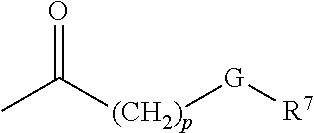
wherein G is O, NR′ or a covalent bond; R′ is H or C1-C6 alkyl; p is 1, 2, 3, or 4, and R7 is selected from the group consisting of NH2, N═CHR3, NH—CH2R3, wherein R3 is alkyl, alkenyl, alkynyl, aryl, or heteroaryl each of which is substituted by fluorine, iodine, a radioisotope of fluorine, a radioisotope of iodine, chlorine, bromine, a radioisotope of bromine, a radioisotope of astatine, NO2, NH2, N+(R2)3, Sn(R2)3, Si(R2)3, Hg(R2), or B(OH)2.

wherein Z is tetrazole or CO2Q, and each Q is independently selected from hydrogen or a protecting group.

wherein X is fluorine, iodine, a radioisotope of fluorine, a radioisotope of iodine, chlorine, bromine, a radioisotope of bromine, a radioisotope of astatine, NO2, NH2, N+(R2)3, Sn(R2)3, Si(R2)3, Hg(R2), B(OH)2, —NHNH2, —NHN═CHR3, —NHNH—CH2R3; n is 1, 2, 3, 4, or 5; Y is O, S, N(R′), C(O), NR′C(O), C(O)N(R′), OC(O), C(O)O, NR′C(O)NR′, NR′C(S)NR′, NR′S(O)2, S(CH2)p, NR′(CH2)p, O(CH2)p, OC(O)CHR8NHC(O), NHC(O)CHR8NHC(O), or a covalent bond; p is 1, 2, or 3, R′ is H or C1-C6 alkyl, and R8 is alkyl, aryl or heteroaryl, each of which may be substituted; R2 is C1-C6 alkyl; and R3 is alkyl, alkenyl, alkynyl, aryl, or heteroaryl each of which is substituted by fluorine, iodine, a radioisotope of fluorine, a radioisotope of iodine, chlorine, bromine, a radioisotope of bromine, or a radioisotope of astatine, NO2, NH2, N+(R2)3, Sn(R2)3, Si(R2)3, Hg(R2), or B(OH)2; or a pharmaceutically acceptable salt thereof.

wherein X′ is selected from the group consisting of NHNH2, —NHN═CHR3, and —NHNH—CH2R3; wherein R3 is alkyl, alkenyl, alkynyl, aryl, or heteroaryl each of which is substituted by fluorine, iodine, a radioisotope of fluorine, a radioisotope of iodine, chlorine, bromine, a radioisotope of bromine, or a radioisotope of astatine; NO2, NH2, N+(R2)3, Sn(R2)3, Si(R2)3, Hg(R2), or B(OH)2; R2 is C1-C6 alkyl; n is 1, 2, 3, 4, or 5; or a pharmaceutically acceptable salt thereof.

wherein G is O, NR′ or a covalent bond; R′ is H or C1-C6 alkyl; p is 1, 2, 3, or 4, and R7 is selected from the group consisting of NH2, N═CHR3, NH—CH2R3, wherein R3 is alkyl, alkenyl, alkynyl, aryl, or heteroaryl each of which is substituted by fluorine, iodine, a radioisotope of fluorine, a radioisotope of iodine, bromine, a radioisotope of bromine, or a radioisotope of astatine; NO2, NH2, N+(R2)3, Sn(R2)3, Si(R2)3, Hg(R2), or B(OH)2; R2 is C1-C6 alkyl; or a pharmaceutically acceptable salt thereof.


wherein X is fluorine, iodine, a radioisotope of fluorine, a radioisotope of iodine, chlorine, bromine, a radioisotope of bromine, a radioisotope of astatine, NO2, NH2, N+(R2)3, Sn(R2)3, Si(R2)3, Hg(R2), B(OH)2, —NHNH2, —NHN═CHR3, —NHNH—CH2R3. In certain embodiments, n is 1. Each Q is independently selected from hydrogen or a protecting group; Z is tetrazole or CO2Q; Y is O, S, N(R′), C(O), NR′C(O), C(O)N(R′), OC(O), C(O)O, NR′C(O)NR′, NR′C(S)NR′, NR′S(O)2, S(CH2)p, NR′(CH2)p, O(CH2)p, OC(O)CHR8NHC(O), NHC(O)CHR8NHC(O), or a covalent bond; wherein p is 1, 2, or 3, R′ is H or C1-C6 alkyl, and R8 is alkyl, aryl or heteroaryl, each of which may be substituted; R2 is C1-C6 alkyl; and R3 is alkyl, alkenyl, alkynyl, aryl, or heteroaryl each of which is substituted by fluorine, iodine, a radioisotope of fluorine, a radioisotope of iodine, chlorine bromine, a radioisotope of bromine, or a radioisotope of astatine; NO2, NH2, N+(R2)3, Sn(R2)3, Si(R2)3, Hg(R2), or B(OH)2. In certain embodiments, R3 is aryl, substituted by fluorine, iodine, a radioisotope of fluorine, a radioisotope of iodine, bromine, a radioisotope of bromine, or a radioisotope of astatine.

wherein m is not 0. R is a pyridine ring selected from the group consisting of

wherein X is fluorine, iodine, a radioisotope of fluorine, a radioisotope of iodine, chlorine, bromine, a radioisotope of bromine, a radioisotope of astatine, NO2, NH2, N+(R2)3, Sn(R2)3, Si(R2)3, Hg(R2), B(OH)2, —NHNH2, —NHN═CHR3, or —NHNH—CH2R3. R2 is C1-C6 alkyl; and R3 is alkyl, alkenyl, alkynyl, aryl, or heteroaryl each of which is substituted by fluorine, iodine, a radioisotope of fluorine, a radioisotope of iodine, chlorine bromine, a radioisotope of bromine, or a radioisotope of astatine; NO2, NH2, N+(R2)3, Sn(R2)3, Si(R2)3, Hg(R2), or B(OH)2. In certain embodiments, n is 1. Other specific embodiments include compounds where X is fluorine, iodine, or a radioisotope of fluorine, a radioisotope of iodine, chlorine, bromine, a radioisotope of bromine, or a radioisotope of astatine. In certain embodiments, R3 is aryl, substituted by fluorine, iodine, a radioisotope of fluorine, a radioisotope of iodine, bromine, a radioisotope of bromine, or a radioisotope of astatine. Specific embodiments include compounds having the structure shown above, where Z is CO2Q, Q is hydrogen, and m is 4.


wherein m is not 0. R is a pyridine ring selected from the group consisting of

wherein X is fluorine, iodine, a radioisotope of fluorine, a radioisotope of iodine, chlorine, bromine, a radioisotope of bromine, a radioisotope of astatine, NO2, NH2, N+(R2)3, Sn(R2)3, Si(R2)3, Hg(R2), B(OH)2, —NHNH2, —NHN═CHR3, —NHNH—CH2R3. R2 is C1-C6 alkyl; and R3 is alkyl, alkenyl, alkynyl, aryl, or heteroaryl each of which is substituted by fluorine, iodine, a radioisotope of fluorine, a radioisotope of iodine, chlorine bromine, a radioisotope of bromine, or a radioisotope of astatine; NO2, NH2, N+(R2)3, Sn(R2)3, Si(R2)3, Hg(R2), or B(OH)2. In certain embodiments, n is 1. Other specific embodiments include compounds where X is fluorine, iodine, or a radioisotope of fluorine, a radioisotope of iodine, chlorine, bromine, a radioisotope of bromine, or a radioisotope of astatine. In certain embodiments, R3 is aryl, substituted by fluorine, iodine, a radioisotope of fluorine, a radioisotope of iodine, bromine, a radioisotope of bromine, or a radioisotope of astatine. Specific embodiments include compounds having the structure shown above, where Z is CO2Q, Q is hydrogen, and m is 1, 2, or 3.

wherein X′ is selected from the group consisting of —NHNH2, —NHN═CHR3, —NHNH—CH2R3. In such embodiments, R3 is alkyl, alkenyl, alkynyl, aryl, or heteroaryl each of which is substituted by fluorine, iodine, a radioisotope of fluorine, a radioisotope of iodine, bromine, a radioisotope of bromine, or a radioisotope of astatine; NO2, NH2, N+(R2)3, Sn(R2)3, Si(R2)3, Hg(R2), B(OH)2. R2 is C1-C6 alkyl; and R3 is alkyl, alkenyl, alkynyl, aryl, or heteroaryl each of which is substituted by fluorine, iodine, a radioisotope of fluorine, a radioisotope of iodine, chlorine bromine, a radioisotope of bromine, or a radioisotope of astatine; NO2, NH2, N+(R2)3, Sn(R2)3, Si(R2)3, Hg(R2), or B(OH)2. In certain embodiments, R3 is aryl, substituted by fluorine, iodine, a radioisotope of fluorine, a radioisotope of iodine, bromine, a radioisotope of bromine, or a radioisotope of astatine. Specific embodiments include compounds where n is 1.


wherein G is O, NR′ or a covalent bond, R′ is H or C1-C6 alkyl, and p is 1, 2, 3, or 4. R7 can be selected from NH2, N═CHR3, and NH—CH2R3, wherein R3 is alkyl, alkenyl, alkynyl, aryl, or heteroaryl, each of which is substituted by fluorine, iodine, a radioisotope of fluorine, a radioisotope of iodine, bromine, a radioisotope of bromine, a radioisotope of astatine, NO2, NH2, N+(R2)3, Sn(R2)3, Si(R2)3, Hg(R2), or B(OH)2, where R2 is C1-C6 alkyl. In certain embodiments, R3 is aryl, substituted by fluorine, iodine, a radioisotope of fluorine, a radioisotope of iodine, chlorine, bromine, a radioisotope of bromine, or a radioisotope of astatine. In certain embodiments, G is O or NR′.


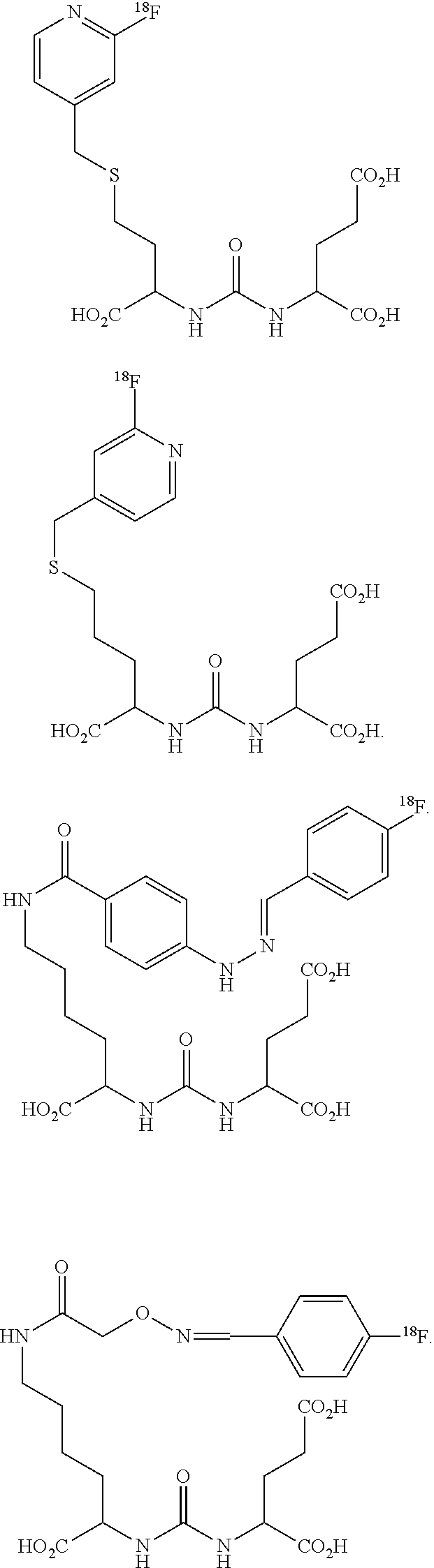


wherein R5 is hydrogen or p-methoxybenzyl; R4 is selected from the group consisting of hydrogen,

wherein A is fluorine, iodine, a radioisotope of fluorine, a radioisotope of iodine, bromine, a radioisotope of bromine, a radioisotope of astatine, Sn(R2)3, Si(R2)3, or HgCl. Further embodiments include compounds according to the structure above, which comprise a radioisotope. One specific embodiment includes the compound having the formula shown below, also known as PMB protected Lys-C(O)-Glu.

wherein PMB is p-methoxybenzyl. Another specific embodiment includes the compound 2-[3-(5-amino-1-carboxy-pentyl)-ureido]-pentanedioic acid, also known as Lys-C(O)-Glu. Other exemplary embodiments include compounds shown below.

Exemplary radioisotope containing compounds include the compounds shown below.

| TABLE 1 |
| PSMA in vitro Inhibitory Activities and Calculated ClogD values |
| compd | Ki [nM]a | SDb | Ki [nM]c | SDb | ClogD |
| 3 | 0.010 | 0.003 | 0.010 | 0.004 | −5.16 |
| 6 | 0.256 | 0.038 | 0.194 | 0.134 | −5.64 |
| 8 | 0.351 | 0.257 | 0.557 | 0.265 | −5.88 |
| aobtained from the NAALADase (radiometric) assay. | |||||
| b95% confidence interval. | |||||
| cobtained from a fluorescence-based assay. | |||||
| TABLE 2 |
| Ex vivo biodistribution of [125I]3 in tumor-bearing mice.a,b |
| Organ | 30 min | 60 min | 2 h | 5 h | 12 h | 24 h | 48 h |
| blood | 0.9 ± 0.8 | 0.6 ± 0.2 | 0.3 ± 0.1 | 0.4 ± 0.2 | 0.1 ± 0.03 | ND | ND |
| (10) | (22) | (36) | (31) | (125) | |||
| heart | 2.7 ± 0.9 | 1.9 ± 0.3 | 1.4 ± 0.7 | 0.9 ± 0.2 | 0.5 ± 0.2 | 0.5 ± 0.2 | 0.1 ± 0.1 |
| (3) | (7) | (8) | (14) | (25) | (28) | (100) | |
| lung | 5.8 ± 2.4 | 4.5 ± 0.5 | 3.6 ± 2.8 | 3.5 ± 0.6 | 2.6 ± 0.8 | 1.1 ± 0.8 | 0.5 ± 0.04 |
| (1.5) | (3) | (3) | (3.5) | (5) | (12) | (22) | |
| liver | 7.7 ± 3.1 | 7.5 ± 0.8 | 5.9 ± 3.5 | 4.5 ± 1.0 | 1.4 ± 0.2 | 1.4 ± 0.6 | 0.7 ± 0.1 |
| (1) | (2) | (2) | (3) | (9) | (9) | (16) | |
| stomach | 1.5 ± 0.9 | 1.5 ± 0.3 | 1.6 ± 1.5 | 0.8 ± 0.03 | 0.3 ± 0.06 | 0.7 ± 0.6 | 0.4 ± 0.2 |
| (6) | (9) | (8) | (15) | (39) | (18) | (25) | |
| pancreas | 2.0 ± 0.3 | 2.3 ± 0.3 | 2.0 ± 0.7 | 1.6 ± 0.5 | 0.6 ± 0.2 | 1.2 ± 0.7 | 1.1 ± 0.6 |
| (4) | (6) | (6) | (8) | (21) | (11) | (10) | |
| spleen | 83 ± 8 | 141 ± 14 | 104 ± 43 | 119 ± 9 | 69 ± 39 | 39 ± 6 | 22 ± 8.6 |
| (0.1) | (0.1) | (0.1) | (0.1) | (0.2) | (0.3) | (0.5) | |
| fat | 4.5 ± 1.1 | 5.6 ± 1.0 | 6.2 ± 0.8 | 6.8 ± 1.3 | 3.8 ± 0.8 | 1.6 ± 1.9 | 2.8 ± 0.7 |
| (2) | (2) | (2) | (2) | (3) | (8) | (4) | |
| kidney | 119 ± 15 | 121 ± 17 | 111 ± 34 | 132 ± 12 | 169 ± 29 | 234 ± 140 | 101 ± 30 |
| (0.1) | (0.1) | (0.1) | (0.1) | (0.1) | (0.1) | (0.1) | |
| muscle | 2.7 ± 2.4 | 0.8 ± 0.2 | 0.6 ± 0.2 | 0.4 ± 0.1 | 1.0 ± 0.1 | 0.4 ± 0.1 | 0.25 ± 0.03 |
| (3) | (17) | (21) | (31) | (12.5) | (33) | (44) | |
| small int. | 4.9 ± 1.9 | 3.8 ± 0.4 | 1.5 ± 0.3 | 1.5 ± 0.2 | 1.0 ± 0.4 | 0.25 ± 0.1 | 0.1 ± 0.1 |
| (2) | (3.5) | (8) | (8) | (12.5) | (54) | (110) | |
| large int. | 1.4 ± 0.6 | 1.0 ± 0.2 | 0.6 ± 0.1 | 0.7 ± 0.6 | 0.6 ± 0.2 | 1.6 ± 1.9 | 0.15 ± 0.1 |
| (6) | (13.5) | (21) | (17) | (21) | (9) | (73) | |
| bladder | 5.2 ± 1.7 | 6.1 ± 0.8 | 4.0 ± 2.6 | 3.0 ± 1.7 | 0.8 ± 0.3 | 0.2 ± 0.2 | 0.3 ± 0.04 |
| (2) | (2) | (3) | (4) | (16) | (64) | (37) | |
| PC-3 PIP | 8.8 ± 4.7 | 13.5 ± 2.1 | 11.8 ± 5.6 | 12.4 ± 6.4 | 12.5 ± 4.8 | 13.4 ± 5.1 | 11.0 ± 0.2 |
| PC-3 flu | 1.8 ± 1.0 | 1.2 ± 0.3 | 0.7 ± 0.3 | 0.6 ± 0.05 | 0.3 ± 0.1 | 0.1 ± 0.06 | 0.08 ± 0.06 |
| PIP:flu | 5 | 11 | 18 | 19 | 48 | 131 | 140 |
| aValues are in % ID/g ± SD; ND = not determined; n = 4 except at 48 h where n = 3. Int. = intestine. | |||||||
| bPip tumor:organ ratios are in parentheses | |||||||
| TABLE 3 |
| Ex vivo biodistribution of [18F]6 in tumor-bearing mice.a,b |
| Organ | 30 min | 60 min | 2 h | 5 h |
| blood | 2.5 ± 1.7 | 0.7 ± 0.5 | 0.4 ± 0.2 | 0.03 ± 0.00 |
| (3) | (9) | (9) | (117) | |
| heart | 0.8 ± 0.1 | 0.2 ± 0.02 | 0.15 ± 0.05 | 0.03 ± 0.01 |
| (11) | (35) | (25) | (117) | |
| lung | 1.7 ± 0.3 | 0.5 ± 0.1 | 1.0 ± 0.9 | 0.1 ± 0.1 |
| (5) | (13) | (4) | (35) | |
| liver | 8.7 ± 1.8 | 5.8 ± 0.6 | 11.7 ± 7.0 | 1.0 ± 0.6 |
| (1) | (1) | (0.3) | (3.5) | |
| stomach | 0.8 ± 0.1 | 0.25 ± 0.1 | 0.3 ± 0.1 | 0.04 ± 0.02 |
| (11) | (26) | (13) | (88) | |
| pancreas | 0.8±0.1 | 0.3 ± 0.1 | 0.15 ± 0.03 | 0.05 ± 0.03 |
| (11) | (21) | (25) | (70) | |
| spleen | 12.7 ± 0.4 | 7.2 ± 1.6 | 4.4 ± 1.2 | 1.0 ± 0.6 |
| (0.7) | (1) | (1) | (3.5) | |
| kidney | 72 ± 3 | 48 ± 5 | 29 ± 12 | 14 ± 9 |
| (0.1) | (0.1) | (0.1) | (0.3) | |
| muscle | 2.4 ± 3.1 | 0.5 ± 0.7 | 0.2 ± 0.1 | 0.1 ± 0.1 |
| (4) | (13) | (19) | (35) | |
| small int. | 1.7 ± 0.7 | 0.6 ± 0.2 | 0.3 ± 0.2 | 0.1 ± 0.04 |
| (5) | (11) | (12) | (35) | |
| large int. | 1.2 ± 0.8 | 0.5 ± 0.1 | 0.2 ± 0.1 | 0.6 ± 0.6 |
| (7) | (13) | (19) | (6) | |
| bladder | 6.8 ± 3.5 | 17 ± 21 | 11 ± 8 | 5.2 ± 8.9 |
| (1) | (0.4) | (0.3) | (0.7) | |
| PC-3 PIP | 8.6 ± 3.1 | 6.4 ± 0.9 | 3.7 ± 1.2 | 3.5 ± 2.3 |
| PC-3 flu | 0.8 ± 0.3 | 0.3 ± 0.05 | 0.25 ± 0.1 | 0.1 ± 0.1 |
| PIP:flu | 11 | 21 | 15 | 35 |
| aValues are in % ID/g ± SD, n = 4, int. = intestine. | ||||
| bPip tumor:organ ratios are in parentheses. | ||||
| TABLE 4 |
| Ex vivo biodistribution of [125I]8 in tumor-bearing mice.a,b |
| Organ | 30 min | 60 min | 4 h | 8 h | 24 h |
| blood | 2.5 ± 1.4 | 1.1 ± 0.5 | 0.25 ± 0.2 | 0.06 ± 0.01 | 0.00 ± 0.00 |
| (6) | (11) | (17) | (23) | ||
| heart | 0.9 ± 0.2 | 0.4 ± 0.3 | 0.06 ± 0.02 | 0.02 ± 0.01 | 0.00 ± 0.00 |
| (16) | (30) | (20) | (70) | ||
| lung | 2.7 ± 3.2 | 2.3 ± 1.0 | 0.3 ± 0.1 | 0.1 ± 0.05 | 0.01 ± 0.00 |
| (5) | (5) | (14) | (12) | (9) | |
| liver | 8.2 ± 1.2 | 9.7 ± 1.2 | 4.8 ± 0.9 | 1.6 ± 0.4 | 0.04 ± 0.03 |
| (2) | (1) | (1) | (1) | (2) | |
| stomach | 0.8 ± 0.3 | 0.5 ± 0.3 | 0.1 ± 0.05 | 0.06 ± 0.02 | 0.01 ± 0.01 |
| (18) | (23) | (42) | (23) | (9) | |
| pancreas | 0.9 ± 0.2 | 0.8 ± 0.3 | 0.3 ± 0.3 | 0.03 ± 0.00 | 0.00 ± 0.00 |
| (15) | (16) | (14) | (47) | ||
| spleen | 26 ± 12 | 13.0 ± 6.8 | 1.25 ± 0.4 | 0.5 ± 0.2 | 0.03 ± 0.02 |
| (0.5) | (1) | (3) | (3) | (3) | |
| fat | 3.5 ± 0.2 | 1.4 ± 0.5 | 0.04 ± 0.1 | 0.2 ± 0.2 | 0.00 ± 0.01 |
| (4) | (8) | (105) | (7) | ||
| kidney | 160 ± 27 | 205 ± 46 | 71 ± 27 | 24 ± 10 | 0.97 ± 0.94 |
| (0.1) | (0.06) | (0.06) | (0.06) | (0.1) | |
| muscle | 1.9 ± 2.4 | 0.9 ± 0.7 | 0.2 ± 0.3 | 0.1 ± 0.1 | 0.00 ± 0.00 |
| (7) | (13) | (21) | (14) | ||
| small int. | 0.8 ± 0.2 | 1.1 ± 1.3 | 0.2 ± 0.05 | 0.1 ± 0.02 | 0.01 ± 0.01 |
| (18) | (11) | (21) | (14) | (9) | |
| Large int. | 0.9 ± 0.4 | 0.6 ± 0.3 | 0.2 ± 0.1 | 0.1 ± 0.1 | 0.00 ± 0.00 |
| (16) | (21) | (21) | (14) | ||
| bladder | 1.9 ± 0.4 | 4.8 ± 4.9 | 7.0 ± 3.6 | 2.8 ± 2.1 | 0.05 ± 0.01 |
| (8) | (2.5) | (0.6) | (0.5) | (2) | |
| PC-3 PIP | 14.2 ± 9.5 | 12.1 ± 4.9 | 4.2 ± 1.5 | 1.4 ± 0.4 | 0.09 ± 0.04 |
| PC-3 flu | 0.8 ± 0.1 | 0.6 ± 0.25 | 0.1 ± 0.02 | 0.03 ± 0.01 | 0.00 ± 0.00 |
| PIP:flu | 18 | 20 | 42 | 47 | |
| aValues are in % ID/g ± SD; n = 4; int. = intestine. | |||||
| bPip tumor:organ ratios are in parentheses. | |||||
| TABLE 5 | ||
| Cmpd. 3 | Cmpd. 8 | |
| Tumor (T)/organ | (5 hours post injection) | (4 hours post injection) |
| T/blood | 31 | 17 |
| T/heart | 14 | 20 |
| T/Lung | 3.5 | 14 |
| T/liver | 3 | 1 |
| T/stomach | 15 | 42 |
| T/Pancreas | 8 | 14 |
| T/Spleen | 0.1 | 3 |
| T/fat | 2 | 105 |
| T/kidney | 0.1 | 0.1 |
| T/muscle | 31 | 21 |
| T/small Intest | 8 | 21 |
| T/large Intest | 17 | 21 |
- 1. Jemal, A., Murray, T., Samuels, A., Ghafoor, A., Ward, E., and Thun, M. J. (2003) Cancer statistics, 2003. CA Cancer J Clin 53, 5-26.
- 2. Geus-Oei, L. F., and Oyen, W. J. (2008) Predictive and prognostic value of FDG-PET. Cancer Imaging 8, 70-80
- 3. Larson, S. M., Morris, M., Gunther, I., Beattie, B., Humm, J. L., Akhurst, T. A., Finn, R. D., Erdi, Y., Pentlow, K., Dyke, J., Squire, O., Bornmann, W., McCarthy, T., Welch, M., and Scher, H. (2004) Tumor localization of 16beta-18F-fluoro-5alpha-dihydrotestosterone versus 18F-FDG in patients with progressive, metastatic prostate cancer. J Nucl Med 45, 366-373
- 4. Scher, B., Seitz, M., Albinger, W., Tiling, R., Scherr, M., Becker, H. C., Souvatzogluou, M., Gildehaus, F. J., Wester, H. J., and Dresel, S. (2007) Value of 11C-choline PET and PET/CT in patients with suspected prostate cancer. Eur J Nucl Med Mol Imaging 34, 45-53
- 5. Reske, S. N., Blumstein, N. M., Neumaier, B., Gottfried, H. W., Finsterbusch, F., Kocot, D., Moller, P., Glatting, G., and Perner, S. (2006) Imaging prostate cancer with 11C-choline PET/CT. J Nucl Med 47, 1249-1254
- 6. Vees, H., Buchegger, F., Albrecht, S., Khan, H., Husarik, D., Zaidi, H., Soloviev, D., Hany, T. F., and Miralbell, R. (2007) 18F-choline and/or 11C-acetate positron emission tomography: detection of residual or progressive subclinical disease at very low prostate-specific antigen values (<1 ng/mL) after radical prostatectomy. BJU Int 99, 1415-1420
- 7. Ponde, D. E., Dence, C. S., Oyama, N., Kim, J., Tai, Y. C., Laforest, R., Siegel, B. A., and Welch, M. J. (2007) 18F-fluoroacetate: a potential acetate analog for prostate tumor imaging—in vivo evaluation of 18F-fluoroacetate versus 11C-acetate. J Nucl Med 48, 420-428
- 8. Schuster, D. M., Votaw, J. R., Nieh, P. T., Yu, W., Nye, J. A., Master, V., Bowman, F. D., Issa, M. M., and Goodman, M. M. (2007) Initial experience with the radiotracer anti-1-amino-3-18F-fluorocyclobutane-1-carboxylic acid with PET/CT in prostate carcinoma. J Nucl Med 48, 56-63
- 9. Oka, S., Hattori, R., Kurosaki, F., Toyama, M., Williams, L. A., Yu, W., Votaw, J. R., Yoshida, Y., Goodman, M. M., and Ito, O. (2007) A preliminary study of anti-1-amino-3-18F-fluorocyclobutyl-1-carboxylic acid for the detection of prostate cancer. J Nucl Med 48, 46-55
- 10. Tehrani, O. S., Muzik, O., Heilbrun, L. K., Douglas, K. A., Lawhorn-Crews, J. M., Sun, H., Mangner, T. J., and Shields, A. F. (2007) Tumor imaging using 1-(2′-deoxy-2′-18F-fluoro-beta-D-arabinofuranosyl)thymine and PET. J Nucl Med 48, 1436-1441
- 11. Chang, S. S., Reuter, V. E., Heston, W. D., Bander, N. H., Grauer, L. S., and Gaudin, P. B. (1999) Five different anti-prostate-specific membrane antigen (PSMA) antibodies confirm PSMA expression in tumor-associated neovasculature. Cancer Res 59, 3192-3198.
- 12. Zhou, J., Neale, J. H., Pomper, M. G., and Kozikowski, A. P. (2005) NAAG peptidase inhibitors and their potential for diagnosis and therapy. Nat Rev Drug Discov 4, 1015-1026
- 13. Chang, S. S. (2004) Overview of prostate-specific membrane antigen. Rev Urol 6 Suppl 10, S13-18
- 14. Murphy, G. P., Kenny, G. M., Ragde, H., Wolfert, R. L., Boynton, A. L., Holmes, E. H., Misrock, S. L., Bartsch, G., Klocker, H., Pointner, J., Reissigl, A., McLeod, D. G., Douglas, T., Morgan, T., and Gilbaugh, J., Jr. (1998) Measurement of serum prostate-specific membrane antigen, a new prognostic marker for prostate cancer. Urology 51, 89-97.
- 15. Galsky, M. D., Eisenberger, M., Moore-Cooper, S., Kelly, W. K., Slovin, S. F., DeLaCruz, A., Lee, Y., Webb, I. J., and Scher, H. I. (2008) Phase I trial of the prostate-specific membrane antigen-directed immunoconjugate MLN2704 in patients with progressive metastatic castration-resistant prostate cancer. J Clin Oncol 26, 2147-2154
- 16. Lange, P. H. (2001) PROSTASCINT scan for staging prostate cancer. Urology 57, 402-406.
- 17. Haseman, M. K., Rosenthal, S. A., and Polascik, T. J. (2000) Capromab Pendetide imaging of prostate cancer. Cancer Biother Radiopharm 15, 131-140.
- 18. Rosenthal, S. A., Haseman, M. K., and Polascik, T. J. (2001) Utility of capromab pendetide (ProstaScint) imaging in the management of prostate cancer. Tech Urol 7, 27-37.
- 19. Banerjee, S. R., Foss, C. A., Mease, R. C., Fox, J., Kozikowski, A. P., and Pomper, M. G. (2008) Synthesis and evaluation of 99 mTc/Re labeled PSMA inhibitors. J Med Chem 51, 4504-4517.
- 20. Vaidyanathan, G., and Zalutsky, M. R. (1994) Improved synthesis of N-succinimidyl 4-[18F]fluorobenzoate and its application to the labeling of a monoclonal antibody fragment. Bioconjug Chem 5, 352-356
- 21. Vaidyanathan, G., and Zalutsky, M. R. (2006) Synthesis of N-succinimidyl 4-[18F]fluorobenzoate, an agent for labeling proteins and peptides with 18F. Nature protocols 1, 1655-1661
- 22. Vaidyanathan, G., and Zalutsky, M. R. (1992) Labeling proteins with fluorine-18 using N-succinimidyl-4-[18F]fluorobenzoate. Int J Rad Appl Instrum Part B 19, 275-281
- 23. Chen, X., Park, R., Shahinian, A. H., Tohme, M., Khankaldyyan, V., Bozorgzadeh, M. H., Bading, J. R., Moats, R., Laug, W. E., and Conti, P. S. (2004) 18F-labeled RGD peptide: initial evaluation for imaging brain tumor angiogenesis. Nucl Med Biol 31, 179-189
- 24. Dekker, B., Keen, H., Shaw, D., Disley, L., Hastings, D., Hadfield, J., Reader, A., Allan, D., Julyan, P., Watson, A., and Zweit, J. (2005) Functional comparison of annexin V analogues labeled indirectly and directly with iodine-124. Nucl Med Biol 32, 403-413
- 25. Garg, S., Garg, P. K., and Zalutsky, M. R. (1991) N-succinimidyl 5-(trialkylstannyl)-3-pyridinecarboxylates: a new class of reagents for protein radioiodination. Bioconjug Chem 2, 50-56
- 26. Lupold, S. E., Hicke, B. J., Lin, Y., and Coffey, D. S. (2002) Identification and characterization of nuclease-stabilized RNA molecules that bind human prostate cancer cells via the prostate-specific membrane antigen. Cancer Res 62, 4029-4033
- 27. Robinson, M. B., Blakely, R. D., Couto, R., and Coyle, J. T. (1987) Hydrolysis of the brain dipeptide N-acetyl-L-aspartyl-L-glutamate. Identification and characterization of a novel N-acetylated alpha-linked acidic dipeptidase activity from rat brain. J Biol Chem 262, 14498-14506
- 28. Cheng, H. C. (2001) determination of KB or Ki from IC50. A closer look at the Cheng-Prusoff equation, the Schild plot and related power equations. J. Pharmacol. Toxicol. Methods 46, 61-71
- 29. Kozikowski, A. P., Nan, F., Conti, P., Zhang, J., Ramadan, E., Bzdega, T., Wroblewska, B., Neale, J. H., Pshenichkin, S., and Wroblewski, J. T. (2001) Design of remarkably simple, yet potent urea-based inhibitors of glutamate carboxypeptidase II (NAALADase). J Med Chem 44, 298-301.
- 30. Kozikowski, A. P., Zhang, J., Nan, F., Petukhov, P. A., Grajkowska, E., Wroblewski, J. T., Yamamoto, T., Bzdega, T., Wroblewska, B., and Neale, J. H. (2004) Synthesis of urea-based inhibitors as active site probes of glutamate carboxypeptidase II: efficacy as analgesic agents. J Med Chem 47, 1729-1738
- 31. Slusher, B. S., Tsai, G., Yoo, G., and Coyle, J. T. (1992) Immunocytochemical localization of the N-acetyl-aspartyl-glutamate (NAAG) hydrolyzing enzyme N-acetylated alpha-linked acidic dipeptidase (NAALADase). J Comp Neurol 315, 217-229
- 32. Silver, D. A., Pellicer, I., Fair, W. R., Heston, W. D., and Cordon-Cardo, C. (1997) Prostate-specific membrane antigen expression in normal and malignant human tissues. Clin Cancer Res 3, 81-85
- 33. Bzdega, T., Crowe, S. L., Ramadan, E. R., Sciarretta, K. H., Olszewski, R. T., Ojeifo, O. A., Rafalski, V. A., Wroblewska, B., and Neale, J. H. (2004) The cloning and characterization of a second brain enzyme with NAAG peptidase activity. J Neurochem 89, 627-635
- 34. Hlouchova, K., Barinka, C., Klusak, V., Sacha, P., Mlcochova, P., Majer, P., Rulisek, L., and Konvalinka, J. (2007) Biochemical characterization of human glutamate carboxypeptidase III. J Neurochem 101, 682-696
- 35. Bakker, W. H., Krenning, E. P., Breeman, W. A., Koper, J. W., Kooij, P. P., Reubi, J. C., Klijn, J. G., Visser, T. J., Docter, R., and Lamberts, S. W. (1990) Receptor scintigraphy with a radioiodinated somatostatin analogue: radiolabeling, purification, biologic activity, and in vivo application in animals. J Nucl Med 31, 1501-1509
- 36. Bakker, W. H., Krenning, E. P., Breeman, W. A., Kooij, P. P., Reubi, J. C., Koper, J. W., de Jong, M., Lameris, J. S., Visser, T. J., and Lamberts, S. W. (1991) In vivo use of a radioiodinated somatostatin analogue: dynamics, metabolism, and binding to somatostatin receptor-positive tumors in man. J Nucl Med 32, 1184-1189.
- 37. Garg, S., Garg, P. K., Zhao, X-G., Friedman, H. S., Bigner, D. D., and Zalutsky, M. R., Radioiodination of a monoclonal antibody using N-succinimidyl 5-iodo-3-pyridinecarboxylate Nucl. Med. Biol. 20: 835-842 (1993);
- 38. Ghirmai, S., Mume, E., Tolmachev, V., and Sjoberg, S., Synthesis and radioiodination of some daunorubicin and doxorubicin derivatives Carbohydrate Research 340 15-24 (2005).
- 39. Barinka, C., Byun, Y., Dusich, C. L., Banerjee, S. R., Chen, Y., Castanares, M., Kozikowski, A. P., Mease, R. C., Pomper, Martin G., and Lubkowski, J., Interactions between human glutamate carboxypeptidase II and urea-based inhibitors: Structural Characterizations. J. Med. Chem. 51: 7737-7743 (2008).
Claims (18)


Priority Applications (1)
| Application Number | Priority Date | Filing Date | Title |
|---|---|---|---|
| US13/057,044 US8778305B2 (en) | 2008-08-01 | 2009-07-31 | PSMA-binding agents and uses thereof |
Applications Claiming Priority (4)
| Application Number | Priority Date | Filing Date | Title |
|---|---|---|---|
| US8546208P | 2008-08-01 | 2008-08-01 | |
| US11179108P | 2008-11-06 | 2008-11-06 | |
| US13/057,044 US8778305B2 (en) | 2008-08-01 | 2009-07-31 | PSMA-binding agents and uses thereof |
| PCT/US2009/052456 WO2010014933A2 (en) | 2008-08-01 | 2009-07-31 | Psma-binding agents and uses thereof |
Related Parent Applications (1)
| Application Number | Title | Priority Date | Filing Date |
|---|---|---|---|
| PCT/US2009/052456 A-371-Of-International WO2010014933A2 (en) | 2008-08-01 | 2009-07-31 | Psma-binding agents and uses thereof |
Related Child Applications (1)
| Application Number | Title | Priority Date | Filing Date |
|---|---|---|---|
| US14/211,683 Division US9226981B2 (en) | 2008-08-01 | 2014-03-14 | PSMA-binding agents and uses thereof |
Publications (2)
| Publication Number | Publication Date |
|---|---|
| US20110142760A1 US20110142760A1 (en) | 2011-06-16 |
| US8778305B2 true US8778305B2 (en) | 2014-07-15 |
Family
ID=41610978
Family Applications (7)
| Application Number | Title | Priority Date | Filing Date |
|---|---|---|---|
| US13/057,044 Active 2030-09-21 US8778305B2 (en) | 2008-08-01 | 2009-07-31 | PSMA-binding agents and uses thereof |
| US14/211,683 Active US9226981B2 (en) | 2008-08-01 | 2014-03-14 | PSMA-binding agents and uses thereof |
| US14/987,032 Active US9861713B2 (en) | 2008-08-01 | 2016-01-04 | PSMA-binding agents and uses thereof |
| US15/864,236 Active US10500292B2 (en) | 2008-08-01 | 2018-01-08 | PSMA-binding agents and uses thereof |
| US16/674,089 Abandoned US20200282083A1 (en) | 2008-08-01 | 2019-11-05 | Psma-binding agents and uses thereof |
| US17/237,850 Active 2030-03-18 US12070513B2 (en) | 2008-08-01 | 2021-04-22 | PSMA-binding agents and uses thereof |
| US18/772,628 Pending US20250177578A1 (en) | 2008-08-01 | 2024-07-15 | Psma-binding agents and uses thereof |
Family Applications After (6)
| Application Number | Title | Priority Date | Filing Date |
|---|---|---|---|
| US14/211,683 Active US9226981B2 (en) | 2008-08-01 | 2014-03-14 | PSMA-binding agents and uses thereof |
| US14/987,032 Active US9861713B2 (en) | 2008-08-01 | 2016-01-04 | PSMA-binding agents and uses thereof |
| US15/864,236 Active US10500292B2 (en) | 2008-08-01 | 2018-01-08 | PSMA-binding agents and uses thereof |
| US16/674,089 Abandoned US20200282083A1 (en) | 2008-08-01 | 2019-11-05 | Psma-binding agents and uses thereof |
| US17/237,850 Active 2030-03-18 US12070513B2 (en) | 2008-08-01 | 2021-04-22 | PSMA-binding agents and uses thereof |
| US18/772,628 Pending US20250177578A1 (en) | 2008-08-01 | 2024-07-15 | Psma-binding agents and uses thereof |
Country Status (25)
| Country | Link |
|---|---|
| US (7) | US8778305B2 (en) |
| EP (3) | EP4089074A1 (en) |
| JP (6) | JP5588441B2 (en) |
| KR (1) | KR101664855B1 (en) |
| CN (3) | CN107382846B (en) |
| AU (1) | AU2009276423B2 (en) |
| CA (2) | CA2987744C (en) |
| CY (3) | CY1119367T1 (en) |
| DK (2) | DK2318366T3 (en) |
| ES (2) | ES2634894T3 (en) |
| FI (1) | FIC20230033I1 (en) |
| FR (1) | FR23C1044I2 (en) |
| HK (1) | HK1247197A1 (en) |
| HR (2) | HRP20220742T1 (en) |
| HU (3) | HUE059436T2 (en) |
| LT (3) | LT3222615T (en) |
| LU (1) | LUC00323I2 (en) |
| NL (1) | NL301250I2 (en) |
| NO (1) | NO2024006I1 (en) |
| PL (2) | PL3222615T3 (en) |
| PT (2) | PT3222615T (en) |
| RU (1) | RU2494096C2 (en) |
| SI (2) | SI2318366T1 (en) |
| SM (1) | SMT201700371T1 (en) |
| WO (1) | WO2010014933A2 (en) |
Cited By (45)
| Publication number | Priority date | Publication date | Assignee | Title |
|---|---|---|---|---|
| US9951324B2 (en) | 2010-02-25 | 2018-04-24 | Purdue Research Foundation | PSMA binding ligand-linker conjugates and methods for using |
| WO2018081354A1 (en) | 2016-10-27 | 2018-05-03 | Progenics Pharmaceuticals, Inc. | Network for medical image analysis, decision support system, and related graphical user interface (gui) applications |
| US10016519B2 (en) | 2014-10-20 | 2018-07-10 | Deutsches Krebsforschungszentrium | 18F-tagged inhibitors of prostate specific membrane antigen (PSMA), their use as imaging agents and pharmaceutical agents for the treatment of prostate cancer |
| US10046054B2 (en) | 2007-08-17 | 2018-08-14 | Purdue Research Foundation | PSMA binding ligand-linker conjugates and methods for using |
| US10112974B2 (en) | 2014-08-24 | 2018-10-30 | Max-Planck-Gesellschaft Zur Foerderung Der Wissenschaften E.V. | Method for the production of 18F-labeled active esters and their application exemplified by the preparation of a PSMA-specific PET-tracer |
| US10179117B2 (en) * | 2016-06-23 | 2019-01-15 | Cornell University | Double targeted constructs to affect tumor kill |
| WO2019136349A2 (en) | 2018-01-08 | 2019-07-11 | Progenics Pharmaceuticals, Inc. | Systems and methods for rapid neural network-based image segmentation and radiopharmaceutical uptake determination |
| US10398791B2 (en) | 2013-10-18 | 2019-09-03 | Deutsches Krebsforschungszentrum | Labeled inhibitors of prostate specific membrane antigen (PSMA), their use as imaging agents and pharmaceutical agents for the treatment of prostate cancer |
| USRE47609E1 (en) | 2007-12-28 | 2019-09-17 | Exini Diagnostics Ab | System for detecting bone cancer metastases |
| WO2020077259A1 (en) | 2018-10-11 | 2020-04-16 | Progenics Pharmaceuticals, Inc | Combination therapy for treating metastatic prostate cancer |
| KR20200081317A (en) | 2018-12-27 | 2020-07-07 | (주)퓨쳐켐 | Carboxylic acid-having compounds for PSMA-targeting and use thereof |
| WO2020144134A1 (en) | 2019-01-07 | 2020-07-16 | Exini Diagnostics Ab | Systems and methods for platform agnostic whole body image segmentation |
| US10806806B2 (en) | 2016-06-23 | 2020-10-20 | Cornell University | Trifunctional constructs with tunable pharmacokinetics useful in imaging and anti-tumor therapies |
| WO2020219619A1 (en) | 2019-04-24 | 2020-10-29 | Progenics Pharmaceuticals, Inc. | Systems and methods for interactive adjustment of intensity windowing in nuclear medicine images |
| WO2020219620A1 (en) | 2019-04-24 | 2020-10-29 | Progenics Pharmaceuticals, Inc. | Systems and methods for automated and interactive analysis of bone scan images for detection of metastases |
| US10869940B2 (en) | 2015-06-12 | 2020-12-22 | The Board Of Trustees Of The Leland Stanford Junior University | Targeted photoacoustic compounds, formulations, and uses thereof |
| US10898596B2 (en) | 2015-01-07 | 2021-01-26 | Endocyte, Inc. | Conjugates for imaging |
| US10912840B2 (en) | 2012-11-15 | 2021-02-09 | Endocyte, Inc. | Conjugates for treating diseases caused by PSMA expressing cells |
| US10947197B2 (en) * | 2016-06-10 | 2021-03-16 | The Johns Hopkins University | Synthesis of the radiolabeled prostate-specific membrane antigen (PSMA) inhibitor [18F]DCFPyL |
| US10973486B2 (en) | 2018-01-08 | 2021-04-13 | Progenics Pharmaceuticals, Inc. | Systems and methods for rapid neural network-based image segmentation and radiopharmaceutical uptake determination |
| US20210338846A1 (en) * | 2018-07-30 | 2021-11-04 | The Johns Hopkins University | Competitive prostate-specific membrane antigen (psma) binding agents for reduction of non-target organ uptake of radiolabeled psma inhibitors for psma positive tumor imaging and radiopharmaceutical therapy |
| US11202836B2 (en) | 2018-03-23 | 2021-12-21 | Case Western Reserve University | PSMA targeted conjugate compounds and uses thereof |
| WO2022008374A1 (en) | 2020-07-06 | 2022-01-13 | Exini Diagnostics Ab | Systems and methods for artificial intelligence-based image analysis for detection and characterization of lesions |
| US20220088229A1 (en) * | 2008-08-01 | 2022-03-24 | The Johns Hopkins University | Psma-binding agents and uses thereof |
| US11285227B2 (en) | 2017-04-05 | 2022-03-29 | Cornell University | Trifunctional constructs with tunablepharmacokinetics useful in imaging and anti-tumor therapies |
| US11321844B2 (en) | 2020-04-23 | 2022-05-03 | Exini Diagnostics Ab | Systems and methods for deep-learning-based segmentation of composite images |
| US11386988B2 (en) | 2020-04-23 | 2022-07-12 | Exini Diagnostics Ab | Systems and methods for deep-learning-based segmentation of composite images |
| US11491247B2 (en) | 2017-05-02 | 2022-11-08 | Cornell University | Methods and reagents for tumor targeting with greater efficacy and less toxicity |
| US11544407B1 (en) | 2019-09-27 | 2023-01-03 | Progenics Pharmaceuticals, Inc. | Systems and methods for secure cloud-based medical image upload and processing |
| US11564621B2 (en) | 2019-09-27 | 2023-01-31 | Progenies Pharmacenticals, Inc. | Systems and methods for artificial intelligence-based image analysis for cancer assessment |
| WO2023057411A1 (en) | 2021-10-08 | 2023-04-13 | Exini Diagnostics Ab | Systems and methods for automated identification and classification of lesions in local lymph and distant metastases |
| US11708393B2 (en) | 2011-11-08 | 2023-07-25 | Case Western Reserve University | Targeted non-invasive imaging probes of EGFR expressing cells |
| US11721428B2 (en) | 2020-07-06 | 2023-08-08 | Exini Diagnostics Ab | Systems and methods for artificial intelligence-based image analysis for detection and characterization of lesions |
| WO2023239829A2 (en) | 2022-06-08 | 2023-12-14 | Progenics Pharmaceuticals, Inc. | Systems and methods for assessing disease burden and progression |
| US11900597B2 (en) | 2019-09-27 | 2024-02-13 | Progenics Pharmaceuticals, Inc. | Systems and methods for artificial intelligence-based image analysis for cancer assessment |
| US11998620B2 (en) | 2021-11-09 | 2024-06-04 | Case Western Reserve University | PSMA targeted compounds and uses thereof |
| WO2024173297A1 (en) | 2023-02-13 | 2024-08-22 | Progenics Pharmaceuticals, Inc. | Systems and methods for predicting biochemical progression free survival in prostate cancer patients |
| WO2024211651A1 (en) | 2023-04-07 | 2024-10-10 | Progenics Pharmaceuticals, Inc. | Systems and methods for facilitating lesion inspection and analysis |
| US12178892B2 (en) | 2013-11-14 | 2024-12-31 | Purdue Research Foundation | Compounds for positron emission tomography |
| US12208102B2 (en) | 2018-04-17 | 2025-01-28 | Endocyte, Inc. | Methods of treating cancer |
| WO2025072177A1 (en) | 2023-09-25 | 2025-04-03 | Progenics Pharmaceuticals, Inc. | Systems and methods for automated cancer staging and risk prediction |
| US12417533B2 (en) | 2019-09-27 | 2025-09-16 | Progenics Pharmaceuticals, Inc. | Systems and methods for artificial intelligence-based image analysis for cancer assessment |
| US12473265B2 (en) | 2019-05-20 | 2025-11-18 | Endocyte, Inc. | Methods for preparing PSMA conjugates |
| US12602772B2 (en) | 2018-01-08 | 2026-04-14 | Progenics Pharmaceuticals, Inc. | Systems and methods for rapid neural network-based image segmentation and radiopharmaceutical uptake determination |
| US12655115B2 (en) | 2020-11-19 | 2026-06-16 | Novartis Ag | Synthesis of prostate specific membrane antigen (PSMA) ligands |
Families Citing this family (46)
| Publication number | Priority date | Publication date | Assignee | Title |
|---|---|---|---|---|
| US9422234B2 (en) * | 2007-11-30 | 2016-08-23 | The Johns Hopkins University | Prostate specific membrane antigen (PSMA) targeted nanoparticles for therapy of prostate cancer |
| CA2769444A1 (en) | 2009-05-19 | 2010-11-25 | Aic Blab Company | Composite current collector and methods therefor |
| US10011632B2 (en) | 2011-08-22 | 2018-07-03 | Siemens Medical Solutions Usa, Inc. | PSMA imaging agents |
| EP2785712B1 (en) | 2011-11-30 | 2019-05-01 | The Johns Hopkins University | Homomultivalent and heteromultivalent inhibitors of prostate specific membrane antigen (pmsa) and uses thereof |
| US20140065070A1 (en) * | 2012-08-28 | 2014-03-06 | Mcmaster University | Methods of preparing triazole-containing radioiodinated compounds |
| SMT202300035T1 (en) * | 2013-03-15 | 2023-05-12 | Cancer Targeted Tech Llc | Methods of preparing 18f-labeled psma-targeted pet imaging agents and diagnostic methods therewith |
| WO2015057692A1 (en) | 2013-10-14 | 2015-04-23 | The Johns Hopkins University | Prostate-specific membrane antigen-targeted photosensitizers for photodynamic therapy |
| JP6292568B2 (en) * | 2013-11-06 | 2018-03-14 | 国立大学法人京都大学 | Urea derivative compound and radiopharmaceutical containing the same |
| US9713649B2 (en) | 2014-01-24 | 2017-07-25 | The Cleveland Clinic Foundation | PSMA-targeting imaging agents |
| US10556916B2 (en) * | 2014-04-01 | 2020-02-11 | The United States Of America, As Represented By The Secretary, Department Of Health And Human Services | Zirconium-89 oxine complex as a cell labeling agent for positron emission tomography |
| EP2993171A1 (en) * | 2014-09-04 | 2016-03-09 | Max-Planck-Gesellschaft zur Förderung der Wissenschaften e.V. | Method for the production of 18F-labeled PSMA-specific PET-tracers |
| EP3011976A1 (en) * | 2014-10-20 | 2016-04-27 | Deutsches Krebsforschungszentrum | 18F-tagged inhibitors of prostate specific membrane antigen (PSMA), their use as imaging agents |
| WO2016065142A2 (en) * | 2014-10-22 | 2016-04-28 | The Johns Hopkins University | New scaffolds and multifunctional intermediates for imaging psma and cancer therapy |
| US20180338910A1 (en) * | 2015-01-09 | 2018-11-29 | The Johns Hopkins University | Intranasal administration of glutamate carboxypeptidase (gcp-ii) inhibitors |
| US20180236109A1 (en) * | 2015-08-20 | 2018-08-23 | Universitat Zu Koln | Pain Tracking by PET-imaging (Pain-TraP) |
| PL3356385T3 (en) | 2015-09-30 | 2021-06-28 | Deutsches Krebsforschungszentrum | 18F-tagged prostate-specific membrane antigen (PSMA) inhibitors and their use as imaging agents in prostate cancer |
| WO2017070482A2 (en) * | 2015-10-22 | 2017-04-27 | The Johns Hopkins University | Psma targeted radiohalogenated ureas for cancer radiotherapy |
| KR101639599B1 (en) | 2015-11-09 | 2016-07-14 | 서울대학교산학협력단 | Peptide thiourea derivatives, their radioisotope labeled compounds and pharmaceutical composition for treatment or diagnosis of prostate cancer comprising the same as an active ingredient |
| EP3400229B1 (en) | 2016-01-10 | 2024-03-06 | Provincial Health Services Authority | 18/19f-labelled compounds which target the prostate specific membrane antigen |
| WO2018090976A1 (en) * | 2016-11-17 | 2018-05-24 | 思路迪(北京)医药科技有限公司 | Compound having anticancer effect, preparation method therefor, and applications thereof |
| DE102016122273B4 (en) * | 2016-11-18 | 2018-06-21 | Abx Advanced Biochemical Compounds Gmbh | Precursors for radiofluorination |
| MX2019012017A (en) | 2017-04-07 | 2020-02-12 | Juno Therapeutics Inc | Engineered cells expressing prostate-specific membrane antigen (psma) or a modified form thereof and related methods. |
| WO2018236115A1 (en) | 2017-06-19 | 2018-12-27 | (주)퓨쳐켐 | 18F-labeled compounds and their uses for the diagnosis of prostate cancer |
| HRP20220557T1 (en) | 2017-06-19 | 2022-06-10 | Futurechem Co., Ltd. | 18f-labelled compound for prostate cancer diagnosis, and use thereof |
| JP2021500373A (en) | 2017-10-23 | 2021-01-07 | ザ・ジョンズ・ホプキンス・ユニバーシティ | Imaging agents and radiotherapy agents targeting fibroblast-activating protein α (FAP-α) |
| DK3723815T3 (en) * | 2017-12-11 | 2022-07-11 | Univ Muenchen Tech | PSMA ligands for imaging and endoradiotherapy |
| WO2019157037A1 (en) * | 2018-02-06 | 2019-08-15 | The Johns Hopkins University | Psma targeted radiohalogenated urea-polyaminocarboxylates for cancer radiotherapy |
| CN109160899B (en) * | 2018-05-16 | 2021-06-04 | 上海如絮生物科技有限公司 | Hydrophilic pyridine compound, intermediate, preparation method and application thereof |
| CN109160896B (en) * | 2018-05-16 | 2021-06-25 | 上海如絮生物科技有限公司 | Hydrophilic pyridine compound intermediate and preparation method thereof |
| CN109160898B (en) * | 2018-05-16 | 2021-06-04 | 上海如絮生物科技有限公司 | Hydrophilic pyridine compound intermediate and preparation method thereof |
| RU2697519C1 (en) * | 2018-10-15 | 2019-08-15 | Общество с ограниченной ответственностью "Изварино Фарма" | Peptide agent comprising a psma-binding ligand based on a urea derivative, a method for production thereof and use thereof for preparing a conjugate with a drug and diagnostic agent |
| PL239934B1 (en) * | 2019-04-12 | 2022-01-31 | Narodowe Centrum Badan Jadrowych Osrodek Radioizotopow Polatom | Derivatives of PSMA inhibitors for ⁹⁹ᵐTc labelling by HYNIC, radiopharmaceutical kit, radiopharmaceutical preparations and their use in the diagnosis of prostate cancer |
| CA3136979A1 (en) | 2019-04-17 | 2020-10-22 | Provincial Health Services Authority | Radiolabelled compounds for diagnosis or treatment of prostate-spe cific membrane antigen-expressing cancer |
| WO2020252598A1 (en) | 2019-06-21 | 2020-12-24 | Provincial Health Services Authority | Radiolabeled compounds targeting the prostate-specific membrane antigen |
| RU2713151C1 (en) * | 2019-07-02 | 2020-02-04 | Общество с ограниченной ответственностью "Изварино Фарма" | Conjugate of a fluorescent dye with a peptide substance which contains a psma-binding ligand based on a urea derivative for visualizing cells expressing psma, a method for production thereof and use thereof |
| US12582728B2 (en) | 2019-08-30 | 2026-03-24 | Memorial Sloan Kettering Cancer Center | Theranostic agents for PSMA positive cancers |
| KR102269315B1 (en) | 2019-10-24 | 2021-06-24 | 서울대학교산학협력단 | A radiolabeled compound for imaging or therapy of prostate cancer |
| CN111548305B (en) * | 2020-05-12 | 2021-08-31 | 北京师范大学 | A kind of quinoline compound that can be used for targeting PSMA and preparation method thereof |
| EP4244216A1 (en) | 2020-11-12 | 2023-09-20 | ABX Advanced Biochemical Compounds GmbH | Ligands of prostate specific membrane antigen (psma) containing heteroaromatic linker building blocks |
| CN114685599A (en) * | 2020-12-30 | 2022-07-01 | 南京江原安迪科正电子研究发展有限公司 | PSMA (patterned beam mosaic Virus inhibitor) targeted inhibitor, radionuclide-labeled PSMA targeted inhibitor, preparation method and application |
| EP4378948A4 (en) | 2021-07-30 | 2026-05-20 | Univ Osaka | RADIOACTIVELY LABELED CONNECTION AND USE OF IT |
| IL321958A (en) | 2023-01-10 | 2025-09-01 | Sun Pharma Advanced Res Co Ltd | Ligand-drug conjugates |
| CN116217505B (en) * | 2023-03-17 | 2024-10-01 | 南京医科大学 | Novel marker-targeted agents for diagnosis or treatment of cancers expressing prostate-specific membrane antigen |
| WO2025090594A1 (en) * | 2023-10-25 | 2025-05-01 | The Johns Hopkins University | Deep transfer learning for fully automated tumor quantification and prognosis of cancer on pet/ct |
| DE102023133281B8 (en) * | 2023-11-28 | 2025-07-24 | Abx Advanced Biochemical Compounds - Biomedizinische Forschungsreagenzien Gmbh | Radiotracers and precursors for these radiotracers and the use of these radiotracers as diagnostic and therapeutic agents |
| CN117670883B (en) * | 2024-01-31 | 2024-05-07 | 中国医学科学院北京协和医院 | Method, equipment and system for identifying high-low-level bladder cancer |
Citations (2)
| Publication number | Priority date | Publication date | Assignee | Title |
|---|---|---|---|---|
| WO2006093991A1 (en) | 2005-03-02 | 2006-09-08 | The Cleveland Clinic Foundation | Compounds which bind psma and uses thereof |
| WO2008058192A2 (en) | 2006-11-08 | 2008-05-15 | Molecular Insight Pharmaceuticals, Inc. | Heterodimers of glutamic acid |
Family Cites Families (8)
| Publication number | Priority date | Publication date | Assignee | Title |
|---|---|---|---|---|
| RU2233269C2 (en) * | 1998-11-02 | 2004-07-27 | Авентис Фарма Лимитед | Substituted anilides, pharmaceutical composition and method for treatment |
| JP3750494B2 (en) | 1999-08-31 | 2006-03-01 | 松下電器産業株式会社 | Semiconductor device |
| RU2435782C2 (en) * | 2006-02-22 | 2011-12-10 | Интернешнл Инститьют Оф Кэнсер Иммунолоджи, Инк. | Hla a*3303-restricted peptide wt1 and pharmaceutical composition containing said peptide |
| WO2009002529A2 (en) * | 2007-06-26 | 2008-12-31 | The Johns Hopkins University | Labeled inhibitors of prostate specific membrane antigen (psma), biological evaluation, and use as imaging agents |
| ATE530169T1 (en) * | 2007-09-28 | 2011-11-15 | Bind Biosciences Inc | CANCER CELL TARGETING WITH NANOPARTICLES |
| ES2634894T3 (en) * | 2008-08-01 | 2017-09-29 | The Johns Hopkins University | PSMA binding agents and uses thereof |
| GB0905438D0 (en) | 2009-03-30 | 2009-05-13 | Ge Healthcare Ltd | Radiolabelling reagents and methods |
| DK3481804T3 (en) * | 2016-06-10 | 2025-01-13 | Univ Johns Hopkins | Improved synthesis of radiolabeled inhibitor of prostate-specific membrane antigen (PSMA) [18F]DCFPyL |
-
2009
- 2009-07-31 ES ES09803670.0T patent/ES2634894T3/en active Active
- 2009-07-31 ES ES17167057T patent/ES2914593T3/en active Active
- 2009-07-31 JP JP2011521362A patent/JP5588441B2/en active Active
- 2009-07-31 CN CN201710536671.3A patent/CN107382846B/en active Active
- 2009-07-31 PT PT171670573T patent/PT3222615T/en unknown
- 2009-07-31 US US13/057,044 patent/US8778305B2/en active Active
- 2009-07-31 EP EP22163541.0A patent/EP4089074A1/en active Pending
- 2009-07-31 PT PT98036700T patent/PT2318366T/en unknown
- 2009-07-31 PL PL17167057.3T patent/PL3222615T3/en unknown
- 2009-07-31 SI SI200931704T patent/SI2318366T1/en unknown
- 2009-07-31 EP EP17167057.3A patent/EP3222615B1/en active Active
- 2009-07-31 LT LTEP17167057.3T patent/LT3222615T/en unknown
- 2009-07-31 CN CN200980139135.3A patent/CN102171187B/en active Active
- 2009-07-31 AU AU2009276423A patent/AU2009276423B2/en active Active
- 2009-07-31 CA CA2987744A patent/CA2987744C/en active Active
- 2009-07-31 HU HUE17167057A patent/HUE059436T2/en unknown
- 2009-07-31 DK DK09803670.0T patent/DK2318366T3/en active
- 2009-07-31 DK DK17167057.3T patent/DK3222615T3/en active
- 2009-07-31 KR KR1020117004960A patent/KR101664855B1/en active Active
- 2009-07-31 HU HUE09803670A patent/HUE034027T2/en unknown
- 2009-07-31 HR HRP20220742TT patent/HRP20220742T1/en unknown
- 2009-07-31 CA CA2732632A patent/CA2732632C/en active Active
- 2009-07-31 RU RU2011107752/04A patent/RU2494096C2/en active
- 2009-07-31 LT LTEP09803670.0T patent/LT2318366T/en unknown
- 2009-07-31 PL PL09803670T patent/PL2318366T3/en unknown
- 2009-07-31 SM SM20170371T patent/SMT201700371T1/en unknown
- 2009-07-31 WO PCT/US2009/052456 patent/WO2010014933A2/en not_active Ceased
- 2009-07-31 EP EP09803670.0A patent/EP2318366B1/en active Active
- 2009-07-31 HR HRP20171133TT patent/HRP20171133T1/en unknown
- 2009-07-31 CN CN202110689899.2A patent/CN113563262B/en active Active
- 2009-07-31 SI SI200932167T patent/SI3222615T1/en unknown
-
2012
- 2012-02-27 HK HK18106684.8A patent/HK1247197A1/en unknown
-
2014
- 2014-03-14 US US14/211,683 patent/US9226981B2/en active Active
- 2014-07-25 JP JP2014152130A patent/JP5806765B2/en active Active
-
2015
- 2015-09-04 JP JP2015174731A patent/JP6030724B2/en active Active
-
2016
- 2016-01-04 US US14/987,032 patent/US9861713B2/en active Active
- 2016-10-20 JP JP2016206120A patent/JP6524046B2/en active Active
-
2017
- 2017-07-31 CY CY20171100825T patent/CY1119367T1/en unknown
-
2018
- 2018-01-08 US US15/864,236 patent/US10500292B2/en active Active
- 2018-11-26 JP JP2018220353A patent/JP7277113B2/en active Active
-
2019
- 2019-11-05 US US16/674,089 patent/US20200282083A1/en not_active Abandoned
-
2021
- 2021-01-28 JP JP2021012046A patent/JP7219497B2/en active Active
- 2021-04-22 US US17/237,850 patent/US12070513B2/en active Active
-
2022
- 2022-06-09 CY CY20221100403T patent/CY1125468T1/en unknown
-
2023
- 2023-11-02 FI FIC20230033C patent/FIC20230033I1/en unknown
- 2023-11-03 CY CY2023024C patent/CY2023024I2/en unknown
- 2023-11-06 FR FR23C1044C patent/FR23C1044I2/en active Active
- 2023-11-14 LT LTPA2023534C patent/LTC2318366I2/lt unknown
- 2023-11-14 HU HUS2300039C patent/HUS2300039I1/en unknown
- 2023-11-15 NL NL301250C patent/NL301250I2/en unknown
- 2023-12-01 LU LU00323C patent/LUC00323I2/fr unknown
-
2024
- 2024-02-01 NO NO2024006C patent/NO2024006I1/en unknown
- 2024-07-15 US US18/772,628 patent/US20250177578A1/en active Pending
Patent Citations (4)
| Publication number | Priority date | Publication date | Assignee | Title |
|---|---|---|---|---|
| WO2006093991A1 (en) | 2005-03-02 | 2006-09-08 | The Cleveland Clinic Foundation | Compounds which bind psma and uses thereof |
| US20080311037A1 (en) * | 2005-03-02 | 2008-12-18 | Heston Warren D W | Compounds which bind PSMA and uses thereof |
| WO2008058192A2 (en) | 2006-11-08 | 2008-05-15 | Molecular Insight Pharmaceuticals, Inc. | Heterodimers of glutamic acid |
| US20080193381A1 (en) * | 2006-11-08 | 2008-08-14 | Molecular Insight Pharmaceuticals, Inc. | Heterodimers of glutamic acid |
Non-Patent Citations (46)
Cited By (102)
| Publication number | Priority date | Publication date | Assignee | Title |
|---|---|---|---|---|
| US10624971B2 (en) | 2007-08-17 | 2020-04-21 | Purdue Research Foundation | PSMA binding ligand-linker conjugates and methods for using |
| US10646581B2 (en) | 2007-08-17 | 2020-05-12 | Purdue Research Foundation | PSMA binding ligand-linker conjugates and methods for using |
| US11298341B2 (en) | 2007-08-17 | 2022-04-12 | Purdue Research Foundation | PSMA binding ligand-linker conjugates and methods for using |
| US10046054B2 (en) | 2007-08-17 | 2018-08-14 | Purdue Research Foundation | PSMA binding ligand-linker conjugates and methods for using |
| US11369590B2 (en) | 2007-08-17 | 2022-06-28 | Purdue Research Foundation | PSMA binding ligand-linker conjugates and methods for using |
| US11318121B2 (en) | 2007-08-17 | 2022-05-03 | Purdue Research Foundation | PSMA binding ligand-linker conjugates and methods for using |
| US10485878B2 (en) | 2007-08-17 | 2019-11-26 | Purdue Research Foundation | PSMA binding ligand-linker conjugates and methods for using |
| US11504357B2 (en) | 2007-08-17 | 2022-11-22 | Purdue Research Foundation | PSMA binding ligand-linker conjugates and methods for using |
| US10624970B2 (en) | 2007-08-17 | 2020-04-21 | Purdue Research Foundation | PSMA binding ligand-linker conjugates and methods for using |
| US10624969B2 (en) | 2007-08-17 | 2020-04-21 | Purdue Research Foundation | PSMA binding ligand-linker conjugates and methods for using |
| US10406240B2 (en) | 2007-08-17 | 2019-09-10 | Purdue Research Foundation | PSMA binding ligand-linker conjugates and methods for using |
| US10828282B2 (en) | 2007-08-17 | 2020-11-10 | Purdue Research Foundation | PSMA binding ligand-linker conjugates and methods for using |
| US12496292B2 (en) | 2007-08-17 | 2025-12-16 | Purdue Research Foundation | PSMA binding ligand-linker conjugates and methods for using |
| US10517957B2 (en) | 2007-08-17 | 2019-12-31 | Purdue Research Foundation | PSMA binding ligand-linker conjugates and methods for using |
| US11083710B2 (en) | 2007-08-17 | 2021-08-10 | Purdue Research Foundation | PSMA binding ligand-linker conjugates and methods for using |
| US10517956B2 (en) | 2007-08-17 | 2019-12-31 | Purdue Research Foundation | PSMA binding ligand-linker conjugates and methods for using |
| US11717514B2 (en) | 2007-08-17 | 2023-08-08 | Purdue Research Foundation | PSMA binding ligand-linker conjugates and methods for using |
| USRE47609E1 (en) | 2007-12-28 | 2019-09-17 | Exini Diagnostics Ab | System for detecting bone cancer metastases |
| US20220088229A1 (en) * | 2008-08-01 | 2022-03-24 | The Johns Hopkins University | Psma-binding agents and uses thereof |
| US12070513B2 (en) * | 2008-08-01 | 2024-08-27 | The Johns Hopkins Universty | PSMA-binding agents and uses thereof |
| US10557128B2 (en) | 2010-02-25 | 2020-02-11 | Purdue Research Foundation | PSMA binding ligand-linker conjugates and methods for using |
| US11155800B2 (en) | 2010-02-25 | 2021-10-26 | Purdue Research Foundation | PSMA binding ligand-linker conjugates and methods for using |
| US9951324B2 (en) | 2010-02-25 | 2018-04-24 | Purdue Research Foundation | PSMA binding ligand-linker conjugates and methods for using |
| US12091693B2 (en) | 2010-02-25 | 2024-09-17 | Purdue Research Foundation | PSMA binding ligand-linker conjugates and methods for using |
| US11708393B2 (en) | 2011-11-08 | 2023-07-25 | Case Western Reserve University | Targeted non-invasive imaging probes of EGFR expressing cells |
| US10912840B2 (en) | 2012-11-15 | 2021-02-09 | Endocyte, Inc. | Conjugates for treating diseases caused by PSMA expressing cells |
| US11045564B2 (en) | 2013-10-18 | 2021-06-29 | Deutsches Krebsforschungszentrum | Labeled inhibitors of prostate specific membrane antigen (PSMA) as agents for the treatment of prostate cancer |
| US11931430B2 (en) | 2013-10-18 | 2024-03-19 | Novartis Ag | Labeled inhibitors of prostate specific membrane antigen (PSMA) as agents for the treatment of prostate cancer |
| US10398791B2 (en) | 2013-10-18 | 2019-09-03 | Deutsches Krebsforschungszentrum | Labeled inhibitors of prostate specific membrane antigen (PSMA), their use as imaging agents and pharmaceutical agents for the treatment of prostate cancer |
| US11951190B2 (en) | 2013-10-18 | 2024-04-09 | Novartis Ag | Use of labeled inhibitors of prostate specific membrane antigen (PSMA), as agents for the treatment of prostate cancer |
| US10471160B2 (en) | 2013-10-18 | 2019-11-12 | Deutsches Krebsforschungszentrum | Labeled inhibitors of prostate specific membrane antigen (PSMA), their use as imaging agents and pharmaceutical agents for the treatment of prostate cancer |
| US12178892B2 (en) | 2013-11-14 | 2024-12-31 | Purdue Research Foundation | Compounds for positron emission tomography |
| US10112974B2 (en) | 2014-08-24 | 2018-10-30 | Max-Planck-Gesellschaft Zur Foerderung Der Wissenschaften E.V. | Method for the production of 18F-labeled active esters and their application exemplified by the preparation of a PSMA-specific PET-tracer |
| US10016519B2 (en) | 2014-10-20 | 2018-07-10 | Deutsches Krebsforschungszentrium | 18F-tagged inhibitors of prostate specific membrane antigen (PSMA), their use as imaging agents and pharmaceutical agents for the treatment of prostate cancer |
| US10898596B2 (en) | 2015-01-07 | 2021-01-26 | Endocyte, Inc. | Conjugates for imaging |
| US10869940B2 (en) | 2015-06-12 | 2020-12-22 | The Board Of Trustees Of The Leland Stanford Junior University | Targeted photoacoustic compounds, formulations, and uses thereof |
| US10947197B2 (en) * | 2016-06-10 | 2021-03-16 | The Johns Hopkins University | Synthesis of the radiolabeled prostate-specific membrane antigen (PSMA) inhibitor [18F]DCFPyL |
| US11851407B2 (en) | 2016-06-10 | 2023-12-26 | The Johns Hopkins Universty | Synthesis of the radiolabeled prostate-specific membrane antigen (PSMA) inhibitor [18F]DCFPYL |
| US12186288B2 (en) | 2016-06-23 | 2025-01-07 | Cornell University | Double targeted constructs to affect tumor kill |
| US10716772B2 (en) * | 2016-06-23 | 2020-07-21 | Cornell University | Double targeted constructs to affect tumor kill |
| US12268759B2 (en) | 2016-06-23 | 2025-04-08 | Cornell University | Trifunctional constructs with tunable pharmacokinetics useful in imaging and anti-tumor therapies |
| US12377175B2 (en) | 2016-06-23 | 2025-08-05 | Cornell University | Trifunctional constructs with tunable pharmacokinetics useful in imaging and anti-tumor therapies |
| US20190142770A1 (en) * | 2016-06-23 | 2019-05-16 | Cornell University | Double targeted constructs to affect tumor kill |
| US10179117B2 (en) * | 2016-06-23 | 2019-01-15 | Cornell University | Double targeted constructs to affect tumor kill |
| US10806806B2 (en) | 2016-06-23 | 2020-10-20 | Cornell University | Trifunctional constructs with tunable pharmacokinetics useful in imaging and anti-tumor therapies |
| US11424035B2 (en) | 2016-10-27 | 2022-08-23 | Progenics Pharmaceuticals, Inc. | Network for medical image analysis, decision support system, and related graphical user interface (GUI) applications |
| WO2018081354A1 (en) | 2016-10-27 | 2018-05-03 | Progenics Pharmaceuticals, Inc. | Network for medical image analysis, decision support system, and related graphical user interface (gui) applications |
| US10762993B2 (en) | 2016-10-27 | 2020-09-01 | Progenics Pharmaceuticals, Inc. | Network for medical image analysis, decision support system, and related graphical user interface (GUI) applications |
| US12224067B1 (en) | 2016-10-27 | 2025-02-11 | Progenics Pharmaceuticals, Inc. | Network for medical image analysis, decision support system, and related graphical user interface (GUI) applications |
| US10665346B2 (en) | 2016-10-27 | 2020-05-26 | Progenics Pharmaceuticals, Inc. | Network for medical image analysis, decision support system, and related graphical user interface (GUI) applications |
| US10340046B2 (en) | 2016-10-27 | 2019-07-02 | Progenics Pharmaceuticals, Inc. | Network for medical image analysis, decision support system, and related graphical user interface (GUI) applications |
| US11894141B2 (en) | 2016-10-27 | 2024-02-06 | Progenics Pharmaceuticals, Inc. | Network for medical image analysis, decision support system, and related graphical user interface (GUI) applications |
| US12431246B2 (en) | 2016-10-27 | 2025-09-30 | Progenics Pharmaceuticals, Inc. | Network for medical image analysis, decision support system, and related graphical user interface (GUI) applications |
| EP4636783A2 (en) | 2016-10-27 | 2025-10-22 | Progenics Pharmaceuticals, Inc. | Network for medical image analysis, decision support system, and related graphical user interface (gui) applications |
| US12661417B2 (en) | 2017-04-05 | 2026-06-23 | Cornell University | Trifunctional constructs with tunable pharmacokinetics useful in imaging and anti-tumor therapies |
| US11285227B2 (en) | 2017-04-05 | 2022-03-29 | Cornell University | Trifunctional constructs with tunablepharmacokinetics useful in imaging and anti-tumor therapies |
| US12285503B2 (en) | 2017-05-02 | 2025-04-29 | Cornell University | Methods and reagents for tumor targeting with greater efficacy and less toxicity |
| US11491247B2 (en) | 2017-05-02 | 2022-11-08 | Cornell University | Methods and reagents for tumor targeting with greater efficacy and less toxicity |
| US11738101B2 (en) | 2017-05-02 | 2023-08-29 | Cornell University | Methods and reagents for tumor targeting with greater efficacy and less toxicity |
| WO2019136349A2 (en) | 2018-01-08 | 2019-07-11 | Progenics Pharmaceuticals, Inc. | Systems and methods for rapid neural network-based image segmentation and radiopharmaceutical uptake determination |
| US10973486B2 (en) | 2018-01-08 | 2021-04-13 | Progenics Pharmaceuticals, Inc. | Systems and methods for rapid neural network-based image segmentation and radiopharmaceutical uptake determination |
| EP4586195A2 (en) | 2018-01-08 | 2025-07-16 | Progenics Pharmaceuticals, Inc. | Systems and methods for rapid neural network-based image segmentation and radiopharmaceutical uptake determination |
| US12602772B2 (en) | 2018-01-08 | 2026-04-14 | Progenics Pharmaceuticals, Inc. | Systems and methods for rapid neural network-based image segmentation and radiopharmaceutical uptake determination |
| US11202836B2 (en) | 2018-03-23 | 2021-12-21 | Case Western Reserve University | PSMA targeted conjugate compounds and uses thereof |
| US12144863B2 (en) | 2018-03-23 | 2024-11-19 | Case Western Reserve University | PSMA targeted conjugate compounds and uses thereof |
| US12208102B2 (en) | 2018-04-17 | 2025-01-28 | Endocyte, Inc. | Methods of treating cancer |
| US20210338846A1 (en) * | 2018-07-30 | 2021-11-04 | The Johns Hopkins University | Competitive prostate-specific membrane antigen (psma) binding agents for reduction of non-target organ uptake of radiolabeled psma inhibitors for psma positive tumor imaging and radiopharmaceutical therapy |
| WO2020077259A1 (en) | 2018-10-11 | 2020-04-16 | Progenics Pharmaceuticals, Inc | Combination therapy for treating metastatic prostate cancer |
| KR20200081317A (en) | 2018-12-27 | 2020-07-07 | (주)퓨쳐켐 | Carboxylic acid-having compounds for PSMA-targeting and use thereof |
| WO2020144134A1 (en) | 2019-01-07 | 2020-07-16 | Exini Diagnostics Ab | Systems and methods for platform agnostic whole body image segmentation |
| US11941817B2 (en) | 2019-01-07 | 2024-03-26 | Exini Diagnostics Ab | Systems and methods for platform agnostic whole body image segmentation |
| US12573050B2 (en) | 2019-01-07 | 2026-03-10 | Exini Diagnostics Ab | Systems and methods for platform agnostic whole body image segmentation |
| US12567155B2 (en) | 2019-01-07 | 2026-03-03 | Exini Diagnostics Ab | Systems and methods for platform agnostic whole body image segmentation |
| EP4597424A2 (en) | 2019-01-07 | 2025-08-06 | Exini Diagnostics AB | Systems and methods for platform agnostic whole body image segmentation |
| US11657508B2 (en) | 2019-01-07 | 2023-05-23 | Exini Diagnostics Ab | Systems and methods for platform agnostic whole body image segmentation |
| US12243236B1 (en) | 2019-01-07 | 2025-03-04 | Exini Diagnostics Ab | Systems and methods for platform agnostic whole body image segmentation |
| EP4564288A2 (en) | 2019-04-24 | 2025-06-04 | Progenics Pharmaceuticals, Inc. | Systems and methods for automated and interactive analysis of bone scan images for detection of metastases |
| US11937962B2 (en) | 2019-04-24 | 2024-03-26 | Progenics Pharmaceuticals, Inc. | Systems and methods for automated and interactive analysis of bone scan images for detection of metastases |
| WO2020219619A1 (en) | 2019-04-24 | 2020-10-29 | Progenics Pharmaceuticals, Inc. | Systems and methods for interactive adjustment of intensity windowing in nuclear medicine images |
| WO2020219620A1 (en) | 2019-04-24 | 2020-10-29 | Progenics Pharmaceuticals, Inc. | Systems and methods for automated and interactive analysis of bone scan images for detection of metastases |
| US11534125B2 (en) | 2019-04-24 | 2022-12-27 | Progenies Pharmaceuticals, Inc. | Systems and methods for automated and interactive analysis of bone scan images for detection of metastases |
| US12414748B2 (en) | 2019-04-24 | 2025-09-16 | Progenics Pharmaceuticals, Inc. | Systems and methods for automated and interactive analysis of bone scan images for detection of metastases |
| US11948283B2 (en) | 2019-04-24 | 2024-04-02 | Progenics Pharmaceuticals, Inc. | Systems and methods for interactive adjustment of intensity windowing in nuclear medicine images |
| US12473265B2 (en) | 2019-05-20 | 2025-11-18 | Endocyte, Inc. | Methods for preparing PSMA conjugates |
| US11900597B2 (en) | 2019-09-27 | 2024-02-13 | Progenics Pharmaceuticals, Inc. | Systems and methods for artificial intelligence-based image analysis for cancer assessment |
| US12032722B2 (en) | 2019-09-27 | 2024-07-09 | Progenics Pharmaceuticals, Inc. | Systems and methods for secure cloud-based medical image upload and processing |
| US11544407B1 (en) | 2019-09-27 | 2023-01-03 | Progenics Pharmaceuticals, Inc. | Systems and methods for secure cloud-based medical image upload and processing |
| US11564621B2 (en) | 2019-09-27 | 2023-01-31 | Progenies Pharmacenticals, Inc. | Systems and methods for artificial intelligence-based image analysis for cancer assessment |
| US12417533B2 (en) | 2019-09-27 | 2025-09-16 | Progenics Pharmaceuticals, Inc. | Systems and methods for artificial intelligence-based image analysis for cancer assessment |
| US11321844B2 (en) | 2020-04-23 | 2022-05-03 | Exini Diagnostics Ab | Systems and methods for deep-learning-based segmentation of composite images |
| US11386988B2 (en) | 2020-04-23 | 2022-07-12 | Exini Diagnostics Ab | Systems and methods for deep-learning-based segmentation of composite images |
| US11721428B2 (en) | 2020-07-06 | 2023-08-08 | Exini Diagnostics Ab | Systems and methods for artificial intelligence-based image analysis for detection and characterization of lesions |
| US12243637B2 (en) | 2020-07-06 | 2025-03-04 | Exini Diagnostics Ab | Systems and methods for artificial intelligence-based image analysis for detection and characterization of lesions |
| WO2022008374A1 (en) | 2020-07-06 | 2022-01-13 | Exini Diagnostics Ab | Systems and methods for artificial intelligence-based image analysis for detection and characterization of lesions |
| US12655115B2 (en) | 2020-11-19 | 2026-06-16 | Novartis Ag | Synthesis of prostate specific membrane antigen (PSMA) ligands |
| WO2023057411A1 (en) | 2021-10-08 | 2023-04-13 | Exini Diagnostics Ab | Systems and methods for automated identification and classification of lesions in local lymph and distant metastases |
| US12597127B2 (en) | 2021-10-08 | 2026-04-07 | Exini Diagnostics Ab | Systems and methods for automated identification and classification of lesions in local lymph and distant metastases |
| US11998620B2 (en) | 2021-11-09 | 2024-06-04 | Case Western Reserve University | PSMA targeted compounds and uses thereof |
| WO2023239829A2 (en) | 2022-06-08 | 2023-12-14 | Progenics Pharmaceuticals, Inc. | Systems and methods for assessing disease burden and progression |
| WO2024173297A1 (en) | 2023-02-13 | 2024-08-22 | Progenics Pharmaceuticals, Inc. | Systems and methods for predicting biochemical progression free survival in prostate cancer patients |
| WO2024211651A1 (en) | 2023-04-07 | 2024-10-10 | Progenics Pharmaceuticals, Inc. | Systems and methods for facilitating lesion inspection and analysis |
| WO2025072177A1 (en) | 2023-09-25 | 2025-04-03 | Progenics Pharmaceuticals, Inc. | Systems and methods for automated cancer staging and risk prediction |
Also Published As
Similar Documents
| Publication | Publication Date | Title |
|---|---|---|
| US12070513B2 (en) | PSMA-binding agents and uses thereof | |
| HK40062845A (en) | Psma-binding agents and uses thereof | |
| HK1161248A (en) | Psma-binding agents and uses thereof | |
| HK1161248B (en) | Psma-binding agents and uses thereof |
Legal Events
| Date | Code | Title | Description |
|---|---|---|---|
| AS | Assignment |
Owner name: THE JOHNS HOPKINS UNIVERSITY, MARYLAND Free format text: ASSIGNMENT OF ASSIGNORS INTEREST;ASSIGNORS:POMPER, MARTIN GILBERT;MEASE, RONNIE CHARLES;CHEN, YING;REEL/FRAME:023340/0236 Effective date: 20090807 |
|
| STCF | Information on status: patent grant |
Free format text: PATENTED CASE |
|
| MAFP | Maintenance fee payment |
Free format text: PAYMENT OF MAINTENANCE FEE, 4TH YR, SMALL ENTITY (ORIGINAL EVENT CODE: M2551) Year of fee payment: 4 |
|
| AS | Assignment |
Owner name: NATIONAL INSTITUTES OF HEALTH (NIH), U.S. DEPT. OF Free format text: CONFIRMATORY LICENSE;ASSIGNOR:JOHNS HOPKINS UNIVERSITY;REEL/FRAME:045327/0723 Effective date: 20171207 |
|
| CC | Certificate of correction | ||
| FEPP | Fee payment procedure |
Free format text: ENTITY STATUS SET TO UNDISCOUNTED (ORIGINAL EVENT CODE: BIG.); ENTITY STATUS OF PATENT OWNER: LARGE ENTITY |
|
| MAFP | Maintenance fee payment |
Free format text: PAYMENT OF MAINTENANCE FEE, 8TH YEAR, LARGE ENTITY (ORIGINAL EVENT CODE: M1552); ENTITY STATUS OF PATENT OWNER: LARGE ENTITY Year of fee payment: 8 |
|
| FEPP | Fee payment procedure |
Free format text: PETITION RELATED TO MAINTENANCE FEES GRANTED (ORIGINAL EVENT CODE: PTGR); ENTITY STATUS OF PATENT OWNER: LARGE ENTITY |
|
| MAFP | Maintenance fee payment |
Free format text: PAYMENT OF MAINTENANCE FEE, 12TH YEAR, LARGE ENTITY (ORIGINAL EVENT CODE: M1553); ENTITY STATUS OF PATENT OWNER: LARGE ENTITY Year of fee payment: 12 |
|
| RF | Reissue application filed |
Effective date: 20251209 |
|
| RF | Reissue application filed |
Effective date: 20251209 |
|
| FEPP | Fee payment procedure |
Free format text: PETITION RELATED TO MAINTENANCE FEES GRANTED (ORIGINAL EVENT CODE: PTGR); ENTITY STATUS OF PATENT OWNER: LARGE ENTITY |