US8765012B2 - Thermosetting composition and printed circuit board using the same - Google Patents
Thermosetting composition and printed circuit board using the same Download PDFInfo
- Publication number
- US8765012B2 US8765012B2 US12/621,043 US62104309A US8765012B2 US 8765012 B2 US8765012 B2 US 8765012B2 US 62104309 A US62104309 A US 62104309A US 8765012 B2 US8765012 B2 US 8765012B2
- Authority
- US
- United States
- Prior art keywords
- group
- combination
- substituted
- unsubstituted
- groups
- Prior art date
- Legal status (The legal status is an assumption and is not a legal conclusion. Google has not performed a legal analysis and makes no representation as to the accuracy of the status listed.)
- Expired - Fee Related, expires
Links
- OVQGRSDAEWUEJH-UHFFFAOYSA-N CC1=CC(C2=CC=CC=C2)=C(C)C=C1.CC1=CC=C(C)C=C1.CC1=CC=C(C2=CC=C(C)C=C2)C=C1.CC1=CC=C(CC2=CC=C(C)C=C2)C=C1.CC1=CC=C2C=C(C)C=CC2=C1 Chemical compound CC1=CC(C2=CC=CC=C2)=C(C)C=C1.CC1=CC=C(C)C=C1.CC1=CC=C(C2=CC=C(C)C=C2)C=C1.CC1=CC=C(CC2=CC=C(C)C=C2)C=C1.CC1=CC=C2C=C(C)C=CC2=C1 OVQGRSDAEWUEJH-UHFFFAOYSA-N 0.000 description 7
- VDUGNUVUMVJNJI-UHFFFAOYSA-N CC1=CC(CC2=CC=CC(C)=C2)=CC=C1.CC1=CC=C2C=CC(C)=CC2=C1.CC1=CC=CC(C)=C1.CC1=CC=CC2=C(C)C=CC=C12.CC1=CC=CC=C1C.CC1CCC2CCC(C)CC2C1.CC1CCCC(C)C1.CC1CCCC(CC2CCCC(C)C2)C1.CC1CCCC2C(C)CCCC12.CC1CCCCC1C Chemical compound CC1=CC(CC2=CC=CC(C)=C2)=CC=C1.CC1=CC=C2C=CC(C)=CC2=C1.CC1=CC=CC(C)=C1.CC1=CC=CC2=C(C)C=CC=C12.CC1=CC=CC=C1C.CC1CCC2CCC(C)CC2C1.CC1CCCC(C)C1.CC1CCCC(CC2CCCC(C)C2)C1.CC1CCCC2C(C)CCCC12.CC1CCCCC1C VDUGNUVUMVJNJI-UHFFFAOYSA-N 0.000 description 7
- WOMXZZYWYMPPEE-UHFFFAOYSA-N C.C.C.C.C.C.C#CC.C=C1CC(=O)N(C)C1=O.CC.CC#N.CC1=C([Rh])C(=O)N(C)C1=O.CC1=CC2=C(C=C1)CC2.CN1C(=O)C2C3C=CC(C3)C2C1=O.CN1C(=O)C2CC=CCC2C1=O.COC#N Chemical compound C.C.C.C.C.C.C#CC.C=C1CC(=O)N(C)C1=O.CC.CC#N.CC1=C([Rh])C(=O)N(C)C1=O.CC1=CC2=C(C=C1)CC2.CN1C(=O)C2C3C=CC(C3)C2C1=O.CN1C(=O)C2CC=CCC2C1=O.COC#N WOMXZZYWYMPPEE-UHFFFAOYSA-N 0.000 description 2
- NSJPKJPMMMIAFC-UHFFFAOYSA-N C1=CC=CC=C1.C1=CC=CC=C1.CCC.COC.COC Chemical compound C1=CC=CC=C1.C1=CC=CC=C1.CCC.COC.COC NSJPKJPMMMIAFC-UHFFFAOYSA-N 0.000 description 2
- PWCSKNJSBLTDSP-UHFFFAOYSA-N C1=CC=CC=C1.COC.COC Chemical compound C1=CC=CC=C1.COC.COC PWCSKNJSBLTDSP-UHFFFAOYSA-N 0.000 description 2
- NKHUZPGREAJDLR-UHFFFAOYSA-N CC(=O)C1=CC=C(N2C(=O)C3C4C=CC(C4)C3C2=O)C=C1.CC(=O)C1=CC=C(N2C(=O)C3CC=CCC3C2=O)C=C1.COC1=CC=C2C=C(OC(=O)C3=CC=C(N4C(=O)C5C6C=CC(C6)C5C4=O)C=C3)C=CC2=C1.COC1=CC=C2C=C(OC(=O)C3=CC=C(N4C(=O)C5CC=CCC5C4=O)C=C3)C=CC2=C1.[H]N(C(=O)C1=CC=CC(C(=O)OC2=CC=C(C(C)=O)C=C2)=C1)C1=CC(OC(=O)C2=CC=C(N3C(=O)C4C5C=CC(C5)C4C3=O)C=C2)=CC=C1.[H]N(C(=O)C1=CC=CC(C(=O)OC2=CC=C(C(C)=O)C=C2)=C1)C1=CC(OC(=O)C2=CC=C(N3C(=O)C4CC=CCC4C3=O)C=C2)=CC=C1.[H]N(C(=O)C1=CC=CC(C(=O)OC2=CC=C(C3=CC=C(OC)C=C3)C=C2)=C1)C1=CC(OC(=O)C2=CC=C(N3C(=O)C4C5C=CC(C5)C4C3=O)C=C2)=CC=C1.[H]N(C(=O)C1=CC=CC(C(=O)OC2=CC=C(C3=CC=C(OC)C=C3)C=C2)=C1)C1=CC(OC(=O)C2=CC=C(N3C(=O)C4CC=CCC4C3=O)C=C2)=CC=C1 Chemical compound CC(=O)C1=CC=C(N2C(=O)C3C4C=CC(C4)C3C2=O)C=C1.CC(=O)C1=CC=C(N2C(=O)C3CC=CCC3C2=O)C=C1.COC1=CC=C2C=C(OC(=O)C3=CC=C(N4C(=O)C5C6C=CC(C6)C5C4=O)C=C3)C=CC2=C1.COC1=CC=C2C=C(OC(=O)C3=CC=C(N4C(=O)C5CC=CCC5C4=O)C=C3)C=CC2=C1.[H]N(C(=O)C1=CC=CC(C(=O)OC2=CC=C(C(C)=O)C=C2)=C1)C1=CC(OC(=O)C2=CC=C(N3C(=O)C4C5C=CC(C5)C4C3=O)C=C2)=CC=C1.[H]N(C(=O)C1=CC=CC(C(=O)OC2=CC=C(C(C)=O)C=C2)=C1)C1=CC(OC(=O)C2=CC=C(N3C(=O)C4CC=CCC4C3=O)C=C2)=CC=C1.[H]N(C(=O)C1=CC=CC(C(=O)OC2=CC=C(C3=CC=C(OC)C=C3)C=C2)=C1)C1=CC(OC(=O)C2=CC=C(N3C(=O)C4C5C=CC(C5)C4C3=O)C=C2)=CC=C1.[H]N(C(=O)C1=CC=CC(C(=O)OC2=CC=C(C3=CC=C(OC)C=C3)C=C2)=C1)C1=CC(OC(=O)C2=CC=C(N3C(=O)C4CC=CCC4C3=O)C=C2)=CC=C1 NKHUZPGREAJDLR-UHFFFAOYSA-N 0.000 description 2
- JBRFOKDRXFPODV-UHFFFAOYSA-N CC1=CC=C([W]C2=CC=C(C)C=C2)C=C1 Chemical compound CC1=CC=C([W]C2=CC=C(C)C=C2)C=C1 JBRFOKDRXFPODV-UHFFFAOYSA-N 0.000 description 2
- SVEQNKWYMFNCFC-UHFFFAOYSA-N COC1=CC=C(C2=CC=C(OC(=O)C3=CC(OC(=O)C4=CC=C(N5C(=O)C=C(C)C5=O)C=C4)=CC=C3)C=C2)C=C1.COC1=CC=C2C=C(C(=O)OC3=CC=C(OC(=O)C4=CC=C(N5C(=O)C(C)=C(C)C5=O)C=C4)C=C3)C=CC2=C1.[H]N(C(=O)C1=CC2=CC(C(C)=O)=CC=C2C=C1)C1=CC=C(C#C)C=C1.[H]N(C(=O)C1=CC=C(N2C(=O)C(C)=C(C)C2=O)C=C1)C1=CC=CC(OC2=CC=CC(OC3=CC=CC(N([H])C(=O)C4=CC=CC(C(C)=O)=C4)=C3)=C2)=C1.[H]N(C(=O)C1=CC=C2C=C(C(C)=O)C=CC2=C1)C1=CC(OC(=O)C2=CC=C(N3C(=O)C=C(C)C3=O)C=C2)=CC=C1.[H]N(C(=O)C1=CC=CC(C(=O)OC2=CC=C3C=C(C(=O)N([H])C4=CC=C(OC)C=C4)C=CC3=C2)=C1)C1=CC=C(C#C)C=C1 Chemical compound COC1=CC=C(C2=CC=C(OC(=O)C3=CC(OC(=O)C4=CC=C(N5C(=O)C=C(C)C5=O)C=C4)=CC=C3)C=C2)C=C1.COC1=CC=C2C=C(C(=O)OC3=CC=C(OC(=O)C4=CC=C(N5C(=O)C(C)=C(C)C5=O)C=C4)C=C3)C=CC2=C1.[H]N(C(=O)C1=CC2=CC(C(C)=O)=CC=C2C=C1)C1=CC=C(C#C)C=C1.[H]N(C(=O)C1=CC=C(N2C(=O)C(C)=C(C)C2=O)C=C1)C1=CC=CC(OC2=CC=CC(OC3=CC=CC(N([H])C(=O)C4=CC=CC(C(C)=O)=C4)=C3)=C2)=C1.[H]N(C(=O)C1=CC=C2C=C(C(C)=O)C=CC2=C1)C1=CC(OC(=O)C2=CC=C(N3C(=O)C=C(C)C3=O)C=C2)=CC=C1.[H]N(C(=O)C1=CC=CC(C(=O)OC2=CC=C3C=C(C(=O)N([H])C4=CC=C(OC)C=C4)C=CC3=C2)=C1)C1=CC=C(C#C)C=C1 SVEQNKWYMFNCFC-UHFFFAOYSA-N 0.000 description 2
- LAVQFODVYNNQQG-UHFFFAOYSA-N [H]N(C(=O)C1=CC=C(N2C(=O)CC(=C)C2=O)C=C1)C1=CC(OC(=O)C2=C/C3=CC=C(C(C)=O)C=C3/C=C\2)=CC=C1.[H]N(C(=O)C1=CC=C(N2C(=O)CC(=C)C2=O)C=C1)C1=CC=CC(S(=O)(=O)C2=CC=CC(N([H])C(=O)C3=CC=C(OC)C=C3)=C2)=C1 Chemical compound [H]N(C(=O)C1=CC=C(N2C(=O)CC(=C)C2=O)C=C1)C1=CC(OC(=O)C2=C/C3=CC=C(C(C)=O)C=C3/C=C\2)=CC=C1.[H]N(C(=O)C1=CC=C(N2C(=O)CC(=C)C2=O)C=C1)C1=CC=CC(S(=O)(=O)C2=CC=CC(N([H])C(=O)C3=CC=C(OC)C=C3)=C2)=C1 LAVQFODVYNNQQG-UHFFFAOYSA-N 0.000 description 2
- HGTSXGBDJRTJKV-UHFFFAOYSA-N [H]N(C(=O)C1=CC=CC(C(=O)OC2=CC=C(C(=O)OC3=CC=C4C=C(OC(C)=O)C=CC4=C3)C=C2)=C1)C1=CC(OC(C)=O)=CC=C1 Chemical compound [H]N(C(=O)C1=CC=CC(C(=O)OC2=CC=C(C(=O)OC3=CC=C4C=C(OC(C)=O)C=CC4=C3)C=C2)=C1)C1=CC(OC(C)=O)=CC=C1 HGTSXGBDJRTJKV-UHFFFAOYSA-N 0.000 description 2
- FOSIQWWXWOEXII-UHFFFAOYSA-N [H]N(C(=O)C1=CC=CC(C(=O)OC2=CC=C(C3=CC=C(OC(C)=O)C=C3)C=C2)=C1)C1=CC(OC(C)=O)=CC=C1 Chemical compound [H]N(C(=O)C1=CC=CC(C(=O)OC2=CC=C(C3=CC=C(OC(C)=O)C=C3)C=C2)=C1)C1=CC(OC(C)=O)=CC=C1 FOSIQWWXWOEXII-UHFFFAOYSA-N 0.000 description 2
- 0 *C1=CC=C([W]C2=CC=C(C)C=C2)C=C1 Chemical compound *C1=CC=C([W]C2=CC=C(C)C=C2)C=C1 0.000 description 1
- DZKPDEPMPWTOLY-UHFFFAOYSA-N C#CC1=CC=C(NC(=O)C2=CC3=CC=C(C(C)=O)C=C3C=C2)C=C1.C#CC1=CC=C(NC(=O)C2=CC=C(OC(=O)C3=CC=C4C=CC(C(=O)OC5=CC=CC(CC)=C5)=CC4=C3)C=C2)C=C1.C#COC1=CC=C(C(=O)OC2=CC=CC=C2C(C)=O)C=C1.CC(=O)C1=CC=C2C=C(OC(=O)C3=CC=C(N4C(=O)C5CC=CCC5C4=O)C=C3)C=CC2=C1.COC1=CC2=CC=C(C(=O)OC3=CC=C(C(=O)OC4=CC(C(C)(C)C5=CC=CC(OC(=O)C6=CC=C(OC#N)C=C6)=C5)=CC=C4)C=C3)C=C2C=C1.[H]N(C(=O)C1=CC=C(N2C(=O)C3CC=CCC3C2=O)C=C1)C1=C2C=CC=CC2=C(OC(=O)C2CCCC(C(=O)OC3=CC=C(C4=CC=C(OC)C=C4)C=C3)C2)C=C1 Chemical compound C#CC1=CC=C(NC(=O)C2=CC3=CC=C(C(C)=O)C=C3C=C2)C=C1.C#CC1=CC=C(NC(=O)C2=CC=C(OC(=O)C3=CC=C4C=CC(C(=O)OC5=CC=CC(CC)=C5)=CC4=C3)C=C2)C=C1.C#COC1=CC=C(C(=O)OC2=CC=CC=C2C(C)=O)C=C1.CC(=O)C1=CC=C2C=C(OC(=O)C3=CC=C(N4C(=O)C5CC=CCC5C4=O)C=C3)C=CC2=C1.COC1=CC2=CC=C(C(=O)OC3=CC=C(C(=O)OC4=CC(C(C)(C)C5=CC=CC(OC(=O)C6=CC=C(OC#N)C=C6)=C5)=CC=C4)C=C3)C=C2C=C1.[H]N(C(=O)C1=CC=C(N2C(=O)C3CC=CCC3C2=O)C=C1)C1=C2C=CC=CC2=C(OC(=O)C2CCCC(C(=O)OC3=CC=C(C4=CC=C(OC)C=C4)C=C3)C2)C=C1 DZKPDEPMPWTOLY-UHFFFAOYSA-N 0.000 description 1
- NXWYFDQKVIPFCZ-UHFFFAOYSA-N C#CC1=CC=C(NC(=O)C2=CC3=CC=C(C(C)=O)C=C3C=C2)C=C1.C#CC1=CC=C(NC(=O)C2=CC=C(OC(=O)C3=CC=C4C=CC(C(=O)OC5=CC=CC(CC)=C5)=CC4=C3)C=C2)C=C1.CC(=O)C1=CC=C2C=C(OC(=O)C3=CC=C(N4C(=O)C5CC=CCC5C4=O)C=C3)C=CC2=C1.CC(=O)C1=CC=CC=C1OC(=O)C1=CC=C(OC#N)C=C1.COC1=CC2=CC=C(C(=O)OC3=CC=C(C(=O)OC4=CC(C(C)(C)C5=CC=CC(OC(=O)C6=CC=C(OC#N)C=C6)=C5)=CC=C4)C=C3)C=C2C=C1.[H]N(C(=O)C1=CC=C(N2C(=O)C3CC=CCC3C2=O)C=C1)C1=C2C=CC=CC2=C(OC(=O)C2CCCC(C(=O)OC3=CC=C(C4=CC=C(OC)C=C4)C=C3)C2)C=C1 Chemical compound C#CC1=CC=C(NC(=O)C2=CC3=CC=C(C(C)=O)C=C3C=C2)C=C1.C#CC1=CC=C(NC(=O)C2=CC=C(OC(=O)C3=CC=C4C=CC(C(=O)OC5=CC=CC(CC)=C5)=CC4=C3)C=C2)C=C1.CC(=O)C1=CC=C2C=C(OC(=O)C3=CC=C(N4C(=O)C5CC=CCC5C4=O)C=C3)C=CC2=C1.CC(=O)C1=CC=CC=C1OC(=O)C1=CC=C(OC#N)C=C1.COC1=CC2=CC=C(C(=O)OC3=CC=C(C(=O)OC4=CC(C(C)(C)C5=CC=CC(OC(=O)C6=CC=C(OC#N)C=C6)=C5)=CC=C4)C=C3)C=C2C=C1.[H]N(C(=O)C1=CC=C(N2C(=O)C3CC=CCC3C2=O)C=C1)C1=C2C=CC=CC2=C(OC(=O)C2CCCC(C(=O)OC3=CC=C(C4=CC=C(OC)C=C4)C=C3)C2)C=C1 NXWYFDQKVIPFCZ-UHFFFAOYSA-N 0.000 description 1
- VXHSROZWXLJEOB-UHFFFAOYSA-N C.C.C.C.C.C.C#CC1=CC=C(C)C=C1.C#CCOC.C=C1CC(=O)N(C2=CC=C(C)C=C2)C1=O.CC.CC1=CC2=C(C=C1)CC2.CC1=CC=C(C#N)C=C1.CC1=CC=C(N2C(=O)C(C)=C(C)C2=O)C=C1.CC1=CC=C(N2C(=O)C3C4C=CC(C4)C3C2=O)C=C1.CC1=CC=C(N2C(=O)C3CC=CCC3C2=O)C=C1.CC1=CC=C(OC#N)C=C1 Chemical compound C.C.C.C.C.C.C#CC1=CC=C(C)C=C1.C#CCOC.C=C1CC(=O)N(C2=CC=C(C)C=C2)C1=O.CC.CC1=CC2=C(C=C1)CC2.CC1=CC=C(C#N)C=C1.CC1=CC=C(N2C(=O)C(C)=C(C)C2=O)C=C1.CC1=CC=C(N2C(=O)C3C4C=CC(C4)C3C2=O)C=C1.CC1=CC=C(N2C(=O)C3CC=CCC3C2=O)C=C1.CC1=CC=C(OC#N)C=C1 VXHSROZWXLJEOB-UHFFFAOYSA-N 0.000 description 1
- YBGVGQQOVBMQDV-UHFFFAOYSA-N C.C.C.C.C.CC(=O)CC(C)=O.COCC(C)=O.COCOC.[H]N(C)CC(C)=O.[H]N(C)CN([H])C.[H]N(C)COC Chemical compound C.C.C.C.C.CC(=O)CC(C)=O.COCC(C)=O.COCOC.[H]N(C)CC(C)=O.[H]N(C)CN([H])C.[H]N(C)COC YBGVGQQOVBMQDV-UHFFFAOYSA-N 0.000 description 1
- MFVWKFWWIAHPTP-UHFFFAOYSA-N C.C.[H]N(C)CN([H])C.[H]N(C)COC.[H]N(C)COC Chemical compound C.C.[H]N(C)CN([H])C.[H]N(C)COC.[H]N(C)COC MFVWKFWWIAHPTP-UHFFFAOYSA-N 0.000 description 1
- UUOUKYMVVFLSGW-UHFFFAOYSA-N C1=CC=C(C2=CC=CC=C2)C=C1.C1=CC=C2=C(=C1)C=CC=C2.C1=CC=CC=C1.CC.CC.CC.CC.CC.CC.CC1=CC=C(C(C)(C)C2=CC=C(C)C=C2)C=C1.CC1=CC=C(CC2=CC=C(C)C=C2)C=C1.CC1=CC=C(OC2=CC=C(C(C)(C)C3=CC=C(OC4=CC=C(C)C=C4)C=C3)C=C2)C=C1.CC1=CC=C(OC2=CC=C(C)C=C2)C=C1.CC1=CC=C(OC2=CC=C(OC3=CC=C(C)C=C3)C=C2)C=C1.CC1=CC=C(OC2=CC=C(S(=O)(=O)C3=CC=C(OC4=CC=C(C)C=C4)C=C3)C=C2)C=C1.CC1=CC=C(OC2=CC=CC(OC3=CC=C(C)C=C3)=C2)C=C1.CC1=CC=C(SO(O)C2=CC=C(C)C=C2)C=C1.CC1=CC=CC(OC2=CC=C(S(=O)(=O)C3=CC=C(OC4=CC=CC(C)=C4)C=C3)C=C2)=C1.[H]N(C(=O)C1=CC=C(C)C=C1)C1=CC=C(OC2=CC=C(C(C)(C)C3=CC=C(OC4=CC=C(N([H])C(=O)C5=CC=C(C)C=C5)C=C4)C=C3)C=C2)C=C1.[H]N(C(=O)C1=CC=C(C)C=C1)C1=CC=C(OC2=CC=CC(OC3=CC=C(N([H])C(=O)C4=CC=C(C)C=C4)C=C3)=C2)C=C1 Chemical compound C1=CC=C(C2=CC=CC=C2)C=C1.C1=CC=C2=C(=C1)C=CC=C2.C1=CC=CC=C1.CC.CC.CC.CC.CC.CC.CC1=CC=C(C(C)(C)C2=CC=C(C)C=C2)C=C1.CC1=CC=C(CC2=CC=C(C)C=C2)C=C1.CC1=CC=C(OC2=CC=C(C(C)(C)C3=CC=C(OC4=CC=C(C)C=C4)C=C3)C=C2)C=C1.CC1=CC=C(OC2=CC=C(C)C=C2)C=C1.CC1=CC=C(OC2=CC=C(OC3=CC=C(C)C=C3)C=C2)C=C1.CC1=CC=C(OC2=CC=C(S(=O)(=O)C3=CC=C(OC4=CC=C(C)C=C4)C=C3)C=C2)C=C1.CC1=CC=C(OC2=CC=CC(OC3=CC=C(C)C=C3)=C2)C=C1.CC1=CC=C(SO(O)C2=CC=C(C)C=C2)C=C1.CC1=CC=CC(OC2=CC=C(S(=O)(=O)C3=CC=C(OC4=CC=CC(C)=C4)C=C3)C=C2)=C1.[H]N(C(=O)C1=CC=C(C)C=C1)C1=CC=C(OC2=CC=C(C(C)(C)C3=CC=C(OC4=CC=C(N([H])C(=O)C5=CC=C(C)C=C5)C=C4)C=C3)C=C2)C=C1.[H]N(C(=O)C1=CC=C(C)C=C1)C1=CC=C(OC2=CC=CC(OC3=CC=C(N([H])C(=O)C4=CC=C(C)C=C4)C=C3)=C2)C=C1 UUOUKYMVVFLSGW-UHFFFAOYSA-N 0.000 description 1
- HKVMDEUPGMTVDG-UHFFFAOYSA-N C1=CC=C(C2=CC=CC=C2)C=C1.C1=CC=C2=C(=C1)C=CC=C2.C1=CC=CC=C1.CC.CC.CC.CC.CC.CC.CC1=CC=C(C(C)(C)C2=CC=C(C)C=C2)C=C1.CC1=CC=C(CC2=CC=C(C)CC2)CC1.CC1=CC=C(OC2=CC=C(C(C)(C)C3=CC=C(OC4=CC=C(C)CC4)C=C3)C=C2)C=C1.CC1=CC=C(OC2=CC=C(C)C=C2)C=C1.CC1=CC=C(OC2=CC=C(OC3=CC=C(C)C=C3)C=C2)C=C1.CC1=CC=C(OC2=CC=C(S(=O)(=O)C3=CC=C(OC4=CC=C(C)C=C4)C=C3)C=C2)C=C1.CC1=CC=C(OC2=CC=CC(OC3=CC=C(C)C=C3)=C2)C=C1.CC1=CC=C(SO(O)C2=CC=C(C)C=C2)C=C1.CC1=CC=CC(OC2=CC=C(S(=O)(=O)C3=CC=C(OC4=CC=CC(C)=C4)C=C3)C=C2)=C1.[H]N(C(=O)C1=CC=C(C)C=C1)C1=CC=C(OC2=CC=C(C(C)(C)C3=CC=C(OC4=CC=C(N([H])C(=O)C5=CC=C(C)C=C5)C=C4)C=C3)C=C2)C=C1.[H]N(C(=O)C1=CC=C(C)C=C1)C1=CC=C(OC2=CC=CC(OC3=CC=C(N([H])C(=O)C4=CC=C(C)C=C4)C=C3)=C2)C=C1 Chemical compound C1=CC=C(C2=CC=CC=C2)C=C1.C1=CC=C2=C(=C1)C=CC=C2.C1=CC=CC=C1.CC.CC.CC.CC.CC.CC.CC1=CC=C(C(C)(C)C2=CC=C(C)C=C2)C=C1.CC1=CC=C(CC2=CC=C(C)CC2)CC1.CC1=CC=C(OC2=CC=C(C(C)(C)C3=CC=C(OC4=CC=C(C)CC4)C=C3)C=C2)C=C1.CC1=CC=C(OC2=CC=C(C)C=C2)C=C1.CC1=CC=C(OC2=CC=C(OC3=CC=C(C)C=C3)C=C2)C=C1.CC1=CC=C(OC2=CC=C(S(=O)(=O)C3=CC=C(OC4=CC=C(C)C=C4)C=C3)C=C2)C=C1.CC1=CC=C(OC2=CC=CC(OC3=CC=C(C)C=C3)=C2)C=C1.CC1=CC=C(SO(O)C2=CC=C(C)C=C2)C=C1.CC1=CC=CC(OC2=CC=C(S(=O)(=O)C3=CC=C(OC4=CC=CC(C)=C4)C=C3)C=C2)=C1.[H]N(C(=O)C1=CC=C(C)C=C1)C1=CC=C(OC2=CC=C(C(C)(C)C3=CC=C(OC4=CC=C(N([H])C(=O)C5=CC=C(C)C=C5)C=C4)C=C3)C=C2)C=C1.[H]N(C(=O)C1=CC=C(C)C=C1)C1=CC=C(OC2=CC=CC(OC3=CC=C(N([H])C(=O)C4=CC=C(C)C=C4)C=C3)=C2)C=C1 HKVMDEUPGMTVDG-UHFFFAOYSA-N 0.000 description 1
- JREBHLDUGLSUBX-UHFFFAOYSA-N C1=CC=C(OCC2CO2)C=C1.C1=CC=C(OCC2CO2)C=C1.C1=CC=C(OCC2CO2)C=C1.C1=CC=C(OCC2CO2)C=C1.C1=CC=C(OCC2CO2)C=C1.CC(C)C.CC(C)C.OCC1=C(CO)NC(C2=CC=CC=C2)=N1 Chemical compound C1=CC=C(OCC2CO2)C=C1.C1=CC=C(OCC2CO2)C=C1.C1=CC=C(OCC2CO2)C=C1.C1=CC=C(OCC2CO2)C=C1.C1=CC=C(OCC2CO2)C=C1.CC(C)C.CC(C)C.OCC1=C(CO)NC(C2=CC=CC=C2)=N1 JREBHLDUGLSUBX-UHFFFAOYSA-N 0.000 description 1
- HOMLTURNCFBHTD-UHFFFAOYSA-N CC(C)(C1=CC=C(OC2=CC=C(N3C(=O)C4C5C=CC(C5)C4C3=O)C=C2)C=C1)C1=CC=C(OC2=CC=C(N3C(=O)C4C5C=CC(C5)C4C3=O)C=C2)C=C1 Chemical compound CC(C)(C1=CC=C(OC2=CC=C(N3C(=O)C4C5C=CC(C5)C4C3=O)C=C2)C=C1)C1=CC=C(OC2=CC=C(N3C(=O)C4C5C=CC(C5)C4C3=O)C=C2)C=C1 HOMLTURNCFBHTD-UHFFFAOYSA-N 0.000 description 1
- XAZPKEBWNIUCKF-UHFFFAOYSA-N CC(C)(C1=CC=C(OC2=CC=C(N3C(=O)C=CC3=O)C=C2)C=C1)C1=CC=C(OC2=CC=C(N3C(=O)C=CC3=O)C=C2)C=C1 Chemical compound CC(C)(C1=CC=C(OC2=CC=C(N3C(=O)C=CC3=O)C=C2)C=C1)C1=CC=C(OC2=CC=C(N3C(=O)C=CC3=O)C=C2)C=C1 XAZPKEBWNIUCKF-UHFFFAOYSA-N 0.000 description 1
- PFLUPZGCTVGDLV-UHFFFAOYSA-N CC(C)=NN=C(C)C Chemical compound CC(C)=NN=C(C)C PFLUPZGCTVGDLV-UHFFFAOYSA-N 0.000 description 1
- YRYLDTKSTHFUKM-UHFFFAOYSA-N CC([Rb])=NN=C(C)[RaH] Chemical compound CC([Rb])=NN=C(C)[RaH] YRYLDTKSTHFUKM-UHFFFAOYSA-N 0.000 description 1
- IOWIFEHLZRQUPW-IMZKCRHNSA-N CC.CC1=C(C)C(C)=C(C)C=C1.CC1=CC(C)=C(C)C=C1C.CC1=CC(C)=C(N=NC2=C(C)C=C(C)C=C2)C=C1.CC1=CC(C2=CC=CC=C2)=C(C)C=C1.CC1=CC=C(/C(C)=C(/C)C2=CC=C(C)C=C2)C=C1.CC1=CC=C(C(C)=NN=C(C)C2=CC=C(C)C=C2)C=C1.CC1=CC=C(C)C=C1.CC1=CC=C(C2=CC=C(C)C=C2)C=C1.CC1=CC=C(C2=CC=C(C3=CC=C(C)C=C3)C=C2)C=C1.CC1=CC=C(C=NC2=CC=C(C)C=C2)C=C1.CC1=CC=C2C=C(C)C=CC2=C1 Chemical compound CC.CC1=C(C)C(C)=C(C)C=C1.CC1=CC(C)=C(C)C=C1C.CC1=CC(C)=C(N=NC2=C(C)C=C(C)C=C2)C=C1.CC1=CC(C2=CC=CC=C2)=C(C)C=C1.CC1=CC=C(/C(C)=C(/C)C2=CC=C(C)C=C2)C=C1.CC1=CC=C(C(C)=NN=C(C)C2=CC=C(C)C=C2)C=C1.CC1=CC=C(C)C=C1.CC1=CC=C(C2=CC=C(C)C=C2)C=C1.CC1=CC=C(C2=CC=C(C3=CC=C(C)C=C3)C=C2)C=C1.CC1=CC=C(C=NC2=CC=C(C)C=C2)C=C1.CC1=CC=C2C=C(C)C=CC2=C1 IOWIFEHLZRQUPW-IMZKCRHNSA-N 0.000 description 1
- OQUPAICAZZKZPZ-UHFFFAOYSA-N CC1=CC(C2=CC=CC(C)=C2)=CC=C1.CC1=CC(CC2=CC=CC(C)=C2)=CC=C1.CC1=CC=C2=C(=C1)C=C(C)C=C2.CC1=CC=CC(C)=C1.CC1=CC=CC(C2=CC(C)=CC=C2)=C1.CC1=CC=CC(C2=CC=CC(C)=C2)=C1.CC1=CC=CC(CC2=CC=CC(C)=C2)=C1.CC1=CC=CC(OC2=CC=C(C(C)(C)C3=CC=C(OC4=CC=CC(C)=C4)C=C3)C=C2)=C1.CC1=CC=CC(OC2=CC=C(S(=O)(=O)C3=CC=C(OC4=CC(C)=CC=C4)C=C3)C=C2)=C1.CC1=CC=CC(OC2=CC=CC(C)=C2)=C1.CC1=CC=CC(OC2=CC=CC(OC3=CC=CC(C)=C3)=C2)=C1 Chemical compound CC1=CC(C2=CC=CC(C)=C2)=CC=C1.CC1=CC(CC2=CC=CC(C)=C2)=CC=C1.CC1=CC=C2=C(=C1)C=C(C)C=C2.CC1=CC=CC(C)=C1.CC1=CC=CC(C2=CC(C)=CC=C2)=C1.CC1=CC=CC(C2=CC=CC(C)=C2)=C1.CC1=CC=CC(CC2=CC=CC(C)=C2)=C1.CC1=CC=CC(OC2=CC=C(C(C)(C)C3=CC=C(OC4=CC=CC(C)=C4)C=C3)C=C2)=C1.CC1=CC=CC(OC2=CC=C(S(=O)(=O)C3=CC=C(OC4=CC(C)=CC=C4)C=C3)C=C2)=C1.CC1=CC=CC(OC2=CC=CC(C)=C2)=C1.CC1=CC=CC(OC2=CC=CC(OC3=CC=CC(C)=C3)=C2)=C1 OQUPAICAZZKZPZ-UHFFFAOYSA-N 0.000 description 1
- GPASKFIFXOCRNP-UHFFFAOYSA-N CN=C(C)C Chemical compound CN=C(C)C GPASKFIFXOCRNP-UHFFFAOYSA-N 0.000 description 1
- FGVZMWAMCIPRAM-UHFFFAOYSA-N CN=C(C)[RaH] Chemical compound CN=C(C)[RaH] FGVZMWAMCIPRAM-UHFFFAOYSA-N 0.000 description 1
- XQUPVDVFXZDTLT-UHFFFAOYSA-N O=C1C=CC(=O)N1C1=CC=C(CC2=CC=C(N3C(=O)C=CC3=O)C=C2)C=C1 Chemical compound O=C1C=CC(=O)N1C1=CC=C(CC2=CC=C(N3C(=O)C=CC3=O)C=C2)C=C1 XQUPVDVFXZDTLT-UHFFFAOYSA-N 0.000 description 1
- UGJHILWNNSROJV-UHFFFAOYSA-N O=C1C=CC(=O)N1C1=CC=C(OC2=CC=CC(OC3=CC=C(N4C(=O)C=CC4=O)C=C3)=C2)C=C1 Chemical compound O=C1C=CC(=O)N1C1=CC=C(OC2=CC=CC(OC3=CC=C(N4C(=O)C=CC4=O)C=C3)=C2)C=C1 UGJHILWNNSROJV-UHFFFAOYSA-N 0.000 description 1
- RAGLARTYAWHDJM-UHFFFAOYSA-N [H]N(C(=O)C1=CC=C(N2C(=O)C=CC2=O)C=C1)C1=CC=C(OC2=CC=C(C(C)(C)C3=CC=C(OC4=CC=C(C(=O)N([H])C5=CC=C(N6C(=O)C=CC6=O)C=C5)C=C4)C=C3)C=C2)C=C1 Chemical compound [H]N(C(=O)C1=CC=C(N2C(=O)C=CC2=O)C=C1)C1=CC=C(OC2=CC=C(C(C)(C)C3=CC=C(OC4=CC=C(C(=O)N([H])C5=CC=C(N6C(=O)C=CC6=O)C=C5)C=C4)C=C3)C=C2)C=C1 RAGLARTYAWHDJM-UHFFFAOYSA-N 0.000 description 1
- AWURQSMAWWMEAB-UHFFFAOYSA-N [H]N(C(=O)C1=CC=C(N2C(=O)C=CC2=O)C=C1)C1=CC=C(OC2=CC=CC(OC3=CC=C(C(=O)N([H])C4=CC=C(N5C(=O)C=CC5=O)C=C4)C=C3)=C2)C=C1 Chemical compound [H]N(C(=O)C1=CC=C(N2C(=O)C=CC2=O)C=C1)C1=CC=C(OC2=CC=CC(OC3=CC=C(C(=O)N([H])C4=CC=C(N5C(=O)C=CC5=O)C=C4)C=C3)=C2)C=C1 AWURQSMAWWMEAB-UHFFFAOYSA-N 0.000 description 1
Images


Classifications
-
- C—CHEMISTRY; METALLURGY
- C09—DYES; PAINTS; POLISHES; NATURAL RESINS; ADHESIVES; COMPOSITIONS NOT OTHERWISE PROVIDED FOR; APPLICATIONS OF MATERIALS NOT OTHERWISE PROVIDED FOR
- C09K—MATERIALS FOR MISCELLANEOUS APPLICATIONS, NOT PROVIDED FOR ELSEWHERE
- C09K19/00—Liquid crystal materials
- C09K19/04—Liquid crystal materials characterised by the chemical structure of the liquid crystal components, e.g. by a specific unit
- C09K19/38—Polymers
- C09K19/3804—Polymers with mesogenic groups in the main chain
- C09K19/3809—Polyesters; Polyester derivatives, e.g. polyamides
-
- B—PERFORMING OPERATIONS; TRANSPORTING
- B32—LAYERED PRODUCTS
- B32B—LAYERED PRODUCTS, i.e. PRODUCTS BUILT-UP OF STRATA OF FLAT OR NON-FLAT, e.g. CELLULAR OR HONEYCOMB, FORM
- B32B15/00—Layered products comprising a layer of metal
- B32B15/04—Layered products comprising a layer of metal comprising metal as the main or only constituent of a layer, which is next to another layer of the same or of a different material
- B32B15/08—Layered products comprising a layer of metal comprising metal as the main or only constituent of a layer, which is next to another layer of the same or of a different material of synthetic resin
-
- B—PERFORMING OPERATIONS; TRANSPORTING
- B32—LAYERED PRODUCTS
- B32B—LAYERED PRODUCTS, i.e. PRODUCTS BUILT-UP OF STRATA OF FLAT OR NON-FLAT, e.g. CELLULAR OR HONEYCOMB, FORM
- B32B15/00—Layered products comprising a layer of metal
- B32B15/20—Layered products comprising a layer of metal comprising aluminium or copper
-
- B—PERFORMING OPERATIONS; TRANSPORTING
- B32—LAYERED PRODUCTS
- B32B—LAYERED PRODUCTS, i.e. PRODUCTS BUILT-UP OF STRATA OF FLAT OR NON-FLAT, e.g. CELLULAR OR HONEYCOMB, FORM
- B32B17/00—Layered products essentially comprising sheet glass, or glass, slag, or like fibres
- B32B17/02—Layered products essentially comprising sheet glass, or glass, slag, or like fibres in the form of fibres or filaments
- B32B17/04—Layered products essentially comprising sheet glass, or glass, slag, or like fibres in the form of fibres or filaments bonded with or embedded in a plastic substance
-
- B—PERFORMING OPERATIONS; TRANSPORTING
- B32—LAYERED PRODUCTS
- B32B—LAYERED PRODUCTS, i.e. PRODUCTS BUILT-UP OF STRATA OF FLAT OR NON-FLAT, e.g. CELLULAR OR HONEYCOMB, FORM
- B32B27/00—Layered products comprising a layer of synthetic resin
- B32B27/06—Layered products comprising a layer of synthetic resin as the main or only constituent of a layer, which is next to another layer of the same or of a different material
- B32B27/08—Layered products comprising a layer of synthetic resin as the main or only constituent of a layer, which is next to another layer of the same or of a different material of synthetic resin
-
- B—PERFORMING OPERATIONS; TRANSPORTING
- B32—LAYERED PRODUCTS
- B32B—LAYERED PRODUCTS, i.e. PRODUCTS BUILT-UP OF STRATA OF FLAT OR NON-FLAT, e.g. CELLULAR OR HONEYCOMB, FORM
- B32B27/00—Layered products comprising a layer of synthetic resin
- B32B27/12—Layered products comprising a layer of synthetic resin next to a fibrous or filamentary layer
-
- B—PERFORMING OPERATIONS; TRANSPORTING
- B32—LAYERED PRODUCTS
- B32B—LAYERED PRODUCTS, i.e. PRODUCTS BUILT-UP OF STRATA OF FLAT OR NON-FLAT, e.g. CELLULAR OR HONEYCOMB, FORM
- B32B5/00—Layered products characterised by the non- homogeneity or physical structure, i.e. comprising a fibrous, filamentary, particulate or foam layer; Layered products characterised by having a layer differing constitutionally or physically in different parts
- B32B5/02—Layered products characterised by the non- homogeneity or physical structure, i.e. comprising a fibrous, filamentary, particulate or foam layer; Layered products characterised by having a layer differing constitutionally or physically in different parts characterised by structural features of a fibrous or filamentary layer
- B32B5/022—Non-woven fabric
-
- B—PERFORMING OPERATIONS; TRANSPORTING
- B32—LAYERED PRODUCTS
- B32B—LAYERED PRODUCTS, i.e. PRODUCTS BUILT-UP OF STRATA OF FLAT OR NON-FLAT, e.g. CELLULAR OR HONEYCOMB, FORM
- B32B5/00—Layered products characterised by the non- homogeneity or physical structure, i.e. comprising a fibrous, filamentary, particulate or foam layer; Layered products characterised by having a layer differing constitutionally or physically in different parts
- B32B5/02—Layered products characterised by the non- homogeneity or physical structure, i.e. comprising a fibrous, filamentary, particulate or foam layer; Layered products characterised by having a layer differing constitutionally or physically in different parts characterised by structural features of a fibrous or filamentary layer
- B32B5/024—Woven fabric
-
- B—PERFORMING OPERATIONS; TRANSPORTING
- B32—LAYERED PRODUCTS
- B32B—LAYERED PRODUCTS, i.e. PRODUCTS BUILT-UP OF STRATA OF FLAT OR NON-FLAT, e.g. CELLULAR OR HONEYCOMB, FORM
- B32B5/00—Layered products characterised by the non- homogeneity or physical structure, i.e. comprising a fibrous, filamentary, particulate or foam layer; Layered products characterised by having a layer differing constitutionally or physically in different parts
- B32B5/02—Layered products characterised by the non- homogeneity or physical structure, i.e. comprising a fibrous, filamentary, particulate or foam layer; Layered products characterised by having a layer differing constitutionally or physically in different parts characterised by structural features of a fibrous or filamentary layer
- B32B5/08—Layered products characterised by the non- homogeneity or physical structure, i.e. comprising a fibrous, filamentary, particulate or foam layer; Layered products characterised by having a layer differing constitutionally or physically in different parts characterised by structural features of a fibrous or filamentary layer the fibres or filaments of a layer being of different substances, e.g. conjugate fibres, mixture of different fibres
-
- B—PERFORMING OPERATIONS; TRANSPORTING
- B32—LAYERED PRODUCTS
- B32B—LAYERED PRODUCTS, i.e. PRODUCTS BUILT-UP OF STRATA OF FLAT OR NON-FLAT, e.g. CELLULAR OR HONEYCOMB, FORM
- B32B2260/00—Layered product comprising an impregnated, embedded, or bonded layer wherein the layer comprises an impregnation, embedding, or binder material
- B32B2260/02—Composition of the impregnated, bonded or embedded layer
- B32B2260/021—Fibrous or filamentary layer
-
- B—PERFORMING OPERATIONS; TRANSPORTING
- B32—LAYERED PRODUCTS
- B32B—LAYERED PRODUCTS, i.e. PRODUCTS BUILT-UP OF STRATA OF FLAT OR NON-FLAT, e.g. CELLULAR OR HONEYCOMB, FORM
- B32B2260/00—Layered product comprising an impregnated, embedded, or bonded layer wherein the layer comprises an impregnation, embedding, or binder material
- B32B2260/04—Impregnation, embedding, or binder material
- B32B2260/046—Synthetic resin
-
- B—PERFORMING OPERATIONS; TRANSPORTING
- B32—LAYERED PRODUCTS
- B32B—LAYERED PRODUCTS, i.e. PRODUCTS BUILT-UP OF STRATA OF FLAT OR NON-FLAT, e.g. CELLULAR OR HONEYCOMB, FORM
- B32B2262/00—Composition or structural features of fibres which form a fibrous or filamentary layer or are present as additives
- B32B2262/10—Inorganic fibres
- B32B2262/101—Glass fibres
-
- B—PERFORMING OPERATIONS; TRANSPORTING
- B32—LAYERED PRODUCTS
- B32B—LAYERED PRODUCTS, i.e. PRODUCTS BUILT-UP OF STRATA OF FLAT OR NON-FLAT, e.g. CELLULAR OR HONEYCOMB, FORM
- B32B2262/00—Composition or structural features of fibres which form a fibrous or filamentary layer or are present as additives
- B32B2262/10—Inorganic fibres
- B32B2262/106—Carbon fibres, e.g. graphite fibres
-
- B—PERFORMING OPERATIONS; TRANSPORTING
- B32—LAYERED PRODUCTS
- B32B—LAYERED PRODUCTS, i.e. PRODUCTS BUILT-UP OF STRATA OF FLAT OR NON-FLAT, e.g. CELLULAR OR HONEYCOMB, FORM
- B32B2262/00—Composition or structural features of fibres which form a fibrous or filamentary layer or are present as additives
- B32B2262/14—Mixture of at least two fibres made of different materials
-
- B—PERFORMING OPERATIONS; TRANSPORTING
- B32—LAYERED PRODUCTS
- B32B—LAYERED PRODUCTS, i.e. PRODUCTS BUILT-UP OF STRATA OF FLAT OR NON-FLAT, e.g. CELLULAR OR HONEYCOMB, FORM
- B32B2307/00—Properties of the layers or laminate
- B32B2307/70—Other properties
- B32B2307/704—Crystalline
-
- B—PERFORMING OPERATIONS; TRANSPORTING
- B32—LAYERED PRODUCTS
- B32B—LAYERED PRODUCTS, i.e. PRODUCTS BUILT-UP OF STRATA OF FLAT OR NON-FLAT, e.g. CELLULAR OR HONEYCOMB, FORM
- B32B2457/00—Electrical equipment
- B32B2457/08—PCBs, i.e. printed circuit boards
-
- H—ELECTRICITY
- H05—ELECTRIC TECHNIQUES NOT OTHERWISE PROVIDED FOR
- H05K—PRINTED CIRCUITS; CASINGS OR CONSTRUCTIONAL DETAILS OF ELECTRIC APPARATUS; MANUFACTURE OF ASSEMBLAGES OF ELECTRICAL COMPONENTS
- H05K1/00—Printed circuits
- H05K1/02—Details
- H05K1/03—Use of materials for the substrate
- H05K1/0313—Organic insulating material
- H05K1/0353—Organic insulating material consisting of two or more materials, e.g. two or more polymers, polymer + filler, + reinforcement
-
- Y—GENERAL TAGGING OF NEW TECHNOLOGICAL DEVELOPMENTS; GENERAL TAGGING OF CROSS-SECTIONAL TECHNOLOGIES SPANNING OVER SEVERAL SECTIONS OF THE IPC; TECHNICAL SUBJECTS COVERED BY FORMER USPC CROSS-REFERENCE ART COLLECTIONS [XRACs] AND DIGESTS
- Y10—TECHNICAL SUBJECTS COVERED BY FORMER USPC
- Y10T—TECHNICAL SUBJECTS COVERED BY FORMER US CLASSIFICATION
- Y10T428/00—Stock material or miscellaneous articles
- Y10T428/24—Structurally defined web or sheet [e.g., overall dimension, etc.]
- Y10T428/24802—Discontinuous or differential coating, impregnation or bond [e.g., artwork, printing, retouched photograph, etc.]
- Y10T428/24917—Discontinuous or differential coating, impregnation or bond [e.g., artwork, printing, retouched photograph, etc.] including metal layer
-
- Y—GENERAL TAGGING OF NEW TECHNOLOGICAL DEVELOPMENTS; GENERAL TAGGING OF CROSS-SECTIONAL TECHNOLOGIES SPANNING OVER SEVERAL SECTIONS OF THE IPC; TECHNICAL SUBJECTS COVERED BY FORMER USPC CROSS-REFERENCE ART COLLECTIONS [XRACs] AND DIGESTS
- Y10—TECHNICAL SUBJECTS COVERED BY FORMER USPC
- Y10T—TECHNICAL SUBJECTS COVERED BY FORMER US CLASSIFICATION
- Y10T442/00—Fabric [woven, knitted, or nonwoven textile or cloth, etc.]
- Y10T442/20—Coated or impregnated woven, knit, or nonwoven fabric which is not [a] associated with another preformed layer or fiber layer or, [b] with respect to woven and knit, characterized, respectively, by a particular or differential weave or knit, wherein the coating or impregnation is neither a foamed material nor a free metal or alloy layer
- Y10T442/2861—Coated or impregnated synthetic organic fiber fabric
-
- Y—GENERAL TAGGING OF NEW TECHNOLOGICAL DEVELOPMENTS; GENERAL TAGGING OF CROSS-SECTIONAL TECHNOLOGIES SPANNING OVER SEVERAL SECTIONS OF THE IPC; TECHNICAL SUBJECTS COVERED BY FORMER USPC CROSS-REFERENCE ART COLLECTIONS [XRACs] AND DIGESTS
- Y10—TECHNICAL SUBJECTS COVERED BY FORMER USPC
- Y10T—TECHNICAL SUBJECTS COVERED BY FORMER US CLASSIFICATION
- Y10T442/00—Fabric [woven, knitted, or nonwoven textile or cloth, etc.]
- Y10T442/20—Coated or impregnated woven, knit, or nonwoven fabric which is not [a] associated with another preformed layer or fiber layer or, [b] with respect to woven and knit, characterized, respectively, by a particular or differential weave or knit, wherein the coating or impregnation is neither a foamed material nor a free metal or alloy layer
- Y10T442/2926—Coated or impregnated inorganic fiber fabric
- Y10T442/2984—Coated or impregnated carbon or carbonaceous fiber fabric
-
- Y—GENERAL TAGGING OF NEW TECHNOLOGICAL DEVELOPMENTS; GENERAL TAGGING OF CROSS-SECTIONAL TECHNOLOGIES SPANNING OVER SEVERAL SECTIONS OF THE IPC; TECHNICAL SUBJECTS COVERED BY FORMER USPC CROSS-REFERENCE ART COLLECTIONS [XRACs] AND DIGESTS
- Y10—TECHNICAL SUBJECTS COVERED BY FORMER USPC
- Y10T—TECHNICAL SUBJECTS COVERED BY FORMER US CLASSIFICATION
- Y10T442/00—Fabric [woven, knitted, or nonwoven textile or cloth, etc.]
- Y10T442/20—Coated or impregnated woven, knit, or nonwoven fabric which is not [a] associated with another preformed layer or fiber layer or, [b] with respect to woven and knit, characterized, respectively, by a particular or differential weave or knit, wherein the coating or impregnation is neither a foamed material nor a free metal or alloy layer
- Y10T442/2926—Coated or impregnated inorganic fiber fabric
- Y10T442/2992—Coated or impregnated glass fiber fabric
Definitions
- thermosetting composition includes: a liquid crystalline thermoset oligomer containing at least aromatic or alicyclic structural unit with a kink structure in the backbone and having one or two thermally crosslinkable reactive groups introduced at one or both ends of the backbone; either a crosslinking agent having thermally crosslinkable reactive groups at both ends thereof or an epoxy compound or both; and an organic solvent.
- a prepreg in another embodiment, can be produced by impregnating the thermosetting composition into a reinforcing material.
- a printed circuit board includes the film or the prepreg.
- a storage medium includes the printed circuit board.
- thermosetting composition includes an organic solvent, a liquid crystalline thermoset oligomer, and a crosslinking agent having crosslinkable reactive groups at both ends thereof, an epoxy compound, or both a crosslinking agent and an epoxy compound, wherein the liquid crystalline thermoset oligomer is represented by Formula 1: Z 1 R 1 n R 2 m Z 2 (1)
- R 1 is represented by Formula 2: —X 1 —Ar 1 —Y 1 — (2)
- a 1 represents a single bond or is —O—, —S—, —C(O)—, —S(O)—, —S(O) 2 —, a divalent aliphatic or aromatic organic group, or any combination thereof,
- aromatic and alicyclic rings contain only carbon atoms, or wherein at least one of the carbon atoms present in each of the aromatic and alicyclic rings is replaced by a heteroatom selected from the group consisting of N, O, S, P, and any combination thereof
- a 2 represents a single bond or is —N 2 —, —O—, —S—, —C(O)—, —S(O)—, —S(O) 2 —, a divalent aliphatic or aromatic organic group, and any combination thereof
- Z 1 and Z 2 are each independently a thermally crosslinkable reactive group having a terminal multiple bond
- m and n are each independently an integer from about 1 to about 50.
- a cured resin product includes cure product of a crosslinking agent having crosslinkable reactive groups at both ends thereof, an epoxy compound, or both a crosslinking agent and an epoxy compound, and a liquid crystalline thermoset oligomer of Formula 1: Z 1 R 1 n R 2 m Z 2 (1)
- R 2 is represented by Formula 6: —X 2 —Ar 3 —Y 2 — (6)
- X 2 and Y 2 are each independently selected from the group consisting of —O—, —C(O)—, —NR′′—, and any combination thereof, wherein R′′ is selected from the group consisting of a hydrogen atom, substituted or unsubstituted C 1 -C 20 alkyl groups, and substituted or unsubstituted C 6 -C 30 aryl groups, and any combination thereof, and Ar 3 contains at least one divalent aromatic or alicyclic group selected from the group consisting of:
- a prepreg includes a cured resin product of a liquid crystalline thermoset oligomer, and a crosslinking agent having crosslinkable reactive groups at both ends thereof, an epoxy compound, or both a crosslinking agent and an epoxy compound, wherein the liquid crystalline thermoset oligomer is represented by Formula 1: Z 1 R 1 n R 2 m Z 2 (1)
- R 1 is represented by Formula 2: —X 1 —Ar 1 —Y 2 — (2)
- X 1 and Y 1 are each independently selected from the group consisting of —O—, —C(O)—, —NR′′, and any combination thereof, wherein R′′ is selected from the group consisting of a hydrogen atom, substituted or unsubstituted C 1 -C 20 alkyl groups, substituted or unsubstituted C 6 -C 30 aryl groups and any combination thereof, and Ar 1 contains at least one divalent aromatic or alicyclic organic group selected from the group consisting of:
- a 1 represents a single bond or is —O—, —S—, —C(O)—, —S(O)—, —S(O) 2 —, a divalent aliphatic or aromatic organic group, or any combination thereof,
- R 2 is represented by Formula 6: —X 2 —Ar 3 —Y 2 — (6)
- X 2 and Y 2 are each independently selected from the group consisting of —O—, —C(O)—, —NR′′, and any combination thereof, wherein R′′ is selected from the group consisting of a hydrogen atom, substituted or unsubstituted C 1 -C 20 alkyl groups, substituted or unsubstituted C 6 -C 30 aryl groups, and any combination thereof, and Ar 3 contains at least one divalent aromatic or alicyclic group selected from the group consisting of:
- aromatic and alicyclic rings contain only carbon atoms, or wherein at least one of the carbon atoms present in each of the aromatic and alicyclic rings is replaced by a heteroatom selected from the group consisting of N, O, S, P, and any combination thereof
- a 2 represents a single bond or is —N 2 —, —O—, —S—, —C(O)—, —S(O)—, —S(O) 2 —, a divalent aliphatic or aromatic organic group, and any combination thereof
- Z 1 and Z 2 are each independently a thermally crosslinkable reactive group having a terminal multiple bond
- m and n are each independently an integer from about 1 to about 50
- a reinforcing material selected from the group consisting of woven glass cloth, woven alumina glass fibers, glass fiber non-woven fabrics, cellulose non-woven fabrics, woven carbon fibers, polymer fabrics, and any combination thereof, wherein the cured resin product penetrates and is
- a method of forming a prepreg includes coating a reinforcing material with the thermosetting composition, drying the coated reinforcing material, and curing the coated reinforcing material.
- FIG. 1 is a 1 H nuclear magnetic resonance (“NMR”) spectrum of an exemplary liquid crystalline thermoset oligomer end-capped with nadimide, which is prepared in Synthesis Example 1;
- FIG. 2 is a 1 H NMR spectrum of an exemplary liquid crystalline thermoset oligomer end-capped with nadimide, which is prepared in Synthesis Example 2;
- FIG. 3 is a 1 H NMR spectrum of an exemplary liquid crystalline thermoset oligomer end-capped with methylmaleimide, which is prepared in Synthesis Example 3;
- FIG. 4 is a 1 H NMR spectrum of an exemplary liquid crystalline thermoset oligomer prepared in Synthesis Example 4;
- FIG. 5 is a thermomechanical analysis (“TMA”) curve for an exemplary prepreg produced in Example 2;
- FIG. 6 is a thermomechanical analysis (TMA) curve for an exemplary prepreg produced in Example 3.
- FIG. 7 is a thermomechanical analysis (TMA) curve for an exemplary prepreg produced in Example 9.
- first, second, third, etc. may be used herein to describe various elements, components, regions, layers and/or sections, these elements, components, regions, layers and/or sections should not be limited by these terms. These terms are only used to distinguish one element, component, region, layer or section from another element, component, region, layer or section. Thus, a first element, component, region, layer or section discussed below could be termed a second element, component, region, layer or section without departing from the teachings of the present invention.
- relative terms such as “lower” or “bottom” and “upper” or “top,” may be used herein to describe one element's relationship to another element as illustrated in the Figures. It will be understood that relative terms are intended to encompass different orientations of the device in addition to the orientation depicted in the Figures. For example, if the device in one of the figures is turned over, elements described as being on the “lower” side of other elements would then be oriented on “upper” sides of the other elements. The exemplary term “lower”, can therefore, encompasses both an orientation of “lower” and “upper,” depending on the particular orientation of the figure.
- substituted means that the groups are substituted with one or more groups selected from the group consisting of halogen atoms, C 1 -C 20 alkyl groups, C 1 -C 20 alkoxy groups, C 6 -C 30 aryl groups, C 6 -C 30 aryloxy groups, and any combination thereof.
- alkyl represents C 1 -C 20 alkyl, C 2 -C 20 alkenyl, C 2 -C 20 alkynyl, C 2 -C 20 alkylene, C 2 -C 20 alkenylene, C 2 -C 20 alkynylene, C 3 -C 20 cycloalkylene, C 3 -C 20 cycloalkenylene, C 3 -C 20 cycloalkynylene, C 1 -C 20 alkoxy and C 2 -C 20 alkoxylene, respectively.
- aryl represents C 6 -C 30 aryl, C 6 -C 30 arylene, C 6 -C 30 aryloxy and C 6 -C 30 oxyarylene, respectively.
- the aromatic structural units may be substituted or unsubstituted phenylene or naphthalene structures, and the alicyclic structural units may be substituted or unsubstituted cyclohexylene or decalinene structural units.
- thermosetting composition may include either a crosslinking agent having thermally crosslinkable reactive groups at both ends thereof, or an epoxy compound or both.
- the liquid crystalline thermoset oligomer contains at least one mesogen structural unit in the backbone. In an exemplary embodiment, the liquid crystalline thermoset oligomer contains one or two thermally crosslinkable reactive groups at one or both ends of the backbone.
- liquid crystalline thermoset oligomer may be represented by Formula 1: Z 1 R 1 n R 2 m Z 2 (1)
- R 1 is an aromatic or alicyclic structural unit having a kink structure
- R 2 is a mesogen structural unit
- Z 1 and Z 2 are each independently a thermally crosslinkable reactive group having a terminal multiple bond
- m and n are each independently an integer from 1 to 50.
- the aromatic or alicyclic structural unit having a kink structure may be an aromatic or alicyclic group having two linking groups located 1,2 or 1,3 (e.g., in the ortho or meta position for a 6-membered aromatic group) relative to each other.
- the aromatic or alicyclic structural unit having a kink structure may be introduced into the backbone of the liquid crystal oligomer as a repeating unit. The introduction of the kink structure reduces the linearity of the backbone of the liquid crystalline thermoset oligomer.
- the aromatic or alicyclic structural unit R 1 having a kink structure may be represented by Formula 2: —X 1 —Ar 1 —Y 1 — (2)
- X 1 and Y 1 are each independently selected from the group consisting of —O—, —C(O)— and —NR′′— (in which R′′ is selected from the group consisting of a hydrogen atom, substituted or unsubstituted C 1 -C 20 alkyl groups, substituted or unsubstituted C 6 -C 30 aryl groups, and any combination thereof), and Ar 1 contains at least one divalent aromatic or alicyclic organic group selected from the group consisting of Formula (3):
- a 1 represents a single bond, —O—, —S—, —C(O)—, —S(O)—, —S(O) 2 — or a divalent aliphatic or aromatic organic group.
- the divalent aliphatic or aromatic organic group of Formula 3 is selected from the group consisting of substituted or unsubstituted C 2 -C 20 alkylene groups, substituted or unsubstituted C 2 -C 20 alkoxylene groups, substituted or unsubstituted C 2 -C 20 oxyalkoxylene groups, substituted or unsubstituted C 6 -C 30 arylene groups, substituted or unsubstituted C 6 -C 30 oxyarylene groups, substituted or unsubstituted C 4 -C 30 heteroarylene groups, substituted or unsubstituted C 4 -C 30 oxyheteroarylene groups, a linking group represented by Formula 3a:
- CH moieties present in the aromatic ring may be replaced by a heteroatom selected from the group consisting of N, O, S, P, and any combination thereof, and
- CH moieties present in the aromatic rings may be replaced by a heteroatom selected from the group consisting of N, O, S, P, and any combination thereof, and D 1 is selected from —O—, —S—, —C(O)—, —S(O)—, —S(O) 2 —, and linear or branched C 2 -C 20 alkylene groups.
- the aromatic or alicyclic structural unit R 1 having a kink structure may be selected from the group consisting of Formula 4:
- each Ar 2 is selected from the group consisting of Formula 5:
- the mesogen structural unit R 2 in Formula 1 may be represented by Formula 6: —X 2 —Ar 3 —Y 2 — (6)
- X 2 and Y 2 are each independently selected from the group consisting of —O—, —C(O)— and —NR′′— (in which R′′ is selected from the group consisting of a hydrogen atom, substituted or unsubstituted C 1 -C 20 alkyl groups, and substituted or unsubstituted C 6 -C 30 aryl groups), and Ar 3 contains at least one divalent aromatic or alicyclic organic group selected from the group consisting of Formula 7:
- a 2 represents a single bond, —N 2 — (i.e., —N ⁇ N—), —O—, —S—, —C(O)—, —S(O)—, —S(O) 2 —, or a divalent aliphatic or aromatic organic group.
- the divalent aliphatic or aromatic organic group in Formula 7 is selected from the group consisting of substituted or unsubstituted C 2 -C 20 alkylene groups, substituted or unsubstituted C 2 -C 20 alkenylene groups, substituted or unsubstituted C 2 -C 20 alkoxylene groups, substituted or unsubstituted C 2 -C 20 oxyalkoxylene groups, substituted or unsubstituted C 6 -C 30 arylene groups, substituted or unsubstituted C 6 -C 30 oxyarylene groups, substituted or unsubstituted C 4 -C 30 heteroarylene groups, substituted or unsubstituted C 4 -C 30 oxyheteroarylene groups, a group represented by Formula 8a or a group of Formula 8b:
- R a is a hydrogen atom, a halogen atom, a C 1 -C 5 alkyl group or a C 1 -C 5 haloalkyl group
- R a and R b are each independently a hydrogen atom, a halogen atom, a C 1 -C 5 alkyl group or a C 1 -C 5 haloalkyl group, and any combination thereof.
- the mesogen structural unit may be selected from the group consisting of:
- each Ar 4 is selected from the group consisting of Formula 10:
- R c and R d are each independently a proton, a C 1 -C 5 alkyl group or a halogen group, and any combination thereof.
- the content of the aromatic or alicyclic structural unit having a kink structure in the liquid crystalline thermoset oligomer may be greater than 5 mole %, specifically greater than or equal to 10 mole %, and less than or equal to 60 mole %, specifically 55 mole %, based on the total moles of all the structural units. That is, n/(n+m+2) in Formula 1 may be greater than 0.05 but not greater than 0.6. Where the content of the aromatic or alicyclic structural unit having a kink structure is not greater than 5 mole % (i.e., is less than or equal to 5 mole %), the solubility of the liquid crystalline thermoset oligomer in a solvent may be extremely low.
- the liquid crystalline thermoset oligomer may no longer have a liquid crystallinity, and therefore may exhibit a deterioration in desired mechanical and thermal properties.
- the aromatic or alicyclic structural unit having a kink structure can be introduced into the backbone of the liquid crystalline thermoset oligomer by using an aromatic or alicyclic compound having two functional groups in the 1,2 or 1,3 (e.g., ortho or meta for an aromatic group) position relative to each other, as a monomer in the preparation of the liquid crystalline thermoset oligomer.
- the content of the aromatic or alicyclic structural unit having a kink structure can be controlled by varying the amount of the monomer corresponding to the kink repeating unit added in the preparation of the liquid crystalline thermoset oligomer.
- the structure, content, and the like, of the aromatic or alicyclic structural unit having a kink structure can be varied to control the characteristics (e.g., solubility and liquid crystallinity) of the liquid crystalline thermoset oligomer.
- the structural units R 1 and R 2 in Formula 1 may be arranged randomly, in blocks or alternately in a repeating manner. Exemplary arrangements of R 1 , R 2 , Z 1 and Z 2 in Formula 1 may include repeating structural units of Z 1 R 1 R 1 R 1 . . . R 2 R 2 R 2 Z 2 , Z 1 R 1 R 1 R 2 . . . R 1 R 2 R 2 Z 2 , Z 1 R 1 R 2 R 2 R 2 . . . R 1 R 2 Z 2 or Z 1 R 1 R 2 R 1 R 2 . . . R 1 R 2 Z 2 .
- a thermally crosslinkable reactive group may be introduced to at least one end of the backbone of the liquid crystalline thermoset oligomer.
- the thermally crosslinkable reactive groups introduced at both ends of the backbone of the liquid crystalline thermoset oligomer may be identical to or different from each other.
- the thermally crosslinkable reactive groups crosslink to form a stable, rigid network-like structure. Such crosslinking may desirably improve the mechanical properties of the cured board.
- thermally crosslinkable reactive groups examples include, but are not necessarily limited to, maleimide, nadimide, phthalimide, acetylene, citraconimide, propargyl ether, benzocyclobutene, cyanate, substituents and derivatives thereof, and any combination thereof.
- the “substituent” as used herein refers to a structure in which the end of the corresponding thermally crosslinkable reactive group is partially substituted with a suitable substituent, for example, an alkyl group, a halogen atom or an aryl group.
- the “derivative” as used herein refers to a structure in which a ring, for example, an aromatic or heteroaromatic group, is fused to the corresponding crosslinkable reactive group.
- the crosslinkable reactive group is a maleimide group
- the substituents include structures in which at least one hydrogen atom in the double bond of the maleimide is substituted with an alkyl group (e.g., a methyl group), and the derivatives include structures in which the double bond of the maleimide is fused to a benzene or naphthalene ring.
- thermally crosslinkable reactive groups Z 1 and Z 2 in Formula 1 may be each independently selected from the group consisting of Formula 11:
- R e and R f are each independently a proton, a C 1 -C 6 alkyl group, a halogen, and any combination thereof.
- the liquid crystalline thermoset oligomer may have a structure of Formula 12a or 12b:
- Z 1 and Z 2 which may be the same or different, are each independently selected from the group consisting of maleimide, nadimide, phthalimide, acetylene, citraconimide, propargyl ether, benzocyclobutene, cyanate, substituents and derivatives thereof, and any combination thereof, and m 1 , m 2 , n 1 and n 2 are each independently a positive integer, preferably an integer from 1 to 50, and satisfy the relations 1 ⁇ m 1 +m 2 ⁇ 50 and 1 ⁇ n 1 +n 2 ⁇ 50, specifically 0.05 ⁇ n 1 +n 2 /(n 1 +n 2 +m 1 +m 2 +2) ⁇ 0.6;
- Z 1 and Z 2 which may be the same or different, are each independently selected from the group consisting of maleimide, nadimide, citraconimide, phthalimide, acetylene, propargyl ether, benzocyclobutene, cyanate, substituents and derivatives thereof, and any combination thereof, and m 1 , n 1 and n 2 are each independently a positive integer, specifically an integer from 1 to 50, and satisfy the relations 1 ⁇ m 1 ⁇ 50 and 1 ⁇ n 1 +n 2 ⁇ 50, preferably 0.05 ⁇ n 1 +n 2 /(m 1 +n 1 +n 2 +2) ⁇ 0.6.
- liquid crystalline thermoset oligomer may include, but are not necessarily limited to, structures of Formulae 13a to 13k:
- n 1 , n 2 , n 1 and n 2 are each independently a positive integer, and specifically an integer from 1 to 50.
- the liquid crystalline thermoset oligomer may have a number average molecular weight (Mn) of 500 to 9,000.
- the liquid crystalline thermoset oligomer may have a number average molecular weight of 1,000 to 9,000.
- the liquid crystalline thermoset oligomer having a number average molecular weight lower than 500 is liable to be brittle due to its high crosslinking density.
- dissolution of the liquid crystalline thermoset oligomer having a number average molecular weight higher than 15,000 in a solvent may undesirably increase the viscosity of the solution, resulting in poor processability.
- the liquid crystalline thermoset oligomer can be prepared by reacting a liquid crystal oligomer containing the aromatic or alicyclic structural unit having a kink structure and a mesogen structural unit with a compound capable of introducing the thermally crosslinkable reactive groups.
- the liquid crystal oligomer can be prepared by copolymerization of a monomer containing the aromatic or alicyclic structural unit having a kink structure with a monomer containing the mesogen structural unit.
- each of the monomers may be selected from the group consisting of: aromatic, aromatic heterocyclic and aliphatic dicarboxylic acids; aromatic, aromatic heterocyclic and aliphatic diols; aromatic, aromatic heterocyclic and aliphatic diamines; aminophenols; hydroxybenzoic acids; aminobenzoic acids, and any combination thereof.
- Each of the monomers may be selected from the group consisting of aromatic diols, aromatic heterocyclic diols and aliphatic diols, aminophenols, aminobenzoic acids, and any combination thereof.
- solution polymerization or bulk polymerization can be carried out in a single reaction tank equipped with suitable stirring means to prepare the liquid crystalline thermoset oligomer.
- thermoset oligomer by solution polymerization
- isophthaloyl chloride, aminophenol, 2,6-dihydroxynaphthalene and triethylamine are reacted in a reactor with stirring at room temperature.
- the reaction mixture is further reacted with a compound (e.g., maleimidobenzoyl chloride, nadimidobenzoyl chloride, or acetylene benzoyl chloride) capable of providing thermally crosslinkable reactive groups (e.g., maleimide, nadimide or acetylene groups) to obtain a crude product.
- a compound e.g., maleimidobenzoyl chloride, nadimidobenzoyl chloride, or acetylene benzoyl chloride
- thermally crosslinkable reactive groups e.g., maleimide, nadimide or acetylene groups
- the liquid crystal oligomer is dissolved in a proper solvent (e.g., N,N-dimethylformamide, abbreviated “DMF”), and then a compound (e.g., maleimidobenzoic acid, nadimide benzoic acid, or acetylene benzoic acid) capable of providing thermally crosslinkable reactive groups (e.g., maleimide, nadimide or acetylene groups) is added to the solution.
- a proper solvent e.g., N,N-dimethylformamide, abbreviated “DMF”
- a compound e.g., maleimidobenzoic acid, nadimide benzoic acid, or acetylene benzoic acid
- thermally crosslinkable reactive groups e.g., maleimide, nadimide or acetylene groups
- Another bulk polymerization process for the preparation of the liquid crystalline thermoset oligomer can be carried out by the following procedure.
- isophthalic acid, aminophenol, 2-hydroxy-6-naphthoic acid and acetic anhydride are slowly heated to 150° C. with stirring in a reactor.
- the mixture is allowed to react at reflux for a predetermined time period.
- Acetic acid as a by-product and unreacted acetic anhydride are removed from the reaction mixture.
- Nadimidobenzoic acid is then added, the temperature is raised to 250° C. The mixture is maintained at this temperature and allowed to react to give the liquid crystalline thermoset oligomer.
- the liquid crystalline thermoset oligomer is highly soluble in the organic solvent due to the introduction of the structural unit having a kink structure and its low molecular weight. This high solubility makes the liquid crystalline thermoset oligomer highly processable.
- a prepreg may be prepared using the liquid crystalline thermoset oligomer.
- a prepreg is a composite material produced by impregnating a polymer resin into a reinforcing material, such as a woven glass fiber or a carbon fiber but not limited to these, and drying the polymer resin.
- a molten polymer is used as a prepreg material, high processing temperature and high melt viscosity of the molten polymer make it difficult to impregnate the molten polymer into a reinforcing material.
- An impregnating solution of a polymer in a solvent can also be used to produce a prepreg.
- the viscosity of the solution increases drastically with increasing concentration, making it difficult for the impregnating solution to have a high solid content and to effectively include sufficient polymer in the fiber.
- an impregnating solution having a low solid content when impregnated into the fiber and dried to remove the solvent, may result in only a small amount of the polymer resin included in the prepreg. That is, the use of the impregnating solution having a low solid content makes it difficult to achieve a sufficiently high resin content in the prepreg. Accordingly, it would be necessary to repeat the impregnation of the impregnating solution several times because one-time impregnation does not ensure an optimal amount of the polymer in the prepreg after drying.
- the thermosetting composition may have a viscosity of 1,000 centipoise (“Cps”) to 15,000 Cps at a solids content of about 50 weight percent (“wt %”).
- the liquid crystalline thermoset oligomer may be present in an amount of about 40 wt % to about 90 wt %, specifically about 45 wt % to about 85 wt %, and more specifically about 50 wt % to about 80 wt %, based on the total solids content of the thermosetting composition.
- the thermosetting composition may have a viscosity of 1,000 Cps to 10,000 Cps when the content of the liquid crystalline thermoset oligomer is about 40 wt % relative to the total solids content.
- the organic solvent may be a polar aprotic solvent.
- the organic solvent may be selected from the group consisting of N,N-dimethylacetamide, N-methylpyrrolidone (“NMP”), N-methylcaprolactam, N,N-dimethylformamide (DMF), N,N-diethylformamide, N,N-diethylacetamide, N-methylpropionamide, dimethylsulfoxide, ⁇ -butyrolactone, dimethylimidazolidinone, tetramethylphosphoramide, and ethyl cellulose acetate.
- NMP N-methylpyrrolidone
- DMF N,N-dimethylformamide
- N,N-diethylformamide N,N-diethylacetamide
- N-methylpropionamide N-methylpropionamide
- dimethylsulfoxide ⁇ -butyrolactone
- dimethylimidazolidinone dimethylimidazolidinone
- tetramethylphosphoramide
- a thin film can be formed using a solution of the liquid crystalline thermoset oligomer in the organic solvent. High-temperature curing of the solution gives a crosslinked structure of the liquid crystalline thermoset oligomer.
- the crosslinked structure can improve the heat resistance and mechanical properties of the thin film.
- the terminal crosslinkable reactive groups of the liquid crystalline thermoset oligomer are copolymerized (i.e., are crosslinked) with the crosslinking agent to form a high-density crosslinked structure, which achieves improved heat resistance such as high coefficient of thermal expansion and high glass transition temperature.
- thermosetting composition can be used as a varnish for electronics applications with impregnation properties because of its high solids content in the organic solvent.
- the thermosetting composition can also be used for the production of a prepreg or copper clad laminate with high heat resistance and improved mechanical properties.
- the crosslinking agent is resistant to heat.
- the crosslinking agent is thermally decomposed at a temperature as high as 200° C.
- the crosslinking agent may have a low molecular weight for higher crosslinking density.
- the crosslinking agent has a molecular weight (number average molecular weight where the crosslinking agent is oligomeric) of 200 to 900.
- the crosslinking agent may have thermally crosslinkable reactive groups at both ends thereof.
- the crosslinking agent may be represented by Formula 14: Z 3 -A 3 -Z 4 (14)
- Z 3 and Z 4 are each independently a monovalent crosslinkable organic group and A 3 is a linking group represented by Formula 15:
- W is selected from the group consisting of —O—, —S—, —C(O)—, —S(O)—, —S(O) 2 —, substituted or unsubstituted C 2 -C 20 alkylene groups, substituted or unsubstituted C 2 -C 20 alkoxylene groups, substituted or unsubstituted C 2 -C 20 oxyalkoxylene groups, substituted or unsubstituted C 6 -C 30 arylene groups, substituted or unsubstituted C 6 -C 30 oxyarylene groups, substituted or unsubstituted C 4 -C 30 heteroarylene groups, substituted or unsubstituted C 4 -C 30 oxyheteroarylene groups, a linking group represented by Formula 16a: —B 1 —Ar 5 —B 2 — (16a)
- B 1 and B 2 are each independently selected from the group consisting of —O—, —S—, —C(O)—, —S(O)—, —S(O) 2 —, —C(O)NH—, —C(O)O—, and any combination thereof, and Ar 5 is a divalent group comprising an aromatic group, and any combination thereof.
- Ar 5 in Formula 16a may be a linking group selected from the group consisting of Formula 16b:
- Z 3 and Z 4 in Formula 14 may each be independently an end group selected from the group consisting of Formula 17:
- R g and R h are each independently a proton, a C 1 -C 6 alkyl group, a halogen, and any combination thereof.
- Non-limiting examples of the crosslinking agent include bismaleimide, bis(methylmaleimide), bisnadimide, bis(methylnadimide), bisacetylene, bis(cyanate)ester, and bis(cyclobutene). These crosslinking agents may be used alone or as a mixture of two or more thereof.
- the liquid crystalline thermoset oligomer and the crosslinking agent may be included in a weight ratio of 1:9 to 9:1, specifically 2:8 to 8:2, in the thermosetting composition.
- the thermosetting composition may further include an epoxy compound.
- the epoxy compound may be in the form of a resin.
- the epoxy resin there may be exemplified: phenolic glycidyl ether type epoxy resins, such as cresol novolac type epoxy resins, phenol novolac type epoxy resins, naphthol-modified novolac type epoxy resins, bisphenol A type epoxy resins, bisphenol F type epoxy resins, biphenyl type epoxy resins, and triphenyl type epoxy resins; alcoholic glycidyl type ether epoxy resins, such as polypropylene glycol glycidyl ether and hydrogenated bisphenol A type epoxy resins; dicyclopentadiene type epoxy resins having a dicyclopentadiene skeleton; naphthalene type epoxy resins having a naphthalene skeleton; dihydroxybenzopyran type epoxy resins; dihydroxydinaphthalene type epoxy resins; glycidyl ester type epoxy
- the epoxy resin may be used alone or in combination of two or more thereof.
- the epoxy resin may be selected from the group consisting of biphenyl type epoxy resins, bisphenol type epoxy resins, stilbene type epoxy resins, phenolic novolac type epoxy resins, cresol novolac type epoxy resins and triphenolmethane type epoxy resins.
- the epoxy resin may be selected from the group consisting of biphenyl type epoxy resins, bisphenol type epoxy resins, phenolic novolac type epoxy resins, cresol novolac type epoxy resins, and any combination thereof.
- the epoxy resin may be a biphenyl type epoxy resin.
- the thermosetting composition may include 5 to 200 parts by weight of the liquid crystalline thermoset oligomer, based on 100 parts by weight of the organic solvent. In an exemplary embodiment, the thermosetting composition may include 5 to 80 parts by weight of the crosslinking agent or the epoxy compound, based on 100 parts by weight of the organic solvent. In a specific exemplary embodiment, the liquid crystalline thermoset oligomer may be present in an amount of 10 to 70 parts by weight, i.e., not lower than 10 parts by weight but equal to or lower than 70 parts by weight, based on 100 parts by weight of the thermosetting composition.
- the liquid crystalline thermoset oligomer may be present in an amount of 20 to 60 parts by weight, based on 100 parts by weight of the thermosetting composition. In a still more specific exemplary embodiment, the liquid crystalline thermoset oligomer may be present in an amount of 30 to 50 parts by weight, based on 100 parts by weight of the thermosetting composition. Because of the high solubility of the liquid crystal oligomer, the solids content of the thermosetting composition may be at least as high as 30 parts by weight, based on 100 parts by weight of the thermosetting composition. In another exemplary embodiment, the solids content of the thermosetting composition may be at least 50 parts by weight but less than or equal to 70 parts by weight, based on 100 parts by weight of the thermosetting composition. In another exemplary embodiment, the liquid crystalline thermoset oligomer may be present in an amount of at least 40% by weight, based on the total solids content of the thermosetting composition.
- the thermosetting composition may further include a liquid crystal polymer or oligomer having one or two hydroxyl groups at one or both ends of the backbone.
- the liquid crystal polymer or oligomer may have a backbone selected from the group consisting of aromatic polyester, aromatic polyester amide, aromatic polyamide backbones, and any combination thereof.
- the liquid crystal polymer or oligomer having terminal hydroxyl groups may have a number average molecular weight (Mn) of about 1,000 to about 50,000.
- Mn number average molecular weight
- the liquid crystal polymer may have a number average molecular weight of 10,000 to 50,000 and the liquid crystal oligomer may have a number average molecular weight of 1,000 to 9,000.
- the liquid crystal polymer or oligomer having terminal hydroxyl groups may be mixed with the liquid crystalline thermoset oligomer in a weight ratio of 90:10 to 10:90, specifically 85:15 to 15:85.
- the thermosetting composition may further include another liquid crystal polymer.
- This liquid crystal polymer may be a liquid crystal polymer without terminal hydroxyl groups.
- the liquid crystal polymer may have a number average molecular weight of about 10,000 to about 500,000.
- the liquid crystal polymer include, but are not necessarily limited to, liquid crystal polymers that contain one or more mesogen groups selected from the group consisting of ester, ester-amide, ester-imide, ester-ether, ester-carbonate, and any combination thereof in the backbone.
- the liquid crystalline thermoset oligomer may be mixed with the liquid crystal polymer in a weight ratio of 99.5:0.5 to 35:65, specifically 99:1 to 40:70.
- the liquid crystal polymer may be a liquid crystal polyester that has constituent monomer units selected from the group consisting of aromatic hydroxycarboxylic acids, aromatic dicarboxylic acids, aromatic diols, aromatic hydroxyamines, aromatic diamines, aromatic aminocarboxylic acids, and any combination thereof, and that forms an anisotropic melt phase.
- the constituent monomer units of the liquid crystal polyester are selected from the group consisting of aromatic dicarboxylic acids, aromatic diols, aromatic hydroxycarboxylic acids, and any combination thereof.
- the liquid crystal polyester may be a liquid crystal polyester amide containing amide moieties in the molecular chain (i.e., the backbone).
- aromatic hydroxycarboxylic acids examples include 4-hydroxybenzoic acid, 3-hydroxybenzoic acid, 2-hydroxybenzoic acid, 2-hydroxy-6-naphthalenecarboxylic acid, 2-hydroxy-5-naphthalenecarboxylic acid, 3-hydroxy-2-naphthalenecarboxylic acid, 2-hydroxy-3-naphthalenecarboxylic acid, 4′-hydroxyphenyl-4-benzoic acid, 3′-hydroxyphenyl-4-benzoic acid, 4′-hydroxyphenyl-3-benzoic acid, alkyl, alkoxy and halogen substituents thereof, ester-forming derivatives thereof, and any combination thereof.
- aromatic dicarboxylic acids examples include terephthalic acid, isophthalic acid, 2,6-naphthalenedicarboxylic acid, 1,6-naphthalenedicarboxylic acid, 2,7-naphthalenedicarboxylic acid, 4,4′-dicarboxybiphenyl, bis(4-carboxyphenyl)ether, bis(4-carboxyphenoxy)butane, bis(4-bis(3-carboxyphenyl)ether, bis(3-carboxyphenyl)ethane, alkyl, alkoxy and halogen substituents thereof, ester-forming derivatives thereof, and any combination thereof.
- aromatic diols examples include hydroquinone, resorcinol, 2,6-dihydroxynaphthalene, 2,7-dihydroxynaphthalene, 1,6-dihydroxynaphthalene, 4,4′-dihydroxybiphenyl, 3,3′-dihydroxybiphenyl, 3,4′-dihydroxybiphenyl, 4,4′-dihydroxybiphenyl ether, bis(4-hydroxyphenyl)ethane, alkyl, alkoxy and halogen substituents thereof, ester-forming derivatives thereof, and any combination thereof.
- aromatic hydroxyamines examples include 4-aminophenol, N-methyl-4-aminophenol, 3-aminophenol, 3-methyl-4-aminophenol, 4-amino-1-naphthol, 4-amino-4′-hydroxydiphenyl, 4-ether, 4-amino-4′-hydroxybiphenylmethane, 4-amino-4′-hydroxybiphenylsulfide, 4,4′-diaminodiphenylsulfone, ester-forming derivatives thereof, and any combination thereof.
- aromatic diamines examples include 1,4-phenylenediamine, N-methyl-1,4-phenylenediamine, N,N′-dimethyl-1,4-phenylenediamine, 4,4′-diaminophenylsulfide(thiodianiline), 2,5-diaminotoluene, 4,4′-ethylenedianilne, 4,4′-diaminodiphenoxyethane, 4,4′-diaminobiphenylmethane(methylenedianiline), 4,4′-diaminobiphenyl ether(oxydianiline), ester-forming derivatives thereof, and any combination thereof.
- aromatic aminocarboxylic acids examples include 4-aminobenzoic acid, 2-amino-6-naphthalenecarboxylic acid, 2-amino-7-naphthalenecarboxylic acid, ester-forming derivatives thereof, and any combination thereof.
- thermosetting composition may further include one or more polymers selected from thermosetting resins, thermoplastic resins, oligomers and elastomers thereof, and any combination thereof. Polymers that are routinely used in the related art may be used without limitation.
- polymers examples include phosphorus-based polymeric compounds, such as poly phosphoric acid ester and melamine phosphate, elastomers, such as nitrogenous compounds (e.g., melamine and benzoguanamine), oxazine ring-containing compounds, silicon compounds, polyimide, polyvinyl acetal, phenoxy resins, acrylic resins, acrylic resins having hydroxyl groups, acrylic resins having carboxyl groups, alkyd resins, thermoplastic polyurethane resins, polybutadiene, butadiene-acrylonitrile copolymers, polychloroprene, butadiene-styrene copolymers, polyisoprene, butyl rubbers, fluorinated rubbers, natural rubbers, thermoplastic resins, such as styrene-isoprene rubbers, acrylic rubbers, epoxidized butadiene, maleated butadiene, polyethylene, polypropylene, polyethylene-propylene copo
- the thermosetting composition may further include one or more additives selected from fillers, softeners, antioxidants, lubricants, antistatic agents, colorants, heat stabilizers, light stabilizers, coupling agents, flame retardants, auxiliary flame retardants, plasticizers, UV absorbers, and any combination thereof.
- additives selected from fillers, softeners, antioxidants, lubricants, antistatic agents, colorants, heat stabilizers, light stabilizers, coupling agents, flame retardants, auxiliary flame retardants, plasticizers, UV absorbers, and any combination thereof.
- the fillers are organic fillers, including resins such as epoxy, melamine, urea, benzoguanamine styrene resins, and any combination thereof.
- Inorganic fillers that are routinely used in the related art may be used without limitation.
- examples of such inorganic fillers include natural silica, fused silica, amorphous silica, hollow silica, metal hydroxides (such as aluminum hydroxide, boehmite and magnesium hydroxide), molybdenum compounds (such as molybdenum oxide and zinc molybdate), zinc borate, zinc stannate, aluminum borate, potassium titanate, magnesium sulfate, silicon carbide, zinc oxide, silicon nitride, silicon dioxide, aluminum titanate, barium titanate, barium strontium titanate, aluminum oxide, alumina, clay, kaolin, talc, calcined clay, calcined kaolin, calcined talc, mica, short glass fibers, and any combination thereof.
- the antioxidants may be well-known ones, such as phosphorus-containing antioxidants, phenolic antioxidants and sulfur-containing antioxidants. These antioxidants may be used alone or as a mixture of two or more thereof.
- the plasticizers may be well-known ones, such as polyethylene glycol, polyamide oligomers, ethylenebisstearamide, phthalic acid ester, polystyrene oligomers, liquid paraffin, polyethylene wax, and silicone oil. These plasticizers may be used alone or as a mixture of two or more thereof.
- the flame retardants may be well-known ones, including brominated polymers, such as brominated polystyrene, brominated syndiotactic polystyrene and brominated polyphenylene ether, and brominated aromatic compounds, such as brominated diphenylalkane and brominated diphenyl ether.
- the auxiliary flame retardants may be well-known ones, including antimony compounds, such as antimony trioxide. These flame retardants and auxiliary flame retardants may be used alone or as a mixture of two or more thereof.
- thermosetting composition can be applied to a varnish for impregnation or coating applications.
- a cured resin product including a crosslinked product of the liquid crystalline thermoset oligomer and either the crosslinking agent or the epoxy resin or both.
- the cured resin product can be produced by applying and drying the thermosetting composition.
- the cured resin product can be molded into a sheet or a board. Due to the presence of the crosslinkable functional groups at one or both ends of the backbone of the liquid crystalline thermoset oligomer and the use of the crosslinking agent or the epoxy resin in the thermosetting composition, thermal curing of the thermosetting composition can be effected to provide a high-density crosslinked structure to markedly improve the mechanical and thermal properties of the final product.
- a prepreg can be produced using the thermosetting composition.
- the prepreg is produced by coating a reinforcing material with the thermosetting composition, drying the coated reinforcing material, and curing the coated reinforcing material.
- coating may accomplished by applying the thermosetting composition to the surface of the reinforcing material.
- the thermosetting composition may be impregnated into a reinforcing material. The coated reinforcing material is cured to produce a sheet-like prepreg.
- the reinforcing material is not particularly limited.
- As the reinforcing material there may be exemplified woven glass cloth, woven alumina glass fibers, glass fiber non-woven fabrics, cellulose non-woven fabrics, woven carbon fibers, polymer fabrics, and any combination thereof.
- Non-limiting examples of such reinforcing materials include: inorganic fibers, such as glass fibers, silica glass fibers, carbon fibers, alumina fibers, silicon carbide fibers, asbestos, rock wool, mineral wool, gypsum whisker, woven fabrics and non-woven fabrics thereof, and mixtures thereof; organic fibers, such as aromatic polyamide fibers, polyimide fibers, liquid crystal polyester, polyester fibers, fluorine fibers, and polybenzoxazole fibers; combined woven fabrics, such as glass fibers with polyamide fibers, glass fibers with carbon fibers, glass fibers with polyimide fibers, and glass fibers with liquid crystal aromatic polyester; inorganic papers, such as glass paper, mica paper and alumina paper; kraft paper; cotton paper; paper glass-combined paper; and mixed fibrous reinforcing materials composed of at least two of the above materials, and any combination thereof.
- inorganic fibers such as glass fibers, silica glass fibers, carbon fibers, alumina fibers, silicon carb
- the prepreg can be produced by applying the thermosetting composition to the reinforcing material or impregnating the thermosetting composition into the reinforcing material, followed by drying to remove the solvent.
- the application, impregnation and drying may be carried out by methods known in the art.
- the thermosetting composition may be coated on, applied to, or impregnated into the reinforcing material by methods such as for example, dip coating or roll coating.
- the amount of the cured resin product in the reinforcing material may be from 50 to 70 wt %, specifically 55 to 65 wt %, based on the total weight of the prepreg. If the resin is impregnated in an amount of less than 50 wt %, the adhesion of the prepreg to an adjacent prepreg may deteriorate. However, if the resin is impregnated in an amount of more than 70 wt %, the mechanical strength of the prepreg may be reduced and the dimensional stability of the prepreg may be degraded.
- the amount (wt %) of the resin impregnated implies the sum of the amount of the resin penetrating and attached to the reinforcing material and the amount of the resin layered on the surface of the reinforcing material, based on the total amount of the prepreg.
- the prepreg has a desirably low coefficient of thermal expansion.
- the prepreg may have a coefficient of thermal expansion less than or equal to 20 ppm/° C., specifically less than or equal to 15 ppm/° C., determined at a temperature of 50-150° C.
- a board including the cured resin product.
- the board can be produced using the thermosetting composition.
- the board is not particularly limited, and examples thereof include constituent layers of multilayer boards, metal clad laminates and printed boards.
- the board may be a combination of the prepreg and a metal foil.
- the board may have various forms.
- the board may be in the form of a film or sheet.
- the film can be produced by forming the thermosetting composition into a thin film.
- film formation processes include, but are not limited to: cast molding in which the thermosetting composition is cast into a film; and dip molding in which an inorganic substrate (e.g., glass) or a fabric substrate is dipped in a varnish of the thermosetting composition, followed by molding into a film or sheet.
- the board may be laminated with a metal foil.
- the metal foil may be a foil of copper, aluminum, or an alloy thereof.
- the thickness of the metal foil may vary from 5 to 100 micrometers (“ ⁇ m”) depending on the desired application of the board.
- the metal foil may be bound to the surface of the resin laminate.
- the metal foil may be patterned.
- a printed circuit board can be produced by circuit processing (e.g., etching) of the metal foil.
- a multilayer printed circuit board can be produced by stacking the metal foil-coated laminate on a printed laminate, followed by circuit processing.
- the metal foil laminate may be produced by applying the thermosetting composition to a metal foil (e.g., a copper foil) or casting the thermosetting composition on a metal foil (e.g., a copper foil), removing the solvent, followed by annealing.
- the solvent may be removed by evaporation.
- the evaporation is carried out by heating under reduced pressure or by flushing with a non-solvent such as water.
- thermosetting composition can be applied by various processes, including but not limited to roll coating, dip coating, spray coating, spin coating, curtain coating, slot coating, or screen printing. Fine impurities contained in the thermosetting composition in the form of a solution may be removed by filtration before application to or casting on the copper foil.
- the printed circuit board may be produced by stacking an inner circuit board, the prepreg and a metal foil in accordance with a design specification, and melting/curing the prepreg under pressure and heat in a press to attach the metal foil to the inner board.
- the printed circuit board may have various structures.
- the printed circuit board may include one or two conductive patterns formed on one or both sides of the prepreg.
- the printed circuit board may be a laminate of two or more prepregs.
- the metal foil laminate can be used as an element of the printed circuit board.
- the metal foil laminate may be a resin coated copper (RCC) or a copper clad laminate (CCL).
- a storage medium including the printed circuit board.
- the printed circuit board can be employed in storage media, such as hard disc drives (“HDDs”), solid state drives (“SSDs”), memory sticks, and other devices.
- HDDs hard disc drives
- SSDs solid state drives
- the printed circuit board may be electrically connected to one or more memory chips mounted thereon through or without leads.
- the solid state device may be a complementary metal-oxide-semiconductor (CMOS) device, a metal-oxide-semiconductor (MOS) device, a conductor-insulator-semiconductor (“CIS”) device, an electro-optical device, a single-atom device, a single-molecule device, a single-hole device, a single-atom PN junction device, a single-molecule PN junction device, a single-electron device, a one-dimensional solid state device, a second-dimensional solid state device, or a three-dimensional solid state device.
- CMOS complementary metal-oxide-semiconductor
- MOS metal-oxide-semiconductor
- CIS conductor-insulator-semiconductor
- the reaction is allowed to proceed for 10 hr, yielding a liquid crystalline thermoset oligomer having one or two nadimide reactive groups introduced to one or both ends of the backbone.
- the 1 H NMR spectrum of the liquid crystalline thermoset oligomer is shown in FIG. 1 .
- the liquid crystalline thermoset oligomer has a number average molecular weight of 2,500, as measured by gel permeation chromatography (“GPC”).
- the viscosity of the liquid crystalline thermoset oligomer (40 wt % in NMP) is 1,600 Cps.
- reaction mixture is precipitated in water, and filtered under reduced pressure to isolate the polymer, which is then washed sequentially with water and ethanol, and dried under vacuum, yielding the liquid crystalline thermoset oligomer having terminal methylmaleimide groups.
- the 1 H NMR spectrum of the liquid crystalline thermoset oligomer is shown in FIG. 3 .
- the liquid crystalline thermoset oligomer has a number average molecular weight of 2,780, as measured by gel permeation chromatography (GPC).
- the bismaleimide compound of Formula 19 is prepared in the same manner as in Synthesis Example 4, except that 14.6 g of 1,3-bis(4-aminophenoxy)benzene is used instead of 2,2-bis[4-aminophenoxy)phenyl]propane.
- the bismaleimide compound of Formula 21 is prepared in the same manner as in Synthesis Example 6, except that 14.6 g of 1,3-bis(4-aminophenoxy)benzene is used instead of 2,2-bis[4-aminophenoxy)phenyl]propane.
- the bismaleimide compound of Formula 22 is prepared in the same manner as in Synthesis Example 6, except that 9.91 g of 4,4′-diaminodiphenylmethane is used instead of 2,2-bis[4-aminophenoxy)phenyl]propane.
- the bisnadimide compound of Formula 23 is prepared in the same manner as in Synthesis Example 6, except that 16.42 g (0.1 mol) of 5-norbornene-2,3-dicarboxylic anhydride is used instead of 9.8 g (0.1 mol) of maleic anhydride.
- the bisnadimide compound of Formula 24 is prepared in the same manner as in Synthesis Example 6, except that 14.6 g of 1,3-bis(4-aminophenoxy)benzene is used instead of 2,2-bis[4-aminophenoxy)phenyl]propane.
- the cured specimen is treated with 50 parts by weight of nitric acid solution to completely remove the copper foil, leaving a prepreg only.
- the polymer is impregnated in an amount of 60 wt %, based on the total weight of the prepreg.
- the coefficient of thermal expansion (CTE) of the prepreg is calculated using a thermomechanical analyzer (TMA 2940, TA Instruments) and is shown in Table 1. As seen in FIG. 4 , the prepreg is shown to have a coefficient of thermal expansion (CTE) of 16.3 ppm/° C. in the temperature range of 50-150° C.
- a prepreg is produced in the same manner as in Example 1, except that 2 g of the liquid crystalline thermoset oligomer end-capped with nadimide, which is prepared in Synthesis Example 2, and 2 g of the bismaleimide compound prepared in Synthesis Example 8 are used.
- the coefficient of thermal expansion (CTE) of the prepreg is measured using a thermomechanical analyzer (TMA 2940, TA Instruments) and is shown in Table 1.
- FIG. 5 is a thermomechanical analysis (TMA) curve of the prepreg.
- the polymer is impregnated in an amount of 64 wt %, based on the total weight of the prepreg.
- the prepreg is shown to have a coefficient of thermal expansion (CTE) of 10.6 ppm/° C. in the temperature range of 50-150° C.
- a prepreg is produced in the same manner as in Example 1, except that 2 g of the liquid crystalline thermoset oligomer end-capped with nadimide, which is prepared in Synthesis Example 3, and 2 g of the bismaleimide compound prepared in Synthesis Example 5 are used.
- the results of thermomechanical analysis for the cured prepreg are shown in Table 1.
- the polymer is impregnated in an amount of 52 wt %, based on the total weight of the prepreg.
- the prepreg is found to have a coefficient of thermal expansion (CTE) of 14.5 ppm/° C. in the temperature range of 50-150° C.
- CTE coefficient of thermal expansion
- a prepreg is produced in the same manner as in Example 1, except that 2 g of the liquid crystalline thermoset oligomer end-capped with nadimide, which is prepared in Synthesis Example 2, 1.2 g of the bismaleimide compound prepared in Synthesis Example 8 and 0.8 g of the bismaleimide compound prepared in Synthesis Example 9 are used.
- the results of thermomechanical analysis for the cured prepreg are shown in Table 1.
- the polymer is impregnated in an amount of 52 wt %, based on the total weight of the prepreg.
- the prepreg is found to have a coefficient of thermal expansion (CTE) of 10.2 ppm/° C. in the temperature range of 50-150° C.
- CTE coefficient of thermal expansion
- a prepreg is produced in the same manner as in Example 1, except that 2.8 g of the liquid crystalline thermoset oligomer end-capped with nadimide, which is prepared in Synthesis Example 2, 0.6 g of the bismaleimide compound prepared in Synthesis Example 7, and 0.6 g of the bismaleimide compound prepared in Synthesis Example 9 are used.
- the results of thermomechanical analysis for the cured prepreg are shown in Table 1.
- the polymer is impregnated in an amount of 58 wt %, based on the total weight of the prepreg.
- the prepreg is found to have a coefficient of thermal expansion (CTE) of 13.6 ppm/° C. in the temperature range of 50-150° C.
- CTE coefficient of thermal expansion
- the viscosities of the solutions prepared in Examples 1-11 are measured using a Brookfield viscometer (Model no. LVDVII+).
- the 180° peel test is conducted on the prepreg using a universal testing machine (“UTM”).
- the prepreg is measured to have an adhesive strength of 0.75 kiloNewtons per meter (kN/m).
- the coefficient of thermal expansion (CTE) of the prepreg is measured using thermomechanical analyzer (TMA 2940, TA Instruments) in the temperature range of 50-150° C.
- TMA results show that a specimen of the prepreg having an impregnation rate of 60 wt % has a CTE of 16.1 ppm/° C. in the temperature range of 50-150° C.
Landscapes
- Chemical & Material Sciences (AREA)
- Engineering & Computer Science (AREA)
- Textile Engineering (AREA)
- Crystallography & Structural Chemistry (AREA)
- Materials Engineering (AREA)
- Organic Chemistry (AREA)
- Reinforced Plastic Materials (AREA)
Abstract
Description
Z1


—X1—Ar1—Y1— (2)

and any combination thereof, wherein at least one of the carbon atoms present in each of the aromatic and aliphatic rings is optionally replaced by a heteroatom selected from the group consisting of N, O, S, P, and any combination thereof, and A1 represents a single bond or is —O—, —S—, —C(O)—, —S(O)—, —S(O)2—, a divalent aliphatic or aromatic organic group, or any combination thereof,
—X2—Ar3—Y2— (6)

Z1
—X1—Ar1—Y2— (2)

—X2—Ar3—Y2— (6)

Z1
—X1—Ar1—Y2— (2)

and any combination thereof, wherein at least one of the carbon atoms present in each of the aromatic and aliphatic rings is optionally replaced by a heteroatom selected from the group consisting of N, O, S, P, and any combination thereof, and A1 represents a single bond or is —O—, —S—, —C(O)—, —S(O)—, —S(O)2—, a divalent aliphatic or aromatic organic group, or any combination thereof,
—X2—Ar3—Y2— (6)

Z1
—X1—Ar1—Y1— (2)


—X2—Ar3—Y2— (6)


wherein m1, m2, n1 and n2 are each independently a positive integer, and specifically an integer from 1 to 50.
Z3-A3-Z4 (14)

—B1—Ar5—B2— (16a)

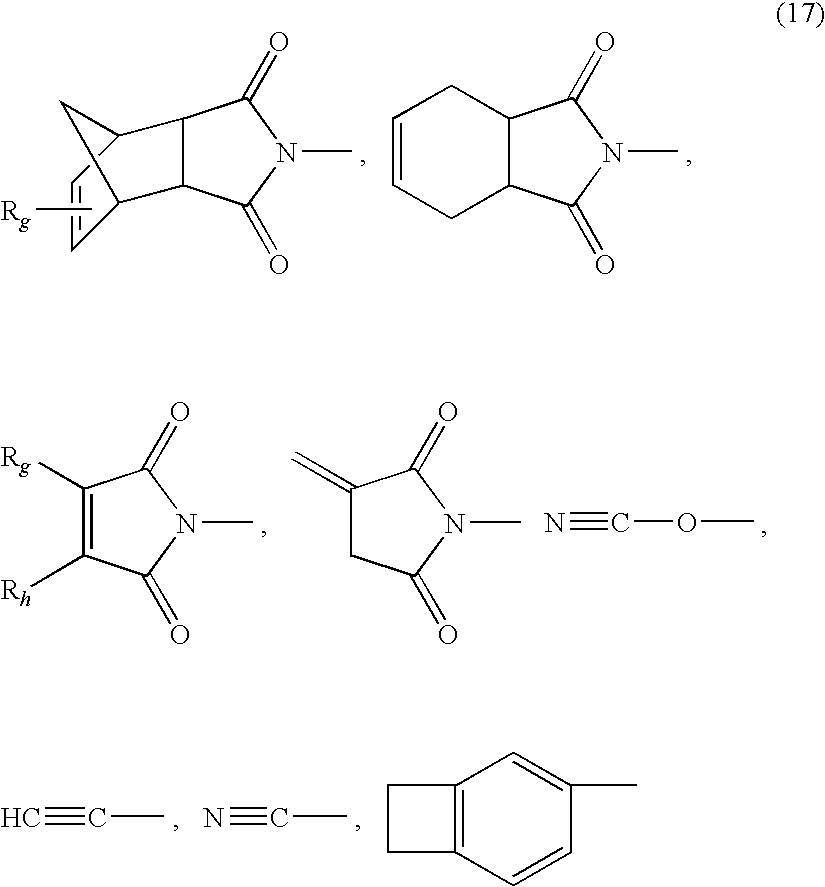


| TABLE 1 | |||||
| Amount of | |||||
| Exam- | resin | Di- | |||
| ple | LCT | Crosslinking | impregnated | CTE | electric |
| No. | oligomer | agent | (wt %) | (ppm/° C.) | constant |
| 1 | Synthesis | Synthesis | 60 | 16.3 | 3.4 | |
| Example 1 | Example 7 | |||||
| 2 | Synthesis | Synthesis | 64 | 10.6 | 3.4 | |
| Example 2 | Example 8 | |||||
| 3 | | Synthesis | 50 | 7.2 | 3.6 | |
| Example 2 | Example 9 | |||||
| 4 | Synthesis | Synthesis | 52 | 14.5 | 3.6 | |
| Example 3 | Example 5 | |||||
| 5 | Synthesis | Synthesis | 52 | 16.5 | 3.5 | |
| Example 3 | Example 10 | |||||
| 6 | Synthesis | Synthesis | 53 | 14.7 | 3.5 | |
| Example 3 | Example 11 | |||||
| 7 | Synthesis | Synthesis | 60 | 14.6 | 3.7 | |
| Example 2 | Example 6 | |||||
| 8 | Synthesis | Synthesis | 52 | 10.2 | 3.5 | |
| Example 2 | Examples 8, 9 | |||||
| 9 | Synthesis | Synthesis | 59 | 9.3 | 3.5 | |
| Example 2 | Example 9 | |||||
| 10 | Synthesis | Synthesis | 58 | 13.6 | 3.6 | |
| Example 2 | Examples 7, 9 | |||||
| 11 | Synthesis | Synthesis | 52 | 11.0 | 3.7 | |
| Example 4 | Example 8 | |||||

Claims (34)
Z1
—X1—Ar1—Y1— (2)

X2—Ar3—Y2 (6)


Z3-A3-Z4 (14)


—B1—Ar5—B2— (16a)

Z1
—X1—Ar1—Y1— (2)

—X2—Ar3—Y2— (6)

Z3-A3-Z4 (14)

—B1—Ar5—B2—, (16a)
Z1
X1—Ar1—Y1— (2)

—X2—Ar3—Y2— (6)

Applications Claiming Priority (6)
| Application Number | Priority Date | Filing Date | Title |
|---|---|---|---|
| KR10-2008-0114806 | 2008-11-18 | ||
| KR20080114806 | 2008-11-18 | ||
| KR10-2009-0042671 | 2009-05-15 | ||
| KR1020090042671A KR20100056344A (en) | 2008-11-18 | 2009-05-15 | Thermoset composition and printed circuit board using the same |
| KR1020090105844A KR20100056371A (en) | 2008-11-18 | 2009-11-04 | Thermoset composition and printed circuit board using the same |
| KR10-2009-0105844 | 2009-11-04 |
Publications (2)
| Publication Number | Publication Date |
|---|---|
| US20100124037A1 US20100124037A1 (en) | 2010-05-20 |
| US8765012B2 true US8765012B2 (en) | 2014-07-01 |
Family
ID=42171904
Family Applications (1)
| Application Number | Title | Priority Date | Filing Date |
|---|---|---|---|
| US12/621,043 Expired - Fee Related US8765012B2 (en) | 2008-11-18 | 2009-11-18 | Thermosetting composition and printed circuit board using the same |
Country Status (1)
| Country | Link |
|---|---|
| US (1) | US8765012B2 (en) |
Families Citing this family (20)
| Publication number | Priority date | Publication date | Assignee | Title |
|---|---|---|---|---|
| US8512596B2 (en) * | 2008-12-08 | 2013-08-20 | Samsung Electronics Co., Ltd. | Composition for producing a board and printed circuit board using the same |
| US8932705B2 (en) * | 2008-12-24 | 2015-01-13 | Samsung Electro-Mechanics Co., Ltd. | Thermosetting resin composition and board using the same |
| KR101077303B1 (en) * | 2009-05-06 | 2011-10-26 | 삼성전기주식회사 | Composition for forming substrate, and prepreg and substrate using the same |
| KR101148384B1 (en) * | 2009-11-26 | 2012-05-21 | 삼성전기주식회사 | Composition for forming substrate, and prepreg and substrate using the same |
| KR101642518B1 (en) * | 2010-03-29 | 2016-07-26 | 삼성전기주식회사 | Composition for forming Board and Printed Circuit Board using the same |
| KR101708934B1 (en) * | 2010-07-05 | 2017-03-08 | 심천 워트 어드밴스드 머티리얼즈 주식회사 | Composition for preparing thermosetting resin, cured product of the composition, prepreg and prepreg laminate having the cured product, and metal clad laminate and printed circuit board having the prepreg or the prepreg laminate |
| KR101319268B1 (en) * | 2011-12-26 | 2013-10-18 | 전자부품연구원 | Maleimide based liquid crystalline thermoset with flexible linkage |
| US20130303677A1 (en) * | 2012-05-08 | 2013-11-14 | Samsung Electronics Co., Ltd. | Composition for polarizing film, polarizing film, and display device including the polarizing film |
| KR101331646B1 (en) * | 2012-06-14 | 2013-11-20 | 삼성전기주식회사 | Insulting epoxy resin composition, insulting film made therefrom, and multilayer printed circuit board having the same |
| US9145519B2 (en) | 2012-09-24 | 2015-09-29 | Ticona Llc | Crosslinkable aromatic polyester |
| US8822628B2 (en) | 2012-09-24 | 2014-09-02 | Ticona Llc | Crosslinkable liquid crystalline polymer |
| US8853342B2 (en) | 2012-09-24 | 2014-10-07 | Ticona Llc | Crosslinkable liquid crystalline polymer |
| KR20140059542A (en) * | 2012-11-08 | 2014-05-16 | 삼성전기주식회사 | Copper clad laminate, manufacturing method thereof and printed circuit board |
| KR102054967B1 (en) * | 2012-12-28 | 2019-12-12 | 삼성전기주식회사 | Insulation materials, insulation composition comprising the same, substrate using the same |
| US20170226302A1 (en) * | 2014-09-09 | 2017-08-10 | Panasonic Intellectual Property Management Co., Ltd. | Curable composition, prepreg, metal foil with resin, metal-clad laminate and printed wiring board |
| NL2016357B1 (en) * | 2016-03-03 | 2017-09-20 | Allotropica Tech Inc | Pre-preg and composite products |
| US20170267824A1 (en) * | 2016-03-21 | 2017-09-21 | Ticona Llc | Prepreg composite containing a crosslinked aromatic polyester |
| KR102686755B1 (en) * | 2016-10-14 | 2024-07-18 | 가부시끼가이샤 레조낙 | Epoxy resin, epoxy resin composition, epoxy resin cured product and composite material |
| CN109053736A (en) * | 2018-08-08 | 2018-12-21 | 青岛科技大学 | A kind of preparation method of pyrrolo- [1,2- α] indoles -3- 01 derivatives |
| CN112867778B (en) | 2018-10-18 | 2025-07-11 | 默克专利股份有限公司 | Dielectric Copolymer Materials |
Citations (16)
| Publication number | Priority date | Publication date | Assignee | Title |
|---|---|---|---|---|
| US5102935A (en) * | 1988-09-13 | 1992-04-07 | Bayer Aktiengesellschaft | Free-flowing polyamide molding compounds and blends |
| US5114612A (en) | 1990-04-04 | 1992-05-19 | The United States Of America As Represented By The Department Of Energy | Liquid crystal polyester thermosets |
| US5315011A (en) | 1990-04-10 | 1994-05-24 | The United States Of America As Represented By The United States Department Of Energy | Polyamide thermosets |
| US5322917A (en) | 1991-08-27 | 1994-06-21 | E. I. Du Pont De Nemours And Company | Fluorine-containing diamines polyamides, and polyimides |
| US5575949A (en) | 1994-06-02 | 1996-11-19 | The Regents Of The University Of California, Office Of Technology Transfer | Thermoset molecular composites |
| US5811507A (en) | 1993-10-21 | 1998-09-22 | Flamel Technologies | Polyesterimides for use in linear and/or non-linear optics, and one method for preparing same |
| JPH1192647A (en) | 1997-07-10 | 1999-04-06 | Dainippon Ink & Chem Inc | High temperature crosslinkable mixture |
| US7507784B2 (en) * | 2000-09-13 | 2009-03-24 | The United States Of America As Represented By The Administrator Of The National Aeronautics And Space Administration | Liquid crystalline thermosets from ester, ester-imide, and ester-amide oligomers |
| US20090111949A1 (en) * | 2007-10-25 | 2009-04-30 | Samsung Electronics Co., Ltd. | Liquid crystal polyester resin composition and printed circuit board using the same |
| US20090117348A1 (en) * | 2007-11-02 | 2009-05-07 | Samsung Electronics Co.,Ltd. | Composition for producing board and printed circuit board using the same |
| US20090224203A1 (en) * | 2008-03-05 | 2009-09-10 | Samsung Electronics Co., Ltd. | Liquid crystal thermoset monomer or oligomer, thermosetting liquid crystal polymer composition comprising the same and printed circuit board using the same |
| US20090308643A1 (en) * | 2008-06-13 | 2009-12-17 | Cho Chung Kun | Crosslinkable thermoset monomer, composition for producing printed circuit board comprising the thermoset monomer and printed circuit board using the composition |
| US20100139961A1 (en) * | 2008-12-08 | 2010-06-10 | Samsung Electronics Co., Ltd., | Composition for producing a board and printed circuit board using the same |
| US20100159231A1 (en) * | 2008-12-24 | 2010-06-24 | Samsung Electronics Co., Ltd. | Thermosetting resin composition and board using the same |
| US20100203326A1 (en) * | 2007-05-23 | 2010-08-12 | Ok Tae Jun | Aromatic liquid-crystalline polyester amide copolymer, prepreg including the same, prepreg laminate including the prepreg, metal film laminate including the prepreg, and printed wiring board including the prepreg |
| US8105663B2 (en) * | 2009-05-06 | 2012-01-31 | Samsung Electro-Mechanics Co., Ltd | Composition for forming substrate, and prepreg and substrate using the same |
-
2009
- 2009-11-18 US US12/621,043 patent/US8765012B2/en not_active Expired - Fee Related
Patent Citations (17)
| Publication number | Priority date | Publication date | Assignee | Title |
|---|---|---|---|---|
| US5102935A (en) * | 1988-09-13 | 1992-04-07 | Bayer Aktiengesellschaft | Free-flowing polyamide molding compounds and blends |
| US5114612A (en) | 1990-04-04 | 1992-05-19 | The United States Of America As Represented By The Department Of Energy | Liquid crystal polyester thermosets |
| US5315011A (en) | 1990-04-10 | 1994-05-24 | The United States Of America As Represented By The United States Department Of Energy | Polyamide thermosets |
| US5322917A (en) | 1991-08-27 | 1994-06-21 | E. I. Du Pont De Nemours And Company | Fluorine-containing diamines polyamides, and polyimides |
| US5811507A (en) | 1993-10-21 | 1998-09-22 | Flamel Technologies | Polyesterimides for use in linear and/or non-linear optics, and one method for preparing same |
| US5575949A (en) | 1994-06-02 | 1996-11-19 | The Regents Of The University Of California, Office Of Technology Transfer | Thermoset molecular composites |
| JPH1192647A (en) | 1997-07-10 | 1999-04-06 | Dainippon Ink & Chem Inc | High temperature crosslinkable mixture |
| US7507784B2 (en) * | 2000-09-13 | 2009-03-24 | The United States Of America As Represented By The Administrator Of The National Aeronautics And Space Administration | Liquid crystalline thermosets from ester, ester-imide, and ester-amide oligomers |
| US20100203326A1 (en) * | 2007-05-23 | 2010-08-12 | Ok Tae Jun | Aromatic liquid-crystalline polyester amide copolymer, prepreg including the same, prepreg laminate including the prepreg, metal film laminate including the prepreg, and printed wiring board including the prepreg |
| US20090111949A1 (en) * | 2007-10-25 | 2009-04-30 | Samsung Electronics Co., Ltd. | Liquid crystal polyester resin composition and printed circuit board using the same |
| US20090117348A1 (en) * | 2007-11-02 | 2009-05-07 | Samsung Electronics Co.,Ltd. | Composition for producing board and printed circuit board using the same |
| US20090224203A1 (en) * | 2008-03-05 | 2009-09-10 | Samsung Electronics Co., Ltd. | Liquid crystal thermoset monomer or oligomer, thermosetting liquid crystal polymer composition comprising the same and printed circuit board using the same |
| US7655155B2 (en) * | 2008-03-05 | 2010-02-02 | Samsung Electronics Co., Ltd. | Liquid crystal thermoset monomer or oligomer, thermosetting liquid crystal polymer composition comprising the same and printed circuit board using the same |
| US20090308643A1 (en) * | 2008-06-13 | 2009-12-17 | Cho Chung Kun | Crosslinkable thermoset monomer, composition for producing printed circuit board comprising the thermoset monomer and printed circuit board using the composition |
| US20100139961A1 (en) * | 2008-12-08 | 2010-06-10 | Samsung Electronics Co., Ltd., | Composition for producing a board and printed circuit board using the same |
| US20100159231A1 (en) * | 2008-12-24 | 2010-06-24 | Samsung Electronics Co., Ltd. | Thermosetting resin composition and board using the same |
| US8105663B2 (en) * | 2009-05-06 | 2012-01-31 | Samsung Electro-Mechanics Co., Ltd | Composition for forming substrate, and prepreg and substrate using the same |
Also Published As
| Publication number | Publication date |
|---|---|
| US20100124037A1 (en) | 2010-05-20 |
Similar Documents
| Publication | Publication Date | Title |
|---|---|---|
| US8765012B2 (en) | Thermosetting composition and printed circuit board using the same | |
| US8512596B2 (en) | Composition for producing a board and printed circuit board using the same | |
| US7655155B2 (en) | Liquid crystal thermoset monomer or oligomer, thermosetting liquid crystal polymer composition comprising the same and printed circuit board using the same | |
| JP5814503B2 (en) | Thermosetting composition and printed wiring board using the same | |
| US8784682B2 (en) | Thermosetting composition and printed circuit board using the same | |
| KR101552716B1 (en) | Thermoset Monomer cross-linking agent and Composition for forming Printed Circuit Board and Printed Circuit Board using the same | |
| US7887887B2 (en) | Liquid crystal polyester resin composition and printed circuit board using the same | |
| US8552123B2 (en) | Thermosetting resin, composition including the same, and printed board fabricated using the same | |
| Zhang et al. | Soluble liquid crystalline poly (ester imide) s with high glass transition temperatures and improved dielectric properties | |
| US8986846B2 (en) | Thermosetting oligomer or polymer, thermosetting resin composition including the oligomer or polymer, and printed circuit board using the composition | |
| JP5945320B2 (en) | Fully aromatic polyester amide copolymer resin, polymer film containing the wholly aromatic polyester amide copolymer resin, flexible metal foil laminate including the polymer film, and flexible printing comprising the flexible metal foil laminate Circuit board | |
| KR20220117275A (en) | Liquid crystalline polyester, manufacturing method of liquid crystalline polyester, resin solution, metal clad laminate and manufacturing method of metal clad laminate | |
| US20090117348A1 (en) | Composition for producing board and printed circuit board using the same | |
| JP5721570B2 (en) | Composition for producing thermosetting resin, cured product thereof, prepreg and prepreg laminate including the cured product, and metal foil laminate and printed wiring board employing the prepreg or prepreg laminate | |
| KR20120100306A (en) | Wholly aromatic polyester amide copolymer resin, film having the resin, flexible metal clad laminate having the film, and flexible printed circuit board having the metal clad laminate | |
| CN102272200B (en) | Aromatic polyester amide copolymer, high molecular film, prepreg, prepreg laminate, metal foil laminate, and printed circuit board | |
| JP6111247B2 (en) | Composition for manufacturing thermosetting resin, cured product thereof, prepreg containing the cured product, metal foil laminate and printed wiring board employing the prepreg | |
| JP5855371B2 (en) | Composition for producing thermosetting resin, cured product thereof, prepreg and prepreg laminate including the cured product, and metal foil laminate and printed wiring board employing the prepreg or prepreg laminate | |
| KR20120136195A (en) | Wholly aromatic polyester amide copolymer resin, and polymer film, flexible metal clad laminate and printed circuit board comprising the same | |
| 이선호 | Polymerization and Physical Properties of Benzoxazine Based Thermosetting Resin and Thermotropic Liquid Crystalline Polyester | |
| KR20110082883A (en) | Thermosetting resin composition and printed circuit board using the same |
Legal Events
| Date | Code | Title | Description |
|---|---|---|---|
| AS | Assignment |
Owner name: SAMSUNG ELECTRONICS CO., LTD.,KOREA, REPUBLIC OF Free format text: ASSIGNMENT OF ASSIGNORS INTEREST;ASSIGNORS:JUNG, MYUNG SUP;CHO, CHUNG KUN;KIM, KWANG HEE;AND OTHERS;REEL/FRAME:023871/0809 Effective date: 20100127 Owner name: SAMSUNG ELECTRO-MECHANICS CO., LTD.,KOREA, REPUBLI Free format text: ASSIGNMENT OF ASSIGNORS INTEREST;ASSIGNORS:JUNG, MYUNG SUP;CHO, CHUNG KUN;KIM, KWANG HEE;AND OTHERS;REEL/FRAME:023871/0809 Effective date: 20100127 Owner name: SAMSUNG FINE CHEMICALS CO., LTD.,KOREA, REPUBLIC O Free format text: ASSIGNMENT OF ASSIGNORS INTEREST;ASSIGNORS:JUNG, MYUNG SUP;CHO, CHUNG KUN;KIM, KWANG HEE;AND OTHERS;REEL/FRAME:023871/0809 Effective date: 20100127 Owner name: SAMSUNG ELECTRONICS CO., LTD., KOREA, REPUBLIC OF Free format text: ASSIGNMENT OF ASSIGNORS INTEREST;ASSIGNORS:JUNG, MYUNG SUP;CHO, CHUNG KUN;KIM, KWANG HEE;AND OTHERS;REEL/FRAME:023871/0809 Effective date: 20100127 Owner name: SAMSUNG ELECTRO-MECHANICS CO., LTD., KOREA, REPUBL Free format text: ASSIGNMENT OF ASSIGNORS INTEREST;ASSIGNORS:JUNG, MYUNG SUP;CHO, CHUNG KUN;KIM, KWANG HEE;AND OTHERS;REEL/FRAME:023871/0809 Effective date: 20100127 Owner name: SAMSUNG FINE CHEMICALS CO., LTD., KOREA, REPUBLIC Free format text: ASSIGNMENT OF ASSIGNORS INTEREST;ASSIGNORS:JUNG, MYUNG SUP;CHO, CHUNG KUN;KIM, KWANG HEE;AND OTHERS;REEL/FRAME:023871/0809 Effective date: 20100127 |
|
| FEPP | Fee payment procedure |
Free format text: PAYOR NUMBER ASSIGNED (ORIGINAL EVENT CODE: ASPN); ENTITY STATUS OF PATENT OWNER: LARGE ENTITY |
|
| AS | Assignment |
Owner name: SAMSUNG ELECTRO-MECHANICS CO., LTD., KOREA, REPUBL Free format text: ASSIGNMENT OF ASSIGNORS INTEREST;ASSIGNORS:SAMSUNG FINE CHEMICALS CO., LTD.;SAMSUNG ELECTRONICS CO., LTD.;SIGNING DATES FROM 20140418 TO 20140429;REEL/FRAME:033025/0222 |
|
| STCF | Information on status: patent grant |
Free format text: PATENTED CASE |
|
| MAFP | Maintenance fee payment |
Free format text: PAYMENT OF MAINTENANCE FEE, 4TH YEAR, LARGE ENTITY (ORIGINAL EVENT CODE: M1551) Year of fee payment: 4 |
|
| FEPP | Fee payment procedure |
Free format text: MAINTENANCE FEE REMINDER MAILED (ORIGINAL EVENT CODE: REM.); ENTITY STATUS OF PATENT OWNER: LARGE ENTITY |
|
| LAPS | Lapse for failure to pay maintenance fees |
Free format text: PATENT EXPIRED FOR FAILURE TO PAY MAINTENANCE FEES (ORIGINAL EVENT CODE: EXP.); ENTITY STATUS OF PATENT OWNER: LARGE ENTITY |
|
| STCH | Information on status: patent discontinuation |
Free format text: PATENT EXPIRED DUE TO NONPAYMENT OF MAINTENANCE FEES UNDER 37 CFR 1.362 |
|
| FP | Lapsed due to failure to pay maintenance fee |
Effective date: 20220701 |