US8759348B2 - Use of 4-(pyrrolidin-1-yl)quinoline compounds to kill clinically latent microorganisms - Google Patents
Use of 4-(pyrrolidin-1-yl)quinoline compounds to kill clinically latent microorganisms Download PDFInfo
- Publication number
- US8759348B2 US8759348B2 US12/600,470 US60047008A US8759348B2 US 8759348 B2 US8759348 B2 US 8759348B2 US 60047008 A US60047008 A US 60047008A US 8759348 B2 US8759348 B2 US 8759348B2
- Authority
- US
- United States
- Prior art keywords
- methyl
- phenylpyrrolidin
- quinolin
- alkyl
- quinoline
- Prior art date
- Legal status (The legal status is an assumption and is not a legal conclusion. Google has not performed a legal analysis and makes no representation as to the accuracy of the status listed.)
- Expired - Fee Related, expires
Links
- 0 [1*]C.[2*]C1=NC2=CC=CC=C2C(N2CCCC2)=C1.[3*]C Chemical compound [1*]C.[2*]C1=NC2=CC=CC=C2C(N2CCCC2)=C1.[3*]C 0.000 description 18
- OTSKZNVDZOOHRX-ARJAWSKDSA-N CC(=O)/C=C\C(C)=O Chemical compound CC(=O)/C=C\C(C)=O OTSKZNVDZOOHRX-ARJAWSKDSA-N 0.000 description 1
- XJOUXLQTCBNSBY-UHFFFAOYSA-N CC(=O)CC(C(C)=O)C(C)=O Chemical compound CC(=O)CC(C(C)=O)C(C)=O XJOUXLQTCBNSBY-UHFFFAOYSA-N 0.000 description 1
- OJVAMHKKJGICOG-UHFFFAOYSA-N CC(=O)CCC(C)=O Chemical compound CC(=O)CCC(C)=O OJVAMHKKJGICOG-UHFFFAOYSA-N 0.000 description 1
Images


Classifications
-
- C—CHEMISTRY; METALLURGY
- C07—ORGANIC CHEMISTRY
- C07D—HETEROCYCLIC COMPOUNDS
- C07D215/00—Heterocyclic compounds containing quinoline or hydrogenated quinoline ring systems
-
- A—HUMAN NECESSITIES
- A61—MEDICAL OR VETERINARY SCIENCE; HYGIENE
- A61K—PREPARATIONS FOR MEDICAL, DENTAL OR TOILETRY PURPOSES
- A61K31/00—Medicinal preparations containing organic active ingredients
- A61K31/33—Heterocyclic compounds
- A61K31/395—Heterocyclic compounds having nitrogen as a ring hetero atom, e.g. guanethidine or rifamycins
- A61K31/435—Heterocyclic compounds having nitrogen as a ring hetero atom, e.g. guanethidine or rifamycins having six-membered rings with one nitrogen as the only ring hetero atom
- A61K31/47—Quinolines; Isoquinolines
- A61K31/4709—Non-condensed quinolines and containing further heterocyclic rings
-
- A—HUMAN NECESSITIES
- A61—MEDICAL OR VETERINARY SCIENCE; HYGIENE
- A61K—PREPARATIONS FOR MEDICAL, DENTAL OR TOILETRY PURPOSES
- A61K31/00—Medicinal preparations containing organic active ingredients
- A61K31/33—Heterocyclic compounds
- A61K31/395—Heterocyclic compounds having nitrogen as a ring hetero atom, e.g. guanethidine or rifamycins
- A61K31/495—Heterocyclic compounds having nitrogen as a ring hetero atom, e.g. guanethidine or rifamycins having six-membered rings with two or more nitrogen atoms as the only ring heteroatoms, e.g. piperazine or tetrazines
- A61K31/4965—Non-condensed pyrazines
- A61K31/497—Non-condensed pyrazines containing further heterocyclic rings
-
- A—HUMAN NECESSITIES
- A61—MEDICAL OR VETERINARY SCIENCE; HYGIENE
- A61K—PREPARATIONS FOR MEDICAL, DENTAL OR TOILETRY PURPOSES
- A61K31/00—Medicinal preparations containing organic active ingredients
- A61K31/33—Heterocyclic compounds
- A61K31/395—Heterocyclic compounds having nitrogen as a ring hetero atom, e.g. guanethidine or rifamycins
- A61K31/495—Heterocyclic compounds having nitrogen as a ring hetero atom, e.g. guanethidine or rifamycins having six-membered rings with two or more nitrogen atoms as the only ring heteroatoms, e.g. piperazine or tetrazines
- A61K31/50—Pyridazines; Hydrogenated pyridazines
- A61K31/501—Pyridazines; Hydrogenated pyridazines not condensed and containing further heterocyclic rings
-
- A—HUMAN NECESSITIES
- A61—MEDICAL OR VETERINARY SCIENCE; HYGIENE
- A61K—PREPARATIONS FOR MEDICAL, DENTAL OR TOILETRY PURPOSES
- A61K31/00—Medicinal preparations containing organic active ingredients
- A61K31/33—Heterocyclic compounds
- A61K31/395—Heterocyclic compounds having nitrogen as a ring hetero atom, e.g. guanethidine or rifamycins
- A61K31/495—Heterocyclic compounds having nitrogen as a ring hetero atom, e.g. guanethidine or rifamycins having six-membered rings with two or more nitrogen atoms as the only ring heteroatoms, e.g. piperazine or tetrazines
- A61K31/505—Pyrimidines; Hydrogenated pyrimidines, e.g. trimethoprim
- A61K31/517—Pyrimidines; Hydrogenated pyrimidines, e.g. trimethoprim ortho- or peri-condensed with carbocyclic ring systems, e.g. quinazoline, perimidine
-
- A—HUMAN NECESSITIES
- A61—MEDICAL OR VETERINARY SCIENCE; HYGIENE
- A61P—SPECIFIC THERAPEUTIC ACTIVITY OF CHEMICAL COMPOUNDS OR MEDICINAL PREPARATIONS
- A61P1/00—Drugs for disorders of the alimentary tract or the digestive system
- A61P1/04—Drugs for disorders of the alimentary tract or the digestive system for ulcers, gastritis or reflux esophagitis, e.g. antacids, inhibitors of acid secretion, mucosal protectants
-
- A—HUMAN NECESSITIES
- A61—MEDICAL OR VETERINARY SCIENCE; HYGIENE
- A61P—SPECIFIC THERAPEUTIC ACTIVITY OF CHEMICAL COMPOUNDS OR MEDICINAL PREPARATIONS
- A61P17/00—Drugs for dermatological disorders
- A61P17/02—Drugs for dermatological disorders for treating wounds, ulcers, burns, scars, keloids, or the like
-
- A—HUMAN NECESSITIES
- A61—MEDICAL OR VETERINARY SCIENCE; HYGIENE
- A61P—SPECIFIC THERAPEUTIC ACTIVITY OF CHEMICAL COMPOUNDS OR MEDICINAL PREPARATIONS
- A61P17/00—Drugs for dermatological disorders
- A61P17/10—Anti-acne agents
-
- A—HUMAN NECESSITIES
- A61—MEDICAL OR VETERINARY SCIENCE; HYGIENE
- A61P—SPECIFIC THERAPEUTIC ACTIVITY OF CHEMICAL COMPOUNDS OR MEDICINAL PREPARATIONS
- A61P31/00—Antiinfectives, i.e. antibiotics, antiseptics, chemotherapeutics
-
- A—HUMAN NECESSITIES
- A61—MEDICAL OR VETERINARY SCIENCE; HYGIENE
- A61P—SPECIFIC THERAPEUTIC ACTIVITY OF CHEMICAL COMPOUNDS OR MEDICINAL PREPARATIONS
- A61P31/00—Antiinfectives, i.e. antibiotics, antiseptics, chemotherapeutics
- A61P31/04—Antibacterial agents
-
- A—HUMAN NECESSITIES
- A61—MEDICAL OR VETERINARY SCIENCE; HYGIENE
- A61P—SPECIFIC THERAPEUTIC ACTIVITY OF CHEMICAL COMPOUNDS OR MEDICINAL PREPARATIONS
- A61P31/00—Antiinfectives, i.e. antibiotics, antiseptics, chemotherapeutics
- A61P31/04—Antibacterial agents
- A61P31/06—Antibacterial agents for tuberculosis
-
- A—HUMAN NECESSITIES
- A61—MEDICAL OR VETERINARY SCIENCE; HYGIENE
- A61P—SPECIFIC THERAPEUTIC ACTIVITY OF CHEMICAL COMPOUNDS OR MEDICINAL PREPARATIONS
- A61P33/00—Antiparasitic agents
- A61P33/02—Antiprotozoals, e.g. for leishmaniasis, trichomoniasis, toxoplasmosis
-
- C—CHEMISTRY; METALLURGY
- C07—ORGANIC CHEMISTRY
- C07D—HETEROCYCLIC COMPOUNDS
- C07D345/00—Heterocyclic compounds containing rings having selenium or tellurium atoms as the only ring hetero atoms
-
- C—CHEMISTRY; METALLURGY
- C07—ORGANIC CHEMISTRY
- C07D—HETEROCYCLIC COMPOUNDS
- C07D401/00—Heterocyclic compounds containing two or more hetero rings, having nitrogen atoms as the only ring hetero atoms, at least one ring being a six-membered ring with only one nitrogen atom
- C07D401/02—Heterocyclic compounds containing two or more hetero rings, having nitrogen atoms as the only ring hetero atoms, at least one ring being a six-membered ring with only one nitrogen atom containing two hetero rings
- C07D401/04—Heterocyclic compounds containing two or more hetero rings, having nitrogen atoms as the only ring hetero atoms, at least one ring being a six-membered ring with only one nitrogen atom containing two hetero rings directly linked by a ring-member-to-ring-member bond
-
- C—CHEMISTRY; METALLURGY
- C07—ORGANIC CHEMISTRY
- C07D—HETEROCYCLIC COMPOUNDS
- C07D403/00—Heterocyclic compounds containing two or more hetero rings, having nitrogen atoms as the only ring hetero atoms, not provided for by group C07D401/00
- C07D403/14—Heterocyclic compounds containing two or more hetero rings, having nitrogen atoms as the only ring hetero atoms, not provided for by group C07D401/00 containing three or more hetero rings
-
- Y—GENERAL TAGGING OF NEW TECHNOLOGICAL DEVELOPMENTS; GENERAL TAGGING OF CROSS-SECTIONAL TECHNOLOGIES SPANNING OVER SEVERAL SECTIONS OF THE IPC; TECHNICAL SUBJECTS COVERED BY FORMER USPC CROSS-REFERENCE ART COLLECTIONS [XRACs] AND DIGESTS
- Y02—TECHNOLOGIES OR APPLICATIONS FOR MITIGATION OR ADAPTATION AGAINST CLIMATE CHANGE
- Y02A—TECHNOLOGIES FOR ADAPTATION TO CLIMATE CHANGE
- Y02A50/00—TECHNOLOGIES FOR ADAPTATION TO CLIMATE CHANGE in human health protection, e.g. against extreme weather
- Y02A50/30—Against vector-borne diseases, e.g. mosquito-borne, fly-borne, tick-borne or waterborne diseases whose impact is exacerbated by climate change
Definitions
- This invention relates to the use of compounds based upon the 4-(pyrrolidin-1-yl)quinoline ring system to kill clinically latent microorganisms.
- the invention further relates to the use of such compounds to treat microbial infections, as well as, inter alia, certain of the compounds per se.
- tuberculosis Before the introduction of antibiotics, patients suffering from acute bacterial infections (e.g. tuberculosis or pneumonia) had a low chance of survival. For example, mortality from tuberculosis was around 50%.
- acute bacterial infections e.g. tuberculosis or pneumonia
- strategies that can be adopted include limiting the use of antibiotics for the treatment of non-acute infections, as well as controlling which antibiotics are fed to animals in order to promote growth.
- Antimicrobial agents target essential components of bacterial metabolism.
- the ⁇ -lactams e.g. penicillins and cephalosporins
- inhibit cell wall synthesis whereas other agents inhibit a diverse range of targets, such as DNA gyrase (quinolones) and protein synthesis (e.g. macrolides, aminoglycosides, tetracyclines and oxazolidinones).
- DNA gyrase quinolones
- protein synthesis e.g. macrolides, aminoglycosides, tetracyclines and oxazolidinones.
- the range of organisms against which the antimicrobial agents are effective varies, depending upon which organisms are heavily reliant upon the metabolic step(s) that is/are inhibited.
- the effect upon bacteria can vary from a mere inhibition of growth (i.e. a bacteriostatic effect, as seen with agents such as the tetracyclines) to full killing (i.e. a bactericidal
- Bacteria have been growing on Earth for more than 3 billion years and, in that time, have needed to respond to vast numbers of environmental stresses. It is therefore perhaps not surprising that bacteria have developed a seemingly inexhaustible variety of mechanisms by which they can respond to the metabolic stresses imposed upon them by antibiotic agents. Indeed, mechanisms by which the bacteria can generate resistance include strategies as diverse as inactivation of the drug, modification of the site of action, modification of the permeability of the cell wall, overproduction of the target enzyme and bypass of the inhibited steps.
- the rate that resistance emerges to a particular agent has been observed to vary widely, depending upon factors such as the agent's mechanism of action, whether the agent's mode of killing is time- or concentration-dependent, the potency against the population of bacteria and the magnitude and duration of the available serum concentration.
- phenotypically resistant bacteria differ from those that are genotypically resistant in that they regain their susceptibility to antimicrobials when they return to a fast-growing state (e.g. when nutrients become more readily available to them).
- phenotypically resistant bacteria in an infection leads to the need for prolonged courses of antimicrobial agents, comprising multiple doses. This is because the resistant, slowly multiplying bacteria provide a pool of “latent” organisms that can convert to a fast-growing state when the conditions allow (thereby effectively re-initiating the infection). Multiple doses over time deal with this issue by gradually killing off the “latent” bacteria that convert to “active” form.
- a new approach to combating the problem of bacterial resistance might be to select and develop antimicrobial agents on the basis of their ability to kill “latent” microorganisms.
- the production of such agents would allow, amongst other things, for the shortening of chemotherapy regimes in the treatment of microbial infections, thus reducing the frequency with which genotypical resistance arises in microorganisms.
- a compound of formula I for the preparation of a medicament for killing clinically latent microorganisms, wherein the compound of formula I is represented by the structure
- each —X—R 4a substituent is attached to the pyrrolidinyl ring via the X moiety.
- Acid addition salts that may be mentioned include carboxylate salts (e.g. formate, acetate, trifluoroacetate, propionate, isobutyrate, heptanoate, decanoate, caprate, caprylate, stearate, acrylate, caproate, propiolate, ascorbate, citrate, glucuronate, glutamate, glycolate, ⁇ -hydroxybutyrate, lactate, tartrate, phenylacetate, mandelate, phenylpropionate, phenylbutyrate, benzoate, chlorobenzoate, methylbenzoate, hydroxybenzoate, methoxybenzoate, dinitrobenzoate, o-acetoxybenzoate, salicylate, nicotinate, isonicotinate, cinnamate, oxalate, malonate, succinate, suberate, sebacate, fumarate, malate, maleate, hydroxymaleate, hippurate, phthalate or ter
- sulfonate salts e.g. benzenesulfonate, methyl-, bromo- or chloro-benzenesulfonate, xylenesulfonate, methanesulfonate, ethanesulfonate, propanesulfonate, hydroxyethanesulfonate, 1- or 2-naphthalene-sulfonate or 1,5-naphthalenedisulfonate salts
- sulfate pyrosulfate, bisulfate, sulfite, bisulfite, phosphate, monohydrogenphosphate, dihydrogenphosphate, metaphosphate, pyrophosphate or nitrate salts, and the like.
- aryl, alkyl, alkenyl, alkynyl, cycloalkyl, cycloalkenyl and alkoxy groups apply, unless otherwise stated, at each usage of such terms herein.
- the one or two benzene rings that may be fused to cycloalkyl groups may bear one or more of the substituents defined in respect of the relevant cycloalkyl group.
- halo when used herein, includes fluoro, chloro, bromo and iodo.
- Heterocyclic (Het 1 to Het 13 and Het a to Het e ) groups may be fully saturated, partly unsaturated, wholly aromatic or partly aromatic in character.
- Values of heterocyclic (Het 1 to Het 13 and Het a to Het e ) groups that may be mentioned include 1-azabicyclo-[2.2.2]octanyl, benzimidazolyl, benzo[c]isoxazolidinyl, benzisoxazolyl, benzodioxanyl, benzodioxepanyl, benzodioxolyl, benzofuranyl, benzofurazanyl, benzomorpholinyl, 2,1,3-benzoxadiazolyl, benzoxazolidinyl, benzoxazolyl, benzopyrazolyl, benzo[e]-pyrimidine, 2,1,3-benzothiadiazolyl, benzothiazolyl, benzothienyl, benzotriazolyl
- Het 2 examples include benzimidazolyl (e.g. benzimidazol-2-yl), piperidinyl (e.g. piperidin-4-yl), pyridinyl (e.g. pyridin-3-yl) and pyrrolidinyl (e.g. pyrrolidin-3-yl).
- benzimidazolyl e.g. benzimidazol-2-yl
- piperidinyl e.g. piperidin-4-yl
- pyridinyl e.g. pyridin-3-yl
- pyrrolidinyl e.g. pyrrolidin-3-yl
- Het 6 examples include morpholinyl (e.g. morpholin-4-yl), piperidinyl (e.g. piperidin-4-yl) or, particularly, pyrrolidinonyl (e.g. 1-pyrrolidin-2-one).
- morpholinyl e.g. morpholin-4-yl
- piperidinyl e.g. piperidin-4-yl
- pyrrolidinonyl e.g. 1-pyrrolidin-2-one
- Het 7 includes isoxazolyl (e.g. isoxazol-3-yl) and pyridinyl (e.g. pyridin-3-yl).
- Het 9 includes piperidinyl (e.g. piperidin-1-yl) or, particularly, furanyl (e.g. furan-2-yl), imidazolyl (e.g. imidazol-5-yl), isoxazolyl (e.g. isoxazol-3-yl, isoxazol-4-yl or isoxazol-5-yl), pyrazinyl (e.g. pyrazin-2-yl), pyrazolyl (e.g. pyrazol-3-yl or pyrazol-4-yl), pyridazinyl (e.g. pyridazin-4-yl) or pyridinyl (e.g. pyridin-2-yl or pyridin-3-yl).
- piperidinyl e.g. piperidin-1-yl
- furanyl e.g. furan-2-yl
- imidazolyl e.g. imidazol
- Het 11 values include piperazinyl (e.g. piperazin-1-yl), piperidinyl (e.g. piperidin-1-yl) and pyridinyl (e.g. pyridin-3-yl).
- piperazinyl e.g. piperazin-1-yl
- piperidinyl e.g. piperidin-1-yl
- pyridinyl e.g. pyridin-3-yl
- Het 13 values include pyridinyl (e.g. pyridin-3-yl).
- microorganisms means:
- microbial means fungal or, particularly, bacterial.
- the term “clinically latent” includes references to microorganisms that are viable but non-culturable (e.g. bacteria that cannot be detected by standard culture techniques but that are detectable and quantifiable by techniques such as broth dilution counting, microscopy, or molecular techniques such as polymerase chain reaction).
- microorganisms that are phenotypically tolerant, for example microorganisms that:
- substantially unchanged refers to MIC values that are anywhere from 50 to 200% (e.g. 90 to 110%) of the value determined under standard conditions for the microorganism and conventional antimicrobial agent concerned.
- the term “clinically latent” excludes references to microorganisms that are genotypically resistant to conventional antimicrobial agents (i.e. microorganisms that differ genetically from antimicrobial-sensitive members of the same genus and that display an increased MIC (e.g. in log phase) for one or more conventional antimicrobial agents compared to said antimicrobial-sensitive microorganisms).
- threshold of infectious disease expression will be understood by those skilled in the art to include references to the growth rate threshold below which the symptoms of infectious disease (in a patient infected with the relevant microorganism) are absent.
- metabolic activity of latent microorganisms can be determined by several methods known to those skilled in the art, for example by measuring mRNA levels in the microorganisms or by determining their rate of uridine uptake.
- the term “clinically latent” further includes references to microorganisms that, compared to the same number of microorganisms under logarithmic growth conditions (in vitro or in vivo), possess reduced but still significant levels of:
- inventions means:
- conventional antibacterial agent(s) include references to bactericidal and bacteristatic agents that are known in the prior art (i.e. agents that have been selected and developed on the basis of their MICs—namely their ability to inhibit the growth of bacteria).
- particular conventional antibacterial agents that may be mentioned include any one or more of the following.
- Particular conventional antibacterial agents that may be mentioned include those listed at (a) to (q) above, such as:
- conventional antifungal agent(s) include references to fungicidal and fungistatic agents that are known in the prior art (i.e. agents that have been selected and developed on the basis of their MICs—namely their ability to inhibit the growth of fungi).
- particular conventional antifungal agents include any one or more of the following.
- the compound of formula I is a compound of formula Ia
- R 1a represents —X—R 4a ;
- references to compounds of formula I are, unless the context indicates otherwise, intended to include references to compounds of formula Ia. Conversely, where reference is made to particular embodiments of the compounds of formula Ia, these embodiments apply equally, where relevant, to compounds of formula I.
- R 1a that may be mentioned in relation to compounds of formula Ia include phenyl, 4-methoxyphenyl, 4-chlorophenyl, benzyl and phenylamino.
- R 3 e.g. as a single substituent at the 6-position of the quinoline or quinazoline ring system
- R 3 e.g. as a single substituent at the 6-position of the quinoline or quinazoline ring system
- Embodiments of the invention include those in which the compound of formula I is a compound of Examples 1 to 39 below, such as:
- Particular compounds that may be mentioned in this respect include compounds (i) and (iv) above, and pharmaceutically-acceptable derivatives thereof.
- Still further embodiments of the invention include those in which the compound of formula I is a compound of formula Ia wherein the compound is in the S— configuration at the C-atom to which R 1a is attached, and is selected from:
- Particular compounds that may be mentioned in this respect include compounds (I) and (IV) above, and pharmaceutically acceptable derivatives thereof.
- the medicament mentioned in the first aspect of the invention may be utilised in a method of medical treatment.
- a second aspect of the invention there is provided:
- the compound of formula I may be used to kill clinically latent microorganisms.
- a compound of formula I as hereinbefore defined, to kill clinically latent microorganisms.
- the use according to this aspect of the invention is an ex vivo use.
- fourth, fifth, sixth and seventh aspects of the invention provide, respectively:
- treatment includes therapeutic and/or prophylactic treatment.
- the uses according to the third and sixth aspects of the invention may be ex vivo uses, such as the use of a compound of formula I, as hereinbefore defined:
- the compounds of formula I may be employed in methods of sterilisation or preservation, such as:
- the object is preferably other than a human or animal body.
- the materials that may be preserved according to the method described at (ii) above include polymers, lubricants, paints, fibres, leather, paper, foodstuffs, water and aqueous mixtures and solutions.
- the compounds of formula I When used to kill clinically latent microorganisms or to treat a microbial infection, the compounds of formula I may be used either alone (i.e. as sole microbicidal or antimicrobial agents) or in combination with any one or more of the conventional antimicrobial agents described above.
- the compounds of formula I when used as a sterilising agent, may be used either alone or in combination with a conventional sterilising agent.
- conventional sterilising agent when used herein, includes references to alcohols (e.g. industrial methylated spirits or ethanol), sodium chloride, thymol, chlorhexidine, cationic surfactants (e.g. cetrimide), iodine (optionally combined with povidone), phenolics (e.g. triclosan), oxidants (e.g. hydrogen peroxide, potassium permanganate or sodium hypochlorite) and any one or more of the conventional antimicrobial agents described above.
- alcohols e.g. industrial methylated spirits or ethanol
- sodium chloride thymol
- chlorhexidine e.g. cetrimide
- iodine optionally combined with povidone
- phenolics e.g. triclosan
- oxidants e.g. hydrogen peroxide, potassium permanganate or
- the combination product according to the eighth aspect of the invention provides for the administration of component (A) in conjunction with component (B), and may thus be presented either as separate formulations, wherein at least one of those formulations comprises component (A) and at least one comprises component (B), or may be presented (i.e. formulated) as a combined preparation (i.e. presented as a single formulation including component (A) and component (B)).
- Component (I) of the kit of parts is thus component (A) in admixture with a pharmaceutically-acceptable adjuvant, diluent or carrier.
- component (II) is component (B) in admixture with a pharmaceutically-acceptable adjuvant, diluent or carrier.
- a method of making a kit of parts as defined above comprises bringing a component (I), as defined above, into association with a component (II), as defined above, thus rendering the two components suitable for administration in conjunction with each other.
- components (I) and (II) of the kit of parts may be:
- kit of parts comprising:
- kits of parts described herein may comprise more than one formulation including an appropriate quantity/dose of component (A), and/or more than one formulation including an appropriate quantity/dose of component (B), in order to provide for repeat dosing. If more than one formulation (comprising either active compound) is present, such formulations may be the same, or may be different in terms of the dose of component (A) or component (B), chemical composition and/or physical form.
- the combination product according to the eighth aspect of the invention may be used to kill clinically latent microorganisms and/or treat a microbial infection.
- further aspects of the invention provide:
- the method of (v) above provides for the advantage that the amount of conventional antimicrobial agent required to treat the microbial infection is reduced compared to that required in the absence of a compound of formula I.
- bacteria and derivatives thereof, such as “bacterial infection” includes references to organisms (or infections due to organisms) of the following classes and specific types:
- bacteria includes references to any of the above classes or specific types of organisms, except for Shigella (e.g. Shigella flexneri ) or Salmonella (e.g. Salmonella typhi ).
- Shigella e.g. Shigella flexneri
- Salmonella e.g. Salmonella typhi
- fungi and derivatives thereof, such as “fungal infection” includes references to organisms (or infections due to organisms) of the following classes and specific types:
- compounds of formula I, or combination products comprising compounds of formula I may be used to kill any of the above-mentioned bacterial or fungal organisms (clinically latent or otherwise).
- bacteria that may be mentioned in this respect include:
- Certain bacteria that may be mentioned include those at (i), (ii) and (viii) above.
- Certain fungi that may be mentioned include those at (I), (II), (X), (XI) and (XII) above.
- tuberculosis e.g. pulmonary tuberculosis, non-pulmonary tuberculosis (such as tuberculosis lymph glands, genito-urinary tuberculosis, tuberculosis of bone and joints, tuberculosis meningitis) and miliary tuberculosis
- anthrax abscesses, acne vulgaris, acne rosacea, rosacea (including erythematotelangiectatic rosacea, papulopustular rosacea, phymatous rosacea and ocular rosacea), actinomycosis, bacilliary dysentry, bacterial conjunctivitis, bacterial keratitis, botulism, Buruli ulcer, bone and joint infections, bronchitis (acute or chronic), brucellosis, burn
- tuberculosis e.g. pulmonary tuberculosis, non-pulmonary tubercul
- furunculosis furunculosis, carbunculosis, staphylococcal scalded skin syndrome, surgical scarlet fever, streptococcal peri-anal disease, streptococcal toxic shock syndrome, pitted keratolysis, trichomycosis axillaris, external canal ear infections, green nail syndrome, spirochetes, necrotizing fasciitis, Mycobacterial skin infections (such as lupus vulgaris, scrofuloderma, warty tuberculosis, tuberculides, erythema nodosum, erythema induratum, cutaneous manifestations of tuberculoid leprosy or lepromatous leprosy, erythema nodosum leprosum, cutaneous M.
- mycobacterial skin infections such as lupus vulgaris, scrofuloderma, warty tuberculosis, tuberculides, erythema nodosum, erythe
- kansasii M. malmoense, M. szulgai, M. simiae, M. gordonae, M. haemophilum, M. avium, M. intracellulare, M. chelonae (including M. abscessus ) or M.
- fortuitum infections swimming pool (or fish tank) granuloma, lymphadenitis and Buruli ulcer (Baimsdale ulcer, Searles' ulcer, Kakerifu ulcer or Toro ulcer)), Q fever, rat-bite fever, reticulosis, Ritter's disease, salmonellosis, salpingitis, septic arthritis, septic infections, septicemia, sinusitis, skin infections (e.g. skin granulomas), syphilis, systemic infections, tonsillitis, toxic shock syndrome, trachoma, tularaemia, typhoid, typhus (e.g.
- candidiasis e.g. oropharyngeal candidiasis, vaginal candidiasis or balanitis
- cryptococcosis e.g. oropharyngeal candidiasis, vaginal candidiasis or balanitis
- references herein to compounds of formula I include references to all embodiments described above in relation to compounds of formulae I and Ia.
- a further aspect of the invention provides a compound of formula Ib for use in medicine, wherein compounds of formula Ib take the same definition as compounds of formula I, as hereinbefore defined, except that:
- compounds of formula I may also have activity against other organisms, such as protozoa. Therefore, according to further aspects of the invention, there is provided:
- the compound of formula I, Ia or Ib may be one in which R 2 does not represent Het 4 (e.g. pyrrolidin-1-yl) when E represents N.
- the compounds of formula I, Ia or Ib When used to treat or prevent a protozoal disease, the compounds of formula I, Ia or Ib may be formulated as described below (i.e. included in a pharmaceutical formulation or a topical pharmaceutical composition comprising a compound of formula I, Ia or Ib in admixture with a pharmaceutically acceptable adjuvant, diluent or carrier).
- protozoa and derivatives thereof, such as “protozoal disease” includes references to organisms (or infections due to organisms) of the following classes and specific types:
- Particular conditions that the compounds of formula I, Ia or Ib can be used to treat include Leishmaniasis, malaria, trypanosomiasis, toxoplasmosis, giardiasis, balantidiasis, amoebiasis (amoebic dysentery), cryptosporidiosis, isosporiasis and microsporidiosis.
- a process for the preparation of a compound of formula I (e.g. a compound of formula Ia or Ib), which comprises:
- L 1 represents a suitable leaving group (e.g. halo, such as chloro), and E, R 2 and R 3 are as hereinbefore defined, with a compound of formula III,
- R 1 is as hereinbefore defined, for example under conditions known to those skilled in the art, such as by reaction at elevated temperature (e.g. from 70 to 250° C., for example as achieved through microwave heating), and optionally at elevated pressure (i.e. above 1 atmosphere), in the presence of a suitable organic solvent, such as a C 2-4 alkylene glycol (e.g. ethylene glycol) or a mono- or di-C 1-4 alkyl ether of a C 2-4 alkylene glycol (e.g. ethoxyethanol), and optionally in the presence of an appropriate base (for instance, the compound of formula II may be reacted with between 1 and 3 equivalents (e.g.
- elevated temperature e.g. from 70 to 250° C., for example as achieved through microwave heating
- elevated pressure i.e. above 1 atmosphere
- a suitable organic solvent such as a C 2-4 alkylene glycol (e.g. ethylene glycol) or a mono- or di-C 1-4 alkyl ether of a
- reaction mixture is optionally heated by use of microwaves, in the presence of a suitable high-boiling solvent (e.g. ethoxyethanol));
- a suitable high-boiling solvent e.g. ethoxyethanol
- R 2 and R 3 are as hereinbefore defined, with a compound of formula III, as hereinbefore defined, for example under conditions known to those skilled in the art, such as at ambient or elevated temperature (e.g. 40 to 200° C.) in the presence of a silylating agent (e.g. hexamethyldisilazane) and optionally in the presence of an appropriate catalyst (e.g. an ammonium salt such as ammonium sulfate);
- a silylating agent e.g. hexamethyldisilazane
- an appropriate catalyst e.g. an ammonium salt such as ammonium sulfate
- E, R 2 and R 3 are as hereinbefore defined, with a compound of formula X, R 4a1 L 3 X wherein R 4a1 represents aryl, and L 3 and aryl are as hereinbefore defined, in the presence of a palladium cross-coupling catalyst (e.g. tris-(dibenzylideneacetone)-dipalladium), for example under conditions known to those skilled in the art, such as at elevated temperature (e.g. 150° C.), wherein the reaction mixture is optionally heated by use of microwaves, in the presence of a suitable phosphine (e.g. 2-dicyclohexyl-phosphino-2′-dimethylaminobiphenyl), an appropriate base (e.g. sodium tert-butoxide) and an organic solvent (e.g. toluene).
- a palladium cross-coupling catalyst e.g. tris-(dibenzylideneacetone)-dipalladium
- Compounds of formula II in which L 1 represents halo may be prepared by reacting a corresponding compound of formula IV, as hereinbefore defined, with a suitable halogenating reagent (e.g. phosphorous oxychloride), for example under conditions known to those skilled in the art, such as at ambient or elevated temperature (e.g. 100 to 120° C.), optionally in the presence of a suitable organic solvent (e.g. toluene or xylene).
- a suitable halogenating reagent e.g. phosphorous oxychloride
- a suitable organic solvent e.g. toluene or xylene.
- Compounds of formula II in which R 3 represents a —NH 2 substituent may be prepared by reduction of a corresponding compound of formula II in which R 3 represents a —NO 2 substituent, for example by catalytic hydrogenation in the presence of a suitable catalyst (such as Pd/C, Pt 2 O or Raney nickel) under conditions known to those skilled in the art, such as at ambient temperature in the presence of a suitable organic solvent (e.g. ethanol).
- a suitable catalyst such as Pd/C, Pt 2 O or Raney nickel
- R 3 is as hereinbefore defined with a compound of formula XV,
- R b is C 1-4 alkyl (such as ethyl), in the presence of an acid (e.g. polyphosphoric acid), for example under conditions known to those skilled in the art, such as at ambient or elevated temperature (e.g. 90 to 105° C.), in the presence of a suitable organic solvent (e.g. dioxane).
- an acid e.g. polyphosphoric acid
- a suitable organic solvent e.g. dioxane
- R 2 and R 3 are as hereinbefore defined, for example under conditions known to those skilled in the art, such as at elevated temperature (e.g. from 70 to 250° C., for example as achieved through microwave heating) in the presence of a suitable solvent (e.g. dichlorobenzene or diphenyl ether).
- a suitable solvent e.g. dichlorobenzene or diphenyl ether
- R c represents halo, OH or C 1-9 alkoxy, with a compound of formula XIII as hereinbefore defined, for example under conditions known to those skilled in the art.
- R c represents OH
- the reaction may be carried out in the presence of a suitable coupling reagent and optionally in the presence of a suitable base, an appropriate solvent and/or a catalyst (e.g. 1-hydroxybenzotriazole hydrate).
- R c represents e.g. chloro
- the reaction may be carried out, for example, at ambient temperature (or below) in the presence of a suitable base and/or an appropriate solvent.
- suitable coupling reagents include, for example:
- suitable bases include, for example, sodium hydride, sodium bicarbonate, potassium carbonate, pyridine, triethylamine, dimethylaminopyridine, diisopropylamine, sodium hydroxide, potassium tert-butoxide and/or lithium diisopropylamide.
- appropriate solvents include tetrahydrofuran, pyridine, toluene, dichloromethane, chloroform, acetonitrile, dimethylformamide, trifluoromethylbenzene, dioxane or triethylamine.
- Compounds of formula XVI may be prepared by reacting a corresponding compound of formula XIV, as hereinbefore defined, with a compound of formula XV as hereinbefore defined, for example under conditions known to those skilled in the art, such as at ambient or elevated temperature (e.g. 100 to 120° C.), optionally in the presence of a solvent.
- L 4 represents a suitable leaving group (e.g. ethylthio) and R 2 is as hereinbefore defined, for example under conditions known to those skilled in the art, such as at ambient or elevated temperature (e.g. 100 to 120° C.), optionally in the presence of a suitable solvent.
- R 2 is as hereinbefore defined, for example under conditions known to those skilled in the art, such as at ambient or elevated temperature (e.g. 100 to 120° C.), optionally in the presence of a suitable solvent.
- R C1 represents C 1-9 alkoxy, with a compound of formula XXII, aryl-CHO XXII wherein aryl is as hereinbefore defined, for example under conditions known to those skilled in the art, such as at ambient or elevated temperature (e.g. 60 to 80° C.) in the presence of an appropriate base (e.g. t-BuOK) and a suitable organic solvent (e.g. t-butanol), followed by reduction of the resultant alkenyl intermediate, for example by catalytic hydrogenation under conditions known to those skilled in the art, such as at ambient or elevated temperature (e.g. 50 to 65° C.) in the presence of a catalyst (e.g. Pd/C) and a suitable organic solvent (e.g. ethanol or methanol).
- a catalyst e.g. Pd/C
- a suitable organic solvent e.g. ethanol or methanol
- each R d independently represents C 1-9 alkyl, with a compound of formula XXIV, aryl-CH 2 -L 3 XXIV wherein aryl and L 3 are as hereinbefore defined, for example under conditions known to those skilled in the art, such as at ambient or elevated temperature (e.g. 40 to 120° C.) in the presence of an appropriate base (e.g. K 2 CO 3 , NaOH, NaH, triethylamine or 4-dimethylaminopyridine) and a suitable organic solvent (e.g. DMF, tetrahydrofuran, dichloromethane or ethanol), followed by hydrolysis of the three ester groups (i.e.
- an appropriate base e.g. K 2 CO 3 , NaOH, NaH, triethylamine or 4-dimethylaminopyridine
- a suitable organic solvent e.g. DMF, tetrahydrofuran, dichloromethane or ethanol
- R d is as hereinbefore defined, with a compound of formula XXVI, R 1 -halo XXVI wherein R 1 and halo are as hereinbefore defined, for example under conditions known to those skilled in the art, such as at ambient or elevated temperature (e.g. 60 to 120° C.) in the presence of an appropriate palladium-based catalyst for Heck coupling and a suitable organic solvent (e.g. dimethylformamide, toluene, acetonitrile or tetrahydrofuran), and optionally in the presence of a suitable base (e.g. K 2 CO 3 , Ag 2 CO 3 , NaOAc or triethylamine), and/or a co-catalyst (e.g.
- a suitable organic solvent e.g. dimethylformamide, toluene, acetonitrile or tetrahydrofuran
- a suitable base e.g. K 2 CO 3 , Ag 2 CO 3 , NaOAc or trie
- n-Bu 4 NBr or NaI n-Bu 4 NBr or NaI
- catalytic hydrogenation of the resultant alkenyl intermediate for example under conditions known to those skilled in the art, such as at ambient or elevated temperature (e.g. 50 to 65° C.) in the presence of a suitable hydrogenation catalyst (e.g. Pd/C, [(R)- or (S)-DIPAMP]RhCl, or [(R)- or (S)-BINAP]Ru(OAc) 2 ) and an appropriate organic solvent (e.g. ethanol or methanol).
- a suitable hydrogenation catalyst e.g. Pd/C, [(R)- or (S)-DIPAMP]RhCl, or [(R)- or (S)-BINAP]Ru(OAc) 2
- an appropriate organic solvent e.g. ethanol or methanol
- the palladium-based catalyst for Heck coupling may comprise a source of palladium(0) (e.g. Pd(OAc) 2 , Pd(OCOCF 3 ) 2 (PPh 3 ) 2 , Pd(dba) 2 , Pd(PPh 3 ) 4 ) and, optionally, a suitable ligand for coordinating to palladium (e.g. PPh 3 , P(Oi-Pr) 3 or tri-(o-tolyl)phosphine).
- a source of palladium(0) e.g. Pd(OAc) 2 , Pd(OCOCF 3 ) 2 (PPh 3 ) 2 , Pd(dba) 2 , Pd(PPh 3 ) 4
- a suitable ligand for coordinating to palladium e.g. PPh 3 , P(Oi-Pr) 3 or tri-(o-tolyl)phosphine.
- Substituents on alkyl, alkenyl, alkynyl, cycloalkyl, cycloalkenyl, aryl and heterocyclic groups in compounds of formulae I, II, III, IV, V, VI, VII, VIII, IX, X, XI, XII, XIII, XIV, XV, XVI, XVII, XVIII, XIX, XX, XXI, XXII, XXIII, XXIV, XXV and XXVIVI may be introduced and/or interconverted using techniques well known to those skilled in the art by way of standard functional groups interconversions, in accordance with standard techniques, from readily available starting materials using appropriate reagents and reaction conditions. For example, benzyloxy may be converted to hydroxy, etc.
- Compounds of formula I may be isolated from their reaction mixtures using conventional techniques. For example, compounds of formula I may be isolated by conversion to an acid (e.g. hydrochloric acid) salt (e.g. by way of addition of acid to the crude product) and then recrystallisation of the salt from a suitable solvent (e.g. methanol or, particularly, ethanol). Alternatively, the salt can simply be washed with or slurried in the presence such a suitable solvent in order to isolate the pure acid salt of the compound of formula I.
- an acid e.g. hydrochloric acid
- a suitable solvent e.g. methanol or, particularly, ethanol
- the salt can simply be washed with or slurried in the presence such a suitable solvent in order to isolate the pure acid salt of the compound of formula I.
- pharmaceutically acceptable derivatives of compounds of formula I also include “protected” derivatives, and/or compounds that act as prodrugs, of compounds of formula I.
- Compounds of formula I may also contain one or more asymmetric carbon atoms and may therefore exhibit optical and/or diastereoisomerism.
- Diastereoisomers may be separated using conventional techniques, e.g. chromatography. The various stereoisomers may be isolated by separation of a racemic or other mixture of the compounds using conventional, e.g. HPLC techniques. Alternatively the desired optical isomers may be made by reaction of the appropriate optically active starting materials under conditions which will not cause racemisation or epimerisation, or by derivatisation (for example with a homochiral acid), followed by separation of the diastereomeric derivatives by conventional means (e.g. fractional crystallisation, HPLC, chromatography over silica). All stereoisomers are included within the scope of the invention.
- Functional groups that it is desirable to protect include hydroxy, amino and carboxylic acid.
- Suitable protecting groups for hydroxy include optionally substituted and/or unsaturated alkyl groups (e.g. methyl, allyl, benzyl or tert-butyl), trialkylsilyl or diarylalkylsilyl groups (e.g. t-butyldimethylsilyl, t-butyldiphenylsilyl or trimethylsilyl) and tetrahydropyranyl.
- Suitable protecting groups for carboxylic acid include C 1-6 alkyl or benzyl esters.
- Suitable protecting groups for amino include tert-butyloxycarbonyl and benzyloxycarbonyl.
- the protection and deprotection of functional groups may take place before or after coupling, or before or after any other reaction in the above-mentioned schemes.
- Protected derivatives of compounds of formula I may be converted chemically to compounds of the invention using standard deprotection techniques (e.g. hydrogenation). The skilled person will also appreciate that certain compounds of formula I may also be referred to as being “protected derivatives” of other compounds of formula I.
- the compounds of formula I may be formulated for administration to a patient.
- a pharmaceutical formulation including a compound of formula I (e.g. compounds of formula Ia or, particularly, Ib), in admixture with a pharmaceutically acceptable adjuvant, diluent or carrier.
- medicaments (components of) combination products and pharmaceutical formulations may be prepared according to methods known to those skilled in the art, for example by mixing the compounds of formulae I, Ia or Ib with excipient or excipients.
- the compounds of formulae I, Ia or Ib may be present in the above-mentioned medicaments, (components of) combination products and pharmaceutical formulations in a concentration from 0.1 to 99.5% (such as from 0.5 to 95%) by weight of the total mixture.
- compounds of formulae I, Ia or Ib When administered to patients by way of any of the above-mentioned medicaments, (components of) combination products and pharmaceutical formulations, compounds of formulae I, Ia or Ib will normally be administered orally, by any parenteral route or via inhalation.
- compounds of formulae I, Ia or Ib can also be administered by incorporation of the compound of formulae I, Ia or Ib into feed or drinking water.
- One preferred route of administration of compounds of the invention is oral.
- Suitable daily doses of the compounds of the invention in prophylactic and/or therapeutic treatment of mammals include, for example, 0.001-100 mg/kg body weight at peroral administration and 0.001-50 mg/kg body weight at parenteral administration.
- compounds of formulae I, Ia or Ib are administered topically.
- the term “topical” includes references to formulations that are adapted for application to body surfaces (e.g. the skin or mucous membranes).
- Mucous membranes that may be mentioned in this respect include the mucosa of the vagina, the penis, the urethra, the bladder, the anus, the mouth (including the mucosa of the cheek, the soft palate, the under surface of tongue and the floor of the mouth), the nose, the throat (including the mucosa of the pharynx, the larynx, the trachea and the esophagus), the bronchi, the lungs, the eye and the ear.
- the combination product provides for the administration of component (A) in conjunction with component (B), and may thus be presented either as separate topical formulations, wherein at least one of those formulations comprises component (A) and at least one comprises component (B), or may be presented (i.e. formulated) as a combined topical preparation (i.e. presented as a single topical formulation including component (A) and component (B)).
- Topical compositions which are useful for treating disorders of the skin or of membranes (e.g. membranes accessible by digitation, such as membranes of the mouth, vagina, cervix, anus and rectum), include creams, ointments, lotions, sprays, gels and sterile aqueous solutions or suspensions.
- topical compositions include those in which the active ingredient(s) is (are) dissolved or dispersed in a dermatological vehicle known in the art (e.g. aqueous or non-aqueous gels, ointments, water-in-oil or oil-in-water emulsions).
- Constituents of such vehicles may comprise water, aqueous buffer solutions, non-aqueous solvents (such as ethanol, isopropanol, benzyl alcohol, 2-(2-ethoxyethoxy)ethanol, propylene glycol, propylene glycol monolaurate, glycofurol or glycerol), oils (e.g. a mineral oil such as a liquid paraffin, natural or synthetic triglycerides such as MiglyolTM, or silicone oils such as dimethicone).
- the dermatological vehicle employed may contain one or more components (for example, when the formulation is an aqueous gel, components in addition to water) selected from the following list:
- the amount of compound of formulae I, Ia or Ib used in topical compositions or combination products will depend, inter alia, upon the particular nature of the composition or combination product, as well as its intended use. In any event, those skilled in the art will be able to determine, by routine and non-inventive methods, amounts of compound of formulae I, Ia or Ib that can be employed. Typically, however, the compound of formulae I, Ia or Ib will be present in the topical composition or combination product at from 0.01 to 25% by weight (e.g. from 0.1 to 10% by weight, such as from 0.1 to 5% by weight or, particularly, from 0.5 to 3% (e.g. 2% or 1%) by weight) of the composition or product.
- 0.01 to 25% by weight e.g. from 0.1 to 10% by weight, such as from 0.1 to 5% by weight or, particularly, from 0.5 to 3% (e.g. 2% or 1%) by weight
- compositions that may be mentioned are those that comprise a compound of formula I (e.g. at 0.5 to 3%, such as 2% or 1%, by weight) and:
- compositions and depending, inter alia, upon the amount of compound of formula I present (typically, the higher the amount of the compound of formula I, the larger the amount of polar, non-aqueous solvents required to solublise the compound):
- the pH buffering agent(s) may, if employed and when dissolved in the water component of the composition, provide a pH in the range of 5 to 7 (e.g. about pH 5.5).
- topical pharmaceutical compositions such as creams, ointments, lotions, sprays and sterile aqueous solutions or suspensions are well known in the art. Suitable methods of preparing topical pharmaceutical compositions are described, for example in WO 95/10999, U.S. Pat. No. 6,974,585, WO 2006/048747, as well as in documents cited in any of these references.
- Topical pharmaceutical compositions and combination products according to the present invention may be used to treat a variety of skin or membrane disorders, such as infections of the skin or membranes (e.g. e.g. infections of nasal membranes, axilla, groin, perineum, rectum, dermatitic skin, skin ulcers, and sites of insertion of medical equipment such as i.v. needles, catheters and tracheostomy or feeding tubes) with any of the bacteria, fungi described hereinbefore, (e.g. any of the Staphylococci, Streptococci, Mycobacteria or Pseudomonas organisms mentioned hereinbefore, such as S. aureus (e.g. Methicillin resistant S. aureus (MRSA))).
- infections of the skin or membranes e.g. e. infections of nasal membranes, axilla, groin, perineum, rectum, dermatitic skin, skin ulcers, and sites of insertion of medical equipment such as i.
- Particular bacterial conditions that may be treated by topical pharmaceutical compositions and combination products according to the present invention also include the skin- and membrane-related conditions disclosed hereinbefore, as well as: acne vulgaris; acne rosacea; rosacea (including erythematotelangiectatic rosacea, papulopustular rosacea, phymatous rosacea and ocular rosacea); erysipelas; erythrasma; eethyma; eethyma gangrenosum; impetigo; paronychia; cellulitis; folliculitis (including hot tub folliculitis); furunculosis; carbunculosis; staphylococcal scalded skin syndrome; surgical scarlet fever; streptococcal peri-anal disease; streptococcal toxic shock syndrome; pitted keratolysis; trichomycosis axillaris; pyoderma; external canal
- kansasii M. malmoense, M. szulgai, M. simiae, M. gordonae, M. haemophilum, M. avium, M. intracellulare, M. chelonae (including M. abscessus ) or M. fortuitum infections, swimming pool (or fish tank) granuloma, lymphadenitis and Buruli ulcer (Bairnsdale ulcer, Searles' ulcer, Kakerifu ulcer or Toro ulcer)); intertrigo; atopic eczma with staphylococcal carriage; as well as infected eczma, burns, abrasions and skin wounds.
- Particular fungal conditions that may be treated by topical pharmaceutical compositions and combination products according to the present invention also include the skin- and membrane-related conditions disclosed hereinbefore, as well as: candidiasis (e.g. oropharyngeal candidiasis, vaginal candidiasis or balanitis); sporotrichosis; ringworm (e.g. tinea pedis, tinea cruris, tinea capitis, tinea unguium or tinea corporis); tinea versicolor; and infections with Trichophyton, Microsporum, Epidermophyton or Pityrosporum ovale ( Malassezia furfur ) fungi.
- candidiasis e.g. oropharyngeal candidiasis, vaginal candidiasis or balanitis
- sporotrichosis e.g. tinea pedis, tinea cruris, tinea capitis, tinea unguium or tinea corporis
- tinea versicolor
- topical compositions and combination products according to the present invention may be used to effect clearance (e.g. prophylactic clearance) of:
- the clearance may be effected particularly from the skin (e.g. before surgery or insertion of medical equipment such as i.v. needles, catheters and tracheostomy or feeding tubes), nose (e.g. anterior nares), wounds or atopic eczma (atopic dermatitis).
- medical equipment such as i.v. needles, catheters and tracheostomy or feeding tubes
- nose e.g. anterior nares
- wounds or atopic eczma atopic dermatitis.
- a method for treating any of the conditions and infections mentioned above in connection with topical compositions, or of effecting clearance of microorganisms as described above comprising administering to a patient in need thereof an effective amount of a topical composition as hereinbefore defined, or a combination product as hereinbefore defined.
- topical composition as hereinbefore defined, or a combination product for topical administration as hereinbefore defined for use in the treatment of any of the conditions and infections mentioned above in connection with topical compositions, or in effecting clearance of microorganisms as described above.
- the microorganisms killed by application of the topical composition or combination product may be clinically latent.
- the invention also encompasses a method of killing clinically latent microorganisms in a mammal infected with such latent microorganisms, the method comprising administering to said mammal a microbicidally effective amount of a topical composition according to the first aspect of the invention, or a combination product according to the second aspect of the invention.
- the compounds of formulae I, Ia or Ib when employed to treat a microbial infection, are preferably administered in a smaller number of doses than is necessary for the treatment of the same microbial infection utilising conventional antimicrobial agents only (e.g. in less than 7, 6, 5, 4, or 3 doses, such as in 2 doses or, particularly, 1 dose).
- a still further aspect of the invention provides a method of reducing the dose of conventional antimicrobial agent required to treat a microbial infection, the method comprising co-administering a compound of formula I, Ia or Ib.
- Compounds of formulae I, Ia or Ib have the advantage that they may be used to kill clinically latent microorganisms. Further, in treating microbial infections, compounds of formulae I, Ia or Ib may possess the further advantage that they allow for a shorter period of therapy (either alone or in combination with a conventional antimicrobial agent), thus increasing patient compliance (through, for example, the need to take fewer or smaller doses of antimicrobial agents) and/or minimising the risk of generating sub-populations of microorganisms that are (genetically) resistant to conventional antimicrobial agents.
- compounds according to the invention may have the advantage that they may be more efficacious than, be less toxic than, have a broader range of activity than, be more potent than, produce fewer side effects than, or have other useful pharmacological properties over compounds known in the prior art.
- Test procedures that may be employed to determine the biological (e.g. bactericidal or antibacterial) activity of the compounds of formulae I, Ia or Ib include those known to persons skilled in the art for determining:
- methods for determining activity against log phase bacteria include a determination, under standard conditions (i.e. conditions known to those skilled in the art, such as those descried in WO 2005/014585, the disclosures of which document are hereby incorporated by reference), of Minimum Inhibitory Concentration (“MIC”) or Minimum Bactericidal Concentration (“MBC”) for a test compound.
- MIC Minimum Inhibitory Concentration
- MBC Minimum Bactericidal Concentration
- methods for determining activity against clinically latent bacteria include a determination, under conditions known to those skilled in the art (such as those described in Nature Reviews, Drug Discovery 1, 895-910 (2002), the disclosures of which are hereby incorporated by reference), of Minimum Stationary-cidal Concentration (“MSC”) or Minimum Dormicidal Concentration (“MDC”) for a test compound. Specific examples of such methods are described below.
- strains used for screening are shown in the following table.
- Staphylococcus aureus Gram positive Reference strain (Oxford) Escherichia coli K12 Gram negative Reference strain Enterococcus Gram positive Clinical isolate Pseudomonas Gram negative Clinical isolate Methicillin resistant Gram positive Clinical isolate S. aureus (MRSA) Klebsiella aerogrenes Gram negative Clinical isolate E.
- the bacteria except for streptococci and H. influenzae and P. acnes ) were grown in 10 mL of nutrient broth (No. 2 (Oxoid)) overnight at 37° C., with continuous shaking at 120 rpm. Streptococci and H. influenzae were grown overnight in Todd-Hewitt broth (Sigma) without shaking. P. acnes was grown overnight in 10 mL of nutrient broth without shaking. The overnight cultures were diluted (1000 ⁇ ) in 100 mL of growth medium and then incubated with or without shaking for 10 days. Viability of the bacteria was estimated by colony forming unit (CFU) counts at 2 hours intervals at the first 24 hours and at 12-24 hours afterwards.
- CFU colony forming unit
- Log-phase cultures The above-described overnight cultures were diluted (1000 ⁇ ) with iso-sensitest broth. The cultures were then incubated at 37° C. with shaking for 1-2 hours to reach log CFU 6, except for streptococci, H. influenzae and P. acnes , which were incubated at 37° C. without shaking. These cultures were served as log-phase cultures.
- Stationary phase cultures Cultures incubated for more than 24 hours are in stationary phase. For drug screening, 5-6 day old stationary phase cultures are used as shown in FIG. 1 (the periods between two arrows). The cultures were diluted with phosphate buffered saline to log 6, which were used to incubate with testing compounds.
- test compound Different concentrations of each test compound were incubated with stationary phase cultures (5-6 day cultures) in 96 well plates for 24 or 48 hours. Bactericidal activity was then determined by taking CFU counts of the resulting cultures, as described above.
- An antibiotic e.g. gentamicin
- PBS phosphate buffered saline
- CFU counts CFU counts
- test compound Different concentrations of each test compound were incubated with the (persister) cell suspension in 96 well plates for various periods of time (24 and 48 hours). Bactericidal activity was then determined by taking CFU counts of the resulting cultures, as described above.
- M. tuberculosis H37Rv was grown in 10 mL of Middlebrook 7H9 broth containing 0.05% Tween 80 supplemented with 10% ADC without disturbing for up to 100 days.
- clumps in the cultures were broken up by vortexing the cultures in the presence of 2 mm glass beads (Philip Harris Scientific, Staffordshire, UK) for 2 minutes, followed by sonication in a water bath sonicator (Branson Ultrasonic B. V.) for 5 minutes.
- the numbers of viable M. tuberculosis in the cultures were determined by colony forming unit (CFU) counts on Middlebrook 7H11 agar.
- Model 1 Sterary-phase cultures. Different concentrations of each test compound were incubated with the sonicated 100-day cultures, each concentration to a separate 10 mL culture. After incubation for 5 days, counts of viable CFU were determined by inoculating a pair of 7H11 plates with 100 ⁇ L of 10-fold serial dilutions of the resulting cultures.
- Model 2 Persistent bacteria selected by rifampicin.
- Rifampicin 100 mg/L was added to each of a set of sonicated 100-day cultures, which cultures were then incubated for 5 days. After the first day of incubation, no colonies could be obtained on plates inoculated from the culture. After washing twice with PBS by centrifugation, fresh (and rifampicin-free) 7H9 medium was added to make up the volume to 10 mL and the test compound was added in the same concentrations as in model 1. After further incubation for 7 days, CFU counts were determined by inoculating 1 mL from each container onto a 7H11 plate. These plates were then incubated for 2 weeks and the very small colonies were counted and marked.
- Model 3 The procedure is similar to model 2, but only different concentrations of the test compound was added to the 100-day culture at three days after the rifampicin treatment. At the end of the 7-day incubation period (4 days with candidate drugs plus rifampicin), all cultures were washed, replacing with medium free of test compound, and then were incubated for a further 7 days before CFU counts were determined.
- Candida albicans a clinical isolate was used. The strain was grown in 10 mL of Potato dextrose broth medium (Sigma-Aldrich) at 24° C., with continuous shaking at 120 rpm for 24 hours. Then, 1 mL of the culture was inoculated in 100 mL of fresh broth medium, which was incubated at the same conditions for 6 days.
- Potato dextrose broth medium Sigma-Aldrich
- Log-phase cultures The above-described 24 hour culture was diluted (100 ⁇ ) with potato glucose broth medium. The cultures were then incubated at 24° C. with shaking for 20-24 hours served as log-phase cultures. The log phase cultures were diluted with fresh broth medium to CFU log 6, which were used to test the activities of compounds.
- Stationary phase cultures For drug screening, 5-6 day old stationary phase cultures were used. The stationary phase cultures were diluted with phosphate buffered saline to CFU log 6, which were used to examine the activities of test compounds.
- test compound Different concentrations of each test compound were incubated with stationary phase cultures (5-6 day cultures) in 96 well plates for 24 or 48 hours. The activity was then determined by taking CFU counts of the resulting cultures, as described above.
- compounds of formulae I, Ia or Ib may also be tested in various in vivo models, including those known to those skilled in the art.
- protocols that may be followed include those described in Antimicrobial Agents and Chemotherapy 49(8), 3435-41 (2005), as well as the following.
- mice ICR or BALB/c mice aged 6-8 weeks were obtained from Harlan UK.
- the mice were anaesthetized by intraperitoneal injection of 200 ⁇ L of ketamine hydrochloride/xylazine solution. Fur on the back of the mouse was removed using an electrical clipper. A 2 cm 2 (2 cm ⁇ 1 cm) area of skin was marked with a marker pen. The marked skin area was swabbed 3 times using a disposable swab in order to examine the bacterial numbers on the skin. The bacteria on the swab were spread on blood agar plates (OxoidTM).
- Bacterial or yeast numbers on the skin were estimated as follows: After the mouse was euthanised, the skin at the marked area was cut and added to a 2 mL tube containing 1 mL water and glass beads (1 mm). The skin was homogenised using a reciprocal shaker (Hybaid Ltd, UK) for 45 seconds (speed setting 6.5) or votexing for 1 min. Residual test compound was removed by washing 3 times with water or PBS (if the test compound precipitated in the buffer system, water alone was used for washing). CFU counts were performed after a serial of 10 fold dilution of the homogenates. 100 ⁇ L samples were added to one third of blood agar plates (OxoidTM) in duplicate. Colony forming units (CFU) were then counted using aCoLye (a colony counter) after incubation of the bacterial plates at 37° C. for 24 hours or yeast plates at 24° C. for 48 hours.
- a reciprocal shaker Hybaid Ltd, UK
- mice ICR or BALB/c mice aged 6-8 weeks were obtained from Harlan UK.
- the mice were anaesthetized by intraperitoneal injection of 200 ⁇ L of ketamine hydrochloride/xylazine solution.
- the fur of the mice on the back was removed by electric clipper.
- An area of 2 cm 2 skin was tape-stripped using autoclave tape. The skin was stripped 10 times in succession. After this procedure, the skin became visibly damaged and was characterized by reddening and glistening but no regular bleeding. Buprenorphine was given during the anaesthetic period and every 12 hours for up to 3 days to reduce prolonged pain.
- a bacterial infection was initiated by placing 10 ⁇ L of bacterial cell suspension containing 10 7 cells from overnight or stationary phase cultures on the damaged skin area. At 0 and 4 hours after infection, 3 mice were killed to estimate the CFU counts on the skin. After 24 hours, solutions of test compound at different concentrations were applied on the skin area for different periods of time. The experiments were terminated 18 h after the last topical treatment.
- Bacterial numbers of the wounds were estimated as follows: After the mouse was been euthanised, the wounds, approximately 2 cm 2 were cut and added to a 2 mL tube containing 1 mL water and glass beads (1 mm). The skin was homogenised using a reciprocal shaker (Hybaid Ltd, UK) for 45 seconds (speed setting 6.5). Residual test compound was removed by washing 3 times with water. CFU counts were performed after a serial of 10 fold dilution of the homogenates. 100 ⁇ L samples were added to one third of blood agar plates (OxoidTM) in duplicate. Colony forming units (CFU) were counted using aCoLye (a colony counter) after incubation of the plates at 37° C. for 24 hours.
- aCoLye a colony counter
- FIG. 1 illustrates the effect of HT230 against stationary phase Staphylococcus aureus on infected mouse skin.
- the compound HT230 was administered as a solution in water, solublised with 10% (by weight) of hydroxypropyl ⁇ -cyclodextrin.
- FIG. 2 illustrates the effect of HT230 against stationary phase Staphylococcus aureus on mouse intact skin.
- the compound HT230 was administered as a solution in water, solublised with 10% (by weight) of hydroxypropyl ⁇ -cyclodextrin.
- FIG. 3 illustrates the effect of HT230 against stationary phase Candida albicans on intact mouse skin.
- the compound HT230 was administered as a solution in water, solublised with 10% (by weight) of hydroxypropyl ⁇ -cyclodextrin.
- Method A Experiments performed on a Micromass Platform LCT spectrometer with positive ion electrospray and single wavelength UV 254 nm detection using a Higgins Clipeus C18 5 micron 100 ⁇ 3.0 mm column and a 1 mL/minute flow rate.
- the initial solvent system was 95% water containing 0.1% formic acid (solvent A) and 5% acetonitrile containing 0.1% formic acid (solvent B) for the first minute followed by a gradient up to 5% solvent A and 95% solvent B over the next 14 minutes. The final solvent system was held constant for a further 5 minutes.
- Method B Experiments performed on a Micromass Platform ZQ Quadrupole spectrometer with positive ion electrospray and single wavelength UV 254 nm detection using a Higgins Clipeus C18 5 micron 100 ⁇ 3.0 mm column and a 1 mL/minute flow rate.
- the initial solvent system was 95% solvent A and 5% solvent B for the first minute followed by a gradient up to 5% solvent A and 95% solvent B over the next 14 minutes.
- the final solvent system was held constant for a further 5 minutes.
- Microwave experiments were carried out using either a Personal Chemistry Smith SynthesizerTM or Emrys OptimizerTM which use a single-mode resonator and dynamic field tuning, both of which give reproducibility and control. Temperatures from 40-250° C. can be achieved, and pressures of up to 20 bar can be reached.
- Preparative HPLC was carried out using a 150 ⁇ 20.6 mm 7 micron Genesis C 18 column eluting at 10 ml/min with a gradient of water/MeCN (+0.1% formic acid or 0.1% trifluoroacetic acid). The fractions containing the desired product were concentrated. In some cases the compound was then converted to the hydrochloride salt by treatment with 1M hydrochloric acid, followed by evaporation.
- the sub-title compound was prepared using procedures analogous to those described in Preparation 6(i) below, but using 4-phenoxyaniline in place of 4-iodoaniline.
- the sub-title compound was prepared using procedures analogous to those described in Preparation 6(i) below, but using 4-aminoacetanilide in place of 4-iodoaniline.
- the sub-title compound was prepared using procedures analogous to those described in Preparation 6(i) below, but using N-(4-aminophenyl)benzamide in place of 4-iodoaniline.
- the free base was prepared using procedures analogous to those described in Example 1 above, but using 4-chloro-2-methyl-6-(pyridin-3-ylmethoxy)quinoline (see Preparation 2 above) in place of 4,6-dichloro-2-methylquinoline.
- the title compound (corresponding hydrochloride salt) was obtained by treating the free base with hydrochloric acid, followed by evaporation of the solvent.
- the free base was prepared using procedures analogous to those described in Example 5 above, but using (2-bromoethyl)benzene in place of 4-methoxybenzyl bromide.
- the title compound (corresponding hydrochloride salt) was obtained by treating the free base with HCl(aq) in methanol, followed by evaporation of the solvent.
- the free base was prepared using procedures analogous to those described in Example 5 above, but using 3-bromomethyl-5-methylisoxazole in place of 4-methoxy-benzyl bromide.
- the title compound (corresponding hydrochloride salt) was obtained by treating the free base with HCl(aq) in methanol, followed by evaporation of the solvent.
- the title compound was prepared using procedures analogous to those described in Example 17 above, but using nicotinic acid in place of 2-pyrazinecarboxylic acid.
- the title compound was prepared using procedures analogous to those described in Example 17 above, but using pyridazine-4-carboxylic acid in place of 2-pyrazinecarboxylic acid.
- Benzyl-[2-methyl-4-(3-phenyl-pyrrolidin-1-yl)quinolin-6-yl]amine (see Example 29 above) was purified by chiral HPLC, eluting with a gradient of acetonitrile/water containing 0.1% formic acid. The title compound of Example 30 eluted from the column first. The solvent was removed from the relevant samples to give the separated enantiomer as a yellow powder.
- Example 31 The title compound of Example 31 was prepared according to the procedure outlined in Example 30 above, and was the second compound eluted from the column. The solvent was removed from the relevant samples to give the separated enantiomer as a yellow powder.
- the title compound was obtained by heating N-(4-chloro-2-methylquinolin-6-yl)benzamide (1 eq.) and 3-benzylpyrrolidine (1 eq.) together under a nitrogen atmosphere to 150 to 170° C. in the presence of anywhere from 3 to 4 equivalents of 2,4,6-trimethylpyridine.
- the first— and second-eluting products were collected separately, providing:
- the first-eluting enantiomer The first-eluting enantiomer.
- the first-eluting enantiomer The first-eluting enantiomer.
- the first- and second-eluting products were collected separately, providing:
- the first-eluting enantiomer The first-eluting enantiomer.
- the first- and second-eluting products were collected separately, providing:
- the first-eluting enantiomer The first-eluting enantiomer.
- Example 38 The title compound of Example 38 was subjected to analytical chiral HPLC under the following conditions.
- the first- and second-eluting products were collected separately, providing:
- the first-eluting enantiomer The first-eluting enantiomer.
- the sub-title compound was prepared using procedures analogous to those described in Example 8 above, but using 3-(tert-butyloxycarbonylamino)pyrrolidine in place of 3-benzylpyrrolidine. The product was used directly in the next step.
- step (i) above was treated with trifluoroacetic acid in dichloromethane (1:1) to give, after evaporation, the title compound as an orange oil, which was used without further purification.
- Bio activity that was determined included a log kill, at 20, or 5 ⁇ g/mL of test compound, of above 0.5 (e.g. above 3) against log phase, stationary phase and/or persister bacteria of the types Staph. aureus , methicillin-resistant Staph. aureus (MRSA), Coagulase negative staphylococcus (CNS), Streptococcus pneumoniae, Streptococcus pyogenes, Streptococcus agalactiae, Enterococcus, E. coli, Candida albicans, Propionibacterium acnes and Mycobacterium tuberculosis.
- MRSA methicillin-resistant Staph. aureus
- CNS Coagulase negative staphylococcus
- Streptococcus pneumoniae Streptococcus pyogenes
- Streptococcus agalactiae Enterococcus
- E. coli Candida albicans
- Candida albicans Pro
- n-, s-, i-, t- and tert- have their usual meanings: normal, secondary, iso, and tertiary.
Landscapes
- Health & Medical Sciences (AREA)
- Chemical & Material Sciences (AREA)
- Organic Chemistry (AREA)
- Veterinary Medicine (AREA)
- Animal Behavior & Ethology (AREA)
- Public Health (AREA)
- Medicinal Chemistry (AREA)
- General Health & Medical Sciences (AREA)
- Pharmacology & Pharmacy (AREA)
- Life Sciences & Earth Sciences (AREA)
- Epidemiology (AREA)
- General Chemical & Material Sciences (AREA)
- Nuclear Medicine, Radiotherapy & Molecular Imaging (AREA)
- Chemical Kinetics & Catalysis (AREA)
- Oncology (AREA)
- Engineering & Computer Science (AREA)
- Bioinformatics & Cheminformatics (AREA)
- Communicable Diseases (AREA)
- Dermatology (AREA)
- Pulmonology (AREA)
- Tropical Medicine & Parasitology (AREA)
- Pharmaceuticals Containing Other Organic And Inorganic Compounds (AREA)
- Plural Heterocyclic Compounds (AREA)
Abstract

Description
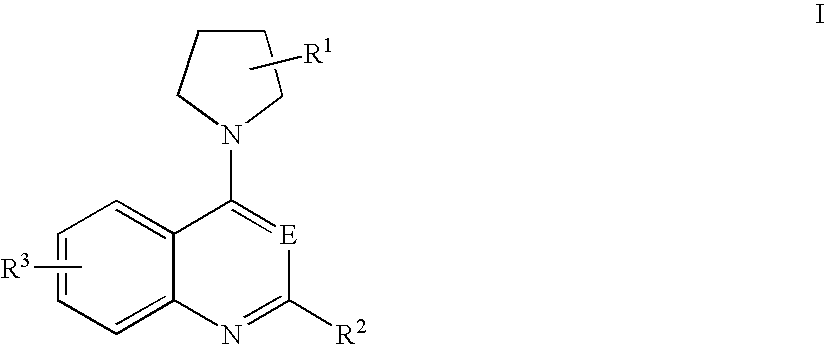
wherein
- E represents CH or N;
- R1 represents one to four substituents on the pyrrolidinyl ring, each substituent independently representing the group —X—R4a;
- X represents
- (a) a direct bond,
- (b) —O— or
- (c) —N(R4b)—;
- R4a and R4b independently represent
- (a) H,
- (b) C1-12 alkyl, C3-12 cycloalkyl, C3-12 cycloalkenyl (which latter three groups are optionally substituted by one or more substituents selected from halo, nitro, CN, C1-6 alkyl, C2-6 alkenyl, C2-6 alkynyl, C3-8 cycloalkyl (which latter three groups are optionally substituted by one or more substituents selected from OH, ═O, halo, C1-4 alkyl and C1-4 alkoxy), OR5a, S(O)nR5b, S(O)2N(R5c)(R5d), N(R5e)S(O)2R5f, N(R5g)(R5h), B1—C(O)—B2—R5i, aryl and Het1, and which C3-12 cycloalkyl or C4-12 cycloalkenyl groups may additionally be substituted by ═O),
- (c) aryl or
- (d) Het2;
- R2 represents
- (a) H,
- (b) C1-12 alkyl, C2-12 alkenyl, C2-12 alkynyl, C3-12 cycloalkyl, C4-12 cycloalkenyl, which latter five groups are optionally substituted by one or more substituents selected from halo, nitro, CN, C1-6 alkyl, C2-6 alkenyl, C2-6 alkynyl, C3-8 cycloalkyl (which latter three groups are optionally substituted by one or more substituents selected from OH, ═O, halo, C1-4 alkyl and C1-4 alkoxy), OR6a, S(O)pR6b, S(O)2N(R6c)(R6d), N(R6e)S(O)2R6f, N(R6g)(R6h), B3—C(O)—B4—R6i, aryl and Het3, and which C3-12 cycloalkyl or C4-12 cycloalkenyl groups may additionally be substituted by ═O,
- (c) aryl or
- (d) Het4;
- R3 represents H or one to four substituents on the fused benzene ring selected from
- (a) halo,
- (b) CN,
- (c) C1-12 alkyl, C2-12 alkenyl, C2-12 alkynyl, C3-12 cycloalkyl, C4-12 cycloalkenyl, which latter five groups are optionally substituted by one or more substituents selected from halo, nitro, CN, C1-6 alkyl, C2-6 alkenyl, C2-6 alkynyl, C3-8 cycloalkyl (which latter three groups are optionally substituted by one or more substituents selected from OH, ═O, halo, C1-4 alkyl and C1-4alkoxy), OR7a, S(O)qR7b, S(O)2N(R7c)(O), N(R7e)S(O)2R7f, N(R7g)(R7h), B5—C(O)—B6—R7i, aryl and Het5, and which C3-12 cycloalkyl or C4-12 cycloalkenyl groups may additionally be substituted by ═O,
- (d) OR8a,
- (e) S(O)rR8b,
- (f) S(O)2N(R8c)(R8d),
- (g) N(R8e)S(O)2R8f,
- (h) N(R8g)(R8h),
- (i) B7—C(O)—B8—R8i,
- (j) aryl or
- (k) Hee;
- R5a to R5i, R6a to R6i, R7a to R7i and R8a to R8i independently represent, at each occurrence,
- (a) H,
- (b) C1-10 alkyl, C2-10 alkenyl, C2-10 alkynyl (which latter three groups are optionally substituted by one or more substituents selected from halo, OH, C1-6 alkoxy, aryl and Het7),
- (c) C3-10 cycloalkyl, C4-10 cycloalkenyl (which latter two groups are optionally substituted by one or more substituents selected from halo, OH, ═O, C1-6 alkyl, C1-6 alkoxy, aryl and Het8),
- (d) aryl or
- (e) Het9,
provided that R5b, R6b, R7b or R8b does not represent H when n, p, q or r, respectively is 1 or 2;
each aryl independently represents a C6-10 carbocyclic aromatic group, which group may comprise either one or two rings and may be substituted by one or more substituents selected from - (a) halo,
- (b) CN,
- (c) C1-12 alkyl, C2-12 alkenyl, C2-12 alkynyl, C3-12 cycloalkyl, C4-12 cycloalkenyl, which latter five groups are optionally substituted by one or more substituents selected from halo, nitro, CN, C1-6 alkyl, C2-6 alkenyl, C2-6 alkynyl, C3-8 cycloalkyl (which latter three groups are optionally substituted by one or more substituents selected from OH, ═O, halo, C1-4 alkyl and C1-4 alkoxy), OR9a, S(O)tR9b, S(O)2N(R9c)(R9d), N(R9e)S(O)2R9f, N(R9g)(R9h), B9—C(O)—B10—R9i, phenyl, naphthyl (which latter two groups are optionally substituted by one or more substituents selected from OH, halo, C1-4 alkyl and C1-4 alkoxy) and Het10, and which C3-12 cycloalkyl or C4-12 cycloalkenyl groups may additionally be substituted by ═O,
- (d) OR10a,
- (e) S(O)uR10b,
- (f) S(O)2N(R10c)(R10d),
- (g) N(R10e)S(O)2R10f,
- (h) N(R10g)(R10h),
- (i) B11—C(O)—B12—R10i,
- (j) phenyl (which latter group is optionally substituted by one or more substituents selected from OH, halo, C1-4 alkyl and C1-4 alkoxy) or
- (k) Het11;
- R9a to R9i and R10a to R10i independently represent, at each occurrence,
- (a) H,
- (b) C1-12 alkyl, C2-12 alkenyl, C2-12 alkynyl, C3-12 cycloalkyl, C4-12 cycloalkenyl (which latter five groups are optionally substituted by one or more substituents selected from halo, OH, C1-6 alkyl, C3-12 cycloalkyl, C4-12 cycloalkenyl (which latter two groups are optionally substituted by one or more substituents selected from OH, ═O, halo, C1-4 alkyl and C1-4 alkoxy), C1-6 alkoxy, NH2, N(H)—C1-6 alkyl, N(C1-6 alkyl)2, phenyl (which latter group is optionally substituted by one or more substituents selected from OH, halo, C1-4 alkyl and C1-4 alkoxy) and Het12, and which C3-12 cycloalkyl or C4-12 cycloalkenyl groups may additionally be substituted by ═O),
- (c) phenyl (which latter group is optionally substituted by one or more substituents selected from OH, CN, halo, C1-6 alkyl and C1-6 alkoxy) or
- (e) Het13,
provided that R9b or R10b does not represent H when t or u, respectively is 1 or 2; - Het1 to Het13 independently represent 4- to 14-membered heterocyclic groups containing one or more heteroatoms selected from oxygen, nitrogen and/or sulfur, which heterocyclic groups may comprise one, two or three rings and may be substituted by one or more substituents selected from
- (a) halo,
- (b) CN,
- (c) C1-12 alkyl, C2-12 alkenyl, C2-12 alkynyl, C3-12 cycloalkyl, C4-12 cycloalkenyl, which latter five groups are optionally substituted by one or more substituents selected from halo, nitro, CN, C1-6 alkyl, C2-6 alkenyl, C2-6 alkynyl, C3-8 cycloalkyl (which latter three groups are optionally substituted by one or more substituents selected from OH, ═O, halo, C1-4 alkyl and C1-4 alkoxy), OR11a,S(O)vR11b, S(O)2N(R11c)(R11d), N(R11e)S(O)2R11f, N(R11g)(R11h), B13—C(O)—B14—R11i, phenyl, naphthyl (which latter two groups are optionally substituted by one or more substituents selected from OH, halo, C1-4 alkyl and C1-4 alkoxy) and Heta, and which C3-12 cycloalkyl or C4-12 cycloalkenyl groups may additionally be substituted by ═O,
- (d) OR12a,
- (e) ═O,
- (f) S(O)wR12b,
- (g) S(O)2N(R12c)(R12d),
- (h) N(R12e)S(O)2R12f,
- (i) N(R12g)(R12h),
- (j) B15—C(O)—B16—R12i,
- (k) phenyl (which latter group is optionally substituted by one or more substituents selected from OH, halo, C1-4 alkyl and C1-4 alkoxy) or
- (l) Hetb;
- R11a to R11i and R12a to R12i independently represent, at each occurrence,
- (a) H,
- (b) C1-12 alkyl, C2-12 alkenyl, C2-12 alkynyl, C3-12 cycloalkyl, C4-12 cycloalkenyl (which latter five groups are optionally substituted by one or more substituents selected from halo, OH, C1-6 alkyl, C3-12 cycloalkyl, C4-12 cycloalkenyl (which latter two groups are optionally substituted by one or more substituents selected from OH, ═O, halo, C1-4 alkyl and C1-4 alkoxy), C1-6 alkoxy, phenyl (which latter group is optionally substituted by one or more substituents selected from OH, halo, C1-4 alkyl and C1-4 alkoxy) and Hetc, and which C3-12 cycloalkyl or C4-12 cycloalkenyl groups may additionally be substituted by ═O),
- (c) phenyl (which latter group is optionally substituted by one or more substituents selected from OH, halo, C1-4 alkyl and C1-4 alkoxy) or
- (e) Hetd,
provided that R11b or R12b does not represent H when v or w, respectively is 1 or 2; - B1 to B16 independently represent a direct bond, O, S, NH or N(R13);
- n, p, q, r, s, t, u, v and w independently represent 0, 1 or 2;
- R13 represents
- (a) C1-6 alkyl,
- (b) phenyl (which latter group is optionally substituted by one or more substituents selected from OH, halo, C1-4 alkyl and C1-4 alkoxy),
- (c) C3-7 cycloalkyl (which latter group is are optionally substituted by one or more substituents selected from OH, ═O, halo, C1-4 alkyl and C1-4 alkoxy) or
- (e) Hete;
- Heta to Hete independently represent 5- or 6-membered heterocyclic groups containing one to four heteroatoms selected from oxygen, nitrogen and/or sulfur, which heterocyclic groups may be substituted by one or more substituents selected from halo, ═O and C1-6 alkyl; and unless otherwise specified
- (i) alkyl, alkenyl, alkynyl, cycloalkyl, and cycloalkenyl groups, as well as the alkyl part of alkoxy groups, may be substituted by one or more halo atoms, and
- (ii) cycloalkyl and cycloalkenyl groups may comprise one or two rings and may additionally be ring-fused to one or two benzene rings.
- (a) pharmaceutically-acceptable salts with either acids or bases (e.g. acid addition salts); and/or
- (b) solvates (e.g. hydrates)
- (a) C1-4 alkyl quaternary ammonium salts; or
- (b) N-oxides,
at either of the two tertiary N-atoms of the 4-(pyrrolidin-1-yl)quinoline ring system, or at a tertiary N-atom that may be present in any of substituents R1, R2 and R3.
- (a) fungi (as defined below); and, particularly
- (b) bacteria (as defined below).
- (a) are sensitive (e.g. in log phase) to the biostatic (e.g. bacteriostatic) effects of conventional antimicrobial agents (i.e. microorganisms for which the minimum inhibitory concentration (MIC) of a conventional antimicrobial is substantially unchanged); but
- (b) possess drastically decreased susceptibility to drug-induced killing (e.g. microorganisms for which, with any given conventional antimicrobial agent, the ratio of minimum microbicidal concentration (e.g. minimum bactericidal concentration, MBC) to MIC is 10 or more).
- (i) are metabolically active; but
- (ii) have a growth rate that is below the threshold of infectious disease expression.
- (I) mRNA (e.g. from 0.0001 to 50%, such as from 1 to 30, 5 to 25 or 10 to 20%, of the level of mRNA); and/or
- (II) uridine (e.g. [3H]uridine) uptake (e.g. from 0.0005 to 50%, such as from 1 to 40, 15 to 35 or 20 to 30% of the level of [3H]uridine uptake).
- (a) conventional antifungal agents; and, particularly
- (b) conventional antibacterial agents,
wherein each of (a) and (b) is as defined below.
- (a) β-Lactams, including:
- (i) penicillins, such as
- (I) benzylpenicillin, procaine benzylpenicillin, phenoxy-methylpenicillin, methicillin, propicillin, epicillin, cyclacillin, hetacillin, 6-aminopenicillanic acid, penicillic acid, penicillanic acid sulphone (sulbactam), penicillin G, penicillin V, phenethicillin, phenoxymethylpenicillinic acid, azlocillin, carbenicillin, cloxacillin, D-(−)-penicillamine, dicloxacillin, nafcillin and oxacillin,
- (II) penicillinase-resistant penicillins (e.g. flucloxacillin),
- (III) broad-spectrum penicillins (e.g. ampicillin, amoxicillin, metampicillin and bacampicillin),
- (IV) antipseudomonal penicillins (e.g. carboxypenicillins such as ticarcillin or ureidopenicillins such as piperacillin),
- (V) mecillinams (e.g. pivmecillinam), or
- (VI) combinations of any two or more of the agents mentioned at (I) to (V) above, or combinations of any of the agents mentioned at (I) to (V) above with a β-lactamase inhibitor such as tazobactam or, particularly, clavulanic acid (which acid is optionally in metal salt form, e.g. in salt form with an alkali metal such as sodium or, particularly, potassium);
- (ii) cephalosporins, such as cefaclor, cefadroxil, cefalexin (cephalexin), cefcapene, cefcapene pivoxil, cefdinir, cefditoren, cefditoren pivoxil, cefixime, cefotaxime, cefpirome, cefpodoxime, cefpodoxime proxetil, cefprozil, cefradine, ceftazidime, cefteram, cefteram pivoxil, ceftriaxone, cefuroxime, cefuroxime axetil, cephaloridine, cephacetrile, cephamandole, cephaloglycine, ceftobiprole, PPI-0903 (TAK-599), 7-aminocephalosporanic acid, 7-aminodes-acetoxycephalosporanic acid, cefamandole, cefazolin, cefinetazole, cefoperazone, cefsulodin, cephalosporin C zinc salt, cephalothin, cephapirin; and
- (iii) other β-lactams, such as monobactams (e.g. aztreonam), carbapenems (e.g. imipenem (optionally in combination with a renal enzyme inhibitor such as cilastatin), meropenem, ertapenem, doripenem (S-4661) and RO4908463 (CS-023)), penems (e.g. faropenem) and 1-oxa-β-lactams (e.g. moxalactam).
- (i) penicillins, such as
- (b) Tetracyclines, such as tetracycline, demeclocycline, doxycycline, lymecycline, minocycline, oxytetracycline, chlortetracycline, meclocycline and methacycline, as well as glycylcyclines (e.g. tigecycline).
- (c) Aminoglycosides, such as amikacin, gentamicin, netilmicin, neomycin, streptomycin, tobramycin, amastatin, butirosin, butirosin A, daunorubicin, dibekacin, dihydrostreptomycin, G 418, hygromycin B, kanamycin B, kanamycin, kirromycin, paromomycin, ribostamycin, sisomicin, spectinomycin, streptozocin and thiostrepton.
- (d) (i) Macrolides, such as azithromycin, clarithromycin, erythromycin, roxithromycin, spiramycin, amphotericins B (e.g. amphotericin B), bafilomycins (e.g. bafilomycin A1), brefeldins (e.g. brefeldin A), concanamycins (e.g. concanamycin A), filipin complex, josamycin, mepartricin, midecamycin, nonactin, nystatin, oleandomycin, oligomycins (e.g. oligomycin A, oligomycin B and oligomycin C), pimaricin, rifampicin, rifamycin, rosamicin, tylosin, virginiamycin and fosfomycin.
- (ii) Ketolides such as telithromycin and cethromycin (ABT-773).
- (iii) Lincosamines, such as lincomycin.
- (e) Clindamycin and clindamycin 2-phosphate.
- (f) Phenicols, such as chloramphenicol and thiamphenicol.
- (g) Steroids, such as fusidic acid (optionally in metal salt form, e.g. in salt form with an alkali metal such as sodium).
- (h) Glycopeptides such as vancomycin, teicoplanin, bleomycin, phleomycin, ristomycin, telavancin, dalbavancin and oritavancin.
- (i) Oxazolidinones, such as linezolid and AZD2563.
- (j) Streptogramins, such as quinupristin and dalfopristin, or a combination thereof.
- (k) (i) Peptides, such as polymyxins (e.g. colistin and polymyxin B), lysostaphin, duramycin, actinomycins (e.g. actinomycin C and actinomycin D), actinonin, 7-aminoactinomycin D, antimycin A, antipain, bacitracin, cyclosporin A, echinomycin, gramicidins (e.g. gramicidin A and gramicidin C), myxothiazol, nisin, paracelsin, valinomycin and viomycin.
- (ii) Lipopeptides, such as daptomycin.
- (iii) Lipoglycopeptides, such as ramoplanin.
- (l) Sulfonamides, such as sulfamethoxazole, sulfadiazine, sulfaquinoxaline, sulfathiazole (which latter two agents are optionally in metal salt form, e.g. in salt form with an alkali metal such as sodium), succinylsulfathiazole, sulfadimethoxine, sulfaguanidine, sulfamethazine, sulfamonomethoxine, sulfanilamide and sulfasalazine.
- (m) Trimethoprim, optionally in combination with a sulfonamide, such as sulfamethoxazole (e.g. the combination co-trimoxazole).
- (n) Antituberculous drugs, such as isoniazid, rifampicin, rifabutin, pyrazinamide, ethambutol, streptomycin, amikacin, capreomycin, kanamycin, quinolones (e.g. those at (q) below), para-aminosalicylic acid, cycloserine and ethionamide.
- (o) Antileprotic drugs, such as dapsone, rifampicin and clofazimine.
- (p) (i) Nitroimidazoles, such as metronidazole and timidazole.
- (ii) Nitrofurans, such as nitrofurantoin.
- (q) Quinolones, such as nalidixic acid, norfloxacin, ciprofloxacin, ofloxacin, levofloxacin, moxifloxacin, gatifloxacin, gemifloxacin, garenoxacin, DX-619, WCK 771 (the arginine salt of S-(−)-nadifloxacin), 8-quinolinol, cinoxacin, enrofloxacin, flumequine, lomefloxacin, oxolinic acid and pipemidic acid.
- (r) Amino acid derivatives, such as azaserine, bestatin, D-cycloserine, 1,10-phenanthroline, 6-diazo-5-oxo-L-norleucine and L-alanyl-L-1-aminoethyl-phosphonic acid.
- (s) Aureolic acids, such as chromomycin A3, mithramycin A and mitomycin C.
- (t) Benzochinoides, such as herbimycin A.
- (u) Coumarin-glycosides, such as novobiocin.
- (v) Diphenyl ether derivatives, such as irgasan.
- (w) Epipolythiodixopiperazines, such as gliotoxin from Gliocladium fimbriatum.
- (x) Fatty acid derivatives, such as cerulenin.
- (y) Glucosamines, such as 1-deoxymannojirimycin, 1-deoxynojirimycin and N-methyl-1-deoxynojirimycin.
- (z) Indole derivatives, such as staurosporine.
- (aa) Diaminopyrimidines, such as iclaprim (AR-100).
- (ab) Macrolactams, such as ascomycin.
- (ac) Taxoids, such as paclitaxel.
- (ad) Statins, such as mevastatin.
- (ae) Polyphenolic acids, such as (+)-usnic acid.
- (af) Polyethers, such as lasalocid A, lonomycin A, monensin, nigericin and salinomycin.
- (ag) Picolinic acid derivatives, such as fusaric acid.
- (ah) Peptidyl nucleosides, such as blasticidine S, nikkomycin, nourseothricin and puromycin.
- (ai) Nucleosides, such as adenine 9-β-D-arabinofuranoside, 5-azacytidine, cordycepin, formycin A, tubercidin and tunicamycin.
- (aj) Pleuromutilins, such as GSK-565154, GSK-275833 and tiamulin.
- (ak) Peptide deformylase inhibitors, such as LBM415 (NVP PDF-713) and BB 83698.
- (al) Antibacterial agents for the skin, such as fucidin, benzamycin, clindamycin, erythromycin, tetracycline, silver sulfadiazine, chlortetracycline, metronidazole, mupirocin, framycitin, gramicidin, neomycin sulfate, polymyxins (e.g. polymixin B) and gentamycin;
- (am) Miscellaneous agents, such as methenamine (hexamine), doxorubicin, piericidin A, stigmatellin, actidione, anisomycin, apramycin, coumermycin A1, L(+)-lactic acid, cytochalasins (e.g. cytochalasin B and cytochalasin D), emetine and ionomycin.
- the -cillins listed at (a)(i) above (e.g. amoxicillin, ampicillin, phenoxymethylpenicillin or, particularly, co-amoxiclav (co-amoxicillin));
- the cephalosporins listed at (a)(ii) above (e.g. cefuroxime, cefaclor or cefalexin);
- the carbapenems listed at (a)(iii) above (e.g. ertapenem);
- the tetracyclines listed at (b) above (e.g. doxycycline or minocycline);
- the macrolides listed at (d)(i) above (e.g. clarithromycin, erythromycin, roxithromycin or, particularly, azithromycin);
- the ketolides listed at (d) (ii) above (e.g. telithromycin);
- the oxazolidinones listed at (i) above (e.g. linezolid);
- the lipopeptides listed at (k)(ii) above (e.g. daptomycin) trimethoprim and the combinations therewith (e.g. co-trimoxazol) listed at (m) above;
- the nitrofurans listed at (p) above (e.g. nitrofurantoin); and
- the quinolones listed at (q) above (e.g. norfloxacin, ciprofloxacin, ofloxacin, or, particularly, levofloxacin or moxifloxacin).
- (a) azole antifungals, such as imidazoles (e.g. clotrimazole, econazole, fenticonazole, ketoconazole, miconazole, sulconazole, and tioconazole) or triazoles (e.g. fluconazole, itraconazole and voriconazole);
- (b) polyene antifungals, such as amphotericin and nystatin;
- (c) miscellaneous antifungal agents such as griseofulvin, caspofungin or flucytosine, which latter two agents are optionally employed in combination;
- (d) allylamine antifungals, such as terbinafine.
- (1) R1 represents one to four substituents (e.g. two substituents or, particularly, one substituent), in at least one of which R4a and/or R4b is other than H;
- (2) R4a represents
- (a) C1-12 alkyl, C3-12 cycloalkyl, C3-12 cycloalkenyl (which latter three groups are substituted by an aryl or Het1 group and are optionally further substituted by one or more substituents selected from halo, nitro, CN, C1-6 alkyl, C2-8 alkenyl, C2-6 alkynyl, cycloalkyl (which latter three groups are optionally substituted by one or more substituents selected from OH, ═O, halo, C1-4 alkyl and C1-4 alkoxy), OR5a, S(O)nR5b, S(O)2N(R5c)(R5d), N(R5e)S(O)2R5f, N(R5g)(R5h), B1—C(O)—B2—R5i, aryl and Het1, and which C3-12 cycloalkyl or C4-12 cycloalkenyl groups may additionally be substituted by ═O),
- (c) aryl or
- (d) Het2;
- (3) R2 is other than H.
- (1) R1 represents two substituents or, particularly, one substituent on the pyrrolidinyl ring, each substituent independently representing the group —X—R4a;
- (2) X represents a direct bond, —O— or —N(H)— (e.g. a direct bond or —N(H)—);
- (3) R4a represents
- (a) C1-8 alkyl (e.g. C1-6 or C1-4 alkyl, such as methyl) or C4-6 cycloalkyl, which alkyl or cycloalkyl group is optionally substituted by one or more substituents selected from halo, nitro, CN, C1-2 alkyl, C4-6 cycloalkyl (which latter group is optionally substituted by one or more substituents selected from ═O, halo, methyl and methoxy), OR5a, phenyl, naphthyl (which latter two groups are optionally substituted by one or more (e.g. one to four) substituents selected from halo, CN, C1-6 alkyl, C2-6 alkenyl, C2-6 alkynyl or C3-6 cycloalkyl, OR10a, S(O)2R10b and —C(O)R10i), or
- (b) phenyl or naphthyl (which latter two groups are optionally substituted by one or more (e.g. one to four) substituents selected from halo, CN, C1-6 alkyl, C2-6 alkenyl, C2-6 alkynyl or C3-6 cycloalkyl, OR10a, S(O)2R10b and —C(O)R10i);
- (4) R2 represents
- (a) H,
- (b) C1-8 alkyl (e.g. C1-6 alkyl, such as C1-4 alkyl or, particularly, methyl), C2-8 alkenyl, C2-8 alkynyl, C3-6 cycloalkyl, which latter four groups are optionally substituted by one or more substituents selected from halo, methyl and methoxy;
- (5) R3 represents H or one to four (e.g. two or, particularly, one) substituents on the fused benzene ring (e.g. one to four substituents including at least one substituent at the 6-position of the quinoline or quinazoline ring system) selected from
- (a) halo,
- (b) CN,
- (c) C1-6 alkyl, C2-6 alkenyl, C2-6 alkynyl, C4-6 cycloalkyl, which latter four groups are optionally substituted by one or more substituents selected from halo, nitro, CN, C1-3 alkyl, C2-3 alkenyl, C2-3 alkynyl, C4-6 cycloalkyl OR7a, N(H)S(O)2R7f, N(H)(R7h), —C(O)R7i, aryl and Het5,
- (d) OR8a,
- (e) S(O)2R8b,
- (f) S(O)2N(R8c)(R8d),
- (g) N(R8e)S(O)2R8f,
- (h) N(R8g)(R8h),
- (i) —C(O)R8i, —N(R13)C(O)R8i, OC(O)R8i, C(O)N(H)R8i, C(O)OR8i,
- (j) aryl or
- (k) Het6;
- (6) R5a represents, at each occurrence,
- (a) C1-6 alkyl, C2-6 alkenyl, C2-6 alkynyl (which latter three groups are optionally substituted by one or more substituents selected from halo, alkoxy, phenyl and naphthyl, which latter two groups are optionally substituted by one or more (e.g. one to four) substituents selected from halo, CN, C1-6 alkyl, C2-6 alkenyl, C2-6 alkynyl or C3-6 cycloalkyl, OR10a, S(O)2R10b and —C(O)R10i),
- (b) C3-6 cycloalkyl (which latter group is optionally substituted by one or more substituents selected from halo, ═O, methyl, methoxy and phenyl),
- (c) phenyl or naphthyl (which latter two groups are optionally substituted by one or more (e.g. one to four) substituents selected from halo, CN, C1-6 alkyl, C2-6 alkenyl, C2-6 alkynyl or C3-6 cycloalkyl, OR10a, S(O)2R10b and —C(O)R10i);
- (7) R7a to R7i and R8a to R8i independently represent, at each occurrence,
- (a) H,
- (b) C1-6 alkyl, C2-6 alkenyl, C2-6 alkynyl (which latter three groups are optionally substituted by one or more substituents selected from halo, OH, methoxy, aryl and Het7),
- (c) C4-6 cycloalkyl (which latter group is optionally substituted by one or more substituents selected from halo, OH, ═O, methyl, methoxy, aryl and Het8),
- (d) aryl or
- (e) Het9,
- provided that R7b or R6b does not represent H when q or r, respectively is 1 or 2;
- (8) R10a, R10b and R10i independently represent, at each occurrence,
- (a) C1-6 alkyl, C2-6 alkenyl, C2-6 alkynyl, C4-6 cycloalkyl (which latter four groups are optionally substituted by one or more substituents selected from halo, methyl and methoxy) or
- (c) phenyl (which latter group is optionally substituted by one or more substituents selected from CN, halo, C1-2 alkyl and C1-2 alkoxy);
- (9) Het6 represents a 4- to 7-membered aromatic, partially unsaturated or, particularly, fully saturated heterocyclic group containing one nitrogen atom (which atom may form the point of attachment of the Het6 group to the rest of the molecule) and, optionally, one or two further heteroatoms selected from oxygen, nitrogen and/or sulfur, which heterocyclic group may be substituted by one or more substituents selected from halo, methyl, methoxy and ═O;
- (10) Het7 to Het9 independently represent 5- to 10-membered aromatic heterocyclic groups containing one or more (e.g. one to three) heteroatoms selected from oxygen, nitrogen and/or sulfur, which heterocyclic groups may comprise one or two rings and may be substituted by one or more (e.g. one or two) substituents selected from
- (a) halo,
- (b) CN,
- (c) C1-8 alkyl (e.g. C1-6 alkyl, such as C1-4 alkyl or, particularly, methyl), C2-8 alkenyl, C2-8 alkynyl, C4-6 cycloalkyl, which latter four groups are optionally substituted by one or more substituents selected from halo, methyl and methoxy,
- (d) OR12a,
- (i) N(H)(R12h),
- (j) —C(O)R12i, —N(H)C(O)R12i, —OC(O)R12i, —C(O)N(H)R12i, —C(O)OR12i,
- (k) phenyl (which latter group is optionally substituted by one or more substituents selected from OH, halo, methyl and methoxy) or
- (l) Hetb;
- (11) R12a, R12h and R12i independently represent, at each occurrence, H, C1-2 alkyl or phenyl (which latter group is optionally substituted by one or more substituents selected from OH, halo, methyl and methoxy);
- (12) R13 represents C1-3 alkyl (e.g. methyl) or, particularly, H;
- (13) Hetb represents a 5- or 6-membered aromatic heterocycle containing one to three heteroatoms selected from nitrogen and oxygen, which heterocyclic group is optionally substituted by one to three substituents selected from halo and methyl;
- (14) unless otherwise specified, alkyl, alkenyl, alkynyl, cycloalkyl, and cycloalkenyl groups, as well as the alkyl part of alkoxy groups, are unsubstituted;
- (15) unless otherwise specified, cycloalkyl groups comprise one or (if sufficient number of C-atoms is present) two rings and are optionally ring-fused to a benzene ring (so as to form a group such as, for example, 1,2,3,4-tetrahydro-naphthyl or, particularly, indanyl).
- (1) E represents CH;
- (2) R1 represents one —X—R4a substituent on the pyrrolidinyl ring (e.g. a substituent at the 3-position of the ring);
- (3) X represents a direct bond or —N(H)—;
- (4) R4a represents
- (a) C1-2 alkyl (such as methyl), which alkyl group is substituted by one or more substituents selected from phenyl (which latter group is optionally substituted by one or more (e.g. two or, particularly, one) substituents selected from halo (e.g. chloro), CN, C1-3 alkyl and OR10a), or
- (b) phenyl (which latter group is optionally substituted by one or more (e.g. two or, particularly, one) substituents selected from halo (e.g. chloro), CN, C1-3 alkyl and OR10a);
- (5) R2 represents C1-2 alkyl, such as methyl;
- (6) R3 represents one to four substituents on the fused benzene ring including at least one substituent at the 6-position of the quinoline or quinazoline ring system, wherein each substituent is independently selected from
- (a) halo (e.g. chloro),
- (b) OR8a,
- (c) N(H)S(O)2R8f,
- (d) N(H)(R8h),
- (e) —N(H)C(O)R8i, C(O)N(H)R8i or
- (f) Het6;
- (7) R8a to R8i independently represent, at each occurrence,
- (a) C1-4 alkyl (e.g. methyl or ethyl) optionally substituted by phenyl (which latter group is optionally substituted by one or more substituents selected from halo, CN, C1-2 alkyl, methoxy, ethoxy and S(O)2—(C1-2 alkyl)) or Het7,
- (b) phenyl (which latter group is optionally substituted by one or more substituents selected from halo, CN, C1-2 alkyl, methoxy, ethoxy and S(O)2—(C1-2 alkyl)) or
- (e) Het9;
- (8) R10a represents C1-4 alkyl (e.g. methyl);
- (9) Het6 represents a 5- or 6-membered, fully saturated heterocyclic group containing one nitrogen atom (which atom forms the point of attachment of the Het6 group to the rest of the molecule) and, optionally, one further heteroatom selected from oxygen and nitrogen, which heterocyclic group may be substituted by one or more substituents selected from halo, methyl, and ═O;
- (10) Het7 to Het9 independently represent 5- or 6-membered aromatic heterocyclic groups containing one to three (e.g. one or two) heteroatoms selected from oxygen, nitrogen and/or sulfur (e.g. selected from oxygen and/or nitrogen), which heterocyclic groups may be substituted by one or more (e.g. one or two) substituents selected from halo, CN and C1-2 alkyl (e.g. methyl).

wherein R1a represents —X—R4a;
- R1b represents H or one or two substituents on the pyrrolidinyl ring, each substituent independently representing the group —X—R4a;
- and E, X, R2, R3 and R4a are as hereinbefore defined.

is in the:
- (a) R— configuration at the C-atom to which R1a is attached; or
- (b) S— configuration at the C-atom to which R1a is attached.
- (1) E represents CH;
- (2) R1b represents H;
- (3) —X—R4a represents
- (a) phenyl (which latter group is optionally substituted by one or more (e.g. two or, particularly, one) substituents selected from halo (e.g. chloro) and methoxy),
- (b) CH2-phenyl (the phenyl part of which group is optionally substituted by one or more (e.g. two or, particularly, one) substituents selected from halo (e.g. chloro) and methoxy, but, in a particular embodiment, is unsubstituted) or
- (c) NH-phenyl (the phenyl part of which group is optionally substituted by one or more (e.g. two or, particularly, one) substituents selected from halo (e.g. chloro) and methoxy, but, in a particular embodiment, is unsubstituted);
- (4) R2 represents methyl;
- (5) R3 represents one or two substituents (e.g. one substituent) on the fused benzene ring including at least one substituent at the 6-position of the quinoline or quinazoline ring system, wherein each substituent is independently selected from halo (e.g. chloro), OR8a, N(H)S(O)2R8f, N(H)(R8h), —N(H)C(O)R8i or Het6 (e.g. each substituent is independently selected from OR8a, N(H)(R8h), —N(H)C(O)R8i or Het6);
- (6) R8a represents
- (a) phenyl optionally substituted by one to three substituents (e.g. one substituent, such as one substituent at the 2- or, particularly the 4-position) selected from halo, CN, methyl, methoxy and S(O)2CH3 (e.g. selected from methoxy and S(O)2CH3),
- (b) C1-2 alkyl substituted by phenyl, which latter group is optionally substituted by one to three substituents (e.g. one substituent, such as one substituent at the 2- or, particularly the 4-position) selected from halo, CN, methyl, methoxy and S(O)2CH3 (e.g. selected from methoxy and S(O)2CH3) or
- (c) C1-2 alkyl substituted by Het7;
- (7) R8f represents phenyl optionally substituted by one to three substituents (e.g. one substituent, such as one substituent at the 2- or, particularly the 4-position) selected from halo, CN, methyl, methoxy and S(O)2CH3;
- (8) R8h represents C1-2 alkyl (e.g. methyl) substituted by phenyl, which latter group is optionally substituted by one to three substituents (e.g. one substituent, such as one substituent at the 2- or, particularly the 4-position) selected from halo, CN, methyl, methoxy and S(O)2CH3 (e.g. selected from CN and methoxy);
- (6) R8i represents
- (a) phenyl optionally substituted by one to three substituents (e.g. one substituent, such as one substituent at the 2- or, particularly the 4-position) selected from halo, CN, methyl, methoxy and S(O)2CH3 (e.g. selected from chloro, methyl and methoxy),
- (b) C1-3 alkyl (e.g. methyl or ethyl) substituted by phenyl, which latter group is optionally substituted by one to three substituents (e.g. one substituent, such as one substituent at the 2- or, particularly the 4-position) selected from halo, CN, methyl, methoxy and S(O)2CH3 (e.g. selected from chloro, methyl and methoxy),
- (c) C1-2 alkyl substituted by Het7 or
- (d) Het9;
- (9) Het6 represents pyrrolidin-1-yl substituted by one to three substituents (e.g. one substituent, such as a single substituent at the 2-position) selected from halo, methyl, and ═O (e.g. an ═O substituent);
- (10) Het7 and Het9 independently represent 5- or 6-membered aromatic heterocyclic groups containing one to three (e.g. one or two) heteroatoms selected from oxygen and/or nitrogen, which heterocyclic groups may be substituted by one or more (e.g. one or two) substituents selected from halo and methyl (e.g. substituted by two or, particularly, one methyl group).
-
- chloro;
- phenoxy;
- benzyloxy; 4-methanesulfonylbenzylm; 4-methoxybenzyloxy;
- 2-phenylethoxy;
- 5-methylisoxazol-3-ylmethoxy;
- benzylamino; (4-cyanobenzyl)amino; (4-methoxybenzyl)amino;
- phenylcarbonylamino; (4-chlorophenyl)carbonylamino; (4-methoxy-phenyl)carbonylamino; (2-methylphenyl)carbonylamino;
- phenylmethylcarbonylamino; (4-chlorophenyl)methylcarbonylamino;
- (4-methoxyphenyl)methylcarbonylamino;
- furan-2-ylcarbonylamino;
- 3-methyl-3H-imidazole-4-ylcarbonylamino;
- 5-methyl-isoxazole-3-ylcarbonylamino; 3,5-dimethylisoxazole-4-yl-carbonylamino;
- 2-phenylethylcarbonylamino;
- pyrazine-2-ylcarbonylamino;
- 5-methyl-1H-pyrazole-3-ylcarbonylamino; 1H-pyrazole-4-ylcarbonyl-amino;
- pyridazine-4-ylcarbonylamino;
- pyridine-2-ylcarbonylamino; pyridin-3-ylcarbonylamino;
- 2-(3-methyl-isoxazol-5-yl)methylcarbonylamino;
- benzenesulfonylamino; and
- 2-oxopyrrolidin-1-yl.
- 2-methyl-6-phenethyloxy-4-(3-phenylpyrrolidin-1-yl)quinoline;
- 4-(3-benzylpyrrolidin-1-yl)-2-methyl-6-phenoxyquinoline;
- 4-[3-(4-methoxyphenyl)pyrrolidin-1-yl]-2-methyl-6-phenoxyquinoline hydrochloride;
- 5-methyl-1H-pyrazole-3-carboxylic acid [2-methyl-4-(3-phenylpyrrolidin-1-yl)-quinolin-6-yl]amide; or
- N-[4-(3-benzylpyrrolidin-1-yl)-2-methylquinolin-6-yl]benzamide,
or a pharmaceutically-acceptable derivative thereof.
- (i) 4-((R)-3-benzylpyrrolidin-1-yl)-2-methyl-6-phenoxyquinoline;
- (ii) 4-[(R)-3-(4-methoxyphenyl)pyrrolidin-1-yl]-2-methyl-6-phenoxyquinoline;
- (iii) 5-methyl-1H-pyrazole-3-carboxylic acid [2-methyl-4-((R)-3-phenyl-pyrrolidin-1-yl)-quinolin-6-yl]amide; and
- (iv) N-[4-((R)-3-benzylpyrrolidin-1-yl)-2-methylquinolin-6-yl]benzamide,
or a pharmaceutically-acceptable derivative thereof.
- (I) 4-((S)-3-benzylpyrrolidin-1-yl)-2-methyl-6-phenoxyquinoline;
- (II) 4-[(S)-3-(4-methoxyphenyl)pyrrolidin-1-yl]-2-methyl-6-phenoxyquinoline;
- (III) 5-methyl-1H-pyrazole-3-carboxylic acid [2-methyl-4-((S)-3-phenyl-pyrrolidin-1-yl)-quinolin-6-yl]amide; and
- (IV) N-[4-((S)-3-benzylpyrrolidin-1-yl)-2-methylquinolin-6-yl]benzamide,
or a pharmaceutically-acceptable derivative thereof.
- (i) a method of killing clinically latent microorganisms in a mammal infected with such latent microorganisms, the method comprising administering to said mammal a microbicidally effective amount of compound of formula I, as hereinbefore defined; and
- (ii) a compound of formula I, as hereinbefore defined, for use in the killing of clinically latent microorganisms in a mammal infected with such latent microorganisms.
- (a) the use of a compound of formula I, as hereinbefore defined, for the preparation of a medicament for the treatment or prevention of a microbial infection;
- (b) a method of treating or preventing a microbial infection in a mammal, the method comprising administering to said mammal an antimicrobially effective amount of a compound of formula I, as hereinbefore defined;
- (c) use (e.g. ex vivo use) of a compound of formula I to kill microorganisms;
- (d) a compound of formula I, as hereinbefore defined for use in the treatment or prevention of a microbial infection in a mammal.
- (a) as a sterilising agent; or
- (b) as a preservative.
- (i) a method of sterilising an object, the method comprising applying to said object a compound of formula I, as hereinbefore defined; or
- (ii) a method of preserving an inorganic or, preferably, an organic material, said method comprising contacting, combining or mixing said material with a compound of formula I, as hereinbefore defined.
- (i) a combination product comprising
- (A) a compound of formula I, as hereinbefore defined, and
- (B) a conventional antimicrobial agent, as hereinbefore defined, wherein each of components (A) and (B) is formulated in admixture with a pharmaceutically-acceptable adjuvant, diluent or carrier; and
- (b) a formulation comprising a compound of formula I, as hereinbefore defined and a conventional sterilising agent, as hereinbefore defined, or a salt and/or solvate thereof.
- (1) a pharmaceutical formulation including a compound of formula I, as hereinbefore defined and a conventional antimicrobial agent, as hereinbefore defined, or a pharmaceutically-acceptable derivative thereof, in admixture with a pharmaceutically-acceptable adjuvant, diluent or carrier (which formulation is hereinafter referred to as a “combined preparation”); and
- (2) a kit of parts comprising components:
- (I) a pharmaceutical formulation including a compound of formula I, as hereinbefore defined, in admixture with a pharmaceutically-acceptable adjuvant, diluent or carrier; and
- (II) a pharmaceutical formulation including a conventional antimicrobial agent, as hereinbefore defined, or a pharmaceutically-acceptable derivative thereof, in admixture with a pharmaceutically-acceptable adjuvant, diluent or carrier,
- which components (I) and (II) are each provided in a form that is suitable for administration in conjunction with the other.
- (i) provided as separate formulations (i.e. independently of one another), which are subsequently brought together for use in conjunction with each other in combination therapy; or
- (ii) packaged and presented together as separate components of a “combination pack” for use in conjunction with each other in combination therapy.
- (1) one of components (I) and (II) as defined herein; together with
- (2) instructions to use that component in conjunction with the other of the two components.
- (i) the use of a combination product according to the eighth aspect of the invention for the preparation of a medicament for killing clinically latent microorganisms;
- (ii) a method of killing clinically latent microorganisms in a mammal infected with such latent microorganisms, the method comprising administering to said mammal a microbicidally effective amount of a combination product according to the eighth aspect of the invention;
- (iii) a combination product according to the eighth aspect of the invention for use in the killing of clinically latent microorganisms in a mammal infected with such latent microorganisms;
- (iv) the use of a combination product according to the eighth aspect of the invention for the preparation of a medicament for treating or preventing a microbial infection;
- (v) a method of treating or preventing a microbial infection in a mammal, the method comprising administering to said mammal an antimicrobially effective amount of a combination product according to the eighth aspect of the invention; and
- (vi) a combination product according to the eighth aspect of the invention for use in the treatment or prevention of a microbial infection in a mammal.
-
- Gram-positive cocci, such as
- Staphylococci (e.g. Staph. aureus, Staph. epidermidis, Staph. saprophyticus, Staph. auricularis, Staph. capitis capitis, Staph. c. ureolyticus, Staph. caprae, Staph. cohnii cohnii, Staph. c. urealyticus, Staph. equorum, Staph. gallinarum, Staph. haemolyticus, Staph. hominis hominis, Staph. h. novobiosepticius, Staph. hyicus, Staph. intermedius, Staph. lugdunensis, Staph. pasteuri, Staph. saccharolyticus, Staph. schleiferi schleiferi, Staph. s. coagulans, Staph. sciuri, Staph. simulans, Staph. wameri and Staph. xylosus) and
- Streptococci (e.g.
- beta-haemolytic, pyogenic streptococci (such as Strept. agalactiae, Strept. canis, Strept. dysgalactiae dysgalactiae, Strept dysgalactiae equisimilis, Strept equi equi, Strept equi zooepidemicus, Strept. iniae, Strept porcinus and Strept pyogenes),
- microaerophilic, pyogenic streptococci (Streptococcus “milleri”, such as Strept anginosus, Strept constellatus constellatus, Strept constellatus pharyngidis and Strept. intermedius),
- oral streptococci of the “mitis” (alpha-haemolytic—Streptococcus “viridans”, such as Strept. mitis, Strept. oxalis, Strept. sanguinis, Strept. cristatus, Strept. gordonii and Strept. parasanguinis), “salivarius” (non-haemolytic, such as Strept salivarius and Strept vestibularis) and “mutans” (tooth-surface streptococci, such as Strept. criceti, Strept. mutans, Strept ratti and Strept sobrinus) groups,
- Strept. acidominimus, Strept. bovis, Strept. faecalis, Strept. equinus, Strept pneumoniae and Strept suis,
- or Streptococci alternatively classified as Group A, B, C, D, E, G, L, P, U or V Streptococcus);
- Gram-negative cocci, such as Neisseria gonorrhoeae, Neisseria meningitidis, Neisseria cinerea, Neisseria elongata, Neisseria flavescens, Neisseria lactamica, Neisseria mucosa, Neisseria sicca, Neisseria subflava and Neisseria weaveri;
- Bacillaceae, such as Bacillus anthracis, Bacillus subtilis, Bacillus thuringiensis, Bacillus stearothermophilus and Bacillus cereus;
- Enterobacteriaceae, such as
- Escherichia coli,
- Enterobacter (e.g. Enterobacter aerogenes, Enterobacter agglomerans and Enterobacter cloacae)
- Citrobacter (such as Citrob. freundii and Citrob. divernis),
- Hafnia (e.g. Hafnia alvei),
- Erwinia (e.g. Erwinia persicinus),
- Morganella morganii,
- Salmonella (Salmonella enterica and Salmonella typhi),
- Shigella (e.g. Shigella dysenteriae, Shigella flexneri, Shigella boydii and Shigella sonnei),
- Klebsiella (e.g. Klebs. pneumoniae, Klebs. oxytoca, Klebs. omitholytica, Klebs. planticola, Klebs. ozaenae, Klebs. terrigena, Klebs. granulomatis (Calymmatobacterium granulomatis) and Klebs. rhinoscleromatis),
- Proteus (e.g. Pr. mirabilis, Pr. rettgeri and Pr. vulgaris),
- Providencia (e.g. Providencia alcalifaciens, Providencia rettgeri and Providencia stuartii),
- Serratia (e.g. Serratia marcescens and Serratia liquifaciens), and
- Yersinia (e.g. Yersinia enterocolitica, Yersinia pestis and Yersinia pseudotuberculosis);
- Enterococci (e.g. Enterococcus avium, Enterococcus casseliflavus, Enterococcus cecorum, Enterococcus dispar, Enterococcus durans, Enterococcus faecalis, Enterococcus faecium, Enterococcus flavescens, Enterococcus gallinarum, Enterococcus hirae, Enterococcus malodoratus, Enterococcus mundtii, Enterococcus pseudoavium, Enterococcus raffinosus and Enterococcus solitarius);
- Helicobacter (e.g. Helicobacter pylori, Helicobacter cinaedi and Helicobacter fennelliae);
- Acinetobacter (e.g. A. baumanii, A. calcoaceticus, A. haemolyticus, A. johnsonii, A. junii, A. Iwoffi and A. radioresistens);
- Pseudomonas (e.g. Ps. aeniginosa, Ps. maltophilia (Stenotrophomonas maltophilia), Ps. alcaligenes, Ps. chlororaphis, Ps. fluorescens, Ps. luteola. Ps. mendocina, Ps. monteilii, Ps. oryzihabitans, Ps. pertocinogena, Ps. pseudalcaligenes, Ps. putida and Ps. stutzen);
- Bacteriodes fragilis;
- Peptococcus (e.g. Peptococcus niger);
- Peptostreptococcus;
- Clostridium (e.g. C. perfringens, C. difficile, C. botulinum, C. tetani, C. absonum, C. argentinense, C. baratii, C. bifermentans, C. beijerinckii, C. butyricum, C. cadaveris, C. camis, C. celatum, C. clostridioforme, C. cochlearium, C. cocleatum, C. fallax, C. ghonii, C. glycolicum, C. haemolyticum, C. hastiforme, C. histolyticum, C. indolis, C. innocuum, C. irregulare, C. leptum, C. limosum, C. malenominatum, C. novyi, C. oroticum, C. paraputrificum, C. piliforme, C. putrefasciens, C. ramosum, C. septicum, C. sordelii, C. sphenoides, C. sporogenes, C. subterminale, C. symbiosum and C. tertium);
- Mycoplasma (e.g. M. pneumoniae, M. hominis, M. genitalium and M. urealyticum);
- Mycobacteria (e.g. Mycobacterium tuberculosis, Mycobacterium avium, Mycobacterium fortuitum, Mycobacterium marinum, Mycobacterium kansasii, Mycobacterium chelonae, Mycobacterium abscessus, Mycobacterium leprae, Mycobacterium smegmitis, Mycobacterium africanum, Mycobacterium alvei, Mycobacterium asiaticum, Mycobacterium aurum, Mycobacterium bohemicum, Mycobacterium bovis, Mycobacterium branderi, Mycobacterium brumae, Mycobacterium celaturn, Mycobacterium chubense, Mycobacterium confluentis, Mycobacterium conspicuum, Mycobacterium cookii, Mycobacterium flavescens, Mycobacterium gadium, Mycobacterium gastri, Mycobacterium genavense, Mycobacterium gordonae, Mycobacterium goodii, Mycobacterium haemophilum, Mycobacterium hassicum, Mycobacterium intracellulare, Mycobacterium interjectum, Mycobacterium heidelberense, Mycobacterium lentiflavum, Mycobacterium malmoense, Mycobacterium microgenicum, Mycobacterium microti, Mycobacterium mucogenicum, Mycobacterium neoaurum, Mycobacterium nonchromogenicum, Mycobacterium peregrinum, Mycobacterium phlei, Mycobacterium scrofulaceum, Mycobacterium shimoidei, Mycobacterium simiae, Mycobacterium szulgai, Mycobacterium terrae, Mycobacterium thermoresistabile, Mycobacterium triplex, Mycobacterium triviale, Mycobacterium tusciae, Mycobacterium ulcerans, Mycobacterium vaccae, Mycobacterium wolinskyi and Mycobacterium xenopi);
- Haemophilus (e.g. Haemophilus influenzae, Haemophilus ducreyi, Haemophilus aegyptius, Haemophilus parainfluenzae, Haemophilus haemolyticus and Haemophilus parahaemolyticus);
- Actinobacillus (e.g. Actinobacillus actinomycetemcomitans, Actinobacillus equuli, Actinobacillus hominis, Actinobacillus lignieresii, Actinobacillus suis and Actinobacillus ureae);
- Actinomyces (e.g. Actinomyces israelii);
- Propionibacteria (e.g. Propionibacterium acnes);
- Brucella (e.g. Brucella abortus, Brucella canis, Brucella melintensis and Brucella suis);
- Campylobacter (e.g. Campylobacter jejuni, Campylobacter coli, Campylobacter lari and Campylobacter fetus);
- Listeria monocytogenes;
- Vibrio (e.g. Vibrio cholerae and Vibrio parahaemolyticus, Vibrio alginolyticus, Vibrio carchariae, Vibrio fluvialis, Vibrio fumissii, Vibrio hollisae, Vibrio metschnikovii, Vibrio mimicus and Vibrio vulnificus);
- Erysipelothrix rhusopathiae;
- Corynebacteriaceae (e.g. Corynebacterium diphtheriae, Corynebacterium jeikeium and Corynebacterium urealyticum);
- Spirochaetaceae, such as Borrelia (e.g. Borrelia recurrentis, Borrelia burgdorferi, Borrelia afzelii, Borrelia andersonii, Borrelia bissettii, Borrelia garinii, Borrelia japonica, Borrelia lusitaniae, Borrelia tanukii, Borrelia turdi, Borrelia valaisiana, Borrelia caucasica, Borrelia crocidurae, Borrelia duttoni, Borrelia graingeri, Borrelia hermsii, Borrelia hispanica, Borrelia latyschewii, Borrelia mazzottii, Borrelia parkeri, Borrelia persica, Borrelia turicatae and Borrelia venezuelensis) and Treponema (Treponema pallidum ssp. pallidum, Treponema pallidum ssp. endemicum, Treponema pallidum ssp. pertenue and Treponema carateum);
- Pasteurella (e.g. Pasteurella aerogenes, Pasteurella bettyae, Pasteurella canis, Pasteurella dagmatis, Pasteurella gallinarum, Pasteurella haemolytica, Pasteurella multocida multocida, Pasteurella multocida gallicida, Pasteurella multocida septica, Pasteurella pneumotropica and Pasteurella stomatis);
- Bordetella (e.g. Bordetella bronchiseptica, Bordetella hinzii, Bordetella holmsefi, Bordetella parapertussis, Bordetella pertussis and Bordetella trematum);
- Nocardiaceae, such as Nocardia (e.g. Nocardia asteroides and Nocardia brasiliensis);
- Rickettsia (e.g. Ricksettsii or Coxiella bumetii);
- Legionella (e.g. Legionalla anisa, Legionalla birminghamensis, Legionalla bozemanii, Legionalla cincinnatiensis, Legionalla dumoffli, Legionalla feelefi, Legionalla gormanii, Legionalla hackeliae, Legionalla israelensis, Legionalla jordanis, Legionalla lansingensis, Legionalla longbeachae, Legionalla maceachemii, Legionalla micdadei, Legionalla oakridgensis, Legionalla pneumophila, Legionalla sainthelensi, Legionalla tucsonensis and Legionalla wadsworthii);
- Moraxella catarrhalis;
- Stenotrophomonas maltophifia;
- Burkholderia cepacia;
- Francisella tularensis;
- Gardnerella (e.g. Gardneralla vaginalis and Gardnerella mobiluncus);
- Streptobacillus moniliformis;
- Flavobacteriaceae, such as Capnocytophaga (e.g. Capnocytophaga canimorsus, Capnocytophaga cynodegmi, Capnocytophaga gingivalis, Capnocytophaga granulosa, Capnocytophaga haemolytica, Capnocytophaga ochracea and Capnocytophaga sputigena);
- Bartonella (Bartonella bacilliformis, Bartonella clarridgeiae, Bartonella elizabethae, Bartonella henselae, Bartonella quintana and Bartonella vinsonii arupensis);
- Leptospira (e.g. Leptospira biflexa, Leptospira borgpetersenii, Leptospira inadai, Leptospira interrogans, Leptospira kirschneri, Leptospira noguchii, Leptospira santarosai and Leptospira weilii);
- Spirillium (e.g. Spirillum minus);
- Bacteroides (e.g. Bacteroides caccae, Bacteroides capillosus, Bacteroides coagulans, Bacteroides distasonis, Bacteroides eggerthii, Bacteroides forsythus, Bacteroides fragilis, Bacteroides merdae, Bacteroides ovatus, Bacteroides putredinis, Bacteroides pyogenes, Bacteroides splanchinicus, Bacteroides stercoris, Bacteroides tectus, Bacteroides thetaiotaomicron, Bacteroides uniformis, Bacteroides ureolyticus and Bacteroides vulgatus);
- Prevotella (e.g. Prevotella bivia, Prevotella buccae, Prevotella corporis, Prevotella dentalis (Mitsuokella dentalis), Prevotella denticola, Prevotella disiens, Prevotella enoeca, Prevotella heparinolytica, Prevotella intermedia, Prevotella loeschii, Prevotella melaninogenica, Prevotella nigrescens, Prevotella oralis, Prevotella oris, Prevotella oulora, Prevotella tannerae, Prevotella venoralis and Prevotella zoogleoformans);
- Porphyromonas (e.g. Porphyromonas asaccharolytica, Porphyromonas cangingivalis, Porphyromonas canons, Porphyromonas cansulci, Porphyromonas catoniae, Porphyromonas circumdentaria, Porphyromonas crevioncanis, Porphyromonas endodontalis, Porphyromonas gingivalis, Porphyromonas gingivicanis, Porphyromonas levii and Porphyromonas macacae);
- Fusobacterium (e.g. F. gonadiaformans, F. mortiferum, F. naviforme, F. necrogenes, F. necrophorum necrophorum, F. necrophorum fundiliforme, F. nucleatum nucleatum, F. nucleatum fusiforme, F. nucleatum polymorphum, F. nucleatum vincentii, F. periodonticum, F. russii, F. ulcerans and F. varium);
- Chlamydia (e.g. Chlamydia trachomatis);
- Chlamydophila (e.g. Chlamydophila abortus (Chlamydia psittaci), Chlamydophila pneumoniae (Chlamydia pneumoniae) and Chlamydophila psittaci (Chlamydia psittaci));
- Leuconostoc (e.g. Leuconostoc citreum, Leuconostoc cremoris, Leuconostoc dextranicum, Leuconostoc lactis, Leuconostoc mesenteroides and Leuconostoc pseudomesenteroides);
- Gemella (e.g. Gemella bergeri, Gemella haemolysans, Gemella morbillorum and Gemella sanguinis); and
- Ureaplasma (e.g. Ureaplasma parvum and Ureaplasma urealyticum).
- Gram-positive cocci, such as
-
- Absidia (e.g. Absidia corymbifera);
- Ajellomyces (e.g. Ajellomyces capsulatus and Ajellomyces dermatitidis);
- Arthroderma (e.g. Arthroderma benhamiae, Arthroderma fulvum, Arthroderma gypseum, Arthroderma incurvatum, Arthroderma otae and Arthroderma vanbreuseghemii);
- Aspergillus (e.g. Aspergillus flavus, Aspergillus fumigatus, Aspergillus niger and Aspergillus terreus);
- Blastomyces (e.g. Blastomyces dermatitidis);
- Candida (e.g. Candida albicans, Candida glabrata, Candida guilliermondii, Candida krusei, Candida parapsilosis, Candida tropicalis, Candida pelliculosa and Candida lusitaniae);
- Cladophialophora (e.g. Cladophialophora carrionii);
- Coccidioides (e.g. Coccidioides immitis);
- Cryptococcus (e.g. Cryptococcus neoformans);
- Cunninghamella (e.g. Cunninghamella sp.)
- Epidermophyton (e.g. Epidermophyton floccosum);
- Exophiala (e.g. Exophiala dermatitidis);
- Filobasidiella (e.g. Filobasidiella neoformans);
- Fonsecaea (e.g. Fonsecaea pedrosoi);
- Fusarium (e.g. Fusarium solani and Fusarium oxysporum);
- Geotrichum (e.g. Geotrichum candidum);
- Histoplasma (e.g. Histoplasma capsulatum);
- Hortaea (e.g. Hortaea wemeckii);
- Issatchenkia (e.g. Issatchenkia orientalis);
- Madurella (e.g. Madurella grisae);
- Malassezia (otherwise known as Pityrosporum) (e.g. Malassezia furfur, Malassezia globosa, Malassezia obtusa, Malassezia pachydermatis, Malassezia restricta, Malassezia slooffiae, Malassezia sympodialis, Malassezia dermatis, Malassezia nana and Malassezia yamatoensis);
- Microsporum (e.g. Microsporum canis, Microsporum fulvum, Microsporum gypseum, Microsporum audouinii and Microsporum ferrugineum);
- Mucor (e.g. Mucor circinelloides);
- Nectria (e.g. Nectria haematococca);
- Paecilomyces (e.g. Paecilomyces variotii);
- Paracoccidioides (e.g. Paracoccidioides brasiliensis);
- Penicillium (e.g. Penicillium mameffei);
- Pichia (e.g. Pichia anomala and Pichia guilliermondii);
- Pneumocystis (e.g. Pneumocystis jiroveci (Pneumocystis carinii));
- Pseudallescheria (e.g. Pseudallescheria boydii);
- Rhizopus (e.g. Rhizopus oryzae and Rhizopus oligosporus);
- Rhodotorula (e.g. Rhodotorula rubra);
- Scedosporium (e.g. Scedosporium apiospermum);
- Schizophyllum (e.g. Schizophyllum commune);
- Sporothrix (e.g. Sporothrix schenckii);
- Trichophyton (e.g. Trichophyton mentagrophytes, Trichophyton rubrum, Trichophyton verrucosum, Trichophyton violaceum, Trichophyton schoenleinii, Trichophyton tonsurans, Trichophyton concentricum, Trichophyton gourvilii, Trichophyton interdigitale, Trichophyton megninii, Trichophyton soudanense); and
- Trichosporon (e.g. Trichosporon asahii, Trichosporon cutaneum, Trichosporon inkin and Trichosporon mucoides).
- (i) Staphylococci, such as Staph. aureus (either Methicillin-sensitive (i.e. MSSA) or Methicillin-resistant (i.e. MRSA)), Staph. epidermidis, Staphylococcus haemolyticus, Staphylococcus hominis and Staphylococcus lugdunensis);
- (ii) Streptococci, such as Strept. agalactiae, Strept. pyogenes; Strept. pneumoniae, and Strept. Group C);
- (iii) Bacillaceae, such as Bacillus anthracis or, particularly, Bacillus cereus;
- (iv) Enterobacteriaceae, such as Escherichia coli, Klebsiella (e.g. Klebs. pneumoniae and Klebs. oxytoca) and Proteus (e.g. Pr. mirabilis, Pr. rettgeri and Pr. vulgaris);
- (v) Haemophilus influenzae;
- (vi) Enterococci, such as Enterococcus faecalis, Enterococcus faecium, Enterococcus gallinarum and Enterococcus casseliflavus;
- (vii) Mycobacteria, such as Mycobacterium tuberculosis;
- (viii) Propionibacteria, such as Propionibacterium acnes;
- (ix) Corynebacteriaceae such as Corynebacterium jeikeium;
- (x) Stenotrophomonas maltophilia; and
- (xi) Mycoplasma such as M. pneumoniae.
- (I) Aspergillus (e.g. Aspergillus fumigatus; Aspergillus niger, Aspergillus flavus or Aspergillus terreus);
- (II) Candida (e.g. Candida albicans, Candida tropicalis, Candida parapsilosis, Candida glabrata or Candida lusitaniae);
- (III) Cryptococcus neoformans;
- (IV) Histoplasma capsulatum;
- (V) Pneumocystis jiroveci;
- (VI) Issatchenkia orientalis;
- (VII) Rhizopus oligosporus;
- (VIII) Fusarium oxysporum;
- (IX) Microsporum (e.g. Microsporum audouinii, Microsporum ferrugineum or Microsporum canis);
- (X) Epidermophyton floccosum;
- (XI) Malassezia (e.g. Malassezia furfur); and
- (XII) Trichophyton (e.g. Trichophyton mentagrophytes, Trichophyton rubrum, Trichophyton verrucosum, Trichophyton violaceum, Trichophyton schoenleinii, Trichophyton tonsurans, Trichophyton concentricum, Trichophyton gourvilii, Trichophyton interdigitale, Trichophyton megninii, Trichophyton soudanense (such as Trichophyton violaceum, Trichophyton mentagrophytes or, particularly, Trichophyton rubrum)).
- (i) the use according to the first or fourth aspect of the invention,
- (ii) the method according to the second or sixth aspect of the invention,
- (iii) the compound for use according to the second or seventh aspect of the invention, and
- (iii) the above-described uses, methods or combination products for use involving the combination product according to the eighth aspect of the invention (i.e. uses (i) or (iv) above, method (ii) or (v) above or combination product for use (iii) or (vi) above), include infections with
- Staph. aureus (either Methicillin-sensitive (i.e. MSSA) or Methicillin-resistant (i.e. MRSA)) and Staph. epidermidis,
- Streptococci, such as Strept. agalactiae and Strept. pyogenes,
- Bacillaceae, such as Bacillus anthracis or, particularly, Bacillus cereus,
- Enterobacteriaceae, such as Escherichia coli, Klebsiella (e.g. Klebs. pneumoniae and Klebs. oxytoca) and Proteus (e.g. Pr. mirabilis, Pr. rettgeri and Pr. vulgaris),
- Haemophilus influenzae,
- Enterococci, such as Enterococcus faecalis and Enterococcus faecium,
- Mycobacteria, such as Mycobacterium tuberculosis,
- Propionibacteria, such as Propionibacterium acnes or
- fungi such as Aspergillus fumigatus, Candida albicans, Cryptococcus neoformans, Histoplasma capsulatum, Pneumocystis jiroveci, Epidermophyton floccosum, Malassezia (e.g. Malassezia furfur) or, particularly, Trichophyton (e.g. Trichophyton violaceum, Trichophyton mentagrophytes or, particularly, Trichophyton rubrum).
- R4a represents
- (a) C1-12 alkyl, C3-12 cycloalkyl, C3-12 cycloalkenyl (which latter three groups are substituted an aryl or Het1 group and are optionally further substituted by one or more substituents selected from halo, nitro, CN, C1-6 alkyl, C2-6 alkenyl, C2-6 alkynyl, C3-8 cycloalkyl (which latter three groups are optionally substituted by one or more substituents selected from OH, ═O, halo, C1-4 alkyl and C1-4 alkoxy), OR5a, S(O)nR5b, S(O)2N(R5c)(R5d), N(R5e)S(O)2R5f, N(R5g)(R5h), B1—C(O)—B2—R5i, aryl and Het1, and which C3-12 cycloalkyl or C4-12 cycloalkenyl groups may additionally be substituted by ═O),
- (c) aryl or
- (d) Het2,
and provided that: - (a) when E represents CH, then R3 does not represent one or more (e.g. one or two) substituents that include one OR8a substituent in the 7-position of the quinoline ring system; and
- (b) when E represents N and R2 represents H, then R1 does not represent an —O—R4a substituent at the 3-position of the pyrrolidine ring, in which R4a represents aryl or Het2.
- (i) R3 does not represent one or more (e.g. one or two) substituents that include one OR8a substituent in the 7-position of the quinoline ring system;
- (ii) R1 does not (e.g. when R2 represents H) represent an —O—R4a substituent at the 3-position of the pyrrolidine ring (e.g. an —O—R4a substituent in which R4a represents aryl or Het2);
- (iii) R2 does not represent aryl or Het4 when E represents N; and/or
- (iv) R1 does not represent piperazin-1-yl.
- (1) 6-chloro-2-methyl-4-(3-phenylpyrrolidin-1-yl)quinoline;
- (2) 6-benzyloxy-2-methyl-4-(3-phenylpyrrolidin-1-yl)quinoline;
- (3) 2-methyl-4-(3-phenylpyrrolidin-1-yl)-6-(pyridin-3-ylmethoxy)quinoline;
- (4) 6-(4-methanesulfonylbenzyloxy)-2-methyl-4-(3-phenylpyrrolidin-1-yl)quinoline;
- (5) 6-(4-methoxybenzyloxy)-2-methyl-4-(3-phenylpyrrolidin-1-yl)quinoline
- (6) 2-methyl-6-phenethyloxy-4-(3-phenylpyrrolidin-1-yl)quinoline;
- (7) 2-methyl-6-(5-methylisoxazol-3-ylmethoxy)-4-(3-phenylpyrrolidin-1-yl)quinoline;
- (8) 4-(3-benzylpyrrolidin-1-yl)-2-methyl-6-phenoxyquinoline;
- (9) 4-[3-(4-methoxyphenyl)pyrrolidin-1-yl]-2-methyl-6-phenoxyquinoline;
- (10) 4-[3-(4-chlorophenyl)pyrrolidin-1-yl]-2-methyl-6-phenoxyquinoline;
- (11) [1-(2-methyl-6-phenoxyquinolin-4-yl)-pyrrolidin-3-yl]phenylamine;
- (12) N[2-methyl-4-(3-phenylpyrrolidin-1-yl)quinolin-6-yl]benzamide;
- (13) N-[2-methyl-4-(3-phenylpyrrolidin-1-yl)-quinolin-6-yl]-2-phenylacetamide;
- (14) 4-chloro-N-[2-methyl-4-(3-phenylpyrrolidin-1-yl)quinolin-6-yl]benzamide;
- (15) 4-methoxy-N-[2-methyl-4-(3-phenylpyrrolidin-1-yl)quinolin-6-yl]benzamide;
- (16) 2-methyl-N-[2-methyl-4-(3-phenylpyrrolidin-1-yl)quinolin-6-yl]benzamide;
- (17) pyrazine-2-carboxylic acid [2-methyl-4-(3-phenylpyrrolidin-1-yl)quinolin-6-yl]amide;
- (18) 1H-pyrazole-4-carboxylic acid [2-methyl-4-(3-phenylpyrrolidin-1-yl)quinolin-6-yl]amide;
- (19) furan-2-carboxylic acid [2-methyl-4-(3-phenylpyrrolidin-1-yl)quinolin-6-yl]amide;
- (20) N-[2-methyl-4-(3-phenylpyrrolidin-1-yl)quinolin-6-yl]nicotinamide;
- (21) 3-methyl-3H-imidazole-4-carboxylic acid [2-methyl-4-(3-phenylpyrrolidin-1-yl)quinolin-6-yl]amide;
- (22) 5-methyl-1H-pyrazole-3-carboxylic acid [2-methyl-4-(3-phenylpyrrolidin-1-yl)-quinolin-6-yl]amide;
- (23) pyridazine-4-carboxylic acid [2-methyl-4-(3-phenylpyrrolidin-1-yl)-quinolin-6-yl]amide;
- (24) 2-(4-methoxyphenyl)-N-[2-methyl-4-(3-phenylpyrrolidin-1-yl)quinolin-6-yl]acetamide;
- (25) 2-(4-chlorophenyl)-N-[2-methyl-4-(3-phenylpyrrolidin-1-yl)quinolin-6-yl]acetamide;
- (26) 3,5-dimethyl-isoxazole-4-carboxylic acid [2-methyl-4-(3-phenylpyrrolidin-1-yl)quinolin-6-yl]amide;
- (27) 2-(3-methyl-isoxazol-5-yl)-N-[2-methyl-4-(3-phenyl-pyrrolidin-1-yl)-quinolin-6-yl]-acetamide;
- (28) N-[2-methyl-4-(3-phenylpyrrolidin-1-yl)quinolin-6-yl]benzenesulfonamide;
- (29) benzyl-[2-methyl-4-(3-phenylpyrrolidin-1-yl)quinolin-6-yl]amine;
- (30) (R- or S-)Benzyl-[2-methyl-4-(3-phenylpyrrolidin-1-yl)quinolin-6-yl]amine;
- (31) (S- or R-)Benzyl-[2-methyl-4-(3-phenylpyrrolidin-1-yl)quinolin-6-yl]amine;
- (32) (4-methoxybenzyl)-[2-methyl-4-(3-phenylpyrrolidin-1-yl)quinolin-6-yl]amine;
- (33) 4-{[2-methyl-4-(3-phenylpyrrolidin-1-yl)quinolin-6-ylamino]methyl}benzonitrile;
- (34) 1-[2-methyl-4-(3-phenylpyrrolidin-1-yl)quinolin-6-yl]pyrrolidin-2-one;
- (35) N[2-methyl-4-(3-phenylpyrrolidin-1-yl)quinolin-6-yl]-3-phenyl propionamide;
- (36) 5-methyl-isoxazole-3-carboxylic acid [2-methyl-4-(3-phenylpyrrolidin-1-yl)-quinolin-6-yl]amide;
- (37) pyridine-2-carboxylic acid [2-methyl-4-(3-phenylpyrrolidin-1-yl)quinolin-6-yl]amide;
- (38) N-[4-(3-benzylpyrrolidin-1-yl)-2-methylquinolin-6-yl]benzamide;
- (39) 2-methyl-6-phenoxy-4-(3-phenylpyrrolidin-1-yl)quinoline;
- (40(a)) 4-((R or S)-3-benzylpyrrolidin-1-yl)-2-methyl-6-phenoxyquinoline;
- (40(b)) 4-((S or R)-3-benzylpyrrolidin-1-yl)-2-methyl-6-phenoxyquinoline;
- (41(a)) 4-[(R or S)-3-(4-methoxyphenyl)pyrrolidin-1-yl]-2-methyl-6-phenoxy-quinoline;
- (41(b)) 4-[(S or R)-3-(4-methoxyphenyl)pyrrolidin-1-yl]-2-methyl-6-phenoxy-quinoline;
- (42(a)) 5-methyl-1H-pyrazole-3-carboxylic acid [2-methyl-4-((R or S)-3-phenyl-pyrrolidin-1-yl)-quinolin-6-yl]amide;
- (42(b)) 5-methyl-1H-pyrazole-3-carboxylic acid [2-methyl-4-((S or R)-3-phenyl-pyrrolidin-1-yl)-quinolin-6-yl]amide;
- (43(a)) N-[4-((R or S)-3-benzylpyrrolidin-1-yl)-2-methylquinolin-6-yl]benzamide;
- (43(b)) N-[4-((S or R)-3-benzylpyrrolidin-1-yl)-2-methylquinolin-6-yl]benzamide,
and pharmaceutically-acceptable salts and/or solvates thereof.
- (i) the use of a compound of formula I, Ia or Ib, as hereinbefore defined, for the preparation of a medicament for the treatment or prevention of a protozoal disease;
- (ii) a method of treating or preventing a protozoal disease in a mammal, the method comprising administering to said mammal an effective amount of a compound of formula I, Ia or Ib, as hereinbefore defined;
- (iii) a compound of formula I, Ia or Ib for use in the treatment or prevention of a protozoal disease;
- (iv) use (e.g. ex vivo use) of a compound of formula I, Ia or Ib for killing protozoa.
-
- Leishmania (e.g. Leishmania donovanii);
- Plasmodium spp.;
- Trypanosoma spp.;
- Giardia lamblia;
- coccidia (e.g. Cryptosporidium parvum, Isospora belli);
- Toxoplasma (e.g. Toxoplasma gondii);
- Balantidium coli;
- amoeba (e.g. Entamoeba, such as Entamoeba histolytica, Entamoeba coli, Entamoeba hartmanni and Entamoeba polecki); and
- Microsporidia (e.g. Enterocylozoon bieneusi, Encephalitozoon hellem, Encephalitozoon cuniculi and Septata intestinalis).
- (a) reaction of a compound of formula II,

wherein L1 represents a suitable leaving group (e.g. halo, such as chloro), and E, R2 and R3 are as hereinbefore defined, with a compound of formula III,

wherein R1 is as hereinbefore defined, for example under conditions known to those skilled in the art, such as by reaction at elevated temperature (e.g. from 70 to 250° C., for example as achieved through microwave heating), and optionally at elevated pressure (i.e. above 1 atmosphere), in the presence of a suitable organic solvent, such as a C2-4 alkylene glycol (e.g. ethylene glycol) or a mono- or di-C1-4 alkyl ether of a C2-4 alkylene glycol (e.g. ethoxyethanol), and optionally in the presence of an appropriate base (for instance, the compound of formula II may be reacted with between 1 and 3 equivalents (e.g. from 2 to 2.5 equivalents) of the compound of formula III at elevated temperature (e.g. above 180° C., such as from 200 to 240° C.), wherein the reaction mixture is optionally heated by use of microwaves, in the presence of a suitable high-boiling solvent (e.g. ethoxyethanol));
- (b) for compounds of formula I in which E represents CH, reaction of a compound of formula IV,

wherein R2 and R3 are as hereinbefore defined, with a compound of formula III, as hereinbefore defined, for example under conditions known to those skilled in the art, such as at ambient or elevated temperature (e.g. 40 to 200° C.) in the presence of a silylating agent (e.g. hexamethyldisilazane) and optionally in the presence of an appropriate catalyst (e.g. an ammonium salt such as ammonium sulfate);
- (c) for compounds of formula I in which R3 represents or includes a —N(H)C(O)R8i substituent, coupling of a corresponding compound of formula I in which R3 represents or includes a —NH2 substituent with a compound of formula V,
R8iC(O)L2 V
wherein L2 represents a leaving group (such as OH, halo (such as chloro or bromo) or —OC(O)R8i) and R8i is as hereinbefore defined, for example under conditions known to those skilled in the art (such as: (i) when L2 represents OH, in the presence of a coupling agent (e.g. oxalyl chloride in DMF; EDC; DCC; HBTU; HATU; PyBOP; or TBTU, which latter six agents can optionally be employed in conjunction with a catalyst such as HOBt, HOAt or HOSu), an appropriate base (e.g. pyridine, DMAP, TEA, 2,4,6-collidine or DIPEA) and a suitable organic solvent (e.g. DCM, MeCN, EtOAc or DMF); or (ii) when L2 represents halo or OC(O)R8i, in the presence of an appropriate base (e.g. pyridine, DMAP, TEA, 2,4,6-collidine or DIPEA) and a suitable organic solvent (e.g. DCM, MeCN, EtOAc or DMF)); - (d) for compounds of formula I in which R3 represents or includes a —N(H)S(O)2R8f substituent, coupling of a corresponding compound of formula I in which R3 represents or includes a —NH2 substituent with a compound of formula VI,
R8fS(O)2L3 VI
wherein L3 represents a leaving group (e.g. halo (such as chloro) or OS(O)2R8f) and R8f is as hereinbefore defined, for example under conditions known to those skilled in the art, such as in the presence of a suitable solvent (e.g. DCM) and an appropriate base (e.g. pyridine); - (e) for compounds of formula I in which R3 represents or includes a —N(H)R8h substituent, wherein R8h is optionally substituted C1-10 alkyl, reaction of a corresponding compound of formula I in which R3 represents or includes a —NH2 substituent with a compound of formula VII,
R8h1CHO VII
wherein R8h1 represents H or C1-9 alkyl, which latter group is optionally substituted as defined above in respect of R8h, in the presence of a suitable reducing agent (e.g. sodium cyanoborohydride or sodium triacetoxyborohydride), for example under conditions known to those skilled in the art, such as at ambient temperature in the presence of a catalytic quantity of a carboxylic acid (e.g. a C2-4 alkanoic acid, such as acetic acid) and an appropriate solvent (e.g. 1,2-dichloroethane); - (f) for compounds of formula I in which R3 represents or includes an —OR8a substituent, wherein R8a is optionally substituted C1-10 alkyl, coupling of a corresponding compound of formula I in which R3 represents or includes an —OH substituent with a compound of formula VIII,
R8a1L3 VIII
wherein R8a1 represents a C1-10 alkyl group that is optionally substituted as defined above in respect of R8a and L3 is as hereinbefore defined, for example under conditions known to those skilled in the art, such as at ambient or elevated temperature (e.g. 120° C.), wherein the reaction mixture is optionally heated by use of microwaves, in the presence of a base (e.g. an alkali metal hydride, such as sodium hydride, or an alkali metal carbonate, such as caesium carbonate) and a suitable solvent (e.g. DMF); or - (g) for compounds of formula I in which R1 represents —N(H)—R4a, wherein R4a represents aryl, reaction of a compound of formula IX,

wherein E, R2 and R3 are as hereinbefore defined, with a compound of formula X,
R4a1L3 X
wherein R4a1 represents aryl, and L3 and aryl are as hereinbefore defined, in the presence of a palladium cross-coupling catalyst (e.g. tris-(dibenzylideneacetone)-dipalladium), for example under conditions known to those skilled in the art, such as at elevated temperature (e.g. 150° C.), wherein the reaction mixture is optionally heated by use of microwaves, in the presence of a suitable phosphine (e.g. 2-dicyclohexyl-phosphino-2′-dimethylaminobiphenyl), an appropriate base (e.g. sodium tert-butoxide) and an organic solvent (e.g. toluene).
- (i) Reduction of a corresponding compound of formula XI,

-
- wherein R1 is as hereinbefore defined, in the presence of a suitable reducing agent (e.g. lithium aluminium hydride), for example under conditions known to those skilled in the art, such as at ambient or elevated temperature (e.g. 50 to 75° C.) in the presence of a suitable organic solvent (e.g. tetrahydrofuran).
- (ii) Reaction of a corresponding compound of formula XII,

-
- wherein L3 and R1 are as hereinbefore defined, with ammonia or a compound of formula XIII,
Ra—NH2 XIII - wherein Ra represents an appropriate protective group (e.g. —CH2Ph or —OH), for example under conditions known to those skilled in the art, such as at ambient or elevated temperature (e.g. 50 to 65° C.) in the presence of a suitable organic solvent (e.g. tetrahydrofuran) and an appropriate base (e.g. Hunig's base or 4-dimethylaminopyridine), followed (if necessary) by removal of the protective group Ra under conditions known by those skilled in the art (e.g. by catalytic hydrogenation using Pd/C as the catalyst, for example at ambient or elevated temperature (e.g. 50 to 65° C.) in the presence of a suitable organic solvent, such as ethanol or methanol).
- wherein L3 and R1 are as hereinbefore defined, with ammonia or a compound of formula XIII,

wherein R3 is as hereinbefore defined with a compound of formula XV,

wherein Rb is C1-4 alkyl (such as ethyl), in the presence of an acid (e.g. polyphosphoric acid), for example under conditions known to those skilled in the art, such as at ambient or elevated temperature (e.g. 90 to 105° C.), in the presence of a suitable organic solvent (e.g. dioxane).

wherein R2 and R3 are as hereinbefore defined, for example under conditions known to those skilled in the art, such as at elevated temperature (e.g. from 70 to 250° C., for example as achieved through microwave heating) in the presence of a suitable solvent (e.g. dichlorobenzene or diphenyl ether).

wherein Rc represents halo, OH or C1-9 alkoxy, with a compound of formula XIII as hereinbefore defined, for example under conditions known to those skilled in the art. For example, when Rc represents OH the reaction may be carried out in the presence of a suitable coupling reagent and optionally in the presence of a suitable base, an appropriate solvent and/or a catalyst (e.g. 1-hydroxybenzotriazole hydrate). Alternatively, when Rc represents halo (e.g. chloro), the reaction may be carried out, for example, at ambient temperature (or below) in the presence of a suitable base and/or an appropriate solvent.
-
- 1,1′-carbonyldiimidazole; N,N′-dicyclohexylcarbodiimide, 1-(3-dimethylamino-propyl)-3-ethylcarbodiimide (or hydrochloride thereof); N,N′-disuccinimidyl carbonate; benzotriazol-1-yloxytris(dimethylamino)phosphonium hexafluoro-phosphate; 2-(1H-benzotriazol-1-yl)-1,1,3,3-tetramethyluronium hexafluorophosphate; benzotriazol-1-yloxytris-pyrrolidinophosphonium hexafluorophosphate; bromo-tris-pyrrolidino-phosphonium hexafluorophosphate; 2-(1H-benzotriazol-1-yl)-1,1,3,3-tetramethyluronium tetrafluorocarbonate; 1-cyclohexylcarbodiimide-3-propyloxymethyl polystyrene; O-(7-azabenzotriazol-1-yl)-N,N,N′,N′-tetramethyluronium hexafluorophosphate; and O-benzotriazol-1-yl-N,N,N′,N′-tetramethyluronium tetrafluoroborate.
-
- reduction of a corresponding compound of formula XVIII in which Fe represents C1-9 alkoxy in the presence of a suitable reducing agent (e.g. lithium aluminium hydride or diisobutylaluminium hydride), for example under conditions known to those skilled in the art, such as at ambient or elevated temperature (e.g. 50 to 70° C.) in the presence of a suitable organic solvent (e.g. tetrahydrofuran); followed by
- reaction of the resulting diol with a compound of formula XIX
L3-S(O)2R8f XIX
wherein L3 and R8f are as hereinbefore defined, for example under conditions known to those skilled in the art, such as at ambient or reduced temperature (e.g. 0 to 5° C.) in the presence of a suitable organic solvent (e.g. tetrahydrofuran or dichloromethane) and an appropriate base (e.g. triethylamine or 4-dimethylaminopyridine).

wherein L4 represents a suitable leaving group (e.g. ethylthio) and R2 is as hereinbefore defined, for example under conditions known to those skilled in the art, such as at ambient or elevated temperature (e.g. 100 to 120° C.), optionally in the presence of a suitable solvent.

wherein RC1 represents C1-9 alkoxy, with a compound of formula XXII,
aryl-CHO XXII
wherein aryl is as hereinbefore defined, for example under conditions known to those skilled in the art, such as at ambient or elevated temperature (e.g. 60 to 80° C.) in the presence of an appropriate base (e.g. t-BuOK) and a suitable organic solvent (e.g. t-butanol), followed by reduction of the resultant alkenyl intermediate, for example by catalytic hydrogenation under conditions known to those skilled in the art, such as at ambient or elevated temperature (e.g. 50 to 65° C.) in the presence of a catalyst (e.g. Pd/C) and a suitable organic solvent (e.g. ethanol or methanol).

wherein each Rd independently represents C1-9 alkyl, with a compound of formula XXIV,
aryl-CH2-L3 XXIV
wherein aryl and L3 are as hereinbefore defined, for example under conditions known to those skilled in the art, such as at ambient or elevated temperature (e.g. 40 to 120° C.) in the presence of an appropriate base (e.g. K2CO3, NaOH, NaH, triethylamine or 4-dimethylaminopyridine) and a suitable organic solvent (e.g. DMF, tetrahydrofuran, dichloromethane or ethanol), followed by hydrolysis of the three ester groups (i.e. conversion of each Rd to H) and mono-decarboxylation, for example under conditions known to those skilled in the art, such as at elevated temperature (e.g. 50 to 65° C.) in the presence of an appropriate aqueous acid (e.g. sulfuric or hydrochloric acid) and a suitable organic solvent (e.g. ethanol or methanol).

wherein Rd is as hereinbefore defined, with a compound of formula XXVI,
R1-halo XXVI
wherein R1 and halo are as hereinbefore defined, for example under conditions known to those skilled in the art, such as at ambient or elevated temperature (e.g. 60 to 120° C.) in the presence of an appropriate palladium-based catalyst for Heck coupling and a suitable organic solvent (e.g. dimethylformamide, toluene, acetonitrile or tetrahydrofuran), and optionally in the presence of a suitable base (e.g. K2CO3, Ag2CO3, NaOAc or triethylamine), and/or a co-catalyst (e.g. n-Bu4NBr or NaI), followed by catalytic hydrogenation of the resultant alkenyl intermediate, for example under conditions known to those skilled in the art, such as at ambient or elevated temperature (e.g. 50 to 65° C.) in the presence of a suitable hydrogenation catalyst (e.g. Pd/C, [(R)- or (S)-DIPAMP]RhCl, or [(R)- or (S)-BINAP]Ru(OAc)2) and an appropriate organic solvent (e.g. ethanol or methanol).
- (I) a topical pharmaceutical composition comprising a compound of formula I, Ia or Ib in admixture with a pharmaceutically acceptable adjuvant, diluent or carrier;
- (II) a combination product for topical administration comprising
- (A) a compound of formula I, Ia or Ib, as hereinbefore defined, and
- (B) a conventional antimicrobial agent, as hereinbefore defined, wherein each of components (A) and (B) is formulated in admixture with a pharmaceutically-acceptable adjuvant, diluent or carrier.
-
- a solubilising agent or solvent (e.g. a βcyclodextrin, such as hydroxypropyl β-cyclodextrin, or an alcohol or polyol such as ethanol, propylene glycol or glycerol);
- a thickening agent (e.g. hydroxyethylcellulose, hydroxypropylcellulose, carboxymethylcellulose or carbomer);
- a gelling agent (e.g. a polyoxyethylene-polyoxypropylene copolymer);
- a preservative (e.g. benzyl alcohol, benzalkonium chloride, chlorhexidine, chlorbutol, a benzoate, potassium sorbate or EDTA or salt thereof); and
- pH buffering agent(s) (such as a mixture of dihydrogen phosphate and hydrogen phosphate salts, or a mixture of citric acid and a hydrogen phosphate salt).
- (a) water;
- (b) one or more polar, non-aqueous solvents (e.g. an alcohol or polyol such as ethanol, propylene glycol and/or glycerol);
- (c) a preservative (e.g. benzyl alcohol);
- (d) a thickening agent (e.g. hydroxyethylcellulose); and, optionally
- (e) pH buffering agent(s) (such as a mixture of dihydrogen phosphate and hydrogen phosphate salts).
- (i) water may be present at from 55 to 75% (e.g. from 60 to 72.5%) by weight;
- (ii) the one or more polar, non-aqueous solvents may (together) be present at from 15 to 40% (e.g. from 24 to 35%) by weight;
- (iii) glycerol, if used, may be present at from 5 to 25% (e.g. from 15 to 20%) by weight;
- (iv) ethanol, if used, may be present at from 3 to 10% (e.g. from 5 to 8%) by weight;
- (v) propylene glycol, if used, may be present at from 2 to 15% (e.g. from 4 to 6%) by weight;
- (vi) the preservative may be present at from 0.1 to 3% (e.g. about 1%) by weight;
- (vii) the thickening agent may be present at from 1 to 5% (e.g. about 2% by weight).
- (a) Staphylococci (e.g. MRSA);
- (b) Propionibacteria, such as Propionibacterium acnes; or
- (c) fungi (such as Candida albicans, Cryptococcus neoformans, Histoplasma capsulatum, Epidermophyton floccosum, Malassezia (e.g. Malassezia furfur) or, particularly, Trichophyton (e.g. Trichophyton violaceum, Trichophyton mentagrophytes or, particularly, Trichophyton rubrum), from the skin or membranes of a patient in need of such clearance.
- (a) bactericidal activity against stationary-phase or “persister” bacteria (i.e. “clinically latent” bacteria); and
- (b) antibacterial activity against log phase bacteria.
| Staphylococcus aureus | Gram positive | Reference strain |
| (Oxford) | ||
| Escherichia coli K12 | Gram negative | Reference strain |
| Enterococcus | Gram positive | Clinical isolate |
| Pseudomonas | Gram negative | Clinical isolate |
| Methicillin resistant | Gram positive | Clinical isolate |
| S. aureus (MRSA) | ||
| Klebsiella aerogrenes | Gram negative | Clinical isolate |
| E. coli | Gram negative | Clinical isolate |
| Streptococcus pneumoniae | Gram positive | Reference strain |
| Streptococcus pyogenes | Gram positive | Reference strain |
| Group A Streptococci | ||
| Group B streptococci | Gram positive | Reference strain |
| (Streptococcus agalactiae) | ||
| Streptococcus viridans | Gram positive | Reference strain |
| Haemophilus influenzae | Gram negative | Reference strain |
| Coagulase negative | Gram positive | Reference strain |
| staphylococcus (CNS) | ||
| Propionibacterium acnes | Gram positive | Reference strain |
| (NCTC 737) | ||
Growth of Bacteria
- HT230: 4-(3-benzylpyrrolidin-1-yl)-2-methyl-6-phenoxyquinoline
- C: control (no treatment)
- C+CD: a control group treated (by topical administration) with the solvent system employed to dissolve HT230 (i.e. an aqueous solution of 10% (by weight) hydroxypropyl β-cyclodextrin).
- Column: 250×4.6 mm
Chiralpak™ IB 5 μm - Mobile phase: heptane/isopropanol/diethylamine 70/30/0.1
- Flow rate: 1 mL/min
- Detection: UV 250 nm
- Temperature: 25° C.
- (a) retention time 7.59 minutes (49.63% of total area under curve); and
- (b) retention time 12.94 minutes (50.30% of total area under curve).
- Column: 250×20 mm
Chiralpak™ IB 5 μm - Mobile phase: heptane/isopropanol/diethylamine 70/30/0.1
- Flow rate: 20 mL/min
- Detection: UV 250 nm
- Temperature: 25° C.
- (a) 40.5 mg of the first eluting enantiomer (retention time 7.6 minutes); and
- (b) 41.4 mg of the second eluting enantiomer (retention time 12.9 minutes).
- Product: retention time 7.51 minutes (99.96% total area under curve);
- Minor impurity: retention time 6.48 minutes (0.03% total area under curve).
- Calculated enantiomeric excess >99.5%;
- Product: retention time 12.86 minutes (99.95% total area under curve);
- Minor impurity: retention time 7.18 minutes (0.05% total area under curve).
- Calculated enantiomeric excess >99.5%;
- Column: 250×4.6 mm
Chiralpak™ IA 5 μm - Mobile phase: heptane/isopropanol/ethylenediamine 70/30/0.1
- Flow rate: 1 mL/min
- Detection: UV 280 nm
- Temperature: 25° C.
- (a) retention time 8.63 minutes (50.58% of total area under curve); and
- (b) retention time 10.42 minutes (49.42% of total area under curve).
- Column: 250×30 mm Chiralpak™ AD-
H 5 μm - Mobile phase: heptane/isopropanol/diethylamine 70/30/0.1
- Flow rate: 42.5 mL/min
- Detection: UV 250 nm
- Temperature: 25° C.
- (a) 50.1 mg of the first eluting enantiomer (retention time 8.6 minutes); and
- (b) 50.3 mg of the second eluting enantiomer (retention time 10.4 minutes).
- Product: retention time 8.50 minutes (100.00% total area under curve).
- Calculated enantiomeric excess >99.5%;
- Product: retention time 10.38 minutes (100.00% total area under curve).
- Calculated enantiomeric excess >99.5%;
- Column: 250×4.6 mm
Chiralpak™ IA 5 μm - Mobile phase: heptane/ethanol/ethylenediamine 70/30/0.1
- Flow rate: 1 mL/min
- Detection: UV 280 nm
- Temperature: 25° C.
- (a) retention time 10.47 minutes (50.20% of total area under curve); and
- (b) retention time 14.15 minutes (49.80% of total area under curve).
- Column: 250×20 mm
Chiralpak™ IA 5 μm - Mobile phase: heptane/ethanol/diethylamine 80/20/0.1
- Flow rate: 20 mL/min
- Detection: UV 290 nm
- Temperature: 25° C.
- (a) 52.1 mg of the first eluting enantiomer (retention time 10.5 minutes); and
- (b) 44.0 mg of the second eluting enantiomer (retention time 14.1 minutes).
- Product: retention time 10.44 minutes (99.95% total area under curve);
- Minor impurity: retention time 14.30 minutes (0.05% total area under curve).
- Calculated enantiomeric excess >99.5%;
- Product: retention time 14.04 minutes (99.95% total area under curve);
- Minor impurity: retention time 10.62 minutes (0.05% total area under curve).
- Calculated enantiomeric excess >99.5%;
- Column: 250×4.6 mm
Chiralpak™ IC 5 μm - Mobile phase: heptane/isopropanol/ethylenediamine 75/25/0.1
- Flow rate: 1 mL/min
- Detection: UV 280 nm
- Temperature: 25° C.
- (a) retention time 14.28 minutes (49.52% of total area under curve); and
- (b) retention time 17.56 minutes (50.48% of total area under curve).
- Column: 250×50 mm
Chiralpak™ IC 5 μm - Mobile phase: heptane/isopropanol/diethylamine 75/25/0.1
- Flow rate: 100 mL/min
- Detection: UV 250 nm
- Temperature: 25° C.
- (a) 44.8 mg of the first eluting enantiomer (retention time 14.3 minutes); and
- (b) 43.4 mg of the second eluting enantiomer (retention time 17.6 minutes).
- Product: retention time 14.16 minutes (100.00% total area under curve).
- Calculated enantiomeric excess >99.5%;
- Product: retention time 17.52 minutes (99.85% total area under curve);
- Minor impurity: retention time 14.40 minutes (0.15% total area under curve).
- Calculated enantiomeric excess >99.5%;
- (a) The compound of Example 6, when tested against Staph. aureus stationary phase bacteria at 5 μg/mL of test compound, displayed a log kill of 6.16.
- (b) The compound of Example 8, when tested at 10 μg/mL of test compound, displayed:
- (i) a log kill of 6.34 against methicillin-resistant Staph. aureus stationary phase bacteria;
- (ii) a log kill of 0.97 against Streptococcus agalactiae stationary phase bacteria;
- (iii) a log kill of 3.70 against stationary phase Candida albicans; and
- (iv) a log kill of 5.76 and 2.26 against, respectively, stationary phase and persister Mycobacterium tuberculosis.
- (c) The compound of Example 9, when tested against Streptococcus pyogenes stationary phase bacteria at 20 μg/mL of test compound, displayed a log kill of 6.42.
- (d) The compound of Example 22, when tested at 5 μg/mL of test compound, displayed:
- (i) a log kill of 5.99 against Coagulase negative staphylococcus stationary phase bacteria; and
- (ii) a log kill of 3.22 against Enterococcus stationary phase bacteria.
- (e) The compound of Example 39, when tested at 10 μg/mL of test compound, displayed:
- (i) a log kill of 7.32 against Streptococcus pneumoniae stationary phase bacteria;
- (ii) a log kill of 6.80 against E. coli K12 stationary phase bacteria; and
- (iii) a log kill of 6.34 against Propionibacterium acnes stationary phase bacteria.
- (f) Both enantiomers of Example 40, as well as both enantiomers of Example 43, when tested at 20 μg/mL of test compound, displayed:
- (i) a log kill of 6.26 against Staph. aureus stationary phase bacteria;
- (ii) a log kill of 6.22 against MRSA stationary phase bacteria; and
- (iii) a log kill of 6.27 against stationary phase Candida albicans.
- (g) Both enantiomers of Example 41, as well as both enantiomers of Example 42, when tested at 5 μg/mL of test compound, displayed:
- (i) a log kill of 6.26 against Staph. aureus stationary phase bacteria; and
- (ii) a log kill of 6.22 against MRSA stationary phase bacteria.
Abbreviations
- br=broad (in relation to NMR)
- d=doublet (in relation to NMR)
- DCC=dicyclohexyl carbodiimide
- DCE=1,2-dichloroethane
- DCM=dichloromethane
- DEAD=diethylazodicarboxylate
- DIPEA=diisopropylethylamine
- DMAP=4-(N,N-dimethyl amino) pyridine
- DMF=dimethylformamide
- DMSO=dimethylsulfoxide
- EDC=1-(3-dimethylaminopropyl)-3-ethylcarbodiimide hydrochloride
- EDTA=ethylenediaminetetraacetic acid
- HATU=O-(azabenzotriazol-1-yl)-N,N,N′,N′-tetramethyluronium hexafluorophosphate
- HBTU=[N,N,N′,N′-tetramethyl-O-(benzotriazol-1-yl)uronium hexafluorophosphate]
- HEC=hydroxyethylcellulose
- HOAt=1-hydroxy-7-azabenzotriazole
- HOBt=1-hydroxybenzotriazole
- HOSu=N-hydroxysuccinimide
- HPLC=high performance liquid chromatography
- LC=liquid chromatography
- m=multiplet (in relation to NMR)
- MBC=minimum bactericidal concentration
- Me=methyl
- min.=minute(s)
- MIC=minimum inhibitory concentration
- MS=mass spectroscopy
- NMR=nuclear magnetic resonance
- PyBOP=(benzotriazol-1-yloxy)tripyrrolidinophosphonium hexafluorophosphate
- q=quartet (in relation to NMR)
- s=singlet (in relation to NMR)
- t=triplet (in relation to NMR)
- TBTU=[N,N,N′,N′-tetramethyl-O-(benzotriazol-1-yl)uronium tetrafluoroborate]
- TEA=triethylamine
Claims (18)


Applications Claiming Priority (5)
| Application Number | Priority Date | Filing Date | Title |
|---|---|---|---|
| GB0709489A GB0709489D0 (en) | 2007-05-17 | 2007-05-17 | New use |
| GB0709489.9 | 2007-05-17 | ||
| GB0807591.3 | 2008-04-25 | ||
| GB0807591A GB0807591D0 (en) | 2008-04-25 | 2008-04-25 | New use |
| PCT/GB2008/001694 WO2008142384A1 (en) | 2007-05-17 | 2008-05-16 | Use of 4-(pyrrolidin-1-yl)quinoline compounds to kill clinically latent microorganisms |
Publications (2)
| Publication Number | Publication Date |
|---|---|
| US20100305065A1 US20100305065A1 (en) | 2010-12-02 |
| US8759348B2 true US8759348B2 (en) | 2014-06-24 |
Family
ID=39672613
Family Applications (1)
| Application Number | Title | Priority Date | Filing Date |
|---|---|---|---|
| US12/600,470 Expired - Fee Related US8759348B2 (en) | 2007-05-17 | 2008-05-16 | Use of 4-(pyrrolidin-1-yl)quinoline compounds to kill clinically latent microorganisms |
Country Status (20)
| Country | Link |
|---|---|
| US (1) | US8759348B2 (en) |
| EP (1) | EP2182950B8 (en) |
| JP (1) | JP5474768B2 (en) |
| KR (1) | KR101599384B1 (en) |
| CN (1) | CN101795688B (en) |
| AU (1) | AU2008252636B2 (en) |
| BR (1) | BRPI0811745B1 (en) |
| CA (1) | CA2684692C (en) |
| DK (1) | DK2182950T3 (en) |
| ES (1) | ES2637999T3 (en) |
| HR (1) | HRP20171553T1 (en) |
| HU (1) | HUE034298T2 (en) |
| IL (1) | IL201392A (en) |
| MX (1) | MX2009012390A (en) |
| NZ (1) | NZ580625A (en) |
| PL (1) | PL2182950T3 (en) |
| PT (1) | PT2182950T (en) |
| RU (1) | RU2520766C2 (en) |
| SI (1) | SI2182950T1 (en) |
| WO (1) | WO2008142384A1 (en) |
Families Citing this family (24)
| Publication number | Priority date | Publication date | Assignee | Title |
|---|---|---|---|---|
| JP2010095522A (en) * | 2008-09-19 | 2010-04-30 | Sumitomo Chemical Co Ltd | Agricultural composition for controlling or preventing plant diseases caused by plant pathogenic bacteria |
| SI2552440T1 (en) | 2010-03-30 | 2019-03-29 | Helperby Therapeutics Limited | Novel combination and use |
| EP2569302A1 (en) * | 2010-05-13 | 2013-03-20 | Amgen, Inc | Heteroaryloxyheterocyclyl compounds as pde10 inhibitors |
| GB201013207D0 (en) | 2010-08-05 | 2010-09-22 | Helperby Therapeutics Ltd | Novel combination |
| WO2012017215A1 (en) | 2010-08-05 | 2012-02-09 | Helperby Therapeutics Limited | Combination of a pyrroloquinoline compound and a beta-lactam antimicrobial agent, mupirocin or chlorhexidine |
| GB201015079D0 (en) | 2010-09-10 | 2010-10-27 | Helperby Therapeutics Ltd | Novel use |
| JP6804096B2 (en) | 2015-04-11 | 2020-12-23 | ヘルパービー セラピューティクス リミテッドHelperby Therapeutics Limited | Oral composition |
| US10329257B2 (en) | 2015-08-13 | 2019-06-25 | The Broad Institute, Inc. | Compositions and methods for treating tuberculosis |
| GB201518969D0 (en) | 2015-10-27 | 2015-12-09 | Helperby Therapeutics Ltd | Triple combination |
| US11253511B2 (en) | 2016-01-04 | 2022-02-22 | The Johns Hopkins University | Use of low dose emetine for inhibition of human cytomegalovirus (HCMV) |
| KR102665309B1 (en) * | 2016-10-27 | 2024-05-10 | 주식회사 엘지생활건강 | Composition for prevention or treatment of oral disease comprising Cordycepin |
| GB201703898D0 (en) | 2017-03-10 | 2017-04-26 | Helperby Therapeautics Ltd | Method |
| RU2664177C1 (en) * | 2017-08-07 | 2018-08-15 | федеральное государственное бюджетное образовательное учреждение высшего образования "Омский государственный медицинский университет" Министерства здравоохранения Российской Федерации (ФГБОУ ВО ОмГМУ Минздрава России) | Method of treatment of abscessed boils of upper and lower areas of face |
| CN111163766A (en) * | 2017-08-17 | 2020-05-15 | 医肯纳肿瘤学公司 | AHR inhibitors and uses thereof |
| US10668046B2 (en) | 2017-12-18 | 2020-06-02 | Ansella Therapeutics, Inc. | Compositions and methods for preventing and treating conditions |
| CN110897032B (en) * | 2019-11-19 | 2025-10-14 | 华南理工大学 | Fermented feed protein and its preparation method and application |
| RU2758056C2 (en) * | 2019-11-21 | 2021-10-26 | федеральное государственное бюджетное образовательное учреждение высшего образования "Ставропольский государственный аграрный университет" | Drug for the treatment of otitis of bacterial and fungal etiology in dogs |
| CN111544599B (en) * | 2020-07-10 | 2020-12-01 | 有术肌肤管理(深圳)有限公司 | A compound for treating acne and its use for preparing medicine or cosmetics |
| KR102461715B1 (en) * | 2020-10-12 | 2022-11-02 | 대한민국 | Novel Strain of Penicillium bissettii with Anti-bacterial and Anti-fungal Activity and Uses thereof |
| CN114831924A (en) * | 2021-03-17 | 2022-08-02 | 武汉恒信源药业有限公司 | Urotropine and vaginal local administration preparation of compound thereof and application |
| CN113528388A (en) * | 2021-07-19 | 2021-10-22 | 海南大学 | Streptomyces corallini symbiosis, method for producing actinomycin D by fermentation and application |
| SMT202500447T1 (en) | 2021-11-02 | 2026-01-12 | Flare Therapeutics Inc | Pparg inverse agonists and uses thereof |
| JP2025513455A (en) | 2022-04-22 | 2025-04-24 | バーテックス ファーマシューティカルズ インコーポレイテッド | Heteroaryl compounds for the treatment of pain - Patents.com |
| CN117323339A (en) * | 2023-09-05 | 2024-01-02 | 中国科学院广州生物医药与健康研究院 | Application of azoserine in preparation of anti-mycobacterium drugs |
Citations (7)
| Publication number | Priority date | Publication date | Assignee | Title |
|---|---|---|---|---|
| WO2002094789A1 (en) | 2001-05-21 | 2002-11-28 | F. Hoffmann-La Roche Ag | Quinoline derivatives as ligands for the neuropeptide y receptor |
| WO2003028726A1 (en) * | 2001-09-28 | 2003-04-10 | F. Hoffmann-La Roche Ag | Quinoline derivatives as neuropeptide y antagonists |
| WO2004002960A1 (en) | 2002-06-27 | 2004-01-08 | Schering Aktiengesellschaft | Substituted quinoline ccr5 receptor antagonists |
| US20040248890A1 (en) | 2003-03-03 | 2004-12-09 | Gonzalez Jesus E. | Quinazolines useful as modulators of ion channels |
| WO2006070284A1 (en) | 2004-12-31 | 2006-07-06 | Pfizer Products Inc. | Pyrrolidyl derivatives of heteroaromatic compounds as phosphodiesterase inhibitors |
| WO2006071875A1 (en) | 2004-12-29 | 2006-07-06 | Millennium Pharmaceuticals, Inc. | Compounds useful as chemokine receptor antagonists |
| US7074801B1 (en) | 2001-04-26 | 2006-07-11 | Eisai Co., Ltd. | Nitrogen-containing condensed cyclic compound having a pyrazolyl group as a substituent group and pharmaceutical composition thereof |
Family Cites Families (7)
| Publication number | Priority date | Publication date | Assignee | Title |
|---|---|---|---|---|
| TW477787B (en) * | 1996-08-27 | 2002-03-01 | Pfizer | Pyrido six-membered nitrogen-containing cyclic ring derivatives having corticotropin releasing factor antagonist activity and pharmaceutical composition containing same |
| EP1451156A4 (en) * | 2001-11-27 | 2005-05-25 | Merck & Co Inc | 4-AMINOQUINOLINE COMPOUNDS |
| PL372295A1 (en) * | 2002-02-04 | 2005-07-11 | F.Hoffmann-La Roche Ag | Quinoline derivatives as npy antagonists |
| WO2004016321A2 (en) * | 2002-08-19 | 2004-02-26 | Avi Elbaz | Proprioceptive/kinesthetic apparatus and method |
| JP4602903B2 (en) * | 2002-10-10 | 2010-12-22 | モルフォケム アクチェンゲゼルシャフト フュア コンビナトリシェ ヘミー | New compounds with antibacterial activity |
| DE102004041163A1 (en) * | 2004-08-25 | 2006-03-02 | Morphochem Aktiengesellschaft für kombinatorische Chemie | New compounds with antibacterial activity |
| GB0522715D0 (en) * | 2005-11-08 | 2005-12-14 | Helperby Therapeutics Ltd | New use |
-
2008
- 2008-05-16 US US12/600,470 patent/US8759348B2/en not_active Expired - Fee Related
- 2008-05-16 NZ NZ580625A patent/NZ580625A/en not_active IP Right Cessation
- 2008-05-16 CN CN200880016456.XA patent/CN101795688B/en not_active Expired - Fee Related
- 2008-05-16 DK DK08750626.7T patent/DK2182950T3/en active
- 2008-05-16 PT PT87506267T patent/PT2182950T/en unknown
- 2008-05-16 EP EP08750626.7A patent/EP2182950B8/en not_active Not-in-force
- 2008-05-16 WO PCT/GB2008/001694 patent/WO2008142384A1/en not_active Ceased
- 2008-05-16 JP JP2010507981A patent/JP5474768B2/en not_active Expired - Fee Related
- 2008-05-16 CA CA2684692A patent/CA2684692C/en not_active Expired - Fee Related
- 2008-05-16 ES ES08750626.7T patent/ES2637999T3/en active Active
- 2008-05-16 KR KR1020097026394A patent/KR101599384B1/en not_active Expired - Fee Related
- 2008-05-16 MX MX2009012390A patent/MX2009012390A/en active IP Right Grant
- 2008-05-16 AU AU2008252636A patent/AU2008252636B2/en not_active Ceased
- 2008-05-16 RU RU2009146828/15A patent/RU2520766C2/en not_active IP Right Cessation
- 2008-05-16 HU HUE08750626A patent/HUE034298T2/en unknown
- 2008-05-16 HR HRP20171553TT patent/HRP20171553T1/en unknown
- 2008-05-16 BR BRPI0811745-4A patent/BRPI0811745B1/en not_active IP Right Cessation
- 2008-05-16 PL PL08750626T patent/PL2182950T3/en unknown
- 2008-05-16 SI SI200831883T patent/SI2182950T1/en unknown
-
2009
- 2009-10-11 IL IL201392A patent/IL201392A/en active IP Right Grant
Patent Citations (9)
| Publication number | Priority date | Publication date | Assignee | Title |
|---|---|---|---|---|
| US7074801B1 (en) | 2001-04-26 | 2006-07-11 | Eisai Co., Ltd. | Nitrogen-containing condensed cyclic compound having a pyrazolyl group as a substituent group and pharmaceutical composition thereof |
| WO2002094789A1 (en) | 2001-05-21 | 2002-11-28 | F. Hoffmann-La Roche Ag | Quinoline derivatives as ligands for the neuropeptide y receptor |
| US20020198194A1 (en) * | 2001-05-21 | 2002-12-26 | Werner Mueller | Quinoline derivatives |
| US6818767B2 (en) * | 2001-05-21 | 2004-11-16 | Hoffmann-La Roche Inc. | Quinoline derivatives |
| WO2003028726A1 (en) * | 2001-09-28 | 2003-04-10 | F. Hoffmann-La Roche Ag | Quinoline derivatives as neuropeptide y antagonists |
| WO2004002960A1 (en) | 2002-06-27 | 2004-01-08 | Schering Aktiengesellschaft | Substituted quinoline ccr5 receptor antagonists |
| US20040248890A1 (en) | 2003-03-03 | 2004-12-09 | Gonzalez Jesus E. | Quinazolines useful as modulators of ion channels |
| WO2006071875A1 (en) | 2004-12-29 | 2006-07-06 | Millennium Pharmaceuticals, Inc. | Compounds useful as chemokine receptor antagonists |
| WO2006070284A1 (en) | 2004-12-31 | 2006-07-06 | Pfizer Products Inc. | Pyrrolidyl derivatives of heteroaromatic compounds as phosphodiesterase inhibitors |
Non-Patent Citations (10)
| Title |
|---|
| "Cystic Fibrosis: Prevention." emedicinehealth, Accessed Jul. 17, 2012. . * |
| "Cystic Fibrosis: Prevention." emedicinehealth, Accessed Jul. 17, 2012. <http://www.emedicinehealth.com/cystic—fibrosis-health/page8—em.htm>. * |
| "Guidance for Industry: Q3C-Tables and List." US DHHS, FDA, CDER, CBER, Nov. 2003, Revision 1. * |
| Howson, "Alpha 1 Anti-Trypsin Deficiency," NYU 2012. * |
| Huff J. Med. Chem. 34(8) 1991, p. 2305-2314. * |
| Li, Guang-yun et al., "Studies on antimalarials. VII. Synthesis and antimalarial activites of some derivatives of 2, 4-dipiperidino- or 2, 4-dipyrrolidino-6-(substituted) aminoquinazolines," Yaoxue Xuebao [Acta Pharmaceutical Sinica ], vol. 17, No. 11 (1982), pp. 827-834. XP-002491844. |
| Miles, Medline Abstract (Community Pract, vol. 78, Issue 8, pp. 292-294) Aug. 2005. * |
| Snyder et al., J. Med. Liban 48(4): 208-214, 2000 (PubMed Abstract provided. * |
| The Merck Manual (16th Ed., 1999, pp. 52-55). * |
| Wolf et al. J. Org. Chem. 2003, 68, pp. 7077-7084. * |
Also Published As
| Publication number | Publication date |
|---|---|
| AU2008252636A1 (en) | 2008-11-27 |
| SI2182950T1 (en) | 2018-01-31 |
| HRP20171553T1 (en) | 2017-12-15 |
| KR20100021476A (en) | 2010-02-24 |
| IL201392A (en) | 2016-03-31 |
| NZ580625A (en) | 2011-12-22 |
| IL201392A0 (en) | 2010-05-31 |
| EP2182950B8 (en) | 2017-08-23 |
| KR101599384B1 (en) | 2016-03-03 |
| HUE034298T2 (en) | 2018-02-28 |
| BRPI0811745B1 (en) | 2019-06-04 |
| DK2182950T3 (en) | 2017-11-06 |
| CN101795688A (en) | 2010-08-04 |
| WO2008142384A1 (en) | 2008-11-27 |
| US20100305065A1 (en) | 2010-12-02 |
| BRPI0811745A2 (en) | 2014-11-11 |
| EP2182950A1 (en) | 2010-05-12 |
| PL2182950T3 (en) | 2018-01-31 |
| JP2010527346A (en) | 2010-08-12 |
| RU2520766C2 (en) | 2014-06-27 |
| AU2008252636B2 (en) | 2013-10-31 |
| PT2182950T (en) | 2017-09-11 |
| RU2009146828A (en) | 2011-06-27 |
| CN101795688B (en) | 2015-05-20 |
| CA2684692A1 (en) | 2008-11-27 |
| JP5474768B2 (en) | 2014-04-16 |
| CA2684692C (en) | 2016-07-05 |
| ES2637999T3 (en) | 2017-10-18 |
| MX2009012390A (en) | 2010-06-23 |
| EP2182950B1 (en) | 2017-07-19 |
Similar Documents
| Publication | Publication Date | Title |
|---|---|---|
| AU2008252636B2 (en) | Use of 4-(pyrrolidin-1-yl)quinoline compounds to kill clinically latent microorganisms | |
| US10493071B2 (en) | Use of pyrroloquinoline compounds to kill clinically latent microorganisms | |
| JP5559541B2 (en) | Topical formulation | |
| WO2008117079A1 (en) | Antimicrobial compounds based upon 4-aminoquinoline | |
| MX2012011236A (en) | Novel combination and use. | |
| HK1140146A (en) | Use of 4-(pyrrolidin-1-yl)quinoline compounds to kill clinically latent microorganisms | |
| HK1140146B (en) | Use of 4-(pyrrolidin-1-yl)quinoline compounds to kill clinically latent microorganisms | |
| MX2008006079A (en) | Use of pyrroloquinoline compounds to kill clinically latent microorganisms |
Legal Events
| Date | Code | Title | Description |
|---|---|---|---|
| AS | Assignment |
Owner name: HELPERBY THERAPEUTICS LIMITED, UNITED KINGDOM Free format text: ASSIGNMENT OF ASSIGNORS INTEREST;ASSIGNORS:BESWICK, MANDY CHRISTINE;CRAMP, SUSAN MARY;HU, YANMIN;AND OTHERS;SIGNING DATES FROM 20100409 TO 20100514;REEL/FRAME:024408/0652 |
|
| STCF | Information on status: patent grant |
Free format text: PATENTED CASE |
|
| MAFP | Maintenance fee payment |
Free format text: PAYMENT OF MAINTENANCE FEE, 4TH YEAR, LARGE ENTITY (ORIGINAL EVENT CODE: M1551) Year of fee payment: 4 |
|
| FEPP | Fee payment procedure |
Free format text: ENTITY STATUS SET TO SMALL (ORIGINAL EVENT CODE: SMAL); ENTITY STATUS OF PATENT OWNER: SMALL ENTITY |
|
| FEPP | Fee payment procedure |
Free format text: MAINTENANCE FEE REMINDER MAILED (ORIGINAL EVENT CODE: REM.); ENTITY STATUS OF PATENT OWNER: SMALL ENTITY |
|
| LAPS | Lapse for failure to pay maintenance fees |
Free format text: PATENT EXPIRED FOR FAILURE TO PAY MAINTENANCE FEES (ORIGINAL EVENT CODE: EXP.); ENTITY STATUS OF PATENT OWNER: SMALL ENTITY |
|
| STCH | Information on status: patent discontinuation |
Free format text: PATENT EXPIRED DUE TO NONPAYMENT OF MAINTENANCE FEES UNDER 37 CFR 1.362 |
|
| FP | Lapsed due to failure to pay maintenance fee |
Effective date: 20220624 |