US8759220B1 - Patterning process - Google Patents
Patterning process Download PDFInfo
- Publication number
- US8759220B1 US8759220B1 US13/780,999 US201313780999A US8759220B1 US 8759220 B1 US8759220 B1 US 8759220B1 US 201313780999 A US201313780999 A US 201313780999A US 8759220 B1 US8759220 B1 US 8759220B1
- Authority
- US
- United States
- Prior art keywords
- titanium
- film
- patterning process
- process according
- underlayer film
- Prior art date
- Legal status (The legal status is an assumption and is not a legal conclusion. Google has not performed a legal analysis and makes no representation as to the accuracy of the status listed.)
- Active
Links
Images


Classifications
-
- H—ELECTRICITY
- H10—SEMICONDUCTOR DEVICES; ELECTRIC SOLID-STATE DEVICES NOT OTHERWISE PROVIDED FOR
- H10P—GENERIC PROCESSES OR APPARATUS FOR THE MANUFACTURE OR TREATMENT OF DEVICES COVERED BY CLASS H10
- H10P76/00—Manufacture or treatment of masks on semiconductor bodies, e.g. by lithography or photolithography
- H10P76/20—Manufacture or treatment of masks on semiconductor bodies, e.g. by lithography or photolithography of masks comprising organic materials
- H10P76/204—Manufacture or treatment of masks on semiconductor bodies, e.g. by lithography or photolithography of masks comprising organic materials of organic photoresist masks
-
- G—PHYSICS
- G03—PHOTOGRAPHY; CINEMATOGRAPHY; ANALOGOUS TECHNIQUES USING WAVES OTHER THAN OPTICAL WAVES; ELECTROGRAPHY; HOLOGRAPHY
- G03F—PHOTOMECHANICAL PRODUCTION OF TEXTURED OR PATTERNED SURFACES, e.g. FOR PRINTING, FOR PROCESSING OF SEMICONDUCTOR DEVICES; MATERIALS THEREFOR; ORIGINALS THEREFOR; APPARATUS SPECIALLY ADAPTED THEREFOR
- G03F7/00—Photomechanical, e.g. photolithographic, production of textured or patterned surfaces, e.g. printing surfaces; Materials therefor, e.g. comprising photoresists; Apparatus specially adapted therefor
- G03F7/26—Processing photosensitive materials; Apparatus therefor
- G03F7/42—Stripping or agents therefor
- G03F7/422—Stripping or agents therefor using liquids only
- G03F7/423—Stripping or agents therefor using liquids only containing mineral acids or salts thereof, containing mineral oxidizing substances, e.g. peroxy compounds
-
- G—PHYSICS
- G03—PHOTOGRAPHY; CINEMATOGRAPHY; ANALOGOUS TECHNIQUES USING WAVES OTHER THAN OPTICAL WAVES; ELECTROGRAPHY; HOLOGRAPHY
- G03F—PHOTOMECHANICAL PRODUCTION OF TEXTURED OR PATTERNED SURFACES, e.g. FOR PRINTING, FOR PROCESSING OF SEMICONDUCTOR DEVICES; MATERIALS THEREFOR; ORIGINALS THEREFOR; APPARATUS SPECIALLY ADAPTED THEREFOR
- G03F7/00—Photomechanical, e.g. photolithographic, production of textured or patterned surfaces, e.g. printing surfaces; Materials therefor, e.g. comprising photoresists; Apparatus specially adapted therefor
- G03F7/004—Photosensitive materials
- G03F7/075—Silicon-containing compounds
- G03F7/0752—Silicon-containing compounds in non photosensitive layers or as additives, e.g. for dry lithography
-
- G—PHYSICS
- G03—PHOTOGRAPHY; CINEMATOGRAPHY; ANALOGOUS TECHNIQUES USING WAVES OTHER THAN OPTICAL WAVES; ELECTROGRAPHY; HOLOGRAPHY
- G03F—PHOTOMECHANICAL PRODUCTION OF TEXTURED OR PATTERNED SURFACES, e.g. FOR PRINTING, FOR PROCESSING OF SEMICONDUCTOR DEVICES; MATERIALS THEREFOR; ORIGINALS THEREFOR; APPARATUS SPECIALLY ADAPTED THEREFOR
- G03F7/00—Photomechanical, e.g. photolithographic, production of textured or patterned surfaces, e.g. printing surfaces; Materials therefor, e.g. comprising photoresists; Apparatus specially adapted therefor
- G03F7/004—Photosensitive materials
- G03F7/09—Photosensitive materials characterised by structural details, e.g. supports, auxiliary layers
- G03F7/094—Multilayer resist systems, e.g. planarising layers
-
- G—PHYSICS
- G03—PHOTOGRAPHY; CINEMATOGRAPHY; ANALOGOUS TECHNIQUES USING WAVES OTHER THAN OPTICAL WAVES; ELECTROGRAPHY; HOLOGRAPHY
- G03F—PHOTOMECHANICAL PRODUCTION OF TEXTURED OR PATTERNED SURFACES, e.g. FOR PRINTING, FOR PROCESSING OF SEMICONDUCTOR DEVICES; MATERIALS THEREFOR; ORIGINALS THEREFOR; APPARATUS SPECIALLY ADAPTED THEREFOR
- G03F7/00—Photomechanical, e.g. photolithographic, production of textured or patterned surfaces, e.g. printing surfaces; Materials therefor, e.g. comprising photoresists; Apparatus specially adapted therefor
- G03F7/26—Processing photosensitive materials; Apparatus therefor
- G03F7/30—Imagewise removal using liquid means
- G03F7/32—Liquid compositions therefor, e.g. developers
- G03F7/322—Aqueous alkaline compositions
-
- G—PHYSICS
- G03—PHOTOGRAPHY; CINEMATOGRAPHY; ANALOGOUS TECHNIQUES USING WAVES OTHER THAN OPTICAL WAVES; ELECTROGRAPHY; HOLOGRAPHY
- G03F—PHOTOMECHANICAL PRODUCTION OF TEXTURED OR PATTERNED SURFACES, e.g. FOR PRINTING, FOR PROCESSING OF SEMICONDUCTOR DEVICES; MATERIALS THEREFOR; ORIGINALS THEREFOR; APPARATUS SPECIALLY ADAPTED THEREFOR
- G03F7/00—Photomechanical, e.g. photolithographic, production of textured or patterned surfaces, e.g. printing surfaces; Materials therefor, e.g. comprising photoresists; Apparatus specially adapted therefor
- G03F7/26—Processing photosensitive materials; Apparatus therefor
- G03F7/30—Imagewise removal using liquid means
- G03F7/32—Liquid compositions therefor, e.g. developers
- G03F7/325—Non-aqueous compositions
Definitions
- the present invention relates to a patterning process by a multilayer resist method used for microfabrication in a step of producing a semiconductor device.
- the space between a projection lens and a wafer is filled with water having a refractive index of 1.44 by a partial filling manner. This enables high-speed scanning.
- a lens having a NA of 1.3 is applied to mass production of 45-nm node devices.
- EUV extreme ultraviolet
- exemplary objects accompanying to the EUV lithography are to increase an output of laser, enhance a sensitivity of resist film, enhance a resolution, decrease a line edge roughness (LER), achieve a defect-free MoSi laminate mask, lower aberrations of a reflecting mirror, for example, thereby leaving a pile of objects to be attained.
- Non-patent document 1 One of miniaturized process technologies that draw attention in recent years is a double patterning process involving performing a first set of exposure and development to form a first pattern and performing a second set of exposure and development to form a pattern between features of the first pattern.
- Non-patent document 1 A large number of processes are proposed as the double patterning process.
- a process involving performing a first set of exposure and development to form a photoresist pattern having line-and-space at intervals of 1:3, processing the underlying hard mask by dry etching, applying another hard mask thereto, performing a second set of exposure and development of a photoresist film to form a line pattern in the spaces of the first exposure, and processing the hard mask by dry etching, thereby forming a line-and-space pattern at a half pitch of the first pattern.
- An another process involves performing a first set of exposure and development to form a photoresist pattern having spaces and lines at intervals of 1:3, processing the underlying layer of hard mask by dry etching, applying a photoresist film thereto, performing a second set of exposure and development to form a second space pattern on the remaining hard mask portion, and processing the hard mask by dry etching. While the former process requires two applications of hard mask, the latter process uses one layer of hard mask but requires to form a trench pattern which is difficult to resolve as compared with the line pattern. In both the processes, the hard mask is processed by two dry etchings.
- Non-patent document 2 a process involving forming a line pattern in the X direction on a positive resist film by dipole illumination, hardening the resist pattern, applying a resist composition thereto, exposing the line pattern in the Y direction to dipole illumination, and forming a hole pattern from gaps of a lattice line pattern.
- the multilayer resist method involves interposing an middle layer film having a different selectivity, for example, a silicon-containing resist underlayer film, between a photoresist film, that is, a resist upper layer film, and a substrate to be processed, forming a pattern on the resist upper layer film, transferring the pattern onto the resist underlayer film using the resist upper layer film as an etching mask, and transferring the pattern onto the substrate to be processed using the resist underlayer film as an etching mask.
- an middle layer film having a different selectivity for example, a silicon-containing resist underlayer film
- a composition for forming a silicon-containing film is well known.
- examples thereof include a silicon-containing inorganic film, a SiO 2 film (Patent document 1) and a SiON film (Patent document 2), which are obtained by CVD, and a spin on glass (SOG) film (Patent document 3) and a crosslinkable silsesquioxane film (Patent document 4), which are obtained by spin-coating.
- Patent document 5 discloses that when a composition for forming a resist underlayer film containing a thermal crosslinking accelerator is prepared, a resist underlayer film having good etching selectivity and storage stability is provided.
- the line width of the pattern is reduced, and the film thickness of a resist upper layer film is reduced to prevent pattern fall. Therefore, improved adhesion and etching selectivity in the finer pattern than the conventional patterns are required in performances needed in a resist underlayer film.
- a coating film which has an etching selectivity to both film components of an organic film and a silicon-containing film, and can be separated under a mild condition without causing damage to the substrate after exhibiting an etching mask function which is one of functions of the underlayer film, that is, after pattern-transferring from the underlayer film.
- Patent documents 6 to 10 a coating film expected for the etching selectivity and stripping performance as described above is a titanium-containing coating film.
- Patent document 6 describes a process using polytitanoxane as a coating film.
- stripping of the coating film only dry stripping is described, but wet stripping is not mentioned.
- Patent document 7 discloses dry stripping and wet stripping using 1% hydrofluoric acid. However, this is not practical since hydrofluoric acid may erode circuits formed on a substrate.
- Patent document 8 proposes wet stripping using a developer of tetramethyl ammonium hydroxide or potassium hydroxide.
- Patent documents 9 and 10 propose wet stripping using an acid or an alkali similar to a resist stripper. However, it is required that a coating film which can be stripped under a milder condition for use in a complicated process in the recent microfabrication, and a patterning process using the same.
- An object of the present invention is to improve such a situation.
- An object of the present invention is to provide a patterning process including removing a resist underlayer film using a wet stripper having a milder condition than the conventional stripper without causing damage to a body to be processed.
- the present invention provides a patterning process comprising the steps of:
- the present invention also provides a patterning process comprising the steps of:
- a body to be processed in which a titanium-containing resist underlayer film is removed by using a wet stripper having a milder condition than the conventional stripper can be obtained without causing damage thereof.
- the photoresist pattern be a positive-pattern formed by development conducted by dissolving the exposed area of the photoresist film with an alkaline developer.
- the photoresist pattern be a negative-pattern formed by development conducted by dissolving a non-exposed area of the photoresist film with a developer of an organic solvent.
- the patterning process of the present invention can be applied to both positive and negative development processes.
- the exposed area of the titanium-containing hard mask and the titanium-containing resist underlayer film be removed by a stripper containing hydrogen peroxide.
- the titanium-containing resist underlayer film can be surely removed without causing damage to a body to be processed under a mild condition which does not cause damage to the body to be processed.
- the removing step by the wet stripping method it is preferable that an exposed area of the titanium-containing hard mask and the titanium-containing resist underlayer film be stripped simultaneously.
- the stripping rate of the titanium-containing resist underlayer film be faster than that of the exposed area of the titanium-containing hard mask.
- the titanium-containing resist underlayer film can be surely removed.
- the titanium-containing hard mask be any one of a titanium film, a titanium carbide film, a titanium oxide film, a titanium nitride film, a titanium silicide film, a titanium oxycarbide film, a titanium carbon nitride film, and a titanium oxynitride film.
- the titanium-containing hard mask be formed by a spin-coating method, a CVD method, or an ALD method.
- the titanium-containing resist underlayer film and the exposed area of thereby can be removed simultaneously in the removing step. Further, a pattern can be transferred onto a body to be processed without a difference in size conversion.
- the body to be processed be a semiconductor substrate coated, as a layer to be processed, with any of a metal film, a metal carbide film, a metal oxide film, a metal nitride film, a metal oxycarbide film, and a metal oxynitride film.
- the metal that constitutes the body to be processed be silicon, titanium, tungsten, hafnium, zirconium, chromium, germanium, copper, aluminum, indium, gallium, arsenic, palladium, iron, tantalum, iridium, molybdenum, or an alloy of these metals.
- such a body to be processed can be processed to form a pattern.
- the photoresist film be exposed by the method of photolithography with a wavelength of 300 nm or less or an EUV beam or by the method of a direct drawing with an electron beam.
- a finer pattern can be formed on a photoresist film.
- the composition for forming a titanium-containing resist underlayer film contain, as a component (A), a titanium-containing compound obtained by hydrolysis and/or condensation of one or more kinds of titanium compounds represented by the following general formula (A-I): Ti(OR 0A ) 4 (A-I)
- R OA represents an organic group having 1 to 30 carbon atoms.
- a titanium-containing resist underlayer film formed by using such a composition for forming a titanium-containing resist underlayer film can be removed under a milder condition.
- the composition for forming a titanium-containing resist underlayer film contain, as a component (B), a silicon-containing compound obtained by hydrolysis and/or condensation of one or more kinds of silicon compounds represented by the following general formula (B-I): R 1B b1 R 2B b2 R 3B b3 Si(OR 0B ) (4-b1-b2-b3) (B-I)
- R OB represents a hydrocarbon group having 1 to 6 carbon atoms
- R 1B , R 2B and R 3B represent a hydrogen atom or a monovalent organic group having 1 to 30 carbon atoms
- b1, b2, and b3 are 0 or 1, and satisfy 1 ⁇ b1+b2+b3 ⁇ 3.
- the component (B) contains a silicon-containing compound obtained by hydrolysis and/or condensation of one or more kinds of silicon compounds represented by the general formula (B-I) and one or more kinds of silicon compounds represented by the following general formula (B-II): Si(OR 4B ) 4 (B-II)
- R 4B represents a hydrocarbon group having 1 to 6 carbon atoms.
- any one or more of R 1B , R 2B and R 3B in the general formula (B-I) be an organic group containing a hydroxyl group or a carboxyl group, the groups being substituted with an acid-labile group.
- a titanium-containing resist underlayer film formed by using such a composition for forming a titanium-containing resist underlayer film can be used to improve the adhesion with a photoresist pattern.
- a wet stripper having a milder condition than the conventional stripper can be used to remove a resist underlayer film without causing damage to a body to be processed, and a finer pattern can be formed on the body to be processed.
- a process for further microfabrication such as double patterning process can be applied.
- FIG. 1 is a schematic view showing an aspect of a patterning process according to the present invention.
- the present inventors have investigated the lithography characteristics and stability of a composition for forming a silicon-containing resist underlayer film, and formed a resist underlayer film having good etching selectivity and storage stability by using a silicon-containing compound.
- the miniaturized process of a semiconductor device is promoted, the line width of the pattern is miniaturized, and the structure of logical circuit in the semiconductor device is complicated.
- a silicon-containing resist underlayer film used as an etching mask remains on an organic film as a residue in a thickness of several nanometers after completion of processing the organic film. In general, the residue can be completely removed on the organic film in the next processing of a substrate to be processed.
- a resist film of a titanium-containing compound can be stripped with a stripper containing hydrogen peroxide.
- titanium nitride is used as a resist underlayer film, and the resist underlayer film is removed by a stripper containing hydrogen peroxide.
- ArF exposure there was no patterning technology by ArF exposure at the time. Therefore, it is not clear whether or not an ArF pattern can be formed by this process.
- the present inventors have intensively studied that a titanium-containing compound can be applied to a resist underlayer film for microfabrication such as a current ArF exposure process. As a result, they have constructed a patterning process by a multilayer resist method using a titanium-containing resist underlayer film having particular titanium content. Thus, the present invention has been completed.
- FIG. 1 is a schematic view showing an aspect of a patterning process according to the present invention.
- an organic underlayer film 3 is formed by using an application-type organic underlayer film composition on a body to be processed 1 on which a titanium-containing hard mask 2 is formed, or an organic hard mask (not shown) mainly containing carbon is formed ( FIGS. 1(I-a) and 1 (II-a)).
- a titanium-containing resist underlayer film 4 is formed by using a composition for forming a titanium-containing resist underlayer film, the composition containing titanium in the amount of 10% to 60% by mass, on the organic hard mask 3 or the organic hard mask (not shown) (FIG. 1 (III-a)).
- a photoresist film 5 is formed by using a chemically amplified resist composition on the titanium-containing resist underlayer film 4 (FIG. 1 (IV-a)).
- a photoresist pattern 5 a positive photoresist pattern 5 a
- a titanium-containing resist underlayer film pattern 4 a is formed by pattern-transferring onto the titanium-containing resist underlayer film 4 by using the photoresist pattern 5 a as a mask (FIG. 1 (VII-a)).
- an organic underlayer film pattern 3 a or an organic hard mask pattern (not shown) is formed by pattern-transferring onto the organic underlayer film 3 or the organic hard mask (not shown) by using the titanium-containing resist underlayer film pattern 4 a as a mask (FIG. 1 (VIII-a)).
- an exposed area of the titanium-containing hard mask 2 and a residue 4 a ′ of the titanium-containing resist underlayer film are removed by the wet stripping method (FIG. 1 (IX-a)).
- a positive photoresist pattern 5 a is able to form by development conducted by dissolving an exposed area of photoresist film 5 with an alkaline developer in the development step.
- a negative photoresist pattern 5 b is able to form by development conducted by dissolving a non-exposed area of photoresist film 5 with a developer of an organic solvent, instead of the alkaline developer ( FIGS. 1(I-b) to 1 (IX-b)).
- the organic underlayer film 3 is formed by using an application-type organic underlayer film composition on the body to be processed 1 on which the titanium-containing hard mask 2 is formed ( FIGS. 1(I-a) and 1 (II-a)).
- a semiconductor substrate coated, as a layer to be processed (area to be processed), with any of a metal film, a metal carbide film, a metal oxide film, a metal nitride film, a metal oxycarbide film, and a metal oxynitride film can be employed.
- a silicon substrate is generally used, but not particularly limited.
- the material quality different from that of the layer to be processed such as Si, amorphous silicon ( ⁇ -Si), p-Si, SiO 2 , SiN, SiON, W, TiN, and Al may be employed as semiconductor substrate.
- any of silicon, titanium, tungsten, hafnium, zirconium, chromium, germanium, copper, aluminum, and iron, or an alloy of these metals can be used.
- As a layer to be processed containing such a metal Si, SiO 2 , SiN, SiON, SiOC, p-Si, ⁇ -Si, TiN, WSi, BPSG, SOG, Cr, CrO, CrON, MoSi, W, W—Si, Al, Cu, Al—Si, various low dielectric films, or an etching stopper film thereof can be used.
- the thickness of film to be formed is usually 50 to 10,000 nm, particularly 100 to 5,000 nm.
- a titanium-containing hard mask is formed on such a body to be processed. It is preferable that such a titanium-containing hard mask be any one of a titanium film, a titanium carbide film, a titanium oxide film, a titanium nitride film, a titanium silicide film, a titanium oxycarbide film, a titanium carbon nitride film, and a titanium oxynitride film. It is preferable that the forming method be a spin-coating method, a CVD method, or an ALD method.
- the organic underlayer film 3 formed by using an application-type organic underlayer film composition or an organic hard mask (not shown) mainly containing carbon is formed on the body to be processed 1 on which such a titanium-containing hard mask 2 is formed.
- the organic underlayer film and organic hard mask are not particularly limited, and can be exemplified by a substance expressing a sufficient anti-reflection film function when a photoresist film is exposed.
- a pattern formed by a photoresist film can be transferred onto a body to be processed without a difference in size conversion.
- the titanium-containing resist underlayer film 4 is formed by using a composition for forming a titanium-containing resist underlayer film, the composition containing titanium in the amount of 10% to 60% by mass, on the organic hard mask 3 or the organic hard mask (not shown) (FIG. 1 (III-a)).
- the composition for forming a titanium-containing resist underlayer film which forms the titanium-containing resist underlayer film 4 contain, as a component (A), a titanium-containing compound obtained by hydrolysis and/or condensation of one or more kinds of titanium compounds represented by the following general formula (A-I): Ti(OR 0A ) 4 (A-I)
- R 0A represents an organic group having 1 to 30 carbon atoms.
- titanium compound represented by the general formula (A-I) examples include titanium methoxide, titanium ethoxide, titanium propoxide, titanium butoxide, titanium amyloxide, titanium hexyloxide, titanium cyclopentoxide, titanium cyclohexyloxide, titanium allyloxide, titanium phenoxide, titanium methoxyethoxide, titanium ethoxyethoxide, titanium dipropoxy bis(ethyl acetoacetate), titanium dibutoxy bis(ethyl acetoacetate), titanium dipropoxy bis(2,4-pentanedionate), titanium dibutoxy bis(2,4-pentanedionate), and an oligomer as a partially hydrolyzed condensate thereof.
- the titanium compound can be hydrolyzed and/or condensed in the absence of a catalyst or in the presence of an acid or an alkaline catalyst to prepare a titanium-containing compound.
- an acid catalyst one or more compounds selected from an inorganic acid, an aliphatic sulfonic acid, an aromatic sulfonic acid, an aliphatic carboxylic acid, and an aromatic carboxylic acid can be used.
- the acid catalyst include hydrofluoric acid, hydrochloric acid, hydrobromic acid, sulfuric acid, nitric acid, perchloric acid, phosphoric acid, methanesulfonic acid, benzenesulfonic acid, toluene sulfonic acid, formic acid, acetic acid, propionic acid, oxalic acid, malonic acid, maleic acid, fumaric acid, and benzoic acid.
- the amount of catalyst to be used is preferably 10 ⁇ 6 to 10 moles, more preferably 10 ⁇ 5 to 5 moles, further preferably 10 ⁇ 4 to 1 moles, relative to 1 mole of titanium compound.
- alkaline catalyst examples include methylamine, ethylamine, propylamine, butylamine, ethylenediamine, hexamethylene diamine, dimethylamine, diethylamine, ethylmethylamine, trimethylamine, triethylamine, tripropylamine, tributylamine, cyclohexylamine, dicyclohexylamine, monoethanolamine, diethanolamine, dimethylmonoethanolamine, monomethyldiethanolamine, triethanolamine, diazabicyclooctane, diazabicyclocyclononene, diazabicycloundecene, hexamethylenetetramine, aniline, N,N-dimethylaniline, pyridine, N,N-dimethylethanolamine, N,N-diethylethanolamine, N-( ⁇ -aminoethyl)ethanolamine, N-methylethanolamine, N-methyldiethanolamine, N-ethylethanolamine, N-n-
- the amount of water when the titanium-containing compound is obtained is preferably 0.01 to 10 moles, more preferably 0.05 to 5 moles, further preferably 0.1 to 3 moles, relative to 1 mole of hydrolyzable substituent bonded to the titanium-containing compound.
- the amount is 10 moles or less, a device used for a reaction is not huge, and therefore it is economic and the stability of the titanium-containing compound is not impaired. Accordingly, this is preferable.
- a titanium compound is added to a catalyst aqueous solution as an operation procedure, to initiate a hydrolysis-condensation reaction.
- an organic solvent may be added to the catalyst aqueous solution, the titanium compound may be diluted with an organic solvent, or both the operations may be performed.
- the reaction temperature is preferably 0 to 200° C., more preferably 5 to 150° C.
- a method in which the temperature is kept to 5 to 150° C. during addition of titanium compound, followed by aging at 20 to 150° C. is preferable.
- reaction temperature is preferably 0 to 200° C., more preferably 5 to 150° C.
- a method in which the temperature is kept to 5 to 150° C. during addition of titanium compound, followed by aging at 20 to 150° C. is preferable.
- Examples of an organic solvent which can be added to a catalyst aqueous solution or can be used to dilute a titanium compound include methanol, ethanol, 1-propanol, 2-propanol, 1-butanol, 2-butanol, 2-methyl-1-propanol, acetone, acetonitrile, tetrahydrofuran, toluene, hexane, ethyl acetate, cyclohexanone, methyl amyl ketone, butanediol monomethyl ether, propylenegylcol monomethyl ether, ethylenegylcol monomethyl ether, butanediol monoethyl ether, propylenegylcol monoethyl ether, ethylenegylcol monoethyl ether, propylenegylcol dimethyl ether, diethylene glycol dimethyl ether, propylene gylcol monomethyl ether acetate, propylenegylcol monoeth
- the amount of the organic solvent to be used is preferably 0 to 1,000 mL, particularly preferably 0 to 500 mL, relative to 1 mole of titanium compound.
- the amount of the organic solvent to be used is 1,000 mL or less, a reaction vessel is not huge, and therefore it is economic.
- the neutralization of the catalyst is then performed if needed, and alcohol produced by the hydrolysis-condensation reaction is removed under reduced pressure to obtain an aqueous solution of reaction mixture.
- the amount of acid or alkali used in the neutralization at this time is preferably 0.1 to 2 equivalent weights relative to the acid or alkali used as the catalyst, and the acid or alkali may be any substance as long as the product becomes neutral.
- the temperature of heating the reaction mixture at this time depends on the type of alcohol produced by a reaction with an added organic solvent, and is preferably 0 to 200° C., more preferably 10 to 150° C., further preferably 15 to 150° C.
- the degree of reduced pressure at this time depends on the types of organic solvent and alcohol to be removed, an exhaust device, a condenser, and a heating temperature, and is preferably equal to or less than atmospheric pressure, more preferably an absolute pressure of 80 kPa or less, further preferably an absolute pressure of 50 kPa or less. It is difficult to surely know the amount of alcohol to be removed at this time, but it is desirable that about 80% by mass or more of produced alcohol is removed.
- Preferable examples of final solvent to be added to a titanium-containing compound solution include butanediol monomethyl ether, propylenegylcol monomethyl ether, ethylenegylcol monomethyl ether, butanediol monoethyl ether, propylenegylcol monoethyl ether, ethylenegylcol monoethyl ether, butanediol monopropyl ether, propylenegylcol monopropyl ether, ethylenegylcol monopropyl ether, ethylenegylcol monobutyl ether, diethylenegylcol monomethyl ether, diethylene glycol monoethyl ether, diethylenegylcol monopropyl ether, diethylene glycol monobutyl ether, propylenegylcol monobutyl ether, 1-butanol, 2-butanol, 2-methyl-1-propanol, 4-methyl-2-pentanol, acetone, tetrahydro
- the molecular weight of titanium-containing compound to be obtained can be adjusted by selection of titanium-containing compound and control of reaction condition in hydrolysis condensation.
- a titanium-containing compound having a weight average molecular weight of 100,000 or less, preferably 200 to 50,000, more preferably 300 to 30,000 is preferably used since a foreign matter and uneven coating are not caused.
- Data involved in the weight average molecular weight are represented by molecular weight in terms of polystyrene, measured using polystyrenes as a standard substance by gel permeation chromatography (GPC) using RI as a detector and tetrahydrofuran as an eluting solvent.
- composition for forming a titanium-containing resist underlayer film further contain a component (B).
- Examples of starting material for such a component (B) include a silicon-containing compound obtained by hydrolysis and/or condensation of one or more kinds of silicon compounds represented by the following general formula (B-I): R 1B b1 R 2B b2 R 3B b3 Si(OR 0B ) (4-b1-b2-b3) (B-I)
- R OB represents a hydrocarbon group having 1 to 6 carbon atoms
- R 1B , R 2B and R 3B represent a hydrogen atom or a monovalent organic group having 1 to 30 carbon atoms
- b1, b2, and b3 are 0 or 1, and satisfy 1 ⁇ b1+b2+b3 ⁇ 3.
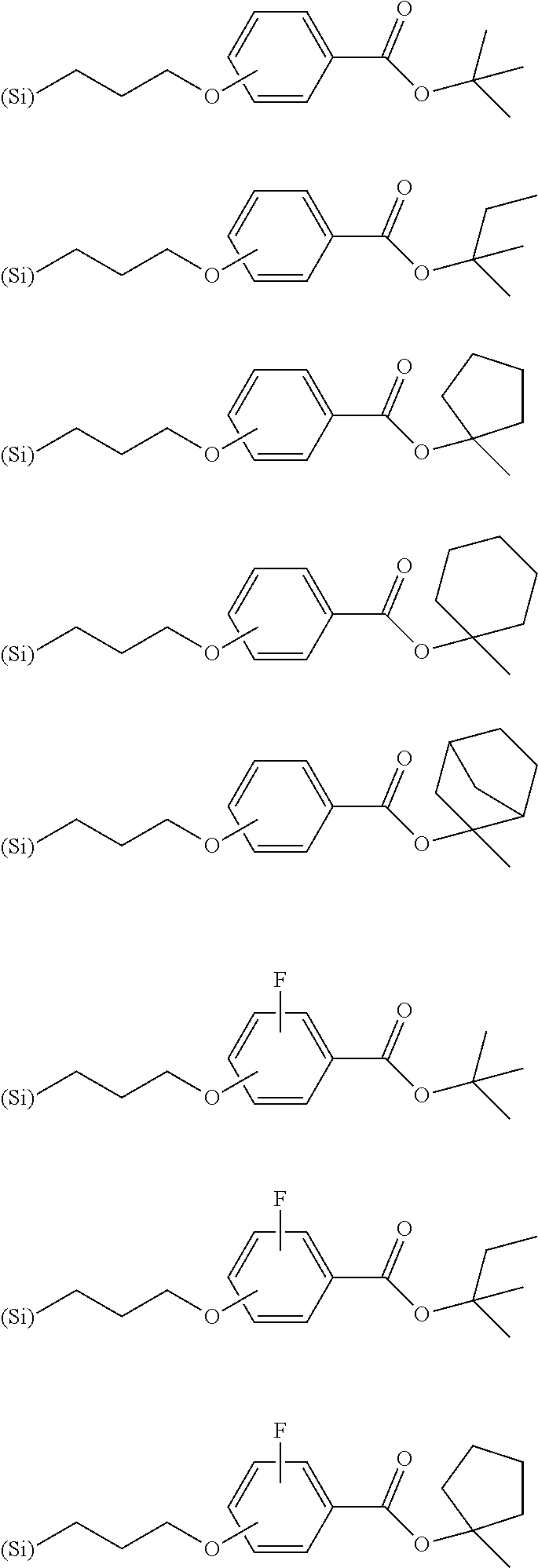
- Examples of the silicon compound represented by the general formula (B-1) may be as follows:
- silicon compound represented by the general formula (B-1) a compound having two or three methoxy groups, ethoxy groups, propoxy groups, butoxy groups, pentoxy groups, cyclopentoxy groups, hexyloxy groups, cyclohexyloxy groups, or phenoxy groups as a hydrolysable group on silicon of the following structures can be used.
- Examples of other starting material for the component (B) include a silicon-containing compound obtained by hydrolysis and/or condensation of one or more kinds of silicon compounds represented by the following general formula (B-II): Si(OR 4B ) 4 (B-II)
- R 4B represents a hydrocarbon group having 1 to 6 carbon atoms.
- Examples of silicon compound represented by the general formula (B-II) include tetramethoxysilane, tetraethoxysilane, tetrapropoxysilane, and tetraisopropoxysilane.
- One or more kinds of the silicon compounds can be selected and hydrolyzed and condensed in the presence of an acid catalyst or a base catalyst to prepare a silicon-containing compound contained in the component (B).
- one or more compounds selected from an inorganic acid, an aliphatic sulfonic acid, an aromatic sulfonic acid, an aliphatic carboxylic acid, and an aromatic carboxylic acid can be used.
- Specific examples thereof include hydrofluoric acid, hydrochloric acid, hydrobromic acid, sulfuric acid, nitric acid, perchloric acid, phosphoric acid, methanesulfonic acid, benzenesulfonic acid, toluene sulfonic acid, formic acid, acetic acid, propionic acid, oxalic acid, malonic acid, maleic acid, fumaric acid, and benzoic acid.
- Examples of the used base catalyst include methylamine, ethylamine, propylamine, butylamine, ethylenediamine, hexamethylenediamine, dimethylamine, diethylamine, ethylmethylamine, trimethylamine, triethylamine, tripropylamine, tributylamine, cyclohexylamine, dicyclohexylamine, monoethanolamine, diethanolamine, dimethylmonoethanolamine, monomethyldiethanolamine, triethanolamine, diazabicyclooctane, diazabicyclocyclononene, diazabicycloundecene, hexamethylenetetramine, aniline, N,N-dimethylaniline, pyridine, N,N-dimethylaminopyridine, pyrrole, piperazine, pyrrolidine, piperidine, picoline, tetramethylammonium hydroxide, choline hydroxide, tetrapropylammonium hydro
- the amount of each catalyst to be used is 10 ⁇ 6 to 10 moles, preferably 10 ⁇ 5 to 5 moles, more preferably 10 ⁇ 4 to 1 moles, relative to 1 mole of monomer.
- the amount of water to be added when the silicon-containing compound is obtained from the monomer by hydrolysis-condensation is preferably 0.01 to 100 moles, more preferably 0.05 to 50 moles, further preferably 0.1 to 30 moles, relative to 1 mole of hydrolyzable substituent bonded to the monomer.
- the amount of the water to be added is 100 moles or less, a device used in the reaction needs not to be huge, and therefore it is economic and preferable.
- the molecular weight of silicon-containing compound to be obtained can be adjusted by selection of monomer and control of reaction condition in polymerization.
- a silicon-containing compound having a weight average molecular weight more than 100,000 is used, a foreign matter and uneven coating may be caused.
- a silicon-containing compound having a weight average molecular weight of 100,000 or less, more preferably 200 to 50,000, further preferably 300 to 30,000 is preferably used.
- Data involved in the weight average molecular weight are represented by molecular weight in terms of polystyrene, measured using polystyrenes as a standard substance by gel permeation chromatography (GPC) using RI as a detector and tetrahydrofuran as an eluting solvent.
- GPC gel permeation chromatography
- the composition for forming a titanium-containing resist underlayer film may further contain a photoacid generator.
- a photoacid generator Specifically, a substance described in Japanese Patent Laid-Open Publication No. 2009-126940, paragraphs [0160] to [0179] can be added as a photoacid generator to be used.
- the composition for forming a titanium-containing resist underlayer film may further contain a thermal acid generator.
- a thermal acid generator Specifically, a substance described in Japanese Patent Laid-Open Publication No. 2007-199653, paragraphs [0061] to [0085] can be added as a thermal acid generator to be used.
- composition for forming a titanium-containing resist underlayer film can further contain a surfactant, if necessary, Specifically, a substance described in Japanese Patent Laid-Open Publication No. 2009-126940, paragraph [0129], can be blended as such a surfactant.
- the composition for forming a titanium-containing resist underlayer film is used to form the titanium-containing resist underlayer film 4 on the organic hard mask 3 or the organic hard mask (not shown) formed in the step (1).
- the titanium content in the titanium-containing resist underlayer film is 10 to 60% by mass. When the titanium content is less than 10% by mass, a residue is not removed to remain in a removing step of the wet stripping method described later. A titanium content more than 60% by mass is impossible in theory.
- Such a titanium-containing resist underlayer film can be formed on an organic underlayer film or an organic hard mask from the composition for forming a titanium-containing resist under layer film by the spin-coating method. After spin-coating, it is desirable that a crosslinking reaction is promoted by evaporating a solvent and baking the film to prevent mixing with a photoresist film.
- the baking temperature within a range of 50 to 500° C. is preferably used for 10 to 300 seconds. The temperature range depends on the structure of device to produced, but is particularly preferably 400° C. or lower since the thermal damage against the device is reduced.
- the photoresist film 5 is formed by using a chemically amplified resist composition on the titanium-containing resist underlayer film 4 (FIG. 1 (IV-a)).
- the chemically amplified resist composition forming the photoresist film 5 is not particularly limited, and preferably contains a resin having a repeating unit represented by the following general formula (a1):
- R 101 represents a hydrogen atom or a methyl group
- R 102 represents an acid labile group
- a monomer to obtain the repeating unit having an acid labile group represented by the general formula (a1) is represented by the following general formula (Ma1), wherein R 101 and R 102 represent the same meaning as before.
- a chemically amplified resist composition used in the patterning process of the present invention preferably contains an acid generator, and examples thereof include a compound generating an acid in respond to active light beam or radiation (photoacid generator).
- the component of a photoacid generator may be a compound generating an acid under high energy irradiation.
- Suitable examples of photoacid generator include sulfonium salt, iodonium salt, sulfonyldiazomethane, N-sulfonyloxyimide, and oxime-O-sulfonate acid generators. These may be used alone or as a mixture of two or more kinds.
- Specific examples of acid generators may include those described in Japanese Patent Laid-Open Publication No. 2008-111103, paragraphs [0122] to [0142].
- a photoresist film 5 is formed on the titanium-containing resist underlayer film 4 formed in the step (2) using the chemically amplified resist composition.
- a photoresist film can be formed, for example, by a spin-coating method, or the like.
- the photoresist pattern 5 a (positive photoresist pattern 5 a ) is formed by exposing the photoresist film 5 to high energy beam and developing ( FIGS. 1(V-a) and (VI-a)).
- the photoresist film be exposed to high energy beam by the method of photolithography with a wavelength of 300 nm or less or a EUV beam or by the method of a direct drawing with an electron beam.
- a finer pattern can be formed on a body to be processed.
- a 32-node device can be produced.
- the exposed area of exposed photoresist film is dissolved in an alkaline developer to form a positive pattern ( FIG. 1 , positive photoresist pattern 5 a ), or the non-exposed area is dissolved in an organic solvent to form a negative pattern ( FIG. 1 , negative photoresist pattern 5 b ).
- TMAH tetramethylammonium hydroxide
- a developer of organic solvent a developer containing as components one or more selected from 2-octanone, 2-nonanone, 2-heptanone, 3-heptanone, 4-heptanone, 2-hexanone, 3-hexanone, diisobutyl ketone, methyl cyclohexanone, acetophenone, methyl acetophenone, propyl acetate, butyl acetate, isobutyl acetate, amyl acetate, butenyl acetate, isoamyl acetate, phenyl acetate, propyl formate, butyl formate, isobutyl formate, amyl formate, isoamyl formate, methyl valerate, methyl pentenoate, methyl crotonate, ethyl crotonate, methyl lactate, ethyl lactate, propyl lactate, butyl lactate, isobutyl lactate, amyl lactate
- the titanium-containing resist underlayer film pattern 4 a is formed by pattern-transferring onto the titanium-containing resist underlayer film 4 by using the photoresist pattern 5 a as a mask (FIG. 1 (VII-a)).
- a method for transferring a pattern onto a titanium-containing resist underlayer film is not particularly limited, and may be dry etching using a gas mainly containing fluorine- or fluoride-containing gas such as fluorocarbons. Alternatively, wet etching using a stripper used in the removing step of a wet stripping method described below may be employed.
- the organic underlayer film pattern 3 a or the organic hard mask pattern (not shown) is formed by pattern-transferring onto the organic underlayer film 3 or the organic hard mask (not shown) by using the titanium-containing resist underlayer film pattern 4 a as a mask (FIG. 1 (VIII-a)).
- the method for transferring a pattern on an organic underlayer film or an organic hard mask is not particularly limited, and may be reactive dry etching by oxygen gas plasma.
- the exposed area of the titanium-containing hard mask 2 and the residue 4 a ′ of the titanium-containing resist underlayer film are removed by the wet stripping method (FIG. 1 (IX-a)).
- a stripper containing hydrogen peroxide is preferably used.
- an acid or an alkali be added to adjust the pH.
- Examples of a pH adjuster used in this case include an inorganic acid such as hydrochloric acid and sulfuric acid, an organic acid such as acetic acid, oxalic acid, tartaric acid, citric acid, and lactic acid, an alkali containing nitrogen such as ammonia, ethanolamine, or tetramethylammonium hydroxide, and an organic acid compound containing nitrogen such as ethylenediamine tetraacetate (EDTA).
- an inorganic acid such as hydrochloric acid and sulfuric acid
- an organic acid such as acetic acid, oxalic acid, tartaric acid, citric acid, and lactic acid
- an alkali containing nitrogen such as ammonia, ethanolamine, or tetramethylammonium hydroxide
- an organic acid compound containing nitrogen such as ethylenediamine tetraacetate (EDTA).
- the method for wet stripping includes a method in which a body to be processed having a resist pattern to be processed is immersed into a stripper of preferably 0 to 80° C., more preferably 5 to 60° C. According to such a method, the exposed area of the titanium-containing hard mask and the residue of the titanium-containing resist underlayer film can be simultaneously stripped, and therefore they can be efficiently removed. If necessary, by the ordinary procedure including spraying the stripper on the surface and applying the stripper while the body to be processed is rotated, the stripping rate on the titanium-containing resist underlayer film is faster than that at the exposed area of the titanium-containing hard mask, and therefore the titanium-containing resist underlayer film can be more certainly removed.
- the titanium-containing hard mask and the titanium-containing resist underlayer film can be certainly removed with ease without causing damage to the body to be processed to expose a layer to be processed on the body to be processed.
- the body to be processed having an organic underlayer film pattern or an organic hard mask pattern as formed above has no residue of the titanium-containing resist underlayer film on the organic underlayer film pattern or the organic hard mask pattern, and has an exposed layer to be processed on the body to be processed without damage
- the body to be processed can be suitably used for a process for microfabrication, for example, a double patterning process.
- a mixture of 2.7 g of pure water and 50 g of isopropyl alcohol (IPA) was added dropwise to a mixture of 28.4 g of titanium tetraisopropoxide and 50 g of IPA. After completion of dropwise addition, the mixture was stirred for 3 hours. Then, 11.8 g of 2-(butylamino)ethanol was added, and the mixture was stirred for 17 hours. Further, 30.4 g of 1,2-propanediol was added, and the mixture was refluxed for 2 hours. To the mixture, 150 g of PGMEA was added, and the resulting mixture was concentrated under reduced pressure to obtain 130 g of solution containing 19.9 g of nonvolatile matter as A-1.
- IPA isopropyl alcohol
- a mixed solution of 110 g of IPA and 2.7 g of pure water was added dropwise to a mixture of 48.6 g of solution of titanium diisopropoxide-bis(2,4-pentanedionate) in 75% IPA and 10 g of 2,4-pentanedione. After completion of dropwise addition, the mixture was stirred for 3 hours. Then, 11.8 g of 2-(butylamino)ethanol was added, and the mixture was stirred for 17 hours. Further, 30.4 g of 1,2-propanediol was added, and the mixture was refluxed for 2 hours. To the mixture, 150 g of PGMEA was added, and the resulting mixture was concentrated under reduced pressure to obtain 141 g of solution containing 23.1 g of nonvolatile matter as A-3.
- Synthesis Examples B-2 through B-6 were performed by using a monomer each shown in Table 1 under the same condition as in Synthesis Example B-1 to obtain each target compound.
- each component obtained in the synthesis example, a solvent, and an additive were mixed at a ratio shown in Table 2.
- the mixture was filtrated through a fluororesin filter having a pore size of 0.1 ⁇ m, to prepare each composition for forming a titanium-containing resist underlayer film as Sols. 1 to 21.
- Each of the compositions was baked at a predetermined temperature (180, 250, 350, or 450° C.), the coating film on a wafer was scratched off, and an ashing process was performed at 800° C. From the resultant, TiO 2 content and Ti content at the predetermined temperature were determined by calculation. For a sample containing Si, correction in x-ray fluorescence analysis and determination of the amount were performed. The results are shown in Tables 3 and 4.
- a silicon wafer was spin-coated with each of compositions for forming a titanium-containing resist underlayer film Sols. 1 to 21, and heated at 180, 250, 350, or 450° C. for 1 minute to form a titanium-containing resist underlayer film having a film thickness of 35 nm.
- the film was immersed in 1% hydrogen peroxide containing 0.6% ammonia (hereinafter referred to as ammonia-hydrogen peroxide) at 23° C. for 10 minutes, and the thickness of remaining film was measured with M-2000 high-speed spectroscopic Ellipsometer manufactured by J.A. Woollam Co., Inc. The results are shown in Table 5.
- the titanium-containing resist underlayer film formed by Sols. 20 and 21 which have a Ti content less than 10% by mass cannot be removed by ammonia-hydrogen peroxide.
- a spin-on carbon film ODL-50 (carbon content: 80% by mass) available from Shin-Etsu Chemical Co., Ltd., was baked at 300° C. on a silicon wafer having a diameter of 8 inches (200 mm) on which a titanium nitride film having a thickness of 30 nm was formed, to form a film having a thickness of 200 nm.
- the film was coated with each of compositions for forming a titanium-containing resist underlayer film Sols. 1 to 21, and heated at 250° C. for 60 seconds to form a titanium-containing resist underlayer film having a thickness of 35 nm (Films 1 to 21).
- PR-1 was dissolved as a resist composition for ArF excimer laser light exposure in a propylene glycol monomethyl ether acetate (PGMEA) solution containing 0.1% FC-430 (available from Sumitomo 3M, Ltd.), and the solution was filtrated through a 0.1- ⁇ m fluorocarbon resin filter to prepare a photoresist film.
- PGMEA propylene glycol monomethyl ether acetate
- Photoacid generator triphenylsulfonium nonafluoro butanesulfonate 0.2 part by mass
- Basic compound triethanolamine 0.02 part by mass
- the resist films were exposed using an ArF exposure device (manufactured by Nikon Corporation; NA: 0.68, ⁇ : 0.85, 2 ⁇ 3 cycle lighting, Cr mask), then baked (PEB) at 110° C. for 90 seconds, and developed with an aqueous solution of 2.38% tetramethylammonium hydroxide (TNAH), thereby giving a positive pattern having line and space of 100 nm.
- PEB baked
- TNAH tetramethylammonium hydroxide
- the titanium-containing resist underlayer film was dry etched under a condition (1) using the resist pattern produced in the patterning test as a mask, followed by dry etching under a condition (2), and the pattern was transferred onto a spin-on carbon film.
- the resulting pattern was immersed in ammonia-hydrogen peroxide at 23° C. for 20 minutes, and the presence or absence of residue was confirmed with an electron microscope (S-9380) manufactured by Hitachi, Lid. The results are shown in Table 7.
- a titanium nitride film as a titanium-containing hard mask and a titanium-containing resist underlayer film can be simultaneously removed under a mild condition using ammonia-hydrogen peroxide.
- a body to be processed can be used in a step such as double patterning process.
- the titanium-containing resist underlayer film having a Ti content less than 10% by mass cannot be removed by ammonia-hydrogen peroxide.
- a resist underlayer film can be removed using a wet stripper having a milder condition than the conventional stripper can be obtained without causing damage to the body to be processed.
Landscapes
- Physics & Mathematics (AREA)
- General Physics & Mathematics (AREA)
- Engineering & Computer Science (AREA)
- Architecture (AREA)
- Structural Engineering (AREA)
- Photosensitive Polymer And Photoresist Processing (AREA)
- Materials For Photolithography (AREA)
- Exposure Of Semiconductors, Excluding Electron Or Ion Beam Exposure (AREA)
- Exposure And Positioning Against Photoresist Photosensitive Materials (AREA)
- Addition Polymer Or Copolymer, Post-Treatments, Or Chemical Modifications (AREA)
Abstract
Description
- Patent Document 1: Japanese Patent Laid-Open Publication No. 7-183194
- Patent Document 2: Japanese Patent Laid-Open Publication No. 7-181688
- Patent document 3: Japanese Patent Laid-Open Publication No. 2007-302873
- Patent Document 4: Japanese Patent Application Publication No. 2005-520354
- Patent document 5: Japanese Patent No. 4716037
- Patent Document 6: Japanese Patent Laid-Open Publication No. 11-258813
- Patent document 7: Japanese Patent Laid-Open Publication No. 2006-251369
- Patent Document 8: Japanese Patent Application Publication No. 2005-537502
- Patent document 9: Japanese Patent Laid-Open Publication No. 2005-173552
- Patent document 10: Japanese Patent Laid-Open Publication No. 2006-317864
- Non-patent document 1: Proc. SPIE Vol. 5754 p. 1508 (2005)
- Non-patent document 2: Proc. SPIE Vol. 5377 p. 255 (2004)
Ti(OR0A)4 (A-I)
R1B b1R2B b2R3B b3Si(OR0B)(4-b1-b2-b3) (B-I)
Si(OR4B)4 (B-II)
Ti(OR0A)4 (A-I)
R1B b1R2B b2R3B b3Si(OR0B)(4-b1-b2-b3) (B-I)




Si(OR4B)4 (B-II)


| TABLE 1 | ||
| Synthesis | ||
| Example | Reaction starting material | Mw |
| B-1 | [Monomer 101]: 68.1 g | 2200 |
| B-2 | [Monomer 100]: 29.7 g, [Monomer 101]: 47.7 g | 2400 |
| [Monomer 100]: 19.8 g, [Monomer 101]: 27.2 g, | 2500 | |
| B-3 | [Monomer 102]: 30.4 g | |
| [Monomer 101]: 27.2 g, [Monomer 102]: 22.8 g, | 2400 | |
| B-4 | [Monomer 103]: 44.8 g | |
| [Monomer 101]: 13.6 g, [Monomer 102]: 38.1 g, | 2300 | |
| B-5 | [Monomer 104]: 49.0 g | |
| [Monomer 101]: 34.1 g, [Monomer 102]: 15.2 g, | 2800 | |
| B-6 | [Monomer 105]: 47.5 g | |

| TABLE 2 | ||||
| Component (A) | Component (B) | |||
| Titanium- | Silicon- | |||
| containing | containing | |||
| compound | compound | Additive | Solvent | |
| No. | (Part by mass) | (Part by mass) | (Part by mass) | (Part by mass) |
| Sol. 1 | A-1 (4.0) | — | — | PGMEA (145) |
| Sol. 2 | A-2 (4.0) | — | — | PGMEA (120) |
| Sol. 3 | A-3 (4.0) | — | — | PGMEA (150) |
| Sol. 4 | A-1 (3.9) | B-1 (0.1) | TPSMA (0.04) | PGMEA (145) |
| Sol. 5 | A-1 (3.9) | B-2 (0.1) | TPSMA (0.04) | PGMEA (145) |
| Sol. 6 | A-1 (3.9) | B-3 (0.1) | TPSMA (0.04) | PGMEA (145) |
| Sol. 7 | A-1 (3.9) | B-4 (0.1) | TPSMA (0.04) | PGMEA (145) |
| Sol. 8 | A-1 (3.9) | B-5 (0.1) | TPSMA (0.04) | PGMEA (145) |
| Sol. 9 | A-1 (3.9) | B-6 (0.1) | TPSMA (0.04) | PGMEA (145) |
| Sol. 10 | A-2 (3.9) | B-1 (0.1) | TPSMA (0.04) | PGMEA (125) |
| Sol. 11 | A-2 (3.9) | B-2 (0.1) | TPSMA (0.04) | PGMEA (125) |
| Sol. 12 | A-2 (3.9) | B-3 (0.1) | TPSMA (0.04) | PGMEA (125) |
| Sol. 13 | A-2 (3.9) | B-4 (0.1) | TPSMA (0.04) | PGMEA (125) |
| Sol. 14 | A-2 (3.9) | B-5 (0.1) | TPSMA (0.04) | PGMEA (125) |
| Sol. 15 | A-2 (3.9) | B-6 (0.1) | TPSMA (0.04) | PGMEA (125) |
| Sol. 16 | A-1 (3.0) | B-3 (1.0) | TPSMA (0.04) | PGMEA (145) |
| Sol. 17 | A-1 (2.5) | B-3 (1.5) | TPSMA (0.04) | PGMEA (145) |
| Sol. 18 | A-1 (2.0) | B-3 (2.0) | TPSMA (0.04) | PGMEA (145) |
| Sol. 19 | A-1 (1.5) | B-3 (2.5) | TPSMA (0.04) | PGMEA (145) |
| Sol. 20 | A-1 (1.0) | B-3 (3.0) | TPSMA (0.04) | PGMEA (145) |
| Sol. 21 | A-1 (0.5) | B-3 (3.5) | TPSMA (0.04) | PGMEA (145) |
TPSMA: mono(triphenylsulfonium)maleate
| TABLE 3 | |||||
| Amount | Amount | TiO2 | Ti | ||
| Baking | before | after | content | content | |
| temperature | ashing | ashing | (% by | (% by | |
| No. | (° C.) | (mg) | (mg) | mass) | mass) |
| Sol. 1 | 180 | 4.34 | 1.94 | 44.7 | 26.8 |
| 250 | 4.52 | 3.09 | 68.4 | 41.0 | |
| 350 | 4.80 | 3.72 | 77.6 | 46.5 | |
| 450 | 4.68 | 4.55 | 97.2 | 58.2 | |
| Sol. 2 | 180 | 4.92 | 2.08 | 42.2 | 25.3 |
| 250 | 4.38 | 3.10 | 70.8 | 42.4 | |
| 350 | 4.81 | 3.65 | 75.8 | 45.5 | |
| 450 | 4.61 | 4.44 | 96.2 | 57.7 | |
| Sol. 3 | 180 | 4.71 | 2.18 | 46.2 | 27.7 |
| 250 | 4.37 | 2.92 | 66.8 | 40.1 | |
| 350 | 4.09 | 3.12 | 76.2 | 45.7 | |
| 450 | 4.84 | 4.46 | 92.2 | 55.3 | |
| Sol. 4 | 180 | 4 47 | 1.95 | 42.1 | 25.2 |
| 250 | 4.09 | 2.83 | 66.9 | 40.1 | |
| 350 | 4.19 | 3.19 | 73.5 | 44.0 | |
| 450 | 4.74 | 4.60 | 93.7 | 56.1 | |
| Sol. 5 | 180 | 4.85 | 2.11 | 43.5 | 25.2 |
| 250 | 4.76 | 3.40 | 71.4 | 41.4 | |
| 350 | 4.25 | 3.22 | 73.2 | 43.9 | |
| 450 | 4.61 | 4.47 | 93.5 | 56.1 | |
| Sol. 6 | 180 | 4.69 | 2.14 | 44.1 | 26.5 |
| 250 | 4.03 | 2.87 | 68.8 | 41.3 | |
| 350 | 4.21 | 3.38 | 77.6 | 46.5 | |
| 450 | 4.86 | 4.66 | 92.5 | 55.4 | |
| Sol. 7 | 180 | 4.27 | 2.04 | 46.2 | 27.7 |
| 250 | 4.97 | 3.37 | 65.4 | 39.2 | |
| 350 | 4.55 | 3.59 | 76.2 | 45.7 | |
| 450 | 4.94 | 4.85 | 94.7 | 56.8 | |
| Sol. 8 | 180 | 4.47 | 1.91 | 41.3 | 24.8 |
| 250 | 4.46 | 3.23 | 69.8 | 41.8 | |
| 350 | 4.67 | 3.51 | 72.5 | 43.5 | |
| 450 | 4.79 | 4.59 | 92.5 | 55.5 | |
| Sol. 9 | 180 | 4.90 | 2.16 | 42.5 | 25.4 |
| 250 | 4.49 | 3.00 | 64.5 | 38.6 | |
| 350 | 4.35 | 3.52 | 78.2 | 46.9 | |
| 450 | 4.68 | 4.33 | 89.3 | 53.5 | |
| Sol. 10 | 180 | 4.85 | 2.03 | 40.5 | 24.3 |
| 250 | 4.36 | 3.03 | 67.0 | 40.2 | |
| 350 | 4.39 | 3.34 | 73.5 | 44.1 | |
| 450 | 4.07 | 3.87 | 91.8 | 55.0 | |
| Sol. 11 | 180 | 4.37 | 2.11 | 46.5 | 27.9 |
| 250 | 4.74 | 3.44 | 70.1 | 42.0 | |
| 350 | 4.48 | 3.50 | 75.4 | 45.2 | |
| 450 | 4.92 | 4.83 | 94.8 | 56.8 | |
| TABLE 4 | |||||
| Amount | Amount | TiO2 | Ti | ||
| Baking | before | after | content | content | |
| temperature | ashing | ashing | (% by | (% by | |
| No. | (° C.) | (mg) | (mg) | mass) | mass) |
| Sol. 12 | 180 | 4.38 | 1.86 | 41.0 | 24.6 |
| 250 | 4.83 | 3.32 | 66.4 | 39.8 | |
| 350 | 4.98 | 3.97 | 76.9 | 46.1 | |
| 450 | 4.55 | 4.34 | 92.2 | 55.2 | |
| Sol. 13 | 180 | 4.49 | 1.94 | 41.7 | 25.0 |
| 250 | 4.35 | 3.01 | 66.7 | 40.0 | |
| 350 | 4.43 | 3.56 | 77.6 | 46.5 | |
| 450 | 4.66 | 4.54 | 94.0 | 56.3 | |
| Sol. 14 | 180 | 4.24 | 1.92 | 43.6 | 26.2 |
| 250 | 4.49 | 3.14 | 67.6 | 40.5 | |
| 350 | 4.62 | 3.68 | 76.8 | 46.0 | |
| 450 | 4.11 | 3.78 | 88.8 | 53.2 | |
| Sol. 15 | 180 | 4.70 | 2.15 | 44.2 | 26.5 |
| 250 | 4.69 | 3.38 | 69.6 | 41.7 | |
| 350 | 4.02 | 3.04 | 73.0 | 43.7 | |
| 450 | 4.05 | 3.98 | 94.8 | 56.8 | |
| Sol. 16 | 180 | 4.88 | 2.27 | 34.5 | 20.7 |
| 250 | 4.47 | 3.04 | 50.5 | 30.3 | |
| 350 | 4.06 | 3.28 | 59.9 | 35.9 | |
| 450 | 4.44 | 4.13 | 69.1 | 41.4 | |
| Sol. 17 | 180 | 4.47 | 1.94 | 26.9 | 16.1 |
| 250 | 4.46 | 3.12 | 43.3 | 26.0 | |
| 350 | 4.79 | 3.82 | 49.4 | 29.6 | |
| 450 | 4.99 | 4.86 | 60.3 | 36.2 | |
| Sol. 18 | 180 | 4.06 | 1.90 | 23.2 | 13.9 |
| 250 | 4.50 | 3.11 | 34.3 | 20.5 | |
| 350 | 4.83 | 3.76 | 38.5 | 23.1 | |
| 450 | 4.40 | 4.10 | 46.2 | 27.7 | |
| Sol. 19 | 180 | 4.11 | 1.97 | 17.8 | 10.7 |
| 250 | 4.77 | 3.46 | 27 0 | 16.2 | |
| 350 | 4.14 | 3.17 | 28.4 | 17.0 | |
| 450 | 4.97 | 4.82 | 36_0 | 21.6 | |
| Sol. 20 | 180 | 4.58 | 2.14 | 11.6 | 6.9 |
| 250 | 4.88 | 2.44 | 12.5 | 7.5 | |
| 350 | 4.36 | 2.53 | 14.5 | 8.7 | |
| 450 | 4.80 | 3.17 | 16.5 | 9.9 | |
| Sol. 21 | 180 | 4.98 | 2.24 | 5.6 | 3.3 |
| 250 | 4.64 | 3.12 | 8.3 | 5.0 | |
| 350 | 4.04 | 3.28 | 10.0 | 6.0 | |
| 450 | 4.03 | 3.85 | 11.8 | 7.1 | |
TiO2 content (% by mass)=(amount after ashing)/(amount before ashing)×100
Ti content in TiO2 (% by mass)=47.87/79.87×TiO2 content (% by mass)
Wet Etching Test of Coating Film
| TABLE 5 | ||||
| Film | Film | |||
| thickness | thickness | |||
| Baking | before | after | ||
| temperature | process | process | ||
| No. | (° C.) | (A) | (A) | |
| Sol. | 180 | 341 | 2 or less | |
| 1 | 250 | 341 | 2 or less | |
| 350 | 354 | 2 or less | ||
| 450 | 345 | 2 or less | ||
| Sol. | 180 | 351 | 2 or less | |
| 2 | 250 | 360 | 2 or less | |
| 350 | 353 | 2 or less | ||
| 450 | 357 | 2 or less | ||
| Sol. | 180 | 359 | 2 or less | |
| 3 | 250 | 341 | 2 or less | |
| 350 | 351 | 2 or less | ||
| 450 | 355 | 2 or less | ||
| Sol. | 180 | 345 | 2 or less | |
| 4 | 250 | 355 | 2 or less | |
| 350 | 350 | 2 or less | ||
| 450 | 348 | 2 or less | ||
| Sol. | 180 | 340 | 2 or less | |
| 5 | 250 | 346 | 2 or less | |
| 350 | 358 | 2 or less | ||
| 450 | 358 | 2 or less | ||
| Sol. | 180 | 342 | 2 or less | |
| 6 | 250 | 342 | 2 or less | |
| 350 | 360 | 2 or less | ||
| 450 | 359 | 2 or less | ||
| Sol. | 180 | 357 | 2 or less | |
| 7 | 250 | 357 | 2 or less | |
| 350 | 345 | 2 or less | ||
| 450 | 359 | 2 or less | ||
| Sol. | 180 | 349 | 2 or less | |
| 8 | 250 | 345 | 2 or less | |
| 350 | 355 | 2 or less | ||
| 450 | 351 | 2 or less | ||
| Sol. | 180 | 344 | 2 or less | |
| 9 | 250 | 348 | 2 or less | |
| 350 | 343 | 2 or less | ||
| 450 | 356 | 2 or less | ||
| Sol. | 180 | 351 | 2 or less | |
| 10 | 250 | 358 | 2 or less | |
| 350 | 344 | 2 or less | ||
| 450 | 351 | 2 or less | ||
| Sol. | 180 | 344 | 2 or less | |
| 11 | 250 | 353 | 2 or less | |
| 350 | 353 | 2 or less | ||
| 450 | 351 | 2 or less | ||
| Sol. | 180 | 355 | 2 or less | |
| 12 | 250 | 349 | 2 or less | |
| 350 | 352 | 2 or less | ||
| 450 | 350 | 2 or less | ||
| Sol. | 180 | 347 | 2 or less | |
| 13 | 250 | 354 | 2 or less | |
| 350 | 352 | 2 or less | ||
| 450 | 359 | 2 or less | ||
| Sol. | 180 | 343 | 2 or less | |
| 14 | 250 | 357 | 2 or less | |
| 350 | 348 | 2 or less | ||
| 450 | 344 | 2 or less | ||
| Sol. | 180 | 342 | 2 or less | |
| 15 | 250 | 356 | 2 or less | |
| 350 | 348 | 2 or less | ||
| 450 | 352 | 2 or less | ||
| Sol. | 180 | 360 | 2 or less | |
| 16 | 250 | 350 | 2 or less | |
| 350 | 360 | 2 or less | ||
| 450 | 356 | 2 or less | ||
| Sol. | 180 | 359 | 2 or less | |
| 17 | 250 | 358 | 2 or less | |
| 350 | 354 | 2 or less | ||
| 450 | 356 | 2 or less | ||
| Sol. | 180 | 358 | 2 or less | |
| 18 | 250 | 356 | 2 or less | |
| 350 | 344 | 2 or less | ||
| 450 | 352 | 2 or less | ||
| Sol. | 180 | 349 | 2 or less | |
| 19 | 250 | 344 | 2 or less | |
| 350 | 354 | 2 or less | ||
| 450 | 354 | 2 or less | ||
| Sol. | 180 | 359 | 71 | |
| 20 | 250 | 342 | 103 | |
| 350 | 347 | 115 | ||
| 450 | 343 | 133 | ||
| Sol. | 180 | 349 | 143 | |
| 21 | 250 | 344 | 189 | |
| 350 | 354 | 202 | ||
| 450 | 354 | 221 | ||

(Me represents a methyl group and Et represents an ethyl group) 10 parts by mass
Photoacid generator: triphenylsulfonium nonafluoro butanesulfonate 0.2 part by mass
Basic compound: triethanolamine 0.02 part by mass
| TABLE 6 | ||||||
| Titanium- | ||||||
| containing | ||||||
| resist | Form of cross section | |||||
| underlayer | ArF | of pattern after | Pattern | |||
| No. | film | resist | development | fall | ||
| Sol. 1 | | PR-1 | Vertical form | None | ||
| Sol. 2 | | PR-1 | Vertical form | None | ||
| Sol. 3 | | PR-1 | Vertical form | None | ||
| Sol. 4 | | PR-1 | Vertical form | None | ||
| Sol. 5 | | PR-1 | Vertical form | None | ||
| Sol. 6 | Film 6 | PR-1 | Vertical form | None | ||
| Sol. 7 | Film 7 | PR-1 | Vertical form | None | ||
| Sol. 8 | Film 8 | PR-1 | Vertical form | None | ||
| Sol. 9 | Film 9 | PR-1 | Vertical form | None | ||
| Sol. 10 | Film 10 | PR-1 | Vertical form | None | ||
| Sol. 11 | Film 11 | PR-1 | Vertical form | None | ||
| Sol. 12 | Film 12 | PR-1 | Vertical form | None | ||
| Sol. 13 | Film 13 | PR-1 | Vertical form | None | ||
| Sol. 14 | Film 14 | PR-1 | Vertical form | None | ||
| Sol. 15 | Film 15 | PR-1 | Vertical form | None | ||
| Sol. 16 | Film 16 | PR-1 | Vertical form | None | ||
| Sal. 17 | Film 17 | PR-1 | Vertical form | None | ||
| Sol. 18 | Film 18 | PR-1 | Vertical form | None | ||
| Sol. 19 | Film 19 | PR-1 | Vertical form | None | ||
| Sol. 20 | Film 20 | PR-1 | Vertical form | None | ||
| Sol. 21 | | PR-1 | Vertical form | None | ||
Patter Etching Test
| TABLE 7 | ||
| Titanium-containing | ||
| resist underlayer | CVD titanium nitride | |
| No | film | film |
| Film | ||
| 1 | No residue | No |
| Film | ||
| 2 | No residue | No |
| Film | ||
| 3 | No residue | No |
| Film | ||
| 4 | No residue | No |
| Film | ||
| 5 | No residue | No residue |
| Film 6 | No residue | No residue |
| Film 7 | No residue | No residue |
| Film 8 | No residue | No residue |
| Film 9 | No residue | No residue |
| Film 10 | No residue | No residue |
| Film 11 | No residue | No residue |
| Film 12 | No residue | No residue |
| Film 13 | No residue | No residue |
| Film 14 | No residue | No residue |
| Film 15 | No residue | No residue |
| Film 16 | No residue | No residue |
| Film 17 | No residue | No residue |
| Film 18 | No residue | No residue |
| Film 19 | No residue | No residue |
| Film 20 | Residue | No |
| Film | ||
| 21 | Residue | No residue |
Claims (46)
Ti(OR0A)4 (A-I)
Ti(OR0A)4 (A-I)
R1B b1R2B b2R3B b3Si(OR0B)(4-b1-b2-b3) (B-I)
R1B b1R2B b2R3B b3Si(OR0B)(4-b1-b2-b3) (B-I)
R1B b1R2B b2R3B b3Si(OR0B)(4-b1-b2-b3) (B-I)
R1B b1R2B b2R3B b3Si(OR0B)(4-b1-b2-b3) (B-I)
Si(OR4B)4 (B-II)
Si(OR4B)4 (B-II)
Si(OR4B)4 (B-II)
Si(OR4B)4 (B-II)
Priority Applications (4)
| Application Number | Priority Date | Filing Date | Title |
|---|---|---|---|
| US13/780,999 US8759220B1 (en) | 2013-02-28 | 2013-02-28 | Patterning process |
| JP2014008325A JP6196165B2 (en) | 2013-02-28 | 2014-01-21 | Pattern formation method |
| TW103104276A TWI501041B (en) | 2013-02-28 | 2014-02-10 | Pattern formation method |
| KR1020140020256A KR101568570B1 (en) | 2013-02-28 | 2014-02-21 | Patterning process |
Applications Claiming Priority (1)
| Application Number | Priority Date | Filing Date | Title |
|---|---|---|---|
| US13/780,999 US8759220B1 (en) | 2013-02-28 | 2013-02-28 | Patterning process |
Publications (1)
| Publication Number | Publication Date |
|---|---|
| US8759220B1 true US8759220B1 (en) | 2014-06-24 |
Family
ID=50944017
Family Applications (1)
| Application Number | Title | Priority Date | Filing Date |
|---|---|---|---|
| US13/780,999 Active US8759220B1 (en) | 2013-02-28 | 2013-02-28 | Patterning process |
Country Status (4)
| Country | Link |
|---|---|
| US (1) | US8759220B1 (en) |
| JP (1) | JP6196165B2 (en) |
| KR (1) | KR101568570B1 (en) |
| TW (1) | TWI501041B (en) |
Cited By (11)
| Publication number | Priority date | Publication date | Assignee | Title |
|---|---|---|---|---|
| US20140193975A1 (en) * | 2013-01-08 | 2014-07-10 | Shin-Etsu Chemical Co., Ltd. | Composition for forming titanium-containing resist underlayer film and patterning process |
| US20160116836A1 (en) * | 2014-10-27 | 2016-04-28 | Samsung Electronics Co., Ltd. | Methods of manufacturing integrated circuit devices by using photomask cleaning compositions |
| US9377690B2 (en) | 2013-01-08 | 2016-06-28 | Shin-Etsu Chemical Co., Ltd. | Compositon for forming metal oxide-containing film and patterning process |
| US10082736B2 (en) | 2017-01-13 | 2018-09-25 | International Business Machines Corporation | Approach to lowering extreme ultraviolet exposure dose for inorganic hardmasks for extreme ultraviolet patterning |
| US20190027369A1 (en) * | 2017-07-21 | 2019-01-24 | Shin-Etsu Chemical Co., Ltd. | Composition for forming organic film, patterning process, and resin for forming organic film |
| US10354922B1 (en) * | 2017-12-27 | 2019-07-16 | International Business Machines Corporation | Simplified block patterning with wet strippable hardmask for high-energy implantation |
| CN110494807A (en) * | 2017-03-31 | 2019-11-22 | 日产化学株式会社 | Silicon-containing resist underlayer film-forming composition having carbonyl structure |
| TWI722561B (en) * | 2018-09-13 | 2021-03-21 | 日商信越化學工業股份有限公司 | Patterning process |
| US11614686B2 (en) * | 2018-02-22 | 2023-03-28 | Shin-Etsu Chemical Co., Ltd. | Resist composition and patterning process |
| CN118399190A (en) * | 2024-04-29 | 2024-07-26 | 江苏富乐华功率半导体研究院有限公司 | Manufacturing process of silicon carbide substrate laser heat sink base plate |
| US12668700B2 (en) | 2022-03-25 | 2026-06-30 | Shin-Etsu Chemical Co., Ltd. | Composition for forming silicon-containing metal hard mask and patterning process |
Families Citing this family (7)
| Publication number | Priority date | Publication date | Assignee | Title |
|---|---|---|---|---|
| JP6189758B2 (en) * | 2013-03-15 | 2017-08-30 | 信越化学工業株式会社 | Titanium-containing resist underlayer film forming composition and pattern forming method |
| JP6323456B2 (en) * | 2013-09-11 | 2018-05-16 | Jsr株式会社 | Inorganic film forming composition for multilayer resist process and pattern forming method |
| WO2016111210A1 (en) * | 2015-01-09 | 2016-07-14 | Jsr株式会社 | Composition for forming silicon-containing film and pattern forming method using said composition |
| JP6632200B2 (en) * | 2015-02-27 | 2020-01-22 | キヤノン株式会社 | Pattern forming method, processing substrate manufacturing method, optical component manufacturing method, circuit board manufacturing method, electronic component manufacturing method |
| JP6462602B2 (en) * | 2016-01-12 | 2019-01-30 | 信越化学工業株式会社 | Multilayer film forming method and pattern forming method |
| WO2021166674A1 (en) * | 2020-02-19 | 2021-08-26 | 東京エレクトロン株式会社 | Substrate processing method and substrate processing system |
| JP2025101895A (en) * | 2023-12-26 | 2025-07-08 | 信越化学工業株式会社 | Metal-containing film-forming compound, metal-containing film-forming composition, pattern forming method |
Citations (20)
| Publication number | Priority date | Publication date | Assignee | Title |
|---|---|---|---|---|
| JPS61185928A (en) | 1985-02-14 | 1986-08-19 | Nippon Telegr & Teleph Corp <Ntt> | Pattern forming method |
| JPH07181688A (en) | 1993-12-24 | 1995-07-21 | Sony Corp | Multilayer resist pattern forming method |
| JPH07183194A (en) | 1993-12-24 | 1995-07-21 | Sony Corp | Multilayer resist pattern forming method |
| JPH11258813A (en) | 1998-03-13 | 1999-09-24 | Jsr Corp | Composition for forming antireflection film and antireflection film |
| US20020182514A1 (en) * | 2001-05-03 | 2002-12-05 | Applied Materials, Inc. | Organic bottom antireflective coating for high performance mask making using optical imaging |
| US20030235786A1 (en) | 2002-06-25 | 2003-12-25 | Brewer Science, Inc. | Developer-soluble metal alkoxide coatings for microelectronic applications |
| WO2004007192A1 (en) | 2000-06-23 | 2004-01-22 | International Business Machines Corporation | Antireflective silicon-containing compositions as hardmask layer |
| US20040146790A1 (en) * | 2001-07-23 | 2004-07-29 | Scott Fuller | Method of increasing the shelf life of a blank photomask substrate |
| US20050112383A1 (en) | 2003-11-20 | 2005-05-26 | Takeshi Tanaka | Undercoating layer material for lithography and wiring forming method using the same |
| JP2005520354A (en) | 2002-07-11 | 2005-07-07 | インターナショナル・ビジネス・マシーンズ・コーポレーション | Silicon-containing antireflection composition as a hard mask layer |
| JP2006251369A (en) | 2005-03-10 | 2006-09-21 | Rasa Ind Ltd | Multilayer resist intermediate layer forming coating solution and pattern forming method using the same |
| JP2006317864A (en) | 2005-05-16 | 2006-11-24 | Tokyo Ohka Kogyo Co Ltd | Antireflection film forming composition and wiring forming method |
| US20070037410A1 (en) * | 2005-08-15 | 2007-02-15 | Taiwan Semiconductor Manufacturing Company, Ltd. | Method for forming a lithography pattern |
| JP2007199653A (en) | 2005-12-27 | 2007-08-09 | Shin Etsu Chem Co Ltd | Photoresist underlayer film forming material and pattern forming method |
| US20070238300A1 (en) | 2006-04-11 | 2007-10-11 | Shin-Etsu Chemical Co., Ltd. | Silicon-containing film-forming composition, silicon-containing film, silicon-containing film-bearing substrate, and patterning method |
| JP2007302873A (en) | 2006-04-11 | 2007-11-22 | Shin Etsu Chem Co Ltd | Silicon-containing film forming composition, silicon-containing film, silicon-containing film-forming substrate, and pattern forming method using the same |
| JP2008111103A (en) | 2006-10-04 | 2008-05-15 | Shin Etsu Chem Co Ltd | Polymer compound, resist material, and pattern forming method |
| US20080118860A1 (en) | 2006-10-04 | 2008-05-22 | Shin-Etsu Chemical Co., Ltd. | Polymer, resist composition, and patterning process |
| US20090136869A1 (en) | 2007-11-22 | 2009-05-28 | Tsutomu Ogihara | Metal oxide-containing film-forming composition, metal oxide-containing film, metal oxide-containing film-bearing substrate, and patterning method |
| US20130005150A1 (en) * | 2011-06-28 | 2013-01-03 | Shin-Etsu Chemical Co., Ltd. | Composition for forming resist underlayer film and patterning process using the same |
Family Cites Families (8)
| Publication number | Priority date | Publication date | Assignee | Title |
|---|---|---|---|---|
| KR100978250B1 (en) * | 2002-11-22 | 2010-08-26 | 엘지디스플레이 주식회사 | Pattern Forming Method and Electric Device Manufacturing Method Using the Same |
| US7364832B2 (en) * | 2003-06-11 | 2008-04-29 | Brewer Science Inc. | Wet developable hard mask in conjunction with thin photoresist for micro photolithography |
| US8642246B2 (en) * | 2007-02-26 | 2014-02-04 | Honeywell International Inc. | Compositions, coatings and films for tri-layer patterning applications and methods of preparation thereof |
| US8133659B2 (en) * | 2008-01-29 | 2012-03-13 | Brewer Science Inc. | On-track process for patterning hardmask by multiple dark field exposures |
| US8183162B2 (en) * | 2008-09-12 | 2012-05-22 | Taiwan Semiconductor Manufacturing Company, Ltd. | Method of forming a sacrificial layer |
| JP5015891B2 (en) * | 2008-10-02 | 2012-08-29 | 信越化学工業株式会社 | Metal oxide-containing film forming composition, metal oxide-containing film forming substrate, and pattern forming method |
| JP5785121B2 (en) * | 2011-04-28 | 2015-09-24 | 信越化学工業株式会社 | Pattern formation method |
| WO2013012068A1 (en) * | 2011-07-20 | 2013-01-24 | 日産化学工業株式会社 | Thin film formation composition for lithography which contains titanium and silicon |
-
2013
- 2013-02-28 US US13/780,999 patent/US8759220B1/en active Active
-
2014
- 2014-01-21 JP JP2014008325A patent/JP6196165B2/en active Active
- 2014-02-10 TW TW103104276A patent/TWI501041B/en active
- 2014-02-21 KR KR1020140020256A patent/KR101568570B1/en active Active
Patent Citations (25)
| Publication number | Priority date | Publication date | Assignee | Title |
|---|---|---|---|---|
| JPS61185928A (en) | 1985-02-14 | 1986-08-19 | Nippon Telegr & Teleph Corp <Ntt> | Pattern forming method |
| JPH07181688A (en) | 1993-12-24 | 1995-07-21 | Sony Corp | Multilayer resist pattern forming method |
| JPH07183194A (en) | 1993-12-24 | 1995-07-21 | Sony Corp | Multilayer resist pattern forming method |
| US5632910A (en) | 1993-12-24 | 1997-05-27 | Sony Corporation | Multilayer resist pattern forming method |
| JPH11258813A (en) | 1998-03-13 | 1999-09-24 | Jsr Corp | Composition for forming antireflection film and antireflection film |
| WO2004007192A1 (en) | 2000-06-23 | 2004-01-22 | International Business Machines Corporation | Antireflective silicon-containing compositions as hardmask layer |
| US20020182514A1 (en) * | 2001-05-03 | 2002-12-05 | Applied Materials, Inc. | Organic bottom antireflective coating for high performance mask making using optical imaging |
| US20040146790A1 (en) * | 2001-07-23 | 2004-07-29 | Scott Fuller | Method of increasing the shelf life of a blank photomask substrate |
| JP2005537502A (en) | 2002-06-25 | 2005-12-08 | ブルーワー サイエンス アイ エヌ シー. | Developer-soluble alkoxide metal coatings for microelectronic applications |
| US20030235786A1 (en) | 2002-06-25 | 2003-12-25 | Brewer Science, Inc. | Developer-soluble metal alkoxide coatings for microelectronic applications |
| JP2005520354A (en) | 2002-07-11 | 2005-07-07 | インターナショナル・ビジネス・マシーンズ・コーポレーション | Silicon-containing antireflection composition as a hard mask layer |
| US20050112383A1 (en) | 2003-11-20 | 2005-05-26 | Takeshi Tanaka | Undercoating layer material for lithography and wiring forming method using the same |
| JP2005173552A (en) | 2003-11-20 | 2005-06-30 | Tokyo Ohka Kogyo Co Ltd | Lower layer film forming material for lithography and wiring forming method using the same |
| JP2006251369A (en) | 2005-03-10 | 2006-09-21 | Rasa Ind Ltd | Multilayer resist intermediate layer forming coating solution and pattern forming method using the same |
| JP2006317864A (en) | 2005-05-16 | 2006-11-24 | Tokyo Ohka Kogyo Co Ltd | Antireflection film forming composition and wiring forming method |
| US20070037410A1 (en) * | 2005-08-15 | 2007-02-15 | Taiwan Semiconductor Manufacturing Company, Ltd. | Method for forming a lithography pattern |
| JP2007199653A (en) | 2005-12-27 | 2007-08-09 | Shin Etsu Chem Co Ltd | Photoresist underlayer film forming material and pattern forming method |
| US20070238300A1 (en) | 2006-04-11 | 2007-10-11 | Shin-Etsu Chemical Co., Ltd. | Silicon-containing film-forming composition, silicon-containing film, silicon-containing film-bearing substrate, and patterning method |
| JP2007302873A (en) | 2006-04-11 | 2007-11-22 | Shin Etsu Chem Co Ltd | Silicon-containing film forming composition, silicon-containing film, silicon-containing film-forming substrate, and pattern forming method using the same |
| JP4716037B2 (en) | 2006-04-11 | 2011-07-06 | 信越化学工業株式会社 | Silicon-containing film forming composition, silicon-containing film, silicon-containing film-forming substrate, and pattern forming method using the same |
| JP2008111103A (en) | 2006-10-04 | 2008-05-15 | Shin Etsu Chem Co Ltd | Polymer compound, resist material, and pattern forming method |
| US20080118860A1 (en) | 2006-10-04 | 2008-05-22 | Shin-Etsu Chemical Co., Ltd. | Polymer, resist composition, and patterning process |
| US20090136869A1 (en) | 2007-11-22 | 2009-05-28 | Tsutomu Ogihara | Metal oxide-containing film-forming composition, metal oxide-containing film, metal oxide-containing film-bearing substrate, and patterning method |
| JP2009126940A (en) | 2007-11-22 | 2009-06-11 | Shin Etsu Chem Co Ltd | Metal oxide-containing film forming composition, metal oxide-containing film, metal oxide-containing film forming substrate, and pattern forming method using the same |
| US20130005150A1 (en) * | 2011-06-28 | 2013-01-03 | Shin-Etsu Chemical Co., Ltd. | Composition for forming resist underlayer film and patterning process using the same |
Non-Patent Citations (3)
| Title |
|---|
| Maenhoudt et al., "Double Patterning scheme for sub-0.25 k1 single damascene structures at NA=0.75, lambda-193nm," Proceedings of SPIE, pp. 1508-1518, 2005, vol. 5754, Bellingham, WA. |
| Maenhoudt et al., "Double Patterning scheme for sub-0.25 k1 single damascene structures at NA=0.75, λ-193nm," Proceedings of SPIE, pp. 1508-1518, 2005, vol. 5754, Bellingham, WA. |
| Nakamura et al., "Contact Hole Formation by Multiple Exposure Technique in Ultra-low k1 Lithography," Proceedings of SPIE, pp. 255-263, 2004, vol. 5377, Bellingham, WA. |
Cited By (14)
| Publication number | Priority date | Publication date | Assignee | Title |
|---|---|---|---|---|
| US20140193975A1 (en) * | 2013-01-08 | 2014-07-10 | Shin-Etsu Chemical Co., Ltd. | Composition for forming titanium-containing resist underlayer film and patterning process |
| US9377690B2 (en) | 2013-01-08 | 2016-06-28 | Shin-Etsu Chemical Co., Ltd. | Compositon for forming metal oxide-containing film and patterning process |
| US20160116836A1 (en) * | 2014-10-27 | 2016-04-28 | Samsung Electronics Co., Ltd. | Methods of manufacturing integrated circuit devices by using photomask cleaning compositions |
| US9507255B2 (en) * | 2014-10-27 | 2016-11-29 | Samsung Electronics Co., Ltd. | Methods of manufacturing integrated circuit devices by using photomask cleaning compositions |
| US10254652B2 (en) | 2017-01-13 | 2019-04-09 | International Business Machines Corporation | Approach to lowering extreme ultraviolet exposure dose for inorganic hardmasks for extreme ultraviolet patterning |
| US10082736B2 (en) | 2017-01-13 | 2018-09-25 | International Business Machines Corporation | Approach to lowering extreme ultraviolet exposure dose for inorganic hardmasks for extreme ultraviolet patterning |
| CN110494807A (en) * | 2017-03-31 | 2019-11-22 | 日产化学株式会社 | Silicon-containing resist underlayer film-forming composition having carbonyl structure |
| US20190027369A1 (en) * | 2017-07-21 | 2019-01-24 | Shin-Etsu Chemical Co., Ltd. | Composition for forming organic film, patterning process, and resin for forming organic film |
| US10615045B2 (en) * | 2017-07-21 | 2020-04-07 | Shin-Etsu Chemical Co., Ltd. | Composition for forming organic film, patterning process, and resin for forming organic film |
| US10354922B1 (en) * | 2017-12-27 | 2019-07-16 | International Business Machines Corporation | Simplified block patterning with wet strippable hardmask for high-energy implantation |
| US11614686B2 (en) * | 2018-02-22 | 2023-03-28 | Shin-Etsu Chemical Co., Ltd. | Resist composition and patterning process |
| TWI722561B (en) * | 2018-09-13 | 2021-03-21 | 日商信越化學工業股份有限公司 | Patterning process |
| US12668700B2 (en) | 2022-03-25 | 2026-06-30 | Shin-Etsu Chemical Co., Ltd. | Composition for forming silicon-containing metal hard mask and patterning process |
| CN118399190A (en) * | 2024-04-29 | 2024-07-26 | 江苏富乐华功率半导体研究院有限公司 | Manufacturing process of silicon carbide substrate laser heat sink base plate |
Also Published As
| Publication number | Publication date |
|---|---|
| JP6196165B2 (en) | 2017-09-13 |
| TW201435510A (en) | 2014-09-16 |
| KR101568570B1 (en) | 2015-11-11 |
| TWI501041B (en) | 2015-09-21 |
| KR20140108130A (en) | 2014-09-05 |
| JP2014170220A (en) | 2014-09-18 |
Similar Documents
| Publication | Publication Date | Title |
|---|---|---|
| JP6196165B2 (en) | Pattern formation method | |
| JP5650086B2 (en) | Resist underlayer film forming composition and pattern forming method | |
| JP6603115B2 (en) | Silicon-containing condensate, silicon-containing resist underlayer film forming composition, and pattern forming method | |
| JP5882776B2 (en) | Resist underlayer film forming composition and pattern forming method | |
| JP5453361B2 (en) | Silicon-containing resist underlayer film forming composition and pattern forming method | |
| JP5739360B2 (en) | Silicon-containing resist underlayer film forming composition and pattern forming method | |
| JP5785121B2 (en) | Pattern formation method | |
| JP5859466B2 (en) | Titanium-containing resist underlayer film forming composition and pattern forming method | |
| US9176382B2 (en) | Composition for forming titanium-containing resist underlayer film and patterning process | |
| JP5830044B2 (en) | Resist underlayer film forming composition and pattern forming method | |
| JP5746005B2 (en) | Silicon-containing resist underlayer film forming composition and pattern forming method | |
| JP5830041B2 (en) | Composition for forming polysiloxane-containing resist underlayer film, and pattern forming method using the same | |
| JP5830048B2 (en) | Titanium-containing resist underlayer film forming composition and pattern forming method | |
| JP6297992B2 (en) | Silicon-containing polymer, silicon-containing compound, resist underlayer film forming composition, and pattern forming method | |
| JP5829994B2 (en) | Pattern formation method | |
| JP6196194B2 (en) | Ultraviolet absorber, resist underlayer film forming composition, and pattern forming method | |
| CN120020643A (en) | Patterning method |
Legal Events
| Date | Code | Title | Description |
|---|---|---|---|
| AS | Assignment |
Owner name: SHIN-ETSU CHEMICAL CO., LTD., JAPAN Free format text: ASSIGNMENT OF ASSIGNORS INTEREST;ASSIGNORS:OGIHARA, TSUTOMU;UEDA, TAKAFUMI;TACHIBANA, SEIICHIRO;AND OTHERS;REEL/FRAME:030128/0638 Effective date: 20130301 |
|
| AS | Assignment |
Owner name: INTERNATIONAL BUSINESS MACHINES CORPORATION, NEW Y Free format text: RESPONSE TO NOTICE OF NON-RECORDATION OF ASSIGNMENT DOCUMENT - DOCUMENT ID NO: 103658141;ASSIGNORS:GLODDE, MARTIN;LAWSON, MARGARET C.;HUANG, WU-SONG;REEL/FRAME:030538/0883 Effective date: 20130312 |
|
| STCF | Information on status: patent grant |
Free format text: PATENTED CASE |
|
| FEPP | Fee payment procedure |
Free format text: PAYOR NUMBER ASSIGNED (ORIGINAL EVENT CODE: ASPN); ENTITY STATUS OF PATENT OWNER: LARGE ENTITY |
|
| MAFP | Maintenance fee payment |
Free format text: PAYMENT OF MAINTENANCE FEE, 4TH YEAR, LARGE ENTITY (ORIGINAL EVENT CODE: M1551) Year of fee payment: 4 |
|
| MAFP | Maintenance fee payment |
Free format text: PAYMENT OF MAINTENANCE FEE, 8TH YEAR, LARGE ENTITY (ORIGINAL EVENT CODE: M1552); ENTITY STATUS OF PATENT OWNER: LARGE ENTITY Year of fee payment: 8 |
|
| MAFP | Maintenance fee payment |
Free format text: PAYMENT OF MAINTENANCE FEE, 12TH YEAR, LARGE ENTITY (ORIGINAL EVENT CODE: M1553); ENTITY STATUS OF PATENT OWNER: LARGE ENTITY Year of fee payment: 12 |