US8755530B2 - Method for multi-channel processing in a multi-channel sound system - Google Patents
Method for multi-channel processing in a multi-channel sound system Download PDFInfo
- Publication number
- US8755530B2 US8755530B2 US12/737,692 US73769208A US8755530B2 US 8755530 B2 US8755530 B2 US 8755530B2 US 73769208 A US73769208 A US 73769208A US 8755530 B2 US8755530 B2 US 8755530B2
- Authority
- US
- United States
- Prior art keywords
- channel
- value
- output level
- channels
- level value
- Prior art date
- Legal status (The legal status is an assumption and is not a legal conclusion. Google has not performed a legal analysis and makes no representation as to the accuracy of the status listed.)
- Active - Reinstated
Links
Images



Classifications
-
- G—PHYSICS
- G10—MUSICAL INSTRUMENTS; ACOUSTICS
- G10L—SPEECH ANALYSIS TECHNIQUES OR SPEECH SYNTHESIS; SPEECH RECOGNITION; SPEECH OR VOICE PROCESSING TECHNIQUES; SPEECH OR AUDIO CODING OR DECODING
- G10L25/00—Speech or voice analysis techniques not restricted to a single one of groups G10L15/00 - G10L21/00
-
- H—ELECTRICITY
- H04—ELECTRIC COMMUNICATION TECHNIQUE
- H04S—STEREOPHONIC SYSTEMS
- H04S3/00—Systems employing more than two channels, e.g. quadraphonic
- H04S3/02—Systems employing more than two channels, e.g. quadraphonic of the matrix type, i.e. in which input signals are combined algebraically, e.g. after having been phase shifted with respect to each other
Definitions
- the invention relates to a method for multi-channel processing in a multi-channel sound system, particularly using surround multi-channel sound technology, having the following method steps:
- the audio components of the data that lie in the surround channels LS, RS, BL, BR are added to the channels L and R with a phase rotation by +/ ⁇ 90°, and embedded in the front channels R, L with slight lowering of the volume level.
- a first step in the usual multi-channel processing process in the sector of upmixing of audio material from stereo/mono to surround of any configuration, is splitting a channel or a channel mixture into individual channels.
- This splitting can be implemented by means of corresponding software.
- the individual channels are available for further processing, particularly in order to guarantee the stability of the multi-channel mix in comparison with the original, for example stereo mix, by means of multi-channel compressing/limiting.
- a compressor/limiter is provided.
- a compressor/limiter is a limiter that prevents a peak level from being exceeded, in order to prevent overloads.
- volume/loudness regulators of instrument groups/singing or speech. Furthermore, they compensate part of the energy loss that results from splitting up a channel or a channel mixture into the individual channels, even before encoding.
- a compressor/limiter is assigned to each individual channel or channel groups.
- the ratio of the individual channels relative to one another is regulated by means of setting the values of the parameters channel fader, threshold, attack (if available), release, as well as output level (output level) within a compressor or/and limiter. The regulation has the result that the volume/loudness balance of the individual channels relative to one another is already stabilized before encoding.
- the channel fader volume serves to regulate the volume of each individual channel in a mixing console, which is an important component of a sound studio.
- the normal volume setting of a channel fader is 0 dB. If one sets a channel fader to 0 dB, then the signal originally applied to the individual channel sounds exactly the same way as it was originally adjusted, presuming a correctly measured and neutrally set gain value at the corresponding channel strip.
- the channel gain value regulates the pre-amplification of a signal before it passes through the channel fader.
- the threshold value acts like a threshold of the signal that is applied to the channel fader. In this connection, a compressor/limiter works in such a manner that the compressor/limiter limits the signal as soon as the applied signal exceeds the threshold value.
- the release value gives information about the time that the compressor/limiter needs to be brought to the zero position again, after the applied signal has dropped below the threshold value again.
- the attack value determines the reaction time when the threshold value is exceeded.
- the output level indicates how strong the signal applied to the channel is after processing by the compressor/limiter.
- the output leveler is essentially a signal amplifier.
- the matrix surround technology fulfills all the demands on a usable compatible surround system.
- the present invention is therefore based on the task of further developing a method of the type indicated initially, in such a manner that the Lt, Rt encoded surround mixes not only function as data carriers, but rather exist in parallel, also in and of themselves, as compared with stereo and mono, and can improve their quality, as needed, by means of processing by means of the invented method.
- the channel faders are set to a uniform value and in method step c), at least two channels are limited with a uniform output level value, whereby a channel C (center) can vary in terms of output level value, and every further channel is limited in such a manner that it has an output level value that is at least one decibel lower than the uniform output level value of the two channels, whereby subsequent to method step d), further compression and/or limiting of the encoded channels takes place by means of setting a value of at least one of the parameters channel fader, threshold, release, and output level.
- individual channels preferably five individual channels, can be set to a uniform channel fader value (volume), for example, at first, in method step b), in the basic setting.
- the sixth channel within a 5.1 system would then receive a higher channel fader value, for example, depending on the audio material to be processed.
- This value preferably amounts to between 0.1 to 5 dB.
- This basic setting can then either be maintained over the entire processing, within the scope of the invention, or also changed manually. This would hold true for all six channels (example of a 5.1 configuration).
- the signals are then sent on for limiting in method step c).
- At least two channels can be limited with a uniform output level value, at the same setting of the threshold and release, whereby one channel is freely set both in the threshold and in the output level, within specific default values, specifically depending on the audio material to be processed.
- the invention is based on the recognition that uncontrolled splitting of the energy accompanies splitting into the individual channels, and this in turn has effects on the volume/loudness constellation, as well as on the phasing within the mix. If, for example, one splits a finished stereo mix that had been harmoniously optimized on channels FL and FR, and in terms of volume and loudness, this has the result that the original balance is permanently destroyed. Neither the balance, the phasing, nor the volume/loudness constellation within the mix are then retained. Splitting the energy therefore results in weakening of the individual channels.
- the fundamental idea of the invention is now to set the balance between the individual channels, by means of limiting, in such a manner that the original style mix is restored, or actually improved in terms of tone and expression.
- the phasing within the surround mix is already stabilized before encoding, by means of the constellation of the channel faders (method step b)) and limiting.
- the optimal loudness is achieved by means of further limiting subsequent to method step d), in that a value of at least one of the parameters channel fader, threshold, release, and output level is set.
- the first limiting known from the state of the art and manifesting itself in method step c) is used in the surround sector, in general, in order to preserve the greatest possible volume in the mix. However, it does not serve for stabilization of the split-up channels, according to the invention. Another idea of the invention is that contrary to prevailing opinion, further limiting of the individual channels takes place subsequent to method step d). Since encoded surround mixes have a poor sound in a direct comparison with stereo and mono mixes, they are less suitable for continuous programming, such as radio and TV, for example, since here, the encoded mix competes with stereo and mono mixes. The invention therefore provides that after encoding, a limiter in the form of a maximizer is incorporated, in order to optimize the loudness, i.e.
- Another advantage is that stereo-encoded mixes clearly sound better than the previously known stereo after processing by means of the invented method.
- the hearing space of the consumer is included by this method, so that the stereo mixes encoded in this manner sound more transparent, multi-dimensional, and more intense.
- Another application sector is the conversion of existing individual channels created for a digital surround method into the new result. For example, Dolby Digital and dts production can be made audible to consumers who do not have any digital decoding equipment available—with full stereo and mono compatibility.
- the output level value of the channel C is freely adapted, depending on the audio material to be processed.
- the output level value of this channel differs from the channels FR and FL by +1-+6 dB.
- another advantageous embodiment of the invention provides that in method step c), a uniform output level value of the channels Ls, Rs, Bl, Br, LFE is additionally set.
- a threshold value between ⁇ 1.0 dB and ⁇ 10.0 dB, an output level value between 0 dB and ⁇ 1.0 dB, as well as a release value between 0.5 and 2.0.
- a decompressor is a compressor that is equipped with the parameters threshold, attack, release, ratio, and output level. Setting of a ratio value below the value 1.00, as well as long attack and release values, can lead to more dynamic results for corresponding starting material that had already been disadvantageously mastered in itself, with overly hard or with brick wall compression. Presuming a threshold and output level setting adapted to the starting material.
- the invention provides for the use of the method for a recording medium, an audio carrier, a digital data set, as well as a conversion automation from conventional audio formats all the way to the new sound possibilities.
- This can be built into audio/video equipment or also be operated as stand-alone hardware or software, as well as be implemented in software-based and hardware-based host applications.
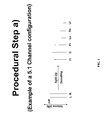
- FIG. 1 shows an example of a 5.1 channel configuration according to procedural step a) of the present invention
- FIG. 2 shows the volume/level adjusting of procedural step b) of the invention
- FIG. 3 shows the first compression/limiting of procedural step c 1 ) of the invention
- FIG. 4 shows the sound adjusting via multiband EQ of procedural step c 2 ) of the invention.
- FIG. 5 shows the encoding, limiting/maximizing of procedural step d) of the invention.
- the channel faders FL, FR, Ls, Rs, LFE of the audio tracks previously split up have a setting of 0 dB; the channel fader value of C deviates upward, depending on the audio material to be processed.
- the channel faders regulate the volume of each channel.
- the normal volume setting of a fader is 0 dB.
- the channel fader is set to 0 dB, so that the signal applied to the channel sounds the way it was originally adjusted, presuming a correctly measured and neutrally set gain value.
- the signals are sent on to the channel faders with limiters.
- each channel fader of the six channels with limiters has a setting of +8.3 dB.
- each of the six limiters has a “threshold” value of ⁇ 3.3 dB.
- the “threshold” value indicates the threshold value of the signal applied to the channel fader, starting from which the limiter starts to work.
- a limiter works in such a manner that it limits the signal as soon as the signal exceeds the threshold value. In contrast to a compressor, however, this takes place in rather simplified manner, since it reacts immediately, while a compressor keeps multiple deficit individual settings available, as to how precisely compression is to take place.
- the limiter has more of the properties of a signal compression. If, in the present case, the value exceeds ⁇ 3.3 dB, then limiting takes place from the top (and the signal thereby gains loudness, in that the energy within the system is increased, because the level cannot increase further), specifically in such manner that it nevertheless does not change its character. If all the channels were simply strongly limited, the result would appear strong, but flat and without depth, and with a “pumping” effect.
- the threshold value at the channel C can vary in terms of threshold value—depending on the audio to be processed.
- each limiter has a “release” value of 1.00
- the “release” value states how long the limiter needs to return to the zero position after the applied signal has dropped back down below the threshold value. If a signal goes above the threshold limit, the limiter limits the level. If the signal drops again, there are multiple possibilities for selecting the “release” value.
- the “output level” value indicates the strength of the signal applied to the channel after processing by the limiter. This is fundamentally a normal signal amplifier/limiter. The advantage of this value is that a fixed configuration can be found, which allows finding the correct ratios of the volumes again—both in the later stereo/mono mode but also in all the surround formats.
- the “output level” value of channel C can vary, depending on the audio material to be processed.
- the threshold value cannot be standardized.
- a threshold value of ⁇ 2.6 dB has proven to be advantageous.
- This method can also be applied to finished, produced individual tracks of a surround mix (discrete tracks), to form them into an Lt, Rt track.
Landscapes
- Engineering & Computer Science (AREA)
- Physics & Mathematics (AREA)
- Signal Processing (AREA)
- Acoustics & Sound (AREA)
- Theoretical Computer Science (AREA)
- Mathematical Optimization (AREA)
- Mathematical Physics (AREA)
- Pure & Applied Mathematics (AREA)
- Mathematical Analysis (AREA)
- General Physics & Mathematics (AREA)
- Algebra (AREA)
- Computational Linguistics (AREA)
- Health & Medical Sciences (AREA)
- Audiology, Speech & Language Pathology (AREA)
- Human Computer Interaction (AREA)
- Multimedia (AREA)
- Stereophonic System (AREA)
Abstract
Description
-
- a) splitting a channel or a channel mixture into individual channels;
- b) processing the resulting individual channels by means of setting the parameter channel fader;
- c) limiting the individual channels by means of setting the values of the parameters channel fader, threshold, release, and output level; and
- d) encoding the individual channels.
| Channel “FL”: | −17.5 db | ||
| Channel “FR”: | −17.5 db | ||
| Channel “C”: | −17.5 db | ||
| Channel “LS”: | −18.5 db | ||
| Channel “RS”: | −18.5 db | ||
| Channel “LFE”: | −18.5 db | ||
Claims (10)
Applications Claiming Priority (4)
| Application Number | Priority Date | Filing Date | Title |
|---|---|---|---|
| DE102008036924.1 | 2008-08-08 | ||
| DE102008036924 | 2008-08-08 | ||
| DE102008036924A DE102008036924B4 (en) | 2008-08-08 | 2008-08-08 | Method for multi-channel processing in a multi-channel sound system |
| PCT/EP2008/011128 WO2010015275A1 (en) | 2008-08-08 | 2008-12-29 | Method for multi-channel processing in a multi-channel sound system |
Publications (2)
| Publication Number | Publication Date |
|---|---|
| US20110129091A1 US20110129091A1 (en) | 2011-06-02 |
| US8755530B2 true US8755530B2 (en) | 2014-06-17 |
Family
ID=40512428
Family Applications (1)
| Application Number | Title | Priority Date | Filing Date |
|---|---|---|---|
| US12/737,692 Active - Reinstated US8755530B2 (en) | 2008-08-08 | 2008-12-29 | Method for multi-channel processing in a multi-channel sound system |
Country Status (7)
| Country | Link |
|---|---|
| US (1) | US8755530B2 (en) |
| EP (1) | EP2321982B1 (en) |
| JP (1) | JP5917145B2 (en) |
| KR (1) | KR101571197B1 (en) |
| DE (1) | DE102008036924B4 (en) |
| DK (1) | DK2321982T3 (en) |
| WO (1) | WO2010015275A1 (en) |
Cited By (2)
| Publication number | Priority date | Publication date | Assignee | Title |
|---|---|---|---|---|
| US9628932B2 (en) | 2013-02-04 | 2017-04-18 | Kronoton Gmbh | Method for processing a multichannel sound in a multichannel sound system |
| US10735119B2 (en) | 2013-09-06 | 2020-08-04 | Gracenote, Inc. | Modifying playback of content using pre-processed profile information |
Families Citing this family (5)
| Publication number | Priority date | Publication date | Assignee | Title |
|---|---|---|---|---|
| US9692382B2 (en) | 2012-01-06 | 2017-06-27 | Sony Corporation | Smart automatic audio recording leveler |
| JP6056356B2 (en) | 2012-10-10 | 2017-01-11 | ティアック株式会社 | Recording device |
| JP6079119B2 (en) | 2012-10-10 | 2017-02-15 | ティアック株式会社 | Recording device |
| US9820073B1 (en) | 2017-05-10 | 2017-11-14 | Tls Corp. | Extracting a common signal from multiple audio signals |
| KR102504081B1 (en) * | 2022-08-18 | 2023-02-28 | 주식회사 킨트 | System for mastering sound files |
Citations (4)
| Publication number | Priority date | Publication date | Assignee | Title |
|---|---|---|---|---|
| US20040213420A1 (en) * | 2003-04-24 | 2004-10-28 | Gundry Kenneth James | Volume and compression control in movie theaters |
| US20050195995A1 (en) * | 2004-03-03 | 2005-09-08 | Frank Baumgarte | Audio mixing using magnitude equalization |
| US20060106620A1 (en) * | 2004-10-28 | 2006-05-18 | Thompson Jeffrey K | Audio spatial environment down-mixer |
| US8073160B1 (en) * | 2008-07-18 | 2011-12-06 | Adobe Systems Incorporated | Adjusting audio properties and controls of an audio mixer |
Family Cites Families (10)
| Publication number | Priority date | Publication date | Assignee | Title |
|---|---|---|---|---|
| JPH04132499A (en) * | 1990-09-25 | 1992-05-06 | Matsushita Electric Ind Co Ltd | Sound image controller |
| JP3991372B2 (en) * | 1995-08-30 | 2007-10-17 | 日本ビクター株式会社 | Digital signal processor |
| JP3788537B2 (en) * | 1997-01-20 | 2006-06-21 | 松下電器産業株式会社 | Acoustic processing circuit |
| JPH11113098A (en) * | 1997-10-03 | 1999-04-23 | Victor Co Of Japan Ltd | Two-channel encoding processor for multi-channel audio signal |
| US6931370B1 (en) * | 1999-11-02 | 2005-08-16 | Digital Theater Systems, Inc. | System and method for providing interactive audio in a multi-channel audio environment |
| JP2001275195A (en) * | 2000-03-24 | 2001-10-05 | Onkyo Corp | Encoding / decoding system |
| JP2002175097A (en) * | 2000-12-06 | 2002-06-21 | Yamaha Corp | Encoding and compressing device, and decoding and expanding device for voice signal |
| JP2003009297A (en) * | 2001-06-21 | 2003-01-10 | Kenwood Corp | Signal processing circuit and signal processing method |
| JP4084990B2 (en) * | 2002-11-19 | 2008-04-30 | 株式会社ケンウッド | Encoding device, decoding device, encoding method and decoding method |
| JP4186228B2 (en) * | 2005-03-17 | 2008-11-26 | ヤマハ株式会社 | Acoustic adjustment console |
-
2008
- 2008-08-08 DE DE102008036924A patent/DE102008036924B4/en active Active
- 2008-12-29 KR KR1020117005511A patent/KR101571197B1/en active Active
- 2008-12-29 WO PCT/EP2008/011128 patent/WO2010015275A1/en not_active Ceased
- 2008-12-29 US US12/737,692 patent/US8755530B2/en active Active - Reinstated
- 2008-12-29 DK DK08875130.0T patent/DK2321982T3/en active
- 2008-12-29 EP EP08875130.0A patent/EP2321982B1/en active Active
- 2008-12-29 JP JP2011521440A patent/JP5917145B2/en active Active
Patent Citations (4)
| Publication number | Priority date | Publication date | Assignee | Title |
|---|---|---|---|---|
| US20040213420A1 (en) * | 2003-04-24 | 2004-10-28 | Gundry Kenneth James | Volume and compression control in movie theaters |
| US20050195995A1 (en) * | 2004-03-03 | 2005-09-08 | Frank Baumgarte | Audio mixing using magnitude equalization |
| US20060106620A1 (en) * | 2004-10-28 | 2006-05-18 | Thompson Jeffrey K | Audio spatial environment down-mixer |
| US8073160B1 (en) * | 2008-07-18 | 2011-12-06 | Adobe Systems Incorporated | Adjusting audio properties and controls of an audio mixer |
Non-Patent Citations (6)
| Title |
|---|
| Benson, K. B., "Audio Engineering Handbook," 1988 McGraw Hill, New York, US, XP002523505, ISBN 0-07-004777-4, p. 14.28-p. 14.44. (ISR). |
| Christian Birkner, Surround, Einführung in die Mehrkanaltontechnik [Surround, introduction to multi-channel sound technology], PPV Presse Projekt Verlags GmbH [publisher], Bergkirchen, 2002). (Spec, p. 4). |
| Dolby Laboratories, Inc. "DP563 Dolby Surround and Pro Logic II Encoder User's Manual," [Online] 2003, XP002523630, Retrieved from the Internet: URL: http://www.dolby.com/uploadedFiles/zz--Shared-Assets/English-PDFs/Professiona1/148-563-2.Manual.pdf>. (ISR). |
| Dolby Laboratories, Inc. "Mixing Information for Dolby Pro Logic II," [Online] 2005, XP002523504, Retrieved from the Internet: URL: http://www.dolby.com/uploadedFiles/zz--Shared-Assets/English-PDFs/Professional/214-Mixing%20with%20Dolby%20Pro%20Logic%20II%20Technology.pdf>. (ISR). |
| Hilson, Jim; Gray, David, Dicosimo, Michael, "Dolby Surround Mixing Manual," [Online] 2005, XP007906506, Retrieved from the Internet: URL:http://www.dolby.com/uploadedFiles/zz--Shared-Assets/English-PDFs/Professional/44-SurroundMixing.pdf>. (ISR). |
| International Search Report. |
Cited By (2)
| Publication number | Priority date | Publication date | Assignee | Title |
|---|---|---|---|---|
| US9628932B2 (en) | 2013-02-04 | 2017-04-18 | Kronoton Gmbh | Method for processing a multichannel sound in a multichannel sound system |
| US10735119B2 (en) | 2013-09-06 | 2020-08-04 | Gracenote, Inc. | Modifying playback of content using pre-processed profile information |
Also Published As
| Publication number | Publication date |
|---|---|
| EP2321982A1 (en) | 2011-05-18 |
| WO2010015275A1 (en) | 2010-02-11 |
| KR101571197B1 (en) | 2015-11-23 |
| DE102008036924B4 (en) | 2011-04-21 |
| EP2321982B1 (en) | 2015-06-03 |
| KR20110058801A (en) | 2011-06-01 |
| US20110129091A1 (en) | 2011-06-02 |
| DK2321982T3 (en) | 2015-09-07 |
| JP2011530843A (en) | 2011-12-22 |
| JP5917145B2 (en) | 2016-05-11 |
| DE102008036924A1 (en) | 2010-02-11 |
Similar Documents
| Publication | Publication Date | Title |
|---|---|---|
| US12183355B2 (en) | System and method for non-destructively normalizing loudness of audio signals within portable devices | |
| US8892450B2 (en) | Signal clipping protection using pre-existing audio gain metadata | |
| US8355909B2 (en) | Hybrid permanent/reversible dynamic range control system | |
| US20110129091A1 (en) | Method for multi-channel processing in a multi-channel sound system | |
| US20030023429A1 (en) | Digital signal processing techniques for improving audio clarity and intelligibility | |
| KR20200011578A (en) | Optimizing loudness and dynamic range across different playback devices | |
| US20080080722A1 (en) | Loudness controller with remote and local control | |
| US10242684B2 (en) | Systems and methods for adjusting audio levels in a plurality of audio signals | |
| Wolters et al. | Loudness normalization in the age of portable media players | |
| KR20230122397A (en) | Surruond Sound Mastering Processing | |
| HK40096159B (en) | Signal clipping protection using pre-existing audio gain metadata | |
| HK40096159A (en) | Signal clipping protection using pre-existing audio gain metadata | |
| HK40117482A (en) | Signal clipping protection using pre-existing audio gain metadata | |
| HK1237985A1 (en) | Signal clipping protection using pre-existing audio gain metadata | |
| HK1237985B (en) | Signal clipping protection using pre-existing audio gain metadata | |
| HK1261365A1 (en) | System and method for optimizing loudness and dynamic range across different playback devices | |
| CA2736684A1 (en) | Systems and methods for adjusting audio levels in a plurality of audio signals |
Legal Events
| Date | Code | Title | Description |
|---|---|---|---|
| AS | Assignment |
Owner name: KRONOTON GMBH, GERMANY Free format text: ASSIGNMENT OF ASSIGNORS INTEREST;ASSIGNOR:KRON, GUNNAR;REEL/FRAME:030331/0727 Effective date: 20130424 |
|
| FEPP | Fee payment procedure |
Free format text: PAYOR NUMBER ASSIGNED (ORIGINAL EVENT CODE: ASPN); ENTITY STATUS OF PATENT OWNER: SMALL ENTITY |
|
| FEPP | Fee payment procedure |
Free format text: MAINTENANCE FEE REMINDER MAILED (ORIGINAL EVENT CODE: REM.) |
|
| LAPS | Lapse for failure to pay maintenance fees |
Free format text: PATENT EXPIRED FOR FAILURE TO PAY MAINTENANCE FEES (ORIGINAL EVENT CODE: EXP.) |
|
| STCH | Information on status: patent discontinuation |
Free format text: PATENT EXPIRED DUE TO NONPAYMENT OF MAINTENANCE FEES UNDER 37 CFR 1.362 |
|
| FP | Lapsed due to failure to pay maintenance fee |
Effective date: 20180617 |
|
| FP | Lapsed due to failure to pay maintenance fee |
Effective date: 20180617 |
|
| PRDP | Patent reinstated due to the acceptance of a late maintenance fee |
Effective date: 20200407 |
|
| FEPP | Fee payment procedure |
Free format text: PETITION RELATED TO MAINTENANCE FEES FILED (ORIGINAL EVENT CODE: PMFP); ENTITY STATUS OF PATENT OWNER: SMALL ENTITY Free format text: PETITION RELATED TO MAINTENANCE FEES GRANTED (ORIGINAL EVENT CODE: PMFG); ENTITY STATUS OF PATENT OWNER: SMALL ENTITY Free format text: SURCHARGE, PETITION TO ACCEPT PYMT AFTER EXP, UNINTENTIONAL. (ORIGINAL EVENT CODE: M2558); ENTITY STATUS OF PATENT OWNER: SMALL ENTITY |
|
| MAFP | Maintenance fee payment |
Free format text: PAYMENT OF MAINTENANCE FEE, 4TH YR, SMALL ENTITY (ORIGINAL EVENT CODE: M2551); ENTITY STATUS OF PATENT OWNER: SMALL ENTITY Year of fee payment: 4 |
|
| STCF | Information on status: patent grant |
Free format text: PATENTED CASE |
|
| MAFP | Maintenance fee payment |
Free format text: PAYMENT OF MAINTENANCE FEE, 8TH YR, SMALL ENTITY (ORIGINAL EVENT CODE: M2552); ENTITY STATUS OF PATENT OWNER: SMALL ENTITY Year of fee payment: 8 |
|
| MAFP | Maintenance fee payment |
Free format text: PAYMENT OF MAINTENANCE FEE, 12TH YR, SMALL ENTITY (ORIGINAL EVENT CODE: M2553); ENTITY STATUS OF PATENT OWNER: SMALL ENTITY Year of fee payment: 12 |
|
| AS | Assignment |
Owner name: HOTTES & MILLER GBR, GERMANY Free format text: ASSIGNMENT OF ASSIGNORS INTEREST;ASSIGNOR:KRONOTON GMBH;REEL/FRAME:074382/0158 Effective date: 20260318 |