US8742519B2 - Magnetic storage element and magnetic memory - Google Patents
Magnetic storage element and magnetic memory Download PDFInfo
- Publication number
- US8742519B2 US8742519B2 US13/150,995 US201113150995A US8742519B2 US 8742519 B2 US8742519 B2 US 8742519B2 US 201113150995 A US201113150995 A US 201113150995A US 8742519 B2 US8742519 B2 US 8742519B2
- Authority
- US
- United States
- Prior art keywords
- layer
- magnetization
- magnetic
- storage element
- recording layer
- Prior art date
- Legal status (The legal status is an assumption and is not a legal conclusion. Google has not performed a legal analysis and makes no representation as to the accuracy of the status listed.)
- Expired - Fee Related, expires
Links
Images



Classifications
-
- H—ELECTRICITY
- H10—SEMICONDUCTOR DEVICES; ELECTRIC SOLID-STATE DEVICES NOT OTHERWISE PROVIDED FOR
- H10N—ELECTRIC SOLID-STATE DEVICES NOT OTHERWISE PROVIDED FOR
- H10N50/00—Galvanomagnetic devices
- H10N50/10—Magnetoresistive devices
-
- G—PHYSICS
- G11—INFORMATION STORAGE
- G11C—STATIC STORES
- G11C11/00—Digital stores characterised by the use of particular electric or magnetic storage elements; Storage elements therefor
- G11C11/02—Digital stores characterised by the use of particular electric or magnetic storage elements; Storage elements therefor using magnetic elements
- G11C11/16—Digital stores characterised by the use of particular electric or magnetic storage elements; Storage elements therefor using magnetic elements using elements in which the storage effect is based on magnetic spin effect
-
- G—PHYSICS
- G11—INFORMATION STORAGE
- G11C—STATIC STORES
- G11C11/00—Digital stores characterised by the use of particular electric or magnetic storage elements; Storage elements therefor
- G11C11/02—Digital stores characterised by the use of particular electric or magnetic storage elements; Storage elements therefor using magnetic elements
- G11C11/16—Digital stores characterised by the use of particular electric or magnetic storage elements; Storage elements therefor using magnetic elements using elements in which the storage effect is based on magnetic spin effect
- G11C11/161—Digital stores characterised by the use of particular electric or magnetic storage elements; Storage elements therefor using magnetic elements using elements in which the storage effect is based on magnetic spin effect details concerning the memory cell structure, e.g. the layers of the ferromagnetic memory cell
-
- G—PHYSICS
- G11—INFORMATION STORAGE
- G11C—STATIC STORES
- G11C11/00—Digital stores characterised by the use of particular electric or magnetic storage elements; Storage elements therefor
- G11C11/02—Digital stores characterised by the use of particular electric or magnetic storage elements; Storage elements therefor using magnetic elements
- G11C11/16—Digital stores characterised by the use of particular electric or magnetic storage elements; Storage elements therefor using magnetic elements using elements in which the storage effect is based on magnetic spin effect
- G11C11/165—Auxiliary circuits
- G11C11/1675—Writing or programming circuits or methods
-
- H—ELECTRICITY
- H10—SEMICONDUCTOR DEVICES; ELECTRIC SOLID-STATE DEVICES NOT OTHERWISE PROVIDED FOR
- H10B—ELECTRONIC MEMORY DEVICES
- H10B61/00—Magnetic memory devices, e.g. magnetoresistive RAM [MRAM] devices
- H10B61/10—Magnetic memory devices, e.g. magnetoresistive RAM [MRAM] devices comprising components having two electrodes, e.g. diodes or MIM elements
-
- H—ELECTRICITY
- H10—SEMICONDUCTOR DEVICES; ELECTRIC SOLID-STATE DEVICES NOT OTHERWISE PROVIDED FOR
- H10B—ELECTRONIC MEMORY DEVICES
- H10B61/00—Magnetic memory devices, e.g. magnetoresistive RAM [MRAM] devices
- H10B61/20—Magnetic memory devices, e.g. magnetoresistive RAM [MRAM] devices comprising components having three or more electrodes, e.g. transistors
- H10B61/22—Magnetic memory devices, e.g. magnetoresistive RAM [MRAM] devices comprising components having three or more electrodes, e.g. transistors of the field-effect transistor [FET] type
-
- H—ELECTRICITY
- H10—SEMICONDUCTOR DEVICES; ELECTRIC SOLID-STATE DEVICES NOT OTHERWISE PROVIDED FOR
- H10N—ELECTRIC SOLID-STATE DEVICES NOT OTHERWISE PROVIDED FOR
- H10N50/00—Galvanomagnetic devices
- H10N50/01—Manufacture or treatment
-
- H—ELECTRICITY
- H10—SEMICONDUCTOR DEVICES; ELECTRIC SOLID-STATE DEVICES NOT OTHERWISE PROVIDED FOR
- H10N—ELECTRIC SOLID-STATE DEVICES NOT OTHERWISE PROVIDED FOR
- H10N50/00—Galvanomagnetic devices
- H10N50/80—Constructional details
-
- H—ELECTRICITY
- H10—SEMICONDUCTOR DEVICES; ELECTRIC SOLID-STATE DEVICES NOT OTHERWISE PROVIDED FOR
- H10N—ELECTRIC SOLID-STATE DEVICES NOT OTHERWISE PROVIDED FOR
- H10N50/00—Galvanomagnetic devices
- H10N50/80—Constructional details
- H10N50/85—Materials of the active region
Definitions
- the present disclosure relates to non-volatile magnetic storage element and magnetic memory that perform information recording by spin injection magnetization reversal.
- the dynamic random access memory which is a high-density recording memory capable of high-speed operation, is widely used as a random access memory in various kinds of information apparatus such as computers.
- the DRAM is a volatile memory, in which information is lost when the power supply is turned off. Therefore, it is desired to put into practical use a non-volatile memory that has performance equivalent to that of the DRAM and is free from the information loss.
- a magnetic random access memory (MRAM) to record information based on the magnetization of a magnetic material is attracting attention and its development is being advanced.
- the methods for recording of the MRAM include a method of reversing magnetization by a current magnetic field and a spin injection magnetization reversal method of causing magnetization reversal by injecting spin-polarized electrons directly into the recording layer as described in e.g. Japanese Patent Laid-open No. 2004-193595. This method is attracting attention because the recording current can be made smaller as the element size becomes smaller.
- ⁇ denotes the damping constant
- e denotes the charge of an electron
- ⁇ denotes the gyro constant
- Ms denotes the saturation magnetization of the magnetic layer whose magnetization rotates.
- H eff denotes the effective magnetic field acting on the magnetic layer, such as an anisotropic magnetic field (Ha) due to magnetic anisotropy and an external magnetic field
- V denotes the volume of the magnetic layer
- g denotes the spin injection efficiency
- ⁇ B denotes the Bohr magneton.
- a magnetic storage element including a reference layer configured to have a magnetization direction fixed to a predetermined direction, a recording layer configured to have a magnetization direction that changes due to spin injection in a direction corresponding to recording information, an intermediate layer configured to separate the recording layer from the reference layer, and a heat generator configured to heat the recording layer.
- a material of the recording layer is such a magnetic material that magnetization at 150° C. is at least 50% of magnetization at a room temperature and magnetization at a temperature in the range from 150° C. to 200° C. is in the range from 10% to 80% of magnetization at a room temperature.
- a magnetic memory including the magnetic storage element having the above-described configuration.
- this magnetic memory includes a magnetic storage element configured to include a reference layer having a magnetization direction fixed to a predetermined direction, a recording layer having a magnetization direction that changes due to spin injection in a direction corresponding to recording information, an intermediate layer that separates the recording layer from the reference layer, and a heat generator that heats the recording layer.
- the magnetic memory includes two kinds of interconnects configured to intersect with each other, and the magnetic storage element is disposed near the intersection of two kinds of interconnects and between two kinds of interconnects.
- a material of the recording layer is such a magnetic material that magnetization at 150° C. is at least 50% of magnetization at a room temperature and magnetization at a temperature in the range from 150° C. to 200° C. is in the range from 10% to 80% of magnetization at a room temperature.
- the heat generator to heat the recording layer is provided and such a material that the temperature characteristic of the magnetization has a specific range is used as the material of the recording layer. Specifically, such a material is used that, as this temperature characteristic, magnetization equal to or higher than 50% is obtained at 150° C. and magnetization in the range from 10% to 80% is obtained at a temperature in the range from 150° C. to 200° C. on the basis of the magnetization of the recording layer material at a room temperature.
- the current necessary to cause magnetization reversal by spin injection can be reduced without the lowering of the information retention characteristic.
- FIG. 1 is a schematic perspective view of the configuration of a magnetic memory according to an embodiment of the present disclosure
- FIG. 2 is a schematic sectional view of the configuration of a magnetic storage element according to the embodiment of the present disclosure
- FIG. 3 is a schematic sectional view of the configuration of a modification example of the magnetic storage element according to the embodiment of the present disclosure
- FIG. 4 is a schematic sectional view of the configuration of another modification example of the magnetic storage element according to the embodiment of the present disclosure.
- FIG. 5 is a schematic sectional view of the configuration of another modification example of the magnetic storage element according to the embodiment of the present disclosure.
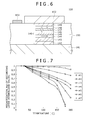
- FIG. 6 is a schematic sectional view of the configuration of another modification example of the magnetic storage element according to the embodiment of the present disclosure.
- FIG. 7 is a diagram showing the temperature dependence of the magnetization of a recording layer in samples 1 to 7 of the magnetic storage element.
- FIG. 8 is a diagram showing the spin injection magnetization reversal current density Jc in samples 1 to 7 of the magnetic storage element on each element structure basis.
- this magnetic memory 10 includes two kinds of address interconnects intersecting with each other, e.g. word lines and bit lines, and is formed by disposing magnetic storage elements 3 near the intersections of these two kinds of interconnects and between the interconnects.
- this magnetic storage element 3 a magnetic storage element according to an embodiment and modification examples to be described later is used.
- a drain region 8 in the area isolated by an element isolating layer 2 in a semiconductor substrate 11 composed of e.g. Si, a drain region 8 , a source region 7 , and a gate electrode 1 are formed. These components configure a selection transistor for selecting the corresponding magnetic storage element 3 .
- the gate electrode 1 serves also as one address interconnect (e.g. word line) extended along the anteroposterior direction in the diagram.
- the drain region 8 is formed in common to the selection transistors on the left and right sides in the diagram.
- An interconnect 9 is connected to this drain region 8 .
- the magnetic storage element 3 is disposed between the source region 7 and the other address interconnect (e.g. bit line) 6 that is disposed on the upper side and extended along the horizontal direction in the diagram.
- This magnetic storage element 3 includes a recording layer formed of a ferromagnetic layer whose magnetization direction is reversed by spin injection and a heat generator to heat this recording layer.
- this recording layer is composed of such a material that the magnetization at 150° C. is at least 50% of the magnetization at a room temperature and the magnetization at a temperature in the range from 150° C. to 200° C. is in the range from 10% to 80% of the magnetization at a room temperature.
- This magnetic storage element 3 is disposed near the intersection of the gate electrode 1 and the interconnect 6 , which serve as two kinds of address interconnects, and is connected to these interconnects via upper and lower contact layers 4 . This makes it possible to apply a current in the vertical direction to the magnetic storage element 3 via two kinds of interconnects, i.e. the gate electrode 1 and the interconnect 6 , and reverse the magnetization direction of the recording layer by spin injection corresponding to information.
- the existence of the magnetic storage element 3 having the recording layer and the heat generator with the above-described configuration enables this magnetic memory 10 to effectively lower the magnetization of the recording layer in information recording and perform information rewriting by small current with keeping of the information retention characteristic that is stable against thermal fluctuation and so forth.
- a magnetic storage element As shown in FIG. 2 , in this magnetic storage element 30 , a base layer 22 composed of e.g. Ta serving also as one of the electrodes and an antiferromagnetic layer 23 composed of e.g. PtMn are formed in that order over a substrate 21 composed of e.g. thermally-oxidized silicon. Furthermore, a reference layer 24 composed of a ferromagnetic material such as CoFe or CoFeB is stacked on the antiferromagnetic layer 23 and the magnetization direction of the reference layer 24 is fixed. Over the reference layer 24 , a non-magnetic layer 25 composed of e.g.
- Ru and a reference layer 26 composed of a ferromagnetic material such as CoFe or CoFeB are formed in that order.
- the reference layer 24 and the reference layer 26 are coupled to each other with the intermediary of the non-magnetic layer 25 in such a manner that the magnetization directions of these layers are antiparallel to each other, so that a synthetic ferrimagnetic structure is formed.
- the structure is not limited thereto.
- a recording layer 28 whose magnetization direction changes due to spin injection is formed with the intermediary of an intermediate layer 27 composed of a non-magnetic material. It is preferable to use e.g. a metal material of small spin scattering such as Cu or a ceramic material such as Al 2 O 3 or MgO as the material of the intermediate layer 27 . In particular, using MgO or the like is preferable because a large signal is obtained as a reproduction signal in reading. The material of the recording layer 28 will be described later.
- a heat generator 33 formed of e.g. a thermal resistance layer composed of e.g. Ti is formed on the recording layer 28 formed of a ferromagnetic layer. Furthermore, a cap layer 29 composed of e.g. Ta is formed on this heat generator 33 , so that a multilayer structure part 20 is configured.
- the planar shape of this multilayer structure part 20 may be e.g. an elliptical shape as shown in FIG. 1 . However, another planar shape may be employed and there is no particular limitation.
- the periphery of this multilayer structure part 20 is buried in a filling layer 31 composed of a non-magnetic material and the surface of the multilayer structure part 20 is flush with the cap layer 29 .
- an electrode layer 32 to apply a current to the magnetic storage element 30 is formed on the cap layer 29 and the filling layer 31 .
- an electrode layer 32 to apply a current to the magnetic storage element 30 is formed on the cap layer 29 and the filling layer 31 .
- FIG. 2 and FIGS. 3 to 6 to be described later the direction of the magnetization possessed by a ferromagnetic layer is schematically shown by an arrowhead.
- this magnetic storage element 30 a voltage is applied between the base layer 22 and the electrode layer 32 and a current is applied in a direction perpendicular to the film plane of the magnetic storage element 30 to carry out spin injection, to thereby change the relative angle between the magnetization directions of the recording layer 28 and the reference layer 26 . Therefore, in the spin injection through the current application, Joule heat due to the applied current is generated, and the influence of the heat generation exists even when the heat generator 33 is not provided.
- the same material as that of the related art is used as the magnetic material of the recording layer 28 , the ratio of contribution to reduction in the spin injection current by the Joule heat generated in a normal element structure is at an ignorable level.
- reduction in the spin injection current can be realized by using such a magnetic material that the temperature dependence of the magnetic characteristics falls within a specific range as the material of the recording layer 28 and providing the heat generator 33 to aggressively utilize the effect of heat generation.
- the recording layer 28 such a magnetic material is used that the magnetization at 150° C. is at least 50% of the magnetization at a room temperature and the magnetization at a temperature in the range from 150° C. to 200° C. is in the range from 10% to 80% of the magnetization at a room temperature. Due to the use of such a magnetic material, the magnetization of the recording layer 28 is sufficiently lowered when the current necessary for spin injection magnetization reversal is applied, and the recording current is reduced.
- the magnetization of the recording layer 28 is lowered to a value smaller than 50% of the magnetization at a room temperature when the temperature is lower than 150° C., a problem occurs in the information retention characteristic although the effect of reduction in the recording current is obtained. Because the magnetic storage element 30 of the spin injection type is a non-volatile memory, it should retain the recorded information for e.g.
- the upper limit of the temperature range is about 90° C. to 120° C. although the temperature range changes depending on the use purpose. So, information retention tests were made with use of these temperatures as the upper limit. As a result, it was found that the occurrence rate of an information retention error is not sufficiently decreased if such a magnetic material that the magnetization is lowered to a value smaller than 50% of the magnetization at a room temperature when the temperature is lower than 150° C. is used as the material of the recording layer 28 .
- magnetization of the recording layer 28 becomes lower than 10% of the magnetization at a room temperature when the temperature is in the range from 150° C. to 200° C., magnetization reversal can be induced by small current. However, if such a material that the magnetization becomes extremely low is used as the recording layer 28 , the back hopping frequently occurs and it is difficult to stably control the magnetization state of the recording layer 28 (refer to e.g. “Journal of Applied Physics 105, 07D126 (2009)”).
- such a magnetic material that the magnetization at 150° C. is at least 50% of the magnetization at a room temperature and the magnetization at a temperature in the range from 150° C. to 200° C. is in the range from 10% to 80% of the magnetization at a room temperature is used as the recording layer 28 .
- Such a temperature characteristic is preferable because it can be easily realized by using a material obtained by combining at least one element of Co and Fe and at least one of a non-magnetic element and an oxide.
- the non-magnetic element include Ta, Zr, and V.
- the oxide include SiO 2 , MgO, and Al—O (aluminum oxide).
- Examples of the magnetic material used as the base include CoFe, CoFeB, and alloys containing these substances.
- a material layer having a high thermal resistance rate such as a Ti layer, be provided as the heat generator 33 . If such a thermal resistance material is used as the heat generator 33 , heat is generated in a certain range when a current is applied. In addition, the configuration is simple and the manufacturing is also easy.
- the magnetic layers used as the reference layers 24 and 26 and the recording layer 28 may be either an in-plane magnetization film or a perpendicular magnetization film. However, when the reference layers 24 and 26 are in-plane magnetization films, an in-plane magnetization film is employed also as the recording layer 28 . Conversely, when the reference layers 24 and 26 are perpendicular magnetization films, it is preferable to employ a perpendicular magnetization film also as the recording layer 28 . As just described, it is preferable that the magnetization directions of the reference layers 24 and 26 and the recording layer 28 be parallel to each other or antiparallel to each other.
- the same materials as those in the related-art magnetic storage element of the spin injection type can be used besides the above-described materials.
- the same applies also to the substrate 21 , the filling layer 31 , and the electrode layer 32 , and the materials and configurations thereof are not particularly limited.
- a heat generator 53 is formed on a substrate 41 .
- a base layer 42 an antiferromagnetic layer 43 , a reference layer 44 , a non-magnetic layer 45 , a reference layer 46 , an intermediate layer 47 formed of a non-magnetic layer, a recording layer 48 , and a cap layer 49 are formed in that order.
- the heat generator 53 is formed of e.g. a thermal resistance layer.
- the respective layers from the heat generator 53 to the cap layer 49 are formed with e.g.
- the magnetization at 150° C. is at least 50% of the magnetization at a room temperature and the magnetization at a temperature in the range from 150° C. to 200° C. is in the range from 10% to 80% of the magnetization at a room temperature.
- the materials and film thicknesses of the respective other layers configuring the multilayer structure part 40 except the heat generator 53 may be the same as those of the related-art magnetic storage element of the spin injection type, and the manufacturing method thereof is also not particularly limited. The same applies also to the substrate 41 , the filling layer 51 , and the electrode layer 52 , and the materials and configurations thereof are not particularly limited.
- the reference layers 24 , 26 , 44 , and 46 are disposed closer to the substrates 21 and 41 than the recording layers 28 and 48 .
- the structure is not limited thereto.
- the same characteristics can be achieved also with a reverse structure in which the recording layers 28 and 48 are disposed closer to the substrates 21 and 41 and the reference layers 24 , 26 , 44 , and 46 are disposed closer to the electrode layers 32 and 52 on the upper side.
- a magnetic storage element 90 has a so-called dual configuration in which reference layers 66 and 76 are provided below and over a recording layer 68 with the intermediary of intermediate layers 67 and 77 formed of non-magnetic layers.
- this magnetic storage element 90 over a substrate 61 , a base layer 62 , an antiferromagnetic layer 63 , a reference layer 64 , a non-magnetic layer 65 , the reference layer 66 , the intermediate layer 67 formed of a non-magnetic layer, and the recording layer 68 are formed in that order.
- the intermediate layer 77 formed of a non-magnetic layer, the reference layer 76 , a non-magnetic layer 75 , a reference layer 74 , a non-magnetic layer 85 , a reference layer 84 , and an antiferromagnetic layer 83 are formed in that order.
- a heat generator 93 formed of e.g. a thermal resistance layer is formed over the antiferromagnetic layer 83 .
- a cap layer 89 is formed on the heat generator 93 , so that a multilayer structure part 60 is configured.
- a filling layer 91 is formed around the multilayer structure part 60 and an electrode layer 92 is formed on the cap layer 89 and the filling layer 91 .
- the material of the recording layer 68 such a magnetic material is used that the magnetization at 150° C. is at least 50% of the magnetization at a room temperature and the magnetization at a temperature in the range from 150° C. to 200° C. is in the range from 10% to 80% of the magnetization at a room temperature.
- the materials and film thicknesses of the respective other layers configuring the multilayer structure part 60 except the heat generator 93 may be the same as those of the related-art magnetic storage element of the spin injection type, and the manufacturing method thereof is also not particularly limited. The same applies also to the substrate 61 , the filling layer 91 , and the electrode layer 92 , and the materials and configurations thereof are not particularly limited.
- a magnetic storage element 130 also has a dual configuration in which reference layers 106 and 116 are provided below and over a recording layer 108 with the intermediary of intermediate layers 107 and 117 formed of non-magnetic layers, similarly to the second modification example.
- a heat generator 133 is provided between a substrate 101 and a base layer 102 .
- the heat generator 133 formed of e.g.
- the base layer 102 an antiferromagnetic layer 103 , a reference layer 104 , a non-magnetic layer 105 , the reference layer 106 , the intermediate layer 107 formed of a non-magnetic layer, and the recording layer 108 are formed in that order. Furthermore, over the recording layer 108 , the intermediate layer 117 formed of a non-magnetic layer, the reference layer 116 , a non-magnetic layer 115 , a reference layer 114 , a non-magnetic layer 125 , a reference layer 124 , and an antiferromagnetic layer 123 are formed in that order.
- a cap layer 129 is formed on the antiferromagnetic layer 123 , so that a multilayer structure part 100 is configured.
- a filling layer 131 is formed around the multilayer structure part 100 and an electrode layer 132 is formed on the cap layer 129 and the filling layer 131 .
- the material of the recording layer 108 such a magnetic material is used that the magnetization at 150° C. is at least 50% of the magnetization at a room temperature and the magnetization at a temperature in the range from 150° C. to 200° C. is in the range from 10% to 80% of the magnetization at a room temperature.
- the materials and film thicknesses of the respective other layers configuring the multilayer structure part 100 except the heat generator 133 may be the same as those of the related-art magnetic storage element of the spin injection type, and the manufacturing method thereof is also not particularly limited. The same applies also to the substrate 101 , the filling layer 131 , and the electrode layer 132 , and the materials and configurations thereof are not particularly limited.
- reference layers 144 and 146 are provided on a single side of a recording layer 148 similarly to the examples shown in FIG. 2 and FIG. 3 .
- a heat generator 153 is provided on a filling layer 151 separately from a multilayer structure part 140 .
- a base layer 142 over a substrate 141 , a base layer 142 , an antiferromagnetic layer 143 , the reference layer 144 , a non-magnetic layer 145 , the reference layer 146 , an intermediate layer 147 formed of a non-magnetic layer, the recording layer 148 , and a cap layer 149 are formed in that order.
- the respective layers from the base layer 142 to the cap layer 149 are formed with e.g. an elliptical shape as their planar shape, so that the multilayer structure part 140 is configured.
- the filling layer 151 is formed around the multilayer structure part 140 and an electrode layer 152 is formed on the cap layer 149 and the filling layer 151 .
- the heat generator 153 is formed e.g. at a position adjacent to the electrode layer 152 .
- the heat generator 153 is formed of e.g. a thermal resistance layer.
- the material of the recording layer 148 such a magnetic material is used that the magnetization at 150° C. is at least 50% of the magnetization at a room temperature and the magnetization at a temperature in the range from 150° C. to 200° C. is in the range from 10% to 80% of the magnetization at a room temperature.
- the materials and film thicknesses of the respective other layers configuring the multilayer structure part 140 except the heat generator 153 may be the same as those of the related-art magnetic storage element of the spin injection type, and the manufacturing method thereof is also not particularly limited. The same applies also to the substrate 141 , the filling layer 151 , and the electrode layer 152 , and the materials and configurations thereof are not particularly limited.
- the configuration of the reference layers two magnetic material layers and one non-magnetic material layer are disposed in the lower part (substrate side) and three magnetic material layers and two non-magnetic material layers are disposed in the upper part (opposite side to the substrate).
- the lower part and the upper part may be interchanged, and one magnetic material layer may be employed as the reference layer.
- the numbers and combination of the magnetic material layers are not particularly limited.
- the numbers of magnetic material layers of the upper part and the lower part may be one and two, respectively, or three and four, respectively.
- the heat generator is provided in the multilayer structure part or on the filling layer surrounding the multilayer structure part.
- heat generated by the heat generator reaches the recording layer and the amount of heat generation per unit current is increased compared with the case of providing no heat generator.
- the temperature rise of the recording layer is larger compared with the case of providing no heat generator. Therefore, in spin injection, the magnetization is reduced compared with the magnetization at a room temperature.
- increase in the spin injection magnetization reversal current can be avoided.
- the distance between the recording layer and the upper/lower electrode serving as a heat sink is longer and the temperature rise of the recording layer is larger compared with the example shown in FIG. 6 .
- the temperature rise of the recording layer 146 is smaller than that in the other examples but the above-described effect due to the temperature rise is sufficiently obtained.
- the composition of CoFeB used as the base magnetic material in samples 1 to 7 is as follows: Co is 40 atomic%, Fe is 40 atomic %, and B is 20 atomic %.
- the recording layer used in the embodiments of the present disclosure is not limited to the material having this composition ratio.
- Samples 2 to 7 are configured by stacking the base magnetic material and a non-magnetic layer and/or an oxide.
- the multilayer configurations of the respective samples are as follows. Specifically, regarding the respective samples, the film thicknesses and the numbers of stacked layers about the base magnetic material, the non-magnetic layer, and the oxide, and the multilayer configuration from the substrate side (i.e. the intermediate layer side) are shown.
- the numeric value in the bracket in the multilayer configuration indicates the film thickness and the unit thereof is nm.
- Example 2 CoFeB (1 nm) ⁇ three layers, Ta (0.2 nm) ⁇ two layers] CoFeB (1)/Ta (0.2)/CoFeB (1)/Ta (0.2)/CoFeB (1)
- Sample 3 CoFeB (1 nm) ⁇ three layers, Zr (0.15 nm) ⁇ two layers, SiO 2 (0.15 nm) ⁇ two layers] CoFeB (1)/SiO 2 (0.15)/Zr (0.15)/CoFeB (1)/Zr (0.15)/SiO 2 (0.15)/CoFeB (1)
- Sample 4 CoFeB (1 nm) ⁇ four layers, Ta (0.25 nm) ⁇ two layers, MgO (0.2 nm) ⁇ one layer, MgO (0.3 nm) ⁇ two layers] CoFeB (1)/MgO(0.2)/CoFeB (1)/Ta (0.2
- FIG. 7 shows the temperature dependence of the magnetization Mst of the recoding layer in these samples 1 to 7.
- the magnetization at 150° C. is at least 50% of the magnetization at a room temperature and the magnetization at a temperature in the range from 150° C. to 200° C. is in the range from 10% to 80% of the magnetization at a room temperature.
- the recording layers in samples 2 to 5 correspond to the working examples of the present disclosure.
- the recording layers in samples 1, 6, and 7 correspond to the comparative examples.
- the difference between the case of providing no heat generator and the case of providing the heat generator was investigated for the purpose of confirming the advantageous effect of the embodiments of the present disclosure.
- the magnetic layer materials of the recording layers in samples 1 to 7 shown in Table 1 were used.
- configuration examples of the magnetic storage element the above-described configurations of FIG. 2 , FIG. 3 , and FIG. 6 were employed as a configuration “with the heat generator,” and the configuration obtained by omitting the heat generator in FIG. 2 was employed as a configuration “without the heat generator.” Based on these configuration examples, the spin injection magnetization reversal characteristic was evaluated.
- the materials and configurations of the respective components are as follows:
- Substrate thermally-oxidized Si substrate
- Base layer Ta, thickness 5 nm
- Antiferromagnetic layer PtMn, thickness 30 nm
- Reference layer (lower layer): CoFe, thickness 2 nm
- Non-magnetic layer Ru, thickness 0.8 nm
- Intermediate layer MgO, thickness 1.0 nm
- Cap layer Ta, thickness 5 nm
- Electrode layer Al—Cu, thickness 100 nm
- Filling layer SiO 2 , thickness 10 to 100 nm
- Ti which is a metal having a low thermal conductivity
- a film thickness of 80 nm When a metal having a low thermal conductivity like Ti is used, large heat generation is obtained.
- ⁇ denotes the damping constant.
- e denotes the charge of an electron.
- ⁇ denotes the gyro constant.
- Ms denotes the saturation magnetization of the magnetic layer whose magnetization rotates.
- H eff denotes the effective magnetic field acting on the magnetic layer, such as an anisotropic magnetic field (Ha) due to magnetic anisotropy and an external magnetic field.
- V denotes the volume of the magnetic layer.
- g denotes the spin injection efficiency.
- ⁇ B denotes the Bohr magneton.
- WITHOUT HEAT GENERATOR corresponds to the element structure obtained by omitting the heat generator 33 in the element configuration shown in FIG. 2 .
- WITH HEAT GENERATOR OVER RECORDING LAYER corresponds to the element structure shown in FIG. 2 .
- WITH HEAT GENERATOR BELOW REFERENCE LAYER corresponds to the element structure shown in FIG. 3 .
- WITH HEAT GENERATOR NEAR FILLING LAYER corresponds to the element structure shown in FIG. 6 .
- the spin injection magnetization reversal current Jc can be suppressed to 4.0 MA/cm 2 or lower in samples 2 to 5, which correspond to the working examples of the present disclosure.
- the magnetization in spin injection is reduced and the spin injection magnetization reversal current can be reduced.
- the spin injection current is reduced compared with the case of providing the heat generator on the filling layer.
- the spin injection magnetization reversal current density Jc can be decreased at the most degree in the element configuration in which the heat generator is provided over the recording layer.
- the material of the recording layer used in samples 1 to 7 was so adjusted that the thermal stability index ⁇ fell within the range of 50 to 55.
- the spin injection magnetization reversal current density Jc of the recording layer in sample 1 large change dependent on the element structure is not found.
- the spin injection magnetization reversal current density Jc in the element structure including the heat generator is decreased by at least 10% compared with the element structure including no heat generator, so that the advantageous effect of the embodiments of the present disclosure is confirmed.
- the spin injection magnetization reversal current density Jc can be decreased also in samples 6 and 7.
- the information retention rate is lowered and the occurrence rate of back hopping is increased in samples 6 and 7. That is, it turns out that the controllability of the magnetization reversal behavior is deteriorated in samples 6 and 7.
- the magnetic material of the recording layer it turns out that it is preferable for the magnetic material of the recording layer to have the following temperature characteristic. Specifically, it is preferable to use, as the recording layer, such a magnetic material that the magnetization at 150° C.
- the magnetization at a temperature in the range from 150° C. to 200° C. is in the range from 10% to 80% of the magnetization at a room temperature.
- Using a magnetic material having such a temperature characteristic as the recording layer can decrease the magnetization in spin injection by heating from the heat generator and thereby suppress increase in the spin injection magnetization reversal current Ic even when the film thickness is increased to some extent in order to maintain the information retention characteristic.
- the recording layer material from which such a temperature characteristic is obtained is not limited to the materials and configurations in the above-described samples 2 to 5.
- the material and composition ratio of the base magnetic material, the materials and film thicknesses of the non-magnetic material and the oxide, and the number of stacked layers and the multilayer configuration can be properly changed and the same advantageous effect can be achieved as long as a material having the above-described temperature dependence of the magnetization is employed.
Landscapes
- Engineering & Computer Science (AREA)
- Computer Hardware Design (AREA)
- Manufacturing & Machinery (AREA)
- Mram Or Spin Memory Techniques (AREA)
- Hall/Mr Elements (AREA)
Abstract
Description
Ic=α·e·γ·Ms·V·H eff/(g·μ B) (1)
- 1. First Embodiment of the Present Disclosure (embodiment of magnetic memory)
- 2. Second Embodiment of the Present Disclosure (embodiment of magnetic storage element)
- 3. Modification Examples of Second Embodiment of the Present Disclosure
- 4. Working Examples and Comparative Examples
1. First Embodiment of the Present Disclosure (Embodiment of Magnetic Memory)
| TABLE 1 | ||||
| Sample | Base Magnetic | Non-magnetic | ||
| Number | Material | Layer | | Remarks |
| # | ||||
| 1 | CoFeB: 2.5 | — | — | |
| example | ||||
| # | ||||
| 2 | CoFeB: 3 | Ta: 0.4 | — | working |
| | ||||
| # | ||||
| 3 | CoFeB: 3 | Zr: 0.3 | SiO2: 0.3 | working |
| | ||||
| # | ||||
| 4 | CoFeB: 4 | Ta: 0.5 | MgO: 0.8 | working |
| | ||||
| # | ||||
| 5 | CoFeB: 4 | V: 0.7 | Al—O: 0.3 | working |
| | ||||
| # | ||||
| 6 | CoFeB: 4 | V: 0.5 | — | |
| example | ||||
| # | ||||
| 7 | CoFeB: 4 | Ta: 0.5 | SiO2: 0.8 | comparative |
| example | ||||
[Sample 2: CoFeB (1 nm)×three layers, Ta (0.2 nm)×two layers]
CoFeB (1)/Ta (0.2)/CoFeB (1)/Ta (0.2)/CoFeB (1)
[Sample 3: CoFeB (1 nm)×three layers, Zr (0.15 nm)×two layers, SiO2 (0.15 nm)×two layers]
CoFeB (1)/SiO2 (0.15)/Zr (0.15)/CoFeB (1)/Zr (0.15)/SiO2 (0.15)/CoFeB (1)
[Sample 4: CoFeB (1 nm)×four layers, Ta (0.25 nm)×two layers, MgO (0.2 nm)×one layer, MgO (0.3 nm)×two layers]
CoFeB (1)/MgO(0.2)/CoFeB (1)/Ta (0.25)/MgO (0.3)/CoFeB (1)/MgO (0.3)/Ta (0.25)/CoFeB (1)
[Sample 5: CoFeB (1 nm)×four layers, V (0.3 nm)×one layer, V (0.2 nm)×two layers, Al—O (0.15 nm)×two layers]
CoFeB (1)/Al—O (0.15)/CoFeB (1)/V (0.2)/Al—O (0.15)/V (0.2)/CoFeB (1)/V (0.3)/CoFeB (1)
[Sample 6: CoFeB (1 nm)×four layers, V (0.2 nm)×one layer, V (0.15 nm)×two layers]
CoFeB (1)/V (0.15)/CoFeB (1)/V (0.2)/CoFeB (1)/V (0.15)/CoFeB (1)
[Sample 7: CoFeB (1 nm)×four layers, Ta (0.25 nm)×two layers, SiO2 (0.4 nm)×one layer, SiO2 (0.2 nm)×two layers]
CoFeB (1)/SiO2 (0.2)/Ta (0.25)/CoFeB (1)/SiO2 (0.4)/CoFeB (1)/Ta (0.25)/SiO2 (0.2)/CoFeB (1)
Jc=Ic/A
Jc=α·e·γ·Ms·V·H eff/(g·μ B·A) (2)
| TABLE 2 | |||
| Information | |||
| Retention Rate | Occurrence | ||
| Sample | under 120° C. | Rate of | |
| Number | Environment | Back Hopping | |
| # | |||
| 1 | ~100% | <1% | |
| example | |||
| # | |||
| 2 | ~100% | <1% | working |
| | |||
| # | |||
| 3 | ~100% | <1% | working |
| | |||
| # | |||
| 4 | ~100% | <1% | working |
| | |||
| # | |||
| 5 | ~100% | <1% | working |
| | |||
| # | |||
| 6 | ~99.9% | 13% | |
| example | |||
| # | |||
| 7 | ~80% | 13% | comparative |
| example | |||
Claims (7)
Priority Applications (1)
| Application Number | Priority Date | Filing Date | Title |
|---|---|---|---|
| US14/256,413 US9196824B2 (en) | 2010-06-30 | 2014-04-18 | Magnetic storage element and magnetic memory |
Applications Claiming Priority (2)
| Application Number | Priority Date | Filing Date | Title |
|---|---|---|---|
| JP2010150179A JP2012015312A (en) | 2010-06-30 | 2010-06-30 | Magnetic storage element and magnetic memory |
| JP2010-150179 | 2010-06-30 |
Related Child Applications (1)
| Application Number | Title | Priority Date | Filing Date |
|---|---|---|---|
| US14/256,413 Continuation US9196824B2 (en) | 2010-06-30 | 2014-04-18 | Magnetic storage element and magnetic memory |
Publications (2)
| Publication Number | Publication Date |
|---|---|
| US20120001281A1 US20120001281A1 (en) | 2012-01-05 |
| US8742519B2 true US8742519B2 (en) | 2014-06-03 |
Family
ID=45399072
Family Applications (2)
| Application Number | Title | Priority Date | Filing Date |
|---|---|---|---|
| US13/150,995 Expired - Fee Related US8742519B2 (en) | 2010-06-30 | 2011-06-01 | Magnetic storage element and magnetic memory |
| US14/256,413 Active US9196824B2 (en) | 2010-06-30 | 2014-04-18 | Magnetic storage element and magnetic memory |
Family Applications After (1)
| Application Number | Title | Priority Date | Filing Date |
|---|---|---|---|
| US14/256,413 Active US9196824B2 (en) | 2010-06-30 | 2014-04-18 | Magnetic storage element and magnetic memory |
Country Status (5)
| Country | Link |
|---|---|
| US (2) | US8742519B2 (en) |
| JP (1) | JP2012015312A (en) |
| KR (1) | KR20120002443A (en) |
| CN (1) | CN102332297B (en) |
| TW (1) | TW201212024A (en) |
Cited By (1)
| Publication number | Priority date | Publication date | Assignee | Title |
|---|---|---|---|---|
| US20140225207A1 (en) * | 2010-06-30 | 2014-08-14 | Sony Corporation | Magnetic storage element and magnetic memory |
Families Citing this family (3)
| Publication number | Priority date | Publication date | Assignee | Title |
|---|---|---|---|---|
| JP5786341B2 (en) * | 2010-09-06 | 2015-09-30 | ソニー株式会社 | Memory element and memory device |
| KR102306333B1 (en) | 2016-05-31 | 2021-09-30 | 소니그룹주식회사 | Nonvolatile memory cell, memory cell unit, information writing method, and electronic device |
| US11769526B1 (en) * | 2022-06-21 | 2023-09-26 | Seagate Technology Llc | Spin torque assisted magnetic recording media |
Citations (4)
| Publication number | Priority date | Publication date | Assignee | Title |
|---|---|---|---|---|
| JP2004193595A (en) | 2002-11-26 | 2004-07-08 | Toshiba Corp | Magnetic cell and magnetic memory |
| US20050078510A1 (en) * | 2003-09-29 | 2005-04-14 | Won-Cheol Jeong | Magnetic random access memory devices including heat generating layers and related methods |
| US6956766B2 (en) | 2002-11-26 | 2005-10-18 | Kabushiki Kaisha Toshiba | Magnetic cell and magnetic memory |
| US20080080102A1 (en) * | 2006-09-28 | 2008-04-03 | Fujitsu Limited | Tunnel magnetoresistance element, magnetic head, and magnetic memory |
Family Cites Families (5)
| Publication number | Priority date | Publication date | Assignee | Title |
|---|---|---|---|---|
| US7573737B2 (en) * | 2003-08-19 | 2009-08-11 | New York University | High speed low power magnetic devices based on current induced spin-momentum transfer |
| US7126202B2 (en) * | 2004-11-16 | 2006-10-24 | Grandis, Inc. | Spin scattering and heat assisted switching of a magnetic element |
| JP4682998B2 (en) * | 2007-03-15 | 2011-05-11 | ソニー株式会社 | Memory element and memory |
| CN101499513A (en) * | 2008-02-01 | 2009-08-05 | 财团法人工业技术研究院 | Thermally assisted magnetic memory cell structure and magnetic random access memory |
| JP2012015312A (en) * | 2010-06-30 | 2012-01-19 | Sony Corp | Magnetic storage element and magnetic memory |
-
2010
- 2010-06-30 JP JP2010150179A patent/JP2012015312A/en active Pending
-
2011
- 2011-05-27 TW TW100118718A patent/TW201212024A/en unknown
- 2011-06-01 US US13/150,995 patent/US8742519B2/en not_active Expired - Fee Related
- 2011-06-22 KR KR1020110060708A patent/KR20120002443A/en not_active Withdrawn
- 2011-06-23 CN CN201110173481.2A patent/CN102332297B/en not_active Expired - Fee Related
-
2014
- 2014-04-18 US US14/256,413 patent/US9196824B2/en active Active
Patent Citations (4)
| Publication number | Priority date | Publication date | Assignee | Title |
|---|---|---|---|---|
| JP2004193595A (en) | 2002-11-26 | 2004-07-08 | Toshiba Corp | Magnetic cell and magnetic memory |
| US6956766B2 (en) | 2002-11-26 | 2005-10-18 | Kabushiki Kaisha Toshiba | Magnetic cell and magnetic memory |
| US20050078510A1 (en) * | 2003-09-29 | 2005-04-14 | Won-Cheol Jeong | Magnetic random access memory devices including heat generating layers and related methods |
| US20080080102A1 (en) * | 2006-09-28 | 2008-04-03 | Fujitsu Limited | Tunnel magnetoresistance element, magnetic head, and magnetic memory |
Non-Patent Citations (1)
| Title |
|---|
| J. C. Slonczewski; Current-driven excitation of magnetic multilayers; Journal of Magnetism and Magnetic Materials; 159; 1996; L1-L7. |
Cited By (2)
| Publication number | Priority date | Publication date | Assignee | Title |
|---|---|---|---|---|
| US20140225207A1 (en) * | 2010-06-30 | 2014-08-14 | Sony Corporation | Magnetic storage element and magnetic memory |
| US9196824B2 (en) * | 2010-06-30 | 2015-11-24 | Sony Corporation | Magnetic storage element and magnetic memory |
Also Published As
| Publication number | Publication date |
|---|---|
| TW201212024A (en) | 2012-03-16 |
| US9196824B2 (en) | 2015-11-24 |
| US20140225207A1 (en) | 2014-08-14 |
| JP2012015312A (en) | 2012-01-19 |
| CN102332297B (en) | 2016-08-03 |
| CN102332297A (en) | 2012-01-25 |
| US20120001281A1 (en) | 2012-01-05 |
| KR20120002443A (en) | 2012-01-05 |
Similar Documents
| Publication | Publication Date | Title |
|---|---|---|
| US10374146B2 (en) | Memory element and memory device | |
| US9324940B2 (en) | Storage element, memory and electronic apparatus | |
| US8436438B2 (en) | Memory element and memory device | |
| US9196333B2 (en) | Magnetic memory element and magnetic memory device | |
| JP6244617B2 (en) | Storage element, storage device, magnetic head | |
| KR101943651B1 (en) | Storage element and storage device | |
| US9196336B2 (en) | Storage cell, storage device, and magnetic head | |
| JP5987613B2 (en) | Storage element, storage device, magnetic head | |
| US8809978B2 (en) | Magnetic memory element and memory apparatus having multiple magnetization directions | |
| CN102403038B (en) | Memory element and memory device | |
| WO2015064049A1 (en) | Stt mram and magnetic head | |
| US9196824B2 (en) | Magnetic storage element and magnetic memory | |
| JP2013115412A (en) | Memory element and memory device | |
| KR20160051524A (en) | Magnetoresistive Device | |
| JP2012064624A (en) | Storage element and memory unit | |
| US8445980B2 (en) | Memory element and memory device | |
| US20210159401A1 (en) | Magnetoresistive element having a perpendicular afm structure | |
| CN102385923A (en) | Memory element and memory device | |
| WO2017169291A1 (en) | Magnetoresistive element, memory element, and electronic apparatus | |
| JP2012059809A (en) | Storage element and memory unit |
Legal Events
| Date | Code | Title | Description |
|---|---|---|---|
| AS | Assignment |
Owner name: SONY CORPORATION, JAPAN Free format text: ASSIGNMENT OF ASSIGNORS INTEREST;ASSIGNORS:YAMANE, KAZUTAKA;HOSOMI, MASANORI;OHMORI, HIROYUKI;AND OTHERS;REEL/FRAME:026372/0969 Effective date: 20110519 |
|
| AS | Assignment |
Owner name: SONY CORPORATION, JAPAN Free format text: ASSIGNMENT OF ASSIGNORS INTEREST;ASSIGNORS:YAMANE, KAZUTAKA;HOSOMI, MASANORI;OHMORI, HIROYUKI;AND OTHERS;REEL/FRAME:026834/0872 Effective date: 20110519 |
|
| FEPP | Fee payment procedure |
Free format text: PAYOR NUMBER ASSIGNED (ORIGINAL EVENT CODE: ASPN); ENTITY STATUS OF PATENT OWNER: LARGE ENTITY |
|
| STCF | Information on status: patent grant |
Free format text: PATENTED CASE |
|
| MAFP | Maintenance fee payment |
Free format text: PAYMENT OF MAINTENANCE FEE, 4TH YEAR, LARGE ENTITY (ORIGINAL EVENT CODE: M1551) Year of fee payment: 4 |
|
| FEPP | Fee payment procedure |
Free format text: MAINTENANCE FEE REMINDER MAILED (ORIGINAL EVENT CODE: REM.); ENTITY STATUS OF PATENT OWNER: LARGE ENTITY |
|
| LAPS | Lapse for failure to pay maintenance fees |
Free format text: PATENT EXPIRED FOR FAILURE TO PAY MAINTENANCE FEES (ORIGINAL EVENT CODE: EXP.); ENTITY STATUS OF PATENT OWNER: LARGE ENTITY |
|
| STCH | Information on status: patent discontinuation |
Free format text: PATENT EXPIRED DUE TO NONPAYMENT OF MAINTENANCE FEES UNDER 37 CFR 1.362 |
|
| FP | Lapsed due to failure to pay maintenance fee |
Effective date: 20220603 |