US8728576B2 - Method for producing photocatalytically active titanium dioxide layers - Google Patents
Method for producing photocatalytically active titanium dioxide layers Download PDFInfo
- Publication number
- US8728576B2 US8728576B2 US13/121,785 US200913121785A US8728576B2 US 8728576 B2 US8728576 B2 US 8728576B2 US 200913121785 A US200913121785 A US 200913121785A US 8728576 B2 US8728576 B2 US 8728576B2
- Authority
- US
- United States
- Prior art keywords
- substrate
- accordance
- titanium dioxide
- gases
- water vapor
- Prior art date
- Legal status (The legal status is an assumption and is not a legal conclusion. Google has not performed a legal analysis and makes no representation as to the accuracy of the status listed.)
- Expired - Fee Related, expires
Links
Images



Classifications
-
- C—CHEMISTRY; METALLURGY
- C23—COATING METALLIC MATERIAL; COATING MATERIAL WITH METALLIC MATERIAL; CHEMICAL SURFACE TREATMENT; DIFFUSION TREATMENT OF METALLIC MATERIAL; COATING BY VACUUM EVAPORATION, BY SPUTTERING, BY ION IMPLANTATION OR BY CHEMICAL VAPOUR DEPOSITION, IN GENERAL; INHIBITING CORROSION OF METALLIC MATERIAL OR INCRUSTATION IN GENERAL
- C23C—COATING METALLIC MATERIAL; COATING MATERIAL WITH METALLIC MATERIAL; SURFACE TREATMENT OF METALLIC MATERIAL BY DIFFUSION INTO THE SURFACE, BY CHEMICAL CONVERSION OR SUBSTITUTION; COATING BY VACUUM EVAPORATION, BY SPUTTERING, BY ION IMPLANTATION OR BY CHEMICAL VAPOUR DEPOSITION, IN GENERAL
- C23C16/00—Chemical coating by decomposition of gaseous compounds, without leaving reaction products of surface material in the coating, i.e. chemical vapour deposition [CVD] processes
- C23C16/22—Chemical coating by decomposition of gaseous compounds, without leaving reaction products of surface material in the coating, i.e. chemical vapour deposition [CVD] processes characterised by the deposition of inorganic material, other than metallic material
- C23C16/30—Deposition of compounds, mixtures or solid solutions, e.g. borides, carbides, nitrides
- C23C16/40—Oxides
- C23C16/405—Oxides of refractory metals or yttrium
-
- B—PERFORMING OPERATIONS; TRANSPORTING
- B01—PHYSICAL OR CHEMICAL PROCESSES OR APPARATUS IN GENERAL
- B01J—CHEMICAL OR PHYSICAL PROCESSES, e.g. CATALYSIS OR COLLOID CHEMISTRY; THEIR RELEVANT APPARATUS
- B01J21/00—Catalysts comprising the elements, oxides, or hydroxides of magnesium, boron, aluminium, carbon, silicon, titanium, zirconium, or hafnium
- B01J21/06—Silicon, titanium, zirconium or hafnium; Oxides or hydroxides thereof
- B01J21/063—Titanium; Oxides or hydroxides thereof
-
- B—PERFORMING OPERATIONS; TRANSPORTING
- B01—PHYSICAL OR CHEMICAL PROCESSES OR APPARATUS IN GENERAL
- B01J—CHEMICAL OR PHYSICAL PROCESSES, e.g. CATALYSIS OR COLLOID CHEMISTRY; THEIR RELEVANT APPARATUS
- B01J35/00—Catalysts, in general, characterised by their form or physical properties
- B01J35/30—Catalysts, in general, characterised by their form or physical properties characterised by their physical properties
- B01J35/39—Photocatalytic properties
-
- B—PERFORMING OPERATIONS; TRANSPORTING
- B01—PHYSICAL OR CHEMICAL PROCESSES OR APPARATUS IN GENERAL
- B01J—CHEMICAL OR PHYSICAL PROCESSES, e.g. CATALYSIS OR COLLOID CHEMISTRY; THEIR RELEVANT APPARATUS
- B01J37/00—Processes, in general, for preparing catalysts; Processes, in general, for activation of catalysts
- B01J37/02—Impregnation, coating or precipitation
- B01J37/0238—Impregnation, coating or precipitation via the gaseous phase-sublimation
-
- C—CHEMISTRY; METALLURGY
- C23—COATING METALLIC MATERIAL; COATING MATERIAL WITH METALLIC MATERIAL; CHEMICAL SURFACE TREATMENT; DIFFUSION TREATMENT OF METALLIC MATERIAL; COATING BY VACUUM EVAPORATION, BY SPUTTERING, BY ION IMPLANTATION OR BY CHEMICAL VAPOUR DEPOSITION, IN GENERAL; INHIBITING CORROSION OF METALLIC MATERIAL OR INCRUSTATION IN GENERAL
- C23C—COATING METALLIC MATERIAL; COATING MATERIAL WITH METALLIC MATERIAL; SURFACE TREATMENT OF METALLIC MATERIAL BY DIFFUSION INTO THE SURFACE, BY CHEMICAL CONVERSION OR SUBSTITUTION; COATING BY VACUUM EVAPORATION, BY SPUTTERING, BY ION IMPLANTATION OR BY CHEMICAL VAPOUR DEPOSITION, IN GENERAL
- C23C16/00—Chemical coating by decomposition of gaseous compounds, without leaving reaction products of surface material in the coating, i.e. chemical vapour deposition [CVD] processes
- C23C16/44—Chemical coating by decomposition of gaseous compounds, without leaving reaction products of surface material in the coating, i.e. chemical vapour deposition [CVD] processes characterised by the method of coating
- C23C16/455—Chemical coating by decomposition of gaseous compounds, without leaving reaction products of surface material in the coating, i.e. chemical vapour deposition [CVD] processes characterised by the method of coating characterised by the method used for introducing gases into reaction chamber or for modifying gas flows in reaction chamber
- C23C16/45502—Flow conditions in reaction chamber
- C23C16/45504—Laminar flow
-
- C—CHEMISTRY; METALLURGY
- C23—COATING METALLIC MATERIAL; COATING MATERIAL WITH METALLIC MATERIAL; CHEMICAL SURFACE TREATMENT; DIFFUSION TREATMENT OF METALLIC MATERIAL; COATING BY VACUUM EVAPORATION, BY SPUTTERING, BY ION IMPLANTATION OR BY CHEMICAL VAPOUR DEPOSITION, IN GENERAL; INHIBITING CORROSION OF METALLIC MATERIAL OR INCRUSTATION IN GENERAL
- C23C—COATING METALLIC MATERIAL; COATING MATERIAL WITH METALLIC MATERIAL; SURFACE TREATMENT OF METALLIC MATERIAL BY DIFFUSION INTO THE SURFACE, BY CHEMICAL CONVERSION OR SUBSTITUTION; COATING BY VACUUM EVAPORATION, BY SPUTTERING, BY ION IMPLANTATION OR BY CHEMICAL VAPOUR DEPOSITION, IN GENERAL
- C23C16/00—Chemical coating by decomposition of gaseous compounds, without leaving reaction products of surface material in the coating, i.e. chemical vapour deposition [CVD] processes
- C23C16/44—Chemical coating by decomposition of gaseous compounds, without leaving reaction products of surface material in the coating, i.e. chemical vapour deposition [CVD] processes characterised by the method of coating
- C23C16/455—Chemical coating by decomposition of gaseous compounds, without leaving reaction products of surface material in the coating, i.e. chemical vapour deposition [CVD] processes characterised by the method of coating characterised by the method used for introducing gases into reaction chamber or for modifying gas flows in reaction chamber
- C23C16/45514—Mixing in close vicinity to the substrate
-
- C—CHEMISTRY; METALLURGY
- C23—COATING METALLIC MATERIAL; COATING MATERIAL WITH METALLIC MATERIAL; CHEMICAL SURFACE TREATMENT; DIFFUSION TREATMENT OF METALLIC MATERIAL; COATING BY VACUUM EVAPORATION, BY SPUTTERING, BY ION IMPLANTATION OR BY CHEMICAL VAPOUR DEPOSITION, IN GENERAL; INHIBITING CORROSION OF METALLIC MATERIAL OR INCRUSTATION IN GENERAL
- C23C—COATING METALLIC MATERIAL; COATING MATERIAL WITH METALLIC MATERIAL; SURFACE TREATMENT OF METALLIC MATERIAL BY DIFFUSION INTO THE SURFACE, BY CHEMICAL CONVERSION OR SUBSTITUTION; COATING BY VACUUM EVAPORATION, BY SPUTTERING, BY ION IMPLANTATION OR BY CHEMICAL VAPOUR DEPOSITION, IN GENERAL
- C23C16/00—Chemical coating by decomposition of gaseous compounds, without leaving reaction products of surface material in the coating, i.e. chemical vapour deposition [CVD] processes
- C23C16/44—Chemical coating by decomposition of gaseous compounds, without leaving reaction products of surface material in the coating, i.e. chemical vapour deposition [CVD] processes characterised by the method of coating
- C23C16/455—Chemical coating by decomposition of gaseous compounds, without leaving reaction products of surface material in the coating, i.e. chemical vapour deposition [CVD] processes characterised by the method of coating characterised by the method used for introducing gases into reaction chamber or for modifying gas flows in reaction chamber
- C23C16/45563—Gas nozzles
- C23C16/45574—Nozzles for more than one gas
Definitions
- the invention relates to a method of manufacturing photocatalytically active titanium dioxide layers on substrate surfaces.
- the most varied substrate materials can be coated which may also be temperature-sensitive.
- a self-cleaning effect can thus be utilized for windows or frontage elements.
- An independent sterilization can be utilized for the cleaning of the air with wall coverings or in vehicle passenger compartments.
- Organic compounds can be oxidized by reaction with oxygen to form carbon dioxide and water when the coated surface is exposed to suitable electromagnetic radiation.
- Photocatalytically active titanium dioxide has a high proportion of titanium dioxide for this purpose in the anatas modification.
- electromagnetic radiation having wavelengths below 388 nm can be utilized for exciting electron-hole pairs for initiating the reactions.
- Surfaces thus coated can also be hydrophilic so that a formation of water droplets on the surface can be avoided and fogging protection can be achieved due to the formation of a water film.
- microbiological growth can be prevented, but at least impeded.
- Sol-gel processes and thermal oxidation processes require very high temperatures and can therefore not be used for the coating of all materials. The time effort for this is likewise high.
- the layers can also be sprayed on thermally, which, however, causes a low layer quality and rough surfaces.
- the present invention relates to reducing the effort for the manufacture of photocatalytically active titanium dioxide layers and to increasing the choice for the coating of suitable substrate materials.
- the two gaseous components are in this respect supplied so that they have a flow speed of at least 0.5 m/s, preferably at least 2 m/s, and the time between the contact of the two gases up to the impact on the substrate surface to be coated is kept lower than 0.05 s, preferably lower than 0.001 s.
- titanium compounds known per se such as also TiCl 4
- tetraisopropyl orthotitanate also called TTIP in the following
- Titanium alkoxides or titanium alcoholates such as —Ti(C 2 H 5 O) 4 —, titanium-n-butoxide —Ti(n-C 4 H 9 O) 4 — or titanium t-butoxide —Ti(t-C 4 H 9 O) 4 can also be used.
- the two gaseous components can be supplied with an additional propellant gas.
- the two gases can be diluted in this manner.
- water vapor can be supplied with the propellant gas as a mixture, the titanium compound with the propellant gas as a mixture, or the two gas components reacting with one another as such a mixture.
- a propellant gas should preferably be an inert gas such as nitrogen or argon.
- Further gaseous components can be admixed by which a doping of the titanium oxide layer can be achieved.
- a chemical compound suitable for this purpose is e.g. niobium(V) ethoxide. An increased electrical conductivity of a titanium dioxide layer can be achieved by a niobium doping.
- the respective volume flows of the two gas components reacting with one another should be set for the formation of the layer so that water is present in excess.
- a mol ratio of 2 to 1 for water and titanium compound should at least be observed.
- a mol ratio of 10 to 1 is preferred, with all the water not reacting in this case.
- TTIP is used as the titanium compound, the following total reaction can run over a plurality of intermediate stages: Ti(OC 3 H 7 ) 4 +2H 2 O ⁇ TiO 2 +4HOC 3 H 7
- the first part reaction is the hydrolysis of the TTIP: Ti(OC 3 H 7 ) 4 +4H 2 O ⁇ Ti(OH) 4 +4HOC 3 H 7
- a condensation reaction while forming the titanium dioxide is to be considered a further part reaction.
- the substrates to be coated should be preheated so that they have a temperature in the range 100° C. to 250° C. This temperature should be reached at least at the surface to be coated.
- An apparatus for supplying the gases and a substrate to be coated can be moved relative to one another to coat larger surfaces or to form a defined structure of a titanium dioxide layer on a surface. In this respect, influence can also be taken on the layer thickness of the layer with the selection of the feed speed. A plurality of individual titanium oxide layers can also be formed above one another on the substrate surface.
- An apparatus for supplying the gases should also be heated.
- the temperature should be kept so high that neither water vapor nor the gaseous titanium compound can condense within the apparatus.
- a mechanical and also a thermal posttreatment can be dispensed with.
- a use of a substrate coated using the method is possible directly after the formation of the titanium dioxide layer.
- a formation of powder did not occur in the carrying out of the method in accordance with the invention.
- the photocatalytically active titanium dioxide layers obtained with the invention achieve very good photocatalytic efficiency in comparison with titanium dioxide layers manufactured in a different manner.
- a stearin degradation rate of above 40 nm/h can thus be achieved on irradiation with electromagnetic radiation of a wavelength of 366 nm.
- the layers manufactured in accordance with the invention are very hydrophilic on a reduction of the water contact angle from 70° to 10° within a time period of 6 min on irradiation at a wavelength of 254 nm.
- the optical refractive index is between 2 and 2.6 with a small reached extinction coefficient.
- the layers obtained are very smooth at the surface.
- a roughness of R a 3.9 nm could thus be determined.
- the layers had good adhesion and were able to be formed with layer thicknesses between 10 and 1000 nm.
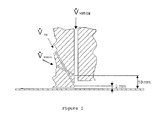
- FIG. 1 in a partly sectional representation, an example of an apparatus for supplying gases which can be used in carrying out the method in accordance with the invention
- FIG. 2 in a partly sectional representation, a further example of an apparatus for supplying gases which can be used in carrying out the method in accordance with the invention
- FIGS. 3 a and b in a partly sectional representation, two further examples of an apparatus for supplying gases which can be used in carrying out the method in accordance with the invention
- FIG. 4 a Raman spectrum of a photocatalytically lactive titanium dioxide layer manufactured using the method in accordance with the invention.
- FIG. 5 an X-ray diffractograph of a photocatalytically active titanium oxide layer manufactured using the method in accordance with the invention.
- FIGS. 1 to 3 Examples for apparatus for a supply of gases are shown in FIGS. 1 to 3 which can be used in the method in accordance with the invention.
- Possibilities for a passage guide are illustrated with the representation in accordance with FIG. 1 via which the required gases can be supplied in the direction of the substrate surface.
- a passage is aligned vertically here and its middle longitudinal axis extends perpendicular to the substrate surface.
- the volume flow V vertical is supplied through it. This can be solely nitrogen as a carrier gas.
- the outlet opening can be formed as a slit nozzle. There is, however, also the possibility of providing a plurality of such individual passages in a row arrangement.
- the gas components actually reacting with one another can be supplied via the further passages differently obliquely inclined.
- the spacings of the lower edges of exit openings from the substrate surface of these inclined passages are dimensioned in FIG. 1 .
- the passages via which the volume flow V bottom is conducted are inclined at an angle of 64° with respect to the substrate surface.
- a gas mixture of nitrogen as the carrier gas with water vapor or TTIP was supplied at 5 to 20 slm through these passages having a number of 49 and a diameter of the outlet openings of 1 mm.
- the passages were arranged in a row and had a spacing of 3 mm in each case.
- FIGS. 3 a and 3 b In the possibilities for apparatus for a gas supply shown in FIGS. 3 a and 3 b , a plurality of parallel passages are present whose longitudinal axes are all aligned perpendicular to the substrate surface.
- FIG. 3 a there are three passages or a ring passage in whose interior a further middle passage can be arranged.
- FIG. 3 b two parallel passages are present which, however, have different free inner cross-sections.
- a mixture which is formed with carrier gas and water vapor can be supplied through the two outer passages or the ring passage and TTIP alone through the central passage.
- the TTIP was heated up to above its boiling temperature (232° C.) and supplied in gaseous form.
- a supply can, however, also take place via a bubbler with the aid of a carrier gas at which lower temperatures of up to approx. 80° C. are present.
- FIGS. 4 and 5 also demonstrate the high proportion of anatas in the formed titanium dioxide layer which is important for the photocatalytic activity.
- Titanium dioxide layers were formed using an apparatus such as is shown in FIG. 1 .
- An apparatus having a gas distribution system was arranged above a substrate to be coated and the substrate was moved on the coating.
- TTIP was directed onto the substrate surface at a mass flow of 15 g/h and a carrier gas flow of 20 l/min as V bottom through the lower passages whose outlet openings are arranged closest to the substrate surface and have a diameter of 1 mm.
- a flow speed of this gas mixture of 8.66 m/s resulted.
- Water was directed in the direction of the surface to be coated at 19.4 g/h with a carrier gas flow of 33 l/min as V top .
- the passages were heated to a temperature of 100° C.
- Substrates of glass or stainless steel having a thickness of 1 mm were heated to a temperature of 250° C.
- the coating took place with 10 cycles, with one cycle being divided into a forward movement and a rearward movement.
- the substrate was moved at a speed of 5 mm/s and on the rearward movement at 30 mm/s.
- the titanium dioxide layers deposited on a substrate of stainless steel had an optical refractive index of 2.43 at a wavelength of 550 nm and a layer thickness of 244 nm.
- the crystallinity (anatas modification) of the titanium dioxide was able to be demonstrated by means of Raman spectroscopy.
- Titanium dioxide layers were formed using an apparatus such as is shown in FIG. 2 .
- the apparatus was attached above a substrate surface to be coated and was able to be moved two-dimensionally in an X-Y direction.
- TTIP having a mass flow of 7.6 g/h in a carrier gas flow of 2 l/min was in this respect supplied through the lower passages arranged with their outlet opening closer to the substrate as V bottom .
- a flow speed of 0.56 m/s resulted for this gas mixture with the 75 passages used for this purpose whose outlet openings had a diameter of 1 mm.
- 13 g/h water and 4 l/min carrier gas were supplied through the upper 75 passages whose outlet openings likewise had a diameter of 1 mm as V top .
- a flow speed of this gas mixture of 1.12 m/s resulted in this process.
- a gas mixture of argon/nitrogen was supplied through the vertically aligned passage at 55 l/min as V vertical .
- the passages were heated to a temperature of 100° C. and substrates to be coated of glass or stainless steel having a thickness of 1 mm were heated to a temperature of 250° C.
- the apparatus was moved at a speed of 25 mm/s and at an increment of 1.5 mm in meander form over the substrate surface.
- the spacing of the apparatus from the surface of the substrate was kept constant during the formation of the coating in all examples.
- the titanium dioxide layers thus formed on stainless steel had an optical refractive index of 2.41 at a wavelength of 550 nm and a layer thickness of 111 nm.
- the high crystallinity (anatas modification) of the titanium dioxide was able to be demonstrated by means of Raman spectroscopy, as is shown in FIG. 4 .
- Glass substrates coated in an analog manner had titanium dioxide layers with an optical refractive index of 2.54 at a wavelength of 550 nm and a layer thickness of 82 nm.
- the crystallinity of the titanium dioxide was demonstrated by means of X-ray diffractometry (XRD), as can be seen from FIG. 5 .
Landscapes
- Chemical & Material Sciences (AREA)
- Materials Engineering (AREA)
- Organic Chemistry (AREA)
- Chemical Kinetics & Catalysis (AREA)
- Engineering & Computer Science (AREA)
- Mechanical Engineering (AREA)
- General Chemical & Material Sciences (AREA)
- Metallurgy (AREA)
- Inorganic Chemistry (AREA)
- Physics & Mathematics (AREA)
- Fluid Mechanics (AREA)
- Catalysts (AREA)
- Inorganic Compounds Of Heavy Metals (AREA)
Abstract
Description
Ti(OC3H7)4+2H2O→TiO2+4HOC3H7
Ti(OC3H7)4+4H2O→Ti(OH)4+4HOC3H7
Ti(OH)4→TiO2+2H2O
| TABLE 1 | ||||
| Flow | ||||
| Number of | Gas flow | speed | Reynolds | |
| passages | [slm] | Throughflow/passage | [m/s] | number |
| 49 | 5 | 0.10204 | 2.1653 | 163.13 |
| 25 | 0.5102 | 10.8268 | 815.67 | |
| 50 | 5 | 0.1 | 2.12207 | 159.87 |
| 25 | 0.5 | 10.6103 | 799.35 | |
Claims (11)
Applications Claiming Priority (4)
| Application Number | Priority Date | Filing Date | Title |
|---|---|---|---|
| DE102008052098A DE102008052098B4 (en) | 2008-10-14 | 2008-10-14 | Process for the preparation of photocatalytically active titanium dioxide layers |
| DE102008052098 | 2008-10-14 | ||
| DE102008052098.5 | 2008-10-14 | ||
| PCT/DE2009/001474 WO2010043215A1 (en) | 2008-10-14 | 2009-10-09 | Method for producing photocatalytically active titanium dioxide layers |
Publications (2)
| Publication Number | Publication Date |
|---|---|
| US20110244130A1 US20110244130A1 (en) | 2011-10-06 |
| US8728576B2 true US8728576B2 (en) | 2014-05-20 |
Family
ID=41528847
Family Applications (1)
| Application Number | Title | Priority Date | Filing Date |
|---|---|---|---|
| US13/121,785 Expired - Fee Related US8728576B2 (en) | 2008-10-14 | 2009-10-09 | Method for producing photocatalytically active titanium dioxide layers |
Country Status (4)
| Country | Link |
|---|---|
| US (1) | US8728576B2 (en) |
| EP (1) | EP2347029B1 (en) |
| DE (1) | DE102008052098B4 (en) |
| WO (1) | WO2010043215A1 (en) |
Families Citing this family (6)
| Publication number | Priority date | Publication date | Assignee | Title |
|---|---|---|---|---|
| JP5971248B2 (en) * | 2011-07-21 | 2016-08-17 | Jsr株式会社 | Method for manufacturing a substrate including a metal body |
| DE102013004611B4 (en) | 2013-03-14 | 2014-12-24 | Fraunhofer-Gesellschaft zur Förderung der angewandten Forschung e.V. | Coating, process for its preparation and its use |
| WO2016051559A1 (en) * | 2014-10-01 | 2016-04-07 | 東芝三菱電機産業システム株式会社 | Film forming device |
| DE112015007038T5 (en) * | 2015-10-19 | 2018-07-19 | Toshiba Mitsubishi-Electric Industrial Systems Corporation | Film formation apparatus |
| JP6426298B2 (en) * | 2015-10-19 | 2018-11-21 | 東芝三菱電機産業システム株式会社 | Film deposition system |
| CN117772172B (en) * | 2024-02-23 | 2024-05-03 | 山西安仑化工有限公司 | Preparation method and preparation device of titanium oxide/magnetic carbon black catalytic material |
Citations (10)
| Publication number | Priority date | Publication date | Assignee | Title |
|---|---|---|---|---|
| US777374A (en) | 1903-01-20 | 1904-12-13 | Chapman Valve Mfg Co | Motor-disconnecting mechanism for valves. |
| US3785851A (en) | 1971-07-01 | 1974-01-15 | Dart Ind Inc | Hot end coating device |
| US5298587A (en) * | 1992-12-21 | 1994-03-29 | The Dow Chemical Company | Protective film for articles and method |
| US6113983A (en) | 1997-04-03 | 2000-09-05 | The United States Of America As Represented By The Secretary Of Commerce | Method of forming metallic and ceramic thin film structures using metal halides and alkali metals |
| US20010009140A1 (en) * | 1999-05-10 | 2001-07-26 | Niklas Bondestam | Apparatus for fabrication of thin films |
| US6268019B1 (en) * | 1998-06-04 | 2001-07-31 | Atofina Chemicals, Inc. | Preparation of fluorine modified, low haze, titanium dioxide films |
| US6921707B1 (en) | 1999-05-28 | 2005-07-26 | Ultramet | Low temperature metal oxide coating formation |
| US20050214533A1 (en) * | 2002-01-21 | 2005-09-29 | Sumitomo Titanium Corporation | Photocatalytic composite material and method for preparation thereof |
| DE102004045321A1 (en) | 2004-09-16 | 2006-03-23 | Biedermann, Andreas | Normal pressure chemical vapor deposition process for producing photoactive coatings uses gas mixture containing precursor which is sprayed at speed such that gap between mixing in precursor and striking substrate is below 0.01 seconds |
| EP1650325A1 (en) | 2003-07-10 | 2006-04-26 | Sumitomo Titanium Corporation | Method for forming metal oxide coating film and vapor deposition apparatus |
Family Cites Families (1)
| Publication number | Priority date | Publication date | Assignee | Title |
|---|---|---|---|---|
| US6777374B2 (en) * | 2000-07-18 | 2004-08-17 | The United States Of America As Represented By The Environmental Protection Agency | Process for photo-induced selective oxidation of organic chemicals to alcohols, ketones and aldehydes using flame deposited nano-structured photocatalyst |
-
2008
- 2008-10-14 DE DE102008052098A patent/DE102008052098B4/en not_active Expired - Fee Related
-
2009
- 2009-10-09 US US13/121,785 patent/US8728576B2/en not_active Expired - Fee Related
- 2009-10-09 WO PCT/DE2009/001474 patent/WO2010043215A1/en not_active Ceased
- 2009-10-09 EP EP09771279.8A patent/EP2347029B1/en active Active
Patent Citations (10)
| Publication number | Priority date | Publication date | Assignee | Title |
|---|---|---|---|---|
| US777374A (en) | 1903-01-20 | 1904-12-13 | Chapman Valve Mfg Co | Motor-disconnecting mechanism for valves. |
| US3785851A (en) | 1971-07-01 | 1974-01-15 | Dart Ind Inc | Hot end coating device |
| US5298587A (en) * | 1992-12-21 | 1994-03-29 | The Dow Chemical Company | Protective film for articles and method |
| US6113983A (en) | 1997-04-03 | 2000-09-05 | The United States Of America As Represented By The Secretary Of Commerce | Method of forming metallic and ceramic thin film structures using metal halides and alkali metals |
| US6268019B1 (en) * | 1998-06-04 | 2001-07-31 | Atofina Chemicals, Inc. | Preparation of fluorine modified, low haze, titanium dioxide films |
| US20010009140A1 (en) * | 1999-05-10 | 2001-07-26 | Niklas Bondestam | Apparatus for fabrication of thin films |
| US6921707B1 (en) | 1999-05-28 | 2005-07-26 | Ultramet | Low temperature metal oxide coating formation |
| US20050214533A1 (en) * | 2002-01-21 | 2005-09-29 | Sumitomo Titanium Corporation | Photocatalytic composite material and method for preparation thereof |
| EP1650325A1 (en) | 2003-07-10 | 2006-04-26 | Sumitomo Titanium Corporation | Method for forming metal oxide coating film and vapor deposition apparatus |
| DE102004045321A1 (en) | 2004-09-16 | 2006-03-23 | Biedermann, Andreas | Normal pressure chemical vapor deposition process for producing photoactive coatings uses gas mixture containing precursor which is sprayed at speed such that gap between mixing in precursor and striking substrate is below 0.01 seconds |
Non-Patent Citations (3)
| Title |
|---|
| Aarik et al., "Morphology and structure of TiO2 thin films grown by atomic layer deposition", Journal of Crystal Growth, vol. 148, No. 3, Mar. 1, 1995, pp. 268-275. |
| Biedermann, DE10-2004 045321, Mar. 2006, English Machine translation (from EP cite). * |
| Kamata et al., "Rapid Formation of TIO2 Films by a Conventional CVD Method," Journal of Materials Science Letters, Chapman and Hall Ltd:, Ondon, GB, vol. 9, No. 3, Mar. 1, 1990, pp. 316-319, XP000159766, ISSN: 0261-8028, DOI: 10.1007/BF00725836. |
Also Published As
| Publication number | Publication date |
|---|---|
| US20110244130A1 (en) | 2011-10-06 |
| EP2347029A1 (en) | 2011-07-27 |
| DE102008052098A1 (en) | 2010-04-15 |
| DE102008052098B4 (en) | 2013-04-04 |
| EP2347029B1 (en) | 2020-01-15 |
| WO2010043215A1 (en) | 2010-04-22 |
Similar Documents
| Publication | Publication Date | Title |
|---|---|---|
| US20110244130A1 (en) | Method for Producing Photocatalytically Active Titanium Dioxide Layers | |
| JP6320303B2 (en) | Chemical vapor deposition process for forming silica coatings on glass substrates | |
| KR100493566B1 (en) | Method for depositing titanium oxide coatings on flat glass and the resulting coated glass | |
| US5798142A (en) | CVD method of depositing a silica coating on a heated glass substrate | |
| CN101903303B (en) | Device for forming an aerosol and method and device for coating glass | |
| EP2761054B1 (en) | Deposition of silicon oxide by atmospheric pressure chemical vapor deposition | |
| US8734903B2 (en) | Process for forming a silica coating on a glass substrate | |
| JPH1179788A (en) | Film-forming glass and its manufacturing method | |
| JP2005029866A (en) | Metal oxide film forming method and vapor deposition apparatus | |
| KR20070012647A (en) | How to deposit gallium oxide coating on flat glass | |
| EP1834933A1 (en) | Process for producing glass plate with thin film | |
| US20110041556A1 (en) | Glass surface modification process | |
| JP6971370B2 (en) | Chemical vapor deposition method for depositing titanium oxide film | |
| EP3417088B1 (en) | Chemical vapor deposition process for depositing a coating | |
| WO2011044325A2 (en) | Methods of nucleation control in film deposition | |
| WO2019016221A1 (en) | Plasma device for depositing functional composite film comprising crystallized particles embedded in a matrix and method of deposition thereof | |
| JPH09279346A (en) | Powder vaporization method and apparatus | |
| WO2017137773A1 (en) | Chemical vapor deposition process for depositing a mixed metal oxide coating and the coated article formed thereby |
Legal Events
| Date | Code | Title | Description |
|---|---|---|---|
| AS | Assignment |
Owner name: FRAUNHOFER-GESELLSCHAFT ZUR FOERDERUNG DER ANGEWAN Free format text: ASSIGNMENT OF ASSIGNORS INTEREST;ASSIGNORS:ABENDROTH, THOMAS;ALTHUES, HOLGER;KASKEL, STEFAN;AND OTHERS;SIGNING DATES FROM 20110504 TO 20110506;REEL/FRAME:026535/0866 |
|
| FEPP | Fee payment procedure |
Free format text: PAYOR NUMBER ASSIGNED (ORIGINAL EVENT CODE: ASPN); ENTITY STATUS OF PATENT OWNER: LARGE ENTITY |
|
| STCF | Information on status: patent grant |
Free format text: PATENTED CASE |
|
| MAFP | Maintenance fee payment |
Free format text: PAYMENT OF MAINTENANCE FEE, 4TH YEAR, LARGE ENTITY (ORIGINAL EVENT CODE: M1551) Year of fee payment: 4 |
|
| MAFP | Maintenance fee payment |
Free format text: PAYMENT OF MAINTENANCE FEE, 8TH YEAR, LARGE ENTITY (ORIGINAL EVENT CODE: M1552); ENTITY STATUS OF PATENT OWNER: LARGE ENTITY Year of fee payment: 8 |
|
| FEPP | Fee payment procedure |
Free format text: MAINTENANCE FEE REMINDER MAILED (ORIGINAL EVENT CODE: REM.); ENTITY STATUS OF PATENT OWNER: LARGE ENTITY |
|
| LAPS | Lapse for failure to pay maintenance fees |
Free format text: PATENT EXPIRED FOR FAILURE TO PAY MAINTENANCE FEES (ORIGINAL EVENT CODE: EXP.); ENTITY STATUS OF PATENT OWNER: LARGE ENTITY |
|
| STCH | Information on status: patent discontinuation |
Free format text: PATENT EXPIRED DUE TO NONPAYMENT OF MAINTENANCE FEES UNDER 37 CFR 1.362 |
|
| FP | Lapsed due to failure to pay maintenance fee |
Effective date: 20260520 |