US8716308B2 - (1-azinone)-substituted pyridoindoles - Google Patents

(1-azinone)-substituted pyridoindoles Download PDF

Info

Publication number
US8716308B2
US8716308B2 US12/351,561 US35156109A US8716308B2 US 8716308 B2 US8716308 B2 US 8716308B2 US 35156109 A US35156109 A US 35156109A US 8716308 B2 US8716308 B2 US 8716308B2
Authority
US
United States
Prior art keywords
pyridin
compound according
mmol
pyrido
methyl
Prior art date
Legal status (The legal status is an assumption and is not a legal conclusion. Google has not performed a legal analysis and makes no representation as to the accuracy of the status listed.)
Active, expires
Application number
US12/351,561
Other versions
US20090275590A1 (en
US20100331339A9 (en
Inventor
Peter Guzzo
Matthew David Surman
Alan John Henderson
May Xiaowu JIANG
Mark Hadden
James Grabowski
Alexander Usyatinsky
Current Assignee (The listed assignees may be inaccurate. Google has not performed a legal analysis and makes no representation or warranty as to the accuracy of the list.)
Harmony Biosciences Management Inc
Original Assignee
Albany Molecular Research Inc
Priority date (The priority date is an assumption and is not a legal conclusion. Google has not performed a legal analysis and makes no representation as to the accuracy of the date listed.)
Filing date
Publication date
Application filed by Albany Molecular Research Inc filed Critical Albany Molecular Research Inc
Priority to US12/351,561 priority Critical patent/US8716308B2/en
Assigned to ALBANY MOLECULAR RESEARCH, INC. reassignment ALBANY MOLECULAR RESEARCH, INC. ASSIGNMENT OF ASSIGNORS INTEREST (SEE DOCUMENT FOR DETAILS). Assignors: USYATINSKY, ALEXANDER, GRABOWSKI, JAMES, GUZZO, PETER ROBERT, HADDEN, MARK, HENDERSON, ALAN JOHN, JIANG, MAY XIAOWU, SURMAN, MATTHEW DAVID
Publication of US20090275590A1 publication Critical patent/US20090275590A1/en
Publication of US20100331339A9 publication Critical patent/US20100331339A9/en
Assigned to BANK OF AMERICA, N.A., AS ADMINISTRATIVE AGENT reassignment BANK OF AMERICA, N.A., AS ADMINISTRATIVE AGENT INTELLECTUAL PROPERTY SECURITY AGREEMENT Assignors: ALBANY MOLECULAR RESEARCH, INC., AMRI BOTHELL RESEARCH CENTER, INC., AMRI BURLINGTON, INC., AMRI RENSSELAER, INC.
Assigned to AMRI RENESSELAER, INC., ALBANY MOLECULAR RESEARCH, INC., AMRI BOTHELL RESEARCH CENTER, INC., AMRI BURLINGTON, INC. reassignment AMRI RENESSELAER, INC. TERMINATION Assignors: BANK OF AMERICA, N.A.
Assigned to WELLS FARGO BANK, NATIONAL ASSOCIATION reassignment WELLS FARGO BANK, NATIONAL ASSOCIATION SECURITY AGREEMENT Assignors: ALBANY MOLECULAR RESEARCH, INC., AMRI BOTHELL RESEARCH CENTER, INC., AMRI BURLINGTON, INC., AMRI RENESSELAER, INC.
Priority to US14/223,151 priority patent/US9296743B2/en
Application granted granted Critical
Publication of US8716308B2 publication Critical patent/US8716308B2/en
Assigned to ALBANY MOLECULAR RESEARCH, INC. reassignment ALBANY MOLECULAR RESEARCH, INC. RELEASE OF SECURITY INTEREST Assignors: WELLS FARGO
Assigned to BARCLAYS BANK PLC, AS THE COLLATERAL AGENT reassignment BARCLAYS BANK PLC, AS THE COLLATERAL AGENT SECURITY INTEREST (SEE DOCUMENT FOR DETAILS). Assignors: ALBANY MOLECULAR RESEARCH, INC., ALO ACQUISITION LLC, AMRI BURLINGTON, INC., AMRI RENSSELAER, INC., CEDARBURG PHARMACEUTICALS, INC., OSO BIOPHARMACEUTICALS MANUFACTURING, LLC
Priority to US15/045,652 priority patent/US9650378B2/en
Priority to US15/477,984 priority patent/US20170204095A1/en
Assigned to ALBANY MOLECULAR RESEARCH, INC., ALO ACQUISITION LLC, AMRI SSCI, LLC, CEDARBURG PHARMACEUTICALS, INC., AMRI BURLINGTON, INC., Euticals Inc., AMRI RENSSELAER, INC., OSO BIOPHARMACEUTICALS MANUFACTURING, LLC reassignment ALBANY MOLECULAR RESEARCH, INC. RELEASE BY SECURED PARTY (SEE DOCUMENT FOR DETAILS). Assignors: BARCLAYS BANK PLC, AS COLLATERAL AGENT
Assigned to MORGAN STANLEY SENIOR FUNDING, INC. reassignment MORGAN STANLEY SENIOR FUNDING, INC. SECOND LIEN SECURITY AGREEMENT Assignors: OSO BIOPHARMACEUTICALS MANUFACTURING LLC-BY ITS SOLE MEMBER:ALO ACQUISITION LLC, ALBANY MOLECULAR RESEARCH, INC., CEDARBURG PHARMACEUTICALS, INC., Euticals Inc., AMRI BURLINGTON, INC.
Assigned to BARCLAYS BANK, PLC AS COLLATERAL AGENT reassignment BARCLAYS BANK, PLC AS COLLATERAL AGENT FIRST LIEN SECURITY AGREEMENT Assignors: ALBANY MOLECULAR RESEARCH, INC., AMRI BURLINGTON, INC., CEDARBURG PHARMACEUTICALS, INC., Euticals Inc., OSO BIOPHARMACEUTICALS MANUFACTURING, LLC-BY ITS SOLE MEMBER: ALO ACQUISITION LLC
Assigned to BARCLAYS BANK PLC, AS THE COLLATERAL AGENT reassignment BARCLAYS BANK PLC, AS THE COLLATERAL AGENT CORRECTIVE ASSIGNMENT TO CORRECT THE INCORRECT PATENT NO. 7541537 PREVIOUSLY RECORDED AT REEL: 034045 FRAME: 0951. ASSIGNOR(S) HEREBY CONFIRMS THE SECURITY INTEREST. Assignors: ALBANY MOLECULAR RESEARCH, INC., ALO ACQUISITION LLC, AMRI BURLINGTON, INC., AMRI RENSSELAER, INC., CEDARBURG PHARMACEUTICALS, INC., OSO BIOPHARMACEUTICALS MANUFACTURING, LLC
Assigned to ALBANY MOLECULAR RESEARCH, INC., CEDARBURG PHARMACEUTICALS, INC., Euticals Inc., OSO BIOPHARMACEUTICALS MANUFACTURING, LLC, AMRI BURLINGTON, INC. reassignment ALBANY MOLECULAR RESEARCH, INC. RELEASE BY SECURED PARTY (SEE DOCUMENT FOR DETAILS). Assignors: MORGAN STANLEY SENIOR FUNDING, INC., AS COLLATERAL AGENT
Assigned to WILMINGTON TRUST, NATIONAL ASSOCIATION reassignment WILMINGTON TRUST, NATIONAL ASSOCIATION SECURITY INTEREST (SEE DOCUMENT FOR DETAILS). Assignors: HARMONY BIOSCIENCES, LLC
Assigned to HARMONY BIOSCIENCES, LLC reassignment HARMONY BIOSCIENCES, LLC ASSIGNMENT OF ASSIGNORS INTEREST (SEE DOCUMENT FOR DETAILS). Assignors: CURIA GLOBAL, INC. (F/K/A ALBANY MOLECULAR RESEARCH, INC.)
Assigned to JPMORGAN CHASE BANK, N.A. reassignment JPMORGAN CHASE BANK, N.A. SUPPLEMENTAL CONFIRMATORY GRANT OF SECURITY INTEREST IN UNITED STATES PATENTS Assignors: HARMONY BIOSCIENCES, LLC
Assigned to CURIA GLOBAL, INC. reassignment CURIA GLOBAL, INC. CHANGE OF NAME (SEE DOCUMENT FOR DETAILS). Assignors: ALBANY MOLECULAR RESEARCH, INC.
Assigned to HARMONY BIOSCIENCES MANAGEMENT, INC. reassignment HARMONY BIOSCIENCES MANAGEMENT, INC. ASSIGNMENT OF ASSIGNORS INTEREST (SEE DOCUMENT FOR DETAILS). Assignors: HARMONY BIOSCIENCES, LLC
Assigned to APOLLO ADMINISTRATIVE AGENCY LLC, AS SUCCESSOR AGENT reassignment APOLLO ADMINISTRATIVE AGENCY LLC, AS SUCCESSOR AGENT ASSIGNMENT OF SECURITY INTEREST IN INTELLECTUAL PROPERTY, RECORDED ON SEPTEMBER 1, 2017, AT REEL/FRAME 043746/0621 Assignors: BARCLAYS BANK PLC, AS EXISTING AGENT
Active legal-status Critical Current
Adjusted expiration legal-status Critical

Links

Classifications

    • CCHEMISTRY; METALLURGY
    • C07ORGANIC CHEMISTRY
    • C07DHETEROCYCLIC COMPOUNDS
    • C07D471/00Heterocyclic compounds containing nitrogen atoms as the only ring hetero atoms in the condensed system, at least one ring being a six-membered ring with one nitrogen atom, not provided for by groups C07D451/00 - C07D463/00
    • C07D471/02Heterocyclic compounds containing nitrogen atoms as the only ring hetero atoms in the condensed system, at least one ring being a six-membered ring with one nitrogen atom, not provided for by groups C07D451/00 - C07D463/00 in which the condensed system contains two hetero rings
    • C07D471/04Ortho-condensed systems
    • AHUMAN NECESSITIES
    • A61MEDICAL OR VETERINARY SCIENCE; HYGIENE
    • A61PSPECIFIC THERAPEUTIC ACTIVITY OF CHEMICAL COMPOUNDS OR MEDICINAL PREPARATIONS
    • A61P1/00Drugs for disorders of the alimentary tract or the digestive system
    • A61P1/16Drugs for disorders of the alimentary tract or the digestive system for liver or gallbladder disorders, e.g. hepatoprotective agents, cholagogues, litholytics
    • AHUMAN NECESSITIES
    • A61MEDICAL OR VETERINARY SCIENCE; HYGIENE
    • A61PSPECIFIC THERAPEUTIC ACTIVITY OF CHEMICAL COMPOUNDS OR MEDICINAL PREPARATIONS
    • A61P25/00Drugs for disorders of the nervous system
    • A61P25/22Anxiolytics
    • AHUMAN NECESSITIES
    • A61MEDICAL OR VETERINARY SCIENCE; HYGIENE
    • A61PSPECIFIC THERAPEUTIC ACTIVITY OF CHEMICAL COMPOUNDS OR MEDICINAL PREPARATIONS
    • A61P25/00Drugs for disorders of the nervous system
    • A61P25/24Antidepressants
    • AHUMAN NECESSITIES
    • A61MEDICAL OR VETERINARY SCIENCE; HYGIENE
    • A61PSPECIFIC THERAPEUTIC ACTIVITY OF CHEMICAL COMPOUNDS OR MEDICINAL PREPARATIONS
    • A61P3/00Drugs for disorders of the metabolism
    • A61P3/04Anorexiants; Antiobesity agents
    • AHUMAN NECESSITIES
    • A61MEDICAL OR VETERINARY SCIENCE; HYGIENE
    • A61PSPECIFIC THERAPEUTIC ACTIVITY OF CHEMICAL COMPOUNDS OR MEDICINAL PREPARATIONS
    • A61P3/00Drugs for disorders of the metabolism
    • A61P3/06Antihyperlipidemics
    • AHUMAN NECESSITIES
    • A61MEDICAL OR VETERINARY SCIENCE; HYGIENE
    • A61PSPECIFIC THERAPEUTIC ACTIVITY OF CHEMICAL COMPOUNDS OR MEDICINAL PREPARATIONS
    • A61P3/00Drugs for disorders of the metabolism
    • A61P3/08Drugs for disorders of the metabolism for glucose homeostasis
    • A61P3/10Drugs for disorders of the metabolism for glucose homeostasis for hyperglycaemia, e.g. antidiabetics
    • AHUMAN NECESSITIES
    • A61MEDICAL OR VETERINARY SCIENCE; HYGIENE
    • A61PSPECIFIC THERAPEUTIC ACTIVITY OF CHEMICAL COMPOUNDS OR MEDICINAL PREPARATIONS
    • A61P35/00Antineoplastic agents
    • AHUMAN NECESSITIES
    • A61MEDICAL OR VETERINARY SCIENCE; HYGIENE
    • A61PSPECIFIC THERAPEUTIC ACTIVITY OF CHEMICAL COMPOUNDS OR MEDICINAL PREPARATIONS
    • A61P43/00Drugs for specific purposes, not provided for in groups A61P1/00-A61P41/00
    • AHUMAN NECESSITIES
    • A61MEDICAL OR VETERINARY SCIENCE; HYGIENE
    • A61PSPECIFIC THERAPEUTIC ACTIVITY OF CHEMICAL COMPOUNDS OR MEDICINAL PREPARATIONS
    • A61P9/00Drugs for disorders of the cardiovascular system
    • A61P9/10Drugs for disorders of the cardiovascular system for treating ischaemic or atherosclerotic diseases, e.g. antianginal drugs, coronary vasodilators, drugs for myocardial infarction, retinopathy, cerebrovascula insufficiency, renal arteriosclerosis
    • CCHEMISTRY; METALLURGY
    • C07ORGANIC CHEMISTRY
    • C07DHETEROCYCLIC COMPOUNDS
    • C07D519/00Heterocyclic compounds containing more than one system of two or more relevant hetero rings condensed among themselves or condensed with a common carbocyclic ring system not provided for in groups C07D453/00 or C07D455/00
    • CCHEMISTRY; METALLURGY
    • C07ORGANIC CHEMISTRY
    • C07DHETEROCYCLIC COMPOUNDS
    • C07D521/00Heterocyclic compounds containing unspecified hetero rings

Definitions

  • the invention relates to human melanin-concentrating hormone (MCH 1 ) receptor-selective antagonists substituted pyridoindoles that are useful for treating obesity, to pharmaceutical compositions comprising these compounds, and to methods for the treatment of obesity, anxiety, depression, and psychiatric disorders in a mammal.
  • MCH 1 human melanin-concentrating hormone
  • Obesity and the multitude of co-morbidities associated with obesity such as diabetes, dyslipidemia, coronary heart disease, and certain cancers are a major concern for public health.
  • the currently available pharmaceutical therapies for the treatment of obesity have limited efficacy and side effects that limit their use.
  • MCH Melanin-concentrating hormone
  • mice lacking MCH are hypophagic and lean with increased metabolic rate, whereas animals over-expressing MCH gain excess weight on both standard and high fat diets. MCH is thought to have effects on other nervous system functions as well (Rocksz, L. L. Biological Examination of Melanin Concentrating Hormone 1: Multi-tasking from the hypothalamus Drug News Perspect 19(5), 273, 2006).
  • GPCR G-protein coupled receptor
  • R 1 is H or optionally substituted alkyl
  • R 2 , R 3 , R 4 are each independently selected from H, —O-alkyl, —S-alkyl, alkyl, halo, —CF 3 , and —CN
  • G is —CR 12 R 13 —NR 5 — or —NR 5 —CR 12 R 13
  • R 5 is H, optionally substituted alkyl, optionally substituted heterocycle, —C( ⁇ O)—R 6 , —C( ⁇ O)—O—R 7 , or —C( ⁇ O)—NR 19 R 20
  • R 6 and R 7 are each optionally substituted alkyl or optionally substituted heterocycle
  • R 8 , R 9 , R 10 , R 11 , R 12 , R 13 , R 19 and R 20 are each independently selected from H or optionally substituted alkyl
  • R 14 and R 15 are each independently H or halogen
  • Y is CH or N
  • L is —CH 2 —
  • compounds represented by formula (I) above may be substituted derivatives either of tetrahydro- ⁇ -carboline, where G is —CR 12 R 13 —NR 5 —, or of tetrahydro- ⁇ -carboline, where G is —NR 12 —CR 13 R 13 —.
  • G is —CH 2 —NR 5 —; in other embodiments, G is —NR 5 —CH 2 —.
  • R 1 is H.
  • R 5 is alkyl, for example, methyl or ethyl.
  • R 5 is H. In other embodiments, R 5 is optionally substituted alkyl. In some embodiments, R 5 is selected from methyl, ethyl, 2-propyl, 2-hydroxyethyl, 2,2,2-trifluoroethyl, 3,3,3-trifluoropropyl, 2-oxo-2-(pyrrolidin-1-yl)ethyl, 2-(pyrrolidin-1-yl)ethyl and (S)-pyrrolidin-2-ylmethyl. In other embodiments, R 5 is optionally substituted heterocycle. In some embodiments, R 5 is selected from piperidin-4-yl and 1-methylpiperidin-4-yl. In other embodiments, R 5 is —C( ⁇ O)—R 6 . In other embodiments, R 5 is —C( ⁇ O)—O—R 7 .
  • R 6 and R 7 are each optionally substituted alkyl, for example, methyl, 2-propyl, 2-(pyrrolidin-1-yl)-ethyl, pyrrolidin-1-ylmethyl, and dimethylaminomethyl.
  • R 6 is optionally substituted heterocycle, for example, pyrrolidin-3-yl, (R)-pyrrolidin-2-yl, (S)-pyrrolidin-2-yl, 1-methylpyrrolidin-3-yl, (R)-1-methylpyrrolidin-2-yl and (S)-1-methylpyrrolidin-2-yl.
  • the compound has the
  • the compound has the
  • the L is a bond. In accordance with other embodiments of the invention, L is —CH 2 —O—. In accordance with some embodiments of the invention, L is —CH 2 CH 2 —. In accordance with other embodiments of the invention, L is —CH ⁇ CH—.
  • B is aryl, for example, phenyl.
  • B is heteroaryl, for example, pyridinyl.
  • B is pyridin-2-yl or pyridin-3-yl.
  • B is pyridazinyl, for example, pyridazin-3-yl.
  • B is pyrimidinyl, for example, pyrimidin-5-yl or pyrimidin-2-yl.
  • B is cycloalkyl, for example, cyclohexyl.
  • R 2 , R 3 and R 4 are each H. In accordance with other embodiments of the invention, two of R 2 , R 3 and R 4 are H, and the other of R 2 , R 3 and R 4 is selected from trifluoromethyl, chloro, fluoro, methyl, methoxy and methanethio.
  • one of R 2 , R 3 and R 4 is H, another of R 2 , R 3 and R 4 is Cl, and the third of R 2 , R 3 and R 4 is F, Cl or methoxy.
  • one of R 2 , R 3 and R 4 is H, another of R 2 , R 3 and R 4 is F, and the third of R 2 , R 3 and R 4 is methoxy.
  • one of R 2 , R 3 and R 4 is H, another of R 2 , R 3 and R 4 is methoxy, and the third of R 2 , R 3 and R 4 is methyl.
  • B is selected from phenyl, 4-trifluoromethylphenyl, 4-chlorophenyl, 2,4-dichlorophenyl, 4-fluorophenyl, 4-chloro-2-fluorophenyl, 2-fluoro-4-methoxyphenyl, pyridin-2-yl, 5-chloropyridin-2-yl, 5-(trifluoromethyl)pyridin-2-yl, 5-fluoropyridin-2-yl, 6-(trifluoromethyl)pyridazin-3-yl, 6-methylpyridazin-3-yl, 4-fluoro-2-methoxyphenyl, 6-(trifluoromethyl)pyridin-3-yl, 2-(trifluoromethyl)pyrimidin-5-yl, 5-(trifluoromethyl)pyrimidin-2-yl, 5-methylpyridin-2-yl, 6-methylpyridin-3-yl
  • At least one of R 8 , R 9 , R 10 , R 11 , R 12 , R 13 , R 19 and R 20 is H. In other embodiments, at least one of R 8 , R 9 , R 10 , R 11 , R 12 , R 13 , R 19 and R 20 is optionally substituted alkyl, for example, methyl, ethyl, or hydroxymethyl.
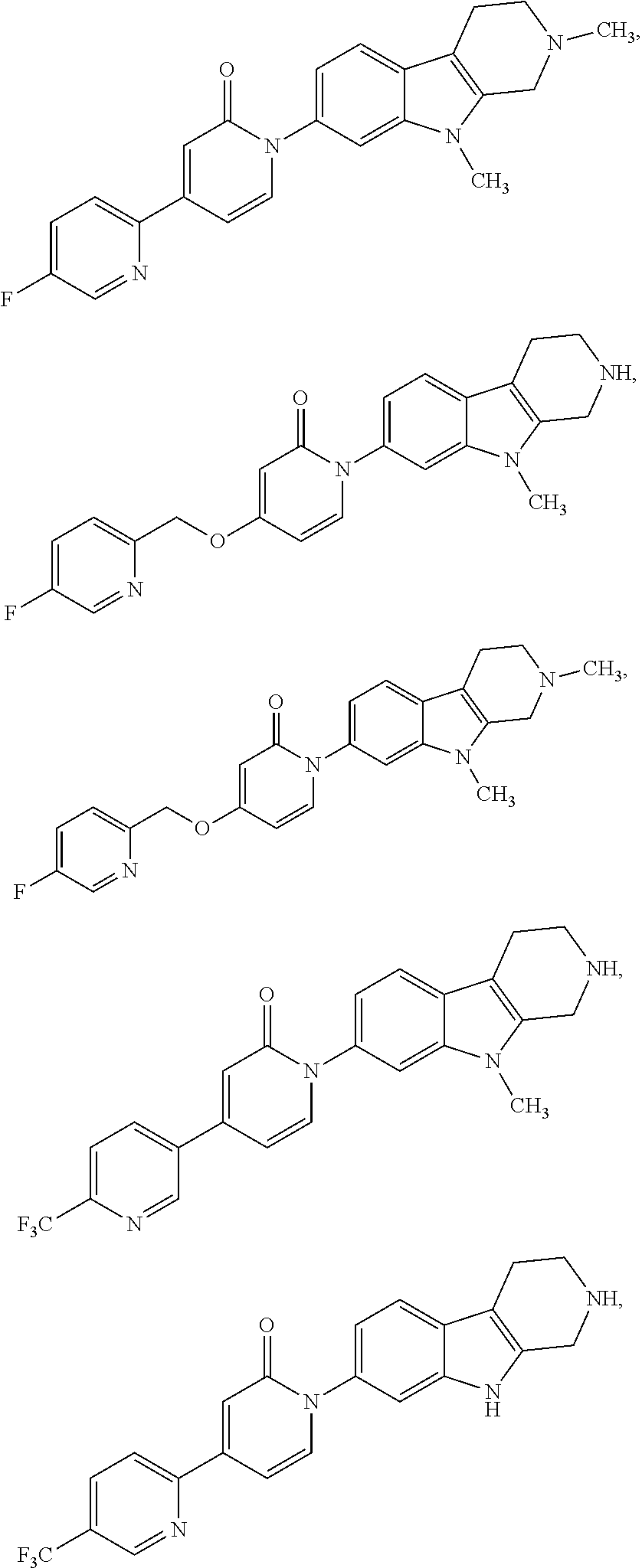
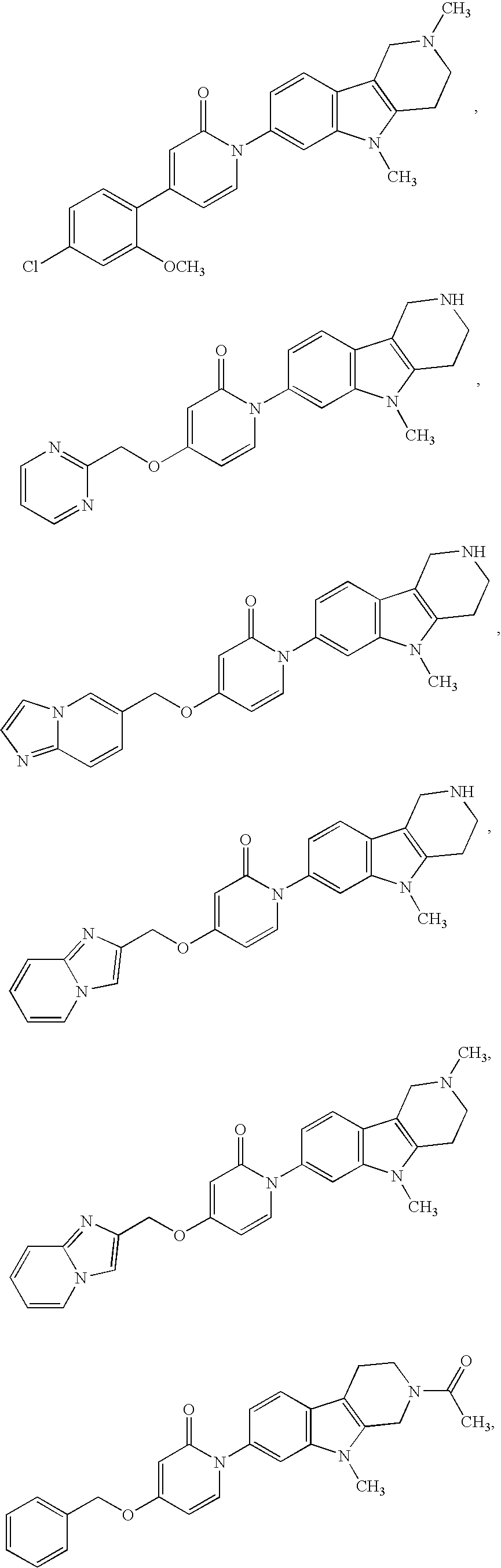
  • the compound is selected from:
  • the compound is a pharmaceutically acceptable salt thereof.
  • the salt is an HCl salt.
  • a pharmaceutical composition comprising a compound as described herein, and a pharmaceutically acceptable carrier, excipient or diluent therefore.
  • a method of treating obesity comprising administering to a patient in need of obesity reduction an obesity-reducing effective amount of a compound as described herein.
  • a method of treating anxiety comprising administering to a patient in need of such treatment a therapeutically effective amount of a compound as described herein.
  • a method of treating depression comprising administering to a patient in need of such treatment a therapeutically effective amount of a compound as described herein.
  • a method of treating non-alcoholic fatty liver disease comprising administering to a patient in need of such treatment a therapeutically effective amount of a compound as described herein.
  • a method of treating a disease or condition which is susceptible to treatment with an MCH 1 receptor modulator comprising administering to a patient in need thereof a therapeutically effective amount of a compound as described herein.
  • Alkyl is intended to include linear, branched, or cyclic hydrocarbon structures and combinations thereof. When not otherwise restricted, the term refers to alkyl of 20 or fewer carbons.
  • Lower alkyl refers to alkyl groups of 1, 2, 3, 4, 5 and 6 carbon atoms. Examples of lower alkyl groups include methyl, ethyl, propyl, isopropyl, butyl, s- and t-butyl and the like.
  • Cycloalkyl is a subset of alkyl and includes cyclic hydrocarbon groups of 3, 4, 5, 6, 7, and 8 carbon atoms. Examples of cycloalkyl groups include c-propyl, c-butyl, c-pentyl, norbornyl, adamantyl and the like.
  • Hydrocarbon e.g. C 1 , C 2 , C 3 , C 4 , C 5 , C 6 , C 7 , C 8 , C 9 , C 10 , C 11 , C 12 , C 13 , C 14 , C 15 , C 16 , C 17 , C 18 , C 19 , C 20
  • phenylene refers to ortho, meta or para residues of the formulae:
  • Alkoxy or alkoxyl refers to groups of 1, 2, 3, 4, 5, 6, 7 or 8 carbon atoms of a straight, branched, cyclic configuration and combinations thereof attached to the parent structure through an oxygen. Examples include methoxy, ethoxy, propoxy, isopropoxy, cyclopropyloxy, cyclohexyloxy and the like. Lower-alkoxy refers to groups containing one to four carbons.
  • alkoxy also includes methylenedioxy and ethylenedioxy in which each oxygen atom is bonded to the atom, chain or ring from which the methylenedioxy or ethylenedioxy group is pendant so as to form a ring.
  • phenyl substituted by alkoxy may be, for example,
  • Oxaalkyl refers to alkyl residues in which one or more carbons (and their associated hydrogens) have been replaced by oxygen. Examples include methoxypropoxy, 3,6,9-trioxadecyl and the like.
  • the term oxaalkyl is intended as it is understood in the art [see Naming and Indexing of Chemical Substances for Chemical Abstracts, published by the American Chemical Society, ⁇ 196, but without the restriction of ⁇ 127(a)], i.e. it refers to compounds in which the oxygen is bonded via a single bond to its adjacent atoms (forming ether bonds).
  • thiaalkyl and azaalkyl refer to alkyl residues in which one or more carbons have been replaced by sulfur or nitrogen, respectively. Examples include ethylaminoethyl and methylthiopropyl.
  • Acyl refers to groups of 1, 2, 3, 4, 5, 6, 7 and 8 carbon atoms of a straight, branched, cyclic configuration, saturated, unsaturated and aromatic and combinations thereof, attached to the parent structure through a carbonyl functionality.
  • One or more carbons in the acyl residue may be replaced by nitrogen, oxygen or sulfur as long as the point of attachment to the parent remains at the carbonyl. Examples include formyl, acetyl, propionyl, isobutyryl, t-butoxycarbonyl, benzoyl, benzyloxycarbonyl and the like.
  • Lower-acyl refers to groups containing one to four carbons.
  • Aryl and heteroaryl refer to aromatic or heteroaromatic rings, respectively, as substituents.
  • Heteroaryl contains one, two or three heteroatoms selected from O, N, or S. Both refer to monocyclic 5- or 6-membered aromatic or heteroaromatic rings, bicyclic 9- or 10-membered aromatic or heteroaromatic rings and tricyclic 13- or 14-membered aromatic or heteroaromatic rings.
  • Aromatic 6, 7, 8, 9, 10, 11, 12, 13 and 14-membered carbocyclic rings include, e.g., benzene, naphthalene, indane, tetralin, and fluorene and the 5, 6, 7, 8, 9 and 10-membered aromatic heterocyclic rings include, e.g., imidazole, pyridine, indole, thiophene, benzopyranone, thiazole, furan, benzimidazole, quinoline, isoquinoline, quinoxaline, pyrimidine, pyrazine, tetrazole and pyrazole.
  • Arylalkyl means an alkyl residue attached to an aryl ring. Examples are benzyl, phenethyl and the like.
  • Substituted alkyl, aryl, cycloalkyl, heterocyclyl etc. refer to alkyl, aryl, cycloalkyl, or heterocyclyl wherein up to three H atoms in each residue are replaced with alkyl, halogen, haloalkyl, hydroxy, loweralkoxy, carboxy, carboalkoxy (also referred to as alkoxycarbonyl), carboxamido (also referred to as alkylaminocarbonyl), cyano, carbonyl, nitro, amino, alkylamino, dialkylamino, mercapto, alkylthio, sulfoxide, sulfone, acylamino, amidino, phenyl, benzyl, heteroaryl, phenoxy, benzyloxy, or heteroaryloxy.
  • halogen means fluorine, chlorine, bromine or iodine.
  • prodrug refers to a compound that is made more active in vivo. Commonly the conversion of prodrug to drug occurs by enzymatic processes in the liver or blood of the mammal. Many of the compounds of the invention may be chemically modified without absorption into the systemic circulation, and in those cases, activation in vivo may come about by chemical action (as in the acid-catalyzed cleavage in the stomach) or through the intermediacy of enzymes and microflora in the gastrointestinal GI tract.
  • the compounds of this invention can exist in radiolabeled form, i.e., the compounds may contain one or more atoms containing an atomic mass or mass number different from the atomic mass or mass number usually found in nature.
  • Radioisotopes of hydrogen, carbon, phosphorous, fluorine, iodine and chlorine include 3 H, 14 C, 35 S, 18 F, 32 P, 33 P, 125 I, and 36 Cl, respectively.
  • Compounds that contain those radioisotopes and/or other radioisotopes of other atoms are within the scope of this invention.
  • Radiolabeled compounds described herein and prodrugs thereof can generally be prepared by methods well known to those skilled in the art. Conveniently, such radiolabeled compounds can be prepared by carrying out the procedures disclosed in the Examples and Schemes by substituting a readily available radiolabeled reagent for a non-radiolabeled reagent.
  • the terms “methods of treating or preventing” mean amelioration, prevention or relief from the symptoms and/or effects associated with lipid disorders.
  • preventing refers to administering a medicament beforehand to forestall or obtund an acute episode or, in the case of a chronic condition to diminish the likelihood or seriousness of the condition.
  • prevent is not an absolute term.
  • reference to “treatment” of a patient is intended to include prophylaxis.
  • mammal is used in its dictionary sense.
  • the term “mammal” includes, for example, mice, hamsters, rats, cows, sheep, pigs, goats, and horses, monkeys, dogs (e.g., Canis familiaris ), cats, rabbits, guinea pigs, and primates, including humans.
  • Compounds described herein may contain one or more asymmetric centers and may thus give rise to enantiomers, diastereomers, and other stereoisomeric forms.
  • Each chiral center may be defined, in terms of absolute stereochemistry, as (R)— or (S)—.
  • the present invention is meant to include all such possible isomers, as well as mixtures thereof, including racemic and optically pure forms.
  • Optically active (R)— and (S)—, ( ⁇ )- and (+)-, or (D)- and (L)-isomers may be prepared using chiral synthons or chiral reagents, or resolved using conventional techniques.
  • a compound as described herein, including in the contexts of pharmaceutical compositions, methods of treatment, and compounds per se, is provided as the salt form.
  • the salt is a hydrochloride salt.
  • ee a ( conc . ⁇ of ⁇ ⁇ a - conc . ⁇ of ⁇ ⁇ b conc . ⁇ of ⁇ ⁇ a + conc . ⁇ of ⁇ ⁇ b ) ⁇ 100
  • enantiomeric excess is related to the older term “optical purity” in that both are measures of the same phenomenon.
  • the value of ee will be a number from 0 to 100, zero being racemic and 100 being pure, single enantiomer.
  • a compound which in the past might have been called 98% optically pure is now more precisely described as 96% ee; in other words, a 90% ee reflects the presence of 95% of one enantiomer and 5% of the other in the material in question.
  • a protecting group refers to a group which is used to mask a functionality during a process step in which it would otherwise react, but in which reaction is undesirable.
  • the protecting group prevents reaction at that step, but may be subsequently removed to expose the original functionality.
  • the removal or “deprotection” occurs after the completion of the reaction or reactions in which the functionality would interfere.
  • HPLC, THF, DCM and DMSO represent high performance liquid chromatography, tetrahydrofuran, dichloromethane and dimethylsulfoxide, respectively.
  • the abbreviations Me, Et, Ph, Tf, Ts, Boc and Ms represent methyl, ethyl, phenyl, trifluoromethanesulfonyl, toluenesulfonyl, butyloxycarbonyl and methanesulfonyl respectively.
  • dppf refers to 1,1′-Bis-(diphosphenylphosphino)ferrocene.
  • a pharmaceutical composition comprising a compound of formula I or a pharmaceutically acceptable salt or solvate thereof, together with one or more pharmaceutically carriers thereof and optionally one or more other therapeutic ingredients.
  • the carrier(s) must be “acceptable” in the sense of being compatible with the other ingredients of the formulation and not deleterious to the recipient thereof.
  • the formulations include those suitable for oral, parenteral (including subcutaneous, intradermal, intramuscular, intravenous and intraarticular), rectal and topical (including dermal, buccal, sublingual and intraocular) administration.
  • the most suitable route may depend upon the condition and disorder of the recipient.
  • the formulations may conveniently be presented in unit dosage form and may be prepared by any of the methods well known in the art of pharmacy. Such methods include the step of bringing into association a compound of formula I or a pharmaceutically acceptable salt or solvate thereof (“active ingredient”) with the carrier, which constitutes one or more accessory ingredients.
  • active ingredient a pharmaceutically acceptable salt or solvate thereof
  • the formulations are prepared by uniformly and intimately bringing into association the active ingredient with liquid carriers or finely divided solid carriers or both and then, if necessary, shaping the product into the desired formulation.
  • Formulations suitable for oral administration may be presented as discrete units such as capsules, cachets or tablets each containing a predetermined amount of the active ingredient; as a powder or granules; as a solution or a suspension in an aqueous liquid or a non-aqueous liquid; or as an oil-in-water liquid emulsion or a water-in-oil liquid emulsion.
  • the active ingredient may also be presented as a bolus, electuary or paste.
  • a tablet may be made by compression or molding, optionally with one or more accessory ingredients.
  • Compressed tablets may be prepared by compressing in a suitable machine the active ingredient in a free-flowing form such as a powder or granules, optionally mixed with a binder, lubricant, inert diluent, lubricating, surface active or dispersing agent.
  • Molded tablets may be made by molding in a suitable machine a mixture of the powdered compound moistened with an inert liquid diluent.
  • the tablets may optionally be coated or scored and may be formulated so as to provide sustained, delayed or controlled release of the active ingredient therein.
  • the pharmaceutical compositions may include a “pharmaceutically acceptable inert carrier”, and this expression is intended to include one or more inert excipients, which include starches, polyols, granulating agents, microcrystalline cellulose, diluents, lubricants, binders, disintegrating agents, and the like. If desired, tablet dosages of the disclosed compositions may be coated by standard aqueous or nonaqueous techniques, “Pharmaceutically acceptable carrier” also encompasses controlled release means.
  • compositions may also optionally include other therapeutic ingredients, anti-caking agents, preservatives, sweetening agents, colorants, flavors, desiccants, plasticizers, dyes, and the like. Any such optional ingredient must be compatible with the compound of formula I to insure the stability of the formulation.
  • the composition may contain other additives as needed, including for example lactose, glucose, fructose, galactose, trehalose, sucrose, maltose, raffinose, maltitol, melezitose, stachyose, lactitol, palatinite, starch, xylitol, mannitol, myoinositol, and the like, and hydrates thereof, and amino acids, for example alanine, glycine and betaine, and peptides and proteins, for example albumen.
  • additives including for example lactose, glucose, fructose, galactose, trehalose, sucrose, maltose, raffinose, maltitol, melezitose, stachyose, lactitol, palatinite, starch, xylitol, mannitol, myoinositol, and the like, and hydrates thereof, and amino
  • excipients for use as the pharmaceutically acceptable carriers and the pharmaceutically acceptable inert carriers and the aforementioned additional ingredients include, but are not limited to binders, fillers, disintegrants, lubricants, anti-microbial agents, and coating agents.
  • the dose range for adult humans is generally from 0.005 mg to 10 g/day orally. Tablets or other forms of presentation provided in discrete units may conveniently contain an amount of compound of formula I which is effective at such dosage or as a multiple of the same, for instance, units containing 5 mg to 500 mg, usually around 10 mg to 200 mg.
  • the precise amount of compound administered to a patient will be the responsibility of the attendant physician. However, the dose employed will depend on a number of factors, including the age and sex of the patient, the precise disorder being treated, and its severity.
  • a dosage unit e.g.
  • an oral dosage unit can include from, for example, 1 to 30 mg, 1 to 40 mg, 1 to 100 mg, 1 to 300 mg, 1 to 500 mg, 2 to 500 mg, 3 to 100 mg, 5 to 20 mg, 5 to 100 mg (e.g. 1 mg, 2 mg, 3 mg, 4 mg, 5 mg, 6 mg, 7 mg, 8 mg, 9 mg, 10 mg, 11 mg, 12 mg, 13 mg, 14 mg, 15 mg, 16 mg, 17 mg, 18 mg, 19 mg, 20 mg, 25 mg, 30 mg, 35 mg, 40 mg, 45 mg, 50 mg, 55 mg, 60 mg, 65 mg, 70 mg, 75 mg, 80 mg, 85 mg, 90 mg, 95 mg, 100 mg, 150 mg, 200 mg, 250 mg, 300 mg, 350 mg, 400 mg, 450 mg, 500 mg) of a compound described herein.
  • 1 to 30 mg, 1 to 40 mg 1 to 100 mg, 1 to 300 mg, 1 to 500 mg, 2 to 500 mg, 3 to 100 mg, 5 to 20 mg, 5 to 100 mg (e.g. 1 mg,
  • the agents can be administered, e.g., by intravenous injection, intramuscular injection, subcutaneous injection, intraperitoneal injection, topical, sublingual, intraarticular (in the joints), intradermal, buccal, ophthalmic (including intraocular), intranasaly (including using a cannula), or by other routes.
  • the agents can be administered orally, e.g., as a tablet or cachet containing a predetermined amount of the active ingredient, gel, pellet, paste, syrup, bolus, electuary, slurry, capsule, powder, granules, as a solution or a suspension in an aqueous liquid or a non-aqueous liquid, as an oil-in-water liquid emulsion or a water-in-oil liquid emulsion, via a micellar formulation (see, e.g.
  • the agents can also be administered transdermally (i.e. via reservoir-type or matrix-type patches, microneedles, thermal poration, hypodermic needles, iontophoresis, electroporation, ultrasound or other forms of sonophoresis, jet injection, or a combination of any of the preceding methods (Prausnitz et al. 2004, Nature Reviews Drug Discovery 3:115)).
  • the agents can be administered locally, for example, at the site of injury to an injured blood vessel.
  • the agents can be coated on a stent.
  • the agents can be administered using high-velocity transdermal particle injection techniques using the hydrogel particle formulation described in U.S. 20020061336. Additional particle formulations are described in WO 00/45792, WO 00/53160, and WO 02/19989. An example of a transdermal formulation containing plaster and the absorption promoter dimethylisosorbide can be found in WO 89/04179. WO 96/11705 provides formulations suitable for transdermal administration.
  • the agents can be administered in the form a suppository or by other vaginal or rectal means.
  • the agents can be administered in a transmembrane formulation as described in WO 90/07923.
  • the agents can be administered non-invasively via the dehydrated particles described in U.S. Pat. No. 6,485,706.
  • the agent can be administered in an enteric-coated drug formulation as described in WO 02/49621.
  • the agents can be administered intranasaly using the formulation described in U.S. Pat. No. 5,179,079.
  • Formulations suitable for parenteral injection are described in WO 00/62759.
  • the agents can be administered using the casein formulation described in U.S. 20030206939 and WO 00/06108.
  • the agents can be administered using the particulate formulations described in U.S. 20020034536.
  • the agents can be administered by pulmonary route utilizing several techniques including but not limited to intratracheal instillation (delivery of solution into the lungs by syringe), intratracheal delivery of liposomes, insufflation (administration of powder formulation by syringe or any other similar device into the lungs) and aerosol inhalation.
  • Aerosols e.g., jet or ultrasonic nebulizers, metered-dose inhalers (MDIs), and dry-Powder inhalers (DPIs)
  • MDIs metered-dose inhalers
  • DPIs dry-Powder inhalers
  • Aerosol formulations are stable dispersions or suspensions of solid material and liquid droplets in a gaseous medium and can be placed into pressurized acceptable propellants, such as hydrofluoroalkanes (HFAs, i.e. HFA-134a and HFA-227, or a mixture thereof), dichlorodifluoromethane (or other chlorofluorocarbon propellants such as a mixture of Propellants 11, 12, and/or 114), propane, nitrogen, and the like.
  • HFAs hydrofluoroalkanes
  • HFA-134a and HFA-227 or a mixture thereof
  • dichlorodifluoromethane or other chlorofluorocarbon propellants such as a mixture of Propellants 11, 12, and/or 114
  • propane nitrogen, and the like.
  • Pulmonary formulations may include permeation enhancers such as fatty acids, and saccharides, chelating agents, enzyme inhibitors (e.g., protease inhibitors), adjuvants (e.g., glycocholate, surfactin, span 85, and nafamostat), preservatives (e.g., benzalkonium chloride or chlorobutanol), and ethanol (normally up to 5% but possibly up to 20%, by weight). Ethanol is commonly included in aerosol compositions as it can improve the function of the metering valve and in some cases also improve the stability of the dispersion.
  • permeation enhancers such as fatty acids, and saccharides
  • chelating agents e.g., enzyme inhibitors (e.g., protease inhibitors), adjuvants (e.g., glycocholate, surfactin, span 85, and nafamostat), preservatives (e.g., benzalkonium chloride or chlorobut
  • Pulmonary formulations may also include surfactants which include but are not limited to bile salts and those described in U.S. Pat. No. 6,524,557 and references therein.
  • surfactants which include but are not limited to bile salts and those described in U.S. Pat. No. 6,524,557 and references therein.
  • the surfactants described in U.S. Pat. No. 6,524,557 e.g., a C 8 -C 16 fatty acid salt, a bile salt, a phospholipid, or alkyl saccharide are advantageous in that some of them also reportedly enhance absorption of the compound in the formulation.
  • dry powder formulations comprising a therapeutically effective amount of active compound blended with an appropriate carrier and adapted for use in connection with a dry-powder inhaler.
  • Absorption enhancers that can be added to dry powder formulations of the present invention include those described in U.S. Pat. No. 6,632,456.
  • WO 02/080884 describes new methods for the surface modification of powders. Aerosol formulations may include U.S. Pat. No. 5,230,884, U.S. Pat. No. 5,292,499, WO 017/8694, WO 01/78696, U.S. 2003019437, U.S. 20030165436, and WO 96/40089 (which includes vegetable oil).
  • Sustained release formulations suitable for inhalation are described in U.S. 20010036481A1, 20030232019A1, and U.S. 20040018243A1 as well as in WO 01/13891, WO 02/067902, WO 03/072080, and WO 03/079885.
  • Pulmonary formulations containing microparticles are described in WO 03/015750, U.S. 20030008013, and WO 00/00176. Pulmonary formulations containing stable glassy state powder are described in U.S. 20020141945 and U.S. Pat. No. 6,309,671. Other aerosol formulations are described in EP 1338272A1 WO 90/09781, U.S. Pat. No. 5,348,730, U.S. Pat. No. 6,436,367, WO 91/04011, and U.S. Pat. No. 6,294,153 and U.S. Pat. No. 6,290,987 describes a liposomal based formulation that can be administered via aerosol or other means.
  • Powder formulations for inhalation are described in U.S. 20030053960 and WO 01/60341.
  • the agents can be administered intranasally as described in U.S. 20010038824.
  • Solutions of medicament in buffered saline and similar vehicles are commonly employed to generate an aerosol in a nebulizer.
  • Simple nebulizers operate on Bernoulli's principle and employ a stream of air or oxygen to generate the spray particles. More complex nebulizers employ ultrasound to create the spray particles. Both types are well known in the art and are described in standard textbooks of pharmacy such as Sprowls' American Pharmacy and Remington's The Science and Practice of Pharmacy.
  • the agent can be incorporated into a liposome to improve half-life.
  • the agent can also be conjugated to polyethylene glycol (PEG) chains.
  • PEG polyethylene glycol
  • Methods for pegylation and additional formulations containing PEG-conjugates i.e. PEG-based hydrogels, PEG modified liposomes
  • the agent can be administered via a nanocochleate or cochleate delivery vehicle (BioDelivery Sciences International).
  • the agents can be delivered transmucosally (i.e. across a mucosal surface such as the vagina, eye or nose) using formulations such as that described in U.S. Pat. No. 5,204,108.
  • the agents can be formulated in microcapsules as described in WO 88/01165.
  • the agent can be administered intra-orally using the formulations described in U.S. 20020055496, WO 00/47203, and U.S. Pat. No. 6,495,120.
  • the agent can be delivered using nanoemulsion formulations described in WO 01/91728A2.
  • the compounds of the present invention may be prepared by the methods illustrated in the general reaction schemes as, for example, described below, or by modifications thereof, using readily available starting materials, reagents and conventional synthesis procedures. In these reactions, it is also possible to make use of variants that are in themselves known, but are not mentioned here.
  • Compounds of formula 3 (wherein R 14 is H or halogen; R 1 is H; R 5 is a protecting group such as tert-butoxycarbonyl or benzyloxycarbonyl; R 8 , R 9 , R 10 , R 11 , R 12 and R 13 are each independently selected from H or optionally substituted alkyl) can be prepared from 3- or 4-bromo phenylhydrazine 1 (or a salt thereof) and piperidinone 2 under heated acidic conditions.
  • N5-alkylation or N5-protection of compound 3 can provide compounds of formula 3 wherein R 1 is alkyl or a protecting group such as tert-butoxycarbonyl, benzyloxycarbonyl or p-toluenesulfonyl.
  • R 1 is alkyl or a protecting group such as tert-butoxycarbonyl, benzyloxycarbonyl or p-toluenesulfonyl.
  • Optional removal of N2-protecting group R 5 and reductive amination, alkylation or acylation can provide compounds of formula 3 wherein R 5 is alkyl or acyl.
  • Compounds of formula 1 (wherein R 14 is H or halogen) can be treated with compounds of formula 4 (wherein R 12 and R 13 are each independently selected from H or optionally substituted alkyl and R 16 is alkyl) and a Lewis acid such as ZnCl 2 under heated conditions to give compounds of formula 5.
  • Treatment of compounds of formula 5 with ethyl glyoxylate under heated acidic conditions can provide compounds of formula 6 wherein R 10 and R 11 are H.
  • compounds of formula 5 can be treated with a ketone under heated acidic conditions to provide compounds of formula 6 wherein R 10 and R 11 are optionally substituted alkyl.
  • Compounds of formula 5 also can be treated with an acid chloride under basic conditions, followed by heating with POCl 3 and finally by treatment with a reducing agent such as NaBH 4 to provide compounds of formula 6 wherein R 10 is H and R 11 is optionally substituted alkyl. Protection of the N2-position on the tetrahydrocarboline ring can provide compounds of formula 7 (wherein R 5 is a protecting group such as tert-butoxycarbonyl or benzyloxycarbonyl).
  • Protection of the N9-position on the tetrahydrocarboline ring can provide compounds of formula 8 (wherein R 1 is a protecting group such as tert-butoxycarbonyl, benzyloxycarbonyl or p-toluenesulfonyl).
  • R 1 is a protecting group such as tert-butoxycarbonyl, benzyloxycarbonyl or p-toluenesulfonyl.
  • a base such as sodium hydride and an alkylating agent
  • R 1 is optionally substituted alkyl.
  • Optional removal of N2-protecting group R 5 and reductive amination, alkylation or acylation can provide compounds of formula 8 wherein R 5 is alkyl or acyl.
  • Compounds of formula 12 (wherein B is aryl or heteroaryl; R 2 , R 3 , R 4 are each independently selected from H, —O-alkyl, S-alkyl, alkyl, halo, —CF 3 , and —CN; and Y is CH) can be prepared by treating compounds of formula 9 (wherein X 1 is chlorine, bromine or iodine and Y is CH) with compounds of formula 10 (wherein B is aryl or heteroaryl; R 2 , R 3 , R 4 are each independently selected from H, —O-alkyl, alkyl, halo, —CF 3 , and —CN; Z 1 is B(OH) 2 , B(OR 17 ) 2 , SnR 17 3 or the like and R 17 is alkyl), a catalyst such as palladium(0), and a base such as potassium carbonate to give compounds of formula 11, wherein L is a direct bond.
  • compounds of formula 10 can be treated with a base such as sodium hydride and compounds of formula 9 under heated conditions to give compounds of formula 11, wherein L is —CH 2 O—.
  • compounds of formula 11 can be treated with acetic anhydride under heated conditions followed by methanol and water or methanol and sodium hydroxide under ambient to heated conditions to provide compounds of formula 12, wherein L is —CH 2 O— or a direct bond.
  • compounds of formula 12 (wherein B is aryl or heteroaryl; R 2 , R 3 , R 4 are each independently selected from H, —O-alkyl, S-alkyl, alkyl, halo, —CF 3 , and —CN; and Y is CH) can be prepared by treating compounds of formula 13 (wherein X is chlorine, bromine or iodine and Y is CH) with compounds of formula 10 (wherein Z 1 is —CH ⁇ CH—B(OR 17 ) 2 , B(OR 17 ) 2 , SnR 17 3 or the like and R 17 is H or alkyl), a catalyst such as palladium(0), and a base such as potassium carbonate to give compounds of formula 14, wherein L is —CH ⁇ CH— or a direct bond, in accordance with Z 1 .
  • compounds of formula 14 can be treated with palladium on carbon under an atmosphere of hydrogen to give compounds of formula 14, wherein L is —CH 2 CH 2 —.
  • compounds of formula 10 can be treated with compounds of formula 13, a catalyst such as copper iodide, a ligand such as 3,4,7,8-tetramethylphenanthroline and a base such as cesium carbonate under heated conditions to give compounds of formula 14, wherein L is —CH 2 O—.
  • compounds of formula 14 can be heated under acid conditions to provide compounds of formula 12, wherein L is —CH ⁇ CH—, —CH 2 CH 2 —, —CH 2 O— or a direct bond, respectively.
  • compounds of formula 12 (wherein B is aryl or heteroaryl; R 2 , R 3 , R 4 are each independently selected from H, —O-alkyl, S-alkyl, alkyl, halo, —CF 3 , and —CN; and Y is N) can be prepared from compounds of formula 15 (wherein Y is N and R 18 is a protecting group such as tetrahydropyran-2-yl). The hydroxyl group on compound 15 can be converted to an appropriate activating group to give compounds of formula 16.
  • compounds of formula 15 can be treated with trifluoromethylsulfonic anhydride or N-phenyl trifluoromethanesulfonamide and a base such as triethylamine, pyridine or lithium bis(trimethylsilyl)amide under cooled conditions to give compounds of formula 16.
  • Compounds of formula 18 (wherein B is aryl, heteroaryl or cycloalkyl; R 2 , R 3 , R 4 are each independently selected from H, —O-alkyl, —S-alkyl, alkyl, halo, —CF 3 , and —CN; L is —CH 2 —O—, —CH ⁇ CH—, —CH 2 CH 2 —, or a bond; Y is CH or N; R 14 is H or halogen; R 5 is alkyl, acyl or a protecting group such as tert-butoxycarbonyl or benzyloxycarbonyl; R 1 is alkyl or a protecting group such as tert-butoxycarbonyl, benzyloxycarbonyl or p-toluenesulfonyl; and R 8 , R 9 , R 10 , R 11 , R 12 , and R 13 are each independently selected from H or optionally substituted alkyl) can be prepared by treating compounds
  • N2 can be acylated to give compounds of formula 18 wherein R 5 is —C( ⁇ O)—R 6 or —C( ⁇ O)—O—R 7 , and R 6 and R 7 are each optionally substituted alkyl or optionally substituted heterocycle. Additionally, in the case where R 1 is a protecting group, the protecting group can be removed to give compounds of formula 18 wherein R 1 is H.
  • N5 can be alkylated to give compounds of formula 18 wherein R 5 is an optionally substituted alkyl.
  • Compounds of formula 19 (wherein B is aryl, heteroaryl or cycloalkyl; R 2 , R 3 , R 4 are each independently selected from H, —O-alkyl, —S-alkyl, alkyl, halo, —CF 3 , and —CN; L is —CH 2 —O—, —CH ⁇ CH—, —CH 2 CH 2 —, or a bond; Y is CH or N; R 14 is H or halogen; R 5 is alkyl, acyl or a protecting group such as tert-butoxycarbonyl or benzyloxycarbonyl; R 1 is alkyl or a protecting group such as tert-butoxycarbonyl, benzyloxycarbonyl or p-toluenesulfonyl; and R 8 , R 9 , R 10 , R 11 , R 12 and R 13 are each independently selected from H or optionally substituted alkyl) can be prepared by treating compounds of formula
  • N2 can be acylated to give compounds of formula 18 wherein R 5 is —C( ⁇ O)—R 6 or —C( ⁇ O)—O—R 7 , and R 6 and R 7 are each optionally substituted alkyl or optionally substituted heterocycle. Additionally, in the case where R 1 is a protecting group, the protecting group can be removed to give compounds of formula 18 wherein R 1 is H.
  • N5 can be alkylated to give compounds of formula 18 wherein R 5 is an optionally substituted alkyl.
  • hydroxyl group on compounds of formula 21 can be converted to an appropriate activating group to give compounds of formula 22.
  • Z 2 is triflate
  • compounds of formula 21 can be treated with trifluoromethylsulfonic anhydride or N-phenyl trifluoromethanesulfonamide and a base such as pyridine or lithium bis(trimethylsilyl)amide under cooled conditions to give compounds of formula 22.
  • hydroxyl group on compounds of formula 24 can be converted to an appropriate activating group to give compounds of formula 25.
  • compounds of formula 24 can be treated with trifluoromethylsulfonic anhydride or N-phenyl trifluoromethanesulfonamide and a base such as pyridine or lithium bis(trimethylsilyl)amide under cooled conditions to give compounds of formula 25.
  • compounds of formula 18 can be treated with palladium on carbon under an atmosphere of hydrogen to give compounds of formula 18, where L is —CH 2 CH 2 —.
  • Compounds of formula 26 (wherein B is aryl or heteroaryl; R 2 , R 3 , R 4 are each independently selected from H, —O-alkyl, —S-alkyl, alkyl, halo, —CF 3 , and —CN; L is —CH 2 —O—, —CH ⁇ CH—, —CH 2 CH 2 —, or a bond; G is —CR 12 R 13 —NH— or —NH—CR 12 R 13 —; R 1 is alkyl; and R 8 , R 9 , R 10 , R 11 , R 12 and R 13 are each independently selected from H or optionally substituted alkyl) can be treated under halogenation conditions such as 2-bromopropane under heated conditions to provide compounds of formula 27 wherein R 15 is a halogen such as bromine.
  • R 15 is a halogen such as bromine.
  • HPLC High performace liquid chromatograph
  • Boc 2 O 39.2 g, 0.179 mol
  • DMAP 195 mg, 1.6 mmol
  • triethylamine 46.4 mL, 0.358 mol
  • the mixture was then concentrated and purified by flash column chromatography (4 g ISCO column eluting with methylene chloride and a methanol/ammonia mixture (10:1); gradient 100% methylene chloride to 85% methylene chloride over 30 min) providing the free base.
  • 1,1,1-trifluoroethyl triflate (76 mg, 0.328 mmol) was then added, and the mixture was heated to reflux. After 1.5 h, the mixture was concentrated and purified by flash column chromatography (4 g ISCO column eluting with methylene chloride and a methanol/ammonia mixture (10:1); gradient 100% methylene chloride to 85% methylene chloride over 30 min).
  • the compound was prepared from tert-butyl 7-bromo-5-methyl-3,4-dihydro-1H-pyrido[4,3-b]indole-2(5H)-carboxylate (250 mg, 0.701 mmol) and 4-(4-(trifluoromethyl)benzyloxy)pyridin-2(1H)-one (142 mg, 0.526 mmol) according to the procedure in Example 1 (step c).
  • the compound was prepared from tert-butyl 7-bromo-5-methyl-3,4-dihydro-1H-pyrido[4,3-b]indole-2(5H)-carboxylate (200 mg, 0.548 mmol) and 4-(4-chlorobenzyloxy)pyridin-2(1H)-one (129 mg, 0.548 mmol) according to the procedure in Example 1 (step c).
  • the compound was prepared from tert-butyl 7-bromo-5-methyl-3,4-dihydro-1H-pyrido[4,3-b]indole-2(5H)-carboxylate (200 mg, 0.548 mmol) and 4-phenethylpyridin-2(1H)-one (109 mg, 0.548 mmol) according to the procedure in Example 1 (step c). Purification by flash column chromatography (silica gel, hexanes/EtOAc, 100:0 to 80:20 to 50:50 to 25:75 then 0:100) provided the title compound (126 mg, 48%) as a yellow solid:
  • the compound was prepared from tert-butyl 7-bromo-5-methyl-3,4-dihydro-1H-pyrido[4,3-b]indole-2(5H)-carboxylate (153 mg, 0.418 mmol) and 4-(4-(trifluoromethy)phenyl)pyridine-2(1H)-one (100 mg g, 0.418 mmol) according to the procedure in Example 1 (step c).
  • the compound was prepared from tert-Butyl 7-bromo-5-methyl-3,4-dihydro-1H-pyrido[4,3-b]indole-2(5H)-carboxylate (250 mg, 0.685 mmol) and 4-(4-chlorophenyl)pyridine-2(1H)-one (100 mg, 0.418 mmol) according to the procedure in Example 1 (step c).
  • the compound was prepared from tert-butyl 7-bromo-5-methyl-3,4-dihydro-1H-pyrido[4,3-b]indole-2(5H)-carboxylate (200 mg, 0.548 mmol) and 4-(2,4-dichlorophenyl)pyridine-2(1H)-one (132 mg, 0.548 mmol) according to the procedure in Example 1 (step c).
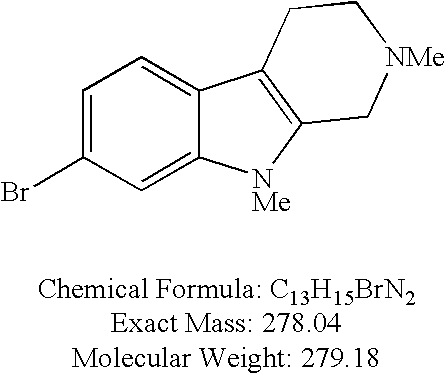
  • 3-Bromophenylhydrazine hydrochloride (20.0 g, 85.8 mmol) was reacted according to the procedure of Mascal et al. (Rinehart, Kenneth L.; Kobayashi, Jun'ichi; Harbour, Gary C.; Gilmore, Jeremy; Mascal, Mark; et al. J. Am. Chem. Soc. 1987, 109, 3378-3387) to provide the title compound as a 1:1 mixture of the 6-bromo and 7-bromo-regioisomers (13.2 g, 65%), obtained as an orange solid: ESI MS m/z 239 [M+H] + .
  • tert-Butyl 7-bromo-3,4-dihydro-1H-pyrido[3,4-b]indole-2(9H)-carboxylate (1.96 g, 5.58 mmol) was dissolved in DMF (20 mL), and sodium hydride (60% weight dispersion in mineral oil, 330 mg, 8.37 mmol) was added. After 30 minutes, methyl iodide (0.52 mL, 8.4 mmol) was added, and the reaction stirred for a further 2 h. The mixture was diluted with methylene chloride and washed with 5% lithium chloride solution (5 ⁇ ), dried and concentrated.
  • tert-Butyl-7-bromo-9-methyl-3,4-dihydro-1H-pyrido[3,4-b]indole-2(9H)-carboxylate (1.75 g, 4.79 mmol) was dissolved in CH 2 Cl 2 (10 mL) and trifluoroacetic acid (TFA) (10 mL) was added.
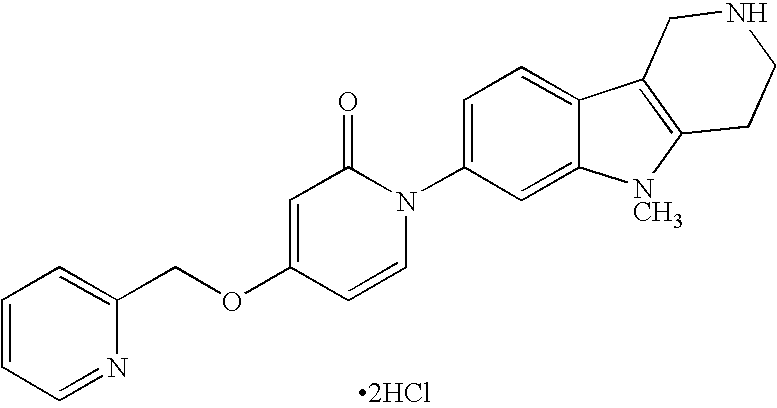
  • 2-Pyridylbenzylalcohol (1.67 g, 15.3 mmol) was dissolved in 1,4-dioxane (25 mL) and NaH (60% weight dispersion in mineral oil, 0.92 g, 23 mmol) was added. After stirring for 30 minutes, 4-chloropyridine-N-oxide (2.27 g, 17.5 mmol) was added and the reaction mixture was heated for 1 h at 120° C.
  • the product was purified by preparative HPLC and then flash column chromatography (12 g ISCO column eluting with methylene chloride and a methanol/ammonia mixture (10:1); gradient 100% methylene chloride to 90% methylene chloride over 30 min at 25 mL/min) to provide the free-base.
  • 6-Bromo-2,3,4,9-tetrahydro-1H-pyrido[3,4-b]indole (2.6 g, 10 mmol) was suspended in CH 2 Cl 2 (50 mL) and THF (7.5 mL) and Boc 2 O (2.3 g, 11 mmol) was added. After 2.5 h, the mixture was concentrated.
  • tert-Butyl 6-bromo-3,4-dihydro-1H-pyrido[3,4-b]indole-2(9H)-carboxylate (1.15 g, 3.26 mmol) was dissolved in DMF (20 mL) and sodium hydride (60% weight dispersion in mineral oil, 196 mg, 4.89 mmol) was added. After 1 h, methyl iodide (0.30 mL, 4.9 mmol) was added and the reaction mixture was stirred for a further 30 min. The mixture was diluted with methylene chloride and washed with 5% lithium chloride solution (5 ⁇ ), dried over Na 2 SO 4 and concentrated.
  • tert-Butyl 7-bromo-3,4-dihydro-1H-pyrido[4,3-b]indole-2(5H)-carboxylate 300 mg, 0.85 mmol was dissolved in DMF (3 mL), and NaH (60% weight dispersion in mineral oil, 40 mg, 1.02 mmol) and TIPSCl (164 mg, 1.02 mmol) were added. After stirring for 1 h, the mixture was poured into water and extracted with EtOAc.
  • This compound was prepared in accordance with the procedure of Stenkamp et al., WO 2008/022979.
  • This compound was prepared in accordance with the procedure of Stenkamp et al., WO 2008/022979.
  • the foam was suspended in benzene (70 mL) and treated with POCl 3 (3.52 mL, 38.4 mmol). The reaction was heated and stirred at 85° C. for one hour. After the solution was concentrated, the residue was purified by flash column chromatography (silica gel, 10% CH 3 OH in CH 2 Cl 2 ) to give a brown solid (1.83 g 91%). The solid was suspended in EtOH (20 mL) and CHCl 3 (20 mL) and cooled to 0° C. NaBH 4 (0.26 g, 6.95 mmol) was added, and the reaction was stirred from 0° C. to room temperature for one hour.

Landscapes

  • Health & Medical Sciences (AREA)
  • Chemical & Material Sciences (AREA)
  • Organic Chemistry (AREA)
  • Chemical Kinetics & Catalysis (AREA)
  • Engineering & Computer Science (AREA)
  • General Chemical & Material Sciences (AREA)
  • Medicinal Chemistry (AREA)
  • Nuclear Medicine, Radiotherapy & Molecular Imaging (AREA)
  • Bioinformatics & Cheminformatics (AREA)
  • Pharmacology & Pharmacy (AREA)
  • Life Sciences & Earth Sciences (AREA)
  • Animal Behavior & Ethology (AREA)
  • General Health & Medical Sciences (AREA)
  • Public Health (AREA)
  • Veterinary Medicine (AREA)
  • Diabetes (AREA)
  • Hematology (AREA)
  • Obesity (AREA)
  • Neurosurgery (AREA)
  • Neurology (AREA)
  • Biomedical Technology (AREA)
  • Heart & Thoracic Surgery (AREA)
  • Emergency Medicine (AREA)
  • Endocrinology (AREA)
  • Child & Adolescent Psychology (AREA)
  • Cardiology (AREA)
  • Vascular Medicine (AREA)
  • Urology & Nephrology (AREA)
  • Pain & Pain Management (AREA)
  • Psychiatry (AREA)
  • Gastroenterology & Hepatology (AREA)
  • Pharmaceuticals Containing Other Organic And Inorganic Compounds (AREA)
  • Nitrogen Condensed Heterocyclic Rings (AREA)
  • Nitrogen And Oxygen Or Sulfur-Condensed Heterocyclic Ring Systems (AREA)

Abstract

Substituted pyridoindoles for incorporation in pharmaceutical compositions employed in the treatment of various diseases correspond to formula (I)
Figure US08716308-20140506-C00001

wherein R1 is H or optionally substituted alkyl; R2, R3, R4 are each independently selected from H, —O-alkyl, —S-alkyl, alkyl, halo, —CF3, and —CN; G is —CR12R13—NR5— or —NR5—CR12R13; R5; is H, optionally substituted alkyl, optionally substituted heterocycle, —C(═O)—R6, —C(═O)—O—R7, or —C(═O)—NR19R20; R6 and R7 are each optionally substituted alkyl or optionally substituted heterocycle; R8, R9, R10, R11, R12, R13, R19 and R20 are each independently selected from H or optionally substituted alkyl; R14 and R15 are each independently H or halogen; L is —CH2—O—, —CH2CH2—, —CH═CH— or a bond; and B is aryl or heteroaryl or cycloalkyl; with the proviso that, when L is a direct bond, B cannot be unsubstituted heteroaryl or heteroaryl monosubstituted with fluorine.

Description

CROSS-REFERENCE TO RELATED APPLICATION
This application claims the benefit of priority from U.S. Provisional Application Ser. No. 61/020,530, filed Jan. 11, 2008, and U.S. Provisional Application Ser. No. 61/048,677, filed Apr. 29, 2008, the disclosures of which are incorporated herein by reference.
FIELD OF THE INVENTION
The invention relates to human melanin-concentrating hormone (MCH1) receptor-selective antagonists substituted pyridoindoles that are useful for treating obesity, to pharmaceutical compositions comprising these compounds, and to methods for the treatment of obesity, anxiety, depression, and psychiatric disorders in a mammal.
BACKGROUND OF THE INVENTION
Obesity and the multitude of co-morbidities associated with obesity such as diabetes, dyslipidemia, coronary heart disease, and certain cancers are a major concern for public health. The currently available pharmaceutical therapies for the treatment of obesity have limited efficacy and side effects that limit their use. Thus, there is a significant medical need for better pharmacotherapy for obesity.
Melanin-concentrating hormone (MCH) has been identified as an orexigenic peptide that exerts an effect on food intake and body weight regulation. MCH is a cyclic 19 amino acid neuropeptide expressed in the zona incerta and lateral hypothalamus in response to both energy restriction and leptin deficiency. MCH is known to stimulate feeding when injected into the lateral ventricle of rats and the mRNA for MCH is upregulated in the hypothalamus of genetically obese mice (ob/ob) and in fasted control and ob/ob animals. In addition, animals treated with MCH show increases in glucose, insulin and leptin levels, mimicking human metabolic syndrome (Gomori, A. Chronic infusion of MCH causes obesity in mice Am. J. Physiol. Endocrinol. Metab. 284, E583, 2002). Mice lacking MCH are hypophagic and lean with increased metabolic rate, whereas animals over-expressing MCH gain excess weight on both standard and high fat diets. MCH is thought to have effects on other nervous system functions as well (Rocksz, L. L. Biological Examination of Melanin Concentrating Hormone 1: Multi-tasking from the hypothalamus Drug News Perspect 19(5), 273, 2006). An orphan G-protein coupled receptor (GPCR) was recently identified as a receptor for MCH. Disruption of the binding between MCH and the MCH receptor, i.e. MCH antagonism, may thus be used to counteract the effects of MCH (McBriar, M. D. Recent advances in the discovery of melanin-concentrating hormone receptor antagonists Curr. Opin. Drug Disc. & Dev. 9(4), 496, 2006).
SUMMARY OF THE INVENTION
In accordance the present invention, there is provided a compound of formula (I)
Figure US08716308-20140506-C00002

wherein
R1 is H or optionally substituted alkyl;
R2, R3, R4 are each independently selected from H, —O-alkyl, —S-alkyl, alkyl, halo, —CF3, and —CN;
G is —CR12R13—NR5— or —NR5—CR12R13;
R5 is H, optionally substituted alkyl, optionally substituted heterocycle, —C(═O)—R6, —C(═O)—O—R7, or —C(═O)—NR19R20;
R6 and R7 are each optionally substituted alkyl or optionally substituted heterocycle;
R8, R9, R10, R11, R12, R13, R19 and R20 are each independently selected from H or optionally substituted alkyl;
R14 and R15 are each independently H or halogen;
Y is CH or N;
L is —CH2—O—, —CH2CH2—, —CH═CH— or a bond; and
B is aryl or heteroaryl or cycloalkyl;
with the proviso that, when L is a direct bond, B cannot be unsubstituted heteroaryl or heteroaryl monosubstituted with fluorine.
DETAILED DESCRIPTION OF THE INVENTION
In accordance with the present invention, compounds represented by formula (I) above may be substituted derivatives either of tetrahydro-β-carboline, where G is —CR12R13—NR5—, or of tetrahydro-γ-carboline, where G is —NR12—CR13R13—. In some embodiments of the invention, G is —CH2—NR5—; in other embodiments, G is —NR5—CH2—. In accordance with some embodiments of the invention, R1 is H.
In accordance with other embodiments of the invention, R5 is alkyl, for example, methyl or ethyl.
In accordance with some embodiments of the invention, R5 is H. In other embodiments, R5 is optionally substituted alkyl. In some embodiments, R5 is selected from methyl, ethyl, 2-propyl, 2-hydroxyethyl, 2,2,2-trifluoroethyl, 3,3,3-trifluoropropyl, 2-oxo-2-(pyrrolidin-1-yl)ethyl, 2-(pyrrolidin-1-yl)ethyl and (S)-pyrrolidin-2-ylmethyl. In other embodiments, R5 is optionally substituted heterocycle. In some embodiments, R5 is selected from piperidin-4-yl and 1-methylpiperidin-4-yl. In other embodiments, R5 is —C(═O)—R6. In other embodiments, R5 is —C(═O)—O—R7.
In some embodiments, R6 and R7 are each optionally substituted alkyl, for example, methyl, 2-propyl, 2-(pyrrolidin-1-yl)-ethyl, pyrrolidin-1-ylmethyl, and dimethylaminomethyl. In some embodiments, R6 is optionally substituted heterocycle, for example, pyrrolidin-3-yl, (R)-pyrrolidin-2-yl, (S)-pyrrolidin-2-yl, 1-methylpyrrolidin-3-yl, (R)-1-methylpyrrolidin-2-yl and (S)-1-methylpyrrolidin-2-yl.
In accordance with some embodiments of the invention, the compound has the
Figure US08716308-20140506-C00003

structure
In accordance with other embodiments of the invention, the compound has the
Figure US08716308-20140506-C00004

structure
In accordance with some embodiments of the invention, the L is a bond. In accordance with other embodiments of the invention, L is —CH2—O—. In accordance with some embodiments of the invention, L is —CH2CH2—. In accordance with other embodiments of the invention, L is —CH═CH—.
In accordance with some embodiments of the invention, B is aryl, for example, phenyl. In accordance with other embodiments of the invention, B is heteroaryl, for example, pyridinyl. In some embodiments, B is pyridin-2-yl or pyridin-3-yl. In other embodiments, B is pyridazinyl, for example, pyridazin-3-yl. In some other embodiments, B is pyrimidinyl, for example, pyrimidin-5-yl or pyrimidin-2-yl. In accordance with other embodiments of the invention, B is cycloalkyl, for example, cyclohexyl.
In accordance with some embodiments of the invention, R2, R3 and R4 are each H. In accordance with other embodiments of the invention, two of R2, R3 and R4 are H, and the other of R2, R3 and R4 is selected from trifluoromethyl, chloro, fluoro, methyl, methoxy and methanethio.
In accordance with other embodiments of the invention, one of R2, R3 and R4 is H, another of R2, R3 and R4 is Cl, and the third of R2, R3 and R4 is F, Cl or methoxy. In accordance with other embodiments of the invention, one of R2, R3 and R4 is H, another of R2, R3 and R4 is F, and the third of R2, R3 and R4 is methoxy. In accordance with other embodiments of the invention, one of R2, R3 and R4 is H, another of R2, R3 and R4 is methoxy, and the third of R2, R3 and R4 is methyl.
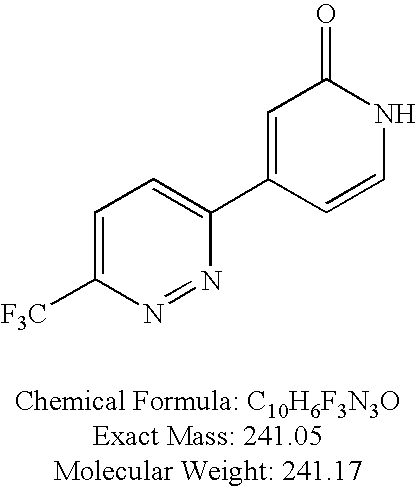
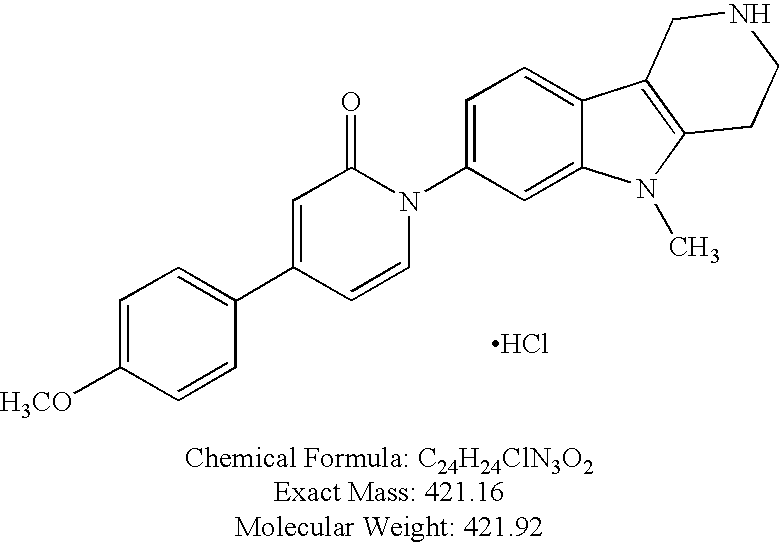
In accordance with some embodiments of the invention, B, together with R2, R3 and R4, is selected from phenyl, 4-trifluoromethylphenyl, 4-chlorophenyl, 2,4-dichlorophenyl, 4-fluorophenyl, 4-chloro-2-fluorophenyl, 2-fluoro-4-methoxyphenyl, pyridin-2-yl, 5-chloropyridin-2-yl, 5-(trifluoromethyl)pyridin-2-yl, 5-fluoropyridin-2-yl, 6-(trifluoromethyl)pyridazin-3-yl, 6-methylpyridazin-3-yl, 4-fluoro-2-methoxyphenyl, 6-(trifluoromethyl)pyridin-3-yl, 2-(trifluoromethyl)pyrimidin-5-yl, 5-(trifluoromethyl)pyrimidin-2-yl, 5-methylpyridin-2-yl, 6-methylpyridin-3-yl, cyclohexyl, 4-chloro-2-methoxyphenyl, pyrimidin-2-yl, imidazo[1,2-a]pyridin-6-yl, imidazo[1,2-a]pyridin-2-yl, 4-methoxyphenyl, 4-methanethiophenyl and 4-methoxy-2-methylphenyl.
In accordance with some embodiments of the invention, at least one of R8, R9, R10, R11, R12, R13, R19 and R20 is H. In other embodiments, at least one of R8, R9, R10, R11, R12, R13, R19 and R20 is optionally substituted alkyl, for example, methyl, ethyl, or hydroxymethyl.
In accordance with some embodiments of the invention, the compound is selected
Figure US08716308-20140506-C00005
Figure US08716308-20140506-C00006
Figure US08716308-20140506-C00007
Figure US08716308-20140506-C00008
Figure US08716308-20140506-C00009
Figure US08716308-20140506-C00010
Figure US08716308-20140506-C00011
Figure US08716308-20140506-C00012
Figure US08716308-20140506-C00013
Figure US08716308-20140506-C00014
Figure US08716308-20140506-C00015
Figure US08716308-20140506-C00016
Figure US08716308-20140506-C00017
Figure US08716308-20140506-C00018
Figure US08716308-20140506-C00019
Figure US08716308-20140506-C00020
Figure US08716308-20140506-C00021
Figure US08716308-20140506-C00022
Figure US08716308-20140506-C00023
Figure US08716308-20140506-C00024
Figure US08716308-20140506-C00025
Figure US08716308-20140506-C00026
Figure US08716308-20140506-C00027
Figure US08716308-20140506-C00028
Figure US08716308-20140506-C00029
Figure US08716308-20140506-C00030
In accordance with some embodiments of the invention, the compound is a pharmaceutically acceptable salt thereof. In some embodiments, the salt is an HCl salt. There is also provided, in accordance with embodiments of the invention, a pharmaceutical composition comprising a compound as described herein, and a pharmaceutically acceptable carrier, excipient or diluent therefore.
There is also provided, in accordance with embodiments of the invention, a method of treating obesity, comprising administering to a patient in need of obesity reduction an obesity-reducing effective amount of a compound as described herein.
There is also provided, in accordance with embodiments of the invention, a method of treating anxiety, comprising administering to a patient in need of such treatment a therapeutically effective amount of a compound as described herein.
There is also provided, in accordance with embodiments of the invention, a method of treating depression, comprising administering to a patient in need of such treatment a therapeutically effective amount of a compound as described herein.
There is also provided, in accordance with embodiments of the invention, a method of treating non-alcoholic fatty liver disease, comprising administering to a patient in need of such treatment a therapeutically effective amount of a compound as described herein.
There is also provided, in accordance with embodiments of the invention, a method of treating a disease or condition which is susceptible to treatment with an MCH1 receptor modulator, comprising administering to a patient in need thereof a therapeutically effective amount of a compound as described herein.
DEFINITIONS
Throughout this specification the terms and substituents retain their definitions. Alkyl is intended to include linear, branched, or cyclic hydrocarbon structures and combinations thereof. When not otherwise restricted, the term refers to alkyl of 20 or fewer carbons. Lower alkyl refers to alkyl groups of 1, 2, 3, 4, 5 and 6 carbon atoms. Examples of lower alkyl groups include methyl, ethyl, propyl, isopropyl, butyl, s- and t-butyl and the like. Cycloalkyl is a subset of alkyl and includes cyclic hydrocarbon groups of 3, 4, 5, 6, 7, and 8 carbon atoms. Examples of cycloalkyl groups include c-propyl, c-butyl, c-pentyl, norbornyl, adamantyl and the like.
C1 to C20 Hydrocarbon (e.g. C1, C2, C3, C4, C5, C6, C7, C8, C9, C10, C11, C12, C13, C14, C15, C16, C17, C18, C19, C20) includes alkyl, cycloalkyl, alkenyl, alkynyl, aryl and combinations thereof. Examples include benzyl, phenethyl, cyclohexylmethyl, camphoryl and naphthylethyl. The term “phenylene” refers to ortho, meta or para residues of the formulae:
Figure US08716308-20140506-C00031
Alkoxy or alkoxyl refers to groups of 1, 2, 3, 4, 5, 6, 7 or 8 carbon atoms of a straight, branched, cyclic configuration and combinations thereof attached to the parent structure through an oxygen. Examples include methoxy, ethoxy, propoxy, isopropoxy, cyclopropyloxy, cyclohexyloxy and the like. Lower-alkoxy refers to groups containing one to four carbons. For the purposes of the present patent application alkoxy also includes methylenedioxy and ethylenedioxy in which each oxygen atom is bonded to the atom, chain or ring from which the methylenedioxy or ethylenedioxy group is pendant so as to form a ring. Thus, for example, phenyl substituted by alkoxy may be, for example,
Figure US08716308-20140506-C00032
Oxaalkyl refers to alkyl residues in which one or more carbons (and their associated hydrogens) have been replaced by oxygen. Examples include methoxypropoxy, 3,6,9-trioxadecyl and the like. The term oxaalkyl is intended as it is understood in the art [see Naming and Indexing of Chemical Substances for Chemical Abstracts, published by the American Chemical Society, ¶196, but without the restriction of ¶127(a)], i.e. it refers to compounds in which the oxygen is bonded via a single bond to its adjacent atoms (forming ether bonds). Similarly, thiaalkyl and azaalkyl refer to alkyl residues in which one or more carbons have been replaced by sulfur or nitrogen, respectively. Examples include ethylaminoethyl and methylthiopropyl.
Acyl refers to groups of 1, 2, 3, 4, 5, 6, 7 and 8 carbon atoms of a straight, branched, cyclic configuration, saturated, unsaturated and aromatic and combinations thereof, attached to the parent structure through a carbonyl functionality. One or more carbons in the acyl residue may be replaced by nitrogen, oxygen or sulfur as long as the point of attachment to the parent remains at the carbonyl. Examples include formyl, acetyl, propionyl, isobutyryl, t-butoxycarbonyl, benzoyl, benzyloxycarbonyl and the like. Lower-acyl refers to groups containing one to four carbons.
Aryl and heteroaryl refer to aromatic or heteroaromatic rings, respectively, as substituents. Heteroaryl contains one, two or three heteroatoms selected from O, N, or S. Both refer to monocyclic 5- or 6-membered aromatic or heteroaromatic rings, bicyclic 9- or 10-membered aromatic or heteroaromatic rings and tricyclic 13- or 14-membered aromatic or heteroaromatic rings. Aromatic 6, 7, 8, 9, 10, 11, 12, 13 and 14-membered carbocyclic rings include, e.g., benzene, naphthalene, indane, tetralin, and fluorene and the 5, 6, 7, 8, 9 and 10-membered aromatic heterocyclic rings include, e.g., imidazole, pyridine, indole, thiophene, benzopyranone, thiazole, furan, benzimidazole, quinoline, isoquinoline, quinoxaline, pyrimidine, pyrazine, tetrazole and pyrazole.
Arylalkyl means an alkyl residue attached to an aryl ring. Examples are benzyl, phenethyl and the like.
Substituted alkyl, aryl, cycloalkyl, heterocyclyl etc. refer to alkyl, aryl, cycloalkyl, or heterocyclyl wherein up to three H atoms in each residue are replaced with alkyl, halogen, haloalkyl, hydroxy, loweralkoxy, carboxy, carboalkoxy (also referred to as alkoxycarbonyl), carboxamido (also referred to as alkylaminocarbonyl), cyano, carbonyl, nitro, amino, alkylamino, dialkylamino, mercapto, alkylthio, sulfoxide, sulfone, acylamino, amidino, phenyl, benzyl, heteroaryl, phenoxy, benzyloxy, or heteroaryloxy.
The term “halogen” means fluorine, chlorine, bromine or iodine.
The term “prodrug” refers to a compound that is made more active in vivo. Commonly the conversion of prodrug to drug occurs by enzymatic processes in the liver or blood of the mammal. Many of the compounds of the invention may be chemically modified without absorption into the systemic circulation, and in those cases, activation in vivo may come about by chemical action (as in the acid-catalyzed cleavage in the stomach) or through the intermediacy of enzymes and microflora in the gastrointestinal GI tract.
In the characterization of some of the substituents, it is recited that certain substituents may combine to form rings. Unless stated otherwise, it is intended that such rings may exhibit various degrees of unsaturation (from fully saturated to fully unsaturated), may include heteroatoms and may be substituted with lower alkyl or alkoxy.
It will be recognized that the compounds of this invention can exist in radiolabeled form, i.e., the compounds may contain one or more atoms containing an atomic mass or mass number different from the atomic mass or mass number usually found in nature. Radioisotopes of hydrogen, carbon, phosphorous, fluorine, iodine and chlorine include 3H, 14C, 35S, 18F, 32P, 33P, 125I, and 36Cl, respectively. Compounds that contain those radioisotopes and/or other radioisotopes of other atoms are within the scope of this invention. Radiolabeled compounds described herein and prodrugs thereof can generally be prepared by methods well known to those skilled in the art. Conveniently, such radiolabeled compounds can be prepared by carrying out the procedures disclosed in the Examples and Schemes by substituting a readily available radiolabeled reagent for a non-radiolabeled reagent.
The terms “methods of treating or preventing” mean amelioration, prevention or relief from the symptoms and/or effects associated with lipid disorders. The term “preventing” as used herein refers to administering a medicament beforehand to forestall or obtund an acute episode or, in the case of a chronic condition to diminish the likelihood or seriousness of the condition. The person of ordinary skill in the medical art (to which the present method claims are directed) recognizes that the term “prevent” is not an absolute term. In the medical art it is understood to refer to the prophylactic administration of a drug to substantially diminish the likelihood or seriousness of a condition, and this is the sense intended in applicants' claims. As used herein, reference to “treatment” of a patient is intended to include prophylaxis.
Throughout this application, various references are referred to. Each of the patents, patent applications, patent publications, and references mentioned herein is hereby incorporated by reference in its entirety.
The term “mammal” is used in its dictionary sense. The term “mammal” includes, for example, mice, hamsters, rats, cows, sheep, pigs, goats, and horses, monkeys, dogs (e.g., Canis familiaris), cats, rabbits, guinea pigs, and primates, including humans.
Compounds described herein may contain one or more asymmetric centers and may thus give rise to enantiomers, diastereomers, and other stereoisomeric forms. Each chiral center may be defined, in terms of absolute stereochemistry, as (R)— or (S)—. The present invention is meant to include all such possible isomers, as well as mixtures thereof, including racemic and optically pure forms. Optically active (R)— and (S)—, (−)- and (+)-, or (D)- and (L)-isomers may be prepared using chiral synthons or chiral reagents, or resolved using conventional techniques. When the compounds described herein contain olefinic double bonds or other centers of geometric asymmetry, and unless specified otherwise, it is intended that the compounds include both E and Z geometric isomers. The configuration of any carbon-carbon double bond appearing herein is selected for convenience only and is not intended to designate a particular configuration; thus a carbon-carbon double bond depicted arbitrarily herein as E may be Z, E, or a mixture of the two in any proportion. Likewise, all tautomeric forms are also intended to be included.
As used herein, and as would be understood by the person of skill in the art, the recitation of “a compound” is intended to include salts, solvates and inclusion complexes of that compound as well as any stereoisomeric form, or a mixture of any such forms of that compound in any ratio. Thus, in accordance with some embodiments of the invention, a compound as described herein, including in the contexts of pharmaceutical compositions, methods of treatment, and compounds per se, is provided as the salt form. In accordance with some embodiments of the invention, the salt is a hydrochloride salt.
The term “enantiomeric excess” is well known in the art and is defined for a resolution of ab into a+b as
ee a = ( conc . of a - conc . of b conc . of a + conc . of b ) × 100
The term “enantiomeric excess” is related to the older term “optical purity” in that both are measures of the same phenomenon. The value of ee will be a number from 0 to 100, zero being racemic and 100 being pure, single enantiomer. A compound which in the past might have been called 98% optically pure is now more precisely described as 96% ee; in other words, a 90% ee reflects the presence of 95% of one enantiomer and 5% of the other in the material in question.
Terminology related to “protecting”, “deprotecting” and “protected” functionalities occurs throughout this application. Such terminology is well understood by persons of skill in the art and is used in the context of processes which involve sequential treatment with a series of reagents. In that context, a protecting group refers to a group which is used to mask a functionality during a process step in which it would otherwise react, but in which reaction is undesirable. The protecting group prevents reaction at that step, but may be subsequently removed to expose the original functionality. The removal or “deprotection” occurs after the completion of the reaction or reactions in which the functionality would interfere. Thus, when a sequence of reagents is specified, as it is in the processes of the invention, the person of ordinary skill can readily envision those groups that would be suitable as “protecting groups”. Suitable groups for that purpose are discussed in standard textbooks in the field of chemistry, such as Protective Groups in Organic Synthesis by T. W. Greene [John Wiley & Sons, New York, 1991], which is incorporated herein by reference. Particular attention is drawn to the chapters entitled “Protection for the Hydroxyl Group, Including 1,2- and 1,3-Diols” (pages 10-86).
The following abbreviations and terms have the indicated meanings throughout: Ac=acetyl; Bu=butyl; c-=cyclo; DIEA=N,N-diisopropylethyl amine; TEA=triethylamine; HOAc=acetic acid; mesyl=methanesulfonyl; rt=room temperature; sat'd=saturated; s-=secondary; t-=tertiary; TMS=trimethylsilyl; tosyl=p-toluenesulfonyl; TFA=trifluoroacetic acid; HATU=O-(7-azabenzotriazol-1-yl)-N,N,N′N′-tetramethyluronium hexafluorophosphate. The abbreviations HPLC, THF, DCM and DMSO represent high performance liquid chromatography, tetrahydrofuran, dichloromethane and dimethylsulfoxide, respectively. The abbreviations Me, Et, Ph, Tf, Ts, Boc and Ms represent methyl, ethyl, phenyl, trifluoromethanesulfonyl, toluenesulfonyl, butyloxycarbonyl and methanesulfonyl respectively. The term dppf refers to 1,1′-Bis-(diphosphenylphosphino)ferrocene. A comprehensive list of abbreviations utilized by organic chemists (i.e. persons of ordinary skill in the art) appears in the first issue of each volume of the Journal of Organic Chemistry. The list, which is typically presented in a table entitled “Standard List of Abbreviations” is incorporated herein by reference.
While it may be possible for the compounds of the invention to be administered as the raw chemical, it is preferable to present them as a pharmaceutical composition. In accordance with an embodiment of the present invention there is provided a pharmaceutical composition comprising a compound of formula I or a pharmaceutically acceptable salt or solvate thereof, together with one or more pharmaceutically carriers thereof and optionally one or more other therapeutic ingredients. The carrier(s) must be “acceptable” in the sense of being compatible with the other ingredients of the formulation and not deleterious to the recipient thereof. Furthermore, notwithstanding the statement above regarding the term “compound” including salts thereof as well, so that independent claims reciting “a compound” will be understood as referring to salts thereof as well, if in an independent claim reference is made to a compound or a pharmaceutically acceptable salt thereof, it will be understood that claims which depend from that independent claim which refer to such a compound also include pharmaceutically acceptable salts of the compound, even if explicit reference is not made to the salts in the dependent claim.
The formulations include those suitable for oral, parenteral (including subcutaneous, intradermal, intramuscular, intravenous and intraarticular), rectal and topical (including dermal, buccal, sublingual and intraocular) administration. The most suitable route may depend upon the condition and disorder of the recipient. The formulations may conveniently be presented in unit dosage form and may be prepared by any of the methods well known in the art of pharmacy. Such methods include the step of bringing into association a compound of formula I or a pharmaceutically acceptable salt or solvate thereof (“active ingredient”) with the carrier, which constitutes one or more accessory ingredients. In general, the formulations are prepared by uniformly and intimately bringing into association the active ingredient with liquid carriers or finely divided solid carriers or both and then, if necessary, shaping the product into the desired formulation.
Formulations suitable for oral administration may be presented as discrete units such as capsules, cachets or tablets each containing a predetermined amount of the active ingredient; as a powder or granules; as a solution or a suspension in an aqueous liquid or a non-aqueous liquid; or as an oil-in-water liquid emulsion or a water-in-oil liquid emulsion. The active ingredient may also be presented as a bolus, electuary or paste.
A tablet may be made by compression or molding, optionally with one or more accessory ingredients. Compressed tablets may be prepared by compressing in a suitable machine the active ingredient in a free-flowing form such as a powder or granules, optionally mixed with a binder, lubricant, inert diluent, lubricating, surface active or dispersing agent. Molded tablets may be made by molding in a suitable machine a mixture of the powdered compound moistened with an inert liquid diluent. The tablets may optionally be coated or scored and may be formulated so as to provide sustained, delayed or controlled release of the active ingredient therein.
The pharmaceutical compositions may include a “pharmaceutically acceptable inert carrier”, and this expression is intended to include one or more inert excipients, which include starches, polyols, granulating agents, microcrystalline cellulose, diluents, lubricants, binders, disintegrating agents, and the like. If desired, tablet dosages of the disclosed compositions may be coated by standard aqueous or nonaqueous techniques, “Pharmaceutically acceptable carrier” also encompasses controlled release means.
Pharmaceutical compositions may also optionally include other therapeutic ingredients, anti-caking agents, preservatives, sweetening agents, colorants, flavors, desiccants, plasticizers, dyes, and the like. Any such optional ingredient must be compatible with the compound of formula I to insure the stability of the formulation. The composition may contain other additives as needed, including for example lactose, glucose, fructose, galactose, trehalose, sucrose, maltose, raffinose, maltitol, melezitose, stachyose, lactitol, palatinite, starch, xylitol, mannitol, myoinositol, and the like, and hydrates thereof, and amino acids, for example alanine, glycine and betaine, and peptides and proteins, for example albumen.
Examples of excipients for use as the pharmaceutically acceptable carriers and the pharmaceutically acceptable inert carriers and the aforementioned additional ingredients include, but are not limited to binders, fillers, disintegrants, lubricants, anti-microbial agents, and coating agents.
The dose range for adult humans is generally from 0.005 mg to 10 g/day orally. Tablets or other forms of presentation provided in discrete units may conveniently contain an amount of compound of formula I which is effective at such dosage or as a multiple of the same, for instance, units containing 5 mg to 500 mg, usually around 10 mg to 200 mg. The precise amount of compound administered to a patient will be the responsibility of the attendant physician. However, the dose employed will depend on a number of factors, including the age and sex of the patient, the precise disorder being treated, and its severity. A dosage unit (e.g. an oral dosage unit) can include from, for example, 1 to 30 mg, 1 to 40 mg, 1 to 100 mg, 1 to 300 mg, 1 to 500 mg, 2 to 500 mg, 3 to 100 mg, 5 to 20 mg, 5 to 100 mg (e.g. 1 mg, 2 mg, 3 mg, 4 mg, 5 mg, 6 mg, 7 mg, 8 mg, 9 mg, 10 mg, 11 mg, 12 mg, 13 mg, 14 mg, 15 mg, 16 mg, 17 mg, 18 mg, 19 mg, 20 mg, 25 mg, 30 mg, 35 mg, 40 mg, 45 mg, 50 mg, 55 mg, 60 mg, 65 mg, 70 mg, 75 mg, 80 mg, 85 mg, 90 mg, 95 mg, 100 mg, 150 mg, 200 mg, 250 mg, 300 mg, 350 mg, 400 mg, 450 mg, 500 mg) of a compound described herein.
For additional information about pharmaceutical compositions and their formulation, see, for example, Remington: The Science and Practice of Pharmacy, 20th Edition, 2000.
The agents can be administered, e.g., by intravenous injection, intramuscular injection, subcutaneous injection, intraperitoneal injection, topical, sublingual, intraarticular (in the joints), intradermal, buccal, ophthalmic (including intraocular), intranasaly (including using a cannula), or by other routes. The agents can be administered orally, e.g., as a tablet or cachet containing a predetermined amount of the active ingredient, gel, pellet, paste, syrup, bolus, electuary, slurry, capsule, powder, granules, as a solution or a suspension in an aqueous liquid or a non-aqueous liquid, as an oil-in-water liquid emulsion or a water-in-oil liquid emulsion, via a micellar formulation (see, e.g. WO 97/11682) via a liposomal formulation (see, e.g., EP 736299, WO 99/59550 and WO 97/13500), via formulations described in WO 03/094886 or in some other form. The agents can also be administered transdermally (i.e. via reservoir-type or matrix-type patches, microneedles, thermal poration, hypodermic needles, iontophoresis, electroporation, ultrasound or other forms of sonophoresis, jet injection, or a combination of any of the preceding methods (Prausnitz et al. 2004, Nature Reviews Drug Discovery 3:115)). The agents can be administered locally, for example, at the site of injury to an injured blood vessel. The agents can be coated on a stent. The agents can be administered using high-velocity transdermal particle injection techniques using the hydrogel particle formulation described in U.S. 20020061336. Additional particle formulations are described in WO 00/45792, WO 00/53160, and WO 02/19989. An example of a transdermal formulation containing plaster and the absorption promoter dimethylisosorbide can be found in WO 89/04179. WO 96/11705 provides formulations suitable for transdermal administration.
The agents can be administered in the form a suppository or by other vaginal or rectal means. The agents can be administered in a transmembrane formulation as described in WO 90/07923. The agents can be administered non-invasively via the dehydrated particles described in U.S. Pat. No. 6,485,706. The agent can be administered in an enteric-coated drug formulation as described in WO 02/49621. The agents can be administered intranasaly using the formulation described in U.S. Pat. No. 5,179,079. Formulations suitable for parenteral injection are described in WO 00/62759. The agents can be administered using the casein formulation described in U.S. 20030206939 and WO 00/06108. The agents can be administered using the particulate formulations described in U.S. 20020034536.
The agents, alone or in combination with other suitable components, can be administered by pulmonary route utilizing several techniques including but not limited to intratracheal instillation (delivery of solution into the lungs by syringe), intratracheal delivery of liposomes, insufflation (administration of powder formulation by syringe or any other similar device into the lungs) and aerosol inhalation. Aerosols (e.g., jet or ultrasonic nebulizers, metered-dose inhalers (MDIs), and dry-Powder inhalers (DPIs)) can also be used in intranasal applications. Aerosol formulations are stable dispersions or suspensions of solid material and liquid droplets in a gaseous medium and can be placed into pressurized acceptable propellants, such as hydrofluoroalkanes (HFAs, i.e. HFA-134a and HFA-227, or a mixture thereof), dichlorodifluoromethane (or other chlorofluorocarbon propellants such as a mixture of Propellants 11, 12, and/or 114), propane, nitrogen, and the like. Pulmonary formulations may include permeation enhancers such as fatty acids, and saccharides, chelating agents, enzyme inhibitors (e.g., protease inhibitors), adjuvants (e.g., glycocholate, surfactin, span 85, and nafamostat), preservatives (e.g., benzalkonium chloride or chlorobutanol), and ethanol (normally up to 5% but possibly up to 20%, by weight). Ethanol is commonly included in aerosol compositions as it can improve the function of the metering valve and in some cases also improve the stability of the dispersion.
Pulmonary formulations may also include surfactants which include but are not limited to bile salts and those described in U.S. Pat. No. 6,524,557 and references therein. The surfactants described in U.S. Pat. No. 6,524,557, e.g., a C8-C16 fatty acid salt, a bile salt, a phospholipid, or alkyl saccharide are advantageous in that some of them also reportedly enhance absorption of the compound in the formulation.
Also suitable in the invention are dry powder formulations comprising a therapeutically effective amount of active compound blended with an appropriate carrier and adapted for use in connection with a dry-powder inhaler. Absorption enhancers that can be added to dry powder formulations of the present invention include those described in U.S. Pat. No. 6,632,456. WO 02/080884 describes new methods for the surface modification of powders. Aerosol formulations may include U.S. Pat. No. 5,230,884, U.S. Pat. No. 5,292,499, WO 017/8694, WO 01/78696, U.S. 2003019437, U.S. 20030165436, and WO 96/40089 (which includes vegetable oil). Sustained release formulations suitable for inhalation are described in U.S. 20010036481A1, 20030232019A1, and U.S. 20040018243A1 as well as in WO 01/13891, WO 02/067902, WO 03/072080, and WO 03/079885.
Pulmonary formulations containing microparticles are described in WO 03/015750, U.S. 20030008013, and WO 00/00176. Pulmonary formulations containing stable glassy state powder are described in U.S. 20020141945 and U.S. Pat. No. 6,309,671. Other aerosol formulations are described in EP 1338272A1 WO 90/09781, U.S. Pat. No. 5,348,730, U.S. Pat. No. 6,436,367, WO 91/04011, and U.S. Pat. No. 6,294,153 and U.S. Pat. No. 6,290,987 describes a liposomal based formulation that can be administered via aerosol or other means.
Powder formulations for inhalation are described in U.S. 20030053960 and WO 01/60341. The agents can be administered intranasally as described in U.S. 20010038824. Solutions of medicament in buffered saline and similar vehicles are commonly employed to generate an aerosol in a nebulizer. Simple nebulizers operate on Bernoulli's principle and employ a stream of air or oxygen to generate the spray particles. More complex nebulizers employ ultrasound to create the spray particles. Both types are well known in the art and are described in standard textbooks of pharmacy such as Sprowls' American Pharmacy and Remington's The Science and Practice of Pharmacy.
Other devices for generating aerosols employ compressed gases, usually hydrofluorocarbons and chlorofluorocarbons, which are mixed with the medicament and any necessary excipients in a pressurized container, these devices are likewise described in standard textbooks such as Sprowls and Remington.
The agent can be incorporated into a liposome to improve half-life. The agent can also be conjugated to polyethylene glycol (PEG) chains. Methods for pegylation and additional formulations containing PEG-conjugates (i.e. PEG-based hydrogels, PEG modified liposomes) can be found in Harris and Chess, Nature Reviews Drug Discovery 2:214-221 and the references therein. The agent can be administered via a nanocochleate or cochleate delivery vehicle (BioDelivery Sciences International). The agents can be delivered transmucosally (i.e. across a mucosal surface such as the vagina, eye or nose) using formulations such as that described in U.S. Pat. No. 5,204,108. The agents can be formulated in microcapsules as described in WO 88/01165. The agent can be administered intra-orally using the formulations described in U.S. 20020055496, WO 00/47203, and U.S. Pat. No. 6,495,120. The agent can be delivered using nanoemulsion formulations described in WO 01/91728A2.
TABLE 1 lists compounds representative of embodiments of the invention. In general, the compounds of the present invention may be prepared by the methods illustrated in the general reaction schemes as, for example, described below, or by modifications thereof, using readily available starting materials, reagents and conventional synthesis procedures. In these reactions, it is also possible to make use of variants that are in themselves known, but are not mentioned here.
Processes for obtaining the compounds of the invention are presented below. Other compounds of the invention may be prepared in analogous fashion to those whose synthesis is exemplified herein. The procedures below illustrate such methods. Furthermore, although the syntheses depicted herein may result in the preparation of enantiomers having a particular stereochemistry, included within the scope of the present invention are compounds of formula I in any stereoisomeric form, and preparation of compounds of formula I in stereoisomeric forms other than those depicted herein would be obvious to one of ordinary skill in the chemical arts based on the procedures presented herein.
Synthetic Methods
Figure US08716308-20140506-C00033
Compounds of formula 3 (wherein R14 is H or halogen; R1 is H; R5 is a protecting group such as tert-butoxycarbonyl or benzyloxycarbonyl; R8, R9, R10, R11, R12 and R13 are each independently selected from H or optionally substituted alkyl) can be prepared from 3- or 4-bromo phenylhydrazine 1 (or a salt thereof) and piperidinone 2 under heated acidic conditions. Optional N5-alkylation or N5-protection of compound 3 can provide compounds of formula 3 wherein R1 is alkyl or a protecting group such as tert-butoxycarbonyl, benzyloxycarbonyl or p-toluenesulfonyl. Optional removal of N2-protecting group R5 and reductive amination, alkylation or acylation can provide compounds of formula 3 wherein R5 is alkyl or acyl.
Figure US08716308-20140506-C00034
Compounds of formula 1 (wherein R14 is H or halogen) can be treated with compounds of formula 4 (wherein R12 and R13 are each independently selected from H or optionally substituted alkyl and R16 is alkyl) and a Lewis acid such as ZnCl2 under heated conditions to give compounds of formula 5. Treatment of compounds of formula 5 with ethyl glyoxylate under heated acidic conditions can provide compounds of formula 6 wherein R10 and R11 are H. Alternatively, compounds of formula 5 can be treated with a ketone under heated acidic conditions to provide compounds of formula 6 wherein R10 and R11 are optionally substituted alkyl. Compounds of formula 5 also can be treated with an acid chloride under basic conditions, followed by heating with POCl3 and finally by treatment with a reducing agent such as NaBH4 to provide compounds of formula 6 wherein R10 is H and R11 is optionally substituted alkyl. Protection of the N2-position on the tetrahydrocarboline ring can provide compounds of formula 7 (wherein R5 is a protecting group such as tert-butoxycarbonyl or benzyloxycarbonyl). Protection of the N9-position on the tetrahydrocarboline ring can provide compounds of formula 8 (wherein R1 is a protecting group such as tert-butoxycarbonyl, benzyloxycarbonyl or p-toluenesulfonyl). Alternatively, treatment of compound 7 with a base such as sodium hydride and an alkylating agent can provide compounds of formula 8 wherein R1 is optionally substituted alkyl. Optional removal of N2-protecting group R5 and reductive amination, alkylation or acylation can provide compounds of formula 8 wherein R5 is alkyl or acyl.
Figure US08716308-20140506-C00035
Compounds of formula 12 (wherein B is aryl or heteroaryl; R2, R3, R4 are each independently selected from H, —O-alkyl, S-alkyl, alkyl, halo, —CF3, and —CN; and Y is CH) can be prepared by treating compounds of formula 9 (wherein X1 is chlorine, bromine or iodine and Y is CH) with compounds of formula 10 (wherein B is aryl or heteroaryl; R2, R3, R4 are each independently selected from H, —O-alkyl, alkyl, halo, —CF3, and —CN; Z1 is B(OH)2, B(OR17)2, SnR17 3 or the like and R17 is alkyl), a catalyst such as palladium(0), and a base such as potassium carbonate to give compounds of formula 11, wherein L is a direct bond. Alternatively, in the case where Z1 is —CH2OH and B is aryl, heteroaryl or cycloalkyl, compounds of formula 10 can be treated with a base such as sodium hydride and compounds of formula 9 under heated conditions to give compounds of formula 11, wherein L is —CH2O—. In turn, compounds of formula 11 can be treated with acetic anhydride under heated conditions followed by methanol and water or methanol and sodium hydroxide under ambient to heated conditions to provide compounds of formula 12, wherein L is —CH2O— or a direct bond.
Figure US08716308-20140506-C00036
Alternatively, compounds of formula 12 (wherein B is aryl or heteroaryl; R2, R3, R4 are each independently selected from H, —O-alkyl, S-alkyl, alkyl, halo, —CF3, and —CN; and Y is CH) can be prepared by treating compounds of formula 13 (wherein X is chlorine, bromine or iodine and Y is CH) with compounds of formula 10 (wherein Z1 is —CH═CH—B(OR17)2, B(OR17)2, SnR17 3 or the like and R17 is H or alkyl), a catalyst such as palladium(0), and a base such as potassium carbonate to give compounds of formula 14, wherein L is —CH═CH— or a direct bond, in accordance with Z1. In the case where L is —CH═CH—, compounds of formula 14 can be treated with palladium on carbon under an atmosphere of hydrogen to give compounds of formula 14, wherein L is —CH2CH2—. Alternatively, in the case where Z1 is —CH2OH, compounds of formula 10 can be treated with compounds of formula 13, a catalyst such as copper iodide, a ligand such as 3,4,7,8-tetramethylphenanthroline and a base such as cesium carbonate under heated conditions to give compounds of formula 14, wherein L is —CH2O—. In turn, when L is —CH═CH—, —CH2CH2—, —CH2O— or a direct bond, compounds of formula 14 can be heated under acid conditions to provide compounds of formula 12, wherein L is —CH═CH—, —CH2CH2—, —CH2O— or a direct bond, respectively.
Figure US08716308-20140506-C00037
Alternatively, compounds of formula 12 (wherein B is aryl or heteroaryl; R2, R3, R4 are each independently selected from H, —O-alkyl, S-alkyl, alkyl, halo, —CF3, and —CN; and Y is N) can be prepared from compounds of formula 15 (wherein Y is N and R18 is a protecting group such as tetrahydropyran-2-yl). The hydroxyl group on compound 15 can be converted to an appropriate activating group to give compounds of formula 16. In the case where Z2 is triflate, compounds of formula 15 can be treated with trifluoromethylsulfonic anhydride or N-phenyl trifluoromethanesulfonamide and a base such as triethylamine, pyridine or lithium bis(trimethylsilyl)amide under cooled conditions to give compounds of formula 16. Treatment of compounds of formula 16 with compounds of formula 10 (wherein B is aryl or heteroaryl; R2, R3, R4 are each independently selected from H, —O-alkyl, S-alkyl, alkyl, halo, —CF3, and —CN; Z1═CH═CH—B(OR17)2, B(OH)2, B(OR17)2, SnR17 3 or the like, and R17=alkyl), a catalyst such as palladium(0), and a base such as potassium carbonate under heated conditions can provide compounds of formula 17, wherein L is —CH═CH— or a direct bond. Removal of the protecting group R18 on compound 17 can provide compounds of formula 12.
Figure US08716308-20140506-C00038

Compounds of formula 18 (wherein B is aryl, heteroaryl or cycloalkyl; R2, R3, R4 are each independently selected from H, —O-alkyl, —S-alkyl, alkyl, halo, —CF3, and —CN; L is —CH2—O—, —CH═CH—, —CH2CH2—, or a bond; Y is CH or N; R14 is H or halogen; R5 is alkyl, acyl or a protecting group such as tert-butoxycarbonyl or benzyloxycarbonyl; R1 is alkyl or a protecting group such as tert-butoxycarbonyl, benzyloxycarbonyl or p-toluenesulfonyl; and R8, R9, R10, R11, R12, and R13 are each independently selected from H or optionally substituted alkyl) can be prepared by treating compounds of formula 3 (wherein R5 is alkyl, acyl or a protecting group such as tert-butoxycarbonyl or benzyloxycarbonyl and R1 is alkyl or a protecting group such as tert-butoxycarbonyl, benzyloxycarbonyl or p-toluenesulfonyl) under heated conditions with a catalyst such as copper iodide, a ligand such as trans-1,2-diaminocyclohexane or 8-hydroxyquinoline, a base such as potassium carbonate, cesium carbonate or potassium phosphate and compounds of formula 12 (wherein B is aryl, heteroaryl or cycloalkyl; R2, R3, R4 are each independently selected from H, —O-alkyl, —S-alkyl, alkyl, halo, —CF3, and —CN; L is —CH2—O—, —CH═CH—, —CH2CH2—, or a bond; and Y is CH or N). Removal of the N2-protecting group R5 followed by reductive amination or alkylation can provide compounds of formula 18, wherein R5 is an optionally substituted alkyl group.
Alternatively, following deprotection, N2 can be acylated to give compounds of formula 18 wherein R5 is —C(═O)—R6 or —C(═O)—O—R7, and R6 and R7 are each optionally substituted alkyl or optionally substituted heterocycle. Additionally, in the case where R1 is a protecting group, the protecting group can be removed to give compounds of formula 18 wherein R1 is H.
Alternatively, following removal of the R1 protecting group, N5 can be alkylated to give compounds of formula 18 wherein R5 is an optionally substituted alkyl.
Figure US08716308-20140506-C00039
Compounds of formula 19 (wherein B is aryl, heteroaryl or cycloalkyl; R2, R3, R4 are each independently selected from H, —O-alkyl, —S-alkyl, alkyl, halo, —CF3, and —CN; L is —CH2—O—, —CH═CH—, —CH2CH2—, or a bond; Y is CH or N; R14 is H or halogen; R5 is alkyl, acyl or a protecting group such as tert-butoxycarbonyl or benzyloxycarbonyl; R1 is alkyl or a protecting group such as tert-butoxycarbonyl, benzyloxycarbonyl or p-toluenesulfonyl; and R8, R9, R10, R11, R12 and R13 are each independently selected from H or optionally substituted alkyl) can be prepared by treating compounds of formula 3 (wherein R5 is alkyl, acyl or a protecting group such as tert-butoxycarbonyl or benzyloxycarbonyl and R1 is alkyl or a protecting group such as tert-butoxycarbonyl, benzyloxycarbonyl or p-toluenesulfonyl) under heated conditions with a catalyst such as copper iodide, a ligand such as trans-1,2-diaminocyclohexane or 8-hydroxyquinoline, a base such as potassium carbonate, cesium carbonate or potassium phosphate and compounds of formula 12 (wherein B is aryl, heteroaryl or cycloalkyl; R2, R3, R4 are each independently selected from H, —O-alkyl, —S-alkyl, alkyl, halo, —CF3, and —CN; L is —CH2—O—, —CH═CH—, —CH2CH2—, or a bond; and Y is CH or N). Removal of the N2-protecting group R5 followed by reductive amination or alkylation can provide compounds of formula 18, wherein R5 is an optionally substituted alkyl group.
Alternatively, following deprotection, N2 can be acylated to give compounds of formula 18 wherein R5 is —C(═O)—R6 or —C(═O)—O—R7, and R6 and R7 are each optionally substituted alkyl or optionally substituted heterocycle. Additionally, in the case where R1 is a protecting group, the protecting group can be removed to give compounds of formula 18 wherein R1 is H.
Alternatively, following removal of the R1 protecting group, N5 can be alkylated to give compounds of formula 18 wherein R5 is an optionally substituted alkyl.
Figure US08716308-20140506-C00040
Compounds of formula 20 (wherein Y is CH or N; R14 is H or halogen; R5 is alkyl, acyl or a protecting group such as tert-butoxycarbonyl or benzyloxycarbonyl; R1 is alkyl or a protecting group such as tert-butoxycarbonyl, benzyloxycarbonyl or p-toluenesulfonyl; and R8, R9, R10, R11, R12 and R13 are each independently selected from H or optionally substituted alkyl) can be treated with hydrogen and a catalyst such as palladium on carbon to provide compounds of formula 21. The hydroxyl group on compounds of formula 21 can be converted to an appropriate activating group to give compounds of formula 22. In the case where Z2 is triflate, compounds of formula 21 can be treated with trifluoromethylsulfonic anhydride or N-phenyl trifluoromethanesulfonamide and a base such as pyridine or lithium bis(trimethylsilyl)amide under cooled conditions to give compounds of formula 22. Treatment of compounds of formula 22 with compounds of formula 10 (wherein B is aryl or heteroaryl; R2, R3, R4 are each independently selected from H, —O-alkyl, —S-alkyl, alkyl, halo, —CF3, and —CN; Z1=—CH═CH—B(OR17)2, B(OH)2, B(OR17)2, SnR17 3 or the like and R17=alkyl), a catalyst such as palladium(0), and a base such as potassium carbonate under heated conditions can provide compounds of formula 18, wherein L is —CH═CH— or a direct bond. In the case where L is —CH═CH—, compounds of formula 18 can be treated with palladium on carbon under an atmosphere of hydrogen to give compounds of formula 18, where L is —CH2CH2—.
Figure US08716308-20140506-C00041
Compounds of formula 23 (wherein Y is CH or N; R14 is H or halogen; R5 is alkyl, acyl or a protecting group such as tert-butoxycarbonyl or benzyloxycarbonyl; R1 is alkyl or a protecting group such as tert-butoxycarbonyl, benzyloxycarbonyl or p-toluenesulfonyl; and R8, R9, R10, R11, R12 and R13 are each independently selected from H or optionally substituted alkyl) can be treated with hydrogen and a catalyst such as palladium on carbon to provide compounds of formula 24. The hydroxyl group on compounds of formula 24 can be converted to an appropriate activating group to give compounds of formula 25. In the case where Z2 is triflate, compounds of formula 24 can be treated with trifluoromethylsulfonic anhydride or N-phenyl trifluoromethanesulfonamide and a base such as pyridine or lithium bis(trimethylsilyl)amide under cooled conditions to give compounds of formula 25.
Treatment of compounds of formula 25 with compounds of formula 10 (wherein B is aryl or heteroaryl; R2, R3, R4 are each independently selected from H, —O-alkyl, —S-alkyl, alkyl, halo, —CF3, and —CN; Z1=—CH═CH—B(OR17)2, B(OH)2, B(OR17)2, SnR17 3 or the like and R17=alkyl), a catalyst such as palladium(0), and a base such as potassium carbonate under heated conditions can provide compounds of formula 19, wherein L is —CH═CH— or a direct bond.
In the case where L is —CH═CH—, compounds of formula 18 can be treated with palladium on carbon under an atmosphere of hydrogen to give compounds of formula 18, where L is —CH2CH2—.
Figure US08716308-20140506-C00042
Compounds of formula 26 (wherein B is aryl or heteroaryl; R2, R3, R4 are each independently selected from H, —O-alkyl, —S-alkyl, alkyl, halo, —CF3, and —CN; L is —CH2—O—, —CH═CH—, —CH2CH2—, or a bond; G is —CR12R13—NH— or —NH—CR12R13—; R1 is alkyl; and R8, R9, R10, R11, R12 and R13 are each independently selected from H or optionally substituted alkyl) can be treated under halogenation conditions such as 2-bromopropane under heated conditions to provide compounds of formula 27 wherein R15 is a halogen such as bromine.
EXAMPLES
Unless otherwise noted, reagents and solvents were used as received from commercial suppliers. Proton nuclear magnetic resonance (NMR) spectra were obtained on Bruker spectrometers at 300, 400 or 500 MHz. Spectra are given in ppm (δ) and coupling constants, J, are reported in Hertz. Tetramethylsilane (TMS) was used as an internal standard. Mass spectra were collected using either a Finnigan LCQ Duo LCMS ion trap electrospray ionization (ESI) or a mass Varian 1200L single quadrapole mass spectrometer (ESI). High performace liquid chromatograph (HPLC) analyses were obtained using a Luna C18(2) column (250×4.6 mm, Phenomenex) or a Gemini C18 column (250×4.6 mm, Phenomenex) with UV detection at 254 nm or 223 nm using a standard solvent gradient program (Method A or Method B).
Method A:
Time Flow
(min) (mL/min) % A % B
0.0 1.0 90.0 10.0
20 1.0 10.0 90.0
25 1.0 10.0 90.0
A = Water with 0.025% Trifluoroacetic Acid
B = Acetonitrile with 0.025% Trifluoroacetic Acid
Method B:
Time Flow
(min) (mL/min) % A % B
0.0 1.0 98.0 2.0
25 1.0 10.0 90.0
30 1.0 10.0 90.0
A = Water with 0.025% Trifluoroacetic Acid
B = Acetonitrile with 0.025% Trifluoroacetic Acid
Example 1 Preparation of 4-(Benzyloxy)-1-(5-methyl-2,3,4,5-tetrahydro-1H-pyrido[4,3-b]indol-7-yl)pyridin-2(1H)-one hydrochloride a) tert-Butyl 7-bromo-3,4-dihydro-1H-pyrido[4,3-b]indole-2(5H)-carboxylate
Figure US08716308-20140506-C00043

3-Bromophenylhydrazine (40.0 g, 0.179 mol) and N-Boc-4-oxo-piperidine (35.4 g, 0.179 mol) were dissolved in ethanol (368 mL), and conc. HCl (72 mL) was added. The reaction mixture was then heated to reflux for 18 h, concentrated and basified using 10% NH4OH in methanol (10%, 100 mL). The solvent was removed, and the residue was suspended in CH2Cl2 (1.2 L). Boc2O (39.2 g, 0.179 mol) followed by DMAP (195 mg, 1.6 mmol) and triethylamine (46.4 mL, 0.358 mol) were then added, and the reaction progressed at room temperature for 18 h. The mixture was washed with 0.5 N HCl, and the organic phase was removed, dried over Na2SO4, filtered and concentrated to dryness. The resulting mixture of regioisomers was purified by flash column chromatography (silica gel, hexanes/EtOAc, 100:0 to 80:20 to 50:50 then 25:75) to give the more polar title compound (26.2 g, 42%) as a yellow solid: 1H NMR (300 MHz, CDCl3) δ 8.16 (br s, 1H), 7.42 (s, 1H), 7.28 (d, J=8.1 Hz, 1H, partially masked by solvent), 7.18 (d, J=8.1 Hz, 1H), 4.60 (s, 2H), 3.80 (t, J=5.5 Hz, 2H), 2.79 (t, J=5.6 Hz, 2H), 1.51 (s, 9H).
b) tert-Butyl 7-bromo-5-methyl-3,4-dihydro-1H-pyrido[4,3-b]indole-2(5H)-carboxylate
Figure US08716308-20140506-C00044
Sodium hydride (60% weight dispersion in mineral oil, 4.19 g, 0.105 mol) was added portionwise to a solution of tert-butyl 7-bromo-3,4-dihydro-1H-pyrido[4,3-b]indole-2(5H)-carboxylate (23.6 g, 0.07 mol) in DMF (300 mL) at room temperature under N2. After 1 h, methyl iodide (14.8 g, 6.47 mL, 0.105 mol) was added, and the reaction was allowed to proceed for an additional 2 h. The mixture was quenched with H2O, upon which a solid precipitated out of solution. The suspension was therefore diluted to 2 L with H2O and filtered. The solids were washed thoroughly with water, then dissolved in CH2Cl2, dried over Na2SO4, filtered and concentrated to dryness. This provided the title compound (22.4 g, 91%) as a yellow solid: 1H NMR (300 MHz, CDCl3) δ 7.41 (s, 1H), 7.30 (d, J=8.3 Hz, 1H), 7.17 (d, J=8.4 Hz, 1H), 4.60 (s, 2H), 3.81 (br t, 2H), 3.58 (s, 3H), 2.77 (t, J=5.4 Hz, 2H), 1.50 (s, 9H).
c) tert-Butyl 7-(4-(benzyloxy)-2-oxopyridin-1(2H)-yl)-5-methyl-3,4-dihydro-1H-pyrido[4,3-b]indole-2(5H)-carboxylate
Figure US08716308-20140506-C00045
tert-Butyl 7-bromo-5-methyl-3,4-dihydro-1H-pyrido[4,3-b]indole-2(5H)-carboxylate (7.0 g, 19 mmol), 4-benzyloxypyridone (3.85 g, 19.2 mmol), K2CO3 (2.91 g, 21.1 mmol) and 8-hydroxyquinoline (418 mg, 2.88 mmol) were suspended in DMSO (50 mL) and the air removed under vacuum for 15 min. The system was then flushed with N2. This process was repeated and then copper iodide (547 mg, 2.88 mmol) was added. The evacuation/N2 flushing process was repeated twice more, and the reaction mixture was heated to 100-120° C. for 18 h. The mixture was cooled, partitioned between EtOAc and sat. NH4Cl and the organic phase removed, dried over Na2SO4, filtered and concentrated to dryness. Purification by flash column chromatography (silica gel, CH2Cl2/MeOH, 100:0 to 98:2 to 95:5 to 92:8 then 90:10) gave the title compound (4.71 g, 51%) as a yellow solid: 1H NMR (300 MHz, CDCl3) δ 7.50 (d, J=8.2 Hz, 1H), 7.43-7.35 (m, 5H), 7.32-7.29 (m, 2H), 7.01 (d, J=7.9 Hz, 1H), 6.10-6.03 (m, 2H), 5.06 (s, 2H), 4.64 (s, 2H), 3.89 (br t, 2H), 3.63 (s, 3H), 2.82 (br t, 2H), 1.50 (s, 9H).
d) 4-(Benzyloxy)-1-(5-methyl-2,3,4,5-tetrahydro-1H-pyrido[4,3-b]indol-7-yl)pyridin-2(1H)-one hydrochloride
Figure US08716308-20140506-C00046

tert-Butyl 7-(4-(benzyloxy)-2-oxopyridin-1(2H)-yl)-5-methyl-3,4-dihydro-1H-pyrido[4,3-b]indole-2(5H)-carboxylate (12.0 g, 24.7 mmol) was dissolved in MeOH (100 mL), and 2 N HCl in Et2O (300 mL) was added. The reaction was allowed to proceed for 18 h. The mixture was concentrated, and the residue was partitioned between CH2Cl2 and sat. Na2CO3 solution. The organic phase was removed, and the aqueous phase was back extracted with CH2Cl2. The combined organic extracts were dried over Na2SO4, filtered and concentrated to dryness providing the free base of the title compound (8.1 g, 85%) as a yellow solid. A portion of the free base was converted to the HCl salt for biological testing. Free base: 1H NMR (500 MHz, CDCl3) δ 7.47-7.34 (m, 6H), 7.32-7.28 (m, 2H), 6.98 (d, J=7.1 Hz, 1H), 6.07 (d, J=2.6 Hz, 1H), 6.04 (dd, J=7.5, 2.6 Hz, 1H), 5.05 (s, 2H), 4.15 (s, 2H), 3.61 (s, 3H), 3.34 (br s, 2H), 2.78 (br s, 2H). HCl salt: melting point (mp) 296-302° C.; 1H NMR (500 MHz, CD3OD) δ 7.61-7.57 (2×d, 2H), 7.47-7.46 (m, 3H), 7.43-7.40 (m, 2H), 7.37-7.34 (m, 1H), 7.05 (dd, J=8.3, 1.7 Hz, 1H), 6.33 (dd, J=7.5, 2.7 Hz, 1H), 6.16 (d, J=2.6 Hz, 1H), 5.19 (s, 2H), 4.57 (s, 2H), 3.73 (s, 3H), 3.67 (t, J=6.2 Hz, 2H), 3.20 (t, J=6.1 Hz, 2H); ESI MS m/z 386 [M+H]+; HPLC (Method A) 95.7% (AUC), tR=13.6 min.
Example 2 Preparation of 4-(Benzyloxy)-1-(2,5-dimethyl-2,3,4,5-tetrahydro-1H-pyrido[4,3-b]indol-7-yl)pyridin-2(1H)-one hydrochloride
Figure US08716308-20140506-C00047

4-(Benzyloxy)-1-(5-methyl-2,3,4,5-tetrahydro-1H-pyrido[4,3-b]indol-7-yl)pyridin-2(1H)-one (8.1 g, 21.0 mmol) and 37% aqueous formaldehyde (2.56 mL, 31.5 mmol) were dissolved in MeOH (200 mL) and stirred at room temperature for 2 h. Sodium triacetoxyborohydride (8.9 g, 42.0 mmol) was then added, and the reaction was stirred at room temperature for an additional 1 h. The mixture was concentrated, and the residue was partitioned between CH2Cl2 and sat. Na2CO3 solution. The organic phase was removed and the aqueous phase was back extracted with CH2Cl2. The combined organics were dried over Na2SO4, filtered and concentrated to dryness. Purification by column chromatography (120 g ISCO column eluting with methylene chloride and a methanol/ammonia mixture (10:1); gradient 100% methylene chloride to 85% methylene chloride over 60 min) provided the free base of the title compound. This was converted to the HCl salt using 2 N HCl in Et2O providing the title compound (5.57 g, 61%) as a yellow solid: mp 268-274° C.; 1H NMR (500 MHz, CD3OD) δ 7.57 (dd, J=7.6, 1.7 Hz, 2H), 7.47-7.46 (m, 3H) 7.43-7.34 (m, 3H), 7.06 (dd, J=8.4, 1.9 Hz, 1H), 6.29 (dd, J=7.6, 2.7 Hz, 1H), 6.13 (d, J=2.6 Hz, 1H), 5.18 (s, 2H), 4.75 (d, J=14.3 Hz, 1H), 4.38 (d, J=14.2 Hz, 1H), 3.90 (m, 1H), 3.73 (s, 3H), 3.64-3.58 (m, 1H), 3.29-3.26 (m, 2H, partially masked by solvent), 3.13 (s, 3H); ESI MS m/z 400 [M+H]+; HPLC (Method B) 97.4% (AUC), tR=14.7 min.
Example 3 Preparation of 4-(Benzyloxy)-1-(2-(2-hydroxyethyl)-5-methyl-2,3,4,5-tetrahydro-1H-pyrido[4,3-b]indol-7-yl)pyridin-2(1H)-one dihydrochloride
Figure US08716308-20140506-C00048

4-(Benzyloxy)-1-(5-methyl-2,3,4,5-tetrahydro-1H-pyrido[4,3-b]indol-7-yl)pyridin-2(1H)-one (75 mg, 0.16 mmol), 2-iodoethanol (17 μL, 36 mg, 0.21 mmol) and triethylamine (105 μL, 0.82 mmol) were dissolved in MeCN (2 mL) and heated to reflux for 3 h. The mixture was then concentrated and purified by flash column chromatography (4 g ISCO column eluting with methylene chloride and a methanol/ammonia mixture (10:1); gradient 100% methylene chloride to 85% methylene chloride over 30 min) providing the free base. This was converted to the HCl salt (2 N HCl/Et2O) providing the title compound (22 mg, 27%) as a yellow solid: mp 162-168° C.; 1H NMR (500 MHz, CD3OD) δ 7.63 (dd, J=7.6, 2.0 Hz, 2H), 7.51-7.50 (m, 3H) 7.46-7.43 (m, 2H), 7.41-7.38 (m, 1H), 7.09 (dd, J=8.3, 1.7 Hz, 1H), 6.36 (dd, J=7.6, 2.7 Hz, 1H), 6.18 (d, J=2.7 Hz, 1H), 5.23 (s, 2H), 4.82 (d, 1H, partially masked by solvent), 4.520 (d, J=14.3 Hz, 1H), 4.06-4.02 (m, 3H), 3.77 (s, 3H), 3.70-3.68 (m, 1H), 3.55-3.51 (m, 2H), 3.33-3.31 (m, 2H, partially masked by solvent); ESI MS m/z 430 [M+H]+; HPLC (Method B) 95.1% (AUC), tR=12.4 min.
Example 4 Preparation of 4-(Benzyloxy)-1-(5-methyl-2-(2-(pyrrolidin-1-yl)acetyl)-2,3,4,5-tetrahydro-1H-pyrido[4,3-b]indol-7-yl)pyridin-2(1H)-one dihydrochloride a) 4-(Benzyloxy)-1-(2-(2-chloroacetyl)-5-methyl-2,3,4,5-tetrahydro-1H-pyrido[4,3-b]indol-7-yl)pyridin-2(1H)-one
Figure US08716308-20140506-C00049
4-(Benzyloxy)-1-(5-methyl-2,3,4,5-tetrahydro-1H-pyrido[4,3-b]indol-7-yl)pyridin-2(1H)-one (75 mg, 0.16 mmol) was dissolved in a mixture of CH2Cl2 (1 mL) and sat. NaHCO3 solution (1 mL) and chloroacetyl chloride (28 mg, 0.25 mmol) was added. The reaction mixture was vigorously stirred for 1 h then the phases were separated. The aqueous phase was extracted with CH2Cl2 and the combined organic extracts were dried over Na2SO4, filtered and concentrated to dryness providing the title compound (74 mg, 97%) as a beige solid which was a mixture of rotamers: ESI MS m/z 462 [M+H]+.
b) 4-(Benzyloxy)-1-(5-methyl-2-(2-(pyrrolidin-1-yl)acetyl)-2,3,4,5-tetrahydro-1H-pyrido[4,3-b]indol-7-yl)pyridin-2(1H)-one dihydrochloride
Figure US08716308-20140506-C00050
4-(Benzyloxy)-1-(2-(2-chloroacetyl)-5-methyl-2,3,4,5-tetrahydro-1H-pyrido[4,3-b]indol-7-yl)pyridin-2(1H)-one (70 mg, 0.15 mmol) was dissolved in MeCN (0.5 mL) and pyrrolidine (54 mg, 0.76 mmol) was added. The reaction mixture was refluxed for 2 h, concentrated and the residue purified by preparative HPLC. The fractions were concentrated, and the residue was converted to the free base by partitioning between CH2Cl2 and sat. Na2CO3 solution. The organic phase was removed, and the aqueous layer was extracted with CH2Cl2. The combined organic extracts were dried over Na2SO4, filtered and concentrated to dryness. Conversion to the HCl salt (2 N HCl/Et2O) provided the title compound (74 mg, 97%) as a beige solid: 1H NMR (500 MHz, CD3OD) δ 7.62 (dd, J=7.7, 1.9 Hz, 1H), 7.53 (d, J=8.0 Hz, 1H) 7.46-7.44 (m, 2H), 7.41-7.35 (m, 4H), 7.06 (dd, J=8.0, 1.7 Hz, 1H), 6.36 (d, J=7.6 Hz, 1H), 6.18 (s, 1H), 5.25 (s, 2H), 4.90 (m, 1H, masked by solvent), 4.82 (s, 1H), 4.53 (d, J=14.2 Hz, 2H), 4.09 (t, J=6.5 Hz, 1H), 3.91 (t, J=6.4 Hz, 1H), 3.89-3.86 (m, 2H), 3.77 (s, 3H), 3.20-3.18 (m, 2H), 3.05-3.03 (m, 1H), 2.99-2.97 (m, 1H), 2.12-2.10 (m, 2H), 2.08-2.05 (m, 2H); ESI MS m/z 497 [M+H]+; HPLC (Method B) 95.0% (AUC), tR=13.1 min.
Example 5 Preparation of 4-(Benzyloxy)-1-(5-methyl-2-(2,2,2-trifluoroethyl)-2,3,4,5-tetrahydro-1H-pyrido[4,3-b]indol-7-yl)pyridin-2(1H)-one dihydrochloride
Figure US08716308-20140506-C00051
4-(Benzyloxy)-1-(5-methyl-2,3,4,5-tetrahydro-1H-pyrido[4,3-b]indol-7-yl)pyridin-2(1H)-one (75 mg, 0.16 mmol) and triethylamine (105 μL, 0.753 mmol) were dissolved in MeCN (2 mL) and 1,1,1-trifluoro-2-bromoethane (32 mg, 0.20 mmol) was added. The reaction mixture was heated to reflux for 4 h, but no reaction occurred. The mixture was concentrated, DMF (2 mL) and NaI (5 mg) were added, and the reaction mixture was heated to reflux. Again, no reaction occurred. 1,1,1-trifluoroethyl triflate (76 mg, 0.328 mmol) was then added, and the mixture was heated to reflux. After 1.5 h, the mixture was concentrated and purified by flash column chromatography (4 g ISCO column eluting with methylene chloride and a methanol/ammonia mixture (10:1); gradient 100% methylene chloride to 85% methylene chloride over 30 min). Further purification by preparative HPLC, followed by conversion to the HCl salt (2 N HCl/Et2O) provided the title compound (6 mg, 7%) as a white solid: 1H NMR (300 MHz, CD3OD) δ 7.48 (d, J=7.5 Hz, 1H), 7.40-7.24 (m, 7H), 6.87 (dd, J=8.3, 1.9 Hz, 1H), 6.19 (dd, J=7.6, 2.7 Hz, 1H), 6.03 (d, J=2.7 Hz, 1H), 5.08 (s, 2H), 3.96 (s, 2H), 3.58 (s, 3H), 3.37 (q, J=9.7 Hz, 2H), 3.15-3.14 (m, 2H, partially masked by solvent), 2.87 (t, J=5.5 Hz, 2H); ESI MS m/z 468 [M+H]+; HPLC (Method B) 98.9% (AUC), tR=17.3 min.
Example 6 Preparation of 4-(Benzyloxy)-1-(5-methyl-2-(3,3,3-trifluoropropyl)-2,3,4,5-tetrahydro-1H-pyrido[4,3-b]indol-7-yl)pyridin-2(1H)-one dihydrochloride
Figure US08716308-20140506-C00052
4-(Benzyloxy)-1-(5-methyl-2,3,4,5-tetrahydro-1H-pyrido[4,3-b]indol-7-yl)pyridin-2(1H)-one (63 mg, 0.14 mmol) and K2CO3 (97 mg, 0.70 mmol) were suspended in DMF (1 mL) and 1,1,1-trifluoro-3-bromopropane (50 mg, 0.28 mmol) was added. The reaction mixture was heated to 80° C. for 18 h, cooled and partitioned between ethyl acetate and water. The aqueous phase was removed and the organic phase washed with 5% LiCl (5×), dried over Na2SO4, filtered and concentrated to dryness. Purification by flash column chromatography (4 g ISCO column eluting with methylene chloride and a methanol/ammonia mixture (10:1); gradient 100% methylene chloride to 85% methylene chloride over 30 min) followed by conversion to the HCl salt (2 N HCl/Et2O) provided the title compound (12 mg, 16%) as a yellow solid: 1H NMR (500 MHz, CD3OD) δ 7.66 (d, J=8.3 Hz, 1H), 7.63 (d, J=7.6 Hz, 1H), 7.52-7.51 (m, 3H), 7.48-7.45 (m, 2H), 7.43 (d, J=7.2 Hz, 1H), 7.11 (dd, J=8.3, 1.7 Hz, 1H), 6.36 (dd, J=7.6, 2.7 Hz, 1H), 6.19 (d, J=2.7 Hz, 1H), 5.24 (s, 2H), 4.96 (m, 6H, masked by solvent), 3.79-3.74 (m, 5H), 3.03-3.02 (m, 2H); ESI MS m/z 482 [M+H]+; HPLC (Method B) 95.6% (AUC), tR=14.3 min.
Example 7 Preparation of 1-(5-Methyl-2,3,4,5-tetrahydro-1H-pyrido[4,3-b]indol-7-yl)-4-(4-(trifluoromethyl)benzyloxy)pyridin-2(1H)-one dihydrochloride a) tert-Butyl 5-methyl-7-(2-oxo-4-(4-(trifluoromethyl)benzyloxy)pyridin-1(2H)-yl)-3,4-dihydro-1H-pyrido[4,3-b]indole-2(5H)-carboxylate
Figure US08716308-20140506-C00053
The compound was prepared from tert-butyl 7-bromo-5-methyl-3,4-dihydro-1H-pyrido[4,3-b]indole-2(5H)-carboxylate (250 mg, 0.701 mmol) and 4-(4-(trifluoromethyl)benzyloxy)pyridin-2(1H)-one (142 mg, 0.526 mmol) according to the procedure in Example 1 (step c). Purification by flash column chromatography (silica gel, hexanes/EtOAc, 100:0 to 80:20 to 50:50 to 25:75 then 0:100) provided the title compound (73 mg, 19%) as a solid, that contained an impurity: ESI MS m/z 554 [M+H]+.
b) 1-(5-Methyl-2,3,4,5-tetrahydro-1H-pyrido[4,3-b]indol-7-yl)-4-(4-(trifluoromethyl)benzyloxy)pyridin-2(1H)-one dihydrochloride
Figure US08716308-20140506-C00054
tert-Butyl 5-methyl-7-(2-oxo-4-(4-(trifluoromethyl)benzyloxy)pyridin-1(2H)-yl)-3,4-dihydro-1H-pyrido[4,3-b]indole-2(5H)-carboxylate (73 mg, 0.13 mmol) was dissolved in MeOH (0.5 mL) and 2 N HCl in Et2O (3 mL) was added. The reaction was allowed to proceed for 3 h. The mixture was concentrated and purified by preparative HPLC. Converion to the HCl salt (2 NHCl/Et2O) provided the title compound (26 mg, 38%) as a yellow solid: mp 311-315° C.; 1H NMR (500 MHz, CD3OD) δ 7.77 (d, J=8.3 Hz, 2H), 7.71 (d, J=8.2 Hz, 2H), 7.65 (d, J=7.6 Hz, 1H), 7.62 (d, J=8.3 Hz, 1H), 7.50 (s, 1H), 7.09 (dd, J=8.3, 1.8 Hz, 1H), 6.38 (dd, J=7.6, 2.7 Hz, 1H), 6.17 (d, J=2.7 Hz, 1H), 5.33 (s, 2H), 4.51 (s, 2H), 3.77 (s, 3H), 3.71 (t, J=6.2 Hz, 2H), 3.24 (t, J=6.1 Hz, 2H); ESI MS m/z 454 [M+H]+; HPLC (Method B)>99% (AUC), tR=14.2 min.
Example 8 Preparation of 4-(4-Chlorobenzyloxy)-1-(5-methyl-2,3,4,5-tetrahydro-1H-pyrido[4,3-b]indol-7-yl)pyridin-2(1H)-one dihydrochloride a) tert-Butyl 7-(4-(4-chlorobenzyloxy)-2-oxopyridin-1(2H)-yl)-5-methyl-3,4-dihydro-1H-pyrido[4,3-b]indole-2(5H)-carboxylate
Figure US08716308-20140506-C00055
The compound was prepared from tert-butyl 7-bromo-5-methyl-3,4-dihydro-1H-pyrido[4,3-b]indole-2(5H)-carboxylate (200 mg, 0.548 mmol) and 4-(4-chlorobenzyloxy)pyridin-2(1H)-one (129 mg, 0.548 mmol) according to the procedure in Example 1 (step c). Purification by flash column chromatography (silica gel, hexanes/EtOAc, 100:0 to 80:20 to 50:50 to 25:75 then 0:100) provided the title compound (143 mg, 50%) as a yellow solid: 1H NMR (300 MHz, CDCl3) δ 7.51 (d, J=8.0 Hz, 1H), 7.43-7.29 (m, 6H), 7.01 (d, J=7.9 Hz, 1H), 6.05-6.02 (m, 2H), 5.02 (s, 2H), 4.64 (br s, 2H), 3.84 (br s, 2H), 3.63 (s, 3H), 2.82 (br s, 2H), 1.50 (s, 9H).
b) 4-(4-Chlorobenzyloxy)-1-(5-methyl-2,3,4,5-tetrahydro-1H-pyrido[4,3-b]indol-7-yl)pyridin-2(1H)-one dihydrochloride
Figure US08716308-20140506-C00056
tert-Butyl-7-(4-(4-chlorobenzyloxy)-2-oxopyridin-1(2H)-yl)-5-methyl-3,4-dihydro-1H-pyrido[4,3-b]indole-2(5H)-carboxylate (143 mg, 0.275 mmol) was dissolved in MeOH (1 mL) and 2 N HCl in Et2O (5 mL) was added. The reaction was allowed to proceed for 3 h. The resulting precipitate was collected by filtration and washed with Et2O to provide the title compound (95 mg, 71%) as a yellow solid: mp 305-310° C. dec; 1H NMR (500 MHz, DMSO-d6) δ 9.54 (br s, 2H), 7.57 (m, 2H), 7.51 (s, 5H), 6.99 (d, J=7.8 Hz, 1H), 6.12 (dd, J=7.8, 2.7 Hz, 1H), 5.99 (d, J=2.7 Hz, 1H), 5.16 (s, 2H), 4.33 (br s, 2H), 3.68 (s, 3H), 3.52-3.48 (m, 2H), 3.12-3.08 (m, 2H); ESI MS m/z 420 [M+H]+; HPLC (Method B) 97% (AUC), tR=13.99 min.
Example 9 Preparation of 1-(5-Methyl-2,3,4,5-tetrahydro-1H-pyrido[4,3-b]indol-7-yl)-4-phenethylpyridin-2(1H)-one dihydrochloride
a) tert-Butyl 5-methyl-7-(2-oxo-4-phenethylpyridin-1(2H)-yl)-3,4-dihydro-1H-pyrido[4,3-b]indole-2(5H)-carboxylate
Figure US08716308-20140506-C00057
The compound was prepared from tert-butyl 7-bromo-5-methyl-3,4-dihydro-1H-pyrido[4,3-b]indole-2(5H)-carboxylate (200 mg, 0.548 mmol) and 4-phenethylpyridin-2(1H)-one (109 mg, 0.548 mmol) according to the procedure in Example 1 (step c). Purification by flash column chromatography (silica gel, hexanes/EtOAc, 100:0 to 80:20 to 50:50 to 25:75 then 0:100) provided the title compound (126 mg, 48%) as a yellow solid:
1H NMR (300 MHz, CDCl3) δ 7.52 (d, J=8.2 Hz, 1H), 7.34-7.30 (m, 4H), 7.24-7.20 (m, 3H, partially masked by solvent), 7.03 (d, J=7.8 Hz, 1H), 6.52 (s, 1H), 6.10 (dd, J=7.9, 1.7 Hz, 1H), 4.65 (br s, 2H), 3.84 (br s, 2H), 3.63 (s, 3H), 2.98-2.93 (m, 2H), 2.84-2.81 (m, 4H), 1.51 (s, 9H).
b) 1-(5-Methyl-2,3,4,5-tetrahydro-1H-pyrido[4,3-b]indol-7-yl)-4-phenethylpyridin-2(1H)-one dihydrochloride
Figure US08716308-20140506-C00058
tert-Butyl 5-methyl-7-(2-oxo-4-phenethylpyridin-1(2H)-yl)-3,4-dihydro-1H-pyrido[4,3-b]indole-2(5H)-carboxylate (120 mg, 0.248 mmol) was dissolved in MeOH (1.5 mL) and 2 N HCl in Et2O (5 mL) was added. The reaction was allowed to proceed for 3 h. The resulting precipitate was collected by filtration and washed with Et2O to provide the title compound (90 mg, 80%) as a yellow solid: mp 282-286° C.; 1H NMR (500 MHz, CD3OD) δ 7.70 (d, J=6.9 Hz, 1H), 7.62 (d, J=8.3 Hz, 1H), 7.52 (s, 1H), 7.33-7.26 (m, 4H), 7.22 (t, J=7.2 Hz, 1H), 7.09 (dd, J=8.3, 1.6 Hz, 1H), 6.59-6.56 (m, 2H), 4.50 (s, 2H), 3.76 (s, 3H), 3.70 (t, J=6.2 Hz, 2H), 3.24 (t, J=6.0 Hz, 2H), 3.04-3.01 (m, 2H), 2.98-2.95 (m, 2H); ESI MS m/z 384 [M+H]+; HPLC (Method B)>99% (AUC), tR=13.3 min.
Example 10 Preparation of 1-(5-Methyl-2,3,4,5-tetrahydro-1H-pyrido[4,3-b]indol-7-yl)-4-(4-(trifluoromethyl)phenyl)pyridin-2(1H)-one dihydrochloride
a) tert-Butyl 5-methyl-7-(2-oxo-4-(4-(trifluoromethyl)phenyl)pyridin-1(2H)-yl)-3,4-dihydro-1H-pyrido[4,3-b]indole-2(5H)-carboxylate
Figure US08716308-20140506-C00059
The compound was prepared from tert-butyl 7-bromo-5-methyl-3,4-dihydro-1H-pyrido[4,3-b]indole-2(5H)-carboxylate (153 mg, 0.418 mmol) and 4-(4-(trifluoromethy)phenyl)pyridine-2(1H)-one (100 mg g, 0.418 mmol) according to the procedure in Example 1 (step c). Purification by flash column chromatography (silica gel, hexanes/EtOAc, 100:0 to 80:20 to 50:50 to 25:75 then 0:100) provided the title compound (98 mg, 45%) as a yellow/green solid: 1H NMR (500 MHz, CDCl3) δ 7.75 (s, 4H), 7.57-7.53 (m, 2H), 7.37 (s, 1H), 7.09 (d, J=8.0 Hz, 1H), 6.92 (s, 1H), 6.50 (d, J=6.7 Hz, 1H), 4.67 (s, 2H), 3.86 (br s, 2H), 3.60 (s, 3H), 2.84 (br s, 2H), 1.51 (s, 9H).
b) 1-(5-Methyl-2,3,4,5-tetrahydro-1H-pyrido[4,3-b]indol-7-yl)-4-(4-(trifluoromethyl)phenyl)pyridin-2(1H)-one dihydrochloride
Figure US08716308-20140506-C00060
tert-Butyl 5-methyl-7-(2-oxo-4-(4-(trifluoromethyl)phenyl)pyridin-1(2H)-yl)-3,4-dihydro-1H-pyrido[4,3-b]indole-2(5H)-carboxylate (95 mg, 0.18 mmol) was dissolved in MeOH (2 mL) and 2 N HCl in Et2O (10 mL) was added. The reaction was allowed to proceed for 3 h. The resulting precipitate was collected by filtration and washed with Et2O to provide the title compound (45 mg, 50%) as a pale yellow solid: mp 318-323° C.; 1H NMR (500 MHz, CD3OD) δ 7.95 (d, J=8.2 Hz, 2H), 7.84 (d, J=8.2 Hz, 2H), 7.81 (d, J=7.1 Hz, 1H), 7.63 (d, J=8.3 Hz, 1H), 7.57 (s, 1H), 7.14 (dd, J=8.3, 1.3 Hz, 1H), 6.96 (d, J=1.6 Hz, 1H), 6.87 (dd, J=7.1, 1.7 Hz, 1H), 4.50 (s, 2H), 3.76 (s, 3H), 3.68 (t, J=6.1 Hz, 2H), 3.22 (t, J=6.1 Hz, 2H); ESI MS m/z 424 [M+H]+; HPLC (Method B) 97.6% (AUC), tR=13.9 min.
Example 11 Preparation of 4-(4-Chlorophenyl)-1-(5-methyl-2,3,4,5-tetrahydro-1H-pyrido[4,3-b]indol-7-yl)pyridin-2(1H)-one dihydrochloride a) 4-(4-Chlorophenyl)pyridine 1-oxide
Beilstein Registry Number 5510914
Figure US08716308-20140506-C00061
4-Chloropyridine-N-oxide (1.5 g, 12 mmol), 4-chlorophenylboronic acid (2.7 g, 17 mmol) and K2CO3 (4.78 g, 34.6 mmol) were suspended in DMSO (15 mL) and [1,1′-bis(diphenylphosphino)ferrocene]dichloropalladium(II) (PdCl2(dppf)) (225 mg, 0.276 mmol) was added. The reaction mixture was placed under vacuum for 20 min and then flushed with N2. This process was repeated, and the reaction mixture was heated to 120° C. for 3 h, cooled and partitioned between ethyl acetate and brine. The aqueous phase was removed, and the organic phase was washed with brine, dried over Na2SO4, filtered and concentrated to dryness. Purification by flash column chromatography (silica gel, hexanes/EtOAc, 100:0 to 80:20 to 50:50 then 25:75 followed by methylene chloride/MeOH 100:0 to 95:5 then 90:10) provided the title compound (1.05 g, 44%) as a grey solid: 1H NMR (300 MHz, CDCl3) δ 8.26 (d, J=7.1 Hz, 2H), 7.58-7.43 (m, 6H).
b) 4-(4-Chlorophenyl)pyridin-2(1H)-one
Figure US08716308-20140506-C00062
4-(4-Chlorophenyl)pyridine 1-oxide (1.04 g, 5.07 mmol) and acetic anhydride (25 mL) were heated to reflux for 24 h. The mixture was then concentrated, and 1 N NaOH (10 mL) in MeOH (10 mL) was added. The reaction mixture was heated to reflux for 1 h, then cooled, concentrated, and purified by flash column chromatography (silica gel, methylene chloride/MeOH 100:0 to 98:2 to 95:5 then 90:10) providing the title compound (500 mg, 48%) as an off-white solid: 1H NMR (300 MHz, CDCl3) δ 11.64 (s, 1H), 7.73 (d, J=8.6 Hz, 2H), 7.54 (d, J=8.6 Hz, 2H), 7.46 (d, J=6.8 Hz, 1H), 6.60 (d, J=1.4 Hz, 1H), 6.50 (dd, J=6.9, 1.8 Hz, 1H).
c) tert-Butyl 7-(4-(4-chlorophenyl)-2-oxopyridin-1(2H)-yl)-5-methyl-3,4-dihydro-1H-pyrido[4,3-b]indole-2(5H)-carboxylate
Figure US08716308-20140506-C00063
The compound was prepared from tert-Butyl 7-bromo-5-methyl-3,4-dihydro-1H-pyrido[4,3-b]indole-2(5H)-carboxylate (250 mg, 0.685 mmol) and 4-(4-chlorophenyl)pyridine-2(1H)-one (100 mg, 0.418 mmol) according to the procedure in Example 1 (step c). Purification by flash column chromatography (silica gel, hexanes/EtOAc, 100:0 to 80:20 to 50:50 to 25:75 then 0:100) provided the title compound (59 mg, 18%) as a solid, that contained an impurity: ESI MS m/z 490 [M+H]+.
d) 4-(4-Chlorophenyl)-1-(5-methyl-2,3,4,5-tetrahydro-1H-pyrido[4,3-b]indol-7-yl)pyridin-2(1H)-one dihydrochloride
Figure US08716308-20140506-C00064
tert-Butyl 7-(4-(4-chlorophenyl)-2-oxopyridin-1(2H)-yl)-5-methyl-3,4-dihydro-1H-pyrido[4,3-b]indole-2(5H)-carboxylate (59 mg, 0.12 mmol) was dissolved in MeOH (0.5 mL) and 2 N HCl in Et2O (3 mL) was added. The reaction was allowed to proceed for 3 h. The mixture was concentrated and purified by preparative HPLC. Conversion to the HCl salt (2 N HCl in Et2O) provided the title compound (22 mg, 40%) as a pale yellow solid: 1H NMR (500 MHz, CD3OD) δ 7.80-7.78 (m, 3H), 7.66 (d, J=8.5 Hz, 1H), 7.58-7.57 (m, 3H), 7.16 (dd, J=8.3, 1.7 Hz, 1H), 6.94 (d, J=1.8 Hz, 1H), 6.87 (dd, J=7.1, 1.9 Hz, 1H), 6.17 (d, J=2.7 Hz, 1H), 4.53 (s, 2H), 3.79 (s, 3H), 3.72 (t, J=5.9 Hz, 2H), 3.25 (t, J=5.9 Hz, 2H); ESI MS m/z 390 [M+H]+; HPLC (Method B) 98.2% (AUC), tR=16.3 min.
Example 12 Preparation of 4-(2,4-Dichlorophenyl)-1-(5-methyl-2,3,4,5-tetrahydro-1H-pyrido[4,3-b]indol-7-yl)pyridin-2(1H)-one dihydrochloride a) tert-Butyl 7-(4-(2,4-dichlorophenyl)-2-oxopyridin-1(2H)-yl)-5-methyl-3,4-dihydro-1H-pyrido[4,3-b]indole-2(5H)-carboxylate
Figure US08716308-20140506-C00065
The compound was prepared from tert-butyl 7-bromo-5-methyl-3,4-dihydro-1H-pyrido[4,3-b]indole-2(5H)-carboxylate (200 mg, 0.548 mmol) and 4-(2,4-dichlorophenyl)pyridine-2(1H)-one (132 mg, 0.548 mmol) according to the procedure in Example 1 (step c). Purification by flash column chromatography (silica gel, hexanes/EtOAc, 100:0 to 80:20 to 50:50 then 25:75) provided the title compound (56 mg, 20%) as a yellow solid: 1H NMR (500 MHz, CDCl3) δ 7.56-7.52 (m, 2H), 7.47 (d, J=7.0 Hz, 1H), 7.39-7.32 (m, 3H), 7.10 (br s, 1H), 6.69 (s, 1H), 6.35 (d, J=5.7 Hz, 1H), 4.66 (s, 2H), 3.85 (br s, 2H), 3.65 (s, 3H), 2.84 (br s, 2H), 1.51 (s, 9H).
b) 4-(2,4-Dichlorophenyl)-1-(5-methyl-2,3,4,5-tetrahydro-1H-pyrido[4,3-b]indol-7-yl)pyridin-2(1H)-one dihydrochloride
Figure US08716308-20140506-C00066
tert-Butyl 7-(4-(2,4-dichlorophenyl)-2-oxopyridin-1(2H)-yl)-5-methyl-3,4-dihydro-1H-pyrido[4,3-b]indole-2(5H)-carboxylate (56 mg, 0.11 mmol) was dissolved in MeOH (1 mL) and 2 N HCl in Et2O (5 mL) was added. The reaction was allowed to proceed for 3 h. The mixture was concentrated and purified by preparative HPLC. Conversion to the HCl salt (2 N HCl in Et2O) provided the title compound (22 mg, 42%) as a yellow solid: mp 321-324° C.; 1H NMR (500 MHz, CD3OD) δ 7.80 (d, J=7.0 Hz, 1H), 7.70 (s, 1H), 7.68 (d, J=7.9 Hz, 1H), 7.62 (s, 1H), 7.54 (s, 2H), 7.13 (d, J=7.0 Hz, 1H), 6.73 (s, 1H), 6.61 (d, J=7.2 Hz, 1H), 4.54 (s, 2H), 3.80 (s, 3H), 3.72 (t, J=6.0 Hz, 2H), 3.26 (t, J=5.9 Hz, 2H); ESI MS m/z 424 [M+H]+; HPLC (Method B)>99% (AUC), tR=14.1 min.
Example 13 Preparation of 4-(Benzyloxy)-1-(5-methyl-2,3,4,5-tetrahydro-1H-pyrido[4,3-b]indol-8-yl)pyridin-2(1H)-one hydrochloride a) tert-Butyl 8-bromo-3,4-dihydro-1H-pyrido[4,3-b]indole-2(5H)-carboxylate
Figure US08716308-20140506-C00067
To a mixture of 4-bromophenylhydryzine hydrochloride (1.00 g, 4.47 mmol) and tert-butyl 4-oxopiperidine-1-carboxylate (0.89 g, 4.5 mmol) were added EtOH (10 mL) and conc. HCl (3 mL). The reaction mixture was heated to 90° C. and stirred at 90° C. until the reaction was complete. Then the mixture was concentrated and the residue was dissolved in CH2Cl2 (10 mL) and CH3OH (5 mL). To the above solution were added Boc2O (1.46 g, 6.69 mmol), TEA (0.94 mL, 6.7 mmol) and DMAP (55 mg, 0.45 mmol). The reaction mixture was stirred at room temperature until it was complete. The mixture was concentrated and the residue was dissolved in CH2Cl2, washed with H2O and brine, dried with Na2SO4, filtered and concentrated. Purification by flash column chromatography (silica gel, hexanes/EtOAc, 1:1) gave the title compound (1.12 g, 72%) as a yellow foam: 1H NMR (500 MHz, CDCl3) δ 7.89 (br s, 1H), 7.57 (s, 1H), 7.17-7.24 (m, 2H), 4.58 (s, 2H), 3.81 (m, 2H), 2.83 (m, 2H), 1.5 (s, 9H); ESI MS m/z 351 [M+H]+.
b) tert-Butyl 8-4-(benzyloxy)-2-oxopyridin-1(2H)-yl)-5-methyl-3,4-dihydro-1H-pyrido[4,3-b]indole-2-(5H)-carboxylate
Figure US08716308-20140506-C00068
To a solution of tert-butyl 8-bromo-3,4-dihydro-1H-pyrido[4,3-b]indole-2(5H)-carboxylate (0.53 g, 1.5 mmol) in DMF (6 mL) was added NaH (60% weight dispersion in mineral oil, 91 mg, 2.3 mmol) and CH3I (0.14 mL, 2.3 mmol). The reaction mixture was stirred at room temperature until the reaction was complete. Then the reaction was quenched with H2O and extracted with CH2Cl2. The organic layer was washed with H2O and 5% LiCl, dried with Na2SO4, filtered and concentrated to give tert-butyl 8-bromo-5-methyl-3,4-dihydro-1H-pyrido[4,3-b]indole-2(5H)-carboxylate, which was used directly without purification.
To a mixture of tert-butyl 8-bromo-5-methyl-3,4-dihydro-1H-pyrido[4,3-b]indole-2(5H)-carboxylate (0.48 g, 1.3 mmol), 4-(benzyloxy)pyridin-2(1H)-one (264 mg, 1.31 mmol), 8-hydroxyquinoline (29 mg, 0.20 mmol), K2CO3 (217 mg, 1.57 mmol) and CuI (38 mg, 0.20 mmol) was added DMSO (5 mL). The reaction mixture was degassed and back-filled with N2. The reaction mixture was heated to 130° C. and stirred at 130° C. overnight. After it was cooled, the mixture was filtered through a layer of Celite. The filtrate was diluted with CH2Cl2, washed with H2O and 5% LiCl, dried with Na2SO4, filtered, and concentrated. Purification by flash column chromatography (silica gel, 5% CH3OH in CH2Cl2) gave the title compound (0.28 g, 44%) as a yellow solid: 1H NMR (500 MHz, CDCl3) δ 7.36-7.29 (m, 8H), 7.13 (d, J=8.0 Hz, 1H), 6.09 (d, J=2.0 Hz, 1H), 6.03 (dd, J=7.5, 2.0 Hz, 1H), 5.05 (s, 2H), 4.61 (s, 2H), 3.84 (m, 2H), 3.66 (s, 3H), 2.82 (m, 2H), 1.49 (s, 9H); ESI MS m/z 486 [M+H]+.
c) 4-(Benzyloxy)-1-(5-methyl-2,3,4,5-tetrahydro-1H-pyrido[4,3-b]indol-8-yl)pyridin-2(1H)-one hydrochloride
Figure US08716308-20140506-C00069
To a solution of tert-butyl 8-4-(benzyloxy)-2-oxopyridin-1(2H)-yl)-5-methyl-3,4-dihydro-1H-pyrido[4,3-b]indole-2-(5H)-carboxylate (180 mg, 0.37 mmol) in CH3OH (2 mL) was added 1 N HCl in Et2O (2 mL). The reaction mixture was stirred at room temperature until the reaction was complete. The resulting solid was dried under vacumn to give the title compound (142 mg, 91%) as a yellow solid: mp 280-285° C. (decompose);
1H NMR (500 MHz, CD3OD) δ 7.59 (d, J=7.5 Hz, 1H), 7.54 (d, J=9.0 Hz, 1H), 7.48-7.40 (m, 5H), 7.38-7.36 (m, 1H), 7.17 (dd, J=8.5, 1.5 Hz, 1H), 6.33 (dd, J=7.5, 2.5 Hz, 1H), 6.16 (d, J=2.5 Hz, 1H), 5.20 (s, 2H), 4.45 (s, 2H), 3.77 (s, 3H), 3.67 (t, J=6.0 Hz, 2H), 3.21 (t, J=6.0 Hz, 2H); ESI MS m/z 386 [M+H]+; HPLC (Method B) 98.8% (AUC), tR=12.9 min.
Example 14 Preparation of 4-(Benzyloxy)-1-(2,5-dimethyl-2,3,4,5-tetrahydro-1H-pyrido[4,3-b]indol-8-yl)pyridin-2(1H)-one hydrochloride
Figure US08716308-20140506-C00070
To a solution of 4-(benzyloxy)-1-(5-methyl-2,3,4,5-tetrahydro-1H-pyrido[4,3-b]indol-8-yl)pyridin-2(1H)-one (100 mg, 0.26 mmol) in CH3OH (3 mL) was added formaldehyde (30 L, 0.29 mmol) and NaBH(OAc)3 (110 mg, 0.52 mmol). The reaction mixture was stirred at room temperature until the reaction was complete. Then the mixture was concentrated and the residue was dissolved in CH2Cl2. The organic layer was washed with H2O and 5% LiCl, dried with Na2SO4, filtered and concentrated. Purification by flash column chromatography (silica gel, 10% CH3OH in CH2Cl2) gave 4-(benzyloxy)-1-(2,5-dimethyl-2,3,4,5-tetrahydro-1H-pyrido[4,3-b]indol-8-yl)pyridin-2(1H)-one (102 mg, 98%) as a yellow solid. The free base was converted to the HCl salt to give the title compound (100 mg, 90%) as a yellow solid: mp 264-268° C. (decompose); 1H NMR (500 MHz, DMSO-d6) δ 10.26 (s, 1H), 7.56-7.36 (m, 8H), 7.10 (dd, J=8.5, 1.5 Hz, 1H), 6.10 (dd, J=7.5, 3.0 Hz, 1H), 5.97 (d, J=3.0 Hz, 1H), 5.15 (s, 2H), 4.58 (m, 1H), 4.27 (m, 1H), 3.78 (m, 1H), 3.72 (s, 3H), 3.50 (m, 1H), 3.18 (m, 2H), 2.97 (s, 3H); ESI MS m/z 400 [M+H]+; HPLC (Method B)>99% (AUC), tR=12.9 min.
Example 15 Preparation of 2-(Pyrrolidin-1-yl)ethyl-7-4-(benzyloxy)-2-oxopyridin-1(2H)-5-methyl-3,4-dihydro-1H-pyrido[4,3-b]indole-2(5H)-carboxylate hydrochloride
Figure US08716308-20140506-C00071
To a solution of 4-benzyloxy-1-(5-methyl-2,3,4,5-tetrahydro-1H-pyrido[4,3-b]indol-7-yl)pyridin-2(1H)-one hydrochloride (100 mg, 0.24 mmol) in DMSO (2 mL) was added 1-(2-chloroethyl)pyrrolidine hydrochloride (53 mg, 0.29 mmol) and Cs2CO3 (313 mg, 1.06 mmol). The reaction mixture was stirred at room temperature under Ar until the reaction was complete. The reaction was quenched with water and extracted with CH2Cl2. The organic layer was washed with H2O and 5% LiCl, dried with Na2SO4, filtered, and concentrated. Purification by flash column chromatography (silica gel, 5% CH3OH in CH2Cl2) gave 2-(pyrrolidin-1-yl)ethyl-7-4-(benzyloxy)-2-oxopyridin-1(2H)-5-methyl-3,4-dihydro-1H-pyrido[4,3-b]indole-2(5H)-carboxylate (56 mg, 44%) as a yellow foam. The free base was converted to the HCl salt to give the title compound (44 mg, 73%) as a yellow solid: mp 95-97° C.; 1H NMR (500 MHz, CD3OD) δ 7.78-7.75 (m, 1H), 7.57-7.54 (m, 1H), 7.49-7.37 (m, 6H), 7.04-7.01 (m, 1H), 6.55-6.52 (m, 1H), 6.33-6.31 (m, 1H), 5.26 (s, 2H), 4.80-4.73 (m, 2H), 4.49-4.48 (m, 2H), 3.94-3.93 (m, 2H), 3.82-3.72 (m, 2H), 3.69 (s, 3H), 3.58-3.57 (m, 2H), 3.20-3.14 (m, 2H), 2.98-2.94 (m, 2H), 2.15-1.99 (m, 4H); ESI MS m/z 527 [M+H]+; HPLC (Method B)>99% (AUC), tR=13.8 min.
Example 16 Preparation of 4-(Benzyloxy)-1-(2-(2-(dimethylamino)acetyl)-5-methyl-2,3,4,5-tetrahydro-1H-pyrido[4,3-b]indol-7-yl)pyridin-2(1H)-one hydrochloride
Figure US08716308-20140506-C00072
To a solution of 4-benzyloxy-1-(5-methyl-2,3,4,5-tetrahydro-1H-pyrido[4,3-b]indol-7-yl)pyridin-2(1H)-one (100 mg, 0.26 mmol) in CH2Cl2 (2 mL) was added 2-chloroacetyl chloride (29 μL, 0.36 mmol) and Et3N (0.1 mL, 0.7 mmol). The reaction mixture was stirred at room temperature until the reaction was complete. After the solvent was removed, the residue was dissolved in DMF. To the DMF solution was added (CH3)2NH (64 μL, 1.2 mmol) and K2CO3 (166 mg, 1.2 mmol). The reaction mixture was heated to 70° C. and stirred at 70° C. until the reaction was complete. After it was cooled, the reaction was quenched with water and extracted with CH2Cl2. The organic layer was washed with H2O and 5% LiCl, dried with Na2SO4, filtered, and concentrated. Purification by flash column chromatography (silica gel, 10% CH3OH in CH2Cl2) gave 4-(benzyloxy)-1-(2-(2-(dimethylamino)acetyl)-5-methyl-2,3,4,5-tetrahydro-1H-pyrido[4,3-b]indol-7-yl)pyridin-2(1H)-one (58 mg, 51%) as a yellow foam. The free base was converted to the HCl salt to give the title compound (31 mg, 50%) as a yellow solid and as a mixture of rotamers: mp 135-140° C.; 1H NMR (500 MHz, CD3OD) δ 7.75-7.71 (m, 1H), 7.59-7.55 (m, 1H), 7.49-7.37 (m, 6H), 7.05-7.01 (m, 1H), 6.49-6.45 (m, 1H), 6.28-6.26 (m, 1H), 5.24 (s, 2H), 4.87 (br s, 1H), 4.69 (br s, 1H), 4.44-4.41 (m, 2H), 4.11-4.07 (m, 1H), 3.85-3.82 (m, 1H), 3.70 (2×s, 3H), 3.06-2.92 (m, 2H), 2.97-2.94 (2×s, 6H); ESI MS m/z 471 [M+H]+; HPLC (Method B) 97.0% (AUC), tR=13.2 min.
Example 17 Preparation of 4-(Benzyloxy)-1-(5-methyl-2-(2-oxo-2-(pyrrolidin-1-yl)ethyl)-2,3,4,5-tetrahydro-1H-pyrido[4,3-b]indol-7-yl)pyridine-2(1H)-one hydrochloride
Figure US08716308-20140506-C00073
To a solution of 4-benzyloxy-1-(5-methyl-2,3,4,5-tetrahydro-1H-pyrido[4,3-b]indol-7-yl)pyridin-2(1H)-one (100 mg, 0.26 mmol) in DMF (3 mL) was added 2-chloro-1-(pyrrolidin-1-yl)ethanone (77 mg, 0.52 mmol) and K2CO3 (72 mg, 0.52 mmol). The reaction mixture was heated to 70° C. and stirred at 70° C. until the reaction was complete. After it was cooled, the reaction was quenched with water and extracted with CH2Cl2. The organic layer was washed with H2O and 5% LiCl, dried with Na2SO4, filtered, and concentrated. Purification by flash column chromatography (silica gel, 5% CH3OH in CH2Cl2) gave 4-(benzyloxy)-1-(5-methyl-2-(2-oxo-2-(pyrrolidin-1-yl)ethyl)-2,3,4,5-tetrahydro-1H-pyrido[4,3-b]indol-7-yl)pyridine-2(1H)-one (35 mg, 27%) as a yellow foam. The free base was converted to the HCl salt to the give title compound (30 mg, 80%) as a yellow solid: mp 162-166° C.; 1H NMR (500 MHz, CD3OD) δ 7.60 (d, J=7.5 Hz, 1H), 7.56 (d, J=8.0 Hz, 1H), 7.49-7.35 (m, 6H), 7.06 (dd, J=8.5, 1.5 Hz, 1H), 6.33 (dd, J=7.5, 3.0 Hz, 1H), 6.16 (d, J=3.0 Hz, 1H), 5.20 (s, 2H), 4.80 (d, J=14.5 Hz, 1H), 4.54 (d, J=14.5 Hz, 1H), 4.36 (s, 2H), 4.00-3.98 (m, 1H), 3.75 (s, 3H), 3.68-3.65 (m, 1H), 3.54 (t, J=7.0 Hz, 2H), 3.49-3.45 (m, 2H), 3.35-3.33 (m, 2H), 2.05-1.92 (m, 4H); ESI MS m/z 497 [M+H]+; HPLC (Method B) 97.9% (AUC), tR=13.4 min.
Example 18 Preparation of 4-(Benzyloxy)-1-(5-methyl-2-(3-(pyrrolidin-1-yl)propanoyl)-2,3,4,5-tetrahydro-1H-pyrido[4,3-b]indol-7-yl)pyridine-2(1H)-one hydrochloride
Figure US08716308-20140506-C00074
To a solution of 4-benzyloxy-1-(5-methyl-2,3,4,5-tetrahydro-1H-pyrido[4,3-b]indol-7-yl)pyridin-2(1H)-one (100 mg, 0.26 mmol) in DMF (3 mL) was added O-(7-azabenzotriazol-1-yl)-N,N,N′N′-tetramethyluronium hexafluorophosphate (HATU) (148 mg, 0.389 mmol), 3-(pyrrolidin-1-yl)propanoic acid hydrochloride (56 mg, 0.31 mmol), and Et3N (73 μL, 0.52 mmol). The reaction mixture was stirred at room temperature under Ar until the reaction was complete. The reaction was quenched with water and extracted with CH2Cl2. The organic layer was washed with H2O and 5% LiCl, dried with Na2SO4, filtered and concentrated. Purification by flash column chromatography (silica gel, 5% CH3OH in CH2Cl2) gave 4-(benzyloxy)-1-(5-methyl-2-(3-(pyrrolidin-1-yl)propanoyl)-2,3,4,5-tetrahydro-1H-pyrido[4,3-b]indol-7-yl)pyridine-2(1H)-one as a yellow foam. The free base was converted to the HCl salt to give the title compound (75 mg, 86%) as a yellow solid: mp 110-115° C.; 1H NMR (500 MHz, CD3OD) δ 7.79-7.76 (m, 1H), 7.61-7.55 (m, 1H), 7.49-7.36 (m, 6H), 7.05-7.02 (m, 1H), 6.55-6.52 (m, 1H), 6.33-6.32 (m, 1H), 5.26 (s, 2H), 4.06 (t, J=5.5 Hz, 1H), 3.94 (t, J=5.5 Hz, 1H), 3.70-3.69 (m, 5H), 3.54-3.50 (m, 2H), 3.18-2.89 (m, 8H), 2.18-2.04 (m, 4H); ESI MS m/z 511 [M+H]+; HPLC (Method B) 97.7% (AUC), tR=13.6 min.
Example 19 Preparation of 4-(Benzyloxy)-1-(5-methyl-2-(pyrrolidine-3-carbonyl)-2,3,4,5-tetrahydro-1H-pyrido[4,3-b]indol-7-yl)pyridin-2(1H)-one hydrochloride
Figure US08716308-20140506-C00075
Following the procedure of Example 18, but substituting 1-(tert-butoxycarbonyl)pyrrolidine-3-carboxylic acid for 3-(pyrrolidin-1-yl)propanoic acid hydrochloride, a yellow solid was obtained in 78% yield (118 mg). The yellow solid was dissolved in CH3OH (3 mL) and was treated with 1 N HCl in Et2O (2 mL). The resulting solid was isolated by filtration and dried under vacuum to give the title compound (90 mg, 90%) as a green-yellow powder: 1H NMR (500 MHz, CD3OD) δ 7.75-7.72 (m, 1H), 7.63-7.55 (m, 1H), 7.49-7.36 (m, 6H), 7.05-7.02 (m, 1H), 6.51-6.46 (m, 1H), 6.29-6.27 (m, 1H), 5.25 (s, 2H), 4.79-4.76 (m, 2H), 4.14-3.97 (m, 2H), 3.87-3.82 (m, 1H), 3.71-3.69 (m, 4H), 3.60-3.50 (m, 1H), 3.45-3.36 (m, 3H), 3.04-3.03 (m, 1H), 2.94-2.92 (m, 1H), 2.52-2.36 (m, 1H), 2.18-2.00 (m, 1H); ESI MS m/z 483 [M+H]+; HPLC (Method B) 98.1% (AUC), tR=13.2 min.
Example 20 Preparation of (R)-4-(Benzyloxy)-1-(5-methyl-2-(pyrrolidine-2-carbonyl)-2,3,4,5-tetrahydro-1H-pyrido[4,3-b]indol-7-yl)pyridin-2(1H)-one hydrochloride
Figure US08716308-20140506-C00076
Following the procedure of Example 19, but substituting (R)-1-(tert-butoxycarbonyl)pyrrolidine-2-carboxylic acid for 1-(tert-butoxycarbonyl)pyrrolidine-3-carboxylic acid, the title compound (67 mg, 50%) was obtained as a yellow solid and as a mixture of rotamers: 1H NMR (500 MHz, CD3OD) δ 7.82-7.79 (m, 1H), 7.66-7.56 (m, 1H), 7.49-7.36 (m, 6H), 7.07-7.03 (m, 1H), 6.59-6.56 (m, 1H), 6.36 (dd, J=5.0, 2.5 Hz, 1H), 5.28 (s, 2H), 4.82-4.81 (m, 2H), 4.14-4.05 (m, 1H), 3.97-3.95 (m, 1H), 3.71-3.69 (2×s, 3H), 3.58-3.34 (m, 3H), 3.07-2.94 (m, 2H), 2.70-2.57 (m, 1H), 2.17-1.85 (m, 3H); ESI MS m/z 483 [M+H]+; HPLC (Method B)>99% (AUC), tR=13.3 min.
Example 21 Preparation of (S)-4-(Benzyloxy)-1-(5-methyl-2-(pyrrolidine-2-carbonyl)-2,3,4,5-tetrahydro-1H-pyrido[4,3-b]indol-7-yl)pyridin-2(1H)-one hydrochloride
Figure US08716308-20140506-C00077
Following the procedure of Example 20, but substituting (S)-1-(tert-butoxycarbonyl)pyrrolidine-2-carboxylic acid for (R)-1-(tert-butoxycarbonyl)pyrrolidine-2-carboxylic acid, the title compound (47 mg, 72%) was obtained as a yellow solid and as a mixture of rotamers: 1H NMR (500 MHz, CD3OD) δ 7.82-7.79 (m, 1H), 7.66-7.56 (m, 1H), 7.49-7.36 (m, 6H), 7.07-7.03 (m, 1H), 6.59-6.56 (m, 1H), 6.36 (dd, J=5.0, 2.5 Hz, 1H), 5.28 (s, 2H), 4.82-4.81 (m, 2H), 4.14-4.05 (m, 1H), 3.97-3.95 (m, 1H), 3.71-3.69 (2×s, 3H), 3.58-3.34 (m, 3H), 3.07-2.94 (m, 2H), 2.70-2.57 (m, 1H), 2.17-1.85 (m, 3H); ESI MS m/z 483 [M+H]+; HPLC (Method B)>99% (AUC), tR=13.3 min.
Example 22 Preparation of 4-(Benzyloxy)-1-(5-methyl-2-(1-methylpyrrolidine-3-carbonyl)-2,3,4,5-tetrahydro-1H-pyrido[4,3-b]indol-7-yl)pyridin-2(1H)-one hydrochloride
Figure US08716308-20140506-C00078
To a solution of 4-(benzyloxy)-1-(5-methyl-2-(pyrrolidine-3-carbonyl)-2,3,4,5-tetrahydro-1H-pyrido[4,3-b]indol-7-yl)pyridin-2(1H)-one hydrochloride (105 mg, 0.197 mmol) in CH3OH (3 mL) was added Et3N (40 μL, 0.29 mmol), formaldehyde (23 μL, 0.29 mmol), and NaBH(OAc)3 (86 mg, 0.41 mmol). The reaction mixture was stirred at room temperature until the reaction was complete. Then the mixture was concentrated and the residue was dissolved in CH2Cl2. The organic layer was washed with H2O and 5% LiCl, dried with Na2SO4, filtered and concentrated. Purification by flash column chromatography (silica gel, 10% CH3OH in CH2Cl2) gave 4-(benzyloxy)-1-(5-methyl-2-(1-methylpyrrolidine-3-carbonyl)-2,3,4,5-tetrahydro-1H-pyrido[4,3-b]indol-7-yl)pyridin-2(1H)-one (60 mg, 60%) as a yellow solid. The free base was converted to the HCl salt to give the title compound (43 mg, 80%) as a yellow solid and as a mixture of rotamers: mp 132-136° C.; 1H NMR (500 MHz, CD3OD) δ 7.61-7.33 (m, 8H), 7.02-6.98 (m, 1H), 6.29-6.27 (m, 1H), 6.12-6.11 (m, 1H), 5.17 (s, 2H), 4.79-4.76 (m, 2H), 4.09-3.97 (m, 2H), 3.81-3.79 (m, 1H), 3.69-3.67 (m, 4H), 3.49-3.42 (m, 1H), 3.22-3.16 (m, 2H), 3.00 (m, 1H), 2.92-2.91 (m, 1H), 2.81-2.78 (2×s, 3H), 2.52-2.36 (m, 1H), 2.18-2.00 (m, 1H); ESI MS m/z 497 [M+H]+; HPLC (Method B) 98.7% (AUC), tR=13.6 min.
Example 23 Preparation of (R)-4-(Benzyloxy)-1-(5-methyl-2-(1-methylpyrrolidine-2-carbonyl)-2,3,4,5-tetrahydro-1H-pyrido[4,3-b]indol-7-yl)pyridin-2(1H)-one hydrochloride
Figure US08716308-20140506-C00079
Following the procedure of Example 22, but substituting (R)-4-(benzyloxy)-1-(5-methyl-2-(pyrrolidine-2-carbonyl)-2,3,4,5-tetrahydro-1H-pyrido[4,3-b]indol-7-yl)pyridin-2(1H)-one hydrochloride for 4-(benzyloxy)-1-(5-methyl-2-(pyrrolidine-3-carbonyl)-2,3,4,5-tetrahydro-1H-pyrido[4,3-b]indol-7-yl)pyridin-2(1H)-one hydrochloride, the title compound (80 mg, 67%) was obtained as a yellow solid and as a mixture of rotamers: mp 158-162° C.; 1H NMR (500 MHz, CD3OD) δ 7.61-7.33 (m, 8H), 7.03-6.99 (m, 1H), 6.30 (dd, J=7.5, 2.5 Hz, 1H), 6.13 (d, J=2.5 Hz, 1H), 5.18 (s, 2H), 4.80-4.70 (m, 2H), 4.12-4.09 (m, 1H), 3.92-3.90 (m, 1H), 3.78-3.72 (m, 1H), 3.69-3.68 (2s, 3H), 3.49-3.42 (m, 1H), 3.28-3.20 (m, 1H), 3.07-3.00 (m, 2H), 2.96-2.94 (2s, 3H), 2.79-2.65 (m, 1H), 2.21-2.09 (m, 1H), 2.09-1.86 (m, 2H); ESI MS m/z 497 [M+H]+; HPLC (Method B)>99% (AUC), tR=13.4 min.
Example 24 Preparation of (S)-4-(Benzyloxy)-1-(5-methyl-2-(1-methylpyrrolidine-2-carbonyl)-2,3,4,5-tetrahydro-1H-pyrido[4,3-b]indol-7-yl)pyridin-2(1H)-one hydrochloride
Figure US08716308-20140506-C00080
Following the procedure of Example 22, but substituting (S)-4-(benzyloxy)-1-(5-methyl-2-(pyrrolidine-2-carbonyl)-2,3,4,5-tetrahydro-1H-pyrido[4,3-b]indol-7-yl)pyridin-2(1H)-one hydrochloride for 4-(benzyloxy)-1-(5-methyl-2-(pyrrolidine-3-carbonyl)-2,3,4,5-tetrahydro-1H-pyrido[4,3-b]indol-7-yl)pyridin-2(1H)-one hydrochloride, the title compound (40 mg, 61%) was obtained as a yellow solid and as a mixture of rotamers: mp 154-160° C.; 1H NMR (500 MHz, CD3OD) δ 7.61-7.33 (m, 8H), 7.03-6.99 (m, 1H), 6.30 (dd, J=7.5, 2.5 Hz, 1H), 6.13 (d, J=2.5 Hz, 1H), 5.18 (s, 2H), 4.80-4.70 (m, 2H), 4.12-4.09 (m, 1H), 3.92-3.90 (m, 1H), 3.78-3.72 (m, 1H), 3.69-3.68 (2s, 3H), 3.49-3.42 (m, 1H), 3.28-3.20 (m, 1H), 3.07-3.00 (m, 2H), 2.96-2.94 (2×s, 3H), 2.79-2.65 (m, 1H), 2.21-2.09 (m, 1H), 2.09-1.86 (m, 2H); ESI MS m/z 497 [M+H]+; HPLC (Method B) 98.9% (AUC), tR=13.3 min.
Example 25 Preparation of 1-(2,5-Dimethyl-2,3,4,5-tetrahydro-1H-pyrido[4,3-b]indol-7-yl)-4-(4-fluorophenyl)pyridine-2(1H)-one hydrochloride a) tert-Butyl 5-methyl-7-(2-oxo-4-(trifluoromethylsulfonyloxy)pyridine-1(2H)-yl)3,4-dihydro-1H-pyrido[4,3-b]indole-2(5H)-carboxylate
Figure US08716308-20140506-C00081
To a solution of tert-butyl 7-(4-(benzyloxy)-2-oxopyridin-1(2H)-yl)-5-methyl-3,4-dihydro-1H-pyrido[4,3-b]indole-2(5H)-carboxylate (0.98 g, 2.0 mmol) in CH3OH (30 mL) was added 5% Pd/C (0.3 g) and ammonium formate (0.32 g, 5 mmol) under Ar atmosphere. The reaction mixture was heated to 90° C. and stirred at 90° C. until the reaction was complete. After it was cooled, the reaction mixture was filtered through a layer of Celite. The solvent was concentrated to give tert-butyl 7-(4-hydroxy-2-oxopyridin-1(2H)-yl)-5-methyl-3,4-dihydro-1H-pyrido[4,3-b]indole-2(5H)-carboxylate, which was used directly without purification.
To a solution of tert-butyl 7-(4-hydroxy-2-oxopyridin-1(2H)-yl)-5-methyl-3,4-dihydro-1H-pyrido[4,3-b]indole-2(5H)-carboxylate (800 mg, 2.02 mmol) in THF (10 mL) was added LiN(SiMe3)2 (2.6 mL, 2.6 mmol) followed by PhN(Tf)2 (0.94 g, 2.6 mmol) under Ar atmosphere. The reaction mixture was stirred at room temperature until the reaction was complete. Then the mixture was concentrated and the residue was purified by flash column chromatography (silica gel, hexanes/EtOAc, 1:1) to give the title compound (0.42 g, 40%) as a white solid: 1H NMR (300 MHz, CDCl3) δ 7.57-7.53 (m, 2H), 7.30 (d, J=1.5 Hz, 1H), 7.02-6.99 (m, 1H), 6.60 (d, J=2.7 Hz, 1H), 6.27 (dd, J=7.8, 2.7 Hz, 1H), 4.65 (s, 2H), 3.85 (m, 2H), 3.65 (s, 3H), 2.84 (m, 2H), 1.51 (s, 9H); ESI MS m/z 528 [M+H]+.
b) 1-(2,5-Dimethyl-2,3,4,5-tetrahydro-1H-pyrido[4,3-b]indol-7-yl)-4-(4-fluorophenyl)pyridine-2(1H)-one hydrochloride
Figure US08716308-20140506-C00082
To a solution of tert-butyl 5-methyl-7-(2-oxo-4-(trifluloromethylsulfonyloxy)pyridine-1-(2H)-yl)3,4-dihydro-1H-pyrido[4,3-b]indole-2(5H)-carboxylate (100 mg, 0.19 mmol) in DMSO (2 mL) was added 4-fluorophenylboronic acid (66 mg, 0.48 mmol), K2CO3 (66 mg, 0.48 mmol), and PdCl2(dppf) (14 mg, 0.019 mmol). The reaction mixture was degassed, then back-filled with N2. The reaction mixture was stirred at 80° C. in a pre-heated oil bath for 2 hours. After cooling, the reaction was quenched with water and extracted with CH2Cl2. The organic layer was washed with H2O and 5% LiCl, dried with Na2SO4, filtered and concentrated. Purification by flash column chromatography (silica gel, 5% CH3OH in CH2Cl2) gave a yellow solid (120 mg, >100%). The solid was dissolved in CH3OH (2 mL) and treated with 1 N HCl in Et2O (1.9 mL). The reaction mixture was stirred at room temperature until the reaction was complete. After the solvent was removed, the resulting solid was dissolved in CH3OH (3 mL). Et3N (40 μL), formaldehyde (22 μL, 0.29 mmol), and NaBH(OAc)3 were added sequentially. The reaction mixture was stirred at room temperature until the reaction was complete. The solvent was removed and the residue was dissolved in CH2Cl2. The organic layer was washed with H2O and 5% LiCl, dried with Na2SO4, filtered and concentrated. Purification by flash column chromatography (silica gel, 5% CH3OH in CH2Cl2) gave 1-(2,5-dimethyl-2,3,4,5-tetrahydro-1H-pyrido[4,3-b]indol-7-yl)-4-(4-fluorophenyl)pyridine-2(1H)-one (37 mg 50% yield over three steps) as a yellow solid. The free base was converted to the HCl salt to give the title compound (36.5 mg, 91%) as a yellow solid: mp 276-280° C. (decompose); 1H NMR (500 MHz, CD3OD) δ 7.82-7.79 (m, 2H), 7.75 (d, J=7.0 Hz, 1H), 7.61 (d, J=8.5 Hz, 1H), 7.56 (d, J=1.5 Hz, 1H), 7.29-7.25 (m, 2H), 7.14 (dd, J=8.5, 1.5 Hz, 1H), 6.88 (d, J=2.0 Hz, 1H), 6.82 (dd, J=7.0, 2.0 Hz, 1H), 4.77 (d, J=14.0 Hz, 1H), 4.41 (d, J=14.0 Hz, 1H), 3.93-3.90 (m, 1H), 3.76 (s, 3H), 3.66-3.60 (m, 1H), 3.27 (m, 2H), 3.15 (s, 3H); ESI MS m/z 388 [M+H]+; HPLC (Method B) 98.1% (AUC), tR=12.8 min.
Example 26 Preparation of 1-(2,5-Dimethyl-2,3,4,5-tetrahydro-1H-pyrido[4,3-b]indol-7-yl)-4-(4-(trifluoromethylphenyl)pyridin-2(1H)-one hydrochloride
Figure US08716308-20140506-C00083
Following the procedure of Example 25 (step b), but substituting 4-trifluoromethylphenylboronic acid for 4-fluorophenylboronic acid, the title compound (47 mg, 53%) was obtained as a yellow solid: mp 270-274° C.; 1H NMR (500 MHz, CD3OD) δ 7.95 (d, J=8.5 Hz, 2H), 7.84 (d, J=8.5 Hz, 2H), 7.80 (d, J=7.5 Hz, 1H), 7.62 (d, J=8.0 Hz, 1H), 7.57 (d, J=1.5 Hz, 1H), 7.15 (dd, J=8.5, 2.0 Hz, 1H), 6.96 (d, J=1.5 Hz, 1H), 6.87 (dd, J=7.5, 2.0 Hz, 1H), 4.78 (d, J=14.0 Hz, 1H), 4.41 (d, J=14.0 Hz, 1H), 3.93-3.90 (m, 1H), 3.77 (s, 3H), 3.66-3.60 (m, 1H), 3.27 (m, 2H), 3.15 (s, 3H); ESI MS m/z 438 [M+H]+; HPLC (Method B)>99% (AUC), tR=13.8 min.
Example 27 Preparation of 4-(4-Chlorophenyl)-1-(2,5-dimethyl-2,3,4,5-tetrahydro-1H-pyrido[4,3-b]indol-7-yl)-pyridin-2(1H)-one hydrochloride
Figure US08716308-20140506-C00084
Following the procedure of Example 25 (step b), but substituting 4-chlorophenylboronic acid for 4-fluorophenylboronic acid, the title compound (55 mg, 65%) was obtained as a yellow solid: mp 276-280° C.; 1H NMR (500 MHz, CD3OD) δ 7.77-7.75 (m, 3H), 7.62 (d, J=8.5 Hz, 1H), 7.57 (d, J=2.0 Hz, 1H), 7.56-7.54 (m, 2H), 7.15 (dd, J=8.5, 2.0 Hz, 1H), 6.91 (d, J=2.0 Hz, 1H), 6.84 (dd, J=7.0, 2.0 Hz, 1H), 4.78 (d, J=14.0 Hz, 1H), 4.41 (d, J=14.0 Hz, 1H), 3.93-3.90 (m, 1H), 3.77 (s, 3H), 3.66-3.60 (m, 1H), 3.27 (m, 2H), 3.15 (s, 3H); ESI MS m/z 404 [M+H]+; HPLC (Method B) 98% (AUC), tR=13.4 min.
Example 28 Preparation of 4-(4-Chloro-2-fluorophenyl)-1-(2,5-dimethyl-2,3,4,5-tetrahydro-1H-pyrido[4,3-b]indol-7-yl)-pyridin-2(1H)-one hydrochloride
Figure US08716308-20140506-C00085
Following the procedure of Example 25 (step b), but substituting 4-chloro-2-fluorophenylboronic acid for 4-fluorophenylboronic acid, the title compound (20 mg, 32%) was obtained as a yellow solid: mp 270-274° C.; 1H NMR (500 MHz, CD3OD) δ 7.76 (d, J=7.0 Hz, 1H), 7.66-7.57 (m, 2H), 7.57 (d, J=2.0 Hz, 1H), 7.42-7.39 (m, 2H), 7.15 (dd, J=8.5, 2.0 Hz, 1H), 6.84 (s, 1H), 6.73-6.71 (m, 1H), 4.77 (d, J=14.0 Hz, 1H), 4.41 (d, J=14.0 Hz, 1H), 3.93-3.90 (m, 1H), 3.76 (s, 3H), 3.64-3.61 (m, 1H), 3.27 (m, 2H), 3.15 (s, 3H); ESI MS m/z 422 [M+H]+; HPLC (Method B)>99% (AUC), tR=12.9 min.
Example 29 Preparation of 1-(2,5-Dimethyl-2,3,4,5-tetrahydro-1H-pyrido[4,3-b]indol-7-yl)-4-(2-fluoro-4-methoxyphenyl)pyridin-2(1H)-one hydrochloride
Figure US08716308-20140506-C00086
Following the procedure of Example 25 (step b), but substituting 2-fluoro-4-methoxyphenylboronic acid for 4-fluorophenylboronic acid, the title compound (46 mg, 53%) was obtained as a yellow solid: mp 280-282° C.; 1H NMR (500 MHz, CD3OD) δ 7.72 (d, J=7.0 Hz, 1H), 7.63-7.56 (m, 3H), 7.15 (dd, J=8.5, 1.5 Hz, 1H), 6.92 (dd, J=8.5, 2.5 Hz, 1H), 6.87 (dd, J=13.0, 2.0 Hz, 1H), 6.83 (s, 1H), 6.76 (d, J=7.0 Hz, 1H), 4.77 (d, J=14.0 Hz, 1H), 4.41 (d, J=14.0 Hz, 1H), 3.94-3.90 (m, 1H), 3.88 (s, 3H), 3.76 (s, 3H), 3.66-3.60 (m, 1H), 3.27 (m, 2H), 3.15 (s, 3H); ESI MS m/z 418 [M+H]+; HPLC (Method B)>99% (AUC), tR=12.9 min.
Example 30 Preparation of 4-(Benzyloxy)-1-(2,9-dimethyl-2,3,4,9-tetrahydro-1H-pyrido[3,4-b]indol-7-yl)pyridin-2(1H)-one hydrochloride a) 2-(6-Bromo-1H-indol-3-yl)ethanamine
Beilstein Registry Number 6056308
Figure US08716308-20140506-C00087
3-Bromophenylhydrazine hydrochloride (20.0 g, 85.8 mmol) was reacted according to the procedure of Mascal et al. (Rinehart, Kenneth L.; Kobayashi, Jun'ichi; Harbour, Gary C.; Gilmore, Jeremy; Mascal, Mark; et al. J. Am. Chem. Soc. 1987, 109, 3378-3387) to provide the title compound as a 1:1 mixture of the 6-bromo and 7-bromo-regioisomers (13.2 g, 65%), obtained as an orange solid: ESI MS m/z 239 [M+H]+.
b) 7-Bromo-2,3,4,9-tetrahydro-1H-pyrido[3,4-b]indole
Beilstein Registry Number 5935540
Figure US08716308-20140506-C00088
2-(6-Bromo-1H-indol-3-yl)ethanamine (13.2 g, 55.2 mmol) was reacted according to the procedure of Mascal et al. (Rinehart, Kenneth L.; Kobayashi, Jun'ichi; Harbour, Gary C.; Gilmore, Jeremy; Mascal, Mark; et al. J. Am. Chem. Soc. 1987, 109, 3378-3387) to provide the title compound as a 1:1 mixture of the 7-bromo and 8-bromo-regioisomers (8.8 g, 63%), obtained as an orange solid: ESI MS m/z 251 [M+H]+.
c) tert-Butyl 7-bromo-3,4-dihydro-1H-pyrido[3,4-b]indole-2(9H)-carboxylate
Figure US08716308-20140506-C00089
7-Bromo-2,3,4,9-tetrahydro-1H-pyrido[3,4-b]indole (8.81 g, 35.1 mmol, present as a mixture with the 8-bromo regioisomer) was suspended in CH2Cl2 (100 mL) and THF (10 mL). Boc anhydride (7.83 g, 38.6 mmol) and a catalytic amount of 4-(dimethylamino)pyridine (DMAP) were added. After 24 h, the mixture was concentrated. Purification by flash column chromatography (silica gel, hexanes/ethyl acetate, 97:3 to 70:30) separated the 7- and 8-regioisomers and gave the title compound (3.37 g, 27%) as a white powder: 1H NMR (500 MHz, CDCl3) δ 7.94 (br s, 1H), 7.45 (d, J=1.6 Hz, 1H), 7.32 (d, J=8.3 Hz, 1H), 7.19 (dd, J=8.3, 1.3 Hz, 1H), 4.61 (br s, 2H), 3.75 (br s, 2H), 2.76 (br s, 2H), 1.50 (s, 9H).
d) tert-Butyl 7-bromo-9-methyl-3,4-dihydro-1H-pyrido[3,4-b]indole-2(9H)-carboxylate
Figure US08716308-20140506-C00090
tert-Butyl 7-bromo-3,4-dihydro-1H-pyrido[3,4-b]indole-2(9H)-carboxylate (1.96 g, 5.58 mmol) was dissolved in DMF (20 mL), and sodium hydride (60% weight dispersion in mineral oil, 330 mg, 8.37 mmol) was added. After 30 minutes, methyl iodide (0.52 mL, 8.4 mmol) was added, and the reaction stirred for a further 2 h. The mixture was diluted with methylene chloride and washed with 5% lithium chloride solution (5×), dried and concentrated. Purification by flash column chromatography (silica gel, hexanes/ethyl acetate, 97:3 to 75:25) gave the title compound (1.75 g, 86%) as a white powder: 1H NMR (500 MHz, CD3OD) δ 7.41 (d, J=1.5 Hz, 1H), 7.32 (d, J=8.3 Hz, 1H), 7.18 (dd, J=8.4, 1.6 Hz, 1H), 4.60 (br s, 2H), 3.73 (br s, 2H), 3.59 (s, 3H), 2.76 (br s, 2H), 1.50 (s, 9H).
e) 7-Bromo-9-methyl-2,3,4,9-tetrahydro-1H-pyrido[3,4-b]indole
Figure US08716308-20140506-C00091
tert-Butyl-7-bromo-9-methyl-3,4-dihydro-1H-pyrido[3,4-b]indole-2(9H)-carboxylate (1.75 g, 4.79 mmol) was dissolved in CH2Cl2 (10 mL) and trifluoroacetic acid (TFA) (10 mL) was added. After stirring for 1 h, the mixture was diluted with methylene chloride (50 mL), washed with saturated Na2CO3 solution, dried over sodium sulfate and concentrated to provide the title compound (1.24 g, 97%) as a yellow oil: 1H NMR (300 MHz, CDCl3) δ 7.41 (d, J=1.4 Hz, 1H), 7.32 (d, J=8.3 Hz, 1H), 7.17 (dd, J=8.3, 1.4 Hz, 1H), 4.01 (s, 2H), 3.55 (s, 3H), 3.15 (t, J=6.0 Hz, 2H), 2.72 (t, J=5.7 Hz, 2H).
f) 7-Bromo-2,9-dimethyl-2,3,4,9-tetrahydro-1H-pyrido[3,4-b]indole
Figure US08716308-20140506-C00092
7-Bromo-9-methyl-2,3,4,9-tetrahydro-1H-pyrido[3,4-b]indole (1.24 g, 4.68 mmol) was dissolved in a mixture of MeOH (20 mL) and CH2Cl2 (5 mL) and formaldehyde (0.56 mL, 37% aqueous solution) was added. After stirring for 1 h, NaBH(OAc)3 (1.98 g, 9.34 mmol) was added and the mixture stirred for a further 10 minutes. The mixture was diluted with methylene chloride (50 mL), washed with saturated Na2CO3 solution, concentrated and purified by flash column chromatography (40 g ISCO column eluting with methylene chloride and a methanol/ammonia mixture (10:1); gradient 100% methylene chloride to 90% methylene chloride over 30 min at 40 mL/min) to provide the title compound (1.15 g, 88%) as a white powder: 1H NMR (500 MHz, CDCl3) δ 7.40 (d, J=1.6 Hz, 1H), 7.32 (d, J=8.4 Hz, 1H), 7.16 (dd, J=8.3, 1.7 Hz, 1H), 3.61 (s, 2H), 3.55 (s, 3H), 2.86-2.76 (m, 4H), 2.56 (s, 3H).
g) 4-(Benzyloxy)-1-(2,9-dimethyl-2,3,4,9-tetrahydro-1H-pyrido[3,4-b]indol-7-yl)pyridin-2(1H)-one hydrochloride
Figure US08716308-20140506-C00093
A stirred solution of 7-bromo-2,9-dimethyl-2,3,4,9-tetrahydro-1H-pyrido[3,4-b]indole (250 mg, 0.895 mmol) in DMSO (4 mL) under nitrogen was treated sequentially with 4-(benzyloxy)pyridin-2(1H)-one (180 mg, 0.895 mmol), 8-hydroxyquinoline (20 mg, 0.14 mmol), CuI (196 mg, 1.04 mmol) and K2CO3 (142 mg, 1.04 mmol). The mixture was placed under vacuum for 30 minutes and then flushed with nitrogen. After stirring overnight at 130° C., the mixture was allowed to cool to room temperature, diluted with CH2Cl2, washed with brine, dried over Na2SO4 and concentrated. Purification by flash column chromatography (12 g ISCO column eluting with methylene chloride and a methanol/ammonia mixture (10:1); gradient 100% methylene chloride to 80% methylene chloride over 30 min at 25 mL/min) provided the free-base. This was dissolved in methylene chloride (2 mL) and treated with 2 N HCl in Et2O (1 equivalent) and the mixture was concentrated to provide the title compound (131 mg, 33%) as a yellow solid: mp 270-274° C.; 1H NMR (500 MHz, CD3OD) δ 7.67-7.63 (m, 2H), 7.50-7.40 (m, 3H), 7.43-7.35 (m, 3H), 7.08 (dd, J=8.3, 1.6 Hz, 1H), 6.40 (dd, J=7.5, 2.6 Hz, 1H), 6.21 (d, J=2.6 Hz, 1H), 5.22 (s, 2H), 4.81-4.80 (m, 1H), 4.58 (d, J=15.3 Hz, 1H), 3.88-3.84 (m, 1H), 3.72 (s, 3H), 3.55-3.49 (m, 1H), 3.21-3.16 (m, 5H); ESI MS m/z 400 [M+H]+; HPLC (Method B)>98.9% (AUC), tR=13.0 min.
Example 31 Preparation of 1-(2,9-Dimethyl-2,3,4,9-tetrahydro-1H-pyrido[3,4-b]indol-7-yl)-4-phenethylpyridin-2(1H)-one hydrochloride a) (E)-2-Methoxy-4-styrylpyridine
Figure US08716308-20140506-C00094
4-Bromo-2-methoxypyridine (1.85 g, 9.84 mmol), (E)-phenylvinylboronic acid (4.3 g, 30 mmol), K2CO3 (4.0 g, 30 mmol) and PdCl2(dppf) (400 mg, 0.5 mmol) were stirred in DMSO (15 mL) under vacuum for 30 min. The flask was flushed with nitrogen and the mixture was heated to 90° C. for 30 min. Upon cooling, the mixture was diluted with methylene chloride and washed with 5% lithium chloride solution (5×), dried, concentrated, and the residue was purified by flash column chromatography (silica gel, hexanes/ethyl acetate, 97:3 to 75:25) to provide the title compound (1.93 g, 93%) as an orange oil: 1H NMR (300 MHz, CDCl3) δ 8.12 (d, J=5.2 Hz, 1H), 7.51 (m, 2H), 7.40-7.22 (m, 4H), 7.02-6.94 (m, 2H), 6.78 (s, 1H), 3.95 (s, 3H).
b) 2-Methoxy-4-phenethylpyridine
Figure US08716308-20140506-C00095
(E)-2-Methoxy-4-styrylpyridine (22.15 g, 104.8 mmol) was dissolved in MeOH (400 mL) and degassed with a nitrogen stream for 10 minutes. Palladium on charcoal (10%, wet, 5 g) was added and the reaction mixture was stirred under an atmosphere of hydrogen for 24 h. The reaction mixture was degassed again, and the catalyst was removed by filtration. Concentration of the filtrate provided the title compound (22 g, 98%) as a green oil: 1H NMR (500 MHz, CDCl3) δ 8.04 (d, J=5.3 Hz, 1H), 7.29-7.24 (m, 2H), 7.21-7.15 (m, 3H), 6.69-6.67 (m, 1H), 6.54 (s, 1H), 3.91 (s, 3H), 2.91-2.89 (m, 2H), 2.87-2.84 (m, 2H).
c) 4-Phenethylpyridin-2(1H)-one
Figure US08716308-20140506-C00096
2-Methoxy-4-phenethylpyridine (22.0 g, 102 mmol) was stirred in concentrated hydrochloric acid (200 mL) at 120° C. for 18 h and then concentrated. The residue was dissolved in MeOH (100 mL) and made basic with aqueous 6 N NaOH and re-concentrated until most of the solvent had been removed. The solids were filtered off, washed with water and dried under vacuum to provide the title compound (21.3 g, 95%) as a beige solid: 1H NMR (500 MHz, DMSO-d6) δ 11.31 (br s, 1H), 7.28-7.21 (m, 5H), 7.17 (t, J=7.1 Hz, 1H), 6.10-6.08 (m, 2H), 2.85-2.82 (m, 2H), 2.70-2.67 (m, 2H).
d) 1-(2,9-Dimethyl-2,3,4,9-tetrahydro-1H-pyrido[3,4-b]indol-7-yl)-4-phenethylpyridin-2(1H)-one hydrochloride
Figure US08716308-20140506-C00097
4-Phenethylpyridin-2(1H)-one (82 mg, 0.41 mmol) and 7-bromo-2,9-dimethyl-2,3,4,9-tetrahydro-1H-pyrido[3,4-b]indole (115 mg, 0.412 mmol) were reacted following the procedure for Example 30 (step g) to provide the title compound (54 mg, 30%) as a yellow solid: mp 299-304° C.; 1H NMR (500 MHz, CD3OD) δ 7.67-7.64 (m, 2H), 7.51 (d, J=1.8 Hz, 1H), 7.30-7.24 (m, 4H), 7.20-7.17 (m, 1H), 7.08 (dd, J=8.4, 1.9 Hz, 1H), 6.56 (dd, J=6.9, 1.9 Hz, 1H), 6.53 (s, 1H), 4.85 (m, 1H), 4.49 (d, J=15.3 Hz, 1H), 3.89-3.84 (m, 1H), 3.72 (s, 3H), 3.55-3.50 (m, 1H), 3.21-3.19 (m, 2H), 3.16 (s, 3H), 3.02-2.99 (m, 2H), 2.96-2.93 (m, 2H); ESI MS m/z 398 [M+H]+; HPLC (Method B) 98.1% (AUC), tR=13.5 min.
Example 32 Preparation of 1-(2,9-Dimethyl-2,3,4,9-tetrahydro-1H-pyrido[3,4-b]indol-7-yl)-4-(4-(trifluoromethyl)benzyloxy)pyridin-2(1H)-one hydrochloride a) 4-(4-(Trifluoromethyl)benzyloxy)pyridine 1-oxide
Figure US08716308-20140506-C00098
4-Trifluoromethylbenzylalcohol (4.2 g, 23 mmol) was dissolved in DMF (20 mL) and NaH (60% weight dispersion in mineral oil, 0.92 g, 23 mmol) was added. After stirring for 30 minutes, 4-chloropyridine-N-oxide (1.5 g, 11.5 mmol) was added and the reaction mixture was heated for 1 h at 120° C. Upon cooling the mixture was diluted with methylene chloride and washed with 5% lithium chloride solution (5×), dried and concentrated. Purification by flash column chromatography (40 g ISCO column eluting with methylene chloride and a methanol/ammonia mixture (10:1); gradient 100% methylene chloride to 90% methylene chloride over 30 min at 40 mL/min) provided the title compound (0.6 g, 19%) as a yellow solid: 1H NMR (300 MHz, CDCl3) δ 8.14 (d, J=7.8 Hz, 2H), 7.68 (d, J=8.1 Hz, 2H), 7.52 (d, J=8.1 Hz, 2H), 6.86 (d, J=7.8 Hz, 2H), 5.15 (s, 2H).
b) 4-(4-(Trifluoromethyl)benzyloxy)pyridin-2(1H)-one
Figure US08716308-20140506-C00099
4-(4-(Trifluoromethyl)benzyloxy)pyridine 1-oxide (600 mg, 2.22 mmol) was heated to 140° C. in acetic anhydride (20 mL) for 2 h. The mixture was concentrated and then heated at 80° C. for 1 h in a mixture of MeOH (10 mL) and aqueous 1 N NaOH (10 mL). The resultant black solution was concentrated to a volume of 10 mL and extracted with CHCl3/EtOH (3:1). The organic layer was removed and concentrated to provide the title compound (550 mg, 91%) as a tan solid: 1H NMR (300 MHz, CD3OD) δ 7.70-7.60 (m, 4H), 7.41 (d, J=7.0 Hz, 1H), 6.17 (dd, J=7.0, 2.5 Hz, 1H), 5.96 (d, J=2.4 Hz, 1H), 5.18 (s, 2H).
c) 1-(2,9-Dimethyl-2,3,4,9-tetrahydro-1H-pyrido[3,4-b]indol-7-yl)-4-(4-(trifluoromethyl)benzyloxy)pyridin-2(1H)-one hydrochloride
Figure US08716308-20140506-C00100
4-(4-(Trifluoromethyl)benzyloxy)pyridin-2(1H)-one (100 mg, 0.37 mmol) and 7-bromo-2,9-dimethyl-2,3,4,9-tetrahydro-1H-pyrido[3,4-b]indole (103 mg, 0.47 mmol) were reacted following the procedure for Example 30 (step g) to provide the title compound (67 mg, 36%) as a light-brown solid: mp 280-285° C.; 1H NMR (500 MHz, CD3OD) δ 7.78-7.73 (m, 3H), 7.69-7.64 (m, 3H), 7.52 (d, J=1.8 Hz, 1H), 7.18-7.08 (m, 1H), 6.55-6.52 (m, 1H), 6.28 (d, J=2.6 Hz, 1H), 5.35 (s, 2H), 4.82-4.80 (m, 1H), 4.50 (d, J=15.4 Hz, 1H), 3.89-3.85 (m, 1H), 3.73 (s, 3H), 3.55-3.50 (m, 1H), 3.22-3.16 (m, 5H); ESI MS m/z 468 [M+H]+; HPLC (Method B)>99% (AUC), tR=14.4 min.
Example 33 Preparation of 4-(4-Chlorobenzyloxy)-1-(2,9-dimethyl-2,3,4,9-tetrahydro-1H-pyrido[3,4-b]indol-7-yl)pyridin-2(1H)-one hydrochloride a) 4-(4-Chlorobenzyloxy)pyridine 1-oxide
Beilstein Registry Number 7707045
Figure US08716308-20140506-C00101
4-Chlorobenzylalcohol (5.0 g, 35 mmol) was dissolved in DMF (25 mL) and NaH (60% weight dispersion in mineral oil, 0.92 g, 23 mmol) was added. After stirring for 30 minutes, 4-chloropyridine-N-oxide (2.27 g, 17.5 mmol) was added and the reaction mixture was heated for 1 h at 120° C. Upon cooling, the mixture was diluted with methylene chloride and washed with 5% lithium chloride solution (5×), dried and concentrated. Purification by flash column chromatography (12 g ISCO column eluting with methylene chloride and a methanol/ammonia mixture (10:1); gradient 100% methylene chloride to 90% methylene chloride over 30 min at 25 mL/min) provided the title compound (1.9 g, 47%) as an orange solid: 1H NMR (300 MHz, CDCl3) δ 8.11 (d, J=7.7 Hz, 2H), 7.40 (d, J=8.6 Hz, 2H), 7.34 (d, J=8.6 Hz, 2H), 6.86 (d, J=7.7 Hz, 2H), 5.06 (s, 2H).
b) 4-(4-Chlorobenzyloxy)pyridin-2(1H)-one
Beilstein Registry Number 7707762
Figure US08716308-20140506-C00102
4-(4-Chlorobenzyloxy)pyridine 1-oxide (1.95 g, 8.24 mmol) was reacted according to the procedure of Example 32 (step b), and the crude product was purified by flash column chromatography (40 g ISCO column eluting with methylene chloride and a methanol/ammonia mixture (10:1); gradient 100% methylene chloride to 90% methylene chloride over 30 min at 40 mL/min) to provide the title compound (1.0 g, 51%) as a yellow solid: 1H NMR (500 MHz, CDCl3) δ 12.70 (br s, 1H), 7.37 (d, J=8.5 Hz, 2H), 7.33 (d, J=8.5 Hz, 2H), 7.22 (d, J=7.3 Hz, 1H), 6.02 (dd, J=7.3, 2.5 Hz, 1H), 5.93 (d, J=2.5 Hz, 1H), 4.98 (s, 2H).
c) 4-(4-Chlorobenzyloxy)-1-(2,9-dimethyl-2,3,4,9-tetrahydro-1H-pyrido[3,4-b]indol-7-yl)pyridin-2(1H)-one hydrochloride
Figure US08716308-20140506-C00103
4-(4-Chlorobenzyloxy)pyridin-2(1H)-one (82 mg, 0.34 mmol) and 7-bromo-2,9-dimethyl-2,3,4,9-tetrahydro-1H-pyrido[3,4-b]indole (97 mg, 0.34 mmol) were reacted following the procedure for Example 30 (step g) to provide the title compound (28 mg, 17%) as a yellow solid: mp 290-296° C.; 1H NMR (500 MHz, CD3OD) δ 7.83 (d, J=7.6 Hz, 1H), 7.68 (d, J=8.3 Hz, 1H), 7.50-7.46 (m, 3H), 7.44-7.42 (m, 2H), 7.08 (dd, J=8.3, 1.8 Hz, 1H), 6.41 (dd, J=7.6, 2.6 Hz, 1H), 6.21 (d, J=2.6 Hz, 1H), 5.21 (s, 2H), 4.86-4.84 (m, 1H), 4.49 (d, J=15.4 Hz, 1H), 3.88-3.84 (m, 1H), 3.72 (s, 3H), 3.55-3.50 (m, 1H), 3.21-3.16 (m, 5H); ESI MS m/z 434 [M+H]; HPLC (Method B) 98.6% (AUC), tR=14.0 min.
Example 34 Preparation of 1-(2,9-Dimethyl-2,3,4,9-tetrahydro-1H-pyrido[3,4-b]indol-7-yl)-4-(pyridin-2-ylmethoxy)pyridin-2(1H)-one dihydrochloride a) 4-(Pyridin-2-ylmethoxy)pyridine 1-oxide
Figure US08716308-20140506-C00104
2-Pyridylbenzylalcohol (1.67 g, 15.3 mmol) was dissolved in 1,4-dioxane (25 mL) and NaH (60% weight dispersion in mineral oil, 0.92 g, 23 mmol) was added. After stirring for 30 minutes, 4-chloropyridine-N-oxide (2.27 g, 17.5 mmol) was added and the reaction mixture was heated for 1 h at 120° C. Upon cooling, the mixture was purified by flash column chromatography (40 g ISCO column eluting with methylene chloride and a methanol/ammonia mixture (10:1); gradient 100% methylene chloride to 90% methylene chloride over 30 min at 40 mL/min) to provide the title compound (600 mg, 38%) as a brown solid: 1H NMR (500 MHz, CDCl3) δ 8.62-8.61 (m, 1H), 8.13-8.10 (m, 2H), 7.74 (overlapping ddd, J=7.8, 1.4 Hz, 1H), 7.44 (d, J=7.8 Hz, 1H), 7.30 (d, J=4.8 Hz, 1H), 6.92-6.89 (m, 2H), 5.23 (s, 2H).
b) 4-(Pyridin-2-ylmethoxy)pyridin-2(1H)-one
Figure US08716308-20140506-C00105
4-(Pyridin-2-ylmethoxy)pyridine 1-oxide (9.0 g, 45 mmol) was heated to 140° C. in acetic anhydride (100 mL) for 2 h. The solution was concentrated and then heated at 80° C. for 1 h in a mixture of MeOH (50 mL) and H2O (50 mL). The resultant black solution was concentrated and the residue was dissolved in hot i-PrOH (40 ml). Et2O (250 mL) was added and the mixture was placed in the freezer for 16 h. The solid was filtered off to provide the title compound (1.9 g, 21%) as a brown solid: 1H NMR (300 MHz, DMSO-d6) δ 11.13 (br s, 1H), 8.58 (d, J=4.7 Hz, 1H), 7.85 (overlapping ddd, J=7.9, 1.6 Hz, 1H), 7.49 (d, J=7.9 Hz, 1H), 7.38-7.34 (m, 1H), 7.26 (d, J=7.3 Hz, 1H), 5.96 (dd, J=7.3, 2.5 Hz, 1H), 5.76 (d, J=3.4 Hz, 1H), 5.12 (s, 2H).
c) 1-(2,9-Dimethyl-2,3,4,9-tetrahydro-1H-pyrido[3,4-b]indol-7-yl)-4-(pyridin-2-ylmethoxy)pyridin-2(1H)-one dihydrochloride
Figure US08716308-20140506-C00106
4-(Pyridin-2-ylmethoxy)pyridin-2(1H)-one (109 mg, 0.539 mmol) and 7-bromo-2,9-dimethyl-2,3,4,9-tetrahydro-1H-pyrido[3,4-b]indole (97 mg, 0.34 mmol) were reacted following the procedure for Example 30 (step g) to provide the title compound (28 mg, 11%) as a yellow solid: mp 160-175° C.; 1H NMR (500 MHz, CD3OD) δ 8.90 (dd, J=5.8, 1.8 Hz, 1H), 8.65 (overlapping ddd, J=7.9, 1.6 Hz, 1H), 8.20 (d, J=8.0 Hz, 1H), 8.07 (overlapping dd, J=6.4 Hz, 1H), 7.70 (d, J=7.6 Hz, 1H), 7.65 (d, J=6.4 Hz, 1H), 7.49 (d, J=1.7 Hz, 1H), 7.07 (dd, J=6.8, 1.8 Hz, 1H), 6.63 (dd, J=7.6, 2.7 Hz, 1H), 6.21 (d, J=2.7 Hz, 1H), 5.59 (s, 2H), 4.80 (m, 1H), 4.50 (d, J=15.3 Hz, 1H), 3.88-3.85 (m, 1H), 3.73 (s, 3H), 3.55-3.50 (m, 1H), 3.21-3.16 (m, 5H); ESI MS m/z 401 [M+H]+; HPLC (Method B)>99% (AUC), tR=9.3 min.
Example 35 Preparation of 4-((5-Chloropyridin-2-yl)methoxy)-1-(2,9-dimethyl-2,3,4,9-tetrahydro-1H-pyrido[3,4-b]indol-7-yl)pyridin-2(1H)-one dihydrochloride a) 4-((5-Chloropyridin-2-yl)methoxy)pyridine 1-oxide
Figure US08716308-20140506-C00107
5-Chloro-2-pyridylbenzylalcohol (4.9 g, 34 mmol) and 4-chloropyridine-N-oxide (2.94 g, 22.7 mmol) were reacted according to Example 34 (step a) to provide the title compound (2.2 g, 40%) as a tan solid: 1H NMR (300 MHz, CDCl3) δ 8.58 (d, J=2.2 Hz, 1H), 8.13 (d, J=7.7 Hz, 2H), 7.74 (dd, J=8.4, 2.5 Hz, 1H), 7.43 (d, J=8.4 Hz, 1H), 6.90 (d, J=7.7 Hz, 2H), 5.20 (s, 2H).
Figure US08716308-20140506-C00108
5-Chloro-2-pyridylbenzylalcohol (4.9 g, 34 mmol) and 4-chloropyridine-N-oxide (2.94 g, 22.7 mmol) were reacted according to Example 34 (step a) to provide the title compound (2.2 g, 40%) as a tan solid: 1H NMR (300 MHz, CDCl3) δ 8.58 (d, J=2.2 Hz, 1H), 8.13 (d, J=7.7 Hz, 2H), 7.76-7.72 (dd, J=8.4, 2.5 Hz, 1H), 7.43 (d, J=8.4 Hz, 1H), 6.90 (d, J=7.7 Hz, 2H), 5.20 (s, 2H).
b) 4-((5-Chloropyridin-2-yl)methoxy)pyridin-2(1H)-one
Figure US08716308-20140506-C00109
4-((5-Chloropyridin-2-yl)methoxy)pyridine 1-oxide (2.2 g, 9.2 mmol) was reacted according to Example 34 (step b) to provide the title compound (1.52 g, 69%) as a tan solid: 1H NMR (500 MHz, CD3OD) δ 8.56 (d, J=2.3 Hz, 1H), 7.91-7.89 (dd, J=8.4, 2.5 Hz, 1H), 7.56 (d, J=8.4 Hz, 1H), 7.34 (d, J=8.3 Hz, 1H), 6.21-6.19 (dd, J=7.2, 2.5 Hz, 1H), 5.97 (d, J=2.4 Hz, 1H), 5.18 (s, 2H).
c) tert-Butyl 7-(4-((5-chloropyridin-2-yl)methoxy)-2-oxopyridin-1(2H)-yl)-9-methyl-3,4-dihydro-1H-pyrido[3,4-b]indole-2(9H)-carboxylate
Figure US08716308-20140506-C00110
4-((5-Chloropyridin-2-yl)methoxy)pyridin-2(1H)-one (259 mg, 1.09 mmol) and tert-butyl 7-bromo-9-methyl-3,4-dihydro-1H-pyrido[3,4-b]indole-2(9H)-carboxylate (400 mg, 1.1 mmol) were reacted following the procedure of Example 30 (step g) to provide the title compound (145 mg, 25%) as a yellow solid: ESI MS m/z 521 [M+H]+.
d) 4-((5-Chloropyridin-2-yl)methoxy)-1-(9-methyl-2,3,4,9-tetrahydro-1H-pyrido[3,4-b]indol-7-yl)pyridin-2(1H)-one dihydrochloride
Figure US08716308-20140506-C00111
tert-Butyl 7-(4-((5-chloropyridin-2-yl)methoxy)-2-oxopyridin-1(2H)-yl)-9-methyl-3,4-dihydro-1H-pyrido[3,4-b]indole-2(9H)-carboxylate (145 mg, 0.278 mmol) was deprotected and converted to the dihydrochloride salt according to the procedure of Example 30 (steps e and g) to provide the title compound (114 mg, 94%) as a yellow solid: mp 275-280° C.; 1H NMR (500 MHz, CD3OD) δ 8.61 (s, 1H), 7.77 (dd, J=8.3, 3.8 Hz, 1H), 7.64-7.62 (m, 3H), 7.47 (d, J=1.6 Hz, 1H), 7.03 (dd, J=8.4, 1.8 Hz, 1H), 6.37 (dd, J=7.6, 3.8 Hz, 1H), 6.15 (d, J=2.7 Hz, 1H), 5.28 (s, 2H), 4.54 (s, 2H), 3.71 (s, 3H), 3.60 (t, J=6.1 Hz, 2H), 3.12 (t, J=6.0 Hz, 2H); ESI MS m/z 421 [M+H]+; HPLC (Method B) 98.5% (AUC), tR=12.1 min
Example 36 Preparation of 4-((5-Chloropyridin-2-yl)methoxy)-1-(2,9-dimethyl-2,3,4,9-tetrahydro-1H-pyrido[3,4-b]indol-7-yl)pyridin-2(1H)-one dihydrochloride
Figure US08716308-20140506-C00112
4-((5-Chloropyridin-2-yl)methoxy)-1-(9-methyl-2,3,4,9-tetrahydro-1H-pyrido[3,4-b]indol-7-yl)pyridin-2(1H)-one (80 mg, 0.19 mmol) was dissolved a mixture of MeOH (3 mL) and CH2Cl2 (1 mL) and formaldehyde (9.0 mg, 0.29 mmol, 37% aqueous solution) was added. After stirring for 45 minutes, NaBH(OAc)3 (80 mg, 0.38 mmol) was added and the reaction mixture was stirred for a further 10 minutes. The mixture was diluted with CH2Cl2, washed with saturated Na2CO3 solution and concentrated to provide the free base. Conversion to the dihydrochloride salt using the procedure of Example 30 (step g) provided the title compound (83 mg, 86%) as an orange solid: mp 202-210° C.; 1H NMR (500 MHz, CD3OD) δ 8.68 (br s, 1H), 8.05 (dd, J=8.0, 2.4 Hz, 1H), 7.76 (d, J=8.4 Hz, 1H), 7.71 (d, J=8.4 Hz, 1H), 7.65 (d, J=8.3 Hz, 1H), 7.51 (d, J=1.6 Hz, 1H), 7.09 (dd, J=8.3, 1.8 Hz, 1H), 6.53 (dd, J=7.6, 1.7 Hz, 1H), 6.28 (d, J=1.6 Hz, 1H), 5.36 (s, 2H), 4.85-4.80 (m, 1H), 4.49 (d, J=15.3 Hz, 1H), 3.89-3.84 (m, 1H), 3.72 (s, 3H), 3.53-3.47 (m, 1H), 3.22-3.19 (m, 2H), 3.16 (s, 3H); ESI MS m/z 435 [M+H]+; HPLC (Method B) 97.8% (AUC), tR=12.2 min.
Example 37 Preparation of 4-(4-Chlorophenyl)-1-(2,9-dimethyl-2,3,4,9-tetrahydro-1H-pyrido[3,4-b]indol-7-yl)pyridin-2(1H)-one hydrochloride
Figure US08716308-20140506-C00113
4-(4-Chlorophenyl)pyridin-2(1H)-one (80 mg, 0.33 mmol) and 7-bromo-2,9-dimethyl-2,3,4,9-tetrahydro-1H-pyrido[3,4-b]indole (49 mg, 0.33 mmol) were reacted following the procedure of Example 30 (step g) to provide the title compound (28 mg, 19%) as a yellow-green solid: mp 316-323° C.; 1H NMR (500 MHz, DMSO-d6) δ 11.0 (br s, 1H), 7.83 (dd, J=6.8, 1.9 Hz, 2H), 7.76 (d, J=7.1 Hz, 1H), 7.62-7.57 (m, 4H), 7.07 (dd, J=8.3, 1.8 Hz, 1H), 6.81 (d, J=2.0 Hz, 1H), 6.69 (dd, J=7.2, 2.1 Hz, 1H), 4.79 (d, J=15.2 Hz, 1H), 4.44 (dd, J=15.2, 6.0 Hz, 1H), 3.74-3.68 (m, 4H), 3.48-3.38 (m, 1H), 3.10-2.99 (m, 5H); ESI MS m/z 404 [M+H]+; HPLC (Method B)>99% (AUC), tR=13.5 min.
Example 38 Preparation of 4-(4-Chlorophenyl)-1-(9-methyl-2,3,4,9-tetrahydro-1H-pyrido[3,4-b]indol-7-yl)pyridin-2(1H)-one hydrochloride a) tert-Butyl 7-(4-(4-chlorophenyl)-2-oxopyridin-1(2H)-yl)-9-methyl-3,4-dihydro-1H-pyrido[3,4-b]indole-2(9H)-carboxylate
Figure US08716308-20140506-C00114
4-(4-Chlorophenyl)pyridin-2(1H)-one (74 mg, 0.32 mmol) and tert-butyl 7-bromo-9-methyl-3,4-dihydro-1H-pyrido[3,4-b]indole-2(9H)-carboxylate (74 mg, 0.36 mmol) were coupled following the procedure of Example 30 (step g) to provide the title compound (85 mg, 54%) as a yellow solid: 1H NMR (300 MHz, CD3OD) δ 7.58-7.55 (m, 3H), 7.51-7.44 (m, 3H), 7.35 (s, 1H), 7.07 (dd, J=8.2, 1.6 Hz, 1H), 6.87 (d, J=1.8 Hz, 1H), 6.47 (dd, J=7.1, 1.8 Hz, 1H), 4.65 (br m, 2H), 3.75 (br m, 2H), 3.64 (s, 3H), 2.81 (br m, 2H), 1.52 (s, 9H).
b) 4-(4-Chlorophenyl)-1-(9-methyl-2,3,4,9-tetrahydro-1H-pyrido[3,4-b]indol-7-yl)pyridin-2(1H)-one hydrochloride
Figure US08716308-20140506-C00115
tert-Butyl 7-(4-(4-chlorophenyl)-2-oxopyridin-1(2H)-yl)-9-methyl-3,4-dihydro-1H-pyrido[3,4-b]indole-2(9H)-carboxylate (85 mg, 0.17 mmol) was deprotected and converted to the hydrochloride salt according to the procedure of Example 30 (steps e and g) to provide the title compound (38 mg, 52%) as a yellow solid: mp 310-315° C.; 1H NMR (500 MHz, CD3OD) δ 7.78-7.75 (m, 3H), 7.67 (d, J=8.3 Hz, 1H), 7.55-7.53 (m, 3H), 7.13 (dd, J=8.3, 1.8 Hz, 1H), 6.91 (d, J=1.9 Hz, 1H), 6.84 (dd, J=7.1, 2.0 Hz, 1H), 4.56 (s, 2H), 3.74 (s, 3H), 3.61 (t, J=6.0 Hz, 2H), 3.14 (t, J=6.0 Hz, 2H); ESI MS m/z 390 [M+H]+; HPLC (Method B)>99% (AUC), tR=13.6 min.
Example 39 Preparation of 1-(9-Methyl-2,3,4,9-tetrahydro-1H-pyrido[3,4-b]indol-7-yl)-4-(4-(trifluoromethyl)phenyl)pyridin-2(1H)-one hydrochloride hydrochloride a) 4-(4-(Trifluoromethyl)phenyl)pyridine 1-oxide
Figure US08716308-20140506-C00116
4-Chloropyridine-N-oxide (3.0 g, 23 mmol), 4-trifluoromethylphenylboronic acid (6.57 g, 34.6 mmol), K2CO3 (4.8 g, 35 mmol) and PdCl2(dppf) (470 mg, 0.57 mmol) were stirred in DMSO (40 mL) under vacuum for 30 min. The flask was flushed with nitrogen and the mixture was heated to 80° C. for 10 min. Upon cooling, the mixture was diluted with methylene chloride and washed with 5% lithium chloride solution (5×), dried, concentrated and the residue was purified by flash column chromatography (40 g ISCO column eluting with methylene chloride and a methanol/ammonia mixture (10:1); gradient 100% methylene chloride to 80% methylene chloride over 30 min at 40 mL/min) to provide the title compound (1.90 g, 34%) as a tan solid: ESI MS m/z 240 [M+H]+.
b) 4-(4-(Trifluoromethyl)phenyl)pyridin-2(1H)-one
Figure US08716308-20140506-C00117
4-(4-(Trifluoromethyl)phenyl)pyridine-1-oxide (1.9 g, 7.9 mmol) was reacted according to the procedure of Example 32 (step b) to provide the title compound (1.26 g, 66%) as a brown solid: 1H NMR (300 MHz, CD3OD) δ 7.80-7.74 (br m, 5H), 6.85-6.66 (br m, 2H).
c) tert-Butyl 9-methyl-7-(2-oxo-4-(4-(trifluoromethyl)phenyl)pyridin-1(2H)-yl)-3,4-dihydro-1H-pyrido[3,4-b]indole-2(9H)-carboxylate
Figure US08716308-20140506-C00118
4-(4-(Trifluoromethyl)phenyl)pyridin-2(1H)-one (86 mg, 0.36 mmol) and tert-butyl 7-bromo-9-methyl-3,4-dihydro-1H-pyrido[3,4-b]indole-2(9H)-carboxylate (120 mg, 0.32 mmol) were reacted following the procedure of Example 30 (step g) to provide the title compound (97 mg, 58%) as a yellow solid: 1H NMR (300 MHz, CDCl3) δ 7.74 (s, 4H), 7.58-7.52 (m, 2H), 7.36 (s, 1H), 7.08 (dd, J=8.2, 1.8 Hz, 1H), 6.92 (d, J=1.9 Hz, 1H), 6.50 (dd, J=7.2, 2.0 Hz, 1H), 4.65 (br m, 2H), 3.76 (br m, 2H), 3.65 (s, 3H), 2.81 (br m, 2H), 1.52 (s, 9H).
d) 1-(9-Methyl-2,3,4,9-tetrahydro-1H-pyrido[3,4-b]indol-7-yl)-4-(4-(trifluoromethyl)phenyl)pyridin-2(1H)-one hydrochloride
Figure US08716308-20140506-C00119
tert-Butyl 9-methyl-7-(2-oxo-4-(4-(trifluoromethyl)phenyl)pyridin-1(2H)-yl)-3,4-dihydro-1H-pyrido[3,4-b]indole-2(9H)-carboxylate (97 mg, 0.19 mmol) was deprotected and converted to the hydrochloride salt according to the procedure of Example 30 (steps e and g) to provide the title compound (53 mg, 62%) as a yellow solid: mp 316-321° C.; 1H NMR (300 MHz, CD3OD) δ 7.97 (d, J=8.1 Hz, 2H), 7.87-7.80 (m, 3H), 7.68 (d, J=8.2 Hz, 1H), 7.57 (d, J=1.5 Hz, 1H), 7.14 (dd, J=8.3, 1.8 Hz, 1H), 6.96 (d, J=1.8 Hz, 1H), 6.87 (dd, J=7.2, 1.8 Hz, 1H), 4.56 (s, 2H), 3.74 (s, 3H), 3.61 (t, J=6.0 Hz, 2H), 3.14 (t, J=6.0 Hz, 2H); ESI MS m/z 424 [M+H]+; HPLC (Method B) 96.3% (AUC), tR=14.0 min.
Example 40 Preparation of 1-(2,9-Dimethyl-2,3,4,9-tetrahydro-1H-pyrido[3,4-b]indol-7-yl)-4-(4-(trifluoromethyl)phenyl)pyridin-2(1H)-one hydrochloride
Figure US08716308-20140506-C00120
4-(4-(Trifluoromethyl)phenyl)pyridin-2(1H)-one (100 mg, 0.42 mmol) and 7-bromo-2,9-dimethyl-2,3,4,9-tetrahydro-1H-pyrido[3,4-b]indole (117 mg, 0.419 mmol) were reacted following the procedure of Example 30 (step g) to provide the title compound (70 mg, 35%) as a yellow-brown solid: mp 294-299° C.; 1H NMR (500 MHz, CD3OD) δ 7.96 (d, J=8.2 Hz, 2H), 7.85-7.83 (m, 3H), 7.68 (d, J=8.3 Hz, 1H), 7.58 (d, J=1.6 Hz, 1H), 7.16 (dd, J=8.3, 1.7 Hz, 1H), 6.98 (d, J=1.8 Hz, 1H), 6.90 (dd, J=7.1, 1.9 Hz, 1H), 4.87-4.86 (m, 1H), 4.51 (d, J=15.3 Hz, 1H), 3.90-3.86 (m, 1H), 3.74 (s, 3H), 3.57-3.51 (m, 1H), 3.23-3.20 (m, 2H), 3.17 (s, 3H); ESI MS m/z 438 [M+H]+; HPLC (Method B) 95.6% (AUC), tR=14.1 min.
Example 41 Preparation of 4-(2,4-Dichlorophenyl)-1-(2,9-dimethyl-2,3,4,9-tetrahydro-1H-pyrido[3,4-b]indol-7-yl)pyridin-2(1H)-one hydrochloride a) 4-(2,4-Dichlorophenyl)pyridine 1-oxide
Figure US08716308-20140506-C00121
4-Chloropyridine-N-oxide (1.5 g, 12 mmol), 2,4-dichlorophenylboronic acid (5.4 g, 29 mmol) were reacted according to the procedure of Example 39 (step a) to provide the title compound (1.40 g, 50%) as a grey solid: 1H NMR (500 MHz, CD3OD) δ 8.26 (d, J=6.9 Hz, 2H), 7.53 (d, J=2.0 Hz, 1H), 7.37-7.35 (m, 3H), 7.29 (d, J=8.3 Hz, 1H).
b) 4-(2,4-Dichlorophenyl)pyridin-2(1H)-one
Figure US08716308-20140506-C00122
4-(2,4-Dichlorophenyl)pyridine 1-oxide (1.4 g, 5.8 mmol) was reacted according to the procedure of Example 32 (step b) to provide the title compound (0.95 g, 67%) as a brown solid: 1H NMR (300 MHz, DMSO-d6) δ 11.75 (br m, 1H), 7.75 (s, 1H), 7.51-7.46 (m, 3H), 6.31-6.22 (m, 2H).
c) 4-(2,4-Dichlorophenyl)-1-(2,9-dimethyl-2,3,4,9-tetrahydro-1H-pyrido[3,4-b]indol-7-yl)pyridin-2(1H)-one hydrochloride
Figure US08716308-20140506-C00123
4-(2,4-Dichlorophenyl)pyridin-2(1H)-one (103 mg, 0.429 mmol) and 7-bromo-2,9-dimethyl-2,3,4,9-tetrahydro-1H-pyrido[3,4-b]indole (120 mg, 0.43 mmol) were reacted following the procedure of Example 30 (step g) to provide the title compound (44 mg, 21%) as a yellow solid: mp 308-313° C.; 1H NMR (500 MHz, CD3OD) δ 7.77 (d, J=7.0 Hz, 1H), 7.68 (d, J=8.4 Hz, 1H), 7.65 (overlapping dd, J=1.1 Hz, 1H), 7.58 (d, J=1.7 Hz, 1H), 7.49 (s, 2H), 7.16 (dd, J=8.3, 1.8 Hz, 1H), 6.70 (d, J=1.5 Hz, 1H), 6.62 (dd, J=7.0, 1.9 Hz, 1H), 4.86 (m, 1H), 4.50 (d, J=15.3 Hz, 1H), 3.89-3.85 (m, 1H), 3.74 (s, 3H), 3.56-3.55 (m, 1H), 3.23-3.20 (m, 2H), 3.16 (s, 3H); ESI MS m/z 438 [M+H]+; HPLC (Method B) 98.5% (AUC), tR=14.3 min.
Example 42 Preparation of 4-(Benzyloxy)-1-(9-methyl-2,3,4,9-tetrahydro-1H-pyrido[3,4-b]indol-7-yl)pyridin-2(1H)-one hydrochloride a) tert-Butyl 7-(4-(benzyloxy)-2-oxopyridin-1(2H)-yl)-9-methyl-3,4-dihydro-1H-pyrido[3,4-b]indole-2(9H)-carboxylate
Figure US08716308-20140506-C00124
4-(Benzyloxy)pyridin-2(1H)-one (580 mg, 0.28 mmol) and tert-butyl 7-bromo-9-methyl-3,4-dihydro-1H-pyrido[3,4-b]indole-2(9H)-carboxylate (850 mg, 0.23 mmol) were reacted following the procedure of Example 30 (step g) to provide the title compound (700 mg, 62%) as a green solid: 1H NMR (500 MHz, CDCl3) δ 7.52 (d, J=8.2 Hz, 1H), 7.44-7.39 (m, 4H), 7.38-7.35 (m, 1H), 7.31-7.28 (m, 2H), 7.01 (dd, J=8.3, 1.8 Hz, 1H), 6.09 (d, J=2.6 Hz, 1H), 6.04 (dd, J=7.6, 2.6 Hz, 1H), 5.05 (s, 2H), 4.64 (br m, 2H), 3.74 (br m, 2H), 3.62 (s, 3H), 2.79 (br m, 2H), 1.47 (s, 9H).
b) 4-(Benzyloxy)-1-(9-methyl-2,3,4,9-tetrahydro-1H-pyrido[3,4-b]indol-7-yl)pyridin-2(1H)-one hydrochloride
Figure US08716308-20140506-C00125
tert-Butyl 7-(4-(benzyloxy)-2-oxopyridin-1(2H)-yl)-9-methyl-3,4-dihydro-1H-pyrido[3,4-b]indole-2(9H)-carboxylate (700 mg, 1.44 mmol) was deprotected and converted to the hydrochloride salt according to the procedure of Example 30 (steps e and g) to provide the title compound (530 mg, 83%) as a yellow solid: mp 251-257° C.; 1H NMR (500 MHz, DMSO-d6) δ 9.71 (br s, 2H), 7.56 (d, J=7.6 Hz, 1H), 7.54 (d, J=8.3 Hz, 1H), 7.50-7.47 (m, 3H), 7.44-7.41 (m, 2H), 7.38-7.37 (m, 1H), 6.99 (dd, J=8.3, 1.8 Hz, 1H), 6.11 (dd, J=7.6, 2.8 Hz, 1H), 5.97 (d, J=2.6 Hz, 1H), 5.15 (s, 2H), 4.45 (s, 2H), 3.81 (s, 3H), 3.42-3.41 (m, 2H), 2.98-2.97 (m, 2H); ESI MS m/z 386 [M+H]+; HPLC (Method B)>99% (AUC), tR=12.9 min.
Example 43 Preparation of 4-(Benzyloxy)-1-(2-(2-hydroxyethyl)-9-methyl-2,3,4,9-tetrahydro-1H-pyrido[3,4-b]indol-7-yl)pyridin-2(1H)-one hydrochloride
Figure US08716308-20140506-C00126
4-(Benzyloxy)-1-(9-methyl-2,3,4,9-tetrahydro-1H-pyrido[3,4-b]indol-7-yl)pyridin-2(1H)-one (70 mg, 0.18 mmol), 2-iodoethanol (156 mg, 0.907 mmol) and K2CO3 (250 mg, 1.8 mmol) were combined in DMF (3 mL) and heated to 80° C. for 1 h. Upon cooling, the product was purified by preparative HPLC and then flash column chromatography (12 g ISCO column eluting with methylene chloride and a methanol/ammonia mixture (10:1); gradient 100% methylene chloride to 90% methylene chloride over 30 min at 25 mL/min) to provide the free-base. This was converted to the hydrochloride salt as of Example 30 (step g) to provide the title compound (14.8 mg, 18%) as a yellow solid: 1H NMR (500 MHz, CD3OD) δ 7.63 (d, J=8.4 Hz, 1H), 7.61 (d, J=7.5 Hz, 1H), 7.47-7.46 (m, 3H), 7.42-7.39 (m, 2H), 7.36 (d, J=7.1 Hz, 1H), 7.06 (dd, J=8.3, 1.8 Hz, 1H), 6.33 (dd, J=7.6, 2.6 Hz, 1H), 6.15 (d, J=2.6 Hz, 1H), 5.19 (s, 2H), 4.81-4.79 (m, 1H), 4.59 (d, J=15.3 Hz, 1H), 4.01 (t, J=5.1 Hz, 2H), 3.97-3.94 (m, 1H), 3.73 (s, 3H), 3.58-3.50 (m, 3H), 3.21-3.16 (m, 2H); ESI MS m/z 430 [M+H]+; HPLC (Method B) 97.2% (AUC), tR=12.8 min.
Example 44 Preparation of 4-(Benzyloxy)-1-(9-methyl-2-(2-(pyrrolidin-1-yl)acetyl)-2,3,4,9-tetrahydro-1H-pyrido[3,4-b]indol-7-yl)pyridin-2(1H)-one hydrochloride a) 4-(Benzyloxy)-1-(2-(2-chloroacetyl)-9-methyl-2,3,4,9-tetrahydro-1H-pyrido[3,4-b]indol-7-yl)pyridin-2(1H)-one
Figure US08716308-20140506-C00127
4-(Benzyloxy)-1-(2-(2-hydroxyethyl)-9-methyl-2,3,4,9-tetrahydro-1H-pyrido[3,4-b]indol-7-yl)pyridin-2(1H)-one hydrochloride (100 mg, 0.23 mmol) was stirred in a mixture of CH2Cl2 (2 mL) and saturated NaHCO3 solution (2 mL) and chloroacetyl chloride (32 mg, 0.28 mmol) was added. After 1.5 h, the organic layer was removed and concentrated to provide the title compound (120 mg, 100%) as a yellow oil: ESI MS m/z 462 [M+H]+.
b) 4-(Benzyloxy)-1-(9-methyl-2-(2-(pyrrolidin-1-yl)acetyl)-2,3,4,9-tetrahydro-1H-pyrido[3,4-b]indol-7-yl)pyridin-2(1H)-one hydrochloride
Figure US08716308-20140506-C00128
4-(Benzyloxy)-1-(2-(2-chloroacetyl)-9-methyl-2,3,4,9-tetrahydro-1H-pyrido[3,4-b]indol-7-yl)pyridin-2(1H)-one (120 mg. 0.23 mmol), pyrrolidine (85 mg, 1.2 mmol) and K2CO3 (331 mg, 2.39 mmol) were combined in DMF (3 mL) and heated to 80° C. for 1 h. Upon cooling, the mixture was diluted with methylene chloride and washed with 5% lithium chloride solution (5×), dried over Na2SO4 and concentrated. The residue was converted to the hydrochloride salt as of Example 30 (step g) to provide the title compound (110 mg, 60%) as a yellow solid: mp 190-200° C.; 1H NMR (500 MHz, CD3OD) δ 7.86 (d, J=7.5 Hz, 1H), 7.62 (dd, J=8.2, 2.7 Hz, 1H), 7.51-7.50 (m, 3H), 7.46-7.43 (m, 2H), 7.41-7.40 (m, 1H), 7.08-7.06 (m, 1H), 6.63 (dd, J=7.8, 2.6 Hz, 1H), 6.40 (d, J=1.4 Hz, 1H), 5.31 (s, 2H), 4.93 (s, 1.3H), 4.77 (s, 0.7H), 4.56-4.55 (m, 2H), 4.04-4.02 (m, 0.6H), 3.81-3.78 (m, 3.4H), 3.76 (s, 3H), 3.24-3.19 (m, 2H), 2.79-2.97 (m, 1.3H), 2.92-2.85 (m, 0.7H), 2.22-2.19 (m, 2H), 2.11-2.19 (m, 2H); ESI MS m/z 497 [M+H]+; HPLC (Method B)>99% (AUC), tR=13.7 min.
Example 45 Preparation of (S)-4-(Benzyloxy)-1-(9-methyl-2-(pyrrolidine-2-carbonyl)-2,3,4,9-tetrahydro-1H-pyrido[3,4-b]indol-7-yl)pyridin-2(1H)-one hydrochloride a) (S)-tert-Butyl 2-(7-(4-(benzyloxy)-2-oxopyridin-1(2H)-yl)-9-methyl-2,3,4,9-tetrahydro-1H-pyrido[3,4-b]indole-2-carbonyl)pyrrolidine-1-carboxylate
Figure US08716308-20140506-C00129

4-(Benzyloxy)-1-(9-methyl-2,3,4,9-tetrahydro-1H-pyrido[3,4-b]indol-7-yl)pyridin-2(1H)-one hydrochloride (50 mg, 0.12 mmol) was stirred in DMF (1 mL) and saturated Boc-L-proline (30 mg, 0.14 mmol), HATU (68 mg, 0.18 mmol) and Et3N (36 mg, 0.36 mmol) were added. After 16 h, the mixture was diluted with methylene chloride and washed with 5% lithium chloride solution (5×), dried over Na2SO4 and concentrated. The residue was purified by flash column chromatography (12 g ISCO column eluting with methylene chloride and a methanol/ammonia mixture (10:1); gradient 100% methylene chloride to 90% methylene chloride over 30 min at 25 mL/min) to provide the title compound (55 mg, 78%) as a colorless oil: ESI MS m/z 583 [M+H]+.
b) (S)-4-(Benzyloxy)-1-(9-methyl-2-(pyrrolidine-2-carbonyl)-2,3,4,9-tetrahydro-1H-pyrido[3,4-b]indol-7-yl)pyridin-2(1H)-one hydrochloride
Figure US08716308-20140506-C00130
(S)-tert-Butyl 2-(7-(4-(benzyloxy)-2-oxopyridin-1(2H)-yl)-9-methyl-2,3,4,9-tetrahydro-1H-pyrido[3,4-b]indole-2-carbonyl)pyrrolidine-1-carboxylate (55 mg, 0.094 mmol) was stirred in a mixture of MeOH (2 mL) and 2 N HCl in Et2O (8 mL) for 5 h. The reaction mixture was concentrated to provide the title compound (42 mg, 85%) as a yellow-green solid: mp 220-226° C.; 1H NMR (500 MHz, CD3OD) δ 7.79 (dd, J=7.5, 1.4 Hz, 1H), 7.47 (d, J=8.3 Hz, 1H), 7.49-7.46 (m, 3H), 7.44-7.46 (m, 2H), 7.39-7.36 (m, 1H), 7.04 (dd, J=8.3, 1.6 Hz, 1H), 6.57-6.55 (m, 1H), 6.34 (d, J=2.5 Hz, 1H), 5.27 (s, 2H), 4.96-4.87 (m, 2H), 3.90-8.86 (m, 2H), 3.77 (s, 3H), 3.48-3.34 (m, 3H), 3.00-2.86 (m, 2H), 2.67-2.61 (m, 1H), 2.17-2.02 (m, 3H); ESI MS m/z 483 [M+H]+; HPLC (Method B) 95.5% (AUC), tR=13.5 min.
Example 46 Preparation of 4-(Benzyloxy)-1-(9-methyl-2,3,4,9-tetrahydro-1H-pyrido[3,4-b]indol-6-yl)pyridin-2(1H)-one hydrochloride a) 2-(5-Bromo-1H-indol-3-yl)ethanamine
Beilstein Registry Number 143491
Figure US08716308-20140506-C00131
4-Bromophenylhydrazine hydrochloride (20.0 g, 85.8 mmol) was reacted according to the procedure of Mascal et al. (Rinehart, Kenneth L.; Kobayashi, Jun'ichi; Harbour, Gary C.; Gilmore, Jeremy; Mascal, Mark; et al. J. Am. Chem. Soc. 1987, 109, 3378-3387) to provide the title compound (5.2 g, 25%) as an orange solid: ESI MS m/z 239 [M+H]+.
b) 6-Bromo-2,3,4,9-tetrahydro-1H-pyrido[3,4-b]indole
Beilstein Registry Number 911238
Figure US08716308-20140506-C00132
2-(5-Bromo-1H-indol-3-yl)ethanamine (5.2 g, 22 mmol) was reacted according to the procedure of Mascal et al. (Rinehart, Kenneth L.; Kobayashi, Jun'ichi; Harbour, Gary C.; Gilmore, Jeremy; Mascal, Mark; et al. J. Am. Chem. Soc. 1987, 109, 3378-3387) to provide the title compound (2.6 g, 48%) as an orange solid: ESI MS m/z 251 [M+H]+.
c) tert-Butyl 6-bromo-3,4-dihydro-1H-pyrido[3,4-b]indole-2(9H)-carboxylate
Figure US08716308-20140506-C00133
6-Bromo-2,3,4,9-tetrahydro-1H-pyrido[3,4-b]indole (2.6 g, 10 mmol) was suspended in CH2Cl2 (50 mL) and THF (7.5 mL) and Boc2O (2.3 g, 11 mmol) was added. After 2.5 h, the mixture was concentrated. Purification by flash column chromatography (silica gel, hexanes/ethyl acetate, 97:3 to 70:30) gave the title compound (1.15 g, 30%) as an orange powder: 1H NMR (300 MHz, CDCl3) δ 7.59 (s, 1H), 7.23 (d, J=8.5 Hz, 1H), 7.18 (d, J=8.5 Hz, 1H), 4.68-4.59 (br m, 2H), 3.80-3.70 (br m, 2H), 2.78-2.71 (br m, 2H), 1.50 (s, 9H).
d) tert-Butyl 6-bromo-9-methyl-3,4-dihydro-1H-pyrido[3,4-b]indole-2(9H)-carboxylate
Figure US08716308-20140506-C00134
tert-Butyl 6-bromo-3,4-dihydro-1H-pyrido[3,4-b]indole-2(9H)-carboxylate (1.15 g, 3.26 mmol) was dissolved in DMF (20 mL) and sodium hydride (60% weight dispersion in mineral oil, 196 mg, 4.89 mmol) was added. After 1 h, methyl iodide (0.30 mL, 4.9 mmol) was added and the reaction mixture was stirred for a further 30 min. The mixture was diluted with methylene chloride and washed with 5% lithium chloride solution (5×), dried over Na2SO4 and concentrated. Purification by flash column chromatography (silica gel, hexanes/ethyl acetate, 97:3 to 75:25) gave the title compound (740 mg, 36%) as a yellow solid: 1H NMR (500 MHz, CDCl3) δ 7.58 (s, 1H), 7.24 (d overlapped by solvent, J=8.5, 1H), 7.14 (d, J=8.5, 1H), 4.67-4.53 (br m, 2H), 3.79-3.67 (br m, 2H), 3.60 (s, 3H), 2.78-2.66 (br m, 2H), 1.51 (s, 9H).
e) tert-Butyl 6-(4-(benzyloxy)-2-oxopyridin-1(2H)-yl)-9-methyl-3,4-dihydro-1H-pyrido[3,4-b]indole-2(9H)-carboxylate
Figure US08716308-20140506-C00135
A solution of tert-Butyl-6-bromo-9-methyl-3,4-dihydro-1H-pyrido[3,4-b]indole-2(9H)-carboxylate (750 mg, 2.03 mmol) in DMSO (10 mL) was stirred under nitrogen and treated sequentially with 4-(benzyloxy)pyridin-2(1H)-one (448 mg, 2.23 mmol), 8-hydroxyquinoline (44 mg, 0.305 mmol), CuI (58 mg, 0.305 mmol) and K2CO3 (308 mg, 2.23 mmol). After stirring overnight at 130° C., the mixture was allowed to cool to room temperature and a mixture of MeOH and NH4OH (10:1, 10 mL) was added. After stirring for 15 min, the mixture was diluted with CH2Cl2, washed with brine, dried over Na2SO4, filtered and concentrated to dryness. Purification by flash column chromatography (40 g ISCO column eluting with a 1:1 ethylacetate/hexanes and a methanol/ammonia mixture (10:1); gradient 100% 1:1 ethylacetate/hexanes to 90% 1:1 ethylacetate/hexanes/10% methanol/ammonia mixture (10:1) over 30 min at 25 mL/min) provided the title compound (340 mg, 33%) as a yellow solid; 1H NMR (500 MHz, CDCl3) δ 7.50-7.36 (m, 8H), 7.13 (d, J=7.8, Hz, 1H), 6.09 (d, J=2.6 Hz, 1H), 6.03 (dd, J=7.5, 2.7 Hz, 1H), 5.05 (s, 2H), 4.65 (br s, 2H), 3.73 (br s, 2H), 3.66 (s, 3H), 2.77 (br s, 2H), 1.51 (s, 9H).
f) 4-(Benzyloxy)-1-(9-methyl-2,3,4,9-tetrahydro-1H-pyrido[3,4-b]indol-6-yl)pyridin-2(1H)-one hydrochloride
Figure US08716308-20140506-C00136
tert-Butyl 6-(4-(benzyloxy)-2-oxopyridin-1(2H)-yl)-9-methyl-3,4-dihydro-1H-pyrido[3,4-b]indole-2(9H)-carboxylate (0.340 g, 0.70 mmol) was dissolved in MeOH (5 mL) and 2 N HCl in ether (15 mL) was added. After stirring for 1 h, the liquid was decanted off and the resultant solid was filtered and washed with ether (3×). This provided the title compound (267 mg, 98%) as a light yellow solid: mp 290-300° C.; 1H NMR (500 MHz, CD3OD) δ 7.66 (d, J=7.5 Hz, 1H), 7.57-7.52 (m, 2H), 7.46 (d, J=7.7 Hz, 2H), 7.41 (overlapping dd, J=7.3 Hz, 2H), 7.36 (d, J=7.5 Hz, 1H), 7.19 (dd, J=8.6, 2.0 Hz, 1H), 6.42 (dd, J=7.5, 2.7 Hz, 1H), 6.22 (d, J=2.6 Hz, 1H), 5.22 (s, 2H), 4.55 (s, 2H), 3.75 (s, 3H), 3.58 (t, J=6.0 Hz, 2H), 3.10 (t, J=6.0 Hz, 2H); ESI MS m/z 386 [M+H]+; HPLC (Method B) 98.8% (AUC), tR=12.8 min.
Example 47 Preparation of 4-(Benzyloxy)-1-(2,9-dimethyl-2,3,4,9-tetrahydro-1H-pyrido[3,4-b]indol-7-yl)pyridin-2(1H)-one hydrochloride
Figure US08716308-20140506-C00137
4-(Benzyloxy)-1-(9-methyl-2,3,4,9-tetrahydro-1H-pydido[3,4-b]indol-6-yl)pyridine-2(1H)-one hydrochloride (126 mg, 0.325 mmol) was dissolved in MeOH (2 mL) and CH2Cl2 (0.5 mL) and formaldehyde (0.036 mL, 37% aqueous solution) was added. After stirring for 1 h, NaBH(OAc)3 (138 mg, 0.651 mmol) was added and the mixture was stirred for a further 40 min. The mixture was diluted with methylene chloride (50 mL), washed with saturated Na2CO3 solution, concentrated and purified by flash column chromatography (12 g ISCO column eluting with methylene chloride and a methanol/ammonia mixture (10:1); gradient 100% methylene chloride to 85% methylene chloride over 30 min at 40 mL/min), and further purified by preparative HPLC to provide the title compound (55.5 mg, 43%) as a white powder: mp 260-270° C.; 1H NMR (500 MHz, CD3OD) δ 7.56-7.53 (m, 2H), 7.51 (d, J=1.8, 1H), 7.46 (d, J=7.3 Hz, 2H), 7.41 (overlapping dd, J=7.4 Hz, 2H), 7.36 (d, J=7.2 Hz, 1H), 7.19 (dd, J=8.6, 2.0 Hz, 1H), 6.27 (dd, J=7.6, 2.7 Hz, 1H), 6.11 (d, J=2.6 Hz, 1H), 5.18 (s, 2H), 4.64 (br s, 2H), 3.75 (s, 3H), 3.67 (br s, 2H), 3.18-3.13 (m, 5H); ESI MS m/z 400 [M+H]+; HPLC (Method B)>99% (AUC), tR=12.9 min.
Example 48 Preparation of 1-(5-Methyl-2,3,4,5-tetrahydro-1H-pyrido[4,3-b]indol-7-yl)-4-(5-(trifluoromethyl)pyridin-2-yl)pyridin-2(1H)-one dihydrochloride a) 2′-Methoxy-5-(trifluoromethyl)-2,4′-bipyridine
Figure US08716308-20140506-C00138
2-Bromo-5-trifluoromethylpyridine (410 mg, 2.13 mmol) and 2-methoxy-4-(4,4,5,5-tetramethyl-1,3,2-dioxaborolan-2-yl)pyridine (500 mg, 1.81 mmol) were reacted according to Example 31 (step a) to provide the title compound (337 mg, 62%) as a white solid: 1H NMR (300 MHz, CDCl3) δ 8.96 (s, 1H), 8.31 (d, J=5.4 Hz, 1H), 8.04 (dd, J=8.3, 2.1 Hz, 1H), 7.87 (d, J=8.3 Hz, 1H), 7.51 (dd, J=5.4, 1.4 Hz, 1H), 7.36 (s, 1H), 3.52 (s, 3H).
b) 4-(5-(Trifluoromethyl)pyridin-2-yl)pyridin-2(1H)-one
Figure US08716308-20140506-C00139
2′-Methoxy-5-(trifluoromethyl)-2,4′-bipyridine (337 mg, 1.32 mmol) was reacted reacted according to Example 31 (step c) to provide the title compound (289 mg, 89%) as a white solid: 1H NMR (300 MHz, DMSO-d6) δ 11.08 (s, 1H) 9.10 (s, 1H), 8.35 (dd, J=8.4, 2.1 Hz, 1H), 8.25 (d, J=8.3 Hz, 1H), 7.53 (d, J=6.8, 1H), 7.09 (d, J=1.3 Hz, 1H), 6.90 (dd, J=6.8, 1.6 Hz, 1H).
c) tert-Butyl 5-methyl-7-(2-oxo-4-(5-(trifluoromethyl)pyridin-2-yl)pyridin-1(2H)-yl)-3,4-dihydro-1H-pyrido[4,3-b]indole-2(5H)-carboxylate
Figure US08716308-20140506-C00140
4-(5-(Trifluoromethyl)pyridin-2-yl)pyridin-2(1H)-one (100 mg, 0.41 mmol) and tert-butyl 7-bromo-5-methyl-3,4-dihydro-1H-pyrido[4,3-b]indole-2(5H)-carboxylate (152 mg, 0.416 mmol) were reacted following the procedure of Example 30 (step g) to provide the title compound (83 mg, 38%) as a green solid: 1H NMR (500 MHz, CDCl3) δ 9.00 (s, 1H), 8.06 (dd, J=8.3, 2.1 Hz, 1H), 7.91 (d, J=8.3 Hz, 1H), 7.58 (d, J=7.2 Hz, 1H), 7.55 (d, J=8.2 Hz, 1H), 7.37 (d, J=1.6 Hz, 1H), 7.25 (d, J=1.6 Hz, 1H), 7.08 (d, J=7.5 Hz, 1H), 7.03 (dd, J=7.1, 1.8 Hz, 1H), 4.66 (s, 2H), 3.85 (br m, 2H), 3.66 (s, 3H), 2.84 (br m, 2H), 1.51 (s, 9H).
d) 1-(5-Methyl-2,3,4,5-tetrahydro-1H-pyrido[4,3-b]indol-7-yl)-4-(5-(trifluoromethyl)pyridin-2-yl)pyridin-2(1H)-one dihydrochloride
Figure US08716308-20140506-C00141
tert-Butyl 5-methyl-7-(2-oxo-4-(5-(trifluoromethyl)pyridin-2-yl)pyridin-1(2H)-yl)-3,4-dihydro-1H-pyrido[4,3-b]indole-2(5H)-carboxylate (83 mg, 0.16 mmol) was deprotected and converted to the dihydrochloride salt according to the procedure of Example 30 (steps e and g) to provide the title compound (51 mg, 78%) as a yellow solid: mp 320-330° C.; 1H NMR (500 MHz, CD3OD) δ 9.06 (s, 1H), 8.28 (dd, J=8.4, 2.1 Hz, 1H), 8.23 (d, J=8.2 Hz, 1H), 7.87 (d, J=7.1 Hz, 1H), 7.64 (d, J=8.3 Hz, 1H), 7.58 (d, J=1.6 Hz, 1H), 7.43 (d, J=1.6 Hz, 1H), 7.29 (dd, J=Hz, 1H), 7.17 (dd, J=8.3, 1.8 Hz, 1H), 4.50 (s, 2H), 3.76 (s, 3H), 3.69 (t, J=6.0 Hz, 2H), 3.22 (t, J=Hz, 2H); ESI MS m/z 425 [M+H]+; HPLC (Method B)>99% (AUC), tR=12.5 min.
Example 49 Preparation of 4-((5-Fluoropyridin-2-yl)methoxy)-1-(9-methyl-2,3,4,9-tetrahydro-1H-pyrido[3,4-b]indol-7-yl)pyridin-2(1H)-one dihydrochloride a) 4-((5-Fluoropyridin-2-yl)methoxy)pyridine 1-oxide
Figure US08716308-20140506-C00142
5-Fluoro-2-pyridylbenzylalcohol (3.00 g, 23.6 mmol) and 4-chloropyridine-N-oxide (2.03 g, 15.7 mmol) were reacted according to Example 34 (step a) to provide the title compound (1.76 g, 50%) as a tan solid: 1H NMR (300 MHz, CDCl3) δ 8.48 (s, 1H), 8.12 (d, J=7.7 Hz, 2H), 7.48-7.46 (m, 2H), 6.90 (d, J=7.7 Hz, 2H), 5.20 (s, 2H).
b) 4-((5-Fluoroyridin-2-yl)methoxy)pyridin-2(1H)-one
Figure US08716308-20140506-C00143
4-((5-Fluoropyridin-2-yl)methoxy)pyridine 1-oxide (1.76 g, 7.99 mmol) was reacted according to Example 34 (step b) to provide the title compound (1.29 g, 73%) as a yellow solid: 1H NMR (500 MHz, DMSO-d6) δ 11.12 (s, 1H), 8.59 (d, J=2.9 Hz, 1H), 7.79 (dt, J=8.7, 2.9 Hz, 1H), 7.60 (dd, J=8.7, 4.5 Hz, 1H), 7.26 (d, J=7.3 Hz, 1H), 5.95 (dd, J=7.4, 2.6 Hz, 1H), 5.78 (d, J=2.5 Hz, 1H), 5.12 (s, 2H).
c) tert-Butyl 7-(4-((5-fluoropyridin-2-yl)methoxy)-2-oxopyridin-1(2H)-yl)-5-methyl-3,4-dihydro-1H-pyrido[4,3-b]indole-2(5H)-carboxylate
Figure US08716308-20140506-C00144
4-((5-Fluoropyridin-2-yl)methoxy)pyridin-2(1H)-one (275 mg, 1.25 mmol) and tert-butyl 7-bromo-5-methyl-3,4-dihydro-1H-pyrido[4,3-b]indole-2(5H)-carboxylate (456 mg, 1.25 mmol) were reacted following the procedure of Example 30 (step g) to provide the title compound (420 mg, 66%) as a yellow solid: 1H NMR (500 MHz, CDCl3) δ 8.15 (d, J=2.1 Hz, 1H), 7.50 (m, 3H), 7.36 (d, J=7.8 Hz, 1H), 7.31 (d, J=1.6 Hz, 1H), 7.01 (d, J=8.9 Hz, 1H), 6.11-6.08 (m, 2H), 5.18 (s, 2H), 4.65 (s, 2H), 3.87 (t, J=5.3 Hz, 2H), 3.65 (s, 3H), 2.84 (t, J=4.2 Hz, 2H), 1.60 (s, 9H).
d) 4-((5-Fluoropyridin-2-yl)methoxy)-1-(5-methyl-2,3,4,5-tetrahydro-1H-pyrido[4,3-b]indol-7-yl)pyridin-2(1H)-one dihydrochloride
Figure US08716308-20140506-C00145
tert-Butyl 7-(4-((5-fluoropyridin-2-yl)methoxy)-2-oxopyridin-1(2H)-yl)-5-methyl-3,4-dihydro-1H-pyrido[4,3-b]indole-2(5H)-carboxylate (415 mg, 0.823 mmol) was deprotected and converted to the dihydrochloride according to procedure of Example 30 (steps e and g) to provide the title compound (328 mg, 84%) as a white solid: mp 174-180° C.; 1H NMR (500 MHz, CD3OD) δ 8.70 (s, 1H), 8.00 (dt, J=8.4, 2.8 Hz, 1H), 7.91-7.88 (m, 2H), 7.63 (d, J=8.4 Hz, 1H), 7.55 (s, 1H), 7.11 (dd, J=8.3, 1.7 Hz, 1H), 6.69 (dd, J=7.5, 2.7 Hz, 1H), 6.45 (d, J=2.6 Hz, 1H), 5.46 (s, 2H), 4.49 (s, 2H), 3.75 (s, 3H), 3.68 (t, J=6.1 Hz, 2H), 3.22 (t, J=6.1 Hz, 2H); ESI MS m/z 405 [M+H]+; HPLC (Method B) 95.5% (AUC), tR=10.9 min.
Example 50 Preparation of 1-(5-Methyl-2,3,4,5-tetrahydro-1H-pyrido[4,3-b]indol-7-yl)-4-(6-(trifluoromethyl)pyridazin-3-yl)pyridin-2(1H)-one hydrochloride a) 3-(2-Methoxypyridin-4-yl)-6-(trifluoromethyl)pyridazine
Figure US08716308-20140506-C00146
3-Chloro-6-(trifluoromethyl)pyridazine (137 mg, 0.751 mmol) and 2-methoxy-4-(4,4,5,5-tetramethyl-1,3,2-dioxaborolan-2-yl)pyridine (176 mg, 0.749 mmol) were reacted according to Example 31 (step a) to provide the title compound (115 mg, 60%) as a white solid: 1H NMR (500 MHz, CDCl3) δ 8.39 (d, J=5.8 Hz, 1H), 8.05 (d, J=8.8 Hz, 1H), 7.94 (d, J=8.8 Hz, 1H), 7.62 (dd, J=5.4, 1.5 Hz, 1H), 7.45 (s, 1H), 4.03 (s, 3H).
b) 4-(6-(Trifluoromethyl)pyridazin-3-yl)pyridin-2(1H)-one
Figure US08716308-20140506-C00147
3-(2-Methoxypyridin-4-yl)-6-(trifluoromethyl)pyridazine (115 mg, 0.451 mmol) was reacted according to Example 31 (step c) to provide the title compound (120 mg, quant) as a white solid: 1H NMR (500 MHz, DMSO-d6) δ 11.87 (s, 1H), 8.61 (d, J=8.9 Hz, 1H), 8.42 (d, J=8.9 Hz, 1H), 7.62 (d, J=6.8 Hz, 1H), 7.19 (s, 1H), 7.01 (dd, J=6.8, 1.6 Hz, 1H).
c) tert-Butyl 5-methyl-7-(2-oxo-4-(6-(trifluoromethyl)pyridazin-3-yl)pyridin-1(2H)-yl)-3,4-dihydro-1H-pyrido[4,3-b]indole-2(5H)-carboxylate
Figure US08716308-20140506-C00148
4-(6-(Trifluoromethyl)pyridazin-3-yl)pyridin-2(1H)-one (60 mg, 0.25 mmol) and tert-butyl 7-bromo-5-methyl-3,4-dihydro-1H-pyrido[4,3-b]indole-2(5H)-carboxylate (90 mg, 0.25 mmol) were reacted following the procedure of Example 30 (step g) to provide the title compound (60 mg, 46%) as a yellow solid: 1H NMR (500 MHz, CDCl3) δ 8.10 (d, J=8.8 Hz, 1H), 7.79 (d, J=8.8 Hz, 1H), 7.66 (d, J=7.0 Hz, 1H), 7.56 (d, J=8.2 Hz, 1H), 7.38 (d, J=1.3 Hz, 1H), 7.26-7.24 (m, 2H), 7.10 (d, J=7.8 Hz, 1H), 4.66 (s, 2H), 3.66 (t, J=3.3 Hz, 2H), 3.86 (s, 3H), 2.84 (t, J=3.3 Hz, 2H), 1.51 (s, 9H).
d) 1-(5-Methyl-2,3,4,5-tetrahydro-1H-pyrido[4,3-b]indol-7-yl)-4-(6-(trifluoromethyl)pyridazin-3-yl)pyridin-2(1H)-one hydrochloride
Figure US08716308-20140506-C00149
tert-Butyl 5-methyl-7-(2-oxo-4-(6-(trifluoromethyl)pyridazin-3-yl)pyridin-1(2H)-yl)-3,4-dihydro-1H-pyrido[4,3-b]indole-2(5H)-carboxylate (60 mg, 0.11 mmol) was deprotected and converted to the hydrochloride salt according to the procedure of Example 30 (steps e and g) to provide the title compound (44 mg, 88%) as a yellow solid: mp 315-320° C.; 1H NMR (500 MHz, CD3OD) δ 8.54 (d, J=8.8 Hz, 1H), 8.28 (d, J=8.9 Hz, 1H), 7.91 (d, J=7.0 Hz, 1H), 7.64 (d, J=8.4 Hz, 1H), 7.60 (d, J=1.5 Hz, 1H), 7.44 (d, J=1.5 Hz, 1H), 7.35 (dd, J=7.2, 1.9 Hz, 1H), 7.16 (dd, J=8.3, 1.8 Hz, 1H), 4.50 (s, 2H), 3.77 (s, 3H), 3.69 (t, J=6.1 Hz, 2H), 3.22 (t, J=6.0 Hz, 2H); ESI MS m/z 426 [M+H]+; HPLC (Method B) 95.9% (AUC), tR=11.7 min.
Example 51 Preparation of 4-((5-Chloropyridin-2-yl)methoxy)-1-(5-methyl-2,3,4,5-tetrahydro-1H-pyrido[4,3-b]indol-7-yl)pyridin-2(1H)-one dihydrochloride a) tert-Butyl 7-(4-((5-chloropyridin-2-yl)methoxy)-2-oxopyridin-1(2H)-yl)-5-methyl-3,4-dihydro-1H-pyrido[4,3-b]indole-2(5H)-carboxylate
Figure US08716308-20140506-C00150
4-((5-Chloropyridin-2-yl)methoxy)pyridin-2(1H)-one (127 mg, 0.537 mmol) and tert-butyl 7-bromo-5-methyl-3,4-dihydro-1H-pyrido[4,3-b]indole-2(5H)-carboxylate (200 mg, 1.1 mmol) were reacted following the procedure of Example 30 (step g) to provide the title compound (113 mg, 40%) as a white solid: 1H NMR (300 MHz, CDCl3) δ 8.59 (d, J=2.4 Hz, 1H), 7.73 (dd, J=8.4, 2.4 Hz, 1H), 7.51 (d, J=8.3 Hz, 1H), 7.45 (d, J=8.3 Hz, 1H), 7.33 (d, J=7.5 Hz, 1H), 7.29 (d, J=1.5 Hz, 1H), 7.01 (d, J=7.9 Hz, 1H), 6.09 (dd, J=7.5, 2.7 Hz, 1H), 6.05 (d, J=2.5 Hz, 1H), 5.17 (s, 2H), 4.64 (s, 2H), 3.84 (t, J=5.4 Hz, 2H), 3.63 (s, 3H), 2.82 (t, J=5.4 Hz, 2H), 1.50 (s, 9H).
b) 4-((5-Chloropyridin-2-yl)methoxy)-1-(5-methyl-2,3,4,5-tetrahydro-1H-pyrido[4,3-b]indol-7-yl)pyridin-2(1H)-one dihydrochloride
Figure US08716308-20140506-C00151
tert-Butyl 7-(4-((5-chloropyridin-2-yl)methoxy)-2-oxopyridin-1(2H)-yl)-5-methyl-3,4-dihydro-1H-pyrido[4,3-b]indole-2(5H)-carboxylate (108 mg, 0.207 mmol) was deprotected and converted to the dihydrochloride salt according to the procedure of Example 30 (steps e and g) to provide the title compound (99 mg, 97%) as a white solid: mp 290-320° C. dec; 1H NMR (300 MHz, CD3OD) δ 8.61 (d, J=2.1 Hz, 1H), 7.95 (dd, J=8.4, 2.4 Hz, 1H), 7.62 (d, J=7.6 Hz, 2H), 7.58 (d, J=8.4 Hz, 1H), 7.47 (d, J=1.6 Hz, 1H), 7.05 (dd, J=8.3, 1.8 Hz, 1H), 6.36 (dd, J=7.6, 2.2 Hz, 1H), 6.13 (d, J=2.6 Hz, 1H), 5.28 (s, 2H), 4.48 (s, 2H), 3.73 (s, 3H), 3.67 (t, J=6.2 Hz, 2H), 3.02 (t, J=6.2 Hz, 2H); ESI MS m/z 421 [M+H]+; HPLC (Method B) 98.2% (AUC), tR=12.0 min.
Example 52 Preparation of 4-((5-Chloropyridin-2-yl)methoxy)-1-(2,5-dimethyl-2,3,4,5-tetrahydro-1H-pyrido[4,3-b]indol-7-yl)pyridin-2(1H)-one dihydrochloride
Figure US08716308-20140506-C00152
4-((5-Chloropyridin-2-yl)methoxy)-1-(5-methyl-2,3,4,5-tetrahydro-1H-pyrido[4,3-b]indol-7-yl)pyridin-2(1H)-one (50 mg, 0.12 mmol) was reacted according to the procedure of Example 47 to provide the free-base. Conversion to the dihydrochloride salt using the procedure of Example 30 (step g) provided the title compound (39 mg, 64%) as a white solid: mp 278-282° C.; 1H NMR (300 MHz, CD3OD) δ 8.60 (d, J=2.0 Hz, 1H), 7.96-7.92 (m, 1H), 7.61 (d, J=7.7 Hz, 2H), 7.57 (d, J=8.3 Hz, 1H), 7.47 (d, J=1.4 Hz, 1H), 7.06 (dd, J=8.4, 1.7 Hz, 1H), 6.34 (dd, J=7.6, 2.6 Hz, 1H), 6.12 (d, J=2.6 Hz, 1H), 5.27 (s, 2H), 4.75 (d, J=14.2 Hz, 1H), 4.38 (d, J=14.1 Hz, 1H), 3.95-3.85 (m, 1H), 3.73 (s, 3H), 3.63 (m, 1H), 3.31 (m overlapping with solvent, 2H), 3.13 (s, 3H); ESI MS m/z 435 [M+H]+; HPLC (Method B) 98.9% (AUC), tR=12.1 min.
Example 53 Preparation of 1-(5-Methyl-2,3,4,5-tetrahydro-1H-pyrido[4,3-b]indol-7-yl)-4-(pyridin-2-ylmethoxy)pyridin-2(1H)-one dihydrochloride a) tert-Butyl 5-methyl-7-(2-oxo-4-(pyridin-2-ylmethoxy)pyridin-1(2H)-yl)-3,4-dihydro-1H-pyrido[4,3-b]indole-2(5H)-carboxylate
Figure US08716308-20140506-C00153
4-(Pyridin-2-ylmethoxy)pyridin-2(1H)-one (110 mg, 0.54 mmol) and tert-butyl 7-bromo-5-methyl-3,4-dihydro-1H-pyrido[4,3-b]indole-2(5H)-carboxylate (200 mg, 0.54 mmol) were reacted following the procedure of Example 30 (step g) to provide the title compound (113 mg, 43%) as a yellow oil: 1H NMR (300 MHz, CDCl3) δ 8.63 (ddd, J=4.9, 1.6, 0.9 Hz, 1H), 7.75 (overlapping ddd, J=7.6, 1.8 Hz, 1H), 7.49 (t, J=7.3 Hz, 2H), 7.33 (d, J=7.5 Hz, 1H), 7.29 (d, J=1.4 Hz, 1H), 7.26 (m overlapping with solvent, 1H), 7.01 (d, J=7.9 Hz, 1H), 6.12-6.07 (m, 2H), 5.19 (s, 2H), 4.64 (s, 2H), 3.84 (t, J=5.4 Hz, 2H), 3.62 (s, 3H), 2.82 (t, J=5.4 Hz, 2H), 1.52 (s, 9H).
b) 1-(5-Methyl-2,3,4,5-tetrahydro-1H-pyrido[4,3-b]indol-7-yl)-4-(pyridin-2-ylmethoxy)pyridin-2(1H)-one dihydrochloride
Figure US08716308-20140506-C00154
tert-Butyl 5-methyl-7-(2-oxo-4-(pyridin-2-ylmethoxy)pyridin-1(2H)-yl)-3,4-dihydro-1H-pyrido[4,3-b]indole-2(5H)-carboxylate (113 mg, 0.23 mmol) was deprotected and converted to the dihydrochloride salt according to the procedure of Example 30 (steps e and g) to provide the title compound (81 mg, 77%) as a white solid: mp 206-211° C.; 1H NMR (300 MHz, CDCl3) δ 8.88 (d, J=5.2 Hz, 1H), 8.59 (dd, J=7.9, 1.5 Hz, 1H), 8.15 (d, J=8.0 Hz, 1H), 8.01 (overlapping dd, J=6.6 Hz, 1H), 7.69 (d, J=7.6 Hz, 1H), 7.60 (d, J=8.4 Hz, 1H), 7.48 (d, J=1.6 Hz, 1H), 7.06 (dd, J=8.4, 1.8 Hz, 1H), 6.44 (dd, J=7.6, 2.7 Hz, 1H), 6.21 (d, J=2.7 Hz, 1H), 5.57 (s, 2H), 4.48 (s, 2H), 3.74 (s, 3H), 3.68 (t, J=6.2 Hz, 2H), 3.21 (t, J=6.2 Hz, 2H); ESI MS m/z 387 [M+H]+; HPLC (Method B) 98% (AUC), tR=9.3 min.
Example 54 Preparation of 1-(2,5-Dimethyl-2,3,4,5-tetrahydro-1H-pyrido[4,3-b]indol-7-yl)-4-(pyridin-2-ylmethoxy)pyridin-2(1H)-one dihydrochloride
Figure US08716308-20140506-C00155
1-(5-Methyl-2,3,4,5-tetrahydro-1H-pyrido[4,3-b]indol-7-yl)-4-(pyridin-2-ylmethoxy)pyridin-2(1H)-one (45 mg, 0.116 mmol) was reacted according to the procedure of Example 47 to provide the free-base. Conversion to the dihydrochloride salt using the procedure of Example 30 (step g) provided the title compound (54 mg, 98%) as a white solid: mp 260-265° C.; 1H NMR (500 MHz, CD3OD) δ 8.87 (d, J=5.7 Hz, 1H), 8.58 (overlapping dd, J=8.2 Hz, 1H), 8.14 (d, J=7.9 Hz, 1H), 8.00 (overlapping dd, J=6.6 Hz, 1H), 7.69 (d, J=7.6 Hz, 1H), 7.59 (d, J=8.3 Hz, 1H), 7.49 (s, 1H), 7.07 (dd, J=8.3, 1.7 Hz, 1H), 6.44 (dd, J=7.5, 2.6 Hz, 1H), 6.20 (d, J=2.0 Hz, 1H), 5.56 (s, 2H), 4.76 (d, J=14.2 Hz, 1H), 4.40 (d, J=14.2 Hz, 1H), 3.91 (m, 1H), 3.74 (s, 3H), 3.61 (m, 1H), 3.29-3.17 (m overlapping with solvent, 2H), 3.13 (s, 3H); ESI MS m/z 401 [M+H]+; HPLC (Method B)>99% (AUC), tR=9.2 min.
Example 55 Preparation of 1-(9-Methyl-2,3,4,9-tetrahydro-1H-pyrido[3,4-b]indol-7-yl)-4-(pyridin-2-ylmethoxy)pyridin-2(1H)-one dihydrochloride a) tert-Butyl 9-methyl-7-(2-oxo-4-(pyridin-2-ylmethoxy)pyridin-1(2H)-yl)-3,4-dihydro-1H-pyrido[3,4-b]indole-2(9H)-carboxylate
Figure US08716308-20140506-C00156
4-(Pyridin-2-ylmethoxy)pyridin-2(1H)-one (138 mg, 0.682 mmol) and tert-butyl 7-bromo-9-methyl-3,4-dihydro-1H-pyrido[3,4-b]indole-2(9H)-carboxylate (250 mg, 0.68 mmol) were reacted following the procedure of Example 30 (step g) to provide the title compound (170 mg, 51%) as a white foam: 1H NMR (300 MHz, CDCl3) δ 8.63 (d, J=4.1 Hz, 1H), 7.76 (overlapping ddd, J=7.7, 1.7 Hz, 1H), 7.53 (d, J=8.3 Hz, 1H), 7.48 (d, J=7.8 Hz, 1H), 7.33 (d, J=7.4 Hz, 1H), 7.29-7.26 (m overlapping with solvent, 2H), 7.01 (dd, J=8.2, 1.8 Hz, 1H), 6.12-6.07 (m, 2H), 5.19 (s, 2H), 4.63 (s, 2H), 3.74 (br s, 2H), 3.62 (s, 3H), 2.79 (s, 2H), 1.51 (s, 9H).
b) 1-(9-Methyl-2,3,4,9-tetrahydro-1H-pyrido[3,4-b]indol-7-yl)-4-(pyridin-2-ylmethoxy)pyridin-2(1H)-one dihydrochloride
Figure US08716308-20140506-C00157
tert-Butyl 9-methyl-7-(2-oxo-4-(pyridin-2-ylmethoxy)pyridin-1(2H)-yl)-3,4-dihydro-1H-pyrido[3,4-b]indole-2(9H)-carboxylate (167 mg, 0.34 mmol) was deprotected and converted to the dihydrochloride salt according to the procedure of Example 30 (steps e and g) to provide the title compound (124 mg, 79%) as a yellow solid: mp 226-231° C.;
1H NMR (500 MHz, CD3OD) δ 8.89 (d, J=5.4 Hz, 1H), 8.61 (overlapping ddd, J=8.0, 1.6 Hz, 1H), 8.16 (d, J=8.0 Hz, 1H), 8.02 (overlapping dd, J=6.6 Hz, 1H), 7.70 (d, J=7.6 Hz, 1H), 7.63 (d, J=8.4 Hz, 1H), 7.47 (d, J=1.6 Hz, 1H), 7.06 (dd, J=8.4, 1.8 Hz, 1H), 6.44 (dd, J=7.6, 2.7 Hz, 1H), 6.21 (d, J=2.6 Hz, 1H), 5.57 (s, 2H), 4.56 (s, 2H), 3.73 (s, 3H), 3.60 (t, J=6.0, 2H), 3.13 (t, J=6.0, 2H); ESI MS m/z 387 [M+H]+; HPLC (Method B) 98.6% (AUC), tR=9.2 min.
Example 56 Preparation of 1-(9-Methyl-2,3,4,9-tetrahydro-1H-pyrido[3,4-b]indol-7-yl)-4-phenethylpyridin-2(1H)-one dihydrochloride a) tert-Butyl 9-methyl-7-(2-oxo-4-phenethylpyridin-1(2H)-yl)-3,4-dihydro-1H-pyrido[3,4-b]indole-2(9H)-carboxylate
Figure US08716308-20140506-C00158
4-Phenethylpyridin-2(1H)-one (817 mg, 4.10 mmol) and tert-butyl 7-bromo-9-methyl-3,4-dihydro-1H-pyrido[3,4-b]indole-2(9H)-carboxylate (1.5 g, 4.1 mmol) were reacted following the procedure of Example 30 (step g) to provide the title compound (1.2 g, 60%) as a yellow solid: 1H NMR (300 MHz, CDCl3) δ 7.53 (d, J=8.1 Hz, 1H), 7.34-7.29 (m, 4H), 7.26-7.20 (m, 3H), 7.03 (dd, J=8.2, 1.5 Hz, 1H), 6.50 (s, 1H), 6.09 (dd, J=6.9, 1.6 Hz, 1H), 4.63 (br s, 2H), 3.74 (br s, 2H), 3.63 (s, 3H), 2.98-2.91 (m, 2H), 2.84-2.79 (m, 4H), 1.51 (s, 9H).
b) 1-(9-Methyl-2,3,4,9-tetrahydro-1H-pyrido[3,4-b]indol-7-yl)-4-phenethylpyridin-2(1H)-one dihydrochloride
Figure US08716308-20140506-C00159
tert-Butyl 9-methyl-7-(2-oxo-4-phenethylpyridin-1(2H)-yl)-3,4-dihydro-1H-pyrido[3,4-b]indole-2(9H)-carboxylate (1.2 g, 2.4 mmol) was deprotected and converted to the dihydrochloride salt according to the procedure of Example 30 (steps e and g) to provide the title compound (550 mg, 51%) as a yellow solid: mp 280-295° C.; 1H NMR (300 MHz, DMSO-d6) δ 9.67 (s, 2H), 7.59-7.52 (m, 3H), 7.35-7.27 (m, 4H), 7.24-7.17 (m, 1H), 7.01 (dd, J=7.4, 2.0 Hz, 1H), 6.38-6.27 (m, 2H), 4.45 (s, 2H), 3.67 (s, 3H), 3.42 (t, J=6.4 Hz, 2H), 2.97-2.89 (m, 4H), 2.81-2.76 (m, 2H); ESI MS m/z 384 [M+H]; HPLC (Method B)>99% (AUC), tR=13.3 min.
Example 57 Preparation of 4-(5-Chloropyridin-2-yl)-1-(5-methyl-2,3,4,5-tetrahydro-1H-pyrido[4,3-b]indol-7-yl)pyridin-2(1H)-one dihydrochloride a) tert-Butyl 7-(4-(5-chloropyridin-2-yl)-2-oxopyridin-1(2H)-yl)-5-methyl-3,4-dihydro-1H-pyrido[4,3-b]indole-2(5H)-carboxylate
Figure US08716308-20140506-C00160
4-(5-Chloropyridin-2-yl)pyridin-2(1H)-one (111 mg, 0.537 mmol) and tert-butyl 7-bromo-5-methyl-3,4-dihydro-1H-pyrido[4,3-b]indole-2(5H)-carboxylate (200 mg, 0.54 mmol) were reacted following the procedure of Example 30 (step g) to provide the title compound (80 mg, 30%) as a green solid: 1H NMR (500 MHz, CDCl3) δ 8.69 (d, J=2.2 Hz, 1H), 7.79 (dd, J=8.5, 2.4 Hz, 1H), 7.74 (d, J=8.5 Hz, 1H), 7.53 (d, J=7.2 Hz, 2H), 7.36 (d, J=1.5 Hz, 1H), 7.17 (d, J=1.5 Hz, 1H), 7.07 (d, J=7.4 Hz, 1H), 6.98 (dd, J=7.1, 1.8 Hz, 1H), 4.65 (br s, 2H), 3.85 (br s, 2H), 3.65 (s, 3H), 2.83 (br s, 2H), 1.50 (s, 9H).
b) 4-(5-Chloropyridin-2-yl)-1-(5-methyl-2,3,4,5-tetrahydro-1H-pyrido[4,3-b]indol-7-yl)pyridin-2(1H)-one dihydrochloride
Figure US08716308-20140506-C00161
tert-Butyl 7-(4-(5-chloropyridin-2-yl)-2-oxopyridin-1(2H)-yl)-5-methyl-3,4-dihydro-1H-pyrido[4,3-b]indole-2(5H)-carboxylate (80 mg, 0.16 mmol) was deprotected and converted to the dihydrochloride salt according to the procedure of Example 30 (steps e and g) to provide the title compound (40 mg, 54%) as a white solid: 1H NMR (500 MHz, CD3OD) δ 8.74 (d, J=2.4 Hz, 1H), 8.06 (d, J=8.5 Hz, 1H), 8.02 (dd, J=8.7, 2.4 Hz, 1H), 7.86 (d, J=7.2 Hz, 1H), 7.64 (d, J=8.3 Hz, 1H), 7.58 (d, J=1.9 Hz, 1H), 7.37 (d, J=1.5 Hz, 1H), 7.27 (dd, J=8.5, 1.8 Hz, 1H), 7.15 (dd, J=8.4, 1.8 Hz, 1H), 4.50 (s, 2H), 3.75 (s, 3H), 3.68 (t, J=6.5 Hz, 2H), 3.22 (t, J=6.5 Hz, 2H); ESI MS m/z 391 [M+H]+; HPLC (Method B)>99% (AUC), tR=12.2 min.
Example 59 Preparation of 1-(2,5-Dimethyl-2,3,4,5-tetrahydro-1H-pyrido[4,3-b]indol-7-yl)-4-((5-fluoropyridin-2-yl)methoxy)pyridin-2(1H)-one dihydrochloride
Figure US08716308-20140506-C00162
4-((5-Fluoropyridin-2-yl)methoxy)-1-(5-methyl-2,3,4,5-tetrahydro-1H-pyrido[4,3-b]indol-7-yl)pyridin-2(1H)-one (75 mg, 0.19 mmol) was reacted according to the procedure of Example 47 to provide the free-base. Conversion to the dihydrochloride salt using the procedure of Example 30 (step g) provided the title compound (71 mg, 78%) as a white solid: mp 215-230° C.; 1H NMR (500 MHz, CD3OD) δ 8.65 (d, J=2.6 Hz, 1H), 7.91 (overlapping ddd, J=9.6, 2.1 Hz, 1H), 7.83-7.20 (m, 2H), 7.61 (d, J=8.4 Hz, 1H), 7.53 (d, J=1.8 Hz, 1H), 7.09 (dd, J=8.4, 1.8 Hz, 1H), 6.59 (dd, J=7.5, 2.6 Hz, 1H), 6.36 (d, J=2.6 Hz, 1H), 5.41 (s, 2H), 4.76 (d, J=14.2 Hz, 1H), 4.39 (d, J=14.2 Hz, 1H), 3.94-3.82 (m, 2H), 3.74 (s, 3H), 3.65-3.58 (m, 2H), 3.13 (s, 3H); ESI MS m/z 419 [M+H]+; HPLC (Method B) 95.8% (AUC), tR=110 min.
Example 60 Preparation of 4-(5-Chloropyridin-2-yl)-1-(2,5-dimethyl-2,3,4,5-tetrahydro-1H-pyrido[4,3-b]indol-7-yl)pyridin-2(1H)-one dihydrochloride
Figure US08716308-20140506-C00163
4-(5-Chloropyridin-2-yl)-1-(5-methyl-2,3,4,5-tetrahydro-1H-pyrido[4,3-b]indol-7-yl)pyridin-2(1H)-one (57 mg, 0.14 mmol) was reacted according to the procedure of Example 47 to provide the free-base. Conversion to the dihydrochloride salt using the procedure of Example 30 (step g) provided the title compound (54.5 mg, 81%) as a yellow solid: 1H NMR (500 MHz, CD3OD) δ 8.72 (d, J=1.7 Hz, 1H), 8.03 (d, J=7.9 Hz, 1H), 7.99 (dd, J=8.2, 2.2 Hz, 1H), 7.79 (d, J=7.1 Hz, 1H), 7.61 (d, J=8.3 Hz, 1H), 7.56 (d, J=1.3 Hz, 1H), 7.34 (d, J=1.5 Hz, 1H), 7.19 (dd, J=7.2, 1.8 Hz, 1H), 7.14 (dd, J=8.3, 1.8 Hz, 1H), 4.80-4.72 (br m, 1H), 4.46-4.34 (m, 1H), 3.96-3.86 (m, 1H), 3.75 (s, 3H), 3.65-3.55 (br m, 1H), 3.28 (s, 2H), 3.14 (s, 3H); ESI MS m/z 405 [M+H]+; HPLC (Method B)>99% (AUC), tR=12.0 min.
Example 61 Preparation of 4-(Benzyloxy)-1-(5-methyl-2-(2-(pyrrolidin-1-yl)ethyl)-2,3,4,5-tetrahydro-1H-pyrido[4,3-b]indol-7-yl)pyridin-2(1H)-one dihydrochloride
Figure US08716308-20140506-C00164
4-(Benzyloxy)-1-(5-methyl-2,3,4,5-tetrahydro-1H-pyrido[4,3-b]indol-7-yl)pyridin-2(1H)-one (180 mg, 0.46 mmol), 1-(2-chloroethyl)pyrrolidine hydrochloride (95 mg, 0.56 mmol), (i-Pr)2EtN (0.25 mL, 1.4 mmol) were combined in ethanol (2 mL) and heated at 60° C. for 2 h. Purification by preparative HPLC and conversion to the dihydrochloride salt using the procedure of Example 30 (step g) provided the title compound as a white solid: mp 285-289° C.; 1H NMR (300 MHz, D2O) δ 7.50 (d, J=8.3 Hz, 1H), 7.46 (d, J=7.7 Hz, 1H), 7.42-7.31 (m, 6H), 6.96 (dd, J=8.3, 1.6 Hz, 1H), 6.27 (dd, J=7.7, 2.6 Hz, 1H), 6.10 (d, J=2.6 Hz, 1H), 5.90 (s, 2H), 4.59 (br s, 2H), 3.81-3.59 (m, 8H), 3.55 (s, 3H), 3.20 (t, J=5.7 Hz, 2H), 3.18-3.05 (br m, 2H), 2.15-1.90 (m, 4H); ESI MS m/z 483 [M+H]+; HPLC (Method B) 98.8% (AUC), tR=11.3 min.
Example 62 Preparation of 1-(2,5-Dimethyl-2,3,4,5-tetrahydro-1H-pyrido[4,3-b]indol-7-yl)-4-(5-(trifluoromethyl)pyridin-2-yl)pyridin-2(1H)-one dihydrochloride
Figure US08716308-20140506-C00165
1-(5-Methyl-2,3,4,5-tetrahydro-1H-pyrido[4,3-b]indol-7-yl)-4-(5-(trifluoromethyl)pyridin-2-yl)pyridin-2(1H)-one (68 mg, 0.16 mmol) was reacted according to the procedure of Example 47 to provide the free-base. Conversion to the dihydrochloride salt using the procedure of Example 30 (step g) provided the title compound (39.6 mg, 48%) as a brown solid: mp 274-280° C.; 1H NMR (500 MHz, CD3OD) δ 9.04 (s, 1H), 8.28 (dd, J=8.7, 1.9 Hz, 1H), 8.21 (d, J=2.1 Hz, 1H), 7.83 (d, J=7.1 Hz, 1H), 7.62 (d, J=8.3 Hz, 1H), 7.58 (d, J=1.3 Hz, 1H), 7.39 (d, J=1.6 Hz, 1H), 7.24 (dd, J=7.1, 1.9 Hz, 1H), 7.15 (dd, J=8.3, 1.7 Hz, 1H), 4.80-4.71 (br m, 1H), 4.44-4.35 (br m, 1H), 3.96-3.86 (br m, 1H), 3.75 (s, 3H), 3.67-3.57 (br m, 1H), 3.28 (s, 2H), 3.14 (s, 3H); ESI MS m/z 439 [M+H]+; HPLC (Method B) 96.4% (AUC), tR=12.6 min.
Example 63 Preparation of 1-(5-Methyl-2,3,4,5-tetrahydro-1H-pyrido[4,3-b]indol-7-yl)-4-(6-methylpyridazin-3-yl)pyridin-2(1H)-one dihydrochloride a) 3-(2-Methoxypyridin-4-yl)-6-methylpyridazine
Figure US08716308-20140506-C00166
3-Chloro-6-methylpyridazine (343 mg, 2.67 mmol) and 2-methoxy-4-(4,4,5,5-tetramethyl-1,3,2-dioxaborolan-2-yl)pyridine (470 mg, 2.0 mmol) were reacted according to Example 31 (step a) to provide the title compound (183 mg, 45%) as a cream solid: 1H NMR (500 MHz, CDCl3) δ 8.31 (d, J=5.3 Hz, 1H), 7.62 (d, J=8.7 Hz, 1H), 7.59 (dd, J=5.3, 1.5 Hz, 1H), 7.43 (d, J=8.6 Hz, 1H), 7.38 (s, 1H), 4.00 (s, 3H), 2.79 (s, 3H).
b) 4-(6-Methylpyridazin-3-yl)pyridin-2(1H)-one
Figure US08716308-20140506-C00167
3-(2-Methoxypyridin-4-yl)-6-methylpyridazine (183 mg, 0.909 mmol) was reacted according to Example 31 (step c) to provide the title compound (133 mg, 75%) as a white solid: 1H NMR (300 MHz, CD3OD) δ 8.12 (d, J=8.8 Hz, 1H), 7.73 (d, J=8.8 Hz, 1H), 7.59 (d, J=6.6 Hz, 1H), 7.17-7.14 (m, 2H), 2.75 (s, 3H).
c) tert-Butyl 5-methyl-7-(4-(6-methylpyridazin-3-yl)-2-oxopyridin-1(2H)-yl)-3,4-dihydro-1H-pyrido[4,3-b]indole-2(5H)-carboxylate
Figure US08716308-20140506-C00168
3-(2-Methoxypyridin-4-yl)-6-methylpyridazine (133 mg, 0.710 mmol) and tert-butyl 7-bromo-5-methyl-3,4-dihydro-1H-pyrido[4,3-b]indole-2(5H)-carboxylate (259 mg, 0.71 mmol) were reacted following the procedure of Example 30 (step g) to provide the title compound (200 mg, 59%) as a yellow solid: 1H NMR (300 MHz, CDCl3) δ 7.83 (d, J=8.7 Hz, 1H), 7.60 (d, J=7.2 Hz, 1H), 7.56 (d, J=8.3 Hz, 1H), 7.48 (d, J=8.8 Hz, 1H), 7.39 (d, J=1.6 Hz, 1H), 7.29 (overlapping ddd, J=7.3, 1.8 Hz, 1H), 7.17 (d, J=1.8 Hz, 1H), 7.11 (d, J=7.6 Hz, 1H), 4.67 (br s, 2H), 3.91-3.83 (br m, 2H), 3.67 (s, 3H), 2.89-2.83 (br m, 2H), 2.53 (s, 3H), 1.52 (s, 9H).
d) 1-(5-Methyl-2,3,4,5-tetrahydro-1H-pyrido[4,3-b]indol-7-yl)-4-(6-methylpyridazin-3-yl)pyridin-2(1H)-one dihydrochloride
Figure US08716308-20140506-C00169
tert-Butyl 5-methyl-7-(4-(6-methylpyridazin-3-yl)-2-oxopyridin-1(2H)-yl)-3,4-dihydro-1H-pyrido[4,3-b]indole-2(5H)-carboxylate (200 mg, 0.42 mmol) was deprotected and converted to the dihydrochloride salt according to the procedure of Example 30 (steps e and g) to provide the title compound (57 mg, 33%) as an orange solid: mp 310-315° C.;
1H NMR (500 MHz, CD3OD) δ 8.47 (d, J=8.8 Hz, 1H), 8.03 (d, J=8.8 Hz, 1H), 7.89 (d, J=7.4 Hz, 1H), 7.64 (d, J=8.4 Hz, 1H), 7.58 (d, J=1.6 Hz, 1H), 7.35 (d, J=1.6 Hz, 1H), 7.25 (dd, J=7.1, 1.9 Hz, 1H), 7.15 (dd, J=8.3, 1.9 Hz, 1H), 4.49 (s, 2H), 3.75 (s, 3H), 3.68 (t, J=6.2 Hz, 2H), 3.24 (t, J=6.2 Hz, 2H), 2.85 (s, 3H); ESI MS m/z 372 [M+H]+; HPLC (Method B) 98% (AUC), tR=9.3 min.
Example 64 Preparation of 1-(2,5-Dimethyl-2,3,4,5-tetrahydro-1H-pyrido[4,3-b]indol-7-yl)-4-(6-methylpyridazin-3-yl)pyridin-2(1H)-one dihydrochloride
Figure US08716308-20140506-C00170
1-(5-Methyl-2,3,4,5-tetrahydro-1H-pyrido[4,3-b]indol-7-yl)-4-(6-methylpyridazin-3-yl)pyridin-2(1H)-one (77 mg, 0.21 mmol) was reacted according to the procdure of Example 47 to provide the free-base. Conversion to the dihydrochloride salt using the procedure of Example 30 (step g) provided the title compound (60 mg, 74%) as a yellow solid: mp 285-288° C.; 1H NMR (300 MHz, DMSO-d6) δ 10.9 (s, 1H), 8.32 (d, J=8.8 Hz, 1H), 7.85 (d, J=7.2 Hz, 1H), 7.79 (d, J=8.8 Hz, 1H), 7.64 (d, J=1.5 Hz, 1H), 7.56 (d, J=8.3 Hz, 1H), 7.25 (d, J=1.7 Hz, 1H), 7.14-7.11 (m, 2H), 4.65 (d, J=12.1 Hz, 1H), 4.31 (dd, J=14.2, 7.5 Hz, 1H), 3.81-3.74 (m, 1H), 3.71 (s, 3H), 3.55-3.45 (m, 1H), 3.26-3.15 (m, 2H), 2.98 (s, 3H), 2.72 (s, 3H); ESI MS m/z 386 [M+H]+; HPLC (Method B)>99% (AUC), tR=9.4 min.
Example 65 Preparation of 4-(4-Fluoro-2-methoxyphenyl)-1-(5-methyl-2,3,4,5-tetrahydro-1H-pyrido[4,3-b]indol-7-yl)pyridin-2(1H)-one hydrochloride a) 4-(4-Fluoro-2-methoxyphenyl)pyridine 1-oxide
Figure US08716308-20140506-C00171
4-Chloropyridine-N-oxide (305 mg, 2.35 mmol), 4-fluoro-2-methoxyphenylboronic acid (1.0 g, 8.8 mmol) were reacted according to the procedure of Example 39 (step a) to provide the title compound (450 mg, 87%) as a purple solid: 1H NMR (300 MHz, CDCl3) δ 8.21 (d, J=7.2 Hz, 2H), 7.45 (d, J=7.2 Hz, 2H), 7.31 (d, J=6.5 Hz, 1H), 6.80-6.71 (m, 2H), 3.85 (s, 3H).
b) 4-(4-Fluoro-2-methoxyphenyl)pyridin-2(1H)-one
Figure US08716308-20140506-C00172
4-(4-Fluoro-2-methoxyphenyl)pyridine 1-oxide (450 mg, 2.05 mmol) was reacted according to the procedure of Example 32 (step b) to provide the title compound (291 mg, 66%) as a brown solid: 1H NMR (300 MHz, DMSO-d6) δ 11.4 (br s, 1H), 7.39-7.31 (m, 2H), 7.03 (d, J=10.2 Hz, 1H), 6.85 (overlapping dd, J=7.4 Hz, 1H), 6.35 (s, 1H), 6.27 (d, J=6.1 Hz, 1H), 3.80 (s, 3H).
c) tert-Butyl 7-(4-(4-fluoro-2-methoxyphenyl)-2-oxopyridin-1(2H)-yl)-5-methyl-3,4-dihydro-1H-pyrido[4,3-b]indole-2(5H)-carboxylate
Figure US08716308-20140506-C00173
4-(4-Fluoro-2-methoxyphenyl)pyridin-2(1H)-one (100 mg, 0.45 mmol) and tert-butyl 7-bromo-5-methyl-3,4-dihydro-1H-pyrido[4,3-b]indole-2(5H)-carboxylate (166 mg, 0.454 mmol) were reacted following the procedure of Example 30 (step g) to provide the title compound (106 mg, 46%) as a yellow oil: 1H NMR (300 MHz, CDCl3) δ 7.53 (d, J=8.2 Hz, 1H), 7.41 (d, J=7.1 Hz, 1H), 7.39-7.32 (m, 2H), 7.08 (d, J=8.0 Hz, 1H), 6.80-6.70 (m, 3H), 6.46 (dd, J=7.1, 1.9 Hz, 1H), 4.66 (br s, 2H), 3.87 (s, 3H), 3.86-3.78 (m, 2H), 3.64 (s, 3H), 2.83 (t, J=6.1 Hz, 2H), 1.50 (s, 9H).
d) 4-(4-Fluoro-2-methoxyphenyl)-1-(5-methyl-2,3,4,5-tetrahydro-1H-pyrido[4,3-b]indol-7-yl)pyridin-2(1H)-one hydrochloride
Figure US08716308-20140506-C00174
tert-Butyl 7-(4-(4-fluoro-2-methoxyphenyl)-2-oxopyridin-1(2H)-yl)-5-methyl-3,4-dihydro-1H-pyrido[4,3-b]indole-2(5H)-carboxylate (106 mg, 0.211 mmol) was deprotected according to the procedure of Example 30 (step e) to provide the free base (74 mg, 88%). The free-base (37 mg, 0.092 mmol) was converted to the hydrochloride salt according to the procedure of Example 30 (steps g) to provide the title compound (35 mg, 89%) as a yellow solid: mp 296-300° C.; 1H NMR (300 MHz, DMSO-d6) δ 9.56 (br s, 2H), 7.64 (d, J=7.1 Hz, 1H), 7.62-7.55 (m, 2H), 7.47 (dd, J=8.4, 6.9 Hz, 1H), 7.12-7.06 (m, 2H), 6.90 (overlapping ddd, J=8.4, 2.4 Hz, 1H), 6.55 (d, J=1.6 Hz, 1H), 6.47 (dd, J=7.1, 1.8 Hz, 1H), 4.37-4.30 (br m, 2H), 3.81 (s, 3H), 3.69 (s, 3H), 3.56-3.45 (br m, 2H), 3.10 (t, J=5.5 Hz, 2H); ESI MS m/z 404 [M+H]+; HPLC (Method B)>99% (AUC), tR=12.5 min.
Example 66 Preparation of 1-(2,5-Dimethyl-2,3,4,5-tetrahydro-1H-pyrido[4,3-b]indol-7-yl)-4-(4-fluoro-2-methoxyphenyl)pyridin-2(1H)-one hydrochloride
Figure US08716308-20140506-C00175
4-(4-Fluoro-2-methoxyphenyl)-1-(5-methyl-2,3,4,5-tetrahydro-1H-pyrido[4,3-b]indol-7-yl)pyridin-2(1H)-one (37 mg, 0.092 mmol) was reacted according to the procedure of Example 47 to provide the free-base. Conversion to the dihydrochloride salt using the procedure of Example 30 (step g) provided the title compound (21 mg, 52%) as a yellow solid: mp 294-298° C.; 1H NMR (300 MHz, DMSO-d6) δ 10.83 (br s, 1H), 7.65 (d, J=7.1 Hz, 1H), 7.61 (d, J=1.4 Hz, 1H), 7.54 (d, J=8.3 Hz, 1H), 7.46 (dd, J=8.4, 6.9 Hz, 1H), 7.12-7.10 (m, 1H), 7.08 (d, J=1.4 Hz, 1H), 6.91 (overlapping ddd, J=8.4, 2.4 Hz, 1H), 6.55 (d, J=1.6 Hz, 1H), 6.48 (dd, J=7.1, 1.6 Hz, 1H), 4.62 (d, J=12.2 Hz, 1H), 4.30 (dd, J=14.2, 7.5 Hz, 1H), 3.86 (s, 3H), 3.80-3.76 (m, 1H), 3.75 (s, 3H), 3.52-3.42 (m, 1H), 3.24-3.15 (m, 2H), 2.79 (d, J=4.6 Hz, 3H); ESI MS m/z 418 [M+H]+; HPLC (Method B)>99% (AUC), tR=12.6 min.
Example 67 Preparation of 4-(Benzyloxy)-1-(5-methyl-2-(piperidin-4-yl)-2,3,4,5-tetrahydro-1H-pyrido[4,3-b]indol-7-yl)pyridin-2(1H)-one dihydrochloride a) tert-Butyl 4-(7-(4-(benzyloxy)-2-oxopyridin-1(2H)-yl)-5-methyl-3,4-dihydro-1H-pyrido[4,3-b]indol-2(5H)-yl)piperidine-1-carboxylate
Figure US08716308-20140506-C00176
4-(Benzyloxy)-1-(5-methyl-2,3,4,5-tetrahydro-1H-pyrido[4,3-b]indol-7-yl)pyridin-2(1H)-one (100 mg, 0.26 mmol) and tert-butyl 4-oxopiperidine-1-carboxylate (27 mg, 0.26 mmol) were stirred in methylene chloride (1 mL) and AcOH (0.1 mL), and picoline borane complex (27 mg, 0.26 mmol) was added. After stirring for 16 h, the mixture was diluted with methylene chloride, washed with sodium carbonate solution and concentrated. The obtained residue was purified by flash column chromatography (silica gel, (1:1 EtOAc/hexanes)/(10:1 methanol/ammonia), 10:0 to 9:1) to provide the title compound (90 mg, 61%) as a white solid: 1H NMR (300 MHz, CDCl3) δ 7.45-7.36 (m, 5H), 7.32-7.30 (m, 1H), 7.32-7.27 (m, 2H), 6.99 (dd, J=8.2, 1.6 Hz, 1H), 6.05-6.01 (m, 2H), 5.05 (s, 2H), 4.20 (s, 2H), 3.85 (s, 2H), 3.60 (s, 3H), 3.04-2.93 (m, 2H), 2.88-2.66 (m, 5H), 1.98-1.87 (m, 2H), 1.60-1.54 (m, 2H), 1.47 (s, 9H).
b) 4-(Benzyloxy)-1-(5-methyl-2-(piperidin-4-yl)-2,3,4,5-tetrahydro-1H-pyrido[4,3-b]indol-7-yl)pyridin-2(1H)-one dihydrochloride
Figure US08716308-20140506-C00177
tert-Butyl 4-(7-(4-(benzyloxy)-2-oxopyridin-1(2H)-yl)-5-methyl-3,4-dihydro-1H-pyrido[4,3-b]indol-2(5H)-yl)piperidine-1-carboxylate (90 mg, 0.16 mmol) was deprotected and converted to the dihydrochloride salt according to the procedure of Example 30 (steps e and g) to provide the title compound (85 mg, 100%) as an orange solid: 1H NMR (500 MHz, D2O) δ 7.56-7.53 (m, 2H), 7.48-7.40 (m, 6H), 7.02 (dd, J=8.4, 1.4 Hz, 1H), 6.33 (dd, J=7.5, 2.4 Hz, 1H), 6.17 (d, J=2.4 Hz, 1H), 5.16 (s, 2H), 4.63 (br s, 2H), 4.09-3.79 (br m, 2H), 3.69-3.53 (m, 6H), 3.26-3.23 (m, 2H), 3.14 (t, J=12.8 Hz, 2H), 2.49 (d, J=1.3 Hz, 2H), 2.16-2.04 (m, 2H); ESI MS m/z 469 [M+H]+; HPLC (Method B) 98.1% (AUC), tR=11.4 min.
Example 68 Preparation of 4-(Benzyloxy)-1-(5-methyl-2-(1-methylpiperidin-4-yl)-2,3,4,5-tetrahydro-1H-pyrido[4,3-b]indol-7-yl)pyridin-2(1H)-one dihydrochloride
Figure US08716308-20140506-C00178
4-(Benzyloxy)-1-(5-methyl-2-(piperidin-4-yl)-2,3,4,5-tetrahydro-1H-pyrido[4,3-b]indol-7-yl)pyridin-2(1H)-one (50 mg, 0.11 mmol) was methylated according to the procedure of Example 47 to provide the title compound (30 mg, 51%) as a white solid: 1H NMR (500 MHz, D2O) δ 7.56-7.52 (m, 2H), 7.48-7.38 (m, 6H), 7.02 (dd, J=8.3, 1.6 Hz, 1H), 6.33 (dd, J=7.5, 2.6 Hz, 1H), 6.16 (d, J=2.5 Hz, 1H), 5.16 (s, 2H), 4.63 (s, 2H), 3.85-3.83 (m, 2H), 3.74-3.71 (m, 2H), 3.62 (s, 3H), 3.26-3.14 (m, 5H), 2.89 (s, 3H), 2.55-2.50 (m, 2H), 2.19-2.12 (m, 2H); ESI MS m/z 483 [M+H]+; HPLC (Method B)>99% (AUC), tR=11.4 min.
Example 69 Preparation of 1-(5-Methyl-2,3,4,5-tetrahydro-1H-pyrido[4,3-b]indol-7-yl)-4-(6-(trifluoromethyl)pyridin-3-yl)pyridin-2(1H)-one dihydrochloride a) 2′-Methoxy-6-(trifluoromethyl)-3,4′-bipyridine
Figure US08716308-20140506-C00179
2-Methoxy-4-(4,4,5,5-tetramethyl-1,3,2-dioxaborolan-2-yl)pyridine (1.24 g, 0.53 mmol) and 5-bromo-2-(trifluoromethyl)pyridine (2.4 g, 11 mmol) were reacted according to the procedure of Example 31 (step a) to provide the title compound (1.1 g, 81%) as a white solid: ESI MS m/z 255 [M+H].
b) 4-(6-(Trifluoromethyl)pyridin-3-yl)pyridin-2(1H)-one
Figure US08716308-20140506-C00180
2′-Methoxy-6-(trifluoromethyl)-3,4′-bipyridine (1.1 g, 4.3 mmol) was reacted according to the procedure of Example 31 (step c) to provide the title compound (522 mg, 50%) as a white solid: 1H NMR (500 MHz, DMSO-d6) δ 11.8 (br s, 1H), 9.10 (s, 1H), 8.40 (dd, J=8.1, 1.2 Hz, 1H), 8.00 (d, J=8.2 Hz, 1H), 7.56 (d, J=6.7 Hz, 1H), 6.81 (s, 1H), 6.63 (dd, J=6.7, 1.3 Hz, 1H).
c) tert-Butyl 5-methyl-7-(2-oxo-4-(6-(trifluoromethyl)pyridin-3-yl)pyridin-1(2H)-yl)-3,4-dihydro-1H-pyrido[4,3-b]indole-2(5H)-carboxylate
Figure US08716308-20140506-C00181
4-(6-(Trifluoromethyl)pyridin-3-yl)pyridin-2(1H)-one (131 mg, 0.54 mmol) and tert-butyl 7-bromo-5-methyl-3,4-dihydro-1H-pyrido[4,3-b]indole-2(5H)-carboxylate (200 mg, 0.54 mmol) were reacted following the procedure of Example 30 (step g) to provide the title compound (167 mg, 59%) as a green solid: 1H NMR (300 MHz, CDCl3) δ 8.99 (d, J=2.0 Hz, 1H), 8.10 (dd, J=8.1, 1.8 Hz, 1H), 7.84 (d, J=8.2 Hz, 1H), 7.60-7.54 (m, 2H), 7.32 (d, J=1.9 Hz, 1H), 7.07 (d, J=8.0 Hz, 1H), 6.93 (d, J=1.8 Hz, 1H), 6.49 (dd, J=7.1, 2.0 Hz, 1H), 4.66 (s, 2H), 3.85 (br m, 2H), 3.65 (s, 3H), 2.84 (s, 2H), 1.50 (s, 9H).
d) 1-(5-Methyl-2,3,4,5-tetrahydro-1H-pyrido[4,3-b]indol-7-yl)-4-(6-(trifluoromethyl)pyridin-3-yl)pyridin-2(1H)-one dihydrochloride
Figure US08716308-20140506-C00182
tert-Butyl 5-methyl-7-(2-oxo-4-(6-(trifluoromethyl)pyridin-3-yl)pyridin-1(2H)-yl)-3,4-dihydro-1H-pyrido[4,3-b]indole-2(5H)-carboxylate (165 mg, 0.315 mmol) was deprotected and converted to the dihydrochloride salt according to the procedure of Example 30 (steps e and g) to provide the title compound (40 mg, 26%) as a yellow solid 1H NMR (300 MHz, CD3OD) δ 9.10 (d, J=2.0 Hz, 1H), 8.41 (dd, J=8.2, 1.7 Hz, 1H), 7.98 (d, J=8.2 Hz, 1H), 7.85 (d, J=7.2 Hz, 1H), 7.61 (d, J=8.2 Hz, 1H), 7.57 (d, J=1.6 Hz, 1H), 7.14 (dd, J=8.3, 1.9 Hz, 1H), 7.02 (d, J=1.6 Hz, 1H), 6.89 (dd, J=7.1, 2.0 Hz, 1H), 4.49 (s, 2H), 3.76 (s, 3H), 3.68 (t, J=6.2 Hz, 2H), 3.22 (t, J=6.2 Hz, 2H); ESI MS m/z 425 [M+H]+; HPLC (Method B)>99% (AUC), tR=12.3 min.
Example 70 Preparation of 1-(2,5-Dimethyl-2,3,4,5-tetrahydro-1H-pyrido[4,3-b]indol-7-yl)-4-(6-(trifluoromethyl)pyridin-3-yl)pyridin-2(1H)-one
Figure US08716308-20140506-C00183
1-(5-Methyl-2,3,4,5-tetrahydro-1H-pyrido[4,3-b]indol-7-yl)-4-(6-(trifluoromethyl)pyridin-3-yl)pyridin-2(1H)-one (77 mg, 0.18 mmol) was reacted according to the procedure of Example 47 and converted to the dihydrochloride to provide the title compound (27 mg, 29%) as a yellow solid: mp 295-300° C.; 1H NMR (500 MHz, CD3OD) δ 9.09 (d, J=1.7 Hz, 1H), 8.42 (dd, J=8.1, 2.0 Hz, 1H), 7.97 (d, J=8.2 Hz, 1H), 7.85 (d, J=7.1 Hz, 1H), 7.62 (d, J=8.3 Hz, 1H), 7.58 (d, J=1.5 Hz, 1H), 7.15 (dd, J=8.3, 1.8 Hz, 1H), 7.02 (d, J=1.8 Hz, 1H), 6.89 (dd, J=7.1, 2.0 Hz, 1H), 4.79-4.37 (br m, 2H), 3.90-3.60 (br m, 5H), 3.30 (br m, 2H), 3.14 (s, 3H); ESI MS m/z 439 [M+H]+; HPLC (Method B)>99% (AUC), tR=12.4 min.
Example 71 Preparation of 1-(2,3,4,5-Tetrahydro-1H-pyrido[4,3-b]indol-7-yl)-4-(5-(trifluoromethyl)pyridin-2-yl)pyridin-2(1H)-one dihydrochloride a) tert-Butyl 7-bromo-5-tosyl-3,4-dihydro-1H-pyrido[4,3-b]indole-2(5H)-carboxylate
Figure US08716308-20140506-C00184
tert-Butyl 7-bromo-3,4-dihydro-1H-pyrido[4,3-b]indole-2(5H)-carboxylate (1.07 g, 3.04 mmol) was reacted according to the procedure of Example 87 (step a) to provide the title compound (1.39 g, 91%) as a white solid: 1H NMR (300 MHz, CDCl3) δ 8.35 (s, 1H), 7.66 (d, J=6.6 Hz, 2H), 7.35 (d, J=8.2 Hz, 1H), 7.28-7.21 (m, 2H), 7.18 (d, J=8.1 Hz, 1H), 4.47 (s, 2H), 3.77-3.65 (br m, 2H), 3.11-3.03 (br m, 2H), 2.36 (s, 3H), 1.48 (s, 9H).
b) tert-Butyl 7-(2-oxo-4-(5-(trifluoromethyl)pyridin-2-yl)pyridin-1(2H)-yl)-5-tosyl-3,4-dihydro-1H-pyrido[4,3-b]indole-2(5H)-carboxylate
Figure US08716308-20140506-C00185
4-(5-(Trifluoromethyl)pyridin-2-yl)pyridin-2(1H)-one (131 mg, 0.545 mmol) and tert-butyl 7-bromo-5-tosyl-3,4-dihydro-1H-pyrido[4,3-b]indole-2(5H)-carboxylate (255 mg, 0.505 mmol) were reacted following the procedure of Example 30 (step g) to provide the title compound (125 mg, 34%) as a yellow oil: 1H NMR (300 MHz, CDCl3) δ 9.01 (s, 1H), 8.29 (d, J=1.6 Hz, 1H), 8.08 (dd, J=8.3, 1.9 Hz, 1H), 7.92 (d, J=8.3 Hz, 1H), 7.74 (d, J=8.3 Hz, 1H), 7.57 (d, J=7.2 Hz, 1H), 7.46 (d, J=8.2 Hz, 1H), 7.33 (dd, J=8.2, 1.6 Hz, 1H), 7.29-7.23 (m, 4H), 7.09 (dd, J=7.2, 1.8 Hz, 1H), 4.52 (s, 2H), 3.80-3.73 (br m, 2H), 3.18-3.09 (br m, 2H), 2.35 (s, 3H), 1.50 (s, 9H).
b) 1-(5-Tosyl-2,3,4,5-tetrahydro-1H-pyrido[4,3-b]indol-7-yl)-4-(5-(trifluoromethyl)pyridin-2-yl)pyridin-2(1H)-one trifluoroacetic acid salt
Figure US08716308-20140506-C00186
tert-Butyl 7-(2-oxo-4-(5-(trifluoromethyl)pyridin-2-yl)pyridin-1(2H)-yl)-5-tosyl-3,4-dihydro-1H-pyrido[4,3-b]indole-2(5H)-carboxylate (165 mg, 0.248 mmol) was stirred in TFA (3 mL) and methylene chloride (1 mL) for 3 h. Concentration of the solution under reduced pressure provided the title compound (164 mg, 100%) as a yellow oil; ESI MS m/z 565 [M+H]+.
c) 1-(2,3,4,5-Tetrahydro-1H-pyrido[4,3-b]indol-7-yl)-4-(5-(trifluoromethyl)pyridin-2-yl)pyridin-2(1H)-one dihydrochloride
Figure US08716308-20140506-C00187
1-(5-Tosyl-2,3,4,5-tetrahydro-1H-pyrido[4,3-b]indol-7-yl)-4-(5-(trifluoromethyl)pyridin-2-yl)pyridin-2(1H)-one trifluoroacetic acid salt (163 mg, 0.248 mmol) was deprotected and converted to the dihydrochloride salt according to the procedure of Example 106 (step b) to provide the title compound (30 mg, 25%) as an orange solid: mp 308-313° C.; 1H NMR (500 MHz, CD3OD) δ 9.04 (s, 1H), 8.28 (dd, J=8.3, 2.2 Hz, 1H), 8.22 (d, J=8.2 Hz, 1H), 7.81 (d, J=7.0 Hz, 1H), 7.62 (d, J=8.3 Hz, 1H), 7.46 (d, J=1.8 Hz, 1H), 7.38 (d, J=1.8 Hz, 1H), 7.24 (dd, J=7.1, 2.0 Hz, 1H), 7.11 (dd, J=8.3, 2.0 Hz, 1H), 4.49 (s, 2H), 3.65 (t, J=6.2 Hz, 2H), 3.21 (t, J=6.2 Hz, 2H); ESI MS m/z 411 [M+H]+; HPLC (Method B) 97.6% (AUC), tR=12.4 min.
Example 72 Preparation of 1-(2,3,4,5-Tetrahydro-1H-pyrido[4,3-b]indol-7-yl)-4-(6-(trifluoromethyl)pyridazin-3-yl)pyridin-2(1H)-one hydrochloride a) tert-Butyl 7-bromo-5-(triisopropylsilyl)-3,4-dihydro-1H-pyrido[4,3-b]indole-2(5H)-carboxylate
Figure US08716308-20140506-C00188
tert-Butyl 7-bromo-3,4-dihydro-1H-pyrido[4,3-b]indole-2(5H)-carboxylate (300 mg, 0.85 mmol) was dissolved in DMF (3 mL), and NaH (60% weight dispersion in mineral oil, 40 mg, 1.02 mmol) and TIPSCl (164 mg, 1.02 mmol) were added. After stirring for 1 h, the mixture was poured into water and extracted with EtOAc. Concentration of the organic extracts and purification of the residue by flash column chromatography (silica gel, EtOAc/hexanes) provided the title compound (262 mg, 61%) as a clear oil: 1H NMR (300 MHz, CDCl3) δ 7.70 (s, 1H), 7.25 (d, J=8.2 Hz, 1H), 7.19 (dd, J=8.2, 1.4 Hz, 1H), 4.59 (s, 2H), 3.76-3.71 (br m, 2H), 2.96-2.90 (br m, 2H), 1.81-1.71 (m, 3H), 1.51 (s, 9H), 1.15 (d, J=7.5 Hz, 18H).
b) tert-Butyl 7-(2-oxo-4-(6-(trifluoromethyl)pyridazin-3-yl)pyridin-1(2H)-yl)-3,4-dihydro-1H-pyrido[4,3-b]indole-2(5H)-carboxylate
Figure US08716308-20140506-C00189
tert-Butyl 7-bromo-5-(triisopropylsilyl)-3,4-dihydro-1H-pyrido[4,3-b]indole-2(5H)-carboxylate (260 mg, 0.51 mmol) and 4-(6-(trifluoromethyl)pyridazin-3-yl)pyridin-2(1H)-one (123 mg, 0.510 mmol) were reacted according to the procedure of Example 30 (step g) to provide the title compound (80 mg, 30%) as a yellow solid: ESI MS m/z 512 [M+H]+.
c) 1-(2,3,4,5-Tetrahydro-1H-pyrido[4,3-b]indol-7-yl)-4-(6-(trifluoromethyl)pyridazin-3-yl)pyridin-2(1H)-one hydrochloride
Figure US08716308-20140506-C00190
tert-Butyl 7-(2-oxo-4-(6-(trifluoromethyl)pyridazin-3-yl)pyridin-1(2H)-yl)-3,4-dihydro-1H-pyrido[4,3-b]indole-2(5H)-carboxylate (80 mg, 0.15 mmol) was deprotected and converted to the hydrochloride salt according to the procedure of Example 30 (steps e and g) to provide the title compound (30 mg, 44%) as an orange solid: mp 314-318° C.; 1H NMR (300 MHz, CD3OD) δ 8.52 (d, J=8.9 Hz, 1H), 8.28 (d, J=8.9 Hz, 1H), 7.89 (d, J=7.2 Hz, 1H), 7.62 (d, J=8.3 Hz, 1H), 7.48 (d, J=1.5 Hz, 1H), 7.43 (d, J=1.5 Hz, 1H), 7.33 (dd, J=7.2, 2.0 Hz, 1H), 7.14 (dd, J=7.4, 2.0 Hz, 1H), 4.49 (s, 2H), 3.65 (t, J=6.2 Hz, 2H), 3.21 (t, J=6.2 Hz, 2H); ESI MS m/z 412 [M+H]+; HPLC (Method B) 96.0% (AUC), tR=11.6 min.
Example 73 Preparation of 1-(5-Methyl-2,3,4,5-tetrahydro-1H-pyrido[4,3-b]indol-7-yl)-4-(2-(trifluoromethyl)pyrimidin-5-yl)pyridin-2(1H)-one hydrochloride a) 5-(2-Methoxypyridin-4-yl)-2-(trifluoromethyl)pyrimidine
Figure US08716308-20140506-C00191
2-Methoxy-4-(4,4,5,5-tetramethyl-1,3,2-dioxaborolan-2-yl)pyridine (2.0 g, 8.5 mmol) and 5-chloro-2-(trifluoromethyl)pyrimidine (2.3 g, 13 mmol) were reacted according to the procedure of Example 31 (step a) to provide the title compound (1.0 g, 46%) as a white solid: 1H NMR (300 MHz, CDCl3) δ 9.10 (s, 2H), 8.35 (d, J=5.5 Hz, 1H), 7.11 (dd, J=5.5, 1.6 Hz, 1H), 6.98 (d, J=1.6 Hz, 1H), 4.02 (s, 3H).
b) 4-(2-(Trifluoromethyl)pyrimidin-5-yl)pyridin-2(1H)-one
Figure US08716308-20140506-C00192
5-(2-Methoxypyridin-4-yl)-2-(trifluoromethyl)pyrimidine (900 mg, 3.5 mmol) was reacted according to the procedure of Example 31 (step c) to provide the title compound (470 mg, 56%) as an orange solid: 1H NMR (300 MHz, DMSO-d6) δ 11.6 (br s, 1H), 9.41 (s, 2H), 7.61 (d, J=6.8 Hz, 1H), 6.91 (s, 1H), 6.68 (dd, J=6.8, 1.6 Hz, 1H).
c) tert-Butyl 5-methyl-7-(2-oxo-4-(2-(trifluoromethyl)pyrimidin-5-yl)pyridin-1(2H)-yl)-3,4-dihydro-1H-pyrido[4,3-b]indole-2(5H)-carboxylate
Figure US08716308-20140506-C00193
4-(2-(Trifluoromethyl)pyrimidin-5-yl)pyridin-2(1H)-one (100 mg, 0.42 mmol) and tert-butyl 7-bromo-5-methyl-3,4-dihydro-1H-pyrido[4,3-b]indole-2(5H)-carboxylate (116 mg, 0.32 mmol) were reacted following the procedure of Example 30 (step g) to provide the title compound (41 mg, 24%) as a yellow oil: ESI MS m/z 526 [M+H]+.
d) 1-(5-Methyl-2,3,4,5-tetrahydro-1H-pyrido[4,3-b]indol-7-yl)-4-(2-(trifluoromethyl)pyrimidin-5-yl)pyridin-2(1H)-one hydrochloride
Figure US08716308-20140506-C00194
tert-Butyl 5-methyl-7-(2-oxo-4-(2-(trifluoromethyl)pyrimidin-5-yl)pyridin-1(2H)-yl)-3,4-dihydro-1H-pyrido[4,3-b]indole-2(5H)-carboxylate (41 mg, 0.078 mmol) was deprotected and converted to the hydrochloride salt according to the procedure of Example 30 (steps e and g) to provide the title compound (29 mg, 80%) as a yellow solid: 1H NMR (500 MHz, DMSO-d6) δ 9.51 (s, 2H), 9.37 (br s, 2H), 7.90 (d, J=7.2 Hz, 1H), 7.62-7.60 (m, 2H), 7.13 (d, J=1.9 Hz, 1H), 7.10 (dd, J=8.3, 1.7 Hz, 1H), 6.88 (dd, J=7.1, 2.0 Hz, 1H), 4.38-4.34 (br m, 2H), 3.70 (s, 3H), 3.56-3.50 (br m, 2H), 3.11 (t, J=5.8 Hz, 2H); ESI MS m/z 426 [M+H]+; HPLC (Method B)>100% (AUC), tR=12.2 min.
Example 74 Preparation of 1-(5-Methyl-2,3,4,5-tetrahydro-1H-pyrido[4,3-b]indol-7-yl)-4-(5-(trifluoromethyl)pyrimidin-2-yl)pyridin-2(1H)-one hydrochloride a) 2-(2-Methoxypyridin-4-yl)-5-(trifluoromethyl)pyrimidine
Figure US08716308-20140506-C00195
2-Methoxy-4-(4,4,5,5-tetramethyl-1,3,2-dioxaborolan-2-yl)pyridine (1.66 g, 7.06 mmol) and 2-chloro-5-(trifluoromethyl)pyrimidine (1.3 g, 7.1 mmol) were reacted according to the procedure of Example 31 (step a) to provide the title compound (307 mg, 16%) as a white solid: 1H NMR (300 MHz, CDCl3) δ 9.08 (s, 2H), 8.34 (d, J=5.3 Hz, 1H), 7.89 (dd, J=5.3, 1.4 Hz, 1H), 7.81 (s, 1H), 4.01 (s, 3H).
b) 4-(5-(Trifluoromethyl)pyrimidin-2-yl)pyridin-2(1H)-one
Figure US08716308-20140506-C00196
2-(2-Methoxypyridin-4-yl)-5-(trifluoromethyl)pyrimidine (400 mg, 1.56 mmol) was reacted according to the procedure of Example 31 (step c) to provide the title compound (200 mg, 63%) as a white solid: 1H NMR (300 MHz, DMSO-d6) δ 11.9 (br s, 1H), 9.43 (s, 2H), 7.58 (d, J=6.8 Hz, 1H), 7.34 (s, 1H), 7.06 (dd, J=6.8, 1.7 Hz, 1H).
c) tert-Butyl 5-methyl-7-(2-oxo-4-(5-(trifluoromethyl)pyrimidin-2-yl)pyridin-1(2H)-yl)-3,4-dihydro-1H-pyrido[4,3-b]indole-2(5H)-carboxylate
Figure US08716308-20140506-C00197
4-(5-(Trifluoromethyl)pyrimidin-2-yl)pyridin-2(1H)-one (100 mg, 0.34 mmol) and tert-butyl 7-bromo-5-methyl-3,4-dihydro-1H-pyrido[4,3-b]indole-2(5H)-carboxylate (124 mg, 0.339 mmol) were reacted following the procedure of Example 30 (step g) to provide the title compound (70 mg, 39%) as a yellow solid: 1H NMR (300 MHz, CDCl3) δ 9.11 (s, 2H), 7.86 (s, 1H), 7.59-7.53 (m, 2H), 7.38 (s, 1H), 7.28-7.26 (m, 1H), 7.08 (d, J=8.4 Hz, 1H), 4.89-4.63 (br m, 2H), 3.90-3.80 (br m, 2H), 3.65 (s, 3H), 2.88-2.79 (br m, 2H), 1.50 (s, 9H).
d) 1-(5-Methyl-2,3,4,5-tetrahydro-1H-pyrido[4,3-b]indol-7-yl)-4-(5-(trifluoromethyl)pyrimidin-2-yl)pyridin-2(1H)-one hydrochloride
Figure US08716308-20140506-C00198
tert-Butyl 5-methyl-7-(2-oxo-4-(5-(trifluoromethyl)pyrimidin-2-yl)pyridin-1(2H)-yl)-3,4-dihydro-1H-pyrido[4,3-b]indole-2(5H)-carboxylate (70 mg, 0.13 mmol) was deprotected and converted to the hydrochloride salt according to the procedure of Example 30 (steps e and g) to provide the title compound (51 mg, 87%) as a yellow solid: mp 301-309° C.; 1H NMR (500 MHz, DMSO-d6) δ 9.48 (s, 2H), 9.37 (br s, 2H), 7.89 (d, J=7.2 Hz, 1H), 7.65 (d, J=1.6 Hz, 1H), 7.61 (d, J=8.3 Hz, 1H), 7.50 (d, J=1.6 Hz, 1H), 7.21 (dd, J=7.6, 1.9 Hz, 1H), 7.12 (dd, J=8.3, 1.8 Hz, 1H), 4.41-4.31 (br m, 2H), 3.71 (s, 3H), 3.51-3.48 (br m, 2H), 3.10 (t, J=5.6 Hz, 2H); ESI MS m/z 426 [M+H]+; HPLC (Method B) 97.9% (AUC), tR=12.6 min.
Example 75 Preparation of 1-(5-Methyl-2,3,4,5-tetrahydro-1H-pyrido[4,3-b]indol-7-yl)-4-((6-(trifluoromethyl)pyridin-3-yl)methoxy)pyridin-2(1H)-one hydrochloride a) 2-Methoxy-4-((6-(trifluoromethyl)pyridin-3-yl)methoxy)pyridine
Figure US08716308-20140506-C00199
4-BromoBromo-2-methoxypyridine (3.06 g, 16.2 mmol), (6-(trifluoromethyl)pyridin-3-yl)methanol (2.74 g, 15.5 mmol), 3,4,7,8-tetramethylphenanthroline (0.36 g, 0.15 mmol), CuI (0.14 g, 0.74 mmol) and Cs2CO3 (7.57 g, 23.2 mmol) were combined in toluene (15 mL) and heated to reflux under a nitrogen atmosphere for 16 h. Upon cooling the mixture was purified by flash column chromagraphy (silica gel, hexanes/EtOAc, 1:0 to 1:1) to provide the title compound (3.19 g, 72%) as a red oil: 1H NMR (300 MHz, CDCl3) δ 8.78 (s, 1H), 8.02 (d, J=5.9 Hz, 1H), 7.95 (d, J=8.1 Hz, 1H), 7.32 (d, J=8.0 Hz, 1H), 6.55 (dd, J=5.9, 2.2 Hz, 1H), 6.26 (d, J=2.2 Hz, 1H), 5.16 (s, 2H), 3.93 (s, 3H).
b) 4-((6-(Trifluoromethyl)pyridin-3-yl)methoxy)pyridin-2(1H)-one
Figure US08716308-20140506-C00200
2-Methoxy-4-((6-(trifluoromethyl)pyridin-3-yl)methoxy)pyridine (3.19 g, 11.2 mmol) was reacted according to the procedure of Example 31 (step c) to provide the title compound (2.04 g, 67%) as a white solid: 1H NMR (300 MHz, DMSO-d6) δ 11.2 (br s, 1H), 8.84 (s, 1H), 8.14 (d, J=8.5 Hz, 1H), 7.96 (d, J=8.0 Hz, 1H), 7.28 (d, J=7.3 Hz, 1H), 5.95 (dd, J=7.3, 2.5 Hz, 1H), 5.82 (d, J=2.4 Hz, 1H), 5.25 (s, 2H).
c) tert-Butyl 5-methyl-7-(2-oxo-4-((6-(trifluoromethyl)pyridin-3-yl)methoxy)pyridin-1(2H)-yl)-3,4-dihydro-1H-pyrido[4,3-b]indole-2(5H)-carboxylate
Figure US08716308-20140506-C00201
4-((6-(Trifluoromethyl)pyridin-3-yl)methoxy)pyridin-2(1H)-one (177 mg, 0.655 mmol) and tert-butyl 7-bromo-5-methyl-3,4-dihydro-1H-pyrido[4,3-b]indole-2(5H)-carboxylate (200 mg, 0.54 mmol) were reacted following the procedure of Example 30 (step g) to provide the title compound (120 mg, 40%) as a yellow oil: 1H NMR (300 MHz, CDCl3) δ 8.80 (s, 1H), 7.95 (d, J=8.1 Hz, 1H), 7.76 (d, J=8.0 Hz, 1H), 7.51 (d, J=7.9 Hz, 1H), 7.35 (d, J=8.0 Hz, 1H), 7.28 (m, 1H), 7.01 (d, J=8.1 Hz, 1H), 6.06-6.04 (m, 2H), 5.16 (s, 2H), 4.65-4.60 (br m, 2H), 3.89-3.79 (br m, 2H), 3.63 (s, 3H), 2.87-2.78 (br m, 2H), 1.50 (s, 9H).
d) 1-(5-Methyl-2,3,4,5-tetrahydro-1H-pyrido[4,3-b]indol-7-yl)-4-((6-(trifluoromethyl)pyridin-3-yl)methoxy)pyridin-2(1H)-one dihydrochloride
Figure US08716308-20140506-C00202
tert-Butyl 5-methyl-7-(2-oxo-4-((6-(trifluoromethyl)pyridin-3-yl)methoxy)pyridin-1(2H)-yl)-3,4-dihydro-1H-pyrido[4,3-b]indole-2(5H)-carboxylate (120 mg, 0.21 mmol) was deprotected and converted to the dihydrochloride salt according to the procedure of Example 30 (steps e and g) to provide the title compound (90 mg, 81%) as a white solid: mp 286-291° C.; 1H NMR (500 MHz, DMSO-d6) δ 9.54 (br s, 2H), 8.89 (s, 1H), 8.19 (dd, J=7.9, 1.4 Hz, 1H), 8.00 (d, J=8.0 Hz, 1H), 7.60 (d, J=7.6 Hz, 1H), 7.55 (d, J=8.3 Hz, 1H), 7.50 (d, J=1.7 Hz, 1H), 6.98 (dd, J=8.3, 1.8 Hz, 1H), 6.15 (dd, J=7.5, 2.7 Hz, 1H), 6.02 (d, J=2.7 Hz, 1H), 5.35 (s, 2H), 4.35-4.30 (br m, 2H), 3.67 (s, 3H), 3.53-3.47 (br m, 2H), 3.09 (t, J=5.8 Hz, 2H); ESI MS m/z 455 [M+H]+; HPLC (Method B)>99% (AUC), tR=12.7 min.
Example 76 Preparation of 1-(5-Methyl-2,3,4,5-tetrahydro-1H-pyrido[4,3-b]indol-7-yl)-4-((5-(trifluoromethyl)pyridin-2-yl)methoxy)pyridin-2(1H)-one a) tert-Butyl 5-methyl-7-(2-oxo-4-((5-(trifluoromethyl)pyridin-2-yl)methoxy)pyridin-1(2H)-yl)-3,4-dihydro-1H-pyrido[4,3-b]indole-2(5H)-carboxylate
Figure US08716308-20140506-C00203
2-(Bromomethyl)-5-(trifluoromethyl)pyridine (140 mg, 0.58 mmol), tert-butyl 7-(4-hydroxy-2-oxopyridin-1(2H)-yl)-5-methyl-3,4-dihydro-1H-pyrido[4,3-b]indole-2(5H)-carboxylate (230 mg, 0.58 mmol) and K2CO3 (160 mg, 1.16 mmol) were stirred in acetonitrile/DMF (3 mL/0.5 mL) for 72 h. The mixture was diluted with methylene chloride, washed with water and concentrated to provide the title compound (96 mg, 29%) as a yellow solid: 1H NMR (300 MHz, CDCl3) δ 8.88 (s, 1H), 8.00 (dd, J=8.2, 2.0 Hz, 1H), 7.63 (d, J=8.2 Hz, 1H), 7.51 (d, J=8.2 Hz, 1H), 7.36 (d, J=7.6 Hz, 1H), 7.28-7.26 (m, 1H), 7.00 (d, J=7.7 Hz, 1H), 6.12 (dd, J=7.6, 2.7 Hz, 1H), 6.04 (d, J=2.7 Hz, 1H), 5.26 (s, 2H), 4.63-4.58 (br m, 2H), 3.87-3.76 (br m, 2H), 3.63 (s, 3H), 2.86-2.76 (br m, 2H), 1.50 (s, 9H).
b) 1-(5-Methyl-2,3,4,5-tetrahydro-1H-pyrido[4,3-b]indol-7-yl)-4-((5-(trifluoromethyl)pyridin-2-yl)methoxy)pyridin-2(1H)-one dihydrochloride
Figure US08716308-20140506-C00204
tert-Butyl 5-methyl-7-(2-oxo-4-((5-(trifluoromethyl)pyridin-2-yl)methoxy)pyridin-1(2H)-yl)-3,4-dihydro-1H-pyrido[4,3-b]indole-2(5H)-carboxylate (90 mg, 0.16 mmol) was deprotected and converted to the dihydrochloride salt according to the procedure of Example 30 (steps e and g) to provide the title compound (76 mg, 90%) as a white solid: mp 296-300° C.; 1H NMR (300 MHz, CD3OD) δ 8.93 (s, 1H), 8.23 (dd, J=8.2, 2.1 Hz, 1H), 7.82 (d, J=8.2 Hz, 1H), 7.70 (d, J=7.5 Hz, 1H), 7.59 (d, J=8.3 Hz, 1H), 7.49 (d, J=1.7 Hz, 1H), 7.06 (dd, J=8.3, 1.8 Hz, 1H), 6.47 (dd, J=7.5, 2.7 Hz, 1H), 6.20 (d, J=2.6 Hz, 1H), 5.42 (s, 2H), 4.48 (s, 2H), 3.73 (s, 3H), 3.67 (t, J=6.1 Hz, 2H), 3.20 (t, J=6.1 Hz, 2H); ESI MS m/z 455 [M+H]+; HPLC (Method B) 97.6% (AUC), tR=12.6 min.
Example 77 Preparation of 5-(Benzyloxy)-2-(5-methyl-2,3,4,5-tetrahydro-1H-pyrido[4,3-b]indol-7-yl)pyridazin-3(2H)-one hydrochloride a) 5-(Benzyloxy)pyridazin-3(2H)-one
CAS Registry Number 1008517-73-4
Figure US08716308-20140506-C00205
This compound was prepared in accordance with the procedure of Stenkamp et al., WO 2008/022979.
b) tert-Butyl 7-(4-(benzyloxy)-6-oxopyridazin-1(6H)-yl)-5-methyl-3,4-dihydro-1H-pyrido[4,3-b]indole-2(5H)-carboxylate
Figure US08716308-20140506-C00206
5-(Benzyloxy)pyridazin-3(2H)-one (100 mg, 0.5 mmol) and tert-butyl 7-bromo-5-methyl-3,4-dihydro-1H-pyrido[4,3-b]indole-2(5H)-carboxylate (180 mg, 0.5 mmol) were reacted following the procedure of Example 30 (step g) to provide the title compound (106 mg, 43%) as a solid: ESI MS m/z 487 [M+H]+.
c) 5-(Benzyloxy)-2-(5-methyl-2,3,4,5-tetrahydro-1H-pyrido[4,3-b]indol-7-yl)pyridazin-3(2H)-one hydrochloride
Figure US08716308-20140506-C00207
tert-Butyl 7-(4-(benzyloxy)-6-oxopyridazin-1(6H)-yl)-5-methyl-3,4-dihydro-1H-pyrido[4,3-b]indole-2(5H)-carboxylate (100 mg, 0.2 mmol) was deprotected and converted to the hydrochloride salt according to the procedure of Example 30 (steps e and g) to provide the title compound (30 mg, 35%) as a white solid: mp 261-265° C.; 1H NMR (500 MHz, DMSO-d6) δ 9.23 (s, 2H), 7.96 (d, J=2.8 Hz, 1H), 7.59 (d, J=1.6 Hz, 1H), 7.54 (d, J=8.4 Hz, 1H), 7.51-7.48 (m, 2H), 7.46-7.42 (m, 2H), 7.40 (d, J=7.5 Hz, 1H), 7.13 (dd, J=8.4, 1.7 Hz, 1H), 6.51 (d, J=2.8 Hz, 1H), 5.22 (s, 2H), 4.34 (s, 2H), 3.69 (s, 3H), 3.52 (t, J=5.8 Hz, 2H), 3.09 (t, J=5.8 Hz, 2H); ESI MS m/z 387 [M+H]+; HPLC (Method B) 97.7% (AUC), tR=12.8 min.
Example 78 Preparation of 2-(5-Methyl-2,3,4,5-tetrahydro-1H-pyrido[4,3-b]indol-7-yl)-5-(4-(trifluoromethyl)phenyl)pyridazin-3(2H)-one hydrochloride a) 5-Hydroxy-2-(tetrahydro-2H-pyran-2-yl)pyridazin-3(2H)-one
CAS Registry Number 1008517-74-5
Figure US08716308-20140506-C00208
This compound was prepared in accordance with the procedure of Stenkamp et al., WO 2008/022979.
b) 6-Oxo-1-(tetrahydro-2H-pyran-2-yl)-1,6-dihydropyridazin-4-yl trifluoromethanesulfonate
Figure US08716308-20140506-C00209
5-Hydroxy-2-(tetrahydro-2H-pyran-2-yl)pyridazin-3(2H)-one (2.4 g, 13 mmol) dissolved in methylene chloride (75 mL) and cooled to 0° C. Triethylamine (3.5 mL, 25 mmol) and Tf2O (2.3 mL, 14 mmol) were added and the mixture stirred for a further 2.5 h. Saturated NaHCO3 solution was added and the organic phase removed, dried over Na2SO4 and concentrated. Purification by flash column chromaotgraphy (silica gel, EtOAc/hexanes) provided the title compound (2.47 g, 60%) as a yellow oil: 1H NMR (500 MHz, CDCl3) δ 7.85 (d, J=2.8 Hz, 1H), 6.86 (d, J=2.7 Hz, 1H), 6.01 (dd, J=10.2, 2.2 Hz, 1H), 4.15-4.12 (m, 1H), 3.75 (dt, J=11.6, 2.5 Hz, 1H), 2.18-2.02 (m, 2H), 1.78-1.66 (m, 3H), 1.62-1.55 (m, 1H).
c) 2-(Tetrahydro-2H-pyran-2-yl)-5-(4-(trifluoromethyl)phenyl)pyridazin-3(2H)-one
Figure US08716308-20140506-C00210
6-Oxo-1-(tetrahydro-2H-pyran-2-yl)-1,6-dihydropyridazin-4-yl trifluoromethanesulfonate (2.47 g, 7.5 mmol) and 4-trifluoromethylphenylboronic acid (2.56 g, 15 mmol) were reacted according to the procedure of Example 31 (step a) to provide the title compound (500 mg, 20%) as a white solid: ESI MS m/z 325 [M+H]+.
d) 5-(4-(Trifluoromethyl)phenyl)pyridazin-3(2H)-one
Figure US08716308-20140506-C00211
2-(Tetrahydro-2H-pyran-2-yl)-5-(4-(trifluoromethyl)phenyl)pyridazin-3(2H)-one (500 mg, 1.54 mmol) was reacted according to the procedure of Example 31 (step c) to provide the title compound (100 mg, 27%) as a solid: ESI MS m/z 241 [M+H].
e) tert-Butyl 5-methyl-7-(6-oxo-4-(4-(trifluoromethyl)phenyl)pyridazin-1(6H)-yl)-3,4-dihydro-1H-pyrido[4,3-b]indole-2(5H)-carboxylate
Figure US08716308-20140506-C00212
5-(4-(Trifluoromethyl)phenyl)pyridazin-3(2H)-one (100 mg, 0.41 mmol) and tert-butyl 7-bromo-5-methyl-3,4-dihydro-1H-pyrido[4,3-b]indole-2(5H)-carboxylate (151 mg, 0.41 mmol) were reacted following the procedure of Example 30 (step g) to provide the title compound (65 mg, 30%) as a yellow solid: 1H NMR (300 MHz, CDCl3) δ 8.20 (s, 1H), 7.81 (d, J=8.4 Hz, 2H), 7.76 (d, J=8.4 Hz, 2H), 7.59 (d, J=1.6 Hz, 1H), 7.54 (d, J=8.4 Hz, 1H), 7.31 (d, J=6.9 Hz, 1H), 7.26-7.24 (m, 1H), 4.62 (s, 2H), 3.89-3.80 (br m, 2H), 3.66 (s, 3H), 2.84 (br m, 2H), 1.51 (s, 9H).
f) 2-(5-Methyl-2,3,4,5-tetrahydro-1H-pyrido[4,3-b]indol-7-yl)-5-(4-(trifluoromethyl)phenyl)pyridazin-3(2H)-one hydrochloride
Figure US08716308-20140506-C00213
tert-Butyl 5-methyl-7-(6-oxo-4-(4-(trifluoromethyl)phenyl)pyridazin-1(6H)-yl)-3,4-dihydro-1H-pyrido[4,3-b]indole-2(5H)-carboxylate (65 mg, 0.12 mmol) was deprotected and converted to the hydrochloride salt according to the procedure of Example 30 (steps e and g) to provide the title compound (47 mg, 80%) as an orange solid: mp 315-320° C.; 1H NMR (300 MHz, DMSO-d6) δ 9.37 (s, 2H), 8.56 (d, J=2.2 Hz, 1H), 8.13 (d, J=Hz, 2H), 7.93 (d, J=8.2 Hz, 2H), 7.72 (d, J=1.6 Hz, 1H), 7.61 (d, J=8.4 Hz, 1H), 7.48 (d, J=2.2 Hz, 1H), 7.25 (dd, J=8.4, 1.8 Hz, 1H), 4.36 (s, 2H), 3.70 (s, 3H), 3.58-3.48 (br m, 2H), 3.11 (t, J=5.7 Hz, 2H); ESI MS m/z 425 [M+H]+; HPLC (Method A) 96.6% (AUC), tR=15.7 min.
Example 79 Preparation of 4-(5-Chloropyridin-2-yl)-1-(9-methyl-2,3,4,5-tetrahydro-1H-pyrido[3,4-b]indol-7-yl)pyridin-2(1H)-one hydrochloride a) tert-Butyl 7-(4-(5-chloropyridin-2-yl)-2-oxopyridin-1(2H)-yl)-9-methyl-3,4-dihydro-1H-pyrido[3,4-b]indole-2(9H)-carboxylate
Figure US08716308-20140506-C00214
tert-Butyl 7-bromo-9-methyl-3,4-dihydro-1H-pyrido[3,4-b]indole-2(9H)-carboxylate (200 mg, 0.549 mmol) and 4-(5-chloropyridin-2-yl)pyridin-2(1H)-one (87 mg, 0.42 mmol) were reacted following the procedure of Example 30 (step g) to provide the title compound (97 mg, 47%) as a yellow solid: 1H NMR (300 MHz, CDCl3) δ 8.69 (d, J=2.0 Hz, 1H), 7.80 (dd, J=8.5, 2.3 Hz, 1H), 7.75 (d, J=8.4 Hz, 1H), 7.55 (overlapping dd, J=7.4 Hz, 2H), 7.36 (s, 1H), 7.18 (d, J=1.7 Hz, 1H), 7.08 (dd, J=8.3, 1.6 Hz, 1H), 7.00 (dd, J=7.1, 1.8 Hz, 1H), 4.65 (s, 2H), 3.76 (br m, 2H), 3.65 (s, 3H), 2.82 (br m, 2H), 1.52 (s, 9H).
b) 4-(5-Chloropyridin-2-yl)-1-(9-methyl-2,3,4,5-tetrahydro-1H-pyrido[3,4-b]indol-7-yl)pyridin-2(1H)-one hydrochloride
Figure US08716308-20140506-C00215
tert-Butyl 7-(4-(5-chloropyridin-2-yl)-2-oxopyridin-1(2H)-yl)-5-methyl-3,4-dihydro-1H-pyrido[3,4-b]indole-2(5H)-carboxylate (97 mg, 0.20 mmol) was deprotected and converted to the hydrochloride salt according to the procedure of Example 30 (steps e and g) to provide the title compound as a orange solid (68 mg, 88%): mp 310-320° C.; 1H NMR (500 MHz, CD3OD) δ 8.73 (dd, J=2.4, 0.6 Hz, 1H), 8.03 (dd, J=8.5, 0.5 Hz, 1H), 8.00 (dd, J=8.5, 2.4 Hz, 1H), 7.80 (d, J=7.1 Hz, 1H), 7.67 (d, J=8.3 Hz, 1H), 7.56 (d, J=1.7 Hz, 1H), 7.31 (d, J=1.7 Hz, 1H), 7.19 (dd, J=7.1, 2.0 Hz, 1H), 7.14 (dd, J=8.4, 1.8 Hz, 1H), 4.56 (s, 2H), 3.74 (s, 3H), 3.61 (t, J=6.1 Hz, 2H), 3.14 (t, J=6.1 Hz, 2H); ESI MS m/z 391 [M+H]+; HPLC (Method A)>99% (AUC), tR=11.9 min.
Example 80 Preparation of 1-(2,9-Dimethyl-2,3,4,9-tetrahydro-1H-pyrido[3,4-b]indol-7-yl)-4-(5-chloropyridin-2-yl)pyridin-2(1H)-one hydrochloride
Figure US08716308-20140506-C00216
4-(5-Chloropyridin-2-yl)-1-(5-methyl-2,3,4,5-tetrahydro-1H-pyrido[3,4-b]indol-7-yl)pyridin-2(1H)-one (104 mg, 0.266 mmol) was reacted following the procedure of Example 47 to provide the title compound (75 mg, 70%) as a yellow solid: mp 283-295° C.; 1H NMR (500 MHz, CD3OD) δ 8.73 (d, J=2.3 Hz, 1H), 8.03 (d, J=8.5 Hz, 1H) 7.99 (dd, J=8.5, 2.3 Hz, 1H), 7.79 (d, J=7.2 Hz, 1H), 7.67 (d, J=8.3 Hz, 1H), 7.57 (s, 1H), 7.31 (d, J=1.6 Hz, 1H), 7.19 (dd, J=7.1, 1.8 Hz, 1H), 7.15 (dd, J=8.3, 1.7 Hz, 1H), 4.65 (br s, 2H), 3.74 (m, 5H), 3.21 (t, J=5.7 Hz, 2H), 3.17 (s, 3H); ESI MS m/z 405 [M+H]+; HPLC (Method B) 98.7% (AUC), tR=12.1 min.
Example 81 Preparation of 4-(5-(Trifluoromethyl)pyridin-2-yl)-1-(9-methyl-2,3,4,5-tetrahydro-1H-pyrido[3,4-b]indol-7-yl)pyridin-2(1H)-one hydrochloride a) tert-Butyl 9-methyl-7-(2-oxo-4-(5-(trifluoromethyl)pyridin-2-yl)pyridin-1(2H)-yl)-3,4-dihydro-1H-pyrido[3,4-b]indole-2(9H)-carboxylate
Figure US08716308-20140506-C00217
tert-Butyl 7-bromo-9-methyl-3,4-dihydro-1H-pyrido[3,4-b]indole-2(9H)-carboxylate (100 mg, 0.417 mmol) and 4-(5-(trifluoromethyl)pyridin-2-yl)pyridin-2(1H)-one (197 mg, 0.542 mmol), were reacted following the procedure of Example 30 (step g) to provide the title compound (168 mg, 66%) as a yellow solid: 1H NMR (300 MHz, CDCl3) δ 9.00 (s, 1H), 8.07 (dd, J=8.3, 1.9 Hz, 1H), 7.90 (d, J=8.3 Hz, 1H), 7.58 (overlapping dd, J=7.1 Hz, 2H), 7.37 (s, 1H), 7.26 (d, 1H under solvent), 7.08 (dd, J=8.3, 1.7 Hz, 1H), 7.03 (dd, J=7.1, 1.9 Hz, 1H), 4.66 (s, 2H), 3.76 (br m, 2H), 3.65 (s, 3H), 2.82 (br m, 2H), 1.52 (s, 9H).
b) 4-(5-(Trifluoromethyl)pyridin-2-yl)-1-(9-methyl-2,3,4,5-tetrahydro-1H-pyrido[3,4-b]indol-7-yl)pyridin-2(1H)-one hydrochloride
Figure US08716308-20140506-C00218
tert-Butyl 9-methyl-7-(2-oxo-4-(5-(trifluoromethyl)pyridin-2-yl)pyridin-1(2H)-yl)-3,4-dihydro-1H-pyrido[3,4-b]indole-2(9H)-carboxylate (168 mg, 0.321 mmol) was deprotected and converted to the hydrochloride salt according to the procedure of Example 30 (steps e and g) to provide the title compound as an orange solid (73 mg, 54%): mp 305-315° C.; 1H NMR (500 MHz, CD3OD) δ 9.05 (s, 1H), 8.28 (dd, J=8.3, 2.2 Hz, 1H), 8.22 (d, J=8.3, Hz, 1H), 7.84 (d, J=7.1 Hz, 1H), 7.67 (d, J=8.4 Hz, 1H), 7.58 (d, J=1.8 Hz, 1H), 7.40 (d, J=1.8 Hz, 1H), 7.25 (dd, J=7.2, 2.0 Hz, 1H), 7.15 (dd, J=8.4, 1.8 Hz, 1H), 4.57 (s, 2H), 3.74 (s, 3H), 3.62 (t, J=6.1 Hz, 2H), 3.15 (t, J=5.9 Hz, 2H); ESI MS m/z 425 [M+H]+; HPLC (Method A) 96.4% (AUC), tR=12.6 min.
Example 82 Preparation of 1-(2,9-Dimethyl-2,3,4,9-tetrahydro-1H-pyrido[3,4-b]indol-7-yl)-4-(5-(trifluoromethyl)pyridin-2-yl)pyridin-2(1H)-one hydrochloride
Figure US08716308-20140506-C00219
4-(5-(Trifluoromethyl)pyridin-2-yl)-1-(9-methyl-2,3,4,5-tetrahydro-1H-pyrido[3,4-b]indol-7-yl)pyridin-2(1H)-one (125 mg, 0.294 mmol) was reacted following the procedure of Example 47 to provide the title compound (97.9 g, 78%) as a yellow solid: mp 280-290° C.; 1H NMR (500 MHz, CD3OD) δ 9.05 (s, 1H), 8.28 (dd, J=8.3, 2.1 Hz, 1H) 8.22 (d, J=8.4, Hz, 1H), 7.84 (d, J=7.1 Hz, 1H), 7.68 (d, J=8.3 Hz, 1H), 7.59 (d, J=1.6, 1H), 7.40 (d, J=1.7 Hz, 1H), 7.25 (dd, J=7.2, 1.9 Hz, 1H), 7.16 (dd, J=8.3, 1.8 Hz, 1H), 4.87 (s, 1H), 4.51 (s, 1H), 3.87 (s, 1H), 3.75 (br s, 3H), 3.55 (br s, 1H), 3.21-3.17 (m, 5H); ESI MS m/z 439 [M+H]+; HPLC (Method B) 98.3% (AUC), tR=12.8 min.
Example 84 Preparation of 4-((5-Fluoropyridin-2-yl)methoxy)-1-(9-methyl-2,3,4,9-tetrahydro-1H-pyrido[3,4-b]indol-7-yl)pyridin-2(1H)-one hydrochloride a) tert-Butyl 7-(4-((5-fluoropyridin-2-yl)methoxy)-2-oxopyridin-1(2H)-yl)-9-methyl-3,4-dihydro-1H-pyrido[3,4-b]indole-2(9H)-carboxylate
Figure US08716308-20140506-C00220
tert-Butyl 7-bromo-9-methyl-3,4-dihydro-1H-pyrido[3,4-b]indole-2(9H)-carboxylate (306 mg, 0.840 mmol) and 4-(4-fluorobenzyloxy)pyridin-2(1H)-one (142 mg, 0.640 mmol) were reacted following the procedure of Example 30 (step g) to provide the title compound (157 mg, 49%) as a yellow/green solid: 1H NMR (300 MHz, CDCl3) δ 8.49 (d, J=2.0 Hz, 1H), 7.54-7.46 (m, 3H), 7.34-7.28 (m, 2H), 7.01 (dd, J=8.2, 1.8 Hz, 1H), 6.10 (d, J=2.7 Hz, 1H), 6.07 (s, 1H), 5.17 (s, 2H), 4.63 (br m, 2H), 3.74 (br m, 2H), 3.62 (s, 3H), 2.80 (br m, 2H), 1.51 (s, 9H).
b) 4-((5-Fluoropyridin-2-yl)methoxy)-1-(9-methyl-2,3,4,9-tetrahydro-1H-pyrido[3,4-b]indol-7-yl)pyridin-2(1H)-one hydrochloride
Figure US08716308-20140506-C00221
tert-Butyl 7-(4-((5-fluoropyridin-2-yl)methoxy)-2-oxopyridin-1(2H)-yl)-9-methyl-3,4-dihydro-1H-pyrido[3,4-b]indole-2(9H)-carboxylate (157 mg, 0.312 mmol) was deprotected and converted to the hydrochloride salt according to the procedure of Example 30 (steps e and g) to provide the title compound as a yellow solid (72.7 mg, 54%): mp 285-295° C.; 1H NMR (500 MHz, CD3OD) δ 8.51 (s, 1H), 7.72-7.59 (m, 4H), 7.46 (d, J=1.0 Hz, 1H), 7.05 (dd, J=8.3, 1.5 Hz, 1H), 6.32 (dd, J=7.6, 2.6 Hz, 1H), 7.05 (d, J=2.6 Hz, 1H), 5.26 (s, 2H), 4.54 (s, 2H), 3.71 (s, 3H), 3.60 (t, J=6.0 Hz, 2H), 3.12 (t, J=5.8 Hz, 2H); ESI MS m/z 405 [M+H]+; HPLC (Method B) 98.3% (AUC), tR=12.0 min.
Example 85 Preparation of 1-(2,9-Dimethyl-2,3,4,9-tetrahydro-1H-pyrido[3,4-b]indol-7-yl)-4-((5-fluoropyridin-2-yl)methoxy)pyridin-2(1H)-one hydrochloride
Figure US08716308-20140506-C00222
4-((5-Fluoropyridin-2-yl)methoxy)-1-(9-methyl-2,3,4,9-tetrahydro-1H-pyrido[3,4-b]indol-7-yl)pyridin-2(1H)-one (76 mg, 0.19 mmol) was reacted following the procedure of Example 47 to provide the title compound (61 mg, 79%) as a yellow solid: mp 287-300° C.; 1H NMR (500 MHz, CD3OD) δ 8.51 (d, J=2.6 Hz, 1H), 7.72-7.59 (m, 4H), 7.47 (s, 1H), 7.06 (dd, J=8.3, 1.7 Hz, 1H), 6.32 (dd, J=7.6, 2.6 Hz, 1H), 6.13 (d, J=2.6 Hz, 1H), 5.26 (s, 2H), 4.68 (m, 2H), 3.71 (m, 5H), 3.18 (t, J=5.9 Hz, 2H), 3.15 (s, 3H); ESI MS m/z 419 [M+H]+; HPLC (Method B) 98.4% (AUC), tR=11.1 min.
Example 86 Preparation of 1-(9-Methyl-2,3,4,9-tetrahydro-1H-pyrido[3,4-b]indol-7-yl)-4-(6-(trifluoromethyl)pyridin-3-yl)pyridin-2(1H)-one hydrochloride a) tert-Butyl 9-methyl-7-(2-oxo-4-(6-(trifluoromethyl)pyridin-3-yl)pyridin-1(2H)-yl)-3,4-dihydro-1H-pyrido[3,4-b]indole-2(9H)-carboxylate
Figure US08716308-20140506-C00223
4-(6-(Trifluoromethyl)pyridin-3-yl)pyridin-2(1H)-one (145 mg, 0.604 mmol) and tert-butyl 7-bromo-9-methyl-3,4-dihydro-1H-pyrido[3,4-b]indole-2(9H)-carboxylate (200 mg, 0.549 mmol) were coupled following the procedure of Example 30 (step g) to provide the title compound (129 mg, 45%) as a yellow/green solid: 1H NMR (500 MHz, CDCl3) δ 9.00 (s, 1H), 8.10 (dd, J=8.1, 2.0 Hz, 1H), 7.82 (d, J=8.2 Hz, 1H), 7.60-7.57 (m, 2H), 7.36 (s, 1H), 7.08 (dd, J=8.3, 1.8 Hz, 1H), 6.93 (d, J=1.8 Hz, 1H), 6.49 (dd, J=7.1, 2.0 Hz, 1H), 4.66 (br m, 2H), 3.76 (br m, 2H), 3.66 (s, 3H), 2.82 (br m, 2H), 1.52 (s, 9H).
b) 1-(9-Methyl-2,3,4,9-tetrahydro-1H-pyrido[3,4-b]indol-7-yl)-4-(6-(trifluoromethyl)pyridin-3-yl)pyridin-2(1H)-one hydrochloride
Figure US08716308-20140506-C00224
tert-Butyl 9-methyl-7-(2-oxo-4-(6-(trifluoromethyl)pyridin-3-yl)pyridin-1(2H)-yl)-3,4-dihydro-1H-pyrido[3,4-b]indole-2(9H)-carboxylate (129 mg, 0.25 mmol) was deprotected and converted to the hydrochloride salt according to the procedure of Example 30 (steps e and g) to provide the title compound (67 mg, 58%) as a yellow/brown solid: mp 315-320° C.; 1H NMR (500 MHz, CD3OD) δ 9.10 (d, J=1.9 Hz, 1H), 8.41 (dd, J=8.2, 2.2 Hz, 1H), 7.97 (d, J=8.3 Hz, 1H), 7.85 (d, J=7.0 Hz, 1H), 7.68 (d, J=8.3 Hz, 1H), 7.57 (d, J=1.7 Hz, 1H), 7.15 (dd, J=8.3, 1.8 Hz, 1H), 7.03 (d, J=1.8 Hz, 1H), 6.89 (dd, J=7.1, 2.0 Hz, 1H), 4.57 (br m, 2H), 3.75 (s, 3H), 3.62 (br m, 2H), 3.15 (br m, 2H); ESI MS m/z 425 [M+H]+; HPLC (Method B) 97.4% (AUC), tR=12.3 min.
Example 87 Preparation of 1-(2,3,4,9-Tetrahydro-1H-pyrido[3,4-b]indol-7-yl)-4-(5-(trifluoromethyl)pyridin-2-yl)pyridin-2(1H)-one hydrochloride a) tert-Butyl 7-bromo-9-tosyl-3,4-dihydro-1H-pyrido[3,4-b]indole-2(9H)-carboxylate
Figure US08716308-20140506-C00225
6 N NaOH solution (6 mL), (Bu4N)2SO4 (50% wt. solution in H2O, 0.20 mL), and TsCl (646 mg, 3.39 mmol) were added to a suspension of tert-butyl 7-bromo-3,4-dihydro-1H-pyrido[3,4-b]indole-2(9H)-carboxylate (991 mg, 2.82 mmol) in toluene (20 mL) and the resulting suspension was stirred at 25° C. for 1.5 h. H2O and EtOAc were added to the suspension and the phases were separated. The organic phase was washed with H2O, dried over Na2SO4 and concentrated under reduced pressure to afford the title compound (1.285 g, 90%) as a white foam: 1H NMR (300 MHz, CDCl3) δ 8.32 (d, J=1.5 Hz, 1H), 7.78-7.66 (m, 2H), 7.36 (dd, J=8.4, 1.5 Hz, 1H), 7.25-7.21 (m, 2H), 7.21-7.13 (m, 1H), 4.92-4.81 (m, 2H), 3.74-3.63 (m, 2H), 2.70-2.61 (m, 2H), 2.37 (s, 3H), 1.50 (s, 9H).
b) tert-Butyl 7-(2-oxo-4-(5-(trifluoromethyl)pyridin-2-yl)pyridin-1(2H)-yl)-9-tosyl-3,4-dihydro-1H-pyrido[3,4-b]indole-2(9H)-carboxylate
Figure US08716308-20140506-C00226
4-(5-(Trifluoromethyl)pyridin-2-yl)pyridin-2(1H)-one (200 mg, 0.830 mmol) and tert-butyl 7-bromo-9-tosyl-3,4-dihydro-1H-pyrido[3,4-b]indole-2(9H)-carboxylate (419 mg, 0.830 mmol) were coupled following the procedure of Example 30 (step g) to provide the title compound (222 mg, 40%) as a yellow solid: 1H NMR (500 MHz, CDCl3) δ 9.02 (s, 1H), 8.26 (s, 1H), 8.08 (d, J=7.6 Hz, 1H), 7.80 (br s, 2H), 7.57 (d, J=7.2 Hz, 1H), 7.47 (d, J=7.2 Hz, 1H), 7.47 (d, J=8.0 Hz, 1H), 7.32 (d, J=7.9 Hz, 1H), 7.27 (3H, under solvent peak), 7.07 (d, J=6.8 Hz, 1H), 4.91 (br m, 2H), 3.71 (br m, 2H), 2.71 (br m, 2H), 2.36 (s, 3H), 1.52 (s, 9H).
c) 1-(9-Tosyl-2,3,4,9-tetrahydro-1H-pyrido[3,4-b]indol-7-yl)-4-(5-(trifluoromethyl)pyridin-2-yl)pyridin-2(1H)-one
Figure US08716308-20140506-C00227
tert-Butyl 7-(2-oxo-4-(5-(trifluoromethyl)pyridin-2-yl)pyridin-1(2H)-yl)-9-tosyl-3,4-dihydro-1H-pyrido[3,4-b]indole-2(9H)-carboxylate (222 mg, 0.334 mmol) was deprotected according to the procedure of Example 30 (step e) to provide the title compound (131 mg, 58%) as a yellow solid: 1H NMR (300 MHz, CDCl3) δ 9.02 (s, 1H), 8.25 (d, J=1.6 Hz, 1H), 8.08 (dd, J=8.3, 1.9 Hz, 1H), 7.93 (d, J=8.3 Hz, 1H), 7.75 (d, J=8.4 Hz, 2H), 7.58 (d, J=7.2 Hz, 1H), 7.48 (d, J=8.3 Hz, 1H), 7.32 (dd, J=8.3, 1.8 Hz, 1H), 7.28-7.24 (3H, under solvent peak), 7.08 (dd, J=7.2, 2.0 Hz, 1H), 4.30 (br s, 2H), 3.13 (t, J=5.6 Hz, 2H), 3.61 (br m, 2H), 2.36 (s, 3H).
d) 1-(2,3,4,9-Tetrahydro-1H-pyrido[3,4-b]indol-7-yl)-4-(5-(trifluoromethyl)pyridin-2-yl)pyridin-2(1H)-one dihydrochloride
Figure US08716308-20140506-C00228
1-(9-Tosyl-2,3,4,9-tetrahydro-1H-pyrido[3,4-b]indol-7-yl)-4-(5-(trifluoromethyl)pyridin-2-yl)pyridin-2(1H)-one (130 mg, 0.23 mmol) was deprotected according to the procedure of Example 106 (step b) to provide the title compound (39.5 mg, 36%) as a yellow solid: mp 320-330° C.; 1H NMR (500 MHz, CD3OD) δ 9.05 (s, 1H), 8.28 (dd, J=8.4, 2.1 Hz, 1H), 8.22 (d, J=8.4 Hz, 1H), 7.82 (d, J=7.2 Hz, 1H), 7.66 (d, J=8.4 Hz, 1H), 7.48 (d, J=7.1 Hz, 1H), 7.39 (d, J=1.7 Hz, 1H), 7.24 (dd, J=7.2, 1.9 Hz, 1H), 7.13 (dd, J=8.4, 1.8 Hz, 1H), 4.50 (s, 2H), 3.63 (t, J=6.1 Hz, 2H), 3.14 (t, J=6.1 Hz, 2H); ESI MS m/z 411 [M+H]+; HPLC (Method B) 98.4% (AUC), tR=12.6 min.
Example 88 Preparation of 5-(Benzyloxy)-2-(9-methyl-2,3,4,9-tetrahydro-1H-pyrido[3,4-b]indol-7-yl)pyridazin-3(2H)-one hydrochloride a) tert-Butyl 7-(4-(benzyloxy)-6-oxopyridazin-1(6H)-yl)-9-methyl-3,4-dihydro-1H-pyrido[3,4-b]indole-2(9H)-carboxylate
Figure US08716308-20140506-C00229
5-(Benzyloxy)pyridazin-3(2H)-one (197 mg, 0.974 mmol) and tert-butyl 7-bromo-9-methyl-3,4-dihydro-1H-pyrido[3,4-b]indole-2(9H)-carboxylate (353 mg, 0.966 mmol) were coupled following the procedure of Example 30 (step g) to provide the title compound (130 mg, 28%) as a yellow/green solid: 1H NMR (300 MHz, CDCl3) δ 7.77 (d, J=2.7 Hz, 1H), 7.52 (d, J=8.2 Hz, 1H), 7.45-7.40 (m, 7H), 7.21 (dd, J=8.4, 1.5 Hz, 1H), 5.08 (s, 2H), 4.64 (br m, 2H), 3.75 (br m, 2H), 3.63 (s, 3H), 2.80 (br m, 2H), 1.52 (s, 9H).
b) 5-(Benzyloxy)-2-(9-methyl-2,3,4,9-tetrahydro-1H-pyrido[3,4-b]indol-7-yl)pyridazin-3(2H)-one hydrochloride
Figure US08716308-20140506-C00230
tert-Butyl 7-(4-(benzyloxy)-6-oxopyridazin-1(6H)-yl)-9-methyl-3,4-dihydro-1H-pyrido[3,4-b]indole-2(9H)-carboxylate (130 mg, 0.27 mmol) was deprotected and converted to the hydrochloride salt according to the procedure of Example 30 (steps e and g) to provide the title compound (55.7, 48%) as a yellow solid: mp 235-245° C.; 1H NMR (500 MHz, CD3OD) δ 7.93 (d, J=2.7 Hz, 1H), 7.59 (d, J=8.4 Hz, 1H), 7.56 (d, J=1.5 Hz, 1H), 7.50-7.48 (m, 2H), 7.43 (overlapping dd, J=7.8 Hz, 2H), 7.39 (d, J=1.7 Hz, 1H), 7.18 (dd, J=8.4, 1.7 Hz, 1H), 6.48 (d, J=2.7 Hz, 1H), 5.22 (s, 2H), 4.54 (s, 2H), 3.71 (s, 3H), 3.59 (t, J=5.6 Hz, 2H), 3.12 (t, J=5.9 Hz, 2H); ESI MS m/z 387 [M+H]+; HPLC (Method B)>99% (AUC), tR=11.7 min.
Example 89 Preparation of 1-(9-Methyl-2,3,4,9-tetrahydro-1H-pyrido[3,4-b]indol-7-yl)-4-((6-(trifluoromethyl)pyridin-3-yl)methoxy)pyridin-2(1H)-one hydrochloride a) tert-Butyl 9-methyl-7-(2-oxo-4-((6-(trifluoromethyl)pyridin-3-yl)methoxy)pyridin-1(2H)-yl)-3,4-dihydro-1H-pyrido[3,4-b]indole-2(9H)-carboxylate
Figure US08716308-20140506-C00231
4-((6-(Trifluoromethyl)pyridin-3-yl)methoxy)pyridin-2(1H)-one (100 mg, 0.37 mmol) and tert-butyl 7-bromo-9-methyl-3,4-dihydro-1H-pyrido[3,4-b]indole-2(9H)-carboxylate (135 mg, 0.370 mmol) were coupled following the procedure of Example 30 (step g) to provide the title compound (44 mg, 21%) as a yellow/brown solid: 1H NMR (300 MHz, CDCl3) δ 8.81 (s, 1H), 7.96 (d, J=8.6 Hz, 1H), 7.75 (d, J=8.0 Hz, 1H), 7.54 (d, J=8.3 Hz, 1H), 7.37-7.34 (m, 1H), 7.27 (1H, under solvent peak), 7.02 (dd, J=8.3, 1.7 Hz, 1H), 6.07-6.04 (m, 2H), 5.16 (s, 2H), 4.64 (br m, 2H), 3.75 (br m, 2H), 3.63 (s, 3H), 2.80 (br m, 2H), 1.52 (s, 9H).
b) 1-(9-Methyl-2,3,4,9-tetrahydro-1H-pyrido[3,4-b]indol-7-yl)-4-((6-(trifluoromethyl)pyridin-3-yl)methoxy)pyridin-2(1H)-one hydrochloride
Figure US08716308-20140506-C00232
tert-Butyl 9-methyl-7-(2-oxo-4-((6-(trifluoromethyl)pyridin-3-yl)methoxy)pyridin-1(2H)-yl)-3,4-dihydro-1H-pyrido[3,4-b]indole-2(9H)-carboxylate (44 mg, 0.079 mmol) was deprotected and converted to the hydrochloride salt according to the procedure of Example 30 (steps e and g) to provide the title compound (28 mg, 65%) as a yellow solid: mp 285-295° C.; 1H NMR (500 MHz, CD3OD) δ 8.75 (s, 1H), 8.08 (d, J=7.9 Hz, 1H), 7.79 (d, J=8.1 Hz, 1H), 7.53 (dd, J=7.9, 2.0 Hz, 2H), 7.38 (d, J=1.7 Hz, 1H), 6.97 (dd, J=8.4, 1.8 Hz, 1H), 6.25 (dd, J=7.6, 2.7 Hz, 1H), 6.08 (d, J=2.6 Hz, 1H), 5.26 (s, 2H), 4.46 (s, 2H), 3.63 (s, 3H), 3.51 (t, J=6.1 Hz, 2H), 3.03 (t, J=6.1 Hz, 2H); ESI MS m/z 455 [M+H]+; HPLC (Method B)>99% (AUC), tR=12.8 min.
Example 90 Preparation of 1-(9-Methyl-2,3,4,9-tetrahydro-1H-pyrido[3,4-b]indol-7-yl)-4-(5-methylpyridin-2-yl)pyridin-2(1H)-one dihydrochloride a) 2′-Methoxy-5-methyl-2,4′-bipyridine
Figure US08716308-20140506-C00233
2-Bromo-5-methylpyridine (2.93 g, 17.0 mmol) and 2-methoxy-4-(4,4,5,5-tetramethyl-1,3,2-dioxaborolan-2-yl)pyridine (3.34 g, 14.2 mmol) were reacted according to Example 31 (step a) to provide the title compound (1.2 g, 42%) as a brown solid: ESI MS m/z 201 [M+H]+.
b) 4-(5-Methylpyridin-2-yl)pyridin-2(1H)-one
Figure US08716308-20140506-C00234
2′-Methoxy-5-methyl-2,4′-bipyridine (1.2 g, 6.0 mmol) was reacted according to Example 31 (step c) to provide the title compound (301 mg, 27%) as a white solid: 1H NMR (500 MHz, DMSO-d6) δ 11.58 (s, 1H) 8.53 (s, 1H), 7.88 (overlapping dd, J=8.2 Hz, 1H), 7.71 (d, J=6.0 Hz, 1H), 7.43 (d, J=7.7, 1H), 6.95 (d, J=1.5 Hz, 1H), 6.84 (dd, J=6.9, 1.7 Hz, 1H), 2.34 (s, 3H).
c) tert-Butyl 9-methyl-7-(4-(5-methylpyridin-2-yl)-2-oxopyridin-1(2H)-yl)-3,4-dihydro-1H-pyrido[3,4-b]indole-2(9H)-carboxylate
Figure US08716308-20140506-C00235
4-(5-methylpyridin-2-yl)pyridin-2(1H)-one (150 mg, 0.81 mmol) and tert-butyl 7-bromo-9-methyl-3,4-dihydro-1H-pyrido[3,4-b]indole-2(9H)-carboxylate (294 mg, 0.805 mmol) were reacted following the procedure of Example 30 (step g) to provide the title compound (138 mg, 36%) as a yellow/green solid: 1H NMR (500 MHz, CDCl3) δ 8.56 (s, 1H), 7.71 (d, J=8.2 Hz, 1H), 7.63-7.61 (m, 1H), 7.56 (d, J=8.3 Hz, 1H), 7.52 (d, J=7.2 Hz, 1H), 7.37 (s, 1H), 7.17 (d, J=1.6 Hz, 1H), 7.09 (dd, J=8.3, 1.7 Hz, 1H), 7.04 (dd, J=7.2, 1.9 Hz, 1H), 4.65 (br m, 2H), 3.76 (br m, 2H), 3.65 (s, 3H), 2.82 (br m, 2H), 2.42 (s, 3H), 1.51 (s, 9H).
d) 1-(9-Methyl-2,3,4,9-tetrahydro-1H-pyrido[3,4-b]indol-7-yl)-4-(5-methylpyridin-2-yl)pyridin-2(1H)-one dihydrochloride
Figure US08716308-20140506-C00236
tert-Butyl 9-methyl-7-(4-(5-methylpyridin-2-yl)-2-oxopyridin-1(2H)-yl)-3,4-dihydro-1H-pyrido[3,4-b]indole-2(9H)-carboxylate (138 mg, 0.27 mmol) was deprotected and converted to the dihydrochloride salt according to the procedure of Example 30 (steps e and g) to provide the title compound (18 mg, 15%) as a yellow solid: mp 303-310° C.; 1H NMR (500 MHz, CD3OD) δ 8.59 (s, 1H), 7.95 (d, J=8.1 Hz, 1H), 7.87 (d, J=6.5 Hz, 1H), 7.80 (d, J=7.0 Hz, 1H), 7.67 (d, J=8.4 Hz, 1H), 7.56 (d, J=1.4 Hz, 1H), 7.24 (d, J=1.6 Hz, 1H), 7.15-7.12 (m, 2H), 4.57 (s, 2H), 3.74 (s, 3H), 3.61 (t, J=6.0 Hz, 2H), 3.14 (t, J=6.1 Hz, 2H), 2.46 (s, 3H); ESI MS m/z 371 [M+H]+; HPLC (Method B)>99% (AUC), tR=11.0 min.
Example 91 Preparation of 1-(5-Methyl-2,3,4,5-tetrahydro-1H-pyrido[4,3-b]indol-7-yl)-4-(5-methylpyridin-2-yl)pyridin-2(1H)-one dihydrochloride a) tert-Butyl 5-methyl-7-(4-(5-methylpyridin-2-yl)-2-oxopyridin-1(2H)-yl)-3,4-dihydro-1H-pyrido[4,3-b]indole-2(5H)-carboxylate
Figure US08716308-20140506-C00237
4-(5-Methylpyridin-2-yl)pyridin-2(1H)-one (150 mg, 0.81 mmol) and tert-butyl 7-bromo-5-methyl-3,4-dihydro-1H-pyrido[4,3-b]indole-2(5H)-carboxylate (294 mg, 0.805 mmol) were reacted following the procedure of Example 30 (step g) to provide the title compound (245 mg, 64%) as a yellow/green solid: 1H NMR (300 MHz, CDCl3) δ 8.57 (d, J=2.0 Hz, 1H), 7.71 (d, J=8.0 Hz, 1H), 7.64-7.60 (m, 1H), 7.55-7.51 (m, 2H), 7.37 (d, J=1.6 Hz, 1H), 7.17 (d, J=1.6 Hz, 1H), 7.10-7.03 (m, 2H), 4.66 (br m, 2H), 3.85 (br m, 2H), 3.65 (s, 3H), 2.84 (br m, 2H), 2.42 (s, 3H), 1.51 (s, 9H).
b) 1-(5-Methyl-2,3,4,5-tetrahydro-1H-pyrido[4,3-b]indol-7-yl)-4-(5-methylpyridin-2-yl)pyridin-2(1H)-one dihydrochloride
Figure US08716308-20140506-C00238
tert-Butyl 5-methyl-7-(4-(5-methylpyridin-2-yl)-2-oxopyridin-1(2H)-yl)-3,4-dihydro-1H-pyrido[4,3-b]indole-2(5H)-carboxylate (245 mg, 0.520 mmol) was deprotected and converted to the dihydrochloride salt according to the procedure of Example 30 (steps e and g) to provide the title compound (57 mg, 30%) as a yellow solid: mp 295-305° C.; 1H NMR (500 MHz, CD3OD) δ 8.76 (d, J=1.8 Hz, 1H), 8.34 (d, J=6.9 Hz, 1H), 8.24 (d, J=8.2 Hz, 1H), 7.94 (d, J=7.2 Hz, 1H), 7.67 (d, J=8.3 Hz, 1H), 7.61 (d, J=1.7 Hz, 1H), 7.23 (d, J=1.8 Hz, 1H), 7.17 (dd, J=8.3, 1.8 Hz, 1H), 7.04 (dd, J=7.1, 2.1 Hz, 1H), 4.53 (s, 2H), 3.79 (s, 3H), 3.71 (t, J=6.2 Hz, 2H), 3.25 (t, J=6.2 Hz, 2H), 2.61 (s, 3H); ESI MS m/z 371 [M+H]+; HPLC (Method B) 97.3% (AUC), tR=10.9 min.
Example 92 Preparation of 1-(5-Methyl-2,3,4,9-tetrahydro-1H-pyrido[4,3-b]indol-7-yl)-4-(6-methylpyridin-3-yl)pyridin-2(1H)-one dihydrochloride a) 2′-Methoxy-6-methyl-3,4′-bipyridine
Figure US08716308-20140506-C00239
2-Methyl-5-(4,4,5,5-tetramethyl-1,3,2-dioxaborolan-2-yl)pyridine (3.5 g, 16 mmol) and 4-bromo-2-methoxypyridine (2.0 g, 11 mmol) were reacted according to Example 31 (step a) to provide the title compound (2.1 g, 98%) as a brown solid: 1H NMR (300 MHz, CDCl3) δ 8.75 (d, J=2.1 Hz, 1H), 8.23 (d, J=5.4 Hz, 1H), 7.78 (dd, J=8.0, 2.4 Hz, 1H), 7.24 (d, J=8.1, 1H), 7.08 (dd, J=5.4, 1.5 Hz, 1H), 6.84 (d, J=1.0, 1H), 3.98 (s, 3H), 2.61 (s, 3H).
b) 4-(6-Methylpyridin-3-yl)pyridin-2(1H)-one
Figure US08716308-20140506-C00240
2′-Methoxy-6-methyl-3,4′-bipyridine (2.1 g, 10.4 mmol) was reacted according to Example 31 (step c) to provide the title compound (1.36 mg, 68%) as a white solid: 1H NMR (300 MHz, DMSO-d6) δ 11.65 (s, 1H) 8.78 (d, J=2.1 Hz, 1H), 8.01 (dd, J=8.1, 2.5 Hz, 1H), 7.47 (d, J=6.9 Hz, 1H), 7.36 (d, J=8.1, 1H), 6.66 (d, J=1.4 Hz, 1H), 6.55 (dd, J=6.9, 1.8 Hz, 1H), 2.51 (s, 3H).
c) tert-Butyl 5-methyl-7-(4-(6-methylpyridin-3-yl)-2-oxopyridin-1(2H)-yl)-3,4-dihydro-1H-pyrido[4,3-b]indole-2(5H)-carboxylate
Figure US08716308-20140506-C00241
4-(6-Methylpyridin-3-yl)pyridin-2(1H)-one (150 mg, 0.81 mmol) and tert-butyl 7-bromo-5-methyl-3,4-dihydro-1H-pyrido[4,3-b]indole-2(5H)-carboxylate (294 mg, 0.805 mmol) were reacted following the procedure of Example 30 (step g) to provide the title compound (220 mg, 58%) as a yellow/green solid: 1H NMR (500 MHz, CDCl3) δ 8.79 (d, J=8.2 Hz, 1H), 7.83 (dd, J=8.1, 2.4 Hz, 1H), 7.56-7.51 (m, 2H), 7.37 (d, J=1.4 Hz, 1H), 7.30 (1H, partially under solvent), 7.08 (d, J=8.7 Hz, 1H), 6.90 (d, J=1.6 Hz, 1H), 6.50 (dd, J=7.1, 1.9 Hz, 1H), 4.66 (br s, 2H), 3.85 (br m, 2H), 3.65 (s, 3H), 2.84 (br m, 2H), 2.64 (s, 3H), 1.51 (s, 9H).
d) 1-(5-Methyl-2,3,4,5-tetrahydro-1H-pyrido[4,3-b]indol-7-yl)-4-(6-methylpyridin-3-yl)pyridin-2(1H)-one dihydrochloride
Figure US08716308-20140506-C00242
tert-Butyl 5-methyl-7-(4-(6-methylpyridin-3-yl)-2-oxopyridin-1(2H)-yl)-3,4-dihydro-1H-pyrido[4,3-b]indole-2(5H)-carboxylate (220 mg, 0.47 mmol) was deprotected and converted to the dihydrochloride salt according to the procedure of Example 30 (steps e and g) to provide the title compound (50.2 mg, 29%) as a yellow solid: mp 295-305° C.;
1H NMR (500 MHz, CD3OD) δ 8.80 (d, J=2.2 Hz, 1H), 8.12 (dd, J=8.1, 2.5 Hz, 1H), 7.79 (d, J=7.0 Hz, 1H), 7.59 (d, J=8.3 Hz, 1H), 7.52 (d, J=1.7 Hz, 1H), 7.47 (d, J=8.2 Hz, 1H), 7.10 (dd, J=8.3, 1.9 Hz, 1H), 6.93 (d, J=1.8 Hz, 1H), 6.85 (dd, J=7.1, 2.0 Hz, 1H), 4.34 (s, 2H), 3.73 (s, 3H), 3.52 (t, J=6.1 Hz, 2H), 3.10 (t, J=6.1 Hz, 2H), 2.62 (s, 3H); ESI MS m/z 371 [M+H]+; HPLC (Method B)>99% (AUC), tR=8.7 min.
Example 93 Preparation of 1-(9-Methyl-2,3,4,9-tetrahydro-1H-pyrido[3,4-b]indol-7-yl)-4-(6-methylpyridin-3-yl)pyridin-2(1H)-one dihydrochloride a) tert-Butyl 9-methyl-7-(4-(6-methylpyridin-3-yl)-2-oxopyridin-1(2H)-yl)-3,4-dihydro-1H-pyrido[3,4-b]indole-2(9H)-carboxylate
Figure US08716308-20140506-C00243
4-(6-Methylpyridin-3-yl)pyridin-2(1H)-one (150 mg, 0.81 mmol) and tert-butyl 7-bromo-9-methyl-3,4-dihydro-1H-pyrido[3,4-b]indole-2(9H)-carboxylate (294 mg, 0.805 mmol) were reacted following the procedure of Example 30 (step g) to provide the title compound (208 mg, 55%) as a yellow/green solid: 1H NMR (300 MHz, CDCl3) δ 8.79 (d, J=8.2 Hz, 1H), 7.83 (dd, J=8.0, 2.3 Hz, 1H), 7.58-7.51 (m, 2H), 7.36 (s, 1H), 7.30 (1H, partially under solvent), 7.08 (dd, J=8.3, 1.8 Hz, 1H), 6.90 (d, J=1.7 Hz, 1H), 6.50 (dd, J=7.1, 2.0 Hz, 1H), 4.65 (br s, 2H), 3.76 (br m, 2H), 3.65 (s, 3H), 2.82 (br m, 2H), 2.64 (s, 3H), 1.52 (s, 9H).
b) 1-(9-Methyl-2,3,4,9-tetrahydro-1H-pyrido[3,4-b]indol-7-yl)-4-(6-methylpyridin-3-yl)pyridin-2(1H)-one dihydrochloride
Figure US08716308-20140506-C00244
tert-Butyl 9-methyl-7-(4-(6-methylpyridin-3-yl)-2-oxopyridin-1(2H)-yl)-3,4-dihydro-1H-pyrido[3,4-b]indole-2(9H)-carboxylate (208 mg, 0.442 mmol) was deprotected and converted to the dihydrochloride salt according to the procedure of Example 30 (steps e and g) to provide the title compound (40.6 mg, 23%) as a yellow solid: mp 305-313° C.; 1H NMR (500 MHz, CD3OD) δ 8.80 (d, J=8.1 Hz, 1H), 8.11 (dd, J=8.2, 2.5 Hz, 1H), 7.79 (d, J=7.0 Hz, 1H), 7.64 (d, J=8.3 Hz, 1H), 7.52 (d, J=1.7 Hz, 1H), 7.47 (d, J=8.2 Hz, 1H), 7.11 (dd, J=8.3, 1.8 Hz, 1H), 6.93 (d, J=1.9 Hz, 1H), 6.85 (dd, J=7.1, 2.0 Hz, 1H), 4.40 (s, 2H), 3.71 (s, 3H), 3.46 (t, J=5.9 Hz, 2H), 3.04 (t, J=5.9 Hz, 2H), 2.62 (s, 3H); ESI MS m/z 371 [M+H]+; HPLC (Method B)>99% (AUC), tR=8.9 min.
Example 94 Preparation of 4-(Benzyloxy)-1-(1,9-dimethyl-2,3,4,9-tetrahydro-1H-pyrido[3,4-b]indol-7-yl)pyridin-2(1H)-one hydrochloride a) tert-Butyl 7-bromo-1,9-dimethyl-3,4-dihydro-1H-pyrido[4,3-b]indole-2(9H)-carboxylate
Figure US08716308-20140506-C00245
To a solution of 2-(6-bromo-1H-indol-3-yl)ethanamine (1.9 g, 8.0 mmol) in THF (30 mL) at 0° C. was added saturated aqueous NaHCO3 (30 mL) and acetyl chloride (0.56 mL, 7.95 mmol). The reaction was warmed up to room temperature and stirred at room temperature until complete. The solution was concentrated, and the residue was dissolved in CH2Cl2, washed with H2O and brine and dried with Na2SO4. The organic solution was filtered and concentrated to give a pale yellow foam. The foam was suspended in benzene (70 mL) and treated with POCl3 (3.52 mL, 38.4 mmol). The reaction was heated and stirred at 85° C. for one hour. After the solution was concentrated, the residue was purified by flash column chromatography (silica gel, 10% CH3OH in CH2Cl2) to give a brown solid (1.83 g 91%). The solid was suspended in EtOH (20 mL) and CHCl3 (20 mL) and cooled to 0° C. NaBH4 (0.26 g, 6.95 mmol) was added, and the reaction was stirred from 0° C. to room temperature for one hour. The reaction was quenched with H2O, extracted with CH2Cl2, washed with H2O and brine and dried over Na2SO4. The organic solution was filtered and concentrated to give a yellow foam (1.44 g, 78%). The foam was dissolved in i-PrOH (15 mL) and H2O (10 mL) and treated with Boc2O (1.36 g, 6.24 mmol) and K2CO3 (0.86 g, 6.2 mmol). The reaction was stirred at room temperature for one hour and then concentrated under reduced pressure. The resulting residue was dissolved in CH2Cl2, washed with H2O and brine and dried over Na2SO4. After filtration and concentration, the residue was purified by flash column chromatography (silica gel, hexanes/EtOAc, 4:1) to give a yellow foam (0.92 g, 46%). The foam was dissolved in DMF (6 mL) and cooled to 0° C. The solution was treated with NaH (60% weight dispersion in mineral oil, 108 mg, 2.68 mmol) followed by CH3I (0.17 mL, 0.69 mmol). The reaction was stirred at 0° C. until complete. The reaction was quenched with H2O, extracted with CH2Cl2, washed with H2O and brine and dried over Na2SO4. The organic solution was filtered and concentrated, and the residue was purified by flash column chromatography (silica gel, hexanes/EtOAc, 4:1) to give the title compound as a white foam (0.82 g, 89%). 1H NMR (300 MHz, CDCl3) δ 7.42 (s, 1H), 7.31 (d, J=8.0 Hz, 1H), 7.18 (d, J=8.0 Hz, 1H), 5.43-5.20 (m, 1H), 4.48-4.26 (m, 1H), 3.62 (s, 3H), 3.24-3.13 (m, 1H), 2.78-2.66 (m, 2H), 1.49 (s, 9H), 1.47 (d, J=6.5 Hz, 3H); MS (ESI) m/z 380 [M+H]+.
b) 4-(Benzyloxy)-1-(1,9-dimethyl-2,3,4,9-tetrahydro-1H-pyrido[3,4-b]indol-7-yl)pyridin-2(1H)-one hydrochloride
Figure US08716308-20140506-C00246
To a mixture of tert-butyl 7-bromo-1,9-dimethyl-3,4-dihydro-1H-pyrido[4,3-b]indole-2(9H)-carboxylate (0.57 g, 1.6 mmol), 4-(benzyloxy)pyridin-2(1H)-one (0.32 g, 1.6 mmol), 8-hydroxyquilinine (46 mg, 0.32 mmol), K2CO3 (0.26 g, 1.9 mmol) and CuI (0.15 g, 0.79 mmol) was added DMSO (4 mL). The reaction mixture was degassed and back-filled with N2. The reaction was stirred at 130° C. overnight. The mixture was cooled and filtered through a layer of Celite. The filtrate was diluted with CH2Cl2, washed with H2O and 5% aqueous LiCl and dried over Na2SO4. The organic solution was filtered and concentrated. The residue was purified by flash column chromatography (silica gel, 5% CH3OH in CH2Cl2) to give a yellow solid (0.5 g, 64%). The solid was dissolved in CH3OH (8 mL) and treated with 1 N HCl in Et2O (5 mL). The reaction was stirred at room temperature until complete. The solvent was removed under reduced pressure and the resulting solid was dried under vacumn to give the title compound (0.44 g, 100%) as a yellow powder: 1H NMR (500 MHz, CD3OD) δ 7.79 (d, J=7.0 Hz, 1H), 7.66 (d, J=8.0 Hz, 1H), 7.53 (s, 1H), 7.48-7.36 (m, 5H), 7.10 (d, J=8.5 Hz, 1H), 6.55 (d, J=6.5 Hz, 1H), 6.33 (s, 1H), 5.27 (s, 2H), 4.98 (q, J=6.5 Hz, 1H), 3.76 (s, 3H), 3.67-3.59 (m, 2H), 3.13-3.08 (m, 2H), 1.76 (d, J=7.0 Hz, 3H); ESI MS m/z 400 [M+H]+; HPLC (Method A)>99% (AUC), tR=12.9 min.
Example 95 Preparation of 4-(Benzyloxy)-1-(1,2,9-trimethyl-2,3,4,9-tetrahydro-1H-pyrido[3,4-b]indol-7-yl)pyridin-2(1H)-one hydrochloride
Figure US08716308-20140506-C00247
To a solution of 4-(benzyloxy)-1-(1,9-dimethyl-2,3,4,9-tetrahydro-1H-pyrido[3,4-b]indol-7-yl)pyridin-2(1H)-one hydrochloride (205 mg, 0.470 mmol) in CH3OH (8 mL) was added formaldehyde (53 μL, 0.71 mmol) and NaBH(OAc)3 (200 mg, 0.94 mmol). The reaction was stirred at room temperature until complete and then concentrated under reduced pressure. The residue was dissolved in CH2Cl2 and washed with H2O and 5% aqueous LiCl and dried over Na2SO4. The organic solution was filtered and concentrated. The residue was purified by flash column chromatography (silica gel, 10% CH3OH in CH2Cl2) to give 4-(benzyloxy)-1-(1,2,9-trimethyl-2,3,4,9-tetrahydro-1H-pyrido[3,4-b]indol-7-yl)pyridin-2(1H)-one as a white solid (0.15 g, 77%). The free base was converted to the HCl salt to give the title compound (147 mg, 90%) as an off-white powder: 1H NMR (500 MHz, CD3OD) δ 7.58-7.55 (m, 2H), 7.47-7.34 (m, 6H), 6.99 (d, J=8.5, 1.0 Hz, 1H), 6.28 (dd, J=7.5, 2.5 Hz, 1H), 6.11 (d, J=2.5 Hz, 1H), 5.18 (s, 2H), 4.27 (q, J=6.5 Hz, 1H), 3.69 (s, 3H), 3.36-3.33 (m, 1H), 3.10-2.96 (m, 2H), 2.84-2.80 (m, 1H), 2.65 (s, 3H), 1.51 (d, J=6.5 Hz, 3H); ESI MS m/z 414 [M+H]+; HPLC (Method A)>99% (AUC), tR=13.0 min.
Example 96 Preparation of 4-(Benzyloxy)-1-(5-(ethoxymethyl)-2,3,4,5-tetrahydro-1H-pyrido[4,3-b]indol-7-yl)pyridin-2(1H)-one hydrochloride a) tert-Butyl 7-(4-(benzyloxy)-2-oxopyridin-1(2H)-yl)-5-(ethoxymethyl)-3,4-dihydro-1H-pyrido[4,3-b]indole-2(5H)-carboxylate
Figure US08716308-20140506-C00248
To a solution of tert-butyl 7-bromo-3,4-dihydro-1H-pyrido[4,3-b]indole-2(5H)-carboxylate (0.66 g, 1.9 mmol) in DMF (8 mL) was added NaH (60% weight dispersion in mineral oil, 113 mg, 2.82 mmol) followed by SEMCl (0.50 mL, 2.8 mmol). The reaction was stirred at room temperature until complete. The reaction was quenched with H2O, and the aqueous mixture was extracted with CH2Cl2. The organic phase was washed with H2O and brine and dried over Na2SO4. After filtration and concentration, the residue was dried under vacuum to give tert-butyl 7-bromo-5-((2-(trimethylsilyl)ethoxy)methyl)-3,4-dihydro-1H-pyrido[4,3-b]indole-2(5H)-carboxylate, which and used directly in the next step. To a mixture of tert-butyl 7-bromo-5-((2-(trimethylsilyl)ethoxy)methyl)-3,4-dihydro-1H-pyrido[4,3-b]indole-2(5H)-carboxylate (0.75 g, 1.6 mmol), 4-benzyloxypyridone (0.31 g, 1.6 mmol), 8-hydroxyquilinine (34 mg, 0.23 mmol), K2CO3 (0.26 g, 1.9 mmol) and CuI (45 mg, 0.23 mmol) was added DMSO (6 mL). The reaction mixture was degassed and back-filled with N2. The reaction was stirred at 130° C. overnight. The mixture was cooled and filtered through a layer of Celite. The filtrate was diluted with CH2Cl2, washed with H2O and 5% aqueous LiCl and dried over Na2SO4. The organic solution was filtered and concentrated, and the residue was purified by flash column chromatography (silica gel, 5% CH3OH in CH2Cl2) to give the title compound as a yellow oil (0.12 g, 13%): 1H NMR (500 MHz, CDCl3) δ 7.60 (d, J=8.5 Hz, 1H), 7.44-7.37 (m, 6H), 7.31 (d, J=7.5 Hz, 1H), 7.09 (m, 1H), 6.12 (s, 1H), 6.07 (d, J=6.5 Hz, 1H), 5.40 (s, 2H), 5.07 (s, 2H), 4.65 (m, 2H), 3.86 (m, 2H), 3.51 (t, J=8.0 Hz, 2H), 2.73 (m, 2H), 1.53 (s, 9H), 0.89 (t, J=8.0 Hz, 2H), −0.04 (s, 9H); ESI MS m/z 602 [M+H]+.
b) 4-(Benzyloxy)-1-(5-(ethoxymethyl)-2,3,4,5-tetrahydro-1H-pyrido[4,3-b]indol-7-yl)pyridin-2(1H)-one hydrochloride
Figure US08716308-20140506-C00249
To a solution of tert-butyl 7-(4-(benzyloxy)-2-oxopyridin-1(2H)-yl)-5-(ethoxymethyl)-3,4-dihydro-1H-pyrido[4,3-b]indole-2(5H)-carboxylate (120 mg, 0.20 mmol) in EtOH (2 mL) was added 1 N HCl in Et2O (1 mL). The reaction was stirred at 60° C. until complete. The solvent was concentrated and the residue was purified by preparative HPLC (Phenomenex Luna C18 (2), 250×50 mm, 15 micron, H2O with 0.05% TFA and CH3CN with 0.05% TFA) to give 4-(benzyloxy)-1-(5-(ethoxymethyl)-2,3,4,5-tetrahydro-1H-pyrido[4,3-b]indol-7-yl)pyridin-2(1H)-one as a white solid (54 mg, 73%). The free base was converted to the HCl salt to give the title compound (35 mg, 65%) as a white powder: mp 148-149° C.; 1H NMR (500 MHz, DMSO-d6) δ 9.12 (s, 2H), 7.66 (d, J=2.0 Hz, 1H), 7.59-7.56 (m, 2H), 7.49-7.37 (m, 5H), 7.08-7.05 (m, 1H), 6.14-6.12 (m, 1H), 5.99 (d, J=2.5 Hz, 1H), 5.57 (s, 2H), 5.17 (s, 2H), 4.38 (m, 2H), 3.55 (m, 2H), 3.45-3.40 (m, 2H), 3.13 (m, 2H), 1.08-1.05 (m, 3H); ESI MS m/z 430 [M+H]+; HPLC (Method A)>99% (AUC), tR=12.8 min.
Example 97 Preparation of 1-(5-Methyl-2,3,4,5-tetrahydro-1H-pyrido[4,3-b]indol-7-yl)-4-phenylpyridin-2(1H)-one hydrochloride a) tert-Butyl 5-methyl-7-(2-oxo-4-(trifluoromethylsulfonyloxy)pyridine-1(2H)-yl)3,4-dihydro-1H-pyrido[4,3-b]indole-2(5H)-carboxylate
Figure US08716308-20140506-C00250
To a solution of tert-butyl 7-(4-(benzyloxy)-2-oxopyridin-1(2H)-yl)-5-methyl-3,4-dihydro-1H-pyrido[4,3-b]indole-2(5H)-carboxylate (0.98 g, 2.0 mmol) in CH3OH (30 mL) was added 5% Pd/C (0.3 g) and ammonium formate (0.32 g, 5.1 mmol) under an atmosphere of argon. The reaction was stirred at 90° C. until complete. The reaction mixture was cooled and filtered through a layer of Celite. The solvent was removed under reduced pressure to give tert-butyl 7-(4-hydroxy-2-oxopyridin-1(2H)-yl)-5-methyl-3,4-dihydro-1H-pyrido[4,3-b]indole-2(5H)-carboxylate, which was used directly in the next step. To a solution of tert-butyl 7-(4-hydroxy-2-oxopyridin-1(2H)-yl)-5-methyl-3,4-dihydro-1H-pyrido[4,3-b]indole-2(5H)-carboxylate (800 mg, 2.02 mmol) in THF (10 mL) was added LiN(SiMe3)2 (1.0 M in THF, 2.6 mL, 2.6 mmol) followed by PhN(Tf)2 (0.94 g, 2.6 mmol) under an atmosphere of argon. The reaction was stirred at room temperature until complete. The solvent was removed under reduced pressure, and the residue was purified by flash column chromatography (silica gel, hexanes/EtOAc, 1:1) to give the title compound (0.42 g, 40% yield) as a white solid: 1H NMR (300 MHz, CDCl3) δ 7.57-7.53 (m, 2H), 7.30 (d, J=1.5 Hz, 1H), 7.02-6.99 (m, 1H), 6.60 (d, J=2.7 Hz, 1H), 6.27 (dd, J=7.8, 2.7 Hz, 1H), 4.65 (s, 2H), 3.85 (m, 2H), 3.65 (s, 3H), 2.84 (m, 2H), 1.51 (s, 9H); ESI MS m/z 528 [M+H]+.
b) 1-(5-Methyl-2,3,4,5-tetrahydro-1H-pyrido[4,3-b]indol-7-yl)-4-phenylpyridin-2(1H)-one hydrochloride
Figure US08716308-20140506-C00251
Following the procedure of Example 25 (step b), but substituting phenylboronic acid for 4-fluorophenylboronic acid and eliminating the methylation step, the title compound (37 mg, 46%) was obtained as a yellow solid: mp 275-280° C. (decompose); 1H NMR (500 MHz, DMSO-d6) δ 9.26 (s, 2H), 7.79 (dd, J=8.0, 1.5 Hz, 2H), 7.75 (d, J=7.5 Hz, 1H), 7.62 (d, J=1.5 Hz, 1H), 7.59 (d, J=8.5 Hz, 1H), 7.55-7.50 (m, 3H), 7.10 (dd, J=8.5, 2.0 Hz, 1H), 6.78 (d, J=1.5 Hz, 1H), 6.70 (dd, J=7.0, 2.0 Hz, 1H), 4.37 (m, 2H), 3.71 (s, 3H), 3.54-3.53 (m, 2H), 3.10 (t, J=6.0 Hz, 2H); ESI MS m/z 356 [M+H]+; HPLC (Method A)>99% (AUC), tR=12.3 min.
Example 98 Preparation of 1-(2,5-Dimethyl-2,3,4,5-tetrahydro-1H-pyrido[4,3-b]indol-7-yl)-4-phenylpyridin-2(1H)-one hydrochloride
Figure US08716308-20140506-C00252
Following the procedure of Example 25 (step b), but substituting phenylboronic acid for 4-fluorophenylboronic acid, the title compound (56 mg, 83%) was obtained as an off-white solid: mp 290-295° C. (decompose); 1H NMR (500 MHz, DMSO-d6) δ 10.46 (s, 1H), 7.80-7.74 (m, 3H), 7.63 (s, 1H), 7.56-7.52 (m, 4H), 7.11 (d, J=8.0 Hz, 1H), 6.78 (s, 1H), 6.70 (d, J=7.0 Hz, 1H), 4.68-4.65 (m, 1H), 4.34-4.30 (m, 1H), 3.82-3.79 (m, 1H), 3.71 (s, 3H), 3.53-3.51 (m, 1H), 3.20 (m, 2H), 3.00 (d, J=4.0 Hz, 3H); ESI MS m/z 370 [M+H]+; HPLC (Method A) 98% (AUC), tR=12.5 min.
Example 99 Preparation of 4-(2-Fluoro-4-methoxyphenyl)-1-(5-methyl-2,3,4,5-tetrahydro-1H-pyrido[4,3-b]indol-7-yl)pyridin-2(1H)-one hydrochloride
Figure US08716308-20140506-C00253
Following the procedure of Example 25 (step b), but substituting 2-fluoro-4-methoxyphenylboronic acid for 4-fluorophenylboronic acid and eliminating the methylation step, the title compound (34 mg, 19%) was obtained as a green powder: mp 270-274° C.; 1H NMR (500 MHz, CD3OD) δ 7.72 (d, J=7.0 Hz, 1H), 7.63-7.56 (m, 3H), 7.14 (dd, J=8.5, 1.5 Hz, 1H), 6.92 (dd, J=8.5, 2.5 Hz, 1H), 6.87 (dd, J=13.0, 2.5 Hz, 1H), 6.84 (s, 1H), 6.77-6.75 (m, 1H), 4.50 (s, 2H), 3.88 (s, 3H), 3.76 (s, 3H), 3.68 (t, J=6.0 Hz, 2H), 3.22 (t, J=6.0 Hz, 2H); ESI MS m/z 404 [M+H]+; HPLC (Method A)>99% (AUC), tR=12.3 min
Example 100 Preparation of 1-(2-Acetyl-5-methyl-2,3,4,5-tetrahydro-1H-pyrido[4,3-b]indol-7-yl)-4-(benzyloxy)pyridin-2(1H)-one
Figure US08716308-20140506-C00254
To a solution of 4-(benzyloxy)-1-(5-methyl-2,3,4,5-tetrahydro-1H-pyrido[4,3-b]indol-7-yl)pyridin-2(1H)-one (0.2 g, 0.5 mmol) in CH2Cl2 (6 mL) was added triethylamine (0.20 mL, 1.4 mmol) followed by acetyl chloride (50 μL, 0.71 mmol). The reaction was stirred at room temperature until complete. After the solvent was removed under reduced pressure, the residue was purified by flash column chromatography (silica gel, 5% CH3OH in CH2Cl2) to give the title compound (72.2 mg, 36%) as a yellow solid and as a mixture of rotamers: mp 225-230° C.; 1H NMR (500 MHz, CDCl3) δ 7.53-7.36 (m, 6H), 7.32-7.30 (m, 2H), 7.06-7.00 (m, 1H), 6.09 (d, J=3.0 Hz, 1H), 6.07-6.04 (m, 1H), 5.06 (s, 2H), 4.82 (s, 1H), 4.67 (s, 1H), 4.03 (t, J=5.5 Hz, 1H), 3.84 (t, J=5.5 Hz, 1H), 3.64 (s, 3H), 2.90 (t, J=5.5 Hz, 1H), 2.84 (t, J=5.5 Hz, 1H), 2.24, 2.22 (2×s, 3H); ESI MS m/z 428 [M+H]+; HPLC (Method A) 95.7% (AUC), tR=16.8 min.
Example 101 Preparation of 1-(2-Acetyl-5-methyl-2,3,4,5-tetrahydro-1H-pyrido[4,3-b]indol-7-yl)-4-((5-fluoropyridin-2-yl)methoxy)pyridin-2(1H)-one
Figure US08716308-20140506-C00255
Following the procedure of Example 100, but substituting 4-((5-fluoropyridin-2-yl)methoxy)-1-(5-methyl-2,3,4,5-tetrahydro-1H-pyrido[4,3-b]indol-7-yl)-pyridin-2(1H)-one for 4-(benzyloxy)-1-(5-methyl-2,3,4,5-tetrahydro-1H-pyrido[4,3-b]indol-7-yl)pyridin-2(1H)-one, the title compound (71 mg, 61%) was obtained as a yellow solid and as a mixture of rotamers: mp 220-224° C.; 1H NMR (500 MHz, CDCl3) δ 8.50 (d, J=1.5 Hz, 1H), 7.54-7.46 (m, 3H), 7.35 (d, J=7.5 Hz, 1H), 7.32 (d, J=2.0 Hz, 1H), 7.03 (ddd, J=20, 8.0, 1.5 Hz, 1H), 6.15-6.08 (m, 2H), 5.18 (s, 2H), 4.83, 4.70 (2×s, 2H), 4.04 (t, J=5.5 Hz, 1H), 3.85 (t, J=5.5 Hz, 1H), 3.65, 3.64 (2×s, 3H), 2.91 (t, J=5.5 Hz, 1H), 2.85 (t, J=5.5 Hz, 1H), 2.23, 2.25 (2×s, 3H); ESI MS m/z 447 [M+H]+; HPLC (Method A) 96.4% (AUC), tR=14.5 min.
Example 102 Preparation of 4-(Cyclohexylmethoxy)-1-(9-methyl-2,3,4,9-tetrahydro-1H-pyrido[3,4-b]indol-7-yl)pyridin-2(1H)-one hydrochloride a) 4-(Cyclohexylmethoxy)pyridin-2(1H)-one
Figure US08716308-20140506-C00256
To a solution of cyclohexylmethanol (1.1 mL, 9.3 mmol) in DMF (8 mL) was added NaH (60% weight dispersion in mineral oil, 0.37 g, 9.3 mmol) in one portion. After the bubbles disappeared, 4-chloropyridine N-oxide (1.0 g, 7.7 mmol) was added. The reaction was stirred at room temperature under Ar until complete. The reaction was quenched with water and the aqueous mixture was extracted with CH2Cl2. The combined organic extracts were washed with H2O and 5% aqueous LiCl and dried over Na2SO4. After filtration and concentration, the residue was purified by flash column chromatography (silica gel, 10% CH3OH in CH2Cl2) to give a yellow solid. The yellow solid was suspended in Ac2O (5 mL) and heated at 140° C. for 4 h. The reaction mixture was cooled, diluted with CH3OH/H2O (10 mL, 1:1) and stirred at room temperature for 1 h. The mixture was concentrated, and the residue was purified by flash column chromatography (silica gel, 10% CH3OH in CH2Cl2) to give the title compound (0.92 g, 58%) as a brown solid: 1H NMR (300 MHz, DMSO-d6) δ 11.03 (s, 1H), 7.21 (d, J=7.2 Hz, 1H), 5.83 (dd, J=7.2, 2.4 Hz, 1H), 5.64 (d, J=2.4 Hz, 1H), 3.72 (d, J=6.0 Hz, 2H), 1.84-1.68 (m, 6H), 1.30-1.01 (m, 5H).
Figure US08716308-20140506-C00257
Following the procedure of Example 1 (steps c and d), but substituting 4-(cyclohexylmethoxy)pyridin-2(1H)-one for 4-benzyloxypyridone, the title compound (56 mg, 81%) was obtained as a yellow solid: mp 256-260° C.; 1H NMR (500 MHz, CD3OD) δ 7.67-7.65 (m, 2H), 7.50 (s, 1H), 7.09 (d, J=8.5 Hz, 1H), 6.35 (d, J=6.0 Hz, 1H), 6.10 (s, 1H), 4.58 (s, 2H), 3.92 (d, J=5.5 Hz, 2H), 3.75 (s, 3H), 3.63 (t, J=6.0 Hz, 2H), 3.15 (d, J=6.0 Hz, 2H), 1.92-1.74 (m, 6H), 1.39-1.19 (m, 5H); ESI MS m/z 392 [M+H]+; HPLC (Method A) 97.8% (AUC), tR=14.4 min.
Example 103 Preparation of 4-(Cyclohexylmethoxy)-1-(5-methyl-2,3,4,5-tetrahydro-1H-pyrido[4,3-b]indol-7-yl)pyridin-2(1H)-one hydrochloride
Figure US08716308-20140506-C00258
Following the procedure of Example 102, but substituting substituting tert-butyl 7-bromo-5-methyl-3,4-dihydro-1H-pyrido[4,3-b]indole-2(5H)-carboxylate for tert-butyl 7-bromo-9-methyl-3,4-dihydro-1H-pyrido[4,3-b]indole-2(9H)-carboxylate, the title compound (197 mg, 100%) was obtained as a pale green solid: mp 245-250° C. (decompose); 1H NMR (500 MHz, DMSO-d6) δ 9.21 (s, 2H), 7.55 (d, J=8.5 Hz, 1H), 7.52 (d, J=7.5 Hz, 1H), 7.50 (s, 1H), 6.99 (dd, J=8.5, 1.5 Hz, 1H), 6.04 (dd, J=7.5, 2.5 Hz, 1H), 5.85 (d, J=2.5 Hz, 1H), 4.35 (s, 2H), 3.82 (d, J=6.0 Hz, 2H), 3.68 (s, 3H), 3.54-3.53 (m, 2H), 3.09 (t, J=5.5 Hz, 2H), 1.80-1.65 (m, 6H), 1.30-1.01 (m, 5H); ESI MS m/z 392 [M+H]+; HPLC (Method A)>99% (AUC), tR=14.3 min.
Example 104 Preparation of 4-(Cyclohexylmethoxy)-1-(2,5-dimethyl-2,3,4,5-tetrahydro-1H-pyrido[4,3-b]indol-7-yl)pyridin-2(1H)-one hydrochloride
Figure US08716308-20140506-C00259
To a solution of 4-(cyclohexylmethoxy)-1-(5-methyl-2,3,4,5-tetrahydro-1H-pyrido[4,3-b]indol-7-yl)pyridin-2(1H)-one hydrochloride (110 mg, 0.26 mmol) in CH3OH (5 mL) was added triethylamine (90 μL, 2.5 mmol), formaldehyde (30 μL, 0.39 mmol) and NaBH(OAc)3 (110 mg, 0.52 mmol). The reaction was stirred at room temperature until complete. The solvent was removed under reduced pressure, and the residue was dissolved in CH2Cl2. The organic solution was washed with H2O and 5% aqueous LiCl and dried over Na2SO4. After filtration and concentration, the residue was purified by flash column chromatography (silica gel, 10% CH3OH in CH2Cl2) to give 4-(cyclohexylmethoxy)-1-(2,5-dimethyl-2,3,4,5-tetrahydro-1H-pyrido[4,3-b]indol-7-yl)pyridin-2(1H)-one as a white solid (73 mg, 69%). The free base was converted to the HCl salt to give the title compound (84 mg, 100%) as a white powder: mp 270-272° C.; 1H NMR (500 MHz, DMSO-d6) δ 10.53 (s, 1H), 7.53 (d, J=7.5 Hz, 1H), 7.51 (d, J=8.0 Hz, 1H), 7.50 (d, J=1.5 Hz, 1H), 7.00 (dd, J=8.5, 1.5 Hz, 1H), 6.04 (dd, J=7.5, 2.5 Hz, 1H), 5.85 (d, J=3.0 Hz, 1H), 4.64 (d, J=13 Hz, 1H), 4.30 (dd, J=14, 7.5 Hz, 1H), 3.82 (d, J=6.0 Hz, 2H), 3.80-3.78 (m, 1H), 3.69 (s, 3H), 3.51-3.47 (m, 1H), 3.18 (t, J=5.5 Hz, 2H), 2.98 (d, J=4.5 Hz, 3H), 1.80-1.65 (m, 6H), 1.30-1.01 (m, 5H); ESI MS m/z 406 [M+H]+; HPLC (Method A)>99% (AUC), tR=14.4 min.
Example 105 Preparation of 4-(Benzyloxy)-1-(1-(hydroxymethyl)-9-methyl-2,3,4,9-tetrahydro-1H-pyrido[3,4-b]indol-7-yl)pyridin-2(1H)-one hydrochloride a) 7-Bromo-2,3,4,9-tetrahydro-1H-pyrido[3,4-b]indole-1-carboxylic acid
Figure US08716308-20140506-C00260
Glyoxylic acid monohydrate (3.69 g, 40.1 mmol) was added to a solution of a 2:1 mixture of 2-(6-bromo-1H-indol-3-yl)ethanamine and 2-(4-bromo-1H-indol-3-yl)ethanamine (7.38 g, 30.9 mmol) in 0.4 N HCl (50 mL), and the resulting solution was stirred at 25° C. for 30 min. The solution was adjusted to pH 3.5 with 6 N NaOH solution, and the resulting tan suspension was stirred at 25° C. for 22 h. The suspension was adjusted to pH 5 with 6 N NaOH solution, and the resulting suspension was filtered. The filtered solid was dried under reduced pressure to afford 3.85 g (42%) of a 2:1 mixture of the title compound and an undesired regioisomer as a tan solid: 1H NMR (300 MHz, DMSO-d6) δ 10.90 (s, 1H), 9.00 (br s, 1H), 7.63 (s, 1H), 7.33 (d, J=8.4 Hz, 1H), 7.12-7.04 (m, 1H), 4.66 (s, 1H), 3.50-2.70 (m, 4H).
Undesired regioisomer: 1H NMR (300 MHz, DMSO-d6) δ 11.09 (s, 1H), 9.00 (br s, 1H), 7.47 (d, J=8.0 Hz, 1H), 7.12-7.04 (m, 1H), 6.91 (overlapping dd, J=8.0 Hz, 1H), 4.66 (s, 1H), 3.50-2.70 (m, 4H).
b) 7-Bromo-1-((tert-butyldimethylsilyloxy)methyl)-2,3,4,9-tetrahydro-1H-pyrido[3,4-b]indole
Figure US08716308-20140506-C00261
A 1.0 M solution of LiAlH4 in THF (26 mL, 26.1 mmol) was added to a solution of a 2:1 mixture of 7-bromo-2,3,4,9-tetrahydro-1H-pyrido[3,4-b]indole-1-carboxylic acid and the undesired regioisomer (3.85 g, 13.1 mmol) in THF (50 mL) under N2, and the resulting solution was heated at reflux for 1 h. The solution was cooled to 0° C. and H2O, 6 N NaOH in H2O and H2O were added carefully in succession. The resulting suspension was filtered through celite. The filtrate was dried over Na2SO4 and concentrated under reduced pressure. Flash chromatography (silica gel, (1:1 EtOAc/hexanes)/(9:0.9:0.1 CH2Cl2/MeOH/NH4OH), 100:0 to 0:100) afforded 2.48 g of a tan foam. Et3N (6.2 mL, 44.3 mmol) was added to a suspension of TBSCl (6.68 g, 44.3 mmol) and the above tan foam in CH2Cl2 (50 mL) under N2, and the resulting suspension was stirred at 25° C. overnight. H2O was added to the suspension, and the phases were separated. The organic phase was dried over Na2SO4 and concentrated under reduced pressure. Flash chromatography (silica gel, (1:1 EtOAc/hexanes)/(9:0.9:0.1 Et2O/MeOH/NH4OH), 100:0 to 75:25) yielded the title compound (1.186 g, 32%) as a clear oil: 1H NMR (300 MHz, CDCl3) δ 8.50 (s, 1H), 7.45 (d, J=1.7 Hz, 1H), 7.35 (d, J=8.4 Hz, 1H), 7.18 (dd, J=8.4, 1.7 Hz, 1H), 4.19-4.10 (m, 1H), 3.92 (dd, J=9.2, 5.0 Hz, 1H), 3.69 (dd, J=9.2, 9.2 Hz, 1H), 3.32 (ddd, J=12.6, 4.2, 4.2 Hz, 1H), 3.11-3.01 (m, 1H), 2.75-2.62 (m, 2H), 0.97 (s, 9H), 0.13 (s, 6H).
c) tert-Butyl 7-bromo-1-((tert-butyldimethylsilyloxy)methyl)-9-methyl-3,4-dihydro-1H-pyrido[3,4-b]indole-2(9H)-carboxylate
Figure US08716308-20140506-C00262
Boc2O (752 mg, 3.45 mmol) was added to a suspension of 7-Bromo-1-((tert-butyldimethyl-silyloxy)methyl)-2,3,4,9-tetrahydro-1H-pyrido[3,4-b]indole (1.239 g, 3.14 mmol) and K2CO3 (476 mg, 3.45 mmol) in a 1:1 mixture of H2O/i-PrOH (80 mL), and the resulting suspension was stirred at 25° C. for 2 h. The suspension was filtered, and the solid was concentrated under reduced pressure. MeI (0.19 mL, 3.1 mmol) was added to a suspension of the above solid and Cs2CO3 (1.34 g, 4.12 mmol) in DMSO (20 mL) under N2, and the resulting suspension was stirred at 25° C. for 4 h. H2O was added to the suspension, and the resulting suspension was filtered. The solid was dried under reduced pressure to afford the title compound (728 mg, 46%) as a white solid: 1H NMR (500 MHz, CDCl3) δ 7.44 (br s, 1H), 7.37-7.28 (m, 1H), 7.23-7.15 (m, 1H), 5.49-5.43 (m, 0.6H), 5.37-5.32 (m, 0.4H), 4.56-4.48 (m, 0.4H), 4.35-4.24 (m, 0.6H), 3.98-3.84 (m, 2H), 3.68 (s, 3H), 3.43-3.35 (m, 0.6H), 3.30-3.21 (m, 0.4H), 2.90-2.75 (m, 1H), 2.72-2.63 (m, 1H), 1.50 (s, 9H), 0.90-0.82 (m, 9H), 0.14-0.02 (m, 6H).
d) 4-(Benzyloxy)-1-(1-(hydroxymethyl)-9-methyl-2,3,4,9-tetrahydro-1H-pyrido[3,4-b]indol-7-yl)pyridin-2(1H)-one
Figure US08716308-20140506-C00263
A suspension of tert-butyl 7-bromo-1-((tert-butyldimethylsilyloxy)methyl)-9-methyl-3,4-dihydro-1H-pyrido[3,4-b]indole-2(9H)-carboxylate (727 mg, 1.47 mmol), 4-(benzyl-oxy)pyridin-2(1H)-one (591 mg, 2.94 mmol), CuI (110 mg, 0.576 mmol), 8-hydroxyquinoline (84 mg, 0.58 mmol) and Cs2CO3 (720 mg, 2.21 mmol) in DMSO (10 mL) was degassed under reduced pressure for 45 min. The suspension was put under Ar and heated at 135° C. with stirring for 14 h. The suspension was cooled, 1:1 MeOH/NH4OH (40 mL) was added, and the resulting suspension was stirred for 30 min. CH2Cl2 was added and the phases were separated. The aqueous phase was extracted with CH2Cl2, and the combined organic extracts were washed with brine, dried over Na2SO4 and concentrated under reduced pressure. Flash chromatography (silica gel, (1:1 EtOAc/hexanes)/(9:0.9:0.1 Et2O/MeOH/NH4OH) 100:0 to 0:100) afforded the amine as a yellow amorphous solid. A 1.0 M solution of TBAF in THF (0.57 mL, 0.57 mmol) was added to a solution of the above yellow semi-solid in THF (10 mL) under N2, and the resulting solution was stirred at 25° C. for 1.5 h. H2O and CH2Cl2 were added to the solution and the phases were separated. The aqueous phase was extracted with CH2Cl2, and the combined organic phases were dried over Na2SO4 and concentrated under reduced pressure. Flash chromatography (silica gel, (1:1 EtOAc/hexanes)/(9:0.9:0.1 Et2O/MeOH/NH4OH) 100:0 to 0:100) yielded a yellow amorphous solid. TFA (2 mL) was added to a solution of the above amorphous solid in CH2Cl2 (10 mL) under N2, and the resulting solution was stirred at 25° C. for 1 h. The solution was concentrated under reduced pressure. The resulting residue was diluted with CH2Cl2 and neutralized with a saturated aqueous NaHCO3 solution. The phases were separated. The organic phase was dried over Na2SO4 and concentrated under reduced pressure. Flash chromatography (silica gel, (1:1 EtOAc/hexanes)/(9:0.9:0.1 CH2Cl2/MeOH/NH4OH) 100:0 to 0:100) yielded the title compound (56 mg, 9%) as a viscous oil: 1H NMR (500 MHz, CDCl3) δ 7.56 (d, J=8.0 Hz, 1H), 7.46-7.37 (m, 5H), 7.32 (d, J=7.5 Hz, 1H), 7.30 (d, J=1.5 Hz, 1H), 7.03 (dd, J=8.0, 1.5 Hz, 1H), 6.11 (d, J=2.5 Hz, 1H), 6.06 (dd, J=7.5, 2.5 Hz, 1H), 5.08 (s, 2H), 4.14 (dd, J=10.0, 4.5 Hz, 1H), 3.80 (dd, J=10.0, 4.5 Hz, 1H), 3.69-3.62 (m, 4H), 3.23 (ddd, J=14.0, 4.5, 4.5 Hz, 1H), 3.12-3.05 (m, 1H), 2.78-2.73 (m, 2H); ESI MS m/z 416 [M+H]+.
e) 4-(Benzyloxy)-1-(1-(hydroxymethyl)-9-methyl-2,3,4,9-tetrahydro-1H-pyrido[3,4-b]indol-7-yl)pyridin-2(1H)-one hydrochloride
Figure US08716308-20140506-C00264
A 1.0 M solution of HCl in Et2O (0.13 mL, 0.13 mmol) was added to a solution of 4-(benzyloxy)-1-(1-(hydroxymethyl)-9-methyl-2,3,4,9-tetrahydro-1H-pyrido[3,4-b]indol-7-yl)pyridin-2(1H)-one (55 mg, 0.13 mmol) in CH2Cl2 (10 mL) under N2 and stirred at 25° C. for 1 h. The solution was concentrated to afford the title compound (32 mg, 54%) as an off-white powder: mp 168-170° C.; 1H NMR (500 MHz, DMSO-d6) δ 9.48 (br s, 1H), 9.10 (br s, 1H), 7.56 (overlapping dd, J=8.5 Hz, 2H), 7.52 (s, 1H), 7.49-7.41 (m, 4H), 7.40-7.36 (m, 1H), 7.01 (dd, J=7.0, 1.5 Hz, 1H), 6.12 (dd, J=7.5, 1.5 Hz, 1H), 5.98 (d, J=1.5 Hz, 1H), 5.72 (t, J=3.3 Hz, 1H), 5.16 (s, 2H), 4.89-4.82 (m, 1H), 4.07-4.01 (m, 1H), 3.80-3.71 (m, 1H), 3.72 (s, 3H), 3.61-3.50 (m, 1H), 3.49-3.43 (m, 1H), 3.02-2.94 (m, 2H); ESI MS m/z 416 [M+H]+.
Example 106 Preparation of 4-(Benzyloxy)-1-(2,3,4,9-tetrahydro-1H-pyrido[3,4-b]indol-7-yl)pyridin-2(1H)-one hydrochloride a) tert-Butyl 7-(4-(benzyloxy)-2-oxopyridin-1(2H)-yl)-9-tosyl-3,4-dihydro-1H-pyrido[3,4-b]indole-2(9H)-carboxylate
Figure US08716308-20140506-C00265
A suspension of 4-(benzyloxy)pyridin-2(1H)-one (426 mg, 2.12 mmol), tert-butyl 7-bromo-9-tosyl-3,4-dihydro-1H-pyrido[3,4-b]indole-2(9H)-carboxylate (1.28 g, 2.54 mmol), CuI (484 mg, 2.54 mmol), 8-hydroxyquinoline (369 mg, 2.54 mmol) and Cs2CO3 (760 mg, 2.33 mmol) in DMSO (10 mL) was degassed under reduced pressure for 45 min. The suspension was put under Ar and heated at 135° C. with stirring for 1.5 h. The suspension was cooled, 4:1 CH2Cl2/(9:1 MeOH/NH4OH) (50 mL) was added and the resulting suspension was stirred at 25° C. for 10 min. The suspension was passed through a plug of silica gel and the filtrate was washed with brine. The solution was dried over Na2SO4 and concentrated under reduced pressure to afford an amorphous solid. Flash chromatography (silica gel, (1:1 EtOAc/hexanes)/(9:0.9:0.1 CH2Cl2/MeOH/NH4OH) 100:0 to 0:100) yielded the title compound (715 mg, 54%) as an off-white solid: 1H NMR (300 MHz, CDCl3) δ 8.18 (br s, 1H), 7.82-7.73 (m, 2H), 7.48-7.35 (m, 6H), 7.33-7.23 (m, 4H), 6.12-5.97 (m, 2H) 5.07 (s, 2H), 4.90 (br s, 2H), 3.72-3.64 (m, 2H), 2.73-2.63 (m, 2H), 2.34 (s, 3H), 1.51 (s, 9H).
b) 4-(Benzyloxy)-1-(2,3,4,9-tetrahydro-1H-pyrido[3,4-b]indol-7-yl)pyridin-2(1H)-one hydrochloride
Figure US08716308-20140506-C00266
TFA (2 mL) was added to a solution of tert-butyl 7-(4-(benzyloxy)-2-oxopyridin-1(2H)-yl)-9-tosyl-3,4-dihydro-1H-pyrido[3,4-b]indole-2(9H)-carboxylate (678 mg, 1.09 mmol) in CH2Cl2 (10 mL) under N2, and the resulting solution was stirred at 25° C. for 1 h. Saturated NaHCO3 solution and EtOAc were added, and the phases were separated. The aqueous phase was extracted with CH2Cl2, and the combined organic phases were dried over Na2SO4. The organic solution was concentrated under reduced pressure to afford 510 mg of an off-white solid. NaOH (469 mg, 11.7 mmol) was added to a solution of the off-white solid (123 mg) in CH2Cl2/MeOH (10 mL) that had been degassed with N2. The resulting solution was heated at 40° C. with stirring for 5 h under N2. The solution was allowed to cool, saturated NH4Cl solution and CH2Cl2 were added, and the phases were separated. The organic phase was washed with saturated NaHCO3 solution, dried over Na2SO4 and concentrated under reduced pressure to yield an off-white solid. Flash chromatography (silica gel, (1:1 EtOAc/hexanes)/(9:0.9:0.1 CH2Cl2/MeOH/NH4OH) 100:0 to 0:100) afforded a white solid. 1 M HCl in Et2O (0.28 ml, 0.28 mmol) was added to a solution of the white solid in CH2Cl2 (10 mL) under N2, and the resulting solution was stirred at 25° C. for 30 min. The resulting suspension was filtered. The solid was washed with CH2Cl2 and dried under reduced pressure to afford the title compound (26 mg, 24%) as a white solid: mp 246-248° C.; 1H NMR (500 MHz, DMSO-d6) δ 11.22 (s, 1H), 9.29 (br s, 2H), 7.54 (dd, J=12.0, 8.0 Hz, 2H), 7.50-7.41 (m, 4H), 7.40-7.33 (m, 2H), 6.96 (dd, J=8.0, 1.5 Hz, 1H), 6.09 (dd, J=7.5, 2.5 Hz, 1H), 5.97 (d, J=2.5 Hz, 1H), 5.15 (s, 2H), 4.38 (s, 2H), 3.50-3.42 (m, 2H) 3.00-2.92 (m, 2H); ESI MS m/z 372 [M+H]+.
Example 107 Preparation of 4-(Benzyloxy)-1-(2-methyl-2,3,4,9-tetrahydro-1H-pyrido[3,4-b]indol-7-yl)pyridin-2(1H)-one hydrochloride a) 4-(Benzyloxy)-1-(2-methyl-9-tosyl-2,3,4,9-tetrahydro-1H-pyrido[3,4-b]indol-7-yl)pyridin-2(1H)-one
Figure US08716308-20140506-C00267
TFA (2 mL) was added to a solution of tert-butyl 7-(4-(benzyloxy)-2-oxopyridin-1(2H)-yl)-9-tosyl-3,4-dihydro-1H-pyrido[3,4-b]indole-2(9H)-carboxylate (678 mg, 1.09 mmol) in CH2Cl2 (10 mL) under N2 and the resulting solution was stirred at 25° C. for 1 h. Saturated NaHCO3 solution and EtOAc were added to the solution and the phases were separated. The aqueous phase was extracted with CH2Cl2 and the combined organic phases were dried over Na2SO4. The organic solution was concentrated under reduced pressure to afford 510 mg of an off-white solid. Formaldehyde (37% in H2O, 0.04 mL, 0.49 mmol) was added to a solution of the off-white solid (170 mg) in 1:1 MeOH/CH2Cl2 (10 mL) and the resulting solution was stirred at 25° C. for 45 min. NaBH(OAc)3 (137 mg, 0.648 mmol) was added to the solution and the resulting suspension was stirred at 25° C. for 30 min. The suspension was concentrated under reduced pressure and the resulting residue was diluted with CH2Cl2 and saturated NaHCO3 solution. The phases were separated. The organic phase was dried over Na2SO4 and concentrated under reduced pressure to yield the title compound (174 mg, 89%) as a viscous oil: 1H NMR (300 MHz, CDCl3) δ 8.14 (d, J=1.5 Hz, 1H), 7.72 (d, J=8.4 Hz, 2H), 7.47-7.35 (m, 6H), 7.33-7.28 (m, 1H), 7.26-7.21 (m, 3H), 6.12-6.05 (m, 2H), 5.07 (s, 2H), 3.92 (br s, 2H), 2.79-2.70 (m, 4H), 2.56 (s, 3H), 2.33 (s, 3H).
b) 4-(Benzyloxy)-1-(2-methyl-2,3,4,9-tetrahydro-1H-pyrido[3,4-b]indol-7-yl)pyridin-2(1H)-one hydrochloride
Figure US08716308-20140506-C00268
NaOH (644 mg, 16.1 mmol) was added to a solution of the 4-(benzyloxy)-1-(2-methyl-9-tosyl-2,3,4,9-tetrahydro-1H-pyrido[3,4-b]indol-7-yl)pyridin-2(1H)-one (174 mg, 0.322 mmol) in CH2Cl2/MeOH (10 mL) that had been degassed with N2. The resulting solution was heated at reflux with stirring for 2 h under N2. The solution was allowed to cool, saturated NH4Cl solution and CH2Cl2 were added, and the phases were separated. The organic phase was washed with saturated NaHCO3 solution, dried over Na2SO4 and concentrated under reduced pressure to yield a white solid. 1 M HCl in Et2O (0.38 ml, 0.38 mmol) was added to a solution of the white solid in 9:1 CH2Cl2/MeOH (10 mL) under N2, and the resulting solution was stirred at 25° C. for 30 min. The solution was concentrated, and the residue was diluted with a small amount of CH2Cl2/CH3CN. The resulting suspension was filtered, and the solid was dried under reduced pressure to yield the title compound (46 mg, 34%) as a white solid: mp 168-170° C.; 1H NMR (500 MHz, DMSO-d6) δ 11.30 (s, 1H), 10.50-10.41 (m, 1H), 7.58-7.52 (m, 2H), 7.49-7.40 (m, 4H), 7.39-7.35 (m, 2H), 6.96 (br d, J=8.0 Hz, 1H), 6.09 (br d, J=7.5 Hz, 1H), 5.97 (br s, 1H), 5.15 (s, 2H), 4.60 (br d, J=15.0 Hz, 1H), 4.41 (dd, J=15.0, 7.5 Hz, 1H), 3.78-3.71 (m, 1H), 3.45-3.38 (m, 1H), 3.09-2.98 (m, 5H); ESI MS m/z 386 [M+H]+.
Example 108 Preparation of 1-(2,3,4,9-Tetrahydro-1H-pyrido[3,4-b]indol-7-yl)-4-(4-(trifluoro-methyl)phenyl)pyridin-2(1H)-one hydrochloride a) tert-Butyl 7-(2-oxo-4-(4-(trifluoromethyl)phenyl)pyridin-1(2H)-yl)-9-tosyl-3,4-dihydro-1H-pyrido[3,4-b]indole-2(9H)-carboxylate
Figure US08716308-20140506-C00269
A suspension of 4-(4-(trifluoromethyl)phenyl)pyridin-2(1H)-one (121 mg, 0.504 mmol), tert-butyl 7-bromo-9-tosyl-3,4-dihydro-1H-pyrido[3,4-b]indole-2(9H)-carboxylate (305 mg, 0.605 mmol), CuI (115 mg, 0.605 mmol), 8-hydroxyquinoline (88 mg, 0.605 mmol) and Cs2CO3 (181 mg, 0.605 mmol) in DMSO (5 mL) was degassed under reduced pressure for 45 min. The suspension was put under Ar and heated at 135° C. with stirring for 2.5 h. The suspension was cooled, 4:1 CH2Cl2/(9:1 MeOH/NH4OH) (25 mL) was added and the resulting suspension was stirred at 25° C. for 10 min. The suspension was passed through a plug of silica gel and the filtrate was washed with brine. The solution was dried over Na2SO4 and concentrated under reduced pressure to afford an amorphous solid. Flash chromatography (silica gel, (1:1 EtOAc/hexanes)/(9:0.9:0.1 CH2Cl2/MeOH/NH4OH) 100:0 to 0:100) gave the title compound (170 mg, 51%) as a pink foam: 1H NMR (300 MHz, CDCl3) δ 8.26 (br s, 1H), 7.83-7.74 (m, 6H), 7.53 (d, J=7.2 Hz, 1H), 7.51-7.45 (m, 1H), 7.35-7.23 (m, 3H), 6.93 (d, J=1.8 Hz, 1H), 6.54 (dd, J=7.2, 1.8 Hz, 1H), 4.91 (br s, 2H), 3.75-3.65 (m, 2H), 2.73-2.68 (m, 2H), 2.36 (s, 3H), 1.52 (s, 9H).
b) 1-(2,3,4,9-Tetrahydro-1H-pyrido[3,4-b]indol-7-yl)-4-(4-(trifluoromethyl)phenyl)pyridin-2(1H)-one hydrochloride
Figure US08716308-20140506-C00270
TFA (1 mL) was added to a solution of tert-butyl 7-(2-oxo-4-(4-(trifluoro-methyl)phenyl)pyridin-1(2H)-yl)-9-tosyl-3,4-dihydro-1H-pyrido[3,4-b]indole-2(9H)-carboxylate (170 mg, 0.256 mmol) in CH2Cl2 (5 mL) under N2, and the resulting solution was stirred at 25° C. for 30 min. Saturated NaHCO3 solution and CH2Cl2 were added to the solution, and the phases were separated. The organic phase was dried over Na2SO4 and concentrated under reduced pressure to afford 145 mg of a pink solid. NaOH (227 mg, 5.67 mmol) was added to a solution of the pink solid (64 mg) in CH2Cl2/MeOH (10 mL) that had been degassed with N2. The resulting solution was heated at reflux with stirring for 7 h under N2. The solution was allowed to cool, saturated NH4Cl solution and CH2Cl2 were added, and the phases were separated. The organic phase was washed with saturated NaHCO3 solution, dried over Na2SO4 and concentrated under reduced pressure to yield a yellow powder. Flash chromatography (silica gel, (1:1 EtOAc/hexanes)/(9:0.9:0.1 CH2Cl2/MeOH/NH4OH) 100:0 to 0:100) afforded a yellow solid. 1 M HCl in Et2O (0.07 ml, 0.06 mmol) was added to a solution of the yellow solid in 9:1 CH2Cl2/MeOH (10 mL) under N2 and the resulting solution was stirred at 25° C. for 30 min. The solution was concentrated under reduced pressure to yield the title compound (27 mg, 54%) as a yellow solid: 1H NMR (500 MHz, DMSO-d6) δ 11.28 (s, 1H), 9.21 (br s, 2H), 8.01 (d J=8.3 Hz, 2H), 7.88 (d, J=8.3 Hz, 2H), 7.80 (d, J=7.0 Hz, 1H), 7.58 (d, J=8.0 Hz, 1H), 7.49 (d, J=1.5 Hz, 1H), 7.07 (dd, J=8.0, 1.5 Hz, 1H), 6.87 (d, J=2.0 Hz, 1H), 6.72 (dd, J=7.0, 2.0 Hz, 1H), 4.40 (s, 2H), 3.52-3.48 (m, 2H), 2.99 (t, J=6.0 Hz, 2H); ESI MS m/z 410 [M+H]+.
Example 109 Preparation of 1-(2-Methyl-2,3,4,9-tetrahydro-1H-pyrido[3,4-b]indol-7-yl)-4-(4-(trifluoro-methyl)phenyl)pyridin-2(1H)-one hydrochloride a) 1-(2-Methyl-9-tosyl-2,3,4,9-tetrahydro-1H-pyrido[3,4-b]indol-7-yl)-4-(4-(trifluoromethyl)phenyl)pyridin-2(1H)-one
Figure US08716308-20140506-C00271
TFA (1 mL) was added to a solution of tert-butyl 7-(2-oxo-4-(4-(trifluoro-methyl)phenyl)pyridin-1(2H)-yl)-9-tosyl-3,4-dihydro-1H-pyrido[3,4-b]indole-2(9H)-carboxylate (170 mg, 0.256 mmol) in CH2Cl2 (5 mL) under N2, and the resulting solution was stirred at 25° C. for 30 min. Saturated NaHCO3 solution and CH2Cl2 were added to the solution, and the phases were separated. The organic phase was dried over Na2SO4 and concentrated under reduced pressure to afford 145 mg of a pink solid. Formaldehyde (37% in H2O, 0.02 mL, 0.2 mmol) was added to a solution of the pink solid (80 mg) in 1:1 MeOH/CH2Cl2 (4 mL) and the resulting solution was stirred at 25° C. for 45 min. NaBH(OAc)3 (60 mg, 0.28 mmol) was added to the solution and the resulting suspension was stirred at 25° C. for 30 min. The suspension was concentrated under reduced pressure. The residue was diluted with CH2Cl2 and saturated NaHCO3 solution. The phases were separated. The organic phase was dried over Na2SO4 and concentrated under reduced pressure to yield the title compound (61 mg, 74%) as a pink foam: 1H NMR (300 MHz, CDCl3) δ 8.23 (d, J=1.8 Hz, 1H), 7.79-7.71 (m, 6H), 7.53 (d, J=7.2 Hz, 1H), 7.47 (d, J=8.4 Hz, 1H), 7.32 (dd, J=8.4, 1.8 Hz, 1H), 7.27-7.22 (m, 2H), 6.93 (d, J=1.8 Hz, 1H), 6.53 (dd, J=7.2, 1.8 Hz, 1H), 3.93 (br s, 2H), 2.80-2.60 (m, 4H), 2.57 (s, 3H), 2.34 (s, 3H).
b) 1-(2-Methyl-2,3,4,9-tetrahydro-1H-pyrido[3,4-b]indol-7-yl)-4-(4-(trifluoro-methyl)phenyl)pyridin-2(1H)-one hydrochloride
Figure US08716308-20140506-C00272
NaOH (211 mg, 5.28 mmol) was added to a solution of 1-(2-methyl-9-tosyl-2,3,4,9-tetrahydro-1H-pyrido[3,4-b]indol-7-yl)-4-(4-(trifluoromethyl)phenyl)pyridin-2(1H)-one (61 mg, 0.11 mmol) in CH2Cl2/MeOH (10 mL) that had been degassed with N2. The resulting solution was heated at reflux with stirring for 7 h under N2. The solution was allowed to cool, saturated NH4Cl solution and CH2Cl2 were added, and the phases were separated. The organic phase was washed with saturated NaHCO3 solution, dried over Na2SO4 and concentrated under reduced pressure to yield a yellow solid. Flash chromatography (silica gel, (1:1 EtOAc/hexanes)/(9:0.9:0.1 CH2Cl2/MeOH/NH4OH) 100:0 to 0:100) afforded a yellow solid. 1 M HCl in Et2O (0.06 ml, 0.06 mmol) was added to a solution of the yellow solid in 9:1 CH2Cl2/MeOH (10 mL) under N2 and the resulting solution was stirred at 25° C. for 30 min. The solution was concentrated under reduced pressure to yield the title compound (28 mg, 58%) as a yellow solid: mp 200-204° C.; 1H NMR (500 MHz, DMSO-d6) δ 11.36 (s, 1H), 10.35 (br s, 1H), 8.02 (d, J=8.3 Hz, 2H), 7.88 (d, J=8.3 Hz, 2H), 7.80 (d, J=7.0 Hz, 1H), 7.59 (d, J=8.0 Hz, 1H), 7.49 (br s, 1H), 7.07 (dd, J=8.0, 1.5 Hz, 1H), 6.87 (d, J=1.5 Hz, 1H), 6.72 (d, J=7.0, 1.5 Hz, 1H), 4.62 (br d, J=16.0 Hz, 1H), 4.49-4.40 (m, 1H), 3.81-3.73 (m, 1H), 3.49-3.39 (m, 1H), 3.12-3.00 (m, 5H); ESI MS m/z 424 [M+H]+.
Example 110 Preparation of 4-(Benzyloxy)-1-(1,1,9-trimethyl-2,3,4,9-tetrahydro-1H-pyrido[3,4-b]indol-7-yl)pyridin-2(1H)-one hydrochloride a) 7-Bromo-1,1-dimethyl-2,3,4,9-tetrahydro-1H-pyrido[3,4-b]indole
Figure US08716308-20140506-C00273
Concentrated HCl (10 mL) was added to a suspension of a 2:1 mixture of 2-(6-bromo-1H-indol-3-yl)ethanamine and 2-(4-bromo-1H-indol-3-yl)ethanamine (9.90 g, 41.4 mmol) and Na2SO4 (30 g) in 1:1 acetone/n-butanol (100 mL). The resulting suspension was heated at 60° C. with stirring for 4 d. The suspension was cooled and concentrated under reduced pressure. The residue was diluted with EtOAc, and the suspension was filtered. The filtrate was washed with saturate NaHCO3 solution, dried over Na2SO4 and concentrated under reduced pressure. Flash chromatography (silica gel, (1:1 EtOAc/hexanes)/(9:0.9:0.1 CH2Cl2/MeOH/NH4OH) 100:0 to 0:100) yielded the title compound (1.68 g, 15%) as a red foam: 1H NMR (500 MHz, CDCl3) δ 7.66 (br s, 1H), 7.45 (d, J=1.5 Hz, 1H), 7.32 (d, J=8.5 Hz, 1H), 7.19 (dd, J=8.5, 1.5 Hz, 1H), 3.20 (t, J=5.5 Hz, 2H), 2.68 (t, J=5.5 Hz, 2H), 1.47 (s, 6H).
b) tert-Butyl 7-bromo-1,1,9-trimethyl-3,4-dihydro-1H-pyrido[3,4-b]indole-2(9H)-carboxylate
Figure US08716308-20140506-C00274
Boc2O (7.88 g, 36.1 mmol) was added to a suspension of 7-bromo-1,1-dimethyl-2,3,4,9-tetrahydro-1H-pyrido[3,4-b]indole (1.68 g, 6.02 mmol) and K2CO3 (1.66 g, 12.0 mmol) in 1:1 H2O/i-PrOH (80 mL), and the resulting suspension was stirred at 25° C. for 2 h. The suspension was filtered. The solid was washed with H2O and dried under reduced pressure to afford 1.285 g of a white solid. NaH (60% dispersion in oil, 152 mg, 3.80 mmol) was added to a solution of the white solid (720 mg) in DMF (10 mL) under N2 and the resulting suspension was stirred at 25° C. for 30 min. MeI (0.18 mL, 2.9 mmol) was added to the suspension, and the resulting suspension was stirred at 25° C. for 30 min. The suspension was cooled to 0° C., and H2O was added slowly. Hexanes was added and the phases were separated. The organic phase was dried over Na2SO4 and concentrated under reduced pressure. Flash chromatography (silica gel, hexanes/(1:1 EtOAc/hexanes) 100:0 to 60:40) yielded the title compound (471 mg, 36%) as a white solid: 1H NMR (300 MHz, CDCl3) δ 7.43 (d, J=1.5 Hz, 1H), 7.33 (d, J=8.4 Hz, 1H), 7.20 (dd, J=8.4, 1.5 Hz, 1H), 3.79-3.72 (m, 5H), 2.73 (t, J=5.4 Hz, 2H), 1.88 (s, 6H), 1.53 (s, 9H).
c) tert-Butyl 7-(4-(benzyloxy)-2-oxopyridin-1(2H)-yl)-1,1,9-trimethyl-3,4-dihydro-1H-pyrido[3,4-b]indole-2(9H)-carboxylate
Figure US08716308-20140506-C00275
A suspension of 4-(benzyloxy)pyridin-2(1H)-one (107 mg, 0.532 mmol), tert-butyl 7-bromo-1,1,9-trimethyl-3,4-dihydro-1H-pyrido[3,4-b]indole-2(9H)-carboxylate (251 mg, 0.639 mmol), CuI (122 mg, 0.639 mmol), 8-hydroxyquinoline (93 mg, 0.639 mmol) and Cs2CO3 (190 mg, 0.585 mmol) in DMSO (10 mL) was degassed under reduced pressure for 45 min. The suspension was put under Ar and heated at 135° C. with stirring overnight. The suspension was cooled, 40:9:1 CH2Cl2/MeOH/NH4OH was added and the resulting suspension was stirred at 25° C. for 30 min. The suspension was passed through a plug of silica gel, and the filtrate was washed with brine. The solution was dried over Na2SO4 and concentrated under reduced pressure to afford an amorphous solid. Flash chromatography (silica gel, (1:1 EtOAc/hexanes)/(9:0.9:0.1 CH2Cl2/MeOH/NH4OH) 100:0 to 1:1) yielded the title compound (74 mg, 27%) as a white powder: 1H NMR (300 MHz, CDCl3) δ 7.54 (d, J=8.1 Hz, 1H), 7.46-7.35 (m, 4H), 7.33-7.25 (m, 3H), 7.12 (dd, J=8.1, 2.1 Hz, 1H), 6.09 (d, J=2.6 Hz, 1H), 6.04 (dd, J=7.5, 2.6 Hz, 1H), 5.06 (s, 2H), 3.80 (s, 3H), 3.77 (t, J=4.8 Hz, 2H), 2.77 (t, J=4.8 Hz, 2H), 1.89 (s, 6H), 1.54 (s, 9H).
d) 4-(Benzyloxy)-1-(1,1,9-trimethyl-2,3,4,9-tetrahydro-1H-pyrido[3,4-b]indol-7-yl)pyridin-2(1H)-one hydrochloride
Figure US08716308-20140506-C00276
TFA (1 mL) was added to a solution of tert-butyl 7-(4-(benzyloxy)-2-oxopyridin-1(2H)-yl)-1,1,9-trimethyl-3,4-dihydro-1H-pyrido[3,4-b]indole-2(9H)-carboxylate (72 mg, 0.14 mmol) in CH2Cl2 (10 mL) under N2, and the resulting solution was stirred at 25° C. for 30 min. Saturated NaHCO3 solution and CH2Cl2 were added to the solution and the phases were separated. The organic phase was dried over Na2SO4 and concentrated under reduced pressure. Purification by semi-preparative HPLC (Phenomenex Luna C18 (2), 250.0×21.20 mm, 10 micron, H2O with 0.05% TFA and CH3CN with 0.05% TFA) afforded 14 mg of clear crystals. 1 M HCl in Et2O (0.04 ml, 0.04 mmol) was added to a solution of the clear crystals in CH2Cl2 (10 mL) under N2 and the resulting solution was stirred at 25° C. for 30 min. The solution was concentrated under reduced pressure to yield the title compound (15 mg, 24%) as an off-white powder: mp 296-298; 1H NMR (500 MHz, DMSO-d6) δ 9.59 (s, 2H), 7.58-7.51 (m, 3H), 7.49-7.41 (m, 4H), 7.40-7.35 (m, 1H), 7.01 (dd, J=8.5, 1.5 Hz, 1H), 6.10 (dd, J=7.5, 2.8 Hz, 1H), 5.97 (d, J=2.8 Hz, 1H), 5.16 (s, 2H), 3.80 (s, 3H), 3.52-3.48 (m, 2H), 2.99 (t, J=6.0 Hz, 2H), 1.81 (s, 6H); ESI MS m/z 414 [M+H]+.
Example 111 Preparation of (S)-4-(Benzyloxy)-1-(9-methyl-2-(pyrrolidin-2-ylmethyl)-2,3,4,9-tetrahydro-1H-pyrido[3,4-b]indol-7-yl)pyridin-2(1H)-one dihydrochloride a) (S)-tert-Butyl 2-(bromomethyl)pyrrolidine-1-carboxylate
Beilstein Registry Number 6325435
Figure US08716308-20140506-C00277
This compound was prepared in accordance with the procedure of Kawara et al., Tetrahedron Lett., 1994, 35, 8805-8808.
b) (S)-4-(Benzyloxy)-1-(9-methyl-2-(pyrrolidin-2-ylmethyl)-2,3,4,9-tetrahydro-1H-pyrido[3,4-b]indol-7-yl)pyridin-2(1H)-one dihydrochloride
Figure US08716308-20140506-C00278
A suspension of 4-(benzyloxy)-1-(9-methyl-2,3,4,9-tetrahydro-1H-pyrido[3,4-b]indol-7-yl)pyridin-2(1H)-one (250 mg, 0.646 mmol), (S)-tert-butyl 2-(bromomethyl)pyrrolidine-1-carboxylate (342 mg, 1.29 mmol) and Cs2CO3 (841 mg, 2.58 mmol) in DMSO (10 mL) under N2 was stirred at 25° C. for 16 h. The suspension was heated at 60° C. for 1 d. The suspension was cooled, and H2O was added. The suspension was filtered. The solid was washed with H2O and dried under reduced pressure. Flash chromatograph (silica gel, hexanes/(9:0.9:0.1 Et2O/MeOH/NH4OH), 100:0 to 0:100) afforded 18 mg of a yellow solid. TFA (1 mL) was added to a solution of the yellow solid in CH2Cl2 (5 mL) under N2 and the resulting solution was stirred at 25° C. for 3.5 h. Saturated NaHCO3 solution and CH2Cl2 were added and the phases were separated. The organic phase was dried over Na2SO4 and concentrated under reduced pressure. Flash chromatograph (silica gel,(1:1 EtOAc/hexanes)/(9:0.9:0.1 Et2O/MeOH/NH4OH), 100:0 to 0:100) yielded 10 mg of a yellow solid. 1 M HCl in Et2O (0.04 ml, 0.04 mmol) was added to a solution of the yellow solid in CH2Cl2 (10 mL) under N2, and the resulting solution was stirred at 25° C. for 30 min. The solution was concentrated under reduced pressure to yield the title compound (10 mg, 3%) as an off-white powder: mp 160-162° C.; 1H NMR (500 MHz, DMSO-d6) δ 9.25 (br s, 1H), 7.56 (d, J=7.5 Hz, 1H), 7.54-7.40 (m, 6H), 7.39-7.34 (m, 1H), 7.04-6.93 (m, 1H), 6.11 (dd, J=7.5, 2.5 Hz, 1H), 5.97 (d, J=2.5 Hz, 1H), 5.16 (s, 2H), 3.98-3.45 (m, 1H), 3.39 (s, 1H), 3.30-3.21 (m, 2H), 2.25-2.10 (m, 1H), 2.05-1.74 (m, 2H), 1.73-1.60 (m, 1H); ESI MS m/z 469 [M+H]+.
Example 112 Preparation of 4-(4-Chloro-2-methoxyphenyl)-1-(5-methyl-2,3,4,5-tetrahydro-1H-pyrido[4,3-b]indol-7-yl)pyridin-2(1H)-one hydrochloride a) 4-(4-Chloro-2-methoxyphenyl)pyridine 1-oxide
Figure US08716308-20140506-C00279
4-Chloropyridine-N-oxide (500 mg, 3.85 mmol), 2-methoxy-4-chlorophenylboronic acid (862 mg, 4.63 mmol) and K2CO3 (1.59 g, 11.55 mmol) were suspended in DMSO (5 mL) and PdCl2(dppf) (314 mg, 0.385 mmol) was added. The reaction mixture was placed under vacuum for 20 min and flushed with N2. This process was repeated, and the reaction mixture was heated at 120° C. for 3 h. The reaction mixture was cooled to 25° C. and partitioned between methylene chloride and 5% lithium chloride. The aqueous phase was removed, and the organic phase was washed with brine, dried over Na2SO4, filtered and concentrated to dryness under reduced pressure. Flash chromatography (ISCO 40 g column, methylene chloride/MeOH 100:0 to 90:10) provided the title compound (673 mg, 74%) as a tan solid: 1H NMR (300 MHz, CD3OD) δ 8.21 (dd, J=5.4, 1.8 Hz, 2H), 7.47 (dd, J=5.6, 1.6 Hz, 2H), 7.26 (d, J=8.2 Hz, 1H), 7.06 (dd, J=8.3, 2.4 Hz, 1H), 7.00 (d, J=1.7 Hz, 1H), 3.87 (s, 3H); ESI MS m/z 235 [M+H].
b) 4-(4-Chloro-2-methoxyphenyl)pyridin-2(1H)-one
Figure US08716308-20140506-C00280

4-(4-Chloro-2-methoxyphenyl)pyridine 1-oxide (673 mg, 2.86 mmol) and acetic anhydride (10 mL) were heated at reflux for 3 h. The mixture was concentrated under reduced pressure, and a 1:1 solution of H2O/MeOH (20 mL) was added. The reaction mixture was heated to reflux for 1 h, cooled to 25° C. and concentrated under reduced pressure. The resulting residue was dissolved in hot 2-propanol (3 mL), triturated with Et2O, sonicated for 30 min then placed in the freezer. The solid was filtered off providing the title compound (550 mg, 91%) as a tan solid: 1H NMR (500 MHz, DMSO-d6) δ 11.54 (s, 1H), 7.35-7.33 (m, 2H), 7.01 (s, 1H), 7.08 (d, J=6.6 Hz, 1H), 6.36 (s, 1H), 6.28 (s, 1H), 3.82 (s, 3H); ESI MS m/z 235 [M+H]+.
c) tert-Butyl 7-(4-(4-chloro-2-methoxyphenyl)-2-oxopyridin-1(2H)-yl)-5-methyl-3,4-dihydro-1H-pyrido[4,3-b]indole-2(5H)-carboxylate
Figure US08716308-20140506-C00281
A suspension of 4-(4-chloro-2-methoxyphenyl)pyridin-2(1H)-one (126 mg, 0.534 mmol), tert-butyl 7-bromo-5-methyl-3,4-dihydro-1H-pyrido[4,3-b]indole-2(5H)-carboxylate (234 mg, 0.641 mmol), CuI (122 mg, 0.641 mmol), 8-hydroxyquinoline (93 mg, 0.64 mmol) and Cs2CO3 (191 mg, 0.587 mmol) in DMSO (5 mL) was degassed under reduced pressure for 45 min. The suspension was put under Ar and heated at 135° C. with stirring overnight. The suspension was cooled, 40:9:1 CH2Cl2/MeOH/NH4OH was added, and the resulting suspension was stirred at 25° C. for 10 min. The suspension was passed through a plug of silica gel, and the filtrate was washed with brine. The solution was dried over Na2SO4 and concentrate under reduced pressure. Flash chromatography (silica gel, (1:1 EtOAc/hexanes)/(9:0.9:0.1 CH2Cl2/MeOH/NH4OH) 100:0 to 0:100) gave the title compound (123 mg, 44%) as a yellow solid: 1H NMR (300 MHz, CDCl3) δ 7.54 (d, J=8.1 Hz, 1H), 7.42-7.35 (m, 2H), 7.31 (d, J=8.1 Hz, 1H), 7.12-7.02 (m, 2H), 6.99 (d, J=1.8 Hz, 1H), 6.81 (d, J=1.8 Hz, 1H), 6.44 (dd, J=7.2, 1.8 Hz, 1H), 4.65 (br s, 2H), 3.88 (s, 3H), 3.90-3.81 (m, 2H), 3.65 (s, 3H), 2.87-2.79 (m, 2H), 1.51 (s, 9H).
d) 4-(4-Chloro-2-methoxyphenyl)-1-(5-methyl-2,3,4,5-tetrahydro-1H-pyrido[4,3-b]indol-7-yl)pyridin-2(1H)-one hydrochloride
Figure US08716308-20140506-C00282
TFA (2 mL) was added to a solution of tert-butyl 7-(4-(4-chloro-2-methoxyphenyl)-2-oxopyridin-1(2H)-yl)-5-methyl-3,4-dihydro-1H-pyrido[4,3-b]indole-2(5H)-carboxylate (124 mg, 0.238 mmol) in CH2Cl2 (10 mL) under N2, and the resulting solution was stirred at 25° C. for 1 h. Saturated NaHCO3 solution and CH2Cl2 were added to the solution, and the phases were separated. The organic phase was dried over Na2SO4 and concentrated under reduced pressure. Flash chromatography (silica gel, (1:1 EtOAc/hexanes)/(9:0.9:0.1 CH2Cl2/MeOH/NH4OH) 100:0 to 0:100) yielded 70 mg of an off-white solid. 1 M HCl in Et2O (0.03 ml, 0.03 mmol) was added to a solution of the off-white solid (10 mg) in CH2Cl2 (10 mL) under N2 and the resulting solution was stirred at 25° C. for 30 min. The solution was concentrated under reduced pressure to yield the title compound (9 mg, 26%) as an off-white powder: mp 290-292° C.; 1H NMR (500 MHz, DMSO-d6) δ 9.17 (br s, 2H), 7.65 (d, J=7.0 Hz, 1H), 7.62 (d, J=1.8 Hz, 1H), 7.59 (d, J=8.5 Hz, 1H), 7.44 (d, J=8.0 Hz, 1H), 7.26 (d, J=1.8 Hz, 1H), 7.14 (dd, J=8.0, 1.8 Hz, 1H), 7.09 (dd, J=8.5, 1.8 Hz, 1H), 6.57 (d, J=2.0 Hz, 1H), 6.47 (dd, J=7.0, 2.0 Hz, 1H), 4.37 (br s, 2H), 3.87 (s, 3H), 3.70 (s, 3H), 3.57-3.52 (m, 2H), 3.10 (t, J=6.0 Hz, 2H); ESI MS m/z 420 [M+H]+.
Example 113 Preparation of 4-(4-Chloro-2-methoxyphenyl)-1-(2,5-dimethyl-2,3,4,5-tetrahydro-1H-pyrido[4,3-b]indol-7-yl)pyridin-2(1H)-one hydrochloride a) 4-(4-Chloro-2-methoxyphenyl)-1-(2,5-dimethyl-2,3,4,5-tetrahydro-1H-pyrido[4,3-b]indol-7-yl)pyridin-2(1H)-one hydrochloride
Figure US08716308-20140506-C00283
TFA (2 mL) was added to a solution of tert-butyl 7-(4-(4-chloro-2-methoxyphenyl)-2-oxopyridin-1(2H)-yl)-5-methyl-3,4-dihydro-1H-pyrido[4,3-b]indole-2(5H)-carboxylate (124 mg, 0.238 mmol) in CH2Cl2 (10 mL) under N2, and the resulting solution was stirred at 25° C. for 1 h. Saturated NaHCO3 solution and CH2Cl2 were added to the solution, and the phases were separated. The organic phase was dried over Na2SO4 and concentrated under reduced pressure. Flash chromatography (silica gel, (1:1 EtOAc/hexanes)/(9:0.9:0.1 CH2Cl2/MeOH/NH4OH), 100:0 to 0:100) yielded 70 mg of an off-white solid. Formaldehyde (37% in H2O, 0.02 mL, 0.2 mmol) was added to a solution of the off-white solid (43 mg) in 1:1 MeOH/CH2Cl2 (5 mL) and the resulting solution was stirred at 25° C. for 45 min. NaBH(OAc)3 (43 mg, 0.20 mmol) was added to the solution, and the resulting suspension was stirred at 25° C. for 30 min. The suspension was concentrated under reduced pressure, and the resulting residue was diluted with CH2Cl2 and saturated NaHCO3 solution. The phases were separated. The organic phase was dried over Na2SO4 and concentrated under reduced pressure. Purification by semi-preparative HPLC (Phenomenex Luna C18 (2), 250.0×21.20 mm, 10 micron, H2O with 0.05% TFA and CH3CN with 0.05% TFA) afforded 13 mg of an off-white solid. 1 M HCl in Et2O (0.03 ml, 0.03 mmol) was added to a solution of the off-white solid in CH2Cl2 (10 mL) under N2 and the resulting solution was stirred at 25° C. for 30 min. The solution was concentrated under reduced pressure to yield the title compound (14 mg, 17%) as an off-white powder: mp 270-272° C.; 1H NMR (500 MHz, DMSO-d6) δ 10.15 (br s, 1H), 7.66 (d, J=7.0 Hz, 1H), 7.63 (d, J=1.5 Hz, 1H), 7.55 (d, J=8.0 Hz, 1H), 7.44 (d, J=8.5 Hz, 1H), 7.26 (d, J=1.8 Hz, 1H), 7.14 (dd, J=8.5, 1.5 Hz, 1H), 7.11 (dd, J=8.0, 1.8 Hz, 1H), 6.57 (d, J=2.0 Hz, 1H), 6.47 (dd, J=7.0, 2.0 Hz, 1H), 4.67 (d, J=13.5 Hz, 1H), 4.33 (dd, J=14.3, 6.0 Hz, 1H), 3.87 (s, 3H), 3.86-3.79 (m, 1H), 3.71 (s, 3H), 3.55-3.47 (m, 1H), 3.24-3.15 (m, 2H), 3.01 (s, 3H); ESI MS m/z 434 [M+H]+.
Example 114 Preparation of 1-(5-Methyl-2,3,4,5-tetrahydro-1H-pyrido[4,3-b]indol-7-yl)-4-(pyrimidin-2-ylmethoxy)pyridin-2(1H)-one dihydrochloride a) 4-(Pyrimidin-2-ylmethoxy)pyridine 1-oxide
Figure US08716308-20140506-C00284
Following the procedure of Example 137 (step a), but substituting pyrimidin-2ylmethanol (3.0 g, 27 mmol) for imidazo[1,2-a]pyridine-2-ylmethanol, the title compound (0.95 g, 17%) was prepared as an orange solid: 1H NMR (300 MHz, CD3OD) δ 8.81 (d, J=5.1 Hz, 2H), 8.23-8.21 (m, 2H), 7.45 (t, J=4.8 Hz, 1H), 7.24-7.21 (m, 2H), 5.46 (s, 2H).
b) 4-(Pyrimidin-2-ylmethoxy)pyridin 2(1H)-one
Figure US08716308-20140506-C00285
Following the procedure of Example 137 (step b), but substituting 4-(pyrimidin-2-ylmethoxy)pyridine 1-oxide (0.95 g, 4.6 mmol) for 4-(imidazo[1,2-a]pyridin-2-ylmethoxy)pyridine 1-oxide, the title compound (0.55 g, 58%) was prepared as a dark brown solid: 1H NMR (500 MHz, DMSO-d6) δ 11.09 (br s, 1H), 8.84 (d, J=4.5 Hz, 2H), 7.48 (t, J=5.0 Hz, 1H), 7.25-7.23 (m, 1H), 5.92 (dd, J=7.0, 2.5 Hz, 1H), 5.66 (d, J=8.0, 2.5 Hz, 1H), 5.23 (s, 2H).
c) tert-Butyl 5-methyl-7-(2-oxo-4-(pyrimidin-2-ylmethoxy)pyridin-1(2H)-yl)-3,4-dihydro-1H-pyrido[4,3-b]indole-2(5H)-carboxylate
Figure US08716308-20140506-C00286
A suspension of 4-(pyrimidin-2-ylmethoxy)pyridin-2(1H)-one (242 mg, 1.19 mmol), tert-butyl 7-bromo-5-methyl-3,4-dihydro-1H-pyrido[4,3-b]indole-2(5H)-carboxylate (522 mg, 1.43 mmol), CuI (272 mg, 1.43 mmol), 8-hydroxyquinoline (35 mg, 0.24 mmol) and Cs2CO3 (426 mg, 1.31 mmol) in DMSO (10 mL) was degassed under reduced pressure for 45 min. The suspension was put under Ar and heated at 135° C. with stirring overnight. The suspension was cooled, 40:9:1 CH2Cl2/MeOH/NH4OH (50 mL) was added, and the resulting suspension was stirred at 25° C. for 1 h. The suspension was passed through a plug of silica gel, and the filtrate was washed with brine. The solution was dried over Na2SO4 and concentrated under reduced pressure. Flash chromatography (silica gel, (1:1 EtOAc/hexanes)/(4:0.9:0.1 CH2Cl2/MeOH/NH4OH), 100:0 to 0:100) yielded the title compound (256 mg, 44%) as a yellow solid: 1H NMR (500 MHz, CDCl3) δ 8.81 (d, J=4.5 Hz, 1H), 7.50 (d, J=8.0 Hz, 1H), 7.32 (d, J=7.5 Hz, 1H), 7.31-7.27 (m, 3H), 7.01 (br d, J=8.0 Hz, 1H), 6.17 (dd, J=7.5, 2.8 Hz, 1H), 6.00 (d, J=2.8 Hz, 1H), 5.32 (s, 2H), 4.64 (br s, 2H), 3.88-3.79 (m, 2H), 3.62 (s, 3H), 2.84-2.78 (m, 2H), 1.50 (s, 9H).
d) 1-(5-Methyl-2,3,4,5-tetrahydro-1H-pyrido[4,3-b]indol-7-yl)-4-(pyrimidin-2-ylmethoxy)pyridin-2(1H)-one dihydrochloride
Figure US08716308-20140506-C00287
TFA (2 mL) was added to a solution of tert-butyl 5-methyl-7-(2-oxo-4-(pyrimidin-2-ylmethoxy)pyridin-1(2H)-yl)-3,4-dihydro-1H-pyrido[4,3-b]indole-2(5H)-carboxylate (256 mg, 0.525 mmol) in CH2Cl2 (10 mL) under N2, and the resulting solution was stirred at 25° C. for 1 h. Saturated NaHCO3 solution and CH2Cl2 were added to the solution, and the phases were separated. The organic phase was dried over Na2SO4 and concentrated under reduced pressure. Flash chromatography (silica gel, (1:1 EtOAc/hexanes)/(4:0.9:0.1 CH2Cl2/MeOH/NH4OH), 100:0 to 0:100) yielded 35 mg of a yellow foam. 1 M HCl in Et2O (0.08 ml, 0.08 mmol) was added to a solution of the yellow foam (16 mg) in CH2Cl2 (10 mL) under N2, and the resulting solution was stirred at 25° C. for 30 min. The solution was concentrated under reduced pressure to yield the title compound (16 mg, 14%) as an off-white powder: mp 234-236° C.; 1H NMR (500 MHz, DMSO-d6) δ 9.10 (br s, 2H), 8.88 (d, J=5.0 Hz, 2H), 7.58-7.52 (m, 4H), 6.99 (dd, J=8.0, 1.8 Hz, 1H), 6.14 (dd, J=7.5, 2.5 Hz, 1H), 5.86 (d, J=2.5 Hz, 1H), 5.33 (s, 2H), 4.36 (br s, 2H), 3.68 (s, 3H), 3.57-3.52 (m, 2H), 3.11-3.05 (m, 2H); ESI MS m/z 388 [M+H]+.
Example 115 Preparation of 4-(Imidazo[1,2-a]pyridin-6-ylmethoxy)-1-(5-methyl-2,3,4,5-tetrahydro-1H-pyrido[4,3-b]indol-7-yl)pyridin-2(1H)-one dihydrochloride a) tert-Butyl 7-(4-(imidazo[1,2-a]pyridin-6-ylmethoxy)-2-oxopyridin-1(2H)-yl)-5-methyl-3,4-dihydro-1H-pyrido[4,3-b]indole-2(5H)-carboxylate
Figure US08716308-20140506-C00288
A suspension of 4-(imidazo[1,2-a]pyridin-6-ylmethoxy)pyridin-2(1H)-one (270 mg, 1.12 mmol), tert-butyl 7-bromo-5-methyl-3,4-dihydro-1H-pyrido[4,3-b]indole-2(5H)-carboxylate (493 mg, 1.35 mmol), CuI (257 mg, 1.35 mmol), 8-hydroxyquinoline (98 mg, 0.67 mmol) and Cs2CO3 (401 mg, 1.23 mmol) in DMSO (10 mL) was degassed under reduced pressure for 45 min. The suspension was put under Ar and heated at 135° C. with stirring for 4.5 h. The suspension was cooled, 40:9:1 CH2Cl2/MeOH/NH4OH (50 mL) was added, and the resulting suspension was stirred at 25° C. for 30 min. The suspension was passed through a plug of silica gel, and the filtrate was washed with brine. The solution was dried over Na2SO4 and concentrate under reduced pressure. Flash chromatography (silica gel, (1:1 EtOAc/hexanes)/(4:0.9:0.1 CH2Cl2/MeOH/NH4OH), 100:0 to 0:100) yielded the title compound (167 mg, 28%) as a yellow solid: 1H NMR (300 MHz, CDCl3) δ 8.34-8.25 (m, 1H), 7.79-7.61 (m, 3H), 7.58-7.50 (m, 1H), 7.40-7.25 (m, 3H), 7.07-6.69 (m, 1H), 6.17-6.10 (m, 1H), 6.09-6.02 (m, 1H), 5.11 (s, 2H), 4.65 (br s, 2H), 3.92-3.80 (m, 2H), 3.65 (s, 3H), 2.89-2.80 (m, 2H), 1.52 (s, 9H); ESI MS m/z 526 [M+H]+.
b) 4-(Imidazo[1,2-a]pyridin-6-ylmethoxy)-1-(5-methyl-2,3,4,5-tetrahydro-1H-pyrido[4,3-b]indol-7-yl)pyridin-2(1H)-one dihydrochloride
Figure US08716308-20140506-C00289
TFA (2 mL) was added to a solution of tert-butyl 7-(4-(imidazo[1,2-a]pyridin-6-ylmethoxy)-2-oxopyridin-1(2H)-yl)-5-methyl-3,4-dihydro-1H-pyrido[4,3-b]indole-2(5H)-carboxylate (167 mg, 0.317 mmol) in CH2Cl2 (10 mL) under N2, and the resulting solution was stirred at 25° C. for 1 h. Saturated NaHCO3 solution and CH2Cl2 were added to the solution, and the phases were separated. The organic phase was dried over Na2SO4 and concentrated under reduced pressure. Flash chromatography (silica gel, (1:1 EtOAc/hexanes)/(4:0.9:0.1 CH2Cl2/MeOH/NH4OH), 100:0 to 0:100) yielded 51 mg of a yellow solid. Purification by semi-preparative HPLC (Phenomenex Luna C18 (2), 250.0×21.20 mm, 10 micron, H2O with 0.05% TFA and CH3CN with 0.05% TFA) afforded 7 mg of a white solid. 1 M HCl in Et2O (0.03 ml, 0.03 mmol) was added to a solution of the white solid (7 mg) in CH2Cl2 (10 mL) under N2, and the resulting solution was stirred at 25° C. for 30 min. The solution was concentrated under reduced pressure to yield the title compound (8 mg, 5%) as a white powder: 1H NMR (500 MHz, DMSO-d6) δ 9.28 (br s, 2H), 9.06 (s, 1H), 8.38 (s, 1H), 8.19 (s, 1H), 8.05-7.94 (m, 2H), 7.62 (d, J=7.5 Hz, 1H), 7.56 (d, J=8.0 Hz, 1H), 7.50 (d, J=1.5 Hz, 1H), 6.99 (dd, J=8.0, 1.5 Hz, 1H), 6.13 (dd, J=7.5, 2.5 Hz, 1H), 6.09 (d, J=2.5 Hz, 1H), 5.33 (s, 2H), 4.35 (br s, 2H), 3.69 (s, 3H), 3.56-3.50 (m, 2H), 3.12-3.05 (m, 2H); ESI MS m/z 426 [M+H]+.
Example 116 Preparation of 4-(Imidazo[1,2-a]pyridin-2-ylmethoxy)-1-(5-methyl-2,3,4,5-tetrahydro-1H-pyrido[4,3-b]indol-7-yl)pyridin-2(1H)-one dihydrochloride a) tert-Butyl 7-(4-(imidazo[1,2-a]pyridin-2-ylmethoxy)-2-oxopyridin-1(2H)-yl)-5-methyl-3,4-dihydro-1H-pyrido[4,3-b]indole-2(5H)-carboxylate
Figure US08716308-20140506-C00290
A suspension of 4-(imidazo[1,2-a]pyridin-2-ylmethoxy)pyridin-2(1H)-one (231 mg, 0.960 mmol), tert-butyl 7-bromo-5-methyl-3,4-dihydro-1H-pyrido[4,3-b]indole-2(5H)-carboxylate (421 mg, 1.15 mmol), CuI (219 mg, 1.15 mmol), 8-hydroxyquinoline (84 mg, 0.576 mmol) and Cs2CO3 (345 mg, 1.06 mmol) in DMSO (10 mL) was degassed under reduced pressure for 45 min. The suspension was put under Ar and heated at 135° C. with stirring overnight. The suspension was cooled, 40:9:1 CH2Cl2/MeOH/NH4OH (50 mL) was added, and the resulting suspension was stirred at 25° C. for 30 min. The suspension was passed through a plug of silica gel, and the filtrate was washed with brine and 10% CuSO4 solution. The solution was dried over Na2SO4 and concentrated under reduced pressure. Flash chromatography (silica gel, (1:1 EtOAc/hexanes)/(4:0.9:0.1 CH2Cl2/MeOH/NH4OH), 100:0 to 0:100) gave the title compound (132 mg, 26%) as a yellow solid: 1H NMR (300 MHz, CDCl3) δ 8.12 (d, J=6.9 Hz, 1H), 7.70 (br s, 1H), 7.62 (d, J=8.7 Hz, 1H), 7.50 (d, J=8.4 Hz, 1H), 7.33-7.18 (m, 3H), 7.02 (d, J=7.5 Hz, 1H), 6.82 (dd, J=6.9, 6.9 Hz, 1H), 6.17 (d, J=2.1 Hz, 1H), 6.08 (dd, J=7.5, 2.1 Hz, 1H), 5.25 (s, 2H), 3.84 (br s, 2H), 3.63 (s, 3H), 2.84-2.79 (m, 2H), 1.72-1.60 (m, 2H), 1.50 (s, 9H).
b) 4-(Imidazo[1,2-a]pyridin-2-ylmethoxy)-1-(5-methyl-2,3,4,5-tetrahydro-1H-pyrido[4,3-b]indol-7-yl)pyridin-2(1H)-one dihydrochloride
Figure US08716308-20140506-C00291
TFA (1 mL) was added to a solution of tert-butyl 7-(4-(imidazo[1,2-a]pyridin-2-ylmethoxy)-2-oxopyridin-1(2H)-yl)-5-methyl-3,4-dihydro-1H-pyrido[4,3-b]indole-2(5H)-carboxylate (132 mg, 0.251 mmol) in CH2Cl2 (10 mL) under N2, and the resulting solution was stirred at 25° C. for 1 h. Saturated NaHCO3 solution and CH2Cl2 were added to the solution, and the phases were separated. The aqueous phase was extracted with EtOAc. The combined organic phases were dried over Na2SO4 and concentrated under reduced pressure. Flash chromatography (silica gel, (1:1 EtOAc/hexanes)/(4:0.9:0.1 CH2Cl2/MeOH/NH4OH), 100:0 to 0:100) yielded 42 mg of an off-white solid. 1 M HCl in Et2O (0.07 ml, 0.07 mmol) was added to a solution of the off-white solid (15 mg) in CH2Cl2 (10 mL) under N2, and the resulting solution was stirred at 25° C. for 30 min. The solution was concentrated under reduced pressure to yield the title compound (15 mg, 34%) as a white powder: 1H NMR (500 MHz, DMSO-d6) δ 9.30 (br s, 2H), 8.84 (s, 1H), 8.37 (s, 1H), 7.89-7.70 (m, 2H), 7.64-7.53 (m, 2H), 7.50 (s, 1H), 7.37-7.29 (m, 1H), 7.03-6.97 (m, 1H), 6.20-6.09 (m, 2H), 5.41 (s, 2H), 4.35 (br s, 2H), 3.69 (s, 3H), 3.58-3.50 (m, 2H), 3.13-3.07 (m, 2H); ESI MS m/z 426 [M+H]+.
Example 117 Preparation of 1-(2,5-Dimethyl-2,3,4,5-tetrahydro-1H-pyrido[4,3-b]indol-7-yl)-4-(imidazo[1,2-a]pyridin-2-ylmethoxy)pyridin-2(1H)-one dihydrochloride a) 1-(2,5-Dimethyl-2,3,4,5-tetrahydro-1H-pyrido[4,3-b]indol-7-yl)-4-(imidazo[1,2-a]pyridin-2-ylmethoxy)pyridin-2(1H)-one dihydrochloride
Figure US08716308-20140506-C00292
TFA (1 mL) was added to a solution of tert-butyl 7-(4-(imidazo[1,2-a]pyridin-2-ylmethoxy)-2-oxopyridin-1(2H)-yl)-5-methyl-3,4-dihydro-1H-pyrido[4,3-b]indole-2(5H)-carboxylate (132 mg, 0.251 mmol) in CH2Cl2 (10 mL) under N2, and the resulting solution was stirred at 25° C. for 1 h. Saturated NaHCO3 solution and CH2Cl2 were added to the solution, and the phases were separated. The aqueous phase was extracted with EtOAc. The combined organic phases were dried over Na2SO4 and concentrated under reduced pressure. Flash chromatography (silica gel, (1:1 EtOAc/hexanes)/(4:0.9:0.1 CH2Cl2/MeOH/NH4OH), 100:0 to 0:100) yielded 42 mg of an off-white solid. Formaldehyde (37% in H2O, 0.01 mL, 0.12 mmol) was added to a solution of the off-white solid (27 mg) in 1:1 MeOH/CH2Cl2 (5 mL), and the resulting solution was stirred at 25° C. for 45 min. NaBH(OAc)3 (27 mg, 0.13 mmol) was added to the solution, and the resulting suspension was stirred at 25° C. for 30 min. The suspension was concentrated under reduced pressure, and the residue was diluted with CH2Cl2 and saturated NaHCO3 solution. The phases were separated. The organic phase was dried over Na2SO4 and concentrated under reduced pressure to afford 25 mg of a viscous oil. 1 M HCl in Et2O (0.11 ml, 0.11 mmol) was added to a solution of the off-white solid in CH2Cl2 (10 mL) under N2, and the resulting solution was stirred at 25° C. for 30 min. The solution was concentrated under reduced pressure to yield the title compound (25 mg, 30%) as an off-white powder: 1H NMR (500 MHz, DMSO-d6) 10.79 (br s, 1H), 8.87 (d, J=6.5 Hz, 1H), 8.41 (s, 1H), 7.90-7.78 (m, 2H), 7.61 (d, J=7.5 Hz, 1H), 7.53-7.49 (m, 2H), 7.42-7.35 (m, 1H), 7.00 (dd, J=8.5, 1.5 Hz, 1H), 6.15 (d, J=2.5 Hz, 1H), 6.12 (dd, J=7.5, 2.5 Hz, 1H), 5.43 (s, 2H), 4.62 (d, J=14.0 Hz, 1H), 4.29 (dd, J=14.0, 7.5 Hz, 1H), 3.80-3.75 (m, 1H), 3.69 (s, 3H), 3.55-3.46 (m, 1H), 3.23-3.16 (m, 2H), 2.97 (s, 3H); ESI MS m/z 440 [M+H]+.
Example 118 Preparation of 1-(2-Acetyl-9-methyl-2,3,4,9-tetrahydro-1H-pyrido[3,4-b]indol-7-yl)-4-(benzyloxy)pyridin-2(1H)-one
Figure US08716308-20140506-C00293
AcCl (0.023 mL, 0.32 mmol) was added to a solution of 4-(benzyloxy)-1-(9-methyl-2,3,4,9-tetrahydro-1H-pyrido[3,4-b]indol-7-yl)pyridin-2(1H)-one dihydrochloride (100 mg, 0.216 mmol), DMAP (5 mg, 0.04 mmol) and Et3N (0.09 mL, 0.6 mmol) in CH2Cl2 (20 mL) under N2, and the resulting solution was stirred at 25° C. for 4 h. H2O was added to the solution, and the phases were separated. The organic phase was washed with saturated NH4Cl solution, dried over Na2SO4 and concentrated under reduced pressure. Flash chromatography (silica gel, (1:1 EtOAc/hexanes)/(9:0.9:0.1 CH2Cl2/MeOH/NH4OH), 100:0 to 0:100) afforded the title compound (61 mg, 66%) as a mixture of rotomers as a white powder: mp 80-82° C.; 1H NMR (500 MHz, DMSO-d6) δ 7.56 (d, J=7.5 Hz, 1H), 7.52-7.35 (m, 7H), 6.94 (dd, J=8.0, 1.5 Hz, 1H), 6.12-6.08 (m, 1H), 5.97 (d, J=3.0 Hz, 1H), 5.15 (s, 2H), 4.77-4.72 (m, 2H), 3.82-3.72 (m, 2H), 3.69-3.65 (m, 3H), 3.82-2.78 (m, 1.3H), 2.71-2.68 (m, 0.7H), 2.16 (s, 3H); ESI MS m/z 428 [M+H]+.
Example 119 Preparation of 1-(2-Acetyl-5-methyl-2,3,4,5-tetrahydro-1H-pyrido[4,3-b]indol-7-yl)-4-(5-(trifluoromethyl)pyridin-2-yl)pyridin-2(1H)-one
Figure US08716308-20140506-C00294
AcCl (0.03 mL, 0.4 mmol) was added to a solution of 1-(5-methyl-2,3,4,5-tetrahydro-1H-pyrido[4,3-b]indol-7-yl)-4-(5-(trifluoromethyl)pyridin-2-yl)pyridin-2(1H)-one (125 mg, 0.294 mmol), DMAP (7 mg, 0.06 mmol) and Et3N (0.08 mL, 0.6 mmol) in CH2Cl2 (10 mL) under N2, and the resulting solution was stirred at 25° C. for 17 h. H2O was added to the solution, and the phases were separated. The organic phase was washed with saturated NH4Cl solution, dried over Na2SO4 and concentrated under reduced pressure. Flash chromatography (silica gel, (1:1 EtOAc/hexanes)/(9:0.9:0.1 CH2Cl2/MeOH/NH4OH), 100:0 to 0:100) afforded the title compound (116 mg, 84%) as a mixture of rotomers as a white powder: mp 232-236° C.; 1H NMR (500 MHz, DMSO-d6) δ 9.15 (s, 1H), 8.38 (d, J=8.3 Hz, 1H), 8.35 (d, J=8.3 Hz, 1H), 7.84 (d, J=7.5 Hz, 1H), 7.59-7.54 (m, 2H), 7.28 (d, J=1.5 Hz, 1H), 7.08-7.03 (m, 2H), 4.70 (s, 0.8H), 4.68 (s, 1.2H), 3.88 (t, J=5.5 Hz, 0.8H), 3.83 (t, J=5.5 Hz, 1.2H), 3.67 (s, 3H), 2.97-2.91 (m, 1.2H), 2.86-2.81 (m, 0.8H), 2.15 (s, 1.8H), 2.13 (s, 1.2H); ESI MS m/z 467 [M+H]+.
Example 120 Preparation of 1-(2-Ethyl-5-methyl-2,3,4,5-tetrahydro-1H-pyrido[4,3-b]indol-7-yl)-4-(5-(trifluoromethyl)pyridin-2-yl)pyridin-2(1H)-one dihydrochloride
Figure US08716308-20140506-C00295
2-Picoline borane (63 mg, 0.59 mmol) was added to a suspension of 1-(5-methyl-2,3,4,5-tetrahydro-1H-pyrido[4,3-b]indol-7-yl)-4-(5-(trifluoromethyl)pyridin-2-yl)pyridin-2(1H)-one dihydrochloride (98 mg, 0.20 mmol) and acetylaldhyde (0.03 mL, 1 mmol) in 9:1 CH2Cl2/AcOH (10 mL) under N2, and the resulting solution was stirred under N2 for 4 h. Acetylaldhyde (0.03 mL, 1 mmol) was added to the solution under N2 and the resulting solution was stirred at 25° C. for 15 min. The solution was neutralized with saturated NaHCO3 solution, and the phases were separated. The organic phase was dried over Na2SO4 and concentrated under reduced pressure. Flash chromatography (silica gel, (1:1 EtOAc/hexanes)/(9:0.9:0.1 CH2Cl2/MeOH/NH4OH), 100:0 to 0:100) afforded 67 mg of a yellow powder. 2 N HCl in Et2O (0.15 mL, 0.330 mmol) was added to a solution of the yellow powder in 1:1 MeOH/CH2Cl2 (10 mL) under N2, and the resulting solution was stirred at 25° C. for 15 min. Et2O was added to the solution, and the resulting suspension was filtered under N2 to afford the title compound (78 mg, 75%) as a yellow powder: mp 300-302° C.; 1H NMR (500 MHz, DMSO-d6) δ 10.16 (br s, 1H), 9.15 (s, 1H), 8.42-8.35 (m, 2H), 7.85 (d, J=7.0 Hz, 1H), 7.65 (d, J=1.5 Hz, 1H), 7.61 (d, J=8.5 Hz, 1H), 7.30 (d, J=2.0 Hz, 1H), 7.13 (dd, J=8.5, 1.5 Hz, 1H), 7.08 (dd, J=7.5, 2.0 Hz, 1H), 4.70 (d, J=12.5 Hz, 1H), 4.32 (dd, J=14.5, 8.0 Hz, 1H), 3.91-3.83 (m, 1H), 3.72 (s, 3H), 3.52-3.43 (m, 1H), 3.41-3.30 (m, 2H), 3.24-3.16 (m, 2H), 1.38 (t, J=7.3 Hz, 3H); ESI MS m/z 453 [M+H]+.
Example 121 Preparation of 1-(2-Isopropyl-5-methyl-2,3,4,5-tetrahydro-1H-pyrido[4,3-b]indol-7-yl)-4-(5-(trifluoromethyl)pyridin-2-yl)pyridin-2(1H)-one dihydrochloride
Figure US08716308-20140506-C00296
2-Picoline borane (87 mg, 0.81 mmol) was added to a suspension of 1-(5-methyl-2,3,4,5-tetrahydro-1H-pyrido[4,3-b]indol-7-yl)-4-(5-(trifluoromethyl)pyridin-2-yl)pyridin-2(1H)-one dihydrochloride (134 mg, 0.27 mmol) and acetone (0.10 mL, 1.4 mmol) in 9:1 CH2Cl2/AcOH (10 mL) under N2, and the resulting solution was stirred for 24 h. Acetone (1 mL) was added to the solution and the resulting solution was stirred at 25° C. for 24 h. Acetone (1 mL) and 2-picoline borane (87 mg, 0.81 mmol) were added to the solution, and the resulting solution was stirred at reflux for 24 h. The solution was cooled, H2O was added, and the reaction mixture was neutralized with saturated NaHCO3 solution. The phases were separated, and the organic phase was dried over Na2SO4 and concentrated under reduced pressure. Flash chromatography (silica gel, (1:1 EtOAc/hexanes)/(9:0.9:0.1 CH2Cl2/MeOH/NH4OH), 100:0 to 0:100) afforded 88 mg of a yellow powder. 2 N HCl in Et2O (0.15 mL, 0.330 mmol) was added to a solution of the yellow powder in 1:1 MeOH/CH2Cl2 (10 mL) under N2, and the resulting solution was stirred at 25° C. for 30 min. Et2O was added to the solution, and the resulting solid was collected by filtration under N2. The solid was washed with Et2O to afford the title compound (25 mg, 17%) as a yellow powder: 1H NMR (500 MHz, DMSO-d6) δ 9.80 (br s, 1H), 9.15 (d, J=2.0 Hz, 1H), 8.42-8.35 (m, 2H), 7.85 (d, J=7.5 Hz, 1H), 7.66 (d, J=1.5 Hz, 1H), 7.62 (d, J=8.5 Hz, 1H), 7.30 (d, J=2.0 Hz, 1H), 7.14 (dd, J=8.5, 1.5 Hz, 1H), 7.08 (dd, J=7.5, 2.0 Hz, 1H), 4.58 (d, J=13.0 Hz, 1H), 4.48-4.40 (m, 1H), 3.90-3.82 (m, 1H), 3.78-3.70 (m, 4H), 3.51-3.42 (m, 1H), 3.38-3.15 (m, 2H), 1.45-1.36 (m, 6H); ESI MS m/z 467 [M+H]+.
Example 122 Preparation of 4-(4-Methoxyphenyl)-1-(9-methyl-2,3,4,9-tetrahydro-1H-pyrido[3,4-b]indol-7-yl)pyridin-2(1H)-one hydrochloride a) 4-(4-Methoxyphenyl)pyridin-2(1H)-one
Figure US08716308-20140506-C00297
A suspension of 4-bromo-2-methoxypyridine (1.22 g, 6.49 mmol), 4-methoxyphenyl boronic acid (1.97 g, 13.0 mmol), PdCl2(dppf) (530 mg, 0.649 mmol) and K2CO3 (1.79 g, 13.0 mmol) in DMSO (10 mL) was degassed under reduced pressure for 45 min. The suspension was put under Ar and stirred at 95° C. for 2 h. The suspension was cooled, H2O was added, and the suspension was filtered to afford a light colored solid. Flash chromatography (silica gel, hexanes/(1:1 EtOAc/hexanes), 100:0 to 0:100) afforded 1.10 g of a white powder. The white powder was diluted with concentrated HCl solution (50 mL) and stirred at reflux for 12 h. The reaction was cooled and concentrated under reduced pressure. Flash chromatography (silica gel, (1:1 EtOAc/hexanes)/(9:0.9:0.1 CH2Cl2/MeOH/NH4OH), 100:0 to 0:100) afforded the title compound (313 mg, 24%) as a white powder: 1H NMR (300 MHz, DMSO-d6) δ 11.47 (s, 1H), 7.65 (d, J=8.7 Hz, 2H), 7.38 (d, J=6.8 Hz, 1H), 7.01 (d, J=8.7 Hz, 2H), 6.51 (br s, 1H), 6.47 (d, J=6.8 Hz, 1H), 3.79 (s, 3H).
b) tert-Butyl 7-(4-(4-methoxyphenyl)-2-oxopyridin-1(2H)-yl)-9-methyl-3,4-dihydro-1H-pyrido[3,4-b]indole-2(9H)-carboxylate
Figure US08716308-20140506-C00298

A suspension of 4-(4-methoxyphenyl)pyridin-2(1H)-one (103 mg, 0.510 mmol), tert-butyl 7-bromo-9-methyl-3,4-dihydro-1H-pyrido[3,4-b]indole-2(9H)-carboxylate (223 mg, 0.612 mmol), CuI (116 mg, 0.612 mmol), 8-hydroxyquinoline (15 mg, 0.10 mmol) and Cs2CO3 (183 mg, 0.561 mmol) in DMSO (10 mL) was degassed under reduced pressure for 45 min. The suspension was put under Ar and stirred at 135° C. overnight. The suspension was cooled, 9:0.9:0.1 CH2Cl2/MeOH/NH4OH was added, and the resulting suspension was stirred at 25° C. for 30 min. The suspension was passed through a plug of silica gel, and the filtrate was washed with brine. The resulting solution was dried over Na2SO4 and concentrated under reduced pressure. Flash chromatography (silica gel, (1:1 EtOAc/hexanes)/(9:0.9:0.1 CH2Cl2/MeOH/NH4OH), 100:0 to 0:100) afforded the title compound (98 mg, 40%) as a yellow powder: 1H NMR (300 MHz, CDCl3) δ 7.64-7.53 (m, 3H), 7.46 (d, J=7.2 Hz, 1H), 7.36 (br s, 1H), 7.08 (dd, J=8.1, 1.5 Hz, 1H), 7.01 (d, J=8.7 Hz, 2H), 6.87 (d, J=1.8 Hz, 1H), 6.51 (dd, J=7.2, 1.8 Hz, 1H), 4.68-4.60 (m, 2H), 3.88 (s, 3H), 3.82-3.73 (m, 2H), 3.65 (s, 3H), 2.85-2.78 (m, 2H), 1.52 (s, 9H).
c) 4-(4-Methoxyphenyl)-1-(9-methyl-2,3,4,9-tetrahydro-1H-pyrido[3,4-b]indol-7-yl)pyridin-2(1H)-one hydrochloride
Figure US08716308-20140506-C00299
TFA (1 ml) was added to a solution of tert-butyl 7-(4-(4-methoxyphenyl)-2-oxopyridin-1(2H)-yl)-9-methyl-3,4-dihydro-1H-pyrido[3,4-b]indole-2(9H)-carboxylate (98 mg, 0.20 mmol) in CH2Cl2 (10 mL) under N2 and the resulting solution was stirred for 2.5 h at 25° C. Saturated NaHCO3 solution was added, and the phases were separated. The organic phase was dried over Na2SO4 and concentrated under reduced pressure. Flash chromatography (silica gel, (1:1 EtOAc/hexanes)/(9:0.9:0.1 CH2Cl2/MeOH/NH4OH), 100:0 to 0:100) afforded 49 mg of a white powder. 1 N HCl in Et2O (0.07 mL, 0.07 mmol) was added to a solution of the white powder in CH2Cl2 (10 mL) under N2, and the resulting solution was stirred at 25° C. for 1 h. The solution was concentrated under reduced pressure to yield the title compound (47 mg, 55%) as a yellow powder: mp 306-308° C.; 1H NMR (500 MHz, DMSO-d6) δ 9.43 (br s, 2H), 7.76 (d, J=9.0 Hz, 2H), 7.70 (d, J=7.0 Hz, 1H), 7.61-7.58 (m, 2H), 7.11-7.05 (m, 3H), 6.73 (d, J=2.0 Hz, 1H), 6.68 (dd, J=7.0, 2.0 Hz, 1H), 4.51-4.45 (m, 2H), 3.83 (s, 3H), 3.70 (s, 3H), 3.48-3.42 (m, 2H), 2.99 (t, J=6.0 Hz, 2H); ESI MS m/z 386 [M+H]+.
Example 123 Preparation of 1-(5-Methyl-2,3,4,5-tetrahydro-1H-pyrido[4,3-b]indol-7-yl)-4-(4-(methylthio)phenyl)pyridin-2(1H)-one hydrochloride a) 4-(4-(Methylthio)phenyl)pyridin-2(1H)-one
Figure US08716308-20140506-C00300
A suspension of 4-bromo-2-methoxypyridine (1.225 g, 6.511 mmol), 4-methylthiophenyl boronic acid (2.188 g, 13.02 mmol), PdCl2(dppf) (531 mg, 0.651 mmol) and K2CO3 (1.797 g, 13.02 mmol) in DMSO (10 mL) was degassed under reduced pressure for 25 min. The suspension was put under N2 and stirred at 95° C. for 16 h. The suspension was cooled, H2O was added, and the suspension was filtered to afford a light colored solid. Flash chromatography (silica gel, hexanes/(1:1 EtOAc/hexanes), 100:0 to 0:100) afforded 1.10 g of a white powder. The white powder was diluted with concentrated HCl solution (50 mL) and stirred at reflux for 24 h. The reaction was cooled and concentrated under reduced pressure. The residue was neutralized with saturated NaHCO3 solution, and the solid was collected by filtration. The solid was washed with H2O to afford the title compound (1.103 g, 71%) as a tan solid: 1H NMR (300 MHz, DMSO-d6) δ 7.65 (d, J=8.4 Hz, 2H), 7.43 (d, J=6.9 Hz, 1H), 7.34 (d, J=8.4 Hz, 2H), 6.57 (d, J=1.7 Hz, 1H), 6.50 (dd, J=6.9, 1.7 Hz, 1H), 3.34 (s, 3H).
b) 1-(5-Methyl-2,3,4,5-tetrahydro-1H-pyrido[4,3-b]indol-7-yl)-4-(4-(methylthio)phenyl)pyridine-2(1H)-one hydrochloride
Figure US08716308-20140506-C00301
A suspension of 4-(4-(methylthio)phenyl)pyridine-2(1H)-one (134 mg, 0.615 mmol), tert-butyl 7-bromo-5-methyl-3,4-dihydro-1H-pyrido[4,3-b]indole-2(5H)-carboxylate (247 mg, 0.676 mmol), CuI (140 mg, 0.738 mmol), 8-hydroxyquinoline (18 mg, 0.12 mmol) and Cs2CO3 (220 mg, 0.676 mmol) in DMSO (10 mL) was degassed under reduced pressure for 45 min. The suspension was put under N2 and stirred at 135° C. overnight. The suspension was cooled, 9:0.9:0.1 CH2Cl2/MeOH/NH4OH was added, and the resulting suspension was stirred at 25° C. for 30 min. The suspension was passed through a plug of silica gel, and the filtrate was washed with brine. The resulting solution was dried over Na2SO4 and concentrated under reduced pressure. Flash chromatography (silica gel, (1:1 EtOAc/hexanes)/(9:0.9:0.1 CH2Cl2/MeOH/NH4OH), 100:0 to 0:100) afforded 179 mg of a yellow powder. 2 N HCl in Et2O (300 mL) was added to a solution of the yellow powder in 1:1 CH2Cl2/MeOH (8 mL) under N2, and the resulting suspension was stirred at 25° C. for 17 h. The suspension was filtered and the solid was washed with CH2Cl2 and 99:1 CH2Cl2/MeOH to afford the title compound (41 mg, 15%) as an off-white solid: mp 306-310° C.; 1H NMR (500 MHz, DMSO-d6) δ 9.27 (br s, 2H), 7.77-7.71 (m, 3H), 7.61-7.58 (m, 2H), 7.39 (d, J=8.5 Hz, 2H), 7.09 (dd, J=8.5, 2.0 Hz, 1H), 6.78 (d, J=2.0 Hz, 1H), 6.69 (dd, J=7.5, 2.0 Hz, 1H), 4.36 (br s, 2H), 3.70 (s, 3H), 3.56-3.51 (m, 2H), 3.10 (t, J=5.5 Hz, 2H), 2.54 (s, 3H); ESI MS m/z 402 [M+H]+.
Example 124 Preparation of 1-(9-Methyl-2,3,4,9-tetrahydro-1H-pyrido[3,4-b]indol-7-yl)-4-(4-(methylthio)phenyl)pyridine-2(1H)-one hydrochloride a) tert-Butyl 9-methyl-7-(4-(4-(methylthio)phenyl)-2-oxopyridin-1(2H)-yl)-3,4-dihydro-1H-pyrido[3,4-b]indole-2(9H)-carboxylate
Figure US08716308-20140506-C00302
A suspension of 4-(4-(methylthio)phenyl)pyridine-2(1H)-one (110 mg, 0.505 mmol), tert-butyl 7-bromo-9-methyl-3,4-dihydro-1H-pyrido[3,4-b]indole-2(9H)-carboxylate (203 mg, 0.555 mmol), CuI (115 mg, 0.606 mmol), 8-hydroxyquinoline (15 mg, 0.10 mmol) and Cs2CO3 (181 mg, 0.555 mmol) in DMSO (10 mL) was degassed under reduced pressure for 45 min. The suspension was put under N2 and stirred at 135° C. overnight. The suspension was cooled, 9:0.9:0.1 CH2Cl2/MeOH/NH4OH was added, and the resulting suspension was stirred at 25° C. for 30 min. The suspension was passed through a plug of silica gel, and the filtrate was washed with brine. The resulting solution was dried over Na2SO4 and concentrated under reduced pressure. Flash chromatography (silica gel, (1:1 EtOAc/hexanes)/(9:0.9:0.1 CH2Cl2/MeOH/NH4OH), 100:0 to 0:100) afforded the title compound (97 mg, 38%) as an off-white powder: 1H NMR (500 MHz, CDCl3) δ 7.61-7.54 (m, 3H), 7.48 (d, J=7.5 Hz, 1H), 7.38-7.32 (m, 3H), 7.08 (dd, J=8.5, 2.0 Hz, 1H), 6.89 (d, J=2.0 Hz, 1H), 6.50 (dd, J=7.5, 2.0 Hz, 1H), 4.70-4.61 (m, 2H), 3.81-3.73 (m, 2H), 3.65 (s, 3H), 2.84-2.78 (m, 2H), 2.54 (s, 3H), 1.52 (s, 9H).
b) 1-(9-Methyl-2,3,4,9-tetrahydro-1H-pyrido[3,4-b]indol-7-yl)-4-(4-(methylthio)phenyl)pyridine-2(1H)-one hydrochloride
Figure US08716308-20140506-C00303
TFA (1 ml) was added to a solution of tert-butyl 9-methyl-7-(4-(4-(methylthio)phenyl)-2-oxopyridin-1(2H)-yl)-3,4-dihydro-1H-pyrido[3,4-b]indole-2(9H)-carboxylate (97 mg, 0.19 mmol) in CH2Cl2 (10 mL) under N2, and the resulting solution was stirred for 1.5 h at 25° C. Saturated NaHCO3 solution was added to the reaction mixture, and the resulting suspension was filtered. Flash chromatography (silica gel, (1:1 EtOAc/hexanes)/(9:0.9:0.1 CH2Cl2/MeOH/NH4OH), 100:0 to 0:100) afforded 35 mg of a yellow powder. 2 N HCl in Et2O (0.09 mL, 0.09 mmol) was added to a solution of the yellow solid in CH2Cl2 (10 mL) under N2, and the resulting solution was stirred at 25° C. for 15 min. Et2O was added to the solution, and the resulting suspension was filtered under N2. The solid was washed with Et2O to afford the title compound (37 mg, 17%) as a yellow powder: mp 300-304° C.; 1H NMR (500 MHz, DMSO-d6) δ 9.32 (br s, 2H), 7.75 (d, J=8.5 Hz, 2H), 7.73 (d, J=7.3 Hz, 1H), 7.62-7.58 (m, 2H), 7.38 (d, J=8.5 Hz, 2H), 7.10 (dd, J=8.5, 2.0 Hz, 1H), 6.78 (d, J=2.0 Hz, 1H), 6.69 (dd, J=7.3, 2.0 Hz, 1H), 4.49 (br s, 2H), 3.70 (s, 3H), 3.60-3.32 (m, 2H), 2.99 (t, J=5.5 Hz, 2H), 2.54 (s, 3H); ESI MS m/z 402 [M+H]+.
Example 125 Preparation of 4-(Benzyloxy)-1-(3,39-trimethyl-2,3,4,9-tetrahydro-1H-pyrido[3,4-b]indol-7-yl)pyridine-2(1H)-one hydrochloride a) 4-(1,3-Dioxolan-2-yl)-2-methylbutan-2-amine
Beilstein Registry Number 9387059
Figure US08716308-20140506-C00304
This compound was prepared in accordance with the procedure of Hinderaker, et al., Protien Sci. 2003, 12, 1188-1194.
b) tert-butyl 7-bromo-3,3-dimethyl-3,4-dihydro-1H-pyrido[3,4-b]indole-2(9H)-carboxylate
Figure US08716308-20140506-C00305
A mixture of 4-(1,3-dioxolan-2-yl)-2-methylbutan-2-amine (3.28 g, 20.4 mmol), 3-bromophenylhydrazine hydrochloride (4.34 g, 19.4 mmol) and ZnCl2 (2.90 g, 21.3 mmol) was stirred at 180° C. for 2.5 h. The mixture was cooled to 120° C., MeOH was added, and the resulting suspension was concentrated on silica gel. Flash chromatography (silica gel, (1:1 EtOAc/hexanes)/(9:0.9:0.1 CH2Cl2/MeOH/NH4OH), 100:0 to 0:100) afforded 4.20 g of a red amorphous solid. Glyoxylic acid (1.87 g, 20.4 mmol) was added to a suspension of the red amorphous solid in 4:2:1 H2O/MeOH/(concentrated HCl solution) (70 mL), and the resulting solution was stirred at 25° C. for 30 min. The solution was adjusted to pH 3.5 with 6 N NaOH in H2O, and the resulting solution was stirred at 25° C. overnight. The solution was adjusted to pH 5 with saturated NaHCO3 solution and the suspension was filtered. The solid was diluted with 2 N HCl in H2O, and the resulting suspension was stirred at reflux for 2.5 h. The solution was concentrated under reduced pressure and neutralized with saturated NaHCO3 solution. The resulting suspension was filtered, and the solid was dissolved in CH2Cl2. The resulting solution was dried over Na2SO4 and concentrated under reduced pressure. Flash chromatography (silica gel, (1:1 EtOAc/hexanes)/(9:0.9:0.1 CH2Cl2/MeOH/NH4OH), 100:0 to 0:100) afforded 577 mg of a white solid. Boc2O (2.71 g, 12.4 mmol) was added to a suspension of the white solid and K2CO3 (571 mg, 4.14 mmol) in 1:1 H2O/i-PrOH (40 mL), and the resulting suspension was stirred at 25 C for 5.5 h. The suspension was concentrated under reduced pressure, and the residue was diluted with water. The solid was collected by filtration, and flash chromatography (silica gel, hexanes/(1:1 EtOAc/hexanes), 100:0 to 0:100) afforded the title compound (200 mg, 3%) as a white solid:
1H NMR (300 MHz, CDCl3) δ 7.83 (br s, 1H), 7.47 (br s, 1H), 7.31 (br d, J=8.7 Hz, 1H), 7.20 (br d, J=8.7 Hz, 1H), 4.62 (br s, 2H), 2.77 (br s, 2H), 1.53 (s, 6H), 1.48 (s, 9H).
c) tent-Butyl 7-bromo-3,3,9-trimethyl-3,4-dihydro-1H-pyrido[3,4-b]indole-2(9H)-carboxylate
Figure US08716308-20140506-C00306
NaH (60% dispersion in oil, 42 mg, 1.1 mmol) was added to a solution of tert-butyl 7-bromo-3,3-dimethyl-3,4-dihydro-1H-pyrido[3,4-b]indole-2(9H)-carboxylate (200 mg, 0.528 mmol) in DMF (10 mL) under N2, and the resulting suspension was stirred at 25° C. for 30 min. MeI (0.05 mL, 0.8 mmol) was added to the suspension, and the resulting suspension was stirred at 25° C. for 1 h. H2O was added, and the resulting solid was collected by filteration. Flash chromatography (silica gel, hexanes/(1:1 EtOAc/hexanes), 100:0 to 0:100) afforded the title compound (145 mg, 70%) as a white solid: 1H NMR (300 MHz, CDCl3) δ 7.43 (d, J=1.5 Hz, 1H), 7.30 (d, J=8.3 Hz, 1H), 7.18 (dd, J=8.3, 1.5 Hz, 1H), 4.62 (s, 2H), 3.61 (s, 3H), 2.77 (s, 2H), 1.52 (s, 6H), 1.49 (s, 9H).
d) 4-(Benzyloxy)-1-(3,3,9-trimethyl-2,3,4,9-tetrahydro-1H-pyrido[3,4-b]indol-7-yl)pyridine-2(1H)-one hydrochloride
Figure US08716308-20140506-C00307
A suspension of 4-(benzyloxy)pyridine-2(1H)-one (67 mg, 0.34 mmol), tert-butyl 7-bromo-3,3,9-trimethyl-3,4-dihydro-1H-pyrido[3,4-b]indole-2(9H)-carboxylate (145 mg, 0.369 mmol), CuI (76 mg, 0.40 mmol), 8-hydroxyquinoline (10 mg, 0.07 mmol) and Cs2CO3 (120 mg, 0.369 mmol) in DMSO (10 mL) was degassed under reduced pressure for 45 min. The suspension was put under Ar and stirred at 135° C. overnight. The suspension was cooled, 9:0.9:0.1 CH2Cl2/MeOH/NH4OH (10 mL) was added, and the resulting suspension was stirred at 25° C. for 30 min. The suspension was passed through a plug of silica gel, and the filtrate was washed with brine. The resulting solution was dried over Na2SO4 and concentrated under reduced pressure. Flash chromatography (silica gel, (1:1 EtOAc/hexanes)/(9:0.9:0.1 CH2Cl2/MeOH/NH4OH), 100:0 to 0:100) afforded 28 mg of a white solid. TFA (1 ml) was added to a solution of the white solid in CH2Cl2 (10 mL) under N2, and the resulting solution was stirred for 1 h at 25° C. Saturated NaHCO3 solution was added to the solution, and the phases were separated. The aqueous phase was extracted with CH2Cl2, and the combined organic extracts were dried over Na2SO4. The resulting solution was concentrated under reduced pressure. Flash chromatography (silica gel, (1:1 EtOAc/hexanes)/(9:0.9:0.1 CH2Cl2/MeOH/NH4OH), 100:0 to 0:100) afforded 14 mg of a white powder. 2 N HCl in Et2O (0.01 mL, 0.02 mmol) was added to a solution of the white solid in CH2Cl2 (10 mL) under N2, and the resulting solution was stirred at 25° C. for 30 min. The solution was concentrated under reduced pressure to afford the title compound (5.2 mg, 3%) as a white powder: mp 184-186° C.; 1H NMR (500 MHz, DMSO-d6) δ 9.34 (br s, 2H), 7.57 (d, J=7.5 Hz, 1H), 7.53-7.50 (m, 2H), 7.49-7.41 (m, 4H), 7.40-7.35 (m, 1H), 6.99 (dd, J=8.0, 2.0 Hz, 1H), 6.11 (dd, J=8.0, 2.5 Hz, 1H), 5.98 (d, J=2.5 Hz, 1H), 5.16 (s, 2H), 4.50 (br s, 2H), 3.70 (s, 3H), 2.89 (s, 2H), 1.42 (s, 6H); ESI MS m/z 414 [M+H]+.
Example 126 Preparation of 4-(4-Methoxy-2-methylphenyl)-1-(9-methyl-2,3,4,9-tetrahydro-1H-pyrido[3,4-b]indol-7-yl)pyridin-2(1H)-one hydrochloride a) 4-(4-Methoxy-2-methylphenyl)pyridin-2(1H)-one
Figure US08716308-20140506-C00308
A suspension of 4-bromo-2-methoxypyridine (341 mg, 1.82 mmol), 4-methyloxy-2-methylphenyl boronic acid (452 mg, 2.72 mmol), Pd(PPh3)2Cl2 (133 mg, 0.182 mmol) and K2CO3 (503 mg, 3.64 mmol) in DMSO (10 mL) was degassed under reduced pressure for 1 h. The suspension was put under Ar and stirred at 90° C. for 2 h. The suspension was cooled, H2O was added, and the suspension was filtered to afford a light colored solid. Flash chromatography (silica gel, hexanes/(1:1 EtOAc/hexanes), 100:0 to 0:100) afforded 235 mg of a white powder. The white powder was diluted with concentrated HCl solution (20 mL) and stirred at reflux for 24 h. The reaction was cooled and concentrated under reduced pressure. The residue was neutralized with saturated NaHCO3 solution, and the solid was collected by filtration. Flash chromatography (silica gel, (1:1 EtOAc/hexanes)/(9:0.9:0.1 CH2Cl2/MeOH/NH4OH), 100:0 to 0:100) afforded the title compound (62 mg, 16%) as a white powder: 1H NMR (300 MHz, DMSO-d6) δ 11.54 (br s, 1H), 7.35 (d, J=6.9 Hz, 1H), 7.13 (d, J=8.4 Hz, 1H), 6.87-6.76 (m, 2H), 6.15-6.09 (m, 2H), 3.75 (s, 3H), 1.97 (s, 3H).
b) 4-(4-Methoxy-2-methylphenyl)-1-(9-methyl-2,3,4,9-tetrahydro-1H-pyrido[3,4-b]indol-7-yl)pyridin-2(1H)-one hydrochloride
Figure US08716308-20140506-C00309
A suspension of 4-(4-methoxy-2-methylphenyl)pyridin-2(1H)-one (62 mg, 0.29 mmol), tert-butyl 7-bromo-3,3,9-trimethyl-3,4-dihydro-1H-pyrido[3,4-b]indole-2(9H)-carboxylate (126 mg, 0.344 mmol), CuI (66 mg, 0.34 mmol), 8-hydroxyquinoline (8 mg, 0.06 mmol) and Cs2CO3 (103 mg, 0.316 mmol) in DMSO (10 mL) was degassed under reduced pressure for 45 min. The suspension was put under Ar and stirred at 135° C. overnight. The suspension was cooled, 9:0.9:0.1 CH2Cl2/MeOH/NH4OH (10 mL) was added, and the resulting suspension was stirred at 25° C. for 1 h. The suspension was passed through a plug of silica gel, and the filtrate was washed with brine. The resulting solution was dried over Na2SO4 and concentrated under reduced pressure. Flash chromatography (silica gel, (1:1 EtOAc/hexanes)/(9:0.9:0.1 CH2Cl2/MeOH/NH4OH), 100:0 to 0:100) afforded 52 mg of a yellow amorphous solid. TFA (1 ml) was added to a solution of the yellow amorphous solid in CH2Cl2 (10 mL) under N2 and the resulting solution was stirred for 1 h at 25° C. Saturated NaHCO3 solution was added to the solution, and the phases were separated. The aqueous phase was extracted with CH2Cl2, and the combined organic extracts were dried over Na2SO4. The resulting solution was concentrated under reduced pressure. Flash chromatography (silica gel, (1:1 EtOAc/hexanes)/(9:0.9:0.1 CH2Cl2/MeOH/NH4OH), 100:0 to 0:100) afforded 19 mg of a viscous oil. 1 N HCl in Et2O (0.05 mL, 0.05 mmol) was added to a solution of the viscous oil in CH2Cl2 (10 mL) under N2, and the resulting solution was stirred at 25° C. for 30 min. The solution was concentrated under reduced pressure to afford the title compound (16 mg, 13%) as a white powder: mp 308-310° C.; 1H NMR (500 MHz, DMSO-d6) δ 9.44 (br s, 2H), 7.67 (d, J=7.0 Hz, 1H), 7.63 (d, J=1.5 Hz, 1H), 7.60 (d, J=8.0 Hz, 1H), 7.25 (d, J=8.5 Hz, 1H), 7.11 (dd, J=8.5, 1.5 Hz, 1H), 6.92 (d, J=2.5 Hz, 1H), 6.88 (dd, J=8.5, 2.5 Hz, 1H), 6.37 (s, 1H), 6.34 (dd, J=7.5, 1.5 Hz, 1H), 4.89 (br s, 2H), 3.79 (s, 3H), 3.70 (s, 3H), 3.49-3.43 (m, 2H), 2.99 (t, J=6.0 Hz, 2H), 2.36 (s, 3H); ESI MS m/z 400 [M+H]+.
Example 127 Preparation of 4-(Benzyloxy)-1-(9-methyl-2-(2-(pyrrolidin-1-yl)ethyl)-2,3,4,9,-tetrahydro-1H-pyrido[3,4-b]indol-7-yl)pyridine-2(1H)-one hydrochloride a) 4-(Benzyloxy)-1-(9-methyl-2-(2-(pyrrolidin-1-yl)ethyl)-2,3,4,9,-tetrahydro-1H-pyrido[3,4-b]indol-7-yl)pyridine-2(1H)-one
Figure US08716308-20140506-C00310
1-(2-Chloroethyl)pyrrolidine hydrochloride (50 mg, 0.29 mmol) was added to a solution of 4-(benzyloxy)-1-(9-methyl-2,3,4,9,-tetrahydro-1H-pyrido[3,4-b]indol-7-yl)pyridine-2(1H)-one (0.10 g, 0.27 mmol) and diisoproylethyl amine (0.14 mL) in EtOH (4 mL), and the resulting solution was heated at 65° C. for 2 h. The reaction mixture was concentrated to dryness under reduced pressure. Purification by flash column chromatography (40 g ISCO column, CH2Cl2/(80:18:2 CH2Cl2/MeOH/NH4OH), 100:0 hold 5 column volumes increased to 0:100 over 20 column volumes) followed by preparative TLC (Analtech, 20×20 cm, 1000 microns, uV 254, 80:18:2 CH2Cl2/MeOH/NH4OH) followed by preparative HPLC (Phenomenex Luna C18 (2), 250.0×21.2 mm, 10 micron, H2O with 0.05% TFA and CH3CN with 0.05% TFA) and filtration through SCX-2 column gave the title compound (10 mg, 7%) as a yellow solid:
1H NMR (500 MHz, CD3OD) δ 7.54 (d, J=7.5 Hz, 1H), 7.51 (d, J=8.5 Hz, 1H), 7.46-7.33 (m, 6H), 6.96 (dd, J=8.0, 1.5 Hz, 1H), 6.26 (dd, J=7.5, 2.5, Hz, 1H), 6.11 (d, J=3.0 Hz, 1H), 5.16 (s, 2H), 3.82 (s, 2H), 3.64 (s, 3H), 3.01-2.99 (m, 2H), 2.94-2.85 (m, 10H), 1.91-1.90 (m, 4H); HPLC (Method A) 95.1% (AUC), tR=13.8 min.
b) 4-(Benzyloxy)-1-(9-methyl-2-(2-(pyrrolidin-1-yl)ethyl)-2,3,4,9,-tetrahydro-1H-pyrido[3,4-b]indol-7-yl)pyridine-2(1H)-one hydrochloride
Figure US08716308-20140506-C00311
2 N HCl in Et2O (20 μL, 0.04 mmol) was added to a solution of 4-(benzyloxy)-1-(9-methyl-2-(2-(pyrrolidin-1-yl)ethyl)-2,3,4,9,-tetrahydro-1H-pyrido[3,4-b]indol-7-yl)pyridine-2(1H)-one (10 mg, 0.020 mmol) in CH2Cl2 (3 mL) and the reaction was stirred at ambient temperature for 1 h under N2. The reaction was concentrated to dryness under reduced pressure to provide the title compound (10 mg, quantitative) as a yellow solid: 1H NMR (500 MHz, CD3OD) δ 7.62-7.57 (m, 2H), 7.47-7.34 (m, 6H), 7.03 (dd, J=8.5, 1.5 Hz, 1H), 6.29 (dd, J=7.5, 2.5 Hz, 1H), 6.12 (d, J=2.5 Hz, 1H), 5.18 (s, 2H), 4.55-4.43 (m, 2H), 3.72 (s, 3H), 3.38-3.14 (m, 12H), 2.14 (m, 4H); ESI MS m/z 483 [M+H]+; HPLC (Method A) 92.8% (AUC), tR=13.6 min.
Example 128 Preparation of 4-(4-Chloro-2-methoxyphenyl)-1-(9-methyl-2,3,4,9-tetrahydro-1H-pyrido[3,4-b]indol-7-yl)pyridin-2(1H)-one hydrochloride a) tert-Butyl-7-(4-(4-chloro-2-methoxyphenyl)-2-oxopyridin-1(2H)-yl)-9-methyl-3,4-dihydro-1H-pyrido[3,4-b]indole-2(9H)-carboxylate
Figure US08716308-20140506-C00312
tert-Butyl-7-bromo-9-methyl-3,4-dihydro-1H-pyrido[3,4-b]indole-2(9H)-carboxylate (0.19 g, 0.81 mmol), 4-(4-chloro-2-methoxyphenyl)pyridin-2(1H)-one (0.30 g, 0.81 mmol), Cs2CO3 (0.29 g, 0.89 mmol) were diluted with DMSO (3.3 mL), and argon was bubbled through the suspension for 10 min. 8-Hydroxyquinoline (59 mg, 0.41 mmol) and copper iodide (0.18 g, 0.97 mmol) were added, and the resulting suspension was placed under vacuum for 15 min. The system was flushed with argon, and the degassing/argon flushing process was repeated a total of three times. The reaction mixture was heated at 130° C. for 18 h and stirred under argon. The suspension was cooled. A solution of 20% NH4OH in MeOH (40 mL) was added, and the resulting mixture was stirred for 1 h. The mixture was diluted with CH2Cl2 and filtered through celite. The filtrate was washed with brine (2×50 mL), dried over Na2SO4, and concentrated under reduced pressure. Flash chromatography (40 g ISCO (1:1 hexanes/EtOAc)/(80:18:2 CH2Cl2/MeOH/NH4OH), 100:0 for 3 column volumnes then increase to 50:50 over 10 column volumnes and hold for 10 column volumes) gave the title compound (0.23 g, 54%) as an olive-green film: 1H NMR (500 MHz, DMSO-d6) δ 7.65 (d, J=7.0 Hz, 1H), 7.54 (d, J=2.0 Hz, 1H), 7.50 (d, J=8.0 Hz, 1H), 7.44 (d, J=8.0 Hz, 1H), 7.25 (d, J=1.5 Hz, 1H), 7.13 (dd, J=8.0, 1.5 Hz, 1H), 7.02 (dd, J=8.0, 1.5 Hz, 1H), 6.55 (d, J=2.0 Hz, 1H), 6.54 (dd, J=7.0, 1.5 Hz, 1H), 4.64 (s, 2H), 3.87 (s, 3H), 3.68-3.66 (m, 5H), 2.74-2.72 (m, 2H), 1.46 (s, 9H).
b) 4-(4-Chloro-2-methoxyphenyl)-1-(9-methyl-2,3,4,9-tetrahydro-1H-pyrido[3,4-b]indol-7-yl)pyridin-2(1H)-one hydrochloride
Figure US08716308-20140506-C00313
Trifluoroacetic acid (1.0 mL) was added to a solution of tert-butyl-7-(4-(4-chloro-2-methoxyphenyl)-2-oxopyridin-1(2H)-yl)-9-methyl-3,4-dihydro-1H-pyrido[3,4-b]indole-2(9H)-carboxylate (0.23 g, 0.44 mmol) in CH2Cl2 (2 mL) under argon and stirred for 1 h. The mixture was concentrated under reduced pressure, and the residue was partitioned between CH2Cl2 and saturated NaHCO3 solution. The organic phase was removed, and the aqueous phase was extracted with CH2Cl2 (10×25 mL). The combined organic extracts were washed with brine (25 mL), dried over Na2SO4, and concentrated under reduced pressure. Flash column chromatography (12 g ISCO CH2Cl2/(80:18:2 CH2Cl2/MeOH/NH4OH), 100:0 for 2 column volumes to 0:100 over 20 column volumes and hold for 10 column volumes) provided the free base of the title compound. The free base was converted to the HCl salt using 2 N HCl in Et2O as of Example 129 (step b), providing the title compound (0.13 g, 33%) as a yellow solid: mp 294-300° C.; 1H NMR (500 MHz, DMSO-d6) δ 9.43 (br s, 2H), 7.65 (d, J=7.0 Hz, 1H), 7.61 (d, J=1.5 Hz, 1H), 7.59 (d, J=8.0 Hz, 1H), 7.44 (d, J=8.5 Hz, 1H), 7.26 (d, J=2.0 Hz, 1H), 7.13 (dd, J=8.5, 2.0 Hz, 1H), 7.09 (dd, J=8.0, 2.0 Hz, 1H), 6.56 (d, J=2.0 Hz, 1H), 6.47 (dd, J=7.0, 1.5 Hz, 1H), 4.49-4.47 (m, 2H), 3.87 (m, 3H), 3.69 (s, 3H), 3.47-3.43 (m, 2H), 3.00-2.97 (m, 2H); ESI MS m/z 420 [M+H]+; HPLC (Method A) 96.7% (AUC), tR=15.5 min.
Example 129 Preparation of 4-(4-Chloro-2-methoxyphenyl)-1-(2,9-dimethyl-2,3,4,9-tetrahydro-1H-pyrido[3,4-b]indol-7-yl)pyridin-2(1H)-one hydrochloride a) 4-(4-Chloro-2-methoxyphenyl)-1-(2,9-dimethyl-2,3,4,9-tetrahydro-1H-pyrido[3,4-b]indol-7-yl)pyridin-2(1H)-one
Figure US08716308-20140506-C00314
4-(4-Chloro-2-methoxyphenyl)-1-(9-methyl-2,3,4,9-tetrahydro-1H-pyrido[3,4-b]indol-7-yl)pyridin-2(1H)-one (83 mg, 0.20 mmol) and 37% aqueous formaldehyde (24 μL, 0.30 mmol) were dissolved in 1:1 MeOH/CH2Cl2 (1.4 mL) and stirred at room temperature for 45 min. Sodium triacetoxyborohydride (84 mg, 0.40 mmol) was added, and the reaction was stirred at ambient temperature for 30 min. The reaction mixture was neutralized with saturated NaHCO3 solution and extracted with CH2Cl2 (3×25 mL). The combined organics were washed with brine (25 mL), dried over Na2SO4, filtered and concentrated to dryness under reduced pressure. Purification by flash column chromatography (12 g ISCO (1:1 hexanes/EtOAc)/(80:18:2 CH2Cl2/MeOH/NH4OH), 95:5 to 10:90 over 20 column volumes, hold for 10 column volumes) provided the title compound (77 mg, 89%) as a yellow film: 1H NMR (500 MHz, CDCl3) δ 7.55 (d, J=8.0 Hz, 1H), 7.41 (d, J=7.0 Hz, 1H), 7.35-7.34 (m, 1H), 7.31 (d, J=8.0 Hz, 1H), 7.07-7.03 (m, 2H), 7.00-6.99 (m, 1H), 6.81-6.80 (m, 1H), 6.43-6.42 (m, 1H), 3.87 (s, 3H), 3.66-3.65 (m, 2H), 3.48 (s, 3H), 2.87-2.86 (m, 2H), 2.81-2.80 (m, 2H), 2.58 (s, 3H).
b) 4-(4-Chloro-2-methoxyphenyl)-1-(2,9-dimethyl-2,3,4,9-tetrahydro-1H-pyrido[3,4-b]indol-7-yl)pyridin-2(1H)-one hydrochloride
Figure US08716308-20140506-C00315
2 N HCl in Et2O (0.17 mL, 0.34 mmol) was added to a solution of 4-(4-chloro-2-methoxyphenyl)-1-(2,9-dimethyl-2,3,4,9-tetrahydro-1H-pyrido[3,4-b]indol-7-yl)pyridin-2(1H)-one (74 mg, 0.17 mmol) in CH2Cl2 (2 mL) and the reaction was stirred at ambient temperature for 1.5 h under N2. The solids were collected by filtration, washed with Et2O and dried under reduced pressure to yield the title compound (54 mg, 68%) as a yellow powder: mp 272-280° C.; 1H NMR (500 MHz, DMSO-d6) δ 10.82 (br s, 1H), 7.65 (d, J=7.0 Hz, 1H), 7.62 (d, J=1.5 Hz, 1H), 7.60 (d, J=8.5 Hz, 1H), 7.44 (d, J=8.5 Hz, 1H), 7.26 (d, J=1.5 Hz, 1H), 7.14-7.09 (m, 2H), 6.56 (d, J=1.5 Hz, 1H), 6.47 (dd, J=7.0, 1.5 Hz, 1H), 4.79-4.76 (m, 1H), 4.53-4.42 (m, 1H), 3.87 (s, 3H), 3.72-3.68 (m, 4H), 3.42-3.40 (m, 1H), 3.08-3.06 (m, 2H), 3.00 (s, 3H); ESI MS m/z 434 [M+H]+; HPLC (Method A) 96.5% (AUC), tR=15.3 min.
Example 130 Preparation of (S)-4-(Benzyloxy)-1-(5-methyl-2-pyrrolidin-2-ylmethyl)-2,3,4,5-tetrahydro-1H-pyrido[4,3-b]indol-7-yl)pyridine-2(1H)-one hydrochloride a) (S)-tert-Butyl 2-((7-(4-(benzyloxy)-2-oxopyridin-1(2H)-yl)-5-methyl-3,4-dihydro-1H-pyrido[4,3-b]indol-2(5H)-yl)methyl)pyrrolidine-1-carboxylate
Figure US08716308-20140506-C00316
A solution of (S)-tert-butyl-2-(bromomethyl)pyrrolidine-1-carboxylate (0.45 g, 1.7 mmol) in DMSO (1.5 mL) was added to a solution of 4-(benzyloxy)-1-(9-methyl-2,3,4,9,-tetrahydro-1H-pyrido[3,4-b]indol-7-yl)pyridine-2(1H)-one (0.33 g, 0.85 mmol), and Cs2CO3 (1.10 g, 3.4 mmol) in DMSO (2.8 mL), and the resulting solution was heated at 60° C. for 18 h. The reaction mixture was diluted with H2O and extracted with CH2Cl2 (3×25 mL). The combined organic extracts were washed with brine (2×25 mL), dried over Na2SO4 and concentrated to dryness under reduced pressure. Purification by flash column chromatography (40 g ISCO column, CH2Cl2/(80:18:2 CH2Cl2/MeOH/NH4OH), 100:0 hold 5 column volumes, increased to 0:100:0 over 20 column volumes) provided a clear film. The film was diluted with EtOAc and washed with brine (4×10 mL), dried over Na2SO4, filtered and concentrated under reduced pressure to provide the title compound (19 mg, 3%) as a clear film: ESI MS m/z 569 [M+H]+.
b) (S)-4-(Benzyloxy)-1-(5-methyl-2-pyrrolidin-2-ylmethyl)-2,3,4,5-tetrahydro-1H-pyrido[4,3-b]indol-7-yl)pyridine-2(1H)-one
Figure US08716308-20140506-C00317
Trifluoroacetic acid (1.0 mL) was added to a solution of (S)-tert-butyl 2-((7-(4-(benzyloxy)-2-oxopyridin-1(2H)-yl)-5-methyl-3,4-dihydro-1H-pyrido[4,3-b]indol-2(5H)-yl)methyl)pyrrolidine-1-carboxylate (19 mg, 0.033 mmol) in 2:1 CDCl3/MeOH (1.5 mL) under argon and stirred for 30 min. The mixture was concentrated to dryness under reduced pressure. Flash column chromatography (4 g ISCO CH2Cl2/(80:18:2 CH2Cl2/MeOH/NH4OH), 95:5 for 20 column volumes to 0:100 over 40 column volumes and hold for 100 column volumnes) yielded the title compound (10 mg, 65%) as a clear film: ESI MS m/z 469 [M+H]+
c) (S)-4-(Benzyloxy)-1-(5-methyl-2-pyrrolidin-2-ylmethyl)-2,3,4,5-tetrahydro-1H-pyrido[4,3-b]indol-7-yl)pyridine-2(1H)-one hydrochloride
Figure US08716308-20140506-C00318
2 N HCl in Et2O (0.12 μL, 0.024 mmol) was added to a solution of (S)-4-(benzyloxy)-1-(5-methyl-2-pyrrolidin-2-ylmethyl)-2,3,4,5-tetrahydro-1H-pyrido[4,3-b]indol-7-yl)pyridine-2(1H)-one) (10 mg, 0.021 mmol) in CH2Cl2 (0.6 mL), and the solution was stirred at ambient temperature for 1.5 h under N2. The reaction mixture was concentrated under reduced pressure to provide the title compound (6.0 mg, 56%) as a white solid: 1H NMR (500 MHz, CD3OD) δ 7.59-7.56 (m, 2H), 7.47-7.45 (m, 3H), 7.42-7.39 (m, 2H), 7.37-7.34 (m, 1H), 7.06 (dd, J=8.5, 2.0 Hz, 1H), 6.29 (dd, J=7.5, 2.5 Hz, 1H), 6.12 (d, J=3.0 Hz, 1H), 5.18 (s, 2H), 4.70-4.49 (br m, 2H), 4.28-4.26 (m, 1H), 3.75-3.73 (m, 7H), 3.46-3.43 (m, 2H), 3.34-3.33 (m, 2H), 2.46-2.43 (m, 1H), 2.21-2.08 (m, 2H), 1.91-1.86 (m, 1H); ESI MS m/z 469 [M+H]+; HPLC (Method A) 93.8% (AUC), tR=13.5 min.
Example 131 Preparation of 4-(4-Methoxyphenyl)-1-(5-methyl-2,3,4,5-tetrahydro-1H-pyrido[4,3-b]indol-7-yl)pyridin-2(1H)-one hydrochloride c) tert-Butyl 7-(4-(4-methoxyphenyl)-2-oxopyridin-1(2H)-yl)-5-methyl-3,4-dihydro-1H-pyrido[4,3-b]indole-2(5H)-carboxylate
Figure US08716308-20140506-C00319
tert-Butyl-7-bromo-5-methyl-3,4-dihydro-1H-pyrido[4,3-b]indole-2(5H)-carboxylate (0.19 g, 0.54 mmol), 4-(4-methoxyphenyl)pyridin-2(1H)-one (90 mg, 0.45 mmol) and Cs2CO3 (0.16 g, 0.49 mmol) were suspensed in DMSO (2.0 mL) and degassed under vacuum for 15 min. The system was then flushed with Ar and 8-hydroxyquinoline (19 mg, 0.13 mmol) and copper iodide (0.10 g, 0.54 mmol) were added. The degassing/Ar flushing process was repeated twice more, and the reaction mixture was heated at 133° C. for 18 h under N2. The suspension was cooled, diluted with 20% NH4OH/MeOH (25 mL) and stirred at ambient temperature for 30 min. The suspension was further diluted with CH2Cl2 (100 mL). The solution was filtered through silica gel and concentrated under reduced pressure. The concentrate was diluted with CH2Cl2 and washed with brine (3×25 mL). The organic phase was dried over Na2SO4, filtered and concentrated to dryness. Flash column chromatography (12 g ISCO column, (1:1 hexanes/EtOAc)/(80:18:2 CH2Cl2/MeOH/NH4OH), 100:0 for 10 column volumes, increased to 50:50 over 20 column volumes and then hold for 5 column volumes) gave the title compound (75 mg, 34%) as a yellow solid: 1H NMR (500 MHz, CDCl3) δ 7.60 (d, J=9.0 Hz, 2H), 7.53 (d, J=8.0 Hz, 1H), 7.46 (d, J=7.5 Hz, 1H), 7.37 (d, J=1.5 Hz, 1H), 7.08 (d, J=7.5 Hz, 1H), 7.00 (d, J=9.0 Hz, 2H), 6.86 (d, J=2.0 Hz, 1H), 6.50 (dd, J=7.0, 2.0 Hz, 1H), 4.66-4.64 (m, 2H), 3.87 (s, 3H), 3.85-3.84 (m, 2H), 3.64 (s, 3H), 2.84-2.83 (m, 2H), 1.50 (s, 9H).
b) 4-(4-Methoxyphenyl)-1-(5-methyl-2,3,4,5-tetrahydro-1H-pyrido[4,3-b]indol-7-yl)pyridin-2(1H)-one
Figure US08716308-20140506-C00320
Trifluoroacetic acid (1.0 mL) was added to a solution of tert-butyl 7-(4-(4-methoxyphenyl)-2-oxopyridin-1(2H)-yl)-5-methyl-3,4-dihydro-1H-pyrido[4,3-b]indole-2(5H)-carboxylate (74 mg, 0.15 mmol) in CH2Cl2 (1 mL) under N2 and stirred for 2 h at ambient temperature. The mixture was concentrated, and the residue was partitioned between CH2Cl2 and saturated NaHCO3 solution. The organic phase was removed, and the aqueous phase was extracted with CH2Cl2 (4×25 mL). The combined organic extracts were washed with brine (25 mL), dried over Na2SO4 and concentrated under reduced pressure. Flash column chromatography (12 g ISCO CH2Cl2/(80:18:2 CH2Cl2/MeOH/NH4OH), 100:0 for 5 column volumes to 0:100 over 20 column volumes and hold for 5 column volumnes) yielded the title compound (46 mg, 78%) as a yellow solid: 1H NMR (500 MHz, CDCl3) δ 7.60 (d, J=9.0 Hz, 2H), 7.50-7.46 (m, 2H), 7.36 (d, J=2.0 Hz, 1H), 7.05 (dd, J=8.5, 2.0 Hz, 1H), 7.00 (d, J=8.5 Hz, 2H), 6.86 (d, J=1.5 Hz, 1H), 6.49 (dd, J=7.0, 2.0 Hz, 1H), 4.08 (s, 2H), 3.87 (s, 3H), 3.63 (s, 3H), 3.27 (t, J=6.0 Hz, 2H), 2.77 (t, J=5.5 Hz, 2H).
c) 4-(4-Methoxyphenyl)-1-(5-methyl-2,3,4,5-tetrahydro-1H-pyrido[4,3-b]indol-7-yl)pyridin-2(1H)-one hydrochloride
Figure US08716308-20140506-C00321
2 N HCl in Et2O (0.12 mL, 0.24 mmol) was added to a solution of 4-(4-methoxyphenyl)-1-(5-methyl-2,3,4,5-tetrahydro-1H-pyrido[4,3-b]indol-7-yl)pyridin-2(1H)-one (45 mg, 0.12 mmol) in CH2Cl2 (2.0 mL), and the solution was stirred at ambient temperature for 2.5 h under N2. The reaction mixture was concentrated, partially diluted with H2O and lyophilized to provide the title compound (46 mg, 95%) as a yellow powder:
1H NMR (500 MHz, DMSO-d6) δ 9.26 (br s, 2H), 7.76 (d, J=9.0 Hz, 2H), 7.70 (d, J=7.0 Hz, 1H), 7.60-7.57 (m, 2H), 7.09-7.06 (m, 3H), 6.73 (d, J=2.0 Hz, 1H), 6.68 (dd, J=7.5, 2.0 Hz, 1H), 4.37-4.35 (m, 2H), 3.83 (s, 3H), 3.70 (s, 3H), 3.54-3.53 (m, 2H), 3.10 (t, J=6.0 Hz, 2H); ESI MS m/z 386 [M+H]+.
Example 132 Preparation of 4-(4-Methoxy-2-methylphenyl)-1-(5-methyl-2,3,4,5-tetrahydro-1H-pyrido[4,3-b]indol-7-yl)pyridin-2(1H)-one hydrochloride a) tert-Butyl 7-(4-(4-methoxy-2-methylphenyl)-2-oxopyridin-1(2H)-yl)-5-methyl-3,4-dihydro-1H-pyrido[4,3-b]indole-2(5H)-carboxylate
Figure US08716308-20140506-C00322
tert-Butyl-7-bromo-5-methyl-3,4-dihydro-1H-pyrido[4,3-b]indole-2(5H)-carboxylate (0.35 g, 0.96 mmol), 4-(4-methoxy-2-methylphenyl)pyridin-2(1H)-one (0.21 g, 0.96 mmol) and Cs2CO3 (0.35 g, 1.1 mmol) were suspensed in DMSO (5.6 mL), and the resulting suspension was degassed under vacuum for 15 min. The system was then flushed with Ar, and 8-hydroxyquinoline (42 mg, 0.29 mmol) and copper iodide (0.22 g, 1.2 mmol) were added. The evacuation/Ar flushing process was repeated twice more, and the reaction mixture was heated at 130° C. for 18 h under N2. The suspension was cooled, diluted with 20% NH4OH/MeOH (10 mL) and stirred at ambient temperature for 30 min. The reaction was further diluted with CH2Cl2 (100 mL). The solution was filtered through silica gel and concentrated. The concentrate was diluted with CH2Cl2 and washed with brine (4×20 mL). The organic phase was dried over Na2SO4 and concentrated to dryness under reduced pressure. Flash column chromatography (12 g ISCO column, (1:1 hexanes/EtOAc)/(80:18:2 CH2Cl2/MeOH/NH4OH), 100:0 for 5 column volumes, increased to 50:50 over 20 column volumes and then hold for 5 column volumes, increase to 0:100 over 10 column volumes and hold for 5 column volumes) gave the title compound (0.25 g, 52%) as a yellow film: 1H NMR (500 MHz, CDCl3) δ 7.54 (d, J=8.0 Hz, 1H), 7.42 (d, J=6.5 Hz, 1H), 7.39 (d, J=1.5 Hz, 1H), 7.22 (d, J=8.0 Hz, 1H), 7.10 (d, J=7.0 Hz, 1H), 6.82-6.80 (m, 2H), 6.60 (d, J=1.5 Hz, 1H), 6.24 (dd, J=6.5, 1.5 Hz, 1H), 4.67-4.65 (m, 2H), 3.86-3.83 (m, 5H), 3.65 (s, 3H), 2.93 (m, 3H), 2.82-2.84 (m, 2H), 1.50 (s, 9H).
b) 4-(4-Methoxy-2-methylphenyl)-1-(5-methyl-2,3,4,5-tetrahydro-1H-pyrido[4,3-]indol-7-yl)pyridin-2(1H)-one
Figure US08716308-20140506-C00323

Trifluoroacetic acid (1.0 mL) was added to a solution of tert-butyl 7-(4-(4-methoxy-2-methylphenyl)-2-oxopyridin-1(2H)-yl)-5-methyl-3,4-dihydro-1H-pyrido[4,3-b]indole-2(5H)-carboxylate (0.25 g, 0.50 mmol) in CH2Cl2 (2.0 mL) under N2 and stirred for 1 h. The reaction mixture was made basic with saturated NaHCO3 solution and the resultion solution was extracted with CH2Cl2 (3×25 mL). The combined organic extracts were dried over Na2SO4 and concentrated under reduced pressure. Flash column chromatography (12 g ISCO CH2Cl2/(80:18:2 CH2Cl2/MeOH/NH4OH), 100:0 for 5 column volumes to 0:100 over 20 column volumes and hold for 40 column volumes) yielded the title compound (0.16 g, 80%) as an off-white film: 1H NMR (500 MHz, CDCl3) δ 7.50 (d, J=8.0 Hz, 1H), 7.42 (d, J=7.0 Hz, 1H), 7.38 (m, 1H), 7.22 (d, J=8.0 Hz, 1H), 7.07 (dd, J=8.5, 2.0 Hz, 1H), 6.82-6.80 (m, 2H), 6.60 (d, J=1.5 Hz, 1H), 6.23 (dd, J=7.0, 1.5 Hz, 1H), 4.09 (s, 2H), 3.84 (s, 3H), 3.64 (s, 3H), 2.77 (t, J=5.5 Hz, 2H), 2.27 (t, J=6.0 Hz, 2H), 2.39 (s, 3H).
c) 4-(4-Methoxy-2-methylphenyl)-1-(5-methyl-2,3,4,5-tetrahydro-1H-pyrido[4,3-b]indol-7-yl)pyridin-2(1H)-one hydrochloride
Figure US08716308-20140506-C00324
2 N HCl in Et2O (0.40 mL, 0.80 mmol) was added to a solution of 4-(4-methoxy-2-methylphenyl)-1-(5-methyl-2,3,4,5-tetrahydro-1H-pyrido[4,3-b]indol-7-yl)pyridin-2(1H)-one (0.16 g, 0.40 mmol) in CH2Cl2 (1.5 mL), and the solution was stirred at ambient temperature for 1 h under N2. The solids were collected by filtration, washed with Et2O and dried to yield the title compound (0.15 g, 85%) as an off-white powder: 1H NMR (500 MHz, DMSO-d6) δ 9.39 (br s, 2H), 7.67 (d, J=7.0 Hz, 1H), 7.59 (d, J=8.0 Hz, 1H), 7.27 (d, J=2.0 Hz, 1H), 7.25 (d, J=8.5 Hz, 1H), 7.10 (dd, J=8.5, 2.0 Hz, 1H), 6.92 (d, J=2.5 Hz, 1H), 6.88 (dd, J=8.0, 2.5 Hz, 1H), 6.37 (d, J=2.0 Hz, 1H), 6.34 (dd, J=7.0, 2.0 Hz, 1H), 4.36-4.34 (m, 2H), 3.79 (s, 3H), 3.71 (s, 3H), 3.53-3.52 (m, 2H), 3.10 (t, J=6.0 Hz, 2H), 2.35 (s, 3H); ESI MS m/z 400 [M+H]; HPLC (Method A) 95.8% (AUC), tR=14.5 min.
Example 133 Preparation of (4-Benzyloxy)-1-(9-(difluoromethyl)-2,3,4,9-tetrahydro-1H-pyrido[4,3-b]indol-7-yl)pyridin-2(1H)-one hydrochloride a) tert-Butyl 7-bromo-9-(difluoromethyl)-3,4-dihydro-1H-pyrido[4,3-b]indole-2(9H)-carboxylate
Figure US08716308-20140506-C00325
Sodium hydride (60% in mineral oil, 0.347 g, 8.71 mmol) was added to a solution of tert-butyl 7-bromo-3,4-dihydro-1H-pyrido[3,4-b]indole-2(9H)-carboxylate (2.04 g, 5.81 mmol) in DMF (20 mL) at room temperature under N2 and stirred for 30 minutes. Difluoroiodomethane (11.5 mL), which had been condensed with a cold finger into a separate flask, was added via syringe. The reaction was sealed with a rubber septum and stirred overnight at ambient temperature. The mixture was quenched with H2O. EtOAc was added and the mixture was stirred for 40 minutes. The mixture was extracted with EtOAc (3×40 mL), and the combined organic extracts were washed with brine (2×20 mL), dried over Na2SO4 and concentrated under reduced pressure. Flash chromatography (40+M Biotage column, hexanes/(4:1 hexanes/EtOAc), 100:0 to 0:100) provided the title compound (0.93 g, 40%) as a white solid: 1H NMR (300 MHz, CDCl3) δ 7.62 (s, 1H), 7.17 (t, J=56.0 Hz, 1H), 7.33 (m, 2H), 4.71 (s, 2H), 3.75 (m, 2H), 2.74 (s, 2H), 1.50 (s, 9H).
b) tert-Butyl 7-(4-benzyloxy)-2-oxopyridin-1(2H)-yl)-9-(difluoromethyl)-3,4-dihydro-1H-pyrido[4,3-b]indole-2(9H)-carboxylate
Figure US08716308-20140506-C00326
tert-Butyl 7-bromo-9-(difluoromethyl)-3,4-dihydro-1H-pyrido[4,3-b]indole-2(9H)-carboxylate (0.936 g, 2.33 mmol), 4-benzyloxypyridone (0.469 g, 2.33 mmol), Cs2CO3 (0.834 g, 2.57 mmol) and H2O (1 drop) were diluted with DMSO (10.4 mL) and argon was bubbled through the suspension for 10 minutes. 8-Hydroxyquinoline (0.101 g, 0.699 mmol) and copper iodide (133 mg, 0.699 mmol) were added, and the resulting suspension was placed under vacuum for 15 min. The system was flushed with argon. The degassing/argon flushing process was repeated a total of three times. The reaction mixture was heated to 130° C. for 18 h and stirred under argon. The suspension was cooled. A solution of 20% NH4OH in MeOH (40 mL) was added, and the resulting mixture was stirred for 1 h. The mixture was diluted with CH2Cl2 and filtered through celite. The filtrate was washed with brine (3×25 mL), dried over Na2SO4 and concentrated under reduced pressure. Flash chromatography (40+M Biotage column, (20% EtOAc in hexanes)/(50% EtOAc in hexanes)/(80:18:2 CH2Cl2/MeOH/NH4OH), 100:0:0 to 0:100:0 over 1.2 L then 0:100:0 to 0:0:100 over 1.2 L) gave the title compound (0.41 g, 33%) as a yellow foam: 1H NMR (500 MHz, DMSO-d6) δ 8.10 (t, J=58.0 Hz, 1H), 7.74 (d, J=1.4 Hz, 1H), 7.60 (d, J=3.2 Hz, 1H), 7.58 (d, J=3.9 Hz, 1H), 7.47-7.35 (m, 5H), 7.16 (dd, J=8.3, 1.7 Hz, 1H), 6.12 (dd, J=7.6, 2.6 Hz, 1H), 5.99 (d, J=2.7 Hz, 1H), 5.15 (s, 2H), 4.72 (m, 2H), 4.03 (s, 2H), 3.70 (m, 2H), 1.44 (s, 9H).
c) (4-Benzyloxy)-1-(9-(difluoromethyl)-2,3,4,9-tetrahydro-1H-pyrido[4,3-b]indol-7-yl)pyridin-2(1H)-one hydrochloride
Figure US08716308-20140506-C00327
2 N HCl in Et2O (15.0 mL) was added to a solution of tert-butyl 7-(4-benzyloxy)-2-oxopyridin-1(2H)-yl)-9-(difluoromethyl)-3,4-dihydro-1H-pyrido[4,3-b]indole-2(9H)-carboxylate (0.39 g, 0.75 mmol) in 1:1 MeOH/CH2Cl2 (5 mL). The reaction was stirred at ambient temperature for 2 h under N2. The reaction was diluted with Et2O, and the resulting solids were collected by filtration to yield the title compound (0.31 g, 92%) as a yellow solid: mp 220-230° C.; 1H NMR (500 MHz, DMSO-d6) δ 9.60 (br s, 2H), 8.11 (t, J=58.0 Hz, 1H), 7.78 (d, J=1.5 Hz, 1H), 7.68 (d, J=8.0 Hz, 1H), 7.60 (d, J=7.5 Hz, 1H), 7.48-7.36 (m, 5H), 7.22 (dd, J=8.5, 1.5 Hz, 1H), 6.14 (dd, J=7.5, 2.5 Hz, 1H), 5.99 (d, J=2.5 Hz, 1H), 5.16 (s, 2H), 4.52 (m, 2H), 3.49-3.48 (m, 2H), 2.99 (m, 2H); ESI MS m/z 422 [M+H]+; HPLC (Method A) 96.5% (AUC), tR=14.4 min.
Example 134 Preparation of (4-Benzyloxy)-1-(9-(difluoromethyl)-2-methyl-2,3,4,9-tetrahydro-1H-pyrido[3,4-b]indol-7-yl)pyridin-2(1H)-one hydrochloride a) (4-Benzyloxy)-1-(9-(difluoromethyl)-2-methyl-2,3,4,9-tetrahydro-1H-pyrido[3,4-b]indol-7-yl)pyridin-2(1H)-one
Figure US08716308-20140506-C00328
(4-Benzyloxy)-1-(9-(difluoromethyl)-2,3,4,9-tetrahydro-1H-pyrido[4,3-b]indol-7-yl)pyridin-2(1H)-one (83 mg, 20 mmol) and 37% aqueous formaldehyde (22 μL, 0.30 mmol) were dissolved in 1:1 CH2Cl2/MeOH (1.0 mL) and stirred at ambient temperature for 45 min. Sodium triacetoxyborohydride (83 mg, 0.39 mmol) was added, and the resulting suspension was stirred at ambient temperature for 15 min. The suspension was concentrated, and the residue was diluted with saturated NaHCO3 solution. The aqueous solution was extracted with CH2Cl2. The combined organic extracts were dried over Na2SO4 and concentrated under reduced pressure. Flash chromatography (10 g Biotage SNAP column, CH2Cl2/(80:18:2 CH2Cl2/MeOH/NH4OH), 100:0 to 0:100) gave the title compound (57 mg, 67%) as a clear oil. ESI MS m/z 436 [M+H]+; HPLC (Method A) 98.9% (AUC), tR=14.3 min.
b) (4-Benzyloxy)-1-(9-(difluoromethyl)-2-methyl-2,3,4,9-tetrahydro-1H-pyrido[3,4-b]indol-7-yl)pyridin-2(1H)-one hydrochloride
Figure US08716308-20140506-C00329
A solution of (4-benzyloxy)-1-(9-(difluoromethyl)-2-methyl-2,3,4,9-tetrahydro-1H-pyrido[3,4-b]indol-7-yl)pyridin-2(1H)-one (58 mg, 0.13 mmol) in CH2Cl2 (1.0 mL) was treated with anhydrous 1.0 M HCl in diethyl ether (0.13 mL, 0.13 mmol). The reaction was stirred at ambient temperature for 1 h, and the solids were collected and dried to yield the title compound (53 mg, 86%) as a yellow solid: mp 250-256° C.; 1H NMR (500 MHz, DMSO-d6) δ 10.89 (br s, 1H), 8.15 (t, J=58.0 Hz, 1H), 7.82 (d, J=1.5 Hz, 1H), 7.69 (d, J=8.3 Hz, 1H), 7.60 (d, J=7.6 Hz, 1H), 7.47-7.36 (m, 5H), 7.23 (dd, J=8.4, 1.5 Hz, 1H), 6.14 (dd, J=7.6, 2.7 Hz, 1H), 6.00 (d, J=2.7 Hz, 1H), 5.16 (s, 2H), 4.77 (m, 1H), 4.55 (m, 1H), 3.76-3.75 (m, 1H), 3.45-3.40 (m, 1H), 3.07-3.02 (m, 5H); ESI MS m/z 436 [M+H]+; HPLC (Method A) 98.9% (AUC), tR=14.4 min.
Example 135 Preparation of 4-(2-Fluoro-4-methoxyphenyl)-1-(9-methyl-2,3,4,9-tetrahydro-1H-pyrido[3,4-b]indol-7-yl)pyridin-2(1H)-one hydrochloride a) 4-(2-Fluoro-4-methoxyphenyl)-2-methoxypyridine
Figure US08716308-20140506-C00330
4-Bromo-2-methoxypyridine (1.39 g, 7.42 mmol), 2-fluoro-4-methoxyphenylboronic acid (2.40 g, 14.1 mmol), K2CO3 (2.05 g, 14.8 mmol) and bis(triphenylphosphine) palladium(II) chloride (Pd(PPh3)2Cl2) (52 mg, 0.74 mmol) were stirred in DMSO (8.5 mL) under vacuum for 20 min. The flask was flushed with argon and the mixture was heated to 90° C. for 3 h. Upon cooling, the mixture was diluted with brine, and the aqueous solution was extracted with CH2Cl2 (3×50 mL). The combined organic extracts were washed with water (3×20 mL), dried over Na2SO4 and concentrated under reduced pressure. Flash chromatography (40+M Biotage column, CH2Cl2/(80:18:2 CH2Cl2/MeOH/NH4OH), 100:0 to 80:20) provided the title compound (0.98 g, 57%) as a yellow oil: 1H NMR (500 MHz, CDCl3) δ 8.20 (d, J=5.4 Hz, 1H), 7.42-7.38 (m, 1H), 7.07 (d, J=5.4 Hz, 1H), 6.93 (s, 1H), 6.80 (dd, J=8.6, 2.5 Hz, 1H), 6.74 (dd, J=12.6, 2.5 Hz, 1H), 3.99 (s, 3H), 3.85 (s, 3H).
b) 4-(2-Fluoro-4-methoxyphenyl)pyridin-2(1H)-one
Figure US08716308-20140506-C00331
4-(2-Fluoro-4-methoxyphenyl)-2-methoxypyridine (1.34 g, 5.72 mmol) was stirred in concentrated hydrochloric acid (25.5 mL) at reflux for 18 h. The reaction was cooled to 0° C. and neutralized with solid NaOH. The resulting solids were collected by filtration and dried under vacuum to yield the title compound (1.09 g, 87%) as a light brown solid: 1H NMR (300 MHz, DMSO-d6) δ 7.52-7.38 (m, 2H), 6.97-6.85 (m, 2H), 6.42-6.33 (m, 2H), 3.80 (s, 3H); ESI MS m/z 220 [M+H]+.
c) tert-Butyl-7(4(2-fluoro-4-methoxyphenyl)-2-oxopyridin-2(1H)-yl)-9-methyl-3,4-dihydro-1H-pyrido[3,4-b]indole-2(9H)-carboxylate
Figure US08716308-20140506-C00332
Following the procedure of Example 133 (step b), but substituting 4-(2-fluoro-4-methoxyphenyl)pyridin-2(1H)-one (359 mg, 1.64 mmol) for 4-benzyloxypyridone, the title compound (288 mg, 41%) was prepared as a yellow foam: 1H NMR (500 MHz, DMSO-d6) δ 7.71 (d, J=7.1 Hz, 1H), 7.61 (m, 1H), 7.55 (d, J=1.6 Hz, 1H), 7.51 (d, J=8.3 Hz, 1H), 7.04-6.99 (m, 2H), 6.94 (dd, J=6.9, 2.5 Hz, 1H), 6.61 (s, 1H), 6.51-6.50 (m, 1H), 4.64 (s, 2H), 3.84 (s, 3H), 3.69-3.67 (m, 5H), 2.74-2.72 (m, 2H), 1.45 (s, 9H).
d) 4-(2-Fluoro-4-methoxyphenyl)-1-(9-methyl-2,3,4,9-tetrahydro-1H-pyrido[3,4-b]indol-7-yl)pyridin-2(1H)-one
Figure US08716308-20140506-C00333
Trifluoroacetic acid (1.0 mL) was added to a solution of tert-butyl-7(4(2-fluoro-4-methoxyphenyl)-2-oxopyridin-2(1H)-yl)-9-methyl-3,4-dihydro-1H-pyrido[3,4-b]indole-2(9H)-carboxylate (0.28 g, 0.56 mmol) in CH2Cl2 (5 mL) under argon and stirred for 1 h. The mixture was concentrated, and the residue was partitioned between CH2Cl2 and saturated NaHCO3 solution. The organic phase was removed, and the aqueous phase was extracted with CH2Cl2. The combined organic extracts were dried over Na2SO4 and concentrated under reduced pressure. Preparative HPLC (Phenomenex Luna C18 (2), 250.0×50.0 mm, 10 micron, H2O with 0.05% TFA and CH3CN with 0.05% TFA) provided the title compound (87 mg, 39%) as a yellow solid: 1H NMR (500 MHz, DMSO-d6) δ 7.71 (d, J=7.1 Hz, 1H), 7.61 (m, 1H), 7.49-7.46 (m, 2H), 7.02-6.99 (m, 2H), 6.93 (dd, J=8.7, 2.1 Hz, 1H), 6.60 (s, 1H), 6.50 (d, J=7.1 Hz, 1H), 3.96 (m, 2H), 3.84 (s, 3H), 3.61 (s, 3H), 3.01-2.99 (m, 2H), 2.66 (m, 2H); ESI MS m/z 404 [M+H]+.
e) 4-(2-Fluoro-4-methoxyphenyl)-1-(9-methyl-2,3,4,9-tetrahydro-1H-pyrido[3,4-b]indol-7-yl)pyridin-2(1H)-one hydrochloride
Figure US08716308-20140506-C00334
A solution of 4-(2-fluoro-4-methoxyphenyl)-1-(9-methyl-2,3,4,9-tetrahydro-1H-pyrido[3,4-b]indol-7-yl)pyridin-2(1H)-one (80 mg, 0.20 mmol) in CH2Cl2 (2.6 mL) was treated with anhydrous 1.0 M HCl in diethyl ether (0.22 mL, 0.22 mmol). The reaction was stirred at ambient temperature for 1 h, and then the solids were collected by filtration and dried to yield the title compound (68 mg, 77%) as a yellow solid: mp 290-292° C.; 1H NMR (500 MHz, DMSO-d6) δ 9.54 (s, 2H), 7.71 (d, J=7.2 Hz, 1H), 7.62-7.58 (m, 3H), 7.10 (dd, J=8.3, 1.8 Hz, 1H), 7.01 (dd, J=13.2, 2.4 Hz, 1H), 6.94 (dd, J=8.6, 2.3 Hz, 1H), 6.62 (s, 1H), 6.53-6.52 (m, 1H), 4.48 (s, 2H), 3.95 (s, 3H), 3.69 (s, 3H), 3.45-3.44 (m, 2H), 3.00-2.97 (m, 2H); ESI MS m/z 404 [M+H]+; HPLC (Method A)>99% (AUC), tR=14.6 min.
Example 136 Preparation of 1-(2,9-Dimethyl-2,3,4,9-tetrahydro-1H-pyrido[3,4-b]indol-7-yl)-4-(2-fluoro-4-methoxyphenyl)pyridin-2(1H)-one hydrochloride a) 1-(2,9-Dimethyl-2,3,4,9-tetrahydro-1H-pyrido[3,4-b]indol-7-yl)-4-(2-fluoro-4-methoxyphenyl)pyridin-2(1H)-one
Figure US08716308-20140506-C00335
Following the procedure of Example 134 (step a), but substituting 4-(2-fluoro-4-methoxyphenyl)-1-(9-methyl-2,3,4,9-tetrahydro-1H-pyrido[3,4-b]indol-7-yl)pyridin-2(1H)-one (57 mg, 0.14 mmol) for (4-benzyloxy)-1-(9-(difluoromethyl)-2,3,4,9-tetrahydro-1H-pyrido[4,3-b]indol-7-yl)pyridin-2(1H)-one, the title compound (35 mg, 59%) was provided as an off-white solid: 1H NMR (500 MHz, DMSO-d6) δ 7.71 (d, J=7.0 Hz, 1H), 7.61 (m, 1H), 7.51 (d, J=1.8 Hz, 1H), 7.48 (d, J=8.3 Hz, 1H), 7.02-6.99 (m, 2H), 6.94 (dd, J=8.6, 2.4 Hz, 1H), 6.60 (s, 1H), 6.53-6.52 (m, 1H), 3.84 (s, 3H), 3.62 (m, 5H), 2.74-2.70 (m, 4H), 2.46 (s, 3H).
b) 1-(2,9-Dimethyl-2,3,4,9-tetrahydro-1H-pyrido[3,4-b]indol-7-yl)-4-(2-fluoro-4-ethoxyphenyl)pyridin-2(1H)-one hydrochloride
Figure US08716308-20140506-C00336
Following the procedure of Example 134 (step b), but substituting 1-(2,9-dimethyl-2,3,4,9-tetrahydro-1H-pyrido[3,4-b]indol-7-yl)-4-(2-fluoro-4-methoxyphenyl)pyridin-2(1H)-one (35 mg, 0.84 mmol) for (4-benzyloxy)-1-(9-(difluoromethyl)-2-methyl-2,3,4,9-tetrahydro-1H-pyrido[3,4-b]indol-7-yl)pyridin-2(1H)-one, the title compound (33 mg, 87%) was provided as a yellow solid: mp 290-294° C.; 1H NMR (500 MHz, DMSO-d6) δ 10.71 (s, 1H), 7.71 (d, J=7.2 Hz, 1H), 7.63-7.59 (m, 3H), 7.11 (dd, J=8.3, 1.6 Hz, 1H), 7.01 (dd, J=13.2, 2.4 Hz, 1H), 6.94 (dd, J=8.7, 2.4 Hz, 1H), 6.62 (s, 1H), 6.53-6.52 (m, 1H), 4.80-4.77 (m, 1H), 4.45-4.43 (m, 1H), 3.84 (s, 3H), 3.73 (br s, 1H), 3.68 (s, 3H), 3.42-3.34 (m, 1H), 3.07-3.06 (m, 2H), 3.00 (s, 3H); ESI MS m/z 418 [M+H]+; HPLC (Method A) 97.0% (AUC), tR=14.0 min.
Example 137 Preparation of 4-(Imidazo[1,2-a]pyridin-2-ylmethoxy)-1-(9-methyl-2,3,4,9-tetrahydro-1H-pyrido[3,4-b]indol-7-yl)pyridin-2(1H)-one hydrochloride a) 4-(Imidazo[1,2-a]pyridin-2-ylmethoxy)pyridine 1-oxide
Figure US08716308-20140506-C00337
Imidazo[1,2-a]pyridine-2-ylmethanol (3.01 g, 20.3 mmol) was partially dissolved in 5:1 dioxane/DMF (30 mL) and the resulting slurry was added slowly to a stirring suspension of NaH (60% in mineral oil, 0.812 g, 16.9 mmol) in dioxane (29 mL). The resulting mixture was heated to 60° C. for 15 min. 4-Chloropyridine-N-oxide (1.5 g, 11.5 mmol) was added and the reaction mixture was heated for 1 h at 110° C. Upon cooling, the mixture was diluted with methylene chloride and a 20% NH4OH in MeOH solution. The resulting suspension was filtered through a silica gel plug using CH2Cl2 (200 mL) and 20% 4:1 MeOH/NH4OH in CH2Cl2 (500 mL). The filtrate was collected and concentrated under reduced pressure. Flash chromatography (120 g ISCO column, CH2Cl2/(80:18:2 CH2Cl2/MeOH/NH4OH), 100:0 to 0:100 over 60 min) provided the title compound (1.5 g, 30%) as an orange-brown solid: 1H NMR (300 MHz, CD3OD) δ 8.42 (m, 1H), 8.24-8.22 (m, 2H), 7.97 (d, J=0.5 Hz, 1H), 7.54 (dd, J=9.1, 0.7 Hz, 1H) 7.37-7.32 (m, 1H), 7.27-7.25 (m, 2H), 6.94 (m, 1H), 5.37 (s, 2H).
b) 4-(Imidazo[1,2-a]pyridin-2-ylmethoxy)pyridine-2(1H)-one
Figure US08716308-20140506-C00338
4-(Imidazo[1,2-a]pyridin-2-ylmethoxy)pyridine 1-oxide (1.50 g, 6.25 mmol) was heated at 140° C. in acetic anhydride (18 mL) for 2 h. The mixture was concentrated and heated at 80° C. for 2 h in 1:1 MeOH/H2O (50 mL). The resulting black solution was concentrated. The material was then partially dissolved in iPrOH (20 mL). Et2O (70 mL) was added, and the mixture was allowed to sit at ambient temperature for 1 h. The resulting solids were collected by filtration and washed with Et2O to yield the title compound (951 mg, 63%) as a dark brown solid: 1H NMR (300 MHz, DMSO-d6) δ 11.08 (br s, 1H), 8.54 (m, 1H), 8.01 (s, 1H), 7.53 (d, J=9.0 Hz, 1H), 7.26-7.23 (m, 2H), 6.90 (m, 1H), 5.89-5.87 (m, 2H), 5.14 (s, 2H).
c) tert-Butyl-7-(4-(imidazo[1,2-a]pyridin-2-ylmethoxy)-2-oxopyridin-1(2H)-yl)-9-methyl-3,4-dihydro-1H-pyrido[3,4-b]indole-2(9H)-carboxylate
Figure US08716308-20140506-C00339
tert-Butyl-7-bromo-9-methyl-3,4-dihydro-1H-pyrido[3,4-b]indole-2(9H)-carboxylate (0.328 g, 0.898 mmol), 4-(imidazo[1,2-a]pyridin-2-ylmethoxy)pyridine-2(1H)-one (0.240 g, 0.998 mmol) and Cs2CO3 (0.358 g, 1.09 mmol) were suspended in DMSO (4.0 mL), and argon was bubbled through the system for 10 minutes. 8-Hydroxyquinoline (43.4 mg, 0.299 mmol) and copper iodide (228 mg, 1.20 mmol) were added, and resulting suspension was placed under vacuum for 15 min. The system was flushed with argon. The evacuation/argon flushing process was repeated a total of three times. The reaction mixture was heated at 130° C. for 18 h under argon. The mixture was cooled, and a solution of 20% NH4OH in MeOH (40 mL) was added. The resulting mixture was stirred for 1 h. The mixture was diluted with CH2Cl2 and filtered through a silica gel plug. The filtrate was collected and concentrated. The residue was diluted with CH2Cl2, washed with brine (3×25 mL), dried over Na2SO4 and concentrated under reduced pressure. Purification by flash column chromatography (80 g ISCO column, (1:1 hexanes/EtOAc)/(80:18:2 CH2Cl2/MeOH/NH4OH), 80:20 to 0:100:0 over 10 column volumes and then hold for 8 column volumes) gave the title compound (0.190 g, 40%) as a yellow foam: 1H NMR (500 MHz, DMSO-d6) δ 8.12 (d, J=6.8 Hz, 1H), 7.69 (s, 1H), 7.61 (d, J=9.1 Hz, 1H), 7.52 (d, J=8.3 Hz, 1H), 7.31-7.29 (m, 2H), 7.22-7.19 (m, 1H), 7.02 (dd, J=8.3, 1.7 Hz, 1H), 6.83-6.80 (m, 1H), 6.17 (d, J=2.7 Hz, 1H), 6.07 (dd, J=7.6, 2.7 Hz, 1H), 5.25 (s, 2H), 4.64 (m, 2H), 3.75 (m, 2H), 3.63 (s, 3H), 2.80 (m, 2H), 1.52 (s, 9H)— ESI MS m/z 526 [M+H]+.
d) 4-(Imidazo[1,2-a]pyridin-2-ylmethoxy)-1-(9-methyl-2,3,4,9-tetrahydro-1H-pyrido[3,4-b]indol-7-yl)pyridin-2(1H)-one
Figure US08716308-20140506-C00340
Following the procedure of Example 135 (step d), but substituting tert-butyl-7-(4-(imidazo[1,2-a]pyridin-2-ylmethoxy)-2-oxopyridin-1(2H)-yl)-9-methyl-3,4-dihydro-1H-pyrido[3,4-b]indole-2(9H)-carboxylate (190 mg, 362 mmol) for tert-butyl-7(4(2-fluoro-4-methoxyphenyl)-2-oxopyridin-2(1H)-yl)-9-methyl-3,4-dihydro-1H-pyrido[3,4-b]indole-2(9H)-carboxylate, the title compound (0.105 g, 68%) was prepared as a yellow film: 1H NMR (500 MHz, CD3OD) δ 8.45-8.43 (m, 1H), 7.98 (s, 1H), 7.59-7.54 (m, 3H), 7.41 (d, J=1.8 Hz, 1H), 7.37-7.33 (m, 1H), 7.02 (dd, J=8.3, 1.8 Hz, 1H), 6.96-6.94 (m, 1H), 6.29 (dd, J=7.6, 2.7 Hz, 1H), 6.21 (d, J=2.7 Hz, 1H), 5.31 (s, 2H), 3.96 (s, 2H), 3.68 (s, 3H), 3.42 (t, J=6.0 Hz, 2H), 3.00 (t, J=6.0 Hz, 2H); ESI MS m/z 426 [M+H].
e) 4-(Imidazo[1,2-a]pyridin-2-ylmethoxy)-1-(9-methyl-2,3,4,9-tetrahydro-1H-pyrido[3,4-b]indol-7-yl)pyridin-2(1H)-one-hydrochloride
Figure US08716308-20140506-C00341
Following the procedure of Example 134 (step b), but substituting 4-(imidazo[1,2-a]pyridin-2-ylmethoxy)-1-(9-methyl-2,3,4,9-tetrahydro-1H-pyrido[3,4-b]indol-7-yl)pyridin-2(1H)-one (102 mg, 0.240 mmol) for (4-benzyloxy)-1-(9-(difluoromethyl)-2-methyl-2,3,4,9-tetrahydro-1H-pyrido[3,4-b]indol-7-yl)pyridin-2(1H)-one, the title compound (95 mg, 86%) was prepared as a yellow solid: 1H NMR (500 MHz, CD3OD) δ 8.81 (d, J=7.0, 1.0 Hz, 1H), 8.38 (s, 1H), 8.02-7.99 (m, 1H), 7.92 (d, J=9.5 Hz, 1H), 7.66-7.62 (m, 2H), 7.52-7.49 (m, 1H), 7.46 (s, 1H), 7.05 (d, J=7.0 Hz, 1H), 6.33 (dd, J=7.5, 3.0 Hz, 1H), 6.23 (d, J=3.0 Hz, 1H), 5.50 (s, 2H), 4.55 (s, 2H), 3.72 (s, 3H), 3.60 (t, J=6.0 Hz, 2H), 3.14-3.12 (m, 2H); ESI MS m/z 426 [M+H]+; HPLC (Method A) 98.5% (AUC), tR=9.2 min.
Example 138 Preparation of 1-(2,9-Dimethyl-2,3,4,9-tetrahydro-1H-pyrido[3,4-b]indol-7-yl)-4-(imidazo[1,2-a]pyridin-2-ylmethoxy)pyridin-2(1H)-one hydrochloride a) 1-(2,9-Dimethyl-2,3,4,9-tetrahydro-1H-pyrido[3,4-b]indol-7-yl)-4-(imidazo[1,2-a]pyridin-2-ylmethoxy)pyridin-2(1H)-one
Figure US08716308-20140506-C00342
Following the procedure of Example 134 (step a), but substituting 4-(imidazo[1,2-a]pyridin-2-ylmethoxy)-1-(9-methyl-2,3,4,9-tetrahydro-1H-pyrido[3,4-b]indol-7-yl)pyridin-2(1H)-one (57 mg, 0.14 mmol) for (4-benzyloxy)-1-(9-(difluoromethyl)-2,3,4,9-tetrahydro-1H-pyrido[4,3-b]indol-7-yl)pyridin-2(1H)-one, the title compound (25 mg, 62%) was prepared as a yellow solid: 1H NMR (500 MHz, DMSO-d6) δ 7.54 (d, J=7.5 Hz, 1H), 7.47-7.36 (m, 7H), 6.95 (dd, J=8.5, 1.5 Hz, 1H), 6.10 (dd, J=7.5, 2.5 Hz, 1H), 5.96 (d, J=3.0 Hz, 1H), 5.15 (s, 2H), 3.64 (m, 4H), 3.18-3.16 (m, 1H), 3.05-3.02 (m, 1H), 2.90-2.84 (m, 4H), 2.42-2.39 (m, 1H), 2.00-1.92 (m, 1H).
b) 1-(2,9-Dimethyl-2,3,4,9-tetrahydro-1H-pyrido[3,4-b]indol-7-yl)-4-(imidazo[1,2-a]pyridin-2-ylmethoxy)pyridin-2(1H)-one hydrochloride
Figure US08716308-20140506-C00343
Following the procedure of Example 134 (step b), but substituting 1-(2,9-dimethyl-2,3,4,9-tetrahydro-1H-pyrido[3,4-b]indol-7-yl)-4-(imidazo[1,2-a]pyridin-2-ylmethoxy)pyridin-2(1H)-one (25 mg, 0.056 mmol) for (4-benzyloxy)-1-(9-(difluoromethyl)-2-methyl-2,3,4,9-tetrahydro-1H-pyrido[3,4-b]indol-7-yl)pyridin-2(1H)-one, the title compound (27 mg, 98%) was prepared as a yellow solid: 1H NMR (500 MHz, DMSO-d6) δ 10.91 (br s, 1H), 8.86 (d, J=6.0 Hz, 1H), 8.39 (s, 1H), 7.87-7.79 (m, 2H), 7.61 (d, J=7.5 Hz, 1H), 7.57 (d, J=8.0 Hz, 1H), 7.51 (s, 1H), 7.37-7.35 (m, 1H), 7.01 (dd, J=8.5, 1.0 Hz, 1H), 6.15-6.11 (m, 2H), 5.42 (s, 2H), 4.77 (d, J=15.0 Hz, 1H), 4.43 (dd, J=14.0, 6.0 Hz, 1H), 3.80-3.77 (m, 1H), 3.66 (s, 3H), 3.41-3.39 (m, 1H), 3.08-3.04 (m, 2H), 2.99 (s, 3H); ESI MS m/z 440 [M+H]+; HPLC (Method A) 97.1% (AUC), tR=9.8 min.
Example 139 Preparation of 1-(2,9-Dimethyl-2,3,4,9-tetrahydro-1H-pyrido[3,4-b]indol-7-yl)-4-(4-(trifluoromethyl)benzyloxy)pyridin-2(1H)-one hydrochloride a) 4-(Imidazo[1,2-a]pyridin-6-ylmethoxy)pyridine 1-oxide
Figure US08716308-20140506-C00344
Following the procedure of Example 137 (step a), but substituting imidazo[1,2-a]pyridine-6-ylmethanol (2.91 g, 19.6 mmol) for imidazo[1,2-a]pyridine-2-ylmethanol, the title compound (1.69 g, 42%) was prepared as an orange solid: 1H NMR (300 MHz, DMSO-d6) δ 8.70 (s, 1H), 8.13-8.10 (m, 2H), 7.97 (s, 1H), 7.60-7.59 (m, 2H), 7.30 (dd, J=9.3, 1.7 Hz, 1H), 7.14-7.11 (m, 2H), 5.18 (s, 2H).
b) 4-(Imidazo[1,2-a]pyridin-6-ylmethoxy)pyridine-2(1H)-one
Figure US08716308-20140506-C00345
4-(Imidazo[1,2-a]pyridin-6-ylmethoxy)pyridine 1-oxide (1.69 g, 7.04 mmol) was heated at 140° C. in acetic anhydride (20 mL) for 4 h. The mixture was concentrated and heated at 80° C. for 3 h in a mixture of 1:1 MeOH/H2O (50 mL). The resulting solution was concentrated. The residue was partially dissolved in iPrOH (75 mL). Et2O (200 mL) was added, and the mixture was allowed to sit at ambient temperature for 1 h. The resulting solids were collected by filtration, washed with Et2O and dried under reduced pressure. The solids were again subjected to iPrOH and Et2O, and the solids were removed by filtration. The filtrate was concentrated to afford the title compound (0.47 g, 28%) as a dark brown solid: 1H NMR (300 MHz, CD3OD) δ 8.60 (d, J=0.7 Hz, 1H), 7.87 (d, J=0.6 Hz, 1H), 7.59 (d, J=1.4 Hz, 1H), 7.57 (s, 1H), 7.40-7.27 (m, 2H), 6.18 (dd, J=7.3, 2.5 Hz, 1H), 6.05 (d, J=2.5 Hz, 1H), 5.13 (s, 2H).
c) tert-Butyl-7-(4-(imidazo[1,2-a]pyridin-6-ylmethoxy)-2-oxopyridin-1(2H)-yl)-9-methyl-3,4-dihydro-1H-pyrido[3,4-b]indole-2(9H)-carboxylate
Figure US08716308-20140506-C00346
Following the procedure of Example 133 (step b), but substituting 4-(imidazo[1,2-a]pyridin-6-ylmethoxy)pyridine-2(1H)-one (218 mg, 0.901 mmol) for 4-benzyloxypyridone, the title compound (112 mg, 26%) was prepared as a yellow solid: 1H NMR (500 MHz, CDCl3) δ 8.25 (s, 1H), 7.68-7.65 (m, 2H), 7.64-7.61 (m, 1H), 7.53-7.52 (m, 1H), 7.33 (d, J=7.6 Hz, 1H), 7.28-7.26 (m, 1H), 7.22 (dd, J=9.3, 1.5 Hz, 1H), 7.01 (dd, J=8.2, 1.8 Hz, 1H), 6.11 (d, J=2.7 Hz, 1H), 6.03 (dd, J=7.5, 2.7 Hz, 1H), 5.06-5.04 (m, 2H), 4.70-4.57 (m, 2H), 3.75 (m, 2H), 3.62 (s, 3H), 2.79 (m, 2H), 1.51 (s, 9H).
d) 4-(Imidazo[1,2-a]pyridin-6-ylmethoxy)-1-(9-methyl-2,3,4,9-tetrahydro-1H-pyrido[3,4-b]indol-7-yl)pyridin-2(1H)-one hydrochloride
Figure US08716308-20140506-C00347
Following the procedure of Example 135 (step d), but substituting tert-butyl-7-(4-(imidazo[1,2-a]pyridin-6-ylmethoxy)-2-oxopyridin-1(2H)-yl)-9-methyl-3,4-dihydro-1H-pyrido[3,4-b]indole-2(9H)-carboxylate (112 mg, 0.213 mmol) for tert-butyl-7(4(2-fluoro-4-methoxyphenyl)-2-oxopyridin-2(1H)-yl)-9-methyl-3,4-dihydro-1H-pyrido[3,4-b]indole-2(9H)-carboxylate, the crude title compound was prepared. Preparative HPLC (Phenomenex Luna C18 (2), 250.0×21.2 mm, 10 micron, H2O with 0.05% TFA and CH3CN with 0.05% TFA) yielded the title compound (12 mg, 13%) as an off-white film:
1H NMR (500 MHz, CDCl3) δ 8.24 (s, 1H), 7.67-7.65 (m, 2H), 7.59 (s, 1H), 7.53 (d, J=8.3 Hz, 1H), 7.34 (d, J=7.6 Hz, 1H), 7.26 (m, 1H overlapping with solvent), 7.22 (dd, J=9.3, 1.6 Hz, 1H), 7.00 (dd, J=8.3, 1.8 Hz, 1H), 6.11 (d, J=2.7 Hz, 1H), 6.03 (dd, J=7.6, 2.7 Hz, 1H), 5.04 (s, 2H), 4.04 (s, 2H), 3.57 (s, 3H), 3.17 (t, J=5.6 Hz, 2H), 2.76 (t, J=5.6 Hz, 2H).
e) 4-(Imidazo[1,2-a]pyridin-6-ylmethoxy)-1-(9-methyl-2,3,4,9-tetrahydro-1H-pyrido[3,4-b]indol-7-yl)pyridin-2(1H)-one hydrochloride
Figure US08716308-20140506-C00348
Following the procedure of Example 134 (step b), but substituting 4-(imidazo[1,2-a]pyridin-6-ylmethoxy)-1-(9-methyl-2,3,4,9-tetrahydro-1H-pyrido[3,4-b]indol-7-yl)pyridin-2(1H)-one (12 mg, 0.028 mmol) for (4-benzyloxy)-1-(9-(difluoromethyl)-2-methyl-2,3,4,9-tetrahydro-1H-pyrido[3,4-b]indol-7-yl)pyridin-2(1H)-one, the title compound (14 mg, 100%) was prepared as a light yellow solid: 1H NMR (500 MHz, DMSO-d6) δ 9.55 (br s, 2H), 9.01 (s, 1H), 8.33 (s, 1H), 8.11 (s, 1H), 7.97 (d, J=9.2 Hz, 1H), 7.89 (d, J=9.2 Hz, 1H), 7.61 (d, J=7.6 Hz, 1H), 7.56 (d, J=8.4 Hz, 1H), 7.50 (d, J=1.6 Hz, 1H), 7.00 (dd, J=8.4, 1.7 Hz, 1H), 6.13 (dd, J=7.6, 2.7 Hz, 1H), 6.08 (d, J=2.7 Hz, 1H), 5.31 (s, 2H), 4.46 (m, 2H), 3.67 (s, 3H), 3.44 (m, 2H), 2.97 (t, J=5.7 Hz, 2H); ESI MS m/z 426 [M+H]+; HPLC (Method A)>99% (AUC), tR=9.7 min.
Example 140 Preparation of 4-(Benzyloxy)-1-(8-fluoro-2,5-dimethyl-2,3,4,5-tetrahydro-1H-pyrido[4,3-b]indol-7-yl)pyridin-2(1H)-one hydrochloride a) (3-Bromo-4-fluorophenyl)hydrazine hydrochloride
Figure US08716308-20140506-C00349
A solution of sodium nitrite (4.2 g, 60 mmol) was added drop-wise to a mixture of 3-bromo-4-fluoroaniline (11.2 g, 58.9 mmol) and concentrated HCl (30 mL, 0.36 M) at 0° C. over 30 min. The resulting clear solution was stirred for 45 min, and a solution of SnCl2.2H2O (27 g, 120 mmol) in concentrated HCl (30 mL) was added drop-wise at 0° C. over 1.5 h. The mixture was stirred for 18 h at room temperature. The resulting precipitate was collected by filtration and crystallized from ethanol to provide the title compound (6.2 g, 42%) as a yellow powder: 1H NMR (300 MHz, DMSO-d6) δ 10.24 (s, 3H), 8.42 (s, 1H), 7.36-7.30 (m, 2H), 7.03-6.98 (m, 1H).
b) 7-Bromo-8-fluoro-3,4-dihydro-1H-pyrido[4,3-b]indole-2(5H)-carboxylate
Figure US08716308-20140506-C00350
A mixture of (3-bromo-4-fluorophenyl)hydrazine hydrochloride (3.0 g, 12 mmol), tert-butyl 4-oxopiperidine-1-carboxylate (2.48 g, 12.5 mmol) and concentrated HCl (6.0 mL, 72 mmol) in ethanol (40 mL) was stirred for 18 h at reflux. The solvent was removed under reduced pressure, the residue was suspended in dichloromethane (50 mL), and di-tert-butyl dicarbonate (3.3 g, 15 mmol) and triethylamine (2.1 mL, 30 mmol) were added. The mixture was stirred for 18 h at ambient temperature. The resulting clear solution was concentrated, and the residue was purified by flash chromatography (silica gel, hexanes/ethyl acetate, 1:0 to 1:1) to afford the title compound (0.9 g, 20%) as a yellow solid: 1H NMR (500 MHz, CDCl3) δ 7.94 (br s, 1H), 7.45 (d, J=5.5 Hz, 1H), 7.14 (br s, 1H), 4.56 (br s 2H), 3.81 (br m 2H), 2.81 (br m 2H), 1.57 (s, 9H); ESI MS m/z 369 [M+H]+.
c) tert-Butyl 7-bromo-8-fluoro-5-methyl-3,4-dihydro-1H-pyrido[4,3-b]indole-2(5H)-carboxylate
Figure US08716308-20140506-C00351
Sodium hydride (60% weight dispersion in mineral oil, 150 mg, 3.66 mmol) was added to a solution of tert-butyl 7-bromo-8-fluoro-3,4-dihydro-1H-pyrido[4,3-b]indole-2(5H)-carboxylate (0.9 g, 2.44 mmol) in 20 ml of DMF, and the mixture was stirred for 40 min at ambient temperature. Iodomethane (0.25 mL, 3.66 mmol) was added, and the resulting suspension was stirred for 2 h. The resulting mixture was concentrated under reduced pressure to ⅓ of initial volume and treated with water (20 mL). The resulting precipitate was collected by filtration, sequentially washed with water and diethyl ether and dried under vacuum to afford the title compound (0.75 g, 83%) as a yellow solid: 1H NMR (300 MHz, CDCl3) δ 7.42 (d, J=5.4 Hz, 1H), 7.17 (d, J=9.3 Hz, 1H), 4.45 (br s, 2H), 3.81 (br m, 2H), 3.60 (s, 3H), 2.78 (br m, 2H), 1.52 (s, 9H); ESI MS m/z 383 [M+H]+.
d) 4-(Benzyloxy)-1-(8-fluoro-5-methyl-2,3,4,5-tetrahydro-1H-pyrido[4,3-b]indol-7-yl)pyridin-2(1H)-one
Figure US08716308-20140506-C00352
tert-Butyl 7-bromo-8-fluoro-5-methyl-3,4-dihydro-1H-pyrido[4,3-b]indole-2(5H)-carboxylate (720 mg, 1.88 mmol), 4-benzyloxypyridone (380 mg, 1.9 mmol) and Cs2CO3 (680 mg, 2.1 mmol) were suspended in DMSO (8.0 mL) and the resulting suspension was degassed for 15 min. The system was flushed with Ar. Then 8-hydroxyquinoline (87 mg, 0.60 mmol) and copper iodide (114 mg, 0.599 mmol) were added. The degassing/Ar flushing process was repeated twice more, and the reaction mixture was heated at 133° C. for 18 h under argon. The reaction mixture was cooled, diluted with 15% solution of concentrated ammonium hydroxide in methanol (25 mL) and stirred at ambient temperature for 30 min. The reaction was further diluted with dichloromethane (75 mL). The solution was filtered through silica gel and concentrated under reduced pressure. The residue was diluted with CH2Cl2 and washed with H2O (25 mL) and brine (3×50 mL). The combined organics were dried over Na2SO4 and concentrated to dryness. The crude material was purified by flash chromatography (silica gel, (1:1 hexanes/EtOAc)/(10:1:0.1 dichloromethane/methanol concentrated ammonium hydroxide), 1:0 to 0:1) to afford crude tert-butyl 7-(4-(benzyloxy)-2-oxopyridin-1(2H)-yl)-8-fluoro-5-methyl-3,4-dihydro-1H-pyrido[4,3-b]indole-2(5H)-carboxylate (280 mg) as a yellow oil. This oil was dissolved in dichloromethane (3 mL) and TFA (1 mL) was added. The reaction mixture was stirred at ambient temperature for 1 h, concentrated and dried under vacuum overnight to provide the title compound (200 mg), which was used in the next step without further purification: ESI MS m/z 404 [M+H]+.
e) 4-(Benzyloxy)-1-(8-fluoro-2,5-dimethyl-2,3,4,5-tetrahydro-1H-pyrido[4,3-b]indol-7-yl)pyridin-2(1H)-one hydrochloride
Figure US08716308-20140506-C00353
To a solution of 4-(benzyloxy)-1-(8-fluoro-5-methyl-2,3,4,5-tetrahydro-1H-pyrido[4,3-b]indol-7-yl)pyridin-2(1H)-one (100 mg, 0.26 mmol) in dichloromethane/acetic acid (1% acetic acid, 10 mL) were sequentially added formaldehyde (37% aqueous solution, 22 μL, 0.74 mmol) and NaBH(OAc)3 (316 mg, 1.49 mmol). The reaction mixture was stirred at room temperature for 2.5 h. The mixture was concentrated under reduced pressure, and the residue was dissolved in CH2Cl2. The organic layer was washed with H2O and 5% aqueous LiCl, dried over Na2SO4, filtered and concentrated. Purification by flash chromatography (silica gel, CH2Cl2/(10:1:0.1 CH2Cl2/MeOH/NH4OH), 0:1 to 1:1) gave 4-(benzyloxy)-1-(8-fluoro-2,5-dimethyl-2,3,4,5-tetrahydro-1H-pyrido[4,3-b]indol-7-yl)pyridin-2(1H)-one (78 mg, 38%) as a yellow solid. The free base was converted to the HCl salt using 1.25M HCl in methanol providing the title compound (75 mg, 95%) as a off-white solid: 1H NMR (300 MHz, CD3OD) δ 7.53-7.33 (m, 7H), 7.27 (d, J=10.5 Hz, 1H), 7.28 (dd, J=7.8, 2.4 Hz, 1H), 6.10 (d, J=2.7 Hz, 1H), 5.17 (s, 2H), 3.79 (br s, 2H), 3.67 (s, 3H), 3.03-3.00 (m, 4H), 2.64 (s, 3H); ESI MS m/z 418 [M+H]+; HPLC (Method A) 95.7% (AUC), tR=14.5 min.
Example 141 Preparation of 4-(Benzyloxy)-1-(6-fluoro-9-methyl-2,3,4,9-tetrahydro-1H-pyrido[3,4-b]indol-7-yl)pyridin-2(1H)-one hydrochloride a) 2-(6-Bromo-5-fluoro-1H-indol-3-yl)ethanamine
Figure US08716308-20140506-C00354
4,4-Diethoxybutan-1-amine (4.72 g, 29.3 mmol) was added to (3-bromo-4-fluorophenyl)hydrazine hydrochloride (6.4 g, 27 mmol). The resulting mixture in an open round bottom flask was placed into a preheated oil bath at 180° C. The mixture was stirred at 180° C. for 2.5 h and then cooled to 120° C. Methanol (300 mL) was added, and the mixture was stirred at ambient temperature for 18 h. The resulting suspension was filtered through a silica gel plug, and the silica gel was then washed with methanol (5×300 mL). The combined methanol fractions were concentrated under vacuum to provide the crude title compound (8.1 g) as a yellow solid, which was used in the next step without further purification: ESI MS m/z 257 [M+H]+.
b) tert-Butyl 7-bromo-6-fluoro-3,4-dihydro-1H-pyrido[3,4-b]indole-2(9H)-carboxylate
Figure US08716308-20140506-C00355
Glyoxylic acid (8.6 g, 95 mmol) was added to a solution of 2-(6-bromo-5-fluoro-1H-indol-3-yl)ethanamine (8.1 g 31 mmol) in 2 N HCl (150 ml), and the pH of the resulting solution was adjusted to pH 3.5 with 6 N NaOH solution. The reaction mixture was stirred at ambient temperature for 18 h. The solution was adjusted to pH 5.5 with 6 N NaOH solution. The resulting precipitate was collected by filtration and dried under vacuum to afford a yellow solid. The yellow solid was suspended in 2 N HCl (100 mL), and the resulting mixture was stirred at reflux for 4.5 h. The reaction mixture was cooled to ambient temperature and was adjusted to pH 10 by addition of 2 N sodium hydroxide solution. The resulting precipitate was collected by filtration and dried under vacuum to afford a crude mixture of 7-bromo-6-fluoro-2,3,4,9-tetrahydro-1H-pyrido[3,4-b]indole and 6-bromo-7-fluoro-2,3,4,5-tetrahydro-1H-pyrido[4,3-b]indole (2.0 g, 23%) as a yellow solid. The mixture (1.9 g, 7.1 mmol) was suspended in dichloromethane (100 mL) and di-tert-butyl carbonate (1.85 g, 8.7 mmol) was added, followed by addition of DMAP (100 mg, 0.82 mmol). The reaction mixture was stirred at ambient temperature for 18 h and concentrated under vacuum. The residue was purified twice by column chromatography (silica gel, hexanes/ethyl acetate, 0:1 to 1:1) to afford the title compound (300 mg, 12%) as a pale yellow solid: 1H NMR (300 MHz, CDCl3) δ 7.46 (d, J=5.7 Hz, 1H), 7.18 (d, J=9.0 Hz, 1H), 4.61 (s, 2H), 3.75 (br m, 2H), 2.73 (br m, 2H), 1.56 (s, 9H); ESI MS m/z 369 [M+H]+.
c) tert-Butyl 7-bromo-6-fluoro-9-methyl-3,4-dihydro-1H-pyrido[3,4-b]indole-2(9H)-carboxylate
Figure US08716308-20140506-C00356
Sodium hydride (60% weight dispersion in mineral oil, 25 mg, 0.60 mmol) was added to a solution of tert-butyl 7-bromo-6-fluoro-3,4-dihydro-1H-pyrido[3,4-b]indole-2(9H)-carboxylate (150 mg, 0.40 mmol) in DMF (10 mL) at room temperature under N2 and stirred for 1 h at ambient temperature. Methyl iodide (230 mg, 0.16 mL, 0.60 mmol) was added, and the reaction mixture was stirred for 1 h. The resulting mixture was concentrated under reduced pressure to approximately ⅓ of initial volume and treated with water (20 mL). The resulting precipitate was collected by filtration, washed with water and diethyl ether and dried under vacuum to afford the title compound (140 mg, 91%) as a yellow powder: ESI MS m/z 383 [M+H]+.
d) 4-(Benzyloxy)-1-(6-fluoro-9-methyl-2,3,4,9-tetrahydro-1H-pyrido[3,4-b]indol-7-yl)pyridin-2(1H)-one hydrochloride
Figure US08716308-20140506-C00357
tert-Butyl 7-bromo-6-fluoro-9-methyl-3,4-dihydro-1H-pyrido[3,4-b]indole-2(9H)-carboxylate (160 mg, 0.40 mmol), 4-benzyloxypyridone (80 mg, 0.33 mmol) and Cs2CO3 (390 mg, 0.38 mmol) were suspended in DMSO (8.0 mL) and degassed under vacuum for 15 min. The system was then flushed with Ar, and 8-hydroxyquinoline (30 mg, 0.18 mmol) and copper iodide (80 mg, 0.40 mmol) were added. The degassing/Ar flushing process was repeated twice, and the reaction mixture was heated at 133° C. for 18 h under argon. The mixture was cooled, diluted with 15% solution of concentrated ammonium hydroxide in methanol (25 mL) and stirred at ambient temperature for 30 min. The reaction was further diluted with CH2Cl2 (75 mL) and filtered through silica gel and concentrated. The concentrate was diluted with CH2Cl2 and washed with H2O (25 mL) and brine (3×50 mL). The combined organics were dried over Na2SO4, filtered and concentrated under reduced pressure to dryness. The crude material was purified by flash chromatography (silica gel, (1:1 hexanes/EtOAc)/(10:1:0.1 dichloromethane/methanol/concentrated ammonium hydroxide), 1:0 to 0:1) to afford 75 mg of crude material containing the desired product. The crude mixture was dissolved in a mixture of dichloromethane and methanol (1:1, 5 mL), treated with TFA (2 mL) and stirred at ambient temperature for 30 min. The solvent was removed under reduced pressure, and the residue was neutralized by ion-exchange chromatography (SCX-2 column, 5 g). Purification by preparatory TLC (silica gel, 10:1:0.1 dichloromethane/methanol/concentrated ammonium hydroxide) provided the free base of the title compound (12 mg, 10%) as a white foam: ESI MS m/z 404 [M+H]+. The free base was dissolved in methanol (25 mL) and treated with a solution of HCl (1.25 M in methanol, 0.1 mL, 0.13 mmol). The reaction mixture was sonicated for 5 min at ambient temperature. The mixture was concentrated, and the resulting residue was lyophilized from water (5 mL) to afford the title compound (14 mg, 8%) as a white powder: 1H NMR (500 MHz, DMSO-d6) δ 9.56 (br s, 2H), 7.61 (d, J=6.0 Hz, 1H), 7.54 (d, J=7.5 Hz, 1H), 7.50-7.37 (m, 6H), 6.14-6.12 (m, 1H), 5.99 (s, 1H), 5.16 (s, 2H), 4.46 (br s, 2H), 3.67 (s, 3H), 3.43 (br m, 2H), 2.94 (m, 2H); ESI MS m/z 404 [M+H]+; HPLC (Method A) 95.7% (AUC), tR=14.8 min
Example 142 Preparation of 4-(Benzyloxy)-1-(2-ethyl-9-methyl-2,3,4,9-tetrahydro-1H-pyrido[3,4-b]indol-7-yl)pyridin-2(1H)-one hydrochloride
Figure US08716308-20140506-C00358
To a solution of 4-(benzyloxy)-1-(9-methyl-2,3,4,9-tetrahydro-1H-pyrido[3,4-b]indol-7-yl)pyridin-2(1H)-one hydrochloride (120 mg, 0.28 mmol) in dichloromethane/acetic acid (1% acetic acid, 10 mL) were sequentially added acetaldehyde (0.50 mL, 13 mmol) and NaBH(OAc)3 (1.0 g, 4.7 mmol). The reaction mixture was stirred at ambient temperature for 1 h. The mixture was concentrated, and the residue was purified by flash chromatography (silica gel silica gel, (1:1 hexanes/EtOAc)/(10:1:0.1 dichloromethane/methanol/concentrated ammonium hydroxide), 1:0 to 0:1) to provide 4-(benzyloxy)-1-(2-ethyl-9-methyl-2,3,4,9-tetrahydro-1H-pyrido[3,4-b]indol-7-yl)pyridin-2(1H)-one (120 mg, 72%) as a white solid. The free base was converted to the HCl salt using 1.25 M HCl in methanol, providing the title compound (120 mg, 95%) as an off-white solid: 1H NMR (500 MHz, DMSO-d6) δ 7.57 (d, J=7.5 Hz, 1H), 7.54-7.34 (m, 7H), 6.97 (d, J=8.0 Hz, 1H), 6.10 (dd, J=7.5, 2.0 Hz, 1H), 5.97 (s, 1H), 5.16 (s, 2H), 3.67 (s, 3H), 3.45-3.18 (4H, overlapping with solvent peak), 3.26 (br m, 2H), 2.96 (m, 2H), 1.33 (br m, 3H); ESI MS m/z 414 [M+H]+; HPLC (Method A) 95.7% (AUC), tR=14.6 min.
Example 143 Preparation of 4-(Benzyloxy)-1-(2-isopropyl-9-methyl-2,3,4,9-tetrahydro-1H-pyrido[3,4-b]indol-7-yl)pyridin-2(1H)-one hydrochloride
Figure US08716308-20140506-C00359
2-Bromopropane (1.5 mL, 16 mmol) was added to a mixture of 4-(benzyloxy)-1-(9-methyl-2,3,4,9-tetrahydro-1H-pyrido[3,4-b]indol-7-yl)pyridin-2(1H)-one hydrochloride (138 mg, 0.327 mmol) and Cs2CO3 (1.2 g, 3.7 mmol) in acetonitrile (25 mL). The mixture was stirred at 55° C. for 72 h. The resulting mixture was cooled, and the precipitate was filtered off. The mother liquor was concentrated under vacuum. The residue was purified by preparatory TLC (silica gel, 10:1:0.1 dichloromethane/methanol/concentrated ammonium hydroxide) to afford 4-(benzyloxy)-1-(2-isopropyl-9-methyl-2,3,4,9-tetrahydro-1H-pyrido[3,4-b]indol-7-yl)pyridin-2(1H)-one. The free base was converted to the HCl salt using 1.25 M HCl in methanol to provide the title compound (26 mg, 19%) as a off white solid: 1H NMR (500 MHz, DMSO-d6) δ 10.50 (s, 1H), 7.56 (d, J=4.5 Hz, 2H), 7.52-7.38 (m, 6H), 7.01 (dd, J=4.5, 1.0 Hz, 1H), 6.11 (dd, J=4.5, 1.0 Hz, 1H), 5.97 (s, 1H), 5.16 (s, 2H), 4.60-4.53 (m, 2H), 3.78-3.70 (m, 2H), 3.70 (s, 3H), 3.40-3.28 (m, 1H), 3.18-2.98 (m, 2H), 1.44-1.39 (m, 6H); ESI MS m/z 428 [M+H]+; HPLC (Method A) 95.7% (AUC), tR=15.1 min.
Example 144 Preparation of Isopropyl 7-(4-(benzyloxy)-2-oxopyridin-1(2H)-yl)-9-methyl-3,4-dihydro-1H-pyrido[3,4-b]indole-2(9H)-carboxylate
Figure US08716308-20140506-C00360
Following the procedure of Example 143, the title compound (12 mg, 8%) was obtained as a second product as an off-white powder after lyophilization from acetonitrile/water: 1H NMR (500 MHz, CDCl3) δ 7.48 (d, J=8.5 Hz, 1H), 7.50-7.32 (m, 7H), 6.99 (d, J=8.5 Hz, 1H), 6.90 (s, 1H), 6.34 (d, J=6.5 Hz, 1H), 5.17 (s, 2H), 5.05-5.00 (m, 1H), 4.72-4.58 (m, 2H), 3.79 (br m, 2H), 3.76 (s, 3H), 2.82 (m, 2H), 1.42-1.32 (m, 6H); ESI MS m/z 472 [M+H]+; HPLC (Method A) 95.7% (AUC), tR=19.9 min.
Example 145 Preparation of 4-(Benzyloxy)-3-bromo-1-(9-methyl-2,3,4,9-tetrahydro-1H-pyrido[3,4-b]indol-7-yl)pyridine-2(1H)-one hydrochloride
Figure US08716308-20140506-C00361
2-Bromopropane (0.25 mL, 2.7 mmol) was added to a solution of 4-(benzyloxy)-1-(9-methyl-2,3,4,9-tetrahydro-1H-pyrido[3,4-b]indol-7-yl)pyridin-2(1H)-one in DMSO (5 mL). The reaction mixture was stirred at 55° C. for 3 d. The mixture was diluted with a saturated solution of sodium bicarbonate and extracted with dichloromethane (3×50 mL). The combined organics were washed with water and brine, dried over sodium sulfate and concentrated under reduced pressure. Purification by preparatory TLC (silica gel, 10:1:0.1 dichloromethane/methanol/concentrated ammonium hydroxide) provided the free base of the title compound. The free base was converted to the HCl salt using 2.5 M HCl in methanol to afford, after lyophilization from acetonitrile/water, the title compound (15 mg, 14%) as a yellow solid: 1H NMR (300 MHz, CD3OD) δ 7.71 (d, J=7.8 Hz, 1H), 7.63 (d, J=8.4, Hz, 1H), 7.53-7.30 (m, 6H), 7.05 (dd, J=7.8, 1.2 Hz, 1H), 6.60 (d, J=7.6 Hz, 1H), 5.40 (s, 2H), 4.54 (s, 2H), 3.71 (s, 3H), 3.62-3.55 (m, 2H), 3.22-3.02 (m, 2H); ESI MS m/z 465 [M+H]+; HPLC (Method A) 95.7% (AUC), tR=15.3 min.
Example 146 Preparation of 4-(Benzyloxy)-1-(2,3,4,5-tetrahydro-1H-pyrido[4,3-b]indol-7-yl)pyridin-2(1H)-one dihydrochloride a) Di-tert-butyl 7-bromo-3,4-dihydro-1H-pyrido[4,3-b]indole-2,5-dicarboxylate
Figure US08716308-20140506-C00362
To a solution of tert-butyl 7-bromo-3,4-dihydro-1H-pyrido[4,3-b]indole-2(5H)-carboxylate (1.00 g, 2.85 mmol), Boc2O (683 mg, 3.13 mol) and triethylamine (0.73 mL, 5.7 mmol) in methylene chloride (30 mL) at room temperature was added DMAP (50 mg, 0.41 mmol), and the reaction progressed for 18 h. The mixture was washed with 0.5 N HCl, and the organic phase was removed, dried over Na2SO4, filtered and concentrated to dryness. The crude title product (1.25 g, 98%) was recovered as an orange solid: 1H NMR (500 MHz, CDCl3) δ 8.37 (br s, 1H), 7.34 (dd, J=8.2, 1.6 Hz, 1H), 7.24 (d, J=8.25 Hz, 1H), 4.54 (br s, 2H), 3.73 (m, 2H), 3.07 (t, J=5.6 Hz, 2H), 1.66 (s, 9H), 1.50 (s, 9H).
b) tert-Butyl 7-(4-(benzyloxy)-2-oxopyridin-1(2H)-yl)-3,4-dihydro-1H-pyrido[4,3-b]indole-2(5H)-carboxylate
Figure US08716308-20140506-C00363
Prepared from di-tert-butyl 7-bromo-3,4-dihydro-1H-pyrido[4,3-b]indole-2,5-dicarboxylate (1.24 g, 2.72 mmol) and 4-benzyloxypyridone (547 mg, 2.72 mmol) according to the procedure of Example 1 (step c). Purification by flash column chromatography (silica gel, hexanes/ethyl acetate, 100:0 to 80:20 to 50:50 to 25:75 then 0:100) gave the title compound (155 mg, 10%) as a yellow solid: 1H NMR (500 MHz, CDCl3) δ 9.40 (br s, 1H), 7.44-7.38 (m, 5H), 7.30 (d, J=7.5 Hz, 1H), 7.22 (d, J=8.2 Hz, 1H), 7.16 (s, 1H), 6.82 (dd, J=8.2, 1.4 Hz, 1H), 6.12-6.09 (m, 2H), 5.09 (s, 2H), 4.46 (br s, 2H), 3.70 (br m, 2H), 2.54 (br m, 2H), 1.50 (s, 9H).
c) 4-(Benzyloxy)-1-(2,3,4,5-tetrahydro-1H-pyrido[4,3-b]indol-7-yl)pyridin-2(1H)-one dihydrochloride
Figure US08716308-20140506-C00364
Prepared from tert-butyl 7-(4-(benzyloxy)-2-oxopyridin-1(2H)-yl)-3,4-dihydro-1H-pyrido[4,3-b]indole-2(5H)-carboxylate (150 mg, 0.32 mmol) according to the procedure of Example 1 (step d). Purification by flash column chromatography (4 g ISCO column eluting with methylene chloride and a methanol/ammonia mixture (10:1); gradient 100% methylene chloride to 85% methylene chloride over 30 min) provided the free-base as a yellow solid. This was converted to the bis-HCl salt (2 N HCl Et2O in CH2Cl2) providing the title compound (36 mg, 26%) as a yellow solid: mp 240° C. dec.; 1H NMR (500 MHz, CD3OD) δ 7.65 (d, J=7.5 Hz, 1H), 7.57 (d, J=8.2 Hz, 1H), 7.47 (d, J=7.2 Hz, 2H), 7.42-7.36 (m, 4H), 7.03 (d, J=8.5 Hz, 1H), 6.39 (dd, J=7.6, 2.5 Hz, 1H), 6.21 (d, J=2.5 Hz, 1H), 5.21 (s, 2H), 4.47 (s, 2H), 3.64 (t, J=6.0 Hz, 2H), 3.20 (t, J=6.1 Hz, 2H); ESI MS m/z 372 [M+H]+; HPLC (Method A) 95.0% (AUC), tR=12.2 min.
Example 147 Preparation of 4-(Benzyloxy)-1-(5-ethyl-2,3,4,5-tetrahydro-1H-pyrido[4,3-b]indol-7-yl)pyridin-2(1H)-one dihydrochloride a) tert-Butyl 7-bromo-5-ethyl-3,4-dihydro-1H-pyrido[4,3-b]indole-2(5H)-carboxylate
Figure US08716308-20140506-C00365
Prepared from tert-butyl 7-bromo-3,4-dihydro-1H-pyrido[4,3-b]indole-2(5H)-carboxylate (500 mg, 1.43 mmol) according to the procedure of Example 1 (step b). This provided the title compound (520 mg, 96%) as a yellow/orange solid: 1H NMR (500 MHz, CDCl3) δ 7.36 (s, 1H), 7.23 (d, J=8.3 Hz, 1H), 7.10 (d, J=8.2 Hz, 1H), 4.54 (s, 2H), 3.96 (q, J=7.2 Hz, 2H), 3.76 (br m, 2H), 2.71 (br m, 2H), 1.43 (s, 9H), 1.25 (t, J=7.2 Hz, 3H).
b) tert-Butyl 7-(4-(benzyloxy)-2-oxopyridin-1(2H)-yl)-5-ethyl-3,4-dihydro-1H-pyrido[4,3-b]indole-2(5H)-carboxylate
Figure US08716308-20140506-C00366
Prepared from tert-butyl 7-bromo-5-ethyl-3,4-dihydro-1H-pyrido[4,3-b]indole-2(5H)-carboxylate (500 mg, 1.32 mmol) and 4-benzyloxypyridone (265 mg, 1.32 mmol), according to the procedure of Example 1 (step c). Purification by flash column chromatography (silica gel, hexanes/EtOAc, 100:0 to 80:20 to 50:50 to 25:75 then 0:100) gave the title compound (317 mg, 48%) as a yellow solid: 1H NMR (300 MHz, CDCl3) δ 7.53 (d, J=8.2 Hz, 1H), 7.44-7.37 (m, 5H), 7.32-7.29 (m, 2H), 7.04 (d, J=8.0 Hz, 1H), 6.10-6.03 (m, 2H), 5.08 (s, 2H), 4.66 (br s, 2H), 4.10 (q, J=7.1 Hz, 2H), 3.86 (br m, 2H), 2.84 (br m, 2H), 1.53 (s, 9H), 1.25 (t, J=7.1 Hz, 3H).
c) 4-(Benzyloxy)-1-(5-ethyl-2,3,4,5-tetrahydro-1H-pyrido[4,3-b]indol-7-yl)pyridin-2(1H)-one dihydrochloride
Figure US08716308-20140506-C00367
Prepared from tert-butyl 7-(4-(benzyloxy)-2-oxopyridin-1(2H)-yl)-5-ethyl-3,4-dihydro-1H-pyrido[4,3-b]indole-2(5H)-carboxylate (315 mg, 0.631 mmol) according to the procedure of Example 1 (step d) providing the title compound (207 mg, 74%) as a yellow solid: mp 176-181° C.; 1H NMR (300 MHz, CD3OD) δ 7.83 (d, J=7.5 Hz, 1H), 7.62-7.57 (m, 2H), 7.45-7.40 (m, 5H), 7.09 (dd, J=8.4, 1.6 Hz, 1H), 6.59 (dd, J=7.5, 2.3 Hz, 1H), 6.36 (d, J=2.3 Hz, 1H), 5.28 (s, 2H), 4.49 (s, 2H), 4.23 (q, J=7.2 Hz, 2H), 3.68 (t, J=6.1 Hz, 2H), 3.22 (t, J=5.9 Hz, 2H), 1.35 (t, J=7.1 Hz, 3H); ESI MS m/z 400 [M+H]; HPLC (Method A)>99% (AUC), tR=13.2 min.
In accordance with further embodiments of the invention, there are provided the following compounds, which may be synthesized by analogy by the methods shown and described above:
Name Structure
1-(2-Isobutyryl-5-methyl-2,3,4,5-tetrahydro-1H- pyrido[4,3-b]indol-7-yl)-4-(5-(trifluoromethyl)pyridin- 2-yl)pyridin-2(1H)-one
Figure US08716308-20140506-C00368
1-(5-Methyl-2-propionyl-2,3,4,5-tetrahydro-1H- pyrido[4,3-b]indol-7-yl)-4-(5-(trifluoromethyl)pyridin- 2-yl)pyridin-2(1H)-one
Figure US08716308-20140506-C00369
4-(Benzyloxy)-1-(4,4,5-trimethyl-2,3,4,5-tetrahydro- 1H-pyrido[4,3-b]indol-7-yl)pyridin-2(1H)-one
Figure US08716308-20140506-C00370
N,N,5-Trimethyl-7-(2-oxo-4-(5- (trifluoromethyl)pyridin-2-yl)pyridin-1(2H)-yl)-3,4- dihydro-1H-pyrido[4,3-b]indole-2(5H)-carboxamide
Figure US08716308-20140506-C00371
4-((5-Fluoropyridin-2-yl)methoxy)-1-(2-isobutyryl-5- methyl-2,3,4,5-tetrahydro-1H-pyrido[4,3-b]indol-7- yl)pyridin-2(1H)-one
Figure US08716308-20140506-C00372
1-(2-Ethyl-5-methyl-2,3,4,5-tetrahydro-1H-pyrido[4,3- b]indol-7-yl)-4-((5-fluoropyridin-2- yl)methoxy)pyridin-2(1H)-one
Figure US08716308-20140506-C00373
1-(2-(3-Hydroxy-2,2-dimethylpropanoyl)-5-methyl- 2,3,4,5-tetrahydro-1H-pyrido[4,3-b]indol-7-yl)-4-(5- (trifluoromethyl)pyridin-2-yl)pyridin-2(1H)-one
Figure US08716308-20140506-C00374
1-(2-(3-Hydroxy-3-methylbutanoyl)-5-methyl-2,3,4,5- tetrahydro-1H-pyrido[4,3-b]indol-7-yl)-4-(5- (trifluoromethyl)pyridin-2-yl)pyridin-2(1H)-one
Figure US08716308-20140506-C00375
1-(2-(2-Hydroxyacetyl)-5-methyl-2,3,4,5-tetrahydro- 1H-pyrido[4,3-b]indol-7-yl)-4-(5- (trifluoromethyl)pyridin-2-yl)pyridin-2(1H)-one
Figure US08716308-20140506-C00376
4-(Benzyloxy)-1-(2-isopropyl-9-methyl-2,3,4,9- tetrahydro-1H-pyrido[3,4-b]indol-7-yl)pyridin-2(1H)- one
Figure US08716308-20140506-C00377
Isopropyl 7-(4-(benzyloxy)-2-oxopyridin-1(2H)-yl)-9- methyl-3,4-dihydro-1H-pyrido [3,4-b]indole-2(9H)- carboxylate
Figure US08716308-20140506-C00378
1-(5-Methyl-2,3,4,5-tetrahydro-1H-pyrido[4,3-b]indol- 7-yl)-4-(5-(trifluoromethyl)pyrazin-2-yl)pyridin- 2(1H)-one
Figure US08716308-20140506-C00379
1-(9-Methyl-2,3,4,9-tetrahydro-1H-pyrido[3,4-b]indol- 7-yl)-4-(5-(trifluoromethyl)pyrazin-2-yl)pyridin- 2(1H)-one
Figure US08716308-20140506-C00380
2-(5-Methyl-2,3,4,5-tetrahydro-1H-pyrido[4,3-b]indol- 7-yl)-5-(5-(trifluoromethyl)pyridin-2-yl)pyridazin- 3(2H)-one
Figure US08716308-20140506-C00381
2-(9-Methyl-2,3,4,9-tetrahydro-1H-pyrido[3,4-b]indol- 7-yl)-5-(5-(trifluoromethyl)pyridin-2-yl)pyridazin- 3(2H)-one
Figure US08716308-20140506-C00382
2-(5-Methyl-2,3,4,5-tetrahydro-1H-pyrido[4,3-b]indol- 7-yl)-5-(6-(trifluoromethyl)pyridazin-3-yl)pyridazin- 3(2H)-one
Figure US08716308-20140506-C00383
2-(9-Methyl-2,3,4,9-tetrahydro-1H-pyrido[3,4-b]indol- 7-yl)-5-(6-(trifluoromethyl)pyridazin-3-yl)pyridazin- 3(2H)-one
Figure US08716308-20140506-C00384
2-(5-Methyl-2,3,4,5-tetrahydro-1H-pyrido[4,3-b]indol- 7-yl)-5-(4-(trifluoromethyl)phenyl)pyridazin-3(2H)- one
Figure US08716308-20140506-C00385
2-(9-Methyl-2,3,4,9-tetrahydro-1H-pyrido[3,4-b]indol- 7-yl)-5-(4-(trifluoromethyl)phenyl)pyridazin-3(2H)- one
Figure US08716308-20140506-C00386
4-(Benzyloxy)-1-(2-isobutyl-5-methyl-2,3,4,5- tetrahydro-1H-pyrido[4,3-b]indol-7-yl)pyridin-2(1H)- one
Figure US08716308-20140506-C00387
4-(Benzyloxy)-1-(2-isobutyl-9-methyl-2,3,4,9- tetrahydro-1H-pyrido[3,4-b]indol-7-yl)pyridin-2(1H)- one
Figure US08716308-20140506-C00388
4-(Benzyloxy)-1-(2-(cyclopropylmethyl)-5-methyl- 2,3,4,5-tetrahydro-1H-pyrido[4,3-b]indol-7-yl)pyridin- 2(1H)-one
Figure US08716308-20140506-C00389
4-(Benzyloxy)-1-(2-(cyclopropylmethyl)-9-methyl- 2,3,4,9-tetrahydro-1H-pyrido[3,4-b]indol-7-yl)pyridin- 2(1H)-one
Figure US08716308-20140506-C00390
4-(5-Methoxypyridin-2-yl)-1-(5-methyl-2,3,4,5- tetrahydro-1H-pyrido[4,3-b]indol-7-yl)pyridin-2(1H)- one
Figure US08716308-20140506-C00391
4-(5-Methoxypyridin-2-yl)-1-(9-methyl-2,3,4,9- tetrahydro-1H-pyrido[3,4-b]indol-7-yl)pyridin-2(1H)- one
Figure US08716308-20140506-C00392
4-(Benzyloxy)-1-(4,4,9-trimethyl-2,3,4,9-tetrahydro- 1H-pyrido[3,4-b]indol-7-yl)pyridin-2(1H)-one
Figure US08716308-20140506-C00393
4-(Benzyloxy)-1-(1,1,5-trimethyl-2,3,4,5-tetrahydro- 1H-pyrido[4,3-b]indol-7-yl)pyridin-2(1H)-one
Figure US08716308-20140506-C00394
4-(Benzyloxy)-1-(1,1,3,3,5-pentamethyl-2,3,4,5- tetrahydro-1H-pyrido[4,3-b]indol-7-yl)pyridin-2(1H)- one
Figure US08716308-20140506-C00395
4-(Benzyloxy)-1-(3,3,5-trimethyl-2,3,4,5-tetrahydro- 1H-pyrido[4,3-b]indol-7-yl)pyridin-2(1H)-one
Figure US08716308-20140506-C00396
1-(5-Methyl-2,3,4,5-tetrahydro-1H-pyrido[4,3-b]indol- 7-yl)-4-(4-(methylsulfonyl)phenyl)pyridin-2(1H)-one
Figure US08716308-20140506-C00397
1-(9-Methyl-2,3,4,9-tetrahydro-1H-pyrido[3,4-b]indol- 7-yl)-4-(4-(methylsulfonyl)phenyl)pyridin-2(1H)-one
Figure US08716308-20140506-C00398
1-(5-Methyl-2,3,4,5-tetrahydro-1H-pyrido[4,3-b]indol- 7-yl)-4-(4-(methylsulfinyl)phenyl)pyridin-2(1H)-one
Figure US08716308-20140506-C00399
1-(9-Methyl-2,3,4,9-tetrahydro-1H-pyrido[3,4-b]indol- 7-yl)-4-(4-(methylsulfinyl)phenyl)pyridin-2(1H)-one
Figure US08716308-20140506-C00400
1-(5-Methyl-2,3,4,5-tetrahydro-1H-pyrido[4,3-b]indol- 7-yl)-4-(5-(methylthio)pyridin-2-yl)pyridin-2(1H)-one
Figure US08716308-20140506-C00401
1-(9-Methyl-2,3,4,9-tetrahydro-1H-pyrido[3,4-b]indol- 7-yl)-4-(5-(methylthio)pyridin-2-yl)pyridin-2(1H)-one
Figure US08716308-20140506-C00402

Binding Assay I for Human Melanin-Concentrating Hormone (MCH1) receptor
Evaluation of the affinity of compounds for the human MCH1 receptor was accomplished in transfected Chinese Hamster Ovary (CHO) cells determined in a radioligand binding assay, as described in MacDonald et al., “Molecular characterization of the melanin-concentrating hormone/receptor complex: identification of critical residues involved in binding and activation”, Mol. Pharmacol., 58:217 (2000). Cell membrane homogenates (5 μg protein) were incubated for 60 min at 22° C. with 0.1 nM [125I][Phe13,Tyr19]-MCH in the absence or presence of the test compound in a buffer containing 25 mM Hepes/Tris (pH 7.4), 5 mM MgCl2, 1 mM CaCl2 and 0.5% bovine serum albumin (BSA). Nonspecific binding was determined in the presence of 0.1 μM MCH. Following incubation, the samples were filtered rapidly under vacuum through glass fiber filters (GF/B, Packard) and rinsed several times with an ice-cold buffer containing 25 mM Hepes/Tris (pH 7.4), 500 mM NaCl, 5 mM MgCl2, 1 mM CaCl2 and 0.1% BSA using a 96-sample cell harvester (Unifilter, Packard). The filters were dried, then counted for radioactivity in a scintillation counter (Topcount, Packard) using a scintillation cocktail (Microscint 0, Packard).
The results are expressed as a percent inhibition of the control radioligand specific binding. The IC50 value (concentration causing a half-maximal inhibition of control specific binding) and Hill coefficient (nH) were determined by non-linear regression analysis of the competition curve using Hill equation curve fitting. The inhibition constant (Ki) was calculated from the Cheng Prusoff equation: (Ki=IC50/(1+(L/KD)), where L=concentration of radioligand in the assay, and KD=affinity of the radioligand for the receptor).
Binding Assay II for Human Melanin-Concentrating Hormone (MCH1) receptor
Evaluation of the affinity of compounds for the human MCH1 receptor was accomplished using 4-(3,4,5-tritritiumbenzyloxy)-1-(1-(2-(pyrrolidin-1-yl)ethyl)-1H-indazol-5-yl)pyridin-2(1H)-one and membranes prepared from stable CHO—K1 cells expressing the human MCH1 receptor obtained from Euroscreen (Batch 1138). Cell membrane homogenates (8.92 μg protein) were incubated for 60 min at 25° C. with 1.4 nM of the [3H]-labeled compound in the absence or presence of the test compound in 50 mM Tris-HCl buffer, pH 7.4. Nonspecific binding was determined in the presence of 50 μM 1-(5-(4-cyanophenyl)bicyclo[3.1.0]hexan-2-yl)-3-(4-fluoro-3-(trifluoromethyl)phenyl)-1-(3-(4-methylpiperazin-1-yl)propyl)urea. Following incubation, the samples were filtered rapidly under vacuum through Skatron 11731 filters, pre-soaked in 0.5% polyethylenimine, and washed with ice-cold 50 mM Tris-HCl buffer, pH 7.4, (wash setting 9,9,0) using a Skatron cell harvester. The filters were counted for radioactivity in a liquid scintillation counter (Tri-Carb 2100TR, Packard) using a scintillation cocktail (Ultima Gold MV, Perkin Elmer).
The results are expressed as a percent inhibition of the control radioligand specific binding. The IC50 value (concentration causing a half-maximal inhibition of control specific binding) and Hill coefficient (nH) were determined by non-linear regression analysis of the competition curve using Hill equation curve fitting. The inhibition constant (Ki) was calculated from the Cheng Prusoff equation: (Ki=IC50/(1+(L/KD)), where L=concentration of radioligand in the assay, and KD=affinity of the radioligand for the receptor.
By methods as described above, the compounds listed in TABLE 1 were synthesized and tested for biological activity. All of the compounds in TABLE 1 exhibited Ki of less than or equal to 3.5 μM in MCH1 binding assays I or II.
TABLE 1
Ex, Mass
No. Structure Spec 1H NMR Data
1
Figure US08716308-20140506-C00403
386 1H NMR (500 MHz, CD3OD) δ 7.61-7.57 (2 × d, 2H), 7.47-7.46 (m, 3H), 7.43-7.40 (m, 2H), 7.37-7.34 (m, 1H), 7.05 (dd, J = 8.3, 1.7 Hz, 1H), 6.33 (dd, J = 7.5, 2.7 Hz, 1H), 6.16 (d, J = 2.6 Hz, 1H), 5.19 (s, 2H), 4.57 (s, 2H), 3.73 (s, 3H), 3.67 (t, J = 6.2 Hz, 2H), 3.20 (t, J = 6.1 Hz, 2H)
2
Figure US08716308-20140506-C00404
400 1H NMR (500 MHz, CD3OD) δ 7.57 (dd, J = 7.6, 1.7 Hz, 2H), 7.47-7.46 (m, 3H) 7.43-7.34 (m, 3H), 7.06 (dd, J = 8.4, 1.9 Hz, 1H), 6.29 (dd, J = 7.6, 2.7 Hz, 1H), 6.13 (d, J = 2.6 Hz, 1H), 5.18 (s, 2H), 4.75 (d, J = 14.3 Hz, 1H), 4.38 (d, J = 14.2 Hz, 1H), 3.90 (m, 1H), 3.73 (s, 3H), 3.64-3.58 (m, 1H), 3.29-3.26 (m, 2H, partially masked by solvent), 3.13 (s, 3H)
3
Figure US08716308-20140506-C00405
430 1H NMR (500 MHz, CD3OD) δ 7.63 (dd, J = 7.6, 2.0 Hz, 2H), 7.51-7.50 (m, 3H) 7.46-7.43 (m, 2H), 7.41-7.38 (m, 1H), 7.09 (dd, J = 8.3, 1.7 Hz, 1H), 6.36 (dd, J = 7.6, 2.7 Hz, 1H), 6.18 (d, J = 2.7 Hz, 1H), 5.23 (s, 2H), 4.82 (d, 1H, partially masked by solvent), 4.520 (d, J = 14.3 Hz, 1H), 4.06-4.02 (m, 3H), 3.77 (s, 3H), 3.70-3.68 (m, 1H), 3.55-3.51 (m, 2H), 3.33- 3.31 (m, 2H, partially masked by solvent)
4
Figure US08716308-20140506-C00406
497 1H NMR (500 MHz, CD3OD) δ 7.62 (dd, J = 7.7, 1.9 Hz, 1H), 7.53 (d, J = 8.0 Hz, 1H) 7.46-7.44 (m, 2H), 7.41-7.35 (m, 4H), 7.06 (dd, J = 8.0, 1.7 Hz, 1H), 6.36 (d, J = 7.6 Hz, 1H), 6.18 (s, 1H), 5.25 (s, 2H), 4.90 (m, 1H, masked by solvent), 4.82 (s, 1H), 4.53 (d, J = 14.2 Hz, 2H), 4.09 (t, J = 6.5 Hz, 1H), 3.91 (t, J = 6.4 Hz, 1H), 3.89-3.86 (m, 2H), 3.77 (s, 3H), 3.20-3.18 (m, 2H), 3.05-3.03 (m, 1H), 2.99-2.97 (m, 1H), 2.12-2.10 (m, 2H), 2.08-2.05 (m, 2H)
5
Figure US08716308-20140506-C00407
468 1H NMR (300 MHz, CD3OD) δ 7.48 (d, J = 7.5 Hz, 1H), 7.40-7.24 (m, 7H), 6.87 (dd, J = 8.3, 1.9 Hz, 1H), 6.19 (dd, J = 7.6, 2.7 Hz, 1H), 6.03 (d, J = 2.7 Hz, 1H), 5.08 (s, 2H), 3.96 (s, 2H), 3.58 (s, 3H), 3.37 (q, J = 9.7 Hz, 2H), 3.15-3.14 (m, 2H, partially masked by solvent), 2.87 (t, J = 5.5 Hz, 2H)
6
Figure US08716308-20140506-C00408
482 1H NMR (500 MHz, CD3OD) δ 7.66 (d, J = 8.3 Hz, 1H), 7.63 (d, J = 7.6 Hz, 1H), 7.52- 7.51 (m, 3H), 7.48-7.45 (m, 2H), 7.43 (d, J = 7.2 Hz, 1H), 7.11 (dd, J = 8.3, 1.7 Hz, 1H), 6.36 (dd, J = 7.6, 2.7 Hz, 1H), 6.19 (d, J = 2.7 Hz, 1H), 5.24 (s, 2H), 4.96 (m, 6H, masked by solvent), 3.79-3.74 (m, 5H), 3.03-3.02 (m, 2H)
7
Figure US08716308-20140506-C00409
454 1H NMR (500 MHz, CD3OD) δ 7.77 (d, J = 8.3 Hz, 2H), 7.71 (d, J = 8.2 Hz, 2H), 7.65 (d, J = 7.6 Hz, 1H), 7.62 (d, J = 8.3 Hz, 1H), 7.50 (s, 1H), 7.09 (dd, J = 8.3, 1.8 Hz, 1H), 6.38 (dd, J = 7.6, 2.7 Hz, 1H), 6.17 (d, J = 2.7 Hz, 1H), 5.33 (s, 2H), 4.51 (s, 2H), 3.77 (s, 3H), 3.71 (t, J = 6.2 Hz, 2H), 3.24 (t, J = 6.1 Hz, 2H)
8
Figure US08716308-20140506-C00410
420 1H NMR (500 MHz, DMSO-d6) δ 9.54 (br s, 2H), 7.57 (m, 2H), 7.51 (s, 5H), 6.99 (d, J = 7.8 Hz, 1H), 6.12 (dd, J = 7.8, 2.7 Hz, 1H), 5.99 (d, J = 2.7 Hz, 1H), 5.16 (s, 2H), 4.33 (br s, 2H), 3.68 (s, 3H), 3.52-3.48 (m, 2H), 3.12- 3.08 (m, 2H)
9
Figure US08716308-20140506-C00411
384 1H NMR (500 MHz, CD3OD) δ 7.70 (d, J = 6.9 Hz, 1H), 7.62 (d, J = 8.3 Hz, 1H), 7.52 (s, 1H), 7.33-7.26 (m, 4H), 7.22 (t, J = 7.2 Hz, 1H), 7.09 (dd, J = 8.3, 1.6 Hz, 1H), 6.59-6.56 (m, 2H), 4.50 (s, 2H), 3.76 (s, 3H), 3.70 (t, J = 6.2 Hz, 2H), 3.24 (t, J = 6.0 Hz, 2H), 3.04- 3.01 (m, 2H), 2.98-2.95 (m, 2H)
10
Figure US08716308-20140506-C00412
424 1H NMR (500 MHz, CD3OD) δ 7.95 (d, J = 8.2 Hz, 2H), 7.84 (d, J = 8.2 Hz, 2H), 7.81 (d, J = 7.1 Hz, 1H), 7.63 (d, J = 8.3 Hz, 1H), 7.57 (s, 1H), 7.14 (dd, J = 8.3, 1.3 Hz, 1H), 6.96 (d, J = 1.6 Hz, 1H), 6.87 (dd, J = 7.1, 1.7 Hz, 1H), 4.50 (s, 2H), 3.76 (s, 3H), 3.68 (t, J = 6.1 Hz, 2H), 3.22 (t, J = 6.1 Hz, 2H)
11
Figure US08716308-20140506-C00413
390 1H NMR (500 MHz, CD3OD) δ 7.80-7.78 (m, 3H), 7.66 (d, J = 8.5 Hz, 1H), 7.58-7.57 (m, 3H), 7.16 (dd, J = 8.3, 1.7 Hz, 1H), 6.94 (d, J = 1.8 Hz, 1H), 6.87 (dd, J = 7.1, 1.9 Hz, 1H), 6.17 (d, J = 2.7 Hz, 1H), 4.53 (s, 2H), 3.79 (s, 3H), 3.72 (t, J = 5.9 Hz, 2H), 3.25 (t, J = 5.9 Hz, 2H)
12
Figure US08716308-20140506-C00414
424 1H NMR (500 MHz, CD3OD) δ 7.80 (d, J = 7.0 Hz, 1H), 7.70 (s, 1H), 7.68 (d, J = 7.9 Hz, 1H), 7.62 (s, 1H), 7.54 (s, 2H), 7.13 (d, J = 7.0 Hz, 1H), 6.73 (s, 1H), 6.61 (d, J = 7.2 Hz, 1H), 4.54 (s, 2H), 3.80 (s, 3H), 3.72 (t, J = 6.0 Hz, 2H), 3.26 (t, J = 5.9 Hz, 2H)
13
Figure US08716308-20140506-C00415
386 1H NMR (500 MHz, CD3OD) δ 7.59 (d, J = 7.5 Hz, 1H), 7.54 (d, J = 9.0 Hz, 1H), 7.48- 7.40 (m, 5H), 7.38-7.36 (m, 1H), 7.17 (dd, J = 8.5, 1.5 Hz, 1H), 6.33 (dd, J = 7.5, 2.5 Hz, 1H), 6.16 (d, J = 2.5 Hz, 1H), 5.20 (s, 2H), 4.45 (s, 2H), 3.77 (s, 3H), 3.67 (t, J = 6.0 Hz, 2H), 3.21 (t, J = 6.0 Hz, 2H)
14
Figure US08716308-20140506-C00416
400 1H NMR (500 MHz, DMSO-d6) δ 10.26 (s, 1H), 7.56-7.36 (m, 8H), 7.10 (dd, J = 8.5, 1.5 Hz, 1H), 6.10 (dd, J = 7.5, 3.0 Hz, 1H), 5.97 (d, J = 3.0 Hz, 1H), 5.15 (s, 2H), 4.58 (m, 1H), 4.27 (m, 1H), 3.78 (m, 1H), 3.72 (s, 3H), 3.50 (m, 1H), 3.18 (m, 2H), 2.97 (s, 3H)
15
Figure US08716308-20140506-C00417
527 1H NMR (500 MHz, CD3OD) δ 7.78-7.75 (m, 1H), 7.57-7.54 (m, 1H), 7.49-7.37 (m, 6H), 7.04-7.01 (m, 1H), 6.55-6.52 (m, 1H), 6.33- 6.31 (m, 1H), 5.26 (s, 2H), 4.80-4.73 (m, 2H), 4.49-4.48 (m, 2H), 3.94-3.93 (m, 2H), 3.82- 3.72 (m, 2H), 3.69 (s, 3H), 3.58-3.57 (m, 2H), 3.20-3.14 (m, 2H), 2.98-2.94 (m, 2H), 2.15- 1.99 (m, 4H)
16
Figure US08716308-20140506-C00418
471 1H NMR (500 MHz, CD3OD) δ 7.75-7.71 (m, 1H), 7.59-7.55 (m, 1H), 7.49-7.37 (m, 6H), 7.05-7.01 (m, 1H), 6.49-6.45 (m, 1H), 6.28- 6.26 (m, 1H), 5.24 (s, 2H), 4.87 (br s, 1H), 4.69 (br s, 1H), 4.44-4.41 (m, 2H), 4.11-4.07 (m, 1H), 3.85-3.82 (m, 1H), 3.70 (2 × s, 3H), 3.06-2.92 (m, 2H), 2.97-2.94 (2 × s, 6H)
17
Figure US08716308-20140506-C00419
497 1H NMR (500 MHz, CD3OD) δ 7.60 (d, J = 7.5 Hz, 1H), 7.56 (d, J = 8.0 Hz, 1H), 7.49- 7.35 (m, 6H), 7.06 (dd, J = 8.5, 1.5 Hz, 1H), 6.33 (dd, J = 7.5, 3.0 Hz, 1H), 6.16 (d, J = 3.0 Hz, 1H), 5.20 (s, 2H), 4.80 (d, J = 14.5 Hz, 1H), 4.54 (d, J = 14.5 Hz, 1H), 4.36 (s, 2H), 4.00-3.98 (m, 1H), 3.75 (s, 3H), 3.68-3.65 (m, 1H), 3.54 (t, J = 7.0 Hz, 2H), 3.49-3.45 (m, 2H), 3.35-3.33 (m, 2H), 2.05-1.92 (m, 4H)
18
Figure US08716308-20140506-C00420
511 1H NMR (500 MHz, CD3OD) δ 7.79-7.76 (m, 1H), 7.61-7.55 (m, 1H), 7.49-7.36 (m, 6H), 7.05-7.02 (m, 1H), 6.55-6.52 (m, 1H), 6.33- 6.32 (m, 1H), 5.26 (s, 2H), 4.06 (t, J = 5.5 Hz, 1H), 3.94 (t, J = 5.5 Hz, 1H), 3.70-3.69 (m, 5H), 3.54-3.50 (m, 2H), 3.18-2.89 (m, 8H), 2.18-2.04 (m, 4H)
19
Figure US08716308-20140506-C00421
483 1H NMR (500 MHz, CD3OD) δ 7.75-7.72 (m, 1H) 7.63-7.55 (m, 1H), 7.49-7.36 (m, 6H), 7.05-7.02 (m, 1H), 6.51-6.46 (m, 1H), 6.29- 6.27 (m, 1H), 5.25 (s, 2H), 4.79-4.76 (m, 2H), 4.14-3.97 (m, 2H), 3.87-3.82 (m, 1H), 3.71- 3.69 (m, 4H), 3.60-3.50 (m, 1H), 3.45-3.36 (m, 3H), 3.04-3.03 (m, 1H), 2.94-2.92 (m, 1H), 2.52-2.36 (m, 1H), 2.18-2.00 (m, 1H)
20
Figure US08716308-20140506-C00422
483 1H NMR (500 MHz, CD3OD) δ 7.82-7.79 (m, 1H), 7.66-7.56 (m, 1H), 7.49-7.36 (m, 6H), 7.07-7.03 (m, 1H), 6.59-6.56 (m, 1H), 6.36 (dd, J = 5.0, 2.5 Hz, 1H), 5.28 (s, 2H), 4.82- 4.81 (m, 2H), 4.14-4.05 (m, 1H), 3.97-3.95 (m, 1H), 3.71-3.69 (2 × s, 3H), 3.58-3.34 (m, 3H), 3.07-2.94 (m, 2H), 2.70-2.57 (m, 1H), 2.17-1.85 (m, 3H)
21
Figure US08716308-20140506-C00423
483 1H NMR (500 MHz, CD3OD) δ 7.82-7.79 (m, 1H), 7.66-7.56 (m, 1H), 7.49-7.36 (m, 6H), 7.07-7.03 (m, 1H), 6.59-6.56 (m, 1H), 6.36 (dd, J = 5.0, 2.5 Hz, 1H), 5.28 (s, 2H), 4.82- 4.81 (m, 2H), 4.14-4.05 (m, 1H), 3.97-3.95 (m, 1H), 3.71-3.69 (2 × s, 3H), 3.58-3.34 (m, 3H), 3.07-2.94 (m, 2H), 2.70-2.57 (m, 1H), 2.17- 1.85 (m, 3H)
22
Figure US08716308-20140506-C00424
497 1H NMR (500 MHz, CD3OD) δ 7.61-7.33 (m, 8H), 7.02-6.98 (m, 1H), 6.29-6.27 (m, 1H), 6.12-6.11 (m, 1H), 5.17 (s, 2H), 4.79-4.76 (m, 2H), 4.09-3.97 (m, 2H), 3.81-3.79 (m, 1H), 3.69-3.67 (m, 4H), 3.49-3.42 (m, 1H), 3.22- 3.16 (m, 2H), 3.00 (m, 1H), 2.92-2.91 (m, 1H), 2.81-2.78 (2 × s, 3H), 2.52-2.36 (m, 1H), 2.18- 2.00 (m, 1H)
23
Figure US08716308-20140506-C00425
497 1H NMR (500 MHz, CD3OD) δ 7.61-7.33 (m, 8H), 7.03-6.99 (m, 1H), 6.30 (dd, J = 7.5, 2.5 Hz, 1H), 6.13 (d, J = 2.5 Hz, 1H), 5.18 (s, 2H), 4.80-4.70 (m, 2H), 4.12-4.09 (m, 1H), 3.92- 3.90 (m, 1H), 3.78-3.72 (m, 1H), 3.69-3.68 (2s, 3H), 3.49-3.42 (m, 1H), 3.28-3.20 (m, 1H), 3.07-3.00 (m, 2H), 2.96-2.94 (2s, 3H), 2.79-2.65 (m, 1H), 2.21-2.09 (m, 1H), 2.09- 1.86 (m, 2H)
24
Figure US08716308-20140506-C00426
497 1H NMR (500 MHz, CD3OD) δ 7.61-7.33 (m, 8H), 7.03-6.99 (m, 1H), 6.30 (dd, J = 7.5, 2.5 Hz, 1H), 6.13 (d, J = 2.5 Hz, 1H), 5.18 (s, 2H), 4.80-4.70 (m, 2H), 4.12-4.09 (m, 1H), 3.92- 3.90 (m, 1H), 3.78-3.72 (m, 1H), 3.69-3.68 (2s, 3H), 3.49-3.42 (m, 1H), 3.28-3.20 (m, 1H), 3.07-3.00 (m, 2H), 2.96-2.94 (2 × s, 3H), 2.79-2.65 (m, 1H), 2.21-2.09 (m, 1H), 2.09- 1.86 (m, 2H)
25
Figure US08716308-20140506-C00427
388 1H NMR (500 MHz, CD3OD) δ 7.82-7.79 (m, 2H), 7.75 (d, J = 7.0 Hz, 1H), 7.61 (d, J = 8.5 Hz, 1H), 7.56 (d, J = 1.5 Hz, 1H), 7.29-7.25 (m, 2H), 7.14 (dd, J = 8.5, 1.5 Hz, 1H), 6.88 (d, J = 2.0 Hz, 1H), 6.82 (dd, J = 7.0, 2.0 Hz, 1H), 4.77 (d, J = 14.0 Hz, 1H), 4.41 (d, J = 14.0 Hz, 1H), 3.93-3.90 (m, 1H), 3.76 (s, 3H), 3.66-3.60 (m, 1H), 3.27 (m, 2H), 3.15 (s, 3H)
26
Figure US08716308-20140506-C00428
438 1H NMR (500 MHz, CD3OD) δ 7.95 (d, J = 8.5 Hz, 2H), 7.84 (d, J = 8.5 Hz, 2H), 7.80 (d, J = 7.5 Hz, 1H), 7.62 (d, J = 8.0 Hz, 1H), 7.57 (d, J = 1.5 Hz, 1H), 7.15 (dd, J = 8.5, 2.0 Hz, 1H), 6.96 (d, J = 1.5 Hz, 1H), 6.87 (dd, J = 7.5, 2.0 Hz, 1H), 4.78 (d, J = 14.0 Hz, 1H), 4.41 (d, J = 14.0 Hz, 1H), 3.93-3.90 (m, 1H), 3.77 (s, 3H), 3.66-3.60 (m, 1H), 3.27 (m, 2H), 3.15 (s, 3H)
27
Figure US08716308-20140506-C00429
404 1H NMR (500 MHz, CD3OD) δ 7.77-7.75 (m, 3H), 7.62 (d, J = 8.5 Hz, 1H), 7.57 (d, J = 2.0 Hz, 1H), 7.56-7.54 (m, 2H), 7.15 (dd, J = 8.5, 2.0 Hz, 1H), 6.91 (d, J = 2.0 Hz, 1H), 6.84 (dd, J = 7.0, 2.0 Hz, 1H), 4.78 (d, J = 14.0 Hz, 1H), 4.41 (d, J = 14.0 Hz, 1H), 3.93-3.90 (m, 1H), 3.77 (s, 3H), 3.66-3.60 (m, 1H), 3.27 (m, 2H), 3.15 (s, 3H)
28
Figure US08716308-20140506-C00430
422 1H NMR (500 MHz, CD3OD) δ 7.76 (d, J = 7.0 Hz, 1H), 7.66-7.57 (m, 2H), 7.57 (d, J = 2.0 Hz, 1H), 7.42-7.39 (m, 2H), 7.15 (dd, J = 8.5, 2.0 Hz, 1H), 6.84 (s, 1H), 6.73-6.71 (m, 1H), 4.77 (d, J = 14.0 Hz, 1H), 4.41 (d, J = 14.0 Hz, 1H), 3.93-3.90 (m, 1H), 3.76 (s, 3H), 3.64-3.61 (m, 1H), 3.27 (m, 2H), 3.15 (s, 3H)
29
Figure US08716308-20140506-C00431
418 1H NMR (500 MHz, CD3OD) δ 7.72 (d, J = 7.0 Hz, 1H), 7.63-7.56 (m, 3H), 7.15 (dd, J = 8.5, 1.5 Hz, 1H), 6.92 (dd, J = 8.5, 2.5 Hz, 1H), 6.87 (dd, J = 13.0, 2.0 Hz, 1H), 6.83 (s, 1H), 6.76 (d, J = 7.0 Hz, 1H), 4.77 (d, J = 14.0 Hz, 1H), 4.41 (d, J = 14.0 Hz, 1H), 3.94-3.90 (m, 1H), 3.88 (s, 3H), 3.76 (s, 3H), 3.66-3.60 (m, 1H), 3.27 (m, 2H), 3.15 (s, 3H)
30
Figure US08716308-20140506-C00432
400 1H NMR (500 MHz, CD3OD) δ 7.67-7.63 (m, 2H), 7.50-7.40 (m, 3H), 7.43-7.35 (m, 3H), 7.08 (dd, J = 8.3, 1.6 Hz, 1H), 6.40 (dd, J = 7.5, 2.6 Hz, 1H), 6.21 (d, J = 2.6 Hz, 1H), 5.22 (s, 2H), 4.81-4.80 (m, 1H), 4.58 (d, J = 15.3 Hz, 1H), 3.88-3.84 (m, 1H), 3.72 (s, 3H), 3.55- 3.49 (m, 1H), 3.21-3.16 (m, 5H)
31
Figure US08716308-20140506-C00433
398 1H NMR (500 MHz, CD3OD) δ 7.67-7.64 (m, 2H), 7.51 (d, J = 1.8 Hz, 1H), 7.30-7.24 (m, 4H), 7.20-7.17 (m, 1H), 7.08 (dd, J = 8.4, 1.9 Hz, 1H), 6.56 (dd, J = 6.9, 1.9 Hz, 1H), 6.53 (s, 1H), 4.85 (m, 1H), 4.49 (d, J = 15.3 Hz, 1H), 3.89-3.84 (m, 1H), 3.72 (s, 3H), 3.55-3.50 (m, 1H), 3.21-3.19 (m, 2H), 3.16 (s, 3H), 3.02- 2.99 (m, 2H), 2.96-2.93 (m, 2H)
32
Figure US08716308-20140506-C00434
468 1H NMR (500 MHz, CD3OD) δ 7.78-7.73 (m, 3H), 7.69-7.64 (m, 3H), 7.52 (d, J = 1.8 Hz, 1H), 7.18-7.08 (m, 1H), 6.55-6.52 (m, 1H), 6.28 (d, J = 2.6 Hz, 1H), 5.35 (s, 2H), 4.82- 4.80 (m, 1H), 4.50 (d, J = 15.4 Hz, 1H), 3.89- 3.85 (m, 1H), 3.73 (s, 3H), 3.55-3.50 (m, 1H), 3.22-3.16 (m, 5H)
33
Figure US08716308-20140506-C00435
434 1H NMR (500 MHz, CD3OD) δ 7.83 (d, J = 7.6 Hz, 1H), 7.68 (d, J = 8.3 Hz, 1H), 7.50- 7.46 (m, 3H), 7.44-7.42 (m, 2H), 7.08 (dd, J = 8.3, 1.8 Hz, 1H), 6.41 (dd, J = 7.6, 2.6 Hz, 1H), 6.21 (d, J = 2.6 Hz, 1H), 5.21 (s, 2H), 4.86-4.84 (m, 1H), 4.49 (d, J = 15.4 Hz, 1H), 3.88-3.84 (m, 1H), 3.72 (s, 3H), 3.55-3.50 (m, 1H), 3.21-3.16 (m, 5H)
34
Figure US08716308-20140506-C00436
401 1H NMR (500 MHz, CD3OD) δ 8.90 (dd, J = 5.8, 1.8 Hz, 1H), 8.65 (overlapping ddd, J = 7.9, 1.6 Hz, 1H), 8.20 (d, J = 8.0 Hz, 1H), 8.07 (overlapping dd, J = 6.4 Hz, 1H), 7.70 (d, J = 7.6 Hz, 1H), 7.65 (d, J = 6.4 Hz, 1H), 7.49 (d, J = 1.7 Hz, 1H), 7.07 (dd, J = 6.8, 1.8 Hz, 1H), 6.63 (dd, J = 7.6, 2.7 Hz, 1H), 6.21 (d, J = 2.7 Hz, 1H), 5.59 (s, 2H), 4.80 (m, 1H), 4.50 (d, J = 15.3 Hz, 1H), 3.88-3.85 (m, 1H), 3.73 (s, 3H), 3.55-3.50 (m, 1H), 3.21-3.16 (m, 5H)
35
Figure US08716308-20140506-C00437
421 1H NMR (500 MHz, CD3OD) δ 8.61 (s, 1H), 7.77 (dd, J = 8.3, 3.8 Hz, 1H), 7.64-7.62 (m, 3H), 7.47 (d, J = 1.6 Hz, 1H), 7.03 (dd, J = 8.4, 1.8 Hz, 1H), 6.37 (dd, J = 7.6, 3.8 Hz, 1H), 6.15 (d, J = 2.7 Hz, 1H), 5.28 (s, 2H), 4.54 (s, 2H), 3.71 (s, 3H), 3.60 (t, J = 6.1 Hz, 2H), 3.12 (t, J = 6.0 Hz, 2H)
36
Figure US08716308-20140506-C00438
435 1H NMR (500 MHz, CD3OD) δ 8.68 (br s, 1H), 8.05 (dd, J = 8.0, 2.4 Hz, 1H), 7.76 (d, J = 8.4 Hz, 1H), 7.71 (d, J = 8.4 Hz, 1H), 7.65 (d, J = 8.3 Hz, 1H), 7.51 (d, J = 1.6 Hz, 1H), 7.09 (dd, J = 8.3, 1.8 Hz, 1H), 6.53 (dd, J = 7.6, 1.7 Hz, 1H), 6.28 (d, J = 1.6 Hz, 1H), 5.36 (s, 2H), 4.85-4.80 (m, 1H), 4.49 (d, J = 15.3 Hz, 1H), 3.89-3.84 (m, 1H), 3.72 (s, 3H), 3.53-3.47 (m, 1H), 3.22-3.19 (m, 2H), 3.16 (s, 3H)
37
Figure US08716308-20140506-C00439
404 1H NMR (500 MHz, DMSO-d6) δ 11.0 (br s, 1H), 7.83 (dd, J = 6.8, 1.9 Hz, 2H), 7.76 (d, J = 7.1 Hz, 1H), 7.62-7.57 (m, 4H), 7.07 (dd, J = 8.3, 1.8 Hz, 1H), 6.81 (d, J = 2.0 Hz, 1H), 1H), 6.69 (dd, J = 7.2, 2.1 Hz, 1H), 4.79 (d, J = 15.2 Hz, 1H), 4.44 (dd, J = 15.2, 6.0 Hz, 1H), 3.74-3.68 (m, 4H), 3.48-3.38 (m, 1H), 3.10-2.99 (m, 5H)
38
Figure US08716308-20140506-C00440
390 1H NMR (500 MHz, CD3OD) δ 7.78-7.75 (m, 3H), 7.67 (d, J = 8.3 Hz, 1H), 7.55-7.53 (m, 3H), 7.13 (dd, J = 8.3, 1.8 Hz, 1H), 6.91 (d, J = 1.9 Hz, 1H), 6.84 (dd, J = 7.1, 2.0 Hz, 1H), 4.56 (s, 2H), 3.74 (s, 3H), 3.61 (t, J = 6.0 Hz, 2H), 3.14 (t, J = 6.0 Hz, 2H)
39
Figure US08716308-20140506-C00441
424 1H NMR (300 MHz, CD3OD) δ 7.97 (d, J = 8.1 Hz, 2H), 7.87-7.80 (m, 3H), 7.68 (d, J = 8.2 Hz, 1H), 7.57 (d, J = 1.5 Hz, 1H), 7.14 (dd, J = 8.3, 1.8 Hz, 1H), 6.96 (d, J = 1.8 Hz, 1H), 6.87 (dd, J = 7.2, 1.8 Hz, 1H), 4.56 (s, 2H), 3.74 (s, 3H), 3.61 (t, J = 6.0 Hz, 2H), 3.14 (t, J = 6.0 Hz, 2H)
40
Figure US08716308-20140506-C00442
438 1H NMR (500 MHz, CD3OD) δ 7.96 (d, J = 8.2 Hz, 2H), 7.85-7.83 (m, 3H), 7.68 (d, J = 8.3 Hz, 1H), 7.58 (d, J = 1.6 Hz, 1H), 7.16 (dd, J = 8.3, 1.7 Hz, 1H), 6.98 (d, J = 1.8 Hz, 1H), 6.90 (dd, J = 7.1, 1.9 Hz, 1H), 4.87-4.86 (m, 1H), 4.51 (d, J = 15.3 Hz, 1H), 3.90-3.86 (m, 1H), 3.74 (s, 3H), 3.57-3.51 (m, 1H), 3.23- 3.20 (m, 2H), 3.17 (s, 3H)
41
Figure US08716308-20140506-C00443
438 1H NMR (500 MHz, CD3OD) δ 7.77 (d, J = 7.0 Hz, 1H), 7.68 (d, J = 8.4 Hz, 1H), 7.65 (overlapping dd, J = 1.1 Hz, 1H), 7.58 (d, J = 1.7 Hz, 1H), 7.49 (s, 2H), 7.16 (dd, J = 8.3, 1.8 Hz, 1H), 6.70 (d, J = 1.5 Hz, 1H), 6.62 (dd, J = 7.0, 1.9 Hz, 1H), 4.86 (m, 1H), 4.50 (d, J = 15.3 Hz, 1H), 3.89-3.85 (m, 1H), 3.74 (s, 3H), 3.56-3.55 (m, 1H), 3.23-3.20 (m, 2H), 3.16 (s, 3H)
42
Figure US08716308-20140506-C00444
386 1H NMR (500 MHz, DMSO-d6) δ 9.71 (br s, 2H), 7.56 (d, J = 7.6 Hz, 1H), 7.54 (d, J = 8.3 Hz, 1H), 7.50-7.47 (m, 3H), 7.44-7.41 (m, 2H), 7.38-7.37 (m, 1H), 6.99 (dd, J = 8.3, 1.8 Hz, 1H), 6.11 (dd, J = 7.6, 2.8 Hz, 1H), 5.97 (d, J = 2.6 Hz, 1H), 5.15 (s, 2H), 4.45 (s, 2H), 3.81 (s, 3H), 3.42-3.41 (m, 2H), 2.98-2.97 (m, 2H)
43
Figure US08716308-20140506-C00445
430 1H NMR (500 MHz, CD3OD) δ 7.63 (d, J = 8.4 Hz, 1H), 7.61 (d, J = 7.5 Hz, 1H), 7.47- 7.46 (m, 3H), 7.42-7.39 (m, 2H), 7.36 (d, J = 7.1 Hz, 1H), 7.06 (dd, J = 8.3, 1.8 Hz, 1H), 6.33 (dd, J = 7.6, 2.6 Hz, 1H), 6.15 (d, J = 2.6 Hz, 1H), 5.19 (s, 2H), 4.81-4.79 (m, 1H), 4.59 (d, J = 15.3 Hz, 1H), 4.01 (t, J = 5.1 Hz, 2H), 3.97-3.94 (m, 1H), 3.73 (s, 3H), 3.58-3.50 (m, 3H), 3.21-3.16 (m, 2H)
44
Figure US08716308-20140506-C00446
497 1H NMR (500 MHz, CD3OD) δ 7.86 (d, J = 7.5 Hz, 1H), 7.62 (dd, J = 8.2, 2.7 Hz, 1H), 7.51-7.50 (m, 3H), 7.46-7.43 (m, 2H), 7.41-7.40 (m, 1H), 7.08-7.06 (m, 1H), 6.63 (dd, J = 7.8, 2.6 Hz, 1H), 6.40 (d, J = 1.4 Hz, 1H), 5.31 (s, 2H), 4.93 (s, 1.3H), 4.77 (s, 0.7H), 4.56-4.55 (m, 2H), 4.04- 4.02 (m, 0.6H), 3.81-3.78 (m, 3.4H), 3.76 (s, 3H), 3.24-3.19 (m, 2H), 2.79-2.97 (m, 1.3H), 2.92 2.85 (m, 0.7H), 2.22-2.19 (m, 2H), 2.11-2.19 (m, 2H)
45
Figure US08716308-20140506-C00447
483 1H NMR (500 MHz, CD3OD) δ 7.79 (dd, J = 7.5, 1.4 Hz, 1H), 7.47 (d, J = 8.3 Hz, 1H), 7.49-7.46 (m, 3H), 7.44-7.46 (m, 2H), 7.39- 7.36 (m, 1H), 7.04 (dd, J = 8.3, 1.6 Hz, 1H), 6.57-6.55 (m, 1H), 6.34 (d, J = 2.5 Hz, 1H), 5.27 (s, 2H), 4.96-4.87 (m, 2H), 3.90-8.86 (m, 2H), 3.77 (s, 3H), 3.48-3.34 (m, 3H), 3.00-2.86 (m, 2H), 2.67-2.61 (m, 1H), 2.17-2.02 (m, 3H)
46
Figure US08716308-20140506-C00448
386 1H NMR (500 MHz, CD3OD) δ 7.66 (d, J = 7.5 Hz, 1H), 7.57-7.52 (m, 2H), 7.46 (d, J = 7.7 Hz, 2H), 7.41 (overlapping dd, J = 7.3 Hz, 2H), 7.36 (d, J = 7.5 Hz, 1H), 7.19 (dd, J = 8.6, 2.0 Hz, 1H), 6.42 (dd, J = 7.5, 2.7 Hz, 1H), 6.22 (d, J = 2.6 Hz, 1H), 5.22 (s, 2H), 4.55 (s, 2H), 3.75 (s, 3H), 3.58 (t, J = 6.0 Hz, 2H), 3.10 (t, J = 6.0 Hz, 2H)
47
Figure US08716308-20140506-C00449
400 1H NMR (500 MHz, CD3OD) δ 7.56-7.53 (m, 2H), 7.51 (d, J = 1.8, 1H), 7.46 (d, J = 7.3 Hz, 2H), 7.41 (overlapping dd, J = 7.4 Hz, 2H), 7.36 (d, J = 7.2 Hz, 1H), 7.19 (dd, J = 8.6, 2.0 Hz, 1H), 6.27 (dd, J = 7.6, 2.7 Hz, 1H), 6.11 (d, J = 2.6 Hz, 1H), 5.18 (s, 2H), 4.64 (br s, 2H), 3.75 (s, 3H), 3.67 (br s, 2H), 3.18-3.13 (m, 5H)
48
Figure US08716308-20140506-C00450
425 1H NMR (500 MHz, CD3OD) δ 9.06 (s, 1H), 8.28 (dd, J = 8.4, 2.1 Hz, 1H), 8.23 (d, J = 8.2 Hz, 1H), 7.87 (d, J = 7.1 Hz, 1H), 7.64 (d, J = 8.3 Hz, 1H), 7.58 (d, J = 1.6 Hz, 1H), 7.43 (d, J = 1.6 Hz, 1H), 7.29 (dd, J = Hz, 1H), 7.17 (dd, J = 8.3, 1.8 Hz, 1H), 4.50 (s, 2H), 3.76 (s, 3H), 3.69 (t, J = 6.0 Hz, 2H), 3.22 (t, J = Hz, 2H)
49
Figure US08716308-20140506-C00451
405 1H NMR (500 MHz, CD3OD) δ 8.70 (s, 1H), 8.00 (dt, J = 8.4, 2.8 Hz, 1H), 7.91-7.88 (m, 2H), 7.63 (d, J = 8.4 Hz, 1H), 7.55 (s, 1H), 7.11 (dd, J = 8.3, 1.7 Hz, 1H), 6.69 (dd, J = 7.5, 2.7 Hz, 1H), 6.45 (d, J = 2.6 Hz, 1H), 5.46 (s, 2H), 4.49 (s, 2H), 3.75 (s, 3H), 3.68 (t, J = 6.1 Hz, 2H), 3.22 (t, J = 6.1 Hz, 2H)
50
Figure US08716308-20140506-C00452
426 1H NMR (500 MHz, CD3OD) δ 8.54 (d, J = 8.8 Hz, 1H), 8.28 (d, J = 8.9 Hz, 1H), 7.91 (d, J = 7.0 Hz, 1H), 7.64 (d, J = 8.4 Hz, 1H), 7.60 (d, J = 1.5 Hz, 1H), 7.44 (d, J = 1.5 Hz, 1H), 7.35 (dd, J = 7.2, 1.9 Hz, 1H), 7.16 (dd, J = 8.3, 1.8 Hz, 1H), 4.50 (s, 2H), 3.77 (s, 3H), 3.69 (t, J = 6.1 Hz, 2H), 3.22 (t, J = 6.0 Hz, 2H)
51
Figure US08716308-20140506-C00453
421 1H NMR (300 MHz, CD3OD) δ 8.61 (d, J = 2.1 Hz, 1H), 7.95 (dd, J = 8.4, 2.4 Hz, 1H), 7.62 (d, J = 7.6 Hz, 2H), 7.58 (d, J = 8.4 Hz, 1H), 7.47 (d, J = 1.6 Hz, 1H), 7.05 (dd, J = 8.3, 1.8 Hz, 1H), 6.36 (dd, J = 7.6, 2.2 Hz, 1H), 6.13 (d, J = 2.6 Hz, 1H), 5.28 (s, 2H), 4.48 (s, 2H), 3.73 (s, 3H), 3.67 (t, J = 6.2 Hz, 2H), 3.02 (t, J =6.2 Hz, 2H)
52
Figure US08716308-20140506-C00454
435 1H NMR (300 MHz, CD3OD) δ 8.60 (d, J = 2.0 Hz, 1H), 7.96-7.92 (m, 1H), 7.61 (d, J = 7.7 Hz, 2H), 7.57 (d, J = 8.3 Hz, 1H), 7.47 (d, J = 1.4 Hz, 7.06 (dd, J = 8.4, 1.7 Hz, 1H), 6.34 (dd, J = 7.6, 2.6Hz, 1H), 6.12(d, J = 2.6Hz, 1H), 5.27 (s, 2H), 4.75 (d, J = 14.2 Hz, 1H), 4.38 (d, J = 14.1 Hz, 1H), 3.95-3.85 (m, 1H), 3.73 (s, 3H), 3.63 (m, 1H), 3.31 (m overlapping with solvent, 2H), 3.13 (s,3H)
53
Figure US08716308-20140506-C00455
387 1H NMR (300 MHz, CDCl3) δ 8.88 (d, J = 5.2 Hz, 1H), 8.59 (dd, J = 7.9, 1.5 Hz, 1H), 8.15 (d, J = 8.0 Hz, 1H), 8.01 (overlapping dd, J = 6.6 Hz, 1H), 7.69 (d, J = 7.6 Hz, 1H), 7.60 (d, J = 8.4 Hz, 1H), 7.48 (d, J = 1.6 Hz, 1H), 7.06 (dd, J = 8.4, 1.8 Hz, 1H), 6.44 (dd, J = 7.6, 2.7 Hz, 1H), 6.21 (d, J = 2.7 Hz, 1H), 5.57 (s, 2H), 4.48 (s, 2H), 3.74 (s, 3H), 3.68 (t, J = 6.2 Hz, 2H), 3.21 (t, J = 6.2 Hz, 2H
54
Figure US08716308-20140506-C00456
401 1H NMR (500 MHz, CD3OD) δ 8.87 (d, J = 5.7 Hz, 1H), 8.58 (overlapping dd, J = 8.2 Hz, 1H), 8.14 (d, J = 7.9 Hz, 1H), 8.00 (overlapping dd, J = 6.6 Hz, 1H), 7.69 (d, J = 7.6 Hz, 1H), 7.59 (d, J = 8.3 Hz, 1H), 7.49 (s, 1H), 7.07 (dd, J = 8.3, 1.7 Hz, 1H), 6.44 (dd, J = 7.5, 2.6 Hz, 1H), 6.20 (d, J = 2.0 Hz, 1H), 5.56 (s, 2H), 4.76 (d, J = 14.2 Hz, 1H), 4.40 (d, J = 14.2 Hz, 1H), 3.91 (m, 1H), 3.74 (s, 3H) 3.61 (m, 1H), 3.29-3.17 (m overlapping with solvent, 2H), 3.13 (s, 3H)
55
Figure US08716308-20140506-C00457
387 1H NMR (500 MHz, CD3OD) δ 8.89 (d, J = 5.4 Hz, 1H), 8.61 (overlapping ddd, J = 8.0, 1.6 Hz, 1H), 8.16 (d, J = 8.0 Hz, 1H), 8.02 (overlapping dd, J = 6.6 Hz, 1H), 7.70 (d, J = 7.6 Hz, 1H), 7.63 (d, J = 8.4 Hz, 1H), 7.47 (d, J = 1.6 Hz, 1H), 7.06 (dd, J = 8.4, 1.8 Hz, 1H), 6.44 (dd, J = 7.6, 2.7 Hz, 1H), 6.21 (d, J = 2.6 Hz, 1H), 5.57 (s, 2H), 4.56 (s, 2H), 3.73 (s, 2H), 3.73 (s, 3H), 3.60 (t, J = 6.0, 2H), 3.13 (t, J = 6.0, 2H)
56
Figure US08716308-20140506-C00458
384 1H NMR (300 MHz, DMSO-d6) δ 9.67 (s, 2H), 7.59-7.52 (m, 3H), 7.35-7.27 (m, 4H), 7.24- 7.17 (m, 1H), 7.01 (dd, J = 7.4, 2.0 Hz, 1H), 6.38-6.27 (m, 2H), 4.45 (s, 2H), 3.67 (s, 3H), 3.42 (t, J = 6.4 Hz, 2H), 2.97-2.89 (m, 4H), 2.81-2.76 (m, 2H)
57
Figure US08716308-20140506-C00459
391 1H NMR (500 MHz, CD3OD) δ 8.74 (d, J = 2.4 Hz, 1H), 8.06 (d, J = 8.5 Hz, 1H), 8.02 (dd, J = 8.7, 2.4 Hz, 1H), 7.86 (d, J = 7.2 Hz, 1H), 7.64 (d, J = 8.3 Hz, 1H), 7.58 (d, J = 1.9 Hz, 1H), 7.37 (d, J = 1.5 Hz, 1H), 7.27 (dd, J = 8.5, 1.8 Hz, 1H), 7.15 (dd, J = 8.4, 1.8 Hz, 1H), 4.50 (s, 2H), 3.75 (s, 3H), 3.68 (t, J = 6.5 Hz, 2H), 3.22 (t, J = 6.5 Hz, 2H)
59
Figure US08716308-20140506-C00460
419 1H NMR (500 MHz, CD3OD) δ 8.65 (d, J = 2.6 Hz, 1H), 7.91 (overlapping ddd, J = 9.6, 2.1 Hz, 1H), 7.83-7.20 (m, 2H), 7.61 (d, J = 8.4 Hz, 1H), 7.53 (d, J = 1.8 Hz, 1H), 7.09 (dd, J = 8.4, 1.8 Hz, 1H), 6.59 (dd, J = 7.5, 2.6 Hz, 1H), 6.36 (d, J = 2.6 Hz, 1H), 5.41 (s, 2H), 4.76 (d, J = 14.2 Hz, 1H), 4.39 (d, J = 14.2 Hz, 1H), 3.94-3.82 (m, 2H), 3.74 (s, 3H), 3.65- 3.58 (m, 2H), 3.13 (s, 3H)
60
Figure US08716308-20140506-C00461
405 1H NMR (500 MHz, CD3OD) δ 8.72 (d, J = 1.7 Hz, 1H), 8.03 (d, J = 7.9 Hz, 1H), 7.99 (dd, J = 8.2, 2.2 Hz, 1H), 7.79 (d, J = 7.1 Hz, 1H), 7.61 (d, J = 8.3 Hz, 1H), 7.56 (d, J = 1.3 Hz, 1H), 7.34 (d, J = 1.5 Hz, 1H), 7.19 (dd, J = 7.2, 1.8 Hz, 1H), 7.14 (dd, J = 8.3, 1.8 Hz, 1H), 4.80-4.72 (br m, 1H), 4.46-4.34 (m, 1H), 3.96-3.86 (m, 1H), 3.75 (s, 3H), 3.65-3.55 (br m, 1H), 3.28 (s, 2H), 3.14 (s, 3H)
61
Figure US08716308-20140506-C00462
483 1H NMR (300 MHz, D2O) δ 7.50 (d, J = 8.3 Hz, 1H), 7.46 (d, J = 7.7 Hz, 1H), 7.42-7.31 (m, 6H), 6.96 (dd, J = 8.3, 1.6 Hz, 1H), 6.27 (dd, J = 7.7, 2.6 Hz, 1H), 6.10 (d, J = 2.6 Hz, 1H), 5.90 (s, 2H), 4.59 (br s, 2H), 3.81-3.59 (m, 8H), 3.55 (s, 3H), 3.20 (t, J = 5.7 Hz, 2H), 3.18-3.05 (br m, 2H), 2.15-1.90 (m, 4H)
62
Figure US08716308-20140506-C00463
439 1H NMR (500 MHz, CD3OD) δ 9.04 (s, 1H), 8.28 (dd, J = 8.7, 1.9 Hz, 1H), 8.21 (d, J = 2.1 Hz, 1H), 7.83 (d, J = 7.1 Hz, 1H), 7.62 (d, J = 8.3 Hz, 1H), 7.58 (d, J = 1.3 Hz, 1H), 7.39 (d, J = 1.6 Hz, 1H), 7.24 (dd, J = 7.1, 1.9 Hz, 1H), 7.15 (dd, J = 8.3, 1.7 Hz, 1H), 4.80-4.71 (br m, 1H), 4.44-4.35 (br m, 1H), 3.96-3.86 (br m, 1H), 3.75 (s, 3H), 3.67-3.57 (br m, 1H), 3.28 (s, 2H), 3.14 (s, 3H)
63
Figure US08716308-20140506-C00464
372 1H NMR (500 MHz, CD3OD) δ 8.47 (d, J = 8.8 Hz, 1H), 8.03 (d, J = 8.8 Hz, 1H), 7.89 (d, J = 7.4 Hz, 1H), 7.64 (d, J = 8.4 Hz, 1H), 7.58 (d, J = 1.6 Hz, 1H), 7.35 (d, J = 1.6 Hz, 1H), 7.25 (dd, J = 7.1, 1.9 Hz, 1H), 7.15 (dd, J = 8.3, 1.9 Hz, 1H), 4.49 (s, 2H), 3.75 (s, 3H), 3.68 (t, J = 6.2 Hz, 2H), 3.24 (t, J = 6.2 Hz, 2H), 2.85 (s, 3H)
64
Figure US08716308-20140506-C00465
386 1H NMR (300 MHz, DMSO-d6) δ 10.9 (s, 1H), 8.32 (d, J = 8.8 Hz, 1H), 7.85 (d, J = 7.2 Hz, 1H), 7.79 (d, J = 8.8 Hz, 1H), 7.64 (d, J = 1.5 Hz, 1H), 7.56 (d, J = 8.3 Hz, 1H), 7.25 (d, J = 1.7 Hz, 1H), 7.14-7.11 (m, 2H), 4.65 (d, J = 12.1 Hz, 1H), 4.31 (dd, J = 14.2, 7.5 Hz, 1H), 3.81- 3.74 (m, 1H), 3.71 (s, 3H), 3.55-3.45 (m, 1H), 3.26-3.15 (m, 2H), 2.98 (s, 3H), 2.72 (s, 3H)
65
Figure US08716308-20140506-C00466
404 1H NMR (300 MHz, DMSO-d6) δ 9.56 (br s, 2H), 7.64 (d, J = 7.1 Hz, 1H), 7.62-7.55 (m, 2H), 7.47 (dd, J = 8.4, 6.9 Hz, 1H), 7.12-7.06 (m, 2H), 6.90 (overlapping ddd, J = 8.4, 2.4 Hz, 1H), 6.55 (d, J = 1.6 Hz, 1H), 6.47 (dd, J = 7.1, 1.8 Hz, 1H), 4.37-4.30 (br m, 2H), 3.81 (s, 3H), 3.69 (s, 3H), 3.56-3.45 (br m, 2H), 3.10 (t, J = 5.5 Hz, 2H)
66
Figure US08716308-20140506-C00467
418 1H NMR (300 MHz, DMSO-d6) δ 10.83 (br s, 1H), 7.65 (d, J = 7.1 Hz, 1H), 7.61 (d, J = 1.4 Hz, 1H), 7.54 (d, J = 8.3 Hz, 1H), 7.46 (dd, J = 8.4, 6.9 Hz, 1H), 7.12-7.10 (m, 1H), 7.08 (d, J = 1.4 Hz, 1H), 6.91 (overlapping ddd, J = 8.4, 2.4 Hz, 1H), 6.55 (d, J = 1.6 Hz, 1H), 6.48 (dd, J = 7.1, 1.6 Hz, 1H), 4.62 (d, J = 12.2 Hz, 1H), 4.30 (dd, J = 14.2, 7.5 Hz, 1H), 3.86 (s, 3H), 3.80-3.76 (m, 1H), 3.75 (s, 3H), 3.52-3.42 (m, 1H), 3.24-3.15 (m, 2H), 2.79 (d, J = 4.6 Hz, 3H)
67
Figure US08716308-20140506-C00468
469 1H NMR (500 MHz, D2O) δ 7.56-7.53 (m, 2H), 7.48-7.40 (m, 6H), 7.02 (dd, J = 8.4, 1.4 Hz, 1H), 6.33 (dd, J = 7.5, 2.4 Hz, 1H), 6.17 (d, J = 2.4 Hz, 1H), 5.16 (s, 2H), 4.63 (br s, 2H), 4.09-3.79 (br m, 2H), 3.69-3.53 (m, 6H), 3.26-3.23 (m, 2H), 3.14 (t, J = 12.8 Hz, 2H), 2.49 (d, J = 1.3 Hz, 2H), 2.16-2.04 (m, 2H)
68
Figure US08716308-20140506-C00469
483 1H NMR (500 MHz, D2O) δ 7.56-7.52 (m, 2H), 7.48-7.38 (m, 6H), 7.02 (dd, J = 8.3, 1.6 Hz, 1H), 6.33 (dd, J = 7.5, 2.6 Hz, 1H), 6.16 (d, J = 2.5 Hz, 1H), 5.16 (s, 2H), 4.63 (s, 2H), 3.85-3.83 (m, 2H), 3.74-3.71 (m, 2H), 3.62 (s, 3H), 3.26-3.14 (m, 5H), 2.89 (s, 3H), 2.55-2.50 (m, 2H), 2.19-2.12 (m, 2H)
69
Figure US08716308-20140506-C00470
425 1H NMR (300 MHz, CD3OD) δ 9.10 (d, J = 2.0 Hz, 1H), 8.41 (dd, J = 8.2, 1.7 Hz, 1H), 7.98 (d, J = 8.2 Hz, 1H), 7.85 (d, J = 7.2 Hz, 1H), 7.61 (d, J = 8.2 Hz, 1H), 7.57 (d, J = 1.6 Hz, 1H), 7.14 (dd, J = 8.3, 1.9 Hz, 1H), 7.02 (d, J = 1.6 Hz, 1H), 6.89 (dd, J = 7.1, 2.0 Hz, 1H), 4.49 (s, 2H), 3.76 (s, 3H), 3.68 (t, J = 6.2 Hz, 2H), 3.22 (t, J = 6.2 Hz, 2H)
70
Figure US08716308-20140506-C00471
439 1H NMR (500 MHz, CD3OD) δ 9.09 (d, J = 1.7 Hz, 1H), 8.42 (dd, J = 8.1, 2.0 Hz, 1H), 7.97 (d, J = 8.2 Hz, 1H), 7.85 (d, J = 7.1 Hz, 1H), 7.62 (d, J = 8.3 Hz, 1H), 7.58 (d, J = 1.5 Hz, 1H), 7.15 (dd, J = 8.3, 1.8 Hz, 1H), 7.02 (d, J = 1.8 Hz, 1H), 6.89 (dd, J = 7.1, 2.0 Hz, 1H), 4.79-4.37 (br m, 2H), 3.90-3.60 (br m, 5H), 3.30 (br m, 2H), 3.14 (s, 3H)
71
Figure US08716308-20140506-C00472
411 1H NMR (500 MHz, CD3OD) δ 9.04 (s, 1H), 8.28 (dd, J = 8.3, 2.2 Hz, 1H), 8.22 (d, J = 8.2 Hz, 1H), 7.81 (d, J = 7.0 Hz, 1H), 7.62 (d, J = 8.3 Hz, 1H), 7.46 (d, J = 1.8 Hz, 1H), 7.38 (d, J = 1.8 Hz, 1H), 7.24 (dd, J = 7.1, 2.0 Hz, 1H), 7.11 (dd, J = 8.3, 2.0 Hz, 1H), 4.49 (s, 2H), 3.65 (t, J = 6.2 Hz, 2H), 3.21 (t, J = 6.2 Hz, 2H)
72
Figure US08716308-20140506-C00473
412 1H NMR (300 MHz, CD3OD) δ 8.52 (d, J = 8.9 Hz, 1H), 8.28 (d, J = 8.9 Hz, 1H), 7.89 (d, J = 7.2 Hz, 1H), 7.62 (d, J = 8.3 Hz, 1H), 7.48 (d, J = 1.5 Hz, 1H), 7.43 (d, J = 1.5 Hz, 1H), 7.33 (dd, J = 7.2, 2.0 Hz, 1H), 7.14 (dd, J = 7.4, 2.0 Hz, 1H), 4.49 (s, 2H), 3.65 (t, J = 6.2 Hz, 2H), 3.21 (t, J = 6.2 Hz, 2H)
73
Figure US08716308-20140506-C00474
426 1H NMR (500 MHz, DMSO-d6) δ 9.51 (s, 2H), 9.37 (br s, 2H), 7.90 (d, J = 7.2 Hz, 1H), 7.62- 7.60 (m, 2H), 7.13 (d, J = 1.9 Hz, 1H), 7.10 (dd, J = 8.3, 1.7 Hz, 1H), 6.88 (dd, J = 7.1, 2.0 Hz, 1H), 4.38-4.34 (br m, 2H), 3.70 (s, 3H), 3.56-3.50 (br m, 2H), 3.11 (t, J = 5.8 Hz, 2H)
74
Figure US08716308-20140506-C00475
426 1H NMR (500 MHz, DMSO-d6) δ 9.48 (s, 2H), 9.37 (br s, 2H), 7.89 (d, J = 7.2 Hz, 1H), 7.65 (d, J = 1.6 Hz, 1H), 7.61 (d, J = 8.3 Hz, 1H), 7.50 (d, J = 1.6 Hz, 1H), 7.21 (dd, J = 7.6, 1.9 Hz, 1H), 7.12 (dd, J = 8.3, 1.8 Hz, 1H), 4.41-4.31 (br m, 2H), 3.71 (s, 3H), 3.51-3.48 (br m, 2H), 3.10 (t, J = 5.6 Hz, 2H)
75
Figure US08716308-20140506-C00476
455 1H NMR (500 MHz,DMSO-d6) δ 9.54 (br s, 2H), 8.89 (s, 1H), 8.19 (dd, J = 7.9, 1.4 Hz, 1H), 8.00 (d, J = 8.0 Hz, 1H), 7.60 (d, J = 7.6 Hz, 1H), 7.55 (d, J = 8.3 Hz, 1H), 7.50 (d, J = 1.7 Hz, 1H), 6.98 (dd, J = 8.3, 1.8 Hz, 1H), 6.15 (dd, J = 7.5, 2.7 Hz, 1H), 6.02 (d, J = 2.7 Hz, 1H), 5.35 (s, 2H), 4.35-4.30 (br m, 2H), 3.67 (s, 3H), 3.53-3.47 (br m, 2H), 3.09 (t, J = 5.8 Hz, 2H)
76
Figure US08716308-20140506-C00477
455 1H NMR (300 MHz, CD3OD) δ 8.93 (s, 1H), 8.23 (dd, J = 8.2, 2.1 Hz, 1H), 7.82 (d, J = 8.2 Hz, 1H), 7.70 (d, J = 7.5 Hz, 1H), 7.59 (d, J = 8.3 Hz, 1H), 7.49 (d, J = 1.7 Hz, 1H), 7.06 (dd, J = 8.3, 1.8 Hz, 1H), 6.47 (dd, J = 7.5, 2.7 Hz, 1H), 6.20 (d, J = 2.6 Hz, 1H), 5.42 (s, 2H), 4.48 (s, 2H), 3.73 (s, 3H), 3.67 (t, J = 6.1 Hz, 2H), 3.20 (t, J = 6.1 Hz, 2H)
77
Figure US08716308-20140506-C00478
387 1H NMR (500 MHz, DMSO-d6) δ 9.23 (s, 2H), 7.96 (d, J = 2.8 Hz, 1H), 7.59 (d, J = 1.6 Hz, 1H), 7.54 (d, J = 8.4 Hz, 1H), 7.51-7.48 (m, 2H), 7.46-7.42 (m, 2H), 7.40 (d, J = 7.5 Hz, 1H), 7.13 (dd, J = 8.4, 1.7 Hz, 1H), 6.51 (d, J = 2.8 Hz, 1H), 5.22 (s, 2H), 4.34 (s, 2H), 3.69 (s, 3H), 3.52 (t, J = 5.8 Hz, 2H), 3.09 (t, J = 5.8 Hz, 2H)
78
Figure US08716308-20140506-C00479
425 1H NMR (300 MHz, DMSO-d6) δ 9.37 (s, 2H), 8.56 (d, J = 2.2 Hz, 1H), 8.13 (d, J = Hz, 2H), 7.93 (d, J = 8.2 Hz, 2H), 7.72 (d, J = 1.6 Hz, 1H), 7.61 (d, J = 8.4 Hz, 1H), 7.48 (d, J = 2.2 Hz, 1H), 7.25 (dd, J = 8.4, 1.8 Hz, 1H), 4.36 (s, 2H), 3.70 (s, 3H), 3.58-3.48 (br m, 2H), 3.11 (t, J = 5.7 Hz, 2H)
79
Figure US08716308-20140506-C00480
391 1H NMR (500 MHz, CD3OD) δ 8.73 (dd, J = 2.4, 0.6 Hz, 1H), 8.03 (dd, J = 8.5, 0.5 Hz, 1H), 8.00 (dd, J = 8.5, 2.4 Hz, 1H), 7.80 (d, J = 7.1 Hz, 1H), 7.67 (d, J = 8.3 Hz, 1H), 7.56 (d, J = 1.7 Hz, 1H), 7.31 (d, J = 1.7 Hz, 1H), 7.19 (dd, J = 7.1, 2.0 Hz, 1H), 7.14 (dd, J = 8.4, 1.8 Hz, 1H), 4.56 (s, 2H), 3.74 (s, 3H), 3.61 (t, J = 6.1 Hz, 2H), 3.14 (t, J = 6.1 Hz, 2H)
80
Figure US08716308-20140506-C00481
405 1H NMR (500 MHz, CD3OD) δ 8.73 (d, J = 2.3 Hz, 1H), 8.03 (d, J = 8.5 Hz, 1H) 7.99 (dd, J = 8.5, 2.3 Hz, 1H), 7.79 (d, J = 7.2 Hz, 1H), 7.67 (d, J = 8.3 Hz, 1H), 7.57 (s, 1H), 7.31 (d, J = 1.6 Hz, 1H), 7.19 (dd, J = 7.1, 1.8 Hz, 1H), 7.15 (dd, J = 8.3, 1.7 Hz, 1H), 4.65 (br s, 2H), 3.74 (m, 5H), 3.21 (t, J = 5.7 Hz, 2H), 3.17 (s, 3H)
81
Figure US08716308-20140506-C00482
425 1H NMR (500 MHz, CD3OD) δ 9.05 (s, 1H), 8.28 (dd, J = 8.3, 2.2 Hz, 1H), 8.22 (d, J = 8.3, Hz, 1H), 7.84 (d, J = 7.1 Hz, 1H), 7.67 (d, J = 8.4 Hz, 1H), 7.58 (d, J = 1.8 Hz, 1H), 7.40 (d, J = 1.8 Hz, 1H), 7.25 (dd, J = 7.2, 2.0 Hz, 1H), 7.15 (dd, J = 8.4, 1.8 Hz, 1H), 4.57 (s, 2H), 3.74 (s, 3H), 3.62 (t, J = 6.1 Hz, 2H), 3.15 (t, J = 5.9 Hz, 2H)
82
Figure US08716308-20140506-C00483
439 1H NMR (500 MHz, CD3OD) δ 9.05 (s, 1H), 8.28 (dd, J = 8.3, 2.1 Hz, 1H) 8.22 (d, J = 8.4, Hz, 1H), 7.84 (d, J = 7.1 Hz, 1H), 7.68 (d, J = 8.3 Hz, 1H), 7.59 (d, J = 1.6, 1H), 7.40 (d, J = 1.7 Hz, 1H), 7.25 (dd, J = 7.2, 1.9 Hz, 1H), 7.16 (dd, J = 8.3, 1.8 Hz, 1H), 4.87 (s, 1H), 4.51 (s, 1H), 3.87 (s, 1H), 3.75 (br s, 3H), 3.55 (br s, 1H), 3.21-3.17 (m, 5H)
84
Figure US08716308-20140506-C00484
405 1H NMR (500 MHz, CD3OD) δ 8.51 (s, 1H), 7.72-7.59 (m, 4H), 7.46 (d, J = 1.0 Hz, 1H), 7.05 (dd, J = 8.3, 1.5 Hz, 1H), 6.32 (dd, J = 7.6, 2.6 Hz, 1H), 7.05 (d, J = 2.6 Hz, 1H), 5.26 (s, 2H), 4.54 (s, 2H), 3.71 (s, 3H), 3.60 (t, J = 6.0 Hz, 2H), 3.12 (t, J = 5.8 Hz, 2H)
85
Figure US08716308-20140506-C00485
419 1H NMR (500 MHz, CD3OD) δ 8.51 (d, J = 2.6 Hz, 1H), 7.72-7.59 (m, 4H), 7.47 (s, 1H), 7.06 (dd, J = 8.3, 1.7 Hz, 1H), 6.32 (dd, J = 7.6, 2.6 Hz, 1H), 6.13 (d, J = 2.6 Hz, 1H), 5.26 (s, 2H), 4.68 (m, 2H), 3.71 (m, SH), 3.18 (t, J = 5.9 Hz, 2H), 3.15 (s, 3H)
86
Figure US08716308-20140506-C00486
425 1H NMR (500 MHz, CD3OD) δ 9.10 (d, J = 1.9 Hz, 1H), 8.41 (dd, J = 8.2, 2.2 Hz, 1H), 7.97 (d, J = 8.3 Hz, 1H), 7.85 (d, J = 7.0 Hz, 1H), 7.68 (d, J = 8.3 Hz, 1H), 7.57 (d, J = 1.7 Hz, 1H), 7.15 (dd, J = 8.3, 1.8 Hz, 1H), 7.03 (d, J = 1.8 Hz, 1H), 6.89 (dd, J = 7.1, 2.0 Hz, 1H), 4.57 (br m, 2H), 3.75 (s, 3H), 3.62 (br m, 2H), 3.15 (br m, 2H)
87
Figure US08716308-20140506-C00487
411 1H NMR (500 MHz, CD3OD) δ 9.05 (s, 1H), 8.28 (dd, J = 8.4, 2.1 Hz, 1H), 8.22 (d, J = 8.4 Hz, 1H), 7.82 (d, J = 7.2 Hz, 1H), 7.66 (d, J = 8.4 Hz, 1H), 7.48 (d, J = 7.1 Hz, 1H), 7.39 (d, J = 1.7 Hz, 1H), 7.24 (dd, J = 7.2, 1.9 Hz, 1H), 7.13 (dd, J = 8.4, 1.8 Hz, 1H), 4.50 (s, 2H), 3.63 (t, J = 6.1 Hz, 2H), 3.14 (t, J = 6.1 Hz, 2H)
88
Figure US08716308-20140506-C00488
387 1H NMR (500 MHz, CD3OD) δ 7.93 (d, J = 2.7 Hz, 1H), 7.59 (d, J = 8.4 Hz, 1H), 7.56 (d, J = 1.5 Hz, 1H), 7.50-7.48 (m, 2H), 7.43 (overlapping dd, J = 7.8 Hz, 2H), 7.39 (d, J = 1.7 Hz, 1H), 7.18 (dd, J = 8.4, 1.7 Hz, 1H), 6.48 (d, J = 2.7 Hz, 1H), 5.22 (s, 2H), 4.54 (s, 2H), 3.71 (s, 3H), 3.59 (t, J = 5.6 Hz, 2H), 3.12 (t, J = 5.9 Hz, 2H)
89
Figure US08716308-20140506-C00489
455 1H NMR (500 MHz, CD3OD) δ 8.75 (s, 1H), 8.08 (d, J = 7.9 Hz, 1H), 7.79 (d, J = 8.1 Hz, 1H), 7.53 (dd, J = 7.9, 2.0 Hz, 2H), 7.38 (d, J = 1.7 Hz, 1H), 6.97 (dd, J = 8.4, 1.8 Hz, 1H), 6.25 (dd, J = 7.6, 2.7 Hz, 1H), 6.08 (d, J = 2.6 Hz, 1H), 5.26 (s, 2H), 4.46 (s, 2H), 3.63 (s, 3H), 3.51 (t, J = 6.1 Hz, 2H), 3.03 (t, J = 6.1 Hz, 2H)
90
Figure US08716308-20140506-C00490
371 1H NMR (500 MHz, CD3OD) δ 8.59 (s, 1H), 7.95 (d, J = 8.1 Hz, 1H), 7.87 (d, J = 6.5 Hz, 1H), 7.80 (d, J = 7.0 Hz, 1H), 7.67 (d, J = 8.4 Hz, 1H), 7.56 (d, J = 1.4 Hz, 1H), 7.24 (d, J = 1.6 Hz, 1H), 7.15-7.12 (m, 2H), 4.57 (s, 2H), 3.74 (s, 3H), 3.61 (t, J = 6.0 Hz, 2H), 3.14 (t, J = 6.1 Hz, 2H), 2.46 (s, 3H)
91
Figure US08716308-20140506-C00491
371 1H NMR (500 MHz, CD3OD) δ 8.76 (d, J = 1.8 Hz, 1H), 8.34 (d, J = 6.9 Hz, 1H), 8.24 (d, J = 8.2 Hz, 1H), 7.94 (d, J = 7.2 Hz, 1H), 7.67 (d, J = 8.3 Hz, 1H), 7.61 (d, J = 1.7 Hz, 1H), 7.23 (d, J = 1.8 Hz, 1H), 7.17 (dd, J = 8.3, 1.8 Hz, 1H), 7.04 (dd, J = 7.1, 2.1 Hz, 1H), 4.53 (s, 2H), 3.79 (s, 3H), 3.71 (t, J = 6.2 Hz, 2H), 3.25 (t, J = 6.2 Hz, 2H), 2.61 (s, 3H)
92
Figure US08716308-20140506-C00492
371 1H NMR (500 MHz, CD3OD) δ 8.80 (d, J = 2.2 Hz, 1H), 8.12 (dd, J = 8.1, 2.5 Hz, 1H), 7.79 (d, J = 7.0 Hz, 1H), 7.59 (d, J = 8.3 Hz, 1H), 7.52 (d, J = 1.7 Hz, 1H), 7.47 (d, J = 8.2 Hz, 1H), 7.10 (dd, J = 8.3, 1.9 Hz, 1H), 6.93 (d, J = 1.8 Hz, 1H), 6.85 (dd, J = 7.1, 2.0 Hz, 1H), 4.34 (s, 2H), 3.73 (s, 3H), 3.52 (t, J = 6.1 Hz, 2H), 3.10 (t, J = 6.1 Hz, 2H), 2.62 (s, 3H)
93
Figure US08716308-20140506-C00493
371 1H NMR (500 MHz, CD3OD) δ 8.80 (d, J = 8.1 Hz, 1H), 8.11 (dd, J = 8.2, 2.5 Hz, 1H), 7.79 (d, J = 7.0 Hz, 1H), 7.64 (d, J = 8.3 Hz, 1H), 7.52 (d, J = 1.7 Hz, 1H), 7.47 (d, J = 8.2 Hz, 1H), 7.11 (dd, J = 8.3, 1.8 Hz, 1H), 6.93 (d, J = 1.9 Hz, 1H), 6.85 (dd, J = 7.1, 2.0 Hz, 1H), 4.40 (s, 2H), 3.71 (s, 3H), 3.46 (t, J = 5.9 Hz, 2H), 3.04 (t, J = 5.9 Hz, 2H), 2.62 (s, 3H)
94
Figure US08716308-20140506-C00494
400 1H NMR (500 MHz, CD3OD) δ 7.79 (d, J = 7.0 Hz, 1H), 7.66 (d, J = 8.0 Hz, 1H), 7.53 (s, 1H), 7.48-7.36 (m, 5H), 7.10 (d, J = 8.5 Hz, 1H), 6.55 (d, J = 6.5 Hz, 1H), 6.33 (s, 1H), 5.27 (s, 2H), 4.98 (q, J = 6.5 Hz, 1H), 3.76 (s, 3H), 3.67-3.59 (m, 2H), 3.13-3.08 (m, 2H), 1.76 (d, J = 7.0 Hz, 3H)
95
Figure US08716308-20140506-C00495
414 1H NMR (500 MHz, CD3OD) δ 7.58-7.55 (m, 2H), 7.47-7.34 (m, 6H), 6.99 (d, J = 8.5, 1.0 Hz, 1H), 6.28 (dd, J = 7.5, 2.5 Hz, 1H), 6.11 (d, J = 2.5 Hz, 1H), 5.18 (s, 2H), 4.27 (q, J = 6.5 Hz, 1H), 3.69 (s, 3H), 3.36-3.33 (m, 1H), 3.10-2.96 (m, 2H), 2.84-2.80 (m, 1H), 2.65 (s, 3H), 1.51 (d, J = 6.5 Hz, 3H)
96
Figure US08716308-20140506-C00496
430 1H NMR (500 MHz, DMSO-d6) δ 9.12 (s, 2H), 7.66 (d, J = 2.0 Hz, 1H), 7.59-7.56 (m, 2H), 7.49-7.37 (m, 5H), 7.08-7.05 (m, 1H), 6.14- 6.12 (m, 1H), 5.99 (d, J = 2.5 Hz, 1H), 5.57 (s, 2H), 5.17 (s, 2H), 4.38 (m, 2H), 3.55 (m, 2H), 3.45-3.40 (m, 2H), 3.13 (m, 2H), 1.08-1.05 (m, 3H)
97
Figure US08716308-20140506-C00497
356 1H NMR (500 MHz, DMSO-d6) δ 9.26 (s, 2H), 7.79 (dd, J = 8.0, 1.5 Hz, 2H), 7.75 (d, J = 7.5 Hz, 1H), 7.62 (d, J = 1.5 Hz, 1H), 7.59 (d, J = 8.5 Hz, 1H), 7.55-7.50 (m, 3H), 7.10 (dd, J = 8.5, 2.0 Hz, 1H), 6.78 (d, J = 1.5 Hz, 1H), 6.70 (dd, J = 7.0, 2.0 Hz, 1H), 4.37 (m, 2H), 3.71 (s, 3H), 3.54-3.53 (m, 2H), 3.10 (t, J = 6.0 Hz, 2H)
98
Figure US08716308-20140506-C00498
370 1H NMR (500 MHz, DMSO-d6) δ 10.46 (s, 1H), 7.80-7.74 (m, 3H), 7.63 (s, 1H), 7.56-7.52 (m, 4H), 7.11 (d, J = 8.0 Hz, 1H), 6.78 (s, 1H), 6.70 (d, J = 7.0 Hz, 1H), 4.68-4.65 (m, 1H), 4.34-4.30 (m, 1H), 3.82-3.79 (m, 1H), 3.71 (s, 3H), 3.53-3.51 (m, 1H), 3.20 (m, 2H), 3.00 (d, J = 4.0 Hz, 3H)
99
Figure US08716308-20140506-C00499
404 1H NMR (500 MHz, CD3OD) δ 7.72 (d, J = 7.0 Hz, 1H), 7.63-7.56 (m, 3H), 7.14 (dd, J = 8.5, 1.5 Hz, 1H), 6.92 (dd, J = 8.5, 2.5 Hz, 1H), 6.87 (dd, J = 13.0, 2.5 Hz, 1H), 6.84 (s, 1H), 6.77-6.75 (m, 1H), 4.50 (s, 2H), 3.88 (s, 3H), 3.76 (s, 3H), 3.68 (t, J = 6.0 Hz, 2H), 3.22 (t, J = 6.0 Hz, 2H)
100
Figure US08716308-20140506-C00500
428 1H NMR (500 MHz, CDCl3) δ 7.53-7.36 (m, 6H), 7.32-7.30 (m, 2H), 7.06-7.00 (m, 1H), 6.09 (d, J = 3.0 Hz, 1H), 6.07-6.04 (m, 1H), 5.06 (s, 2H), 4.82 (s, 1H), 4.67 (s, 1H), 4.03 (t, J = 5.5 Hz, 1H), 3.84 (t, J = 5.5 Hz, 1H), 3.64 (s, 3H), 2.90 (t, J = 5.5 Hz, 1H), 2.84 (t, J = 5.5 Hz, 1H), 2.24, 2.22 (2 × s, 3H)
101
Figure US08716308-20140506-C00501
447 1H NMR (500 MHz, CDCl3) δ 8.50 (d, J = 1.5 Hz, 1H), 7.54-7.46 (m, 3H), 7.35 (d, J = 7.5 Hz, 1H), 7.32 (d, J = 2.0 Hz, 1H), 7.03 (ddd, J = 20, 8.0, 1.5 Hz, 1H), 6.15-6.08 (m, 2H), 5.18 (s, 2H), 4.83, 4.70 (2 × s, 2H), 4.04 (t, J = 5.5 Hz, 1H), 3.85 (t, J = 5.5 Hz, 1H), 3.65, 3.64 (2 × s, 3H), 2.91 (t, J = 5.5 Hz, 1H), 2.85 (t, J = 5.5 Hz, 1H), 2.23, 2.25 (2 × s, 3H)
102
Figure US08716308-20140506-C00502
392 1H NMR (500 MHz, CD3OD) δ 7.67-7.65 (m, 2H), 7.50 (s, 1H), 7.09 (d, J = 8.5 Hz, 1H), 6.35 (d, J = 6.0 Hz, 1H), 6.10 (s, 1H), 4.58 (s, 2H), 3.92 (d, J = 5.5 Hz, 2H), 3.75 (s, 3H), 3.63 (t, J = 6.0 Hz, 2H), 3.15 (d, J = 6.0 Hz, 2H), 1.92-1.74 (m, 6H), 1.39-1.19 (m, 5H)
103
Figure US08716308-20140506-C00503
392 1H NMR (500 MHz, DMSO-d6) δ 9.21 (s, 2H), 7.55 (d, J = 8.5 Hz, 1H), 7.52 (d, J = 7.5 Hz, 1H), 7.50 (s, 1H), 6.99 (dd, J = 8.5, 1.5 Hz, 1H), 6.04 (dd, J = 7.5, 2.5 Hz, 1H), 5.85 (d, J = 2.5 Hz, 1H), 4.35 (s, 2H), 3.82 (d, J = 6.0 Hz, 2H), 3.68 (s, 3H), 3.54-3.53 (m, 2H), 3.09 (t, J = 5.5 Hz, 2H), 1.80-1.65 (m, 6H), 1.30- 1.01 (m, 5H)
104
Figure US08716308-20140506-C00504
406 1H NMR (500 MHz, DMSO-d6) δ10.53 (s, 1H), 7.53 (d, J = 7.5 Hz, 1H), 7.51 (d, J = 8.0 Hz, 1H), 7.50 (d, J = 1.5 Hz, 1H), 7.00 (dd, J = 8.5, 1.5 Hz, 1H), 6.04 (dd, J = 7.5, 2.5 Hz, 1H), 5.85 (d, J = 3.0 Hz, 1H), 4.64 (d, J = 13 Hz, 1H), 4.30 (dd, J = 14, 7.5 Hz, 1H), 3.82 (d, J = 6.0 Hz, 2H), 3.80-3.78 (m, 1H), 3.69 (s, 3H), 3.51-3.47 (m, 1H), 3.18 (t, J = 5.5 Hz, 2H), 2.98 (d, J = J = 4.5 Hz, 3H), 1.80-1.65 (m, 6H), 1.30-1.01 (m, 5H)
105
Figure US08716308-20140506-C00505
416 1H NMR (500 MHz, DMSO-d6) δ 9.48 (br s, 1H), 9.10 (br s, 1H), 7.56 (overlapping dd, J = 8.5 Hz, 2H), 7.52 (s, 1H), 7.49-7.41 (m, 4H), 7.40-7.36 (m, 1H), 7.01 (dd, J = 7.0, 1.5 Hz, 1H), 6.12 (dd, J = 7.5, 1.5 Hz, 1H), 5.98 (d, J = 1.5 Hz, 1H), 5.72 (t, J = 3.3 Hz, 1H), 5.16 (s, 2H), 4.89-4.82 (m, 1H), 4.07-4.01 (m, 1H), 3.80-3.71 (m, 1H), 3.72 (s, 3H), 3.61-3.50 (m, 1H), 3.49-3.43 (m, 1H), 3.02-2.94 (m, 2H)
106
Figure US08716308-20140506-C00506
372 1H NMR (500 MHz, DMSO-d6) δ 11.22 (s, 1H), 9.29 (br s, 2H), 7.54 (dd, J = 12.0, 8.0 Hz, 2H), 7.50-7.41 (m, 4H), 7.40-7.33 (m, 2H), 6.96 (dd, J = 8.0, 1.5 Hz, 1H), 6.09 (dd, J = 7.5, 2.5 Hz, 1H), 5.97 (d, J = 2.5 Hz, 1H), 5.15 (s, 2H), 4.38 (s, 2H), 3.50-3.42 (m, 2H) 3.00-2.92 (m, 2H)
107
Figure US08716308-20140506-C00507
386 1H NMR (500 MHz, DMSO-d6) δ 11.30 (s, 1H), 10.50-10.41 (m, 1H), 7.58-7.52 (m, 2H), 7.49-7.40 (m, 4H), 7.39-7.35 (m, 2H), 6.96 (br d, J = 8.0 Hz, 1H), 6.09 (br d, J = 7.5 Hz, 1H), 5.97 (br s, 1H), 5.15 (s, 2H), 4.60 (br d, J = 15.0 Hz, 1H), 4.41 (dd, J = 15.0, 7.5 Hz, 1H), 3.78-3.71 (m, 1H), 3.45-3.38 (m, 1H), 3.09- 2.98 (m, 5H)
108
Figure US08716308-20140506-C00508
410 1H NMR (500 MHz, DMSO-d6) δ 11.28 (s, 1H), 9.21 (br s, 2H), 8.01 (d J = 8.3 Hz, 2H), 7.88 (d, J = 8.3 Hz, 2H), 7.80 (d, J = 7.0 Hz, 1H), 7.58 (d, J = 8.0 Hz, 1H), 7.49 (d, J = 1.5 Hz, 1H), 7.07 (dd, J = 8.0, 1.5 Hz, 1H), 6.87 (d, J = 2.0 Hz, 1H), 6.72 (dd, J = 7.0, 2.0 Hz, 1H), 4.40 (s, 2H), 3.52-3.48 (m, 2H), 2.99 (t, J = 6.0 Hz, 2H)
109
Figure US08716308-20140506-C00509
424 1H NMR (500 MHz, DMSO-d6) δ 11.36 (s, 1H), 10.35 (br s, 1H), 8.02 (d, J = 8.3 Hz, 2H), 7.88 (d, J = 8.3 Hz, 2H), 7.80 (d, J = 7.0 Hz, 1H), 7.59 (d, J = 8.0 Hz, 1H), 7.49 (br s, 1H), 7.07 (dd, J = 8.0, 1.5 Hz, 1H), 6.87 (d, J = 1.5 Hz, 1H), 6.72 (d, J = 7.0, 1.5 Hz, 1H), 4.62 (br d, J = 16.0 Hz, 1H), 4.49-4.40 (m, 1H), 3.81-3.73 (m, 1H), 3.49-3.39 (m, 1H), 3.12-3.00 (m, 5H)
110
Figure US08716308-20140506-C00510
414 1H NMR (500 MHz, DMSO-d6) δ 9.59 (s, 1H), 7.58-7.51 (m, 3H), 7.49-7.41 (m, 4H), 7.40-7.35 (m, 1H), 7.01 (dd, J = 8.5, 1.5 Hz, 1H), 6.10 (dd, J = 7.5, 2.8 Hz, 1H), 5.97 (d, J = 2.8 Hz, 1H), 5.16 (s, 2H), 3.80 (s, 3H), 3.52-3.48 (m, 2H), 2.99 (t, J = 6.0 Hz, 2H), 1.81 (s, 6H)
111
Figure US08716308-20140506-C00511
469 1H NMR (500 MHz, DMSO-d6) δ 9.25 (br s, 1H), 7.56 (d, J = 7.5 Hz, 1H), 7.54-7.40 (m, 6H), 7.39-7.34 (m, 1H), 7.04-6.93 (m, 1H), 6.11 (dd, J = 7.5, 2.5 Hz, 1H), 5.97 (d, J = 2.5 Hz, 1H), 5.16 (s, 2H), 3.98-3.45 (m, 11H), 3.39 (s, 1H), 3.30-3.21 (m, 2H), 2.25-2.10 (m, 1H), 2.05- 1.74 (m, 2H), 1.73-1.60 (m, 1H)
112
Figure US08716308-20140506-C00512
420 1H NMR (500 MHz, DMSO-d6) δ 9.17 (br s, 2H), 7.65 (d, J = 7.0 Hz, 1H), 7.62 (d, J = 1.8 Hz, 1H), 7.59 (d, J = 8.5 Hz, 1H), 7.44 (d, J = 8.0 Hz, 1H), 7.26 (d, J = 1.8 Hz, 1H), 7.14 (dd, J = 8.0, 1.8 Hz, 1H), 7.09 (dd, J = 8.5, 1.8 Hz, 1H), 6.57 (d, J = 2.0 Hz, 1H), 6.47 (dd, J = 7.0, 2.0 Hz, 1H), 4.37 (br s, 2H), 3.87 (s, 3H), 3.70 (s, 3H), 3.57- 3.52 (m, 2H), 3.10 (t, J = 6.0 Hz, 2H)
113
Figure US08716308-20140506-C00513
434 1H NMR (500 MHz, DMSO-d6) δ 10.15 (br s, 1H), 7.66 (d, J = 7.0 Hz, 1H), 7.63 (d, J = 1.5 Hz, 1H), 7.55 (d, J = 8.0 Hz, 1H), 7.44 (d, J = 8.5 Hz, 1H), 7.26 (d, J = 1.8 Hz, 1H), 7.14 (dd, J = 8.5, 1.5 Hz, 1H), 7.11 (dd, J = 8.0, 1.8 Hz, 1H), 6.57 (d, J = 2.0 Hz, 1H), 6.47 (dd, J = 7.0, 2.0 Hz, 1H), 4.67 (d, J = 13.5 Hz, 1H), 4.33 (dd, J = 14.3, 6.0 Hz, 1H), 3.87 (s, 3H), 3.86- 3.79 (m, 1H), 3.71 (s, 3H), 3.55-3.47 (m, 1H), 3.24-3.15 (m, 2H), 3.01 (s, 3H)
114
Figure US08716308-20140506-C00514
388 1H NMR (500 MHz, DMSO-d6) δ 9.10 (br s, 2H), 8.88 (d, J = 5.0 Hz, 2H), 7.58-7.52 (m, 4H), 6.99 (dd, J = 8.0, 1.8 Hz, 1H), 6.14 (dd, J = 7.5, 2.5 Hz, 1H), 5.86 (d, J = 2.5 Hz, 1H), 5.33 (s, 2H), 4.36 (br s, 2H), 3.68 (s, 3H), 3.57-3.52 (m, 2H), 3.11-3.05 (m, 2H)
115
Figure US08716308-20140506-C00515
426 1H NMR (500 MHz, DMSO-d6) δ 9.28 (br s, 2H), 9.06 (s, 1H), 8.38 (s, 1H), 8.19 (s, 1H), 8.05-7.94 (m, 2H), 7.62 (d, J = 7.5 Hz, 1H), 7.56 (d, J = 8.0 Hz, 1H), 7.50 (d, J = 1.5 Hz, 1H), 6.99 (dd, J = 8.0, 1.5 Hz, 1H), 6.13 (dd, J = 7.5, 2.5 Hz, 1H), 6.09 (d, J = 2.5 Hz, 1H), 5.33 (s, 2H), 4.35 (br s, 2H), 3.69 (s, 3H), 3.56-3.50 (m, 2H), 3.12-3.05 (m, 2H)
116
Figure US08716308-20140506-C00516
426 1H NMR (500 MHz, DMSO-d6) δ 9.30 (br s, 2H), 8.84 (s, 1H), 8.37 (s, 1H), 7.89-7.70 (m, 2H), 7.64-7.53 (m, 2H), 7.50 (s, 1H), 7.37-7.29 (m, 1H), 7.03-6.97 (m, 1H), 6.20-6.09 (m, 2H), 5.41 (s, 2H), 4.35 (br s, 2H), 3.69 (s, 3H), 3.58- 3.50 (m, 2H), 3.13-3.07 (m, 2H)
117
Figure US08716308-20140506-C00517
440 1H NMR (500 MHz, DMSO-d6) 10.79 (br s, 1H), 8.87 (d, J = 6.5 Hz, 1H), 8.41 (s, 1H), 7.90-7.78 (m, 2H), 7.61 (d, J = 7.5 Hz, 1H), 7.53-7.49 (m, 2H), 7.42-7.35 (m, 1H), 7.00 (dd, J = 8.5, 1.5 Hz, 1H), 6.15 (d, J = 2.5 Hz, 1H), 6.12 (dd, J = 7.5, 2.5 Hz, 1H), 5.43 (s, 2H), 4.62 (d, J = 14.0 Hz, 1H), 4.29 (dd, J = 14.0, 7.5 Hz, 1H), 3.80-3.75 (m, 1H), 3.69 (s, 3H), 3.55-3.46 (m, 1H), 3.23- 3.16 (m, 2H), 2.97 (s, 3H)
118
Figure US08716308-20140506-C00518
428 1H NMR (500 MHz, DMSO-d6) δ 7.56 (d, J = 7.5 Hz, 1H), 7.52-7.35 (m, 7H), 6.94 (dd, J = 8.0, 1.5 Hz, 1H), 6.12-6.08 (m, 1H), 5.97 (d, J = 3.0 Hz, 1H), 5.15 (s, 2H), 4.77-4.72 (m, 2H), 3.82-3.72 (m, 2H), 3.69-3.65 (m, 3H), 3.82-2.78 (m, 1.3H), 2.71-2.68 (m, 0.7H), 2.16 (s, 3H)
119
Figure US08716308-20140506-C00519
467 1H NMR (500 MHz, DMSO-d6) δ 9.15 (s, 1H), 8.38 (d, J = 8.3 Hz, 1H), 8.35 (d, J = 8.3 Hz, 1H), 7.84 (d, J = 7.5 Hz, 1H), 7.59-7.54 (m, 2H), 7.28 (d, J = 1.5 Hz, 1H), 7.08-7.03 (m, 2H), 4.70 (s, 0.8H), 4.68 (s, 1.2H), 3.88 (t, J = 5.5 Hz, 0.8H), 3.83 (t, J = 5.5 Hz, 1.2 H), 3.67 (s, 3H), 2.97-2.91 (m, 1.2H), 2.86-2.81 (m, 0.8H), 2.15 (s, 1.8H), 2.13 (s, 1.2H)
120
Figure US08716308-20140506-C00520
453 1H NMR (500 MHz, DMSO-d6) δ 10.16 (br s, 1H), 9.15 (s, 1H), 8.42-8.35 (m, 2H), 7.85 (d, J = 7.0 Hz, 1H), 7.65 (d, J = 1.5 Hz, 1H), 7.61 (d, J = 8.5 Hz, 1H), 7.30 (d, J = 2.0 Hz, 1H), 7.13 (dd, J = 8.5, 1.5 Hz, 1H), 7.08 (dd, J = 7.5, 2.0 Hz, 1H), 4.70 (d, J = 12.5 Hz, 1H), 4.32 (dd, J = 14.5, 8.0 Hz, 1H), 3.91-3.83 (m, 1H), 3.72 (s, 3H), 3.52-3.43 (m, 1H), 3.41-3.30 (m, 2H), 3.24-3.16 (m, 2H), 1.38 (t, J = 7.3 Hz, 3H)
121
Figure US08716308-20140506-C00521
467 1H NMR (500 MHz, DMSO-d6) δ 9.80 (br s, 1H), 9.15 (d, J = 2.0 Hz, 1H), 8.42-8.35 (m, 2H), 7.85 (d, J = 7.5 Hz, 1H), 7.66 (d, J = 1.5 Hz, 1H), 7.62 (d, J = 8.5 Hz, 1H), 7.30 (d, J = 2.0 Hz, 1H), 7.14 (dd, J = 8.5, 1.5 Hz, 1H), 7.08 (dd, J = 7.5, 2.0 Hz, 1H), 4.58 (d, J = 13.0 Hz, 1H), 4.48-4.40 (m, 1H), 3.90-3.82 (m, 1H), 3.78-3.70 (m, 4H), 3.51-3.42 (m, 1H), 3.38-3.15 (m, 2H), 1.45-1.36 (m, 6H)
122
Figure US08716308-20140506-C00522
386 1H NMR (500 MHz, DMSO-d6) δ 9.43 (br s, 2H), 7.76 (d, J = 9.0 Hz, 2H), 7.70 (d, J = 7.0 Hz, 1H), 7.61-7.58 (m, 2H), 7.11-7.05 (m, 3H), 6.73 (d, J = 2.0 Hz, 1H), 6.68 (dd, J = 7.0, 2.0 Hz, 1H), 4.51-4.45 (m, 2H), 3.83 (s, 3H), 3.70 (s, 3H), 3.48-3.42 (m, 2H), 2.99 (t, J = 6.0 Hz, 2H)
123
Figure US08716308-20140506-C00523
402 1H NMR (500 MHz, DMSO-d6) δ 9.27 (br s, 2H), 7.77-7.71 (m, 3H), 7.61-7.58 (m, 2H), 7.39 (d, J = 8.5 Hz, 2H), 7.09 (dd, J = 8.5, 2.0 Hz, 1H), 6.78 (d, J = 2.0 Hz, 1H), 6.69 (dd, J = 7.5, 2.0 Hz, 1H), 4.36 (br s, 2H), 3.70 (s, 3H), 3.56-3.51 (m, 2H), 3.10 (t, J = 5.5 Hz, 2H), 2.54 (s, 3H)
124
Figure US08716308-20140506-C00524
402 1H NMR (500 MHz, DMSO-d6) δ 9.32 (br s, 2H), 7.75 (d, J = 8.5 Hz, 2H), 7.73 (d, J = 7.3 Hz, 1H), 7.62-7.58 (m, 2H), 7.38 (d, J = 8.5 Hz, 2H), 7.10 (dd, J = 8.5, 2.0 Hz, 1H), 6.78 (d, J = 2.0 Hz, 1H), 6.69 (dd, J = 7.3, 2.0 Hz, 1H), 4.49 (br s, 2H), 3.70 (s, 3H), 3.60-3.32 (m, 2H), 2.99 (t, J = 5.5 Hz, 2H), 2.54 (s, 3H)
125
Figure US08716308-20140506-C00525
414 1H NMR (500 MHz, DMSO-d6) δ 9.34 (br s, 2H), 7.57 (d, J = 7.5 Hz, 1H), 7.53-7.50 (m, 2H), 7.49-7.41 (m, 4H), 7.40-7.35 (m, 1H), 6.99 (dd, J = 8.0, 2.0 Hz, 1H), 6.11 (dd, J = 8.0, 2.5 Hz, 1H), 5.98 (d, J = 2.5 Hz, 1H), 5.16 (s, 2H), 4.50 (br s, 2H), 3.70 (s, 3H), 2.89 (s, 2H), 1.42 (s, 6H)
126
Figure US08716308-20140506-C00526
400 1H NMR (500 MHz, DMSO-d6) δ 9.44 (br s, 2H), 7.67 (d, J = 7.0 Hz, 1H), 7.63 (d, J = 1.5 Hz, 1H), 7.60 (d, J = 8.0 Hz, 1H), 7.25 (d, J = 8.5 Hz, 1H), 7.11 (dd, J = 8.5, 1.5 Hz, 1H),6.92 (d, J = 2.5 Hz, 1H), 6.88 (dd, J = 8.5, 2.5 Hz, 1H), 6.37 (s, 1H), 6.34 (dd, J = 7.5, 1.5 Hz, 1H), 4.89 (br s, 2H), 3.79 (s, 3H), 3.70 (s, 3H), 3.49-3.43 (m, 2H), 2.99 (t, J = 6.0 Hz, 2H), 2.36 (s, 3H)
127
Figure US08716308-20140506-C00527
483 1H NMR (500 MHz,CD3OD) δ 7.62-7.57 (m, 2H), 7.47-7.34 (m, 6H), 7.03 (dd, J = 8.5, 1.5 Hz, 1H), 6.29 (dd, J = 7.5, 2.5 Hz, 1H), 6.12 (d, J = 2.5 Hz, 1H), 5.18 (s, 2H), 4.55-4.43 (m, 2H), 3.72 (s, 3H), 3.38-3.14 (m, 12H), 2.14 (m, 4H)
128
Figure US08716308-20140506-C00528
420 1H NMR (500 MHz, DMSO-d6) δ 9.43 (br s, 2H), 7.65 (d, J = 7.0 Hz, 1H), 7.61 (d, J = 1.5 Hz, 1H), 7.59 (d, J = 8.0 Hz, 1H), 7.44 (d, J = 8.5 Hz, 1H), 7.26 (d, J = 2.0 Hz, 1H), 7.13 (dd, J = 8.5, 2.0 Hz, 1H), 7.09 (dd, J = 8.0, 2.0 Hz, 1H), 6.56 (d, J = 2.0 Hz, 1H), 6.47 (dd, J = 7.0, 1.5 Hz, 1H), 4.49-4.47 (m, 2H), 3.87 (m, 3H), 3.69 (s, 3H), 3.47-3.43 (m, 2H), 3.00-2.97 (m, 2H)
129
Figure US08716308-20140506-C00529
434 1H NMR (500 MHz, DMSO-d6) δ 10.82 (br s, 1H), 7.65 (d, J = 7.0 Hz, 1H), 7.62 (d, J = 1.5 Hz, 1H), 7.60 (d, J = 8.5 Hz, 1H), 7.44 (d, J = 8.5 Hz, 1H), 7.26 (d, J = 1.5 Hz, 1H), 7.14-7.09 (m, 2H), 6.56 (d, J = 1.5 Hz, 1H), 6.47 (dd, J = 7.0, 1.5 Hz, 1H), 4.79-4.76 (m, 1H), 4.53-4.42 (m, 1H), 3.87 (s, 3H), 3.72-3.68 (m, 4H), 3.42-3.40 (m, 1H), 3.08-3.06 (m, 2H), 3.00 (s, 3H)
130
Figure US08716308-20140506-C00530
469 1H NMR (500 MHz,CD3OD) δ 7.59-7.56 (m, 2H), 7.47-7.45 (m, 3H), 7.42-7.39 (m, 2H), 7.37-7.34 (m, 1H), 7.06 (dd, J = 8.5, 2.0 Hz, 1H), 6.29 (dd, J = 7.5, 2.5 Hz, 1H), 6.12 (d, J = 3.0 Hz, 1H), 5.18 (s, 2H), 4.70-4.49 (br m, 2H), 4.28-4.26 (m, 1H), 3.75-3.73 (m, 7H), 3.46-3.43 (m, 2H), 3.34-3.33 (m, 2H), 2.46-2.43 (m, 1H), 2.21-2.08 (m, 2H), 1.91-1.86 (m, 1H)
131
Figure US08716308-20140506-C00531
386 1H NMR (500 MHz, DMSO-d6) δ 9.26 (br s, 2H), 7.76 (d, J = 9.0 Hz, 2H), 7.70 (d, J = 7.0 Hz, 1H), 7.60-7.57 (m, 2H), 7.09-7.06 (m, 3H), 6.73 (d, J = 2.0 Hz, 1H), 6.68 (dd, J =7.5, 2.0 Hz, 1H), 4.37-4.35 (m, 2H), 3.83 (s, 3H), 3.70 (s, 3H), 3.54-3.53 (m, 2H), 3.10 (t, J = 6.0 Hz, 2H)
132
Figure US08716308-20140506-C00532
400 1H NMR (500 MHz, DMSO-d6) δ 9.39 (br s, 2H), 7.67 (d, J = 7.0 Hz, 1H), 7.59 (d, J = 8.0 Hz, 1H), 7.27 (d, J = 2.0 Hz, 1H), 7.25 (d, J = 8.5 Hz, 1H), 7.10 (dd, J = 8.5, 2.0 Hz, 1H), 6.92 (d, J = 2.5 Hz, 1H), 6.88 (dd, J = 8.0, 2.5 Hz, 1H), 6.37 (d, J = 2.0 Hz, 1H), 6.34 (dd, J = 7.0, 2.0 Hz, 1H), 4.36-4.34 (m, 2H), 3.79 (s, 3H), 3.71 (s, 3H), 3.53-3.52 (m, 2H), 3.10 (t, J =6.0 Hz, 2H), 2.35 (s, 3H)
133
Figure US08716308-20140506-C00533
422 1H NMR (500 MHz, DMSO-d6) δ 9.60 (br s, 2H), 8.11 (t, J = 58.0 Hz, 1H), 7.78 (d, J = 1.5 Hz, 1H), 7.68 (d, J = 8.0 Hz, 1H), 7.60 (d, J = 7.5 Hz, 1H), 7.48-7.36 (m, 5H), 7.22 (dd, J = 8.5, 1.5 Hz, 1H), 6.14 (dd, J = 7.5, 2.5 Hz, 1H), 5.99 (d, J = 2.5 Hz, 1H), 5.16 (s, 2H), 4.52 (m, 2H), 3.49-3.48 (m, 2H), 2.99 (m, 2H)
134
Figure US08716308-20140506-C00534
436 1H NMR (500 MHz, DMSO-d6) δ 10.89 (br s, 1H), 8.15 (t, J = 58.0 Hz, 1H), 7.82 (d, J = 1.5 Hz, 1H), 7.69 (d, J = 8.3 Hz, 1H), 7.60 (d, J = 7.6 Hz, 1H), 7.47-7.36 (m, 5H), 7.23 (dd, J = 8.4, 1.5 Hz, 1H), 6.14 (dd, J = 7.6, 2.7 Hz, 1H), 6.00 (d, J = 2.7 Hz, 1H), 5.16 (s, 2H), 4.77 (m, 1H), 4.55 (m, 1H), 3.76-3.75 (m, 1H), 3.45-3.40 (m, 1H), 3.07-3.02 (m, 5H)
135
Figure US08716308-20140506-C00535
404 1H NMR (500 MHz, DMSO-d6) δ 9.54 (s, 2H), 7.71 (d, J = 7.2 Hz, 1H), 7.62-7.58 (m, 3H), 7.10 (dd, J = 8.3, 1.8 Hz, 1H), 7.01 (dd, J = 13.2, 2.4 Hz, 1H), 6.94 (dd, J = 8.6, 2.3 Hz, 1H), 6.62 (s, 1H), 6.53-6.52 (m, 1H), 4.48 (s, 2H), 3.95 (s, 3H), 3.69 (s, 3H), 3.45-3.44 (m, 2H), 3.00-2.97 (m, 2H)
136
Figure US08716308-20140506-C00536
418 1H NMR (500 MHz, DMSO-d6) δ 10.71 (s, 1H), 7.71 (d, J = 7.2 Hz, 1H), 7.63-7.59 (m, 3H), 7.11 (dd, J = 8.3, 1.6 Hz, 1H), 7.01 (dd, J = 13.2, 2.4 Hz, 1H), 6.94 (dd, J = 8.7, 2.4 Hz, 1H), 6.62 (s, 1H), 6.53-6.52 (m, 1H), 4.80-4.77 (m, 1H), 4.45-4.43 (m, 1H), 3.84 (s, 3H), 3.73 (br s, 1H), 3.68 (s, 3H), 3.42-3.34 (m, 1H), 3.07-3.06 (m, 2H), 3.00 (s, 3H)
137
Figure US08716308-20140506-C00537
426 1H NMR (500 MHz,CD3OD) δ 8.81 (d, J = 7.0, 1.0 Hz, 1H), 8.38 (s, 1H), 8.02-7.99 (m, 1H), 7.92 (d, J = 9.5 Hz, 1H), 7.66-7.62 (m, 2H), 7.52-7.49 (m, 1H), 7.46 (s, 1H), 7.05 (d, J = 7.0 Hz, 1H), 6.33 (dd, J = 7.5, 3.0 Hz, 1H), 6.23 (d, J = 3.0 Hz, 1H), 5.50 (s, 2H), 4.55 (s, 2H), 3.72 (s, 3H), 3.60 (t, J = 6.0 Hz, 2H), 3.14-3.12 (m, 2H)
138
Figure US08716308-20140506-C00538
440 1H NMR (500 MHz, DMSO-d6) δ 10.91 (br s, 1H), 8.86 (d, J = 6.0 Hz, 1H), 8.39 (s, 1H), 7.87-7.79 (m, 2H), 7.61 (d, J = 7.5 Hz, 1H), 7.57 (d, J = 8.0 Hz, 1H), 7.51 (s, 1H), 7.37-7.35 (m, 1H), 7.01 (dd, J = 8.5, 1.0 Hz, 1H), 6.15-6.11 (m, 2H), 5.42 (s, 2H), 4.77 (d, J = 15.0 Hz, 1H), 4.43 (dd, J = 14.0, 6.0 Hz, 1H), 3.80-3.77 (m, 1H), 3.66 (s, 3H), 3.41-3.39 (m, 1H), 3.08- 3.04 (m, 2H), 2.99 (s, 3H)
139
Figure US08716308-20140506-C00539
426 1H NMR (500 MHz, DMSO-d6) δ 9.55 (br s, 2H), 9.01 (s, 1H), 8.33 (s, 1H), 8.11 (s, 1H), 7.97 (d, J = 9.2 Hz, 1H), 7.89 (d, J = 9.2 Hz, 1H), 7.61 (d, J = 7.6 Hz, 1H), 7.56 (d, J = 8.4 Hz, 1H), 7.50 (d, J = 1.6 Hz, 1H), 7.00 (dd, J = 8.4, 1.7 Hz, 1H), 6.13 (dd, J = 7.6, 2.7 Hz, 1H), 6.08 (d, J = 2.7 Hz, 1H), 5.31 (s, 2H), 4.46 (m, 2H), 3.67 (s, 3H), 3.44 (m, 2H), 2.97 (t, J = 5.7 Hz, 2H)
140
Figure US08716308-20140506-C00540
418 1H NMR (300 MHz, CD3OD) δ 7.53-7.33 (m, 7H), 7.27 (d, J = 10.5 Hz, 1H), 7.28 (dd, J = 7.8, 2.4 Hz, 1H), 6.10 (d, J = 2.7 Hz, 1H), 5.17 (s, 2H), 3.79 (br s, 2H), 3.67 (s, 3H), 3.03-3.00 (m, 4H), 2.64 (s, 3H)
141
Figure US08716308-20140506-C00541
404 1H NMR (500 MHz, DMSO-d6) δ 9.56 (br s, 2H), 7.61 (d, J = 6.0 Hz, 1H), 7.54 (d, J = 7.5 Hz, 1H), 7.50-7.37 (m, 6H), 6.14-6.12 (m, 1H), 5.99 (s, 1H), 5.16 (s, 2H), 4.46 (br s, 2H), 3.67 (s, 3H), 3.43 (br m, 2H), 2.94 (m, 2H)
142
Figure US08716308-20140506-C00542
414 1H NMR (500 MHz, DMSO-d6) δ 7.57 (d, J = 7.5 Hz, 1H), 7.54-7.34 (m, 7H), 6.97 (d, J = 8.0 Hz, 1H), 6.10 (dd, J = 7.5, 2.0 Hz, 1H), 5.97 (s, 1H), 5.16 (s, 2H), 3.67 (s, 3H), 3.45-3.18 (4H, overlapping with solvent peak), 3.26 (br m, 2H), 2.96 (m, 2H), 1.33 (br m, 3H)
143
Figure US08716308-20140506-C00543
428 1H NMR (500 MHz, DMSO-d6) δ 10.50 (s, 1H), 7.56 (d, J = 4.5 Hz, 2H), 7.52-7.38 (m, 6H), 7.01 (dd, J = 4.5, 1.0 Hz, 1H), 6.11 (dd, J = 4.5, 1.0 Hz, 1H), 5.97 (s, 1H), 5.16 (s, 2H), 4.60-4.53 (m, 2H), 3.78-3.70 (m, 2H), 3.70 (s, 3H), 3.40-3.28 (m, 1H), 3.18-2.98 (m, 2H), 1.44-1.39 (m, 6H)
144
Figure US08716308-20140506-C00544
472 1H NMR (500 MHz, CDCl3) δ 7.48 (d, J = 8.5 Hz, 1H), 7.50-7.32 (m, 7H), 6.99 (d, J = 8.5 Hz, 1H), 6.90 (s, 1H), 6.34 (d, J = 6.5 Hz, 1H), 5.17 (s, 2H), 5.05-5.00 (m, 1H), 4.72-4.58 (m, 2H), 3.79 (br m, 2H), 3.76 (s, 3H), 2.82 (m, 2H), 1.42-1.32 (m, 6H)
145
Figure US08716308-20140506-C00545
465 1H NMR (300 MHz, CD3OD) δ 7.71 (d, J = 7.8 Hz, 1H), 7.63 (d, J = 8.4, Hz, 1H), 7.53-7.30 (m, 6H), 7.05 (dd, J = 7.8, 1.2 Hz, 1H), 6.60 (d, J = 7.6 Hz, 1H), 5.40 (s, 2H), 4.54 (s, 2H), 3.71 (s, 3H), 3.62-3.55 (m, 2H), 3.22-3.02 (m, 2H)
146
Figure US08716308-20140506-C00546
372 1H NMR (500 MHz, CD3OD) δ 7.65 (d, J = 7.5 Hz, 1H), 7.57 (d, J = 8.2 Hz, 1H), 7.47 (d, J = 7.2 Hz, 2H), 7.42-7.36 (m, 4H), 7.03 (d, J = 8.5 Hz, 1H), 6.39 (dd, J = 7.6, 2.5 Hz, 1H), 6.21 (d, J = 2.5 Hz, 1H), 5.21 (s, 2H), 4.47 (s, 2H), 3.64 (t, J = 6.0 Hz, 2H), 3.20 (t, J = 6.1 Hz, 2H)
147
Figure US08716308-20140506-C00547
400 1H NMR (300 MHz, CD3OD) δ 7.83 (d, J = 7.5 Hz, 1H), 7.62-7.57 (m, 2H), 7.45-7.40 (m, 5H), 7.09 (dd, J = 8.4, 1.6 Hz, 1H), 6.59 (dd, J = 7.5, 2.3 Hz, 1H), 6.36 (d, J = 2.3 Hz, 1H), 5.28 (s, 2H), 4.49 (s, 2H), 4.23 (q, J = 7.2 Hz, 2H), 3.68 (t, J = 6.1 Hz, 2H), 3.22 (t, J = 5.9 Hz, 2H), 1.35 (t, J = 7.1 Hz, 3H)
As compounds that bind strongly to MCH1, compounds of formula I are expected to be effective in reducing obesity.
The present invention is not limited to the compounds found in the above examples, and many other compounds falling within the scope of the invention may also be prepared using the procedures set forth in the above synthetic schemes. The preparation of additional compounds of formula (I) using these methods will be apparent to one of ordinary skill in the chemical arts.
The invention has been described in detail with particular reference to some embodiments thereof, but it will be understood by those skilled in the art that variations and modifications can be effected within the spirit and scope of the invention.

Claims (66)

The invention claimed is:
1. A compound of formula I:
Figure US08716308-20140506-C00548
wherein
R1 is H or optionally substituted alkyl;
R2, R3, R4 are each independently selected from H, —O-alkyl, —S-alkyl, alkyl, halo, —CF3, and —CN;
G is —CR12R13—NR5— or —NR5—CR12R13;
R5 is H, optionally substituted alkyl, optionally substituted heterocycle, —C(═O)—R6, —C(═O)—O—R7, or —C(═O)—NR19R20;
R6 and R7 are each optionally substituted alkyl or optionally substituted heterocycle;
R8, R9, R10, R11, R12, R13, R19 and R20 are each independently selected from H or optionally substituted alkyl;
R14 and R15 are each independently H or halogen;
Y is CH;
L is —CH2—O—, —CH2CH2—, —CH═CH— or a bond; and
B is aryl or heteroaryl or cycloalkyl;
with the proviso that, when L is a direct bond, B cannot be unsubstituted heteroaryl or heteroaryl monosubstituted with fluorine.
2. A compound according to claim 1 wherein G is —CH2—NR5—.
3. A compound according to claim 1 wherein G is —NR5—CH2—.
4. A compound according to claim 1 wherein R5 is H.
5. A compound according to claim 1 wherein R5 is optionally substituted alkyl.
6. A compound according to claim 5 wherein R5 is selected from methyl, ethyl, 2-propyl, 2-hydroxyethyl, 2,2,2-trifluoroethyl, 3,3,3-trifluoropropyl and 2-oxo-2-(pyrrolidin-1-yl)ethyl, 2-(pyrrolidin-1-yl)ethyl and (S)-pyrrolidin-2-ylmethyl.
7. A compound according to claim 1 wherein R5 is optionally substituted heterocycle.
8. A compound according to claim 7 wherein R5 is selected from piperidin-4-yl and 1-methylpiperidin-4-yl.
9. A compound according to claim 1 wherein R5 is —C(═O)—R6 or —C(═O)—O—R7.
10. A compound according to claim 1 wherein R5 is —C(═O)—NR19R20.
11. A compound according to claim 7 wherein R6 and R7 are each optionally substituted alkyl.
12. A compound according to claim 11 wherein R6 and R7 are selected from methyl, 2-pyrrolidin-1-ylmethyl and dimethylaminomethyl.
13. A compound according to claim 7 wherein R6 and R7 are each optionally substituted heterocycle.
14. A compound according to claim 13 wherein R6 and R7 are selected from pyrrolidin-3-yl, (R)-pyrrolidin-2-yl, (S)-pyrrolidin-2-yl, 1-methylpyrrolidin-3-yl, (R)-1-methylpyrrolidin-2-yl and (S)-1-methylpyrrolidin-2-yl.
15. A compound according to claim 1 wherein R1 is H.
16. A compound according to claim 1 wherein R1 is alkyl.
17. A compound according to claim 16 wherein R1 is selected from methyl and ethyl.
18. A compound according to claim 1 wherein the compound has the structure
Figure US08716308-20140506-C00549
19. A compound according to claim 1 wherein the compound has the structure
Figure US08716308-20140506-C00550
20. A compound according to claim 1 wherein L is a bond.
21. A compound according to claim 1 wherein L is —CH2—O—.
22. A compound according to claim 1 wherein L is —CH2CH2—.
23. A compound according to claim 1 wherein L is —CH═CH—.
24. A compound according to claim 1 wherein B is aryl.
25. A compound according to claim 24 wherein B is phenyl.
26. A compound according to claim 1 wherein B is heteroaryl.
27. A compound according to claim 26 wherein B is pyridinyl.
28. A compound according to claim 27 wherein B is pyridin-2-yl.
29. A compound according to claim 27 wherein B is pyridin-3-yl.
30. A compound according to claim 26 wherein B is pyridazinyl.
31. A compound according to claim 30 wherein B is pyridazin-3-yl.
32. A compound according to claim 26 wherein B is pyrimidinyl.
33. A compound according to claim 32 wherein B is pyrimidin-5-yl.
34. A compound according to claim 32 wherein B is pyrimidin-2-yl.
35. A compound according to claim 1 wherein B is cycloalkyl.
36. A compound according to claim 35 wherein B is cyclohexyl.
37. A compound according to claim 1 wherein R2, R3 and R4 are each H.
38. A compound according to claim 1 wherein two of R2, R3 and R4 are H, and the other of R2, R3 and R4 is selected from trifluoromethyl, chloro, fluoro, methyl, methoxy and methylthio.
39. A compound according to claim 1 wherein one of R2, R3 and R4 is H, another of R2, R3 and R4 is Cl, and the third of R2, R3 and R4 is F, Cl or methoxy.
40. A compound according to claim 1 wherein one of R2, R3 and R4 is H, another of R2, R3 and R4 is F, and the third of R2, R3 and R4 is methoxy.
41. A compound according to claim 1 wherein one of R2, R3 and R4 is H, another of R2, R3 and R4 is methoxy, and the third of R2, R3 and R4 is methyl.
42. A compound according to claim 1 wherein B, together with R2, R3 and R4, is selected from phenyl, 4-trifluoromethylphenyl, 4-chlorophenyl, 2,4-dichlorophenyl, 4-fluorophenyl, 4-chloro-2-fluorophenyl, 2-fluoro-4-methoxyphenyl, pyridin-2-yl, 5-chloropyridin-2-yl, 5-(trifluoromethyl)pyridin-2-yl, 5-fluoropyridin-2-yl, 6-(trifluoromethyl)pyridazin-3-yl, 6-methylpyridazin-3-yl, 4-fluoro-2-methoxyphenyl, 6-(trifluoromethyl)pyridin-3-yl, 2-(trifluoromethyl)pyrimidin-5-yl, 5-(trifluoromethyl)pyrimidin-2-yl, 5-methylpyridin-2-yl, 6-methylpyridin-3-yl, cyclohexyl, 4-chloro-2-methoxyphenyl, pyrimidin-2-yl, imidazo[1,2-a]pyridin-6-yl, imidazo[1,2-a]pyridin-2-yl, 4-methoxyphenyl, 4-methanethiophenyl and 4-methoxy-2-methylphenyl.
43. A compound according to claim 1 wherein the compound is selected from
Figure US08716308-20140506-C00551
Figure US08716308-20140506-C00552
Figure US08716308-20140506-C00553
Figure US08716308-20140506-C00554
Figure US08716308-20140506-C00555
Figure US08716308-20140506-C00556
Figure US08716308-20140506-C00557
Figure US08716308-20140506-C00558
Figure US08716308-20140506-C00559
Figure US08716308-20140506-C00560
Figure US08716308-20140506-C00561
Figure US08716308-20140506-C00562
Figure US08716308-20140506-C00563
Figure US08716308-20140506-C00564
Figure US08716308-20140506-C00565
Figure US08716308-20140506-C00566
Figure US08716308-20140506-C00567
Figure US08716308-20140506-C00568
Figure US08716308-20140506-C00569
Figure US08716308-20140506-C00570
Figure US08716308-20140506-C00571
Figure US08716308-20140506-C00572
Figure US08716308-20140506-C00573
Figure US08716308-20140506-C00574
Figure US08716308-20140506-C00575
44. A compound according to claim 1 wherein the compound is selected from
Figure US08716308-20140506-C00576
Figure US08716308-20140506-C00577
45. A compound according to claim 1 wherein R1 is substituted alkyl.
46. A compound according to claim 45 wherein R1 is selected from difluoromethyl and ethoxymethyl.
47. A compound according to claim 1 wherein at least one of R8 and R9 is H.
48. A compound according to claim 1 wherein at least one of R8 and R9 is alkyl.
49. A compound according to claim 48 wherein at least one of R8 and R9 is methyl.
50. A compound according to claim 1 wherein R10 is alkyl.
51. A compound according to claim 50 wherein R10 is methyl.
52. A compound according to claim 1 wherein R10 is substituted alkyl.
53. A compound according to claim 52 wherein R10 is hydroxymethyl.
54. A compound according to claim 1 wherein R11 is alkyl.
55. A compound according to claim 54 wherein R11 is methyl.
56. A compound according to claim 1 wherein R12 is alkyl.
57. A compound according to claim 56 wherein R12 is methyl.
58. A compound according to claim 1 wherein R13 is alkyl.
59. A compound according to claim 58 wherein R13 is methyl.
60. A compound according to claim 1 wherein R10, R11, R12 and R13 are each methyl.
61. A compound according to claim 1 wherein R14 is H.
62. A compound according to claim 1 wherein R14 is halogen.
63. A compound according to claim 1 wherein
G is —CH2—NR5— or —NR5—CH2—;
R1 and R5 are each independently H or methyl;
R14 is H;
R15 is H or halogen;
B is phenyl or heteroaryl; and
(a) when L is —CH2—O—, —CH2CH2—, or —CH═CH—; then
R2, R3, R4 are each independently selected from H, —O-alkyl, —S-alkyl, alkyl, halo, —CF3, and —CN; or
(b) when L is a direct bond, R2 is selected from —O-alkyl, —S-alkyl, alkyl, Cl, Br, —CF3 and —CN, and R3 and R4 are each independently selected from H, —O-alkyl, —S-alkyl, alkyl, halo, —CF3 and —CN.
64. A compound according to claim 1 wherein the compound is in a pharmaceutically acceptable salt form.
65. A compound according to claim 64 wherein the salt is an HCl salt.
66. A pharmaceutical composition comprising a compound according to claim 1 and a pharmaceutically acceptable carrier, excipient or diluent therefore.
US12/351,561 2008-01-11 2009-01-09 (1-azinone)-substituted pyridoindoles Active 2031-06-05 US8716308B2 (en)

Priority Applications (4)

Application Number Priority Date Filing Date Title
US12/351,561 US8716308B2 (en) 2008-01-11 2009-01-09 (1-azinone)-substituted pyridoindoles
US14/223,151 US9296743B2 (en) 2008-01-11 2014-03-24 (1-azinone)-substituted pyridoindoles
US15/045,652 US9650378B2 (en) 2008-01-11 2016-02-17 (1-azinone)-substituted pyridoindoles
US15/477,984 US20170204095A1 (en) 2008-01-11 2017-04-03 (1-azinone)-substituted pyridoindoles

Applications Claiming Priority (3)

Application Number Priority Date Filing Date Title
US2053008P 2008-01-11 2008-01-11
US4867708P 2008-04-29 2008-04-29
US12/351,561 US8716308B2 (en) 2008-01-11 2009-01-09 (1-azinone)-substituted pyridoindoles

Related Child Applications (1)

Application Number Title Priority Date Filing Date
US14/223,151 Division US9296743B2 (en) 2008-01-11 2014-03-24 (1-azinone)-substituted pyridoindoles

Publications (3)

Publication Number Publication Date
US20090275590A1 US20090275590A1 (en) 2009-11-05
US20100331339A9 US20100331339A9 (en) 2010-12-30
US8716308B2 true US8716308B2 (en) 2014-05-06

Family

ID=40429805

Family Applications (4)

Application Number Title Priority Date Filing Date
US12/351,561 Active 2031-06-05 US8716308B2 (en) 2008-01-11 2009-01-09 (1-azinone)-substituted pyridoindoles
US14/223,151 Active US9296743B2 (en) 2008-01-11 2014-03-24 (1-azinone)-substituted pyridoindoles
US15/045,652 Active US9650378B2 (en) 2008-01-11 2016-02-17 (1-azinone)-substituted pyridoindoles
US15/477,984 Abandoned US20170204095A1 (en) 2008-01-11 2017-04-03 (1-azinone)-substituted pyridoindoles

Family Applications After (3)

Application Number Title Priority Date Filing Date
US14/223,151 Active US9296743B2 (en) 2008-01-11 2014-03-24 (1-azinone)-substituted pyridoindoles
US15/045,652 Active US9650378B2 (en) 2008-01-11 2016-02-17 (1-azinone)-substituted pyridoindoles
US15/477,984 Abandoned US20170204095A1 (en) 2008-01-11 2017-04-03 (1-azinone)-substituted pyridoindoles

Country Status (13)

Country Link
US (4) US8716308B2 (en)
EP (2) EP2476680B1 (en)
JP (2) JP5501251B2 (en)
KR (1) KR101614723B1 (en)
CN (1) CN101945872B (en)
AU (1) AU2009204048B2 (en)
BR (1) BRPI0907122B8 (en)
CA (1) CA2727055C (en)
ES (1) ES2523580T3 (en)
IL (1) IL206594A (en)
MX (1) MX2010007430A (en)
NZ (1) NZ586120A (en)
WO (1) WO2009089482A1 (en)

Cited By (2)

* Cited by examiner, † Cited by third party
Publication number Priority date Publication date Assignee Title
US20160159798A1 (en) * 2008-01-11 2016-06-09 Albany Molecular Research, Inc. (1-azinone)-substituted pyridoindoles
EP4151210A3 (en) * 2020-01-10 2023-06-14 Harmony Biosciences, LLC Pyridine-carboline derivatives as mchr1 antagonists for use in therapy

Families Citing this family (15)

* Cited by examiner, † Cited by third party
Publication number Priority date Publication date Assignee Title
US9187455B2 (en) * 2009-02-23 2015-11-17 Hoffmann-La Roche Inc. Substituted pyridazines as PDE10A inhibitors
US8618299B2 (en) 2009-07-01 2013-12-31 Albany Molecular Research, Inc. Azinone-substituted azapolycycle MCH-1 antagonists, methods of making, and use thereof
US9073925B2 (en) 2009-07-01 2015-07-07 Albany Molecular Research, Inc. Azinone-substituted azabicycloalkane-indole and azabicycloalkane-pyrrolo-pyridine MCH-1 antagonists, methods of making, and use thereof
WO2011003007A1 (en) 2009-07-01 2011-01-06 Albany Molecular Research, Inc. Azabicycloalkane-indole and azabicycloalkane-pyrrolo-pyridine mch-1 antagonists, methods of making, and use thereof
JP2012532144A (en) 2009-07-01 2012-12-13 アルバニー モレキュラー リサーチ, インコーポレイテッド Azinone-substituted azepino [B] indoles and pyrido-pyrrolo-azepine MCH-1 antagonists and methods for making and using the same
WO2012088038A2 (en) 2010-12-21 2012-06-28 Albany Molecular Research, Inc. Piperazinone-substituted tetrahydro-carboline mch-1 antagonists, methods of making, and uses thereof
US8993765B2 (en) 2010-12-21 2015-03-31 Albany Molecular Research, Inc. Tetrahydro-azacarboline MCH-1 antagonists, methods of making, and uses thereof
EP2802571A1 (en) * 2012-01-12 2014-11-19 Takeda Pharmaceutical Company Limited Benzimidazole derivatives as mch receptor antagonists
HU230880B1 (en) 2015-04-15 2018-11-29 Richter Gedeon Nyrt Indole derivatives
WO2020116296A1 (en) 2018-12-07 2020-06-11 ユニマテック株式会社 Fluorinated pyrimidine compound and production method therefor
CN114901279A (en) * 2019-03-13 2022-08-12 洛克菲勒大学 Inhibitors of cGAS for the treatment of autoinflammatory diseases and cancer metastasis
JP7471407B2 (en) 2020-05-19 2024-04-19 ユニマテック株式会社 Fluorine-containing pyrimidine compounds and fluorine-containing pyrimidinone compounds
AU2022215844A1 (en) * 2021-02-02 2023-09-14 Liminal Biosciences Limited Gpr84 antagonists and uses thereof
CN118251386A (en) 2021-11-12 2024-06-25 优迈特株式会社 Fluorine-containing pyrimidine compound, harmful fungus control agent, and method for producing fluorine-containing pyrimidine compound
HUP2200222A1 (en) 2022-06-17 2023-12-28 Richter Gedeon Nyrt Mchr1 antagonists for the treatment of prader-willi syndrome

Citations (158)

* Cited by examiner, † Cited by third party
Publication number Priority date Publication date Assignee Title
US3514462A (en) 1966-10-21 1970-05-26 Upjohn Co 1 and 2 ethoxy 3,4,5,10 - tetrahydroazepino(3,4-b) and (2,3-b)indoles and corresponding amino derivatives thereof
GB2120662A (en) 1982-05-06 1983-12-07 Sandoz Ltd New azepinoindoles, their production and pharmaceutical compositions containing them
US4978669A (en) 1989-06-08 1990-12-18 Neurex Corporation Method of suppressing appetite by administration of tetrahydro-beta-carboline derivatives
US4985422A (en) 1988-04-27 1991-01-15 Glaxo Group Limited Lactam derivatives
US5013733A (en) 1989-02-28 1991-05-07 Glaxo Group Limited Lactam derivatives
WO1992000295A1 (en) 1990-06-21 1992-01-09 Rhone-Poulenc Rorer International (Holdings) Inc. Tetrahydropyridoindoles as cholecystokinin and gastrin antagonists
US5169852A (en) 1989-06-08 1992-12-08 Neurex Corporation Method of suppressing appetite by administration of tetrahydro-beta-carboline derivatives
US5183820A (en) 1988-08-02 1993-02-02 Glaxo Group Limited Lactam derivatives
US5187180A (en) 1990-07-26 1993-02-16 Merck Frosst Canada, Inc. (quinolin-2-ylmethoxy)heterotetrahydrocarbazoles as inhibitors of the biosynthesis of leukotrienes
US5223625A (en) 1988-12-22 1993-06-29 Duphar International Research B.V. Annelated indolo [3,2,-C]lactams
US5225407A (en) 1990-02-22 1993-07-06 Glaxo Group Limited 5-HT3 receptor antagonists for the treatment of autism
WO1994022829A2 (en) 1993-04-05 1994-10-13 Synaptic Pharmaceutical Corporation Dihydropyridines and new uses thereof
US5424314A (en) 1990-02-15 1995-06-13 Roussel-Uclaf 20,21-dinoreburnamenines
US5466688A (en) 1994-10-20 1995-11-14 American Home Products Corporation Pyrido[3,4-B]indole derivatives as serotonergic agents
US5506234A (en) 1991-09-13 1996-04-09 Schering Aktiengesellschaft β-carboline derivatives for use as pharmaceutical agents
WO1996011197A1 (en) 1994-10-10 1996-04-18 Gerhard Bringmann HALOGENATED β-CARBOLINE DERIVATIVES, PROCESS FOR THEIR PREPARATION AND USE OF THESE SUBSTANCES FOR INHIBITING THE RESPIRATORY CHAIN
WO1996012721A1 (en) 1994-10-20 1996-05-02 American Home Products Corporation Indole derivatives useful as serotonergic agents
US5563147A (en) 1994-09-12 1996-10-08 Eli Lilly And Company Serotonerbic tetrahydropyridoindoles
WO1996033211A1 (en) 1995-04-20 1996-10-24 University Of British Columbia Biologically active peptides and compositions, their use
US5569661A (en) 1992-11-24 1996-10-29 Schering Aktiengesellschaft Process for the production of b-carbolines
WO1997012613A1 (en) 1995-10-05 1997-04-10 Warner-Lambert Company Method for treating and preventing inflammation and atherosclerosis
WO1997023458A1 (en) 1995-12-22 1997-07-03 Warner-Lambert Company Subtype-selective nmda receptor ligands and the use thereof
WO1997031910A1 (en) 1996-02-28 1997-09-04 Merck & Co., Inc. Fibrinogen receptor antagonists
WO1998000134A1 (en) 1996-06-28 1998-01-08 Merck & Co., Inc. Fibrinogen receptor antagonists
WO1998000401A1 (en) 1996-06-28 1998-01-08 Merck & Co., Inc. Fibrinogen receptor antagonist prodrugs
US5767131A (en) 1993-04-05 1998-06-16 Synaptic Pharmaceutical Corporation Dihydropyridines and new uses thereof
US5811551A (en) 1996-08-13 1998-09-22 Merck & Co., Inc. Palladium catalyzed indolization
US5854245A (en) 1996-06-28 1998-12-29 Merck & Co., Inc. Fibrinogen receptor antagonists
US5932582A (en) 1996-06-28 1999-08-03 Merck & Co., Inc. Fibrinogen receptor antagonist prodrugs
JP2951434B2 (en) 1991-04-18 1999-09-20 三菱製紙株式会社 Electrophotographic photoreceptor
WO1999047521A1 (en) 1998-03-17 1999-09-23 Macef HYPNOTIC β-CARBOLINE DERIVATIVES, PROCESS FOR THEIR PREPARATION AND THEIR USE AS MEDICINAL PRODUCTS
EP0950661A1 (en) 1998-04-17 1999-10-20 Eli Lilly And Company Substituted tricyclics useful in sPLA2 induced diseases
US5972980A (en) 1995-10-05 1999-10-26 Warner-Lambert Company Method for treating and preventing inflammation and atherosclerosis
US6001866A (en) 1995-10-05 1999-12-14 Warner-Lambert Company Method for treating and preventing inflammation and atherosclerosis
WO2000064899A1 (en) 1999-04-23 2000-11-02 Pharmacia & Upjohn Company Tetracyclic azepinoindole compounds as 5-ht receptor ligands
WO2000077002A1 (en) 1999-06-15 2000-12-21 Du Pont Pharmaceuticals Company Substituted heterocycle fused gamma-carbolines
US6177440B1 (en) 1996-10-30 2001-01-23 Eli Lilly And Company Substituted tricyclics
WO2001005793A1 (en) 1999-07-19 2001-01-25 Pharmacia & Upjohn Company 1,2,3,4,5,6-HEXAHYDROAZEPINO[4,5-b]INDOLES CONTAINING ARYLSULFONES AT THE 9-POSITION
US6255306B1 (en) 1994-07-26 2001-07-03 John E. Macor 4-indole derivatives as serotonin agonists and antagonists
WO2001058869A2 (en) 2000-02-11 2001-08-16 Bristol-Myers Squibb Company Cannabinoid receptor modulators, their processes of preparation, and use of cannabinoid receptor modulators in treating respiratory and non-respiratory diseases
WO2001064680A1 (en) 2000-03-02 2001-09-07 Smithkline Beecham Corporation Myt1 kinase inhibitors
WO2001068648A1 (en) 2000-03-15 2001-09-20 Aventis Pharma Deutschland Gmbh Substituted beta-carbolines with ikb-kinase inhibiting activity
WO2001087883A1 (en) 2000-05-15 2001-11-22 Darwin Discovery Limited Hydroxamic and carboxylic acid derivatives having mmp and tnf inhibitory activity
WO2001087038A2 (en) 2000-05-17 2001-11-22 Ortho-Mcneil Pharmaceutical, Inc. β-CARBOLINE DERIVATIVES USEFUL AS INHIBITORS OF PHOSPHODIESTERASE
WO2001094345A2 (en) 2000-06-07 2001-12-13 Lilly Icos Llc Derivatives of 2,3,6,7,12,12a-hexahydropyrazino[1',2':1,6]pyrido[3,4-b]indole-1,4-dione
WO2002004456A1 (en) 2000-07-06 2002-01-17 Pharmacia & Upjohn Company SUBSTITUTED 2,3,7,8,9,10,11,12-OCTAHYDROAZEPINO[4,5-b]PYRANO[3,2-e]INDOLES
WO2002024701A2 (en) 2000-09-20 2002-03-28 Pharmacia & Upjohn Company Substituted azepino[4,5b)indole derivatives
WO2002028859A2 (en) 2000-10-02 2002-04-11 Lilly Icos Llc Condensed pyridoindole derivatives
WO2002028865A2 (en) 2000-10-03 2002-04-11 Lilly Icos Llc Condensed pyridoindole derivatives
US6407092B1 (en) 1999-04-23 2002-06-18 Pharmacia & Upjohn Company Tetracyclic azepinoindole compounds
WO2002050034A2 (en) 2000-12-18 2002-06-27 Eli Lilly And Company Tetracyclic carbazole derivates and their use as spla2 inhibitors
US20020099068A1 (en) 2000-03-15 2002-07-25 Olaf Ritzeler Substituted beta carbolines
WO2002059082A2 (en) 2000-12-20 2002-08-01 Bristol-Myers Squibb Pharma Company Aryl and aminoaryl substituted serotonin receptor agonist and antagonist ligands
WO2002059129A2 (en) 2000-12-20 2002-08-01 Bristol-Myers Squibb Company Substituted tetracyclic pyridoindoles as serotonin agonists and antagonists
WO2002064590A2 (en) 2001-02-12 2002-08-22 Lilly Icos Llc Carboline derivatives
WO2002064591A2 (en) 2001-02-12 2002-08-22 Lilly Icos Llc Carboline derivatives
WO2002088101A2 (en) 2001-04-27 2002-11-07 Vertex Pharmaceuticals Incorporated Inhibitors of bace
WO2002088123A1 (en) 2001-04-25 2002-11-07 Lilly Icos Llc Chemical compounds
WO2002098875A1 (en) 2001-06-05 2002-12-12 Lilly Icos Llc Carboline derivatives as pde-5 inhibitors
US20030022819A1 (en) 2000-06-16 2003-01-30 Ling Leona E. Angiogenesis-modulating compositions and uses
WO2003014118A1 (en) 2001-08-08 2003-02-20 Pharmacia & Upjohn Company THERAPEUTIC 1H-PYRIDO[4,3-b]INDOLES
US20030130293A1 (en) 2001-09-05 2003-07-10 Bamdad Cynthia C. Compositions and methods of treatment of cancer
US20030144267A1 (en) 2000-02-25 2003-07-31 Peter Hansen Novel compounds
US6605639B1 (en) 1998-12-14 2003-08-12 Nuclear Receptor Research, Ltd. Ligands of nuclear receptor
US6610684B2 (en) 1998-06-16 2003-08-26 The United States Of America As Represented By The Department Of Health And Human Services Fused azepinone cyclin dependent kinase inhibitors
WO2003099821A1 (en) 2002-05-24 2003-12-04 X-Ceptor Therapeutics, Inc. Azepinoindole and pyridoindole derivatives as pharmaceutical agents
US20030232843A1 (en) 2002-05-10 2003-12-18 Wyeth (1-Substituted-indol-3-yl) alkylidenehydrazinecarboximidamide derivatives as 5-hydroxytryptamine-6 ligands
US20040002527A1 (en) 2002-05-10 2004-01-01 Wyeth Indolylalkylidenehydrazine-carboximidamide derivatives as 5-hydroxytryptamine-6 ligands
US6713645B1 (en) 1996-10-30 2004-03-30 Eli Lilly And Company Substituted tricyclics
US6713471B1 (en) 1999-06-15 2004-03-30 Bristol-Myers Squibb Pharma Company Substituted heterocycle fused gamma-carbolines
WO2004030629A2 (en) 2002-10-01 2004-04-15 Predix Pharmaceuticals Novel neurokinin antagonists and methods of use thereof
US6727264B1 (en) 2001-07-05 2004-04-27 Synaptic Pharmaceutical Corporation Substituted anilinic piperidines as MCH selective antagonists
US20040186094A1 (en) 2000-12-20 2004-09-23 Robichaud Albert J. Substituted pyridoindoles as serotonin agonists and antagonists
WO2004081010A1 (en) 2003-03-11 2004-09-23 Glaxo Group Limited Compounds having activity at 5ht2c receptor and uses thereof
EP1462103A1 (en) 2003-03-25 2004-09-29 Faust Pharmaceuticals NO donors, combination products and uses as modulators of neurotransmitter release
US20040235820A1 (en) 2003-05-19 2004-11-25 Board Of Trustees Of Michigan State University Preparation of hymenialdisine derivatives and use thereof
US20050004156A1 (en) 2000-02-24 2005-01-06 President And Fellows Of Harvard College Kinesin inhibitors
US20050033049A1 (en) 2003-05-19 2005-02-10 Aventis Pharma Deutschland Gmbh Indole derivatives as factor Xa inhibitors
US20050054634A1 (en) 2002-05-24 2005-03-10 Brett Busch Azepinoindole derivatives as pharmaceutical agents
WO2005070930A2 (en) 2004-01-23 2005-08-04 Chiron Corporation Tetrahydrocarboline compounds as anticancer agents
US6927223B1 (en) 2000-05-26 2005-08-09 Washington State University Research Foundation Use of serotonin agents for adjunct therapy in the treatment of cancer
US20050176775A1 (en) 2003-08-13 2005-08-11 Balekudru Devadas Substituted pyridinones
US20050187387A1 (en) 2004-02-25 2005-08-25 Lynch John K. Antagonists of melanin concentrating hormone effects on the melanin concentrating hormone receptor
US20050192333A1 (en) 2003-12-23 2005-09-01 Gruenenthal Gmbh Spirocyclic cyclohexane compounds
WO2005108367A1 (en) 2004-05-03 2005-11-17 Envivo Pharmaceuticals, Inc. Compounds for treatment of neurodegenerative diseases
WO2005107471A1 (en) 2004-05-12 2005-11-17 Bayer Cropscience Gmbh Plant growth regulation
WO2005118587A1 (en) 2004-06-02 2005-12-15 Takeda Pharmaceutical Company Limited Indole derivative and use for treatment of cancer
US20060019952A1 (en) 2004-01-29 2006-01-26 Elixir Pharmaceuticals, Inc. Anti-viral therapeutics
WO2006015035A1 (en) 2004-08-02 2006-02-09 Smithkline Beecham Corporation Useful compounds for hpv infection
WO2006018184A2 (en) 2004-08-13 2006-02-23 Grünenthal GmbH Spirocyclic cyclohexane derivatives
US20060128711A1 (en) 2001-08-07 2006-06-15 Pilar Gallego Antitumoral analogs
WO2006064355A2 (en) 2004-12-17 2006-06-22 Glenmark Pharmaceuticals S.A. Novel heterocyclic compounds useful for the treatment of inflammatory and allergic disorders
WO2006064757A1 (en) 2004-12-13 2006-06-22 Ono Pharmaceutical Co., Ltd. Aminocarboxylic acid derivative and medicinal use thereof
US20060167259A1 (en) 2005-01-21 2006-07-27 Cephalon, Inc. Direct racemization of indole derivatives
US20060189639A1 (en) 2005-01-24 2006-08-24 Stewart Andrew O Antagonists of the mGlu receptor and uses thereof
WO2006089874A1 (en) 2005-02-22 2006-08-31 Gpc Biotech Ag Benzo[2,3]azepino[4,5-b]indol-6-ones
US20060235012A1 (en) 2003-06-16 2006-10-19 Chroma Therapeutics Limited Carboline and betacarboline derivatives for use as hdac enzyme inhibitors
US20060247228A1 (en) 2003-08-01 2006-11-02 Nippon Soda Co., Ltd. Phenylazole compounds production process and antioxidants
WO2006117548A1 (en) 2005-05-05 2006-11-09 Chroma Therapeutics Ltd Hydroxamic acid dervicatives as inhibitors of hdac enzymatic activity
WO2006122931A1 (en) 2005-05-20 2006-11-23 Biovitrum Ab (Publ) Beta-carboline derivatives and theri use as ghsr modulators
US20060281796A1 (en) 2003-06-06 2006-12-14 Edmondson Scott D Fused indoles as dipeptidyl peptidase inhibitors for the treatment or prevention of diabetes
WO2007002051A1 (en) 2005-06-22 2007-01-04 Smithkline Beecham Corporation Carboline derivatives and their use as inhibitors of flaviviridae infections
WO2007009120A2 (en) 2005-07-14 2007-01-18 Irm Llc Heterotetracyclic compounds as tpo mimetics
US20070027178A1 (en) 2005-07-28 2007-02-01 Bristol-Myers Squibb Company Substituted tetrahydro-1H-pyrido[4,3-b]indoles as serotonin receptors agonists and antagonists
US20070037791A1 (en) 2005-08-12 2007-02-15 Rawson Thomas E Pentacyclic kinase inhibitors
EP1757607A1 (en) 2005-08-24 2007-02-28 Molisa GmbH N5-substituted benzo¬2,3|azepino¬4,5-b|indol-6-ones for treating tropical diseases
US20070049593A1 (en) 2004-02-24 2007-03-01 Japan Tobacco Inc. Tetracyclic fused heterocyclic compound and use thereof as HCV polymerase inhibitor
WO2007024004A1 (en) 2005-08-24 2007-03-01 Banyu Pharmaceutical Co., Ltd. Phenylpyridone derivative
WO2007035620A2 (en) 2005-09-16 2007-03-29 Serenex, Inc. Carbazole derivatives
WO2007062175A2 (en) 2005-11-21 2007-05-31 Amgen Inc. Spiro-substituted tricyclic heterocycles cxcr3 antagonists
WO2007070796A1 (en) 2005-12-15 2007-06-21 Exelixis, Inc. Azepinoindole derivatives as pharmaceutical agents
US20070173537A1 (en) 2004-02-12 2007-07-26 Mitsubishi Pharma Corporation Indazole compound and pharmaceutical use thereof
US7250514B1 (en) 2002-10-21 2007-07-31 Takeda San Diego, Inc. Histone deacetylase inhibitors
WO2007120333A2 (en) 2005-12-16 2007-10-25 Genentech, Inc. Tetracyclic kinase inhibitors
WO2007124903A1 (en) 2006-04-27 2007-11-08 Grünenthal GmbH Spirocyclic cyclohexane derivative with analgesic properties
CN101074207A (en) 2006-06-08 2007-11-21 中国科学院成都有机化学有限公司 Soluble chiral diamino derivative, its production and use
WO2007141200A1 (en) 2006-06-02 2007-12-13 Janssen Pharmaceutica N.V. Novel n-aryl and n-heteroaryl substituted pyridinone derivatives for use in mch-1 mediated diseases
WO2007142217A1 (en) 2006-06-07 2007-12-13 Banyu Pharmaceutical Co., Ltd. 1-phenylpyridone derivative
US20070293491A1 (en) 2006-04-19 2007-12-20 Novartis Vaccines And Diagnostics, Inc. Indazole compounds and methods for inhibition of cdc7
WO2008011805A1 (en) 2006-07-17 2008-01-31 Shanghai Hengrui Pharmaceutical Co. Ltd. Vinblastines compounds, the preparation and the pharmaceutical use thereof
US20080045539A1 (en) 2006-05-19 2008-02-21 Jianguo Ji Fused bicycloheterocycle substituted azabicyclic alkane derivatives
WO2008024029A1 (en) 2006-08-24 2008-02-28 Alla Chem, Llc Substituted azepino[4,3-b]indoles, pharmacological composition and a method for the production and use thereof
WO2008046155A1 (en) 2006-10-20 2008-04-24 Dia-B Tech Limited Methods for regulating glucose homeostasis and agents therefor
WO2008060190A2 (en) 2006-11-16 2008-05-22 Alla Chem, Llc Ligands of 5-ht6 receptors, a pharmaceutical composition, method for the production and use thereof
US20080125475A1 (en) 2006-09-29 2008-05-29 Grunenthal Gmbh Mixed ORL1/mu-agonists for the treatment of pain
US20080124319A1 (en) 2006-05-16 2008-05-29 Charalabos Pothoulakis Methods for treating inflammation by disrupting MCH-mediated signaling
WO2008081282A2 (en) 2006-12-20 2008-07-10 Glenmark Pharmaceuticals S.A. Process for the synthesis of n9-(3,5-dichloro-4-pyridyl)-6- difluoromethoxybenzo(4,5)furo(3,2-c)pyridine-9-carboxamide and salts thereof
US20080194803A1 (en) 2005-06-14 2008-08-14 Sinclair David A Cognitive Performance With Sirtuin Activators
WO2008101659A1 (en) 2007-02-22 2008-08-28 Grünenthal GmbH Spirocyclic cyclohexane derivatives
WO2008103470A2 (en) 2007-02-21 2008-08-28 Trustees Of Columbia University In The City Of New York Oncogenic-ras-signal dependent lethal compounds
US20080207594A1 (en) 2005-05-04 2008-08-28 Davelogen Aktiengesellschaft Use of Gsk-3 Inhibitors for Preventing and Treating Pancreatic Autoimmune Disorders
WO2008101660A1 (en) 2007-02-22 2008-08-28 Grünenthal GmbH Spirocyclic cyclohexane derivatives
WO2008106594A2 (en) 2007-02-28 2008-09-04 The Arizona Board Of Regents, On Behalf Of The University Of Arizona Inhibitors of nucleophosmin (npm) and methods for inducing apoptosis
US20080221141A1 (en) 2005-04-11 2008-09-11 Gruenenthal Gmbh Spirocyclic Cyclohexane Compounds Useful To Treat Substance Dependency
WO2008112280A1 (en) 2007-03-12 2008-09-18 Intra-Cellular Therapies, Inc. Substituted heterocycle fused gamma-carbolines synthesis
US20080287423A1 (en) 2005-05-04 2008-11-20 Rainer Mussmann Use of Azapaullones For Preventing and Treating Pancreatic Autoimmune Disorders
US20080292626A1 (en) 2007-05-22 2008-11-27 Taigen Biotechnology Co., Ltd. Kinesin inhibitors
EP2003129A1 (en) 2007-06-11 2008-12-17 Nerviano Medical Sciences S.r.l. 1H-Pyrido[3,4-B]indol-1-one and 2,3,4,9-Tetrahydro-1H-Beta-Carbolin-1-one Derivatives
US20080312218A1 (en) 2005-09-23 2008-12-18 Schering Corporation Fused tetracyclic mglur1 antagonists as therapeutic agents
WO2009003003A2 (en) 2007-06-25 2008-12-31 Neurogen Corporation Piperazinyl oxoalkyl tetrahydro-beta-carbolines and related analogues
US20090012077A1 (en) 2007-06-26 2009-01-08 Alexander Graham Dossetter Novel Compound - 827
US20090012062A1 (en) 2005-12-21 2009-01-08 Jose Ignacio Andres-Gil Novel Substituted Pyrazinone Derivatives for Use in Mch-1 Mediated Diseases
CA2597193A1 (en) 2007-08-13 2009-02-13 De Montfort University Compounds and uses
WO2009022104A1 (en) 2007-08-13 2009-02-19 De Montfort University Fascaplysin derivatives and their use in the treatment of cancer
US20090069367A1 (en) 2007-09-25 2009-03-12 Bamdad Cynthia C Methods for treatment of cancer
WO2009032123A2 (en) 2007-08-29 2009-03-12 Schering Corporation Tetracyclic indole derivatives and their use for treating or preventing viral infections
US20090232879A1 (en) 2005-05-26 2009-09-17 Metabasis Therapeutics, Inc. Thyromimetics for the Treatment of Fatty Liver Diseases
US20090264426A1 (en) 2005-09-07 2009-10-22 Shunji Sakuraba Bicyclic aromatic substituted pyridone derivative
US20100105679A1 (en) 2007-01-10 2010-04-29 Albany Molecular Research, Inc. 5-pyridinone substituted indazoles
US20100249105A1 (en) 2008-09-29 2010-09-30 Abbott Laboratories Indole and indoline derivatives and methods of use thereof
WO2011003012A1 (en) 2009-07-01 2011-01-06 Albany Molecular Research, Inc. Azinone-substituted azapolycycle mch-1 antagonists, methods of making, and use thereof
WO2011003007A1 (en) 2009-07-01 2011-01-06 Albany Molecular Research, Inc. Azabicycloalkane-indole and azabicycloalkane-pyrrolo-pyridine mch-1 antagonists, methods of making, and use thereof
WO2011003005A1 (en) 2009-07-01 2011-01-06 Albany Molecular Research, Inc. Azinone-substituted azepino[b]indole and pyrido-pyrrolo-azepine mch-1 antagonists, methods of making, and use thereof
WO2011003021A1 (en) 2009-07-01 2011-01-06 Albany Molecular Research, Inc. Azinone-substituted azabicycloalkane-indole and azabicycloalkane-pyrrolo-pyridine mch-1 antagonists, methods of making, and use thereof
US8067590B2 (en) 2006-08-25 2011-11-29 Boehringer Ingelheim International Gmbh Pyridone derivates with MCH antagonistic activity and medicaments comprising these compounds
US8101632B2 (en) 2007-01-10 2012-01-24 Albany Molecular Research, Inc. 5-furopyridinone substituted indazoles
US8158643B2 (en) 2006-12-05 2012-04-17 Janssen Pharmaceutica N.V. Substituted diaza-spiro-pyridinone derivatives for use in MCH-1 mediated diseases
US8273770B2 (en) 2007-07-21 2012-09-25 Albany Molecular Research, Inc. 5-pyridinone substituted indazoles

Family Cites Families (48)

* Cited by examiner, † Cited by third party
Publication number Priority date Publication date Assignee Title
NZ221411A (en) 1986-08-11 1989-10-27 Innovata Biomed Ltd Pharmaceutical compositions containing microcapsules and a surfactant
US5179079A (en) 1986-12-16 1993-01-12 Novo Nordisk A/S Nasal formulation and intranasal administration therewith
GB8723846D0 (en) 1987-10-10 1987-11-11 Danbiosyst Ltd Bioadhesive microsphere drug delivery system
IT1223343B (en) 1987-11-03 1990-09-19 Also Lab Sas PHARMACEUTICAL FORMULATIONS FOR TRANSDERMAL ADMINISTRATION
US4994439A (en) 1989-01-19 1991-02-19 California Biotechnology Inc. Transmembrane formulations for drug administration
JPH05508616A (en) 1989-02-23 1993-12-02 ローヌー プーラン ローラー インターナショナル(ホウルディングス)インコーポレイテッド therapeutic aerosol
GB8921222D0 (en) 1989-09-20 1989-11-08 Riker Laboratories Inc Medicinal aerosol formulations
US5292499A (en) 1990-09-11 1994-03-08 University Of Wales College Of Cardiff Method of preparing medical aerosol formulations including drug dissolved in reverse micelles
US5230884A (en) 1990-09-11 1993-07-27 University Of Wales College Of Cardiff Aerosol formulations including proteins and peptides solubilized in reverse micelles and process for making the aerosol formulations
US6632456B1 (en) 1993-06-24 2003-10-14 Astrazeneca Ab Compositions for inhalation
US5707641A (en) 1994-10-13 1998-01-13 Pharmaderm Research & Development Ltd. Formulations comprising therapeutically-active proteins or polypeptides
US6524557B1 (en) 1994-12-22 2003-02-25 Astrazeneca Ab Aerosol formulations of peptides and proteins
CH689139A5 (en) 1995-04-03 1998-10-30 Cerbios Pharma Sa Process for the preparation of a liposomal, in water dispersable, orally administrable, solid, dry therapeutic formulation.
US6309671B1 (en) 1995-04-14 2001-10-30 Inhale Therapeutic Systems Stable glassy state powder formulations
US5635161A (en) 1995-06-07 1997-06-03 Abbott Laboratories Aerosol drug formulations containing vegetable oils
US6120794A (en) 1995-09-26 2000-09-19 University Of Pittsburgh Emulsion and micellar formulations for the delivery of biologically active substances to cells
CN1173815A (en) 1995-10-12 1998-02-18 萨珀根公司 Liposome formulations of 5'beta' steroids
AR019308A1 (en) 1998-05-20 2002-02-13 Liposome Co Inc FORMULATIONS OF NEW NOVELTIES.
GB9814172D0 (en) 1998-06-30 1998-08-26 Andaris Ltd Formulation for inhalation
US6451349B1 (en) 1998-08-19 2002-09-17 Quadrant Healthcare (Uk) Limited Spray-drying process for the preparation of microparticles
AUPP494798A0 (en) 1998-07-29 1998-08-20 Pacific Biolink Pty Limited Protective protein formulation
US6290987B1 (en) 1998-09-27 2001-09-18 Generex Pharmaceuticals, Inc. Mixed liposome pharmaceutical formulation with amphiphiles and phospholipids
EP1338272A1 (en) 1998-12-21 2003-08-27 Generex Pharmaceuticals Inc. Aerosol formulations for buccal and pulmonary application comprising chenodeoxycholate or deoxycholate
US6294153B1 (en) 1998-12-21 2001-09-25 Generex Pharmaceuticals, Inc. Aerosol pharmaceutical formulation for pulmonary and nasal delivery
US6436367B1 (en) 1998-12-21 2002-08-20 Generex Pharmaceuticals Inc. Aerosol formulations for buccal and pulmonary application
AU780397B2 (en) 1999-02-03 2005-03-17 Powderject Research Limited Hydrogel particle formulations
AU2879100A (en) 1999-02-12 2000-08-29 Miles A. Libbey Iii Formulation and system for intra-oral delivery of pharmaceutical agents
WO2000053160A1 (en) 1999-03-08 2000-09-14 Powderject Research Limited Delivery of microparticle formulations using needleless syringe device for sustained-release of bioactive compounds
WO2000062759A1 (en) 1999-04-16 2000-10-26 Novo Nordisk A/S Dry, mouldable drug formulation
EP1187639A1 (en) 1999-06-04 2002-03-20 Delrx Pharmaceutical Corporation Formulations comprising dehydrated particles of pharmaceutical agents and process for preparing the same
US20010036481A1 (en) 1999-08-25 2001-11-01 Advanced Inhalation Research, Inc. Modulation of release from dry powder formulations
EP1210067A2 (en) 1999-08-25 2002-06-05 Advanced Inhalation Research, Inc. Modulation of release from dry powder formulations
DE60103504T2 (en) 2000-01-20 2005-06-09 Basilea Pharmaceutica Ag NASAL ADMINISTRATIVE CYCLIC ANTIMYCOTIC PEPTIDE COMPOSITIONS
EP1129705A1 (en) 2000-02-17 2001-09-05 Rijksuniversiteit te Groningen Powder formulation for inhalation
EP1276474B1 (en) 2000-04-17 2007-06-13 Vectura Limited Formulations for use in inhaler devices
PE20011227A1 (en) 2000-04-17 2002-01-07 Chiesi Farma Spa PHARMACEUTICAL FORMULATIONS FOR DRY POWDER INHALERS IN THE FORM OF HARD AGGLOMERATES
GB0009468D0 (en) 2000-04-17 2000-06-07 Vectura Ltd Improvements in or relating to formulations for use in inhaler devices
US20020155084A1 (en) 2000-06-02 2002-10-24 The Regents Of The University Of The Michigan Nanoemulsion formulations
FI20002768A7 (en) 2000-12-18 2002-06-19 Licentia Oy Enteric-coated pharmaceutical compositions and their preparation
GB0107106D0 (en) 2001-03-21 2001-05-09 Boehringer Ingelheim Pharma Powder inhaler formulations
US20030019437A1 (en) 2001-07-26 2003-01-30 John Fore Ungulate game animal feed system and method
EP1418890B1 (en) 2001-08-16 2008-05-14 Baxter International Inc. Propellant-based microparticle formulations
US20030232019A1 (en) 2002-02-22 2003-12-18 Advanced Inhalation Research, Inc. Inhalable formulations for sustained release
WO2003079885A2 (en) 2002-03-20 2003-10-02 Advanced Inhalation Research, Inc. Inhalable sustained therapeutic formulations
WO2003094886A2 (en) 2002-05-07 2003-11-20 Ferring Bv Desmopressin in an orodispersible dosage form
EP2476680B1 (en) * 2008-01-11 2014-08-27 Albany Molecular Research, Inc. (1-Azinone)-Substituted Pyridoindoles
US8993765B2 (en) 2010-12-21 2015-03-31 Albany Molecular Research, Inc. Tetrahydro-azacarboline MCH-1 antagonists, methods of making, and uses thereof
WO2012088038A2 (en) 2010-12-21 2012-06-28 Albany Molecular Research, Inc. Piperazinone-substituted tetrahydro-carboline mch-1 antagonists, methods of making, and uses thereof

Patent Citations (222)

* Cited by examiner, † Cited by third party
Publication number Priority date Publication date Assignee Title
US3514462A (en) 1966-10-21 1970-05-26 Upjohn Co 1 and 2 ethoxy 3,4,5,10 - tetrahydroazepino(3,4-b) and (2,3-b)indoles and corresponding amino derivatives thereof
GB2120662A (en) 1982-05-06 1983-12-07 Sandoz Ltd New azepinoindoles, their production and pharmaceutical compositions containing them
US4985422A (en) 1988-04-27 1991-01-15 Glaxo Group Limited Lactam derivatives
US5183820A (en) 1988-08-02 1993-02-02 Glaxo Group Limited Lactam derivatives
US5223625A (en) 1988-12-22 1993-06-29 Duphar International Research B.V. Annelated indolo [3,2,-C]lactams
US5013733A (en) 1989-02-28 1991-05-07 Glaxo Group Limited Lactam derivatives
US5169852A (en) 1989-06-08 1992-12-08 Neurex Corporation Method of suppressing appetite by administration of tetrahydro-beta-carboline derivatives
US4978669A (en) 1989-06-08 1990-12-18 Neurex Corporation Method of suppressing appetite by administration of tetrahydro-beta-carboline derivatives
US5424314A (en) 1990-02-15 1995-06-13 Roussel-Uclaf 20,21-dinoreburnamenines
US5225407A (en) 1990-02-22 1993-07-06 Glaxo Group Limited 5-HT3 receptor antagonists for the treatment of autism
WO1992000295A1 (en) 1990-06-21 1992-01-09 Rhone-Poulenc Rorer International (Holdings) Inc. Tetrahydropyridoindoles as cholecystokinin and gastrin antagonists
US5162336A (en) 1990-06-21 1992-11-10 Rhone-Poulenc Rorer Pharmaceuticals Inc. Tetrahydro-pyrido-indoles as cholecystokinin and gastrin antagonists
US5187180A (en) 1990-07-26 1993-02-16 Merck Frosst Canada, Inc. (quinolin-2-ylmethoxy)heterotetrahydrocarbazoles as inhibitors of the biosynthesis of leukotrienes
JP2951434B2 (en) 1991-04-18 1999-09-20 三菱製紙株式会社 Electrophotographic photoreceptor
US5506234A (en) 1991-09-13 1996-04-09 Schering Aktiengesellschaft β-carboline derivatives for use as pharmaceutical agents
US5569661A (en) 1992-11-24 1996-10-29 Schering Aktiengesellschaft Process for the production of b-carbolines
US5767131A (en) 1993-04-05 1998-06-16 Synaptic Pharmaceutical Corporation Dihydropyridines and new uses thereof
WO1994022829A2 (en) 1993-04-05 1994-10-13 Synaptic Pharmaceutical Corporation Dihydropyridines and new uses thereof
US6255306B1 (en) 1994-07-26 2001-07-03 John E. Macor 4-indole derivatives as serotonin agonists and antagonists
US5563147A (en) 1994-09-12 1996-10-08 Eli Lilly And Company Serotonerbic tetrahydropyridoindoles
WO1996011197A1 (en) 1994-10-10 1996-04-18 Gerhard Bringmann HALOGENATED β-CARBOLINE DERIVATIVES, PROCESS FOR THEIR PREPARATION AND USE OF THESE SUBSTANCES FOR INHIBITING THE RESPIRATORY CHAIN
US5466688A (en) 1994-10-20 1995-11-14 American Home Products Corporation Pyrido[3,4-B]indole derivatives as serotonergic agents
US5527794A (en) 1994-10-20 1996-06-18 American Home Products Corporation Pyrido[3,4-b]indole derivatives as serotonergic agents
WO1996012721A1 (en) 1994-10-20 1996-05-02 American Home Products Corporation Indole derivatives useful as serotonergic agents
WO1996033211A1 (en) 1995-04-20 1996-10-24 University Of British Columbia Biologically active peptides and compositions, their use
WO1997012613A1 (en) 1995-10-05 1997-04-10 Warner-Lambert Company Method for treating and preventing inflammation and atherosclerosis
US5972980A (en) 1995-10-05 1999-10-26 Warner-Lambert Company Method for treating and preventing inflammation and atherosclerosis
US6001866A (en) 1995-10-05 1999-12-14 Warner-Lambert Company Method for treating and preventing inflammation and atherosclerosis
WO1997023458A1 (en) 1995-12-22 1997-07-03 Warner-Lambert Company Subtype-selective nmda receptor ligands and the use thereof
WO1997031910A1 (en) 1996-02-28 1997-09-04 Merck & Co., Inc. Fibrinogen receptor antagonists
WO1998000401A1 (en) 1996-06-28 1998-01-08 Merck & Co., Inc. Fibrinogen receptor antagonist prodrugs
US5854245A (en) 1996-06-28 1998-12-29 Merck & Co., Inc. Fibrinogen receptor antagonists
US5932582A (en) 1996-06-28 1999-08-03 Merck & Co., Inc. Fibrinogen receptor antagonist prodrugs
WO1998000134A1 (en) 1996-06-28 1998-01-08 Merck & Co., Inc. Fibrinogen receptor antagonists
US5811551A (en) 1996-08-13 1998-09-22 Merck & Co., Inc. Palladium catalyzed indolization
US6177440B1 (en) 1996-10-30 2001-01-23 Eli Lilly And Company Substituted tricyclics
US6713645B1 (en) 1996-10-30 2004-03-30 Eli Lilly And Company Substituted tricyclics
WO1999047521A1 (en) 1998-03-17 1999-09-23 Macef HYPNOTIC β-CARBOLINE DERIVATIVES, PROCESS FOR THEIR PREPARATION AND THEIR USE AS MEDICINAL PRODUCTS
EP0950661A1 (en) 1998-04-17 1999-10-20 Eli Lilly And Company Substituted tricyclics useful in sPLA2 induced diseases
US6610684B2 (en) 1998-06-16 2003-08-26 The United States Of America As Represented By The Department Of Health And Human Services Fused azepinone cyclin dependent kinase inhibitors
US6605639B1 (en) 1998-12-14 2003-08-12 Nuclear Receptor Research, Ltd. Ligands of nuclear receptor
WO2000064899A1 (en) 1999-04-23 2000-11-02 Pharmacia & Upjohn Company Tetracyclic azepinoindole compounds as 5-ht receptor ligands
US6407092B1 (en) 1999-04-23 2002-06-18 Pharmacia & Upjohn Company Tetracyclic azepinoindole compounds
US6875762B2 (en) 1999-04-23 2005-04-05 Pfizer Tetracyclic azepinoindole compounds
US6713471B1 (en) 1999-06-15 2004-03-30 Bristol-Myers Squibb Pharma Company Substituted heterocycle fused gamma-carbolines
US6552017B1 (en) 1999-06-15 2003-04-22 Bristol-Myers Squibb Pharma Company Substituted heterocycle fused gamma-carbolines
WO2000077002A1 (en) 1999-06-15 2000-12-21 Du Pont Pharmaceuticals Company Substituted heterocycle fused gamma-carbolines
US6548493B1 (en) 1999-06-15 2003-04-15 Bristol-Myers Squibb Pharma Company Substituted heterocycle fused gamma-carbolines
WO2001005793A1 (en) 1999-07-19 2001-01-25 Pharmacia & Upjohn Company 1,2,3,4,5,6-HEXAHYDROAZEPINO[4,5-b]INDOLES CONTAINING ARYLSULFONES AT THE 9-POSITION
US6653304B2 (en) 2000-02-11 2003-11-25 Bristol-Myers Squibb Co. Cannabinoid receptor modulators, their processes of preparation, and use of cannabinoid receptor modulators for treating respiratory and non-respiratory diseases
WO2001058869A2 (en) 2000-02-11 2001-08-16 Bristol-Myers Squibb Company Cannabinoid receptor modulators, their processes of preparation, and use of cannabinoid receptor modulators in treating respiratory and non-respiratory diseases
US20050004156A1 (en) 2000-02-24 2005-01-06 President And Fellows Of Harvard College Kinesin inhibitors
US6890933B1 (en) 2000-02-24 2005-05-10 President And Fellows Of Harvard College Kinesin inhibitors
US6951874B2 (en) 2000-02-25 2005-10-04 Astrazeneca Ab Compounds
US6927222B2 (en) 2000-02-25 2005-08-09 Astrazeneca Ab Compounds
US6943188B2 (en) 2000-02-25 2005-09-13 Astrazeneca Ab Hydroxyalkyl compounds
US20030158225A1 (en) 2000-02-25 2003-08-21 Peter Hansen Novel compounds
US20030149047A1 (en) 2000-02-25 2003-08-07 Tomas Eriksson Novel compounds
US20030144267A1 (en) 2000-02-25 2003-07-31 Peter Hansen Novel compounds
WO2001064680A1 (en) 2000-03-02 2001-09-07 Smithkline Beecham Corporation Myt1 kinase inhibitors
US20020099068A1 (en) 2000-03-15 2002-07-25 Olaf Ritzeler Substituted beta carbolines
WO2001068648A1 (en) 2000-03-15 2001-09-20 Aventis Pharma Deutschland Gmbh Substituted beta-carbolines with ikb-kinase inhibiting activity
WO2001087883A1 (en) 2000-05-15 2001-11-22 Darwin Discovery Limited Hydroxamic and carboxylic acid derivatives having mmp and tnf inhibitory activity
US20020013333A1 (en) 2000-05-15 2002-01-31 Duncan Batty Hydroxamic and carboxylic acid derivatives
WO2001087038A2 (en) 2000-05-17 2001-11-22 Ortho-Mcneil Pharmaceutical, Inc. β-CARBOLINE DERIVATIVES USEFUL AS INHIBITORS OF PHOSPHODIESTERASE
US6927223B1 (en) 2000-05-26 2005-08-09 Washington State University Research Foundation Use of serotonin agents for adjunct therapy in the treatment of cancer
WO2001094345A2 (en) 2000-06-07 2001-12-13 Lilly Icos Llc Derivatives of 2,3,6,7,12,12a-hexahydropyrazino[1',2':1,6]pyrido[3,4-b]indole-1,4-dione
US6872721B2 (en) 2000-06-07 2005-03-29 Lilly Icos Llc Derivatives of 2,3,6,7,12,12a-hexahydropyrazino-[1′,2′:1,6]pyrido[3,4b]-indole-1,4-dione
US20030022819A1 (en) 2000-06-16 2003-01-30 Ling Leona E. Angiogenesis-modulating compositions and uses
WO2002004456A1 (en) 2000-07-06 2002-01-17 Pharmacia & Upjohn Company SUBSTITUTED 2,3,7,8,9,10,11,12-OCTAHYDROAZEPINO[4,5-b]PYRANO[3,2-e]INDOLES
WO2002004457A1 (en) 2000-07-06 2002-01-17 Pharmacia & Upjohn Company Azepino[4,5-b]pyrano[3,2-e]indoles
WO2002024701A2 (en) 2000-09-20 2002-03-28 Pharmacia & Upjohn Company Substituted azepino[4,5b)indole derivatives
US20030225058A1 (en) 2000-09-20 2003-12-04 Pharmacia & Upjohn Company Substituted azepino[4,5b]indoline derivatives
US6838456B2 (en) 2000-10-02 2005-01-04 Lilly Icos Llc Condensed pyridoindole derivatives
WO2002028859A2 (en) 2000-10-02 2002-04-11 Lilly Icos Llc Condensed pyridoindole derivatives
WO2002028865A2 (en) 2000-10-03 2002-04-11 Lilly Icos Llc Condensed pyridoindole derivatives
WO2002050034A2 (en) 2000-12-18 2002-06-27 Eli Lilly And Company Tetracyclic carbazole derivates and their use as spla2 inhibitors
US6872743B2 (en) 2000-12-18 2005-03-29 Eli Lilly And Company sPLA2 inhibitors
WO2002059082A2 (en) 2000-12-20 2002-08-01 Bristol-Myers Squibb Pharma Company Aryl and aminoaryl substituted serotonin receptor agonist and antagonist ligands
US20040186094A1 (en) 2000-12-20 2004-09-23 Robichaud Albert J. Substituted pyridoindoles as serotonin agonists and antagonists
WO2002059129A2 (en) 2000-12-20 2002-08-01 Bristol-Myers Squibb Company Substituted tetracyclic pyridoindoles as serotonin agonists and antagonists
US6699852B2 (en) 2000-12-20 2004-03-02 Bristol-Myers Squibb Pharma Company Substituted pyridoindoles as serotonin agonists and antagonists
US6849619B2 (en) 2000-12-20 2005-02-01 Bristol-Myers Squibb Company Substituted pyridoindoles as serotonin agonists and antagonists
US20020173503A1 (en) 2000-12-20 2002-11-21 Albert Robichaud Substituted pyridoindoles as serotonin agonists and antagonists
WO2002064590A2 (en) 2001-02-12 2002-08-22 Lilly Icos Llc Carboline derivatives
US20040116458A1 (en) 2001-02-12 2004-06-17 Sawyer Jason S. Chemical compounds
US20040122035A1 (en) 2001-02-12 2004-06-24 Orme Mark W. Chemical compounds
WO2002064591A2 (en) 2001-02-12 2002-08-22 Lilly Icos Llc Carboline derivatives
US7022856B2 (en) 2001-02-12 2006-04-04 Lilly Icos Llc. Carboline derivatives
US7122554B2 (en) 2001-02-12 2006-10-17 Lilly Icos Llc. Carboline derivatives
WO2002088123A1 (en) 2001-04-25 2002-11-07 Lilly Icos Llc Chemical compounds
US7115621B2 (en) 2001-04-25 2006-10-03 Lilly Icos Llc Chemical compounds
WO2002088101A2 (en) 2001-04-27 2002-11-07 Vertex Pharmaceuticals Incorporated Inhibitors of bace
US20030095958A1 (en) 2001-04-27 2003-05-22 Bhisetti Govinda R. Inhibitors of bace
WO2002098875A1 (en) 2001-06-05 2002-12-12 Lilly Icos Llc Carboline derivatives as pde-5 inhibitors
US20050026941A1 (en) 2001-06-05 2005-02-03 Sawyer Jason S. Carboline derivatives as pde-5 inhibitors
US6992192B2 (en) 2001-06-05 2006-01-31 Lilly Icos Llc. Carboline derivatives as PDE5 inhibitors
US6727264B1 (en) 2001-07-05 2004-04-27 Synaptic Pharmaceutical Corporation Substituted anilinic piperidines as MCH selective antagonists
US20060128711A1 (en) 2001-08-07 2006-06-15 Pilar Gallego Antitumoral analogs
WO2003014118A1 (en) 2001-08-08 2003-02-20 Pharmacia & Upjohn Company THERAPEUTIC 1H-PYRIDO[4,3-b]INDOLES
US6849640B2 (en) 2001-08-08 2005-02-01 Pharmacia & Upjohn Company Therapeutic 1H-pyrido [4,3-b] indoles
US20030130293A1 (en) 2001-09-05 2003-07-10 Bamdad Cynthia C. Compositions and methods of treatment of cancer
US6906095B2 (en) 2002-05-10 2005-06-14 Wyeth Indolylalkylidenehydrazine-carboximidamide derivatives as 5-hydroxytryptamine-6 ligands
US20040002527A1 (en) 2002-05-10 2004-01-01 Wyeth Indolylalkylidenehydrazine-carboximidamide derivatives as 5-hydroxytryptamine-6 ligands
US20030232843A1 (en) 2002-05-10 2003-12-18 Wyeth (1-Substituted-indol-3-yl) alkylidenehydrazinecarboximidamide derivatives as 5-hydroxytryptamine-6 ligands
US6951881B2 (en) 2002-05-10 2005-10-04 Wyeth (1-substituted-indol-3-yl) alkylidenehydrazinecarboximidamide derivatives as 5-hydroxytryptamine-6 ligands
US7485634B2 (en) 2002-05-24 2009-02-03 Exelixis, Inc. Azepinoindole and pyridoindole derivatives as pharmaceutical agents
US20040023947A1 (en) 2002-05-24 2004-02-05 X-Ceptor Therapeutics Inc. Azepinoindole and pyridoindole derivatives as pharmaceutical agents
US20050054634A1 (en) 2002-05-24 2005-03-10 Brett Busch Azepinoindole derivatives as pharmaceutical agents
WO2003099821A1 (en) 2002-05-24 2003-12-04 X-Ceptor Therapeutics, Inc. Azepinoindole and pyridoindole derivatives as pharmaceutical agents
WO2004030629A2 (en) 2002-10-01 2004-04-15 Predix Pharmaceuticals Novel neurokinin antagonists and methods of use thereof
US7250514B1 (en) 2002-10-21 2007-07-31 Takeda San Diego, Inc. Histone deacetylase inhibitors
WO2004081010A1 (en) 2003-03-11 2004-09-23 Glaxo Group Limited Compounds having activity at 5ht2c receptor and uses thereof
US20060281786A1 (en) 2003-03-11 2006-12-14 Dieter Hamprecht Compounds having activity at 5ht2c receptor and uses thereof
EP1462103A1 (en) 2003-03-25 2004-09-29 Faust Pharmaceuticals NO donors, combination products and uses as modulators of neurotransmitter release
US7196103B2 (en) 2003-05-19 2007-03-27 Sanofi-Aventis Deutschland Gmbh Indole derivatives as factor Xa inhibitors
US20040235820A1 (en) 2003-05-19 2004-11-25 Board Of Trustees Of Michigan State University Preparation of hymenialdisine derivatives and use thereof
US20070049575A1 (en) 2003-05-19 2007-03-01 Tepe Jetze J Preparation of hymenialdisine derivatives and use thereof
US20060293305A1 (en) 2003-05-19 2006-12-28 Tepe Jetze J Preparation of hymenialdisine derivatives and use thereof
US7335769B2 (en) 2003-05-19 2008-02-26 Board Of Trustees Of Michigan State University Preparation of hymenialdsine derivatives and use thereof
US20060287296A1 (en) 2003-05-19 2006-12-21 Tepe Jetze J Preparation of hymenialdsine derivatives and use thereof
US20050033049A1 (en) 2003-05-19 2005-02-10 Aventis Pharma Deutschland Gmbh Indole derivatives as factor Xa inhibitors
US7193079B1 (en) 2003-05-19 2007-03-20 Board Of Trustees Of Michigan State University Preparation of hymenialdisine derivatives and use thereof
US7385055B2 (en) 2003-05-19 2008-06-10 Board Of Trustees Of Michigan State University Preparation of hymenialdisine derivatives and use thereof
US20060276451A1 (en) 2003-05-19 2006-12-07 Tepe Jetze J Preparation of hymenialdisine derivatives and use thereof
US20060281796A1 (en) 2003-06-06 2006-12-14 Edmondson Scott D Fused indoles as dipeptidyl peptidase inhibitors for the treatment or prevention of diabetes
US20060235012A1 (en) 2003-06-16 2006-10-19 Chroma Therapeutics Limited Carboline and betacarboline derivatives for use as hdac enzyme inhibitors
US20060247228A1 (en) 2003-08-01 2006-11-02 Nippon Soda Co., Ltd. Phenylazole compounds production process and antioxidants
US20050176775A1 (en) 2003-08-13 2005-08-11 Balekudru Devadas Substituted pyridinones
US20050192333A1 (en) 2003-12-23 2005-09-01 Gruenenthal Gmbh Spirocyclic cyclohexane compounds
US7332519B2 (en) 2003-12-23 2008-02-19 Gruenenthal Gmbh Spirocyclic cyclohexane compounds
US20050215580A1 (en) 2004-01-23 2005-09-29 Weibo Wang Tetrahydrocarboline compounds as anticancer agents
WO2005070930A2 (en) 2004-01-23 2005-08-04 Chiron Corporation Tetrahydrocarboline compounds as anticancer agents
US20060019952A1 (en) 2004-01-29 2006-01-26 Elixir Pharmaceuticals, Inc. Anti-viral therapeutics
US20070173537A1 (en) 2004-02-12 2007-07-26 Mitsubishi Pharma Corporation Indazole compound and pharmaceutical use thereof
US20070049593A1 (en) 2004-02-24 2007-03-01 Japan Tobacco Inc. Tetracyclic fused heterocyclic compound and use thereof as HCV polymerase inhibitor
US20050187387A1 (en) 2004-02-25 2005-08-25 Lynch John K. Antagonists of melanin concentrating hormone effects on the melanin concentrating hormone receptor
WO2005108367A1 (en) 2004-05-03 2005-11-17 Envivo Pharmaceuticals, Inc. Compounds for treatment of neurodegenerative diseases
US20060004041A1 (en) 2004-05-03 2006-01-05 Envivo Pharmaceuticals, Inc. Compounds for treatment of neurodegenerative diseases
WO2005107471A1 (en) 2004-05-12 2005-11-17 Bayer Cropscience Gmbh Plant growth regulation
US20080269055A1 (en) 2004-05-12 2008-10-30 Bayer Cropscience Gmbh Plant Growth Regulation
WO2005118587A1 (en) 2004-06-02 2005-12-15 Takeda Pharmaceutical Company Limited Indole derivative and use for treatment of cancer
US20070254877A1 (en) 2004-06-02 2007-11-01 Takada Pharmaceutical Company Limited Indole Derivative and Use for Treatment of Cancer
WO2006015035A1 (en) 2004-08-02 2006-02-09 Smithkline Beecham Corporation Useful compounds for hpv infection
US20080103164A1 (en) 2004-08-02 2008-05-01 Kristjan Gudmundsson Useful compounds for hpv infection
WO2006018184A2 (en) 2004-08-13 2006-02-23 Grünenthal GmbH Spirocyclic cyclohexane derivatives
US20070213351A1 (en) 2004-08-13 2007-09-13 Gruenenthal Gmbh Spirocyclic cyclohexane compounds
WO2006064757A1 (en) 2004-12-13 2006-06-22 Ono Pharmaceutical Co., Ltd. Aminocarboxylic acid derivative and medicinal use thereof
WO2006064355A2 (en) 2004-12-17 2006-06-22 Glenmark Pharmaceuticals S.A. Novel heterocyclic compounds useful for the treatment of inflammatory and allergic disorders
US20060167259A1 (en) 2005-01-21 2006-07-27 Cephalon, Inc. Direct racemization of indole derivatives
US20060189639A1 (en) 2005-01-24 2006-08-24 Stewart Andrew O Antagonists of the mGlu receptor and uses thereof
WO2006089874A1 (en) 2005-02-22 2006-08-31 Gpc Biotech Ag Benzo[2,3]azepino[4,5-b]indol-6-ones
US20080221141A1 (en) 2005-04-11 2008-09-11 Gruenenthal Gmbh Spirocyclic Cyclohexane Compounds Useful To Treat Substance Dependency
US20080207594A1 (en) 2005-05-04 2008-08-28 Davelogen Aktiengesellschaft Use of Gsk-3 Inhibitors for Preventing and Treating Pancreatic Autoimmune Disorders
US20080287423A1 (en) 2005-05-04 2008-11-20 Rainer Mussmann Use of Azapaullones For Preventing and Treating Pancreatic Autoimmune Disorders
WO2006117548A1 (en) 2005-05-05 2006-11-09 Chroma Therapeutics Ltd Hydroxamic acid dervicatives as inhibitors of hdac enzymatic activity
WO2006122931A1 (en) 2005-05-20 2006-11-23 Biovitrum Ab (Publ) Beta-carboline derivatives and theri use as ghsr modulators
US20070004765A1 (en) 2005-05-20 2007-01-04 Biovitrum Ab New compounds
US20090232879A1 (en) 2005-05-26 2009-09-17 Metabasis Therapeutics, Inc. Thyromimetics for the Treatment of Fatty Liver Diseases
US20080194803A1 (en) 2005-06-14 2008-08-14 Sinclair David A Cognitive Performance With Sirtuin Activators
WO2007002051A1 (en) 2005-06-22 2007-01-04 Smithkline Beecham Corporation Carboline derivatives and their use as inhibitors of flaviviridae infections
WO2007009120A2 (en) 2005-07-14 2007-01-18 Irm Llc Heterotetracyclic compounds as tpo mimetics
US20090075996A1 (en) 2005-07-14 2009-03-19 Irm Llc Heterotetracyclic compounds as tpo mimetics
US20070027178A1 (en) 2005-07-28 2007-02-01 Bristol-Myers Squibb Company Substituted tetrahydro-1H-pyrido[4,3-b]indoles as serotonin receptors agonists and antagonists
US20070037791A1 (en) 2005-08-12 2007-02-15 Rawson Thomas E Pentacyclic kinase inhibitors
EP1757607A1 (en) 2005-08-24 2007-02-28 Molisa GmbH N5-substituted benzo¬2,3|azepino¬4,5-b|indol-6-ones for treating tropical diseases
WO2007024004A1 (en) 2005-08-24 2007-03-01 Banyu Pharmaceutical Co., Ltd. Phenylpyridone derivative
US20090264426A1 (en) 2005-09-07 2009-10-22 Shunji Sakuraba Bicyclic aromatic substituted pyridone derivative
US20070185184A1 (en) 2005-09-16 2007-08-09 Serenex, Inc. Carbazole derivatives
WO2007035620A2 (en) 2005-09-16 2007-03-29 Serenex, Inc. Carbazole derivatives
US7482360B2 (en) 2005-09-23 2009-01-27 Schering Corporation Fused tetracyclic mGluR1 antagonists as therapeutic agents
US20080312218A1 (en) 2005-09-23 2008-12-18 Schering Corporation Fused tetracyclic mglur1 antagonists as therapeutic agents
WO2007062175A2 (en) 2005-11-21 2007-05-31 Amgen Inc. Spiro-substituted tricyclic heterocycles cxcr3 antagonists
US20070149557A1 (en) 2005-11-21 2007-06-28 Amgen Inc. CXCR3 antagonists
WO2007070796A1 (en) 2005-12-15 2007-06-21 Exelixis, Inc. Azepinoindole derivatives as pharmaceutical agents
WO2007120333A2 (en) 2005-12-16 2007-10-25 Genentech, Inc. Tetracyclic kinase inhibitors
US20090012062A1 (en) 2005-12-21 2009-01-08 Jose Ignacio Andres-Gil Novel Substituted Pyrazinone Derivatives for Use in Mch-1 Mediated Diseases
US20070293491A1 (en) 2006-04-19 2007-12-20 Novartis Vaccines And Diagnostics, Inc. Indazole compounds and methods for inhibition of cdc7
WO2007124903A1 (en) 2006-04-27 2007-11-08 Grünenthal GmbH Spirocyclic cyclohexane derivative with analgesic properties
US20080124319A1 (en) 2006-05-16 2008-05-29 Charalabos Pothoulakis Methods for treating inflammation by disrupting MCH-mediated signaling
US7872017B2 (en) 2006-05-19 2011-01-18 Abbott Laboratories Fused bicycloheterocycle substituted azabicyclic alkane derivatives
US20080045539A1 (en) 2006-05-19 2008-02-21 Jianguo Ji Fused bicycloheterocycle substituted azabicyclic alkane derivatives
WO2007141200A1 (en) 2006-06-02 2007-12-13 Janssen Pharmaceutica N.V. Novel n-aryl and n-heteroaryl substituted pyridinone derivatives for use in mch-1 mediated diseases
WO2007142217A1 (en) 2006-06-07 2007-12-13 Banyu Pharmaceutical Co., Ltd. 1-phenylpyridone derivative
CN101074207A (en) 2006-06-08 2007-11-21 中国科学院成都有机化学有限公司 Soluble chiral diamino derivative, its production and use
WO2008011805A1 (en) 2006-07-17 2008-01-31 Shanghai Hengrui Pharmaceutical Co. Ltd. Vinblastines compounds, the preparation and the pharmaceutical use thereof
WO2008024029A1 (en) 2006-08-24 2008-02-28 Alla Chem, Llc Substituted azepino[4,3-b]indoles, pharmacological composition and a method for the production and use thereof
US8067590B2 (en) 2006-08-25 2011-11-29 Boehringer Ingelheim International Gmbh Pyridone derivates with MCH antagonistic activity and medicaments comprising these compounds
US20080125475A1 (en) 2006-09-29 2008-05-29 Grunenthal Gmbh Mixed ORL1/mu-agonists for the treatment of pain
WO2008046155A1 (en) 2006-10-20 2008-04-24 Dia-B Tech Limited Methods for regulating glucose homeostasis and agents therefor
WO2008060190A2 (en) 2006-11-16 2008-05-22 Alla Chem, Llc Ligands of 5-ht6 receptors, a pharmaceutical composition, method for the production and use thereof
US8158643B2 (en) 2006-12-05 2012-04-17 Janssen Pharmaceutica N.V. Substituted diaza-spiro-pyridinone derivatives for use in MCH-1 mediated diseases
WO2008081282A2 (en) 2006-12-20 2008-07-10 Glenmark Pharmaceuticals S.A. Process for the synthesis of n9-(3,5-dichloro-4-pyridyl)-6- difluoromethoxybenzo(4,5)furo(3,2-c)pyridine-9-carboxamide and salts thereof
US8101632B2 (en) 2007-01-10 2012-01-24 Albany Molecular Research, Inc. 5-furopyridinone substituted indazoles
US8268868B2 (en) 2007-01-10 2012-09-18 Albany Molecular Research, Inc. 5-pyridinone substituted indazoles
US20100105679A1 (en) 2007-01-10 2010-04-29 Albany Molecular Research, Inc. 5-pyridinone substituted indazoles
WO2008103470A2 (en) 2007-02-21 2008-08-28 Trustees Of Columbia University In The City Of New York Oncogenic-ras-signal dependent lethal compounds
WO2008101659A1 (en) 2007-02-22 2008-08-28 Grünenthal GmbH Spirocyclic cyclohexane derivatives
WO2008101660A1 (en) 2007-02-22 2008-08-28 Grünenthal GmbH Spirocyclic cyclohexane derivatives
WO2008106594A2 (en) 2007-02-28 2008-09-04 The Arizona Board Of Regents, On Behalf Of The University Of Arizona Inhibitors of nucleophosmin (npm) and methods for inducing apoptosis
WO2008112280A1 (en) 2007-03-12 2008-09-18 Intra-Cellular Therapies, Inc. Substituted heterocycle fused gamma-carbolines synthesis
US20080292626A1 (en) 2007-05-22 2008-11-27 Taigen Biotechnology Co., Ltd. Kinesin inhibitors
EP2003129A1 (en) 2007-06-11 2008-12-17 Nerviano Medical Sciences S.r.l. 1H-Pyrido[3,4-B]indol-1-one and 2,3,4,9-Tetrahydro-1H-Beta-Carbolin-1-one Derivatives
WO2009003003A2 (en) 2007-06-25 2008-12-31 Neurogen Corporation Piperazinyl oxoalkyl tetrahydro-beta-carbolines and related analogues
US20090012077A1 (en) 2007-06-26 2009-01-08 Alexander Graham Dossetter Novel Compound - 827
US8273770B2 (en) 2007-07-21 2012-09-25 Albany Molecular Research, Inc. 5-pyridinone substituted indazoles
WO2009022104A1 (en) 2007-08-13 2009-02-19 De Montfort University Fascaplysin derivatives and their use in the treatment of cancer
CA2597193A1 (en) 2007-08-13 2009-02-13 De Montfort University Compounds and uses
WO2009032123A2 (en) 2007-08-29 2009-03-12 Schering Corporation Tetracyclic indole derivatives and their use for treating or preventing viral infections
US20090069367A1 (en) 2007-09-25 2009-03-12 Bamdad Cynthia C Methods for treatment of cancer
US20100249105A1 (en) 2008-09-29 2010-09-30 Abbott Laboratories Indole and indoline derivatives and methods of use thereof
US20110003737A1 (en) 2009-07-01 2011-01-06 Albany Molecular Research, Inc. Azabicycloalkane-indole and azabicycloalkane-pyrrolo-pyridine mch-1 antagonists, methods of making, and use thereof
US20110003739A1 (en) 2009-07-01 2011-01-06 Albany Molecular Research, Inc. Azinone-substituted azabicycloalkane-indole and azabicycloalkane-pyrrolo-pyridine mch-1 antagonists, methods of making, and use thereof
US20110003738A1 (en) 2009-07-01 2011-01-06 Albany Molecular Research, Inc. Azinone-substituted azapolycycle mch-1 antagonists, methods of making, and use thereof
US20110003793A1 (en) 2009-07-01 2011-01-06 Albany Molecular Research, Inc. AZINONE-SUBSTITUTED AZEPINO[b]INDOLE AND PYRIDO-PYRROLO-AZEPINE MCH-1 ANTAGONISTS, METHODS OF MAKING, AND USE THEREOF
WO2011003021A1 (en) 2009-07-01 2011-01-06 Albany Molecular Research, Inc. Azinone-substituted azabicycloalkane-indole and azabicycloalkane-pyrrolo-pyridine mch-1 antagonists, methods of making, and use thereof
WO2011003005A1 (en) 2009-07-01 2011-01-06 Albany Molecular Research, Inc. Azinone-substituted azepino[b]indole and pyrido-pyrrolo-azepine mch-1 antagonists, methods of making, and use thereof
US20120035102A9 (en) 2009-07-01 2012-02-09 Albany Molecular Research, Inc. Azinone-substituted azabicycloalkane-indole and azabicycloalkane-pyrrolo-pyridine mch-1 antagonists, methods of making, and use thereof
US20120058940A9 (en) 2009-07-01 2012-03-08 Albany Molecular Research, Inc. Azinone-substituted azapolycycle mch-1 antagonists, methods of making, and use thereof
US20120058939A9 (en) 2009-07-01 2012-03-08 Albany Molecular Research, Inc. Azabicycloalkane-indole and azabicycloalkane-pyrrolo-pyridine mch-1 antagonists, methods of making, and use thereof
WO2011003007A1 (en) 2009-07-01 2011-01-06 Albany Molecular Research, Inc. Azabicycloalkane-indole and azabicycloalkane-pyrrolo-pyridine mch-1 antagonists, methods of making, and use thereof
WO2011003012A1 (en) 2009-07-01 2011-01-06 Albany Molecular Research, Inc. Azinone-substituted azapolycycle mch-1 antagonists, methods of making, and use thereof

Non-Patent Citations (53)

* Cited by examiner, † Cited by third party
Title
"Burger's Medicinal Chemistry and Drug Discovery" edited by Manfred E. Wolff, 5th Ed. Part 1, pp. 975-977 (1995).
Banker et al., "Modern Parmaceutics," 3rd Ed., p. 451, 596 (1996).
BE 896590 to Gadient (Oct. 28, 1983) (abstract only).
Carpenter et al., "Melanin-Concentrating Hormone Receptor Antagonists as Potential Antiobesity Agents," Expert Opin. Ther. Patents 12(11):1639-1646 (2002).
CN 101074207 to Deng et al. (Nov. 21, 2007) (abstract only).
Dyke et al., "Recent Developments in the Discovery of MCH-1R Antagonists for the Treatment of Obesity-An Update," Expert Opin. Ther. Patents 15(10):1303-1313 (2005).
Extended European Search Report for EP Application No. 10794771.5 (mailed Oct. 16, 2012).
Extended Search Report dated Jun. 7, 2012 for European Application No. 12163813.4.
First Office Action for China Patent Application No. 200980105529.7 (issued Mar. 7, 2012).
Hadden et al., "Synthesis and SAR of 4-aryl-1-(indazol-5-yl)pyridin-2(1H)ones as MCH-1 Antagonists for the Treatment of Obesity," Bioorg. Med. Chem. Lett. 20:7020-7023 (2010).
Henderson et al., "Tetrahydrocarboline Analogs as MCH-1 Antagonists," Bioorg. Med. Chem. Lett. 20:7024-7028 (2010).
IN 2000CH01126 to Bipul et al. (Mar. 4, 2005) (abstract only).
International Search Report and Written Opinion for PCT/US2011/066027 (Aug. 14, 2012).
International Search Report and Written Opinion for PCT/US2011/066177 (Jun. 28, 2012).
International Search Report for International Patent Application No. PCT/US10/40800 (Aug. 30, 2010).
International Search Report for International Patent Application No. PCT/US10/40803 (Aug. 30, 2010).
International Search Report for International Patent Application No. PCT/US10/40809 (Aug. 30, 2010).
International Search Report for International Patent Application No. PCT/US10/40820 (Aug. 30, 2010).
International Search Report for International Patent Application No. PCT/US2009/030646 (Apr. 2, 2009).
Jantzen and Robinson, Modern Pharmaceutics, 596 (1996).
Johansson, "Recent Progress in the Discovery of Melanin-Concentrating Hormone 1-Receptor Antagonists," Expert Opin. Ther. Patents 21(6):905-925 (2011).
JP 04319958 to Ito, A. (Nov. 10, 1992) (abstract only).
JP 2951434 to Ito, A. (Sep. 20, 1999) (abstract only).
Kokkotou et al., "Melanin-Concentrating Hormone (MCH) Modulates C Difficile Toxin A-Mediated Enteritis in Mice," Gut. 58(1):34-40 (2009).
Kokkotou et al., "Melanin-Concentrating Hormone as a Mediator of Intestinal Inflammation," PNAS 105(30):10613-10618 (2008).
Kowalski et al., "Therapeutic Potential of Melanin-concentrating Hormone-1 Receptor Antagonists for the Treatment of Obesity," Expert Opin, Investig, Drugs 13(9):1113-1122 (2004).
Lakaye et al., "Melanin-Concentrating Hormone and Immune Function," Peptides 30:2076-2080 (2009).
Méndez-Andino et al., "MCH-R1 Antagonists: What is Keeping Most Research Programs Away from the Clinic?," Drug Discovery Today 12(21122):972-979 (2007).
Nahon, "The Melanocortins and Melanin-concentrating Hormone in the Central Regulation of Feeding Behavior and Energy Homeostasis," C.R. Biologies 329:623-638 (2006).
Office Action dated Feb. 17, 2011 for New Zealand Application No. 586120.
Office Action dated Feb. 20, 2013 for U.S. Appl. No. 12/828,955.
Office Action dated Jan. 17, 2013 for U.S. Appl. No. 12/828,855.
Office Action dated Jan. 30, 2013 for U.S. Appl. No. 12/828,890.
Office Action dated Jan. 5, 2013 for Chinese Application No. 200980105529.7.
Office Action dated Jul. 2, 2012 for U.S. Appl. No. 12/828,807.
Office Action dated May 30, 2012 for New Zealand Application No. 586120.
Office Action for U.S. Appl. No. 13/330,989 (Jul. 19, 2013).
Office Action for U.S. Appl. No. 13/331,814 dated Dec. 31, 2013.
Patent Examination Report dated Oct. 22, 2012 for Australian Application No. 2009204048.
Sargent et al., "New Central Targets for the Treatment of Obesity," Br. J. Clin. Pharmacol. 68(6):852-860 (2009).
STN Registry Database, RN 1260582-72-6, available online Jan. 27, 2011.
Surman et al., "5-(Pyridinon-1-yl)indazoles and 5-(furopyridinon-5-yl)indazoles as MCH-1 Antagonists," Bioorg. Med. Chem. Lett. 20:7015-7019 (2010).
Translation of Office Action dated Oct. 3, 2013 for Japanese Application No. 2010-542381.
Translation of Office Action dated Oct. 30, 2012 for Israeli Application No. 206594.
U.S. Appl. No. 13/330,989, Surman et al.
U.S. Appl. No. 13/331,814, Surman et al.
Viggers et al., "Development and Validation of a Radioligand Receptor Binding Assay for MCH-1 Receptors Using [3H]AMR-MCH-1 In Vitro and Ex Vivo," Abstract 584.27/SS8, Society for Neuroscience Annual Meeting (2008).
Vippagunta et al., "Crystalline Solids," Adv. Drug Del. Rev. 48:3-26 (2001).
Written Opinion of the International Searching Authority for International Patent Application No. PCT/US10/40800 (Aug. 30, 2010).
Written Opinion of the International Searching Authority for International Patent Application No. PCT/US10/40803 (Aug. 30, 2010).
Written Opinion of the International Searching Authority for International Patent Application No. PCT/US10/40809 (Aug. 30, 2010).
Written Opinion of the International Searching Authority for International Patent Application No. PCT/US10/40820 (Aug. 30, 2010).
Written Opinion of the International Searching Authority for International Patent Application No. PCT/US2009/030646 (Apr. 2, 2009).

Cited By (3)

* Cited by examiner, † Cited by third party
Publication number Priority date Publication date Assignee Title
US20160159798A1 (en) * 2008-01-11 2016-06-09 Albany Molecular Research, Inc. (1-azinone)-substituted pyridoindoles
US9650378B2 (en) * 2008-01-11 2017-05-16 Albany Molecular Research, Inc. (1-azinone)-substituted pyridoindoles
EP4151210A3 (en) * 2020-01-10 2023-06-14 Harmony Biosciences, LLC Pyridine-carboline derivatives as mchr1 antagonists for use in therapy

Also Published As

Publication number Publication date
BRPI0907122B1 (en) 2019-04-16
JP2014129417A (en) 2014-07-10
JP5501251B2 (en) 2014-05-21
IL206594A0 (en) 2010-12-30
BRPI0907122B8 (en) 2021-05-25
WO2009089482A1 (en) 2009-07-16
CN101945872A (en) 2011-01-12
CN101945872B (en) 2014-07-23
AU2009204048B2 (en) 2013-08-01
KR101614723B1 (en) 2016-04-22
EP2240481A1 (en) 2010-10-20
US20160159798A1 (en) 2016-06-09
KR20100124251A (en) 2010-11-26
CA2727055A1 (en) 2009-07-16
US20140206696A1 (en) 2014-07-24
IL206594A (en) 2015-05-31
US9296743B2 (en) 2016-03-29
US20090275590A1 (en) 2009-11-05
ES2523580T3 (en) 2014-11-27
BRPI0907122A2 (en) 2015-07-14
MX2010007430A (en) 2010-12-21
US20170204095A1 (en) 2017-07-20
EP2476680B1 (en) 2014-08-27
US20100331339A9 (en) 2010-12-30
EP2476680A1 (en) 2012-07-18
US9650378B2 (en) 2017-05-16
JP2011509937A (en) 2011-03-31
AU2009204048A1 (en) 2009-07-16
CA2727055C (en) 2016-12-20
NZ586120A (en) 2012-07-27

Similar Documents

Publication Publication Date Title
US9650378B2 (en) (1-azinone)-substituted pyridoindoles
US8637501B2 (en) Azinone-substituted azepino[b]indole and pyrido-pyrrolo-azepine MCH-1 antagonists, methods of making, and use thereof
AU2008279321B2 (en) 5-pyridinone substituted indazoles
US8629158B2 (en) Azabicycloalkane-indole and azabicycloalkane-pyrrolo-pyridine MCH-1 antagonists, methods of making, and use thereof
AU2008204915B2 (en) 5-furopyridinone substituted indazoles
WO2011003012A1 (en) Azinone-substituted azapolycycle mch-1 antagonists, methods of making, and use thereof
WO2011003021A1 (en) Azinone-substituted azabicycloalkane-indole and azabicycloalkane-pyrrolo-pyridine mch-1 antagonists, methods of making, and use thereof
US20140163012A1 (en) Pyrido-/azepino-benzofuran and pyrido-/azepino-benzothiophene mch-1 antagonists, methods of making, and use thereof
US20240391931A1 (en) Tricyclic fused pyrimidine compounds for use as her2 inhibitors
HK1169111A (en) (1-azinone)-substituted pyridoindoles

Legal Events

Date Code Title Description
AS Assignment

Owner name: ALBANY MOLECULAR RESEARCH, INC., NEW YORK

Free format text: ASSIGNMENT OF ASSIGNORS INTEREST;ASSIGNORS:GUZZO, PETER ROBERT;SURMAN, MATTHEW DAVID;HENDERSON, ALAN JOHN;AND OTHERS;REEL/FRAME:022403/0883;SIGNING DATES FROM 20090116 TO 20090213

Owner name: ALBANY MOLECULAR RESEARCH, INC., NEW YORK

Free format text: ASSIGNMENT OF ASSIGNORS INTEREST;ASSIGNORS:GUZZO, PETER ROBERT;SURMAN, MATTHEW DAVID;HENDERSON, ALAN JOHN;AND OTHERS;SIGNING DATES FROM 20090116 TO 20090213;REEL/FRAME:022403/0883

AS Assignment

Owner name: BANK OF AMERICA, N.A., AS ADMINISTRATIVE AGENT, MA

Free format text: INTELLECTUAL PROPERTY SECURITY AGREEMENT;ASSIGNORS:ALBANY MOLECULAR RESEARCH, INC.;AMRI RENSSELAER, INC.;AMRI BOTHELL RESEARCH CENTER, INC.;AND OTHERS;REEL/FRAME:026397/0001

Effective date: 20110603

AS Assignment

Owner name: ALBANY MOLECULAR RESEARCH, INC., NEW YORK

Free format text: TERMINATION;ASSIGNOR:BANK OF AMERICA, N.A.;REEL/FRAME:028072/0335

Effective date: 20120411

Owner name: AMRI BURLINGTON, INC., NEW YORK

Free format text: TERMINATION;ASSIGNOR:BANK OF AMERICA, N.A.;REEL/FRAME:028072/0335

Effective date: 20120411

Owner name: AMRI BOTHELL RESEARCH CENTER, INC., NEW YORK

Free format text: TERMINATION;ASSIGNOR:BANK OF AMERICA, N.A.;REEL/FRAME:028072/0335

Effective date: 20120411

Owner name: AMRI RENESSELAER, INC., NEW YORK

Free format text: TERMINATION;ASSIGNOR:BANK OF AMERICA, N.A.;REEL/FRAME:028072/0335

Effective date: 20120411

AS Assignment

Owner name: WELLS FARGO BANK, NATIONAL ASSOCIATION, MASSACHUSE

Free format text: SECURITY AGREEMENT;ASSIGNORS:ALBANY MOLECULAR RESEARCH, INC.;AMRI BURLINGTON, INC.;AMRI BOTHELL RESEARCH CENTER, INC.;AND OTHERS;REEL/FRAME:028078/0227

Effective date: 20120411

STCF Information on status: patent grant

Free format text: PATENTED CASE

AS Assignment

Owner name: ALBANY MOLECULAR RESEARCH, INC., NEW YORK

Free format text: RELEASE OF SECURITY INTEREST;ASSIGNOR:WELLS FARGO;REEL/FRAME:033283/0357

Effective date: 20140610

CC Certificate of correction
AS Assignment

Owner name: BARCLAYS BANK PLC, AS THE COLLATERAL AGENT, NEW YO

Free format text: SECURITY INTEREST;ASSIGNORS:ALBANY MOLECULAR RESEARCH, INC.;ALO ACQUISITION LLC;AMRI BURLINGTON, INC.;AND OTHERS;REEL/FRAME:034045/0951

Effective date: 20141024

AS Assignment

Owner name: AMRI RENSSELAER, INC., NEW YORK

Free format text: RELEASE BY SECURED PARTY;ASSIGNOR:BARCLAYS BANK PLC, AS COLLATERAL AGENT;REEL/FRAME:043742/0085

Effective date: 20170831

Owner name: EUTICALS INC., MISSOURI

Free format text: RELEASE BY SECURED PARTY;ASSIGNOR:BARCLAYS BANK PLC, AS COLLATERAL AGENT;REEL/FRAME:043742/0085

Effective date: 20170831

Owner name: ALO ACQUISITION LLC, NEW YORK

Free format text: RELEASE BY SECURED PARTY;ASSIGNOR:BARCLAYS BANK PLC, AS COLLATERAL AGENT;REEL/FRAME:043742/0085

Effective date: 20170831

Owner name: CEDARBURG PHARMACEUTICALS, INC., WISCONSIN

Free format text: RELEASE BY SECURED PARTY;ASSIGNOR:BARCLAYS BANK PLC, AS COLLATERAL AGENT;REEL/FRAME:043742/0085

Effective date: 20170831

Owner name: AMRI SSCI, LLC, INDIANA

Free format text: RELEASE BY SECURED PARTY;ASSIGNOR:BARCLAYS BANK PLC, AS COLLATERAL AGENT;REEL/FRAME:043742/0085

Effective date: 20170831

Owner name: OSO BIOPHARMACEUTICALS MANUFACTURING, LLC, NEW MEX

Free format text: RELEASE BY SECURED PARTY;ASSIGNOR:BARCLAYS BANK PLC, AS COLLATERAL AGENT;REEL/FRAME:043742/0085

Effective date: 20170831

Owner name: ALBANY MOLECULAR RESEARCH, INC., NEW YORK

Free format text: RELEASE BY SECURED PARTY;ASSIGNOR:BARCLAYS BANK PLC, AS COLLATERAL AGENT;REEL/FRAME:043742/0085

Effective date: 20170831

Owner name: AMRI BURLINGTON, INC., MASSACHUSETTS

Free format text: RELEASE BY SECURED PARTY;ASSIGNOR:BARCLAYS BANK PLC, AS COLLATERAL AGENT;REEL/FRAME:043742/0085

Effective date: 20170831

AS Assignment

Owner name: MORGAN STANLEY SENIOR FUNDING, INC., MARYLAND

Free format text: SECOND LIEN SECURITY AGREEMENT;ASSIGNORS:ALBANY MOLECULAR RESEARCH, INC.;AMRI BURLINGTON, INC.;CEDARBURG PHARMACEUTICALS, INC.;AND OTHERS;SIGNING DATES FROM 20170830 TO 20170901;REEL/FRAME:043746/0657

Owner name: BARCLAYS BANK, PLC AS COLLATERAL AGENT, NEW YORK

Free format text: FIRST LIEN SECURITY AGREEMENT;ASSIGNORS:ALBANY MOLECULAR RESEARCH, INC.;AMRI BURLINGTON, INC.;CEDARBURG PHARMACEUTICALS, INC.;AND OTHERS;REEL/FRAME:043746/0621

Effective date: 20170831

FEPP Fee payment procedure

Free format text: SURCHARGE FOR LATE PAYMENT, LARGE ENTITY (ORIGINAL EVENT CODE: M1554)

MAFP Maintenance fee payment

Free format text: PAYMENT OF MAINTENANCE FEE, 4TH YEAR, LARGE ENTITY (ORIGINAL EVENT CODE: M1551)

Year of fee payment: 4

AS Assignment

Owner name: BARCLAYS BANK PLC, AS THE COLLATERAL AGENT, NEW YO

Free format text: CORRECTIVE ASSIGNMENT TO CORRECT THE INCORRECT PATENT NO. 7541537 PREVIOUSLY RECORDED AT REEL: 034045 FRAME: 0951. ASSIGNOR(S) HEREBY CONFIRMS THE SECURITY INTEREST;ASSIGNORS:ALBANY MOLECULAR RESEARCH, INC.;ALO ACQUISITION LLC;AMRI BURLINGTON, INC.;AND OTHERS;REEL/FRAME:046796/0352

Effective date: 20141024

AS Assignment

Owner name: EUTICALS INC., MISSOURI

Free format text: RELEASE BY SECURED PARTY;ASSIGNOR:MORGAN STANLEY SENIOR FUNDING, INC., AS COLLATERAL AGENT;REEL/FRAME:054252/0687

Effective date: 20201027

Owner name: CEDARBURG PHARMACEUTICALS, INC., WISCONSIN

Free format text: RELEASE BY SECURED PARTY;ASSIGNOR:MORGAN STANLEY SENIOR FUNDING, INC., AS COLLATERAL AGENT;REEL/FRAME:054252/0687

Effective date: 20201027

Owner name: OSO BIOPHARMACEUTICALS MANUFACTURING, LLC, NEW MEXICO

Free format text: RELEASE BY SECURED PARTY;ASSIGNOR:MORGAN STANLEY SENIOR FUNDING, INC., AS COLLATERAL AGENT;REEL/FRAME:054252/0687

Effective date: 20201027

Owner name: AMRI BURLINGTON, INC., MASSACHUSETTS

Free format text: RELEASE BY SECURED PARTY;ASSIGNOR:MORGAN STANLEY SENIOR FUNDING, INC., AS COLLATERAL AGENT;REEL/FRAME:054252/0687

Effective date: 20201027

Owner name: ALBANY MOLECULAR RESEARCH, INC., NEW YORK

Free format text: RELEASE BY SECURED PARTY;ASSIGNOR:MORGAN STANLEY SENIOR FUNDING, INC., AS COLLATERAL AGENT;REEL/FRAME:054252/0687

Effective date: 20201027

AS Assignment

Owner name: WILMINGTON TRUST, NATIONAL ASSOCIATION, DELAWARE

Free format text: SECURITY INTEREST;ASSIGNOR:HARMONY BIOSCIENCES, LLC;REEL/FRAME:057120/0282

Effective date: 20210809

AS Assignment

Owner name: HARMONY BIOSCIENCES, LLC, PENNSYLVANIA

Free format text: ASSIGNMENT OF ASSIGNORS INTEREST;ASSIGNOR:CURIA GLOBAL, INC. (F/K/A ALBANY MOLECULAR RESEARCH, INC.);REEL/FRAME:057163/0596

Effective date: 20210804

MAFP Maintenance fee payment

Free format text: PAYMENT OF MAINTENANCE FEE, 8TH YEAR, LARGE ENTITY (ORIGINAL EVENT CODE: M1552); ENTITY STATUS OF PATENT OWNER: LARGE ENTITY

Year of fee payment: 8

AS Assignment

Owner name: JPMORGAN CHASE BANK, N.A., NEW YORK

Free format text: SUPPLEMENTAL CONFIRMATORY GRANT OF SECURITY INTEREST IN UNITED STATES PATENTS;ASSIGNOR:HARMONY BIOSCIENCES, LLC;REEL/FRAME:064417/0852

Effective date: 20230726

AS Assignment

Owner name: CURIA GLOBAL, INC., NEW YORK

Free format text: CHANGE OF NAME;ASSIGNOR:ALBANY MOLECULAR RESEARCH, INC.;REEL/FRAME:069354/0851

Effective date: 20210624

Owner name: HARMONY BIOSCIENCES MANAGEMENT, INC., PENNSYLVANIA

Free format text: ASSIGNMENT OF ASSIGNORS INTEREST;ASSIGNOR:HARMONY BIOSCIENCES, LLC;REEL/FRAME:069248/0274

Effective date: 20241011

AS Assignment

Owner name: APOLLO ADMINISTRATIVE AGENCY LLC, AS SUCCESSOR AGENT, NEW YORK

Free format text: ASSIGNMENT OF SECURITY INTEREST IN INTELLECTUAL PROPERTY, RECORDED ON SEPTEMBER 1, 2017, AT REEL/FRAME 043746/0621;ASSIGNOR:BARCLAYS BANK PLC, AS EXISTING AGENT;REEL/FRAME:070531/0279

Effective date: 20250307

MAFP Maintenance fee payment

Free format text: PAYMENT OF MAINTENANCE FEE, 12TH YEAR, LARGE ENTITY (ORIGINAL EVENT CODE: M1553); ENTITY STATUS OF PATENT OWNER: LARGE ENTITY

Year of fee payment: 12