US8670684B2 - Image forming apparatus - Google Patents

Image forming apparatus Download PDF

Info

Publication number
US8670684B2
US8670684B2 US13/656,254 US201213656254A US8670684B2 US 8670684 B2 US8670684 B2 US 8670684B2 US 201213656254 A US201213656254 A US 201213656254A US 8670684 B2 US8670684 B2 US 8670684B2
Authority
US
United States
Prior art keywords
photo detector
toner
density
sensor
low
Prior art date
Legal status (The legal status is an assumption and is not a legal conclusion. Google has not performed a legal analysis and makes no representation as to the accuracy of the status listed.)
Expired - Fee Related
Application number
US13/656,254
Other versions
US20130108293A1 (en
Inventor
Keisuke Isoda
Current Assignee (The listed assignees may be inaccurate. Google has not performed a legal analysis and makes no representation or warranty as to the accuracy of the list.)
Kyocera Document Solutions Inc
Original Assignee
Kyocera Document Solutions Inc
Priority date (The priority date is an assumption and is not a legal conclusion. Google has not performed a legal analysis and makes no representation as to the accuracy of the date listed.)
Filing date
Publication date
Application filed by Kyocera Document Solutions Inc filed Critical Kyocera Document Solutions Inc
Assigned to KYOCERA DOCUMENT SOLUTIONS INC. reassignment KYOCERA DOCUMENT SOLUTIONS INC. ASSIGNMENT OF ASSIGNORS INTEREST (SEE DOCUMENT FOR DETAILS). Assignors: ISODA, KEISUKE
Publication of US20130108293A1 publication Critical patent/US20130108293A1/en
Application granted granted Critical
Publication of US8670684B2 publication Critical patent/US8670684B2/en
Expired - Fee Related legal-status Critical Current
Anticipated expiration legal-status Critical

Links

Images

Classifications

    • GPHYSICS
    • G03PHOTOGRAPHY; CINEMATOGRAPHY; ANALOGOUS TECHNIQUES USING WAVES OTHER THAN OPTICAL WAVES; ELECTROGRAPHY; HOLOGRAPHY
    • G03GELECTROGRAPHY; ELECTROPHOTOGRAPHY; MAGNETOGRAPHY
    • G03G15/00Apparatus for electrographic processes using a charge pattern
    • G03G15/50Machine control of apparatus for electrographic processes using a charge pattern, e.g. regulating differents parts of the machine, multimode copiers, microprocessor control
    • G03G15/5054Machine control of apparatus for electrographic processes using a charge pattern, e.g. regulating differents parts of the machine, multimode copiers, microprocessor control by measuring the characteristics of an intermediate image carrying member or the characteristics of an image on an intermediate image carrying member, e.g. intermediate transfer belt or drum, conveyor belt
    • G03G15/5058Machine control of apparatus for electrographic processes using a charge pattern, e.g. regulating differents parts of the machine, multimode copiers, microprocessor control by measuring the characteristics of an intermediate image carrying member or the characteristics of an image on an intermediate image carrying member, e.g. intermediate transfer belt or drum, conveyor belt using a test patch

Definitions

  • the present invention relates to image forming apparatuses.
  • a toner image is developed on a photoconductor drum, and the toner image is transferred onto an intermediate transfer belt, and then transferred from the intermediate transfer belt to a paper sheet, and finally the toner image is fixed on the paper sheet.
  • Such image forming apparatuses perform toner density correction and color registration correction when required or periodically.
  • a toner pattern i.e. plural toner patches
  • toner densities of the toner pattern on the intermediate transfer belt is determined using an optical sensor, and the density correction is performed on the basis of the toner densities.
  • positions of the toner pattern on the intermediate transfer belt are determined, and the color registration correction is performed on the basis of the positions.
  • a beam splitter separates a light beam emitted from a light emitting diode into a predetermined polarized component (either P-polarized component or S-polarized component), and the predetermined polarized component enters the toner pattern on the intermediate transfer belt.
  • Reflection light from the toner pattern is separated into a specular reflection component and a diffuse reflection component by a beam splitter, and these components are detected by photo detectors.
  • the toner density is determined from intensities of the specular reflection component and the diffuse reflection component. If the incident light to the toner pattern is P-polarized, then the specular reflection component is P-polarized, for instance.
  • Another image forming apparatus uses a low pass filter to reduce noise due to a stain or a scratch on a surface in toner density measurement of a low density range.
  • a toner density is calculated on the basis of a difference between measurement values of the specular reflection component and the diffuse reflection component, the difference is small under some measurement conditions of the sensor, and it causes low measurement precision.
  • black toner strongly absorbs light, and it may cause very low measurement precision of black toner.
  • An image forming apparatus includes: an image carrier configured to carry toner patches; a first sensor configured to irradiate S-polarized light to a low-density patch in a predetermined low density range among the toner patches, and to receive reflection light from, the low-density patch; and a second sensor configured to irradiate P-polarized light to a high-density patch in a predetermined high density range among the toner patches, and to receive reflection light from the high-density patch.
  • toner densities of the toner patches are precisely measured from a low density range to a high density range using the aforementioned reflection-type sensor.
  • FIG. 1 is a side view that shows an internal mechanical configuration of an image forming apparatus in an embodiment according to the present disclosure
  • FIG. 2 is a block diagram that shows an electronic configuration of the image forming apparatus in the embodiment according to the present disclosure
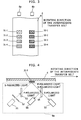
  • FIG. 3 is a diagram that shows an example of positions of sensors and plural series of toner patches in FIG. 1 ;
  • FIG. 4 is a diagram that shows a detailed configuration of the sensor 8 a in FIG. 1 ;
  • FIG. 5 is a diagram that shows a detailed configuration of the sensor 8 b in FIG. 1 ;
  • FIG. 6 is a diagram that shows an example of an output characteristic of the sensor 8 a which irradiates S-polarized light.
  • FIG. 7 is a diagram that shows an example of an output characteristic of the sensor 8 b which irradiates P-polarized light.
  • FIG. 1 is a side view that shows an internal mechanical configuration of an image forming apparatus in an embodiment according to the present disclosure.
  • the image forming apparatus is an apparatus having a printing function such as printer, facsimile apparatus, copier, or multi-function peripheral.
  • the image forming apparatus in this embodiment has a tandem-type color development device.
  • This color development device has photoconductor drums 1 a to 1 d , exposure devices 2 a to 2 d , and development units 3 a to 3 d .
  • the photoconductor drums 1 a to 1 d are photoconductors of four colors: Cyan, Magenta, Yellow and Black.
  • the photoconductor drums 1 a to 1 d are made of amorphous silicon.
  • the exposure devices 2 a to 2 d are devices that form electrostatic latent images by irradiating laser light to the photoconductor drums 1 a to 1 d .
  • Each of the exposure devices 2 a to 2 d includes a laser diode as a light source of the laser light, optical elements (such as lens, mirror and polygon mirror) that guide the laser light to the photoconductor drum 1 a , 1 b , 1 c , or 1 d.
  • optical elements such as lens, mirror and polygon mirror
  • a charging unit such as scorotron, a cleaning device, a static electricity eliminator and so on are disposed.
  • the cleaning device removes residual toner on the photoconductor drum 1 a , 1 b , 1 c , or 1 d after primary transfer.
  • the static electricity eliminator eliminates static electricity of the photoconductor drum 1 a , 1 b , 1 c , or 1 d after primary transfer.
  • the development units 3 a to 3 d include respective toner containers filled with four color toner of Cyan, Magenta, Yellow and Black, and make the toner adhere to electrostatic latent images on the photoconductor drums 1 a to 1 d to form toner images.
  • a developer is composed of the toner and a carrier with external additives such as titanium dioxide.
  • the photoconductor drum 1 a , the exposure device 2 a and the development unit 3 a perform development of Magenta.
  • the photoconductor drum 1 b , the exposure device 2 b and the development unit 3 b perform development of Cyan.
  • the photoconductor drum 1 c , the exposure device 2 c and the development unit 3 c perform development of Yellow.
  • the photoconductor drum 1 d , the exposure device 2 d and the development unit 3 d perform development of Black.
  • the intermediate transfer belt 4 is a loop-shaped image carrier and intermediate transfer member, and contacts the photoconductor drums 1 a to 1 d . Toner images on the photoconductor drums 1 a to 1 d are primarily transferred onto the intermediate transfer belt 4 .
  • the intermediate transfer belt 4 is hitched round driving rollers 5 , and rotates by driving force of the driving rollers 5 towards the direction from the contact position with the photoconductor drum 1 d to the contact position with the photoconductor drum 1 a.
  • a transfer roller 6 makes a conveyed paper sheet contact the transfer belt 4 , and secondarily transfers the toner image on the transfer belt 4 to the paper sheet.
  • the paper sheet on which the toner image has been transferred is conveyed to a fuser 9 , and consequently, the toner image is fixed on the paper sheet.
  • a roller 7 has a cleaning brush, and removes residual toner on the intermediate transfer belt 4 by contacting the cleaning brush to the intermediate transfer belt 4 after transferring the toner image to the paper sheet.
  • Sensors 8 a and 8 b irradiate respective light to the intermediate transfer belt 4 , and detect respective reflection light from a surface of the intermediate transfer belt 4 or a toner pattern on the surface of the intermediate transfer belt 4 .
  • the sensors 8 a and 8 b irradiate respective light to predetermined areas on the intermediate transfer belt 4 , detect respective reflection light, and output respective electrical signals corresponding to the detected intensities of the respective reflection light.
  • FIG. 2 is a block diagram that shows an electronic configuration of the image forming apparatus in the embodiment according to the present disclosure.
  • a print engine 11 is a processing circuit that controls a driving source that drives the aforementioned rollers, a bias induction circuit that induces a development bias and a primary transfer bias, and controls the exposure devices 2 a to 2 d in order to perform developing, transferring and fixing the toner image, feeding a paper sheet, printing on the paper sheet, and outputting it.
  • the development biases are applied between the photoconductor drums 1 a to 1 d and the development units 3 a to 3 d , respectively.
  • the primary transfer biases are applied between the photoconductor drums 1 a to 1 d and the intermediate transfer belt 4 , respectively.
  • the print engine 11 calculates a toner density of a toner patch in a predetermined low density range on the basis of P-polarized component and S-polarized component of the reflection light detected by the sensor 8 a , and calculates a toner density of a toner patch in a predetermined high density range on the basis of P-polarized component and S-polarized component of the reflection light detected by the sensor 8 b.
  • the print engine 11 rotates the intermediate transfer belt 4 using the driving rollers 5 , and controls the exposure devices 2 a to 2 d etc. to form a toner pattern (plural series of toner patches) of each color on a predetermined area on a surface of the intermediate transfer belt 4 .
  • FIG. 3 is a diagram that shows an example of positions of the sensors 8 a and 8 b and plural series of toner patches in FIG. 1 .
  • toner patches 31 - 1 to 31 - 4 in the low density range and toner patches 32 - 1 to 32 - 4 in the high density range are formed in two rows and in parallel.
  • a half of the eight toner patches 31 - 1 to 31 - 4 and 32 - 1 to 32 - 4 and the other half are formed in two rows.
  • the number of the toner patches 31 - 1 to 31 - 4 in the low density range is the same as the number of the toner patches 32 - 1 to 32 - 4 in the high density range. Alternatively, these numbers may not be the same.
  • the toner patches 31 - 1 to 31 - 4 in the low density range are formed with respective predetermined densities (here, 12.5%, 25%, 37.5%, and 50%), and the toner patches 32 - 1 to 32 - 4 in the high density range are formed with respective predetermined densities (here, 62.5%, 75%, 87.5%, and 100%) higher than the predetermined densities of the toner patches 31 - 1 to 31 - 4 .
  • the sensor 8 a is disposed at a position corresponding to a position through which the toner patches 31 - 1 to 31 - 4 in the low density range pass, and irradiates S-polarized light to the toner patches 31 - 1 to 31 - 4 in the low density range.
  • the sensor 8 b is disposed at a position corresponding to a position through which the toner patches 32 - 1 to 32 - 4 in the high density range pass, and irradiates P-polarized light to the toner patches 32 - 1 to 32 - 4 in the high density range.
  • densities of the toner patches 31 - 1 to 31 - 4 in the low density range are measured using the sensor 8 a
  • densities of the toner patches 32 - 1 to 32 - 4 in the high density range are measured using the sensor 8 b.
  • the toner patches of one color is depicted, in this embodiment, the toner patches of all colors (Black, Cyan, Magenta, and Yellow) are formed as well as depicted.
  • FIG. 4 is a diagram that shows a detailed configuration of the sensor 8 a in FIG. 1 .
  • FIG. 5 is a diagram that shows a detailed configuration of the sensor 8 b in FIG. 1 .
  • the sensor 8 a includes a light source 51 emitting a light, an aperture 52 which is disposed in the light source 51 side, a beam splitter 53 which is disposed in the light source 51 side, a beam splitter 54 which is disposed in the light receiving side, a first photo detector 55 , and a second photo detector 56 .
  • the light source 51 is a light emitting diode.
  • the beam splitter 53 is a polarizing element which passes a predetermined polarized component in the light emitted from the light source 51 .
  • the beam splitter 53 passes an S-polarized component (i.e. S-polarized light) and reflects a P-polarized component (i.e. P-polarized light) in incident light from the light source 51 .
  • the beam splitter 54 passes an S-polarized component (i.e. the specular component) and reflects a P-polarized component in the reflection light.
  • the first photo detector 55 receives this S-polarized light, and the second photo detector 56 receives this P-polarized light.
  • the sensor 8 b includes a light source 61 emitting a light, an aperture 62 which is disposed in the light source 61 side, a beam splitter 63 which is disposed in the light source 61 side, a beam splitter 64 which is disposed in the light receiving side, a third photo detector 65 , and a fourth photo detector 66 .
  • the light source 61 is a light emitting diode.
  • the beam splitter 63 is a polarizing element which passes a predetermined polarized component in the light emitted from the light source 61 .
  • the beam splitter 63 passes a P-polarized component and reflects an S-polarized component in incident light from the light source 61 .
  • the beam splitter 64 passes a P-polarized component (i.e. the specular component) and reflects an S-polarized component in the reflection light.
  • the third photo detector 65 receives this P-polarized light, and the fourth photo detector 66 receives this S-polarized light.
  • the beam splitters 53 , 54 , 63 , and 64 include respective optically transparent plates, respective dielectric multi-layer films formed on incidence surfaces of the optically transparent plates, and respective reflection preventing films formed on exit surfaces of the optically transparent plates. Polarized light transmission characteristics of the beam splitters 53 , 54 , 63 , and 64 can be set by changing thicknesses of these films etc.
  • FIG. 6 is a diagram that shows an example of an output characteristic of the sensor 8 a which irradiates S-polarized light.
  • FIG. 6 shows an example of output values from the first photo detector 55 (i.e. output values of S-polarized light) and output values from the second photo detector 56 (i.e. output values of P-polarized light) of the sensor 8 a when densities of black toner patches are measured.
  • FIG. 7 is a diagram that shows an example of an output characteristic of the sensor 8 b which irradiates P-polarized light when the P-polarized light is irradiated to black toner patches.
  • FIG. 7 shows an example of output values from the third photo detector 65 (i.e. output values of P-polarized light) and output values from the fourth photo detector 66 (i.e. output values of S-polarized light) of the sensor 8 b.
  • the sensor 8 a is used to measure toner patches in the low density range
  • the sensor 8 b is used to measure toner patches in the high density range.
  • the print engine 11 rotates the intermediate transfer belt 4 using the driving rollers 5 , and controls the exposure devices 2 a to 2 d to form toner patches of each color as shown in FIG. 3 at a predetermined area on a surface of the intermediate transfer belt 4 .
  • the print engine 11 samples output signals from the photo detectors 55 , 56 , 65 , and 66 , and calculates measurement values of toner densities of respective toner patches 31 - i and 32 - i on the basis of the sampled values of the output signals. Amplifiers and so forth are disposed between the photo detectors 55 , 55 , 65 , and 66 and the print engine 11 if necessary.
  • P is a sensor output value (voltage) of a P-polarized component at the toner patch 31 - i or 32 - i
  • S is a sensor output value (voltage) of a S-polarized component at the toner patch 31 - i or 32 - i
  • Po is a sensor output value (voltage) of a P-polarized component at a position without any toner images (i.e. at a surface material of the intermediate transfer belt 4 )
  • So is a sensor output value (voltage) of a S-polarized component at a position without any toner images (i.e. at a surface material of the intermediate transfer belt 4 ).
  • the surface material where the sensor output values Po and So are measured is a position without toner images in front or behind of the toner patch 31 - i or 32 - i or a position where the toner patch 31 - i or 32 - i is to be formed (i.e. the same position where the sensor output values P and S are measured, but before the toner patch 31 - i or 32 - i is formed).
  • toner densities which corresponds to predetermined setting values (in FIG. 3 , 12.5%, 25%, 37.5%, 50%, 62.5%, 75%, 87.5%, and 100%) of toner densities.
  • the print engine 11 changes the development bias, the primary transfer bias, the exposure amount and so forth on the basis of the respective measurement values of each color.
  • the toner density adjustment is done in this manner.
  • the intermediate transfer belt 4 carries the toner patches 31 - 1 to 31 - 4 and 32 - 1 to 32 - 4 ; the sensor 8 a irradiates S-polarized light to the toner patches 31 - 1 to 31 - 4 in a predetermined low density range, and receives reflection light from them; and the sensor 8 b irradiates P-polarized light to the toner patches 32 - 1 to 32 - 4 in a predetermined high density range, and receives reflection light from them.
  • the print engine 11 calculates toner densities of the toner patches 31 - 1 to 31 - 4 and 32 - 1 to 32 - 4 on the basis of output values of the sensors 8 a and 8 b.
  • toner densities of the toner patches are precisely measured from a low density range to a high density range.
  • toner densities of toner patches made of black toner which absorbs a lot of light are precisely measured from a low density range to a high density range.
  • black toner which includes a particle made of carbon absorbs light, the sensor receives low intensity of light from the black toner.
  • a particle made of carbon tends to absorb S-polarized light larger than P-polarized light.
  • toner densities of the black toner patches are precisely measured from a low density range to a high density range.
  • a color image forming apparatus is explained in the aforementioned embodiment.
  • the aforementioned technique can be applied to a monochrome image forming apparatus.
  • polarizing plates may be used instead of the beam splitters 53 , 54 , 63 , and 64 .
  • the toner patches in the low density range and the toner patches in the high density range may be set so as to (a) make the difference (absolute value) between outputs of the first photo detector 55 and the second photo detector 56 larger than the difference (absolute value) between outputs of the third photo detector 65 and the fourth photo detector 66 for the low density range, and (b) make the difference (absolute value) between outputs of the third photo detector 65 and the fourth photo detector 66 larger than the difference (absolute value) between outputs of the first photo detector 55 and the second photo detector 56 for the high density range. Therefore, a sensor of which a difference between the specular reflection component and the diffuse reflection component in the reflection light is larger than that of the other sensor is used to measure the toner density in each of the density ranges.
  • the intermediate transfer belt 4 is an image carrier of the toner patches.
  • the photoconductor drum may be used as an image carrier of the toner patches.
  • a transfer belt which transfers a paper sheet may be used as an image carrier of the toner patches.

Landscapes

  • Engineering & Computer Science (AREA)
  • Microelectronics & Electronic Packaging (AREA)
  • Physics & Mathematics (AREA)
  • General Physics & Mathematics (AREA)
  • Control Or Security For Electrophotography (AREA)
  • Color Electrophotography (AREA)

Abstract

An image forming apparatus of the present disclosure includes: an image carrier configured to carry toner patches; a first sensor configured to irradiate S-polarized light to a low-density patch in a predetermined low density range among the toner patches, and to receive reflection light from the low-density patch; and a second sensor configured to irradiate P-polarized light to a high-density patch in a predetermined high density range among the toner patches, and to receive reflection light from the high-density patch.

Description

CROSS-REFERENCE TO RELATED APPLICATIONS
This application relates to and claims priority rights from a Japanese Patent Application No. 2011-238134, filed on Oct. 31, 2011, the entire disclosures of which are hereby incorporated by reference herein.
BACKGROUND OF THE INVENTION
1. Field of the Invention
The present invention relates to image forming apparatuses.
2. Description of the Related Art
In many image forming apparatuses that form images by electronic photography process, such as printer, copier, facsimile, and multi-function peripheral thereof, a toner image is developed on a photoconductor drum, and the toner image is transferred onto an intermediate transfer belt, and then transferred from the intermediate transfer belt to a paper sheet, and finally the toner image is fixed on the paper sheet.
Such image forming apparatuses perform toner density correction and color registration correction when required or periodically.
In general, in a process of the density correction, a toner pattern (i.e. plural toner patches) as reference is developed and transferred to the intermediate transfer belt, toner densities of the toner pattern on the intermediate transfer belt is determined using an optical sensor, and the density correction is performed on the basis of the toner densities. Further, in case of a color image forming apparatus, positions of the toner pattern on the intermediate transfer belt are determined, and the color registration correction is performed on the basis of the positions.
Furthermore, there is another technique to determine toner densities on the photoconductor drum.
In a sensor for measuring the toner densities, a beam splitter separates a light beam emitted from a light emitting diode into a predetermined polarized component (either P-polarized component or S-polarized component), and the predetermined polarized component enters the toner pattern on the intermediate transfer belt. Reflection light from the toner pattern is separated into a specular reflection component and a diffuse reflection component by a beam splitter, and these components are detected by photo detectors. Finally, the toner density is determined from intensities of the specular reflection component and the diffuse reflection component. If the incident light to the toner pattern is P-polarized, then the specular reflection component is P-polarized, for instance.
Further, another image forming apparatus uses a low pass filter to reduce noise due to a stain or a scratch on a surface in toner density measurement of a low density range.
However, since toner absorbs light, it is difficult to precisely measure toner densities of all the toner patches from low density range to high density range using the aforementioned reflection-type sensor.
For example, when a toner density is calculated on the basis of a difference between measurement values of the specular reflection component and the diffuse reflection component, the difference is small under some measurement conditions of the sensor, and it causes low measurement precision. In particular, black toner strongly absorbs light, and it may cause very low measurement precision of black toner.
SUMMARY OF THE INVENTION
An image forming apparatus according to an aspect of the present disclosure includes: an image carrier configured to carry toner patches; a first sensor configured to irradiate S-polarized light to a low-density patch in a predetermined low density range among the toner patches, and to receive reflection light from, the low-density patch; and a second sensor configured to irradiate P-polarized light to a high-density patch in a predetermined high density range among the toner patches, and to receive reflection light from the high-density patch.
Therefore, different light components are irradiated to respective toner patches in the low density range and in the high density range. Consequently, toner densities of the toner patches are precisely measured from a low density range to a high density range using the aforementioned reflection-type sensor.
These and other objects, features and advantages of the present invention will become more apparent upon reading of the following detailed description along with the accompanied drawings.
BRIEF DESCRIPTION OF THE DRAWINGS
FIG. 1 is a side view that shows an internal mechanical configuration of an image forming apparatus in an embodiment according to the present disclosure;
FIG. 2 is a block diagram that shows an electronic configuration of the image forming apparatus in the embodiment according to the present disclosure;
FIG. 3 is a diagram that shows an example of positions of sensors and plural series of toner patches in FIG. 1;
FIG. 4 is a diagram that shows a detailed configuration of the sensor 8 a in FIG. 1;
FIG. 5 is a diagram that shows a detailed configuration of the sensor 8 b in FIG. 1;
FIG. 6 is a diagram that shows an example of an output characteristic of the sensor 8 a which irradiates S-polarized light; and
FIG. 7 is a diagram that shows an example of an output characteristic of the sensor 8 b which irradiates P-polarized light.
DETAILED DESCRIPTION
Hereinafter, an embodiment according to aspects of the present invention will be explained with reference to drawings.
FIG. 1 is a side view that shows an internal mechanical configuration of an image forming apparatus in an embodiment according to the present disclosure. The image forming apparatus is an apparatus having a printing function such as printer, facsimile apparatus, copier, or multi-function peripheral.
The image forming apparatus in this embodiment has a tandem-type color development device. This color development device has photoconductor drums 1 a to 1 d, exposure devices 2 a to 2 d, and development units 3 a to 3 d. The photoconductor drums 1 a to 1 d are photoconductors of four colors: Cyan, Magenta, Yellow and Black. For instance, the photoconductor drums 1 a to 1 d are made of amorphous silicon. The exposure devices 2 a to 2 d are devices that form electrostatic latent images by irradiating laser light to the photoconductor drums 1 a to 1 d. Each of the exposure devices 2 a to 2 d includes a laser diode as a light source of the laser light, optical elements (such as lens, mirror and polygon mirror) that guide the laser light to the photoconductor drum 1 a, 1 b, 1 c, or 1 d.
Further, in the periphery of each of the photoconductor drums 1 a to 1 d, a charging unit such as scorotron, a cleaning device, a static electricity eliminator and so on are disposed. The cleaning device removes residual toner on the photoconductor drum 1 a, 1 b, 1 c, or 1 d after primary transfer. The static electricity eliminator eliminates static electricity of the photoconductor drum 1 a, 1 b, 1 c, or 1 d after primary transfer.
The development units 3 a to 3 d include respective toner containers filled with four color toner of Cyan, Magenta, Yellow and Black, and make the toner adhere to electrostatic latent images on the photoconductor drums 1 a to 1 d to form toner images. A developer is composed of the toner and a carrier with external additives such as titanium dioxide.
The photoconductor drum 1 a, the exposure device 2 a and the development unit 3 a perform development of Magenta. The photoconductor drum 1 b, the exposure device 2 b and the development unit 3 b perform development of Cyan. The photoconductor drum 1 c, the exposure device 2 c and the development unit 3 c perform development of Yellow. The photoconductor drum 1 d, the exposure device 2 d and the development unit 3 d perform development of Black.
The intermediate transfer belt 4 is a loop-shaped image carrier and intermediate transfer member, and contacts the photoconductor drums 1 a to 1 d. Toner images on the photoconductor drums 1 a to 1 d are primarily transferred onto the intermediate transfer belt 4. The intermediate transfer belt 4 is hitched round driving rollers 5, and rotates by driving force of the driving rollers 5 towards the direction from the contact position with the photoconductor drum 1 d to the contact position with the photoconductor drum 1 a.
A transfer roller 6 makes a conveyed paper sheet contact the transfer belt 4, and secondarily transfers the toner image on the transfer belt 4 to the paper sheet. The paper sheet on which the toner image has been transferred is conveyed to a fuser 9, and consequently, the toner image is fixed on the paper sheet.
A roller 7 has a cleaning brush, and removes residual toner on the intermediate transfer belt 4 by contacting the cleaning brush to the intermediate transfer belt 4 after transferring the toner image to the paper sheet.
Sensors 8 a and 8 b irradiate respective light to the intermediate transfer belt 4, and detect respective reflection light from a surface of the intermediate transfer belt 4 or a toner pattern on the surface of the intermediate transfer belt 4. In toner density adjustment, the sensors 8 a and 8 b irradiate respective light to predetermined areas on the intermediate transfer belt 4, detect respective reflection light, and output respective electrical signals corresponding to the detected intensities of the respective reflection light.
FIG. 2 is a block diagram that shows an electronic configuration of the image forming apparatus in the embodiment according to the present disclosure. In FIG. 2, a print engine 11 is a processing circuit that controls a driving source that drives the aforementioned rollers, a bias induction circuit that induces a development bias and a primary transfer bias, and controls the exposure devices 2 a to 2 d in order to perform developing, transferring and fixing the toner image, feeding a paper sheet, printing on the paper sheet, and outputting it. The development biases are applied between the photoconductor drums 1 a to 1 d and the development units 3 a to 3 d, respectively. The primary transfer biases are applied between the photoconductor drums 1 a to 1 d and the intermediate transfer belt 4, respectively.
Further, the print engine 11 calculates a toner density of a toner patch in a predetermined low density range on the basis of P-polarized component and S-polarized component of the reflection light detected by the sensor 8 a, and calculates a toner density of a toner patch in a predetermined high density range on the basis of P-polarized component and S-polarized component of the reflection light detected by the sensor 8 b.
In toner density adjustment, the print engine 11 rotates the intermediate transfer belt 4 using the driving rollers 5, and controls the exposure devices 2 a to 2 d etc. to form a toner pattern (plural series of toner patches) of each color on a predetermined area on a surface of the intermediate transfer belt 4.
FIG. 3 is a diagram that shows an example of positions of the sensors 8 a and 8 b and plural series of toner patches in FIG. 1.
As shown in FIG. 3, toner patches 31-1 to 31-4 in the low density range and toner patches 32-1 to 32-4 in the high density range are formed in two rows and in parallel. In this embodiment, a half of the eight toner patches 31-1 to 31-4 and 32-1 to 32-4 and the other half are formed in two rows. Here, the number of the toner patches 31-1 to 31-4 in the low density range is the same as the number of the toner patches 32-1 to 32-4 in the high density range. Alternatively, these numbers may not be the same.
The toner patches 31-1 to 31-4 in the low density range are formed with respective predetermined densities (here, 12.5%, 25%, 37.5%, and 50%), and the toner patches 32-1 to 32-4 in the high density range are formed with respective predetermined densities (here, 62.5%, 75%, 87.5%, and 100%) higher than the predetermined densities of the toner patches 31-1 to 31-4.
The sensor 8 a is disposed at a position corresponding to a position through which the toner patches 31-1 to 31-4 in the low density range pass, and irradiates S-polarized light to the toner patches 31-1 to 31-4 in the low density range. The sensor 8 b is disposed at a position corresponding to a position through which the toner patches 32-1 to 32-4 in the high density range pass, and irradiates P-polarized light to the toner patches 32-1 to 32-4 in the high density range. Therefore, densities of the toner patches 31-1 to 31-4 in the low density range are measured using the sensor 8 a, and densities of the toner patches 32-1 to 32-4 in the high density range are measured using the sensor 8 b.
Although in FIG. 3 the toner patches of one color is depicted, in this embodiment, the toner patches of all colors (Black, Cyan, Magenta, and Yellow) are formed as well as depicted.
Here, details of the sensors 8 a and 8 b are explained.
FIG. 4 is a diagram that shows a detailed configuration of the sensor 8 a in FIG. 1. FIG. 5 is a diagram that shows a detailed configuration of the sensor 8 b in FIG. 1.
As shown in FIG. 4, the sensor 8 a includes a light source 51 emitting a light, an aperture 52 which is disposed in the light source 51 side, a beam splitter 53 which is disposed in the light source 51 side, a beam splitter 54 which is disposed in the light receiving side, a first photo detector 55, and a second photo detector 56. In this embodiment, the light source 51 is a light emitting diode.
The beam splitter 53 is a polarizing element which passes a predetermined polarized component in the light emitted from the light source 51. The beam splitter 54 is a polarizing element which passes a predetermined polarized component in the reflection light from either a surface of the intermediate transfer belt 4 or a toner pattern (toner patches 31-1 to 31-M; here, M=4) on the surface.
In this embodiment, the beam splitter 53 passes an S-polarized component (i.e. S-polarized light) and reflects a P-polarized component (i.e. P-polarized light) in incident light from the light source 51. The beam splitter 54 passes an S-polarized component (i.e. the specular component) and reflects a P-polarized component in the reflection light. The first photo detector 55 receives this S-polarized light, and the second photo detector 56 receives this P-polarized light.
As shown in FIG. 5, the sensor 8 b includes a light source 61 emitting a light, an aperture 62 which is disposed in the light source 61 side, a beam splitter 63 which is disposed in the light source 61 side, a beam splitter 64 which is disposed in the light receiving side, a third photo detector 65, and a fourth photo detector 66. In this embodiment, the light source 61 is a light emitting diode.
The beam splitter 63 is a polarizing element which passes a predetermined polarized component in the light emitted from the light source 61. The beam splitter 64 is a polarizing element which passes a predetermined polarized component in the reflection light from either a surface of the intermediate transfer belt 4 or a toner pattern (toner patches 32-1 to 32-N; here, N=4) on the surface.
In this embodiment, the beam splitter 63 passes a P-polarized component and reflects an S-polarized component in incident light from the light source 61. The beam splitter 64 passes a P-polarized component (i.e. the specular component) and reflects an S-polarized component in the reflection light. The third photo detector 65 receives this P-polarized light, and the fourth photo detector 66 receives this S-polarized light.
The beam splitters 53, 54, 63, and 64 include respective optically transparent plates, respective dielectric multi-layer films formed on incidence surfaces of the optically transparent plates, and respective reflection preventing films formed on exit surfaces of the optically transparent plates. Polarized light transmission characteristics of the beam splitters 53, 54, 63, and 64 can be set by changing thicknesses of these films etc.
FIG. 6 is a diagram that shows an example of an output characteristic of the sensor 8 a which irradiates S-polarized light. FIG. 6 shows an example of output values from the first photo detector 55 (i.e. output values of S-polarized light) and output values from the second photo detector 56 (i.e. output values of P-polarized light) of the sensor 8 a when densities of black toner patches are measured. FIG. 7 is a diagram that shows an example of an output characteristic of the sensor 8 b which irradiates P-polarized light when the P-polarized light is irradiated to black toner patches. FIG. 7 shows an example of output values from the third photo detector 65 (i.e. output values of P-polarized light) and output values from the fourth photo detector 66 (i.e. output values of S-polarized light) of the sensor 8 b.
As shown in FIGS. 6 and 7, in the low density range, differences (absolute values) between outputs of S-polarized light and P-polarized light of the sensor 8 a irradiating S-polarized light are larger, and in the high density range, differences (absolute values) between outputs of S-polarized light and P-polarized light of the sensor 8 b irradiating P-polarized light are larger. Therefore, the sensor 8 a is used to measure toner patches in the low density range, and the sensor 8 b is used to measure toner patches in the high density range.
In the following part, a behavior of the aforementioned image forming apparatus in the toner density adjustment is explained.
The print engine 11 rotates the intermediate transfer belt 4 using the driving rollers 5, and controls the exposure devices 2 a to 2 d to form toner patches of each color as shown in FIG. 3 at a predetermined area on a surface of the intermediate transfer belt 4.
The print engine 11 samples output signals from the photo detectors 55, 56, 65, and 66, and calculates measurement values of toner densities of respective toner patches 31-i and 32-i on the basis of the sampled values of the output signals. Amplifiers and so forth are disposed between the photo detectors 55, 55, 65, and 66 and the print engine 11 if necessary.
For example, the toner density is calculated with the following formula.
Toner density [percent]={1−(P−S)/(Po−So)}×100
In this formula, P is a sensor output value (voltage) of a P-polarized component at the toner patch 31-i or 32-i; S is a sensor output value (voltage) of a S-polarized component at the toner patch 31-i or 32-i; Po is a sensor output value (voltage) of a P-polarized component at a position without any toner images (i.e. at a surface material of the intermediate transfer belt 4); and So is a sensor output value (voltage) of a S-polarized component at a position without any toner images (i.e. at a surface material of the intermediate transfer belt 4). The surface material where the sensor output values Po and So are measured is a position without toner images in front or behind of the toner patch 31-i or 32-i or a position where the toner patch 31-i or 32-i is to be formed (i.e. the same position where the sensor output values P and S are measured, but before the toner patch 31-i or 32-i is formed).
Consequently, measurement values are obtained of toner densities which corresponds to predetermined setting values (in FIG. 3, 12.5%, 25%, 37.5%, 50%, 62.5%, 75%, 87.5%, and 100%) of toner densities.
In order to adjust toner densities, the print engine 11 changes the development bias, the primary transfer bias, the exposure amount and so forth on the basis of the respective measurement values of each color.
The toner density adjustment is done in this manner.
In the aforementioned embodiment, the intermediate transfer belt 4 carries the toner patches 31-1 to 31-4 and 32-1 to 32-4; the sensor 8 a irradiates S-polarized light to the toner patches 31-1 to 31-4 in a predetermined low density range, and receives reflection light from them; and the sensor 8 b irradiates P-polarized light to the toner patches 32-1 to 32-4 in a predetermined high density range, and receives reflection light from them. The print engine 11 calculates toner densities of the toner patches 31-1 to 31-4 and 32-1 to 32-4 on the basis of output values of the sensors 8 a and 8 b.
Therefore, different light components are irradiated to respective toner patches in the low density range and in the high density range. Consequently, toner densities of the toner patches are precisely measured from a low density range to a high density range.
In particular, toner densities of toner patches made of black toner which absorbs a lot of light are precisely measured from a low density range to a high density range.
In general, as explained by Fresnel equations, if an object surface is a mirror surface or near a mirror surface, then the reflectance of S-polarized light is larger than that of P-polarized light. When a toner density is measured of a low density toner patch, the reflection light contains relatively a lot of reflection light from a surface material of the image carrier (i.e. the intermediate transfer belt 4). Therefore, S-polarized light is favorable for measuring a toner density of a low density toner patch.
Further, in case of a color toner (i.e. not black), when a toner density increases, reflection from the surface material decreases, but a diffused reflection component front the toner increases, and consequently, intensity of reflection light received by the sensor does not decrease much. However, since black toner which includes a particle made of carbon absorbs light, the sensor receives low intensity of light from the black toner. In addition, a particle made of carbon tends to absorb S-polarized light larger than P-polarized light.
Therefore, in particular for black toner, different light components are irradiated to respective toner patches in the low density range and in the high density range. Consequently, toner densities of the black toner patches are precisely measured from a low density range to a high density range.
The description of the present invention has been presented for purposes of illustration and description, and is not intended to be exhaustive or limited to the invention in the form disclosed.
For example, a color image forming apparatus is explained in the aforementioned embodiment. Alternatively, the aforementioned technique can be applied to a monochrome image forming apparatus.
Further, in the aforementioned embodiment, polarizing plates may be used instead of the beam splitters 53, 54, 63, and 64.
Furthermore, regarding toner patches in the low and the high density ranges of which densities are measured by the sensors 8 a and 8 b, the toner patches in the low density range and the toner patches in the high density range may be set so as to (a) make the difference (absolute value) between outputs of the first photo detector 55 and the second photo detector 56 larger than the difference (absolute value) between outputs of the third photo detector 65 and the fourth photo detector 66 for the low density range, and (b) make the difference (absolute value) between outputs of the third photo detector 65 and the fourth photo detector 66 larger than the difference (absolute value) between outputs of the first photo detector 55 and the second photo detector 56 for the high density range. Therefore, a sensor of which a difference between the specular reflection component and the diffuse reflection component in the reflection light is larger than that of the other sensor is used to measure the toner density in each of the density ranges.
Furthermore, in the aforementioned embodiment, the intermediate transfer belt 4 is an image carrier of the toner patches. Alternatively, the photoconductor drum may be used as an image carrier of the toner patches. Further, in case of a direct-transfer type image forming apparatus, a transfer belt which transfers a paper sheet may be used as an image carrier of the toner patches.
It should be understood that various changes and modifications to the embodiments described herein will be apparent to those skilled in the art. Such changes and modifications may be made without departing from the spirit and scope of the present subject matter and without diminishing its intended advantages. It is therefore intended that such changes and modifications be covered by the appended claims.

Claims (7)

What is claimed is:
1. An image forming apparatus, comprising:
an image carrier configured to carry toner patches;
a first sensor configured to irradiate S-polarized light to a low-density patch in a predetermined low density range among the toner patches, and to receive reflection light from the low-density patch; and
a second sensor configured to irradiate P-polarized light to a high-density patch in a predetermined high density range among the toner patches, and to receive reflection light from the high-density patch.
2. The image forming apparatus according to claim 1, wherein:
the first sensor is further configured to irradiate S-polarized light to a low-density patch of black toner in a predetermined low density range among the toner patches, and to receive reflection light from the low-density patch; and
the second sensor is further configured to irradiate P-polarized light to a high-density patch of black toner in a predetermined high density range among the toner patches, and to receive reflection light from the high-density patch.
3. The image forming apparatus according to claim 1, further comprising:
a toner density determining unit configured to determine a measurement value of a toner density on the basis of either an output of the first sensor or an output of the second sensor;
wherein:
the first sensor comprises a first photo detector configured to receive S-polarized component of the reflection light from the low-density patch, and a second photo detector configured to receive P-polarized component of the reflection light from the low-density patch,
the second sensor comprises a third photo detector configured to receive P-polarized component of the reflection light from the high-density patch, and a fourth photo detector configured to receive S-polarized component of the reflection light from the high-density patch, and
the toner density determining unit is further configured to determine the measurement value of the toner density on the basis of either a difference between outputs of the first photo detector and the second photo detect or a difference between outputs of the third photo detector and the fourth photo detect.
4. The image forming apparatus according to claim 3, wherein:
the first photo detector, the second photo detector, the third photo detector, and the fourth photo detector are further configured (a) to make the difference between outputs of the first photo detector and the second photo detector larger than the difference between outputs of the third photo detector and the fourth photo detector for the low density range, and (b) to make the difference between outputs of the third photo detector and the fourth photo detector larger than the difference between outputs of the first photo detector and the second photo detector for the high density range.
5. The image forming apparatus according to claim 2, further comprising:
a toner density determining unit configured to determine a measurement value of a toner density on the basis of either an output of the first sensor or an output of the second sensor;
wherein:
the first sensor comprises a first photo detector configured to receive S-polarized component of the reflection light from the low-density patch, and a second photo detector configured to receive P-polarized component of the reflection light from the low-density patch,
the second sensor comprises a third photo detector configured to receive P-polarized component of the reflection light from the high-density patch, and a fourth photo detector configured to receive S-polarized component of the reflection light from the high-density patch, and
the toner density determining unit is further configured to determine the measurement value of the toner density on the basis of either a difference between outputs of the first photo detector and the second photo detect or a difference between outputs of the third photo detector and the fourth photo detect.
6. The image forming apparatus according to claim 5, further comprising:
the first photo detector, the second photo detector, the third photo detector, and the fourth photo detector are further configured (a) to make the difference between outputs of the first photo detector and the second photo detector larger than the difference between outputs of the third photo detector and the fourth photo detector for the low density range, and (b) to make the difference between outputs of the third photo detector and the fourth photo detector larger than the difference between outputs of the first photo detector and the second photo detector for the high density range.
7. The image forming apparatus according to claim 1, wherein:
the image carrier is further configured to carry a series of low-density toner patches in the low density range and a series of high-density toner patches in the high density range in parallel.
US13/656,254 2011-10-31 2012-10-19 Image forming apparatus Expired - Fee Related US8670684B2 (en)

Applications Claiming Priority (2)

Application Number Priority Date Filing Date Title
JP2011-238134 2011-10-31
JP2011238134A JP5312554B2 (en) 2011-10-31 2011-10-31 Image forming apparatus

Publications (2)

Publication Number Publication Date
US20130108293A1 US20130108293A1 (en) 2013-05-02
US8670684B2 true US8670684B2 (en) 2014-03-11

Family

ID=48172568

Family Applications (1)

Application Number Title Priority Date Filing Date
US13/656,254 Expired - Fee Related US8670684B2 (en) 2011-10-31 2012-10-19 Image forming apparatus

Country Status (2)

Country Link
US (1) US8670684B2 (en)
JP (1) JP5312554B2 (en)

Cited By (1)

* Cited by examiner, † Cited by third party
Publication number Priority date Publication date Assignee Title
US9442407B2 (en) * 2014-11-14 2016-09-13 Ricoh Company, Ltd. Apparatus, controller, and method of forming multicolor toner image

Families Citing this family (3)

* Cited by examiner, † Cited by third party
Publication number Priority date Publication date Assignee Title
JP5999305B2 (en) * 2012-02-20 2016-09-28 株式会社リコー Optical sensor and image forming apparatus
JP5853984B2 (en) * 2013-04-01 2016-02-09 コニカミノルタ株式会社 Image forming apparatus
JP5938367B2 (en) * 2013-05-24 2016-06-22 京セラドキュメントソリューションズ株式会社 Sensor characteristic correction method

Citations (4)

* Cited by examiner, † Cited by third party
Publication number Priority date Publication date Assignee Title
JPH06250480A (en) 1993-02-25 1994-09-09 Stanley Electric Co Ltd Toner adhesion amount measuring device for transfer type color printer
JP2003029476A (en) 2001-07-12 2003-01-29 Canon Inc Image forming device
US20060204267A1 (en) * 2005-01-20 2006-09-14 Kyocera Mita Corporation Image forming apparatus
JP2007333760A (en) 2006-06-12 2007-12-27 Matsushita Electric Ind Co Ltd Tandem color image forming apparatus

Family Cites Families (10)

* Cited by examiner, † Cited by third party
Publication number Priority date Publication date Assignee Title
JP3222617B2 (en) * 1993-05-10 2001-10-29 シャープ株式会社 Automatic image quality compensation control device
JP2001022139A (en) * 1999-07-12 2001-01-26 Minolta Co Ltd Image forming device
JP2001194843A (en) * 2000-01-13 2001-07-19 Canon Inc Image forming device
JP2003195583A (en) * 2001-12-28 2003-07-09 Canon Inc Image forming device
JP2007286524A (en) * 2006-04-19 2007-11-01 Canon Inc Image forming apparatus
US7945178B2 (en) * 2006-11-02 2011-05-17 Canon Kabushiki Kaisha Image forming apparatus including density control and control method thereof
JP5251072B2 (en) * 2007-10-23 2013-07-31 富士ゼロックス株式会社 Detection apparatus, image processing apparatus, and image forming apparatus
JP2009122437A (en) * 2007-11-15 2009-06-04 Kyocera Mita Corp Color shift detection method in image forming apparatus, and image forming apparatus
JP2009251471A (en) * 2008-04-09 2009-10-29 Canon Inc Image forming apparatus
JP5594990B2 (en) * 2009-07-17 2014-09-24 キヤノン株式会社 Image forming apparatus

Patent Citations (4)

* Cited by examiner, † Cited by third party
Publication number Priority date Publication date Assignee Title
JPH06250480A (en) 1993-02-25 1994-09-09 Stanley Electric Co Ltd Toner adhesion amount measuring device for transfer type color printer
JP2003029476A (en) 2001-07-12 2003-01-29 Canon Inc Image forming device
US20060204267A1 (en) * 2005-01-20 2006-09-14 Kyocera Mita Corporation Image forming apparatus
JP2007333760A (en) 2006-06-12 2007-12-27 Matsushita Electric Ind Co Ltd Tandem color image forming apparatus

Non-Patent Citations (2)

* Cited by examiner, † Cited by third party
Title
Machine translation into English language of Watanabe, Masao-JP2007333760. *
Machine translation into English language of Watanabe, Masao—JP2007333760. *

Cited By (1)

* Cited by examiner, † Cited by third party
Publication number Priority date Publication date Assignee Title
US9442407B2 (en) * 2014-11-14 2016-09-13 Ricoh Company, Ltd. Apparatus, controller, and method of forming multicolor toner image

Also Published As

Publication number Publication date
JP2013097081A (en) 2013-05-20
US20130108293A1 (en) 2013-05-02
JP5312554B2 (en) 2013-10-09

Similar Documents

Publication Publication Date Title
US8670684B2 (en) Image forming apparatus
JP4456828B2 (en) Regular reflection light output conversion method, diffuse reflection light output conversion method, powder adhesion amount conversion method, image forming device, powder adhesion amount detection device
US8712265B2 (en) Image forming apparatus with an improved density adjustment unit
JP5393648B2 (en) Image forming apparatus
US10180648B2 (en) Image forming apparatus with improved correction based on toner density
JP6171973B2 (en) Image detecting apparatus and image forming apparatus
JP5627549B2 (en) Image forming apparatus
JP2017187722A (en) Image density detection apparatus and image forming apparatus
US10082746B2 (en) Image forming apparatus
JP3770088B2 (en) Image forming apparatus
US20180106722A1 (en) Image-forming apparatus
US10527995B1 (en) Image forming apparatus having abnormality detection unit for humidity sensor
JP2002214854A (en) Image forming device
JP5919948B2 (en) Image forming apparatus and program
JP5938367B2 (en) Sensor characteristic correction method
JP2012093655A (en) Toner concentration sensor, image forming apparatus, and design method of toner concentration sensor
JP4017108B2 (en) Image forming apparatus having toner adhesion amount measuring unit
JP2002214855A (en) Surface state detecting method, toner amount measuring method, and image forming apparatus
US10108126B2 (en) Image forming apparatus with an improved voltage controlled light emitter
JP2012073030A (en) Toner concentration sensor, image forming device, and toner concentration sensor design method
JP6525207B2 (en) Image forming device
US9946209B2 (en) Image forming apparatus
JP2003345072A (en) Image forming apparatus
JP2025118396A (en) Reading device, reading method, and program
JP6025671B2 (en) Image forming apparatus

Legal Events

Date Code Title Description
AS Assignment

Owner name: KYOCERA DOCUMENT SOLUTIONS INC., JAPAN

Free format text: ASSIGNMENT OF ASSIGNORS INTEREST;ASSIGNOR:ISODA, KEISUKE;REEL/FRAME:029161/0303

Effective date: 20121017

STCF Information on status: patent grant

Free format text: PATENTED CASE

FEPP Fee payment procedure

Free format text: PAYOR NUMBER ASSIGNED (ORIGINAL EVENT CODE: ASPN); ENTITY STATUS OF PATENT OWNER: LARGE ENTITY

MAFP Maintenance fee payment

Free format text: PAYMENT OF MAINTENANCE FEE, 4TH YEAR, LARGE ENTITY (ORIGINAL EVENT CODE: M1551)

Year of fee payment: 4

FEPP Fee payment procedure

Free format text: MAINTENANCE FEE REMINDER MAILED (ORIGINAL EVENT CODE: REM.); ENTITY STATUS OF PATENT OWNER: LARGE ENTITY

LAPS Lapse for failure to pay maintenance fees

Free format text: PATENT EXPIRED FOR FAILURE TO PAY MAINTENANCE FEES (ORIGINAL EVENT CODE: EXP.); ENTITY STATUS OF PATENT OWNER: LARGE ENTITY

STCH Information on status: patent discontinuation

Free format text: PATENT EXPIRED DUE TO NONPAYMENT OF MAINTENANCE FEES UNDER 37 CFR 1.362

FP Lapsed due to failure to pay maintenance fee

Effective date: 20220311