US8638043B2 - Two-terminal current controller and related LED lighting device - Google Patents
Two-terminal current controller and related LED lighting device Download PDFInfo
- Publication number
- US8638043B2 US8638043B2 US13/052,132 US201113052132A US8638043B2 US 8638043 B2 US8638043 B2 US 8638043B2 US 201113052132 A US201113052132 A US 201113052132A US 8638043 B2 US8638043 B2 US 8638043B2
- Authority
- US
- United States
- Prior art keywords
- voltage
- current
- reference voltage
- current controller
- terminal current
- Prior art date
- Legal status (The legal status is an assumption and is not a legal conclusion. Google has not performed a legal analysis and makes no representation as to the accuracy of the status listed.)
- Expired - Fee Related, expires
Links
Images




Classifications
-
- H—ELECTRICITY
- H05—ELECTRIC TECHNIQUES NOT OTHERWISE PROVIDED FOR
- H05B—ELECTRIC HEATING; ELECTRIC LIGHT SOURCES NOT OTHERWISE PROVIDED FOR; CIRCUIT ARRANGEMENTS FOR ELECTRIC LIGHT SOURCES, IN GENERAL
- H05B45/00—Circuit arrangements for operating light-emitting diodes [LED]
- H05B45/40—Details of LED load circuits
- H05B45/44—Details of LED load circuits with an active control inside an LED matrix
- H05B45/48—Details of LED load circuits with an active control inside an LED matrix having LEDs organised in strings and incorporating parallel shunting devices
-
- H—ELECTRICITY
- H02—GENERATION; CONVERSION OR DISTRIBUTION OF ELECTRIC POWER
- H02M—APPARATUS FOR CONVERSION BETWEEN AC AND AC, BETWEEN AC AND DC, OR BETWEEN DC AND DC, AND FOR USE WITH MAINS OR SIMILAR POWER SUPPLY SYSTEMS; CONVERSION OF DC OR AC INPUT POWER INTO SURGE OUTPUT POWER; CONTROL OR REGULATION THEREOF
- H02M7/00—Conversion of AC power input into DC power output; Conversion of DC power input into AC power output
- H02M7/02—Conversion of AC power input into DC power output without possibility of reversal
- H02M7/04—Conversion of AC power input into DC power output without possibility of reversal by static converters
- H02M7/06—Conversion of AC power input into DC power output without possibility of reversal by static converters using discharge tubes without control electrode or semiconductor devices without control electrode
Definitions
- the present invention is related to a two-terminal current controller and related LED lighting device, and more particularly, to a two-terminal current controller and related LED lighting device with high power factor.
- LEDs light-emitting diodes
- LEDs are advantageous in low power consumption, long lifetime, small size, no warm-up time, fast reaction speed, and the ability to be manufactured as small or array devices.
- LEDs are also widely used as indoor/outdoor lighting devices in place of fluorescent or incandescent lamps.
- FIG. 1 is a diagram illustrating the voltage-current chart of a light-emitting diode.
- the forward-bias voltage of the light-emitting diode When the forward-bias voltage of the light-emitting diode is smaller than its barrier voltage Vb, the light-emitting diode functions as an open-circuited device since it only conducts a negligible amount of current.
- the forward-bias voltage of the light-emitting diode exceeds its barrier voltage Vb, the light-emitting diode functions as a short-circuited device since its current increases exponentially with the forward-bias voltage.
- the barrier voltage Vb whose value is related to the material and doping type of the light-emitting diode, is typically between 1.5 and 3.5 volts. For most current values, the luminescence of the light-emitting diode is proportional to the current. Therefore, a current source is generally used for driving light-emitting diodes in order to provide uniform lumin
- FIG. 2 is a diagram of a prior art LED lighting device 600 .
- the LED lighting device 600 includes a power supply circuit 110 , a resistor R and a luminescent device 10 .
- the power supply circuit 110 is configured to receive an alternative-current (AC) voltage VS having positive and negative periods and convert the output of the AC voltage VS in the negative period using a bridge rectifier 112 , thereby providing a rectified AC voltage V AC for driving the luminescent device 10 .
- the resistor R is coupled in series with the luminescent device 10 for regulating its current I LED . In many applications, multiple light-emitting diodes are required in order to provide sufficient brightness.
- the luminescent device 10 Since a light-emitting diode is a current-driven device whose luminescence is proportional to its driving current, the luminescent device 10 normally adopts a plurality of light-emitting diodes D 1 -D n coupled in series. Assuming that the barrier voltage of all the light-emitting diodes D 1 -D n is equal to the ideal value Vb and the rectified AC voltage V AC periodically varies between 0 and V MAX , a forward-bias voltage larger than n*Vb is required for turning on the luminescent device 10 . Therefore, the energy between 0 and n*Vb can not be used.
- the prior art LED lighting device 600 needs to make compromise between the effective operational voltage range and the reliability. Meanwhile, the current-limiting resistor R also consumes extra power and may thus lower system efficiency.
- FIG. 3 is a diagram of another prior art LED lighting device 700 .
- the LED lighting device 700 includes a power supply circuit 110 , an inductor L, a capacitor C, a switch SW, and a luminescent device 10 .
- the power supply circuit 110 is configured to receive an AC voltage VS having positive and negative periods and convert the output of the AC voltage VS in the negative period using a bridge rectifier 112 , thereby providing a rectified AC voltage V AC for driving the luminescent device 10 .
- the inductor L and the switch SW are coupled in series with the luminescent device 10 for limiting its current I LED .
- the capacitor C is coupled in parallel with the luminescent device 10 for absorbing voltage ripples of the power supply circuit 110 .
- the inductor L consumes less energy than the resistor R of the LED lighting device 600 .
- the inductor L for regulating current and the capacitor for stabilizing voltage largely reduce the power factor of the LED lighting device 700 and the energy utilization ratio. Therefore, the prior art LED lighting device 700 needs to make compromise between the effective operational voltage range and the brightness.
- the present invention provides an LED lighting device comprising a luminescent device configured to provide light according to a first current and a two-terminal current controller coupled in parallel with the luminescent device and configured to regulate the first current according to a voltage established across the luminescent device.
- the two-terminal current controller operates in a first mode.
- the two-terminal current controller operates in a second mode.
- the two-terminal current controller operates in a third mode.
- the two-terminal current controller includes a current limiting unit and an adjusting unit.
- the current limiting unit is configured to conduct a second current associated with the rectified AC voltage, regulate the second current according to the voltage established across the luminescent device and maintain the first current at zero when the two-terminal current controller operates in the first mode; conduct the second current, maintain the second current at a first predetermined value larger than zero and maintain the first current at zero when the two-terminal current controller operates in the second mode; and switch off when the two-terminal current controller operates in the third mode.
- the adjusting unit is configured to adjust the first predetermined value and the second voltage.
- the present invention also provides two-terminal current controller for controlling a first current passing through a load.
- the two-terminal current controller operates in a first mode.
- the two-terminal current controller operates in a second mode.
- the two-terminal current controller operates in a third mode.
- the two-terminal current controller includes a current limiting unit and an adjusting unit.
- the current limiting unit is configured to conduct a second current associated with the rectified AC voltage, regulate the second current according to the voltage established across the load and maintain the first current at zero when the two-terminal current controller operates in the first mode; conduct the second current, maintain the second current at a predetermined value larger than zero and maintain the first current at zero when the two-terminal current controller operates in the second mode; and switch off when the two-terminal current controller operates in the third mode.
- the adjusting unit is configured to adjust the predetermined value and the second voltage.
- FIG. 1 is a diagram illustrating the voltage-current chart of a light-emitting diode.
- FIGS. 2 and 3 are diagrams of prior art LED lighting devices.
- FIGS. 4 , 7 , 10 , 13 and 15 are diagrams of LED lighting devices according to embodiments of the present invention.
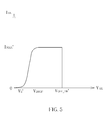
- FIGS. 5 , 8 and 11 A- 11 D are diagrams illustrating the current-voltage chart of a two-terminal current controller according to the present invention.
- FIGS. 6 , 9 , 12 and 14 are diagrams illustrating the variations in the related current and voltage when operating the LED lighting device of the present invention.
- FIGS. 16 and 17 are diagrams of illustrated embodiments of the two-terminal current controller.
- FIG. 4 is a diagram of an LED lighting device 100 according to a first embodiment of the present invention.
- the LED lighting device 100 includes a power supply circuit 110 , a two-terminal current controller 120 , and a luminescent device 10 .
- the power supply circuit 110 is configured to receive an AC voltage VS having positive and negative periods and convert the output of the AC voltage VS in the negative period using a bridge rectifier 112 , thereby providing a rectified AC voltage V AC , whose value varies periodically with time, for driving the luminescent device 10 .
- the luminescent device 10 may adopt n light-emitting units D 1 -D n coupled in series, each of which may include a single light-emitting diode or multiple light-emitting diodes.
- FIG. 1 light-emitting units
- the two-terminal current controller 120 coupled in parallel with the luminescent device 10 and the power supply circuit 110 , includes a current limiting unit 120 A and an adjusting unit 120 B.
- the two-terminal current controller 120 is configured to control the current I LED passing through the luminescent device 10 according to the rectified AC voltage V AC , wherein I AK represents the current passing through the current limiting unit 120 A and V AK represents the voltage established across the current limiting unit 120 A.
- the barrier voltage Vb′ of the two-terminal current controller 120 is smaller than the overall barrier voltage n*Vb of the luminescent device 10 (assuming the barrier voltage of each light-emitting unit is equal to Vb).
- FIGS. 5 and 6 illustrate the operation of the LED lighting device 100 , wherein FIG. 5 is a diagram illustrating the current-voltage chart of the two-terminal current controller 120 , and FIG. 6 is a diagram illustrating the variations in the related current and voltage when operating the LED lighting device 100 .
- the vertical axis represents the current I AK passing through the current limiting unit 120 A
- the horizontal axis represents the voltage V AK established across the current limiting unit 120 A.
- the two-terminal current controller 120 operates in a first mode in which the current limiting unit 120 A functions as a voltage-controlled device when 0 ⁇ V AK ⁇ V DROP .
- the current I AK changes with the voltage V AK in a specific manner.
- the two-terminal current controller 120 operates in a second mode in which the current limiting unit 120 A functions as a constant current source when V DROP ⁇ V AK ⁇ V OFF — TH ′.
- the current I AK is maintained at an adjustable specific current I MAX ′ instead of changing with the voltage V AK .
- the two-terminal current controller 120 functions in a third mode in which the current limiting unit 120 A is turned off when V AK >V OFF — TH ′.
- the two-terminal current controller 120 functions as an open-circuited device since the current I AK is suddenly reduced to zero.
- the adjusting unit 120 B may provide flexible designs with various characteristics by adjusting the value of I MAX ′ when the two-terminal current controller 120 operates in the second mode and the value of V OFF — TH ′ for switching between the second mode and the third mode.
- FIG. 6 illustrates the waveforms of the voltage V AK , the current I AK and the current I LED . Since the voltage V AK is associated with the rectified AC voltage V AC whose value varies periodically with time, a cycle between t 0 -t 6 is used for illustration, wherein the period between t 0 -t 3 is the rising period of the rectified AC voltage V AC and the period between t 4 -t 6 is the falling period of the rectified AC voltage V AC . Between t 0 -t 1 when the voltage V AK gradually increases, the current limiting unit 120 A of the two-terminal current controller 120 is first turned on, after which the current I AK increases with the voltage V AK in a specific manner and the current I LED is maintained at zero.
- the current limiting unit 120 A of the two-terminal current controller 120 is configured to limit the current I AK to a specific current I MAX ′, and the current I LED remains zero since the luminescent device 10 is still turned off.
- the current limiting unit 120 A of the two-terminal current controller 120 is turned off and the current associated with the rectified AC voltage V AC thus flows through the luminescent device 10 . Therefore, the current I AK is reduced to zero, and the current I LED changes with the voltage V AK .
- the current limiting unit 120 A of the two-terminal current controller 120 is turned on, thereby limiting the current I AK to the specific current I MAX ′ and maintaining the current I LED at zero again.
- the current I AK decreases with the voltage V AK in a specific manner.
- the two-terminal current controller 120 operates in the first mode during t 0 -t 1 and t 5 -t 6 when 0 ⁇ V AK ⁇ V DROP ; the two-terminal current controller 120 operates in the second mode during t 1 -t 2 and t 4 -t 5 when V DROP ⁇ V AK ⁇ V OFF — TH ′; the two-terminal current controller 120 operates in the third mode during t 2 -t 4 when V AK >V OFF — TH ′.
- FIG. 7 is a diagram of an LED lighting device 200 according to a second embodiment of the present invention.
- the LED lighting device 200 includes a power supply circuit 110 , a two-terminal current controller 120 , and a luminescent device 20 . Having similar structures, the first and second embodiments of the present invention differ in the luminescent device 20 and how it is connected to the two-terminal current controller 120 .
- the luminescent device 20 includes two luminescent elements 21 and 25 : the luminescent element 21 is coupled in parallel to the two-terminal current controller 120 and includes m light-emitting units D 1 -D m coupled in series, wherein I LED — AK represents the current flowing through the luminescent element 21 and V AK represents the voltage established across the luminescent element 21 ; the luminescent element 25 is coupled in series to the two-terminal current controller 120 and includes n light-emitting units D 1 -D n coupled in series, wherein I LED represents the current flowing through the luminescent element 25 and V LED represents the voltage established across the luminescent element 25 .
- Each light-emitting unit may include a single light-emitting diode or multiple light-emitting diodes.
- FIG. 7 depicts the embodiment using a single light-emitting diode.
- the two-terminal current controller 120 is configured to regulate the current flowing through the luminescent device 20 according to the rectified AC voltage V AC , wherein I AK represents the current flowing through the current limiting unit 120 A and V AK represents the voltage established across the current limiting unit 120 A.
- the barrier voltage Vb′ of the current limiting unit 120 A is smaller than the overall barrier voltage m*Vb of the luminescent element 21 (assuming the barrier voltage of each luminescent element is equal to Vb).
- FIGS. 8 and 9 illustrate the operation of the LED lighting device 200 according to the second embodiment of the present invention, wherein FIG. 8 is a diagram illustrating the current-voltage chart of the two-terminal current controller 120 , and FIG. 9 is a diagram illustrating the variations in the related current and voltage when operating the LED lighting device 200 .
- the vertical axis represents the current I AK passing through the current limiting unit 120 A, and the horizontal axis represents the voltage V AK established across the two-terminal current controller 120 .
- the two-terminal current controller 120 operates in the first mode in which the current limiting unit 120 A functions as a voltage-controlled device when 0 ⁇ V AK ⁇ V DROP .
- the current I AK changes with the voltage V AK in a specific manner.
- the two-terminal current controller 120 operates in the second mode in which the current limiting unit 120 A functions as a constant current source when V DROP ⁇ V AK ⁇ V OFF — TH ′.
- the current I AK is maintained at an adjustable specific current I MAX ′ instead of changing with the voltage V AK .
- the two-terminal current controller 120 operates in the third mode in which the current limiting unit 120 A is turned off when V AK >V OFF — TH ′. In other words, the two-terminal current controller 120 functions as an open-circuited device since the current I AK is suddenly reduced to zero.
- the two-terminal current controller 120 operates in the second mode in which the current limiting unit 120 A is turned on for limiting the current I AK to the specific current I MAX ′ when V AK ⁇ V ON — TH ′.
- the two-terminal current controller 120 operates in the first mode in which the current limiting unit 120 A functions as a voltage-controlled device when 0 ⁇ V AK ⁇ V DROP .
- the current I AK changes with the voltage V AK in a specific manner.
- the adjusting unit 120 B may provide flexible designs with various characteristics by adjusting the value of I MAX ′ when the two-terminal current controller 120 operates in the second mode and the value of V OFF — TH ′ for switching between the second mode and the third mode.
- FIG. 9 illustrates the waveforms of the voltage V AC , V AK , V LED and the current I AK , I LED — AK and I LED .
- V AC the rectified AC voltage
- V AK the voltage V AK established across the two-terminal current controller 120
- V LED the voltage V LED established across the n serially-coupled light-emitting units D 1 -D n increase with the rectified AC voltage V AC .
- the current limiting unit 120 A of the two-terminal current controller 120 is first turned on, after which the current I AK and the current I LED increase with the voltage V AK in a specific manner and the current I LED — AK is maintained at zero.
- the two-terminal current controller 120 is configured to limit the current I AK to the specific current I MAX ′, and the current I LED remains zero since the luminescent element 21 is still turned off.
- V F representing the forward-bias voltage of each light-emitting unit in the luminescent element 25
- the value of the voltage V LED may be represented by m*V F . Therefore, the luminescent element 21 is not conducting between t 0 -t 2 , and the rectified AC voltage V AC provided by the power supply circuit 110 is applied to the two-terminal current controller 120 and the n light-emitting units in the luminescent element 25 .
- the two-terminal current controller 120 is turned off and the current associated with the rectified AC voltage V AC thus passes through the luminescent elements 21 and 25 .
- the current I AK is reduced to zero, and the current I LED — AK changes with the voltage V AK . Therefore, when the luminescent element 21 is conducting between t 2 and t 4 , the voltage V AK established across the two-terminal current controller 120 is supplied as the luminescent device 20 performs voltage dividing on the rectified AC voltage V AC .
- the two-terminal current controller 120 is turned on, thereby limiting the current I AK to the specific current I MAX ′ and maintaining the current I LED — AK at zero again.
- the current I AK decreases with the voltage V AK in a specific manner. As depicted in FIGS. 7 and 9 , the value of the current I LED is the sum of the current I LED — AK and the current I AK .
- the two-terminal current controller 120 may increase the effective operational voltage range (such as the output of the rectified AC voltage V AC during t 0 -t 2 and t 4 -t 6 ), thereby increasing the power factor of the LED luminescence device 200 .
- FIG. 10 is a diagram of an LED lighting device 300 according to a third embodiment of the present invention.
- the LED lighting device 300 includes a power supply circuit 110 , a plurality of two-terminal current controllers, and a luminescent device 30 .
- the second and the third embodiments of the present invention differ in that the LED lighting device 300 includes a plurality of two-terminal current controllers (4 two-terminal current controllers 121 - 124 are depicted in FIG. 10 for illustration) and the luminescent device 30 includes a plurality of luminescent elements (5 luminescent elements 21 - 24 are depicted in FIG. 10 for illustration).
- the luminescent elements 21 - 24 are each coupled in parallel to the corresponding two-terminal current controllers 121 - 124 and each include a plurality of light-emitting units coupled in series, wherein I LED — AK1 -I LED — AK4 respectively represent the currents flowing through the luminescent elements 21 - 24 and V AK1 -V AK4 respectively represent the voltages established across the luminescent elements 21 - 24 .
- the luminescent element 25 is coupled in series to the two-terminal current controllers 121 - 124 and includes a plurality of light-emitting units coupled in series, wherein I LED represents the current flowing through the luminescent element 25 and V LED represents the voltage established across the luminescent element 25 .
- Each light-emitting unit may include a single light-emitting diode or multiple light-emitting diodes.
- FIG. 10 depicts the embodiment using a single light-emitting diode.
- the two-terminal current controllers 121 - 124 each including corresponding current limiting units 121 A- 124 A and corresponding adjusting units 121 B- 124 B, are configured to regulate the currents flowing through the corresponding luminescent devices 21 - 24 according to the voltages V AK1 -V AK4 , respectively, wherein I AK1 -I AK4 respectively represent the currents flowing through the current limiting units 121 A- 124 A and V AK1 -V AK4 respectively represent the voltages established across the current limiting units 121 A- 124 A.
- the barrier voltages of the current limiting units 121 A- 124 A are smaller than the overall barrier voltages of the corresponding luminescent elements 21 - 24 .
- FIGS. 11A-11D and 12 illustrate the operation of the LED lighting device 300 , wherein FIG. 11A-11D are diagrams illustrating the current-voltage charts of the current limiting units 121 A- 124 A, and FIG. 12 is a diagram illustrating the variations in the related current and voltage when operating the LED lighting device 300 .
- the adjusting units 121 B- 124 B may provide flexible designs with various characteristics by adjusting the value of I MAX ′ when the two-terminal current controllers 121 - 124 operate in the second mode and the values of V ON — TH ′ and V OFF — TH ′ for switching between the second mode and the third mode. In the embodiment illustrated in FIGS.
- I MAX1 ⁇ I MAX2 ⁇ I MAX3 ⁇ I MAX4 V ON — TH1 ⁇ V ON — TH2 ⁇ V ON — TH3 ⁇ V ON — TH4 , and V OFF — TH1 ⁇ V OFF — TH2 ⁇ V OFF — TH3 ⁇ V OFF — TH4 .
- FIG. 12 illustrates the waveforms of the voltage V AC and the current I LED when operating the LED lighting device 300 . Since the value of the rectified AC voltage V AC varies periodically with time, a cycle between t 0 -t 10 is used for illustration, wherein the period between t 0 -t 5 is the rising period of the rectified AC voltage V AC and the period between t 5 -t 10 is the falling period of the rectified AC voltage V AC .
- the operation of the LED lighting device 300 during the rising period t 0 -t 5 is hereby explained.
- the current limiting units 124 A- 121 A are sequentially turned on at t 6 -t 9 , respectively.
- the operation of the LED lighting device 300 during the falling period t 5 -t 10 is similar to that during the corresponding rising period t 0 -t 5 as previously illustrated.
- the luminescent element 25 has the longest conducting time
- the luminescent element 21 has the second longest conducting time
- the luminescent element 24 has the shortest conducting time.
- the luminescent elements 21 - 24 may be required to provide different luminescence or become luminescent at different time.
- the present invention may thus provide flexible designs using the adjusting units 121 B- 124 B.
- FIG. 13 is a diagram of an LED lighting device 400 according to a fourth embodiment of the present invention.
- the LED lighting device 400 includes a power supply circuit 110 , a plurality of two-terminal current controllers, and a luminescent device 40 . Having similar structure as the third embodiment, the LED lighting device 400 also include a plurality of two-terminal current controllers (5 two-terminal current controllers 121 - 125 are depicted in FIG. 13 for illustration) and a plurality of luminescent elements (4 luminescent elements 21 - 24 are depicted in FIG.
- the two-terminal current controllers 121 - 124 are each coupled in parallel to the corresponding luminescent elements 21 - 24 and the two-terminal current controller 125 is coupled in series to the luminescent elements 21 - 24 .
- FIG. 14 shows the waveforms of the voltage and the current for illustrating the operation of the LED lighting device 400 according to the fourth embodiment of the present invention.
- the two-terminal current controllers 121 - 124 are turned off during t 4 -t 5 , and the current I LED passing through the luminescent elements 21 - 24 is determined by the rectified AC voltage V AC provided by the power supply circuit 110 .
- the current I LED may exceed the maximum operational current of the luminescent elements 21 - 25 and thus cause permanent damages to the devices.
- the two-terminal current controller 125 is configured to maintain the current I LED to a specific value I MAX5 which may be adjusted in various applications.
- I MAX1 -I MAX5 depicted in FIG. 14 is only for illustrative purpose.
- FIG. 15 is a diagram of an LED lighting device 500 according to a fifth embodiment of the present invention.
- the LED lighting device 500 includes a power supply circuit 410 , a two-terminal current controller 120 , and a luminescent device 10 . Having similar structures, the first and fifth embodiments of the present invention differ in the power supply circuits.
- the power supply circuit 110 is configured to rectify the AC voltage VS (such as 110-220V main) using the bridge rectifier 112 , thereby providing the rectified AC voltage V AC whose value varies periodically with time.
- the power supply circuit 410 is configured to receive any AC voltage VS, perform voltage conversion using an AC-AC converter 412 , and rectify the converted AC voltage VS using the bridge rectifier 112 , thereby providing the rectified AC voltage V AC whose value varies periodically with time. References may be also be made to FIGS. 5 and 6 for illustrating the operation of the LED lighting device 500 . Similarly, the second to fourth embodiments of the present invention may also use the power supply circuit 410 for providing the rectified AC voltage V AC .
- FIGS. 16 and 17 are diagrams of illustrated embodiments of the two-terminal current controller 120 .
- the current limiting unit 120 A of the two-terminal current controller 120 includes resistors R 1 -R 7 , a switch QN, a comparator CP 1 , a band-gap reference voltage generator 50 , and a voltage-detecting circuit 70 .
- the band-gap reference voltage generator 50 generally adopts devices having positive and negative temperature coefficients in order to achieve temperature-independent output characteristic, thereby providing a stable reference voltage V REF .
- the resistor R 1 is used for detecting the current flowing through the switch QN, thereby providing a corresponding feedback voltage V FB .
- the resistors R 2 -R 4 forms a voltage-dividing circuit which provides a reference voltage V REF1 and a reference voltage V REF2 according to the reference voltage V REF .
- the comparator CP 1 having a positive input end for receiving the reference voltage V REF1 and a negative input end for receiving the feedback voltage V FB , is configured to output a control signal V g to the switch QN according to the relationship between the reference voltage V REF1 and the feedback voltage V FB .
- the switch QN may include a field effect transistor (FET), a bipolar junction transistor (BJT) or other devices having similar function.
- FET field effect transistor
- BJT bipolar junction transistor
- NMOS N-type metal-oxide-semiconductor
- the drain-to-source voltage V DS of the switch QN increases with the voltage V AK .
- the voltage V AK does not exceed V DROP
- the drain-to-source voltage V DS is smaller than the difference between the gate-to-source voltage V GS and the threshold voltage V TH (V DS ⁇ V GS ⁇ V TH ).
- the comparator CP 1 provides the control signal V g which allows the switch QN to operate in the linear region where the drain current is mainly determined by the drain-to-source voltage V DS .
- the two-terminal current controller 120 is configured to provide the current I AK and voltage V AK whose relationship corresponds to the I-V characteristic of the switch QN when operating in the linear region.
- the drain-to-source voltage V DS is larger than the difference between the gate-to-source voltage V GS and the threshold voltage V TH (V DS >V GS ⁇ V TH ).
- the comparator CP 1 provides the control signal V g which results in V GS >V TH , thereby allowing the switch QN to operate in the saturation region.
- the drain current of the comparator CP 1 is only related to the gate-to-source voltage V GS . In other words, the current I AK does not change with the voltage V AK .
- the voltage-detecting circuit 70 includes a logic circuit 72 , a voltage edge-detecting circuit 74 , and two comparators CP 2 and CP 3 .
- the comparator CP 2 having a positive input end for receiving the reference voltage V REF2 and a negative input end for receiving a voltage V ON , is configured to output a control signal V ON — TH ′ according to the relationship between the voltage V ON and the reference voltage V REF2 .
- the comparator CP 3 having a positive input end for receiving a voltage V OFF and a negative input end for receiving the reference voltage V REF2 , is configured to output a control signal V OFF — TH ′ according to the relationship between the voltage V OFF and the reference voltage V REF2 .
- the comparator CP 2 may determine the relationship between the voltages V AK and V ON — TH ′, while the comparator CP 3 may determine the relationship between the voltages V AK and V OFF — TH ′. Meanwhile, when the voltages V AK is between V OFF — TH ′ and V ON — TH ′, the voltage edge-detecting circuit 74 is configured to determine whether the rectified AC voltage V AC is during the rising period or during the falling period. Based on the results of the voltage edge-detecting circuit 74 and the comparators CP 2 and CP 3 , the logic circuit 72 outputs a corresponding control signal to the comparator CP 1 .
- the comparator CP 1 During the rising period of the rectified AC voltage V AC when the voltage V AK is between V OFF — TH ′ and V ON — TH ′, the comparator CP 1 provides the control signal V g smaller than the threshold voltage V TH , thereby turning off the switch QN and maintaining the current I AK at zero. During the falling period of the rectified AC voltage V AC when the voltage V AK is between V ON — TH ′ and V OFF — TH ′, the comparator CP 1 provides the control signal V g larger than the threshold voltage V TH ′, thereby operating the switch QN in the saturation region and maintaining the current I AK at I MAX ′.
- the adjusting unit 120 B includes a resistor R 8 whose value may be varied for adjusting how the reference voltage V REF is provided to the comparators CP 1 -CP 3 by voltage division.
- the values of the reference voltages V REF1 and V REF2 may be adjusted flexibly.
- the comparator CP 1 is configured to output the control signal V g to the switch QN according to the relationship between the reference voltage V REF1 and the feedback voltage V FB
- the comparator CP 2 is configured to output the control signal V ON — TH ′ according to the relationship between the voltage V ON and the reference voltage V REF2
- the comparator CP 3 is configured to output the control signal V OFF — TH ′ according to the relationship between the voltage V OFF and the reference voltage V REF2 .
- the drain current of the switch QN is only related to the gate-to-source voltage V GS when operating in the saturation region
- the values of the current I MAX ′ (when the two-terminal current controller 120 operates in the second mode) and the voltages V ON — TH ′ and V OFF — TH ′ (for switching between the second and third modes) may be adjusted using the adjusting unit 120 B. Therefore, the present invention can provide flexible designs with various characteristics.
- the adjusting unit 120 B includes resistors R 8 -R 9 and fuses F 1 -F 3 .
- the resistors R 8 -R 9 may be coupled to the resistors R 3 and R 4 in many ways by laser-burning or current-burning the fuses F 1 -F 3 , thereby adjusting the equivalent resistance when performing voltage division.
- the resistor R 8 may be coupled in parallel with the resistor string R 3 +R 4 by burning the fuse F 1 alone
- the resistor string R 8 +R 9 may be coupled in parallel with the resistor string R 3 +R 4 by burning the fuses F 1 and F 2 alone
- no extra resistor is coupled in parallel with the resistor string R 3 +R 4 by burning the fuse F 3 alone.
- the present invention may adopt other resistor-fuse configurations, with resistors coupled in series or in parallel, as long as similar results can be achieved. Therefore, the present invention may adjust how the reference voltage V REF is provided to the comparators CP 1 -CP 3 by voltage division. In other words, the values of the reference voltages V REF1 and V REF2 may be adjusted flexibly.
- the comparator CP 1 is configured to output the control signal V g to the switch QN according to the relationship between the reference voltage V REF1 and the feedback voltage V FB
- the comparator CP 2 is configured to output the control signal V ON — TH ′ according to the relationship between the voltage V ON and the reference voltage V REF2
- the comparator CP 3 is configured to output the control signal V OFF — TH ′ according to the relationship between the voltage V OFF and the reference voltage V REF2 .
- the drain current of the switch QN is only related to the gate-to-source voltage V GS when operating in the saturation region
- the values of the current I MAX ′ (when the two-terminal current controller 120 operates in the second mode) and the voltages V ON — TH ′ and V OFF — TH ′ (for switching between the second and third modes) may be adjusted using the adjusting unit 120 B. Therefore, the present invention can provide flexible designs with various characteristics.
- the user may adjust the current.
- manufacturer of the two-terminal current controller may adjust the current for the user.
- the adjusting unit may be integrated in an IC of the two-terminal current controller. Built-in resistors and laser-burning are well-know to those skilled in the art.
- FIGS. 15 and 16 are merely for illustrative purpose and do not limit the scope of the present invention.
- the number of the two-terminal current controllers 120 - 125 , the number and configuration of the luminescent elements 21 - 25 , and the type of the power supply circuits 110 and 410 may be determined according to different applications.
- FIGS. 4 , 7 , 10 and 12 are merely for illustrative purpose and do not limit the scope of the present invention.
- the two-terminal current controller 120 depicted in FIG. 16 is an embodiment of the present invention and may be substituted by devices which are able to provide characteristics as shown in FIGS. 5 , 6 , 8 , 9 and 11 A- 11 D.
- the LED lighting device of the present invention regulates the current flowing through the serially-coupled light-emitting diodes and controls the number of the turned-on light-emitting diodes using a two-terminal current controller. Some of the light-emitting diodes may be conducted before the rectified AC voltage reaches the overall barrier voltage of all light-emitting diodes for improving the power factor. Therefore, the present invention may provide lighting devices having large effective operational voltage range and high brightness.
Landscapes
- Circuit Arrangement For Electric Light Sources In General (AREA)
Abstract
Description
Claims (28)
Priority Applications (1)
| Application Number | Priority Date | Filing Date | Title |
|---|---|---|---|
| US13/743,345 US8638047B2 (en) | 2010-12-07 | 2013-01-17 | Two-terminal current controller and related LED lighting device |
Applications Claiming Priority (3)
| Application Number | Priority Date | Filing Date | Title |
|---|---|---|---|
| TW99142624A | 2010-12-07 | ||
| TW099142624A TWI435654B (en) | 2010-12-07 | 2010-12-07 | Double-ended current controller and related light-emitting diode lighting device |
| TW099142624 | 2010-12-07 |
Related Child Applications (1)
| Application Number | Title | Priority Date | Filing Date |
|---|---|---|---|
| US13/743,345 Continuation-In-Part US8638047B2 (en) | 2010-12-07 | 2013-01-17 | Two-terminal current controller and related LED lighting device |
Publications (2)
| Publication Number | Publication Date |
|---|---|
| US20120139448A1 US20120139448A1 (en) | 2012-06-07 |
| US8638043B2 true US8638043B2 (en) | 2014-01-28 |
Family
ID=46161585
Family Applications (1)
| Application Number | Title | Priority Date | Filing Date |
|---|---|---|---|
| US13/052,132 Expired - Fee Related US8638043B2 (en) | 2010-12-07 | 2011-03-21 | Two-terminal current controller and related LED lighting device |
Country Status (3)
| Country | Link |
|---|---|
| US (1) | US8638043B2 (en) |
| CN (1) | CN102563400B (en) |
| TW (1) | TWI435654B (en) |
Cited By (6)
| Publication number | Priority date | Publication date | Assignee | Title |
|---|---|---|---|---|
| US20130257282A1 (en) * | 2012-03-29 | 2013-10-03 | Nxp B.V. | Led driver and a method of driving leds |
| US20140197741A1 (en) * | 2011-07-15 | 2014-07-17 | Citizen Electronics Co., Ltd. | Led lighting apparatus |
| US20150110141A1 (en) * | 2012-06-20 | 2015-04-23 | Wisdom Technologies Holding Limited | Driving circuit and illumination device having light-emitting elements |
| US20150334801A1 (en) * | 2014-05-16 | 2015-11-19 | Unity Opto Technology Co., Ltd. | Purely resistive dimming circuit |
| US9686833B2 (en) | 2015-06-26 | 2017-06-20 | Samsung Electronics Co., Ltd. | LED driving apparatus and lighting apparatus including the same |
| US10807516B2 (en) * | 2016-09-09 | 2020-10-20 | Koito Manufacturing Co., Ltd. | Lighting circuit |
Families Citing this family (34)
| Publication number | Priority date | Publication date | Assignee | Title |
|---|---|---|---|---|
| US8890433B2 (en) | 2010-04-15 | 2014-11-18 | Iml International | Two-terminal current controller and related LED lighting device |
| US8547025B2 (en) | 2010-04-15 | 2013-10-01 | Iml International | Two-terminal current controller and related LED lighting device |
| TWI425862B (en) | 2010-04-15 | 2014-02-01 | 安恩國際公司 | Double-ended current controller and related light-emitting diode lighting device |
| US8674609B2 (en) | 2010-04-15 | 2014-03-18 | Iml International | Two-terminal current controller and related LED lighting device |
| US8564219B2 (en) * | 2010-11-23 | 2013-10-22 | O2Micro, Inc. | Circuits and methods for driving light sources |
| US9030121B2 (en) * | 2010-11-23 | 2015-05-12 | O2Micro, Inc. | Circuits and methods for driving light sources |
| US20130069546A1 (en) * | 2010-11-23 | 2013-03-21 | O2Micro, Inc. | Circuits and methods for driving light sources |
| DE112012005774T5 (en) * | 2012-06-15 | 2014-10-30 | Vastview Technology Inc. | Method and device for segmenting and driving LED-based lighting units |
| TW201408131A (en) * | 2012-08-08 | 2014-02-16 | 安恩國際公司 | Two-terminal current controller and related LED lighting device |
| EP2904877B1 (en) * | 2012-10-08 | 2018-07-25 | Philips Lighting Holding B.V. | Methods and apparatus for compensating a removal of leds from an led array |
| TW201431432A (en) * | 2013-01-17 | 2014-08-01 | 安恩國際公司 | Two-terminal current controller and related LED lighting device |
| CN103974505B (en) * | 2013-02-06 | 2016-05-04 | 安恩国际公司 | Light emitting diode illuminating apparatus |
| US9013109B2 (en) * | 2013-02-06 | 2015-04-21 | Iml International | Light-emitting diode lighting device with adjustable current settings and switch voltages |
| US9277615B2 (en) * | 2013-02-18 | 2016-03-01 | Citizen Holdings Co., Ltd. | LED drive circuit |
| JP6155703B2 (en) * | 2013-03-04 | 2017-07-05 | セイコーエプソン株式会社 | Light source device and projector |
| US9113523B2 (en) * | 2013-05-15 | 2015-08-18 | Iml International | Light-emitting diode lighting device having multiple driving stages |
| TWI569683B (en) * | 2013-05-24 | 2017-02-01 | Vastview Tech Inc | A device for driving a high voltage light emitting diode string |
| US9226354B2 (en) * | 2013-06-03 | 2015-12-29 | Iml International | Light-emitting diode lighting device having multiple driving stages |
| CN104244503B (en) * | 2013-06-18 | 2017-03-22 | 钰瀚科技股份有限公司 | Apparatus for driving light-emitting diode strings using high voltage |
| CN104284478A (en) * | 2013-07-10 | 2015-01-14 | 安恩科技股份有限公司 | Light-emitting diode lighting device having multiple driving stages |
| JP6242654B2 (en) | 2013-10-23 | 2017-12-06 | 東芝テック株式会社 | Power converter |
| CN104753104A (en) * | 2013-12-30 | 2015-07-01 | 鸿富锦精密工业(武汉)有限公司 | USB charging circuit with current regulating function |
| US20150201471A1 (en) * | 2014-01-16 | 2015-07-16 | Iml International | Low-flicker light-emitting diode lighting device having multiple driving stages |
| FR3018659B1 (en) * | 2014-03-14 | 2020-03-27 | Koito Manufacturing Co., Ltd. | VEHICLE LAMP AND VEHICLE LAMP CONTROL DEVICE |
| FR3023119B1 (en) * | 2014-06-30 | 2019-08-02 | Aledia | OPTOELECTRONIC CIRCUIT WITH ELECTROLUMINESCENT DIODES |
| US9351363B1 (en) * | 2014-11-20 | 2016-05-24 | Iml International | Dual mode operation light-emitting diode lighting device having multiple driving stages |
| EP3282491B1 (en) * | 2015-04-08 | 2019-10-09 | Citizen Watch Co., Ltd. | Led drive circuit |
| JP6511322B2 (en) * | 2015-04-14 | 2019-05-15 | 新日本無線株式会社 | LED drive circuit |
| TWM515620U (en) * | 2015-09-11 | 2016-01-11 | Luxmill Electronic Co Ltd | Multi-level LED driving circuit for eliminating undershoot |
| US9794992B1 (en) * | 2016-07-27 | 2017-10-17 | Vastview Technology Inc. | Universal method for driving LEDs using high voltage |
| JP6720753B2 (en) | 2016-07-27 | 2020-07-08 | 東芝ライテック株式会社 | Vehicle lighting device and vehicle lamp |
| CN106524089B (en) * | 2016-12-21 | 2023-06-13 | 广西水利电力职业技术学院 | Control system of liftable lamp stand |
| JP6922578B2 (en) * | 2017-09-13 | 2021-08-18 | 東芝ライテック株式会社 | Vehicle lighting and vehicle lighting |
| CN112770444B (en) * | 2021-01-29 | 2023-03-14 | 漳州立达信光电子科技有限公司 | Full-cycle load driving system |
Citations (19)
| Publication number | Priority date | Publication date | Assignee | Title |
|---|---|---|---|---|
| JP2006244848A (en) | 2005-03-03 | 2006-09-14 | Jamco Corp | Light emitting diode drive circuit for lighting |
| US20060267514A1 (en) | 2003-05-07 | 2006-11-30 | Koninklijke Philips Electronics N.V. | Current control method and circuit for light emitting diodes |
| US20080001547A1 (en) | 2005-09-20 | 2008-01-03 | Negru Sorin L | Driving parallel strings of series connected LEDs |
| JP2008059811A (en) | 2006-08-29 | 2008-03-13 | Avago Technologies Ecbu Ip (Singapore) Pte Ltd | Device and method for driving led |
| JP2008130377A (en) | 2006-11-21 | 2008-06-05 | Matsushita Electric Works Ltd | LED lighting circuit and lighting apparatus using the same |
| TW200850048A (en) | 2007-05-01 | 2008-12-16 | Pacific Tech Microelectronics Inc | LED current control circuits and methods |
| JP2009134933A (en) | 2007-11-29 | 2009-06-18 | Mitsubishi Electric Corp | LED lighting device and vehicle headlamp |
| WO2009153696A1 (en) | 2008-06-17 | 2009-12-23 | Philips Intellectual Property & Standards Gmbh | Harmonic compensation circuit and method for an led light unit |
| US20090322235A1 (en) | 2008-06-30 | 2009-12-31 | Shian-Sung Shiu | Led driving circuit, led driving control unit and transistor switch module thereof |
| TW201004471A (en) | 2008-07-01 | 2010-01-16 | Delta Electronics Inc | Current supply circuit and current control circuit for LED |
| KR20110023551A (en) | 2009-08-31 | 2011-03-08 | 삼성전기주식회사 | LED driving circuit |
| JP2011065922A (en) | 2009-09-18 | 2011-03-31 | Toshiba Lighting & Technology Corp | Led lighting device and illumination device |
| WO2011058805A1 (en) | 2009-11-13 | 2011-05-19 | 日亜化学工業株式会社 | Light-emitting diode drive device and light-emitting diode illumination control method |
| TW201136443A (en) | 2010-04-15 | 2011-10-16 | Addtek Corp | Two-terminal current controller and related LED lighting device |
| US20110273112A1 (en) | 2010-05-07 | 2011-11-10 | Samsung Electro-Mechanics Co., Ltd. | Light emitting driver |
| US20110279044A1 (en) * | 2008-04-10 | 2011-11-17 | Fu-Hwa Maiw | High efficiency power drive device enabling serial connection of light emitting diode lamps thereto |
| KR101132194B1 (en) | 2011-10-18 | 2012-04-06 | 삼성엘이디 주식회사 | Light emitting apparatus and led driving method using the same |
| US8299724B2 (en) * | 2010-03-19 | 2012-10-30 | Active-Semi, Inc. | AC LED lamp involving an LED string having separately shortable sections |
| WO2013011924A1 (en) | 2011-07-15 | 2013-01-24 | シチズンホールディングス株式会社 | Led illumination device |
Family Cites Families (3)
| Publication number | Priority date | Publication date | Assignee | Title |
|---|---|---|---|---|
| DE69914266T2 (en) * | 1998-08-18 | 2004-11-18 | Koninklijke Philips Electronics N.V. | Controlled power source with accelerated switching |
| US7265952B2 (en) * | 2005-06-09 | 2007-09-04 | Addtek Corp. | Two-terminal protecting circuit |
| JP4762722B2 (en) * | 2006-01-10 | 2011-08-31 | ローム株式会社 | Power supply device and electronic apparatus equipped with the same |
-
2010
- 2010-12-07 TW TW099142624A patent/TWI435654B/en not_active IP Right Cessation
- 2010-12-28 CN CN2010106228615A patent/CN102563400B/en not_active Expired - Fee Related
-
2011
- 2011-03-21 US US13/052,132 patent/US8638043B2/en not_active Expired - Fee Related
Patent Citations (22)
| Publication number | Priority date | Publication date | Assignee | Title |
|---|---|---|---|---|
| US20060267514A1 (en) | 2003-05-07 | 2006-11-30 | Koninklijke Philips Electronics N.V. | Current control method and circuit for light emitting diodes |
| JP2006244848A (en) | 2005-03-03 | 2006-09-14 | Jamco Corp | Light emitting diode drive circuit for lighting |
| US20080001547A1 (en) | 2005-09-20 | 2008-01-03 | Negru Sorin L | Driving parallel strings of series connected LEDs |
| JP2008059811A (en) | 2006-08-29 | 2008-03-13 | Avago Technologies Ecbu Ip (Singapore) Pte Ltd | Device and method for driving led |
| JP2008130377A (en) | 2006-11-21 | 2008-06-05 | Matsushita Electric Works Ltd | LED lighting circuit and lighting apparatus using the same |
| US7683553B2 (en) | 2007-05-01 | 2010-03-23 | Pacifictech Microelectronics, Inc. | LED current control circuits and methods |
| TW200850048A (en) | 2007-05-01 | 2008-12-16 | Pacific Tech Microelectronics Inc | LED current control circuits and methods |
| JP2009134933A (en) | 2007-11-29 | 2009-06-18 | Mitsubishi Electric Corp | LED lighting device and vehicle headlamp |
| US20110279044A1 (en) * | 2008-04-10 | 2011-11-17 | Fu-Hwa Maiw | High efficiency power drive device enabling serial connection of light emitting diode lamps thereto |
| JP2011524621A (en) | 2008-06-17 | 2011-09-01 | コーニンクレッカ フィリップス エレクトロニクス エヌ ヴィ | Harmonic compensation circuit and method for LED lighting unit |
| WO2009153696A1 (en) | 2008-06-17 | 2009-12-23 | Philips Intellectual Property & Standards Gmbh | Harmonic compensation circuit and method for an led light unit |
| US20090322235A1 (en) | 2008-06-30 | 2009-12-31 | Shian-Sung Shiu | Led driving circuit, led driving control unit and transistor switch module thereof |
| TW201004471A (en) | 2008-07-01 | 2010-01-16 | Delta Electronics Inc | Current supply circuit and current control circuit for LED |
| US8183795B2 (en) | 2008-07-01 | 2012-05-22 | Delta Electronics, Inc. | LED current-supplying circuit and LED current-controlling circuit |
| KR20110023551A (en) | 2009-08-31 | 2011-03-08 | 삼성전기주식회사 | LED driving circuit |
| JP2011065922A (en) | 2009-09-18 | 2011-03-31 | Toshiba Lighting & Technology Corp | Led lighting device and illumination device |
| WO2011058805A1 (en) | 2009-11-13 | 2011-05-19 | 日亜化学工業株式会社 | Light-emitting diode drive device and light-emitting diode illumination control method |
| US8299724B2 (en) * | 2010-03-19 | 2012-10-30 | Active-Semi, Inc. | AC LED lamp involving an LED string having separately shortable sections |
| TW201136443A (en) | 2010-04-15 | 2011-10-16 | Addtek Corp | Two-terminal current controller and related LED lighting device |
| US20110273112A1 (en) | 2010-05-07 | 2011-11-10 | Samsung Electro-Mechanics Co., Ltd. | Light emitting driver |
| WO2013011924A1 (en) | 2011-07-15 | 2013-01-24 | シチズンホールディングス株式会社 | Led illumination device |
| KR101132194B1 (en) | 2011-10-18 | 2012-04-06 | 삼성엘이디 주식회사 | Light emitting apparatus and led driving method using the same |
Non-Patent Citations (1)
| Title |
|---|
| U.S. Appl. No. 13/743,345, filed Jan. 17, 2013. * |
Cited By (9)
| Publication number | Priority date | Publication date | Assignee | Title |
|---|---|---|---|---|
| US20140197741A1 (en) * | 2011-07-15 | 2014-07-17 | Citizen Electronics Co., Ltd. | Led lighting apparatus |
| US9485830B2 (en) * | 2011-07-15 | 2016-11-01 | Citizen Holdings Co., Ltd. | LED lighting apparatus |
| US20130257282A1 (en) * | 2012-03-29 | 2013-10-03 | Nxp B.V. | Led driver and a method of driving leds |
| US20150110141A1 (en) * | 2012-06-20 | 2015-04-23 | Wisdom Technologies Holding Limited | Driving circuit and illumination device having light-emitting elements |
| US9271357B2 (en) * | 2012-06-20 | 2016-02-23 | Wisdom Technologies Holding Limited | Driving circuit and illumination device having light-emitting elements |
| US20150334801A1 (en) * | 2014-05-16 | 2015-11-19 | Unity Opto Technology Co., Ltd. | Purely resistive dimming circuit |
| US9485824B2 (en) * | 2014-05-16 | 2016-11-01 | Unity Opto Technology Co., Ltd. | Purely resistive dimming circuit |
| US9686833B2 (en) | 2015-06-26 | 2017-06-20 | Samsung Electronics Co., Ltd. | LED driving apparatus and lighting apparatus including the same |
| US10807516B2 (en) * | 2016-09-09 | 2020-10-20 | Koito Manufacturing Co., Ltd. | Lighting circuit |
Also Published As
| Publication number | Publication date |
|---|---|
| TWI435654B (en) | 2014-04-21 |
| CN102563400A (en) | 2012-07-11 |
| US20120139448A1 (en) | 2012-06-07 |
| CN102563400B (en) | 2013-12-18 |
| TW201225738A (en) | 2012-06-16 |
Similar Documents
| Publication | Publication Date | Title |
|---|---|---|
| US20120139448A1 (en) | Two-terminal current controller and related led lighting device | |
| US8638047B2 (en) | Two-terminal current controller and related LED lighting device | |
| US8319443B2 (en) | Two-terminal current controller and related LED lighting device | |
| US8339049B2 (en) | LED driving circuit having a large operational range in voltage | |
| TWI477190B (en) | Light emitting diode driving apparatus | |
| CN105307324A (en) | Light-emitting diode lighting device having multiple driving stages | |
| KR101582500B1 (en) | Light-emitting diode lighting device with adjustable current settings and switch voltages | |
| CN102235601B (en) | Dual-end current controller and relevant light emitting diode lighting device | |
| TW201531154A (en) | Low-flicker light-emitting diode lighting device having multiple driving stages | |
| US8547025B2 (en) | Two-terminal current controller and related LED lighting device | |
| TW201431432A (en) | Two-terminal current controller and related LED lighting device | |
| JP5739834B2 (en) | LED lighting device and two-terminal current controller | |
| US8847501B1 (en) | Apparatus for driving LEDs using high voltage | |
| US8674609B2 (en) | Two-terminal current controller and related LED lighting device | |
| KR101408027B1 (en) | Two-terminal current controller and related led lighting device | |
| US9113523B2 (en) | Light-emitting diode lighting device having multiple driving stages | |
| US8890433B2 (en) | Two-terminal current controller and related LED lighting device | |
| CN103582251B (en) | Dual-end current controller and light emitting diode illuminating apparatus | |
| CN103974505B (en) | Light emitting diode illuminating apparatus | |
| TWI637655B (en) | Low-flicker light-emitting diode lighting device | |
| US9226354B2 (en) | Light-emitting diode lighting device having multiple driving stages | |
| CN105636314A (en) | Dual mode operation light-emitting diode lighting device having multiple driving stages |
Legal Events
| Date | Code | Title | Description |
|---|---|---|---|
| AS | Assignment |
Owner name: ADDTEK CORP., TAIWAN Free format text: ASSIGNMENT OF ASSIGNORS INTEREST;ASSIGNORS:CHIANG, YUNG-HSIN;LI, YI-MEI;REEL/FRAME:025986/0914 Effective date: 20110216 |
|
| AS | Assignment |
Owner name: IML INTERNATIONAL, CAYMAN ISLANDS Free format text: ASSIGNMENT OF ASSIGNORS INTEREST;ASSIGNOR:ADDTEK CORP;REEL/FRAME:027595/0153 Effective date: 20120118 |
|
| STCF | Information on status: patent grant |
Free format text: PATENTED CASE |
|
| FPAY | Fee payment |
Year of fee payment: 4 |
|
| AS | Assignment |
Owner name: IML HONG KONG LIMITED, HONG KONG Free format text: ASSIGNMENT OF ASSIGNORS INTEREST;ASSIGNOR:IML INTERNATIONAL;REEL/FRAME:056321/0926 Effective date: 20210511 |
|
| MAFP | Maintenance fee payment |
Free format text: PAYMENT OF MAINTENANCE FEE, 8TH YR, SMALL ENTITY (ORIGINAL EVENT CODE: M2552); ENTITY STATUS OF PATENT OWNER: SMALL ENTITY Year of fee payment: 8 |
|
| FEPP | Fee payment procedure |
Free format text: MAINTENANCE FEE REMINDER MAILED (ORIGINAL EVENT CODE: REM.); ENTITY STATUS OF PATENT OWNER: SMALL ENTITY |
|
| LAPS | Lapse for failure to pay maintenance fees |
Free format text: PATENT EXPIRED FOR FAILURE TO PAY MAINTENANCE FEES (ORIGINAL EVENT CODE: EXP.); ENTITY STATUS OF PATENT OWNER: SMALL ENTITY |
|
| STCH | Information on status: patent discontinuation |
Free format text: PATENT EXPIRED DUE TO NONPAYMENT OF MAINTENANCE FEES UNDER 37 CFR 1.362 |
|
| FP | Lapsed due to failure to pay maintenance fee |
Effective date: 20260128 |