US8636550B2 - Protective cap for prevention of oblique tightening of fusible link directly mounted on battery - Google Patents

Protective cap for prevention of oblique tightening of fusible link directly mounted on battery Download PDF

Info

Publication number
US8636550B2
US8636550B2 US13/585,078 US201213585078A US8636550B2 US 8636550 B2 US8636550 B2 US 8636550B2 US 201213585078 A US201213585078 A US 201213585078A US 8636550 B2 US8636550 B2 US 8636550B2
Authority
US
United States
Prior art keywords
protective cap
nut
lances
fusible link
stud bolt
Prior art date
Legal status (The legal status is an assumption and is not a legal conclusion. Google has not performed a legal analysis and makes no representation as to the accuracy of the status listed.)
Active
Application number
US13/585,078
Other versions
US20120309239A1 (en
Inventor
Shinya Onoda
Motofumi Kato
Yoshinori Ishikawa
Current Assignee (The listed assignees may be inaccurate. Google has not performed a legal analysis and makes no representation or warranty as to the accuracy of the list.)
Yazaki Corp
Original Assignee
Yazaki Corp
Priority date (The priority date is an assumption and is not a legal conclusion. Google has not performed a legal analysis and makes no representation as to the accuracy of the date listed.)
Filing date
Publication date
Application filed by Yazaki Corp filed Critical Yazaki Corp
Assigned to YAZAKI CORPORATION reassignment YAZAKI CORPORATION ASSIGNMENT OF ASSIGNORS INTEREST (SEE DOCUMENT FOR DETAILS). Assignors: ISHIKAWA, YOSHINORI, KATO, MOTOFUMI, ONODA, SHINYA
Publication of US20120309239A1 publication Critical patent/US20120309239A1/en
Application granted granted Critical
Publication of US8636550B2 publication Critical patent/US8636550B2/en
Active legal-status Critical Current
Anticipated expiration legal-status Critical

Links

Images

Classifications

    • HELECTRICITY
    • H01ELECTRIC ELEMENTS
    • H01RELECTRICALLY-CONDUCTIVE CONNECTIONS; STRUCTURAL ASSOCIATIONS OF A PLURALITY OF MUTUALLY-INSULATED ELECTRICAL CONNECTING ELEMENTS; COUPLING DEVICES; CURRENT COLLECTORS
    • H01R11/00Individual connecting elements providing two or more spaced connecting locations for conductive members which are, or may be, thereby interconnected, e.g. end pieces for wires or cables supported by the wire or cable and having means for facilitating electrical connection to some other wire, terminal, or conductive member, blocks of binding posts
    • H01R11/11End pieces or tapping pieces for wires, supported by the wire and for facilitating electrical connection to some other wire, terminal or conductive member
    • H01R11/28End pieces consisting of a ferrule or sleeve
    • H01R11/281End pieces consisting of a ferrule or sleeve for connections to batteries
    • H01R11/287Intermediate parts between battery post and cable end piece
    • HELECTRICITY
    • H01ELECTRIC ELEMENTS
    • H01RELECTRICALLY-CONDUCTIVE CONNECTIONS; STRUCTURAL ASSOCIATIONS OF A PLURALITY OF MUTUALLY-INSULATED ELECTRICAL CONNECTING ELEMENTS; COUPLING DEVICES; CURRENT COLLECTORS
    • H01R11/00Individual connecting elements providing two or more spaced connecting locations for conductive members which are, or may be, thereby interconnected, e.g. end pieces for wires or cables supported by the wire or cable and having means for facilitating electrical connection to some other wire, terminal, or conductive member, blocks of binding posts
    • H01R11/11End pieces or tapping pieces for wires, supported by the wire and for facilitating electrical connection to some other wire, terminal or conductive member
    • H01R11/28End pieces consisting of a ferrule or sleeve
    • H01R11/281End pieces consisting of a ferrule or sleeve for connections to batteries
    • H01R11/284End pieces consisting of a ferrule or sleeve for connections to batteries comprising means for preventing corrosion, e.g. covers, enclosures filled with gel
    • HELECTRICITY
    • H01ELECTRIC ELEMENTS
    • H01RELECTRICALLY-CONDUCTIVE CONNECTIONS; STRUCTURAL ASSOCIATIONS OF A PLURALITY OF MUTUALLY-INSULATED ELECTRICAL CONNECTING ELEMENTS; COUPLING DEVICES; CURRENT COLLECTORS
    • H01R13/00Details of coupling devices of the kinds covered by groups H01R12/70 or H01R24/00 - H01R33/00
    • H01R13/44Means for preventing access to live contacts
    • H01R13/447Shutter or cover plate
    • HELECTRICITY
    • H01ELECTRIC ELEMENTS
    • H01HELECTRIC SWITCHES; RELAYS; SELECTORS; EMERGENCY PROTECTIVE DEVICES
    • H01H85/00Protective devices in which the current flows through a part of fusible material and this current is interrupted by displacement of the fusible material when this current becomes excessive
    • H01H85/02Details
    • H01H85/0241Structural association of a fuse and another component or apparatus
    • H01H2085/025Structural association with a binding post of a storage battery
    • HELECTRICITY
    • H01ELECTRIC ELEMENTS
    • H01RELECTRICALLY-CONDUCTIVE CONNECTIONS; STRUCTURAL ASSOCIATIONS OF A PLURALITY OF MUTUALLY-INSULATED ELECTRICAL CONNECTING ELEMENTS; COUPLING DEVICES; CURRENT COLLECTORS
    • H01R4/00Electrically-conductive connections between two or more conductive members in direct contact, i.e. touching one another; Means for effecting or maintaining such contact; Electrically-conductive connections having two or more spaced connecting locations for conductors and using contact members penetrating insulation
    • H01R4/28Clamped connections, spring connections
    • H01R4/30Clamped connections, spring connections utilising a screw or nut clamping member
    • H01R4/302Clamped connections, spring connections utilising a screw or nut clamping member having means for preventing loosening of screw or nut, e.g. vibration-proof connection
    • HELECTRICITY
    • H01ELECTRIC ELEMENTS
    • H01RELECTRICALLY-CONDUCTIVE CONNECTIONS; STRUCTURAL ASSOCIATIONS OF A PLURALITY OF MUTUALLY-INSULATED ELECTRICAL CONNECTING ELEMENTS; COUPLING DEVICES; CURRENT COLLECTORS
    • H01R43/00Apparatus or processes specially adapted for manufacturing, assembling, maintaining, or repairing of line connectors or current collectors or for joining electric conductors
    • H01R43/26Apparatus or processes specially adapted for manufacturing, assembling, maintaining, or repairing of line connectors or current collectors or for joining electric conductors for engaging or disengaging the two parts of a coupling device

Definitions

  • the present invention relates to prevention of oblique tightening of a fusible link directly mounted on a battery, and particularly to a protective cap for prevention of oblique tightening constructed so that a nut can be prevented from being obliquely tightened.
  • a vehicle of an automobile is equipped with a battery as a power supply source, and a fusible link with a built-in fuse is electrically connected to a battery post of the battery through a battery terminal.
  • a fusible link directly mounted on the battery for example, a fusible link described in JP-A-2000-331591 as shown in FIG. 18 is used conventionally.
  • FIG. 18 is an exploded perspective view of a fusible link directly mounted on a battery described in JP-A-2000-331591.
  • a fusible link 30 directly mounted on a battery is electrically connected to a battery post 10 P of the battery 10 through a battery terminal 20 .
  • the battery 10 has a rectangular parallelepiped and the battery post 10 P is erected in the vicinity of the upper end.
  • the battery terminal 20 is crimped onto this battery post 10 P.
  • the battery terminal 20 includes a crimp hole 20 H for inserting the battery post 10 P of the battery 10 in the center, an adjusting screw 20 N for adjusting a diameter of the crimp hole 20 H small and large, and a power source side stud bolt 20 S inserted into a connection hole 32 Ah of a power source side terminal block 32 A of the fusible link 30 .
  • the fusible link 30 is constructed of a fuse body 32 and a resin case 34 with which this fuse body 32 is partially covered by resin molding, and the apex of the fusible link 30 is covered with a protective cap 50 .
  • the fuse body 32 is made by punching one conductive plate, and is constructed of the power source side terminal block 32 A with a rectangular shape, a narrow fusible body 32 F joined to the power source side terminal block 32 A, and substantially a rectangular wire harness side terminal block 32 B joined to the fusible body 32 F.
  • the power source side terminal block 32 A, the fusible body 32 F and the wire harness side terminal block 32 B are arranged on substantially the same plane.
  • the fusible body 32 F is not shown, but is presence inside a transparent cover 30 F.
  • connection hole 32 Ah is formed in the power source side terminal block 32 A and also, both of the front and back portions are excluded from the resin case 34 to a range corresponding to space into which a tool (an impact wrench) is inserted around the connection hole 32 Ah.
  • the wire harness side terminal block 32 B has a bolt hole 32 Bh, and a stud bolt 32 S protrudes upward (the side opposite to the battery) in this bolt hole 32 Bh.
  • the resin case 34 exposes the front and back sides of the power source side terminal block 32 A and the front side of the wire harness side terminal block 32 B in the fuse body 32 from the resin case 34 and thereby, the exposed portion is formed as an electrical connection. Also, the front and back sides of the fusible body 32 F are exposed from the resin case 34 , and the transparent covers 30 F are respectively disposed over the front side of the fuse body 32 and under the back side of the fuse body 32 , and appearance of a fusion part of the fusible body of the inside can be visually checked through the transparent covers 30 F.
  • a heat-radiating fin is formed on a surface of the resin case 34 . The resin molding is performed after the stud bolt 32 S is attached to the bolt hole 32 Bh of the wire harness side terminal block 32 B.
  • a wire harness side terminal 40 is fitted into the stud bolt 32 S and a nut is screwed to the stud bolt 32 S and thereby, the wire harness side terminal 40 is electrically connected to the stud bolt 32 S.
  • the protective cap 50 is means for covering the fusible link 30 , and is molded by resin. This protective cap prevents atmospheric dust etc. from entering and also prevents the human body from making contact to get an electric shock or cause an electric leak.
  • a conventional procedure of assembly in a vehicle is performed as described below.
  • the battery terminal 20 is fixed to the battery post 10 P.
  • the power source side stud bolt 20 S of the battery terminal 20 is inserted into the connection hole 32 Ah of the power source side terminal block 32 A of the fusible link 30 , and the nut N is screwed and tightened to the power source side stud bolt 20 S, and the power source side terminal block 32 A is electrically connected to the power source side stud bolt 20 S.
  • the protective cap 50 is fitted into the fusible link 30 from the upper portion of the fusible link 30 .
  • the wire harness side terminal 40 is fitted into the stud bolt 32 S of the fusible link 30 and the nut is screwed to the stud bolt 32 S and thereby, the wire harness side terminal 40 is electrically connected to the battery 10 .
  • the protective cap 50 may be detached temporarily, but it is desirable to be constructed so that a hinge is previously formed in a region of the protective cap 50 corresponding to the stud bolt 32 S of the fusible link 30 and only the portion is turned around the hinge at the time of connection and only the region of the stud bolt 32 S can be exposed.
  • the battery post 10 P is inserted into the crimp hole 20 H of the center of the battery terminal 20 and the adjusting screw (nut) 20 N is tightened from the side of a horizontal bolt, so that there is a low possibility that gravity acts on the nut and oblique insertion is performed and also, even if oblique tightening of the bolt and the nut occurs and the oblique tightening is noticed, a tightening method for decreasing a diameter of the crimp hole 20 H is adopted, so that a tightening force is still small and the nut is returned and the tightening can be retried.
  • wire harness side terminal 40 is fixed to the stud bolt 32 S of the fusible link 30 in a place overhanging from the end of the battery 10 , a sufficient visual check can be made, so that there is a low possibility that oblique tightening of the bolt and the nut at the time of tightening occurs and also, even if oblique tightening of the bolt and the nut occurs and the oblique tightening is noticed, a tightening force is small, so that the tightening can be retried.
  • the bulk of the resin case 34 becomes an obstacle and it is less visible and also, the nut N is inserted into the power source side stud bolt 20 S in a perpendicular direction, so that it is difficult to notice oblique insertion and also tightening is performed by a large pressing force, so that when oblique tightening of the bolt and the nut occurs and the oblique tightening is noticed, an abnormal groove is formed in the bolt or the nut and it is difficult to retry the tightening.
  • the first invention is that a peripheral wall is formed in the periphery of an erected bolt and when work is done with a torque wrench, the peripheral wall regulates oblique travel of the torque wrench so that the torque wrench does not become oblique.
  • the second invention is that the top of a bolt of a tightening part is changed into a long dog point shape and a nut is temporarily set at this top (see JP-A-10-92484).
  • a protective cap for protecting a fusible link formed with a connection hole comprising:
  • a protective cap part disposed on an extension of an axis of a stud bolt of a power source, and formed with a tool insertion hole into which a tool used for fitting a nut with the stud bolt is inserted, the stud bolt inserted through the connection hole;
  • a nut holder provided inside the protective cap part, and configured to hold the nut in a state where an axis of the nut is coaxial to the axis of the stud bolt.
  • An inner diameter of the tool insertion hole may be equal to an outer diameter of the tool.
  • the nut holder may include a plurality of lances which are erected inside the protective cap from a periphery of the tool insertion hole.
  • the protective cap may be configured such that: the lances include first lances and second lances which are shorter than the first lances, the first lances are configured to hold a first face of the nut at a side of the fusible link, and the second lances are configured to hold a second face of the nut opposite to the first face.
  • the protective cap may be configured such that: the lances further include third lances, and the third lances are configured to come in contact with the fusible link and to have an elastic force in a direction separating the protective cap from the fusible link in a state where the protective cap is attached to the fusible link.
  • the protective may further comprise a lid, configured to close the tool insertion hole; and a coupling band coupling the lid to the protective cap part.
  • the tool insertion hole into which the tool for tightening the nut is inserted is included and the nut holder for horizontally holding the nut on a top of the power source side stud bolt is formed, so that by only inserting the tool into the tool insertion hole and rotating the tool, the nut is fitted into the stud bolt from the top of the stud bolt and moves and the nut can be tightened to the stud bolt easily without oblique travel.
  • the nut holder is formed of the lances erected inside the protective cap from the periphery of the connection hole, so that the nut holder can be manufactured integrally to the protective cap using the same resin material as that of the protective cap.
  • the first lance holds the surface of the side of the fusible link in the nut and the second lance holds the surface of the side of the protective cap in the nut, so that the nut can be fixed simply, stably and horizontally.
  • the lid for closing the tool insertion hole and the coupling band for coupling this lid to the protective cap are included, so that fear of losing the lid for closing the tool insertion hole is eliminated.
  • the anti-backlash lance lifts the protective cap in the direction of lifting the protective cap from the fusible link in the use state of the protective cap, so that backlash can be prevented even when there is clearance in the protective cap.
  • FIG. 1 is an exploded perspective view of a battery-direct-mounted fusible link and a protective cap according to the invention.
  • FIGS. 2A and 2B are diagrams describing the protective cap according to the invention.
  • FIG. 2A is a perspective view
  • FIG. 2B is a sectional view taken on line A-A of FIG. 2A .
  • FIG. 3 is a longitudinal sectional view showing a state of attaching a nut to the protective cap according to the invention.
  • FIG. 4 is a longitudinal sectional view showing a state of fitting the protective cap according to the invention into the fusible link.
  • FIG. 5 is a longitudinal sectional view showing a state in which a wrench approaches an upper portion of the protective cap of FIG. 4 .
  • FIG. 6 is a longitudinal sectional view showing a state in which the wrench of FIG. 5 descends and enters the protective cap from a tool insertion hole of the protective cap and starts to tighten the nut.
  • FIG. 7 is a longitudinal sectional view showing a state in which the wrench is tightening the nut.
  • FIG. 8 is a longitudinal sectional view showing a state in which the wrench completes tightening the nut.
  • FIG. 9 is a longitudinal sectional view showing a state in which the wrench retracts from the protective cap from the state of FIG. 8 .
  • FIG. 10 is a longitudinal sectional view showing a state of attaching a lid to the tool insertion hole.
  • FIGS. 11A to 11F are conceptual diagrams describing a cause of occurrence of backlash.
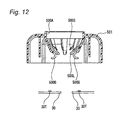
  • FIG. 12 is a longitudinal sectional view of a protective cap according to a second embodiment.
  • FIG. 13 shows a state of horizontally holding a nut on the protective cap of the second embodiment.
  • FIG. 14 is a diagram describing an operation of the protective cap of the second embodiment, and is the diagram showing a state of setting a long dog point of a stud bolt inside the nut of the state of FIG. 13 .
  • FIG. 15 is a diagram describing an operation of the protective cap of the second embodiment, and is the diagram showing a state of descending an impact wrench.
  • FIG. 16 is a diagram describing an operation of the protective cap of the second embodiment, and is the diagram showing a state in which anti-backlash lances are pushed by the impact wrench and retract in a perpendicular direction.
  • FIG. 17 is a diagram describing an operation of the protective cap of the second embodiment, and is the diagram showing a state of detaching the impact wrench.
  • FIG. 18 is an exploded perspective view of a fusible link directly mounted on a battery described in PTL 1.
  • a protective cap according to the invention in which workability is good and oblique tightening of a fusible link without occurrence of the oblique tightening can be prevented in the case of tightening a bolt and a nut will hereinafter be described with reference to the drawings.
  • FIG. 1 is an exploded perspective view of a battery-direct-mounted fusible link including a protective cap according to the invention. Since a battery 10 , a battery terminal 20 , a battery-direct-mounted fusible link 30 and a wire harness side terminal 40 in FIG. 1 are the same as the conventional ones described in FIG. 18 , overlap description is omitted.
  • FIG. 1 differs from a component of FIG. 18 in a protective cap 500 (the protective cap 50 in FIG. 18 ). Therefore, the protective cap 500 will hereinafter be described.
  • the protective cap 500 is means for covering the fusible link 30 and is molded by resin and thereby prevents atmospheric dust etc. from entering and also prevents the human body from making contact to get an electric shock or cause an electric leak.
  • a protective cap region as an extension of a power source side stud bolt of the protective cap 500 is provided with a tool insertion hole 500 A as described in FIGS. 2A and 2B .
  • the tool insertion hole 500 A is bored in the protective cap 500 , and at the time of tightening a nut, a tool is inserted into this tool insertion hole 500 A and the nut is tightened and at the time of normal use, the tool insertion hole 500 A is closed with a lid 510 .
  • the lid 510 is constructed so as not to be lost by coupling the lid 510 to the protective cap 500 using a coupling band 520 .
  • the tool is an impact wrench for example.
  • the tool insertion hole 500 A is formed at a protective cap part in the vicinity of the upper center of a protective cap housing 500 H and an inside diameter of the tool insertion hole 500 A is substantially equal to an outside diameter of the impact wrench.
  • a nut holder is provided inside the protective cap 500 .
  • two kinds of lances 500 L, 500 S are respectively extended from the circumferential lower portion toward the inner center of the tool insertion hole 500 A.
  • the lances 500 L are formed long and the lances 500 S are formed short. In other words, the lances 500 S are shorter than the lances 500 L.
  • the lances may lengthy supports.
  • the long lances 500 L support the lower end side of a nut N and the short lances 500 S press the upper end side of the nut N and thereby, the nut N is held horizontally so as not to come off.
  • the long lances 500 L hold a first face of the nut N at a side of the fusible link 30 .
  • the short lances 500 S hold a second face of the nut N opposite to the first face.
  • a power source side stud bolt 20 S of the battery terminal 20 in a state of inserting the power source side stud bolt 20 S into a connection hole of a power source side terminal block 32 A is positioned just under the nut N.
  • the protective cap part is disposed on an extension of an axis of a stud bolt 20 S.
  • the nut holder holds the nut N in a state where an axis of the nut N is parallel to the axis of the stud bolt 20 S.
  • an impact wrench IL is brought just over the tool insertion hole 500 A of the protective cap 500 of FIG. 4 and is descended. Since a size of a diameter of the tool insertion hole 500 A is formed in a size in which the impact wrench IL can just pass through the tool insertion hole, when the impact wrench IL is inserted into the tool insertion hole 500 A with the same diameter, the impact wrench IL enters perpendicularly to the tool insertion hole 500 A as shown in FIG. 6 and oblique travel could never occur.
  • the nut N is horizontally held by the long lances 500 L and the short lances 500 S, so that the impact wrench IL moves perpendicularly to the nut N.
  • FIG. 7 shows a state in which the impact wrench IL houses the nut N in its own internal space.
  • the long lances 500 L and the short lances 500 S for horizontally holding the nut N complete a role of the horizontal holding, and retract from a path of the impact wrench IL by a descent of the impact wrench IL, and do not interfere with passage of the impact wrench IL.
  • the nut N descends while rotating a surface of the power source side stud bolt 20 S and finally as shown in FIG. 8 , the nut N reaches the power source side terminal block 32 A, and the fusible link 30 is horizontally tightened to the battery terminal 20 without obliquely tightening the fusible link 30 .
  • the protective cap according to the invention enables good workability and can prevent oblique tightening of the fusible link without occurrence of the oblique tightening in the case of tightening the bolt and the nut.
  • a second embodiment is the invention constructed so that backlash of a protective cap can be prevented in the protective cap of the first embodiment.
  • the protective cap 500 it is necessary to create clearance between the protective cap 500 and the fusible link 30 in consideration of a locus of a lock part at the time of fitting in order to fit the protective cap 500 into the fusible link 30 . Because of that, the protective cap 500 has backlash with respect to the fusible link 30 in a state of fitting.
  • FIGS. 11A to 11F are conceptual diagrams describing a reason of occurrence of backlash.
  • FIG. 11F is a side diagram of a state of fitting the protective cap 500 into the fusible link 30 .
  • FIG. 11D is a sectional diagram taken on line B-B of FIG. 11F .
  • FIGS. 11A to 11D are diagrams showing a fitting procedure for fitting the protective cap 500 into the fusible link 30 .
  • FIG. 11A is the diagram before fitting.
  • FIG. 11B is the diagram just before fitting.
  • FIG. 11C is the diagram during fitting.
  • FIG. 11D is the diagram of the completion of fitting.
  • FIG. 11E is an enlarged diagram of a portion E of FIG. 11D .
  • the length 500 t has the clearance slightly larger than the thickness 30 t of the fusible link 30 , so that there is backlash between the protective cap 500 and the fusible link 30 . Since this backlash causes problems such as vibration or noise, the second embodiment is constructed so as to prevent the backlash.
  • FIG. 12 is a longitudinal sectional view describing a protective cap capable of preventing backlash according to the second embodiment.
  • numeral 501 is the protective cap according to the second embodiment.
  • the second embodiment has the following structure in each of the sides of the protective cap 501 and a fusible link 30 .
  • the protective cap 501 of the second embodiment differs from the protective cap 500 of the first embodiment in that an anti-backlash lance 500 G which is a third lance is further included.
  • the anti-backlash lance 500 G is longer than the long lances 500 L, and has a length in which a top G 1 of the anti-backlash lance 500 G can make contact with a surface of the fusible link 30 when the anti-backlash lance 500 G expands and turns directly downward as can be seen from FIG. 17 showing a use state.
  • Such plural anti-backlash lances 500 G are extended downward in a circumferential direction of a tool insertion hole 500 A of the protective cap 501 .
  • a detent protrusion 30 T is disposed in the fusible link 30 .
  • the detent protrusions 30 T are disposed in contact regions of the fusible link 30 whose surface makes contact with the tops G 1 of the anti-backlash lances 500 G as shown in FIG. 17 of a use state (described below).
  • the detent protrusions 30 T inhibit the anti-backlash lances 500 G expanding and turning directly downward from returning to the original state.
  • FIGS. 13 to 17 An operation of the protective cap 501 of the second embodiment will be described using FIGS. 13 to 17 .
  • the long lances 500 L support the lower end side of a nut N and short lances 500 S press the upper end side of the nut N and thereby, the nut N is held horizontally so as not to come off.
  • the tops of the anti-backlash lances 500 G extend further obliquely downward from the lower end of the nut N.
  • the protective cap 501 is descended on the fusible link 30 , and a long dog point of a power source side stud bolt 20 S is set inside the nut N horizontally held by the long lances 500 L and the short lances 500 S. At this time, the tops of the anti-backlash lances 500 G still extend obliquely downward from the lower end of the nut N.
  • FIG. 15 when an impact wrench IL is descended, as described in the first embodiment, a size of a diameter of the tool insertion hole 500 A is formed in a size in which the impact wrench IL can just pass through the tool insertion hole, so that the impact wrench IL enters perpendicularly to the tool insertion hole 500 A and oblique travel does not occur.
  • the tops of the anti-backlash lances 500 G still extend obliquely downward from the lower end of the nut N.
  • the protective cap according to the first embodiment enables good workability and prevents oblique tightening in the case of tightening the bolt and the nut and further, the anti-backlash lances of the second embodiment prevent the backlash.
  • the present invention is extremely useful in forming a protective cap in which workability is good and oblique tightening of a fusible link can be prevented.

Landscapes

  • Fuses (AREA)
  • Connection Of Batteries Or Terminals (AREA)

Abstract

A protective cap protects a fusible link formed with a connection hole. A protective cap part is disposed on an extension of an axis of a stud bolt of a power source. The protective cap part is formed with a tool insertion hole into which a tool used for fitting a nut with the stud bolt is inserted. The stud bolt is inserted through the connection hole. A nut holder is provided inside the protective cap part. The nut holder holds the nut in a state where an axis of the nut is parallel to the axis of the stud bolt.

Description

CROSS REFERENCE TO RELATED APPLICATION
This application is a continuation of PCT application No. PCT/JP2011/053605, which was filed on Feb. 15, 2011 based on Japanese Patent Application (No. 2010-030194) filed on Feb. 15, 2010, the contents of which are incorporated herein by reference. Also, all the references cited herein are incorporated as a whole.
BACKGROUND OF THE INVENTION
1. Technical Field
The present invention relates to prevention of oblique tightening of a fusible link directly mounted on a battery, and particularly to a protective cap for prevention of oblique tightening constructed so that a nut can be prevented from being obliquely tightened.
2. Background Art
A vehicle of an automobile is equipped with a battery as a power supply source, and a fusible link with a built-in fuse is electrically connected to a battery post of the battery through a battery terminal. As the fusible link directly mounted on the battery, for example, a fusible link described in JP-A-2000-331591 as shown in FIG. 18 is used conventionally.
FIG. 18 is an exploded perspective view of a fusible link directly mounted on a battery described in JP-A-2000-331591. In FIG. 18, a fusible link 30 directly mounted on a battery is electrically connected to a battery post 10P of the battery 10 through a battery terminal 20.
The battery 10 has a rectangular parallelepiped and the battery post 10P is erected in the vicinity of the upper end. The battery terminal 20 is crimped onto this battery post 10P.
The battery terminal 20 includes a crimp hole 20H for inserting the battery post 10P of the battery 10 in the center, an adjusting screw 20N for adjusting a diameter of the crimp hole 20H small and large, and a power source side stud bolt 20S inserted into a connection hole 32Ah of a power source side terminal block 32A of the fusible link 30.
The fusible link 30 is constructed of a fuse body 32 and a resin case 34 with which this fuse body 32 is partially covered by resin molding, and the apex of the fusible link 30 is covered with a protective cap 50. The fuse body 32 is made by punching one conductive plate, and is constructed of the power source side terminal block 32A with a rectangular shape, a narrow fusible body 32F joined to the power source side terminal block 32A, and substantially a rectangular wire harness side terminal block 32B joined to the fusible body 32F. The power source side terminal block 32A, the fusible body 32F and the wire harness side terminal block 32B are arranged on substantially the same plane. The fusible body 32F is not shown, but is presence inside a transparent cover 30F.
The connection hole 32Ah is formed in the power source side terminal block 32A and also, both of the front and back portions are excluded from the resin case 34 to a range corresponding to space into which a tool (an impact wrench) is inserted around the connection hole 32Ah.
The wire harness side terminal block 32B has a bolt hole 32Bh, and a stud bolt 32S protrudes upward (the side opposite to the battery) in this bolt hole 32Bh.
The resin case 34 exposes the front and back sides of the power source side terminal block 32A and the front side of the wire harness side terminal block 32B in the fuse body 32 from the resin case 34 and thereby, the exposed portion is formed as an electrical connection. Also, the front and back sides of the fusible body 32F are exposed from the resin case 34, and the transparent covers 30F are respectively disposed over the front side of the fuse body 32 and under the back side of the fuse body 32, and appearance of a fusion part of the fusible body of the inside can be visually checked through the transparent covers 30F. A heat-radiating fin is formed on a surface of the resin case 34. The resin molding is performed after the stud bolt 32S is attached to the bolt hole 32Bh of the wire harness side terminal block 32B.
A wire harness side terminal 40 is fitted into the stud bolt 32S and a nut is screwed to the stud bolt 32S and thereby, the wire harness side terminal 40 is electrically connected to the stud bolt 32S.
The protective cap 50 is means for covering the fusible link 30, and is molded by resin. This protective cap prevents atmospheric dust etc. from entering and also prevents the human body from making contact to get an electric shock or cause an electric leak.
A conventional procedure of assembly in a vehicle is performed as described below.
First, the battery terminal 20 is fixed to the battery post 10P.
Next, the power source side stud bolt 20S of the battery terminal 20 is inserted into the connection hole 32Ah of the power source side terminal block 32A of the fusible link 30, and the nut N is screwed and tightened to the power source side stud bolt 20S, and the power source side terminal block 32A is electrically connected to the power source side stud bolt 20S.
Finally, the protective cap 50 is fitted into the fusible link 30 from the upper portion of the fusible link 30.
Thereafter, at the time of use, the wire harness side terminal 40 is fitted into the stud bolt 32S of the fusible link 30 and the nut is screwed to the stud bolt 32S and thereby, the wire harness side terminal 40 is electrically connected to the battery 10. In that case, the protective cap 50 may be detached temporarily, but it is desirable to be constructed so that a hinge is previously formed in a region of the protective cap 50 corresponding to the stud bolt 32S of the fusible link 30 and only the portion is turned around the hinge at the time of connection and only the region of the stud bolt 32S can be exposed.
In the case of fixing the battery terminal 20 to the battery post 10P, the battery post 10P is inserted into the crimp hole 20H of the center of the battery terminal 20 and the adjusting screw (nut) 20N is tightened from the side of a horizontal bolt, so that there is a low possibility that gravity acts on the nut and oblique insertion is performed and also, even if oblique tightening of the bolt and the nut occurs and the oblique tightening is noticed, a tightening method for decreasing a diameter of the crimp hole 20H is adopted, so that a tightening force is still small and the nut is returned and the tightening can be retried.
Also, since the wire harness side terminal 40 is fixed to the stud bolt 32S of the fusible link 30 in a place overhanging from the end of the battery 10, a sufficient visual check can be made, so that there is a low possibility that oblique tightening of the bolt and the nut at the time of tightening occurs and also, even if oblique tightening of the bolt and the nut occurs and the oblique tightening is noticed, a tightening force is small, so that the tightening can be retried.
On the other hand, in the case of fixing the nut N to the power source side stud bolt 20S of the battery terminal 20 through the connection hole 32Ah of the power source side terminal block 32A of the fusible link 30, the bulk of the resin case 34 becomes an obstacle and it is less visible and also, the nut N is inserted into the power source side stud bolt 20S in a perpendicular direction, so that it is difficult to notice oblique insertion and also tightening is performed by a large pressing force, so that when oblique tightening of the bolt and the nut occurs and the oblique tightening is noticed, an abnormal groove is formed in the bolt or the nut and it is difficult to retry the tightening.
Also, inventions for preventing an increase in resistance by oblique tightening of a bolt and a nut at the time of tightening have been proposed before now.
The first invention is that a peripheral wall is formed in the periphery of an erected bolt and when work is done with a torque wrench, the peripheral wall regulates oblique travel of the torque wrench so that the torque wrench does not become oblique.
The second invention is that the top of a bolt of a tightening part is changed into a long dog point shape and a nut is temporarily set at this top (see JP-A-10-92484).
However, these inventions for preventing the oblique tightening have poor workability and also, still have a possibility that the oblique tightening occurs due to deviation of a tool angle in the case of tightening the bolt and the nut.
SUMMARY OF THE INVENTION
It is therefore one advantageous aspect of the present invention to provide a protective cap in which workability is good and oblique tightening of a fusible link without occurrence of the oblique tightening can be prevented in the case of tightening a bolt and a nut.
According to one aspect of the invention, there is provided a protective cap for protecting a fusible link formed with a connection hole, comprising:
a protective cap part, disposed on an extension of an axis of a stud bolt of a power source, and formed with a tool insertion hole into which a tool used for fitting a nut with the stud bolt is inserted, the stud bolt inserted through the connection hole; and
a nut holder, provided inside the protective cap part, and configured to hold the nut in a state where an axis of the nut is coaxial to the axis of the stud bolt.
An inner diameter of the tool insertion hole may be equal to an outer diameter of the tool.
The nut holder may include a plurality of lances which are erected inside the protective cap from a periphery of the tool insertion hole.
The protective cap may be configured such that: the lances include first lances and second lances which are shorter than the first lances, the first lances are configured to hold a first face of the nut at a side of the fusible link, and the second lances are configured to hold a second face of the nut opposite to the first face.
The protective cap may be configured such that: the lances further include third lances, and the third lances are configured to come in contact with the fusible link and to have an elastic force in a direction separating the protective cap from the fusible link in a state where the protective cap is attached to the fusible link.
The protective may further comprise a lid, configured to close the tool insertion hole; and a coupling band coupling the lid to the protective cap part.
According to the present invention, the tool insertion hole into which the tool for tightening the nut is inserted is included and the nut holder for horizontally holding the nut on a top of the power source side stud bolt is formed, so that by only inserting the tool into the tool insertion hole and rotating the tool, the nut is fitted into the stud bolt from the top of the stud bolt and moves and the nut can be tightened to the stud bolt easily without oblique travel.
Also, according to the present invention, the nut holder is formed of the lances erected inside the protective cap from the periphery of the connection hole, so that the nut holder can be manufactured integrally to the protective cap using the same resin material as that of the protective cap.
Also, according to the present invention, the first lance holds the surface of the side of the fusible link in the nut and the second lance holds the surface of the side of the protective cap in the nut, so that the nut can be fixed simply, stably and horizontally.
Also, according to the present invention, the lid for closing the tool insertion hole and the coupling band for coupling this lid to the protective cap are included, so that fear of losing the lid for closing the tool insertion hole is eliminated.
Also, according to the present invention, the anti-backlash lance lifts the protective cap in the direction of lifting the protective cap from the fusible link in the use state of the protective cap, so that backlash can be prevented even when there is clearance in the protective cap.
BRIEF DESCRIPTION OF THE DRAWINGS
FIG. 1 is an exploded perspective view of a battery-direct-mounted fusible link and a protective cap according to the invention.
FIGS. 2A and 2B are diagrams describing the protective cap according to the invention. FIG. 2A is a perspective view, and FIG. 2B is a sectional view taken on line A-A of FIG. 2A.
FIG. 3 is a longitudinal sectional view showing a state of attaching a nut to the protective cap according to the invention.
FIG. 4 is a longitudinal sectional view showing a state of fitting the protective cap according to the invention into the fusible link.
FIG. 5 is a longitudinal sectional view showing a state in which a wrench approaches an upper portion of the protective cap of FIG. 4.
FIG. 6 is a longitudinal sectional view showing a state in which the wrench of FIG. 5 descends and enters the protective cap from a tool insertion hole of the protective cap and starts to tighten the nut.
FIG. 7 is a longitudinal sectional view showing a state in which the wrench is tightening the nut.
FIG. 8 is a longitudinal sectional view showing a state in which the wrench completes tightening the nut.
FIG. 9 is a longitudinal sectional view showing a state in which the wrench retracts from the protective cap from the state of FIG. 8.
FIG. 10 is a longitudinal sectional view showing a state of attaching a lid to the tool insertion hole.
FIGS. 11A to 11F are conceptual diagrams describing a cause of occurrence of backlash.
FIG. 12 is a longitudinal sectional view of a protective cap according to a second embodiment.
FIG. 13 shows a state of horizontally holding a nut on the protective cap of the second embodiment.
FIG. 14 is a diagram describing an operation of the protective cap of the second embodiment, and is the diagram showing a state of setting a long dog point of a stud bolt inside the nut of the state of FIG. 13.
FIG. 15 is a diagram describing an operation of the protective cap of the second embodiment, and is the diagram showing a state of descending an impact wrench.
FIG. 16 is a diagram describing an operation of the protective cap of the second embodiment, and is the diagram showing a state in which anti-backlash lances are pushed by the impact wrench and retract in a perpendicular direction.
FIG. 17 is a diagram describing an operation of the protective cap of the second embodiment, and is the diagram showing a state of detaching the impact wrench.
FIG. 18 is an exploded perspective view of a fusible link directly mounted on a battery described in PTL 1.
DETAILED DESCRIPTION OF THE EXEMPLARY EMBODIMENTS
A protective cap according to the invention in which workability is good and oblique tightening of a fusible link without occurrence of the oblique tightening can be prevented in the case of tightening a bolt and a nut will hereinafter be described with reference to the drawings.
FIG. 1 is an exploded perspective view of a battery-direct-mounted fusible link including a protective cap according to the invention. Since a battery 10, a battery terminal 20, a battery-direct-mounted fusible link 30 and a wire harness side terminal 40 in FIG. 1 are the same as the conventional ones described in FIG. 18, overlap description is omitted.
Then, a component of FIG. 1 differs from a component of FIG. 18 in a protective cap 500 (the protective cap 50 in FIG. 18). Therefore, the protective cap 500 will hereinafter be described.
The protective cap 500 is means for covering the fusible link 30 and is molded by resin and thereby prevents atmospheric dust etc. from entering and also prevents the human body from making contact to get an electric shock or cause an electric leak. In the invention, a protective cap region as an extension of a power source side stud bolt of the protective cap 500 is provided with a tool insertion hole 500A as described in FIGS. 2A and 2B.
In FIG. 2A, the tool insertion hole 500A is bored in the protective cap 500, and at the time of tightening a nut, a tool is inserted into this tool insertion hole 500A and the nut is tightened and at the time of normal use, the tool insertion hole 500A is closed with a lid 510. The lid 510 is constructed so as not to be lost by coupling the lid 510 to the protective cap 500 using a coupling band 520. The tool is an impact wrench for example.
As shown in a longitudinal sectional view of the protective cap 500 of FIG. 2B, the tool insertion hole 500A is formed at a protective cap part in the vicinity of the upper center of a protective cap housing 500H and an inside diameter of the tool insertion hole 500A is substantially equal to an outside diameter of the impact wrench.
A nut holder is provided inside the protective cap 500. As a nut holder, two kinds of lances 500L, 500S are respectively extended from the circumferential lower portion toward the inner center of the tool insertion hole 500A. The lances 500L are formed long and the lances 500S are formed short. In other words, the lances 500S are shorter than the lances 500L. In addition, the lances may lengthy supports.
In FIG. 3, the long lances 500L support the lower end side of a nut N and the short lances 500S press the upper end side of the nut N and thereby, the nut N is held horizontally so as not to come off. The long lances 500L hold a first face of the nut N at a side of the fusible link 30. The short lances 500S hold a second face of the nut N opposite to the first face. A power source side stud bolt 20S of the battery terminal 20 in a state of inserting the power source side stud bolt 20S into a connection hole of a power source side terminal block 32A is positioned just under the nut N.
The protective cap part is disposed on an extension of an axis of a stud bolt 20S. The nut holder holds the nut N in a state where an axis of the nut N is parallel to the axis of the stud bolt 20S.
In FIG. 4, when the protective cap 500 is descended and is fitted into the fusible link 30, the nut N horizontally held by the long lances 500L and the short lances 500S is positioned just over the power source side stud bolt 20S. Longitudinal dimensions of the long lances 500L and the short lances 500S are determined so as to achieve such positioning.
As shown in FIG. 5, an impact wrench IL is brought just over the tool insertion hole 500A of the protective cap 500 of FIG. 4 and is descended. Since a size of a diameter of the tool insertion hole 500A is formed in a size in which the impact wrench IL can just pass through the tool insertion hole, when the impact wrench IL is inserted into the tool insertion hole 500A with the same diameter, the impact wrench IL enters perpendicularly to the tool insertion hole 500A as shown in FIG. 6 and oblique travel could never occur.
Further, the nut N is horizontally held by the long lances 500L and the short lances 500S, so that the impact wrench IL moves perpendicularly to the nut N.
FIG. 7 shows a state in which the impact wrench IL houses the nut N in its own internal space. In a stage in which the impact wrench IL houses the nut N, the long lances 500L and the short lances 500S for horizontally holding the nut N complete a role of the horizontal holding, and retract from a path of the impact wrench IL by a descent of the impact wrench IL, and do not interfere with passage of the impact wrench IL.
Then, when the impact wrench IL is rotated, the nut N descends while rotating a surface of the power source side stud bolt 20S and finally as shown in FIG. 8, the nut N reaches the power source side terminal block 32A, and the fusible link 30 is horizontally tightened to the battery terminal 20 without obliquely tightening the fusible link 30.
Thereafter, when the impact wrench IL is detached from the protective cap 500 as shown in FIG. 9 and the lid 510 is fitted into the tool insertion hole 500A as shown in FIG. 1, attachment of the fusible link 30 to the battery terminal 20 and fitting of the protective cap 500 into the fusible link 30 are completed.
As described above, use of the protective cap according to the invention enables good workability and can prevent oblique tightening of the fusible link without occurrence of the oblique tightening in the case of tightening the bolt and the nut.
A second embodiment is the invention constructed so that backlash of a protective cap can be prevented in the protective cap of the first embodiment.
In the first embodiment, it is necessary to create clearance between the protective cap 500 and the fusible link 30 in consideration of a locus of a lock part at the time of fitting in order to fit the protective cap 500 into the fusible link 30. Because of that, the protective cap 500 has backlash with respect to the fusible link 30 in a state of fitting.
FIGS. 11A to 11F are conceptual diagrams describing a reason of occurrence of backlash. FIG. 11F is a side diagram of a state of fitting the protective cap 500 into the fusible link 30. FIG. 11D is a sectional diagram taken on line B-B of FIG. 11F. FIGS. 11A to 11D are diagrams showing a fitting procedure for fitting the protective cap 500 into the fusible link 30. FIG. 11A is the diagram before fitting. FIG. 11B is the diagram just before fitting. FIG. 11C is the diagram during fitting. FIG. 11D is the diagram of the completion of fitting. FIG. 11E is an enlarged diagram of a portion E of FIG. 11D.
When the protective cap 500 is descended from an upper portion of the fusible link 30 (FIG. 11A), engaging protrusions 500K of the protective cap 500 make contact with a side surface of the fusible link 30 (FIG. 11B). When the engaging protrusions 500K make contact with the side surface of the fusible link 30, the protective cap 500 descends with the protective cap 500 expanded (FIG. 11C). Then, when the engaging protrusions 500K of the protective cap 500 get over the side surface of the fusible link 30 and reach the lower end, the protective cap 500 returns from the expanded state to the original shape by elasticity of the material itself of the protective cap 500 (FIG. 11D).
In this case, as shown in FIG. 11E, when a length 500 t from the roof inside of the protective cap 500 to the engaging protrusions 500K is exactly equal to a thickness 30 t of the fusible link 30, the engaging protrusions 500K make frictional contact with a lower surface of the fusible link 30 and the protective cap 500 cannot return to the original shape. Therefore, the length 500 t requires a clearance slightly larger than the thickness 30 t of the fusible link 30. Consequently, the engaging protrusions 500K do not make frictional contact with the lower surface of the fusible link 30, so that the protective cap 500 can return to the original shape as shown in FIG. 11D.
However, in a state in which the protective cap 500 returns to the original shape and fitting is completed, the length 500 t has the clearance slightly larger than the thickness 30 t of the fusible link 30, so that there is backlash between the protective cap 500 and the fusible link 30. Since this backlash causes problems such as vibration or noise, the second embodiment is constructed so as to prevent the backlash.
FIG. 12 is a longitudinal sectional view describing a protective cap capable of preventing backlash according to the second embodiment.
In FIG. 12, numeral 501 is the protective cap according to the second embodiment. The second embodiment has the following structure in each of the sides of the protective cap 501 and a fusible link 30.
The protective cap 501 of the second embodiment differs from the protective cap 500 of the first embodiment in that an anti-backlash lance 500G which is a third lance is further included. The anti-backlash lance 500G is longer than the long lances 500L, and has a length in which a top G1 of the anti-backlash lance 500G can make contact with a surface of the fusible link 30 when the anti-backlash lance 500G expands and turns directly downward as can be seen from FIG. 17 showing a use state. Such plural anti-backlash lances 500G are extended downward in a circumferential direction of a tool insertion hole 500A of the protective cap 501.
A detent protrusion 30T is disposed in the fusible link 30.
That is, the detent protrusions 30T are disposed in contact regions of the fusible link 30 whose surface makes contact with the tops G1 of the anti-backlash lances 500G as shown in FIG. 17 of a use state (described below). Thus, the detent protrusions 30T inhibit the anti-backlash lances 500G expanding and turning directly downward from returning to the original state.
An operation of the protective cap 501 of the second embodiment will be described using FIGS. 13 to 17. In FIG. 13, the long lances 500L support the lower end side of a nut N and short lances 500S press the upper end side of the nut N and thereby, the nut N is held horizontally so as not to come off. In this state, the tops of the anti-backlash lances 500G extend further obliquely downward from the lower end of the nut N.
In FIG. 14, the protective cap 501 is descended on the fusible link 30, and a long dog point of a power source side stud bolt 20S is set inside the nut N horizontally held by the long lances 500L and the short lances 500S. At this time, the tops of the anti-backlash lances 500G still extend obliquely downward from the lower end of the nut N.
In FIG. 15, when an impact wrench IL is descended, as described in the first embodiment, a size of a diameter of the tool insertion hole 500A is formed in a size in which the impact wrench IL can just pass through the tool insertion hole, so that the impact wrench IL enters perpendicularly to the tool insertion hole 500A and oblique travel does not occur. At this time, the tops of the anti-backlash lances 500G still extend obliquely downward from the lower end of the nut N.
In FIG. 16, when the impact wrench IL is turned and moves downward, the nut N is horizontally tightened to the power source side stud bolt 20S without occurrence of the oblique travel. At this time, the anti-backlash lances 500G are pushed by the impact wrench IL and the tops of the anti-backlash lances 500G retract in a perpendicular direction from the oblique lower portion. Then, the tops G1 of the anti-backlash lances 500G finally get over the detent protrusions 30T and are positioned in the outside of the detent protrusions 30T.
Thereafter, as shown in FIG. 17, when the impact wrench IL is detached from the protective cap 501, return of the tops G1 of the anti-backlash lances 500G is inhibited by the detent protrusions 30T, so that the anti-backlash lances 500G cannot return to the original state and the anti-backlash lances 500G abut on the fusible link 30 in an expanded state. In this state, the anti-backlash lances 500G always upward lift the protective cap 501 from the fusible link 30 as shown in arrows by an elastic force had by material of the anti-backlash lances themselves, so that backlash is prevented even in the presence of clearance. Also, before the protective cap 501 is assembled, the anti-backlash lances 500G are positioned inside the protective cap 501, so that damage can be prevented.
As described above, use of the protective cap according to the first embodiment enables good workability and prevents oblique tightening in the case of tightening the bolt and the nut and further, the anti-backlash lances of the second embodiment prevent the backlash.
Although the invention has been illustrated and described for the particular preferred embodiments, it is apparent to a person skilled in the art that various changes and modifications can be made on the basis of the teachings of the invention. It is apparent that such changes and modifications are within the spirit, scope, and intention of the inventions as defined by the appended claims.
The present invention is extremely useful in forming a protective cap in which workability is good and oblique tightening of a fusible link can be prevented.

Claims (6)

What is claimed is:
1. A protective cap for protecting a fusible link formed with a connection hole, comprising:
a protective cap part, disposed on an extension of an axis of a stud bolt of a power source, and formed with a tool insertion hole into which a tool used for fitting a nut with the stud bolt is inserted, the stud bolt inserted through the connection hole; and
a nut holder, provided inside the protective cap part, and configured to hold the nut in a state where an axis of the nut is coaxial to the axis of the stud bolt.
2. The protective cap as set forth in claim 1, wherein
an inner diameter of the tool insertion hole is equal to an outer diameter of the tool.
3. The protective cap as set forth in claim 1, wherein
the nut holder includes a plurality of lances which are erected inside the protective cap from a periphery of the tool insertion hole.
4. The protective cap as set forth in claim 3, wherein
the lances include first lances and second lances which are shorter than the first lances,
the first lances are configured to hold a first face of the nut at a side of the fusible link, and
the second lances are configured to hold a second face of the nut opposite to the first face.
5. The protective cap as set forth in claim 4, wherein
the lances further include third lances, and
the third lances are configured to come in contact with the fusible link and to have an elastic force in a direction separating the protective cap from the fusible link in a state where the protective cap is attached to the fusible link.
6. The protective cap as set forth in claim 1, further comprising:
a lid, configured to close the tool insertion hole; and
a coupling band coupling the lid to the protective cap part.
US13/585,078 2010-02-15 2012-08-14 Protective cap for prevention of oblique tightening of fusible link directly mounted on battery Active US8636550B2 (en)

Applications Claiming Priority (3)

Application Number Priority Date Filing Date Title
JP2010-030194 2010-02-15
JP2010030194A JP5501018B2 (en) 2010-02-15 2010-02-15 Anti-tightening protection cap for fusible links attached directly to the battery
PCT/JP2011/053605 WO2011099652A1 (en) 2010-02-15 2011-02-15 Protective cap for prevention of oblique tightening of fusible link directly mounted on battery

Related Parent Applications (1)

Application Number Title Priority Date Filing Date
PCT/JP2011/053605 Continuation WO2011099652A1 (en) 2010-02-15 2011-02-15 Protective cap for prevention of oblique tightening of fusible link directly mounted on battery

Publications (2)

Publication Number Publication Date
US20120309239A1 US20120309239A1 (en) 2012-12-06
US8636550B2 true US8636550B2 (en) 2014-01-28

Family

ID=43770648

Family Applications (1)

Application Number Title Priority Date Filing Date
US13/585,078 Active US8636550B2 (en) 2010-02-15 2012-08-14 Protective cap for prevention of oblique tightening of fusible link directly mounted on battery

Country Status (5)

Country Link
US (1) US8636550B2 (en)
JP (1) JP5501018B2 (en)
CN (1) CN102782946B (en)
DE (1) DE112011100542T5 (en)
WO (1) WO2011099652A1 (en)

Cited By (8)

* Cited by examiner, † Cited by third party
Publication number Priority date Publication date Assignee Title
US20140094062A1 (en) * 2012-10-03 2014-04-03 Yazaki Corporation Connection structure of battery terminal
US20140364016A1 (en) * 2013-06-07 2014-12-11 Honda Motor Co., Ltd. Connection unit
US20160104974A1 (en) * 2013-06-11 2016-04-14 Yazaki Corporation Shielded connector
US20180102599A1 (en) * 2016-10-12 2018-04-12 Yazaki Corporation Power source connection system
US10218092B2 (en) * 2017-05-22 2019-02-26 Volvo Car Corporation Cable terminal protection arrangement
US10269522B2 (en) 2015-01-14 2019-04-23 Yazaki Corporation Fuse unit
US10707590B2 (en) * 2018-03-26 2020-07-07 Mta S.P.A. Clamps for male terminals of power sources
US20230279882A1 (en) * 2022-03-07 2023-09-07 Sumitomo Wiring Systems, Ltd. Clamp assembly configured for vertical tightening

Families Citing this family (17)

* Cited by examiner, † Cited by third party
Publication number Priority date Publication date Assignee Title
JP5501018B2 (en) * 2010-02-15 2014-05-21 矢崎総業株式会社 Anti-tightening protection cap for fusible links attached directly to the battery
KR101243546B1 (en) 2011-03-02 2013-03-20 로베르트 보쉬 게엠베하 Rechargeable battery and battery pack having the same
KR101711978B1 (en) * 2011-10-05 2017-03-06 삼성에스디아이 주식회사 Rechargeable battery
US9172079B2 (en) * 2012-02-01 2015-10-27 Samsung Sdi Co., Ltd. Rechargeable battery
JP5810067B2 (en) * 2012-11-16 2015-11-11 古河電気工業株式会社 Fastening member guide structure
JP6063266B2 (en) * 2013-01-16 2017-01-18 矢崎総業株式会社 Fuse unit
DE102014102659A1 (en) * 2014-02-28 2015-09-03 Phoenix Contact Gmbh & Co. Kg Jacket terminal for making an electrical contact
JP6103548B2 (en) * 2015-01-14 2017-03-29 矢崎総業株式会社 Component unit, fusible link unit, and fixed structure
JP6231051B2 (en) * 2015-07-22 2017-11-15 住友電装株式会社 Connector for equipment
CN106159178B (en) * 2016-09-05 2019-03-12 北京新能源汽车股份有限公司 Automobile battery system and automobile
DE102018201439A1 (en) * 2018-01-31 2019-08-01 Volkswagen Aktiengesellschaft Connecting device and power supply arrangement
CN108832343A (en) * 2018-07-26 2018-11-16 平湖市新仓镇汪氏电子厂 Charging unit
DE102019107791A1 (en) * 2019-03-26 2020-10-01 Webasto SE Assembly device and method for assembling a nut on a screw of a battery assembly and battery assembly
CN110112358B (en) * 2019-04-19 2022-10-04 锂力科技(深圳)有限公司 Automobile accumulator protector
CN113826285B (en) * 2019-05-24 2024-05-28 株式会社自动网络技术研究所 Inter-terminal connection structure
JP7212026B2 (en) * 2020-12-04 2023-01-24 矢崎総業株式会社 fusible link unit
DE102023202510B3 (en) 2023-03-21 2024-08-08 Vitesco Technologies GmbH Safety device for high-voltage connections and electrically powered vehicle with such a safety device

Citations (8)

* Cited by examiner, † Cited by third party
Publication number Priority date Publication date Assignee Title
JPS6248668U (en) 1985-09-13 1987-03-25
JPH1092484A (en) 1996-09-11 1998-04-10 Yazaki Corp Connection terminal fixing structure
JP2000331591A (en) 1999-05-18 2000-11-30 Yazaki Corp Large current fuse for direct power supply
EP1239506A2 (en) 2001-03-07 2002-09-11 Yazaki Corporation Protective cover and fuse box
US6939167B2 (en) * 2002-12-03 2005-09-06 Sumitomo Wiring Systems, Ltd. Battery connecting member and method of mounting it to a battery
JP2010021055A (en) 2008-07-11 2010-01-28 Yazaki Corp Fusible link unit
JP2010040254A (en) 2008-08-01 2010-02-18 Yazaki Corp Fusible link
JP2011165611A (en) * 2010-02-15 2011-08-25 Yazaki Corp Protective cap for prevention of oblique tightening of fusible link directly mounted on battery

Family Cites Families (4)

* Cited by examiner, † Cited by third party
Publication number Priority date Publication date Assignee Title
JP2001257016A (en) * 2000-03-09 2001-09-21 Sumitomo Wiring Syst Ltd Structure to prevent incorrect connection of booster cable
KR200425660Y1 (en) * 2006-06-05 2006-09-19 주식회사 창환단자공업 Battery connection terminal
FR2902937B1 (en) * 2006-06-23 2010-08-27 Cml Innovative Technologies QUICK CONNECTION SYSTEM FOR CONNECTING ELECTRIC CABLES TO A BATTERY
JP5186703B2 (en) 2008-07-30 2013-04-24 コクヨ株式会社 Box file

Patent Citations (10)

* Cited by examiner, † Cited by third party
Publication number Priority date Publication date Assignee Title
JPS6248668U (en) 1985-09-13 1987-03-25
JPH1092484A (en) 1996-09-11 1998-04-10 Yazaki Corp Connection terminal fixing structure
JP2000331591A (en) 1999-05-18 2000-11-30 Yazaki Corp Large current fuse for direct power supply
US6512443B1 (en) 1999-05-18 2003-01-28 Yazaki Corporation Large current fuse for direct coupling to power source
EP1239506A2 (en) 2001-03-07 2002-09-11 Yazaki Corporation Protective cover and fuse box
US20020134572A1 (en) 2001-03-07 2002-09-26 Yazaki Corporation Protective cover and fuse box
US6939167B2 (en) * 2002-12-03 2005-09-06 Sumitomo Wiring Systems, Ltd. Battery connecting member and method of mounting it to a battery
JP2010021055A (en) 2008-07-11 2010-01-28 Yazaki Corp Fusible link unit
JP2010040254A (en) 2008-08-01 2010-02-18 Yazaki Corp Fusible link
JP2011165611A (en) * 2010-02-15 2011-08-25 Yazaki Corp Protective cap for prevention of oblique tightening of fusible link directly mounted on battery

Non-Patent Citations (3)

* Cited by examiner, † Cited by third party
Title
International Search Report dated Apr. 11, 2011 issued in International Application No. PCT/JP2011/053605 (PCT/ISA/210).
Office Action, dated Dec. 3, 2013, issued by the Japanese Patent Office in counterpart Japanese Patent Application No. 2010-030194.
Written Opinion dated Apr. 11, 2011 issued in International Application No. PCT/JP2011/053605 (PCT/ISA/237).

Cited By (13)

* Cited by examiner, † Cited by third party
Publication number Priority date Publication date Assignee Title
US20140094062A1 (en) * 2012-10-03 2014-04-03 Yazaki Corporation Connection structure of battery terminal
US8968028B2 (en) * 2012-10-03 2015-03-03 Yazaki Corporation Connection structure provided between a battery terminal and a fuse unit
US20140364016A1 (en) * 2013-06-07 2014-12-11 Honda Motor Co., Ltd. Connection unit
US9564706B2 (en) * 2013-06-07 2017-02-07 Honda Motor Co., Ltd. Connection unit
US20160104974A1 (en) * 2013-06-11 2016-04-14 Yazaki Corporation Shielded connector
US9692185B2 (en) * 2013-06-11 2017-06-27 Yazaki Corporation Shielded connector
US10269522B2 (en) 2015-01-14 2019-04-23 Yazaki Corporation Fuse unit
US10014603B2 (en) * 2016-10-12 2018-07-03 Yazaki Corporation Power source connection system
US20180102599A1 (en) * 2016-10-12 2018-04-12 Yazaki Corporation Power source connection system
US10218092B2 (en) * 2017-05-22 2019-02-26 Volvo Car Corporation Cable terminal protection arrangement
US10707590B2 (en) * 2018-03-26 2020-07-07 Mta S.P.A. Clamps for male terminals of power sources
US20230279882A1 (en) * 2022-03-07 2023-09-07 Sumitomo Wiring Systems, Ltd. Clamp assembly configured for vertical tightening
US12253102B2 (en) * 2022-03-07 2025-03-18 Sumitomo Wiring Systems, Ltd. Clamp assembly configured for vertical tightening

Also Published As

Publication number Publication date
JP5501018B2 (en) 2014-05-21
JP2011165611A (en) 2011-08-25
US20120309239A1 (en) 2012-12-06
WO2011099652A1 (en) 2011-08-18
DE112011100542T5 (en) 2012-11-22
CN102782946A (en) 2012-11-14
CN102782946B (en) 2015-12-09

Similar Documents

Publication Publication Date Title
US8636550B2 (en) Protective cap for prevention of oblique tightening of fusible link directly mounted on battery
US12355108B2 (en) Inter-terminal connection structure
US7893364B2 (en) Electrical junction box
JP5194609B2 (en) Connector for equipment
EP3578421B1 (en) Liquid-proof structure of fitting body, electrical connection box, and wire harness
CN102576961B (en) Assembly structure for inner retainer and protective case
WO2011135861A1 (en) Assembly structure of electrical junction box
US9694763B2 (en) Wire harness protector having grounding function
US20060148335A1 (en) Terminal device for electrical equipment
EP3792115B1 (en) Electric junction box
JP5291322B2 (en) Battery pack
JP5999448B2 (en) Shield connector
JP2005327557A (en) Case power connector
GB2197759A (en) Electric fuse
CN104218335B (en) Terminal board
JP2022014127A (en) Fuse unit and cover assembly
US20150114679A1 (en) Cover
CN113841291B (en) Mounting apparatus and method for mounting nuts onto screws of a battery unit and battery unit
US11152773B2 (en) Opening closure device for case
JP2001256956A (en) Battery terminal connector
CN218919464U (en) Connection terminal for a vehicle voltage conversion unit and vehicle voltage conversion unit
JP2006093121A (en) Fuse for large current
US20160043502A1 (en) Connector
JP2023083711A (en) Terminal block
EP4131318B1 (en) Fuse assembly including anti-rotation device

Legal Events

Date Code Title Description
AS Assignment

Owner name: YAZAKI CORPORATION, JAPAN

Free format text: ASSIGNMENT OF ASSIGNORS INTEREST;ASSIGNORS:ONODA, SHINYA;KATO, MOTOFUMI;ISHIKAWA, YOSHINORI;REEL/FRAME:028782/0153

Effective date: 20120802

STCF Information on status: patent grant

Free format text: PATENTED CASE

FPAY Fee payment

Year of fee payment: 4

MAFP Maintenance fee payment

Free format text: PAYMENT OF MAINTENANCE FEE, 8TH YEAR, LARGE ENTITY (ORIGINAL EVENT CODE: M1552); ENTITY STATUS OF PATENT OWNER: LARGE ENTITY

Year of fee payment: 8

FEPP Fee payment procedure

Free format text: MAINTENANCE FEE REMINDER MAILED (ORIGINAL EVENT CODE: REM.); ENTITY STATUS OF PATENT OWNER: LARGE ENTITY