US8633329B2 - Titanium-containing precursors for vapor deposition - Google Patents
Titanium-containing precursors for vapor deposition Download PDFInfo
- Publication number
- US8633329B2 US8633329B2 US13/772,737 US201313772737A US8633329B2 US 8633329 B2 US8633329 B2 US 8633329B2 US 201313772737 A US201313772737 A US 201313772737A US 8633329 B2 US8633329 B2 US 8633329B2
- Authority
- US
- United States
- Prior art keywords
- ipr
- oipr
- group
- precursor
- otbu
- Prior art date
- Legal status (The legal status is an assumption and is not a legal conclusion. Google has not performed a legal analysis and makes no representation as to the accuracy of the status listed.)
- Active
Links
- 0 [1*]nc([3*])n[2*] Chemical compound [1*]nc([3*])n[2*] 0.000 description 14
Images


Classifications
-
- C—CHEMISTRY; METALLURGY
- C23—COATING METALLIC MATERIAL; COATING MATERIAL WITH METALLIC MATERIAL; CHEMICAL SURFACE TREATMENT; DIFFUSION TREATMENT OF METALLIC MATERIAL; COATING BY VACUUM EVAPORATION, BY SPUTTERING, BY ION IMPLANTATION OR BY CHEMICAL VAPOUR DEPOSITION, IN GENERAL; INHIBITING CORROSION OF METALLIC MATERIAL OR INCRUSTATION IN GENERAL
- C23C—COATING METALLIC MATERIAL; COATING MATERIAL WITH METALLIC MATERIAL; SURFACE TREATMENT OF METALLIC MATERIAL BY DIFFUSION INTO THE SURFACE, BY CHEMICAL CONVERSION OR SUBSTITUTION; COATING BY VACUUM EVAPORATION, BY SPUTTERING, BY ION IMPLANTATION OR BY CHEMICAL VAPOUR DEPOSITION, IN GENERAL
- C23C16/00—Chemical coating by decomposition of gaseous compounds, without leaving reaction products of surface material in the coating, i.e. chemical vapour deposition [CVD] processes
- C23C16/06—Chemical coating by decomposition of gaseous compounds, without leaving reaction products of surface material in the coating, i.e. chemical vapour deposition [CVD] processes characterised by the deposition of metallic material
- C23C16/18—Chemical coating by decomposition of gaseous compounds, without leaving reaction products of surface material in the coating, i.e. chemical vapour deposition [CVD] processes characterised by the deposition of metallic material from metallo-organic compounds
-
- H—ELECTRICITY
- H10—SEMICONDUCTOR DEVICES; ELECTRIC SOLID-STATE DEVICES NOT OTHERWISE PROVIDED FOR
- H10P—GENERIC PROCESSES OR APPARATUS FOR THE MANUFACTURE OR TREATMENT OF DEVICES COVERED BY CLASS H10
- H10P14/00—Formation of materials, e.g. in the shape of layers or pillars
- H10P14/60—Formation of materials, e.g. in the shape of layers or pillars of insulating materials
- H10P14/66—Formation of materials, e.g. in the shape of layers or pillars of insulating materials characterised by the type of materials
- H10P14/668—Formation of materials, e.g. in the shape of layers or pillars of insulating materials characterised by the type of materials the materials being characterised by the deposition precursor materials
-
- C—CHEMISTRY; METALLURGY
- C07—ORGANIC CHEMISTRY
- C07F—ACYCLIC, CARBOCYCLIC OR HETEROCYCLIC COMPOUNDS CONTAINING ELEMENTS OTHER THAN CARBON, HYDROGEN, HALOGEN, OXYGEN, NITROGEN, SULFUR, SELENIUM OR TELLURIUM
- C07F7/00—Compounds containing elements of Groups 4 or 14 of the Periodic Table
- C07F7/003—Compounds containing elements of Groups 4 or 14 of the Periodic Table without C-Metal linkages
-
- C—CHEMISTRY; METALLURGY
- C07—ORGANIC CHEMISTRY
- C07F—ACYCLIC, CARBOCYCLIC OR HETEROCYCLIC COMPOUNDS CONTAINING ELEMENTS OTHER THAN CARBON, HYDROGEN, HALOGEN, OXYGEN, NITROGEN, SULFUR, SELENIUM OR TELLURIUM
- C07F7/00—Compounds containing elements of Groups 4 or 14 of the Periodic Table
- C07F7/28—Titanium compounds
-
- C—CHEMISTRY; METALLURGY
- C23—COATING METALLIC MATERIAL; COATING MATERIAL WITH METALLIC MATERIAL; CHEMICAL SURFACE TREATMENT; DIFFUSION TREATMENT OF METALLIC MATERIAL; COATING BY VACUUM EVAPORATION, BY SPUTTERING, BY ION IMPLANTATION OR BY CHEMICAL VAPOUR DEPOSITION, IN GENERAL; INHIBITING CORROSION OF METALLIC MATERIAL OR INCRUSTATION IN GENERAL
- C23C—COATING METALLIC MATERIAL; COATING MATERIAL WITH METALLIC MATERIAL; SURFACE TREATMENT OF METALLIC MATERIAL BY DIFFUSION INTO THE SURFACE, BY CHEMICAL CONVERSION OR SUBSTITUTION; COATING BY VACUUM EVAPORATION, BY SPUTTERING, BY ION IMPLANTATION OR BY CHEMICAL VAPOUR DEPOSITION, IN GENERAL
- C23C16/00—Chemical coating by decomposition of gaseous compounds, without leaving reaction products of surface material in the coating, i.e. chemical vapour deposition [CVD] processes
- C23C16/22—Chemical coating by decomposition of gaseous compounds, without leaving reaction products of surface material in the coating, i.e. chemical vapour deposition [CVD] processes characterised by the deposition of inorganic material, other than metallic material
- C23C16/30—Deposition of compounds, mixtures or solid solutions, e.g. borides, carbides, nitrides
- C23C16/40—Oxides
-
- C—CHEMISTRY; METALLURGY
- C23—COATING METALLIC MATERIAL; COATING MATERIAL WITH METALLIC MATERIAL; CHEMICAL SURFACE TREATMENT; DIFFUSION TREATMENT OF METALLIC MATERIAL; COATING BY VACUUM EVAPORATION, BY SPUTTERING, BY ION IMPLANTATION OR BY CHEMICAL VAPOUR DEPOSITION, IN GENERAL; INHIBITING CORROSION OF METALLIC MATERIAL OR INCRUSTATION IN GENERAL
- C23C—COATING METALLIC MATERIAL; COATING MATERIAL WITH METALLIC MATERIAL; SURFACE TREATMENT OF METALLIC MATERIAL BY DIFFUSION INTO THE SURFACE, BY CHEMICAL CONVERSION OR SUBSTITUTION; COATING BY VACUUM EVAPORATION, BY SPUTTERING, BY ION IMPLANTATION OR BY CHEMICAL VAPOUR DEPOSITION, IN GENERAL
- C23C16/00—Chemical coating by decomposition of gaseous compounds, without leaving reaction products of surface material in the coating, i.e. chemical vapour deposition [CVD] processes
- C23C16/44—Chemical coating by decomposition of gaseous compounds, without leaving reaction products of surface material in the coating, i.e. chemical vapour deposition [CVD] processes characterised by the method of coating
- C23C16/455—Chemical coating by decomposition of gaseous compounds, without leaving reaction products of surface material in the coating, i.e. chemical vapour deposition [CVD] processes characterised by the method of coating characterised by the method used for introducing gases into reaction chamber or for modifying gas flows in reaction chamber
- C23C16/45523—Pulsed gas flow or change of composition over time
- C23C16/45525—Atomic layer deposition [ALD]
- C23C16/45553—Atomic layer deposition [ALD] characterized by the use of precursors specially adapted for ALD
-
- H—ELECTRICITY
- H10—SEMICONDUCTOR DEVICES; ELECTRIC SOLID-STATE DEVICES NOT OTHERWISE PROVIDED FOR
- H10D—INORGANIC ELECTRIC SEMICONDUCTOR DEVICES
- H10D64/00—Electrodes of devices having potential barriers
- H10D64/01—Manufacture or treatment
- H10D64/013—Manufacture or treatment of electrodes having a conductor capacitively coupled to a semiconductor by an insulator
- H10D64/01302—Manufacture or treatment of electrodes having a conductor capacitively coupled to a semiconductor by an insulator the insulator being formed after the semiconductor body, the semiconductor being silicon
- H10D64/01332—Making the insulator
- H10D64/0135—Making the insulator by deposition of a layer, e.g. metal, metal compound or polysilicon, followed by transformation thereof into the insulator
-
- H—ELECTRICITY
- H10—SEMICONDUCTOR DEVICES; ELECTRIC SOLID-STATE DEVICES NOT OTHERWISE PROVIDED FOR
- H10P—GENERIC PROCESSES OR APPARATUS FOR THE MANUFACTURE OR TREATMENT OF DEVICES COVERED BY CLASS H10
- H10P14/00—Formation of materials, e.g. in the shape of layers or pillars
- H10P14/60—Formation of materials, e.g. in the shape of layers or pillars of insulating materials
- H10P14/63—Formation of materials, e.g. in the shape of layers or pillars of insulating materials characterised by the formation processes
- H10P14/6326—Deposition processes
- H10P14/6328—Deposition from the gas or vapour phase
- H10P14/6334—Deposition from the gas or vapour phase using decomposition or reaction of gaseous or vapour phase compounds, i.e. chemical vapour deposition
-
- H—ELECTRICITY
- H10—SEMICONDUCTOR DEVICES; ELECTRIC SOLID-STATE DEVICES NOT OTHERWISE PROVIDED FOR
- H10P—GENERIC PROCESSES OR APPARATUS FOR THE MANUFACTURE OR TREATMENT OF DEVICES COVERED BY CLASS H10
- H10P14/00—Formation of materials, e.g. in the shape of layers or pillars
- H10P14/60—Formation of materials, e.g. in the shape of layers or pillars of insulating materials
- H10P14/69—Inorganic materials
- H10P14/692—Inorganic materials composed of oxides, glassy oxides or oxide-based glasses
- H10P14/6938—Inorganic materials composed of oxides, glassy oxides or oxide-based glasses the material containing at least one metal element, e.g. metal oxides, metal oxynitrides or metal oxycarbides
- H10P14/6939—Inorganic materials composed of oxides, glassy oxides or oxide-based glasses the material containing at least one metal element, e.g. metal oxides, metal oxynitrides or metal oxycarbides characterised by the metal
- H10P14/69394—Inorganic materials composed of oxides, glassy oxides or oxide-based glasses the material containing at least one metal element, e.g. metal oxides, metal oxynitrides or metal oxycarbides characterised by the metal the material containing titanium, e.g. TiO2
Definitions
- titanium-containing precursors Disclosed are titanium-containing precursors, methods of synthesizing the same, and methods of using the same to deposit titanium-containing layers using vapor deposition processes.
- SiO 2 silicon dioxide
- Standard dielectric materials like TiO 2 or new dielectric materials containing alkaline earth metals called strontium titanates, such as SrTiO 3 or Sr 2 TiO 4 , or barium strontium titanates provide a significant advantage in capacitance compared to conventional dielectric materials.
- strontium titanates such as SrTiO 3 or Sr 2 TiO 4
- barium strontium titanates provide a significant advantage in capacitance compared to conventional dielectric materials.
- the new dielectric materials are also attractive candidates for several thin film applications, such as high dielectric constant materials for electronic devices, anti-reflection optical coatings, biocompatible coatings, photocatalysis, and solar cells.
- TiO 2 is also a constituent of several important multi-metal oxide systems, such as strontium titanates (STOs), barium strontium titanates (BSTs), and lead zirconium titanates (PZTs), for dielectric and ferroelectric applications.
- STOs strontium titanates
- BSTs barium strontium titanates
- PZTs lead zirconium titanates
- ALD atomic layer deposition
- STO ALD deposition available Sr precursors show excellent reactivity with O 3 and acceptable reactivity with water.
- the use of ozone as an oxidant may have undesired results with the underlying layer, such as TiN or strontium ruthenium oxide (SRO), when the STO film is deposited at high temperature. It may either oxidize the TiN layer or partially etch Ru from SRO layer.
- SRO strontium ruthenium oxide
- ALD atomic layer deposition
- Air Liquide showed that most of the standard homoleptic Ti molecules have limited ALD process temperature window or no deposition (R. Katamreddy, V. Omarjee, B. Feist, C. Dussarrat, ECS conference 2008).
- the Ti molecules titanium tetrakis(isopropoxide) (TTIP), tetrakis(dimethylamino) titanium (TDMAT), tetrakis(diethylamino) titanium (TDEAT), and tetrakis(ethylmethylamino) titanium (TEMAT) had deposition rates below 0.6 ⁇ /cycle and process windows that did not exceed 250° C. Id.
- New Ti precursors having higher thermal stability at higher process temperatures are needed.
- High temperature processes are desired to generate high quality TiO 2 (doped or undoped) and STO films with very high dielectric constants (preferably with k ⁇ 50). It has been reported that an STO film with a dense and columnar polycrystalline microstructure and a small average grain size (30 nm) is required to obtain a low leakage current with a high k value (C. S. Hwang, S. O. Park, C. S. Kang, H. Cho, H. Kang, S. T. Ahn, and M. Y. Lee, Jpn. J. Appl. Phys., Part 1, 34, 5178 1995).
- Zhang et al. disclose the unexpected synthesis of Ti(Cy-NC(NiPr 2 ) N-Cy) 2 (OnBu) 2 .
- Chen et al. disclose the synthesis of Ti(OnBu) 2 (O2CMe) 2 .
- US Pat App Pub No 2005/277223 discloses ALD methods of forming metal oxides using metal-containing precursors having the formula M(L1) x (L2) y , wherein M is a metal, L1 and L2 may be halide, diketonate, alkoxide, amino, alkoxyamine, amidinate, or multidentate ligands.
- the exemplary precursors however are only Hf(OtBu) 2 (NEtMe) 2 , Hf(OtBu) 2 (NEt 2 ) 2 , Hf(NEt 2 ) 2 (DMAMP) 2 , Hf(NEtMe) 2 (DMAMP) 2 , Ti(OtBu) 3 Cl, Ti(OtBu) 3 Me, Ti(OtBu) 2 (NEt 2 ) 2 , Ti(NEt 2 ) 2 (DMAMP) 2 , Ti(OtBu) 2 (DMAMP) 2 , and TiCl 2 (DMAMP) 2 .
- New chemical vapor deposition (CVD) processes are also required for Ti materials.
- Other sources and methods of incorporating Ti materials are being sought for new generations of integrated circuit devices. Novel precursors are needed.
- a reaction chamber having at least one substrate disposed within it.
- the vapor of at least one of the molecules disclosed above is introduced into the reaction chamber.
- the vapor is contacted with the substrate to form a Ti-containing layer on at least one surface of the substrate using a vapor deposition process.
- the disclosed methods may further include one or more of the following aspects:
- An ALD reaction chamber having at least one substrate disposed within it. At least one of the compounds disclosed above is pulsed into the reaction chamber. An oxygen source is pulsed into the reaction chamber. A metal-containing precursor is pulsed into the reaction chamber. The metal-containing precursor is selected from the group consisting of M(L) 2 and M(L) 2 .A, wherein:
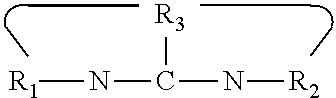
- R 1 —NC(R 3 )N—R 2 refers to the following chemical structure:
- R 1 —N(C(R 3 ) 2 ) m —N—R 2 refers to the following chemical structure:
- Cy refers to cyclohexyl
- Cp refers to cyclopentadiene
- aliphatic group refers to a C1-C6 linear or branched chain alkyl group
- alkyl group refers to saturated functional groups containing exclusively carbon and hydrogen atoms and includes linear, branched, or cyclic alkyl groups.
- linear alkyl groups include without limitation, methyl groups, ethyl groups, n-propyl groups, n-butyl groups, etc.
- branched alkyls groups include without limitation, t-butyl.
- cyclic alkyl groups include without limitation, cyclopropyl groups, cyclobutyl groups, cyclopentyl groups, cyclohexyl groups, etc.
- FIG. 1 is a thermogravimetric analysis (TGA) graph demonstrating the percentage of weight loss with temperature change for Ti(N iPr -amd)(OiPr) 3 ;
- FIG. 2 is a TGA graph for Ti(N iPr -amd) 2 (OiPr) 2 ;
- FIG. 3 is a TGA graph for Ti(N iPr -fmd) 2 (OiPr) 2 ;
- FIG. 4 is a TGA graph for Ti(N iPr -amd)(OiPr) 2 (NMe 2 );
- FIG. 5 is a TGA graph for Ti(Et-N—(CH 2 ) 2 —N-Et)(OiPr) 2 ;
- FIG. 6 is a TGA graph for Ti(Me 2 CH—N—(CH 2 ) 3 —N—CHMe 2 )(OiPr) 2 .
- novel titanium-containing precursors Disclosed are novel titanium-containing precursors, methods of synthesizing the same, and methods of using the same.
- the disclosed heteroleptic titanium-containing precursors are derived from different classes of ligand systems, such as amidinate, formamidinate, guanidinate, amide, and/or chelating amide ligands, plus alkoxide ligands.
- Precursor design may help improve volatility, reduce the melting point (liquids or very low melting solids), increase reactivity with water, and increase thermal stability for wider process window applications.
- the disclosed titanium-containing precursors have the following formulae: Ti(R 1 —N—C(R 3 )—N—R 2 ) u (OR 4 ) x (NR 5 R 6 ) y (O 2 CR 7 ) z Formula I or Ti(R 1 —N—(C(R 3 ) 2 ) m —N—R 2 ) v (OR 4 ) x (NR 5 R 6 ) y (O 2 CR 7 ) z Formula II wherein:
- the C1-C6 alkyl group includes any linear, branched, or cyclic alkyl groups having from 1 to 6 carbon atoms, including but not limited to Me, tBu, or cyclohexyl groups.
- R 1 —NC(R 3 )N—R 2 ligand has the following chemical structure:
- R 1 —N—(C(R 3 ) 2 ) m —N—R 2 ligand has the following chemical structure:
- the ligand itself has gone from a ⁇ 1 ligand having one delocalized negative charge between the —N—C—N— backbone to a ⁇ 2 ligand having a negative charge localized at each nitrogen atom.
- the Formula I ligand has a more rigid structure than the Formula II ligand.
- R 1 and R 3 are C1-C6 linear or branched alkyl groups in Formula I, R 1 and R 3 may be independent substituents or they may be linked together to form a monocyclic structure extending from R 1 to R 3 , as demonstrated below.
- R 1 , R 3 and R 2 are C1-C6 linear or branched alkyl groups in Formula I, R 1 , R 3 and R 2 may be independent substituents or they may be linked together to form a bicyclic structure, as demonstrated below.
- the configuration of the disclosed precursors was selected in order to optimize the reactivity (especially with H 2 O) and, at the same time, the stability.
- the Ti—N bond is weak and will react rapidly on the surface.
- the Ti—O bond is much stronger and will help stabilize the molecule to avoid fast decomposition.
- R 1 and R 2 are preferably Et or iPr
- R 3 is preferably H, Me, or NMe 2
- R 4 is preferably a C1-C4 linear or branched alkyl chain.
- Exemplary precursors include Ti(iPr—N—C(H)—N-iPr) 1 (OiPr) 3 , Ti(iPr—N—C(H)—N-iPr) 1 (OMe) 3 , Ti(iPr—N—C(H)—N-iPr) 1 (OEt) 3 , Ti(iPr—N—C(H)—N-iPr) 1 (OnPr) 3 , Ti(iPr—N—C(H)—N-iPr) 1 (OsBu) 3 , Ti(iPr—N—C(H)—N-iPr) 1 (OiBu) 3 , Ti(iPr—N—C(H)—N-iPr) 1 (OiBu) 3 , Ti(iPr—N—C(H)—N-iPr) 1 (OtBu) 3 , Ti(iPr—N—C(Me)-N-iPr) 1 (OiPr
- Exemplary precursors include Ti(iPr—N—(CH 2 ) 2 —N-iPr) 1 (OiPr) 2 , Ti(iPr—N—(CH 2 ) 2 —N-iPr) 1 (OMe) 2 , Ti(iPr—N—(CH 2 ) 2 —N-iPr) 1 (OEt) 2 , Ti(iPr—N—(CH 2 ) 2 —N-iPr) 1 (OnPr) 2 , Ti(iPr—N—(CH 2 ) 2 —N-iPr) 1 (OsBu) 2 , Ti(iPr—N—(CH 2 ) 2 —N-iPr) 1 (OiBu) 2 , Ti(iPr—N—(CH 2 ) 2 —N-iPr) 1 (OiBu) 2 , Ti(iPr—N—(CH 2 ) 2 —N-iPr) 1 (OtBu) 2 , Ti(
- the preferred exemplary precursors are Ti(iPr—N—(CH 2 ) 2 —N-iPr) 1 (OiPr) 2 , Ti(Et-N—(CH 2 ) 3 —N-Et) 1 (OiPr) 2 , or Ti(Et-N—(CH 2 ) 2 —N-Et) 1 (OiPr) 2 .
- the precursor has the following chemical structure:
- R 1 and R 2 are preferably Et or iPr
- R 3 is preferably H or Me
- R 4 is preferably a C1-C4 linear or branched alkyl chain. More preferably, R 3 is not NMe 2 .
- Exemplary precursors include Ti(iPr—N—C(H)—N-iPr) 2 (OiPr) 2 , Ti(iPr—N—C(H)—N-iPr) 2 (OMe) 2 , Ti(iPr—N—C(H)—N-iPr) 2 (OEt) 2 , Ti(iPr—N—C(H)—N-iPr) 2 (OnPr) 2 , Ti(iPr—N—C(H)—N-iPr) 2 (OsBu) 2 , Ti(iPr—N—C(H)—N-iPr) 2 (OiBu) 2 , Ti(iPr—N—C(H)—N-iPr) 2 (OtBu) 2 , Ti(Et-N—C(H)—N-Et) 2 (OiPr) 2 , Ti(Et-N—C(H)—N-Et) 2 (OMe) 2 , Ti(
- the preferred exemplary precursor is Ti(iPr—N—C(H)—N-iPr) 2 (OiPr) 2 or Ti(iPr—N—C(Me)-N-iPr) 2 (OiPr) 2 .
- the precursor has the following chemical structure:
- R 1 and R 2 are preferably Et or iPr; R 3 is preferably H, Me, or NMe 2 ; R 4 is preferably iPr; and R 5 and R 6 preferably are independently Me or Et.
- Exemplary precursors include Ti(iPr—N—C(Me)-N-iPr)(OiPr) 2 (NMe 2 ), Ti(iPr—N—C(Me)-N-iPr)(OiPr) 2 (NEt 2 ), Ti(iPr—N—C(Me)-N-iPr)(OiPr) 2 (NEtMe), Ti(Et-N—C(Me)-N-Et)(OiPr) 2 (NMe 2 ), Ti(Et-N—C(Me)-N-Et)(OiPr) 2 (NEt 2 ), Ti(Et-N—C(Me)-N-Et)(OiPr) 2 (NEt 2 ),
- the precursor has the following chemical structure:
- R 1 and R 2 are preferably Et or iPr; R 3 is preferably H or Me; R 4 is preferably iPr; and R 7 is preferably Me.
- Exemplary precursors include Ti(iPr—N—C(Me)-N-iPr)(OiPr) 2 (O 2 CMe) and Ti(Et-N—C(Me)-N-Et)(OiPr) 2 (O 2 CMe).
- the precursor has the following chemical structure:
- m is preferably 2 or 3
- R 1 and R 2 are preferably Et or iPr
- R 3 is preferably H
- R 4 is preferably a C1-C4 linear or branched alkyl chain
- R 7 is preferably Me.
- Exemplary precursors include Ti(iPr—N—(CH 2 ) 2 —N-iPr)(OiPr)(O 2 CMe), Ti(iPr—N—(CH 2 ) 2 —N-iPr)(OMe)(O 2 CMe), Ti(iPr—N—(CH 2 ) 2 —N-iPr)(OEt)(O 2 CMe), Ti(iPr—N—(CH 2 ) 2 —N-iPr)(OnPr)(O 2 CMe), Ti(iPr—N—(CH 2 ) 2 —N-iPr)(OsBu)(O 2 CMe), Ti(iPr—N—(CH 2 ) 2 —N-iPr)(OiBu)(O 2 CMe), Ti(iPr—N—(CH 2 ) 2 —N-iPr)(OiBu)(O 2 CMe), Ti(iPr—N—(CH 2
- exemplary precursors include Ti(iPr—N—C(Me)-N-iPr)(OiPr) (NMe 2 ) 2 , Ti(iPr—N—C(Me)-N-iPr)(OiPr)(NEt 2 ) 2 , Ti(iPr—N—C(Me)-N-iPr)(OiPr)(NEtMe) 2 , Ti(Et-N—C(Me)-N-Et)(OiPr)(NMe 2 ) 2 , Ti(Et-N—C(Me)-N-Et)(OiPr)(NEt 2 ) 2 , Ti(Et-N—C(Me)-N-Et)(OiPr)(NEt 2 ) 2 , Ti(Et-N—C(Me)-N-Et)(OiPr)(NEtMe) 2 , Ti(Et-N—C(Me)
- exemplary precursors include Ti(iPr—N—(CH 2 ) 2 —N-iPr)(OiPr)(NMe 2 ), Ti(iPr—N—(CH 2 ) 2 —N-iPr)(OiPr)(NEt 2 ), Ti(iPr—N—(CH 2 ) 2 —N-iPr)(OiPr)(NEtMe), Ti(Et-N—(CH 2 ) 2 —N-Et)(OiPr)(NMe 2 ), Ti(Et-N—(CH 2 ) 2 —N-Et)(OiPr)(NEt 2 ), and Ti(Et-N—(CH 2 ) 2 —N-Et)(OiPr)(NEtMe).
- exemplary precursors include Ti(iPr—N—C(Me)-N-iPr)(OiPr) (O 2 CMe) 2 and Ti(Et-N—C(Me)-N-Et)(OiPr)(O 2 CMe) 2 .
- exemplary precursors include Ti(OiPr) 2 (O 2 CMe) 2 .
- exemplary precursors include Ti(OiPr) 3 (O 2 CMe).
- the disclosed precursors may be synthesized by combining a hydrocarbon solution of H(R 1 —N—C(R 3 )—N—R 2 ) with a neat or hydrocarbon solution of a titanium compound, such as Ti(OR 4 ) 3 (NR 5 R 6 ) Or Ti(OR 4 ) 2 (NR 5 R 6 ) 2 , under atmosphere of nitrogen, the outlet of the mixing flask being connected to an oil bubbler.
- a titanium compound such as Ti(OR 4 ) 3 (NR 5 R 6 ) Or Ti(OR 4 ) 2 (NR 5 R 6 ) 2
- Exemplary hydrocarbon solutions include pentane.
- the resulting solution is stirred at room temperature overnight. Where applicable, HO 2 CR 7 may be added and further stirred for 6-12 hours. Solvent and volatiles are removed from the reaction mixture under vacuum. Purification of the resulting liquid or solid is carried out by distillation or sublimation, respectively. Additional synthesis details are provided in the Examples.
- the disclosed methods provide for the use of the titanium-containing precursors for deposition of titanium-containing films.
- the disclosed methods may be useful in the manufacture of semiconductor, photovoltaic, LCD-TFT, or flat panel type devices.
- the method includes: providing a substrate; providing a vapor including at least one of the disclosed titanium-containing precursors: and contacting the vapor with the substrate (and typically directing the vapor to the substrate) to form a titanium-containing layer on at least one surface of the substrate.
- the disclosed methods also provide for forming a bimetal-containing layer on a substrate using a vapor deposition process and, more particularly, for deposition of STO or BST films.
- the disclosed methods may be useful in the manufacture of semiconductor, photovoltaic, LCD-TFT, or flat panel type devices.
- the method includes: providing a substrate; providing a vapor including at least one of the disclosed titanium-containing precursors and contacting the vapor with the substrate (and typically directing the vapor to the substrate) to form a bi metal-containing layer on at least one surface of the substrate.
- An oxygen source such as O 3 , O 2 , H 2 O, and NO, preferably H 2 O, may also be provided with the vapor.
- the disclosed titanium-containing precursors may be used to deposit titanium-containing films using any deposition methods known to those of skill in the art.
- suitable deposition methods include without limitation, conventional chemical vapor deposition (CVD), low pressure chemical vapor deposition (LPCVD), atomic layer deposition (ALD), pulsed chemical vapor deposition (P-CVD), plasma enhanced atomic layer deposition (PE-ALD), or combinations thereof.
- CVD chemical vapor deposition
- LPCVD low pressure chemical vapor deposition
- ALD atomic layer deposition
- P-CVD pulsed chemical vapor deposition
- PE-ALD plasma enhanced atomic layer deposition
- the deposition method is ALD or PE-ALD.
- the vapor of the titanium-containing precursor is introduced into a reaction chamber containing at least one substrate.
- the temperature and the pressure within the reaction chamber and the temperature of the substrate are held at suitable conditions so that contact between the titanium-containing precursor and substrate results in formation of a Ti-containing layer on at least one surface of the substrate.
- a reactant may also be used to help in formation of the Ti-containing layer.
- the reaction chamber may be any enclosure or chamber of a device in which deposition methods take place, such as, without limitation, a parallel-plate type reactor, a cold-wall type reactor, a hot-wall type reactor, a single-wafer reactor, a multi-wafer reactor, or other such types of deposition systems. All of these exemplary reaction chambers are capable of serving as an ALD reaction chamber.
- the reaction chamber may be maintained at a pressure ranging from about 0.5 mTorr to about 20 Torr.
- the temperature within the reaction chamber may range from about 2000° C. to about 600° C.
- the temperature may be optimized through mere experimentation to achieve the desired result.
- the substrate may be heated to a sufficient temperature to obtain the desired titanium-containing film at a sufficient growth rate and with desired physical state and composition.
- a non-limiting exemplary temperature range to which the substrate may be heated includes from 150° C. to 600° C. Preferably, the temperature of the substrate remains less than or equal to 450° C.
- the substrate upon which the titanium-containing film will be deposited will vary depending on the final use intended.
- the substrate may be chosen from oxides which are used as dielectric materials in MIM, DRAM, or FeRam technologies (for example, HfO 2 based materials, TiO 2 based materials, ZrO 2 based materials, rare earth oxide based materials, ternary oxide based materials, etc.) or from nitride-based films (for example, TaN) that are used as an oxygen barrier between copper and the low-k layer.
- oxides which are used as dielectric materials in MIM, DRAM, or FeRam technologies (for example, HfO 2 based materials, TiO 2 based materials, ZrO 2 based materials, rare earth oxide based materials, ternary oxide based materials, etc.) or from nitride-based films (for example, TaN) that are used as an oxygen barrier between copper and the low-k layer.
- Other substrates may be used in the manufacture of semiconductors, photovoltaics, LCD-T
- substrates include, but are not limited to, solid substrates such as metal nitride containing substrates (for example, TaN, TiN, WN, TaCN, TiCN, TaSiN, and TiSiN); insulators (for example, SiO 2 , Si 3 N4, SiON, HfO 2 , Ta 2 O 5 , ZrO 2 , TiO 2 , Al 2 O 3 , and barium strontium titanate); or other substrates that include any number of combinations of these materials.
- the actual substrate utilized may also depend upon the specific precursor embodiment utilized. In many instances though, the preferred substrate utilized will be selected from TiN, SRO, Ru, and Si type substrates.
- the titanium-containing precursor may be fed in liquid state to a vaporizer where it is vaporized before it is introduced into the reaction chamber.
- the titanium-containing precursor Prior to its vaporization, the titanium-containing precursor may optionally be mixed with one or more solvents, one or more metal sources, and a mixture of one or more solvents and one or more metal sources.
- the solvents may be selected from the group consisting of toluene, ethyl benzene, xylene, mesitylene, decane, dodecane, octane, hexane, pentane, or others.
- the resulting concentration may range from approximately 0.05 M to approximately 2 M.
- the metal source may include any metal-containing precursors now known or later developed.
- the titanium-containing precursor may be vaporized by passing a carrier gas into a container containing the titanium-containing precursor or by bubbling the carrier gas into the titanium-containing precursor.
- the carrier gas and titanium-containing precursor are then introduced into the reaction chamber as a vapor.
- the carrier gas may include, but is not limited to, Ar, He, N 2 , and mixtures thereof.
- the titanium-containing precursor may optionally be mixed in the container with one or more solvents, metal-containing precursors, or mixtures thereof.
- the container may be heated to a temperature that permits the titanium-containing precursor to be in its liquid phase and to have a sufficient vapor pressure.
- the container may be maintained at temperatures in the range of, for example, 0-150° C. Those skilled in the art recognize that the temperature of the container may be adjusted in a known manner to control the amount of titanium-containing precursor vaporized.
- the titanium-containing precursor may be mixed with reactants inside the reaction chamber.
- exemplary reactants include, without limitation, metal-containing precursors such as strontium-containing precursors, barium-containing cursors, aluminum-containing precursors such as TMA, and any combination thereof.
- metal-containing precursors such as strontium-containing precursors, barium-containing cursors, aluminum-containing precursors such as TMA, and any combination thereof.
- These or other metal-containing precursors may be incorporated into the resultant film in small quantities, as a dopant, or as a second or third metal in the resulting film, such as BST and STO.
- the reactants may include an oxygen source which is selected from, but not limited to, O 2 , O 3 , H 2 O, H 2 O 2 , acetic acid, formalin, para-formaldehyde, and combinations thereof.
- the reactant is H 2 O.
- the reactants may include a metal-containing precursor which is selected from, but not limited to, metal alkyls, such as Ln(RCp) 3 or Co(RCp) 2 , metal amines, such as Zr(Cp)(NMe 2 ) 3 or Hf(Cp)(NMe 2 ) 3 , and any combination thereof.
- metal alkyls such as Ln(RCp) 3 or Co(RCp) 2
- metal amines such as Zr(Cp)(NMe 2 ) 3 or Hf(Cp)(NMe 2 ) 3
- the metal-containing precursor has the formula M(R 5 Cp) 2 with each R being independently selected from
- Exemplary metal-containing precursors include but are not limited to Sr(iPr 3 Cp) 2 , Sr(iPr 3 Cp) 2 .thf, Sr(iPr 3 Cp) 2 .dme, Sr(tBu 3 Cp) 2 , Sr(tBu 3 Cp) 2 .thf, Sr(tBu 3 Cp) 2 .dme, Sr(thmd) 2 , Sr(thmd) 2 .triglyme, Sr(thmd) 2 .tetraglyme, Sr(MesCp) 2 , Sr(Me 4 Cp) 2 , Sr(Me 4 EtCp) 2 , Sr(Me 4 nBuCp) 2 , Ba(iPr 3 Cp) 2 , Ba(iPr 3 Cp) 2 .thf, Ba(iPr 3 Cp) 2 .dme, Ba(tBu 3 Cp) 2 , Ba(tBu 3 Cp)
- the vapor of the metal-containing precursor (i.e., second vapor) is introduced into a reaction chamber.
- the temperature and the pressure within the reaction chamber and the temperature of the substrate are held at suitable conditions so that contact between the metal-containing precursor and substrate results in formation of a M-containing layer on at least one surface of the substrate.
- a reactant may also be used to help in formation of the M-containing layer.
- second vapor is merely used to avoid confusion with the “vapor” of the titanium-containing precursor.
- a second vapor of a metal-containing precursor having the formula Sr(iPr 3 Cp) 2 and a third vapor of a metal-containing precursor having the formula Ba(MesCp) 2 may be used with the vapor of the disclosed titanium-containing precursors to form a BST film.
- the titanium-containing precursor and one or more reactants may be introduced into the reaction chamber simultaneously (chemical vapor deposition), sequentially (atomic layer deposition), or in other combinations.
- the titanium-containing precursor may be introduced in one pulse and two additional metal sources may be introduced together in a separate pulse [modified atomic layer deposition].
- the reaction chamber may already contain the reactant prior to introduction of the titanium-containing precursor.
- the reactant may be passed through a plasma system localized remotely from the reaction chamber, and decomposed to radicals.
- the titanium-containing precursor may be introduced to the reaction chamber continuously while other metal sources are introduced by pulse (pulsed-chemical vapor deposition).
- a pulse may be followed by a purge or evacuation step to remove excess amounts of the component introduced.
- the pulse may last for a time period ranging from about 0.01 s to about 10 s, alternatively from about 0.3 s to about 3 s, alternatively from about 0.5 s to about 2 s.
- the vapor phase of a titanium-containing precursor is introduced into the reaction chamber, where it is contacted with a suitable substrate. Excess titanium-containing precursor may then be removed from the reaction chamber by purging and/or evacuating the reaction chamber.
- An oxygen source is introduced into the reaction chamber where it reacts with the absorbed titanium precursor in a self-limiting manner. Any excess oxygen source is removed from the reaction chamber by purging and/or evacuating the reaction chamber. If the desired film is a titanium oxide film, this two-step process may provide the desired film thickness or may be repeated until a film having the necessary thickness has been obtained.
- the two-step process above may be followed by introduction of a second vapor of a metal-containing precursor into the reaction chamber.
- the metal-containing precursor will be selected based on the nature of the titanium metal oxide film being deposited.
- the metal-containing precursor is contacted with the substrate. Any excess metal-containing precursor is removed from the reaction chamber by purging and/or evacuating the reaction chamber.
- an oxygen source may be introduced into the reaction chamber to react with the metal-containing precursor. Excess oxygen source is removed from the reaction chamber by purging and/or evacuating the reaction chamber. If a desired film thickness has been achieved, the process may be terminated. However, if a thicker film is desired, the entire four-step process may be repeated. By alternating the provision of the titanium-containing precursor, metal-containing precursor, and oxygen source, a film of desired composition and thickness can be deposited.
- films having a desired stoichiometric M:Ti ratio may be obtained.
- a Sr 2 TiO 4 film may be obtained by having one pulse of the titanium-containing precursor and two pulses of the metal-containing precursor, with each pulse being followed by pulses of the oxygen source.
- the number of pulses required to obtain the desired film may not be identical to the stoichiometric ratio of the resulting film.
- the titanium-containing films or titanium-containing layers resulting from the processes discussed above may include STO, BST, or PZT.
- STO sulfur-containing film
- BST BST
- PZT PZT
- Ti(N iPr -amd)(OiPr) 3 A 200 mL pentane solution was chilled to ⁇ 30° C. for 1 h, followed by addition of 10.0 g, 37.15 mmol, of Ti(OiPr) 3 (NMe 2 ) and stirring at room temperature under atmosphere of nitrogen. A solution of N iPr -amd-H (5.28 g, 37.15 mmol) in 20 mL of pentane was added slowly to the above mixture. The outlet of the flask was connected to an oil bubbler, which in turn was connected to an acid scrubber. The resulting solution was stirred at room temperature overnight. Solvent and volatiles were removed from the reaction mixture under vacuum, resulting in an orange liquid.
- FIG. 1 is a TGA graph demonstrating the percentage of weight loss with temperature change for this precursor.
- FIG. 2 is a TGA graph demonstrating the percentage of weight loss with temperature change for this precursor.
- FIG. 3 is a TGA graph demonstrating the percentage of weight loss with temperature change for this precursor.
- Ti(N iPr -gmd) 2 (OiPr) 2 To a pentane solution containing 2.98 g, 23.60 mmol, of iPr—N ⁇ C ⁇ N-iPr stirring at room temperature was added slowly a neat Ti(OiPr) 2 (NMe 2 ) 2 (3.00 g, 11.80 mmol) compound under atmosphere of nitrogen, the outlet of the flask connected to an oil bubbler. The resulting solution was stirred at room temperature overnight. Solvent and volatiles were removed from the reaction mixture under vacuum. A red solid was obtained. Purification of the solid was carried out by sublimation, resulting in very low yield, NMR spectra showed a mixture of products.
- FIG. 5 is a TGA graph demonstrating the percentage of weight loss with temperature change for this precursor.
- FIG. 6 is a TGA graph demonstrating the percentage of weight loss with temperature change for this precursor.
- the titanium-containing precursor of Example 1, Ti(N iPr -amd)(OiPr) 3 , and the reactant O 3 were used to deposit a film of TiO 2 on a SiO 2 /Si substrate.
- the SiO 2 /Si substrate was maintained at a temperature of 250° C.
- the precursor was vaporized in a bubbler maintained at 50° C.
- the ALD cycle included a precursor pulse of 5 seconds, followed by a 5 second purge, followed by a reactant pulse of 2 seconds, followed by a 5 second purge.
- the TiO 2 growth rate was observed to be 0.1 ⁇ /cycle.
- the ALD regime was assessed up to 350° C. with a deposition rate as high as 0.3 ⁇ /cycle.
- the titanium-containing precursor of Example 1, Ti(N iPr -amd)(OiPr) 3 , and the reactant H 2 O were used to deposit a film of TiO 2 on a SiO 2 /Si substrate.
- the SiO 2 /Si substrate was maintained at a temperature of 250° C.
- the precursor was vaporized in a bubbler maintained at 50° C.
- the ALD cycle included a precursor pulse of 20 seconds, followed by a 5 second purge, followed by a reactant pulse of 2 seconds, followed by a 10 second purge.
- the TiO 2 growth rate was observed to be 0.33 ⁇ /cycle.
- the ALD regime was assessed up to 350° C. with a deposition rate as high as 0.40 ⁇ /cycle.
- the titanium-containing precursor of Example 2, Ti(N iPr -amd) 2 (OiPr) 2 , and the reactant O 3 were used to deposit a film of TiO 2 on a SiO 2 /Si substrate.
- the SiO 2 /Si substrate was maintained at a temperature of 300° C.
- the orange red precursor was vaporized in a bubbler maintained at 120° C.
- the ALD cycle included a precursor pulse of 10 seconds, followed by a 5 second purge, followed by a reactant pulse of 2 seconds, followed by a 10 second purge.
- the TiO 2 growth rate was observed to be 0.33 ⁇ /cycle.
- the ALD regime was assessed up to 325° C. with a deposition rate as high as 0.40 ⁇ /cycle.
- the titanium-containing precursor of Example 2, Ti(N iPr -amd) 2 (OiPr) 2 , and the reactant H 2 O were used to deposit a film of TiO 2 on a SiO 2 /Si substrate.
- the SiO 2 /Si substrate was maintained at a temperature of 275° C.
- the orange red precursor was vaporized in a bubbler maintained at 120° C.
- the ALD cycle included a precursor pulse of 10 seconds, followed by a 5 second purge, followed by a reactant pulse of 2 seconds, followed by a 5 second purge.
- the TiO 2 growth rate was observed to be 0.40 ⁇ /cycle.
- the ALD regime was assessed up to 325° C. with a deposition rate as high as 0.47 ⁇ /cycle.
- the titanium-containing precursor of Example 5, Ti(N iPr -amd)(OiPr) 2 (NMe 2 ), and the reactant O 3 were used to deposit a film of TiO 2 on a SiO 2 /Si substrate.
- the SiO 2 /Si substrate was maintained at a temperature of 225° C.
- the orange red precursor was vaporized in a bubbler maintained at 55° C.
- the ALD cycle included a precursor pulse of 15 seconds, followed by a 5 second purge, followed by a reactant pulse of 2 seconds, followed by a 5 second purge.
- the TiO 2 growth rate was observed to be 0.17 ⁇ /cycle.
- the ALD regime was assessed up to 375° C. with a deposition rate as high as 0.70 ⁇ /cycle.
- the titanium-containing precursor of Example 5, Ti(N iPr -amd)(OiPr) 2 (NMe 2 ), and the reactant H 2 O were used to deposit a film of TiO 2 on a SiO 2 /Si substrate.
- the SiO 2 /Si substrate was maintained at a temperature of 225° C.
- the orange red precursor was vaporized in a bubbler maintained at 55° C.
- the ALD cycle included a precursor pulse of 10 seconds, followed by a 10 second purge, followed by a reactant pulse of 1 second, followed by a 10 second purge.
- the TiO 2 growth rate was observed to be 0.73 ⁇ /cycle.
- the ALD regime was assessed up to 375° C. with a deposition rate as high as 0.80 ⁇ /cycle.
- the titanium-containing precursor of Example 6, Ti(Et-N—(CH 2 ) 2 —N-Et)(OiPr) 2 , and the reactant O 3 were used to deposit a film of TiO 2 on a SiO 2 /Si substrate.
- the SiO 2 /Si substrate was maintained at a temperature of 250° C.
- the precursor was vaporized in a bubbler maintained at 50° C.
- the ALD cycle included a precursor pulse of 15 seconds, followed by a 5 second purge, followed by a reactant pulse of 2 seconds, followed by a 5 second purge.
- the TiO 2 growth rate was observed to be 0.1 ⁇ /cycle.
- the ALD regime was assessed up to 325° C. with a deposition rate as high as 0.3 ⁇ /cycle.
- the titanium-containing precursor of Example 8 Ti (Me 2 CH—N—(CH 2 ) 3 —N—CHMe 2 )(OiPr) 2 , and the reactant O 3 were used to deposit a film of TiO 2 on a SiO 2 /Si substrate.
- the SiO 2 /Si substrate was maintained at a temperature of 250° C.
- the precursor was vaporized in a bubbler maintained at 50° C.
- the ALD cycle included a precursor pulse of 15 seconds, followed by a 5 second purge, followed by a reactant pulse of 2 seconds, followed by a 5 second purge.
- the TiO 2 growth rate was observed to be 0.2 ⁇ /cycle.
- the ALD regime was assessed up to 325° C. with a deposition rate as high as 0.33 ⁇ /cycle.
- a titanium-containing precursor having the formula Ti(OiPr) 2 (NMe 2 ) 2 , and the reactant O 3 were used to deposit a film of TiO 2 on a SiO 2 /Si substrate.
- the SiO 2 /Si substrate was maintained at a temperature of 250° C.
- the precursor was vaporized in a bubbler maintained at 30° C.
- the ALD cycle included a precursor pulse of 10 seconds, followed by a 5 second purge, followed by a reactant pulse of 2 seconds, followed by a 5 second purge.
- the TiO 2 growth rate was observed to be 0.77 ⁇ /cycle.
- the ALD regime was assessed up to 275° C. with a deposition rate as high as 0.77 ⁇ /cycle.
- the titanium-containing precursor of Example 12, Ti(OiPr) 2 (NMe 2 ) 2 , and the reactant H 2 O were used to deposit a film of TiO 2 on a SiO 2 /Si substrate.
- the SiO 2 /Si substrate was maintained at a temperature of 250° C.
- the precursor was vaporized in a bubbler maintained at 30° C.
- the ALD cycle included a precursor pulse of 7 seconds, followed by a 5 second purge, followed by a reactant pulse of 2 seconds, followed by a 10 second purge.
- the TiO 2 growth rate was observed to be 0.25 ⁇ /cycle.
- the ALD regime was assessed up to 275° C. with a deposition rate as high as 0.40 ⁇ /cycle.
Landscapes
- Chemical & Material Sciences (AREA)
- Organic Chemistry (AREA)
- Chemical Kinetics & Catalysis (AREA)
- Mechanical Engineering (AREA)
- Engineering & Computer Science (AREA)
- Materials Engineering (AREA)
- General Chemical & Material Sciences (AREA)
- Metallurgy (AREA)
- Inorganic Chemistry (AREA)
- Chemical Vapour Deposition (AREA)
- Formation Of Insulating Films (AREA)
- Organic Low-Molecular-Weight Compounds And Preparation Thereof (AREA)
- Semiconductor Memories (AREA)
Abstract
Description
Ti(R1—N—C(R3)—N—R2)u(OR4)x(NR5R6)y(O2CR7)z Formula I
or
Ti(R1—N—(C(R3)2)m—N—R2)v(OR4)x(NR5R6)y(O2CR7)z Formula II
wherein:
-
- R1, R2, R5, R6, and R7 are independently selected from the group consisting of H and C1-C6 alkyl group;
- R3═H, C1-C6 alkyl group, or NMe2;
- R4 is a C1-C6 alkyl group;
- m=2-4;
- u=0-2;
- v=0-1;
- x=1-3;
- y=0-2;
- z=0-1;
- in Formula I, u+x+y+z=4;
- in Formula II, 2v+x+y+z=4; and
- u, v, or z≧1.
The disclosed molecules may further include one or more of the following aspects: - the molecule having Formula I, wherein u=1, x=3, y=0, and z=0;
- the molecule being selected from the group consisting of Ti(iPr—N—C(Me)-N-iPr)1(OiPr)3, Ti(iPr—N—C(Me)-N-iPr)1(OMe)3, Ti(iPr—N—C(Me)-N-iPr)1(OEt)3, Ti(iPr—N—C(Me)-N-iPr)1(OnPr)3, Ti(iPr—N—C(Me)-N-iPr)1(OsBu)3, Ti(iPr—N—C(Me)-N-iPr)1(OiBu)3, Ti(iPr—N—C(Me)-N-iPr)1(OtBu)3, Ti(Et-N—C(Me)-N-Et)1(OEt)3, Ti(Et-N—C(Me)-N-Et)1(OMe)3, Ti(Et-N—C(Me)-N-Et)1(OnPr)3, Ti(Et-N—C(Me)-N-Et)1(OsBu)3, Ti(Et-N—C(Me)-N-Et)1(OiBu)3, Ti(Et-N—C(Me)-N-Et)1(OtBu)3, and Ti(iPr—N—C(NMe2)—N-iPr)(OiPr)3;
- the molecule having Formula II, wherein v=1, x=2, y=0, and z=0;
- The molecule being selected from the group consisting of Ti(iPr—N—(CH2)2—N-iPr)1(OiPr)2, Ti(iPr—N—(CH2)2—N-iPr)1(OMe)2, Ti(iPr—N—(CH2)2—N-iPr)1(OEt)2, Ti(iPr—N—(CH2)2—N-iPr)1(OnPr)2, Ti(iPr—N—(CH2)2—N-iPr)1(OsBu)2, Ti(iPr—N—(CH2)2—N-iPr)1(OiBu)2, Ti(iPr—N—(CH2)2—N-iPr)1(OtBu)2, Ti(Et-N—(CH2)2—N-Et)1(OiPr)2, Ti(Et-N—(CH2)2—N-Et)1(OMe)2, Ti(Et-N—(CH2)2—N-Et)1(OEt)2, Ti(Et-N—(CH2)2—N-Et)1(OnPr)2, Ti(Et-N—(CH2)2—N-Et)1(OsBu)2, Ti(Et-N—(CH2)2—N-Et)1(OiBu)2, Ti(Et-N—(CH2)2—N-Et)1(OtBu)2, Ti(iPr—N—(CH2)3—N-iPr)1(OiPr)2, Ti(iPr—N—(CH2)3—N-iPr)1(OMe)2, Ti(iPr—N—(CH2)3—N-iPr)1(OEt)2, Ti(iPr—N—(CH2)3—N-iPr)1(OnPr)2, Ti(iPr—N—(CH2)3—N-iPr)1(OsBu)2, Ti(iPr—N—(CH2)3—N-iPr)1(OiBu)2, Ti(iPr—N—(CH2)3—N-iPr)1(OtBu)2, Ti(Et-N—(CH2)3—N-Et)1(OiPr)2, Ti(Et-N—(CH2)3—N-Et)(OMe)2, Ti(Et-N—(CH2)3—N-Et)1(OEt)2, Ti(Et-N—(CH2)3—N-Et)1(OnPr)2, Ti(Et-N—(CH2)3—N-Et)1(OsBu)2, Ti(Et-N—(CH2)3—N-Et)1(OiBu)2, and Ti(Et-N—(CH2)3—N-Et)1(OtBu)2;
- the molecule having Formula I, wherein u=2, x=2, y=0, and z=0;
- the molecule being selected from the group consisting of Ti(iPr—N—C(H)—N-iPr)2(OiPr)2, Ti(iPr—N—C(H)—N-iPr)2(OMe)2, Ti(iPr—N—C(H)—N-iPr)2(OEt)2, Ti(iPr—N—C(H)—N-iPr)2(OnPr)2, Ti(iPr—N—C(H)—N-iPr)2(OsBu)2, Ti(iPr—N—C(H)—N-iPr)2(OiBu)2, Ti(iPr—N—C(H)—N-iPr)2(OtBu)2, Ti(Et-N—C(H)—N-Et)2(OiPr)2, Ti(Et-N—C(H)—N-Et)2(OMe)2, Ti(Et-N—C(H)—N-Et)2(OEt)2, Ti(Et-N—C(H)—N-Et)2(OnPr)2, Ti(Et-N—C(H)—N-Et)2(OsBu)2, Ti(Et-N—C(H)—N-Et)2(OiBu)2, Ti(Et-N—C(H)—N-Et)2(OtBu)2, Ti(iPr—N—C(Me)-N-iPr)2(OiPr)2, Ti(iPr—N—C(Me)-N-iPr)2(OMe)2, Ti(iPr—N—C(Me)-N-iPr)2(OEt)2, Ti(iPr—N—C(Me)-N-iPr)2(OnPr)2, Ti(iPr—N—C(Me)-N-iPr)2(OsBu)2, Ti(iPr—N—C(Me)-N-iPr)2(OiBu)2, Ti(iPr—N—C(Me)-N-iPr)2(OtBu)2, Ti(Et-N—C(Me)-N-Et)2(OiPr)2, Ti(Et-N—C(Me)-N-Et)2(OMe)2, Ti(Et-N—C(Me)-N-Et)2(OEt)2, Ti(Et-N—C(Me)-N-Et)2(OnPr)2, Ti(Et-N—C(Me)-N-Et)2(OsBu)2, Ti(Et-N—C(Me)-N-Et)2(OiBu)2, and Ti(Et-N—C(Me)-N-Et)2(OtBu)2;
- the molecule having Formula I, wherein u=1, x=2, y=1, and z=0;
- the molecule being selected from the group consisting of Ti(iPr—N—C(Me)-N-iPr)(OiPr)2(NMe2), Ti(iPr—N—C(Me)-N-iPr)(OiPr)2(NEt2), Ti(iPr—N—C(Me)-N-iPr)(OiPr)2(NEtMe), Ti(Et-N—C(Me)-N-Et)(OiPr)2(NMe2), Ti(Et-N—C(Me)-N-Et)(OiPr)2(NEt2), Ti(Et-N—C(Me)-N-Et)(OiPr)2(NEtMe), Ti(iPr—N—C(NMe2)—N-iPr)(OiPr)2(NMe2), Ti(iPr—N—C(NMe2)—N-iPr)(OiPr)2(NEt2), and Ti(iPr—N—C(NMe2)—N-iPr)(OiPr)2(NEtMe);
- the molecule having Formula I, wherein u=1, x=2, y=0, and z=1;
- the molecule being selected from the group consisting of Ti(iPr—N—C(Me)-N-iPr)(OiPr)2(O2CMe) and Ti(Et-N—C(Me)-N-Et)(OiPr)2(O2CMe);
- the molecule having Formula II, wherein v=1, x=1, y=0, and z=1;
- The molecule being selected from the group consisting of Ti(iPr—N—(CH2)2—N-iPr)(OiPr)(O2CMe), Ti(iPr—N—(CH2)2—N-iPr)(OMe)(O2CMe), Ti(iPr—N—(CH2)2—N-iPr)(OEt)(O2CMe), Ti(iPr—N—(CH2)2—N-iPr)(OnPr)(O2CMe), Ti(iPr—N—(CH2)2—N-iPr)(OsBu)(O2CMe), Ti(iPr—N—(CH2)2—N-iPr)(OiBu)(O2CMe), Ti(iPr—N—(CH2)2—N-iPr)(OtBu)(O2CMe), Ti(Et-N—(CH2)2—N-Et)(OiPr)(O2CMe), Ti(Et-N—(CH2)2—N-Et)(OMe)(O2CMe), Ti(Et-N—(CH2)2—N-Et)(OEt)(O2CMe), Ti(Et-N—(CH2)2—N-Et)(OnPr)(O2CMe), Ti(Et-N—(CH2)2—N-Et)(OsBu)(O2CMe), Ti(Et-N—(CH2)2—N-Et)(OiBu)(O2CMe), and Ti(Et-N—(CH2)2—N-Et)(OtBu)(O2CMe);
- the molecule having either Formula I or Formula II, wherein u, v, y=0, x=2, and z=2;
- the molecule being Ti(OiPr)2(O2CMe)2;
- the molecule having either Formula I or Formula II, wherein u, v, y=0, x=3, and z=1; and
- the molecule being Ti(OiPr)3(O2CMe).
-
- introducing into the reaction chamber a second vapor including at least one metal-containing precursor and contacting the second vapor with the substrate to form a metal-containing layer on at least one surface of the substrate using the vapor deposition process, wherein the metal-containing precursor is selected from the group consisting of M(L)2 and M(L)2.A, wherein:
- M is Sr or Ba;
- L is selected from substituted cyclopentadienyl ligand systems R1R2R3R4R5Cp or beta-diketonate ligand systems —O—CR6—CH—CR7—O—;
- each of R1 to R5 is independently selected from H or C1-C6 linear or branched alkyl chain;
- each of R6 and R7 is independently selected from C1-C6 linear or branched alkyl chain; and
- A is a neutral oxygen containing molecules selected from the group consisting of tetrahydrofuran, dimethoxyethane, diglyme, triglyme, and tetraglyme; and
- the metal-containing precursor being selected from the group consisting of Sr(iPr3Cp)2, Sr(iPr3Cp)2.thf, Sr(iPr3Cp)2.dme, Sr(tBu3Cp)2, Sr(tBu3Cp)2.thf, Sr(tBu3Cp)2.dme, Sr(thmd)2, Sr(thmd)2.triglyme, Sr(thmd)2.tetraglyme, Sr(Me5Cp)2, Sr(Me4Cp)2, Sr(Me4EtCp)2, Sr(Me4nBuCp)2, Ba(iPr3Cp)2, Ba(iPr3Cp)2.thf, Ba(iPr3Cp)2.dme, Ba(tBu3Cp)2, Ba(tBu3Cp)2.thf, Ba(tBu3Cp)2.dme, Ba(thmd)2, Ba(thmd)2.triglyme, Ba(thmd)2.tetraglyme, Ba(Me5Cp)2, Ba(Me4Cp)2, Ba(Me4EtCp)2, and Ba(Me4nBuCp)2.
- introducing into the reaction chamber a second vapor including at least one metal-containing precursor and contacting the second vapor with the substrate to form a metal-containing layer on at least one surface of the substrate using the vapor deposition process, wherein the metal-containing precursor is selected from the group consisting of M(L)2 and M(L)2.A, wherein:
-
- M is Sr or Ba;
- L is selected from substituted cyclopentadenyl ligand systems R1R2R3R4R5Cp or beta-diketonate ligand systems —O—CR6—CH—CR7—O—;
- each of R1 to R5 is independently selected from H or C1-C6 linear or branched alkyl chain;
- each of R6 and R7 is independently selected from C1-C6 linear or branched alkyl chain; and
- A is a neutral oxygen containing molecules selected from the group consisting of tetrahydrofuran, dimethoxyethane, diglyme, triglyme, and tetraglyme.
A second oxygen source is pulsed into the reaction chamber. The stoichiometry of M:Ti ratio in the STO or BST film is controlled by varying the number of pulsing steps for the precursor and metal-containing precursor. The disclosed methods may further include one or more of the following aspects: - the metal-containing precursor being selected from the group consisting of Sr(iPr3Cp)2, Sr(iPr3Cp)2.thf, Sr(iPr3Cp)2.dme, Sr(tBu3Cp)2, Sr(tBu3Cp)2.thf, Sr(tBu3Cp)2.dme, Sr(thmd)2, Sr(thmd)2.triglyme, Sr(thmd)2.tetraglyme, Sr(MesCp)2, Sr(Me4Cp)2, Sr(Me4EtCp)2, Sr(Me4nBuCp)2, Ba(iPr3Cp)2, Ba(iPr3Cp)2.thf, Ba(iPr3Cp)2.dme, Ba(tBu3Cp)2, Ba(tBu3Cp)2.thf, Ba(tBu3Cp)2.dme, Ba(thmd)2, Ba(thmd)2.triglyme, Ba(thmd)2.tetraglyme, Ba(Me5Cp)2, Ba(Me4Cp)2, Ba(Me4EtCp)2, and Ba(Me4nBuCp)2; and
- the oxygen source and the second oxygen source being water.

the abbreviation “R1—N(C(R3)2)m—N—R2” refers to the following chemical structure:

the abbreviation “O2CR7” refers to the following chemical structure:

the abbreviation “Cy” refers to cyclohexyl; the abbreviation “Cp” refers to cyclopentadiene; the term “aliphatic group” refers to a C1-C6 linear or branched chain alkyl group; the term “alkyl group” refers to saturated functional groups containing exclusively carbon and hydrogen atoms and includes linear, branched, or cyclic alkyl groups. Examples of linear alkyl groups include without limitation, methyl groups, ethyl groups, n-propyl groups, n-butyl groups, etc. Examples of branched alkyls groups include without limitation, t-butyl. Examples of cyclic alkyl groups include without limitation, cyclopropyl groups, cyclobutyl groups, cyclopentyl groups, cyclohexyl groups, etc. The abbreviation “Me” refers to a methyl group; the abbreviation “Et” refers to an ethyl group; the abbreviation “Pr” refers to a propyl group; the abbreviation “iPr” refers to an isopropyl group; the abbreviation “iBu” refers to an isobutyl group; the abbreviation “nBu” refers to a n-butyl group; the abbreviation “sBu” refers to a sec-butyl group; the abbreviation “tBu” refers to a tertiary butyl group; the abbreviation “NZ-amd” refers to R1—NC(R3)N—R2, wherein R3=a C1-C6 alkyl group and R1 and R2=Z, which is defined as Me, Et, Pr, iPr, nBu, iBu, sBu, or tBu, for example NMe-amd is Me-NC(Me)N-Me; the abbreviation “NZ-fmd” refers to R1—NC(R3)N—R2, wherein R3═H and R1 and R2=Z, which is defined as Me, Et, Pr, iPr, or tBu; the abbreviation “NZ-gmd” refers to R1—NC(R3)N—R2 wherein R3=NR5R6 with R5 and R6=H or a C1-C6 alkyl group, and R1 and R2=Z, which is defined as Me, Et, Pr, iPr, nBu, iBu, sBu, or tBu; the abbreviation “THF” refers to tetrahydrofuran; the abbreviation “TMA” refers to trimethyl aluminum; the abbreviation “ALD” refers to atomic layer deposition; the abbreviation “CVD” refers to chemical vapor deposition; the abbreviation “LPCVD” refers to low pressure chemical vapor deposition; the abbreviation “P-CVD” refers to pulsed chemical vapor deposition; the abbreviation “PE-ALD” refers to plasma enhanced atomic layer deposition; the abbreviation “MIM” refers to Metal Insulator Metal (a structure used in capacitors); the abbreviation “DRAM” refers to dynamic random access memory; the abbreviation “FeRAM” refers to ferroelectric random access memory; the abbreviation “CMOS” refers to complementary metal-oxide-semiconductor; the abbreviation “TGA” refers to thermogravimetric analysis.
Ti(R1—N—C(R3)—N—R2)u(OR4)x(NR5R6)y(O2CR7)z Formula I
or
Ti(R1—N—(C(R3)2)m—N—R2)v(OR4)x(NR5R6)y(O2CR7)z Formula II
wherein:
-
- R1, R2, R5, R6, and R7 are independently selected from the group consisting of H and C1-C6 alkyl group;
- R3=H, C1-C6 alkyl group, or NMe2;
- R4 is a C1-C6 alkyl group;
- m=2-4;
- u=0-2;
- v=0-1;
- x=1-3;
- y=0-2;
- z=0-1;
- in Formula I, u+x+y+z=4;
- in Formula II, 2v+x+y+z=4; and
- u, v, or z≧1.

In Formula II, the R1—N—(C(R3)2)m—N—R2 ligand has the following chemical structure:

Therefore, although the same elements have been maintained in the backbone of the ligand (i.e., —N—C—N—), the ligand itself has gone from a −1 ligand having one delocalized negative charge between the —N—C—N— backbone to a −2 ligand having a negative charge localized at each nitrogen atom. Additionally, the Formula I ligand has a more rigid structure than the Formula II ligand.


In this embodiment, R1 and R2 are preferably Et or iPr, R3 is preferably H or Me, and R4 is preferably a C1-C4 linear or branched alkyl chain. More preferably, R3 is not NMe2. Exemplary precursors include Ti(iPr—N—C(H)—N-iPr)2(OiPr)2, Ti(iPr—N—C(H)—N-iPr)2(OMe)2, Ti(iPr—N—C(H)—N-iPr)2(OEt)2, Ti(iPr—N—C(H)—N-iPr)2(OnPr)2, Ti(iPr—N—C(H)—N-iPr)2(OsBu)2, Ti(iPr—N—C(H)—N-iPr)2(OiBu)2, Ti(iPr—N—C(H)—N-iPr)2(OtBu)2, Ti(Et-N—C(H)—N-Et)2(OiPr)2, Ti(Et-N—C(H)—N-Et)2(OMe)2, Ti(Et-N—C(H)—N-Et)2(OEt)2, Ti(Et-N—C(H)—N-Et)2(OnPr)2, Ti(Et-N—C(H)—N-Et)2(OsBu)2, Ti(Et-N—C(H)—N-Et)2(OiBu)2, Ti(Et-N—C(H)—N-Et)2(OtBu)2, Ti(iPr—N—C(Me)-N-iPr)2(OiPr)2, Ti(iPr—N—C(Me)-N-iPr)2(OMe)2, Ti(iPr—N—C(Me)-N-iPr)2(OEt)2, Ti(iPr—N—C(Me)-N-iPr)2(OnPr)2, Ti(iPr—N—C(Me)-N-iPr)2(OsBu)2, Ti(iPr—N—C(Me)-N-iPr)2(OiBu)2, Ti(iPr—N—C(Me)-N-iPr)2(OtBu)2, Ti(Et-N—C(Me)-N-Et)2(OiPr)2, Ti(Et-N—C(Me)-N-Et)2(OMe)2, Ti(Et-N—C(Me)-N-Et)2(OEt)2, Ti(Et-N—C(Me)-N-Et)2(OnPr)2, Ti(Et-N—C(Me)-N-Et)2(OsBu)2, Ti(Et-N—C(Me)-N-Et)2(OiBu)2, and Ti(Et-N—C(Me)-N-Et)2(OtBu)2. The preferred exemplary precursor is Ti(iPr—N—C(H)—N-iPr)2(OiPr)2 or Ti(iPr—N—C(Me)-N-iPr)2(OiPr)2.

In this embodiment, R1 and R2 are preferably Et or iPr; R3 is preferably H, Me, or NMe2; R4 is preferably iPr; and R5 and R6 preferably are independently Me or Et. Exemplary precursors include Ti(iPr—N—C(Me)-N-iPr)(OiPr)2(NMe2), Ti(iPr—N—C(Me)-N-iPr)(OiPr)2(NEt2), Ti(iPr—N—C(Me)-N-iPr)(OiPr)2(NEtMe), Ti(Et-N—C(Me)-N-Et)(OiPr)2(NMe2), Ti(Et-N—C(Me)-N-Et)(OiPr)2(NEt2), Ti(Et-N—C(Me)-N-Et)(OiPr)2(NEtMe), Ti(iPr—N—C(NMe2)—N-iPr)(OiPr)2(NMe2), Ti(iPr—N—C(NMe2)—N-iPr)(OiPr)2(NEt2), and Ti(iPr—N—C(NMe2)—N-iPr)(OiPr)2(NEtMe). The preferred exemplary precursor is Ti(iPr—N—C(Me)-N-iPr)(OiPr)2(NMe2).

In this embodiment, R1 and R2 are preferably Et or iPr; R3 is preferably H or Me; R4 is preferably iPr; and R7 is preferably Me. Exemplary precursors include Ti(iPr—N—C(Me)-N-iPr)(OiPr)2(O2CMe) and Ti(Et-N—C(Me)-N-Et)(OiPr)2(O2CMe).


In these embodiments, m is preferably 2 or 3, R1 and R2 are preferably Et or iPr; R3 is preferably H; R4 is preferably a C1-C4 linear or branched alkyl chain; and R7 is preferably Me. Exemplary precursors include Ti(iPr—N—(CH2)2—N-iPr)(OiPr)(O2CMe), Ti(iPr—N—(CH2)2—N-iPr)(OMe)(O2CMe), Ti(iPr—N—(CH2)2—N-iPr)(OEt)(O2CMe), Ti(iPr—N—(CH2)2—N-iPr)(OnPr)(O2CMe), Ti(iPr—N—(CH2)2—N-iPr)(OsBu)(O2CMe), Ti(iPr—N—(CH2)2—N-iPr)(OiBu)(O2CMe), Ti(iPr—N—(CH2)2—N-iPr)(OtBu)(O2CMe), Ti(Et-N—(CH2)2—N-Et)(OiPr)(O2CMe), Ti(Et-N—(CH2)2—N-Et)(OMe)(O2CMe), Ti(Et-N—(CH2)2—N-Et)(OEt)(O2CMe), Ti(Et-N—(CH2)2—N-Et)(OnPr)(O2CMe), Ti(Et-N—(CH2)2—N-Et)(OsBu)(O2CMe), Ti(Et-N—(CH2)2—N-Et)(OiBu)(O2CMe), and Ti(Et-N—(CH2)2—N-Et)(OtBu)(O2CMe).
Claims (16)
Ti(R1—N—C(R3)—N—R2)u(OR4)x(NR5R6)y(O2CR7)z Formula I
Ti(R1—N—C(R3)—N—R2)u(OR4)x(NR5R6)y(O2CR7)z Formula I
Ti(R1—N—C(R3)—N—R2)u(OR4)x(NR5R6)y(O2CR7)z Formula I
Priority Applications (2)
| Application Number | Priority Date | Filing Date | Title |
|---|---|---|---|
| US13/772,737 US8633329B2 (en) | 2010-04-07 | 2013-02-21 | Titanium-containing precursors for vapor deposition |
| US14/151,161 US20140127913A1 (en) | 2010-04-07 | 2014-01-09 | Titanium-containing precursors for vapor deposition |
Applications Claiming Priority (3)
| Application Number | Priority Date | Filing Date | Title |
|---|---|---|---|
| US32176310P | 2010-04-07 | 2010-04-07 | |
| US12/981,872 US8404878B2 (en) | 2010-04-07 | 2010-12-30 | Titanium-containing precursors for vapor deposition |
| US13/772,737 US8633329B2 (en) | 2010-04-07 | 2013-02-21 | Titanium-containing precursors for vapor deposition |
Related Parent Applications (1)
| Application Number | Title | Priority Date | Filing Date |
|---|---|---|---|
| US12/981,872 Continuation US8404878B2 (en) | 2010-04-07 | 2010-12-30 | Titanium-containing precursors for vapor deposition |
Related Child Applications (1)
| Application Number | Title | Priority Date | Filing Date |
|---|---|---|---|
| US14/151,161 Continuation US20140127913A1 (en) | 2010-04-07 | 2014-01-09 | Titanium-containing precursors for vapor deposition |
Publications (2)
| Publication Number | Publication Date |
|---|---|
| US20130164947A1 US20130164947A1 (en) | 2013-06-27 |
| US8633329B2 true US8633329B2 (en) | 2014-01-21 |
Family
ID=44761118
Family Applications (3)
| Application Number | Title | Priority Date | Filing Date |
|---|---|---|---|
| US12/981,872 Active 2031-08-24 US8404878B2 (en) | 2010-04-07 | 2010-12-30 | Titanium-containing precursors for vapor deposition |
| US13/772,737 Active US8633329B2 (en) | 2010-04-07 | 2013-02-21 | Titanium-containing precursors for vapor deposition |
| US14/151,161 Abandoned US20140127913A1 (en) | 2010-04-07 | 2014-01-09 | Titanium-containing precursors for vapor deposition |
Family Applications Before (1)
| Application Number | Title | Priority Date | Filing Date |
|---|---|---|---|
| US12/981,872 Active 2031-08-24 US8404878B2 (en) | 2010-04-07 | 2010-12-30 | Titanium-containing precursors for vapor deposition |
Family Applications After (1)
| Application Number | Title | Priority Date | Filing Date |
|---|---|---|---|
| US14/151,161 Abandoned US20140127913A1 (en) | 2010-04-07 | 2014-01-09 | Titanium-containing precursors for vapor deposition |
Country Status (8)
| Country | Link |
|---|---|
| US (3) | US8404878B2 (en) |
| EP (1) | EP2556181A4 (en) |
| JP (1) | JP2013527147A (en) |
| KR (2) | KR101304760B1 (en) |
| CN (1) | CN102482771B (en) |
| SG (1) | SG178831A1 (en) |
| TW (1) | TW201202465A (en) |
| WO (1) | WO2011127122A2 (en) |
Families Citing this family (15)
| Publication number | Priority date | Publication date | Assignee | Title |
|---|---|---|---|---|
| WO2014015248A1 (en) * | 2012-07-20 | 2014-01-23 | L'air Liquide, Societe Anonyme Pour L'etude Et L'exploitation Des Procedes Georges Claude | Organosilane precursors for ald/cvd silicon-containing film applications |
| US11326255B2 (en) * | 2013-02-07 | 2022-05-10 | Uchicago Argonne, Llc | ALD reactor for coating porous substrates |
| TW201509799A (en) | 2013-07-19 | 2015-03-16 | Air Liquide | Hexacoordinate silicon-containing precursors for ALD/CVD silicon-containing film applications |
| US9382268B1 (en) | 2013-07-19 | 2016-07-05 | American Air Liquide, Inc. | Sulfur containing organosilane precursors for ALD/CVD silicon-containing film applications |
| JP6337116B2 (en) * | 2013-11-13 | 2018-06-06 | レール・リキード−ソシエテ・アノニム・プール・レテュード・エ・レクスプロワタシオン・デ・プロセデ・ジョルジュ・クロード | Group 5 transition metal-containing compound for depositing a Group 5 transition metal-containing film |
| CN104945444A (en) * | 2014-03-26 | 2015-09-30 | 广东丹邦科技有限公司 | Raw material for preparing barium metallocene complex and preparation method of barium metallocene complex |
| WO2016094711A2 (en) | 2014-12-13 | 2016-06-16 | L'air Liquide, Societe Anonyme Pour L'etude Et L'exploitation Des Procedes Georges Claude | Organosilane precursors for ald/cvd silicon-containing film applications and methods of using the same |
| CA2920646A1 (en) | 2016-02-12 | 2017-08-12 | Seastar Chemicals Inc. | Organometallic compound and method |
| US10465289B2 (en) * | 2016-12-30 | 2019-11-05 | L'Air Liquide, Société Anonyme pour l'Etude at l'Exploitation des Procédés Georges Claude | Zirconium, hafnium, titanium precursors and deposition of group 4 containing films using the same |
| JP7235466B2 (en) * | 2018-01-26 | 2023-03-08 | レール・リキード-ソシエテ・アノニム・プール・レテュード・エ・レクスプロワタシオン・デ・プロセデ・ジョルジュ・クロード | Lanthanoid compound, lanthanoid-containing thin film, and method for forming a lanthanoid-containing thin film using the lanthanoid compound |
| IL293196B2 (en) * | 2019-11-27 | 2025-08-01 | Adeka Corp | Compound, raw material for forming a thin layer, and method for producing a thin layer |
| US11111578B1 (en) * | 2020-02-13 | 2021-09-07 | Uchicago Argonne, Llc | Atomic layer deposition of fluoride thin films |
| KR102428276B1 (en) | 2020-09-08 | 2022-08-04 | 주식회사 한솔케미칼 | Group 4 metal element-containing compound, precursor composition containing same, and method for forming thin film using same |
| US12065738B2 (en) | 2021-10-22 | 2024-08-20 | Uchicago Argonne, Llc | Method of making thin films of sodium fluorides and their derivatives by ALD |
| US11901169B2 (en) | 2022-02-14 | 2024-02-13 | Uchicago Argonne, Llc | Barrier coatings |
Citations (6)
| Publication number | Priority date | Publication date | Assignee | Title |
|---|---|---|---|---|
| US6821921B2 (en) | 1998-02-12 | 2004-11-23 | Chevron Chemical Co. | Catalyst compounds with β-diiminate anionic ligands and processes for polymerizing olefins |
| US20050277223A1 (en) | 2004-06-09 | 2005-12-15 | Samsung Electronics Co., Ltd. | Method of forming metal oxide using an atomic layer deposition process |
| JP2006045083A (en) | 2004-08-02 | 2006-02-16 | Asahi Denka Kogyo Kk | Thin film forming raw material, thin film manufacturing method and metal compound |
| KR100584200B1 (en) | 2004-02-13 | 2006-05-29 | 한국화학연구원 | Titanium oxide precursor and its manufacturing method |
| KR100640654B1 (en) | 2005-07-16 | 2006-11-01 | 삼성전자주식회사 | Method of forming a rho2 thin film and a method of manufacturing a capacitor of a semiconductor memory device including the same |
| WO2007012052A1 (en) | 2005-07-20 | 2007-01-25 | Medical College Of Georgia Research Institute | Use of protein profiles in disease diagnosis and treatment |
Family Cites Families (7)
| Publication number | Priority date | Publication date | Assignee | Title |
|---|---|---|---|---|
| GB1310943A (en) * | 1969-05-13 | 1973-03-21 | Maruzen Petrochem Co Ltd | Alternating copolymer of butadiene and alpha-olefine |
| US3907754A (en) * | 1974-06-19 | 1975-09-23 | Eastman Kodak Co | Process and catalyst-inhibitor system for preparing synthetic linear polyester |
| US7048968B2 (en) * | 2003-08-22 | 2006-05-23 | Micron Technology, Inc. | Methods of depositing materials over substrates, and methods of forming layers over substrates |
| WO2006012052A2 (en) * | 2004-06-25 | 2006-02-02 | Arkema, Inc. | Amidinate ligand containing chemical vapor deposition precursors |
| WO2009000708A1 (en) * | 2007-06-28 | 2008-12-31 | Basf Se | Solid state polymerization process for polyester |
| EP2011898B1 (en) * | 2007-07-03 | 2021-04-07 | Beneq Oy | Method in depositing metal oxide materials |
| WO2009012341A2 (en) * | 2007-07-16 | 2009-01-22 | Advancaed Technology Materials, Inc. | Group iv complexes as cvd and ald precursors for forming metal-containing thin films |
-
2010
- 2010-12-30 US US12/981,872 patent/US8404878B2/en active Active
-
2011
- 2011-04-06 KR KR1020127005058A patent/KR101304760B1/en active Active
- 2011-04-06 JP JP2013503872A patent/JP2013527147A/en not_active Withdrawn
- 2011-04-06 EP EP11766624.8A patent/EP2556181A4/en not_active Withdrawn
- 2011-04-06 WO PCT/US2011/031346 patent/WO2011127122A2/en not_active Ceased
- 2011-04-06 TW TW100112132A patent/TW201202465A/en unknown
- 2011-04-06 SG SG2012010237A patent/SG178831A1/en unknown
- 2011-04-06 CN CN201180003704.9A patent/CN102482771B/en not_active Expired - Fee Related
- 2011-04-06 KR KR1020127021696A patent/KR101749783B1/en active Active
-
2013
- 2013-02-21 US US13/772,737 patent/US8633329B2/en active Active
-
2014
- 2014-01-09 US US14/151,161 patent/US20140127913A1/en not_active Abandoned
Patent Citations (7)
| Publication number | Priority date | Publication date | Assignee | Title |
|---|---|---|---|---|
| US6821921B2 (en) | 1998-02-12 | 2004-11-23 | Chevron Chemical Co. | Catalyst compounds with β-diiminate anionic ligands and processes for polymerizing olefins |
| KR100584200B1 (en) | 2004-02-13 | 2006-05-29 | 한국화학연구원 | Titanium oxide precursor and its manufacturing method |
| US20050277223A1 (en) | 2004-06-09 | 2005-12-15 | Samsung Electronics Co., Ltd. | Method of forming metal oxide using an atomic layer deposition process |
| JP2006045083A (en) | 2004-08-02 | 2006-02-16 | Asahi Denka Kogyo Kk | Thin film forming raw material, thin film manufacturing method and metal compound |
| KR100640654B1 (en) | 2005-07-16 | 2006-11-01 | 삼성전자주식회사 | Method of forming a rho2 thin film and a method of manufacturing a capacitor of a semiconductor memory device including the same |
| US7491654B2 (en) | 2005-07-16 | 2009-02-17 | Samsung Electronics Co., Ltd. | Method of forming a ZrO2 thin film using plasma enhanced atomic layer deposition and method of fabricating a capacitor of a semiconductor memory device having the thin film |
| WO2007012052A1 (en) | 2005-07-20 | 2007-01-25 | Medical College Of Georgia Research Institute | Use of protein profiles in disease diagnosis and treatment |
Non-Patent Citations (13)
| Title |
|---|
| Alluri, P. et al., "ECR-MOCVD of the Ba-Sr-Ti-O system below 400° C. * Part I: Processing," Integrated Ferroelectrics, 1998, vol. 21, pp. 305-318. |
| Chen, X-Q et al., "Reaction of titanium tetrabutoxide with acetic anhydride and structure analysis of the titanyl organic compounds products," Acta Chimica Sinica, 61(10), pp. 1592-1596, year 2003. |
| Cotton, S.A., "Titanium, zirconium and hafnium," Annu. Rep. Prog. Che., Sect. A, Aug. 9, 2001, vol. 97, pp. 133-142. |
| Durand, H.-A. et al., "Excimer laser sputtering deposition of TiO2 optical coating for solar cells," Applied Surface Science 86 (1995) pp. 122-127. |
| Hwang, C.S. et al., "Deposition and electrical characterization of very thin SrTiO3 films for ultra large scale integrated dynamic random access memory application," Japan Journal of Applied Physics, vol. 34 (1995) p. 5178-5183. |
| Inoue, T. et al., "Photoelectrocatalytic reduction of carbon dioxide in aqueous suspensions of semiconductor powders," Nature, vol. 277, Feb. 22, 1979, pp. 637-638. |
| International Search Report and Written Opinion for corresponding PCT/US2011/031346, Oct. 20, 2011. |
| Katamreddy, R. et al., "Ti source precursors for atomic layer deposition of TiO2, STO and BST," 2008 ECS conference. |
| Keshmiri, M. et al., "Apatite formation on TiO2 anatase microspheres," Journal of Non-Crystalline Solids 324 (2003) pp. 289-294. |
| Kim, H. et al., "Laser processing of nanocrystalline TiO2 films for dye-sensitized solar cells," Applied Physics Letters, vol. 85, No. 3, Jul. 19, 2004, pp. 464-466. |
| Scott, J.F. et al., "Ferroelectric memories," Science, vol. 246, Dec. 15, 1989, pp. 1400-1405. |
| Wang, C.-W. et al., "Gamma-ray-irradiation effects on the leakage current and reliability of sputtered TiO2 gate oxide in metal-oxide-semiconductor capacitors," Journal of Applied Physics, vol. 91, No. 11, Jun. 1, 2002, pp. 9198-9203. |
| Zhang, Y. et al., "Unexpected carbon-oxygen bond cleavage of THF promoted by guanidinate titanium complex/lithium diisopropylamide: Synthesis and crystal structure," Chinese Science Bulletin (2005), 50(24), pp. 2817-2820. |
Also Published As
| Publication number | Publication date |
|---|---|
| EP2556181A2 (en) | 2013-02-13 |
| US8404878B2 (en) | 2013-03-26 |
| JP2013527147A (en) | 2013-06-27 |
| SG178831A1 (en) | 2012-04-27 |
| WO2011127122A3 (en) | 2011-12-08 |
| EP2556181A4 (en) | 2014-10-15 |
| KR101749783B1 (en) | 2017-06-21 |
| KR20120045031A (en) | 2012-05-08 |
| KR101304760B1 (en) | 2013-09-05 |
| CN102482771B (en) | 2014-07-30 |
| US20110250354A1 (en) | 2011-10-13 |
| WO2011127122A2 (en) | 2011-10-13 |
| US20130164947A1 (en) | 2013-06-27 |
| TW201202465A (en) | 2012-01-16 |
| CN102482771A (en) | 2012-05-30 |
| US20140127913A1 (en) | 2014-05-08 |
| KR20120125631A (en) | 2012-11-16 |
Similar Documents
| Publication | Publication Date | Title |
|---|---|---|
| US8633329B2 (en) | Titanium-containing precursors for vapor deposition | |
| KR102443752B1 (en) | Group 6 film forming compositions for vapor deposition of group 6 transition metal-containing films | |
| US8399056B2 (en) | Method of forming high-k dielectric films based on novel titanium, zirconium, and hafnium precursors and their use for semiconductor manufacturing | |
| US8017184B2 (en) | β-diketiminate ligand sources and metal-containing compounds thereof, and systems and methods including same | |
| US9234273B2 (en) | Unsymmetrical ligand sources, reduced symmetry metal-containing compounds, and systems and methods including same | |
| US20120145953A1 (en) | LITHIUM PRECURSORS FOR LixMyOz MATERIALS FOR BATTERIES | |
| US10174423B2 (en) | Niobium-containing film forming compositions and vapor deposition of Niobium-containing films | |
| TWI523078B (en) | Method for producing a cerium- or zirconium-containing compound and deposition method using the cerium- or zirconium-containing compound | |
| US11466043B2 (en) | Niobium compound and method of forming thin film | |
| US9087690B2 (en) | Hafnium-containing and zirconium-containing precursors for vapor deposition | |
| US20220205099A1 (en) | Group iv element containing precursors and deposition of group iv element containing films | |
| TWI518199B (en) | Hafnium-containing or zirconium-containing precursors for vapor deposition | |
| US20230323530A1 (en) | Niobium, vanadium, tantalum film forming compositions and deposition of group v (five) containing films using the same | |
| WO2024050202A1 (en) | Multiple substituted cyclopentadienyl rare-earth complexes as precursors for vapor phase thin film deposition processes |
Legal Events
| Date | Code | Title | Description |
|---|---|---|---|
| FEPP | Fee payment procedure |
Free format text: PAYOR NUMBER ASSIGNED (ORIGINAL EVENT CODE: ASPN); ENTITY STATUS OF PATENT OWNER: LARGE ENTITY |
|
| STCF | Information on status: patent grant |
Free format text: PATENTED CASE |
|
| FPAY | Fee payment |
Year of fee payment: 4 |
|
| MAFP | Maintenance fee payment |
Free format text: PAYMENT OF MAINTENANCE FEE, 8TH YEAR, LARGE ENTITY (ORIGINAL EVENT CODE: M1552); ENTITY STATUS OF PATENT OWNER: LARGE ENTITY Year of fee payment: 8 |
|
| MAFP | Maintenance fee payment |
Free format text: PAYMENT OF MAINTENANCE FEE, 12TH YEAR, LARGE ENTITY (ORIGINAL EVENT CODE: M1553); ENTITY STATUS OF PATENT OWNER: LARGE ENTITY Year of fee payment: 12 |