US8632699B2 - Fugitive viscosity and stability modifiers for carbon nanotube compositions - Google Patents
Fugitive viscosity and stability modifiers for carbon nanotube compositions Download PDFInfo
- Publication number
- US8632699B2 US8632699B2 US11/547,903 US54790305A US8632699B2 US 8632699 B2 US8632699 B2 US 8632699B2 US 54790305 A US54790305 A US 54790305A US 8632699 B2 US8632699 B2 US 8632699B2
- Authority
- US
- United States
- Prior art keywords
- dispersion
- agents
- carbon nanotubes
- viscosity
- solvent
- Prior art date
- Legal status (The legal status is an assumption and is not a legal conclusion. Google has not performed a legal analysis and makes no representation as to the accuracy of the status listed.)
- Expired - Fee Related, expires
Links
- OKTJSMMVPCPJKN-UHFFFAOYSA-N Carbon Chemical compound [C] OKTJSMMVPCPJKN-UHFFFAOYSA-N 0.000 title claims abstract description 100
- 239000002041 carbon nanotube Substances 0.000 title claims abstract description 87
- 229910021393 carbon nanotube Inorganic materials 0.000 title claims abstract description 85
- 239000000203 mixture Substances 0.000 title abstract description 12
- 239000003607 modifier Substances 0.000 title description 10
- 239000006185 dispersion Substances 0.000 claims description 45
- 239000002904 solvent Substances 0.000 claims description 41
- 239000004034 viscosity adjusting agent Substances 0.000 claims description 26
- XLYOFNOQVPJJNP-UHFFFAOYSA-N water Substances O XLYOFNOQVPJJNP-UHFFFAOYSA-N 0.000 claims description 24
- 239000002109 single walled nanotube Substances 0.000 claims description 18
- PUPZLCDOIYMWBV-UHFFFAOYSA-N (+/-)-1,3-Butanediol Chemical compound CC(O)CCO PUPZLCDOIYMWBV-UHFFFAOYSA-N 0.000 claims description 8
- LYCAIKOWRPUZTN-UHFFFAOYSA-N Ethylene glycol Chemical compound OCCO LYCAIKOWRPUZTN-UHFFFAOYSA-N 0.000 claims description 8
- VYPSYNLAJGMNEJ-UHFFFAOYSA-N Silicium dioxide Chemical compound O=[Si]=O VYPSYNLAJGMNEJ-UHFFFAOYSA-N 0.000 claims description 8
- PEDCQBHIVMGVHV-UHFFFAOYSA-N Glycerine Chemical compound OCC(O)CO PEDCQBHIVMGVHV-UHFFFAOYSA-N 0.000 claims description 6
- 239000002048 multi walled nanotube Substances 0.000 claims description 5
- 229920006397 acrylic thermoplastic Polymers 0.000 claims description 4
- 229920003229 poly(methyl methacrylate) Polymers 0.000 claims description 4
- 239000000377 silicon dioxide Substances 0.000 claims description 4
- ISXSCDLOGDJUNJ-UHFFFAOYSA-N tert-butyl prop-2-enoate Chemical compound CC(C)(C)OC(=O)C=C ISXSCDLOGDJUNJ-UHFFFAOYSA-N 0.000 claims description 4
- 108010010803 Gelatin Proteins 0.000 claims description 3
- 229920003171 Poly (ethylene oxide) Polymers 0.000 claims description 3
- 239000004372 Polyvinyl alcohol Substances 0.000 claims description 3
- 235000019437 butane-1,3-diol Nutrition 0.000 claims description 3
- 239000002079 double walled nanotube Substances 0.000 claims description 3
- 239000008273 gelatin Substances 0.000 claims description 3
- 229920000159 gelatin Polymers 0.000 claims description 3
- 235000019322 gelatine Nutrition 0.000 claims description 3
- 235000011852 gelatine desserts Nutrition 0.000 claims description 3
- 235000011187 glycerol Nutrition 0.000 claims description 3
- 229920002451 polyvinyl alcohol Polymers 0.000 claims description 3
- LFQSCWFLJHTTHZ-UHFFFAOYSA-N Ethanol Chemical compound CCO LFQSCWFLJHTTHZ-UHFFFAOYSA-N 0.000 claims description 2
- 239000002202 Polyethylene glycol Substances 0.000 claims description 2
- 230000002411 adverse Effects 0.000 claims description 2
- 230000007423 decrease Effects 0.000 claims description 2
- 230000003247 decreasing effect Effects 0.000 claims description 2
- 229920001223 polyethylene glycol Polymers 0.000 claims description 2
- 235000019441 ethanol Nutrition 0.000 claims 1
- WGCNASOHLSPBMP-UHFFFAOYSA-N hydroxyacetaldehyde Natural products OCC=O WGCNASOHLSPBMP-UHFFFAOYSA-N 0.000 claims 1
- 238000000034 method Methods 0.000 abstract description 27
- 239000002238 carbon nanotube film Substances 0.000 abstract description 8
- 238000004519 manufacturing process Methods 0.000 abstract description 6
- 239000003795 chemical substances by application Substances 0.000 description 51
- 238000000576 coating method Methods 0.000 description 39
- 239000011248 coating agent Substances 0.000 description 28
- 239000010408 film Substances 0.000 description 21
- 239000000243 solution Substances 0.000 description 19
- KFZMGEQAYNKOFK-UHFFFAOYSA-N Isopropanol Chemical compound CC(C)O KFZMGEQAYNKOFK-UHFFFAOYSA-N 0.000 description 12
- 239000000654 additive Substances 0.000 description 11
- 238000001035 drying Methods 0.000 description 11
- 239000002071 nanotube Substances 0.000 description 11
- 230000008569 process Effects 0.000 description 11
- 239000000758 substrate Substances 0.000 description 11
- 229910052799 carbon Inorganic materials 0.000 description 10
- 229920001285 xanthan gum Polymers 0.000 description 10
- 238000000151 deposition Methods 0.000 description 8
- 230000008021 deposition Effects 0.000 description 8
- 239000000463 material Substances 0.000 description 7
- 239000002562 thickening agent Substances 0.000 description 7
- 239000000230 xanthan gum Substances 0.000 description 7
- 229940082509 xanthan gum Drugs 0.000 description 7
- 235000010493 xanthan gum Nutrition 0.000 description 7
- 238000010438 heat treatment Methods 0.000 description 6
- 230000015572 biosynthetic process Effects 0.000 description 5
- 239000011521 glass Substances 0.000 description 5
- 229910002804 graphite Inorganic materials 0.000 description 5
- 239000010439 graphite Substances 0.000 description 5
- 238000002834 transmittance Methods 0.000 description 5
- UIIMBOGNXHQVGW-UHFFFAOYSA-M Sodium bicarbonate Chemical compound [Na+].OC([O-])=O UIIMBOGNXHQVGW-UHFFFAOYSA-M 0.000 description 4
- 230000000996 additive effect Effects 0.000 description 4
- 239000003054 catalyst Substances 0.000 description 4
- 239000008199 coating composition Substances 0.000 description 4
- 238000000354 decomposition reaction Methods 0.000 description 4
- 230000000694 effects Effects 0.000 description 4
- 230000006870 function Effects 0.000 description 4
- 239000003112 inhibitor Substances 0.000 description 4
- 239000002245 particle Substances 0.000 description 4
- 239000004094 surface-active agent Substances 0.000 description 4
- GJCOSYZMQJWQCA-UHFFFAOYSA-N 9H-xanthene Chemical compound C1=CC=C2CC3=CC=CC=C3OC2=C1 GJCOSYZMQJWQCA-UHFFFAOYSA-N 0.000 description 3
- 239000003638 chemical reducing agent Substances 0.000 description 3
- 150000001875 compounds Chemical class 0.000 description 3
- 238000001704 evaporation Methods 0.000 description 3
- 230000008020 evaporation Effects 0.000 description 3
- 239000000499 gel Substances 0.000 description 3
- 229910052751 metal Inorganic materials 0.000 description 3
- 239000002184 metal Substances 0.000 description 3
- 125000002496 methyl group Chemical group [H]C([H])([H])* 0.000 description 3
- 229920003023 plastic Polymers 0.000 description 3
- 229920000139 polyethylene terephthalate Polymers 0.000 description 3
- 239000005020 polyethylene terephthalate Substances 0.000 description 3
- 229920000642 polymer Polymers 0.000 description 3
- 229920002635 polyurethane Polymers 0.000 description 3
- 239000004814 polyurethane Substances 0.000 description 3
- 238000005507 spraying Methods 0.000 description 3
- IJGRMHOSHXDMSA-UHFFFAOYSA-N Atomic nitrogen Chemical compound N#N IJGRMHOSHXDMSA-UHFFFAOYSA-N 0.000 description 2
- 229920003091 Methocel™ Polymers 0.000 description 2
- 229920001410 Microfiber Polymers 0.000 description 2
- 238000002679 ablation Methods 0.000 description 2
- 230000008901 benefit Effects 0.000 description 2
- 239000011230 binding agent Substances 0.000 description 2
- 239000002738 chelating agent Substances 0.000 description 2
- 230000000593 degrading effect Effects 0.000 description 2
- 239000000945 filler Substances 0.000 description 2
- 239000000834 fixative Substances 0.000 description 2
- 125000000524 functional group Chemical group 0.000 description 2
- 239000003349 gelling agent Substances 0.000 description 2
- 230000006872 improvement Effects 0.000 description 2
- 239000007791 liquid phase Substances 0.000 description 2
- 239000000314 lubricant Substances 0.000 description 2
- 229910044991 metal oxide Inorganic materials 0.000 description 2
- 150000004706 metal oxides Chemical class 0.000 description 2
- 239000003658 microfiber Substances 0.000 description 2
- 230000003287 optical effect Effects 0.000 description 2
- 229920002120 photoresistant polymer Polymers 0.000 description 2
- 239000004033 plastic Substances 0.000 description 2
- -1 polyethylene terephthalate Polymers 0.000 description 2
- 238000002360 preparation method Methods 0.000 description 2
- 230000002441 reversible effect Effects 0.000 description 2
- 229910000030 sodium bicarbonate Inorganic materials 0.000 description 2
- 235000017557 sodium bicarbonate Nutrition 0.000 description 2
- 239000004071 soot Substances 0.000 description 2
- 239000003351 stiffener Substances 0.000 description 2
- 239000011550 stock solution Substances 0.000 description 2
- 238000000859 sublimation Methods 0.000 description 2
- 230000008022 sublimation Effects 0.000 description 2
- 239000000126 substance Substances 0.000 description 2
- 238000005979 thermal decomposition reaction Methods 0.000 description 2
- 229910052723 transition metal Inorganic materials 0.000 description 2
- 150000003624 transition metals Chemical class 0.000 description 2
- 238000005406 washing Methods 0.000 description 2
- 239000004604 Blowing Agent Substances 0.000 description 1
- 239000004215 Carbon black (E152) Substances 0.000 description 1
- 239000004970 Chain extender Substances 0.000 description 1
- 239000001692 EU approved anti-caking agent Substances 0.000 description 1
- 239000004266 EU approved firming agent Substances 0.000 description 1
- 102000004190 Enzymes Human genes 0.000 description 1
- 108090000790 Enzymes Proteins 0.000 description 1
- 239000005069 Extreme pressure additive Substances 0.000 description 1
- 239000004606 Fillers/Extenders Substances 0.000 description 1
- 239000004890 Hydrophobing Agent Substances 0.000 description 1
- 239000004609 Impact Modifier Substances 0.000 description 1
- GRYLNZFGIOXLOG-UHFFFAOYSA-N Nitric acid Chemical compound O[N+]([O-])=O GRYLNZFGIOXLOG-UHFFFAOYSA-N 0.000 description 1
- 239000006057 Non-nutritive feed additive Substances 0.000 description 1
- 229940123973 Oxygen scavenger Drugs 0.000 description 1
- 229920002472 Starch Polymers 0.000 description 1
- 239000004699 Ultra-high molecular weight polyethylene Substances 0.000 description 1
- 238000005411 Van der Waals force Methods 0.000 description 1
- 239000003082 abrasive agent Substances 0.000 description 1
- 239000002250 absorbent Substances 0.000 description 1
- 230000002745 absorbent Effects 0.000 description 1
- 239000006096 absorbing agent Substances 0.000 description 1
- 239000012190 activator Substances 0.000 description 1
- 239000003463 adsorbent Substances 0.000 description 1
- 239000000443 aerosol Substances 0.000 description 1
- 230000002776 aggregation Effects 0.000 description 1
- 238000004220 aggregation Methods 0.000 description 1
- 239000003619 algicide Substances 0.000 description 1
- 229910003481 amorphous carbon Inorganic materials 0.000 description 1
- 239000003146 anticoagulant agent Substances 0.000 description 1
- 229940127219 anticoagulant drug Drugs 0.000 description 1
- 239000007798 antifreeze agent Substances 0.000 description 1
- 239000004599 antimicrobial Substances 0.000 description 1
- 239000003963 antioxidant agent Substances 0.000 description 1
- 230000004888 barrier function Effects 0.000 description 1
- 239000007844 bleaching agent Substances 0.000 description 1
- 239000002981 blocking agent Substances 0.000 description 1
- 239000007767 bonding agent Substances 0.000 description 1
- 239000000872 buffer Substances 0.000 description 1
- 239000004067 bulking agent Substances 0.000 description 1
- 125000000484 butyl group Chemical group [H]C([*])([H])C([H])([H])C([H])([H])C([H])([H])[H] 0.000 description 1
- 239000006227 byproduct Substances 0.000 description 1
- 239000003990 capacitor Substances 0.000 description 1
- 239000003575 carbonaceous material Substances 0.000 description 1
- 239000000969 carrier Substances 0.000 description 1
- 230000015556 catabolic process Effects 0.000 description 1
- 230000003197 catalytic effect Effects 0.000 description 1
- 230000008859 change Effects 0.000 description 1
- 239000013043 chemical agent Substances 0.000 description 1
- 238000000224 chemical solution deposition Methods 0.000 description 1
- 238000005229 chemical vapour deposition Methods 0.000 description 1
- 239000012320 chlorinating reagent Substances 0.000 description 1
- 230000015271 coagulation Effects 0.000 description 1
- 238000005345 coagulation Methods 0.000 description 1
- 229910017052 cobalt Inorganic materials 0.000 description 1
- 239000010941 cobalt Substances 0.000 description 1
- GUTLYIVDDKVIGB-UHFFFAOYSA-N cobalt atom Chemical compound [Co] GUTLYIVDDKVIGB-UHFFFAOYSA-N 0.000 description 1
- 239000000084 colloidal system Substances 0.000 description 1
- 239000003086 colorant Substances 0.000 description 1
- 238000002485 combustion reaction Methods 0.000 description 1
- 239000008139 complexing agent Substances 0.000 description 1
- 230000001010 compromised effect Effects 0.000 description 1
- 239000004020 conductor Substances 0.000 description 1
- 239000002826 coolant Substances 0.000 description 1
- 238000001816 cooling Methods 0.000 description 1
- 238000005260 corrosion Methods 0.000 description 1
- 230000007797 corrosion Effects 0.000 description 1
- 239000007822 coupling agent Substances 0.000 description 1
- 239000003431 cross linking reagent Substances 0.000 description 1
- 239000013078 crystal Substances 0.000 description 1
- 230000000382 dechlorinating effect Effects 0.000 description 1
- 238000006115 defluorination reaction Methods 0.000 description 1
- 239000008380 degradant Substances 0.000 description 1
- 238000006731 degradation reaction Methods 0.000 description 1
- 230000001419 dependent effect Effects 0.000 description 1
- 239000000645 desinfectant Substances 0.000 description 1
- 238000009990 desizing Methods 0.000 description 1
- 239000003866 digestant Substances 0.000 description 1
- 239000003085 diluting agent Substances 0.000 description 1
- 238000007598 dipping method Methods 0.000 description 1
- 239000000975 dye Substances 0.000 description 1
- 238000004043 dyeing Methods 0.000 description 1
- 238000010891 electric arc Methods 0.000 description 1
- 238000010894 electron beam technology Methods 0.000 description 1
- 238000009713 electroplating Methods 0.000 description 1
- 239000003974 emollient agent Substances 0.000 description 1
- 239000000839 emulsion Substances 0.000 description 1
- 230000007613 environmental effect Effects 0.000 description 1
- 238000002474 experimental method Methods 0.000 description 1
- 238000000605 extraction Methods 0.000 description 1
- 238000000855 fermentation Methods 0.000 description 1
- 230000004151 fermentation Effects 0.000 description 1
- 239000000835 fiber Substances 0.000 description 1
- 239000003063 flame retardant Substances 0.000 description 1
- 239000008394 flocculating agent Substances 0.000 description 1
- 238000005189 flocculation Methods 0.000 description 1
- 230000016615 flocculation Effects 0.000 description 1
- 239000008396 flotation agent Substances 0.000 description 1
- 239000012530 fluid Substances 0.000 description 1
- 238000003682 fluorination reaction Methods 0.000 description 1
- 238000009472 formulation Methods 0.000 description 1
- 239000003205 fragrance Substances 0.000 description 1
- 239000000417 fungicide Substances 0.000 description 1
- 239000007789 gas Substances 0.000 description 1
- 208000021302 gastroesophageal reflux disease Diseases 0.000 description 1
- 229910021389 graphene Inorganic materials 0.000 description 1
- 238000000227 grinding Methods 0.000 description 1
- 239000004009 herbicide Substances 0.000 description 1
- 239000003906 humectant Substances 0.000 description 1
- 229930195733 hydrocarbon Natural products 0.000 description 1
- 150000002430 hydrocarbons Chemical class 0.000 description 1
- 239000003752 hydrotrope Substances 0.000 description 1
- 230000006698 induction Effects 0.000 description 1
- 239000003317 industrial substance Substances 0.000 description 1
- 239000003999 initiator Substances 0.000 description 1
- 238000000608 laser ablation Methods 0.000 description 1
- 238000004093 laser heating Methods 0.000 description 1
- 239000004816 latex Substances 0.000 description 1
- 229920000126 latex Polymers 0.000 description 1
- 230000000670 limiting effect Effects 0.000 description 1
- 230000008018 melting Effects 0.000 description 1
- 238000002844 melting Methods 0.000 description 1
- VNWKTOKETHGBQD-UHFFFAOYSA-N methane Chemical compound C VNWKTOKETHGBQD-UHFFFAOYSA-N 0.000 description 1
- 229920000609 methyl cellulose Polymers 0.000 description 1
- 239000001923 methylcellulose Substances 0.000 description 1
- 235000010981 methylcellulose Nutrition 0.000 description 1
- 238000001471 micro-filtration Methods 0.000 description 1
- 230000005012 migration Effects 0.000 description 1
- 238000013508 migration Methods 0.000 description 1
- 229910017604 nitric acid Inorganic materials 0.000 description 1
- 229910052757 nitrogen Inorganic materials 0.000 description 1
- 239000002667 nucleating agent Substances 0.000 description 1
- 239000003921 oil Substances 0.000 description 1
- 239000003605 opacifier Substances 0.000 description 1
- 239000012788 optical film Substances 0.000 description 1
- 230000005693 optoelectronics Effects 0.000 description 1
- 150000002894 organic compounds Chemical class 0.000 description 1
- 239000007800 oxidant agent Substances 0.000 description 1
- 238000000059 patterning Methods 0.000 description 1
- 239000000546 pharmaceutical excipient Substances 0.000 description 1
- 239000003504 photosensitizing agent Substances 0.000 description 1
- 230000000704 physical effect Effects 0.000 description 1
- 239000000049 pigment Substances 0.000 description 1
- 239000002985 plastic film Substances 0.000 description 1
- 239000004014 plasticizer Substances 0.000 description 1
- 229920000515 polycarbonate Polymers 0.000 description 1
- 239000004417 polycarbonate Substances 0.000 description 1
- 239000004848 polyfunctional curative Substances 0.000 description 1
- 229920006254 polymer film Polymers 0.000 description 1
- 239000003755 preservative agent Substances 0.000 description 1
- 238000007639 printing Methods 0.000 description 1
- 239000000047 product Substances 0.000 description 1
- 239000003380 propellant Substances 0.000 description 1
- 230000001681 protective effect Effects 0.000 description 1
- 108090000623 proteins and genes Proteins 0.000 description 1
- 102000004169 proteins and genes Human genes 0.000 description 1
- 238000010992 reflux Methods 0.000 description 1
- 239000003507 refrigerant Substances 0.000 description 1
- 239000012744 reinforcing agent Substances 0.000 description 1
- 239000005871 repellent Substances 0.000 description 1
- 230000002940 repellent Effects 0.000 description 1
- 239000011347 resin Substances 0.000 description 1
- 229920005989 resin Polymers 0.000 description 1
- 239000000523 sample Substances 0.000 description 1
- 239000002455 scale inhibitor Substances 0.000 description 1
- 238000001338 self-assembly Methods 0.000 description 1
- 239000003352 sequestering agent Substances 0.000 description 1
- 238000004513 sizing Methods 0.000 description 1
- 239000012748 slip agent Substances 0.000 description 1
- 239000010802 sludge Substances 0.000 description 1
- 239000000779 smoke Substances 0.000 description 1
- 238000003980 solgel method Methods 0.000 description 1
- 239000007787 solid Substances 0.000 description 1
- 238000001228 spectrum Methods 0.000 description 1
- 238000009987 spinning Methods 0.000 description 1
- 238000005118 spray pyrolysis Methods 0.000 description 1
- 230000007480 spreading Effects 0.000 description 1
- 238000003892 spreading Methods 0.000 description 1
- 238000004544 sputter deposition Methods 0.000 description 1
- 239000003381 stabilizer Substances 0.000 description 1
- 230000000087 stabilizing effect Effects 0.000 description 1
- 235000019698 starch Nutrition 0.000 description 1
- 239000000375 suspending agent Substances 0.000 description 1
- 239000010409 thin film Substances 0.000 description 1
- 229920000785 ultra high molecular weight polyethylene Polymers 0.000 description 1
- 238000001771 vacuum deposition Methods 0.000 description 1
- 238000007740 vapor deposition Methods 0.000 description 1
- 238000009736 wetting Methods 0.000 description 1
Images
Classifications
-
- B—PERFORMING OPERATIONS; TRANSPORTING
- B82—NANOTECHNOLOGY
- B82Y—SPECIFIC USES OR APPLICATIONS OF NANOSTRUCTURES; MEASUREMENT OR ANALYSIS OF NANOSTRUCTURES; MANUFACTURE OR TREATMENT OF NANOSTRUCTURES
- B82Y30/00—Nanotechnology for materials or surface science, e.g. nanocomposites
-
- H—ELECTRICITY
- H01—ELECTRIC ELEMENTS
- H01B—CABLES; CONDUCTORS; INSULATORS; SELECTION OF MATERIALS FOR THEIR CONDUCTIVE, INSULATING OR DIELECTRIC PROPERTIES
- H01B1/00—Conductors or conductive bodies characterised by the conductive materials; Selection of materials as conductors
- H01B1/20—Conductive material dispersed in non-conductive organic material
- H01B1/24—Conductive material dispersed in non-conductive organic material the conductive material comprising carbon-silicon compounds, carbon or silicon
-
- B—PERFORMING OPERATIONS; TRANSPORTING
- B82—NANOTECHNOLOGY
- B82Y—SPECIFIC USES OR APPLICATIONS OF NANOSTRUCTURES; MEASUREMENT OR ANALYSIS OF NANOSTRUCTURES; MANUFACTURE OR TREATMENT OF NANOSTRUCTURES
- B82Y10/00—Nanotechnology for information processing, storage or transmission, e.g. quantum computing or single electron logic
-
- B—PERFORMING OPERATIONS; TRANSPORTING
- B82—NANOTECHNOLOGY
- B82Y—SPECIFIC USES OR APPLICATIONS OF NANOSTRUCTURES; MEASUREMENT OR ANALYSIS OF NANOSTRUCTURES; MANUFACTURE OR TREATMENT OF NANOSTRUCTURES
- B82Y40/00—Manufacture or treatment of nanostructures
-
- C—CHEMISTRY; METALLURGY
- C01—INORGANIC CHEMISTRY
- C01B—NON-METALLIC ELEMENTS; COMPOUNDS THEREOF; METALLOIDS OR COMPOUNDS THEREOF NOT COVERED BY SUBCLASS C01C
- C01B32/00—Carbon; Compounds thereof
- C01B32/15—Nano-sized carbon materials
- C01B32/158—Carbon nanotubes
- C01B32/168—After-treatment
- C01B32/174—Derivatisation; Solubilisation; Dispersion in solvents
-
- C—CHEMISTRY; METALLURGY
- C01—INORGANIC CHEMISTRY
- C01B—NON-METALLIC ELEMENTS; COMPOUNDS THEREOF; METALLOIDS OR COMPOUNDS THEREOF NOT COVERED BY SUBCLASS C01C
- C01B2202/00—Structure or properties of carbon nanotubes
- C01B2202/02—Single-walled nanotubes
-
- C—CHEMISTRY; METALLURGY
- C01—INORGANIC CHEMISTRY
- C01B—NON-METALLIC ELEMENTS; COMPOUNDS THEREOF; METALLOIDS OR COMPOUNDS THEREOF NOT COVERED BY SUBCLASS C01C
- C01B2202/00—Structure or properties of carbon nanotubes
- C01B2202/04—Nanotubes with a specific amount of walls
-
- C—CHEMISTRY; METALLURGY
- C01—INORGANIC CHEMISTRY
- C01B—NON-METALLIC ELEMENTS; COMPOUNDS THEREOF; METALLOIDS OR COMPOUNDS THEREOF NOT COVERED BY SUBCLASS C01C
- C01B2202/00—Structure or properties of carbon nanotubes
- C01B2202/06—Multi-walled nanotubes
-
- C—CHEMISTRY; METALLURGY
- C01—INORGANIC CHEMISTRY
- C01B—NON-METALLIC ELEMENTS; COMPOUNDS THEREOF; METALLOIDS OR COMPOUNDS THEREOF NOT COVERED BY SUBCLASS C01C
- C01B2202/00—Structure or properties of carbon nanotubes
- C01B2202/20—Nanotubes characterized by their properties
- C01B2202/28—Solid content in solvents
-
- H—ELECTRICITY
- H10—SEMICONDUCTOR DEVICES; ELECTRIC SOLID-STATE DEVICES NOT OTHERWISE PROVIDED FOR
- H10K—ORGANIC ELECTRIC SOLID-STATE DEVICES
- H10K71/00—Manufacture or treatment specially adapted for the organic devices covered by this subclass
- H10K71/10—Deposition of organic active material
- H10K71/12—Deposition of organic active material using liquid deposition, e.g. spin coating
- H10K71/15—Deposition of organic active material using liquid deposition, e.g. spin coating characterised by the solvent used
-
- H—ELECTRICITY
- H10—SEMICONDUCTOR DEVICES; ELECTRIC SOLID-STATE DEVICES NOT OTHERWISE PROVIDED FOR
- H10K—ORGANIC ELECTRIC SOLID-STATE DEVICES
- H10K85/00—Organic materials used in the body or electrodes of devices covered by this subclass
- H10K85/20—Carbon compounds, e.g. carbon nanotubes or fullerenes
- H10K85/221—Carbon nanotubes
Definitions
- the invention is directed to carbon nanotube-containing compositions that have increased viscosity and stability.
- the invention is directed to methods for manufacturing carbon nanotube films and layers that provide superior electrical properties.
- Carbon nanotubes are the most recent addition to the growing members of the carbon family of molecular structures. Carbon nanotubes can be viewed as a graphite sheet rolled up into a nanoscale tube form to produce the so-called single-wall carbon nanotubes (SWNT) Harris, P. F. “Carbon Nanotubes and Related Structures: New Materials for the Twenty-first Century”, Cambridge University Press: Cambridge, 1999. There may be additional graphene tubes around the core of a SWNT to form multi-wall carbon nanotubes (MWNT). These elongated nanotubes have a diameter in the range from few angstroms to tens of nanometers and a length of several micrometers up to millimeters. Both ends of the tubes may be capped with fullerene-like structures such as pentagons.
- SWNT single-wall carbon nanotubes
- Carbon nanotubes comprises straight and/or bent multi-walled nanotubes (MWNT), straight and/or bent double-walled nanotubes (DWNT), or straight and/or bent single-walled nanotubes (SWNT), and combinations and mixtures thereof.
- CNT may also include various compositions of these nanotube forms and common by-products contained in nanotube preparations such as described in U.S. Pat. No. 6,333,016 and WO 01/92381.
- Carbon nanotubes may also be modified chemically to incorporate chemical agents or compounds, or physically to create effective and useful molecular orientations (see U.S. Pat. No. 6,265,466), or to adjust the physical structure of the nanotubes.
- SWNTs can be formed by a number of techniques, such as laser ablation of a carbon target, decomposing a hydrocarbon, and setting up an arc between two graphite electrodes.
- U.S. Pat. No. 5,424,054 to Bethune et al. describes a process for producing single-walled carbon nanotubes by contacting carbon vapor with cobalt catalyst.
- Carbon vapor is produced by electric arc heating of solid carbon, which can be amorphous carbon, graphite, activated or decolorizing carbon or mixtures thereof.
- Other techniques of carbon heating are discussed, such as laser heating, electron beam heating and RF induction heating. Smalley (Guo, T., Nikoleev, P., Thess, A., Colbert, D.
- Carbon nanotubes have many well known applications (R. Saito, G. Dresselhaus, M. S. Dresselhaus, “Physical Properties of Carbon Nanotubes,” Imperial College Press, London U.K. 1998, or A. Zettl “Non-Carbon Nanotubes” Advanced Materials, 8, p. 443, 1996). Carbon nanotubes can exhibit semiconducting or metallic behavior (Dai, L.; Mau, A. W. M. Adv. Mater. 2001, 13, 899). They also possess a high surface area (400 m2/g for nanotube “paper”) (Niu, C.; Sichel, E. K.; Hoch, R.; Moy, D.; Tennent, H.
- Coatings comprising carbon nanotubes, such as carbon nanotube-containing films, have been previously described (see U.S. patent application Ser. No. 10/105,623). Such films may have a surface resistance as low as 10 2 ohms/square and a total light transmittance as high as 95%. The content of carbon nanotubes in these films may be as high as 50%. Carbon nanotubes may also be deposited on a transparent plastic film to form a transparent conductive coating.
- Carbon nanotubes deposited on a surface as a thin coating or film can function as electrical conductors or electrodes, catalytic sites, sensors to detect chemicals, energy, motion or contact (as in touch screens); and other functions which exploit the unique properties of this new form of carbon material.
- the coating of nanotubes is formed as patterns or circuits defining an active area of nanotubes and separating that area from one or more inactive areas.
- the electrode For a coating of nanotubes to function as an electrode in a resistive-type touch screen, the electrode must be patterned on an electrically insulating substrate.
- a polymer film such as polyethylene terephthalate PET, can define parts of the nanotube coating that forms an electrically conductive circuit and switch. That coating then responds to the operator's touch when pressed against a second electrode.
- transparent electrodes are made from metal or metal oxide coatings applied to an optically transparent substrate by, for example, vacuum deposition, chemical vapor deposition, chemical bath deposition, sputtering, evaporation, pulsed vapor deposition, sol-gel methods, electroplating or spray pyrolysis. If desired, these coatings can be patterned with costly photolithographic techniques. This process is difficult and expensive. Scaling up production to cover large areas with electrodes can be almost prohibitively. Further, because coatings are based on a rigid metal oxide, flexible applications which would otherwise be possible with substrates of plastic displays, plastic solar voltaic and wearable electrical circuitry are also not possible.
- Carbon Nanotube (CNT) dispersions in water or other common solvents are thermodynamically unstable, meaning they have a high propensity to self assemble into rope structures. Over time, these ropes can increase in diameter or flocculate, ultimately leading to a de-stabilized dispersion, which is undesirable for coating forming uniform thin coatings of CNT on a surface.
- CNT particles it is desirable to maintain the CNT particles as small diameter ropes (less than about 30 nm) in the dispersion until a film is formed on the surface and solvent removed. Once the wet film is formed on a surface, it is desirable to encourage the self assembly of the ropes and thereby form a conductive network of ropes on the surface by removing all other materials.
- CNT dispersions have been found to be kinetically “stable” both at very low concentrations (less than about 100 mg/liter), and at high concentrations (greater than about 3,000 mg/liter).
- the low concentration range has the viscosity of the liquid phase (typically about 1 cP) largely due to the solvent, such as water or alcohol.
- the high concentration range has the viscosity of a “paste” or “gel”.
- the CNT dispersions have useful shelf life (greater than about 8 hours) without need for additives such as surfactant or viscosity modifiers.
- the low concentration range is suitable for the spray coating of transparent (and non-transparent) conductive films over a broad range of sheet resistance (typically 10 to 10 9 ohm/square).
- the low concentration range is also suitable for various continuous web coating techniques (e.g., gravure, Meyer rod, reverse roll, etc.), but the sheet resistance range is limited to higher sheet resistance values (greater than about 10 4 ohm/square).
- the latter limitation is due to practical limits on wet coating thickness for low viscosity coating formulations (typically less than about 50 microns) which being very dilute require a relatively thick wet coating to deposit sufficient material on the surface in a single or multiple applications.
- the high concentration range is suitable for various continuous web coating techniques (e.g., gravure, Meyer rod, reverse roll, etc.), but this concentration is too high to allow for higher sheet resistance values (greater than about 10 2 ohm/square) and results in coating with inferior electrical and optical properties compared to those coating made from deposition of the same amount of CNT per unit area from solutions in the low concentration range.
- the invention is broadly directed to compositions of carbon nanotubes that can be formed into a layers and films that have superior electrical performances over a wide range of concentrations, and in particular to method for their manufacture.
- One embodiment of the invention is directed to stable dispersions comprising carbon nanotubes uniformly distributed within a solvent, wherein said carbon nanotubes do not flocculate within a period of time of greater than 12 hours.
- concentrations of carbon nanotubes in the dispersion is between 10 mg/L and 3,000 mg/L, and contain a fugitive viscosity modifier that increases or decreases viscosity of the dispersion.
- Preferred fugitive viscosity modifier include, but are not limited to, water-soluble gums, xanthan, polyacrylics, polyethylene oxide, silica, methyl cellulose, photosensitive acrylics, polyurethane additives, polyvinyl alcohol, gelatin, and combinations thereof. Also preferred, the fugitive viscosity modifier increases viscosity of the dispersion and can be entirely or nearly entirely removed at a temperature that does not adversely affect molecular structure of the carbon nanotubes.
- Another embodiment of the invention is directed to methods of forming an electrically conductive network of carbon nanotubes comprising applying a solution containing carbon nanotubes in a solvent and a fugitive viscosity modifier to a surface; and removing the solvent and forming an electrically conductive network of carbon nanotubes.
- removing the solvent also removes the fugitive viscosity modifier.
- Preferred methods for removing solvent include, but are not limited to, thermal decomposition, evaporation, sublimation, decomposition, ablation or washing out with the same or another solvent.
- removal or the solvent and the fugitive viscosity modifier does not affect a molecular structure of the carbon nanotubes.
- the fugitive viscosity modifiers aids in dispersion of carbon nanotubes in the solvent during deposition and drying to a substrate.
- FIG. 1 A flow chart of the process of one embodiment of the invention.
- FIG. 2 The process of FIG. 1 contrasted with a spray coating process.
- FIG. 3 Schematic depiction of the conceptual theory.
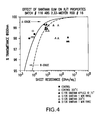
- FIG. 4 Effect of xanthan gum on R/T properties (first trial).
- FIG. 5 Effect of xanthan gum on R/T properties (second trial).
- the invention involves stabilizing CNT compositions, such as dispersions, by constraining the mobility of CNT particles for a period of time sufficient to allow handling of the dispersion, deposition of the dispersion as a wet coating, and drying of the wet coating. This can be achieved by significantly increasing the viscosity of the coating formulation, preferable with an additive that can be removed from the coated layer during drying or in a subsequent washing or decomposition step.
- mobility of the CNT ropes in the dispersions can be made to happen above about 3,000 mg/liter, as the CNT ropes form a “gel” structure above this concentration by directly entangling with each other.
- the gel structure inhibits the kinetics of CNT particles size growth, that is, the growth of larger diameter ropes, which results in improved optoelectronic properties for the final film.
- the viscosity of the liquid phase can be significantly increased (in the range of 10 1 to 10 5 cP). Not only do fugitive viscosity modifier stabilize the CNT dispersion, but they also make the continuous web coating process more robust (as a number of coating techniques prefer higher viscosity) by allowing deposition of thick wet layers that remain stabile during a drying process.
- Stable CNT dispersions comprise a solution containing carbon nanotubes that are uniformly distributed though the solution that does not change (e.g. flocculate, aggregate into small masses which may be difficult or impossible to unaggregate) with the passage of time.
- Preferred time periods during which the solution remains stable include greater than 12 hours, 18 hours, 24 hours, 36 hours, 48 hours, 60 hours, three days, five days, a week or even longer.
- a stable CNT dispersion allows for removal of some or most of the solvent and or viscosity modifier present without allowing the fluid (e.g. wet) coating to flow.
- Stable CNT dispersions may contain one or more fugitive viscosity modifiers.
- Preferred fugitive viscosity modifier function in multiple solvents and within a wide range of CNT concentrations. Concentrations of CNTs within the dispersion range from less than 1 mg/L to greater than 5,000 mg/L.
- Preferred ranges at which the fugitive viscosity modifiers operate are from 1 mg/L to 100 mg/L, from 50 mg/L to 2,000 mg/L, from 100 mg/L to 1,000 mg/L, from 10 mg/L to 3,000 mg/L, from 100 mg/L to 3,000 mg/L, from 1,000 mg/L to 3,000 mg/L, from 2,000 mg/L to 5,000 mg/L, and from 2,000 mg/L to 4,000 mg/L.
- a fugitive viscosity modifier is a material (organic or inorganic) that is added to a solvent and imparts an increased or decreased viscosity (e.g. viscosity builders, viscosity modifiers, viscosity reducers) to the solution (as determined from the desired viscosity) and, preferably, dispersion stability, that can be eliminated after or during removal of solvent. Removal of the modifier and/or the solvent is preferably performed by thermal decomposition, evaporation, sublimation, decomposition, ablation, washed out of the film with one or more solvents, or removed through other conventional processes, or any combination thereof.
- an increased or decreased viscosity e.g. viscosity builders, viscosity modifiers, viscosity reducers
- Removal of the modifier and/or the solvent is preferably performed by thermal decomposition, evaporation, sublimation, decomposition, ablation, washed out of the film with one or more solvents, or removed through other conventional
- the amount of modifier for a particular CNT solution will vary widely, but can be easily determined by those skilled in the art from, for example, the molecular weight of the modifier (e.g. especially with polymers), the functionality of the modifier (e.g. number of functional groups present), nitrogen content, and/or pH.
- a number of specific and generic types of fugitive viscosity modifiers are disclosed in Tables 1 and 2, and also includes clays, thickeners, proteins, gelling agents, stiffening agents, surfactants, suspending agents, fillers, starches, solubilizers, lubricants, excipients, chelating agents, and combinations of any (e.g. see Handbook of Industrial Chemical Additives, Second Edition, compiled by Michael and Irene Ash, Published by John Wiley & Sons Inc., 2000 ⁇ ISBN 1-890595-06-3 ⁇ , which is incorporated entirely by reference).
- compositions of the invention that contain non-fugitive viscosity modifiers.
- Such modifiers may be utilized when it is not necessary to remove the modifier when forming films or coatings.
- At least one advantage of using solvents is that they evaporate during drying and are not present in the carbon nanotube film structure.
- Useful solvents include, but are not limited to: 1,3 butanediol (130 cP); glycerin (1500 cP); ethylene glycol; polyethylene glycol; CELLUSOLVETM and combinations thereof. Additional solvent that are useful with this invention are well-known to those of ordinary skill in the art and commercially available. Since viscosity is temperature dependent, cooling the solvent system sufficiently increases the viscosity in most solvents.
- High molecular weight materials may be used to significantly increase the viscosity, but at concentrations that do not affect the CNT network formation or R/T properties of the carbon nanotube film.
- Preferred materials include, but are not limited to, those listed in Tables 1 and 2.
- the more viscous solvent(s) or the thickening agents can preferably be fugitive at relatively low temperatures (below about 150° C.) or can be rinsed away by a suitable solvent (leaving behind the CNT film).
- An ideal additive is one which increases viscosity, but can be removed entirely or nearly entirely (i.e. to the degree necessary for the purpose of the application), so as at low temperature after coating, leaving the carbon nanotubes on the surface to form a network of ropes.
- compounds that increase viscosity of the CNT-containing solution is capable of decomposing into gases at temperatures below that of the coated substrate which thereby allows formation of the CNT conductive network without hindrances of the network formation. Due to the high thermal stability of CNT in air, many polymeric and organic compounds will decompose before the CNT layer is damaged. A wide variety of compounds can be used to increase viscosity of the CNT dispersion and thereafter can be removed entirely from the CNT layer. Alternatively, one or more thickening agents may be added at such low concentration so as to not excessively impact the final film properties.
- the CNT film can be “further assembled” by exposing the film to an appropriate amount of solvent (e.g., water) via dipping or misting. This further assembly is imparted by the temporary enhancement of CNT mobility resulting from the wetting of the CNT network.
- the CNT film is allowed to sufficiently assembled again (or consolidated) by van der Waals forces as it dries a second time. This second rewetting and drying step is advantageous whenever the initial drying rate is very fast or after removal of the viscosity modifiers during the initial drying or decomposition step.
- a polymeric topcoat may be applied to lock-in this structure and provide additional environmental protection to the CNT layer.
- FIG. 1 Although the process shown in FIG. 1 is complex, it allows for a wider range of products to be manufactured at much better process economics than spray coating.
- SWNTs are purified by process steps including acid reflux, water rinsing, centrifuge and microfiltration. Then, the purified SWNTs are mixed into a 3:1 solution of isopropyl alcohol (IPA) and water to form a carbon nanotube coating solution.
- IPA isopropyl alcohol
- the soot containing approximately 50-60% carbon nanotubes, was purified by refluxing in 3M nitric acid solution for 18 hours at 145 ⁇ 15° C., and then washed, centrifuged and filtered).
- the purified mixture produces an ink solution containing >99% single walled carbon nanotubes at a concentration of 0.059 g/L (ink solution “A”).
- the coating formulations applied in the trials performed utilized a #16 Meyer rod. After application and subsequent processing steps, the sheet resistance (R) of the CNT coating was measured using a Loresta ESP Four-Point probe and the light transmittance (T) measured using a spectrophotometer at wavelength 550 nm.
- Xanthan Gum solution was made by dispersing 2 ml of 0.5% Xanthan Gum Stock Solution in 4 ml of Ink Solution “A”. The xanthan gum solution was distributed along the application interface of the glass substrate and #16 Meyer rod. The Meyer rod was drawn down the length of the glass substrate (200 mm). The coating was applied on a 75° C. hot plate, allow to air dry for 1 min, then heated using a heated air dryer (130° C.). The sheet resistance and percent transmittance (R/T performance) was measured after the following steps:
- the graph in FIG. 4 shows the impact each step has on the sheet resistance and light transmittance.
- the dotted lines on the graph represent the theoretical performance (based on empirical data) of CNT coatings on glass substrates.
Landscapes
- Chemical & Material Sciences (AREA)
- Engineering & Computer Science (AREA)
- Nanotechnology (AREA)
- Physics & Mathematics (AREA)
- Materials Engineering (AREA)
- Crystallography & Structural Chemistry (AREA)
- Condensed Matter Physics & Semiconductors (AREA)
- General Physics & Mathematics (AREA)
- Organic Chemistry (AREA)
- Composite Materials (AREA)
- Spectroscopy & Molecular Physics (AREA)
- Dispersion Chemistry (AREA)
- Manufacturing & Machinery (AREA)
- Inorganic Chemistry (AREA)
- Mathematical Physics (AREA)
- Theoretical Computer Science (AREA)
- Carbon And Carbon Compounds (AREA)
Abstract
Description
-
- Paste concentration=1900-3500 ppm
- Ink concentration=10-50 ppm
- Target Concentration=600-1000 ppm
- Viscosity=100 cP
- Sheet Resistance (Rs)=1500-10,000 Ohm/sq. with implied transparency (90%)
- Increase viscosity without degrading R/T performance.
Solutions:
Using more Viscous Solvents than IPA(/Water) - 1,3 Butanediol (130 cP)
- Glycerin (1500 cP)
- Cellusolve (methyl, butyl)
Utilizing One or More of the Viscosity Increasing Agents Listed in Table 3
- 2 ml 0.5% Xanthan Gum Stock Solution
- 4 ml Ink Solution “A”-0.059 g/l.
- Glass substrates 150 mm×200 mm
- #16 Meyer Rod
-
- 1.
Application using # 16 Meyer rod on 75° C. hot plate - 2. Rinsed in D.I. Water for 1 minute.
- 3. Baked for 30 minutes at 300° C.
- 4. Rinsed in D.I. Water for 1 minute.
- 1.
-
- No significant effect on R/T performance on control after heating at 300° C. for 30 minutes.
- Maintained CNT dispersion during application by remaining on R/T curves.
- Resistance is lower than control indicating there is loss of CNT'S, due to rinsing
- No significant improvement after 2nd rinse indicating a good network structure was obtained after the initial dry stage.
-
- 1.
Application using # 16 Meyer rod on 75° C. hot plate. - 2. Baked for 30 minutes at 300° C.
- 3. Rinsed in D.I. Water for 1 minute.
- 1.
-
- No significant effect on R/T performance on control after heating at 300° C. for 30 minutes.
- Resistance is lower than control indicating there is loss of CNT'S, but not as much as previous process.
- No significant improvement after 2nd rinse.
| TABLE 1 | |||
| Thickener | Rinse (if necessary) | ||
| Water Soluble Gums (e.g. Xanthan) | Water | ||
| Polyacrylics | pH rinse | ||
| Polyethylene Oxide | Leave behind* | ||
| Silica (CABOSIL ™) | Water | ||
| Methyl Celloluse (METHOCEL ™) | Water | ||
| Photosensitive Acrylics (Positive Photoresist) | UV/NaHCO3 | ||
| Polyurethane additive (Rheomax 275) | Leave behind* | ||
| Polyvinyl alcohol | Water | ||
| Gelatin | Water | ||
| TABLE 2 |
| Example Functional Categories |
| abrasives | ||
| absorbents | ||
| accelerators | ||
| acidulants | ||
| activators | ||
| adhesion promotors | ||
| adsorbents | ||
| algicides | ||
| alkaline agents | ||
| antiblocking agents | ||
| anticaking agents | ||
| anticoagulants | ||
| anticracking agents | ||
| anticratering agents | ||
| anticrocking agents | ||
| antidegradants | ||
| antiflexcracking | ||
| agents | ||
| antiflooding agents | ||
| antifog agents | ||
| antifoulants | ||
| antifreeze agents | ||
| antifrosting agents | ||
| antigelling agents | ||
| antimicrobials | ||
| antioxidants | ||
| antiozonants | ||
| antipopping agents. | ||
| antisagging agents | ||
| antisettling agents | ||
| antishrink agents | ||
| antiskinning agents | ||
| antislip agents | ||
| antistats | ||
| antistripping agents | ||
| aromatics/fragrances | ||
| binders bleaching | ||
| agents | ||
| blocking agents | ||
| blowing agents | ||
| bodying agents | ||
| bonding agents | ||
| buffers | ||
| bulking agents | ||
| catalysts | ||
| chain extenders | ||
| chelating agents | ||
| chlorinating agents | ||
| clarifiers/filter aids | ||
| cloud point depressants | ||
| clouding agents | ||
| coagulation agents | ||
| coalescing agents | ||
| combustion promoters | ||
| compatibilizers | ||
| complexing agents | ||
| conditioners | ||
| cooling agents | ||
| corrosion inhibitors | ||
| coupling agents | ||
| creaming agents | ||
| crosslinking agents | ||
| crystal inhibitors | ||
| curing agents | ||
| deactivators | ||
| dedusters | ||
| dechlorinating agents | ||
| deflocculants | ||
| defluorination agents | ||
| defluxing agents | ||
| de-icing agents | ||
| deliming agents | ||
| demulsifiers | ||
| deodorizers | ||
| descaling agents | ||
| desizing agents | ||
| detackifiers | ||
| dewatering agents | ||
| dewaxing agents | ||
| dewebbers/antiwebbers | ||
| digestants/degradants | ||
| diluents | ||
| disinfectants/sanitizers | ||
| driers | ||
| dyeing assistants | ||
| dyes/colorants/pigments | ||
| emollients | ||
| enzymes | ||
| extenders | ||
| extraction aids | ||
| extreme pressure | ||
| additives | ||
| fermentation aids | ||
| fibers fillers | ||
| film-formers | ||
| firming agents | ||
| fixatives | ||
| flame retardants | ||
| flatting agents | ||
| flocculants | ||
| flotation agents | ||
| flow control agents | ||
| fluorination chemicals | ||
| frothers | ||
| fungicides | ||
| gelling agents | ||
| gloss aids/sheen aids | ||
| gloss inhibitors | ||
| grinding aids | ||
| hand modifiers | ||
| hardeners | ||
| herbicides | ||
| homogenizers | ||
| humectants | ||
| hydrophobing agents | ||
| hydrotropes | ||
| impact modifiers | ||
| initiators | ||
| leveling agents | ||
| lubricants | ||
| marproofing agents | ||
| matte agents | ||
| melting point modifiers | ||
| mercerizing agents | ||
| metal passivators | ||
| migration inhibitors | ||
| mildewcides | ||
| moisture barriers/ | ||
| regulators | ||
| mordants neutralizers | ||
| nucleating agents | ||
| opacifiers | ||
| optical brighteners | ||
| oxidizing agents | ||
| oxygen scavengers | ||
| pearlescents | ||
| penetrants/saturants | ||
| peptizing agents | ||
| pH adjusters | ||
| photosensitizers | ||
| pickling agents | ||
| plasticizers/flexibilizers | ||
| polymer, resin and | ||
| latex modifiers | ||
| pour pt. depressants | ||
| preservatives | ||
| printing assistants | ||
| processing aids | ||
| propellants/aerosols. | ||
| protective colloids | ||
| reclaiming agents | ||
| reducing agents | ||
| refatting agents | ||
| refrigerants | ||
| reinforcing agents | ||
| release agents | ||
| scale inhibitors | ||
| scorch retarders | ||
| sequestrants | ||
| short stops | ||
| sizing agents | ||
| slimicides | ||
| slip agents | ||
| sludge conditioners | ||
| smoke suppressants | ||
| softeners | ||
| solvents | ||
| spinning oils | ||
| spreading agents | ||
| stabilizers | ||
| sticking agents | ||
| stiffeners | ||
| substantivity agents | ||
| superfatting agents | ||
| surface finishing | ||
| agents | ||
| synergists | ||
| tackifiers | ||
| tanning agents | ||
| terminators | ||
| uv absorbers | ||
| vehicles/carriers | ||
| viscosity builders | ||
| viscosity modifiers | ||
| viscosity reducers | ||
| vulcanizing agents | ||
| water repellents | ||
| TABLE 3 | |
| Thickener | Rinse (if necessary) |
| Water Soluble Gums (i.e. Xanthan) | Water |
| Polyacrylics | pH rinse |
| Ultra High Molecular Weight Polyethylene Oxide | Water |
| High Molecular Weight Binder (<10%) | |
| Silica (Cabosil) | Water |
| Methyl Celloluse (Methocel) | Water |
| Photosensitive Acrylics (Positive Photoresist) | UV/NaHCO3 |
| Polyurethane additive (Rheomax 275) | |
| Catalyzed Thermal Degradation | |
| Emulsions | |
Claims (10)
Priority Applications (1)
| Application Number | Priority Date | Filing Date | Title |
|---|---|---|---|
| US11/547,903 US8632699B2 (en) | 2004-04-07 | 2005-04-07 | Fugitive viscosity and stability modifiers for carbon nanotube compositions |
Applications Claiming Priority (3)
| Application Number | Priority Date | Filing Date | Title |
|---|---|---|---|
| US56001904P | 2004-04-07 | 2004-04-07 | |
| US11/547,903 US8632699B2 (en) | 2004-04-07 | 2005-04-07 | Fugitive viscosity and stability modifiers for carbon nanotube compositions |
| PCT/US2005/011657 WO2006073420A2 (en) | 2004-04-07 | 2005-04-07 | Fugitive viscosity and stability modifiers for carbon nanotube compositions |
Related Parent Applications (1)
| Application Number | Title | Priority Date | Filing Date |
|---|---|---|---|
| PCT/US2005/011657 A-371-Of-International WO2006073420A2 (en) | 2004-04-07 | 2005-04-07 | Fugitive viscosity and stability modifiers for carbon nanotube compositions |
Related Child Applications (1)
| Application Number | Title | Priority Date | Filing Date |
|---|---|---|---|
| US14/149,790 Division US20140127122A1 (en) | 2004-04-07 | 2014-01-07 | Fugitive viscosity and stability modifiers for carbon nanotube compositions |
Publications (2)
| Publication Number | Publication Date |
|---|---|
| US20080135815A1 US20080135815A1 (en) | 2008-06-12 |
| US8632699B2 true US8632699B2 (en) | 2014-01-21 |
Family
ID=39522085
Family Applications (1)
| Application Number | Title | Priority Date | Filing Date |
|---|---|---|---|
| US11/547,903 Expired - Fee Related US8632699B2 (en) | 2004-04-07 | 2005-04-07 | Fugitive viscosity and stability modifiers for carbon nanotube compositions |
Country Status (1)
| Country | Link |
|---|---|
| US (1) | US8632699B2 (en) |
Cited By (1)
| Publication number | Priority date | Publication date | Assignee | Title |
|---|---|---|---|---|
| US20140127122A1 (en) * | 2004-04-07 | 2014-05-08 | Eikos, Inc. | Fugitive viscosity and stability modifiers for carbon nanotube compositions |
Families Citing this family (14)
| Publication number | Priority date | Publication date | Assignee | Title |
|---|---|---|---|---|
| US8951631B2 (en) * | 2007-01-03 | 2015-02-10 | Applied Nanostructured Solutions, Llc | CNT-infused metal fiber materials and process therefor |
| US8951632B2 (en) * | 2007-01-03 | 2015-02-10 | Applied Nanostructured Solutions, Llc | CNT-infused carbon fiber materials and process therefor |
| US9005755B2 (en) | 2007-01-03 | 2015-04-14 | Applied Nanostructured Solutions, Llc | CNS-infused carbon nanomaterials and process therefor |
| WO2009032090A1 (en) * | 2007-08-29 | 2009-03-12 | Northwestern University | Transparent electrical conductors prepared from sorted carbon nanotubes and methods of preparing same |
| US8580342B2 (en) | 2009-02-27 | 2013-11-12 | Applied Nanostructured Solutions, Llc | Low temperature CNT growth using gas-preheat method |
| US20100227134A1 (en) | 2009-03-03 | 2010-09-09 | Lockheed Martin Corporation | Method for the prevention of nanoparticle agglomeration at high temperatures |
| US20100260998A1 (en) * | 2009-04-10 | 2010-10-14 | Lockheed Martin Corporation | Fiber sizing comprising nanoparticles |
| US9732238B2 (en) * | 2009-05-14 | 2017-08-15 | Battelle Memorial Institute | Solventless methods of coating a carbon nanotube network and carbon nanotube networks coated with a polymer |
| JP5823393B2 (en) | 2009-08-03 | 2015-11-25 | アプライド ナノストラクチャード ソリューションズ リミテッド ライアビリティー カンパニーApplied Nanostructuredsolutions, Llc | Incorporation of nanoparticles into composite fibers |
| CN104475313B (en) | 2010-09-14 | 2017-05-17 | 应用奈米结构公司 | Glass substrates having carbon nanotubes grown thereon and methods for production thereof |
| EP2619133A1 (en) | 2010-09-22 | 2013-07-31 | Applied NanoStructured Solutions, LLC | Carbon fiber substrates having carbon nanotubes grown thereon and processes for production thereof |
| US10519333B2 (en) | 2012-04-26 | 2019-12-31 | Brewer Science, Inc. | Multifunctional alcohol dispersions of carbon nanotubes |
| GB201607421D0 (en) * | 2016-04-28 | 2016-06-15 | Cambridge Entpr Ltd | Members of carbon nanomaterials and methods for their production |
| US20240266544A1 (en) * | 2021-10-22 | 2024-08-08 | Lg Energy Solution, Ltd. | Anode pre-dispersion solution, anode composition comprising same, anode for lithium secondary battery comprising anode composition, lithium secondary battery comprising anode, and method for preparing anode composition |
Citations (12)
| Publication number | Priority date | Publication date | Assignee | Title |
|---|---|---|---|---|
| US5424054A (en) | 1993-05-21 | 1995-06-13 | International Business Machines Corporation | Carbon fibers and method for their production |
| US5853877A (en) | 1996-05-31 | 1998-12-29 | Hyperion Catalysis International, Inc. | Method for disentangling hollow carbon microfibers, electrically conductive transparent carbon microfibers aggregation film amd coating for forming such film |
| US6221330B1 (en) | 1997-08-04 | 2001-04-24 | Hyperion Catalysis International Inc. | Process for producing single wall nanotubes using unsupported metal catalysts |
| US6265466B1 (en) | 1999-02-12 | 2001-07-24 | Eikos, Inc. | Electromagnetic shielding composite comprising nanotubes |
| WO2001092381A1 (en) | 1999-12-07 | 2001-12-06 | William Marsh Rice University | Oriented nanofibers embedded in polymer matrix |
| US6333016B1 (en) | 1999-06-02 | 2001-12-25 | The Board Of Regents Of The University Of Oklahoma | Method of producing carbon nanotubes |
| US20020113335A1 (en) * | 2000-11-03 | 2002-08-22 | Alex Lobovsky | Spinning, processing, and applications of carbon nanotube filaments, ribbons, and yarns |
| WO2002076724A1 (en) * | 2001-03-26 | 2002-10-03 | Eikos, Inc. | Coatings containing carbon nanotubes |
| WO2003013199A2 (en) * | 2001-07-27 | 2003-02-13 | Eikos, Inc. | Conformal coatings comprising carbon nanotubes |
| US20030180472A1 (en) | 2002-03-25 | 2003-09-25 | Otto Zhou | Method for assembling nano objects |
| US20050209392A1 (en) * | 2003-12-17 | 2005-09-22 | Jiazhong Luo | Polymer binders for flexible and transparent conductive coatings containing carbon nanotubes |
| US20080292887A1 (en) * | 2006-09-22 | 2008-11-27 | Hyonny Kim | Conductive Multiwalled Carbon Nanotube/Polyethylene Oxide (PEO) Composite Films and Methods of Use |
-
2005
- 2005-04-07 US US11/547,903 patent/US8632699B2/en not_active Expired - Fee Related
Patent Citations (18)
| Publication number | Priority date | Publication date | Assignee | Title |
|---|---|---|---|---|
| US5424054A (en) | 1993-05-21 | 1995-06-13 | International Business Machines Corporation | Carbon fibers and method for their production |
| US5853877A (en) | 1996-05-31 | 1998-12-29 | Hyperion Catalysis International, Inc. | Method for disentangling hollow carbon microfibers, electrically conductive transparent carbon microfibers aggregation film amd coating for forming such film |
| US6221330B1 (en) | 1997-08-04 | 2001-04-24 | Hyperion Catalysis International Inc. | Process for producing single wall nanotubes using unsupported metal catalysts |
| US6265466B1 (en) | 1999-02-12 | 2001-07-24 | Eikos, Inc. | Electromagnetic shielding composite comprising nanotubes |
| US20020035170A1 (en) * | 1999-02-12 | 2002-03-21 | Paul Glatkowski | Electromagnetic shielding composite comprising nanotubes |
| US6333016B1 (en) | 1999-06-02 | 2001-12-25 | The Board Of Regents Of The University Of Oklahoma | Method of producing carbon nanotubes |
| WO2001092381A1 (en) | 1999-12-07 | 2001-12-06 | William Marsh Rice University | Oriented nanofibers embedded in polymer matrix |
| US6682677B2 (en) | 2000-11-03 | 2004-01-27 | Honeywell International Inc. | Spinning, processing, and applications of carbon nanotube filaments, ribbons, and yarns |
| US20020113335A1 (en) * | 2000-11-03 | 2002-08-22 | Alex Lobovsky | Spinning, processing, and applications of carbon nanotube filaments, ribbons, and yarns |
| WO2002076724A1 (en) * | 2001-03-26 | 2002-10-03 | Eikos, Inc. | Coatings containing carbon nanotubes |
| US20030122111A1 (en) * | 2001-03-26 | 2003-07-03 | Glatkowski Paul J. | Coatings comprising carbon nanotubes and methods for forming same |
| US7060241B2 (en) * | 2001-03-26 | 2006-06-13 | Eikos, Inc. | Coatings comprising carbon nanotubes and methods for forming same |
| WO2003013199A2 (en) * | 2001-07-27 | 2003-02-13 | Eikos, Inc. | Conformal coatings comprising carbon nanotubes |
| US20040071949A1 (en) * | 2001-07-27 | 2004-04-15 | Glatkowski Paul J. | Conformal coatings comprising carbon nanotubes |
| US20070120100A1 (en) * | 2001-07-27 | 2007-05-31 | Glatkowski Paul J | Conformal coatings comprising carbon nanotubes |
| US20030180472A1 (en) | 2002-03-25 | 2003-09-25 | Otto Zhou | Method for assembling nano objects |
| US20050209392A1 (en) * | 2003-12-17 | 2005-09-22 | Jiazhong Luo | Polymer binders for flexible and transparent conductive coatings containing carbon nanotubes |
| US20080292887A1 (en) * | 2006-09-22 | 2008-11-27 | Hyonny Kim | Conductive Multiwalled Carbon Nanotube/Polyethylene Oxide (PEO) Composite Films and Methods of Use |
Cited By (1)
| Publication number | Priority date | Publication date | Assignee | Title |
|---|---|---|---|---|
| US20140127122A1 (en) * | 2004-04-07 | 2014-05-08 | Eikos, Inc. | Fugitive viscosity and stability modifiers for carbon nanotube compositions |
Also Published As
| Publication number | Publication date |
|---|---|
| US20080135815A1 (en) | 2008-06-12 |
Similar Documents
| Publication | Publication Date | Title |
|---|---|---|
| US20140127122A1 (en) | Fugitive viscosity and stability modifiers for carbon nanotube compositions | |
| US8632699B2 (en) | Fugitive viscosity and stability modifiers for carbon nanotube compositions | |
| US20050266162A1 (en) | Carbon nanotube stripping solutions and methods | |
| Ma et al. | Improved conductivity of carbon nanotube networks by in situ polymerization of a thin skin of conducting polymer | |
| JP4182215B2 (en) | Carbon nanotube-dispersed polar organic solvent and method for producing the same | |
| TWI529126B (en) | Approach of single-walled carbon nanotubes uniformly dispersed | |
| KR20150085523A (en) | Film forming composition comprising graphene material and conducting polymer | |
| KR20130091758A (en) | Fabrication method of composite carbon nanotube fibers/yarns | |
| Xie et al. | Dispersing and doping carbon nanotubes by poly (p-styrene-sulfonic acid) for high-performance and stable transparent conductive films | |
| JP3837557B2 (en) | Carbon nanotube dispersion solution and method for producing the same | |
| Zhang et al. | The synthesis of polyacrylonitrile/carbon nanotube microspheres by aqueous deposition polymerization under ultrasonication | |
| JP4182214B2 (en) | Carbon nanotube dispersed polar organic solvent | |
| JP2015170659A (en) | Thermoelectric conversion material, thermoelectric conversion element, and thermoelectric conversion device | |
| JP5688395B2 (en) | Method for forming conductive pattern and transparent conductive film | |
| KR20240101636A (en) | Carbon nanotube fluid matrix | |
| Manivannan et al. | Fabrication and effect of post treatment on flexible single-walled carbon nanotube films | |
| JP7237708B2 (en) | Aqueous carbon nanoparticle ink composition for resistors | |
| Lo et al. | Behavior of mixed multi-walled carbon nanotube/P3HT monolayer at the air/water interface | |
| Rahman et al. | Safer production of water dispersible carbon nanotubes and nanotube/cotton composite materials | |
| KR20190042245A (en) | Ingradients of carbon nanotube dispersion in alcoholic liquid without dispersant molecules and their fabrication methods | |
| Lan et al. | Covalent assembly of shortened multiwall carbon nanotubes on polyelectrolyte films and relevant electrochemistry study | |
| KR101176955B1 (en) | A carbon nano tube transparent conductive thin film with low face resistance and the fabrication method thereof | |
| Bansal et al. | Morphological, Optical And Electrical Characterization Of Solution Processed Mwnt–Pedot: Pss Nanocomposite | |
| RU2743559C1 (en) | Method for removing residual solvent from layers based on carbon nanotubes | |
| Mandal et al. | Transferable thin films of pristine carbon nanotubes |
Legal Events
| Date | Code | Title | Description |
|---|---|---|---|
| AS | Assignment |
Owner name: EIKOS, INC., MASSACHUSETTS Free format text: ASSIGNMENT OF ASSIGNORS INTEREST;ASSIGNORS:GLATKOWSKI, PAUL J.;PICHE, JOSEPH W.;TOTTIER, C. MICHAEL;AND OTHERS;REEL/FRAME:019904/0663;SIGNING DATES FROM 20070726 TO 20070829 Owner name: EIKOS, INC., MASSACHUSETTS Free format text: ASSIGNMENT OF ASSIGNORS INTEREST;ASSIGNORS:GLATKOWSKI, PAUL J.;PICHE, JOSEPH W.;TOTTIER, C. MICHAEL;AND OTHERS;SIGNING DATES FROM 20070726 TO 20070829;REEL/FRAME:019904/0663 |
|
| FEPP | Fee payment procedure |
Free format text: MAINTENANCE FEE REMINDER MAILED (ORIGINAL EVENT CODE: REM.) |
|
| LAPS | Lapse for failure to pay maintenance fees |
Free format text: PATENT EXPIRED FOR FAILURE TO PAY MAINTENANCE FEES (ORIGINAL EVENT CODE: EXP.) |
|
| STCH | Information on status: patent discontinuation |
Free format text: PATENT EXPIRED DUE TO NONPAYMENT OF MAINTENANCE FEES UNDER 37 CFR 1.362 |
|
| FP | Lapsed due to failure to pay maintenance fee |
Effective date: 20180121 |