US8624721B2 - Method and apparatus for embedding a transmitter into a tool, and a system for monitoring the tool - Google Patents
Method and apparatus for embedding a transmitter into a tool, and a system for monitoring the tool Download PDFInfo
- Publication number
- US8624721B2 US8624721B2 US11/279,937 US27993706A US8624721B2 US 8624721 B2 US8624721 B2 US 8624721B2 US 27993706 A US27993706 A US 27993706A US 8624721 B2 US8624721 B2 US 8624721B2
- Authority
- US
- United States
- Prior art keywords
- transmitter
- tool
- slot
- antenna
- access point
- Prior art date
- Legal status (The legal status is an assumption and is not a legal conclusion. Google has not performed a legal analysis and makes no representation as to the accuracy of the status listed.)
- Expired - Fee Related, expires
Links
Images




Classifications
-
- A—HUMAN NECESSITIES
- A61—MEDICAL OR VETERINARY SCIENCE; HYGIENE
- A61B—DIAGNOSIS; SURGERY; IDENTIFICATION
- A61B90/00—Instruments, implements or accessories specially adapted for surgery or diagnosis and not covered by any of the groups A61B1/00 - A61B50/00, e.g. for luxation treatment or for protecting wound edges
- A61B90/90—Identification means for patients or instruments, e.g. tags
-
- A—HUMAN NECESSITIES
- A61—MEDICAL OR VETERINARY SCIENCE; HYGIENE
- A61B—DIAGNOSIS; SURGERY; IDENTIFICATION
- A61B90/00—Instruments, implements or accessories specially adapted for surgery or diagnosis and not covered by any of the groups A61B1/00 - A61B50/00, e.g. for luxation treatment or for protecting wound edges
- A61B90/90—Identification means for patients or instruments, e.g. tags
- A61B90/98—Identification means for patients or instruments, e.g. tags using electromagnetic means, e.g. transponders
Definitions
- the exemplary embodiments may generally relate to management of tools, and may more specifically relate to tracking of tools in supply chain management.
- Surgical instrument storage and sterilization systems are known. These systems, sometimes referred to as surgical instrument trays or surgical instrument kits, typically include metal or plastic trays that hold a variety of general purpose and/or procedure specific surgical instruments, such as, forceps, scissors, clamps, retractors, scalpels, etc. These trays are brought into the operating room (OR) when preparing for surgery, and also are used as a means to organize, transport, and store surgical instruments in a medical facility.
- OR operating room
- the shipping tote is a large bin, usually made of plastic or other durable, lightweight material that is able to securely hold two or more instrument kits inside. A worker then may load the shipping totes into a vehicle thereby reducing the number of manual operations that must be performed.
- a bar coded shipping label is sometimes prepared that identifies certain information such as the point of origin, the destination, and possibly the contents of the tote, i.e., the identification number of each surgical instrument tray contained in the tote.
- the bar coded label allows the tote to be easily and efficiently tracked and entered into inventory at the receiving facility.
- airbills are sometimes referred to as “airbills.”
- Exemplary embodiments may include a method and an apparatus for integrating a transmitter into a tool, and may include a system for monitoring a tool having an integrated transmitter.
- An apparatus may include a tool having a slot, the tool being composed of an electrical conductor, the slot being formed in an outer wall of the tool, and a transmitter having an antenna, the antenna being offset from the tool, the transmitter being positioned within the slot, being coupled to the tool by a conductive material, and being covered with a protective material, wherein the tool is adapted to operate as an electrical ground.
- a method may include forming a slot in an outer wall of a tool, the tool being composed of an electrical conductor, positioning a transmitter within the slot, the transmitter comprising an antenna, affixing the transmitter to the tool with a conductive material, and covering the transmitter with a protective material, wherein the antenna is offset from the tool.
- a system may include an access point, a tool being composed of an electrical conductor and having a slot, the slot being formed in an outer wall of the tool, and a transmitter having an antenna, the antenna being offset from the tool, the transmitter being positioned within the slot, being coupled to the tool by a conductive material, and being covered with a protective material.
- FIG. 1 illustrates an exemplary embodiment of a tool having a slot before a transmitter is placed in the slot
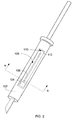
- FIG. 2 illustrates an exemplary embodiment of a tool having a slot after a transmitter is placed in the slot
- FIG. 3 illustrates a partial side view of an exemplary embodiment of a transmitter placed in a slot of a tool
- FIGS. 4A-B illustrate cross-sectional views of an exemplary embodiment of a tool with a transmitter embedded in a slot
- FIG. 5 illustrates an exemplary embodiment of a system monitoring a tool having an embedded transmitter.
- the expressions and terms “surgical instrument,” “surgical tool,” “instrument,” or “tool” will refer to any type of surgical or medical instrument or portable equipment or device to which it may be desirable to attach a transmitter, such as, but not limited to, a radio frequency identification (RFID) tag.
- RFID radio frequency identification
- the specification is written in the context of medical and/or surgical instruments, it should be appreciated that the transmitter of the exemplary embodiments may be used with a variety of different items to be identified as shape and design constraints permit, including tools and equipment in other fields unrelated to the medical field. This may include hand tools or other objects and/or equipment that are used in construction, manufacturing, maintenance, automotive, consumer, aviation, or other similar and differing industries.
- the exemplary embodiments may generally relate to placing a transmitter below the surface of a tool, such as, but not limited to, a surgical instrument or other metal tools or utensils, and encapsulating the transmitter in a protective material.
- a tool such as, but not limited to, a surgical instrument or other metal tools or utensils
- natural conductive properties of the metal instrument may allow a transmitter, such as, but not limited to, a Ultra-High Frequency (UHF) transmitter or a Microwave RFID) tag, to be completely embedded below the metal surface of the tool and also may allow the transmitter to communicate identification information about the tool.
- UHF Ultra-High Frequency
- Microwave RFID Microwave RFID
- the exemplary embodiments also may overcome problems with embedding a transmitter in a metal tool.
- Simply embedding a transmitter within a metal instrument may be problematic for at least the following three reasons.
- conventional transmitter form factors may not be designed for use with very small diameter or thin surface tools, which may frequently occur in surgical instruments.
- Detuning may generally refer to a degradation in performance of the transmitter. Detuning may occur because the electrical conductor absorbs and reflects electromagnetic wireless signals, which may modify the frequency of the wireless signal. This may cause problems when a wireless reader device expects to receive a wireless signal from the transmitter within a certain frequency band, and, because of the electrical conductor, the modified frequency of the wireless signal may fall outside of the frequency band and may not be detected by the wireless reader device.
- RF radio frequency
- UHF ultra-high frequency
- microwave frequencies may severely detune the performance of the transmitter.
- Detuning may generally refer to a degradation in performance of the transmitter. Detuning may occur because the electrical conductor absorbs and reflects electromagnetic wireless signals, which may modify the frequency of the wireless signal. This may cause problems when a wireless reader device expects to receive a wireless signal from the transmitter within a certain frequency band, and, because of the electrical conductor, the modified frequency of the wireless signal may fall outside of the frequency band and may not be detected by the wireless reader device.
- affixing a transmitter to a surgical instrument may be problematic due to the sterilization requirements of surgical instruments, and the specialty of surgical instruments may limit any changes that may affect the aesthetics, function, or ergonomics of the instruments for users.
- Exemplary embodiments overcome transmitter design limitations allowing for a very small, low profile transmitter that performs highly while embedded within a metal tool.
- FIG. 1 illustrates an exemplary embodiment of a tool 100 having a slot 108 prior to placing a transmitter 104 (see FIG. 2 ) in the slot 108 .
- the tool 100 may be a surgical tool, such as, but not limited to, a scalpel useable during surgery, or other types of surgical and non-surgical tools.
- the tool 100 also may be of other sizes and shapes, as will be appreciated by those skilled in the art.
- the slot 108 may be formed in an outer wall of a body 102 of the tool 100 .
- the body 102 may be composed of an electrical conductor.
- the slot 108 may form a depression beneath the surface of the outer wall of the body 102 .
- the slot 108 may be formed using any machining mechanical process that etches into the body 102 .
- a tool die may form the slot 108 when the tool 100 is manufactured.
- FIG. 2 illustrates an exemplary embodiment of the tool 100 with a transmitter 104 placed in the slot 108 .
- the transmitter 104 may be any device capable of wirelessly communicating RF, UHF, microwave frequency signals, or other wireless signals capable of containing information.
- the transmitter 104 may be a miniature electronic circuit that may include a microprocessor.
- the transmitter 104 may be adapted to wirelessly communicate in various wireless environments. Various wireless environments may include responding to a RF signal emitted from a RF field generator, where, upon receipt of the RF signal, the transmitter 104 may transmit a wireless response signal with information about the transmitter 104 .
- the RF signal may be a RF field.
- the transmitter 104 may be referred to as passive in this wireless environment, where the transmitter 104 only transmits a signal after receiving a signal from another source. Alternatively, the transmitter 104 may be active and periodically or aperiodically transmit signals. In various exemplary embodiments, the transmitter 104 may be wireless signal powered (also referred to as beam powered), where power from a received wireless signal may energize circuitry of the transmitter 104 and may cause the transmitter 104 to perform a data operation, such as, but not limited to, emitting a wireless signal.
- a wireless signal powered also referred to as beam powered
- the transmitter 104 may include an RFID tag.
- RFID tags can be found in, for example, U.S. Pat. Nos. 4,075,632, 4,360,801, 4,390,880, 4,739,328 and 5,030,807, the disclosures of which are incorporated herein by reference in their entireties.
- RFID tags also may be described in co-pending U.S. patent application Ser. No. 11/341,489, titled “Surgical Instrument Tray RFID Tag,” filed Jan. 30, 2006, the contents of which are incorporated herein by reference in their entirety.
- the transmitter 104 may be state machine oriented, have global lock capability, write to every non-locked byte, have multiple functions, write to one byte individually, have bulk write capability, have group select capability, be anti-collision capable (e.g., may sort X number of transmitters per second), have cyclic redundancy check (CRC) 16 messaging, operate over ⁇ 40° C. to +85° C., and may have high speed operation.
- the transmitter 104 may have other features, and/or combinations of one or more of these features, as will be appreciated by those skilled in the art.
- the transmitter 104 may transmit data within specified frequency bands that conform to regulatory standards for the country in which the transmitter 104 is used.
- the transmitter 104 may operate in the frequency band of 860-960 MHz.
- the transmitter 104 may operate at other frequency bands. Transmission within the frequency bands also may conform with the regulatory standards of the host country or the needs of the system, as will be appreciated by those skilled in the art.
- the transmitter 104 may generally be rugged enough to survive typical use in a surgical environment.
- the transmitter 104 may be designed to survive multiple sterilization cycles that tools in a surgical environment may be exposed to, such as, but not limited to, autoclaving and citric passivation baths.
- the transmitter 104 may be designed to survive other harsh environments.
- Various exemplary embodiments may permit the transmitter 104 to survive harsh environments to which the tool 100 may be exposed, such as, but not limited to, extreme temperatures, high pressure, vibrations, droppage of the tool 100 , and harsh chemicals.
- the transmitter 104 also may include a memory.
- the memory may include read/write functionality, which may allow certain stored information in the memory to be altered, re-evaluated, and read.
- the memory may have both locked and unlocked memory. Generally, the locked portion of the memory may be read only, and may not be changed without physically reprogramming the memory.
- the locked portion of the memory may store a unique identification number for identifying the transmitter 104 that corresponds to the tool 100 . The unique identification number may be used to index a database containing price, product name, manufacturer, and/or other information that may be used to track the tool 100 over its life cycle.
- the unlocked portion of the memory may store information on events occurring in the life cycle of the tool 100 .
- This information may include, but is not limited to, the number of times the tool has been used, identification numbers of the surgery in which the tool 100 was used, the number of times the tool 100 has been sterilized, the dates of inspection of the tool 100 , the operator who performed the inspection of the tool 100 , the name of the surgeon who performed surgery with the tool 100 , the location at which the tool 100 was last scanned, the names of the locations or hospitals where the tool 100 had been used, and/or other information that may be used to track the travel, usage, storage, and inspection of the tool 100 over its life cycle.
- FIG. 3 depicts a partial side view of an exemplary embodiment of the transmitter 104 within the slot of the tool 100 .
- the transmitter 104 may be inserted into the slot 108 after the slot 108 is formed in the tool 100 .
- the transmitter 104 may have dual poles. A first of the dual poles of the transmitter 104 may be directly affixed to an inner wall 116 of the slot 108 with a conductive material or a conductive snap.
- the conductive material may be solder, a conductive epoxy, or any other suitable material to allow electrical current to flow between the body 102 of the tool 100 and the transmitter 104 .
- the transmitter 104 may be formed on a circuit board that has a pin that may be coupled to the inner wall 116 of the tool 100 .
- the transmitter 104 may have a short, thin gauge, conductive antenna 106 .
- the antenna 106 may be adapted to radiate and/or emit a wireless signal generated by the transmitter 104 .
- the antenna 106 may be an antenna wire and may be circularly polarized or linearly polarized. In various exemplary embodiments, the antenna wire may be 30 aught magnetic wire.
- the antenna 106 may be made of a variety of conductive materials. Materials such as, but not limited to, conductive inks, wire trace (e.g., copper, silver, gold, etc.), and/or any conductive metal wire may be used as the conductive portion of the antenna.
- the antenna 106 may be positioned within the slot 108 such that the antenna 106 is offset from contacting any metal surrounding the slot 108 .
- the antenna 106 may be positioned within the slot 108 so that no portion of the antenna 106 electrically contacts any wall of the slot 108 .
- a gap 110 may be located between the end of the antenna 106 and wall 112 of the slot 108 .
- the gap 110 may be a space between the end of the antenna 108 and the wall 112 so that the antenna 106 may not electrically contact the wall 112 .
- the only point of electrical contact of the transmitter 104 with the body 102 may be at the inner wall 116 .
- FIG. 4A illustrates a cross-sectional view along line A-A′ in FIG. 2 of an exemplary embodiment of the transmitter 104 embedded within the slot 108 .
- the transmitter 104 may be positioned within the slot 108 of the body 102 of the tool 100 below the outer surface of the body 102 .
- the antenna 106 may be positioned within the slot 108 so that it does not contact side walls 404 A-B or base wall 402 .
- FIG. 4B illustrates a cross-sectional view along line A-A′ in FIG. 2 of an alternative exemplary embodiment of the transmitter 104 embedded within the slot 108 .
- the transmitter 104 may be positioned within the slot 108 of the body 102 of the tool 100 below the outer surface of the body 102 .
- the slot 108 may extends laterally through the body 102 , thus forming a hole through the body 102 of the tool 100 that is bounded by body halves 102 A and 102 B.
- the slot 108 may have other sizes and shapes, as will be appreciated by those of skill in the art.
- Forming the slot 108 laterally through the body 102 may permit the transmitter 104 to emit a wireless signal that is receivable over 360° relative to a longitudinal axis of the tool 300 , which may not occur in the slot 108 of FIG. 4A because of base wall 402 . Additionally, having the slot 108 laterally formed through the body 102 may permit the transmitter 104 to be embedded deeper within the body 102 .
- the transmitter 104 may be quickly affixed within the slot 108 on the tool 100 prior to covering the transmitter 104 with a protective material.
- a protective material such as, but not limited to, a non-conductive material, such as, but not limited to, an epoxy, a silicone, a plastic, a rubber, or other non-conductive materials.
- the protective material may be visually clear, opaque, or be of a desired color, and may be adapted to withstand multiple sterilization cycles, such as, but not limited to, repeat autoclave cycles and citric passivation baths.
- the protective material also may protect the transmitter 104 from harsh chemicals during sterilization. Covering the transmitter 104 also may be referred to as overmolding or encapsulating.
- the protective material may cover the transmitter 104 such that the transmitter 104 may be embedded below the surface of the body 102 of the tool 100 and sealed. In an alternative exemplary embodiment, the transmitter 104 may not completely be embedded below the surface of the body 102 of the tool 100 . This may occur at an area of the tool 100 where there is low potential risk for the transmitter 104 being damaged or unintentionally removed or where the transmitter 104 does not interfere with an operator's use of the tool 100 .
- the protective material may protect the transmitter 104 as well as hold the transmitter 104 and the antenna 106 in place. Generally, the protective material may insulate the transmitter 104 and the dielectric properties of the protective material may permit energy from wireless signals to propagate through the protective material.
- the protective material may be processed so that the contour of the protective material substantially corresponds to the shape of the body 102 of the tool 100 .
- FIG. 2 illustrates the body 102 having a substantially cylindrical shape.
- the slot 108 may be filled with the protective material to correspond to the contour of the cylindrical shape of the body 102 (also see FIGS. 4A-B ).
- the protective material may be made from a material capable of being shaped after filling the slot 108 so that the contour matches the contour of the body 102 .
- the body 102 and the slot 108 may be of other geometric, asymmetrical, symmetrical, or other desired shapes, as will be appreciated by those skilled in the art.
- Embedding the transmitter 104 in the tool 100 may provide advantages due to the conductive properties of the tool 100 .
- the transmitter 104 emits a wireless signal, such as, but not limited to a UHF, RF, or, microwave signal
- the transmitter 104 may utilize the metal in the tool 100 as an electrical ground plane, thus making the tool 100 a part of the antenna circuit. This may allow the antenna 106 to be much smaller than would typically be required to operate at UHF and microwave frequencies while still allowing the antenna 106 to resonate.
- Using the tool 100 as the ground plane minimizes detuning of the transmitter 104 as the tool 100 is held in differing ways during transmission by the transmitter 104 .
- Minimizing detuning may imply that the antenna 106 may be efficient and the electrical current flow may not be countering or cancelling out.
- the design of the antenna 106 may account for the effects of the dielectric properties of the protective material, the type of material selected for the antenna 106 , the overall size of the antenna 106 , the amount of protective material, the size of the tool 100 , and other properties and sizes of the components of the tool 100 .
- the antenna 106 also may allow for anti surface-current cancellation (same current direction), have a fully-radiated antenna design, have a dipole-like radiation pattern, and have a multiband return-loss response.
- the design of the antenna 106 may depend upon the size of the tool 100 , the frequency of operation, and environmental conditions.
- the antenna 106 may be very small, less than one square inch or much larger, depending upon the operational requirements. For example, if the antenna 106 were placed in the slot 108 with an offset of approximately 0.010-0.020 inches from the walls of the slot 108 and the slot 108 filled with the protective material, the overall length of the antenna 106 at 915 MHz (UHF) may be 1.0-1.5 inches long, and at 2.45 Ghz (Microwave), the antenna 106 may be 0.5-1.0 inches long. In general, the length of the electromagnetic wave may affect the antenna design.
- the design may have the electrical length of the antenna 106 equal to the wavelength of the electromagnetic wave.
- the length of the antenna 106 also may be a fraction of the length of the wavelength.
- the length of the antenna 106 may be a quarter or an eighth of the wavelength.
- Other fractions of the length of the antenna 106 compared to the length of the wavelength may be used. Having the antenna 106 operating at RF, UHF, microwave, or other operating frequencies may allow a wireless reader device to wirelessly receive information from multiple transmitters 104 at the same time, may improve the distance over which wireless signals may be received from the transmitter 104 , and may prevent data collisions from multiple transmitters 104 simultaneously transmitting.
- FIG. 5 illustrates an exemplary embodiment of a system 500 communicating with tools 100 A-B having respectively embedded transmitters 104 A-B.
- the system 500 may include one or more tools 100 A-B, an Access Point 502 , a Network 504 , a Server 506 , and a Database 508 .
- the tools 100 A-B may be arranged on a tray, or may be placed within a container.
- the depicted number of components in the system 500 is exemplary.
- the system 500 may include more or less components, such as more or less tools 100 , as will be appreciated by those skilled in the art.
- the system 500 may respectively allow transmitters 104 A-B associated with the tools 100 A-B to wirelessly communicate information through the Access Point 502 and the Network 504 to the Server 506 and the Database 508 .
- the Access Point 502 may directly connect to the Network 504 , or may connect through a local area network (LAN), a wireless LAN (WLAN), an Internet Service Provider (ISP), or other methods for connecting to a network, which are known and are omitted for brevity.
- LAN local area network
- WLAN wireless LAN
- ISP Internet Service Provider
- the Access Point 502 may be a computing device that wirelessly communicates with the transmitters 104 A-B.
- the Access Point 502 may be a wireless reader device and may include an RF field generator (reader) to wirelessly extract identification information, such as, but not limited to, a Universal Product Code (UPC), a product name, a unique identification number, or other information stored in the locked and unlocked portions of the memory of the transmitter 104 .
- the Access Point 502 also may comply with the regulatory standards of the host country. For example, in the United States and in North America, RF field generators may conform with Federal Communications Commission (FCC) unlicensed requirements, such as FCC Part 15. Europe sets similar standards, such as ETSI 300.400 869 MHz operation.
- FCC Federal Communications Commission
- tools 100 A-B may be placed on a tray and may be sent through a RF field generated by the Access Point 502 .
- the Access Point 502 may generate a RF signal.
- the RF field may energize circuitry of the transmitters 104 A-B and may cause the circuitry to perform a data operation.
- the data operation may cause the transmitter 104 to transmit a wireless response signal, such as, but not limited to, a RF or UHF signal, containing extraction data.
- the extraction data may include the identification information stored in the locked portion of the memory of the transmitter 104 , and/or may include information stored in the unlocked portion of the memory.
- the RF field generated by the Access Point 502 also may communicate update information to the transmitter 104 for storage in the unlocked portion of the memory of the transmitter 104 .
- the Access Point 502 may communicate this information to the Server 506 , the Database 508 , or both.
- the identification information may be used to track the tool 100 to determine its location, to determine if the tool 100 has been placed on the wrong tray, to track the number of uses of the tool 100 , or other information about the tool over its life cycle.
- the Server 506 and/or the Database 508 may include a database table that stores information on each tool 100 similar to the information stored in the locked and unlocked portions of the memory of the transmitter 104 . Additionally, the database table also may store information for managing and tracking the tool 100 over its life cycle.
- the Server 506 , the Database 508 , or both may review the identification information from one or more tools 100 communicated from the Access Point 502 to identify if the one or more tools 100 correspond to different manufacturers or sterilization processors. This may be beneficial since manufacturers or sterilization processors typically only service and sterilize their own tools.
- the Server 506 , the Database 508 , or both may, for example, communicate a signal for display to an operator at the Access Point 502 indicating that a tool is missing from the tray, that all tools are accounted for, that a tool is improperly included on the tray that belongs to a different manufacturer than the other tools, or other information that the operator may use to process the tool 100 .
- the transmitters 104 A-B embedded in the respective tools 100 A-B may prevent the one or more tools 100 from improperly being sent to the wrong manufacturers or sterilization processors. Moreover, this information may be used to identify if any tools are missing from the tray. Thus, the exemplary embodiments may save time in identifying tools and may prevent the loss of tools, while being able to withstand the processing rigors that the tools may experience.
- the transmitter 104 may not affect the physical appearance, aesthetics, function, or ergonomics of the instruments for users.
- the transmitter 104 may be invisible or unobtrusive to the user of the tool 100 , but still allow for rapid, accurate, automatic, non-orientation restrictive identification and processing of the tool 100 in various processes of supply chain usages, as well as in tracking and managing use of the tool over its life cycle.
Landscapes
- Health & Medical Sciences (AREA)
- Surgery (AREA)
- Life Sciences & Earth Sciences (AREA)
- Engineering & Computer Science (AREA)
- Animal Behavior & Ethology (AREA)
- Pathology (AREA)
- Nuclear Medicine, Radiotherapy & Molecular Imaging (AREA)
- Veterinary Medicine (AREA)
- Public Health (AREA)
- Biomedical Technology (AREA)
- Heart & Thoracic Surgery (AREA)
- Medical Informatics (AREA)
- Molecular Biology (AREA)
- Oral & Maxillofacial Surgery (AREA)
- General Health & Medical Sciences (AREA)
- Physics & Mathematics (AREA)
- Electromagnetism (AREA)
- Arrangements For Transmission Of Measured Signals (AREA)
Abstract
Description
Claims (20)
Priority Applications (1)
| Application Number | Priority Date | Filing Date | Title |
|---|---|---|---|
| US11/279,937 US8624721B2 (en) | 2006-04-17 | 2006-04-17 | Method and apparatus for embedding a transmitter into a tool, and a system for monitoring the tool |
Applications Claiming Priority (1)
| Application Number | Priority Date | Filing Date | Title |
|---|---|---|---|
| US11/279,937 US8624721B2 (en) | 2006-04-17 | 2006-04-17 | Method and apparatus for embedding a transmitter into a tool, and a system for monitoring the tool |
Publications (2)
| Publication Number | Publication Date |
|---|---|
| US20070244470A1 US20070244470A1 (en) | 2007-10-18 |
| US8624721B2 true US8624721B2 (en) | 2014-01-07 |
Family
ID=38605774
Family Applications (1)
| Application Number | Title | Priority Date | Filing Date |
|---|---|---|---|
| US11/279,937 Expired - Fee Related US8624721B2 (en) | 2006-04-17 | 2006-04-17 | Method and apparatus for embedding a transmitter into a tool, and a system for monitoring the tool |
Country Status (1)
| Country | Link |
|---|---|
| US (1) | US8624721B2 (en) |
Cited By (15)
| Publication number | Priority date | Publication date | Assignee | Title |
|---|---|---|---|---|
| US9717565B2 (en) | 2015-01-21 | 2017-08-01 | Covidien Lp | Wirelessly detectable objects for use in medical procedures and methods of making same |
| US9756402B2 (en) | 2015-05-04 | 2017-09-05 | Milwaukee Electric Tool Corporation | Power tool and method for wireless communication |
| US9801566B2 (en) | 2007-02-19 | 2017-10-31 | Medtronic Navigation, Inc. | Automatic identification of instruments used with a surgical navigation system |
| US9814540B2 (en) | 2014-03-31 | 2017-11-14 | Covidien Lp | Method, apparatus and article for detection of transponder tagged objects, for example during surgery |
| US10187742B2 (en) | 2015-01-19 | 2019-01-22 | Haldor Advanced Technologies Ltd | System and method for tracking and monitoring surgical tools |
| US10192160B2 (en) | 2012-04-23 | 2019-01-29 | Tagsys | Radio-frequency identification device |
| US10285775B2 (en) | 2015-02-26 | 2019-05-14 | Covidien Lp | Apparatuses to physically couple transponder to objects, such as surgical objects, and methods of using same |
| US10510199B2 (en) | 2017-08-07 | 2019-12-17 | Milwaukee Electric Tool Corporation | Power tool with irreversably lockable compartment |
| US10595958B2 (en) | 2008-10-28 | 2020-03-24 | Covidien Lp | Wirelessly detectable objects for use in medical procedures and methods of making same |
| US10660726B2 (en) | 2015-01-21 | 2020-05-26 | Covidien Lp | Sterilizable wirelessly detectable objects for use in medical procedures and methods of making same |
| US10874560B2 (en) | 2015-01-21 | 2020-12-29 | Covidien Lp | Detectable sponges for use in medical procedures and methods of making, packaging, and accounting for same |
| US11212909B2 (en) | 2019-11-21 | 2021-12-28 | Milwaukee Electric Tool Corporation | Insertable wireless communication device for a power tool |
| US11260514B2 (en) | 2017-11-29 | 2022-03-01 | Milwaukee Electric Tool Corporation | Externally attachable tracking module for a power tool |
| US11665519B2 (en) | 2019-02-06 | 2023-05-30 | Milwaukee Electric Tool Corporation | Power tool with shared terminal block |
| US12472031B2 (en) | 2007-02-19 | 2025-11-18 | Medtronic Navigation, Inc. | Automatic identification of tracked surgical devices using an electromagnetic localization system |
Families Citing this family (51)
| Publication number | Priority date | Publication date | Assignee | Title |
|---|---|---|---|---|
| US10010371B2 (en) * | 2005-05-31 | 2018-07-03 | Aprovix Ab | Sampling system |
| WO2008062387A2 (en) * | 2006-11-24 | 2008-05-29 | Satyatek Sa | Marker and marking system for objects |
| US20080132882A1 (en) * | 2006-11-30 | 2008-06-05 | Howmedica Osteonics Corp. | Orthopedic instruments with RFID |
| WO2008106552A1 (en) | 2007-02-28 | 2008-09-04 | Rf Surgical Systems, Inc. | Method, apparatus and article for detection of transponder tagged objects, for example during surgery |
| US8202272B2 (en) | 2007-07-19 | 2012-06-19 | Avedro, Inc. | Eye therapy system |
| US8992516B2 (en) | 2007-07-19 | 2015-03-31 | Avedro, Inc. | Eye therapy system |
| US8549966B2 (en) * | 2007-10-22 | 2013-10-08 | Formax, Inc. | Output conveyor for a food article slicing machine |
| US8545487B2 (en) | 2007-12-05 | 2013-10-01 | Avedro Inc. | Eye therapy system |
| US8469952B2 (en) | 2008-01-23 | 2013-06-25 | Avedro, Inc. | System and method for positioning an eye therapy device |
| US8348935B2 (en) * | 2008-01-23 | 2013-01-08 | Avedro, Inc. | System and method for reshaping an eye feature |
| US8409189B2 (en) * | 2008-01-23 | 2013-04-02 | Avedro, Inc. | System and method for reshaping an eye feature |
| US20090187173A1 (en) * | 2008-01-23 | 2009-07-23 | David Muller | System and method for reshaping an eye feature |
| US20090275936A1 (en) * | 2008-05-01 | 2009-11-05 | David Muller | System and method for applying therapy to an eye using energy conduction |
| WO2009151946A2 (en) | 2008-05-27 | 2009-12-17 | Rf Surgical Systems, Inc. | Multi-modal transponder and method and apparatus to detect same |
| JP2012502763A (en) * | 2008-09-19 | 2012-02-02 | アヴェドロ・インコーポレーテッド | Eye therapy system |
| WO2010039854A1 (en) | 2008-09-30 | 2010-04-08 | Neal Marshall | Eye therapy system |
| WO2010039979A1 (en) * | 2008-10-01 | 2010-04-08 | Avedro, Inc. | Eye therapy system |
| US8264342B2 (en) | 2008-10-28 | 2012-09-11 | RF Surgical Systems, Inc | Method and apparatus to detect transponder tagged objects, for example during medical procedures |
| US8882757B2 (en) | 2008-11-11 | 2014-11-11 | Avedro, Inc. | Eye therapy system |
| WO2010115121A1 (en) | 2009-04-02 | 2010-10-07 | Avedro, Inc. | Eye therapy system |
| US8310367B1 (en) * | 2009-05-18 | 2012-11-13 | Empire Technology Development Llc | Methods of implanting electronics in objects and objects with implanted electronics |
| WO2011050164A1 (en) | 2009-10-21 | 2011-04-28 | Avedro, Inc. | Eye therapy |
| WO2011053768A2 (en) * | 2009-10-30 | 2011-05-05 | Avedro, Inc. | System and method for stabilizing corneal tissue after treatment |
| US9226686B2 (en) | 2009-11-23 | 2016-01-05 | Rf Surgical Systems, Inc. | Method and apparatus to account for transponder tagged objects used during medical procedures |
| FR2954088B1 (en) * | 2009-12-22 | 2011-12-30 | Philippe Laheurte | MEDICAL DEVICE EQUIPPED WITH RFID IDENTIFICATION MODULE |
| FR2957240B1 (en) * | 2010-03-10 | 2012-04-20 | Philippe Laheurte | MEDICAL DEVICE EQUIPPED WITH RFID IDENTIFICATION MODULE |
| CN102221613B (en) * | 2010-03-18 | 2013-12-25 | 希森美康株式会社 | Sample analyzer |
| WO2011116306A2 (en) | 2010-03-19 | 2011-09-22 | Avedro, Inc. | Systems and methods for applying and monitoring eye therapy |
| US9358672B2 (en) * | 2010-05-18 | 2016-06-07 | Gauthier Biomedical, Inc. | Electronic torque wrench |
| CA2857950A1 (en) * | 2011-03-18 | 2012-09-27 | Aita Llc | Thermally-armored radio-frequency identification device and method of producing same |
| WO2012162529A1 (en) | 2011-05-24 | 2012-11-29 | Avedro, Inc. | Systems and methods for reshaping an eye feature |
| WO2012167260A2 (en) | 2011-06-02 | 2012-12-06 | Avedro, Inc. | Systems and methods for monitoring time based photo active agent delivery or photo active marker presence |
| US8776644B2 (en) | 2012-01-23 | 2014-07-15 | Stanley Black & Decker, Inc. | Electronic identifier attachment for inventory items |
| US8870078B2 (en) | 2012-02-08 | 2014-10-28 | Stanley Black & Decker, Inc. | Hand tool having an electronic identification device |
| EP2872081B2 (en) | 2012-07-16 | 2025-07-16 | Avedro, Inc. | Systems for corneal cross-linking with pulsed light |
| US9089952B2 (en) | 2012-08-14 | 2015-07-28 | Stanley Black & Decker, Inc. | Electronic identifier attachments for bits |
| US8937544B2 (en) | 2012-11-05 | 2015-01-20 | DePuy Synthes Products, LLC | Systems and methods for tagging and tracking surgical devices and surgical accessories using radio frequency identification tags |
| US9498114B2 (en) | 2013-06-18 | 2016-11-22 | Avedro, Inc. | Systems and methods for determining biomechanical properties of the eye for applying treatment |
| WO2014205145A1 (en) | 2013-06-18 | 2014-12-24 | Avedro, Inc. | Systems and methods for determining biomechanical properties of the eye for applying treatment |
| DE102013219875B4 (en) * | 2013-10-01 | 2019-10-17 | Fried. Dick Gmbh & Co. Kg | Knife with an RFID transponder arranged on the Erl |
| PL3079624T3 (en) | 2013-12-11 | 2024-11-12 | Caretag Aps | Attachment and cover for an electronic identification tag |
| EP2929853A3 (en) * | 2014-03-18 | 2016-01-20 | Ricoh Company, Ltd. | Medical apparatus with ic, and medical apparatus management system |
| EP3212140B1 (en) | 2014-10-27 | 2021-12-01 | Avedro, Inc. | Systems for cross-linking treatments of an eye |
| US10114205B2 (en) | 2014-11-13 | 2018-10-30 | Avedro, Inc. | Multipass virtually imaged phased array etalon |
| EP3827792A1 (en) | 2015-04-24 | 2021-06-02 | Avedro, Inc. | Systems and methods for photoactivating a photosensitizer applied to an eye |
| EP4483884A3 (en) | 2015-05-22 | 2025-03-05 | Avedro Inc. | Systems for monitoring cross-linking activity for corneal treatments |
| WO2017015471A1 (en) | 2015-07-21 | 2017-01-26 | Avedro, Inc. | Systems and methods for treaments of an eye with a photosensitizer |
| JP2019084012A (en) * | 2017-11-06 | 2019-06-06 | 株式会社トータルItシステムジャパン | Installation method of ic tag and ic tag built-in metal body |
| US20190321132A1 (en) * | 2018-04-23 | 2019-10-24 | Mobile Workforce, Inc. | Automatic identification technologies in surgical implants ... |
| ES2844589B2 (en) * | 2020-01-22 | 2024-07-16 | Martinez Y Gascon S A | System for monitoring the use of hand tools, hand tool and procedure for monitoring the use of hand tools |
| US20220057541A1 (en) * | 2020-08-24 | 2022-02-24 | Pico MES Inc. | Intelligent Tool Detection Systems And Methods |
Citations (11)
| Publication number | Priority date | Publication date | Assignee | Title |
|---|---|---|---|---|
| US4075632A (en) | 1974-08-27 | 1978-02-21 | The United States Of America As Represented By The United States Department Of Energy | Interrogation, and detection system |
| US4360801A (en) | 1980-04-14 | 1982-11-23 | Stanley Vemco | Home security and garage door operator system |
| US4390880A (en) | 1976-09-02 | 1983-06-28 | Stiftelsen Institute For Mikrovagstenknik Vid Tekniska Hogskolan I Stockholm | Radio communication system and transmitter and receiver equipment therefor |
| US4739328A (en) | 1986-07-14 | 1988-04-19 | Amtech Corporation | System for identifying particular objects |
| US5030807A (en) | 1990-01-16 | 1991-07-09 | Amtech Corporation | System for reading and writing data from and into remote tags |
| US20020193138A1 (en) * | 2001-06-13 | 2002-12-19 | Norimichi Chiba | Radio module and radio communication apparatus with the radio module |
| US20030102970A1 (en) * | 2001-11-15 | 2003-06-05 | Creel Myron Dale | Tool or implement storage system using wireless devices to facilitate tool control |
| US20040220602A1 (en) * | 2002-08-08 | 2004-11-04 | Wenjie Deng | Surgical cutting accessory with encapsulated RFID chip |
| US20050113037A1 (en) * | 2003-11-25 | 2005-05-26 | Motorola, Inc. | Antenna structure for devices with conductive chassis |
| US20060049986A1 (en) * | 2004-09-08 | 2006-03-09 | Dunn Gregory J | Integrated patch antenna and electronics assembly and method for fabricating |
| US20060244597A1 (en) | 2005-04-28 | 2006-11-02 | Sdgi Holdings, Inc. | Surgical instrument tray RFID tag |
-
2006
- 2006-04-17 US US11/279,937 patent/US8624721B2/en not_active Expired - Fee Related
Patent Citations (11)
| Publication number | Priority date | Publication date | Assignee | Title |
|---|---|---|---|---|
| US4075632A (en) | 1974-08-27 | 1978-02-21 | The United States Of America As Represented By The United States Department Of Energy | Interrogation, and detection system |
| US4390880A (en) | 1976-09-02 | 1983-06-28 | Stiftelsen Institute For Mikrovagstenknik Vid Tekniska Hogskolan I Stockholm | Radio communication system and transmitter and receiver equipment therefor |
| US4360801A (en) | 1980-04-14 | 1982-11-23 | Stanley Vemco | Home security and garage door operator system |
| US4739328A (en) | 1986-07-14 | 1988-04-19 | Amtech Corporation | System for identifying particular objects |
| US5030807A (en) | 1990-01-16 | 1991-07-09 | Amtech Corporation | System for reading and writing data from and into remote tags |
| US20020193138A1 (en) * | 2001-06-13 | 2002-12-19 | Norimichi Chiba | Radio module and radio communication apparatus with the radio module |
| US20030102970A1 (en) * | 2001-11-15 | 2003-06-05 | Creel Myron Dale | Tool or implement storage system using wireless devices to facilitate tool control |
| US20040220602A1 (en) * | 2002-08-08 | 2004-11-04 | Wenjie Deng | Surgical cutting accessory with encapsulated RFID chip |
| US20050113037A1 (en) * | 2003-11-25 | 2005-05-26 | Motorola, Inc. | Antenna structure for devices with conductive chassis |
| US20060049986A1 (en) * | 2004-09-08 | 2006-03-09 | Dunn Gregory J | Integrated patch antenna and electronics assembly and method for fabricating |
| US20060244597A1 (en) | 2005-04-28 | 2006-11-02 | Sdgi Holdings, Inc. | Surgical instrument tray RFID tag |
Cited By (35)
| Publication number | Priority date | Publication date | Assignee | Title |
|---|---|---|---|---|
| US12472031B2 (en) | 2007-02-19 | 2025-11-18 | Medtronic Navigation, Inc. | Automatic identification of tracked surgical devices using an electromagnetic localization system |
| US9801566B2 (en) | 2007-02-19 | 2017-10-31 | Medtronic Navigation, Inc. | Automatic identification of instruments used with a surgical navigation system |
| US10595958B2 (en) | 2008-10-28 | 2020-03-24 | Covidien Lp | Wirelessly detectable objects for use in medical procedures and methods of making same |
| US10192160B2 (en) | 2012-04-23 | 2019-01-29 | Tagsys | Radio-frequency identification device |
| US9814540B2 (en) | 2014-03-31 | 2017-11-14 | Covidien Lp | Method, apparatus and article for detection of transponder tagged objects, for example during surgery |
| US10187742B2 (en) | 2015-01-19 | 2019-01-22 | Haldor Advanced Technologies Ltd | System and method for tracking and monitoring surgical tools |
| US10660726B2 (en) | 2015-01-21 | 2020-05-26 | Covidien Lp | Sterilizable wirelessly detectable objects for use in medical procedures and methods of making same |
| US11065081B2 (en) | 2015-01-21 | 2021-07-20 | Covidien Lp | Sterilizable wirelessly detectable objects for use in medical procedures and methods of making same |
| US9717565B2 (en) | 2015-01-21 | 2017-08-01 | Covidien Lp | Wirelessly detectable objects for use in medical procedures and methods of making same |
| US10874560B2 (en) | 2015-01-21 | 2020-12-29 | Covidien Lp | Detectable sponges for use in medical procedures and methods of making, packaging, and accounting for same |
| US12329592B2 (en) | 2015-01-21 | 2025-06-17 | Covidien Lp | Sterilizable wirelessly detectable objects for use in medical procedures and methods of making same |
| US10285775B2 (en) | 2015-02-26 | 2019-05-14 | Covidien Lp | Apparatuses to physically couple transponder to objects, such as surgical objects, and methods of using same |
| US10888394B2 (en) | 2015-02-26 | 2021-01-12 | Covidien Lp | Apparatuses to physically couple transponder to objects, such as surgical objects, and methods of using same |
| US10277964B2 (en) | 2015-05-04 | 2019-04-30 | Milwaukee Electric Tool Corporation | Power tool and method for wireless communication |
| US11483633B2 (en) | 2015-05-04 | 2022-10-25 | Milwaukee Electric Tool Corporation | Power tool and method for wireless communication |
| US10516920B2 (en) | 2015-05-04 | 2019-12-24 | Milwaukee Electric Tool Corporation | Power tool and method for wireless communication |
| US11871167B2 (en) | 2015-05-04 | 2024-01-09 | Milwaukee Electric Tool Corporation | Power tool and method for wireless communication |
| US10735833B2 (en) | 2015-05-04 | 2020-08-04 | Milwaukee Electric Tool Corporation | Power tool and method for wireless communication |
| US10979786B2 (en) | 2015-05-04 | 2021-04-13 | Milwaukee Electric Tool Corporation | Power tool and method for wireless communication |
| US10136198B2 (en) | 2015-05-04 | 2018-11-20 | Milwaukee Electric Tool Corporation | Power tool and method for wireless communication |
| US9756402B2 (en) | 2015-05-04 | 2017-09-05 | Milwaukee Electric Tool Corporation | Power tool and method for wireless communication |
| US12225335B2 (en) | 2015-05-04 | 2025-02-11 | Milwaukee Electric Tool Corporation | Power tool and method for wireless communication |
| US9888300B2 (en) | 2015-05-04 | 2018-02-06 | Milwaukee Electric Tool Corporation | Power tool and method for wireless communication |
| US11869288B2 (en) | 2017-08-07 | 2024-01-09 | Milwaukee Electric Tool Corporation | Power tool with compartment for receiving another device |
| US12307839B2 (en) | 2017-08-07 | 2025-05-20 | Milwaukee Electric Tool Corporation | Power tool with compartment for receiving another device |
| US10950074B2 (en) | 2017-08-07 | 2021-03-16 | Milwaukee Electric Tool Corporation | Power tool with irreversably lockable compartment |
| US10510199B2 (en) | 2017-08-07 | 2019-12-17 | Milwaukee Electric Tool Corporation | Power tool with irreversably lockable compartment |
| US11260514B2 (en) | 2017-11-29 | 2022-03-01 | Milwaukee Electric Tool Corporation | Externally attachable tracking module for a power tool |
| US11963079B2 (en) | 2019-02-06 | 2024-04-16 | Milwaukee Electric Tool Corporation | Power tool with shared terminal block |
| US11665519B2 (en) | 2019-02-06 | 2023-05-30 | Milwaukee Electric Tool Corporation | Power tool with shared terminal block |
| US11871509B2 (en) | 2019-11-21 | 2024-01-09 | Milwaukee Electric Tool Corporation | Insertable wireless communication device for a power tool |
| US12133324B2 (en) | 2019-11-21 | 2024-10-29 | Milwaukee Electric Tool Corporation | Insertable wireless communication device for a power tool |
| US11570888B2 (en) | 2019-11-21 | 2023-01-31 | Milwaukee Electric Tool Corporation | Insertable wireless communication device for a power tool |
| US11375610B2 (en) | 2019-11-21 | 2022-06-28 | Milwaukee Electric Tool Corporation | Insertable wireless communication device for a power tool |
| US11212909B2 (en) | 2019-11-21 | 2021-12-28 | Milwaukee Electric Tool Corporation | Insertable wireless communication device for a power tool |
Also Published As
| Publication number | Publication date |
|---|---|
| US20070244470A1 (en) | 2007-10-18 |
Similar Documents
| Publication | Publication Date | Title |
|---|---|---|
| US20070244470A1 (en) | Method and apparatus for embedding a transmitter into a tool, and a system for monitoring the tool | |
| US8248243B2 (en) | Insertable form factor for an instrument tray | |
| US7705733B2 (en) | Coiled RFID tag | |
| US8454613B2 (en) | Method and apparatus for surgical instrument identification | |
| US7362228B2 (en) | Smart instrument tray RFID reader | |
| US20060244597A1 (en) | Surgical instrument tray RFID tag | |
| EP2210219B1 (en) | Reusable, hermetic, medical grade rfid tag | |
| US20060119481A1 (en) | Workstation RFID reader for surgical instruments and surgical instrument trays and methods of using same | |
| US7213767B2 (en) | Sleeve-type RFID tag | |
| US7644016B2 (en) | Automated pass-through surgical instrument tray reader | |
| US7256699B2 (en) | Button-type RFID tag | |
| US9280738B2 (en) | Identification tag and attachment | |
| EP3146479B1 (en) | Rfid tag assembly and surgical instrument | |
| US20230082692A1 (en) | Surgical Article And Method For Managing Surgical Articles During A Surgical Procedure | |
| CN101111202A (en) | Radio Frequency Identification of Medical Devices | |
| US20190321132A1 (en) | Automatic identification technologies in surgical implants ... | |
| US8960559B2 (en) | Packaged RFID passive tag for small sized device | |
| CN112966802A (en) | Medical instrument based on radio frequency identification and medical instrument identification system | |
| Hill | Intra-Operative Surgical Instrument Tracking with Radio-Frequency Identification | |
| EP3809330A1 (en) | Cutlery article with a passive uhf identifier | |
| BR102015032172A2 (en) | MONITORING OF SURGICAL INSTRUMENTS BY UHF RADIOFREQUENCY DURING SURGICAL TASK AND CYCLE CLEANING, STERILIZATION AND MAINTENANCE |
Legal Events
| Date | Code | Title | Description |
|---|---|---|---|
| AS | Assignment |
Owner name: SDGI HOLDINGS, INC., DELAWARE Free format text: ASSIGNMENT OF ASSIGNORS INTEREST;ASSIGNORS:BARKER, JR, BOYD THOMAS;VARNER, ROBERT;NYCZ, JEFFREY H.;AND OTHERS;REEL/FRAME:017481/0205;SIGNING DATES FROM 20060411 TO 20060412 Owner name: SDGI HOLDINGS, INC., DELAWARE Free format text: ASSIGNMENT OF ASSIGNORS INTEREST;ASSIGNORS:BARKER, JR, BOYD THOMAS;VARNER, ROBERT;NYCZ, JEFFREY H.;AND OTHERS;SIGNING DATES FROM 20060411 TO 20060412;REEL/FRAME:017481/0205 |
|
| AS | Assignment |
Owner name: WARSAW ORTHOPEDIC, INC., INDIANA Free format text: MERGER;ASSIGNOR:SDGI HOLDINGS, INC.;REEL/FRAME:019808/0917 Effective date: 20060428 |
|
| STCF | Information on status: patent grant |
Free format text: PATENTED CASE |
|
| FPAY | Fee payment |
Year of fee payment: 4 |
|
| MAFP | Maintenance fee payment |
Free format text: PAYMENT OF MAINTENANCE FEE, 8TH YEAR, LARGE ENTITY (ORIGINAL EVENT CODE: M1552); ENTITY STATUS OF PATENT OWNER: LARGE ENTITY Year of fee payment: 8 |
|
| FEPP | Fee payment procedure |
Free format text: MAINTENANCE FEE REMINDER MAILED (ORIGINAL EVENT CODE: REM.); ENTITY STATUS OF PATENT OWNER: LARGE ENTITY |
|
| LAPS | Lapse for failure to pay maintenance fees |
Free format text: PATENT EXPIRED FOR FAILURE TO PAY MAINTENANCE FEES (ORIGINAL EVENT CODE: EXP.); ENTITY STATUS OF PATENT OWNER: LARGE ENTITY |
|
| STCH | Information on status: patent discontinuation |
Free format text: PATENT EXPIRED DUE TO NONPAYMENT OF MAINTENANCE FEES UNDER 37 CFR 1.362 |
|
| FP | Lapsed due to failure to pay maintenance fee |
Effective date: 20260107 |