US8620225B2 - Power detection circuit, transmitter, and power detection method - Google Patents

Power detection circuit, transmitter, and power detection method Download PDF

Info

Publication number
US8620225B2
US8620225B2 US13/124,674 US200913124674A US8620225B2 US 8620225 B2 US8620225 B2 US 8620225B2 US 200913124674 A US200913124674 A US 200913124674A US 8620225 B2 US8620225 B2 US 8620225B2
Authority
US
United States
Prior art keywords
signal
reflection
voltage
power
section
Prior art date
Legal status (The legal status is an assumption and is not a legal conclusion. Google has not performed a legal analysis and makes no representation as to the accuracy of the status listed.)
Expired - Fee Related, expires
Application number
US13/124,674
Other versions
US20110237291A1 (en
Inventor
Akihiro Kirisawa
Current Assignee (The listed assignees may be inaccurate. Google has not performed a legal analysis and makes no representation or warranty as to the accuracy of the list.)
NEC Corp
Original Assignee
NEC Corp
Priority date (The priority date is an assumption and is not a legal conclusion. Google has not performed a legal analysis and makes no representation as to the accuracy of the date listed.)
Filing date
Publication date
Application filed by NEC Corp filed Critical NEC Corp
Assigned to NEC CORPORATION reassignment NEC CORPORATION ASSIGNMENT OF ASSIGNORS INTEREST (SEE DOCUMENT FOR DETAILS). Assignors: Kirisawa, Akihiro
Publication of US20110237291A1 publication Critical patent/US20110237291A1/en
Application granted granted Critical
Publication of US8620225B2 publication Critical patent/US8620225B2/en
Expired - Fee Related legal-status Critical Current
Adjusted expiration legal-status Critical

Links

Images

Classifications

    • HELECTRICITY
    • H04ELECTRIC COMMUNICATION TECHNIQUE
    • H04BTRANSMISSION
    • H04B1/00Details of transmission systems, not covered by a single one of groups H04B3/00 - H04B13/00; Details of transmission systems not characterised by the medium used for transmission
    • H04B1/02Transmitters
    • H04B1/04Circuits
    • H04B1/0466Fault detection or indication

Definitions

  • the present invention relates to a power detection circuit, a transmitter, and a power detection method for detecting electric power.
  • FIG. 1 is a diagram showing one form of a radio apparatus using a common power detection circuit.
  • the radio apparatus shown in FIG. 1 includes transmission signal output section 1000 , power detection circuit 10 , and antenna 4000 .
  • Transmission signal output section 1000 is an amplifier which outputs to antenna 4000 a transmission signal to cause a radio signal to be transmitted from antenna 4000 .
  • Power detection circuit 10 detects the reflection power of the reflection signal reflected from antenna 4000 .
  • Antenna 4000 transmits, as a radio signal, the transmission signal outputted from transmission signal output section 1000 .
  • power detection circuit 10 is configured by reflection power detection section 3000 and comparison section 7000 . Further, reflection power detection section 3000 is configured by coupler 3001 and detector 3002 .
  • Coupler 3001 branches the reflection signal reflected from antenna 4000 , so as to output the branched signal to detector 3002 .
  • Detector 3002 converts to a DC voltage the reflection power of the reflection signal outputted from coupler 3001 . Further, detector 3002 outputs the converted voltage to comparison section 7000 .
  • Comparison section 7000 compares the voltage outputted from detector 3002 with a preset threshold value. Further, when the comparison result is one in which the voltage outputted from detector 3002 is larger than the preset reference value (threshold value), comparison section 7000 outputs an alarm (ALM).
  • ALM preset reference value
  • the reflection power taken out (branched) by coupler 3001 is increased.
  • the reflection power is detected by detector 3002 , and then, in comparison section 7000 , the detected reflection power is compared with the reference value to determine whether or not an alarm is to be issued.
  • the reflection power is proportional to the transmission power of the transmission signal outputted from transmission signal output section 1000 . Therefore, when the transmission power is small, it is not possible to determine the abnormality of antenna 4000 . In the case where the transmission power is too large, even when the return loss (reflection power) of antenna 4000 is in a normal range, there is a case where, since the absolute value of the reflection power is large, the state of antenna 4000 is determined to be abnormal.
  • An object of the present invention is to provide a power detection circuit, a transmitter, and a power detection method for solving the above-described problems.
  • a power detection circuit includes:
  • a transmission power detection section that detects transmission power of a transmission signal which, in order to cause a radio signal to be transmitted from an antenna provided in a transmitter for transmitting the radio signal, is outputted to the antenna;
  • a reflection power detection section that detects reflection power of a reflection signal reflected from the antenna
  • an integration section that integrates the difference between the transmission power and the reflection power at a timing of transmitting a preamble signal of the radio signal
  • a comparison section that compares the difference value obtained by the integration by the integration section with a predetermined threshold value and that outputs an alarm in the case where the result of the comparison is that the difference value obtained by the integration by the integration section is smaller than the predetermined threshold value.
  • a transmitter according to the present invention includes:
  • a transmission signal output section that outputs a transmission signal to the antenna in order to cause the radio signal to be transmitted from the antenna.
  • a power detection method includes:
  • the present invention is configured for: detecting transmission power of a transmission signal which, in order to cause a radio signal to be transmitted from an antenna provided in a transmitter for transmitting the radio signal, is outputted to the antenna; detecting reflection power of a reflection signal reflected from the antenna; integrating the difference between the transmission power and the reflection power at a timing of transmitting a preamble signal of the radio signal; comparing the difference value obtained by the integration with a predetermined threshold value; and outputting an alarm in the case where the result of the comparison is that the difference value obtained by the integration is smaller than the threshold value.
  • FIG. 1 is a diagram showing one form of a radio apparatus using a common power detection circuit.
  • FIG. 2 is a diagram showing a first exemplary embodiment of a power detection circuit according to the present invention.
  • FIG. 3 is a diagram showing the voltage conversion characteristics of the detector shown in FIG. 2 .
  • FIG. 4 is a diagram showing a characteristic of transmission power (reflection power) logarithmically converted by the logarithmic amplifier shown in FIG. 2 with respect to detection (DC) voltage.
  • FIG. 5 is a diagram showing temporal changes of the output (power) level of a signal transmitted by using a time division duplex system.
  • FIG. 6 is a diagram showing a state in which an integration period is generated in the integration period generation section shown in FIG. 2 .
  • FIG. 7 is a diagram showing characteristics in which the detection voltage is varied in an area of small input power.
  • FIG. 8 is a diagram showing characteristics in which the logarithmically amplified detection voltage is varied in an area of small input power.
  • FIG. 9 is a diagram showing temporal changes of an FWD (transmission) voltage, an REV (reflection) voltage, and the difference output between the FWD voltage and the REV voltage in the case where a burst signal is transmitted.
  • FIG. 10 is a diagram showing a relationship between the gate signal and the difference signal during integration period t generated in the integration period generation section shown in FIG. 2 .
  • FIG. 11 is a diagram showing a second exemplary embodiment of a power detection circuit according to the present invention.
  • FIG. 12 a diagram showing a third exemplary embodiment of a power detection circuit according to the present invention.
  • FIG. 13 is a diagram showing a fourth exemplary embodiment of a power detection circuit according to the present invention.
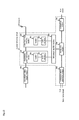
  • FIG. 2 is a diagram showing a first exemplary embodiment of a power detection circuit according to the present invention.
  • the exemplary embodiment is configured by transmission signal output section 100 , power detection circuit 1 according to the present invention, and antenna 110 .
  • Transmission signal output section 100 is an amplifier which outputs to antenna 110 a transmission signal for causing a radio signal to be transmitted from antenna 110 .
  • Power detection circuit 1 detects transmission power of the transmission signal outputted from transmission signal output section 100 to antenna 110 . Further, power detection circuit 1 detects reflection power of a reflection signal reflected from antenna 110 .
  • Antenna 110 transmits, as a radio signal, the transmission signal outputted from transmission signal output section 100 .
  • power detection circuit 1 is configured by transmission power detection section 200 , reflection power detection section 300 , differential amplifier section 400 , integration period generation section 500 , integration section 600 , and comparison section 700 .
  • Transmission power detection section 200 detects transmission power of the transmission signal outputted from transmission signal output section 100 to antenna 110 .
  • transmission power detection section 200 is configured by coupler 201 , detector 202 , and logarithmic amplifier 203 .
  • Coupler 201 is a first directional coupler for branching the transmission signal outputted from transmission signal output section 100 to antenna 110 and for outputting the branched signal to detector 202 .
  • Detector 202 is a first detector for converting to a first DC voltage the transmission power of the transmission signal outputted from coupler 201 . Further, detector 202 outputs the first DC voltage to logarithmic amplifier 203 .
  • Logarithmic amplifier 203 is a first logarithmic amplifier for logarithmically converting the DC voltage outputted from detector 202 to obtain a transmission voltage corresponding to the transmission power. Further, logarithmic amplifier 203 outputs the transmission voltage to differential amplifier section 400 .
  • Reflection power detection section 300 detects reflection power of a reflection signal reflected from antenna 110 .
  • reflection power detection section 300 is configured by coupler 301 , detector 302 , and logarithmic amplifier 303 .
  • Coupler 301 is a second directional coupler for branching the reflection signal reflected from antenna 110 and for outputting the branched signal to detector 302 .
  • Detector 302 is a second detector for converting to a second DC voltage the reflection power of the reflection signal outputted from coupler 301 . Further, detector 302 outputs the second DC voltage to logarithmic amplifier 303 .
  • Logarithmic amplifier 303 is a second logarithmic amplifier for logarithmically converting the second DC voltage outputted from detector 302 to obtain a reflection voltage corresponding to the reflection power. Further, logarithmic amplifier 303 outputs the reflection voltage to differential amplifier section 400 .
  • Differential amplifier section 400 takes the difference between the transmission voltage outputted from logarithmic amplifier 203 and the reflection voltage outputted from logarithmic amplifier 303 , and outputs the difference to integration section 600 .
  • Integration period generation section 500 generates an integration period on the basis of an operation clock and a burst timing signal. The burst timing signal will be described below. Integration period generation section 500 outputs the generated integration period to integration section 600 .
  • Integration section 600 integrates the difference outputted from differential amplifier section 400 during the integration period outputted from integration period generation section 500 . Further, integration section 600 outputs the integration value obtained by the integration to comparison section 700 .
  • Comparison section 700 compares the integration value outputted from integration section 600 with a preset threshold value. Further, when the result of the comparison is that the integration value outputted from integration section 600 is smaller than the preset threshold value, comparison section 700 outputs an alarm (ALM).
  • ALM alarm
  • a transmission signal for causing a radio signal to be transmitted from antenna 110 is amplified to a desired output and outputted by transmission signal output section 100 .
  • the transmission signal outputted from transmission signal output section 100 is branched by coupler 201 . That is, a part of the transmission signal is extracted by coupler 201 .
  • the reflection signal is branched by coupler 301 . That is, a part of the reflection signal is extracted by coupler 301 .
  • the output of the coupling port of coupler 201 is outputted to detector 202 . Further, the output of the coupling port of coupler 301 is outputted to detector 302 .
  • the transmission power outputted from coupler 201 is converted (detected) by detector 202 to a DC voltage.
  • the reflection power outputted from coupler 301 is converted (detected) by detector 302 to a DC voltage.
  • FIG. 3 is a diagram showing the voltage conversion characteristics of detectors 202 and 302 shown in FIG. 2 .
  • the voltage conversion characteristics of detectors 202 and 302 are exponential function characteristics. This is because a diode is usually used in each of detectors 202 and 302 and because the voltage conversion characteristics of detectors 202 and 302 depend on the characteristics of the diode.
  • the DC voltage resulting from the conversion by detector 202 is logarithmically converted by logarithmic amplifier 203 . Further, the DC voltage resulting from the conversion by detector 302 is logarithmically converted by logarithmic amplifier 303 .
  • FIG. 4 is a diagram showing a characteristic of the transmission power (reflection power) logarithmically converted by each of logarithmic amplifier 203 and 303 shown in FIG. 2 with respect to the detection (DC) voltage.
  • the detection voltage exhibits substantially a linear characteristic with respect to the transmission power (reflection power).
  • the difference between the transmission voltage outputted from logarithmic amplifier 203 and the reflection voltage outputted from logarithmic amplifier 303 is calculated by differential amplifier section 400 .
  • an abnormal state in other words, degradation of return loss in the antenna port
  • the reflection voltage is increased.
  • the transmission voltage and the reflection voltage which are respectively proportional to the transmission power and the reflection power, are outputted from logarithmic amplifier 203 and 303 , respectively.
  • the abnormal state degradation of return loss in the antenna port
  • the difference between the transmission voltage and the reflection voltage is calculated, and the difference (voltage) proportional to the return loss of the antenna port is outputted.
  • TDD time division duplex
  • FIG. 5 is a diagram showing temporal changes of the output (power) level of a signal transmitted by using the time division duplex system.
  • the signal transmitted by using the time division duplex system is formed as a burst-type (burst wave) signal. Further, the output (power) level of the signal is changed with time.
  • the burst wave signal includes a preamble signal used to effect the synchronization of a modem of a terminal, and hence the portion corresponding to the preamble signal is configured so that a signal having power of a fixed level or more is surely outputted.
  • the degradation of return loss in the antenna port is not detected in all (time) periods, but the degradation of return loss in the antenna port is detected only in the period of the preamble signal.
  • the output of differential amplifier section 400 is inputted to integration section 600 , while the integration time (integration period) is determined by integration period generation section 500 .
  • FIG. 6 is a diagram showing a state in which an integration period is generated in integration period generation section 500 shown in FIG. 2 .
  • a burst timing signal synchronized with a burst period, and a clock (CLK) are inputted to integration period generation section 500 , so that a control signal (gate signal) with preset integration period (t) is generated by counting the clock pulses from the burst timing signal.
  • integration section 600 an integration value is obtained during a fixed period corresponding to the integration period generated by integration period generation section 500 . That is, an integration value of the difference value between the transmission voltage corresponding to the transmission power and the reflection voltage corresponding to the reflection power is obtained by integration section 600 during the preamble time of the burst wave, and the obtained integration value is outputted from integration section 600 .
  • the integration value outputted from integration section 600 is compared with the preset threshold value (reference value) in comparison section 700 .
  • the result of the comparison is that the integration value is smaller than the reference value (when the difference between transmission voltage and the reflection voltage becomes small, that is, the return loss is degraded)
  • an alarm is outputted from comparison section 700 .
  • the circuit for outputting a signal from transmission signal output section 100 to antenna 110 not only the power in the reflection direction but also the power in the propagation direction are used, and the logarithmic values of the detected voltages of the power in the respective directions are compared with each other, so that an abnormal state of the antenna port can be detected irrespective of the magnitude of the transmission power.
  • This is based on the principle that, since the return loss is degraded in an abnormal state of the antenna port, the return loss can be calculated by obtaining the ratio between the transmission power (voltage) and the reflection power (voltage).
  • FIG. 7 is a diagram showing characteristics in which the detection voltage is varied in an area of small input power.
  • FIG. 8 is a diagram showing characteristics in which the logarithmically amplified detection voltage is varied in an area of small input power.
  • FIG. 9 is a diagram showing temporal changes of an FWD (transmission) voltage, an REV (reflection) voltage, and the difference output between the FWD voltage and the REV voltage in the case where a burst signal is transmitted.
  • the diagram of the upper stage in FIG. 9 is a diagram showing the temporal changes of the FWD (transmission) voltage.
  • the diagram of the middle stage in FIG. 9 is a diagram showing the temporal changes of the REV (reflection) voltage.
  • the diagram of the lower stage in FIG. 9 is a diagram showing the temporal changes of the difference output.
  • FIG. 10 is a diagram showing a relationship between the gate signal and the difference signal during integration period t generated in integration period generation section 500 shown in FIG. 2 .
  • the influence of the variation in the detection voltage is eliminated by determining the integration period by the gate signal generated in integration period generation section 500 .
  • FIG. 11 is a diagram showing a second exemplary embodiment of a power detection circuit according to the present invention.
  • circulator 800 is provided between transmission power detection section 200 and antenna 110 . Further, coupler 301 and terminator 311 are provided in reflection power detection section 310 connected to the side of circulator 800 , which side is seen as an output port side from antenna 110 . The same effect as that of the first exemplary embodiment can be obtained because the reflection signal from antenna 110 can be taken out by coupler 301 .
  • FIG. 12 is a diagram showing a third exemplary embodiment of a power detection circuit according to the present invention.
  • power detection circuit 3 is an example in which, in place of detectors 202 and 302 and logarithmic amplifiers 203 and 303 in the first exemplary embodiment, LOG detectors 221 and 321 having logarithmic characteristics are used in transmission power detection section 220 and reflection power detection section 320 , respectively.
  • Many devices (ICs) having logarithmic characteristics have been used in recent years.
  • the circuit can be simplified by using the devices having logarithmic characteristics.
  • FIG. 13 is a diagram showing a fourth exemplary embodiment of a power detection circuit according to the present invention.
  • power detection circuit 4 is an example in which the processing of logarithmic amplifiers 203 and 303 , differential amplifier section 400 , integration period generation section 500 , and comparison section 700 is realized by using firmware of CPU 900 .
  • the same effect can be obtained as that of the first exemplary embodiment in such a manner that the detection voltages are respectively converted into digital data by AID converters 231 and 331 respectively provided in transmission power detection section 230 and reflection power detection section 330 , so as to be taken in CPU 900 , and thereafter the alarm determination is performed by numerical calculation.
  • the present invention is particularly useful for application to an apparatus, such as a transmission section of a base station used in a WiMAX (Worldwide Interoperability for Microwave Access) system, which uses a time division duplex system and transmits a burst signal.
  • WiMAX Worldwide Interoperability for Microwave Access

Landscapes

  • Engineering & Computer Science (AREA)
  • Computer Networks & Wireless Communication (AREA)
  • Signal Processing (AREA)
  • Transmitters (AREA)
  • Monitoring And Testing Of Transmission In General (AREA)

Abstract

From an antenna provided in a transmitter for transmitting a radio signal, the radio signal is transmitted in such a manner of: detecting transmission power of a transmission signal outputted to the antenna; detecting reflection power of a reflection signal reflected from the antenna; integrating the difference between the transmission power and the reflection power at a timing of transmitting a preamble signal of the radio signal; comparing the difference value obtained by the integration with a predetermined threshold value, and outputting an alarm in the case where the result of the comparison is that the difference value obtained by the integration is smaller than the threshold value.

Description

This application is the National Phase of PCT/JP2009/068766, filed Nov. 2, 2009, which claims the benefit of priority from Japanese Patent Application No. 2008-318516 filed in Japan on Dec. 15, 2008, the entire content of which is hereby incorporated by reference in the application and claims of the present application.
TECHNICAL FIELD
The present invention relates to a power detection circuit, a transmitter, and a power detection method for detecting electric power.
BACKGROUND ART
In a transmitter for transmitting a radio signal from an antenna, in order to detect a case where an abnormality, such as a failure or unconnected state of the antenna occurs in the antenna, a technique has been proposed which measures the reflection power reflected from the antenna and which detects the abnormality on the basis of the magnitude of the measured reflection power (see, for example, Patent Literature 1).
FIG. 1 is a diagram showing one form of a radio apparatus using a common power detection circuit.
The radio apparatus shown in FIG. 1 includes transmission signal output section 1000, power detection circuit 10, and antenna 4000. Transmission signal output section 1000 is an amplifier which outputs to antenna 4000 a transmission signal to cause a radio signal to be transmitted from antenna 4000.
Power detection circuit 10 detects the reflection power of the reflection signal reflected from antenna 4000.
Antenna 4000 transmits, as a radio signal, the transmission signal outputted from transmission signal output section 1000.
Further, power detection circuit 10 is configured by reflection power detection section 3000 and comparison section 7000. Further, reflection power detection section 3000 is configured by coupler 3001 and detector 3002.
Coupler 3001 branches the reflection signal reflected from antenna 4000, so as to output the branched signal to detector 3002.
Detector 3002 converts to a DC voltage the reflection power of the reflection signal outputted from coupler 3001. Further, detector 3002 outputs the converted voltage to comparison section 7000.
Comparison section 7000 compares the voltage outputted from detector 3002 with a preset threshold value. Further, when the comparison result is one in which the voltage outputted from detector 3002 is larger than the preset reference value (threshold value), comparison section 7000 outputs an alarm (ALM).
In the radio apparatus configured in this way, when the return loss (reflection power) from antenna 4000 is increased, the reflection power taken out (branched) by coupler 3001 is increased. The reflection power is detected by detector 3002, and then, in comparison section 7000, the detected reflection power is compared with the reference value to determine whether or not an alarm is to be issued.
Here, the reflection power is proportional to the transmission power of the transmission signal outputted from transmission signal output section 1000. Therefore, when the transmission power is small, it is not possible to determine the abnormality of antenna 4000. In the case where the transmission power is too large, even when the return loss (reflection power) of antenna 4000 is in a normal range, there is a case where, since the absolute value of the reflection power is large, the state of antenna 4000 is determined to be abnormal.
In this way, since an accurate determination cannot be made according to the change in the transmission power, there is a problem that, when the signal level is successively changed as in the case of a burst signal, a correct determination cannot he made.
Thus, in addition to the configuration shown in FIG. 1, a technique has been proposed in which the transmission power transmitted from the amplifier to the antenna is also detected so that the abnormality is detected on the basis of the difference between the detected transmission power and the reflection power (see, for example, Patent Literature 2).
CITATION LIST Patent Literature
  • Patent Literature 1: JP2008-085849A
  • Patent Literature 2: JP2003-525455A
SUMMARY OF INVENTION Technical Problem
However, in the technique described in Patent Literature 2, there is a problem that, when the transmission power and the reflection power are small, the voltage characteristics detected by the diode are varied. In this way, when the detected voltage is varied, an error may be caused in the calculation of return loss (reflection power) so that accurate determination cannot be made.
An object of the present invention is to provide a power detection circuit, a transmitter, and a power detection method for solving the above-described problems.
Solution to Problem
A power detection circuit according to the present invention includes:
a transmission power detection section that detects transmission power of a transmission signal which, in order to cause a radio signal to be transmitted from an antenna provided in a transmitter for transmitting the radio signal, is outputted to the antenna;
a reflection power detection section that detects reflection power of a reflection signal reflected from the antenna;
an integration section that integrates the difference between the transmission power and the reflection power at a timing of transmitting a preamble signal of the radio signal; and
a comparison section that compares the difference value obtained by the integration by the integration section with a predetermined threshold value and that outputs an alarm in the case where the result of the comparison is that the difference value obtained by the integration by the integration section is smaller than the predetermined threshold value.
Further, a transmitter according to the present invention includes:
the power detection circuit;
the antenna; and
a transmission signal output section that outputs a transmission signal to the antenna in order to cause the radio signal to be transmitted from the antenna.
Further, a power detection method according to the present invention includes:
a process that detects transmission power of a transmission signal which, in order to cause a radio signal to be transmitted from an antenna provided in a transmitter for transmitting the radio signal, is outputted to the antenna;
a process that detects reflection power of a reflection signal reflected from the antenna;
a process that integrates the difference between the transmission power and the reflection power at a timing of transmitting a preamble signal of the radio signal;
a process that compares the difference value obtained by the integration with a predetermined threshold value; and
a process that outputs an alarm in the case where the result of the comparison is that the difference value obtained by the integration is smaller than the threshold value.
Advantageous Effects of Invention
As described above, the present invention is configured for: detecting transmission power of a transmission signal which, in order to cause a radio signal to be transmitted from an antenna provided in a transmitter for transmitting the radio signal, is outputted to the antenna; detecting reflection power of a reflection signal reflected from the antenna; integrating the difference between the transmission power and the reflection power at a timing of transmitting a preamble signal of the radio signal; comparing the difference value obtained by the integration with a predetermined threshold value; and outputting an alarm in the case where the result of the comparison is that the difference value obtained by the integration is smaller than the threshold value. Thereby, it is possible to accurately detect an abnormal state of the antenna port irrespective of the magnitude of the transmission power.
BRIEF DESCRIPTION OF DRAWINGS
FIG. 1 is a diagram showing one form of a radio apparatus using a common power detection circuit.
FIG. 2 is a diagram showing a first exemplary embodiment of a power detection circuit according to the present invention.
FIG. 3 is a diagram showing the voltage conversion characteristics of the detector shown in FIG. 2.
FIG. 4 is a diagram showing a characteristic of transmission power (reflection power) logarithmically converted by the logarithmic amplifier shown in FIG. 2 with respect to detection (DC) voltage.
FIG. 5 is a diagram showing temporal changes of the output (power) level of a signal transmitted by using a time division duplex system.
FIG. 6 is a diagram showing a state in which an integration period is generated in the integration period generation section shown in FIG. 2.
FIG. 7 is a diagram showing characteristics in which the detection voltage is varied in an area of small input power.
FIG. 8 is a diagram showing characteristics in which the logarithmically amplified detection voltage is varied in an area of small input power.
FIG. 9 is a diagram showing temporal changes of an FWD (transmission) voltage, an REV (reflection) voltage, and the difference output between the FWD voltage and the REV voltage in the case where a burst signal is transmitted.
FIG. 10 is a diagram showing a relationship between the gate signal and the difference signal during integration period t generated in the integration period generation section shown in FIG. 2.
FIG. 11 is a diagram showing a second exemplary embodiment of a power detection circuit according to the present invention.
FIG. 12 a diagram showing a third exemplary embodiment of a power detection circuit according to the present invention.
FIG. 13 is a diagram showing a fourth exemplary embodiment of a power detection circuit according to the present invention.
DESCRIPTION OF EMBODIMENTS
In the following, exemplary embodiments will be described with reference to the accompanying drawings.
First Exemplary Embodiment
FIG. 2 is a diagram showing a first exemplary embodiment of a power detection circuit according to the present invention.
As shown in FIG. 2, the exemplary embodiment is configured by transmission signal output section 100, power detection circuit 1 according to the present invention, and antenna 110.
Transmission signal output section 100 is an amplifier which outputs to antenna 110 a transmission signal for causing a radio signal to be transmitted from antenna 110.
Power detection circuit 1 detects transmission power of the transmission signal outputted from transmission signal output section 100 to antenna 110. Further, power detection circuit 1 detects reflection power of a reflection signal reflected from antenna 110.
Antenna 110 transmits, as a radio signal, the transmission signal outputted from transmission signal output section 100.
Further, power detection circuit 1 is configured by transmission power detection section 200, reflection power detection section 300, differential amplifier section 400, integration period generation section 500, integration section 600, and comparison section 700.
Transmission power detection section 200 detects transmission power of the transmission signal outputted from transmission signal output section 100 to antenna 110.
Further, transmission power detection section 200 is configured by coupler 201, detector 202, and logarithmic amplifier 203.
Coupler 201 is a first directional coupler for branching the transmission signal outputted from transmission signal output section 100 to antenna 110 and for outputting the branched signal to detector 202.
Detector 202 is a first detector for converting to a first DC voltage the transmission power of the transmission signal outputted from coupler 201. Further, detector 202 outputs the first DC voltage to logarithmic amplifier 203.
Logarithmic amplifier 203 is a first logarithmic amplifier for logarithmically converting the DC voltage outputted from detector 202 to obtain a transmission voltage corresponding to the transmission power. Further, logarithmic amplifier 203 outputs the transmission voltage to differential amplifier section 400.
Reflection power detection section 300 detects reflection power of a reflection signal reflected from antenna 110.
Further, reflection power detection section 300 is configured by coupler 301, detector 302, and logarithmic amplifier 303.
Coupler 301 is a second directional coupler for branching the reflection signal reflected from antenna 110 and for outputting the branched signal to detector 302.
Detector 302 is a second detector for converting to a second DC voltage the reflection power of the reflection signal outputted from coupler 301. Further, detector 302 outputs the second DC voltage to logarithmic amplifier 303.
Logarithmic amplifier 303 is a second logarithmic amplifier for logarithmically converting the second DC voltage outputted from detector 302 to obtain a reflection voltage corresponding to the reflection power. Further, logarithmic amplifier 303 outputs the reflection voltage to differential amplifier section 400.
Differential amplifier section 400 takes the difference between the transmission voltage outputted from logarithmic amplifier 203 and the reflection voltage outputted from logarithmic amplifier 303, and outputs the difference to integration section 600.
Integration period generation section 500 generates an integration period on the basis of an operation clock and a burst timing signal. The burst timing signal will be described below. Integration period generation section 500 outputs the generated integration period to integration section 600.
Integration section 600 integrates the difference outputted from differential amplifier section 400 during the integration period outputted from integration period generation section 500. Further, integration section 600 outputs the integration value obtained by the integration to comparison section 700.
Comparison section 700 compares the integration value outputted from integration section 600 with a preset threshold value. Further, when the result of the comparison is that the integration value outputted from integration section 600 is smaller than the preset threshold value, comparison section 700 outputs an alarm (ALM).
The operation in the configuration shown in FIG. 2 will be described below.
A transmission signal for causing a radio signal to be transmitted from antenna 110 is amplified to a desired output and outputted by transmission signal output section 100.
The transmission signal outputted from transmission signal output section 100 is branched by coupler 201. That is, a part of the transmission signal is extracted by coupler 201.
On the other hand, when mismatching occurs between the output and the antenna, the transmission signal inputted to antenna 110 is reflected by antenna 110, so that a reflection signal is returned toward transmission signal output section 100.
The reflection signal is branched by coupler 301. That is, a part of the reflection signal is extracted by coupler 301.
Thereafter, the output of the coupling port of coupler 201 is outputted to detector 202. Further, the output of the coupling port of coupler 301 is outputted to detector 302.
Then, the transmission power outputted from coupler 201 is converted (detected) by detector 202 to a DC voltage. Further, the reflection power outputted from coupler 301 is converted (detected) by detector 302 to a DC voltage.
Here, the voltage conversion characteristics of detector 202 and 302 are described.
FIG. 3 is a diagram showing the voltage conversion characteristics of detectors 202 and 302 shown in FIG. 2.
As shown in FIG. 3, the voltage conversion characteristics of detectors 202 and 302 are exponential function characteristics. This is because a diode is usually used in each of detectors 202 and 302 and because the voltage conversion characteristics of detectors 202 and 302 depend on the characteristics of the diode.
The DC voltage resulting from the conversion by detector 202 is logarithmically converted by logarithmic amplifier 203. Further, the DC voltage resulting from the conversion by detector 302 is logarithmically converted by logarithmic amplifier 303.
FIG. 4 is a diagram showing a characteristic of the transmission power (reflection power) logarithmically converted by each of logarithmic amplifier 203 and 303 shown in FIG. 2 with respect to the detection (DC) voltage.
As shown in FIG. 4, the detection voltage exhibits substantially a linear characteristic with respect to the transmission power (reflection power).
When the logarithmically converted transmission voltage is outputted from logarithmic amplifier 203, and when the logarithmically converted reflection voltage is outputted from logarithmic amplifier 303, the difference between the transmission voltage outputted from logarithmic amplifier 203 and the reflection voltage outputted from logarithmic amplifier 303 is calculated by differential amplifier section 400. When an abnormal state (in other words, degradation of return loss in the antenna port), such as an unconnected state of antenna 110 and a disconnection state of cable to antenna 110, occurs, the reflection voltage is increased. The transmission voltage and the reflection voltage, which are respectively proportional to the transmission power and the reflection power, are outputted from logarithmic amplifier 203 and 303, respectively. For this reason, when the difference between the transmission voltage and the reflection voltage is calculated, the abnormal state (degradation of return loss in the antenna port) can be detected irrespective of the magnitude of the transmission signal, that is, the magnitude of the transmission power. In differential amplifier section 400, the difference between the transmission voltage and the reflection voltage is calculated, and the difference (voltage) proportional to the return loss of the antenna port is outputted.
Here, a signal transmitted by using a time division duplex (TDD) system is considered.
FIG. 5 is a diagram showing temporal changes of the output (power) level of a signal transmitted by using the time division duplex system.
As shown in FIG. 5, the signal transmitted by using the time division duplex system is formed as a burst-type (burst wave) signal. Further, the output (power) level of the signal is changed with time. The burst wave signal includes a preamble signal used to effect the synchronization of a modem of a terminal, and hence the portion corresponding to the preamble signal is configured so that a signal having power of a fixed level or more is surely outputted.
In the exemplary embodiment, the degradation of return loss in the antenna port is not detected in all (time) periods, but the degradation of return loss in the antenna port is detected only in the period of the preamble signal.
The output of differential amplifier section 400 is inputted to integration section 600, while the integration time (integration period) is determined by integration period generation section 500.
FIG. 6 is a diagram showing a state in which an integration period is generated in integration period generation section 500 shown in FIG. 2.
As shown in FIG. 6, a burst timing signal synchronized with a burst period, and a clock (CLK) are inputted to integration period generation section 500, so that a control signal (gate signal) with preset integration period (t) is generated by counting the clock pulses from the burst timing signal.
In integration section 600, an integration value is obtained during a fixed period corresponding to the integration period generated by integration period generation section 500. That is, an integration value of the difference value between the transmission voltage corresponding to the transmission power and the reflection voltage corresponding to the reflection power is obtained by integration section 600 during the preamble time of the burst wave, and the obtained integration value is outputted from integration section 600.
Then, the integration value outputted from integration section 600 is compared with the preset threshold value (reference value) in comparison section 700. When the result of the comparison is that the integration value is smaller than the reference value (when the difference between transmission voltage and the reflection voltage becomes small, that is, the return loss is degraded), an alarm (ALM) is outputted from comparison section 700.
If, when the alarm (ALM) is outputted, the operation of transmission signal output section 100 is controlled to be turned off, it is possible to prevent transmission signal output section 100 from being damaged when the return loss is degraded, such as when the antenna is not connected.
As described above, in the circuit for outputting a signal from transmission signal output section 100 to antenna 110, not only the power in the reflection direction but also the power in the propagation direction are used, and the logarithmic values of the detected voltages of the power in the respective directions are compared with each other, so that an abnormal state of the antenna port can be detected irrespective of the magnitude of the transmission power. This is based on the principle that, since the return loss is degraded in an abnormal state of the antenna port, the return loss can be calculated by obtaining the ratio between the transmission power (voltage) and the reflection power (voltage).
Further, when the input power is small, the variation of the detection voltage is increased due to the characteristics of the diode.
FIG. 7 is a diagram showing characteristics in which the detection voltage is varied in an area of small input power. FIG. 8 is a diagram showing characteristics in which the logarithmically amplified detection voltage is varied in an area of small input power.
As shown in FIG. 7 and FIG. 8, when the signal is small, the detection voltage is varied, and hence an error may be caused in the calculation of return loss so that an accurate determination cannot be made.
For this reason, in the present invention, an erroneous determination is avoided in such a manner that only the preamble period of the burst signal is used for the determination, and that the small signal portion is not used in the calculation of return loss.
FIG. 9 is a diagram showing temporal changes of an FWD (transmission) voltage, an REV (reflection) voltage, and the difference output between the FWD voltage and the REV voltage in the case where a burst signal is transmitted. The diagram of the upper stage in FIG. 9 is a diagram showing the temporal changes of the FWD (transmission) voltage. Further, the diagram of the middle stage in FIG. 9 is a diagram showing the temporal changes of the REV (reflection) voltage. Further, the diagram of the lower stage in FIG. 9 is a diagram showing the temporal changes of the difference output.
As shown in the diagram of the lower stage in FIG. 9, when the level of the burst signal is low, variations as shown by the broken lines are caused in the difference voltage due to the variation in the detection characteristics.
FIG. 10 is a diagram showing a relationship between the gate signal and the difference signal during integration period t generated in integration period generation section 500 shown in FIG. 2.
As shown in FIG. 10, the influence of the variation in the detection voltage is eliminated by determining the integration period by the gate signal generated in integration period generation section 500.
Second Exemplary Embodiment
FIG. 11 is a diagram showing a second exemplary embodiment of a power detection circuit according to the present invention.
As shown in FIG. 11, in power detection circuit 2 according to the exemplary embodiment, circulator 800 is provided between transmission power detection section 200 and antenna 110. Further, coupler 301 and terminator 311 are provided in reflection power detection section 310 connected to the side of circulator 800, which side is seen as an output port side from antenna 110. The same effect as that of the first exemplary embodiment can be obtained because the reflection signal from antenna 110 can be taken out by coupler 301.
Third Exemplary Embodiment
FIG. 12 is a diagram showing a third exemplary embodiment of a power detection circuit according to the present invention.
As shown in FIG. 12, power detection circuit 3 according to the exemplary embodiment is an example in which, in place of detectors 202 and 302 and logarithmic amplifiers 203 and 303 in the first exemplary embodiment, LOG detectors 221 and 321 having logarithmic characteristics are used in transmission power detection section 220 and reflection power detection section 320, respectively. Many devices (ICs) having logarithmic characteristics have been used in recent years. The circuit can be simplified by using the devices having logarithmic characteristics.
Fourth Exemplary Embodiment
FIG. 13 is a diagram showing a fourth exemplary embodiment of a power detection circuit according to the present invention.
As shown in FIG. 13, power detection circuit 4 according to the exemplary embodiment is an example in which the processing of logarithmic amplifiers 203 and 303, differential amplifier section 400, integration period generation section 500, and comparison section 700 is realized by using firmware of CPU 900. The same effect can be obtained as that of the first exemplary embodiment in such a manner that the detection voltages are respectively converted into digital data by AID converters 231 and 331 respectively provided in transmission power detection section 230 and reflection power detection section 330, so as to be taken in CPU 900, and thereafter the alarm determination is performed by numerical calculation.
Note that the present invention is particularly useful for application to an apparatus, such as a transmission section of a base station used in a WiMAX (Worldwide Interoperability for Microwave Access) system, which uses a time division duplex system and transmits a burst signal.
Although the invention of the present application has been described with reference to exemplary embodiments, the invention of the present application is not limited to the above described exemplary embodiments. The constitution and details of the invention of the present application are open to various modifications within the scope of the invention of the present application that will be clear to anyone of ordinary skill in the art.

Claims (10)

The invention claimed is:
1. A power detection circuit comprising:
a transmission power detection section that detects transmission power of a transmission signal which, in order to cause a radio signal to be transmitted from an antenna provided in a transmitter for transmitting the radio signal, is outputted to the antenna;
a reflection power detection section that detects reflection power of a reflection signal reflected from the antenna;
an integration section that integrates the difference between the transmission power and the reflection power at a timing of transmitting a preamble signal of the radio signal; and
a comparison section that compares the difference value obtained by the integration performed by the integration section with a predetermined threshold value and that outputs an alarm in the case where the result of the comparison is that the difference value obtained by the integration performed by the integration section is smaller than the predetermined threshold value.
2. The power detection circuit according to claim 1, further comprising
a differential amplifier section that outputs the difference between the transmission power and the reflection power,
wherein the integration section integrates the difference outputted by the differential amplifier section.
3. The power detection circuit according to claim 2,
wherein the transmission power detection section comprises a first directional coupler that branches the transmission signal outputted to the antenna, and
wherein the reflection power detection section comprises a second directional coupler that branches the reflection signal reflected from the antenna.
4. The power detection circuit according to claim 3,
wherein the transmission power detection section further comprises a first detector that converts to a first DC voltage the transmission power of the transmission signal branched by the first directional coupler,
wherein the reflection power detection section further comprises a second detector that converts to a second DC voltage the reflection power of the reflection signal branched by the second directional coupler, and
wherein the differential amplifier section outputs the difference between the first DC voltage and the second DC voltage.
5. The power detection circuit according to claim 4,
wherein the transmission power detection section further comprises a first logarithmic amplifier that logarithmically converts the first DC voltage,
wherein the reflection power detection section further comprises a second logarithmic amplifier that logarithmically converts the second DC voltage, and
wherein the differential amplifier section outputs the difference between the first DC voltage logarithmically converted by the first logarithmic amplifier and the second DC voltage logarithmically converted by the second logarithmic amplifier.
6. A transmitter comprising:
the power detection circuit according to claims 1;
the antenna; and
a transmission signal output section that outputs to the antenna a transmission signal for causing the radio signal to be transmitted from the antenna.
7. The transmitter according to claim 6, configured to transmit, as the radio signal, a burst-type signal using a time division duplex system.
8. The transmitter according to claim 6, configured to be used in a WiMAX (Worldwide Interoperability for Microwave Access) system.
9. A power detection method comprising:
a process that detects transmission power of a transmission signal which, in order to cause a radio signal to be transmitted from an antenna provided in a transmitter for transmitting the radio signal, is outputted to the antenna;
a process that detects reflection power of a reflection signal reflected from the antenna;
a process that integrates the difference between the transmission power and the reflection power at a timing of transmitting a preamble signal of the radio signal;
a process that compares the difference value obtained by the integration with a predetermined threshold value; and
a process that outputs an alarm in the case where the result of the comparison is that the difference value obtained by the integration is smaller than the threshold value.
10. The power detection method according to claim 9, further comprising:
a process that branches the transmission signal;
a process that converts the transmission power of the branched transmission signal to a first DC voltage;
a process that logarithmically converts the first DC voltage;
a process that branches the reflection signal;
a process that converts the reflection power of the branched reflection signal to a second DC voltage;
a process that logarithmically converts the second DC voltage; and
a process that integrates the difference between the logarithmically converted first DC voltage and the logarithmically converted second DC voltage at the timing.
US13/124,674 2008-12-15 2009-11-02 Power detection circuit, transmitter, and power detection method Expired - Fee Related US8620225B2 (en)

Applications Claiming Priority (3)

Application Number Priority Date Filing Date Title
JP2008-318516 2008-12-15
JP2008318516 2008-12-15
PCT/JP2009/068766 WO2010070985A1 (en) 2008-12-15 2009-11-02 Power detection circuit, transmitter, and power detection method

Publications (2)

Publication Number Publication Date
US20110237291A1 US20110237291A1 (en) 2011-09-29
US8620225B2 true US8620225B2 (en) 2013-12-31

Family

ID=42268661

Family Applications (1)

Application Number Title Priority Date Filing Date
US13/124,674 Expired - Fee Related US8620225B2 (en) 2008-12-15 2009-11-02 Power detection circuit, transmitter, and power detection method

Country Status (4)

Country Link
US (1) US8620225B2 (en)
JP (1) JP5003824B2 (en)
CN (1) CN102246419B (en)
WO (1) WO2010070985A1 (en)

Families Citing this family (13)

* Cited by examiner, † Cited by third party
Publication number Priority date Publication date Assignee Title
US8762520B2 (en) * 2010-07-02 2014-06-24 At&T Intellectual Property I, L.P. Method and system to detect a predictive network signature
DE102013110801B4 (en) * 2013-09-30 2025-07-03 Intel Corporation Device and method for determining information about a radiated power of a transmission signal
JP5850581B2 (en) * 2013-11-29 2016-02-03 株式会社京三製作所 Plasma non-ignition state discrimination device and plasma non-ignition discrimination method
CN106353591B (en) * 2016-10-21 2023-05-16 成都前锋电子仪器有限责任公司 Average burst power measuring circuit
CN108075844A (en) * 2016-11-17 2018-05-25 中兴通讯股份有限公司 Radio frequency reflection ripple detection device, wireless telecommunication system and antenna condition detection method
JP6739362B2 (en) * 2017-01-18 2020-08-12 アイホン株式会社 Wireless power transmission system and wireless intercom system
CN109217949B (en) * 2017-06-29 2022-08-16 广州极飞科技股份有限公司 Wireless communication device and unmanned vehicles
CN109257023B (en) * 2018-08-24 2022-10-14 中国电子科技集团公司第三十六研究所 Power amplifier protection circuit and method
US11385267B2 (en) * 2019-02-14 2022-07-12 Psemi Corporation Power detector with wide dynamic range
CN110446247B (en) * 2019-07-04 2022-11-25 维沃移动通信有限公司 Signal control circuit, method and terminal equipment
DE102021110345A1 (en) * 2021-04-22 2022-10-27 Hirschmann Car Communication Gmbh Method for determining a connection status between an antenna amplifier and an antenna structure, diagnostic module and antenna amplifier
JP7434255B2 (en) 2021-11-17 2024-02-20 本田技研工業株式会社 Energy storage management system
CN114814720B (en) * 2022-06-20 2022-09-30 成都市克莱微波科技有限公司 Microwave direction finding device, system, method and storage medium

Citations (17)

* Cited by examiner, † Cited by third party
Publication number Priority date Publication date Assignee Title
JPH1051252A (en) 1996-07-31 1998-02-20 Kokusai Electric Co Ltd Radio and gain control circuit for radio
JPH10224314A (en) 1997-02-10 1998-08-21 Saitama Nippon Denki Kk Fault detection system
US20010039198A1 (en) 2000-03-22 2001-11-08 Teruo Onishi Mobile radio communications apparatus and base station thereof, and method of antenna selection
JP2002152060A (en) 2000-11-10 2002-05-24 Fujitsu Ten Ltd Transmission power control circuit in wireless transmitter
CN1374760A (en) 2001-03-02 2002-10-16 株式会社东芝 Radio apparatus and gain control circuit
US20030076168A1 (en) * 2001-10-22 2003-04-24 Tim Forrester Systems and methods for controlling output power in a communication device
JP2003525455A (en) 2000-03-02 2003-08-26 サーノフ コーポレイション Method and apparatus for measuring true transmitted power using a broadband dual directional coupler
US20050026573A1 (en) * 2003-07-30 2005-02-03 Lg Electronics Inc. Transmitting apparatus and method of mobile communication terminal
US20050042989A1 (en) * 2003-08-22 2005-02-24 Benq Corporation Device and method for antenna matching
US20050159119A1 (en) * 2004-01-21 2005-07-21 Matsushita Electric Industrial Co., Ltd. Reflected power suppression circuit
WO2005117309A1 (en) 2004-05-25 2005-12-08 Nec Corporation Transmitter load impedance faulty detecting system
JP2006166153A (en) 2004-12-09 2006-06-22 Matsushita Electric Ind Co Ltd High frequency power transmission circuit and wireless communication apparatus using the same
JP2006333023A (en) 2005-05-26 2006-12-07 Matsushita Electric Ind Co Ltd High frequency power transmission circuit
JP2007251333A (en) 2006-03-14 2007-09-27 Hitachi Communication Technologies Ltd Wireless communication device
JP2008085849A (en) 2006-09-28 2008-04-10 Hitachi Kokusai Electric Inc Wireless terminal device
JP2008147934A (en) 2006-12-08 2008-06-26 Hitachi Kokusai Electric Inc TDD wireless transmitter / receiver
JP2008193719A (en) 2008-03-17 2008-08-21 Hitachi Kokusai Electric Inc Wireless transmission device

Family Cites Families (1)

* Cited by examiner, † Cited by third party
Publication number Priority date Publication date Assignee Title
JP2006217200A (en) * 2005-02-03 2006-08-17 Canon Inc Wireless communication device

Patent Citations (21)

* Cited by examiner, † Cited by third party
Publication number Priority date Publication date Assignee Title
JPH1051252A (en) 1996-07-31 1998-02-20 Kokusai Electric Co Ltd Radio and gain control circuit for radio
JPH10224314A (en) 1997-02-10 1998-08-21 Saitama Nippon Denki Kk Fault detection system
JP2003525455A (en) 2000-03-02 2003-08-26 サーノフ コーポレイション Method and apparatus for measuring true transmitted power using a broadband dual directional coupler
US20010039198A1 (en) 2000-03-22 2001-11-08 Teruo Onishi Mobile radio communications apparatus and base station thereof, and method of antenna selection
JP2003528533A (en) 2000-03-22 2003-09-24 テレフオンアクチーボラゲット エル エム エリクソン(パブル) Mobile radio communication device, base station thereof, and antenna selection method
JP2002152060A (en) 2000-11-10 2002-05-24 Fujitsu Ten Ltd Transmission power control circuit in wireless transmitter
US20060003716A1 (en) 2001-03-02 2006-01-05 Mikio Hayashihara Radio communication terminal and gain control circuit for the same
CN1374760A (en) 2001-03-02 2002-10-16 株式会社东芝 Radio apparatus and gain control circuit
US20030076168A1 (en) * 2001-10-22 2003-04-24 Tim Forrester Systems and methods for controlling output power in a communication device
US20050026573A1 (en) * 2003-07-30 2005-02-03 Lg Electronics Inc. Transmitting apparatus and method of mobile communication terminal
US20050042989A1 (en) * 2003-08-22 2005-02-24 Benq Corporation Device and method for antenna matching
US20050159119A1 (en) * 2004-01-21 2005-07-21 Matsushita Electric Industrial Co., Ltd. Reflected power suppression circuit
WO2005117309A1 (en) 2004-05-25 2005-12-08 Nec Corporation Transmitter load impedance faulty detecting system
CN1957550A (en) 2004-05-25 2007-05-02 日本电气株式会社 Transmitter load impedance faulty detecting system
US20070222629A1 (en) 2004-05-25 2007-09-27 Yuzo Yoneyama Load Impedance Defection System for Transmitter
JP2006166153A (en) 2004-12-09 2006-06-22 Matsushita Electric Ind Co Ltd High frequency power transmission circuit and wireless communication apparatus using the same
JP2006333023A (en) 2005-05-26 2006-12-07 Matsushita Electric Ind Co Ltd High frequency power transmission circuit
JP2007251333A (en) 2006-03-14 2007-09-27 Hitachi Communication Technologies Ltd Wireless communication device
JP2008085849A (en) 2006-09-28 2008-04-10 Hitachi Kokusai Electric Inc Wireless terminal device
JP2008147934A (en) 2006-12-08 2008-06-26 Hitachi Kokusai Electric Inc TDD wireless transmitter / receiver
JP2008193719A (en) 2008-03-17 2008-08-21 Hitachi Kokusai Electric Inc Wireless transmission device

Non-Patent Citations (2)

* Cited by examiner, † Cited by third party
Title
Chinese Office Action for CN Application No. 200980149106.5 issued on May 29, 2013 with English Translation.
International Search Report for PCT/JP2009/068766 mailed Dec. 8, 2009.

Also Published As

Publication number Publication date
CN102246419A (en) 2011-11-16
JP5003824B2 (en) 2012-08-15
JPWO2010070985A1 (en) 2012-05-24
WO2010070985A1 (en) 2010-06-24
US20110237291A1 (en) 2011-09-29
CN102246419B (en) 2014-03-19

Similar Documents

Publication Publication Date Title
US8620225B2 (en) Power detection circuit, transmitter, and power detection method
US10819446B2 (en) Radar transmitting power and channel performance monitoring apparatus
CN101447813A (en) An antenna self calibration method and circuit of TD-SCDMA radio remote unit
US6226496B1 (en) Antenna malfunction detecting system
JP2010230413A (en) Transceiver module fault isolation self-diagnosis system
US20220393647A1 (en) Power detector device and method of calibrating detection power range
CN109031048B (en) A fault location system and method based on fiber grating current sensor
US8354848B2 (en) Obstacle detecting system and obstacle detecting device
US20120282865A1 (en) Signal transceiving module
JP5189483B2 (en) Wireless device
US12487263B2 (en) UWB antenna and BLE antenna performance test system
US9560541B2 (en) Wireless transmission device, VSWR determination device, and VSWR determination method
US9584230B2 (en) Technique for monitoring and managing output power
US11394101B2 (en) Method and device for calibrating a hybrid coupler
US12308868B2 (en) Amplifier circuit
CN113517867A (en) Microwave amplifier output power detection system, detection chip and detection method
CN116366177A (en) Antenna feeder system state monitoring method, device and antenna feeder system
US20210167862A1 (en) Optical module and optical communication system
KR100820165B1 (en) PIM signal monitoring system and PIM signal monitoring method using the same
CN111030648B (en) Symmetrical double-channel signal peak-to-peak value detection circuit
KR101028205B1 (en) RDF Transceiver
JP5389983B2 (en) Base station equipment
KR100894454B1 (en) Carrier signal monitoring method in TD system
JP2024004916A (en) wireless communication device
JP2006238071A (en) Antenna connection detection circuit

Legal Events

Date Code Title Description
AS Assignment

Owner name: NEC CORPORATION, JAPAN

Free format text: ASSIGNMENT OF ASSIGNORS INTEREST;ASSIGNOR:KIRISAWA, AKIHIRO;REEL/FRAME:026185/0623

Effective date: 20110419

STCF Information on status: patent grant

Free format text: PATENTED CASE

FPAY Fee payment

Year of fee payment: 4

FEPP Fee payment procedure

Free format text: MAINTENANCE FEE REMINDER MAILED (ORIGINAL EVENT CODE: REM.); ENTITY STATUS OF PATENT OWNER: LARGE ENTITY

LAPS Lapse for failure to pay maintenance fees

Free format text: PATENT EXPIRED FOR FAILURE TO PAY MAINTENANCE FEES (ORIGINAL EVENT CODE: EXP.); ENTITY STATUS OF PATENT OWNER: LARGE ENTITY

STCH Information on status: patent discontinuation

Free format text: PATENT EXPIRED DUE TO NONPAYMENT OF MAINTENANCE FEES UNDER 37 CFR 1.362

FP Lapsed due to failure to pay maintenance fee

Effective date: 20211231