US8618298B2 - Perylene tetracarboximide derivatives for photovoltaic devices - Google Patents
Perylene tetracarboximide derivatives for photovoltaic devices Download PDFInfo
- Publication number
- US8618298B2 US8618298B2 US13/055,939 US200913055939A US8618298B2 US 8618298 B2 US8618298 B2 US 8618298B2 US 200913055939 A US200913055939 A US 200913055939A US 8618298 B2 US8618298 B2 US 8618298B2
- Authority
- US
- United States
- Prior art keywords
- mmol
- perylene
- reaction mixture
- branched
- straight
- Prior art date
- Legal status (The legal status is an assumption and is not a legal conclusion. Google has not performed a legal analysis and makes no representation as to the accuracy of the status listed.)
- Expired - Fee Related, expires
Links
- 0 CC.CC.CC.CC.[1*]C1=CC=C(CC2=CC=C(C3=C4C5=CC=C6C(=O)N([2*])C(=O)/C7=C/C=C(C5=C67)/C5=C/C=C6/C(=O)N([3*])C(=O)C(=C3[7*])C6=C45)S2)S1.[4*]C.[8*]*C Chemical compound CC.CC.CC.CC.[1*]C1=CC=C(CC2=CC=C(C3=C4C5=CC=C6C(=O)N([2*])C(=O)/C7=C/C=C(C5=C67)/C5=C/C=C6/C(=O)N([3*])C(=O)C(=C3[7*])C6=C45)S2)S1.[4*]C.[8*]*C 0.000 description 11
- XMBQRSATKZYLMJ-MXUWARNBSA-N C.O=C=O.[C-]#[N+]/C(C)=C(\C)C#N.[C-]#[N+]/C(C)=C\C.[H]/C(C)=C\C Chemical compound C.O=C=O.[C-]#[N+]/C(C)=C(\C)C#N.[C-]#[N+]/C(C)=C\C.[H]/C(C)=C\C XMBQRSATKZYLMJ-MXUWARNBSA-N 0.000 description 2
- WIYVADFXKKQLKU-UHFFFAOYSA-N CC.COC(=O)C1=CC=CC=C1 Chemical compound CC.COC(=O)C1=CC=CC=C1 WIYVADFXKKQLKU-UHFFFAOYSA-N 0.000 description 2
- AGOWWMBMNBOOGB-UHFFFAOYSA-N CC1(C)OB(C2=CC=C(C3=CC=CS3)S2)OC1(C)C.CCCCCCCCCCCCOC1=CC(OCCCCCCCCCCCC)=CC(C(=O)OCCCCCCCC2=CC3=C4C5=C2C2=C6C7=C(C=C2)C(=O)N(C2=C(C(C)C)C=CC=C2C(C)C)C(=O)/C7=C/C(C2=CC=C(C7=CC=C(Br)S7)S2)=C6/C5=C/C=C\4C(=O)N(C2=C(C(C)C)C=CC=C2C(C)C)C3=O)=C1.CCCCCCCCCCCCOC1=CC(OCCCCCCCCCCCC)=CC(C(=O)OCCCCCCCC2=CC3=C4C5=C2C2=C6C7=C(C=C2)C(=O)N(C2=C(C(C)C)C=CC=C2C(C)C)C(=O)/C7=C/C(C2=CC=C(C7=CC=C(C8=CC=C(C9=CC=CS9)S8)S7)S2)=C6/C5=C/C=C\4C(=O)N(C2=C(C(C)C)C=CC=C2C(C)C)C3=O)=C1 Chemical compound CC1(C)OB(C2=CC=C(C3=CC=CS3)S2)OC1(C)C.CCCCCCCCCCCCOC1=CC(OCCCCCCCCCCCC)=CC(C(=O)OCCCCCCCC2=CC3=C4C5=C2C2=C6C7=C(C=C2)C(=O)N(C2=C(C(C)C)C=CC=C2C(C)C)C(=O)/C7=C/C(C2=CC=C(C7=CC=C(Br)S7)S2)=C6/C5=C/C=C\4C(=O)N(C2=C(C(C)C)C=CC=C2C(C)C)C3=O)=C1.CCCCCCCCCCCCOC1=CC(OCCCCCCCCCCCC)=CC(C(=O)OCCCCCCCC2=CC3=C4C5=C2C2=C6C7=C(C=C2)C(=O)N(C2=C(C(C)C)C=CC=C2C(C)C)C(=O)/C7=C/C(C2=CC=C(C7=CC=C(C8=CC=C(C9=CC=CS9)S8)S7)S2)=C6/C5=C/C=C\4C(=O)N(C2=C(C(C)C)C=CC=C2C(C)C)C3=O)=C1 AGOWWMBMNBOOGB-UHFFFAOYSA-N 0.000 description 2
- JVXLQDVFXBDALM-UHFFFAOYSA-N CCCCCCCCCCCCOC1=CC(C)=CC(C(=O)OCCCCCCNC2=C3C4=C5C(=CC=C4C4=C(C6=CC=C(CCCCCC)S6)C=C6C(=O)N(C7=C(C(C)C)C=CC=C7C(C)C)C(=O)/C7=C/C=C/3C4=C67)C(=O)N(C3=C(C(C)C)C=CC=C3C(C)C)C(=O)\C5=C\2)=C1 Chemical compound CCCCCCCCCCCCOC1=CC(C)=CC(C(=O)OCCCCCCNC2=C3C4=C5C(=CC=C4C4=C(C6=CC=C(CCCCCC)S6)C=C6C(=O)N(C7=C(C(C)C)C=CC=C7C(C)C)C(=O)/C7=C/C=C/3C4=C67)C(=O)N(C3=C(C(C)C)C=CC=C3C(C)C)C(=O)\C5=C\2)=C1 JVXLQDVFXBDALM-UHFFFAOYSA-N 0.000 description 2
- BZNLPXMEYUTITK-UHFFFAOYSA-N B.C.CC(C)C1=CC=CC(C(C)C)=C1N1C(=O)C2=C3C4=C(C=C2)C2=C5C6=C(C=C2)C(=O)N(C2=C(C(C)C)C=CC=C2C(C)C)C(=O)/C6=C/C(Br)=C5/C4=C/C=C\3C1=O.CC(C)C1=CC=CC(C(C)C)=C1N1C(=O)C2=C3C4=C(C=C2)C2=C5C6=C(C=C2)C(=O)N(C2=C(C(C)C)C=CC=C2C(C)C)C(=O)/C6=C/C(C2=CC=C(C6=CC=CS6)S2)=C5/C4=C/C=C\3C1=O.CC1(C)OB(C2=CC=C(C3=CC=CS3)S2)OC1(C)C.CCCCCCCCCCCCOC1=CC(OCCCCCCCCCCCC)=CC(C(=O)OCCCCCC)=C1.CCCCCCCCCCCCOC1=CC(OCCCCCCCCCCCC)=CC(C(=O)OCCCCCC)=C1.C[K].N.N.O=C([K])OO Chemical compound B.C.CC(C)C1=CC=CC(C(C)C)=C1N1C(=O)C2=C3C4=C(C=C2)C2=C5C6=C(C=C2)C(=O)N(C2=C(C(C)C)C=CC=C2C(C)C)C(=O)/C6=C/C(Br)=C5/C4=C/C=C\3C1=O.CC(C)C1=CC=CC(C(C)C)=C1N1C(=O)C2=C3C4=C(C=C2)C2=C5C6=C(C=C2)C(=O)N(C2=C(C(C)C)C=CC=C2C(C)C)C(=O)/C6=C/C(C2=CC=C(C6=CC=CS6)S2)=C5/C4=C/C=C\3C1=O.CC1(C)OB(C2=CC=C(C3=CC=CS3)S2)OC1(C)C.CCCCCCCCCCCCOC1=CC(OCCCCCCCCCCCC)=CC(C(=O)OCCCCCC)=C1.CCCCCCCCCCCCOC1=CC(OCCCCCCCCCCCC)=CC(C(=O)OCCCCCC)=C1.C[K].N.N.O=C([K])OO BZNLPXMEYUTITK-UHFFFAOYSA-N 0.000 description 1
- BJFRTYDMPYPUKZ-UHFFFAOYSA-N BrC1=CC=CS1.BrC1=CC=CS1.C1=CSC(C2=CC=CS2)=C1 Chemical compound BrC1=CC=CS1.BrC1=CC=CS1.C1=CSC(C2=CC=CS2)=C1 BJFRTYDMPYPUKZ-UHFFFAOYSA-N 0.000 description 1
- PAASGPNJSJZVPZ-UHFFFAOYSA-N BrC1=CC=CS1.C1CCOC1.CCCCCCC1=CC=C(B2OC(C)(C)C(C)(C)O2)S1.CCCCCCC1=CC=C(C2=CC=CS2)S1 Chemical compound BrC1=CC=CS1.C1CCOC1.CCCCCCC1=CC=C(B2OC(C)(C)C(C)(C)O2)S1.CCCCCCC1=CC=C(C2=CC=CS2)S1 PAASGPNJSJZVPZ-UHFFFAOYSA-N 0.000 description 1
- URTMVYVOSFNEQH-UHFFFAOYSA-N BrC1=CC=CS1.OB(O)C1=CC=CS1 Chemical compound BrC1=CC=CS1.OB(O)C1=CC=CS1 URTMVYVOSFNEQH-UHFFFAOYSA-N 0.000 description 1
- UTYHXLSYKDXKLO-UHFFFAOYSA-N C.CC(C)C1=CC=CC(C(C)C)=C1N1C(=O)C2=C3C4=C(C(NCCCCCCO)=C2)C2=C5C6=C(C=C2)C(=O)N(C2=C(C(C)C)C=CC=C2C(C)C)C(=O)/C6=C/C(Br)=C5/C4=C/C=C\3C1=O.CCCCCCCCCCCCOC1=CC(C)=CC(C(=O)O)=C1.CCCCCCCCCCCCOC1=CC(OCCCCCCCCCCCC)=CC(C(=O)OCCCCCCNC2=CC3=C4C5=C2C2=C6C7=C(C=C2)C(=O)N(C2=C(C(C)C)C=CC=C2C(C)C)C(=O)/C7=C/C(Br)=C6/C5=C/C=C\4C(=O)N(C2=C(C(C)C)C=CC=C2C(C)C)C3=O)=C1 Chemical compound C.CC(C)C1=CC=CC(C(C)C)=C1N1C(=O)C2=C3C4=C(C(NCCCCCCO)=C2)C2=C5C6=C(C=C2)C(=O)N(C2=C(C(C)C)C=CC=C2C(C)C)C(=O)/C6=C/C(Br)=C5/C4=C/C=C\3C1=O.CCCCCCCCCCCCOC1=CC(C)=CC(C(=O)O)=C1.CCCCCCCCCCCCOC1=CC(OCCCCCCCCCCCC)=CC(C(=O)OCCCCCCNC2=CC3=C4C5=C2C2=C6C7=C(C=C2)C(=O)N(C2=C(C(C)C)C=CC=C2C(C)C)C(=O)/C7=C/C(Br)=C6/C5=C/C=C\4C(=O)N(C2=C(C(C)C)C=CC=C2C(C)C)C3=O)=C1 UTYHXLSYKDXKLO-UHFFFAOYSA-N 0.000 description 1
- MGJFUXAVDVETSA-UHFFFAOYSA-N C.CCCCCCCCCCCCBr.CCCCCCCCCCCCOC1=CC(C)=CC(C(=O)OC)=C1.COC(=O)C1=CC(O)=CC(O)=C1 Chemical compound C.CCCCCCCCCCCCBr.CCCCCCCCCCCCOC1=CC(C)=CC(C(=O)OC)=C1.COC(=O)C1=CC(O)=CC(O)=C1 MGJFUXAVDVETSA-UHFFFAOYSA-N 0.000 description 1
- HTYYBNOHBLRKNN-UHFFFAOYSA-N C.CO.COC(=O)C1=CC(O)=CC(O)=C1.O=C(O)C1=CC(O)=CC(O)=C1.O=S(=O)(O)O Chemical compound C.CO.COC(=O)C1=CC(O)=CC(O)=C1.O=C(O)C1=CC(O)=CC(O)=C1.O=S(=O)(O)O HTYYBNOHBLRKNN-UHFFFAOYSA-N 0.000 description 1
- JPBDPOFOCJPZMQ-UHFFFAOYSA-N C1=CSC(C2=CC=CS2)=C1.CC(C)OB1CC(C)(C)C(C)(C)O1.CC1(C)OB(C2=CC=C(C3=CC=CS3)S2)OC1(C)C Chemical compound C1=CSC(C2=CC=CS2)=C1.CC(C)OB1CC(C)(C)C(C)(C)O1.CC1(C)OB(C2=CC=C(C3=CC=CS3)S2)OC1(C)C JPBDPOFOCJPZMQ-UHFFFAOYSA-N 0.000 description 1
- PRCMFLQTTKVUOI-UHFFFAOYSA-N C1=CSC=C1.C1CCOC1.CCCCCCBr.CCCCCCC1=CC=CS1.[Li]CCCC Chemical compound C1=CSC=C1.C1CCOC1.CCCCCCBr.CCCCCCC1=CC=CS1.[Li]CCCC PRCMFLQTTKVUOI-UHFFFAOYSA-N 0.000 description 1
- FKJZOYPYAFQEEV-UHFFFAOYSA-N C1CCOC1.CC(C)B1OC(C)(C)C(C)(C)O1.CCCCCCC1=CC=C(C2=CC=C(B3OC(C)(C)C(C)(C)O3)S2)S1.CCCCCCC1=CC=C(C2=CC=CS2)S1 Chemical compound C1CCOC1.CC(C)B1OC(C)(C)C(C)(C)O1.CCCCCCC1=CC=C(C2=CC=C(B3OC(C)(C)C(C)(C)O3)S2)S1.CCCCCCC1=CC=C(C2=CC=CS2)S1 FKJZOYPYAFQEEV-UHFFFAOYSA-N 0.000 description 1
- QUGOCZBQXBECBS-UHFFFAOYSA-N C1CCOC1.CC(C)OB1OC(C)(C)C(C)(C)O1.CCCCCCC1=CC=C(B2OC(C)(C)C(C)(C)O2)S1.[CH2+]CCCCCC1=CC=CS1.[Li]CCCC Chemical compound C1CCOC1.CC(C)OB1OC(C)(C)C(C)(C)O1.CCCCCCC1=CC=C(B2OC(C)(C)C(C)(C)O2)S1.[CH2+]CCCCCC1=CC=CS1.[Li]CCCC QUGOCZBQXBECBS-UHFFFAOYSA-N 0.000 description 1
- NBNHASJOHBIQCG-UHFFFAOYSA-N C1CCOC1.CC(C)OB1OC(C)(C)C(C)(C)O1.CCCCCCC1=CC=C(C2=CC=C(C3=CC=C(B4OC(C)(C)C(C)(C)O4)S3)S2)S1.CCCCCCC1=CC=C(C2=CC=C(C3=CC=CS3)S2)S1.[Li]CCCC Chemical compound C1CCOC1.CC(C)OB1OC(C)(C)C(C)(C)O1.CCCCCCC1=CC=C(C2=CC=C(C3=CC=C(B4OC(C)(C)C(C)(C)O4)S3)S2)S1.CCCCCCC1=CC=C(C2=CC=C(C3=CC=CS3)S2)S1.[Li]CCCC NBNHASJOHBIQCG-UHFFFAOYSA-N 0.000 description 1
- DDRNWZOWMFPNMK-UHFFFAOYSA-N C1CCOC1.CC1(C)OB(C2=CC=C(C3=CC=CS3)S2)OC1(C)C.CCCCCCC1=CC=C(Br)S1.CCCCCCC1=CC=C(C2=CC=C(C3=CC=CS3)S2)S1 Chemical compound C1CCOC1.CC1(C)OB(C2=CC=C(C3=CC=CS3)S2)OC1(C)C.CCCCCCC1=CC=C(Br)S1.CCCCCCC1=CC=C(C2=CC=C(C3=CC=CS3)S2)S1 DDRNWZOWMFPNMK-UHFFFAOYSA-N 0.000 description 1
- KZCOGRQSKUDXMI-UHFFFAOYSA-N CC(C)C1=CC=CC(C(C)C)=C1N.CC(C)C1=CC=CC(C(C)C)=C1N1C(=O)C2=C3C4=C(C(Br)=C2)C2=C5C6=C(C=C2)C(=O)N(C2=C(C(C)C)C=CC=C2C(C)C)C(=O)/C6=C/C(Br)=C5/C4=C/C=C\3C1=O.O=C1OC(=O)/C2=C/C=C3\C4=C(C(Br)=CC1=C42)C1=C2C4=C(C=C1)C(=O)OC(=O)/C4=C\C(Br)=C\23 Chemical compound CC(C)C1=CC=CC(C(C)C)=C1N.CC(C)C1=CC=CC(C(C)C)=C1N1C(=O)C2=C3C4=C(C(Br)=C2)C2=C5C6=C(C=C2)C(=O)N(C2=C(C(C)C)C=CC=C2C(C)C)C(=O)/C6=C/C(Br)=C5/C4=C/C=C\3C1=O.O=C1OC(=O)/C2=C/C=C3\C4=C(C(Br)=CC1=C42)C1=C2C4=C(C=C1)C(=O)OC(=O)/C4=C\C(Br)=C\23 KZCOGRQSKUDXMI-UHFFFAOYSA-N 0.000 description 1
- LFJFTGZXJUBQOM-UHFFFAOYSA-N CC(C)C1=CC=CC(C(C)C)=C1N1C(=O)C2=CC(Br)=C3C4=CC=C5C(=O)N(C6=C(C(C)C)C=CC=C6C(C)C)C(=O)/C6=C/C(Br)=C(C4=C56)/C4=C/C=C(/C1=O)C2=C34.CC(C)C1=CC=CC(C(C)C)=C1N1C(=O)C2=CC(NCCCCCCO)=C3C4=CC=C5C(=O)N(C6=C(C(C)C)C=CC=C6C(C)C)C(=O)/C6=C/C(Br)=C(C4=C56)/C4=C/C=C(/C1=O)C2=C34 Chemical compound CC(C)C1=CC=CC(C(C)C)=C1N1C(=O)C2=CC(Br)=C3C4=CC=C5C(=O)N(C6=C(C(C)C)C=CC=C6C(C)C)C(=O)/C6=C/C(Br)=C(C4=C56)/C4=C/C=C(/C1=O)C2=C34.CC(C)C1=CC=CC(C(C)C)=C1N1C(=O)C2=CC(NCCCCCCO)=C3C4=CC=C5C(=O)N(C6=C(C(C)C)C=CC=C6C(C)C)C(=O)/C6=C/C(Br)=C(C4=C56)/C4=C/C=C(/C1=O)C2=C34 LFJFTGZXJUBQOM-UHFFFAOYSA-N 0.000 description 1
- VJPVMOQVSIARHR-UHFFFAOYSA-N CC1(C)OB(C2=CC=C(C3=CC=C(C4=CC=CS4)S3)S2)OC1(C)C.CCCCCCCCCCCCOC1=CC(OCCCCCCCCCCCC)=CC(C(=O)OCCCCCCCC2=CC3=C4C5=C2C2=C6C7=C(C=C2)C(=O)N(C2=C(C(C)C)C=CC=C2C(C)C)C(=O)/C7=C/C(C2=CC=C(C7=CC=C(C8=CC=C(Br)S8)S7)S2)=C6/C5=C/C=C\4C(=O)N(C2=C(C(C)C)C=CC=C2C(C)C)C3=O)=C1.CCCCCCCCCCCCOC1=CC(OCCCCCCCCCCCC)=CC(C(=O)OCCCCCCCC2=CC3=C4C5=C2C2=C6C7=C(C=C2)C(=O)N(C2=C(C(C)C)C=CC=C2C(C)C)C(=O)/C7=C/C(C2=CC=C(C7=CC=C(C8=CC=C(C9=CC=C(C%10=CC=C(C%11=CC=C(CCCCCC)S%11)S%10)S9)S8)S7)S2)=C6/C5=C/C=C\4C(=O)N(C2=C(C(C)C)C=CC=C2C(C)C)C3=O)=C1 Chemical compound CC1(C)OB(C2=CC=C(C3=CC=C(C4=CC=CS4)S3)S2)OC1(C)C.CCCCCCCCCCCCOC1=CC(OCCCCCCCCCCCC)=CC(C(=O)OCCCCCCCC2=CC3=C4C5=C2C2=C6C7=C(C=C2)C(=O)N(C2=C(C(C)C)C=CC=C2C(C)C)C(=O)/C7=C/C(C2=CC=C(C7=CC=C(C8=CC=C(Br)S8)S7)S2)=C6/C5=C/C=C\4C(=O)N(C2=C(C(C)C)C=CC=C2C(C)C)C3=O)=C1.CCCCCCCCCCCCOC1=CC(OCCCCCCCCCCCC)=CC(C(=O)OCCCCCCCC2=CC3=C4C5=C2C2=C6C7=C(C=C2)C(=O)N(C2=C(C(C)C)C=CC=C2C(C)C)C(=O)/C7=C/C(C2=CC=C(C7=CC=C(C8=CC=C(C9=CC=C(C%10=CC=C(C%11=CC=C(CCCCCC)S%11)S%10)S9)S8)S7)S2)=C6/C5=C/C=C\4C(=O)N(C2=C(C(C)C)C=CC=C2C(C)C)C3=O)=C1 VJPVMOQVSIARHR-UHFFFAOYSA-N 0.000 description 1
- OYOURIVOEFIYBQ-UHFFFAOYSA-N CC1(C)OB(C2=CC=C(C3=CC=C(C4=CC=CS4)S3)S2)OC1(C)C.CCCCCCCCCCCCOC1=CC(OCCCCCCCCCCCC)=CC(C(=O)OCCCCCCCC2=CC3=C4C5=C2C2=C6C7=C(C=C2)C(=O)N(C2=C(C(C)C)C=CC=C2C(C)C)C(=O)/C7=C/C(C2=CC=C(C7=CC=C(C8=CC=C(Br)S8)S7)S2)=C6/C5=C/C=C\4C(=O)N(C2=C(C(C)C)C=CC=C2C(C)C)C3=O)=C1.CCCCCCCCCCCCOC1=CC(OCCCCCCCCCCCC)=CC(C(=O)OCCCCCCCC2=CC3=C4C5=C2C2=C6C7=C(C=C2)C(=O)N(C2=C(C(C)C)C=CC=C2C(C)C)C(=O)/C7=C/C(C2=CC=C(C7=CC=C(C8=CC=C(C9=CC=C(C%10=CC=C(C%11=CC=CS%11)S%10)S9)S8)S7)S2)=C6/C5=C/C=C\4C(=O)N(C2=C(C(C)C)C=CC=C2C(C)C)C3=O)=C1 Chemical compound CC1(C)OB(C2=CC=C(C3=CC=C(C4=CC=CS4)S3)S2)OC1(C)C.CCCCCCCCCCCCOC1=CC(OCCCCCCCCCCCC)=CC(C(=O)OCCCCCCCC2=CC3=C4C5=C2C2=C6C7=C(C=C2)C(=O)N(C2=C(C(C)C)C=CC=C2C(C)C)C(=O)/C7=C/C(C2=CC=C(C7=CC=C(C8=CC=C(Br)S8)S7)S2)=C6/C5=C/C=C\4C(=O)N(C2=C(C(C)C)C=CC=C2C(C)C)C3=O)=C1.CCCCCCCCCCCCOC1=CC(OCCCCCCCCCCCC)=CC(C(=O)OCCCCCCCC2=CC3=C4C5=C2C2=C6C7=C(C=C2)C(=O)N(C2=C(C(C)C)C=CC=C2C(C)C)C(=O)/C7=C/C(C2=CC=C(C7=CC=C(C8=CC=C(C9=CC=C(C%10=CC=C(C%11=CC=CS%11)S%10)S9)S8)S7)S2)=C6/C5=C/C=C\4C(=O)N(C2=C(C(C)C)C=CC=C2C(C)C)C3=O)=C1 OYOURIVOEFIYBQ-UHFFFAOYSA-N 0.000 description 1
- WFFRWPAWHKQDSL-UHFFFAOYSA-N CC1(C)OB(C2=CC=C(C3=CC=C(C4=CC=CS4)S3)S2)OC1(C)C.CCCCCCCCCCCCOC1=CC(OCCCCCCCCCCCC)=CC(C(=O)OCCCCCCOC2=CC3=C4C5=C2C2=C6C7=C(C=C2)C(=O)N(C2=C(C(C)C)C=CC=C2C(C)C)C(=O)/C7=C/C(C2=CC=C(C7=CC=C(Br)S7)S2)=C6/C5=C/C=C\4C(=O)N(C2=C(C(C)C)C=CC=C2C(C)C)C3=O)=C1.CCCCCCCCCCCCOC1=CC(OCCCCCCCCCCCC)=CC(C(=O)OCCCCCCOC2=CC3=C4C5=C2C2=C6C7=C(C=C2)C(=O)N(C2=C(C(C)C)C=CC=C2C(C)C)C(=O)/C7=C/C(C2=CC=C(C7=CC=C(C8=CC=C(C9=CC=C(C%10=CC=CS%10)S9)S8)S7)S2)=C6/C5=C/C=C\4C(=O)N(C2=C(C(C)C)C=CC=C2C(C)C)C3=O)=C1 Chemical compound CC1(C)OB(C2=CC=C(C3=CC=C(C4=CC=CS4)S3)S2)OC1(C)C.CCCCCCCCCCCCOC1=CC(OCCCCCCCCCCCC)=CC(C(=O)OCCCCCCOC2=CC3=C4C5=C2C2=C6C7=C(C=C2)C(=O)N(C2=C(C(C)C)C=CC=C2C(C)C)C(=O)/C7=C/C(C2=CC=C(C7=CC=C(Br)S7)S2)=C6/C5=C/C=C\4C(=O)N(C2=C(C(C)C)C=CC=C2C(C)C)C3=O)=C1.CCCCCCCCCCCCOC1=CC(OCCCCCCCCCCCC)=CC(C(=O)OCCCCCCOC2=CC3=C4C5=C2C2=C6C7=C(C=C2)C(=O)N(C2=C(C(C)C)C=CC=C2C(C)C)C(=O)/C7=C/C(C2=CC=C(C7=CC=C(C8=CC=C(C9=CC=C(C%10=CC=CS%10)S9)S8)S7)S2)=C6/C5=C/C=C\4C(=O)N(C2=C(C(C)C)C=CC=C2C(C)C)C3=O)=C1 WFFRWPAWHKQDSL-UHFFFAOYSA-N 0.000 description 1
- YZKDCHAAZGUMDD-UHFFFAOYSA-N CCCCCCC1=CC=C(C2=CC=C(B3OC(C)(C)C(C)(C)O3)S2)S1.CCCCCCCCCCCCOC1=CC(OCCCCCCCCCCCC)=CC(C(=O)OCCCCCCNC2=CC3=C4C5=C2C2=C6C7=C(C=C2)C(=O)N(C2=C(C(C)C)C=CC=C2C(C)C)C(=O)/C7=C/C(Br)=C6/C5=C/C=C\4C(=O)N(C2=C(C(C)C)C=CC=C2C(C)C)C3=O)=C1.CCCCCCCCCCCCOC1=CC(OCCCCCCCCCCCC)=CC(C(=O)OCCCCCCNC2=CC3=C4C5=C2C2=C6C7=C(C=C2)C(=O)N(C2=C(C(C)C)C=CC=C2C(C)C)C(=O)/C7=C/C(C2=CC=C(C7=CC=C(CCCCCC)S7)S2)=C6/C5=C/C=C\4C(=O)N(C2=C(C(C)C)C=CC=C2C(C)C)C3=O)=C1 Chemical compound CCCCCCC1=CC=C(C2=CC=C(B3OC(C)(C)C(C)(C)O3)S2)S1.CCCCCCCCCCCCOC1=CC(OCCCCCCCCCCCC)=CC(C(=O)OCCCCCCNC2=CC3=C4C5=C2C2=C6C7=C(C=C2)C(=O)N(C2=C(C(C)C)C=CC=C2C(C)C)C(=O)/C7=C/C(Br)=C6/C5=C/C=C\4C(=O)N(C2=C(C(C)C)C=CC=C2C(C)C)C3=O)=C1.CCCCCCCCCCCCOC1=CC(OCCCCCCCCCCCC)=CC(C(=O)OCCCCCCNC2=CC3=C4C5=C2C2=C6C7=C(C=C2)C(=O)N(C2=C(C(C)C)C=CC=C2C(C)C)C(=O)/C7=C/C(C2=CC=C(C7=CC=C(CCCCCC)S7)S2)=C6/C5=C/C=C\4C(=O)N(C2=C(C(C)C)C=CC=C2C(C)C)C3=O)=C1 YZKDCHAAZGUMDD-UHFFFAOYSA-N 0.000 description 1
- HSDFUGSNTGGNAW-UHFFFAOYSA-N CCCCCCC1=CC=C(C2=CC=C(C3=CC=C(B4OC(C)(C)C(C)(C)O4)S3)S2)S1.CCCCCCCCCCCCOC1=CC(OCCCCCCCCCCCC)=CC(C(=O)OCCCCCCOC2=CC3=C4C5=C2C2=C6C7=C(C=C2)C(=O)N(C2=C(C(C)C)C=CC=C2C(C)C)C(=O)/C7=C/C(Br)=C6/C5=C/C=C\4C(=O)N(C2=C(C(C)C)C=CC=C2C(C)C)C3=O)=C1.CCCCCCCCCCCCOC1=CC(OCCCCCCCCCCCC)=CC(C(=O)OCCCCCCOC2=CC3=C4C5=C2C2=C6C7=C(C=C2)C(=O)N(C2=C(C(C)C)C=CC=C2C(C)C)C(=O)/C7=C/C(C2=CC=C(C7=CC=C(C8=CC=C(CCCCCC)S8)S7)S2)=C6/C5=C/C=C\4C(=O)N(C2=C(C(C)C)C=CC=C2C(C)C)C3=O)=C1 Chemical compound CCCCCCC1=CC=C(C2=CC=C(C3=CC=C(B4OC(C)(C)C(C)(C)O4)S3)S2)S1.CCCCCCCCCCCCOC1=CC(OCCCCCCCCCCCC)=CC(C(=O)OCCCCCCOC2=CC3=C4C5=C2C2=C6C7=C(C=C2)C(=O)N(C2=C(C(C)C)C=CC=C2C(C)C)C(=O)/C7=C/C(Br)=C6/C5=C/C=C\4C(=O)N(C2=C(C(C)C)C=CC=C2C(C)C)C3=O)=C1.CCCCCCCCCCCCOC1=CC(OCCCCCCCCCCCC)=CC(C(=O)OCCCCCCOC2=CC3=C4C5=C2C2=C6C7=C(C=C2)C(=O)N(C2=C(C(C)C)C=CC=C2C(C)C)C(=O)/C7=C/C(C2=CC=C(C7=CC=C(C8=CC=C(CCCCCC)S8)S7)S2)=C6/C5=C/C=C\4C(=O)N(C2=C(C(C)C)C=CC=C2C(C)C)C3=O)=C1 HSDFUGSNTGGNAW-UHFFFAOYSA-N 0.000 description 1
- IXVMGHLYNTVYJK-UHFFFAOYSA-N CCCCCCC1=CC=C(C2=CC=C(C3=CC=C(B4OC(C)(C)C(C)(C)O4)S3)S2)S1.CCCCCCCCCCCCOC1=CC(OCCCCCCCCCCCC)=CC(C(=O)OCCCCCCOC2=CC3=C4C5=C2C2=C6C7=C(C=C2)C(=O)N(C2=C(C(C)C)C=CC=C2C(C)C)C(=O)/C7=C/C(C2=CC=C(C7=CC=C(Br)S7)S2)=C6/C5=C/C=C\4C(=O)N(C2=C(C(C)C)C=CC=C2C(C)C)C3=O)=C1.CCCCCCCCCCCCOC1=CC(OCCCCCCCCCCCC)=CC(C(=O)OCCCCCCOC2=CC3=C4C5=C2C2=C6C7=C(C=C2)C(=O)N(C2=C(C(C)C)C=CC=C2C(C)C)C(=O)/C7=C/C(C2=CC=C(C7=CC=C(C8=CC=C(C9=CC=C(C%10=CC=C(CCCCCC)S%10)S9)S8)S7)S2)=C6/C5=C/C=C\4C(=O)N(C2=C(C(C)C)C=CC=C2C(C)C)C3=O)=C1 Chemical compound CCCCCCC1=CC=C(C2=CC=C(C3=CC=C(B4OC(C)(C)C(C)(C)O4)S3)S2)S1.CCCCCCCCCCCCOC1=CC(OCCCCCCCCCCCC)=CC(C(=O)OCCCCCCOC2=CC3=C4C5=C2C2=C6C7=C(C=C2)C(=O)N(C2=C(C(C)C)C=CC=C2C(C)C)C(=O)/C7=C/C(C2=CC=C(C7=CC=C(Br)S7)S2)=C6/C5=C/C=C\4C(=O)N(C2=C(C(C)C)C=CC=C2C(C)C)C3=O)=C1.CCCCCCCCCCCCOC1=CC(OCCCCCCCCCCCC)=CC(C(=O)OCCCCCCOC2=CC3=C4C5=C2C2=C6C7=C(C=C2)C(=O)N(C2=C(C(C)C)C=CC=C2C(C)C)C(=O)/C7=C/C(C2=CC=C(C7=CC=C(C8=CC=C(C9=CC=C(C%10=CC=C(CCCCCC)S%10)S9)S8)S7)S2)=C6/C5=C/C=C\4C(=O)N(C2=C(C(C)C)C=CC=C2C(C)C)C3=O)=C1 IXVMGHLYNTVYJK-UHFFFAOYSA-N 0.000 description 1
- FPFLOMSTBKFKBY-UHFFFAOYSA-N CCCCCCCCCCCCOC1=CC(C)=CC(C(=O)O)=C1.CCCCCCCCCCCCOC1=CC(C)=CC(C(=O)OC)=C1 Chemical compound CCCCCCCCCCCCOC1=CC(C)=CC(C(=O)O)=C1.CCCCCCCCCCCCOC1=CC(C)=CC(C(=O)OC)=C1 FPFLOMSTBKFKBY-UHFFFAOYSA-N 0.000 description 1
- UWDRTTFDUQETNW-UHFFFAOYSA-N CCCCCCCCCCCCOC1=CC(C)=CC(C(=O)OCCCCCCNC)=C1 Chemical compound CCCCCCCCCCCCOC1=CC(C)=CC(C(=O)OCCCCCCNC)=C1 UWDRTTFDUQETNW-UHFFFAOYSA-N 0.000 description 1
- QKKXBZPORYQRQO-UHFFFAOYSA-N CCCCCCCCCCCCOC1=CC(OCCCCCCCCCCCC)=CC(C(=O)OCCC2=C3C4=CC=C5C(=O)N(C6=C(C(C)C)C=CC=C6C(C)C)C(=O)/C6=C/C(C7=CC=C(C8=CC=C(C9=CC=C(C%10=CC=C(C%11=CC=C(C%12=CC=C(CCCCCC)S%12)S%11)S%10)S9)S8)S7)=C(C4=C56)/C4=C/C=C5/C(=O)N(C6=C(C(C)C)C=CC=C6C(C)C)C(=O)C(=C2)C5=C34)=C1 Chemical compound CCCCCCCCCCCCOC1=CC(OCCCCCCCCCCCC)=CC(C(=O)OCCC2=C3C4=CC=C5C(=O)N(C6=C(C(C)C)C=CC=C6C(C)C)C(=O)/C6=C/C(C7=CC=C(C8=CC=C(C9=CC=C(C%10=CC=C(C%11=CC=C(C%12=CC=C(CCCCCC)S%12)S%11)S%10)S9)S8)S7)=C(C4=C56)/C4=C/C=C5/C(=O)N(C6=C(C(C)C)C=CC=C6C(C)C)C(=O)C(=C2)C5=C34)=C1 QKKXBZPORYQRQO-UHFFFAOYSA-N 0.000 description 1
- LXFRGSJNPVXNPD-UHFFFAOYSA-N CCCCCCCCCCCCOC1=CC(OCCCCCCCCCCCC)=CC(C(=O)OCCCCCCNC2=CC3=C4C5=C2C2=C6C7=C(C=C2)C(=O)N(C2=C(C(C)C)C=CC=C2C(C)C)C(=O)/C7=C/C(C2=CC=C(C7=CC=C(Br)S7)S2)=C6/C5=C/C=C\4C(=O)N(C2=C(C(C)C)C=CC=C2C(C)C)C3=O)=C1.CCCCCCCCCCCCOC1=CC(OCCCCCCCCCCCC)=CC(C(=O)OCCCCCCNC2=CC3=C4C5=C2C2=C6C7=C(C=C2)C(=O)N(C2=C(C(C)C)C=CC=C2C(C)C)C(=O)/C7=C/C(C2=CC=C(C7=CC=C(C8=CC=CS8)S7)S2)=C6/C5=C/C=C\4C(=O)N(C2=C(C(C)C)C=CC=C2C(C)C)C3=O)=C1.OB(O)C1=CC=CS1 Chemical compound CCCCCCCCCCCCOC1=CC(OCCCCCCCCCCCC)=CC(C(=O)OCCCCCCNC2=CC3=C4C5=C2C2=C6C7=C(C=C2)C(=O)N(C2=C(C(C)C)C=CC=C2C(C)C)C(=O)/C7=C/C(C2=CC=C(C7=CC=C(Br)S7)S2)=C6/C5=C/C=C\4C(=O)N(C2=C(C(C)C)C=CC=C2C(C)C)C3=O)=C1.CCCCCCCCCCCCOC1=CC(OCCCCCCCCCCCC)=CC(C(=O)OCCCCCCNC2=CC3=C4C5=C2C2=C6C7=C(C=C2)C(=O)N(C2=C(C(C)C)C=CC=C2C(C)C)C(=O)/C7=C/C(C2=CC=C(C7=CC=C(C8=CC=CS8)S7)S2)=C6/C5=C/C=C\4C(=O)N(C2=C(C(C)C)C=CC=C2C(C)C)C3=O)=C1.OB(O)C1=CC=CS1 LXFRGSJNPVXNPD-UHFFFAOYSA-N 0.000 description 1
- STWCSHUORXPBNC-PRQZKWGPSA-N CCCCCCCCCCCCOC1=CC(OCCCCCCCCCCCC)=CC(C(=O)OCCCCCCNC2=CC3=C4C5=C2C2=C6C7=C(C=C2)C(=O)N(C2=C(C(C)C)C=CC=C2C(C)C)C(=O)/C7=C/C(C2=CC=C(C7=CC=C(Br)S7)S2)=C6/C5=C/C=C\4C(=O)N(C2=C(C(C)C)C=CC=C2C(C)C)C3=O)=C1.CCCCCCCCCCCCOC1=CC(OCCCCCCCCCCCC)=CC(C(=O)OCCCCCCNC2=CC3=C4C5=C2C2=C6C7=C(C=C2)C(=O)N(C2=C(C(C)C)C=CC=C2C(C)C)C(=O)/C7=C/C(C2=CC=C(C7=CC=CS7)S2)=C6/C5=C/C=C\4C(=O)N(C2=C(C(C)C)C=CC=C2C(C)C)C3=O)=C1.[2H]CF Chemical compound CCCCCCCCCCCCOC1=CC(OCCCCCCCCCCCC)=CC(C(=O)OCCCCCCNC2=CC3=C4C5=C2C2=C6C7=C(C=C2)C(=O)N(C2=C(C(C)C)C=CC=C2C(C)C)C(=O)/C7=C/C(C2=CC=C(C7=CC=C(Br)S7)S2)=C6/C5=C/C=C\4C(=O)N(C2=C(C(C)C)C=CC=C2C(C)C)C3=O)=C1.CCCCCCCCCCCCOC1=CC(OCCCCCCCCCCCC)=CC(C(=O)OCCCCCCNC2=CC3=C4C5=C2C2=C6C7=C(C=C2)C(=O)N(C2=C(C(C)C)C=CC=C2C(C)C)C(=O)/C7=C/C(C2=CC=C(C7=CC=CS7)S2)=C6/C5=C/C=C\4C(=O)N(C2=C(C(C)C)C=CC=C2C(C)C)C3=O)=C1.[2H]CF STWCSHUORXPBNC-PRQZKWGPSA-N 0.000 description 1
- DYCQOBSSJOSQIL-PRQZKWGPSA-N CCCCCCCCCCCCOC1=CC(OCCCCCCCCCCCC)=CC(C(=O)OCCCCCCNC2=CC3=C4C5=C2C2=C6C7=C(C=C2)C(=O)N(C2=C(C(C)C)C=CC=C2C(C)C)C(=O)/C7=C/C(C2=CC=C(C7=CC=C(C8=CC=C(Br)S8)S7)S2)=C6/C5=C/C=C\4C(=O)N(C2=C(C(C)C)C=CC=C2C(C)C)C3=O)=C1.CCCCCCCCCCCCOC1=CC(OCCCCCCCCCCCC)=CC(C(=O)OCCCCCCNC2=CC3=C4C5=C2C2=C6C7=C(C=C2)C(=O)N(C2=C(C(C)C)C=CC=C2C(C)C)C(=O)/C7=C/C(C2=CC=C(C7=CC=C(C8=CC=CS8)S7)S2)=C6/C5=C/C=C\4C(=O)N(C2=C(C(C)C)C=CC=C2C(C)C)C3=O)=C1.[2H]CF Chemical compound CCCCCCCCCCCCOC1=CC(OCCCCCCCCCCCC)=CC(C(=O)OCCCCCCNC2=CC3=C4C5=C2C2=C6C7=C(C=C2)C(=O)N(C2=C(C(C)C)C=CC=C2C(C)C)C(=O)/C7=C/C(C2=CC=C(C7=CC=C(C8=CC=C(Br)S8)S7)S2)=C6/C5=C/C=C\4C(=O)N(C2=C(C(C)C)C=CC=C2C(C)C)C3=O)=C1.CCCCCCCCCCCCOC1=CC(OCCCCCCCCCCCC)=CC(C(=O)OCCCCCCNC2=CC3=C4C5=C2C2=C6C7=C(C=C2)C(=O)N(C2=C(C(C)C)C=CC=C2C(C)C)C(=O)/C7=C/C(C2=CC=C(C7=CC=C(C8=CC=CS8)S7)S2)=C6/C5=C/C=C\4C(=O)N(C2=C(C(C)C)C=CC=C2C(C)C)C3=O)=C1.[2H]CF DYCQOBSSJOSQIL-PRQZKWGPSA-N 0.000 description 1
- AVWPXXQJETXYAD-UHFFFAOYSA-N O=C1OC(=O)/C2=C/C=C3\C4=C(C(Br)=CC1=C42)C1=C2C4=C(C=C1)C(=O)OC(=O)/C4=C\C(Br)=C\23.O=C1OC(=O)/C2=C/C=C3\C4=C(C=CC1=C42)C1=C2C4=C(C=C1)C(=O)OC(=O)/C4=C\C=C\23 Chemical compound O=C1OC(=O)/C2=C/C=C3\C4=C(C(Br)=CC1=C42)C1=C2C4=C(C=C1)C(=O)OC(=O)/C4=C\C(Br)=C\23.O=C1OC(=O)/C2=C/C=C3\C4=C(C=CC1=C42)C1=C2C4=C(C=C1)C(=O)OC(=O)/C4=C\C=C\23 AVWPXXQJETXYAD-UHFFFAOYSA-N 0.000 description 1
- XDDAPFKRTFYLSC-UHFFFAOYSA-N [H]C1=CC=C(C2=C3C4=CC=C5C(=O)N(C6=C(C(C)C)C=CC=C6C(C)C)C(=O)/C6=C/C(NCCCCCCOC(=O)C7=CC(OCCCCCCCCCCCC)=CC(C)=C7)=C(C4=C56)/C4=C/C=C5/C(=O)N(C6=C(C(C)C)C=CC=C6C(C)C)C(=O)C(=C2)C5=C34)S1 Chemical compound [H]C1=CC=C(C2=C3C4=CC=C5C(=O)N(C6=C(C(C)C)C=CC=C6C(C)C)C(=O)/C6=C/C(NCCCCCCOC(=O)C7=CC(OCCCCCCCCCCCC)=CC(C)=C7)=C(C4=C56)/C4=C/C=C5/C(=O)N(C6=C(C(C)C)C=CC=C6C(C)C)C(=O)C(=C2)C5=C34)S1 XDDAPFKRTFYLSC-UHFFFAOYSA-N 0.000 description 1
Images


Classifications
-
- C—CHEMISTRY; METALLURGY
- C07—ORGANIC CHEMISTRY
- C07D—HETEROCYCLIC COMPOUNDS
- C07D409/00—Heterocyclic compounds containing two or more hetero rings, at least one ring having sulfur atoms as the only ring hetero atoms
- C07D409/14—Heterocyclic compounds containing two or more hetero rings, at least one ring having sulfur atoms as the only ring hetero atoms containing three or more hetero rings
-
- H—ELECTRICITY
- H10—SEMICONDUCTOR DEVICES; ELECTRIC SOLID-STATE DEVICES NOT OTHERWISE PROVIDED FOR
- H10K—ORGANIC ELECTRIC SOLID-STATE DEVICES
- H10K85/00—Organic materials used in the body or electrodes of devices covered by this subclass
- H10K85/60—Organic compounds having low molecular weight
- H10K85/615—Polycyclic condensed aromatic hydrocarbons, e.g. anthracene
- H10K85/621—Aromatic anhydride or imide compounds, e.g. perylene tetra-carboxylic dianhydride or perylene tetracarboxylic di-imide
-
- H—ELECTRICITY
- H10—SEMICONDUCTOR DEVICES; ELECTRIC SOLID-STATE DEVICES NOT OTHERWISE PROVIDED FOR
- H10K—ORGANIC ELECTRIC SOLID-STATE DEVICES
- H10K85/00—Organic materials used in the body or electrodes of devices covered by this subclass
- H10K85/60—Organic compounds having low molecular weight
- H10K85/649—Aromatic compounds comprising a hetero atom
- H10K85/655—Aromatic compounds comprising a hetero atom comprising only sulfur as heteroatom
-
- H—ELECTRICITY
- H10—SEMICONDUCTOR DEVICES; ELECTRIC SOLID-STATE DEVICES NOT OTHERWISE PROVIDED FOR
- H10K—ORGANIC ELECTRIC SOLID-STATE DEVICES
- H10K30/00—Organic devices sensitive to infrared radiation, light, electromagnetic radiation of shorter wavelength or corpuscular radiation
-
- H—ELECTRICITY
- H10—SEMICONDUCTOR DEVICES; ELECTRIC SOLID-STATE DEVICES NOT OTHERWISE PROVIDED FOR
- H10K—ORGANIC ELECTRIC SOLID-STATE DEVICES
- H10K30/00—Organic devices sensitive to infrared radiation, light, electromagnetic radiation of shorter wavelength or corpuscular radiation
- H10K30/50—Photovoltaic [PV] devices
-
- Y—GENERAL TAGGING OF NEW TECHNOLOGICAL DEVELOPMENTS; GENERAL TAGGING OF CROSS-SECTIONAL TECHNOLOGIES SPANNING OVER SEVERAL SECTIONS OF THE IPC; TECHNICAL SUBJECTS COVERED BY FORMER USPC CROSS-REFERENCE ART COLLECTIONS [XRACs] AND DIGESTS
- Y02—TECHNOLOGIES OR APPLICATIONS FOR MITIGATION OR ADAPTATION AGAINST CLIMATE CHANGE
- Y02E—REDUCTION OF GREENHOUSE GAS [GHG] EMISSIONS, RELATED TO ENERGY GENERATION, TRANSMISSION OR DISTRIBUTION
- Y02E10/00—Energy generation through renewable energy sources
- Y02E10/50—Photovoltaic [PV] energy
- Y02E10/549—Organic PV cells
Definitions
- the present invention relates to perylene tetracarboximide derivatives.
- the present invention further relates to oligothiophene-conjugated perylene tetracarboximides (TCPTCDI) and the use thereof in photovoltaic devices.
- Photovoltaic devices are used to convert light into electrical energy. Photovoltaic devices are characterized by their efficiency with which they can convert incidental light to useful electrical energy.
- photovoltaic devices have been made of various inorganic semiconductors, e.g., crystalline, polycrystalline, and amorphous silicon, gallium arsenide, cadmium telluride, and others.
- Devices utilizing crystalline or amorphous silicon dominate commercial applications, and some have achieved high efficiencies.
- high efficiency amorphous silicon devices have problems with stability.
- organic photovoltaic (OPV) devices are being researched and developed to achieve acceptable photovoltaic conversion efficiencies with economical production costs.
- OPO organic photovoltaic
- hetrojunction OPV dispersed heterojunction OPV with a donor-acceptor system, consisting of n- and p-type conducting materials in a double layers separately (hetrojunction OPV) or a single layer prepared by blending the two n- and p-type materials (dispersed heterojunction OPV).
- hetrojunction OPV n- and p-type conducting materials in a double layers separately
- dispensersed heterojunction OPV dispersed heterojunction OPV
- the success and efficiency of dispersed hetrojunction OPV is largely depend on the domain size of interpenetrating donor-acceptor network whose size is ideally in the range of 10 nm.
- One way of controlling the morphology of an organic compound is to produce a molecular heterojunction by covalently linking electron-donor and acceptor molecules. Due to their unique optical and electrical properties, molecular heterojunction materials, i.e., donor-acceptor linked molecules, are likely to have important applications in OPV devices and, thus, have triggered intense scientific research.
- oligothiophene and perylene tetracarboximide functional units have been extensively studied since the former preserves its typical charge-transport and self-assembling properties, while the latter provides high molar absorptivity in the visible region as well as electron-accepting properties.
- Cremer et al. “Perylene-Oligothiophene-Perylene Triads for Photovoltaic Applications,” Eur. J. Org.
- Chem., 3715-3723 (2005) discloses acceptor-donor-acceptor triad systems consisting of head-to-tail-coupled oligo(3-hexylthiophenes) integrated between two terminal perylenemonoimides which can be used for organic solar cells.
- acceptor-donor-acceptor triad systems consisting of head-to-tail-coupled oligo(3-hexylthiophenes) integrated between two terminal perylenemonoimides which can be used for organic solar cells.
- Chen et al. “Oligothiophene-Functionalized Perylene Bisimide System: Synthesis, Characterization, and Electrochemical Polymerization Properties,” Chem. Mater., 17:2208-2215 (2005) describes perylene bisimides derivatives functionalized with two oligothiophene substituents.
- Xiaowei et al. “A High-Mobility Electron-Transport Polymer with Broad Absorption and Its Use in Field-Effect Transistors and All-Polymer Solar Cells,” J. Am. Chem. Soc. 129:7246-7247 (2007) discloses a copolymer of perylene diimide and dithienothiophene building blocks exhibiting broad absorption ranging from the visible to the near infrared regions.
- Huang et al. “Size Effects of Oligothiphene on the Dynamics of Electron Transfer in ⁇ -Conjugated Oligothiophene-Perylene Bisimide Dyads,” J. Phys. Chem.
- FIGS. 1 a - e are cyclic voltammograms of the TCPTCDIs of the present invention.
- FIGS. 2 and 3 are energy band diagrams of the TCPTCDIs of the present invention and other OPV materials.
- FIG. 4 is a band diagram of an ideal electron donor for fullerene derivative [6,6]-phenyl-C 61 -butyric acid methyl ester (PCBM).
- FIGS. 5 a - b are UV-vis absorption spectra of the TCPTCDIs of the present invention.
- FIG. 6 shows the thermogravimetric analysis (TGA) curves of the TCPTCDIs of the present invention.
- FIG. 7 compares the UV-vis absorption spectra of the TCPTCDI of the present invention and the iridium complex.
- FIG. 8 shows the phosphorescent quenching spectra of an iridium complex by the TCPTCDIs of the present invention.
- FIG. 9 is a Stern-Volmer plot of the quenching of an iridium complex by the TCPTCDIs of the present invention.
- the present invention relates to oligothiophene-conjugated perylene tetracarboximide (TCPTCDI) derivatives and the use thereof, as well as molecular heterojunction materials comprising the same for OPV devices.
- TCPTCDI derivatives of the present invention may act as electron donor, acceptor, or donor-acceptor linked molecules in OPV devices.
- TCPTCDI derivatives of the present invention can be represented by formula (I):
- alkyl refers to hydrocarbon radicals containing preferably 1 to 20, more preferably 1 to 10, most preferably 1 to 6 carbon atoms. Specific examples thereof include, but are not limited to, methyl, ethyl, propyl, isopropyl, butyl, t-butyl, pentyl, hexyl, and heptyl groups.
- alkene refers to hydrocarbon radicals having at least one double bond, containing preferably 2 to 20, more preferably 2 to 10, most preferably 2 to 6 carbon atoms.
- alkyne refers to hydrocarbon radicals having at least one triple bond, containing preferably 2 to 20, more preferably 2 to 10, most preferably 2 to 6 carbon atoms.
- alkoxy refers to an alkyl group containing preferably 1 to 20, more preferably 1 to 10, most preferably 1 to 6 carbon atoms, covalently bound to an oxygen atom. Specific examples thereof include, but are not limited to, methoxy, ethoxy, propyloxy, isopropyloxy, butoxy, t-butoxy, pentyloxy, hexyloxy, and heptyloxy groups.
- cyclic alkyl refers to cyclic hydrocarbon radicals containing preferably 3 to 20, more preferably 3 to 10, most preferably 5 or 6 carbon atoms, which do not give steric hindrance. Specific examples thereof include, but are not limited to, cyclopentyl and cyclohexyl groups.
- aryl refers to carbocyclic rings with a degree of unsaturation present so as to impart aromaticity to the ring. Specific examples thereof include, but are not limited to, phenyl, naphthyl, anthracenyl, biphenyl, pyrenyl, and perylene groups.
- heteroaryl refers to a substituted or unsubstituted heterocyclic aromatic ring, which can be a five-member ring heterocycle, a six-member ring heterocycle, or a ring-fused bicyclic heterocycle. Specific examples thereof include, but are not limited to, pyridyl, bipyridyl, acridyl, thiophene, imidazole, oxazole, thiazole, and quinolinyl groups.
- polyoxa-, polythio-, and polyaza- refers to hydrocarnon radicals containing more than two oxygen, sulphur, and nitrogen atoms in the chain.
- the perylene tetracarboximides of particular interest in the frame of the invention preferably have at least x or y which is not equal to zero and even more particularly, x+y which is equalt to or higher than 2.
- perylene tetracarboximides having ⁇ -conjugated oligothiophene groups are perylene tetracarboximides having ⁇ -conjugated oligothiophene groups.
- the electronic interactions between the perylene tetracarboximides and the thiophene units also increase.
- By changing the number of the thiophene repeating units it is possible to control the energy levels of high occupied molecular orbital (HOMO) and low unoccupied molecular orbital (LUMO) of the compounds.
- HOMO high occupied molecular orbital
- LUMO low unoccupied molecular orbital
- R 1 is —H or a straight or branched C 1-20 alkyl which may be substituted with one or more non-aromatic radicals.
- R 1 is —H or a C 1-6 alkyl.
- R 1 is selected from a cyano or carboxyl group. Introducing electron-withdrawing cyano groups at the end of the oligothiophene units, while adding an extra olefin-conjugated moiety, might lower the energy levels (i.e., HOMO/LUMO) and allow smaller energy gap of the compound, leading to a better electron accepting ability. Further, the electron-withdrawing carboxyl group at the end might also make the compound useful as a light absorbing dye for dye-sensitized solar cells (DSSCs).
- R 1 may be selected from the group consisting of,
- R 2 and R 3 are C 4-14 aryl which may be substituted with one or more non-aromatic radicals. More preferably, both R 2 and R 3 are a 2,6-diisopropylphenyl group.
- R 4 , R 5 , R 6 , and R 7 are —H.
- R 8 is a straight or branched C 1-20 alkyl which may be substituted with one or more substituent represented by the following formula:
- R 12 is selected from the group consisting of —F, —Cl, —Br, —NO 2 , —CN, a straight or branched C 1-20 alkyl, a C 2-20 alkene, a C 2-20 alkyne, a C 3-20 cyclic alkyl, a straight or branched C 1-20 alkoxy, a C 1-20 dialkylamino, a C 4-20 polyoxaalkyl, a C 4-20 polythioalkyl, a C 4-20 polyazaalkyl, a C 4-14 aryl, and a C 4-14 heteroaryl which may be substituted with one or more non-aromatic radicals, wherein, when f is an integer of at least 2, a plurality of R 12 may in turn together form a mono- or polycyclic ring, optionally aromatic; and f is an integer from 0 to 5.
- n is an integer from 2 to 6.
- the compounds of Formula II, where n is 2, 3, 4, 5, and 6, are designated as SP2TH, SP3TH, SP4TH, SP5TH, and SP6TH, respectively.
- n is an integer from 2 to 6.
- the compounds of Formula III, where n is 2, 3, 4, 5, and 6, are designated as SP2T, SP3T, SP4T, SP5T, and SP6T, respectively.
- the following scheme shows a synthetic pathway for a PTCDI derivative of the present invention.
- Perylene-3,4,9,10-tetra-carboxylic dianhydride (32 g, 81.4 mmol) was dissolved in 450 mL of 98% H 2 SO 4 and then 0.77 g (3.03 mmol) of iodine was added in the reaction mixture and stirred at room temperature (RT) for 2 h.
- the reaction temperature was set at 80° C. and then 9.2 mL (180 mmol) of bromine was added dropwise over 2 h.
- the reaction was conducted at the same temperature for 16 h.
- the reaction mixture was cooled to RT, and the excess Br 2 was displaced by purging with N 2 .
- the product was precipitated by an addition of ice water and collected by suction filtration. The precipitate was washed with water several times until the aqueous layer became neutral to yield dibromo-dianhydride as a crude product.
- the crude product was dried under reduced pressure at 120° C.
- the crude dibromo compound (2.75 g, 5 mmol) was dissolved in 5 mL of acetic acid and 20 mL of N-methylpyrrolidone (NMP) was added.
- NMP N-methylpyrrolidone
- 2.21 g (12.5 mmol) of 2,6-diisopropylaniline was added into the reaction mixture and then the reaction mixture was refluxed for 120 h.
- the mixture was cooled down to RT and then poured onto crushed ice.
- the solid was filtered and washed with water and then dried in the oven for one day.
- the residue was purified by a column (silica gel, 5% ethyl acetate in n-hexane) to provide the product, diamino-diimide (37%) as an orange colored solid.
- Methyl 3,5-dihydroxybenzoate (4.2 g, 25 mmol) was dissolved in 25 mL of dry DMF and then 13.86 g (100 mmol) of K 2 CO 3 was added in the reaction mixture, where the above mixture was stirred at 80° C. for 1 h under a N 2 atmosphere and then 1-bromododecane (12.4 g, 50 mmol) was added dropwise to the reaction mixture. The reaction mixture was stirred at 90° C. for 24 h under N 2 . At the end of the reaction, the mixture was poured onto ice, 2N—HCl and extracted with MC, H 2 0, NaHCO 3 and brine. The solvent was removed in vacuo.
- Methyl 3,5-bis-dodecyloxybenzoate (8 g) was refluxed for 6 h with EtOH (25 mL) and 10% KOH. Then, the mixture was cooled and poured onto ice H 2 O and extracted with MC, then the organic layer was stored over dry MgSO 4 . The solvent was removed; the crude was recrystallized in EtOH to yield 85% of the benzoic acid product as a white solid.
- 2-Bromothiophene (1.63 g, 10 mmol) was dissolved in 25 mL dry THF and a solution of 2N K 2 CO 3 (5 mL) was added to the reaction mixture. And then 2 mol % (0.115 g) tetrakis(triphenylphosphine) palladium(0) and 2-hexyl-5-thiophene borate (2.94 g, 10 mmol) were added to the reaction mixture. The reaction mixture was refluxed for 24 h in N 2 . Before being poured into water and 2N—HCl, the aqueous layer was extracted with MC and the organic extracts were dried over magnesium sulfate.
- the starting monobromo-substituted perylene bisimide ester (0.275 g, 0.2 mmol) was dissolved in 25 mL dry THF.
- a solution of 2N K 2 CO 3 (3 mL) and 2 mol % (0.005 g) tetrakis(triphenylphosphine) palladium(0) were added to the reaction mixture and then 0.150 g (0.4 mmol) of 2-hexylbithiophene borate was added.
- the reaction mixture was refluxed for 24 h in N 2 before being poured into water and acidifying with 2N—HCl.
- the aqueous layer was extracted with MC and the organic extracts were dried over magnesium sulfate.
- the perylene bromobithiophene bisimide ester (0.77 g, 0.5 mmol) was dissolved in 25 mL dry THF.
- a solution of 2N K 2 CO 3 (3 mL) and 2 mol % (12 mg) tetrakis(triphenylphosphine) palladium(0) were added into the reaction mixture, and then thiopheneboronic acid (0.192 g, 1.5 mmol) was added.
- the reaction mixture was refluxed for 24 h under N 2 , before being poured into water and acidifying with 2N—HCl.
- the aqueous layer was extracted with MC and the organic extracts were dried over magnesium sulfate.
- 2-Bromo-5-hexylthiophene (1.22 g, 5 mmol) was dissolved in 25 mL dry THF.
- a solution of 2M K 2 CO 3 (5 mL) and 2 mol % (0.115 g) tetrakis(triphenylphosphine) palladium(0) were added into the reaction mixture and then bithiophene borate (1.46 g, 5 mmol) was added.
- the reaction mixture was refluxed for 24 h in N 2 before being poured into water and 2N—HCl.
- the aqueous layer was extracted with MC and the organic extracts were dried over magnesium sulfate.
- the bromo-perylene bisimide ester (1 g, 0.73 mmol) was dissolved in 25 mL dry THF and a solution of 2N K 2 CO 3 (3 mL) was added into the reaction mixture. And then 2 mol % (12 mg) tetrakis(triphenylphosphine) palladium(0) and 2-hexylterthiophene borate (0.5 g, 1.08 mmol) were added into the reaction mixture.
- the reaction mixture was refluxed for 24 h in N 2 before being poured into water, and acidifying with 2N—HCl.
- the aqueous layer was extracted with MC and the organic extracts were dried over magnesium sulfate.
- the perylene 2-bromobithiophene bisimide ester (0.308 g, 0.2 mmol) was dissolved in 25 mL dry THF and a solution of 2N K 2 CO 3 (3 mL) was added into the reaction mixture. Then 2 mol % (0.005 g) tetrakis(triphenylphosphine) palladium(0) and 0.117 g (0.4 mmol) of bithiophene borate (0.117 g, 0.4 mmol) were added into the reaction mixture. The reaction mixture was refluxed for 24 h in N 2 before being poured into water, and acidifying with 2N—HCl. The aqueous layer was extracted with MC and the organic extracts were dried over magnesium sulfate.
- the perylene 2-bromobithiophene bisimide ester (0.308 g, 0.2 mmol) was dissolved in 25 mL dry THF and a solution of 2N K 2 CO 3 (3 mL) was added into the reaction mixture. Then 2 mol % (0.005 g) tetrakis(triphenylphosphine) palladium(0) and hexylbithiophene borate (0.15 g, 0.4 mmol) were added into the reaction mixture. The reaction mixture was refluxed for 24 h in N 2 before being poured into water, and acidifying with 2N—HCl. The aqueous layer was extracted with MC and the organic extracts were dried over magnesium sulfate.
- the perylene 2-bromobithiophene bisimide ester (0.308 g, 0.2 mmol) was dissolved in 25 mL dry THF and a solution of 2N K 2 CO 3 (3 mL) was added into the reaction mixture. Then 2 mol % (0.005 g) tetrakis(triphenylphosphine) palladium(0) and terthiophene borate (0.15 g, 0.4 mmol) were added into the reaction mixture. The resulting reaction mixture was refluxed for 24 h in N 2 before being poured into water and acidifying with 2N—HCl. The aqueous layer was extracted with MC and the organic extracts were dried over magnesium sulfate.
- the perylene 2-bromobithiophene bisimide ester (0.308 g, 0.2 mmol) was dissolved in 25 mL dry THF and a solution of 2N K 2 CO 3 (3 mL) was added into the reaction mixture. Then 2 mol % (0.005 g) tetrakis(triphenylphosphine) palladium(0) and hexylterthiophene borate (0.18 g, 0.4 g) were added. The resulting reaction mixture was refluxed for 24 h in N 2 , before being poured into water and acidifying with 2N—HCl. The aqueous layer was extracted with MC and the organic extracts were dried over magnesium sulfate.
- the perylene 2-bromoterthiophene bisimide ester (0.812 g, 0.5 mmol) was dissolved in 25 mL dry THF and a solution of 2N K 2 CO 3 (6 mL) was added into the reaction mixture. Then 2 mol % (12 mg) tetrakis(triphenylphosphine) palladium(0) and terthiophene borate (0.38 g, 1 mmol) were added into the reaction mixture. The reaction mixture was refluxed for 24 h in N 2 before being poured into water, and acidifying with 2N—HCl. The aqueous layer was extracted with MC and the organic extracts were dried over magnesium sulfate.
- the perylene bormoterthiophene bisimide ester (0.812 g, 0.5 mmol) was dissolved in 25 mL dry THF and a solution of 2N K 2 CO 3 (3 mL) was added into the reaction mixture. Then 2 mol % (12 mg) tetrakis(triphenylphosphine) palladium(0) and 2-hexylterthiophene borate (0.45 g, 1 mmol) were added into the reaction mixture. The reaction mixture was refluxed for 24 h in N 2 before being poured into water and acidifying with 2N—HCl. The aqueous layer was extracted with MC and the organic extracts were dried over magnesium sulfate.
- Electrochemical measurements were performed by using a CHI600C (CH Instruments Inc., USA) with an electrochemical cell consisting of a platinum electrode (2 mm diameter), a Pt wire counter electrode, and a Ag/AgCl reference electrode at RT.
- 0.1 M Tetrabutylammonium perchlorate (Bu 4 NClO 4 , TBAP) in dichloromethane (Aldrich, HPLC grade) was used as a supporting electrolyte (scan rate 50 mVs ⁇ 1 ).
- FIGS. 1 a - e show cyclic voltammograms of the TCPTCDIs of the present invention.
- the HOMO levels of SP2TH ⁇ SP6TH were determined as ⁇ 5.35 eV, ⁇ 5.30 eV, ⁇ 5.28 eV, ⁇ 5.14 eV, and ⁇ 5.13 eV, respectively.
- An increase in thiophene conjugation resulted in a slight increase in HOMO levels (0.22 eV).
- FIGS. 2 and 3 show energy band diagrams of the TCPTCDIs synthesized in the above examples and other OPV materials.
- TCPTCDIs could be an electron donor toward C60, C70 and PCBM or an acceptor toward P3HT and iridium complex.
- the TCPTCDIs of the present invention could be used as an ideal electron donor for a PCBM acceptor.
- Reynolds et al. reported that the energy levels of an ideal electron donor for the PCBM acceptor should be ⁇ 3.8 eV ⁇ 5.2 eV (see, Reynolds et al, Macromolecules, 38:5359 (2005), Leclerc et al, J. Am. Chem. Soc. 130:732 (2008), and Scharber et al, J. Adv. Mater. 18: 789 (2006)).
- Reynolds et al. reported that the energy levels of an ideal electron donor for the PCBM acceptor should be ⁇ 3.8 eV ⁇ 5.2 eV (see, Reynolds et al, Macromolecules, 38:5359 (2005), Leclerc et al, J. Am. Chem. Soc. 130:732 (2008), and Scharber et al, J. Adv. Mater. 18: 789 (2006)).
- the oligothiophene-conjugated perylene tetracarboximide has a LUMO of ⁇ 3.58 eV and a HOMO of ⁇ 5.35 eV, which are almost identical to the values ideal for being a donor material for PCBM.
- UV-vis absorption spectra of the compounds obtained in Examples 1-5 above were measured by using a Jasco V-570 UV-vis spectrometer (5 ⁇ 10 ⁇ 5 M in chloroform). The results are shown in FIGS. 5 a - b and Tables 1 and 2 below.
- the SPT derivatives have similar or identical absorption behaviour as those of the SPTH derivatives, and the quarterthiophene-conjugated PTCDI has the strongest molar absorptivity. All oligothiophene-conjugated PTCDIs exhibit strong absorption bands up to the end of the visible region around 800 nm. Thus, they can be used as low band gap OPV materials.
- TGA Thermal gravimetric analysis
- DSC differential scanning calorimetric analysis
- U.S.A Perkin-Elmer Pyris 1 instrument
- FIG. 6 shows the TGA curves of the TCPTCDI derivatives.
- the TGA thermograms of the oligo-TCPTCDI derivatives showed that 5% weight losses ranged from 362 to 388° C. and that oligo-TCPTCDIs were stable at least up to 360° C., indicating that TCPTCDI derivatives are thermally stable enough for OPV device applications.
- FIG. 7 shows data comparing the UV-vis absorption behaviors of TCPTCDI and the Ir complex, where TCPTCDI (SP2T) covers a much longer (red) wavelength region than the iridium complex.
- the molar absorptivity at the longest ⁇ max of SP2T (2.4 ⁇ 10 4 ) was 4 times larger than that of the iridium complex at 475 nm (6.0 ⁇ 10 3 ). Due to the longer absorption wavelength covered and the higher absorptivity at the longest ⁇ max , TCPTCDIs are capable as more efficient donor molecules than the Ir complex.
- TCPTCDIs may also be used as acceptor molecules when a donor molecule having a higher energy band than TCPTCDI is employed.
- Ir(btp) 2 (acac) or P3HT can be used as a donor molecule (see FIG. 4 ).
- the quenching of triplet phosphorescence of the iridium complex Ir(btp) 2 (acac) was determined by using TCPTCDIs.
- FIG. 8 The phosphorescent quenching spectra of the Ir complex measured by varying the ratio of the Ir complex to SP2T is shown in FIG. 8 .
- FIG. 9 is a Stern-Volmer plot of the quenching of the iridium complex by the TCPTCDIs. The quenching rate constant was calculated from the triplet lifetime (iridium complex) and the slope of the Stern-Volmer plot. The quenching rate constant using SP2T was calculated as 1.1 ⁇ 10 10 M ⁇ 1 s ⁇ 1 . Other quenching rate constants using TCPTCDIs are given in Table 3 below.
Landscapes
- Chemical & Material Sciences (AREA)
- Organic Chemistry (AREA)
- Physics & Mathematics (AREA)
- Spectroscopy & Molecular Physics (AREA)
- Engineering & Computer Science (AREA)
- Materials Engineering (AREA)
- Heterocyclic Carbon Compounds Containing A Hetero Ring Having Oxygen Or Sulfur (AREA)
- Photovoltaic Devices (AREA)
Abstract
The compounds of the present invention are represented by the following formula (I):

wherein M is represented by the following formula:

with R1, R2, R3, R4, R5, R6, R7, R8, R10, R11, X1, X2, X3, L, a, b, c, d, e, x, y, and z defined herein.
Description
This application is a U.S. national stage application under 35 U.S.C. §371 of International Application No. PCT/EP2009/059711 filed Jul. 28, 2009, which claims priority to European Application No. 08161385.3 filed Jul. 29, 2008, this application being herein incorporated by reference in its entirety for all purposes.
The present invention relates to perylene tetracarboximide derivatives. The present invention further relates to oligothiophene-conjugated perylene tetracarboximides (TCPTCDI) and the use thereof in photovoltaic devices.
Photovoltaic devices are used to convert light into electrical energy. Photovoltaic devices are characterized by their efficiency with which they can convert incidental light to useful electrical energy.
Traditionally, photovoltaic devices have been made of various inorganic semiconductors, e.g., crystalline, polycrystalline, and amorphous silicon, gallium arsenide, cadmium telluride, and others. Devices utilizing crystalline or amorphous silicon dominate commercial applications, and some have achieved high efficiencies. However, it is difficult and expensive to produce efficient crystalline-based devices, especially of large surface area, due to the inherent difficulties in producing large crystals without significant efficiency-degrading defects. Further, high efficiency amorphous silicon devices have problems with stability.
Recently, organic photovoltaic (OPV) devices are being researched and developed to achieve acceptable photovoltaic conversion efficiencies with economical production costs. However, since the energy conversion efficiencies of OPV devices are still low in comparison to their inorganic counterparts due to mainly very weak molecular orbital coupling and subsequent low carrier mobility of organic semiconductor, the industrial production of organic solar cells is not yet economical. One promising approach to circumvent the problem of low carrier mobility and small exciton diffusion bottleneck and thus to increase the overall energy conversion efficiencies of organic solar cells is the utilization of hetrojunction OPV or dispersed heterojunction OPV with a donor-acceptor system, consisting of n- and p-type conducting materials in a double layers separately (hetrojunction OPV) or a single layer prepared by blending the two n- and p-type materials (dispersed heterojunction OPV). The success and efficiency of dispersed hetrojunction OPV is largely depend on the domain size of interpenetrating donor-acceptor network whose size is ideally in the range of 10 nm. Since the degree of interpenetrating phase separation and the domain size depend on the choice of the solvent, speed of evaporation, solubility, miscibility of the donor and acceptor, etc., controlling the morphology of the organic compound in dispersed heterojunction devices is critical.
One way of controlling the morphology of an organic compound is to produce a molecular heterojunction by covalently linking electron-donor and acceptor molecules. Due to their unique optical and electrical properties, molecular heterojunction materials, i.e., donor-acceptor linked molecules, are likely to have important applications in OPV devices and, thus, have triggered intense scientific research.
Among the electron-donor and acceptor materials that are capable of producing a molecular heterojunction, oligothiophene and perylene tetracarboximide functional units have been extensively studied since the former preserves its typical charge-transport and self-assembling properties, while the latter provides high molar absorptivity in the visible region as well as electron-accepting properties. For example, Cremer et al., “Perylene-Oligothiophene-Perylene Triads for Photovoltaic Applications,” Eur. J. Org. Chem., 3715-3723 (2005) discloses acceptor-donor-acceptor triad systems consisting of head-to-tail-coupled oligo(3-hexylthiophenes) integrated between two terminal perylenemonoimides which can be used for organic solar cells. In addition, Chen et al., “Oligothiophene-Functionalized Perylene Bisimide System: Synthesis, Characterization, and Electrochemical Polymerization Properties,” Chem. Mater., 17:2208-2215 (2005) describes perylene bisimides derivatives functionalized with two oligothiophene substituents. Further, Xiaowei et al., “A High-Mobility Electron-Transport Polymer with Broad Absorption and Its Use in Field-Effect Transistors and All-Polymer Solar Cells,” J. Am. Chem. Soc. 129:7246-7247 (2007) discloses a copolymer of perylene diimide and dithienothiophene building blocks exhibiting broad absorption ranging from the visible to the near infrared regions. Huang et al., “Size Effects of Oligothiphene on the Dynamics of Electron Transfer in π-Conjugated Oligothiophene-Perylene Bisimide Dyads,” J. Phys. Chem. C 112:2689-2696 (2008) discloses the preparation of a series of π-conjugated perylene bisimide dyads having two oligothiophene moieties, while PCT International Publication No. WO 08012584A describes several perylene tetracarboximides as hole-transporting materials for light emitting devices.
However, none of the above compounds disclosed in the art exhibits sufficiently high efficiency, charge carrier mobility, or stability when utilized in OPV devices. It would thus be desirable to develop perylene tetracarboximide derivatives that have potentials for ideal electron donor for fullerene derivative [6,6]-phenyl-C61-butyric acid methyl ester (PCBM), high photovoltaic conversion efficiencies and are stable for OPV device applications.
The present invention relates to oligothiophene-conjugated perylene tetracarboximide (TCPTCDI) derivatives and the use thereof, as well as molecular heterojunction materials comprising the same for OPV devices. The TCPTCDI derivatives of the present invention may act as electron donor, acceptor, or donor-acceptor linked molecules in OPV devices.
In one embodiment, the TCPTCDI derivatives of the present invention can be represented by formula (I):

wherein:
- M is represented by the following formula:

- R1, R2, R3, R4, R5, R6, R7, R8, R10, R11, X1, X2, and X3 are the same or different at each occurrence and are selected from the group consisting of —H, —F, —Cl, —Br, —NO2, —CN, a straight or branched C1-20 alkyl, a C2-20 alkene, a C2-20 alkyne, a C3-20 cyclic alkyl, a straight or branched C1-20 alkoxy, a C1-20 dialkylamino, a C4-20 polyoxaalkyl, a C4-20 polythioalkyl, a C4-20 polyazaalkyl, a C4-14 aryl, and a C4-14 heteroaryl which may be substituted with one or more non-aromatic radicals, wherein R10 and R11 or any of R1, R2, R3, R4, R5, R6, R7, R8, and X1 may in turn together form a mono- or polycyclic ring, optionally aromatic;
- L is selected from the group consisting of —NR9—, —PR9—, —O—, and —S—, wherein R9 is selected from the group consisting of —H, —F, —Cl, —Br, —NO2, —CN, a straight or branched C1-20 alkyl, a C2-20 alkene, a C2-20 alkyne, a C3-20 cyclic alkyl, a straight or branched C1-20 alkoxy, a C1-20 dialkylamino, a C4-20 polyoxaalkyl, a C4-20 polythioalkyl, a C4-20 polyazaalkyl, a C4-14 aryl, and a C4-14 heteroaryl which may be substituted with one or more non-aromatic radicals;
- a, b, and c are the same or different at each occurrence and are an integer from 0 to 2;
- d and e are the same or different at each occurrence and are an integer from 0 to 3;
- x and y are the same or different at each occurrence and are an integer from 0 to 4; and
- z is 0 or 1.
The term “alkyl” as used herein refers to hydrocarbon radicals containing preferably 1 to 20, more preferably 1 to 10, most preferably 1 to 6 carbon atoms. Specific examples thereof include, but are not limited to, methyl, ethyl, propyl, isopropyl, butyl, t-butyl, pentyl, hexyl, and heptyl groups.
The term “alkene” as used herein refers to hydrocarbon radicals having at least one double bond, containing preferably 2 to 20, more preferably 2 to 10, most preferably 2 to 6 carbon atoms. The term “alkyne” as used herein refers to hydrocarbon radicals having at least one triple bond, containing preferably 2 to 20, more preferably 2 to 10, most preferably 2 to 6 carbon atoms.
The term “alkoxy” as used herein refers to an alkyl group containing preferably 1 to 20, more preferably 1 to 10, most preferably 1 to 6 carbon atoms, covalently bound to an oxygen atom. Specific examples thereof include, but are not limited to, methoxy, ethoxy, propyloxy, isopropyloxy, butoxy, t-butoxy, pentyloxy, hexyloxy, and heptyloxy groups.
The term “cyclic alkyl” as used herein refers to cyclic hydrocarbon radicals containing preferably 3 to 20, more preferably 3 to 10, most preferably 5 or 6 carbon atoms, which do not give steric hindrance. Specific examples thereof include, but are not limited to, cyclopentyl and cyclohexyl groups.
The term “aryl” as used herein refers to carbocyclic rings with a degree of unsaturation present so as to impart aromaticity to the ring. Specific examples thereof include, but are not limited to, phenyl, naphthyl, anthracenyl, biphenyl, pyrenyl, and perylene groups.
The term “heteroaryl” as used herein refers to a substituted or unsubstituted heterocyclic aromatic ring, which can be a five-member ring heterocycle, a six-member ring heterocycle, or a ring-fused bicyclic heterocycle. Specific examples thereof include, but are not limited to, pyridyl, bipyridyl, acridyl, thiophene, imidazole, oxazole, thiazole, and quinolinyl groups.
The term “polyoxa-, polythio-, and polyaza-” as used herein refers to hydrocarnon radicals containing more than two oxygen, sulphur, and nitrogen atoms in the chain.
The perylene tetracarboximides of particular interest in the frame of the invention preferably have at least x or y which is not equal to zero and even more particularly, x+y which is equalt to or higher than 2. Hence, of particular interest are perylene tetracarboximides having π-conjugated oligothiophene groups. As the number of thiophene repeating unit increases, the electronic interactions between the perylene tetracarboximides and the thiophene units also increase. By changing the number of the thiophene repeating units, it is possible to control the energy levels of high occupied molecular orbital (HOMO) and low unoccupied molecular orbital (LUMO) of the compounds.
In one embodiment of the present invention, R1 is —H or a straight or branched C1-20 alkyl which may be substituted with one or more non-aromatic radicals. Preferably, R1 is —H or a C1-6 alkyl.
In another embodiment of the present invention, R1 is selected from a cyano or carboxyl group. Introducing electron-withdrawing cyano groups at the end of the oligothiophene units, while adding an extra olefin-conjugated moiety, might lower the energy levels (i.e., HOMO/LUMO) and allow smaller energy gap of the compound, leading to a better electron accepting ability. Further, the electron-withdrawing carboxyl group at the end might also make the compound useful as a light absorbing dye for dye-sensitized solar cells (DSSCs). For example, R1 may be selected from the group consisting of,

Preferably, R2 and R3 are C4-14 aryl which may be substituted with one or more non-aromatic radicals. More preferably, both R2 and R3 are a 2,6-diisopropylphenyl group.
Preferably, all of R4, R5, R6, and R7 are —H.
By introducing a soluble and self-assembling part into the compound, the photovoltaic performance was enhanced. It has been found that the solubility and self-assembling property of the compound can be improved by selecting an appropriate R8. In one embodiment of the present invention, R8 is a straight or branched C1-20 alkyl which may be substituted with one or more substituent represented by the following formula:

wherein R12 is selected from the group consisting of —F, —Cl, —Br, —NO2, —CN, a straight or branched C1-20 alkyl, a C2-20 alkene, a C2-20 alkyne, a C3-20 cyclic alkyl, a straight or branched C1-20 alkoxy, a C1-20 dialkylamino, a C4-20 polyoxaalkyl, a C4-20 polythioalkyl, a C4-20 polyazaalkyl, a C4-14 aryl, and a C4-14 heteroaryl which may be substituted with one or more non-aromatic radicals, wherein, when f is an integer of at least 2, a plurality of R12 may in turn together form a mono- or polycyclic ring, optionally aromatic; and f is an integer from 0 to 5.
Specific compounds of the present invention include compounds represented by the following Formula II:

wherein n is an integer from 2 to 6.
The compounds of Formula II, where n is 2, 3, 4, 5, and 6, are designated as SP2TH, SP3TH, SP4TH, SP5TH, and SP6TH, respectively.
Other specific compounds of the present invention include compounds represented by the following Formula III:

wherein n is an integer from 2 to 6.
The compounds of Formula III, where n is 2, 3, 4, 5, and 6, are designated as SP2T, SP3T, SP4T, SP5T, and SP6T, respectively.
The following examples are provided to illustrate embodiments of the present invention but are by no means intended to limit its scope.
The following scheme shows a synthetic pathway for a PTCDI derivative of the present invention.


All reagents were obtained from commercial sources and purified and dried according to standard procedures. Perylene-3,4,9,10-tetra-carboxylic dianhydride, 2,6-diisopropylaniline, 2-bromothiophene, 1-bromododecane, Pd(PPh3)4, 1-amino-6-hexanol, 3,5-dihydroxybenzoic acid, N-bromosuccinimide (NBS), dimethylaminopyridine (DMAP), dicyclohexylcarbodiimide (DCC), 2-isopropoxy-4,4,5,5-tetramethyl-1,3,2-dioxaborolane were purchased from Aldrich. Perylene tetracarboximides (PTCDI), bithiophene and their derivatives and 3,5-bis(dodecyloxy)benzoic acid were synthesized according to reported procedures.

Perylene-3,4,9,10-tetra-carboxylic dianhydride (32 g, 81.4 mmol) was dissolved in 450 mL of 98% H2SO4 and then 0.77 g (3.03 mmol) of iodine was added in the reaction mixture and stirred at room temperature (RT) for 2 h. The reaction temperature was set at 80° C. and then 9.2 mL (180 mmol) of bromine was added dropwise over 2 h. The reaction was conducted at the same temperature for 16 h. The reaction mixture was cooled to RT, and the excess Br2 was displaced by purging with N2. The product was precipitated by an addition of ice water and collected by suction filtration. The precipitate was washed with water several times until the aqueous layer became neutral to yield dibromo-dianhydride as a crude product. The crude product was dried under reduced pressure at 120° C.

The crude dibromo compound (2.75 g, 5 mmol) was dissolved in 5 mL of acetic acid and 20 mL of N-methylpyrrolidone (NMP) was added. 2.21 g (12.5 mmol) of 2,6-diisopropylaniline was added into the reaction mixture and then the reaction mixture was refluxed for 120 h. The mixture was cooled down to RT and then poured onto crushed ice. The solid was filtered and washed with water and then dried in the oven for one day. The residue was purified by a column (silica gel, 5% ethyl acetate in n-hexane) to provide the product, diamino-diimide (37%) as an orange colored solid. 1H-NMR (300 MHz, CDCl3) δ 9.58 (d, 2H), 9.02 (s, 2H), 8.81 (d, 2H), 7.51 (t, 2H), 7.34 (d, 4H), 2.7-2.8 (septet, 4H), 1.11 (d, 24H).
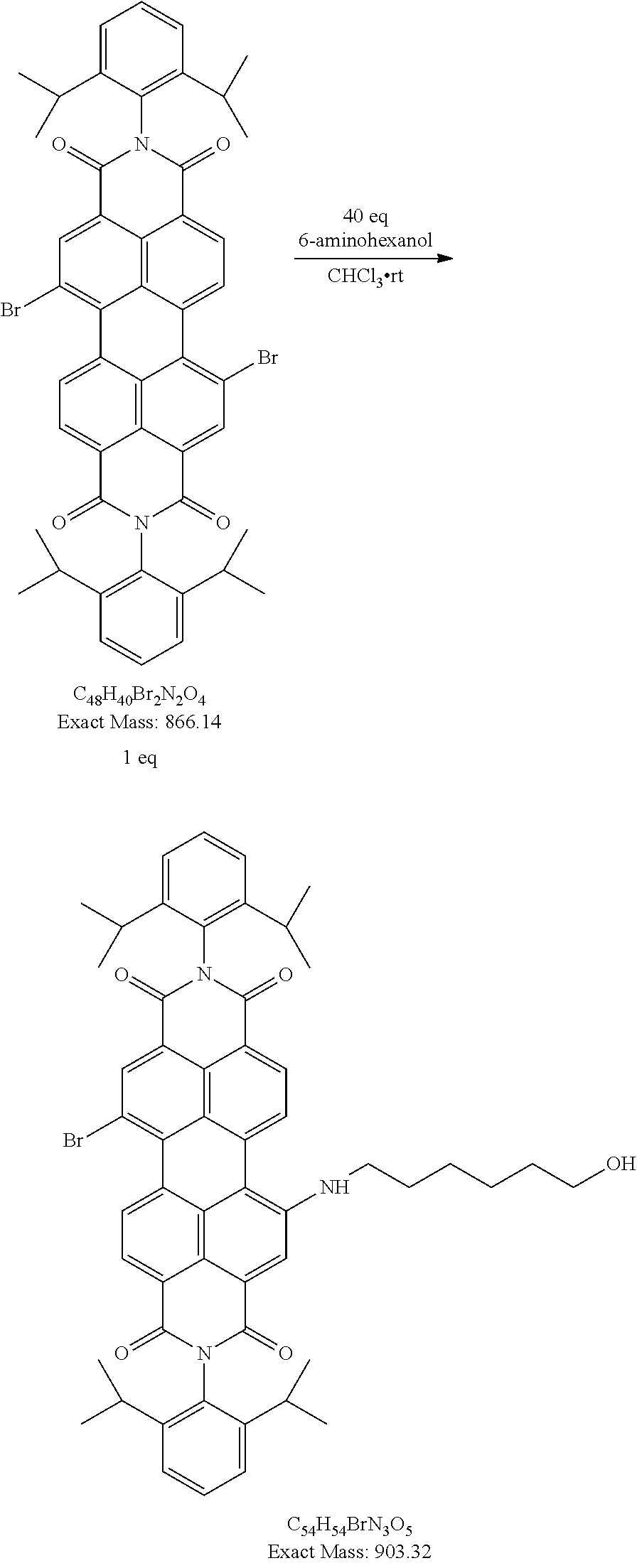
To a solution of diamino-diimide (0.433 g, 0.5 mmol) in 25 mL of CHCl3 under nitrogen atmosphere, 2.4 g (20 mmol) of 1-amino-6-hexanol was added at RT. The resulting orange solution was stirred at a 70° C. temperature under nitrogen for 72 h. The reaction mixture was poured into 2N—HCl. The organic phase was extracted with methylene chloride (MC), washed with water and 2N—HCl solution and then the organic extract was stored over MgSO4. The solvent was removed by rotary evaporation and the residue was purified by a column (silica gel, 40% ethyl acetate and n-hexane) to provide 36% of the product as a green solid. 1H-NMR (300 MHz, CDCl3) δ 9.48 (d, 1H), 9.02 (s, 1H), 8.81 (d, 1H), 8.70 (d, 1 H), 8.51 (d, 1H), 8.31 (s, 1H), 7.51 (t, 2H), 7.34 (d, 4H), 6.2 (t, NH), 3.63-3.7 (m, 2H), 3.5-3.6 (m, 2H), 2.6-2.8 (septet, 4H), 1.8-1.88 (q, 2H), 1.51-1.67 (m, 6H), 1.11 (d, 24H).

A solution of 3,5-dihydroxybenzoic acid (20.0 g, 129.9 mmol) in dry methanol (100 mL) and H2SO4 (1 mL) was refluxed for 20 h. The volatile product was removed in vacuo and the residue was redissolved in ethyl acetate (EA) and washed with aqueous NaHCO3, water and brine. The organic phase was dried with anhydrous sodium sulphate and the solvent was evaporated to yield methyl 3,5-dihydroxybenzoate as a white colored solid (95% yield, m.p.=170° C.). 1H-NMR (300 MHz, CDCl3) δ 7.1 (d, 2H), 6.6 (t, 1H), 4.9 (s, OH), 3.9 (s, OCH3).


Bromo-6-hydroxyhexylaminoperylene bisimide (0.27 g, 0.3 mmol) was dissolved in 20 mL of CH2Cl2 and 3,5-bisdodecyloxybenzoic acid (0.2 g, 0.4 mmol), DCC (0.31 g, 1.5 mmol), and DMAP (0.12 g, 1 mmol) were added. The reaction mixture was stirred at RT for 24 h under N2. At the end of the reaction, the mixture was poured into 2N—HCl and then filtered. The organic layer was extracted with MC, washed with water and then the organic extract was stored over MgSO4. The solvent was removed by rotary evaporation and the residue was purified by a column (silica gel, 20% ethyl acetate in n-hexane) to provide (90%) of the product as an green solid. 1H-NMR (300 MHz, CDCl3) δ 9.48 (d, 1H), 9.02 (s, 1H), 8.81 (d, 1H), 8.70 (d, 1 H), 8.52 (d, 1H), 8.31 (s, 1H), 7.48 (t, 2H), 7.33 (d, 4H), 7.10 (d, 2H), 6.58 (t, 1H), 6.08 (br, NH), 4.28 (t, 2H), 3.84 (t, 4H), 3.5 (t, 2H), 2.62-2.8 (septet, 4H), 1.7-1.8 (m, 6H), 1.38-1.44 (m, 6H), 1.22-1.34 (m, 36H), 1.14-1.20 (d, 24H), 0.84-0.9 (t, 6H).

Gringard reagent 2-thiophenylmanesium bromide was prepared from 60 g of 2-bromothiophene (0.368 mole) and magnesium (9.7 g, 0.404 mole). Magnesium was slowly added to a mixture of 2-bromothiophene (50 g, 0.307 mole), Ni(dppp)Cl2 (1.66 g, 3 mmol) in 150 mL dry ether at 0° C. The mixture was warmed to RT for 20 h before being quenched by diluted HCl. The aqueous layer was extracted with ether and all organic layers were combined. The solvent was evaporated after drying over MgSO4. The crude liquid product was redistilled under reduced pressure to afford 40 g (80%) of a low melting solid of the tilled compound. Mp 32-33° C. 1H-NMR (300 MHz, CDCl3) δ 7.19 (dd, 4H), 7.04 (t, 2H).

Bithiophene (5 g, 30 mmol) was dissolved in 100 mL of dry THF. The mixture is stirred at −78° C. and n-BuLi (20.6 mL, 33 mmol) is added to the reaction mixture. The reaction mixture was stirred at RT for 1 h. The 2-isopropoxy-4,4,5,5-tetramethyl-1,3,2-dioxaborolane (6.7 g, 36 mmol) was added to the mixture at −78° C. and then the resulting mixture was stirred at −78° C. for 1 h and warmed to RT and stirred overnight. At the end of the reaction, the mixture was poured into water and extracted with ether and dried over MgSO4. The solvent was removed and the crude product was purified by column chromatography (5% EA and hexane) to yield 40% of the product as a yellow colored liquid. 1H-NMR (300 MHz, CDCl3) δ 7.52 (d, 2H), 7.22-7.26 (m, 3H), 7.0-7.4 (dd, 1H), 1.3 (s, 12H).

The starting monobromo-substituted perylene bisimide ester (0.275 g, 0.2 mmol) was dissolved in 25 mL of dry THF. A solution of 2N K2CO3 (3 mL) and 2 mol % (0.005 g) tetrakis(triphenylphosphine) palladium(0) were added into the reaction mixture, and then 0.117 g (0.4 mmol) of bithiophene borate was added. The resulting reaction mixture was refluxed for 24 h in N2 before being poured into water and 2N—HCl. The aqueous layer was extracted with MC and the organic extracts were dried over magnesium sulfate. The solvent was removed by rotary evaporation and the residue was purified by a column (silica gel, 20% EA and n-hexane) to yield 85% of the product as a green solid. 1H-NMR (300 MHz, CDCl3) δ 8.96 (d, 1H), 8.76 (s, 1H), 8.68 (d, 1H), 8.37 (d, 1H), 8.29 (s, 1H), 8.12 (d, 1H), 7.48-7.56 (m, 2H), 7.33-7.39 (m, 4H), 7.28 (dd, 2H), 7.22 (d, 1H), 7.18 (dd, 1H) 7.12 (d, 2H), 7.02 (dd, 1H), 6.58 (t, 1H), 6.0 (br, NH), 4.28 (t, 2H), 3.88 (t, 4H), 3.5 (t, 2H), 2.66-2.82 (septet, 4H), 1.7-1.8 (m, 6H), 1.38-1.44 (m, 6H), 1.22-1.34 (m, 36H), 1.14 (d, 24H), 0.82 (t, 6H).

To a solution of thiophene (15 g, 0.178 mole) in 200 mL of dry THF at −78° C., n-BuLi (103 mL, 0.165 mol, 1.6M hexane) was added. The reaction mixture was warmed to RT and stirred for 1 h. After the mixture was cooled to −78° C., 23.15 mL (0.165 mole) of 1-bromohexane was added. The solution was warmed from −78° C. to RT and was stirred overnight. At the end of the reaction, the mixture was poured into ice water, the aqueous layer was extracted with ether, and the organic layer was dried over anhydrous MgSO4. The solvent was removed by rotary evaporation. The residue was redistilled under vacuum to get a colorless liquid (yield=75%). 1H-NMR (300 MHz, CDCl3) δ 7.12 (dd, 1H), 6.92-6.97 (m, 1H), 6.8 (dd, 1H). 2.8 (t, 2H), 1.6-1.9 (q, 2H), 1.30-1.49 (m, 6H), 0.82 (t, 3H).

To a solution of 2-hexylthiophene (5 g, 29.76 mmol) in 50 mL of dry THF at −78° C., n-BuLi (13.2 mL, 33 mmol, 2.5 M hexane) was added. The reaction mixture was warmed to RT and stirred for 1 h. After the mixture was cooled to −78° C., 6.7 g (36 mmol) of 2-isopropoxy-4,4,5,5-tetramethyl-1,3,2-dioxaborolane was added. The solution was warmed from −78° C. to RT and was stirred overnight. At the end of the reaction, the mixture was poured into ice water, the aqueous layer was extracted with ether, and the organic layer was dried over anhydrous MgSO4. The solvent was removed by rotary evaporation. The residue was distilled under vacuum. 1H-NMR (300 MHz, CDCl3) δ 7.45 (d, 1H), 6.84 (d, 1H), 2.70 (t, 2H), 1.64-1.68 (q, 2H), 1.22-1.41 (m, 18), 0.84 (t, 3H).

2-Bromothiophene (1.63 g, 10 mmol) was dissolved in 25 mL dry THF and a solution of 2N K2CO3 (5 mL) was added to the reaction mixture. And then 2 mol % (0.115 g) tetrakis(triphenylphosphine) palladium(0) and 2-hexyl-5-thiophene borate (2.94 g, 10 mmol) were added to the reaction mixture. The reaction mixture was refluxed for 24 h in N2. Before being poured into water and 2N—HCl, the aqueous layer was extracted with MC and the organic extracts were dried over magnesium sulfate. The solvent was removed by rotary evaporation and the residue was purified by a column (silica gel, 5% EA and n-hexane) to yield 90% of the product as a yellow liquid. 1H-NMR (300 MHz, CDCl3) δ 7.18 (dd, 1H), 7.12 (dd, 1H), 7.0-7.04 (m, 2H), 6.71 (dd, 1H), 2.78 (t, 2H), 1.68-1.78 (q, 2H), 1.32-1.46 (m, 6H), 0.84 (t, 3H).

2-Hexylbithiophene (5 g, 20 mmol) was dissolved in 100 mL of dry THF and the mixture is stirred at −78° C. After addition of n-BuLi (20.6 mL, 33 mmol) the reaction mixture was stirred at RT for 1 h and 2-isopropoxy-4,4,5,5-tetramethyl-1,3,2-dioxaborolane (5.6 g, 30 mmol) was added into the mixture at −78° C. The resulting mixture was stirred at −78° C. for 1 h, warmed to RT and stirred overnight. At the end of the reaction the mixture is poured into water and extracted with ether and dried with MgSO4. The solvent was removed and the crude product was purified by column chromatography (5% EA and hexane) to get 40% of the title product as a deep blue colored liquid. 1H-NMR (300 MHz, CDCl3) δ 7.52 (dd, 1H), 7.22 (dd, 1H), 7.0 (dd, H), 6.68 (dd, 1H), 2.76 (t, 2H), 1.62-1.74 (q, 2H), 1.24-1.40 (m, 18H), 0.84 (t, 3H).

The starting monobromo-substituted perylene bisimide ester (0.275 g, 0.2 mmol) was dissolved in 25 mL dry THF. A solution of 2N K2CO3 (3 mL) and 2 mol % (0.005 g) tetrakis(triphenylphosphine) palladium(0) were added to the reaction mixture and then 0.150 g (0.4 mmol) of 2-hexylbithiophene borate was added. The reaction mixture was refluxed for 24 h in N2 before being poured into water and acidifying with 2N—HCl. The aqueous layer was extracted with MC and the organic extracts were dried over magnesium sulfate. The solvent was removed by rotary evaporation and the residue was purified by a column (silica gel, 20% EA and n-hexane) to yield 81% of the product as a green solid. 1H-NMR (300 MHz, CDCl3) δ 8.92 (d, 1H), 8.76 (s, 1H), 8.66 (d, 1H), 8.36 (d, 1H), 8.30 (s, 1H), 8.12 (d, 1H), 7.44-7.51 (m, 2H), 7.32-7.38 (m, 4H), 7.26 (dd, 1H), 7.22 (d, 1H), 7.12 (d, 2H), 6.98 (d, 1H), 6.68 (d, 1H), 6.60 (t, 1H), 6.02-6.07 (br, NH), 4.28 (t, 2H), 3.88 (t, 4H), 3.52 (t, 2H), 2.66-2.82 (septet, 6H), 1.7-1.8 (m, 8H), 1.38-1.44 (m, 8H), 1.22-1.34 (m, 40H), 1.14 (d, 24H), 0.82 (t, 9H).

To a solution of perylene bithiophene bisimide ester (0.292 g, 0.2 mmol) in 10 mL of dry DMF under nitrogen in the dark, a solution of NBS (0.0356 g, 0.2 mmol) in DMF (3 mL) was added dropwise at 0° C. The resulting green solution was stirred at RT under nitrogen overnight and the reaction mixture was poured onto the crushed ice. The reaction mixture was extracted with MC, washed with water and 2N—HCl solution and then the organic extract was stored over MgSO4. The solvent was removed by a rotary evaporator; the crude solid was purified by a column in 10% EA and hexane to obtain the product (78%) as a green colored solid. 1H-NMR (300 MHz, CDCl3) δ 8.92 (d, 1H), 8.76 (s, 1H), 8.68 (d, 1H), 8.34 (d, 1 H), 8.30 (s, 1H), 8.12 (d, 1H), 7.44-7.54 (m, 2H), 7.34-7.38 (m, 4H), 7.21 (d, 1H), 7.12-7.18 (m, bithiophene 1H and Ar 2H), 6.98 (d, 1H), 6.92 (d, 1H), 6.58 (t, 1H), 6.02 (br, NH), 4.28 (t, 2H), 3.88 (t, 4H), 3.52 (t, 2H), 2.66-2.82 (septet, 4H), 1.7-1.8 (m, 6H), 1.38-1.44 (m, 6H), 1.22-1.34 (m, 36H), 1.14 (d, 24H), 0.83 (t, 6H).

To a solution of 2-bromothiophene (8.05 g, 50 mmol) in 100 mL anhydrous THF at −78° C., n-BuLi (34 mL, 55 mmol, 1.6 M hexane) was added. The reaction mixture was warmed to RT and stirred for 1 h. After the mixture was cooled to −78° C., triethyl borate (17 mL, 100 mmol) was slowly added into the mixture and the solution was warmed to RT and stirred for 12 h. At the end of the reaction, the mixture was poured into the 100 mL of 2N HCl and ice, the aqueous layer was extracted with ether, and the organic layer was dried over anhydrous MgSO4. The solvent was removed by rotary evaporation. The residue was recrystallized with n-hexane to obtain the product (45%). 1H-NMR (300 MHz, CDCl3) δ 7.68 (dd, 1H), 7.3 (d, 1H), 7.15 (dd, 1H).

The perylene bromobithiophene bisimide ester (0.77 g, 0.5 mmol) was dissolved in 25 mL dry THF. A solution of 2N K2CO3 (3 mL) and 2 mol % (12 mg) tetrakis(triphenylphosphine) palladium(0) were added into the reaction mixture, and then thiopheneboronic acid (0.192 g, 1.5 mmol) was added. The reaction mixture was refluxed for 24 h under N2, before being poured into water and acidifying with 2N—HCl. The aqueous layer was extracted with MC and the organic extracts were dried over magnesium sulfate. The solvent was removed by rotary evaporation and the residue was purified by a column (silica gel, 20% EA and n-hexane) to yield 35% of the product as a green solid. 1H-NMR (300 MHz, CDCl3) δ 8.92 (d, 1H), 8.76 (s, 1H), 8.66 (d, 1H), 8.36 (d, 1H), 8.30 (s, 1H), 8.12 (d, 1H), 7.44-7.54 (m, 2H), 7.32-7.38 (m, 4H), 7.26 (dd, 2H), 7.22 (d, 1H), 7.18 (d, 1H), 7.12 (d, 2H), 6.98-7.01 (t, 2H), 6.54 (d, 1H), 6.52 (t, 1H), 6.02 (br, NH), 4.28 (t, 2H), 3.88 (t, 4H), 3.52 (t, 2H), 2.66-2.82 (septet, 4H), 1.7-1.82 (m, 8H), 1.38-1.44 (m, 8H), 1.22-1.34 (m, 32H), 1.14 (d, 24H), 0.82 (t, 6H). 13C-NMR (300 MHz, CDCl3) δ166.74 (C═O), 163.81, 163.72, 163.65, 160.38, 156.46, 147.58, 145.90, 143.16, 139.67, 137.27, 137.09, 136.89, 136.53, 135.59, 135.05, 132.62, 132.27, 132.02, 131.36, 131.01, 130.87, 130.42, 130.33, 130.18, 129.80, 128.343, 128.13, 126.52, 125.00, 124.76, 124.67, 124.25, 124.2, 123.22, 122.69, 121.37, 120.29, 119.59, 115.61, 107.97, 106.44, 100.34, 86.73, 76.80, 68.271, 65.02, 45.03, 33.65, 32.12, 31.23, 29.86, 29.84, 29.80, 29.78, 29.58, 29.54, 29.45, 29.41, 28.86, 27.09, 26.23, 25.99, 24.29, 24.22, 22.88, 14.30.

2-Bromo-5-hexylthiophene (1.22 g, 5 mmol) was dissolved in 25 mL dry THF. A solution of 2M K2CO3 (5 mL) and 2 mol % (0.115 g) tetrakis(triphenylphosphine) palladium(0) were added into the reaction mixture and then bithiophene borate (1.46 g, 5 mmol) was added. The reaction mixture was refluxed for 24 h in N2 before being poured into water and 2N—HCl. The aqueous layer was extracted with MC and the organic extracts were dried over magnesium sulfate. The solvent was removed by rotary evaporation and the residue was purified by a column (silica gel, in n-hexane) to yield 80% of the product as a yellow solid. 1H-NMR (300 MHz, CDCl3) δ 7.19-7.22 (dd, 1H), 7.12-7.16 (dd, 1H), 7.06-7.08 (d, 1H), 7.02-7.04 (d, 1H), 6.97-7.00 (m, 2H), 6.67-6.69 (d, 1H). 2.78-2.82 (t, 2H), 1.64-1.74 (q, 2H), 1.24-1.44 (m, 6H), 0.84-0.94 (t, 3H).

2-Hexylterthiophene (3.32 g, 10 mmol) was dissolved in 50 mL of dry THF. The mixture was stirred at −78° C. and 4 mL (10 mmol) of n-BuLi was added into the reaction mixture. The reaction mixture was stirred at RT for 1 h and 2-isopropoxy-4,4,5,5-tetramethyl-1,3,2-dioxaborolane (2.79 g, 15 mmol) was added into the mixture at −78° C. Then the resulting mixture was stirred at −78° C. for 1 h and warmed to RT and stirred overnight. At the end of the reaction, the mixture was poured into water and extracted with ether and dried over MgSO4. The solvent was removed and the crude product was purified by column chromatography (5% EA and hexane) to yield 35% of the product as a green solid. 1H-NMR (300 MHz, CDCl3) δ 7.48 (dd, 1H), 7.20 (d, 1H), 7.1 (d, 1H), 7.0 (dd, 2H), 6.68 (d, 1H), 2.76 (t, 2H), 1.62-1.74 (q, 2H), 1.24-1.40 (m, 18H), 0.84 (t, 3H).

The bromo-perylene bisimide ester (1 g, 0.73 mmol) was dissolved in 25 mL dry THF and a solution of 2N K2CO3 (3 mL) was added into the reaction mixture. And then 2 mol % (12 mg) tetrakis(triphenylphosphine) palladium(0) and 2-hexylterthiophene borate (0.5 g, 1.08 mmol) were added into the reaction mixture. The reaction mixture was refluxed for 24 h in N2 before being poured into water, and acidifying with 2N—HCl. The aqueous layer was extracted with MC and the organic extracts were dried over magnesium sulfate. The solvent was removed by rotary evaporation and the residue was purified by a column (silica gel, 20% EA and n-hexane) to yield 63% of the product as a green solid. 1H-NMR (300 MHz, CDCl3) δ 8.92 (d, 1H), 8.76 (s, 1H), 8.66 (d, 1H), 8.36 (d, 1 H), 8.30 (s, 1H), 8.12 (d, 1H), 7.44-7.54 (m, 2H), 7.32-7.38 (m, 4H), 7.22 (d, 1H), 7.18 (d, 1H), 7.12 (d, 2H), 7.04 (d, 1H), 6.98 (t, 2H), 6.54 (d, 1H), 6.52 (t, 1H), 6.02 (br, NH), 4.28 (t, 2H), 3.88 (t, 4H), 3.52 (t, 2H), 2.66-2.82 (septet, 6H), 1.7-1.8 (m, 8H), 1.22-1.44 (m, 48H), 1.14 (d, 24H), 0.82 (t, 9H). 13C-NMR (300 MHz, CDCl3) δ 166.74 (C═O), 163.81, 163.72, 163.65, 160.38, 156.46, 147.58, 145.90, 143.16, 139.67, 137.27, 137.09, 136.89, 136.53, 135.59, 135.05, 132.62, 132.27, 132.02, 131.36, 131.01, 130.87, 130.42, 130.33, 130.18, 129.80, 128.343, 128.13, 126.52, 125.00, 124.76, 124.67, 124.25, 124.2, 123.22, 122.69, 121.37, 120.29, 119.59, 115.61, 107.97, 106.44, 100.34, 86.73, 76.80, 68.271, 65.02, 45.03, 33.65, 32.12, 31.23, 29.86, 29.84, 29.80, 29.78, 29.58, 29.54, 29.45, 29.41, 28.86, 27.09, 26.23, 25.99, 24.29, 24.22, 22.88, 14.30.

The perylene 2-bromobithiophene bisimide ester (0.308 g, 0.2 mmol) was dissolved in 25 mL dry THF and a solution of 2N K2CO3 (3 mL) was added into the reaction mixture. Then 2 mol % (0.005 g) tetrakis(triphenylphosphine) palladium(0) and 0.117 g (0.4 mmol) of bithiophene borate (0.117 g, 0.4 mmol) were added into the reaction mixture. The reaction mixture was refluxed for 24 h in N2 before being poured into water, and acidifying with 2N—HCl. The aqueous layer was extracted with MC and the organic extracts were dried over magnesium sulfate. The solvent was removed by rotary evaporation and the residue was purified by a column (silica gel, 20% EA and n-hexane) to yield 50% of the product as a green solid. 1H-NMR (300 MHz, acetone d6) δ 9.12 (d, 1H), 8.62 (s, 1H), 8.58 (d, 1H), 8.42 (d, 1H), 8.34 (s, 1H), 8.10 (d, 1H), 7.60-7.72 (m, 2H), 7.44-7.51 (m, 4H), 7.32-7.42 (m, 5H), 7.22 (d, 1H), 7.18 (d, 2H) 7.12 (d, 1H), 7.08 (d, 1H), 6.98 (d, 1H), 6.54 (t, 1H), 6.0 (br, NH), 4.24 (t, 2H), 3.82 (t, 4H), 3.62 (t, 2H), 2.82-2.84 (septet, 4H), 1.62-1.82 (m, 12H), 1.18-1.42 (m, 60H), 0.82 (t, 6H).

The perylene 2-bromobithiophene bisimide ester (0.308 g, 0.2 mmol) was dissolved in 25 mL dry THF and a solution of 2N K2CO3 (3 mL) was added into the reaction mixture. Then 2 mol % (0.005 g) tetrakis(triphenylphosphine) palladium(0) and hexylbithiophene borate (0.15 g, 0.4 mmol) were added into the reaction mixture. The reaction mixture was refluxed for 24 h in N2 before being poured into water, and acidifying with 2N—HCl. The aqueous layer was extracted with MC and the organic extracts were dried over magnesium sulfate. The solvent was removed by rotary evaporation and the residue was purified by a column (silica gel, 20% EA and n-hexane) to provide (45%) of the product as a green solid. 1H-NMR (300 MHz, acetone d6) δ 9.1 (d, 1H), 8.61 (s, 1H), 8.58 (d, 1H), 8.42 (d, 1H), 8.31 (s, 1H), 8.08 (d, 1H), 7.3-7.5 (m, 9H), 7.16 (d, 1H), 7.02-7.1 (m, 3H), 6.98 (d, 2H), 6.78 (d, 1H), 6.52 (t, 1H), 4.28 (t, 2H), 3.88 (t, 4H), 3.52 (t, 2H), 2.66-2.82 (septet, 6H), 1.62-1.72 (m, 8H), 1.21-1.34 (m, 48H), 1.10-1.20 (m, 24H), 0.80 (t, 9H).

The perylene 2-bromobithiophene bisimide ester (0.308 g, 0.2 mmol) was dissolved in 25 mL dry THF and a solution of 2N K2CO3 (3 mL) was added into the reaction mixture. Then 2 mol % (0.005 g) tetrakis(triphenylphosphine) palladium(0) and terthiophene borate (0.15 g, 0.4 mmol) were added into the reaction mixture. The resulting reaction mixture was refluxed for 24 h in N2 before being poured into water and acidifying with 2N—HCl. The aqueous layer was extracted with MC and the organic extracts were dried over magnesium sulfate. The solvent was removed by rotary evaporation and the residue was purified by a column (silica gel, 20% EA and n-hexane) to yield 49% of the product as a green solid. 1H-NMR (300 MHz, acetone d6) δ 8.80 (d, 1H), 8.68 (s, 1H), 8.52 (d, 1H), 8.36 (d, 1 H), 8.29 (s, 1H), 8.12 (d, 1H), 7.44-7.54 (m, 2H), 7.3-7.38 (m, 4H), 7.20 (dd, 2H), 7.16 (d, 1H), 7.12 (d, 2H), 7.01-7.11 (m, 8H), 6.59 (t, 1H), 4.28 (t, 2H), 3.88 (t, 4H), 3.52 (t, 2H), 2.66-2.82 (septet, 4H), 1.7-1.8 (m, 8H), 1.38-1.44 (m, 8H), 1.22-1.34 (m, 32H), 1.14-1.20 (m, 24H), 0.82-0.92 (t, 6H). 13C-NMR (300 MHz, CDCl3) δ 166.74 (C═O), 163.81, 163.72, 163.65, 160.38, 156.46, 147.58, 145.90, 143.16, 139.67, 137.27, 137.09, 136.89, 136.53, 135.59, 135.05, 132.62, 132.27, 132.02, 131.36, 131.01, 130.87, 130.42, 130.33, 130.18, 129.80, 128.343, 128.13, 126.52, 125.00, 124.76, 124.67, 124.25, 124.2, 123.22, 122.69, 121.37, 120.29, 119.59, 115.61, 107.97, 106.44, 100.34, 86.73, 76.80, 68.271, 65.02, 45.03, 33.65, 32.12, 31.23, 29.86, 29.84, 29.80, 29.78, 29.58, 29.54, 29.45, 29.41, 28.86, 27.09, 26.23, 25.99, 24.29, 24.22, 22.88, 14.30.

The perylene 2-bromobithiophene bisimide ester (0.308 g, 0.2 mmol) was dissolved in 25 mL dry THF and a solution of 2N K2CO3 (3 mL) was added into the reaction mixture. Then 2 mol % (0.005 g) tetrakis(triphenylphosphine) palladium(0) and hexylterthiophene borate (0.18 g, 0.4 g) were added. The resulting reaction mixture was refluxed for 24 h in N2, before being poured into water and acidifying with 2N—HCl. The aqueous layer was extracted with MC and the organic extracts were dried over magnesium sulfate. The solvent was removed by rotary evaporation and the residue was purified by a column (silica gel, 20% EA and n-hexane) to yield 40% of the product as a green solid. 1H-NMR (300 MHz, CDCl3) δ 8.92 (d, 1H), 8.76 (s, 1H), 8.66 (d, 1H), 8.36 (d, 1 H), 8.29 (s, 1H), 8.12 (d, 1H), 7.44-7.54 (m, 2H), 7.32-7.38 (m, 4H), 7.18 (dd, 1H), 7.12 (dd, 1H), 7.01-7.11 (m, 6H), 6.9 (t, 2H), 6.68 (d, 1H), 6.59 (t, 1H), 6.1-6.07 (br, NH), 4.28 (t, 2H), 3.86 (t, 4H), 3.52 (t, 2H), 2.66-2.82 (septet, 6H), 1.38-1.8 (m, 8H), −1.44 (m, 8H), 1.22-1.34 (m, 40H), 1.14-1.20 (m, 24H), 0.82 (t, 9H). 13C-NMR (300 MHz, CDCl3) δ 166.74 (C═O), 163.81, 163.72, 163.65, 160.38, 156.46, 147.58, 145.90, 143.16, 139.67, 137.27, 137.09, 136.89, 136.53, 135.59, 135.05, 132.62, 132.27, 132.02, 131.36, 131.01, 130.87, 130.42, 130.33, 130.18, 129.80, 128.343, 128.13, 126.52, 125.00, 124.76, 124.67, 124.25, 124.2, 123.22, 122.69, 121.37, 120.29, 119.59, 115.61, 107.97, 106.44, 100.34, 86.73, 76.80, 68.271, 65.02, 45.03, 33.65, 32.12, 31.23, 29.86, 29.84, 29.80, 29.78, 29.58, 29.54, 29.45, 29.41, 28.86, 27.09, 26.23, 25.99, 24.29, 24.22, 22.88, 14.30.*

To a solution of perylene terthiophene bisimide ester (0.309 g, 0.2 mmol) in 10 mL of dry DMF under nitrogen in the dark, a solution of NBS (0.0356 g, 0.2 mmol) in DMF (3 mL) was added dropwise at 0° C. The resulting green solution was stirred at RT under N2 overnight. The reaction mixture was poured into the crushed ice. The mixture was extracted with MC, washed with water and 2N—HCl solution and then organic extract was stored over MgSO4. The solvent was removed by a rotary evaporator; the crude solid was purified by a column in 10% EA and hexane to obtain the tilled product (62%) as a green colored solid. 1H-NMR (300 MHz, CDCl3) δ 8.92 (d, 1H), 8.76 (s, 1H), 8.68 (d, 1H), 8.34 (d, 1 H), 8.30 (s, 1H), 8.12 (d, 1H), 7.44-7.54 (m, 2H), 7.34-7.38 (m, 4H), 7.21 (d, 1H), 7.12-7.18 (m, bithiophene 1H and Ar 2H), 6.98 (d, 1H), 6.92 (d, 1H), 6.90, (m, 2H), 6.58 (t, 1H), 6.02 (br, NH), 4.28 (t, 2H), 3.88 (t, 4H), 3.52 (t, 2H), 2.66-2.82 (septet, 4H), 1.7-1.8 (m, 6H), 1.38-1.44 (m, 6H), 1.22-1.34 (m, 36H), 1.14 (d, 24H), 0.83 (t, 6H).

The perylene 2-bromoterthiophene bisimide ester (0.812 g, 0.5 mmol) was dissolved in 25 mL dry THF and a solution of 2N K2CO3 (6 mL) was added into the reaction mixture. Then 2 mol % (12 mg) tetrakis(triphenylphosphine) palladium(0) and terthiophene borate (0.38 g, 1 mmol) were added into the reaction mixture. The reaction mixture was refluxed for 24 h in N2 before being poured into water, and acidifying with 2N—HCl. The aqueous layer was extracted with MC and the organic extracts were dried over magnesium sulfate. The solvent was removed by rotary evaporation and the residue was purified by a column (Silica gel, 20% EA and n-hexane) to yield 30% of the product as a green solid. 1H-NMR (300 MHz, CDCl3) δ 8.92 (d, 1H), 8.76 (s, 1H), 8.66 (d, 1H), 8.36 (d, 1 H), 8.29 (s, 1H), 8.12 (d, 1H), 7.44-7.54 (m, 2H), 7.3-7.38 (m, 4H), 7.20 (dd, 3H), 7.16 (d, 1H), 7.12 (d, 2H), 7.01-7.11 (m, 9H), 6.59 (t, 1H), 6.1-6.07 (br, NH), 4.28 (t, 2H), 3.88 (t, 4H), 3.52 (t, 2H), 2.66-2.82 (septet, 4H), 1.7-1.8 (m, 8H), 1.38-1.44 (m, 8H), 1.22-1.34 (m, 32H), 1.14-1.20 (m, 24H), 0.82 (t, 6H). 13C-NMR (300 MHz, CDCl3) δ 166.74 (C═O), 163.81, 163.72, 163.65, 160.38, 156.46, 147.58, 145.90, 143.16, 139.67, 137.27, 137.09, 136.89, 136.53, 135.59, 135.05, 132.62, 132.27, 132.02, 131.36, 131.01, 130.87, 130.42, 130.33, 130.18, 129.80, 128.343, 128.13, 126.52, 125.00, 124.76, 124.67, 124.25, 124.2, 123.22, 122.69, 121.37, 120.29, 119.59, 115.61, 107.97, 106.44, 100.34, 86.73, 76.80, 68.271, 65.02, 45.03, 33.65, 32.12, 31.23, 29.86, 29.84, 29.80, 29.78, 29.58, 29.54, 29.45, 29.41, 28.86, 27.09, 26.23, 25.99, 24.29, 24.22, 22.88, 14.30.

The perylene bormoterthiophene bisimide ester (0.812 g, 0.5 mmol) was dissolved in 25 mL dry THF and a solution of 2N K2CO3 (3 mL) was added into the reaction mixture. Then 2 mol % (12 mg) tetrakis(triphenylphosphine) palladium(0) and 2-hexylterthiophene borate (0.45 g, 1 mmol) were added into the reaction mixture. The reaction mixture was refluxed for 24 h in N2 before being poured into water and acidifying with 2N—HCl. The aqueous layer was extracted with MC and the organic extracts were dried over magnesium sulfate. The solvent was removed by rotary evaporation and the residue was purified by a column (silica gel, 20% EA and n-hexane) to yield 25% of the product as a green solid. 1H-NMR (300 MHz, CDCl3) δ 8.92 (d, 1H), 8.76 (s, 1H), 8.66 (d, 1H), 8.36 (d, 1 H), 8.29 (s, 1H), 8.12 (d, 1H), 7.44-7.54 (m, 2H), 7.32-7.38 (m, 4H), 7.18 (dd, 2H), 7.12 0 (d, 2H), 7.01-7.11 (m, 6H), 6.9 (t, 2H), 6.68 (d, 1H), 6.59 (t, 1H), 6.01-6.07 (br, NH), 4.28 (t, 2H), 3.86 (t, 4H), 3.52 (t, 2H), 2.66-2.82 (septet, 6H), 1.38-1.8 (m, 8H), −1.44 (m, 8H), 1.22-1.34 (m, 40H), 1.14-1.20 (m, 24H), 0.82 (t, 9H). 13C-NMR (300 MHz, CDCl3) δ166.74 (C═O), 163.81, 163.72, 163.65, 160.38, 156.46, 147.58, 145.90, 143.16, 139.67, 137.27, 137.09, 136.89, 136.53, 135.59, 135.05, 132.62, 132.27, 132.02, 131.36, 131.01, 130.87, 130.42, 130.33, 130.18, 129.80, 128.343, 128.13, 126.52, 125.00, 124.76, 124.67, 124.25, 124.2, 123.22, 122.69, 121.37, 120.29, 119.59, 115.61, 107.97, 106.44, 100.34, 86.73, 76.80, 68.271, 65.02, 45.03, 33.65, 32.12, 31.23, 29.86, 29.84, 29.80, 29.78, 29.58, 29.54, 29.45, 29.41, 28.86, 27.09, 26.23, 25.99, 24.29, 24.22, 22.88, 14.30.
Electrochemical measurements were performed by using a CHI600C (CH Instruments Inc., USA) with an electrochemical cell consisting of a platinum electrode (2 mm diameter), a Pt wire counter electrode, and a Ag/AgCl reference electrode at RT. 0.1 M Tetrabutylammonium perchlorate (Bu4NClO4, TBAP) in dichloromethane (Aldrich, HPLC grade) was used as a supporting electrolyte (scan rate 50 mVs−1).
Considering their HOMO and LUMO levels, the TCPTCDIs of the present invention could be used as an ideal electron donor for a PCBM acceptor. Reynolds et al. reported that the energy levels of an ideal electron donor for the PCBM acceptor should be −3.8 eV˜−5.2 eV (see, Reynolds et al, Macromolecules, 38:5359 (2005), Leclerc et al, J. Am. Chem. Soc. 130:732 (2008), and Scharber et al, J. Adv. Mater. 18: 789 (2006)). As shown in FIG. 4 , the oligothiophene-conjugated perylene tetracarboximide has a LUMO of −3.58 eV and a HOMO of −5.35 eV, which are almost identical to the values ideal for being a donor material for PCBM.
The UV-vis absorption spectra of the compounds obtained in Examples 1-5 above were measured by using a Jasco V-570 UV-vis spectrometer (5×10⁻⁵ M in chloroform). The results are shown in FIGS. 5 a-b and Tables 1 and 2 below.
| TABLE 1 |
| UV-vis absorption spectra of SP2T to SP6T |
| λmax of blue | λmax of red | Molar | |||
| Compounds | region | region | Band gap Eg | absorptivity (ε) | |
| SP2T | 426 nm | 666 nm | 1.55 (775 nm) | 2.5 × 10⁴ | |
| SP3T | 375 nm | 665 nm | 1.55 (775 nm) | 2.6 × 10⁴ | |
| SP4T | 411 nm | 664 nm | 1.55 (775 nm) | 6.4 × 10⁴ | Strongest |
| SP5T | 439 nm | 662 nm | 1.55 (775 nm) | 2.8 × 10⁴ | |
| SP6T | 439 nm | 665 nm | 1.55 (775 nm) | 2.8 × 10⁴ | |
| TABLE 2 |
| UV-vis absorption spectra of SP2TH to SP6TH |
| λmax of | λmax of | Molar | ||||
| blue | red | EHOMO | ELUMO | absorptivity | ||
| Compounds | region | region | Eop | (eV) | (eV) | (ε) |
| SP2TH | 424 nm | 672 nm | 1.55 | 5.35 | 3.80 | 1.8 × 10⁴ |
| SP3TH | 381 nm | 678 nm | 1.55 | 5.30 | 3.75 | 2.7 × 10⁴ |
| SP4TH | 424 nm | 660 nm | 1.55 | 5.28 | 3.73 | 3.7 × 10⁴ |
| SP5TH | 430 nm | 647 nm | 1.55 | 5.14 | 3.59 | 3.7 × 10⁴ |
| SP6TH | 440 |
650 nm | 1.55 | 5.13 | 3.58 | 2.5 × 10⁴ |
As shown in the above results, the SPT derivatives have similar or identical absorption behaviour as those of the SPTH derivatives, and the quarterthiophene-conjugated PTCDI has the strongest molar absorptivity. All oligothiophene-conjugated PTCDIs exhibit strong absorption bands up to the end of the visible region around 800 nm. Thus, they can be used as low band gap OPV materials.
Thermal gravimetric analysis (TGA) was carried out on a Mettler Toledo TGA/SDTA 851 (Mettler-Toledo GmbH, Schwerzenbach, Switzerland), and differential scanning calorimetric analysis (DSC) was performed on a Perkin-Elmer Pyris 1 instrument (U.S.A) under N2 atmosphere at a rate of 10° C./min. As the temperature increased, the temperature, when 5% by weight of the test compound decreases, was measured. FIG. 6 shows the TGA curves of the TCPTCDI derivatives. The TGA thermograms of the oligo-TCPTCDI derivatives showed that 5% weight losses ranged from 362 to 388° C. and that oligo-TCPTCDIs were stable at least up to 360° C., indicating that TCPTCDI derivatives are thermally stable enough for OPV device applications.
The UV-vis absorption behavior of TCPTCDI was compared with that of an Ir complex (Ir(btp)2(acac)) which is a conventional donor material in OPV devices. The absorption spectrum of the Ir complex was measured by using the same method of Example 30. FIG. 7 shows data comparing the UV-vis absorption behaviors of TCPTCDI and the Ir complex, where TCPTCDI (SP2T) covers a much longer (red) wavelength region than the iridium complex. The molar absorptivity at the longest λmax of SP2T (2.4×10⁴) was 4 times larger than that of the iridium complex at 475 nm (6.0×10³). Due to the longer absorption wavelength covered and the higher absorptivity at the longest λmax, TCPTCDIs are capable as more efficient donor molecules than the Ir complex.
TCPTCDIs may also be used as acceptor molecules when a donor molecule having a higher energy band than TCPTCDI is employed. For example, Ir(btp)2(acac) or P3HT can be used as a donor molecule (see FIG. 4 ). In this example, the quenching of triplet phosphorescence of the iridium complex Ir(btp)2(acac) was determined by using TCPTCDIs.
The phosphorescent quenching spectra of the Ir complex measured by varying the ratio of the Ir complex to SP2T is shown in FIG. 8 . FIG. 9 is a Stern-Volmer plot of the quenching of the iridium complex by the TCPTCDIs. The quenching rate constant was calculated from the triplet lifetime (iridium complex) and the slope of the Stern-Volmer plot. The quenching rate constant using SP2T was calculated as 1.1×10¹⁰ M−1s−1. Other quenching rate constants using TCPTCDIs are given in Table 3 below.
| TABLE 3 |
| Quenching rate constants |
| Rate Constants | |||
| Compounds | (M−1s−1) | ||
| SP2T | 1.1 × 10¹⁰ | ||
| SP3T | 3.1 × 10¹⁰ | ||
| SP4T | 2.7 × 10¹⁰ | ||
| SP5T | 2.5 × 10¹⁰ | ||
| SP6T | 2.7 × 10¹⁰ | ||
All SPTs which contain bi- to sexi-thiophene moieties exhibit extremely high phosphorescent quenching rate constants, i.e., 1.1˜3.1×10¹⁰ (diffusion-controlled). It is conceived that the high quenching rate constants are the result of a real electron transfer from the excited iridium to the TCPTCDIs.
It will be apparent to those skilled in the art that various modifications and variations can be made to the present invention without departing from the spirit and scope of the invention. Thus, it is intended that the present invention cover the modifications and variations of this invention provided they come within the scope of the appended claims and their equivalents.
Claims (12)
1. A compound of Formula I:

wherein:
M is represented by the following formula:

R1, R2, R3, R4, R5, R6, R7, R8, R10, R11, X1, X2, and X3 are the same or different at each occurrence and are selected from the group consisting of —H, —F, —Cl, —Br, —NO2, —CN, a straight or branched C1-20 alkyl, a C2-20 alkene, a C2-20 alkyne, a C3-20 cyclic alkyl, a straight or branched C1-20 alkoxy, a C1-20 dialkylarnino, a C4-20 polyoxaalkyl, a C4-20 polythioalkyl, a C4-20 polyazaalkyl, a C4-14 aryl, and a C4-14 heteroaryl which may be substituted with one or more non-aromatic radicals;
L is selected from the group consisting of —NR9—, —PR9—, —O—, and —S—, wherein R9 is selected from the group consisting of —H, —F, —Cl, —Br, —NO2, —CN, a straight or branched C1-20 alkyl, a C2-20 alkene, a C2-20 alkyne, a C3-20 cyclic alkyl, a straight or branched C1-20 alkoxy, a C1-20 dialkylamino, a C4-20 polyoxaalkyl, a C4-20 polythioalkyl, a C4-20 polyazaalkyl, a C4-14 aryl, and a C4-14 heteroaryl which may be substituted with one or more non-aromatic radicals;
a, b, and c are the same or different at each occurrence and are an integer from 0 to 2;
d and e are the same or different at each occurrence and are an integer from 0 to 3;
x is an integer from 1 to 4 and y is an integer from 0 to 4; and
z is 0 or 1.
2. The compound according to claim 1 , wherein R1 is —H, a straight or branched C1-20 alkyl, a C4-20 polyoxaalkyl, a C4-20 polythioalkyl, or a C4-20 polyazaalkyl, which may be substituted with one or more non-aromatic radicals.
3. The compound according to claim 1 , wherein R2 and R3 are C4-14 aryl which may be substituted with one or more non-aromatic radicals.
4. The compound according to claim 3 , wherein R2 and R3 are diisopropyl phenyl.
5. The compound according to claim 1 , wherein R4, R5, R6, and R7 are —H.
6. The compound according to claim 1 , wherein R8 is a straight or branched C1-20 alkyl which may be substituted with one or more substituents represented by the following formula:

wherein R12 is selected from the group consisting of —F, —Cl, —Br, —NO2, —CN, a straight or branched C1-20 alkyl, a C2-20 alkene, a C2-20 alkyne, a C3-20 cyclic alkyl, a straight or branched C1-20 alkoxy, a C1-20 dialkylamino, a C4-20 polyoxaalkyl, a C4-20 polythioalkyl, a C4-20 polyazaalkyl, a C4-14 aryl, and a C4-14 heteroaryl which may be substituted with one or more non-aromatic radicals, wherein, when f is an integer of at least 2, a plurality of R12, may in turn together form a mono- or polycyclic ring, optionally aromatic; and
f is an integer from 0 to 5.
7. The compound according to claim 6 , wherein R8-L- is represented by the following formula:

8. The compound according to claim 7 , wherein the compound has the following formula:

wherein n is an integer from 2 to 6.
9. The compound according to claim 1 , wherein R1 is a straight or branched C1-20 alkyl, a C2-20 alkene, a C2-20 alkyne, a C4-20 polyoxaalkyl, a C4-20 polythioalkyl, or a C4-20 polyazaalkyl, substituted with one or more cyano groups and/or carboxyl groups.
10. The compound according to claim 9 , wherein the compound has the following formula:

wherein
R1 is selected from the group consisting of

and
n is an integer from 2 to 6.
11. A molecular heterojunction material comprising the compound according to claim 1 .
12. A photovoltaic device comprising the molecular heterojunction material according to claim 11 .
Applications Claiming Priority (4)
| Application Number | Priority Date | Filing Date | Title |
|---|---|---|---|
| EP08161385 | 2008-07-29 | ||
| EP08161385.3 | 2008-07-29 | ||
| EP08161385 | 2008-07-29 | ||
| PCT/EP2009/059711 WO2010012710A1 (en) | 2008-07-29 | 2009-07-28 | Perylene tetracarboximide derivatives for photovoltaic devices |
Publications (2)
| Publication Number | Publication Date |
|---|---|
| US20110130566A1 US20110130566A1 (en) | 2011-06-02 |
| US8618298B2 true US8618298B2 (en) | 2013-12-31 |
Family
ID=40328441
Family Applications (1)
| Application Number | Title | Priority Date | Filing Date |
|---|---|---|---|
| US13/055,939 Expired - Fee Related US8618298B2 (en) | 2008-07-29 | 2009-07-28 | Perylene tetracarboximide derivatives for photovoltaic devices |
Country Status (7)
| Country | Link |
|---|---|
| US (1) | US8618298B2 (en) |
| EP (1) | EP2307406A1 (en) |
| JP (1) | JP5568554B2 (en) |
| KR (1) | KR20110036637A (en) |
| CN (1) | CN102112470B (en) |
| TW (1) | TWI473804B (en) |
| WO (1) | WO2010012710A1 (en) |
Families Citing this family (9)
| Publication number | Priority date | Publication date | Assignee | Title |
|---|---|---|---|---|
| WO2011138935A1 (en) * | 2010-05-07 | 2011-11-10 | 住友化学株式会社 | Organic photoelectric conversion element |
| US8598302B2 (en) * | 2010-09-10 | 2013-12-03 | Ocean's King Lighting Science & Technology Co., Ltd. | Perylenetetracarboxylic diimide organic semiconductor material and the preparation method and application thereof |
| EP2683718B1 (en) * | 2011-01-10 | 2017-05-24 | Basf Se | Thiocyanato substituted naphthalene diimide compounds and their use as n-type semiconductors |
| JP6159037B2 (en) * | 2012-04-20 | 2017-07-05 | 株式会社半導体エネルギー研究所 | Light emitting element, lighting device, light emitting device, display device, electronic device |
| KR20150017718A (en) | 2012-05-31 | 2015-02-17 | 미쓰비시 가가꾸 가부시키가이샤 | Copolymer, organic semiconductor material, organic electrical device, and solar cell module |
| EP2858099A4 (en) | 2012-06-01 | 2015-05-20 | Mitsubishi Chem Corp | PROCESS FOR PRODUCING SEMICONDUCTOR LAYER CONTAINING METAL OXIDE AND ELECTRONIC DEVICE |
| JP2014029905A (en) * | 2012-07-31 | 2014-02-13 | Fuji Electric Co Ltd | Method for manufacturing organic thin-film solar cell |
| CN106132930A (en) * | 2014-03-31 | 2016-11-16 | 索尼公司 | Perylene kinds material for organic photoelectric conversion layer |
| CN110467827B (en) * | 2019-08-09 | 2021-08-10 | 南京邮电大学 | Organic bulk heterojunction photovoltaic cell and preparation method thereof |
Citations (6)
| Publication number | Priority date | Publication date | Assignee | Title |
|---|---|---|---|---|
| JPH02196885A (en) | 1989-01-25 | 1990-08-03 | Asahi Chem Ind Co Ltd | Organic electroluminescent element |
| JPH106645A (en) | 1996-06-20 | 1998-01-13 | Mitsubishi Chem Corp | Optical recording medium and information recording method |
| DE102005045375A1 (en) | 2005-09-22 | 2007-03-29 | Heinz Prof. Dr. Langhals | New hydroxyperylene-bisimide-, aliphatic ether and aliphatic N-substituted perylene-lactamimide dyes, useful e.g. as intercalating or fluorescent dyes, pigments, tracers or starting materials for organic superconductor or in data storage |
| WO2007042474A2 (en) | 2005-10-07 | 2007-04-19 | Solvay (Société Anonyme) | Light-emitting material |
| WO2008012584A1 (en) | 2006-07-26 | 2008-01-31 | Merck Patent Gmbh | Electroluminescent device |
| DE102006048638A1 (en) | 2006-10-13 | 2008-04-17 | Langhals, Heinz, Prof. Dr. | New perylene dyes e.g. useful as pigments in inks, paints, lacquers and plastics |
Family Cites Families (9)
| Publication number | Priority date | Publication date | Assignee | Title |
|---|---|---|---|---|
| US4611385A (en) * | 1982-06-18 | 1986-09-16 | At&T Bell Laboratories | Devices formed utilizing organic materials |
| DE3545004A1 (en) * | 1985-12-19 | 1987-06-25 | Basf Ag | FLUORESCENT AROXY-SUBSTITUTED PERYLENE-3,4,9,10-TETRACARBONIC ACID DIIMIDES AND THEIR USE FOR AREA CONCENTRATION OF LIGHT |
| JPH01209768A (en) * | 1988-02-18 | 1989-08-23 | Canon Inc | organic solar cells |
| BE1002483A6 (en) * | 1989-06-20 | 1991-02-26 | Continental Photo | CHEMILUMINESCENT SOLUTION BASED ON SUBSTITUTED PERYLENE. |
| JP2756711B2 (en) * | 1989-09-25 | 1998-05-25 | コニカ株式会社 | Photoelectric conversion power generation element |
| JPH0453894A (en) * | 1990-06-20 | 1992-02-21 | Nippon Kagaku Hakko Kk | Red chemiluminesent material |
| US7230269B2 (en) * | 2005-06-13 | 2007-06-12 | The Trustees Of Princeton University | Organic photosensitive cells having a reciprocal-carrier exciton blocking layer |
| EP1987092B1 (en) * | 2006-02-17 | 2013-05-22 | Basf Se | Fluorinated rylenetetracarboxylic acid derivatives and use thereof |
| US20080149165A1 (en) * | 2006-12-22 | 2008-06-26 | General Electric Company | Luminescent solar collector |
-
2009
- 2009-07-14 TW TW98123747A patent/TWI473804B/en not_active IP Right Cessation
- 2009-07-28 EP EP09802502A patent/EP2307406A1/en not_active Withdrawn
- 2009-07-28 WO PCT/EP2009/059711 patent/WO2010012710A1/en not_active Ceased
- 2009-07-28 US US13/055,939 patent/US8618298B2/en not_active Expired - Fee Related
- 2009-07-28 KR KR1020117004550A patent/KR20110036637A/en not_active Ceased
- 2009-07-28 CN CN200980129674.9A patent/CN102112470B/en not_active Expired - Fee Related
- 2009-07-28 JP JP2011520463A patent/JP5568554B2/en not_active Expired - Fee Related
Patent Citations (6)
| Publication number | Priority date | Publication date | Assignee | Title |
|---|---|---|---|---|
| JPH02196885A (en) | 1989-01-25 | 1990-08-03 | Asahi Chem Ind Co Ltd | Organic electroluminescent element |
| JPH106645A (en) | 1996-06-20 | 1998-01-13 | Mitsubishi Chem Corp | Optical recording medium and information recording method |
| DE102005045375A1 (en) | 2005-09-22 | 2007-03-29 | Heinz Prof. Dr. Langhals | New hydroxyperylene-bisimide-, aliphatic ether and aliphatic N-substituted perylene-lactamimide dyes, useful e.g. as intercalating or fluorescent dyes, pigments, tracers or starting materials for organic superconductor or in data storage |
| WO2007042474A2 (en) | 2005-10-07 | 2007-04-19 | Solvay (Société Anonyme) | Light-emitting material |
| WO2008012584A1 (en) | 2006-07-26 | 2008-01-31 | Merck Patent Gmbh | Electroluminescent device |
| DE102006048638A1 (en) | 2006-10-13 | 2008-04-17 | Langhals, Heinz, Prof. Dr. | New perylene dyes e.g. useful as pigments in inks, paints, lacquers and plastics |
Non-Patent Citations (11)
| Title |
|---|
| Alvino et. al.-"Synthesis and spectroscopic properties of highly water-soluble perylene derivatives", Tetrahedron, Aug. 13, 2007, vol. 63, Issue 33, pp. 7858-7865, published by Elsevier Ltd ( 8 pg.). |
| Blouin et. al.-"Toward a Rational Design of Poly(2,7-Carbazole) Derivatives for Solar Cells", Journal of American Chemical Society Articles, 2008, 130 (2), pp. 732-742, published by American Chemical Society (11 pg.). |
| Chen et. al.-"Oligothiophene-Functionalized Perylene Bisimide System: Synthesis, Characterization, and Electrochemical Polymerization Properties", Chem. Mater. 2005, vol. 17, pp. 2208-2215, published by American Chemical Society (8 pg.). |
| Cremer et. al.-"Perylene-Oligothiophene-Perylene Triads for Photovoltaic Applications", Eur. J. Org. Chem. 2005, pp. 3715-3723, published by Wiley-VCH Verlag GmbH & Co. (9 pg.). |
| Huang et. al.-"Size Effects of Oligothiophene on the Dynamics of Electron Transfer in pi-Conjugated Oligothiophene-Perylene Bisimide Dyads", J. Phys. Chem. C 2008, vol. 112, pp. 2689-2696, published by American Chemical Society ( 8 pg.). |
| Huang et. al.—"Size Effects of Oligothiophene on the Dynamics of Electron Transfer in π-Conjugated Oligothiophene-Perylene Bisimide Dyads", J. Phys. Chem. C 2008, vol. 112, pp. 2689-2696, published by American Chemical Society ( 8 pg.). |
| Iden et. al.-"Fluorescent dyes for solar collectors", Forschungsber-Bundesminist. Forsch. Technol., Technol. Forsch. Entwickl. (1984), BMFT-FB-T 84-164, 115 pp.-attached CAS abstract in English only (1 pg.). |
| Reynolds et. al.-"Spectral Broadening in MEH-PPV:PCBM-Based Photovoltaic Devices via Blending with a Narrow Band Gap Cyanovinylene-Dioxythiophene Polymer", Macromolecules, 2005, vol. 38 (13), pp. 5359-5362, published by American Chemical Society (4 pg.). |
| Scharber. et. al.-"Design Rules for Donors in Bulk-Heterojunction Solar Cells-Towards 10 % Energy-Conversion Efficiency", Advanced Materials, vol. 18, Issue 6, Mar. 2006, pp. 789-794, published by Wiley-VCH Verlag GmbH & Co. (6 pg.). |
| U.S. Appl. No. 12/089,303, filed Aug. 18, 2008, Sung Jo Jin et al. |
| Xiaowei et. al.-"A High-Mobility Electron-Transport Polymer with Broad Absorption and Its Use in Field-Effect Transistors and All-Polymer Solar Cells", Journal of American Chemical Society Communications, 2007, vol. 129, pp. 7246-7247 (2 pg.). |
Also Published As
| Publication number | Publication date |
|---|---|
| JP2011529631A (en) | 2011-12-08 |
| KR20110036637A (en) | 2011-04-07 |
| CN102112470A (en) | 2011-06-29 |
| CN102112470B (en) | 2014-12-10 |
| TWI473804B (en) | 2015-02-21 |
| WO2010012710A1 (en) | 2010-02-04 |
| TW201016695A (en) | 2010-05-01 |
| US20110130566A1 (en) | 2011-06-02 |
| JP5568554B2 (en) | 2014-08-06 |
| EP2307406A1 (en) | 2011-04-13 |
Similar Documents
| Publication | Publication Date | Title |
|---|---|---|
| US8618298B2 (en) | Perylene tetracarboximide derivatives for photovoltaic devices | |
| Lin et al. | Star-shaped electron acceptors containing a truxene core for non-fullerene solar cells | |
| Li et al. | Design and synthesis of solution processable small molecules towards high photovoltaic performance | |
| CN110386930B (en) | Aggregation-induced luminescence compound, preparation method and application thereof | |
| JP2009135422A (en) | Thin film transistor and method for forming the same | |
| Liao et al. | Novel ADA type small molecules with β-alkynylated BODIPY flanks for bulk heterojunction solar cells | |
| Shiau et al. | Star-shaped organic semiconductors with planar triazine core and diketopyrrolopyrrole branches for solution-processed small-molecule organic solar cells | |
| Deng et al. | Triphenylamine-containing linear DAD molecules with benzothiadiazole as acceptor unit for bulk-heterojunction organic solar cells | |
| Busireddy et al. | Dithienopyrrole-benzodithiophene based donor materials for small molecular BHJSCs: Impact of side chain and annealing treatment on their photovoltaic properties | |
| Zhou et al. | Enhancing the photovoltaic performance of triphenylamine based star-shaped molecules by tuning the moiety sequence of their arms in organic solar cells | |
| Dutta et al. | A crystalline D-π-A organic small molecule with naphtho [1, 2-b: 5, 6-b′] dithiophene-core for solution processed organic solar cells | |
| Chen et al. | Solution-processable tetrazine and oligothiophene based linear A–D–A small molecules: Synthesis, hierarchical structure and photovoltaic properties | |
| Wang et al. | A novel D–π–A small molecule with N-heteroacene as acceptor moiety for photovoltaic application | |
| Busireddy et al. | Influence of the backbone structure of the donor material and device processing conditions on the photovoltaic properties of small molecular BHJSCs | |
| Dutta et al. | Novel naphtho [1, 2-b: 5, 6-b′] dithiophene core linear donor–π–acceptor conjugated small molecules with thiophene-bridged bithiazole acceptor: design, synthesis, and their application in bulk heterojunction organic solar cells | |
| Hong et al. | A novel small molecule based on dithienophosphole oxide for bulk heterojunction solar cells without pre-or post-treatments | |
| Deng et al. | Polymer based on benzothiadiazole-bridged bis-isoindigo for organic field-effect transistor applications | |
| Liu et al. | Anthradithiophene-benzothiadiazole-based small molecule donors for organic solar cells | |
| KR20070035208A (en) | Novel Nitrogen Semiconductor Compound and Device prepared by using the Same | |
| Jiang et al. | A 3D nonfullerene electron acceptor with a 9, 9′-bicarbazole backbone for high-efficiency organic solar cells | |
| Zhang et al. | Solution-processable star-shaped photovoltaic organic molecules based on triphenylamine and benzothiadiazole with longer pi-bridge | |
| US9315671B2 (en) | Bay-annulated indigo (BAI) as an excellent electron accepting building block for high performance organic semiconductors | |
| KR101589048B1 (en) | Novel organic semiconductor compound and organic electronic device using the same | |
| Wang et al. | D-(π-A) 3 type low bandgap star-shaped fused-ring electron acceptor with alkoxy-substituted thiophene as π-bridge | |
| Sun et al. | Diketopyrrolopyrrole-based acceptors with multi-arms for organic solar cells |
Legal Events
| Date | Code | Title | Description |
|---|---|---|---|
| AS | Assignment |
Owner name: SOLVAY SA, BELGIUM Free format text: ASSIGNMENT OF ASSIGNORS INTEREST;ASSIGNORS:YOON, UNG CHAN;HYUN, MYUNG HO;KIM, HONG-SEOK;AND OTHERS;SIGNING DATES FROM 20090806 TO 20090813;REEL/FRAME:025697/0258 |
|
| REMI | Maintenance fee reminder mailed | ||
| LAPS | Lapse for failure to pay maintenance fees |
Free format text: PATENT EXPIRED FOR FAILURE TO PAY MAINTENANCE FEES (ORIGINAL EVENT CODE: EXP.) |
|
| STCH | Information on status: patent discontinuation |
Free format text: PATENT EXPIRED DUE TO NONPAYMENT OF MAINTENANCE FEES UNDER 37 CFR 1.362 |
|
| FP | Lapsed due to failure to pay maintenance fee |
Effective date: 20171231 |