US8612155B2 - Methods and systems for microseismic mapping - Google Patents
Methods and systems for microseismic mapping Download PDFInfo
- Publication number
- US8612155B2 US8612155B2 US12/756,195 US75619510A US8612155B2 US 8612155 B2 US8612155 B2 US 8612155B2 US 75619510 A US75619510 A US 75619510A US 8612155 B2 US8612155 B2 US 8612155B2
- Authority
- US
- United States
- Prior art keywords
- event
- location
- microseismic
- rec
- time
- Prior art date
- Legal status (The legal status is an assumption and is not a legal conclusion. Google has not performed a legal analysis and makes no representation as to the accuracy of the status listed.)
- Expired - Fee Related, expires
Links
Images



Classifications
-
- G—PHYSICS
- G01—MEASURING; TESTING
- G01V—GEOPHYSICS; GRAVITATIONAL MEASUREMENTS; DETECTING MASSES OR OBJECTS; TAGS
- G01V1/00—Seismology; Seismic or acoustic prospecting or detecting
- G01V1/28—Processing seismic data, e.g. for interpretation or for event detection
- G01V1/288—Event detection in seismic signals, e.g. microseismics
-
- G—PHYSICS
- G01—MEASURING; TESTING
- G01V—GEOPHYSICS; GRAVITATIONAL MEASUREMENTS; DETECTING MASSES OR OBJECTS; TAGS
- G01V1/00—Seismology; Seismic or acoustic prospecting or detecting
- G01V1/40—Seismology; Seismic or acoustic prospecting or detecting specially adapted for well-logging
-
- G—PHYSICS
- G01—MEASURING; TESTING
- G01V—GEOPHYSICS; GRAVITATIONAL MEASUREMENTS; DETECTING MASSES OR OBJECTS; TAGS
- G01V1/00—Seismology; Seismic or acoustic prospecting or detecting
- G01V1/28—Processing seismic data, e.g. for interpretation or for event detection
- G01V1/30—Analysis
- G01V1/303—Analysis for determining velocity profiles or travel times
-
- G—PHYSICS
- G01—MEASURING; TESTING
- G01V—GEOPHYSICS; GRAVITATIONAL MEASUREMENTS; DETECTING MASSES OR OBJECTS; TAGS
- G01V2210/00—Details of seismic processing or analysis
- G01V2210/10—Aspects of acoustic signal generation or detection
- G01V2210/12—Signal generation
- G01V2210/123—Passive source, e.g. microseismics
Definitions
- the present disclosure relates to methods and systems for detection and analysis of seismic waveform data and, more particularly, methods and systems for the real-time 3D detection of microseismic events usable in non-vertical boreholes.
- a reliable real-time scheme for the detection/localization of microseismic events is important for Hydraulic Fracture Monitoring (HFM) and Reservoir Monitoring (RM), to enable timely decision making during stimulation operations and for reservoir management, among other applications.
- HARM Hydraulic Fracture Monitoring
- RM Reservoir Monitoring
- Microseismic event detection, location estimation and source parameter analysis provide critical information on the position, extent and growth of fractures caused during fluid injection or through other active or passive causes.
- a model-based algorithm to image the distribution of microseismic sources in both time and space has been described and applied to episodic tremors in a subduction zone.
- An efficient implementation of a similar method was developed for HFM and is disclosed in U.S. Pat. No. 7,391,675, which is hereby incorporated in its entirety.
- the '675 reference discloses what has been referred to as the Coalescence Microseismic Mapping (CMM) technique for real-time event detection and localization of seismic events. This approach does not require that discrete time picks be made on each of the waveforms.
- CCMM Coalescence Microseismic Mapping
- individual streams of seismic multi-component waveforms at each sensor are operated upon continuously using a function former, such as a signal-to-noise ratio (SNR) estimator.
- SNR signal-to-noise ratio
- the output of the function formers from all sensors are then individually mapped (migrated) into a 4D space-time map of hypocenter and origin time using model based travel times. This allows simultaneous event detection and localization by identifying map locations and origin times for which a collective or multi-sensor processor output exceeds a detection threshold.
- Waveform polarization is included in the discrimination algorithm both as a means of distinguishing consistent portions of the waveform streams which contain P-wave and S-wave phases that are being mapped, and as means of orienting a vertical (radial-depth) plane of localization, as the mapping algorithm is run in a 2D rather than 3D spatial geometry.
- the CMM algorithm delivers in real-time, event detection and location based on a signal to noise ratio onset measure using modeled travel times of P and S-waves.
- the CMM algorithm is a robust event-detector in the presence of noise, and that it is very efficient in making an event detection and location by assuming a vertical receiver array or, more precisely, by assuming that the seismic signal receivers disposed in the wellbore are positioned in the plane containing the center of a target grid.
- the CMM technique as described above has some inherent drawbacks, including that it has not provided standard measures of localization uncertainty which in the past have been computed from the measurement versus model residuals associated with discrete time picks, and that the assumed geometries cause the accuracy of the above approach to break down as wellbore deviation increases and events move away from the target plane.
- the CMM technique may also encounter drawbacks for multi-well data acquisition, where the ability to handle an arbitrarily distributed receiver network is preferred.
- Embodiments disclosed herein provide methods and systems for seismic waveform data processing, such as microseismic waveform data.
- some embodiments of the present disclosure provide methods and systems for microseismic data acquisition and analysis using a general receiver distribution and taking into consideration polarization information for the acquired signals.
- a 3D grid search is applied that is based on modeled travel times and polarizations. For example, polarization angles are used within a probability function of the co-linearity of modeled and locally estimated polarization vectors.
- a gradient based inversion algorithm is utilized in combination with one or more grid based searches to refine and improve initial event location estimates based on coarse grid searching.
- aspects disclosed herein may be applied on dataset that are recorded with an array of three-component (3C) receivers deployed in, for example, a deviated or horizontal well.
- aspects of the present disclosure include methods and systems for microseismic data processing using an algorithm that provides an automatic solution for event detection and location in real-time when the receiver array is distributed in a deviated or horizontal well.
- the techniques of the present disclosure are based on an estimation of signal-to-noise ratios (SNR) at modeled direct arrival times for P- and S-waves.
- SNR signal-to-noise ratios
- the techniques include introducing the required polarization angle information within a probability function.
- techniques for seismic waveform processing utilize, in part, a grid search based approach that depends on the grid location and dimensions.
- event location is estimated based on acquired waveform signals, for example, the SNR data and waveform polarization observed across the receiver distribution, such as a non-vertically distributed array of seismic sensors.
- a method of detecting and locating a microseismic event includes providing an estimate of a velocity model for a formation; estimating a volume of space in which the event will most likely occur; dividing the volume into a plurality of sub-volumes; receiving data of a microseismic event with at least a first and a second seismic sensor located on a tool in a wellbore; approximating a location of the event in the volume to determine in which sub-volume the event occurred; and determining a more precise location of the event within the sub-volume utilizing the signals.
- a method of detecting and locating a microseismic event includes generating a 3D spatial sampled volume of potential hypocenter locations; generating a look-up table for the P and S transit-times as well as the P and S-waves azimuth and dip angles at each grid node in the volume; computing the multicomponent covariance matrix while reading waveforms; storing the largest eigenvalue and its associated eigenvector as a function of time; applying an STA/LTA time-picker to the principal component; computing and storing the measured azimuth and dip for the eigenvector; computing CMM for a decimated grid; storing for every time sample the largest value of CMM when applied to the coarse grid; obtaining a rough estimate of a detected microseismic event with an origin time; determining a refinement of the event origin-time and spatial coordinates by applying a grid-search to the CMM objective function over a finer sampling
- a system of processing waveform data includes an acoustic tool comprising at least a first and a second seismic sensor; a computer in communication with the acoustic tool; and a set of instructions executable by the computer.
- the instructions when executed, receive data of an event with at least the first and the second seismic sensor located on the tool in a wellbore; approximate a location of the event in a volume of space comprising a plurality of sub-volumes to determine in which sub-volume the event occurred; apply a first grid search to obtain spatial coordinates and origin time of the event based on the approximate location of the event; apply a second grid search to derive a residual function at nodes of a finer grid; apply a gradient search of the residual function to optimize the location of the event; and determine a more precise location of the event based on the gradient search.
- the system may include a distributed array of seismic sensors having a non-vertical configuration and deployed in one or more shallow or deep wellbores traversing subterranean formations.
- the seismic sensors may be configured for acquiring waveform data from microseismic events at locations away from the tool.
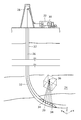
- FIG. 1 is a side sectional view of one exemplary application—a tool receiving signals in a deviated/horizontal wellbore—to which the present disclosure may be applied;
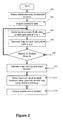
- FIG. 2 is a flowchart depicting one possible embodiment of techniques disclosed herein for the processing and analysis of seismic waveform data
- FIG. 3 is a flowchart depicting another possible embodiment of techniques disclosed herein for the processing and analysis of seismic waveform data
- FIG. 4 is a flowchart depicting a general processing flow of the real-time microseismic event detection/localization algorithm disclosed herein;
- FIG. 5 is a flowchart of a processing algorithm with emphasis on a detection and localization portion of the algorithm
- FIG. 6 is a flowchart of a processing algorithm with emphasis on a location refinement portion of the algorithm
- FIG. 7 is a CMM2D map of an objective function in a vertical plane (x, z);
- FIG. 8 is an illustration of a polarization vector and incidence angles
- FIG. 9 is an example of a 3C synthetic event (East, North, Elevation components) for 8 of the 16 receivers used in this example.
- the SNR for P- and Sh-waves is plotted with the estimation of the origin time shown between 100 ms and 150 ms;
- FIG. 10 is a 3D view of the 16 3C receiver positions and 30 source positions with the 3D grid size of 2000 ft on each side and grid spacing of 40 ft;
- FIG. 11 are Transverse-Depth [top left], Radial-Depth [top right] and Transverse-Radial [bottom left] sections of the 3D detection map computed using Equation (7) below;
- FIG. 12 are Transverse-Depth [top left], Radial-Depth [top right] and Transverse-Radial [bottom left] sections of the 3D location map computed from Equation (9) below;
- FIG. 13 is an example of one event recorded with three 3C accelerometers.
- the dark ticks are the user picked times for P-waves (in the time interval 400-430 ms), the lighter ticks are the times for Sh-waves (in the time interval 590-630 ms).
- the circles are the arrival times from estimated t 0 and location; and
- FIG. 14 is a comparison of location results from three methods. The classical Geiger results are shown with error bars; results obtained by aspects of the techniques disclosed herein are labeled “3D” with locations shown as triangles; and results obtained by CMM2D techniques are labeled “2D” with locations shown as squares.
- FIG. 1 is a schematic illustration of one exemplary embodiment and one exemplary method of deployment, showing a system including a downhole tool that may be used in conjunction with the methods described herein.
- the system of FIG. 1 depicts a seismic tool 20 disposed in a borehole 22 adjacent a formation of interest 24 .
- the tool 20 may be deployed using conventional logging cable 26 , or by another method of deployment that is consistent with the principles described herein.
- known modes of deployment such as wireline, coiled tubing, slick line, among others, may be employed according to the principles described herein or may be used in conjunction with a permanent or semi-permanent seismic monitoring system.
- the disclosure herein contemplates applications in well services, underground gas and waste storage, hydraulic fracture monitoring, reservoir and formation monitoring, and similar areas that require seismic source location.
- the cable 26 may be looped through a pulley 28 of an oilrig in a known conventional arrangement.
- the cable 22 also may include transmission lines for data transmission to and from the surface.
- signals may be transmitted electrically or optically to and from a processing unit 30 that may be disposed in a service truck 32 , or by any other conventional arrangement.
- the tool 20 includes a plurality of receivers 34 that may be disposed in the tool 20 in various configurations, including being disposed vertically along the length of the tool 20 or along the y-axis as shown in FIG. 1 .
- the tool 20 may consist of individual sensor carriers, interconnected by support/telemetry cables, and widely separated along the borehole axis. Several tools may be deployed in multiple boreholes.
- the formation of interest 24 will also include a plurality of points of interest 36 (e.g. fractures in the formation) that are the focus of the present application.
- the applicants have proposed two related approaches for the processing and analysis of seismic waveform data that are acquired in deviated or horizontal boreholes with, for example, a distributed array of seismic sensors having, for example, a non-vertical configuration and deployed in one or multi-well operations. Aspects of the techniques disclosed herein are applicable to real-time 3D processing of waveform data. In this, the principles disclosed herein provide improved detection and localization results of seismic events such as microseismic events that are generated in, for example, reservoir stimulation and management operations including in connection with Hydraulic Fracture Monitoring (HFM) and Reservoir Monitoring (RM) services.
- HFM Hydraulic Fracture Monitoring
- RM Reservoir Monitoring
- a distributed receiver array refers to receivers that are positioned or distributed in a non-vertical configuration, i.e., all the receivers are not in a plane that contains the center of a target grid. Nor are the receivers assumed to be collinear or coplanar.
- CCM2D refers to planar type receiver configurations in which the receivers and the event location are assumed to be coplanar, such as described in the aforementioned '675 patent
- CCM3D refers to the techniques of the present disclosure that remove the planar configuration limitation.
- CCM2D relates to vertically aligned receivers and the associated processing
- CCM3D relates to a distributed array, i.e., a non-vertical array of receivers, and the associated processing of the present disclosure.
- Steps 100 and 102 in FIG. 2 signal-to-noise ratios (SNR) are estimated for each grid node at time, t (Step 104 ) at modeled direct arrival times for P- and S-waves. Origin time, t 0 , and event location are estimated (Step 110 ) with the processing repeated for multiple times, t, to generate a map for each t and grid node (x,y,z) (Steps 106 and 108 ).
- SNR signal-to-noise ratios
- a map is generated using the direction of the incoming signals (Step 112 ) to output one or more locations of seismic events (Step 114 ).
- Polarization angle information is introduced within a probability function measuring the co-linearity of modeled and local estimates of P-wave polarization vectors. Techniques disclosed herein may be applied in real-time to data recorded, for example, by an array of three-component (3C) receivers deployed within a deviated well.
- 3C three-component
- the techniques proposed herein for seismic waveform processing utilize, in part, a grid search based approach based on grid location and dimensions.
- event location is estimated based on acquired waveform signals, for example, the SNR data and waveform polarization observed across the receiver distribution, such as a distributed array of seismic sensors.
- a detection and localization method in another related embodiment for signal processing, involves multiple stages.
- the proposed method for microseismic event detection and localization has several stages of processing which differ in their quantification of mismatch between model and measured values, their choice of objective function, and the procedure used to minimize or maximize that function.
- a first stage is based on a map migration technique which does not require time picking, but does use continuous function forming to produce a measure of SNR, the signal-to-noise ratio, as a function of time for each sensor. It also uses a continuous estimate of waveform polarization versus time.
- a second stage performs guided time picking, and uses discrete time picks along with associated polarization estimates to compute measured versus modeled data error residuals. The error residual objective function is then minimized in several sub-stages to search over the hypocenter/origin-time domain.
- waveform data are acquired (Step 200 ), and are processed to detect an event and estimate origin time t 0 (Step 202 ).
- a grid search may be applied, based on the detected event, over a finer sampling of the solution domain (Step 204 ) to refine the hypocenter and origin time estimates. These can be used to derive estimated arrival times and associated measured incidence azimuth (Step 206 ).
- a second grid search is applied over a residual function (Step 208 ) followed by a gradient search for minimizing the residual function ( 210 ) to estimate the location of seismic events ( 212 ).
- certain embodiments of the event detection/localization processing 300 of the present disclosure include determining waveform attributes using the estimated hypocenter location and its associated model waveform attributes, and then measuring the true waveform-attributes (Step 302 ); with the measured waveform attributes, minimizing a residual-function over a discretized solution domain (Step 304 ); applying a gradient search technique using node coordinates associated to a smallest residual as an initial guess (Step 306 ); and outputting seismic event locations (Step 308 ).
- FIG. 5 depicts in a more detailed flowchart the processing associated with event detection and localization
- FIG. 6 depicts the processing flowchart for refinement of event location that is derived based on the processing of FIG. 5 .
- Waveforms from an event generally differ between geophones. This makes multi-channel time picking difficult.
- Most methods in the literature time-pick on a single-channel basis.
- a popular method for arrival-time picking on a single-channel basis uses the Short Time Average/Long Time Average (STA/LTA) operator described by Baer & Kradolfer which utilizes second order moments.
- STA/LTA Short Time Average/Long Time Average
- the generalisation of this operator with higher-order statistics e.g. ratio of exponents of moments of even orders
- Other operators such as change-point estimation using linear prediction and the Bayesian/Akaike Information Criterion may also be employed and alternative methods for picking time include:
- some embodiments of the current method apply the STA/LTA operator to the largest principal component of the waveforms for two reasons: computational run-time is considerably improved; the data quality is higher, i.e. the principal component signal is smoother and, in the testing that has been conducted, has shown a higher signal-to-noise ratio than the Hilbert envelope.
- the use of other envelopes e.g., the “Hilbert envelope”, the Baer and Kradolfer envelope, sum of the squared amplitudes of the seismograms, among others
- the principal components are computed using Principal Component Analysis (PCA) applied to the three-component (3C) waveforms of each geophone.
- PCA Principal Component Analysis
- the principal components i.e. the eigenvalues and associated principal eigenvectors
- windowed data segments are continuously computed in time using windowed data segments.
- the STA/LTA operator When applied to the principal component data, the STA/LTA operator returns a flat curve with sharp peaks occurring at the P and S-arrivals in the time-domain. Such a curve presents similarities from receiver to receiver. By construction, the STA/LTA signal is hence very adequate for high-resolution time-delay estimators such as cross-correlation.
- Polarization is used to estimate the component incidence-angles of the arriving wave. Estimating polarization can be done in the frequency, time or wavelet domains. A time-domain approach for measuring incidence angles may be used for real-time HFM purposes.
- the covariance matrix of the three waveforms components is computed over a time-window.
- the direction of arrival is given by a principal eigenvector of the covariance matrix.
- corrections are made to determine the ray direction vector from the P-wave polarization. The incidence-angles are subsequently deduced from this vector.
- Time-domain polarization estimates may be based on the use of real signals or analytic (complex) signals. Analytic signals are more stable at amplitude zero-crossing and can provide instantaneous polarization. However, determination of real incidence angles from the eigenvectors of the covariance matrix of multi-component analytic signals requires additional assumptions and is computationally more costly. In testing, it was found that there is little practical difference between incidence angles computed from real or analytic signals. For the purposes of real-time calculations, time-domain polarization estimation based on the use of real rather than complex signals is preferable, but the present technique accommodates polarization computation by either technique. Furthermore, additional processing steps which improve the final estimate of polarization vectors and incidence angles are:
- the alpha-trimmed mean operator returns an average centred on the median value over this time interval.
- the returned value can vary from the median value (i.e. maximum rejection of potential outliers) to the average value of all the samples (i.e. zero rejection of samples when averaging).
- Angles are computed from eigenvectors provided by the PCA. It is known that two vectors pointing in opposite directions are eigenvectors of the same matrix associated to the same eigenvalue. Two techniques may be used in order to remove this uncertainty:
- a receivers' network hull is defined. A convex hull or a cross-section of the beam of rays for instance could be considered. Every receiver presents two unit polarization-vectors pointing to two opposite directions. If the receivers' network hull is “propagated” following the true polarization vectors (i.e. toward the source), then its size should shrink as it gets closer to the source location. This method needs to be applied to an adequately chosen subset of the receiver network.
- the event localization problem is an inversion problem. It is a search for a best-match between a set of measurements made on real data and the associated model values. Hence, provided that the model chosen is consistent, the event localization is defined as an optimization problem.
- the “match-function” between model and measurements is called a residual-function or error-function.
- the search method used for identifying the extremum depends on the residual-function behaviour.
- the main classic optimization techniques that can be considered include: (a) Grid search; (b) “Beta”-section; (c) Gradient; (d) Simplex; (e) Probabilistic algorithms.
- Beta-section methods sometimes referred to as multi-resolution method (i.e. family of bi-section and golden-section methods and their generalization to multi-variable problems such as “quadtrees”, etc.).
- a proposed method for microseismic event detection and localization has several stages of processing which differ in their quantification of mismatch between model and measured values, their choice of objective function, and the procedure used to minimize or maximize that function.
- This section describes the techniques used in those stages and the order in which they are used in the new processing flow. The following section gives a description of the flow of the multi-stage processing.
- microseismic data processing The first challenge in microseismic data processing is the detection of micro-earthquakes (microseismic events) in the continuous flow of recorded data. Due to the lack of prior knowledge about the arrivals-moveout, detection is often based on the use of the STA/LTA operator described earlier. Reliable techniques manage to proceed on a multichannel basis. The CMM technique has been employed effectively for the purpose of multi-channel event detection, and is included in the proposed workflow.
- Spatial position based on the distance of the considered candidate to a given location (e.g. “check-shot” location) or a region, a value is returned to penalize the consideration of the candidates that are too far from the area of interest.
- Waveform content such as the RMS, polarization type, polarization vectors, among others, may be considered to discard candidates.
- CMM Coalescence Microseismic Mapping
- CMM makes use of symmetry properties.
- the velocity models that are currently in use are often one-dimensional vertical anisotropic models. If the set of geophones is assumed to be vertical, then the localization problem presents an interesting symmetry around the vertical axis. Instead of localizing the hypocenter in a 3D space, it is possible to locate it in a vertical plane first, based on this symmetry property. The purpose is to get an estimate of depth and radial distance of the event location to the vertical array of multicomponent geophones (note FIG. 7 ). The final event location is therefore obtained by rotating the considered plane around the vertical axis. The rotation angle is given by the azimuth of the P-waves (average of the measured azimuths over the geophones).
- the detection/localization is defined as the maximization of a three-variable objective function. These variables are origin-time, radial distance to the geophones-array and depth of the event.
- the search of maximum is based on the grid search. The returned maximum corresponds to the event spatial coordinates and origin-time.
- the CMM algorithm is a combined detection/localization scheme in which a continuous input data stream (rather than a few discrete picked data time points) are mapped into hypocenter/origin time candidates using modelled data values. It is sometimes referred to as “model driven” in that detection as well as localization depends on the match between measured and modelled data. Its location accuracy is controlled by the solution domain sampling (gridding of the vertical plane (x, z) at discretized time-intervals). For instance, a densely sampled plane allows accurate mapping but is slow to scan. A compromise needs to be found between location accuracy and algorithm run-time.
- the beamforming applied by CMM differs in several ways from simple waveform, delay and sum beamforming. Firstly, it does not operate on the waveforms directly, but on their STA/LTA transforms. Secondly, the delayed and summed characteristic function is formed from a product of STA/LTA and other factors.
- the objective function obtained is subject to a constraint of orthogonality between polarization vectors measured at the P and S-waves arrival-times. Equation (1) describes the CMM objective function at a candidate “location” (x, z, t):
- PolarizVector rec ⁇ ( t + TT P model ⁇ ( x -> , rec ) ) ⁇ is the polarization vector of the data at the model P-wave arrival-time for this candidate hypocenter, origin-time and receiver position.
- the ray vector at the receiver is determined from the particle motion polarization.
- the relation between ray-vectors and polarization depends functionally on the velocity model and the angle of incidence.
- additional measurements or processing may be required to provide an estimate of vertical phase velocity in order to estimate the ray direction.
- CMM or CMM2D The limitation of CMM or CMM2D remains its assumption about the geophone positions. If the geophones are located in a deviated, horizontal well, or simultaneously logged in two monitoring-wells, then the assumptions of the current implementation are violated. A solution with reduced constraints on the sensor positions is discussed in the section below titled “Proposed Detection and Localization Techniques”.
- Equation 2 The Geiger approach is based on defining and minimizing a residual-function in the least-square manner (see Equation 2 below).
- the search of the minimum is accordingly based on a gradient routine.
- Equation (2) Given a candidate hypocenter location and origin-time fi, the least-square residual-function is given by Equation (2):
- C measure ⁇ 1 represents the inverse of the weight matrix (e.g. covariance matrix)
- “prior” is a penalisation term that can, for example, be provided by the Bayesian theory.
- Equation (2) The minimization of the residual-function, defined in Equation (2), is based on the simultaneous minimization of the two terms of the equation. Minimizing the first term is often referred as a minimization of the L 2 norm.
- the first-term of Equation (2) depends on the choice of the norm used and the waveform attribute chosen. Depending on the selected norm, a different weighting may be applied. The first term is therefore strictly defined as a function of a norm assessing the misfit between modelled and measured values.
- model refers to any waveform attribute that may be modelled and measured. For example, it can refer to:
- Polarization vector (or any projection) of the P and S-waves.
- Waveform amplitudes extracted over a window of the P and S-waves Waveform amplitudes extracted over a window of the P and S-waves.
- Waveforms frequencies of the P and S-waves are waveforms frequencies of the P and S-waves.
- the picked values are quality-controlled. For example, based on prior knowledge, a comparison of the values can be done from receiver to receiver. Another alternative consists of comparing the values between the P and S-waves for the set of receivers. Unexpected values of arrival-times, angles can therefore be detected and removed or corrected before proceeding to the minimization of the residual-function.
- the waveform-attributes e.g. arrival-times
- the location returned may not correspond to the true source location.
- CMM is suitable for event detection due to its beam-forming and forward-modelling properties.
- the Geiger approach is more accurate in localization.
- Removing the assumption of geophone array verticality in CMM means that the objective-function needs to be maximized over a time-interval and spatial-volume (instead of a vertical plane). Proceeding to such a search in real-time is very challenging. It can nevertheless be achieved if the domain of solution is properly sampled and if an adequate optimization technique is applied.
- the objective-function (Equation (1)) needs to be modified. Incidence-angles (e.g. P-waves azimuth and/or dip) need to be included, as shown in Equation (3a) below. As a result, localization uncertainty is reduced.
- Equation (1) Incidence-angles (e.g. P-waves azimuth and/or dip) need to be included, as shown in Equation (3a) below. As a result, localization uncertainty is reduced.
- Equation (3a) Equation (3a) below.
- the ray vector at the receiver must be determined from the particle motion polarization.
- the relation between ray-vectors and polarization depends functionally on the velocity model and the angle of incidence.
- additional measurements or processing may be required to provide an estimate of vertical phase velocity in order to estimate the ray direction.
- CMM is used as an event detector and gross-location estimator.
- the location refinement is overall given by a Geiger minimized residual technique.
- the reason for such an approach is to be able to use CMM as a robust response to all the issues raised by the classic Geiger method.
- CMM is stable for detecting and locating events with a given resolution. Applicants recognized that when an event is detected and located with CMM, the modelled arrival-times can reliably be used to initiate accurate measurement of both arrival-times (picking) and associated angles of the picked wave type. Subsequently, the measured waveform attributes ought to be reliable as good approximations are already available. Therefore, the first two issues about detecting events and measuring arrival-times in the Geiger method are solved.
- the combination of a grid-search with a gradient approach will be referred to as a “stabilized Geiger” approach.
- the techniques proposed herein then adopt a Geiger type of localization and improve the location provided by CMM.
- the third issue about the classic Geiger method is the convergence to the true solution. Due to the use of gradients, the solution may depend on the initial guess. This issue is solved when the classic Geiger algorithm starts from an initial guess close to the true solution.
- the objective-function of CMM is different from the Geiger residual-function; therefore these two functions may reach their extrema at different locations. Consequently, in order to be consistent in the optimization problem, a fine grid-search may be applied to the Geiger residual-function instead of the CMM objective-function. Run-time and consistency both justify the use of a grid-search procedure of the Geiger residual-function. As a result, a reliable initial guess is provided to the gradient method.
- the current implementation of solution steps two and three minimizes the objective function given by Equation (4).
- the first method is based on the Rabinowitz algorithm. Instead of minimizing the median residual-error, the alpha-trimmed mean residual-value is minimized.
- the search of minimum of the designed residual-function was based on a grid-search. Due to differentiability issues, the refinement of such a location could not be done with a gradient method. It was therefore decided to use a nonlinear simplex method. On the tests conducted, the run-time seemed to be longer and accuracy poorer than the second method implemented.
- the second and preferred method chosen comprises minimizing the least-square residual function (i.e.
- Equation (4) weighted sum of squared residuals as shown in Equation (4) by a grid-search first.
- the refinement of the location obtained was then done with the gradient approach described by Lienert (i.e. “Marquard-Levenberg” algorithm combined with a centering-and-scaling procedure).
- Lienert i.e. “Marquard-Levenberg” algorithm combined with a centering-and-scaling procedure.
- the flow charts and processing flow of the algorithm are discussed herein and also detailed in FIGS. 4-6 .
- Equation (4) can be written in a manner to minimize a different norm.
- the output of the CMM3D stage can be used as a final output yielding an estimate of the hypocenter location and origin-time.
- the refinement of such a location can be done directly by any optimization technique for the search of the minimum of the residual-function.
- the combination grid-search followed by a gradient search can for instance be replaced by the following:
- Such output may be used to measure the values used in the residual-function or in the search of extremum of a residual-function (e.g. one of the starting points for a search of extremum of the residual function).
- the refinement stage can be used independently of the CMM3D output.
- a starting point for the grid search can be defined by a pre-defined location (e.g. “check-shot” location) or randomly selected in a predefined-region. Before running the refinement stage, measuring values can be done regardless of the output of CMM3D.
- the covariance matrix is hermitian and therefore has real positive eigenvalues but complex eigenvectors.
- the signals Sx, Sy, Sz are real, the eigenvectors become real too.
- the incidence-angles can be provided by the following equation:
- the input data are the 3C traces recorded at each receiver, r, at time samples, t, rotated to the geographic coordinate system: E r (t),N r (t),U r (t).
- the signal to noise ratios for P- and S-waves, SNRP r (t) and SNRS r (t), are computed taking time window lengths for signal and noise time windows, stwp and ltwp, respectively:
- the signal to noise for S-waves is computed taking different short and long time window lengths, stws and, ltws, respectively.
- the real-time location algorithm proceeds in two steps: a detection step, where an estimate of t 0 and location is made, and a location step, where the estimated t 0 and polarizations are used. In both cases a map based on Equation (6) is used.
- the detection map Det(t,x,y,z) is computed for each time sample, t, and grid node, (x,y,z).
- the value of the detection map is the product of SNRP r (t) and SNRS r (t) at the modeled P- and S-wave arrival times, tp r (x,y,z) and ts r (x,y,z) over all receivers, r:
- Equation (7) is equivalent to Part 1 in Equation (3a) above.
- origin time t 0
- origin time uncertainty ⁇ t 0
- ⁇ t 0 the time range where the maxima of the detection map around the time, t 0 , exceed 50% of the maximum at the estimated origin time.
- the location step is then performed.
- the location requires information about the direction of the incoming energy at each receiver.
- One solution is to compute a probability function based on the continuously estimated P-wave polarization vector, ⁇ right arrow over (vm r ) ⁇ (t) and its uncertainty, ⁇ right arrow over ( ⁇ ) ⁇ r (t). For each grid position (x,y,z) a probability function is computed taking into account the P-wave modelled polarization vector, ⁇ right arrow over (vp) ⁇ r (x,y,z) as follows:
- Equation (8) the measured and modelled polarization vectors are normalized, and point both towards the same half-space. It is noted that Equation (8) may be viewed as an alternative to Equation (3b) above, which is a variant of Part 2 of Equation (3a). Here the index i is one of the three components of the polarization vector. While Equation (3a) forms the CMM objective function from a sum of terms corresponding to each of the receivers, Equation (8) uses a product of receiver terms.
- the location map is then computed from the detection map values and the polarization probability function as follows:
- hypocenter and origin time values determined from Loc(x,y,z) and Det(t,x,y,z) can be used as initial values for time picking and hypocenter estimate initialization in a subsequent location refinement stage which uses the Geiger method. It is noted that the notation only presents the case where the velocity model is isotropic. In the case of TI velocity model, the times and polarization angles for P and Sh waves are computed and used.
- Synthetic data are created for events recorded by an array of 16 3C receivers distributed along a horizontal well path at a depth of 10204 ft with an orientation along the East-West direction.
- the radiation pattern for P and S is isotropic for all sources with a constant amplitude ratio.
- Minimal noise has been added for this dataset and only Sh shear arrivals are included (no Sv).
- An example of the 3C traces with the SNR functions (Equation 6 above) for the first receiver is shown in FIG. 9 .
- the origin time, t 0 estimated at the detection step is also shown, with its uncertainty.
- the velocity model used for data modeling and processing is homogeneous anisotropic with the parameters described in Table 2:
- the travel times and modelled polarization angles at the receivers are computed for a 3D grid.
- the grid size in the radial, transverse and vertical directions is 2000 ft with a spacing of 40 ft.
- the 3D grid position is centered on the first event, located at the same depth as the receivers and oriented toward the middle of the receiver array at a distance of about 3580 ft ( FIG. 10 ).
- the detection map in FIG. 11 shows good resolution in plan view. However, no resolution is achieved in the depth section; taking into account only the SNR along the time moveout of the incoming energy is not enough to resolve the location in depth for a horizontally distributed receiver array.
- a hydraulic fracturing monitoring took place in Far East Asia from a deviated well. Due to constraints associated to high temperature, only three 3C receivers were deployed between 3800 m and 3925 m where the well deviation was around 30°. During the first stage of heavy brine injection, about 300 events were detected; while during the second injection stage of light brine, about 400 events were detected.
- the times were not well estimated and the events were on average located 250 m shallower than the locations found using time picks and the Geiger method (Table 3 below).
- the 2D origin time and spatial coordinates were significantly different from those of the Geiger approach. For instance, for the event presented in FIG. 13 , the origin time was estimated at 146 ms and the coordinates were: North: ⁇ 899 m; Easting: 1175 m; Elevation: ⁇ 4066 m whereas using the Geiger method the estimates were: 131 ms; ⁇ 917 m+/ ⁇ 34; 983 m+/ ⁇ 25 m; ⁇ 4902 m+/ ⁇ 87 m. The two locations were separated in depth by 837 m.
- the locations estimated using the proposed method are closer to the locations found with the Geiger method. In addition, the locations are far less scattered than the initial 2D location estimates ( FIG. 14 ). Given the short array, the amount of noise in this data set and the large difference in the methods, this is judged to be a favorable comparison.
- the present method is based on the estimation of signal to noise ratios at modeled direct arrival times for P- and S-waves.
- the method of the present embodiment introduces the required polarization angle information within a probability function measuring the co-linearity of modeled and local estimates of P-wave polarization vectors. Results from a synthetic dataset show good resolution in depth for the extreme case of data acquisition from a receiver array deployed within a horizontal monitor well.
- the method is applied to a real data set recorded by an array of three 3C receivers deployed within a well deviated at about 30°.
- the automatic location estimates are improved; the differences with estimates obtained after re-picking and using a gradient-based location inversion are in agreement.
- This method is a grid search-based approach. Thus, it depends on the grid location and dimensions.
- the resolution of the location depends on the recorded signal, in particular the signal to noise ratios and the radiation pattern covered by the receiver distribution.
- the accuracy of the proposed solution is based on these two elements, as well as the accuracy of the assumed velocity model.
Landscapes
- Life Sciences & Earth Sciences (AREA)
- Physics & Mathematics (AREA)
- Engineering & Computer Science (AREA)
- Remote Sensing (AREA)
- Environmental & Geological Engineering (AREA)
- Acoustics & Sound (AREA)
- Geology (AREA)
- General Life Sciences & Earth Sciences (AREA)
- General Physics & Mathematics (AREA)
- Geophysics (AREA)
- Business, Economics & Management (AREA)
- Emergency Management (AREA)
- Geophysics And Detection Of Objects (AREA)
- Length Measuring Devices With Unspecified Measuring Means (AREA)
- Apparatus Associated With Microorganisms And Enzymes (AREA)
Abstract
Description
-
- Polarization based techniques: orthogonality of the polarization vectors at the compressional and shear arrival-times, analysis of the different ratios between eigenvalues of the three-component covariance matrix computed continuously in time and their generalization to multichannel techniques.
- Analysis of the waveform content: peaks, troughs, zero-crossings, amplitude/frequency variation, amplitude/frequency comparison to a threshold value, among others, and their generalization to multichannel techniques.
(d) Simplex: the Nelder-Mead simplex approach and its variants are the key references. The present disclosure proposes an alternative to the original nonlinear simplex. Based on a line-search, adaptive steps may be used in order to improve the convergence speed of the algorithm. These steps will be computed respectively at the so-called stages of “Contraction”, “Expansion” and “Reflection”. In addition to the line-search, the use of the concept of adaptive search-directions is introduced herein. The search-directions for the three named stages can be defined by the selection of a search of a direction in which the line-search will operate.
(e) Probabilistic: Probabilistic algorithms include the Monte Carlo and the metaheuristics techniques. The most popular of these algorithms are probably the “simulated annealing” and “genetic algorithms”. The “tabu search”, “hill climbing”, “ant colony” and “particle swarm” can also be considered.
Descriptions of Detection/Localization Techniques
where {right arrow over (x)}=(x, z), (x, z, t) is a candidate “location” (i.e. hypocenter and origin-time); TTP model (TTS model) is the P-wave (S-wave) traveltime from {right arrow over (x)} to the considered receiver location; and
where rec=receiver index, 0<rec<(N+1), N=number of receivers, and
is the polarization vector of the data at the model P-wave arrival-time for this candidate hypocenter, origin-time and receiver position.
where ({right arrow over (x)}, t)=(x, y, z, t) is a candidate “location”; and
where
rec=receiver index, 0<rec<(N+1), N=number of receivers;
p1, p2, n1, n2, n3, n4, n5, n6, n7, n8, n9, n10 and n11 are real numbers not all equal to zero;
w1, w2, w3, w4, w5, w6 and w7 are real numbers referred to as weighting factors;
α is a unitless weighting scalar (so the cosine operator is applied to angles);
TTP model (TTS model) is the P-wave (S-wave) traveltime from to the considered receiver location. The overbar in FPrec indicates a vector quantity.
where Cmeasure −1 represents the inverse of the weight matrix (e.g. covariance matrix) and “prior” is a penalisation term that can, for example, be provided by the Bayesian theory.
| TABLE 1 |
| Summary of a classic Geiger algorithm |
| First: |
| Choose a list of waveform attributes to be measured and modelled (e.g. |
| arrival-times and ray incidence-angle azimuths and/or dips, for both |
| P and S-waves). |
| Choose/define a mismatch quantifier between individual measure and |
| model values. |
| Define an error-function from the sum of a residual-function and a |
| penalizing term (e.g. a weighted least-squares function). |
| Choose an optimization technique (e.g. a gradient method). |
| Define an exit-condition for the search of extremum of the |
| residual-function. |
| Input: |
| P and S velocity models. |
| Measured values of the waveforms' attributes (e.g. P and S |
| arrival-times and ray incidence-angle azimuths and/or dips). |
| Receivers' spatial-coordinates. |
| Area of interest (spatial volume at a given time-interval). |
| Algorithm: |
| Search the minimum of the error-function in its domain of definition |
| until the exit-condition is satisfied. |
({right arrow over (x)}, t)=(x, y, z, t) is a candidate “location”, and
where rec=receiver index; 0<rec<(N+1); N=number of receivers; n1, n2, n3, n4, n5, n6 and n7 are real numbers not all equal to zero; α is a unitless weighting scalar (so the cosine operator is applied to angles; TTP model (TTS model) is the P-wave (S-wave) traveltime from {right arrow over (x)} to the considered receiver location.
where: α is a positive factor controlling the discrimination sharpness. For real-data, such a factor needs to be carefully chosen. If α is too large, then good candidate locations may be excluded. Moreover, the STA/LTA factors may lose their predominance in the objective-function. On the other hand, if α is too small, then the opposite effect happens. Previously in application of the Bayesian approach, a has been set to the reciprocal of the angle measurement uncertainties. Depending on the choice of angle (i.e. dip or azimuth), “FAngleP” (S) can be an alternative to “FAzimP” or “FDipP” (“FAzimS” or “FDipS”) in Equation (3a).
Prior (rec, x, y, z, t) represents a penalizing function based on prior knowledge, rec=receiver index, 0<rec<(N+1), and N=number of receivers.
-
- simplex-based search
- grid-search
- gradient search
- beta-section search
- probabilistic search
- any combination of the different search of function-extremum techniques.
-
- Hypocenter location.
- Hypocenter origin-time.
- Hypocenter modeled or approximated travel-times.
- Hypocenter modeled or approximated arrival-times.
General Form of the Residual-Function:
Prior (rec, x, y, z, t) represents a penalizing function based on prior knowledge, rec=receiver index, 0<rec<(N+1), N=number of receivers, “NumberModelParameters” is the number of parameters used to match the measure with the model values. For example, if only arrival-times of P and S-waves are used, then this number is equal to 2. However, if the incidence azimuth of both the P-waves is added, then this number becomes equal to 3.
General Form of the STA/LTA Operator:
where: “p1”, “p2”, “p3”, “p4”, “w1”, “w2”, “gap”, “sw” and “lw” are real numbers.
En r(t)=H[E r(t)]2 +H[N r(t)]2 +H[U r(t)]2 (5)
where H[ƒ(t)] signifies the envelope computation using the Hilbert transform of the function ƒ(t).
It is noted that Equation (7) is equivalent to
| TABLE 2 |
| Velocity Model Properties. |
| Thomsen | Thomsen | Thomsen | ||||
| Vp (ft/s) | Vs (ft/s) | Epsilon | Gamma | Delta | ||
| 15500 | 9100 | 0.2 | 0.2 | 0.1 | ||
| TABLE 3 |
| Average coordinates in locations between the |
| 2 methods and Geiger method over 110 events. |
| East (m) | North (m) | Elevation(m) | ||
| |
914 +/− 405 | −732 +/− 381 | −4202 +/− 618 |
| |
1100 +/− 130 | −765 +/− 202 | −4486 +/− 299 |
| Geiger | 1056 +/− 95 | −716 +/− 168 | −4477 +/− 274 |
Claims (20)
Priority Applications (4)
| Application Number | Priority Date | Filing Date | Title |
|---|---|---|---|
| PCT/IB2010/000763 WO2010116236A2 (en) | 2009-04-08 | 2010-04-08 | Methods and systems for microseismic mapping |
| US12/756,195 US8612155B2 (en) | 2009-04-08 | 2010-04-08 | Methods and systems for microseismic mapping |
| EA201171225A EA201171225A1 (en) | 2009-04-08 | 2010-04-08 | METHODS AND SYSTEMS FOR MICROSEMIC MAPPING |
| US13/960,777 US20130322209A1 (en) | 2009-04-08 | 2013-08-06 | Methods and Systems for Microseismic Mapping |
Applications Claiming Priority (2)
| Application Number | Priority Date | Filing Date | Title |
|---|---|---|---|
| US12/420,061 US8494777B2 (en) | 2008-04-09 | 2009-04-08 | Continuous microseismic mapping for real-time 3D event detection and location |
| US12/756,195 US8612155B2 (en) | 2009-04-08 | 2010-04-08 | Methods and systems for microseismic mapping |
Related Parent Applications (1)
| Application Number | Title | Priority Date | Filing Date |
|---|---|---|---|
| US12/420,061 Continuation-In-Part US8494777B2 (en) | 2008-04-09 | 2009-04-08 | Continuous microseismic mapping for real-time 3D event detection and location |
Related Child Applications (1)
| Application Number | Title | Priority Date | Filing Date |
|---|---|---|---|
| US13/960,777 Division US20130322209A1 (en) | 2009-04-08 | 2013-08-06 | Methods and Systems for Microseismic Mapping |
Publications (2)
| Publication Number | Publication Date |
|---|---|
| US20100262373A1 US20100262373A1 (en) | 2010-10-14 |
| US8612155B2 true US8612155B2 (en) | 2013-12-17 |
Family
ID=42935047
Family Applications (2)
| Application Number | Title | Priority Date | Filing Date |
|---|---|---|---|
| US12/756,195 Expired - Fee Related US8612155B2 (en) | 2009-04-08 | 2010-04-08 | Methods and systems for microseismic mapping |
| US13/960,777 Abandoned US20130322209A1 (en) | 2009-04-08 | 2013-08-06 | Methods and Systems for Microseismic Mapping |
Family Applications After (1)
| Application Number | Title | Priority Date | Filing Date |
|---|---|---|---|
| US13/960,777 Abandoned US20130322209A1 (en) | 2009-04-08 | 2013-08-06 | Methods and Systems for Microseismic Mapping |
Country Status (3)
| Country | Link |
|---|---|
| US (2) | US8612155B2 (en) |
| EA (1) | EA201171225A1 (en) |
| WO (1) | WO2010116236A2 (en) |
Cited By (6)
| Publication number | Priority date | Publication date | Assignee | Title |
|---|---|---|---|---|
| US20140142854A1 (en) * | 2012-11-16 | 2014-05-22 | Conocophillips Company | Method for locating a microseismic event |
| US20150330190A1 (en) * | 2012-12-23 | 2015-11-19 | Halliburton Energy Services, Inc. | Deep formation evaluation systems and methods |
| US9213116B2 (en) | 2011-07-19 | 2015-12-15 | Halliburton Energy Services, Inc. | System and method for moment tensor migration imaging |
| US9784865B2 (en) | 2015-01-28 | 2017-10-10 | Chevron U.S.A. Inc. | System and method for estimating lateral positioning uncertainties of a seismic image |
| US20180038973A1 (en) * | 2016-08-03 | 2018-02-08 | Harris Corporation | System for processing seismic data based upon volatility measurement model and related methods |
| US11119232B2 (en) * | 2018-11-15 | 2021-09-14 | The Governors Of The University Of Alberta | System and method for real-time passive seismic event localization |
Families Citing this family (53)
| Publication number | Priority date | Publication date | Assignee | Title |
|---|---|---|---|---|
| WO2012058029A1 (en) * | 2010-10-27 | 2012-05-03 | Exxonmobil Uspstream Research Comapny | Method and system for fracture stimulation |
| CN102129063B (en) * | 2010-12-23 | 2012-10-10 | 中南大学 | Method for positioning micro seismic source or acoustic emission source |
| WO2012139082A1 (en) * | 2011-04-06 | 2012-10-11 | Spectraseis Ag | Event selection in the image domain |
| AU2011365515B2 (en) | 2011-04-15 | 2014-07-03 | Landmark Graphics Corporation | Systems and methods for hydraulic fracture characterization using microseismic event data |
| US8681583B2 (en) * | 2011-08-17 | 2014-03-25 | Microseismic, Inc. | Method for calculating spatial and temporal distribution of the Gutenberg-Richter parameter for induced subsurface seismic events and its application to evaluation of subsurface formations |
| WO2013112719A1 (en) * | 2012-01-24 | 2013-08-01 | Octave Reservoir Technologies, Inc. | Method and system for displaying microseismic event locations |
| US11774616B2 (en) | 2011-08-29 | 2023-10-03 | Seismic Innovations | Method and system for microseismic event location error analysis and display |
| US9945970B1 (en) * | 2011-08-29 | 2018-04-17 | Seismic Innovations | Method and apparatus for modeling microseismic event location estimate accuracy |
| US20150003199A1 (en) * | 2012-01-26 | 2015-01-01 | Bernard Widrow | Methods and apparatus for determining stimulated volume of oil and gas reservoirs |
| US9645268B2 (en) | 2012-06-25 | 2017-05-09 | Schlumberger Technology Corporation | Seismic orthogonal decomposition attribute |
| CN102928873B (en) * | 2012-10-30 | 2015-07-08 | 中国石油集团川庆钻探工程有限公司地球物理勘探公司 | Method for positioning ground micro-seismic based on four-dimensional energy focusing |
| US20140126328A1 (en) * | 2012-11-06 | 2014-05-08 | Schlumberger Technology Corporation | Methods and Systems for Improving Microseismic Event Detection and Location |
| US9355105B2 (en) * | 2012-12-19 | 2016-05-31 | International Business Machines Corporation | Indexing of large scale patient set |
| US9562990B2 (en) * | 2013-03-25 | 2017-02-07 | Baker Hughes Incorporated | Fast inversion of MWD transient EM data excited by a pulse of an arbitrary shape |
| CN103389489B (en) * | 2013-07-31 | 2015-03-04 | 中国石油集团川庆钻探工程有限公司地球物理勘探公司 | Micro earthquake monitoring and positioning method based on highly-deviated well |
| US20150081223A1 (en) * | 2013-09-19 | 2015-03-19 | Schlumberger Technology Corporation | Microseismic survey |
| WO2015063595A1 (en) | 2013-11-01 | 2015-05-07 | Cgg Services Sa | Method and device for deblending seismic data using self-adapting and/or selective radon interpolation |
| MX367935B (en) * | 2013-11-01 | 2019-09-12 | Cgg Services Sa | Hybrid deblending method and apparatus. |
| US10101485B2 (en) * | 2014-08-04 | 2018-10-16 | Schlumberger Technology Corporation | Method of coalescence microseismic mapping including model's uncertainty |
| US20160061986A1 (en) * | 2014-08-27 | 2016-03-03 | Schlumberger Technology Corporation | Formation Property Characteristic Determination Methods |
| CN105372696B (en) * | 2014-09-02 | 2018-08-07 | 中国石油化工股份有限公司 | A kind of localization method and system of microseism |
| NO338113B1 (en) * | 2014-11-14 | 2016-08-01 | Octio As | System and method for monitoring microseismic events in a subsurface structure |
| WO2016080981A1 (en) | 2014-11-19 | 2016-05-26 | Halliburton Energy Services, Inc. | Reducing microseismic monitoring uncertainty |
| CA2964862C (en) | 2014-11-19 | 2019-11-19 | Halliburton Energy Services, Inc. | Filtering microseismic events for updating and calibrating a fracture model |
| US10338247B2 (en) | 2014-12-23 | 2019-07-02 | Halliburton Energy Services, Inc. | Microseismic monitoring sensor uncertainty reduction |
| BR112017012769A2 (en) * | 2015-01-13 | 2017-12-26 | Halliburton Energy Services Inc | method and system for detecting one or more underground acoustic sources. |
| CN106353819B (en) * | 2015-07-17 | 2020-02-28 | 中国石油化工股份有限公司 | Borehole three-component microseism first arrival pickup method |
| US10338246B1 (en) | 2015-08-31 | 2019-07-02 | Seismic Innovations | Method and system for microseismic event wavefront estimation |
| WO2017044244A1 (en) * | 2015-09-09 | 2017-03-16 | Halliburton Energy Services, Inc. | Methods to image acoustic sources in wellbores |
| EP3350626B1 (en) | 2015-09-16 | 2023-10-11 | Services Pétroliers Schlumberger | Bayseian polarity determination |
| US10353093B2 (en) | 2017-07-27 | 2019-07-16 | International Business Machines Corporation | Multi-scale manifold learning for full waveform inversion |
| EA201791837A1 (en) | 2017-09-13 | 2019-03-29 | Общество С Ограниченной Ответственностью "Сонограм" (Ооо "Сонограм") | METHOD AND SYSTEM FOR ANALYSIS OF WELLS WITH THE HELP OF PASSIVE ACOUSTIC CAROS |
| CN110221342A (en) * | 2019-07-05 | 2019-09-10 | 中南大学 | Seismic source location method, apparatus and storage medium based on three-dimensional velocity structure |
| CN112558147B (en) * | 2019-09-25 | 2023-10-10 | 中国石油化工股份有限公司 | Polarization analysis method and system for microseism data in well |
| CN113138420A (en) * | 2020-01-20 | 2021-07-20 | 中国石油天然气集团有限公司 | Microseism event positioning method and device |
| CN114428357B (en) * | 2020-10-10 | 2025-04-18 | 中国石油化工股份有限公司 | Vertical well microseismic longitudinal and transverse wave positioning method, device, electronic equipment and medium |
| CN114428353B (en) * | 2020-10-10 | 2025-05-16 | 中国石油化工股份有限公司 | Method, device, electronic equipment and medium for positioning microseismic longitudinal and transverse waves in inclined wells |
| US11674383B2 (en) * | 2020-11-03 | 2023-06-13 | Halliburton Energy Services, Inc. | Acoustic beamforming techniques with simultaneous acoustic velocity estimation |
| CN113359183B (en) * | 2021-05-25 | 2023-09-29 | 哈尔滨工程大学 | A seismic source positioning method for polar ice |
| CN113504568B (en) * | 2021-07-09 | 2022-09-09 | 吉林大学 | A Median Filtering Method Based on Niche Differential Evolution Algorithm |
| CN116009069B (en) * | 2021-10-21 | 2025-07-25 | 中国石油化工股份有限公司 | Quadrilateral hybrid positioning method for microseism event in well, electronic equipment and medium |
| CN114047546B (en) * | 2021-11-18 | 2023-06-16 | 辽宁大学 | Crowd-sensing spiral ore vibration positioning method based on sensor three-dimensional space joint arrangement |
| CN114371503B (en) * | 2021-12-10 | 2023-08-29 | 煤炭科学技术研究院有限公司 | Seismic source location method, device, electronic equipment and storage medium |
| CN115113270A (en) * | 2022-06-22 | 2022-09-27 | 北方工业大学 | Integral and local combined microseismic source searching and positioning algorithm |
| CN116482752B (en) * | 2023-04-26 | 2024-01-23 | 四川大学 | Rapid three-dimensional positioning method of microseismic events in complex rock mass engineering structures |
| CN116755143B (en) * | 2023-06-12 | 2023-11-07 | 中国矿业大学 | Mine microseism energy-frequency compensation method based on microseism system detection probability |
| CN117348105A (en) * | 2023-10-13 | 2024-01-05 | 安徽理工大学 | A microseismic positioning accuracy assessment and correction method based on transparent rock model testing |
| US20250138211A1 (en) * | 2023-10-30 | 2025-05-01 | Saudi Arabian Oil Company | Surface-consistent travel-times inversion with accuracy estimation |
| CN119758451B (en) * | 2024-12-31 | 2025-10-10 | 国能神东煤炭集团有限责任公司 | Acoustic emission source localization method and system based on grid search and simulated annealing |
| CN120044131B (en) * | 2025-01-23 | 2025-10-03 | 苏交科集团股份有限公司 | Bridge crack propagation evaluation method and system based on acoustic emission signals |
| CN121028203B (en) * | 2025-07-10 | 2026-03-03 | 中国三峡建工(集团)有限公司 | A seismic correlation and earthquake location method and device |
| CN121028192B (en) * | 2025-08-18 | 2026-02-24 | 吉林大学 | A three-dimensional localization method for slope microseismic events considering complex geological structures and topographic effects |
| CN120673550B (en) * | 2025-08-22 | 2025-10-24 | 山东省地震局 | Alarm method and positioning system for real-time monitoring of earthquake early warning station network abnormality |
Citations (21)
| Publication number | Priority date | Publication date | Assignee | Title |
|---|---|---|---|---|
| EP0297737A2 (en) | 1987-06-29 | 1989-01-04 | Conoco Inc. | Three-dimensional iterative structural modeling of seismic data |
| US5771170A (en) | 1994-02-14 | 1998-06-23 | Atlantic Richfield Company | System and program for locating seismic events during earth fracture propagation |
| US20020087272A1 (en) | 2000-12-15 | 2002-07-04 | Dwight Mackie | Method for optimizing migration fields using time slice analysis |
| US6462549B1 (en) * | 1999-04-21 | 2002-10-08 | Schlumberger Technology Corporation | Method and system for electroseismic monitoring of microseismicity |
| US20020173914A1 (en) * | 2001-03-08 | 2002-11-21 | Baker Hughes, Inc. | Simultaneous determination of formation angles and anisotropic resistivity using multi-component induction logging data |
| US6662109B2 (en) * | 2001-04-19 | 2003-12-09 | Institut Francais Du Petrole | Method of constraining by dynamic production data a fine model representative of the distribution in the reservoir of a physical quantity characteristic of the subsoil structure |
| US20050190649A1 (en) * | 2003-12-29 | 2005-09-01 | Westerngeco L.L.C. | Method for monitoring seismic events |
| US6947843B2 (en) * | 2001-08-07 | 2005-09-20 | Vetco Grey Controls Limited | Microseismic signal processing |
| US6962549B2 (en) * | 2002-09-21 | 2005-11-08 | Zf Friedrichshafen Ag | Transmission, particularly automatic transmission, with several shifting elements |
| US20050256642A1 (en) * | 2004-03-19 | 2005-11-17 | Schlumberger Technology Corporation | [method of correcting triaxial induction arrays for borehole effect] |
| US20060041410A1 (en) * | 2004-08-20 | 2006-02-23 | Chevron U.S.A. Inc. | Multiple-point statistics (MPS) simulation with enhanced computational efficiency |
| US20060062084A1 (en) * | 2004-09-17 | 2006-03-23 | Julian Drew | Microseismic event detection and location by continuous map migration |
| US20060081412A1 (en) * | 2004-03-16 | 2006-04-20 | Pinnacle Technologies, Inc. | System and method for combined microseismic and tiltmeter analysis |
| US20080068928A1 (en) * | 2006-09-15 | 2008-03-20 | Microseismic Inc. | Method for passive seismic emission tomography |
| US7391671B2 (en) | 2005-09-29 | 2008-06-24 | Hynix Semiconductor Inc. | Data input device for use in semiconductor memory device |
| GB2450163A (en) | 2007-06-16 | 2008-12-17 | Benjamin Charles Dyer | Detecting the location of seismic events without picking events in received seismic wave data |
| US20090010104A1 (en) | 2007-07-06 | 2009-01-08 | Schlumberger Technology Corporation | Methods and systems for processing microseismic data |
| US20090238040A1 (en) * | 2008-03-20 | 2009-09-24 | Duncan Peter M | Method for imaging the earth's subsurface using passive seismic sensing |
| US20100018718A1 (en) * | 2006-09-28 | 2010-01-28 | Krebs Jerome R | Iterative inversion of data from simultaneous geophysical sources |
| US8041510B2 (en) * | 2005-11-03 | 2011-10-18 | Saudi Arabian Oil Company | Continuous reservoir monitoring for fluid pathways using microseismic data |
| US8078437B2 (en) * | 2006-07-07 | 2011-12-13 | Exxonmobil Upstream Research Company | Upscaling reservoir models by reusing flow solutions from geologic models |
-
2010
- 2010-04-08 WO PCT/IB2010/000763 patent/WO2010116236A2/en not_active Ceased
- 2010-04-08 US US12/756,195 patent/US8612155B2/en not_active Expired - Fee Related
- 2010-04-08 EA EA201171225A patent/EA201171225A1/en unknown
-
2013
- 2013-08-06 US US13/960,777 patent/US20130322209A1/en not_active Abandoned
Patent Citations (23)
| Publication number | Priority date | Publication date | Assignee | Title |
|---|---|---|---|---|
| EP0297737A2 (en) | 1987-06-29 | 1989-01-04 | Conoco Inc. | Three-dimensional iterative structural modeling of seismic data |
| US5771170A (en) | 1994-02-14 | 1998-06-23 | Atlantic Richfield Company | System and program for locating seismic events during earth fracture propagation |
| US6462549B1 (en) * | 1999-04-21 | 2002-10-08 | Schlumberger Technology Corporation | Method and system for electroseismic monitoring of microseismicity |
| US20020087272A1 (en) | 2000-12-15 | 2002-07-04 | Dwight Mackie | Method for optimizing migration fields using time slice analysis |
| US20020173914A1 (en) * | 2001-03-08 | 2002-11-21 | Baker Hughes, Inc. | Simultaneous determination of formation angles and anisotropic resistivity using multi-component induction logging data |
| US6662109B2 (en) * | 2001-04-19 | 2003-12-09 | Institut Francais Du Petrole | Method of constraining by dynamic production data a fine model representative of the distribution in the reservoir of a physical quantity characteristic of the subsoil structure |
| US6947843B2 (en) * | 2001-08-07 | 2005-09-20 | Vetco Grey Controls Limited | Microseismic signal processing |
| US6962549B2 (en) * | 2002-09-21 | 2005-11-08 | Zf Friedrichshafen Ag | Transmission, particularly automatic transmission, with several shifting elements |
| US20050190649A1 (en) * | 2003-12-29 | 2005-09-01 | Westerngeco L.L.C. | Method for monitoring seismic events |
| US20060081412A1 (en) * | 2004-03-16 | 2006-04-20 | Pinnacle Technologies, Inc. | System and method for combined microseismic and tiltmeter analysis |
| US20050256642A1 (en) * | 2004-03-19 | 2005-11-17 | Schlumberger Technology Corporation | [method of correcting triaxial induction arrays for borehole effect] |
| US20060041410A1 (en) * | 2004-08-20 | 2006-02-23 | Chevron U.S.A. Inc. | Multiple-point statistics (MPS) simulation with enhanced computational efficiency |
| US20060062084A1 (en) * | 2004-09-17 | 2006-03-23 | Julian Drew | Microseismic event detection and location by continuous map migration |
| US7391675B2 (en) | 2004-09-17 | 2008-06-24 | Schlumberger Technology Corporation | Microseismic event detection and location by continuous map migration |
| US7391671B2 (en) | 2005-09-29 | 2008-06-24 | Hynix Semiconductor Inc. | Data input device for use in semiconductor memory device |
| US8041510B2 (en) * | 2005-11-03 | 2011-10-18 | Saudi Arabian Oil Company | Continuous reservoir monitoring for fluid pathways using microseismic data |
| US8078437B2 (en) * | 2006-07-07 | 2011-12-13 | Exxonmobil Upstream Research Company | Upscaling reservoir models by reusing flow solutions from geologic models |
| US20080068928A1 (en) * | 2006-09-15 | 2008-03-20 | Microseismic Inc. | Method for passive seismic emission tomography |
| US20100018718A1 (en) * | 2006-09-28 | 2010-01-28 | Krebs Jerome R | Iterative inversion of data from simultaneous geophysical sources |
| GB2450163A (en) | 2007-06-16 | 2008-12-17 | Benjamin Charles Dyer | Detecting the location of seismic events without picking events in received seismic wave data |
| US20090010104A1 (en) | 2007-07-06 | 2009-01-08 | Schlumberger Technology Corporation | Methods and systems for processing microseismic data |
| US20090238040A1 (en) * | 2008-03-20 | 2009-09-24 | Duncan Peter M | Method for imaging the earth's subsurface using passive seismic sensing |
| US7986587B2 (en) * | 2008-03-20 | 2011-07-26 | Microseismic, Inc. | Method for imaging the earth's subsurface using passive seismic sensing |
Non-Patent Citations (6)
| Title |
|---|
| Block, Lisa V. et al., Seismic Imaging of the Velocity Structure and the Location of a Hydrofrac in a Geothermal Reservoir, Earth Resources Laboratory Industry Consortia Annual Report; Dec. 1991. * |
| Errington, A. Sensor Placement for Microseismic Event Location, University of Saskatchewan at Saskatoon, Oct. 2006. * |
| G. Michaud, S. Leaney, "Continuous microseismic mapping for real-time event detection and location", SEG Expanded Abstracts 27, 1357 (2008). |
| J. Drew, et al, "Automated Microseismic Event Detection and Location by Continuous Spatial Mapping," SPE Annual Technical Conference and Exhibition, vol. 95513, Oct. 9, 2005. |
| Oye, V et al., Automated Seismic Event Location for Hydrocarbon Reservoirs, Computers & Geosciences 29 (2003), 851-863. * |
| Young, et al., Mining-Induced Microseismicity: Monitoring and Applications of Imagin and Source Mechanism Techniques, Mining-induced Microseismicity: Monitoring and Applications, vol. 139, 1992. |
Cited By (8)
| Publication number | Priority date | Publication date | Assignee | Title |
|---|---|---|---|---|
| US9213116B2 (en) | 2011-07-19 | 2015-12-15 | Halliburton Energy Services, Inc. | System and method for moment tensor migration imaging |
| US20140142854A1 (en) * | 2012-11-16 | 2014-05-22 | Conocophillips Company | Method for locating a microseismic event |
| US20150330190A1 (en) * | 2012-12-23 | 2015-11-19 | Halliburton Energy Services, Inc. | Deep formation evaluation systems and methods |
| US10077637B2 (en) * | 2012-12-23 | 2018-09-18 | Halliburton Energy Services, Inc. | Deep formation evaluation systems and methods |
| US9784865B2 (en) | 2015-01-28 | 2017-10-10 | Chevron U.S.A. Inc. | System and method for estimating lateral positioning uncertainties of a seismic image |
| US20180038973A1 (en) * | 2016-08-03 | 2018-02-08 | Harris Corporation | System for processing seismic data based upon volatility measurement model and related methods |
| US10261205B2 (en) * | 2016-08-03 | 2019-04-16 | Harris Corporation | System for processing seismic data based upon volatility measurement model and related methods |
| US11119232B2 (en) * | 2018-11-15 | 2021-09-14 | The Governors Of The University Of Alberta | System and method for real-time passive seismic event localization |
Also Published As
| Publication number | Publication date |
|---|---|
| WO2010116236A3 (en) | 2010-12-29 |
| WO2010116236A2 (en) | 2010-10-14 |
| US20100262373A1 (en) | 2010-10-14 |
| US20130322209A1 (en) | 2013-12-05 |
| EA201171225A1 (en) | 2012-05-30 |
Similar Documents
| Publication | Publication Date | Title |
|---|---|---|
| US8494777B2 (en) | Continuous microseismic mapping for real-time 3D event detection and location | |
| US20100262373A1 (en) | Methods and systems for microseismic mapping | |
| Verdon et al. | Microseismic monitoring using a fiber-optic distributed acoustic sensor array | |
| US6748330B2 (en) | Method and apparatus for anisotropic vector plane wave decomposition for 3D vertical seismic profile data | |
| Eisner et al. | Uncertainties in passive seismic monitoring | |
| US7924652B2 (en) | Method for determining seismic anisotropy | |
| US7660199B2 (en) | Microseismic event detection and location by continuous map migration | |
| RU2457513C2 (en) | Methods and systems for processing microseismic data | |
| US9784863B2 (en) | S-wave anisotropy estimate by automated image registration | |
| US20040073370A1 (en) | Use of drill bit energy for tomographic modeling of near surface layers | |
| US20080151690A1 (en) | Imaging Near-Borehole Reflectors Using Shear Wave Reflections From a Multi-Component Acoustic Tool | |
| US20160139283A1 (en) | Seismic wavefield deghosting and noise attenuation | |
| US20100223012A1 (en) | Method for Determination of Diffractor Locations at Sea Bottom for the Purpose of Attenuating Such Energy | |
| US5402392A (en) | Determining orientation of vertical fractures with well logging tools | |
| US7672784B2 (en) | Using statistics of a fitting function for data-driven dispersion slowness processing | |
| US20140126328A1 (en) | Methods and Systems for Improving Microseismic Event Detection and Location | |
| US7672193B2 (en) | Methods and systems for processing acoustic waveform data | |
| WO2014159839A1 (en) | Attenuation of multiple reflections | |
| Al-Muhaidib et al. | DrillCam: A fully integrated real-time system to image and predict ahead and around the bit | |
| US6956790B2 (en) | Borehole sonic data processing method | |
| US20120269035A1 (en) | Evaluating Prospects from P-Wave Seismic Data Using S-Wave Vertical Shear Profile Data | |
| US12618992B2 (en) | DAS depth calibration with multi-gauge length interrogation | |
| Lei et al. | Robust sonic log tracking using a multi-resolution approach | |
| US10101485B2 (en) | Method of coalescence microseismic mapping including model's uncertainty | |
| Ding et al. | Reverse-time ray-tracing method for microseismic source localization |
Legal Events
| Date | Code | Title | Description |
|---|---|---|---|
| AS | Assignment |
Owner name: SCHLUMBERGER TECHNOLOGY CORPORATION, TEXAS Free format text: ASSIGNMENT OF ASSIGNORS INTEREST;ASSIGNORS:KHADHRAOUI, BASSEM;LESLIE, HAROLD DAVID;MICHAUD, GWENOLA;AND OTHERS;SIGNING DATES FROM 20100412 TO 20100419;REEL/FRAME:024377/0221 |
|
| REMI | Maintenance fee reminder mailed | ||
| LAPS | Lapse for failure to pay maintenance fees |
Free format text: PATENT EXPIRED FOR FAILURE TO PAY MAINTENANCE FEES (ORIGINAL EVENT CODE: EXP.) |
|
| STCH | Information on status: patent discontinuation |
Free format text: PATENT EXPIRED DUE TO NONPAYMENT OF MAINTENANCE FEES UNDER 37 CFR 1.362 |
|
| STCH | Information on status: patent discontinuation |
Free format text: PATENT EXPIRED DUE TO NONPAYMENT OF MAINTENANCE FEES UNDER 37 CFR 1.362 |
|
| FP | Lapsed due to failure to pay maintenance fee |
Effective date: 20171217 |