US8604962B1 - ADC first stage combining both sample-hold and ADC first stage analog-to-digital conversion functions - Google Patents
ADC first stage combining both sample-hold and ADC first stage analog-to-digital conversion functions Download PDFInfo
- Publication number
- US8604962B1 US8604962B1 US13/688,203 US201213688203A US8604962B1 US 8604962 B1 US8604962 B1 US 8604962B1 US 201213688203 A US201213688203 A US 201213688203A US 8604962 B1 US8604962 B1 US 8604962B1
- Authority
- US
- United States
- Prior art keywords
- adc
- stage
- input
- sha
- less
- Prior art date
- Legal status (The legal status is an assumption and is not a legal conclusion. Google has not performed a legal analysis and makes no representation as to the accuracy of the status listed.)
- Active
Links
Images


Classifications
-
- H—ELECTRICITY
- H03—ELECTRONIC CIRCUITRY
- H03M—CODING; DECODING; CODE CONVERSION IN GENERAL
- H03M1/00—Analogue/digital conversion; Digital/analogue conversion
- H03M1/06—Continuously compensating for, or preventing, undesired influence of physical parameters
- H03M1/08—Continuously compensating for, or preventing, undesired influence of physical parameters of noise
- H03M1/0863—Continuously compensating for, or preventing, undesired influence of physical parameters of noise of switching transients, e.g. glitches
-
- H—ELECTRICITY
- H03—ELECTRONIC CIRCUITRY
- H03M—CODING; DECODING; CODE CONVERSION IN GENERAL
- H03M1/00—Analogue/digital conversion; Digital/analogue conversion
- H03M1/12—Analogue/digital converters
- H03M1/14—Conversion in steps with each step involving the same or a different conversion means and delivering more than one bit
- H03M1/16—Conversion in steps with each step involving the same or a different conversion means and delivering more than one bit with scale factor modification, i.e. by changing the amplification between the steps
- H03M1/164—Conversion in steps with each step involving the same or a different conversion means and delivering more than one bit with scale factor modification, i.e. by changing the amplification between the steps the steps being performed sequentially in series-connected stages
- H03M1/167—Conversion in steps with each step involving the same or a different conversion means and delivering more than one bit with scale factor modification, i.e. by changing the amplification between the steps the steps being performed sequentially in series-connected stages all stages comprising simultaneous converters
-
- H—ELECTRICITY
- H03—ELECTRONIC CIRCUITRY
- H03M—CODING; DECODING; CODE CONVERSION IN GENERAL
- H03M1/00—Analogue/digital conversion; Digital/analogue conversion
- H03M1/12—Analogue/digital converters
- H03M1/34—Analogue value compared with reference values
- H03M1/38—Analogue value compared with reference values sequentially only, e.g. successive approximation type
- H03M1/44—Sequential comparisons in series-connected stages with change in value of analogue signal
Definitions
- This invention pertains to analog-to-digital converters (ADCs), and particularly to ADCs for telecommunication applications fabricated using integrated circuit (IC) technology.
- ADCs analog-to-digital converters
- IC integrated circuit
- the SHA stage preceding the first stage of a pipeline ADC is sometimes referred to as a track and hold (TH) stage.
- TH track and hold
- charge storage devices such as a plurality of sampling capacitors (CS) are connected to track the analog input signal in a TRACK mode, during a TRACK time interval, and then sampling the analog input signal in synchronization with an ADC SAMPLE CLK edge by holding a sample of the input signal on the sampling capacitors in a HOLD mode. That sample is then passed to the first stage of the several analog-to-digital conversion stages of the pipeline.
- the SHA stage often includes an additional amplifier, an input buffer amplifier (BAMP), which can buffer the ADC input to supply the large on-chip charge-discharge currents required by capacitors when tracking a fast, or high frequency, input signal.
- BAMP input buffer amplifier
- a high-speed TH or SHA input stage in order to not substantially degrade the signal-to-noise dynamic range (SNDR) characteristics of the subsequent pipeline stage, it must consume a high fraction of the total ADC power.
- SNDR signal-to-noise dynamic range
- the noise of either a TH or a pipeline ADC stage is inversely proportional to the size of the plurality of sampling capacitors in the stage, it is not unusual to find the value of the TH or SHA sampling capacitors to be twice the size of the capacitors in the first pipeline ADC stage. This large size is used to prevent the TH stage from significantly increasing the total ADC noise.
- the power required to drive the TH CS is proportional to its size, the TH stage power often equals the total power of all the ADC pipeline stages.
- a pipeline ADC first stage that includes the sample-and-hold or TH function is commonly known as an “SHA-less pipeline ADC first stage.”
- SHA-less pipeline ADC first stage One such successful attempt to eliminate the input SHA has been disclosed in “A 16-bit, 125 MS/s, 385 mW, 78.7 dB SNR CMOS Pipeline ADC,” IEEE J. Solid-State Circuits, vol. 44, no. 12, December 2009, pp. 3305-3313, by Siddharth Devarajan, Larry Singer, Dan Kelly, Steven Decker, Abhishek Kamath, and Paul Wilkins.
- the Devarajan reference describes in detail the power savings that can be obtained by eliminating the input SHA stage, the problems that must be overcome, and the problems which remain that have not been overcome in their solution to the problem. It should be noted that this reference is the result of work on SHA-less pipeline ADC research by one of the leading companies in the field of high-speed analog to digital converters, and that this research work was published and considered to be original and significant by the leading journal for solid state circuits, namely, the IEEE Journal of Solid State Circuits.
- switch control signal names such as PHI_ 1
- PHI_ 1 switch control signal names
- switch number callout such as 111
- PHI_ 1 logic signal
- FIG. 1 a during TRACK the charging of Cs to the input voltage is possible because while the Cs input plates 152 are connected to VIN 151 through switch 111 , controlled by logic signal PHI_ 1 , the output plates 153 _ 1 are connected to signal ground by switch 115 a , controlled by logic signal PHI_ 1 P.
- the feedback capacitor CF is discharged and switchably connected to signal ground 153 _ 2 by switch 116 , controlled by logic signal PHI_ 1 .
- switches 112 T[1:16] and 112 B[1:16] are controlled by logic signals PHI_ 2 A and PHI_ 2 B, respectively to connect the input plates 152 of Cs to positive or negative reference voltages VRP or VRN.
- PHI_ 2 A and PHI_ 2 B respectively to connect the input plates 152 of Cs to positive or negative reference voltages VRP or VRN.
- which ones of switches 112 T and 112 B are closed during HOLD are determined by the value of voltage VIN, which is quantized by a stack of a few capacitors in a flash ADC arrangement comprising a stage ADC, or SADC.
- the residual charge error from the capacitor voltage switching process is amplified by the stage residue amplifier, or RAMP 118 , with inputs INN 153 _ 1 and INP 153 _ 2 , and positive output OUTP which produces residue output VRESIDUE on wire 161 .
- the feedback capacitor CF 115 from the RAMP output 161 to input is usually set to achieve a precise low gain, such as 2, 4, or 8 by setting its value to the appropriate fraction of the total CS value.
- the combination of sampling, DAC, feedback capacitors, and RAMP is commonly referred to as the multiplying DAC, or MDAC, of the pipeline stage.
- the Devarajan reference describes several reasons why the ADC first stage of FIG. 1 a cannot be used to also perform the SH (or TH) function.
- One of the reasons is that after HOLD, when the switches 114 [1:16] subsequently re-connect the Cs capacitors to the input in the next TRACK interval, they have stored a residual nonlinearly-quantized version of the previous input voltage and an error charge kick is given to the BAMP output. That output must rapidly settle to the new value of the input voltage. Any failure to achieve complete voltage settling results in a small nonlinear error.
- This error whose value is computed in the Devarajan reference, is small but significant, and is proportional to the difference between the true value of the previous input voltage and the nonlinearly-quantized estimate of the previous input voltage.
- the Devarajan reference also describes how the small nonlinear errors may be eliminated using another prior-art method.
- the unit capacitors CS[1:16] 124 _ 1 used to sample the input signal VIN 171 are separate from the DAC capacitors CDAC[1:16] 124 _ 2 that are used to feed back a quantized approximation of the input signal. Because the capacitors are separate, the charge across CS[1:16] can be forced to zero during the entire HOLD half-clock cycle before being reconnected to the input during TRACK.
- amplifier 118 amplifies the difference voltage between INN 173 _ 1 and INP 173 _ 2 to produce a VRESIDUE voltage output on OUTP 181 with a forward gain determined by the ratio of feedback capacitor CF 125 to the input capacitors CS and CDAC.
- the additional CDAC capacitors at the amplifier input increase the input capacitive load by approximately a factor of 2 as one plate remains connected to VRP or VRN by either switches 122 T or 122 B which are controlled by PHI_ 2 A or PHI_ 2 B during HOLD.
- the CDAC capacitors degrade the feedback loop gain approximately by a factor of 2. Therefore the amplifier then must be supplied twice as much power to regain the bandwidth lost by the loop gain degradation.
- the solution to the separating the CS and CDAC capacitors is not a viable low-power solution for high sample rate ADC applications.
- the Devarajan reference describes a new low-power solution, shown in FIG. 2 a , that uses just the input sampling capacitors 214 [1:16] to combine the CS[1:16] and CDAC[1:16] functions shown in FIG. 1 b .
- This solution purports to remove the residual CDAC charge by switchably connecting the input 252 of the sampling capacitors to ground 253 _ 2 for a small portion of the clock half-cycle normally used for the signal-tracking (TRACK) time interval.
- Switches 212 T, 212 B, and 216 which are controlled by logic signals PHI_ 2 A, PHI_ 2 B, and in a PHI_ 1 function similar manner with similar timing to that already described for corresponding switches and logic signals in FIGS.
- the residue amplifier 218 with input INN 253 _ 1 , INP 253 _ 2 , OUT RESIDUE 261 , and feedback capacitor CF 216 function in a similar manner to that already described for the corresponding amplifiers in FIGS. 1 a and 1 b .
- the switches 218 [1:16] grounding the sampling capacitor input are driven by a short “clearing pulse” (PHI_CLEAR) which unfortunately consumes a portion of the TRACK half-clock interval prior to the time when switch 211 , controlled by PHI_ 1 , reconnects Cs to the input voltage VIN 251 .
- PHI_CLEAR short “clearing pulse”
- switch 215 controlled by logic signal PHI_ 1 P must remain on past the end of the HOLD period to insure that the switches 218 can reset the voltage across Cs to zero.
- the amount of time allowed for the input capacitor to properly track the input signal is critical.
- the “substantially-shorter-than one-quarter clock interval” timing allocation for the clearing pulse must not overlap the TRACK interval and therefore must cause the beginning of the “shorter-than half-clock” TRACK interval to be delayed. Consequently, the BAMP driving the sampling capacitor is forced to have a shorter slew time and settling time. Shortening these times requires the BAMP to have higher bandwidth and therefore higher power.
- This limitation of the Devarajan reference which is also common to any ADC using timing signals that are not at least a full one-half ADC sampling clock period in width for tracking, will be hereinafter referred to as the Shortened Tracking Time Limitation.
- the input sampling capacitors are disconnected from the input buffer amplifier (BAMP) for a period of time greater than one half of the ADC sampling clock period.
- BAMP input buffer amplifier
- the ADC capacitive load on the BAMP is removed for a period of time, such as half an ADC sample clock period, the removal and consequently reduced capacitive load could lead to an instability which could cause either the output of an operational transconductance, or current-output BAMP (OTA) to begin uncontrolled oscillation for a brief period of time.
- OTA current-output BAMP
- the BAMP can be designed to include additional output stabilization elements that would allow the capacitive load to be removed, but the added stabilization elements would also slow the time response of the amplifier.
- This limitation on input buffer amplifier design which arises when the output capacitive load is disconnected for a period of time such as a half-clock period, or more, will hereinafter be referred to as the ADC Input Capacitive Load Variation Limitation.
- the time duration allowed to reset the input in the Devarajan reference cannot be arbitrarily shortened. Because the input sampling capacitor CS[1:16] 214 [1:16] must be large enough to achieve acceptable ADC noise performance, the MOS switches 218 [1:16] receiving the “clearing pulse” PHI_CLEAR must be quite large to short out the input in a time which is very small compared to the TRACK interval PHI_ 1 . For the same reason switch 215 , controlled by PHI_ 1 P must also be large. Large devices have large parasitic junction capacitances with non-linear capacitance vs. voltage characteristics. Non-linear capacitances are well known contributors to high frequency amplifier distortion. Therefore the requirement to short out the input must not require a clearing switch that is unacceptably large in value. This requirement will be hereinafter referred to as the Clearing Switch Size Limitation, and that size limits the minimum width of the clearing pulse.
- the Devarajan reference does describe how the time delay from sampling the final value of the input signal to the time that the comparators produce a reliable output adversely affects how the time available for the MDAC RAMP to fully settle is shortened.
- This adverse effect of the comparator time delay is to shorten the HOLD time interval. Any shortening of HOLD time available for MDAC output settling requires an increase in MDAC RAMP power to speed its response.
- the comparator delay must be kept to a small fraction of the HOLD clock width, higher ADC clock rates require shorter delay times, and consequently require that much higher power be supplied to the comparators so that they will more rapidly regenerate to a reliable answer.
- the effect of the comparator delay time in shortening the HOLD time available for MDAC output settling is hereinafter referred to as the Comparator Delay-Time Limitation.
- the Devarajan reference qualitatively describes how the additional comparator power required to shorten the comparator delay time required to accommodate increasing ADC clock rates (shorter ADC clock periods) results in a significant sampling frequency limitation in SHA-less ADCs.
- the reference concludes that as required comparator power increases at some increasing-sample-rate total power inflection point, which is difficult to generally determine, it would be better to use an input SHA rather than an SHA-less configuration.
- the pipeline ADC in the Devarajan reference targets only a modest sampling rate of 125 mega-samples per second (MSPS) using 180 nm CMOS technology. Therefore, in order to allow a sufficient MDAC RAMP settling time, SADC power considerations prevent the comparator delay time from being reduced to an arbitrarily short value, in accordance with the above-described Comparator Delay-Time Limitation.
- the comparator stack comprising the SADC in the Devarajan reference must have fast input time-response characteristics similar to that of the BAMP charging CS. This requirement arises from the fact that although the SADC sample occurs at the same time as the input signal is sampled across CS, differences in the SADC input time response and the time response of the BAMP charging CS can result in SADC quantization error consuming an unacceptably large fraction of the MDAC error correction range. This limitation will be hereinafter referred to as the SADC-BAMP Bandwidth Matching Limitation.
- the SADC-BAMP Bandwidth Matching Limitation becomes a severe limitation when the input signals have significant frequency components near the maximum bandwidth of the IC components used in the SADC-BAMP.
- this matching limitation becomes severe when input signal bandwidths exceed 1 GHz and also in cases where multiple pipeline ADCs of lower bandwidth are interleaved to quantize higher bandwidth input signals.
- prior-art pipeline ADCs are preceded by an input SHA, despite its significantly higher power consumption. See, for example, “A 10.3 GS/s Gbit time-interleaved-pipelined ADC using open-loop amplifiers and digital calibration in 90 nm CMOS,” 2008 IEEE Symposium on VLSI Circuits, June 2008, pp. 18-19, by A. Nazemi, C. Grace, L. Lewyn, et. al.
- the Devarajan reference also describes the requirement to reduce the 1/f noise contribution of the RAMP. It avoids the technique of auto-zeroing the amplifier to reduce 1/f noise because “auto-zeroing the amplifier can help reduce 1/f noise at the expense of increased complexity and power.” Unfortunately, most other methods are not nearly as effective as auto-zeroing for reducing 1/f noise.
- the 1/f noise limitation for an SHA-less pipeline ADCs without autozero, as described in the Devarajan reference will hereinafter be referred to as the Partially-Corrected 1/f Noise Limitation.
- the Amplifier Common-Mode Offset Correction Limitation The limitation of operating the RAMP with only common-mode DC offset correction, will be hereinafter referred to as the Amplifier Common-Mode Offset Correction Limitation, because this common-mode offset correction does not correct for input DC offsets. Additionally, because the Devarajan amplifier has a factor of 8 closed-loop forward gain, the DC output offset can be substantial, particularly in the case of deep-nanoscale CMOS nodes where process variability is a significant factor.
- the Devarajan reference did not employ autozeroing as the preferred method for reducing 1/f noise or DC offset in a pipeline ADC stage for the complexity and power reasons previously stated.
- the prior art of U.S. Pat. No. 7,450,050, Nov. 11, 2008, by A. Rezayee, et. al. employed small autozeroing capacitors (CRESET_ 1 224 - 1 and CRESET_ 2 224 - 2 in FIG. 2 b ) and switches in an arrangement which add little complexity to the stage and, as stated in the patent, also consume little additional power.
- the Rezayee patent discloses an MDAC configuration that cannot be used directly as an SHA-less pipeline stage for the reasons previously stated in the Devarajan reference which pointed out the limitations of the prior art illustrated in FIG. 1 a .
- the Rezayee patent circuit configuration achieves a significant bandwidth advantage over the MDAC of the Devarajan reference by pre-charging all the MDAC sampling capacitors CDAC_ 1 P, CDAC_ 1 N, 221 - 1 , 221 - 2 , CDAC_ 2 P, CDAC_ 2 N, 222 - 1 , 222 - 2 , and CF- 1 [1:2], 223 - 1 [1:2], 223 - 2 [1:2] to the input voltage difference INPV ( 250 _ 1 ) ⁇ INNV ( 250 _ 2 ) during TRACK (PHI_ 1 ), and then re-using some of the sampling capacitors CF- 1 [1:2], 223 - 1 [1:2], 223 - 1 [1:2
- the input capacitors 221 _ 1 , 221 _ 2 and 222 _ 1 , 222 _ 2 are switchably connected to wither the positive or negative voltage references VRP or VRN using the same MDAC techniques described previously with reference to FIG. 1 a .
- the bandwidth advantage in the Rezayee circuit configuration arises because half of the sampling capacitors (the CF capacitors) are removed from the input capacitive load during the HOLD timing interval. During the HOLD interval they are placed in the feedback path as they are connected to the positive and negative voltage outputs OUTPV 273 _ 1 and OUTNV 273 _ 2 .
- RAMP opamp 290 has separate positive and negative inputs INP 252 _ 1 and INN 252 _ 2 , and separate positive and negative outputs OUTP and OUTN.
- the Rezayee patent discloses a method of amplifier offset correction using switched capacitor techniques which is not a common-mode feedback method, but rather an autozero method.
- the method uses the switching of two small reset capacitors 224 - 1 , 224 - 2 between RAMP input and output during TRACK (PHI_ 1 ) using switches 203 - 1 , 203 - 2 and switches 206 - 1 , 206 - 2 , and then to two separate amplifier input and output common-mode voltage references VCM_IN 383 and VCM_OUT 289 using reset switches 205 - 1 , 205 - 2 and 206 - 1 , 206 - 2 during HOLD (PHI_ 2 ).
- the small autozero capacitors can be used to reset the pipeline stage and set the common-mode output voltage. While not greatly amplifying the input DC offset, unfortunately the amplifier input DC offset will still be present in the RAMP output after reset. With the advancement of CMOS technology line widths shrinking down into the deep nanoscale region, it is not unusual to find high speed operational amplifier input DC offsets in the range of several tens of millivolts. The accumulation of DC offset in a sequence of pipeline ADC stages is detrimental to the overall ADC performance because it subtracts from the available voltage headroom which, in turn, limits output signal swing.
- Input DC offset is not corrected at the opamp output in the Rezayee patent because the target output voltage is obtained by adding the same constant reference VCM_OUT-VCM_IN voltage difference 289 - 383 across the 2 small capacitors to the respective amplifier inputs.
- the limitation of the Rezayee patent RAMP which results in the DC output offset being equal to, or slightly greater than, the input DC offset of the input will be hereinafter referred to as the Uncorrected Amplifier DC Offset Limitation.
- FIG. 1 a is a schematic illustration of an ADC MDAC stage having a single input capacitor network designed to combine track-hold and first-stage ADC MDAC functions in a manner described in the prior art of Devarajan.
- FIG. 1 b is a schematic illustration of an ADC MDAC stage having separate input track-and-hold and DAC capacitor networks designed to combine track-hold and first-stage ADC input MDAC functions in a manner described in the prior art of Devarajan.
- FIG. 2 a is a schematic diagram illustrating the general functions and improvements designed to combine track-hold and ADC first-stage MDAC functions in a manner described in the prior art of Devarajan.
- FIG. 2 b is a schematic diagram illustrating the general functions and improvements designed to provide accurate reset for an ADC first-stage MDAC without combined track-hold in a manner described in the prior art of Rezayee.
- FIG. 3 a is an ADC MDAC stage schematic which can be combined with another identical MDAC stage to perform combined track-hold and MDAC functions according to one embodiment.
- FIG. 3 b is an ADC MDAC stage schematic which can be combined with another identical MDAC stage to perform combined track-hold and MDAC functions according to a second embodiment of the MDAC autozero circuit of the present invention
- FIG. 4 is a schematic diagram which illustrates the switched-capacitor input block of FIG. 3 a including capacitors and switching blocks that sample and hold the input signal and also perform the capacitor DAC function in accordance with one embodiment.
- FIG. 5 a is a schematic diagram which illustrates the top 4 switching network blocks of FIG. 4 which sample and hold the input signal and also perform the capacitor DAC function in accordance with one embodiment.
- FIG. 5 b is a schematic diagram which illustrates the bottom 4 switching network blocks of FIG. 4 which sample and hold the input signal and also perform the capacitor DAC function in accordance with one embodiment.
- FIG. 6 is a schematic illustration of an operational transconductance amplifier (OTA) using the autozeroing feedback method according to one embodiment.
- OTA operational transconductance amplifier
- FIG. 7 a is a schematic diagram of the logic circuitry which is duplicated, wherein each of the duplicates is used to generate timing signals which control the switches of each of the MDAC stage circuit elements shown in either FIG. 3 a , or FIG. 3 b , to enable combining MDAC and track-hold functions according to one embodiment.
- FIG. 7 b is a schematic diagram of the logic circuitry which is duplicated, wherein each of the duplicates is used to generate timing signals which control the switches of each of the MDAC switched capacitor input elements shown in FIG. 4 to enable combining MDAC and track-hold functions according to one embodiment.
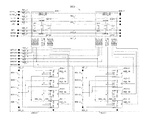
- FIG. 8 is a schematic diagram illustrating the interconnection of two blocks which include identical MDAC and logic circuits and two identical stage ADC (SADC) blocks that are interconnected according to one embodiment to perform both MDAC and track-hold functions.
- SADC stage ADC
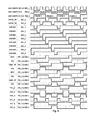
- FIG. 9 is a timing diagram of the clock and control waveform 0 and 1 logic levels which are used to control and which are generated by the logic circuitry of the two MDAC and SADC blocks shown in FIG. 8 .
- one aspect addresses the limitations present in the Devarajan and Rezayee systems to achieve SHA-less pipeline ADC sampling rates up to, and beyond, the GSPS region of operation by combining the track and hold functions of an SHA-less pipeline ADC with the first stage MDAC functions of a pipeline ADC.
- Another aspect relates to the desire to overcome the Gain-Bandwidth Limitation of each individual amplifier in the separate ADC first stages by arranging the combination of switches and the timing of the switch control signals to permit the inputs and the output of the residue operational amplifiers of the first and second of the ADC first stages to be connected to each other, respectively. Therefore one can assist the other when a HOLD amplification function is being performed. The transconductance of both then can then be used to double the gain bandwidth of the resulting combination. The common connection of the amplifier outputs then becomes the output of the SHA-less pipeline ADC first stage.
- Still another aspect deals with the desire to overcome the Shortened Tracking Time Limitation by providing provide a combination of capacitors, amplifiers, switches, different timing intervals, and duplicate MDAC circuits which facilitate a TRACK time interval of 2 half ADC SAMPLE CLK periods as opposed to the TRACK time interval of less-than one-half ADC SAMPLE CLK period in the prior-art Devarajan reference.
- the technology disclosed herein which enables the longer TRACK time interval includes construction of two identical SHA-less pipeline ADC first stages interconnected in such a way that the amplifiers are shared between the duplicated circuits.
- Yet another aspect relates to the goal of overcoming the ADC Input Capacitive Load Variation Limitation by providing a combination of capacitors, amplifiers, switches, different timing intervals, and duplicate MDAC circuits that facilitate long tracking intervals for each of the duplicate circuits in which sampling capacitor connections to the ADC input neither overlap each other, nor are separated widely in time from each other.
- the lack of separation, or overlap provides a nearly-constant capacitive load for the input device or input buffer amplifier (BAMP).
- BAMP input buffer amplifier
- the technology disclosed herein can therefore use just one BAMP, with one output which can be connected to the voltage input of both of the two identical SHA-less pipeline ADC first stages.
- Still another aspect involves the desire to overcome the Clearing Switch Size Limitation by providing a combination of capacitors, amplifiers, switches, different timing intervals, and duplicate MDAC circuits which facilitate a TRACK clock interval of one ADC SAMPLE CLK interval, and yet provides a time period of one-quarter ADC SAMPLE CLK period for resetting the input sampling capacitor as opposed to the “significantly-less-than-half” ADC SAMPLE CLK clearing pulse timing interval of the prior art Devarajan system.
- Comparator Delay-Time Limitation overcomes the Comparator Delay-Time Limitation by providing a combination of capacitors, amplifiers, switches, different timing intervals, and duplicate MDAC circuits which delay the HOLD time interval from the TRACK time interval by a time of one-quarter of an ADC SAMPLE CLK period. This delay provides a time equal to one-quarter ADC SAMPLE CLK prior to the ADC HOLD timing interval for the comparators to respond with a very low metastability error rate, as opposed to the “significantly-less-than-half” ADC SAMPLE CLK interval of the prior-art Devarajan reference, or other typical prior-art MDAC circuits.
- Another aspect relates to overcoming the SADC-Bandwidth Matching Limitation by providing a combination of capacitors, amplifiers, switches, different timing intervals, and duplicate MDAC circuits which allow the incoming signal to be sampled and held STABLE for one-quarter of an ADC SAMPLE CLK period during the time that the SADC comparator samples are taken.
- the BAMP bandwidth limitations have already shaped the input signal sample prior to the time that a stable sample of the input is obtained. Thereafter, a one-quarter ADC SAMPLE CLK period is provided for the SADC to respond, both with acceptable accuracy and metastability-error performance.
- Still another aspect has to do with the desire to overcome the Partially-Corrected 1/f Noise Limitation, the Amplifier Common-Mode Offset Correction Limitation, and the Uncorrected Amplifier DC Offset Limitation by providing a combination of capacitors, amplifiers, and switches which consume very little additional power in a circuit topology that provides 1/f noise cancellation, output common-mode voltage correction, and input DC offset correction.
- circuit topology Some key features of the circuit topology include switchably connecting the amplifier output to a switched-capacitor filter feedback circuit which has been designed with the objective of preventing input DC offsets from appearing at the output, reducing amplifier 1/f noise contributions from any stage in the amplifier (not just from the input stage), and setting the common mode DC output voltage to a value precisely half way between the positive and negative analog signal voltage references.
- Still another aspect relates to overcoming the Autozero-Mode Amplifier Input Offset Switch Parasitic Capacitance Limitation.
- This limitation results when autozero-mode offset-correction switched-capacitor offset circuitry is connected directly to the residue amplifier input. It is the object of the technology disclosed herein to accomplish the autozero-mode feedback from the amplifier output by utilizing a combination of switches and capacitors which connect to the amplifier output current-biasing circuitry and not its charge-sensitive input.
- FIG. 8 A schematic diagram illustrating how the major blocks of one embodiment are interconnected is shown in FIG. 8 .
- some of the principal ADC analog signals connect to both of the MDAC blocks 800 - 1 and 800 - 2 .
- these signals are the joined analog ADC inputs INPV ( 350 _ 1 ) and INNV ( 350 _ 2 ), the joined ADC analog outputs OUTPV ( 360 _ 1 ) and OUTNV ( 360 _ 2 ), and the joined ADC residue amplifier inputs AMPINP ( 352 _ 1 ) and AMPINN ( 352 _ 2 ).
- the blocks shown in FIG. 8 require regular and recurring externally-generated timing signals, which are shown in the timing sequence of FIG. 9 as logic-level signals CKP 1 XTH 391 _ 3 , CKP 3 XTH 393 _ 3 , CKP 1 XF 1 991 _ 1 , CKP 2 XF 1 992 _ 1 , CKP 3 XF 1 993 _ 1 , CKP 1 XF 2 991 _ 2 , CKP 2 XF 2 992 _ 2 , and CKP 3 XF 2 993 _ 2 .
- logic timing signals are shown in FIG. 9 as rectangular waveforms, several of these waveforms are generated using logic blocks which output non-overlapping half-clock timing waveforms. It is well understood that the use of non-overlapping timing waveforms is required to prevent two CMOS switches which connect a single circuit node to two different analog voltages from being both on at the same time. For example, it is common practice to prevent TRACK and HOLD clock signals from overlapping in time.
- half-clock periods When describing typical non-overlapping clock periods, or half-clock timing intervals that are shortened by only a few percent to provide non-overlap, they will be still hereinafter referred to as “half-clock periods” or “half-clock timing intervals” and therefore treated as rectangular waveforms without shortening of a few percent in the waveform illustrations.
- timing events which occur earlier in time than, or prior-to others, it will be assumed that the earlier-described timing event, or waveform, occurs in the half-clock period prior to the later-described timing event, or waveform.
- Timing signals 391 _ 3 and 393 _ 3 occur with the same periodicity as the ADC analog input signal sample rate, shown as ADC SAMPLE CLK ( 990 _ 2 ), in FIG. 9 . While the equivalent “track” and “hold” time periods for a conventional ADC are shown for 990 _ 2 in FIG. 9 , the duration, or pulse width of the TRACK time period for the embodiment disclosed herein will start earlier, end earlier, and be twice as long in comparison to the “track” and “hold” time intervals of 990 _ 2 in FIG. 9 . Also note that most of the ADC timing signals, such as 391 _ 3 and 393 _ 3 , are substantially shorter than a half period of the ADC sample clock.
- Timing signals which have a pulse width of approximately one-quarter of the ADC SAMPLE CLK period may be easily formed in the external circuitry by logically combining the ADC sample clock and another clock operating at twice the sample clock frequency such as ADC SAMPLE HF-CLK ( 990 _ 1 ) using logic combinations well understood by any person of ordinary skill in the art of CMOS logic circuit design.
- external timing signals 991 _ 1 , 992 _ 1 , 993 _ 1 , 991 _ 2 , 992 _ 2 , and 993 _ 2 occur with a periodicity of one-half the ADC sample clock.
- the blocks 800 - 1 and 800 - 2 in FIG. 8 each include identical MDAC circuits shown generally at 300 A in FIG. 3 a .
- Each MDAC circuit shown generally at 300 A in FIG. 3 a is paired with a logic circuit, generally shown at 700 A in FIG. 7 a .
- Each of the paired logic circuits of FIG. 7 a provides the logic-level timing signals that operate the MDAC switches shown in FIG. 3 a , or FIG. 3 b .
- a schematic of the input switched capacitor network block 400 of FIG. 3 a is shown in FIG. 4 .
- the schematics for the sub-blocks 501 -A to 505 -A and 501 -B to 505 -B of the switching networks shown in FIG. 4 are shown in FIG. 5 a and FIG. 5 b , respectively.
- Each switched capacitor network block, shown generally at 400 in FIG. 4 is paired with and operated by the logic circuitry shown generally at 700 B in FIG. 7 b.
- a coarse measurement (quantization) of the amplitude of sampled-and-held inputs of each MDAC block 800 - 1 and 800 - 2 is made by a corresponding stage ADC (SADC), 800 - 3 or 800 - 4 of FIG. 8 .
- SADC stage ADC
- the Q outputs of the SADC flash comparators 890 - 1 A through 890 - 4 A and 890 - 1 B through 890 - 4 B are used to control the capacitor switch selection inputs 390 - 1 through 390 - 4 of the corresponding MDACs in a manner well understood by any person of ordinary skill in the art of pipeline ADC design.
- Each of the MDACs shown generally at 300 A in FIG. 3 a , or 300 B or in FIG. 3 b may include an operational, or residue, amplifier 600 with inputs INPV, INNV and outputs OUTPV, OUTNV which are also shown in the simplified schematic of FIG. 6 . While the detailed circuit design of operational amplifiers is well understood by any person of ordinary skill in the art of analog CMOS circuit design, the main purpose of FIG. 6 is to illustrate how the autozero feedback switchcap circuitry of FIG. 3 a , or FIG. 3 b , which performs amplifier offset and 1/f noise correction, connects to the amplifier output current-control terminals GPP and GPN of the amplifier through wires GPP 373 _ 1 and GPN 373 _ 2 , of FIG. 6 .
- the residue amplifier shown in FIG. 6 is a well understood configuration commonly known as an operational transconductance amplifier, or OTA.
- the bias current generator 622 in FIG. 6 establishes the same gate voltage GPBIAS ( 382 ) on the current mirror input PMOS 621 - 1 as in the current mirror output PMOS 621 - 2 .
- Bypass capacitor 631 reduces voltage changes induced on 382 from internal AC signal feedthrough from signals on the PMOS input differential pair, 622 - 1 and 622 - 2 , and external switching events.
- the differential pair current output is amplified by identical NMOS current mirrors 623 - 1 , 624 - 1 and 623 _ 2 , 624 _ 2 which have source terminals connected to the most negative supply terminal VN 322 _ 2 .
- the current source 621 - 2 and the width/length (W/L) ratios between the diode connected MOS devices 623 - 1 and 623 - 2 and the current mirror output devices 624 - 1 and 624 - 2 determine the quiescent output current of the NMOS output devices 624 - 1 and 624 - 2 .
- the PMOS output transistors 601 - 2 and 601 - 1 sink the currents from NMOS output transistors 624 - 2 -and 624 - 1 . If the gate voltages GPN 373 _ 2 on PMOS transistors 601 - 2 or GPP 373 _ 1 on PMOS 601 - 1 go more negative and cause these transistors to sink more current than the quiescent currents from NMOS output transistors 624 - 2 - or 624 - 1 , the outputs OUTNV 360 _ 2 and OUTPV 360 _ 1 will tend to rise in voltage.
- the operation of the MDAC block, shown generally at 300 A in FIG. 3 a or at 300 B in FIG. 3 b , and the switch capacitor block, shown generally at 400 in FIG. 4 depends on the timing of locally generated logic signals, such as 798 _ 1 and 793 _ 7 which are generated by the timing-control logic of FIGS. 7 a and 7 b , and also shown in FIG. 9 with appropriate timing delays between the blocks 800 - 1 and 800 - 2 . Therefore, the detailed description of the one embodiment continues with a description of the switchcap timing-control logic flip-flops (FF, or flops).
- FF switchcap timing-control logic flip-flops
- the set-reset SR flip flops used in one embodiment are designed to produce a positive logic-level output from the QP output (for example output 791 _ 5 of flop 714 in FIG. 7 a ) and a negative logic-level output from the QN output when the set input, S 791 _ 3 , receives a positive (or 1) logic level input. Conversely, they produce a negative logic-level output from the QP output and a positive logic-level output from the QN output when the reset input, R 791 _ 4 , receives a positive logic level input.
- the QP output changes state to a 1, and the QN output changes to a 0 when the set input SX (for example input 391 _ 2 of flop 711 in FIG. 7 a ) receives a negative (or 0) logic-level input.
- the SR-FF flip-flops in FIGS. 7 a and 7 b , and all others in the illustrated embodiments of the invention are designed in a manner well understood to produce non-overlapping (NOL) QP and QN outputs.
- NOL non-overlapping
- both QP and QN outputs will neither be positive at the same time nor negative at the same time.
- it is desirable that the non-overlap time periods are as short as possible so that the delay from receiving a control input change to producing a change in both outputs is minimized.
- a non-overlap time of less than 5% of the total clock period is desired. Therefore the waveforms of FIG.
- NOL-SR-FF non-overlapping-output SR flip-flop design
- NOL-SR-FF design must produce output voltage level changes that are sufficient to drive the analog CMOS switches.
- N and P type CMOS devices are used for the switches, then both QP and QN voltage outputs are used.
- a switch control voltage such as control voltage TPC_A of switch 301 - 1 in FIG. 3 a is positive (logic 1), then the switch is closed (inputs and outputs are connected together).
- the switches of MDAC switched-capacitor circuit in block 800 - 1 , 800 - 2 , and shown in the schematic diagram of FIG. 3 a or 3 b are each operated by identical timing-control logic circuits which are shown generally at 700 A in FIG. 7 a .
- the operation of the flops in FIG. 7 a , their connection to control a corresponding switch in FIG. 3 a or 3 b , and the timing of that switch control signal for each of blocks 800 - 1 and 800 - 2 is shown in FIG. 9 .
- all the timing control logic signals described as operating the circuitry in FIG. 3 a are also capable of operating the circuitry in FIG. 3 b if that alternate embodiment of the MDAC is used.
- the descriptions in the following paragraphs begin by referencing the input signal connections shown in FIG. 7 a , such as CKP 1 X_TH 391 _ 3 and CKP 1 XF 2 391 _ 2 .
- the negative-going logic input signal CKP 1 X_TH 391 _ 3 causes the QP output of each NOL-SRX-FF 710 in blocks 800 - 1 or 800 - 2 to produce a logic 1 output HN 4 _A on wire 793 _ 4 and a logic 0 output HP 4 _A on wire 793 _ 5 .
- the HN 4 _A logic signal is shown in the timing diagram of FIG.
- HN 4 A 793 _ 4 in 800 - 1 or “HN 4 A 793 _ 4 in 800 - 2 .”
- the HN 4 _A logic 1 output on wire 793 _ 4 causes amplifier reset switches 303 - 1 and 303 - 2 in FIG. 3 a to close, connecting the amplifier inputs INNQ 352 _ 2 and INPQ 352 _ 1 to the amplifier input common voltage VCM_IN, 383 .
- VCM_IN is derived from an external reference voltage source such as 100 mV above the zero-voltage reference, or most negative supply terminal, which is also designated by VN 322 _ 2 in FIG. 6 .
- a negative-going logic input signal CKP 3 X_TH ( 391 _ 3 ) causes the QP output of each NOL-SRX-FF 710 in blocks 800 - 1 or 800 - 2 to produce a logic 0 output on HN 4 _A 793 _ 4 and open switches 303 - 1 and 303 - 2 .
- the HN 4 _A logic signal occurs in synchronism with the ADC SAMPLE CLK 900 _ 2 “track” timing interval shown in FIG. 9 .
- the negative-going logic input signal CKP 1 X_TH 391 _ 3 also causes the output of inverter 721 at 791 _ 3 to go to a logic 1 and cause the QP output of NOL-SR-FF 715 in blocks 800 - 1 or 800 - 2 to produce a logic 1 output on TP_A 791 _ 8 .
- NOL-SR-FF 715 is reset (QP output goes to 0 and QN goes to 1) when a negative-going logic input signal CKP 3 X_TH 393 _ 3 causes the output of inverter 723 at 793 _ 3 to go to a logic 1. It can be seen from FIG.
- TP_A 791 _ 8 controls switches 305 - 1 , 305 - 2 , 305 - 3 , 305 - 4 , 305 - 5 , 305 - 6 in blocks 800 - 1 and 800 - 2 to connect one plate of the small autozero capacitors 320 - 1 , 320 - 2 and 321 - 1 , 321 - 2 to amplifier 600 outputs and the other plate to amplifier output biasing connections GPP 373 _ 1 or GPN 373 _ 2 during the ADC SAMPLE CLK 900 _ 2 “track” timing interval.
- HP_A 793 _ 8 timing signals are derived from the flop QN output, they are just the logical complement of the QP output and therefore are in synchronism with the ADC SAMPLE CLK 900 _ 2 “hold” timing interval.
- switches 305 - 1 , 305 - 2 , 305 - 3 , 305 - 4 , 305 - 5 , 305 - 6 for blocks 800 - 1 and 800 - 2 will open and switches 305 - 1 , 305 - 2 , 305 - 3 , 305 - 4 , 305 - 5 , 305 - 6 for blocks 800 - 1 and 800 - 2 will close, to connect one plate of the small autozero capacitors 320 - 1 , 320 - 2 and 321 - 1 , 321 - 2 to MDAC positive and negative voltage references VRP_D 381 _ 1 and VRN_D 381 _ 2 and the other plate to the amplifier gate bias voltage GPBIAS
- the negative-going logic input signal CKP 1 X_TH 391 _ 3 also causes the output of inverter 721 at 791 _ 3 to go to a logic 1 and cause the QP output of NOL-SR-FF 714 to produce a logic 1 output on RP 1 _A 791 _ 5 and a logic 0 on RN 1 _A 791 _ 6 .
- RP 1 _A 791 _ 5 controls switch 306 - 1 in FIG. 3 a to clamp both of OTA 600 outputs together.
- CKP 1 XTH 791 _ 4 is directly connected to the R input of NOL-SR-FF 714 , the flop is reset when CKP 1 X_TH 391 _ 3 goes to 1 and therefore produces a logic 1 at the output of inverter 722 .
- FIG. 9 the timing of RP 1 _A 791 _ 5 is shown as RP 1 _A 791 _ 5 for both blocks 800 - 1 and 800 - 2 .
- a logic 1 on RP 1 _A 791 _ 5 controls amplifier reset switch 306 - 1 in FIG. 3 a to short the outputs of amplifier 600 together during the first half of the ADC SAMPLE CLK 900 _ 2 “track” timing interval.
- the negative-going logic input signal CKP 1 XF 2 391 _ 2 causes the QP output of each NOL-SRX-FF 711 in blocks 800 - 1 or 800 - 2 to produce the logic 1 output TPC_A on wire 791 _ 7 and a logic 0 output HPC_A on wire 792 _ 4 .
- the timing for the 2 different TPC_A logic signals is shown in the timing diagram of FIG. 9 as the logic signals in block 800 - 1 and 800 - 2 using the designation “TPC_A 791 _ 7 in 800 - 1 ” or “TPC_A 791 _ 7 in 800 - 2 .”
- TPC_A 791 _ 7 in 800 - 1 the timing of the same logic signal is different for blocks 800 - 1 , and 800 - 2 as shown in the timing diagram of FIG.
- the reason for the difference can therefore be determined for CKP 1 XF 2 391 _ 2 and the remaining logic signals by referring to the description of the block timing signal interconnections of FIG. 8 in “Section 1—Interconnection of the Major Blocks.”
- the TPC_A logic 1 output on wire 791 _ 7 causes the input capacitor reset switches 301 - 1 , 301 - 2 , 301 - 3 in FIG. 3 a to close, connecting each capacitor 421 through 428 positive and negative signal output plates (CCOM_F 1 P 351 _ 1 and CCOM_F 1 N 351 _ 2 ) in the input switched-capacitor network of FIG. 4 to be connected together and also to the amplifier input common voltage VCM_IN 383 .
- a negative-going logic input signal CKP 2 XF 1 392 _ 1 causes the QP output of NOL-SRX-FF 711 to produce a logic 0 output on wire 791 _ 7 and open switches 301 - 1 , 301 - 2 , 301 - 3 at the appropriate times for the different blocks 800 - 1 and 800 - 2 .
- the negative-going logic input signal CKP 3 XF 1 393 _ 1 causes the QN output of NOL-SRX-FF 713 to produce a logic 1 output HP 3 _A on wire 793 _ 7 and also causes the QP output to produce a logic 0 output HN 3 _A on wire 793 _ 6 .
- the 2 different HP 3 _A logic signals for blocks 800 - 1 and 800 - 2 are shown in the timing diagram of FIG.
- HP 3 _A logic 1 output on wire 793 _ 7 causes the amplifier input connection switches 302 - 1 and 302 - 2 to connect to the capacitor 421 through 428 positive and negative signal output plates (CCOM_F 1 P 351 _ 1 and CCOM_F 1 N 351 _ 2 ) in the input switched-capacitor network of FIG. 4 to the operational amplifier 600 negative and positive inputs INNQ 352 _ 2 and INPQ 352 _ 1 .
- These switches are opened when the negative-going logic input signal CKP 1 XF 2 391 _ 2 causes the QN output of each NOL-SRX-FF 713 to produce a logic 0 on output HP 3 _A ( 793 _ 7 ).
- CKP 2 XF 2 392 _ 2 in FIG. 7 b transitions to a logic 0, the positive-going output of inverter 744 ( 792 _ 2 ) also causes the QP output of NOL-SR-FF 734 to produce a logic 1 and the QN output to produce a logic 0.
- the QN output TN 2 798 _ 2 is not connected.
- the OP output logic 1 signal TP 2 798 _ 1 begins the MDAC tracking interval.
- TP 2 798 _ 1 is shown in FIG. 4 to connect to blocks 501 -A through 505 -B where it closes switches 513 - 1 and 513 - 2 in FIG. 5 a , and switches 528 - 1 and 528 - 2 in FIG.
- the TP 2 logic 0 opens switches 513 - 1 and 513 - 2 in FIG. 5 a , and switches 528 - 1 and 528 - 2 in FIG. 5 b disconnecting the positive and negative voltage inputs INPV ( 350 _ 1 ) and INNV ( 350 _ 2 ), respectively, from the input plates of capacitors 421 - 1 through 428 - 2 in FIG. 4 and ending the MDAC TRACK interval.
- the negative-going logic input signal CKP 3 XF 2 393 _ 2 causes the output of inverter 741 output at 793 _ 2 to go to a logic 1 and cause the QP output of NOL-SR-FF 731 to produce a logic 1 output on SADC_TP ( 795 _ 1 ) and the QN output to produce a logic 0.
- the QN output SADC_TN 795 _ 2 is not connected.
- SADC_TP ( 795 _ 1 ) is shown in FIG. 4 to connect to blocks 501 -A through 505 -B where it closes switches 514 - 1 and 514 - 2 in FIG.
- the 2 different SADC_TP switch control signal waveforms for each block are shown in FIG. 9 .
- the negative-going logic input signal CKP 3 XF 1 393 _ 1 causes the output of inverter 742 output at 793 _ 1 to go to a logic 1 and cause the QP output of NOL-SR-FF 731 to produce a logic 0 output on SADC_TP ( 795 _ 1 ) which opens switches 514 - 1 and 514 - 2 in FIG. 5 a , and switches 529 - 1 and 529 - 2 in FIG. 5 b , disconnecting the capacitors from the inputs of the SADC, thereby ending the tracking time interval of the stage. From the timing diagram of FIG.
- the logic 1 output of inverter 742 on 793 _ 1 also causes the QP output of NOL-SR-FF 732 to produce a QP logic 1 output and the QN output to produce a logic 0.
- the QN output HN 2 796 _ 2 is not connected.
- the QP logic 1 output on HP 2 ( 796 _ 1 ) begins the HOLD time interval of the stage.
- HP 2 796 _ 1 is shown in FIG. 4 to connect to blocks 501 -A through 505 -B where it closes switches 511 - 1 and 511 - 2 in FIG. 5 a connecting the positive and negative input plates of capacitors 421 - 1 through 424 - 2 to the positive and negative amplifier outputs OUTPV 360 _ 1 and OUTPN 360 _ 2 in FIG.
- FIG. 9 The 2 different HP 2 switch control signal waveforms for blocks 800 - 1 and 800 - 2 are shown in FIG. 9 .
- the negative-going logic input signal CKP 1 XF 2 391 _ 2 causes the output of inverter 743 output at 791 _ 2 to go to a logic 1
- the QP output of each NOL-SR-FF 732 in blocks 800 - 1 or 800 - 2 transition to a logic 0, disconnecting the capacitors from the amplifier 600 outputs OUTPV and OUTPN, ending the hold time interval of the stage.
- the HP 2 796 _ 1 signal is also shown in FIG. 5 b connecting to logic inverter 523 having output HN 2 555 .
- NAND gate 520 - 1 will output a logic 0 on line 550 _ 1 to inverter 521 - 1 resulting in a logic 1 on switch control line PQP 551 _ 1 which will close switch 525 - 1 connecting the COUTP capacitor input plate wire 462 to the positive analog voltage reference VRP_D 381 _ 1 .
- the output of the NOR gate 522 - 1 must produce a logic zero on control line NQP 552 _ 1 and therefore switch 526 - 1 will not connect COUTP to the negative analog voltage reference VRN_D 381 _ 2 .
- the logic 1 output of CMP_QP will produce a logic 0 at the output of inverter 524 on wire 553 , and that output combined with the logic 0 from inverter 523 will result in a logic 1 on switch control line NQN 552 _ 2 from NOR gate 522 - 2 .
- NQN will cause switch 526 - 2 to close, connecting the COUTN capacitor input plate wire 463 to the negative analog voltage reference VRN_D 381 _ 2 during time interval
- HP 2 is a 1 in blocks 800 - 1 and 800 - 2 as shown in FIG. 9 .
- the logic 0 at the output of inverter 524 on wire 553 will force the output of NAND 520 - 2 to be a logic 1, thereby forcing inverter 521 - 2 to output a logic 0 on switch control line PQN 550 _ 2 .
- a logic 0 on PQN will cause switch 525 - 2 to open, not allowing the COUTN capacitor input plate wire 463 to connect to the negative analog voltage reference VRN_D ( 381 _ 2 ).
- the output of the NAND gate 520 - 1 must be a logic 1, causing inverter 521 - 1 to produce a logic 0 on control line PQP 552 _ 1 and therefore switch 525 - 1 will not connect COUTP 462 to the positive analog voltage reference VRP_D 381 _ 1 .
- the logic 0 output of CMP_QP will insure a logic 1 at the output of inverter 524 , and that output, together with the logic 1 on HP 2 will result in a logic 0 at the output of NAND gate 520 - 2 on 550 _ 2 and a logic 1 on switch control line PQN 551 _ 2 .
- switch 525 - 2 will connect COUTN to the positive analog voltage reference VRP_D ( 381 _ 1 ).
- the logic 1 at the output of inverter 524 will force the output of NOR gate 522 - 2 to output a 0 on switch control line NQN.
- a logic zero on switch control line NQN will open switch 526 - 2 , disconnecting COUTN from the negative analog voltage reference VRN_D 381 _ 2 .
- RFP 1 797 _ 1 connects to blocks 501 -A through 505 -B where it closes switches 512 - 1 and 512 - 2 in FIG. 5 a and switches 527 - 1 and 527 - 2 in FIG. 5 b connecting the positive and negative input plates of capacitors 421 - 1 through 424 - 2 to the ADC common mode input voltage reference VCM_IC 380 _ 1 .
- the ADC common mode input voltage VCM_IC and opamp 600 common mode output voltage are commonly set to a voltage midway between the MDAC positive reference voltage VRP_D 381 _ 1 and the MDAC negative reference voltage VRN_D ( 381 _ 2 ), and that these voltage references are set to values equal to the positive and negative limits of the analog input and output voltage swings for the pipeline ADC stages.
- the negative-going logic input signal CKP 2 XF 2 392 _ 2 causes the output of inverter 744 output at 792 _ 2 to go to a logic 1 and cause the QP output of each NOL-SR-FF 733 in blocks 800 - 1 or 800 - 2 to produce a logic 0 output on RFP 1 797 _ 1 ) which, in turn, causes switches 512 - 1 and 512 - 2 in FIGS. 5 a and 527 - 1 and 527 - 2 in FIG. 5 b to open, ending the input capacitor reset timing interval.
- the timing of signal RPF 1 ( 797 _ 1 ) for the blocks 800 - 1 and 800 - 2 is shown in FIG. 9 .
- RPF 1 is a logic 1
- any residual charge on the input capacitors is cleared.
- the RPF 1 timing interval of one-quarter of a full ADC SAMPLE CLK period is substantially longer than the short “clearing pulse” (PHI_CLEAR) timing interval of the referenced prior art which consumed a portion of the TRACK half-clock interval.
- PKI_CLEAR short “clearing pulse”
- the RPF 1 timing interval does not subtract from the TP 2 tracking time interval, which at a width of a full ADC SAMPLE CLK period is more than twice the timing interval of the referenced prior art TRACK less-than half-clock interval.
- the description of the MDAC and input switched-capacitor circuit operation begins with the reset of the input capacitor array of block 800 - 1 as shown in FIG. 4 .
- the purpose of the reset time interval is to initialize the voltage across the capacitors 421 - 1 through 428 - 2 so that any residual voltage remaining as a result of the pervious conversion will be removed.
- the substantially-complete removal of the residual voltage is particularly relevant in pipeline ADC systems which employ a plurality of pipeline ADCs, also known as pipeline ADC leaves, to perform analog-to-digital conversions in a multi-leaf ADC system at a higher rate than a single leaf.
- the reason for the relevancy in this case is that the previous signal stored on the sampling capacitors of a particular leaf in a multi-leaf system is not the previous analog input voltage sample of that leaf, but a voltage sample from a prior time interval which may have a value that is not linearly related to the present sample.
- the reset signal RPF 1 797 _ 1 in 800 - 1 causes the reset switches 512 - 1 , 512 - 2 and 527 - 1 , 527 - 2 in blocks 501 -A through 505 -B to connect the input plates of capacitors 421 - 1 through 428 - 2 to be connected to VCM_IC, the ADC input signal common mode reference voltage.
- the reset signal RPF 1 time interval, 797 _ 1 in 800 - 1 as shown in FIG. 9 it is also necessary to connect the output plates of the capacitors to an appropriate reference voltage. This connection is made during timing interval TPC_A 791 _ 7 in 800 - 1 as shown in FIG.
- TP 2 798 _ 1 in 800 - 1 becomes logic 1 at the beginning of the logic 1 to 0 transition for RPF 1 797 _ 1 in 800 - 1 (end of reset) and extends for a full ADC SAMPLE CLK 990 _ 2 period beyond that transition.
- This begins the TRACK time interval for block 800 - 1 in one embodiment of the invention.
- the TP 2 TRACK time interval begins more than a full clock period before the hold time interval for a conventional pipeline ADC shown for the ADC SAMPLE CLK 990 _ 2 .
- the reset switches 512 - 1 , 512 - 2 and 527 - 1 , 527 - 2 in blocks 501 -A through 505 -B open and the tracking switches 513 - 1 , 513 - 2 and 528 - 1 , 528 - 2 in blocks 501 -A through 505 -B close, to connect the input plates of capacitors 421 - 1 through 428 - 2 to connect to INPV 350 _ 1 and INNV 350 _ 2 , the ADC positive and negative input voltage signals.
- These tracking switches are closed for a TP 2 period of time equal to one full ADC SAMPLE CLK 990 _ 2 period.
- the tracking capacitors 421 - 1 through 428 - 2 have approximately twice as much time to track the input signal as typical pipeline ADCs of the prior art, such as the ADC disclosed in the Rezayee reference ( FIG. 2 b ) which allocate only half of the ADC SAMPLE CLK period for input signal voltage tracking. It should be also noted that the extra factor of 2 time allocation for input buffer amplifier (BAMP) slewing and settling is also an advantage.
- BAMP input buffer amplifier
- the ADC voltage input signal tracking time which is approximately equal to the ADC SAMPLE CLK period in one embodiment has a time advantage of more than a factor of two in comparison to the tracking time interval in the SHA-less pipeline ADC disclosed in the Devarajan which must be shortened to less than one half of the ADC SAMPLE CLK period in order to allow time for the reset or “clearing” pulse to occur.
- the one embodiment therefore overcomes the prior art limitation previously described as the Shortened Tracking Time Limitation.
- MDAC block 800 - 1 and SADC block 800 - 3 While the preceding and following descriptions of the operation of one embodiment emphasize the operation of MDAC block 800 - 1 and SADC block 800 - 3 , it should be understood that the operation of MDAC block 800 - 2 and SADC block 800 - 4 is identical, however delayed in time by one full ADC SAMPLE CLK 990 _ 2 as shown in FIG. 9 . It should be noted that if more than one input capacitor network, for example capacitors 421 - 1 through 428 - 2 in block 800 - 1 , is connected to the ADC positive and negative voltage inputs INPV 350 _ 1 and INNV 350 _ 2 at one time, the capacitive load on the ADC input device, such as an external input buffer amplifier BAMP, will double for a certain period of time.
- ADC input device such as an external input buffer amplifier BAMP
- a time interval equal to one-quarter of the ADC SAMPLE CLK period elapses before the input plates of capacitors 425 - 1 to 425 - 2 are switched during HP 2 ( 796 _ 1 in 800 - 1 ) to either the MDAC positive or negative voltage reference outputs VRP_D 381 _ 1 or VRN_D 381 _ 2 by switches 525 - 1 or 525 - 2 , and 526 - 1 or 526 - 2 , shown in FIG. 5 a .
- the capacitor input plates in block 800 - 1 are connected to the appropriate SADC comparator inputs on wires 399 _ 1 A, 399 _ 2 A shown in FIG.
- SADC_TP transitions to a logic 1 and maintains the connection between the capacitor input plates and the SADC inputs during the one-quarter ADC SAMPLE CLK period after the 1 to 0 transition of TP 2 .
- SADC_TP remains a logic 1 for one-quarter of an ADC SAMPLE CLK period, until the 0 to 1 transition of HP 2 , when the capacitor input plate voltages are reconnected to the ADC input voltage reference VCM_IC by switch control signal RPF 1 .
- the one-quarter ADC SAMPLE CLK period between the opening of the switches connecting the comparator inputs to the ADC analog voltage inputs, and the 0 to 1 transition of HP 2 allows ample time for the SADC comparator input circuits to acquire, and hold, the sampled value of a rapidly changing input signal, that is approximately the same as the sampled value acquired by the MDAC, without having to closely match the response to the amplifier input time response. Because one embodiment allows ample time for the comparator circuits to acquire the same sampled-and-held value of a rapidly changing input signal that is held by the MDAC track-and-hold circuitry, it therefore overcomes the prior art limitation previously described as the SADC-BAMP Bandwidth Matching Limitation.
- the one-quarter ADC SAMPLE CLK period allowed for comparator regeneration also allows time to regenerate and produce a correct logical output with an extremely low error rate. That is because the comparator regeneration time constant, which was previously described to be in the range of 50 ps for 180 nm CMOS technology, will easily be in the range of 5 picoseconds for 28 nm CMOS technology. For a 1 GSPS ADC SAMPLE CLK rate, a one-quarter ADC SMAPLE CLK period of 250 pS would still allow comparator regeneration for more than 35 regeneration time constants. Because one embodiment overcomes the prior art limitation shortening the time available for the TRACK timing interval it overcomes the problem of high metastability error rates in low error-rate telecommunication systems which was previously described as the Comparator Delay-Time Limitation.
- the 0 to 1 transition of HP 2 ( 796 _ 1 in 800 - 1 ), causes the residue amplifier 600 positive and negative outputs OUTPV and OUTNV to be connected to the positive and negative capacitor 421 - 1 to 424 - 2 input plates and the appropriate comparator outputs to control the connection of the positive and negative capacitor 425 - 1 to 428 - 2 input plates to the appropriate MDAC positive or negative voltage reference outputs VRP_D or VRN_D.
- the residue amplifier then has a one-half ADC SAMPLE CLK period (a timing interval designated hold in waveform 990 _ 2 in FIG. 9 ) to settle and transmit the residue amplifier output to the next stage of the ADC.
- the operation of the offset and 1/f noise correction circuits is described with reference to FIG. 3 a .
- the timing of the control signal for the switches which enable offset and 1/f noise correction is the same for both block 800 - 1 and 800 - 2 .
- the control signals TP_A 791 _ 8 and HN 4 _A 793 _ 4 operate in synchronism with the ADC SAMPLE CLK 900 _ 2 “track” timing interval of FIG. 9 .
- the control signal HP_A ( 793 _ 8 ) operates in synchronism with the ADC SAMPLE CLK 900 _ 2 “hold” timing interval shown in FIG. 9 .
- the reset signals RP 1 _A ( 791 _ 5 in 800 - 1 ) and RP 1 _A ( 791 _ 5 in 800 - 2 ) also operate in synchronism with the ADC SAMPLE CLK 900 _ 2 “track” timing interval shown in FIG. 9 , but are only a logic 1 for the first one-half of the “track” timing interval.
- control timing signal RP 1 _A closes the reset switch 306 - 1 which helps force the VOUTP-VOUTN difference to go more rapidly toward zero.
- the outputs are released during the last half of the track timing interval to settle to a residual voltage difference which is the result of an input DC offset voltage difference and input 1/f noise.
- the small autozero capacitors In order for the small output offset voltage OUTPV-OUTNV difference to create an accurate GPP-GPN voltage difference, the small autozero capacitors must be first pre-charged to an initial voltage which is the same for both positive and negative amplifier outputs. If the capacitors are pre-charged to a reference voltage difference that is equal to the difference between the target GPP and GPN quiescent DC bias voltage GPBIAS on line 382 in amplifier 600 , and the target amplifier common mode output voltage VCM_OUT, then the amplifier switched-capacitor feedback circuit will also be capable of correcting for errors in amplifier common-mode voltage.
- COSPTOP ( 372 _ 1 ) of the small autozero capacitors 321 - 1 and 320 - 1 is connected by switch 305 - 1 to the target GPP and GPN quiescent DC bias voltage GPBIAS ( 382 ), while the other plates 370 _ 1 and 371 _ 1 are connected to VRN_D by switch 305 - 3 for capacitor 321 - 1 and to VRP_D by switch 305 - 5 for capacitor 320 - 1 .
- COSNTOP ( 372 _ 2 ) of the small autozero capacitors 321 - 2 and 320 - 2 is connected by switch 305 - 2 to the target GPP and GPN quiescent DC bias voltage, GPBIAS 382 , while the other plates 370 _ 2 and 371 _ 2 are connected to VRN_D by switch 305 - 4 for capacitor 321 - 2 and to VRP_D by switch 305 - 6 for capacitor 320 - 2 .
- one plate of the small autozero capacitors 321 - 1 and 320 - 1 are connected by switches 305 - 3 and 305 - 5 to the amplifier positive output OUTPV, while the other plate is connected by switch 305 - 1 to the amplifier GPP bias input 373 _ 1 .
- one plate of the small autozero capacitors 321 - 2 and 320 - 2 are connected by switches 305 - 4 and 305 - 6 to the amplifier negative output OUTNV, while the other plate is connected by switch 305 - 2 to the amplifier GPN bias input 373 _ 2 .
- one embodiment therefore overcomes the prior art limitation previously described as the Autozero-Mode Amplifier Input Offset Switch Parasitic Capacitance Limitation.
- the GPP-GPN bias voltage difference will become slightly more positive. This voltage change will be less than the OUTPV-OUTPN voltage difference at the end of track because the small positive and negative autozero capacitor output signal voltages are divided down by filter capacitors 322 - 1 and 322 - 2 , respectively.
- Filter capacitors 322 - 1 and 322 which are returned to the most positive amplifier supply voltage VPHI 322 _ 1 , act together with the smaller autozero capacitors to form what is well understood to be a lowpass switched capacitor filter.
- a typical capacitance ratio of the sum of the 2 smaller autozero capacitor values to the switched capacitor filter capacitor value is 1:8.
- GPP-GPN voltage difference being driven slightly more positive at the end of the track interval may be understood with reference to the residue amplifier schematic of FIG. 6 .
- GPP 373 _ 1 connects to the gate of PMOS transistor 601 - 1 , its current will be slightly reduced, while the bias current in PMOS transistor 601 - 2 will be slightly increased. This will result in a slight decrease in the OUTPV-OUTPN voltage difference to correct for the initial OUTPV-OUTPN positive output voltage difference.
- the slight decrease in the OUTPV-OUTPN voltage difference therefore corrects for a DC offset or 1/f input-noise-induced positive OUTPV-OUTPN difference offset in a manner that is a well understood operating principle of negative-feedback loops.
- one embodiment therefore overcomes the limitations previously described as the Partially-Corrected 1/f Noise Limitation of the Devarajan reference and also the Uncorrected Amplifier DC Offset Limitation of the Rezayee reference.
- SADC MDAC stage ADC
- two SADCs are used for the SHA-less first pipeline stage, with separate SADC connections to each MDAC.
- SADC 800 - 3 including comparators 821 - 1 through 824 - 1 and resistor divider network 830 - 1 through 834 - 1
- SDC 800 - 4 including comparators 821 - 2 through 824 - 2 and resistor divider network 830 - 2 through 834 - 2 , is associated with MDAC 800 - 2 . Because the operation of both SADCs is identical, the operation of both will be described in detail with reference to SADC 800 - 3 .
- the positive and negative ADC capacitor analog input plates ( 460 / 461 in FIGS. 5 a and 462 / 463 in FIG. 5 b ) are connected to the positive and negative inputs INP 399 _ 1 A and INN 399 _ 2 A of comparators 821 - 1 through 824 - 1 .
- These inputs are compared to the individual comparator positive and negative input reference voltage inputs INRP and INRN of each comparator which are derived from the appropriate voltage taps on input reference voltage divider string 830 - 1 through 830 - 4 .
- the resistor values in the divider are chosen by well understood methods that usually set the threshold values of comparators 821 - 1 through 824 - 1 to voltages that are specific fractions of the VRP_D and VRN_D voltage difference.
- the chosen fractions are 1 ⁇ 8, 3 ⁇ 8, 5 ⁇ 8, and 7 ⁇ 8 of the reference voltage difference, respectively.
- SADC block 800 - 4 The operation of SADC block 800 - 4 is identical to that of SADC block 800 - 3 , except that all of the block 800 - 4 timing signals have been shifted one full ADC SAMPLE CLK ( 990 _ 2 ) period.
- the SADC comparator regeneration time interval when CKP 2 XF 2 ( 992 _ 2 ) is a logic 0, is delayed one full ADC SAMPLE CLK period from CKP 2 XF 1 ( 992 _ 1 ).
- FIG. 3 a shows the 4 small autozero capacitors 320 - 1 , 320 - 2 and 321 - 1 , 321 - 2 switched to either the positive or negative voltage references VRP_D 381 _ 1 or VRN_D 381 _ 2 , but it is well understood that such a switching combination has the same electrical effect as switchably connecting all 4 capacitors to a voltage mid-way between VRP_D and VRN_D. Because the voltages VRP_D and VRN_D also correspond to the limits of the opamp analog output voltage swing, a reference voltage set mid-way between these voltages is the optimum target voltage setting for the opamp output common-mode voltage VCM_OUT.
- FIG. 3 b An arrangement for switching just 2 of the small autozero capacitors 321 - 1 and 321 - 2 to VCM_OUT is shown in a second embodiment of the autozero circuit in FIG. 3 b .
- the capacitors are switchably connected to VCM_OUT ( 385 ) through switches 305 - 3 and 305 - 4 in FIG. 3 b , which are controlled by the same switch control signal HP_A.
- the logic signals controlling the switches in FIG. 3 b are identical in design and timing to those shown in FIGS. 7 a and 7 b which are used to control the switches in FIG. 3 a .
- the small autozero capacitors are doubled in value to retain the same performance described above.
- the autozero circuit of the second embodiment of FIG. 3 b appears simpler, but requires an additional reference supply voltage circuit to supply VCM_OUT. Therefore this arrangement was not used in the first-described embodiment.
- the main embodiment described refers to an MDAC operated with a given sequence and length of timing events described with reference to FIG. 9
- the SHA may be used, for example, as the front end circuitry for a conventional pipeline ADC while retaining several of the performance advantages herein described for a SHA-less ADC.
- a combination of elements including CMOS switches and devices is primarily described, but other combinations of CMOS switches or circuit elements, such as alternative embodiments of the switched capacitor networks of FIGS. 5 a and 5 b , corresponding control logic of FIGS. 7 a and 7 b , or the OTA amplifier of FIG. 6 , may be used to emulate the functions of the invention
- one embodiment as described herein refers to a combination of elements forming the first stage of a pipeline ADC
- the improvement is also applicable to forming a SHA-less first stage ADCs with other topologies, such as flash or successive-approximation ADCs (SAR-ADC).
- SAR-ADC successive-approximation ADCs
- the embodiments of the invention disclosed herein such as resetting the input sampling capacitor while maintaining a long tracking time interval would definitely benefit the input stage of either a flash or a SAR-ADC.
- the SAR-ADC it would be appropriate to provide additional HOLD time to allow the gain of the residue amplifier to be increased, thereby providing the additional settling time required by one or more successive approximations.
- ADC sample rates such as 4 times the basic sample rate, may be obtained by again duplicating all of the structures described above and operating each of the 4 identical SHA-less pipeline ADC first stages with timing control signals that delayed in time by one-quarter of the ADC SAMPLE CLK period.
Landscapes
- Engineering & Computer Science (AREA)
- Theoretical Computer Science (AREA)
- Amplifiers (AREA)
- Analogue/Digital Conversion (AREA)
Abstract
Description
Claims (23)
Priority Applications (1)
| Application Number | Priority Date | Filing Date | Title |
|---|---|---|---|
| US13/688,203 US8604962B1 (en) | 2012-11-28 | 2012-11-28 | ADC first stage combining both sample-hold and ADC first stage analog-to-digital conversion functions |
Applications Claiming Priority (1)
| Application Number | Priority Date | Filing Date | Title |
|---|---|---|---|
| US13/688,203 US8604962B1 (en) | 2012-11-28 | 2012-11-28 | ADC first stage combining both sample-hold and ADC first stage analog-to-digital conversion functions |
Publications (1)
| Publication Number | Publication Date |
|---|---|
| US8604962B1 true US8604962B1 (en) | 2013-12-10 |
Family
ID=49681545
Family Applications (1)
| Application Number | Title | Priority Date | Filing Date |
|---|---|---|---|
| US13/688,203 Active US8604962B1 (en) | 2012-11-28 | 2012-11-28 | ADC first stage combining both sample-hold and ADC first stage analog-to-digital conversion functions |
Country Status (1)
| Country | Link |
|---|---|
| US (1) | US8604962B1 (en) |
Cited By (33)
| Publication number | Priority date | Publication date | Assignee | Title |
|---|---|---|---|---|
| US20130335045A1 (en) * | 2011-02-25 | 2013-12-19 | University Of Electronic Science And Technology Of China | Power converter with the function of digital error correction |
| US8866652B2 (en) | 2013-03-07 | 2014-10-21 | Analog Devices, Inc. | Apparatus and method for reducing sampling circuit timing mismatch |
| US20150194981A1 (en) * | 2014-01-08 | 2015-07-09 | Maxlinear, Inc. | Method And System For Analog-To-Digital Converter With Near-Constant Common Mode Voltage |
| US9391628B1 (en) * | 2015-10-26 | 2016-07-12 | Analog Devices Global | Low noise precision input stage for analog-to-digital converters |
| CN105991138A (en) * | 2015-01-30 | 2016-10-05 | 中芯国际集成电路制造(上海)有限公司 | Asynchronous successive approximation register analog-to-digital conversion circuit |
| CN106773952A (en) * | 2016-12-14 | 2017-05-31 | 北京三快在线科技有限公司 | A kind of signal sample circuit, signal sampling device and signal sampling method |
| US9882586B2 (en) | 2012-08-03 | 2018-01-30 | Entropic Communications, Llc | Switchable diplexer with physical layout to provide improved isolation |
| CN108206695A (en) * | 2016-12-16 | 2018-06-26 | 联发科技股份有限公司 | Analog-to-digital converter |
| US10056916B2 (en) * | 2016-09-16 | 2018-08-21 | Infineon Technologies Ag | Analog/digital conversion with analog filtering |
| US20200014393A1 (en) * | 2018-07-08 | 2020-01-09 | Ipgreat Incorporated | Programmable gain apmplifier (pga) embedded pipelined analog to digital converters (adc) for wide input full scale range |
| US10566985B2 (en) * | 2016-05-23 | 2020-02-18 | Anne Amanda Greve | Method for analog-to-digital conversion of analog input signals |
| TWI696353B (en) * | 2019-03-01 | 2020-06-11 | 力晶積成電子製造股份有限公司 | Digital to analog convertor, failure bit number detector and non-volatile semiconductor storage device |
| US10715160B1 (en) | 2019-09-13 | 2020-07-14 | Analog Devices International Unlimited Company | Low noise analog-to-digital converter |
| US10840936B2 (en) * | 2016-07-28 | 2020-11-17 | Sony Semiconductor Solutions Corporation | Sensor, driving method, and electronic device |
| CN112260690A (en) * | 2020-10-16 | 2021-01-22 | 中国电子科技集团公司第二十四研究所 | High linearity input buffer and pipeline analog-to-digital converter without sampling and protection structure |
| US10958281B1 (en) * | 2019-10-15 | 2021-03-23 | Analog Devices International Unlimited Company | Analog-to-digital convertor (ADC) with a synthesized delay stage |
| US10979065B1 (en) * | 2020-04-01 | 2021-04-13 | Taiwan Semiconductor Manufacturing Company, Ltd. | Signal processing circuit, in-memory computing device and control method thereof |
| US11063602B1 (en) | 2020-02-05 | 2021-07-13 | Analog Devices International Unlimited Company | Switched capacitor circuits |
| CN113114248A (en) * | 2021-05-11 | 2021-07-13 | 成都信息工程大学 | Self-calibration pipeline ADC |
| CN113328746A (en) * | 2020-02-28 | 2021-08-31 | 瑞昱半导体股份有限公司 | Sample-and-hold amplifying circuit |
| TWI748352B (en) * | 2020-02-25 | 2021-12-01 | 瑞昱半導體股份有限公司 | Sample and hold amplifier circuit |
| US11265007B2 (en) * | 2020-07-24 | 2022-03-01 | Hewlett Packard Enterprise Development Lp | Capacitor voltage stacking pipeline analog-to-digital converter (ADC) |
| CN114327135A (en) * | 2021-12-22 | 2022-04-12 | 北京奕斯伟计算技术有限公司 | Touch sampling circuit, touch sampling method and display device |
| CN114362752A (en) * | 2020-10-13 | 2022-04-15 | 北京特邦微电子科技有限公司 | Analog-to-digital conversion circuit and pipeline analog-to-digital converter |
| CN115664393A (en) * | 2022-11-07 | 2023-01-31 | 上海类比半导体技术有限公司 | Switched capacitor circuit, semiconductor device and chip |
| CN116155291A (en) * | 2022-12-30 | 2023-05-23 | 上海联影微电子科技有限公司 | Sample and hold device and sample and hold method |
| US20230308109A1 (en) * | 2020-11-09 | 2023-09-28 | Hitachi Astemo, Ltd. | Signal processing device and control method for signal processing device |
| US12015420B2 (en) * | 2020-08-11 | 2024-06-18 | Analog Devices, Inc. | Low-noise switched-capacitor circuit |
| RU2822616C1 (en) * | 2023-10-31 | 2024-07-09 | Федеральное государственное бюджетное образовательное учреждение высшего образования "Ростовский государственный экономический университет (РИНХ)" | Analogue-to-digital converter |
| CN118659788A (en) * | 2024-08-20 | 2024-09-17 | 中科亿海微电子科技(苏州)有限公司 | Multiplication type digital-to-analog converter circuit for pipeline analog-to-digital converter |
| US20240380408A9 (en) * | 2022-10-12 | 2024-11-14 | Washington University | Scaling-friendly, analog correlators using charge-based margin propagation |
| US12293987B2 (en) * | 2022-03-17 | 2025-05-06 | Realtek Semiconductor Corporation | Electronic package device and method of operating the same |
| CN121441308A (en) * | 2025-12-31 | 2026-01-30 | 苏州旗芯微半导体有限公司 | A sample-and-hold circuit with signal voltage divider |
Citations (6)
| Publication number | Priority date | Publication date | Assignee | Title |
|---|---|---|---|---|
| US6396429B2 (en) * | 2000-01-07 | 2002-05-28 | Analog Devices, Inc. | Front-end sampling for analog-to-digital conversion |
| US6469652B1 (en) * | 2000-08-24 | 2002-10-22 | National Semiconductor Corporation | Pipelined analog-to-digital converter using zero-crossing capacitor swapping scheme |
| US6956519B1 (en) * | 2004-10-11 | 2005-10-18 | Faraday Technology Corp. | Switched capacitor circuit of a pipeline analog to digital converter and a method for operating the switched capacitor circuit |
| US6977606B2 (en) * | 2003-08-22 | 2005-12-20 | Sharp Kabushiki Kaisha | Pipelined analog-to-digital converter |
| US7148833B1 (en) * | 2005-08-26 | 2006-12-12 | Micron Technology, Inc. | Sharing operational amplifier between two stages of pipelined ADC and/or two channels of signal processing circuitry |
| US20070247348A1 (en) | 2006-04-05 | 2007-10-25 | Afshin Rezayee | Switched-capacitor reset architecture for opamp |
-
2012
- 2012-11-28 US US13/688,203 patent/US8604962B1/en active Active
Patent Citations (6)
| Publication number | Priority date | Publication date | Assignee | Title |
|---|---|---|---|---|
| US6396429B2 (en) * | 2000-01-07 | 2002-05-28 | Analog Devices, Inc. | Front-end sampling for analog-to-digital conversion |
| US6469652B1 (en) * | 2000-08-24 | 2002-10-22 | National Semiconductor Corporation | Pipelined analog-to-digital converter using zero-crossing capacitor swapping scheme |
| US6977606B2 (en) * | 2003-08-22 | 2005-12-20 | Sharp Kabushiki Kaisha | Pipelined analog-to-digital converter |
| US6956519B1 (en) * | 2004-10-11 | 2005-10-18 | Faraday Technology Corp. | Switched capacitor circuit of a pipeline analog to digital converter and a method for operating the switched capacitor circuit |
| US7148833B1 (en) * | 2005-08-26 | 2006-12-12 | Micron Technology, Inc. | Sharing operational amplifier between two stages of pipelined ADC and/or two channels of signal processing circuitry |
| US20070247348A1 (en) | 2006-04-05 | 2007-10-25 | Afshin Rezayee | Switched-capacitor reset architecture for opamp |
Non-Patent Citations (2)
| Title |
|---|
| Devarajan, Siddharth, et al., "A 16-bit, 125 MS/s, 385 mW, 78.7 dB SNR CMOS Pipeline ADC," Dec. 2009, pp. 3305-3313, vol. 44, No. 12, IEEE J. Solid-State Circuits, USA. |
| Nazemi, A., et al., "A 10.3GS/s 6bit time-interleaved-pipelined ADC using open-loop amplifiers and digital calibration in 90nm CMOS," Jun. 2008, pp. 18-19, 2008 IEEE Symposium on VLSI Circuits, USA. |
Cited By (51)
| Publication number | Priority date | Publication date | Assignee | Title |
|---|---|---|---|---|
| US8947063B2 (en) * | 2011-02-25 | 2015-02-03 | University Of Electronic Science And Technology Of China | Power converter with the function of digital error correction |
| US20130335045A1 (en) * | 2011-02-25 | 2013-12-19 | University Of Electronic Science And Technology Of China | Power converter with the function of digital error correction |
| US9882586B2 (en) | 2012-08-03 | 2018-01-30 | Entropic Communications, Llc | Switchable diplexer with physical layout to provide improved isolation |
| US8866652B2 (en) | 2013-03-07 | 2014-10-21 | Analog Devices, Inc. | Apparatus and method for reducing sampling circuit timing mismatch |
| US10009034B2 (en) * | 2014-01-08 | 2018-06-26 | Maxlinear, Inc. | Method and system for an analog-to-digital converter with near-constant common mode voltage |
| US20150194981A1 (en) * | 2014-01-08 | 2015-07-09 | Maxlinear, Inc. | Method And System For Analog-To-Digital Converter With Near-Constant Common Mode Voltage |
| US9197239B2 (en) * | 2014-01-08 | 2015-11-24 | Maxlinear, Inc. | Method and system for analog-to-digital converter with near-constant common mode voltage |
| US10243575B2 (en) * | 2014-01-08 | 2019-03-26 | Maxlinear, Inc. | Method and system for an analog-to-digital converter with near-constant common mode voltage |
| US20170141784A1 (en) * | 2014-01-08 | 2017-05-18 | Maxlinear, Inc. | Method and system for an analog-to-digital converter with near-constant common mode voltage |
| US20180302098A1 (en) * | 2014-01-08 | 2018-10-18 | Maxlinear, Inc. | Method And System For An Analog-To-Digital Converter With Near-Constant Common Mode Voltage |
| US9780799B2 (en) * | 2014-01-08 | 2017-10-03 | Maxlinear, Inc. | Method and system for an analog-to-digital converter with near-constant common mode voltage |
| US20180019760A1 (en) * | 2014-01-08 | 2018-01-18 | Maxlinear, Inc. | Method And System For An Analog-To-Digital Converter With Near-Constant Common Mode Voltage |
| CN105991138A (en) * | 2015-01-30 | 2016-10-05 | 中芯国际集成电路制造(上海)有限公司 | Asynchronous successive approximation register analog-to-digital conversion circuit |
| CN105991138B (en) * | 2015-01-30 | 2019-07-02 | 中芯国际集成电路制造(上海)有限公司 | Asynchronous successive approximation modulus conversion circuit |
| US9391628B1 (en) * | 2015-10-26 | 2016-07-12 | Analog Devices Global | Low noise precision input stage for analog-to-digital converters |
| US10566985B2 (en) * | 2016-05-23 | 2020-02-18 | Anne Amanda Greve | Method for analog-to-digital conversion of analog input signals |
| US10840936B2 (en) * | 2016-07-28 | 2020-11-17 | Sony Semiconductor Solutions Corporation | Sensor, driving method, and electronic device |
| US10056916B2 (en) * | 2016-09-16 | 2018-08-21 | Infineon Technologies Ag | Analog/digital conversion with analog filtering |
| CN106773952A (en) * | 2016-12-14 | 2017-05-31 | 北京三快在线科技有限公司 | A kind of signal sample circuit, signal sampling device and signal sampling method |
| CN106773952B (en) * | 2016-12-14 | 2019-11-29 | 北京三快在线科技有限公司 | A kind of signal sample circuit, signal sampling device and signal sampling method |
| CN108206695A (en) * | 2016-12-16 | 2018-06-26 | 联发科技股份有限公司 | Analog-to-digital converter |
| CN108206695B (en) * | 2016-12-16 | 2021-07-20 | 联发科技股份有限公司 | analog to digital converter |
| US20200014393A1 (en) * | 2018-07-08 | 2020-01-09 | Ipgreat Incorporated | Programmable gain apmplifier (pga) embedded pipelined analog to digital converters (adc) for wide input full scale range |
| US10686459B2 (en) * | 2018-07-08 | 2020-06-16 | Ipgreat Incorporated | Programmable gain amplifier (PGA) embedded pipelined analog to digital converters (ADC) for wide input full scale range |
| TWI696353B (en) * | 2019-03-01 | 2020-06-11 | 力晶積成電子製造股份有限公司 | Digital to analog convertor, failure bit number detector and non-volatile semiconductor storage device |
| US10715160B1 (en) | 2019-09-13 | 2020-07-14 | Analog Devices International Unlimited Company | Low noise analog-to-digital converter |
| US10958281B1 (en) * | 2019-10-15 | 2021-03-23 | Analog Devices International Unlimited Company | Analog-to-digital convertor (ADC) with a synthesized delay stage |
| US20210111732A1 (en) * | 2019-10-15 | 2021-04-15 | Analog Devices International Unlimited Company | Analog-to-digital convertor (adc) with a synthesized delay stage |
| US11063602B1 (en) | 2020-02-05 | 2021-07-13 | Analog Devices International Unlimited Company | Switched capacitor circuits |
| US11581858B2 (en) | 2020-02-25 | 2023-02-14 | Realtek Semiconductor Corporation | Sample and hold amplifier circuit |
| TWI748352B (en) * | 2020-02-25 | 2021-12-01 | 瑞昱半導體股份有限公司 | Sample and hold amplifier circuit |
| CN113328746A (en) * | 2020-02-28 | 2021-08-31 | 瑞昱半导体股份有限公司 | Sample-and-hold amplifying circuit |
| CN113328746B (en) * | 2020-02-28 | 2024-05-14 | 瑞昱半导体股份有限公司 | Sample-hold amplifying circuit |
| US10979065B1 (en) * | 2020-04-01 | 2021-04-13 | Taiwan Semiconductor Manufacturing Company, Ltd. | Signal processing circuit, in-memory computing device and control method thereof |
| US11265007B2 (en) * | 2020-07-24 | 2022-03-01 | Hewlett Packard Enterprise Development Lp | Capacitor voltage stacking pipeline analog-to-digital converter (ADC) |
| US12184298B2 (en) | 2020-08-11 | 2024-12-31 | Analog Devices, Inc. | Low-noise switched-capacitor circuit |
| US12015420B2 (en) * | 2020-08-11 | 2024-06-18 | Analog Devices, Inc. | Low-noise switched-capacitor circuit |
| CN114362752A (en) * | 2020-10-13 | 2022-04-15 | 北京特邦微电子科技有限公司 | Analog-to-digital conversion circuit and pipeline analog-to-digital converter |
| CN112260690A (en) * | 2020-10-16 | 2021-01-22 | 中国电子科技集团公司第二十四研究所 | High linearity input buffer and pipeline analog-to-digital converter without sampling and protection structure |
| US20230308109A1 (en) * | 2020-11-09 | 2023-09-28 | Hitachi Astemo, Ltd. | Signal processing device and control method for signal processing device |
| US12334947B2 (en) * | 2020-11-09 | 2025-06-17 | Hitachi Astemo, Ltd. | Signal processing device and control method for signal processing device |
| CN113114248A (en) * | 2021-05-11 | 2021-07-13 | 成都信息工程大学 | Self-calibration pipeline ADC |
| CN114327135A (en) * | 2021-12-22 | 2022-04-12 | 北京奕斯伟计算技术有限公司 | Touch sampling circuit, touch sampling method and display device |
| US12293987B2 (en) * | 2022-03-17 | 2025-05-06 | Realtek Semiconductor Corporation | Electronic package device and method of operating the same |
| US20240380408A9 (en) * | 2022-10-12 | 2024-11-14 | Washington University | Scaling-friendly, analog correlators using charge-based margin propagation |
| US12580577B2 (en) * | 2022-10-12 | 2026-03-17 | Washington University | Scaling-friendly, analog correlators using charge-based margin propagation |
| CN115664393A (en) * | 2022-11-07 | 2023-01-31 | 上海类比半导体技术有限公司 | Switched capacitor circuit, semiconductor device and chip |
| CN116155291A (en) * | 2022-12-30 | 2023-05-23 | 上海联影微电子科技有限公司 | Sample and hold device and sample and hold method |
| RU2822616C1 (en) * | 2023-10-31 | 2024-07-09 | Федеральное государственное бюджетное образовательное учреждение высшего образования "Ростовский государственный экономический университет (РИНХ)" | Analogue-to-digital converter |
| CN118659788A (en) * | 2024-08-20 | 2024-09-17 | 中科亿海微电子科技(苏州)有限公司 | Multiplication type digital-to-analog converter circuit for pipeline analog-to-digital converter |
| CN121441308A (en) * | 2025-12-31 | 2026-01-30 | 苏州旗芯微半导体有限公司 | A sample-and-hold circuit with signal voltage divider |
Similar Documents
| Publication | Publication Date | Title |
|---|---|---|
| EP2367285B1 (en) | A sample-and-hold amplifier | |
| US10587281B2 (en) | Radio frequency flash ADC circuits | |
| US6573853B1 (en) | High speed analog to digital converter | |
| US8094056B2 (en) | Analog-to-digital converter | |
| US9973198B2 (en) | Telescopic amplifier with improved common mode settling | |
| US7633423B2 (en) | Method of and apparatus for reducing settling time of a switched capacitor amplifier | |
| US8134401B2 (en) | Systems and methods of low offset switched capacitor comparators | |
| TWI459723B (en) | Zero-crossing-based analog/digital convertor with current mismatch correction | |
| US20050242982A1 (en) | Switched-current analogue-to-digital converter | |
| Min et al. | A 69 mW 10 b 80 MS/s pipelined CMOS ADC | |
| US9654126B2 (en) | Systems and methods for providing a pipelined analog-to-digital converter | |
| US20090273392A1 (en) | Methods and apparatus for reducing non-ideal effects in correlated double sampling compensated circuits | |
| EP2191476A1 (en) | A signal sampling circuit | |
| Verbruggen et al. | A 2.6 mW 6b 2.2 GS/s 4-times interleaved fully dynamic pipelined ADC in 40nm digital CMOS | |
| US20160352372A1 (en) | Low power buffer with gain boost | |
| WO2008042188A2 (en) | Signal conditioning circuit, a comparator including such a conditioning circuit and a successive approximation converter including such a circuit | |
| US20070247348A1 (en) | Switched-capacitor reset architecture for opamp | |
| Scaletti et al. | A novel push-pull input buffer for wideband ADCs with improved high-frequency linearity | |
| US20080129576A1 (en) | Multi-bit pipeline analog-to-digital converter having merged capacitor switching structure | |
| Banik et al. | A low power 1.8 V 4-bit 400-MHz flash ADC in 0.18/spl mu/digital CMOS | |
| CN101964661B (en) | Comparator and Related Signal Sampling Method for Pipeline Analog-to-Digital Converter | |
| US7545296B2 (en) | Interleaved track and hold circuit | |
| RU2352061C1 (en) | Differential comparator with sample of input signal | |
| Minh et al. | A design of 10-bit 25-MS/s SAR ADC using separated clock frequencies with high speed comparator in 180nm CMOS | |
| US12562704B2 (en) | Amplifier circuit |
Legal Events
| Date | Code | Title | Description |
|---|---|---|---|
| AS | Assignment |
Owner name: LEWYN CONSULTING, INC., CALIFORNIA Free format text: ASSIGNMENT OF ASSIGNORS INTEREST;ASSIGNOR:LEWYN, LANNY L;REEL/FRAME:029385/0935 Effective date: 20121128 |
|
| STCF | Information on status: patent grant |
Free format text: PATENTED CASE |
|
| REMI | Maintenance fee reminder mailed | ||
| FEPP | Fee payment procedure |
Free format text: SURCHARGE FOR LATE PAYMENT, SMALL ENTITY (ORIGINAL EVENT CODE: M2554) |
|
| MAFP | Maintenance fee payment |
Free format text: PAYMENT OF MAINTENANCE FEE, 4TH YR, SMALL ENTITY (ORIGINAL EVENT CODE: M2551) Year of fee payment: 4 |
|
| MAFP | Maintenance fee payment |
Free format text: PAYMENT OF MAINTENANCE FEE, 8TH YR, SMALL ENTITY (ORIGINAL EVENT CODE: M2552); ENTITY STATUS OF PATENT OWNER: SMALL ENTITY Year of fee payment: 8 |
|
| FEPP | Fee payment procedure |
Free format text: MAINTENANCE FEE REMINDER MAILED (ORIGINAL EVENT CODE: REM.); ENTITY STATUS OF PATENT OWNER: SMALL ENTITY |
|
| FEPP | Fee payment procedure |
Free format text: 11.5 YR SURCHARGE- LATE PMT W/IN 6 MO, SMALL ENTITY (ORIGINAL EVENT CODE: M2556); ENTITY STATUS OF PATENT OWNER: SMALL ENTITY |
|
| MAFP | Maintenance fee payment |
Free format text: PAYMENT OF MAINTENANCE FEE, 12TH YR, SMALL ENTITY (ORIGINAL EVENT CODE: M2553); ENTITY STATUS OF PATENT OWNER: SMALL ENTITY Year of fee payment: 12 |