US8539201B2 - Transposing array data on SIMD multi-core processor architectures - Google Patents
Transposing array data on SIMD multi-core processor architectures Download PDFInfo
- Publication number
- US8539201B2 US8539201B2 US12/612,037 US61203709A US8539201B2 US 8539201 B2 US8539201 B2 US 8539201B2 US 61203709 A US61203709 A US 61203709A US 8539201 B2 US8539201 B2 US 8539201B2
- Authority
- US
- United States
- Prior art keywords
- matrix
- simd
- format
- segment
- transposed
- Prior art date
- Legal status (The legal status is an assumption and is not a legal conclusion. Google has not performed a legal analysis and makes no representation as to the accuracy of the status listed.)
- Expired - Fee Related, expires
Links
Images




Classifications
-
- G—PHYSICS
- G06—COMPUTING OR CALCULATING; COUNTING
- G06F—ELECTRIC DIGITAL DATA PROCESSING
- G06F7/00—Methods or arrangements for processing data by operating upon the order or content of the data handled
- G06F7/76—Arrangements for rearranging, permuting or selecting data according to predetermined rules, independently of the content of the data
- G06F7/78—Arrangements for rearranging, permuting or selecting data according to predetermined rules, independently of the content of the data for changing the order of data flow, e.g. matrix transposition or LIFO buffers; Overflow or underflow handling therefor
- G06F7/785—Arrangements for rearranging, permuting or selecting data according to predetermined rules, independently of the content of the data for changing the order of data flow, e.g. matrix transposition or LIFO buffers; Overflow or underflow handling therefor having a sequence of storage locations each being individually accessible for both enqueue and dequeue operations, e.g. using a RAM
-
- G—PHYSICS
- G06—COMPUTING OR CALCULATING; COUNTING
- G06F—ELECTRIC DIGITAL DATA PROCESSING
- G06F17/00—Digital computing or data processing equipment or methods, specially adapted for specific functions
- G06F17/10—Complex mathematical operations
- G06F17/14—Fourier, Walsh or analogous domain transformations, e.g. Laplace, Hilbert, Karhunen-Loeve, transforms
- G06F17/141—Discrete Fourier transforms
- G06F17/142—Fast Fourier transforms, e.g. using a Cooley-Tukey type algorithm
-
- G—PHYSICS
- G06—COMPUTING OR CALCULATING; COUNTING
- G06F—ELECTRIC DIGITAL DATA PROCESSING
- G06F2207/00—Indexing scheme relating to methods or arrangements for processing data by operating upon the order or content of the data handled
- G06F2207/38—Indexing scheme relating to groups G06F7/38 - G06F7/575
- G06F2207/3804—Details
- G06F2207/3808—Details concerning the type of numbers or the way they are handled
- G06F2207/3828—Multigauge devices, i.e. capable of handling packed numbers without unpacking them
Definitions
- Embodiments of the invention generally relate to performing efficient fast Fourier transforms (FFTs) on multi-core processor architectures. More specifically, embodiments of the invention relate to transposing array data in a format tailored for efficient FFTs on SIMD multi-core processor architectures.
- FFTs fast Fourier transforms
- SIMD single instruction, multiple data
- SIMD indicates that a single instruction operates on multiple data items in parallel.
- an “add” SIMD instruction may add eight 16-bit values in parallel. That is, the add operation (a single operation) is performed for eight distinct sets of data values (multiple data) in a single clock cycle.
- the data values may be supplied as elements of a vector.
- SIMD processing is also referred to as vector processing.
- SIMD instructions dramatically increase execution speed by performing multiple operations as part of a single instruction.
- SIMD extensions include multimedia extension (“MMX”) instructions, SSE instructions, and vectored multimedia extension (“VMX”) instructions.
- One embodiment of the invention includes a method for transposing a matrix on a SIMD multi-core processor architecture, comprising configuring the SIMD multi-core processor architecture to perform an operation.
- the operation may generally include converting a matrix M in a first format to a matrix S in a SIMD format, wherein the SIMD format allows a plurality of cores on the SIMD multi-core processor architecture to each perform a 1D FFT operation on a row of data in the matrix Min parallel; retrieving a mapping for each element of the matrix S to an element in a transpose of matrix M in a SIMD format, wherein the mappings preserve the SIMD format of S for a transposition of the matrix M; and generating, based on the retrieved mappings, a SIMD-transposed matrix T, wherein the transposed SIMD matrix T allows the plurality of cores on the SIMD multi-core processor architecture to each perform an 1D FFT operation on a transposed row of data in the matrix M in parallel.
- Another embodiment of the invention includes a computer-readable storage medium containing a program, which when executed by the processor is configured to perform an operation for transposing a matrix on a SIMD multi-core processor architecture.
- the operation may generally include converting a matrix M in a first format to a matrix S in a SIMD format, wherein the SIMD format allows a plurality of cores on the SIMD multi-core processor architecture to each perform a 1D FFT operations on a row of data in the matrix M in parallel; retrieving a mapping for each element of the matrix S to an element in a transpose of matrix Min a SIMD format, wherein the mappings preserve the SIMD format of S for a transposition of the matrix M; and generating, based on the retrieved mappings, a SIMD-transposed matrix T, wherein the transposed SIMD matrix T allows the plurality of cores on the SIMD multi-core processor architecture to each perform an 1D FFT operations on a transposed row of data in the matrix M in parallel.
- Still another embodiment of the invention includes a system having a processor and a memory containing a program, which when executed by the processor is configured to perform an operation for transposing a matrix on a SIMD multi-core processor architecture.
- the operation may generally include converting a matrix M in a first format to a matrix S in a SIMD format, wherein the SIMD format allows a plurality of cores on the SIMD multi-core processor architecture to each perform a 1D FFT operations on a row of data in the matrix M in parallel; retrieving a mapping for each element of the matrix S to an element in a transpose of M in a SIMD format, wherein the mappings preserve the SIMD format of S for a transposition of the matrix M; and generating, based on the retrieved mappings, a SIMD-transposed matrix T, wherein the transposed SIMD matrix T allows the plurality of cores on the SIMD multi-core processor architecture to each perform an 1D FFT operations on a transposed row of data in the matrix M in parallel.
- FIG. 1 is a block diagram illustrating a system for transposing array data on a SIMD multi-core processor architecture, according to one embodiment of the invention.
- FIG. 2 illustrates a data flow for performing a 2D FFT on a 4 ⁇ 4 matrix, according to one embodiment of the invention.
- FIG. 3 illustrates a data flow for performing a SIMD-transpose on an 8 ⁇ 8 matrix in four-way SIMD format, according to one embodiment of the invention.
- FIG. 4 illustrates a data flow for simultaneously transposing segments of a matrix, according to one embodiment of the invention.
- FIG. 5 illustrates a data flow for simultaneously transposing subdivisions of a matrix, according to one embodiment of the invention.
- FIG. 6 is a flowchart depicting a method for performing efficient FFTs on a SIMD multi-core processor architecture, according to one embodiment of the invention.
- FIG. 7 is a flowchart depicting a method for transposing data in SIMD format, according to one embodiment of the invention.
- FIG. 8 is a block diagram illustrating components of a SIMD transposer, according to one embodiment of the invention.
- Embodiments of the invention provide techniques for transposing array data in a format tailored for efficient multidimensional FFTs on SIMD multi-core processor architectures.
- the array data may be converted into SIMD format from a multidimensional array stored in row-major order.
- Converted data in SIMD format may include of a sequence of blocks, where each block interleaves data from a number of rows (r rows) such that SIMD vector processors may operate on r rows simultaneously. That is, each single vector instruction processes r row elements at a time (one from each row).
- r rows a number of rows
- SIMD vector processors may operate on r rows simultaneously. That is, each single vector instruction processes r row elements at a time (one from each row).
- the execution of smaller-sized 1D FFTs is optimized in multi-core processors. Examples of smaller-sized 1D (one dimensional) FFTs include FFTs performed on 256 ⁇ 256, 512 ⁇ 512, 1024 ⁇ 1024, and 2048 ⁇ 2048 matrixes.
- embodiments of the invention provide a SIMD data structure configured to a SIMD vector instruction to process multiple floating point values simultaneously.
- a Cell BE processor may simultaneously process four single precision floating point values in a single SIMD vector instruction.
- the SIMD data structure may be tailored for processing FFTs on SIMD multi-core processors such as the Cell BE processor. Additionally, in one embodiment, the FFT algorithm may be optimized for use with the SIMD data structure.
- image data is commonly stored as a two-dimensional array.
- data in the two-dimensional array is typically stored in a conventional row-major order (such as is used by the C programming language) or a column-major order (such as is used by the FORTRAN programming language).
- Applications that operate on the image data such as an image viewer, typically expect the image data to be stored in a row-major (or column-major) order—typically the two-dimensional array stores image data in an (x, y) pixel format corresponding to the pixel positions.
- Embodiments of the invention operate on a data structure that allows smaller-sized FFTs (such as image data in a 256 ⁇ 256, 512 ⁇ 512, or 1024 ⁇ 1024 sized image captured from an MRI device) to be efficiently processed on SIMD multi-core processor architectures.
- the data stored in a conventional row-major order may be transformed to a SIMD data format tailored for a multi-row SIMD 1D FFT algorithm.
- the number of rows or columns that may be processed using a single instruction corresponds to the number of floating point data elements that can fit on the SIMD registers of a processor.
- SIMD-transpose operation may be used to transpose data (such as an image) that is already in a SIMD format.
- data such as an image
- the data may then be converted back to the conventional row-major order for viewing and/or further processing by typical applications which expect to receive the data in the row-major order (or column-major order).
- One embodiment of the invention is implemented as a program product for use with a computer system.
- the program(s) of the program product defines functions of the embodiments (including the methods described herein) and can be contained on a variety of computer-readable storage media.
- Illustrative computer-readable storage media include, but are not limited to: (i) non-writable storage media (e.g., read-only memory devices within a computer such as CD-ROM disks readable by a CD-ROM drive) on which information is permanently stored; (ii) writable storage media (e.g., floppy disks within a diskette drive or hard-disk drive) on which alterable information is stored.
- Such computer-readable storage media when carrying computer-readable instructions that direct the functions of the present invention, are embodiments of the present invention.
- Other media include communications media through which information is conveyed to a computer, such as through a computer or telephone network, including wireless communications networks. The latter embodiment specifically includes transmitting information to/from the Internet and other networks.
- Such communications media when carrying computer-readable instructions that direct the functions of the present invention, are embodiments of the present invention.
- computer-readable storage media and communications media may be referred to herein as computer-readable media.
- routines executed to implement the embodiments of the invention may be part of an operating system or a specific application, component, program, module, object, or sequence of instructions.
- the computer program of the present invention typically is comprised of a multitude of instructions that will be translated by the native computer into a machine-readable format and hence executable instructions.
- programs are comprised of variables and data structures that either reside locally to the program or are found in memory or on storage devices.
- various programs described hereinafter may be identified based upon the application for which they are implemented in a specific embodiment of the invention. However, it should be appreciated that any particular program nomenclature that follows is used merely for convenience, and thus the invention should not be limited to use solely in any specific application identified and/or implied by such nomenclature.
- a Cell BETM computer that includes a power processor element (PPE) having a processor (PPU) and its L1 and L2 caches.
- PPE power processor element
- PPU processor
- Each Cell BE computer also includes multiple synergistic processor elements (SPEs) that each provide a synergistic processor unit (SPU) and local store as well as a high bandwidth internal element interconnect bus (EIB).
- SPEs synergistic processor elements
- SPU synergistic processor unit
- EIB internal element interconnect bus
- FIG. 1 is a block diagram illustrating a system 100 for transposing array data on a SIMD multi-core processor architecture, according to one embodiment of the invention.
- the system 100 includes a computer 110 .
- the computer 110 is a Cell BE computer.
- the computer 110 may be connected to other computers via a network.
- the network may be a telecommunications network and/or a wide area network (WAN).
- the network is the Internet.
- the Cell BE computer 110 includes a Cell PPU 120 , eight Cell SPUs 130 , 132 , an Element Interconnect Bus 140 , a memory 150 , and a storage device.
- the computer 110 includes one or more processors 120 , 130 , 132 which obtain instructions and data from a memory 150 and any storage devices (e.g., a hard-drive, flash memory, or a computer readable storage medium such as a CD or DVD-ROM).
- Each processor 120 , 130 , 132 is a programmable logic device that performs instructions, logic, and mathematical processing.
- the computer 110 may include storage, e.g., hard-disk drives, flash memory devices, optical media and the like.
- the memory 150 includes an operating system configured to manage the operation of the computer 110 .
- operating systems include UNIX, a version of the Microsoft Windows® operating system, and distributions of the Linux® operating system. (Note: Linux is a trademark of Linus Torvalds in the United States and other countries.)
- the computer 110 may also include other peripheral devices—such as a display, keyboard mouse, network interface device, etc.
- the memory 150 of the computer 110 includes a SIMD transposer 170 and a matrix 154 .
- the matrix 154 includes a plurality of matrix segments 154 , 156 , 158 , 160 , representing a subdivided portion of the matrix 152 .
- each segment represents a collection of elements to be transposed by the SIMD transposer 170 .
- FIGS. 2 through 8 and associated descriptions detail the structure and operation of the SIMD transposer 170 running on the computer 110 .
- the local store of one or more cell SPUs 130 , 132 includes the SIMD transposer 170 and the matrix segments 154 , 156 , 158 , 160 , according to one embodiment.
- FIG. 2 illustrates a data flow 200 for performing a 2D FFT on a 4 ⁇ 4 matrix, according to one embodiment of the invention.
- the data flow 200 includes a matrix 210 in row-major format.
- the matrix 210 includes values v 1 through v 16 .
- the matrix 210 (and all other matrices of FIG. 2 ) may be stored sequentially in physical memory.
- each individual cell of the matrix 210 (containing the values v 1 through v 16 ) may correspond to sequential memory addresses of the memory 150 .
- a 2D FFT may be performed on the matrix 210 via steps 211 , 213 , 215 , 217 , which represent operations on a matrix in a conventional data format (such as row-major format).
- Matrix 218 represents a result of the 2D FFT of the matrix 210 .
- a matrix 220 is shown in a SIMD format where the matrix values are ordered in memory such that multiple rows may be processed in parallel.
- a 2D FFT may be performed on the matrix 220 in SIMD format via steps 221 , 223 , 225 , 227 , which represent operations on a matrix in SIMD format.
- a reverse conversion from SIMD format to row-major format may be performed (e.g., via a step 229 ) to generate the matrix 218 representing the result of the 2D FFT of the matrix 210 .
- the 2D FFT on the matrix 210 in row-major format may include a row-wise 1D FFT (via step 211 ) followed by a column-wise FFT (via steps 213 , 215 , 217 ).
- a 1D FFT may be performed on the rows of the matrix 210 to produce the matrix 212 .
- a 1D FFT on the first row of the matrix 210 namely, v 1 , v 2 , v 3 , v 4
- the matrix 212 may be transposed to produce the matrix 214 .
- the matrix 212 may be reflected by the main diagonal of the matrix 212 (i.e., v 1 ′, v 6 ′, v 11 ′, v 16 ′). For example, v 2 ′ and v 5 ′ swap positions.
- a row-wise 1D FFT may be performed on the rows of the matrix 214 .
- the row-wise 1D FFT of step 215 operates on the columns of the matrix 212 due to the transpose operation performed in step 213 .
- a 1D FFT on the first row of the matrix 214 namely, v 1 ′, v 5 ′, v 9 ′, v 13 ′
- a second transpose operation may be performed on the matrix 216 to produce the matrix 218 (so that the rows of the matrix 218 correspond to the rows of the matrix 210 ).
- the matrix 216 may be reflected by the main diagonal of the matrix 216 (i.e., v 1 ′′, v 6 ′′, v 11 ′′, v 16 ′′). For example, v 5 ′′ and v 2 ′′ swap positions.
- the matrix 218 i.e., v 1 ′′ through v 16 ′′
- represents a 2D FFT i.e., a frequency domain representation
- the matrix 210 in row-major format may be converted (via step 219 ) to a matrix 220 in SIMD format to exploit row parallelism during computation of the 2D FFT of the matrix 210 .
- Row-parallelism may be exploited because of a precise way in which data in the SIMD format is arranged in memory. That is, a matrix in SIMD format is configured to use a SIMD vector instruction to simultaneously process multiple floating point values stored sequentially in memory.
- a Cell BE processor may simultaneously process four single precision floating point values in a single SIMD vector instruction.
- a matrix in SIMD format may be tailored for processing FFTs on such SIMD multi-core processors.
- the matrix 220 allows two rows to be processed simultaneously. That is, one SIMD vector instruction (single instruction) may operate on two single precision floating point values (multiple data).
- the matrix 210 in row-major format may be converted into the matrix 220 in SIMD format.
- the SIMD format may be described as follows. Elements of a two-dimensional array may be stored in any conventional order, such as row-major order (i.e., the rows are stored in sequence) or column-major order (i.e., the columns are stored in sequence). To illustrate, assume that the two-dimensional data is a 4 ⁇ 4 matrix with the following values:
- the 4 ⁇ 4 matrix may be represented as a two-dimensional array that uses a column-major order.
- An example of a programming language that uses a column-major order is FORTRAN.
- the elements are stored in the memory 150 at sequential memory addresses, as follows:
- a SIMD formatter converts data into a sequence of blocks, where each block represents r rows of data. Then, r rows of data may be processed simultaneously using SIMD operations.
- Block 1 includes the first two rows (i.e., the rows containing the values 1 2 3 4 and 5 6 7 8) and block 2 includes the last two rows (i.e., the rows containing the values 9 10 11 12 and 13 14 15 16).
- the SIMD formatter places the blocks in memory sequentially one after another. However, within each block, the SIMD formatter interleaves the elements of each row, such that the first element of each row precedes the second element of each row (in terms of sequential memory addresses).
- block 1 of matrix 220 contains the values from the first and second rows of matrix 210 .
- the SIMD formatter interleaves the elements such that all of the first elements of the rows, namely the values 1 and 5, come before any of the second elements of the rows, namely the values 2 and 6.
- the two-dimensional data from matrix 210 is shown in matrix 220 , converted to SIMD format. Elements of data in SIMD format are stored in memory 150 at sequential memory addresses, as follows:
- SIMD format example 1 5 2 6 3 7 4 8 9 13 10 14 11 15 12 16
- each element may also be a complex number, e.g., a complex number represented by two 16-bit floats stored sequentially in memory.
- Complex numbers may also be represented as two arrays: a first array for real parts of the complex numbers and a second array for imaginary parts of the complex numbers.
- SIMD format the two-dimensional data is tailored for simultaneous processing of r rows at a time.
- each SIMD instruction may process one element from each of the r rows, for a total of r elements being processed in a single SIMD instruction. Consequently, the SIMD format is tailored for multi-row SIMD 1D FFT algorithms because the SIMD format allows the algorithms (once modified to work with the SIMD format) to exploit row parallelism during computation.
- a SIMD formatter coverts the matrix 210 in row-major format into the matrix 220 in SIMD format.
- the first row of the matrix 220 becomes v 1 , v 5 , v 2 , v 6 (instead of v 1 , v 2 , v 3 , v 4 as in the matrix 210 ).
- the 2D FFT on the matrix 220 in SIMD format may include a row-wise 1D FFT (via step 221 ) followed by a column-wise FFT (via steps 223 , 225 , 227 ).
- a 1D FFT may be performed on elements of the matrix 220 (corresponding to rows of the matrix 220 ) to produce the matrix 222 .
- a 1D FFT on the elements of the matrix 220 corresponding to the first row of the matrix 210 namely, v 1 , v 2 , v 3 , v 4
- the 1D FFT performed at the step 221 may exploit row parallelism of the matrix 220 in SIMD format.
- the rows (v 1 , v 2 , v 3 , v 4 ) and (v 5 , v 6 , v 7 , v 8 ) may be processed simultaneously using a single SIMD vector instruction.
- the 1D FFT performed may include any scalar 1D FFT algorithm modified to use SIMD vector instructions in conjunction with the matrix 220 in SIMD format.
- the SIMD transposer 170 generates the matrix 224 . Specifically, the SIMD transposer 170 rearranges the matrix 222 such that operations on the positions of matrix 222 (e.g., v 1 ′, v 2 ′, v 3 ′, v 4 ′) corresponding to a row of the matrix 210 (e.g., v 1 , v 2 , v 3 , v 4 ) operate on a column of the matrix 210 (e.g., v 1 , v 5 , v 9 , v 13 ).
- operations on the positions of matrix 222 e.g., v 1 ′, v 2 ′, v 3 ′, v 4 ′
- a row of the matrix 210 e.g., v 1 , v 2 , v 3 , v 4
- v 1 , v 5 , v 9 , v 13 e.g., v 1 , v 5
- the SIMD transposer 170 swaps the positions of v 1 ′, v 2 ′, v 3 ′, v 4 ′ with v 1 ′, v 5 ′, v 9 ′, and v 13 ′, respectively.
- a transpose describes the correct indices representing the element's new location in the matrix 224 in a transposed SIMD format. That is, the mapping associates each element of a matrix in SIMD format to an element of a SIMD-transposed matrix.
- Table VI shows an illustrative mapping for a 4 ⁇ 4 matrix in two-way SIMD format:
- the mapping converts a matrix 222 in SIMD format to a SIMD-transposed matrix 224 , such that operations on the positions of matrix 222 (e.g., v 1 ′, v 2 ′, v 3 ′, v 4 ′) corresponding to a row of the matrix 210 (e.g., v 1 , v 2 , v 3 , v 4 ) operate on a column of the matrix 210 (e.g., v 1 , v 5 , v 9 , v 13 ).
- the SIMD-transposed matrix may be generally the equivalent to performing a SIMD-conversion of a transpose of the matrix 210 in row-major format.
- the SIMD transposer 170 swaps the middle two rows of the matrix 222 and swaps the middle two elements of each row of the matrix 222 .
- embodiments are described herein with reference to a SIMD-transpose operation of a 4 ⁇ 4 matrix in two-way SIMD format, those skilled in the art will recognize that embodiments of the invention may be adapted to support other matrix sizes (such as a 256 ⁇ 256 matrix, and including matrices having sizes other than powers of two), other matrix types (such as higher dimensionality matrices, e.g., 3D and 4D matrices), and other SIMD format types (such as four-way SIMD).
- matrix sizes such as a 256 ⁇ 256 matrix, and including matrices having sizes other than powers of two
- other matrix types such as higher dimensionality matrices, e.g., 3D and 4D matrices
- SIMD format types such as four-way SIMD.
- a row-wise 1D FFT (identical to the operation of step 221 ) may be performed on the elements of the matrix 224 .
- the row-wise 1D FFT of step 225 operates on elements of the matrix 224 corresponding to columns of the matrix 210 , due to the transpose operation performed in step 223 .
- a 1D FFT on elements of the matrix 224 corresponding to the first column of the matrix 210 namely, (v 1 ′, v 5 ′, v 9 ′, v 13 ′), may produce (v 1 ′′, v 5 ′′, v 9 ′′, v 13 ′′).
- a second SIMD-transpose operation may be performed on the matrix 226 to produce the matrix 228 (so that the rows of the matrix 228 correspond to the rows of the matrix 220 ).
- the SIMD transposer 170 may perform the mapping of Table VI in reverse to produce the matrix 228 .
- the matrix 228 may be converted from SIMD format back to a conventional data format (such as row-major format) to produce the matrix 228 .
- FIG. 3 illustrates a data flow 300 for performing a SIMD-transpose on an 8 ⁇ 8 matrix in four-way SIMD format, according to one embodiment of the invention.
- the symbols “v 1 ” through “v 64 ” (and v 1 ′ through v 64 ′) are simplified to read “1” through “64”. That is, “1” through “64” do not represent actual numerical values, but represent matrix elements of the matrix 310 .
- the data flow 310 includes a matrix 310 in row-major format.
- the matrix 310 (and all other matrices of FIG. 3 ) may be stored sequentially in physical memory.
- each individual cell of the matrix 310 may correspond to sequential memory addresses of the memory 150 .
- the matrix 310 is converted to four-way SIMD format (and a 1D FFT is performed on rows of the matrix 310 ) to produce a matrix 320 .
- the SIMD transposer 170 performs a SIMD transpose on the matrix 320 to generate the matrix 330 .
- a mapping for the 8 ⁇ 8 matrix (or for a matrix of any size) may be generated using the general technique for generating the mapping for the 4 ⁇ 4 matrix (e.g., of Table VI).
- mappings may be used to preserve a SIMD format for a transposed matrix—allowing multiple rows of the matrix to be processed in parallel.
- mappings for a given matrix size e.g., 4 ⁇ 4, 8 ⁇ 8, 2556 ⁇ 256, etc
- the SIMD transposer 170 rearranges the matrix 320 such that operations on the positions of matrix 320 (e.g., 1 through 8) corresponding to a row of the matrix 310 operate on a column of the matrix 310 (e.g., 1, 9, 17, 25, 33, 41, 49, and 57). For example, the SIMD transposer 170 swaps the positions of v 2 ′, v 10 ′, v 18 ′, v 26 ′ with v 9 ′, v 10 ′, v 11 ′, and v 12 ′, respectively.
- the SIMD-transposed matrix may be the equivalent to performing a transpose of the matrix 310 in row-major format.
- a 1D FFT may be performed on elements of the matrix 330 (corresponding to columns of the matrix 310 ).
- the 1D FFT performed at the step 335 may exploit column parallelism of elements of the matrix 320 in SIMD format (corresponding to columns of the matrix 310 ). For example, four columns (1, 9, 17, 25, 33, 41, 49, 57), (2, 10, 18, 26, 34, 42, 50, 58), (3, 11, 19, 27, 35, 43, 51, 59), and (4, 12, 20, 28, 36, 44, 52, 60) may be processed simultaneously using a single SIMD vector instruction.
- FIG. 4 illustrates a data flow 400 for transposing a matrix, according to one embodiment of the invention.
- the data flow 400 includes a matrix 410 in row-major format using matrix indices of 0 through 15.
- the SIMD transposer 170 divides the matrix 410 into a plurality of segments 412 , 414 , 416 , 418 .
- the SIMD transposer 170 may divide a matrix into a plurality of segments based on a size of the matrix and a count of processing elements of the computer 110 .
- the SIMD transposer 170 divides the matrix 410 into four segments: (0, 1, 4, 5), (2, 3, 6, 7), (8, 9, 12, 13), and (10, 11, 14, 15).
- the processing elements of the computer 110 may simultaneously transpose the four segments.
- the SIMD transposer 170 on Cell SPUs 132 1-4 transpose the segments 412 , 414 , 416 , 418 .
- Cell SPU 132 1 transposes a segment 412 to produce a transposed segment 422 .
- the SIMD transposer 170 executing on each of the plurality of processing elements moves the transposed segments 422 , 424 , 426 , 428 from local stores of the CELL SPUs 132 to the memory 150 .
- CELL SPU 132 2 operating on the segment 414 stores the transposed segment 424 in matrix 430 .
- the SIMD transposer 170 executing on the Cell PPU 120 may, if necessary, further reorganize the matrix 430 to complete the transpose operation. For example, the SIMD transposer 170 may swap elements from different segments 422 , 424 , 426 , 428 to complete the transpose operation.
- the resulting matrix may generally be equivalent to a SIMD-conversion of a transpose of the matrix 410 .
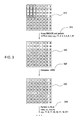
- FIG. 5 illustrates a data flow 400 for simultaneously transposing subdivisions of a matrix, according to one embodiment of the invention. Unlike FIG. 4 , in which each entire segment is accommodated by the local store of each processing element, FIG. 5 illustrates a scenario in which the each segment exceeds the size of local store of any processing element.
- the data flow 500 includes a 256 ⁇ 256 matrix 510 .
- the SIMD transposer 170 divides the matrix 510 into a plurality of segments, according to one embodiment. For example, the SIMD transposer 170 may device the matrix 510 into four segments 520 , 530 , 540 , 550 .
- the SIMD transposer 170 may also assign each segment 520 , 530 , 540 , 550 to be transposed by a processing element 132 .
- the SIMD transposer 170 may assign the segment 520 to a first Cell SPU 132 , the segment 530 to a second Cell SPU 132 , the segment 540 to a third Cell SPU 132 , and the segment 550 to a fourth Cell SPU 132 .
- the local store of a processing element 132 may not accommodate an entire segment.
- the segment 520 may exceed the size of the local store for a Cell SPU 132 .
- the SIMD transposer 170 may divide a segment into a plurality of subdivisions, based on a size of the local store of a processing element (such as a Cell SPU). For example, the SIMD transposer 170 may divide a segment 520 into four subdivisions 522 , 524 , 526 , 528 . Each subdivision 522 , 524 , 526 , 528 may be of a size not exceeding the size of the local store of a processing element 132 .
- each processing element simultaneously transposes the first subdivision 522 , 523 , 542 , 552 of the respective assigned segment 520 , 530 , 540 , 550 to produce a first transposed subdivision 562 , 572 , 582 , 592 .
- each processing element simultaneously transposes the second subdivision (e.g., element 524 ) of the respective assigned segment (e.g., element 520 ) to produce a second transposed subdivision (e.g., element 564 ), and so forth until all subdivisions have been transposed.
- FIG. 6 is a flowchart depicting a method 600 for performing efficient FFTs on a SIMD multi-core processor architecture, according to one embodiment of the invention.
- the method 600 begins at step 610 , where the SIMD transposer 170 receives a matrix in a conventional data format.
- the SIMD transposer may receive the matrix 210 of FIG. 2 .
- the SIMD transposer 170 converts the matrix to SIMD format.
- FIG. 2 shows an example where the matrix 220 is generated (e.g., via step 219 ).
- SIMD vector processors may simultaneously operate on multiple rows (two rows in this specific example) of the matrix in SIMD format.
- the SIMD transposer performs a 1D FFT for each row of the received matrix.
- FIG. 2 shows an example where the matrix 222 is generated (e.g., via step 221 ).
- the SIMD transposer 170 may SIMD-transpose the matrix.
- FIG. 2 shows an example where the matrix 224 is produced (e.g., via step 223 ).
- the SIMD transposer 170 performs a 1D FFT for each column of the received matrix.
- FIG. 2 shows an example where the matrix 226 is generated (e.g., via step 225 ).
- the SIMD transposer 170 may perform another SIMD-transpose on the matrix.
- the matrix 226 is SIMD-transposed into the matrix 228 (e.g., via step 227 ).
- the SIMD transposer may convert the matrix back to a conventional data format.
- the SIMD transposer may perform the step 229 of FIG. 2 to produce the matrix 218 .
- the method 600 terminates.
- SIMD transposer 170 that performs SIMD conversions, 1D FFTs, and SIMD transposes
- the embodiments described herein are intended to be illustrative and not limiting of the invention, and other embodiments are broadly contemplated.
- the conversion, transposition, and FFT functions may be performed by different software modules organized in a variety of ways.
- FIG. 7 is a flowchart depicting a method 700 for transposing data in SIMD format, according to one embodiment of the invention.
- the method 700 may be performed by the SIMD transposer 170 of FIG. 1 .
- the steps of the method 700 correspond to steps 640 and 660 of FIG. 6 and are described in conjunction with the element mapping examples of Tables VI and VII.
- the method 700 begins at step 710 , where the SIMD transposer 170 receives a matrix in SIMD format.
- the SIMD transposer may receive the matrix 222 of FIG. 2 .
- the SIMD transposer 170 divides the matrix into a plurality of segments, based on the size of the matrix and a count of the processing elements on the computer 110 .
- FIG. 4 shows an example where the matrix 410 of FIG. 4 is divided into four segments 412 , 414 , 416 , 418 .
- the SIMD transposer 170 assigns each segment to a processing element. For example, the SIMD transposer 170 may assign the segment 412 of FIG. 4 to a first Cell SPU 132 . The SIMD transposer 170 may also determine if a segment exceeds the size of the local store of the assigned processing element. If so, the SIMD transposer 170 may divide each segment into a plurality of subdivisions, each subdivision not exceeding the size of the local store of the assigned processing element. For example, the SIMD transposer 170 may divide the segment 520 of FIG. 5 into subdivisions 522 , 524 , 526 , 528 .
- the SIMD transposer 170 executing on each assigned processing element may transpose the respective segment of the matrix.
- the first Cell SPU 132 of FIG. 4 may transpose segment 412 to produce transposed segment 422 .
- each assigned processing element may scatter the transposed segments from the respective local store to the main memory 150 .
- the third Cell SPU 132 of FIG. 4 may scatter the transposed segment 426 to segment position 424 of the transposed matrix 430 in the main memory 150 .
- the SIMD transposer 170 performs reorganizes the transposed matrix 430 as necessary to complete the transpose operation.
- the SIMD transposer 170 may swap elements between segments to complete the transpose operation. After step 760 , the method 700 terminates.
- FIG. 8 is a block diagram 800 illustrating components of the SIMD transposer 170 of FIG. 1 , according to one embodiment of the invention.
- the SIMD transposer 170 includes a matrix manager 810 , a segment generator 820 , a segment manager 830 , a transpose manager 840 , and a reorganizer 850 .
- the matrix manager 810 may be configured to receive a matrix 152 in SIMD format.
- the matrix manager 810 may receive the matrix 222 of FIG. 2 .
- the segment generator 820 may produce a plurality of segments 180 based on the received matrix 152 .
- the segment generator 820 may produce the segments 412 , 414 , 416 , 418 of FIG.
- the segment generator 820 may also generate a plurality of subdivisions for each segment. For example, the segment generator 820 may generate the subdivisions 522 , 524 , 526 , 528 of FIG. 5 for the segment 520 .
- the segment manager 830 may assign each segment to a processing element. For example, the segment manager 830 may assign the segments 412 , 414 , 416 , 418 of FIG. 4 to the processing elements 132 . Further, the transpose manager 840 defines a mapping from SIMD matrix to a SIMD-transposed matrix. For example, the transpose manager 840 may define the mapping of Table VI (for a 4 ⁇ 4 matrix).
- the transpose manager 840 transposes each segment of the matrix 152 .
- the transpose manager 840 executing on each of the processing elements 132 may transpose the respective assigned segment 412 , 414 , 416 , 418 of FIG. 4 .
- the transpose manager 840 may also scatter transposed segments from local stores of the processing elements to the main memory 150 .
- the transpose manager 840 executing on the third processing element 132 of FIG. 4 may scatter the transposed segment 426 to the segment position 424 of the transposed matrix 430 in the main memory 150 .
- the reorganizer 850 rearranges elements in the memory 150 , if necessary to complete the transpose of the matrix 152 , according to one embodiment.
- the reorganizer 850 may rearrange elements between segments 180 .
- embodiments described herein are intended to be illustrative and not limiting of the invention, and other embodiments are broadly contemplated. Those skilled in the art will recognize, for example, that embodiments of the invention may be adapted to support matrices of other sizes (e.g., 512 ⁇ 512 matrices), other counts of processing elements (e.g., 32 processing elements), and other numbers of rows per block (e.g., 8-way SIMD, 16-way SIMD, etc.).
- matrices of other sizes e.g., 512 ⁇ 512 matrices
- other counts of processing elements e.g., 32 processing elements
- other numbers of rows per block e.g., 8-way SIMD, 16-way SIMD, etc.
- a SIMD transposer may receive a matrix in a SIMD format.
- the matrix may comprise a SIMD conversion of a matrix M in a conventional data format.
- the SIMD transposer may define a mapping from each element of the matrix to an element of a SIMD conversion of a transpose of M.
- the SIMD transposer may generate a SIMD-transposed matrix T based on M and the defined mapping.
- a row-wise algorithm may be applied to T, without modification, to operate on columns of M.
Landscapes
- Physics & Mathematics (AREA)
- Engineering & Computer Science (AREA)
- Mathematical Physics (AREA)
- General Physics & Mathematics (AREA)
- Theoretical Computer Science (AREA)
- Computational Mathematics (AREA)
- Mathematical Optimization (AREA)
- Pure & Applied Mathematics (AREA)
- Mathematical Analysis (AREA)
- Data Mining & Analysis (AREA)
- General Engineering & Computer Science (AREA)
- Algebra (AREA)
- Databases & Information Systems (AREA)
- Software Systems (AREA)
- Discrete Mathematics (AREA)
- Complex Calculations (AREA)
- Image Processing (AREA)
Priority Applications (4)
| Application Number | Priority Date | Filing Date | Title |
|---|---|---|---|
| US12/612,037 US8539201B2 (en) | 2009-11-04 | 2009-11-04 | Transposing array data on SIMD multi-core processor architectures |
| JP2010243281A JP5689282B2 (ja) | 2009-11-04 | 2010-10-29 | 行列をsimdマルチコア・プロセッサ・アーキテクチャ上で転置するためのコンピュータ実装方法、コンピュータ可読ストレージ媒体及びシステム |
| KR1020100108204A KR20110079495A (ko) | 2009-11-04 | 2010-11-02 | Simd 멀티코어 프로세서 아키텍처 상의 어레이 데이터 전치 |
| CN2010105375212A CN102053948B (zh) | 2009-11-04 | 2010-11-04 | 在单指令多数据多核处理器架构上转置矩阵的方法和系统 |
Applications Claiming Priority (1)
| Application Number | Priority Date | Filing Date | Title |
|---|---|---|---|
| US12/612,037 US8539201B2 (en) | 2009-11-04 | 2009-11-04 | Transposing array data on SIMD multi-core processor architectures |
Publications (2)
| Publication Number | Publication Date |
|---|---|
| US20110107060A1 US20110107060A1 (en) | 2011-05-05 |
| US8539201B2 true US8539201B2 (en) | 2013-09-17 |
Family
ID=43926625
Family Applications (1)
| Application Number | Title | Priority Date | Filing Date |
|---|---|---|---|
| US12/612,037 Expired - Fee Related US8539201B2 (en) | 2009-11-04 | 2009-11-04 | Transposing array data on SIMD multi-core processor architectures |
Country Status (4)
| Country | Link |
|---|---|
| US (1) | US8539201B2 (https=) |
| JP (1) | JP5689282B2 (https=) |
| KR (1) | KR20110079495A (https=) |
| CN (1) | CN102053948B (https=) |
Cited By (3)
| Publication number | Priority date | Publication date | Assignee | Title |
|---|---|---|---|---|
| US20170193311A1 (en) * | 2015-12-30 | 2017-07-06 | Texas Instruments Incorporated | Vehicle control with efficient iterative traingulation |
| US20170286170A1 (en) * | 2016-03-29 | 2017-10-05 | HGST Netherlands B.V. | Systems and methods for offloading processing from a host to storage processing units using an interconnect network |
| US20210374209A1 (en) * | 2020-06-02 | 2021-12-02 | Intel Corporation | Matrix operation optimization mechanism |
Families Citing this family (70)
| Publication number | Priority date | Publication date | Assignee | Title |
|---|---|---|---|---|
| JP5146449B2 (ja) * | 2007-04-12 | 2013-02-20 | 日本電気株式会社 | アレイプロセッサ型データ処理装置 |
| US8484276B2 (en) * | 2009-03-18 | 2013-07-09 | International Business Machines Corporation | Processing array data on SIMD multi-core processor architectures |
| JP5760532B2 (ja) * | 2011-03-14 | 2015-08-12 | 株式会社リコー | プロセッサ装置及びその演算方法 |
| WO2013054468A1 (ja) * | 2011-10-14 | 2013-04-18 | パナソニック株式会社 | 転置演算装置とその集積回路、および転置処理方法 |
| US9690620B2 (en) * | 2011-12-01 | 2017-06-27 | National University Of Singapore | Polymorphic heterogeneous multi-core architecture |
| CN102521209B (zh) * | 2011-12-12 | 2015-03-11 | 浪潮电子信息产业股份有限公司 | 一种并行多处理器计算机的设计方法 |
| WO2013095580A1 (en) * | 2011-12-22 | 2013-06-27 | Intel Corporation | Processors, methods, systems, and instructions to generate sequences of integers in which integers in consecutive positions differ by a constant integer stride and where a smallest integer is offset from zero by an integer offset |
| US20140164733A1 (en) * | 2011-12-30 | 2014-06-12 | Ashish Jha | Transpose instruction |
| KR101893796B1 (ko) | 2012-08-16 | 2018-10-04 | 삼성전자주식회사 | 동적 데이터 구성을 위한 방법 및 장치 |
| CN102929724B (zh) * | 2012-11-06 | 2016-04-13 | 无锡江南计算技术研究所 | 基于异构众核处理器的多级访存方法、离散访存方法 |
| US9406015B2 (en) | 2013-12-27 | 2016-08-02 | International Business Machines Corporation | Transform for a neurosynaptic core circuit |
| US9412063B2 (en) | 2013-12-27 | 2016-08-09 | International Business Machines Corporation | Transform architecture for multiple neurosynaptic core circuits |
| TWI570573B (zh) | 2014-07-08 | 2017-02-11 | 財團法人工業技術研究院 | 矩陣轉置電路 |
| SE539721C2 (en) * | 2014-07-09 | 2017-11-07 | Device and method for performing a Fourier transform on a three dimensional data set | |
| KR102452945B1 (ko) * | 2015-08-27 | 2022-10-11 | 삼성전자주식회사 | 푸리에 변환을 수행하는 방법 및 장치 |
| US10275243B2 (en) | 2016-07-02 | 2019-04-30 | Intel Corporation | Interruptible and restartable matrix multiplication instructions, processors, methods, and systems |
| KR102526754B1 (ko) | 2016-07-13 | 2023-04-27 | 삼성전자주식회사 | 3차원 영상 처리 방법 및 장치 |
| KR102654862B1 (ko) * | 2016-08-31 | 2024-04-05 | 삼성전자주식회사 | 영상 처리 방법 및 장치 |
| EP4160449A1 (en) * | 2016-12-30 | 2023-04-05 | Intel Corporation | Deep learning hardware |
| US10169296B2 (en) | 2016-12-30 | 2019-01-01 | Intel Corporation | Distributed matrix multiplication for neural networks |
| US11748625B2 (en) | 2016-12-30 | 2023-09-05 | Intel Corporation | Distributed convolution for neural networks |
| EP4553650A1 (en) | 2017-03-20 | 2025-05-14 | INTEL Corporation | Systems, methods, and apparatuses for tile matrix multiplication and accumulation |
| CN107168683B (zh) * | 2017-05-05 | 2020-06-09 | 中国科学院软件研究所 | 申威26010众核cpu上gemm稠密矩阵乘高性能实现方法 |
| WO2019009870A1 (en) | 2017-07-01 | 2019-01-10 | Intel Corporation | SAVE BACKGROUND TO VARIABLE BACKUP STATUS SIZE |
| KR102494412B1 (ko) * | 2017-11-28 | 2023-02-03 | 삼성전자 주식회사 | Simd 연산을 이용하여 이미지 데이터의 주파수 변환을 수행하는 전자 장치 및 전자 장치의 동작 방법 |
| US11809869B2 (en) | 2017-12-29 | 2023-11-07 | Intel Corporation | Systems and methods to store a tile register pair to memory |
| US11023235B2 (en) | 2017-12-29 | 2021-06-01 | Intel Corporation | Systems and methods to zero a tile register pair |
| US11789729B2 (en) | 2017-12-29 | 2023-10-17 | Intel Corporation | Systems and methods for computing dot products of nibbles in two tile operands |
| US11816483B2 (en) | 2017-12-29 | 2023-11-14 | Intel Corporation | Systems, methods, and apparatuses for matrix operations |
| US11669326B2 (en) | 2017-12-29 | 2023-06-06 | Intel Corporation | Systems, methods, and apparatuses for dot product operations |
| US11093247B2 (en) | 2017-12-29 | 2021-08-17 | Intel Corporation | Systems and methods to load a tile register pair |
| US10664287B2 (en) | 2018-03-30 | 2020-05-26 | Intel Corporation | Systems and methods for implementing chained tile operations |
| US11093579B2 (en) | 2018-09-05 | 2021-08-17 | Intel Corporation | FP16-S7E8 mixed precision for deep learning and other algorithms |
| US10970076B2 (en) | 2018-09-14 | 2021-04-06 | Intel Corporation | Systems and methods for performing instructions specifying ternary tile logic operations |
| US11579883B2 (en) | 2018-09-14 | 2023-02-14 | Intel Corporation | Systems and methods for performing horizontal tile operations |
| US10719323B2 (en) | 2018-09-27 | 2020-07-21 | Intel Corporation | Systems and methods for performing matrix compress and decompress instructions |
| US10990396B2 (en) | 2018-09-27 | 2021-04-27 | Intel Corporation | Systems for performing instructions to quickly convert and use tiles as 1D vectors |
| US10866786B2 (en) | 2018-09-27 | 2020-12-15 | Intel Corporation | Systems and methods for performing instructions to transpose rectangular tiles |
| US10929143B2 (en) | 2018-09-28 | 2021-02-23 | Intel Corporation | Method and apparatus for efficient matrix alignment in a systolic array |
| US10896043B2 (en) | 2018-09-28 | 2021-01-19 | Intel Corporation | Systems for performing instructions for fast element unpacking into 2-dimensional registers |
| US10963256B2 (en) | 2018-09-28 | 2021-03-30 | Intel Corporation | Systems and methods for performing instructions to transform matrices into row-interleaved format |
| US10963246B2 (en) | 2018-11-09 | 2021-03-30 | Intel Corporation | Systems and methods for performing 16-bit floating-point matrix dot product instructions |
| CN111338974B (zh) * | 2018-12-19 | 2025-05-16 | 超威半导体公司 | 用于矩阵数学指令集的图块化算法 |
| US10929503B2 (en) | 2018-12-21 | 2021-02-23 | Intel Corporation | Apparatus and method for a masked multiply instruction to support neural network pruning operations |
| US11294671B2 (en) | 2018-12-26 | 2022-04-05 | Intel Corporation | Systems and methods for performing duplicate detection instructions on 2D data |
| US11886875B2 (en) | 2018-12-26 | 2024-01-30 | Intel Corporation | Systems and methods for performing nibble-sized operations on matrix elements |
| US20200210517A1 (en) | 2018-12-27 | 2020-07-02 | Intel Corporation | Systems and methods to accelerate multiplication of sparse matrices |
| US10922077B2 (en) | 2018-12-29 | 2021-02-16 | Intel Corporation | Apparatuses, methods, and systems for stencil configuration and computation instructions |
| US10942985B2 (en) | 2018-12-29 | 2021-03-09 | Intel Corporation | Apparatuses, methods, and systems for fast fourier transform configuration and computation instructions |
| US10853559B2 (en) | 2019-03-27 | 2020-12-01 | Charter Communications Operating, Llc | Symmetric text replacement |
| US11016731B2 (en) | 2019-03-29 | 2021-05-25 | Intel Corporation | Using Fuzzy-Jbit location of floating-point multiply-accumulate results |
| US11269630B2 (en) | 2019-03-29 | 2022-03-08 | Intel Corporation | Interleaved pipeline of floating-point adders |
| US11175891B2 (en) | 2019-03-30 | 2021-11-16 | Intel Corporation | Systems and methods to perform floating-point addition with selected rounding |
| US10990397B2 (en) | 2019-03-30 | 2021-04-27 | Intel Corporation | Apparatuses, methods, and systems for transpose instructions of a matrix operations accelerator |
| US11403097B2 (en) | 2019-06-26 | 2022-08-02 | Intel Corporation | Systems and methods to skip inconsequential matrix operations |
| US11334647B2 (en) | 2019-06-29 | 2022-05-17 | Intel Corporation | Apparatuses, methods, and systems for enhanced matrix multiplier architecture |
| US11714875B2 (en) | 2019-12-28 | 2023-08-01 | Intel Corporation | Apparatuses, methods, and systems for instructions of a matrix operations accelerator |
| CN111444134A (zh) * | 2020-03-24 | 2020-07-24 | 山东大学 | 分子动力学模拟软件的并行pme的加速优化方法及系统 |
| US11972230B2 (en) | 2020-06-27 | 2024-04-30 | Intel Corporation | Matrix transpose and multiply |
| US12112167B2 (en) | 2020-06-27 | 2024-10-08 | Intel Corporation | Matrix data scatter and gather between rows and irregularly spaced memory locations |
| US11941395B2 (en) | 2020-09-26 | 2024-03-26 | Intel Corporation | Apparatuses, methods, and systems for instructions for 16-bit floating-point matrix dot product instructions |
| CN112433760B (zh) * | 2020-11-27 | 2022-09-23 | 海光信息技术股份有限公司 | 数据排序方法和数据排序电路 |
| US12474928B2 (en) | 2020-12-22 | 2025-11-18 | Intel Corporation | Processors, methods, systems, and instructions to select and store data elements from strided data element positions in a first dimension from three source two-dimensional arrays in a result two-dimensional array |
| US12001385B2 (en) | 2020-12-24 | 2024-06-04 | Intel Corporation | Apparatuses, methods, and systems for instructions for loading a tile of a matrix operations accelerator |
| US12001887B2 (en) | 2020-12-24 | 2024-06-04 | Intel Corporation | Apparatuses, methods, and systems for instructions for aligning tiles of a matrix operations accelerator |
| KR102909878B1 (ko) | 2021-06-01 | 2026-01-08 | 에스케이하이닉스 주식회사 | 메모리 장치, 반도체 시스템 및 데이터 처리 시스템 |
| KR102527829B1 (ko) * | 2021-08-19 | 2023-04-28 | 한국기술교육대학교 산학협력단 | Cpu와 gpu를 사용하는 행렬 전치기반 2d-fft 연산 장치 및 이를 이용한 데이터 연산 방법 |
| US20240020129A1 (en) * | 2022-07-14 | 2024-01-18 | Nxp Usa, Inc. | Self-Ordering Fast Fourier Transform For Single Instruction Multiple Data Engines |
| CN120677468A (zh) * | 2023-02-22 | 2025-09-19 | 株式会社电装 | 运算处理装置 |
| US12613699B2 (en) * | 2023-12-20 | 2026-04-28 | Sony Interactive Entertainment Inc. | DMA controller and LSU to transpose data arrays stored in main memory for storage in processor registers |
Citations (10)
| Publication number | Priority date | Publication date | Assignee | Title |
|---|---|---|---|---|
| US6243730B1 (en) * | 1999-05-04 | 2001-06-05 | Sony Electronics, Inc. | Methods and systems for performing short integer chen IDCT algorithm with fused multiply/add |
| US20030084081A1 (en) * | 2001-10-27 | 2003-05-01 | Bedros Hanounik | Method and apparatus for transposing a two dimensional array |
| US6625721B1 (en) * | 1999-07-26 | 2003-09-23 | Intel Corporation | Registers for 2-D matrix processing |
| US6963341B1 (en) * | 2002-06-03 | 2005-11-08 | Tibet MIMAR | Fast and flexible scan conversion and matrix transpose in a SIMD processor |
| US20070106718A1 (en) * | 2005-11-04 | 2007-05-10 | Shum Hoi L | Fast fourier transform on a single-instruction-stream, multiple-data-stream processor |
| US20070250683A1 (en) * | 1997-10-09 | 2007-10-25 | Mips Technologies, Inc. | Alignment and ordering of vector elements for single instruction multiple data processing |
| US7386703B2 (en) | 2003-11-18 | 2008-06-10 | International Business Machines Corporation | Two dimensional addressing of a matrix-vector register array |
| US20100023728A1 (en) * | 2008-07-25 | 2010-01-28 | International Business Machines Corporation | Method and system for in-place multi-dimensional transpose for multi-core processors with software-managed memory hierarchy |
| US20100241824A1 (en) * | 2009-03-18 | 2010-09-23 | International Business Machines Corporation | Processing array data on simd multi-core processor architectures |
| US7937567B1 (en) * | 2006-11-01 | 2011-05-03 | Nvidia Corporation | Methods for scalably exploiting parallelism in a parallel processing system |
-
2009
- 2009-11-04 US US12/612,037 patent/US8539201B2/en not_active Expired - Fee Related
-
2010
- 2010-10-29 JP JP2010243281A patent/JP5689282B2/ja not_active Expired - Fee Related
- 2010-11-02 KR KR1020100108204A patent/KR20110079495A/ko not_active Ceased
- 2010-11-04 CN CN2010105375212A patent/CN102053948B/zh not_active Expired - Fee Related
Patent Citations (10)
| Publication number | Priority date | Publication date | Assignee | Title |
|---|---|---|---|---|
| US20070250683A1 (en) * | 1997-10-09 | 2007-10-25 | Mips Technologies, Inc. | Alignment and ordering of vector elements for single instruction multiple data processing |
| US6243730B1 (en) * | 1999-05-04 | 2001-06-05 | Sony Electronics, Inc. | Methods and systems for performing short integer chen IDCT algorithm with fused multiply/add |
| US6625721B1 (en) * | 1999-07-26 | 2003-09-23 | Intel Corporation | Registers for 2-D matrix processing |
| US20030084081A1 (en) * | 2001-10-27 | 2003-05-01 | Bedros Hanounik | Method and apparatus for transposing a two dimensional array |
| US6963341B1 (en) * | 2002-06-03 | 2005-11-08 | Tibet MIMAR | Fast and flexible scan conversion and matrix transpose in a SIMD processor |
| US7386703B2 (en) | 2003-11-18 | 2008-06-10 | International Business Machines Corporation | Two dimensional addressing of a matrix-vector register array |
| US20070106718A1 (en) * | 2005-11-04 | 2007-05-10 | Shum Hoi L | Fast fourier transform on a single-instruction-stream, multiple-data-stream processor |
| US7937567B1 (en) * | 2006-11-01 | 2011-05-03 | Nvidia Corporation | Methods for scalably exploiting parallelism in a parallel processing system |
| US20100023728A1 (en) * | 2008-07-25 | 2010-01-28 | International Business Machines Corporation | Method and system for in-place multi-dimensional transpose for multi-core processors with software-managed memory hierarchy |
| US20100241824A1 (en) * | 2009-03-18 | 2010-09-23 | International Business Machines Corporation | Processing array data on simd multi-core processor architectures |
Non-Patent Citations (3)
| Title |
|---|
| Franchetti, Franz et al., "Discrete Fourier Transform on Multicore", IEEE Signal Processing Magazine, Nov. 2009, pp. 90-102. |
| Jun-shan, Li et al., "Image Parallel Fourier Analysis Technology Based on LS MPPM (1): principle, analysis and design of algorithm", Mini-Micro Systems Journal Paper, vol. 25, Jul. 2004, Issue 7, pp. 1303-1306-Abstract only. |
| Kumaki, T. ; Koide, T.; Mattausch, H. J. ; Kuroda, Y.; Noda, H.; et al. "Efficient vertical/horizontal-space 1D-DCT processing based on massive-parallel matrix-processing engine" In 2007 IEEE International Symposium on Circuits and Systems (IEEE Cat. No. 07CH37868). * |
Cited By (11)
| Publication number | Priority date | Publication date | Assignee | Title |
|---|---|---|---|---|
| US20170193311A1 (en) * | 2015-12-30 | 2017-07-06 | Texas Instruments Incorporated | Vehicle control with efficient iterative traingulation |
| US10635909B2 (en) * | 2015-12-30 | 2020-04-28 | Texas Instruments Incorporated | Vehicle control with efficient iterative triangulation |
| US20170286170A1 (en) * | 2016-03-29 | 2017-10-05 | HGST Netherlands B.V. | Systems and methods for offloading processing from a host to storage processing units using an interconnect network |
| US10095445B2 (en) * | 2016-03-29 | 2018-10-09 | Western Digital Technologies, Inc. | Systems and methods for offloading processing from a host to storage processing units using an interconnect network |
| US10725709B2 (en) | 2016-03-29 | 2020-07-28 | Western Digital Technologies, Inc. | Systems and methods for offloading processing from a host to storage processing units using an interconnect network |
| US20210374209A1 (en) * | 2020-06-02 | 2021-12-02 | Intel Corporation | Matrix operation optimization mechanism |
| JP2021190066A (ja) * | 2020-06-02 | 2021-12-13 | インテル・コーポレーション | 行列演算の最適化メカニズム |
| US11593454B2 (en) * | 2020-06-02 | 2023-02-28 | Intel Corporation | Matrix operation optimization mechanism |
| US12039000B2 (en) * | 2020-06-02 | 2024-07-16 | Intel Corporation | Matrix operation optimization mechanism |
| TWI859383B (zh) * | 2020-06-02 | 2024-10-21 | 美商英特爾股份有限公司 | 促進機器學習矩陣處理之設備及方法和非暫態電腦可讀取媒體 |
| JP7582603B2 (ja) | 2020-06-02 | 2024-11-13 | インテル・コーポレーション | 行列演算の最適化メカニズム |
Also Published As
| Publication number | Publication date |
|---|---|
| JP2011100452A (ja) | 2011-05-19 |
| JP5689282B2 (ja) | 2015-03-25 |
| CN102053948A (zh) | 2011-05-11 |
| US20110107060A1 (en) | 2011-05-05 |
| KR20110079495A (ko) | 2011-07-07 |
| CN102053948B (zh) | 2013-09-11 |
Similar Documents
| Publication | Publication Date | Title |
|---|---|---|
| US8539201B2 (en) | Transposing array data on SIMD multi-core processor architectures | |
| US8484276B2 (en) | Processing array data on SIMD multi-core processor architectures | |
| US11698773B2 (en) | Accelerated mathematical engine | |
| US20240012644A1 (en) | Efficient direct convolution using simd instructions | |
| CN111859273B (zh) | 矩阵乘法器 | |
| US11763156B2 (en) | Neural network compression based on bank-balanced sparsity | |
| Anderson et al. | Communication-avoiding QR decomposition for GPUs | |
| US11983616B2 (en) | Methods and apparatus for constructing digital circuits for performing matrix operations | |
| US4821224A (en) | Method and apparatus for processing multi-dimensional data to obtain a Fourier transform | |
| US7461114B2 (en) | Fourier transform apparatus | |
| CN106846235B (zh) | 一种利用NVIDIA Kepler GPU汇编指令加速的卷积优化方法及系统 | |
| KR20230081697A (ko) | 팽창 컨볼루션 계산 가속화 방법 및 장치 | |
| US10339200B2 (en) | System and method for optimizing mixed radix fast fourier transform and inverse fast fourier transform | |
| CN104636273A (zh) | 一种带多级Cache的SIMD众核处理器上的稀疏矩阵存储方法 | |
| US7640284B1 (en) | Bit reversal methods for a parallel processor | |
| US20040243656A1 (en) | Digital signal processor structure for performing length-scalable fast fourier transformation | |
| CN117633418A (zh) | 基于矩阵运算的多维快速傅立叶变换加速方法 | |
| WO2018213438A1 (en) | Apparatus and methods of providing efficient data parallelization for multi-dimensional ffts | |
| US6728742B1 (en) | Data storage patterns for fast fourier transforms | |
| Alam et al. | A new time distributed DCT architecture for MPEG-4 hardware reference model | |
| CN111368250B (zh) | 基于傅里叶变换/逆变换的数据处理系统、方法及设备 | |
| US7657587B2 (en) | Multi-dimensional fast fourier transform | |
| Zamarashkin et al. | GPU acceleration of dense matrix and block operations for Lanczos method for systems over GF (2) | |
| Al Na'mneh et al. | An efficient bit reversal permutation algorithm | |
| Sun et al. | Fast computation of local correlation coefficients |
Legal Events
| Date | Code | Title | Description |
|---|---|---|---|
| AS | Assignment |
Owner name: INTERNATIONAL BUSINESS MACHINES CORPORATION, NEW Y Free format text: ASSIGNMENT OF ASSIGNORS INTEREST;ASSIGNORS:MCALLISTER, JEFFREY S.;BRANSFORD, MARK A.;MULLINS, TIMOTHY J.;AND OTHERS;SIGNING DATES FROM 20091017 TO 20091028;REEL/FRAME:023467/0458 |
|
| REMI | Maintenance fee reminder mailed | ||
| LAPS | Lapse for failure to pay maintenance fees |
Free format text: PATENT EXPIRED FOR FAILURE TO PAY MAINTENANCE FEES (ORIGINAL EVENT CODE: EXP.) |
|
| STCH | Information on status: patent discontinuation |
Free format text: PATENT EXPIRED DUE TO NONPAYMENT OF MAINTENANCE FEES UNDER 37 CFR 1.362 |
|
| FP | Lapsed due to failure to pay maintenance fee |
Effective date: 20170917 |