US8507541B2 - N-hydroxyamidinoheterocycles as modulators of indoleamine 2,3-dioxygenase - Google Patents
N-hydroxyamidinoheterocycles as modulators of indoleamine 2,3-dioxygenase Download PDFInfo
- Publication number
- US8507541B2 US8507541B2 US13/050,143 US201113050143A US8507541B2 US 8507541 B2 US8507541 B2 US 8507541B2 US 201113050143 A US201113050143 A US 201113050143A US 8507541 B2 US8507541 B2 US 8507541B2
- Authority
- US
- United States
- Prior art keywords
- alkyl
- alkynyl
- alkenyl
- independently selected
- haloalkyl
- Prior art date
- Legal status (The legal status is an assumption and is not a legal conclusion. Google has not performed a legal analysis and makes no representation as to the accuracy of the status listed.)
- Expired - Fee Related
Links
- 0 *N=C(NC)C1=CC([2*])=[U][W]1 Chemical compound *N=C(NC)C1=CC([2*])=[U][W]1 0.000 description 10
- KPBOJEZCSIIVRH-UHFFFAOYSA-N CC(=O)NC1=NOC(C(=NO)NCC2=CC(Cl)=CC=C2C)=C1 Chemical compound CC(=O)NC1=NOC(C(=NO)NCC2=CC(Cl)=CC=C2C)=C1 KPBOJEZCSIIVRH-UHFFFAOYSA-N 0.000 description 2
- WRZHJPSWSREZCW-UHFFFAOYSA-N CC1=CC=C(Cl)C=C1CN1C(=O)ON=C1C1=CC(N)=NO1 Chemical compound CC1=CC=C(Cl)C=C1CN1C(=O)ON=C1C1=CC(N)=NO1 WRZHJPSWSREZCW-UHFFFAOYSA-N 0.000 description 2
- HZEUAQAFBRTHKF-UHFFFAOYSA-N CC(=O)NC1=NOC(C(=O)NCC2=CC(Cl)=CC=C2C)=C1 Chemical compound CC(=O)NC1=NOC(C(=O)NCC2=CC(Cl)=CC=C2C)=C1 HZEUAQAFBRTHKF-UHFFFAOYSA-N 0.000 description 1
- BUGAUTLUBXKKLH-UHFFFAOYSA-N CC1=C(C)OC(C(=NO)NC2=CC=C(F)C(Cl)=C2)=C1 Chemical compound CC1=C(C)OC(C(=NO)NC2=CC=C(F)C(Cl)=C2)=C1 BUGAUTLUBXKKLH-UHFFFAOYSA-N 0.000 description 1
- YLNXAQNXENFKOZ-UHFFFAOYSA-N CC1=C(CNC(=NO)C2=C3C=CC=CC3=NO2)C=CC=C1 Chemical compound CC1=C(CNC(=NO)C2=C3C=CC=CC3=NO2)C=CC=C1 YLNXAQNXENFKOZ-UHFFFAOYSA-N 0.000 description 1
- FFJVPPVIFKDORO-UHFFFAOYSA-N CC1=C(CNC(=NO)C2=CC(Br)=NO2)C=C(Cl)C=C1 Chemical compound CC1=C(CNC(=NO)C2=CC(Br)=NO2)C=C(Cl)C=C1 FFJVPPVIFKDORO-UHFFFAOYSA-N 0.000 description 1
- PMHDTGUCTDIGQU-UHFFFAOYSA-N CC1=C(CNC(=NO)C2=CC(Br)=NO2)C=CC=C1 Chemical compound CC1=C(CNC(=NO)C2=CC(Br)=NO2)C=CC=C1 PMHDTGUCTDIGQU-UHFFFAOYSA-N 0.000 description 1
- PPBYBOFLBWRFDM-UHFFFAOYSA-N CC1=C(Cl)C=CC=C1CNC(=NO)C1=CC(Br)=NO1 Chemical compound CC1=C(Cl)C=CC=C1CNC(=NO)C1=CC(Br)=NO1 PPBYBOFLBWRFDM-UHFFFAOYSA-N 0.000 description 1
- WFPLSCXOOCDFIM-UHFFFAOYSA-N CC1=CC=C(Cl)C=C1CNC(=NO)C1=CC(N)=NO1 Chemical compound CC1=CC=C(Cl)C=C1CNC(=NO)C1=CC(N)=NO1 WFPLSCXOOCDFIM-UHFFFAOYSA-N 0.000 description 1
- LOVMPHUWAHIGFX-UHFFFAOYSA-N CC1=CC=C(Cl)C=C1CNC(=O)C1=CC(N)=NO1 Chemical compound CC1=CC=C(Cl)C=C1CNC(=O)C1=CC(N)=NO1 LOVMPHUWAHIGFX-UHFFFAOYSA-N 0.000 description 1
- ZQDKEHTUXUMDQR-UHFFFAOYSA-N CC1=NOC(C(=NO)NC2=CC=C(F)C(Cl)=C2)=C1 Chemical compound CC1=NOC(C(=NO)NC2=CC=C(F)C(Cl)=C2)=C1 ZQDKEHTUXUMDQR-UHFFFAOYSA-N 0.000 description 1
- ZXGGKONTGNWUPG-UHFFFAOYSA-N CC1=NOC(C(=NO)NCC2=C(C)C=CC=C2)=C1 Chemical compound CC1=NOC(C(=NO)NCC2=C(C)C=CC=C2)=C1 ZXGGKONTGNWUPG-UHFFFAOYSA-N 0.000 description 1
- WAAVRBFXHQBLLV-UHFFFAOYSA-N CCCN(C(=O)C(F)(F)F)C1=NOC(C(=NO)NCC2=CC(Cl)=CC=C2C)=C1 Chemical compound CCCN(C(=O)C(F)(F)F)C1=NOC(C(=NO)NCC2=CC(Cl)=CC=C2C)=C1 WAAVRBFXHQBLLV-UHFFFAOYSA-N 0.000 description 1
- VFLOBAWMZLJPBU-UHFFFAOYSA-N CCCNC1=NOC(C(=NO)NCC2=CC(Cl)=CC=C2C)=C1 Chemical compound CCCNC1=NOC(C(=NO)NCC2=CC(Cl)=CC=C2C)=C1 VFLOBAWMZLJPBU-UHFFFAOYSA-N 0.000 description 1
- HEQLFYMCYFOCEZ-UHFFFAOYSA-N CN1CCN(CCCOC2=NOC(C(=NO)NC3=CC=C(F)C(Cl)=C3)=C2)CC1 Chemical compound CN1CCN(CCCOC2=NOC(C(=NO)NC3=CC=C(F)C(Cl)=C3)=C2)CC1 HEQLFYMCYFOCEZ-UHFFFAOYSA-N 0.000 description 1
- XUGLTHZXITTYCI-UHFFFAOYSA-N COC(=O)C1=CC(OCCCBr)=NO1 Chemical compound COC(=O)C1=CC(OCCCBr)=NO1 XUGLTHZXITTYCI-UHFFFAOYSA-N 0.000 description 1
- UBYOUWSQTPGZTN-UHFFFAOYSA-N COC1=CC=C(C2=NOC(C(=NO)NC3=CC=C(F)C(Cl)=C3)=C2)C=C1 Chemical compound COC1=CC=C(C2=NOC(C(=NO)NC3=CC=C(F)C(Cl)=C3)=C2)C=C1 UBYOUWSQTPGZTN-UHFFFAOYSA-N 0.000 description 1
- QWDZMCFKQAFMFM-UHFFFAOYSA-N COC1=NOC(C(=NO)NC2=CC=C(F)C(Cl)=C2)=C1 Chemical compound COC1=NOC(C(=NO)NC2=CC=C(F)C(Cl)=C2)=C1 QWDZMCFKQAFMFM-UHFFFAOYSA-N 0.000 description 1
- WETJDLMSLVDSOH-UHFFFAOYSA-N NC1=NOC(C(=NO)NC2=CC=C(F)C(Br)=C2)=C1 Chemical compound NC1=NOC(C(=NO)NC2=CC=C(F)C(Br)=C2)=C1 WETJDLMSLVDSOH-UHFFFAOYSA-N 0.000 description 1
- KZRBTFSMIBKPGE-UHFFFAOYSA-N NC1=NOC(C(=O)O)=C1 Chemical compound NC1=NOC(C(=O)O)=C1 KZRBTFSMIBKPGE-UHFFFAOYSA-N 0.000 description 1
- SPPBCCOOMODVHA-UHFFFAOYSA-N O=C(CC1=CC=C(F)C(Cl)=C1)C1=CC(OCCCBr)=NO1 Chemical compound O=C(CC1=CC=C(F)C(Cl)=C1)C1=CC(OCCCBr)=NO1 SPPBCCOOMODVHA-UHFFFAOYSA-N 0.000 description 1
- IZCUKZHQFDSISV-UHFFFAOYSA-N O=C(NC1=CC(Cl)=C(F)C=C1)C1=CC(Br)=NO1 Chemical compound O=C(NC1=CC(Cl)=C(F)C=C1)C1=CC(Br)=NO1 IZCUKZHQFDSISV-UHFFFAOYSA-N 0.000 description 1
- SILFDYFZUVLWPA-UHFFFAOYSA-N O=C(NC1=CC(Cl)=C(F)C=C1)C1=CC(N2CCOCC2)=NO1 Chemical compound O=C(NC1=CC(Cl)=C(F)C=C1)C1=CC(N2CCOCC2)=NO1 SILFDYFZUVLWPA-UHFFFAOYSA-N 0.000 description 1
- OKRXTOLEBWZGOE-UHFFFAOYSA-N O=C(NC1=CC(Cl)=C(F)C=C1)C1=CC(OCCCN2CCCC2)=NO1 Chemical compound O=C(NC1=CC(Cl)=C(F)C=C1)C1=CC(OCCCN2CCCC2)=NO1 OKRXTOLEBWZGOE-UHFFFAOYSA-N 0.000 description 1
- OXXFJJLKKJJIQT-UHFFFAOYSA-N O=C(O)C1=CC(OCCCBr)=NO1 Chemical compound O=C(O)C1=CC(OCCCBr)=NO1 OXXFJJLKKJJIQT-UHFFFAOYSA-N 0.000 description 1
- MLFKLJAUWGMQEM-UHFFFAOYSA-N ON=C(CC1=CC=C(F)C(Cl)=C1)C1=CC(OCCCBr)=NO1 Chemical compound ON=C(CC1=CC=C(F)C(Cl)=C1)C1=CC(OCCCBr)=NO1 MLFKLJAUWGMQEM-UHFFFAOYSA-N 0.000 description 1
- STJJDEQISXXOAT-UHFFFAOYSA-N ON=C(NC1=CC(Cl)=C(F)C=C1)C1=CC(N2CCOCC2)=NO1 Chemical compound ON=C(NC1=CC(Cl)=C(F)C=C1)C1=CC(N2CCOCC2)=NO1 STJJDEQISXXOAT-UHFFFAOYSA-N 0.000 description 1
- RKFSKHBIRRFQEZ-UHFFFAOYSA-N ON=C(NC1=CC(Cl)=C(F)C=C1)C1=CC(OCCCN2CCCC2)=NO1 Chemical compound ON=C(NC1=CC(Cl)=C(F)C=C1)C1=CC(OCCCN2CCCC2)=NO1 RKFSKHBIRRFQEZ-UHFFFAOYSA-N 0.000 description 1
- VNQGUOOJWMVONZ-UHFFFAOYSA-N ON=C(NC1=CC(Cl)=C(F)C=C1)C1=CC(OCCCN2CCOCC2)=NO1 Chemical compound ON=C(NC1=CC(Cl)=C(F)C=C1)C1=CC(OCCCN2CCOCC2)=NO1 VNQGUOOJWMVONZ-UHFFFAOYSA-N 0.000 description 1
- YXBWBWOZROXIBP-UHFFFAOYSA-N ON=C(NC1=CC=C(F)C(Cl)=C1)C1=C2C=CC=CC2=NO1 Chemical compound ON=C(NC1=CC=C(F)C(Cl)=C1)C1=C2C=CC=CC2=NO1 YXBWBWOZROXIBP-UHFFFAOYSA-N 0.000 description 1
- XUJQIAUUKOHQAL-UHFFFAOYSA-N ON=C(NC1=CC=C(F)C(Cl)=C1)C1=CC(Br)=NO1 Chemical compound ON=C(NC1=CC=C(F)C(Cl)=C1)C1=CC(Br)=NO1 XUJQIAUUKOHQAL-UHFFFAOYSA-N 0.000 description 1
- RWDFCLFBYPBORT-UHFFFAOYSA-N ON=C(NC1=CC=C(F)C(Cl)=C1)C1=CC(C2=CC=CC=C2)=NO1 Chemical compound ON=C(NC1=CC=C(F)C(Cl)=C1)C1=CC(C2=CC=CC=C2)=NO1 RWDFCLFBYPBORT-UHFFFAOYSA-N 0.000 description 1
- ZSMPKIXTRDKHEA-UHFFFAOYSA-N ON=C(NC1=CC=C(F)C(Cl)=C1)C1=CC2=C(C=CC=C2)S1 Chemical compound ON=C(NC1=CC=C(F)C(Cl)=C1)C1=CC2=C(C=CC=C2)S1 ZSMPKIXTRDKHEA-UHFFFAOYSA-N 0.000 description 1
- GZDYXTPLPKTKQC-UHFFFAOYSA-N ON=C(NC1=CC=CC(Br)=C1)C1=CC(Br)=NO1 Chemical compound ON=C(NC1=CC=CC(Br)=C1)C1=CC(Br)=NO1 GZDYXTPLPKTKQC-UHFFFAOYSA-N 0.000 description 1
- UPRZORMCBPNZBW-UHFFFAOYSA-N ON=C(NCC1=CC=CC(Cl)=C1)C1=CC(Br)=NO1 Chemical compound ON=C(NCC1=CC=CC(Cl)=C1)C1=CC(Br)=NO1 UPRZORMCBPNZBW-UHFFFAOYSA-N 0.000 description 1
Classifications
-
- C—CHEMISTRY; METALLURGY
- C07—ORGANIC CHEMISTRY
- C07D—HETEROCYCLIC COMPOUNDS
- C07D261/00—Heterocyclic compounds containing 1,2-oxazole or hydrogenated 1,2-oxazole rings
- C07D261/02—Heterocyclic compounds containing 1,2-oxazole or hydrogenated 1,2-oxazole rings not condensed with other rings
- C07D261/06—Heterocyclic compounds containing 1,2-oxazole or hydrogenated 1,2-oxazole rings not condensed with other rings having two or more double bonds between ring members or between ring members and non-ring members
- C07D261/10—Heterocyclic compounds containing 1,2-oxazole or hydrogenated 1,2-oxazole rings not condensed with other rings having two or more double bonds between ring members or between ring members and non-ring members with hetero atoms or with carbon atoms having three bonds to hetero atoms with at the most one bond to halogen, e.g. ester or nitrile radicals, directly attached to ring carbon atoms
- C07D261/18—Carbon atoms having three bonds to hetero atoms, with at the most one bond to halogen
-
- A—HUMAN NECESSITIES
- A61—MEDICAL OR VETERINARY SCIENCE; HYGIENE
- A61P—SPECIFIC THERAPEUTIC ACTIVITY OF CHEMICAL COMPOUNDS OR MEDICINAL PREPARATIONS
- A61P17/00—Drugs for dermatological disorders
- A61P17/02—Drugs for dermatological disorders for treating wounds, ulcers, burns, scars, keloids, or the like
-
- A—HUMAN NECESSITIES
- A61—MEDICAL OR VETERINARY SCIENCE; HYGIENE
- A61P—SPECIFIC THERAPEUTIC ACTIVITY OF CHEMICAL COMPOUNDS OR MEDICINAL PREPARATIONS
- A61P25/00—Drugs for disorders of the nervous system
-
- A—HUMAN NECESSITIES
- A61—MEDICAL OR VETERINARY SCIENCE; HYGIENE
- A61P—SPECIFIC THERAPEUTIC ACTIVITY OF CHEMICAL COMPOUNDS OR MEDICINAL PREPARATIONS
- A61P25/00—Drugs for disorders of the nervous system
- A61P25/24—Antidepressants
-
- A—HUMAN NECESSITIES
- A61—MEDICAL OR VETERINARY SCIENCE; HYGIENE
- A61P—SPECIFIC THERAPEUTIC ACTIVITY OF CHEMICAL COMPOUNDS OR MEDICINAL PREPARATIONS
- A61P25/00—Drugs for disorders of the nervous system
- A61P25/28—Drugs for disorders of the nervous system for treating neurodegenerative disorders of the central nervous system, e.g. nootropic agents, cognition enhancers, drugs for treating Alzheimer's disease or other forms of dementia
-
- A—HUMAN NECESSITIES
- A61—MEDICAL OR VETERINARY SCIENCE; HYGIENE
- A61P—SPECIFIC THERAPEUTIC ACTIVITY OF CHEMICAL COMPOUNDS OR MEDICINAL PREPARATIONS
- A61P27/00—Drugs for disorders of the senses
- A61P27/02—Ophthalmic agents
- A61P27/12—Ophthalmic agents for cataracts
-
- A—HUMAN NECESSITIES
- A61—MEDICAL OR VETERINARY SCIENCE; HYGIENE
- A61P—SPECIFIC THERAPEUTIC ACTIVITY OF CHEMICAL COMPOUNDS OR MEDICINAL PREPARATIONS
- A61P29/00—Non-central analgesic, antipyretic or antiinflammatory agents, e.g. antirheumatic agents; Non-steroidal antiinflammatory drugs [NSAID]
-
- A—HUMAN NECESSITIES
- A61—MEDICAL OR VETERINARY SCIENCE; HYGIENE
- A61P—SPECIFIC THERAPEUTIC ACTIVITY OF CHEMICAL COMPOUNDS OR MEDICINAL PREPARATIONS
- A61P31/00—Antiinfectives, i.e. antibiotics, antiseptics, chemotherapeutics
- A61P31/12—Antivirals
-
- A—HUMAN NECESSITIES
- A61—MEDICAL OR VETERINARY SCIENCE; HYGIENE
- A61P—SPECIFIC THERAPEUTIC ACTIVITY OF CHEMICAL COMPOUNDS OR MEDICINAL PREPARATIONS
- A61P35/00—Antineoplastic agents
-
- A—HUMAN NECESSITIES
- A61—MEDICAL OR VETERINARY SCIENCE; HYGIENE
- A61P—SPECIFIC THERAPEUTIC ACTIVITY OF CHEMICAL COMPOUNDS OR MEDICINAL PREPARATIONS
- A61P35/00—Antineoplastic agents
- A61P35/02—Antineoplastic agents specific for leukemia
-
- A—HUMAN NECESSITIES
- A61—MEDICAL OR VETERINARY SCIENCE; HYGIENE
- A61P—SPECIFIC THERAPEUTIC ACTIVITY OF CHEMICAL COMPOUNDS OR MEDICINAL PREPARATIONS
- A61P37/00—Drugs for immunological or allergic disorders
-
- A—HUMAN NECESSITIES
- A61—MEDICAL OR VETERINARY SCIENCE; HYGIENE
- A61P—SPECIFIC THERAPEUTIC ACTIVITY OF CHEMICAL COMPOUNDS OR MEDICINAL PREPARATIONS
- A61P37/00—Drugs for immunological or allergic disorders
- A61P37/02—Immunomodulators
-
- A—HUMAN NECESSITIES
- A61—MEDICAL OR VETERINARY SCIENCE; HYGIENE
- A61P—SPECIFIC THERAPEUTIC ACTIVITY OF CHEMICAL COMPOUNDS OR MEDICINAL PREPARATIONS
- A61P37/00—Drugs for immunological or allergic disorders
- A61P37/02—Immunomodulators
- A61P37/04—Immunostimulants
-
- A—HUMAN NECESSITIES
- A61—MEDICAL OR VETERINARY SCIENCE; HYGIENE
- A61P—SPECIFIC THERAPEUTIC ACTIVITY OF CHEMICAL COMPOUNDS OR MEDICINAL PREPARATIONS
- A61P37/00—Drugs for immunological or allergic disorders
- A61P37/02—Immunomodulators
- A61P37/06—Immunosuppressants, e.g. drugs for graft rejection
-
- A—HUMAN NECESSITIES
- A61—MEDICAL OR VETERINARY SCIENCE; HYGIENE
- A61P—SPECIFIC THERAPEUTIC ACTIVITY OF CHEMICAL COMPOUNDS OR MEDICINAL PREPARATIONS
- A61P43/00—Drugs for specific purposes, not provided for in groups A61P1/00-A61P41/00
-
- C—CHEMISTRY; METALLURGY
- C07—ORGANIC CHEMISTRY
- C07D—HETEROCYCLIC COMPOUNDS
- C07D261/00—Heterocyclic compounds containing 1,2-oxazole or hydrogenated 1,2-oxazole rings
- C07D261/20—Heterocyclic compounds containing 1,2-oxazole or hydrogenated 1,2-oxazole rings condensed with carbocyclic rings or ring systems
-
- C—CHEMISTRY; METALLURGY
- C07—ORGANIC CHEMISTRY
- C07D—HETEROCYCLIC COMPOUNDS
- C07D307/00—Heterocyclic compounds containing five-membered rings having one oxygen atom as the only ring hetero atom
- C07D307/02—Heterocyclic compounds containing five-membered rings having one oxygen atom as the only ring hetero atom not condensed with other rings
- C07D307/34—Heterocyclic compounds containing five-membered rings having one oxygen atom as the only ring hetero atom not condensed with other rings having two or three double bonds between ring members or between ring members and non-ring members
- C07D307/56—Heterocyclic compounds containing five-membered rings having one oxygen atom as the only ring hetero atom not condensed with other rings having two or three double bonds between ring members or between ring members and non-ring members with hetero atoms or with carbon atoms having three bonds to hetero atoms with at the most one bond to halogen, e.g. ester or nitrile radicals, directly attached to ring carbon atoms
- C07D307/68—Carbon atoms having three bonds to hetero atoms with at the most one bond to halogen
-
- C—CHEMISTRY; METALLURGY
- C07—ORGANIC CHEMISTRY
- C07D—HETEROCYCLIC COMPOUNDS
- C07D333/00—Heterocyclic compounds containing five-membered rings having one sulfur atom as the only ring hetero atom
- C07D333/50—Heterocyclic compounds containing five-membered rings having one sulfur atom as the only ring hetero atom condensed with carbocyclic rings or ring systems
- C07D333/52—Benzo[b]thiophenes; Hydrogenated benzo[b]thiophenes
- C07D333/62—Benzo[b]thiophenes; Hydrogenated benzo[b]thiophenes with hetero atoms or with carbon atoms having three bonds to hetero atoms with at the most one bond to halogen, e.g. ester or nitrile radicals, directly attached to carbon atoms of the hetero ring
- C07D333/68—Carbon atoms having three bonds to hetero atoms with at the most one bond to halogen
- C07D333/70—Carbon atoms having three bonds to hetero atoms with at the most one bond to halogen attached in position 2
Definitions
- the present invention is directed to modulators of indoleamine 2,3-dioxygenase (IDO), as well as compositions and pharmaceutical methods thereof.
- IDO indoleamine 2,3-dioxygenase
- Trp Tryptophan
- IDO 5-hydroxytryptamine
- Trp is an essential amino acid required for the biosynthesis of proteins, niacin and the neurotransmitter 5-hydroxytryptamine (serotonin).
- the enzyme indoleamine 2,3-dioxygenase also known as INDO or IDO
- IDO indoleamine 2,3-dioxygenase
- a depletion of Trp resulting from IDO activity is a prominent gamma interferon (IFN- ⁇ )-inducible antimicrobial effector mechanism.
- IFN- ⁇ stimulation induces activation of IDO, which leads to a depletion of Trp, thereby arresting the growth of Trp-dependent intracellular pathogens such as Toxoplasma gondii and Chlamydia trachomatis .
- IDO activity also has an antiproliferative effect on many tumor cells, and IDO induction has been observed in vivo during rejection of allogeneic tumors, indicating a possible role for this enzyme in the tumor rejection process (Daubener, et al., 1999, Adv. Exp. Med. Biol., 467: 517-24; Taylor, et al., 1991, FASEB J., 5: 2516-22).
- HeLa cells co-cultured with peripheral blood lymphocytes acquire an immuno-inhibitory phenotype through up-regulation of IDO activity.
- a reduction in PBL proliferation upon treatment with interleukin-2 (IL2) was believed to result from IDO released by the tumor cells in response to IFNG secretion by the PBLs.
- IL2 interleukin-2
- This effect was reversed by treatment with 1-methyl-tryptophan (1MT), a specific IDO inhibitor. It was proposed that IDO activity in tumor cells may serve to impair antitumor responses (Logan, et al., 2002, Immunology, 105: 478-87).
- Trp depletion has received much attention.
- IDO is involved in induction of immune tolerance.
- Studies of mammalian pregnancy, tumor resistance, chronic infections and autoimmune diseases have shown that cells expressing IDO can suppress T-cell responses and promote tolerance.
- Accelerated Trp catabolism has been observed in diseases and disorders associated with cellular immune activation, such as infection, malignancy, autoimmune diseases and AIDS, as well as during pregnancy.
- increased levels of IFNs and elevated levels of urinary Trp metabolites have been observed in autoimmune diseases; it has been postulated that systemic or local depletion of Trp occurring in autoimmune diseases may relate to the degeneration and wasting symptoms of these diseases.
- IDO immunodeficiency virus
- IDO inhibition can enhance the levels of virus-specific T cells and, concomitantly, reduce the number of virally-infected macrophages in a mouse model of HIV (Portula et al., 2005, Blood, 106:2382-90).
- IDO is believed to play a role in the immunosuppressive processes that prevent fetal rejection in utero. More than 40 years ago, it was observed that, during pregnancy, the genetically disparate mammalian conceptus survives in spite of what would be predicted by tissue transplantation immunology (Medawar, 1953, Symp. Soc. Exp. Biol. 7: 320-38). Anatomic separation of mother and fetus and antigenic immaturity of the fetus cannot fully explain fetal allograft survival. Recent attention has focused on immunologic tolerance of the mother.
- the mammalian conceptus appears to suppresses T-cell activity and defends itself against rejection, and blocking tryptophan catabolism during murine pregnancy allows maternal T cells to provoke fetal allograft rejection (Munn, et al., 1998, Science 281: 1191-3).
- IDO inhibitor 1-MT
- chemotherapeutic agents to reduce tumor growth in mice, suggesting that IDO inhibition may also enhance the anti-tumor activity of conventional cytotoxic therapies (Muller et al., 2005, Nature Med., 11:312-9).
- TDLNs mouse tumor-draining lymph nodes
- pDCs plasmacytoid dendritic cells
- IDO degrades the indole moiety of tryptophan, serotonin and melatonin, and initiates the production of neuroactive and immunoregulatory metabolites, collectively known as kynurenines.
- kynurenines neuroactive and immunoregulatory metabolites
- IDO expressed by dendritic cells (DCs) can greatly affect T-cell proliferation and survival. IDO induction in DCs could be a common mechanism of deletional tolerance driven by regulatory T cells.
- tryptophan metabolism and kynurenine production might represent a crucial interface between the immune and nervous systems (Grohmann, et al., 2003, Trends Immunol., 24: 242-8).
- availability of free serum Trp is diminished and, as a consequence of reduced serotonin production, serotonergic functions may also be affected (Wirleitner, et al., 2003, Curr. Med. Chem., 10: 1581-91).
- interferon- ⁇ has been observed to induce neuropsychiatric side effects, such as depressive symptoms and changes in cognitive function. Direct influence on serotonergic neurotransmission may contribute to these side effects.
- IDO activation leads to reduced levels of tryptophan, the precursor of serotonin (5-HT)
- IDO may play a role in these neuropsychiatric side effects by reducing central 5-HT synthesis.
- kynurenine metabolites such as 3-hydroxy-kynurenine (3-OH-KYN) and quinolinic acid (QUIN) have toxic effects on brain function.
- 3-OH-KYN is able to produce oxidative stress by increasing the production of reactive oxygen species (ROS), and QUIN may produce overstimulation of hippocampal N-methyl-D-aspartate (NMDA) receptors, which leads to apoptosis and hippocampal atrophy.
- ROS reactive oxygen species
- NMDA hippocampal N-methyl-D-aspartate
- Both ROS overproduction and hippocampal atrophy caused by NMDA overstimulation have been associated with depression (Wichers and Maes, 2004, J. Psychiatry Neurosci., 29: 11-17).
- IDO activity may play a role in depression.
- Small molecule inhibitors of IDO are being developed to treat or prevent IDO-related diseases such as those described above.
- PCT Publication WO 99/29310 reports methods for altering T cell-mediated immunity comprising altering local extracellular concentrations of tryptophan and tryptophan metabolites, using an inhibitor of IDO such as 1-methyl-DL-tryptophan, p-(3-benzofuranyl)-DL-alanine, p-[3-benzo(b)thienyl]-DL-alanine, and 6-nitro-L-tryptophan) (Munn, 1999).
- IDO in immunosuppression, tumor resistance and/or rejection, chronic infections, HIV-infection, AIDS (including its manifestations such as cachexia, dementia and diarrhea), autoimmune diseases or disorders (such as rheumatoid arthritis), and immunologic tolerance and prevention of fetal rejection in utero
- therapeutic agents aimed at suppression of tryptophan degradation by inhibiting IDO activity are desirable.
- Inhibitors of IDO can be used to activate T cells and therefore enhance T cell activation when the T cells are suppressed by pregnancy, malignancy or a virus such as HIV. Inhibition of IDO may also be an important treatment strategy for patients with neurological or neuropsychiatric diseases or disorders such as depression.
- the compounds, compositions and methods herein help meet the current need for IDO modulators.
- the present invention provides, inter alia, compounds of Formula I:
- the present invention further provides compositions comprising a compound of Formula I, or pharmaceutically acceptable salt thereof, and a pharmaceutically acceptable carrier.
- the present invention further provides methods of modulating enzyme activity of IDO comprising contacting a compound of Formula I, or pharmaceutically acceptable salt thereof, with the IDO.
- the present invention further provides methods of treating IDO-associated diseases, including cancer, viral infection and depression, comprising administering to a patient a therapeutically effective amount of a compound of Formula I, or pharmaceutically acceptable salt thereof.
- the present invention hither provides methods of altering extracellular tryptophan levels in a mammal comprising administering to the mammal an effective amount of a compound of Formula I, or pharmaceutically acceptable salt thereof, or pharmaceutically acceptable salt thereof.
- the present invention further provides methods of inhibiting immunosuppression, such as IDO-mediated immunosuppression, in a patient comprising administering to the patient an effective amount of a compound of Formula I, or pharmaceutically acceptable salt thereof.
- immunosuppression such as IDO-mediated immunosuppression
- the present invention provides compounds which are modulators of IDO having Formula I:
- W is O, S, or NR 1 ;
- U is N or CR 3 ;
- X is N or CR 4 ;
- Q is H, C 1-6 alkyl, C 2-6 alkenyl, C 2-4 alkynyl, aryl, heteroaryl, cycloalkyl, or heterocycloalkyl, wherein said C 1-6 alkyl, C 2-6 alkenyl, C 2-6 alkynyl, aryl, heteroaryl, cycloalkyl, or heterocycloalkyl is optionally substituted by 1, 2, 3, 4, or 5 substituents independently selected from halo, C 1-6 alkyl, C 2-6 alkenyl, C 2-6 alkynyl, C 1-6 haloalkyl, C 1-6 hydroxyalkyl, C 1-6 cyanoalkyl, pentahalosulfanyl, Cy 4 , —(C 1-4 alkyl)-Cy 4 , CN, NO 2 , OR a4 , —(C 1-4 alkyl)-OR a4 , SR a4 , —(C 1-4 alkyl)-SR
- R 1 is H, C 1-10 alkyl, C 2-6 alkenyl, or C 2-6 alkynyl;
- R 2 is halo, C 1-10 alkyl, C 2-10 alkenyl, C 2-10 alkynyl, C 1-6 haloalkyl, C 1-6 hydroxyalkyl, C 1-6 cyanoalkyl, pentahalosulfanyl, Cy 3 , CN, NO 2 , OR a3 , SR a3 , C(O)R b3 , C(O)NR c3 R d3 , C(O)OR a3 , OC(O)R b3 , OC(O)NR c3 R d3 , NR c3 R d3 , NR c3 C(O)R b3 , NR c3 C(O)NR c3 R d3 , NR c3 C(O)OR c3 C(O)OR a3 , C( ⁇ NR i3 )NR c3 R d3 , NR c3 C( ⁇ NR i3
- R 3 and R 4 are independently selected from H, halo, C 1-4 alkyl, C 2-6 alkenyl, and C 2-6 alkynyl;
- R 5 is H, C(O)R 6 , C(O)OR 7 , or C(O)NR 8 NR 9 ;
- R 6 and R 7 are independently selected from H, C 1-8 alkyl, aryl, heteroaryl, cycloalkyl, heterocycloalkyl, arylalkyl, heteroarylalkyl, cycloalkylalkyl, and heterocycloalkylalkyl, each optionally substituted by 1, 2, 3 substituents independently selected from halo, CN, NO 2 , OH, C 1-4 alkoxy, C 1-4 haloalkoxy, amino, C 1-4 alkylamino, C 2-8 dialkylamino, C 1-6 alkyl, C 2-6 alkenyl, and C 2-6 alkynyl;
- R 8 and R 9 are independently selected from H, C 1-8 alkyl, aryl, heteroaryl, cycloalkyl, heterocycloalkyl, arylalkyl, heteroarylalkyl, cycloalkylalkyl, and heterocycloalkylalkyl, each optionally substituted by 1, 2, or 3 substituents independently selected from halo, CN, NO 2 , OH, C 1-4 alkoxy, C 1-4 haloalkoxy, amino, C 1-4 alkylamino, C 2-8 dialkylamino, C 1-6 alkyl, C 2-6 alkenyl, and C 2-6 alkynyl;
- R 1 and R 3 together with the atoms to which they are attached form a heteroaryl or a 4-20 membered heterocycloalkyl ring, wherein said heteroaryl or 4-20 membered heterocycloalkyl ring is optionally substituted with 1, 2, 3, 4, or 5 substituents independently selected from halo, C 1-6 alkyl, C 2-6 alkenyl, C 2-6 alkynyl, C 1-6 haloalkyl, C 1-6 hydroxyalkyl, C 1-6 cyanoalkyl, Cy, CN, NO 2 , OR a , SR a , C(O)R b , C(O)NR c R d , C(O)OR a , OC(O)R b , OC(O)NR c R d , NR c R d , NR c C(O)R b , NR c C(O)NR c R d , NR c C(O)OR
- R 2 and R 3 together with the atoms to which they are attached form an aryl, cycloalkyl, heteroaryl, or 4-20 membered heterocycloalkyl ring, wherein said aryl, cycloalkyl, heteroaryl, or 4-20 membered heterocycloalkyl ring is optionally substituted with 1, 2, 3, 4, or 5 substituents independently selected from halo, C 1-6 alkyl, C 2-6 alkenyl, C 2-6 alkynyl, C 1-6 haloalkyl, C 1-6 hydroxyalkyl, C 1-6 cyanoalkyl, Cy 1 , CN, NO 2 , OR a1 , SR a1 , C(O)R b1 , C(O)NR c1 R d1 , C(O)OR a1 , OC(O)R b1 , OC(O)NR c1 R d1 , NR c1 R d1 , NR c
- R 2 and R 4 together with the atoms to which they are attached form an aryl, cycloalkyl, heteroaryl or 4-20 membered heterocycloalkyl ring, wherein said aryl, cycloalkyl, heteroaryl, or 4-20 membered heterocycloalkyl ring is optionally substituted with 1, 2, 3, 4, or 5 substituents independently selected from halo, C 1-6 alkyl, C 2-6 alkenyl, C 2-6 alkynyl, C 1-6 haloalkyl, C 1-6 hydroxyalkyl, C 1-6 cyanoalkyl, Cy 2 , CN, NO 2 , OR a2 , SR a2 , C(O)R b2 , C(O)NR c2 R d2 , C(O)OR a2 , OC(O)R b2 , OC(O)NR c2 R d2 , NR c2 R d2 , NR c2
- R a3 and R a4 are independently selected from H, C 1-6 alkyl, C 1-6 haloalkyl, C 2-6 alkenyl, C 2-6 alkynyl, Cy 5 , and Cy 5 -(C 1-6 alkyl)-, wherein said C 1-6 alkyl, C 2-6 alkenyl, or C 2-6 alkynyl is optionally substituted with 1, 2, 3, 4, or 5 substituents independently selected from halo, C 1-6 alkyl, C 2-6 alkenyl, C 2-6 alkynyl, C 1-6 haloalkyl, C 1-6 hydroxyalkyl, C 1-6 cyanoalkyl, Cy 5 , CN, NO 2 , OR a5 , SR a5 , C(O)R b5 , C(O)NR c5 R d5 , C(O)OR a5 , OC(O)R b5 , OC(O)NR c5 R d5 ,
- R b3 and R b4 are independently selected from H, C 1-6 alkyl, C 1-6 haloalkyl, C 2-6 alkenyl, C 2-6 alkynyl, Cy 5 , and Cy 5 -(C 1-6 alkyl)-, wherein said C 1-6 alkyl, C 2-6 alkenyl, or C 2-6 alkynyl is optionally substituted with 1, 2, 3, 4, or 5 substituents independently selected from halo, C 1-6 alkyl, C 2-6 alkenyl, C 2-6 alkynyl, C 1-6 haloalkyl, C 1-6 hydroxyalkyl, C 1-6 cyanoalkyl, Cy 5 , CN, NO 2 , OR a5 , SR a5 , C(O)R b5 , C(O)NR c5 R d5 , C(O)OR a5 , OC(O)R b5 , OC(O)NR c5 R d5 ,
- R c3 and R c4 are independently selected from H, C 1-6 alkyl, C 1-6 haloalkyl, C 2-6 alkenyl, C 2-6 alkynyl, C(O)R b5 , C(O)NR c5 R d5 , C( ⁇ NR i5 )NR c5 R d5 , Cy 5 , and Cy 5 -(C 1-6 alkyl)-, wherein said C 1-6 alkyl, C 2-6 alkenyl, or C 2-6 alkynyl is optionally substituted with 1, 2, 3, 4, or 5 substituents independently selected from halo, C 1-6 alkyl, C 2-6 alkenyl, C 2-6 alkynyl, C 1-6 haloalkyl, C 1-6 hydroxyalkyl, C 1-6 cyanoalkyl, Cy 5 , CN, NO 2 , OR a5 , SR a5 , C(O)R b5 , C(O)NR c
- R d3 and R d4 are independently selected from H, C 1-6 alkyl, C 1-6 haloalkyl, C 2-6 alkenyl, C 2-6 alkynyl, C(O)R b5 , C(O)NR c5 R d5 , C( ⁇ NR i5 )NR c5 R d5 , Cy 5 , and Cy 5 -(C 1-6 alkyl)-, wherein said C 1-6 alkyl, C 2-6 alkenyl, or C 2-6 alkynyl is optionally substituted with 1, 2, 3, 4, or 5 substituents independently selected from halo, C 1-6 alkyl, C 2-6 alkenyl, C 2-6 alkynyl, C 1-6 haloalkyl, C 1-6 hydroxyalkyl, C 1-6 cyanoalkyl, Cy 5 , CN, NO 2 , OR a5 , SR a5 , C(O)R b5 , C(O)NR c
- R c3 and R d3 together with the N atom to which they are attached form a 4-, 5-, 6- or 7-membered heteroaryl or heterocycloalkyl group, each optionally substituted with 1, 2, 3, 4, or 5 substituents independently selected from halo, C 1-6 alkyl, C 2-6 alkenyl, C 2-6 alkynyl, C 1-6 haloalkyl, C 1-6 hydroxyalkyl, C 1-6 cyanoalkyl, Cy 5 , CN, NO 2 , OR a5 , SR a5 , C(O)R b5 , C(O)NR c5 R d5 , C(O)OR a5 , OC(O)R b5 , OC(O)NR c5 R d5 , NR c5 R d5 , NR c5 C(O)R b5 , NR c5 C(O)NR c5 R d5 , NR c
- R c4 and R d4 together with the N atom to which they are attached form a 4-, 5-, 6- or 7-membered heteroaryl or heterocycloalkyl group, each optionally substituted with 1, 2, 3, 4, or 5 substituents independently selected from halo, C 1-6 alkyl, C 2-6 alkenyl, C 2-6 alkynyl, C 1-6 haloalkyl, C 1-6 hydroxyalkyl, C 1-6 cyanoalkyl, Cy 5 , CN, NO 2 , OR a5 , SR a5 , C(O)R b5 , C(O)NR c5 R d5 , C(O)OR a5 , OC(O)R b5 , OC(O)NR c5 R d5 , NR c5 R d5 , NR c5 C(O)R b5 , NR c5 C(O)NR c5 R d5 , NR c
- Cy, Cy 1 , Cy 2 , Cy 3 , Cy 4 , Cy 5 are independently selected from aryl, heteroaryl, cycloalkyl, and heterocycloalkyl, each optionally substituted by 1, 2, 3, 4 or 5 substituents selected from halo, C 1-4 alkyl, C 2-4 alkenyl, C 2-4 alkynyl, C 1-4 haloalkyl, pentahalosulfanyl, CN, NO 2 , OR a6 , SR a6 , C(O)R b6 , C(O)NR c6 R d6 , C(O)OR a6 , OC(O)R b6 , OC(O)NR c6 R d6 , NR c6 R d6 , NR c6 C(O)R b6 , NR c6 C(O)OR a6 , C( ⁇ NR i6 )NR c6 R d6 , NR
- R a , R a1 , R a2 , R a5 , and R a6 are independently selected from H, C 1-10 alkyl, C 1-10 haloalkyl, C 2-10 alkenyl, C 2-10 alkynyl, aryl, cycloalkyl, heteroaryl, heterocycloalkyl, arylalkyl, heteroarylalkyl, cycloalkylalkyl, and heterocycloalkylalkyl, wherein said C 1-10 alkyl, C 1-10 haloalkyl, C 2-10 alkenyl, C 2-10 alkynyl, aryl, cycloalkyl, heteroaryl, heterocycloalkyl, arylalkyl, heteroarylalkyl, cycloalkylalkyl, or heterocycloalkylalkyl is optionally substituted with 1, 2, 3, 4, or 5 substituents independently selected from OH, amino, halo, C 1-6 alkyl, ary
- R b , R b1 , R b2 , R b5 , and R b6 are independently selected from H, C 1-10 alkyl, C 1-10 haloalkyl, C 2-10 alkenyl, C 2-10 alkynyl, aryl, cycloalkyl, heteroaryl, heterocycloalkyl, arylalkyl, heteroarylalkyl, cycloalkylalkyl, and heterocycloalkylalkyl, wherein said C 1-10 alkyl, C 1-10 haloalkyl, C 2-10 alkenyl, C 2-10 alkynyl, aryl, cycloalkyl, heteroaryl, heterocycloalkyl, arylalkyl, heteroarylalkyl, cycloalkylalkyl, or heterocycloalkylalkyl is optionally substituted with 1, 2, 3, 4, or 5 substituents independently selected from OH, amino, halo, C 1-6 alkyl, ary
- R c , R c1 , R c2 , R c5 , and R c6 are independently selected from H, C 1-10 alkyl, C 1-10 haloalkyl, C 2-10 alkenyl, C 2-10 alkynyl, aryl, cycloalkyl, heteroaryl, heterocycloalkyl, arylalkyl, heteroarylalkyl, cycloalkylalkyl, and heterocycloalkylalkyl, wherein said C 1-10 alkyl, C 1-10 haloalkyl, C 2-10 alkenyl, C 2-10 alkynyl, aryl, cycloalkyl, heteroaryl, heterocycloalkyl, arylalkyl, heteroarylalkyl, cycloalkylalkyl, or heterocycloalkylalkyl is optionally substituted with 1, 2, 3, 4, or 5 substituents independently selected from OH, amino, halo, C 1-6 alkyl, ary
- R d , R d1 , R d2 , R d5 , and R d6 are independently selected from H, C 1-10 alkyl, C 1-10 haloalkyl, C 2-10 alkenyl, C 2-10 alkynyl, aryl, cycloalkyl, heteroaryl, heterocycloalkyl, arylalkyl, heteroarylalkyl, cycloalkylalkyl, and heterocycloalkylalkyl, wherein said C 1-15 alkyl, C 1-10 haloalkyl, C 2-10 alkenyl, C 2-10 alkynyl, aryl, cycloalkyl, heteroaryl, heterocycloalkyl, arylalkyl, heteroarylalkyl, cycloalkylalkyl, or heterocycloalkylalkyl is optionally substituted with 1, 2, 3, 4, or 5 substituents independently selected from OH, amino, halo, C 1-6 alkyl, ary
- R e , R e1 , R e2 , R e5 , and R e6 are independently selected from H, C 1-10 alkyl, C 1-10 haloalkyl, C 2-10 alkenyl, C 2-10 alkynyl, aryl, cycloalkyl, heteroaryl, heterocycloalkyl, arylalkyl, heteroarylalkyl, cycloalkylalkyl, and heterocycloalkylalkyl, wherein said C 1-10 alkyl, C 1-10 haloalkyl, C 2-10 alkenyl, C 2-10 alkynyl, aryl, cycloalkyl, heteroaryl, heterocycloalkyl, arylalkyl, heteroarylalkyl, cycloalkylalkyl, or heterocycloalkylalkyl is optionally substituted with 1, 2, 3, 4, or 5 substituents independently selected from OH, amino, halo, C 1-6 alkyl, ary
- R f , R f1 , R f2 , R f3 , R f4 , R f5 , and R f6 are independently selected from H, C 1-10 alkyl, C 1-10 haloalkyl, C 2-10 alkenyl, C 2-10 alkynyl, aryl, cycloalkyl, heteroaryl, heterocycloalkyl, arylalkyl, heteroarylalkyl, cycloalkylalkyl, and heterocycloalkylalkyl, wherein said C 1-10 alkyl, C 1-10 haloalkyl, C 2-10 alkenyl, C 2-10 alkynyl, aryl, cycloalkyl, heteroaryl, heterocycloalkyl, arylalkyl, heteroarylalkyl, cycloalkylalkyl, or heterocycloalkylalkyl is optionally substituted with 1, 2, 3, 4, or 5 substituents independently selected from OH, amino,
- R i , R i1 , R i2 , R i3 , R i4 , R i5 , and R i6 are independently selected from H, C 1-10 alkyl, C 1-10 haloalkyl, C 2-10 alkenyl, C 2-10 alkynyl, aryl, cycloalkyl, heteroaryl, heterocycloalkyl, arylalkyl, heteroarylalkyl, cycloalkylalkyl, and heterocycloalkylalkyl, wherein said C 1-10 alkyl, C 1-10 haloalkyl, C 2-10 alkenyl, C 2-10 alkynyl, aryl, cycloalkyl, heteroaryl, heterocycloalkyl, arylalkyl, heteroarylalkyl, cycloalkylalkyl, or heterocycloalkylalkyl is optionally substituted with 1, 2, 3, 4, or 5 substituents independently selected from OH, amino,
- Q is other than C 1-6 alkyl substituted with NR c4 R d4 .
- W is O.
- U is N.
- X is CR 4 .
- W is S.
- U is CR 3 .
- W is O and U is N.
- W is S and U is CR 3 .
- W is O and U is CR 3 .
- Q is aryl or heteroaryl, each optionally substituted by 1, 2, 3, 4, or 5 substituents independently selected from halo, C 1-6 alkyl, C 2-4 alkenyl, C 2-6 alkynyl, C 1-6 haloalkyl, C 1-6 hydroxyalkyl, C 1-6 cyanoalkyl, Cy 4 , —(C 1-4 alkyl)-Cy 4 , CN, NO 2 , OR a4 , —(C 1-4 alkyl)-OR a4 , SR a4 , —(C 1-4 alkyl)-SR a4 , C(O)R b4 , —(C 1-4 alkyl)-C(O)R b4 , C(O)NR c4 R d4 , —(C 1-4 alkyl)-C(O)NR c4 R d4 , C(O)OR a4 , —(C 1-4 alkyl)-
- Q is aryl optionally substituted by 1, 2, 3, 4, or 5 substituents independently selected from halo, C 1-6 alkyl, C 2-6 alkenyl, C 2-6 alkynyl, C 1-6 haloalkyl, C 1-6 hydroxyalkyl, C 1-6 cyanoalkyl, Cy 4 , —(C 1-4 alkyl)-Cy 4 , CN, NO 2 , OR a4 , —(C 1-4 alkyl)-OR a4 , SR a4 , —(C 1-4 alkyl)-SR a4 , C(O)R b4 , —(C 1-4 alkyl)-C(O)R b4 , C(O)NR c4 R d4 , —(C 1-4 alkyl)-C(O)NR c4 R d4 , C(O)OR a4 , —(C 1-4 alkyl)-C(O)OR
- Q is phenyl optionally substituted by 1, 2, 3, 4, or 5 substituents independently selected from halo, C 1-6 alkyl, C 2-6 alkenyl, C 2-6 alkynyl, C 1-6 haloalkyl, C 1-6 hydroxyalkyl, C 1-6 cyanoalkyl, CN, NO 2 , OR a4 , SR a4 , C(O)R b4 , C(O)NR c4 R d4 , C(O)OR a4 , OC(O)R b4 , OC(O)NR c4 R d4 , NR c4 R d4 , NR c4 C(O)R b4 , NR c4 C(O)NR c4 R d4 , NR c4 C(O)OR d4 , NR c4 C(O)OR a4 , S(O)R b4 , S(O)NR c4 R
- Q is phenyl optionally substituted by 1, 2, 3, 4, or 5 substituents independently selected from halo, C 1-6 alkyl, C 1-6 haloalkyl, and CN.
- Q is phenyl optionally substituted by 1, 2, 3, 4, or 5 substituents independently selected from halo and CN.
- Q is C 1-6 alkyl optionally substituted by 1, 2, 3, 4, or 5 substituents independently selected from halo, C 1-6 alkyl, C 2-6 alkenyl, C 2-6 alkynyl, C 1-6 haloalkyl, C 1-6 hydroxyalkyl, C 1-6 cyanoalkyl, pentahalosulfanyl, Cy 4 , —(C 1-4 alkyl)-Cy 4 , CN, NO 2 , OR a4 , —(C 1-4 alkyl)-OR a4 , SR a4 , —(C 1-4 alkyl)-SR a4 , C(O)R b4 , —(C 1-4 alkyl)-C(O)R b4 , C(O)NR c4 R d4 , —(C 1-4 alkyl)-C(O)NR c4 R d4 , C(O)OR a4 , —(C 1-4 alky
- Q is C 1-6 alkyl substituted by Cy 4 .
- Q is C 1-6 alkyl substituted by phenyl, wherein said phenyl is substituted by 1, 2, or 3 substituents independently selected from halo and C 1-4 alkyl.
- R 2 is halo, C 1-10 alkyl, C 2-10 alkenyl, C 2-10 alkynyl, C 1-6 haloalkyl, C 1-6 hydroxyalkyl, C 1-6 cyanoalkyl, Cy 3 , CN, NO 2 , OR a3 , SR a3 , C(O)R b3 , C(O)NR c3 R d3 , C(O)OR a3 , OC(O)R b3 , OC(O)NR c3 R d3 , NR c3 R d3 , NR c3 C(O)R b3 , NR c3 C(O)NR c3 R d3 , NR c3 C(O)OR c3 C(O)OR a3 , S(O)R b3 , S(O)NR c3 R d3 , S(O) 2 R b3 , NR c3 S(
- R 2 is halo, C 1-10 alkyl, C 2-10 alkenyl, C 2-10 alkynyl, C 1-6 haloalkyl, C 1-6 hydroxyalkyl, C 1-6 cyanoalkyl, Cy 3 , CN, NO 2 , OR a3 , SR a3 , C(O)R b3 , C(O)NR c3 R d3 , C(O)OR a3 , OC(O)R b3 , OC(O)NR c3 R d3 , NR c3 R d3 , NR c3 C(O)R b3 , NR c3 C(O)NR c3 R d3 , NR c3 C(O)OR d3 , NR c3 C(O)OR a3 ; wherein said C 1-10 alkyl, C 2-10 alkenyl, or C 2-10 alkynyl, is optionally substituted with 1,
- R 2 is halo, C 1-10 alkyl, C 2-10 alkenyl, C 2-10 alkynyl, C 1-6 haloalkyl, C 1-6 hydroxyalkyl, C 1-6 cyanoalkyl, Cy 3 , CN, NO 2 , OR a3 , SR a3 , C(O)R b3 , C(O)NR c3 R d3 , C(O)OR a3 , OC(O)R b3 , OC(O)NR c3 R d3 ; wherein said C 1-10 alkyl, C 2-10 alkenyl, or C 2-10 alkynyl, is optionally substituted with 1, 2, 3, 4, or 5 substituents independently selected from halo, C 1-10 alkyl, C 2-10 alkenyl, C 2-10 alkynyl, C 1-10 haloalkyl, C 1-10 hydroxyalkyl, C 1-10 cyanoalkyl, Cy 3
- R 2 is halo, C 1-10 alkyl, Cy 3 , OR a3 , wherein said C 1-10 alkyl is optionally substituted with 1, 2, 3, 4, or 5 substituents independently selected from halo, C 1-10 alkyl, C 2-10 alkenyl, C 2-10 alkynyl, C 1-10 haloalkyl, C 1-10 hydroxyalkyl, C 1-10 cyanoalkyl, Cy 3 , CN, NO 2 , OR a3 , SR a3 , C(O)R b3 , C(O)NR c3 R d3 , C(O)OR a3 , OC(O)R b3 , OC(O)NR c3 R d3 , NR c3 R d3 , NR c3 C(O)R b3 , NR c3 C(O)NR c3 R d3 , NR c3 C(O)OR d3 , NR
- R 2 is halo, C 1-10 alkyl, OR a3 , aryl, heteroaryl, or heterocycloalkyl, wherein said C 1-10 alkyl, aryl, heteroaryl, or heterocycloalkyl is optionally substituted with 1, 2, 3, 4, or 5 substituents independently selected from halo, C 1-10 alkyl, C 1-6 haloalkyl, OR a3 , and NR c3 R d3 .
- R 2 is halo
- R 2 is C 1-10 alkyl.
- R 2 is NR c3 R d3 .
- R 2 is NH 2 .
- R 2 and R 3 together with the atoms to which they are attached form an aryl, heteroaryl, or 4-20 membered heterocycloalkyl ring, each optionally substituted with 1, 2, 3, 4, or 5 substituents independently selected from halo, C 1-6 alkyl, C 2-6 alkenyl, C 2-6 alkynyl, C 1-6 haloalkyl, C 1-6 hydroxyalkyl, C 1-6 cyanoalkyl, Cy 1 , CN, NO 2 , OR a1 , SR a1 , C(O)R b1 , C(O)NR c1 R d1 , C(O)OR a1 , OC(O)R b1 , OC(O)NR c1 R d1 , NR c1 R d1 , NR c1 C(O)R b1 , NR c1 C(O)NR c1 R d1 , NR c1 C(O)
- R 2 and R 3 together with the atoms to which they are attached form an aryl or heteroaryl, each optionally substituted with 1, 2, 3, 4, or 5 substituents independently selected from halo, C 1-6 alkyl, C 2-6 alkenyl, C 2-6 alkynyl, C 1-6 haloalkyl, C 1-6 ) hydroxyalkyl, C 1-6 cyanoalkyl, Cy 1 , CN, NO 2 , OR a1 , SR a1 , C(O)R b1 , C(O)NR c1 R d1 , C(O)OR a1 , OC(O)R b1 , OC(O)NR c1 R d1 , NR c1 R d1 , NR c1 C(O)R b1 , NR c1 C(O)NR c1 R d1 , NR c1 C(O)OR d1 , NR c1 C(
- R 2 and R 3 together with the atoms to which they are attached form an aryl optionally substituted with 1, 2, 3, 4, or 5 substituents independently selected from halo, C 1-6 alkyl, C 2-6 alkenyl, C 2-6 alkynyl, C 1-6 haloalkyl, C 1-6 hydroxyalkyl, C 1-6 cyanoalkyl, Cy 1 , CN, NO 2 , OR a1 , SR a1 , C(O)R b1 , C(O)NR c1 R d1 , C(O)OR a1 , OC(O)R b1 , OC(O)NR c1 R d1 , NR c1 R d1 , NR c1 C(O)R b1 , NR c1 C(O)NR c1 R d1 , NR c1 C(O)OR d1 , NR c1 C(O)OR a1 ,
- R 2 and R 3 together with the atoms to which they are attached form an aryl optionally substituted with 1, 2, 3, 4, or 5 substituents independently selected from halo, C 1-6 alkyl, C 2-6 alkenyl, C 2-6 alkynyl, C 1-6 haloalkyl, C 1-6 hydroxyalkyl, C 1-6 cyanoalkyl, Cy 1 , CN, NO 2 , OR a1 , SR a1 , C(O)R b1 , C(O)NR c1 R d1 , C(O)OR a1 , OC(O)R b1 , OC(O)NR c1 R d1 , NR c1 R d1 , NR c1 C(O)R b1 , NR c1 C(O)NR c1 R d1 , NR c1 C(O)OR d1 , NR c1 C(O)OR a1 ,
- R 2 and R 3 together with the atoms to which they are attached form an aryl optionally substituted with 1, 2, 3, 4, or 5 substituents independently selected from halo, C 1-6 alkyl, C 2-6 alkenyl, C 2-6 alkynyl, C 1-6 haloalkyl, C 1-6 hydroxyalkyl, C 1-6 cyanoalkyl, CN, NO 2 , OR a1 , SR a1 , C(O)R b1 , C(O)NR c1 R d1 , C(O)OR a1 , OC(O)R b1 , OC(O)NR c1 R d1 , NR c1 R d1 , NR c1 C(O)R b1 , NR c1 C(O)NR c1 R d1 , NR c1 C(O)OR d1 , NR c1 C(O)OR d1 , NR c
- R 2 and R 3 together with the atoms to which they are attached form an aryl optionally substituted with 1, 2, 3, 4, or 5 substituents independently selected from halo, C 1-6 alkyl, C 2-6 alkenyl, C 2-6 alkynyl, C 1-6 haloalkyl, C 1-6 hydroxyalkyl, C 1-6 cyanoalkyl, CN, NO 2 , OR a1 , and SR a1 .
- R 2 and R 3 together with the atoms to which they are attached form a phenyl group.
- R 2 and R 4 together with the atoms to which they are attached form an aryl, heteroaryl or 4-20 membered heterocycloalkyl ring, each optionally substituted with 1, 2, 3, 4, or 5 substituents independently selected from halo, C 1-6 alkyl, C 2-6 alkenyl, C 2-6 alkynyl, C 1-6 haloalkyl, C 1-6 hydroxyalkyl, C 1-6 cyanoalkyl, Cy 2 , CN, NO 2 , OR a2 , SR a2 , C(O)R b2 , C(O)NR c2 R d2 , C(O)OR a2 , OC(O)R b2 , OC(O)NR c2 R d2 , NR c2 R d2 , NR c2 C(O)R b2 , NR c2 C(O)NR c2 R d2 , NR c2 C(O)NR
- R 2 and R 4 together with the atoms to which they are attached form an aryl or heteroaryl, each optionally substituted with 1, 2, 3, 4, or 5 substituents independently selected from halo, C 1-6 alkyl, C 2-6 alkenyl, C 2-6 alkynyl, C 1-6 haloalkyl, C 1-6 hydroxyalkyl, C 1-6 cyanoalkyl, Cy 2 , CN, NO 2 , OR a2 , SR a2 , C(O)R b2 , C(O)NR c2 R d2 , C(O)OR a2 , OC(O)R b2 , OC(O)NR c2 R d2 , NR c2 R d2 , NR c2 C(O)R b2 , NR c2 C(O)NR c2 R d2 , NR c2 C(O)OR d2 , NR c2 C(O)
- R 2 and R 4 together with the atoms to which they are attached form an aryl optionally substituted with 1, 2, 3, 4, or 5 substituents independently selected from halo, C 1-6 alkyl, C 2-6 alkenyl, C 2-6 alkynyl, C 1-6 haloalkyl, C 1-6 hydroxyalkyl, C 1-6 cyanoalkyl, Cy 2 , CN, NO 2 , OR a2 , SR a2 , C(O)R b2 , C(O)NR c2 R d2 , C(O)OR a2 , OC(O)R b2 , OC(O)NR c2 R d2 , NR c2 R d2 , NR c2 C(O)R b2 , NR c2 C(O)NR c2 R d2 , NR c2 C(O)OR d2 , NR c2 C(O)OR d2 ,
- R 2 and R 4 together with the atoms to which they are attached form an aryl optionally substituted with 1, 2, 3, 4, or 5 substituents independently selected from halo, C 1-6 alkyl, C 2-6 alkenyl, C 2-6 alkynyl, C 1-6 haloalkyl, C 1-6 hydroxyalkyl, C 1-6 cyanoalkyl, Cy 2 , CN, NO 2 , OR a2 , SR a2 , C(O)R b2 , C(O)NR c2 R d2 , C(O)OR a2 , OC(O)R b2 , OC(O)NR c2 R d2 , NR c2 R d2 , NR c2 C(O)R b2 , NR c2 C(O)NR c2 R d2 , NR c2 C(O)OR d2 , NR c2 C(O)OR d2 ,
- R 2 and R 4 together with the atoms to which they are attached form an aryl optionally substituted with 1, 2, 3, 4, or 5 substituents independently selected from halo, C 1-6 alkyl, C 2-6 alkenyl, C 2-6 alkynyl, C 1-6 haloalkyl, C 1-6 hydroxyalkyl, C 1-6 cyanoalkyl, Cy 2 , CN, NO 2 , OR a2 , SR a2 , C(O)R b2 , C(O)NR c2 R d2 , C(O)OR a2 , OC(O)R b2 , OC(O)NR c2 R d2 , NR c2 R d2 , NR c2 C(O)R b2 , NR c2 C(O)NR c2 R d2 , NR c2 C(O)OR d2 , NR c2 C(O)OR d2 ,
- R 2 and R 4 together with the atoms to which they are attached form an aryl optionally substituted with 1, 2, 3, 4, or 5 substituents independently selected from halo, C 1-6 alkyl, C 2-6 alkenyl, C 2-6 alkynyl, C 1-6 haloalkyl, C 1-6 hydroxyalkyl, C 1-6 cyanoalkyl, CN, NO 2 , OR a1 , SR a1 , C(O)R b1 , C(O)NR c1 R d1 , C(O)OR a1 , OC(O)R b1 , OC(O)NR c1 R d1 , NR c1 R d1 , NR c1 C(O)R b1 , NR c1 C(O)NR c1 R d1 , NR c1 C(O)OR d1 , NR c1 C(O)OR d1 , NR c
- R 2 and R 4 together with the atoms to which they are attached form an aryl optionally substituted 1, 2, 3, 4, or 5 substituents independently selected from halo, C 1-6 alkyl, C 2-6 alkenyl, C 2-6 alkynyl, C 1-6 haloalkyl, C 1-6 hydroxyalkyl, C 1-6 cyanoalkyl, CN, NO 2 , OR a1 , and SR a1 .
- R 2 and R 4 together with the atoms to which they are attached form a phenyl group.
- R 5 is H.
- R c3 and R c4 are independently selected from H, C 1-6 alkyl, C 1-6 haloalkyl, C 2-6 alkenyl, C 2-6 alkynyl, Cy 5 , and Cy 5 -(C 1-6 alkyl)-, wherein said C 1-6 alkyl, C 2-6 alkenyl, or C 2-6 alkynyl is optionally substituted with 1, 2, 3, 4, or 5 substituents independently selected from halo, C 1-6 alkyl, C 2-6 alkenyl, C 2-6 alkynyl, C 1-6 haloalkyl, C 1-6 hydroxyalkyl, C 1-6 cyanoalkyl, Cy 5 , CN, NO 2 , OR a5 , SR a5 , C(O)R b5 , C(O)NR c5 R d5 , C(O)OR a5 , OC(O)R b5 , OC(O)NR c5 R
- R d3 and R d4 are independently selected from H, C 1-6 alkyl, C 1-6 haloalkyl, C 2-6 alkenyl, C 2-6 alkynyl, Cy 5 , and Cy 5 -(C 1-6 alkyl)-, wherein said C 1-6 alkyl, C 2-6 alkenyl, or C 2-6 alkynyl is optionally substituted with 1, 2, 3, 4, or 5 substituents independently selected from halo, C 1-6 alkyl, C 2-6 alkenyl, C 2-6 alkynyl, C 1-6 haloalkyl, C 1-6 hydroxyalkyl, C 1-6 cyanoalkyl, Cy 5 , CN, NO 2 , OR a5 , SR a5 , C(O)R b5 , C(O)NR c5 R d5 , C(O)OR a5 , OC(O)R b5 , OC(O)NR c5 R
- the compounds of the invention have Formula II:
- the compounds of the invention have Formula III:
- the compounds of the invention have Formula IV:
- the compounds of the invention have Formula V:
- the present invention provides compounds of Formula II:
- W is O, S, or NR 1 ;
- U is N or CR 3 ;
- X is N or CR 4 ;
- Q is H, C 1-6 alkyl, C 2-6 alkenyl, C 2-6 alkynyl, aryl, heteroaryl, cycloalkyl, or heterocycloalkyl, wherein said C 1-6 alkyl, C 2-6 alkenyl, C 2-6 alkynyl, aryl, heteroaryl, cycloalkyl, or heterocycloalkyl is optionally substituted by 1, 2, 3, 4, or 5 substituents independently selected from halo, C 1-6 alkyl, C 2-6 alkenyl, C 2-6 alkynyl, C 1-6 haloalkyl, C 1-6 hydroxyalkyl, C 1-6 cyanoalkyl, Cy 4 , —(C 1-4 alkyl)-Cy 4 , CN, NO 2 , OR a4 , —(C 1-4 alkyl)-OR a4 , SR a4 , —(C 1-4 alkyl)-SR a4 , C(O)R
- R 1 is H, C 1-10 alkyl, C 2-6 alkenyl, or C 2-6 alkynyl;
- R 2 is halo, C 1-10 alkyl, C 2-10 alkenyl, C 2-10 alkynyl, C 1-6 haloalkyl, C 1-6 hydroxyalkyl, C 1-6 cyanoalkyl, Cy 3 , CN, NO 2 , OR a3 , SR a3 , C(O)R b3 , C(O)NR c3 R d3 , C(O)OR a3 , OC(O)R b3 , OC(O)NR c3 R d3 , NR c3 R d3 , NR c3 C(O)R b3 , NR c3 C(O)NR c3 R d3 , NR c3 C(O)OR c3 C(O)OR a3 , C( ⁇ NR i3 )NR c3 R d3 , NR c3 C( ⁇ NR i3 )NR c3 R d3
- R 3 and R 4 are independently selected from H, halo, C 1-4 alkyl, C 2-6 alkenyl, and C 2-6 alkynyl;
- R 6 and R 7 are independently selected from H, C 1-8 alkyl, aryl, heteroaryl, cycloalkyl, heterocycloalkyl, arylalkyl, heteroarylalkyl, cycloalkylalkyl, and heterocycloalkylalkyl, each optionally substituted by 1, 2, 3 substituents independently selected from halo, CN, NO 2 , OH, C 1-4 alkoxy, C 1-4 haloalkoxy, amino, C 1-4 alkylamino, C 2-8 dialkylamino, C 1-6 alkyl, C 2-6 alkenyl, and C 2-6 alkynyl;
- R 8 and R 9 are independently selected from H, C 1-8 alkyl, aryl, heteroaryl, cycloalkyl, heterocycloalkyl, arylalkyl, heteroarylalkyl, cycloalkylalkyl, and heterocycloalkylalkyl, each optionally substituted by 1, 2, or 3 substituents independently selected from halo, CN, NO 2 , OH, C 1-4 alkoxy, C 1-4 haloalkoxy, amino, C 1-4 alkylamino, C 2-8 dialkylamino, C 1-6 alkyl, C 2-6 alkenyl, and C 2-6 alkynyl;
- R 1 and R 3 together with the atoms to which they are attached form a heteroaryl or a 4-20 membered heterocycloalkyl ring, wherein said heteroaryl or 4-20 membered heterocycloalkyl ring is optionally substituted with 1, 2, 3, 4, or 5 substituents independently selected from halo, C 1-6 alkyl, C 2-6 alkenyl, C 2-6 alkynyl, C 1-6 haloalkyl, C 1-6 hydroxyalkyl, C 1-6 cyanoalkyl, Cy, CN, NO 2 , OR a , SR a , C(O)R b , C(O)NR c R d , C(O)OR a , OC(O)R b , OC(O)NR c R d , NR c R d , NR c C(O)R b , NR c C(O)NR c R d , NR c C(O)OR
- R 2 and R 3 together with the atoms to which they are attached form an aryl, cycloalkyl, heteroaryl, or 4-20 membered heterocycloalkyl ring, wherein said aryl, cycloalkyl, heteroaryl, or 4-20 membered heterocycloalkyl ring is optionally substituted with 1, 2, 3, 4, or 5 substituents independently selected from halo, C 1-6 alkyl, C 2-6 alkenyl, C 2-6 alkynyl, C 1-6 haloalkyl, C 1-6 hydroxyalkyl, C 1-6 cyanoalkyl, Cy 1 , CN, NO 2 , OR a1 , SR a1 , C(O)R b1 , C(O)NR c1 R d1 , C(O)OR a1 , OC(O)R b1 , OC(O)NR c1 R d1 , NR c1 R d1 , NR c
- R 2 and R 4 together with the atoms to which they are attached form an aryl, cycloalkyl, heteroaryl or 4-20 membered heterocycloalkyl ring, wherein said aryl, cycloalkyl, heteroaryl, or 4-20 membered heterocycloalkyl ring is optionally substituted with 1, 2, 3, 4, or 5 substituents independently selected from halo, C 1-6 alkyl, C 2-6 alkenyl, C 2-6 alkynyl, C 1-6 haloalkyl, C 1-6 hydroxyalkyl, C 1-6 cyanoalkyl, Cy 2 , CN, NO 2 , OR a2 , SR a2 , C(O)R b2 , C(O)NR c2 R d2 , C(O)OR a2 , OC(O)R b2 , OC(O)NR c2 R d2 , NR c2 R d2 , NR c2
- R a3 and R a4 are independently selected from H, C 1-6 alkyl, C 1-6 haloalkyl, C 2-6 alkenyl, C 2-6 alkynyl, Cy 5 , and Cy 5 -(C 1-6 alkyl)-, wherein said C 1-6 alkyl, C 2-6 alkenyl, or C 2-6 alkynyl is optionally substituted with 1, 2, 3, 4, or 5 substituents independently selected from halo, C 1-6 alkyl, C 2-6 alkenyl, C 2-6 alkynyl, C 1-6 haloalkyl, C 1-6 hydroxyalkyl, C 1-6 cyanoalkyl, Cy 5 , CN, NO 2 , OR a5 , SR a5 , C(O)R b5 , C(O)NR c5 R d5 , C(O)OR a5 , OC(O)R b5 , OC(O)NR c5 R d5 ,
- R b3 and R b4 are independently selected from H, C 1-6 alkyl, C 1-6 haloalkyl, C 2-6 alkenyl, C 2-6 alkynyl, Cy 5 , and Cy 5 -(C 1-6 alkyl)-, wherein said C 1-6 alkyl, C 2-6 alkenyl, or C 2-6 alkynyl is optionally substituted with 1, 2, 3, 4, or 5 substituents independently selected from halo, C 1-6 alkyl, C 2-6 alkenyl, C 2-6 alkynyl, C 1-6 haloalkyl, C 1-6 hydroxyalkyl, C 1-6 cyanoalkyl, Cy 5 , CN, NO 2 , OR a5 , SR a5 , C(O)R b5 , C(O)NR c5 R d5 , C(O)OR a5 , OC(O)R b5 , OC(O)NR c5 R d5 ,
- R c3 and R c4 are independently selected from H, C 1-6 alkyl, C 1-6 haloalkyl, C 2-6 alkenyl, C 2-6 alkynyl, Cy 5 , and Cy 5 -(C 1-6 alkyl)-, wherein said C 1-6 alkyl, C 2-6 alkenyl, C 2-6 alkynyl, Cy 5 is optionally substituted with 1, 2, 3, 4, or 5 substituents independently selected from halo, C 1-6 alkyl, C 2-6 alkenyl, C 2-6 alkynyl, C 1-6 haloalkyl, C 1-6 hydroxyalkyl, C 1-6 cyanoalkyl, Cy 5 , CN, NO 2 , OR a5 , SR a5 , C(O)R b5 , C(O)NR c5 R d5 , C(O)OR a5 , OC(O)R b5 , OC(O)NR c5 R d5
- R d3 and R d4 are independently selected from H, C 1-6 alkyl, C 1-6 haloalkyl, C 2-6 alkenyl, C 2-6 alkynyl, Cy 5 , and Cy 5 -(C 1-6 alkyl)-, wherein said C 1-6 alkyl, C 2-6 alkenyl, and C 2-6 alkynyl is optionally substituted with 1, 2, 3, 4, or 5 substituents independently selected from halo, C 1-6 alkyl, C 2-6 alkenyl, C 2-6 alkynyl, C 1-6 haloalkyl, C 1-6 hydroxyalkyl, C 1-6 cyanoalkyl, Cy 5 , CN, NO 2 , OR a5 , SR a5 , C(O)R b5 , C(O)NR c5 R d5 , C(O)OR a5 , OC(O)R b5 , OC(O)NR c5 R d5 ,
- R c3 and R d3 together with the N atom to which they are attached form a 4-, 5-, 6- or 7-membered heteroaryl or heterocycloalkyl group, each optionally substituted with 1, 2, 3, 4, or 5 substituents independently selected from halo, C 1-6 alkyl, C 2-6 alkenyl, C 2-6 alkynyl, C 1-6 haloalkyl, C 1-6 hydroxyalkyl, C 1-6 cyanoalkyl, Cy 5 , CN, NO 2 , OR a5 , SR a5 , C(O)R b5 , C(O)NR c5 R d5 , C(O)OR a5 , OC(O)R b5 , OC(O)NR c5 R d5 , NR c5 R d5 , NR c5 C(O)R b5 , NR c5 C(O)NR c5 R d5 , NR c
- R c4 and R d4 together with the N atom to which they are attached form a 4-, 5-, 6- or 7-membered heteroaryl or heterocycloalkyl group, each optionally substituted with 1, 2, 3, 4, or 5 substituents independently selected from halo, C 1-6 alkyl, C 2-6 alkenyl, C 2-6 alkynyl, C 1-6 haloalkyl, C 1-6 hydroxyalkyl, C 1-6 cyanoalkyl, Cy 5 , CN, NO 2 , SR a5 , SR a5 , C(O)R b5 , C(O)NR c5 R d5 , C(O)OR a5 , OC(O)R b5 , OC(O)NR c5 R d5 , NR c5 R d5 , NR c5 C(O)R b5 , NR c5 C(O)NR c5 R d5 , NR
- Cy, Cy 1 , Cy 2 , Cy 3 , Cy 4 , Cy 5 are independently selected from aryl, heteroaryl, cycloalkyl, and heterocycloalkyl, each optionally substituted by 1, 2, 3, 4 or 5 substituents selected from halo, C 1-4 alkyl, C 2-4 alkenyl, C 2-4 alkynyl, C 1-4 haloalkyl, CN, NO 2 , OR a6 , SR a6 , C(O)R b6 , C(O)NR c6 R d6 , C(O)OR a6 , OC(O)R b6 , OC(O)NR c6 R d6 , NR c6 R d6 , NR c6 C(O)R b6 , NR c6 C(O)OR a6 , C( ⁇ NR i6 )NR c6 R d6 , NR c6 C( ⁇ NR i6
- R a , R a1 , R a2 , R a5 , and R a6 are independently selected from H, C 1-10 alkyl, C 1-10 haloalkyl, C 2-10 alkenyl, C 2-10 alkynyl, aryl, cycloalkyl, heteroaryl, heterocycloalkyl, arylalkyl, heteroarylalkyl, cycloalkylalkyl, and heterocycloalkylalkyl, wherein said C 1-10 alkyl, C 1-10 haloalkyl, C 2-10 alkenyl, C 2-10 alkynyl, aryl, cycloalkyl, heteroaryl, heterocycloalkyl, arylalkyl, heteroarylalkyl, cycloalkylalkyl, or heterocycloalkylalkyl is optionally substituted with 1, 2, 3, 4, or 5 substituents independently selected from OH, amino, halo, C 1-6 alkyl, ary
- R b , R b1 , R b2 , R b5 , and R b6 are independently selected from H, C 1-10 alkyl, C 1-10 haloalkyl, C 2-10 alkenyl, C 2-10 alkynyl, aryl, cycloalkyl, heteroaryl, heterocycloalkyl, arylalkyl, heteroarylalkyl, cycloalkylalkyl, and heterocycloalkylalkyl, wherein said C 1-10 alkyl, C 1-10 haloalkyl, C 2-10 alkenyl, C 2-10 alkynyl, aryl, cycloalkyl, heteroaryl, heterocycloalkyl, arylalkyl, heteroarylalkyl, cycloalkylalkyl, or heterocycloalkylalkyl is optionally substituted with 1, 2, 3, 4, or 5 substituents independently selected from OH, amino, halo, C 1-6 alkyl, ary
- R c , R c1 , R c2 , R c5 , and R c6 are independently selected from H, C 1-10 alkyl, C 1-10 haloalkyl, C 2-10 alkenyl, C 2-10 alkynyl, aryl, cycloalkyl, heteroaryl, heterocycloalkyl, arylalkyl, heteroarylalkyl, cycloalkylalkyl, and heterocycloalkylalkyl, wherein said C 1-10 alkyl, C 1-10 haloalkyl, C 2-10 alkenyl, C 2-10 alkynyl, aryl, cycloalkyl, heteroaryl, heterocycloalkyl, arylalkyl, heteroarylalkyl, cycloalkylalkyl, or heterocycloalkylalkyl is optionally substituted with 1, 2, 3, 4, or 5 substituents independently selected from OH, amino, halo, C 1-6 alkyl, ary
- R d , R d1 , R d2 , R d5 , and R d6 are independently selected from H, C 1-10 alkyl, C 1-10 haloalkyl, C 2-10 alkenyl, C 2-10 alkynyl, aryl, cycloalkyl, heteroaryl, heterocycloalkyl, arylalkyl, heteroarylalkyl, cycloalkylalkyl, and heterocycloalkylalkyl, wherein said C 1-10 alkyl, C 1-10 haloalkyl, C 2-10 alkenyl, C 2-10 alkynyl, aryl, cycloalkyl, heteroaryl, heterocycloalkyl, arylalkyl, heteroarylalkyl, cycloalkylalkyl, or heterocycloalkylalkyl is optionally substituted with 1, 2, 3, 4, or 5 substituents independently selected from OH, amino, halo, C 1-6 alkyl, ary
- R e , R e1 , R e2 , R e5 , and R e6 are independently selected from H, C 1-10 alkyl, C 1-10 haloalkyl, C 2-10 alkenyl, C 2-10 alkynyl, aryl, cycloalkyl, heteroaryl, heterocycloalkyl, arylalkyl, heteroarylalkyl, cycloalkylalkyl, and heterocycloalkylalkyl, wherein said C 1-10 alkyl, C 1-10 haloalkyl, C 2-10 alkenyl, C 2-10 alkynyl, aryl, cycloalkyl, heteroaryl, heterocycloalkyl, arylalkyl, heteroarylalkyl, cycloalkylalkyl, or heterocycloalkylalkyl is optionally substituted with 1, 2, 3, 4, or 5 substituents independently selected from OH, amino, halo, C 1-6 alkyl, ary
- R f , R f1 , R f2 , R f3 , R f4 , R f5 , and R f6 are independently selected from H, C 1-10 alkyl, C 1-10 haloalkyl, C 2-10 alkenyl, C 2-10 alkynyl, aryl, cycloalkyl, heteroaryl, heterocycloalkyl, arylalkyl, heteroarylalkyl, cycloalkylalkyl, and heterocycloalkylalkyl, wherein said C 1-10 alkyl, C 1-10 haloalkyl, C 2-10 alkenyl, C 2-10 alkynyl, aryl, cycloalkyl, heteroaryl, heterocycloalkyl, arylalkyl, heteroarylalkyl, cycloalkylalkyl, or heterocycloalkylalkyl is optionally substituted with 1, 2, 3, 4, or 5 substituents independently selected from OH, amino,
- R i , R i1 , R i2 , R i3 , R i4 , R i5 , and R i6 are independently selected from H, C 1-10 alkyl, C 1-10 haloalkyl, C 2-10 alkenyl, C 2-10 alkynyl, aryl, cycloalkyl, heteroaryl, heterocycloalkyl, arylalkyl, heteroarylalkyl, cycloalkylalkyl, and heterocycloalkylalkyl, wherein said C 1-10 alkyl, C 1-10 haloalkyl, C 2-10 alkenyl, C 2-10 alkynyl, aryl, cycloalkyl, heteroaryl, heterocycloalkyl, arylalkyl, heteroarylalkyl, cycloalkylalkyl, or heterocycloalkylalkyl is optionally substituted with 1, 2, 3, 4, or 5 substituents independently selected from OH, amino,
- substituents of compounds of the invention are disclosed in groups or in ranges. It is specifically intended that the invention include each and every individual subcombination of the members of such groups and ranges.
- C 1-6 alkyl is specifically intended to individually disclose methyl, ethyl, C 3 alkyl, C 4 alkyl, C 5 alkyl, and C 6 alkyl.
- stable refers to a compound that is sufficiently robust to survive isolation to a useful degree of purity from a reaction mixture, and preferably capable of formulation into an efficacious therapeutic agent.
- alkyl is meant to refer to a saturated hydrocarbon group which is straight-chained or branched.
- Example alkyl groups include methyl (Me), ethyl (Et), propyl (e.g., n-propyl and isopropyl), butyl (e.g., n-butyl, isobutyl, t-butyl), pentyl (e.g., n-pentyl, isopentyl, neopentyl), and the like.
- An alkyl group can contain from 1 to about 20, from 2 to about 20, from 1 to about 10, from 1 to about 8, from 1 to about 6, from 1 to about 4, or from 1 to about 3 carbon atoms.
- alkenyl refers to an alkyl group having one or more double carbon-carbon bonds.
- Example alkenyl groups include ethenyl, propenyl, and the like.
- alkynyl refers to an alkyl group having one or more triple carbon-carbon bonds.
- Example alkynyl groups include ethynyl, propynyl, and the like.
- haloalkyl refers to an alkyl group having one or more halogen substituents.
- Example haloalkyl groups include CF 3 , C 2 F 5 , CHF 2 , CCl 3 , CHCl 2 , C 2 Cl 5 , and the like.
- aryl refers to monocyclic or polycyclic (e.g., having 2, 3 or 4 fused rings) aromatic hydrocarbons such as, for example, phenyl, naphthyl, anthracenyl, phenanthrenyl, indanyl, indenyl, and the like. In some embodiments, aryl groups have from 6 to about 20 carbon atoms.
- cycloalkyl refers to non-aromatic carbocycles including cyclized alkyl, alkenyl, and alkynyl groups.
- Cycloalkyl groups can include mono- or polycyclic (e.g., having 2, 3 or 4 fused rings) ring systems, including spirocycles.
- cycloalkyl groups can have from 3 to about 20 carbon atoms, 3 to about 14 carbon atoms, 3 to about 10 carbon atoms, or 3 to 7 carbon atoms. Cycloalkyl groups can further have 0, 1, 2, or 3 double bonds and/or 0, 1, or 2 triple bonds.
- cycloalkyl moieties that have one or more aromatic rings fused (i.e., having a bond in common with) to the cycloalkyl ring, for example, benzo derivatives of cyclopentane, cyclopentene, cyclohexane, and the like.
- a cycloalkyl group having one or more fused aromatic rings can be attached though either the aromatic or non-aromatic portion.
- One or more ring-forming carbon atoms of a cycloalkyl group can be oxidized, for example, having an oxo or sulfido substituent.
- Example cycloalkyl groups include cyclopropyl, cyclobutyl, cyclopentyl, cyclohexyl, cycloheptyl, cyclopentenyl, cyclohexenyl, cyclohexadienyl, cycloheptatrienyl, norbornyl, norpinyl, norcarnyl, adamantyl, and the like.
- heteroaryl refers to an aromatic heterocycle having at least one heteroatom ring member such as sulfur, oxygen, or nitrogen.
- Heteroaryl groups include monocyclic and polycyclic (e.g., having 2, 3 or 4 fused rings) systems. Any ring-forming N atom in a heteroaryl group can also be oxidized to form an N-oxo moiety.
- heteroaryl groups include without limitation, pyridyl, N-oxopyridyl, pyrimidinyl, pyrazinyl, pyridazinyl, triazinyl, furyl, quinolyl, isoquinolyl, thienyl, imidazolyl, thiazolyl, indolyl, pyrryl, oxazolyl, benzofuryl, benzothienyl, benzthiazolyl, isoxazolyl, pyrazolyl, triazolyl, tetrazolyl, indazolyl, 1,2,4-thiadiazolyl, isothiazolyl, benzothienyl, purinyl, carbazolyl, benzimidazolyl, indolinyl, and the like.
- the heteroaryl group has from 1 to about 20 carbon atoms, and in further embodiments from about 3 to about 20 carbon atoms. In some embodiments, the heteroaryl group contains 3 to about 14, 3 to about 7, or 5 to 6 ring-forming atoms. In some embodiments, the heteroaryl group has 1 to about 4, 1 to about 3, or 1 to 2 heteroatoms.
- heterocycloalkyl refers to a non-aromatic heterocycle where one or more of the ring-forming atoms is a heteroatom such as an O, N, or S atom.
- Heterocycloalkyl groups can include mono- or polycyclic (e.g., having 2, 3 or 4 fused rings) ring systems as well as spirocycles.
- heterocycloalkyl groups include morpholino, thiomorpholino, piperazinyl, tetrahydrofuranyl, tetrahydrothienyl, 2,3-dihydrobenzofuryl, 1,3-benzodioxole, benzo-1,4-dioxane, piperidinyl, pyrrolidinyl, isoxazolidinyl, isothiazolidinyl, pyrazolidinyl, oxazolidinyl, thiazolidinyl, imidazolidinyl, and the like.
- heterocycloalkyl moieties that have one or more aromatic rings fused (i.e., having a bond in common with) to the nonaromatic heterocyclic ring, for example phthalimidyl, naphthalimidyl, and benzo derivatives of heterocycles.
- a heterocycloalkyl group having one or more fused aromatic rings can be attached though either the aromatic or non-aromatic portion.
- moieties in which a ring-forming C, N, or S atom bears one or two oxo groups are also included in which a ring-forming C, N, or S atom bears one or two oxo groups.
- the heterocycloalkyl group has from 1 to about 20 carbon atoms, and in further embodiments from about 3 to about 20 carbon atoms. In some embodiments, the heterocycloalkyl group contains 3 to about 20, 3 to about 14, 3 to about 7, or 5 to 6 ring-forming atoms. In some embodiments, the heterocycloalkyl group has 1 to about 4, 1 to about 3, or 1 to 2 heteroatoms. In some embodiments, the heterocycloalkyl group contains 0 to 3 double bonds. In some embodiments, the heterocycloalkyl group contains 0 to 2 triple bonds.
- halo or “halogen” includes fluoro, chloro, bromo, and iodo.
- hydroxyalkyl refers to an alkyl group substituted with a hydroxyl group.
- cyanoalkyl refers to an alkyl group substituted with a cyano group.
- alkoxy refers to an —O-alkyl group.
- Example alkoxy groups include methoxy, ethoxy, propoxy (e.g., n-propoxy and isopropoxy), t-butoxy, and the like.
- arylalkyl refers to alkyl substituted by aryl and “cycloalkylalkyl” refers to alkyl substituted by cycloalkyl.
- An example arylalkyl group is benzyl.
- heteroarylalkyl refers to alkyl substituted by heteroaryl and “heterocycloalkylalkyl” refers to alkyl substituted by heterocycloalkyl.
- pentahalosulfanyl refers to moieties of formula —SX 5 where each X is independently selected from F, Cl, Br, or I.
- pentahalosulfanyl is SF 5 .
- amino refers to NH 2 .
- alkylamino refers to an amino group substituted by an alkyl group.
- dialkylamino refers to an amino group substituted by two alkyl groups.
- the compounds described herein can be asymmetric (e.g., having one or more stereocenters). All stereoisomers, such as enantiomers and diastereomers, are intended unless otherwise indicated.
- Compounds of the present invention that contain asymmetrically substituted carbon atoms can be isolated in optically active or racemic forms. Methods on how to prepare optically active forms from optically active starting materials are known in the art, such as by resolution of racemic mixtures or by stereoselective synthesis. Many geometric isomers of olefins, C ⁇ N double bonds, and the like can also be present in the compounds described herein, and all such stable isomers are contemplated in the present invention. Cis and trans geometric isomers of the compounds of the present invention are described and may be isolated as a mixture of isomers or as separated isomeric forms.
- Tautomeric forms result from the swapping of a single bond with an adjacent double bond together with the concomitant migration of a proton.
- Tautomeric forms include prototropic tautomers which are isomeric protonation states having the same empirical formula and total charge.
- Example prototropic tautomers include ketone-enol pairs, amide-imidic acid pairs, lactam-lactim pairs, amide-imidic acid pairs, enamine-imine pairs, and annular forms where a proton can occupy two or more positions of a heterocyclic system, for example, 1H- and 3H-imidazole, 1H-, 2H- and 4H-1,2,4-triazole, 1H- and 2H-isoindole, and 1H- and 2H-pyrazole.
- Tautomeric forms can be in equilibrium or sterically locked into one form by appropriate substitution.
- Compounds of the invention can also include all isotopes of atoms occurring in the intermediates or final compounds.
- Isotopes include those atoms having the same atomic number but different mass numbers.
- isotopes of hydrogen include tritium and deuterium.
- compound as used herein is meant to include all stereoisomers, geometric isomers, tautomers, and isotopes of the structures depicted.
- Compounds of the invention can be present together with other substances, such as with water or solvent in the form of hydrates or solvates, or present in isolated form.
- the compounds of the invention, and salts thereof are isolated.
- isolated is meant that the compound is at least partially or substantially separated from the environment in which it was formed or discovered.
- Partial separation can include, for example, a composition enriched in the compound of the invention.
- Substantial separation can include compositions containing at least about 90% by weight of the compound of the invention, or salt thereof. Methods for isolating compounds and their salts are routine in the art.
- the present invention also includes pharmaceutically acceptable salts of the compounds described herein.
- pharmaceutically acceptable salts refers to derivatives of the disclosed compounds wherein the parent compound is modified by converting an existing acid or base moiety to its salt form.
- pharmaceutically acceptable salts include, but are not limited to, mineral or organic acid salts of basic residues such as amines; alkali or organic salts of acidic residues such as carboxylic acids; and the like.
- the pharmaceutically acceptable salts of the present invention include the conventional non-toxic salts or the quaternary ammonium salts of the parent compound formed, for example, from non-toxic inorganic or organic acids.
- the pharmaceutically acceptable salts of the present invention can be synthesized from the parent compound which contains a basic or acidic moiety by conventional chemical methods.
- such salts can be prepared by reacting the free acid or base forms of these compounds with a stoichiometric amount of the appropriate base or acid in water or in an organic solvent, or in a mixture of the two; generally, nonaqueous media like ether, ethyl acetate, ethanol, isopropanol, or acetonitrile are preferred.
- Lists of suitable salts are found in Remington's Pharmaceutical Sciences, 17 th ed., Mack Publishing Company, Easton, Pa., 1985, p. 1418 and Journal of Pharmaceutical Science, 66, 2 (1977), each of which is incorporated herein by reference in its entirety.
- phrases “pharmaceutically acceptable” is employed herein to refer to those compounds, materials, compositions, and/or dosage forms which are, within the scope of sound medical judgment, suitable for use in contact with the tissues of human beings and animals without excessive toxicity, irritation, allergic response, or other problem or complication, commensurate with a reasonable benefit/risk ratio.
- prodrugs refer to any covalently bonded carriers which release the active parent drug when administered to a mammalian subject.
- Prodrugs can be prepared by modifying functional groups present in the compounds in such a way that the modifications are cleaved, either in routine manipulation or in vivo, to the parent compounds.
- Prodrugs include compounds wherein hydroxyl, amino, sulfhydryl, or carboxyl groups are bonded to any group that, when administered to a mammalian subject, cleaves to form a free hydroxyl, amino, sulfhydryl, or carboxyl group respectively.
- prodrugs include, but are not limited to, acetate, formate and benzoate derivatives of alcohol and amine functional groups in the compounds of the invention. Preparation and use of prodrugs is discussed in T. Higuchi and V. Stella, “Pro-drugs as Novel Delivery Systems,” Vol. 14 of the A.C.S. Symposium Series, and in Bioreversible Carriers in Drug Design , ed. Edward B. Roche, American Pharmaceutical Association and Pergamon Press, 1987, both of which are hereby incorporated by reference in their entirety.
- novel compounds of the present invention can be prepared in a variety of ways known to one skilled in the art of organic synthesis.
- the compounds of the present invention can be synthesized using the methods as hereinafter described below, together with synthetic methods known in the art of synthetic organic chemistry or variations thereon as appreciated by those skilled in the art.
- the compounds of this invention can be prepared from readily available starting materials using the following general methods and procedures. It will be appreciated that where typical or preferred process conditions (i.e., reaction temperatures, times, mole ratios of reactants, solvents, pressures, etc.) are given; other process conditions can also be used unless otherwise stated. Optimum reaction conditions may vary with the particular reactants or solvent used, but such conditions can be determined by one skilled in the art by routine optimization procedures.
- product formation can be monitored by spectroscopic means, such as nuclear magnetic resonance spectroscopy (e.g., 1 H or 13 C), infrared spectroscopy, spectrophotometry (e.g., UV-visible), or mass spectrometry, or by chromatography such as high performance liquid chromatography (HPLC) or thin layer chromatography.
- spectroscopic means such as nuclear magnetic resonance spectroscopy (e.g., 1 H or 13 C), infrared spectroscopy, spectrophotometry (e.g., UV-visible), or mass spectrometry
- chromatography such as high performance liquid chromatography (HPLC) or thin layer chromatography.
- Preparation of Compounds can Involve the Protection and Deprotection of Various chemical groups.
- the need for protection and deprotection, and the selection of appropriate protecting groups can be readily determined by one skilled in the art.
- the chemistry of protecting groups can be found, for example, in Greene, et al., Protective Groups in Organic Synthesis, 2d. Ed., Wiley & Sons, 1991, which is incorporated herein by reference in its entirety.
- Suitable solvents can be substantially nonreactive with the starting materials (reactants), the intermediates, or products at the temperatures at which the reactions are carried out, i.e., temperatures which can range from the solvent's freezing temperature to the solvent's boiling temperature.
- a given reaction can be carried out in one solvent or a mixture of more than one solvent.
- suitable solvents for a particular reaction step can be selected.
- Resolution of racemic mixtures of compounds can be carried out by any of numerous methods known in the art.
- An example method includes fractional recrystallization using a “chiral resolving acid” which is an optically active, salt-forming organic acid.
- Suitable resolving agents for fractional recrystallization methods are, for example, optically active acids, such as the D and L forms of tartaric acid, diacetyltartaric acid, dibenzoyltartaric acid, mandelic acid, malic acid, lactic acid or the various optically active camphorsulfonic acids.
- Resolution of racemic mixtures can also be carried out by elution on a column packed with an optically active resolving agent (e.g., dinitrobenzoylphenylglycine). Suitable elution solvent composition can be determined by one skilled in the art.
- the compounds of the invention can be prepared, for example, using the reaction pathways and techniques as described below.
- the amide 1-2 is can then be either A) chlorinated with suitable chlorination reagent (such as PCl 5 , POCl 3 , SO 2 Cl 2 , or alike) followed by addition of NH 2 OH or B) thionated (with a suitable thionating agent such as Lawesson's reagent) and subsequently S-alkylated (with a suitable alkylating agent such as MeI or MeOTf) followed by addition of NH 2 OH to afford the desired products 1-3.
- suitable chlorination reagent such as PCl 5 , POCl 3 , SO 2 Cl 2 , or alike
- suitable thionated with a suitable thionating agent such as Lawesson's reagent
- S-alkylated with a suitable alkylating agent such as MeI or MeOTf
- Compounds of the invention can modulate activity of the enzyme indoleamine-2,3-dioxygenase (IDO).
- IDO indoleamine-2,3-dioxygenase
- modulate is meant to refer to an ability to increase or decrease activity of an enzyme.
- compounds of the invention can be used in methods of modulating IDO by contacting the enzyme with any one or more of the compounds or compositions described herein.
- compounds of the present invention can act as inhibitors of IDO.
- the compounds of the invention can be used to modulate activity of IDO in cell or in an individual in need of modulation of the enzyme by administering a modulating (e.g., inhibiting) amount of a compound of the invention.
- the present invention further provides methods of inhibiting the degradation of tryptophan in a system containing cells expressing IDO such as a tissue, living organism, or cell culture.
- the present invention provides methods of altering (e.g., increasing) extracellular tryptophan levels in a mammal by administering an effective amount of a compound of composition provided herein. Methods of measuring tryptophan levels and tryptophan degradation are routine in the art.
- the present invention further provides methods of inhibiting immunosuppression such as IDO-mediated immunosuppression in a patient by administering to the patient an effective amount of a compound or composition recited herein.
- immunosuppression has been associated with, for example, cancers, tumor growth, metastasis, viral infection, viral replication, etc.
- the present invention further provides methods of treating diseases associated with activity or expression, including abnormal activity and/or overexpression, of IDO in an individual (e.g., patient) by administering to the individual in need of such treatment a therapeutically effective amount or dose of a compound of the present invention or a pharmaceutical composition thereof.
- Example diseases can include any disease, disorder or condition that is directly or indirectly linked to expression or activity of the IDO enzyme, such as over expression or abnormal activity.
- An IDO-associated disease can also include any disease, disorder or condition that can be prevented, ameliorated, or cured by modulating enzyme activity.
- IDO-associated diseases include cancer, viral infection such as HIV infection, depression, neurodegenerative disorders such as Alzheimer's disease and Huntington's disease, trauma, age-related cataracts, organ transplantation (e.g., organ transplant rejection), and autoimmune diseases including asthma, rheumatoid arthritis, multiple sclerosis, inflammatory bowel disease, psoriasis and systemic lupus erythematosusor.
- Example cancers treatable by the methods herein include cancer of the colon, pancreas, breast, prostate, lung, brain, ovary, cervix, testes, renal, head and neck, lymphoma, leukemia, melanoma, and the like.
- an ex vivo cell can be part of a tissue sample excised from an organism such as a mammal.
- an in vitro cell can be a cell in a cell culture.
- an in vivo cell is a cell living in an organism such as a mammal.
- contacting refers to the bringing together of indicated moieties in an in vitro system or an in vivo system.
- “contacting” the IDO enzyme with a compound of the invention includes the administration of a compound of the present invention to an individual or patient, such as a human, having IDO, as well as, for example, introducing a compound of the invention into a sample containing a cellular or purified preparation containing the IDO enzyme.
- the term “individual” or “patient,” used interchangeably, refers to any animal, including mammals, preferably mice, rats, other rodents, rabbits, dogs, cats, swine, cattle, sheep, horses, or primates, and most preferably humans.
- the phrase “therapeutically effective amount” refers to the amount of active compound or pharmaceutical agent that elicits the biological or medicinal response that is being sought in a tissue, system, animal, individual or human by a researcher, veterinarian, medical doctor or other clinician.
- the term “treating” refers to (1) preventing the disease; for example, preventing a disease, condition or disorder in an individual who may be predisposed to the disease, condition or disorder but does not yet experience or display the pathology or symptomatology of the disease; (2) inhibiting the disease; for example, inhibiting a disease, condition or disorder in an individual who is experiencing or displaying the pathology or symptomatology of the disease, condition or disorder; and (3) ameliorating the disease; for example, ameliorating a disease, condition or disorder in an individual who is experiencing or displaying the pathology or symptomatology of the disease, condition or disorder (i.e., reversing the pathology and/or symptomatology) such as decreasing the severity of disease.
- One or more additional pharmaceutical agents or treatment methods such as, for example, anti-viral agents, chemotherapeutics or other anti-cancer agents, immune enhancers, immunosuppressants, radiation, anti-tumor and anti-viral vaccines, cytokine therapy (e.g., IL2, GM-CSF, etc.), and/or tyrosine kinase inhibitors can be used in combination with the compounds of the present invention for treatment of IDO-associated diseases, disorders or conditions.
- the agents can be combined with the present compounds in a single dosage form, or the agents can be administered simultaneously or sequentially as separate dosage forms.
- Suitable antiviral agents contemplated for use in combination with the compounds of the present invention can comprise nucleoside and nucleotide reverse transcriptase inhibitors (NRTIs), non-nucleoside reverse transcriptase inhibitors (NNRTIs), protease inhibitors and other antiviral drugs.
- NRTIs nucleoside and nucleotide reverse transcriptase inhibitors
- NRTIs non-nucleoside reverse transcriptase inhibitors
- protease inhibitors and other antiviral drugs.
- Example suitable NRTIs include zidovudine (AZT); didanosine (ddI); zalcitabine (ddC); stavudine (d4T); lamivudine (3TC); abacavir (1592U89); adefovir dipivoxil [bis(POM)-PMEA]; lobucavir (BMS-180194); BCH-10652; emitricitabine [( ⁇ )-FTC]; beta-L-FD4 (also called beta-L-D4C and named beta-L-2′,3′-dicleoxy-5-fluoro-cytidene); DAPD, (( ⁇ )-beta-D-2,6,-diamino-purine dioxolane); and lodenosine (FddA).
- ZT zidovudine
- ddI didanosine
- ddC zalcitabine
- d4T stavudine
- NNRTIs include nevirapine (BI-RG-587); delaviradine (BHAP, U-90152); efavirenz (DMP-266); PNU-142721; AG-1549; MKC-442 (1-(ethoxy-methyl)-5-(1-methylethyl)-6-(phenylmethyl)-(2,4(1H,3H)-pyrimidinedione); and (+)-calanolide A (NSC-675451) and B.
- Typical suitable protease inhibitors include saquinavir (Ro 31-8959); ritonavir (ABT-538); indinavir (MK-639); nelfinavir (AG-1343); amprenavir (141W94); lasinavir (BMS-234475); DMP-450; BMS-2322623; ABT-378; and AG-1 549.
- Other antiviral agents include hydroxyurea, ribavirin, IL-2, IL-12, pentafuside and Yissum Project No. 11607.
- Suitable chemotherapeutic or other anti-cancer agents include, for example, alkylating agents (including, without limitation, nitrogen mustards, ethylenimine derivatives, alkyl sulfonates, nitrosoureas and triazenes) such as uracil mustard, chlormethine, cyclophosphamide (CytoxanTM), ifosfamide, melphalan, chlorambucil, pipobroman, triethylene-melamine, triethylenethiophosphoramine, busulfan, carmustine, lomustine, streptozocin, dacarbazine, and temozolomide.
- alkylating agents including, without limitation, nitrogen mustards, ethylenimine derivatives, alkyl sulfonates, nitrosoureas and triazenes
- alkylating agents including, without limitation, nitrogen mustards, ethylenimine derivatives, alkyl sulfonates, nitrosoure
- Suitable chemotherapeutic or other anti-cancer agents include, for example, antimetabolites (including, without limitation, folic acid antagonists, pyrimidine analogs, purine analogs and adenosine deaminase inhibitors) such as methotrexate, 5-fluorouracil, floxuridine, cytarabine, 6-mercaptopurine, 6-thioguanine, fludarabine phosphate, pentostatine, and gemcitabine.
- antimetabolites including, without limitation, folic acid antagonists, pyrimidine analogs, purine analogs and adenosine deaminase inhibitors
- methotrexate including, without limitation, folic acid antagonists, pyrimidine analogs, purine analogs and adenosine deaminase inhibitors
- methotrexate including, without limitation, folic acid antagonists, pyrimidine analogs, purine analogs and adenosine deaminase inhibitors
- Suitable chemotherapeutic or other anti-cancer agents further include, for example, certain natural products and their derivatives (for example, ulna alkaloids, antitumor antibiotics, enzymes, lymphokines and epipodophyllotoxins) such as vinblastine, vincristine, vindesine, bleomycin, dactinomycin, daunorubicin, doxorubicin, epirubicin, idarubicin, ara-C, paclitaxel (TaxolTM), mithramycin, deoxyco-formycin, mitomycin-C, L-asparaginase, interferons (especially IFN-a), etoposide, and teniposide.
- certain natural products and their derivatives for example, ulna alkaloids, antitumor antibiotics, enzymes, lymphokines and epipodophyllotoxins
- cytotoxic agents include navelbene, CPT-11, anastrazole, letrazole, capecitabine, reloxafine, cyclophosphamide, ifosamide, and droloxafine.
- cytotoxic agents such as epidophyllotoxin; an antineoplastic enzyme; a topoisomerase inhibitor; procarbazine; mitoxantrone; platinum coordination complexes such as cis-platin and carboplatin; biological response modifiers; growth inhibitors; antihormonal therapeutic agents; leucovorin; tegafur; and haematopoietic growth factors.
- anti-cancer agent(s) include antibody therapeutics such as trastuzumab (Herceptin), antibodies to costimulatory molecules such as CTLA-4, 4-1BB and PD-1, or antibodies to cytokines (IL-10, TGF- ⁇ , etc.).
- trastuzumab Herceptin
- costimulatory molecules such as CTLA-4, 4-1BB and PD-1
- cytokines IL-10, TGF- ⁇ , etc.
- anti-cancer agents also include those that block immune cell migration such as antagonists to chemokine receptors, including CCR2 and CCR4.
- anti-cancer agents also include those that augment the immune system such as adjuvants or adoptive T cell transfer.
- Anti-cancer vaccines include dendritic cells, synthetic peptides, DNA vaccines and recombinant viruses.
- the compounds of the invention can be administered in the form of pharmaceutical compositions which is a combination of a compound of the invention and a pharmaceutically acceptable carrier.
- These compositions can be prepared in a manner well known in the pharmaceutical art, and can be administered by a variety of routes, depending upon whether local or systemic treatment is desired and upon the area to be treated. Administration may be topical (including ophthalmic and to mucous membranes including intranasal, vaginal and rectal delivery), pulmonary (e.g., by inhalation or insufflation of powders or aerosols, including by nebulizer; intratracheal, intranasal, epidermal and transdermal), ocular, oral or parenteral.
- topical including ophthalmic and to mucous membranes including intranasal, vaginal and rectal delivery
- pulmonary e.g., by inhalation or insufflation of powders or aerosols, including by nebulizer; intratracheal, intranasal,
- Methods for ocular delivery can include topical administration (eye drops), subconjunctival, periocular or intravitreal injection or introduction by balloon catheter or ophthalmic inserts surgically placed in the conjunctival sac.
- Parenteral administration includes intravenous, intraarterial, subcutaneous, intraperitoneal or intramuscular injection or infusion; or intracranial, e.g., intrathecal or intraventricular, administration.
- Parenteral administration can be in the form of a single bolus dose, or may be, for example, by a continuous perfusion pump.
- Pharmaceutical compositions and formulations for topical administration may include transdermal patches, ointments, lotions, creams, gels, drops, suppositories, sprays, liquids and powders. Conventional pharmaceutical carriers, aqueous, powder or oily bases, thickeners and the like may be necessary or desirable.
- compositions which contain, as the active ingredient, one or more of the compounds of the invention above in combination with one or more pharmaceutically acceptable carriers.
- the active ingredient is typically mixed with an excipient, diluted by an excipient or enclosed within such a carrier in the form of, for example, a capsule, sachet, paper, or other container.
- the excipient serves as a diluent, it can be a solid, semi-solid, or liquid material, which acts as a vehicle, carrier or medium for the active ingredient.
- compositions can be in the form of tablets, pills, powders, lozenges, sachets, cachets, elixirs, suspensions, emulsions, solutions, syrups, aerosols (as a solid or in a liquid medium), ointments containing, for example, up to 10% by weight of the active compound, soft and hard gelatin capsules, suppositories, sterile injectable solutions, and sterile packaged powders.
- the active compound can be milled to provide the appropriate particle size prior to combining with the other ingredients. If the active compound is substantially insoluble, it can be milled to a particle size of less than 200 mesh. If the active compound is substantially water soluble, the particle size can be adjusted by milling to provide a substantially uniform distribution in the formulation, e.g. about 40 mesh.
- the compounds of the invention may be milled using known milling procedures such as wet milling to obtain a particle size appropriate for tablet formation and for other formulation types.
- Finely divided (nanoparticulate) preparations of the compounds of the invention can be prepared by processes known in the art, for example see International Patent Pub. No. WO 2002/000196.
- excipients include lactose, dextrose, sucrose, sorbitol, mannitol, starches, gum acacia, calcium phosphate, alginates, tragacanth, gelatin, calcium silicate, microcrystalline cellulose, polyvinylpyrrolidone, cellulose, water, syrup, and methyl cellulose.
- the formulations can additionally include: lubricating agents such as talc, magnesium stearate, and mineral oil; wetting agents; emulsifying and suspending agents; preserving agents such as methyl- and propylhydroxy-benzoates; sweetening agents; and flavoring agents.
- the compositions of the invention can be formulated so as to provide quick, sustained or delayed release of the active ingredient after administration to the patient by employing procedures known in the art.
- compositions can be formulated in a unit dosage form, each dosage containing from about 5 to about 100 mg, more usually about 10 to about 30 mg, of the active ingredient.
- unit dosage forms refers to physically discrete units suitable as unitary dosages for human subjects and other mammals, each unit containing a predetermined quantity of active material calculated to produce the desired therapeutic effect, in association with a suitable pharmaceutical excipient.
- the active compound can be effective over a wide dosage range and is generally administered in a pharmaceutically effective amount. It will be understood, however, that the amount of the compound actually administered will usually be determined by a physician, according to the relevant circumstances, including the condition to be treated, the chosen route of administration, the actual compound administered, the age, weight, and response of the individual patient, the severity of the patient's symptoms, and the like.
- the principal active ingredient is mixed with a pharmaceutical excipient to form a solid preformulation composition containing a homogeneous mixture of a compound of the present invention.
- a solid preformulation composition containing a homogeneous mixture of a compound of the present invention.
- the active ingredient is typically dispersed evenly throughout the composition so that the composition can be readily subdivided into equally effective unit dosage forms such as tablets, pills and capsules.
- This solid preformulation is then subdivided into unit dosage forms of the type described above containing from, for example, 0.1 to about 500 mg of the active ingredient of the present invention.
- the tablets or pills of the present invention can be coated or otherwise compounded to provide a dosage form affording the advantage of prolonged action.
- the tablet or pill can comprise an inner dosage and an outer dosage component, the latter being in the form of an envelope over the former.
- the two components can be separated by an enteric layer which serves to resist disintegration in the stomach and permit the inner component to pass intact into the duodenum or to be delayed in release.
- enteric layers or coatings such materials including a number of polymeric acids and mixtures of polymeric acids with such materials as shellac, cetyl alcohol, and cellulose acetate.
- liquid forms in which the compounds and compositions of the present invention can be incorporated for administration orally or by injection include aqueous solutions, suitably flavored syrups, aqueous or oil suspensions, and flavored emulsions with edible oils such as cottonseed oil, sesame oil, coconut oil, or peanut oil, as well as elixirs and similar pharmaceutical vehicles.
- compositions for inhalation or insufflation include solutions and suspensions in pharmaceutically acceptable, aqueous or organic solvents, or mixtures thereof, and powders.
- the liquid or solid compositions may contain suitable pharmaceutically acceptable excipients as described supra.
- the compositions are administered by the oral or nasal respiratory route for local or systemic effect.
- Compositions in can be nebulized by use of inert gases. Nebulized solutions may be breathed directly from the nebulizing device or the nebulizing device can be attached to a face masks tent, or intermittent positive pressure breathing machine. Solution, suspension, or powder compositions can be administered orally or nasally from devices which deliver the formulation in an appropriate manner.
- compositions can be administered to a patient already suffering from a disease in an amount sufficient to cure or at least partially arrest the symptoms of the disease and its complications. Effective doses will depend on the disease condition being treated as well as by the judgment of the attending clinician depending upon factors such as the severity of the disease, the age, weight and general condition of the patient, and the like.
- compositions administered to a patient can be in the form of pharmaceutical compositions described above. These compositions can be sterilized by conventional sterilization techniques, or may be sterile filtered. Aqueous solutions can be packaged for use as is, or lyophilized, the lyophilized preparation being combined with a sterile aqueous carrier prior to administration.
- the pH of the compound preparations typically will be between 3 and 11, more preferably from 5 to 9 and most preferably from 7 to 8. It will be understood that use of certain of the foregoing excipients, carriers, or stabilizers will result in the formation of pharmaceutical salts.
- the therapeutic dosage of the compounds of the present invention can vary according to, for example, the particular use for which the treatment is made, the manner of administration of the compound, the health and condition of the patient, and the judgment of the prescribing physician.
- the proportion or concentration of a compound of the invention in a pharmaceutical composition can vary depending upon a number of factors including dosage, chemical characteristics (e.g., hydrophobicity), and the route of administration.
- the compounds of the invention can be provided in an aqueous physiological buffer solution containing about 0.1 to about 10% w/v of the compound for parenteral administration. Some typical dose ranges are from about 1 ⁇ g/kg to about 1 g/kg of body weight per day.
- the dose range is from about 0.01 mg/kg to about 100 mg/kg of body weight per day.
- the dosage is likely to depend on such variables as the type and extent of progression of the disease or disorder, the overall health status of the particular patient, the relative biological efficacy of the compound selected, formulation of the excipient, and its route of administration. Effective doses can be extrapolated from dose-response curves derived from in vitro or animal model test systems.
- the compounds of the invention can also be formulated in combination with one or more additional active ingredients which can include any pharmaceutical agent such as anti-viral agents, vaccines, antibodies, immune enhancers, immune suppressants, anti-inflammatory agents and the like.
- Another aspect of the present invention relates to fluorescent dye, spin label, heavy metal or radio-labeled compounds of the invention that would be useful not only in imaging but also in assays, both in vitro and in vivo, for localizing and quantitating the IDO enzyme in tissue samples, including human, and for identifying IDO enzyme ligands by inhibition binding of a labeled compound. Accordingly, the present invention includes IDO enzyme assays that contain such labeled compounds.
- the present invention further includes isotopically-labeled compounds of Formula I.
- An “isotopically” or “radio-labeled” compound is a compound of the invention where one or more atoms are replaced or substituted by an atom having an atomic mass or mass number different from the atomic mass or mass number typically found in nature (i.e., naturally occurring).
- Suitable radionuclides that may be incorporated in compounds of the present invention include but are not limited to 2 H (also written as D for deuterium), 3 H (also written as T for tritium), 11 C, 13 C, 14 C, 13 N, 15 N, 15 O, 17 O, 18 O, 18 F, 35 S, 36 Cl, 82 Br, 75 Br, 76 Br, 77 Br, 123 I, 124 I, 125 I and 131 I.
- the radionuclide that is incorporated in the instant radio-labeled compounds will depend on the specific application of that radio-labeled compound.
- radio-labeled or “labeled compound” is a compound that has incorporated at least one radionuclide.
- the radionuclide is selected from the group consisting of 3 H, 14 C, 125 I, 35 S and 82 Br.
- Synthetic methods for incorporating radio-isotopes into organic compounds are applicable to compounds of the invention and are well known in the art.
- a radio-labeled compound of the invention can be used in a screening assay to identify/evaluate compounds.
- a newly synthesized or identified compound i.e., test compound
- kits useful for example, in the treatment or prevention of IDO-associated diseases or disorders, obesity, diabetes and other diseases referred to herein which include one or more containers containing a pharmaceutical composition comprising a therapeutically effective amount of a compound of the invention.
- kits can further include, if desired, one or more of various conventional pharmaceutical kit components, such as, for example, containers with one or more pharmaceutically acceptable carriers, additional containers, etc., as will be readily apparent to those skilled in the art.
- Instructions, either as inserts or as labels, indicating quantities of the components to be administered, guidelines for administration, and/or guidelines for mixing the components, can also be included in the kit.
- Step B 3-(3-Bromopropoxy)isoxazole-5-carboxylic acid
- Step C 3-(3-Bromopropoxy)-N-(3-chloro-4-fluorophenyl)isoxazole-5-carboxamide
- Step D 3-(3-Bromopropoxy)-N-(3-chloro-4-fluorophenyl)-N′-hydroxyisoxazole-5-carboxamide
- Step E N-(3-Chloro-4-fluorophenyl)-N′-hydroxy-3-(3-morpholin-1-ylpropoxy)isoxazole-5-carboximidamide
- Step A N-(3-Chloro-4-fluorophenyl)-3-(3-pyrrolidin-1-ylpropoxy)isoxazole-5-carboxamide
- Step B N-(3-Chloro-4-fluorophenyl)-N′-hydroxy-3-(3-pyrrolidin-1-ylpropoxy)isoxazole-5-carboximidamide
- Step A 3-Bromo-N-(3-chloro-4-fluorophenyl)isoxazole-5-carboxamide
- Step B N-(3-Chloro-4-fluorophenyl)-3-morpholin-4-ylisoxazole-5-carboxamide
- Step C N-(3-Chloro-4-fluorophenyl)-N′-hydroxy-3-morpholin-ylisoxazole-5-carboximidamide
- Step 4 N-5-[(5-chloro-2-methylbenzyl)amino](hydroxyimino)methyl]isoxazol-3-yl-2,2,2-trifluoroacetamide
- N-(5-chloro-2-methylbenzyl)-3-[(trifluoroacetyl)amino]isoxazole-5-carboxamide 550 mg, 1.5 mmol
- phosphorus pentachloride 620 mg, 3.0 mmol
- Toluene (18 mL) was added and the vial was heated at 90° C. for 1.5 h.
- the solution was stripped to dryness and residue was dissolved in ethanol (14 mL) and 50% hydroxylamine in water (3.1 mL) was added. After stirring for 0.5 h, reaction was diluted with ethyl acetate and water. Aqueous layer was extracted with ethyl acetate once.
- Step 1 3-(3-aminoisoxazol-5-yl)-4-(5-chloro-2-methylbenzyl)-1,2,4-oxadiazol-5(4H)-one
- Step 1 N-(5-chloro-2-methylbenzyl)-3-[(2-methoxyethyl)(trifluoroacetyl)amino]isoxazole-5-carboxamide
- Step 2 N-(5-chloro-2-methylbenzyl)-N′-hydroxy-3-[(2-methoxyethyl)amino]isoxazole-5-carboximidamide
- N-(5-chloro-2-methylbenzyl)-3-[(2-methoxyethyl)(trifluoroacetyl)amino]isoxazole-5-carboxamide 300 mg, 0.7 mmol
- phosphorus pentachloride 220 mg, 1.1 mmol
- Toluene (8.0 mL) was added and the vial was heated at 90° C. for 1.5 h.
- the solution was concentrated to dryness, dissolved in ethanol (6 mL) and 15.1 M of hydroxylamine in water (1.5 mL) was added.
- the compound of Table 2 was prepared according to the procedures of Example 21.
- IDO Human idoleamine 2,3-dioxygenase
- N-terminal His tag Human idoleamine 2,3-dioxygenase (IDO) with an N-terminal His tag was expressed in E. coli and purified to homogeneity. IDO catalyzes the oxidative cleavage of the pyrrole ring of the indole nucleus of tryptophan to yield N′-formylkynurenine.
- the assays were performed at room temperature as described in the literature using 95 nM IDO and 2 mM D-Trp in the presence of 20 mM ascorbate, 5 ⁇ M methylene blue and 0.2 mg/mL catalase in 50 mM potassium phosphate buffer (pH 6.5).
- HeLa cells (#CCL-2) were obtained from the American Type Tissue Culture Collection (ATCC, Manassas, Va.) and routinely maintained in minimum essential medium (eagle) with 2 mM L-glutamine and Earle's BSS adjusted to contain 1.5 g/L sodium bicarbonate, 0.1 mM non-essential amino acids, 1 mM sodium pyruvate and 10% fetal bovine serum (all from Invitrogen). Cells were kept at 37° C. in a humidified incubator supplied with 5% CO 2 . The assay was performed as follows: HeLa cells were seeded in a 96 well culture plate at a density of 5 ⁇ 10 3 per well and grown overnight.
- IFN- ⁇ 50 ng/mL final concentration
- serial dilutions of compounds in total volume of 200 ⁇ L culture medium
- 140 ⁇ L of the supernatant per well was transferred to a new 96 well plate.
- 10 ⁇ L of 6.1 N trichloroacetic acid (#T0699, Sigma) was mixed into each well and incubated at 50° C. for 30 mM to hydrolyze N-formylkynurenine produced by indoleamine 2,3-dioxygenase to kynurenine.
- the reaction mixture was then centrifuged for 10 mM at 2500 rpm to remove sediments.
- Monocytes are collected from human peripheral mononuclear cells by leukophoresis. Monocytes are then seeded at a density of 1 ⁇ 10 6 cells/well in a 96 well plate, using RPMI 1640 medium supplemented with 10% fetal bovine serum and 2 mM L-glutamine (all from Invitrogen). Adherent cells are retained on the plate after overnight culture at 37° C.
- Adherent monocytes are then stimulated for 5-7 days with 100 ng/ml GM-CSF (#300-03, PeproTech) and 250 ng/ml IL-4 (#200-04, PeproTech), followed by activation with 5 ⁇ g/mL LPS from Salmonella typhimurium (#437650, Sigma) and 50 ng/mL IFN- ⁇ (#285-IF, R&D Systems) for additional 2 days to induce dendritic cell maturation.
- T cell proliferation is measured by BrdU incorporation assay, using a colorimetric Cell Proliferation ELISA kit per manufacturer's instruction (#1647229, Roche Molecular Biochemicals). Cells are continuously cultured for 16-18 hrs in presence of 10 ⁇ M BrdU labeling solution.
- the labeling medium is removed, and 200 ⁇ L FixDenat per well is added to the cells and incubated for 30 minutes at room temperature.
- the FixDenat solution is removed and 100 ⁇ L/well anti-BrdU-POD antibody conjugate working solution is added.
- the reaction was carried out for 90 minutes at room temperature.
- the antibody conjugate is then removed, and cells are rinsed three times with 200 ⁇ L/well washing solution.
- 100 ⁇ L/well of substrate solution is added and the results are obtained using a microplate reader (Spectra Max PLUS, Molecular Devices) during color development. Multiple readings at various time points are obtained to ensure the data is within the linear range.
- the data is routinely obtained from replicated experiments, and appropriate controls are included. See: Terness P, et al.
- In vivo anti-tumor efficacy can be tested using modified tumor allograft/xenograft protocols. For instance, it has been described in the literature that IDO inhibition can synergize with cytotoxic chemotherapy in immune-competent mice (Muller, A. J., et al). This synergy was shown to be dependent on T-cells by comparison of the synergistic effects of an investigational IDO inhibitor in murine tumor xenograft models (e.g. B16 and related variants, CT-26, LLC) grown in immune competent syngenic mice to that observed in syngenic mice treated with neutralizing anti-CD4 antibodies, or the same tumors grown in immune-compromised mice (e.g. nu/nu).
- murine tumor xenograft models e.g. B16 and related variants, CT-26, LLC
- tumor-mediated immune suppressive activity of IDO will likely differ depending on the immunogenic potential of different tumor models, genetic modifications can be made to the tumor cells to increase their immunogenic potential. For instance, expression of GM-CSF in B16.F10 cells increases their immunogenic potential (Dranoff, G., et al). As such, in some tumor models (e.g. B16.F10) one can generate [poly]clones that express immune stimulatory proteins such as GM-CSF and test the growth inhibitory effects of IDO inhibitors against tumors established from these tumor cells in both immune-competent and -compromised mice.
- immune stimulatory proteins such as GM-CSF
- a third avenue for assessing the efficacy of IDO inhibitors in vivo employs ‘pre-immunization’ murine tumor allograft/xenograft models.
- immune-competent mice are sensitized to a specific tumor antigen or antigens to mimic a therapeutic anti-tumor vaccination. This primes the mice for an anti-tumor response mediated by the immune system when mice are subsequently challenged with murine tumor cell lines (possessing similar tumor antigens to those used for immunization) in xenograft experiments.
- Expression of IDO has been shown to blunt the anti-tumor response and allow xenografts to grow more rapidly.
- IDO inhibitor 1-MT Uyttenhove, C., et al.
- therapeutic immunization may be used to evaluate the impact of IDO inhibitors in vivo.
- IDO inhibitors e.g. TRP-2; SVYDFFVWL
- TRP-2 tumor reconstituted immunogenic peptide
- SVYDFFVWL tumor derived immunogenic peptide expressed by the tumor cells
- immune system modifiers such as anti-CTL-4 antibody
- Efficacy is assess by animal survival (time to morbidity) or by the measurement of tumor metastases to the lungs and/or other organs at defined timepoints.
- any/all of the above mentioned models it may also be possible to directly and/or indirectly measure the number and/or activity of tumor reactive immune cells.
- Methods for measuring the number and/or activity of tumor reactive immune cells are well established and can be performed using techniques familiar to those schooled in the art (Current Protocols in Immunology, vol 4, Coligan, J. E., et al; Immunotherapy of Cancer, Human Press, 2006, Disis, M. L. and references therein).
- a reduction in the immune suppressive effects of IDO may result in increased numbers or reactivity of tumor specific immune cells.
- IDO inhibition may further increase the number or reactivity of tumor reactive immune cells when combined with other therapeutics, for example chemotherapeutics and/or immune modulators (e.g. anti-CTLA4 antibody).
- All allograft/xenograft experiments can be performed using standard tumor techniques (reviewed by Corbett, et al).
- the cloning and introduction of genes (e.g. IDO, GM-CSF) into tumor cell lines can be performed using techniques familiar to those schooled in the art (reviewed in Sambrook, J, et al). See: Corbett, T., Polin, L., et al. In vivo methods for screening and preclinical testing. Cancer Drug Discovery and Development: Anticancer Drug Development Guide: Preclinical Screening, Clinical Trials, and Approval, 2 nd Ed. Teicher, B. A. and Andrews, P.
- Monocytes and PBL can be obtained by countercurrent centrifugal elutriation of leukopheresis packs from HIV-1, 2 and hepatitis B seronegative donors.
- Monocytes are cultivated in suspension culture using Teflon flasks in Dulbecco's Modified Eagle's Medium (DMEM, Sigma-Aldrich) supplemented with 10% heat-inactivated pooled human serum, 1% glutamine, 50 ⁇ g/mL gentamicin, 10 ⁇ g/mL ciprofloxacin (Sigma), and 1000 U/mL highly purified recombinant human macrophage colony stimulating factor. After seven days in culture, MDM are infected with HIV-1 ADA at multiplicity of infection of 0.01.
- DMEM Dulbecco's Modified Eagle's Medium
- mice Four-wk old male NOD/C.B-17 SCID mice can be purchased (Jackson Laboratory). Animals are maintained in sterile microisolator cages under pathogen-free conditions. All animals are injected intraperitoneally with rat anti-CD122 (0.25 mg/mouse) three days before PBL transplantation and twice with rabbit asialo-GM1 antibodies (0.2 mg/mouse) (Wako) one day before and three days after PBL injection (20 ⁇ 10 6 cells/mouse). HIV-1 ADA -infected MDM (3 ⁇ 10 5 cells in 10 ⁇ L) are injected intracranially (i.e.) eight days following PBL reconstitution generating hu-PBL-NOD/SCID HIVE mice. Immediately following i.c.
- mice injection of HIV-1 infected MDM the hu-PBL-NOD/SCID HIVE mice are subcutaneously (s.c) implanted with control (vehicle) or compound pellets (14 or 28 day slow release, Innovative Research).
- Initial experiments are designed to confirm the induction of virus-specific CTL in the hu PBL-NOD/SCID HIVE animals treated with IDO compounds. This is confirmed by tetramer staining and neuropathologic analyses of MDM elimination from the brain tissue. Then, the experiment is designed to analyze human lymphocyte reconstitution, humoral immune responses, and neuropathological alterations. In these experiments, animals are bled on day 7 and sacrificed at 14 and 21 days after i.c. injection of human MDM.
- HIV-1-specific antibodies are detected by Western blot tests according to the manufacturer instructions (Cambridge Biotech HIV-1 Western blot kit, Calypte Biomedical). Similar amount of virus-specific antibodies are detected in control and compound-treated animals. A total of three independent experiments can be performed using three different human leukocyte donors.
- Two-color FACS analysis can be performed on peripheral blood at wk 1-3 and splenocytes at wk 2 and 3 after i.c. injection of human MDM.
- Cells are incubated with fluorochrome-conjugated monoclonal Abs (mAbs) to human CD4, CD8, CD56, CD3, IFN- ⁇ (eBioscience) for 30 min at 4° C.
- mAbs monoclonal Abs
- eBioscience IFN- ⁇ intracellular staining is performed in combination with anti-human CD8 and FITC-conjugated anti-mouse CD45 to exclude murine cells.
- Brain tissue is collected at days 14 and 21 after i.e. injection of MDM, fixed in 4% phosphate-buffered paraformaldehyde and embedded in paraffin or frozen at ⁇ 80° C. for later use. Coronal sections from the embedded blocks are cut in order to identify the injection site. For each mouse, 30-100 (5- ⁇ m-thick) serial sections are cut from the human MDM injection site and 3-7 slides (10 sections apart) are analyzed. Brain sections are deparaffinized with xylene and hydrated in gradient alcohols. Immunohistochemical staining follows a basic indirect protocol, using antigen retrieval by heating to 95° C. in 0.01 mol/L citrate buffer for 30 min for antigen retrieval.
- mAb to vimentin (1:50, clone 3B4, Dako Corporation), which identifies all human leukocytes is used.
- Human MDM and CD8 + lymphocytes are detected with CD68 (1:50 dilution, clone KP 1) and CD8 (1:50 dilution, clone 144B) antibodies, respectively.
- Virus-infected cells are labeled with mAb to HIV-1 p24 (1:10, clone Kal-1, all from Dako).
- Reactive murine microglial cells are detected with Iba-1 antibody (1:500, Wako).
- huIDO human IDO
- Abs obtained from the Department of Cell Pharmacology, Central Research Institute, graduate School of Medicine, Hokkaido University, Sapporo, Japan.
- Primary antibodies are detected with the appropriate biotinylated secondary antibodies and visualized with avidin-biotin complexes (Vectastain Elite ABC kit, Vector Laboratories) and horseradish peroxidase (HRP) coupled dextran polymer (En Vision, Dako Corporation). Immunostained sections are counterstained with Mayer's hematoxylin. Sections from which primary antibody is deleted or irrelevant IgG isotype is incorporated served as controls.
Landscapes
- Health & Medical Sciences (AREA)
- Chemical & Material Sciences (AREA)
- Organic Chemistry (AREA)
- Life Sciences & Earth Sciences (AREA)
- Pharmacology & Pharmacy (AREA)
- General Health & Medical Sciences (AREA)
- General Chemical & Material Sciences (AREA)
- Medicinal Chemistry (AREA)
- Nuclear Medicine, Radiotherapy & Molecular Imaging (AREA)
- Chemical Kinetics & Catalysis (AREA)
- Veterinary Medicine (AREA)
- Public Health (AREA)
- Animal Behavior & Ethology (AREA)
- Bioinformatics & Cheminformatics (AREA)
- Engineering & Computer Science (AREA)
- Immunology (AREA)
- Neurosurgery (AREA)
- Biomedical Technology (AREA)
- Neurology (AREA)
- Ophthalmology & Optometry (AREA)
- Oncology (AREA)
- Pain & Pain Management (AREA)
- Psychiatry (AREA)
- Virology (AREA)
- Hospice & Palliative Care (AREA)
- Transplantation (AREA)
- Hematology (AREA)
- Communicable Diseases (AREA)
- Rheumatology (AREA)
- Dermatology (AREA)
- Pharmaceuticals Containing Other Organic And Inorganic Compounds (AREA)
- Heterocyclic Carbon Compounds Containing A Hetero Ring Having Nitrogen And Oxygen As The Only Ring Hetero Atoms (AREA)
- Plural Heterocyclic Compounds (AREA)
- Medicines That Contain Protein Lipid Enzymes And Other Medicines (AREA)
Abstract
Description

or pharmaceutically acceptable salts or prodrugs thereof, wherein constituent members are provided herein.

or pharmaceutically acceptable salts or prodrugs thereof, wherein:


or pharmaceutically acceptable salts or prodrugs thereof, wherein:

Methods of Use


| TABLE 1 | |||
| Ex. | MS | ||
| No. | Structure | Name | (M + 1) |
| 4 |
 |
N-(3-chloro-4-fluorophenyl)-N′-hydroxy-3- phenylisoxazole-5-carboximidamide | 332 |
| 5 |
 |
N-(3-chloro-4-fluorophenyl)-N′-hydroxy-3-(4- methoxyphenyl)isoxazole-5-carboximidamide | 362 |
| 6 |
 |
N-(3-chloro-4-fluorophenyl)-N′-hydroxy-3- methoxyisoxazole-5-carboximidamide | 286 |
| 7 |
 |
3-bromo-N-(3-bromophenyl)-N′- hydroxyisoxazole-5-carboximidamide | 360 |
| 8 |
 |
3-bromo-N-(3-chloro-4-fluorophenyl)-N′- hydroxyisoxazole-5-carboximidamide | 334 |
| 9 |  |
N-(3-chloro-4-fluorophenyl)-N′-hydroxy-3- [3-(4-methylpiperazin-1-yl)propoxy]isoxazole- 5-carboximidamide | 412 |
| 10 |
 |
N-(3-chloro-4-fluorophenyl)-N′-hydroxy-3- methylisoxazole-5-carboximidamide | 270 |
| 11 | !! EMBED | 4-chloro-N-(3-chloro-4-fluorophenyl)-N′- | 304 |
| hydroxy-3-methylisoxazole-5- | |||
| carboximidamide | |||
| 12 |
 |
N-(3-chloro-4-fluorophenyl)-N′-hydroxy-4,5- dimethylfuran-2-carboximidamide | 283 |
| 13 |
 |
N-(3-chloro-4-fluorophenyl)-N′-hydroxy-2,1- benzisoxazole-3-carboximidamide | 306 |
| 14 |
 |
N-(3-chloro-4-fluorophenyl)-N′-hydroxy-1- benzothiophene-2-carboximidamide | 321 |
| 15 |
 |
3-bromo-N-(3-chlorobenzyl)-N′- hydroxyisoxazole-5-carboximidamide | 330 |
| 16 |
 |
3-bromo-N-(3-chloro-2-methylbenzyl)-N′- hydroxyisoxazole-5-carboximidamide | 344 |
| 17 |
 |
3-bromo-N-(5-chloro-2-methylbenzyl)-N′- hydroxyisoxazole-5-carboximidamide | 344 |
| 18 |
 |
3-bromo-N′-hydroxy-N-(2- methylbenzyl)isoxazole-5-carboximidamide | 311 |
| 19 |
 |
N′-hydroxy-3-methyl-N-(2- methylbenzyl)isoxazole-5-carboximidamide | 246 |
| 20 |
 |
N′-hydroxy-N-(2-methylbenzyl)-2,1- benzisoxazole-3-carboximidamide | 282 |
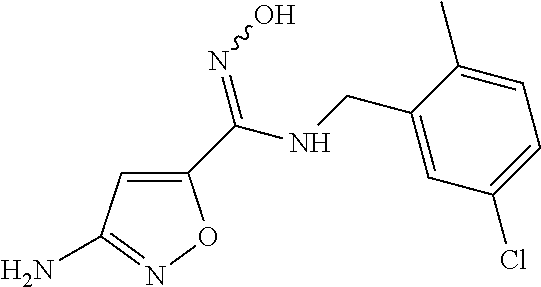


| TABLE 2 | |||
| Ex. | MS | ||
| No. | Structure | Name | (M + 1) |
| 24 |
 |
3-amino-N- (3-bromo-4- fluoro- phenyl)-N′- hydroxy- isoxazole- 5-carboxi- midamide | 315.0 |
| TABLE 3 | |||
| Ex. No. | IC50 (μM) | ||
| 1 | + | ||
| 2 | +++ | ||
| 3 | +++ | ||
| 4 | + | ||
| 5 | + | ||
| 6 | ++ | ||
| 7 | ++ | ||
| 8 | + | ||
| 9 | ++ | ||
| 10 | + | ||
| 11 | ++ | ||
| 12 | ++ | ||
| 13 | + | ||
| 14 | ++ | ||
| 15 | + | ||
| 16 | + | ||
| 17 | + | ||
| 18 | + | ||
| 19 | ++ | ||
| 20 | ++ | ||
| 21 | ++ | ||
| 22 | +++ | ||
| 23 | ++ | ||
| 24 | ++ | ||
- Poluektova L Y, Munn D H, Persidsky Y, and Gendelman H E (2002). Generation of cytotoxic T cells against virus-infected human brain macrophages in a murine model of HIV-1 encephalitis. J. Immunol. 168(8):3941-9.
Claims (22)

Priority Applications (1)
| Application Number | Priority Date | Filing Date | Title |
|---|---|---|---|
| US13/050,143 US8507541B2 (en) | 2006-09-19 | 2011-03-17 | N-hydroxyamidinoheterocycles as modulators of indoleamine 2,3-dioxygenase |
Applications Claiming Priority (3)
| Application Number | Priority Date | Filing Date | Title |
|---|---|---|---|
| US84571106P | 2006-09-19 | 2006-09-19 | |
| US11/856,982 US20080214546A1 (en) | 2006-09-19 | 2007-09-18 | N-hydroxyamidinoheterocycles as modulators of indoleamine 2,3-dioxygenase |
| US13/050,143 US8507541B2 (en) | 2006-09-19 | 2011-03-17 | N-hydroxyamidinoheterocycles as modulators of indoleamine 2,3-dioxygenase |
Related Parent Applications (1)
| Application Number | Title | Priority Date | Filing Date |
|---|---|---|---|
| US11/856,982 Continuation US20080214546A1 (en) | 2006-09-19 | 2007-09-18 | N-hydroxyamidinoheterocycles as modulators of indoleamine 2,3-dioxygenase |
Publications (2)
| Publication Number | Publication Date |
|---|---|
| US20110165188A1 US20110165188A1 (en) | 2011-07-07 |
| US8507541B2 true US8507541B2 (en) | 2013-08-13 |
Family
ID=38974145
Family Applications (2)
| Application Number | Title | Priority Date | Filing Date |
|---|---|---|---|
| US11/856,982 Abandoned US20080214546A1 (en) | 2006-09-19 | 2007-09-18 | N-hydroxyamidinoheterocycles as modulators of indoleamine 2,3-dioxygenase |
| US13/050,143 Expired - Fee Related US8507541B2 (en) | 2006-09-19 | 2011-03-17 | N-hydroxyamidinoheterocycles as modulators of indoleamine 2,3-dioxygenase |
Family Applications Before (1)
| Application Number | Title | Priority Date | Filing Date |
|---|---|---|---|
| US11/856,982 Abandoned US20080214546A1 (en) | 2006-09-19 | 2007-09-18 | N-hydroxyamidinoheterocycles as modulators of indoleamine 2,3-dioxygenase |
Country Status (9)
| Country | Link |
|---|---|
| US (2) | US20080214546A1 (en) |
| EP (1) | EP2064194B1 (en) |
| JP (1) | JP5432715B2 (en) |
| AR (1) | AR062881A1 (en) |
| CA (1) | CA2662773C (en) |
| CL (1) | CL2007002650A1 (en) |
| ES (1) | ES2704641T3 (en) |
| TW (1) | TW200819445A (en) |
| WO (1) | WO2008036653A2 (en) |
Cited By (6)
| Publication number | Priority date | Publication date | Assignee | Title |
|---|---|---|---|---|
| US8796319B2 (en) | 2008-07-08 | 2014-08-05 | Incyte Corporation | 1,2,5-oxadiazoles as inhibitors of indoleamine 2,3-dioxygenase |
| US8846726B2 (en) | 2005-05-10 | 2014-09-30 | Incyte Corporation | Modulators of indoleamine 2,3-dioxygenase and methods of using the same |
| US8951536B2 (en) | 2005-12-20 | 2015-02-10 | Incyte Corporation | N-hydroxyamidinoheterocycles as modulators of indoleamine 2,3-dioxygenase |
| US9321755B2 (en) | 2013-11-08 | 2016-04-26 | Incyte Corporation | Process for the synthesis of an indoleamine 2,3-dioxygenase inhibitor |
| WO2018119440A1 (en) | 2016-12-22 | 2018-06-28 | Calithera Biosciences, Inc. | Compositions and methods for inhibiting arginase activity |
| WO2020081381A1 (en) * | 2018-10-17 | 2020-04-23 | Merck Sharp & Dohme Corp. | Novel arylalkyl pyrazole compounds as indoleamine 2,3-dioxygenase inhibitors |
Families Citing this family (155)
| Publication number | Priority date | Publication date | Assignee | Title |
|---|---|---|---|---|
| CN100406567C (en) * | 2002-01-22 | 2008-07-30 | 生物材料公司 | Drying method for biodegradable polymers |
| WO2008036642A2 (en) * | 2006-09-19 | 2008-03-27 | Incyte Corporation | N-hydroxyamidinoheterocycles as modulators of indoleamine 2,3-dioxygenase |
| CL2007002650A1 (en) | 2006-09-19 | 2008-02-08 | Incyte Corp | COMPOUNDS DERIVED FROM HETEROCICLO N-HIDROXIAMINO; PHARMACEUTICAL COMPOSITION, USEFUL TO TREAT CANCER, VIRAL INFECTIONS AND NEURODEGENERATIVE DISORDERS BETWEEN OTHERS. |
| CN102558084A (en) * | 2010-12-22 | 2012-07-11 | 上海药明康德新药开发有限公司 | Synthesis method of N,N-disubstituted-3-aminoisooxazolyl-5-carboxylic acid compound |
| CN102558083B (en) * | 2010-12-22 | 2015-07-01 | 无锡药明康德生物技术有限公司 | Synthesizing method for N, N-double substitution-3-amino isoxazole-5-methanol compound |
| GB201120860D0 (en) | 2011-12-05 | 2012-01-18 | Cambridge Entpr Ltd | Cancer immunotherapy |
| KR20150087400A (en) | 2012-11-20 | 2015-07-29 | 버텍스 파마슈티칼스 인코포레이티드 | Compounds useful as inhibitors of indoleamine 2,3-dioxygenase |
| KR102457145B1 (en) | 2013-12-24 | 2022-10-19 | 브리스톨-마이어스 스큅 컴퍼니 | Tricyclic compounds as anticancer agents |
| PE20170441A1 (en) | 2014-06-06 | 2017-04-26 | Bristol Myers Squibb Co | ANTIBODIES AGAINST THE GLUCOCORTICOID-INDUCED TUMOR NECROSIS FACTOR RECEPTOR (GITR) AND ITS USES |
| RU2016149812A (en) * | 2014-06-06 | 2018-07-17 | Флексус Байосайенсиз, Инк. | IMMUNO REGULATORY MEANS |
| AU2015349878A1 (en) | 2014-11-21 | 2017-05-25 | Bristol-Myers Squibb Company | Antibodies against CD73 and uses thereof |
| US10525035B2 (en) | 2014-12-18 | 2020-01-07 | Lankenau Institute For Medical Research | Methods and compositions for the treatment of retinopathy and other ocular diseases |
| AR103232A1 (en) | 2014-12-22 | 2017-04-26 | Bristol Myers Squibb Co | TGFbR ANTAGONISTS |
| JP6180663B2 (en) | 2014-12-23 | 2017-08-16 | ブリストル−マイヤーズ スクイブ カンパニーBristol−Myers Squibb Company | Antibodies against TIGIT |
| US10983128B2 (en) | 2015-02-05 | 2021-04-20 | Bristol-Myers Squibb Company | CXCL11 and SMICA as predictive biomarkers for efficacy of anti-CTLA4 immunotherapy |
| EA037112B1 (en) | 2015-03-02 | 2021-02-08 | Ригель Фармасьютикалс, Инк. | Tgf- inhibitors |
| KR20170134981A (en) | 2015-04-03 | 2017-12-07 | 브리스톨-마이어스 스큅 컴퍼니 | Inhibitor of indoleamine-2,3-dioxygenase for the treatment of cancer |
| TW201642897A (en) | 2015-04-08 | 2016-12-16 | F 星生物科技有限公司 | HER2 binding agent therapies |
| AU2016249981B2 (en) | 2015-04-13 | 2022-02-17 | Five Prime Therapeutics, Inc. | Combination therapy for cancer |
| US10683290B2 (en) | 2015-05-11 | 2020-06-16 | Bristol-Myers Squibb Company | Tricyclic compounds as anticancer agents |
| ES2770349T3 (en) | 2015-05-12 | 2020-07-01 | Bristol Myers Squibb Co | 5H-pyrido [3,2-b] indole compounds as antineoplastic agents |
| US9725449B2 (en) | 2015-05-12 | 2017-08-08 | Bristol-Myers Squibb Company | Tricyclic compounds as anticancer agents |
| DK3303396T5 (en) | 2015-05-29 | 2024-10-07 | Bristol Myers Squibb Co | ANTIBODIES AGAINST OX40 AND USES THEREOF |
| CN107922500A (en) | 2015-06-29 | 2018-04-17 | 洛克菲勒大学 | The anti-CD 40 antibodies of agonist activity with enhancing |
| US10399987B2 (en) | 2015-07-28 | 2019-09-03 | Bristol-Myer Squibb Company | TGF beta receptor antagonists |
| CN108349976A (en) | 2015-08-25 | 2018-07-31 | 百时美施贵宝公司 | TGFβ receptor antagonist |
| US10273281B2 (en) | 2015-11-02 | 2019-04-30 | Five Prime Therapeutics, Inc. | CD80 extracellular domain polypeptides and their use in cancer treatment |
| AU2016356780A1 (en) | 2015-11-19 | 2018-06-28 | Bristol-Myers Squibb Company | Antibodies against glucocorticoid-induced tumor necrosis factor receptor (GITR) and uses thereof |
| MX2018006181A (en) | 2015-11-23 | 2018-09-24 | Five Prime Therapeutics Inc | FGFR2 INHIBITORS ALONE OR IN COMBINATION WITH AGENTS THAT STIMULATE THE IMMUNE SYSTEM IN THE TREATMENT AGAINST CANCER. |
| JP6856648B2 (en) | 2015-12-15 | 2021-04-07 | ブリストル−マイヤーズ スクイブ カンパニーBristol−Myers Squibb Company | CXCR4 receptor antagonist |
| WO2017140835A1 (en) | 2016-02-19 | 2017-08-24 | INSERM (Institut National de la Santé et de la Recherche Médicale) | Methods and pharmaceutical compositions for the treatment of obesity |
| RU2638530C2 (en) * | 2016-02-29 | 2017-12-14 | Федеральное государственное бюджетное образовательное учреждение высшего образования "Московский государственный университет имени М.В. Ломоносова" (МГУ) | Derivatives of 5-aminoisoxazol - conformationally-rigid analogs of g-amino butyric acid and its production method |
| EP3423494A1 (en) | 2016-03-04 | 2019-01-09 | Bristol-Myers Squibb Company | Combination therapy with anti-cd73 antibodies |
| US12297266B2 (en) | 2016-04-18 | 2025-05-13 | Celldex Therapeutics, Inc. | Agonistic antibodies that bind human CD40 and uses thereof |
| WO2017192840A1 (en) | 2016-05-04 | 2017-11-09 | Bristol-Myers Squibb Company | Inhibitors of indoleamine 2,3-dioxygenase and methods of their use |
| EP3452450A1 (en) | 2016-05-04 | 2019-03-13 | Bristol-Myers Squibb Company | Inhibitors of indoleamine 2,3-dioxygenase and methods of their use |
| KR20190004743A (en) | 2016-05-04 | 2019-01-14 | 브리스톨-마이어스 스큅 컴퍼니 | Inhibitors of indoleamine 2,3-dioxygenase and methods of use thereof |
| WO2017192813A1 (en) | 2016-05-04 | 2017-11-09 | Bristol-Myers Squibb Company | Inhibitors of indoleamine 2,3-dioxygenase and methods of their use |
| WO2017192844A1 (en) | 2016-05-04 | 2017-11-09 | Bristol-Myers Squibb Company | Inhibitors of indoleamine 2,3-dioxygenase and methods of their use |
| CN109757103B (en) | 2016-07-14 | 2024-01-02 | 百时美施贵宝公司 | Antibodies against TIM3 and their uses |
| US20190292179A1 (en) | 2016-07-21 | 2019-09-26 | Bristol-Myers Squibb Company | TGF Beta RECEPTOR ANTAGONISTS |
| US11351164B2 (en) | 2016-08-26 | 2022-06-07 | Bristol-Myers Squibb Company | Inhibitors of indoleamine 2,3-dioxygenase and methods of their use |
| UY37466A (en) | 2016-11-03 | 2018-01-31 | Phenex Discovery Verwaltungs Gmbh | N-HYDROXIAMIDINHETEROCICLES SUBSTITUTED AS MODULATORS OF INDOLAMINE 2,3-DIOXYGENASE |
| WO2018132279A1 (en) | 2017-01-05 | 2018-07-19 | Bristol-Myers Squibb Company | Tgf beta receptor antagonists |
| CA3047002A1 (en) | 2017-01-17 | 2018-07-26 | Board Of Regents, The University Of Texas System | Compounds useful as inhibitors of indoleamine 2,3-dioxygenase and/or tryptophan dioxygenase |
| CA3057312A1 (en) * | 2017-03-29 | 2018-10-04 | Merck Sharp & Dohme Corp. | Novel substituted n'-hydroxycarbamimidoyl-1,2,5-oxadiazole compounds as indoleamine 2,3-dioxygenase (ido) inhibitors |
| CN110709420A (en) | 2017-03-31 | 2020-01-17 | 戊瑞治疗有限公司 | Cancer combination therapy using anti-GITR antibodies |
| TWI788340B (en) | 2017-04-07 | 2023-01-01 | 美商必治妥美雅史谷比公司 | Anti-icos agonist antibodies and uses thereof |
| MX2019012431A (en) | 2017-04-21 | 2020-08-03 | Ikena Oncology Inc | Indole ahr inhibitors and uses thereof. |
| KR20190139216A (en) | 2017-04-28 | 2019-12-17 | 파이브 프라임 테라퓨틱스, 인크. | Therapeutic Methods Using CD80 Extracellular Domain Polypeptides |
| US11066392B2 (en) | 2017-05-12 | 2021-07-20 | Bristol-Myers Squibb Company | Inhibitors of indoleamine 2,3-dioxygenase and methods of their use |
| RU2658837C1 (en) * | 2017-06-30 | 2018-06-25 | Федеральное государственное бюджетное образовательное учреждение высшего образования "Московский государственный университет имени М.В. Ломоносова" (МГУ) | Process for the preparation of 5-aminoisoxazole-carboxylic acid |
| EP3644993B1 (en) | 2017-06-30 | 2023-08-02 | Bristol-Myers Squibb Company | Amorphous and crystalline forms of ido inhibitors |
| JP7186764B2 (en) | 2017-07-28 | 2022-12-09 | ブリストル-マイヤーズ スクイブ カンパニー | Cyclic dinucleotides as anticancer agents |
| BR112020003116A2 (en) | 2017-08-17 | 2020-08-04 | Ikena Oncology, Inc. | ahr inhibitors and their uses |
| KR102812783B1 (en) | 2017-08-31 | 2025-05-26 | 브리스톨-마이어스 스큅 컴퍼니 | Cyclic dinucleotides as anticancer agents |
| US10947263B2 (en) | 2017-08-31 | 2021-03-16 | Bristol-Myers Squibb Company | Cyclic dinucleotides as anticancer agents |
| JP7208225B2 (en) | 2017-08-31 | 2023-01-18 | ブリストル-マイヤーズ スクイブ カンパニー | Cyclic dinucleotides as anticancer agents |
| JP2020534289A (en) | 2017-09-14 | 2020-11-26 | ランケナー インスティテュート フォー メディカル リサーチ | Methods and compositions for the treatment of cancer |
| WO2019074824A1 (en) | 2017-10-09 | 2019-04-18 | Bristol-Myers Squibb Company | Inhibitors of indoleamine 2,3-dioxygenase and methods of their use |
| WO2019074822A1 (en) | 2017-10-09 | 2019-04-18 | Bristol-Myers Squibb Company | Inhibitors of indoleamine 2,3-dioxygenase and methods of their use |
| EP3694552A1 (en) | 2017-10-10 | 2020-08-19 | Tilos Therapeutics, Inc. | Anti-lap antibodies and uses thereof |
| US11660311B2 (en) | 2017-10-10 | 2023-05-30 | Bristol-Myers Squibb Company | Cyclic dinucleotides as anticancer agents |
| EP3697801B1 (en) | 2017-10-16 | 2024-11-20 | Bristol-Myers Squibb Company | Cyclic dinucleotides as anticancer agents |
| JP2021501801A (en) | 2017-11-01 | 2021-01-21 | ブリストル−マイヤーズ スクイブ カンパニーBristol−Myers Squibb Company | Immunostimulatory agonist antibody for use in the treatment of cancer |
| EP3707138B1 (en) | 2017-11-06 | 2022-07-13 | Bristol-Myers Squibb Company | Isofuranone compounds useful as hpk1 inhibitors |
| WO2019115586A1 (en) | 2017-12-12 | 2019-06-20 | Phenex Discovery Verwaltungs-GmbH | Oxalamides as modulators of indoleamine 2,3-dioxygenase |
| CN111788227B (en) | 2017-12-27 | 2025-02-25 | 百时美施贵宝公司 | Anti-CD40 antibodies and uses thereof |
| US11447449B2 (en) | 2018-01-05 | 2022-09-20 | Bristol-Myers Squibb Company | Inhibitors of indoleamine 2,3-dioxygenase and methods of their use |
| EP3737700A1 (en) | 2018-01-12 | 2020-11-18 | Bristol-Myers Squibb Company | Antibodies against tim3 and uses thereof |
| US10519187B2 (en) | 2018-02-13 | 2019-12-31 | Bristol-Myers Squibb Company | Cyclic dinucleotides as anticancer agents |
| ES2980374T3 (en) | 2018-03-08 | 2024-10-01 | Bristol Myers Squibb Co | Cyclic dinucleotides as anticancer agents |
| BR112020019083A2 (en) | 2018-03-21 | 2020-12-29 | Five Prime Therapeutics, Inc. | ANTIBODIES, NUCLEIC ACID, COMPOSITIONS, CELL AND METHODS FOR PREPARING AN ANTIBODY, FOR TREATING CANCER, FOR TREATING AN INFECTIOUS DISEASE, FOR TREATING INFLAMMATION, FOR THE IDENTIFICATION OF AN ANTIBODY, TO IMPROVE THE ANTICORUS OF ANTICORUS AND ANTICORUS OF AN ANTIBODY, TO SELECT AN ANTIBODY, TO IMPROVE ANTIBODY EFFICIENCY, TO ISOLATE ANTIBODIES, TO DETECT VIEW IN A SAMPLE AND TO TREAT CANCER |
| EP3768715A1 (en) | 2018-03-23 | 2021-01-27 | Bristol-Myers Squibb Company | Antibodies against mica and/or micb and uses thereof |
| EP3774755B1 (en) | 2018-03-29 | 2022-05-18 | Phenex Discovery Verwaltungs-GmbH | Spirocyclic compounds as modulators of indoleamine 2,3-dioxygenase |
| BR112020020826A2 (en) | 2018-04-12 | 2021-01-19 | Bristol-Myers Squibb Company | ANTICANCER COMBINATION THERAPY WITH CD73 ANTAGONIST ANTIBODY AND PD-1 / PD-L1 AXIS ANTIBODY |
| JP2021522211A (en) | 2018-04-16 | 2021-08-30 | アリーズ セラピューティクス, インコーポレイテッド | EP4 inhibitor and its use |
| WO2019206800A1 (en) | 2018-04-24 | 2019-10-31 | Phenex Discovery Verwaltungs-GmbH | Spirocyclic compounds as modulators of indoleamine 2,3-dioxygenase |
| WO2019213340A1 (en) | 2018-05-03 | 2019-11-07 | Bristol-Myers Squibb Company | Uracil derivatives as mer-axl inhibitors |
| CN112585139B (en) | 2018-06-27 | 2023-12-01 | 百时美施贵宝公司 | Naphthyridinone compounds used as T cell activators |
| KR102767739B1 (en) | 2018-06-27 | 2025-02-12 | 브리스톨-마이어스 스큅 컴퍼니 | Substituted naphthyridinone compounds useful as T cell activators |
| CN113056483B (en) | 2018-07-09 | 2025-08-01 | 戊瑞治疗有限公司 | Antibodies that bind to ILT4 |
| PE20210687A1 (en) | 2018-07-11 | 2021-04-08 | Bristol Myers Squibb Co | ANTIBODIES FROM BINDING TO SIGHT TO ACID PH |
| WO2020018670A1 (en) | 2018-07-17 | 2020-01-23 | Board Of Regents, The University Of Texas System | Compounds useful as inhibitors of indoleamine 2,3-dioxygenase and/or tryptophan dioxygenase |
| WO2020023356A1 (en) | 2018-07-23 | 2020-01-30 | Bristol-Myers Squibb Company | Inhibitors of indoleamine 2,3-dioxygenase and methods of their use |
| US12059420B2 (en) | 2018-07-23 | 2024-08-13 | Bristol-Myers Squibb Company | Inhibitors of indoleamine 2,3-dioxygenase and methods of their use |
| US10959986B2 (en) | 2018-08-29 | 2021-03-30 | Bristol-Myers Squibb Company | Inhibitors of indoleamine 2,3-dioxygenase and methods of their use |
| US11253525B2 (en) | 2018-08-29 | 2022-02-22 | Bristol-Myers Squibb Company | Inhibitors of indoleamine 2,3-dioxygenase and methods of their use |
| CN113164780A (en) | 2018-10-10 | 2021-07-23 | 泰洛斯治疗公司 | anti-LAP antibody variants and uses thereof |
| CN113316590B (en) | 2018-11-16 | 2025-02-28 | 百时美施贵宝公司 | Anti-NKG2A antibodies and uses thereof |
| US12012374B2 (en) | 2019-05-13 | 2024-06-18 | Bristol-Myers Squibb Company | Agonists of ROR GAMMAt |
| US20230295087A1 (en) | 2019-05-13 | 2023-09-21 | Bristol-Myers Squibb Company | AGONISTS OF ROR GAMMAt |
| CN111943906B (en) * | 2019-05-14 | 2023-12-15 | 中国医学科学院药物研究所 | Amidine derivatives, preparation methods, pharmaceutical compositions and uses thereof |
| US20220306630A1 (en) | 2019-08-06 | 2022-09-29 | Bristol-Myers Squibb Company | AGONISTS OF ROR GAMMAt |
| AR119821A1 (en) | 2019-08-28 | 2022-01-12 | Bristol Myers Squibb Co | SUBSTITUTED PYRIDOPYRIMIDINOL COMPOUNDS USEFUL AS T-CELL ACTIVATORS |
| CA3149719A1 (en) | 2019-09-19 | 2021-03-25 | Bristol-Myers Squibb Company | Antibodies binding to vista at acidic ph |
| JP7629459B2 (en) | 2019-11-19 | 2025-02-13 | ブリストル-マイヤーズ スクイブ カンパニー | Compounds useful as inhibitors of Helios protein |
| AU2020394424A1 (en) | 2019-11-26 | 2022-06-16 | Ikena Oncology, Inc. | Polymorphic carbazole derivatives and uses thereof |
| BR112022009944A2 (en) | 2019-11-26 | 2022-08-09 | Bristol Myers Squibb Co | SALTS / COCRYSTALS OF (R)-N-(4-CHLOROPHENYL)-2-((1S,4S)-4-(6-FLUOROQUINOLIN-4-YL)CYCLO-HEXYL)PROPANAMIDE |
| BR112022012204A2 (en) | 2019-12-23 | 2022-09-13 | Bristol Myers Squibb Co | SUBSTITUTED HETEROARYL COMPOUNDS USEFUL AS T-CELL ACTIVATORS |
| CA3162979A1 (en) | 2019-12-23 | 2021-07-01 | Upender Velaparthi | Substituted piperazine derivatives useful as t cell activators |
| BR112022012179A2 (en) | 2019-12-23 | 2022-09-06 | Bristol Myers Squibb Co | SUBSTITUTED QUINAZOLINE COMPOUNDS USEFUL AS T-CELL ACTIVATORS |
| AR120823A1 (en) | 2019-12-23 | 2022-03-23 | Bristol Myers Squibb Co | SUBSTITUTED BICYCLIC COMPOUNDS USEFUL AS T-CELL ACTIVATORS |
| KR20220119456A (en) | 2019-12-23 | 2022-08-29 | 브리스톨-마이어스 스큅 컴퍼니 | Substituted Quinolinonyl Piperazine Compounds Useful as T Cell Activators |
| KR20230020379A (en) | 2020-01-06 | 2023-02-10 | 하이파이바이오 (에이치케이) 리미티드 | Anti-TNFR2 Antibodies and Uses Thereof |
| CN120647763A (en) | 2020-01-07 | 2025-09-16 | 高诚生物医药公司 | Anti-galectin-9 antibodies and uses thereof |
| TW202140473A (en) | 2020-01-15 | 2021-11-01 | 美商纜圖藥品公司 | Map4k1 inhibitors |
| CN115485302A (en) | 2020-03-09 | 2022-12-16 | 百时美施贵宝公司 | Antibodies against CD40 with enhanced agonist activity |
| TW202140441A (en) | 2020-03-23 | 2021-11-01 | 美商必治妥美雅史谷比公司 | Substituted oxoisoindoline compounds |
| US20230272056A1 (en) | 2020-04-09 | 2023-08-31 | Merck Sharp & Dohme Llc | Affinity matured anti-lap antibodies and uses thereof |
| US20230192867A1 (en) | 2020-05-15 | 2023-06-22 | Bristol-Myers Squibb Company | Antibodies to garp |
| WO2021258010A1 (en) | 2020-06-19 | 2021-12-23 | Gossamer Bio Services, Inc. | Oxime compounds useful as t cell activators |
| CN116724051A (en) | 2020-08-10 | 2023-09-08 | 上海寻百会生物技术有限公司 | Compositions and methods for treating autoimmune diseases and cancer by targeting IGSF8 |
| CN112521357B (en) * | 2020-08-31 | 2021-10-08 | 深圳瑞健生物科技有限公司 | A kind of long-acting and low-addiction HNK derivative and preparation method thereof |
| CA3198456A1 (en) | 2020-10-14 | 2022-04-21 | Five Prime Therapeutics, Inc. | Anti-c-c chemokine receptor 8 (ccr8) antibodies and methods of use thereof |
| WO2022133083A1 (en) | 2020-12-16 | 2022-06-23 | Gossamer Bio Services, Inc. | Compounds useful as t cell activators |
| WO2022169921A1 (en) | 2021-02-04 | 2022-08-11 | Bristol-Myers Squibb Company | Benzofuran compounds as sting agonists |
| AU2022221124A1 (en) | 2021-02-12 | 2023-08-03 | F. Hoffmann-La Roche Ag | Bicyclic tetrahydroazepine derivatives for the treatment of cancer |
| EP4305041A1 (en) | 2021-03-08 | 2024-01-17 | Blueprint Medicines Corporation | Map4k1 inhibitors |
| US11918582B2 (en) | 2021-03-15 | 2024-03-05 | Rapt Therapeutics, Inc. | Pyrazole pyrimidine compounds and uses thereof |
| EP4314068A1 (en) | 2021-04-02 | 2024-02-07 | The Regents Of The University Of California | Antibodies against cleaved cdcp1 and uses thereof |
| AU2022253450A1 (en) | 2021-04-05 | 2023-11-16 | Bristol-Myers Squibb Company | Pyridinyl substituted oxoisoindoline compounds for the treatment of cancer |
| EP4320112B1 (en) | 2021-04-06 | 2025-05-14 | Bristol-Myers Squibb Company | Pyridinyl substituted oxoisoindoline compounds |
| WO2023288254A1 (en) | 2021-07-14 | 2023-01-19 | Blueprint Medicines Corporation | Heterocyclic compounds as map4k1 inhibitors |
| US20240336630A1 (en) | 2021-07-15 | 2024-10-10 | Blueprint Medicines Corporation | Map4k1 inhibitors |
| WO2023122772A1 (en) | 2021-12-22 | 2023-06-29 | Gossamer Bio Services, Inc. | Oxime derivatives useful as t cell activators |
| WO2023122778A1 (en) | 2021-12-22 | 2023-06-29 | Gossamer Bio Services, Inc. | Pyridazinone derivatives useful as t cell activators |
| WO2023122777A1 (en) | 2021-12-22 | 2023-06-29 | Gossamer Bio Services, Inc. | Oxime derivatives useful as t cell activators |
| WO2023150186A1 (en) | 2022-02-01 | 2023-08-10 | Arvinas Operations, Inc. | Dgk targeting compounds and uses thereof |
| CN119654312A (en) | 2022-08-08 | 2025-03-18 | 百时美施贵宝公司 | Substituted tetrazolyl compounds as T cell activators |
| CN119677740A (en) | 2022-08-09 | 2025-03-21 | 百时美施贵宝公司 | Tertiary amine substituted bicyclic compounds as T cell activators |
| JP2025526726A (en) | 2022-08-11 | 2025-08-15 | エフ・ホフマン-ラ・ロシュ・アクチェンゲゼルシャフト | Bicyclic Tetrahydroazepine Derivatives |
| AU2023322637A1 (en) | 2022-08-11 | 2024-11-14 | F. Hoffmann-La Roche Ag | Bicyclic tetrahydrothiazepine derivatives |
| WO2024033457A1 (en) | 2022-08-11 | 2024-02-15 | F. Hoffmann-La Roche Ag | Bicyclic tetrahydrothiazepine derivatives |
| AU2023322638A1 (en) | 2022-08-11 | 2024-11-28 | F. Hoffmann-La Roche Ag | Bicyclic tetrahydrothiazepine derivatives |
| WO2024137865A1 (en) | 2022-12-22 | 2024-06-27 | Gossamer Bio Services, Inc. | Compounds useful as t cell activators |
| GB202303250D0 (en) | 2023-03-06 | 2023-04-19 | King S College London | Method and compounds |
| EP4511371A1 (en) | 2023-05-08 | 2025-02-26 | Bristol-Myers Squibb Company | Substituted phenyl oxazolone compounds |
| EP4709712A1 (en) | 2023-05-10 | 2026-03-18 | Blueprint Medicines Corporation | Gsk3a inhibitors and methods of use thereof |
| AU2024281056A1 (en) | 2023-05-31 | 2026-01-22 | Bristol-Myers Squibb Company | Substituted oxazolone compound for decreasing levels of ikzf1-4 proteins |
| AU2024285766A1 (en) | 2023-06-07 | 2026-01-08 | Bristol-Myers Squibb Company | Spirocyclic substituted oxoisoindolinyl piperidine-2,6-dione compound |
| WO2024263853A1 (en) | 2023-06-23 | 2024-12-26 | Bristol-Myers Squibb Company | Substituted oxoisoindolinyl piperidine-2,6-dione compound as anticancer agent |
| WO2025030002A2 (en) | 2023-08-02 | 2025-02-06 | Arvinas Operations, Inc. | Dgk targeting compounds and uses thereof |
| KR102834908B1 (en) | 2023-09-02 | 2025-07-16 | 브리스톨-마이어스 스큅 컴퍼니 | Substituted phenyl oxooxazolyl piperidine dione compounds |
| WO2025064197A1 (en) | 2023-09-02 | 2025-03-27 | Bristol-Myers Squibb Company | Substituted azetidinyl oxoisoindolinyl piperidine-2,6-dione compounds |
| JP7808733B2 (en) | 2023-09-13 | 2026-01-29 | ブリストル-マイヤーズ スクイブ カンパニー | Substituted oxoisoindolinylpiperidine-2,6-dione compounds |
| WO2025096487A1 (en) | 2023-10-31 | 2025-05-08 | Bristol-Myers Squibb Company | Ubiquitin specific processing protease 1 (usp1) compounds |
| TW202535865A (en) | 2023-10-31 | 2025-09-16 | 美商必治妥美雅史谷比公司 | Ubiquitin specific processing protease 1 (usp1) compounds |
| WO2025096488A1 (en) | 2023-10-31 | 2025-05-08 | Bristol-Myers Squibb Company | Ubiquitin specific processing protease 1 (usp1) compounds |
| WO2025096494A1 (en) | 2023-10-31 | 2025-05-08 | Bristol-Myers Squibb Company | Ubiquitin specific processing protease 1 (usp1) compounds |
| WO2025096490A1 (en) | 2023-10-31 | 2025-05-08 | Bristol-Myers Squibb Company | Ubiquitin specific processing protease 1 (usp1) compounds |
| WO2025096505A1 (en) | 2023-10-31 | 2025-05-08 | Bristol-Myers Squibb Company | Ubiquitin specific processing protease 1 (usp1) compounds |
| WO2025226767A1 (en) | 2024-04-24 | 2025-10-30 | Bristol-Myers Squibb Company | Substituted 3-(5-(6-aminopyridin-2-yl)-4-fluoro-1-oxoisoindolin-2-yl)piperidine-2,6-dione compounds for use in the treatment of cancer |
| WO2026035787A1 (en) | 2024-08-07 | 2026-02-12 | Bristol-Myers Squibb Company | Ubiquitin specific processing protease 1 (usp1) macrocyles |
| WO2026080794A1 (en) | 2024-10-11 | 2026-04-16 | Bristol-Myers Squibb Company | Chemical compounds useful for degrading proteins |
Citations (68)
| Publication number | Priority date | Publication date | Assignee | Title |
|---|---|---|---|---|
| BE659467A (en) | 1964-02-19 | 1965-08-09 | ||
| US3236855A (en) | 1964-01-17 | 1966-02-22 | Merck & Co Inc | Certain n-phenyl(thiazole-hydroxamidine) compounds and their preparation |
| US3553228A (en) | 1967-09-26 | 1971-01-05 | Colgate Palmolive Co | 3-substituted-4h(1)benzopyrano(3,4-d) isoxazoles |
| DE2040628A1 (en) | 1970-08-17 | 1972-02-24 | Fahlberg List Veb | Substd hydroxyguanidines prepn |
| JPS5050369A (en) | 1973-09-05 | 1975-05-06 | ||
| US3948928A (en) | 1972-03-17 | 1976-04-06 | Dainippon Pharmaceutical Co., Ltd. | 3-Substituted-1,2-benzisoxazoles and pharmaceutically acceptable acid addition salts thereof |
| US4116974A (en) | 1975-09-11 | 1978-09-26 | Philagro | Herbicidal and phytohormonal amidoximes |
| SU886740A3 (en) | 1975-09-11 | 1981-11-30 | Рон-Пуленк Агрошими (Фирма) | Method of preparing amidoxime derivatives |
| US4323681A (en) | 1980-09-29 | 1982-04-06 | American Home Products Corporation | 4-Amino-2-substituted-5-pyrimidinecarboxamidoximes and carbothioamides |
| JPS58208275A (en) | 1982-05-20 | 1983-12-03 | Lion Corp | 5-amino-pyrazole derivative and antitumor agent containing it |
| JPS60193968A (en) | 1984-03-13 | 1985-10-02 | Toyo Jozo Co Ltd | Imidazoleamidoxime having cyclopentene ring and its preparation |
| JPS6259283A (en) | 1985-09-10 | 1987-03-14 | Kaken Pharmaceut Co Ltd | Cephalosporin compound |
| US4699916A (en) | 1983-07-22 | 1987-10-13 | Bayer Aktiengesellschaft | Substituted furazan pesticides |
| JPH026453A (en) | 1988-06-27 | 1990-01-10 | Nippon Soda Co Ltd | Amidine derivative, production thereof and acaricide, agricultural and horticultural germicide |
| EP0352832A1 (en) | 1988-07-05 | 1990-01-31 | Akzo N.V. | Compounds with bronchodilator activity |
| JPH04297449A (en) | 1991-03-27 | 1992-10-21 | Hokko Chem Ind Co Ltd | N-hydroxybenzylguanidine derivative and germicide for agriculture and horticulture |
| EP0516520A1 (en) | 1991-05-27 | 1992-12-02 | Pierre Fabre Medicament | 1,4-Disubstituted piperidines, their preparation and therapeutical application |
| EP0536424A1 (en) | 1991-04-26 | 1993-04-14 | Japan Tobacco Inc. | Novel benzopyran derivative |
| JPH0665269A (en) | 1992-06-19 | 1994-03-08 | Otsuka Pharmaceut Factory Inc | Phosphonic acid diester derivative |
| WO1997014686A1 (en) | 1995-10-17 | 1997-04-24 | Astra Pharmaceuticals Limited | Pharmaceutically active quinazoline compounds |
| WO1997030047A1 (en) | 1996-02-17 | 1997-08-21 | Agrevo Uk Limited | Fungicidal 1,2,4-oxadiazoles and analogues |
| WO1997042183A1 (en) | 1996-05-03 | 1997-11-13 | F. Hoffmann-La Roche Ag | Benzofuryl derivatives and their use |
| US5712294A (en) | 1994-05-27 | 1998-01-27 | Adir Et Compagnie | N-pyridyl carboxamides and derivatives |
| WO1998024784A1 (en) | 1996-12-06 | 1998-06-11 | Rhone-Poulenc Rorer Pharmaceuticals Inc. | Substituted sulfonic acid n-[(aminoiminomethyl)phenylalkyl]-azaheterocyclamide compounds |
| WO1999029310A2 (en) | 1997-12-05 | 1999-06-17 | Medical College Of Georgia Research Institute, Inc. | Regulation of t cell-mediated immunity by tryptophan and its analogs |
| JPH11171702A (en) | 1997-09-24 | 1999-06-29 | Takeda Chem Ind Ltd | Pest controlling method |
| WO1999062903A1 (en) | 1998-06-02 | 1999-12-09 | Takeda Chemical Industries, Ltd. | Oxadiazoline derivatives and their use as insecticides |
| WO2000052001A1 (en) | 1999-03-03 | 2000-09-08 | Samjin Pharmaceutical Co., Ltd. | Piperazine derivatives and process for the preparation thereof |
| EP1038874A1 (en) | 1997-12-10 | 2000-09-27 | Dainippon Ink And Chemicals, Inc. | Oxime derivatives and agricultural chemicals containing the same |
| WO2000061609A2 (en) | 1999-04-09 | 2000-10-19 | Basf Aktiengesellschaft | Prodrugs of thrombin inhibitors |
| JP2001158785A (en) | 1999-11-30 | 2001-06-12 | Takeda Chem Ind Ltd | Agrochemical composition |
| JP2001158786A (en) | 1999-11-30 | 2001-06-12 | Takeda Chem Ind Ltd | Controller against mammalian ectoparasite |
| WO2001051456A2 (en) | 2000-01-13 | 2001-07-19 | Tularik Inc. | Antibacterial agents |
| JP2001233861A (en) | 2000-02-22 | 2001-08-28 | Ube Ind Ltd | Pyrazole oxime compounds, their production and use |
| WO2002000196A2 (en) | 2000-06-28 | 2002-01-03 | Smithkline Beecham P.L.C. | Wet milling process |
| EP1188747A1 (en) | 1999-05-24 | 2002-03-20 | Mitsubishi Pharma Corporation | Phenoxypropylamine compounds |
| WO2002079200A1 (en) | 2001-03-30 | 2002-10-10 | Pfizer Limited | 3-heterocyclylpropanohydroxamic acid as procollagen c-proteinase inhibitors |
| US6482822B1 (en) | 1998-09-23 | 2002-11-19 | Societe De Conseils De Recherches Et D'applications Scientifiques (S.C.R.A.S.) | N-(iminomethyl)amines derivatives, their preparation, their use as medicines and compositions containing them |
| WO2002102799A2 (en) | 2001-06-18 | 2002-12-27 | Applied Research Systems Ars Holding N.V. | Pyrrolidine oxadiazole- and thiadiazole oxime derivatives being oxytocin receptor antagonists |
| WO2003045901A2 (en) | 2002-04-10 | 2003-06-05 | Celltech R & D Limited | Guanidine derivatives |
| WO2003070236A2 (en) | 2002-02-19 | 2003-08-28 | Pharmacia Italia S.P.A. | Tricyclic pyrazole derivatives, process for their preparation and their use as antitumor agents |
| WO2003087347A1 (en) | 2002-04-12 | 2003-10-23 | Medical College Of Georgia Research Institute, Inc. | Antigen-presenting cell populations and their use as reagents for enhancing or reducing immune tolerance |
| WO2003099805A1 (en) | 2002-05-28 | 2003-12-04 | 3-Dimensional Pharmaceuticals, Inc. | Novel thiophene amidines, compositions thereof, and methods of treating complement-mediated diseases and conditions |
| CA2500113A1 (en) | 2002-09-24 | 2004-04-08 | Euro-Celtique, S.A. | Therapeutic piperazine compounds |
| WO2004094409A1 (en) | 2003-03-27 | 2004-11-04 | Lankenau Institute For Medical Research | Novel ido inhibitors and methods of use |
| US20040234623A1 (en) | 2003-04-01 | 2004-11-25 | Medical College Of Georgia Research Institute, Inc. | Use of inhibitors of indoleamine-2,3-dioxygenase in combination with other therapeutic modalities |
| WO2005019190A2 (en) | 2003-08-20 | 2005-03-03 | Vertex Pharmaceuticals Incorporated | (4 -amino -1,2, 5-oxadiazol-4-yl) -hetξroaromatic compounds useful as protein kinase inhibitors |
| WO2005037779A2 (en) | 2003-10-15 | 2005-04-28 | Imtm Gmbh | Novel dipeptidyl peptidase iv inhibitors used for functionally influencing different cells and treating immunological, inflammatory, neuronal, and other diseases |
| WO2005037257A2 (en) | 2003-10-15 | 2005-04-28 | Imtm Gmbh | Novel alanyl-amino peptidase inhibitors for functionally influencing different cells and treating immunological, inflammatory, neuronal, and other diseases |
| WO2006028284A1 (en) | 2004-09-08 | 2006-03-16 | Mitsubishi Pharma Corporation | Morpholine compound |
| WO2006067532A1 (en) | 2004-12-24 | 2006-06-29 | Prosidion Ltd | G-protein coupled receptor agonists |
| US20060194802A1 (en) | 2005-01-20 | 2006-08-31 | Hassan Abdellaoui | Phenylamino isothiazole carboxamidines as MEK inhibitors |
| US20060258719A1 (en) | 2005-05-10 | 2006-11-16 | Combs Andrew P | Modulators of indoleamine 2,3-dioxygenase and methods of using the same |
| WO2006133417A1 (en) | 2005-06-07 | 2006-12-14 | Valeant Pharmaceuticals International | Phenylamino isothiazole carboxamidines as mek inhibitors |
| US20070038298A1 (en) | 2005-06-30 | 2007-02-15 | Sulner Joseph W | Repair of tympanic membrane using placenta derived collagen biofabric |
| WO2007068377A1 (en) | 2005-12-17 | 2007-06-21 | Bayer Cropscience Ag | Carboxamides for controlling micro-organisms in plant and material protection |
| WO2007075598A2 (en) | 2005-12-20 | 2007-07-05 | Incyte Corporation | N-hydroxyamidinoheterocycles as modulators of indoleamine 2,3-dioxygenase |
| US20070203140A1 (en) | 2006-02-09 | 2007-08-30 | Combs Andrew P | N-hydroxyguanidines as modulators of indoleamine 2,3-dioxygenase |
| WO2008036643A2 (en) | 2006-09-19 | 2008-03-27 | Incyte Corporation | Amidinoheterocycles as modulators of indoleamine 2,3-dioxygenase |
| WO2008036642A2 (en) | 2006-09-19 | 2008-03-27 | Incyte Corporation | N-hydroxyamidinoheterocycles as modulators of indoleamine 2,3-dioxygenase |
| WO2008036653A2 (en) | 2006-09-19 | 2008-03-27 | Incyte Corporation | N-hydroxyamidinoheterocycles as modulators of indoleamine 2,3-dioxygenase |
| WO2008036652A2 (en) | 2006-09-19 | 2008-03-27 | Incyte Corporation | Amidines as modulators of indoleamine 2,3-dioxygenase |
| WO2008058178A1 (en) | 2006-11-08 | 2008-05-15 | Incyte Corporation | N-hydroxyamidinoheterocycles as modulators of indoleamine 2,3-dioxygenase |
| WO2008073825A1 (en) | 2006-12-08 | 2008-06-19 | Exelixis, Inc. | Lxr and fxr modulators |
| US20080214549A1 (en) | 2007-01-12 | 2008-09-04 | Shaw Antony N | N-Substituted Glycine Derivatives: Hydroxylase Inhibitors |
| US20090163545A1 (en) | 2007-12-21 | 2009-06-25 | University Of Rochester | Method For Altering The Lifespan Of Eukaryotic Organisms |
| JP4297449B2 (en) | 2006-05-12 | 2009-07-15 | 株式会社サクラクレパス | India ink |
| US8088803B2 (en) | 2008-07-08 | 2012-01-03 | Incyte Corporation | 1,2,5-oxadiazoles as inhibitors of indoleamine 2,3-dioxygenase |
-
2007
- 2007-09-12 CL CL200702650A patent/CL2007002650A1/en unknown
- 2007-09-18 WO PCT/US2007/078759 patent/WO2008036653A2/en not_active Ceased
- 2007-09-18 AR ARP070104118A patent/AR062881A1/en unknown
- 2007-09-18 ES ES07842681T patent/ES2704641T3/en active Active
- 2007-09-18 EP EP07842681.4A patent/EP2064194B1/en active Active
- 2007-09-18 CA CA2662773A patent/CA2662773C/en active Active
- 2007-09-18 JP JP2009529343A patent/JP5432715B2/en not_active Expired - Fee Related
- 2007-09-18 US US11/856,982 patent/US20080214546A1/en not_active Abandoned
- 2007-09-19 TW TW096135025A patent/TW200819445A/en unknown
-
2011
- 2011-03-17 US US13/050,143 patent/US8507541B2/en not_active Expired - Fee Related
Patent Citations (93)
| Publication number | Priority date | Publication date | Assignee | Title |
|---|---|---|---|---|
| US3236855A (en) | 1964-01-17 | 1966-02-22 | Merck & Co Inc | Certain n-phenyl(thiazole-hydroxamidine) compounds and their preparation |
| BE659467A (en) | 1964-02-19 | 1965-08-09 | ||
| US3553228A (en) | 1967-09-26 | 1971-01-05 | Colgate Palmolive Co | 3-substituted-4h(1)benzopyrano(3,4-d) isoxazoles |
| DE2040628A1 (en) | 1970-08-17 | 1972-02-24 | Fahlberg List Veb | Substd hydroxyguanidines prepn |
| US3948928A (en) | 1972-03-17 | 1976-04-06 | Dainippon Pharmaceutical Co., Ltd. | 3-Substituted-1,2-benzisoxazoles and pharmaceutically acceptable acid addition salts thereof |
| JPS5050369A (en) | 1973-09-05 | 1975-05-06 | ||
| US4116974A (en) | 1975-09-11 | 1978-09-26 | Philagro | Herbicidal and phytohormonal amidoximes |
| SU886740A3 (en) | 1975-09-11 | 1981-11-30 | Рон-Пуленк Агрошими (Фирма) | Method of preparing amidoxime derivatives |
| US4323681A (en) | 1980-09-29 | 1982-04-06 | American Home Products Corporation | 4-Amino-2-substituted-5-pyrimidinecarboxamidoximes and carbothioamides |
| JPS58208275A (en) | 1982-05-20 | 1983-12-03 | Lion Corp | 5-amino-pyrazole derivative and antitumor agent containing it |
| US4699916A (en) | 1983-07-22 | 1987-10-13 | Bayer Aktiengesellschaft | Substituted furazan pesticides |
| JPS60193968A (en) | 1984-03-13 | 1985-10-02 | Toyo Jozo Co Ltd | Imidazoleamidoxime having cyclopentene ring and its preparation |
| JPS6259283A (en) | 1985-09-10 | 1987-03-14 | Kaken Pharmaceut Co Ltd | Cephalosporin compound |
| JPH026453A (en) | 1988-06-27 | 1990-01-10 | Nippon Soda Co Ltd | Amidine derivative, production thereof and acaricide, agricultural and horticultural germicide |
| EP0352832A1 (en) | 1988-07-05 | 1990-01-31 | Akzo N.V. | Compounds with bronchodilator activity |
| JPH04297449A (en) | 1991-03-27 | 1992-10-21 | Hokko Chem Ind Co Ltd | N-hydroxybenzylguanidine derivative and germicide for agriculture and horticulture |
| EP0536424A1 (en) | 1991-04-26 | 1993-04-14 | Japan Tobacco Inc. | Novel benzopyran derivative |
| EP0516520A1 (en) | 1991-05-27 | 1992-12-02 | Pierre Fabre Medicament | 1,4-Disubstituted piperidines, their preparation and therapeutical application |
| US5364864A (en) | 1991-05-27 | 1994-11-15 | Pierre Fabre Medicament | 1,4-disubstituted piperidines, their preparation and their application in therapy |
| JPH0665269A (en) | 1992-06-19 | 1994-03-08 | Otsuka Pharmaceut Factory Inc | Phosphonic acid diester derivative |
| US5712294A (en) | 1994-05-27 | 1998-01-27 | Adir Et Compagnie | N-pyridyl carboxamides and derivatives |
| WO1997014686A1 (en) | 1995-10-17 | 1997-04-24 | Astra Pharmaceuticals Limited | Pharmaceutically active quinazoline compounds |
| JPH11513679A (en) | 1995-10-17 | 1999-11-24 | アストラ・フアーマシユウテイカルズ・リミテツド | Drug-active quinazoline compounds |
| WO1997030047A1 (en) | 1996-02-17 | 1997-08-21 | Agrevo Uk Limited | Fungicidal 1,2,4-oxadiazoles and analogues |
| WO1997042183A1 (en) | 1996-05-03 | 1997-11-13 | F. Hoffmann-La Roche Ag | Benzofuryl derivatives and their use |
| WO1998024784A1 (en) | 1996-12-06 | 1998-06-11 | Rhone-Poulenc Rorer Pharmaceuticals Inc. | Substituted sulfonic acid n-[(aminoiminomethyl)phenylalkyl]-azaheterocyclamide compounds |
| JP2000505815A (en) | 1996-12-06 | 2000-05-16 | ローヌ―プーラン ローラー ファーマシューティカルズ インコーポレイテッド | Substituted sulfonic acid N-[(aminoiminomethyl) phenylalkyl] -azaheterocyclic amide compounds |
| JPH11171702A (en) | 1997-09-24 | 1999-06-29 | Takeda Chem Ind Ltd | Pest controlling method |
| US6482416B2 (en) | 1997-12-05 | 2002-11-19 | Medical College Of Georgia Research Institute, Inc. | Regulation of T cell-mediated immunity by tryptophan |
| WO1999029310A2 (en) | 1997-12-05 | 1999-06-17 | Medical College Of Georgia Research Institute, Inc. | Regulation of t cell-mediated immunity by tryptophan and its analogs |
| EP1038874A1 (en) | 1997-12-10 | 2000-09-27 | Dainippon Ink And Chemicals, Inc. | Oxime derivatives and agricultural chemicals containing the same |
| WO1999062903A1 (en) | 1998-06-02 | 1999-12-09 | Takeda Chemical Industries, Ltd. | Oxadiazoline derivatives and their use as insecticides |
| US6482822B1 (en) | 1998-09-23 | 2002-11-19 | Societe De Conseils De Recherches Et D'applications Scientifiques (S.C.R.A.S.) | N-(iminomethyl)amines derivatives, their preparation, their use as medicines and compositions containing them |
| RU2230742C2 (en) | 1998-09-23 | 2004-06-20 | Сосьете Де Консей Де Решерш Э Д'Аппликасьон Сьентифик (С.К.Р.А.С.) | New derivatives of n-(iminomethyl)amines, their preparing, their using as medicinal agents and pharmaceutical compositions containing thereof |
| WO2000052001A1 (en) | 1999-03-03 | 2000-09-08 | Samjin Pharmaceutical Co., Ltd. | Piperazine derivatives and process for the preparation thereof |
| WO2000061609A2 (en) | 1999-04-09 | 2000-10-19 | Basf Aktiengesellschaft | Prodrugs of thrombin inhibitors |
| JP2002542165A (en) | 1999-04-09 | 2002-12-10 | ビーエーエスエフ アクチェンゲゼルシャフト | Prodrugs of thrombin inhibitors |
| US7144902B1 (en) | 1999-04-09 | 2006-12-05 | Abbott Gmbh & Co. Kg | Prodrugs of thrombin inhibitors |
| EP1188747A1 (en) | 1999-05-24 | 2002-03-20 | Mitsubishi Pharma Corporation | Phenoxypropylamine compounds |
| JP2001158786A (en) | 1999-11-30 | 2001-06-12 | Takeda Chem Ind Ltd | Controller against mammalian ectoparasite |
| JP2001158785A (en) | 1999-11-30 | 2001-06-12 | Takeda Chem Ind Ltd | Agrochemical composition |
| WO2001051456A2 (en) | 2000-01-13 | 2001-07-19 | Tularik Inc. | Antibacterial agents |
| US6780858B2 (en) | 2000-01-13 | 2004-08-24 | Tularik Inc. | Antibacterial agents |
| JP2001233861A (en) | 2000-02-22 | 2001-08-28 | Ube Ind Ltd | Pyrazole oxime compounds, their production and use |
| WO2002000196A2 (en) | 2000-06-28 | 2002-01-03 | Smithkline Beecham P.L.C. | Wet milling process |
| WO2002079200A1 (en) | 2001-03-30 | 2002-10-10 | Pfizer Limited | 3-heterocyclylpropanohydroxamic acid as procollagen c-proteinase inhibitors |
| WO2002102799A2 (en) | 2001-06-18 | 2002-12-27 | Applied Research Systems Ars Holding N.V. | Pyrrolidine oxadiazole- and thiadiazole oxime derivatives being oxytocin receptor antagonists |
| WO2003070236A2 (en) | 2002-02-19 | 2003-08-28 | Pharmacia Italia S.P.A. | Tricyclic pyrazole derivatives, process for their preparation and their use as antitumor agents |
| WO2003045901A2 (en) | 2002-04-10 | 2003-06-05 | Celltech R & D Limited | Guanidine derivatives |
| WO2003087347A1 (en) | 2002-04-12 | 2003-10-23 | Medical College Of Georgia Research Institute, Inc. | Antigen-presenting cell populations and their use as reagents for enhancing or reducing immune tolerance |
| WO2003099805A1 (en) | 2002-05-28 | 2003-12-04 | 3-Dimensional Pharmaceuticals, Inc. | Novel thiophene amidines, compositions thereof, and methods of treating complement-mediated diseases and conditions |
| CA2500113A1 (en) | 2002-09-24 | 2004-04-08 | Euro-Celtique, S.A. | Therapeutic piperazine compounds |
| WO2004029031A2 (en) | 2002-09-24 | 2004-04-08 | Euro-Celtque, S.A. | Therapeutic piperazine compounds |
| WO2004094409A1 (en) | 2003-03-27 | 2004-11-04 | Lankenau Institute For Medical Research | Novel ido inhibitors and methods of use |
| US8008281B2 (en) | 2003-03-27 | 2011-08-30 | Lankenau Institute For Medical Research | Methods for the treatment of cancer |
| US20040234623A1 (en) | 2003-04-01 | 2004-11-25 | Medical College Of Georgia Research Institute, Inc. | Use of inhibitors of indoleamine-2,3-dioxygenase in combination with other therapeutic modalities |
| WO2005019190A2 (en) | 2003-08-20 | 2005-03-03 | Vertex Pharmaceuticals Incorporated | (4 -amino -1,2, 5-oxadiazol-4-yl) -hetξroaromatic compounds useful as protein kinase inhibitors |
| WO2005037257A2 (en) | 2003-10-15 | 2005-04-28 | Imtm Gmbh | Novel alanyl-amino peptidase inhibitors for functionally influencing different cells and treating immunological, inflammatory, neuronal, and other diseases |
| US20070037752A1 (en) | 2003-10-15 | 2007-02-15 | Siegfried Ansorge | Novel alanyl-amino peptidase inhibitors for functionally influencing different cells and treating immunological, inflammatory, neuronal, and other diseases |
| US20070037785A1 (en) | 2003-10-15 | 2007-02-15 | Siegfried Ansorge | Novel dipeptidyl peptidase IV inhibitors used for functionally influencing different cells and treating immunological, infammatory, neuronal, and other diseases |
| WO2005037779A2 (en) | 2003-10-15 | 2005-04-28 | Imtm Gmbh | Novel dipeptidyl peptidase iv inhibitors used for functionally influencing different cells and treating immunological, inflammatory, neuronal, and other diseases |
| US20070265257A1 (en) | 2004-09-08 | 2007-11-15 | Mitsubishi Pharma Corporation | Morpholine Compound |
| WO2006028284A1 (en) | 2004-09-08 | 2006-03-16 | Mitsubishi Pharma Corporation | Morpholine compound |
| WO2006067532A1 (en) | 2004-12-24 | 2006-06-29 | Prosidion Ltd | G-protein coupled receptor agonists |
| US20060194802A1 (en) | 2005-01-20 | 2006-08-31 | Hassan Abdellaoui | Phenylamino isothiazole carboxamidines as MEK inhibitors |
| US20060258719A1 (en) | 2005-05-10 | 2006-11-16 | Combs Andrew P | Modulators of indoleamine 2,3-dioxygenase and methods of using the same |
| WO2006122150A1 (en) | 2005-05-10 | 2006-11-16 | Incyte Corporation | Modulators of indoleamine 2,3-dioxygenase and methods of using the same |
| US8034953B2 (en) | 2005-05-10 | 2011-10-11 | Incyte Corporation | Modulators of indoleamine 2,3-dioxygenase and methods of using the same |
| US20110311479A1 (en) | 2005-05-10 | 2011-12-22 | Incyte Corporation, A Delaware Corporation | Modulators of indoleamine 2,3-dioxygenase and methods of using the same |
| WO2006133417A1 (en) | 2005-06-07 | 2006-12-14 | Valeant Pharmaceuticals International | Phenylamino isothiazole carboxamidines as mek inhibitors |
| US20070038298A1 (en) | 2005-06-30 | 2007-02-15 | Sulner Joseph W | Repair of tympanic membrane using placenta derived collagen biofabric |
| US20090247586A1 (en) | 2005-12-17 | 2009-10-01 | Bayer Cropscience | Carboxamides for controlling micro-organisms in plant and material protection |
| WO2007068377A1 (en) | 2005-12-17 | 2007-06-21 | Bayer Cropscience Ag | Carboxamides for controlling micro-organisms in plant and material protection |
| US20070185165A1 (en) | 2005-12-20 | 2007-08-09 | Combs Andrew P | N-hydroxyamidinoheterocycles as modulators of indoleamine 2,3-dioxygenase |
| WO2007075598A2 (en) | 2005-12-20 | 2007-07-05 | Incyte Corporation | N-hydroxyamidinoheterocycles as modulators of indoleamine 2,3-dioxygenase |
| US20070203140A1 (en) | 2006-02-09 | 2007-08-30 | Combs Andrew P | N-hydroxyguanidines as modulators of indoleamine 2,3-dioxygenase |
| JP4297449B2 (en) | 2006-05-12 | 2009-07-15 | 株式会社サクラクレパス | India ink |
| WO2008036653A2 (en) | 2006-09-19 | 2008-03-27 | Incyte Corporation | N-hydroxyamidinoheterocycles as modulators of indoleamine 2,3-dioxygenase |
| US20110172279A1 (en) | 2006-09-19 | 2011-07-14 | Incyte Corporation, A Delaware Corporation | N-hydroxyamidinoheterocycles as modulators of indoleamine 2,3-dioxygenase |
| WO2008036643A2 (en) | 2006-09-19 | 2008-03-27 | Incyte Corporation | Amidinoheterocycles as modulators of indoleamine 2,3-dioxygenase |
| US20080146624A1 (en) | 2006-09-19 | 2008-06-19 | Incyte Corporation | Amidines as modulators of indoleamine 2,3-dioxygenase |
| WO2008036642A2 (en) | 2006-09-19 | 2008-03-27 | Incyte Corporation | N-hydroxyamidinoheterocycles as modulators of indoleamine 2,3-dioxygenase |
| US20080214546A1 (en) | 2006-09-19 | 2008-09-04 | Incyte Corporation | N-hydroxyamidinoheterocycles as modulators of indoleamine 2,3-dioxygenase |
| US20080125470A1 (en) | 2006-09-19 | 2008-05-29 | Incyte Corporation | N-hydroxyamidinoheterocycles as modulators of indoleamine 2,3-dioxygenase |
| WO2008036652A2 (en) | 2006-09-19 | 2008-03-27 | Incyte Corporation | Amidines as modulators of indoleamine 2,3-dioxygenase |
| US20080119491A1 (en) | 2006-09-19 | 2008-05-22 | Incyte Corporation | Amidinoheterocycles as modulators of indoleamine 2,3-dioxygenase |
| WO2008058178A1 (en) | 2006-11-08 | 2008-05-15 | Incyte Corporation | N-hydroxyamidinoheterocycles as modulators of indoleamine 2,3-dioxygenase |
| US20080182882A1 (en) | 2006-11-08 | 2008-07-31 | Incyte Corporation | N-hydroxyamidinoheterocycles as modulators of indoleamine 2,3-dioxygenase |
| WO2008073825A1 (en) | 2006-12-08 | 2008-06-19 | Exelixis, Inc. | Lxr and fxr modulators |
| US20080214549A1 (en) | 2007-01-12 | 2008-09-04 | Shaw Antony N | N-Substituted Glycine Derivatives: Hydroxylase Inhibitors |
| US20090163545A1 (en) | 2007-12-21 | 2009-06-25 | University Of Rochester | Method For Altering The Lifespan Of Eukaryotic Organisms |
| US8088803B2 (en) | 2008-07-08 | 2012-01-03 | Incyte Corporation | 1,2,5-oxadiazoles as inhibitors of indoleamine 2,3-dioxygenase |
| US20120058079A1 (en) | 2008-07-08 | 2012-03-08 | Incyte Corporation, A Delaware Corporation | 1,2,5-Oxadiazoles as Inhibitors of Indoleamine 2,3-Dioxygenase |
Non-Patent Citations (214)
| Title |
|---|
| A.R. Katritzky et al., "Synthesis of mono and symmetrical di-N-hydroxy- and N-aminoguanidines", Journal of Organic Chemistry, 71(18):6753-8 (2006). |
| Ait-Mohand, Samia. and Dolbier, Jr. William R., "New and Convenient Method for Incorporation of pentafluorosulfanyl (SF5) Substituents Into Aliphatic Organic Compounds", Organic Letters, 4(17), 3013-3015, 2002. |
| Andrianov et al. "Degenerate Rearrangement of 3-amino-1,2,5-oxadiazole-4-carboxamidoxime", Khimiya Geterotsiklicheskikh Soedinenii, (1988), (12), 1701 (and abstract Database Hcaplus, on STN, 1989:515108, No. 111:115108). |
| Andrianov et al., "4-aminofurazan-3-hydroximic halides", Institute of Organic Synthesis, 5:581-585 (1992) translation of "Acid halides of 4-aminofurazan-3-carbohydroximic acid", Khimiya Geterotsiklicheskikh Soedinenii, (1992), (5), 687-91 and abstract Database Hcaplus, on STN, 1993:212973, No. 118:212973. |
| Andrianov et al., "Acid halides of 4-aminofurazan-3-carbohydroxamic acids", Chemistry of Heterocyclic Compounds, Latvian Institute of Organic Chemistry, vol. 30, 3:370-371 (1994) (English translation of Khimiya Geterotsiklicheskikh Soedinenii, (1994), (3), 420-21) and abstract Database Hcaplus STN File CA, 1995:376582; 123:198702. |
| Andrianov et al., "Rearrangements of 1-oxa-2-azoles. 2. Structure and isomerization of pentamethyleneamidoximes of 4-aminofurazan-3-carboxylic acid", Khimiya Geterotsiklicheskikh Soedinenii, (1991), (1), 122-3 (and abstract Database Hcaplus, STN, 1991:449555, No. 115:49555). |
| Andrianov et al., "Rearrangements of 5-trifluoromethyl-1,2,4-oxadiazoles by action of ammonia and amines", Institute of Organic Synthesis, Academy of Sciences of the Latvian SSR, p. 707 translation of "Ammonia- and amine-induced rearrangements of 5-(trifluoromethyl)-1,2,4-oxadiazoles", Khimiya Geterotsiklicheskikh Soedinenii, (1988), (6), 856-7 and abstract Database Hcaplus, on STN, 1989:212695, No, 110:212695). |
| Andrianov et al., "Ring formation reactions of 4-aminofurazan-3-carboxyamidoximes", Chemistry of Heterocyclic Compounds, 30(4):470-474 (1993) (English translation of Andrianov et al., "4-aminofurazan-3-carboxamidoxime cyclization", Khimiya Geterotsiklicheskikh Soedinenii (4):534-8 (1994) (and abstract Database Caplus No. 1995:393128; 122:290788). |
| Andrianov et al., "Synthesis and properties of derivatives of 4-aminofuroxan-3-carboxylic acid", Chemistry of Heterocyclic Compounds, 33(8), 973-976 (1997), translation of Khimiya Geterotsiklicheskikh Soedinenii, (1997) No. 8, pp. 1115-1119 and abstract Database Hcaplus, on STN, 1998:221958, No. 128:308445. |
| Andrianov et al., "Synthesis of furazans by rearrangement of 3-acyl-1-oxa-2-azole oximes", UDC 547.793.07(047) 2611(90):1199-1213 (1991), Institute of Organic Synthesis, Academy of Science of the Latvian SSR, (Translation of Khimiya Geterotsiklicheskikh Soedinenii, (1990) No. 11, pp. 1443-1459). |
| Andrianov et al., "Synthesis, structure, and rearrangement of 4-aminofurazan-3-carboxamide oximes", UDC 547.793.2, 29(5):877-880 (1994), (translation of Zhurnal Organicheskoi Khimii, (1993), 29(5), 1062-6) and abstract Database Hcaplus, on STN, 1994:270259, No. 120:270259. |
| Andrianov, et al., "Synthesis and properties of 4-amino-3-cyanofurazan", Chemistry of Heterocyclic Compounds, vol. 30, No. 5, pp. 608-611 (1994), translation of Khimiya Geterotsiklicheskikh Soedinenii, (5), 693-6 (1994) with abstract Database Hcaplus, on STN 1995:374071, No. 123:198701. |
| Areschka et al., "Studies on the benzofuran series. LXI. 3-Benzofuranylacetamidoximes with antihypertenstive potential", European Journal of Medicinal Chemistry, (1977), 12(1), 87-91 (with English abstract). |
| Astigiano, et al., Neoplasia, 7(4):390-396 (2005). |
| Bagdasarov et al., "Extraction—photometric determination of copper and cobalt with oxime derivatives of benzimidazole", Zavodskaya Laboratoriya (1976), 42(2), 143-144 (Non-English Reference), (U.S. Appl. No. 11/856,982 in Jan. 29, 2010 Office Action). |
| Beaudegnies et al., "Synthesis of furazan conjugated new heterocycles", Heterocycles, (2003), 60(11), 2417-2424 and abstract Database Hcaplus, on STN, 2003:865834, No. 140:59538. |
| Belik et al., "Descriptor v'cp-aided study of the rearrangement of 1-oxa-2-azoles", Zhurnal Organicheskoi Khimii, 30(5), 757-9 (1994) with abstract STN File CA, 122:238877; 1995:326366. |
| Belik, et al., "Theoretical investigation of rearrangements of 1-oxa-2-azole-3-carboxamidoximes", Russian Journal of Organic Chemistry, 34(4), 543-548 (1998) (Translation of Zhurnal Organicheskoi Khimii 34(4), 577-582) (with abstract STN File CA, 130:209340; 1999:79495). |
| Berge, et al., "Pharmaceutical Salts", J. of Pharmaceutical Science, vol. 66 No. 1, pp. 1-19 (1977). |
| Bonda, et al., "Indoleamine 2,3-dioxygenase and 3-hydroxykynurenine modifications are found in the neuropathology of Alzheimer's disease", Redox Rep., 15(4):161-8 (2010). |
| Brandacher, et al., Clin. Cancer Res., 12(4):1144-1151 (2006) (abstract). |
| Brown, et al., "Implications of Interferon-induced Tryptophan Catabolism in Cancer, Auto-immune Diseases and Aids", Adv. Exp. Med. Biol., 294: 425-35 (1991). |
| Burger et al., "Janus kinase inhibitor INCB20 has antiproliferative and apoptotic effects on human myeloma cells in vitro and in vivo," Mol. Cancer Ther 2009;8(1) Jan. 2009, 26-35. |
| Chauhan et al., "Antifilarial profile of substituted pyrazoles: a new class of antifilarial agents," Indian Journal of Chemistry, Section B: Organic Chemistry Including Medicinal Chemistry (1993), 32B(8), 858-61 (with abstract Database Hcaplus STN File CA, 120:244819; 1994:244819). |
| Chilean Patent Office, Application No. 1096-2006, Office Action, Apr. 22, 2007 (2 pages). |
| Clercq, Journal of Clinical Virology, vol. 30, 2004, pp. 115-133. |
| Clinical Trial Study, "IDO Inhibitor Study for the Relapsed or Refractory Solid Tumors (D-1MT)", (Study Start Date: Aug. 2008); last downloaded on Jan. 18, 2013; http://clinicaltrials.gov/ct2/show/NCT00739609?term=IDO+inhibitor&rank=2 5 pages. |
| Corbett et al. In vivo methods for screening and preclinical testing. Cancer Drug Discovery and Development: Anticancer Drug Development Guide: Preclinical Screening, Clinical Trials, and Approval, 2nd Ed. Teicher, B.A. and Andrews, P.A., Gumana Press Inc., Totowa, NJ, 2004*. |
| Current Protocols in Immunology, vol. 4, Coligan, J.E., et al; Immunotherapy of Cancer, Human Press, 2006, Disis, M.L.*. |
| Database CAPLUS, on STN, 1963: 73272, No. 83, 12528c-e, see RN 90585-88-9 CAPLUS, XP-002467962 dated May 2, 2008, (abstract of Sycheva, et al. "Compaunds with Potential Antitubercular Activity. VI. Amidoximes, amide Hydrazones, and S-Oxides of Thioamides of some Heterocyclic acids", (1962) 32, 3669-74) (1page). |
| Database CAPLUS, on STN, 1966: 35828, No. 64, 6633a-d, see RN 4698-75-3 CAPLUS, XP-002467245 dated May 2, 2008 (abstract of Sycheva, et al., "Compaunds with Potential Antitubercular Activity. X. Derivatives of Benzoxazole-2-carboxylic acid", (1965) 46-51 (1 page). |
| Database CAPLUS, on STN, 1975:606233, No. 83: 32463a, 32466a, see RN 5 5942-51-3 CAPLUS, XP-002467961 dated May 2, 2008 (abstract of Nishimura, Haruki et al., JP Patent No. 50050369, issued May 6, 1975 "Amidoxime Derivatives",) (1 page). |
| Database CAPLUS, on STN, 1992: 6493, No. 116, 6493, XP-002467964, RN 137890-17-6 dated Jun. 2, 2008, (abstract of Andrianov, et al., "Rearrangements of 1-oxa-2-azoles. 4. synthesis and rearrangement of Amidoximes of soxazole-and 4,5-dihydrosoxazole-3-carboxylic acid", (1991) (6), 827-32) (1 page). |
| Daubener, et al., "IFN-gamma Activated Indoleamine 2,3-Dioxygenase Activity in Human Cells Is an Antiparasitic and an Antibacterial Effector Mechanism", Adv. Exp. Med. Biol., 467: 517-24 (1999). |
| Daubener, et al., "IFN-γ Activated Indoleamine 2,3-Dioxygenase Activity in Human Cells Is an Antiparasitic and an Antibacterial Effector Mechanism", Adv. Exp. Med. Biol., 467: 517-24 (1999). |
| Deeb et al., "Heterocyclic synthesis from 3-amino-4-cyanopyrazole," Collection of Czechoslovak Chemical Communications (1990), 55(3), 728-33 (with abstract Database Hcaplus STN File CA, 113:97502; 1990:497502). |
| Dranoff et al., "Vaccination with irradiated tumor cells engineered to secrete murine granulocyte-macrophage colony-stimulating factor stimulates potent, specific, and long-lasting anti-tumor immunity," Proc. Natl. Acad. Sci, USA. 90:3539-3543 (1993). |
| El-Mobayed et al., "Synthesis of heterocyclic compounds containing nitrogen and sulfur from 3-amino-4-cyanopyrazole," Journal of the Chemical Society of Pakistan (1989), 11(4), 287-90 (with abstract Database Hcaplus STN File CA, 113:231330; 1990:631330). |
| Eurasian Patent Office, Application No. 200702455, Office Action, Oct. 9, 2009 (English translation) (6 pages). |
| Eurasia—Search Report for Application No. 200702455 dated Apr. 28, 2008 (1 page). |
| Examination Report—EP Patent Application No. 06759438.2 dated Jul. 29, 2010 (4 pages). |
| Extended European Search Report for European Application No. 06759438.2 dated Jun. 5, 2009 (10 pages). |
| Feder-Mengus, et al., "High expression of indoleamine 2,3-dioxygenase gene in prostate cancer", European J. Cancer, 44 (2008) pp. 2266-2275. |
| Friberg, M., Jennings, R., et al. Indoleamine 2,3-dioxygenase contributes to tumor cell evasion of T cell-mediated rejection. Int. J. Cancer: 101:151-155, 2002. |
| Fujii et al., "Oxidation of N6-benzyladenine with m-chloroperoxybenzoic acid: formation of the N(1)-oxide," Heterocycles (1994), 37(1), 219-22 (with abstract Database Hcaplus STN File CA, 121:35143; 1994:435143). |
| Fujii et al., "Purines. III. Rearrangement of 1-alkoxy-9-alkyladenines to 6-alkoxyamino-9-alkylpurines through isolatable N'-alkoxy-l-alkyl-5-formamidoimidazole-4-carboxamidines," Tetrahedron (1971), 27(12), 2415-23 (with abstract Database Hcaplus STN File CA, Abstract 75:76739; 1971:476739). |
| Fujii et al., "Purines. V. Dimroth rearrangement of 1-alkoxyadenines. Synthesis of N-alkoxyadenines," Chemical & Pharmaceutical Bulletin (1971), 19(8), 1731-4 (with abstract Database Hcaplus STN File CA, Abstract 75:110279; 1971:510279). |
| Fujii et al., "Purines. XLVIII. Syntheses and proton nuclear magnetic resonance study of 2-deuterioadenines substituted or unsubstituted at the 9-position and of their N-oxygenated derivatives," Chemical & Pharmaceutical Bulletin (1991), 39(2), 301-8 (with abstract Database Hcaplus STN File CA, 114:247645; 1991:247645). |
| Fujii et al., "Purines. XV. Conversion of N,9-dimethyladenine into the 1,9-dimethyl isomer. Reverse operation of the dimroth rearrangement," Chemical & Pharmaceutical Bulletin (1974), 22(10), 2211-16 (with abstract Database Hcaplus STN File CA, Abstract 82:43349; 1975:43349). |
| Fujii, et al., "Antitumor activities of some fifty compounds related to adenine derivatives," Yakugaku Zasshi (1977), 97(6), 689-91(with abstract Database Hcaplus STN File CA, 87:111278; 1977:511278). |
| Gasparri, et al., "Critical Role of Indoleamine 2,3-dioxygenase in tumor resistance to repeated treatments with targeted IFNγ", Mol. Cancer Ther., 7(12):3859-66 (2008). |
| Georgian Patent Office, Application No. AP2006010418, Office Action, Jul. 14, 2009 (English translation) (2 pages). |
| Giron, D.J., "Applications of Thermal Analysis and Coupled Techniques in Pharmaceutical Industry", J. Therm. Anal. Cal. (2002), 68, pp. 335-357. |
| Giron, D.J., "Investigations of Polymorphism and Pseudo-Polymorphism in Pharmaceuticals by Combined Thermoanalytical Techniques", J. Therm. Anal, Cal. (2001), 64, pp. 37-60. |
| Graham, B.S., "Clinical trials of HIV vaccines." HIV Molecular Immunology Database 2000. Edited by: Korber BT, Brander C, Haynes BF, Koup R, Kuiken C, Moore JP, Walker BD, and Watkins D. Published by: Theoretical Biology and Biophysics Group, Los Alamos National Laboratory, Los Alamos, NM. pp. 1-20-38. |
| Greene, et al., Protective Groups in Organic Synthesis, 2d. Ed., Wiley & Sons, 1991*. |
| Griesser, "The Importance of Solvates" in Polymorphism in the Pharmaceutical Industry, 211-233 (Rolf Hilfiker, ed., 2006). |
| Grohmann, et al., "Tolerance, DCs and tryptophan: much ado about IDO", Trends Immunol., 24: 242-8 (2003). |
| Higuchi et al., "Pro-drugs as Novel Delivery Systems," vol. 14 of the A.C.S. Symposium Series Bioreversible Carriers in Drug Design, ed. Edward B. Roche, American Pharmaceutical Association and Pergamon Press, 1987*. |
| Horig et al. Journal of Translation Medicine 2004, 2(44); p. 1-8. * |
| Horig et al., "From bench to clinic and back: perspective on the 1st IQPC Translational Research Conference", Journal of Translational Medicine, 2:44 (2004) pp. 1-8. |
| Hoshi et al., "Indoleamine 2,3-dioxygenase is highly expressed in human adult T-cell leukemia/lymphoma and chemotherapy changes tryptophan catabolism in serum and reduced activity", Leukemia Research, 33 pp. 29-45 (2009). |
| Hou, et al., Cancer Res 67(2):792-801 (2007). |
| Hwu P, et al., "Indoleamine 2,3-dioxygenase production by human dendritic cells results in the inhibition of T cell proliferation", J. Immunol. 164(7):3596-9, (2000). |
| Ichikawa, T. et al., "A new synthesis of adenine and 4-aminoimidazole-5-carboxamide", Central Research Laboratories, Ajinomoto Co., Inc., pp. 253-255 (1965). |
| Inaba, et al., "Role of the Immunosuppressive Enzyme Indoleamine 2,3-dioxygenase in the Progression of Ovarian Carcinoma", Gynecologic Oncology, 115(2), 185-192 (2009). |
| Ino, et al., British Journal of Cancer, 95:1555-1561 (2006). |
| Intellectual Property Office of New Zealand, Application No. 562919, Examination Report, Sep. 17, 2009 (4 pages). |
| International Preliminary Report on Patentability for PCT/US2006/048290 dated Jun. 24, 2008 (9 pages). |
| International Preliminary Report on Patentability for PCT/US2006/17983 dated Nov. 13, 2007 (6 pages). |
| International Preliminary Report on Patentability for PCT/US2007/003364 dated Aug. 12, 2008 (9 pages). |
| International Preliminary Report on Patentability for PCT/US2007/078745 dated Mar. 24, 2009 (13 pages). |
| International Preliminary Report on Patentability for PCT/US2007/078758 dated Mar. 24, 2009 (8 pages). |
| International Preliminary Report on Patentability for PCT/US2007/078759 dated Mar. 24, 2009 (15 pages). |
| International Preliminary Report on Patentability for PCT/US2009/049794 issued Jan. 11, 2011 (12 pages). |
| International Search Report and Written Opinion for PCT/US2006/048290 dated Sep. 17, 2007 (15 pages). |
| International Search Report and Written Opinion for PCT/US2007/003364 dated Sep. 20, 2007 (16 pages). |
| International Search Report and Written Opinion for PCT/US2007/078745 mailed Jun. 16, 2008 (21 pages). |
| International Search Report and Written Opinion for PCT/US2007/078758 dated Apr. 28, 2008 (12 pages). |
| International Search Report and Written Opinion for PCT/US2007/078759 dated Feb. 6, 2008 (23 pages). |
| International Search Report and Written Opinion PCT/US2006/17983 dated Aug. 2, 2006 (12 Pages). |
| International Search Report and Written Opinion PCT/US2009/049794 dated May 6, 2010 (27 Pages). |
| Itaya et al., "Purines. LXXII. Oxidation of N6-alkyladenines with m-chloroperoxybenzoic acid leading to N6-alkyladenine 1-oxides," Chemical & Pharmaceutical Bulletin (1996), 44(5), 967-971, (with abstract Database Hcaplus STN File CA, 125:86583; 1996:325165; CAS RN 155720-89-1). |
| Itaya et al., "Purines. LXXV. Dimroth rearrangement, hydrolytic deamination, and pyrimidine-ring breakdown of 7-alkylated 1-alkoxyadenines: N(1)-C(2) versus N(1)-C(6) bond fission," Chemical & Pharmaceutical Bulletin (1997), 45(5), 832-841(with abstract Database Hcaplus STN File CA, 127:65632, 1997:349657). |
| Itaya et al., "Purines. XVIII. Kinetic studies of the Dimroth rearrangement of 1-alkoxy-9-methyladenines and 1-benzyloxyadenosine. Effect of 1-benzyloxy and 9-beta-D-ribofuranosyl groups on the rates of the ring opening and the reclosure," Chemical & Pharmaceutical Bulletin (1975), 23(11), 2643-53 (with abstract Database Hcaplus STN File CA, Abstract 84:44592; 1976:44592). |
| Itaya et al., "Purines. XVIII. Kinetic studies of the Dimroth rearrangement of 1-alkoxy-9-methyladenines and 1-benzyloxyadenosine. Effect of 1-benzyloxy and 9-β-D-ribofuranosyl groups on the rates of the ring opening and the reclosure," Chemical & Pharmaceutical Bulletin (1975), 23(11), 2643-53 (with abstract Database Hcaplus STN File CA, Abstract 84:44592; 1976:44592). |
| Ji, et al., "Provision of Granulocyte-Macrophage Colony-Stimulating Factor Converts an Autoimmune Response to a Self-Antigen into an Antitumor Response", J. Immunol, 2005, 175:1456-63. |
| Jordan, V. C. Nature Reviews: Drug Discovery, 2, 2003, p. 205. * |
| Karanikas et al., "Indoleamine 2,3-Dioxygenase (IDO) Expression in Lung Cancer", Cancer Biology & Therapy, vol. 6, Issue 8 pp. 1258-1262, (2007). |
| Keith Guillory, "Generation of Polymorphs, Hydrates, Solvates, and Amorphous Solids", in Polymorphism in Pharmaceutical Solids, 183-226 (Harry G. Britain, ed., 1999). |
| Koblish, et al., "Hydroxyamidine Inhibitors of Indoleamine-2,3-dioxygenase Potently Suppress Systemic Tryptophan Catabolism and the Growth of IDO-Expressing Tumors", Molecular Cancer Therapeutics, 9(2):489-498 (Published Online Feb. 2, 2010 at 10.1158/11535-7163.MCT-09-0628). |
| Koblish, et al., "Potent, Orally Active Hydroxylamidine Inhibitors of Indoleamine-2,3-dioxygenase Suppress Growth of IDO1-expressing Tumors through Systemic Inhibition of Tryptophan Catabolism", 24th Annual Meeting of the International Society for the Biological Therapy of Cancer (ISBTC) in National Harbor MD/Washington DC (Oct. 30, 2009) (poster-1 page) and abstract J. Immunother. vol. 32, No. 9 (2009) p. 1005. |
| Kocevar et al., "Neighboring group participation in formation of condensed azines. Formation of pyrazolo[3,4-b]pyrazines, isoxazolo[4,5-b]pyrazines and isothiazolo[5,4-b]pyridine. Heterocycles, CCX," Monatshefte fuer Chemie (1982), 113(6-7), 731-44 (with abstract Database Hcaplus STN File CA, 97:182276; 1982:582276). |
| Kocevar et al., "New synthetic approach for pyrazolo[3,4-b] pyrazines and isoxazolo[4,5-b] pyrazines," Heterocycles (1982), 19(2), 339-42 (with abstract Database Hcaplus STN File CA, 96:162655; 1982:162655). |
| Kocevar et al., "Simple Procedure for the Synthesis of Pyridinecarbohydroximoyl Chlorides and Bromides", Synth. Commun., 18(12), 1427-1432 (1988). |
| Kocevar et al., "Some new synthetic approaches for the preparation of pteridine 3-oxides and pteridines," Heterocycles (1981), 15(1), 293-6 (with abstract Database Hcaplus STN File CA, 94:121470; 1981:121470). |
| Kohl, et al., "IDO and clinical conditions associated with depressive symptoms", Curr. Drug Metab., 8:283-7 (2007). |
| Liu et al., "Estimation and prediction on heats of formation for nitro furazan series compounds with new molecular subgraph", Huaxue Wuli Xuebao, (2002), 15(5), 351-356 and abstract Database Hcaplus, on STN, 2002:880171, No. 138:204550. |
| Liu, et al., "INCB024360, a Potent and Selective Inhibitor of Indoleamine 2,3-dioxygenase (IDO1) as a Novel Cancer Immunotherapeutic Agent", Mol Cancer Ther, 8(12 Suppl):Poster #C106 (2009). |
| Liu, et al., "Indoleamine 2,3-Dioxygenase, an Emerging Target for Anti-Cancer Therapy", Current Cancer Drug Targets, 9:938-952 (2009). |
| Lob et al. Nature Reviews: Cancer, 9:445-452 (2009). * |
| Logan, et al., "HeLa cells cocultured with peripheral blood lymphocytes acquire an immuno-inhibitory phenotype through up-regulation of indoleamine 2,3-dioxygenase activity", Immunology, 105: 478-87 (2002). |
| Longo, G., "Dioximes. LXXVIII", Gazzetta Chimica Italiana, (1931), 61, 575-83 (and abstract Database Hcaplus, on STN, 1932:6117, No. 26:6117). |
| Luo et al. Cel 136, Mar. 6, 2009; 823-837. * |
| Mailankot, et al., "Cell Cycle Arrest by Kynurenine in Lens Epithelial Cells", IOVS, 49:5466-5475 at 5474 (2008). |
| Malaysian Patent Office, Application No. PI20062122, Office Action, Oct. 18, 2010 (2 pages). |
| Medawar, "Some immunological and endocrinological problems raised by the evolution of viviparity in vertebrates", Symp. Soc. Exp. Biol. 7: 320-38 (1953). |
| Meyer, Kevin G., "Improved synthesis of 3-aminofurazan-4-carboxylic acid", Organic Preparations and Procedures INt. 36(4):361-362 (2004). |
| Milletti et al,, "New and Original pKa Prediction Method Using Grid Molecular Interaction Fields", Journal of Chemical Information and Modeling, 2007, 47(6), 2172-2181 and abstract Database Hcaplus, on STN, 2007:1104249, No. 148:33199. |
| Mishnev et al., "Crystal and molecular structure of isomers of the oxime of 3-aminofurazanoyl piperidine", Institute of Organic Synthesis, Latvian Academy of Sciences, pp. 349-352 translation of Zhurnal Strukturnoi Khimii, 32(3):45-48 (1991). |
| Morissette, et al., "High-Throughput Crystallization: Polymorphs, Salts, Co-Crystals and Solvates", Adv. Drug Delivery Rev., 56:275-300 (2004). |
| Muller et al., "Inhibition of indoleamine 2,3-dioxygenase, an immunoregulatory target of the cancer suppression gene Bin1, potentiates cancer chemotherapy", Nature Med., 11:312-9 (2005). |
| Munn et al., "Expression of indoleamine 2,3-dioxygenase by plasmacytoid dendritic cells in tumor-draining lymph nodes", J. Clin. Invest., 114(2): 280-90 (2004). |
| Munn et al., "Potential Regulatory Function of Human Dendritic Cells Expressing Indoleamine 2,3-Dioxygenase", Science 297: 1867-70 (2002). |
| Munn et al., "Prevention of Allogeneic Fetal Rejection by Tryptophan Catabolism", Science 281: 1191-3 (1998). |
| Munn, et al., Journal of Clinical Investigation, 117(5):1147-1154 (2007). |
| Nekrasov et al., "Effect of particular structural features of aminooximes on formation of final products in reactions with 5-aryl-2,3-dihydrofuran-2,3-diones", Russian Journal of Organic Chemistry, (2000), 36(2), 263-268, (Translation of Zhurnal Organicheskoi Khimii,vol. 36, No. 2 (2000) pp. 285-90) and abstract Database Hcaplus, on STN, 2000:643842, No. 133:321845. |
| Notification on the Result of Substantive Examination, National Office of Intellectual Property, No. 60636/SHTT-SC2, Vietnamese Application No. 1-2007-02634, dated Oct. 7, 2009 (3 pages). |
| Office Action (final) for U.S. Appl. No. 11/641,284 mailed Dec. 15, 2010 (8 pages). |
| Office Action (final) for U.S. Appl. No. 11/641,284 mailed Oct. 21, 2009 (8 pages). |
| Office Action (final) for U.S. Appl. No. 11/856,967 mailed Sep. 24, 2010 (11 pages). |
| Office Action (final) for U.S. Appl. No. 11/856,982 mailed Sep. 17, 2010 (6 pages). |
| Office Action (final) mailed Jun. 7, 2010, U.S. Appl. No. 11/430,441 (20 Pages). |
| Office Action (nonfinal) for U.S. Appl. No. 11/430,441 mailed Dec. 9, 2010 (15 pages). |
| Office Action (nonfinal) for U.S. Appl. No. 11/641,284 mailed Jan. 29, 2009 (13 pages). |
| Office Action (nonfinal) for U.S. Appl. No. 11/641,284 mailed May 7, 2010 (9 pages). |
| Office Action (nonfinal) for U.S. Appl. No. 11/856,967 mailed Jan. 19, 2010 (5 pages). |
| Office Action (nonfinal) for U.S. Appl. No. 11/856,982 mailed Jan. 29, 2010 (10 pages). |
| Office Action (nonfinal) for U.S. Appl. No. 12/498,782 mailed Jan. 14, 2011 (14 pages). |
| Office Action (non-final) mailed Aug. 3, 2009, U.S. Appl. No. 11/430,441 (15 Pages). |
| Office Action (non-final) Mexico Application No. MX/1/2007/013977 as communicated to undersigned representative on Nov. 18, 2011 (2 pages). |
| Office Action dated Nov. 8, 2011 for Japanese Patent Appln. No. 2008-511287 with English translation (11 pgs.). |
| Office Action—JP Patent Appl. No. 2008-547407 mailed Aug. 21, 2012 (7 pages). |
| Office Action—JP Patent Appl. No. 2009-529341 mailed Oct. 16, 2012 (4 pages). |
| Office Action—JP Patent Appl. No. 2009-529343 mailed Oct. 16, 2012 (5 pages). |
| Okamoto, et al., Clin Cancer Res 11(16):6030-6039, at 6037-6038 (2005). |
| Pellegrin, et al., "Enhanced enzymatic degradation of tryptophan by indoleamine 2,3-dioxygenase contributes to the tryptophan-deficient state seen after major trauma", Shock, 23:209-215 (2005). |
| Peterson et al., Evaluation of Functionalized Tryptophan Derivatives and related Compounds as Competitive Inhibitors of Indoleamine 2,3-Dioxygenase Med. Chem. Res. 3, 531-544, (1994). |
| Physicians' Desk Reference (PDR, e.g., 1996 edition, Medical Economics Company, Montvale, NJ) Zh. Org. Chim. (1993), 29, 1062-1066. |
| Pivina et al., "Comparative characteristic of energy content calculating methods for the furazan series as an example of energetic materials", Propellants, Explosives, Pyrotechnics, (1995), 20(1) 5-10 and abstract Database Hcaplus, on STN, 1995:464236, No. 122:217824. |
| Poluektova et al., "Generation of cytotoxic T cells against virus-infected human brain macrophages in a murine model of HIV-1 encephalitis", J. Immunol., 168(8):3941-9 (2002). |
| Potula et al., "Inhibition of indoleamine 2,3-dioxygenase (IDO) enhances elimination of virus-infected macrophages in an animal model of HIV-1 encephalitis", Blood, 106:2382-90 (2005). |
| Qian, et al., "Efficacy of Levo-1-Methyl Tryptophan and Dextro-1-Methyl Tryptophan in Reversing Indoleamine-2,3-Dioxygenase—Mediated Arrest of T-Cell Proliferation in Human Epithelial Ovarian Cancer", Cancer Res. (2009) 69:5498-5504. |
| Quan, et al., Expert Opin. Biol. Ther., 8:1705 at 1714 (2008). |
| Rakitin et al., "Reaction of furoxannitrolic acids with nitrogen tetroxide", Khimiya Geterotsiklicheskikh Soedinenii, (1993), (9), 1283-7 (with abstract Database Hcaplus, on STN, 1994:244883, No. 120:244883). |
| Rakitin et al., "Synthesis of Furaxanenitrolic acids", N. D. Zelinskii Institute of Organic Chemistry, Russian Academy of Sciences, 117913 Moscow pp. 952-954 (1994), Translated from Khimiya Geterotsiklicheskikh Soedinenii,(1993), (8), 1117-19 (with abstract Database Hcaplus, on STN, 1994:164073, No. 120:164073). |
| Ravin, Louis J., "Preformulation", Remington's Pharmaceutical Sciences, 17th ed., Mack Publishing Company, Easton, PA., Chapter 76, pp. 1409-1423 (1985). |
| Riesenberg, et al., "Expression of Indoleamine 2,3-Dioxygenase in Tumor Endothelial Cells Correlates with Long-term Survival of Patients with Renal Cell Carcinoma", Clin. Cancer Res. (2007);13(23) pp. 6993-7002. |
| Riffaud, et al., "Sur les propriétiés analqésiques at antiinflammatoires des benzofuryl-2 amidoximes", European Journal of Medicinal Chemistry, Editions Scientifique Elsevier, Paris, Fr., vol. 1796, pp. 577-580, (1982) (please see ISRPCTUS2007078759 regarding the relevance of this reference). |
| Robev et al., "Pharmacological study of newly synthesized 2-phenyl-4-anilinopyrimidine-5-amidoxime," Doklady Bolgarskoi Akademii Nauk (1982), 35(10), 1451-4 (with abstract Database Hcaplus STN File CA, 98:191493; 1983:191493). |
| Roche, Edward B., Bioreversible Carriers in Drug Design, ed., American Pharmaceutical Association and Pergamon Press, 1987*. |
| Rodriguez-Spong et al., "General principles of pharmaceutical solid polymorphism: a supramolecular perspective", Advanced Drug Delivery Review, (2004), 56, pp. 241-274. |
| Romanova et al., "Synthesis and reactivity of azidomes: III 1-Azido (4-amino-1, 2, 5-oxadiazol-3-yl) aldoxime in the Cycloaddtion Reaction," Russian I of Org. Chem., 39(4), 574-578 (translation of Zhurnal Organicheskoi Khimii, vol. 39 No. 4, pp. 610-615 (2003)). |
| Rozhov et al., "Synthesis of 1,2,4-oxadiazole-, pyrrole- and 1,2,3-triazole-substituted (1,2,3-triazol-1-yl)furazans", Mendeleev Communications, 2008, 18(3), 161-163 and abstract Database Hcaplus, on STN, 2008:880463, No. 150:352019. |
| Sako, "Product class 19: pyridopyrimidines," Science of Synthesis (2004), 16, 1155-1267 (and abstract Database Hcaplus STN File CA, 142:197902; 2004:205975). |
| Sambrook, J, Russel, D. Molecular Cloning: A laboratory Manual (3rd edition). Cold Spring Harbor Laboratory Press. Cold Spring Harbor, NY, USA. 2001*. |
| Schafer et al. Drug discovery Today 2008, 13 (21/22), 913-916. * |
| Schafer et al., "Failure is an option: learning from unsuccessful proof of concept trials", Drug Discovery Today, vol. 13, Nos. 21/22, pp. 913-916 (2008). |
| Scherle, P., "Characterization of Novel and Potent Inhibitors of the Immunoregulatory Enzyme Indoleamine 2,3-Dioxygenase (IDO) for Use as Cancer Therapy" presented on Mar. 5, 2009 at the Translational Research Cancer Center Consortium annual meeting in Philadelphia, PA. |
| Search Report dated Nov. 12, 2008 and Written Opinion dated Feb. 6, 2009—Singapore Application No. 200717302-4 (18 pages). |
| Search Report, Taiwan Application No. 117382 dated Mar. 7, 2012 (English Translation 1 page—Taiwan Search Report 4 pages). |
| Search Run Jul. 13, 2010/Scifinder, 10 pages. |
| Search Run Jul. 28, 2009 / HCAPLUS, 95 pgs. |
| Search Run Jul. 28, 2009/Registry File Compounds, 107 pgs. |
| Search Run STN International "11641284" dated Jan. 16, 2009 (93 pages). |
| Shaposhnikov et al., "New Heterocycles with a 3-Aminofurazanyl Substituent", Russian Journal of Organic Chemistry, (2002), 38(9), 1351-1355, (Translation of Zhurnal Organicheskoi Khimii, (2002), 38(9), 1405-8, and abstract Database Hcaplus, on STN, 2002:953422, No. 138:368816. |
| Sheremetev et al., "Hydroxylammonium salts of Furazan family", International Annual Conference of ICT (2003), 34th, 101/1-101/10 and abstract Database Hcaplus, on STN, 2003:641413, No. 139:383553. |
| Sheremetev et al., "Synthesis of secondary and tertiary aminofurazans", Russian Chemical Bulletin 53(3), 596-614 (2004), translation from Izvestiya Akademii Nauk, Seriya Khimicheskaya, 53(3), pp. 569-586 (Mar. 2004) (and abstract Database Caplus No. 2004:589877; 142:219211). |
| Sherif et al., "Syntheses with heterocyclic beta-enaminonitriles. An expeditious synthetic approach to polyfunctionally substituted 5-phenyl-sulfonylthiophenes and their fused derivatives," Monatshefie fuer Chemie (1997), 128(6/7), 687-696 (with abstract Database Hcaplus STN File CA, 127:331458; 1997:619483). |
| Sherif et al., "Syntheses with heterocyclic β-enaminonitriles. An expeditious synthetic approach to polyfunctionally substituted 5-phenyl-sulfonylthiophenes and their fused derivatives," Monatshefie fuer Chemie (1997), 128(6/7), 687-696 (with abstract Database Hcaplus STN File CA, 127:331458; 1997:619483). |
| Shih et al., Medicinal Research Reviews, vol. 24, 2004, pp. 449-474. |
| Sinditskii et al., "Study on combustion of new energetic furazans", 29th International Annual Conference of ICT (Jun. 30-Jul. 3, 1998) (Energetic Materials), 170.1-170.11 and abstract Database Hcaplus, on STN, 1998:498929, No. 129:163569. |
| Singapore—Final Examination Report, Singapore Patent Application No. 2007/17302-4 dated Sep. 23, 2009 (11 pages). |
| Soliman et al., "Indoleamine 2,3-Dioxygenase: Is it an Immune Suppressor", Cancer J., 16, 354-59 (2010). |
| Sono, et al., "Indoleamine 2,3-Dioxygenase", J. Biol. Chem. 255(4), 1339-1345 (1980). |
| Souillac, et al., Characterization of Delivery Systems, Differential Scanning Calorimetry, pp. 217-218 in Encyclopedia of Controlled Drug Delivery, (1999), John Wiley & Sons, pp. 212-227. |
| Spasova et al., "Certain derivatives of pyrazole as potential antimetabolites of 4(5)-amino-imidazole-5(4)-carboxamide," Progress in Chemotherapy, (Antibacterial, Antiviral, Antineoplast.), Proceedings of the 8th International Congress of Chemotherapy Athens 1973, vol. 3, 841-4 (with abstract Database Hcaplus STN File CA, 84:54765; 1976:54765). |
| Spasova et al., "Inhibition of the growth of L. casei by some pyrazole analogues of 5(4)-aminoimidazole-4(5)-carboxamide," Doklady Bolgarskoi Akademii Nauk (1975), 28(11), 1517-20 (with abstract Database Hcaplus STN File CA, Abstract 84:99208; 1976:99208). |
| State Intellectual Property Office—PR China, Application No. 200680024326-1, Office Action, Jan. 19, 2011 (10 pages). |
| State Intellectual Property Office—PR China, Application No. 200680024326-1, Office Action, Oct. 23, 2009 (6 pages). |
| STN File CA, Abstract 145:457146 (abstract of Wang et al, "Experimental study on synthesis of 3-amino-4-chloroximinofurazan" Hanneng Cailiao (2005), 13 (Suppl.), 1-3) (1 page). |
| Storey, et al., "Automation of Solid Form Screening Procedures in the Pharmaceutical Industry—How to Avoid the Bottlenecks", Crystallography Reviews, 10(1):45-46 (2004). |
| Takikawa et al., "Mechanism of Interferon-gammaAction," J. Biol. Chem. 263(4):2041-8 (1988). |
| Takikawa et al., "Mechanism of Interferon-γAction," J. Biol. Chem. 263(4):2041-8 (1988). |
| Tan, et al., "Manipulation of indoleamine 2,3 dioxygenase; a novel therapeutic target for treatment of diseases", Expert Opin. Ther. Targets, 13:987-1012 (2009). |
| Tang, et al., Zhongguo Shi Yan Xue Ye Xue Za Zhi. 14(3):539-42 (2006) (Abstract). |
| Taylor, et al., "Relationship between Interferon-gamma, indoleamine 2,3-dioxygenase, and tryptophan catabolism", FASEB J., 5:2516-22 (1991). |
| Taylor, et al., "Relationship between Interferon-γ, indoleamine 2,3-dioxygenase, and tryptophan catabolism", FASEB J., 5:2516-22 (1991). |
| Terness, P. et al., "Inhibition of Allogenieic T cell Proliferation by Indoleamine 3,3-Dioxygenase-expressing Dendritic Cells: Mediation of Suppression by Tryptophan Metabolites", J.Exp. med., 196,(4),447-457, (2002). |
| Tselinskii et al., "Synthesis and reactivity of carbohydroximoyl azides: II. 4-substituted 1,2,5-oxadiazole-3-carbohydroximoylazides and 1-hydroxy-5-(4-R-1,2,5-oxadiazol-3-yl)tetrazoles", Russian Journal of Organic Chemistry, (2001), 37(11), 1638-1642, translation of Zhurnal Organicheskoi Khimii (2001), 37(11), 1708-1712 (with abstract Database Hcaplus, on STN, 2002:200728, No. 137:20337). |
| Uyttenhove, et al., "Evidence for a tumoral immune resistance mechanism based on tryptophan degradation by indoleamine 2,3-dioxygenase", Nat. Med., 9(10):1269-1274, (2003). |
| Vippagunta, et al., "Crystalline Forms", Adv. Drug Delivery Rev., 48:3-26 (2001). |
| Wang et al., "500 Gram-grade synthesis of 3-amino-4-aminoximinofurazan,"Hanneng Cailiao (2006), 14(1), 27-28 (3 pages); (with Database Hcaplus STN File CA, 145:191465; 2006:477562) (1 page). |
| Wang et al., "Crystal structure of 3-amino-4-acylaminoximinofurazan", Chinese Journal of Energetic Materials, translation of Hanneng Cailiao, 14(6), 441-445 (2006) with abstract Database Hcaplus, on STN, 2007:380035, No. 148:382415. |
| Wang et al., "Furazan-functionalized tetrazolate-based salts: a new family of insensitive energetic materials", Chemistry-A European Journal, 2009, 15(11), 2625-2634 and abstract Database Hcaplus, on STN, 2009:347940, No. 150:518273. |
| Wang et al., "Synthesis of 3-amino-4-aminoximidofurazan and its crystal structure", Hecheng Huaxue, (2006), 14(3), 234-239 (with abstract Database Hcaplus, on STN, 2006:616681, No. 146:206250. |
| Wang et al.,, "Synthesis and crystal structure of 3,6-bis(3′-aminofurazan-4-y1)-1,4-dioxa-2,5-diazacyclohexane-2,5-diene", Huaxue Yanjiu Yu Yingyong (2006), 18(12), 1398-1402 (with abstract Database Hcaplus, on STN, 2007:633470, No. 148:561814). |
| WebMD entry for Parkinson's Disease Prevention, obtained from http://www.webmd.com/parkinsons-disease/guide/parkinsonsdisease-prevention on Jul. 19, 2012 (2 pages). |
| Wichers et al., "The role of indoleamine 2,3-dioxygenase (IDO) in the pathophysiology of interferon-α-induced depression", J. Psychiatry Neurosci., 29(1): 11-17 (2004). |
| Wieland et al, "Zur Konstitution der polymeren Knallsauren. Pericyanilsaure, Epicyanilsaure und Metacyanilsaure", Eingelaufen am 25 pp. 54-78 (1929). |
| Wieland et al., "Zur Konstitution der polymeren Knallsauren. X", Aus dem Chem. Laboratorium der Bayr. Akademie der Wissenschaften zu Munchen, Eingelaufen am 23, pp. 43-53 (1929). |
| Wikipedia, "indoleamine 2,3-dioxygenase"; downloaded on Jan. 16, 2009 http://en.wikipedia.org/wiki/Indoleamine—2,3-dioxygenase (3 pages). |
| Wiley-VCH Verlag GmbH & Co. KGaA, Weinheim, "Organic Synthesis: General Remarks", pp. 1-16 (2005). |
| Wirleitner, et al., "Interferon-γ-Induced Conversion of Tryptophan: Immunologic and Neuropsychiatric Aspects", Curr. Med. Chem., 10: 1581-91 (2003). |
| Witkiewicz et al., "Expression of Indoleamine 2,3-Dioxygenase in Metastatic Pancreatic Ductal Adenocarcinoma Recruits Regulatory T Cells to Avoid Immune Detection", J. Am. Coll. Surg., vol. 206, No. 5, pp. 849-856 (May 2008). |
| Witkiewicz et al., "IDO2 Genotyping and Expression in Pancreatic Cancer", J. Am. Coll. Surg., vol. 208, No. 5 pp. 781-789 (May 2008). |
| Yarovenko et al., "A convenient synthesis of 3-substituted 5-guanidino-1,2,4-oxadiazoles", Russian Chem. Bulletin, vol. 43, No. 1 pp. 114-117 (1994) translation of Izvestiya Akademii Nauk, Seriya Khimicheskaya, (1994), (1), 118-21 and abstract Database Hcaplus, on STN, 1995:542485, No. 123:55777. |
| Yarovenko et al., "New method for the preparation of 5-amino-1,2,4-oxadiazoles", Bulletin of the Academy of Sciences of the USSR, p. 1924, translation of Izvestiya Akademii Nauk SSSR, Seriya Khimicheskaya, (1991), (9), 2166-7 (3 pages); (with abstract Database Hcaplus, on STN, 1992:21001, No. 116:21001) (1 page). |
| Yarovenko et al., "New synthesis of nitriles enriched with 15N isotope", Russian Chem. Bulletin, vol. 43, No. 3 pp. 402-404 (1994) translation of Izvestiya Akademii Nauk, Seriya Khimicheskaya, (1994), (3), 444-6 and abstract Database Hcaplus, on STN, 1995:542864, No. 123:111224. |
| Yarovenko et al., Tetrahedron, 1990, 46 (11), pp. 3941-3952. |
| Youngdale, Gilbert A. et al., "Synthesis and antifertility activity of 5-(phenoxymethyl)-2-oxazolidinethiones", Journal of Medicinal Chemistry, 9(1), 155-7, 1966; Database Caplus No. 1966:35829. |
| Yue et al., "Discovery of Potent Competitive Inhibitors of Indoleamine 2,3-Dioxygenase with in Vivo Pharmacodynamic Activity and Efficacy in a Mouse Melanoma Model," J. Med. Chem. vol. 52, No. 23, pp. 7364-7367 (2009). |
| Zhou, et al., "Synthesis and properties of 3,4-Bis (4′-aminofurazano-3′)furoxan", Huozhayao Xuebao, 30(1), 54-56 (2007) and abstract. |
| Zidarova et al., "Certain derivatives of 3-aminopyrazole-4-carboxylic acid as potential antimetabolites of 4(5)-aminoimidazole-5(4)-carboxamide in microorganisms," Doklady Bolgarskoi Akademd Nauk (1973), 26(3), 419-22 (with abstract Database Hcaplus STN File CA, Abstract 79:74187; 1973:474187). |
Cited By (20)
| Publication number | Priority date | Publication date | Assignee | Title |
|---|---|---|---|---|
| US10208002B2 (en) | 2005-05-10 | 2019-02-19 | Incyte Corporation | Modulators of indoleamine 2,3-dioxygenase and methods of using the same |
| US11192868B2 (en) | 2005-05-10 | 2021-12-07 | Incyte Corporation | Modulators of indoleamine 2,3-dioxygenase and methods of using the same |
| US8846726B2 (en) | 2005-05-10 | 2014-09-30 | Incyte Corporation | Modulators of indoleamine 2,3-dioxygenase and methods of using the same |
| US8951536B2 (en) | 2005-12-20 | 2015-02-10 | Incyte Corporation | N-hydroxyamidinoheterocycles as modulators of indoleamine 2,3-dioxygenase |
| US10034864B2 (en) | 2008-07-08 | 2018-07-31 | Incyte Holdings Corporation | 1,2,5-oxadiazoles as inhibitors of indoleamine 2,3-dioxygenase |
| US10369137B2 (en) | 2008-07-08 | 2019-08-06 | Incyte Corporation | 1,2,5-Oxadiazoles as inhibitors of indoleamine 2,3-dioxygenase |
| US11207302B2 (en) | 2008-07-08 | 2021-12-28 | Incyte Corporation | 1,2,5-oxadiazoles as inhibitors of indoleamine 2,3-dioxygenase |
| US9789094B2 (en) | 2008-07-08 | 2017-10-17 | Incyte Holdings Corporation | 1,2,5-oxadiazoles as inhibitors of indoleamine 2,3-dioxygenase |
| US9320732B2 (en) | 2008-07-08 | 2016-04-26 | Incyte Corporation | 1,2,5-oxadiazoles as inhibitors of indoleamine 2,3-dioxygenase |
| US8822511B2 (en) | 2008-07-08 | 2014-09-02 | Incyte Corporation | 1,2,5-oxadiazoles as inhibitors of indoleamine 2,3-dioxygenase |
| US8796319B2 (en) | 2008-07-08 | 2014-08-05 | Incyte Corporation | 1,2,5-oxadiazoles as inhibitors of indoleamine 2,3-dioxygenase |
| US8993605B2 (en) | 2008-07-08 | 2015-03-31 | Incyte Corporation | 1,2,5-oxadiazoles as inhibitors of indoleamine 2,3-dioxygenase |
| US10653677B2 (en) | 2008-07-08 | 2020-05-19 | Incyte Holdings Corporation | 1,2,5-oxadiazoles as inhibitors of indoleamine 2,3-dioxygenase |
| US9873688B2 (en) | 2013-11-08 | 2018-01-23 | Incyte Holdings Corporation | Process for the synthesis of an indoleamine 2,3-dioxygenase inhibitor |
| US10280157B2 (en) | 2013-11-08 | 2019-05-07 | Incyte Corporation | Process for the synthesis of an indoleamine 2,3-dioxygenase inhibitor |
| US9321755B2 (en) | 2013-11-08 | 2016-04-26 | Incyte Corporation | Process for the synthesis of an indoleamine 2,3-dioxygenase inhibitor |
| EP3842442A1 (en) | 2016-12-22 | 2021-06-30 | Calithera Biosciences, Inc. | Compositions and methods for inhibiting arginase activity |
| WO2018119440A1 (en) | 2016-12-22 | 2018-06-28 | Calithera Biosciences, Inc. | Compositions and methods for inhibiting arginase activity |
| WO2020081381A1 (en) * | 2018-10-17 | 2020-04-23 | Merck Sharp & Dohme Corp. | Novel arylalkyl pyrazole compounds as indoleamine 2,3-dioxygenase inhibitors |
| US12152019B2 (en) | 2018-10-17 | 2024-11-26 | Merck Sharp & Dohme Llc | Arylalkyl pyrazole compounds as indoleamine 2,3-dioxygenase inhibitors |
Also Published As
| Publication number | Publication date |
|---|---|
| US20080214546A1 (en) | 2008-09-04 |
| CA2662773A1 (en) | 2008-03-27 |
| JP5432715B2 (en) | 2014-03-05 |
| EP2064194A2 (en) | 2009-06-03 |
| JP2010504347A (en) | 2010-02-12 |
| ES2704641T3 (en) | 2019-03-19 |
| CA2662773C (en) | 2015-11-24 |
| AR062881A1 (en) | 2008-12-10 |
| US20110165188A1 (en) | 2011-07-07 |
| CL2007002650A1 (en) | 2008-02-08 |
| WO2008036653A2 (en) | 2008-03-27 |
| EP2064194B1 (en) | 2018-11-07 |
| TW200819445A (en) | 2008-05-01 |
| WO2008036653A3 (en) | 2008-07-31 |
Similar Documents
| Publication | Publication Date | Title |
|---|---|---|
| US8507541B2 (en) | N-hydroxyamidinoheterocycles as modulators of indoleamine 2,3-dioxygenase | |
| US8377976B2 (en) | N-hydroxyamidinoheterocycles as modulators of indoleamine 2,3-dioxygenase | |
| US11192868B2 (en) | Modulators of indoleamine 2,3-dioxygenase and methods of using the same | |
| US20080119491A1 (en) | Amidinoheterocycles as modulators of indoleamine 2,3-dioxygenase | |
| US10280157B2 (en) | Process for the synthesis of an indoleamine 2,3-dioxygenase inhibitor | |
| US20080146624A1 (en) | Amidines as modulators of indoleamine 2,3-dioxygenase | |
| US20080182882A1 (en) | N-hydroxyamidinoheterocycles as modulators of indoleamine 2,3-dioxygenase | |
| US20070203140A1 (en) | N-hydroxyguanidines as modulators of indoleamine 2,3-dioxygenase | |
| US20070185165A1 (en) | N-hydroxyamidinoheterocycles as modulators of indoleamine 2,3-dioxygenase |
Legal Events
| Date | Code | Title | Description |
|---|---|---|---|
| AS | Assignment |
Owner name: INCYTE CORPORATION, DELAWARE Free format text: ASSIGNMENT OF ASSIGNORS INTEREST;ASSIGNORS:COMBS, ANDREW P.;GLASS, BRIAN M.;SPARKS, RICHARD B.;AND OTHERS;SIGNING DATES FROM 20080215 TO 20080218;REEL/FRAME:026664/0234 |
|
| STCF | Information on status: patent grant |
Free format text: PATENTED CASE |
|
| AS | Assignment |
Owner name: INCYTE HOLDINGS CORPORATION AND INCYTE CORPORATION Free format text: ASSIGNMENT OF ASSIGNORS INTEREST;ASSIGNOR:INCYTE CORPORATION;REEL/FRAME:035920/0576 Effective date: 20150107 |
|
| AS | Assignment |
Owner name: INCYTE HOLDINGS CORPORATION, DELAWARE Free format text: CORRECTIVE ASSIGNMENT TO CORRECT THE RECEIVING PARTY INFORMATION PREVIOUSLY RECORDED ON REEL 035920 FRAME 0576. ASSIGNOR(S) HEREBY CONFIRMS THE RECEIVING PARTY NAME SHOULD BE RECORDED AS TWO PARTIES;ASSIGNOR:INCYTE CORPORATION;REEL/FRAME:036054/0740 Effective date: 20150107 Owner name: INCYTE CORPORATION, DELAWARE Free format text: CORRECTIVE ASSIGNMENT TO CORRECT THE RECEIVING PARTY INFORMATION PREVIOUSLY RECORDED ON REEL 035920 FRAME 0576. ASSIGNOR(S) HEREBY CONFIRMS THE RECEIVING PARTY NAME SHOULD BE RECORDED AS TWO PARTIES;ASSIGNOR:INCYTE CORPORATION;REEL/FRAME:036054/0740 Effective date: 20150107 |
|
| FPAY | Fee payment |
Year of fee payment: 4 |
|
| CC | Certificate of correction | ||
| MAFP | Maintenance fee payment |
Free format text: PAYMENT OF MAINTENANCE FEE, 8TH YEAR, LARGE ENTITY (ORIGINAL EVENT CODE: M1552); ENTITY STATUS OF PATENT OWNER: LARGE ENTITY Year of fee payment: 8 |
|
| FEPP | Fee payment procedure |
Free format text: MAINTENANCE FEE REMINDER MAILED (ORIGINAL EVENT CODE: REM.); ENTITY STATUS OF PATENT OWNER: LARGE ENTITY |
|
| LAPS | Lapse for failure to pay maintenance fees |
Free format text: PATENT EXPIRED FOR FAILURE TO PAY MAINTENANCE FEES (ORIGINAL EVENT CODE: EXP.); ENTITY STATUS OF PATENT OWNER: LARGE ENTITY |
|
| STCH | Information on status: patent discontinuation |
Free format text: PATENT EXPIRED DUE TO NONPAYMENT OF MAINTENANCE FEES UNDER 37 CFR 1.362 |
|
| FP | Lapsed due to failure to pay maintenance fee |
Effective date: 20250813 |