US8497062B2 - Resin for formation of upper antireflective film, composition for formation of upper antireflective film, and resist pattern formation method - Google Patents
Resin for formation of upper antireflective film, composition for formation of upper antireflective film, and resist pattern formation method Download PDFInfo
- Publication number
- US8497062B2 US8497062B2 US12/530,624 US53062408A US8497062B2 US 8497062 B2 US8497062 B2 US 8497062B2 US 53062408 A US53062408 A US 53062408A US 8497062 B2 US8497062 B2 US 8497062B2
- Authority
- US
- United States
- Prior art keywords
- group
- antireflective film
- upper antireflective
- acid
- carbon atoms
- Prior art date
- Legal status (The legal status is an assumption and is not a legal conclusion. Google has not performed a legal analysis and makes no representation as to the accuracy of the status listed.)
- Expired - Fee Related, expires
Links
- 230000003667 anti-reflective effect Effects 0.000 title claims abstract description 152
- 239000000203 mixture Substances 0.000 title claims abstract description 85
- 238000000034 method Methods 0.000 title claims abstract description 71
- 239000011347 resin Substances 0.000 title abstract description 45
- 229920005989 resin Polymers 0.000 title abstract description 45
- 230000015572 biosynthetic process Effects 0.000 title description 94
- 230000007261 regionalization Effects 0.000 title description 3
- 125000004435 hydrogen atom Chemical group [H]* 0.000 claims abstract description 42
- 125000003178 carboxy group Chemical group [H]OC(*)=O 0.000 claims abstract description 18
- 125000004432 carbon atom Chemical group C* 0.000 claims description 63
- 229920002120 photoresistant polymer Polymers 0.000 claims description 63
- 229920000642 polymer Polymers 0.000 claims description 53
- 125000000217 alkyl group Chemical group 0.000 claims description 42
- 239000002253 acid Substances 0.000 claims description 33
- 125000002496 methyl group Chemical group [H]C([H])([H])* 0.000 claims description 22
- 230000005855 radiation Effects 0.000 claims description 22
- 125000002723 alicyclic group Chemical group 0.000 claims description 20
- 150000001875 compounds Chemical class 0.000 claims description 19
- 239000000758 substrate Substances 0.000 claims description 17
- 125000004029 hydroxymethyl group Chemical group [H]OC([H])([H])* 0.000 claims description 14
- 125000002023 trifluoromethyl group Chemical group FC(F)(F)* 0.000 claims description 14
- 125000002029 aromatic hydrocarbon group Chemical group 0.000 claims description 12
- 125000001424 substituent group Chemical group 0.000 claims description 12
- 125000002915 carbonyl group Chemical group [*:2]C([*:1])=O 0.000 claims description 10
- 125000005708 carbonyloxy group Chemical group [*:2]OC([*:1])=O 0.000 claims description 10
- 125000003118 aryl group Chemical group 0.000 claims description 5
- 125000002887 hydroxy group Chemical group [H]O* 0.000 claims description 5
- 125000001841 imino group Chemical group [H]N=* 0.000 claims description 5
- 230000001678 irradiating effect Effects 0.000 claims description 5
- 125000000542 sulfonic acid group Chemical group 0.000 claims description 5
- 125000004453 alkoxycarbonyl group Chemical group 0.000 claims description 3
- 125000005196 alkyl carbonyloxy group Chemical group 0.000 claims description 3
- 125000005011 alkyl ether group Chemical group 0.000 claims description 3
- -1 —OH Chemical group 0.000 abstract description 114
- 230000000694 effects Effects 0.000 abstract description 40
- 238000001459 lithography Methods 0.000 abstract description 17
- 229910006069 SO3H Inorganic materials 0.000 abstract description 12
- 229920001577 copolymer Polymers 0.000 description 39
- 239000002904 solvent Substances 0.000 description 37
- LFQSCWFLJHTTHZ-UHFFFAOYSA-N Ethanol Chemical compound CCO LFQSCWFLJHTTHZ-UHFFFAOYSA-N 0.000 description 28
- 0 [1*]C1=C(C(C)CC)C([7*])=C2C([6*])=C([5*])C([4*])=C([3*])C2=C1[2*].[8*]C1=C(C(C)CC)C2=C(C([10*])=C1[9*])C([11*])=C([12*])C([13*])=C2[14*] Chemical compound [1*]C1=C(C(C)CC)C([7*])=C2C([6*])=C([5*])C([4*])=C([3*])C2=C1[2*].[8*]C1=C(C(C)CC)C2=C(C([10*])=C1[9*])C([11*])=C([12*])C([13*])=C2[14*] 0.000 description 28
- 230000007547 defect Effects 0.000 description 23
- 239000000243 solution Substances 0.000 description 22
- VLSRKCIBHNJFHA-UHFFFAOYSA-N 2-(trifluoromethyl)prop-2-enoic acid Chemical compound OC(=O)C(=C)C(F)(F)F VLSRKCIBHNJFHA-UHFFFAOYSA-N 0.000 description 20
- WYURNTSHIVDZCO-UHFFFAOYSA-N Tetrahydrofuran Chemical compound C1CCOC1 WYURNTSHIVDZCO-UHFFFAOYSA-N 0.000 description 20
- 239000011248 coating agent Substances 0.000 description 20
- 238000000576 coating method Methods 0.000 description 20
- 230000000052 comparative effect Effects 0.000 description 20
- 238000003786 synthesis reaction Methods 0.000 description 19
- RTZKZFJDLAIYFH-UHFFFAOYSA-N Diethyl ether Chemical compound CCOCC RTZKZFJDLAIYFH-UHFFFAOYSA-N 0.000 description 16
- 238000007334 copolymerization reaction Methods 0.000 description 16
- OKKJLVBELUTLKV-UHFFFAOYSA-N Methanol Chemical compound OC OKKJLVBELUTLKV-UHFFFAOYSA-N 0.000 description 15
- OQGRFQCUGLKSAV-JTQLQIEISA-N n-[(3s)-2,6-dioxopiperidin-3-yl]-2-phenylacetamide Chemical compound N([C@@H]1C(NC(=O)CC1)=O)C(=O)CC1=CC=CC=C1 OQGRFQCUGLKSAV-JTQLQIEISA-N 0.000 description 15
- ZWEHNKRNPOVVGH-UHFFFAOYSA-N 2-Butanone Chemical compound CCC(C)=O ZWEHNKRNPOVVGH-UHFFFAOYSA-N 0.000 description 14
- XVZWMPLMWUJTCE-UHFFFAOYSA-N 6-ethenylnaphthalen-2-ol Chemical compound C1=C(C=C)C=CC2=CC(O)=CC=C21 XVZWMPLMWUJTCE-UHFFFAOYSA-N 0.000 description 14
- NIXOWILDQLNWCW-UHFFFAOYSA-M Acrylate Chemical compound [O-]C(=O)C=C NIXOWILDQLNWCW-UHFFFAOYSA-M 0.000 description 14
- 235000012431 wafers Nutrition 0.000 description 14
- IJGRMHOSHXDMSA-UHFFFAOYSA-N Atomic nitrogen Chemical compound N#N IJGRMHOSHXDMSA-UHFFFAOYSA-N 0.000 description 13
- 230000005587 bubbling Effects 0.000 description 13
- 229910001873 dinitrogen Inorganic materials 0.000 description 13
- KXYAVSFOJVUIHT-UHFFFAOYSA-N 2-vinylnaphthalene Chemical compound C1=CC=CC2=CC(C=C)=CC=C21 KXYAVSFOJVUIHT-UHFFFAOYSA-N 0.000 description 12
- UHOVQNZJYSORNB-UHFFFAOYSA-N Benzene Chemical compound C1=CC=CC=C1 UHOVQNZJYSORNB-UHFFFAOYSA-N 0.000 description 12
- XEKOWRVHYACXOJ-UHFFFAOYSA-N Ethyl acetate Chemical compound CCOC(C)=O XEKOWRVHYACXOJ-UHFFFAOYSA-N 0.000 description 12
- DNIAPMSPPWPWGF-UHFFFAOYSA-N Propylene glycol Chemical compound CC(O)CO DNIAPMSPPWPWGF-UHFFFAOYSA-N 0.000 description 12
- YXFVVABEGXRONW-UHFFFAOYSA-N Toluene Chemical compound CC1=CC=CC=C1 YXFVVABEGXRONW-UHFFFAOYSA-N 0.000 description 12
- 150000002430 hydrocarbons Chemical class 0.000 description 12
- 239000004094 surface-active agent Substances 0.000 description 12
- PYZCOYROAJKRSK-UHFFFAOYSA-N 2-[(2-carboxy-3-methylbutan-2-yl)diazenyl]-2,3-dimethylbutanoic acid Chemical compound CC(C)C(C)(C(O)=O)N=NC(C)(C(C)C)C(O)=O PYZCOYROAJKRSK-UHFFFAOYSA-N 0.000 description 11
- 238000011161 development Methods 0.000 description 11
- 230000018109 developmental process Effects 0.000 description 11
- CSCPPACGZOOCGX-UHFFFAOYSA-N Acetone Chemical compound CC(C)=O CSCPPACGZOOCGX-UHFFFAOYSA-N 0.000 description 10
- NTIZESTWPVYFNL-UHFFFAOYSA-N Methyl isobutyl ketone Chemical compound CC(C)CC(C)=O NTIZESTWPVYFNL-UHFFFAOYSA-N 0.000 description 10
- 238000010304 firing Methods 0.000 description 10
- 238000005227 gel permeation chromatography Methods 0.000 description 10
- 239000000178 monomer Substances 0.000 description 10
- YLQBMQCUIZJEEH-UHFFFAOYSA-N tetrahydrofuran Natural products C=1C=COC=1 YLQBMQCUIZJEEH-UHFFFAOYSA-N 0.000 description 10
- LRHPLDYGYMQRHN-UHFFFAOYSA-N N-Butanol Chemical compound CCCCO LRHPLDYGYMQRHN-UHFFFAOYSA-N 0.000 description 9
- DMEGYFMYUHOHGS-UHFFFAOYSA-N cycloheptane Chemical compound C1CCCCCC1 DMEGYFMYUHOHGS-UHFFFAOYSA-N 0.000 description 9
- 238000004528 spin coating Methods 0.000 description 9
- XUIMIQQOPSSXEZ-UHFFFAOYSA-N Silicon Chemical compound [Si] XUIMIQQOPSSXEZ-UHFFFAOYSA-N 0.000 description 8
- 230000003321 amplification Effects 0.000 description 8
- 239000007864 aqueous solution Substances 0.000 description 8
- DIOQZVSQGTUSAI-UHFFFAOYSA-N decane Chemical compound CCCCCCCCCC DIOQZVSQGTUSAI-UHFFFAOYSA-N 0.000 description 8
- SWXVUIWOUIDPGS-UHFFFAOYSA-N diacetone alcohol Chemical compound CC(=O)CC(C)(C)O SWXVUIWOUIDPGS-UHFFFAOYSA-N 0.000 description 8
- CEIPQQODRKXDSB-UHFFFAOYSA-N ethyl 3-(6-hydroxynaphthalen-2-yl)-1H-indazole-5-carboximidate dihydrochloride Chemical compound Cl.Cl.C1=C(O)C=CC2=CC(C3=NNC4=CC=C(C=C43)C(=N)OCC)=CC=C21 CEIPQQODRKXDSB-UHFFFAOYSA-N 0.000 description 8
- 125000001495 ethyl group Chemical group [H]C([H])([H])C([H])([H])* 0.000 description 8
- 238000003199 nucleic acid amplification method Methods 0.000 description 8
- 125000000962 organic group Chemical group 0.000 description 8
- YFSUTJLHUFNCNZ-UHFFFAOYSA-N perfluorooctane-1-sulfonic acid Chemical compound OS(=O)(=O)C(F)(F)C(F)(F)C(F)(F)C(F)(F)C(F)(F)C(F)(F)C(F)(F)C(F)(F)F YFSUTJLHUFNCNZ-UHFFFAOYSA-N 0.000 description 8
- 239000011148 porous material Substances 0.000 description 8
- 229910052710 silicon Inorganic materials 0.000 description 8
- 239000010703 silicon Substances 0.000 description 8
- 125000000999 tert-butyl group Chemical group [H]C([H])([H])C(*)(C([H])([H])[H])C([H])([H])[H] 0.000 description 8
- WGTYBPLFGIVFAS-UHFFFAOYSA-M tetramethylammonium hydroxide Chemical compound [OH-].C[N+](C)(C)C WGTYBPLFGIVFAS-UHFFFAOYSA-M 0.000 description 8
- XLYOFNOQVPJJNP-UHFFFAOYSA-N water Substances O XLYOFNOQVPJJNP-UHFFFAOYSA-N 0.000 description 8
- 239000007787 solid Substances 0.000 description 7
- 239000004215 Carbon black (E152) Substances 0.000 description 6
- XTHFKEDIFFGKHM-UHFFFAOYSA-N Dimethoxyethane Chemical class COCCOC XTHFKEDIFFGKHM-UHFFFAOYSA-N 0.000 description 6
- SNRUBQQJIBEYMU-UHFFFAOYSA-N Dodecane Natural products CCCCCCCCCCCC SNRUBQQJIBEYMU-UHFFFAOYSA-N 0.000 description 6
- LYCAIKOWRPUZTN-UHFFFAOYSA-N Ethylene glycol Chemical compound OCCO LYCAIKOWRPUZTN-UHFFFAOYSA-N 0.000 description 6
- KFZMGEQAYNKOFK-UHFFFAOYSA-N Isopropanol Chemical compound CC(C)O KFZMGEQAYNKOFK-UHFFFAOYSA-N 0.000 description 6
- IMNFDUFMRHMDMM-UHFFFAOYSA-N N-Heptane Chemical compound CCCCCCC IMNFDUFMRHMDMM-UHFFFAOYSA-N 0.000 description 6
- MUBZPKHOEPUJKR-UHFFFAOYSA-N Oxalic acid Chemical compound OC(=O)C(O)=O MUBZPKHOEPUJKR-UHFFFAOYSA-N 0.000 description 6
- KWYUFKZDYYNOTN-UHFFFAOYSA-M Potassium hydroxide Chemical compound [OH-].[K+] KWYUFKZDYYNOTN-UHFFFAOYSA-M 0.000 description 6
- HEMHJVSKTPXQMS-UHFFFAOYSA-M Sodium hydroxide Chemical compound [OH-].[Na+] HEMHJVSKTPXQMS-UHFFFAOYSA-M 0.000 description 6
- ZMANZCXQSJIPKH-UHFFFAOYSA-N Triethylamine Chemical compound CCN(CC)CC ZMANZCXQSJIPKH-UHFFFAOYSA-N 0.000 description 6
- 150000005215 alkyl ethers Chemical class 0.000 description 6
- 150000004945 aromatic hydrocarbons Chemical class 0.000 description 6
- BTANRVKWQNVYAZ-UHFFFAOYSA-N butan-2-ol Chemical compound CCC(C)O BTANRVKWQNVYAZ-UHFFFAOYSA-N 0.000 description 6
- DKPFZGUDAPQIHT-UHFFFAOYSA-N butyl acetate Chemical compound CCCCOC(C)=O DKPFZGUDAPQIHT-UHFFFAOYSA-N 0.000 description 6
- 150000004292 cyclic ethers Chemical class 0.000 description 6
- 238000011156 evaluation Methods 0.000 description 6
- 229910052731 fluorine Inorganic materials 0.000 description 6
- 229930195733 hydrocarbon Natural products 0.000 description 6
- 125000001449 isopropyl group Chemical group [H]C([H])([H])C([H])(*)C([H])([H])[H] 0.000 description 6
- 150000002576 ketones Chemical class 0.000 description 6
- 125000004108 n-butyl group Chemical group [H]C([H])([H])C([H])([H])C([H])([H])C([H])([H])* 0.000 description 6
- 125000004123 n-propyl group Chemical group [H]C([H])([H])C([H])([H])C([H])([H])* 0.000 description 6
- 238000006116 polymerization reaction Methods 0.000 description 6
- 238000005406 washing Methods 0.000 description 6
- 125000005838 1,3-cyclopentylene group Chemical group [H]C1([H])C([H])([H])C([H])([*:2])C([H])([H])C1([H])[*:1] 0.000 description 5
- 125000004955 1,4-cyclohexylene group Chemical group [H]C1([H])C([H])([H])C([H])([*:1])C([H])([H])C([H])([H])C1([H])[*:2] 0.000 description 5
- WVYWICLMDOOCFB-UHFFFAOYSA-N 4-methyl-2-pentanol Chemical compound CC(C)CC(C)O WVYWICLMDOOCFB-UHFFFAOYSA-N 0.000 description 5
- AUVJPOODTYNOMA-UHFFFAOYSA-N CC(=O)C(C)C(C)C(=O)O Chemical compound CC(=O)C(C)C(C)C(=O)O AUVJPOODTYNOMA-UHFFFAOYSA-N 0.000 description 5
- UIHCLUNTQKBZGK-UHFFFAOYSA-N Methyl isobutyl ketone Natural products CCC(C)C(C)=O UIHCLUNTQKBZGK-UHFFFAOYSA-N 0.000 description 5
- WJTCGQSWYFHTAC-UHFFFAOYSA-N cyclooctane Chemical compound C1CCCCCCC1 WJTCGQSWYFHTAC-UHFFFAOYSA-N 0.000 description 5
- 230000001747 exhibiting effect Effects 0.000 description 5
- 125000000959 isobutyl group Chemical group [H]C([H])([H])C([H])(C([H])([H])[H])C([H])([H])* 0.000 description 5
- 238000004519 manufacturing process Methods 0.000 description 5
- 238000012545 processing Methods 0.000 description 5
- 229920006395 saturated elastomer Polymers 0.000 description 5
- 125000002914 sec-butyl group Chemical group [H]C([H])([H])C([H])([H])C([H])(*)C([H])([H])[H] 0.000 description 5
- DZSVIVLGBJKQAP-UHFFFAOYSA-N 1-(2-methyl-5-propan-2-ylcyclohex-2-en-1-yl)propan-1-one Chemical compound CCC(=O)C1CC(C(C)C)CC=C1C DZSVIVLGBJKQAP-UHFFFAOYSA-N 0.000 description 4
- PRAMZQXXPOLCIY-UHFFFAOYSA-N 2-(2-methylprop-2-enoyloxy)ethanesulfonic acid Chemical compound CC(=C)C(=O)OCCS(O)(=O)=O PRAMZQXXPOLCIY-UHFFFAOYSA-N 0.000 description 4
- SZNYYWIUQFZLLT-UHFFFAOYSA-N 2-methyl-1-(2-methylpropoxy)propane Chemical compound CC(C)COCC(C)C SZNYYWIUQFZLLT-UHFFFAOYSA-N 0.000 description 4
- ZCLXQTGLKVQKFD-UHFFFAOYSA-N 3-hydroxybenzenesulfonic acid Chemical compound OC1=CC=CC(S(O)(=O)=O)=C1 ZCLXQTGLKVQKFD-UHFFFAOYSA-N 0.000 description 4
- QGZKDVFQNNGYKY-UHFFFAOYSA-N Ammonia Chemical compound N QGZKDVFQNNGYKY-UHFFFAOYSA-N 0.000 description 4
- QUSNBJAOOMFDIB-UHFFFAOYSA-N Ethylamine Chemical compound CCN QUSNBJAOOMFDIB-UHFFFAOYSA-N 0.000 description 4
- YNQLUTRBYVCPMQ-UHFFFAOYSA-N Ethylbenzene Chemical compound CCC1=CC=CC=C1 YNQLUTRBYVCPMQ-UHFFFAOYSA-N 0.000 description 4
- CERQOIWHTDAKMF-UHFFFAOYSA-N Methacrylic acid Chemical compound CC(=C)C(O)=O CERQOIWHTDAKMF-UHFFFAOYSA-N 0.000 description 4
- AMQJEAYHLZJPGS-UHFFFAOYSA-N N-Pentanol Chemical compound CCCCCO AMQJEAYHLZJPGS-UHFFFAOYSA-N 0.000 description 4
- CTQNGGLPUBDAKN-UHFFFAOYSA-N O-Xylene Chemical compound CC1=CC=CC=C1C CTQNGGLPUBDAKN-UHFFFAOYSA-N 0.000 description 4
- OFBQJSOFQDEBGM-UHFFFAOYSA-N Pentane Chemical compound CCCCC OFBQJSOFQDEBGM-UHFFFAOYSA-N 0.000 description 4
- NQRYJNQNLNOLGT-UHFFFAOYSA-N Piperidine Chemical compound C1CCNCC1 NQRYJNQNLNOLGT-UHFFFAOYSA-N 0.000 description 4
- KAESVJOAVNADME-UHFFFAOYSA-N Pyrrole Chemical compound C=1C=CNC=1 KAESVJOAVNADME-UHFFFAOYSA-N 0.000 description 4
- CDBYLPFSWZWCQE-UHFFFAOYSA-L Sodium Carbonate Chemical compound [Na+].[Na+].[O-]C([O-])=O CDBYLPFSWZWCQE-UHFFFAOYSA-L 0.000 description 4
- 239000004115 Sodium Silicate Substances 0.000 description 4
- 238000006243 chemical reaction Methods 0.000 description 4
- MVPPADPHJFYWMZ-UHFFFAOYSA-N chlorobenzene Chemical compound ClC1=CC=CC=C1 MVPPADPHJFYWMZ-UHFFFAOYSA-N 0.000 description 4
- RWGFKTVRMDUZSP-UHFFFAOYSA-N cumene Chemical compound CC(C)C1=CC=CC=C1 RWGFKTVRMDUZSP-UHFFFAOYSA-N 0.000 description 4
- JHIVVAPYMSGYDF-UHFFFAOYSA-N cyclohexanone Chemical compound O=C1CCCCC1 JHIVVAPYMSGYDF-UHFFFAOYSA-N 0.000 description 4
- NNBZCPXTIHJBJL-UHFFFAOYSA-N decalin Chemical compound C1CCCC2CCCCC21 NNBZCPXTIHJBJL-UHFFFAOYSA-N 0.000 description 4
- 238000001035 drying Methods 0.000 description 4
- 150000002148 esters Chemical class 0.000 description 4
- LZCLXQDLBQLTDK-UHFFFAOYSA-N ethyl 2-hydroxypropanoate Chemical compound CCOC(=O)C(C)O LZCLXQDLBQLTDK-UHFFFAOYSA-N 0.000 description 4
- 125000001153 fluoro group Chemical group F* 0.000 description 4
- CATSNJVOTSVZJV-UHFFFAOYSA-N heptan-2-one Chemical compound CCCCCC(C)=O CATSNJVOTSVZJV-UHFFFAOYSA-N 0.000 description 4
- ZXEKIIBDNHEJCQ-UHFFFAOYSA-N isobutanol Chemical compound CC(C)CO ZXEKIIBDNHEJCQ-UHFFFAOYSA-N 0.000 description 4
- GJRQTCIYDGXPES-UHFFFAOYSA-N isobutyl acetate Chemical compound CC(C)COC(C)=O GJRQTCIYDGXPES-UHFFFAOYSA-N 0.000 description 4
- 239000012528 membrane Substances 0.000 description 4
- 125000001570 methylene group Chemical group [H]C([H])([*:1])[*:2] 0.000 description 4
- VLKZOEOYAKHREP-UHFFFAOYSA-N n-Hexane Chemical compound CCCCCC VLKZOEOYAKHREP-UHFFFAOYSA-N 0.000 description 4
- BKIMMITUMNQMOS-UHFFFAOYSA-N nonane Chemical compound CCCCCCCCC BKIMMITUMNQMOS-UHFFFAOYSA-N 0.000 description 4
- TVMXDCGIABBOFY-UHFFFAOYSA-N octane Chemical compound CCCCCCCC TVMXDCGIABBOFY-UHFFFAOYSA-N 0.000 description 4
- JYVLIDXNZAXMDK-UHFFFAOYSA-N pentan-2-ol Chemical compound CCCC(C)O JYVLIDXNZAXMDK-UHFFFAOYSA-N 0.000 description 4
- AQIXEPGDORPWBJ-UHFFFAOYSA-N pentan-3-ol Chemical compound CCC(O)CC AQIXEPGDORPWBJ-UHFFFAOYSA-N 0.000 description 4
- 125000000843 phenylene group Chemical group C1(=C(C=CC=C1)*)* 0.000 description 4
- 230000001737 promoting effect Effects 0.000 description 4
- 125000001436 propyl group Chemical group [H]C([*])([H])C([H])([H])C([H])([H])[H] 0.000 description 4
- WGYKZJWCGVVSQN-UHFFFAOYSA-N propylamine Chemical compound CCCN WGYKZJWCGVVSQN-UHFFFAOYSA-N 0.000 description 4
- NTHWMYGWWRZVTN-UHFFFAOYSA-N sodium silicate Chemical compound [Na+].[Na+].[O-][Si]([O-])=O NTHWMYGWWRZVTN-UHFFFAOYSA-N 0.000 description 4
- 229910052911 sodium silicate Inorganic materials 0.000 description 4
- RSJKGSCJYJTIGS-UHFFFAOYSA-N undecane Chemical compound CCCCCCCCCCC RSJKGSCJYJTIGS-UHFFFAOYSA-N 0.000 description 4
- NLVXSWCKKBEXTG-UHFFFAOYSA-N vinylsulfonic acid Chemical compound OS(=O)(=O)C=C NLVXSWCKKBEXTG-UHFFFAOYSA-N 0.000 description 4
- 239000008096 xylene Substances 0.000 description 4
- MMZXPRQMECEMRJ-UHFFFAOYSA-N (4,4,5,5,6,6,7,7,7-nonafluoro-2-hydroxyheptyl) prop-2-enoate Chemical compound C=CC(=O)OCC(O)CC(F)(F)C(F)(F)C(F)(F)C(F)(F)F MMZXPRQMECEMRJ-UHFFFAOYSA-N 0.000 description 3
- YCPXWRQRBFJBPZ-UHFFFAOYSA-N 5-sulfosalicylic acid Chemical compound OC(=O)C1=CC(S(O)(=O)=O)=CC=C1O YCPXWRQRBFJBPZ-UHFFFAOYSA-N 0.000 description 3
- DQLFPEHHGQFWGY-UHFFFAOYSA-N CCC(C)(C(=O)O)C(F)(F)F.CCC(C)C1=CC2=C(C=CC=C2)C=C1 Chemical compound CCC(C)(C(=O)O)C(F)(F)F.CCC(C)C1=CC2=C(C=CC=C2)C=C1 DQLFPEHHGQFWGY-UHFFFAOYSA-N 0.000 description 3
- XDTMQSROBMDMFD-UHFFFAOYSA-N Cyclohexane Chemical compound C1CCCCC1 XDTMQSROBMDMFD-UHFFFAOYSA-N 0.000 description 3
- 239000004793 Polystyrene Substances 0.000 description 3
- 125000005571 adamantylene group Chemical group 0.000 description 3
- DNFSNYQTQMVTOK-UHFFFAOYSA-N bis(4-tert-butylphenyl)iodanium Chemical compound C1=CC(C(C)(C)C)=CC=C1[I+]C1=CC=C(C(C)(C)C)C=C1 DNFSNYQTQMVTOK-UHFFFAOYSA-N 0.000 description 3
- 150000001924 cycloalkanes Chemical class 0.000 description 3
- 125000004976 cyclobutylene group Chemical group 0.000 description 3
- 125000004956 cyclohexylene group Chemical group 0.000 description 3
- 239000004914 cyclooctane Substances 0.000 description 3
- 125000004978 cyclooctylene group Chemical group 0.000 description 3
- 125000004979 cyclopentylene group Chemical group 0.000 description 3
- OZLBDYMWFAHSOQ-UHFFFAOYSA-N diphenyliodanium Chemical compound C=1C=CC=CC=1[I+]C1=CC=CC=C1 OZLBDYMWFAHSOQ-UHFFFAOYSA-N 0.000 description 3
- 238000010894 electron beam technology Methods 0.000 description 3
- 230000002349 favourable effect Effects 0.000 description 3
- 125000002950 monocyclic group Chemical group 0.000 description 3
- 125000003136 n-heptyl group Chemical group [H]C([H])([H])C([H])([H])C([H])([H])C([H])([H])C([H])([H])C([H])([H])C([H])([H])* 0.000 description 3
- 125000001280 n-hexyl group Chemical group C(CCCCC)* 0.000 description 3
- 125000000740 n-pentyl group Chemical group [H]C([H])([H])C([H])([H])C([H])([H])C([H])([H])C([H])([H])* 0.000 description 3
- 125000001624 naphthyl group Chemical group 0.000 description 3
- 125000001971 neopentyl group Chemical group [H]C([*])([H])C(C([H])([H])[H])(C([H])([H])[H])C([H])([H])[H] 0.000 description 3
- UMRZSTCPUPJPOJ-KNVOCYPGSA-N norbornane Chemical compound C1C[C@H]2CC[C@@H]1C2 UMRZSTCPUPJPOJ-KNVOCYPGSA-N 0.000 description 3
- 125000005574 norbornylene group Chemical group 0.000 description 3
- 229920002223 polystyrene Polymers 0.000 description 3
- 230000035945 sensitivity Effects 0.000 description 3
- 239000000126 substance Substances 0.000 description 3
- 238000002834 transmittance Methods 0.000 description 3
- TZEUDSUHMOPLQM-UHFFFAOYSA-N (2-methylpropan-2-yl)oxycyclohexane Chemical compound CC(C)(C)OC1CCCCC1 TZEUDSUHMOPLQM-UHFFFAOYSA-N 0.000 description 2
- AWCQPJGDROLAIF-UHFFFAOYSA-N (2-methylpropan-2-yl)oxycyclopentane Chemical compound CC(C)(C)OC1CCCC1 AWCQPJGDROLAIF-UHFFFAOYSA-N 0.000 description 2
- XNUYPROIFFCXAE-UHFFFAOYSA-N (4-cyclohexylphenyl)-diphenylsulfanium Chemical compound C1CCCCC1C1=CC=C([S+](C=2C=CC=CC=2)C=2C=CC=CC=2)C=C1 XNUYPROIFFCXAE-UHFFFAOYSA-N 0.000 description 2
- MFNBODQBPMDPPQ-UHFFFAOYSA-N (4-tert-butylphenyl)-diphenylsulfanium Chemical compound C1=CC(C(C)(C)C)=CC=C1[S+](C=1C=CC=CC=1)C1=CC=CC=C1 MFNBODQBPMDPPQ-UHFFFAOYSA-N 0.000 description 2
- MIOPJNTWMNEORI-GMSGAONNSA-N (S)-camphorsulfonic acid Chemical compound C1C[C@@]2(CS(O)(=O)=O)C(=O)C[C@@H]1C2(C)C MIOPJNTWMNEORI-GMSGAONNSA-N 0.000 description 2
- QYGBYAQGBVHMDD-XQRVVYSFSA-N (z)-2-cyano-3-thiophen-2-ylprop-2-enoic acid Chemical compound OC(=O)C(\C#N)=C/C1=CC=CS1 QYGBYAQGBVHMDD-XQRVVYSFSA-N 0.000 description 2
- VLLPVDKADBYKLM-UHFFFAOYSA-M 1,1,2,2,3,3,4,4,4-nonafluorobutane-1-sulfonate;triphenylsulfanium Chemical compound [O-]S(=O)(=O)C(F)(F)C(F)(F)C(F)(F)C(F)(F)F.C1=CC=CC=C1[S+](C=1C=CC=CC=1)C1=CC=CC=C1 VLLPVDKADBYKLM-UHFFFAOYSA-M 0.000 description 2
- SCYULBFZEHDVBN-UHFFFAOYSA-N 1,1-Dichloroethane Chemical class CC(Cl)Cl SCYULBFZEHDVBN-UHFFFAOYSA-N 0.000 description 2
- DHKHKXVYLBGOIT-UHFFFAOYSA-N 1,1-Diethoxyethane Chemical class CCOC(C)OCC DHKHKXVYLBGOIT-UHFFFAOYSA-N 0.000 description 2
- LZDKZFUFMNSQCJ-UHFFFAOYSA-N 1,2-diethoxyethane Chemical compound CCOCCOCC LZDKZFUFMNSQCJ-UHFFFAOYSA-N 0.000 description 2
- RYHBNJHYFVUHQT-UHFFFAOYSA-N 1,4-Dioxane Chemical compound C1COCCO1 RYHBNJHYFVUHQT-UHFFFAOYSA-N 0.000 description 2
- SGRHVVLXEBNBDV-UHFFFAOYSA-N 1,6-dibromohexane Chemical compound BrCCCCCCBr SGRHVVLXEBNBDV-UHFFFAOYSA-N 0.000 description 2
- CEZIJESLKIMKNL-UHFFFAOYSA-N 1-(4-butoxynaphthalen-1-yl)thiolan-1-ium Chemical compound C12=CC=CC=C2C(OCCCC)=CC=C1[S+]1CCCC1 CEZIJESLKIMKNL-UHFFFAOYSA-N 0.000 description 2
- MNDIARAMWBIKFW-UHFFFAOYSA-N 1-bromohexane Chemical class CCCCCCBr MNDIARAMWBIKFW-UHFFFAOYSA-N 0.000 description 2
- DURPTKYDGMDSBL-UHFFFAOYSA-N 1-butoxybutane Chemical compound CCCCOCCCC DURPTKYDGMDSBL-UHFFFAOYSA-N 0.000 description 2
- VFWCMGCRMGJXDK-UHFFFAOYSA-N 1-chlorobutane Chemical class CCCCCl VFWCMGCRMGJXDK-UHFFFAOYSA-N 0.000 description 2
- RRQYJINTUHWNHW-UHFFFAOYSA-N 1-ethoxy-2-(2-ethoxyethoxy)ethane Chemical compound CCOCCOCCOCC RRQYJINTUHWNHW-UHFFFAOYSA-N 0.000 description 2
- PZHIWRCQKBBTOW-UHFFFAOYSA-N 1-ethoxybutane Chemical compound CCCCOCC PZHIWRCQKBBTOW-UHFFFAOYSA-N 0.000 description 2
- JOLQKTGDSGKSKJ-UHFFFAOYSA-N 1-ethoxypropan-2-ol Chemical compound CCOCC(C)O JOLQKTGDSGKSKJ-UHFFFAOYSA-N 0.000 description 2
- CXBDYQVECUFKRK-UHFFFAOYSA-N 1-methoxybutane Chemical compound CCCCOC CXBDYQVECUFKRK-UHFFFAOYSA-N 0.000 description 2
- ARXJGSRGQADJSQ-UHFFFAOYSA-N 1-methoxypropan-2-ol Chemical compound COCC(C)O ARXJGSRGQADJSQ-UHFFFAOYSA-N 0.000 description 2
- AOPDRZXCEAKHHW-UHFFFAOYSA-N 1-pentoxypentane Chemical compound CCCCCOCCCCC AOPDRZXCEAKHHW-UHFFFAOYSA-N 0.000 description 2
- YGZQJYIITOMTMD-UHFFFAOYSA-N 1-propoxybutane Chemical compound CCCCOCCC YGZQJYIITOMTMD-UHFFFAOYSA-N 0.000 description 2
- IGGDKDTUCAWDAN-UHFFFAOYSA-N 1-vinylnaphthalene Chemical compound C1=CC=C2C(C=C)=CC=CC2=C1 IGGDKDTUCAWDAN-UHFFFAOYSA-N 0.000 description 2
- GQHTUMJGOHRCHB-UHFFFAOYSA-N 2,3,4,6,7,8,9,10-octahydropyrimido[1,2-a]azepine Chemical compound C1CCCCN2CCCN=C21 GQHTUMJGOHRCHB-UHFFFAOYSA-N 0.000 description 2
- BAYAKMPRFGNNFW-UHFFFAOYSA-N 2,4-dimethylpentan-3-ol Chemical compound CC(C)C(O)C(C)C BAYAKMPRFGNNFW-UHFFFAOYSA-N 0.000 description 2
- WFQNMENFJSZTGD-UHFFFAOYSA-O 2,6-dimethyl-4-(thiolan-1-ium-1-yl)phenol Chemical compound CC1=C(O)C(C)=CC([S+]2CCCC2)=C1 WFQNMENFJSZTGD-UHFFFAOYSA-O 0.000 description 2
- FPZWZCWUIYYYBU-UHFFFAOYSA-N 2-(2-ethoxyethoxy)ethyl acetate Chemical compound CCOCCOCCOC(C)=O FPZWZCWUIYYYBU-UHFFFAOYSA-N 0.000 description 2
- SBASXUCJHJRPEV-UHFFFAOYSA-N 2-(2-methoxyethoxy)ethanol Chemical compound COCCOCCO SBASXUCJHJRPEV-UHFFFAOYSA-N 0.000 description 2
- XNWFRZJHXBZDAG-UHFFFAOYSA-N 2-METHOXYETHANOL Chemical compound COCCO XNWFRZJHXBZDAG-UHFFFAOYSA-N 0.000 description 2
- KBMDBLCFKPRPOC-UHFFFAOYSA-N 2-bromo-3,3,3-trifluoro-2-(trifluoromethyl)propanenitrile Chemical compound FC(F)(F)C(Br)(C#N)C(F)(F)F KBMDBLCFKPRPOC-UHFFFAOYSA-N 0.000 description 2
- ZNQVEEAIQZEUHB-UHFFFAOYSA-N 2-ethoxyethanol Chemical compound CCOCCO ZNQVEEAIQZEUHB-UHFFFAOYSA-N 0.000 description 2
- SVONRAPFKPVNKG-UHFFFAOYSA-N 2-ethoxyethyl acetate Chemical compound CCOCCOC(C)=O SVONRAPFKPVNKG-UHFFFAOYSA-N 0.000 description 2
- TZYRSLHNPKPEFV-UHFFFAOYSA-N 2-ethyl-1-butanol Chemical compound CCC(CC)CO TZYRSLHNPKPEFV-UHFFFAOYSA-N 0.000 description 2
- BKRLZOLTNMRSLY-UHFFFAOYSA-N 2-hydroxy-3-sulfobenzoic acid Chemical compound OC(=O)C1=CC=CC(S(O)(=O)=O)=C1O BKRLZOLTNMRSLY-UHFFFAOYSA-N 0.000 description 2
- RHLPAVIBWYPLRV-UHFFFAOYSA-N 2-hydroxy-4-sulfobenzoic acid Chemical compound OC(=O)C1=CC=C(S(O)(=O)=O)C=C1O RHLPAVIBWYPLRV-UHFFFAOYSA-N 0.000 description 2
- IULJSGIJJZZUMF-UHFFFAOYSA-N 2-hydroxybenzenesulfonic acid Chemical compound OC1=CC=CC=C1S(O)(=O)=O IULJSGIJJZZUMF-UHFFFAOYSA-N 0.000 description 2
- QBRYGDSLFHXJOD-UHFFFAOYSA-N 2-hydroxycyclohexane-1-sulfonic acid Chemical compound OC1CCCCC1S(O)(=O)=O QBRYGDSLFHXJOD-UHFFFAOYSA-N 0.000 description 2
- FITVQUMLGWRKKG-UHFFFAOYSA-N 2-methyl-2-propoxypropane Chemical compound CCCOC(C)(C)C FITVQUMLGWRKKG-UHFFFAOYSA-N 0.000 description 2
- YOEBUXVLRTXMEK-UHFFFAOYSA-N 3-hydroxycyclohexane-1-sulfonic acid Chemical compound OC1CCCC(S(O)(=O)=O)C1 YOEBUXVLRTXMEK-UHFFFAOYSA-N 0.000 description 2
- ZXNBBWHRUSXUFZ-UHFFFAOYSA-N 3-methyl-2-pentanol Chemical compound CCC(C)C(C)O ZXNBBWHRUSXUFZ-UHFFFAOYSA-N 0.000 description 2
- LWMDPZVQAMQFOC-UHFFFAOYSA-N 4-butylpyridine Chemical compound CCCCC1=CC=NC=C1 LWMDPZVQAMQFOC-UHFFFAOYSA-N 0.000 description 2
- MAGFQRLKWCCTQJ-UHFFFAOYSA-N 4-ethenylbenzenesulfonic acid Chemical compound OS(=O)(=O)C1=CC=C(C=C)C=C1 MAGFQRLKWCCTQJ-UHFFFAOYSA-N 0.000 description 2
- LSNNMFCWUKXFEE-UHFFFAOYSA-M Bisulfite Chemical compound OS([O-])=O LSNNMFCWUKXFEE-UHFFFAOYSA-M 0.000 description 2
- RGSFGYAAUTVSQA-UHFFFAOYSA-N Cyclopentane Chemical compound C1CCCC1 RGSFGYAAUTVSQA-UHFFFAOYSA-N 0.000 description 2
- AQZGPSLYZOOYQP-UHFFFAOYSA-N Diisoamyl ether Chemical compound CC(C)CCOCCC(C)C AQZGPSLYZOOYQP-UHFFFAOYSA-N 0.000 description 2
- ZAFNJMIOTHYJRJ-UHFFFAOYSA-N Diisopropyl ether Chemical compound CC(C)OC(C)C ZAFNJMIOTHYJRJ-UHFFFAOYSA-N 0.000 description 2
- YCKRFDGAMUMZLT-UHFFFAOYSA-N Fluorine atom Chemical compound [F] YCKRFDGAMUMZLT-UHFFFAOYSA-N 0.000 description 2
- MHAJPDPJQMAIIY-UHFFFAOYSA-N Hydrogen peroxide Chemical compound OO MHAJPDPJQMAIIY-UHFFFAOYSA-N 0.000 description 2
- AFVFQIVMOAPDHO-UHFFFAOYSA-N Methanesulfonic acid Chemical compound CS(O)(=O)=O AFVFQIVMOAPDHO-UHFFFAOYSA-N 0.000 description 2
- RJUFJBKOKNCXHH-UHFFFAOYSA-N Methyl propionate Chemical compound CCC(=O)OC RJUFJBKOKNCXHH-UHFFFAOYSA-N 0.000 description 2
- BZLVMXJERCGZMT-UHFFFAOYSA-N Methyl tert-butyl ether Chemical compound COC(C)(C)C BZLVMXJERCGZMT-UHFFFAOYSA-N 0.000 description 2
- XYVQFUJDGOBPQI-UHFFFAOYSA-N Methyl-2-hydoxyisobutyric acid Chemical compound COC(=O)C(C)(C)O XYVQFUJDGOBPQI-UHFFFAOYSA-N 0.000 description 2
- UEEJHVSXFDXPFK-UHFFFAOYSA-N N-dimethylaminoethanol Chemical compound CN(C)CCO UEEJHVSXFDXPFK-UHFFFAOYSA-N 0.000 description 2
- ISWSIDIOOBJBQZ-UHFFFAOYSA-N Phenol Chemical compound OC1=CC=CC=C1 ISWSIDIOOBJBQZ-UHFFFAOYSA-N 0.000 description 2
- 239000004372 Polyvinyl alcohol Substances 0.000 description 2
- OFOBLEOULBTSOW-UHFFFAOYSA-N Propanedioic acid Natural products OC(=O)CC(O)=O OFOBLEOULBTSOW-UHFFFAOYSA-N 0.000 description 2
- GSEJCLTVZPLZKY-UHFFFAOYSA-N Triethanolamine Chemical compound OCCN(CCO)CCO GSEJCLTVZPLZKY-UHFFFAOYSA-N 0.000 description 2
- 238000010521 absorption reaction Methods 0.000 description 2
- ORILYTVJVMAKLC-UHFFFAOYSA-N adamantane Chemical compound C1C(C2)CC3CC1CC2C3 ORILYTVJVMAKLC-UHFFFAOYSA-N 0.000 description 2
- 150000001335 aliphatic alkanes Chemical class 0.000 description 2
- XAGFODPZIPBFFR-UHFFFAOYSA-N aluminium Chemical compound [Al] XAGFODPZIPBFFR-UHFFFAOYSA-N 0.000 description 2
- 229910052782 aluminium Inorganic materials 0.000 description 2
- 229910021529 ammonia Inorganic materials 0.000 description 2
- 125000000732 arylene group Chemical group 0.000 description 2
- SRSXLGNVWSONIS-UHFFFAOYSA-N benzenesulfonic acid Chemical compound OS(=O)(=O)C1=CC=CC=C1 SRSXLGNVWSONIS-UHFFFAOYSA-N 0.000 description 2
- 229940092714 benzenesulfonic acid Drugs 0.000 description 2
- 229950011260 betanaphthol Drugs 0.000 description 2
- GKRALBJDXHXFNB-UHFFFAOYSA-N butoxycyclohexane Chemical compound CCCCOC1CCCCC1 GKRALBJDXHXFNB-UHFFFAOYSA-N 0.000 description 2
- LALHWYBLLSTBLQ-UHFFFAOYSA-N butoxycyclopentane Chemical compound CCCCOC1CCCC1 LALHWYBLLSTBLQ-UHFFFAOYSA-N 0.000 description 2
- 150000001733 carboxylic acid esters Chemical class 0.000 description 2
- 239000012986 chain transfer agent Substances 0.000 description 2
- OEYIOHPDSNJKLS-UHFFFAOYSA-N choline Chemical compound C[N+](C)(C)CCO OEYIOHPDSNJKLS-UHFFFAOYSA-N 0.000 description 2
- 229960001231 choline Drugs 0.000 description 2
- 125000000753 cycloalkyl group Chemical group 0.000 description 2
- 125000002993 cycloalkylene group Chemical group 0.000 description 2
- 125000001995 cyclobutyl group Chemical group [H]C1([H])C([H])([H])C([H])(*)C1([H])[H] 0.000 description 2
- 125000000582 cycloheptyl group Chemical group [H]C1([H])C([H])([H])C([H])([H])C([H])([H])C([H])(*)C([H])([H])C1([H])[H] 0.000 description 2
- ZHGASCUQXLPSDT-UHFFFAOYSA-N cyclohexanesulfonic acid Chemical compound OS(=O)(=O)C1CCCCC1 ZHGASCUQXLPSDT-UHFFFAOYSA-N 0.000 description 2
- 125000000113 cyclohexyl group Chemical group [H]C1([H])C([H])([H])C([H])([H])C([H])(*)C([H])([H])C1([H])[H] 0.000 description 2
- 125000000640 cyclooctyl group Chemical group [H]C1([H])C([H])([H])C([H])([H])C([H])([H])C([H])(*)C([H])([H])C([H])([H])C1([H])[H] 0.000 description 2
- 125000001511 cyclopentyl group Chemical group [H]C1([H])C([H])([H])C([H])([H])C([H])(*)C1([H])[H] 0.000 description 2
- 229960002887 deanol Drugs 0.000 description 2
- AQEFLFZSWDEAIP-UHFFFAOYSA-N di-tert-butyl ether Chemical compound CC(C)(C)OC(C)(C)C AQEFLFZSWDEAIP-UHFFFAOYSA-N 0.000 description 2
- 239000012933 diacyl peroxide Substances 0.000 description 2
- HPNMFZURTQLUMO-UHFFFAOYSA-N diethylamine Chemical compound CCNCC HPNMFZURTQLUMO-UHFFFAOYSA-N 0.000 description 2
- 229940019778 diethylene glycol diethyl ether Drugs 0.000 description 2
- XXJWXESWEXIICW-UHFFFAOYSA-N diethylene glycol monoethyl ether Chemical compound CCOCCOCCO XXJWXESWEXIICW-UHFFFAOYSA-N 0.000 description 2
- 229940075557 diethylene glycol monoethyl ether Drugs 0.000 description 2
- SBZXBUIDTXKZTM-UHFFFAOYSA-N diglyme Chemical compound COCCOCCOC SBZXBUIDTXKZTM-UHFFFAOYSA-N 0.000 description 2
- 239000012972 dimethylethanolamine Substances 0.000 description 2
- POLCUAVZOMRGSN-UHFFFAOYSA-N dipropyl ether Chemical compound CCCOCCC POLCUAVZOMRGSN-UHFFFAOYSA-N 0.000 description 2
- WEHWNAOGRSTTBQ-UHFFFAOYSA-N dipropylamine Chemical compound CCCNCCC WEHWNAOGRSTTBQ-UHFFFAOYSA-N 0.000 description 2
- 238000010494 dissociation reaction Methods 0.000 description 2
- 230000005593 dissociations Effects 0.000 description 2
- 125000003438 dodecyl group Chemical group [H]C([H])([H])C([H])([H])C([H])([H])C([H])([H])C([H])([H])C([H])([H])C([H])([H])C([H])([H])C([H])([H])C([H])([H])C([H])([H])C([H])([H])* 0.000 description 2
- 125000004185 ester group Chemical group 0.000 description 2
- AOWTYVFGMCEIRN-UHFFFAOYSA-N ethoxycyclopentane Chemical compound CCOC1CCCC1 AOWTYVFGMCEIRN-UHFFFAOYSA-N 0.000 description 2
- CKSRFHWWBKRUKA-UHFFFAOYSA-N ethyl 2-ethoxyacetate Chemical compound CCOCC(=O)OCC CKSRFHWWBKRUKA-UHFFFAOYSA-N 0.000 description 2
- GFUIDHWFLMPAGY-UHFFFAOYSA-N ethyl 2-hydroxy-2-methylpropanoate Chemical compound CCOC(=O)C(C)(C)O GFUIDHWFLMPAGY-UHFFFAOYSA-N 0.000 description 2
- ZANNOFHADGWOLI-UHFFFAOYSA-N ethyl 2-hydroxyacetate Chemical compound CCOC(=O)CO ZANNOFHADGWOLI-UHFFFAOYSA-N 0.000 description 2
- BHXIWUJLHYHGSJ-UHFFFAOYSA-N ethyl 3-ethoxypropanoate Chemical compound CCOCCC(=O)OCC BHXIWUJLHYHGSJ-UHFFFAOYSA-N 0.000 description 2
- 125000000816 ethylene group Chemical group [H]C([H])([*:1])C([H])([H])[*:2] 0.000 description 2
- 125000000219 ethylidene group Chemical group [H]C(=[*])C([H])([H])[H] 0.000 description 2
- 239000011737 fluorine Substances 0.000 description 2
- 150000008282 halocarbons Chemical class 0.000 description 2
- 125000003187 heptyl group Chemical group [H]C([*])([H])C([H])([H])C([H])([H])C([H])([H])C([H])([H])C([H])([H])C([H])([H])[H] 0.000 description 2
- 125000004836 hexamethylene group Chemical group [H]C([H])([*:2])C([H])([H])C([H])([H])C([H])([H])C([H])([H])C([H])([H])[*:1] 0.000 description 2
- FUZZWVXGSFPDMH-UHFFFAOYSA-N hexanoic acid Chemical compound CCCCCC(O)=O FUZZWVXGSFPDMH-UHFFFAOYSA-N 0.000 description 2
- 238000011835 investigation Methods 0.000 description 2
- 238000005468 ion implantation Methods 0.000 description 2
- VZCYOOQTPOCHFL-UPHRSURJSA-N maleic acid Chemical compound OC(=O)\C=C/C(O)=O VZCYOOQTPOCHFL-UPHRSURJSA-N 0.000 description 2
- 239000011976 maleic acid Substances 0.000 description 2
- FPYJFEHAWHCUMM-UHFFFAOYSA-N maleic anhydride Chemical compound O=C1OC(=O)C=C1 FPYJFEHAWHCUMM-UHFFFAOYSA-N 0.000 description 2
- 238000005259 measurement Methods 0.000 description 2
- GHDIHPNJQVDFBL-UHFFFAOYSA-N methoxycyclohexane Chemical compound COC1CCCCC1 GHDIHPNJQVDFBL-UHFFFAOYSA-N 0.000 description 2
- SKTCDJAMAYNROS-UHFFFAOYSA-N methoxycyclopentane Chemical compound COC1CCCC1 SKTCDJAMAYNROS-UHFFFAOYSA-N 0.000 description 2
- YSGBMDFJWFIEDF-UHFFFAOYSA-N methyl 2-hydroxy-3-methylbutanoate Chemical compound COC(=O)C(O)C(C)C YSGBMDFJWFIEDF-UHFFFAOYSA-N 0.000 description 2
- BDJSOPWXYLFTNW-UHFFFAOYSA-N methyl 3-methoxypropanoate Chemical compound COCCC(=O)OC BDJSOPWXYLFTNW-UHFFFAOYSA-N 0.000 description 2
- 229940017219 methyl propionate Drugs 0.000 description 2
- 125000000325 methylidene group Chemical group [H]C([H])=* 0.000 description 2
- QYZFTMMPKCOTAN-UHFFFAOYSA-N n-[2-(2-hydroxyethylamino)ethyl]-2-[[1-[2-(2-hydroxyethylamino)ethylamino]-2-methyl-1-oxopropan-2-yl]diazenyl]-2-methylpropanamide Chemical compound OCCNCCNC(=O)C(C)(C)N=NC(C)(C)C(=O)NCCNCCO QYZFTMMPKCOTAN-UHFFFAOYSA-N 0.000 description 2
- GNVRJGIVDSQCOP-UHFFFAOYSA-N n-ethyl-n-methylethanamine Chemical compound CCN(C)CC GNVRJGIVDSQCOP-UHFFFAOYSA-N 0.000 description 2
- PSZYNBSKGUBXEH-UHFFFAOYSA-N naphthalene-1-sulfonic acid Chemical compound C1=CC=C2C(S(=O)(=O)O)=CC=CC2=C1 PSZYNBSKGUBXEH-UHFFFAOYSA-N 0.000 description 2
- KVBGVZZKJNLNJU-UHFFFAOYSA-N naphthalene-2-sulfonic acid Chemical compound C1=CC=CC2=CC(S(=O)(=O)O)=CC=C21 KVBGVZZKJNLNJU-UHFFFAOYSA-N 0.000 description 2
- 239000003960 organic solvent Substances 0.000 description 2
- 235000006408 oxalic acid Nutrition 0.000 description 2
- 239000002245 particle Substances 0.000 description 2
- 125000004817 pentamethylene group Chemical group [H]C([H])([*:2])C([H])([H])C([H])([H])C([H])([H])C([H])([H])[*:1] 0.000 description 2
- 125000001997 phenyl group Chemical group [H]C1=C([H])C([H])=C(*)C([H])=C1[H] 0.000 description 2
- 229920001296 polysiloxane Polymers 0.000 description 2
- 229920002451 polyvinyl alcohol Polymers 0.000 description 2
- 235000019422 polyvinyl alcohol Nutrition 0.000 description 2
- 238000002360 preparation method Methods 0.000 description 2
- UIIIBRHUICCMAI-UHFFFAOYSA-N prop-2-ene-1-sulfonic acid Chemical compound OS(=O)(=O)CC=C UIIIBRHUICCMAI-UHFFFAOYSA-N 0.000 description 2
- KBZVFSSKGBFEBT-UHFFFAOYSA-N propan-2-yloxycyclohexane Chemical compound CC(C)OC1CCCCC1 KBZVFSSKGBFEBT-UHFFFAOYSA-N 0.000 description 2
- XSXHNHNXEICRHE-UHFFFAOYSA-N propan-2-yloxycyclopentane Chemical compound CC(C)OC1CCCC1 XSXHNHNXEICRHE-UHFFFAOYSA-N 0.000 description 2
- MAHQPELWLUTHNP-UHFFFAOYSA-N propoxycyclohexane Chemical compound CCCOC1CCCCC1 MAHQPELWLUTHNP-UHFFFAOYSA-N 0.000 description 2
- HEPMXJPHYFIYFP-UHFFFAOYSA-N propoxycyclopentane Chemical compound CCCOC1CCCC1 HEPMXJPHYFIYFP-UHFFFAOYSA-N 0.000 description 2
- LLHKCFNBLRBOGN-UHFFFAOYSA-N propylene glycol methyl ether acetate Chemical compound COCC(C)OC(C)=O LLHKCFNBLRBOGN-UHFFFAOYSA-N 0.000 description 2
- 125000004805 propylene group Chemical group [H]C([H])([H])C([H])([*:1])C([H])([H])[*:2] 0.000 description 2
- 239000007870 radical polymerization initiator Substances 0.000 description 2
- 230000035484 reaction time Effects 0.000 description 2
- 229910000029 sodium carbonate Inorganic materials 0.000 description 2
- 235000019795 sodium metasilicate Nutrition 0.000 description 2
- KZNICNPSHKQLFF-UHFFFAOYSA-N succinimide Chemical compound O=C1CCC(=O)N1 KZNICNPSHKQLFF-UHFFFAOYSA-N 0.000 description 2
- 230000005469 synchrotron radiation Effects 0.000 description 2
- NUMQCACRALPSHD-UHFFFAOYSA-N tert-Butyl ethyl ether Natural products CCOC(C)(C)C NUMQCACRALPSHD-UHFFFAOYSA-N 0.000 description 2
- XKXIQBVKMABYQJ-UHFFFAOYSA-N tert-butyl hydrogen carbonate Chemical group CC(C)(C)OC(O)=O XKXIQBVKMABYQJ-UHFFFAOYSA-N 0.000 description 2
- 229940073455 tetraethylammonium hydroxide Drugs 0.000 description 2
- LRGJRHZIDJQFCL-UHFFFAOYSA-M tetraethylazanium;hydroxide Chemical compound [OH-].CC[N+](CC)(CC)CC LRGJRHZIDJQFCL-UHFFFAOYSA-M 0.000 description 2
- 125000000383 tetramethylene group Chemical group [H]C([H])([*:1])C([H])([H])C([H])([H])C([H])([H])[*:2] 0.000 description 2
- 125000001544 thienyl group Chemical group 0.000 description 2
- 125000005628 tolylene group Chemical group 0.000 description 2
- VZCYOOQTPOCHFL-UHFFFAOYSA-N trans-butenedioic acid Natural products OC(=O)C=CC(O)=O VZCYOOQTPOCHFL-UHFFFAOYSA-N 0.000 description 2
- WLOQLWBIJZDHET-UHFFFAOYSA-N triphenylsulfonium Chemical compound C1=CC=CC=C1[S+](C=1C=CC=CC=1)C1=CC=CC=C1 WLOQLWBIJZDHET-UHFFFAOYSA-N 0.000 description 2
- 239000012953 triphenylsulfonium Substances 0.000 description 2
- FAYMLNNRGCYLSR-UHFFFAOYSA-M triphenylsulfonium triflate Chemical compound [O-]S(=O)(=O)C(F)(F)F.C1=CC=CC=C1[S+](C=1C=CC=CC=1)C1=CC=CC=C1 FAYMLNNRGCYLSR-UHFFFAOYSA-M 0.000 description 2
- ZMOJTPABCOWEOS-UHFFFAOYSA-N tris(4-tert-butylphenyl)sulfanium Chemical compound C1=CC(C(C)(C)C)=CC=C1[S+](C=1C=CC(=CC=1)C(C)(C)C)C1=CC=C(C(C)(C)C)C=C1 ZMOJTPABCOWEOS-UHFFFAOYSA-N 0.000 description 2
- PXXNTAGJWPJAGM-UHFFFAOYSA-N vertaline Natural products C1C2C=3C=C(OC)C(OC)=CC=3OC(C=C3)=CC=C3CCC(=O)OC1CC1N2CCCC1 PXXNTAGJWPJAGM-UHFFFAOYSA-N 0.000 description 2
- YUOCJTKDRNYTFJ-UHFFFAOYSA-N (2,5-dioxopyrrolidin-1-yl) 1,1,2,2,3,3,4,4,4-nonafluorobutane-1-sulfonate Chemical compound FC(F)(F)C(F)(F)C(F)(F)C(F)(F)S(=O)(=O)ON1C(=O)CCC1=O YUOCJTKDRNYTFJ-UHFFFAOYSA-N 0.000 description 1
- IFAMWFCILVCFKD-UHFFFAOYSA-N (2,5-dioxopyrrolidin-1-yl) 1,1,2,2,3,3,4,4,5,5,6,6,7,7,8,8,8-heptadecafluorooctane-1-sulfonate Chemical compound FC(F)(F)C(F)(F)C(F)(F)C(F)(F)C(F)(F)C(F)(F)C(F)(F)C(F)(F)S(=O)(=O)ON1C(=O)CCC1=O IFAMWFCILVCFKD-UHFFFAOYSA-N 0.000 description 1
- FYXFQXMZDDKKAA-UHFFFAOYSA-N (2,5-dioxopyrrolidin-1-yl) 1,1-difluoro-2-(4-tetracyclo[6.2.1.13,6.02,7]dodecanyl)ethanesulfonate Chemical compound C1C(C2C3CCC(C3)C22)CC2C1CC(F)(F)S(=O)(=O)ON1C(=O)CCC1=O FYXFQXMZDDKKAA-UHFFFAOYSA-N 0.000 description 1
- XSSDZVAXPMVGEC-UHFFFAOYSA-N (2,5-dioxopyrrolidin-1-yl) 2-(3-bicyclo[2.2.1]heptanyl)-1,1,2,2-tetrafluoroethanesulfonate Chemical compound C1C(C2)CCC2C1C(F)(F)C(F)(F)S(=O)(=O)ON1C(=O)CCC1=O XSSDZVAXPMVGEC-UHFFFAOYSA-N 0.000 description 1
- OKRLWHAZMUFONP-UHFFFAOYSA-N (2,5-dioxopyrrolidin-1-yl) trifluoromethanesulfonate Chemical compound FC(F)(F)S(=O)(=O)ON1C(=O)CCC1=O OKRLWHAZMUFONP-UHFFFAOYSA-N 0.000 description 1
- GEEMGMOJBUUPBY-UHFFFAOYSA-N (4,4,5,5,6,6,7,7,8,8,9,9,9-tridecafluoro-2-hydroxynonyl) prop-2-enoate Chemical compound C=CC(=O)OCC(O)CC(F)(F)C(F)(F)C(F)(F)C(F)(F)C(F)(F)C(F)(F)F GEEMGMOJBUUPBY-UHFFFAOYSA-N 0.000 description 1
- RUDFKNNFTLQMGW-UHFFFAOYSA-M (4-cyclohexylphenyl)-diphenylsulfanium;(7,7-dimethyl-3-oxo-4-bicyclo[2.2.1]heptanyl)methanesulfonate Chemical compound C1CC2(CS([O-])(=O)=O)C(=O)CC1C2(C)C.C1CCCCC1C1=CC=C([S+](C=2C=CC=CC=2)C=2C=CC=CC=2)C=C1 RUDFKNNFTLQMGW-UHFFFAOYSA-M 0.000 description 1
- UFADEYDBOXASBQ-UHFFFAOYSA-M (4-cyclohexylphenyl)-diphenylsulfanium;1,1,2,2,3,3,4,4,4-nonafluorobutane-1-sulfonate Chemical compound [O-]S(=O)(=O)C(F)(F)C(F)(F)C(F)(F)C(F)(F)F.C1CCCCC1C1=CC=C([S+](C=2C=CC=CC=2)C=2C=CC=CC=2)C=C1 UFADEYDBOXASBQ-UHFFFAOYSA-M 0.000 description 1
- QEYKXSMQZGHJSX-UHFFFAOYSA-M (4-cyclohexylphenyl)-diphenylsulfanium;trifluoromethanesulfonate Chemical compound [O-]S(=O)(=O)C(F)(F)F.C1CCCCC1C1=CC=C([S+](C=2C=CC=CC=2)C=2C=CC=CC=2)C=C1 QEYKXSMQZGHJSX-UHFFFAOYSA-M 0.000 description 1
- ANQXYRAAAFAVKZ-UHFFFAOYSA-M (4-tert-butylphenyl)-diphenylsulfanium;(7,7-dimethyl-3-oxo-4-bicyclo[2.2.1]heptanyl)methanesulfonate Chemical compound C1CC2(CS([O-])(=O)=O)C(=O)CC1C2(C)C.C1=CC(C(C)(C)C)=CC=C1[S+](C=1C=CC=CC=1)C1=CC=CC=C1 ANQXYRAAAFAVKZ-UHFFFAOYSA-M 0.000 description 1
- GXZZZWUTJCPYHC-UHFFFAOYSA-M (4-tert-butylphenyl)-diphenylsulfanium;1,1,2,2,3,3,4,4,4-nonafluorobutane-1-sulfonate Chemical compound [O-]S(=O)(=O)C(F)(F)C(F)(F)C(F)(F)C(F)(F)F.C1=CC(C(C)(C)C)=CC=C1[S+](C=1C=CC=CC=1)C1=CC=CC=C1 GXZZZWUTJCPYHC-UHFFFAOYSA-M 0.000 description 1
- RLAWXWSZTKMPQQ-UHFFFAOYSA-M (4-tert-butylphenyl)-diphenylsulfanium;trifluoromethanesulfonate Chemical compound [O-]S(=O)(=O)C(F)(F)F.C1=CC(C(C)(C)C)=CC=C1[S+](C=1C=CC=CC=1)C1=CC=CC=C1 RLAWXWSZTKMPQQ-UHFFFAOYSA-M 0.000 description 1
- PQONLZARMHVIPW-UHFFFAOYSA-N (7,7-dimethyl-3-oxo-4-bicyclo[2.2.1]heptanyl)methanesulfonate;2,6-dimethyl-4-(thiolan-1-ium-1-yl)phenol Chemical compound CC1=C(O)C(C)=CC([S+]2CCCC2)=C1.C1CC2(CS([O-])(=O)=O)C(=O)CC1C2(C)C PQONLZARMHVIPW-UHFFFAOYSA-N 0.000 description 1
- HHYVKZVPYXHHCG-UHFFFAOYSA-M (7,7-dimethyl-3-oxo-4-bicyclo[2.2.1]heptanyl)methanesulfonate;diphenyliodanium Chemical compound C=1C=CC=CC=1[I+]C1=CC=CC=C1.C1CC2(CS([O-])(=O)=O)C(=O)CC1C2(C)C HHYVKZVPYXHHCG-UHFFFAOYSA-M 0.000 description 1
- FJALTVCJBKZXKY-UHFFFAOYSA-M (7,7-dimethyl-3-oxo-4-bicyclo[2.2.1]heptanyl)methanesulfonate;triphenylsulfanium Chemical compound C1CC2(CS([O-])(=O)=O)C(=O)CC1C2(C)C.C1=CC=CC=C1[S+](C=1C=CC=CC=1)C1=CC=CC=C1 FJALTVCJBKZXKY-UHFFFAOYSA-M 0.000 description 1
- KNIJWIUUGPPNDQ-UHFFFAOYSA-M (7,7-dimethyl-3-oxo-4-bicyclo[2.2.1]heptanyl)methanesulfonate;tris(4-tert-butylphenyl)sulfanium Chemical compound C1CC2(CS([O-])(=O)=O)C(=O)CC1C2(C)C.C1=CC(C(C)(C)C)=CC=C1[S+](C=1C=CC(=CC=1)C(C)(C)C)C1=CC=C(C(C)(C)C)C=C1 KNIJWIUUGPPNDQ-UHFFFAOYSA-M 0.000 description 1
- GKNWQHIXXANPTN-UHFFFAOYSA-N 1,1,2,2,2-pentafluoroethanesulfonic acid Chemical compound OS(=O)(=O)C(F)(F)C(F)(F)F GKNWQHIXXANPTN-UHFFFAOYSA-N 0.000 description 1
- XBWQFDNGNOOMDZ-UHFFFAOYSA-N 1,1,2,2,3,3,3-heptafluoropropane-1-sulfonic acid Chemical compound OS(=O)(=O)C(F)(F)C(F)(F)C(F)(F)F XBWQFDNGNOOMDZ-UHFFFAOYSA-N 0.000 description 1
- HWZAQSLOKICOMP-UHFFFAOYSA-M 1,1,2,2,3,3,4,4,4-nonafluorobutane-1-sulfonate;tris(4-tert-butylphenyl)sulfanium Chemical compound [O-]S(=O)(=O)C(F)(F)C(F)(F)C(F)(F)C(F)(F)F.C1=CC(C(C)(C)C)=CC=C1[S+](C=1C=CC(=CC=1)C(C)(C)C)C1=CC=C(C(C)(C)C)C=C1 HWZAQSLOKICOMP-UHFFFAOYSA-M 0.000 description 1
- OYGQVDSRYXATEL-UHFFFAOYSA-N 1,1,2,2,3,3,4,4,5,5,6,6,7,7,7-pentadecafluoroheptane-1-sulfonic acid Chemical compound OS(=O)(=O)C(F)(F)C(F)(F)C(F)(F)C(F)(F)C(F)(F)C(F)(F)C(F)(F)F OYGQVDSRYXATEL-UHFFFAOYSA-N 0.000 description 1
- AKIUQBXPOKYEBJ-UHFFFAOYSA-N 1,1,2,2-tetrafluoropropane-1-sulfonic acid Chemical compound CC(F)(F)C(F)(F)S(O)(=O)=O AKIUQBXPOKYEBJ-UHFFFAOYSA-N 0.000 description 1
- AJGQZZMDEXEZKB-UHFFFAOYSA-M 1,1-difluoro-2-(4-tetracyclo[6.2.1.13,6.02,7]dodecanyl)ethanesulfonate tris(4-tert-butylphenyl)sulfanium Chemical compound C12C3C(CC(C2C2CCC1C2)C3)CC(S(=O)(=O)[O-])(F)F.C(C)(C)(C)C3=CC=C(C=C3)[S+](C3=CC=C(C=C3)C(C)(C)C)C3=CC=C(C=C3)C(C)(C)C AJGQZZMDEXEZKB-UHFFFAOYSA-M 0.000 description 1
- KCBOLCDFVMDQIU-UHFFFAOYSA-N 1,1-difluoroethanesulfonic acid Chemical compound CC(F)(F)S(O)(=O)=O KCBOLCDFVMDQIU-UHFFFAOYSA-N 0.000 description 1
- QONNXHPROUWTGS-UHFFFAOYSA-N 1,1-difluoropropane-1-sulfonic acid Chemical compound CCC(F)(F)S(O)(=O)=O QONNXHPROUWTGS-UHFFFAOYSA-N 0.000 description 1
- BXGYVRIBHDBIJQ-UHFFFAOYSA-M 1-(4-butoxynaphthalen-1-yl)thiolan-1-ium;(7,7-dimethyl-3-oxo-4-bicyclo[2.2.1]heptanyl)methanesulfonate Chemical compound C1CC2(CS([O-])(=O)=O)C(=O)CC1C2(C)C.C12=CC=CC=C2C(OCCCC)=CC=C1[S+]1CCCC1 BXGYVRIBHDBIJQ-UHFFFAOYSA-M 0.000 description 1
- WNDABSCBNOUSTE-UHFFFAOYSA-M 1-(4-butoxynaphthalen-1-yl)thiolan-1-ium;1,1,2,2,3,3,4,4,4-nonafluorobutane-1-sulfonate Chemical compound [O-]S(=O)(=O)C(F)(F)C(F)(F)C(F)(F)C(F)(F)F.C12=CC=CC=C2C(OCCCC)=CC=C1[S+]1CCCC1 WNDABSCBNOUSTE-UHFFFAOYSA-M 0.000 description 1
- JQIQJUCEFIYYOJ-UHFFFAOYSA-M 1-(4-butoxynaphthalen-1-yl)thiolan-1-ium;trifluoromethanesulfonate Chemical compound [O-]S(=O)(=O)C(F)(F)F.C12=CC=CC=C2C(OCCCC)=CC=C1[S+]1CCCC1 JQIQJUCEFIYYOJ-UHFFFAOYSA-M 0.000 description 1
- MFXWQGHKLXJIIP-UHFFFAOYSA-N 1-bromo-3,5-difluoro-2-methoxybenzene Chemical compound COC1=C(F)C=C(F)C=C1Br MFXWQGHKLXJIIP-UHFFFAOYSA-N 0.000 description 1
- KVGOXGQSTGQXDD-UHFFFAOYSA-N 1-decane-sulfonic-acid Chemical compound CCCCCCCCCCS(O)(=O)=O KVGOXGQSTGQXDD-UHFFFAOYSA-N 0.000 description 1
- 238000001644 13C nuclear magnetic resonance spectroscopy Methods 0.000 description 1
- 238000005160 1H NMR spectroscopy Methods 0.000 description 1
- XGMDYIYCKWMWLY-UHFFFAOYSA-N 2,2,2-trifluoroethanesulfonic acid Chemical compound OS(=O)(=O)CC(F)(F)F XGMDYIYCKWMWLY-UHFFFAOYSA-N 0.000 description 1
- PPGCZBADXNYOFW-UHFFFAOYSA-N 2,2,3,3,4,4,4-heptafluorobutane-1-sulfonic acid Chemical compound OS(=O)(=O)CC(F)(F)C(F)(F)C(F)(F)F PPGCZBADXNYOFW-UHFFFAOYSA-N 0.000 description 1
- OZARAEFTGONNJV-UHFFFAOYSA-N 2,2-dimethylpropane-1-sulfonic acid Chemical compound CC(C)(C)CS(O)(=O)=O OZARAEFTGONNJV-UHFFFAOYSA-N 0.000 description 1
- IKMBXKGUMLSBOT-UHFFFAOYSA-N 2,3,4,5,6-pentafluorobenzenesulfonic acid Chemical compound OS(=O)(=O)C1=C(F)C(F)=C(F)C(F)=C1F IKMBXKGUMLSBOT-UHFFFAOYSA-N 0.000 description 1
- GWGBNENHEGYJSN-UHFFFAOYSA-N 2,4-dinitrobenzenesulfonic acid;hydrate Chemical compound O.OS(=O)(=O)C1=CC=C([N+]([O-])=O)C=C1[N+]([O-])=O GWGBNENHEGYJSN-UHFFFAOYSA-N 0.000 description 1
- IRLYGRLEBKCYPY-UHFFFAOYSA-N 2,5-dimethylbenzenesulfonic acid Chemical compound CC1=CC=C(C)C(S(O)(=O)=O)=C1 IRLYGRLEBKCYPY-UHFFFAOYSA-N 0.000 description 1
- GNZYDSUXCMLOMM-UHFFFAOYSA-N 2,6-dimethyl-4-(thiolan-1-ium-1-yl)phenol;1,1,2,2,3,3,4,4,4-nonafluorobutane-1-sulfonate Chemical compound CC1=C(O)C(C)=CC([S+]2CCCC2)=C1.[O-]S(=O)(=O)C(F)(F)C(F)(F)C(F)(F)C(F)(F)F GNZYDSUXCMLOMM-UHFFFAOYSA-N 0.000 description 1
- VAOHUAFTTHSCRT-UHFFFAOYSA-N 2,6-dimethyl-4-(thiolan-1-ium-1-yl)phenol;trifluoromethanesulfonate Chemical compound [O-]S(=O)(=O)C(F)(F)F.CC1=C(O)C(C)=CC([S+]2CCCC2)=C1 VAOHUAFTTHSCRT-UHFFFAOYSA-N 0.000 description 1
- ZDVZUTSFCLMPMB-UHFFFAOYSA-M 2-(3-bicyclo[2.2.1]heptanyl)-1,1,2,2-tetrafluoroethanesulfonate;(4-cyclohexylphenyl)-diphenylsulfanium Chemical compound C1CC2C(C(F)(F)C(F)(F)S(=O)(=O)[O-])CC1C2.C1CCCCC1C1=CC=C([S+](C=2C=CC=CC=2)C=2C=CC=CC=2)C=C1 ZDVZUTSFCLMPMB-UHFFFAOYSA-M 0.000 description 1
- VRUJBNLUYHMBBN-UHFFFAOYSA-M 2-(3-bicyclo[2.2.1]heptanyl)-1,1,2,2-tetrafluoroethanesulfonate;(4-tert-butylphenyl)-diphenylsulfanium Chemical compound C1CC2C(C(F)(F)C(F)(F)S(=O)(=O)[O-])CC1C2.C1=CC(C(C)(C)C)=CC=C1[S+](C=1C=CC=CC=1)C1=CC=CC=C1 VRUJBNLUYHMBBN-UHFFFAOYSA-M 0.000 description 1
- CDSOWTBAXZQSFF-UHFFFAOYSA-M 2-(3-bicyclo[2.2.1]heptanyl)-1,1,2,2-tetrafluoroethanesulfonate;1-(4-butoxynaphthalen-1-yl)thiolan-1-ium Chemical compound C1CC2C(C(F)(F)C(F)(F)S(=O)(=O)[O-])CC1C2.C12=CC=CC=C2C(OCCCC)=CC=C1[S+]1CCCC1 CDSOWTBAXZQSFF-UHFFFAOYSA-M 0.000 description 1
- JDUWLFYXEJGUET-UHFFFAOYSA-N 2-(3-bicyclo[2.2.1]heptanyl)-1,1,2,2-tetrafluoroethanesulfonate;2,6-dimethyl-4-(thiolan-1-ium-1-yl)phenol Chemical compound CC1=C(O)C(C)=CC([S+]2CCCC2)=C1.C1CC2C(C(F)(F)C(F)(F)S(=O)(=O)[O-])CC1C2 JDUWLFYXEJGUET-UHFFFAOYSA-N 0.000 description 1
- NIKOMHHZILSBRS-UHFFFAOYSA-M 2-(3-bicyclo[2.2.1]heptanyl)-1,1,2,2-tetrafluoroethanesulfonate;bis(4-tert-butylphenyl)iodanium Chemical compound C1CC2C(C(F)(F)C(F)(F)S(=O)(=O)[O-])CC1C2.C1=CC(C(C)(C)C)=CC=C1[I+]C1=CC=C(C(C)(C)C)C=C1 NIKOMHHZILSBRS-UHFFFAOYSA-M 0.000 description 1
- FUARBSGJOAXCCL-UHFFFAOYSA-M 2-(3-bicyclo[2.2.1]heptanyl)-1,1,2,2-tetrafluoroethanesulfonate;diphenyliodanium Chemical compound C=1C=CC=CC=1[I+]C1=CC=CC=C1.C1CC2C(C(F)(F)C(F)(F)S(=O)(=O)[O-])CC1C2 FUARBSGJOAXCCL-UHFFFAOYSA-M 0.000 description 1
- SPBNQWDOUKTPIC-UHFFFAOYSA-M 2-(3-bicyclo[2.2.1]heptanyl)-1,1,2,2-tetrafluoroethanesulfonate;triphenylsulfanium Chemical compound C1CC2C(C(F)(F)C(F)(F)S(=O)(=O)[O-])CC1C2.C1=CC=CC=C1[S+](C=1C=CC=CC=1)C1=CC=CC=C1 SPBNQWDOUKTPIC-UHFFFAOYSA-M 0.000 description 1
- BHJJROUQCIMVFG-UHFFFAOYSA-M 2-(3-bicyclo[2.2.1]heptanyl)-1,1,2,2-tetrafluoroethanesulfonate;tris(4-tert-butylphenyl)sulfanium Chemical compound C1CC2C(C(F)(F)C(F)(F)S(=O)(=O)[O-])CC1C2.C1=CC(C(C)(C)C)=CC=C1[S+](C=1C=CC(=CC=1)C(C)(C)C)C1=CC=C(C(C)(C)C)C=C1 BHJJROUQCIMVFG-UHFFFAOYSA-M 0.000 description 1
- DPXABRZASYWNOE-UHFFFAOYSA-N 2-methylbutane-1-sulfonic acid Chemical compound CCC(C)CS(O)(=O)=O DPXABRZASYWNOE-UHFFFAOYSA-N 0.000 description 1
- FKOZPUORKCHONH-UHFFFAOYSA-N 2-methylpropane-1-sulfonic acid Chemical compound CC(C)CS(O)(=O)=O FKOZPUORKCHONH-UHFFFAOYSA-N 0.000 description 1
- XCJGLBWDZKLQCY-UHFFFAOYSA-N 2-methylpropane-2-sulfonic acid Chemical compound CC(C)(C)S(O)(=O)=O XCJGLBWDZKLQCY-UHFFFAOYSA-N 0.000 description 1
- ZTJLYUVAFAMUKO-UHFFFAOYSA-N 2-phenylethanesulfonic acid Chemical compound OS(=O)(=O)CCC1=CC=CC=C1 ZTJLYUVAFAMUKO-UHFFFAOYSA-N 0.000 description 1
- XKPFLKWPESVZJF-UHFFFAOYSA-N 3,3,3-trifluoropropane-1-sulfonic acid Chemical compound OS(=O)(=O)CCC(F)(F)F XKPFLKWPESVZJF-UHFFFAOYSA-N 0.000 description 1
- POGJNMOVQNQIGY-UHFFFAOYSA-N 3,3,4,4,4-pentafluorobutane-1-sulfonic acid Chemical compound OS(=O)(=O)CCC(F)(F)C(F)(F)F POGJNMOVQNQIGY-UHFFFAOYSA-N 0.000 description 1
- PHKYYUQQYARDIU-UHFFFAOYSA-N 3-methyl-9h-carbazole Chemical compound C1=CC=C2C3=CC(C)=CC=C3NC2=C1 PHKYYUQQYARDIU-UHFFFAOYSA-N 0.000 description 1
- JDQDSEVNMTYMOC-UHFFFAOYSA-N 3-methylbenzenesulfonic acid Chemical compound CC1=CC=CC(S(O)(=O)=O)=C1 JDQDSEVNMTYMOC-UHFFFAOYSA-N 0.000 description 1
- HYZYOKHLDUXUQK-UHFFFAOYSA-N 3-methylbutane-1-sulfonic acid Chemical compound CC(C)CCS(O)(=O)=O HYZYOKHLDUXUQK-UHFFFAOYSA-N 0.000 description 1
- HVBSAKJJOYLTQU-UHFFFAOYSA-N 4-aminobenzenesulfonic acid Chemical compound NC1=CC=C(S(O)(=O)=O)C=C1 HVBSAKJJOYLTQU-UHFFFAOYSA-N 0.000 description 1
- PXACTUVBBMDKRW-UHFFFAOYSA-N 4-bromobenzenesulfonic acid Chemical compound OS(=O)(=O)C1=CC=C(Br)C=C1 PXACTUVBBMDKRW-UHFFFAOYSA-N 0.000 description 1
- JNVFIMNBBVDEPV-UHFFFAOYSA-N 4-butylbenzenesulfonic acid Chemical compound CCCCC1=CC=C(S(O)(=O)=O)C=C1 JNVFIMNBBVDEPV-UHFFFAOYSA-N 0.000 description 1
- RJWBTWIBUIGANW-UHFFFAOYSA-N 4-chlorobenzenesulfonic acid Chemical compound OS(=O)(=O)C1=CC=C(Cl)C=C1 RJWBTWIBUIGANW-UHFFFAOYSA-N 0.000 description 1
- BRIXOPDYGQCZFO-UHFFFAOYSA-N 4-ethylphenylsulfonic acid Chemical compound CCC1=CC=C(S(O)(=O)=O)C=C1 BRIXOPDYGQCZFO-UHFFFAOYSA-N 0.000 description 1
- WVSYONICNIDYBE-UHFFFAOYSA-N 4-fluorobenzenesulfonic acid Chemical compound OS(=O)(=O)C1=CC=C(F)C=C1 WVSYONICNIDYBE-UHFFFAOYSA-N 0.000 description 1
- FEPBITJSIHRMRT-UHFFFAOYSA-N 4-hydroxybenzenesulfonic acid Chemical compound OC1=CC=C(S(O)(=O)=O)C=C1 FEPBITJSIHRMRT-UHFFFAOYSA-N 0.000 description 1
- DUPJEKYVVIGXEJ-UHFFFAOYSA-N 4-propylbenzenesulfonic acid Chemical compound CCCC1=CC=C(S(O)(=O)=O)C=C1 DUPJEKYVVIGXEJ-UHFFFAOYSA-N 0.000 description 1
- HWAQOZGATRIYQG-UHFFFAOYSA-N 4-sulfobenzoic acid Chemical compound OC(=O)C1=CC=C(S(O)(=O)=O)C=C1 HWAQOZGATRIYQG-UHFFFAOYSA-N 0.000 description 1
- LZQMCUIWYRQLOG-UHFFFAOYSA-N 4-tert-butylbenzenesulfonic acid Chemical compound CC(C)(C)C1=CC=C(S(O)(=O)=O)C=C1 LZQMCUIWYRQLOG-UHFFFAOYSA-N 0.000 description 1
- MPWDUPVIMTXFTO-UHFFFAOYSA-M C12=CC=CC=C2C(OCCCC)=CC=C1[S+]1CCCC1.C12C(C3)CCC3C2C2CC(CC(F)(F)S(=O)(=O)[O-])C1C2 Chemical compound C12=CC=CC=C2C(OCCCC)=CC=C1[S+]1CCCC1.C12C(C3)CCC3C2C2CC(CC(F)(F)S(=O)(=O)[O-])C1C2 MPWDUPVIMTXFTO-UHFFFAOYSA-M 0.000 description 1
- GMMMYGMYYKUVOG-UHFFFAOYSA-M C12C(C3)CCC3C2C2CC(CC(F)(F)S(=O)(=O)[O-])C1C2.C1=CC(C(C)(C)C)=CC=C1[S+](C=1C=CC=CC=1)C1=CC=CC=C1 Chemical compound C12C(C3)CCC3C2C2CC(CC(F)(F)S(=O)(=O)[O-])C1C2.C1=CC(C(C)(C)C)=CC=C1[S+](C=1C=CC=CC=1)C1=CC=CC=C1 GMMMYGMYYKUVOG-UHFFFAOYSA-M 0.000 description 1
- GOLGCYSYKQTBST-UHFFFAOYSA-M C12C3C(CC(C2C2CCC1C2)C3)CC(S(=O)(=O)[O-])(F)F.C3(CCCCC3)C3=CC=C(C=C3)[S+](C3=CC=CC=C3)C3=CC=CC=C3 Chemical compound C12C3C(CC(C2C2CCC1C2)C3)CC(S(=O)(=O)[O-])(F)F.C3(CCCCC3)C3=CC=C(C=C3)[S+](C3=CC=CC=C3)C3=CC=CC=C3 GOLGCYSYKQTBST-UHFFFAOYSA-M 0.000 description 1
- XZXZMPFSONTILD-UHFFFAOYSA-M C1=CC=CC=C1[S+](C=1C=CC=CC=1)C1=CC=CC=C1.C12C(C3)CCC3C2C2CC(CC(F)(F)S(=O)(=O)[O-])C1C2 Chemical compound C1=CC=CC=C1[S+](C=1C=CC=CC=1)C1=CC=CC=C1.C12C(C3)CCC3C2C2CC(CC(F)(F)S(=O)(=O)[O-])C1C2 XZXZMPFSONTILD-UHFFFAOYSA-M 0.000 description 1
- TVOODGSPMFKSIJ-UHFFFAOYSA-N CC(C(=O)O)C(C)C(=O)O.CCC(C)(C(=O)O)C(F)(F)F.CCC(C)C1=CC2=C(C=CC=C2)C=C1 Chemical compound CC(C(=O)O)C(C)C(=O)O.CCC(C)(C(=O)O)C(F)(F)F.CCC(C)C1=CC2=C(C=CC=C2)C=C1 TVOODGSPMFKSIJ-UHFFFAOYSA-N 0.000 description 1
- XKJRKIAUKYBHLV-UHFFFAOYSA-N CC(C(=O)O)C(C)C(=O)O.CCC(C)(C(=O)O)C(F)(F)F.CCC(C)C1=CC=C2C=C(O)C=CC2=C1 Chemical compound CC(C(=O)O)C(C)C(=O)O.CCC(C)(C(=O)O)C(F)(F)F.CCC(C)C1=CC=C2C=C(O)C=CC2=C1 XKJRKIAUKYBHLV-UHFFFAOYSA-N 0.000 description 1
- CPOFOQZDWKLWAA-UHFFFAOYSA-N CC1=C(O)C(C)=CC([S+]2CCCC2)=C1.C12C(C3)CCC3C2C2CC(CC(F)(F)S(=O)(=O)[O-])C1C2 Chemical compound CC1=C(O)C(C)=CC([S+]2CCCC2)=C1.C12C(C3)CCC3C2C2CC(CC(F)(F)S(=O)(=O)[O-])C1C2 CPOFOQZDWKLWAA-UHFFFAOYSA-N 0.000 description 1
- IBFCLWAJVMLWIU-UHFFFAOYSA-N CCC(C)(C(=O)O)C(F)(F)F.CCC(C)(C)C(=O)OCCS(=O)(=O)O.CCC(C)C1=CC2=C(C=CC=C2)C=C1 Chemical compound CCC(C)(C(=O)O)C(F)(F)F.CCC(C)(C)C(=O)OCCS(=O)(=O)O.CCC(C)C1=CC2=C(C=CC=C2)C=C1 IBFCLWAJVMLWIU-UHFFFAOYSA-N 0.000 description 1
- OOAKOZBVRODOMV-UHFFFAOYSA-N CCC(C)(C(=O)O)C(F)(F)F.CCC(C)(C)C(=O)OCCS(=O)(=O)O.CCC(C)C1=CC=C2C=C(O)C=CC2=C1 Chemical compound CCC(C)(C(=O)O)C(F)(F)F.CCC(C)(C)C(=O)OCCS(=O)(=O)O.CCC(C)C1=CC=C2C=C(O)C=CC2=C1 OOAKOZBVRODOMV-UHFFFAOYSA-N 0.000 description 1
- AEWBLSJZCKYRLY-UHFFFAOYSA-N CCC(C)(C(=O)O)C(F)(F)F.CCC(C)C(=O)OCCC(O)C(F)(F)C(F)(F)C(F)(F)C(F)(F)F.CCC(C)C1=CC=C2C=C(O)C=CC2=C1 Chemical compound CCC(C)(C(=O)O)C(F)(F)F.CCC(C)C(=O)OCCC(O)C(F)(F)C(F)(F)C(F)(F)C(F)(F)F.CCC(C)C1=CC=C2C=C(O)C=CC2=C1 AEWBLSJZCKYRLY-UHFFFAOYSA-N 0.000 description 1
- RPPCQDWMZZAPNE-UHFFFAOYSA-N CCC(C)(C(=O)O)C(F)(F)F.CCC(C)C1=CC=C2C=C(O)C=CC2=C1 Chemical compound CCC(C)(C(=O)O)C(F)(F)F.CCC(C)C1=CC=C2C=C(O)C=CC2=C1 RPPCQDWMZZAPNE-UHFFFAOYSA-N 0.000 description 1
- VYYVOYFGBRTRHM-UHFFFAOYSA-N CCC(C)(C(=O)O)C(F)(F)F.CCC(C)C1=CC=C2C=C(O)C=CC2=C1.CCC(C)C1=CC=C2C=CC=CC2=C1 Chemical compound CCC(C)(C(=O)O)C(F)(F)F.CCC(C)C1=CC=C2C=C(O)C=CC2=C1.CCC(C)C1=CC=C2C=CC=CC2=C1 VYYVOYFGBRTRHM-UHFFFAOYSA-N 0.000 description 1
- HZKBKAYIDIFDKE-UHFFFAOYSA-N CCC(C)(C(=O)O)C(F)(F)F.CCC(C)C1=CC=C2C=C(O)C=CC2=C1.CCC(C)C1=CC=CC2=C1C=CC=C2 Chemical compound CCC(C)(C(=O)O)C(F)(F)F.CCC(C)C1=CC=C2C=C(O)C=CC2=C1.CCC(C)C1=CC=CC2=C1C=CC=C2 HZKBKAYIDIFDKE-UHFFFAOYSA-N 0.000 description 1
- JWQGANGKTNPSQJ-UHFFFAOYSA-N CCC(C)(C(C)=O)C(F)(F)F.CCC(C)C1=CC2=C(C=CC=C2)C=C1 Chemical compound CCC(C)(C(C)=O)C(F)(F)F.CCC(C)C1=CC2=C(C=CC=C2)C=C1 JWQGANGKTNPSQJ-UHFFFAOYSA-N 0.000 description 1
- NVEWLHPFDROUMU-UHFFFAOYSA-N CCC(C)(C)C(=O)O.CCC(C)C1=CC=C2C=C(O)C=CC2=C1.CCC(C)C1=CC=C2C=CC=CC2=C1 Chemical compound CCC(C)(C)C(=O)O.CCC(C)C1=CC=C2C=C(O)C=CC2=C1.CCC(C)C1=CC=C2C=CC=CC2=C1 NVEWLHPFDROUMU-UHFFFAOYSA-N 0.000 description 1
- AQYIGYFQZGWKQS-UHFFFAOYSA-N CCC(C)(C1=CC=C2C=C(O)C=CC2=C1)C(F)(F)F.CCC(C)C(=O)OC(C)CC(O)(C(F)(F)F)C(F)(F)F.CCC(C)C1=CC=C2C=CC=CC2=C1 Chemical compound CCC(C)(C1=CC=C2C=C(O)C=CC2=C1)C(F)(F)F.CCC(C)C(=O)OC(C)CC(O)(C(F)(F)F)C(F)(F)F.CCC(C)C1=CC=C2C=CC=CC2=C1 AQYIGYFQZGWKQS-UHFFFAOYSA-N 0.000 description 1
- XXOJZEDVNGSFSI-UHFFFAOYSA-N CCC(C)C(=O)NCC(C)(C)S(=O)(=O)O.CCC(C)C(=O)OCCC(O)C(F)(F)C(F)(F)C(F)(F)C(F)(F)F Chemical compound CCC(C)C(=O)NCC(C)(C)S(=O)(=O)O.CCC(C)C(=O)OCCC(O)C(F)(F)C(F)(F)C(F)(F)C(F)(F)F XXOJZEDVNGSFSI-UHFFFAOYSA-N 0.000 description 1
- DFXNWXVVZWEXOR-UHFFFAOYSA-N CCC(C)C(=O)OCCC(O)C(F)(F)C(F)(F)C(F)(F)C(F)(F)F.CCC(C)S(=O)(=O)O Chemical compound CCC(C)C(=O)OCCC(O)C(F)(F)C(F)(F)C(F)(F)C(F)(F)F.CCC(C)S(=O)(=O)O DFXNWXVVZWEXOR-UHFFFAOYSA-N 0.000 description 1
- SPNWRTKKKNDOEM-UHFFFAOYSA-N CCC(C)C1=CC=C2C=CC=CC2=C1.CCC(C)C1=CC=CC2=C1C=CC=C2 Chemical compound CCC(C)C1=CC=C2C=CC=CC2=C1.CCC(C)C1=CC=CC2=C1C=CC=C2 SPNWRTKKKNDOEM-UHFFFAOYSA-N 0.000 description 1
- PMPVIKIVABFJJI-UHFFFAOYSA-N Cyclobutane Chemical compound C1CCC1 PMPVIKIVABFJJI-UHFFFAOYSA-N 0.000 description 1
- CERQOIWHTDAKMF-UHFFFAOYSA-M Methacrylate Chemical compound CC(=C)C([O-])=O CERQOIWHTDAKMF-UHFFFAOYSA-M 0.000 description 1
- CZDKPGBADTUZLK-UHFFFAOYSA-N [5,5,5-trifluoro-4-hydroxy-4-(trifluoromethyl)pentan-2-yl] 2-methylprop-2-enoate Chemical compound FC(F)(F)C(O)(C(F)(F)F)CC(C)OC(=O)C(C)=C CZDKPGBADTUZLK-UHFFFAOYSA-N 0.000 description 1
- NVJPBZCLWGTJKD-UHFFFAOYSA-N [bis(4-tert-butylphenyl)-lambda3-iodanyl] trifluoromethanesulfonate Chemical compound CC(C)(C)c1ccc(cc1)[I](OS(=O)(=O)C(F)(F)F)c1ccc(cc1)C(C)(C)C NVJPBZCLWGTJKD-UHFFFAOYSA-N 0.000 description 1
- 238000000862 absorption spectrum Methods 0.000 description 1
- 238000004458 analytical method Methods 0.000 description 1
- MDUKBVGQQFOMPC-UHFFFAOYSA-M bis(4-tert-butylphenyl)iodanium;(7,7-dimethyl-3-oxo-4-bicyclo[2.2.1]heptanyl)methanesulfonate Chemical compound C1CC2(CS([O-])(=O)=O)C(=O)CC1C2(C)C.C1=CC(C(C)(C)C)=CC=C1[I+]C1=CC=C(C(C)(C)C)C=C1 MDUKBVGQQFOMPC-UHFFFAOYSA-M 0.000 description 1
- DJBAOXYQCAKLPH-UHFFFAOYSA-M bis(4-tert-butylphenyl)iodanium;1,1,2,2,3,3,4,4,4-nonafluorobutane-1-sulfonate Chemical compound [O-]S(=O)(=O)C(F)(F)C(F)(F)C(F)(F)C(F)(F)F.C1=CC(C(C)(C)C)=CC=C1[I+]C1=CC=C(C(C)(C)C)C=C1 DJBAOXYQCAKLPH-UHFFFAOYSA-M 0.000 description 1
- QDHFHIQKOVNCNC-UHFFFAOYSA-N butane-1-sulfonic acid Chemical compound CCCCS(O)(=O)=O QDHFHIQKOVNCNC-UHFFFAOYSA-N 0.000 description 1
- 150000001732 carboxylic acid derivatives Chemical class 0.000 description 1
- 125000004093 cyano group Chemical group *C#N 0.000 description 1
- 125000004966 cyanoalkyl group Chemical group 0.000 description 1
- 125000006165 cyclic alkyl group Chemical group 0.000 description 1
- 125000004122 cyclic group Chemical group 0.000 description 1
- CGDXUTMWWHKMOE-UHFFFAOYSA-N difluoromethanesulfonic acid Chemical compound OS(=O)(=O)C(F)F CGDXUTMWWHKMOE-UHFFFAOYSA-N 0.000 description 1
- ORPDKMPYOLFUBA-UHFFFAOYSA-M diphenyliodanium;1,1,2,2,3,3,4,4,4-nonafluorobutane-1-sulfonate Chemical compound C=1C=CC=CC=1[I+]C1=CC=CC=C1.[O-]S(=O)(=O)C(F)(F)C(F)(F)C(F)(F)C(F)(F)F ORPDKMPYOLFUBA-UHFFFAOYSA-M 0.000 description 1
- SBQIJPBUMNWUKN-UHFFFAOYSA-M diphenyliodanium;trifluoromethanesulfonate Chemical compound [O-]S(=O)(=O)C(F)(F)F.C=1C=CC=CC=1[I+]C1=CC=CC=C1 SBQIJPBUMNWUKN-UHFFFAOYSA-M 0.000 description 1
- CCIVGXIOQKPBKL-UHFFFAOYSA-M ethanesulfonate Chemical compound CCS([O-])(=O)=O CCIVGXIOQKPBKL-UHFFFAOYSA-M 0.000 description 1
- 238000004299 exfoliation Methods 0.000 description 1
- BTZNPZMHENLISZ-UHFFFAOYSA-N fluoromethanesulfonic acid Chemical compound OS(=O)(=O)CF BTZNPZMHENLISZ-UHFFFAOYSA-N 0.000 description 1
- 125000000524 functional group Chemical group 0.000 description 1
- 229910052736 halogen Inorganic materials 0.000 description 1
- 150000002367 halogens Chemical class 0.000 description 1
- AKRQHOWXVSDJEF-UHFFFAOYSA-N heptane-1-sulfonic acid Chemical compound CCCCCCCS(O)(=O)=O AKRQHOWXVSDJEF-UHFFFAOYSA-N 0.000 description 1
- FYAQQULBLMNGAH-UHFFFAOYSA-N hexane-1-sulfonic acid Chemical compound CCCCCCS(O)(=O)=O FYAQQULBLMNGAH-UHFFFAOYSA-N 0.000 description 1
- 125000002768 hydroxyalkyl group Chemical group 0.000 description 1
- 230000010354 integration Effects 0.000 description 1
- 239000000463 material Substances 0.000 description 1
- 125000005641 methacryl group Chemical group 0.000 description 1
- 229940098779 methanesulfonic acid Drugs 0.000 description 1
- WLGDAKIJYPIYLR-UHFFFAOYSA-N octane-1-sulfonic acid Chemical compound CCCCCCCCS(O)(=O)=O WLGDAKIJYPIYLR-UHFFFAOYSA-N 0.000 description 1
- RJQRCOMHVBLQIH-UHFFFAOYSA-M pentane-1-sulfonate Chemical compound CCCCCS([O-])(=O)=O RJQRCOMHVBLQIH-UHFFFAOYSA-M 0.000 description 1
- PDQQNRQUKBTFSA-UHFFFAOYSA-N pentane-2-sulfonic acid Chemical compound CCCC(C)S(O)(=O)=O PDQQNRQUKBTFSA-UHFFFAOYSA-N 0.000 description 1
- JGTNAGYHADQMCM-UHFFFAOYSA-N perfluorobutanesulfonic acid Chemical compound OS(=O)(=O)C(F)(F)C(F)(F)C(F)(F)C(F)(F)F JGTNAGYHADQMCM-UHFFFAOYSA-N 0.000 description 1
- QZHDEAJFRJCDMF-UHFFFAOYSA-N perfluorohexanesulfonic acid Chemical compound OS(=O)(=O)C(F)(F)C(F)(F)C(F)(F)C(F)(F)C(F)(F)C(F)(F)F QZHDEAJFRJCDMF-UHFFFAOYSA-N 0.000 description 1
- NIXKBAZVOQAHGC-UHFFFAOYSA-N phenylmethanesulfonic acid Chemical compound OS(=O)(=O)CC1=CC=CC=C1 NIXKBAZVOQAHGC-UHFFFAOYSA-N 0.000 description 1
- 230000000704 physical effect Effects 0.000 description 1
- 238000011548 physical evaluation Methods 0.000 description 1
- KCXFHTAICRTXLI-UHFFFAOYSA-N propane-1-sulfonic acid Chemical compound CCCS(O)(=O)=O KCXFHTAICRTXLI-UHFFFAOYSA-N 0.000 description 1
- HNDXKIMMSFCCFW-UHFFFAOYSA-N propane-2-sulphonic acid Chemical compound CC(C)S(O)(=O)=O HNDXKIMMSFCCFW-UHFFFAOYSA-N 0.000 description 1
- 239000012925 reference material Substances 0.000 description 1
- 238000002310 reflectometry Methods 0.000 description 1
- 229960002317 succinimide Drugs 0.000 description 1
- 229950000244 sulfanilic acid Drugs 0.000 description 1
- JOXIMZWYDAKGHI-UHFFFAOYSA-N toluene-4-sulfonic acid Chemical compound CC1=CC=C(S(O)(=O)=O)C=C1 JOXIMZWYDAKGHI-UHFFFAOYSA-N 0.000 description 1
- ITMCEJHCFYSIIV-UHFFFAOYSA-N triflic acid Chemical compound OS(=O)(=O)C(F)(F)F ITMCEJHCFYSIIV-UHFFFAOYSA-N 0.000 description 1
- HHMQUQRJNPTPAJ-UHFFFAOYSA-M trifluoromethanesulfonate;tris(4-tert-butylphenyl)sulfanium Chemical compound [O-]S(=O)(=O)C(F)(F)F.C1=CC(C(C)(C)C)=CC=C1[S+](C=1C=CC(=CC=1)C(C)(C)C)C1=CC=C(C(C)(C)C)C=C1 HHMQUQRJNPTPAJ-UHFFFAOYSA-M 0.000 description 1
Images


Classifications
-
- G—PHYSICS
- G03—PHOTOGRAPHY; CINEMATOGRAPHY; ANALOGOUS TECHNIQUES USING WAVES OTHER THAN OPTICAL WAVES; ELECTROGRAPHY; HOLOGRAPHY
- G03F—PHOTOMECHANICAL PRODUCTION OF TEXTURED OR PATTERNED SURFACES, e.g. FOR PRINTING, FOR PROCESSING OF SEMICONDUCTOR DEVICES; MATERIALS THEREFOR; ORIGINALS THEREFOR; APPARATUS SPECIALLY ADAPTED THEREFOR
- G03F7/00—Photomechanical, e.g. photolithographic, production of textured or patterned surfaces, e.g. printing surfaces; Materials therefor, e.g. comprising photoresists; Apparatus specially adapted therefor
- G03F7/004—Photosensitive materials
- G03F7/09—Photosensitive materials characterised by structural details, e.g. supports, auxiliary layers
- G03F7/091—Photosensitive materials characterised by structural details, e.g. supports, auxiliary layers characterised by antireflection means or light filtering or absorbing means, e.g. anti-halation, contrast enhancement
-
- C—CHEMISTRY; METALLURGY
- C08—ORGANIC MACROMOLECULAR COMPOUNDS; THEIR PREPARATION OR CHEMICAL WORKING-UP; COMPOSITIONS BASED THEREON
- C08F—MACROMOLECULAR COMPOUNDS OBTAINED BY REACTIONS ONLY INVOLVING CARBON-TO-CARBON UNSATURATED BONDS
- C08F212/00—Copolymers of compounds having one or more unsaturated aliphatic radicals, each having only one carbon-to-carbon double bond, and at least one being terminated by an aromatic carbocyclic ring
- C08F212/02—Monomers containing only one unsaturated aliphatic radical
- C08F212/04—Monomers containing only one unsaturated aliphatic radical containing one ring
- C08F212/14—Monomers containing only one unsaturated aliphatic radical containing one ring substituted by heteroatoms or groups containing heteroatoms
- C08F212/22—Oxygen
- C08F212/24—Phenols or alcohols
-
- C—CHEMISTRY; METALLURGY
- C08—ORGANIC MACROMOLECULAR COMPOUNDS; THEIR PREPARATION OR CHEMICAL WORKING-UP; COMPOSITIONS BASED THEREON
- C08F—MACROMOLECULAR COMPOUNDS OBTAINED BY REACTIONS ONLY INVOLVING CARBON-TO-CARBON UNSATURATED BONDS
- C08F212/00—Copolymers of compounds having one or more unsaturated aliphatic radicals, each having only one carbon-to-carbon double bond, and at least one being terminated by an aromatic carbocyclic ring
- C08F212/02—Monomers containing only one unsaturated aliphatic radical
- C08F212/32—Monomers containing only one unsaturated aliphatic radical containing two or more rings
-
- G—PHYSICS
- G03—PHOTOGRAPHY; CINEMATOGRAPHY; ANALOGOUS TECHNIQUES USING WAVES OTHER THAN OPTICAL WAVES; ELECTROGRAPHY; HOLOGRAPHY
- G03F—PHOTOMECHANICAL PRODUCTION OF TEXTURED OR PATTERNED SURFACES, e.g. FOR PRINTING, FOR PROCESSING OF SEMICONDUCTOR DEVICES; MATERIALS THEREFOR; ORIGINALS THEREFOR; APPARATUS SPECIALLY ADAPTED THEREFOR
- G03F7/00—Photomechanical, e.g. photolithographic, production of textured or patterned surfaces, e.g. printing surfaces; Materials therefor, e.g. comprising photoresists; Apparatus specially adapted therefor
- G03F7/004—Photosensitive materials
- G03F7/0045—Photosensitive materials with organic non-macromolecular light-sensitive compounds not otherwise provided for, e.g. dissolution inhibitors
-
- C—CHEMISTRY; METALLURGY
- C08—ORGANIC MACROMOLECULAR COMPOUNDS; THEIR PREPARATION OR CHEMICAL WORKING-UP; COMPOSITIONS BASED THEREON
- C08F—MACROMOLECULAR COMPOUNDS OBTAINED BY REACTIONS ONLY INVOLVING CARBON-TO-CARBON UNSATURATED BONDS
- C08F220/00—Copolymers of compounds having one or more unsaturated aliphatic radicals, each having only one carbon-to-carbon double bond, and only one being terminated by only one carboxyl radical or a salt, anhydride ester, amide, imide or nitrile thereof
- C08F220/02—Monocarboxylic acids having less than ten carbon atoms; Derivatives thereof
- C08F220/04—Acids; Metal salts or ammonium salts thereof
-
- C—CHEMISTRY; METALLURGY
- C08—ORGANIC MACROMOLECULAR COMPOUNDS; THEIR PREPARATION OR CHEMICAL WORKING-UP; COMPOSITIONS BASED THEREON
- C08F—MACROMOLECULAR COMPOUNDS OBTAINED BY REACTIONS ONLY INVOLVING CARBON-TO-CARBON UNSATURATED BONDS
- C08F220/00—Copolymers of compounds having one or more unsaturated aliphatic radicals, each having only one carbon-to-carbon double bond, and only one being terminated by only one carboxyl radical or a salt, anhydride ester, amide, imide or nitrile thereof
- C08F220/02—Monocarboxylic acids having less than ten carbon atoms; Derivatives thereof
- C08F220/10—Esters
- C08F220/38—Esters containing sulfur
- C08F220/382—Esters containing sulfur and containing oxygen, e.g. 2-sulfoethyl (meth)acrylate
-
- C—CHEMISTRY; METALLURGY
- C08—ORGANIC MACROMOLECULAR COMPOUNDS; THEIR PREPARATION OR CHEMICAL WORKING-UP; COMPOSITIONS BASED THEREON
- C08F—MACROMOLECULAR COMPOUNDS OBTAINED BY REACTIONS ONLY INVOLVING CARBON-TO-CARBON UNSATURATED BONDS
- C08F222/00—Copolymers of compounds having one or more unsaturated aliphatic radicals, each having only one carbon-to-carbon double bond, and at least one being terminated by a carboxyl radical and containing at least one other carboxyl radical in the molecule; Salts, anhydrides, esters, amides, imides, or nitriles thereof
- C08F222/02—Acids; Metal salts or ammonium salts thereof, e.g. maleic acid or itaconic acid
Definitions
- the present invention relates to a resin for formation of an upper antireflective film, a composition for formation of an upper antireflective film and a resist pattern formation method. More specifically, the present invention relates to a resin for formation of an upper antireflective film and a composition for formation of an upper antireflective film that can reduce a standing wave effect satisfactorily and lead excellent solubility in an alkaline developer in lithography (193-nm lithography in particular) and a method for forming a resist pattern.
- the present invention relates to a composition for formation of an upper antireflective film that can reduce a standing wave effect and blob defects satisfactorily and lead excellent solubility in an alkaline developer in lithography (193-nm lithography in particular) and a method for forming a resist pattern.
- Lithographic technique has been recently required which is capable of attaining fine processing at a level of about 200 nm or less, using an ArF excimer laser (wavelength: 193 nm), a F 2 excimer laser (wavelength: 157 nm) and the like.
- resists suitable for irradiation with such an excimer laser are many resists making use of chemically amplifying effect (hereinafter referred to as “chemically amplification type resist”) based on a component having an acid-disassociating functional group and a component which is subjected to irradiation with a radiation (hereinafter referred to as “exposure”) so as to generate an acid (hereinafter referred to as “acid generator”).
- exposure a component having an acid-disassociating functional group and a component which is subjected to irradiation with a radiation
- exposure a component which is subjected to irradiation with a radiation
- exposure so as to generate an acid
- acid generator an acid generator
- This resist makes use of the following phenomenon: an acid generated by exposure functions so as to dissociate the t-butyl ester group or t-butyl carbonate group present in the resin, and thus the resin comes to have an acid group that is a carboxyl group or a phenolic hydroxyl group so that an exposed area of the photoresist film turns easily-soluble in an alkaline developer.
- a radiation used ordinarily in lithographic process is a single-wavelength ray, thus an incident radiation and a reflected radiation on the upper and lower interfaces of a photoresist film interfere with each other in the photoresist film.
- a phenomenon called “standing wave effect” or “multi-interferential effect” that is, a phenomenon that even when the dose of exposure is constant, a fluctuation in the thickness of the photoresist film causes a fluctuation in effective exposure dose to the photoresist film on the basis of mutual interfere between the radiations in the film, is generated. This is caused a problem that a bad effect is produced onto the formation of a resist pattern.
- Non-patent document 1 discloses a technique in which an upper antireflective film comprising a polysiloxane, a polyethylvinylether, a polyvinylalcohol or the like is laminated on a photoresist film to reduce the standing wave effect.
- the reflection-restraining effect on the photoresist film surface depends mainly on the refractive index and the thickness of the antireflective film;
- the refractive index of the upper antireflective film is ideally ⁇ n wherein n is the refractive index of the resist, and the thickness of the upper antireflective film is ideally an odd multiple of ⁇ /4 m wherein ⁇ is the wavelength of a radiation, and m is the refractive index of the upper antireflective film.
- Non-Patent Document 1 J. Electrochem. Soc., Vol. 137, No. 12, P. 3900 (1990)
- the refractive index of a resists is generally in the range from 1.6 to 1.8. Therefore, an upper antireflective film having a refractive index of 1.4 or less is required in order to restrain the standing wave effect sufficiently.
- the refractive index of an upper antireflective film comprising a polysiloxane, a polyethylvinylether or a polyvinyl alcohol is generally 1.5 or more, however, the standing wave effect cannot be sufficiently restrained.
- an upper antireflective film is required to have a high transmittance as well as a small refractive index. This is because: when an upper antireflective film has an intensely absorptive band, light reaching the resist film becomes weak to cause a problem that the sensitivity is declined so that the throughput falls. It is therefore preferred that the absorption coefficient (k value) of the upper antireflective film is small. It can be mentioned that the absorption coefficient is practically 0.25 or less.
- a lithographic process for the production of an integrated circuit element in recent years has a problem of defects generated when a resist film is developed.
- the defect include a bridge defect and a scum in line and space patterns, a poor openings defect and a scum in contact hole patterns, and the like.
- a cause for these defects is that a material hardly soluble in a developer adheres again onto the resist or the substrate at the time of rinsing after development. This defect is called a blob defect.
- the present invention is completed based on the above-mentioned circumstances and an objective of the present invention is to provide a resin for formation of an upper antireflective film, a composition for formation of an upper antireflective film and a resist pattern formation method. More specifically, the present invention relates to a resin for formation of an upper antireflective film and a composition for formation of an upper antireflective film that can reduce a standing wave effect satisfactorily and lead excellent solubility in an alkaline developer in lithography (193-nm lithography in particular) and a method for forming a resist pattern.
- other objective of the present invention is to provide a composition for formation of an upper antireflective film that can reduce a standing wave effect and blob defects satisfactorily and lead excellent solubility in an alkaline developer in lithography (193-nm lithography in particular) and a method for forming a resist pattern.
- R 1 to R 7 are each independently a hydrogen atom, —OH, —COOH or —SO 3 H, provided that all of R 1 to R 7 do not represent a hydrogen atom in a molecule.
- R 8 to R 14 are each independently a hydrogen atom, —OH, —COOH or —SO 3 H, provided that all of R 8 to R 14 do not represent a hydrogen atom in a molecule.
- R 15 represents a hydrogen atom, a methyl group, a hydroxymethyl group or a trifluoromethyl group
- A represents a single bond, a carbonyl group or a carbonyloxy group
- B represents a single bond or an imino group
- D represents a single bond or a bivalent organic group having carbon atoms of 1 to 12.
- R 16 represents a hydrogen atom, a methyl group, a hydroxymethyl group or a trifluoromethyl group.
- R 17 represents a hydrogen atom, an alkyl group having carbon atoms of 1 to 12, or a fluorinated alkyl group having carbon atoms of 1 to 12.
- R 18 represents a hydrogen atom, a methyl group, a hydroxymethyl group or a trifluoromethyl group
- P represents a single bond, a carbonyl group or a carbonyloxy group
- Q represents a single bond or a bivalent organic group having carbon atoms of 1 to 21
- R 19 and R 20 each independently represent a hydrogen atom, an alkyl group having carbon atoms of 1 to 4, or a fluorinated alkyl group having carbon atoms of 1 to 4.
- R 21 represents a linear or branched alkyl group having carbon atoms of 1 to 10, an alicyclic alkyl group having carbon atoms of 3 to 20 or a derivative thereof, a hydroxyl group, a carboxyl group, an alkylether group, an alkyloxycarbonyl group or an alkylcarbonyloxy group
- Z represents a linear, branched or alicyclic hydrocarbon group, having carbon atoms of 4 to 12, or an aromatic hydrocarbon group which may have a substituent
- m is an integer of 0 to 4
- n is an integer of 1 to 4.
- R 22 to R 28 are each independently a hydrogen atom, —OH, —COOH or —SO 3 H.
- R 29 to R 35 are each independently a hydrogen atom, —OH, —COOH or —SO 3 H.
- R 36 represents a hydrogen atom, a methyl group, a hydroxymethyl group or a trifluoromethyl group
- A represents a single bond, a carbonyl group or a carbonyloxy group
- B represents a single bond or an imino group
- D represents a single bond, a linear, branched or alicyclic hydrocarbon group having carbon atoms of 1 to 20, or an aromatic hydrocarbon group which may have a substituent.
- R 37 represents a hydrogen atom, a methyl group, a hydroxymethyl group or a trifluoromethyl group.
- R 38 represents a hydrogen atom, an alkyl group having carbon atoms of 1 to 12, or a fluorinated alkyl group having carbon atoms of 1 to 12.
- R 39 represents a hydrogen atom, a methyl group, a hydroxymethyl group or a trifluoromethyl group
- P represents a single bond, a carbonyl group or a carbonyloxy group
- Q represents a single bond, a linear, branched or alicyclic hydrocarbon group having carbon atoms of 1 to 20, or an aromatic hydrocarbon group which may have a substituent
- R 40 and R 41 each independently represent a hydrogen atom, an alkyl group having carbon atoms of 1 to 4 or a fluorinated alkyl group having carbon atoms of 1 to 4.
- the present invention it is possible to form an upper antireflective film which can reduce a standing wave effect satisfactorily and lead excellent solubility in an alkaline developer in lithography (193-nm lithography in particular). Further, it is possible to form an upper antireflective film which can reduce a standing wave effect and blob defects satisfactorily and lead excellent solubility in an alkaline developer in lithography (193-nm lithography in particular). Accordingly, the present invention can be used very suitably for the production of LSIs, which will be becoming still finer in the future. Moreover, the present invention can be used suitably in an ion implantation process particularly in 193-nm lithography.
- FIG. 1 is a schematic view showing a cross-sectional shape of a pattern.
- (meth)acryl means acryl and methacryl.
- the resin for formation of an upper antireflective film of the present invention is characterized in that the resin comprises at least one unit selected from the group consisting of a repeating unit represented by the following formula (1) (referred to as “repeating unit (1)”) and a repeating unit represented by the following formula (2) (referred to as “repeating unit (2)”), and is soluble in an alkaline developer.
- a repeating unit represented by the following formula (1) referred to as “repeating unit (1)”
- a repeating unit represented by the following formula (2) referred to as “repeating unit (2)”
- R 1 to R 7 are each independently a hydrogen atom, —OH, —COOH or —SO 3 H, provided that all of R 1 to R 7 do not represent a hydrogen atom in a molecule.
- R 8 to R 14 are each independently a hydrogen atom, —OH, —COOH or —SO 3 H, provided that all of R 8 to R 14 do not represent a hydrogen atom in a molecule.
- each of the repeating units (1) and (2) contained in the resin for formation of an upper antireflective film may be of only one type or may be of two or more types.
- the resin for formation of an upper antireflective film of the present invention may comprise a repeating unit containing at least one group selected from the group consisting of —OH, —COOH and —SO 3 H for the purpose of promoting the solubility in an alkaline developer in addition to the above-mentioned repeating units (1) and (2).
- the repeating unit include repeating units represented by the formulae (3), (4), (5) and (6), which will be referred to as “repeating unit (3)”, “repeating unit (4)”, “repeating unit (5)” and “repeating unit (6)”, respectively.
- at least one type selected from the group consisting of these repeating units (3) to (6) is preferably contained.
- R 15 represents a hydrogen atom, a methyl group, a hydroxymethyl group or a trifluoromethyl group
- A represents a single bond, a carbonyl group or a carbonyloxy group
- B represents a single bond or an imino group
- D represents a single bond or a bivalent organic group having carbon atoms of 1 to 12.
- R 16 represents a hydrogen atom, methyl group, hydroxymethyl group or trifluoromethyl group.
- R 17 represents a hydrogen atom, an alkyl group having carbon atoms of 1 to 12 or a fluorinated alkyl group having carbon atoms of 1 to 12.
- R 18 represents a hydrogen atom, a methyl group, a hydroxymethyl group or a trifluoromethyl group
- P represents a single bond, a carbonyl group or a carbonyloxy group
- Q represents a single bond or a bivalent organic group having carbon atoms of 1 to 21
- R 19 and R 20 each independently represent a hydrogen atom, an alkyl group having carbon atoms of 1 to 4, or a fluorinated alkyl group having carbon atoms of 1 to 4.
- Examples of the bivalent organic group having carbon atoms of 1 to 12 for D in the above-mentioned formula (3) include methylene group, 1,2-ethylene group, 1,2-propylene group, 1,1-dimethyl-1,2-ethylene group, 1,3-propylene group, 1-methyl-1,3-propylene group, 2-methyl-1,3-propylene group, 1,4-butylene group, 1-methyl-1,4-butylene group, 2-methyl-1,4-butylene group, 1,5-pentylene group, 1,1-dimethyl-1,4-butylene group, 2,2-dimethyl-1,4-butylene group, 1,2-dimethyl-1,4-butylene group, 1,6-hexlene group, 1,3-cyclopentylene group, 1,4-cyclohexylene group and the like.
- a monomer providing the repeating unit (3) represented by the above-mentioned formula (3) includes vinylsulfonic acid, allylsulfonic acid, 1-sulfoxyethyl (meth) acrylate, 4-vinyl-1-benzenesulfonic acid, 2-acrylamide-2-methylpropanesulfonic acid and the like.
- a monomer providing the repeating unit (4) represented by the above-mentioned formula (4) includes (meth)acrylic acid, ⁇ -trifluoromethyl acrylic acid and the like.
- Examples of the alkyl group having carbon atoms of 1 to 12 as R 17 in the above-mentioned formula (5) include a linear and branched alkyl groups such as methyl group, ethyl group, n-propyl group, i-propyl group, n-butyl group, 2-methylpropyl group, 1-methylpropyl group, t-butyl group, n-pentyl group, neopentyl group, n-hexyl group, n-heptyl group, n-octyl group, 2-ethylhexyl group, n-nonyl group and n-decyl group; a cycloalkyl group such as cyclobutyl group, cyclopentyl group, cyclohexyl group, cycloheptyl group and cyclooctyl group; an alicyclic hydrocarbon group such as bicyclo[2.2.1]heptane-2-
- examples of the fluorinated alkyl group having carbon atoms of 1 to 12 as R 17 include a group in which a part or all of hydrogen atom in the alkyl group having carbon atoms of 1 to 12 is/are substituted with a fluorine atom.
- Examples of the bivalent organic group having carbon atoms of 1 to 12 for Q in the above-mentioned formula (6) include methylene group, 1,2-ethylene group, 1,2-propylene group, 1,1-dimethyl-1,2-ethylene group, 1,3-propylene group, 1-methyl-1,3-propylene group, 2-methyl-1,3-propylene group, 1,4-butylene group, 1-methyl-1,4-butylene group, 2-methyl-1,4-butylene group, 1,5-pentylene group, 1,1-dimethyl-1,4-butylene group, 2,2-dimethyl-1,4-butylene group, 1,2-dimethyl-1,4-butylene group, 1,6-hexlene group, 1,3-cyclopentylene group, 1,4-cyclohexylene group and the like.
- examples of the alkyl group having carbon atoms of 1 to 4 as R 19 and R 20 in the above-mentioned formula (6) include methyl group, ethyl group, n-propyl group, i-propyl group, n-butyl group, 2-methylpropyl group, 1-methylpropyl group, t-butyl group and the like.
- examples of the fluorinated alkyl group having carbon atoms of 1 to 4 as R 19 and R 20 include a group in which a part or all of hydrogen atom in the alkyl group having carbon atoms of 1 to 4 is/are substituted with a fluorine atom.
- R 19 and R 20 are the same or different from each other.
- a monomer providing the repeating unit (6) represented by the above-mentioned formula (6) includes (1,1,1-trifluoro-2-trifluoromethyl-2-hydroxy-3-propyl)(meth)acrylate, (1,1,1-trifluoro-2-trifluoromethyl-2-hydroxy-4-butyl)(meth)acrylate, (1,1,1-trifluoro-2-trifluoromethyl-2-hydroxy-5-pentyl)(meth)acrylate, (1,1,1-trifluoro-2-trifluoromethyl-2-hydroxy-4-pentyl)(meth)acrylate, 2- ⁇ [5-(1′,1′,1′-trifluoro-2′-trifluoromethyl-2′-hydroxy)propyl]bicyclo[2.2.1]heptyl ⁇ (meth)acrylate, 3- ⁇ [8-(1′,1′,1′-trifluoro-2′-trifluoromethyl-2′-hydroxy)propyl]tetra
- the resin for formation of an upper antireflective film of the present invention may comprise a repeating unit represented by the following formula (7-1) or (7-2) (hereinafter, referred to also as “repeating unit (7)”) in addition to the above-mentioned repeating units (1) to (6).
- the standing wave effect exhibiting as an antireflective film can be sufficiently reduced, being favorable.
- the above-mentioned resin for formation of an upper antireflective film may comprise both of the repeating unit represented by the formula (7-1) and that represented by the formula (7-2).
- the total of contents of the above-mentioned repeating units (1) and (2) is not particularly limited and is preferably in the range from 20% to 80% by mole, more preferably from 30% to 70% by mole, and further preferably from 40% to 60% by mole based on 100% by mole of the total of repeating units constituting the resin.
- the content ratio is in the range from 20% to 80% by mole, the standing wave effect exhibiting as an antireflective film can be sufficiently reduced and further the resin has a sufficient transmittance at a wavelength of 193 nm.
- an excellent pattern can be obtained and further an enhancement in sensitivity can be restrained.
- the total content of the repeating units (3) to (6), which are for promoting the above-mentioned solubility in an alkaline developer is not particularly limited, and is preferably in the range from 20% to 80% by mole, more preferably from 30% to 70% by mole, and further preferably from 40% to 60% by mole based on 100% by mole of the total amount of all the repeating units constituting this resin.
- the content ratio is in the range from 20% to 80% by mole, a sufficient solubility in a developer can be obtained.
- the resin is developed, the resin remaining without being dissolved and the generation of a scum can be restrained.
- the content of the above-mentioned repeating unit (7) is not particularly limited, and is preferably in the range from 10% to 60% by mole, more preferably from 20% to 50% by mole, and further preferably from 30% to 50% by mole based on 100% by mole of the total amount of all the repeating units constituting this resin.
- the content is in the range from 10% to 60% by mole, the standing wave effect exhibiting as an antireflective film can be sufficiently reduced.
- the polystyrene-reduced weight average molecular weight determined by gel permeation chromatography (GPC) (hereinafter referred to as “Mw”) of the resin for formation of an upper antireflective film of the present invention is in the range from 1,000 to 100,000, preferably 1,500 to 10,000, and more preferably 2,000 to 7,000. If the Mw is less than 1,000, the film formability may be insufficient. On the other hand, if the Mw is more than 100,000, a sufficient dissolving speed in a developer is not obtained so that the resin may remain without being dissolved or a scum may be generated.
- GPC gel permeation chromatography
- the resin for formation of an upper antireflective film of the invention can be produced, for example, by polymerization of polymerizable unsaturated monomers corresponding to the individual repeating units constituting the resin in an appropriate solvent in the presence of a radical polymerization initiator such as a hydroperoxide, a dialkylperoxide, a diacylperoxide and an azo compound, and optionally in the presence of a chain transfer agent.
- a radical polymerization initiator such as a hydroperoxide, a dialkylperoxide, a diacylperoxide and an azo compound
- Examples of the solvent used for the above-mentioned polymerization include an alkane such as n-pentane, n-hexane, n-heptane, n-octane, n-nonane and n-decane; a cycloalkane such as cyclohexane, cycloheptane, cyclooctane, decalin and norbornane; an aromatic hydrocarbon such as benzene, toluene, xylene, ethylbenzene and cumene; a halogenated hydrocarbon such as chlorobutanes, bromohexanes, dichloroethanes, hexamethylene dibromide and chlorobenzene; a saturated carboxylic acid ester such as ethyl acetate, n-butyl acetate, i-butyl acetate and methyl propionate; a ketone such as acetone
- the reaction temperature for the above-mentioned polymerization is usually in the range from 40° C. to 120° C., and preferably from 50° C. to 100° C.
- the reaction time is usually in the range from 1 to 24 hours, and preferably from 3 to 12 hours.
- composition for formation of an upper antireflective film (I) of the present invention is characterized by comprising a resin for formation of an upper antireflective film and a solvent.
- resin for formation of an upper antireflective film can have the explanation on the resin described above as it is.
- the resin for formation of an upper antireflective film may be used singly or in combination of two or more types thereof.
- solvent may be used one in which lithographic performance hardly deteriorates, for example in the case where the solvent undergoes an intermixing with a photoresist film at coating of the composition for formation of an upper antireflective film (I) on the photoresist film.
- the solvent examples include a monovalent alcohol, a polyvalent alcohol, an alkylether of a polyvalent alcohol, an alkyletheracetate of a polyvalent alcohol, an ether, a cyclic ether, a higher hydrocarbon, an aromatic hydrocarbon, a ketone, an ester, water and the like.
- the above-mentioned monovalent alcohol is preferably a monovalent alcohol having carbon atoms of 4 to 8.
- Specific example thereof includes 2-methyl-1-propanol, 1-butanol, 2-butanol, 1-pentanol, 2-pentanol, 3-pentanol, 3-methyl-2-pentanol, 4-methyl-2-pentanol, 2-ethyl-1-butanol, 2,4-dimethyl-3-pentanol and the like.
- Examples of the above-mentioned polyvalent alcohol include ethylene glycol, propylene glycol and the like.
- alkylether of a polyvalent alcohol examples include ethylene glycol monomethylether, ethylene glycol monoethylether, ethylene glycol dimethylether, ethylene glycol diethylether, diethylene glycol monomethylether, diethylene glycol monoethylether, diethylene glycol dimethylether, diethylene glycol diethylether, diethylene glycol ethylmethylether, propylene glycol monomethylether, propylene glycol monoethylether and the like.
- alkyletheracetate examples include ethylene glycol ethyletheracetate, diethylene glycol ethyletheracetate, propylene glycol ethyletheracetate, propylene glycol monomethyletheracetate and the like.
- ether examples include dipropylether, diisopropylether, butylmethylether, butylethylether, butylpropylether, dibutylether, diisobutylether, tert-butyl-methylether, tert-butyl-ethylether, tert-butyl-propylether, di-tert-butylether, dipentylether, diisoamylether, cyclopentylmethylether, cyclohexylmethylether, cyclopentylethylether, cyclohexylethylether, cyclopentylpropylether, cyclopentyl-2-propylether, cyclohexylpropylether, cyclohexyl-2-propylether, cyclopentylbutylether, cyclopentyl-tert-butylether, cyclohexylbutylether, cyclohexylbut
- Examples of the above-mentioned cyclic ether include tetrahydrofuran, dioxane and the like.
- Examples of the above-mentioned higher hydrocarbon include decane, dodecane, undecane and the like.
- aromatic hydrocarbon examples include benzene, toluene, xylene and the like.
- ketone examples include acetone, methyl ethyl ketone, methyl isobutyl ketone, cyclohexanone, 4-hydroxy-4-methyl-2-pentanone, diacetone alcohol and the like.
- ester examples include ethyl acetate, butyl acetate, ethyl 2-hydroxypropionate, methyl 2-hydroxy-2-methylpropionate, ethyl 2-hydroxy-2-methylpropionate, ethyl ethoxyacetate, ethyl hydroxyacetate, methyl 2-hydroxy-3-methylbutyrate, methyl 3-methoxypropionate, ethyl 3-methyoxypropionate, ethyl 3-ethyoxypropionate, methyl 3-ethyoxypropionate and the like.
- a monovalent alcohol, an ether, a cyclic ether, an alkylether of a polyvalent alcohol, an alkyletheracetate of a polyvalent alcohol and a higher hydrocarbon are preferred.
- the solvent may be used singly or in combination of two or more types thereof.
- a surfactant may be further incorporated into the composition for formation of an upper antireflective film (I) of the present invention for the purpose of improving the coatability, defoamability, leveling performance and the like.
- a fluorine-based surfactant including commercial products such as “BM-1000” and “BM-1100” manufactured by BM-Chemie, “Megafak F142D”, “Megafak F172”, “Megafak F173” and “Megafak F183” manufactured by Dainippon ink and chemicals Inc., “Fluorad FC-135”, “Fluorad FC-170C”, “Fluorad FC-430” and “Fluorad FC-431” manufactured by Sumitomo 3M Ltd., “Surfron S-112”, “Surfron S-113”, “Surfron S-131” and “Surfron S-141” manufactured by Asahi glass Co., Ltd., “SH-28PA”, “SH-190”, “SH-193”, “SZ-6032” and “SF8428” manufactured by Dow Corning Toray Co., Ltd., and “EMULGEN A-60”, “EMULGEN 104P
- the surfactant may be used singly or in combination of two or more types thereof.
- the formulating amount of the surfactant is preferably 5 parts or less by weight based on 100 parts by weight of the resin for formation of an upper antireflective film.
- the composition (I) for formation of an upper antireflective film is preferably a composition prepared by dissolving the above-mentioned resin for formation of an upper antireflective film and others into the above-mentioned solvent so as to give, for example, a solid concentration in the range from 0.1% to 15% by weight (preferably from 0.1% to 10% by weight), and then filtrating with a filter having a pore diameter of, for example, about 20 nm.
- the refractive index (n value) at a wavelength of 193 nm for a film obtained using the present composition (I) for formation of an upper antireflective film is preferably 1.5 or less, more preferably in the range from 1.25 to 1.45, and further preferably from 1.25 to 1.4.
- the refractive index is 1.5 or less, the reflection of light in a laminate to be yielded is restrained so that the standing wave effect can be reduced, being favorable.
- the refractive index can be measured with an ellipsometer after coating the composition (I) for formation of an upper antireflective film onto a silicon wafer having a diameter of 8 inches.
- the formation method of a resist pattern (I) is characterized by comprising:
- process (1) a process for forming a photoresist film on a substrate (hereinafter referred to as “process (1)”);
- process (2) a process for forming an upper antireflective film on the photoresist film, using the above-mentioned composition (I) for forming an upper antireflective film (hereinafter referred to as “process (2)”);
- process (3) a process for irradiating a predetermined region of said photoresist film on which said upper antireflective film is formed with a radiation, thereby performing exposure (hereinafter referred to as “process (3)”);
- process (4) a process for developing the resultant to remove the upper antireflective film (hereinafter referred to as “process (4)”).
- a photoresist film is formed on a substrate.
- a resist composition solution is coated over a substrate in an appropriate coating manner such as spin coating, cast coating and roll coating so as to obtain a photoresist film having a predetermined thickness, and then the resultant is subjected to preliminary firing (hereinafter referred to as “pre-baking”) and volatilizing the solvent in the coating film, sequentially. In this way, the photoresist film is formed.
- pre-baking preliminary firing
- the above-mentioned substrate may be a silicon wafer, a wafer coated with aluminum, and the like.
- an organic or inorganic antireflection film may be formed in advance on the substrate using a method described in, for example, JP-B H6-12452 or the like.
- the above-mentioned resist composition solution is not particularly limited, and may be appropriately selected in accordance with the intended use of the photoresist.
- a specific example of the resist composition solution is a resist composition solution prepared by dissolving a chemically amplification type resist composition or the like which contains an acid generator or the like in an appropriate solvent so as to give, for example, a solid concentration in the range from 0.1% to 20% by weight and then filtrating with a filter having a pore diameter of, for example, about 30 nm.
- a commercially available resist solution may be used as it is.
- the resist composition solution may be of a positive type or of a negative type, and is preferably a positive type resist composition solution.
- a chemically amplification positive type resist an acid generated from the acid generator by exposure leads to a dissociation of an acid-dissociating organic group in the polymer, for example, a carboxyl group is generated.
- an acid generated from the acid generator by exposure leads to a dissociation of an acid-dissociating organic group in the polymer, for example, a carboxyl group is generated.
- the solubility of the exposed region of the resist to an alkaline developer becomes high so that the exposed region is dissolved and removed by the alkaline developer.
- a positive type resist pattern is obtained.
- the composition for formation of an upper antireflective film (I) is used to form an upper antireflective film on the above-mentioned photoresist film.
- the composition for formation of an upper antireflective film (I) can have the explanation on the composition described above as it is.
- the composition for formation of an upper antireflective film (I) is coated over the photoresist film in an appropriate coating manner such as spin coating, cast coating and roll coating so as to obtain an upper antireflective film having a predetermined thickness, and then the resultant is subjected to preliminary firing and volatilizing the solvent, sequentially. In this way, the upper antireflective film is formed.
- the thickness of the above-mentioned upper antireflective film closer is the thickness to an odd multiple of ⁇ /4 m wherein ⁇ represents the wavelength of a radiation, and m represents the refractive index of the upper antireflective film, larger effect in reflection-restraining at an upper surface of the photoresist film can be obtained. It is therefore preferred to make the thickness of the upper antireflective film closer to this value.
- any one of the pre-baking after the resist composition solution is coated in the above-mentioned process (1) and the firing after coating of the composition for formation of an upper antireflective film in the above-mentioned process (2) may be omitted in order to make the process simple.
- a radiation is emitted to a predetermined region of the photoresist film on which the upper antireflective film is formed, thereby performing exposure.
- the radiation is appropriately selected in accordance with the components which constitute the photoresist film, and a combination of the photoresist film with the upper antireflective film.
- the radiation include visible rays; ultraviolet rays such as g-lines and i-lines; far ultraviolet rays such as an excimer laser; X-rays such as a synchrotron radiation; charged particle beams such as an electron beam; and various other radiations.
- an ArF excimer laser wavelength; 193 nm
- a KrF excimer laser wavelength; 248 nm
- firing hereinafter, referred to as “PEB”
- the firing temperature therefor is appropriately adjusted in accordance with the used resist composition, and others.
- the temperature is usually in the range from about 30° C. to 200° C., and preferably from 50° C. to 150° C.
- the photoresist film is developed with a developer, and then washed. Thereafter, a desired resist pattern is formed, and further the above-mentioned upper antireflective film is completely removed, without being subjected to any separate peeling process, during the development or during the washing after the development.
- Examples of the above-mentioned developer include an alkaline aqueous solution prepared by dissolving sodium hydroxide, potassium hydroxide, sodium carbonate, sodium silicate, sodium metasilicate, ammonia, ethylamine, n-propylamine, diethylamine, di-n-propylamine, triethylamine, methyldiethylamine, dimethylethanolamine, triethanolamine, tetramethylammonium hydroxide, tetraethylammonium hydroxide, pyrrole, piperidine, choline, 1,8-diazabicyclo-[5.4.0]-7-undecene, 1,5-diazabicyclo-[4.3.0]-5-nonane and the like.
- an aqueous organic solvent such as an alcohol including methanol, ethanol and the like, a surfactant and the like may be added to the developer.
- composition for formation of an upper antireflective film (II) of the present invention is characterized by comprising a polymer (A) that is soluble in an alkaline developer and has an aromatic group (hereinafter referred to simply as “polymer (A)”), and at least one component selected from the group consisting of a photosensitive acid generator (B) (hereinafter referred to simply as “acid generator (B)”) and a compound (C) having a sulfonic acid residue (hereinafter referred to simply as “compound (C)”).
- a photosensitive acid generator B
- compound (C) having a sulfonic acid residue
- the above-mentioned “polymer (A)” is not particularly limited so long as the polymer leads to the advantageous effects of the invention, is soluble in an alkaline developer, and further has an aromatic group.
- aromatic group examples include phenyl group, naphthyl group, acenaphthyl group, thiophenyl group and the like. Among these, naphthyl group and acenaphthyl group are preferred.
- the above-mentioned polymer (A) is preferably one that comprises at least one selected from the group consisting of a repeating unit represented by the following formula (II) (hereinafter referred to as “repeating unit (I)”) and a repeating unit represented by the following formula (III) (hereinafter referred to as “repeating unit (II)”), and has a weight average molecular weight measured by gel permeation chromatography of 1,000 to 100,000.
- a repeating unit represented by the following formula (II) hereinafter referred to as “repeating unit (I)”
- a repeating unit represented by the following formula (III) hereinafter referred to as “repeating unit (II)”
- R 22 to R 28 are each independently a hydrogen atom, —OH, —COOH or —SO 3 H.
- R 29 to R 35 are each independently a hydrogen atom, —OH, —COOH or —SO 3 H.
- Each of the repeating units (I) and (II) contained in the above-mentioned polymer (A) may be of only one type or may be of two or more types.
- the above-mentioned polymer (A) may comprise a repeating unit containing at least one type selected from the group consisting of —OH, —COOH and —SO 3 H in addition to the repeating units (I) and (II) for the purpose of promoting the solubility in an alkaline developer.
- the repeating unit include repeating units represented by the formulae (IV), (V), (VI) and (VII), which will be referred to as “repeating unit (III)”, “repeating unit (IV)”, “repeating unit (V)” and “repeating unit (VI)”, respectively.
- at least one type selected from the group consisting of these repeating units (III) to (VI) is preferably contained.
- R 36 represents a hydrogen atom, a methyl group, a hydroxymethyl group or a trifluoromethyl group
- A represents a single bond, a carbonyl group or a carbonyloxy group
- B represents a single bond or an imino group
- D represents a single bond, a linear, branched or alicyclic hydrocarbon group having carbon atoms of 1 to 20, or an aromatic hydrocarbon group which may have a substituent.
- R 37 represents a hydrogen atom, methyl group, hydroxymethyl group or trifluoromethyl group.
- R 38 represents a hydrogen atom, an alkyl group having carbon atoms of 1 to 12 or a fluorinated alkyl group having carbon atoms of 1 to 12.
- R 39 represents a hydrogen atom, a methyl group, a hydroxymethyl group or a trifluoromethyl group
- P represents a single bond, a carbonyl group or a carbonyloxy group
- Q represents a single bond, a linear, branched or alicyclic hydrocarbon group having carbon atoms of 1 to 20, or an aromatic hydrocarbon group which may have a substituent
- R 40 and R 41 each independently represent a hydrogen atom, an alkyl group having carbon atoms of 1 to 4 or a fluorinated alkyl group having carbon atoms of 1 to 4.
- Examples of the linear, branched or alicyclic hydrocarbon group having carbon atoms of 1 to 20, or the aromatic hydrocarbon group which may have a substituent as D in the above-mentioned formula (IV) include a saturated chain hydrocarbon group such as methylene group, ethylene group, propylene group including 1,3-propylene group and 1,2-propylene group, tetramethylene group, pentamethylene group, hexamethylene group, heptamethylene group, octamethylene group, nonamethylene group, decamethylene group, undecamethylene group, dodecamethylene group, tridecamethylene group, tetradecamethylene group, pentadecamethylene group, hexadecamethylene group, heptadecamethylene group, octadecamethylene group, nonadecamethylene group, 1-methyl-1,3-propylene group, 2-methyl-1,3-propylene group, 2-methyl-1,2-propylene group, 1-methyl-1,4-butylene group, 2-methyl-1,4-
- a monomer providing the repeating unit (III) represented by the above-mentioned formula (IV) includes vinylsulfonic acid, allylsulfonic acid, 1-sulfoxyethyl(meth)acrylate, 4-vinyl-1-benzenesulfonic acid, 2-acrylamide-2-methylpropanesulfonic acid and the like.
- a monomer providing the repeating unit (IV) represented by the above-mentioned formula (V) includes (meth)acrylic acid, ⁇ -trifluoromethyl acrylic acid and the like.
- alkyl group having carbon atoms of 1 to 12 as R 38 in the above-mentioned formula (VI) examples include a linear and branched alkyl groups such as methyl group, ethyl group, n-propyl group, i-propyl group, n-butyl group, 2-methylpropyl group, 1-methylpropyl group, t-butyl group, n-pentyl group, neopentyl group, n-hexyl group, n-heptyl group, n-octyl group, 2-ethylhexyl group, n-nonyl group and n-decyl group; a cycloalkyl group such as cyclobutyl group, cyclopentyl group, cyclohexyl group, cycloheptyl group and cyclooctyl group; an alicyclic hydrocarbon group such as bicyclo[2.2.1]heptane-2-
- examples of the fluorinated alkyl group having carbon atoms of 1 to 12 as R 38 include a group in which a part or all of hydrogen atom in the above-mentioned alkyl group having carbon atoms of 1 to 12 is/are substituted with a fluorine atom.
- Examples of the linear, branched or alicyclic hydrocarbon group having carbon atoms of 1 to 20, or the aromatic hydrocarbon group which may have a substituent as Q in the above-mentioned formula (VII) include a saturated chain hydrocarbon group such as methylene group, ethylene group, propylene group including 1,3-propylene group and 1,2-propylene group, tetramethylene group, pentamethylene group, hexamethylene group, heptamethylene group, octamethylene group, nonamethylene group, decamethylene group, undecamethylene group, dodecamethylene group, tridecamethylene group, tetradecamethylene group, pentadecamethylene group, hexadecamethylene group, heptadecamethylene group, octadecamethylene group, nonadecamethylene group, 1-methyl-1,3-propylene group, 2-methyl-1,3-propylene group, 2-methyl-1,2-propylene group, 1-methyl-1,4-butylene group, 2-methyl-1,4
- Examples of the alkyl group having carbon atoms of 1 to 4 as R 40 and R 41 in the above-mentioned formula (VII) include methyl group, ethyl group, n-propyl group, i-propyl group, n-butyl group and the like.
- examples of the fluorinated alkyl group having carbon atoms of 1 to 4 as R 40 and R 41 include a group in which a part or all of hydrogen atom in the above-mentioned alkyl group having carbon atoms of 1 to 4 is/are substituted with a fluorine atom.
- R 40 and R 41 may be the same or different from each other.
- preferable examples of the monomer providing the repeating unit (VI) represented by the above-mentioned formula (VII) include (1,1,1-trifluoro-2-trifluoromethyl-2-hydroxy-3-propyl)(meth)acrylate, (1,1,1-trifluoro-2-trifluoromethyl-2-hydroxy-4-butyl)(meth)acrylate, (1,1,1-trifluoro-2-trifluoromethyl-2-hydroxy-5-pentyl)(meth)acrylate, (1,1,1-trifluoro-2-trifluoromethyl-2-hydroxy-4-pentyl)(meth)acrylate, 2- ⁇ [5-(1′,1′,1′-trifluoro-2′-trifluoromethyl-2′-hydroxy)propyl]bicyclo[2.2.1]heptyl ⁇ (meth)acrylate, 3- ⁇ [8-(1′,1′,1′-trifluoro-2′-trifluoromethyl-2′-hydroxy)propyl]te
- the above-mentioned polymer (A) preferably comprises at least a repeating unit represented by the following formula (VIII) and a repeating unit represented by the following formula (IX).
- VIII a repeating unit represented by the following formula
- IX a repeating unit represented by the following formula
- the total of contents of the above-mentioned repeating units (I) and (II) is not particularly limited and is preferably in the range from 20% to 80% by mole, more preferably from 30% to 70% by mole, and further preferably from 40% to 60% by mole based on 100% by mole of the total of repeating units constituting the polymer (A).
- the content ratio is in the range from 20% to 80% by mole, the standing wave effect exhibiting as an antireflective film can be sufficiently reduced and further the polymer has a sufficient transmittance at a wavelength of 193 nm.
- an excellent pattern can be obtained and further an enhancement in sensitivity can be restrained.
- the total content of the repeating units (III) to (IV), which are for promoting the above-mentioned solubility in an alkaline developer is not particularly limited. It is preferably in the range from 20% to 80% by mole, more preferably from 30% to 70% by mole, and further preferably from 40% to 60% by mole based on 100% by mole of the total amount of all the repeating units constituting this polymer (A).
- the content ratio is in the range from 20% to 80% by mole, a sufficient solubility in a developer can be obtained.
- the resin is developed, the resin remaining without being dissolved and the generation of a scum can be restrained.
- the polystyrene-reduced weight average molecular weight determined by gel permeation chromatography (GPC) (hereinafter referred to as “Mw”) of the above-mentioned polymer (A) is in the range from 1,000 to 100,000, preferably 1,500 to 10,000, and more preferably 2,000 to 7,000. If the Mw is less than 1,000, the film formability may be insufficient. On the other hand, if the Mw is more than 100,000, a sufficient dissolving speed in a developer is not obtained so that the resin may remain without being dissolved or a scum may be generated.
- GPC gel permeation chromatography
- the above-mentioned polymer (A) can be produced, for example, by polymerization of polymerizable unsaturated monomers corresponding to the individual repeating units constituting the resin in an appropriate solvent in the presence of a radical polymerization initiator such as a hydroperoxide, a dialkylperoxide, a diacylperoxide and an azo compound, and optionally in the presence of a chain transfer agent.
- a radical polymerization initiator such as a hydroperoxide, a dialkylperoxide, a diacylperoxide and an azo compound
- Examples of the solvent used for the above-mentioned polymerization include an alkane such as n-pentane, n-hexane, n-heptane, n-octane, n-nonane and n-decane; a cycloalkane such as cyclohexane, cycloheptane, cyclooctane, decalin and norbornane; an aromatic hydrocarbon such as benzene, toluene, xylene, ethylbenzene and cumene; a halogenated hydrocarbon such as chlorobutanes, bromohexanes, dichloroethanes, hexamethylene dibromide and chlorobenzene; a saturated carboxylic acid ester such as ethyl acetate, n-butyl acetate, i-butyl acetate and methyl propionate; a ketone such as acetone
- the reaction temperature for the above-mentioned polymerization is usually in the range from 40° C. to 120° C., and preferably from 50° C. to 100° C.
- the reaction time is usually in the range from 1 to 24 hours, and preferably from 3 to 12 hours.
- the above-mentioned “acid generator (B)” according to the composition for formation of an upper antireflective film (II) of the present invention is a substance that is exposed to a radiation such as visible rays, ultraviolet rays, far ultraviolet rays, an electron beam and X-rays, thereby generating an acid.
- this acid generator (B) include an onium salt compound, a halogen-containing compound, a sulfone compound, a sulfonic acid ester compound, a quinone diazide compound and the like.
- the acid generator (B) include triphenylsulfonium trifluoromethanesulfonate, triphenylsulfonium nonafluoro-n-butanesulfonate, triphenylsulfonium perfluoro-n-octanesulfonate, triphenylsulfonium 2-bicyclo[2.2.1]hept-2-yl-1,1,2,2-tetrafluoroethanesulfonate, triphenylsulfonium 2-(3-tetracyclo[4.4.0.1 2,5 .1 7,10 ]dodecanyl)-1,1-difluoroethanesulfonate, triphenylsulfonium N,N-bis(nonafluoro-n-butanesulfonyl)imidate, triphenylsulfonium camphorsulfonate,
- diphenyliodonium trifluoromethanesulfonate diphenyliodonium nonafluoro-n-butanesulfonate, diphenyliodonium perfluoro-n-octanesulfonate, diphenyliodonium 2-bicyclo[2.2.1]hept-2-yl-1,1,2,2-tetrafluoroethanesulfonate, diphenyliodonium 2-(3-tetracyclo)[4.4.0.1 2,5 .1 7,10 ]dodecanyl)-1,1-difluoroethanesulfonate, diphenyliodonium N,N-bis(nonafluoro-n-butanesulfonyl)imidate, diphenyliodonium camphorsulfonate, bis(4-t-butylphenyl)iodonium trifluoromethanesulfonate, bis(4-t-buty
- the above-mentioned acid generator (B) may be used singly or in combination of two or more types thereof.
- the content of this acid generator (B) is preferably in the range from 0.1 to 15 parts by weight, more preferably from 0.1 to 10 parts by weight, and further preferably 0.1 to 5 parts by weight based on 100 parts by weight of the polymer (A).
- the content is in this range from 0.1 to 15 parts by weight, blob defects can be reduced and further a good resist pattern can be obtained.
- the content of the acid generator (B) is less than 0.1 part by weight, the effect of reducing blob defects may be insufficient.
- the content is more than 15 parts by weight, a top loss of a resist pattern after development is remarkably increased, so that the resultant resist pattern may not easily be rectangular.
- the above-mentioned “compound (C)” is a compound having a sulfonic acid residue.
- This compound (C) is not particularly limited and is preferably a compound represented by the following general formula (I).
- R 21 represents a linear or branched alkyl group having carbon atoms of 1 to 10, an alicyclic alkyl group having carbon atoms of 3 to 20 or a derivative thereof, a hydroxyl group, a carboxyl group, an alkylether group, an alkyloxycarbonyl group or an alkylcarbonyloxy group
- Z represents a linear, branched or alicyclic hydrocarbon group, having carbon atoms of 4 to 12, or an aromatic hydrocarbon group which may have a substituent
- m is an integer of 0 to 4
- n is an integer of 1 to 4.
- R 21 s may be the same or different from each other.
- Examples of the linear and branched alkyl group having carbon atoms of 1 to 10 as R 21 in the above-mentioned formula (I) include methyl group, ethyl group, n-propyl group, i-propyl group, n-butyl group, 2-methylpropyl group, 1-methylpropyl group, t-butyl group, n-pentyl group, neopentyl group, n-hexyl group, n-heptyl group, n-octyl group, 2-ethylhexyl group, n-nonyl group, n-decyl group and the like.
- examples of the alicyclic alkyl group or the derivative thereof as R 21 in the above-mentioned formula (I) include a group derived from an alicyclic ring consisting of a cycloalkane such as norbornane, tricyclodecane, tetracyclododecane, adamantane, cyclobutane, cyclopentane, cyclohexane, cycloheptane and cyclooctane; a group in which the group derived from the alicyclic ring is substituted with one or more types, or, one or more groups of a linear, branched or cyclic alkyl group such as methyl group, ethyl group, n-propyl group, i-propyl group, n-butyl group, 2-methylpropyl group, 1-methylpropyl group and t-butyl group, or with one or more groups of a hydroxyl group, a hydroxyalkan
- Examples of the linear, branched or alicyclic hydrocarbon group having carbon atoms of 4 to 12 as Z in the above-mentioned formula (I) include a saturated chain hydrocarbon group such as 1-methyl-1,3-propylene group, 2-methyl-1,3-propylene group, 1,4-butylene group, 1-methyl-1,4-butylene group, 2-methyl-1,4-butylene group, 1,5-pentylene group, 1,1-dimethyl-1,4-butylene group, 1,6-hexylene group; a monocyclic hydrocarbon ring group including a cyclobutylene group such as 1,3-cyclobutylene, a cyclopentylene group such as 1,3-cyclopentylene, a cyclohexylene group such as 1,4-cyclohexylene group, a cyclooctylene group such as 1,5-cyclooctylene group, and the like; a bridged-cyclic hydrocarbon ring group including a norbornylene
- examples of the aromatic hydrocarbon group which may have a substituent as Z in the above-mentioned formula (I) include a phenyl group, a naphthyl group, a thiophenyl group and the like.
- the above-mentioned compound (C) include a fluoroalkylsulfonic acid such as trifluoromethanesulfonic acid, pentafluoroethanesulfonic acid, heptafluoropropanesulfonic acid, nonafluorobutanesulfonic acid, dodecafluoropentanesulfonic acid, tridecafluorohexanesulfonic acid, pentadecafluoroheptanesulfonic acid, heptadecafluorooctanesulfonic acid, octadecafluorononanesulfonic acid, fluoromethanesulfonic acid, difluoromethanesulfonic acid, 1,1-difluoroethanesulfonic acid, 2,2,2-trifluoroethanesulfonic acid, 1,1-difluoropropanesulfonic acid, 1,1,2,2-tetrafluoropropanesulfonic acid
- an alkylsulfonic acid such as methanesulfonic acid, ethanesulfonic acid, propanesulfonic acid, isopropanesulfonic acid, butanesulfonic acid, isobutanesulfonic acid, 1,1-dimethylethanesulfonic acid, pentanesulfonic acid, 1-methylbutanesulfonic acid, 2-methylbutanesulfonic acid, 3-methylbutanesulfonic acid, neopentanesulfonic acid, hexanesulfonic acid, heptanesulfonic acid, octanesulfonic acid, nonanesulfonic acid, and decanesulfonic acid; an arylsulfonic acid such as benzenesulfonic acid, 2-toluenesulfonic acid, 3-toluenesulfonic acid, 4-toluenesulfonic acid, 4-ethylbenzenesulfonic acid, 4-propy
- an aralkylsulfonic acid such as benzylsulfonic acid and phenethylsulfonic acid
- a cyclic sulfonic acid such as camphorsulfonic acid
- benzenesulfonic acid 2-hydroxybenzenesulfonic acid, 3-hydroxybenzenesulfonic acid, 3-sulfosalicylic acid, 4-sulfosalicylic acid, 5-sulfosalicylic acid, 1-naphthylsulfonic acid, 2-naphthylsulfonic acid, cyclohexylsulfonic acid, 2-hydroxycyclohexylsulfonic acid, 3-hydroxycyclohexylsulfonic acid, poly(4-styrenesulfonic acid), polyvinylnaphthalene sulfonic acid and the like.
- the above-mentioned compound (C) may be used singly or in combination of two or more types thereof.
- the content of the above-mentioned compound (C) is preferably in the range from 0.1 to 15 parts by weight, more preferably from 0.1 to 10 parts by weight and further preferably from 0.1 to 5 parts by weight based on 100 parts by weight of the polymer (A).
- the content is in the range from 0.1 to 15 parts by weight, blob defect can be reduced and further a good resist pattern shape can be obtained. If this content is less than 0.1 part by weight, the effect of reducing the blob defect may become insufficient.
- the content is more than 15 parts by weight, a top loss of a pattern of the resist is remarkably increased after the resist is developed, so that the resultant resist pattern may not easily become a rectangular resist pattern.
- a surfactant may be further incorporated into the composition for formation of an upper antireflective film (II) of the present invention for the purpose of improving the coatability, defoamability, leveling performance and the like.
- a fluorine-based surfactant including commercial products such as “BM-1000” and “BM-1100” manufactured by BM-Chemie, “Megafak F142D”, “Megafak F172”, “Megafak F173” and “Megafak F183” manufactured by Dainippon ink and chemicals Inc., “Fluorad FC-135”, “Fluorad FC-170C”, “Fluorad FC-430” and “Fluorad FC-431” manufactured by Sumitomo 3M Ltd., “Surfron S-112”, “Surfron S-113”, “Surfron S-131” and “Surfron S-141” manufactured by Asahi glass Co., Ltd., “SH-28PA”, “SH-190”, “SH-193”, “SZ-6032” and “SF8428” manufactured by Dow Corning Toray Co., Ltd., and “EMULGEN A-60”, “EMULGEN 104P
- the formulating amount of the above-mentioned surfactant is preferably 5 parts or less by weight based on 100 parts by weight of the above-mentioned polymer (A).
- composition (II) for formation of an upper antireflective film of the present invention is preferably a composition prepared by dissolving the components into a solvent so as to give, for example, a concentration in the range usually from 0.1% to 15% by weight and preferably from 0.1% to 10% by weight, and then filtrating with a filter having a pore diameter of, for example, about 20 nm.
- the above-mentioned solvent may be used one in which lithographic performance hardly deteriorates, for example in the case where the solvent undergoes an intermixing with a photoresist film at coating of the composition for formation of an upper antireflective film (II) on the photoresist film.
- the solvent examples include a monovalent alcohol, a polyvalent alcohol, an alkylether of a polyvalent alcohol, an alkyletheracetate of a polyvalent alcohol, an ether, a cyclic ether, a higher hydrocarbon, an aromatic hydrocarbon, a ketone, an ester, water and the like.
- the above-mentioned monovalent alcohol is preferably a monovalent alcohol having carbon atoms of 4 to 8.
- Specific example thereof includes 2-methyl-1-propanol, 1-butanol, 2-butanol, 1-pentanol, 2-pentanol, 3-pentanol, 3-methyl-2-pentanol, 4-methyl-2-pentanol, 2-ethyl-1-butanol, 2,4-dimethyl-3-pentanol and the like.
- Examples of the above-mentioned polyvalent alcohol include ethylene glycol, propylene glycol and the like.
- alkylether of a polyvalent alcohol examples include ethylene glycol monomethylether, ethylene glycol monoethylether, ethylene glycol dimethylether, ethylene glycol diethylether, diethylene glycol monomethylether, diethylene glycol monoethylether, diethylene glycol dimethylether, diethylene glycol diethylether, diethylene glycol ethylmethylether, propylene glycol monomethylether, propylene glycol monoethylether and the like.
- alkyletheracetate examples include ethylene glycol ethyletheracetate, diethylene glycol ethyletheracetate, propylene glycol ethyletheracetate, propylene glycol monomethyletheracetate and the like.
- ether examples include dipropylether, diisopropylether, butylmethylether, butylethylether, butylpropylether, dibutylether, diisobutylether, tert-butyl-methylether, tert-butyl-ethylether, tert-butyl-propylether, di-tert-butylether, dipentylether, diisoamylether, cyclopentylmethylether, cyclohexylmethylether, cyclopentylethylether, cyclohexylethylether, cyclopentylpropylether, cyclopentyl-2-propylether, cyclohexylpropylether, cyclohexyl-2-propylether, cyclopentylbutylether, cyclopentyl-tert-butylether, cyclohexylbutylether, cyclohexylbut
- Examples of the above-mentioned cyclic ether include tetrahydrofuran, dioxane and the like.
- Examples of the above-mentioned higher hydrocarbon include decane, dodecane, undecane and the like.
- aromatic hydrocarbon examples include benzene, toluene, xylene and the like.
- ketone examples include acetone, methyl ethyl ketone, methyl isobutyl ketone, cyclohexanone, 4-hydroxy-4-methyl-2-pentanone, diacetone alcohol and the like.
- ester examples include ethyl acetate, butyl acetate, ethyl 2-hydroxypropionate, methyl 2-hydroxy-2-methylpropionate, ethyl 2-hydroxy-2-methylpropionate, ethyl ethoxyacetate, ethyl hydroxyacetate, methyl 2-hydroxy-3-methylbutyrate, methyl 3-methoxypropionate, ethyl 3-methyoxypropionate, ethyl 3-ethyoxypropionate, methyl 3-ethyoxypropionate and the like.
- a monovalent alcohol, an ether, a cyclic ether, an alkylether of a polyvalent alcohol, an alkyletheracetate of a polyvalent alcohol and a higher hydrocarbon are preferred.
- the solvent may be used singly or in combination of two or more types thereof.
- the refractive index (n value) at a wavelength of 193 nm for a film obtained using the present composition (II) for formation of an upper antireflective film is preferably 1.5 or less, more preferably in the range from 1.25 to 1.45, and further preferably from 1.25 to 1.4.
- the refractive index is 1.5 or less, the reflection of light in a laminate to be yielded is restrained so that the standing wave effect can be reduced, being favorable.
- the refractive index can be measured with an ellipsometer after coating the composition (II) for formation of an upper antireflective film onto a silicon wafer having a diameter of 8 inches.
- the formation method of a resist pattern (II) of the present invention is characterized by comprising:
- process (1) a process for forming a photoresist film on a substrate (hereinafter referred to as “process (1)”);
- process (2) a process for forming an upper antireflective film on the photoresist film, using the composition (II) for forming an upper antireflective film (hereinafter referred to as “process (2)”);
- process (3) a process for irradiating a predetermined region of the photoresist film on which the upper antireflective film is formed with a radiation, thereby performing exposure (hereinafter referred to as “process (3)”);
- process (4) a process for developing the resultant to remove the upper antireflective film (hereinafter referred to as “process (4)”).
- a photoresist film is formed on a substrate.
- a resist composition solution is coated over a substrate in an appropriate coating manner such as spin coating, cast coating and roll coating so as to obtain a photoresist film having a predetermined thickness, and then the resultant is subjected to preliminary firing (hereinafter referred to as “pre-baking (PB)”) and volatilizing the solvent in the coating film, sequentially.
- pre-baking pre-baking
- the above-mentioned substrate may be a silicon wafer, a wafer coated with aluminum, and the like.
- an organic or inorganic antireflection film may be formed in advance on the substrate using a method described in, for example, JP-B H6-12452 or the like.
- the above-mentioned resist composition solution is not particularly limited, and may be appropriately selected in accordance with the intended use of the photoresist.
- a specific example of the resist composition solution is a resist composition solution prepared by dissolving a chemically amplification type resist composition or the like which contains an acid generator or the like in an appropriate solvent so as to give, for example, a solid concentration in the range from 0.1% to 20% by weight and then filtrating with a filter having a pore diameter of, for example, about 30 nm.
- a commercially available resist solution may be used as it is.
- the resist composition solution may be of a positive type or of a negative type, and is preferably a positive type resist composition solution.
- a chemically amplification positive type resist an acid generated from the acid generator by exposure leads to a dissociation of an acid-dissociating organic group in the polymer, for example, a carboxyl group is generated.
- an acid generated from the acid generator by exposure leads to a dissociation of an acid-dissociating organic group in the polymer, for example, a carboxyl group is generated.
- the solubility of the exposed region of the resist to an alkaline developer becomes high so that the exposed region is dissolved and removed by the alkaline developer.
- a positive type resist pattern is obtained.
- composition for formation of an upper antireflective film (I) is used to form an upper antireflective film on the above-mentioned photoresist film.
- the composition for formation of an upper antireflective film (II) can have the explanation on the composition described above as it is.
- the composition for formation of an upper antireflective film (I) is coated over the photoresist film in an appropriate coating manner such as spin coating, cast coating and roll coating so as to obtain an upper antireflective film having a predetermined thickness, and then the resultant is subjected to preliminary firing and volatilizing the solvent, sequentially. In this way, the upper antireflective film is formed.
- the thickness of the above-mentioned upper antireflective film closer is the thickness to an odd multiple of ⁇ /4 m wherein ⁇ represents the wavelength of a radiation, and m represents the refractive index of the upper antireflective film, larger effect in reflection-restraining at an upper surface of the photoresist film can be obtained. It is therefore preferred to make the thickness of the upper antireflective film closer to this value.
- any one of the pre-baking after the resist composition solution is coated in the above-mentioned process (1) and the firing after coating of the composition for formation of an upper antireflective film in the above-mentioned process (2) may be omitted in order to make the process simple.
- a radiation is emitted to a predetermined region of the photoresist film on which the upper antireflective film is formed, thereby performing exposure.
- the radiation is appropriately selected in accordance with the components which constitute the photoresist film, and a combination of the photoresist film with the upper antireflective film.
- the radiation include visible rays; ultraviolet rays such as g-lines and i-lines; far ultraviolet rays such as an excimer laser; X-rays such as a synchrotron radiation; charged particle beams such as an electron beam; and various other radiations.
- an ArF excimer laser wavelength; 193 nm
- a KrF excimer laser wavelength; 248 nm
- firing hereinafter, referred to as “PEB”
- the firing temperature therefor is appropriately adjusted in accordance with the used resist composition, and others.
- the temperature is usually in the range from about 30° C. to 200° C., and preferably from 50° C. to 150° C.
- the photoresist film is developed with a developer, and then washed. Thereafter, a desired resist pattern is formed, and further the above-mentioned upper antireflective film is completely removed, without being subjected to any separate peeling process, during the development or during the washing after the development.
- Examples of the above-mentioned developer include an alkaline aqueous solution prepared by dissolving sodium hydroxide, potassium hydroxide, sodium carbonate, sodium silicate, sodium metasilicate, ammonia, ethylamine, n-propylamine, diethylamine, di-n-propylamine, triethylamine, methyldiethylamine, dimethylethanolamine, triethanolamine, tetramethylammonium hydroxide, tetraethylammonium hydroxide, pyrrole, piperidine, choline, 1,8-diazabicyclo-[5.4.0]-7-undecene, 1,5-diazabicyclo-[4.3.0]-5-nonane and the like.
- an aqueous organic solvent such as an alcohol including methanol, ethanol and the like, a surfactant and the like may be added to the developer.
- GPC gel permeation chromatography
- the copolymerization ratio between the individual monomers was determined according to the area ratio between peaks originating from side chain groups of the monomers in absorption spectra of 1 H-NMR and 13 C-NMR
- This copolymer had an Mw of 2.7 ⁇ 10 3 , and a copolymerization ratio (% by mole) of 6-vinyl-2-naphthol/1-vinylnaphthalene/ ⁇ -trifluoromethyl acrylic acid was 10/40/50. This copolymer was taken as “polymer (A-1)”.
- This copolymer had an Mw of 19.5 ⁇ 10 3 , and a copolymerization ratio (% by mole) of 6-vinyl-2-naphthol/2-vinylnaphthalene/methacrylic acid was 5/35/60. This copolymer was taken as “polymer (A-2)”.
- MIBK methyl isobutyl ketone
- This copolymer had an Mw of 3.1 ⁇ 10 3 , and a copolymerization ratio (% by mole) of 2-vinylnaphthalene/6-vinyl-2-naphthol/ ⁇ -trifluoromethyl acrylic acid was 40/20/40. This copolymer was taken as “polymer (A-3)”.
- This copolymer had an Mw of 2.6 ⁇ 10 3 , and a copolymerization ratio (% by mole) of 6-vinyl-2-naphthol/ ⁇ -trifluoromethyl acrylic acid was 40/60. This copolymer was taken as “polymer (A-4)”.
- the system was then cooled to a temperature of 25° C.
- 3 g of a 1% aqueous solution of oxalic acid was added thereto in a slow dropwise manner.
- the internal temperature was then raised to a temperature of 70° C. to cause the reactive components to react with each other for 2 hours. Thereafter, the reaction solution was washed with 50 g of water 3 times, and then vacuum-dried to remove the solvent, thereby yielding a copolymer.
- This copolymer had an Mw of 3.5 ⁇ 10 3 , and a copolymerization ratio (% by mole) of 6-vinyl-2-naphthol/ ⁇ -trifluoromethyl acrylic acid/maleic acid was 40/40/20. This copolymer was taken as “polymer (A-5)”.
- This copolymer had an Mw of 3.3 ⁇ 10 3 , and a copolymerization ratio (% by mole) of 6-vinyl-2-naphthol/ ⁇ -trifluoromethyl acrylic acid/4,4,5,5,6,6,7,7,7-nonafluoro-2-hydroxyheptyl acrylate was 40/50/10.
- This copolymer was taken as “polymer (A-6)”.
- This copolymer had an Mw of 2.9 ⁇ 10 3 , and a copolymerization ratio (% by mole) of 2-vinylnaphthalene/6-vinyl-2-naphthol/4,4,4-trifluoro-3-hydroxy-1-methyl-3-trifluoromethylbutyl methacrylate was 20/30/50.
- This copolymer was taken as “polymer (A-7)”.
- This copolymer had an Mw of 3.1 ⁇ 10 3 , and a copolymerization ratio (% by mole) of 6-vinyl-2-naphthol/ ⁇ -trifluoromethyl acrylic acid/sulfoethyl methacrylate was 50/40/10. This copolymer was taken as “polymer (A-8)”.
- the internal temperature was raised to a temperature of 60° C., so that the reactive components were caused to react further with each other for 8 hours.
- the system was then cooled to a temperature of 25° C.
- the resultant was vacuum-dried to remove the solvent, thereby yielding a copolymer.
- This copolymer had an Mw of 4.5 ⁇ 10 3 , and a copolymerization ratio (% by mole) of 2-acrylamide-2-methylpropanesulfonic acid/3-(perfluoro-n-butyl)-2-hydroxypropyl acrylate was 20/80. This copolymer was taken as “polymer (a-1)”.
- the internal temperature was raised to a temperature of 60° C., so that the reactive components were caused to react further with each other for 8 hours.
- the system was then cooled to a temperature of 25° C.
- the resultant was vacuum-dried to remove the solvent, thereby yielding a copolymer.
- This copolymer had an Mw of 3.9 ⁇ 10 3 , and a copolymerization ratio (% by mole) of vinylsulfonic acid/3-(perfluoro-n-hexyl)-2-hydroxypropyl acrylate was 20/80. This copolymer was taken as “polymer (a-2)”.
- 4-methyl-2-pentanol was added to 100 parts by weight of the polymer shown in Table 1 to set the solid concentration to 1% by weight, and then the resultant was filtrated through a membrane filter having a pore diameter of 0.2 ⁇ m to yield a composition for formation of an upper antireflective film for Examples 1 to 8.
- 1-butanol was added to 100 parts by weight of the polymer shown in Table 1 to set the solid concentration to 1% by weight, and then the resultant was filtrated through a membrane filter having a pore diameter of 0.2 ⁇ m to yield a composition for formation of an upper antireflective film for Comparative Examples 1 to 2.
- the refractive index (wavelength; 193 nm) of a film formed using the composition for formation of an upper antireflective film in Examples and Comparative Examples was measured according to the following method. The results are also shown in Table 1.
- composition for formation of an upper antireflective film was coated onto a silicon wafer having a diameter of 8 inches by spin coating so as to set the film thickness of an antireflective film to be formed into the range from 26 to 33 nm. Thereafter, an ellipsometer “VUV-VASE” manufactured by J. A. Woolam Co., Inc. was used to measure the refractive index of the film.
- composition for formation of an upper antireflective film in Examples and Comparative Examples was used to form a resist pattern and performances thereof as an antireflective film were evaluated.
- the evaluation results are also shown in Table 1.
- a chemically amplification type positive resist for an ArF excimer laser (trade name “ARX1682J” manufactured by JSR Corp.) was coated onto a silicon wafer having a diameter of 8 inches by spin coating and then the resultant was pre-baked on a hot plate heated to a temperature of 110° C. for 60 seconds to form a photoresist film having a thickness of 0.19 ⁇ m.
- composition for formation of an upper antireflective film in Examples and Comparative Examples was coated onto the photoresist film by spin coating so as to set the film thickness of an antireflective film to be formed into the range from 26 to 33 nm.
- a scanner “NSRS306C” manufactured by Nikon Corp. was used at a wavelength of 193 nm to expose the film to light for a predetermined period.
- a post-exposure baking was conducted on a hot plate heated to a temperature of 115° C. for 60 seconds.
- an aqueous solution containing 2.38% by weight of tetramethylammonium hydroxide was used to develop at a temperature of 25° C. for 1 minute. And washing with water and drying were sequentially conducted to form a resist pattern.
- a scanning electron microscope was used to examine the degree of a scum made of a residue from the upper antireflective film or the photoresist film, or the degree of an undeveloped portion in the film. A case where a scum or an undeveloped portion was not observed was judged as good developability.
- a scanning electron microscope was used to observe a cross-sectional shape of a 160-nm 1L/1S pattern in the resists.
- a cross-sectional shape (a) to (f) illustrated in FIG. 1 a case of a shape (b), (c) or (d) was judged as good shape.
- Photoresist films were formed on silicon wafers having a diameter of 8 inches, respectively, so as to give film thicknesses different, between the films, at intervals of 0.01 ⁇ m in the range from 0.18 to 0.24 ⁇ m, and then the upper antireflective films were formed in the same manner as the above-mentioned method. Subsequently, a reduction projection aligner was used to expose the wafers to light while the exposure dose was varied between the wafers. After that, post-exposure baking and development were conducted sequentially in the same manner as described above to form resist patterns.
- THF tetrahydrofuran
- the system was subjected to bubbling with a nitrogen gas for 15 minutes and 10.4809 g of 2-vinylnaphthalene, 9.5891 g of t-butyl ⁇ -trifluoromethyl acrylate and 1.8779 g of 2,2′-azobis(dimethyl 2-methylpropionate) were added.
- the internal temperature was raised to a temperature of 45° C.
- This copolymer had an Mw of 3.5 ⁇ 10 3 , and a copolymerization ratio (% by mole) of 2-vinylnaphthalene/ ⁇ -trifluoromethyl acrylic acid was 50/50. This copolymer was taken as “polymer (A-9)”.
- the system was then cooled to a temperature of 25° C.
- 3 g of a 1% aqueous solution of oxalic acid was added thereto in a slow dropwise manner.
- the internal temperature was then raised to a temperature of 70° C. to cause the reactive components to react with each other for 2 hours. Thereafter, the reaction solution was washed with 50 g of water 3 times, and then vacuum-dried to remove the solvent, thereby yielding a copolymer.
- This copolymer had an Mw of 3.8 ⁇ 10 3 , and a copolymerization ratio (% by mole) of 2-vinylnaphthalene/ ⁇ -trifluoromethyl acrylic acid/maleic acid was 40/40/20. This copolymer was taken as “polymer (A-10)”.
- This copolymer had an Mw of 2.6 ⁇ 10 3 , and a copolymerization ratio (% by mole) of 2-vinylnaphthalene/ ⁇ -trifluoromethyl acrylic acid/2-sulfoethyl methacrylate was 45/50/5. This copolymer was taken as “polymer (A-11)”.
- An acid generator (B) and a compound (C) that are shown in Table 2 were incorporated into 100 parts by weight of the polymer (A) shown in Table 2, and then 4-methyl-2-pentanol was added thereto so as to set the solid concentration therein to 1%. After that, the resultant was filtrated through a membrane filter having a pore diameter of 0.2 ⁇ m to yield a composition for formation of an upper antireflective film for Examples 9 to 17.
- 4-methyl-2pentanol was added to 100 parts by weight of the polymer shown in Table 2 to set the solid concentration to 1%, and then the resultant was filtrated through a membrane filter having a pore diameter of 0.2 ⁇ m to yield a composition for formation of an upper antireflective film for Comparative Examples 3 to 5.
- the refractive index (wavelength; 193 nm) of a film formed using the composition for formation of an upper antireflective film in Examples and Comparative Examples was measured in the same manner as in the above-mentioned [1-3]. The results are also shown in Table 2.
- composition for formation of an upper antireflective film in Examples and Comparative Examples was used to form a resist pattern and performances thereof as an antireflective film were evaluated.
- the evaluation results are shown in Table 3.
- a resist pattern was formed in the same manner as in the above-mentioned [1-4].
- a chemically amplification type positive resist for an ArF excimer laser (trade name “ARX1682J” manufacture d by JSR Corp.) was coated onto a silicon wafer having a diameter of 8 inches by spin coating and then the resultant was pre-baked on a hot plate heated to a temperature of 110° C. for 60 seconds to form a photoresist film having a thickness of 0.19 ⁇ m.
- composition for formation of an upper antireflective film was coated onto the photoresist film by spin coating so as to set the film thickness of an antireflective film to be formed into the range from 26 to 33 nm.
- a scanner “NSRS306C” manufactured by Nikon Corp. was used at a wavelength of 193 nm to expose the film to light for examining blob defects for a predetermined period.
- a post-exposure baking was conducted on a hot plate heated to a temperature of 115° C. for 60 seconds.
- an aqueous solution containing 2.38% by weight of tetramethylammonium hydroxide was used to develop at a temperature of 25° C. for 1 minute. And washing with water and drying were sequentially conducted to form a resist pattern.
- KLA2351 manufactured by KLA-Tencor Corp. was used to detect defects. A case where the number of detected defects based on development-exfoliation was 500 or less was judged to be good, and a case where the number was more than 500 was judged to be insufficient.
- compositions for formation of an upper antireflective film in Examples 9 to 17 made it possible to reduce standing wave effect and blob defects sufficiently.
Landscapes
- Chemical & Material Sciences (AREA)
- Physics & Mathematics (AREA)
- Health & Medical Sciences (AREA)
- Chemical Kinetics & Catalysis (AREA)
- General Physics & Mathematics (AREA)
- Medicinal Chemistry (AREA)
- Polymers & Plastics (AREA)
- Organic Chemistry (AREA)
- Spectroscopy & Molecular Physics (AREA)
- Structural Engineering (AREA)
- Architecture (AREA)
- Engineering & Computer Science (AREA)
- Emergency Medicine (AREA)
- Materials For Photolithography (AREA)
- Addition Polymer Or Copolymer, Post-Treatments, Or Chemical Modifications (AREA)
- Exposure Of Semiconductors, Excluding Electron Or Ion Beam Exposure (AREA)
Abstract

Description
- [1] A resin for forming an upper antireflective film characterized in that the resin comprises at least one unit selected from the group consisting of a repeating unit represented by the following formula (1) and a repeating unit represented by the following formula (2), has a weight average molecular weight in the range from 1,000 to 100,000, the molecular weight being measured by gel permeation chromatography, and is soluble in an alkaline developer.

[In the formula (1), R1 to R7 are each independently a hydrogen atom, —OH, —COOH or —SO3H, provided that all of R1 to R7 do not represent a hydrogen atom in a molecule.]

[In the formula (2), R8 to R14 are each independently a hydrogen atom, —OH, —COOH or —SO3H, provided that all of R8 to R14 do not represent a hydrogen atom in a molecule.]
- [2] The resin for forming an upper antireflective film according to [1] above, comprising a repeating unit that has at least one group selected from the group consisting of —OH, —COOH and —SO3H, and is other than the repeating units (1) and (2).
- [3] The resin for forming an upper antireflective film according to [1] above, further comprising at least one unit selected from the group consisting of repeating units represented by the following formulae (3) to (6).

[In the formula (3), R15 represents a hydrogen atom, a methyl group, a hydroxymethyl group or a trifluoromethyl group, A represents a single bond, a carbonyl group or a carbonyloxy group, B represents a single bond or an imino group, and D represents a single bond or a bivalent organic group having carbon atoms of 1 to 12.]

[In the formula (4), R16 represents a hydrogen atom, a methyl group, a hydroxymethyl group or a trifluoromethyl group.]

[In the formula (5), R17 represents a hydrogen atom, an alkyl group having carbon atoms of 1 to 12, or a fluorinated alkyl group having carbon atoms of 1 to 12.]

[In the formula (6), R18 represents a hydrogen atom, a methyl group, a hydroxymethyl group or a trifluoromethyl group, P represents a single bond, a carbonyl group or a carbonyloxy group, Q represents a single bond or a bivalent organic group having carbon atoms of 1 to 21, and R19 and R20 each independently represent a hydrogen atom, an alkyl group having carbon atoms of 1 to 4, or a fluorinated alkyl group having carbon atoms of 1 to 4.]
- [4] A composition for forming an upper antireflective film characterized by comprising the resin for forming an upper antireflective film as recited in any one of [1] to [3] above, and a solvent.
- [5] A method for forming a resist pattern characterized by comprising:
- [6] A composition for forming an upper antireflective film characterized by comprising a polymer (A) that is soluble in an alkaline developer and has an aromatic group, and at least one component selected from the group consisting of a photosensitive acid generator (B) and a compound (C) having a sulfonic acid residue.
- [7] The composition for forming an upper antireflective film according to [6] above, wherein the compound (C) having a sulfonic acid residue is a compound represented by the following (I).

[In the formula (I), R21 represents a linear or branched alkyl group having carbon atoms of 1 to 10, an alicyclic alkyl group having carbon atoms of 3 to 20 or a derivative thereof, a hydroxyl group, a carboxyl group, an alkylether group, an alkyloxycarbonyl group or an alkylcarbonyloxy group, Z represents a linear, branched or alicyclic hydrocarbon group, having carbon atoms of 4 to 12, or an aromatic hydrocarbon group which may have a substituent, m is an integer of 0 to 4, and n is an integer of 1 to 4. When plural R1s are present, they may be the same or different from each other.]
- [8] The composition for forming an upper antireflective film according to [6] or [7] above, wherein the polymer (A) comprises at least one unit selected from the group consisting of a repeating unit represented by the following formula (II) and a repeating unit represented by the following formula (III), and has a weight average molecular weight in the range from 1,000 to 100,000, the molecular weight being measured by gel permeation chromatography.

[In the formula (II), R22 to R28 are each independently a hydrogen atom, —OH, —COOH or —SO3H.]

[In the formula (III), R29 to R35 are each independently a hydrogen atom, —OH, —COOH or —SO3H.]
- [9] The composition for forming an upper antireflective film according to [8] above, wherein the polymer (A) further comprises at least one unit selected from the group consisting of repeating units represented by the following formulae (IV) to (VII).

[In the formula (IV), R36 represents a hydrogen atom, a methyl group, a hydroxymethyl group or a trifluoromethyl group, A represents a single bond, a carbonyl group or a carbonyloxy group, B represents a single bond or an imino group, and D represents a single bond, a linear, branched or alicyclic hydrocarbon group having carbon atoms of 1 to 20, or an aromatic hydrocarbon group which may have a substituent.]

[In the formula (V), R37 represents a hydrogen atom, a methyl group, a hydroxymethyl group or a trifluoromethyl group.]

[In the formula (VI), R38 represents a hydrogen atom, an alkyl group having carbon atoms of 1 to 12, or a fluorinated alkyl group having carbon atoms of 1 to 12.]

[In the formula (VII), R39 represents a hydrogen atom, a methyl group, a hydroxymethyl group or a trifluoromethyl group, P represents a single bond, a carbonyl group or a carbonyloxy group, Q represents a single bond, a linear, branched or alicyclic hydrocarbon group having carbon atoms of 1 to 20, or an aromatic hydrocarbon group which may have a substituent, and R40 and R41 each independently represent a hydrogen atom, an alkyl group having carbon atoms of 1 to 4 or a fluorinated alkyl group having carbon atoms of 1 to 4.]
- [10] The composition for forming an upper antireflective film according to any one of [6] to [9] above, wherein the polymer (A) comprises a repeating unit represented by the following formula (VIII) and a repeating unit represented by the following formula (IX).

- [11] A method for forming a resist pattern characterized by comprising:

[In the formula (1), R1 to R7 are each independently a hydrogen atom, —OH, —COOH or —SO3H, provided that all of R1 to R7 do not represent a hydrogen atom in a molecule.]

[In the formula (2), R8 to R14 are each independently a hydrogen atom, —OH, —COOH or —SO3H, provided that all of R8 to R14 do not represent a hydrogen atom in a molecule.]

[In the formula (3), R15 represents a hydrogen atom, a methyl group, a hydroxymethyl group or a trifluoromethyl group, A represents a single bond, a carbonyl group or a carbonyloxy group, B represents a single bond or an imino group, and D represents a single bond or a bivalent organic group having carbon atoms of 1 to 12.]

[In the formula (4), R16 represents a hydrogen atom, methyl group, hydroxymethyl group or trifluoromethyl group.]
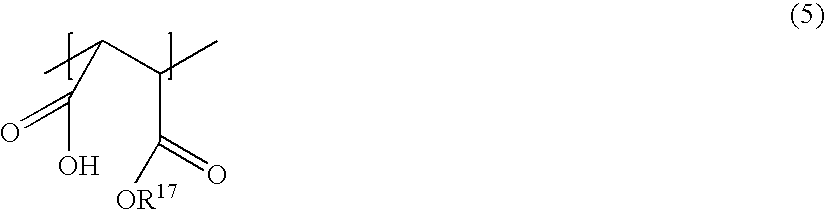
[In the formula (5), R17 represents a hydrogen atom, an alkyl group having carbon atoms of 1 to 12 or a fluorinated alkyl group having carbon atoms of 1 to 12.]

[In the formula (6), R18 represents a hydrogen atom, a methyl group, a hydroxymethyl group or a trifluoromethyl group, P represents a single bond, a carbonyl group or a carbonyloxy group, Q represents a single bond or a bivalent organic group having carbon atoms of 1 to 21, and R19 and R20 each independently represent a hydrogen atom, an alkyl group having carbon atoms of 1 to 4, or a fluorinated alkyl group having carbon atoms of 1 to 4.]
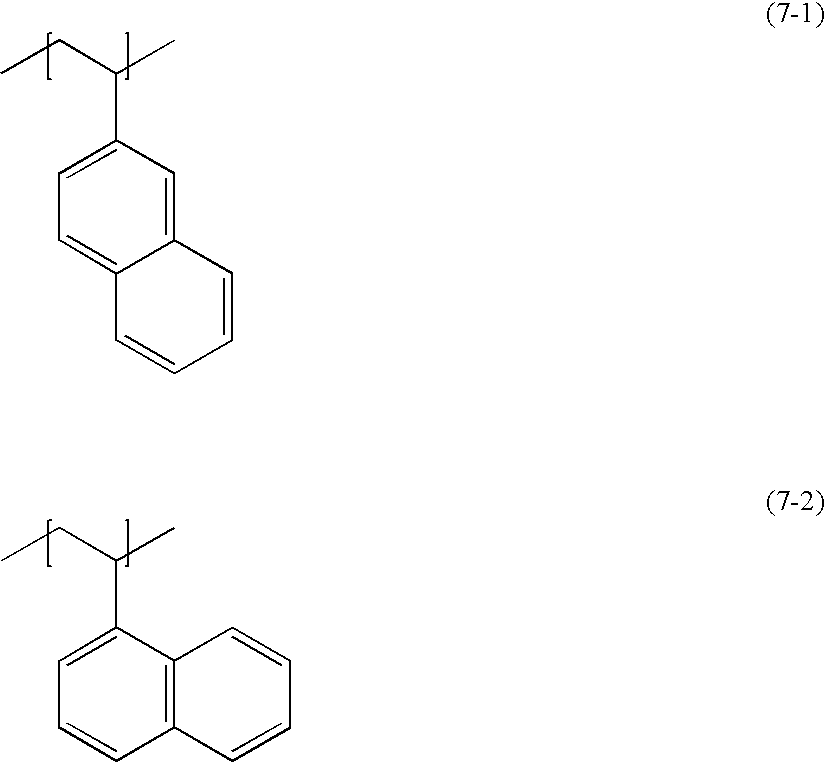

[In the formula (II), R22 to R28 are each independently a hydrogen atom, —OH, —COOH or —SO3H.]

[In the formula (III), R29 to R35 are each independently a hydrogen atom, —OH, —COOH or —SO3H.]

[In the formula (IV), R36 represents a hydrogen atom, a methyl group, a hydroxymethyl group or a trifluoromethyl group, A represents a single bond, a carbonyl group or a carbonyloxy group, B represents a single bond or an imino group, and D represents a single bond, a linear, branched or alicyclic hydrocarbon group having carbon atoms of 1 to 20, or an aromatic hydrocarbon group which may have a substituent.]

[In the formula (V), R37 represents a hydrogen atom, methyl group, hydroxymethyl group or trifluoromethyl group.]

[In the formula (VI), R38 represents a hydrogen atom, an alkyl group having carbon atoms of 1 to 12 or a fluorinated alkyl group having carbon atoms of 1 to 12.]

[In the formula (VII), R39 represents a hydrogen atom, a methyl group, a hydroxymethyl group or a trifluoromethyl group, P represents a single bond, a carbonyl group or a carbonyloxy group, Q represents a single bond, a linear, branched or alicyclic hydrocarbon group having carbon atoms of 1 to 20, or an aromatic hydrocarbon group which may have a substituent, and R40 and R41 each independently represent a hydrogen atom, an alkyl group having carbon atoms of 1 to 4 or a fluorinated alkyl group having carbon atoms of 1 to 4.]


[In the formula (I), R21 represents a linear or branched alkyl group having carbon atoms of 1 to 10, an alicyclic alkyl group having carbon atoms of 3 to 20 or a derivative thereof, a hydroxyl group, a carboxyl group, an alkylether group, an alkyloxycarbonyl group or an alkylcarbonyloxy group, Z represents a linear, branched or alicyclic hydrocarbon group, having carbon atoms of 4 to 12, or an aromatic hydrocarbon group which may have a substituent, m is an integer of 0 to 4, and n is an integer of 1 to 4. When plural R21s are present, R21s may be the same or different from each other.]

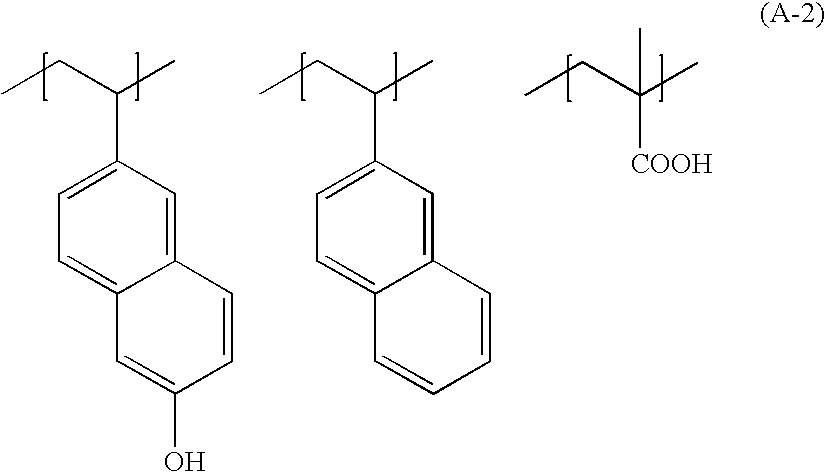


[1-2] Preparation of Composition for Formation of Upper Antireflective Film (I)
| TABLE 1 | ||||||
| Refractive | ||||||
| index | Develop- | Pattern | Standing-wave | |||
| Polymer | (193 nm) | ability | shape | effect | ||
| Example 1 | A-1 | 1.47 | good | good | good |
| Example 2 | A-2 | 1.44 | good | good | good |
| Example 3 | A-3 | 1.42 | good | good | good |
| Example 4 | A-4 | 1.46 | good | good | good |
| Example 5 | A-5 | 1.46 | good | good | good |
| Example 6 | A-6 | 1.43 | good | good | good |
| Example 7 | A-7 | 1.46 | good | good | good |
| Example 8 | A-8 | 1.45 | good | good | good |
| Comparative | a-1 | 1.57 | good | good | insufficient |
| Example 1 | |||||
| Comparative | a-2 | 1.56 | good | good | insufficient |
| Example 2 | |||||
[1-3] Measurement of Refractive Index
S=(E max −E min)
The S value was used as an index for standing wave effect; in a case where the S value was smaller than 35, the case was judged as good standing wave effect.
[1-5] Effect of Examples


[2-2] Preparation of Composition for Formation of Upper Antireflective Film (II)
| TABLE 2 | |||||
| Acid | |||||
| Polymer | generator | Compound | Refractive | ||
| (A) | (B) | (C) | index | ||
| (parts) | (parts) | (parts) | (193 nm) | ||
| Example 9 | A-9 (100) | B-1 (3) | — | 1.39 |
| Example 10 | A-9 (100) | B-2 (3) | — | 1.39 |
| Example 11 | A-9 (100) | — | C-1 (3) | 1.39 |
| Example 12 | A-9 (100) | B-1 (3) | C-2 (0.3) | 1.39 |
| Example 13 | A-9 (100) | B-1 (3) | C-1 (3) | 1.39 |
| Example 14 | A-9 (100) | B-2 (3) | C-1 (3) | 1.39 |
| Example 15 | A-9 (100) | — | C-2 (0.3) | 1.39 |
| Example 16 | A-10 (100) | — | C-1 (3) | 1.45 |
| Example 17 | A-10 (100) | B-2 (3) | — | 1.45 |
| Comparative | A-9 (100) | — | — | 1.39 |
| Example 3 | ||||
| Comparative | A-10 (100) | — | — | 1.45 |
| Example 4 | ||||
| Comparative | A-11 (100) | — | — | 1.42 |
| Example 5 | ||||
- (B-1): Triphenylsulfonium trifluoromethanesulfonate
- (B-2): Triphenylsulfonium nonafluorobutanesulfonate
<Compound (C)> - (C-1): 5-sulfosalicylic acid
- (C-2): Camphorsulfonic acid.
[2-3] Measurement of Refractive Index
| TABLE 3 | |||||
| Develop- | Pattern | Standing-wave | |||
| ability | shape | effect | Blob defect | ||
| Example 9 | good | good | good | good |
| Example 10 | good | good | good | good |
| Example 11 | good | good | good | good |
| Example 12 | good | good | good | good |
| Example 13 | good | good | good | good |
| Example 14 | good | good | good | good |
| Example 15 | good | good | good | good |
| Example 16 | good | good | good | good |
| Example 17 | good | good | good | good |
| Comparative | good | good | good | insufficient |
| Example 3 | ||||
| Comparative | good | insufficient | good | insufficient |
| Example 4 | ||||
| Comparative | good | insufficient | good | good |
| Example 5 | ||||
[2-5] Effect of Examples
Claims (4)


Applications Claiming Priority (5)
| Application Number | Priority Date | Filing Date | Title |
|---|---|---|---|
| JP2007077689A JP5162934B2 (en) | 2007-03-23 | 2007-03-23 | Composition for forming upper antireflection film and method for forming resist pattern |
| JP2007-077689 | 2007-03-23 | ||
| JP2007085726A JP4910829B2 (en) | 2007-03-28 | 2007-03-28 | Composition for forming upper antireflection film and method for forming resist pattern |
| JP2007-085726 | 2007-03-28 | ||
| PCT/JP2008/054658 WO2008126625A1 (en) | 2007-03-23 | 2008-03-13 | Resin for formation of upper antireflective film, composition for formation of upper antireflective film, and resist pattern formation method |
Publications (2)
| Publication Number | Publication Date |
|---|---|
| US20100112475A1 US20100112475A1 (en) | 2010-05-06 |
| US8497062B2 true US8497062B2 (en) | 2013-07-30 |
Family
ID=39911383
Family Applications (1)
| Application Number | Title | Priority Date | Filing Date |
|---|---|---|---|
| US12/530,624 Expired - Fee Related US8497062B2 (en) | 2007-03-23 | 2008-03-13 | Resin for formation of upper antireflective film, composition for formation of upper antireflective film, and resist pattern formation method |
Country Status (2)
| Country | Link |
|---|---|
| US (1) | US8497062B2 (en) |
| JP (1) | JP5162934B2 (en) |
Cited By (1)
| Publication number | Priority date | Publication date | Assignee | Title |
|---|---|---|---|---|
| US8715907B2 (en) | 2011-08-10 | 2014-05-06 | International Business Machines Corporation | Developable bottom antireflective coating compositions for negative resists |
Families Citing this family (16)
| Publication number | Priority date | Publication date | Assignee | Title |
|---|---|---|---|---|
| JP4993139B2 (en) * | 2007-09-28 | 2012-08-08 | 信越化学工業株式会社 | Antireflection film forming material, antireflection film and pattern forming method using the same |
| US8097401B2 (en) * | 2009-03-24 | 2012-01-17 | International Business Machines Corporation | Self-forming top anti-reflective coating compositions and, photoresist mixtures and method of imaging using same |
| JP5672120B2 (en) * | 2011-03-31 | 2015-02-18 | Jsr株式会社 | Composition for forming upper layer film for immersion |
| JP5786426B2 (en) * | 2011-04-11 | 2015-09-30 | Jsr株式会社 | Photoresist composition and resist pattern forming method |
| GB2492167C (en) | 2011-06-24 | 2018-12-05 | Nexeon Ltd | Structured particles |
| JP5846046B2 (en) * | 2011-12-06 | 2016-01-20 | 信越化学工業株式会社 | Resist protective film material and pattern forming method |
| US10388948B2 (en) | 2012-01-30 | 2019-08-20 | Nexeon Limited | Composition of SI/C electro active material |
| GB2499984B (en) | 2012-02-28 | 2014-08-06 | Nexeon Ltd | Composite particles comprising a removable filler |
| GB2502625B (en) | 2012-06-06 | 2015-07-29 | Nexeon Ltd | Method of forming silicon |
| GB2507535B (en) | 2012-11-02 | 2015-07-15 | Nexeon Ltd | Multilayer electrode |
| US9977331B2 (en) * | 2014-02-26 | 2018-05-22 | Nissan Chemical Industries, Ltd. | Resist overlayer film forming composition and method for producing semiconductor device including the same |
| KR101567203B1 (en) | 2014-04-09 | 2015-11-09 | (주)오렌지파워 | Negative electrode material for rechargeable battery and method of fabricating the same |
| KR101604352B1 (en) | 2014-04-22 | 2016-03-18 | (주)오렌지파워 | Negative electrode active material and rechargeable battery having the same |
| GB2533161C (en) | 2014-12-12 | 2019-07-24 | Nexeon Ltd | Electrodes for metal-ion batteries |
| US10691023B2 (en) * | 2017-08-24 | 2020-06-23 | Taiwan Semiconductor Manufacturing Co., Ltd. | Method for performing lithography process with post treatment |
| WO2022196485A1 (en) * | 2021-03-19 | 2022-09-22 | Jsr株式会社 | Method for manufacturing semiconductor substrate and resist underlayer film forming composition |
Citations (9)
| Publication number | Priority date | Publication date | Assignee | Title |
|---|---|---|---|---|
| JP2002311585A (en) | 2001-04-12 | 2002-10-23 | Fuji Photo Film Co Ltd | Negative type resist composition for use in electron beam or x-ray |
| US20060046184A1 (en) * | 2004-08-31 | 2006-03-02 | Hynix Semiconductor Inc. | Top anti-reflective coating composition and method for pattern formation of semiconductor device using the same |
| US20060063104A1 (en) * | 2004-09-17 | 2006-03-23 | Hynix Semiconductor Inc. | Top anti-reflective coating composition and method for forming the pattern of a semiconductor device using the same |
| US20060223008A1 (en) * | 2005-03-17 | 2006-10-05 | Nakaatsu Yoshimura | Composition for forming antireflection film, laminate, and method for forming resist pattern |
| WO2007023710A1 (en) * | 2005-08-25 | 2007-03-01 | Nissan Chemical Industries, Ltd. | Lithographic coated-type underlayer film forming composition containing vinylnaphthalene resin derivative |
| US20070087285A1 (en) * | 2005-10-13 | 2007-04-19 | International Business Machines Corporation | Top antireflective coating composition with low refractive index at 193nm radiation wavelength |
| US20070122740A1 (en) * | 2005-11-28 | 2007-05-31 | Shin-Etsu Chemical Co., Ltd. | Resist undercoat-forming material and patterning process |
| JP2007316188A (en) * | 2006-05-24 | 2007-12-06 | Shin Etsu Chem Co Ltd | Antireflection film material and pattern forming method |
| US20080026315A1 (en) * | 2006-06-21 | 2008-01-31 | International Business Machines Corporation | Fluorinated half ester of maleic anhydride polymers for dry 193 nm top antireflective coating application |
Family Cites Families (2)
| Publication number | Priority date | Publication date | Assignee | Title |
|---|---|---|---|---|
| KR100574490B1 (en) * | 2004-04-27 | 2006-04-27 | 주식회사 하이닉스반도체 | Upper antireflection film polymer, preparation method thereof and upper antireflection film composition containing same |
| JP4275062B2 (en) * | 2004-12-27 | 2009-06-10 | 東京応化工業株式会社 | Resist protective film forming material and resist pattern forming method using the same |
-
2007
- 2007-03-23 JP JP2007077689A patent/JP5162934B2/en not_active Expired - Fee Related
-
2008
- 2008-03-13 US US12/530,624 patent/US8497062B2/en not_active Expired - Fee Related
Patent Citations (10)
| Publication number | Priority date | Publication date | Assignee | Title |
|---|---|---|---|---|
| JP2002311585A (en) | 2001-04-12 | 2002-10-23 | Fuji Photo Film Co Ltd | Negative type resist composition for use in electron beam or x-ray |
| US20060046184A1 (en) * | 2004-08-31 | 2006-03-02 | Hynix Semiconductor Inc. | Top anti-reflective coating composition and method for pattern formation of semiconductor device using the same |
| US20060063104A1 (en) * | 2004-09-17 | 2006-03-23 | Hynix Semiconductor Inc. | Top anti-reflective coating composition and method for forming the pattern of a semiconductor device using the same |
| US20060223008A1 (en) * | 2005-03-17 | 2006-10-05 | Nakaatsu Yoshimura | Composition for forming antireflection film, laminate, and method for forming resist pattern |
| WO2007023710A1 (en) * | 2005-08-25 | 2007-03-01 | Nissan Chemical Industries, Ltd. | Lithographic coated-type underlayer film forming composition containing vinylnaphthalene resin derivative |
| US20090253076A1 (en) * | 2005-08-25 | 2009-10-08 | Nissan Chemical Industries, Ltd. | Coating-type underlayer coating forming composition for lithography containing vinylnaphthalene resin derivative |
| US20070087285A1 (en) * | 2005-10-13 | 2007-04-19 | International Business Machines Corporation | Top antireflective coating composition with low refractive index at 193nm radiation wavelength |
| US20070122740A1 (en) * | 2005-11-28 | 2007-05-31 | Shin-Etsu Chemical Co., Ltd. | Resist undercoat-forming material and patterning process |
| JP2007316188A (en) * | 2006-05-24 | 2007-12-06 | Shin Etsu Chem Co Ltd | Antireflection film material and pattern forming method |
| US20080026315A1 (en) * | 2006-06-21 | 2008-01-31 | International Business Machines Corporation | Fluorinated half ester of maleic anhydride polymers for dry 193 nm top antireflective coating application |
Non-Patent Citations (3)
| Title |
|---|
| English translation of JP, 2007-316188, A (2007) from machine translation from AIPN Japan Patent Office National Center for Industrial Property Information and Training, generated Mar. 11, 2012, 27 pages. * |
| Japanese Office Action for corresponding JP Application No. 2007-077689, Jul. 17, 2012. |
| T. Tanaka, N. Hasegawa, H. Shiraishi, and S. Okazaki. A New Photolithography Technique with Antireeflective Coating on Resist: ARCOR J. Electrochem. Soc., Dec. 1990, pp. 3900-3904, vol. 137, No. 12, The Electrochemical Society, Inc. |
Cited By (1)
| Publication number | Priority date | Publication date | Assignee | Title |
|---|---|---|---|---|
| US8715907B2 (en) | 2011-08-10 | 2014-05-06 | International Business Machines Corporation | Developable bottom antireflective coating compositions for negative resists |
Also Published As
| Publication number | Publication date |
|---|---|
| JP2008239646A (en) | 2008-10-09 |
| JP5162934B2 (en) | 2013-03-13 |
| US20100112475A1 (en) | 2010-05-06 |
Similar Documents
| Publication | Publication Date | Title |
|---|---|---|
| US20100112475A1 (en) | Resin for formation of upper antireflective film, composition for formation of upper antireflective film, and resist pattern formation method | |
| US8329838B2 (en) | Norbornene-type polymers, compositions thereof and lithographic processes using such compositions | |
| US8895229B2 (en) | Composition for formation of upper layer film, and method for formation of photoresist pattern | |
| US9023587B2 (en) | Negative resist composition and patterning process | |
| US8431332B2 (en) | Composition for forming upper layer film for immersion exposure, upper layer film for immersion exposure, and method of forming photoresist pattern | |
| JP4265766B2 (en) | Resist protective film forming material for immersion exposure process, resist protective film comprising the protective film forming material, and resist pattern forming method using the resist protective film | |
| US20090042148A1 (en) | Photoresist Composition for Deep UV and Process Thereof | |
| US8039201B2 (en) | Antireflective coating composition and process thereof | |
| US20060154188A1 (en) | Immersion fluid for use in liquid immersion lithography and method of forming resist pattern using the immersion fluid | |
| US20080032202A1 (en) | Material for Forming Resist Protective Film for Use in Liquid Immersion Lithography Process and Method for Forming Resist Pattern Using the Protective Film | |
| US20120214100A1 (en) | Resist composition and patterning process using the same | |
| US11009791B2 (en) | Actinic ray-sensitive or radiation-sensitive resin composition, actinic ray-sensitive or radiation-sensitive film, pattern forming method, and method for manufacturing electronic device | |
| EP2378362A1 (en) | Resist pattern coating agent and resist pattern forming method using the same | |
| US20060235174A1 (en) | Norbornene-type polymers, compositions thereof and lithographic processes using such compositions | |
| US20150248054A1 (en) | Pattern forming method, actinic ray-sensitive or radiation-sensitive resin composition, resist film, method of manufacturing electronic device, and electronic device | |
| US9354523B2 (en) | Composition for resist pattern-refinement, and fine pattern-forming method | |
| US20220146937A1 (en) | Actinic ray-sensitive or radiation-sensitive resin composition, actinic ray-sensitive or radiation-sensitive film, pattern forming method, and method for manufacturing electronic device | |
| US7381519B2 (en) | Top anti-reflective coating polymer, its preparation method and top anti-reflective coating composition comprising the same | |
| JP3344063B2 (en) | Base blocking antireflection film and method for forming resist pattern | |
| JP4051931B2 (en) | Radiation sensitive resin composition | |
| JP4910829B2 (en) | Composition for forming upper antireflection film and method for forming resist pattern | |
| US20250237951A1 (en) | Actinic ray-sensitive or radiation-sensitive resin composition, actinic ray-sensitive or radiation-sensitive film, pattern forming method, and method for producing electronic device | |
| WO2005117074A1 (en) | Immersion liquid for immersion exposure process and method for forming resist pattern using such immersion liquid | |
| US20100040974A1 (en) | Upper layer film forming composition and method of forming photoresist pattern | |
| TW200903172A (en) | Resin for formation of upper antireflective film, composition for formation of upper antireflective film, and resist pattern formation method |
Legal Events
| Date | Code | Title | Description |
|---|---|---|---|
| AS | Assignment |
Owner name: JSR CORPORATION, JAPAN Free format text: ASSIGNMENT OF ASSIGNORS INTEREST;ASSIGNORS:NATSUME, NORIHIRO;SUGIE, NORIHIKO;TAKAHASHI, JUNICHI;SIGNING DATES FROM 20090617 TO 20090626;REEL/FRAME:023210/0625 Owner name: JSR CORPORATION,JAPAN Free format text: ASSIGNMENT OF ASSIGNORS INTEREST;ASSIGNORS:NATSUME, NORIHIRO;SUGIE, NORIHIKO;TAKAHASHI, JUNICHI;SIGNING DATES FROM 20090617 TO 20090626;REEL/FRAME:023210/0625 |
|
| STCF | Information on status: patent grant |
Free format text: PATENTED CASE |
|
| FEPP | Fee payment procedure |
Free format text: PAYOR NUMBER ASSIGNED (ORIGINAL EVENT CODE: ASPN); ENTITY STATUS OF PATENT OWNER: LARGE ENTITY |
|
| FPAY | Fee payment |
Year of fee payment: 4 |
|
| FEPP | Fee payment procedure |
Free format text: MAINTENANCE FEE REMINDER MAILED (ORIGINAL EVENT CODE: REM.); ENTITY STATUS OF PATENT OWNER: LARGE ENTITY |
|
| LAPS | Lapse for failure to pay maintenance fees |
Free format text: PATENT EXPIRED FOR FAILURE TO PAY MAINTENANCE FEES (ORIGINAL EVENT CODE: EXP.); ENTITY STATUS OF PATENT OWNER: LARGE ENTITY |
|
| STCH | Information on status: patent discontinuation |
Free format text: PATENT EXPIRED DUE TO NONPAYMENT OF MAINTENANCE FEES UNDER 37 CFR 1.362 |
|
| FP | Lapsed due to failure to pay maintenance fee |
Effective date: 20210730 |