US8470836B2 - Dipeptidyl peptidase-IV inhibiting compounds, methods of preparing the same, and pharmaceutical compositions containing the same as active agent - Google Patents
Dipeptidyl peptidase-IV inhibiting compounds, methods of preparing the same, and pharmaceutical compositions containing the same as active agent Download PDFInfo
- Publication number
- US8470836B2 US8470836B2 US12/747,860 US74786008A US8470836B2 US 8470836 B2 US8470836 B2 US 8470836B2 US 74786008 A US74786008 A US 74786008A US 8470836 B2 US8470836 B2 US 8470836B2
- Authority
- US
- United States
- Prior art keywords
- hydroxy
- butyl
- oxo
- trifluoromethyl
- pyrido
- Prior art date
- Legal status (The legal status is an assumption and is not a legal conclusion. Google has not performed a legal analysis and makes no representation as to the accuracy of the status listed.)
- Expired - Fee Related, expires
Links
- 0 [15*]C1c2[u][v][w]c2C([17*])C([16*])N1C(=O)CC(N)C[Ar] Chemical compound [15*]C1c2[u][v][w]c2C([17*])C([16*])N1C(=O)CC(N)C[Ar] 0.000 description 26
- BZLUPDUKIUESRB-FAQQKDIKSA-N CC(C)(C)C1=NC2=C(CCN(C(=O)C[C@H](N)CN3C(=O)CCC(F)(F)C3O)C2)C(C(F)(F)F)=N1.[H]Cl Chemical compound CC(C)(C)C1=NC2=C(CCN(C(=O)C[C@H](N)CN3C(=O)CCC(F)(F)C3O)C2)C(C(F)(F)F)=N1.[H]Cl BZLUPDUKIUESRB-FAQQKDIKSA-N 0.000 description 2
- WGJBBIAXKAWQPJ-KIYNQFGBSA-N CC1CC(=O)N(C[C@@H](N)CC(=O)N2CCC3=C(C2)N=C(C(C)(C)C)N=C3C(F)(F)F)C1=O.[H]Cl Chemical compound CC1CC(=O)N(C[C@@H](N)CC(=O)N2CCC3=C(C2)N=C(C(C)(C)C)N=C3C(F)(F)F)C1=O.[H]Cl WGJBBIAXKAWQPJ-KIYNQFGBSA-N 0.000 description 2
- OPWLXRFLOSHBNJ-HSLMYDHPSA-N N[C@@H](CC(=O)N1CCC2=C(C1)N=C(C1CCC1)N=C2C(F)(F)F)CN1C(=O)CCC(F)(F)C1O.[H]Cl Chemical compound N[C@@H](CC(=O)N1CCC2=C(C1)N=C(C1CCC1)N=C2C(F)(F)F)CN1C(=O)CCC(F)(F)C1O.[H]Cl OPWLXRFLOSHBNJ-HSLMYDHPSA-N 0.000 description 2
- QPQRFJMPQZLXIA-UHFFFAOYSA-N BCC(CC(=O)O)N#P Chemical compound BCC(CC(=O)O)N#P QPQRFJMPQZLXIA-UHFFFAOYSA-N 0.000 description 1
- FUWAVZSJNJWMOK-UHFFFAOYSA-N BCC(CC(=O)O)N#P.BCC(CC(C)=O)N#P.CC(=O)CC(CO)N#P.CC(=O)CC(N#P)C(=O)O Chemical compound BCC(CC(=O)O)N#P.BCC(CC(C)=O)N#P.CC(=O)CC(CO)N#P.CC(=O)CC(N#P)C(=O)O FUWAVZSJNJWMOK-UHFFFAOYSA-N 0.000 description 1
- YDOSDBLHYCUZRQ-UDBNUGGLSA-N CC(C)(C)C1=NC2=C(CCN(C(=O)C[C@H](N)CN3C(=O)CCC(F)C3O)C2)C(C(F)(F)F)=N1.[H]Cl Chemical compound CC(C)(C)C1=NC2=C(CCN(C(=O)C[C@H](N)CN3C(=O)CCC(F)C3O)C2)C(C(F)(F)F)=N1.[H]Cl YDOSDBLHYCUZRQ-UDBNUGGLSA-N 0.000 description 1
- CBPSNVFQXUPLFD-JTQLQIEISA-N CC1=NC2=C(CCN(C(=O)C[C@H](N)CN3C(=O)CCC(F)(F)C3=O)C2)C(C(F)(F)F)=N1.[H]Cl Chemical compound CC1=NC2=C(CCN(C(=O)C[C@H](N)CN3C(=O)CCC(F)(F)C3=O)C2)C(C(F)(F)F)=N1.[H]Cl CBPSNVFQXUPLFD-JTQLQIEISA-N 0.000 description 1
- ONCYIFKJOZNHEY-ABLWVSNPSA-N CC1CCC(=O)N(C[C@@H](N)CC(=O)N2CCC3=C(C2)N=C(C2=CC=CS2)N=C3C(F)(F)F)C1=O.[H]Cl Chemical compound CC1CCC(=O)N(C[C@@H](N)CC(=O)N2CCC3=C(C2)N=C(C2=CC=CS2)N=C3C(F)(F)F)C1=O.[H]Cl ONCYIFKJOZNHEY-ABLWVSNPSA-N 0.000 description 1
- FTDVZFAEAFUIRP-FAQQKDIKSA-N CCCC1=NC2=C(CCN(C(=O)C[C@H](N)CN3C(=O)CCC(F)(F)C3O)C2)C(C(F)(F)F)=N1.[H]Cl Chemical compound CCCC1=NC2=C(CCN(C(=O)C[C@H](N)CN3C(=O)CCC(F)(F)C3O)C2)C(C(F)(F)F)=N1.[H]Cl FTDVZFAEAFUIRP-FAQQKDIKSA-N 0.000 description 1
- UZRFJLLICAFQHT-NVAANYKZSA-N CCCC1=NC2=C(CCN(C(=O)C[C@H](N)CN3C(=O)CCC(F)C3O)C2)C(C(F)(F)F)=N1.[H]Cl Chemical compound CCCC1=NC2=C(CCN(C(=O)C[C@H](N)CN3C(=O)CCC(F)C3O)C2)C(C(F)(F)F)=N1.[H]Cl UZRFJLLICAFQHT-NVAANYKZSA-N 0.000 description 1
- BXVXOKIGWCPEMH-UHFFFAOYSA-N CCOC(=O)C(Br)([Rb])[RaH].CCOC(=O)CCC([Rb])([RaH])C(=O)OCC.CCOC(=O)CCC([Rb])([RaH])C(N)=O.O=C1CCC([Rb])([RaH])C(=O)N1 Chemical compound CCOC(=O)C(Br)([Rb])[RaH].CCOC(=O)CCC([Rb])([RaH])C(=O)OCC.CCOC(=O)CCC([Rb])([RaH])C(N)=O.O=C1CCC([Rb])([RaH])C(=O)N1 BXVXOKIGWCPEMH-UHFFFAOYSA-N 0.000 description 1
- LKUDZOFKOABHPY-VOJFVSQTSA-N COCCC1=NC2=C(CCN(C(=O)C[C@H](N)CN3C(=O)CCC(F)(F)[C@@H]3O)C2)C(C(F)(F)F)=N1.[H]Cl Chemical compound COCCC1=NC2=C(CCN(C(=O)C[C@H](N)CN3C(=O)CCC(F)(F)[C@@H]3O)C2)C(C(F)(F)F)=N1.[H]Cl LKUDZOFKOABHPY-VOJFVSQTSA-N 0.000 description 1
- LKUDZOFKOABHPY-BBATYDOGSA-N COCCC1=NC2=C(CCN(C(=O)C[C@H](N)CN3C(=O)CCC(F)(F)[C@H]3O)C2)C(C(F)(F)F)=N1.[H]Cl Chemical compound COCCC1=NC2=C(CCN(C(=O)C[C@H](N)CN3C(=O)CCC(F)(F)[C@H]3O)C2)C(C(F)(F)F)=N1.[H]Cl LKUDZOFKOABHPY-BBATYDOGSA-N 0.000 description 1
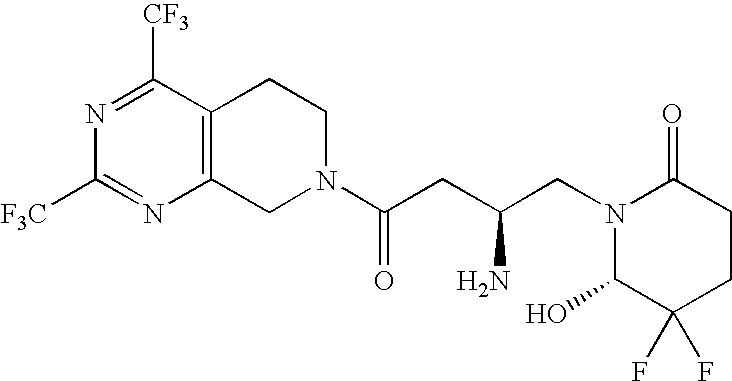
- DMXWXVXGQLCKOY-AYVTZFPOSA-N N[C@@H](CC(=O)N1CCC2=C(C1)N=C(C(F)(F)F)N=C2C(F)(F)F)CN1C(=O)CCC(F)(F)[C@@H]1O Chemical compound N[C@@H](CC(=O)N1CCC2=C(C1)N=C(C(F)(F)F)N=C2C(F)(F)F)CN1C(=O)CCC(F)(F)[C@@H]1O DMXWXVXGQLCKOY-AYVTZFPOSA-N 0.000 description 1
- DMXWXVXGQLCKOY-VXJOIVPMSA-N N[C@@H](CC(=O)N1CCC2=C(C1)N=C(C(F)(F)F)N=C2C(F)(F)F)CN1C(=O)CCC(F)(F)[C@H]1O Chemical compound N[C@@H](CC(=O)N1CCC2=C(C1)N=C(C(F)(F)F)N=C2C(F)(F)F)CN1C(=O)CCC(F)(F)[C@H]1O DMXWXVXGQLCKOY-VXJOIVPMSA-N 0.000 description 1
- WRAFEJUBPSXFSJ-LHSJRXKWSA-N N[C@@H](CC(=O)N1CCC2=C(C1)N=C(C1=CC=C(F)C=C1)N=C2C(F)(F)F)CN1C(=O)CCC(F)(F)[C@H]1O.[H]Cl Chemical compound N[C@@H](CC(=O)N1CCC2=C(C1)N=C(C1=CC=C(F)C=C1)N=C2C(F)(F)F)CN1C(=O)CCC(F)(F)[C@H]1O.[H]Cl WRAFEJUBPSXFSJ-LHSJRXKWSA-N 0.000 description 1
- QGMCXZMURXFXMP-WLRWDXFRSA-N N[C@@H](CC(=O)N1CCC2=C(C1)N=C(C1=CC=CO1)N=C2C(F)(F)F)CN1C(=O)CCC(F)(F)[C@@H]1O.[H]Cl Chemical compound N[C@@H](CC(=O)N1CCC2=C(C1)N=C(C1=CC=CO1)N=C2C(F)(F)F)CN1C(=O)CCC(F)(F)[C@@H]1O.[H]Cl QGMCXZMURXFXMP-WLRWDXFRSA-N 0.000 description 1
- QGMCXZMURXFXMP-JEOXALJRSA-N N[C@@H](CC(=O)N1CCC2=C(C1)N=C(C1=CC=CO1)N=C2C(F)(F)F)CN1C(=O)CCC(F)(F)[C@H]1O.[H]Cl Chemical compound N[C@@H](CC(=O)N1CCC2=C(C1)N=C(C1=CC=CO1)N=C2C(F)(F)F)CN1C(=O)CCC(F)(F)[C@H]1O.[H]Cl QGMCXZMURXFXMP-JEOXALJRSA-N 0.000 description 1
- GFJBKPNUKUGKIS-WXPZDACBSA-N N[C@@H](CC(=O)N1CCC2=C(C1)N=C(C1=CC=CO1)N=C2C(F)(F)F)CN1C(=O)CCC(F)C1O.[H]Cl Chemical compound N[C@@H](CC(=O)N1CCC2=C(C1)N=C(C1=CC=CO1)N=C2C(F)(F)F)CN1C(=O)CCC(F)C1O.[H]Cl GFJBKPNUKUGKIS-WXPZDACBSA-N 0.000 description 1
- ODHDKYQTZUUNJQ-WLRWDXFRSA-N N[C@@H](CC(=O)N1CCC2=C(C1)N=C(C1=CC=CS1)N=C2C(F)(F)F)CN1C(=O)CCC(F)(F)[C@@H]1O.[H]Cl Chemical compound N[C@@H](CC(=O)N1CCC2=C(C1)N=C(C1=CC=CS1)N=C2C(F)(F)F)CN1C(=O)CCC(F)(F)[C@@H]1O.[H]Cl ODHDKYQTZUUNJQ-WLRWDXFRSA-N 0.000 description 1
- ODHDKYQTZUUNJQ-JEOXALJRSA-N N[C@@H](CC(=O)N1CCC2=C(C1)N=C(C1=CC=CS1)N=C2C(F)(F)F)CN1C(=O)CCC(F)(F)[C@H]1O.[H]Cl Chemical compound N[C@@H](CC(=O)N1CCC2=C(C1)N=C(C1=CC=CS1)N=C2C(F)(F)F)CN1C(=O)CCC(F)(F)[C@H]1O.[H]Cl ODHDKYQTZUUNJQ-JEOXALJRSA-N 0.000 description 1
- OWCVNVQDIPAUOO-WXPZDACBSA-N N[C@@H](CC(=O)N1CCC2=C(C1)N=C(C1=CC=CS1)N=C2C(F)(F)F)CN1C(=O)CCC(F)C1O.[H]Cl Chemical compound N[C@@H](CC(=O)N1CCC2=C(C1)N=C(C1=CC=CS1)N=C2C(F)(F)F)CN1C(=O)CCC(F)C1O.[H]Cl OWCVNVQDIPAUOO-WXPZDACBSA-N 0.000 description 1
- JLAXABGHGCBAGV-RBZFPXEDSA-N N[C@@H](CC(=O)N1CCC2=C(C1)N=C(C1=CC=NC=C1)N=C2C(F)(F)F)CN1C(=O)CCC(F)(F)[C@@H]1O.[H]Cl Chemical compound N[C@@H](CC(=O)N1CCC2=C(C1)N=C(C1=CC=NC=C1)N=C2C(F)(F)F)CN1C(=O)CCC(F)(F)[C@@H]1O.[H]Cl JLAXABGHGCBAGV-RBZFPXEDSA-N 0.000 description 1
- JLAXABGHGCBAGV-RNODOKPDSA-N N[C@@H](CC(=O)N1CCC2=C(C1)N=C(C1=CC=NC=C1)N=C2C(F)(F)F)CN1C(=O)CCC(F)(F)[C@H]1O.[H]Cl Chemical compound N[C@@H](CC(=O)N1CCC2=C(C1)N=C(C1=CC=NC=C1)N=C2C(F)(F)F)CN1C(=O)CCC(F)(F)[C@H]1O.[H]Cl JLAXABGHGCBAGV-RNODOKPDSA-N 0.000 description 1
- RLDBEXDQWHAZSW-PCODGMICSA-N N[C@@H](CC(=O)N1CCC2=C(C1)N=C(C1=CC=NC=C1)N=C2C(F)(F)F)CN1C(=O)CCC(F)C1O.[H]Cl Chemical compound N[C@@H](CC(=O)N1CCC2=C(C1)N=C(C1=CC=NC=C1)N=C2C(F)(F)F)CN1C(=O)CCC(F)C1O.[H]Cl RLDBEXDQWHAZSW-PCODGMICSA-N 0.000 description 1
- BVRCFFHWENBRPE-ZETCQYMHSA-N [H]N(C)CC(=O)N1CCC[C@H]1C#N Chemical compound [H]N(C)CC(=O)N1CCC[C@H]1C#N BVRCFFHWENBRPE-ZETCQYMHSA-N 0.000 description 1
Classifications
-
- C—CHEMISTRY; METALLURGY
- C07—ORGANIC CHEMISTRY
- C07D—HETEROCYCLIC COMPOUNDS
- C07D471/00—Heterocyclic compounds containing nitrogen atoms as the only ring hetero atoms in the condensed system, at least one ring being a six-membered ring with one nitrogen atom, not provided for by groups C07D451/00 - C07D463/00
- C07D471/02—Heterocyclic compounds containing nitrogen atoms as the only ring hetero atoms in the condensed system, at least one ring being a six-membered ring with one nitrogen atom, not provided for by groups C07D451/00 - C07D463/00 in which the condensed system contains two hetero rings
- C07D471/04—Ortho-condensed systems
-
- A—HUMAN NECESSITIES
- A61—MEDICAL OR VETERINARY SCIENCE; HYGIENE
- A61P—SPECIFIC THERAPEUTIC ACTIVITY OF CHEMICAL COMPOUNDS OR MEDICINAL PREPARATIONS
- A61P3/00—Drugs for disorders of the metabolism
- A61P3/04—Anorexiants; Antiobesity agents
-
- A—HUMAN NECESSITIES
- A61—MEDICAL OR VETERINARY SCIENCE; HYGIENE
- A61P—SPECIFIC THERAPEUTIC ACTIVITY OF CHEMICAL COMPOUNDS OR MEDICINAL PREPARATIONS
- A61P3/00—Drugs for disorders of the metabolism
- A61P3/08—Drugs for disorders of the metabolism for glucose homeostasis
- A61P3/10—Drugs for disorders of the metabolism for glucose homeostasis for hyperglycaemia, e.g. antidiabetics
-
- A—HUMAN NECESSITIES
- A61—MEDICAL OR VETERINARY SCIENCE; HYGIENE
- A61P—SPECIFIC THERAPEUTIC ACTIVITY OF CHEMICAL COMPOUNDS OR MEDICINAL PREPARATIONS
- A61P43/00—Drugs for specific purposes, not provided for in groups A61P1/00-A61P41/00
-
- C—CHEMISTRY; METALLURGY
- C07—ORGANIC CHEMISTRY
- C07D—HETEROCYCLIC COMPOUNDS
- C07D513/00—Heterocyclic compounds containing in the condensed system at least one hetero ring having nitrogen and sulfur atoms as the only ring hetero atoms, not provided for in groups C07D463/00, C07D477/00 or C07D499/00 - C07D507/00
- C07D513/02—Heterocyclic compounds containing in the condensed system at least one hetero ring having nitrogen and sulfur atoms as the only ring hetero atoms, not provided for in groups C07D463/00, C07D477/00 or C07D499/00 - C07D507/00 in which the condensed system contains two hetero rings
- C07D513/04—Ortho-condensed systems
Definitions
- the present invention relates to novel compounds having excellent inhibitory activity against dipeptidyl peptidase-IV (DPP-IV), methods of preparing the same and pharmaceutical compositions comprising the same as an active agent.
- DPP-IV dipeptidyl peptidase-IV
- Type II diabetes mellitus characterized by little or no insulin secretory capacity due to the destruction of pancreatic cells
- type II diabetes mellitus characterized by insulin deficiency and insulin resistance due to other causes.
- the incidence of type II diabetes mellitus accounts for 90% or more of total diabetic patients.
- Representative examples of diabetic complications include hyperlipidemia, hypertension, retinopathy and renal insufficiency (Paul Zimmer, et al., Nature, 2001, 414, 782).
- DPP-IV dipeptidyl peptidase-IV knockout mice maintains glucagon-like protein 1 (GLP-1) activity and high insulin levels, resulting in decreased blood glucose levels, suggesting the therapeutic feasibility of DPP-IV as an antidiabetic agent (Marguet D. et al, Natl. Acad. Sci. USA, (2000) 97, 6874-6879).
- GLP-1 is involved in the differentiation and growth of pancreatic ⁇ -cells in vivo and plays an important role in the production and secretion of insulin.
- GLP-1 is inactivated by DPP-IV, and DPP-IV inhibitors have been reported to increase insulin secretion via the inhibition of GLP-1 inactivation.
- DPP-IV inhibitors are also being developed as anti-obesity drugs because GLP-1 contributes to satiety and fullness in rats and slows down intestinal digestion of food, resulting in weight loss. Further, many researchers and institutions have also demonstrated that DPP-IV inhibitors control blood glucose and lipid levels in animal model experiments (Pospislik J. A., et al, Diabetes, (2002) 51, 943-950). In this regard, DPP-IV inhibitors can be considered as potentially useful agents for the treatment of diabetic diseases.
- DPP-IV inhibitors represented by the following formula.
- R is substituted adamantyl, and n is in a range of 0 to 3.
- DPP-IV inhibitors can be found in WO 04/064778, WO 03/004498, WO 03/082817, and the like. Disclosed in WO 04/064778 DPP-IV are DPP-IV inhibitors represented by the following formula.
- Ar is unsubstituted or substituted phenyl; R 15 , R 16 and R 17 are each independently hydrogen or alkyl; and U, V and W are each independently nitrogen, oxygen, or substituted nitrogen or carbon.
- WO 03/004498 suggests DPP-IV inhibitors represented by the following formula.
- Ar is unsubstituted or substituted phenyl; R 18 is hydrogen or alkyl; and T is nitrogen or substituted carbon.
- WO 03/082817 discloses DPP-IV inhibitors represented by the following formula.
- Ar is unsubstituted or substituted phenyl; R 19 , R 20 and R 21 are each independently hydrogen or alkyl; and Q is nitrogen or substituted carbon.
- the compounds of Formula I′ are cyclic compounds having rings connected via an amide bond, which are similar to those of DPP-IV inhibitor compounds set forth in the above-mentioned patent publications; however, the molecular structures substituted with a phenyl group, which is represented as Ar or Z in the above documents, are completely different from the structures substituted with a saturated or unsaturated, 5-membered or 6-membered cyclic moiety as in the present invention. Further, to the best of our knowledge, there is yet no disclosure in the art of DPP-IV inhibitors according to the present invention, having the molecular structure where a lactam ring is substituted at the phenyl position.
- the inventors of the present invention discovered that the compounds of Formula I′ disclosed in the prior patent of the present applicant can exhibit significantly improved inhibitory activity and selectivity for DPP-IV through the introduction of amines having high DPP-IV inhibitory effects into substituent A and the introduction of various substituents (such as hydroxy or carbonyl group) into substituent B.
- the present invention provides highly significant results in terms of excellent pharmaceutical efficacy and high DPP-IV selectivity of the inventive compounds.
- DPP-IV inhibitor compounds of the present invention having the aforementioned chemical structure and preparation methods thereof have not been disclosed in the related art.
- DPP-IV inhibitor compounds having a lactam ring structure which is optionally substituted, particularly by hydroxy or carbonyl.
- DPP-IV dipeptidyl peptidase-IV
- A is selected from a substituent of Formula 2:
- R 1 is hydrogen or CF 3 .
- R 2 is selected from the group consisting of hydrogen, substituted or unsubstituted C 1 -C 10 alkyl, substituted or unsubstituted C 3 -C 10 cycloalkyl, substituted or unsubstituted C 4 -C 8 aryl and substituted or unsubstituted C 3 -C 7 heteroaryl; and
- R 3 is selected from the group consisting of hydrogen, halogen, and substituted or unsubstituted C 1 -C 4 alkyl;
- B is selected from the group consisting of a substituent of Formula 4:
- X is —CR 4 R 5 — or —CO—, wherein R 4 and R 5 are each independently hydrogen or hydroxy, provided that at least one of R 4 and R 5 is hydroxy,
- R 6 , R 7 , R 8 and R 9 are each independently selected from the group consisting of hydrogen, halogen and substituted or unsubstituted C 1 -C 4 alkyl, and
- n 0 or 1
- X is —CR 10 R 11 — or —CO—, wherein R 10 and R 11 are each independently hydrogen or hydroxy, provided that at least one of R 10 and R 11 is hydroxy,
- R 12 , R 13 and R 14 are each independently selected from the group consisting of hydrogen, halogen and substituted or unsubstituted C 1 -C 4 alkyl, and
- Y is oxygen or sulfur
- X is —CR 15 R 16 — or —CO—, wherein R 15 and R 16 are each independently hydrogen or hydroxy, provided that at least one of R 15 and R 16 is hydroxy,
- R 17 , R 18 and R 19 are each independently selected from the group consisting of hydrogen, halogen, and substituted or unsubstituted C 1 -C 4 alkyl, and
- Z is —CH—or oxygen, provided that when Z is oxygen, R 19 is absent;
- X is —CR 20 R 21 —or —CO—, wherein R 20 and R 21 are each independently hydrogen or hydroxy, provided that at least one of R 20 and R 21 is hydroxy, and
- R 22 is substituted or unsubstituted C 1 -C 4 alkyl.
- compounds of the present invention can form addition salts with pharmaceutically acceptable acids.
- pharmaceutically acceptable salt means a formulation of a compound that does not cause significant irritation to an organism to which it is administered and does not abrogate the biological activity and properties of the compound.
- the pharmaceutical salt may include acid addition salts of the compound with acids capable of forming a non-toxic acid addition salt containing pharmaceutically acceptable anions, for example, inorganic acids such as hydrochloric acid, sulfuric acid, nitric acid, phosphoric acid, hydrobromic acid and hydroiodic acid; organic carboxylic acids such as tartaric acid, formic acid, citric acid, acetic acid, trichloroacetic acid, trifluoroacetic acid, gluconic acid, benzoic acid, lactic acid, fumaric acid, maleic acid and salicylic acid; or sulfonic acids such as methanesulfonic acid, ethanesulfonic acid, benzenesulfonic acid and p-toluenesulfonic acid.
- examples of pharmaceutically acceptable carboxylic acid salts include salts with alkali metals or alkaline earth metals such as lithium, sodium, potassium, calcium and magnesium, salts with amino acids such as lysine, arginine and guanidine, and salts with organic bases such as dicyclohexylamine, N-methyl-D-glucamine, tris(hydroxymethyl)methylamine, diethanolamine, choline and triethylamine.
- the compound of Formula 1 in accordance with the present invention may be converted into a salt thereof, by conventional methods known in the art.
- compound of Formula 1 is intended to encompass compounds of Formula 1 per se as well as pharmaceutically acceptable salts.
- alkyl means a radical that has no unsaturated group and consists of carbon and hydrogen atoms.
- the alkyl radical may be linear or branched. Examples of alkyl may include, but are not limited to, methyl, ethyl, propyl, isopropyl, hexyl, t-butyl, and sec-butyl.
- Lower alkyl is C 1 -C 10 alkyl (for example, alkyl having 1 to 10 carbon atoms in a linear or branched alkyl backbone).
- the alkyl may be optionally substituted. When it is substituted, the alkyl may be substituted by four or less substituents at any binding point (any carbon atom).
- alkyl When the alkyl is substituted with another alkyl, this is also intended to refer to “branched alkyl”.
- cycloalkyl refers to an alkyl species that contains 3 to 15 carbon atoms, preferably 3 to 8 carbon atoms, without the formation of alternate or resonant double bond(s) between the carbon atoms.
- the cycloalkyl may contain 1 to 4 rings. Examples of the cycloalkyl may include cyclopropyl, cyclobutyl, cyclopentyl, cyclohexyl, and adamantyl.
- Exemplary substituents of the cycloalkyl may include halogen, C 1 -C 10 alkyl, C 1 -C 10 alkoxy, C 1 -C 10 alkyl hydroxy, amino, nitro, cyano, thiol and C 1 -C 10 alkylthio.
- Heterocycloalkyl are saturated or unsaturated, 7 to 11-membered bicyclic heterocyclic ring systems or stable non-aromatic 3 to 8-membered monocyclic heterocyclic ring systems, or may be fused, spiro, or bridged ring systems, wherein ring carbons are substituted with hetero atoms such as nitrogen (N), sulfur (S) or oxygen (O).
- Each heterocyclic ring consists of one or more carbon atoms and 1 to 4 hetero atoms.
- the heterocycloalkyl may be attached at any endocyclic carbon atom that results in a stable structure.
- heterocyclic groups may include, but are not limited to, furan, thiophene, pyrrole, pyrroline, pyrrolidine, oxazole, thiazole, imidazole, imidazoline, imidazolidine, pyrazole, pyrazoline, pyrazolidine, isothiazole, triazole, thiadiazole, pyran, pyridine, piperidine, morpholine, thiomorpholine, pyridazine, pyrimidine, pyrazine, piperazine and triazine.
- heterocyclic rings may include, but are not limited to, 3 to 7-membered monocyclic heterocyclic rings such as piperidinyl, pyranyl, piperazinyl, morpholinyl, thiomorpholinyl and tetrahydrofuranyl, and more preferably 3 to 7-membered monocyclic heterocyclic rings.
- aryl refers to an aromatic group which has at least one ring having a conjugated pi ( ⁇ ) electron system and includes carbocyclic aryl (for example, phenyl) and heterocyclic aryl (for example, pyridine) groups. This term is intended to include monocyclic or fused-ring polycyclic (i.e., rings which share adjacent pairs of carbon atoms) groups.
- the aryl group may optionally contain 1 to 4 hetero atoms (for example, nitrogen (N), sulfur (S) or oxygen (O)) in a carbocyclic or aromatic ring, and such a hetero atom-containing aryl system is also referred to as “heteroaryl”.
- aryl or heteroaryl groups may include, but are not limited to, phenyl, naphthyl, pyridyl, pyrimidyl, pyrrolyl, isothiazolyl, triazolyl, tetrazolyl, pyrazolyl, oxazolyl, isoxazolyl, pyrazinyl, pyridazinyl, triazinyl, quinazolinyl, thiazolyl, benzothiophenyl, furanyl, imidazolyl and thiophenyl.
- the substituent when alkyl, cycloalkyl, heterocycloalkyl, aryl or heteroaryl is substituted, the substituent may be C 1 -C 10 alkyl or halogen, particularly preferably fluorine-substituted C 1 -C 10 alkyl.
- a in Formula 1 is a substituent represented by Formula 2 wherein R 1 is hydrogen or CF 3 , and R 2 is selected from the group consisting of hydrogen, and C 1 -C 5 alkyl, C 3 -C 6 cycloalkyl, C 3 -C 10 heterocycloalkyl, C 4 -C 8 aryl and C 3 -C 7 heteroaryl, each of which may be optionally substituted by halogen.
- the heterocycloalkyl or heteroaryl may be any one selected from the group consisting of furan, thiophene, pyrrole, pyrrolidine, imidazole, pyrazole, pyrazoline, oxazole, oxazoline, isoxazole, isoxazoline, thiazole, thiazoline, isothiazole, isothiazolidine, thiadiazole, thiadiazoline, tetrahydrofuran, tetrahydrothiophene, imidazolidine, pyrazolidine, oxazolidine, isoxazolidine, thiazolidine, isothiazolidine, isothiazolidine, thiadiazolidine, sulfolane, pyran, dihydropyran
- R 2 may be selected from the group consisting of trifluoromethyl, propyl, butyl, t-butyl, cyclobutyl, pyridine, furan, methoxyethyl, thiophene and 4-fluorophenyl.
- B in Formula 1 is a substituent represented by Formula 4 wherein X is —(CH—OH)—or —CO—, R 6 and R 7 are each independently selected from the group consisting of hydrogen, fluoro and unsubstituted C 1 -C 4 alkyl, and R 8 and R 9 are each independently hydrogen.
- the compounds of the present invention encompass their isomers. Particularly preferred are compounds where an NH 2 -substituted carbon atom forms a stereogenic center, as shown in a structure of Formula 1a.
- a and B are as defined for Formula 1.
- non-limiting examples of the compounds of Formula 1 in accordance with the present invention may include the following compounds:
- the compounds of the present invention or their pharmaceutically acceptable salts may be in the form of hydrates or solvates.
- the present invention provides a method for preparing the compounds of Formula 1.
- An exemplary method of preparing the compounds of Formula 1 comprises reacting a compound of Formula 8 with a compound of Formula 9 and removing an amine protecting group P 1 .
- a and B are as defined above;
- P 1 is an amine protecting group
- F 1 is absent or is hydrochloric acid, sulfuric acid or trifluoroacetic acid.
- A, B and P 1 are as defined above; and G 1 H is hydrochloric acid, sulfuric acid, or trifluoroacetic acid.
- compound 1 can be obtained as follows. First, the desired amine group is introduced into a compound of Formula 8 via a coupling reaction using EDC and HOBT, thereby forming compound 10 as an amide. Then, the amine protecting group P 1 is removed to obtain compound 1, using a strong acid such as TFA or HCl when the amine protecting group P 1 is Boc, or H 2 /Pd/C or TMSI using when the amine protecting group P 1 is Cbz, or using Et 2 NH when the amine protecting group P 1 is Fmoc.
- a strong acid such as TFA or HCl when the amine protecting group P 1 is Boc, or H 2 /Pd/C or TMSI using when the amine protecting group P 1 is Cbz, or using Et 2 NH when the amine protecting group P 1 is Fmoc.
- amine A may be obtained by using methods disclosed in WO 04/064778, WO 03/004498, WO 03/082817, WO 06/104356, etc., or otherwise may be commercially available amine.
- B and P 1 are as defined above; and R is benzyl, methyl, ethyl or i-propyl.
- a carboxylic acid of Formula 11 is converted into an anhydrous ester, and the ester compound is then reduced in methanol using sodium borohydride (NaBH 4 ) to thereby obtain compound 12 as a primary alcohol.
- the coupling product of the resulting primary alcohol and the desired imide compound, i.e. compound 13 can be obtained using DIAD and PPh 3 .
- the amine protecting group P 1 is removed to obtain compound 8, using a strong acid such as TFA or HCl when the amine protecting group P 1 is Boc, or using H 2 /Pd/C or TMSI when the amine protecting group P 1 is Cbz, or using Et 2 NH when the amine protecting group P 1 is Fmoc.
- substituent B in Formula 8 can be prepared typically according to Reaction Scheme 3-1 or Reaction Scheme 3-2 below.
- Ra and Rb are each independently hydrogen or halogen.
- a diester compound of Formula 14 is obtained via the Michael addition reaction of a compound of Formula 14 with ethyl acrylate, and a compound of Formula 16 containing an amide group is obtained via the reaction of the resulting diester with ammonia.
- the reaction proceeds toward a carbonyl group adjacent to halogen, among two esters, due to the electron attraction of one or more halogen atoms contained in the reactant compound.
- cyclization is carried out in ethanol in the presence of sodium ethoxide to give a salt compound having sodium attached to a nitrogen atom of an imide.
- Treatment of the salt compound with an anhydrous strong acid provides the desired imide compound of Formula 17.
- the resulting insoluble NaCl solid was removed by simple filtration.
- R′ is methyl
- the product compound is then hydrolyzed by reaction with a strong base such as lithium hydroxide or potassium hydroxide, prior to use.
- Step (a) Addition of an acetic anhydride as a solvent and a reactant to the diacid compound of Formula 18 results in the formation of a highly reactive intermediate in the form of an anhydride ring.
- a compound of Formula 20 is produced by the ring-opening of the intermediate with ammonia. Due to the absence of a strong electron-attracting substituent group unlike in Reaction Scheme 3-1, ammonia can attack carbon atoms of both ketones and therefore two types of amino acid compounds are produced. These amino acid compounds are not detrimental to the subsequent reaction and can therefore be directly used without further separation.
- the desired imide compound of Formula 21 is obtained via the cyclization of compound 20 in the form of amino acid by addition of an acetic anhydride as shown in Step (a).
- starting compounds used in the present invention are known in the art or can be synthesized from known compounds by per se known methods or similar methods thereof.
- the compounds of Formula 1 can be isolated and purified from the reaction product by means of conventional methods such as recrystallization, ion electrophoresis, silica gel column chromatography or ion exchange resin chromatography and the like.
- the present invention provides a pharmaceutical composition for inhibiting DPP-IV, comprising a compound of Formula 1 or a pharmaceutically acceptable salt thereof.
- the pharmaceutical composition may contain a compound of the present invention and other chemical components such as diluents, carriers, and the like. Therefore, the pharmaceutical composition may contain a pharmaceutically acceptable carrier, diluent or excipient, or any combination thereof, if necessary.
- the pharmaceutical composition facilitates in vivo administration of the compound to a subject organism.
- Various techniques of administering the compound are known in the art and include, but are not limited to, oral, injection, aerosol, parenteral and topical administrations.
- carrier means a chemical compound that facilitates the incorporation of a compound into cells or tissues.
- DMSO dimethyl sulfoxide
- carrier facilitates the uptake of many organic compounds into the cells or tissues of an organism.
- diluent defines a chemical compound diluted in water that will dissolve a composition of interest as well as stabilize the biologically active form of the composition. Salts dissolved in buffered solutions are utilized as diluents in the art.
- buffer solution is phosphate buffered saline (PBS) because it mimics the salt conditions of human body fluid. Since buffer salts can control the pH of a solution at low concentrations, a buffer diluent rarely modifies the biological activity of a compound.
- physiologically acceptable defines a carrier or diluent that is not detrimental to the biological activity and physical properties of the compound.
- the compound of the present invention can be formulated into various pharmaceutical dosage forms in accordance with intended use.
- an active agent more specifically a compound of Formula 1 or a pharmaceutically acceptable salt thereof may be mixed with one or more pharmaceutically acceptable carriers which can be selected depending on the dosage form to be prepared.
- the pharmaceutical composition according to the present invention can be formulated into dosage forms suitable for injection or oral administration.
- the compounds of the present invention may be formulated in a conventional manner using known pharmaceutically acceptable carriers and excipients and presented in unit dosage forms or in multidose containers.
- the formulations may take such forms as solutions, suspensions or emulsions in oily or aqueous vehicles, and may contain conventional dispersing, suspending or stabilizing agents.
- the active agent may be in powder form for reconstitution with sterile pyrogen-free water, before use.
- the compounds of the present invention may also be formulated into suppositories containing conventional suppository bases such as cocoa butter or other glycerides.
- Solid dosage forms for oral administration include capsules, tablets, pills, powders and granules. Preferable dosage forms are capsules and tablets.
- the solid dosage forms for oral administration may be obtained by mixing the compound of the present invention as an active agent with one or more inert diluents such as sucrose, lactose, starch and the like and carriers such as lubricants (for example magnesium stearate), disintegrators, binders and the like.
- inert diluents such as sucrose, lactose, starch and the like
- carriers such as lubricants (for example magnesium stearate), disintegrators, binders and the like.
- the compounds of the present invention and compositions comprising the same may be administrated in combination with other pharmaceutical agents, for example, other antidiabetic agents.
- the compound of Formula 1 as an active agent can be preferably contained in a unit dosage of about 0. 1 to 1500 mg.
- the dosage amount of the compound of Formula 1 will be dependent on the subject's weight and age, the nature and severity of the affliction and the judgment of the prescribing physician.
- the dosage amount required will be in the range of 1 to 500 mg a day depending on the frequency and strength of the dosage.
- a total dosage amount of about 5 to 300 mg a day will be sufficient. In some patients, the daily dosage will be higher than that.
- the present invention provides methods for treating or preventing diseases involving inappropriate activity of DPP-IV by the use of effective amounts of the compounds of Formula 1.
- DPP-IV-related diseases include, but are in no way limited to, diabetes, obesity and the like as described above.
- the present invention is preferred to treat and prevent type II diabetes mellitus.
- treating means ceasing or delaying progress of diseases when the compounds of Formula 1 or compositions comprising the same are administered to subjects exhibiting symptoms of diseases.
- preventing means ceasing or delaying symptoms of diseases when the compounds of Formula 1 or compositions comprising the same are administered to subjects exhibiting no symptoms of diseases, but having high risk of developing symptoms of diseases.
- 3-hydroxy-piperidine-1-carboxylic acid t-butyl ester (4.0 g, 20 mmol) synthesized in Section (1) was dissolved in a mixed solution (2:1:2, 100 mL) of toluene, water and ethyl ester, and 1.0 mol% TEMPO (31 mg), and NaBr (2.3 g) were sequentially added thereto.
- a mixture of NaHCO 3 (4.7 g) and NaOCl (5%, 36 mL) was slowly added to the mixture under cooling conditions (0 to 4° C.). After the reaction was complete, the organic layer was dried over anhydrous magnesium sulfate and filtered. The filtered organic layer was concentrated under reduced pressure to afford 3.8 g (yield: 95%) of the title compound.
- 3-oxo-piperidine-1-carboxylic acid t-butyl ester (7.7 g, 38.4 mmol) synthesized in Section (2) was dissolved in anhydrous THF (60 mL) and the resulting solution was added with stirring to 1.0 M LHMDS (46 mL) under cooling conditions ( ⁇ 10 to ⁇ 5° C.), followed by stirring for 30 min.
- Ethyl trifluoroacetate 6.6 g was added dropwise to the mixture under the same cooling conditions. The reaction was slowly warmed to room temperature and was terminated by the addition of a saturated acidic aqueous solution (100 mL).
- 2,2-difluoropentanedioic acid diethyl ester (21 g) synthesized in Section (1) was dissolved in ethanol (50 mL) and 2.0 M methanolic ammonia was slowly added thereto. The mixture was stirred at room temperature for 30 min and distilled under reduced pressure to afford 18.2 g of the title compound as viscous oil, which was used in the subsequent step without further purification.
- the basic aqueous solution was adjusted to a pH of 3.0 to 4.0 by addition of a strong acidic aqueous solution and the resulting white slurry was extracted two times with methylene chloride.
- the organic extract was distilled under reduced pressure to provide 1.9 g of the concentrated title compound, which was used in the subsequent step without further purification.
- the isomer having a relatively high polarity was dissolved in ethyl acetate (10 mL), treated with commercially available 4.0 N hydrogen chloride in dioxane and was stirred for 30 min.
- the reaction solution was distilled under reduced pressure and the viscous oil was slurried with t-butylmethyl ether (10 mL). The resulting slurry was filtered and dried to afford 500 mg of the title compound.
- Example 5 Analogously to Example 1, the diastereomeric mixture synthesized in Preparation Example 5 was subjected to column chromatography to separate a relatively low polarity isomer which was then dissolved in ethyl acetate (10 mL), followed by the treatment with a solution of commercially available 4.0 N hydrogen chloride in dioxane and stirring for 30 min. The reaction solution was distilled under reduced pressure, and the resulting concentrate was slurried with t-butylmethyl ether (10 mL). The resulting slurry was filtered and dried to afford 250 mg of the title compound.
- dimethyl methylsuccinate (1.57 g, 9.8 mmol) was dissolved in a 3:1 mixed solvent of tetrahydrofuran and water, and lithium hydroxide (4 g, 98 mmol) was added and stirred for 2 days at 40° C. under reflux. After completion of the reaction was confirmed by TLC, the residue was distilled under reduced pressure to afford the title compound.
- DPP-IV Dipeptidyl peptidase-IV
- serine protease was obtained by a modification of the known method (Tanaka T. et al, Proc. Natl. Acad. Sci. USA, (1994) 91,3082-3086), which comprises cloning, purification by use of Baculovirus and activation steps.
- DPP-IV was used to test the pharmaceutical efficacy of candidate inhibitors as follows. The cloned DPP-IV was expressed in Baculovirus, which was purified by a nickel column and then subjected to dialysis. The inhibitors synthesized in Examples were tested to determine the DPP-IV inhibitory activity thereof using a fluorescent substrate, Ac-Gly-Pro-AFC.
- Enzymatic reactions were conducted for various concentrations of inhibitors, using 100 ⁇ M Ac-Gly-Pro-AFC at 25° C. in a buffer solution containing 50. mM HEPES (pH 7.4), with the concentration of DPP-IV being 7.1 nM.
- IC 50 values of the inhibitors were determined by measuring the amount of fluorescence so emitted in a fluorescence spectrometer after allowing an enzymatic reaction for 1 hour, and then calculating the concentration of inhibitors exhibiting 50% inhibition of the total enzymatic reaction.
- Spectra MAX GeminiXS fluorescence spectrometer (Molecular Device Co.) was used as the fluorescence spectrometer and the excitation and emission wavelengths were set to 400 nm and 505 nm, respectively. The results obtained are summarized in Table 1 below.
- DPP-II was obtained and purified. Using Gly-Pro-AFC as the substrate, DPP-IV inhibitors as set forth in Table 2 below were assayed for DPP-II inhibitory activity. Enzymatic reactions were conducted for various concentrations of DPP-IV inhibitors, using 0.018 ⁇ g DPP-II and 100 ⁇ M Gly-Pro-AFC in a buffer solution containing 50 mM acetic acid (pH 4.5) at room temperature. IC 50 values of the inhibitors were determined by tracing the reaction rate using a fluorescence spectrometer for 60 min and analyzing the results using TableCurve 2D (v 5.01). DPP-IV inhibitors were analyzed using the fluorescence spectrometer at the excitation and emission wavelengths of 405 nm and 505 nm, respectively.
- DPP-VIII was obtained and purified. Using Gly-Pro-AFC as the substrate, DPP-IV inhibitors as set forth in Table 2 below were assayed for DPP-VIII inhibitory activity. Enzymatic reactions were conducted for various concentrations of DPP-IV inhibitors, using 0.0049 ⁇ g DPP-VIII and 100 ⁇ M Gly-Pro-AFC in a buffer solution containing 50 mM HEPES (pH 7.5) at room temperature. IC 50 values of the inhibitors were determined by tracing the reaction rate using a fluorescence spectrometer for 60 min and analyzing the results using TableCurve 2D (v 5.01). DPP-IV inhibitors were analyzed using the fluorescence spectrometer at the excitation and emission wavelengths of 405 nm and 505 nm, respectively.
- DPP-IX was obtained and purified. Using Gly-Pro-AFC as the substrate, DPP-IV inhibitors as set forth in Table 2 below were assayed for DPP-IX inhibitory activity. Enzymatic reactions were conducted for various concentrations of DPP-IV inhibitors, using 200 ng DPP-IX and 100 ⁇ M Gly-Pro-AFC in a buffer solution containing 50 mM HEPES (pH 7.5) at room temperature. IC 50 values of the inhibitors were determined by time-course tracing of the reaction rate using a fluorescence spectrometer and analyzing the results using TableCurve 2D (v 5.01). DPP-IV inhibitors were analyzed using the fluorescence spectrometer at the excitation and emission wavelengths of 405 nm and 505 nm, respectively.
- novel compounds according to the present invention inhibit DPP-IV activity, thus resulting in facilitation of insulin secretion and consequently lowering of blood glucose levels. Accordingly, these compounds can be used for the treatment or prevention of DPP-IV-related diseases, for example, diabetes (particularly, type II), obesity and the like.
Landscapes
- Chemical & Material Sciences (AREA)
- Organic Chemistry (AREA)
- Health & Medical Sciences (AREA)
- Diabetes (AREA)
- Public Health (AREA)
- General Health & Medical Sciences (AREA)
- Veterinary Medicine (AREA)
- Bioinformatics & Cheminformatics (AREA)
- Engineering & Computer Science (AREA)
- Chemical Kinetics & Catalysis (AREA)
- General Chemical & Material Sciences (AREA)
- Medicinal Chemistry (AREA)
- Nuclear Medicine, Radiotherapy & Molecular Imaging (AREA)
- Animal Behavior & Ethology (AREA)
- Pharmacology & Pharmacy (AREA)
- Life Sciences & Earth Sciences (AREA)
- Obesity (AREA)
- Hematology (AREA)
- Endocrinology (AREA)
- Emergency Medicine (AREA)
- Child & Adolescent Psychology (AREA)
- Pharmaceuticals Containing Other Organic And Inorganic Compounds (AREA)
- Nitrogen Condensed Heterocyclic Rings (AREA)
- Medicines That Contain Protein Lipid Enzymes And Other Medicines (AREA)
Abstract
Description


- (1) 2-propyl-4-trifluoromethyl-5,6,7,8-tetrahydropyrido[3,4-d]pyrimidine hydrochloride
- (2) 2-t-butyl-4-trifluoromethyl-5,6,7,8-tetrahydro-pyrido[3,4-d]pyrimidine hydrochloride
- (3) 2-cyclobutyl-4-trifluoromethyl-5,6,7,8-tetrahydro-pyrido[3,4-d]pyrimidine hydrochloride
- (4) 2-pyridin-4-yl-4-trifluoromethyl-5,6,7,8-tetrahydro-pyrido[3,4-d]pyrimidine hydrochloride
- (5) 2-furan-2-yl-4-trifluoromethyl-5,6,7,8-tetrahydro-pyrido[3,4-d]pyrimidine hydrochloride
- (6) 2-(2-methoxy-ethyl)-4-trifluoromethyl-5,6,7,8-tetrahydro-pyrido[3,4-d]Pyrimidine hydrochloride
- (7) 2-thiophen-3-yl-4-trifluoromethyl-5,6,7,8-tetrahydro-pyrido[3,4-d]pyrimidine hydrochloride
- (8) 2-(4-fluoro-phenyl)-4-trifluoromethyl-5,6,7,8-tetrahydro-pyrido[3,4-d]pyrimidine hydrochloride



| TABLE 1 | ||||
| IC50 (nM) | IC50 (nM) | |||
| Example 1 | 36 | Example 2 | 5 | ||
| Example 3 | 20 | Example 4 | 39 | ||
| Example 5 | 17 | Example 6 | 10 | ||
| Example 7 | 63 | Example 8 | 6 | ||
| Example 9 | 93 | Example 10 | 14 | ||
| Example 11 | 160 | Example 12 | 10 | ||
| Example 13 | 195 | Example 14 | 57 | ||
| Example 15 | 2500 | Example 16 | 197 | ||
| Example 17 | 81 | Example 18 | 159 | ||
| Example 19 | 409 | Example 20 | 206 | ||
| Example 21 | >2500 | Example 22 | >2500 | ||
| TABLE 2 | ||||
| DPP-IX | ||||
| Inhibitors | DPP-II (μM) | DPP-IV (nM) | DPP-VIII (μM) | (μM) |
| Example 2 | >400 | 5 | >400 | >400 |
| Example 5 | >161 | 17 | >400 | >400 |
| Example 6 | >70 | 10 | >127 | >100 |
| Example 8 | >80 | 6 | >400 | >130 |
| Example 10 | >400 | 14 | >400 | >210 |
| Example 12 | >50 | 10 | >400 | >110 |
| Example 83a | >400 | 18 | 15 | 124 |
| Vildagliptin | >10 | 62 | >10 | 1.3 |
| (Norvatis)b | ||||
| Sitagliptin | >100 | 18 | 48 | >100 |
| (Merck)c | ||||
| Saxagliptin | >400 | 13 | 0.17 | 0.061 |
| (BMS) | ||||
| aSee WO 06/104356 assigned to the present applicant | ||||
| bData published in IDF, 2006 | ||||
| cKim, D., et al., J. Med Chem, 2005, 48, 141~451 | ||||
Claims (12)


Applications Claiming Priority (3)
| Application Number | Priority Date | Filing Date | Title |
|---|---|---|---|
| KR20070134887 | 2007-12-21 | ||
| KR10-2007-0134887 | 2007-12-21 | ||
| PCT/KR2008/007543 WO2009082134A2 (en) | 2007-12-21 | 2008-12-19 | Dipeptidyl peptidase-iv inhibiting compounds, methods of preparing the same, and pharmaceutical compositions containing the same as active agent |
Publications (2)
| Publication Number | Publication Date |
|---|---|
| US20100274013A1 US20100274013A1 (en) | 2010-10-28 |
| US8470836B2 true US8470836B2 (en) | 2013-06-25 |
Family
ID=40801676
Family Applications (1)
| Application Number | Title | Priority Date | Filing Date |
|---|---|---|---|
| US12/747,860 Expired - Fee Related US8470836B2 (en) | 2007-12-21 | 2008-12-19 | Dipeptidyl peptidase-IV inhibiting compounds, methods of preparing the same, and pharmaceutical compositions containing the same as active agent |
Country Status (14)
| Country | Link |
|---|---|
| US (1) | US8470836B2 (en) |
| EP (1) | EP2220086A4 (en) |
| JP (1) | JP5358585B2 (en) |
| KR (1) | KR101105607B1 (en) |
| CN (1) | CN101903386B (en) |
| AU (1) | AU2008341352B2 (en) |
| BR (1) | BRPI0819719B8 (en) |
| CA (1) | CA2710109C (en) |
| CO (1) | CO6300861A2 (en) |
| EA (1) | EA201070635A1 (en) |
| MA (1) | MA31919B1 (en) |
| UA (1) | UA103181C2 (en) |
| WO (1) | WO2009082134A2 (en) |
| ZA (1) | ZA201004214B (en) |
Families Citing this family (19)
| Publication number | Priority date | Publication date | Assignee | Title |
|---|---|---|---|---|
| WO2011107494A1 (en) | 2010-03-03 | 2011-09-09 | Sanofi | Novel aromatic glycoside derivatives, medicaments containing said compounds, and the use thereof |
| US8530413B2 (en) | 2010-06-21 | 2013-09-10 | Sanofi | Heterocyclically substituted methoxyphenyl derivatives with an oxo group, processes for preparation thereof and use thereof as medicaments |
| TW201215388A (en) | 2010-07-05 | 2012-04-16 | Sanofi Sa | (2-aryloxyacetylamino)phenylpropionic acid derivatives, processes for preparation thereof and use thereof as medicaments |
| TW201215387A (en) | 2010-07-05 | 2012-04-16 | Sanofi Aventis | Spirocyclically substituted 1,3-propane dioxide derivatives, processes for preparation thereof and use thereof as a medicament |
| TW201221505A (en) | 2010-07-05 | 2012-06-01 | Sanofi Sa | Aryloxyalkylene-substituted hydroxyphenylhexynoic acids, process for preparation thereof and use thereof as a medicament |
| PT2611776T (en) * | 2010-09-03 | 2016-12-20 | Lg Life Sciences Ltd | Production method of intermediate compound for synthesizing medicament |
| CN102617566B (en) * | 2011-01-30 | 2015-03-04 | 山东轩竹医药科技有限公司 | Pyrazolo alkylimidazole derivative |
| CN102875567B (en) * | 2011-07-15 | 2015-03-11 | 天津药物研究院 | Piperazine compound and preparation and usage thereof |
| WO2013037390A1 (en) | 2011-09-12 | 2013-03-21 | Sanofi | 6-(4-hydroxy-phenyl)-3-styryl-1h-pyrazolo[3,4-b]pyridine-4-carboxylic acid amide derivatives as kinase inhibitors |
| WO2013045413A1 (en) | 2011-09-27 | 2013-04-04 | Sanofi | 6-(4-hydroxy-phenyl)-3-alkyl-1h-pyrazolo[3,4-b]pyridine-4-carboxylic acid amide derivatives as kinase inhibitors |
| MY168411A (en) * | 2012-02-03 | 2018-11-09 | Lg Chemical Ltd | Method for preparing compound by novel michael addition reaction using water or various acids as additive |
| WO2014064215A1 (en) | 2012-10-24 | 2014-05-01 | INSERM (Institut National de la Santé et de la Recherche Médicale) | TPL2 KINASE INHIBITORS FOR PREVENTING OR TREATING DIABETES AND FOR PROMOTING β-CELL SURVIVAL |
| CN105017244A (en) * | 2014-04-16 | 2015-11-04 | 上海药明康德新药开发有限公司 | Cis/trans-tert-butyl-4-O-hexahydro-1H-pyrrole[3,4-c]pyridine-2(3H)-tert-butyl carboxylate synthesis method |
| CN104447511A (en) * | 2014-11-12 | 2015-03-25 | 江苏中邦制药有限公司 | Synthetic method of N-t-butyloxycarboryl-3-piperidone |
| WO2016151018A1 (en) | 2015-03-24 | 2016-09-29 | INSERM (Institut National de la Santé et de la Recherche Médicale) | Method and pharmaceutical composition for use in the treatment of diabetes |
| RU2741389C1 (en) * | 2017-11-16 | 2021-01-25 | ЭлДжи КЕМ, ЛТД. | Method for preparing intermediate compound for synthesis of medicinal agent |
| WO2023150619A2 (en) * | 2022-02-02 | 2023-08-10 | The Katholieke Universiteit Leuven | Tetrahydropyridopyrimidines and related analogs for inhibiting yap/taz-tead |
| CN118791425A (en) * | 2024-06-18 | 2024-10-18 | 浙江尚科生物医药有限公司 | A method for synthesizing 1-BOC-3-piperidone and similar cyclic ketone compounds |
| CN120004890B (en) * | 2025-02-17 | 2025-10-21 | 安徽峆一药业股份有限公司 | A kind of gemagliptin hydrochloride microcrystal and its preparation method and application |
Citations (6)
| Publication number | Priority date | Publication date | Assignee | Title |
|---|---|---|---|---|
| WO2000034241A1 (en) | 1998-12-10 | 2000-06-15 | Novartis Ag | N-substituted 2-cyanopyrrolidines |
| WO2003004498A1 (en) | 2001-07-06 | 2003-01-16 | Merck & Co., Inc. | Beta-amino tetrahydroimidazo (1, 2-a) pyrazines and tetrahydrotrioazolo (4, 3-a) pyrazines as dipeptidyl peptidase inhibitors for the treatment or prevention of diabetes |
| WO2003037327A1 (en) | 2001-10-26 | 2003-05-08 | F. Hoffmann-La-Roche Ag | N-substituted pyrrolidin derivatives as dipeptidyl peptidase iv inhibitors |
| WO2003082817A2 (en) | 2002-03-25 | 2003-10-09 | Merck & Co., Inc. | Beta-amino heterocyclic dipeptidyl peptidase inhibitors for the treatment or prevention of diabetes |
| WO2004064778A2 (en) | 2003-01-17 | 2004-08-05 | Merck & Co. Inc. | 3-amino-4-phenylbutanoic acid derivatives as dipeptidyl peptidase inhibitors for the treatment or prevention of diabetes |
| WO2006104356A1 (en) | 2005-04-01 | 2006-10-05 | Lg Life Sciences, Ltd. | Dipeptidyl peptidase-iv inhibiting compounds, methods of preparing the same, and pharmaceutical compositions containing the same as an active agent |
Family Cites Families (1)
| Publication number | Priority date | Publication date | Assignee | Title |
|---|---|---|---|---|
| WO2004089362A1 (en) * | 2003-04-11 | 2004-10-21 | Novo Nordisk A/S | 2-cyanopyrroles and their analogues as ddp-iv inhibitors |
-
2008
- 2008-12-19 AU AU2008341352A patent/AU2008341352B2/en not_active Ceased
- 2008-12-19 CA CA2710109A patent/CA2710109C/en active Active
- 2008-12-19 BR BRPI0819719A patent/BRPI0819719B8/en active IP Right Grant
- 2008-12-19 EA EA201070635A patent/EA201070635A1/en unknown
- 2008-12-19 WO PCT/KR2008/007543 patent/WO2009082134A2/en not_active Ceased
- 2008-12-19 CN CN200880121980.3A patent/CN101903386B/en not_active Expired - Fee Related
- 2008-12-19 UA UAA201007683A patent/UA103181C2/en unknown
- 2008-12-19 KR KR1020080129930A patent/KR101105607B1/en active Active
- 2008-12-19 JP JP2010539306A patent/JP5358585B2/en active Active
- 2008-12-19 EP EP08863947A patent/EP2220086A4/en not_active Withdrawn
- 2008-12-19 US US12/747,860 patent/US8470836B2/en not_active Expired - Fee Related
-
2010
- 2010-06-14 ZA ZA2010/04214A patent/ZA201004214B/en unknown
- 2010-06-15 MA MA32919A patent/MA31919B1/en unknown
- 2010-06-21 CO CO10074430A patent/CO6300861A2/en active IP Right Grant
Patent Citations (6)
| Publication number | Priority date | Publication date | Assignee | Title |
|---|---|---|---|---|
| WO2000034241A1 (en) | 1998-12-10 | 2000-06-15 | Novartis Ag | N-substituted 2-cyanopyrrolidines |
| WO2003004498A1 (en) | 2001-07-06 | 2003-01-16 | Merck & Co., Inc. | Beta-amino tetrahydroimidazo (1, 2-a) pyrazines and tetrahydrotrioazolo (4, 3-a) pyrazines as dipeptidyl peptidase inhibitors for the treatment or prevention of diabetes |
| WO2003037327A1 (en) | 2001-10-26 | 2003-05-08 | F. Hoffmann-La-Roche Ag | N-substituted pyrrolidin derivatives as dipeptidyl peptidase iv inhibitors |
| WO2003082817A2 (en) | 2002-03-25 | 2003-10-09 | Merck & Co., Inc. | Beta-amino heterocyclic dipeptidyl peptidase inhibitors for the treatment or prevention of diabetes |
| WO2004064778A2 (en) | 2003-01-17 | 2004-08-05 | Merck & Co. Inc. | 3-amino-4-phenylbutanoic acid derivatives as dipeptidyl peptidase inhibitors for the treatment or prevention of diabetes |
| WO2006104356A1 (en) | 2005-04-01 | 2006-10-05 | Lg Life Sciences, Ltd. | Dipeptidyl peptidase-iv inhibiting compounds, methods of preparing the same, and pharmaceutical compositions containing the same as an active agent |
Non-Patent Citations (12)
Also Published As
| Publication number | Publication date |
|---|---|
| EP2220086A4 (en) | 2010-12-22 |
| BRPI0819719A8 (en) | 2015-09-22 |
| CO6300861A2 (en) | 2011-07-21 |
| CA2710109A1 (en) | 2009-07-02 |
| ZA201004214B (en) | 2011-04-28 |
| US20100274013A1 (en) | 2010-10-28 |
| JP2011507832A (en) | 2011-03-10 |
| WO2009082134A2 (en) | 2009-07-02 |
| AU2008341352B2 (en) | 2013-08-01 |
| KR20090068156A (en) | 2009-06-25 |
| UA103181C2 (en) | 2013-09-25 |
| CN101903386B (en) | 2015-04-22 |
| KR101105607B1 (en) | 2012-01-18 |
| JP5358585B2 (en) | 2013-12-04 |
| WO2009082134A3 (en) | 2009-09-24 |
| BRPI0819719B1 (en) | 2020-09-24 |
| CA2710109C (en) | 2016-07-19 |
| CN101903386A (en) | 2010-12-01 |
| MA31919B1 (en) | 2010-12-01 |
| BRPI0819719B8 (en) | 2021-05-25 |
| EA201070635A1 (en) | 2010-12-30 |
| EP2220086A2 (en) | 2010-08-25 |
| AU2008341352A1 (en) | 2009-07-02 |
| BRPI0819719A2 (en) | 2015-06-16 |
Similar Documents
| Publication | Publication Date | Title |
|---|---|---|
| US20100274013A1 (en) | Dipeptidyl peptidase-iv inhibiting compounds, methods of preparing the same, and pharmaceutical compositions containing the same as active agent | |
| US12390463B2 (en) | Dosage forms and regimens for amino acid compounds | |
| US10683281B2 (en) | GLP-1 receptor agonists and uses thereof | |
| US11952376B2 (en) | Substituted amino acids as integrin inhibitors | |
| US7985759B2 (en) | Dipeptidyl peptidase IV inhibitors and processes for their preparation and pharmaceutical compositions containing them | |
| US20240025902A1 (en) | Bifunctional compounds for degradation of egfr and related methods of use | |
| US20250382305A1 (en) | Compounds for treating spinocerebellar ataxia type 3 | |
| US20240382471A1 (en) | Glucagon-like peptide-1 receptor modulators and uses thereof | |
| US20080045537A1 (en) | Chemical Compounds | |
| US12570607B2 (en) | Compound as cyclin-dependent kinase 9 inhibitor and use thereof | |
| US20190382418A1 (en) | Bicyclic amines as novel jak kinase inhibitors | |
| US20210188828A1 (en) | Compounds active towards nuclear receptors | |
| US20240246961A1 (en) | Autotaxin inhibitor compounds | |
| CN118084881A (en) | PROTAC small molecules, pharmaceutical composition and application thereof | |
| CA2844617A1 (en) | Pyrrolidine-3-ylacetic acid derivative | |
| US20250188079A1 (en) | Inhibiting cyclic amp-responsive element-binding protein (creb) | |
| US20250163041A1 (en) | Azacycloalkyl carbonyl cyclic amine compound | |
| US8476301B2 (en) | Pyrrolidin-3-ylacetic acid derivative | |
| WO2025226861A1 (en) | Cyclin inhibitors | |
| RU2769715C9 (en) | Glp-1 receptor agonists and use thereof | |
| WO2025090827A1 (en) | A1at modulators | |
| US20250215010A1 (en) | Diazabicyclooctane derivatives useful as matrix metalloproteinase inhibitors | |
| JP2025521648A (en) | Cyclic boronic esters and uses thereof | |
| CN117800895A (en) | Oxalic acid amine derivative, pharmaceutical composition containing oxalic acid amine derivative and medical application of oxalic acid amine derivative |
Legal Events
| Date | Code | Title | Description |
|---|---|---|---|
| AS | Assignment |
Owner name: LG LIFE SCIENCES, LTD., KOREA, REPUBLIC OF Free format text: ASSIGNMENT OF ASSIGNORS INTEREST;ASSIGNORS:LEE, CHANG-SEOK;YIM, HYEON JOO;KIM, KYOUNG-HEE;AND OTHERS;REEL/FRAME:024584/0110 Effective date: 20100602 |
|
| FEPP | Fee payment procedure |
Free format text: PAYOR NUMBER ASSIGNED (ORIGINAL EVENT CODE: ASPN); ENTITY STATUS OF PATENT OWNER: LARGE ENTITY |
|
| STCF | Information on status: patent grant |
Free format text: PATENTED CASE |
|
| FPAY | Fee payment |
Year of fee payment: 4 |
|
| AS | Assignment |
Owner name: LG CHEM, LTD., KOREA, REPUBLIC OF Free format text: MERGER;ASSIGNOR:LG LIFE SCIENCES LTD.;REEL/FRAME:043475/0619 Effective date: 20170102 |
|
| MAFP | Maintenance fee payment |
Free format text: PAYMENT OF MAINTENANCE FEE, 8TH YEAR, LARGE ENTITY (ORIGINAL EVENT CODE: M1552); ENTITY STATUS OF PATENT OWNER: LARGE ENTITY Year of fee payment: 8 |
|
| FEPP | Fee payment procedure |
Free format text: MAINTENANCE FEE REMINDER MAILED (ORIGINAL EVENT CODE: REM.); ENTITY STATUS OF PATENT OWNER: LARGE ENTITY |
|
| LAPS | Lapse for failure to pay maintenance fees |
Free format text: PATENT EXPIRED FOR FAILURE TO PAY MAINTENANCE FEES (ORIGINAL EVENT CODE: EXP.); ENTITY STATUS OF PATENT OWNER: LARGE ENTITY |
|
| STCH | Information on status: patent discontinuation |
Free format text: PATENT EXPIRED DUE TO NONPAYMENT OF MAINTENANCE FEES UNDER 37 CFR 1.362 |
|
| FP | Lapsed due to failure to pay maintenance fee |
Effective date: 20250625 |