US8463579B2 - Methods and arrangements for detecting weak signals - Google Patents
Methods and arrangements for detecting weak signals Download PDFInfo
- Publication number
- US8463579B2 US8463579B2 US13/009,023 US201113009023A US8463579B2 US 8463579 B2 US8463579 B2 US 8463579B2 US 201113009023 A US201113009023 A US 201113009023A US 8463579 B2 US8463579 B2 US 8463579B2
- Authority
- US
- United States
- Prior art keywords
- measurement
- measurements
- target
- probability density
- multitude
- Prior art date
- Legal status (The legal status is an assumption and is not a legal conclusion. Google has not performed a legal analysis and makes no representation as to the accuracy of the status listed.)
- Active, expires
Links
Images


Classifications
-
- G—PHYSICS
- G01—MEASURING; TESTING
- G01S—RADIO DIRECTION-FINDING; RADIO NAVIGATION; DETERMINING DISTANCE OR VELOCITY BY USE OF RADIO WAVES; LOCATING OR PRESENCE-DETECTING BY USE OF THE REFLECTION OR RERADIATION OF RADIO WAVES; ANALOGOUS ARRANGEMENTS USING OTHER WAVES
- G01S13/00—Systems using the reflection or reradiation of radio waves, e.g. radar systems; Analogous systems using reflection or reradiation of waves whose nature or wavelength is irrelevant or unspecified
- G01S13/66—Radar-tracking systems; Analogous systems
-
- G—PHYSICS
- G01—MEASURING; TESTING
- G01S—RADIO DIRECTION-FINDING; RADIO NAVIGATION; DETERMINING DISTANCE OR VELOCITY BY USE OF RADIO WAVES; LOCATING OR PRESENCE-DETECTING BY USE OF THE REFLECTION OR RERADIATION OF RADIO WAVES; ANALOGOUS ARRANGEMENTS USING OTHER WAVES
- G01S7/00—Details of systems according to groups G01S13/00, G01S15/00, G01S17/00
- G01S7/02—Details of systems according to groups G01S13/00, G01S15/00, G01S17/00 of systems according to group G01S13/00
- G01S7/28—Details of pulse systems
- G01S7/285—Receivers
- G01S7/292—Extracting wanted echo-signals
- G01S7/2923—Extracting wanted echo-signals based on data belonging to a number of consecutive radar periods
- G01S7/2926—Extracting wanted echo-signals based on data belonging to a number of consecutive radar periods by integration
Definitions
- the invention concerns generally the detection of a desired features from among a plurality of measurements, only a small part of which are related to the desired features.
- the invention concerns the use of a search algorithm and an electronic apparatus to separate meaningful measurements from noise and other undesired measurements.
- the traditional approach to separating the desired signal from noise at the reception stage is based on filtering. For example, if a carrier frequency of the desired signal is known, the receiver may use a band pass filter to reject signals at frequencies that differ from the known carrier frequency more than half the width of a relatively narrow pass band. Filtering in the time space means only qualifying receiver output that occurs within a time interval that is known (or assumed) to correspond to the desired signal. Matched filters are devices that correlate the received signal with some code that is known to occur in the desired transmission, and so on. However, some noise will always have characteristics similar to those of the desired signal with certain accuracy, and hence despite all filtering, the output of the reception stage will always contain also unwanted signal components. The problem is prominent especially if the energy levels associated with the desired signal are low compared to the levels of coincident noise energy.
- a radar As an example we will consider the detection of relatively small, relatively faraway objects such as space debris with a radar.
- the transmitter of an ionospheric radar emits an electromagnetic transmission, usually a regularly repeated short pulse train, into a measurement direction pointing to the sky.
- a radar receiver receives echoes, which are the results of scattering of the transmission by meteors, space debris, and other targets that are capable of interacting with electromagnetic radiation at the frequency in use.
- Space debris comes in sizes ranging from dust and paint flakes to complete bodies of obsolete satellites.
- the smaller end of the size scale is the most important, because of the large number (hundreds of thousands) and the difficult detectability of small man-made objects orbiting the Earth.
- FIG. 1 illustrates schematically an arrangement, in which a radar station 101 has made measurements of the sky above.
- Each black dot represents an individual measurement.
- each measurement may represent a combination of different measured quantities. Typical quantities to be obtained as raw data are the round-trip delay it took for the transmission to be transmitted, scattered, and received; as well as the Doppler shift that the scattering target caused. From these the range (distance between the radar station and the target that caused the echo), radial velocity, and radial acceleration of the target can be calculated.
- the term “radial” refers to the direction of the straight line combining the radar and the scattering target. Radars equipped with monopulse feeds, as well as phased array systems, are also capable of measuring the angle or arrival from a point target.
- FIG. 2 illustrates schematically a similar problem that occurs in communications.
- a transmitting device 201 uses original data 202 to produce a transmission, which it emits in the form of a modulated electromagnetic carrier wave signal towards a receiving device 203 .
- the receiving device 203 produces a series 204 of measurements that reflect what was received. Each individual measurement may contain values of one or more quantities such as phase, amplitude, and/or frequency. Again, only some of the measurements at the receiving device 203 are actually associated with the original transmission, while others represent interference or noise. Again, for example if the transmitting device wanted to conceal its transmission among noise to avoid detection by hostile parties, it may be difficult for the receiving device to decide, which measurements it should take into account for reconstructing the original data.
- An objective of the present invention is to present methods and arrangements for producing an organized subset from a multitude of measurements, wherein each measurement is a value or a set of values that describe characteristics of an assumed target, and wherein said multitude of measurements have been obtained by processing a received electromagnetic signal.
- An objective of the invention can also be described as to present methods and arrangements for producing a probable description for a multitude of measurements, wherein each measurement is a value or a set of values that describe characteristics of an assumed target, and wherein said multitude of measurements have been obtained by some form of remote sensing, e.g. by processing a received electromagnetic signal in a radar, sonar, or lidar system.
- the objectives of the invention are achieved by arranging the measurements in a ranked order, proceeding through the measurements in said ranked order and each time testing, whether associating a measurement with a particular target would increase the probability of the multitude of measurements describing the assumed behaviour of targets.
- a method for producing an organized subset from a multitude of measurements wherein each measurement is a value or a set of values that describe characteristics of an assumed target, and wherein said multitude of measurements has been obtained by processing a received electromagnetic signal, such as a signal received in one or more remote sensing systems, the method comprising:
- a computer program product comprising, on a computer-readable medium, machine-readable instructions that, when executed on a computer, cause the computer to implement a method for producing an organized subset from a multitude of measurements, wherein each measurement is a value or a set of values that describe characteristics of an assumed target, and wherein said multitude of measurements has been obtained by processing a received electromagnetic signal, the method comprising:
- the method presented in this description differs from previous methods as it utilizes a combination of a holistic Bayesian statistical target model and a customized optimization algorithm that searches for the peak of the a posteriori probability density arising from the combined model and prior distributions of the target trajectory parameters.
- a holistic Bayesian statistical target model and a customized optimization algorithm that searches for the peak of the a posteriori probability density arising from the combined model and prior distributions of the target trajectory parameters.
- the main challenge with the Bayesian probability density approach is the fact that the model space, i.e., the number of possible different models that can explain the measurements, is too large to be exhaustively searched through.
- a custom optimization algorithm that only scans through likely regions of the search space, e.g., making use of the fact that moving targets that pass the radar beam are closely spaced together in time and space.
- FIG. 1 illustrates finding measurements that are associated with a trajectory of a target
- FIG. 2 illustrates finding measurements that are associated with a transmitted signal
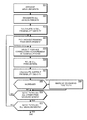
- FIG. 3 illustrates a method and a computer program product according to an embodiment of the invention
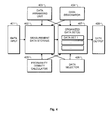
- FIG. 4 illustrates an apparatus according to an embodiment of the invention.
- the current space debris analysis used for EISCAT measurements is a three-step procedure that involves:
- a certain duration of time is coherently integrated.
- different accelerations are also searched.
- the computations in this stage can be accelerated with an algorithm known as FastGMF and described in the patent publication U.S. Pat. No. 7,576,688, which is incorporated herein by reference.
- the grid search can also be accelerated using the non-uniform (in time and frequency) fast Fourier transform, as has been shown by Keiner, J., Kunis, S., and Potts, D. in their study “Using NFFT 3—a software library for various nonequispaced fast Fourier transforms ACM Trans. Math. Software”. The first step of the analysis procedure is reasonably well described already in earlier studies but the second step has not yet been properly addressed until now.
- the second step consists of determining which coherent integration blocks (or measurements) belong to the same target and which integration blocks do not contain anything meaningful.
- Step three involves using the trajectory obtained in the detection step ( 2 ) to improve the target trajectory estimate.
- the optimal way would be to use the original raw voltage data, and fit a trajectory directly into the raw voltage data. This can be done for example using MCMC (Markov Chain Monte Carlo) methods or using a combination of grid and gradient search methods.
- MCMC Markov Chain Monte Carlo
- the computations can be sped up significantly by using results of the detection step as an initial guess for the target parameters. We will not discuss step three in this description.
- the measurement m i (r i , ⁇ dot over (r) ⁇ i , ⁇ i ) contains signal amplitude ⁇ i , range r i and velocity ⁇ dot over (r) ⁇ i at time instant t i .
- the majority of these measurements are not expected to contain information about any target at all, and they are expected to consist of instrumental noise, or more generally just something else than the desired signal. This set-up is similar to what was described earlier with reference to FIG. 1 and FIG. 2 .
- the concept of “measurement” refers in this description to a value or a set of values that describe characteristics of an assumed target.
- the momentary voltage value at the output of a radar receiver is not a “measurement” in the sense of this description, but “raw data” or “raw voltage data”.
- a “measurement” would be an estimate of said content.
- the measurement is a set of three values, namely range, velocity, and amplitude, of which the latter is a direct indicator of the interaction cross section of the target with the radar signal. It is typical to both remote sensing and communications applications that in order to obtain a “measurement” a not insignificant amount of signal processing has to be performed already. Above such signal processing has been referred to as coherent integration in blocks, which is the case especially in remote sensing applications.
- the problem is to determine the number N ev of unique targets with unique trajectories that are contained in the set of measurements, their approximate trajectories, and which measurements contain information about each detected target.
- Bayesian model selection provides a way of assigning a probabilty density for different models and their parameters
- D ) p ⁇ ( D
- D) is the a posteriori probability density for different models k and their corresponding model parameters ⁇ (k) .
- k, ⁇ (k) ) is the likelihood function, which describes the probability of the measurement given a model and set of model parameters.
- k)p(k) is the a priori density for the models and model parameters.
- p(D) is the probability of the data, and it can be thought of as a normalization constant.
- the number of different models k is astronomical. Assuming that each target n is described by a set of unique measurements I n , with each measurement belonging to not more than one target, the number of different models is given by the Bell number:
- B 20 ⁇ 5.1 ⁇ 10 13 and B 30 ⁇ 8.5 ⁇ 10 23 This means that in practice we cannot perform an exhaustive search through all the possible models unless the number of measurements is very small. For larger sets of measurements, it is only possible to consider a smaller subset of all the possible models. This is why we have to develop a algorithm that only goes through a small subset of the model space.
- ⁇ i and ⁇ ′ i are the measurement errors for the range and radial velocity measurements. Measurements that don't belong to any target detection are described with the random variables v i and v′ i , which have a distribution that models the instrumental noise. For example, in the case of space debris measurements, this is very close to uniformly distributed noise.
- ⁇ contains the probability of the non-targets, i.e. the probability density of v i and v′ i .
- ⁇ ( ⁇ r ⁇ v ) ⁇ N n
- ⁇ r r max ⁇ r min
- logarithmic posteriori density leaving out the constant terms, can now be written as log p ( ⁇ (k) ,k
- the specific formulation of the a posteoriori density in equation (10) results in a simple logarithmic probability density form that can be efficiently evaluated.
- the formulation starts by assuming that measurements either belong to a moving point target, or they don't.
- the moving targets are modeled using some parametric trajectory, while the measurements not containing any targets are assumed to span a finite parameter space uniformly.
- the a posteriori probability density does not necessarily need to result in a form of Eq. (10). In some cases it can be more profitable to model the trajectory using another parametric form, or to model the non-targets using a different distribution than the uniform distribution that resulted in Eq. (10). E.g., in the case of active radar jamming, the distribution of Doppler and range measurements can be completely different than in the case no jamming, where only ground clutter and receiver noise are the main contributing factors.
- the algorithm initially sorts all measurements in decreasing order of measured signal power ⁇ i .
- the measurements are marked as belonging together if the posteriori probability density is increased. If measurements are marked as belonging to some event, they will not be used for other events.
- FIG. 3 illustrates a method and a computer program product for the restricted grid search.
- the measurements are arranged to a ranked order according to a measurement-specific value, the magnitude of which is assumed to correlate with a reliability of the measurement.
- the measurement-specific signal power is a natural candidate.
- the value used to decide the order could be selected differently. For example a radar, sonar, or lidar arrangement could be used to detect an approaching missile or other threatening object, the typical velocity of which can be known with certain reliability. In such a case the highest-ranking measurements could be those where the velocity value contained in the measurement was closest to the assumed actual velocity.
- Steps 302 and 303 are initializing steps where all measurements are initially designated as not belonging to or being associated with any target (step 302 ) and the initial probability density is calculated (step 303 ).
- the last-mentioned gives a kind of a threshold value that can be used for comparisons, because it indicates, how probable it should be to obtain the current set of measurements by just looking at the clear sky with no orbiting objects currently in view.
- a probability value higher than at least the initial probability calculated at step 303 should be obtained.
- the currently highest-ranking measurement that has not yet been marked as belonging to (or associated with) a particular target is picked at step 304 , and a candidate correlating measurement is selected at step 305 .
- a candidate correlating measurement is selected at step 305 .
- the verb “to pick” and its derivatives to refer to the measurement picked at step 304
- the verb “to select” and its derivatives to refer to the candidate measurement selected at step 305 .
- the selection of the candidate correlating measurement is made according to a criterion that again should involve some insight about how the sought-after targets actually behave.
- a criterion that again should involve some insight about how the sought-after targets actually behave.
- the candidate correlating measurement could be selected on the basis that it was made in the same or only slightly different spatial direction.
- the invention does not limit the criterion that is used to select the candidate correlating measurement at step 305 , as long as it reflects the above-mentioned insight of how actual targets should behave.
- a measurement may comprise measurement-specific values for time (the exact time at which the measurement was made), distance (the distance at which the measurement indicates a target to be), and velocity (the velocity at which the measurement indicates a target to move).
- a neighbourhood set up by that measurement in the time-distance-velocity coordinate system would include such other measurements that consist of sufficiently similar time, distance, and velocity values, taken the assumed behaviour of the target. In other words, only such other measurements are included in said neighbourhood that could possibly relate to the same target.
- a very frequently used norm is a the Euclidean norm, which is the square root of the sum of squares of the coordinates.
- the calculation of an Euclidean norm may be weighted, if it is assumed that the coordinates involved come with differences in significance. For example, if a measuring arrangement is assumed to produce more accurate values of distance than velocity of targets, it may be advantageous to give the distance coordinate more weight in defining the neighbourhood of a measurement and calculating how close two measurements are to each other in said neighbourhood. Numerous other ways of defining and calculating a norm are known and can be used.
- a predetermined limit may be set to an acceptable neighbourhood of a measurement by giving a limiting value for the norm. A measurement is then closer than said predetermined limit to another measurement, if the value of a predetermined norm calculated for these two measurements exceeds a limiting value that corresponds to said predetermined limit.
- the definition of the norm to be used, as well as the limiting value for the norm reflect knowledge of the assumed behaviour of the target. Therefore by changing the definition of the norm, and/or by changing the limiting value, the same method can be applied to different kinds of applications.
- the definition of the norm, and its known association to the assumed physical characteristics of the target, may involve different limiting considerations for the different coordinates on which the norm is based. These limiting considerations may even vary dynamically according to the values included in the currently picked measurement. As an example, if the currently picked measurement includes a velocity value 1 km/s (i.e. if the currently picked measurement is assumed to represent a target that is moving at 1 km/s), it is clear that within a time frame of, say, ⁇ 5 seconds, the target could not have moved very much further than 5 km in distance. Some other picked measurement might include a velocity value 2 km/s, so plausible candidate measurements to be associated with the same target might well have a distance coordinate differing by 10 km within the same time frame of ⁇ 5 seconds.
- the maximum likelihood parameters are solved for S, typically with matrix equations.
- the calculation of the current probability density is shown separately as step 307 .
- the probability density calculated at step 307 is reflective of the picked measurement and the candidate correlating measurement being associated with a same target and tells, how probable it would be to obtain the current set of measurements, if during the time when the measurements were obtained, there was a target in view which had the range, velocity and acceleration values as indicated by the currently picked measurement and the candidate correlating measurement. Therefore the calculated probability density is compared to the highest previously calculated probability density at step 308 .
- the measurement picked at step 304 above and the candidate correlating measurement selected at 305 above are marked at step 309 as belonging to a common target. In other words they are not any more “free” measurements, where “free” means not associated with any target.
- step 305 Possibly looping back from step 310 to step 305 means that once a highest measurement was picked at step 304 , other free measurements (e.g. all remaining free measurements that are closer than a predetermined limit to the picked measurement, in the sense of a predetermined norm) are gone through in order to find all those measurements, the grouping together of which increases the probability density.
- step 311 a transition to step 311 occurs, where it is checked, whether free measurements were left that did not belong to any of the targets found so far. If yes, a return to step 304 occurs where the highest-ranking measurement still free is picked. Thereafter the inner loop consisting of steps 305 to 310 is again repeatedly circulated in order to find matching pairs for the currently picked measurement from among the remaining free measurements in its neighbourhood.
- the norm may have been defined as an Euclidean norm that takes into account time, velocity, and distance.
- Candidate measurements are gone through in an increasing order of their norm value, i.e. by proceeding within the neighbourhood of the picked measurement from the closest possible candidate measurement outwards.
- the limit of how many candidate measurements will be gone through is not defined as a maximum value of the whole norm, but simply as a maximum value of time. Other measurements will simply not be selected as candidate measurements if they have been made more than, say. ⁇ 5 seconds away from the picked measurement. This example illustrates the choice of using three different coordinates to calculate the norm but only one of them to set the limiting value.
- the limiting value may be as simple as a counted number of candidate measurements, which counted number may or may not have some dynamic relation to other characteristics of the set of measurement data. As an example, one may terminate looping back from step 310 to step 305 when 0.1% of those measurements have been selected as candidate measurements that are closer in time to the picked measurement than half a minute.
- the algorithm continues to process all or some significant portion of the measurements and will at some point terminate, as illustrated by the arrow down from step 311 . If the computation is halted at some point of time, e.g., due to real-time processing requirements, the algorithm has already processed the echos with the smallest estimations errors, i.e., the ones most likely to contain a target. As a result, there is output an organized subset that contains those measurements that have been marked as being associated with the same target. In case several targets were found, there are output the measurements themselves as well as an indication of which measurements were associated with a common target in each case.
- FIG. 4 is a schematic illustration of an apparatus according to an embodiment of the invention.
- the apparatus is configured to receive data through a data input 401 , which is for example a wired or wireless connection to a computer, or an interface for receiving portable data storage means, a local area network connection or a wide area network connection.
- a data input 401 which is for example a wired or wireless connection to a computer, or an interface for receiving portable data storage means, a local area network connection or a wide area network connection.
- the apparatus is configured to receive as data a large number of measurements, so that each measurement has been obtained by processing a received electromagnetic signal, and each measurement is a value or a set of values that describe characteristics of an assumed target. At least a large majority of the measurements should each contain a measurement-specific value, the magnitude of which is assumed to correlate with a reliability of that particular measurement.
- the apparatus comprises a measurement data storage 402 configured to store the received measurements.
- the apparatus comprises a data arranging unit 403 , which is configured to arrange the measurements to a ranked order according to said measurement-specific value, the magnitude of which is assumed to correlate with a reliability of the measurement.
- the apparatus comprises also a data designator 404 , which is configured to initially designate individual stored measurements as not being associated with a target.
- Further parts of the apparatus are a probability density calculator 405 , which is configured to calculate an initial probability density, and a data selector 406 , which is configured to pick from said multitude of measurements a measurement that is not associated with a target and additionally configured to select from said multitude of measurements a candidate correlating measurement.
- the probability density calculator 405 is configured to calculate a probability density reflective of the picked measurement and the candidate correlating measurement being associated with a same target.
- the data designator 406 is configured to, as a response to the calculated probability density being indicative of higher probability than the initial probability density, mark the picked measurement and the candidate correlating measurement as being associated with the same target.
- the concepts of picking and marking of measurements may be conceptually imaged as utilizing a memory 407 of organized data sets, in which one or more data sets are stored.
- a data set in the memory 407 consists of measurements that have been marked as being associated with a common target.
- the data arranging unit 403 , the data designator 404 , and the data selector 406 cooperate to go through the initially anonymous multitude of measurements in the measurement data storage 402 , so that as a result, those of the measurements that have true meaning eventually end up into well-specified entities within the memory 407 of organized data sets.
- the apparatus is configured to output, as an organized subset, those measurements that have been marked as being associated with the same target.
- the apparatus comprises a data output 408 dedicated to this purpose.
- the output 408 may be for example a wired or wireless connection to a computer, or an interface for writing data into portable data storage means, a local area network connection or a wide area network connection. Outputting data may comprise displaying some of the data or its derivatives on a display device.
- Blocks 403 , 404 , 405 , and 406 are advantageously implemented as machine-readable instructions stored on a memory medium, so that executing said machine-readable instructions by a processor causes the apparatus to implement those steps that have been described earlier in a more detailed manner as a method.
- Blocks 402 and 407 are advantageously implemented as machine-readable and -writable memory means together with their associated memory management software and hardware.
- the restricted grid search selects candidate measurements beginning from the one which is closest (in the sense of the applied norm) to the currently picked measurement. If the probability density calculated after selecting the closest candidate measurement is higher than the initial probability density, the closest candidate measurement is marked as being associated with the same target as the currently picked measurement. After that the next closest measurement is selected as the candidate measurement.
- the present invention may take advantage of the calculation algorithm previously known from the U.S. Pat. No. 7,576,688.
- said algorithm gives out an individual measurement, which in the sense of statistical analysis is the one within a number of measurements that has the highest probability of representing an actual target.
- any number of measurements in decreasing order of probability can be taken out of said algorithm, for later use as picked measurements.
- a neighbourhood can be set up around each measurement so identified, in order to find out, whether there are more measurements that could be associated with the same target as the picked measurement in question.
- the present invention is applied to telecommunications, one may consider reconstructing a transmitted message at the receiver using a so-called Markov chain approach.
- Most original signals involve some kind of regularity, like the known frequent occurrence of certain characters together.
- a part of the received signal that represents a character (or a short character string) can be thought of as a “measurement” in the parlance used earlier in this description. If one such part has been received and decoded, associating a further measurement with it could be considered as increasing the probability density if, taken the known regularity laid down by some known basic property of the message, a further message part derived from that particular measurement could occur together with the first part at a high probability.
- said known basic property of the message is its language, say, French.
- a part of the signal has been received and decoded, and found out to contain the character string “qu”.
- the next character following that particular string is a vowel, mostly “e” or “i”.
- receiving and decoding a further part of the signal gives such a vowel, it can be associated with the first part with relatively high certainty.
- associating the character string “qu” and for example further part “e” with the same “target”, i.e. the same portion of the received signal probably results in decoding this portion of the received signal correctly.
- a specific area of application of the present invention is constituted by multi-instrument measurements.
- a number of different instruments and/or a number of separate channels used by a single instrument measure the same targets.
- a multi-instrument measurement may be for example a combination of two radars located at different locations, operating at possibly different frequencies. It is possible to combine measurements from these two different systems within one analysis using the same algorithm.
- care should be taken in defining the norm that is used to set up the neighbourhood of a measurement, so that factors that can be considered most reliable have the highest significance in the norm. For example if the instruments are separate radars, the distance coordinate is typically more reliable than the time and velocity coordinate, so one might consider weighing especially distance in the definition of the norm.
- a natural measurement ranking measure would in this case be the sum of the two signal powers.
- One particular advantage of the present invention it its ability to produce organize subsets from a large set of measurements, where even a very large majority of the original measurements may actually come from no target at all.
- the organized subsets produced according to the invention contain, with high probability, a large portion of those measurements that actually do come from a target.
- the invention ensures that the production of such organized subsets can be accomplished with a reasonable demand of processing power and calculating time.
Landscapes
- Engineering & Computer Science (AREA)
- Radar, Positioning & Navigation (AREA)
- Remote Sensing (AREA)
- Computer Networks & Wireless Communication (AREA)
- Physics & Mathematics (AREA)
- General Physics & Mathematics (AREA)
- Radar Systems Or Details Thereof (AREA)
Abstract
Description
-
- arranging the multitude of measurements to a ranked order according to a measurement-specific value, the magnitude of which is assumed to correlate with a reliability of the measurement,
- initially designating individual measurements in said multitude of measurements as not being associated with a target,
- calculating an initial probability density
- picking from said multitude of measurements a measurement that is not associated with a target,
- selecting from said multitude of measurements a candidate correlating measurement,
- calculating a probability density reflective of the picked measurement and the candidate correlating measurement being associated with a same target,
- as a response to the calculated probability density being indicative of higher probability than the initial probability density, marking the picked measurement and the candidate correlating measurement as being associated with the same target, and
- outputting, as the organized subset, those measurements that have been marked as being associated with the same target.
-
- a data arranging unit configured to arrange the multitude of measurements to a ranked order according to a measurement-specific value, the magnitude of which is assumed to correlate with a reliability of the measurement,
- a data designator configured to initially designate individual measurements in said multitude of measurements as not being associated with a target,
- a probability density calculator configured to calculate an initial probability density, and
- a data selector configured to pick from said multitude of measurements a measurement that is not associated with a target;
wherein: - said data selector is additionally configured to select from said multitude of measurements a candidate correlating measurement,
- said probability density calculator is additionally configured to calculate a probability density reflective of the picked measurement and the candidate correlating measurement being associated with a same target,
- as a response to the calculated probability density being indicative of higher probability than the initial probability density, said data designator is configured to mark the picked measurement and the candidate correlating measurement as being associated with the same target, and
- the apparatus is configured to output, as the organized subset, those measurements that have been marked as being associated with the same target.
-
- arranging the multitude of measurements to a ranked order according to a measurement-specific value, the magnitude of which is assumed to correlate with a reliability of the measurement,
- initially designating individual measurements in said multitude of measurements as not being associated with a target,
- calculating an initial probability density
- picking from said multitude of measurements a measurement that is not associated with a target,
- selecting from said multitude of measurements a candidate correlating measurement,
- calculating a probability density reflective of the picked measurement and the candidate correlating measurement being associated with a same target,
- as a response to the calculated probability density being indicative of higher probability than the initial probability density, marking the picked measurement and the candidate correlating measurement as being associated with the same target, and
- outputting, as the organized subset, those measurements that have been marked as being associated with the same target.
- 1. Coherent integration in blocks
- 2. Combining integration blocks into events
- 3. Improving target detection accuracy.
where p(k, θ(k)|D) is the a posteriori probability density for different models k and their corresponding model parameters θ(k). p(D|k, θ(k)) is the likelihood function, which describes the probability of the measurement given a model and set of model parameters. p(θ(k)|k)p(k) is the a priori density for the models and model parameters. p(D) is the probability of the data, and it can be thought of as a normalization constant.
which grows extremely fast, e.g. B20≈5.1·1013 and B30≈8.5·1023. This means that in practice we cannot perform an exhaustive search through all the possible models unless the number of measurements is very small. For larger sets of measurements, it is only possible to consider a smaller subset of all the possible models. This is why we have to develop a algorithm that only goes through a small subset of the model space.
where ξi and ξ′i are the measurement errors for the range and radial velocity measurements. Measurements that don't belong to any target detection are described with the random variables vi and v′i, which have a distribution that models the instrumental noise. For example, in the case of space debris measurements, this is very close to uniformly distributed noise.


p(D|k,θ (k))=κCexp{−S}, (5)
where the sum of squares term is
and C is the normalization factor
κ=(ΔrΔv)−N
with prior ranges Δr=rmax−rmin and Δv=vmax−vmin. The number of measurements that contain actual events is
and the number of non-events events is Nn=N−Np.
p(θ(k) |k)=(ΔrΔvΔa)−N
with the additional uniform distribution for the acceleration parameter Δa=amax−amin.
log p(θ(k) ,k|D)=−S−αN n −βN ev+log C, (10)
where
α=log ΔrΔv (11)
and
β=log ΔrΔvΔa (12)
({circumflex over (k)},{circumflex over (θ)} (k))=arg maxk,θ
Claims (13)
log p(θ(k) ,k|D)=−S−αN n −βN ev+log C,


Priority Applications (4)
| Application Number | Priority Date | Filing Date | Title |
|---|---|---|---|
| US13/009,023 US8463579B2 (en) | 2011-01-19 | 2011-01-19 | Methods and arrangements for detecting weak signals |
| EP12702571.6A EP2666032B1 (en) | 2011-01-19 | 2012-01-18 | Methods and arrangements for detecting weak signals |
| CA2825283A CA2825283C (en) | 2011-01-19 | 2012-01-18 | Methods and arrangements for detecting weak signals |
| PCT/FI2012/050041 WO2012098294A1 (en) | 2011-01-19 | 2012-01-18 | Methods and arrangements for detecting weak signals |
Applications Claiming Priority (1)
| Application Number | Priority Date | Filing Date | Title |
|---|---|---|---|
| US13/009,023 US8463579B2 (en) | 2011-01-19 | 2011-01-19 | Methods and arrangements for detecting weak signals |
Publications (2)
| Publication Number | Publication Date |
|---|---|
| US20120183035A1 US20120183035A1 (en) | 2012-07-19 |
| US8463579B2 true US8463579B2 (en) | 2013-06-11 |
Family
ID=45563067
Family Applications (1)
| Application Number | Title | Priority Date | Filing Date |
|---|---|---|---|
| US13/009,023 Active 2031-12-30 US8463579B2 (en) | 2011-01-19 | 2011-01-19 | Methods and arrangements for detecting weak signals |
Country Status (4)
| Country | Link |
|---|---|
| US (1) | US8463579B2 (en) |
| EP (1) | EP2666032B1 (en) |
| CA (1) | CA2825283C (en) |
| WO (1) | WO2012098294A1 (en) |
Cited By (3)
| Publication number | Priority date | Publication date | Assignee | Title |
|---|---|---|---|---|
| US20160161606A1 (en) * | 2014-12-08 | 2016-06-09 | Northrop Grumman Systems Corporation | Variational track management |
| US20220146667A1 (en) * | 2022-01-25 | 2022-05-12 | Intel Corporation | Apparatus, system and method of radar tracking |
| US11372097B2 (en) * | 2018-10-09 | 2022-06-28 | Metawave Corporation | Method and apparatus for phase unwrapping radar detections using optical flow |
Families Citing this family (13)
| Publication number | Priority date | Publication date | Assignee | Title |
|---|---|---|---|---|
| JP6266882B2 (en) * | 2012-12-27 | 2018-01-24 | 日本無線株式会社 | Tracking support device |
| CN103592646B (en) * | 2013-11-01 | 2015-10-28 | 南昌大学 | Phased array incoherent scattering radar system |
| US9989634B2 (en) * | 2014-04-22 | 2018-06-05 | Specialized Arrays, Inc. | System and method for detection and orbit determination of earth orbiting objects |
| CN109581312B (en) * | 2018-11-22 | 2023-07-14 | 西安电子科技大学昆山创新研究院 | A multi-target clustering method for high-resolution millimeter-wave radar |
| CN109581363B (en) * | 2018-12-03 | 2022-04-22 | 中国电波传播研究所(中国电子科技集团公司第二十二研究所) | A small-size space debris detection and parameter extraction method based on incoherent scattering radar |
| CN111142083B (en) * | 2020-02-27 | 2022-05-03 | 西北核技术研究院 | A method for constructing intermediate frequency echo of short pulse non-coherent radar |
| CN112162246B (en) * | 2020-07-17 | 2024-02-09 | 中国人民解放军63892部队 | Complex electromagnetic environment effect analysis method based on Bayesian network radar system |
| CN113093180B (en) * | 2021-03-20 | 2023-10-13 | 中国人民解放军空军工程大学 | A slow weak target detection method based on clustering extrapolation |
| CN113567948B (en) * | 2021-08-17 | 2023-07-28 | 南昌大学 | A Data Processing Method of Incoherent Scatter Radar Based on Trust Region Method |
| CN114379592B (en) * | 2022-01-10 | 2024-06-14 | 中国第一汽车股份有限公司 | Target association method, device, electronic equipment and storage medium |
| CN115407297B (en) * | 2022-08-30 | 2024-12-13 | 电子科技大学 | Distributed multi-radar signal-level collaborative detection and localization method under strong communication constraints |
| US20250110205A1 (en) * | 2023-10-03 | 2025-04-03 | Viettel Group | Method for calculating gating scores in pulse-doppler radar systems using a fusion of position, power, detection size and ambiguous doppler measurement data |
| CN119476666A (en) * | 2024-10-23 | 2025-02-18 | 中国船舶集团有限公司第七一九研究所 | A detection task path planning method and device |
Citations (4)
| Publication number | Priority date | Publication date | Assignee | Title |
|---|---|---|---|---|
| US20050001759A1 (en) | 2003-07-03 | 2005-01-06 | Deepak Khosla | Method and apparatus for joint kinematic and feature tracking using probabilistic argumentation |
| US20090052737A1 (en) | 2005-04-14 | 2009-02-26 | Samantha Lycett | Method and Apparatus for Detecting a Target in a Scene |
| US20110022319A1 (en) * | 2009-07-22 | 2011-01-27 | Schlumberger Technology Corporation | Guided bayesian experimental design |
| US20110241927A1 (en) * | 2010-04-02 | 2011-10-06 | Porikli Fatih M | Method for Detecting Small Targets in Radar Images Using Needle Based Hypotheses Verification |
Family Cites Families (1)
| Publication number | Priority date | Publication date | Assignee | Title |
|---|---|---|---|---|
| FI117653B (en) | 2005-02-21 | 2006-12-29 | Eigenor Oy | Procedure and arrangement for sensing objects with a radar |
-
2011
- 2011-01-19 US US13/009,023 patent/US8463579B2/en active Active
-
2012
- 2012-01-18 WO PCT/FI2012/050041 patent/WO2012098294A1/en not_active Ceased
- 2012-01-18 EP EP12702571.6A patent/EP2666032B1/en not_active Not-in-force
- 2012-01-18 CA CA2825283A patent/CA2825283C/en active Active
Patent Citations (4)
| Publication number | Priority date | Publication date | Assignee | Title |
|---|---|---|---|---|
| US20050001759A1 (en) | 2003-07-03 | 2005-01-06 | Deepak Khosla | Method and apparatus for joint kinematic and feature tracking using probabilistic argumentation |
| US20090052737A1 (en) | 2005-04-14 | 2009-02-26 | Samantha Lycett | Method and Apparatus for Detecting a Target in a Scene |
| US20110022319A1 (en) * | 2009-07-22 | 2011-01-27 | Schlumberger Technology Corporation | Guided bayesian experimental design |
| US20110241927A1 (en) * | 2010-04-02 | 2011-10-06 | Porikli Fatih M | Method for Detecting Small Targets in Radar Images Using Needle Based Hypotheses Verification |
Non-Patent Citations (3)
| Title |
|---|
| International Search Report and Written Opinion for corresponding application No. PCT/F12012/050041, Jan. 18, 2012. |
| Markkanen J et al., "REal-time space debris monitoring with Eiscat" Advances in Space Research, Pergamon, Oxford, GB, vol. 35, No. 7, Jan. 1, 2005, p. 1197-1209, XP027796828. |
| Wing Ip Tam et al., "An efficient radar tracking algorithm using multidimensional Gauss-Hermite quadratures", IEEE International Conference on Acoustics, Speech, and Signal Processing, 1997. ICASSP-97, Munich, DE Apr. 21-24, 1997, Los Alamitos, CA, USA, vol. 5, Apr. 21, 1997, p. 3777-3780, XP010226623. |
Cited By (6)
| Publication number | Priority date | Publication date | Assignee | Title |
|---|---|---|---|---|
| US20160161606A1 (en) * | 2014-12-08 | 2016-06-09 | Northrop Grumman Systems Corporation | Variational track management |
| US10310068B2 (en) * | 2014-12-08 | 2019-06-04 | Northrop Grumman Systems Corporation | Variational track management |
| US10782396B2 (en) | 2014-12-08 | 2020-09-22 | Northrop Grumman Systems Corporation | Variational track management |
| US11372097B2 (en) * | 2018-10-09 | 2022-06-28 | Metawave Corporation | Method and apparatus for phase unwrapping radar detections using optical flow |
| US20220146667A1 (en) * | 2022-01-25 | 2022-05-12 | Intel Corporation | Apparatus, system and method of radar tracking |
| US12265150B2 (en) * | 2022-01-25 | 2025-04-01 | Intel Corporation | Apparatus, system and method of radar tracking |
Also Published As
| Publication number | Publication date |
|---|---|
| EP2666032B1 (en) | 2016-07-13 |
| WO2012098294A1 (en) | 2012-07-26 |
| EP2666032A1 (en) | 2013-11-27 |
| US20120183035A1 (en) | 2012-07-19 |
| CA2825283A1 (en) | 2012-07-26 |
| CA2825283C (en) | 2019-01-15 |
Similar Documents
| Publication | Publication Date | Title |
|---|---|---|
| EP2666032B1 (en) | Methods and arrangements for detecting weak signals | |
| Massimi et al. | Deep learning‐based space debris detection for space situational awareness: A feasibility study applied to the radar processing | |
| EP1485729B1 (en) | System and method for target signature calculation and recognition | |
| Aprile et al. | Track-before-detect for sea clutter rejection: Tests with real data | |
| US10054668B2 (en) | Probabilistic signal, detection, and track processing architecture and system | |
| CN113985376B (en) | Radar comprehensive display and control excitation system | |
| Zhang et al. | Radar operation mode recognition via multifeature residual-and-shrinkage ConvNet | |
| Anderson et al. | Track association for over-the-horizon radar with a statistical ionospheric model | |
| Zheng et al. | Adaptive PHD filter with RCS and Doppler feature for space targets tracking via space-based radar | |
| RU2235342C2 (en) | Method for measuring angular coordinates of object and radiolocation station for its realization | |
| CN121634032A (en) | A non-line-of-sight moving target 3D reconstruction method based on MIMO millimeter-wave radar | |
| Ristic et al. | Gaussian mixture multitarget–multisensor Bernoulli tracker for multistatic sonobuoy fields | |
| Zhou et al. | RFI source localization for SAR: Method and experiment based on GaoFen-3 | |
| Romeo et al. | Data fusion with ML-PMHT for very low SNR track detection in an OTHR | |
| Chatterjee et al. | Effects of measurement uncertainties on multitarget tracking | |
| RU2362182C1 (en) | Radial velocity measurement method and radiolocation station for its implementation | |
| CN116027317A (en) | Sea surface ship target two-dimensional speed estimation method based on spaceborne broadband radar | |
| Artyushenko et al. | Measurement error estimation of motion variables for extended objects under changing range conditions | |
| Pu et al. | Velocity estimation of DRFM jamming source based on doppler differences in distributed array radar | |
| Silantyev et al. | Analysis of Efficiency of Long-Term Multi-Scanning Radar Observation Methods | |
| Cuccoli et al. | Coordinate registration method based on sea/land transitions identification for over-the-horizon sky-wave radar: Numerical model and basic performance requirements | |
| Herrmann et al. | Track Initiation and Adaptive Target Birth in Existence-Based Poisson Histogram-PMHT | |
| Stawiarski et al. | Adaptation of radar software to work with ambiguous distance measurement | |
| Vasiliev et al. | Issue of VHF Continuous Emission Radars Coordinate Measurement Discrepancy | |
| Timoshenko et al. | Substantiation of the Periodicity of Multi-Scanning Radar Monitoring of Moving Objects |
Legal Events
| Date | Code | Title | Description |
|---|---|---|---|
| AS | Assignment |
Owner name: RADAREAL OY, FINLAND Free format text: ASSIGNMENT OF ASSIGNORS INTEREST;ASSIGNOR:VIERINEN, JUHA;REEL/FRAME:025666/0301 Effective date: 20110119 |
|
| STCF | Information on status: patent grant |
Free format text: PATENTED CASE |
|
| REMI | Maintenance fee reminder mailed | ||
| FPAY | Fee payment |
Year of fee payment: 4 |
|
| SULP | Surcharge for late payment | ||
| FEPP | Fee payment procedure |
Free format text: MAINTENANCE FEE REMINDER MAILED (ORIGINAL EVENT CODE: REM.); ENTITY STATUS OF PATENT OWNER: SMALL ENTITY |
|
| FEPP | Fee payment procedure |
Free format text: 7.5 YR SURCHARGE - LATE PMT W/IN 6 MO, SMALL ENTITY (ORIGINAL EVENT CODE: M2555); ENTITY STATUS OF PATENT OWNER: SMALL ENTITY |
|
| MAFP | Maintenance fee payment |
Free format text: PAYMENT OF MAINTENANCE FEE, 8TH YR, SMALL ENTITY (ORIGINAL EVENT CODE: M2552); ENTITY STATUS OF PATENT OWNER: SMALL ENTITY Year of fee payment: 8 |
|
| FEPP | Fee payment procedure |
Free format text: MAINTENANCE FEE REMINDER MAILED (ORIGINAL EVENT CODE: REM.); ENTITY STATUS OF PATENT OWNER: SMALL ENTITY |
|
| FEPP | Fee payment procedure |
Free format text: 11.5 YR SURCHARGE- LATE PMT W/IN 6 MO, SMALL ENTITY (ORIGINAL EVENT CODE: M2556); ENTITY STATUS OF PATENT OWNER: SMALL ENTITY |
|
| MAFP | Maintenance fee payment |
Free format text: PAYMENT OF MAINTENANCE FEE, 12TH YR, SMALL ENTITY (ORIGINAL EVENT CODE: M2553); ENTITY STATUS OF PATENT OWNER: SMALL ENTITY Year of fee payment: 12 |
|
| AS | Assignment |
Owner name: OPTIVERITO OY, FINLAND Free format text: PURCHASE AGREEMENT;ASSIGNOR:RADAREAL OY;REEL/FRAME:071685/0682 Effective date: 20250616 |