US8460628B2 - Spiro compounds - Google Patents
Spiro compounds Download PDFInfo
- Publication number
- US8460628B2 US8460628B2 US12/810,765 US81076508A US8460628B2 US 8460628 B2 US8460628 B2 US 8460628B2 US 81076508 A US81076508 A US 81076508A US 8460628 B2 US8460628 B2 US 8460628B2
- Authority
- US
- United States
- Prior art keywords
- formula
- compounds
- porous
- spiro
- independently
- Prior art date
- Legal status (The legal status is an assumption and is not a legal conclusion. Google has not performed a legal analysis and makes no representation as to the accuracy of the status listed.)
- Expired - Fee Related, expires
Links
- 150000003413 spiro compounds Chemical class 0.000 title claims abstract description 28
- 239000000463 material Substances 0.000 claims abstract description 27
- 150000001875 compounds Chemical class 0.000 claims abstract description 23
- 239000003054 catalyst Substances 0.000 claims abstract description 17
- 229910044991 metal oxide Inorganic materials 0.000 claims abstract description 8
- 150000004706 metal oxides Chemical class 0.000 claims abstract description 8
- 238000000034 method Methods 0.000 claims description 23
- 239000000178 monomer Substances 0.000 claims description 21
- 125000005842 heteroatom Chemical group 0.000 claims description 16
- VYPSYNLAJGMNEJ-UHFFFAOYSA-N Silicium dioxide Chemical compound O=[Si]=O VYPSYNLAJGMNEJ-UHFFFAOYSA-N 0.000 claims description 15
- 239000001257 hydrogen Substances 0.000 claims description 15
- 229910052739 hydrogen Inorganic materials 0.000 claims description 15
- 239000012071 phase Substances 0.000 claims description 14
- 229920000642 polymer Polymers 0.000 claims description 14
- UFHFLCQGNIYNRP-UHFFFAOYSA-N Hydrogen Chemical compound [H][H] UFHFLCQGNIYNRP-UHFFFAOYSA-N 0.000 claims description 13
- 229920005989 resin Polymers 0.000 claims description 13
- 239000011347 resin Substances 0.000 claims description 13
- 125000004432 carbon atom Chemical group C* 0.000 claims description 12
- 238000002360 preparation method Methods 0.000 claims description 11
- 238000004519 manufacturing process Methods 0.000 claims description 9
- 150000001338 aliphatic hydrocarbons Chemical class 0.000 claims description 8
- 239000012074 organic phase Substances 0.000 claims description 7
- 238000006116 polymerization reaction Methods 0.000 claims description 7
- 238000006798 ring closing metathesis reaction Methods 0.000 claims description 7
- 239000000377 silicon dioxide Substances 0.000 claims description 7
- KXGFMDJXCMQABM-UHFFFAOYSA-N 2-methoxy-6-methylphenol Chemical group [CH]OC1=CC=CC([CH])=C1O KXGFMDJXCMQABM-UHFFFAOYSA-N 0.000 claims description 6
- 239000005011 phenolic resin Substances 0.000 claims description 6
- 229920001568 phenolic resin Polymers 0.000 claims description 6
- 239000010936 titanium Substances 0.000 claims description 6
- 229910052719 titanium Inorganic materials 0.000 claims description 6
- 125000000217 alkyl group Chemical group 0.000 claims description 5
- 229910052751 metal Inorganic materials 0.000 claims description 5
- 239000002184 metal Substances 0.000 claims description 5
- 229910052710 silicon Inorganic materials 0.000 claims description 5
- 125000000524 functional group Chemical group 0.000 claims description 3
- 229910052735 hafnium Inorganic materials 0.000 claims description 3
- 150000002366 halogen compounds Chemical class 0.000 claims description 3
- 125000003003 spiro group Chemical group 0.000 claims description 3
- 229910052726 zirconium Inorganic materials 0.000 claims description 3
- 150000002431 hydrogen Chemical class 0.000 claims description 2
- XLYOFNOQVPJJNP-UHFFFAOYSA-M hydroxide Chemical compound [OH-] XLYOFNOQVPJJNP-UHFFFAOYSA-M 0.000 claims 4
- GWEVSGVZZGPLCZ-UHFFFAOYSA-N Titan oxide Chemical compound O=[Ti]=O GWEVSGVZZGPLCZ-UHFFFAOYSA-N 0.000 claims 2
- CJNBYAVZURUTKZ-UHFFFAOYSA-N hafnium(iv) oxide Chemical compound O=[Hf]=O CJNBYAVZURUTKZ-UHFFFAOYSA-N 0.000 claims 2
- 230000000379 polymerizing effect Effects 0.000 claims 2
- MCMNRKCIXSYSNV-UHFFFAOYSA-N ZrO2 Inorganic materials O=[Zr]=O MCMNRKCIXSYSNV-UHFFFAOYSA-N 0.000 claims 1
- 238000010538 cationic polymerization reaction Methods 0.000 claims 1
- 229910052605 nesosilicate Inorganic materials 0.000 claims 1
- 150000004762 orthosilicates Chemical class 0.000 claims 1
- RVTZCBVAJQQJTK-UHFFFAOYSA-N oxygen(2-);zirconium(4+) Chemical compound [O-2].[O-2].[Zr+4] RVTZCBVAJQQJTK-UHFFFAOYSA-N 0.000 claims 1
- 235000012239 silicon dioxide Nutrition 0.000 claims 1
- 239000004408 titanium dioxide Substances 0.000 claims 1
- 238000007151 ring opening polymerisation reaction Methods 0.000 abstract description 9
- YMWUJEATGCHHMB-UHFFFAOYSA-N Dichloromethane Chemical compound ClCCl YMWUJEATGCHHMB-UHFFFAOYSA-N 0.000 description 17
- 239000002131 composite material Substances 0.000 description 13
- YXFVVABEGXRONW-UHFFFAOYSA-N Toluene Chemical compound CC1=CC=CC=C1 YXFVVABEGXRONW-UHFFFAOYSA-N 0.000 description 12
- 0 [1*]C1([2*])OC2(OC3=C(C)C(C)=C(C)C(C)=C31)OC1=C(C(C)=C(C)C(C)=C1C)C([1*])([2*])O2 Chemical compound [1*]C1([2*])OC2(OC3=C(C)C(C)=C(C)C(C)=C31)OC1=C(C(C)=C(C)C(C)=C1C)C([1*])([2*])O2 0.000 description 12
- DTQVDTLACAAQTR-UHFFFAOYSA-N Trifluoroacetic acid Chemical compound OC(=O)C(F)(F)F DTQVDTLACAAQTR-UHFFFAOYSA-N 0.000 description 10
- 230000015572 biosynthetic process Effects 0.000 description 9
- 238000006243 chemical reaction Methods 0.000 description 9
- VLKZOEOYAKHREP-UHFFFAOYSA-N n-Hexane Chemical compound CCCCCC VLKZOEOYAKHREP-UHFFFAOYSA-N 0.000 description 9
- AFVFQIVMOAPDHO-UHFFFAOYSA-N Methanesulfonic acid Chemical compound CS(O)(=O)=O AFVFQIVMOAPDHO-UHFFFAOYSA-N 0.000 description 6
- 125000002091 cationic group Chemical group 0.000 description 6
- -1 for example Chemical class 0.000 description 6
- LFQCEHFDDXELDD-UHFFFAOYSA-N tetramethyl orthosilicate Chemical compound CO[Si](OC)(OC)OC LFQCEHFDDXELDD-UHFFFAOYSA-N 0.000 description 6
- 239000000047 product Substances 0.000 description 5
- 238000003756 stirring Methods 0.000 description 5
- XLYOFNOQVPJJNP-UHFFFAOYSA-N water Substances O XLYOFNOQVPJJNP-UHFFFAOYSA-N 0.000 description 5
- IJGRMHOSHXDMSA-UHFFFAOYSA-N Atomic nitrogen Chemical compound N#N IJGRMHOSHXDMSA-UHFFFAOYSA-N 0.000 description 4
- HEDRZPFGACZZDS-MICDWDOJSA-N Trichloro(2H)methane Chemical compound [2H]C(Cl)(Cl)Cl HEDRZPFGACZZDS-MICDWDOJSA-N 0.000 description 4
- 239000002114 nanocomposite Substances 0.000 description 4
- 230000003647 oxidation Effects 0.000 description 4
- 238000007254 oxidation reaction Methods 0.000 description 4
- 239000007787 solid Substances 0.000 description 4
- BJZIXRIEVONTPV-UHFFFAOYSA-N tetrakis(furan-2-ylmethyl) silicate Chemical compound C=1C=COC=1CO[Si](OCC=1OC=CC=1)(OCC=1OC=CC=1)OCC1=CC=CO1 BJZIXRIEVONTPV-UHFFFAOYSA-N 0.000 description 4
- OKKJLVBELUTLKV-UHFFFAOYSA-N Methanol Chemical compound OC OKKJLVBELUTLKV-UHFFFAOYSA-N 0.000 description 3
- ZMANZCXQSJIPKH-UHFFFAOYSA-N Triethylamine Chemical compound CCN(CC)CC ZMANZCXQSJIPKH-UHFFFAOYSA-N 0.000 description 3
- 239000002253 acid Substances 0.000 description 3
- 150000007513 acids Chemical class 0.000 description 3
- 238000009833 condensation Methods 0.000 description 3
- 230000005494 condensation Effects 0.000 description 3
- 238000001816 cooling Methods 0.000 description 3
- 238000005530 etching Methods 0.000 description 3
- 125000004435 hydrogen atom Chemical group [H]* 0.000 description 3
- 150000004679 hydroxides Chemical class 0.000 description 3
- 125000002496 methyl group Chemical group [H]C([H])([H])* 0.000 description 3
- 239000000203 mixture Substances 0.000 description 3
- 239000011148 porous material Substances 0.000 description 3
- 238000007086 side reaction Methods 0.000 description 3
- XKRFYHLGVUSROY-UHFFFAOYSA-N Argon Chemical compound [Ar] XKRFYHLGVUSROY-UHFFFAOYSA-N 0.000 description 2
- HEDRZPFGACZZDS-UHFFFAOYSA-N Chloroform Chemical compound ClC(Cl)Cl HEDRZPFGACZZDS-UHFFFAOYSA-N 0.000 description 2
- 229910003910 SiCl4 Inorganic materials 0.000 description 2
- NINIDFKCEFEMDL-UHFFFAOYSA-N Sulfur Chemical compound [S] NINIDFKCEFEMDL-UHFFFAOYSA-N 0.000 description 2
- RTAQQCXQSZGOHL-UHFFFAOYSA-N Titanium Chemical compound [Ti] RTAQQCXQSZGOHL-UHFFFAOYSA-N 0.000 description 2
- 230000002378 acidificating effect Effects 0.000 description 2
- QVGXLLKOCUKJST-UHFFFAOYSA-N atomic oxygen Chemical compound [O] QVGXLLKOCUKJST-UHFFFAOYSA-N 0.000 description 2
- 239000007859 condensation product Substances 0.000 description 2
- 239000003814 drug Substances 0.000 description 2
- 230000002349 favourable effect Effects 0.000 description 2
- 230000002452 interceptive effect Effects 0.000 description 2
- 229910000000 metal hydroxide Inorganic materials 0.000 description 2
- 150000004692 metal hydroxides Chemical class 0.000 description 2
- 150000002739 metals Chemical class 0.000 description 2
- 229940098779 methanesulfonic acid Drugs 0.000 description 2
- 229910052757 nitrogen Inorganic materials 0.000 description 2
- 229920000620 organic polymer Polymers 0.000 description 2
- 239000001301 oxygen Substances 0.000 description 2
- 229910052760 oxygen Inorganic materials 0.000 description 2
- 239000011814 protection agent Substances 0.000 description 2
- CQRYARSYNCAZFO-UHFFFAOYSA-N salicyl alcohol Chemical compound OCC1=CC=CC=C1O CQRYARSYNCAZFO-UHFFFAOYSA-N 0.000 description 2
- FDNAPBUWERUEDA-UHFFFAOYSA-N silicon tetrachloride Chemical compound Cl[Si](Cl)(Cl)Cl FDNAPBUWERUEDA-UHFFFAOYSA-N 0.000 description 2
- 238000003980 solgel method Methods 0.000 description 2
- 239000011593 sulfur Substances 0.000 description 2
- 229910052717 sulfur Inorganic materials 0.000 description 2
- FPGGTKZVZWFYPV-UHFFFAOYSA-M tetrabutylammonium fluoride Chemical compound [F-].CCCC[N+](CCCC)(CCCC)CCCC FPGGTKZVZWFYPV-UHFFFAOYSA-M 0.000 description 2
- VXUYXOFXAQZZMF-UHFFFAOYSA-N titanium(IV) isopropoxide Chemical compound CC(C)O[Ti](OC(C)C)(OC(C)C)OC(C)C VXUYXOFXAQZZMF-UHFFFAOYSA-N 0.000 description 2
- 238000001644 13C nuclear magnetic resonance spectroscopy Methods 0.000 description 1
- 238000005160 1H NMR spectroscopy Methods 0.000 description 1
- 238000004400 29Si cross polarisation magic angle spinning Methods 0.000 description 1
- WKBOTKDWSSQWDR-UHFFFAOYSA-N Bromine atom Chemical compound [Br] WKBOTKDWSSQWDR-UHFFFAOYSA-N 0.000 description 1
- ZAMOUSCENKQFHK-UHFFFAOYSA-N Chlorine atom Chemical compound [Cl] ZAMOUSCENKQFHK-UHFFFAOYSA-N 0.000 description 1
- BPQQTUXANYXVAA-UHFFFAOYSA-N Orthosilicate Chemical compound [O-][Si]([O-])([O-])[O-] BPQQTUXANYXVAA-UHFFFAOYSA-N 0.000 description 1
- BOTDANWDWHJENH-UHFFFAOYSA-N Tetraethyl orthosilicate Chemical compound CCO[Si](OCC)(OCC)OCC BOTDANWDWHJENH-UHFFFAOYSA-N 0.000 description 1
- 239000013543 active substance Substances 0.000 description 1
- 230000002411 adverse Effects 0.000 description 1
- 125000003545 alkoxy group Chemical group 0.000 description 1
- 239000004411 aluminium Substances 0.000 description 1
- 229910052782 aluminium Inorganic materials 0.000 description 1
- XAGFODPZIPBFFR-UHFFFAOYSA-N aluminium Chemical compound [Al] XAGFODPZIPBFFR-UHFFFAOYSA-N 0.000 description 1
- 150000003863 ammonium salts Chemical class 0.000 description 1
- 229910052786 argon Inorganic materials 0.000 description 1
- 125000003118 aryl group Chemical group 0.000 description 1
- 229910052796 boron Inorganic materials 0.000 description 1
- GDTBXPJZTBHREO-UHFFFAOYSA-N bromine Substances BrBr GDTBXPJZTBHREO-UHFFFAOYSA-N 0.000 description 1
- 229910052794 bromium Inorganic materials 0.000 description 1
- 239000007795 chemical reaction product Substances 0.000 description 1
- 239000003795 chemical substances by application Substances 0.000 description 1
- 239000000460 chlorine Substances 0.000 description 1
- 229910052801 chlorine Inorganic materials 0.000 description 1
- 238000003776 cleavage reaction Methods 0.000 description 1
- 229910052681 coesite Inorganic materials 0.000 description 1
- 230000001427 coherent effect Effects 0.000 description 1
- 238000006482 condensation reaction Methods 0.000 description 1
- 229920001577 copolymer Polymers 0.000 description 1
- 229910052906 cristobalite Inorganic materials 0.000 description 1
- 229920006037 cross link polymer Polymers 0.000 description 1
- 238000004132 cross linking Methods 0.000 description 1
- 125000004093 cyano group Chemical group *C#N 0.000 description 1
- 238000009792 diffusion process Methods 0.000 description 1
- 238000004090 dissolution Methods 0.000 description 1
- 238000009826 distribution Methods 0.000 description 1
- 230000008030 elimination Effects 0.000 description 1
- 238000003379 elimination reaction Methods 0.000 description 1
- 230000032050 esterification Effects 0.000 description 1
- 238000005886 esterification reaction Methods 0.000 description 1
- 125000001495 ethyl group Chemical group [H]C([H])([H])C([H])([H])* 0.000 description 1
- 150000002240 furans Chemical class 0.000 description 1
- 239000000499 gel Substances 0.000 description 1
- 239000008187 granular material Substances 0.000 description 1
- 229910052736 halogen Inorganic materials 0.000 description 1
- 150000002367 halogens Chemical class 0.000 description 1
- 229920001519 homopolymer Polymers 0.000 description 1
- 230000007062 hydrolysis Effects 0.000 description 1
- 238000006460 hydrolysis reaction Methods 0.000 description 1
- 230000003301 hydrolyzing effect Effects 0.000 description 1
- 239000012535 impurity Substances 0.000 description 1
- 239000003999 initiator Substances 0.000 description 1
- 229910052809 inorganic oxide Inorganic materials 0.000 description 1
- 229920002521 macromolecule Polymers 0.000 description 1
- 230000007246 mechanism Effects 0.000 description 1
- 239000002086 nanomaterial Substances 0.000 description 1
- 229920000368 omega-hydroxypoly(furan-2,5-diylmethylene) polymer Polymers 0.000 description 1
- 125000004430 oxygen atom Chemical group O* 0.000 description 1
- 230000000737 periodic effect Effects 0.000 description 1
- 125000001997 phenyl group Chemical group [H]C1=C([H])C([H])=C(*)C([H])=C1[H] 0.000 description 1
- 229920000414 polyfuran Polymers 0.000 description 1
- 239000000843 powder Substances 0.000 description 1
- 238000001556 precipitation Methods 0.000 description 1
- 239000011541 reaction mixture Substances 0.000 description 1
- 230000035484 reaction time Effects 0.000 description 1
- 238000010992 reflux Methods 0.000 description 1
- 238000001226 reprecipitation Methods 0.000 description 1
- 238000007142 ring opening reaction Methods 0.000 description 1
- 230000007017 scission Effects 0.000 description 1
- 238000000926 separation method Methods 0.000 description 1
- 239000000741 silica gel Substances 0.000 description 1
- 229910002027 silica gel Inorganic materials 0.000 description 1
- 238000010996 solid-state NMR spectroscopy Methods 0.000 description 1
- 239000002904 solvent Substances 0.000 description 1
- 239000007858 starting material Substances 0.000 description 1
- 229910052682 stishovite Inorganic materials 0.000 description 1
- 239000000126 substance Substances 0.000 description 1
- 125000001424 substituent group Chemical group 0.000 description 1
- 238000003786 synthesis reaction Methods 0.000 description 1
- 229910052905 tridymite Inorganic materials 0.000 description 1
- 238000010626 work up procedure Methods 0.000 description 1
Images


Classifications
-
- C—CHEMISTRY; METALLURGY
- C08—ORGANIC MACROMOLECULAR COMPOUNDS; THEIR PREPARATION OR CHEMICAL WORKING-UP; COMPOSITIONS BASED THEREON
- C08J—WORKING-UP; GENERAL PROCESSES OF COMPOUNDING; AFTER-TREATMENT NOT COVERED BY SUBCLASSES C08B, C08C, C08F, C08G or C08H
- C08J5/00—Manufacture of articles or shaped materials containing macromolecular substances
- C08J5/005—Reinforced macromolecular compounds with nanosized materials, e.g. nanoparticles, nanofibres, nanotubes, nanowires, nanorods or nanolayered materials
-
- B—PERFORMING OPERATIONS; TRANSPORTING
- B82—NANOTECHNOLOGY
- B82Y—SPECIFIC USES OR APPLICATIONS OF NANOSTRUCTURES; MEASUREMENT OR ANALYSIS OF NANOSTRUCTURES; MANUFACTURE OR TREATMENT OF NANOSTRUCTURES
- B82Y30/00—Nanotechnology for materials or surface science, e.g. nanocomposites
-
- C—CHEMISTRY; METALLURGY
- C07—ORGANIC CHEMISTRY
- C07F—ACYCLIC, CARBOCYCLIC OR HETEROCYCLIC COMPOUNDS CONTAINING ELEMENTS OTHER THAN CARBON, HYDROGEN, HALOGEN, OXYGEN, NITROGEN, SULFUR, SELENIUM OR TELLURIUM
- C07F7/00—Compounds containing elements of Groups 4 or 14 of the Periodic Table
- C07F7/02—Silicon compounds
- C07F7/04—Esters of silicic acids
- C07F7/07—Cyclic esters
-
- C—CHEMISTRY; METALLURGY
- C08—ORGANIC MACROMOLECULAR COMPOUNDS; THEIR PREPARATION OR CHEMICAL WORKING-UP; COMPOSITIONS BASED THEREON
- C08J—WORKING-UP; GENERAL PROCESSES OF COMPOUNDING; AFTER-TREATMENT NOT COVERED BY SUBCLASSES C08B, C08C, C08F, C08G or C08H
- C08J2361/00—Characterised by the use of condensation polymers of aldehydes or ketones; Derivatives of such polymers
- C08J2361/04—Condensation polymers of aldehydes or ketones with phenols only
- C08J2361/06—Condensation polymers of aldehydes or ketones with phenols only of aldehydes with phenols
-
- C—CHEMISTRY; METALLURGY
- C08—ORGANIC MACROMOLECULAR COMPOUNDS; THEIR PREPARATION OR CHEMICAL WORKING-UP; COMPOSITIONS BASED THEREON
- C08K—Use of inorganic or non-macromolecular organic substances as compounding ingredients
- C08K3/00—Use of inorganic substances as compounding ingredients
- C08K3/34—Silicon-containing compounds
- C08K3/36—Silica
Definitions
- the invention relates to spiro compounds of the formula I and to composites prepared therefrom by twin ring-opening polymerisation, to porous metal oxide or semimetal oxide materials, which are preferably in the form of monoliths and are suitable, inter alia, for supporting catalysts.
- metal oxide or semimetal oxide here encompasses both metal oxides or semimetal oxides in the actual sense and also oxides which additionally comprise metal hydroxides or semimetal hydroxides (mixed oxides/hydroxides).
- TFOS tetrafurfuryloxysilane
- furan derivatives are very reactive, making side reactions, in particular oxidation, easier, which makes the specific industrial use of such derivatives more difficult.
- Polyfuran resins are therefore often inhomogeneous, extremely brittle and coloured, often even black, which excludes many applications.
- the object of the present invention was therefore to further develop the known twin condensation polymerisation starting from TFOS and difurfuryloxydimethylsilane (DFS) in such a way that it results in uniform processes with no side reactions, no interfering substances, such as water, are eliminated in the course of the polymerisation, and that it results in uniform, colourless or only slightly coloured nanocomposites.
- the present object is, surprisingly, achieved by the preparation of composites by “twin ring-opening polymerisation” of a metal or semimetal spiro compound, such as, for example, 2,2′′-spirobi[4H-1,3,2-benzodioxasilyne] (abbreviated to SPISI).
- a metal or semimetal spiro compound such as, for example, 2,2′′-spirobi[4H-1,3,2-benzodioxasilyne] (abbreviated to SPISI).
- SPISI 2,2′′-spirobi[4H-1,3,2-benzodioxasilyne]
- These composites have, for example, two bicontinuous, homogeneous and nanostructured phases comprising silica and phenolic resin, which can be converted into an oxidic monolith by oxidation of the organic phase without loss of the monolithic structure.
- the silica phase can likewise be dissolved out by etching, giving
- the present invention thus relates to spiro compounds of the formula I
- radicals A 1 to A 4 are linked to one another, in particular fused, i.e. linked to form a common aromatic ring system.
- one or more carbon atoms of the radicals A 1 to A 4 have been replaced, independently of one another, by heteroatoms, in particular by oxygen, sulfur and/or nitrogen.
- a 1 to A 4 it is preferred for A 1 to A 4 to contain, independently of one another, one or more functional groups. Suitable functional groups are, in particular, the following groups: halogen, in particular bromine or chlorine, —CN and —NR 2 , where R is, in particular, hydrogen or an aliphatic or aromatic hydrocarbon radical, preferably H, methyl, ethyl or phenyl.
- radicals R1 and R2 are furthermore preferably, independently of one another, hydrogen or an alkyl group having 1 to 6 carbon atoms.
- R 1 and R 2 are preferably selected from hydrogen (H) and methyl.
- R 1 and R 2 are particularly preferably equal to H.
- At least one of the two radicals A 1 and A 3 is a hydrogen atom.
- both A 1 and A 3 are a hydrogen atom.
- a 1 to A 4 are very particularly preferably equal to H.
- the compound is most preferably 2,2′-spirobi[4H-1,3,2-benzodioxasilyne].
- the present invention furthermore relates to an inorganic/organic hybrid material (composite) obtainable by polymerisation, preferably by twin ring-opening polymerisation, of one or more monomer units selected from the group of the spiro compounds of the general formula I
- These composites can be employed, for example, as materials having high heat resistance and strength.
- the present invention furthermore relates to a porous oxidic monolith obtainable from an inorganic/organic hybrid material by cationic polymerisation, preferably by twin ring-opening polymerisation, in which the organic phase is removed completely, preferably oxidised.
- porous, stable, inorganic monoliths are suitable, for example, as catalyst supports.
- an “oxidic monolith” is defined as a monolith which consists of one or more metal oxides or semimetal oxides and may also comprise, as described above, metal hydroxides or semimetal hydroxides.
- the present invention furthermore relates to a porous organic resin body obtainable from an inorganic/organic hybrid material by cationic polymerisation, preferably by twin ring-opening polymerisation, in which the inorganic phase is removed completely, preferably by dissolution or etching.
- Suitable solvents or etchants are preferably agents, in particular acids, which completely dissolve or chemically modify the inorganic phase without adversely affecting the organic phase.
- porous, stable, organic resins are suitable, for example, as catalyst supports or as supports for active substances, such as pharmaceuticals or crop-protection agents.
- twin polymerisation of organic/inorganic hybrid monomers is thus clearly distinguished from processes which are already known, such as simultaneous polymerisation, in which two different monomers are polymerised simultaneously in a single system, or consecutive polymerisation, where composite monomers (parent monomers) are often polymerised successively by two different mechanisms.
- simultaneous polymerisation in which two different monomers are polymerised simultaneously in a single system, or consecutive polymerisation, where composite monomers (parent monomers) are often polymerised successively by two different mechanisms.
- twin polymerisation of specifically conceived monomers consisting of two different, covalently bonded units (hybrid monomers) results, in only one process step, in the simultaneous formation of two different polymers.
- hybrid monomers consisting of two different, covalently bonded units
- the two polymers formed here may each form linear, branched or crosslinked structures.
- the molecular composition of the hybrid monomer defines the theoretical degree of crosslinking. If two crosslinked polymer structures form simultaneously, the length scale of the respective component in the composite is determined by the molecular size of the monomer unit and by diffusion processes.
- This novel polymerisation method thus also enables the development of nanostructured composites on the length scale from 0.5 nm to 2 nm for a very wide variety of material classes, where template-assisted processes using organic polymers come up against the intrinsic limit.
- the polymerisation method according to the invention thus closes the gap in the length scale between a molecule and a typical nanostructure ⁇ 2 nm.
- the advantageous bicontinuous structure comprising an inorganic phase and an organic phase, of the hybrid material is achieved through the use of a single starting material, from which the two phases form simultaneously.
- the phases separate during the polymerisation without macroscopically visible precipitation of a reaction product occurring. Instead, the separation takes place on a length scale in the nanometre range.
- the two phases which form in the polymerisation interpenetrate completely and continuously. The formation of isolated domains cannot be observed if the reaction is carried out correctly.
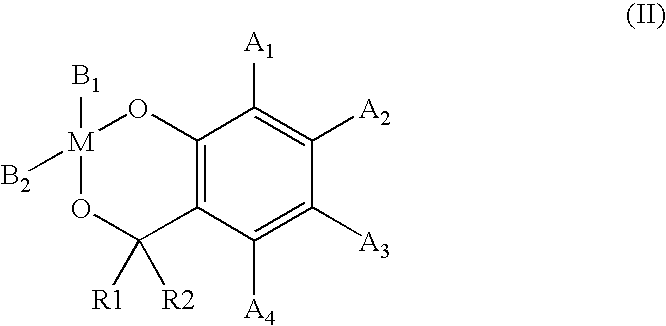
- Novel spiro compounds of the general formula I and/or compounds of the general formula II containing the radicals defined above, or combinations of the two formulae avoid the formation of a low-molecular-weight elimination product during the reaction.
- the hybrid materials formed are distinguished by a very homogeneous distribution of the two phases.
- the transparency of the resultant monoliths indicates that macroscopic domains of one of the two phases do not form in the reaction.
- the choice of a suitable acidic catalyst is also crucial for the optimum course of the polymerisation reaction. Preference is given here to the use of acids, such as, for example, trifluoroacetic acid or methanesulfonic acid. Relatively weak protonic acids, such as trifluoroacetic acid, which is particularly preferred, result in a slowed polymerisation reaction, giving transparent composites (see Table 1). By contrast, relatively strongly acidic catalysts often result in reactions which proceed uncontrollably quickly.
- the invention furthermore relates to a process for the preparation of inorganic/organic hybrid material by polymerisation of one or more monomer units selected from the group of the spiro compounds of the general formula I and/or compounds of the general formula II, as indicated above.
- a 1 and A 3 in formula I and, if used, formula II are hydrogen (H), in particular for A 1 to A 4 to be equal to H.
- Hydrogen atoms as substituents A 1 and A 3 represent reactive groups for the purposes of the polymerisation reaction.
- the invention thus furthermore relates to a process for the production of oxidic monoliths, comprising the steps of:
- the invention furthermore relates to a process for the production of porous organic resin bodies, comprising step a), as described above for the process for the production of oxidic monoliths, and the following step: preparation of a hybrid material by polymerisation of one or more monomer units, as described above under a), and complete removal of the inorganic phase, preferably by etching.
- the present invention furthermore relates to a process for the preparation of spiro compounds of the formula I, characterised in that a compound of the formula III
- a 1 , A 2 , A 3 , A 4 , R1, R2 have the meanings given above, where A 1 and A 3 are equal to H, is reacted with at least one alkoxy and/or halogen compound of the elements Si, Ti, Zr or Hf.
- the halogen compound employed is preferably SiCl 4 and the alkyl compound employed is preferably a tetraalkyl orthosilicate or tetraalkyl titanate. Particular preference is given to tetramethyl orthosilicate (TMOS) and tetraethyl orthosilicate as well as tetraisopropyl titanate.
- TMOS tetramethyl orthosilicate
- tetraethyl orthosilicate as well as tetraisopropyl titanate.
- triethylamine is used as auxiliary base.
- the bulky ammonium salt formed may represent a hindrance during work-up, meaning that the use of the tetraalkyl compounds is even more preferred.
- the invention furthermore relates to the use of spiro compounds of the formulae I and/or II for the production of oxidic monoliths as catalyst supports.
- the invention furthermore relates to the use of the inorganic or oxidic monoliths as catalyst supports.
- metals, oxides or complex compounds are either adsorbed on the porous surface or chemically bonded thereto.
- the favourable surface-to-volume ratio allows a large amount of catalyst per unit volume, the transport pores allow good material transport to the active centres, and the monolithic structure allows simple handling.
- the invention furthermore relates to the use of spiro compounds of the formula I and/or II for the preparation of porous organic resins as catalyst supports or supports for active compounds, such as pharmaceuticals or crop-protection agents.
- the invention furthermore relates to the use of the organic porous resins as catalyst supports or supports for active compounds.
- catalyst supports metals, oxides or complex compounds are either adsorbed on the porous surface or chemically bonded thereto.
- the favourable surface-to-volume ratio allows a large amount of catalyst per unit volume, and the transport pores allow good material transport to the active centres.
- active compounds are adsorbed in the pores and liberated in a controlled manner over time or depending on ambient variables. It is thus possible to liberate active compounds over a period of time or at the desired site of action.
- the invention furthermore relates to the use of spiro compounds of the formulae I and/or II for the preparation of materials, in particular those having high heat resistance and strength.
- the invention furthermore relates to the use of the composites as materials, in particular those having high heat resistance and strength.
- the product was dissolved out of the resultant reaction bottom product using hexane at ⁇ 70° C., and, after cooling, the clear solution was decanted off. After removal of the hexane, a white solid remains.
- the product can be purified further from impurities by re-precipitation using hexane.
- the monomer prepared in accordance with Example 1 is melted under argon at 80° C. or dissolved in chloroform at 25° C.
- the initiator trifluoroacetic acid is added dropwise with stirring, and the reaction mixture is stirred at the same temperature for a further 3 h and subsequently left to stand at 25° C.
- the formation of the SiO 2 phase and of the phenolic resin is confirmed unambiguously by solid-state NMR spectroscopy.
- the composite monoliths are heated to 900° C. at 2 K/min with a supply of air and calcined at this temperature for 3 h.
- the composite materials are treated with a 20% solution of HF in water at 40° C. for 3 h.
- FIG. 1 the schemes show that classical copolymerisations give copolymers: a) unimolecularly b) bimolecularly.
- two homopolymers inorganic oxide and organic polymer form simultaneously.
- A inorganic component (Si, B, Ti, . . . )
- B organic component.
- FIG. 2 shows twin polymerisations of the TFOS type and a specific spiro compound in accordance with the concept of the twin ring-opening polymerisation according to the invention.
- the organic component D here can carry two differently bonded oxygen atoms, which result in asymmetrical cleavage and form an OH-carrying polymer. Water-liberating condensation reactions are thus avoided.
- FIG. 3 shows the synthesis of SPISI by esterification of salicyl alcohol using tetramethoxysilane.
- FIG. 4 shows the theoretical overall equation of the twin ring-opening polymerisation according to the invention with reference to the example of 2,2′-spirobi[4H-1,3,2-benzodioxasilyne]. For simplification, only the formation of a linear polymer is shown. However, networks form in the polymerisation reaction according to the invention.
Landscapes
- Chemical & Material Sciences (AREA)
- Engineering & Computer Science (AREA)
- Materials Engineering (AREA)
- Organic Chemistry (AREA)
- Nanotechnology (AREA)
- Manufacturing & Machinery (AREA)
- Chemical Kinetics & Catalysis (AREA)
- Crystallography & Structural Chemistry (AREA)
- Condensed Matter Physics & Semiconductors (AREA)
- Composite Materials (AREA)
- Physics & Mathematics (AREA)
- Health & Medical Sciences (AREA)
- General Physics & Mathematics (AREA)
- Medicinal Chemistry (AREA)
- Polymers & Plastics (AREA)
- Polymers With Sulfur, Phosphorus Or Metals In The Main Chain (AREA)
- Compositions Of Macromolecular Compounds (AREA)
- Silicon Polymers (AREA)
- Polyoxymethylene Polymers And Polymers With Carbon-To-Carbon Bonds (AREA)
- Manufacture Of Porous Articles, And Recovery And Treatment Of Waste Products (AREA)
- Polyethers (AREA)
Abstract
Description

where
- M is a metal or semimetal, preferably Si, Ti, Zr or Hf, particularly preferably Si or Ti,
- A1, A2, A3, A4, independently of one another, are hydrogen or linear or branched, aliphatic hydrocarbon radicals, aromatic hydrocarbon radicals or aromatic-aliphatic hydrocarbon radicals,
- R1, R2, independently of one another, are hydrogen or an alkyl group having 1 to 6 carbon atoms, preferably methyl or H.

where A1 and A3 denote H, and/or compounds of the general formula II

where
- B1 and B2, independently of one another, are linear or branched aliphatic or aromatic hydrocarbon radicals, which may contain heteroatoms, preferably oxygen, nitrogen or sulfur, where ring closures may exist between the groups B1 and B2 via one or more carbon atoms or heteroatoms,
- and M, A1, A2, A3, A4, R1, R2, have the meanings indicated above, where A1 and A3 are equal to hydrogen.
-
- Hybrid monomers without ring equivalents must, even if they give two polymer structures in a single process, additionally form a further low-molecular-weight condensation product, such as, for example, water. This reaction is thus a condensation polymerisation.
- The twin polymerisation according to the invention uses monomers with ring equivalents, which can form two polymers in a single process during a ring-opening polymerisation without low-molecular-weight products being formed. This is observed, for example, in the ring-opening, cationic polymerisation of spiro-silicon compounds.
-
- a) preparation of a hybrid material by polymerisation of one or more monomer units selected from the group of the spiro compounds of the general formula I and/or compounds of the general formula II, as defined above,
- b) complete removal of the organic phase, preferably by oxidation, to give an oxidic monolith.

where A1, A2, A3, A4, R1, R2 have the meanings given above,
where A1 and A3 are equal to H, is reacted with at least one alkoxy and/or halogen compound of the elements Si, Ti, Zr or Hf.
| TABLE 1 | ||
| Spiro/cat.[a] | Reaction conditions | Reaction time; result |
| 25 - CH3SO3H | 25° C., 3.09 mol l−1/CH2Cl2 | 60 sec; polymerisation; pink solid |
| 50 - CH3SO3H | 25° C., 3.09 mol l−1/CH2Cl2 | 5 min; inhomogeneous, partly transparent |
| monolith | ||
| 25 - CH3SO3H[7] | 0° C., 1.58 mol l−1/CH2Cl2 | 1 h, homogeneous pink powder |
| 10 - CF3CO2H | 85° C. melt | 30 min-1 h; transparent monolith |
| 25 - CF3CO2H[9] | 85° C. melt | 2 h, transparent monolith |
| 5 - CF3CO2H | 25° C., 3.09 mol l−1/CH2Cl2 | 1 day; transparent monolith |
| 50 - CF3CO2H | 25° C., 3.09 mol l−1/CH2Cl2 | 1 week; incomplete reaction, viscous |
| [a]Spiro compound:catalyst molar ratio | ||
| [7],[9]Examples 7 and 9 described below | ||
Claims (22)




Applications Claiming Priority (4)
| Application Number | Priority Date | Filing Date | Title |
|---|---|---|---|
| DE102007063284A DE102007063284A1 (en) | 2007-12-27 | 2007-12-27 | spiro compounds |
| DE102007063284.5 | 2007-12-27 | ||
| DE102007063284 | 2007-12-27 | ||
| PCT/EP2008/010169 WO2009083083A1 (en) | 2007-12-27 | 2008-12-01 | Spiro compounds |
Publications (2)
| Publication Number | Publication Date |
|---|---|
| US20100284882A1 US20100284882A1 (en) | 2010-11-11 |
| US8460628B2 true US8460628B2 (en) | 2013-06-11 |
Family
ID=40379715
Family Applications (1)
| Application Number | Title | Priority Date | Filing Date |
|---|---|---|---|
| US12/810,765 Expired - Fee Related US8460628B2 (en) | 2007-12-27 | 2008-12-01 | Spiro compounds |
Country Status (7)
| Country | Link |
|---|---|
| US (1) | US8460628B2 (en) |
| EP (1) | EP2222687B1 (en) |
| JP (1) | JP5583026B2 (en) |
| CN (1) | CN101918413B (en) |
| CA (1) | CA2710700A1 (en) |
| DE (1) | DE102007063284A1 (en) |
| WO (1) | WO2009083083A1 (en) |
Families Citing this family (19)
| Publication number | Priority date | Publication date | Assignee | Title |
|---|---|---|---|---|
| DE102007063297A1 (en) * | 2007-12-27 | 2009-07-02 | Merck Patent Gmbh | Porous monolithic materials |
| RU2010148303A (en) | 2008-04-28 | 2012-06-10 | Басф Се (De) | LOW-TO DIELECTRICS OBTAINED BY TWIN POLYMERIZATION METHOD |
| WO2010112581A1 (en) | 2009-04-03 | 2010-10-07 | Basf Se | Method for the production of composite materials |
| JP5627666B2 (en) * | 2009-04-03 | 2014-11-19 | ビーエーエスエフ ソシエタス・ヨーロピアBasf Se | Electroactive materials and use of the electroactive materials in negative electrodes for lithium ion batteries |
| WO2010127938A1 (en) | 2009-05-06 | 2010-11-11 | Basf Se | An aqueous polishing agent comprising solid polymer particles and two complexing agents and its use in a process for polishing patterned and unstructured metal surfaces |
| KR101793288B1 (en) | 2009-05-06 | 2017-11-02 | 바스프 에스이 | An aqueous metal polishing agent comprising a polymeric abrasiv containing pendant functional groups and its use in a cmp process |
| KR20120044934A (en) * | 2009-05-08 | 2012-05-08 | 바스프 에스이 | Process for producing a particulate nanocomposite material |
| US8603681B2 (en) * | 2009-07-01 | 2013-12-10 | Basf Se | Porous film material comprising at least one carbonaceous semimetal oxide phase, and use thereof as a separator material for electrochemical cells |
| CA2774213A1 (en) | 2009-10-01 | 2011-04-07 | Basf Se | Method for separating substance mixtures by means of multiphase polymer films |
| JP2011184503A (en) * | 2010-03-05 | 2011-09-22 | Sumitomo Chemical Co Ltd | Thermoplastic elastomer composition |
| US8536264B2 (en) | 2010-04-02 | 2013-09-17 | The Goodyear Tire & Rubber Company | Pneumatic tire and rubber composition containing twin polymerization structures |
| JP2014506608A (en) * | 2011-01-19 | 2014-03-17 | ビーエーエスエフ ソシエタス・ヨーロピア | Manufacturing method of composite material |
| US9099744B2 (en) | 2011-03-31 | 2015-08-04 | Basf Se | Particulate porous carbon material and use thereof in lithium cells |
| EP2864381A1 (en) | 2012-06-26 | 2015-04-29 | Basf Se | Process for producing a composite material |
| US8865858B2 (en) | 2012-06-26 | 2014-10-21 | Basf Se | Process for producing a composite material |
| WO2014009451A1 (en) * | 2012-07-12 | 2014-01-16 | Basf Se | Method for producing composite materials |
| WO2014049103A1 (en) | 2012-09-28 | 2014-04-03 | Basf Se | Process for producing composite materials |
| WO2015086461A1 (en) | 2013-12-13 | 2015-06-18 | Basf Se | Nitrogen-containing composite materials, production and use thereof |
| EP3999516A1 (en) | 2019-07-18 | 2022-05-25 | Basf Se | Twin-monomer composition and dielectric film thereof |
Family Cites Families (10)
| Publication number | Priority date | Publication date | Assignee | Title |
|---|---|---|---|---|
| US2276094A (en) | 1939-08-24 | 1942-03-10 | Du Pont | Alpha, beta-unsaturated primary alcohol esters of silicic and boric acids |
| US3298999A (en) * | 1961-12-21 | 1967-01-17 | Kiriyama Shigeru | Curing epoxy resins with chelated omethylol phenolic compounds or resins |
| US3266981A (en) * | 1962-04-16 | 1966-08-16 | American Potash & Chem Corp | Biologically toxic compositions containing boron-phenol complexes and methods |
| US4622309A (en) * | 1983-12-27 | 1986-11-11 | The Dow Chemical Company | Novel titanium complexes and catalysts prepared therefrom |
| FR2725207B1 (en) * | 1994-09-30 | 1996-11-29 | Exsymol Sa | BIOLOGICALLY ACTIVE SILICON-BASED COMPOUNDS, THEIR THERAPEUTIC AND COSMETIC APPLICATIONS |
| JP4004080B2 (en) * | 1995-08-29 | 2007-11-07 | オリヱント化学工業株式会社 | Aromatic oxycarboxylic acid metal compounds and related technologies |
| JP4332256B2 (en) * | 1998-05-26 | 2009-09-16 | キヤノン株式会社 | Negative frictionally chargeable toner and image forming method |
| DE19942459A1 (en) * | 1999-09-06 | 2001-03-15 | Espe Dental Ag | Elastomer compounds with improved catalyst components |
| KR100489284B1 (en) * | 2002-11-13 | 2005-05-11 | 삼성전자주식회사 | A Method for preparing Nanoporous Carbons with enhanced mechanical strength and the Nanoporous Carbons using the method |
| MY143187A (en) * | 2005-03-23 | 2011-03-31 | Ciba Holding Inc | Coating compositions for marking substrates |
-
2007
- 2007-12-27 DE DE102007063284A patent/DE102007063284A1/en not_active Withdrawn
-
2008
- 2008-12-01 JP JP2010540040A patent/JP5583026B2/en not_active Expired - Fee Related
- 2008-12-01 WO PCT/EP2008/010169 patent/WO2009083083A1/en not_active Ceased
- 2008-12-01 CA CA2710700A patent/CA2710700A1/en not_active Abandoned
- 2008-12-01 EP EP08868790A patent/EP2222687B1/en not_active Not-in-force
- 2008-12-01 US US12/810,765 patent/US8460628B2/en not_active Expired - Fee Related
- 2008-12-01 CN CN200880122882.1A patent/CN101918413B/en not_active Expired - Fee Related
Non-Patent Citations (5)
| Title |
|---|
| Database CA [Online] Chemical Abstracts Service-Mehrotra, R. C. et al. "Reactions of Titanium and Zirconium Alkoxides with Salicylaldehyde" XP002517484 & Indian Journal of Chemistry, vol. 11, No. 8 (1973) pp. 814-816. |
| Database CA [Online] Chemical Abstracts Service—Mehrotra, R. C. et al. "Reactions of Titanium and Zirconium Alkoxides with Salicylaldehyde" XP002517484 & Indian Journal of Chemistry, vol. 11, No. 8 (1973) pp. 814-816. |
| International Search Report of PCT/EP2008/010169 (Mar. 3, 2009). |
| Mehrotra et al., Indian Journal of Chemistry, vol. 11, pp. 814-816 (1973). * |
| S. Grund et al., "Zwillingspolymerisation : ein Weg zur Synthese von Nanokompositen", Angew. Chem., vol. 119 (2007) pp. 636-640. |
Also Published As
| Publication number | Publication date |
|---|---|
| CN101918413A (en) | 2010-12-15 |
| CA2710700A1 (en) | 2009-07-09 |
| US20100284882A1 (en) | 2010-11-11 |
| DE102007063284A1 (en) | 2009-07-02 |
| EP2222687B1 (en) | 2012-09-26 |
| WO2009083083A1 (en) | 2009-07-09 |
| EP2222687A1 (en) | 2010-09-01 |
| JP5583026B2 (en) | 2014-09-03 |
| CN101918413B (en) | 2014-04-09 |
| JP2011508736A (en) | 2011-03-17 |
Similar Documents
| Publication | Publication Date | Title |
|---|---|---|
| US20100284882A1 (en) | Spiro compounds | |
| JP3496097B2 (en) | Method for producing polysilanes | |
| CA2290455C (en) | Organosilane oligomers | |
| US6927301B2 (en) | Well-defined nanosized building blocks for organic/inorganic nanocomposites | |
| JP4615214B2 (en) | Well-defined nano-sized building blocks for organic / inorganic nanocomposites | |
| JP4311768B2 (en) | Monodispersed polymer production method, cyclic monomer continuous polymerization method, and polymer thereby | |
| JP4227787B2 (en) | Preparation method of liquid polysulfide mainly containing disulfide bond | |
| KR20070013329A (en) | Process for preparing branched polysilane | |
| JP3414029B2 (en) | Monodisperse polymers and methods for their production | |
| US6946536B2 (en) | Silicon-containing copolymer and process for producing the same | |
| Vij et al. | Synthesis of aromatic polyhedral oligomeric silsesquioxane (POSS) dianilines for use in high-temperature polyimides | |
| JP2007106894A (en) | Production method of polysilane | |
| KR100492279B1 (en) | Curable Polymethylsilsesuccioxane Composition | |
| KR100543488B1 (en) | Organosilane oligomer | |
| Schwarz et al. | New polymer synthesis. LXXXIII. Synthesis of chiral and cholesteric polyesters from silylated “sugar diols” | |
| JP4295687B2 (en) | Composite and production method thereof | |
| CN114044905B (en) | A kind of preparation method of end group functionalized polydimethylsiloxane | |
| JP6003856B2 (en) | Terminally modified silacyclobutane ring-opening polymer and process for producing the same | |
| JPH0643494B2 (en) | Process for producing linear thermotropic copolymer composed of aromatic azomethine type mesogenic unit and polysiloxane spacer | |
| JPH09100352A (en) | Polysiloxane and its production | |
| JPH064699B2 (en) | 1,2,2-Trimethyl-1-phenylpolydisilane and method for producing the same | |
| JP6390473B2 (en) | Silacyclobutane ring-opened polymer modified at both ends and method for producing the same | |
| US20020103322A1 (en) | Multi-reactive silicon compound having polyalkyleneglycol substituents and synthetic method thereof | |
| JP2751568B2 (en) | Silane compounds | |
| JP2758116B2 (en) | Method for producing methyl group-containing polysilane |
Legal Events
| Date | Code | Title | Description |
|---|---|---|---|
| AS | Assignment |
Owner name: MERCK PATENT GESELLSCHAFT MIT BESCHRANKTER HAFTUNG Free format text: ASSIGNMENT OF ASSIGNORS INTEREST;ASSIGNORS:KOCH, MATTHIAS;SPANGE, STEFAN;LANGE, ARNO;AND OTHERS;SIGNING DATES FROM 20100303 TO 20100428;REEL/FRAME:024597/0175 Owner name: BASF SE, GERMANY Free format text: ASSIGNMENT OF ASSIGNORS INTEREST;ASSIGNORS:KOCH, MATTHIAS;SPANGE, STEFAN;LANGE, ARNO;AND OTHERS;SIGNING DATES FROM 20100303 TO 20100428;REEL/FRAME:024597/0175 |
|
| AS | Assignment |
Owner name: BASF SE, GERMANY Free format text: ASSIGNMENT OF ASSIGNORS INTEREST;ASSIGNOR:MERCK PATENT GESELLSCHAFT MIT BESCHRANKTER HAFTUNG;REEL/FRAME:026714/0210 Effective date: 20110728 |
|
| CC | Certificate of correction | ||
| REMI | Maintenance fee reminder mailed | ||
| LAPS | Lapse for failure to pay maintenance fees | ||
| STCH | Information on status: patent discontinuation |
Free format text: PATENT EXPIRED DUE TO NONPAYMENT OF MAINTENANCE FEES UNDER 37 CFR 1.362 |
|
| FP | Expired due to failure to pay maintenance fee |
Effective date: 20170611 |