US8445142B2 - Organic electrolytic solution and lithium battery employing the same - Google Patents
Organic electrolytic solution and lithium battery employing the same Download PDFInfo
- Publication number
- US8445142B2 US8445142B2 US12/775,997 US77599710A US8445142B2 US 8445142 B2 US8445142 B2 US 8445142B2 US 77599710 A US77599710 A US 77599710A US 8445142 B2 US8445142 B2 US 8445142B2
- Authority
- US
- United States
- Prior art keywords
- group
- substituted
- unsubstituted
- formula
- electrolytic solution
- Prior art date
- Legal status (The legal status is an assumption and is not a legal conclusion. Google has not performed a legal analysis and makes no representation as to the accuracy of the status listed.)
- Active, expires
Links
Images


Classifications
-
- H—ELECTRICITY
- H01—ELECTRIC ELEMENTS
- H01M—PROCESSES OR MEANS, e.g. BATTERIES, FOR THE DIRECT CONVERSION OF CHEMICAL ENERGY INTO ELECTRICAL ENERGY
- H01M10/00—Secondary cells; Manufacture thereof
- H01M10/05—Accumulators with non-aqueous electrolyte
- H01M10/052—Li-accumulators
- H01M10/0525—Rocking-chair batteries, i.e. batteries with lithium insertion or intercalation in both electrodes; Lithium-ion batteries
-
- H—ELECTRICITY
- H01—ELECTRIC ELEMENTS
- H01M—PROCESSES OR MEANS, e.g. BATTERIES, FOR THE DIRECT CONVERSION OF CHEMICAL ENERGY INTO ELECTRICAL ENERGY
- H01M10/00—Secondary cells; Manufacture thereof
- H01M10/05—Accumulators with non-aqueous electrolyte
- H01M10/056—Accumulators with non-aqueous electrolyte characterised by the materials used as electrolytes, e.g. mixed inorganic/organic electrolytes
- H01M10/0564—Accumulators with non-aqueous electrolyte characterised by the materials used as electrolytes, e.g. mixed inorganic/organic electrolytes the electrolyte being constituted of organic materials only
- H01M10/0566—Liquid materials
- H01M10/0567—Liquid materials characterised by the additives
-
- H—ELECTRICITY
- H01—ELECTRIC ELEMENTS
- H01M—PROCESSES OR MEANS, e.g. BATTERIES, FOR THE DIRECT CONVERSION OF CHEMICAL ENERGY INTO ELECTRICAL ENERGY
- H01M4/00—Electrodes
- H01M4/02—Electrodes composed of, or comprising, active material
- H01M4/13—Electrodes for accumulators with non-aqueous electrolyte, e.g. for lithium-accumulators; Processes of manufacture thereof
-
- Y—GENERAL TAGGING OF NEW TECHNOLOGICAL DEVELOPMENTS; GENERAL TAGGING OF CROSS-SECTIONAL TECHNOLOGIES SPANNING OVER SEVERAL SECTIONS OF THE IPC; TECHNICAL SUBJECTS COVERED BY FORMER USPC CROSS-REFERENCE ART COLLECTIONS [XRACs] AND DIGESTS
- Y02—TECHNOLOGIES OR APPLICATIONS FOR MITIGATION OR ADAPTATION AGAINST CLIMATE CHANGE
- Y02E—REDUCTION OF GREENHOUSE GAS [GHG] EMISSIONS, RELATED TO ENERGY GENERATION, TRANSMISSION OR DISTRIBUTION
- Y02E60/00—Enabling technologies; Technologies with a potential or indirect contribution to GHG emissions mitigation
- Y02E60/10—Energy storage using batteries
Definitions
- One or more embodiments of the present invention relate to an organic electrolytic solution and a lithium battery employing the same.
- batteries used therein are required to have high capacity and high output power.
- an active material having high capacity or a high charging voltage of the battery is used.
- Metals or alloys are mainly used as high-capacity active materials, and thus the volume of the active material varies significantly during charging and discharging.
- One or more embodiments of the present invention include an organic electrolytic solution inhibiting decomposition of an electrolytic solution and elution or precipitation of metal ions.
- One or more embodiments of the present invention include a lithium battery incorporating the organic electrolytic solution.
- an organic electrolytic solution includes a lithium salt, an organic solvent and a compound represented by Formula 1 below.
- a lithium battery includes a cathode; an anode; and the organic electrolytic solution.
- FIG. 1 is a schematic perspective view of a lithium battery according to an embodiment of the present invention
- FIG. 3 is a graph illustrating capacity variation of lithium batteries prepared according to Comparative Example 2 and Examples 4 to 6 while being stored at high temperature.
- An organic electrolytic solution according to an embodiment of the present invention includes a lithium salt, an organic solvent and a compound represented by Formula 1 below.
- Z 1 and Z 2 are each independently a cyano group, an isocyano group, a substituted or unsubstituted dicyanoethylphosphino group, or a substituted or unsubstituted dialkoxyphosphoryloxy group
- R 1 , R 2 , R 3 and R 4 which are the same or different, are each independently a hydrogen atom, a nitro group, an amino group, a hydroxy group, a halogen atom, a cyano group, a carboxyl group, a substituted or unsubstituted C 1 -C 20 alkyl group, a substituted or unsubstituted C 2 -C 20 alkenyl group, a substituted or unsubstituted C 2 -C 20 alkynyl group, a substituted or unsubstituted C 1 -C 20 alkoxy group, a substituted or unsubstituted C 2 -C 20 alkoxycarbonyl group,
- the compound represented by Formula 1 some moieties are partially negatively charged due to localization of electrons on the molecule.
- the negatively charged moieties are coordinated with positive charges at the surface of a cathode to be adsorbed to the surface of the cathode, thereby forming a film. Since the film including the compound represented by Formula 1 is formed on the surface of the cathode, decomposition of a polar organic solvent on the surface of the cathode, by which the polar organic solvent is oxidized, may be inhibited. Since the decomposition of the polar organic solvent is inhibited, the cycle lifetime of a lithium battery employing the organic electrolytic solution may be improved. In addition, the film prevents metal ions from being eluted from the cathode to the electrolyte solution and prevents an increase of resistance of the lithium battery.
- the compound of Formula 1 may form a part of a solid electrolyte interface (SEI) that is formed on the surface of an electrode during the initial charging and discharging. Accordingly, the compound of Formula 1 changes the composition of the SEI film that normally includes only a polar organic solvent, and thus the SEI film including the compound of Formula 1 may have rigid properties after many cycles of charging and discharging.
- the rigid modified SEI film may efficiently prevent the organic solvent in which the lithium ions are dissolved from penetrating into the cathode during the intercalation of lithium ions.
- the SEI film may efficiently block direct contact of the organic solvent and the cathode. As a result, reversible charging and discharging may be performed for many cycles.
- the compound represented by Formula 1 may be one of the compounds represented by Formulae 2 to 4 below.
- R 5 and R 6 are each independently a substituted or unsubstituted C 1 -C 20 alkyl group
- R 20 , R 21 , R 22 , R 23 , R 24 , R 25 , R 26 , R 27 , R 28 , R 29 and R 30 which are the same or different, are each independently a hydrogen atom, a nitro group, an amino group, a hydroxy group, a halogen atom, a cyano group, a carboxyl group, a substituted or unsubstituted C 1 -C 20 alkyl group, a substituted or unsubstituted C 2 -C 20 alkenyl group, a substituted or unsubstituted C 2 -C 20 alkynyl group, a
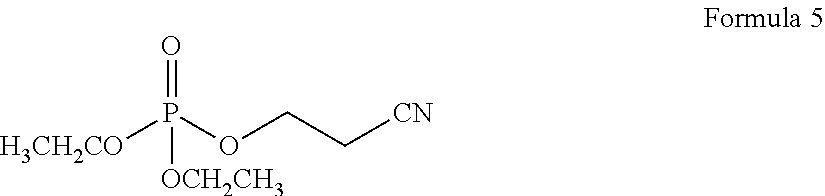
- the compound of Formula 2 may be diethyl(2-cyanoethyl)-phosphonate represented by Formula 5 below, the compound represented by Formula 3 may be 1,4-diisocyanatobutane represented by Formula 6 below, and the compound represented by Formula 4 may be tri-(2-cyanoethyl) phosphine represented by Formula 7 below:
- alkyl indicates a saturated, monovalent, straight or branched hydrocarbon group having about 1-20 carbon atoms, for example, about 1-10 carbon atoms, or about 1-6 carbon atoms.
- the alkyl group may be arbitrarily substituted with at least one halogen substituent.
- alkyl group may include a methyl group, an ethyl group, a propyl group, a 2-propyl group, an n-butyl group, an iso-butyl group, a tert-butyl group, a pentyl group, a hexyl group, a dodecyl group, a fluoromethyl group, a difluoromethyl group, a trifluoromethyl group, a chloromethyl group, a dichloromethyl group, a trichloromethyl group, an iodomethyl group, and a bromomethyl group.
- aryl indicates a monovalent, monocyclic, bicyclic, or tricyclic aromatic hydrocarbon group having 6-30 carbon atoms, for example, 6-18 carbon atoms.
- the aryl group may be arbitrarily substituted with at least one halogen substituent.
- alkenyl indicates a straight or branched unsaturated hydrocarbon chain radical having one or more carbon-carbon double bonds therein and 2-20 carbon atoms, for example, 2-10 carbon atoms, or 2-6 carbon atoms.
- the alkenyl group binds to residual binding sites via a single bond or a double bond.
- Examples of the alkenyl group may include ethyl, prop-1-enyl, but-1-enyl, pent-1-enyl, and penta-1,4-dienyl.
- alkynyl indicates a straight or branched unsaturated hydrocarbon chain radical having one or more carbon-carbon triple bonds and 2-20 carbon atoms, and for example, 2-10 carbon atoms, or 2-6 carbon atoms.
- the alkynyl group may bind to the residual binding sites via a single bond or a triple bond. Examples of the alkynyl group include ethynyl, prop-1-ynyl, but-1-ynyl, pent-1-ynyl, and pent-3-enyl.
- alkoxy indicates an alkyl group bound to oxygen through a single bond and the oxygen in turn bonded through a single bond to another moiety.
- heteroalkyl indicates an alkyl group, wherein at least one carbon atom in the backbone of the alkyl group is substituted with a hetero atom such as nitrogen, sulfur, oxygen, or phosphorus.
- heteroaryl indicates an aryl group, wherein at least one carbon in the ring of the aryl group is substituted with a hetero atom such as nitrogen, sulfur, oxygen, or phosphorus.
- alkylene alkenylene
- alkynylene alkynylene
- the amounts of the compounds represented by Formulae 1 to 10 in the organic electrolytic solution according to the present embodiment may respectively be in the range of about 0.01 to about 10 parts by weight based on 100 parts by weight of the organic solvent.
- the amount of the compounds may be in the range of about 0.01 to about 3 parts by weight based on 100 parts by weight of the organic solvent.
- the organic solvent used in the organic electrolytic solution may be a nonaqueous organic solvent that functions as a medium through which ions participate in an electrochemical reaction of a battery.
- the nonaqueous organic solvent may include a carbonate solvent, an ester solvent, an ether solvent, a ketone solvent, an alcohol solvent, or an aprotic solvent.
- the carbonate solvent may be dimethyl carbonate (DMC), diethyl carbonate (DEC), dipropyl carbonate (DPC), methylpropyl carbonate (MPC), ethylpropyl carbonate (EPC), ethyl methyl carbonate (methylethyl carbonate, MEC or EMC), ethylene carbonate (EC), propylene carbonate (PC), butylene carbonate (BC), or the like.
- DMC dimethyl carbonate
- DEC diethyl carbonate
- DPC dipropyl carbonate
- MPC methylpropyl carbonate
- EPC ethylpropyl carbonate
- EC ethyl methyl carbonate
- EC ethylene carbonate
- PC propylene carbonate
- BC butylene carbonate
- the ester solvent may be methyl acetate, ethyl acetate, n-propyl acetate, dimethylacetate, methylpropionate, ethylpropionate, ⁇ -butyrolactone, 5-decanolide, ⁇ -valerolactone, dl-mevalonolactone, ⁇ -caprolactone, or the like.
- the ether solvent may be dibutyl ether, tetraglyme, diglyme, dimethoxy ethane, 2-methyltetrahydrofuran, tetrahydrofuran, or the like.
- the ketone solvent may be cyclohexanone, or the like.
- the alcohol solvent may be ethyl alcohol, isopropyl alcohol, or the like.
- the aprotic solvent may be a nitrile such as R—CN (where R is a C 2 -C 20 straight, branched, or cyclic hydrocarbon which may include a double bonded aromatic ring or an ether bond), an amide such as dimethylformamide, dioxolane such as 1,3-dioxolane, sulfolane, or the like.
- the nonaqueous organic solvents may be used alone or in combinations of at least two. If used in combinations, the ratio of the nonaqueous organic solvents may vary according to the performance of a desired lithium battery.
- the lithium salt used in the organic electrolyte solution is dissolved in the organic solvent and functions a source of lithium ions in the lithium battery to basically operate the lithium battery and accelerate the migration of lithium ions between the cathode and the anode.
- the lithium salt are LiPF 6 , LiBF 4 , LiSbF 6 , LiAsF 6 , LiN(SO 2 C 2 F 5 ) 2 , Li(CF 3 SO 2 ) 2 N, LiC 4 F 9 SO 3 , LiClO 4 , LiAlO 2 , LiAlCl 4 , LiN(C x F 2x+1 SO 2 )(C y F 2y+1 SO 2 )(where x and y are natural number), LiCl, Lil and LiB(C 2 O 4 ) 2 (lithium bis(oxalato) borate or (LiBOB)).
- the concentration of the lithium salt may be in the range of about 0.1 to about 2.0M. If the concentration of the lithium salt is within the range above, the organic electrolytic solution may have desired conductivity and viscosity, and thus the organic electrolytic solution may have excellent electrolytic properties, and lithium ions may migrate effectively.
- a lithium battery according to another embodiment of the present invention includes a cathode, an anode and the organic electrolytic solution.
- the type of the lithium battery is not limited, and may be, for example, a lithium secondary battery, such as a lithium ion battery, a lithium ion polymer battery, a lithium sulfur battery, or the like; or a lithium primary battery.
- the lithium battery includes an anode, a cathode, and an electrolyte, and may be prepared as described below.
- the cathode includes a current collector and a cathode active material layer formed on the current collector.
- a cathode active material, a conducting agent, a binder and a solvent are mixed to prepare a cathode active material composition.
- the cathode active material composition is directly coated on an aluminium (Al) current collector and dried to prepare a cathode plate.
- Al aluminium
- the cathode active material composition is cast on a separate substrate and the film obtained therefrom is laminated on an Al current collector to prepare a cathode plate.
- the method of manufacturing the cathode is known in the art, and thus a detailed description thereof will not be provided.
- the solvent may be N-methylpyrrolidone (NMP), water, or the like, without limitation.
- a compound (lithiated intercalation compound) which allows reversible intercalation and deintercalation of lithium may be used as the cathode active material for forming the anode active material layer.
- the cathode active material may include at least one composite oxide of lithium and a metal selected from the group consisting of cobalt (Co), manganese (Mn), nickel (Ni), and combinations thereof.
- Examples of the cathode active material may include compounds represented by the following formulae.
- Li a A 1 ⁇ b X b D 2 (where 0.95 ⁇ a ⁇ 1.1, and 0 ⁇ b ⁇ 0.5); Li a E 1 ⁇ b X b O 2 ⁇ c D c (where 0.95 ⁇ a ⁇ 1.1, 0 ⁇ b ⁇ 0.5, 0 ⁇ c ⁇ 0.05); LiE 2 ⁇ b X b O 4 ⁇ c D c (where 0 ⁇ b ⁇ 0.5, 0 ⁇ c ⁇ 0.05); Li a Ni 1 ⁇ b ⁇ c Co b BcD ⁇ (where 0.95 ⁇ a ⁇ 1.1, 0 ⁇ b ⁇ 0.5, 0 ⁇ c ⁇ 0.05, 0 ⁇ 2); Li a Ni 1 ⁇ b ⁇ c Co b X c O 2 ⁇ M ⁇ (where 0.95 ⁇ a ⁇ 1.1, 0 ⁇ b ⁇ 0.5, 0 ⁇ c ⁇ 0.05, 0 ⁇ 2); Li a Ni 1 ⁇ b ⁇ c Co b X c O 2 ⁇ M 2 (where 0.95 ⁇ a ⁇ 1.1, 0 ⁇ b ⁇ 0.5, 0 ⁇ c ⁇ 0.05, 0 ⁇ 2); Li a Ni 1 ⁇ b
- A is selected from the group consisting of nickel (Ni), cobalt (Co), manganese (Mn), and combinations thereof;
- X is selected from the group consisting of aluminum (Al), nickel (Ni), cobalt (Co), manganese (Mn), chromium (Cr), iron (Fe), magnesium (Mg), strontium (Sr), vanadium (V), a rare earth element, and combinations thereof;
- D is selected from the group consisting of oxygen (O), fluorine (F), sulfur (S), phosphorus (P), and combinations thereof;
- E is selected from the group consisting of cobalt (Co), manganese (Mn), and combinations thereof;
- M is selected from the group consisting of fluorine (F), sulfur (S), phosphorus (P), and combinations thereof;
- G is selected from the group consisting of aluminum (Al), chromium (Cr), manganese (Mn), iron (Fe), magnesium (Mg), lanthanum (La), cerium (Ce
- a surface coating layer may be formed on these compounds.
- a mixture of the compounds without having a coating layer formed thereon and a compound having a coating layer formed thereon, the compounds being selected from the above group, may be used.
- the coating layer may include at least one compound of a coating element selected from the group consisting of oxides, hydroxides, oxyhydroxides, oxycarbonates, and hydroxycarbonates of the coating element.
- the compounds for the coating layer may be amorphous or crystalline.
- the coating element contained in the coating layer may be magnesium (Mg), aluminium (Al), cobalt (Co), potassium (K), sodium (Na), calcium (Ca), silicon (Si), titanium (Ti), vanadium (V), tin (Sn), germanium (Ge), gallium (Ga), boron (B), arsenic (As), zirconium (Zr), or mixtures thereof.
- the coating layer may be formed using any method that does not adversely affect the physical properties of the cathode active material when a compound of such a coating element is used, for example, a spray coating method, an immersion method, or the like. This is known in the art, and thus a detailed description thereof will not be provided.
- the binder contained in the cathode active material layer functions to strongly bind cathode active material particles together and to the current collector.
- the binder may include, but are not limited to, polyvinyl alcohol, carboxymethyl cellulose, hydroxypropyl cellulose, diacetyl cellulose, polyvinyl chloride, carboxylated polyvinyl chloride, polyvinyl fluoride, and a polymer having ethylene oxide (polyethylene oxide or PEO), polyvinylpyrrolidone, polyurethane, polytetrafluoroethylene, polyvinylidene fluoride, polyethylene, polypropylene, styrene-butadiene rubber (SBR), acrylated SBR (styrene acrylate co-polymer), epoxy resin, nylon (polyamide), and the like.
- the conducting agent contained in the cathode active material layer is used to provide conductivity to the cathode. Any electrical conductive material causing no chemical change in batteries may be used.
- the conducting agent include carbonaceous materials, such as natural graphite, artificial graphite, carbon black, acetylene black, ketjen black, carbon fibers, and the like; metal-based materials, such as copper (Cu), nickel (Ni), aluminum (Al), silver (Ag), and the like, in powder or fiber form; and conductive materials, including conductive polymers, such as a polyphenylene derivative, and mixtures thereof.
- the current collector may be formed of aluminum (Al), but is not limited thereto.
- an anode active material, a conducting agent, a binder and a solvent are mixed to prepare an anode active material composition.
- the anode active material composition is directly coated on a Cu current collector, or is cast on a separate substrate and an anode active material film obtained therefrom is laminated on a Cu current collector to obtain an anode plate. Amounts of the anode active material, the conducting agent, the binder and the solvent are those commonly used in a lithium battery.
- a silicon/carbon complex (SiO x ), silicon metal, silicon thin film, lithium metal, a lithium alloy, a carbonaceous material or graphite may be used as the anode active material.
- the conducting agent, the binder and the solvent in the anode active material composition are the same as those in the cathode active material composition.
- a plasticizer may be added to the cathode active material composition and the anode active material composition to produce pores inside the electrode plates.
- a separator may be interposed between the cathode and the anode according to the type of the lithium battery.
- the separator used in the lithium battery may be any separator that is commonly used for lithium batteries.
- the separator may have low resistance to migration of ions in an electrolyte and have a high electrolyte-retaining ability.
- materials used to form the separator include glass fiber, polyester, a fluoropolymer such as polytetrafluoroethylene (PTFE), polyethylene, polypropylene, and combinations thereof, each of which may be a nonwoven fabric or a woven fabric.
- a windable separator formed of a material such as polyethylene or polypropylene may be used for a lithium ion polymer battery.
- a separator that may retain a large amount of an organic electrolytic solution may be used for a lithium-ion polymer battery. A method of forming these separators will now be described in more detail.
- a polymer resin, a filler, and a solvent are mixed to prepare a separator composition. Then, the separator composition may be directly coated on an electrode, and then dried to form a separator film. Alternatively, the separator composition may be cast on a support and then dried to form a separator composition film, and the separator composition film exfoliated from the support may be laminated on an electrode to form a separator film.
- the polymer resin is not particularly limited and may be any material that may be used as a binder for an electrode plate.
- the polymer resin include vinylidenefluoride/hexafluoropropylene copolymer, polyvinylidenefluoride, polyacrylonitrile, polymethylmethacrylate and mixtures thereof.
- a vinylidenefluoride/hexafluoropropylene copolymer having about 8 to about 25 wt % of hexafluoropropylene may be used.
- the separator may be interposed between the cathode plate and the anode plate to form a battery assembly.
- the electrode assembly is wound or folded and then sealed in a cylindrical or rectangular battery case. Then, an organic electrolyte solution is injected into the battery case to complete the manufacture of a lithium ion battery.
- a plurality of electrode assemblies may be stacked in a multi-cell structure and impregnated with an organic electrolyte solution. The resultant is put into a pouch and sealed, thereby completing the manufacture of a lithium ion polymer battery.
- FIG. 1 is a schematic perspective view of a lithium battery 30 according to an embodiment of the present invention.
- the lithium battery 30 according to the present embodiment includes a cathode 23 , an anode 22 and a separator interposed between the cathode 23 and the anode 22 , and an electrolyte (not shown and bathing the cathode 23 ), the anode 22 and the separator 24 , a case 25 , and a sealing member 26 sealing the case 25 .
- the lithium battery 30 is manufactured by sequentially stacking the cathode 23 , the anode 22 and the separator 24 upon one another, winding the stack in a spiral form, and inserting the wound stack in the case 25 .
- 0.3 parts by weight of diethyl(2-cyanoethyl)-phosphonate represented by Formula 5 below was added to 100 parts by weight of a mixed organic solvent including 30 volume % of ethylene carbonate, 50 volume % of diethyl carbonate and 20 volume % of ethyl methyl carbonate, and 1.3 M of a lithium salt, LiPF 6 , was added thereto, in order to prepare an organic electrolyte solution.
- a mixed organic solvent including 30 volume % of ethylene carbonate, 50 volume % of diethyl carbonate and 20 volume % of ethyl methyl carbonate, and 1.3 M of a lithium salt, LiPF 6 , was added thereto, in order to prepare an organic electrolyte solution.
- 1,4-diisocyanatobutane represented by Formula 6 below was added to 100 parts by weight of a mixed organic solvent including 30 volume % of ethylene carbonate, 50 volume % of diethyl carbonate and 20 volume % of ethyl methyl carbonate, and 1.3 M of a lithium salt, LiPF 6 , was added thereto, in order to prepare an organic electrolyte solution.
- a mixed organic solvent including 30 volume % of ethylene carbonate, 50 volume % of diethyl carbonate and 20 volume % of ethyl methyl carbonate, and 1.3 M of a lithium salt, LiPF 6 , was added thereto, in order to prepare an organic electrolyte solution.
- 0.1 parts by weight of tri-(2-cyanoethyl)phosphine represented by Formula 7 below was added to 100 parts by weight of a mixed organic solvent including 30 volume % of ethylene carbonate, 50 volume % of diethyl carbonate and 20 volume % of ethyl methyl carbonate, and 1.3 M of a lithium salt, LiPF 6 , was added thereto, in order to prepare an organic electrolyte solution.
- a mixed organic solvent including 30 volume % of ethylene carbonate, 50 volume % of diethyl carbonate and 20 volume % of ethyl methyl carbonate, and 1.3 M of a lithium salt, LiPF 6 , was added thereto, in order to prepare an organic electrolyte solution.
- An organic electrolytic solution was prepared in the same manner as in Preparation Example 1, except that diethyl(2-cyanoethyl)-phosphonate was not added thereto.
- PVdF polyvinylidene fluoride
- NMP N-methylpyrrolidone
- SUPER P®, Timcal SA conducting agent
- the slurry was cast on a 15 ⁇ m aluminum foil using a doctor blade with an interval of 100 ⁇ m to obtain a cathode electrode. Then, the cathode electrode was dried in a primary drying process in an oven at 90° C. for about 2 hours so as to evaporate NMP, and the resultant was dried in a secondary drying process in a vacuum oven at 120° C. for about 2 hours to completely evaporate the NMP. Then, the cathode electrode was rolled to have a thickness of 60 ⁇ m.
- a silicon oxide (SiO) powder and a binder including polyamideimide were mixed in a weight ratio of 90:1 in an agate mortar to prepare a slurry for an anode material.
- the slurry was cast on a 10 ⁇ m copper foil using a doctor blade with an interval of 60 ⁇ m to obtain an anode electrode.
- the anode electrode was dried in a drying process in an oven at 90° C. for about 2 hours, and the anode electrode was rolled to have a thickness of 47 ⁇ m.
- the anode electrode was cured in a vacuum oven at 200° C. for about 1 hour.
- Lithium batteries in the form of coin cells were prepared in the same manner as in Example 1, except that the organic electrolytic solution prepared according to Preparation Example 2 was used instead of the organic electrolytic solution prepared according to Preparation Example 1.
- Lithium batteries in the form of coin cells were prepared in the same manner as in Example 1, except that the organic electrolytic solution prepared according to Preparation Example 3 was used instead of the organic electrolytic solution prepared according to Preparation Example 1.
- Lithium batteries in the form of coin cells were prepared in the same manner as in Example 1, except that a cathode including Li 2 NiO 2 and LiCoO 2 in a weight ratio of 1:9 was used instead of the cathode including Li 1.167 Ni 0.2333 Co 0.1 Mn 0.4667 MO 0.033 O 2 and LiCoO 2 in a weight ratio of 3:7.
- Lithium batteries in the form of coin cells were prepared in the same manner as in Example 4, except that the organic electrolytic solution prepared according to Preparation Example 2 was used instead of the organic electrolytic solution prepared according to Preparation Example 1.
- Lithium batteries in the form of coin cells were prepared in the same manner as in Example 4, except that the organic electrolytic solution prepared according to Preparation Example 3 was used instead of the organic electrolytic solution prepared according to Preparation Example 1.
- Lithium batteries in the form of coin cells were prepared in the same manner as in Example 1, except that the organic electrolytic solution prepared according to Comparative Preparation Example 1 was used instead of the organic electrolytic solution prepared according to Preparation Example 1.
- Lithium batteries in the form of coin cells were prepared in the same manner as in Example 6, except that the organic electrolytic solution prepared according to Comparative Preparation Example 1 was used instead of the organic electrolytic solution prepared according to Preparation Example 1.
- the coin cells prepared according to Examples 1 to 3 and Comparative Example 1 were charged with a current of 0.05 C until the voltage of the cells reached 4.53 V and discharged with a current of 0.05 C until the voltage of the cells reached 2.5 V in a 1 st cycle.
- the cells were charged with a current of 0.1 C until the voltage of the cells reached 4.50 V, charged while maintaining the voltage of 4.5 V until the current reached 0.05 C, and discharged with a current of 0.1 C until the voltage of the cells reached 2.5 V.
- FIG. 2 is a graph illustrating capacity variation of the lithium batteries prepared according to Comparative Example 1 and Examples 1 to 3.
- the discharge capacity of the 4 th cycle is regarded as the standard capacity, and capacity retention of the 100 th cycle of the cycling mode is shown in Table 1 below.
- the capacity retention is defined by Equation 1 below.
- Capacity retention of 100 th cycle of cycling mode [%] Discharge capacity of 100 th cycle of cycling mode/Discharge capacity of 1 st cycle of cycling mode Equation 1
- the capacity retention of the coin cells prepared according to Examples 1 to 3 into which compounds of Formulae 5 to 7 are added as additives according to embodiments of the present invention is greater than that of the coin cells prepared according to Comparative Example 1.
- FIG. 3 is a graph illustrating capacity variation of the lithium batteries prepared according to Comparative Example 2 and Examples 4 to 6 while being stored at high temperature.
- Capacity retention of 100 th cycle at 60° C. is defined by Equation 2 below.
- Capacity retention of 100 th cycle at 60° C. [%] Discharge capacity of 100 th cycle at 60° C./Discharge capacity of 1 st cycle at 60° C. Equation 2
- the capacity retention of the coin cells prepared according to Examples 4 to 6 into which compounds of Formulae 5 to 7 are added as additives according to embodiments of the present invention is greater than that of coin cells prepared according to Comparative Example 2 after being stored at high temperature.
- a lithium battery including the organic electrolytic solution has excellent stability at high temperature and long lifetime.
Landscapes
- Chemical & Material Sciences (AREA)
- Engineering & Computer Science (AREA)
- Manufacturing & Machinery (AREA)
- Chemical Kinetics & Catalysis (AREA)
- Electrochemistry (AREA)
- General Chemical & Material Sciences (AREA)
- Materials Engineering (AREA)
- Physics & Mathematics (AREA)
- Condensed Matter Physics & Semiconductors (AREA)
- General Physics & Mathematics (AREA)
- Inorganic Chemistry (AREA)
- Secondary Cells (AREA)
Abstract

and a lithium battery employing the organic electrolytic solution. Groups Z1 and Z2 are each, independently, a cyano group, an isocyano group, a substituted or unsubstituted dicyanoethylphosphino group, or a substituted or unsubstituted dialkoxyphosphoryloxy group. Groups R1 through R4 are described fully in the Description. The organic electrolyte solution inhibits decomposition of an electrolytic solution and elution or precipitation of metal ions, and thus the lithium battery including the organic electrolytic solution has excellent cycle characteristics and lifetime characteristics.
Description




Capacity retention of 100th cycle of cycling mode [%]=Discharge capacity of 100th cycle of cycling mode/Discharge capacity of 1st cycle of
| TABLE 1 |
| Capacity retention of 100th cycle of cycling mode (%) |
| Comparative Example 1 | 79.9 | ||
| Example 1 | 92.3 | ||
| Example 2 | 91.1 | ||
| Example 3 | 90.5 | ||
Capacity retention of 100th cycle at 60° C. [%]=Discharge capacity of 100th cycle at 60° C./Discharge capacity of 1st cycle at 60°
| TABLE 2 |
| Capacity retention of 100th cycle of cycling mode at 60° C. (%) |
| Comparative Example 2 | 33.3 | ||
| Example 4 | 74.6 | ||
| Example 5 | 72.8 | ||
| Example 6 | 57.8 | ||
Claims (7)


Applications Claiming Priority (2)
| Application Number | Priority Date | Filing Date | Title |
|---|---|---|---|
| KR10-2009-0044628 | 2009-05-21 | ||
| KR1020090044628A KR101585147B1 (en) | 2009-05-21 | 2009-05-21 | Organic electrolytic solution and lithium battery employing the same |
Publications (2)
| Publication Number | Publication Date |
|---|---|
| US20100297508A1 US20100297508A1 (en) | 2010-11-25 |
| US8445142B2 true US8445142B2 (en) | 2013-05-21 |
Family
ID=43124766
Family Applications (1)
| Application Number | Title | Priority Date | Filing Date |
|---|---|---|---|
| US12/775,997 Active 2031-06-16 US8445142B2 (en) | 2009-05-21 | 2010-05-07 | Organic electrolytic solution and lithium battery employing the same |
Country Status (2)
| Country | Link |
|---|---|
| US (1) | US8445142B2 (en) |
| KR (1) | KR101585147B1 (en) |
Families Citing this family (10)
| Publication number | Priority date | Publication date | Assignee | Title |
|---|---|---|---|---|
| US20130224604A1 (en) * | 2012-02-27 | 2013-08-29 | Samsung Sdi Co., Ltd. | Electrolyte for secondary lithium battery and secondary lithium battery including same |
| CN104488126B (en) * | 2012-08-01 | 2017-06-23 | 株式会社Lg 化学 | Electrode for secondary battery component and the lithium secondary battery comprising it |
| KR101754608B1 (en) * | 2013-02-27 | 2017-07-07 | 삼성에스디아이 주식회사 | Electrolyte and rechargeable lithium battery including the same |
| US20160158252A1 (en) * | 2013-08-20 | 2016-06-09 | Olatec Therapeutics Llc | Pharmaceutical composition and use of diethyl (2-cyanoethyl)phosphonate |
| CN104004183B (en) * | 2014-06-10 | 2016-11-09 | 天津师范大学 | Polymers containing phosphonic acid groups and salts thereof, their preparation methods and applications |
| CN106356562A (en) * | 2016-10-28 | 2017-01-25 | 张家港市国泰华荣化工新材料有限公司 | Electrolyte for ternary cathode material lithium ion battery and ternary cathode material lithium ion battery |
| WO2022032585A1 (en) * | 2020-08-13 | 2022-02-17 | 宁德新能源科技有限公司 | Electrolyte, electrochemical device including electrolyte, and electronic device |
| KR102612376B1 (en) * | 2020-12-23 | 2023-12-12 | 닝더 엠프렉스 테크놀로지 리미티드 | Electrolytes, electrochemical devices and electronic devices |
| CN114400375A (en) * | 2022-01-18 | 2022-04-26 | 宁德新能源科技有限公司 | Electrolyte solution, electrochemical device, and electronic device |
| WO2023177162A1 (en) * | 2022-03-16 | 2023-09-21 | 주식회사 엘지에너지솔루션 | Lithium secondary battery |
Citations (24)
| Publication number | Priority date | Publication date | Assignee | Title |
|---|---|---|---|---|
| JPH087921A (en) | 1994-06-21 | 1996-01-12 | Fujitsu Ltd | Electrolyte for secondary battery |
| CN1045966C (en) | 1997-06-11 | 1999-10-27 | 中国科学院上海有机化学研究所 | Novel trifluorovinyl phosphonic acid diester monomer and its synthesis |
| JP2000036608A (en) | 1998-07-17 | 2000-02-02 | Fuji Photo Film Co Ltd | Gel electrolyte, photoelectric transducer and optical regenerative photoelectric chemical cell |
| US6022643A (en) | 1997-12-08 | 2000-02-08 | Brookhaven Science Associates | Boron compounds as anion binding agents for nonaqueous battery electrolytes |
| JP2000100487A (en) | 1998-09-21 | 2000-04-07 | Fuji Photo Film Co Ltd | Electrolyte, photoelectric conversion element and photoelectrochemical battery |
| JP2000215911A (en) | 1999-01-20 | 2000-08-04 | Denso Corp | Flame retardant electrolyte and non-aqueous electrolyte secondary battery |
| EP1172878A2 (en) | 2000-07-14 | 2002-01-16 | Mitsubishi Chemical Corporation | Non-aqueous electrolytic solution and secondary battery containing same |
| JP2002280061A (en) | 2001-03-15 | 2002-09-27 | Mitsubishi Chemicals Corp | Non-aqueous electrolyte and lithium secondary battery using the same |
| US20040013944A1 (en) | 2002-07-15 | 2004-01-22 | Jin-Young Lee | Lithium secondary battery and a method for preparing the same |
| US20040086757A1 (en) | 2002-10-30 | 2004-05-06 | Mohapatra Satish C. | Fuel cell and fuel cell coolant compositions |
| JP2004171981A (en) | 2002-11-21 | 2004-06-17 | Mitsui Chemicals Inc | Nonaqueous electrolytic solution and secondary battery using the same |
| US20040142246A1 (en) * | 2003-01-14 | 2004-07-22 | Samsung Sdi Co., Ltd. | Organic electrolytic solution and lithium battery using the same |
| WO2004106349A1 (en) | 2003-05-27 | 2004-12-09 | E.I. Dupont De Nemours And Company | Fuel cell membrane containing zirconium phosphate |
| US20040262559A1 (en) | 2003-06-25 | 2004-12-30 | Takayuki Shibata | Fluid control apparatus |
| WO2005029632A1 (en) | 2003-09-19 | 2005-03-31 | Lg Chem, Ltd. | Nonaqueous lithium secondary battery with cyclability and/or high temperature safety improved |
| JP2006286382A (en) | 2005-03-31 | 2006-10-19 | Sanyo Electric Co Ltd | Nonaqueous electrolyte secondary battery |
| US20070026318A1 (en) | 2005-07-26 | 2007-02-01 | Takashi Kishi | Nonaqueous electrolyte secondary battery and battery pack |
| JP2007048545A (en) | 2005-08-09 | 2007-02-22 | Sony Corp | Lithium / iron disulfide primary battery |
| JP2007121280A (en) | 2005-09-30 | 2007-05-17 | Canon Inc | Enzyme electrode, sensor using the same, and biofuel cell |
| US20070176151A1 (en) | 2006-01-31 | 2007-08-02 | Kaimin Chen | Electrolyte additive for performance stability of batteries |
| WO2007091656A1 (en) | 2006-02-09 | 2007-08-16 | Shin-Etsu Polymer Co., Ltd. | Conductive polymer solution, conductive coating, capacitor and process for manufacturing capacitor |
| EP1920755A1 (en) | 2006-11-10 | 2008-05-14 | L'Oréal | Method for permanently deforming keratinous fibres comprising a step of applying an intermediate rinsing component comprising a monovalent metal cation salt or an ammonia salt and an organic acid |
| JP2008123714A (en) | 2006-11-08 | 2008-05-29 | Sony Corp | Electrolyte and battery |
| JP2008198542A (en) | 2007-02-15 | 2008-08-28 | Sony Corp | Nonaqueous electrolyte and nonaqueous electrolyte secondary battery using the same |
-
2009
- 2009-05-21 KR KR1020090044628A patent/KR101585147B1/en active Active
-
2010
- 2010-05-07 US US12/775,997 patent/US8445142B2/en active Active
Patent Citations (29)
| Publication number | Priority date | Publication date | Assignee | Title |
|---|---|---|---|---|
| JPH087921A (en) | 1994-06-21 | 1996-01-12 | Fujitsu Ltd | Electrolyte for secondary battery |
| CN1045966C (en) | 1997-06-11 | 1999-10-27 | 中国科学院上海有机化学研究所 | Novel trifluorovinyl phosphonic acid diester monomer and its synthesis |
| US6022643A (en) | 1997-12-08 | 2000-02-08 | Brookhaven Science Associates | Boron compounds as anion binding agents for nonaqueous battery electrolytes |
| JP2000036608A (en) | 1998-07-17 | 2000-02-02 | Fuji Photo Film Co Ltd | Gel electrolyte, photoelectric transducer and optical regenerative photoelectric chemical cell |
| JP2000100487A (en) | 1998-09-21 | 2000-04-07 | Fuji Photo Film Co Ltd | Electrolyte, photoelectric conversion element and photoelectrochemical battery |
| JP2000215911A (en) | 1999-01-20 | 2000-08-04 | Denso Corp | Flame retardant electrolyte and non-aqueous electrolyte secondary battery |
| EP1172878A2 (en) | 2000-07-14 | 2002-01-16 | Mitsubishi Chemical Corporation | Non-aqueous electrolytic solution and secondary battery containing same |
| EP1172878A3 (en) | 2000-07-14 | 2005-05-25 | Mitsubishi Chemical Corporation | Non-aqueous electrolytic solution and secondary battery containing same |
| JP2002280061A (en) | 2001-03-15 | 2002-09-27 | Mitsubishi Chemicals Corp | Non-aqueous electrolyte and lithium secondary battery using the same |
| US20040013944A1 (en) | 2002-07-15 | 2004-01-22 | Jin-Young Lee | Lithium secondary battery and a method for preparing the same |
| US20040086757A1 (en) | 2002-10-30 | 2004-05-06 | Mohapatra Satish C. | Fuel cell and fuel cell coolant compositions |
| JP2004171981A (en) | 2002-11-21 | 2004-06-17 | Mitsui Chemicals Inc | Nonaqueous electrolytic solution and secondary battery using the same |
| US20040142246A1 (en) * | 2003-01-14 | 2004-07-22 | Samsung Sdi Co., Ltd. | Organic electrolytic solution and lithium battery using the same |
| WO2004106349A1 (en) | 2003-05-27 | 2004-12-09 | E.I. Dupont De Nemours And Company | Fuel cell membrane containing zirconium phosphate |
| JP2005014701A (en) | 2003-06-25 | 2005-01-20 | Advics:Kk | Fluid controlling device |
| US20040262559A1 (en) | 2003-06-25 | 2004-12-30 | Takayuki Shibata | Fluid control apparatus |
| WO2005029632A1 (en) | 2003-09-19 | 2005-03-31 | Lg Chem, Ltd. | Nonaqueous lithium secondary battery with cyclability and/or high temperature safety improved |
| JP2006286382A (en) | 2005-03-31 | 2006-10-19 | Sanyo Electric Co Ltd | Nonaqueous electrolyte secondary battery |
| US20070026318A1 (en) | 2005-07-26 | 2007-02-01 | Takashi Kishi | Nonaqueous electrolyte secondary battery and battery pack |
| JP2007035413A (en) | 2005-07-26 | 2007-02-08 | Toshiba Corp | Nonaqueous electrolyte secondary battery and battery pack |
| JP2007048545A (en) | 2005-08-09 | 2007-02-22 | Sony Corp | Lithium / iron disulfide primary battery |
| JP2007121280A (en) | 2005-09-30 | 2007-05-17 | Canon Inc | Enzyme electrode, sensor using the same, and biofuel cell |
| US20070176151A1 (en) | 2006-01-31 | 2007-08-02 | Kaimin Chen | Electrolyte additive for performance stability of batteries |
| WO2007091656A1 (en) | 2006-02-09 | 2007-08-16 | Shin-Etsu Polymer Co., Ltd. | Conductive polymer solution, conductive coating, capacitor and process for manufacturing capacitor |
| US20090021894A1 (en) | 2006-02-09 | 2009-01-22 | Tailu Ning | Conductive polymer solution, conductive coating, condenser and process for manufacturing condenser |
| JP2008123714A (en) | 2006-11-08 | 2008-05-29 | Sony Corp | Electrolyte and battery |
| EP1920755A1 (en) | 2006-11-10 | 2008-05-14 | L'Oréal | Method for permanently deforming keratinous fibres comprising a step of applying an intermediate rinsing component comprising a monovalent metal cation salt or an ammonia salt and an organic acid |
| US20080142033A1 (en) | 2006-11-10 | 2008-06-19 | Anne Sabbagh | Process for permanently deforming keratinic fibers comprising an application step of an intermediate rinsing composition including a monovalent metallic cation or an ammonium salt and an organic acid |
| JP2008198542A (en) | 2007-02-15 | 2008-08-28 | Sony Corp | Nonaqueous electrolyte and nonaqueous electrolyte secondary battery using the same |
Non-Patent Citations (2)
| Title |
|---|
| Abstract CN 1165826 Publication date Nov. 26, 1997. |
| U.S. Appl. No. 12/775,940, filed May 7, 2010, Dong-joon Lee et al., Samsung SDI Co., Ltd. |
Also Published As
| Publication number | Publication date |
|---|---|
| KR20100125769A (en) | 2010-12-01 |
| US20100297508A1 (en) | 2010-11-25 |
| KR101585147B1 (en) | 2016-01-13 |
Similar Documents
| Publication | Publication Date | Title |
|---|---|---|
| US8445142B2 (en) | Organic electrolytic solution and lithium battery employing the same | |
| US9093702B2 (en) | Electrolytic solution for lithium battery, lithium battery employing the same and method for operating the lithium battery | |
| CN110612632B (en) | Non-aqueous electrolyte solution for lithium secondary battery and lithium secondary battery containing the same | |
| US11063296B2 (en) | Electrolyte additive and non-aqueous electrolyte solution for lithium secondary battery comprising the same | |
| US8999575B2 (en) | Positive electrode and lithium battery including the same | |
| US10892489B2 (en) | Composite anode active material, and anode and lithium battery including composite anode active material | |
| US9564628B2 (en) | Composite cathode active material, and cathode and lithium battery each using the same | |
| US20110311866A1 (en) | Lithium battery and method of manufacturing the same | |
| US20200251778A1 (en) | Electrolyte for lithium secondary battery and lithium secondary battery comprising same | |
| US8415057B2 (en) | Electrolytic solution for lithium battery, lithium battery comprising the same and method of operating the lithium battery | |
| KR20160091077A (en) | Organic electrolytic solution and Lithium battery comprising the solution | |
| US20120021287A1 (en) | Positive electrode and lithium battery including the same | |
| US20250062407A1 (en) | Organic electrolyte, and secondary battery comprising same | |
| US7858241B2 (en) | Nonaqueous electrolyte for lithium secondary battery and lithium secondary batter using the same | |
| KR102018756B1 (en) | Electrolyte for lithium secondary battery and lithium secondary battery comprising the same | |
| US20080226977A1 (en) | Electrolyte for lithium ion rechargeable battery and lithium ion rechargeable battery including the same | |
| US8568920B2 (en) | Electrolytic solution and lithium battery employing the same | |
| US8685572B2 (en) | Organic electrolyte and lithium battery including the same | |
| US20140212746A1 (en) | Lithium secondary battery for high voltage | |
| US20110117428A1 (en) | Lithium battery and method of manufacturing the same | |
| US20080241700A1 (en) | Electrolyte for lithium rechargeable battery and lithium rechargeable battery comprising the same |
Legal Events
| Date | Code | Title | Description |
|---|---|---|---|
| AS | Assignment |
Owner name: SAMSUNG SDI CO., LTD., KOREA, REPUBLIC OF Free format text: ASSIGNMENT OF ASSIGNORS INTEREST;ASSIGNORS:LEE, DONG-JOON;RYN, YOUNG-GYOON;IM, DONG-MIN;REEL/FRAME:025020/0132 Effective date: 20100831 |
|
| AS | Assignment |
Owner name: SAMSUNG SDI CO., LTD., KOREA, REPUBLIC OF Free format text: CORRECTIVE ASSIGNMENT TO CORRECT THE INVENTORSHIP BY ADDING THE FOURTH INVENTOR SEOK-SOO LEE PREVIOUSLY RECORDED ON REEL 025020 FRAME 0132. ASSIGNOR(S) HEREBY CONFIRMS THE NAME WAS OMITTED;ASSIGNORS:LEE, DONG-JOON;RYN, YOUNG-GYOON;IM, DONG-MIN;AND OTHERS;REEL/FRAME:025082/0978 Effective date: 20100831 |
|
| STCF | Information on status: patent grant |
Free format text: PATENTED CASE |
|
| FEPP | Fee payment procedure |
Free format text: PAYOR NUMBER ASSIGNED (ORIGINAL EVENT CODE: ASPN); ENTITY STATUS OF PATENT OWNER: LARGE ENTITY |
|
| CC | Certificate of correction | ||
| FPAY | Fee payment |
Year of fee payment: 4 |
|
| MAFP | Maintenance fee payment |
Free format text: PAYMENT OF MAINTENANCE FEE, 8TH YEAR, LARGE ENTITY (ORIGINAL EVENT CODE: M1552); ENTITY STATUS OF PATENT OWNER: LARGE ENTITY Year of fee payment: 8 |
|
| MAFP | Maintenance fee payment |
Free format text: PAYMENT OF MAINTENANCE FEE, 12TH YEAR, LARGE ENTITY (ORIGINAL EVENT CODE: M1553); ENTITY STATUS OF PATENT OWNER: LARGE ENTITY Year of fee payment: 12 |