US8433563B2 - Predictive speech signal coding - Google Patents
Predictive speech signal coding Download PDFInfo
- Publication number
- US8433563B2 US8433563B2 US12/455,478 US45547809A US8433563B2 US 8433563 B2 US8433563 B2 US 8433563B2 US 45547809 A US45547809 A US 45547809A US 8433563 B2 US8433563 B2 US 8433563B2
- Authority
- US
- United States
- Prior art keywords
- signal
- remaining
- portions
- ltp
- version
- Prior art date
- Legal status (The legal status is an assumption and is not a legal conclusion. Google has not performed a legal analysis and makes no representation as to the accuracy of the status listed.)
- Active, expires
Links
- 238000000034 method Methods 0.000 claims abstract description 43
- 230000003595 spectral effect Effects 0.000 claims abstract description 40
- 230000000694 effects Effects 0.000 claims abstract description 27
- 238000004590 computer program Methods 0.000 claims abstract description 6
- 230000001131 transforming effect Effects 0.000 claims abstract description 4
- 238000004458 analytical method Methods 0.000 claims description 62
- 230000005284 excitation Effects 0.000 claims description 56
- 230000007774 longterm Effects 0.000 claims description 54
- 238000012545 processing Methods 0.000 claims description 34
- 230000009466 transformation Effects 0.000 claims description 33
- 230000005540 biological transmission Effects 0.000 claims description 17
- 238000009795 derivation Methods 0.000 claims description 6
- 238000004891 communication Methods 0.000 claims description 4
- 230000009467 reduction Effects 0.000 claims description 3
- 230000002452 interceptive effect Effects 0.000 claims 1
- 230000000737 periodic effect Effects 0.000 abstract description 5
- 238000007493 shaping process Methods 0.000 description 66
- 230000015572 biosynthetic process Effects 0.000 description 37
- 238000003786 synthesis reaction Methods 0.000 description 37
- 238000013139 quantization Methods 0.000 description 31
- 239000013598 vector Substances 0.000 description 21
- 230000000875 corresponding effect Effects 0.000 description 12
- 230000002087 whitening effect Effects 0.000 description 10
- 230000004048 modification Effects 0.000 description 7
- 238000012986 modification Methods 0.000 description 7
- 238000010586 diagram Methods 0.000 description 6
- 230000035945 sensitivity Effects 0.000 description 5
- 230000001364 causal effect Effects 0.000 description 4
- 230000003111 delayed effect Effects 0.000 description 3
- 230000008569 process Effects 0.000 description 3
- 238000001228 spectrum Methods 0.000 description 3
- 238000013459 approach Methods 0.000 description 2
- 230000008901 benefit Effects 0.000 description 2
- 238000004364 calculation method Methods 0.000 description 2
- 230000008859 change Effects 0.000 description 2
- 230000004044 response Effects 0.000 description 2
- 230000001755 vocal effect Effects 0.000 description 2
- 230000003044 adaptive effect Effects 0.000 description 1
- 230000002596 correlated effect Effects 0.000 description 1
- 230000001934 delay Effects 0.000 description 1
- 230000001419 dependent effect Effects 0.000 description 1
- 230000001627 detrimental effect Effects 0.000 description 1
- 238000002474 experimental method Methods 0.000 description 1
- 238000001914 filtration Methods 0.000 description 1
- 239000011159 matrix material Substances 0.000 description 1
- 238000010606 normalization Methods 0.000 description 1
- 230000002441 reversible effect Effects 0.000 description 1
- 238000012549 training Methods 0.000 description 1
Images




Classifications
-
- G—PHYSICS
- G10—MUSICAL INSTRUMENTS; ACOUSTICS
- G10L—SPEECH ANALYSIS TECHNIQUES OR SPEECH SYNTHESIS; SPEECH RECOGNITION; SPEECH OR VOICE PROCESSING TECHNIQUES; SPEECH OR AUDIO CODING OR DECODING
- G10L19/00—Speech or audio signals analysis-synthesis techniques for redundancy reduction, e.g. in vocoders; Coding or decoding of speech or audio signals, using source filter models or psychoacoustic analysis
- G10L19/04—Speech or audio signals analysis-synthesis techniques for redundancy reduction, e.g. in vocoders; Coding or decoding of speech or audio signals, using source filter models or psychoacoustic analysis using predictive techniques
- G10L19/08—Determination or coding of the excitation function; Determination or coding of the long-term prediction parameters
-
- G—PHYSICS
- G10—MUSICAL INSTRUMENTS; ACOUSTICS
- G10L—SPEECH ANALYSIS TECHNIQUES OR SPEECH SYNTHESIS; SPEECH RECOGNITION; SPEECH OR VOICE PROCESSING TECHNIQUES; SPEECH OR AUDIO CODING OR DECODING
- G10L19/00—Speech or audio signals analysis-synthesis techniques for redundancy reduction, e.g. in vocoders; Coding or decoding of speech or audio signals, using source filter models or psychoacoustic analysis
- G10L19/04—Speech or audio signals analysis-synthesis techniques for redundancy reduction, e.g. in vocoders; Coding or decoding of speech or audio signals, using source filter models or psychoacoustic analysis using predictive techniques
- G10L19/08—Determination or coding of the excitation function; Determination or coding of the long-term prediction parameters
- G10L19/12—Determination or coding of the excitation function; Determination or coding of the long-term prediction parameters the excitation function being a code excitation, e.g. in code excited linear prediction [CELP] vocoders
-
- G—PHYSICS
- G10—MUSICAL INSTRUMENTS; ACOUSTICS
- G10L—SPEECH ANALYSIS TECHNIQUES OR SPEECH SYNTHESIS; SPEECH RECOGNITION; SPEECH OR VOICE PROCESSING TECHNIQUES; SPEECH OR AUDIO CODING OR DECODING
- G10L19/00—Speech or audio signals analysis-synthesis techniques for redundancy reduction, e.g. in vocoders; Coding or decoding of speech or audio signals, using source filter models or psychoacoustic analysis
- G10L19/04—Speech or audio signals analysis-synthesis techniques for redundancy reduction, e.g. in vocoders; Coding or decoding of speech or audio signals, using source filter models or psychoacoustic analysis using predictive techniques
- G10L19/08—Determination or coding of the excitation function; Determination or coding of the long-term prediction parameters
- G10L19/10—Determination or coding of the excitation function; Determination or coding of the long-term prediction parameters the excitation function being a multipulse excitation
-
- G—PHYSICS
- G10—MUSICAL INSTRUMENTS; ACOUSTICS
- G10L—SPEECH ANALYSIS TECHNIQUES OR SPEECH SYNTHESIS; SPEECH RECOGNITION; SPEECH OR VOICE PROCESSING TECHNIQUES; SPEECH OR AUDIO CODING OR DECODING
- G10L25/00—Speech or voice analysis techniques not restricted to a single one of groups G10L15/00 - G10L21/00
-
- G—PHYSICS
- G10—MUSICAL INSTRUMENTS; ACOUSTICS
- G10L—SPEECH ANALYSIS TECHNIQUES OR SPEECH SYNTHESIS; SPEECH RECOGNITION; SPEECH OR VOICE PROCESSING TECHNIQUES; SPEECH OR AUDIO CODING OR DECODING
- G10L19/00—Speech or audio signals analysis-synthesis techniques for redundancy reduction, e.g. in vocoders; Coding or decoding of speech or audio signals, using source filter models or psychoacoustic analysis
- G10L19/04—Speech or audio signals analysis-synthesis techniques for redundancy reduction, e.g. in vocoders; Coding or decoding of speech or audio signals, using source filter models or psychoacoustic analysis using predictive techniques
- G10L19/08—Determination or coding of the excitation function; Determination or coding of the long-term prediction parameters
- G10L19/09—Long term prediction, i.e. removing periodical redundancies, e.g. by using adaptive codebook or pitch predictor
Definitions
- the present invention relates to the encoding of speech for transmission over a transmission medium, such as by means of an electronic signal over a wired connection or electromagnetic signal over a wireless connection.
- a source-filter model of speech is illustrated schematically in FIG. 1 a .
- speech can be modelled as comprising a signal from a source 102 passed through a time-varying filter 104 .
- the source signal represents the immediate vibration of the vocal chords
- the filter represents the acoustic effect of the vocal tract formed by the shape of the throat, mouth and tongue.
- the effect of the filter is to alter the frequency profile of the source signal so as to emphasise or diminish certain frequencies.
- speech encoding works by representing the speech using parameters of a source-filter model.
- the encoded signal will be divided into a plurality of frames 106 , with each frame comprising a plurality of subframes 108 .
- speech may be sampled at 16 kHz and processed in frames of 20 ms, with some of the processing done in subframes of 5 ms (four subframes per frame).
- Each frame comprises a flag 107 by which it is classed according to its respective type.
- Each frame is thus classed at least as either “voiced” or “unvoiced”, and unvoiced frames are encoded differently than voiced frames.
- Each subframe 108 then comprises a set of parameters of the source-filter model representative of the sound of the speech in that subframe.
- the source signal has a degree of long-term periodicity corresponding to the perceived pitch of the voice.
- the source signal can be modelled as comprising a quasi-periodic signal with each period corresponds to a respective “pitch pulse” comprising a series of peaks of differing amplitudes.
- the source signal is said to be “quasi” periodic in that on a timescale of at least one subframe it can be taken to have a single, meaningful period which is approximately constant; but over many subframes or frames then the period and form of the signal may change.
- the approximated period at any given point may be referred to as the pitch lag.
- An example of a modelled source signal 202 is shown schematically in FIG. 2 a with a gradually varying period P 1 , P 2 , P 3 , etc., each comprising a pitch period of four peaks which may vary gradually in form and amplitude from one period to the next.
- a short-term filter is used to separate out the speech signal into two separate components: (i) a signal representative of the effect of the time-varying filter 104 ; and (ii) the remaining signal with the effect of the filter 104 removed, which is representative of the source signal.
- the signal representative of the effect of the filter 104 may be referred to as the spectral envelope signal, and typically comprises a series of sets of LPC parameters describing the spectral envelope at each stage.
- FIG. 2 b shows a schematic example of a sequence of spectral envelopes 204 1 , 204 2 , 204 3 , etc. varying over time.
- the remaining signal representative of the source alone may be referred to as the LPC residual signal, as shown schematically in FIG. 2 a .
- the short-term filter works by removing short-term correlations (i.e. short term compared to the pitch period), leading to an LPC residual with less energy than the speech signal.
- each subframe 106 would contain: (i) a set of parameters representing the spectral envelope 204 ; and (ii) a set of parameters representing the pulses of the source signal 202 .
- LPC long-term prediction
- correlation being a statistical measure of a degree of relationship between groups of data, in this case the degree of repetition between portions of a signal.
- the source signal can be said to be “quasi” periodic in that on a timescale of at least one correlation calculation it can be taken to have a meaningful period which is approximately (but not exactly) constant; but over many such calculations then the period and form of the source signal may change more significantly.
- a set of parameters derived from this correlation are determined to at least partially represent the source signal for each subframe.
- LTP residual signal representing the source signal with the effect of the correlation between pitch periods removed.
- LTP vectors and LTP residual signal are encoded separately for transmission.
- the sets of LPC parameters, the LTP vectors and the LTP residual signal are each quantised prior to transmission (quantisation being the process of converting a continuous range of values into a set of discrete values, or a larger approximately continuous set of discrete values into a smaller set of discrete values).
- quantisation being the process of converting a continuous range of values into a set of discrete values, or a larger approximately continuous set of discrete values into a smaller set of discrete values.
- each subframe 106 would comprise: (i) a quantised set of LPC parameters representing the spectral envelope, (ii)(a) a quantised LTP vector related to the correlation between pitch periods in the source signal, and (ii)(b) a quantised LTP residual signal representative of the source signal with the effects of this inter-period correlation removed.
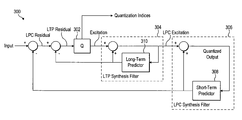
- FIG. 3 a shows a diagram of a linear predictive speech encoder 300 comprising an LPC synthesis filter 306 having a short-term predictor 308 and an LTP synthesis filter 304 having a long-term predictor 310 .
- the output of the short-term predictor 308 is subtracted from the speech input signal to produce an LPC residual signal.
- the output of the long-term predictor 310 is subtracted from the LPC residual signal to create an LTP residual signal.
- the LTP residual signal is quantized by a quantizer 302 to produce an excitation signal, and to produce corresponding quantisation indices for transmission to a decoder to allow it to recreate the excitation signal.
- the quantizer 302 can be a scalar quantizer, a vector quantizer, an algebraic codebook quantizer, or any other suitable quantizer.
- the output of a long term predictor 310 in the LTP synthesis filter 304 is added to the excitation signal, which creates the LPC excitation signal.
- the LPC excitation signal is input to the long-term predictor 310 , which is a strictly causal moving average (MA) filter controlled by the pitch lag and quantized LTP coefficients.
- MA moving average
- the output of a short term predictor 308 in the LPC synthesis filter 306 is added to the LPC excitation signal, which creates the quantized output signal for feedback for subtraction the input.
- the quantized output signal is input to the short-term predictor 308 , which is a strictly causal MA filter controlled by the quantized LPC coefficients.
- FIG. 3 b shows a linear predictive speech decoder 350 .
- Quantization indices are input to an excitation generator 352 which generates an excitation signal.
- the output of a long term predictor 360 in a LTP synthesis filter 354 is added to the excitation signal, which creates the LPC excitation signal.
- the LPC excitation signal is input to the long-term predictor 360 , which is a strictly causal MA filter controlled by the pitch lag and quantized LTP coefficients.
- the output of a short term predictor 358 in a short-term synthesis filter 356 is added to the LPC excitation signal, which creates the quantized output signal.
- the quantized output signal is input to the short-term predictor 358 , which is a strictly causal MA filter controlled by the quantized LPC coefficients.
- the encoder 300 works by using an LTP analysis (not shown) to determine a correlation between successive received pitch pulses in the LPC residual signal, then passing coefficients of that correlation to the LTP synthesis filter where they are used to predict a version of the later of those pitch pulses from a stored version of the earlier of those pitch pulses based on the correlation.
- the predicted version of the later pitch pulse is fed back to the input where it is subtracted from the corresponding portion in the actual LPC residual signal, thus removing the effect of the periodicity and thereby deriving an LTP residual signal.
- LTP analysis not shown
- the LTP synthesis filter uses a long-term prediction to effectively remove or reduce the pitch pulses from the LPC residual signal, leaving an LTP residual signal having lower energy than the LPC residual.
- a method of encoding speech according to a source-filter model whereby speech is modelled to comprise a source signal filtered by a time-varying filter comprising: receiving a speech signal; from the speech signal, deriving a spectral envelope signal representative of the modelled filter and a first remaining signal representative of the modelled source signal, the first remaining signal comprising a plurality of successive portions having a degree of periodicity; deriving a second remaining signal from the first remaining signal by, at intervals during the encoding of said speech signal: exploiting a correlation between ones of said portions to generate a predicted version of a later of said portions from a stored version of an earlier of said portions, and using the predicted version of the later portion to remove an effect of said periodicity from the first remaining signal; and transmitting an encoded signal representing said speech signal based on the spectral envelope signal, said correlations and the second remaining signal; wherein the method further comprises, once every number of said intervals, transforming the stored version of the
- parameters used to derive the first remaining signal may be updated between deriving the respective earlier portion and generating the predicted version of the respective later portion; and said transformation may be performed at said one or more intervals and may comprise updating the stored version of the respective earlier portion of the first residual signal using the updated parameters.
- the encoding may be performed over a plurality of frames each comprising a plurality of subframes, and each of said intervals may be a subframe; said deriving of the second remaining signal may be performed once per subframe whilst parameters used to derive the first remaining signal may be updated once per frame, hence at one subframe per frame then the predicted version of the later portion may be generated from the earlier portion as derived using a previous frame's parameters but used to remove said effect of periodicity from the first remaining signal as derived using a current frame's parameters; and said transformation of the stored version of the earlier portion may be performed at said one subframe per frame and may comprise updating the stored version of the respective earlier portion of the first residual signal using the current frame's parameters.
- the method may comprise determining said correlations using at least one of an open-loop pitch analysis and a long-term prediction analysis, and at least one of those analyses may be based on a version of the first remaining signal derived using said updated parameters for both the previous and current frames.
- Said transformation may be so as to result in a greater reduction in overall energy of the second remaining signal relative to the first remaining signal than without said transformation.
- Said transformation may comprise re-whitening the stored version of the earlier portion.
- the encoded signal may be transmitted as a plurality of packets each encoding a plurality of said intervals, and said transformation of the stored version of the earlier portion may be performed once per packet so as to reduce error propagation caused by potential packet loss in the transmission. Said transformation may be performed for the first interval of each packet.
- Said transformation may be based on information about the packet loss in a channel used for said transmission.
- Said transformation may comprise scaling down the stored version of the earlier portion by a scaling factor.
- the scaling factor may be selected from one of a plurality of specified factors.
- Said specified factors may have substantially the values of 0.5, 0.7 and 0.95.
- Said periodicity may correspond to a perceived pitch of the speech signal.
- the derivation of said spectral envelope signal may be by linear predictive coding (LPC) such that said first remaining signal is an LPC residual signal.
- LPC linear predictive coding
- Said stored versions of the earlier portions may be stored in the form of a quantized excitation corresponding to respective portions of said LPC residual signal.
- Said derivation of the second remaining signal may be by long-term prediction (LTP) such that said second remaining signal is an LTP residual signal.
- LTP long-term prediction
- Each of said stored versions of the earlier portions may each comprises an LTP state.
- a method of decoding an encoded signal comprising speech encoded according to a source-filter model whereby the speech is modelled to comprise a source signal filtered by a time-varying filter, the method comprising: receiving a encoded signal over a communication medium; from the encoded signal, determining a spectral envelope signal representative of the modelled filter; from the encoded signal, determining a second remaining signal; deriving a first remaining signal representative of the modelled source signal and comprising a plurality of successive portions having a degree of periodicity, by, at intervals during the decoding of said encoded signal: determining from the encoded signal information relating to a correlation between ones of said portions of the first remaining signal, using said information to generate a predicted version of a later of said portions based on a stored version of an earlier of said portions, and reconstructing a corresponding portion of the first remaining signal using the second remaining signal and said predicted version of the later portion; and generating a decoded speech signal based on the
- an encoder for encoding speech according to a source-filter model whereby speech is modelled to comprise a source signal filtered by a time-varying filter
- the encoder comprising: an input arranged to receive a speech signal; a first signal processing module configured to derive, from the speech signal, a spectral envelope signal representative of the modelled filter and a first remaining signal representative of the modelled source signal, the first remaining signal comprising a plurality of successive portions having a degree of periodicity; a second signal processing module configured to derive a second remaining signal from the first remaining signal by, at intervals during the encoding of said speech signal: exploiting a correlation between ones of said portions to generate a predicted version of a later of said portions from a stored version of an earlier of said portions, and using the predicted version of the later portion to remove an effect of said periodicity from the first remaining signal; and an output arranged to transmit an encoded signal representing said speech signal based on the spectral envelope signal, said correlations and the second
- a decoder for decoding an encoded signal comprising speech encoded according to a source-filter model whereby the speech is modelled to comprise a source signal filtered by a time-varying filter
- the decoder comprising: an input arranged to receive a encoded signal; a first signal processing module configured to determine, from the encoded signal, a spectral envelope signal representative of the modelled filter; and a second signal processing module configured to determine, from the encoded signal, a second remaining signal; wherein the second signal processing module is further configured to derive a first remaining signal representative of the modelled source signal and comprising a plurality of successive portions having a degree of periodicity, by, at intervals during the decoding of said encoded signal: determining from the encoded signal information relating to a correlation between ones of said portions of the first remaining signal, using said information to generate a predicted version of a later of said portions based on a stored version of an earlier of said portions, and reconstructing a corresponding portion of the
- a computer program product for encoding speech according to a source-filter model whereby the speech is modelled to comprise a source signal filtered by a time-varying filter, the program comprising code arranged so as when executed on a processor to:
- a computer program product for decoding an encoded signal comprising speech encoded according to a source-filter model whereby the speech is modelled to comprise a source signal filtered by a time-varying filter, the program comprising code arranged so as when executed on a processor to:
- a communication system comprising a plurality of end-user terminals each comprising a corresponding encoder and/or decoder.
- FIG. 1 a is a schematic representation of a source-filter model of speech
- FIG. 1 b is a schematic representation of a frame
- FIG. 2 a is a schematic representation of a source signal
- FIG. 2 b is a schematic representation of variations in a spectral envelope
- FIG. 3 a is a schematic block diagram of an encoder
- FIG. 3 b is a schematic block diagram of a decoder
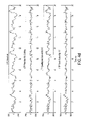
- FIG. 4 a shows graphs of an LPC residual, LTP state and LTP residual
- FIG. 4 b shows further graphs of an LPC residual, LTP state and LTP residual
- FIG. 4 c shows graphs illustrating error propagation
- FIG. 4 d shows graphs of an LTP residual according to a number of methods
- FIG. 4 e is another schematic representation of a frame
- FIG. 5 is another schematic block diagram of an encoder
- FIG. 6 is a schematic block diagram of a noise shaping quantizer
- FIG. 7 is another schematic block diagram of a decoder
- FIG. 8 shows schematically an LTP state and LTP synthesis filter output
- FIG. 9 shows graphs illustrating resynchronisation of the LTP state.
- long-term prediction is a known technique in speech coding whereby correlations between pitch pulses are exploited to improve coding efficiency.
- a long term prediction filter uses one or more pitch lags and one or more LTP coefficients to compute an LTP residual signal from an LPC residual.
- the LTP residual has smaller variance and can thus be encoded more efficiently than the LPC residual.
- the pitch lags and LTP coefficients are sent to the decoder together with the coded LTP residual, or excitation.
- the excitation is used to reconstruct the LPC excitation signal, using an LTP synthesis filter.
- the LTP state is sometimes called the adaptive codebook.
- the long-term prediction process can itself introduce problems such as difficulties in the prediction or propagation of errors.
- the present invention overcomes such problems by providing a method for modifying the LTP state in predictive speech coding.
- the LTP state is the stored LPC residual or LPC excitation signal from the previous pitch period, from which the following pitch period is to be predicted in order to remove it from the current LPC residual signal and thus derive the LTP residual signal.
- the invention can apply to any situation where a first signal is derived to represent the source signal of a source-filter model of speech, and a second signal is then derived by calculating correlation between earlier and later portions of the first signal which have a degree of repetition therebetween. By transforming the stored earlier portion, it is possible to compensate for changes in the filter part of the source-filter model that would lead to an LTP residual signal having a greater energy that it should.
- the long-term prediction filter removes or reduces the pitch pulses in the LPC residual signal by predicting one pitch pulse based on the previous one.
- the LPC residual of one frame is typically computed based on quantized LPC coefficients that may differ from those used to compute the LPC residual of the next frame.
- Reasons for the difference in quantized LPC coefficients may be the natural evolution of the spectral envelope in speech, and numerical fluctuations in the estimation and quantization of the LPC coefficients.
- the difference in quantized LPC coefficients may cause the last pitch pulse of one frame to have a significantly different shape than the first pitch pulse of the next frame. Consequently, the last pitch pulses of a frame may be a poor basis for predicting the first pitch pulse of the next frame.
- the LPC coefficients are typically updated at the start of a frame, and sometimes also during a frame, for example when interpolated LPC coefficients are used.
- the long-term predictor outputs a signal that is based on the LPC coefficients before the update of the LPC coefficients.
- the long-term predictor output is subtracted, with the aim of minimizing an LPC residual signal based on the LPC coefficients after the update of the LPC coefficients. This creates an inconsistency, where the LTP state is not perfectly suited for minimizing the LTP residual.
- the shape of the pitch pulse in the LPC residual signal is influenced by the LPC coefficients, and after updating the LPC coefficients the LTP state may contain a pitch pulse with a different shape than the pitch pulse in the LPC residual.
- the long-term predictor is not able to create a long-term prediction signal that efficiently minimizes the LTP residual.
- problems of this kind can be solved by modifying the LTP state synchronously in encoder and decoder when LPC coefficients are updated. This improves the long-term prediction performance and thus improves coding efficiency.
- First a quantized speech signal is generated by inputting the LTP state into an LPC synthesis filter controlled by the LPC coefficients before the update of the LPC coefficients.
- a new LTP state is created by whitening the quantized speech signal with an LPC analysis filter controlled by the LPC coefficients after the update of the LPC coefficients.
- the LTP state is updated in this manner in encoder and decoder synchronously.
- a preferred modification is to “re-whiten” the LTP state using the same whitening (LPC) coefficients as were used for generating the LPC residual (“whitening” is to equalize the LTP state to flatten its spectral density, so that its energy is more evenly spread across its frequency spectrum). Note that this modification does not necessarily make the LTP more white: the preferred modification is to whiten the stored LTP state using the same, updated whitening (LPC) coefficients as used for generating the current LPC residual.
- LPC whitening
- the whitening operation is done by the LPC analysis, and the LPC synthesis performs the reverse of a whitening operation. Therefore the LTP state was already whitened, but using the LPC coefficients of the previous frame. To compensate for this, the preferred modification is therefore to:
- the modification may be referred to as a “re-whitening” (i.e. re-applying a whitening LPC analysis filter), rather than a whitening per se.
- FIG. 4 a shows the effect of different LCP coefficients used for generating the LTP state and LPC residual.
- the top graph shows an LPC residual for one frame of 20 milliseconds, containing six similarly shaped pitch pulses.
- the similarity allows a long term predictor to create an LTP residual with significantly less energy than the LPC residual.
- the long term predictor uses a state containing the previous pitch pulse.
- the LTP predictor uses an LTP state depending on the LPC coefficients from the previous frame.
- the LTP state is shown in the second graph, and contains a pitch pulse with different shape.
- the LTP residual shown in the bottom graph has more energy for the first pitch pulse than for the subsequent pitch pulses.
- FIG. 4 b shows the same LPC residual in the top graph, but now the LTP state has been modified by first inputting it into an LPC synthesis filter controlled by the LPC coefficients from the previous frame, and then whitening the output from the LPC synthesis filter with an LPC analysis filter controlled by the LPC coefficients of the current frame.
- the result is an LTP state containing a pitch pulse that matches the first pitch pulse of the LPC residual better. Consequently, the LTP residual in the bottom graph contains less energy for the first pitch pulse than with the unmodified LTP state.
- the LTP residual can be coded more efficiently, thereby reducing the bitrate of the codec.
- Another particular problem with existing encoders is packet loss error propagation.
- the LTP synthesis filter in the decoder (a time varying AR filter), often has a very long impulse response. This means that an error in the decoder, due to losing a packet can have effect over a long time. This effect is often called error propagation as the error from the lost frame propagates into future frames.
- FIG. 4 c The effect of such error propagation is illustrated in FIG. 4 c .
- the top graph shows an error free decoded signal
- the middle graph shows a decoded signal with a packet loss between the vertical lines
- the bottom graph shows the difference between the two decoded signals. As illustrated, the difference lasts much longer than the duration of the lost packet.
- One approach to reduce the error propagation is to set constraints on the LTP coefficients so as to shorten the impulse response of the LTP synthesis filter. By doing this the coding gain from LTP is lowered resulting in a need for higher bit rate to maintain the output speech quality in lossless condition.
- the problem of error propagation can be reduced by down-scaling the LTP state synchronously in encoder and decoder.
- error propagation is controlled by scaling down the LTP filter state in both encoder and decoder at the start of each new packet. This gives a better trade off between LTP prediction gain and packet loss error propagation, which translates to a better trade off between bitrate and packet loss sensitivity.
- FIG. 4 d illustrates different methods for limiting error propagation.
- the top graph shows one 20 ms frame of LPC residual.
- the other three graphs show one corresponding frame of LTP residual for three different methods.
- the second graph shows the LTP residual for unconstrained LTP coefficients.
- the LTP residual can be seen to be much reduced compared to the LPC residual.
- the third graph shows the LTP residual for scaled LTP coefficients scaled by 0.5.
- the LTP residual is less reduced than for the unconstrained method.
- the last graph shows the LTP residual for a scaled LTP state scaled by 0.5, with the optimal LTP coefficients used unaltered.
- the first pitch pulse is less reduced, similar to the LTP residual signal with scaled LTP coefficients. However, the remainder of the LTP residual is as much reduced as with the unconstrained method.
- the method of scaling the LTP state is better than scaling the LTP coefficients, because of the higher coding efficiency for the signal after the first pitch pulse.
- FIG. 4 e is a schematic representation of a frame according to a preferred embodiment of the present invention.
- the frame additionally comprises an index 110 of the scaling value selected to multiply the LTP state by.
- the encoder 500 comprises a high-pass filter 502 , a linear predictive coding (LPC) analysis block 504 , a first vector quantizer 506 , an open-loop pitch analysis block 508 , a long-term prediction (LTP) analysis block 510 , a second vector quantizer 512 , a noise shaping analysis block 514 , a noise shaping quantizer 516 , and an arithmetic encoding block 518 .
- the LTP analysis block 510 comprises a scaling control module 520 , which will be discussed later in relation to FIG. 6 .
- the high pass filter 502 has an input arranged to receive an input speech signal from an input device such as a microphone, and an output coupled to inputs of the LPC analysis block 504 , noise shaping analysis block 514 and noise shaping quantizer 516 .
- the LPC analysis block has an output coupled to an input of the first vector quantizer 506 , and the first vector quantizer 506 has outputs coupled to inputs of the arithmetic encoding block 518 and noise shaping quantizer 516 .
- the LPC analysis block 504 has outputs coupled to inputs of the open-loop pitch analysis block 508 and the LTP analysis block 510 .
- the LTP analysis block 510 has an output coupled to an input of the second vector quantizer 512
- the second vector quantizer 512 has outputs coupled to inputs of the arithmetic encoding block 518 and noise shaping quantizer 516 .
- the open-loop pitch analysis block 508 has outputs coupled to inputs of the LTP 510 analysis block 510 and the noise shaping analysis block 514 .
- the noise shaping analysis block 514 has outputs coupled to inputs of the arithmetic encoding block 518 and the noise shaping quantizer 516 .
- the noise shaping quantizer 516 has an output coupled to an input of the arithmetic encoding block 518 .
- the arithmetic encoding block 518 is arranged to produce an output bitstream based on its inputs, for transmission from an output device such as a wired modem or wireless transceiver.
- the encoder processes a speech input signal sampled at 16 kHz in frames of 20 milliseconds, with some of the processing done in subframes of 5 milliseconds.
- the output bitsream payload contains arithmetically encoded parameters, and has a bitrate that varies depending on a quality setting provided to the encoder and on the complexity and perceptual importance of the input signal.
- the speech input signal is input to the high-pass filter 504 to remove frequencies below 80 Hz which contain almost no speech energy and may contain noise that can be detrimental to the coding efficiency and cause artifacts in the decoded output signal.
- the high-pass filter 504 is preferably a second order auto-regressive moving average (ARMA) filter.
- the high-pass filtered input X HP is input to the linear prediction coding (LPC) analysis block 504 , which calculates 16 LPC coefficients a i using the covariance method which minimizes the energy of the LPC residual r LPC :
- the LPC residual is computed for the current frame, and also for the previous frame using the LPC coefficients derived for the current frame.
- the effect of this is to use an LPC residual generated with constant LPC coefficients in the open loop pitch analysis and LTP analysis. Having the last pitch pulse in the previous frame generated with the same LPC coefficients as the pitch pulses in the current frame improves the open loop pitch estimation and LTP analysis. This is particularly applicable when applying the re-whitening in the noise shaping quantizer 516 as described below.
- the LPC coefficients are transformed to a line spectral frequency (LSF) vector.
- LSFs are quantized using the first vector quantizer 506 , a multi-stage vector quantizer (MSVQ) with 10 stages, producing 10 LSF indices that together represent the quantized LSFs.
- MSVQ multi-stage vector quantizer
- the quantized LSFs are transformed back to produce the quantized LPC coefficients for use in the noise shaping quantizer 516 .
- the LPC residual is input to the open loop pitch analysis block 508 , producing one pitch lag for every 5 millisecond subframe, i.e., four pitch lags per frame.
- the pitch lags are chosen between 32 and 288 samples, corresponding to pitch frequencies from 56 to 500 Hz, which covers the range found in typical speech signals.
- the pitch analysis produces a pitch correlation value which is the normalized correlation of the signal in the current frame and the signal delayed by the pitch lag values. Frames for which the correlation value is below a threshold of 0.5 are classified as unvoiced, i.e., containing no periodic signal, whereas all other frames are classified as voiced.
- the pitch lags are input to the arithmetic coder 518 and noise shaping quantizer 516 .
- LPC residual r LPC is supplied from the LPC analysis block 504 to the LTP analysis block 510 .
- the LTP analysis block 510 solves normal equations to find 5 linear prediction filter coefficients b i such that the energy in the LTP residual r LTP for that subframe:
- the LTP residual is computed as the LPC residual in the current subframe minus a filtered and delayed LPC residual.
- the LPC residual in the current subframe and the delayed LPC residual are both generated with an LPC analysis filter controlled by the same LPC coefficients. That means that when the LPC coefficients were updated, an LPC residual is computed not only for the current frame but also a new LPC residual is computed for at least lag+2 samples preceding the current frame.
- the LTP coefficients for each frame are quantized using a vector quantizer (VQ).
- VQ vector quantizer
- the resulting VQ codebook index is input to the arithmetic coder, and the quantized LTP coefficients b Q are input to the noise shaping quantizer.
- the high-pass filtered input is analyzed by the noise shaping analysis block 514 to find filter coefficients and quantization gains used in the noise shaping quantizer.
- the filter coefficients determine the distribution over the quantization noise over the spectrum, and are chose such that the quantization is least audible.
- the quantization gains determine the step size of the residual quantizer and as such govern the balance between bitrate and quantization noise level.
- All noise shaping parameters are computed and applied per subframe of 5 milliseconds.
- a 16 th order noise shaping LPC analysis is performed on a windowed signal block of 16 milliseconds.
- the signal block has a look-ahead of 5 milliseconds relative to the current subframe, and the window is an asymmetric sine window.
- the noise shaping LPC analysis is done with the autocorrelation method.
- the quantization gain is found as the square-root of the residual energy from the noise shaping LPC analysis, multiplied by a constant to set the average bitrate to the desired level.
- the quantization gain is further multiplied by 0.5 times the inverse of the pitch correlation determined by the pitch analyses, to reduce the level of quantization noise which is more easily audible for voiced signals.
- the quantization gain for each subframe is quantized, and the quantization indices are input to the arithmetically encoder 518 .
- the quantized quantization gains are input to the noise shaping quantizer 516 .
- a shape, i are found by applying bandwidth expansion to the coefficients found in the noise shaping LPC analysis.
- the short-term and long-term noise shaping coefficients are input to the noise shaping quantizer 516 .
- the high-pass filtered input is also input to the noise shaping quantizer 516 .
- noise shaping quantizer 516 An example of the noise shaping quantizer 516 is now discussed in relation to FIG. 6 .
- the noise shaping quantizer 516 comprises a first addition stage 602 , a first subtraction stage 604 , a first amplifier 606 , a scalar quantizer 608 , a second amplifier 609 , a second addition stage 610 , a shaping filter 612 , a prediction filter 614 and a second subtraction stage 616 .
- the shaping filter 612 comprises a third addition stage 618 , a long-term shaping block 620 , a third subtraction stage 622 , and a short-term shaping block 624 .
- the prediction filter 614 comprises a fourth addition stage 626 , a long-term prediction block 628 , a fourth subtraction stage 630 , and a short-term prediction block 632 .
- the long term prediction block 628 comprises an LTP buffer 634 .
- the first addition stage 602 has an input arranged to receive the high-pass filtered input from the high-pass filter 502 , and another input coupled to an output of the third addition stage 618 .
- the first subtraction stage has inputs coupled to outputs of the first addition stage 602 and fourth addition stage 626 .
- the first amplifier has a signal input coupled to an output of the first subtraction stage and an output coupled to an input of the scalar quantizer 608 .
- the first amplifier 606 also has a control input coupled to the output of the noise shaping analysis block 514 .
- the scalar quantiser 608 has outputs coupled to inputs of the second amplifier 609 and the arithmetic encoding block 518 .
- the second amplifier 609 also has a control input coupled to the output of the noise shaping analysis block 514 , and an output coupled to the an input of the second addition stage 610 .
- the other input of the second addition stage 610 is coupled to an output of the fourth addition stage 626 .
- An output of the second addition stage is coupled back to the input of the first addition stage 602 , and to an input of the short-term prediction block 632 and the fourth subtraction stage 630 .
- An output of the short-term prediction block 632 is coupled to the other input of the fourth subtraction stage 630 .
- the output of the fourth subtraction stage 630 is coupled to the input of the long-term prediction block 628 .
- the fourth addition stage 626 has inputs coupled to outputs of the long-term prediction block.
- the output of the second addition stage 610 is further coupled to an input of the second subtraction stage 616 , and the other input of the second subtraction stage 616 is coupled to the input from the high-pass filter 502 .
- An output of the second subtraction stage 616 is coupled to inputs of the short-term shaping block 624 and the third subtraction stage 622 .
- An output of the short-term shaping block 624 is coupled to the other input of the third subtraction stage 622 .
- the output of third subtraction stage 622 is coupled to the input of the long-term shaping block 620 .
- the third addition stage 618 has inputs coupled to outputs of the long-term shaping block 620 and short-term prediction block 624 .
- the short-term and long-term shaping blocks 624 and 620 are each also coupled to the noise shaping analysis block 514 , and the long-term shaping block 620 is also coupled to the open-loop pitch analysis block 508 (connections not shown). Further, the short-term prediction block 632 is coupled to the LPC analysis block 504 via the first vector quantizer 506 , and the long-term prediction block 628 is coupled to the LTP analysis block 510 via the second vector quantizer 512 (connections also not shown).
- the purpose of the noise shaping quantizer 516 is to quantize the LTP residual signal in a manner that weights the distortion noise created by the quantisation into less noticeable parts of the frequency spectrum, e.g. where the human ear is more tolerant to noise, and/or where the speech energy is high so that the relative effect of the noise is less.
- the noise shaping quantizer 516 generates a quantized output signal that is identical to the output signal ultimately generated in the decoder.
- the input signal is subtracted from this quantized output signal at the second subtraction stage 616 to obtain the quantization error signal d(n).
- the quantization error signal is input to a shaping filter 612 , described in detail later.
- the output of the shaping filter 612 is added to the input signal at the first addition stage 602 in order to effect the spectral shaping of the quantization noise. From the resulting signal, the output of the prediction filter 614 , described in detail below, is subtracted at the first subtraction stage 604 to create a residual signal.
- the residual signal is multiplied at the first amplifier 606 by the inverse quantized quantization gain from the noise shaping analysis block 514 , and input to the scalar quantizer 608 .
- the quantization indices of the scalar quantizer 608 represent a signal that is input to the arithmetically encoder 518 .
- the scalar quantizer 608 also outputs a quantization signal, which is multiplied at the second amplifier 609 by the quantized quantization gain from the noise shaping analysis block 514 to create an excitation signal.
- the output of the prediction filter 614 is added at the second addition stage to the excitation signal to form the quantized output signal.
- the quantized output signal is input to the prediction filter 614 .
- residual is obtained by subtracting a prediction from the input speech signal.
- excitation is based on only the quantizer output. Often, the residual is simply the quantizer input and the excitation is its output.
- the shaping filter 612 inputs the quantization error signal d(n) to a short-term shaping filter 624 , which uses the short-term shaping coefficients a shape (i) to create a short-term shaping signal s short (n), according to the formula:
- the short-term shaping signal is subtracted at the third addition stage 622 from the quantization error signal to create a shaping residual signal f(n).
- the shaping residual signal is input to a long-term shaping filter 620 which uses the long-term shaping coefficients b shape (i) to create a long-term shaping signal s long (n), according to the formula:
- the short-term and long-term shaping signals are added together at the third addition stage 618 to create the shaping filter output signal.
- the prediction filter 614 inputs the quantized output signal y(n) to a short-term prediction filter 632 , which uses the quantized LPC coefficients a Q to create a short-term prediction signal p short (n), according to the formula:
- the short-term prediction signal is subtracted at the fourth subtraction stage 630 from the quantized output signal to create an LPC excitation signal e LPC (n).
- the LPC excitation signal is input to a long-term prediction filter 628 which calculates a prediction signal using the filter coefficients that were derived from correlations in the LTP analysis block 51 . 0 (see FIG. 5 ). That is, long-term prediction filter 628 uses the quantized long-term prediction coefficients b Q (i) to create a long-term prediction signal p long (n), according to the formula:
- the LPC excitation signal e LPC (n) is stored in an LTP buffer 634 in the long-term prediction 628 block.
- the LTP buffer 634 is of length at least equal to the maximum pitch lag of 288 plus 2.
- the signal contained in the LTP buffer 635 is the LTP filter state.
- the long-term prediction block 628 may modify the LPC excitation e LPC (n) stored in the encoder LTP buffer 634 at the start of every new input frame classified as voiced, when the quantized LPC coefficients a Q are updated.
- the modification consists of replacing the LTP filter state with a new LPC excitation signal e LPC,new computed from the quantized output signal y(n) and the new quantized LPC coefficients a Q,new :
- the scaling control module 520 in the LTP analysis block 520 may scale down the LTP filter state stored in the LTP buffer 634 at the beginning of every new input frame, before the noise shape quantization is started. Sometimes multiple frames are combined within one packet, in which case the LTP scaling should preferably be applied only for the first frame of each packet (whereas the re-whitening is preferably done for every frame).
- the scaling value is passed from the scaling control module 520 in the LTP analysis block 510 to the long-term prediction block 628 in the noise shaping quantizer 516 , where it is used to scale the LTP state stored in the LTP buffer 634 .
- the LTP scaling value is calculated by a scaling control module 636 based on information about the packet loss in the channel and information about the speech signal. This module 636 chooses between three scaling values of 0.5, 0.7 or 0.95, where 0.5 gives most error propagation resilience and lowest coding efficiency, and 0.95 gives least error propagation resilience and highest coding efficiency.
- the scaling control module 520 calculates a sensitivity measure that is compared with two thresholds, one for using a scaling value of 0.5 and one for 0.7. Default is using a scaling value of 0.95.
- PG LTP is the long-term prediction gain, as measured as ratio of the energy of LPC residual r LPC and LTP residual r LTP
- the sensitivity measure is a combination of the LTP prediction gain and a high pass version of the same measure.
- the LTP prediction gain is chosen because it directly relates the LTP state error with the output signal error.
- the high pass part is added to put emphasis on signal changes.
- a changing signal has high risk of giving severe error propagation because the LTP state in encoder and decoder will most likely be very different, after a packet loss.
- An example is when loosing a voiced onset (see FIG. 4 c ).
- the distribution of scaling values for the frames is dependent on the loss percentage where more of the frames get a scaling value less than 0.95 when the channel loss rate increases. This is done by lowering the sensitivity thresholds as the loss rate increases.
- the state control module 636 only assigns scaling values lower than 0.95 for frames that are the first in a packet.
- the scaling value is supplied from the scaling control module 520 in the LTP analysis block 510 to the arithmetic encoder 518 , and from there is transmitted on to the decoder in the encoded signal.
- the short-term and long-term prediction signals are added together to create the prediction filter output signal.
- the LTP state can be either the LPC residual or the LPC excitation signal, depending on details of the encoder. Typically however, as in the described embodiments, it is the LPC excitation signal.
- the LSF indices, LTP indices, quantization gains indices, pitch lags, LTP scaling value indices (if used), and quantization indices are each arithmetically encoded and multiplexed at the arithmetic encoder 518 to create the payload bitstream.
- the arithmetic encoder 518 uses a look-up table with probability values for each index.
- the look-up tables are created by running a database of speech training signals and measuring frequencies of each of the index values. The frequencies are translated into probabilities through a normalization step.
- the decoder 700 comprises an arithmetic decoding and dequantizing block 702 , an excitation generation block 704 , an LTP synthesis filter 706 , and an LPC synthesis filter 708 .
- the LTP synthesis filter 706 comprises an LTP buffer 710 .
- the arithmetic decoding and dequantizing block 702 has an input arranged to receive an encoded bitstream from an input device such as a wired modem or wireless transceiver, and has outputs coupled to inputs of each of the excitation generation block 704 , LTP synthesis filter 706 and LPC synthesis filter 708 .
- the excitation generation block 704 has an output coupled to an input of the LTP synthesis filter 706 , and the LTP synthesis block 706 has an output connected to an input of the LPC synthesis filter 708 .
- the LPC synthesis filter has an output arranged to provide a decoded output for supply to an output device such as a speaker or headphones.
- the arithmetically encoded bitstream is demultiplexed and decoded to create LSF indices, LTP indices, LTP scaling value indices (if used), quantization gains indices, pitch lags and a signal of quantization indices.
- the LSF indices are converted to quantized LSFs by adding the codebook vectors of the ten stages of the MSVQ.
- the quantized LSFs are transformed to quantized LPC coefficients.
- the LTP codebook is then used to convert the LTP indices to quantized LTP coefficients.
- the gains indices are converted to quantization gains, through look ups in the gain quantization codebook.
- the excitation quantization indices signal is multiplied by the quantization gain to create an excitation signal e(n).
- the excitation signal is input to the LTP synthesis filter 706 to create the LPC excitation signal e LPC (n) according to:
- the excitation signal e(n) is stored in an LTP buffer of length at least equal to the maximum pitch lag of 288, plus 2.
- the signal contained in the LTP buffer is the LTP filter state.
- the LPC excitation signal is input to an LPC synthesis filter to create the decoded speech signal y(n) according to
- the LTP synthesis filter 706 may modify the LPC excitation e LPC (n) stored in the decoder LTP buffer 710 at the start of every new input frame classified as voiced, when the quantized LPC coefficients a Q are updated.
- the modification consists of replacing the LTP filter state with a new LPC excitation signal e LPC,new computed from the decoded speech signal y(n) and the new quantized LPC coefficients a Q,new
- the LTP synthesis filter 706 may use the decoded LTP scale value to scale down the LTP filter state at the beginning of every new input frame, before LTP synthesis filtering is started. That is, scaling the LPC excitation e LPC (n).
- the LTP synthesis filter 706 in the decoder 700 may use its knowledge about the LTP scale value to improve the LTP state synchronization further as discussed below.
- FIG. 8 shows the relationship between the LTP state and LTP synthesis filter output.
- the LTP synthesis filter delays the LTP state by the pitch lag and convolves it with the LTP filter coefficients to create a filtered LTP state.
- the filtered LTP state is added to the excitation signal to create the LTP synthesis filter output, or LPC excitation signal.
- the left figure shows the filtered LTP state and excitation signal without downscaling, where they are orthogonal. If after a packet loss the LTP state is set to zero, resulting in a zero filtered LTP state, then the excitation signal provides the best approximation to the LTP synthesis output that would have been generated if no packet loss had occurred.
- the figure to the right shows the excitation signal with LTP downscaling, using the same optimal LTP coefficients.
- the vectors are not orthogonal anymore, and have positive correlation.
- the positive correlation between filtered reduced LTP state and excitation can be exploited after a packet loss. If after a loss the LTP state is set to zero, the excitation can be scaled up to give a closer match to the LTP synthesis output that would have been generated if no packet loss had occurred.
- the optimal scaling is not known on the decoder side, but can be estimated using for instance a trained statistical approach. It was found heuristically that good performance is obtained when upscaling by a factor 1.4 when the LTP scale value is 0.7 and upscaling by a factor 1.8 when the LTP scale value is 0.5.
- the LTP state is not set to zero after packet loss, but is approximated using the signal generated with a packet loss concealment unit
- another enhancement is used in the decoder.
- the knowledge of LTP state scaling is exploited by changing the phase of the decoder LTP filter state such as to optimize the correlation with the LTP residual signal for the duration of the first pitch period.
- This enhancement is useful when the pitch lag used by the concealment unit drifts away from the pitch lag used in the encoder.
- FIG. 9 is an illustration of the resynchronisation of the LTP state after packet loss.
- the first plot is a voiced speech signal without packet loss.
- the second plot illustrates a signal with a lost packet between the vertical lines.
- LTP state scaling by 0.5 is used, but because the phase of the pitch pulse drifts in the concealment signal compared to the lossless signal the signal after the loss contains a large error in the pitch pulse shape.
- the last plot shows how synchronising the LTP state such that correlation between filtered LTP state and excitation signal is maximized improves the pitch pulse shape.
- the encoder 500 and decoder 700 are preferably implemented in software, such that each of the components 502 to 634 and 702 to 710 comprise modules of software stored on one or more memory devices and executed on a processor.
- a preferred application of the present invention is to encode speech for transmission over a packet-based network such as the Internet, preferably using a peer-to-peer (P2P) system implemented over the Internet, for example as part of a live call such as a Voice over IP (VoIP) call.
- P2P peer-to-peer
- VoIP Voice over IP
- the encoder 500 and decoder 700 are preferably implemented in client application software executed on end-user terminals of two users communicating over the P2P system.
- parameters used to derive the first remaining signal may be updated between determining the respective earlier portion and generating the predicted version of the respective later portion;
- the encoded speech signal may be received as a plurality of packets each encoding a plurality of said intervals, and said transformation of the stored version of the earlier portion may be performed once per packet so as to reduce error propagation caused by potential packet loss in the transmission.
- the transformation may comprise scaling down the stored version of the earlier portion by a scaling factor.
- an encoder as described above having the following features.
- the first signal processing module may be configured such that, at one or more of said intervals, parameters used to derive the first remaining signal are updated between deriving the respective earlier portion and generating the predicted version of the respective later portion;
- the encoding may be performed over a plurality of frames each comprising a plurality of subframes, where each of said intervals is a subframe;
- the second signal processing module may comprise at least one of an open-loop pitch analysis block and a long-term prediction analysis block, at least one of which is configured to perform its analysis based on a version of the first remaining signal derived using said updated parameters for both the previous and current frames.
- the second signal processing module may be configured to perform said transformation so as to result in a greater reduction in overall energy of the second remaining signal relative to the first remaining signal than without said transformation.
- the second signal processing module may be configured to perform said transformation by re-whitening the stored version of the earlier portion.
- the output may be arranged to transmit said encoded signal as a plurality of packets each encoding a plurality of said intervals, and the second signal processing module may be configured to perform said transformation of the stored version of the earlier portion once per packet so as to reduce error propagation caused by potential packet loss in the transmission.
- the second signal processing module may be configured to perform said transformation for the first interval of each packet.
- the second signal processing module may be configured to perform said transformation based on information about the packet loss in a channel used for said transmission.
- the second signal processing module may be configured to perform said transformation by scaling down the stored version of the earlier portion by a scaling factor.
- the second signal processing means may be configured to select said scaling factor from one of a plurality of specified factors.
- the specified factors may have substantially the values of 0.5, 0.7 and 0.95.
- the periodicity may correspond to a perceived pitch of the speech signal.
- the first signal processing module may comprise a linear predictive coding (LPC) module such that the derivation of said spectral envelope signal is by linear predictive coding and said first remaining signal is an LPC residual signal.
- LPC linear predictive coding
- the stored versions of the earlier portions may be stored in the form of a quantized excitation corresponding to respective portions of said LPC residual signal.
- the second signal processing module may comprise a long-term prediction (LTP) such that said derivation of the second remaining signal is by long-term prediction and said second remaining signal is an LTP residual signal.
- LTP long-term prediction
- Each of the stored versions of the earlier portions may each comprise an LTP state.
- the first signal processing module may be configured such that, at one or more of said intervals, parameters used to derive the first remaining signal are updated between determining the respective earlier portion and generating the predicted version of the respective later portion;
- the input may be arranged to receive the encoded speech signal as a plurality of packets each encoding a plurality of said intervals, and the second signal processing module may be configured to perform said transformation of the stored version of the earlier portion once per packet so as to reduce error propagation caused by potential packet loss in the transmission.
- the second signal processing module may be configured to perform said transformation by scaling down the stored version of the earlier portion by a scaling factor.
Landscapes
- Engineering & Computer Science (AREA)
- Computational Linguistics (AREA)
- Signal Processing (AREA)
- Health & Medical Sciences (AREA)
- Audiology, Speech & Language Pathology (AREA)
- Human Computer Interaction (AREA)
- Physics & Mathematics (AREA)
- Acoustics & Sound (AREA)
- Multimedia (AREA)
- Compression, Expansion, Code Conversion, And Decoders (AREA)
Abstract
Description
-
- receive a speech signal;
- from the speech signal, derive a spectral envelope signal representative of the modelled filter and a first remaining signal representative of the modelled source signal, the first remaining signal comprising a plurality of successive portions having a degree of periodicity;
- derive a second remaining signal from the first remaining signal by, at intervals during the encoding of said speech signal: exploiting a correlation between ones of said portions to generate a predicted version of a later of said portions from a stored version of an earlier of said portions, and using the predicted version of the later portion to remove an effect of said periodicity from the first remaining signal;
- transmit an encoded signal representing said speech signal based on the spectral envelope signal, said correlations and the second remaining signal; and
- once every number of said intervals, transform the stored version of the earlier portion of the first remaining signal prior to generating the predicted version of the respective later portion.
-
- receive a encoded signal over a communication medium;
- from the encoded signal, determine a spectral envelope signal representative of the modelled filter;
- from the encoded signal, determine a second remaining signal;
- derive a first remaining signal representative of the modelled source signal and comprising a plurality of successive portions having a degree of periodicity, by, at intervals during the decoding of said encoded signal: determining from the encoded signal information relating to a correlation between ones of said portions of the first remaining signal, using said information to generate a predicted version of a later of said portions based on a stored version of an earlier of said portions, and reconstructing a corresponding portion of the first remaining signal using the second remaining signal and said predicted version of the later portion; and
- generate a decoded speech signal based on the first excitation signal and spectral envelope signal, and output the decoded speech signal to an output device.
where n is the sample number. The LPC coefficients are used with an LPC analysis filter to create the LPC residual.
is minimized. The normal equations are solved as:
b=WLTP −1CLTP,
where WLTP is a weighting matrix containing correlation values
and CLTP is a correlation vector:
ashape, i=aautocorr, igi
where aautocorr, i is the ith coefficient from the noise shaping LPC analysis and for the bandwidth expansion factor g a value of 0.94 was found to give good results.
b shape=0.5sqrt(PitchCorrelation)[0.25, 0.5, 0.25].
s=0.5·PG LTP+0.5·PG LTP,HP
PG LTP,HP(n)=PG LTP(n)−PG LTP(n−1)+0.5·PG LTP,HP(n−1)
using the pitch lag and quantized LTP coefficients bQ.
using the quantized LPC coefficients aQ.
-
- said transformation may be performed at said one or more intervals and may comprise updating the stored version of the respective earlier portion of the first residual signal using the updated parameters.
-
- the second signal processing module may be configured to perform said transformation at said one or more intervals by updating the stored version of the respective earlier portion of the first residual signal using the updated parameters.
-
- the second signal processing module may be configured to derive the second remaining signal once per subframe whilst the first signal processing module is configured to update said parameters once per frame, hence at one subframe per frame then the predicted version of the later portion is generated from the earlier portion as derived using a previous frame's parameters but is used to remove said effect of periodicity from the first remaining signal as derived using a current frame's parameters; and
- the second signal processing module may be configured to perform said transformation of the stored version of the earlier portion at said one subframe per frame by updating the stored version of the respective earlier portion of the first residual signal using the current frame's parameters.
-
- the second signal processing module may be configured to perform said transformation at said one or more intervals by updating the stored version of the respective earlier portion of the first residual signal using the updated parameters.
Claims (20)
Applications Claiming Priority (2)
| Application Number | Priority Date | Filing Date | Title |
|---|---|---|---|
| GB0900142.1A GB2466672B (en) | 2009-01-06 | 2009-01-06 | Speech coding |
| GB0900142.1 | 2009-01-06 |
Publications (2)
| Publication Number | Publication Date |
|---|---|
| US20100174537A1 US20100174537A1 (en) | 2010-07-08 |
| US8433563B2 true US8433563B2 (en) | 2013-04-30 |
Family
ID=40379221
Family Applications (1)
| Application Number | Title | Priority Date | Filing Date |
|---|---|---|---|
| US12/455,478 Active 2031-10-31 US8433563B2 (en) | 2009-01-06 | 2009-06-02 | Predictive speech signal coding |
Country Status (4)
| Country | Link |
|---|---|
| US (1) | US8433563B2 (en) |
| EP (1) | EP2384508B1 (en) |
| GB (1) | GB2466672B (en) |
| WO (1) | WO2010079167A1 (en) |
Cited By (8)
| Publication number | Priority date | Publication date | Assignee | Title |
|---|---|---|---|---|
| US20100174541A1 (en) * | 2009-01-06 | 2010-07-08 | Skype Limited | Quantization |
| US20100174538A1 (en) * | 2009-01-06 | 2010-07-08 | Koen Bernard Vos | Speech encoding |
| US20120323567A1 (en) * | 2006-12-26 | 2012-12-20 | Yang Gao | Packet Loss Concealment for Speech Coding |
| US8452606B2 (en) | 2009-09-29 | 2013-05-28 | Skype | Speech encoding using multiple bit rates |
| US8655653B2 (en) | 2009-01-06 | 2014-02-18 | Skype | Speech coding by quantizing with random-noise signal |
| US8670981B2 (en) | 2009-01-06 | 2014-03-11 | Skype | Speech encoding and decoding utilizing line spectral frequency interpolation |
| US10650837B2 (en) | 2017-08-29 | 2020-05-12 | Microsoft Technology Licensing, Llc | Early transmission in packetized speech |
| US20210343302A1 (en) * | 2019-01-13 | 2021-11-04 | Huawei Technologies Co., Ltd. | High resolution audio coding |
Families Citing this family (10)
| Publication number | Priority date | Publication date | Assignee | Title |
|---|---|---|---|---|
| WO2008108721A1 (en) * | 2007-03-05 | 2008-09-12 | Telefonaktiebolaget Lm Ericsson (Publ) | Method and arrangement for controlling smoothing of stationary background noise |
| GB2466672B (en) | 2009-01-06 | 2013-03-13 | Skype | Speech coding |
| GB2466669B (en) | 2009-01-06 | 2013-03-06 | Skype | Speech coding |
| GB2466674B (en) | 2009-01-06 | 2013-11-13 | Skype | Speech coding |
| US9767822B2 (en) * | 2011-02-07 | 2017-09-19 | Qualcomm Incorporated | Devices for encoding and decoding a watermarked signal |
| JP5947971B2 (en) | 2012-04-05 | 2016-07-06 | 華為技術有限公司Huawei Technologies Co.,Ltd. | Method for determining coding parameters of a multi-channel audio signal and multi-channel audio encoder |
| WO2015134579A1 (en) | 2014-03-04 | 2015-09-11 | Interactive Intelligence Group, Inc. | System and method to correct for packet loss in asr systems |
| ES2758517T3 (en) | 2014-07-29 | 2020-05-05 | Ericsson Telefon Ab L M | Background noise estimation in audio signals |
| US20190051286A1 (en) * | 2017-08-14 | 2019-02-14 | Microsoft Technology Licensing, Llc | Normalization of high band signals in network telephony communications |
| US11437050B2 (en) * | 2019-09-09 | 2022-09-06 | Qualcomm Incorporated | Artificial intelligence based audio coding |
Citations (91)
| Publication number | Priority date | Publication date | Assignee | Title |
|---|---|---|---|---|
| US4857927A (en) | 1985-12-27 | 1989-08-15 | Yamaha Corporation | Dither circuit having dither level changing function |
| US5125030A (en) | 1987-04-13 | 1992-06-23 | Kokusai Denshin Denwa Co., Ltd. | Speech signal coding/decoding system based on the type of speech signal |
| EP0501421A2 (en) | 1991-02-26 | 1992-09-02 | Nec Corporation | Speech coding system |
| EP0550990A2 (en) | 1992-01-07 | 1993-07-14 | Hewlett-Packard Company | Combined and simplified multiplexing with dithered analog to digital converter |
| US5240386A (en) | 1989-06-06 | 1993-08-31 | Ford Motor Company | Multiple stage orbiting ring rotary compressor |
| US5253269A (en) | 1991-09-05 | 1993-10-12 | Motorola, Inc. | Delta-coded lag information for use in a speech coder |
| US5327250A (en) | 1989-03-31 | 1994-07-05 | Canon Kabushiki Kaisha | Facsimile device |
| EP0610906A1 (en) | 1993-02-09 | 1994-08-17 | Nec Corporation | Device for encoding speech spectrum parameters with a smallest possible number of bits |
| US5357252A (en) | 1993-03-22 | 1994-10-18 | Motorola, Inc. | Sigma-delta modulator with improved tone rejection and method therefor |
| US5487086A (en) | 1991-09-13 | 1996-01-23 | Comsat Corporation | Transform vector quantization for adaptive predictive coding |
| EP0720145A2 (en) | 1994-12-27 | 1996-07-03 | Nec Corporation | Speech pitch lag coding apparatus and method |
| EP0724252A2 (en) | 1994-12-27 | 1996-07-31 | Nec Corporation | A CELP-type speech encoder having an improved long-term predictor |
| US5646961A (en) | 1994-12-30 | 1997-07-08 | Lucent Technologies Inc. | Method for noise weighting filtering |
| US5649054A (en) | 1993-12-23 | 1997-07-15 | U.S. Philips Corporation | Method and apparatus for coding digital sound by subtracting adaptive dither and inserting buried channel bits and an apparatus for decoding such encoding digital sound |
| US5680508A (en) | 1991-05-03 | 1997-10-21 | Itt Corporation | Enhancement of speech coding in background noise for low-rate speech coder |
| EP0849724A2 (en) | 1996-12-18 | 1998-06-24 | Nec Corporation | High quality speech coder and coding method |
| US5774842A (en) | 1995-04-20 | 1998-06-30 | Sony Corporation | Noise reduction method and apparatus utilizing filtering of a dithered signal |
| EP0877355A2 (en) | 1997-05-07 | 1998-11-11 | Nokia Mobile Phones Ltd. | Speech coding |
| US5867814A (en) | 1995-11-17 | 1999-02-02 | National Semiconductor Corporation | Speech coder that utilizes correlation maximization to achieve fast excitation coding, and associated coding method |
| EP0957472A2 (en) | 1998-05-11 | 1999-11-17 | Nec Corporation | Speech coding apparatus and speech decoding apparatus |
| US6104992A (en) | 1998-08-24 | 2000-08-15 | Conexant Systems, Inc. | Adaptive gain reduction to produce fixed codebook target signal |
| US6122608A (en) | 1997-08-28 | 2000-09-19 | Texas Instruments Incorporated | Method for switched-predictive quantization |
| US6173257B1 (en) | 1998-08-24 | 2001-01-09 | Conexant Systems, Inc | Completed fixed codebook for speech encoder |
| WO2001003122A1 (en) | 1999-07-05 | 2001-01-11 | Nokia Corporation | Method for improving the coding efficiency of an audio signal |
| US6188980B1 (en) | 1998-08-24 | 2001-02-13 | Conexant Systems, Inc. | Synchronized encoder-decoder frame concealment using speech coding parameters including line spectral frequencies and filter coefficients |
| EP1093116A1 (en) | 1994-08-02 | 2001-04-18 | Nec Corporation | Autocorrelation based search loop for CELP speech coder |
| US20010001320A1 (en) | 1998-05-29 | 2001-05-17 | Stefan Heinen | Method and device for speech coding |
| US20010005822A1 (en) | 1999-12-13 | 2001-06-28 | Fujitsu Limited | Noise suppression apparatus realized by linear prediction analyzing circuit |
| US6260010B1 (en) | 1998-08-24 | 2001-07-10 | Conexant Systems, Inc. | Speech encoder using gain normalization that combines open and closed loop gains |
| US20010039491A1 (en) | 1996-11-07 | 2001-11-08 | Matsushita Electric Industrial Co., Ltd. | Excitation vector generator, speech coder and speech decoder |
| WO2001091112A1 (en) | 2000-05-19 | 2001-11-29 | Conexant Systems, Inc. | Gains quantization for a clep speech coder |
| US20020032571A1 (en) | 1996-09-25 | 2002-03-14 | Ka Y. Leung | Method and apparatus for storing digital audio and playback thereof |
| US6363119B1 (en) | 1998-03-05 | 2002-03-26 | Nec Corporation | Device and method for hierarchically coding/decoding images reversibly and with improved coding efficiency |
| US6408268B1 (en) | 1997-03-12 | 2002-06-18 | Mitsubishi Denki Kabushiki Kaisha | Voice encoder, voice decoder, voice encoder/decoder, voice encoding method, voice decoding method and voice encoding/decoding method |
| US20020120438A1 (en) | 1993-12-14 | 2002-08-29 | Interdigital Technology Corporation | Receiver for receiving a linear predictive coded speech signal |
| US6456964B2 (en) | 1998-12-21 | 2002-09-24 | Qualcomm, Incorporated | Encoding of periodic speech using prototype waveforms |
| US6470309B1 (en) | 1998-05-08 | 2002-10-22 | Texas Instruments Incorporated | Subframe-based correlation |
| EP1255244A1 (en) | 2001-05-04 | 2002-11-06 | Nokia Corporation | Memory addressing in the decoding of an audio signal |
| US6493665B1 (en) | 1998-08-24 | 2002-12-10 | Conexant Systems, Inc. | Speech classification and parameter weighting used in codebook search |
| US6502069B1 (en) | 1997-10-24 | 2002-12-31 | Fraunhofer-Gesellschaft Zur Forderung Der Angewandten Forschung E.V. | Method and a device for coding audio signals and a method and a device for decoding a bit stream |
| US6523002B1 (en) | 1999-09-30 | 2003-02-18 | Conexant Systems, Inc. | Speech coding having continuous long term preprocessing without any delay |
| US6574593B1 (en) | 1999-09-22 | 2003-06-03 | Conexant Systems, Inc. | Codebook tables for encoding and decoding |
| WO2003052744A2 (en) | 2001-12-14 | 2003-06-26 | Voiceage Corporation | Signal modification method for efficient coding of speech signals |
| EP1326235A2 (en) | 2002-01-04 | 2003-07-09 | Broadcom Corporation | Efficient excitation quantization in noise feedback coding with general noise shaping |
| US20030200092A1 (en) | 1999-09-22 | 2003-10-23 | Yang Gao | System of encoding and decoding speech signals |
| US20040102969A1 (en) | 1998-12-21 | 2004-05-27 | Sharath Manjunath | Variable rate speech coding |
| US6757654B1 (en) | 2000-05-11 | 2004-06-29 | Telefonaktiebolaget Lm Ericsson | Forward error correction in speech coding |
| US6775649B1 (en) | 1999-09-01 | 2004-08-10 | Texas Instruments Incorporated | Concealment of frame erasures for speech transmission and storage system and method |
| US6862567B1 (en) | 2000-08-30 | 2005-03-01 | Mindspeed Technologies, Inc. | Noise suppression in the frequency domain by adjusting gain according to voicing parameters |
| US20050141721A1 (en) | 2002-04-10 | 2005-06-30 | Koninklijke Phillips Electronics N.V. | Coding of stereo signals |
| CN1653521A (en) | 2002-03-12 | 2005-08-10 | 迪里辛姆网络控股有限公司 | Method for adaptive codebook pitch-lag computation in audio transcoders |
| US20050278169A1 (en) | 2003-04-01 | 2005-12-15 | Hardwick John C | Half-rate vocoder |
| US20050285765A1 (en) | 2004-06-24 | 2005-12-29 | Sony Corporation | Delta-sigma modulator and delta-sigma modulation method |
| US6996523B1 (en) | 2001-02-13 | 2006-02-07 | Hughes Electronics Corporation | Prototype waveform magnitude quantization for a frequency domain interpolative speech codec system |
| US20060074643A1 (en) | 2004-09-22 | 2006-04-06 | Samsung Electronics Co., Ltd. | Apparatus and method of encoding/decoding voice for selecting quantization/dequantization using characteristics of synthesized voice |
| US20060271356A1 (en) | 2005-04-01 | 2006-11-30 | Vos Koen B | Systems, methods, and apparatus for quantization of spectral envelope representation |
| US7149683B2 (en) | 2002-12-24 | 2006-12-12 | Nokia Corporation | Method and device for robust predictive vector quantization of linear prediction parameters in variable bit rate speech coding |
| US7151802B1 (en) | 1998-10-27 | 2006-12-19 | Voiceage Corporation | High frequency content recovering method and device for over-sampled synthesized wideband signal |
| US7171355B1 (en) | 2000-10-25 | 2007-01-30 | Broadcom Corporation | Method and apparatus for one-stage and two-stage noise feedback coding of speech and audio signals |
| US20070043560A1 (en) | 2001-05-23 | 2007-02-22 | Samsung Electronics Co., Ltd. | Excitation codebook search method in a speech coding system |
| US20070055503A1 (en) | 2002-10-29 | 2007-03-08 | Docomo Communications Laboratories Usa, Inc. | Optimized windows and interpolation factors, and methods for optimizing windows, interpolation factors and linear prediction analysis in the ITU-T G.729 speech coding standard |
| US20070088543A1 (en) | 2000-01-11 | 2007-04-19 | Matsushita Electric Industrial Co., Ltd. | Multimode speech coding apparatus and decoding apparatus |
| US20070136057A1 (en) | 2005-12-14 | 2007-06-14 | Phillips Desmond K | Preamble detection |
| US20070225971A1 (en) | 2004-02-18 | 2007-09-27 | Bruno Bessette | Methods and devices for low-frequency emphasis during audio compression based on ACELP/TCX |
| JP2007279754A (en) | 1999-08-23 | 2007-10-25 | Matsushita Electric Ind Co Ltd | Speech encoding device |
| US20070255561A1 (en) | 1998-09-18 | 2007-11-01 | Conexant Systems, Inc. | System for speech encoding having an adaptive encoding arrangement |
| US20080004869A1 (en) | 2006-06-30 | 2008-01-03 | Juergen Herre | Audio Encoder, Audio Decoder and Audio Processor Having a Dynamically Variable Warping Characteristic |
| US20080015866A1 (en) | 2006-07-12 | 2008-01-17 | Broadcom Corporation | Interchangeable noise feedback coding and code excited linear prediction encoders |
| EP1903558A2 (en) | 2006-09-20 | 2008-03-26 | Fujitsu Limited | Audio signal interpolation method and device |
| US20080091418A1 (en) | 2006-10-13 | 2008-04-17 | Nokia Corporation | Pitch lag estimation |
| WO2008046492A1 (en) | 2006-10-20 | 2008-04-24 | Dolby Sweden Ab | Apparatus and method for encoding an information signal |
| WO2008056775A1 (en) | 2006-11-10 | 2008-05-15 | Panasonic Corporation | Parameter decoding device, parameter encoding device, and parameter decoding method |
| US20080126084A1 (en) | 2006-11-28 | 2008-05-29 | Samsung Electroncis Co., Ltd. | Method, apparatus and system for encoding and decoding broadband voice signal |
| US20080140426A1 (en) | 2006-09-29 | 2008-06-12 | Dong Soo Kim | Methods and apparatuses for encoding and decoding object-based audio signals |
| US20080154588A1 (en) | 2006-12-26 | 2008-06-26 | Yang Gao | Speech Coding System to Improve Packet Loss Concealment |
| US20090043574A1 (en) | 1999-09-22 | 2009-02-12 | Conexant Systems, Inc. | Speech coding system and method using bi-directional mirror-image predicted pulses |
| US7505594B2 (en) | 2000-12-19 | 2009-03-17 | Qualcomm Incorporated | Discontinuous transmission (DTX) controller system and method |
| JP4312000B2 (en) | 2003-07-23 | 2009-08-12 | パナソニック株式会社 | Buck-boost DC-DC converter |
| US20090222273A1 (en) | 2006-02-22 | 2009-09-03 | France Telecom | Coding/Decoding of a Digital Audio Signal, in Celp Technique |
| US7684981B2 (en) | 2005-07-15 | 2010-03-23 | Microsoft Corporation | Prediction of spectral coefficients in waveform coding and decoding |
| GB2466669A (en) | 2009-01-06 | 2010-07-07 | Skype Ltd | Encoding speech for transmission over a transmission medium taking into account pitch lag |
| GB2466674A (en) | 2009-01-06 | 2010-07-07 | Skype Ltd | Speech coding |
| US20100174542A1 (en) | 2009-01-06 | 2010-07-08 | Skype Limited | Speech coding |
| US20100174531A1 (en) | 2009-01-06 | 2010-07-08 | Skype Limited | Speech coding |
| US20100174532A1 (en) | 2009-01-06 | 2010-07-08 | Koen Bernard Vos | Speech encoding |
| WO2010079171A1 (en) | 2009-01-06 | 2010-07-15 | Skype Limited | Speech encoding |
| WO2010079170A1 (en) | 2009-01-06 | 2010-07-15 | Skype Limited | Quantization |
| WO2010079167A1 (en) | 2009-01-06 | 2010-07-15 | Skype Limited | Speech coding |
| US7869993B2 (en) | 2003-10-07 | 2011-01-11 | Ojala Pasi S | Method and a device for source coding |
| US20110077940A1 (en) | 2009-09-29 | 2011-03-31 | Koen Bernard Vos | Speech encoding |
| US20110173004A1 (en) | 2007-06-14 | 2011-07-14 | Bruno Bessette | Device and Method for Noise Shaping in a Multilayer Embedded Codec Interoperable with the ITU-T G.711 Standard |
Family Cites Families (3)
| Publication number | Priority date | Publication date | Assignee | Title |
|---|---|---|---|---|
| SG47028A1 (en) * | 1989-09-01 | 1998-03-20 | Motorola Inc | Digital speech coder having improved sub-sample resolution long-term predictor |
| US5327520A (en) * | 1992-06-04 | 1994-07-05 | At&T Bell Laboratories | Method of use of voice message coder/decoder |
| US7556612B2 (en) * | 2003-10-20 | 2009-07-07 | Medical Components, Inc. | Dual-lumen bi-directional flow catheter |
-
2009
- 2009-01-06 GB GB0900142.1A patent/GB2466672B/en active Active
- 2009-06-02 US US12/455,478 patent/US8433563B2/en active Active
-
2010
- 2010-01-05 WO PCT/EP2010/050057 patent/WO2010079167A1/en not_active Ceased
- 2010-01-05 EP EP10704769.8A patent/EP2384508B1/en active Active
Patent Citations (119)
| Publication number | Priority date | Publication date | Assignee | Title |
|---|---|---|---|---|
| US4857927A (en) | 1985-12-27 | 1989-08-15 | Yamaha Corporation | Dither circuit having dither level changing function |
| US5125030A (en) | 1987-04-13 | 1992-06-23 | Kokusai Denshin Denwa Co., Ltd. | Speech signal coding/decoding system based on the type of speech signal |
| US5327250A (en) | 1989-03-31 | 1994-07-05 | Canon Kabushiki Kaisha | Facsimile device |
| US5240386A (en) | 1989-06-06 | 1993-08-31 | Ford Motor Company | Multiple stage orbiting ring rotary compressor |
| EP0501421A2 (en) | 1991-02-26 | 1992-09-02 | Nec Corporation | Speech coding system |
| US5680508A (en) | 1991-05-03 | 1997-10-21 | Itt Corporation | Enhancement of speech coding in background noise for low-rate speech coder |
| US5253269A (en) | 1991-09-05 | 1993-10-12 | Motorola, Inc. | Delta-coded lag information for use in a speech coder |
| US5487086A (en) | 1991-09-13 | 1996-01-23 | Comsat Corporation | Transform vector quantization for adaptive predictive coding |
| EP0550990A2 (en) | 1992-01-07 | 1993-07-14 | Hewlett-Packard Company | Combined and simplified multiplexing with dithered analog to digital converter |
| EP0610906A1 (en) | 1993-02-09 | 1994-08-17 | Nec Corporation | Device for encoding speech spectrum parameters with a smallest possible number of bits |
| US5357252A (en) | 1993-03-22 | 1994-10-18 | Motorola, Inc. | Sigma-delta modulator with improved tone rejection and method therefor |
| US20020120438A1 (en) | 1993-12-14 | 2002-08-29 | Interdigital Technology Corporation | Receiver for receiving a linear predictive coded speech signal |
| US5649054A (en) | 1993-12-23 | 1997-07-15 | U.S. Philips Corporation | Method and apparatus for coding digital sound by subtracting adaptive dither and inserting buried channel bits and an apparatus for decoding such encoding digital sound |
| EP1093116A1 (en) | 1994-08-02 | 2001-04-18 | Nec Corporation | Autocorrelation based search loop for CELP speech coder |
| EP0720145A2 (en) | 1994-12-27 | 1996-07-03 | Nec Corporation | Speech pitch lag coding apparatus and method |
| EP0724252A2 (en) | 1994-12-27 | 1996-07-31 | Nec Corporation | A CELP-type speech encoder having an improved long-term predictor |
| US5646961A (en) | 1994-12-30 | 1997-07-08 | Lucent Technologies Inc. | Method for noise weighting filtering |
| US5699382A (en) | 1994-12-30 | 1997-12-16 | Lucent Technologies Inc. | Method for noise weighting filtering |
| US5774842A (en) | 1995-04-20 | 1998-06-30 | Sony Corporation | Noise reduction method and apparatus utilizing filtering of a dithered signal |
| US5867814A (en) | 1995-11-17 | 1999-02-02 | National Semiconductor Corporation | Speech coder that utilizes correlation maximization to achieve fast excitation coding, and associated coding method |
| US20020032571A1 (en) | 1996-09-25 | 2002-03-14 | Ka Y. Leung | Method and apparatus for storing digital audio and playback thereof |
| US20070100613A1 (en) | 1996-11-07 | 2007-05-03 | Matsushita Electric Industrial Co., Ltd. | Excitation vector generator, speech coder and speech decoder |
| US20010039491A1 (en) | 1996-11-07 | 2001-11-08 | Matsushita Electric Industrial Co., Ltd. | Excitation vector generator, speech coder and speech decoder |
| US20020099540A1 (en) | 1996-11-07 | 2002-07-25 | Matsushita Electric Industrial Co. Ltd. | Modified vector generator |
| US20060235682A1 (en) | 1996-11-07 | 2006-10-19 | Matsushita Electric Industrial Co., Ltd. | Excitation vector generator, speech coder and speech decoder |
| US20080275698A1 (en) | 1996-11-07 | 2008-11-06 | Matsushita Electric Industrial Co., Ltd. | Excitation vector generator, speech coder and speech decoder |
| US8036887B2 (en) | 1996-11-07 | 2011-10-11 | Panasonic Corporation | CELP speech decoder modifying an input vector with a fixed waveform to transform a waveform of the input vector |
| EP0849724A2 (en) | 1996-12-18 | 1998-06-24 | Nec Corporation | High quality speech coder and coding method |
| US6408268B1 (en) | 1997-03-12 | 2002-06-18 | Mitsubishi Denki Kabushiki Kaisha | Voice encoder, voice decoder, voice encoder/decoder, voice encoding method, voice decoding method and voice encoding/decoding method |
| EP0877355A2 (en) | 1997-05-07 | 1998-11-11 | Nokia Mobile Phones Ltd. | Speech coding |
| CN1255226A (en) | 1997-05-07 | 2000-05-31 | 诺基亚流动电话有限公司 | Speech coding |
| US6122608A (en) | 1997-08-28 | 2000-09-19 | Texas Instruments Incorporated | Method for switched-predictive quantization |
| US6502069B1 (en) | 1997-10-24 | 2002-12-31 | Fraunhofer-Gesellschaft Zur Forderung Der Angewandten Forschung E.V. | Method and a device for coding audio signals and a method and a device for decoding a bit stream |
| US6363119B1 (en) | 1998-03-05 | 2002-03-26 | Nec Corporation | Device and method for hierarchically coding/decoding images reversibly and with improved coding efficiency |
| US6470309B1 (en) | 1998-05-08 | 2002-10-22 | Texas Instruments Incorporated | Subframe-based correlation |
| EP0957472A2 (en) | 1998-05-11 | 1999-11-17 | Nec Corporation | Speech coding apparatus and speech decoding apparatus |
| US20010001320A1 (en) | 1998-05-29 | 2001-05-17 | Stefan Heinen | Method and device for speech coding |
| US6260010B1 (en) | 1998-08-24 | 2001-07-10 | Conexant Systems, Inc. | Speech encoder using gain normalization that combines open and closed loop gains |
| US6188980B1 (en) | 1998-08-24 | 2001-02-13 | Conexant Systems, Inc. | Synchronized encoder-decoder frame concealment using speech coding parameters including line spectral frequencies and filter coefficients |
| US6493665B1 (en) | 1998-08-24 | 2002-12-10 | Conexant Systems, Inc. | Speech classification and parameter weighting used in codebook search |
| US6104992A (en) | 1998-08-24 | 2000-08-15 | Conexant Systems, Inc. | Adaptive gain reduction to produce fixed codebook target signal |
| US6173257B1 (en) | 1998-08-24 | 2001-01-09 | Conexant Systems, Inc | Completed fixed codebook for speech encoder |
| US20070255561A1 (en) | 1998-09-18 | 2007-11-01 | Conexant Systems, Inc. | System for speech encoding having an adaptive encoding arrangement |
| US7151802B1 (en) | 1998-10-27 | 2006-12-19 | Voiceage Corporation | High frequency content recovering method and device for over-sampled synthesized wideband signal |
| US6456964B2 (en) | 1998-12-21 | 2002-09-24 | Qualcomm, Incorporated | Encoding of periodic speech using prototype waveforms |
| US7496505B2 (en) | 1998-12-21 | 2009-02-24 | Qualcomm Incorporated | Variable rate speech coding |
| US20040102969A1 (en) | 1998-12-21 | 2004-05-27 | Sharath Manjunath | Variable rate speech coding |
| US7136812B2 (en) | 1998-12-21 | 2006-11-14 | Qualcomm, Incorporated | Variable rate speech coding |
| WO2001003122A1 (en) | 1999-07-05 | 2001-01-11 | Nokia Corporation | Method for improving the coding efficiency of an audio signal |
| JP2007279754A (en) | 1999-08-23 | 2007-10-25 | Matsushita Electric Ind Co Ltd | Speech encoding device |
| US6775649B1 (en) | 1999-09-01 | 2004-08-10 | Texas Instruments Incorporated | Concealment of frame erasures for speech transmission and storage system and method |
| US6574593B1 (en) | 1999-09-22 | 2003-06-03 | Conexant Systems, Inc. | Codebook tables for encoding and decoding |
| US6757649B1 (en) | 1999-09-22 | 2004-06-29 | Mindspeed Technologies Inc. | Codebook tables for multi-rate encoding and decoding with pre-gain and delayed-gain quantization tables |
| US20090043574A1 (en) | 1999-09-22 | 2009-02-12 | Conexant Systems, Inc. | Speech coding system and method using bi-directional mirror-image predicted pulses |
| US20030200092A1 (en) | 1999-09-22 | 2003-10-23 | Yang Gao | System of encoding and decoding speech signals |
| US6523002B1 (en) | 1999-09-30 | 2003-02-18 | Conexant Systems, Inc. | Speech coding having continuous long term preprocessing without any delay |
| US20010005822A1 (en) | 1999-12-13 | 2001-06-28 | Fujitsu Limited | Noise suppression apparatus realized by linear prediction analyzing circuit |
| US20070088543A1 (en) | 2000-01-11 | 2007-04-19 | Matsushita Electric Industrial Co., Ltd. | Multimode speech coding apparatus and decoding apparatus |
| US6757654B1 (en) | 2000-05-11 | 2004-06-29 | Telefonaktiebolaget Lm Ericsson | Forward error correction in speech coding |
| WO2001091112A1 (en) | 2000-05-19 | 2001-11-29 | Conexant Systems, Inc. | Gains quantization for a clep speech coder |
| US6862567B1 (en) | 2000-08-30 | 2005-03-01 | Mindspeed Technologies, Inc. | Noise suppression in the frequency domain by adjusting gain according to voicing parameters |
| US7171355B1 (en) | 2000-10-25 | 2007-01-30 | Broadcom Corporation | Method and apparatus for one-stage and two-stage noise feedback coding of speech and audio signals |
| US7505594B2 (en) | 2000-12-19 | 2009-03-17 | Qualcomm Incorporated | Discontinuous transmission (DTX) controller system and method |
| US6996523B1 (en) | 2001-02-13 | 2006-02-07 | Hughes Electronics Corporation | Prototype waveform magnitude quantization for a frequency domain interpolative speech codec system |
| EP1255244A1 (en) | 2001-05-04 | 2002-11-06 | Nokia Corporation | Memory addressing in the decoding of an audio signal |
| US20070043560A1 (en) | 2001-05-23 | 2007-02-22 | Samsung Electronics Co., Ltd. | Excitation codebook search method in a speech coding system |
| EP1758101A1 (en) | 2001-12-14 | 2007-02-28 | Nokia Corporation | Signal modification method for efficient coding of speech signals |
| WO2003052744A2 (en) | 2001-12-14 | 2003-06-26 | Voiceage Corporation | Signal modification method for efficient coding of speech signals |
| US6751587B2 (en) | 2002-01-04 | 2004-06-15 | Broadcom Corporation | Efficient excitation quantization in noise feedback coding with general noise shaping |
| EP1326235A2 (en) | 2002-01-04 | 2003-07-09 | Broadcom Corporation | Efficient excitation quantization in noise feedback coding with general noise shaping |
| CN1653521A (en) | 2002-03-12 | 2005-08-10 | 迪里辛姆网络控股有限公司 | Method for adaptive codebook pitch-lag computation in audio transcoders |
| US20050141721A1 (en) | 2002-04-10 | 2005-06-30 | Koninklijke Phillips Electronics N.V. | Coding of stereo signals |
| US20070055503A1 (en) | 2002-10-29 | 2007-03-08 | Docomo Communications Laboratories Usa, Inc. | Optimized windows and interpolation factors, and methods for optimizing windows, interpolation factors and linear prediction analysis in the ITU-T G.729 speech coding standard |
| US7149683B2 (en) | 2002-12-24 | 2006-12-12 | Nokia Corporation | Method and device for robust predictive vector quantization of linear prediction parameters in variable bit rate speech coding |
| US20050278169A1 (en) | 2003-04-01 | 2005-12-15 | Hardwick John C | Half-rate vocoder |
| JP4312000B2 (en) | 2003-07-23 | 2009-08-12 | パナソニック株式会社 | Buck-boost DC-DC converter |
| US7869993B2 (en) | 2003-10-07 | 2011-01-11 | Ojala Pasi S | Method and a device for source coding |
| US20070225971A1 (en) | 2004-02-18 | 2007-09-27 | Bruno Bessette | Methods and devices for low-frequency emphasis during audio compression based on ACELP/TCX |
| US20050285765A1 (en) | 2004-06-24 | 2005-12-29 | Sony Corporation | Delta-sigma modulator and delta-sigma modulation method |
| US20060074643A1 (en) | 2004-09-22 | 2006-04-06 | Samsung Electronics Co., Ltd. | Apparatus and method of encoding/decoding voice for selecting quantization/dequantization using characteristics of synthesized voice |
| US8078474B2 (en) | 2005-04-01 | 2011-12-13 | Qualcomm Incorporated | Systems, methods, and apparatus for highband time warping |
| US8069040B2 (en) | 2005-04-01 | 2011-11-29 | Qualcomm Incorporated | Systems, methods, and apparatus for quantization of spectral envelope representation |
| US20060271356A1 (en) | 2005-04-01 | 2006-11-30 | Vos Koen B | Systems, methods, and apparatus for quantization of spectral envelope representation |
| US7684981B2 (en) | 2005-07-15 | 2010-03-23 | Microsoft Corporation | Prediction of spectral coefficients in waveform coding and decoding |
| US20070136057A1 (en) | 2005-12-14 | 2007-06-14 | Phillips Desmond K | Preamble detection |
| US20090222273A1 (en) | 2006-02-22 | 2009-09-03 | France Telecom | Coding/Decoding of a Digital Audio Signal, in Celp Technique |
| US20080004869A1 (en) | 2006-06-30 | 2008-01-03 | Juergen Herre | Audio Encoder, Audio Decoder and Audio Processor Having a Dynamically Variable Warping Characteristic |
| US7873511B2 (en) | 2006-06-30 | 2011-01-18 | Fraunhofer-Gesellschaft Zur Foerderung Der Angewandten Forschung E.V. | Audio encoder, audio decoder and audio processor having a dynamically variable warping characteristic |
| US20080015866A1 (en) | 2006-07-12 | 2008-01-17 | Broadcom Corporation | Interchangeable noise feedback coding and code excited linear prediction encoders |
| EP1903558A2 (en) | 2006-09-20 | 2008-03-26 | Fujitsu Limited | Audio signal interpolation method and device |
| US20080140426A1 (en) | 2006-09-29 | 2008-06-12 | Dong Soo Kim | Methods and apparatuses for encoding and decoding object-based audio signals |
| US20080091418A1 (en) | 2006-10-13 | 2008-04-17 | Nokia Corporation | Pitch lag estimation |
| WO2008046492A1 (en) | 2006-10-20 | 2008-04-24 | Dolby Sweden Ab | Apparatus and method for encoding an information signal |
| WO2008056775A1 (en) | 2006-11-10 | 2008-05-15 | Panasonic Corporation | Parameter decoding device, parameter encoding device, and parameter decoding method |
| US20080126084A1 (en) | 2006-11-28 | 2008-05-29 | Samsung Electroncis Co., Ltd. | Method, apparatus and system for encoding and decoding broadband voice signal |
| US20080154588A1 (en) | 2006-12-26 | 2008-06-26 | Yang Gao | Speech Coding System to Improve Packet Loss Concealment |
| US20110173004A1 (en) | 2007-06-14 | 2011-07-14 | Bruno Bessette | Device and Method for Noise Shaping in a Multilayer Embedded Codec Interoperable with the ITU-T G.711 Standard |
| US20100174532A1 (en) | 2009-01-06 | 2010-07-08 | Koen Bernard Vos | Speech encoding |
| US20100174531A1 (en) | 2009-01-06 | 2010-07-08 | Skype Limited | Speech coding |
| WO2010079164A1 (en) | 2009-01-06 | 2010-07-15 | Skype Limited | Speech coding |
| WO2010079170A1 (en) | 2009-01-06 | 2010-07-15 | Skype Limited | Quantization |
| WO2010079167A1 (en) | 2009-01-06 | 2010-07-15 | Skype Limited | Speech coding |
| WO2010079166A1 (en) | 2009-01-06 | 2010-07-15 | Skype Limited | Speech coding |
| WO2010079165A1 (en) | 2009-01-06 | 2010-07-15 | Skype Limited | Speech encoding |
| WO2010079163A1 (en) | 2009-01-06 | 2010-07-15 | Skype Limited | Speech coding |
| US20100174547A1 (en) | 2009-01-06 | 2010-07-08 | Skype Limited | Speech coding |
| US20100174534A1 (en) | 2009-01-06 | 2010-07-08 | Koen Bernard Vos | Speech coding |
| GB2466671B (en) | 2009-01-06 | 2013-03-27 | Skype | Speech encoding |
| WO2010079171A1 (en) | 2009-01-06 | 2010-07-15 | Skype Limited | Speech encoding |
| US20100174542A1 (en) | 2009-01-06 | 2010-07-08 | Skype Limited | Speech coding |
| GB2466674A (en) | 2009-01-06 | 2010-07-07 | Skype Ltd | Speech coding |
| GB2466669A (en) | 2009-01-06 | 2010-07-07 | Skype Ltd | Encoding speech for transmission over a transmission medium taking into account pitch lag |
| GB2466673B (en) | 2009-01-06 | 2012-11-07 | Skype | Quantization |
| GB2466670B (en) | 2009-01-06 | 2012-11-14 | Skype | Speech encoding |
| US8392178B2 (en) | 2009-01-06 | 2013-03-05 | Skype | Pitch lag vectors for speech encoding |
| GB2466675B (en) | 2009-01-06 | 2013-03-06 | Skype | Speech coding |
| US8396706B2 (en) | 2009-01-06 | 2013-03-12 | Skype | Speech coding |
| GB2466672B (en) | 2009-01-06 | 2013-03-13 | Skype | Speech coding |
| US20110077940A1 (en) | 2009-09-29 | 2011-03-31 | Koen Bernard Vos | Speech encoding |
Non-Patent Citations (57)
| Title |
|---|
| "Coding of Speech at 8 kbit/s Using Conjugate-Structure Algebraic-Code-Excited Linear-Prediction (CS-ACELP)", International Telecommunication Union, ITUT, (1996), 39 pages. |
| "Examination Report under Section 18(3)", Great Britain Application No. 0900143.9, (May 21, 2012), 2 pages. |
| "Examination Report", GB Application No. 0900141.3, (Oct. 8, 2012), 2 pages. |
| "Final Office Action", U.S. Appl. No. 12/455,100, (Oct. 4, 2012), 5 pages. |
| "Final Office Action", U.S. Appl. No. 12/455,632, (Jan. 18, 2013), 15 pages. |
| "Final Office Action", U.S. Appl. No. 12/455,752, (Nov. 23, 2012), 8 pages. |
| "Foreign Office Action", CN Application No. 201080010208.1, (Dec. 28, 2012), 7 pages. |
| "Foreign Office Action", Great Britain Application No. 0900145.4, (May 28, 2012), 2 pages. |
| "International Search Report and Written Opinion", Application No. PCT/EP2010/050051, (Mar. 15, 2010), 13 pages. |
| "International Search Report and Written Opinion", Application No. PCT/EP2010/050052, (Jun. 21, 2010), 13 pages. |
| "International Search Report and Written Opinion", Application No. PCT/EP2010/050053, (May 17, 2010), 17 pages. |
| "International Search Report and Written Opinion", Application No. PCT/EP2010/050056, (Mar. 29, 2010), 8 pages. |
| "International Search Report and Written Opinion", Application No. PCT/EP2010/050060, (Apr. 14, 2010), 14 pages. |
| "International Search Report and Written Opinion", Application No. PCT/EP2010/050061, (Apr. 12, 2010), 13 pages. |
| "Non-Final Office Action", U.S. Appl. No. 12/455,100, (Jun. 8, 2012), 8 pages. |
| "Non-Final Office Action", U.S. Appl. No. 12/455,157, (Aug. 6, 2012), 15 pages. |
| "Non-Final Office Action", U.S. Appl. No. 12/455,632, (Aug. 22, 2012), 14 pages. |
| "Non-Final Office Action", U.S. Appl. No. 12/455,632, (Feb. 6, 2012), 18 pages. |
| "Non-Final Office Action", U.S. Appl. No. 12/455,632, (Oct. 18, 2011), 14 pages. |
| "Non-Final Office Action", U.S. Appl. No. 12/455,712, (Jun. 20, 2012), 8 pages. |
| "Non-Final Office Action", U.S. Appl. No. 12/455,752, (Jun. 15, 2012), 8 pages. |
| "Non-Final Office Action", U.S. Appl. No. 12/583,998, (Oct. 18, 2012), 16 pages. |
| "Non-Final Office Action", U.S. Appl. No. 12/586,915, (May 8, 2012), 10 pages. |
| "Non-Final Office Action", U.S. Appl. No. 12/586,915, (Sep. 25, 2012), 10 pages. |
| "Notice of Allowance", Application No. 12/586,915, (Jan. 22, 2013), 8 pages. |
| "Notice of Allowance", U.S. Appl. No. 12/455,100, (Feb. 5, 2013), 4 Pages. |
| "Notice of Allowance", U.S. Appl. No. 12/455,157, (Nov. 29, 2012), 9 pages. |
| "Notice of Allowance", U.S. Appl. No. 12/455,632, (May 15, 2012), 7 pages. |
| "Notice of Allowance", U.S. Appl. No. 12/455,712, (Oct. 23, 2012), 7 pages. |
| "Search Report", Application No. GB 0900139.7, (Apr. 17, 2009), 3 pages. |
| "Search Report", Application No. GB 0900141.3, (Apr. 30, 2009), 3 pages. |
| "Search Report", Application No. GB 0900144.7, (Apr. 24, 2009), 2 pages. |
| "Search Report", Application No. GB0900143.9, (Apr. 28, 2009), 1 page. |
| "Search Report", Application No. GB0900145.4, (Apr. 27, 2009), 1 page. |
| "Supplemental Notice of Allowance", U.S. Appl. No. 12/455,157, (Feb. 8, 2013), 2 pages. |
| "Supplemental Notice of Allowance", U.S. Appl. No. 12/455,157, (Jan. 22, 2013), 2 pages. |
| "Supplemental Notice of Allowance", U.S. Appl. No. 12/455,712, (Dec. 19, 2012), 2 pages. |
| "Supplemental Notice of Allowance", U.S. Appl. No. 12/455,712, (Feb. 5, 2013), 2 pages. |
| "Supplemental Notice of Allowance", U.S. Appl. No. 12/455,712, (Jan. 14, 2013), 2 pages. |
| "Wideband Coding of Speech at Around 1 kbit/sUsing Adaptive Multi-rate Wideband (AMR-WB)", International Telecommunication Union G.722.2, (2002), pp. 1-65. |
| Bishnu, S et al., "Predictive Coding of Speech Signals and Error Criteria", IEEE, Transactions on Acoustics, Speech and Signal Processing, ASSP 27(3), (1979), pp. 247-254. |
| Chen, Juin-Hwey "Novel Codec Structures for Noice Feedback Coding of Speech", IEEE, (2006), pp. 681-684. |
| Chen, L "Subframe Interpolation Optimized Coding of LSF Parameters", IEEE, (Jul. 2007), pp. 725-728. |
| Denckla, Ben "Subtractive Dither for Internet Audio", Journal of the Audio Engineering Society, vol. 46, Issue 7/8, (Jul. 1998), pp. 654-656. |
| Ferreira, C R., et al., "Modified Interpolation of LSFs Based on Optimization of Distortion Measures", IEEE, (Sep. 2006), pp. 777-782. |
| Gerzon, et al., "A High-Rate Buried-Data Channel for Audio CD", Journal of Audio Engineering Society, vol. 43, No. 1/2,(Jan. 1995), 22 pages. |
| Haagen, J et al., "Improvements in 2.4 KBPS High-Quality Speech Coding", IEEE, (Mar. 1992), pp. 145-148. |
| Islam, T et al., "Partial-Energy Weighted Interpolation of Linear Prediction Coefficients", IEEE, (Sep. 2000), pp. 105-107. |
| Jayant, N S., et al., "The Application of Dither to the Quantization of Speech Signals", Program of the 84th Meeting of the Acoustical Society of America. (Abstract Only), (Nov.-Dec. 1972), pp. 1293-1304. |
| Lupini, Peter et al., "A Multi-Mode Variable Rate Celp Coder Based on Frame Classification", Proceedings of the International Conference on Communications (ICC), IEEE 1, (1993), pp. 406-409. |
| Mahe, G et al., "Quantization Noise Spectral Shaping in Instantaneous Coding of Spectrally Unbalanced Speech Signals", IEEE, Speech Coding Workshop, (2002), pp. 56-58. |
| Makhoul, John et al., "Adaptive Noise Spectral Shaping and Entropy Coding of Speech", (Feb. 1979),pp. 63-73. |
| Martins Da Silva, L et al., "Interpolation-Based Differential Vector Coding of Speech LSF Parameters", IEEE, (Nov. 1996), pp. 2049-2052. |
| Notification of Transmittal of the International Search Report and the Written Opinion of the International Searching Authority, or the Declaration for Application No. PCT/EP2010/050057, dated Jun. 24, 2010. |
| Rao, A V., et al., "Pitch Adaptive Windows for Improved Excitation Coding in Low-Rate CELP Coders", IEEE Transactions on Speech and Audio Processing, (Nov. 2003), pp. 648-659. |
| Salami, R "Design and Description of CS-ACELP: A Toll Quality 8 kb/s Speech Coder", IEEE, 6(2), (Mar. 1998), pp. 116-130. |
| Search Report for GB0900142.1, date of mailing Apr. 21, 2009. |
Cited By (19)
| Publication number | Priority date | Publication date | Assignee | Title |
|---|---|---|---|---|
| US8688437B2 (en) * | 2006-12-26 | 2014-04-01 | Huawei Technologies Co., Ltd. | Packet loss concealment for speech coding |
| US10083698B2 (en) | 2006-12-26 | 2018-09-25 | Huawei Technologies Co., Ltd. | Packet loss concealment for speech coding |
| US20120323567A1 (en) * | 2006-12-26 | 2012-12-20 | Yang Gao | Packet Loss Concealment for Speech Coding |
| US9767810B2 (en) | 2006-12-26 | 2017-09-19 | Huawei Technologies Co., Ltd. | Packet loss concealment for speech coding |
| US9336790B2 (en) | 2006-12-26 | 2016-05-10 | Huawei Technologies Co., Ltd | Packet loss concealment for speech coding |
| US8463604B2 (en) | 2009-01-06 | 2013-06-11 | Skype | Speech encoding utilizing independent manipulation of signal and noise spectrum |
| US9530423B2 (en) | 2009-01-06 | 2016-12-27 | Skype | Speech encoding by determining a quantization gain based on inverse of a pitch correlation |
| US8670981B2 (en) | 2009-01-06 | 2014-03-11 | Skype | Speech encoding and decoding utilizing line spectral frequency interpolation |
| US8639504B2 (en) | 2009-01-06 | 2014-01-28 | Skype | Speech encoding utilizing independent manipulation of signal and noise spectrum |
| US8849658B2 (en) | 2009-01-06 | 2014-09-30 | Skype | Speech encoding utilizing independent manipulation of signal and noise spectrum |
| US9263051B2 (en) | 2009-01-06 | 2016-02-16 | Skype | Speech coding by quantizing with random-noise signal |
| US20100174541A1 (en) * | 2009-01-06 | 2010-07-08 | Skype Limited | Quantization |
| US8655653B2 (en) | 2009-01-06 | 2014-02-18 | Skype | Speech coding by quantizing with random-noise signal |
| US20100174538A1 (en) * | 2009-01-06 | 2010-07-08 | Koen Bernard Vos | Speech encoding |
| US10026411B2 (en) | 2009-01-06 | 2018-07-17 | Skype | Speech encoding utilizing independent manipulation of signal and noise spectrum |
| US8452606B2 (en) | 2009-09-29 | 2013-05-28 | Skype | Speech encoding using multiple bit rates |
| US10650837B2 (en) | 2017-08-29 | 2020-05-12 | Microsoft Technology Licensing, Llc | Early transmission in packetized speech |
| US20210343302A1 (en) * | 2019-01-13 | 2021-11-04 | Huawei Technologies Co., Ltd. | High resolution audio coding |
| US12334091B2 (en) * | 2019-01-13 | 2025-06-17 | Huawei Technologies Co., Ltd. | High resolution audio coding |
Also Published As
| Publication number | Publication date |
|---|---|
| EP2384508B1 (en) | 2018-09-05 |
| GB0900142D0 (en) | 2009-02-11 |
| WO2010079167A1 (en) | 2010-07-15 |
| US20100174537A1 (en) | 2010-07-08 |
| EP2384508A1 (en) | 2011-11-09 |
| GB2466672A (en) | 2010-07-07 |
| WO2010079167A4 (en) | 2010-10-14 |
| GB2466672B (en) | 2013-03-13 |
Similar Documents
| Publication | Publication Date | Title |
|---|---|---|
| US8433563B2 (en) | Predictive speech signal coding | |
| US8463604B2 (en) | Speech encoding utilizing independent manipulation of signal and noise spectrum | |
| US9530423B2 (en) | Speech encoding by determining a quantization gain based on inverse of a pitch correlation | |
| US8655653B2 (en) | Speech coding by quantizing with random-noise signal | |
| EP2384505B1 (en) | Speech encoding | |
| US8396706B2 (en) | Speech coding | |
| US8452606B2 (en) | Speech encoding using multiple bit rates | |
| US8392178B2 (en) | Pitch lag vectors for speech encoding | |
| GB2499505A (en) | Speech signal decoding |
Legal Events
| Date | Code | Title | Description |
|---|---|---|---|
| AS | Assignment |
Owner name: SKYPE LIMITED, IRELAND Free format text: ASSIGNMENT OF ASSIGNORS INTEREST;ASSIGNORS:VOS, KOEN BERNARD;JENSEN, SOREN SKAK;SIGNING DATES FROM 20090408 TO 20090503;REEL/FRAME:022808/0196 |
|
| AS | Assignment |
Owner name: JPMORGAN CHASE BANK, N.A., NEW YORK Free format text: SECURITY AGREEMENT;ASSIGNOR:SKYPE LIMITED;REEL/FRAME:023854/0805 Effective date: 20091125 |
|
| AS | Assignment |
Owner name: SKYPE LIMITED, CALIFORNIA Free format text: RELEASE OF SECURITY INTEREST;ASSIGNOR:JPMORGAN CHASE BANK, N.A.;REEL/FRAME:027289/0923 Effective date: 20111013 |
|
| AS | Assignment |
Owner name: SKYPE, IRELAND Free format text: CHANGE OF NAME;ASSIGNOR:SKYPE LIMITED;REEL/FRAME:028691/0596 Effective date: 20111115 |
|
| STCF | Information on status: patent grant |
Free format text: PATENTED CASE |
|
| FPAY | Fee payment |
Year of fee payment: 4 |
|
| MAFP | Maintenance fee payment |
Free format text: PAYMENT OF MAINTENANCE FEE, 8TH YEAR, LARGE ENTITY (ORIGINAL EVENT CODE: M1552); ENTITY STATUS OF PATENT OWNER: LARGE ENTITY Year of fee payment: 8 |
|
| AS | Assignment |
Owner name: MICROSOFT TECHNOLOGY LICENSING, LLC, WASHINGTON Free format text: ASSIGNMENT OF ASSIGNORS INTEREST;ASSIGNOR:SKYPE;REEL/FRAME:054586/0001 Effective date: 20200309 |
|
| MAFP | Maintenance fee payment |
Free format text: PAYMENT OF MAINTENANCE FEE, 12TH YEAR, LARGE ENTITY (ORIGINAL EVENT CODE: M1553); ENTITY STATUS OF PATENT OWNER: LARGE ENTITY Year of fee payment: 12 |