US8427516B2 - Image erasing apparatus and recording medium conveying method for image erasing apparatus - Google Patents

Image erasing apparatus and recording medium conveying method for image erasing apparatus Download PDF

Info

Publication number
US8427516B2
US8427516B2 US12/817,732 US81773210A US8427516B2 US 8427516 B2 US8427516 B2 US 8427516B2 US 81773210 A US81773210 A US 81773210A US 8427516 B2 US8427516 B2 US 8427516B2
Authority
US
United States
Prior art keywords
sheet
recording medium
image
image erasing
collecting
Prior art date
Legal status (The legal status is an assumption and is not a legal conclusion. Google has not performed a legal analysis and makes no representation as to the accuracy of the status listed.)
Active, expires
Application number
US12/817,732
Other versions
US20100321457A1 (en
Inventor
Takahiro Kawaguchi
Isao Yahata
Hiroyuki Taguchi
Ken Iguchi
Hiroyuki Tsuchihashi
Hiroyuki Taki
Current Assignee (The listed assignees may be inaccurate. Google has not performed a legal analysis and makes no representation or warranty as to the accuracy of the list.)
Toshiba Corp
Toshiba Tec Corp
Original Assignee
Toshiba Corp
Toshiba Tec Corp
Priority date (The priority date is an assumption and is not a legal conclusion. Google has not performed a legal analysis and makes no representation as to the accuracy of the date listed.)
Filing date
Publication date
Application filed by Toshiba Corp, Toshiba Tec Corp filed Critical Toshiba Corp
Priority to US12/817,732 priority Critical patent/US8427516B2/en
Assigned to KABUSHIKI KAISHA TOSHIBA, TOSHIBA TEC KABUSHIKI KAISHA reassignment KABUSHIKI KAISHA TOSHIBA ASSIGNMENT OF ASSIGNORS INTEREST (SEE DOCUMENT FOR DETAILS). Assignors: Iguchi, Ken, KAWAGUCHI, TAKAHIRO, TAGUCHI, HIROYUKI, TAKI, HIROYUKI, TSUCHIHASHI, HIROYUKI, YAHATA, ISAO
Publication of US20100321457A1 publication Critical patent/US20100321457A1/en
Priority to US13/846,274 priority patent/US8711191B2/en
Application granted granted Critical
Publication of US8427516B2 publication Critical patent/US8427516B2/en
Active legal-status Critical Current
Adjusted expiration legal-status Critical

Links

Images

Classifications

    • BPERFORMING OPERATIONS; TRANSPORTING
    • B41PRINTING; LINING MACHINES; TYPEWRITERS; STAMPS
    • B41JTYPEWRITERS; SELECTIVE PRINTING MECHANISMS, i.e. MECHANISMS PRINTING OTHERWISE THAN FROM A FORME; CORRECTION OF TYPOGRAPHICAL ERRORS
    • B41J29/00Details of, or accessories for, typewriters or selective printing mechanisms not otherwise provided for
    • B41J29/26Devices, non-fluid media or methods for cancelling, correcting errors, underscoring or ruling
    • B41J29/36Devices, non-fluid media or methods for cancelling, correcting errors, underscoring or ruling for cancelling or correcting errors by overprinting
    • BPERFORMING OPERATIONS; TRANSPORTING
    • B41PRINTING; LINING MACHINES; TYPEWRITERS; STAMPS
    • B41JTYPEWRITERS; SELECTIVE PRINTING MECHANISMS, i.e. MECHANISMS PRINTING OTHERWISE THAN FROM A FORME; CORRECTION OF TYPOGRAPHICAL ERRORS
    • B41J2/00Typewriters or selective printing mechanisms characterised by the printing or marking process for which they are designed
    • B41J2/315Typewriters or selective printing mechanisms characterised by the printing or marking process for which they are designed characterised by selective application of heat to a heat sensitive printing or impression-transfer material
    • B41J2/32Typewriters or selective printing mechanisms characterised by the printing or marking process for which they are designed characterised by selective application of heat to a heat sensitive printing or impression-transfer material using thermal heads

Definitions

  • An embodiment of the present invention relates to an image erasing apparatus configured to erase an image on a recording medium formed with an erasable developer and a recording medium conveying method for the image erasing apparatus.
  • an image forming apparatus configured to form an image with an erasable developer and an erasing apparatus were introduced according to the demand for resource saving.
  • the erasing apparatus erases an image by applying heat and light to a recording medium on which the image is formed with the erasable developer and erasing the developer. Therefore, the recording medium after the image is erased can be reused.
  • a recording medium on which an image is once formed is stapled or affixed with a tag or the like. Such a recording medium clogs a recording medium conveying path and causes a jam or damages the apparatus.
  • FIG. 1 is a side view of the configuration of an image erasing apparatus
  • FIG. 2 is a perspective view of a recording-medium collecting device
  • FIG. 3 is a front view of the recording-medium collecting device viewed from a direction of an arrow A in FIG. 1 ;
  • FIG. 4 is a diagram of a state of recording medium collecting operation by the recording-medium collecting device
  • FIG. 5 is a diagram of recording medium collecting operation of a recording-medium collecting device according to a first application example
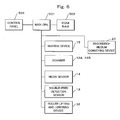
  • FIG. 6 is a block diagram of the configuration of the image erasing apparatus
  • FIG. 7 is a side view of the configuration of an image erasing apparatus according to a second application example.
  • FIG. 8 is a side view of the configuration of an image erasing apparatus according to a third application example.
  • FIG. 9 is a side view of recording medium collecting operation of the image erasing apparatus according to the second application example.
  • the image erasing apparatus includes: a paper feeding tray configured to feed the recording medium; a sensor group including a double-feed detection sensor configured to detect double feed of the recording medium and a media sensor configured to detect thickness of the recording medium; a collecting device configured to collect the recording medium; a recording-medium conveying device configured to convey the recording medium, the recording-medium conveying device linearly connecting the paper feeding tray, the sensor group, and the collecting device; a switching device configured to switch a conveying direction of the recording medium; a heating device configured to heat the recording medium to temperature equal to or higher than erasing temperature of a developer; and a control unit configured to operate the switching device in the direction to collect the recording medium in the collecting device if the recording medium is judged non-conveyable on the basis of an output of the sensor group and operate the switching device in the direction to convey the recording medium to the heating device if the recording medium is judged conveyable on the basis of an output of the sensor group.
  • An image erasing apparatus 1 includes: a paper feeding tray configured to feed a recording medium; a sensor group including a double-feed detection sensor configured to detect double feed of the recording medium and a media sensor configured to detect the thickness of the recording medium; a recording-medium conveying device configured to convey the recording medium; a collecting device provided in the recording-medium conveying device and configured to drop and collect the recording medium; a switching device configured to switch a conveying direction of the recording medium; a heating device configured to heat the recording medium to temperature equal to or higher than erasing temperature of a developer; a stacking device configured to stack the recording medium; and a control unit configured to cause, when determining on the basis of an output of the double-feed detection sensor or the media sensor that the recording medium is non-conveyable, the recording-medium conveying device to collect the recording medium in the collecting device and cause, when determining that the recording medium is conveyable, the recording-medium conveying device to convey the recording medium in the direction of the heating device and cause the heating device to erase
  • Each of image erasing apparatuses 1 , 2 , and 3 include a paper feeding tray 11 configured to feed a recording medium, a sensor group including a double-feed detection sensor 13 configured to detect double feed of the recording medium and a media sensor 14 configured to detect the thickness of the recording medium, a collecting device configured to drop the recording medium in the vertical direction and collect the recording medium, and a recording-medium conveying device 20 configured to convey the recording medium.
  • FIG. 1 is a side view of the configuration of the image erasing apparatus 1 according to this embodiment.
  • the image erasing apparatus 1 includes the paper feeding tray 11 on which recording media to be subjected to image erasing are stacked, a paper feeding device 12 configured to extract a recording medium from the paper feeding tray 11 , the recording-medium conveying device 20 configured to convey the recording medium, and a sensor group including the double-feed detection sensor 13 configured to detect double feed of the recording medium and the media sensor 14 configured to detect the thickness of the recording medium.
  • the recording-medium conveying device 20 includes plural conveying rollers 20 A and a switching device 22 configured to switch a conveying path.
  • the double-feed detection sensor 13 includes an ultrasound generating device configured to emit ultrasound from one side of the recording medium to the recording medium and an ultrasound detecting device set on the other side of the recording medium and configured to detect the ultrasound.
  • the double-feed detection sensor 13 outputs an electric signal on the basis of the detected ultrasound.
  • the image erasing apparatus 1 determines presence or absence of double feed on the basis of the electric signal.
  • the media sensor 14 includes an arm displaced by the passage of the recording medium, a permanent magnet set in the arm, and a magnetic sensor configured to detect magnetism of the permanent magnet.
  • the media sensor 14 outputs an electric signal corresponding to the thickness of the recording medium.
  • the image erasing apparatus 1 determines the thickness of the recording medium on the basis of the electric signal.
  • the image erasing apparatus 1 includes, downstream in a recording medium conveyance direction of the sensor group, a recording-medium collecting device 30 and a collection box 31 configured to store a collected recording medium.
  • the recording-medium conveying device 20 is formed on a straight line from the paper feeding device 12 to the recording-medium collecting device 30 .
  • the recording-medium conveying device 20 connecting the paper feeding device 12 , the sensor group, and the recording-medium collecting device 30 is formed on the straight line.
  • the paper feeding device 12 , the sensor group, and the recording-medium collecting device 30 are arranged on the straight line.
  • the image erasing apparatus 1 conveys the recording medium from the paper feeding device 12 to the recording-medium collecting device 30 without bending the recording medium.
  • the image erasing apparatus 1 includes a heating device 15 downstream in the recording medium conveyance direction of the recording-medium collecting device 30 .
  • a heating device 15 a pair of rollers are provided on both sides of the recording-medium conveying device 20 .
  • the heating device 15 heats the recording medium to erasing temperature that is temperature at which a color of a developer on the recording medium is erased. Therefore, the image erasing apparatus 1 subjects the recording medium to image erasing with the heating device 15 .
  • the image erasing apparatus 1 includes a pair of scanners 16 A and 16 B as image reading devices downstream in the recording medium conveyance direction of the heating device 15 .
  • the scanners 16 A and 16 B are provided on both sides of the recording-medium conveying device 20 .
  • the image erasing apparatus 1 determines on the basis of outputs of the scanners 16 A and 16 B whether image erasing for the recording medium is successful.
  • the image erasing apparatus 1 includes, downstream in the recording medium conveyance direction of the scanners 16 A and 16 B, stacking devices 21 A, 21 B, and 21 C configured to store recording media.
  • the image erasing apparatus 1 operates the switching device 22 to thereby stack recording media for which image erasing is unsuccessful in the collection box 31 and stack recording media for which image erasing is successful in the stacking devices 21 A to 21 C while sorting the recording media according to sizes.
  • FIG. 2 is a perspective view of the recording-medium collecting device 30 .
  • FIG. 3 is a front view of the recording-medium collecting device 30 viewed from a direction of an arrow A in FIG. 1 .
  • the recording medium collecting device 30 includes a roller lifting and lowering device 32 , driving rollers 31 A 1 and 31 A 2 driven by a driving motor, driven rollers 31 B 1 and 31 B 2 configured to rotate following the driving rollers 31 A 1 and 31 A 2 , and a first brush roller 33 A including a brush 33 .
  • a rotating shaft 33 A 1 of the first brush roller 33 A and a rotating shaft 31 C of the driving rollers 31 A 1 and 31 A 2 are supported by the roller lifting and lowering device 32 .
  • the roller lifting and lowering device 32 is lifted and lowered by a solenoid or the like.
  • the recording-medium collecting device 30 includes a pair of movable plates 34 A and 34 B.
  • the movable plates 34 A and 34 B have plural teeth on sides thereof.
  • the recording-medium collecting device 30 includes motors 36 A and 36 B including gears 35 A and 35 B.
  • the teeth on the sides of the movable plates 34 A and 34 B mesh with the gears 35 A and 35 B.
  • the movable plates 34 A and 34 B rotatably support second brush rollers 33 B 1 and 33 B 2 having the brush 33 and the driven rollers 31 B and 31 B 2 , respectively.
  • the length of the first brush roller 33 A is equal to total length of the second brush rollers 33 B 1 and 33 B 2 and larger than maximum width of a conveyable recording medium.
  • plastic such as nylon or animal hair such as pig hair can be used.
  • the first brush roller 33 A and the second brush rollers 33 B 1 and 33 B 2 rotate in a direction opposite to a direction of conveyance of a recording medium and remove tag paper and foreign matters such as bits of eraser grit adhering to the conveyed recording medium from the recording medium.
  • FIG. 4 is a diagram of a state of recording medium collecting operation by the recording-medium collecting device 30 .
  • the image erasing apparatus 1 when detecting from an output of the double-feed detection sensor 13 or the media sensor 14 that double feed occurs, a recording medium has thickness larger than a first threshold set in advance, or a recording medium has thickness smaller than a second threshold set in advance, the image erasing apparatus 1 causes the recording-medium collecting device 30 to perform the recording medium collecting operation.
  • the image erasing apparatus 1 when determining that a recording medium is non-conveyable, the image erasing apparatus 1 lifts the roller lifting and lowering device 32 to pull the brush roller 33 A and the driving rollers 31 A 1 and 31 A 2 upward, i.e., in an arrow X 1 direction and release nip of the recording medium.
  • the image erasing apparatus 1 rotates the motor 36 A to displace the movable plate 34 A in an arrow X 2 direction and rotates the motor 36 B to displace the movable plate 34 B in an arrow X 3 direction. Specifically, the image erasing apparatus 1 opens the movable plates 34 A and 34 B in a vertical direction with respect to the recording medium conveyance direction.
  • the recording-medium collecting device 30 drops a non-conveyable recording medium in the vertical direction to the collecting box 31 and collects the recording medium.
  • a jam tends to be caused when a stapled sheet bundle or a sheet is double-fed or a sheet having thickness other than specified thickness is conveyed.
  • a conveying path is bent, it is highly likely that a sheet is non-conveyable and jams.
  • the image erasing apparatus 1 conveys a recording medium from the paper feeding device 12 to the recording-medium collecting device 30 without bending the recording medium, it is possible to prevent an unnecessary jam.
  • FIG. 5 is a diagram of recording medium collecting operation by the recording-medium collecting device 30 according to a first application example.
  • the rotating shaft 31 C of the driving rollers 31 A 1 and 31 A 2 is supported by the roller lifting and lowering device 32 .
  • the rotating shaft 33 A 1 of the brush roller 33 A is not supported by the roller lifting and lowering device 32 .
  • the driving rollers 31 A 1 and 31 A 2 rise according to the recording medium collecting operation.
  • the brush roller 33 A does not rise according to the recording medium collecting operation.
  • FIG. 6 is a block diagram of the configuration of the image erasing apparatus 1 .
  • the image erasing apparatus 1 includes a main CPU 501 as a control unit (a controller).
  • the main CPU 501 is connected to a control panel 503 and a ROM and RAM 502 as a storage device.
  • the main CPU 501 is connected to the heating device 15 , the scanners 16 A and 16 B, the media sensor 14 , the double-feed detection sensor 13 , and the roller lifting and lowering device 32 .
  • the main CPU 501 controls the recording-medium conveying device 20 .
  • the main CPU 501 controls ON and OFF and the temperature of the heating device 15 .
  • FIG. 7 is a side view of the configuration of an image erasing apparatus 2 according to a second application example.
  • the image erasing apparatus 2 includes the paper feeding tray 11 on which recording media to be subjected to image erasing are stacked, the paper feeding device 12 configured to extract a recording medium from the paper feeding tray 11 , the recording-medium conveying device 20 configured to convey the recording medium, and the sensor group including the double-feed detection sensor 13 configured to detect double feed of the recording medium and the media sensor 14 configured to detect the thickness of the recording medium.
  • the recording-medium conveying device 20 includes the plural conveying rollers 20 A and switching devices 22 and 22 A configured to switch a conveying path.
  • the image erasing apparatus 2 includes a collection box 40 downstream in a recording medium conveyance direction of the sensor group.
  • the switching device 22 A is set between the sensor group and the collection box 40 .
  • the recording-medium conveying device 20 is formed on a straight line from the paper feeding device 12 to the collection box 40 .
  • the recording-medium conveying device 20 connecting the paper feeding device 12 , the sensor group, and the collection box 40 is formed on the straight line.
  • the paper feeding device 12 , the sensor group, and the collection box 40 are arranged on the straight line.
  • the image erasing apparatus 2 conveys a recording medium from the paper feeding device 12 to the collection box 40 without bending the recording medium.
  • the image erasing apparatus 2 includes the heating device 15 downstream in the recording medium conveyance direction of the switching device 22 A.
  • the heating device 15 a pair of rollers are provided on both sides of the recording-medium conveying device 20 .
  • the heating device 15 heats the recording medium to erasing temperature that is temperature at which a color of a developer on the recording medium is erased. Therefore, the image erasing apparatus 2 subjects the recording medium to image erasing with the heating device 15 .
  • the image erasing apparatus 2 performs the recording medium collecting operation when detecting from an output of the double-feed detection sensor 13 or the media sensor that double feed occurs, a recording medium has thickness larger than a first threshold set in advance, or a recording medium has thickness smaller than a second threshold set in advance.
  • the image erasing apparatus 2 when determining that a recording medium is non-conveyable, operates the switching device 22 A and conveys the recording medium in a direction of arrows X 4 and X 5 .
  • the recording medium is collected in the collection box 40 .
  • a jam tends to be caused when a stapled sheet bundle or a sheet is double-fed or a sheet having thickness other than specified thickness is conveyed.
  • a conveying path is bent, it is highly likely that a sheet is non-conveyable and jams.
  • the paper feeding device 12 , the sensor group, and the collection box 40 are arranged on the straight line, it is possible to prevent an unnecessary jam caused when a sheet bundle is caught.
  • the image erasing apparatus 2 When determining that a recording medium is conveyable, the image erasing apparatus 2 operates the switching device 22 A and conveys the recording medium in the direction of the heating device 15 .
  • the image erasing apparatus 2 includes the pair of scanners 16 A and 16 B as image reading devices downstream in the recording medium conveyance direction of the heating device 15 .
  • the scanners 16 A and 16 B are provided on both sides of the recording-medium conveying device 20 .
  • the image erasing apparatus 2 determines on the basis of outputs of the scanners 16 A and 16 B whether image erasing for the recording medium is successful.
  • the image erasing apparatus 2 includes, downstream in the recording medium conveyance direction of the scanners 16 A and 16 B, stacking devices 21 A, 21 B, and 21 D configured to store recording media.
  • the image erasing apparatus 2 operates the switching device 22 to thereby stack recording media for which image erasing is unsuccessful in the stacking device 21 D and stack recording media for which image erasing is successful in the stacking devices 21 A and 21 B while sorting the recording media according to sizes.
  • FIG. 8 is a side view of the configuration of an image erasing apparatus 3 according to a third application example.
  • the image erasing apparatus 3 includes the paper feeding tray 11 on which recording media to be subjected to image erasing are stacked, a paper-feeding-tray lifting and lowering device 11 A configured to lift and lower the paper feeding tray 11 , the paper feeding device 12 configured to extract a recording medium from the paper feeding tray 11 , the recording-medium conveying device 20 configured to convey the recording medium, and the sensor group including the double-feed detection sensor 13 configured to detect double feed of the recording medium and the media sensor 14 configured to detect the thickness of the recording medium.
  • the recording-medium conveying device 20 includes the plural conveying rollers 20 A and switching devices 22 , 22 A, and 22 B configured to switch a conveying path.
  • the image erasing apparatus 3 includes the collection box 40 downstream in a recording medium conveyance direction of the sensor group.
  • the switching device 22 A is set between the sensor group and the collection box 40 .
  • the image erasing apparatus 3 includes a discharge box 41 further upstream than the paper feeding tray 11 in the recording medium conveyance direction.
  • the recording-medium conveying device 20 is formed on a straight line from the paper feeding device 12 to the collection box 40 and from the paper feeding device 12 to the discharge box 41 .
  • the recording-medium conveying device 20 connecting the paper feeding device 12 , the sensor group, and the collection box 40 is formed on the straight line.
  • the recording-medium conveying device 20 connecting the paper feeding device 12 and the discharge box 41 is formed on the straight line.
  • the paper feeding device 12 , the sensor group, and the collection box 40 are arranged on the straight line.
  • the paper feeding device 12 and the discharge box 41 are arranged on the straight line.
  • the image erasing apparatus 3 conveys a recording medium from the paper feeding device 12 to the collection box 40 and from the paper feeding device, 12 to the discharge box 41 without bending the recording medium.
  • the image erasing apparatus 3 includes the heating device 15 downstream in the recording medium conveyance direction of the switching device 22 A.
  • the heating device 15 a pair of rollers are provided on both sides of the recording-medium conveying device 20 .
  • the heating device 15 heats the recording medium to erasing temperature that is temperature at which a color of a developer on the recording medium is erased. Therefore, the image erasing apparatus 3 subjects the recording medium to image erasing with the heating device 15 .
  • the image erasing apparatus 3 performs the recording medium collecting operation when detecting from an output of the double-feed detection sensor 13 or the media sensor that double feed occurs, a recording medium has thickness larger than a first threshold set in advance, or a recording medium has thickness smaller than a second threshold set in advance.
  • FIG. 9 is a side view of recording medium collecting operation by the image erasing apparatus 3 according to the third application example.
  • image erasing apparatus 3 stops conveyance of the recording medium.
  • the image erasing apparatus 3 operates the paper-feeding-tray lifting and lowering device 11 A to lower the paper feeding tray 11 .
  • the image erasing apparatus 3 operates the switching device 22 B to form a recording medium conveying path reaching from the sensor group to the discharge box 41 .
  • the image erasing apparatus 3 reversely rotates the conveying roller 20 A, conveys the recording medium in a direction of an arrow X 8 , and discharges the recording medium to the discharge box 41 .
  • the image erasing apparatus 3 When determining that a recording medium is conveyable but is folded, the image erasing apparatus 3 operates the switching device 22 A to convey the recording medium to the collection box 40 and collect the recording medium. The image erasing apparatus 3 determines, according to whether sheet thickness detected by the media sensor changes, whether the recording medium is folded.
  • the image erasing apparatus 3 When determining that the recording medium is conveyable and is not folded, the image erasing apparatus 3 operates the switching device 22 A to convey the recording medium in a direction of the heating device 15 .
  • the image erasing apparatus 3 includes the pair of scanners 16 A and 16 B as image reading devices downstream in the recording medium conveyance direction of the heating device 15 .
  • the scanners 16 A and 16 B are provided on both sides of the recording-medium conveying device 20 .
  • the image erasing apparatus 3 determines on the basis of outputs of the scanners 16 A and 16 B whether image erasing for the recording medium is successful.
  • the image erasing apparatus 3 includes, downstream in the recording medium conveyance direction of the scanners 16 A and 16 B, the stacking devices 21 A, 21 B, 21 C, and 21 D configured to store recording media.
  • the image erasing apparatus 3 operates the switching device 22 to thereby stack recording media for which image erasing is unsuccessful in the stacking device 21 D and stack recording media for which image erasing is successful in the stacking devices 21 A to 21 C while sorting the recording media according to sizes.
  • each of the image erasing apparatuses 1 , 2 , and 3 includes the paper feeding tray 11 configured to feed a recording medium, the sensor group including the double-feed detection sensor 13 configured to detect double feed of the recording medium and the media sensor 14 configured to detect the thickness of the recording medium, the recording-medium collecting device 30 , the collection box 40 , or the discharge box 41 configured to collect the recording medium, and the recording-medium conveying device 20 connecting the paper feeding tray 11 , the sensor group, and the recording-medium collecting device 30 , the collection box 40 , or the discharge box 41 on a straight line.

Landscapes

  • Cleaning In Electrography (AREA)
  • Controlling Sheets Or Webs (AREA)

Abstract

An image erasing apparatus includes: a paper feeding tray configured to feed a recording medium; a sensor group including a double-feed detection sensor configured to detect double feed of the recording medium and a media sensor configured to detect the thickness of the recording medium; a recording-medium collecting device, a collection box, or a discharge box configured to collect the recording medium; and a recording-medium conveying device connecting the paper feeding tray, the sensor group, and the recording-medium collecting device, the collection box, or the discharge box on a straight line.

Description

CROSS-REFERENCE TO RELATED APPLICATIONS
This application is based upon and claims the benefit of priority from the prior the U.S. Patent Application No. 61/218,831, filed on Jun. 19, 2009, and the prior the U.S.A. Patent Application No. 61/242,719, filed on Sep. 15, 2009 and the entire contents of which are incorporated herein by reference.
FIELD
An embodiment of the present invention relates to an image erasing apparatus configured to erase an image on a recording medium formed with an erasable developer and a recording medium conveying method for the image erasing apparatus.
BACKGROUND
In recent years, an image forming apparatus configured to form an image with an erasable developer and an erasing apparatus were introduced according to the demand for resource saving. The erasing apparatus erases an image by applying heat and light to a recording medium on which the image is formed with the erasable developer and erasing the developer. Therefore, the recording medium after the image is erased can be reused.
In some case, a recording medium on which an image is once formed is stapled or affixed with a tag or the like. Such a recording medium clogs a recording medium conveying path and causes a jam or damages the apparatus.
As measures against such a problem, there is proposed a technique for providing a detecting device configured to detect double feed and stopping conveyance of a recording medium when the double feed is detected.
There is also proposed a technique for providing, halfway in the recording medium conveying path, a sensor configured to detect the thickness of a recording medium and discharging the recording medium to the outside of the apparatus via the normal recording medium conveying path when the recording medium has unexpected thickness.
DESCRIPTION OF THE DRAWINGS
FIG. 1 is a side view of the configuration of an image erasing apparatus;
FIG. 2 is a perspective view of a recording-medium collecting device;
FIG. 3 is a front view of the recording-medium collecting device viewed from a direction of an arrow A in FIG. 1;
FIG. 4 is a diagram of a state of recording medium collecting operation by the recording-medium collecting device;
FIG. 5 is a diagram of recording medium collecting operation of a recording-medium collecting device according to a first application example;
FIG. 6 is a block diagram of the configuration of the image erasing apparatus;
FIG. 7 is a side view of the configuration of an image erasing apparatus according to a second application example;
FIG. 8 is a side view of the configuration of an image erasing apparatus according to a third application example; and
FIG. 9 is a side view of recording medium collecting operation of the image erasing apparatus according to the second application example.
DETAILED DESCRIPTION
Throughout this description, the embodiments and examples shown should be considered as exemplars, rather than limitations on the apparatus and methods of the present invention.
An image erasing apparatus and a recording medium conveying method for the image erasing apparatus according to an embodiment of the present invention are explained in detail below with reference to the accompanying drawings.
The image erasing apparatus includes: a paper feeding tray configured to feed the recording medium; a sensor group including a double-feed detection sensor configured to detect double feed of the recording medium and a media sensor configured to detect thickness of the recording medium; a collecting device configured to collect the recording medium; a recording-medium conveying device configured to convey the recording medium, the recording-medium conveying device linearly connecting the paper feeding tray, the sensor group, and the collecting device; a switching device configured to switch a conveying direction of the recording medium; a heating device configured to heat the recording medium to temperature equal to or higher than erasing temperature of a developer; and a control unit configured to operate the switching device in the direction to collect the recording medium in the collecting device if the recording medium is judged non-conveyable on the basis of an output of the sensor group and operate the switching device in the direction to convey the recording medium to the heating device if the recording medium is judged conveyable on the basis of an output of the sensor group.
An image erasing apparatus 1 includes: a paper feeding tray configured to feed a recording medium; a sensor group including a double-feed detection sensor configured to detect double feed of the recording medium and a media sensor configured to detect the thickness of the recording medium; a recording-medium conveying device configured to convey the recording medium; a collecting device provided in the recording-medium conveying device and configured to drop and collect the recording medium; a switching device configured to switch a conveying direction of the recording medium; a heating device configured to heat the recording medium to temperature equal to or higher than erasing temperature of a developer; a stacking device configured to stack the recording medium; and a control unit configured to cause, when determining on the basis of an output of the double-feed detection sensor or the media sensor that the recording medium is non-conveyable, the recording-medium conveying device to collect the recording medium in the collecting device and cause, when determining that the recording medium is conveyable, the recording-medium conveying device to convey the recording medium in the direction of the heating device and cause the heating device to erase an image.
Each of image erasing apparatuses 1, 2, and 3 according to this embodiment include a paper feeding tray 11 configured to feed a recording medium, a sensor group including a double-feed detection sensor 13 configured to detect double feed of the recording medium and a media sensor 14 configured to detect the thickness of the recording medium, a collecting device configured to drop the recording medium in the vertical direction and collect the recording medium, and a recording-medium conveying device 20 configured to convey the recording medium.
FIG. 1 is a side view of the configuration of the image erasing apparatus 1 according to this embodiment. As shown in FIG. 1, the image erasing apparatus 1 includes the paper feeding tray 11 on which recording media to be subjected to image erasing are stacked, a paper feeding device 12 configured to extract a recording medium from the paper feeding tray 11, the recording-medium conveying device 20 configured to convey the recording medium, and a sensor group including the double-feed detection sensor 13 configured to detect double feed of the recording medium and the media sensor 14 configured to detect the thickness of the recording medium.
The recording-medium conveying device 20 includes plural conveying rollers 20A and a switching device 22 configured to switch a conveying path.
The double-feed detection sensor 13 includes an ultrasound generating device configured to emit ultrasound from one side of the recording medium to the recording medium and an ultrasound detecting device set on the other side of the recording medium and configured to detect the ultrasound. The double-feed detection sensor 13 outputs an electric signal on the basis of the detected ultrasound. The image erasing apparatus 1 determines presence or absence of double feed on the basis of the electric signal.
The media sensor 14 includes an arm displaced by the passage of the recording medium, a permanent magnet set in the arm, and a magnetic sensor configured to detect magnetism of the permanent magnet. The media sensor 14 outputs an electric signal corresponding to the thickness of the recording medium. The image erasing apparatus 1 determines the thickness of the recording medium on the basis of the electric signal.
The image erasing apparatus 1 includes, downstream in a recording medium conveyance direction of the sensor group, a recording-medium collecting device 30 and a collection box 31 configured to store a collected recording medium.
The recording-medium conveying device 20 is formed on a straight line from the paper feeding device 12 to the recording-medium collecting device 30. The recording-medium conveying device 20 connecting the paper feeding device 12, the sensor group, and the recording-medium collecting device 30 is formed on the straight line. The paper feeding device 12, the sensor group, and the recording-medium collecting device 30 are arranged on the straight line. The image erasing apparatus 1 conveys the recording medium from the paper feeding device 12 to the recording-medium collecting device 30 without bending the recording medium.
The image erasing apparatus 1 includes a heating device 15 downstream in the recording medium conveyance direction of the recording-medium collecting device 30. In the heating device 15, a pair of rollers are provided on both sides of the recording-medium conveying device 20. The heating device 15 heats the recording medium to erasing temperature that is temperature at which a color of a developer on the recording medium is erased. Therefore, the image erasing apparatus 1 subjects the recording medium to image erasing with the heating device 15.
The image erasing apparatus 1 includes a pair of scanners 16A and 16B as image reading devices downstream in the recording medium conveyance direction of the heating device 15. The scanners 16A and 16B are provided on both sides of the recording-medium conveying device 20. The image erasing apparatus 1 determines on the basis of outputs of the scanners 16A and 16B whether image erasing for the recording medium is successful.
The image erasing apparatus 1 includes, downstream in the recording medium conveyance direction of the scanners 16A and 16B, stacking devices 21A, 21B, and 21C configured to store recording media. The image erasing apparatus 1 operates the switching device 22 to thereby stack recording media for which image erasing is unsuccessful in the collection box 31 and stack recording media for which image erasing is successful in the stacking devices 21A to 21C while sorting the recording media according to sizes.
FIG. 2 is a perspective view of the recording-medium collecting device 30. FIG. 3 is a front view of the recording-medium collecting device 30 viewed from a direction of an arrow A in FIG. 1.
As shown in FIGS. 2 and 3, the recording medium collecting device 30 includes a roller lifting and lowering device 32, driving rollers 31A1 and 31A2 driven by a driving motor, driven rollers 31B1 and 31B2 configured to rotate following the driving rollers 31A1 and 31A2, and a first brush roller 33A including a brush 33.
A rotating shaft 33A1 of the first brush roller 33A and a rotating shaft 31C of the driving rollers 31A1 and 31A2 are supported by the roller lifting and lowering device 32. The roller lifting and lowering device 32 is lifted and lowered by a solenoid or the like.
The recording-medium collecting device 30 includes a pair of movable plates 34A and 34B. The movable plates 34A and 34B have plural teeth on sides thereof. The recording-medium collecting device 30 includes motors 36A and 36 B including gears 35A and 35B. The teeth on the sides of the movable plates 34A and 34B mesh with the gears 35A and 35B.
The movable plates 34A and 34B rotatably support second brush rollers 33B1 and 33B2 having the brush 33 and the driven rollers 31B and 31B2, respectively.
The length of the first brush roller 33A is equal to total length of the second brush rollers 33B1 and 33B2 and larger than maximum width of a conveyable recording medium.
As a material of the brush 33, plastic such as nylon or animal hair such as pig hair can be used.
The first brush roller 33A and the second brush rollers 33B1 and 33B2 rotate in a direction opposite to a direction of conveyance of a recording medium and remove tag paper and foreign matters such as bits of eraser grit adhering to the conveyed recording medium from the recording medium.
FIG. 4 is a diagram of a state of recording medium collecting operation by the recording-medium collecting device 30. As shown in FIG. 4, when detecting from an output of the double-feed detection sensor 13 or the media sensor 14 that double feed occurs, a recording medium has thickness larger than a first threshold set in advance, or a recording medium has thickness smaller than a second threshold set in advance, the image erasing apparatus 1 causes the recording-medium collecting device 30 to perform the recording medium collecting operation.
Specifically, when determining that a recording medium is non-conveyable, the image erasing apparatus 1 lifts the roller lifting and lowering device 32 to pull the brush roller 33A and the driving rollers 31A1 and 31A2 upward, i.e., in an arrow X1 direction and release nip of the recording medium.
Subsequently, the image erasing apparatus 1 rotates the motor 36A to displace the movable plate 34A in an arrow X2 direction and rotates the motor 36B to displace the movable plate 34B in an arrow X3 direction. Specifically, the image erasing apparatus 1 opens the movable plates 34A and 34B in a vertical direction with respect to the recording medium conveyance direction.
According to this recording medium collecting operation, the recording-medium collecting device 30 drops a non-conveyable recording medium in the vertical direction to the collecting box 31 and collects the recording medium.
Usually, a jam tends to be caused when a stapled sheet bundle or a sheet is double-fed or a sheet having thickness other than specified thickness is conveyed. In particular, when a conveying path is bent, it is highly likely that a sheet is non-conveyable and jams. However, since the image erasing apparatus 1 conveys a recording medium from the paper feeding device 12 to the recording-medium collecting device 30 without bending the recording medium, it is possible to prevent an unnecessary jam.
FIG. 5 is a diagram of recording medium collecting operation by the recording-medium collecting device 30 according to a first application example. As shown in FIG. 5, in the recording medium collecting device 30 according to the first application example, the rotating shaft 31C of the driving rollers 31A1 and 31A2 is supported by the roller lifting and lowering device 32. The rotating shaft 33A1 of the brush roller 33A is not supported by the roller lifting and lowering device 32.
Therefore, the driving rollers 31A1 and 31A2 rise according to the recording medium collecting operation. The brush roller 33A does not rise according to the recording medium collecting operation.
FIG. 6 is a block diagram of the configuration of the image erasing apparatus 1. As shown in FIG. 6, the image erasing apparatus 1 includes a main CPU 501 as a control unit (a controller). The main CPU 501 is connected to a control panel 503 and a ROM and RAM 502 as a storage device.
The main CPU 501 is connected to the heating device 15, the scanners 16A and 16B, the media sensor 14, the double-feed detection sensor 13, and the roller lifting and lowering device 32. The main CPU 501 controls the recording-medium conveying device 20. The main CPU 501 controls ON and OFF and the temperature of the heating device 15.
FIG. 7 is a side view of the configuration of an image erasing apparatus 2 according to a second application example. As shown in FIG. 7, the image erasing apparatus 2 includes the paper feeding tray 11 on which recording media to be subjected to image erasing are stacked, the paper feeding device 12 configured to extract a recording medium from the paper feeding tray 11, the recording-medium conveying device 20 configured to convey the recording medium, and the sensor group including the double-feed detection sensor 13 configured to detect double feed of the recording medium and the media sensor 14 configured to detect the thickness of the recording medium.
The recording-medium conveying device 20 includes the plural conveying rollers 20A and switching devices 22 and 22A configured to switch a conveying path.
The image erasing apparatus 2 includes a collection box 40 downstream in a recording medium conveyance direction of the sensor group. The switching device 22A is set between the sensor group and the collection box 40.
The recording-medium conveying device 20 is formed on a straight line from the paper feeding device 12 to the collection box 40. The recording-medium conveying device 20 connecting the paper feeding device 12, the sensor group, and the collection box 40 is formed on the straight line. The paper feeding device 12, the sensor group, and the collection box 40 are arranged on the straight line. The image erasing apparatus 2 conveys a recording medium from the paper feeding device 12 to the collection box 40 without bending the recording medium.
The image erasing apparatus 2 includes the heating device 15 downstream in the recording medium conveyance direction of the switching device 22A. In the heating device 15, a pair of rollers are provided on both sides of the recording-medium conveying device 20. The heating device 15 heats the recording medium to erasing temperature that is temperature at which a color of a developer on the recording medium is erased. Therefore, the image erasing apparatus 2 subjects the recording medium to image erasing with the heating device 15.
The image erasing apparatus 2 performs the recording medium collecting operation when detecting from an output of the double-feed detection sensor 13 or the media sensor that double feed occurs, a recording medium has thickness larger than a first threshold set in advance, or a recording medium has thickness smaller than a second threshold set in advance.
Specifically, when determining that a recording medium is non-conveyable, the image erasing apparatus 2 operates the switching device 22A and conveys the recording medium in a direction of arrows X4 and X5. The recording medium is collected in the collection box 40.
Usually, a jam tends to be caused when a stapled sheet bundle or a sheet is double-fed or a sheet having thickness other than specified thickness is conveyed. In particular, when a conveying path is bent, it is highly likely that a sheet is non-conveyable and jams. However, since the paper feeding device 12, the sensor group, and the collection box 40 are arranged on the straight line, it is possible to prevent an unnecessary jam caused when a sheet bundle is caught.
When determining that a recording medium is conveyable, the image erasing apparatus 2 operates the switching device 22A and conveys the recording medium in the direction of the heating device 15.
The image erasing apparatus 2 includes the pair of scanners 16A and 16B as image reading devices downstream in the recording medium conveyance direction of the heating device 15. The scanners 16A and 16B are provided on both sides of the recording-medium conveying device 20. The image erasing apparatus 2 determines on the basis of outputs of the scanners 16A and 16B whether image erasing for the recording medium is successful.
The image erasing apparatus 2 includes, downstream in the recording medium conveyance direction of the scanners 16A and 16B, stacking devices 21A, 21B, and 21D configured to store recording media. The image erasing apparatus 2 operates the switching device 22 to thereby stack recording media for which image erasing is unsuccessful in the stacking device 21D and stack recording media for which image erasing is successful in the stacking devices 21A and 21B while sorting the recording media according to sizes.
FIG. 8 is a side view of the configuration of an image erasing apparatus 3 according to a third application example. As shown in FIG. 8, the image erasing apparatus 3 includes the paper feeding tray 11 on which recording media to be subjected to image erasing are stacked, a paper-feeding-tray lifting and lowering device 11A configured to lift and lower the paper feeding tray 11, the paper feeding device 12 configured to extract a recording medium from the paper feeding tray 11, the recording-medium conveying device 20 configured to convey the recording medium, and the sensor group including the double-feed detection sensor 13 configured to detect double feed of the recording medium and the media sensor 14 configured to detect the thickness of the recording medium.
The recording-medium conveying device 20 includes the plural conveying rollers 20A and switching devices 22, 22A, and 22B configured to switch a conveying path.
The image erasing apparatus 3 includes the collection box 40 downstream in a recording medium conveyance direction of the sensor group. The switching device 22A is set between the sensor group and the collection box 40.
The image erasing apparatus 3 includes a discharge box 41 further upstream than the paper feeding tray 11 in the recording medium conveyance direction.
The recording-medium conveying device 20 is formed on a straight line from the paper feeding device 12 to the collection box 40 and from the paper feeding device 12 to the discharge box 41. The recording-medium conveying device 20 connecting the paper feeding device 12, the sensor group, and the collection box 40 is formed on the straight line. The recording-medium conveying device 20 connecting the paper feeding device 12 and the discharge box 41 is formed on the straight line.
The paper feeding device 12, the sensor group, and the collection box 40 are arranged on the straight line. The paper feeding device 12 and the discharge box 41 are arranged on the straight line. The image erasing apparatus 3 conveys a recording medium from the paper feeding device 12 to the collection box 40 and from the paper feeding device, 12 to the discharge box 41 without bending the recording medium.
The image erasing apparatus 3 includes the heating device 15 downstream in the recording medium conveyance direction of the switching device 22A. In the heating device 15, a pair of rollers are provided on both sides of the recording-medium conveying device 20. The heating device 15 heats the recording medium to erasing temperature that is temperature at which a color of a developer on the recording medium is erased. Therefore, the image erasing apparatus 3 subjects the recording medium to image erasing with the heating device 15.
The image erasing apparatus 3 performs the recording medium collecting operation when detecting from an output of the double-feed detection sensor 13 or the media sensor that double feed occurs, a recording medium has thickness larger than a first threshold set in advance, or a recording medium has thickness smaller than a second threshold set in advance.
FIG. 9 is a side view of recording medium collecting operation by the image erasing apparatus 3 according to the third application example. As shown in FIG. 9, when the determining that a recording medium is non-conveyable, first, image erasing apparatus 3 stops conveyance of the recording medium. Subsequently, the image erasing apparatus 3 operates the paper-feeding-tray lifting and lowering device 11A to lower the paper feeding tray 11. The image erasing apparatus 3 operates the switching device 22B to form a recording medium conveying path reaching from the sensor group to the discharge box 41. The image erasing apparatus 3 reversely rotates the conveying roller 20A, conveys the recording medium in a direction of an arrow X8, and discharges the recording medium to the discharge box 41.
When determining that a recording medium is conveyable but is folded, the image erasing apparatus 3 operates the switching device 22A to convey the recording medium to the collection box 40 and collect the recording medium. The image erasing apparatus 3 determines, according to whether sheet thickness detected by the media sensor changes, whether the recording medium is folded.
When determining that the recording medium is conveyable and is not folded, the image erasing apparatus 3 operates the switching device 22A to convey the recording medium in a direction of the heating device 15.
The image erasing apparatus 3 includes the pair of scanners 16A and 16B as image reading devices downstream in the recording medium conveyance direction of the heating device 15. The scanners 16A and 16B are provided on both sides of the recording-medium conveying device 20. The image erasing apparatus 3 determines on the basis of outputs of the scanners 16A and 16B whether image erasing for the recording medium is successful.
The image erasing apparatus 3 includes, downstream in the recording medium conveyance direction of the scanners 16A and 16B, the stacking devices 21A, 21B, 21C, and 21D configured to store recording media. The image erasing apparatus 3 operates the switching device 22 to thereby stack recording media for which image erasing is unsuccessful in the stacking device 21D and stack recording media for which image erasing is successful in the stacking devices 21A to 21C while sorting the recording media according to sizes.
As explained above, each of the image erasing apparatuses 1, 2, and 3 according to this embodiment includes the paper feeding tray 11 configured to feed a recording medium, the sensor group including the double-feed detection sensor 13 configured to detect double feed of the recording medium and the media sensor 14 configured to detect the thickness of the recording medium, the recording-medium collecting device 30, the collection box 40, or the discharge box 41 configured to collect the recording medium, and the recording-medium conveying device 20 connecting the paper feeding tray 11, the sensor group, and the recording-medium collecting device 30, the collection box 40, or the discharge box 41 on a straight line.
Therefore, since it is possible to collect a non-conveyable recording medium without bending the recording medium, there is an effect that it is possible to efficiently prevent clogging or a jam of the recording medium.
While certain embodiments have been described, these embodiments have been presented by way of example only, and are not intended to limit the scope of the inventions. Indeed, the novel methods and apparatuses described herein may be embodied in a variety of other forms; furthermore, various omissions, substitutions and changes in the form of the methods and systems described herein may be made without departing from the spirit of the inventions. The accompanying claims and their equivalents are indeed to cover such forms or modifications as would fall within the scope and spirit of the inventions.

Claims (20)

What is claimed is:
1. An image erasing apparatus configured to erase an image on a sheet formed with a color material whose color is erased at a temperature equal to or higher than an erasing temperature, the apparatus comprising:
a paper feeding unit configured to feed the sheet;
a detection unit configured to detect a state of the fed sheet;
a collecting device configured to collect the sheet;
a heating device configured to heat the sheet to temperature equal to or higher than the erasing temperature to thereby erase a color of the image formed on the sheet with the color material;
a conveying device configured to convey the sheet to either of the collecting device and the heating device;
a switching device arranged upstream in a sheet conveyance direction of the heating device, and configured to switch a conveying direction of the sheet; and
a control unit configured to set a conveyance destination of the sheet with the switching device in a direction of the collecting device if the sheet is judged to be non-conveyable to the heating device based on an output of the detection unit and in a direction of the heating device if the sheet is judged to be conveyable to the heating device based on the output of the detection unit.
2. The apparatus according to claim 1, wherein the collecting device is set downstream of the detection unit and the switching device in the sheet conveyance direction.
3. The apparatus according to claim 1, wherein the collecting device is set upstream of the paper feeding unit in the sheet conveyance direction, and the control unit is configured to operate the switching device and the conveying device to reversely convey the sheet and collect the sheet in the collecting device if the sheet is judged to be non-conveyable to the heating device based on the output of the detection unit and operate the switching device and the conveying device to convey the sheet to the heating device if the sheet is judged to be conveyable to the heating device based on the output of the detection unit.
4. The apparatus according to claim 1, further comprising
a reading unit arranged downstream in the sheet conveyance direction of the heating device, and configured to read an image on the sheet, wherein
the control unit is configured to control the conveying device to convey the sheet to the collecting device if image erasing is determined to be unsuccessful based on the image read with the reading unit.
5. The apparatus according to claim 1, wherein the control unit is configured to operate the switching device and the conveying device to convey the sheet to the collecting device, if the detection unit detects that the sheet is folded.
6. The apparatus according to claim 1, wherein the conveying device is configured to convey the sheet to the collecting device without bending the sheet.
7. The apparatus according to claim 1, wherein the control unit is configured to cause the sheet to be collected with the collecting device if the detection unit detects a double feed.
8. The apparatus according to claim 1, wherein the control unit is configured to cause the sheet to be collected with the collecting device if the detection unit detects that the sheet has a thickness larger than a first threshold thickness or smaller than a second threshold thickness.
9. The apparatus according to claim 1, wherein
the conveying device linearly connects the paper feeding unit, the detection unit, and the collecting device.
10. The apparatus according to claim 9, wherein the detection unit includes at least one of a double-feed detection sensor configured to detect double feed of the sheet and a media sensor configured to detect thickness of the sheet.
11. An image erasing method of an erasing apparatus having a heating device configured to erase a color of an image on a sheet formed with a color material whose color is erased at a temperature equal to or higher than an erasing temperature, the method comprising:
feeding the sheet from a paper feeding unit;
detecting a state of the fed sheet with a detection unit;
judging with a control unit whether the sheet is conveyable or not to the heating device based on an output of the detection unit;
collecting the sheet with a collecting device by setting a conveyance destination of the sheet in a direction of the collecting device with a switching unit arranged upstream of the heating device in a sheet conveyance direction if the sheet is judged to be non-conveyable to the heating device; and
erasing a color of the image on the sheet by heating the conveyed sheet to a temperature equal to or higher than the erasing temperature with the heating device by setting the conveyance destination of the sheet in a direction of the heating device with the switching unit if the sheet is judged to be conveyable to the heating device.
12. The image erasing method according to claim 11, wherein
the sheet fed from the paper feeding unit is linearly conveyed to the collecting device via the detection unit.
13. The image erasing method according to claim 12, wherein the detection unit includes at least one of a double-feed detection sensor configured to detect double feed of the sheet and a media sensor configured to detect thickness of the sheet.
14. The image erasing method according to claim 11, wherein
the sheet is collected, without going by way of the heating device, with the collecting device set downstream of the detection unit and the switching unit in the sheet conveyance direction, if the sheet is non-conveyable to the heating device.
15. The image erasing method according to claim 11, further comprising:
reversely conveying the sheet fed from the paper feeding unit if the sheet is non-conveyable to the heating device, and
collecting the sheet with the collecting device set upstream of the paper feeding unit in the sheet conveyance direction.
16. The image erasing method according to claim 11, further comprising:
reading an image on the sheet erased with the heating device with a reading unit,
determining whether the sheet has been successfully erased or not on the basis of the image read with the reading unit, and
conveying the sheet to the collecting device if it is determined that the sheet was not successfully erased.
17. The image erasing method according to claim 13, wherein
the sheet is conveyed to the collecting device if the detection unit detects that the sheet is folded.
18. The image erasing method according to claim 13, wherein
the sheet is conveyed to the collecting device if the detection unit detects double feed of the sheet.
19. The image erasing method according to claim 13, wherein
the sheet is conveyed to the collecting device if the sheet has a thickness larger than a first threshold thickness or smaller than a second threshold thickness.
20. An image erasing apparatus configured to erase an image on a sheet formed with a color material whose color is erased at a temperature equal to or higher than an erasing temperature, the apparatus comprising:
paper feeding means for feeding the sheet;
detection means for detecting a state of the fed sheet;
collecting means for collecting the sheet;
heating means for heating the sheet to temperature equal to or higher than the erasing temperature;
conveying means for conveying the sheet to either of the collecting means and the heating means;
switching means for switching a conveying direction of the sheet arranged upstream in a sheet conveyance direction of the heating means; and
control means for setting a conveyance destination of the sheet with the switching means in a direction of the collecting means if the sheet is judged to be non-conveyable to the heating means based on an output of the detection means and in a direction of the heating means if the sheet is judged to be conveyable to the heating means based on the output of the detection means.
US12/817,732 2009-06-19 2010-06-17 Image erasing apparatus and recording medium conveying method for image erasing apparatus Active 2031-02-24 US8427516B2 (en)

Priority Applications (2)

Application Number Priority Date Filing Date Title
US12/817,732 US8427516B2 (en) 2009-06-19 2010-06-17 Image erasing apparatus and recording medium conveying method for image erasing apparatus
US13/846,274 US8711191B2 (en) 2009-06-19 2013-03-18 Image erasing apparatus and recording medium conveying method for image erasing apparatus

Applications Claiming Priority (3)

Application Number Priority Date Filing Date Title
US21883109P 2009-06-19 2009-06-19
US24271909P 2009-09-15 2009-09-15
US12/817,732 US8427516B2 (en) 2009-06-19 2010-06-17 Image erasing apparatus and recording medium conveying method for image erasing apparatus

Related Child Applications (1)

Application Number Title Priority Date Filing Date
US13/846,274 Division US8711191B2 (en) 2009-06-19 2013-03-18 Image erasing apparatus and recording medium conveying method for image erasing apparatus

Publications (2)

Publication Number Publication Date
US20100321457A1 US20100321457A1 (en) 2010-12-23
US8427516B2 true US8427516B2 (en) 2013-04-23

Family

ID=43353957

Family Applications (2)

Application Number Title Priority Date Filing Date
US12/817,732 Active 2031-02-24 US8427516B2 (en) 2009-06-19 2010-06-17 Image erasing apparatus and recording medium conveying method for image erasing apparatus
US13/846,274 Active US8711191B2 (en) 2009-06-19 2013-03-18 Image erasing apparatus and recording medium conveying method for image erasing apparatus

Family Applications After (1)

Application Number Title Priority Date Filing Date
US13/846,274 Active US8711191B2 (en) 2009-06-19 2013-03-18 Image erasing apparatus and recording medium conveying method for image erasing apparatus

Country Status (1)

Country Link
US (2) US8427516B2 (en)

Cited By (4)

* Cited by examiner, † Cited by third party
Publication number Priority date Publication date Assignee Title
US20110220305A1 (en) * 2010-03-15 2011-09-15 Kabushiki Kaisha Toshiba Foreign matter removing apparatus, color erasing apparatus, and foreign matter removing method
US20120306982A1 (en) * 2011-06-03 2012-12-06 Toshiba Tec Kabushiki Kaisha Color erasing apparatus
US20130271547A1 (en) * 2012-04-16 2013-10-17 Toshiba Tec Kabushiki Kaisha Image forming device
US8711191B2 (en) * 2009-06-19 2014-04-29 Kabushiki Kaisha Toshiba Image erasing apparatus and recording medium conveying method for image erasing apparatus

Families Citing this family (13)

* Cited by examiner, † Cited by third party
Publication number Priority date Publication date Assignee Title
US20110074901A1 (en) * 2009-07-17 2011-03-31 Kabushiki Kaisha Toshiba Image erasing apparatus and recording medium conveying method for image erasing apparatus
CN102190178A (en) * 2010-03-15 2011-09-21 株式会社东芝 Recording medium removing apparatus, erasing apparatus, automatic document feeding apparatus, and recording medium removing method
CN102190197A (en) * 2010-03-15 2011-09-21 株式会社东芝 Recording medium sorting apparatus, erasing apparatus, and recording medium sorting method
CN102190179B (en) * 2010-03-15 2014-05-14 株式会社东芝 Recording medium removing apparatus, erasing apparatus, cutting apparatus, and recording medium removing method
CN102205731B (en) 2010-03-29 2013-10-30 株式会社东芝 Image erasing apparatus and control method for image erasing apparatus
US8608166B2 (en) 2010-07-28 2013-12-17 Kabushiki Kaisha Toshiba Decoloring apparatus and sheet conveyance control method
US8537383B2 (en) 2010-07-28 2013-09-17 Kabushiki Kaisha Toshiba Decoloring device and function management method
CN102809914B (en) * 2011-06-02 2015-12-02 株式会社东芝 Image decolorization device and image decolorization method
CN202687600U (en) * 2011-06-02 2013-01-23 株式会社东芝 Sheet discharging device and decoloration device
US8670011B2 (en) * 2011-06-03 2014-03-11 Kabushiki Kaisha Toshiba Erasing apparatus and image erasing method
US8844927B2 (en) * 2011-06-30 2014-09-30 Kabushiki Kaisha Toshiba Sheet loading apparatus, erasing apparatus, and sheet loading method
US8885004B2 (en) * 2012-04-10 2014-11-11 Kabushiki Kaisha Toshiba Erasing apparatus and method of erasing
US9266374B1 (en) * 2014-12-15 2016-02-23 Kabushiki Kaisha Toshiba Decoloring apparatus

Citations (4)

* Cited by examiner, † Cited by third party
Publication number Priority date Publication date Assignee Title
JPH0876534A (en) 1994-09-01 1996-03-22 Ricoh Co Ltd Image forming device
JPH0891602A (en) 1994-09-29 1996-04-09 Ricoh Co Ltd Paper processing equipment
JP2009137716A (en) 2007-12-06 2009-06-25 Murata Mach Ltd Document transfer apparatus
US20110074901A1 (en) * 2009-07-17 2011-03-31 Kabushiki Kaisha Toshiba Image erasing apparatus and recording medium conveying method for image erasing apparatus

Family Cites Families (1)

* Cited by examiner, † Cited by third party
Publication number Priority date Publication date Assignee Title
US8427516B2 (en) * 2009-06-19 2013-04-23 Kabushiki Kaisha Toshiba Image erasing apparatus and recording medium conveying method for image erasing apparatus

Patent Citations (4)

* Cited by examiner, † Cited by third party
Publication number Priority date Publication date Assignee Title
JPH0876534A (en) 1994-09-01 1996-03-22 Ricoh Co Ltd Image forming device
JPH0891602A (en) 1994-09-29 1996-04-09 Ricoh Co Ltd Paper processing equipment
JP2009137716A (en) 2007-12-06 2009-06-25 Murata Mach Ltd Document transfer apparatus
US20110074901A1 (en) * 2009-07-17 2011-03-31 Kabushiki Kaisha Toshiba Image erasing apparatus and recording medium conveying method for image erasing apparatus

Non-Patent Citations (1)

* Cited by examiner, † Cited by third party
Title
Machine-generated translation of JP 8-091602, published on Apr. 1996. *

Cited By (8)

* Cited by examiner, † Cited by third party
Publication number Priority date Publication date Assignee Title
US8711191B2 (en) * 2009-06-19 2014-04-29 Kabushiki Kaisha Toshiba Image erasing apparatus and recording medium conveying method for image erasing apparatus
US20110220305A1 (en) * 2010-03-15 2011-09-15 Kabushiki Kaisha Toshiba Foreign matter removing apparatus, color erasing apparatus, and foreign matter removing method
US9250597B2 (en) * 2010-03-15 2016-02-02 Kabushiki Kaisha Toshiba Foreign matter removing apparatus, color erasing apparatus, and foreign matter removing method
US20120306982A1 (en) * 2011-06-03 2012-12-06 Toshiba Tec Kabushiki Kaisha Color erasing apparatus
US8890913B2 (en) 2011-06-03 2014-11-18 Kabushiki Kaisha Toshiba Color erasing apparatus
US8890912B2 (en) * 2011-06-03 2014-11-18 Kabushiki Kaisha Toshiba Color erasing apparatus
US20130271547A1 (en) * 2012-04-16 2013-10-17 Toshiba Tec Kabushiki Kaisha Image forming device
US8754915B2 (en) * 2012-04-16 2014-06-17 Kabushiki Kaisha Toshiba Image forming device

Also Published As

Publication number Publication date
US8711191B2 (en) 2014-04-29
US20130229476A1 (en) 2013-09-05
US20100321457A1 (en) 2010-12-23

Similar Documents

Publication Publication Date Title
US8427516B2 (en) Image erasing apparatus and recording medium conveying method for image erasing apparatus
US20110074901A1 (en) Image erasing apparatus and recording medium conveying method for image erasing apparatus
JP5091201B2 (en) Image erasing apparatus, image erasing method, and image forming apparatus
US8960668B2 (en) Sheet-discharge apparatus, sheet processing apparatus, and image forming apparatus
US8462185B2 (en) Recording medium removing apparatus, erasing apparatus, automatic document feeding apparatus, and recording medium removing method
US8564631B2 (en) Image erasing apparatus and control method for image erasing apparatus
JP4964978B2 (en) Medium detection method, medium detection apparatus, medium discharge apparatus, and printing apparatus
US8489010B2 (en) Image delete apparatus and recording medium carrying method of image delete apparatus
CN101927613A (en) Image erasing device and its recording medium delivery method
US8451304B2 (en) Recording medium sorting apparatus, erasing apparatus, and recording medium sorting method
US9760051B2 (en) Post-processing apparatus and image forming system
JPH0938513A (en) Document shredding device
US8066278B2 (en) Printer
US8466940B2 (en) Recording medium removing apparatus, erasing apparatus, cutting apparatus, and recording medium removing method
JP2005221518A (en) Image forming apparatus
CN102190163A (en) Image erasing apparatus and sheet carrying method of image erasing apparatus
CN206692081U (en) After-treatment device and image formation system
JP5634479B2 (en) Erasing device and erasing method of erasing device
JP2010208800A (en) Paper feeder
JP2003246471A (en) Paper feeder and image forming device
JP5118423B2 (en) Paper sheet processing equipment
JP2012182575A (en) Document reading apparatus, image formation apparatus, and document reading method
JP2003246469A (en) Paper feeder and image forming device
JP2007062974A (en) Automatic document feeder, image forming apparatus, and image reading apparatus
JP2007329769A (en) Image reading apparatus, and laser beam printer, facsimile, and image forming apparatus equipped with the same

Legal Events

Date Code Title Description
AS Assignment

Owner name: KABUSHIKI KAISHA TOSHIBA, JAPAN

Free format text: ASSIGNMENT OF ASSIGNORS INTEREST;ASSIGNORS:KAWAGUCHI, TAKAHIRO;YAHATA, ISAO;TAGUCHI, HIROYUKI;AND OTHERS;REEL/FRAME:024553/0363

Effective date: 20100602

Owner name: TOSHIBA TEC KABUSHIKI KAISHA, JAPAN

Free format text: ASSIGNMENT OF ASSIGNORS INTEREST;ASSIGNORS:KAWAGUCHI, TAKAHIRO;YAHATA, ISAO;TAGUCHI, HIROYUKI;AND OTHERS;REEL/FRAME:024553/0363

Effective date: 20100602

STCF Information on status: patent grant

Free format text: PATENTED CASE

FEPP Fee payment procedure

Free format text: PAYOR NUMBER ASSIGNED (ORIGINAL EVENT CODE: ASPN); ENTITY STATUS OF PATENT OWNER: LARGE ENTITY

Free format text: PAYER NUMBER DE-ASSIGNED (ORIGINAL EVENT CODE: RMPN); ENTITY STATUS OF PATENT OWNER: LARGE ENTITY

FPAY Fee payment

Year of fee payment: 4

MAFP Maintenance fee payment

Free format text: PAYMENT OF MAINTENANCE FEE, 8TH YEAR, LARGE ENTITY (ORIGINAL EVENT CODE: M1552); ENTITY STATUS OF PATENT OWNER: LARGE ENTITY

Year of fee payment: 8

MAFP Maintenance fee payment

Free format text: PAYMENT OF MAINTENANCE FEE, 12TH YEAR, LARGE ENTITY (ORIGINAL EVENT CODE: M1553); ENTITY STATUS OF PATENT OWNER: LARGE ENTITY

Year of fee payment: 12