US8420818B2 - Process for the preparation of pyrido[2,1-a] isoquinoline derivatives - Google Patents
Process for the preparation of pyrido[2,1-a] isoquinoline derivatives Download PDFInfo
- Publication number
- US8420818B2 US8420818B2 US13/274,523 US201113274523A US8420818B2 US 8420818 B2 US8420818 B2 US 8420818B2 US 201113274523 A US201113274523 A US 201113274523A US 8420818 B2 US8420818 B2 US 8420818B2
- Authority
- US
- United States
- Prior art keywords
- formula
- fluoromethyl
- oxo
- pyrrolidin
- pyrido
- Prior art date
- Legal status (The legal status is an assumption and is not a legal conclusion. Google has not performed a legal analysis and makes no representation as to the accuracy of the status listed.)
- Expired - Fee Related
Links
- 0 [2*]C1=C([3*])C([4*])=C2CCN3C[C@H](N4C[C@@H](CF)CC4=O)[C@@H](N)C[C@@]3([H])C2=C1 Chemical compound [2*]C1=C([3*])C([4*])=C2CCN3C[C@H](N4C[C@@H](CF)CC4=O)[C@@H](N)C[C@@]3([H])C2=C1 0.000 description 21
- GVAXUUCXZMPRKO-ZCFIWIBFSA-N CCN1C[C@@H](CF)CC1=O Chemical compound CCN1C[C@@H](CF)CC1=O GVAXUUCXZMPRKO-ZCFIWIBFSA-N 0.000 description 3
- DJUJBXMOAHTFFU-ZCFIWIBFSA-N O=C(O)CC(=O)CN1C[C@@H](CF)CC1=O Chemical compound O=C(O)CC(=O)CN1C[C@@H](CF)CC1=O DJUJBXMOAHTFFU-ZCFIWIBFSA-N 0.000 description 3
- SNOBQHSFTVYKRO-SCSAIBSYSA-N O=C1C[C@H](CF)CO1 Chemical compound O=C1C[C@H](CF)CO1 SNOBQHSFTVYKRO-SCSAIBSYSA-N 0.000 description 3
- HVDKNQPAOGDFRJ-LURJTMIESA-N CC(=O)C[C@H](CF)CBr Chemical compound CC(=O)C[C@H](CF)CBr HVDKNQPAOGDFRJ-LURJTMIESA-N 0.000 description 2
- CSCPPACGZOOCGX-UHFFFAOYSA-N CC(C)=O Chemical compound CC(C)=O CSCPPACGZOOCGX-UHFFFAOYSA-N 0.000 description 2
- ALBXEVPGIYQMSN-UHFFFAOYSA-N Cl.OCC1=C(CO)C=C2CCN=CC2=C1 Chemical compound Cl.OCC1=C(CO)C=C2CCN=CC2=C1 ALBXEVPGIYQMSN-UHFFFAOYSA-N 0.000 description 2
- ATQDAHBZKQUVFT-IJUZONTFSA-N CC(=O)CC(=O)CN1C[C@@H](CF)CC1=O.CC1=C(C)C=C2CCN=CC2=C1.Cl.[H][C@@]12CC(=O)[C@@H](N3C[C@@H](CF)CC3=O)CN1CCC1=CC(C)=C(C)C=C12 Chemical compound CC(=O)CC(=O)CN1C[C@@H](CF)CC1=O.CC1=C(C)C=C2CCN=CC2=C1.Cl.[H][C@@]12CC(=O)[C@@H](N3C[C@@H](CF)CC3=O)CN1CCC1=CC(C)=C(C)C=C12 ATQDAHBZKQUVFT-IJUZONTFSA-N 0.000 description 1
- NDLPUDIMBLKPGE-CPVNYBHJSA-N CC(=O)CC(=O)CN1C[C@@H](CF)CC1=O.CCOC(=O)CN1C[C@@H](CF)CC1=O Chemical compound CC(=O)CC(=O)CN1C[C@@H](CF)CC1=O.CCOC(=O)CN1C[C@@H](CF)CC1=O NDLPUDIMBLKPGE-CPVNYBHJSA-N 0.000 description 1
- VYXKWQSADOBCSU-WNXIGWQFSA-N CC(=O)CC(=O)CN1C[C@@H](CF)CC1=O.O=C(O)CC(=O)CN1C[C@@H](CF)CC1=O Chemical compound CC(=O)CC(=O)CN1C[C@@H](CF)CC1=O.O=C(O)CC(=O)CN1C[C@@H](CF)CC1=O VYXKWQSADOBCSU-WNXIGWQFSA-N 0.000 description 1
- CAEAKUDQXOATKX-MQGQABFXSA-N CCCN(CC1=CC=CC=C1)C[C@@H](CF)CC(=O)OC.CCOC(=O)CN1C[C@@H](CF)CC1=O.O=C=O Chemical compound CCCN(CC1=CC=CC=C1)C[C@@H](CF)CC(=O)OC.CCOC(=O)CN1C[C@@H](CF)CC1=O.O=C=O CAEAKUDQXOATKX-MQGQABFXSA-N 0.000 description 1
- LDIJDGUMWNDSOL-DJQNYAMLSA-N CCCN(CC1=CC=CC=C1)C[C@@H](CF)CC(=O)OC.COC(=O)C[C@H](CF)CBr.O=C=O Chemical compound CCCN(CC1=CC=CC=C1)C[C@@H](CF)CC(=O)OC.COC(=O)C[C@H](CF)CBr.O=C=O LDIJDGUMWNDSOL-DJQNYAMLSA-N 0.000 description 1
- YBVJMFYZYINYOI-GTYZUFBLSA-N COC(=O)C[C@H](CF)CBr.O=C1C[C@H](CF)CO1 Chemical compound COC(=O)C[C@H](CF)CBr.O=C1C[C@H](CF)CO1 YBVJMFYZYINYOI-GTYZUFBLSA-N 0.000 description 1
- VOIKOMDTVOSXIV-KCXAZCMYSA-N COc(cc(CCN(C[C@@H]1N(C[C@@H](CF)C2)C2=O)[C@H]2CC1=O)c2c1)c1OC Chemical compound COc(cc(CCN(C[C@@H]1N(C[C@@H](CF)C2)C2=O)[C@H]2CC1=O)c2c1)c1OC VOIKOMDTVOSXIV-KCXAZCMYSA-N 0.000 description 1
- NSLJVQUDZCZJLK-UHFFFAOYSA-N COc(cc(CCN=C1)c1c1)c1OC Chemical compound COc(cc(CCN=C1)c1c1)c1OC NSLJVQUDZCZJLK-UHFFFAOYSA-N 0.000 description 1
- JLAJEIBICDJZJP-CYBMUJFWSA-N O=C(CC(OCc1ccccc1)=O)CN(C[C@@H](CF)C1)C1=O Chemical compound O=C(CC(OCc1ccccc1)=O)CN(C[C@@H](CF)C1)C1=O JLAJEIBICDJZJP-CYBMUJFWSA-N 0.000 description 1
- ULEYVJYGLPRBPX-QIFNFJTFSA-N [H][C@@]12CC(=O)[C@@H](N3C[C@@H](CF)CC3=O)CN1CCC1=CC(C)=C(C)C=C12.[H][C@@]12C[C@H](NCC3=CC=CC=C3)[C@@H](N3C[C@@H](CF)CC3=O)CN1CCC1=CC(C)=C(C)C=C12 Chemical compound [H][C@@]12CC(=O)[C@@H](N3C[C@@H](CF)CC3=O)CN1CCC1=CC(C)=C(C)C=C12.[H][C@@]12C[C@H](NCC3=CC=CC=C3)[C@@H](N3C[C@@H](CF)CC3=O)CN1CCC1=CC(C)=C(C)C=C12 ULEYVJYGLPRBPX-QIFNFJTFSA-N 0.000 description 1
- ZMYLDGJYDIRXGP-KNTRFNDTSA-N [H][C@@]12C[C@H](N)[C@@H](N3C[C@@H](CC)CC3=O)CN1CCC1=CC(C)=C(C)C=C12 Chemical compound [H][C@@]12C[C@H](N)[C@@H](N3C[C@@H](CC)CC3=O)CN1CCC1=CC(C)=C(C)C=C12 ZMYLDGJYDIRXGP-KNTRFNDTSA-N 0.000 description 1
- FZCSHRRXCUINGP-FCLVOEFKSA-N [H][C@@]12C[C@H](N)[C@@H](N3C[C@@H](CF)CC3=O)CN1CCC1=CC(C)=C(C)C=C12 Chemical compound [H][C@@]12C[C@H](N)[C@@H](N3C[C@@H](CF)CC3=O)CN1CCC1=CC(C)=C(C)C=C12 FZCSHRRXCUINGP-FCLVOEFKSA-N 0.000 description 1
- ATIMXGXTMBTEBK-ZEYCCVMCSA-N [H][C@@]12C[C@H](N)[C@@H](N3C[C@@H](CF)CC3=O)CN1CCC1=CC(C)=C(C)C=C12.[H][C@@]12C[C@H](NCC3=CC=CC=C3)[C@@H](N3C[C@@H](CF)CC3=O)CN1CCC1=CC(C)=C(C)C=C12 Chemical compound [H][C@@]12C[C@H](N)[C@@H](N3C[C@@H](CF)CC3=O)CN1CCC1=CC(C)=C(C)C=C12.[H][C@@]12C[C@H](NCC3=CC=CC=C3)[C@@H](N3C[C@@H](CF)CC3=O)CN1CCC1=CC(C)=C(C)C=C12 ATIMXGXTMBTEBK-ZEYCCVMCSA-N 0.000 description 1
Classifications
-
- C—CHEMISTRY; METALLURGY
- C07—ORGANIC CHEMISTRY
- C07D—HETEROCYCLIC COMPOUNDS
- C07D401/00—Heterocyclic compounds containing two or more hetero rings, having nitrogen atoms as the only ring hetero atoms, at least one ring being a six-membered ring with only one nitrogen atom
- C07D401/02—Heterocyclic compounds containing two or more hetero rings, having nitrogen atoms as the only ring hetero atoms, at least one ring being a six-membered ring with only one nitrogen atom containing two hetero rings
- C07D401/06—Heterocyclic compounds containing two or more hetero rings, having nitrogen atoms as the only ring hetero atoms, at least one ring being a six-membered ring with only one nitrogen atom containing two hetero rings linked by a carbon chain containing only aliphatic carbon atoms
-
- A—HUMAN NECESSITIES
- A61—MEDICAL OR VETERINARY SCIENCE; HYGIENE
- A61P—SPECIFIC THERAPEUTIC ACTIVITY OF CHEMICAL COMPOUNDS OR MEDICINAL PREPARATIONS
- A61P43/00—Drugs for specific purposes, not provided for in groups A61P1/00-A61P41/00
-
- C—CHEMISTRY; METALLURGY
- C07—ORGANIC CHEMISTRY
- C07D—HETEROCYCLIC COMPOUNDS
- C07D207/00—Heterocyclic compounds containing five-membered rings not condensed with other rings, with one nitrogen atom as the only ring hetero atom
- C07D207/02—Heterocyclic compounds containing five-membered rings not condensed with other rings, with one nitrogen atom as the only ring hetero atom with only hydrogen or carbon atoms directly attached to the ring nitrogen atom
- C07D207/18—Heterocyclic compounds containing five-membered rings not condensed with other rings, with one nitrogen atom as the only ring hetero atom with only hydrogen or carbon atoms directly attached to the ring nitrogen atom having one double bond between ring members or between a ring member and a non-ring member
- C07D207/22—Heterocyclic compounds containing five-membered rings not condensed with other rings, with one nitrogen atom as the only ring hetero atom with only hydrogen or carbon atoms directly attached to the ring nitrogen atom having one double bond between ring members or between a ring member and a non-ring member with hetero atoms or with carbon atoms having three bonds to hetero atoms with at the most one bond to halogen, e.g. ester or nitrile radicals, directly attached to ring carbon atoms
- C07D207/24—Oxygen or sulfur atoms
- C07D207/26—2-Pyrrolidones
-
- C—CHEMISTRY; METALLURGY
- C07—ORGANIC CHEMISTRY
- C07D—HETEROCYCLIC COMPOUNDS
- C07D471/00—Heterocyclic compounds containing nitrogen atoms as the only ring hetero atoms in the condensed system, at least one ring being a six-membered ring with one nitrogen atom, not provided for by groups C07D451/00 - C07D463/00
- C07D471/02—Heterocyclic compounds containing nitrogen atoms as the only ring hetero atoms in the condensed system, at least one ring being a six-membered ring with one nitrogen atom, not provided for by groups C07D451/00 - C07D463/00 in which the condensed system contains two hetero rings
- C07D471/04—Ortho-condensed systems
Definitions
- a major task in the synthesis of the compounds of formula I is the introduction of the chiral centers in the pyrido[2,1-a]isoquinoline moiety, which in the synthesis according to the PCT Int. Appl. WO 2005/000848 involves late stage enantiomer separation by chiral HPLC. Such a process is however difficult to manage on technical scale. The problem to be solved was therefore to find a suitable process alternative which allows obtaining the desired optical isomer in an earlier stage of the process, affords a higher yield and which can be conducted on technical scale.
- the present invention relates to a process of the preparation of pyrido[2,1-a]isoquinoline derivatives of the formula
- R 2 , R 3 and R 4 are each independently selected from the group consisting of hydrogen, halogen, hydroxy, lower alkyl, lower alkoxy and lower alkenyl, wherein lower alkyl, lower alkoxy and lower alkenyl may optionally be substituted by a group consisting of lower alkoxycarbonyl, aryl and heterocyclyl, and the pharmaceutically acceptable salts thereof, which are useful for the treatment and/or prophylaxis of diseases which are associated with DPP IV.
- the present invention relates particularly to a process of the preparation of a pyrido[2,1-a]isoquinoline derivative of the formula
- R 2 , R 3 and R 4 are each independently selected from the group consisting of hydrogen, halogen, hydroxy, lower alkyl, lower alkoxy and lower alkenyl, wherein lower alkyl, lower alkoxy and lower alkenyl may optionally be substituted by a group selected from lower alkoxycarbonyl, aryl and heterocyclyl, and of pharmaceutically acceptable salts thereof, comprises one or more of the following steps a) ring opening of (S)-4-fluoromethyl-dihydro-furan-2-one of the formula
- R 1a is lower alkyl; b) converting the (R)-4-bromo-3-fluoromethyl-butyric acid ester of the formula (2) with an N-protected glycine alkylester into a N-protected-(S)-4-(alkoxycarbonylmethyl-amino)-3-fluoromethyl-butyric acid ester of formula
- R 1a and R 1b are lower alkyl and Prot is an amino protecting group; c) deprotecting the N-protected —(S)-4-(alkoxycarbonylmethyl-amino)-3-fluoromethyl-butyric acid ester of formula (3) and subsequent ring closure to form the ((S)-4-fluoromethyl-2-oxo-pyrrolidin-1-yl)-acetic acid ester of formula
- R 1b is lower alkyl; d) converting the ((S)-4-fluoromethyl-2-oxo-pyrrolidin-1-yl)-acetic acid ester of formula (4) into the ((S)-4-fluoromethyl-2-oxo-pyrrolidin-1-yl)-3-oxo-butyric acid ester of formula
- R 1c is a protecting group or a salt thereof; e) transforming the ((S)-4-fluoromethyl-2-oxo-pyrrolidin-1-yl)-3-oxo-butyric acid ester of formula (5a) into the ((S)-4-fluoromethyl-2-oxo-pyrrolidin-1-yl)-3-oxo-butyric acid of formula
- R 2 , R 3 and R 4 are as above, or a salt thereof, subsequently ring closing the compound of formula (7a) with formaldehyde to form the (3S,11bS)-3-((S)-4-fluoromethyl-2-oxo-pyrrolidin-1-yl)-1,3,4,6,7,11b-hexahydro-pyrido[2,1-a] isoquinolin-2-one derivative of formula
- R 2 , R 3 and R 4 are as above, or a salt thereof; g) transforming the (3S,11bS)-3-((S)-4-fluoromethyl-2-oxo-pyrrolidin-1-yl)-1,3,4,6,7,11b-hexahydro-pyrido[2,1-a] isoquinolin-2-one derivative of formula (7b) into the (S)-1-((2S,3S,11bS)-2-N-protected-amino-1,3,4,6,7,11b-hexahydro-2H-pyrido[2,1-a]isoquinolin-3-yl)-4-fluoromethyl-pyrrolidin-2-one of formula
- R 2 , R 3 and R 4 and Prot are as above, or a salt thereof; h) removing the protecting group Prot in the (S)-1-((2S,3S,11bS)-2-N-protected-amino-1,3,4,6,7,11b-hexahydro-2H-pyrido[2,1-a]isoquinolin-3-yl)-4-fluoromethyl-pyrrolidin-2-one of formula (8).
- lower is used to mean a group consisting of one to six, preferably of one to four carbon atom(s).
- halogen refers to fluorine, chlorine, bromine and iodine, with fluorine, bromine and chlorine being preferred.
- alkyl refers to a branched or straight-chain monovalent saturated aliphatic hydrocarbon radical of one to twenty carbon atoms, preferably one to sixteen carbon atoms, more preferably one to ten carbon atoms.
- lower alkyl refers to a branched or straight-chain monovalent alkyl radical of one to six carbon atoms, preferably one to four carbon atoms. This term is further exemplified by radicals such as methyl, ethyl, n-propyl, isopropyl, n-butyl, s-butyl, isobutyl, t-butyl, n-pentyl, 3-methylbutyl, n-hexyl, 2-ethylbutyl and the like.
- Preferable lower alkyl residues are methyl and ethyl, with methyl being especially preferred.
- halogenated lower alkyl refers to a lower alkyl group as defined above wherein at least one of the hydrogens of the lower alkyl group is replaced by a halogen atom, preferably fluoro or chloro.
- halogenated lower alkyl groups are trifluoromethyl, difluoromethyl, fluoromethyl and chloromethyl.
- alkenyl denotes an unsubstituted or substituted hydrocarbon chain radical having from 2 to 6 carbon atoms, preferably from 2 to 4 carbon atoms, and having one or two olefinic double bonds, preferably one olefinic double bond. Examples are vinyl, 1-propenyl, 2-propenyl(allyl) or 2-butenyl(crotyl).
- alkoxy refers to the group R′—O—, wherein R′ is alkyl.
- lower-alkoxy refers to the group R′—O—, wherein R′ is a lower alkyl group as defined above. Examples of lower alkoxy groups are e.g. methoxy, ethoxy, propoxy, isopropoxy, butoxy, isobutoxy and hexyloxy, with methoxy being especially preferred.
- lower alkoxycarbonyl refers to the group R′—O—C(O)—, wherein R′ is a lower alkyl group as defined above.
- aryl refers to an aromatic monovalent mono- or polycarbocyclic radical, such as phenyl or naphthyl, preferably phenyl, which may optionally be mono-, di- or tri-substituted, independently, by lower alkyl, lower alkoxy, halo, cyano, azido, amino, di-lower alkyl amino or hydroxy.
- cycloalkyl refers to a monovalent carbocyclic radical of three to six, preferably three to five carbon atoms. This term is further exemplified by radicals such as cyclopropyl, cyclobutyl, cyclopentyl and cyclohexyl, with cyclopropyl and cyclobutyl being preferred. Such cycloalkyl residues may optionally be mono-, di- or tri-substituted, independently, by lower alkyl or by halogen.
- heterocyclyl refers to a 5- or 6-membered aromatic or saturated N-heterocyclic residue, which may optionally contain a further nitrogen or oxygen atom, such as imidazolyl, pyrazolyl, thiazolyl, pyridyl, pyrimidyl, morpholino, piperazino, piperidino or pyrrolidino, preferably pyridyl, thiazolyl or morpholino.
- Such heterocyclic rings may optionally be mono-, di- or tri-substituted, independently, by lower alkyl, lower alkoxy, halo, cyano, azido, amino, di-lower alkyl amino or hydroxy.
- Preferable substituent is lower alkyl, with methyl being preferred.
- salt refers to salts that are formed with inorganic acids such as hydrochloric acid, hydrobromic acid, sulfuric acid, nitric acid, phosphoric acid and the like, preferably hydrochloric acid, and organic acids such as acetic acid, propionic acid, glycolic acid, pyruvic acid, oxylic acid, maleic acid, malonic acid, succinic acid, fumaric acid, tartaric acid, citric acid, benzoic acid, cinnamic acid, mandelic acid, methanesulfonic acid, ethanesulfonic acid, p-toluenesulfonic acid, salicylic acid, N-acetylcystein and the like.
- inorganic acids such as hydrochloric acid, hydrobromic acid, sulfuric acid, nitric acid, phosphoric acid and the like, preferably hydrochloric acid
- organic acids such as acetic acid, propionic acid, glycolic acid, pyruvic acid, oxylic acid,
- salts derived from an inorganic base include, but are not limited to, the sodium, potassium, lithium, ammonium, calcium, magnesium salts and the like.
- Salts derived from organic bases include, but are not limited to salts of primary, secondary, and tertiary amines, substituted amines including naturally occurring substituted amines, cyclic amines and basic ion exchange resins, such as isopropylamine, trimethylamine, diethylamine, triethylamine, tripropylamine, ethanolamine, lysine, arginine, N-ethylpiperidine, piperidine.
- salts embraces salts of the compounds of formula I with inorganic or organic acids such as hydrochloric acid, hydrobromic acid, nitric acid, sulphuric acid, phosphoric acid, citric acid, formic acid, maleic acid, acetic acid, fumaric acid, succinic acid, tartaric acid, methanesulphonic acid, salicylic acid, p-toluenesulphonic acid and the like, which are non toxic to living organisms.
- Preferred salts with acids are formates, maleates, citrates, hydrochlorides, hydrobromides and methanesulfonic acid salts, with hydrochlorides being especially preferred.
- Step a) requires the ring opening of (S)-4-fluoromethyl-dihydro-furan-2-one of the formula (1) and subsequent esterification to provide the (R)-4-bromo-3-fluoromethyl-butyric acid ester of the formula (2).
- the ring opening reaction usually takes place with hydrobromic acid, suitably with an acetic acid solution of hydrobromic acid at a reaction temperature of 20° C. to 100° C., preferably of 40° C. to 80° C.
- a lower alcohol preferably methanol or ethanol, more preferably methanol is added to the reaction mixture.
- the reaction temperature is not critical, but usually it is kept below 40° C.
- the ring opening and the esterification can be effected directly by reacting the (S)-4-fluoromethyl-dihydro-furan-2-one with a hydrobromic acid solution in the lower alcohol at the conditions as outlined above.
- Step b) requires converting the (R)-4-bromo-3-fluoromethyl-butyric acid ester of the formula (2) with an N-protected glycine alkylester into a N-protected —(S)-4-(alkoxycarbonylmethyl-amino)-3-fluoromethyl-butyric acid ester of formula (3).
- Preferred (R)-4-bromo-3-fluoromethyl-butyric acid ester of formula (2) is the corresponding methylester.
- Suitable N-protected glycine alkylester is a N-protected glycine lower alkyl ester, preferably the methyl- or ethylester.
- the N-protecting group “Prot” may refer to any substituents conventionally used to hinder the reactivity of the amino group. Suitable amino protecting groups are described in Green T., “Protective Groups in Organic Synthesis”, Chapter 7, John Wiley and Sons, Inc., 1991, 309-385. The benzyl group was found to be the preferred N-protecting group “Prot”.
- N-protected glycine alkylester therefore is the N-benzyl glycine ethylester.
- the reaction is usually performed in a suitable polar aprotic solvent such as in acetonitrile, tetrahydrofuran, dimethoxyethane, dioxane or triethyalmine, preferably in acetonitrile at a reaction temperature of 60° C. to the reflux temperature of the solvent, usually at the reflux temperature of the solvent.
- a suitable polar aprotic solvent such as in acetonitrile, tetrahydrofuran, dimethoxyethane, dioxane or triethyalmine
- step b) preferably the (S)-4-(benzyl-ethoxycarbonylmethyl-amino)-3-fluoromethyl-butyric acid methyl ester can be isolated applying methods known to the skilled in the art for example by removing the solvent. Purification can be achieved by filtering the residue over silica gel using a suitable organic solvent or organic solvent mixture as eluent, for example a mixture of ethylacetate and heptane.
- Step c) requires the deprotection of the N-protected-(S)-4-(alkoxycarbonylmethyl-amino)-3-fluoromethyl-butyric acid ester of formula (3) and subsequent ring closure to form the ((S)-4-fluoromethyl-2-oxo-pyrrolidin-1-yl)-acetic acid ester of formula (4).
- N-protecting group “Prot” is removed by way of a hydrogenolysis applying conditions which are known to the skilled in the art (see e.g. “Hydrogenolysis of Benzyl Groups Attached to Oxygen, Nitrogen, or Sulfur.” Org. React. (N.Y.) 7: 263).
- the hydrogenolysis can as a rule be performed under a hydrogen atmosphere of 1 bar to 10 bar in the presence of a common hydrogenation catalyst such as palladium or platinum on an inert support like charcoal and in a lower alcohol, preferably ethanol as solvent.
- a common hydrogenation catalyst such as palladium or platinum on an inert support like charcoal and in a lower alcohol, preferably ethanol as solvent.
- the reaction temperature is expediently selected between 0° C. and 60° C., preferably 10° C. to 30° C.
- Ring closing can already be observed in the course of the hydrogenolysis. Completion of the ring closing can be achieved by raising the reaction temperature, preferably to reflux temperature of the solvent. The catalyst can be filtered off prior to the temperature increase.
- step c) preferably the ((S)-4-fluoromethyl-2-oxo-pyrrolidin-1-yl)-acetic acid ethyl ester can be isolated from the reaction mixture by removing the solvent and, if desired by subsequent distillation of the residue.
- R 1b is lower alkyl, particularly the ((S)-4-fluoromethyl-2-oxo-pyrrolidin-1-yl)-acetic acid ethyl ester is novel and thus represents a further embodiment of the invention.
- Step d) requires the conversion of the ((S)-4-fluoromethyl-2-oxo-pyrrolidin-1-yl)-acetic acid ester of formula (4) into the ((S)-4-fluoromethyl-2-oxo-pyrrolidin-1-yl)-3-oxo-butyric acid ester of formula (5a).
- Suitable protecting group R 1c is benzyl or 1-phenyl ethyl, preferably benzyl. Preferably benzyl acetate is used.
- the ((S)-4-fluoromethyl-2-oxo-pyrrolidin-1-yl)-acetic acid ester of formula (4) can then be added at a temperature of ⁇ 50° C. to ⁇ 100° C., preferably ⁇ 60° C. to ⁇ 80° C. in the presence of the same solvent as used for the enolate formation.
- the ((S)-4-fluoromethyl-2-oxo-pyrrolidin-1-yl)-3-oxo-butyric acid ester of formula (5a), preferably the ((S)-4-fluoromethyl-2-oxo-pyrrolidin-1-yl)-3-oxo-butyric acid benzyl ester can be isolated applying aqueous work up methods known to the skilled in the art. Purification of the product can be achieved by filtration over silica gel using a suitable organic solvent or organic solvent mixture as eluent, for example a mixture of ethylacetate and heptane.
- R 1c is a protecting group, particularly the ((S)-4-fluoromethyl-2-oxo-pyrrolidin-1-yl)-3-oxo-butyric acid benzyl ester, or a salt thereof, are novel compounds and thus represent a further embodiment of the invention.
- Step e) requires the transformation of the ((S)-4-fluoromethyl-2-oxo-pyrrolidin-1-yl)-3-oxo-butyric acid ester of formula (5a) into the ((S)-4-fluoromethyl-2-oxo-pyrrolidin-1-yl)-3-oxo-butyric acid of formula (5b).
- the formation of the acid as a rule consists of a hydrogeolysis which can be performed applying methods known to the skilled in the art (see e.g. W. H. Hartung, R. Smirnoff (1953). “Hydrogenolysis of Benzyl Groups Attached to Oxygen, Nitrogen, or Sulfur.” Org. React. (N.Y.) 7: 263).
- reaction is performed under a hydrogen atmosphere of 1 bar to 10 bar in the presence of a common hydrogenation catalyst such as palladium or platinum on an inert support like charcoal and in a lower alcohol, preferably ethanol as solvent.
- a common hydrogenation catalyst such as palladium or platinum on an inert support like charcoal and in a lower alcohol, preferably ethanol as solvent.
- the reaction temperature is expediently selected between 0° C. and 60° C., preferably 0° C. to 30° C.
- the resulting ((S)-4-fluoromethyl-2-oxo-pyrrolidin-1-yl)-3-oxo-butyric acid of formula (5b) can be isolated from the reaction mixture by filtering off of the catalyst and after removal of the solvent.
- Step f) requires the coupling of the ((S)-4-fluoromethyl-2-oxo-pyrrolidin-1-yl)-3-oxo-butyric acid of formula (5b) with an isoquinoline derivative of formula (6) or a salt thereof to form a compound of formula (7a) or a salt thereof and the subsequent ring closing of the compound of formula (7a) with formaldehyde to form the (3S,11bS)-3-(S)-4-fluoromethyl-2-oxo-pyrrolidin-1-yl)-1,3,4,6,7,11b-hexahydro-pyrido[2,1-a] isoquinolin-2-one derivative of formula (7b).
- step e) the filtrate obtained from step e) and containing ((S)-4-fluoromethyl-2-oxo-pyrrolidin-1-yl)-3-oxo-butyric acid of formula (5b) can be added to the isoquinoline derivative of formula (6) to provide compound of formula (7a) or a salt thereof (depending on the reaction conditions and isolation procedure).
- a suitable isoquinoline derivative of formula (6) is the dihydroisoquinoline of formula
- preferred conditions involve the reaction of (S)-(4-fluoromethyl-2-oxo-pyrrolidin-1-yl)-3-oxo-butyric acid of formula (5b) with the compound of formula (6a.HCl) in a suitable solvent such as water, lower alcohols or preferably mixtures thereof.
- a suitable solvent such as water, lower alcohols or preferably mixtures thereof.
- carboxylic acids salts are preferred, more preferably sodium or potassium acetate, even more preferably sodium acetate.
- Preferred conditions comprise the use of 0.05 to 1 equivalents, preferably 0.05 to 0.5 equivalents, even more preferably 0.1-0.2 equivalents of sodium acetate in a mixture of ethanol, water and optionally heptane as co-solvent.
- the product of formula (7a) be conveniently introduced in the next step or can be isolated by direct crystallization (of its hydrochloride salt) or can be isolated by an extractive work-up.
- the reaction temperature is as a rule selected between 0° C. and 40° C., preferably between 20° C. and 30° C.
- the optimal temperature range can vary from substrate to substrate.
- the following ring closing is accomplished with aqueous formaldehyde at a temperature of 20° C. to 60° C., preferably 20° C. to 50° C.
- the optimal temperature range can vary from substrate to substrate.
- the reaction is performed at a pH between 5 and 7, preferably between 6 and 7.
- R 2 , R 3 and R 4 are each independently selected from the group consisting of hydrogen, halogen, hydroxy, lower alkyl, lower alkoxy and lower alkenyl, wherein lower alkyl, lower alkoxy and lower alkenyl may optionally be substituted by a group selected from lower alkoxycarbonyl, aryl and heterocyclyl, or a salt thereof and the compounds of formula
- R 2 , R 3 and R 4 are each independently selected from the group consisting of hydrogen, halogen, hydroxy, lower alkyl, lower alkoxy and lower alkenyl, wherein lower alkyl, lower alkoxy and lower alkenyl may optionally be substituted by a group selected from lower alkoxycarbonyl, aryl and heterocyclyl, or a salt thereof, are novel compounds and therefore represent a further embodiment of the present invention.
- Preferred representatives of the compounds of formula 7a and 7b are those with R 2 and R 3 being methoxy and R 4 being hydrogen.
- Preferred salt of the compounds of formula 7a and 7b is hydrochloride.
- Step g) requires the transformation of the (3S,11bS)-3-(S)-4-fluoromethyl-2-oxo-pyrrolidin-1-yl)-1,3,4,6,7,11b-hexahydro-pyrido[2,1-a]isoquinolin-2-one derivative of formula (7b) into the (S)-1-((2S,3S,11bS)-2-N-protected-amino-1,3,4,6,7,11b-hexahydro-2H-pyrido[2,1-a]isoquinolin-3-yl)-4-fluoromethyl-pyrrolidin-2-one of formula (8).
- N-protecting group “Prot” used hereinafter used for the compound of formula (8) may refer to any substituents conventionally used to hinder the reactivity of the amino group. Suitable amino protecting groups are described in Green T., “Protective Groups in Organic Synthesis”, Chapter 7, John Wiley and Sons, Inc., 1991, 309-385. The benzyl group was found to be the preferred N-protecting group “Prot”.
- the (3S,11bS)-3-(S)-4-fluoromethyl-2-oxo-pyrrolidin-1-yl)-1,3,4,6,7,11b-hexahydro-pyrido[2,1-a]isoquinolin-2-one derivative of formula (7b), is reacted with the N-protected amine, preferably with benzylamine in the presence of a Ti-organic compound such as titanium tetraisopropoxide in a suitable organic solvent such as tetrahydrofuran at temperatures of 0° C. to 40° C. and by subsequent reduction of the previously formed imine with a common reducing agent such as with sodium borohydride at temperatures of 0° C. to ⁇ 50° C.
- a Ti-organic compound such as titanium tetraisopropoxide
- suitable organic solvent such as tetrahydrofuran
- Isolation of (S)-1-((2S,3S,11bS)-2-N-protected-amino-1,3,4,6,7,11b-hexahydro-2H-pyrido[2,1-a]isoquinolin-3-yl)-4-fluoromethyl-pyrrolidin-2-one of formula (8), preferably of the (S)-1-((2S,3S,11bS)-2-N-protected-amino-9,10-dimethoxy-1,3,4,6,7,11b-hexahydro-2H-pyrido[2,1-a]isoquinolin-3-yl)-4-fluoromethyl-pyrrolidin-2-one can happen by filtration over silica gel using a suitable organic solvent, for example a mixture of dichloromethane and methanol as eluent. Evaporation of the solvent and crystallization in a suitable organic solvent, for example in dichloromethane/ethanol leads to an even more pure product
- Step h) finally requires the removal of the protecting group Prot in the (S)-1-((2S,3S,11bS)-2-N-protected-amino-1,3,4,6,7,11b-hexahydro-2H-pyrido[2,1-a]isoquinolin-3-yl)-4-fluoromethyl-pyrrolidin-2-one of formula (8) and the formation of the target compound of formula (I).
- N-protecting group preferably of the benzyl group
- the removal of the N-protecting group, preferably of the benzyl group can as a rule be accomplished by way of a hydrogenolysis applying conditions which are known to the skilled in the art (see e.g. W. H. Hartung, R. Smirnoff (1953). “Hydrogenolysis of Benzyl Groups Attached to Oxygen, Nitrogen, or Sulfur.” Org. React. (N.Y.) 7: 263).
- the hydrogenolysis can as a rule be performed under a hydrogen atmosphere of 1 bar to 10 bar in the presence of a common hydrogenation catalyst such as palladium or platinum on an inert support like charcoal and in a lower alcohol, preferably ethanol as solvent.
- a common hydrogenation catalyst such as palladium or platinum on an inert support like charcoal and in a lower alcohol, preferably ethanol as solvent.
- the reaction temperature is expediently selected between 0° C. and 60° C., preferably 20° C. to 50° C.
- the preferred formation of the dihydrochloride can be accomplished by reacting the deprotected product of formula (I) with a suitable alkanoyl chloride such as with acetyl chloride in a suitable solvent such as in methanol and at reaction temperatures between 0° C. and 30° C. or with HCl in a suitable solvent such as in isopropanol or dioxane.
- a suitable alkanoyl chloride such as with acetyl chloride in a suitable solvent such as in methanol and at reaction temperatures between 0° C. and 30° C. or with HCl in a suitable solvent such as in isopropanol or dioxane.
- Most preferred product of formula (I) is the (S)-1-((2S,3S,11bS)-2-amino-9,10-dimethoxy-1,3,4,6,7,11b-hexahydro-2H-pyrido[2,1-a]isoquinolin-3-yl)-4-fluoromethyl-pyrrolidin-2-one dihydrochloride of formula (9)
- hydrobromic acid 400 ml, 2.28 mol, 5.7 M in acetic acid
- lactone 1 80 g, 677 mmol
- Methanol 800 ml was added over 10 minutes under ice cooling, keeping the temperature below 30° C.
- the resulting mixture was stirred at ambient temperature for 19 hours and then concentrated under reduced pressure at 40° C.
- bromide 2 (110 g, 519 mmol) was dissolved in acetonitrile (880 ml). To this solution was added N-benzylglycine ethyl ester (256 g, 1.30 mol) and the reaction mixture was refluxed for 71 hours, slowly turning dark red during this time. After cooling to room temperature, the mixture was concentrated under reduced pressure. The dark red oil was filtered over silica gel (800 g) using EtOAc:heptane 1:9 as eluent, giving the crude title compound 3 (169 g) as yellow oil which was used without further purification.
- ester 3 (148 g, 455 mmol) is dissolved in ethanol (500 ml) and a suspension of palladium on charcoal (13.8 g, 10 wt % Pd) in ethanol (40 ml) is added in one portion. The mixture is stirred for 2 hours at 20° C. under hydrogen atmosphere (1.1 bar). The reaction mixture is filtered and the filter cake washed with ethanol. The filtrate is concentrated under reduced pressure at 40° C. to a volume of ca. 500 ml and the solution obtained is stirred at reflux temperature for 6 hours. After cooling to ambient temperature, the solvent is removed under reduced pressure at 40° C. The crude product (92.0 g) is fractionally distilled under reduced pressure (0.75 mbar, 134-139° C.) to give ester 5 (75.5 g, 81% yield) as a colorless oil.
- diisopropylamine (112 ml, 792 mmol) was dissolved in 960 ml THF and the mixture was cooled to ⁇ 30° C.
- n-Butyllithium (507 ml, 787 mmol, 1.55 m in hexanes) was added dropwise over 35 minutes and the clear solution was stirred for 30 minutes at ⁇ 25° C. after the end of the addition.
- the reaction was quenched by addition of the reaction mixture to 1.0 m aqueous hydrochloric acid (2000 ml).
- the organic solvents were removed by evaporation under reduced pressure at 40° C. and the residual aqueous layer was extracted with dichloromethane (3 ⁇ 970 ml).
- the combined organic layers were dried over anhydrous Na 2 SO 4 , filtered, and concentrated under reduced pressure at 40° C., giving an orange oil (176.5 g).
- the crude product was purified by silica gel chromatography (1.75 kg silica gel), eluting with EtOAc:heptane 3:1. Ester 5 (109 g, 90% yield) was isolated as a yellowish oil.
- benzyl ester 5 150 mg, 0.488 mmol was dissolved in methanol (1.5 ml) and palladium on charcoal (10.0 mg, 10 wt % Pd) was added. The mixture was stirred for 2 hours under a hydrogen atmosphere (1 bar) and then filtered, washing the filter cake with ethanol (1.6 ml). The volatiles were removed under reduced pressure at ambient temperature and the crude keto ester 5b (105 mg, 99% yield) was obtained as a clear, colorless oil.
- benzyl ester 5 (16.19 g, 52.7 mmol) was dissolved in ethanol (134 ml) and palladium on charcoal (1.07 g, 10 wt % Pd) was added. The mixture was stirred for 80 minutes under a hydrogen atmosphere (1 bar) and then filtered, washing the filter cake with ethanol (20 ml).
- the solid residue is purified by chromatography over silica gel (650 g), using EtOAc:EtOH 9:1 as eluent. After evaporation of the solvent, the purified product was dissolved in dichloromethane (40 ml) and ethanol (23 ml) was added. Upon evaporation of dichloromethane under reduced pressure at 40° C., crystallization occurred. The suspension was stirred at ambient temperature for 3 hours. The crystals were filtered off, washed with ethanol (6 ml) and dried under reduced pressure (10 mbar, 50° C.) for 24 hours, giving ketone 7 (5.18 g, 26% yield) as white crystals.
- ketone 7 (10 g, 26.6 mmol) was suspended in THF (150 ml). Titanium tetraisopropoxide (15.7 ml, 53.1 mmol) and benzyl amine (5.9 ml, 53.1 mmol) were added to give an orange solution which was stirred at room temperature for 1 hour. Sodium borohydride (1.57 g, 39.9 mmol) was added and, after cooling the mixture to ⁇ 30° C., ethanol (20 ml) was added dropwise over 6 minutes.
- the reaction mixture is stirred at ⁇ 30° C. for 15 minutes and then allowed to slowly warm to 0° C. over 45 minutes. After 100 minutes at 0° C., the solvent is removed by evaporation under reduced pressure to give a solid residue, which is suspended in dichloromethane (100 ml) and stirred at room temperature for 15 minutes. After filtration, the dichloromethane solution is filtered over a plug of silica gel (150 g), using CH 2 Cl 2 :MeOH 19:1 as eluent. Evaporation of the volatiles under reduced pressure affords a white solid (12.6 g), which is dissolved in dichloromethane (100 ml).
- benzyl amine 8 (8.5 g, 18.2 mmol) was dissolved in methanol (300 ml) and palladium on charcoal (1.68 g, 10 wt % Pd) was added under argon.
- the reactor is sealed and flashed with hydrogen.
- the mixture is hydrogenated at 40° C. under a pressure of 4 bar.
- the reaction mixture is filtered, and the filter cake is washed with methanol.
Landscapes
- Organic Chemistry (AREA)
- Chemical & Material Sciences (AREA)
- Health & Medical Sciences (AREA)
- Nuclear Medicine, Radiotherapy & Molecular Imaging (AREA)
- Life Sciences & Earth Sciences (AREA)
- Chemical Kinetics & Catalysis (AREA)
- General Chemical & Material Sciences (AREA)
- Medicinal Chemistry (AREA)
- Engineering & Computer Science (AREA)
- Pharmacology & Pharmacy (AREA)
- Bioinformatics & Cheminformatics (AREA)
- Animal Behavior & Ethology (AREA)
- General Health & Medical Sciences (AREA)
- Public Health (AREA)
- Veterinary Medicine (AREA)
- Nitrogen Condensed Heterocyclic Rings (AREA)
- Other In-Based Heterocyclic Compounds (AREA)
- Pyrrole Compounds (AREA)
- Pharmaceuticals Containing Other Organic And Inorganic Compounds (AREA)
Abstract
The present invention relates to a novel process for the preparation of pyrido[2,1-a]isoquinoline derivatives of the formula

wherein R2, R3 and R4 are each independently selected from the group consisting of hydrogen, halogen, hydroxy, lower alkyl, lower alkoxy and lower alkenyl, wherein lower alkyl, lower alkoxy and lower alkenyl may optionally be substituted by a group consisting of lower alkoxycarbonyl, aryl and heterocyclyl, and the pharmaceutically acceptable salts thereof. The pyrido[2,1-a]isoquinoline derivatives of the formula I are useful for the treatment and/or prophylaxis of diseases which are associated with DPP IV.
Description
This application is a continuation of U.S. application Ser. No. 12/326,976, filed Dec. 3, 2008, now Pending, which claims the benefit of European Application No. 07150174.6, filed Dec. 19, 2007. The entire contents of the above-identified applications are hereby incorporated by reference.
A major task in the synthesis of the compounds of formula I is the introduction of the chiral centers in the pyrido[2,1-a]isoquinoline moiety, which in the synthesis according to the PCT Int. Appl. WO 2005/000848 involves late stage enantiomer separation by chiral HPLC. Such a process is however difficult to manage on technical scale. The problem to be solved was therefore to find a suitable process alternative which allows obtaining the desired optical isomer in an earlier stage of the process, affords a higher yield and which can be conducted on technical scale.
All documents cited to or relied upon herein is expressly incorporated herein by reference.
The present invention relates to a process of the preparation of pyrido[2,1-a]isoquinoline derivatives of the formula

wherein R2, R3 and R4 are each independently selected from the group consisting of hydrogen, halogen, hydroxy, lower alkyl, lower alkoxy and lower alkenyl, wherein lower alkyl, lower alkoxy and lower alkenyl may optionally be substituted by a group consisting of lower alkoxycarbonyl, aryl and heterocyclyl, and the pharmaceutically acceptable salts thereof, which are useful for the treatment and/or prophylaxis of diseases which are associated with DPP IV.
The present invention relates particularly to a process of the preparation of a pyrido[2,1-a]isoquinoline derivative of the formula

Pyrido[2,1-a]isoquinoline derivatives of the formula I are disclosed in PCT International Patent Appl. WO 2005/000848.
Provided is a process for the preparation of pyrido[2,1-a]isoquinoline derivatives of the formula

wherein R2, R3 and R4 are each independently selected from the group consisting of hydrogen, halogen, hydroxy, lower alkyl, lower alkoxy and lower alkenyl, wherein lower alkyl, lower alkoxy and lower alkenyl may optionally be substituted by a group selected from lower alkoxycarbonyl, aryl and heterocyclyl,
and of pharmaceutically acceptable salts thereof,
comprises one or more of the following steps
a) ring opening of (S)-4-fluoromethyl-dihydro-furan-2-one of the formula

and subsequent esterification to provide the (R)-4-bromo-3-fluoromethyl-butyric acid ester of the formula

wherein R1a is lower alkyl;
b) converting the (R)-4-bromo-3-fluoromethyl-butyric acid ester of the formula (2) with an N-protected glycine alkylester into a N-protected-(S)-4-(alkoxycarbonylmethyl-amino)-3-fluoromethyl-butyric acid ester of formula

wherein R1a and R1b are lower alkyl and Prot is an amino protecting group;
c) deprotecting the N-protected —(S)-4-(alkoxycarbonylmethyl-amino)-3-fluoromethyl-butyric acid ester of formula (3) and subsequent ring closure to form the ((S)-4-fluoromethyl-2-oxo-pyrrolidin-1-yl)-acetic acid ester of formula

wherein R1b is lower alkyl;
d) converting the ((S)-4-fluoromethyl-2-oxo-pyrrolidin-1-yl)-acetic acid ester of formula (4) into the ((S)-4-fluoromethyl-2-oxo-pyrrolidin-1-yl)-3-oxo-butyric acid ester of formula

wherein R1c is a protecting group or a salt thereof;
e) transforming the ((S)-4-fluoromethyl-2-oxo-pyrrolidin-1-yl)-3-oxo-butyric acid ester of formula (5a) into the ((S)-4-fluoromethyl-2-oxo-pyrrolidin-1-yl)-3-oxo-butyric acid of formula

or a salt thereof;
coupling the ((S)-4-fluoromethyl-2-oxo-pyrrolidin-1-yl)-3-oxo-butyric acid of formula (5b) with an isoquinoline derivative of formula

or a salt thereof, wherein R2, R3 and R4 are as above, to form a compound of formula

wherein R2, R3 and R4 are as above, or a salt thereof, subsequently ring closing the compound of formula (7a) with formaldehyde to form the (3S,11bS)-3-((S)-4-fluoromethyl-2-oxo-pyrrolidin-1-yl)-1,3,4,6,7,11b-hexahydro-pyrido[2,1-a] isoquinolin-2-one derivative of formula

wherein R2, R3 and R4 are as above, or a salt thereof;
g) transforming the (3S,11bS)-3-((S)-4-fluoromethyl-2-oxo-pyrrolidin-1-yl)-1,3,4,6,7,11b-hexahydro-pyrido[2,1-a] isoquinolin-2-one derivative of formula (7b) into the (S)-1-((2S,3S,11bS)-2-N-protected-amino-1,3,4,6,7,11b-hexahydro-2H-pyrido[2,1-a]isoquinolin-3-yl)-4-fluoromethyl-pyrrolidin-2-one of formula

wherein R2, R3 and R4 and Prot are as above, or a salt thereof;
h) removing the protecting group Prot in the (S)-1-((2S,3S,11bS)-2-N-protected-amino-1,3,4,6,7,11b-hexahydro-2H-pyrido[2,1-a]isoquinolin-3-yl)-4-fluoromethyl-pyrrolidin-2-one of formula (8).
Unless otherwise indicated, the following definitions are set forth to illustrate and define the meaning and scope of the various terms used to describe the invention herein.
In this specification the term “lower” is used to mean a group consisting of one to six, preferably of one to four carbon atom(s).
The term “halogen” refers to fluorine, chlorine, bromine and iodine, with fluorine, bromine and chlorine being preferred.
The term “alkyl”, alone or in combination with other groups, refers to a branched or straight-chain monovalent saturated aliphatic hydrocarbon radical of one to twenty carbon atoms, preferably one to sixteen carbon atoms, more preferably one to ten carbon atoms.
The term “lower alkyl”, alone or in combination with other groups, refers to a branched or straight-chain monovalent alkyl radical of one to six carbon atoms, preferably one to four carbon atoms. This term is further exemplified by radicals such as methyl, ethyl, n-propyl, isopropyl, n-butyl, s-butyl, isobutyl, t-butyl, n-pentyl, 3-methylbutyl, n-hexyl, 2-ethylbutyl and the like. Preferable lower alkyl residues are methyl and ethyl, with methyl being especially preferred.
The term “halogenated lower alkyl” refers to a lower alkyl group as defined above wherein at least one of the hydrogens of the lower alkyl group is replaced by a halogen atom, preferably fluoro or chloro. Among the preferred halogenated lower alkyl groups are trifluoromethyl, difluoromethyl, fluoromethyl and chloromethyl.
The term “alkenyl” as used herein denotes an unsubstituted or substituted hydrocarbon chain radical having from 2 to 6 carbon atoms, preferably from 2 to 4 carbon atoms, and having one or two olefinic double bonds, preferably one olefinic double bond. Examples are vinyl, 1-propenyl, 2-propenyl(allyl) or 2-butenyl(crotyl).
The term “alkoxy” refers to the group R′—O—, wherein R′ is alkyl. The term “lower-alkoxy” refers to the group R′—O—, wherein R′ is a lower alkyl group as defined above. Examples of lower alkoxy groups are e.g. methoxy, ethoxy, propoxy, isopropoxy, butoxy, isobutoxy and hexyloxy, with methoxy being especially preferred.
The term “lower alkoxycarbonyl” refers to the group R′—O—C(O)—, wherein R′ is a lower alkyl group as defined above.
The term “aryl” refers to an aromatic monovalent mono- or polycarbocyclic radical, such as phenyl or naphthyl, preferably phenyl, which may optionally be mono-, di- or tri-substituted, independently, by lower alkyl, lower alkoxy, halo, cyano, azido, amino, di-lower alkyl amino or hydroxy.
The term “cycloalkyl” refers to a monovalent carbocyclic radical of three to six, preferably three to five carbon atoms. This term is further exemplified by radicals such as cyclopropyl, cyclobutyl, cyclopentyl and cyclohexyl, with cyclopropyl and cyclobutyl being preferred. Such cycloalkyl residues may optionally be mono-, di- or tri-substituted, independently, by lower alkyl or by halogen.
The term “heterocyclyl” refers to a 5- or 6-membered aromatic or saturated N-heterocyclic residue, which may optionally contain a further nitrogen or oxygen atom, such as imidazolyl, pyrazolyl, thiazolyl, pyridyl, pyrimidyl, morpholino, piperazino, piperidino or pyrrolidino, preferably pyridyl, thiazolyl or morpholino. Such heterocyclic rings may optionally be mono-, di- or tri-substituted, independently, by lower alkyl, lower alkoxy, halo, cyano, azido, amino, di-lower alkyl amino or hydroxy. Preferable substituent is lower alkyl, with methyl being preferred.
The term “salt” refers to salts that are formed with inorganic acids such as hydrochloric acid, hydrobromic acid, sulfuric acid, nitric acid, phosphoric acid and the like, preferably hydrochloric acid, and organic acids such as acetic acid, propionic acid, glycolic acid, pyruvic acid, oxylic acid, maleic acid, malonic acid, succinic acid, fumaric acid, tartaric acid, citric acid, benzoic acid, cinnamic acid, mandelic acid, methanesulfonic acid, ethanesulfonic acid, p-toluenesulfonic acid, salicylic acid, N-acetylcystein and the like.
In addition these salts may be prepared form addition of an inorganic base or an organic base to the free acid. Salts derived from an inorganic base include, but are not limited to, the sodium, potassium, lithium, ammonium, calcium, magnesium salts and the like. Salts derived from organic bases include, but are not limited to salts of primary, secondary, and tertiary amines, substituted amines including naturally occurring substituted amines, cyclic amines and basic ion exchange resins, such as isopropylamine, trimethylamine, diethylamine, triethylamine, tripropylamine, ethanolamine, lysine, arginine, N-ethylpiperidine, piperidine.
The term “pharmaceutically acceptable salts” embraces salts of the compounds of formula I with inorganic or organic acids such as hydrochloric acid, hydrobromic acid, nitric acid, sulphuric acid, phosphoric acid, citric acid, formic acid, maleic acid, acetic acid, fumaric acid, succinic acid, tartaric acid, methanesulphonic acid, salicylic acid, p-toluenesulphonic acid and the like, which are non toxic to living organisms. Preferred salts with acids are formates, maleates, citrates, hydrochlorides, hydrobromides and methanesulfonic acid salts, with hydrochlorides being especially preferred.
Step a)
Step a) requires the ring opening of (S)-4-fluoromethyl-dihydro-furan-2-one of the formula (1) and subsequent esterification to provide the (R)-4-bromo-3-fluoromethyl-butyric acid ester of the formula (2).
The ring opening reaction usually takes place with hydrobromic acid, suitably with an acetic acid solution of hydrobromic acid at a reaction temperature of 20° C. to 100° C., preferably of 40° C. to 80° C.
For the subsequent esterification a lower alcohol, preferably methanol or ethanol, more preferably methanol is added to the reaction mixture. The reaction temperature is not critical, but usually it is kept below 40° C.
Alternatively the ring opening and the esterification can be effected directly by reacting the (S)-4-fluoromethyl-dihydro-furan-2-one with a hydrobromic acid solution in the lower alcohol at the conditions as outlined above.
Upon completion of the reaction the (R)-4-bromo-3-fluoromethyl-butyric acid ester of the formula (2) can be isolated applying aqueous work up methods known to the skilled in the art. Further purification of the product can be achieved by distillation.
Step b)
Step b) requires converting the (R)-4-bromo-3-fluoromethyl-butyric acid ester of the formula (2) with an N-protected glycine alkylester into a N-protected —(S)-4-(alkoxycarbonylmethyl-amino)-3-fluoromethyl-butyric acid ester of formula (3).
Preferred (R)-4-bromo-3-fluoromethyl-butyric acid ester of formula (2) is the corresponding methylester.
Suitable N-protected glycine alkylester is a N-protected glycine lower alkyl ester, preferably the methyl- or ethylester.
The N-protecting group “Prot” may refer to any substituents conventionally used to hinder the reactivity of the amino group. Suitable amino protecting groups are described in Green T., “Protective Groups in Organic Synthesis”, Chapter 7, John Wiley and Sons, Inc., 1991, 309-385. The benzyl group was found to be the preferred N-protecting group “Prot”.
Most preferred N-protected glycine alkylester therefore is the N-benzyl glycine ethylester.
The reaction is usually performed in a suitable polar aprotic solvent such as in acetonitrile, tetrahydrofuran, dimethoxyethane, dioxane or triethyalmine, preferably in acetonitrile at a reaction temperature of 60° C. to the reflux temperature of the solvent, usually at the reflux temperature of the solvent.
The product of step b), preferably the (S)-4-(benzyl-ethoxycarbonylmethyl-amino)-3-fluoromethyl-butyric acid methyl ester can be isolated applying methods known to the skilled in the art for example by removing the solvent. Purification can be achieved by filtering the residue over silica gel using a suitable organic solvent or organic solvent mixture as eluent, for example a mixture of ethylacetate and heptane.
Step c)
Step c) requires the deprotection of the N-protected-(S)-4-(alkoxycarbonylmethyl-amino)-3-fluoromethyl-butyric acid ester of formula (3) and subsequent ring closure to form the ((S)-4-fluoromethyl-2-oxo-pyrrolidin-1-yl)-acetic acid ester of formula (4).
In a first step the N-protecting group “Prot” is removed by way of a hydrogenolysis applying conditions which are known to the skilled in the art (see e.g. “Hydrogenolysis of Benzyl Groups Attached to Oxygen, Nitrogen, or Sulfur.” Org. React. (N.Y.) 7: 263).
For the preferred debenzylation the hydrogenolysis can as a rule be performed under a hydrogen atmosphere of 1 bar to 10 bar in the presence of a common hydrogenation catalyst such as palladium or platinum on an inert support like charcoal and in a lower alcohol, preferably ethanol as solvent.
The reaction temperature is expediently selected between 0° C. and 60° C., preferably 10° C. to 30° C.
Ring closing can already be observed in the course of the hydrogenolysis. Completion of the ring closing can be achieved by raising the reaction temperature, preferably to reflux temperature of the solvent. The catalyst can be filtered off prior to the temperature increase.
The product of step c), preferably the ((S)-4-fluoromethyl-2-oxo-pyrrolidin-1-yl)-acetic acid ethyl ester can be isolated from the reaction mixture by removing the solvent and, if desired by subsequent distillation of the residue.
The ((S)-4-fluoromethyl-2-oxo-pyrrolidin-1-yl)-acetic acid ester of formula

wherein R1b is lower alkyl, particularly the ((S)-4-fluoromethyl-2-oxo-pyrrolidin-1-yl)-acetic acid ethyl ester is novel and thus represents a further embodiment of the invention.
Step d)
Step d) requires the conversion of the ((S)-4-fluoromethyl-2-oxo-pyrrolidin-1-yl)-acetic acid ester of formula (4) into the ((S)-4-fluoromethyl-2-oxo-pyrrolidin-1-yl)-3-oxo-butyric acid ester of formula (5a).
Initially the acetic acid ester of the formula

wherein R1c is a protecting group is deprotonated in the presence of a non nucleophilic strong organic base, such as with LDA=lithium diisopropylamide, LiHMDS=lithium hexamethyldisilazide, KHMDS=potassium hexamethyldisilazide, NaHMDS=sodium hexamethyldisilazide or LiTMP=lithium 2,2,6,6-tetramethylpiperidide at a temperature of 0° C. to −100° C., preferably 0° C. to −40° C. in the presence of suitable inert organic solvent, for example in tetrahydrofuran.
Suitable protecting group R1c is benzyl or 1-phenyl ethyl, preferably benzyl. Preferably benzyl acetate is used.
To the in situ formed enolate the ((S)-4-fluoromethyl-2-oxo-pyrrolidin-1-yl)-acetic acid ester of formula (4) can then be added at a temperature of −50° C. to −100° C., preferably −60° C. to −80° C. in the presence of the same solvent as used for the enolate formation.
Upon completion of the reaction the ((S)-4-fluoromethyl-2-oxo-pyrrolidin-1-yl)-3-oxo-butyric acid ester of formula (5a), preferably the ((S)-4-fluoromethyl-2-oxo-pyrrolidin-1-yl)-3-oxo-butyric acid benzyl ester can be isolated applying aqueous work up methods known to the skilled in the art. Purification of the product can be achieved by filtration over silica gel using a suitable organic solvent or organic solvent mixture as eluent, for example a mixture of ethylacetate and heptane.
The ((S)-4-fluoromethyl-2-oxo-pyrrolidin-1-yl)-3-oxo-butyric acid esters of formula

wherein R1c is a protecting group, particularly the ((S)-4-fluoromethyl-2-oxo-pyrrolidin-1-yl)-3-oxo-butyric acid benzyl ester, or a salt thereof, are novel compounds and thus represent a further embodiment of the invention.
β-Ketoesters show keto-enol tautomerism and thus the (S)-4-fluoromethyl-2-oxo-pyrrolidin-1-yl)-3-oxo-butyric acid ester can also exist in its enol form of the formula

Step e)
Step e) requires the transformation of the ((S)-4-fluoromethyl-2-oxo-pyrrolidin-1-yl)-3-oxo-butyric acid ester of formula (5a) into the ((S)-4-fluoromethyl-2-oxo-pyrrolidin-1-yl)-3-oxo-butyric acid of formula (5b).
The formation of the acid as a rule consists of a hydrogeolysis which can be performed applying methods known to the skilled in the art (see e.g. W. H. Hartung, R. Smirnoff (1953). “Hydrogenolysis of Benzyl Groups Attached to Oxygen, Nitrogen, or Sulfur.” Org. React. (N.Y.) 7: 263).
Usually the reaction is performed under a hydrogen atmosphere of 1 bar to 10 bar in the presence of a common hydrogenation catalyst such as palladium or platinum on an inert support like charcoal and in a lower alcohol, preferably ethanol as solvent.
The reaction temperature is expediently selected between 0° C. and 60° C., preferably 0° C. to 30° C.
The resulting ((S)-4-fluoromethyl-2-oxo-pyrrolidin-1-yl)-3-oxo-butyric acid of formula (5b) can be isolated from the reaction mixture by filtering off of the catalyst and after removal of the solvent.
However, it is preferred not to isolate the ((S)-4-fluoromethyl-2-oxo-pyrrolidin-1-yl)-3-oxo-butyric acid of formula (5b), but to use the filtrate (after removal of the catalyst) for the subsequent step f).
The ((S)-4-fluoromethyl-2-oxo-pyrrolidin-1-yl)-3-oxo-butyric acid of formula

or a salt thereof, is a novel compound and thus represents a further embodiment of the invention.
Step f)
Step f) requires the coupling of the ((S)-4-fluoromethyl-2-oxo-pyrrolidin-1-yl)-3-oxo-butyric acid of formula (5b) with an isoquinoline derivative of formula (6) or a salt thereof to form a compound of formula (7a) or a salt thereof and the subsequent ring closing of the compound of formula (7a) with formaldehyde to form the (3S,11bS)-3-(S)-4-fluoromethyl-2-oxo-pyrrolidin-1-yl)-1,3,4,6,7,11b-hexahydro-pyrido[2,1-a] isoquinolin-2-one derivative of formula (7b).
As outlined under step e) the filtrate obtained from step e) and containing ((S)-4-fluoromethyl-2-oxo-pyrrolidin-1-yl)-3-oxo-butyric acid of formula (5b) can be added to the isoquinoline derivative of formula (6) to provide compound of formula (7a) or a salt thereof (depending on the reaction conditions and isolation procedure).
A suitable isoquinoline derivative of formula (6) is the dihydroisoquinoline of formula

In this case, preferred conditions involve the reaction of (S)-(4-fluoromethyl-2-oxo-pyrrolidin-1-yl)-3-oxo-butyric acid of formula (5b) with the compound of formula (6a.HCl) in a suitable solvent such as water, lower alcohols or preferably mixtures thereof. The addition of a base is required for the reaction to proceed. Among suitable bases, carboxylic acids salts are preferred, more preferably sodium or potassium acetate, even more preferably sodium acetate. Preferred conditions comprise the use of 0.05 to 1 equivalents, preferably 0.05 to 0.5 equivalents, even more preferably 0.1-0.2 equivalents of sodium acetate in a mixture of ethanol, water and optionally heptane as co-solvent. The product of formula (7a) be conveniently introduced in the next step or can be isolated by direct crystallization (of its hydrochloride salt) or can be isolated by an extractive work-up.
The reaction temperature is as a rule selected between 0° C. and 40° C., preferably between 20° C. and 30° C. The optimal temperature range can vary from substrate to substrate.
The following ring closing is accomplished with aqueous formaldehyde at a temperature of 20° C. to 60° C., preferably 20° C. to 50° C. The optimal temperature range can vary from substrate to substrate. The reaction is performed at a pH between 5 and 7, preferably between 6 and 7.
Separation of the diastereomers and isolation of the specific diastereomer (3S,11bS)-3-((S)-4-fluoromethyl-2-oxo-pyrrolidin-1-yl)-1,3,4,6,7,11b-hexahydro-pyrido[2,1-a]isoquinolin-2-one derivative of formula (7b), preferably of the (3S,11bS)-3-(S)-4-fluoromethyl-2-oxo-pyrrolidin-1-yl)-9,10-dimethoxy-1,3,4,6,7,11b-hexahydro-pyrido[2,1-a]isoquinolin-2-one can happen by silica gel chromatography using a suitable organic solvent such as a mixture of ethylacetate and ethanol or t.-butyl-methylether and ethanol as eluent. Crystallization in a suitable organic solvent for example in dichloromethane/ethanol leads to an even more pure product.
Both the compound of formula

wherein R2, R3 and R4 are each independently selected from the group consisting of hydrogen, halogen, hydroxy, lower alkyl, lower alkoxy and lower alkenyl, wherein lower alkyl, lower alkoxy and lower alkenyl may optionally be substituted by a group selected from lower alkoxycarbonyl, aryl and heterocyclyl, or a salt thereof and the compounds of formula
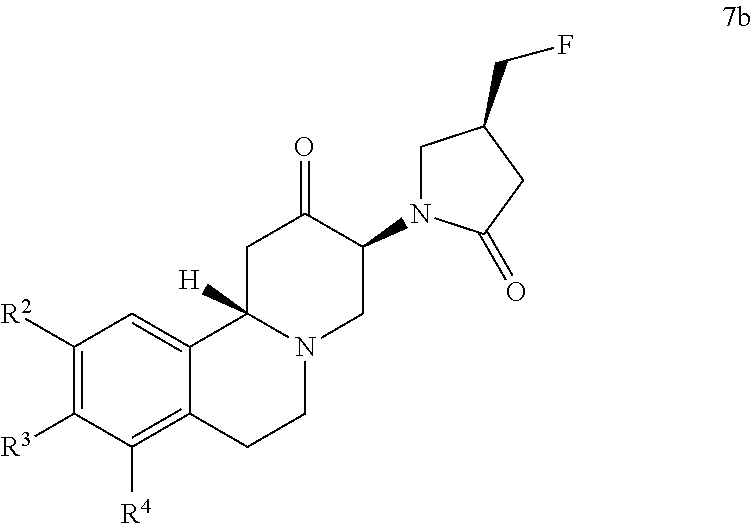
wherein R2, R3 and R4 are each independently selected from the group consisting of hydrogen, halogen, hydroxy, lower alkyl, lower alkoxy and lower alkenyl, wherein lower alkyl, lower alkoxy and lower alkenyl may optionally be substituted by a group selected from lower alkoxycarbonyl, aryl and heterocyclyl, or a salt thereof, are novel compounds and therefore represent a further embodiment of the present invention.
Preferred representatives of the compounds of formula 7a and 7b are those with R2 and R3 being methoxy and R4 being hydrogen. Preferred salt of the compounds of formula 7a and 7b is hydrochloride.
Step g)
Step g) requires the transformation of the (3S,11bS)-3-(S)-4-fluoromethyl-2-oxo-pyrrolidin-1-yl)-1,3,4,6,7,11b-hexahydro-pyrido[2,1-a]isoquinolin-2-one derivative of formula (7b) into the (S)-1-((2S,3S,11bS)-2-N-protected-amino-1,3,4,6,7,11b-hexahydro-2H-pyrido[2,1-a]isoquinolin-3-yl)-4-fluoromethyl-pyrrolidin-2-one of formula (8).
The N-protecting group “Prot” used hereinafter used for the compound of formula (8) may refer to any substituents conventionally used to hinder the reactivity of the amino group. Suitable amino protecting groups are described in Green T., “Protective Groups in Organic Synthesis”, Chapter 7, John Wiley and Sons, Inc., 1991, 309-385. The benzyl group was found to be the preferred N-protecting group “Prot”.
The exchange of the oxo-group by the N-protected amino group usually follows the principles of a reductive amination (see e.g. E. W. Baxter, A. B. Reitz (2002). “Reductive aminations of carbonyl compounds with borohydride and borane reducing agents.” Org. React. (N.Y.) 59: 1-714).
The (3S,11bS)-3-(S)-4-fluoromethyl-2-oxo-pyrrolidin-1-yl)-1,3,4,6,7,11b-hexahydro-pyrido[2,1-a]isoquinolin-2-one derivative of formula (7b), is reacted with the N-protected amine, preferably with benzylamine in the presence of a Ti-organic compound such as titanium tetraisopropoxide in a suitable organic solvent such as tetrahydrofuran at temperatures of 0° C. to 40° C. and by subsequent reduction of the previously formed imine with a common reducing agent such as with sodium borohydride at temperatures of 0° C. to −50° C.
Isolation of (S)-1-((2S,3S,11bS)-2-N-protected-amino-1,3,4,6,7,11b-hexahydro-2H-pyrido[2,1-a]isoquinolin-3-yl)-4-fluoromethyl-pyrrolidin-2-one of formula (8), preferably of the (S)-1-((2S,3S,11bS)-2-N-protected-amino-9,10-dimethoxy-1,3,4,6,7,11b-hexahydro-2H-pyrido[2,1-a]isoquinolin-3-yl)-4-fluoromethyl-pyrrolidin-2-one can happen by filtration over silica gel using a suitable organic solvent, for example a mixture of dichloromethane and methanol as eluent. Evaporation of the solvent and crystallization in a suitable organic solvent, for example in dichloromethane/ethanol leads to an even more pure product.
Step h)
Step h) finally requires the removal of the protecting group Prot in the (S)-1-((2S,3S,11bS)-2-N-protected-amino-1,3,4,6,7,11b-hexahydro-2H-pyrido[2,1-a]isoquinolin-3-yl)-4-fluoromethyl-pyrrolidin-2-one of formula (8) and the formation of the target compound of formula (I).
The removal of the N-protecting group, preferably of the benzyl group can as a rule be accomplished by way of a hydrogenolysis applying conditions which are known to the skilled in the art (see e.g. W. H. Hartung, R. Smirnoff (1953). “Hydrogenolysis of Benzyl Groups Attached to Oxygen, Nitrogen, or Sulfur.” Org. React. (N.Y.) 7: 263).
For the preferred debenzylation the hydrogenolysis can as a rule be performed under a hydrogen atmosphere of 1 bar to 10 bar in the presence of a common hydrogenation catalyst such as palladium or platinum on an inert support like charcoal and in a lower alcohol, preferably ethanol as solvent.
The reaction temperature is expediently selected between 0° C. and 60° C., preferably 20° C. to 50° C.
Upon completion of the reaction the reaction mixture is filtered and the filtrate is concentrated to afford the deprotected product.
Subsequent formation of a pharmaceutically acceptable salt of the compound of formula (I) is within the skill of an artisan.
The preferred formation of the dihydrochloride can be accomplished by reacting the deprotected product of formula (I) with a suitable alkanoyl chloride such as with acetyl chloride in a suitable solvent such as in methanol and at reaction temperatures between 0° C. and 30° C. or with HCl in a suitable solvent such as in isopropanol or dioxane.
Most preferred product of formula (I) is the (S)-1-((2S,3S,11bS)-2-amino-9,10-dimethoxy-1,3,4,6,7,11b-hexahydro-2H-pyrido[2,1-a]isoquinolin-3-yl)-4-fluoromethyl-pyrrolidin-2-one dihydrochloride of formula (9)
The following examples shall illustrate the invention without limiting it.

In a 2.5-1 four-necked flask equipped with a mechanical stirrer, a reflux condenser, a Pt-100 thermometer, and an argon in/outlet, hydrobromic acid (400 ml, 2.28 mol, 5.7 M in acetic acid) was added to lactone 1 (80 g, 677 mmol). The mixture was heated to 60° C. and stirred for 3 hours to give a clear, yellow solution. Methanol (800 ml) was added over 10 minutes under ice cooling, keeping the temperature below 30° C. The resulting mixture was stirred at ambient temperature for 19 hours and then concentrated under reduced pressure at 40° C. The residue was diluted with toluene (400 ml) and saturated aqueous sodium bicarbonate (1000 ml) was slowly added under CO2 evolution. The phases were separated and the organic layer was washed with water (200 ml), dried over anhydrous Na2SO4, filtered, and concentrated under reduced pressure at 40° C. to give 139 g of the crude product as yellow oil. The crude product was purified by vacuum distillation (62-65° C., 0.9 mbar) to give ester 2 (111.3 g, 77% yield) of as a colorless oil.
MS: m/e 213 (M+H)+.

In a 2.5-1 four-necked flask equipped with a mechanical stirrer, a reflux condenser, a Pt-100 thermometer, and an argon in/outlet, bromide 2 (110 g, 519 mmol) was dissolved in acetonitrile (880 ml). To this solution was added N-benzylglycine ethyl ester (256 g, 1.30 mol) and the reaction mixture was refluxed for 71 hours, slowly turning dark red during this time. After cooling to room temperature, the mixture was concentrated under reduced pressure. The dark red oil was filtered over silica gel (800 g) using EtOAc:heptane 1:9 as eluent, giving the crude title compound 3 (169 g) as yellow oil which was used without further purification.
MS: m/e 326 (M+H)+.

In a 5-1 reactor, ester 3 (148 g, 455 mmol) is dissolved in ethanol (500 ml) and a suspension of palladium on charcoal (13.8 g, 10 wt % Pd) in ethanol (40 ml) is added in one portion. The mixture is stirred for 2 hours at 20° C. under hydrogen atmosphere (1.1 bar). The reaction mixture is filtered and the filter cake washed with ethanol. The filtrate is concentrated under reduced pressure at 40° C. to a volume of ca. 500 ml and the solution obtained is stirred at reflux temperature for 6 hours. After cooling to ambient temperature, the solvent is removed under reduced pressure at 40° C. The crude product (92.0 g) is fractionally distilled under reduced pressure (0.75 mbar, 134-139° C.) to give ester 5 (75.5 g, 81% yield) as a colorless oil.
MS: m/e 204 (M+H)+, 130, 158.

In a 2.5-l four-necked flask equipped with a mechanical stirrer, a Pt-100 thermometer, an addition funnel, and an argon in/outlet, diisopropylamine (112 ml, 792 mmol) was dissolved in 960 ml THF and the mixture was cooled to −30° C. n-Butyllithium (507 ml, 787 mmol, 1.55 m in hexanes) was added dropwise over 35 minutes and the clear solution was stirred for 30 minutes at −25° C. after the end of the addition. After further cooling to −70° C., benzyl acetate (114 ml, 794 mmol) was added dropwise over 35 minutes and the yellow solution was stirred for another 1.5 hours. A solution of ethyl ester 4 (80.0 g, 394 mmol) in THF (40 ml) was added over 1 hour at −70° C. at the mixture was allowed to warm to −25° C. over 90 minutes after the end of the addition.
The reaction was quenched by addition of the reaction mixture to 1.0 m aqueous hydrochloric acid (2000 ml). The organic solvents were removed by evaporation under reduced pressure at 40° C. and the residual aqueous layer was extracted with dichloromethane (3×970 ml). The combined organic layers were dried over anhydrous Na2SO4, filtered, and concentrated under reduced pressure at 40° C., giving an orange oil (176.5 g). The crude product was purified by silica gel chromatography (1.75 kg silica gel), eluting with EtOAc:heptane 3:1. Ester 5 (109 g, 90% yield) was isolated as a yellowish oil.
MS: m/e 308 (M+H)+, 325, 330 (M+Na)+.

In a 10-ml two-necked flask equipped with a magnetic stir bar, benzyl ester 5 (150 mg, 0.488 mmol) was dissolved in methanol (1.5 ml) and palladium on charcoal (10.0 mg, 10 wt % Pd) was added. The mixture was stirred for 2 hours under a hydrogen atmosphere (1 bar) and then filtered, washing the filter cake with ethanol (1.6 ml). The volatiles were removed under reduced pressure at ambient temperature and the crude keto ester 5b (105 mg, 99% yield) was obtained as a clear, colorless oil.
MS: m/e 218 (M+H)+.

In a 350-ml four-necked flask equipped with a gas-injection stirrer and a Pt-100 thermometer, benzyl ester 5 (16.19 g, 52.7 mmol) was dissolved in ethanol (134 ml) and palladium on charcoal (1.07 g, 10 wt % Pd) was added. The mixture was stirred for 80 minutes under a hydrogen atmosphere (1 bar) and then filtered, washing the filter cake with ethanol (20 ml).
The yellowish filtrate was added over 10 minutes to a mixture of dihydroisoquinoline 6 (12.0 g, 52.7 mmol), sodium acetate (432 mg, 5.24 mmol), and water (3.7 ml) in ethanol (56 ml) under evolution of CO2, the temperature being maintained between 20° C. and 23° C. using a cooling bath. After the end of the addition, stirring was maintained for 4 hours, leading to an off-white suspension.
Sodium acetate (3.89 g, 47.2 mmol) (pH of reaction mixture ca. 7) and aqueous formaldehyde solution (4.5 ml, 60.3 mmol, 36.5% in H2O) were added and the resulting mixture was stirred at 40° C. for 17 hours. The off-white suspension is slowly cooled to 0° C. over 3 hours and stirred at this temperature for 6 hours. The solids are filtered off and washed with ethanol (8 ml).
The solid residue is purified by chromatography over silica gel (650 g), using EtOAc:EtOH 9:1 as eluent. After evaporation of the solvent, the purified product was dissolved in dichloromethane (40 ml) and ethanol (23 ml) was added. Upon evaporation of dichloromethane under reduced pressure at 40° C., crystallization occurred. The suspension was stirred at ambient temperature for 3 hours. The crystals were filtered off, washed with ethanol (6 ml) and dried under reduced pressure (10 mbar, 50° C.) for 24 hours, giving ketone 7 (5.18 g, 26% yield) as white crystals.
Melting point (Mp)=134° C.
MS: m/e 377 (M+H)+, 399 (M+Na)+.

In a 350-ml four-necked flask equipped with a mechanical stirrer, a Pt-100 thermometer, an argon in/outlet and a rubber septum, ketone 7 (10 g, 26.6 mmol) was suspended in THF (150 ml). Titanium tetraisopropoxide (15.7 ml, 53.1 mmol) and benzyl amine (5.9 ml, 53.1 mmol) were added to give an orange solution which was stirred at room temperature for 1 hour. Sodium borohydride (1.57 g, 39.9 mmol) was added and, after cooling the mixture to −30° C., ethanol (20 ml) was added dropwise over 6 minutes. The reaction mixture is stirred at −30° C. for 15 minutes and then allowed to slowly warm to 0° C. over 45 minutes. After 100 minutes at 0° C., the solvent is removed by evaporation under reduced pressure to give a solid residue, which is suspended in dichloromethane (100 ml) and stirred at room temperature for 15 minutes. After filtration, the dichloromethane solution is filtered over a plug of silica gel (150 g), using CH2Cl2:MeOH 19:1 as eluent. Evaporation of the volatiles under reduced pressure affords a white solid (12.6 g), which is dissolved in dichloromethane (100 ml). Ethanol (200 ml) is added and dichloromethane is evaporated under reduced pressure at 40° C. under stirring, leading to crystallization. After stirring for 15 hours at ambient temperature, the crystals are filtered off, washed with ethanol (5 ml) and dried under reduced pressure (10 mbar, 50° C.) to give amine 8 (8.61 g, 69% yield) as white crystals.
Mp=192° C. (decomp.)
MS: m/e 468 (M+H)+.

In a 1.5-1 glass autoclave, benzyl amine 8 (8.5 g, 18.2 mmol) was dissolved in methanol (300 ml) and palladium on charcoal (1.68 g, 10 wt % Pd) was added under argon. The reactor is sealed and flashed with hydrogen. The mixture is hydrogenated at 40° C. under a pressure of 4 bar. The reaction mixture is filtered, and the filter cake is washed with methanol.
The filtrate is concentrated under reduced pressure at 40° C. to afford 6.65 g (97% crude yield) of the debenzylated product as an off-white solid.
Acetyl chloride (5.1 ml) is added carefully under ice-cooling to methanol (22.7 ml), keeping the temperature below 17° C. This solution is added at room temperature over 40 minutes to a solution of the crude product in methanol (50 ml), whereupon crystallization occurs. After completion of the addition, stirring is maintained for 2 hours. The solid is recovered by filtration, washed with methanol (7 ml), and dried under reduced pressure (10 mbar, 50° C.). Dihydrochloride 9 (7.13 g, 87% yield) is isolated as white crystals.
MS: m/e 378 (M−2HCl+H)+, 400 (M−2HCl+Na)+.
Claims (16)
1. A process for the preparation of pyrido[2,1-a]isoquinoline derivatives of the formula

wherein R2, R3 and R4 are each independently selected from the group consisting of hydrogen, halogen, hydroxy, lower alkyl, lower alkoxy and lower alkenyl, wherein lower alkyl, lower alkoxy and lower alkenyl may optionally be substituted by a group selected from lower alkoxycarbonyl and aryl,
and of pharmaceutically acceptable salts thereof,
comprising one or more of the following steps
a) ring opening of (S)-4-fluoromethyl-dihydro-furan-2-one of the formula

and subsequent esterification to provide the (R)-4-bromo-3-fluoromethyl-butyric acid ester of the formula

wherein R1a is lower alkyl;
b) converting the (R)-4-bromo-3-fluoromethyl-butyric acid ester of the formula (2) with an N-protected glycine alkylester into a N-protected —(S)-4-(alkoxycarbonylmethyl-amino)-3-fluoromethyl-butyric acid ester of formula

wherein R1a and R1b are lower alkyl and Prot is an amino protecting group;
c) deprotection of the N-protected —(S)-4-(alkoxycarbonylmethyl-amino)-3-fluoromethyl-butyric acid ester of formula (3) and subsequent ring closure to form the ((S)-4-fluoromethyl-2-oxo-pyrrolidin-1-yl)-acetic acid ester of formula

wherein R1b is lower alkyl;
d) converting the ((S)-4-fluoromethyl-2-oxo-pyrrolidin-1-yl)-acetic acid ester of formula (4) into the ((S)-4-fluoromethyl-2-oxo-pyrrolidin-1-yl)-3-oxo-butyric acid ester of formula

wherein R1c is a protecting group, or a salt thereof;
e) transforming the ((S)-4-fluoromethyl-2-oxo-pyrrolidin-1-yl)-3-oxo-butyric acid ester of formula (5a) into the ((S)-4-fluoromethyl-2-oxo-pyrrolidin-1-yl)-3-oxo-butyric acid of formula

or a salt thereof;
f) coupling the ((S)-4-fluoromethyl-2-oxo-pyrrolidin-1-yl)-3-oxo-butyric acid of formula (5b) with an isoquinoline derivative of formula

wherein R2, R3 and R4 are as above, or a salt thereof to form a compound of formula

wherein R2, R3 and R4 are as above or of a salt thereof, subsequently ring closing the compound of formula (7a) with formaldehyde to form the (3S,11bS)-3-((S)-4-fluoromethyl-2-oxo-pyrrolidin-1-yl)-1,3,4,6,7,11b-hexahydro-pyrido[2,1-a] isoquinolin-2-one derivative of formula

wherein R2, R3 and R4 are as above, or a salt thereof;
g) transforming the (3S,11bS)-3-((S)-4-fluoromethyl-2-oxo-pyrrolidin-1-yl)-1,3,4,6,7,11b-hexahydro-pyrido[2,1-a] isoquinolin-2-one derivative of formula (7b) into the (S)-1-((2S,3S,11bS)-2-N-protected-amino-1,3,4,6,7,11b-hexahydro-2H-pyrido[2,1-a] isoquinolin-3-yl)-4-fluoromethyl-pyrrolidin-2-one of formula

wherein R2, R3 and R4 and Prot are as above, or a salt thereof;
h) removing the protecting group Prot in the (S)-1-((2S,3S,11bS)-2-N-protected-amino-1,3,4,6,7,11b-hexahydro-2H-pyrido[2,1-a]isoquinolin-3-yl)-4-fluoromethyl-pyrrolidin-2-one of formula (8).
2. The process according to claim 1 , characterized in that the pyrido[2,1-a]isoquinoline derivative of the formula I is

3. The process according to claim 1 , characterized in that the formation of the (R)-4-bromo-3-fluoromethyl-butyric acid ester of the formula (2) in step a) is performed with hydrobromic acid at a reaction temperature of 20° C. to 100° C.
4. The process according to claim 1 , characterized in that the subsequent esterification in step a) is performed in a lower alcohol.
5. The process according to claim 1 , characterized in that the N-protected glycine alkylester used for the formation of N-protected-(S)-4-(alkoxycarbonylmethyl-amino)-3-fluoromethyl-butyric acid ester of formula (3) in step b) is the N-benzyl glycine ethylester.
6. The process according to claim 1 , characterized in that the conversion in step b) is performed in a polar aprotic solvent at a temperature of 60° C. to the reflux temperature of the solvent.
7. The process according to claim 1 , characterized in that the formation of the ((S)-4-fluoromethyl-2-oxo-pyrrolidin-1-yl)-acetic acid ester of formula (4) in step c) is a hydrogenolysis to remove the N-protecting group under a hydrogen atmosphere of 1 bar to 10 bar in the presence of a hydrogenation catalyst followed by a subsequent ring closing reaction at increased temperature.
8. The process according to claim 1 , characterized in that the formation of ((S)-4-fluoromethyl-2-oxo-pyrrolidin-1-yl)-3-oxo-butyric acid ester of formula (5a) in step d) is performed via condensation of an enolate in situ formed by deprotonating an acetic acid ester of the formula

wherein R1c is a protecting group in the presence of a non nucleophilic strong organic base with the ((S)-4-fluoromethyl-2-oxo-pyrrolidin-1-yl)-acetic acid ester of formula (4) at a temperature of −50° C. to −100° C. in an organic solvent.
9. The process according to claim 1 , characterized in that the formation of the ((S)-4-fluoromethyl-2-oxo-pyrrolidin-1-yl)-3-oxo-butyric acid of formula (5b) in step e) is performed by way of a hydrogenolysis to remove the protecting group R1c under a hydrogen atmosphere of 1 bar to 10 bar in the presence of a hydrogenation catalyst.
10. The process according to claim 1 , characterized in that the ((S)-4-fluoromethyl-2-oxo-pyrrolidin-1-yl)-3-oxo-butyric acid of formula (5b) is not isolated, but without isolation transferred to the reaction step f).
11. The process according to claim 1 , characterized in that the formation of the compound of the formula (7a) in step f) is performed with the isoquinoline derivative of formula

in the presence of a base.
12. The process according to claim 1 , characterized in that the formation of (3S,11bS)-3-((S)-4-fluoromethyl-2-oxo-pyrrolidin-1-yl)-1,3,4,6,7,11b-hexahydro-pyrido[2,1-a]isoquinolin-2-one derivative of formula (7b) in step f) is performed with aqueous formaldehyde at a temperature of 20° C. to 60° C.
13. The process according to claim 1 , characterized in that the formation of the (S)-1-((2S,3S,11bS)-2-N-protected-amino-1,3,4,6,7,11b-hexahydro-2H-pyrido[2,1-a] isoquinolin-3-yl)-4-fluoromethyl-pyrrolidin-2-one of formula (8) in step g) is performed by reductive amination of the (3S,11bS)-3-((S)-4-fluoromethyl-2-oxo-pyrrolidin-1-yl)-1,3,4,6,7,11b-hexahydro-pyrido[2,1-a] isoquinolin-2-one derivative of formula (7b).
14. The process according to claim 1 , characterized in that the reductive amination is performed by reacting the (3S,11bS)-3-((S)-4-fluoromethyl-2-oxo-pyrrolidin-1-yl)-1,3,4,6,7,11b-hexahydro-pyrido[2,1-a]isoquinolin-2-one derivative of formula (7b) with benzylamine in the presence of Ti-organic compound and by reducing the formed imine with a reducing agent.
15. The process according to claim 1 , characterized in that the removal of the protecting group Prot of the (S)-1-((2S,3S,11bS)-2-N-protected-amino-1,3,4,6,7,11b-hexahydro-2H-pyrido[2,1-a]isoquinolin-3-yl)-4-fluoromethyl-pyrrolidin-2-one of formula (8) and the formation of the pyrido[2,1-a]isoquinoline derivative of the formula (I) in step h) is performed by way of a hydrogenolysis under a hydrogen atmosphere of 1 bar to 10 bar in the presence of a hydrogenation catalyst.
16. A compound of formula 7a:

wherein R2, R3 and R4 are each independently selected from the group consisting of hydrogen, halogen, hydroxy, lower alkyl, lower alkoxy and lower alkenyl, wherein lower alkyl, lower alkoxy and lower alkenyl may optionally be substituted by a group selected from lower alkoxycarbonyl and aryl, or of a salt thereof.
Priority Applications (1)
| Application Number | Priority Date | Filing Date | Title |
|---|---|---|---|
| US13/274,523 US8420818B2 (en) | 2007-12-19 | 2011-10-17 | Process for the preparation of pyrido[2,1-a] isoquinoline derivatives |
Applications Claiming Priority (5)
| Application Number | Priority Date | Filing Date | Title |
|---|---|---|---|
| EP07150174 | 2007-12-19 | ||
| EP07150174.6 | 2007-12-19 | ||
| EP07150174 | 2007-12-19 | ||
| US12/326,976 US20090163718A1 (en) | 2007-12-19 | 2008-12-03 | PROCESS FOR THE PREPARATION OF PYRIDO[2,1-a] ISOQUINOLINE DERIVATIVES |
| US13/274,523 US8420818B2 (en) | 2007-12-19 | 2011-10-17 | Process for the preparation of pyrido[2,1-a] isoquinoline derivatives |
Related Parent Applications (1)
| Application Number | Title | Priority Date | Filing Date |
|---|---|---|---|
| US12/326,976 Continuation US20090163718A1 (en) | 2007-12-19 | 2008-12-03 | PROCESS FOR THE PREPARATION OF PYRIDO[2,1-a] ISOQUINOLINE DERIVATIVES |
Publications (2)
| Publication Number | Publication Date |
|---|---|
| US20120035368A1 US20120035368A1 (en) | 2012-02-09 |
| US8420818B2 true US8420818B2 (en) | 2013-04-16 |
Family
ID=40445374
Family Applications (2)
| Application Number | Title | Priority Date | Filing Date |
|---|---|---|---|
| US12/326,976 Abandoned US20090163718A1 (en) | 2007-12-19 | 2008-12-03 | PROCESS FOR THE PREPARATION OF PYRIDO[2,1-a] ISOQUINOLINE DERIVATIVES |
| US13/274,523 Expired - Fee Related US8420818B2 (en) | 2007-12-19 | 2011-10-17 | Process for the preparation of pyrido[2,1-a] isoquinoline derivatives |
Family Applications Before (1)
| Application Number | Title | Priority Date | Filing Date |
|---|---|---|---|
| US12/326,976 Abandoned US20090163718A1 (en) | 2007-12-19 | 2008-12-03 | PROCESS FOR THE PREPARATION OF PYRIDO[2,1-a] ISOQUINOLINE DERIVATIVES |
Country Status (7)
| Country | Link |
|---|---|
| US (2) | US20090163718A1 (en) |
| EP (1) | EP2234997B1 (en) |
| JP (1) | JP5247817B2 (en) |
| CN (1) | CN101896479B (en) |
| CA (1) | CA2708314C (en) |
| ES (1) | ES2392782T3 (en) |
| WO (1) | WO2009080500A1 (en) |
Cited By (1)
| Publication number | Priority date | Publication date | Assignee | Title |
|---|---|---|---|---|
| US20140187785A1 (en) * | 2006-09-15 | 2014-07-03 | Hoffmann-La Roche Inc. | PROCESS FOR THE PREPARATION OF PYRIDO[2,1-a] ISOQUINOLINE DERIVATIVES BY CATALYTIC ASYMMETRIC HYDROGENATION OF AN ENAMINE |
Citations (4)
| Publication number | Priority date | Publication date | Assignee | Title |
|---|---|---|---|---|
| WO2005000848A1 (en) | 2003-06-20 | 2005-01-06 | F. Hoffmann-La Roche Ag | Pyrido` 2, 1-a - isoquinoline derivatives as dpp-iv inhibitors |
| WO2006125728A1 (en) | 2005-05-24 | 2006-11-30 | F. Hoffmann-La Roche Ag | Preparation of (s)-4-fluoromethyl-dihydro-furan-2-one |
| WO2007017423A2 (en) | 2005-08-11 | 2007-02-15 | F. Hoffmann-La Roche Ag | Pharmaceutical composition comprising a dpp-iv inhibitor |
| WO2007128801A1 (en) | 2006-05-08 | 2007-11-15 | Novartis Ag | Combination of organic compounds |
Family Cites Families (1)
| Publication number | Priority date | Publication date | Assignee | Title |
|---|---|---|---|---|
| US6727261B2 (en) * | 2001-12-27 | 2004-04-27 | Hoffman-La Roche Inc. | Pyrido[2,1-A]Isoquinoline derivatives |
-
2008
- 2008-12-03 US US12/326,976 patent/US20090163718A1/en not_active Abandoned
- 2008-12-09 JP JP2010538572A patent/JP5247817B2/en not_active Expired - Fee Related
- 2008-12-09 WO PCT/EP2008/067136 patent/WO2009080500A1/en not_active Ceased
- 2008-12-09 CA CA2708314A patent/CA2708314C/en not_active Expired - Fee Related
- 2008-12-09 ES ES08863591T patent/ES2392782T3/en active Active
- 2008-12-09 EP EP08863591A patent/EP2234997B1/en not_active Not-in-force
- 2008-12-09 CN CN2008801208298A patent/CN101896479B/en not_active Expired - Fee Related
-
2011
- 2011-10-17 US US13/274,523 patent/US8420818B2/en not_active Expired - Fee Related
Patent Citations (4)
| Publication number | Priority date | Publication date | Assignee | Title |
|---|---|---|---|---|
| WO2005000848A1 (en) | 2003-06-20 | 2005-01-06 | F. Hoffmann-La Roche Ag | Pyrido` 2, 1-a - isoquinoline derivatives as dpp-iv inhibitors |
| WO2006125728A1 (en) | 2005-05-24 | 2006-11-30 | F. Hoffmann-La Roche Ag | Preparation of (s)-4-fluoromethyl-dihydro-furan-2-one |
| WO2007017423A2 (en) | 2005-08-11 | 2007-02-15 | F. Hoffmann-La Roche Ag | Pharmaceutical composition comprising a dpp-iv inhibitor |
| WO2007128801A1 (en) | 2006-05-08 | 2007-11-15 | Novartis Ag | Combination of organic compounds |
Non-Patent Citations (2)
| Title |
|---|
| (Translation of Japanese Office Action in Corresponding Jap App 2010538572 Dec. 4, 2012). |
| International Search Report (PCT/EP2008/067136 Mar. 31, 2009). |
Cited By (2)
| Publication number | Priority date | Publication date | Assignee | Title |
|---|---|---|---|---|
| US20140187785A1 (en) * | 2006-09-15 | 2014-07-03 | Hoffmann-La Roche Inc. | PROCESS FOR THE PREPARATION OF PYRIDO[2,1-a] ISOQUINOLINE DERIVATIVES BY CATALYTIC ASYMMETRIC HYDROGENATION OF AN ENAMINE |
| US20150031888A1 (en) * | 2006-09-15 | 2015-01-29 | Hoffmann-La Roche Inc. | PROCESS FOR THE PREPARATION OF PYRIDO[2,1-a] ISOQUINOLINE DERIVATIVES BY CATALYTIC ASYMMETRIC HYDROGENATION OF AN ENAMINE |
Also Published As
| Publication number | Publication date |
|---|---|
| US20120035368A1 (en) | 2012-02-09 |
| EP2234997B1 (en) | 2012-09-05 |
| US20090163718A1 (en) | 2009-06-25 |
| WO2009080500A1 (en) | 2009-07-02 |
| CN101896479B (en) | 2013-08-07 |
| EP2234997A1 (en) | 2010-10-06 |
| CA2708314C (en) | 2015-06-23 |
| CA2708314A1 (en) | 2009-07-02 |
| JP5247817B2 (en) | 2013-07-24 |
| JP2011506526A (en) | 2011-03-03 |
| ES2392782T3 (en) | 2012-12-13 |
| CN101896479A (en) | 2010-11-24 |
Similar Documents
| Publication | Publication Date | Title |
|---|---|---|
| US20130018191A1 (en) | Process for the preparation of pyrido [2,1-a] isoquinoline derivatives comprising optical resolution of an enamine | |
| US20150126743A1 (en) | Process For The Preparation Of Pyrido [2,1-A] Isoquinoline Derivatives Comprising Optical Resolution Of An Enamine | |
| EP0812827A1 (en) | Piperidine derivative as intermediates for the preparation of paroxetine and process for their preparation | |
| JP2006523700A (en) | Methods and intermediates for the preparation of pyrrolidinecarboxylic acids | |
| TWI438188B (en) | Production method of intermediate compound for synthesizing medicament | |
| AP708A (en) | Processes and intermediates for preparing 1-Benzyl-4-((5,6-Dimethoxy-1-Incanon)-2-Y1) Methylpiperidine. | |
| US6495700B1 (en) | Process for producing phenserine and its analog | |
| JP3269574B2 (en) | Methananoanthracene compounds, pharmaceutical compositions containing the same for treating neuropsychiatric disorders, and methods and intermediates for producing the compounds | |
| US8420818B2 (en) | Process for the preparation of pyrido[2,1-a] isoquinoline derivatives | |
| CA2646802A1 (en) | Novel crystalline forms of 4-[4-[4-(hydroxydiphenylmethyl)-1-piperidinyl]-1-hydroxybutyl]-.alpha.,.alpha.-dimethylbenzene acetic acid and its hydrochloride | |
| JP4874122B2 (en) | How to get tolterodine | |
| JP4688292B2 (en) | Method for producing N-methyl-N-[(1S) -1-phenyl-2-((3S) -3-hydroxypyrrolidin-1-yl) ethyl] -2,2-diphenylacetamide, which is a pure enantiomer | |
| EP1889827B1 (en) | Process for producing [2-(3,3,5,5-tetramethylcyclohexyl)phenyl]piperazine | |
| US11401269B2 (en) | Intermediates and processes for the preparation of Linagliptin and its salts | |
| US20080214826A1 (en) | Processes for the manufacture of a pyrrolidine-3,4-dicarboxamide derivative | |
| JP5080050B2 (en) | Method for producing optically active piperazine compound | |
| KR101299720B1 (en) | A novel process for preparing 3-amino-5-fluoro-4-dialkoxypetanoic acid ester | |
| WO2005000810A1 (en) | Process for producing nitrogenous heterocyclic compound | |
| JP2003171354A (en) | Method for producing optically active amine compound or salt thereof | |
| CA3214107A1 (en) | New process for the synthesis of 5-{5-chloro-2-[(3s)-3- [(morpholin-4-yl)methyl]-3,4-dihydroisoquinoline-2(1h)- carbonyl]phenyl}-1,2-dimethyl-1h-pyrrole-3-carboxylic acid derivatives and its application for the production of pharmaceutical compounds | |
| EP1634879A1 (en) | Method of selectively introducing amino substituent | |
| JP2002053536A (en) | Spiroaminopyrrolidine derivative and method for producing the same |
Legal Events
| Date | Code | Title | Description |
|---|---|---|---|
| REMI | Maintenance fee reminder mailed | ||
| LAPS | Lapse for failure to pay maintenance fees | ||
| STCH | Information on status: patent discontinuation |
Free format text: PATENT EXPIRED DUE TO NONPAYMENT OF MAINTENANCE FEES UNDER 37 CFR 1.362 |
|
| STCH | Information on status: patent discontinuation |
Free format text: PATENT EXPIRED DUE TO NONPAYMENT OF MAINTENANCE FEES UNDER 37 CFR 1.362 |
|
| FP | Lapsed due to failure to pay maintenance fee |
Effective date: 20170416 |