US8406653B2 - Image forming apparatus - Google Patents
Image forming apparatus Download PDFInfo
- Publication number
- US8406653B2 US8406653B2 US12/913,564 US91356410A US8406653B2 US 8406653 B2 US8406653 B2 US 8406653B2 US 91356410 A US91356410 A US 91356410A US 8406653 B2 US8406653 B2 US 8406653B2
- Authority
- US
- United States
- Prior art keywords
- mounting unit
- image
- door
- removable component
- mount
- Prior art date
- Legal status (The legal status is an assumption and is not a legal conclusion. Google has not performed a legal analysis and makes no representation as to the accuracy of the status listed.)
- Expired - Fee Related, expires
Links
Images




Classifications
-
- G—PHYSICS
- G03—PHOTOGRAPHY; CINEMATOGRAPHY; ANALOGOUS TECHNIQUES USING WAVES OTHER THAN OPTICAL WAVES; ELECTROGRAPHY; HOLOGRAPHY
- G03G—ELECTROGRAPHY; ELECTROPHOTOGRAPHY; MAGNETOGRAPHY
- G03G21/00—Arrangements not provided for by groups G03G13/00 - G03G19/00, e.g. cleaning, elimination of residual charge
- G03G21/16—Mechanical means for facilitating the maintenance of the apparatus, e.g. modular arrangements
- G03G21/1604—Arrangement or disposition of the entire apparatus
- G03G21/1623—Means to access the interior of the apparatus
- G03G21/1633—Means to access the interior of the apparatus using doors or covers
-
- G—PHYSICS
- G03—PHOTOGRAPHY; CINEMATOGRAPHY; ANALOGOUS TECHNIQUES USING WAVES OTHER THAN OPTICAL WAVES; ELECTROGRAPHY; HOLOGRAPHY
- G03G—ELECTROGRAPHY; ELECTROPHOTOGRAPHY; MAGNETOGRAPHY
- G03G21/00—Arrangements not provided for by groups G03G13/00 - G03G19/00, e.g. cleaning, elimination of residual charge
- G03G21/16—Mechanical means for facilitating the maintenance of the apparatus, e.g. modular arrangements
- G03G21/1604—Arrangement or disposition of the entire apparatus
- G03G21/1623—Means to access the interior of the apparatus
-
- G—PHYSICS
- G03—PHOTOGRAPHY; CINEMATOGRAPHY; ANALOGOUS TECHNIQUES USING WAVES OTHER THAN OPTICAL WAVES; ELECTROGRAPHY; HOLOGRAPHY
- G03G—ELECTROGRAPHY; ELECTROPHOTOGRAPHY; MAGNETOGRAPHY
- G03G2221/00—Processes not provided for by group G03G2215/00, e.g. cleaning or residual charge elimination
- G03G2221/16—Mechanical means for facilitating the maintenance of the apparatus, e.g. modular arrangements and complete machine concepts
- G03G2221/1651—Mechanical means for facilitating the maintenance of the apparatus, e.g. modular arrangements and complete machine concepts for connecting the different parts
- G03G2221/1654—Locks and means for positioning or alignment
-
- G—PHYSICS
- G03—PHOTOGRAPHY; CINEMATOGRAPHY; ANALOGOUS TECHNIQUES USING WAVES OTHER THAN OPTICAL WAVES; ELECTROGRAPHY; HOLOGRAPHY
- G03G—ELECTROGRAPHY; ELECTROPHOTOGRAPHY; MAGNETOGRAPHY
- G03G2221/00—Processes not provided for by group G03G2215/00, e.g. cleaning or residual charge elimination
- G03G2221/16—Mechanical means for facilitating the maintenance of the apparatus, e.g. modular arrangements and complete machine concepts
- G03G2221/1678—Frame structures
- G03G2221/1687—Frame structures using opening shell type machines, e.g. pivoting assemblies
-
- G—PHYSICS
- G03—PHOTOGRAPHY; CINEMATOGRAPHY; ANALOGOUS TECHNIQUES USING WAVES OTHER THAN OPTICAL WAVES; ELECTROGRAPHY; HOLOGRAPHY
- G03G—ELECTROGRAPHY; ELECTROPHOTOGRAPHY; MAGNETOGRAPHY
- G03G2221/00—Processes not provided for by group G03G2215/00, e.g. cleaning or residual charge elimination
- G03G2221/16—Mechanical means for facilitating the maintenance of the apparatus, e.g. modular arrangements and complete machine concepts
- G03G2221/1678—Frame structures
- G03G2221/169—Structural door designs
Definitions
- the present invention relates to image-forming apparatuses.
- Such a structure may be configured such that upon a first transfer of an image from an image holding member to a recording medium (media sheet), or upon a second transfer of the image from an intermediate transfer member to a recording medium excess developing agent, mainly toner, is removed from the image holding member or the intermediate transfer member by use of a cleaning device, and recovered to a removable recovery container.
- a cleaning device mainly toner
- an image-forming apparatus including: a body having a mount/remove opening; a removable component that can be mounted on or removed from the body via the mount/remove opening, the removable component being operable when mounted on the body; a door attached to the mount/remove opening; a mounting unit on which the removable component is mounted, the mounting unit being attached to the body; a connecting member that connects the door and the mounting unit, changes at least one of a position and attitude of the mounting unit in accordance with an opening/closing operation of the door, causes the removable component mounted on the mounting unit to move to a first position in which the removable component is operable when the door is closed, and causes the removable component mounted on the mounting unit to move to a second position, which is more easily accessible from an external space via the mount/remove opening than the first position, when the door is opened.
- FIG. 1 is a diagram schematically showing a structure of an image-forming apparatus according to an exemplary embodiment of the present invention
- FIG. 2A and FIG. 2B are diagrams showing configurations of an intermediate transfer member in a color mode and in a monochromatic mode individually;
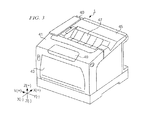
- FIG. 3 is a perspective view showing an external view of the image-forming apparatus
- FIG. 4 is a diagram showing the image-forming apparatus with an opening/closing cover in an open position
- FIGS. 5A , 5 B, and 5 C are drawings schematically showing configurations and operation states of a toner recovery unit
- FIG. 6 is an exploded perspective view of the toner recovery unit
- FIGS. 7A , 7 B, and 7 C are diagrams schematically showing operation states of shutters in association with a rotating movement of a toner recovery container
- FIGS. 8A and 8B are diagrams schematically showing a control section for controlling the rotation of a mounting unit
- FIGS. 9A and 9B are perspective views showing a relation between a mount/remove door and the toner recovery unit when the toner recovery container is in the second position;
- FIG. 10 is a plan view of the mounting unit
- FIGS. 11A to 11F are diagrams showing operation states where the mount/remove door is opened.
- FIGS. 12A to 12F are diagrams showing operation states where the mount/remove door is closed.
- FIG. 1 is a diagram schematically showing a structure of an image-forming apparatus according to an exemplary embodiment of the present invention.
- image-forming apparatus 1 as viewed from the front of the apparatus, where the horizontal direction is denoted as the X-axis direction, with right/left directions from a viewer's perspective being indicated by X(+) and X( ⁇ ), respectively; the front-back direction of image-forming apparatus 1 is denoted as the X-axis direction, with back/front directions of image-forming apparatus 1 being indicated by Y(+) and Y( ⁇ ), respectively; and the vertical direction is denoted as the Z-axis direction, with up/down directions being indicated by Z(+) and Z( ⁇ ), respectively.
- the image-forming apparatus is provided with four image-forming units 2 Y for yellow (Y), 2 M for magenta (M), 2 C for cyan (C), and 2 K for black (K) in parallel along an intermediate transfer belt, as well as a control unit that controls the overall operation of image-forming apparatus 1 , an image processing device (not shown) for performing image processing on image data sent through a scanner and a personal computer (which are not shown in the figure), or through a telephone line and the like.
- Y yellow
- M magenta
- C cyan
- K black
- image-forming units 2 Y, 2 M, 2 C, and 2 K are arranged in parallel with fixed gaps therebetween in such a way that image-forming unit 2 Y for yellow (Y), which is firstly transferred onto an intermediate transfer belt, is disposed at the highest position and image-forming unit 2 K for black (K), which is lastly transferred onto the intermediate transfer belt, is disposed at the lowest position. In other words, they are disposed in a line forming an angle relative to the horizontal (for example, 20 degrees relative to the horizontal).
- the distance between image-forming unit 2 Y and image-forming unit 2 K along the width of image-forming apparatus 1 (in the direction X) is shorter than that in the case where these four image-forming units 2 Y, 2 M, 2 C, and 2 K are disposed horizontally.
- image-forming units 2 Y, 2 M, 2 C, and 2 K have basically the same structure, and therefore, in the following description, they will each be referred to as image-forming unit 2 , when it is not necessary to distinguish between them.
- Image-forming unit 2 includes a photo-conductor unit 3 that is equipped with a photoconductor drum 4 serving as an image holding body, a charging device and the like, and a developing device 5 .
- the developing devices 5 Y, 5 M, 5 C, and 5 K are attached to body 40 through a frame (not shown), and gaps between the developing devices 5 Y, 5 M, 5 C, and 5 K are unit housing sections on which photoconductor units 3 are mounted.
- each photoconductor unit 3 is removable from the body.
- An image exposing device 6 that is commonly used for image-forming units 2 Y, 2 M, 2 C, and 2 K is provided under image-forming units 2 Y, 2 M, 2 C, and 2 K.
- This image-exposing device 6 is equipped with four semiconductor lasers (not shown) that irradiate laser beams individually modulated in accordance with image data of Y, M, C, and K colors.
- the four laser beams irradiated from these semiconductor lasers are polarized by polygon mirrors, and through lenses and mirrors (none of which are shown), they scan surfaces of photoconductor drums 4 of image-forming units 2 Y, 2 M, 2 C, and 2 K respectively and write electrostatic latent images onto the surfaces thereof.
- the electrostatic latent images written onto the surfaces of photoconductor drums 4 are developed by developing devices 5 Y, 5 M, 5 C, and 5 K by the use of developers including corresponding color toners, with the result that four toner images are generated.
- the four color toner images that are sequentially generated on photoconductor drums 4 of image-forming units 2 Y, 2 M, 2 C, and 2 K are overlappingly transferred by corresponding first transfer rollers 11 onto the lower outer peripheral surface of intermediate transfer belt 10 that is disposed above image-forming units 2 Y, 2 M, 2 C, and 2 K as an intermediate transfer member.
- a power supply unit 7 for supplying power to various units and sections is provided in a right corner of body 40 .
- Intermediate transfer belt 10 is an endless belt member that is driven and supported by plural rollers such as drive roller 12 , tension roller 13 , and idler roller 14 .
- Intermediate transfer belt 10 is cyclically driven in the direction indicated by arrow A by drive roller 12 that is rotationally driven by a drive motor (not shown).
- This intermediate transfer belt 10 is disposed on a slant forming a certain angle relative to the horizontal in such a way that, on the lower base of intermediate transfer belt 10 , the downstream side in the direction of travel of intermediate transfer belt 10 is vertically lower, and the upstream side is vertically higher.
- intermediate transfer belt 10 makes contact with photoconductor drums 4 Y, 4 M, 4 C, and 4 K of image-forming units 2 Y, 2 M, 2 C, and 2 K.
- this intermediate transfer belt 10 for example, a belt made of synthetic resin film having flexibility such as polyimide resin film, both end of which are connected to each other by adhesion or other means to make an endless belt, is used.
- Intermediate transfer belt 10 , first transfer rollers 11 , drive roller 12 , tension roller 13 , idler roller 14 , and the like constitute intermediate transfer member 9 .
- Recording sheets 18 of a recognized standard size and quality are fed as recording media from paper container 24 disposed inside image-forming apparatus 1 along feeding route 21 formed by plural pairs of rollers.
- the recording sheets 18 from paper container 24 are fed to resist roller 28 one by one by sheet-feeding roller 25 and sheet-separating/feeding roller 26 , and they stop moving once at resist roller 28 .
- these recording sheets 18 are fed to a second transfer position of intermediate transfer belt 10 by resist roller 28 that is rotationally driven at a predetermined timing.
- second transfer position there is provided second transfer roller 17 on one side of intermediate transfer belt 10 and in opposing relation to drive roller 12 provided on the other side of intermediate transfer belt 10 .
- Second transfer roller 17 rotates in a direction opposite to that of drive roller 12 and presses each recording sheet 18 against intermediate transfer belt 10 as the sheet moves between the rollers.
- Toner images of yellow (Y), magenta (M), cyan (C), and black (K) provided in overlapping relation on intermediate transfer belt 10 are transferred onto recording sheet 18 under pressure of second transfer roller 17 and action of electrostatic force.
- a fixing device 19 After heat and pressure are applied to recording sheets 18 , onto which the four color toner images have been transferred through the second transfer, by a fixing device 19 as a fixing process, recording sheets 18 are discharged by a discharge roller 20 onto sheet discharge section 23 prepared in the upper part of image-forming apparatus 1 .
- feeding route 21 is provided with a reversal mechanism 22 that turns over recording sheets 18 so as to transpose the obverse and the reverse sides of recording sheets 18 .
- Image-forming apparatus 1 is provided with a switching mechanism that switches between a monochromatic mode and a color mode to reduce power consumption.
- a switching mechanism that switches between a monochromatic mode and a color mode to reduce power consumption.
- image-forming apparatus 1 forms monochromatic images using, for example, only black toner.
- color mode image-forming apparatus 1 forms color images using plural color toners.
- the control unit switches between the monochromatic mode, in which images are formed using only black toner, and the color mode, in which images are formed using yellow, magenta, cyan, and black toners, in accordance with a user's operation at an operation unit 49 and the like.
- the control unit changes the attitude of intermediate transfer member 9 according to the currently used mode, controls the arrangements of image-forming units 2 and the like, and forms images on recording sheets 18 .
- the attitude of intermediate transfer member 9 is equivalent to the orientation of intermediate transfer belt 10 , or is equivalent to a relation between the longitudinal direction of intermediate transfer belt 10 and the direction in which photoconductor drums 4 are arranged.
- One method for switching between these two modes is to use a spacing section that makes gaps between this intermediate transfer belt 10 and photoconductor drums 4 C, 4 M, 4 Y by moving the position of intermediate transfer belt 10 .
- FIG. 2A is a diagram showing the configuration of intermediate transfer member 9 in the color mode.
- intermediate transfer belt 10 makes contact with all photoconductor drums 4 , with the result that images are transferred from photoconductor drums 4 to intermediate transfer belt 10 .
- FIG. 2B is a diagram showing the configuration of intermediate transfer member 9 in the monochromatic mode.
- tension roller 13 In the monochromatic mode, tension roller 13 , first transfer rollers 11 C, 11 M, and 11 Y, and a cleaner backup roller 53 (these rollers are referred to as a movable roller group hereinafter) are arranged in such a way that there are gaps between intermediate transfer belt 10 and photoconductor drums 4 C, 4 M, 4 Y.
- a cleaner backup roller 53 these rollers are referred to as a movable roller group hereinafter
- FIG. 3 is a perspective view showing an external view of image-forming apparatus 1 .
- FIG. 4 is a diagram showing an internal configuration of image-forming apparatus 1 when an opening/closing cover 41 on the side surface and a cover 45 on the top surface of image-forming apparatus 1 are opened.
- opening/closing cover 41 On the side surface of body 40 of image-forming apparatus 1 is installed opening/closing cover 41 that is opened or closed on a support shaft 42 .
- this opening/closing cover 41 is provided with a feed opening/closing cover 43 .
- Feed opening/closing cover 43 is usually closed relative to opening/closing cover 41 , but when different types of recording sheets other than those of recording sheets stocked in a paper container 24 are required, feed opening/closing cover 43 is opened relative to opening/closing cover 41 , and necessary recording sheets are fed along feeding route 21 through feed opening/closing cover 43 .
- cover 45 that is opened or closed on a support shaft 46 is provided on a top surface of body 40 .
- a top surface of cover 45 serves as a sheet discharge section 23 to which recording sheets 18 on which toner images are formed are discharged.
- a mount/remove door 47 is attached to this cover 45 to expose a mount/remove opening 48 .
- a toner recovery container 60 which is one example of a removable component, and will be described later, goes through this mount/remove opening 48 when a toner recovery container 60 is mounted on or removed from body 40 .
- a mount/remove door 47 is a door that is opened to expose mount/remove opening 48 to enable the mount/remove operation.
- operation unit 49 including a numeric keypad, by use of which a number of recording sheets to be used and the like are input.
- Cover 45 is usually closed relative to body 40 , and it is opened when photoconductor units 3 Y, 3 M, 3 C, or 3 K are mounted on or removed from body 40 .
- cover 45 is closed first relative to body 40 .
- toner recovery unit 50 is disposed inside a space between intermediate transfer member 9 and cover 45 , which is otherwise a dead space inside cover 45 , which leads to downsizing of body 40 .
- toner recovery unit 50 The configuration of toner recovery unit 50 will be described with reference to FIG. 5 below. Firstly, only the operations of toner recovery container 60 in accordance with the opening/closing operation of mount/remove door 47 will be described, and shapes and configurations of other members will be described in detail later.
- Toner recovery unit 50 has a long side that coincides with the direction Y, and includes a box-shaped removal device 51 having an opening in its top surface, toner recovery container 60 being removably disposed in this removal device 51 .
- Toner recovery container 60 is removable from body 40 , and is an example of a removable component that is operable in the state of being housed in this body 40 .
- Removal device 51 removes toner remaining on the surface of intermediate transfer belt 10 . The toner removed by this removal device 51 is accumulated in toner recovery container 60 .
- Toner recovery container 60 moves in conjunction with the opening/closing operation of mount/remove door 47 via a mounting unit 70 and a support member 85 (none of which is shown in FIG. 5 ). Mounting unit 70 and support member 85 will be described in detail later. Described concretely, when mount/remove door 47 is in the state of being closed, toner recovery container 60 moves to a first position (shown in FIG. 5A ) in which image forming apparatus 1 is operative; in other words, toner recovery container 60 is operative. On the other hand, when mount/remove door 47 is in the state of being opened, toner recovery container 60 moves to a second position (shown in FIG. 5B ) in which it becomes easier to mount or remove toner recovery container 60 .
- toner recovery container 60 moves to the second position, which is nearer to an external space via mount/remove opening 48 than the first position.
- toner recovery container 60 in the second position can be mounted on or removed from removal device 51 as shown in FIG. 5C .
- this toner recovery container 60 moves to the second position, so that toner recovery container 60 can be mounted in or removed from removal device 51 .
- a user of image-forming apparatus 1 removes toner recovery container 60 from removal device 51 , and mounts an empty toner recovery container 60 , that is, one that contains no toner, on removal device 51 .
- Removal device 51 has a scratch-up member 52 as shown in FIG. 5A .
- Cleaner backup roller 53 is disposed in such a way that it faces this scratch-up member 52 with intermediate transfer belt 10 therebetween.
- the width of scratch-up member 52 extending in the direction Y is set to be wider than the width of intermediate transfer belt 10 .
- Scratch-up member 52 has contact with the outer peripheral surface of intermediate transfer belt 10 and scratches up toner attached to the outer peripheral surface, so that the toner removed from the outer peripheral surface is accumulated in a housing space in removal device 51 .
- the housing space in removal device 51 leads to a toner-housing unit 62 in toner recovery container 60 via an aperture section 54 .
- FIG. 5A As shown in the exploded perspective view of FIG.
- removal device 51 has an apparatus-side shutter 55 used for opening or closing the aperture section 54 .
- apparatus-side shutter 55 opens aperture section 54
- apparatus-side shutter 55 closes aperture section 54 .
- Toner recovery container 60 has a long side, and contains toner-housing unit 62 .
- Toner recovery container 60 is provided with an aperture section 61 that faces aperture section 54 in the state where toner recovery container 60 is mounted in removal device 51 .
- the toner accumulated in removal device 51 is fed to toner housing unit 62 via aperture sections 54 and 61 .
- a feeding member 63 Provided in toner housing unit 62 is a feeding member 63 that is rotated on a driving shaft 64 .
- This feeding member 63 conveys the toner fed in the vicinity of aperture section 61 to the rear of toner housing unit 62 .
- a gear 64 A is attached to one end of driving shaft 64 , and torque generated by a driving source in body 40 is transmitted to driving shaft 64 via this gear 64 A.
- This driving shaft 64 is an example of a rotating member the direction of whose long side coincides with the direction of the long side of toner recovery container 60
- gear 64 A is an example of a mechanism that rotates this rotating member (
- toner recovery container 60 has a container-side shutter 65 for opening and closing aperture section 61 .
- Container-side shutter 65 opens aperture section 61 when toner recovery container 60 is in the first position, and closes aperture section 61 when toner recovery container 60 is in the second position.
- FIGS. 7A , 7 B, and 7 C are diagrams schematically showing operation states of shutters 55 and 65 in association with a mount/remove movement of toner recovery container 60 .
- FIG. 7A after being rotated in the direction indicated by an arrow relative to removal device 51 by a user, toner recovery container 60 is removed from removal device 51 .
- FIG. 7A As shown in FIG. 7A , after being rotated in the direction indicated by an arrow relative to removal device 51 by a user, toner recovery container 60 is removed from removal device 51 .
- FIG. 7A after being rotated in the direction indicated by an arrow relative to removal device 51 by a user, toner recovery container 60 is removed from removal device 51 .
- apparatus-side shutter 55 opens aperture section 54 and container-side shutter 65 opens aperture section 61 , whereby the housing space in removal device 51 and toner housing unit 62 in toner recovery container 60 lead to each other via aperture sections 54 and 61 that are formed in such positions that they face each other.
- one end of apparatus-side shutter 55 that is positioned on the upstream side of the arrow is supported by a part of toner recovery container 60 (part marked by a), and one end of container-side shutter 65 that is positioned on the upstream side of the arrow is supported by a part of removal device 51 (part marked by b).
- apparatus-side shutter 55 closes aperture section 54 and container-side shutter 65 closes aperture section 61 .
- apparatus-side shutter 55 that rotates in accordance with the rotation of toner recovery container 60 closes aperture section 54 of removal device 51
- container-side shutter 65 closes aperture section 61 of toner recovery container 60 that rotates in accordance with the rotation of toner recovery container 60 .
- both aperture sections 54 and 61 are closed.
- aperture section 61 of toner recovery container 60 is covered by container-side shutter 65
- aperture section 54 of removal device 51 is covered by apparatus-side shutter 55 .
- both aperture sections 61 and 54 are covered, neither toner inside container 60 nor toner inside device 51 is leaked outside, which prevents the inside of body 40 from being tainted with waste toner.
- These apparatus-side shutter 55 and container-side shutter 65 are examples of doors that open aperture sections 54 and 61 respectively when toner recovery container 60 is in the first position, and close aperture sections 54 and 61 respectively when toner recovery container 60 is in the second position.
- mounting units 70 and 75 that connect removal device 51 and toner recovery container 60 will be described. These mounting units 70 and 75 are examples of mounting units on which toner recovery container 60 is mounted as a removable component. Mounting units 70 and 75 are attached to body 40 .
- removable device 51 has a box-like shape with its long side extending in the direction Y.
- Two different shaped mounting units 70 and 75 are rotatably attached to the sides of both ends of the long side of removal device 51 , respectively.
- a groove 71 Formed in one mounting unit 70 is a groove 71 into which a side of toner recovery container 60 falls in order for toner recovery container 60 to be attached to mounting unit 70 .
- a support section 72 for rotatably supporting mounting unit 70 relative to removal device 51 .
- a U-shaped through-groove 76 Formed in the other mounting unit 75 is a U-shaped through-groove 76 into which a side of toner recovery container 60 and driving shaft 64 fall in order for the toner recovery container 60 to be attached to mounting unit 75 .
- a member in the rear of through-groove 76 forms a support section for rotatably supporting mounting unit 75 relative to removal device 51 in cooperation with driving shaft 64 .
- toner recovery container 60 rotates relative to removal device 51 owing to the operations of these mounting units 70 and 75 , toner recovery container 60 can move from the first position to the second position relative to removal device 51 and vice versa as shown in FIG. 5A to FIG. 5C , FIG. 6 , and FIG. 7A to FIG. 7C .
- mounting unit 70 is provided with a rotation control mechanism.
- This rotation control mechanism functions to prevent toner recovery container 60 from rotating unless the side of toner recovery container 60 properly falls into groove 71 of mounting unit 70 .
- this rotation control mechanism is configured, for example, as shown in FIGS. 8A and 8B .
- a circular arc rib 56 that extends to mounting unit 70 .
- a reception section 74 A is attached to a position whose y-coordinate is equivalent to that of circular arc rib 56 in such a way that reception section 74 A can be moved in the direction indicated by an arrow in FIG. 8A .
- This reception section 74 A is pushed out in the direction opposite to the direction indicated by the arrow in FIG. 8A by biasing force of a spring 74 B. In this state, even if an attempt is made to rotate mounting unit 70 counterclockwise, mounting unit 70 is prevented from rotating because a side of reception section 74 A makes contact with an end of rib 56 .
- the rotation control mechanism is one example of a control section for preventing mount/remove door 47 from closing when mount/remove door 47 is in the state of being opened and toner recovery container 60 is not in the state of being mounted on mounting unit 70 .
- FIGS. 9A and 9B are perspective views of toner recovery container 60 mounted between mounting units 70 and 75 in the case where toner recovery container 60 is located in the second position. These perspective views are used to describe a relationship between mount/remove door 47 and toner recovery unit 50 .
- support member 80 is disposed in the right direction (the direction Y( ⁇ )) from an anterior view in FIG. 9A or FIG. 9B .
- a support salient section 81 Formed on one end of this support member 80 is a support salient section 81 that is rotatably engaged with a support reception concave section (not shown) of body 40 , and attached to the other end is one end of mount/remove door 47 .
- support member 85 is disposed in the left direction (the direction Y(+)) from an anterior view in FIG. 9A or FIG. 9B .
- a support salient section 86 that is rotatably engaged with a support reception concave section (not shown) of body 40 , and attached to the other end of support member 85 is the other end of mount/remove door 47 .
- the line that connects the support salient sections 81 and 86 coincides with a rotating shaft of mount/remove door 47 , and mount/remove door 47 rotates on this rotating shaft.
- an approximately L-shaped guide groove 87 is formed along the length of support member 85 from one end to the other end.
- a pin member 73 that is saliently formed is inserted into this guide groove 87 in the longitudinal direction (direction Y(+)) from mounting unit 70 .
- support member 85 can be said to be an example of a connecting member for connecting mount/remove door 47 and mounting unit 70 .
- the moving direction of pin member 73 that is, the moving direction of toner recovery container 60 during the opening/closing operation of mount/remove door 47 is guided by movement of pin member 73 along guide groove 87 .
- mounting unit 70 is changed in accordance with the opening/closing operation of mount/remove door 47 , with the result that toner recovery container 60 mounted in mounting unit 70 moves from the first position to the second position or vice versa.
- support members 80 and 85 rotatably support mount/remove door 47
- guide groove 87 formed in support member 85 (connecting member) can be said to be one example of a groove
- pin member 73 of mounting unit 70 inserted to this guide groove can be said to be one example of a protruding portion.
- mounting unit 70 can be more smoothly moved in accordance with the operation of mount/remove door 47 without disturbing rotations of rotating shaft 64 and gear 64 A, than in a configuration in which mounting unit 70 and mount/remove door 47 are connected by use of a member other than support member 85 that supports mount/remove door 47 .
- the above-described configuration can be composed of a smaller number of components. If members that support the door are utilized in connecting mounting unit 70 and mount/remove door 47 , it becomes necessary to provide a space to house the members in the body, which in turn necessitates an apparatus of increased size, while the above-described configuration does not require that the size of the apparatus be increased.
- support member 85 that serves as the connecting member and gear 64 A is not limited to the above-described positional relation, and support member 85 and gear 64 A can be freely disposed in consideration of disadvantages such as interference therebetween.
- FIG. 10 is a plan view of support member 85 .
- a short portion 87 A of guide groove 87 A that extends in the vertical direction (the direction Z) is a portion that reduces an amount of pressure needed for pressing mount/remove door 47 (toner recovery container 60 ) into removal device 51 .
- Long portion 87 B that extends in the lateral direction (the direction X) controls an angle that mount/remove door 47 (toner recovery container 60 ) forms, and short portion 87 A that extends in the vertical direction (the direction Z) serves as a buffer for absorbing a positional change between toner recovery container 60 and mount/remove door 47 in a state where toner recovery container 60 is in the first position.
- a part of short portion 87 A that is located near to long portion 87 B forms an embrasure 87 C that is narrower than any embrasures that are formed by other parts of guide groove 87 .
- the groove width of this embrasure 87 C will hereinafter be represented by L (the groove width will be referred to as gap distance L hereinafter).
- Gap distance L of this embrasure 87 C is smaller than the diameter of pin member 73 .
- Support members 80 and 85 are made of resin material, because the extent of deformation of the resin material is greater than that of, for example, metal material when physical force is applied. Therefore, force above a certain level applied to pin member 73 will cause pin member 73 to pass through embrasure 87 C.
- a surface composed of a lower surface of long portion 87 B formed in the down direction (in the direction Z( ⁇ )) and a right surface of short portion 87 A in the right direction (in the direction X( ⁇ )) will be referred to as a first surface 87 D
- a surface composed of a top surface of long portion 87 B formed in the up direction (in the direction Z(+)) and a left surface of short portion 87 A in the left direction (in the direction X(+)) will be referred to as a second surface 87 E.
- mounting unit 75 is provided with through-groove 76 through which driving shaft 64 is supported, only mounting unit 70 is connected to mount/remove door 47 via support member 85 . Even in the above-described configuration, removal device 51 is attached to body 40 and mount/remove door 47 is rotatably supported relative to cover 45 by support members 70 and 75 , so that mounting units 70 and 75 are not significantly deformed.
- support salient section 81 of support member 80 and support salient section 86 of support member 85 are individually provided with release parts such as springs (not shown), when a lock mechanism of mount/remove door 47 (not shown) is released, mount/remove door 47 (toner recovery container 60 ) is automatically opened owing to biasing forces of these release parts.
- FIGS. 11A to 11F are diagrams showing operation states where mount/remove door 47 is opened.
- FIGS. 11A to 11C are diagrams showing operation states where intermediate transfer member 9 is in the color mode
- FIGS. 11D to 11E are diagrams showing the operation states where intermediate transfer member 9 is in the monochromatic mode.
- FIGS. 12A to 12F are diagrams showing operation states where mount/remove door 47 is closed.
- FIGS. 12A to 12C are diagrams showing the operation states where intermediate transfer member 9 is in the color mode
- FIGS. 12D to 12E are diagrams showing the operation states where intermediate transfer member 9 is in the monochromatic mode.
- a difference between a group of FIGS. 11A to 11C and a group of FIGS. 11D to 11F is that the position of pin member 73 that is guided by guide groove 87 is different between FIG. 11A and FIG. 11D , between FIG. 11B and FIG. 11E , or FIG. 11C and FIG. 11F .
- the same is true of a difference between a group of FIGS. 12A to 12C and a group of FIGS. 12D to 12F . Described concretely, as shown in FIG.
- the right side of intermediate transfer member 9 (the side in the direction X(+)) is set to be lower in the color mode than in the monochromatic mode in order for all the photo-conductor drums to make contact with intermediate transfer belt 10 , with the result that, when mount/remove door 47 is in the state of being closed, that is, when toner recovery container 60 is in the first position, the height of pin member 73 relative to short portion 87 A is different between the color mode and the monochromatic mode. In other words, the position of pin member 73 in the color mode shown in FIG. 11A is lower in the vertical direction than in the monochromatic mode shown in FIG. 11D .
- mount/remove door 47 is rotated in such a direction that opening of the door is assisted by the biasing forces of the springs that serve as the release parts.
- support member 85 begins to rotate counterclockwise on support salient section 86 .
- pin member 73 rotates toner recovery container 60 (mounting unit 70 ) so that toner recovery container 60 (mounting unit 70 ) is raised upward.
- mount/remove door 47 being opened as shown in FIG. 11C or FIG.
- toner recovery container 60 is exposed to the outside via mount/remove opening 48 of cover 45 (Refer to FIG. 1 ). In other words, toner recovery container 60 is in the second position. In this state, toner recovery container 60 can be replaced with a new one as shown in FIG. 5B .
- the rotational movement of mounting unit 70 is determined on the basis of the position of pin member 73 that moves in guide groove 87 because gravity acts on mounting unit 70 and toner recovery container 60 .
- pin member 73 moves along guide groove 87 in accordance with the rotation of support member 85 , pin member 73 moves along the lower surface of guide groove 87 from right to left to rotate mounting unit 70 in response to opening of mount/remove door 47 .
- toner recovery unit 50 in the monochromatic mode is located higher in the vertical direction than in the color mode
- the position of pin member 73 (mounting unit 70 ) in the monochromatic mode is higher than in the color mode at the start of the opening operation of mount/remove door 47 , that is, when mount/remove door 47 is in the state of being closed as shown in FIG. 11A and FIG. 11D .
- the position of pin member 73 (mounting unit 70 ) in the monochromatic mode is located higher than in the color mode as shown in FIG. 11C and FIG. 11F .
- mount/remove door 47 is pressed by the user against the biasing forces of the springs that serve as the release parts.
- pin member 73 rotates toner recovery container 60 (mounting unit 70 ) so that toner recovery container 60 (mounting unit 70 ) is dragged down.
- pin member 73 When pin member 73 reaches embrasure 87 C, pin member 73 cannot be passed through embrasure 87 C until force above a certain level is applied to pin member 73 , because the gap distance L is smaller than the diameter of pin member 73 , with the result that pin member 73 is in a state of building up pressure for pushing mount/remove door 47 without being passed through embrasure 87 C (Refer to FIGS. 12B and 12E ).
- toner recovery container 60 is safely mounted at the first position in removal device 51 regardless of the mode of intermediate transfer member 9 .
- toner recovery unit 50 is set to be correspondingly lower.
- pin member 73 is pressed upward in a single movement to be passed from long portion 87 B to short portion 87 A by closing of mount/remove door 47 because the gap distance L of embrasure 87 C is smaller than the diameter of pin member 73 , with the result that, even in the case of the color mode where toner recovery unit 50 is located lower, toner recovery container 60 can be safely mounted in removal device 51 .
- toner recovery unit 50 in the monochromatic mode is located higher than in the color mode in a similar way to the opening operation of mount/remove door 47 . Therefore, at the start of the closing operation of mount/remove door 47 , that is, when the door is in the state of being open, as shown in FIG. 12A and FIG. 12D , pin member 73 (mounting unit 70 ) in the monochromatic mode is located higher than in the color mode.
- the position of pin member 73 (mounting unit 70 ) in the monochromatic mode is higher than in the color mode, as shown in FIG. 12C and FIG. 12F .
- the position of pin member 73 at the start of the closing operation of mount/remove door 47 when pin member 73 starts to move along second surface 87 E while making contact therewith, and that of pin member 73 at the end of the closing operation of mount/remove door 47 when pin member 73 stops moving in the monochromatic mode are different from those in the color mode.
- mounting unit 70 disposed at one end of toner recovery container 60 is connected to mount/remove door 47 via support member 85
- both of mounting unit 70 disposed at one end of toner recovery container 60 and mounting unit 75 disposed at the other end of toner recovery container 60 can be connected to mount/remove door 47 via support member 85 and via support member 80 respectively.
- toner recovery container 60 that recovers waste toner has been explained as an example of a replaceable target
- the replaceable target is not limited to this toner recovery container 60
- toner supplying containers for supplying toner to developing devices 5 Y, 5 M, 5 C, and 5 K can be removal targets.
- a part that is disposed at a location where the part can move between a first position and a second position in accordance with the opening/closing operation of mount/remove door 47 , and that can be removed when in the second position can be a removable component (a replaceable module).
- guide groove 87 is composed of short portion 87 A and long portion 87 B, and short portion 87 A is triangle-shaped so as to cancel the positional change of pin member 73 owing to the switching between the two modes
- shape of short portion 87 A is not limited to a triangle, and can be any other shape as long as pin member 73 moves along short portion 87 A in accordance with the opening/closing operation of mount/remove door 47 , and short portion 87 A cancels the positional change of pin member 73 owing to the switching between the two modes and alleviates pressure for pressing pin member 73 into guide groove 87 .
Landscapes
- Physics & Mathematics (AREA)
- General Physics & Mathematics (AREA)
- Electrophotography Configuration And Component (AREA)
- Dry Development In Electrophotography (AREA)
- Electrostatic Charge, Transfer And Separation In Electrography (AREA)
- Color Electrophotography (AREA)
Abstract
Description
Claims (9)
Applications Claiming Priority (2)
| Application Number | Priority Date | Filing Date | Title |
|---|---|---|---|
| JP2010-059124 | 2010-03-16 | ||
| JP2010059124A JP5565011B2 (en) | 2010-03-16 | 2010-03-16 | Image forming apparatus |
Publications (2)
| Publication Number | Publication Date |
|---|---|
| US20110229192A1 US20110229192A1 (en) | 2011-09-22 |
| US8406653B2 true US8406653B2 (en) | 2013-03-26 |
Family
ID=44601671
Family Applications (1)
| Application Number | Title | Priority Date | Filing Date |
|---|---|---|---|
| US12/913,564 Expired - Fee Related US8406653B2 (en) | 2010-03-16 | 2010-10-27 | Image forming apparatus |
Country Status (3)
| Country | Link |
|---|---|
| US (1) | US8406653B2 (en) |
| JP (1) | JP5565011B2 (en) |
| CN (1) | CN102193365B (en) |
Cited By (3)
| Publication number | Priority date | Publication date | Assignee | Title |
|---|---|---|---|---|
| US20110026056A1 (en) * | 2009-07-28 | 2011-02-03 | Casio Electronics Manufacturing Co., Ltd. | Image forming device and power consumption control method in an image forming device |
| US20120105922A1 (en) * | 2010-10-29 | 2012-05-03 | Kyocera Mita Corporation | Driving unit and image forming apparatus using the same |
| US20140376963A1 (en) * | 2013-06-24 | 2014-12-25 | Canon Kabushiki Kaisha | Toner accommodating container and image forming apparatus |
Families Citing this family (11)
| Publication number | Priority date | Publication date | Assignee | Title |
|---|---|---|---|---|
| JP5533085B2 (en) * | 2010-03-17 | 2014-06-25 | 富士ゼロックス株式会社 | Image forming apparatus |
| CN102621847B (en) * | 2012-03-20 | 2014-03-26 | 上海富士施乐有限公司 | Braking device for connecting side door of copying machine with machine body |
| US9799567B2 (en) | 2014-10-23 | 2017-10-24 | Taiwan Semiconductor Manufacturing Company, Ltd. | Method of forming source/drain contact |
| JP2016186544A (en) * | 2015-03-27 | 2016-10-27 | 富士ゼロックス株式会社 | Developer discharge structure and image forming apparatus |
| JP2016206523A (en) * | 2015-04-27 | 2016-12-08 | 京セラドキュメントソリューションズ株式会社 | Image forming apparatus having developer containing container, developer containing container mounted on image forming apparatus |
| JP6304116B2 (en) * | 2015-04-27 | 2018-04-04 | 京セラドキュメントソリューションズ株式会社 | Developer replenishing device, developing device including the same, image forming apparatus, developer containing container mounted on developer replenishing device |
| JP6834145B2 (en) * | 2016-03-01 | 2021-02-24 | 富士ゼロックス株式会社 | Image forming device |
| US10452006B2 (en) * | 2017-03-01 | 2019-10-22 | Canon Kabushiki Kaisha | Fixing device and image forming apparatus that restore a guiding member from a retracted position to a guiding position when a cover closes |
| JP7118657B2 (en) * | 2018-02-09 | 2022-08-16 | キヤノン株式会社 | image forming device |
| JP7155574B2 (en) * | 2018-03-29 | 2022-10-19 | ブラザー工業株式会社 | image forming device |
| JP2025130131A (en) * | 2024-02-27 | 2025-09-08 | 沖電気工業株式会社 | Media transport device |
Citations (4)
| Publication number | Priority date | Publication date | Assignee | Title |
|---|---|---|---|---|
| US4032229A (en) * | 1975-01-14 | 1977-06-28 | Ricoh Co., Ltd. | Construction of electrophotographic copying machines with a cleaning unit for photosensitive surface |
| JPH09325662A (en) | 1996-06-05 | 1997-12-16 | Casio Electron Mfg Co Ltd | Waste toner container and tandem color image forming apparatus |
| JPH10153933A (en) | 1996-11-21 | 1998-06-09 | Kyocera Corp | Image forming device |
| US20050100354A1 (en) | 2003-11-07 | 2005-05-12 | Fuji Xerox Co. Ltd. | Image forming apparatus |
Family Cites Families (6)
| Publication number | Priority date | Publication date | Assignee | Title |
|---|---|---|---|---|
| JPH10171324A (en) * | 1996-12-16 | 1998-06-26 | Fuji Xerox Co Ltd | Renewal part attaching/detaching mechanism for image forming device |
| JP3363766B2 (en) * | 1997-12-09 | 2003-01-08 | キヤノン株式会社 | Electrophotographic image forming apparatus and process cartridge |
| JP5003864B2 (en) * | 2006-09-01 | 2012-08-15 | 富士ゼロックス株式会社 | Image forming apparatus |
| CN101271293B (en) * | 2007-03-19 | 2011-04-20 | 兄弟工业株式会社 | Image forming apparatus and developing box |
| JP5137647B2 (en) * | 2007-05-15 | 2013-02-06 | キヤノン株式会社 | Image forming apparatus |
| KR101427682B1 (en) * | 2007-06-15 | 2014-08-08 | 삼성전자주식회사 | Toner cartridge guide unit and image forming apparatus having the same |
-
2010
- 2010-03-16 JP JP2010059124A patent/JP5565011B2/en not_active Expired - Fee Related
- 2010-10-27 US US12/913,564 patent/US8406653B2/en not_active Expired - Fee Related
- 2010-11-17 CN CN201010551931.2A patent/CN102193365B/en not_active Expired - Fee Related
Patent Citations (6)
| Publication number | Priority date | Publication date | Assignee | Title |
|---|---|---|---|---|
| US4032229A (en) * | 1975-01-14 | 1977-06-28 | Ricoh Co., Ltd. | Construction of electrophotographic copying machines with a cleaning unit for photosensitive surface |
| JPH09325662A (en) | 1996-06-05 | 1997-12-16 | Casio Electron Mfg Co Ltd | Waste toner container and tandem color image forming apparatus |
| JPH10153933A (en) | 1996-11-21 | 1998-06-09 | Kyocera Corp | Image forming device |
| US20050100354A1 (en) | 2003-11-07 | 2005-05-12 | Fuji Xerox Co. Ltd. | Image forming apparatus |
| JP2005141096A (en) | 2003-11-07 | 2005-06-02 | Fuji Xerox Co Ltd | Image forming device |
| US7155148B2 (en) * | 2003-11-07 | 2006-12-26 | Fuji Xerox Co., Ltd. | Image forming apparatus |
Cited By (8)
| Publication number | Priority date | Publication date | Assignee | Title |
|---|---|---|---|---|
| US20110026056A1 (en) * | 2009-07-28 | 2011-02-03 | Casio Electronics Manufacturing Co., Ltd. | Image forming device and power consumption control method in an image forming device |
| US8570541B2 (en) * | 2009-07-28 | 2013-10-29 | Casio Electronics Manufacturing Co., Ltd. | Image forming device and power consumption control method in an image forming device |
| US20120105922A1 (en) * | 2010-10-29 | 2012-05-03 | Kyocera Mita Corporation | Driving unit and image forming apparatus using the same |
| US8488215B2 (en) * | 2010-10-29 | 2013-07-16 | Kyocera Mita Corporation | Driving unit and image forming apparatus using the same |
| US20140376963A1 (en) * | 2013-06-24 | 2014-12-25 | Canon Kabushiki Kaisha | Toner accommodating container and image forming apparatus |
| US9086653B2 (en) * | 2013-06-24 | 2015-07-21 | Canon Kabushiki Kaisha | Toner accommodating container and image forming apparatus |
| US20150286162A1 (en) * | 2013-06-24 | 2015-10-08 | Canon Kabushiki Kaisha | Toner accommodating container and image forming apparatus |
| US9395648B2 (en) * | 2013-06-24 | 2016-07-19 | Canon Kabushiki Kaisha | Toner accommodating container and image forming apparatus |
Also Published As
| Publication number | Publication date |
|---|---|
| CN102193365B (en) | 2015-03-25 |
| CN102193365A (en) | 2011-09-21 |
| JP5565011B2 (en) | 2014-08-06 |
| US20110229192A1 (en) | 2011-09-22 |
| JP2011191623A (en) | 2011-09-29 |
Similar Documents
| Publication | Publication Date | Title |
|---|---|---|
| US8406653B2 (en) | Image forming apparatus | |
| US7567769B2 (en) | Electrophotographic color image forming apparatus | |
| US8583006B2 (en) | Electrophotographic image forming apparatus and process cartridge with electrical contacts that urge developer roller to photosensitive drum | |
| JP3970274B2 (en) | Process cartridge and electrophotographic image forming apparatus | |
| US7844196B2 (en) | Image forming apparatus | |
| US7580653B2 (en) | Image forming unit and moving unit | |
| US8203586B2 (en) | Image forming apparatus having a cleaning member configured to clean a transparent member of an optical device | |
| US20190163121A1 (en) | Image forming apparatus and cartridge mountable on the same | |
| US7764905B2 (en) | Assist members for an openable structure of an image forming apparatus | |
| CN112526856B (en) | cartridges and imaging devices | |
| CN111352327B (en) | Developing device, process cartridge, and image forming apparatus | |
| KR20110068448A (en) | Image Forming Device | |
| US10754292B2 (en) | Image forming apparatus | |
| US20050238385A1 (en) | Developing cartridge having protective cover and image forming apparatus including the same | |
| JP6292907B2 (en) | Image forming apparatus | |
| JP7707231B2 (en) | Cartridge Unit | |
| US10386782B2 (en) | Image forming apparatus | |
| US20250291306A1 (en) | Image forming apparatus | |
| US20250164925A1 (en) | Process cartridge | |
| JP2026011057A (en) | Image forming device | |
| JP2026011056A (en) | Image forming device | |
| JP2025154679A (en) | Cartridge and image forming apparatus | |
| US8391769B2 (en) | Toner-leveling mechanism, photo-conductor unit, and image-forming apparatus | |
| JP2024041713A (en) | Image forming device | |
| CN120161694A (en) | Imaging equipment |
Legal Events
| Date | Code | Title | Description |
|---|---|---|---|
| AS | Assignment |
Owner name: FUJI XEROX CO., LTD., JAPAN Free format text: ASSIGNMENT OF ASSIGNORS INTEREST;ASSIGNOR:OKAMOTO, MASAYA;REEL/FRAME:025208/0643 Effective date: 20101014 |
|
| FEPP | Fee payment procedure |
Free format text: PAYOR NUMBER ASSIGNED (ORIGINAL EVENT CODE: ASPN); ENTITY STATUS OF PATENT OWNER: LARGE ENTITY |
|
| STCF | Information on status: patent grant |
Free format text: PATENTED CASE |
|
| FPAY | Fee payment |
Year of fee payment: 4 |
|
| MAFP | Maintenance fee payment |
Free format text: PAYMENT OF MAINTENANCE FEE, 8TH YEAR, LARGE ENTITY (ORIGINAL EVENT CODE: M1552); ENTITY STATUS OF PATENT OWNER: LARGE ENTITY Year of fee payment: 8 |
|
| AS | Assignment |
Owner name: FUJIFILM BUSINESS INNOVATION CORP., JAPAN Free format text: CHANGE OF NAME;ASSIGNOR:FUJI XEROX CO., LTD.;REEL/FRAME:058287/0056 Effective date: 20210401 |
|
| FEPP | Fee payment procedure |
Free format text: MAINTENANCE FEE REMINDER MAILED (ORIGINAL EVENT CODE: REM.); ENTITY STATUS OF PATENT OWNER: LARGE ENTITY |
|
| LAPS | Lapse for failure to pay maintenance fees |
Free format text: PATENT EXPIRED FOR FAILURE TO PAY MAINTENANCE FEES (ORIGINAL EVENT CODE: EXP.); ENTITY STATUS OF PATENT OWNER: LARGE ENTITY |
|
| STCH | Information on status: patent discontinuation |
Free format text: PATENT EXPIRED DUE TO NONPAYMENT OF MAINTENANCE FEES UNDER 37 CFR 1.362 |
|
| FP | Lapsed due to failure to pay maintenance fee |
Effective date: 20250326 |