US8399533B2 - Photocurable compositions containing N-oxyazinium salt photoinitiators - Google Patents
Photocurable compositions containing N-oxyazinium salt photoinitiators Download PDFInfo
- Publication number
- US8399533B2 US8399533B2 US12/946,074 US94607410A US8399533B2 US 8399533 B2 US8399533 B2 US 8399533B2 US 94607410 A US94607410 A US 94607410A US 8399533 B2 US8399533 B2 US 8399533B2
- Authority
- US
- United States
- Prior art keywords
- phosphite
- oxyazinium salt
- photoinitiator
- photocurable
- composition
- Prior art date
- Legal status (The legal status is an assumption and is not a legal conclusion. Google has not performed a legal analysis and makes no representation as to the accuracy of the status listed.)
- Expired - Fee Related, expires
Links
- 0 *ON1CCCCC1.*O[N+]1=CC=CC=C1.*[O].C1=CC=NC=C1.[2HH+] Chemical compound *ON1CCCCC1.*O[N+]1=CC=CC=C1.*[O].C1=CC=NC=C1.[2HH+] 0.000 description 12
- JHJZBCIDSCMKDR-UHFFFAOYSA-L C.C1=CC=C(C2=CC=[N+](OCCCO[N+]3=CC=C(C4=CC=CC=C4)C=C3)C=C2)C=C1.CCCO[N+]1=CC=C2C=CC=CC2=C1.CCO[N+]1=C(C2=CC=CC=C2)C=CC=C1.CO[N+]1=C2C=CC=CC2=CC=C1.CO[N+]1=CC=C(C2=CC=CC=C2)C=C1.CO[N+]1=CC=CC(C#N)=C1.CO[N+]1=CC=CC(C2=CC=CC=C2)=C1.FB(F)F.FB(F)F.F[P-](F)(F)(F)(F)F.F[P-](F)(F)(F)(F)F.F[P-](F)(F)(F)(F)F.F[P-](F)(F)(F)(F)F.[F-].[F-] Chemical compound C.C1=CC=C(C2=CC=[N+](OCCCO[N+]3=CC=C(C4=CC=CC=C4)C=C3)C=C2)C=C1.CCCO[N+]1=CC=C2C=CC=CC2=C1.CCO[N+]1=C(C2=CC=CC=C2)C=CC=C1.CO[N+]1=C2C=CC=CC2=CC=C1.CO[N+]1=CC=C(C2=CC=CC=C2)C=C1.CO[N+]1=CC=CC(C#N)=C1.CO[N+]1=CC=CC(C2=CC=CC=C2)=C1.FB(F)F.FB(F)F.F[P-](F)(F)(F)(F)F.F[P-](F)(F)(F)(F)F.F[P-](F)(F)(F)(F)F.F[P-](F)(F)(F)(F)F.[F-].[F-] JHJZBCIDSCMKDR-UHFFFAOYSA-L 0.000 description 2
- GLBNGPJEHVTXOO-UHFFFAOYSA-L C1=CC=C(CO[N+]2=CC=C(C3=CC=CC=C3)C=C2)C=C1.CCCCC1=CC=C(C2=CC=[N+](OCCC)C=C2)C=C1.CCCCC1=CC=C(C2=CC=[N+](OCCC)C=C2)C=C1.CCCCOC(=O)C1=CC=[N+](OCCC)C=C1.FB(F)F.FB(F)F.F[P-](F)(F)(F)(F)F.F[P-](F)(F)(F)(F)F.[F-].[F-] Chemical compound C1=CC=C(CO[N+]2=CC=C(C3=CC=CC=C3)C=C2)C=C1.CCCCC1=CC=C(C2=CC=[N+](OCCC)C=C2)C=C1.CCCCC1=CC=C(C2=CC=[N+](OCCC)C=C2)C=C1.CCCCOC(=O)C1=CC=[N+](OCCC)C=C1.FB(F)F.FB(F)F.F[P-](F)(F)(F)(F)F.F[P-](F)(F)(F)(F)F.[F-].[F-] GLBNGPJEHVTXOO-UHFFFAOYSA-L 0.000 description 2
- MJLSMBIIOZFHPZ-UHFFFAOYSA-N CCCCC1=CC=C(C2=CC=[N+](OCCC)C=C2)C=C1.F[P-](F)(F)(F)(F)F Chemical compound CCCCC1=CC=C(C2=CC=[N+](OCCC)C=C2)C=C1.F[P-](F)(F)(F)(F)F MJLSMBIIOZFHPZ-UHFFFAOYSA-N 0.000 description 2
- KWTJFNJQSXUJGL-UHFFFAOYSA-M CCCCCCCOC(=O)C1=C2C=CC=CC2=[N+](OC)C=C1.CO[N+]1=CC=C(C2=CC=CC(C)=C2)C=C1.COc1ccc(O[N+]2=CC=C(C#N)C=C2)cc1.FB(F)F.F[P-](F)(F)(F)(F)F.N#CC1=CC=[N+](OCCCc2ccccc2)C=C1.O=C([O-])C(F)(F)F.O=S(=O)([O-])CCCO[N+]1=CC=C(C2=CC=CC=C2)C=C1.[F-] Chemical compound CCCCCCCOC(=O)C1=C2C=CC=CC2=[N+](OC)C=C1.CO[N+]1=CC=C(C2=CC=CC(C)=C2)C=C1.COc1ccc(O[N+]2=CC=C(C#N)C=C2)cc1.FB(F)F.F[P-](F)(F)(F)(F)F.N#CC1=CC=[N+](OCCCc2ccccc2)C=C1.O=C([O-])C(F)(F)F.O=S(=O)([O-])CCCO[N+]1=CC=C(C2=CC=CC=C2)C=C1.[F-] KWTJFNJQSXUJGL-UHFFFAOYSA-M 0.000 description 2
- DOHPZJRLEWERNN-UHFFFAOYSA-N C1=CC=C(C2=CC=NC=C2)C=C1.CO[N+]1=CC=C(C2=CC=CC=C2)C=C1.F[P-](F)(F)(F)(F)F.O.[CH3+] Chemical compound C1=CC=C(C2=CC=NC=C2)C=C1.CO[N+]1=CC=C(C2=CC=CC=C2)C=C1.F[P-](F)(F)(F)(F)F.O.[CH3+] DOHPZJRLEWERNN-UHFFFAOYSA-N 0.000 description 1
- FTDVEQGYOXJDSH-UHFFFAOYSA-N C1=CC=C(C2=CC=[N+](OCCCO[N+]3=CC=C(C4=CC=CC=C4)C=C3)C=C2)C=C1 Chemical compound C1=CC=C(C2=CC=[N+](OCCCO[N+]3=CC=C(C4=CC=CC=C4)C=C3)C=C2)C=C1 FTDVEQGYOXJDSH-UHFFFAOYSA-N 0.000 description 1
- ASWWJYUZKLCLJG-UHFFFAOYSA-M C1=CC=C(CO[N+]2=CC=C(C3=CC=CC=C3)C=C2)C=C1.FB(F)F.[F-] Chemical compound C1=CC=C(CO[N+]2=CC=C(C3=CC=CC=C3)C=C2)C=C1.FB(F)F.[F-] ASWWJYUZKLCLJG-UHFFFAOYSA-M 0.000 description 1
- GZASYBZKQOZQGU-UHFFFAOYSA-N CC(C)N1C2=CC=CC=C2C(C)(C)/C1=C\C1=C([O-])/C(=C/C2=[N+](C(C)C)C3=C(C=CC=C3)C2(C)C)C1=O Chemical compound CC(C)N1C2=CC=CC=C2C(C)(C)/C1=C\C1=C([O-])/C(=C/C2=[N+](C(C)C)C3=C(C=CC=C3)C2(C)C)C1=O GZASYBZKQOZQGU-UHFFFAOYSA-N 0.000 description 1
- QUENUQRXOWRGEH-UHFFFAOYSA-N CC1(C)C2=C(C=CC=C2)[N+](C2=CC=CC=C2)=C1/C=C1\C(=O)C(/C=C2/N(C3=CC=CC=C3)C3=CC=CC=C3C2(C)C)=C1[O-] Chemical compound CC1(C)C2=C(C=CC=C2)[N+](C2=CC=CC=C2)=C1/C=C1\C(=O)C(/C=C2/N(C3=CC=CC=C3)C3=CC=CC=C3C2(C)C)=C1[O-] QUENUQRXOWRGEH-UHFFFAOYSA-N 0.000 description 1
- OGTSAINOOYQBJD-UHFFFAOYSA-N CCCCCCCOC(=O)C1=C2C=CC=CC2=[N+](OC)C=C1.F[P-](F)(F)(F)(F)F Chemical compound CCCCCCCOC(=O)C1=C2C=CC=CC2=[N+](OC)C=C1.F[P-](F)(F)(F)(F)F OGTSAINOOYQBJD-UHFFFAOYSA-N 0.000 description 1
- DMFRROXFRMQXDZ-UHFFFAOYSA-M CCCCOC(=O)C1=CC=[N+](OCCC)C=C1.FB(F)F.[F-] Chemical compound CCCCOC(=O)C1=CC=[N+](OCCC)C=C1.FB(F)F.[F-] DMFRROXFRMQXDZ-UHFFFAOYSA-M 0.000 description 1
- HWVWYVSLAKRMIM-SOCRLDLMSA-M CCCC[N+](CCCC)(CCCC)CCCC.O=C1C2=C(C=CC=C2)S(=O)(=O)/C1=C\C1=C(/[O-])C2=CC=CC=C2S1(=O)=O Chemical compound CCCC[N+](CCCC)(CCCC)CCCC.O=C1C2=C(C=CC=C2)S(=O)(=O)/C1=C\C1=C(/[O-])C2=CC=CC=C2S1(=O)=O HWVWYVSLAKRMIM-SOCRLDLMSA-M 0.000 description 1
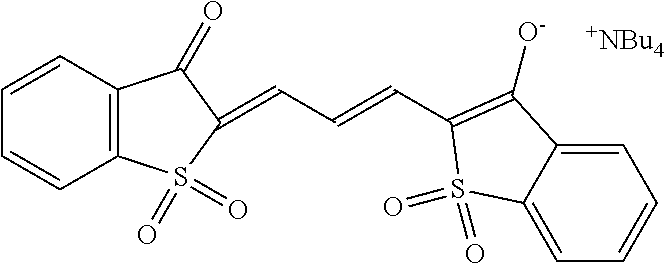
- OBPDJHRIXLHIQW-ZPWHESMDSA-M CCCC[N+](CCCC)(CCCC)CCCC.O=C1C2=C(C=CC=C2)S(=O)(=O)/C1=C\C=C\C1=C(/[O-])C2=CC=CC=C2S1(=O)=O Chemical compound CCCC[N+](CCCC)(CCCC)CCCC.O=C1C2=C(C=CC=C2)S(=O)(=O)/C1=C\C=C\C1=C(/[O-])C2=CC=CC=C2S1(=O)=O OBPDJHRIXLHIQW-ZPWHESMDSA-M 0.000 description 1
- QPJFIMSOYWPEPQ-UHFFFAOYSA-N CCCOC1=CC(C)=CC2=C1C=C(C(=O)C1=CC=CC=C1)C(=O)O2 Chemical compound CCCOC1=CC(C)=CC2=C1C=C(C(=O)C1=CC=CC=C1)C(=O)O2 QPJFIMSOYWPEPQ-UHFFFAOYSA-N 0.000 description 1
- CGFVWXFLLRDZSE-UHFFFAOYSA-N CCCO[N+]1=CC=C2C=CC=CC2=C1.F[P-](F)(F)(F)(F)F Chemical compound CCCO[N+]1=CC=C2C=CC=CC2=C1.F[P-](F)(F)(F)(F)F CGFVWXFLLRDZSE-UHFFFAOYSA-N 0.000 description 1
- ARHXTFKKEOSOOS-SFKRKKMESA-M CCC[N+]1=CC=C(/C=C/C2=C(CO)C=C(OC)C=C2)C=C1.FB(F)F.[F-] Chemical compound CCC[N+]1=CC=C(/C=C/C2=C(CO)C=C(OC)C=C2)C=C1.FB(F)F.[F-] ARHXTFKKEOSOOS-SFKRKKMESA-M 0.000 description 1
- YCCVVPMYSGPISC-UHFFFAOYSA-N CCN(CC)C1=CC=C(/C=C/C2=CC=[N+](C)C=C2)C=C1.F[P-](F)(F)(F)(F)F Chemical compound CCN(CC)C1=CC=C(/C=C/C2=CC=[N+](C)C=C2)C=C1.F[P-](F)(F)(F)(F)F YCCVVPMYSGPISC-UHFFFAOYSA-N 0.000 description 1
- BOXNHJXFMYFAFC-UHFFFAOYSA-N CCN(CC)C1=CC=C(/C=C/C2=[N+](C)C=CC=C2)C=C1.F[P-](F)(F)(F)(F)F Chemical compound CCN(CC)C1=CC=C(/C=C/C2=[N+](C)C=CC=C2)C=C1.F[P-](F)(F)(F)(F)F BOXNHJXFMYFAFC-UHFFFAOYSA-N 0.000 description 1
- OEDXQXLPPCQSKT-UHFFFAOYSA-N CCN(CC)C1=CC=C2C=C(C(=O)C3=CC4=C(C=C(C)C=C4)OC3=O)C(=O)OC2=C1 Chemical compound CCN(CC)C1=CC=C2C=C(C(=O)C3=CC4=C(C=C(C)C=C4)OC3=O)C(=O)OC2=C1 OEDXQXLPPCQSKT-UHFFFAOYSA-N 0.000 description 1
- MXVQOUXVPWNROQ-UHFFFAOYSA-N CCOC1=CC(C)=CC2=C1C=C(C(=O)C1=CC3=CC=CC=C3O1)C(=O)O2 Chemical compound CCOC1=CC(C)=CC2=C1C=C(C(=O)C1=CC3=CC=CC=C3O1)C(=O)O2 MXVQOUXVPWNROQ-UHFFFAOYSA-N 0.000 description 1
- LTQPBZLUWIGGEW-UHFFFAOYSA-N CCOP(=O)(OCC)OCC.CCO[PH+](OCC)OCC.CO[N+]1=CC=C(C2=CC=CC=C2)C=C1.C[N+]1=CC=C(C2=CC=CC=C2)C=C1.F[P-](F)(F)(F)(F)F.F[P-](F)(F)(F)(F)F Chemical compound CCOP(=O)(OCC)OCC.CCO[PH+](OCC)OCC.CO[N+]1=CC=C(C2=CC=CC=C2)C=C1.C[N+]1=CC=C(C2=CC=CC=C2)C=C1.F[P-](F)(F)(F)(F)F.F[P-](F)(F)(F)(F)F LTQPBZLUWIGGEW-UHFFFAOYSA-N 0.000 description 1
- VHPNZZGRSQOPAK-UHFFFAOYSA-M CCO[N+]1=C(C2=CC=CC=C2)C=CC=C1.FB(F)F.[F-] Chemical compound CCO[N+]1=C(C2=CC=CC=C2)C=CC=C1.FB(F)F.[F-] VHPNZZGRSQOPAK-UHFFFAOYSA-M 0.000 description 1
- NLQOVHJMKVSFPL-UHFFFAOYSA-N COC1=CC(CO)=CC2=C1C=C(C(=O)C1=CC3=CC=CC=C3OC1=O)C(=O)O2 Chemical compound COC1=CC(CO)=CC2=C1C=C(C(=O)C1=CC3=CC=CC=C3OC1=O)C(=O)O2 NLQOVHJMKVSFPL-UHFFFAOYSA-N 0.000 description 1
- LCRGTVJFKJAFKT-UHFFFAOYSA-N COC1=CC(OC)=C2C=C(C(=O)C3=CC4=C(C=C(C)C=C4)OC3=O)C(=O)OC2=C1 Chemical compound COC1=CC(OC)=C2C=C(C(=O)C3=CC4=C(C=C(C)C=C4)OC3=O)C(=O)OC2=C1 LCRGTVJFKJAFKT-UHFFFAOYSA-N 0.000 description 1
- VPEZIKWTOPQBQN-UHFFFAOYSA-N COC1=CC(OC)=C2C=C(C(=O)C3=CC4=C(C=C(CO)C=C4OC)OC3=O)C(=O)OC2=C1 Chemical compound COC1=CC(OC)=C2C=C(C(=O)C3=CC4=C(C=C(CO)C=C4OC)OC3=O)C(=O)OC2=C1 VPEZIKWTOPQBQN-UHFFFAOYSA-N 0.000 description 1
- FBTRNHSDVAGODT-UHFFFAOYSA-N COC1=CC=C2C=C(C(=O)C3=CC4=C(C=C(CO)C=C4)OC3=O)C(=O)OC2=C1 Chemical compound COC1=CC=C2C=C(C(=O)C3=CC4=C(C=C(CO)C=C4)OC3=O)C(=O)OC2=C1 FBTRNHSDVAGODT-UHFFFAOYSA-N 0.000 description 1
- DHEAFFQHPYCHOO-UHFFFAOYSA-N CO[N+]1=C2C=CC=CC2=CC=C1.F[P-](F)(F)(F)(F)F Chemical compound CO[N+]1=C2C=CC=CC2=CC=C1.F[P-](F)(F)(F)(F)F DHEAFFQHPYCHOO-UHFFFAOYSA-N 0.000 description 1
- GLAAURLCKULJFN-UHFFFAOYSA-N CO[N+]1=CC=C(C2=CC=CC(S(=O)(=O)[O-])=C2)C=C1 Chemical compound CO[N+]1=CC=C(C2=CC=CC(S(=O)(=O)[O-])=C2)C=C1 GLAAURLCKULJFN-UHFFFAOYSA-N 0.000 description 1
- JLIGQOJMKHMGPV-UHFFFAOYSA-N CO[N+]1=CC=C(C2=CC=CC=C2)C=C1.F[P-](F)(F)(F)(F)F Chemical compound CO[N+]1=CC=C(C2=CC=CC=C2)C=C1.F[P-](F)(F)(F)(F)F JLIGQOJMKHMGPV-UHFFFAOYSA-N 0.000 description 1
- IHSPALBZGKYEAN-UHFFFAOYSA-N CO[N+]1=CC=CC(C#N)=C1.F[P-](F)(F)(F)(F)F Chemical compound CO[N+]1=CC=CC(C#N)=C1.F[P-](F)(F)(F)(F)F IHSPALBZGKYEAN-UHFFFAOYSA-N 0.000 description 1
- PXHYJYWTSYLPLM-UHFFFAOYSA-M CO[N+]1=CC=CC(C2=CC=CC=C2)=C1.FB(F)F.[F-] Chemical compound CO[N+]1=CC=CC(C2=CC=CC=C2)=C1.FB(F)F.[F-] PXHYJYWTSYLPLM-UHFFFAOYSA-M 0.000 description 1
- AXHTUFWBVGEJTQ-UHFFFAOYSA-N COc1ccc(C(=O)C2=CC=C(CO)C=C2)cc1 Chemical compound COc1ccc(C(=O)C2=CC=C(CO)C=C2)cc1 AXHTUFWBVGEJTQ-UHFFFAOYSA-N 0.000 description 1
- WVOYVSMXUTWUSH-UHFFFAOYSA-M COc1ccc(O[N+]2=CC=C(C#N)C=C2)cc1.FB(F)F.[F-] Chemical compound COc1ccc(O[N+]2=CC=C(C#N)C=C2)cc1.FB(F)F.[F-] WVOYVSMXUTWUSH-UHFFFAOYSA-M 0.000 description 1
- LFPQIOAWENXBBZ-UHFFFAOYSA-N N#CC1=CC=[N+](OCCCc2ccccc2)C=C1.O=C([O-])C(F)(F)F Chemical compound N#CC1=CC=[N+](OCCCc2ccccc2)C=C1.O=C([O-])C(F)(F)F LFPQIOAWENXBBZ-UHFFFAOYSA-N 0.000 description 1
- ZCDADJXRUCOCJE-UHFFFAOYSA-N O=C1C2=C(C=CC=C2)Sc2ccc(Cl)cc21 Chemical compound O=C1C2=C(C=CC=C2)Sc2ccc(Cl)cc21 ZCDADJXRUCOCJE-UHFFFAOYSA-N 0.000 description 1
- YRHRIQCWCFGUEQ-UHFFFAOYSA-N O=C1C2=C(C=CC=C2)Sc2ccccc21 Chemical compound O=C1C2=C(C=CC=C2)Sc2ccccc21 YRHRIQCWCFGUEQ-UHFFFAOYSA-N 0.000 description 1
- KAXWTPQJXYZRLO-UHFFFAOYSA-N O=S(=O)([O-])CCO[N+]1=CC=C(C2=CC=CC=C2)C=C1 Chemical compound O=S(=O)([O-])CCO[N+]1=CC=C(C2=CC=CC=C2)C=C1 KAXWTPQJXYZRLO-UHFFFAOYSA-N 0.000 description 1
Classifications
-
- C—CHEMISTRY; METALLURGY
- C08—ORGANIC MACROMOLECULAR COMPOUNDS; THEIR PREPARATION OR CHEMICAL WORKING-UP; COMPOSITIONS BASED THEREON
- C08F—MACROMOLECULAR COMPOUNDS OBTAINED BY REACTIONS ONLY INVOLVING CARBON-TO-CARBON UNSATURATED BONDS
- C08F2/00—Processes of polymerisation
- C08F2/46—Polymerisation initiated by wave energy or particle radiation
- C08F2/48—Polymerisation initiated by wave energy or particle radiation by ultraviolet or visible light
- C08F2/50—Polymerisation initiated by wave energy or particle radiation by ultraviolet or visible light with sensitising agents
Definitions
- This invention relates to photocurable compositions containing acrylate compounds that can be cured efficiently using actinic radiation.
- the composition can be cured in air or other oxygen-containing environments.
- N-oxyazinium salts are known to be photoinitiators for photocrosslinking and photopolymerization as described for example in U.S. Pat. Reissues 27,922 and 27,925 (both Heseltine et al.). Since most N-oxyazinium salt initiators absorb light in UV region of the electromagnetic spectrum, it is common practice to employ a photosensitizer co-initiator to increase their spectral response.
- photosensitizing co-initiators function by absorption of a photon that results in excitation of an electron from an occupied molecular orbital to a higher energy, unoccupied orbital.
- the spin of the electron excited to the higher energy orbital corresponds to that which it exhibits in its original orbital or ground state.
- the photosensitizer in its initially formed excited state is in a singlet excited state.
- the lifetime of the singlet excited state is limited, typically less than a few nanoseconds.
- the excited photosensitizer can return from its singlet excited state directly to its original ground state, dissipating the captured photon energy.
- the singlet excited state photosensitizer in some instances undergoes intersystem crossing through spin inversion to another excited state, referred to as a triplet state, wherein lifetimes are typically in the microsecond to millisecond range. Since photosensitizer co-initiators that exhibit triplet states have longer lifetimes, the presence of the photosensitizer co-initiators provides a much longer time period for reaction.
- GB Publication 2,083,832 (Specht et al.) describes photoinitiator compositions that comprise N-oxyazinium salts and co-initiators based on amino-substituted ketocoumarin triplet photosensitizers.
- the amino-substituted ketocoumarins exhibit very high intersystem crossing (or triplet state generation) efficiencies ranging well above 10%.
- 4,743,528 disclose a photoinitiator composition comprising an N-oxyazinium salt, an N-oxyazinium activator, and a photosensitizer having a reduction potential that in relation to the reduction potential of the N-oxyazinium salt activator is at most 0.1 V more positive, and an electron rich amino-substituted benzene.
- a photoinitiator composition comprising an N-oxyazinium salt, an N-oxyazinium activator, and a photosensitizer having a reduction potential that in relation to the reduction potential of the N-oxyazinium salt activator is at most 0.1 V more positive, and an electron rich amino-substituted benzene.
- 4,743,530 (Farid et al.) describes photoinitiator compositions containing an N-oxyazinium salt activator and a dye based photosensitizer with maximum absorption above 550 nm and having a reduction potential relative to that of N-oxyazinium salt activator is at most 0.1 V more positive.
- N-oxyazinium salts have been demonstrated as useful sources of radicals for photoinitiating polymerization.
- Single electron transfer from an excited electron donor (D*) to an N-oxyazinium salt results in N—O bond cleavage and the formation of an oxy radical, as shown below in Equation (1).
- the quantum yield of a radiation-induced process is the number of times that a defined event occurs per photon absorbed by the system. The event could be the decomposition of a reactant molecule.
- the overall quantum efficiency of oxy radical generation is less than or equal to the triplet formation efficiency (the limiting quantum efficiency being defined as state efficiency for reaction times the quantum yield for formation of the reacting state).
- the overall quantum efficiency is expected to be even lower due to a shorter lifetime of excited dye.
- amplification of photoreactions where one photon leads to the transformation of several reactant molecules to products is necessary.
- the commercial viability of certain systems can depend on whether a relatively modest amplification, for example, in the 10 to 100 times range, could be achieved. This depends usually upon limitations on exposure time, light intensity, or a combination that can be imposed on a specific use.
- amplification is based on photochemical generation of a species that is subsequently used to catalyze another reaction.
- amplified photoreactions are known where one photon leads to the transformation of several reactant molecules to products.
- quantum-amplified electron-transfer processes involve radical cation reactions, such as valence isomerization, for example, the transformation of hexamethyldewarbenzene to hexamethylbenzene, or the cyclization or cycloreversion between two olefin moieties and a cyclobutane, where quantum yields as high as several hundred have been obtained in polar solvents.
- the chain is propagated via electron transfer from a reactant molecule (R) to the radical cation of the product (P. + ).
- Another type of chain-amplified photoreaction involves two reactants where one is oxidized (leading, for example, to dehydrogenation) and the other is reduced.
- a different kind of chain reaction involving two reactants is that of onium salts.
- an onium salt Ar—X +
- aryl radical which in turn takes a hydrogen atom from an alcohol to give an ⁇ -hydroxyl radical.
- Chain propagation occurs through electron transfer from the ⁇ -hydroxyl radical to another onium salt molecule.
- the photoinitiator undergoes excitation by energy absorption with subsequent decomposition into one or more radicals, or
- the photoinitiator undergoes excitation and the excited species interacts with a second compound (by either energy transfer or a redox reaction) to form free radicals from the latter or former compound(s).
- Oxygen inhibition has always been a problem for photocuring of acrylate-containing compositions containing multifunctional acrylate monomers or oligomers using a photoinitiated radical polymerization (for example, see Decker et al., Macromolecules 18 (1985) 1241). This oxygen inhibition is due to the rapid reaction of carbon centered propagating radicals with oxygen molecules to yield peroxyl radicals. These peroxyl radicals are not as reactive towards carbon-carbon unsaturated double bonds and therefore do not initiate or participate in any photopolymerization reaction. Oxygen inhibition usually leads to premature chain termination that results in incomplete photocuring. Thus, many photocuring processes must be carried out in inert environments (for example, under nitrogen or argon), making such processes more expensive and difficult to use in industrial and laboratory settings.
- Dissolved oxygen can be converted into its excited singlet state by means of a red light irradiation in the presence of a dye sensitizer.
- the resulting 1 O 2 radical will be rapidly scavenged by a 1,3-diphenylisobenzofuran molecule to generate a compound (1,2-dibenzoylbenzene) that can work as a photoinitiator (Decker, Makromol. Chem. 180 (1979), p. 2027).
- the photocured composition can become colored, in spite of the photobleaching of the dye, prohibiting this technique for use in various products.
- the photoinitiator concentration can be increased to shorten the UV exposure during which atmospheric oxygen diffuses into the cured composition. This technique can also be used in combination with higher radiation intensities. Oxygen inhibition can further be reduced by using high intensity flashes that generate large concentrations of initiator radicals reacting with oxygen, but hydroperoxides are also formed.
- Free radical photopolymerization can be carried out under inert conditions (Wight, J. Polym. Sci.: Polym. Lett. Ed. 16 (1978) 121), which is the most efficient way to overcome oxygen inhibition. Nitrogen is typically continuously used to flush the photopolymerizable composition during UV exposure. On an industrial UV-curing line, which cannot be made completely airtight, nitrogen losses can be significant, thus making the process expensive and inefficient. This is an even greater concern if argon is used to provide an inert environment.
- This invention provides a photocurable composition comprising:
- At least one N-oxyazinium salt photoinitiator at least one N-oxyazinium salt photoinitiator
- This invention also provides a kit comprising:
- a photoinitiator composition comprising at least one N-oxyazinium salt photoinitiator, a photosensitizer for the N-oxyazinium salt photoinitiator, and an N-oxyazinium salt efficiency amplifier.
- the present invention solves some of difficulties and problems described above by the discovery of a more efficient photoinitiator composition for utilizing radiation in photocuring operations.
- the photocurable composition of the present invention has high sensitivity and storage stability that is useful in the photopolymerization technology. Accordingly, the photocurable composition of this present invention includes a photoinitiator composition that can generate a reactive species by using in combination, an N-oxyazinium salt photoinitiator, a photosensitizer for the N-oxyazinium salt photoinitiator, and an N-oxyazinium salt efficiency amplifier, which is many embodiments, is an organic phosphite that is also referred to as a quantum yield amplifier.
- the photoinitiator composition when combined with a polymerizable material such as an acrylate, the photoinitiator composition causes rapid curing times in comparison to the curing times known in the prior art.
- the photoinitiator composition performs unexpectedly better (higher quantum efficiency) than known N-oxyazinium salt-containing photoinitiator compositions.
- This advantage is achieved particularly by using the N-oxyazinium salt efficiency amplifier that was not previously known to accomplish this purpose. This accomplishes photocuring with an efficient use of the radiation because many reactive species are generated per photon absorbed (that is, amplification) occurs. A relatively large amount of material can be photocured with reduced exposure to radiation.
- Yet another important advantage of the present invention is that the photocuring can be carried out in oxygen-containing environments. Because of the high efficiency of the photoinitiator composition, the presence of oxygen, or oxygen inhibition, is not a serious detriment during photocuring.
- the photocurable compositions can be pigmented into which light penetration is limited. It is also possible to use the invention for partial curing for example to modify their composition viscosity.
- photoinitiator composition used in this application will refer to embodiments used in the present invention.
- polymerization is used herein to mean the combining for example, by covalent bonding, of large number of smaller molecules, such as monomers, to form very large molecules, that is, macromolecules or polymers.
- the monomers may be combined to form only linear macromolecules or they may be combined to form three-dimensional macromolecule, commonly referred to as crosslinked polymers.
- curing and “photocuring” mean the polymerization of functional oligomers and monomers, or even polymers, into a crosslinked polymer network. Curing is the polymerization of unsaturated monomers or oligomers in the presence of crosslinking agents.
- each component of the photoinitiator composition is intended also to include the plural that is, one or more of the respective components.
- unsaturated polymerizable material is meant to include any unsaturated material having one or more carbon-to-carbon double bonds (ethylenically unsaturated groups) capable of undergoing polymerization.
- the term encompasses unsaturated monomers, oligomers, and crosslinking agents.
- the singular form of the term is intended to include the plural.
- Oligomeric and multifunctional acrylates are examples of unsaturated polymerizable materials.
- quantum yield is used herein to indicate the efficiency of a photochemical process. More particularly, quantum yield is a measure of the probability that a particular molecule will absorb a quantum of light during its interaction with a photon. The term expresses the number of photochemical events per photon absorbed. Thus, quantum yields can vary from zero (no absorption) to a very large number (for example, 10 3 ). In this context, the quantum efficiency of an N-oxyazinium salt photoinitiator is defined as in the following equation:
- photosensitizer is meant to refer to a light absorbing compound used to induce photocuring. Upon photoexcitation, the photosensitizer leads to one-electron reduction of the N-oxyazinium salt photoinitiator.
- activator and “photoinitiator” refer to an N-oxyazinium salt that accepts an electron from an excited sensitizer, a process that leads to fragmentation of the activator to give an oxy radical that initiates polymerization.
- Quantum yield amplifier and “efficiency amplifier” refer to a compound that increases the quantum efficiency of the overall photocuring or photopolymerization process.
- photocurable and “curable” refer to a material that will polymerize when irradiated for example with radiation such as ultraviolet (UV), visible, or infrared radiation in the presence of the photoinitiator composition.
- UV radiation is any electromagnetic radiation that is capable of producing photochemical action and can have a wavelength of at least 150 nm and up to and including 1250 nm, and typically at least 300 nm and up to and including 750 nm.
- the photoinitiator composition can be used to cause photocuring or polymerization of various photocurable compounds used for coatings, printable inks, paints, photoresists, or any photocurable imaging compositions.
- the photoinitiator composition can be used to formulate a photocurable composition of this invention comprised of an organic component containing polymerizable materials that are capable of crosslinking such as acrylate-containing compounds, an N-oxyazinium salt photoinitiator (or activator), a photosensitizer for the N-oxyazinium salt photoinitiator, which photosensitizer has a reduction potential that in relation to the reduction potential of the N-oxyazinium salt photoinitiator, is at most 0.1 volt more positive, and an N-oxyazinium salt efficiency amplifier.
- the photoinitiator composition can be provided in any form that is suitable for the various components or intended use. In most embodiments, the photoinitiator composition is in solid form, such as a powder, granules, or pressed tablet.
- the N-oxyazinium salt photoinitiators used in this invention are N-oxy-N-heterocyclic compounds having a heterocyclic nucleus, such as a pyridinium, diazinium, or triazinium nucleus.
- the N-oxyazinium salt can include one or more aromatic rings, typically carbocyclic aromatic rings, fused with the N-oxy-N-heterocyclic compound, including quinolinium, isoquinolinium, benzodiazinium, phenanthridium, and naphthodiazinium.
- any convenient charge balancing counter-ion can be employed to complete the N-oxyazinium salt photoinitiators, such as halide, fluoroborate, hexafluorophosphate, and toluene sulfonate.
- the alkoxy group (—O—R 1 ) of the N-oxyazinium compound that quaternizes the ring nitrogen atom of the azinium nucleus can be selected from among a variety of synthetically convenient oxy groups.
- the N-oxyazinium salt photoinitiators can also be oligomeric or polymeric compounds.
- the N-oxyazinium salt photoinitiator can have a reduction potential less negative than ⁇ 1.4 V and comprise an N-oxy group that is capable of releasing an oxy radical when irradiated of the photocurable composition.
- N-oxyazinium salt photoinitiators are represented by the following Structure (I):
- a and B in Structure (I) independently represent a carbon, C—R 5 , C—R 6 , or nitrogen.
- X is oxygen (O).
- R 1 , R 2 , R 3 , R 4 , R 5 , and R 6 are independently hydrogen, or substituted or unsubstituted alkyl groups having 1 to 12 carbon atoms or aryl groups having 6 or 10 carbon atoms in the carbocyclic ring, which groups can be substituted with one or more acyloxy, alkoxy, aryloxy, alkylthio, arylthio, alkylsulfonyl, thiocyano, cyano, halogen, alkoxycarbonyl, aryloxycarbonyl, acetal, aroyl, alkylaminocarbonyl, arylaminocarbonyl, alkylaminocarbonyloxy, arylaminocarbonyloxy, acylamino, amino, alkylamino, arylamino, carboxy, sulfo, trihalomethyl, alkyl, aryl, heteroaryl, alkylureido, arylureido
- Y is a suitable charge balancing anion that can be a separate charged moiety or a charged part of an A, B, or R group.
- N-oxyazinium salt photoinitiators are represented by the following Structure (II):
- a in Structure (II) represents carbon, C—R 5 , nitrogen, sulfur, or oxygen with sufficient bonds and substituents to form a heteroaromatic ring.
- X is oxygen (O).
- R 1 , R 2 , R 3 , R 4 , and R 5 are independently hydrogen, or substituted or unsubstituted alkyl or aryl groups as described above for Structure (I), or any two R groups may form a ring.
- Y is a charge balancing anion that can be a separate charged moiety or part of a charged R group.
- R 1 is a substituted or unsubstituted alkyl group having 1 to 18 carbon atoms or a substituted or unsubstituted aryl group having 6 or 10 carbon atoms in the aromatic ring.
- N-oxyazinium salt photoinitiators having a cation can be represented by the following formulae:
- R 1 represents a substituted or unsubstituted alkyl group, substituted or unsubstituted aryl group, or an acyl group, as described above, and wherein R 1 can also include a charge balancing anion
- the R 2 groups independently represent hydrogen, or substituted or unsubstituted alkyl, aryl, or heteroaryl groups.
- Z is a substituted or unsubstituted aliphatic linking group having 1 to 12 atoms in the linking chain.
- N-oxyazinium salt photoinitiators are illustrated by Structures III and IV and the compounds shown in TABLES 1 and 2 of U.S. Pat. No. 7,632,879 (Majumdar et al.) that is incorporated herein by reference for this teaching.
- N-oxyazinium salt photoinitiators are compounds OZ-1 to OZ-16 identified below in TABLE I.
- N-oxyazinium salt photoinitiators can be used if desired, and the total amount of N-oxyazinium salt photoinitiators in the photoinitiator composition is generally at least 10 weight %, or typically at least 40 and up to and including 80 weight % based on the total weight of N-oxyazinium salt photoinitiator, photosensitizer for the N-oxyazinium salt photoinitiator, and N-oxyazinium salt efficiency amplifier.
- the photosensitizer (S) for the N-oxyazinium salt photoinitiator initiates the reaction of the N-oxyazinium salt photoinitiator following absorption of suitable radiation having a ⁇ max of at least 150 and up to and including 1250 nm.
- the photosensitizer generally has a triplet energy of at least 20 kcal/mole of N-oxyazinium salt photoinitiator. As long as the reduction potential of the photosensitizer is more negative than that of the N-oxyazinium salt photoinitiator (that is, it is harder to reduce), the photoinduced electron transfer reaction will be exothermic.
- the photoinitiated process produces the reactive oxy radical by electron transfer from the excited state of the photosensitizer (*S) to the N-oxyazinium salt photoinitiator.
- the oxy radical can subsequently react with the N-oxyazinium salt efficiency amplifier, such as a trialkylphosphite, producing a suitable radical such as a phosphoranyl radical that can in turn transfer an electron to the N-oxyazinium salt photoinitiator to continue the chain process.
- the N-oxyazinium salt efficiency amplifier such as a trialkylphosphite
- a suitable radical such as a phosphoranyl radical that can in turn transfer an electron to the N-oxyazinium salt photoinitiator to continue the chain process.
- Mixtures of photosensitizers can be used if desired and the photosensitizers in the mixture can absorb at the same or different wavelengths.
- the photosensitizer is capable of transferring an electron from its own lowest excited state after it has absorbed radiation.
- the driving force for this process depends upon: (a) the excitation energy of the sensitizer, (E excit ) S , (b) its oxidation potential, (E ox ) S , (c) the reduction potential of the N-oxyazinium salt photoinitiator, (E red ) N-oxy , and (d) an energy increment ⁇ that varies from near zero in polar solvents such as acetonitrile to about 0.3 eV in nonpolar media.
- Equation 7 For the photoinduced electron transfer to be exothermic (that is, for the energy stored in the excited state to exceed the energy stored in the electron transfer products) the relationships shown in the following Equation 7 should be satisfied: ( E excit ) S >( E ox ) S ⁇ ( E red ) N-oxy + ⁇ (7)
- the excitation energy of the sensitizer, (E excit ) S could be that of the singlet or the triplet state depending on which of these states react with the N-oxyazinium salt photoinitiator.
- the amount of photosensitizer used in the photocurable composition depends largely on its optical density at the wavelength(s) of radiation used to initiate the photoinduced electron transfer to an N-oxyazinium salt photoinitiator. Solubility of the photosensitizer in a photocurable composition can also be a factor. It is possible that the photosensitizer is a covalently bound part of a polymerizable material such as an acrylate. Either a photosensitizer bound in this manner or a non-bound photosensitizer with a low extinction coefficient can be utilized at relatively high levels to help facilitate the transfer of an electron to an N-oxyazinium salt photoinitiator from triplet sensitizer ( 3 S).
- the photosensitizer When covalently attached to a polymeric material, the photosensitizer can comprise at least 0.01 and up to and including 10% based on the total weight of the N-oxyazinium salt photoinitiator.
- An example of such a covalently bound photosensitizer is a naphthalene moiety (that absorbs actinic radiation) that is bound to polymerizable or photocurable material, or it can be attached to an inert polymeric binder.
- the amount of the photosensitizers is generally governed by their molar absorptivity or extinction coefficient.
- Photosensitizers that are not bound to curable compounds or polymers can be present in an amount of at least 1 and up to and including 10 weight %, based on the total weight of N-oxyazinium salt photoinitiator, photosensitizer for the N-oxyazinium salt photoinitiator, and N-oxyazinium salt efficiency amplifier.
- the triplet energies of the photosensitizers used in this invention can be obtained in a variety of ways. Energys for some photosensitizers or closely related analogs are disclosed in the literature. For most photosensitizers, the lowest triplet state energies can be obtained from low temperature (for example, 77° K) phosphorescence spectra.
- the photosensitizer is typically dissolved in a solvent (such as ethyl acetate) or a mixture of solvents and the solution is placed in an optical cell and immersed in liquid nitrogen. The photosensitizer is then excited with radiation at a wavelength where it absorbs, and its phosphorescence spectrum is measured.
- the highest energy absorption band (the so-called 0-0 band) in the phosphorescence spectrum can usually be taken as the energy of the lowest triplet state of the photosensitizer.
- triplet energies can be obtained either from rates of energy transfer from a series of molecules with known triplet energies or from measured equilibria with triplets of known energies. The former procedure is described in J. Amer. Chem. Soc. 102, 2152 (1980) and the latter procedure is described in J. Phys. Chem. 78, 196 (1974).
- photosensitizers and other compounds can occupy sites of different polarity, such that exact triplet energies are site dependent. To the extent that this is true for the photosensitizers and co-sensitizers (see below) used in this invention, the reported triplet energies represent approximate or average values.
- Especially useful photosensitizers absorb visible light or near ultraviolet light, for example at a wavelength of at least 300 and up to and including 750 nm.
- the ketocoumarins disclosed in Tetrahedron 38, 1203 (1982) represent one class of useful photosensitizers.
- the ketocoumarins described in U.K. Patent Publication 2,083,832 (Specht et al.) are also useful photosensitizers.
- the ketocoumarins exhibit very triplet state generation efficiencies.
- xanthones include but are not limited to, xanthones, thioxanthones, arylketones, and polycyclic aromatic hydrocarbons.
- Examples of specific useful triplet photosensitizers include but are not limited to, compounds S-1 through S-10 shown below in TABLE II.
- the illustrated photosensitizers can optionally contain substituents as methyl, ethyl, phenyl, aryl, methoxy, and chloro groups to modify various properties such as solubility, absorption spectrum, and reduction potential.
- the photosensitizer can be a dye, which is any dye that by reaction with an N-oxyazinium salt photoinitiator leads to the formation of an oxy radical, which initiates polymerization.
- the useful classes of photosensitizer dyes can be for example, cyanine dyes, complex cyanine dyes, merocyanine dyes, complex merocyanine dyes, homopolar cyanine dyes, styryl dyes, oxonol dyes, hemioxonol dyes, hemicyanine dyes, squarilium dyes, coumarin dyes, rhodamine dyes, acridine dyes, and oxanol dyes.
- photosensitizer dyes are described for example in Research Disclosure , Item 36544, September 1996, the disclosure of which is incorporated herein by reference. Some useful photosensitizer dyes are described in U.S. Pat. No. 4,743,530 (noted above) that is incorporated herein by reference. In general, any dye having a reduction potential that is at most 0.1 V more positive than the reduction potential of an N-oxyazinium salt photoinitiator can be effectively used as a photosensitizer.
- the photocurable composition of this invention includes one or more N-oxyazinium salt efficiency amplifiers.
- these efficiency amplifiers are phosphites such as organic phosphites.
- the phosphite can be represented by the formula: (R′O) 3 P wherein the multiple R′ groups are the same or different substituted or unsubstituted alkyl groups or substituted or unsubstituted HO[ ⁇ CH(R) ⁇ x O] y groups wherein the multiple R groups are the same or different hydrogen atoms or substituted or unsubstituted alkyl groups, or two R′ groups can form a substituted or unsubstituted cyclic aliphatic ring or fused ring system, x is a number at least 2 and up to and including 20, and y is at least 1 and up to and including 20.
- the photoinitiator composition can comprise one or more of trimethyl phosphite, triethyl phosphite, tripropyl phosphite, tributyl phosphite, triisobutyl phosphite, triamyl phosphite, trihexyl phosphite, trinonyl phosphite, tri-(ethylene glycol) phosphite, tri-(propylene glycol) phosphite, tri(isopropylene glycol) phosphite, tri-(butylene glycol) phosphite, tri-(isobutylene glycol) phosphite, tri-(pentylene glycol) phosphite, tri-(hexylene glycol) phosphite, tri-(nonylene glycol) phosphite, tri-(diethylene glycol) phosphite, tri
- the N-oxyazinium salt efficiency amplifier is present at a molar ratio to the N-oxyazinium salt photoinitiator of at least 0.001:1 and up to and including 10:1, or typically of at least 1:1 and up to and including 5:1.
- the photoinitiator compositions can be used to prepare photocurable compositions by simply mixing, under “safe light” conditions, the photoinitiator composition, or individually, the N-oxyazinium salt photoinitiator, a photosensitizer for the N-oxyazinium salt photoinitiator, and an N-oxyazinium salt efficiency amplifier, with a suitable photocurable acrylate or other photocurable compound.
- This mixing can occur in suitable inert solvents if desired.
- suitable solvents include but are not limited to, acetone, methylene chloride, and any solvent that does not react appreciably with the phosphite, N-oxyazinium salt photoinitiator, or photosensitizer.
- a liquid organic material to be polymerized or photocured can be used as the solvent for mixing, or it can be used in combination with another liquid.
- An inert solvent can be used also to aid in obtaining a solution of the materials and to provide suitable viscosity to the photocurable compositions for coatings, ink jet inks, or other materials or operations.
- solvent-free photocurable compositions also can be prepared by simply dissolving the N-oxyazinium salt photoinitiator, the efficiency amplifier, and photosensitizer in the organic photocurable material with or without mild heating.
- Photocurable acrylates can be monomers, oligomers, or polymers containing one or more acrylate groups in the molecule. Such compounds include but are not limited to, various compounds having one or more ethylenically unsaturated polymerizable groups.
- the photocurable acrylate also includes the photosensitizer for the N-oxyazinium salt photoinitiator in the same molecule.
- photosensitizers can be ketocoumarin moieties that are parts of molecules that also include acrylate groups.
- the photocurable resins have a weight average molecular weight of at least 100,000.
- a photosensitizer can be present in an amount of at least 5 ⁇ 10 ⁇ 7 and up to and including 1 ⁇ 10 ⁇ 4 , or at least 10 ⁇ 6 and up to and including 5 ⁇ 10 ⁇ 5 , or more typically at least 2 ⁇ 10 ⁇ 5 and up to and including 2 ⁇ 10 ⁇ 4 , moles per gram of photocurable acrylate.
- N-oxyazinium salt photoinitiator concentrations in the photocurable composition can be specified in terms of moles of N-oxyazinium salt photoinitiator per gram of photocurable acrylate.
- Typical concentrations of N-oxyazinium salt photoinitiator are at least 6 ⁇ 10 ⁇ 7 and up to and including 6 ⁇ 10 ⁇ 2 , or typically at least 6 ⁇ 10 ⁇ 6 and up to and including 6 ⁇ 10 ⁇ 2 , or more typically at least 6 ⁇ 10 ⁇ 4 and up and including 60 ⁇ 10 ⁇ 2 moles per gram of photocurable acrylate.
- the efficiency amplifier such as a phosphite
- the efficiency amplifier can be present in the photocurable composition in an amount of at least 5 ⁇ 10 ⁇ 7 and up to and including 1 ⁇ 10 ⁇ 2 , typically at least 10 ⁇ 6 and up to and including 5 ⁇ 10 ⁇ 2 , or more typically at least 10 ⁇ 4 and up to and including 5 ⁇ 10 ⁇ 2 moles per gram of N-oxyazinium salt photoinitiator.
- the use of larger amounts of efficiency amplifier phosphite is possible.
- the photoinitiator composition can be included as part of kit that also includes a precursor composition comprising one or more photocurable acrylates.
- kit that also includes a precursor composition comprising one or more photocurable acrylates.
- each component is separately packaged until it is needed, and each component can be in solid form, or the precursor composition can be in liquid form and the photoinitiator composition can be in solid form.
- kit components can then be combined to form a photocurable composition.
- Evaluation of useful photoinitiator compositions as initiating systems for photopolymerization or photocuring can be carried out using an acrylate-based coating formulation (see Examples below). Irradiation to initiate photocuring can be carried out using a filtered mercury lamp output through a band-pass filter. This is just one source of useful radiation.
- the efficiency of photopolymerization can be determined by the amount of photocrossliked polymer retained after solvent development, which leaves behind only the areas that had sufficient exposure to cause crosslinking of the photocurable acrylates. Thus, a more efficient photoinitiator composition can create more crosslinked polymer than a less efficient photoinitiator composition.
- a method of photocuring an acrylate-containing composition (such as a precursor composition) comprises:
- N-oxyazinium salt photoinitiator mixing at least one N-oxyazinium salt photoinitiator, a photosensitizer for the N-oxyazinium salt photoinitiator, an N-oxyazinium salt efficiency amplifier, and one or more photocurable acrylates to form a photocurable composition, and
- the irradiating step can be carried out in the presence of oxygen, or it can be carried out in an inert (for example, nitrogen or argon) environment.
- the photocurable composition can be partially or completely cured during the irradiating step, depending upon the use of the resulting “cured” composition.
- the photocurable composition can be partially cured to increase its viscosity.
- the photocurable composition can be jetted out of a nozzle before partial curing from the irradiating step to modify the viscosity of the photocurable composition.
- the partially cured photocurable composition can then be completed cured in a second curing step, for example, after it has been applied to a substrate.
- the irradiating step is carried out using radiation having a wavelength of at least 150 nm or typically at least 300 nm and up to and including 1250 nm. More typically, the irradiation is at a wavelength of at least 300 nm and up to and including 750 nm.
- the photocurable composition can mixed in the form of a solution in a solvent that is an inert material, or the photocurable composition is mixed as a solution with at least one photocurable acrylate acting as the solvent.
- the photocurable composition is applied to a substrate before the irradiating step.
- substrates include but are not limited to paper, plastic films, glass, ceramics, metals, composites, fabrics, or porous or non-porous surfaces, so that the photocurable composition can be applied and cured in various industries to provide hardened surfaces.
- the photocurable composition is put into a mold before the irradiating step, and the cured composition is then extracted from the mold. This would enable a user to prepare cured or photopolymerized articles of various shapes and sizes.
- a and B in Structure (I) independently represent a carbon, C—R 5 , C—R 6 or nitrogen
- X is O
- R 1 , R 2 , R 3 , R 4 , R 5 , and R 6 are independently hydrogen, or alkyl or aryl groups, any of the A, B, and R groups where chemically feasible can be joined to form a ring
- Y is a charge balancing anion that can be a separate moiety or part of an A, B, or R,
- a in Structure (II) represents a carbon, C—R 5 , nitrogen, sulfur or oxygen atom with sufficient bonds and substituents to form a heteroaromatic ring
- X is O
- R 1 , R 2 , R 3 , R 4 , and R 5 are independently hydrogen, or alkyl or aryl groups, or any two R groups may form a ring
- Y is a charge balancing anion that can be a separate moiety or part of an R group.
- R 1 represents a substituted or unsubstituted alkyl group, substituted or unsubstituted aryl group, or an acyl group, wherein R 1 can also include a charge balancing anion
- the R 2 groups independently represent hydrogen, or a substituted or unsubstituted alkyl, aryl, or heteroaryl group
- X is a divalent linking group
- Z is an alkylidene group.
- a photoinitiator composition comprising at least one N-oxyazinium salt photoinitiator, a photosensitizer for the N-oxyazinium salt photoinitiator, and an N-oxyazinium salt efficiency amplifier.
- the 2-chlorothioxanthone (S-2) (0.002 moles) sensitizer was added to a 3 ml solution of 0.02 molar N-methoxy-4-phenylpyridinium hexafluorophosphate (OZ-1) in acetonitrile-d 3 .
- this solution was purged with a thin stream of argon for 2-3 minutes and then irradiated at 405 nm for 5 minutes.
- Argon or nitrogen was continuously passed through the reaction mixture during photolysis to purge as well as stir the solution. After photolysis, a 1 H NMR spectrum of the photolysate was recorded and the percent conversion of the starting materials was determined by integration of diagnostic signals.
- the photon flux at the excitation wavelengths, 405 nm was determined by using the known photocycloaddition reaction of phenanthrenequinone to trans-stilbene in benzene as an actinometer (Bohning, J. J.; Weiss, K. J. Am. Chem. Soc. 1966, 88, 2893).
- the light intensity was within 7-10 ⁇ 10 ⁇ 8 Einsteins min ⁇ 1 .
- the quantum yield of reaction was determined by dividing the moles of photoproduct formed by total light intensity and is shown below in TABLE IV.
- the 2-chlorothioxanthone (S-2) (0.002 moles) sensitizer was added to a 3 ml solution of 0.02 molar N-methoxy-4-phenylpyridinium hexafluorophosphate (OZ-1) and 0.02 M triethylphosphite in acetonitrile-d 3 .
- this solution was purged with a thin stream of argon for 2-3 minutes and then irradiated at 405 nm for 30 seconds.
- Argon or nitrogen was continuously passed through the reaction mixture during photolysis to purge as well as stir the solution.
- the yields of the photoproducts were determined from quantitative integration of 1 H NMR spectra of the reaction mixtures containing products N-methyl-4-phenylpyridinium signal at ⁇ : 4.30 relative to starting material N-methoxy signal of OZ-1 at ⁇ : 4.43, as well as signals due to product triethylphosphate at ⁇ : 4.06 relative to starting material triethylphosphite at ⁇ : 3.84. Conversions were kept between 15-20% to minimize any secondary photolysis of the products.
- the photon flux at the excitation wavelengths, 405 nm was determined by using the known photocycloaddition reaction of phenanthrenequinone to trans-stilbene in benzene as an actinometer (Bohning, J.
- This example shows effect of the concentration of the N-oxyazinium salt OZ-1 on the quantum yield.
- the 2-chlorothioxanthone (S-2) (0.002 moles) sensitizer was added to a 3 ml solution of 0.04 molar N-methoxy-4-phenylpyridinium hexafluorophosphate (OZ-1) and 0.02 molar triethylphosphite in acetonitrile-d 3 .
- this solution was purged with a thin stream of argon for 2-3 minutes and was then irradiated at 405 nm for 10-30 seconds minutes.
- Argon or nitrogen was continuously passed through the reaction mixture during photolysis to purge as well as stir the solution.
- the unexpected curing speed produced by the photoinitiator compositions of the present invention is best understood by comparing their performance, when used with an efficiency amplifier phosphite, to their performance when used without one.
- a series of photocurable polymerizable mixtures containing invention photoinitiator compositions were formulated and compared with photocurable mixtures containing only N-oxyazinium salt and photosensitizer. Photocurable polymerizable mixtures were formulated as described below in Comparative Example 2 and Invention Example 3.
- Comparative Example 3 and Invention Example 4 compare the photocuring speed of an invention photoinitiator composition containing an efficiency amplifier phosphate with a composition containing no efficiency amplifier.
- ketocoumarin photosensitizer S-9 (12.2 mg, 3 ⁇ 10 ⁇ 5 moles)
- 4-phenyl-N-methoxypyridinium hexafluorophosphate N-oxyazinium salt OZ-1 (40.5 mg, 1.2 ⁇ 10 ⁇ 3 moles) were added and dissolved at room temperature.
- the formulation was then coated onto a glass plate and exposed to 365 nm radiation in air. After irradiation, the sample was washed with acetone and the cure efficiency was measured in terms of the amount of crosslinked polymer left. The results are summarized below in TABLE VIII.
- ketocoumarin photosensitizer S-9 (12.2 mg, 3 ⁇ 10 ⁇ 5 moles)
- 4-phenyl-N-methoxypyridinium hexafluorophosphate N-oxyazinium salt OZ-1 (40.5 mg, 1.2 ⁇ 10 ⁇ 3 moles) were added and dissolved at room temperature.
- the mixture was split into two equal parts and in the second part, the triethylphosphite efficiency amplifier (63 mg, 8 ⁇ 10 ⁇ 4 moles) was added.
Landscapes
- Chemical & Material Sciences (AREA)
- Health & Medical Sciences (AREA)
- Chemical Kinetics & Catalysis (AREA)
- Medicinal Chemistry (AREA)
- Polymers & Plastics (AREA)
- Organic Chemistry (AREA)
- Polymerisation Methods In General (AREA)
Abstract
Description


wherein A and B in Structure (I) independently represent a carbon, C—R5, C—R6, or nitrogen. X is oxygen (O).

wherein A in Structure (II) represents carbon, C—R5, nitrogen, sulfur, or oxygen with sufficient bonds and substituents to form a heteroaromatic ring. X is oxygen (O). R1, R2, R3, R4, and R5 are independently hydrogen, or substituted or unsubstituted alkyl or aryl groups as described above for Structure (I), or any two R groups may form a ring. Y is a charge balancing anion that can be a separate charged moiety or part of a charged R group.

| TABLE I | |||
| OZ-1 |
 |
||
| OZ-2 |
 |
||
| OZ-3 |
 |
||
| OZ-4 |
 |
||
| OZ-5 |
 |
||
| OZ-6 |
 |
||
| OZ-7 |
 |
||
| OZ-8 |
 |
||
| OZ-9 |
 |
||
| OZ-10 |
 |
||
| OZ-11 |
 |
||
| OZ-12 |
 |
||
| OZ-13 |
 |
||
| OZ-14 |
 |
||
| OZ-15 |
 |
||
| OZ-16 |
 |
||
(E excit)S>(E ox)S−(E red)N-oxy+Δ (7)
The excitation energy of the sensitizer, (Eexcit)S, could be that of the singlet or the triplet state depending on which of these states react with the N-oxyazinium salt photoinitiator.
| TABLE II | |
| S-1 |
 |
| S-2 |
 |
| S-3 |
 |
| S-4 |
 |
| S-5 |
 |
| S-6 |
 |
| S-7 |
 |
| S-8 |
 |
| S-9 |
 |
| S-10 |
 |
| TABLE III | |
| D-1 |
 |
| D-2 |
 |
| D-3 |
 |
| D-4 |
 |
| D-5 |
 |
| D-6 |
 |
| D-7 |
 |
(R′O)3P
wherein the multiple R′ groups are the same or different substituted or unsubstituted alkyl groups or substituted or unsubstituted HO[{CH(R)}xO]y groups wherein the multiple R groups are the same or different hydrogen atoms or substituted or unsubstituted alkyl groups, or two R′ groups can form a substituted or unsubstituted cyclic aliphatic ring or fused ring system, x is a number at least 2 and up to and including 20, and y is at least 1 and up to and including 20.
-
- 1. A photocurable composition comprising: at least one N-oxyazinium salt photoinitiator, a photosensitizer for the N-oxyazinium salt photoinitiator, an N-oxyazinium salt efficiency amplifier, and one or more photocurable acrylates.
- 2. The photocurable composition of embodiment 1 wherein the N-oxyazinium salt efficiency amplifier is a phosphite.
- 3. The photocurable composition of embodiment 1 or 2 wherein the N-oxyazinium salt efficiency amplifier is an organic phosphite having the formula:
(R′O)3P
wherein the multiple R′ groups are the same or different alkyl groups or HO[{CH(R)}xO]y groups wherein the multiple R groups are the same or different hydrogen atoms or alkyl groups, or two R′ groups can form a cyclic aliphatic ring or fused ring system, x is a number at least 2 and up to and including 20, and y is at least 1 and up to and including 20. - 4. The photocurable composition of any of embodiments 1 to 3 comprising one or more of trimethyl phosphite, triethyl phosphite, tripropyl phosphite, tributyl phosphite, triisobutyl phosphite, triamyl phosphite, trihexyl phosphite, trinonyl phosphite, tri-(ethylene glycol) phosphite, tri-(propylene glycol) phosphite, tri(isopropylene glycol) phosphite, tri-(butylene glycol) phosphite, tri-(isobutylene glycol) phosphite, tri-(pentylene glycol) phosphite, tri-(hexylene glycol) phosphite, tri-(nonylene glycol) phosphite, tri-(diethylene glycol) phosphite, tri-(triethylene glycol) phosphite, tri-(polyethylene glycol) phosphite, tri-(polypropylene glycol) phosphite, and tri-(polybutylene glycol) phosphite as N-oxyazinium salt efficiency amplifiers.
- 5. The photocurable composition of any of embodiments 1 to 4 wherein the N-oxyazinium salt efficiency amplifier is a phosphite that is present at a molar ratio to the N-oxyazinium salt photoinitiator is at least 0.001:1 and up to and including 10:1.
- 6. The photocurable composition of any of embodiments 1 to 5 wherein the N-oxyazinium salt photoinitiator is represented by either of the following Structures (I) and (II):

wherein A and B in Structure (I) independently represent a carbon, C—R5, C—R6 or nitrogen, X is O, R1, R2, R3, R4, R5, and R6 are independently hydrogen, or alkyl or aryl groups, any of the A, B, and R groups where chemically feasible can be joined to form a ring, and Y is a charge balancing anion that can be a separate moiety or part of an A, B, or R,

wherein A in Structure (II) represents a carbon, C—R5, nitrogen, sulfur or oxygen atom with sufficient bonds and substituents to form a heteroaromatic ring, X is O, R1, R2, R3, R4, and R5 are independently hydrogen, or alkyl or aryl groups, or any two R groups may form a ring, and Y is a charge balancing anion that can be a separate moiety or part of an R group.
-
- 7. The photocurable composition of embodiment 6 wherein R1 is an alkyl group having 1 to 18 carbon atoms or an aryl group having 6 or 10 carbon atoms in the aromatic ring.
- 8. The photocurable composition of any of embodiments 1 to 7 wherein the N-oxyazinium salt photoinitiator has a cation represented by one of the following formulae:

wherein R1 represents a substituted or unsubstituted alkyl group, substituted or unsubstituted aryl group, or an acyl group, wherein R1 can also include a charge balancing anion, the R2 groups independently represent hydrogen, or a substituted or unsubstituted alkyl, aryl, or heteroaryl group, X is a divalent linking group, and Z is an alkylidene group.
-
- 9. The photocurable composition of any of embodiments 1 to 8 wherein the N-oxyazinium salt photoinitiator has a reduction potential less negative than −1.4 V and comprises an N-oxy group that is capable of releasing an oxy radical during irradiation of the photocurable composition.
- 10. The photocurable composition of any of embodiments 1 to 9 comprising one or more of the compounds OZ-1 to OZ-16 identified below:


-
- 11. The photocurable composition of any of embodiments 1 to 10 comprising the N-oxyazinium salt photoinitiator in an amount of at least 6×10⁻⁷ and up to and including 6×10⁻² moles per gram of photocurable acrylate.
- 12. The photocurable composition of any of embodiments 1 to 11 wherein the photosensitizer is present in an amount of at least 5×10⁻⁷ and up to and including 1×10⁻⁴ moles per gram of photocurable acrylate.
- 13. The photocurable composition of any of embodiments 1 to 12 wherein the photosensitizer for the N-oxyazinium salt photoinitiator has a triplet energy of at least 20 kcal/mole of N-oxyazinium salt photoinitiator.
- 14. The photocurable composition of any of embodiments 1 to 13 wherein the photosensitizer for the N-oxyazinium salt photoinitiator absorbs radiation having a λmax of at least 150 nm and up to and including 1250 nm.
- 15. The photocurable composition of any of embodiments 1 to 14 wherein the photosensitizer for the N-oxyazinium salt photoinitiator is a ketocoumarin, xanthone, thioxanthone, arylketone, or polycyclic aromatic hydrocarbons.
- 16. The photocurable composition of any of embodiments claims 1 to 14 wherein the photosensitizer for the N-oxyazinium salt photoinitiator is a cyanine or merocyanine dye.
- 17. The photocurable composition of any of embodiments 1 to 16 wherein the photocurable acrylate is a monomeric material.
- 18. The photocurable composition of any of embodiments 1 to 17 wherein the photocurable acrylate comprises the photosensitizer for the N-oxyazinium salt photoinitiator.
- 19. The photocurable composition of any of embodiments 1 to 18 wherein the photocurable acrylate is a photocurable resin having a weight average molecular weight of at least 100,000.
- 20. A kit comprising:
-
- 21. The kit of embodiment 20 wherein the N-oxyazinium salt efficiency amplifier is an organic phosphite that is present in the photoinitiator composition at a molar ratio to the N-oxyazinium salt photoinitiator is at least 0.001:1 and up to and including 10:1.
- 22. The kit of embodiment 20 or 21 wherein the precursor composition is in liquid form and the photoinitiator composition is in solid form.
- 23. The kit of embodiment 20 or 21 wherein both precursor composition and photoinitiator composition are in solid form.

The 2-chlorothioxanthone (S-2) (0.002 moles) sensitizer was added to a 3 ml solution of 0.02 molar N-methoxy-4-phenylpyridinium hexafluorophosphate (OZ-1) in acetonitrile-d3. In a 1×1 cm quartz cell, this solution was purged with a thin stream of argon for 2-3 minutes and then irradiated at 405 nm for 5 minutes. Argon or nitrogen was continuously passed through the reaction mixture during photolysis to purge as well as stir the solution. After photolysis, a 1H NMR spectrum of the photolysate was recorded and the percent conversion of the starting materials was determined by integration of diagnostic signals. For example, before photolysis the 1H NMR spectrum of a solution of N-methoxy-4-phenylpyridinium hexafluorophosphate and a catalytic amount of 2-chlorothioxanthone in acetonitrile-d3 shows characteristic signals due to the N-methoxypyridinium salt OZ-1 [δ: 8.94 (m, 2H), 8.35 (m, 2H), 7.94 (m, 2H), 7.69 (m, 3H), and 4.43 (s, 3H)]. After irradiation at 405 nm for about 2 minutes, the 1H NMR spectrum of the photolysate clearly showed appearance of new diagnostic signals due to formation of 4-phenylpyridine [δ: 8.71 (m, 2H) and 8.26 (m, 2H) and CH3OH (δ: 3.30)]. The identity of these products was established by comparison with 1H NMR spectra of authentic samples. The yields of the photo-products were determined from quantitative integration of diagnostic signals of starting materials, N-methoxy-4-phenylpyridinium (OZ-1), and product, 4-phenylpyridine, in 1H NMR spectra of the reaction mixtures. Conversions were kept between 15-20% to minimize any secondary photolysis of the products. The photon flux at the excitation wavelengths, 405 nm, was determined by using the known photocycloaddition reaction of phenanthrenequinone to trans-stilbene in benzene as an actinometer (Bohning, J. J.; Weiss, K. J. Am. Chem. Soc. 1966, 88, 2893). The light intensity was within 7-10×10−8 Einsteins min−1. The quantum yield of reaction was determined by dividing the moles of photoproduct formed by total light intensity and is shown below in TABLE IV.

| TABLE IV |
| Reaction of Triplet Sensitized Reaction of N-Oxyazinium |
| Salts with and without Phosphite: Effect of Concentration |
| of N-Oxyazinium on Quantum Yields |
| Amount of | Quantum | ||
| Triethylphosphite | Yield | ||
| Comparative | 0.002 molar S-2 + | 0 | 0.95 |
| Example 1 | 0.02 molar OZ-1 | ||
| Invention | 0.002 molar S-2 + | 0.02 molar | 30.0 |
| Example 1 | 0.02 molar OZ-1 | ||
| Invention | 0.002 molar S-2 + | 0.02 molar | 70.0 |
| Example 2 | 0.04 molar OZ-1 | ||
| TABLE V |
| Effect of Efficiency Phosphite on Photocuring in Air |
| Material left after | |||
| Degree of Curing | Solvent Wash? | ||
| Comparative Example 2 | No | No |
| Invention Example 3 | Extensive curing | Yes |
| TABLE VI |
| Effect of Efficiency Amplifier Triethylphosphite on Cure Speed |
| Dose Required for Complete | |||
| Photoinitiator Composition | Photocuring | ||
| Comparative Example 3 | 90 mJ/cm2 | ||
| OZ-1 + S-2 | |||
| Invention Example 4 | 5 mJ/cm2 | ||
| OZ-1 + S-2 + | |||
| Triethylphosphite | |||
| TABLE VII |
| Effect of Efficiency Amplifier Phosphite on Photocuring in Air |
| Material left after | ||
| Photoinitiator Composition | Extent of Curing | Solvent Wash? |
| Comparative Example 4 | No | No |
| OZ-2 + S-2 | ||
| Invention Example 5 | Extensive | Yes |
| OZ-2 + S-2 + | ||
| Triisopropylphosphite | ||
| TABLE VIII |
| Effect of Efficiency Amplifier Phosphite on Photocuring in Air |
| Material left after | |||
| Degree of Curing | Solvent Wash? | ||
| Comparative Example 5 | No | No |
| OZ-1 + S-9 | ||
| Invention Example 6 | Extensive curing | Yes |
| OZ-1 + S-9 + | ||
| Triethylphosphite | ||
These results clearly show that in the presence of the efficiency amplifier improves photocuring of the polymerizable composition quite extensively relative to the composition used in Comparative Example 5.
Claims (21)
(R′O)3P


(R′O)3P
Priority Applications (1)
| Application Number | Priority Date | Filing Date | Title |
|---|---|---|---|
| US12/946,074 US8399533B2 (en) | 2010-11-15 | 2010-11-15 | Photocurable compositions containing N-oxyazinium salt photoinitiators |
Applications Claiming Priority (1)
| Application Number | Priority Date | Filing Date | Title |
|---|---|---|---|
| US12/946,074 US8399533B2 (en) | 2010-11-15 | 2010-11-15 | Photocurable compositions containing N-oxyazinium salt photoinitiators |
Publications (2)
| Publication Number | Publication Date |
|---|---|
| US20120123010A1 US20120123010A1 (en) | 2012-05-17 |
| US8399533B2 true US8399533B2 (en) | 2013-03-19 |
Family
ID=46048363
Family Applications (1)
| Application Number | Title | Priority Date | Filing Date |
|---|---|---|---|
| US12/946,074 Expired - Fee Related US8399533B2 (en) | 2010-11-15 | 2010-11-15 | Photocurable compositions containing N-oxyazinium salt photoinitiators |
Country Status (1)
| Country | Link |
|---|---|
| US (1) | US8399533B2 (en) |
Cited By (3)
| Publication number | Priority date | Publication date | Assignee | Title |
|---|---|---|---|---|
| US20120295035A1 (en) * | 2011-05-16 | 2012-11-22 | Deepak Shukla | Photocuring methods and articles prepared therefrom |
| US9365658B2 (en) | 2010-11-15 | 2016-06-14 | Eastman Kodak Company | Method of photocuring acrylate compositions |
| US9475889B2 (en) | 2011-05-16 | 2016-10-25 | Eastman Kodak Company | Photoinitiator and photocurable compositions and uses |
Families Citing this family (3)
| Publication number | Priority date | Publication date | Assignee | Title |
|---|---|---|---|---|
| US20120295999A1 (en) * | 2011-05-16 | 2012-11-22 | Deepak Shukla | Photoinitiator and photocurable compositions and uses |
| US9540531B2 (en) | 2015-04-23 | 2017-01-10 | Electronics For Imaging, Inc. | Radiation curable ink compositions |
| CN115889400B (en) * | 2022-09-26 | 2024-05-31 | 华南师范大学 | A method for photocatalytic degradation of PET plastic |
Citations (15)
| Publication number | Priority date | Publication date | Assignee | Title |
|---|---|---|---|---|
| US3699022A (en) | 1970-02-05 | 1972-10-17 | Reichhold Albert Chemie Ag | Photopolymerizable unsaturated polyesters containing benzoin-ether,organic acid ester,organic phosphine initiators |
| USRE27925E (en) | 1972-06-23 | 1974-02-19 | Photopolymemzation using n-alkoxy heterocyclic initiators | |
| USRE27922E (en) | 1972-06-30 | 1974-02-19 | Image-forming elements containing cross- linkable polymer compositions and processes for their use | |
| US4186069A (en) * | 1978-01-30 | 1980-01-29 | Richardson Graphics Company | Photopolymerizable latex systems |
| GB2083832A (en) | 1980-09-10 | 1982-03-31 | Eastman Kodak Co | Photopolymerization initiator compositions containing N-oxy-N- heterocyclic activator compounds |
| US4743530A (en) | 1986-11-21 | 1988-05-10 | Eastman Kodak Company | Negative working photoresists responsive to longer wavelengths and novel coated articles |
| US4743528A (en) | 1986-11-21 | 1988-05-10 | Eastman Kodak Company | Enhanced imaging composition containing an azinium activator |
| US4940645A (en) * | 1985-07-16 | 1990-07-10 | The Mead Corporation | Imaging material employing photosensitive microcapsules containing tertiary amines as coinitiators |
| US5091280A (en) * | 1989-08-11 | 1992-02-25 | Fuji Photo Film Co., Ltd. | Light- and heat-sensitive recording material |
| US6476092B1 (en) * | 1999-09-22 | 2002-11-05 | Fuji Photo Film Co., Ltd. | Photopolymerizable composition containing a polymerizable acrylic compound with hetero-substituted methyl or halo-substituted methyl at the alpha position |
| US6902864B2 (en) * | 2002-09-26 | 2005-06-07 | Fuji Photo Film Co., Ltd. | Polymerizable composition |
| US7063936B2 (en) * | 2003-10-07 | 2006-06-20 | Fuji Photo Film Co., Ltd. | Polymerizable composition and image recording material containing the same |
| US7632879B2 (en) | 2005-03-31 | 2009-12-15 | Eastman Kodak Company | Azinium salts as splayant for layered materials |
| US20120121815A1 (en) * | 2010-11-15 | 2012-05-17 | Deepak Shukla | Method of photopolymerizing of acrylates |
| US20120122664A1 (en) * | 2010-11-15 | 2012-05-17 | Deepak Shukla | Photoinitiator compositions |
-
2010
- 2010-11-15 US US12/946,074 patent/US8399533B2/en not_active Expired - Fee Related
Patent Citations (15)
| Publication number | Priority date | Publication date | Assignee | Title |
|---|---|---|---|---|
| US3699022A (en) | 1970-02-05 | 1972-10-17 | Reichhold Albert Chemie Ag | Photopolymerizable unsaturated polyesters containing benzoin-ether,organic acid ester,organic phosphine initiators |
| USRE27925E (en) | 1972-06-23 | 1974-02-19 | Photopolymemzation using n-alkoxy heterocyclic initiators | |
| USRE27922E (en) | 1972-06-30 | 1974-02-19 | Image-forming elements containing cross- linkable polymer compositions and processes for their use | |
| US4186069A (en) * | 1978-01-30 | 1980-01-29 | Richardson Graphics Company | Photopolymerizable latex systems |
| GB2083832A (en) | 1980-09-10 | 1982-03-31 | Eastman Kodak Co | Photopolymerization initiator compositions containing N-oxy-N- heterocyclic activator compounds |
| US4940645A (en) * | 1985-07-16 | 1990-07-10 | The Mead Corporation | Imaging material employing photosensitive microcapsules containing tertiary amines as coinitiators |
| US4743528A (en) | 1986-11-21 | 1988-05-10 | Eastman Kodak Company | Enhanced imaging composition containing an azinium activator |
| US4743530A (en) | 1986-11-21 | 1988-05-10 | Eastman Kodak Company | Negative working photoresists responsive to longer wavelengths and novel coated articles |
| US5091280A (en) * | 1989-08-11 | 1992-02-25 | Fuji Photo Film Co., Ltd. | Light- and heat-sensitive recording material |
| US6476092B1 (en) * | 1999-09-22 | 2002-11-05 | Fuji Photo Film Co., Ltd. | Photopolymerizable composition containing a polymerizable acrylic compound with hetero-substituted methyl or halo-substituted methyl at the alpha position |
| US6902864B2 (en) * | 2002-09-26 | 2005-06-07 | Fuji Photo Film Co., Ltd. | Polymerizable composition |
| US7063936B2 (en) * | 2003-10-07 | 2006-06-20 | Fuji Photo Film Co., Ltd. | Polymerizable composition and image recording material containing the same |
| US7632879B2 (en) | 2005-03-31 | 2009-12-15 | Eastman Kodak Company | Azinium salts as splayant for layered materials |
| US20120121815A1 (en) * | 2010-11-15 | 2012-05-17 | Deepak Shukla | Method of photopolymerizing of acrylates |
| US20120122664A1 (en) * | 2010-11-15 | 2012-05-17 | Deepak Shukla | Photoinitiator compositions |
Non-Patent Citations (1)
| Title |
|---|
| Shukla et al., J.Org. Chem. 70, No. 17, 6809-6819, Chain Amplification in Photoreactions of N-Alkoxypyridinium Salts with Alcohols: Mechanism and Kinetics. |
Cited By (4)
| Publication number | Priority date | Publication date | Assignee | Title |
|---|---|---|---|---|
| US9365658B2 (en) | 2010-11-15 | 2016-06-14 | Eastman Kodak Company | Method of photocuring acrylate compositions |
| US20120295035A1 (en) * | 2011-05-16 | 2012-11-22 | Deepak Shukla | Photocuring methods and articles prepared therefrom |
| US8664287B2 (en) * | 2011-05-16 | 2014-03-04 | Eastman Kodah Company | Photocuring methods and articles prepared therefrom |
| US9475889B2 (en) | 2011-05-16 | 2016-10-25 | Eastman Kodak Company | Photoinitiator and photocurable compositions and uses |
Also Published As
| Publication number | Publication date |
|---|---|
| US20120123010A1 (en) | 2012-05-17 |
Similar Documents
| Publication | Publication Date | Title |
|---|---|---|
| EP2640755B1 (en) | Photoinitiator compositions | |
| US8399533B2 (en) | Photocurable compositions containing N-oxyazinium salt photoinitiators | |
| KR100594956B1 (en) | Photopolymer composition comprising maleimide and method of using the same | |
| US10919909B2 (en) | Photoinitiated reactions | |
| US9365658B2 (en) | Method of photocuring acrylate compositions | |
| ITMI982363A1 (en) | QUINOLINIUM AND BORATE DYES IN PHOTOPOLYMERIZABLE COMPOSITIONS. | |
| JPH06157623A (en) | Polymerizable composition and polymerization method | |
| JPH06348011A (en) | Photopolymerizable composition | |
| US20120121815A1 (en) | Method of photopolymerizing of acrylates | |
| Xin et al. | NIR-sensitized cationic frontal polymerization of vinyl ether and epoxy monomers | |
| Kaya et al. | Visible light-induced free radical promoted cationic polymerization using organotellurium compounds | |
| JP2000510884A (en) | Polymerizable composition | |
| EP0555058B1 (en) | (Oxo)sulfonium complex, polymerizable composition containing the complex, and method of polymerizing composition | |
| CN101069129B (en) | Radiation Curable Coatings | |
| PL244249B1 (en) | Photoinitiating system for radical polymerization of plastics and its application | |
| US20140216283A1 (en) | Method of flexographic patterning using photocurable composition | |
| US6900280B2 (en) | Acid macromonomers and their method of preparation | |
| US8632858B2 (en) | Methods of photocuring and imaging | |
| JP3412199B2 (en) | Method for producing polymerizable composition and cured product thereof | |
| EP2190887B1 (en) | Photoinitiators for energy curing | |
| US3966574A (en) | Ultraviolet polymerization coatings suitable for food packaging using FDA approved dyes as photosensitizers | |
| JPH08100011A (en) | Photopolymerization initiator | |
| JP2884902B2 (en) | Polymerizable composition and polymerization method | |
| JP2026013261A (en) | Photoradical polymerization initiator | |
| US20160177453A1 (en) | Method of photopolymerizing of acrylates |
Legal Events
| Date | Code | Title | Description |
|---|---|---|---|
| AS | Assignment |
Owner name: EASTMAN KODAK COMPANY, NEW YORK Free format text: ASSIGNMENT OF ASSIGNORS INTEREST;ASSIGNOR:SHUKLA, DEEPAK;REEL/FRAME:025360/0281 Effective date: 20101115 |
|
| AS | Assignment |
Owner name: CITICORP NORTH AMERICA, INC., AS AGENT, NEW YORK Free format text: SECURITY INTEREST;ASSIGNORS:EASTMAN KODAK COMPANY;PAKON, INC.;REEL/FRAME:028201/0420 Effective date: 20120215 |
|
| STCF | Information on status: patent grant |
Free format text: PATENTED CASE |
|
| AS | Assignment |
Owner name: WILMINGTON TRUST, NATIONAL ASSOCIATION, AS AGENT, Free format text: PATENT SECURITY AGREEMENT;ASSIGNORS:EASTMAN KODAK COMPANY;PAKON, INC.;REEL/FRAME:030122/0235 Effective date: 20130322 Owner name: WILMINGTON TRUST, NATIONAL ASSOCIATION, AS AGENT, MINNESOTA Free format text: PATENT SECURITY AGREEMENT;ASSIGNORS:EASTMAN KODAK COMPANY;PAKON, INC.;REEL/FRAME:030122/0235 Effective date: 20130322 |
|
| AS | Assignment |
Owner name: BANK OF AMERICA N.A., AS AGENT, MASSACHUSETTS Free format text: INTELLECTUAL PROPERTY SECURITY AGREEMENT (ABL);ASSIGNORS:EASTMAN KODAK COMPANY;FAR EAST DEVELOPMENT LTD.;FPC INC.;AND OTHERS;REEL/FRAME:031162/0117 Effective date: 20130903 Owner name: BARCLAYS BANK PLC, AS ADMINISTRATIVE AGENT, NEW YORK Free format text: INTELLECTUAL PROPERTY SECURITY AGREEMENT (SECOND LIEN);ASSIGNORS:EASTMAN KODAK COMPANY;FAR EAST DEVELOPMENT LTD.;FPC INC.;AND OTHERS;REEL/FRAME:031159/0001 Effective date: 20130903 Owner name: JPMORGAN CHASE BANK, N.A., AS ADMINISTRATIVE, DELAWARE Free format text: INTELLECTUAL PROPERTY SECURITY AGREEMENT (FIRST LIEN);ASSIGNORS:EASTMAN KODAK COMPANY;FAR EAST DEVELOPMENT LTD.;FPC INC.;AND OTHERS;REEL/FRAME:031158/0001 Effective date: 20130903 Owner name: PAKON, INC., NEW YORK Free format text: RELEASE OF SECURITY INTEREST IN PATENTS;ASSIGNORS:CITICORP NORTH AMERICA, INC., AS SENIOR DIP AGENT;WILMINGTON TRUST, NATIONAL ASSOCIATION, AS JUNIOR DIP AGENT;REEL/FRAME:031157/0451 Effective date: 20130903 Owner name: BARCLAYS BANK PLC, AS ADMINISTRATIVE AGENT, NEW YO Free format text: INTELLECTUAL PROPERTY SECURITY AGREEMENT (SECOND LIEN);ASSIGNORS:EASTMAN KODAK COMPANY;FAR EAST DEVELOPMENT LTD.;FPC INC.;AND OTHERS;REEL/FRAME:031159/0001 Effective date: 20130903 Owner name: JPMORGAN CHASE BANK, N.A., AS ADMINISTRATIVE, DELA Free format text: INTELLECTUAL PROPERTY SECURITY AGREEMENT (FIRST LIEN);ASSIGNORS:EASTMAN KODAK COMPANY;FAR EAST DEVELOPMENT LTD.;FPC INC.;AND OTHERS;REEL/FRAME:031158/0001 Effective date: 20130903 Owner name: EASTMAN KODAK COMPANY, NEW YORK Free format text: RELEASE OF SECURITY INTEREST IN PATENTS;ASSIGNORS:CITICORP NORTH AMERICA, INC., AS SENIOR DIP AGENT;WILMINGTON TRUST, NATIONAL ASSOCIATION, AS JUNIOR DIP AGENT;REEL/FRAME:031157/0451 Effective date: 20130903 |
|
| FPAY | Fee payment |
Year of fee payment: 4 |
|
| AS | Assignment |
Owner name: KODAK PHILIPPINES, LTD., NEW YORK Free format text: RELEASE BY SECURED PARTY;ASSIGNOR:JP MORGAN CHASE BANK, N.A., AS ADMINISTRATIVE AGENT;REEL/FRAME:050239/0001 Effective date: 20190617 Owner name: NPEC, INC., NEW YORK Free format text: RELEASE BY SECURED PARTY;ASSIGNOR:JP MORGAN CHASE BANK, N.A., AS ADMINISTRATIVE AGENT;REEL/FRAME:050239/0001 Effective date: 20190617 Owner name: KODAK AMERICAS, LTD., NEW YORK Free format text: RELEASE BY SECURED PARTY;ASSIGNOR:JP MORGAN CHASE BANK, N.A., AS ADMINISTRATIVE AGENT;REEL/FRAME:050239/0001 Effective date: 20190617 Owner name: PAKON, INC., NEW YORK Free format text: RELEASE BY SECURED PARTY;ASSIGNOR:JP MORGAN CHASE BANK, N.A., AS ADMINISTRATIVE AGENT;REEL/FRAME:050239/0001 Effective date: 20190617 Owner name: QUALEX, INC., NEW YORK Free format text: RELEASE BY SECURED PARTY;ASSIGNOR:JP MORGAN CHASE BANK, N.A., AS ADMINISTRATIVE AGENT;REEL/FRAME:050239/0001 Effective date: 20190617 Owner name: KODAK IMAGING NETWORK, INC., NEW YORK Free format text: RELEASE BY SECURED PARTY;ASSIGNOR:JP MORGAN CHASE BANK, N.A., AS ADMINISTRATIVE AGENT;REEL/FRAME:050239/0001 Effective date: 20190617 Owner name: KODAK REALTY, INC., NEW YORK Free format text: RELEASE BY SECURED PARTY;ASSIGNOR:JP MORGAN CHASE BANK, N.A., AS ADMINISTRATIVE AGENT;REEL/FRAME:050239/0001 Effective date: 20190617 Owner name: FAR EAST DEVELOPMENT LTD., NEW YORK Free format text: RELEASE BY SECURED PARTY;ASSIGNOR:JP MORGAN CHASE BANK, N.A., AS ADMINISTRATIVE AGENT;REEL/FRAME:050239/0001 Effective date: 20190617 Owner name: CREO MANUFACTURING AMERICA LLC, NEW YORK Free format text: RELEASE BY SECURED PARTY;ASSIGNOR:JP MORGAN CHASE BANK, N.A., AS ADMINISTRATIVE AGENT;REEL/FRAME:050239/0001 Effective date: 20190617 Owner name: KODAK AVIATION LEASING LLC, NEW YORK Free format text: RELEASE BY SECURED PARTY;ASSIGNOR:JP MORGAN CHASE BANK, N.A., AS ADMINISTRATIVE AGENT;REEL/FRAME:050239/0001 Effective date: 20190617 Owner name: KODAK (NEAR EAST), INC., NEW YORK Free format text: RELEASE BY SECURED PARTY;ASSIGNOR:JP MORGAN CHASE BANK, N.A., AS ADMINISTRATIVE AGENT;REEL/FRAME:050239/0001 Effective date: 20190617 Owner name: LASER PACIFIC MEDIA CORPORATION, NEW YORK Free format text: RELEASE BY SECURED PARTY;ASSIGNOR:JP MORGAN CHASE BANK, N.A., AS ADMINISTRATIVE AGENT;REEL/FRAME:050239/0001 Effective date: 20190617 Owner name: EASTMAN KODAK COMPANY, NEW YORK Free format text: RELEASE BY SECURED PARTY;ASSIGNOR:JP MORGAN CHASE BANK, N.A., AS ADMINISTRATIVE AGENT;REEL/FRAME:050239/0001 Effective date: 20190617 Owner name: KODAK PORTUGUESA LIMITED, NEW YORK Free format text: RELEASE BY SECURED PARTY;ASSIGNOR:JP MORGAN CHASE BANK, N.A., AS ADMINISTRATIVE AGENT;REEL/FRAME:050239/0001 Effective date: 20190617 Owner name: FPC, INC., NEW YORK Free format text: RELEASE BY SECURED PARTY;ASSIGNOR:JP MORGAN CHASE BANK, N.A., AS ADMINISTRATIVE AGENT;REEL/FRAME:050239/0001 Effective date: 20190617 |
|
| AS | Assignment |
Owner name: PFC, INC., NEW YORK Free format text: RELEASE BY SECURED PARTY;ASSIGNOR:JP MORGAN CHASE BANK, N.A., AS ADMINISTRATIVE AGENT;REEL/FRAME:049901/0001 Effective date: 20190617 Owner name: KODAK PORTUGUESA LIMITED, NEW YORK Free format text: RELEASE BY SECURED PARTY;ASSIGNOR:JP MORGAN CHASE BANK, N.A., AS ADMINISTRATIVE AGENT;REEL/FRAME:049901/0001 Effective date: 20190617 Owner name: KODAK PHILIPPINES, LTD., NEW YORK Free format text: RELEASE BY SECURED PARTY;ASSIGNOR:JP MORGAN CHASE BANK, N.A., AS ADMINISTRATIVE AGENT;REEL/FRAME:049901/0001 Effective date: 20190617 Owner name: EASTMAN KODAK COMPANY, NEW YORK Free format text: RELEASE BY SECURED PARTY;ASSIGNOR:JP MORGAN CHASE BANK, N.A., AS ADMINISTRATIVE AGENT;REEL/FRAME:049901/0001 Effective date: 20190617 Owner name: LASER PACIFIC MEDIA CORPORATION, NEW YORK Free format text: RELEASE BY SECURED PARTY;ASSIGNOR:JP MORGAN CHASE BANK, N.A., AS ADMINISTRATIVE AGENT;REEL/FRAME:049901/0001 Effective date: 20190617 Owner name: KODAK AVIATION LEASING LLC, NEW YORK Free format text: RELEASE BY SECURED PARTY;ASSIGNOR:JP MORGAN CHASE BANK, N.A., AS ADMINISTRATIVE AGENT;REEL/FRAME:049901/0001 Effective date: 20190617 Owner name: KODAK IMAGING NETWORK, INC., NEW YORK Free format text: RELEASE BY SECURED PARTY;ASSIGNOR:JP MORGAN CHASE BANK, N.A., AS ADMINISTRATIVE AGENT;REEL/FRAME:049901/0001 Effective date: 20190617 Owner name: QUALEX, INC., NEW YORK Free format text: RELEASE BY SECURED PARTY;ASSIGNOR:JP MORGAN CHASE BANK, N.A., AS ADMINISTRATIVE AGENT;REEL/FRAME:049901/0001 Effective date: 20190617 Owner name: NPEC, INC., NEW YORK Free format text: RELEASE BY SECURED PARTY;ASSIGNOR:JP MORGAN CHASE BANK, N.A., AS ADMINISTRATIVE AGENT;REEL/FRAME:049901/0001 Effective date: 20190617 Owner name: PAKON, INC., NEW YORK Free format text: RELEASE BY SECURED PARTY;ASSIGNOR:JP MORGAN CHASE BANK, N.A., AS ADMINISTRATIVE AGENT;REEL/FRAME:049901/0001 Effective date: 20190617 Owner name: KODAK REALTY, INC., NEW YORK Free format text: RELEASE BY SECURED PARTY;ASSIGNOR:JP MORGAN CHASE BANK, N.A., AS ADMINISTRATIVE AGENT;REEL/FRAME:049901/0001 Effective date: 20190617 Owner name: KODAK AMERICAS, LTD., NEW YORK Free format text: RELEASE BY SECURED PARTY;ASSIGNOR:JP MORGAN CHASE BANK, N.A., AS ADMINISTRATIVE AGENT;REEL/FRAME:049901/0001 Effective date: 20190617 Owner name: KODAK (NEAR EAST), INC., NEW YORK Free format text: RELEASE BY SECURED PARTY;ASSIGNOR:JP MORGAN CHASE BANK, N.A., AS ADMINISTRATIVE AGENT;REEL/FRAME:049901/0001 Effective date: 20190617 Owner name: FAR EAST DEVELOPMENT LTD., NEW YORK Free format text: RELEASE BY SECURED PARTY;ASSIGNOR:JP MORGAN CHASE BANK, N.A., AS ADMINISTRATIVE AGENT;REEL/FRAME:049901/0001 Effective date: 20190617 Owner name: CREO MANUFACTURING AMERICA LLC, NEW YORK Free format text: RELEASE BY SECURED PARTY;ASSIGNOR:JP MORGAN CHASE BANK, N.A., AS ADMINISTRATIVE AGENT;REEL/FRAME:049901/0001 Effective date: 20190617 |
|
| AS | Assignment |
Owner name: LASER PACIFIC MEDIA CORPORATION, NEW YORK Free format text: RELEASE BY SECURED PARTY;ASSIGNOR:BARCLAYS BANK PLC;REEL/FRAME:052773/0001 Effective date: 20170202 Owner name: KODAK PHILIPPINES LTD., NEW YORK Free format text: RELEASE BY SECURED PARTY;ASSIGNOR:BARCLAYS BANK PLC;REEL/FRAME:052773/0001 Effective date: 20170202 Owner name: KODAK (NEAR EAST) INC., NEW YORK Free format text: RELEASE BY SECURED PARTY;ASSIGNOR:BARCLAYS BANK PLC;REEL/FRAME:052773/0001 Effective date: 20170202 Owner name: KODAK REALTY INC., NEW YORK Free format text: RELEASE BY SECURED PARTY;ASSIGNOR:BARCLAYS BANK PLC;REEL/FRAME:052773/0001 Effective date: 20170202 Owner name: NPEC INC., NEW YORK Free format text: RELEASE BY SECURED PARTY;ASSIGNOR:BARCLAYS BANK PLC;REEL/FRAME:052773/0001 Effective date: 20170202 Owner name: QUALEX INC., NEW YORK Free format text: RELEASE BY SECURED PARTY;ASSIGNOR:BARCLAYS BANK PLC;REEL/FRAME:052773/0001 Effective date: 20170202 Owner name: FAR EAST DEVELOPMENT LTD., NEW YORK Free format text: RELEASE BY SECURED PARTY;ASSIGNOR:BARCLAYS BANK PLC;REEL/FRAME:052773/0001 Effective date: 20170202 Owner name: FPC INC., NEW YORK Free format text: RELEASE BY SECURED PARTY;ASSIGNOR:BARCLAYS BANK PLC;REEL/FRAME:052773/0001 Effective date: 20170202 Owner name: EASTMAN KODAK COMPANY, NEW YORK Free format text: RELEASE BY SECURED PARTY;ASSIGNOR:BARCLAYS BANK PLC;REEL/FRAME:052773/0001 Effective date: 20170202 Owner name: KODAK AMERICAS LTD., NEW YORK Free format text: RELEASE BY SECURED PARTY;ASSIGNOR:BARCLAYS BANK PLC;REEL/FRAME:052773/0001 Effective date: 20170202 |
|
| FEPP | Fee payment procedure |
Free format text: MAINTENANCE FEE REMINDER MAILED (ORIGINAL EVENT CODE: REM.); ENTITY STATUS OF PATENT OWNER: LARGE ENTITY |
|
| LAPS | Lapse for failure to pay maintenance fees |
Free format text: PATENT EXPIRED FOR FAILURE TO PAY MAINTENANCE FEES (ORIGINAL EVENT CODE: EXP.); ENTITY STATUS OF PATENT OWNER: LARGE ENTITY |
|
| STCH | Information on status: patent discontinuation |
Free format text: PATENT EXPIRED DUE TO NONPAYMENT OF MAINTENANCE FEES UNDER 37 CFR 1.362 |
|
| FP | Lapsed due to failure to pay maintenance fee |
Effective date: 20210319 |