US8336507B2 - Protection for heat transfer oil boiler - Google Patents
Protection for heat transfer oil boiler Download PDFInfo
- Publication number
- US8336507B2 US8336507B2 US11/846,436 US84643607A US8336507B2 US 8336507 B2 US8336507 B2 US 8336507B2 US 84643607 A US84643607 A US 84643607A US 8336507 B2 US8336507 B2 US 8336507B2
- Authority
- US
- United States
- Prior art keywords
- oil
- heat transfer
- storage unit
- disposed
- oil storage
- Prior art date
- Legal status (The legal status is an assumption and is not a legal conclusion. Google has not performed a legal analysis and makes no representation as to the accuracy of the status listed.)
- Expired - Fee Related, expires
Links
Images



Classifications
-
- F—MECHANICAL ENGINEERING; LIGHTING; HEATING; WEAPONS; BLASTING
- F24—HEATING; RANGES; VENTILATING
- F24D—DOMESTIC- OR SPACE-HEATING SYSTEMS, e.g. CENTRAL HEATING SYSTEMS; DOMESTIC HOT-WATER SUPPLY SYSTEMS; ELEMENTS OR COMPONENTS THEREFOR
- F24D19/00—Details
- F24D19/08—Arrangements for drainage, venting or aerating
- F24D19/082—Arrangements for drainage, venting or aerating for water heating systems
- F24D19/083—Venting arrangements
-
- F—MECHANICAL ENGINEERING; LIGHTING; HEATING; WEAPONS; BLASTING
- F28—HEAT EXCHANGE IN GENERAL
- F28F—DETAILS OF HEAT-EXCHANGE AND HEAT-TRANSFER APPARATUS, OF GENERAL APPLICATION
- F28F23/00—Features relating to the use of intermediate heat-exchange materials, e.g. selection of compositions
- F28F23/02—Arrangements for obtaining or maintaining same in a liquid state
-
- Y—GENERAL TAGGING OF NEW TECHNOLOGICAL DEVELOPMENTS; GENERAL TAGGING OF CROSS-SECTIONAL TECHNOLOGIES SPANNING OVER SEVERAL SECTIONS OF THE IPC; TECHNICAL SUBJECTS COVERED BY FORMER USPC CROSS-REFERENCE ART COLLECTIONS [XRACs] AND DIGESTS
- Y10—TECHNICAL SUBJECTS COVERED BY FORMER USPC
- Y10T—TECHNICAL SUBJECTS COVERED BY FORMER US CLASSIFICATION
- Y10T137/00—Fluid handling
- Y10T137/4673—Plural tanks or compartments with parallel flow
- Y10T137/4807—Tank type manifold [i.e., one tank supplies or receives from at least two others]
-
- Y—GENERAL TAGGING OF NEW TECHNOLOGICAL DEVELOPMENTS; GENERAL TAGGING OF CROSS-SECTIONAL TECHNOLOGIES SPANNING OVER SEVERAL SECTIONS OF THE IPC; TECHNICAL SUBJECTS COVERED BY FORMER USPC CROSS-REFERENCE ART COLLECTIONS [XRACs] AND DIGESTS
- Y10—TECHNICAL SUBJECTS COVERED BY FORMER USPC
- Y10T—TECHNICAL SUBJECTS COVERED BY FORMER US CLASSIFICATION
- Y10T137/00—Fluid handling
- Y10T137/4673—Plural tanks or compartments with parallel flow
- Y10T137/4857—With manifold or grouped outlets
-
- Y—GENERAL TAGGING OF NEW TECHNOLOGICAL DEVELOPMENTS; GENERAL TAGGING OF CROSS-SECTIONAL TECHNOLOGIES SPANNING OVER SEVERAL SECTIONS OF THE IPC; TECHNICAL SUBJECTS COVERED BY FORMER USPC CROSS-REFERENCE ART COLLECTIONS [XRACs] AND DIGESTS
- Y10—TECHNICAL SUBJECTS COVERED BY FORMER USPC
- Y10T—TECHNICAL SUBJECTS COVERED BY FORMER US CLASSIFICATION
- Y10T137/00—Fluid handling
- Y10T137/8593—Systems
- Y10T137/86187—Plural tanks or compartments connected for serial flow
Definitions
- a heat transfer boiler is commonly used in an industry to deliver the heat through a type of thermal liquid that is capable of withstanding a certain temperature to an installation that needs substantial amount of heat to operate.
- Heat transfer oil is one of the popular heat transfer media used for the above-mentioned purpose.
- a conventional heat transfer system is essentially comprised of a circulation loop including a heating boiler, a heat consumption installation, an oil-gas separator, and an oil circulation pump; one end of the air-gas separator is connected to a high-level tank through pipes; and the high-level tank contains heat transfer oil within and is provided with a vent.
- the operating procedures include: first, supplying heat transfer oil to the boiler so that the oil will then low through the pipes and into the system of heat consumption installation; after that, the heat transfer oil flows further through the oil-gas separator and the oil circulation pump to return to the boiler for being heated again to complete a cycle.
- the high-level tank in the cycle, functions to supplement the amount of heat transfer oil within the circulation loop when the density of the heat transfer oil reduces due to a temperature drop, or to take in the excessive amount of heat transfer oil when the temperature of the heat transfer oil rises.
- the conventional construction as described above, has the problem that the volume of the heat transfer oil usually expands or reduces based on the temperature changes in the heat consumption installation; and temperatures of the heating boiler fluctuates readily.
- the primary purpose of the present invention is therefore to provide an energy-effective solution for a heat transfer oil boiler to fully utilize the thermal energy carried by the heat transfer oil, thereby reducing the energy consumption caused by the heating boiler, and also preventing the heat transfer oil from being deteriorated due to temperature changes.
- the present invention adds a heat transfer oil buffer into the operation of a heat transfer oil boiler.
- the improved heat transfer oil boiler is embodied as a high-level tank containing a vent and an oil-gas separator connected to the heat transfer oil buffer with pipes; and the heat buffer contains one or more oil storage unit with a chamber connected in a line, physically located between the high-level tank and the oil-gas separator.
- the increased flow of heat transfer oil is thus absorbed into the buffer with one or more oil storage unit to protect the temperature of the high-level tank from going up; and a better quality of the heat transfer oil in the high-level tank is also well maintained from deterioration; further, the thermal loss in the heat transfer oil is reduced.
- All the oil inlet pipes entering the oil storage unit are disposed in the upper chamber in the oil storage unit; and all the oil outlet pipes exiting the oil storage unit are disposed in the lower chamber in each oil storage unit so that the heat transfer oil at higher temperature is first supplied to the heat transfer oil heating boiler since heat transfer oil with a higher temperature is gathered at the upper layer in the oil storage unit.
- the oil storage unit can be embodied as a cylindrical enclosed container with a vent disposed at the top and a drainage pore disposed at the bottom of the oil storage unit.
- the oil storage unit can also be made into other shapes, e.g., a square, a trapezoid or any other geometric forms. In terms of refractory and total area, a cylindrical shape is practically preferred over others.
- the vent functions to exhaust the air present in the oil storage unit, and the drainage pore functions to drain out the heat transfer oil when it is no longer needed in the oil storage unit.
- the oil inlet pipe opening is made in an inverse trapezoid shape and the oil outlet pipe opening is made in a trapezoid shape.
- the designing purpose of these two shapes for the pipe openings is to slow down the flow rate of the heat transfer oil entering and leaving the oil storage unit for preserving thermal energy.
- All the vents each from the oil storage unit are arranged in parallel to form a master exhaustion pipe with the top of the master exhaustion disposed higher than the oil level inside the high-level tank.
- a gate valve is disposed on the master exhaustion pipe. While maintaining a neat and aesthetic appearance, the communication with the ambient air by the oil storage unit can be controlled by opening up or shutting down the gate valve.
- each oil storage unit is arranged in parallel to form a master drainage pipe, and a gate valve is also disposed on the master drainage pipe for easy installation and convenient operation while still maintaining the aesthetic appearance in general.
- the present invention provides its optimal in keeping the thermal loss of the heat transfer oil flowing into the high-level tank to its minimum, and also preventing the heat transfer oil from deterioration, thus minimizing the energy consumption of the heat transfer oil supplied to the heating boiler.
- FIG. 1 is a schematic view showing an overall construction of the present invention.
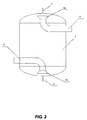
- FIG. 2 is a schematic view showing the present invention implemented with a heating oil boiler.
- FIG. 3 is a magnified view of an oil storage unit adapted to the present invention.
- an improvement for a heat transfer oil boiler disclosed in the present invention includes a high-level tank 2 disposed with a vent 1 , and an oil-gas separator 3 connected to the high-level tank 2 by means of pipes; three oil storage units 4 are connected in series somewhere between the high-level tank 2 and the oil-gas separator 3 , with each oil storage unit 4 embodied as an enclosed cylindrical container with a chamber. All three oil storage units 4 are inter-connected to each other by means of pipes of an S shape, i.e., an oil inlet pipe 5 connected to each oil storage unit 4 is disposed at the upper chamber of the oil storage unit 4 , and an oil outlet pipe 6 of each oil storage unit 4 is disposed at the lower chamber of the oil storage unit 4 .
- each oil inlet pipe 5 is shaped like an inverse trapezoid; and an opening 6 a of each oil outlet pipe 6 is shaped like a trapezoid.
- a vent 7 is disposed at the top 4 and a drainage pore 8 is disposed at the bottom of each oil storage unit 4 .
- All three vents 7 respectively disposed on the top of each oil storage unit 4 , are arranged in parallel to form a master exhaustion pipe 9 with the top of the master exhaustion pipe standing at a level higher than that of the oil inside the high-level tank 2 , and a gage valve 10 is being disposed on the master exhaustion pipe 9 .
- the three drainage pores 8 respectively disposed at the bottom of each oil storage unit 4 , are arranged in parallel to form a master drainage pipe 11 , and a gate valve 12 is disposed on the master drainage pipe 11 .
- a heating boiler 13 a heat consumption installation 14 , the oil-gas separator, 3 and an oil circulation pump 15 defining a circulation loop.
- One end of the oil-gas separator 3 is directly connected to an oil storage unit 4 and indirectly to the high-level tank 2 by means of a pipe. While the boiler 13 is working and the volume of heat transfer oil passing through the oil-gas separator 3 expands due to temperature rise, the heat transfer oil is diverted through the oil-gas separator 3 to flow into the oil storage unit 4 and the high-level tank 2 for a temporary reservation.
Landscapes
- Engineering & Computer Science (AREA)
- Physics & Mathematics (AREA)
- Thermal Sciences (AREA)
- Mechanical Engineering (AREA)
- General Engineering & Computer Science (AREA)
- Chemical & Material Sciences (AREA)
- Combustion & Propulsion (AREA)
- Heat-Pump Type And Storage Water Heaters (AREA)
Abstract
A heat transfer oil boiler system to minimize heat loss and prevent heat transfer oil from deterioration due to temperature fluctuations includes a high-level tank disposed with a vent, a transfer oil buffer, and an oil-gas separator; the heat transfer buffer includes one or more oil storage unit containing a chamber within; the heat transfer buffer is disposed between the high-level tank and the oil-gas separator; an oil inlet pipe and an oil outlet pipe for directing oil to and from the oil storage unit, respectively, is disposed in the upper and the lower chamber.
Description
(a) Field of the Invention
The present invention is related to an improvement for carrying thermal energy in a heating process, and more particularly, to an energy-effective heat transfer oil boiler with a heat transfer buffer.
(b) Description of the Prior Art
A heat transfer boiler is commonly used in an industry to deliver the heat through a type of thermal liquid that is capable of withstanding a certain temperature to an installation that needs substantial amount of heat to operate. Heat transfer oil is one of the popular heat transfer media used for the above-mentioned purpose. A conventional heat transfer system is essentially comprised of a circulation loop including a heating boiler, a heat consumption installation, an oil-gas separator, and an oil circulation pump; one end of the air-gas separator is connected to a high-level tank through pipes; and the high-level tank contains heat transfer oil within and is provided with a vent. The operating procedures include: first, supplying heat transfer oil to the boiler so that the oil will then low through the pipes and into the system of heat consumption installation; after that, the heat transfer oil flows further through the oil-gas separator and the oil circulation pump to return to the boiler for being heated again to complete a cycle. The high-level tank, in the cycle, functions to supplement the amount of heat transfer oil within the circulation loop when the density of the heat transfer oil reduces due to a temperature drop, or to take in the excessive amount of heat transfer oil when the temperature of the heat transfer oil rises. In practical application, the conventional construction, as described above, has the problem that the volume of the heat transfer oil usually expands or reduces based on the temperature changes in the heat consumption installation; and temperatures of the heating boiler fluctuates readily. When the volume of the heat transfer oil expands, the heat transfer oil passing through the oil-gas separator flows into the high-level tank, causing the temperature of the high-level tank to rise. As the temperature rises, heat in the high-level tank dissipate, resulting in a waste of thermal energy. Meanwhile, a higher temperature in heat transfer oil implies a lower density, which forces the heat transfer oil floating over the surface and get deteriorated more quickly than otherwise, especially when it reacts with the air as the heat transfer oil passes through the vent. When the flow of heat transfer oil reduces due to a temperature drop, the temperature of the heat transfer oil supplemented by the high-level tank drops even more quickly, which adversely consumes the thermal energy of the heating boiler.
The primary purpose of the present invention is therefore to provide an energy-effective solution for a heat transfer oil boiler to fully utilize the thermal energy carried by the heat transfer oil, thereby reducing the energy consumption caused by the heating boiler, and also preventing the heat transfer oil from being deteriorated due to temperature changes.
To achieve the above-mentioned goals, the present invention adds a heat transfer oil buffer into the operation of a heat transfer oil boiler. The improved heat transfer oil boiler is embodied as a high-level tank containing a vent and an oil-gas separator connected to the heat transfer oil buffer with pipes; and the heat buffer contains one or more oil storage unit with a chamber connected in a line, physically located between the high-level tank and the oil-gas separator. The increased flow of heat transfer oil is thus absorbed into the buffer with one or more oil storage unit to protect the temperature of the high-level tank from going up; and a better quality of the heat transfer oil in the high-level tank is also well maintained from deterioration; further, the thermal loss in the heat transfer oil is reduced.
All the oil inlet pipes entering the oil storage unit are disposed in the upper chamber in the oil storage unit; and all the oil outlet pipes exiting the oil storage unit are disposed in the lower chamber in each oil storage unit so that the heat transfer oil at higher temperature is first supplied to the heat transfer oil heating boiler since heat transfer oil with a higher temperature is gathered at the upper layer in the oil storage unit.
The oil storage unit can be embodied as a cylindrical enclosed container with a vent disposed at the top and a drainage pore disposed at the bottom of the oil storage unit. The oil storage unit can also be made into other shapes, e.g., a square, a trapezoid or any other geometric forms. In terms of refractory and total area, a cylindrical shape is practically preferred over others.
The vent functions to exhaust the air present in the oil storage unit, and the drainage pore functions to drain out the heat transfer oil when it is no longer needed in the oil storage unit.
The oil inlet pipe opening is made in an inverse trapezoid shape and the oil outlet pipe opening is made in a trapezoid shape. The designing purpose of these two shapes for the pipe openings is to slow down the flow rate of the heat transfer oil entering and leaving the oil storage unit for preserving thermal energy.
Three oil storage units are preferred for the heat transfer oil buffer. Field experience proves that three oil storage units provide the optimal results, reasonable space consuming and installation convenience.
All the vents each from the oil storage unit are arranged in parallel to form a master exhaustion pipe with the top of the master exhaustion disposed higher than the oil level inside the high-level tank. A gate valve is disposed on the master exhaustion pipe. While maintaining a neat and aesthetic appearance, the communication with the ambient air by the oil storage unit can be controlled by opening up or shutting down the gate valve.
Similarly, all the drainage pores at the bottom of each oil storage unit are arranged in parallel to form a master drainage pipe, and a gate valve is also disposed on the master drainage pipe for easy installation and convenient operation while still maintaining the aesthetic appearance in general.
The present invention provides its optimal in keeping the thermal loss of the heat transfer oil flowing into the high-level tank to its minimum, and also preventing the heat transfer oil from deterioration, thus minimizing the energy consumption of the heat transfer oil supplied to the heating boiler.
Referring to FIGS. 1 and 2 , an improvement for a heat transfer oil boiler disclosed in the present invention includes a high-level tank 2 disposed with a vent 1, and an oil-gas separator 3 connected to the high-level tank 2 by means of pipes; three oil storage units 4 are connected in series somewhere between the high-level tank 2 and the oil-gas separator 3, with each oil storage unit 4 embodied as an enclosed cylindrical container with a chamber. All three oil storage units 4 are inter-connected to each other by means of pipes of an S shape, i.e., an oil inlet pipe 5 connected to each oil storage unit 4 is disposed at the upper chamber of the oil storage unit 4, and an oil outlet pipe 6 of each oil storage unit 4 is disposed at the lower chamber of the oil storage unit 4. An opening 5 a of each oil inlet pipe 5 is shaped like an inverse trapezoid; and an opening 6 a of each oil outlet pipe 6 is shaped like a trapezoid. A vent 7 is disposed at the top 4 and a drainage pore 8 is disposed at the bottom of each oil storage unit 4. All three vents 7, respectively disposed on the top of each oil storage unit 4, are arranged in parallel to form a master exhaustion pipe 9 with the top of the master exhaustion pipe standing at a level higher than that of the oil inside the high-level tank 2, and a gage valve 10 is being disposed on the master exhaustion pipe 9. Similarly, the three drainage pores 8, respectively disposed at the bottom of each oil storage unit 4, are arranged in parallel to form a master drainage pipe 11, and a gate valve 12 is disposed on the master drainage pipe 11.
Further referring to FIG. 3 , a heating boiler 13, a heat consumption installation 14, the oil-gas separator, 3 and an oil circulation pump 15 defining a circulation loop. One end of the oil-gas separator 3 is directly connected to an oil storage unit 4 and indirectly to the high-level tank 2 by means of a pipe. While the boiler 13 is working and the volume of heat transfer oil passing through the oil-gas separator 3 expands due to temperature rise, the heat transfer oil is diverted through the oil-gas separator 3 to flow into the oil storage unit 4 and the high-level tank 2 for a temporary reservation. On the other hand, when the volume of heat transfer oil reduces due to a temperature drop, the heat transfer oil in the oil storage unit 4 and the high-level tank 2 starts to supplement to the originally supplied heat transfer oil. As a result, both the supplemental heat transfer oil and the originally supplied heat transfer oil flow through the heat consumption installation to the oil circulation pump 15 and enter the heating boiler 13 to be heated up once again.
Claims (9)
1. A heat transfer oil boiler protection includes
1.a) a high-level tank for accommodating heat transfer oil, disposed with a tank vent at a top thereof,
1.b) an oil-gas separator, and
1.c) one or more oil storage unit disposed between said high-level tank and said oil-gas separator and connected in series for more than one said oil storage unit, wherein
said oil-gas separator is connected to said one or more oil storage unit, and
said one or more oil storage unit is connected to said high-level tank.
2. The heat transfer oil boiler protection as claimed in claim 1 , wherein an oil inlet pipe to said oil storage unit is disposed in an upper part of a chamber of said oil storage unit, and an oil outlet pipe from said oil storage unit is disposed in a lower part of said chamber of said oil storage unit.
3. The heat transfer oil boiler protection as claimed in claim 1 , wherein said oil storage unit is an enclosed cylindrical container including a vent disposed at a top thereof, and a drainage pore disposed at a bottom thereof.
4. The heat transfer oil boiler protection as claimed in claim 2 , wherein said oil storage unit is an enclosed cylindrical container including a top vent disposed at a top thereof, and a bottom drainage pore disposed at a bottom thereof.
5. The heat transfer oil boiler protection as claimed in claim 1 , wherein said oil inlet pipe further includes an opening shaped in an inverse trapezoid with a wider side thereof facing out, and an opening of said oil outlet pipe is shaped in a trapezoid with a wider lateral thereof facing out.
6. The heat transfer oil boiler protection as claimed in claim 2 , wherein said oil inlet pipe further includes an opening shaped in an inverse trapezoid with a wider side thereof facing out, and an opening of said oil outlet pipe is shaped in a trapezoid with a wider lateral thereof facing out.
7. The heat transfer oil boiler protection as claimed in claim 1 , wherein three oil storage units are provided.
8. The heat transfer oil boiler protection as claimed in claim 3 , wherein said vent is disposed in a line with each other for more than one said oil storage unit, further including a master exhaustion pipe with a top gate valve, wherein said master exhaustion pipe is disposed at where said vent meets with each other in said line, and said master exhaustion pipe stands out of said heat transfer oil within said high level tank.
9. The heat transfer oil boiler protection as claimed in claim 3 , wherein said drainage pore is disposed at the bottom of each oil storage unit and in line with each other, including a master drainage pipe with a gate valve, disposed at where said drainage meets with each other.
Priority Applications (1)
| Application Number | Priority Date | Filing Date | Title |
|---|---|---|---|
| US11/846,436 US8336507B2 (en) | 2007-08-28 | 2007-08-28 | Protection for heat transfer oil boiler |
Applications Claiming Priority (1)
| Application Number | Priority Date | Filing Date | Title |
|---|---|---|---|
| US11/846,436 US8336507B2 (en) | 2007-08-28 | 2007-08-28 | Protection for heat transfer oil boiler |
Publications (2)
| Publication Number | Publication Date |
|---|---|
| US20090056648A1 US20090056648A1 (en) | 2009-03-05 |
| US8336507B2 true US8336507B2 (en) | 2012-12-25 |
Family
ID=40405478
Family Applications (1)
| Application Number | Title | Priority Date | Filing Date |
|---|---|---|---|
| US11/846,436 Expired - Fee Related US8336507B2 (en) | 2007-08-28 | 2007-08-28 | Protection for heat transfer oil boiler |
Country Status (1)
| Country | Link |
|---|---|
| US (1) | US8336507B2 (en) |
Families Citing this family (3)
| Publication number | Priority date | Publication date | Assignee | Title |
|---|---|---|---|---|
| CN202032740U (en) * | 2011-03-16 | 2011-11-09 | 上海伏波环保设备有限公司 | System for heating conduction oil by utilizing waste heat of boiler smoke |
| CN108679842B (en) * | 2018-03-22 | 2020-04-17 | 山西能源学院 | Oil bath heating method for local cooling |
| CN110986361B (en) * | 2019-12-25 | 2021-04-13 | 昆山文斌机械科技有限公司 | Heat conduction oil buffer for heat medium system |
Citations (2)
| Publication number | Priority date | Publication date | Assignee | Title |
|---|---|---|---|---|
| US5368447A (en) * | 1991-12-18 | 1994-11-29 | Halliburton Company | Well testing or production facility transfer system |
| US5824836A (en) * | 1996-06-20 | 1998-10-20 | Becquet; James W. | Processing system for condensing hydrocarbon emissions from a vapor stream |
-
2007
- 2007-08-28 US US11/846,436 patent/US8336507B2/en not_active Expired - Fee Related
Patent Citations (2)
| Publication number | Priority date | Publication date | Assignee | Title |
|---|---|---|---|---|
| US5368447A (en) * | 1991-12-18 | 1994-11-29 | Halliburton Company | Well testing or production facility transfer system |
| US5824836A (en) * | 1996-06-20 | 1998-10-20 | Becquet; James W. | Processing system for condensing hydrocarbon emissions from a vapor stream |
Also Published As
| Publication number | Publication date |
|---|---|
| US20090056648A1 (en) | 2009-03-05 |
Similar Documents
| Publication | Publication Date | Title |
|---|---|---|
| US7815173B2 (en) | Cooler | |
| US8336507B2 (en) | Protection for heat transfer oil boiler | |
| CN101815918B (en) | Hydraulic system and method for heat exchanger fluid handling with atmospheric tower | |
| CN204211856U (en) | A kind of polycrystalline ingot furnace with heat-exchange system | |
| KR101185415B1 (en) | Venting apparatus of ship engine room | |
| CA2597486C (en) | Inlet stratification device | |
| JP2008082692A (en) | Open-to-atmosphere heat storage device | |
| CN103234371A (en) | Double-cooling type closed cooling system | |
| GB2452294A (en) | Protection system for a heat transfer oil boiler | |
| CN110056938A (en) | A kind of integrated return water heat-exchanging water tank and its control method | |
| CN208567584U (en) | Gas heater for the heat exchanger and application of the gas heater exchanger | |
| JP4115079B2 (en) | Water heater | |
| KR100853965B1 (en) | Solar heating system using heating water pipe | |
| CN208779756U (en) | A kind of heat pump case tube heat exchanger of band flash distillation function | |
| KR101332259B1 (en) | Water purifier valve for preventing backward flow of dish washer | |
| KR20110093417A (en) | Cold and hot water purifier | |
| KR102036926B1 (en) | A Cooling Device Using ThermoelectricElement | |
| WO2007010538A1 (en) | Method and means for producing hot water from a hot water boiler system | |
| CN208187154U (en) | A kind of more shunting mixing bunker formula cooling towers | |
| CN106705070B (en) | A kind of device convenient for handling high-temperature tail gas | |
| CN205638658U (en) | Two refrigeration auto radiator of efficient | |
| JP2011191004A (en) | Exhaust steam recovery device | |
| JP2011191003A (en) | Exhaust steam recovery device | |
| KR102582112B1 (en) | Condenser cooling system using water of ice-making and waer purifier using the same | |
| KR101367201B1 (en) | Structure of circulating cold air for ice making water purifier or ice making hot and cold water dispenser with wine storage |
Legal Events
| Date | Code | Title | Description |
|---|---|---|---|
| AS | Assignment |
Owner name: LAO, GUAN-MING, CHINA Free format text: ASSIGNMENT OF ASSIGNORS INTEREST;ASSIGNORS:LAO, GUAN-MING;WANG, YAN-FENG;SHI, GUO-SHENG;AND OTHERS;REEL/FRAME:019758/0099 Effective date: 20070531 |
|
| REMI | Maintenance fee reminder mailed | ||
| LAPS | Lapse for failure to pay maintenance fees | ||
| STCH | Information on status: patent discontinuation |
Free format text: PATENT EXPIRED DUE TO NONPAYMENT OF MAINTENANCE FEES UNDER 37 CFR 1.362 |
|
| STCH | Information on status: patent discontinuation |
Free format text: PATENT EXPIRED DUE TO NONPAYMENT OF MAINTENANCE FEES UNDER 37 CFR 1.362 |
|
| FP | Lapsed due to failure to pay maintenance fee |
Effective date: 20161225 |