US8332018B2 - Method and arrangement to predict at least one system event and a corresponding computer program and a corresponding machine-readable storage medium - Google Patents
Method and arrangement to predict at least one system event and a corresponding computer program and a corresponding machine-readable storage medium Download PDFInfo
- Publication number
- US8332018B2 US8332018B2 US12/757,350 US75735010A US8332018B2 US 8332018 B2 US8332018 B2 US 8332018B2 US 75735010 A US75735010 A US 75735010A US 8332018 B2 US8332018 B2 US 8332018B2
- Authority
- US
- United States
- Prior art keywords
- event
- trend
- time windows
- primary parameters
- determining
- Prior art date
- Legal status (The legal status is an assumption and is not a legal conclusion. Google has not performed a legal analysis and makes no representation as to the accuracy of the status listed.)
- Expired - Fee Related, expires
Links
- 238000000034 method Methods 0.000 title claims abstract description 72
- 238000004590 computer program Methods 0.000 title claims abstract description 15
- 238000012545 processing Methods 0.000 claims description 19
- 238000009434 installation Methods 0.000 claims description 18
- 239000007943 implant Substances 0.000 claims description 11
- 238000004458 analytical method Methods 0.000 claims description 10
- 230000000977 initiatory effect Effects 0.000 claims description 9
- 230000011664 signaling Effects 0.000 claims description 9
- 238000012544 monitoring process Methods 0.000 abstract description 4
- 230000004796 pathophysiological change Effects 0.000 abstract description 2
- 230000008569 process Effects 0.000 description 13
- 238000012360 testing method Methods 0.000 description 11
- 230000006870 function Effects 0.000 description 10
- 206010007559 Cardiac failure congestive Diseases 0.000 description 9
- 206010019280 Heart failures Diseases 0.000 description 9
- 230000009471 action Effects 0.000 description 7
- 230000006399 behavior Effects 0.000 description 6
- 230000000875 corresponding effect Effects 0.000 description 6
- 238000012549 training Methods 0.000 description 6
- 230000001154 acute effect Effects 0.000 description 5
- 239000003814 drug Substances 0.000 description 5
- 238000005259 measurement Methods 0.000 description 5
- 238000004364 calculation method Methods 0.000 description 4
- 229940079593 drug Drugs 0.000 description 4
- 238000005457 optimization Methods 0.000 description 4
- 230000001225 therapeutic effect Effects 0.000 description 4
- 230000008859 change Effects 0.000 description 3
- 230000001684 chronic effect Effects 0.000 description 3
- 238000010276 construction Methods 0.000 description 3
- 230000010485 coping Effects 0.000 description 3
- 230000001419 dependent effect Effects 0.000 description 3
- 208000037265 diseases, disorders, signs and symptoms Diseases 0.000 description 3
- 238000007917 intracranial administration Methods 0.000 description 3
- 230000000638 stimulation Effects 0.000 description 3
- 238000010998 test method Methods 0.000 description 3
- 206010015856 Extrasystoles Diseases 0.000 description 2
- 208000000418 Premature Cardiac Complexes Diseases 0.000 description 2
- 230000003321 amplification Effects 0.000 description 2
- 230000008901 benefit Effects 0.000 description 2
- 230000003851 biochemical process Effects 0.000 description 2
- 230000005540 biological transmission Effects 0.000 description 2
- 239000000090 biomarker Substances 0.000 description 2
- 239000008280 blood Substances 0.000 description 2
- 210000004369 blood Anatomy 0.000 description 2
- 230000000747 cardiac effect Effects 0.000 description 2
- 238000009125 cardiac resynchronization therapy Methods 0.000 description 2
- 238000013461 design Methods 0.000 description 2
- 238000010586 diagram Methods 0.000 description 2
- 201000010099 disease Diseases 0.000 description 2
- 230000000694 effects Effects 0.000 description 2
- 238000011156 evaluation Methods 0.000 description 2
- 230000000004 hemodynamic effect Effects 0.000 description 2
- 238000003384 imaging method Methods 0.000 description 2
- 230000000302 ischemic effect Effects 0.000 description 2
- 238000012423 maintenance Methods 0.000 description 2
- 238000010297 mechanical methods and process Methods 0.000 description 2
- 230000005226 mechanical processes and functions Effects 0.000 description 2
- 238000012986 modification Methods 0.000 description 2
- 230000004048 modification Effects 0.000 description 2
- 238000003199 nucleic acid amplification method Methods 0.000 description 2
- 230000035945 sensitivity Effects 0.000 description 2
- 238000000926 separation method Methods 0.000 description 2
- 238000006467 substitution reaction Methods 0.000 description 2
- 239000011800 void material Substances 0.000 description 2
- 206010000117 Abnormal behaviour Diseases 0.000 description 1
- 206010002383 Angina Pectoris Diseases 0.000 description 1
- 206010007558 Cardiac failure chronic Diseases 0.000 description 1
- 206010008190 Cerebrovascular accident Diseases 0.000 description 1
- 206010061818 Disease progression Diseases 0.000 description 1
- 206010029216 Nervousness Diseases 0.000 description 1
- 208000010378 Pulmonary Embolism Diseases 0.000 description 1
- 206010057190 Respiratory tract infections Diseases 0.000 description 1
- 208000006011 Stroke Diseases 0.000 description 1
- 206010049418 Sudden Cardiac Death Diseases 0.000 description 1
- 208000032109 Transient ischaemic attack Diseases 0.000 description 1
- 206010003119 arrhythmia Diseases 0.000 description 1
- 230000006793 arrhythmia Effects 0.000 description 1
- 230000015572 biosynthetic process Effects 0.000 description 1
- 230000001756 cardiomyopathic effect Effects 0.000 description 1
- 208000026106 cerebrovascular disease Diseases 0.000 description 1
- 238000006243 chemical reaction Methods 0.000 description 1
- 230000001427 coherent effect Effects 0.000 description 1
- 238000004891 communication Methods 0.000 description 1
- 230000002596 correlated effect Effects 0.000 description 1
- 230000006378 damage Effects 0.000 description 1
- 230000034994 death Effects 0.000 description 1
- 230000006866 deterioration Effects 0.000 description 1
- 238000011161 development Methods 0.000 description 1
- 238000003745 diagnosis Methods 0.000 description 1
- 230000037213 diet Effects 0.000 description 1
- 235000005911 diet Nutrition 0.000 description 1
- 230000005750 disease progression Effects 0.000 description 1
- 208000035475 disorder Diseases 0.000 description 1
- 208000019622 heart disease Diseases 0.000 description 1
- 238000002513 implantation Methods 0.000 description 1
- 230000033001 locomotion Effects 0.000 description 1
- 238000002483 medication Methods 0.000 description 1
- 230000002107 myocardial effect Effects 0.000 description 1
- 208000010125 myocardial infarction Diseases 0.000 description 1
- 230000001537 neural effect Effects 0.000 description 1
- 230000035778 pathophysiological process Effects 0.000 description 1
- 230000002093 peripheral effect Effects 0.000 description 1
- 238000005086 pumping Methods 0.000 description 1
- 208000023504 respiratory system disease Diseases 0.000 description 1
- 239000000523 sample Substances 0.000 description 1
- 230000035939 shock Effects 0.000 description 1
- 238000012706 support-vector machine Methods 0.000 description 1
- 206010042772 syncope Diseases 0.000 description 1
- 238000003786 synthesis reaction Methods 0.000 description 1
- 230000009897 systematic effect Effects 0.000 description 1
- 238000002560 therapeutic procedure Methods 0.000 description 1
- 231100000331 toxic Toxicity 0.000 description 1
- 230000002588 toxic effect Effects 0.000 description 1
- 201000010875 transient cerebral ischemia Diseases 0.000 description 1
- 230000001960 triggered effect Effects 0.000 description 1
- 230000002861 ventricular Effects 0.000 description 1
Images




Classifications
-
- G—PHYSICS
- G16—INFORMATION AND COMMUNICATION TECHNOLOGY [ICT] SPECIALLY ADAPTED FOR SPECIFIC APPLICATION FIELDS
- G16H—HEALTHCARE INFORMATICS, i.e. INFORMATION AND COMMUNICATION TECHNOLOGY [ICT] SPECIALLY ADAPTED FOR THE HANDLING OR PROCESSING OF MEDICAL OR HEALTHCARE DATA
- G16H50/00—ICT specially adapted for medical diagnosis, medical simulation or medical data mining; ICT specially adapted for detecting, monitoring or modelling epidemics or pandemics
- G16H50/20—ICT specially adapted for medical diagnosis, medical simulation or medical data mining; ICT specially adapted for detecting, monitoring or modelling epidemics or pandemics for computer-aided diagnosis, e.g. based on medical expert systems
-
- G—PHYSICS
- G16—INFORMATION AND COMMUNICATION TECHNOLOGY [ICT] SPECIALLY ADAPTED FOR SPECIFIC APPLICATION FIELDS
- G16H—HEALTHCARE INFORMATICS, i.e. INFORMATION AND COMMUNICATION TECHNOLOGY [ICT] SPECIALLY ADAPTED FOR THE HANDLING OR PROCESSING OF MEDICAL OR HEALTHCARE DATA
- G16H40/00—ICT specially adapted for the management or administration of healthcare resources or facilities; ICT specially adapted for the management or operation of medical equipment or devices
- G16H40/60—ICT specially adapted for the management or administration of healthcare resources or facilities; ICT specially adapted for the management or operation of medical equipment or devices for the operation of medical equipment or devices
- G16H40/67—ICT specially adapted for the management or administration of healthcare resources or facilities; ICT specially adapted for the management or operation of medical equipment or devices for the operation of medical equipment or devices for remote operation
Definitions
- the present invention is directed towards predicting system events in complex systems.
- the object of the invention is a method and arrangement to predict at least one system event and a corresponding computer program and a corresponding machine-readable storage medium, where the event is predictable because of trends in observables over a certain period of time before the occurrence of the events.
- the invention can be used in particular for patient-specific monitoring of patho-physiological changes.
- the method can be used both in linear and non-linear sequences as well as disjunctions in the observables.
- An event may be, for example, the failure of a system, because the abnormal behavior of a certain component is expressed in the irregularities of one or more observables or the early recognition or pre-acute prediction of a particular critical condition of a patient, for example.
- the systems themselves may also represent geophysical or abstract units such as population or economic systems in which the deviation from a defined normal condition is predicted.
- a method and system for the prediction of system events that captures measured values s j of at least one primary parameter S j within at least one time window.
- the length of the time windows can be preset L ⁇ N within a range of a minimum length L min ⁇ N to a maximum length L max ⁇ N, and begin at presettable times H ⁇ N.
- the variable H describes the delay time between the time of the prediction and the occurrence of the predicted event, e.g., the time until the actual or expected occurrence of the upcoming system event, and runs from H min ⁇ N to H max ⁇ N. For at least one part of such time windows and for at least one part of the primary parameters S j , the probability of the existence of a trend is determined.
- a value is determined for the relevance (relevance value) of that window for prediction.
- at least the discriminatory power of the time window for the primary parameters S j will be determined.
- at least one feature will then be constructed, where the construction of at least one such feature will at least take into account part of the probabilities of a trend p j and the relevance values. Such probabilities may be taken into account in such a way that the probabilities of a trend p j are correlated with the relevance values through appropriate arithmetic operations.
- a weighting of the probabilities of a trend p j as a function of the relevance values and/or a summation of the (weighted) probabilities of a trend p j may be provided.
- the relevance value takes into account the discriminatory power of the time window for the primary parameter S j .
- the feature undergoes a classification method that yields an indicator for the occurrence or non-occurrence of a system event. As a function of that indicator, the system event is signaled and/or system-event-related measures are initiated.
- Embodiments of the invention use a multiple parameter set for which trend analysis is used to determine features for individual primary parameters S j , which then undergo a classification method. Each feature is based on at least one primary parameter S j .
- all probabilities of a trend p j are used for identification of areas with maximal discriminatory power. That is then used to derive all the relevant window lengths and positions. In such windows, it is preferable that all probabilities be combined (rather than only the probabilities above a certain threshold value). That combination then represents a feature for a classification method from which each primary parameter S j can then be formed in turn.
- a system's signal progression is checked for a certain form of variability within a limited period of time before an event that is to be detected, while the probability of existence of trends is calculated from time windows that begin a certain time before the time of prediction and have a given length. Those probabilities of selected time windows are combined. Such a combination should preferably be calculated for all measurands.
- a suitable synthesis of the combinations can then be made, if need be, and features can be constructed.
- the classification method used in that case will either be optimized with the help of data with known properties or else used on unfamiliar data and the result of the process will be analyzed with the aid of an automatically or manually determined decision boundary.
- an indicator is supplied by means of which it can be concluded that an event will (or will not) occur.
- Such an indicator signals an upcoming event.
- Such events may be a critical system event, for example.
- Such critical system events may be, but are not limited to, for example, arrhythmias, pulmonary embolisms, cerebro-vascular accident, myocardial infarction, angina pectoris, syncope, transient ischemic attack and/or acute peripheral arteriosclerotic disorders.
- Various courses of action may be deduced from the result, such as triggering an alarm that indicates the malfunctioning of a system or deviations from normal behavior, sets automated maintenance or substitution processes in motion, reports deterioration of an illness to the doctor or patient, initiates a supporting therapy, e.g., a shock or change of the pacing scheme (stimulation scheme) or permits the initiation of similar urgent measures, in order to avoid damage to the system, failure of the system or the death of the patient.
- a supporting therapy e.g., a shock or change of the pacing scheme (stimulation scheme) or permits the initiation of similar urgent measures, in order to avoid damage to the system, failure of the system or the death of the patient.
- the invention provides a method and system for the prediction of future system events.
- the predictions are then made on the basis of primary parameters that were captured within a limited time period before the time of prediction, while the primary parameters that characterize the system in a certain time period are used to form features that reflect the change of the system.
- the prediction time period may be limited before and after and does not necessarily have to begin at the time of prediction.
- At least one time window of length L is observed within the observation period.
- measured values s j of at least one primary parameters S j are captured.
- the measured values at the points of measurement of the primary parameters before the time of prediction are applied in chronological order.
- a combination of the probabilities of a trend is determined for at least one part of at least one primary parameter S j .
- Upward or downward trends may be considered together or separately.
- Embodiments of the invention therefore provide for signaling a system event and/or initiating one or more system-event-related measures based on the probabilities of a trend of time windows. That may be achieved, for example, by analyzing the combination of probabilities of a trend of time windows in a classification method and predicting at least one system event based on the classification.
- Such measures may involve system-stabilizing measures, for example, such as a change of medicines and/or other therapeutic support measures, automated maintenance and/or substitution processes.
- One advantageous embodiment provides for optimizing the classification method by using classified event data and/or control data.
- determination of a trend includes testing a hypothesis for the existence of a trend. It is preferable to perform the Mann trend test in that respect. Other trend test methods may be used, but the Mann test is more robust in coping with outliers than many other methods.
- the units of the time intervals may be seconds, minutes, hours, days, weeks, months or years, with the possibility of using various time intervals for the various primary parameters.
- the invention can be used, for example, to analyze heterogeneous signal progressions.
- the signal progressions may be linear or non-linear or contain disjunctions.
- a further advantage of the invention is that the method is robust in coping with data gaps.
- Examples of possible primary parameters include, but are not limited to:
- all primary parameters that include the patient's heart rate such as the heart rate over a predetermined time period, the heart rate during a specified phase of rest, the variability of the heart rate, and so on;
- biomedical primary parameters such as stimulation thresholds, electrode configurations, sensor amplifications or offset values
- One arrangement according to the invention has at least one chip and/or processor and is configured in such a way that a method for the prediction of at least one system event is feasible, where the method includes at the least the following steps:
- the chip and/or processor may include memory coupled to the chip and/or processor that has coding or software stored thereon for executing the method.
- a computer program for prediction of system events enables a data processing installation, after said program has been loaded into the memory of the data processing installation, to carry out a method for predicting at least one system event, where the method includes at least the following steps:
- the computer program according to the invention has a modular design, with individual modules installed on different data processing installations.
- Such computer programs might be downloadable, for example (for a fee or free of charge, freely accessible or password-protected), from a data or communication network.
- the computer programs made available in that manner can be made useable through a method in which a computer program is downloaded from an electronic data network, such as the Internet, to a data processing installation connected to a network.
- a machine-readable storage medium on which a program is stored that enables a data processing installation, after said program has been loaded into the memory of the data processing installation, to carry out a method for predicting at least one system event, where the method includes at least the following steps:
- a data processing installation is a computer device for running a computer program.
- FIG. 1 is a description of the parameters L min , L max , H min and H max ;
- FIG. 2A is a probability of a trend for an event patient as a function of L and H;
- FIG. 2B is a probability of a trend for a control patient as a function of L and H;
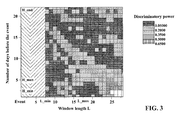
- FIG. 3 is a discriminatory power of a primary parameter for a group of patients
- FIG. 4 is an incoherent area of high discriminatory power with a primary parameter
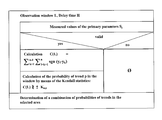
- FIG. 5 is a Nassi-Shneiderman diagram for calculating the probabilities of a trend
- the incoming test signals s j of the measurand S j are filtered.
- the number of primary parameters is designated as N S (superscripted signs and numerals are indices, unless noted otherwise).
- a check is performed to determine, among other things, whether the values of the measurands lie within a valid range of values.
- the time sequence of the test signals generally depends on two parameters whose meaning is illustrated in FIG. 1 .
- the variable L ⁇ N represents an observation window between the lengths L min ⁇ N and L max ⁇ N, in the course of which the variability of a test signal is checked.
- the variable H ⁇ N describes the delay time between the time of the prediction and the occurrence of the predicted event, e.g., the time until the actual expected occurrence of the upcoming decompensation process and runs from H min ⁇ N to H max ⁇ N.
- a suitable criterion should then be used to check the validity of the window.
- One possibility would be, for example, to demand at least 50% valid test signal values, but the precise choice typically always depends on the problem at hand and/or the nature of the input signals.
- the trend tests that may be used for valid windows include, without being limited to, the Mann trend test, for example. In that case, for each window, the quantity
- K n,p is the p quantile of Kendall's K statistics.
- the trend result is calculated individually for each parameter-tuple (L, H).
- each probability of a trend p for various lengths L of the time windows and for various intervals H between the end of the time window and the event is shown in FIG. 2 by example for an event patient ( FIG. 2A ) and a control patient ( FIG. 2B ) for a primary parameter on the L ⁇ H level of the so-called observation plane.
- a positive or negative sign can used to show whether it is an upward or downward trend (+p or ⁇ p).
- L min and L max designated the minimal and maximal lengths of the time windows, H min and H max the minimal and maximal intervals between time of prediction and the event.
- the shape, length and size of those areas depend on the relevant primary parameter S j .
- the Fischer Score method may be used, among other methods.
- FIG. 3 shows the discriminatory power of the primary parameters from FIGS. 2A and 2B for a group of patients.
- the structure with the areas of high discriminatory power is clearly recognizable here.
- the quality of the separation between event patients and control patients is higher when special consideration is given to the time windows from the areas of high discriminatory power. They are taken into consideration by weighting the probabilities of a trend from FIG. 2 .
- Those weights may also be represented, among other ways, by a Fischer score function, i.e., by f(F(L,H)). Such weights may vary for different primary parameters.
- the weighted probabilities are combined, e.g., through summation.
- the area of high discriminatory power for a primary parameter S j is not necessarily coherent, as can be seen from FIG. 4 .
- FIG. 5 shows a Nassi-Shneiderman diagram for the general calculation of combinations of the probabilities of a trend.
- M ⁇ L , H ⁇ p ⁇ ( L , H ) ⁇ f ⁇ ( F ⁇ ( L , H ) ) and are therefore suitable for use as input values for classification methods ⁇ (M). It is sometimes an advantage to input k incoherent areas as features M in the classification. It is likewise sometimes advantageous to include upward and downward trends as special features in the classification. The same is also true of features formed from a combination of several primary parameters. Optimization Method:
- At least one feature M is determined.
- Features classified in that way are suitable for automated learning as a function of the number of event datasets and control datasets. In that respect, methods such as artificial neuronal networks, support vector machines, hidden Markov models and the like have proved effective. Due to the high number of sets of free parameters during the training process, a large number of classified features are needed during the training process.
- the result of that scalar multiplication is a value for the occurrence of an event.
- the initial value is set to a fixed value c Event Train or c Control Train that lies above or below the training threshold value c 0,Train .
- it is necessary to find a c 0,Class such that the method achieves a predetermined degree of specificity and/or sensitivity.
- discrete values e.g., ⁇ 1, 0, +1 or a finer grid
- a maximal interval between c event and c control can be achieved through systematic variation of the components of ⁇ right arrow over ( ⁇ ) ⁇ . That classification function in this example is in the form
- the classification method can be used to predict an event for the time period to H min to H max that lies in the future relative to the time of prediction.
- the above-defined features M can be used as input for a selected classification method ⁇ .
- a system can now be monitored over time, the method is applied anew each time a new measured value occurs or at larger intervals, in order to make a prediction about the system's deviations from the norm. If the result is greater or less than the threshold value determined in the course of the optimization method c 0,Class , then, depending on the threshold value, predetermined measures will be launched, such as a therapeutic chain of actions.
- the measured values of the measurands used to calculate the features are checked for validity. Certain individual measured values may either be discarded, e.g., because they are shown to be invalid by the validity check, e.g., because they fall outside a predetermined range of values, or they may be missing, because they are lost in some way on the transmission path.
- the method can deal with invalid and missing measured values in the following manner, for example:
- One example of an embodiment is an apparatus to predict so-called decompensation in patients who suffer from chronic/congestive heart failure (CHF).
- CHF chronic/congestive heart failure
- the invention is not limited to the field of medicine. Rather, it can also be used to predict events in other complex systems, such as meteorological or geophysical systems or even in economic systems. Such actions may permit an early action on a problem and resolve an issue at a much lower cost or may permit the early action to be much more effective or much more likely to be effective relative to taking similar actions after the predicted event actually occurs.
- CRT Cardiac Resynchronization Therapy
- an automatic defibrillator can also be implanted.
- home monitoring to achieve early recognition of impending decompensation would be desirable.
- the methodology explained here could also be used for applications unrelated to implants.
- the sensors could contain electrodes to record intracranial electrograms, to determine impedances, pressure and other measured values.
- the measured values could undergo optional intermediate processing or else lead directly to an analysis regarding the diagnosis of a patient.
- the process of achieving sound diagnostic statements is fraught with a number of difficulties, however.
- CHF The basic disease CHF describes a complex patho-physiological process with numerous underlying causes. Ischemic, non-ischemic, cardiomyopathic, toxic and idiopathic causes of CHF are distinguished, for example. Factors such as the patient's failure to take medications as directed or non-adherence to a diet, acute respiratory diseases, infections or other co-morbidities further complicate the description of CHF.
- the measured patient signals are heterogeneous prior to the occurrence of the events to be observed. That means that different signal behavior can be expected from different patients, and the course of two different decompensation events may turn out differently for one and the same patient. In both cases, gaps in the series of measurement may appear. The cause of such gaps may be that certain measured values were discarded following a validity check or that certain measured values were lost on the telemetry transmission path.
- the primary parameters may be selected, for example, from the following quantity:
Landscapes
- Engineering & Computer Science (AREA)
- Health & Medical Sciences (AREA)
- Biomedical Technology (AREA)
- Medical Informatics (AREA)
- Public Health (AREA)
- Epidemiology (AREA)
- Primary Health Care (AREA)
- General Health & Medical Sciences (AREA)
- Data Mining & Analysis (AREA)
- Pathology (AREA)
- Databases & Information Systems (AREA)
- Business, Economics & Management (AREA)
- General Business, Economics & Management (AREA)
- Measuring And Recording Apparatus For Diagnosis (AREA)
Priority Applications (1)
| Application Number | Priority Date | Filing Date | Title |
|---|---|---|---|
| US12/757,350 US8332018B2 (en) | 2009-04-09 | 2010-04-09 | Method and arrangement to predict at least one system event and a corresponding computer program and a corresponding machine-readable storage medium |
Applications Claiming Priority (8)
| Application Number | Priority Date | Filing Date | Title |
|---|---|---|---|
| DE102009002307 | 2009-04-09 | ||
| DE102009002307 | 2009-04-09 | ||
| DE102009002307.0 | 2009-04-09 | ||
| US23201209P | 2009-08-07 | 2009-08-07 | |
| DE102010000103 | 2010-01-18 | ||
| DE102010000103.1 | 2010-01-18 | ||
| DE102010000103 | 2010-01-18 | ||
| US12/757,350 US8332018B2 (en) | 2009-04-09 | 2010-04-09 | Method and arrangement to predict at least one system event and a corresponding computer program and a corresponding machine-readable storage medium |
Publications (2)
| Publication Number | Publication Date |
|---|---|
| US20100262027A1 US20100262027A1 (en) | 2010-10-14 |
| US8332018B2 true US8332018B2 (en) | 2012-12-11 |
Family
ID=42145145
Family Applications (1)
| Application Number | Title | Priority Date | Filing Date |
|---|---|---|---|
| US12/757,350 Expired - Fee Related US8332018B2 (en) | 2009-04-09 | 2010-04-09 | Method and arrangement to predict at least one system event and a corresponding computer program and a corresponding machine-readable storage medium |
Country Status (2)
| Country | Link |
|---|---|
| US (1) | US8332018B2 (de) |
| EP (1) | EP2239676A1 (de) |
Cited By (2)
| Publication number | Priority date | Publication date | Assignee | Title |
|---|---|---|---|---|
| US20130116991A1 (en) * | 2011-11-08 | 2013-05-09 | International Business Machines Corporation | Time series data analysis method, system and computer program |
| US20220180247A1 (en) * | 2020-12-04 | 2022-06-09 | Oracle International Corporation | Detecting associated events |
Families Citing this family (5)
| Publication number | Priority date | Publication date | Assignee | Title |
|---|---|---|---|---|
| US8661431B2 (en) * | 2012-01-03 | 2014-02-25 | International Business Machines Corporation | Accurately estimating install time |
| US10552746B2 (en) * | 2014-09-25 | 2020-02-04 | International Business Machines Corporation | Identification of time lagged indicators for events with a window period |
| CN109598364B (zh) * | 2018-09-29 | 2022-10-28 | 创新先进技术有限公司 | 一种预测方法及装置 |
| DE102023210335A1 (de) | 2023-10-19 | 2025-04-24 | Robert Bosch Gesellschaft mit beschränkter Haftung | Verfahren zum Ermitteln wenigstens eines Change-Points in einer Zeitreihe von Sensorwerten |
| CN117688505B (zh) * | 2024-02-04 | 2024-04-19 | 河海大学 | 一种植被大范围区域化负异常的预测方法及系统 |
Citations (1)
| Publication number | Priority date | Publication date | Assignee | Title |
|---|---|---|---|---|
| US20080188763A1 (en) * | 2006-03-01 | 2008-08-07 | Michael Sasha John | System and methods for sliding-scale cardiac event detection |
Family Cites Families (2)
| Publication number | Priority date | Publication date | Assignee | Title |
|---|---|---|---|---|
| WO2000010455A1 (en) * | 1998-08-24 | 2000-03-02 | Emory University | Method and apparatus for predicting the onset of seizures based on features derived from signals indicative of brain activity |
| US20060025931A1 (en) * | 2004-07-30 | 2006-02-02 | Richard Rosen | Method and apparatus for real time predictive modeling for chronically ill patients |
-
2010
- 2010-03-19 EP EP10157116A patent/EP2239676A1/de not_active Withdrawn
- 2010-04-09 US US12/757,350 patent/US8332018B2/en not_active Expired - Fee Related
Patent Citations (1)
| Publication number | Priority date | Publication date | Assignee | Title |
|---|---|---|---|---|
| US20080188763A1 (en) * | 2006-03-01 | 2008-08-07 | Michael Sasha John | System and methods for sliding-scale cardiac event detection |
Cited By (3)
| Publication number | Priority date | Publication date | Assignee | Title |
|---|---|---|---|---|
| US20130116991A1 (en) * | 2011-11-08 | 2013-05-09 | International Business Machines Corporation | Time series data analysis method, system and computer program |
| US20220180247A1 (en) * | 2020-12-04 | 2022-06-09 | Oracle International Corporation | Detecting associated events |
| US12547927B2 (en) * | 2020-12-04 | 2026-02-10 | Oracle International Corporation | Detecting associated events |
Also Published As
| Publication number | Publication date |
|---|---|
| EP2239676A1 (de) | 2010-10-13 |
| US20100262027A1 (en) | 2010-10-14 |
Similar Documents
| Publication | Publication Date | Title |
|---|---|---|
| KR102853899B1 (ko) | 피쳐 묘사 및 기계 학습에 의한 부정맥 검출 | |
| KR102874196B1 (ko) | 기계 학습에 의한 부정맥 검출의 시각화 | |
| US9629548B2 (en) | Within-patient algorithm to predict heart failure decompensation | |
| US8768718B2 (en) | Between-patient comparisons for risk stratification of future heart failure decompensation | |
| US20100262027A1 (en) | Method and Arrangement to Predict at Least One System Event and a Corresponding Computer Program and a Corresponding Machine-Readable Storage Medium | |
| US9022930B2 (en) | Inter-relation between within-patient decompensation detection algorithm and between-patient stratifier to manage HF patients in a more efficient manner | |
| US9538919B2 (en) | System and method for improved ischemia and acute myocardial infarction detection | |
| US20080162183A1 (en) | Method and system to enable physician labels on a remote server and use labels to verify and improve algorithm results | |
| US20080161651A1 (en) | Surrogate measure of patient compliance | |
| US20220265219A1 (en) | Neural network based worsening heart failure detection | |
| US8712518B2 (en) | Determining phase-specific parameters of a physiological variable | |
| EP4376717A1 (de) | Filterbasierte arrhythmiedetektion | |
| US9183352B2 (en) | Method and arrangement for predicting at least one system event, corresponding computer program, and corresponding computer-readable storage medium | |
| US20140012346A1 (en) | Systems and methods to identify the inability to exercise to desired capacity | |
| US20240342489A1 (en) | Method for iegm-based monitoring of an electrode status of an implantable device | |
| US20250140405A1 (en) | Networked system configured to improve accuracy of health event diagnosis | |
| CN120322196A (zh) | 健康事件预测 | |
| CN114680857B (zh) | 参数确定方法、参数确定装置、存储介质及电子设备 |
Legal Events
| Date | Code | Title | Description |
|---|---|---|---|
| AS | Assignment |
Owner name: BIOTRONIK CRM PATENT AG, SWITZERLAND Free format text: ASSIGNMENT OF ASSIGNORS INTEREST;ASSIGNORS:EBERT, MANUEL;BAST, DANIEL;KRAEMER, THOMAS;AND OTHERS;REEL/FRAME:024428/0634 Effective date: 20100329 |
|
| STCF | Information on status: patent grant |
Free format text: PATENTED CASE |
|
| FPAY | Fee payment |
Year of fee payment: 4 |
|
| AS | Assignment |
Owner name: BIOTRONIK SE & CO. KG, GERMANY Free format text: ASSIGNMENT OF ASSIGNORS INTEREST;ASSIGNOR:BIOTRONIK CRM PATENT AG;REEL/FRAME:045995/0948 Effective date: 20170926 |
|
| FEPP | Fee payment procedure |
Free format text: MAINTENANCE FEE REMINDER MAILED (ORIGINAL EVENT CODE: REM.); ENTITY STATUS OF PATENT OWNER: LARGE ENTITY |
|
| LAPS | Lapse for failure to pay maintenance fees |
Free format text: PATENT EXPIRED FOR FAILURE TO PAY MAINTENANCE FEES (ORIGINAL EVENT CODE: EXP.); ENTITY STATUS OF PATENT OWNER: LARGE ENTITY |
|
| STCH | Information on status: patent discontinuation |
Free format text: PATENT EXPIRED DUE TO NONPAYMENT OF MAINTENANCE FEES UNDER 37 CFR 1.362 |
|
| FP | Lapsed due to failure to pay maintenance fee |
Effective date: 20201211 |