US8329729B2 - Quinuclidine derivatives as muscarinic M3 receptor antagonists - Google Patents
Quinuclidine derivatives as muscarinic M3 receptor antagonists Download PDFInfo
- Publication number
- US8329729B2 US8329729B2 US12/992,045 US99204508A US8329729B2 US 8329729 B2 US8329729 B2 US 8329729B2 US 99204508 A US99204508 A US 99204508A US 8329729 B2 US8329729 B2 US 8329729B2
- Authority
- US
- United States
- Prior art keywords
- phenyl
- bicyclo
- cycloheptanecarbonyloxy
- azonia
- methyl
- Prior art date
- Legal status (The legal status is an assumption and is not a legal conclusion. Google has not performed a legal analysis and makes no representation as to the accuracy of the status listed.)
- Expired - Fee Related, expires
Links
- 0 [1*]C([2*])([3*])C(=O)O[4*] Chemical compound [1*]C([2*])([3*])C(=O)O[4*] 0.000 description 9
- XYQZTQQVWURPQU-NXYCWYFDSA-N [Cl-].[H][C@]1(OC(=O)C2(C3=CC=CC=C3)CCCCCC2)C[N+]2(CC(=O)CC3=CC=CC=N3)CCC1CC2 Chemical compound [Cl-].[H][C@]1(OC(=O)C2(C3=CC=CC=C3)CCCCCC2)C[N+]2(CC(=O)CC3=CC=CC=N3)CCC1CC2 XYQZTQQVWURPQU-NXYCWYFDSA-N 0.000 description 3
- FQWJAJKNRCSDMU-UHFFFAOYSA-N C=CCCC(CCC=C)(C(=O)OCC)C1=CC=CS1 Chemical compound C=CCCC(CCC=C)(C(=O)OCC)C1=CC=CS1 FQWJAJKNRCSDMU-UHFFFAOYSA-N 0.000 description 2
- RDSROPKULHPNBC-UHFFFAOYSA-N CCOC(=O)C1(C2=CC=CS2)CCC=CCC1 Chemical compound CCOC(=O)C1(C2=CC=CS2)CCC=CCC1 RDSROPKULHPNBC-UHFFFAOYSA-N 0.000 description 2
- KRLIZFHXCFRWDW-UHFFFAOYSA-N COC(=O)C1(C2=CC=CC=C2)CCCCCC1 Chemical compound COC(=O)C1(C2=CC=CC=C2)CCCCCC1 KRLIZFHXCFRWDW-UHFFFAOYSA-N 0.000 description 2
- DEFBPPYKOPTXIJ-UHFFFAOYSA-N O=C(O)C1(C2=CC=CC=C2)CCCCCC1 Chemical compound O=C(O)C1(C2=CC=CC=C2)CCCCCC1 DEFBPPYKOPTXIJ-UHFFFAOYSA-N 0.000 description 2
- VOWQGVADNCNFKU-IBGZPJMESA-N [H][C@]1(OC(=O)C2(C3=CC=CC=C3)CCCCCC2)CN2CCC1CC2 Chemical compound [H][C@]1(OC(=O)C2(C3=CC=CC=C3)CCCCCC2)CN2CCC1CC2 VOWQGVADNCNFKU-IBGZPJMESA-N 0.000 description 2
- WRRGKVSSGVGACC-UHFFFAOYSA-N BrCCCC1=CC=NC=C1 Chemical compound BrCCCC1=CC=NC=C1 WRRGKVSSGVGACC-UHFFFAOYSA-N 0.000 description 1
- CZDNYGNWQNMKBZ-UHFFFAOYSA-N BrCCOC1=CC=CN=C1 Chemical compound BrCCOC1=CC=CN=C1 CZDNYGNWQNMKBZ-UHFFFAOYSA-N 0.000 description 1
- QPSBHOTXJXFBDF-RXYPHCENSA-N C.[CH3-].[CH3-].[H][C@]1(OC(=O)C2(C3=CC=CC=C3)CCCCCC2)C[N+]2(CC(=O)CC3=CC=CC=C3)CCC1CC2.[H][C@]1(OC(=O)C2(C3=CC=CC=C3)CCCCCC2)C[N+]2(CC(=O)CC3=CC=NC(C)=C3)CCC1CC2 Chemical compound C.[CH3-].[CH3-].[H][C@]1(OC(=O)C2(C3=CC=CC=C3)CCCCCC2)C[N+]2(CC(=O)CC3=CC=CC=C3)CCC1CC2.[H][C@]1(OC(=O)C2(C3=CC=CC=C3)CCCCCC2)C[N+]2(CC(=O)CC3=CC=NC(C)=C3)CCC1CC2 QPSBHOTXJXFBDF-RXYPHCENSA-N 0.000 description 1
- WTAUASGHJGCFNO-UHFFFAOYSA-N C=CCCC(CCC=C)(C(=O)OC)C1=CC(F)=CC=C1 Chemical compound C=CCCC(CCC=C)(C(=O)OC)C1=CC(F)=CC=C1 WTAUASGHJGCFNO-UHFFFAOYSA-N 0.000 description 1
- FUHHBXQFQQJKBE-UHFFFAOYSA-N CC1=CC(CC(=O)CBr)=CC=C1 Chemical compound CC1=CC(CC(=O)CBr)=CC=C1 FUHHBXQFQQJKBE-UHFFFAOYSA-N 0.000 description 1
- CNPFNGJMWXBKLV-UHFFFAOYSA-N CC1=CC(CC(=O)CBr)=NO1 Chemical compound CC1=CC(CC(=O)CBr)=NO1 CNPFNGJMWXBKLV-UHFFFAOYSA-N 0.000 description 1
- QEJPCCJEVGTRBM-UHFFFAOYSA-N CC1=CC(CC(=O)CCl)=CC=N1 Chemical compound CC1=CC(CC(=O)CCl)=CC=N1 QEJPCCJEVGTRBM-UHFFFAOYSA-N 0.000 description 1
- LLGZHXMCSGSXOC-UHFFFAOYSA-N CC1=CC=C(CC(=O)CBr)C=C1 Chemical compound CC1=CC=C(CC(=O)CBr)C=C1 LLGZHXMCSGSXOC-UHFFFAOYSA-N 0.000 description 1
- DSAKZQSWBGESLD-UHFFFAOYSA-N CC1=CC=C(CC(=O)CBr)N=N1 Chemical compound CC1=CC=C(CC(=O)CBr)N=N1 DSAKZQSWBGESLD-UHFFFAOYSA-N 0.000 description 1
- WLVGLKYQYWYFDX-UHFFFAOYSA-N CC1=CC=CC=C1CC(=O)CCl Chemical compound CC1=CC=CC=C1CC(=O)CCl WLVGLKYQYWYFDX-UHFFFAOYSA-N 0.000 description 1
- YXCWXNHZSBOAEN-UHFFFAOYSA-N CC1=CC=NC(CC(=O)CCl)=C1 Chemical compound CC1=CC=NC(CC(=O)CCl)=C1 YXCWXNHZSBOAEN-UHFFFAOYSA-N 0.000 description 1
- BUUZBKHKRHIPEO-UHFFFAOYSA-N CC1=NC(CC(=O)CBr)=CN=C1 Chemical compound CC1=NC(CC(=O)CBr)=CN=C1 BUUZBKHKRHIPEO-UHFFFAOYSA-N 0.000 description 1
- ZMFUERXEJCVRSO-UHFFFAOYSA-N CC1=NC(CC(=O)CCl)=CC=C1 Chemical compound CC1=NC(CC(=O)CCl)=CC=C1 ZMFUERXEJCVRSO-UHFFFAOYSA-N 0.000 description 1
- WPTHWVVKFHGECQ-UHFFFAOYSA-N CC1=NC(CC(=O)CCl)=CC=N1 Chemical compound CC1=NC(CC(=O)CCl)=CC=N1 WPTHWVVKFHGECQ-UHFFFAOYSA-N 0.000 description 1
- AFPFQAXAIRCHAD-UHFFFAOYSA-N CC1=NC=C(CC(=O)CBr)N=C1 Chemical compound CC1=NC=C(CC(=O)CBr)N=C1 AFPFQAXAIRCHAD-UHFFFAOYSA-N 0.000 description 1
- AQFZSXISRHSDLJ-UHFFFAOYSA-N CC1=NC=C(CC(=O)CCl)C=C1 Chemical compound CC1=NC=C(CC(=O)CCl)C=C1 AQFZSXISRHSDLJ-UHFFFAOYSA-N 0.000 description 1
- MSPNOPALVNDUAF-UHFFFAOYSA-N CC1=NC=NC(CC(=O)CCl)=C1 Chemical compound CC1=NC=NC(CC(=O)CCl)=C1 MSPNOPALVNDUAF-UHFFFAOYSA-N 0.000 description 1
- JNWGIUGOEJIFKI-UHFFFAOYSA-N CC1=NOC(CC(=O)CBr)=C1 Chemical compound CC1=NOC(CC(=O)CBr)=C1 JNWGIUGOEJIFKI-UHFFFAOYSA-N 0.000 description 1
- DZTRFCVVLPLWBI-UHFFFAOYSA-N CCOC(=O)C1(C2=CC=CS2)CCCCCC1 Chemical compound CCOC(=O)C1(C2=CC=CS2)CCCCCC1 DZTRFCVVLPLWBI-UHFFFAOYSA-N 0.000 description 1
- YLDILLQKQASWBA-UHFFFAOYSA-N CN(C(=O)CBr)C1=CC=CC=C1 Chemical compound CN(C(=O)CBr)C1=CC=CC=C1 YLDILLQKQASWBA-UHFFFAOYSA-N 0.000 description 1
- HTNCATYWOAKXGO-UHFFFAOYSA-N COC(=O)C1(C2=CC(F)=CC=C2)CCC=CCC1 Chemical compound COC(=O)C1(C2=CC(F)=CC=C2)CCC=CCC1 HTNCATYWOAKXGO-UHFFFAOYSA-N 0.000 description 1
- VOLFQRSFYAWHQY-UHFFFAOYSA-N COC(=O)C1(C2=CC(F)=CC=C2)CCCCCC1 Chemical compound COC(=O)C1(C2=CC(F)=CC=C2)CCCCCC1 VOLFQRSFYAWHQY-UHFFFAOYSA-N 0.000 description 1
- FCIWCAUEMAJKEC-UHFFFAOYSA-N COC1(C2=CC=CC=C2)CCCCCC1 Chemical compound COC1(C2=CC=CC=C2)CCCCCC1 FCIWCAUEMAJKEC-UHFFFAOYSA-N 0.000 description 1
- OFHBPXXGKKOTCS-UHFFFAOYSA-N CS(=O)(=O)OCCCNC(=O)C1=CC=CC=N1 Chemical compound CS(=O)(=O)OCCCNC(=O)C1=CC=CC=N1 OFHBPXXGKKOTCS-UHFFFAOYSA-N 0.000 description 1
- UUQDABRLRUGXER-UHFFFAOYSA-N N#CC1=CC=C(CC(=O)CCl)N=C1 Chemical compound N#CC1=CC=C(CC(=O)CCl)N=C1 UUQDABRLRUGXER-UHFFFAOYSA-N 0.000 description 1
- MDNJCXFVPOUYNC-SHCORVSCSA-N O=C(C1(CCCCCC1)c1ccccc1)O[C@@H]1C(CC2)CC[N+]2(CCOc2cnccc2)C1 Chemical compound O=C(C1(CCCCCC1)c1ccccc1)O[C@@H]1C(CC2)CC[N+]2(CCOc2cnccc2)C1 MDNJCXFVPOUYNC-SHCORVSCSA-N 0.000 description 1
- UYTWXRGEDJYPFI-UHFFFAOYSA-N O=C(C1=CC=CC=C1)C1(Cl)CCCCCC1 Chemical compound O=C(C1=CC=CC=C1)C1(Cl)CCCCCC1 UYTWXRGEDJYPFI-UHFFFAOYSA-N 0.000 description 1
- MYLYAKWBAWDOTR-UHFFFAOYSA-N O=C(C1=CC=CC=C1)C1CCCCCC1 Chemical compound O=C(C1=CC=CC=C1)C1CCCCCC1 MYLYAKWBAWDOTR-UHFFFAOYSA-N 0.000 description 1
- FETLGKRVAVIGQB-UHFFFAOYSA-N O=C(CBr)CC1=C(F)C=CC=C1F Chemical compound O=C(CBr)CC1=C(F)C=CC=C1F FETLGKRVAVIGQB-UHFFFAOYSA-N 0.000 description 1
- AWIZNVLEUCTUFW-UHFFFAOYSA-N O=C(CBr)CC1=CC(F)=CC(F)=C1 Chemical compound O=C(CBr)CC1=CC(F)=CC(F)=C1 AWIZNVLEUCTUFW-UHFFFAOYSA-N 0.000 description 1
- KIOUQFKJYAEPCE-UHFFFAOYSA-N O=C(CBr)CC1=CC(F)=CC=C1F Chemical compound O=C(CBr)CC1=CC(F)=CC=C1F KIOUQFKJYAEPCE-UHFFFAOYSA-N 0.000 description 1
- HGDOVNAQJVOCGG-UHFFFAOYSA-N O=C(CBr)CC1=CC=C(C(F)(F)F)N=N1 Chemical compound O=C(CBr)CC1=CC=C(C(F)(F)F)N=N1 HGDOVNAQJVOCGG-UHFFFAOYSA-N 0.000 description 1
- AWHDBHGJHZETJF-UHFFFAOYSA-N O=C(CBr)CC1=CC=CC(F)=C1 Chemical compound O=C(CBr)CC1=CC=CC(F)=C1 AWHDBHGJHZETJF-UHFFFAOYSA-N 0.000 description 1
- DKTKBZXXFIZGQH-UHFFFAOYSA-N O=C(CBr)CC1=CC=CC(F)=C1F Chemical compound O=C(CBr)CC1=CC=CC(F)=C1F DKTKBZXXFIZGQH-UHFFFAOYSA-N 0.000 description 1
- CIFGSVFCDAILNK-UHFFFAOYSA-N O=C(CBr)CC1=CC=CC=C1 Chemical compound O=C(CBr)CC1=CC=CC=C1 CIFGSVFCDAILNK-UHFFFAOYSA-N 0.000 description 1
- WARDSKDZNJWRBX-UHFFFAOYSA-N O=C(CBr)CC1=CC=CC=C1F Chemical compound O=C(CBr)CC1=CC=CC=C1F WARDSKDZNJWRBX-UHFFFAOYSA-N 0.000 description 1
- YGGZFBWDSJBIQT-UHFFFAOYSA-N O=C(CBr)CC1=CC=CC=N1 Chemical compound O=C(CBr)CC1=CC=CC=N1 YGGZFBWDSJBIQT-UHFFFAOYSA-N 0.000 description 1
- BZDANNVVGQTQPY-UHFFFAOYSA-N O=C(CBr)CC1=CC=CN=N1 Chemical compound O=C(CBr)CC1=CC=CN=N1 BZDANNVVGQTQPY-UHFFFAOYSA-N 0.000 description 1
- KVLWASSNLUKBKL-UHFFFAOYSA-N O=C(CBr)CC1=CN=CC=N1 Chemical compound O=C(CBr)CC1=CN=CC=N1 KVLWASSNLUKBKL-UHFFFAOYSA-N 0.000 description 1
- UJLRILVVLKWXPP-UHFFFAOYSA-N O=C(CBr)CC1=NC=CO1 Chemical compound O=C(CBr)CC1=NC=CO1 UJLRILVVLKWXPP-UHFFFAOYSA-N 0.000 description 1
- KBZBPPLBMYKIMS-UHFFFAOYSA-N O=C(CBr)CC1=NOC=C1 Chemical compound O=C(CBr)CC1=NOC=C1 KBZBPPLBMYKIMS-UHFFFAOYSA-N 0.000 description 1
- GKTHVHVEOXBWIX-UHFFFAOYSA-N O=C(CBr)CCCOC1=CC(F)=CC=C1 Chemical compound O=C(CBr)CCCOC1=CC(F)=CC=C1 GKTHVHVEOXBWIX-UHFFFAOYSA-N 0.000 description 1
- JMRLQUWUFLVROJ-UHFFFAOYSA-N O=C(CBr)Nc(cccc1)c1F Chemical compound O=C(CBr)Nc(cccc1)c1F JMRLQUWUFLVROJ-UHFFFAOYSA-N 0.000 description 1
- NHTCTIBKUJZJKT-UHFFFAOYSA-N O=C(CBr)Nc1ncc[o]1 Chemical compound O=C(CBr)Nc1ncc[o]1 NHTCTIBKUJZJKT-UHFFFAOYSA-N 0.000 description 1
- DFBCAHXQKGZONU-UHFFFAOYSA-N O=C(CBr)Nc1nnc(C(F)(F)F)cc1 Chemical compound O=C(CBr)Nc1nnc(C(F)(F)F)cc1 DFBCAHXQKGZONU-UHFFFAOYSA-N 0.000 description 1
- JXZJGONOXHYLHL-UHFFFAOYSA-N O=C(CBr)Nc1nnccc1 Chemical compound O=C(CBr)Nc1nnccc1 JXZJGONOXHYLHL-UHFFFAOYSA-N 0.000 description 1
- CVZDRXACBUXVOM-UHFFFAOYSA-N O=C(CCCBr)C1=NC=CC=C1 Chemical compound O=C(CCCBr)C1=NC=CC=C1 CVZDRXACBUXVOM-UHFFFAOYSA-N 0.000 description 1
- CYJLLNCZFKWDMW-UHFFFAOYSA-N O=C(CCCBr)C1=NC=CN=C1 Chemical compound O=C(CCCBr)C1=NC=CN=C1 CYJLLNCZFKWDMW-UHFFFAOYSA-N 0.000 description 1
- LQNMHOXPYIMGOY-UHFFFAOYSA-N O=C(CCl)CC1=C(F)C=CC=N1 Chemical compound O=C(CCl)CC1=C(F)C=CC=N1 LQNMHOXPYIMGOY-UHFFFAOYSA-N 0.000 description 1
- XUSYYSWQCLUXAU-UHFFFAOYSA-N O=C(CCl)CC1=C(F)C=NC=C1 Chemical compound O=C(CCl)CC1=C(F)C=NC=C1 XUSYYSWQCLUXAU-UHFFFAOYSA-N 0.000 description 1
- HLQITDMRXVEHJM-UHFFFAOYSA-N O=C(CCl)CC1=CC(F)=CN=C1 Chemical compound O=C(CCl)CC1=CC(F)=CN=C1 HLQITDMRXVEHJM-UHFFFAOYSA-N 0.000 description 1
- JCANCRVHPNRXBJ-UHFFFAOYSA-N O=C(CCl)CC1=CC=C(Cl)C=N1 Chemical compound O=C(CCl)CC1=CC=C(Cl)C=N1 JCANCRVHPNRXBJ-UHFFFAOYSA-N 0.000 description 1
- MDKDQWPJLKBWRB-UHFFFAOYSA-N O=C(CCl)CC1=CC=C(F)C=N1 Chemical compound O=C(CCl)CC1=CC=C(F)C=N1 MDKDQWPJLKBWRB-UHFFFAOYSA-N 0.000 description 1
- IGRNGDVUFADGLZ-UHFFFAOYSA-N O=C(CCl)CC1=CC=CC(C(F)(F)F)=N1 Chemical compound O=C(CCl)CC1=CC=CC(C(F)(F)F)=N1 IGRNGDVUFADGLZ-UHFFFAOYSA-N 0.000 description 1
- QJETVRFJOOUDEY-UHFFFAOYSA-N O=C(CCl)CC1=CC=CC=N1 Chemical compound O=C(CCl)CC1=CC=CC=N1 QJETVRFJOOUDEY-UHFFFAOYSA-N 0.000 description 1
- QDPXJAJTGHLLND-UHFFFAOYSA-N O=C(CCl)CC1=CC=CN=C1 Chemical compound O=C(CCl)CC1=CC=CN=C1 QDPXJAJTGHLLND-UHFFFAOYSA-N 0.000 description 1
- YPAHQCLAKNJEQC-UHFFFAOYSA-N O=C(CCl)CC1=CC=NC=C1 Chemical compound O=C(CCl)CC1=CC=NC=C1 YPAHQCLAKNJEQC-UHFFFAOYSA-N 0.000 description 1
- PLLDLZUTHZVVNC-UHFFFAOYSA-N O=C(CCl)CC1=CC=NC=N1 Chemical compound O=C(CCl)CC1=CC=NC=N1 PLLDLZUTHZVVNC-UHFFFAOYSA-N 0.000 description 1
- QWGWACKEXKTNGF-UHFFFAOYSA-N O=C(CCl)CC1=CN=CN=C1 Chemical compound O=C(CCl)CC1=CN=CN=C1 QWGWACKEXKTNGF-UHFFFAOYSA-N 0.000 description 1
- AOLXZDBRIXWVBH-UHFFFAOYSA-N O=C(CCl)CC1=CN=NC=C1 Chemical compound O=C(CCl)CC1=CN=NC=C1 AOLXZDBRIXWVBH-UHFFFAOYSA-N 0.000 description 1
- BCGSBEDBLUWWRI-UHFFFAOYSA-N O=C(CCl)CC1=NC=CC=N1 Chemical compound O=C(CCl)CC1=NC=CC=N1 BCGSBEDBLUWWRI-UHFFFAOYSA-N 0.000 description 1
- MHVWSDRHYDWELK-UHFFFAOYSA-N O=C(CCl)CC1=NC=NS1 Chemical compound O=C(CCl)CC1=NC=NS1 MHVWSDRHYDWELK-UHFFFAOYSA-N 0.000 description 1
- CBJHJDRXERGPFG-UHFFFAOYSA-N O=C(CCl)CC1=NOC2=C1C=CC=C2 Chemical compound O=C(CCl)CC1=NOC2=C1C=CC=C2 CBJHJDRXERGPFG-UHFFFAOYSA-N 0.000 description 1
- PRVQJAXHLAUQDK-JFBYPVLBSA-O O=C(C[N+]1(CCC2CC1)C[C@@H]2OC(C1(CCCCCC1)c1ccccc1)=O)Nc1cc(F)cnc1 Chemical compound O=C(C[N+]1(CCC2CC1)C[C@@H]2OC(C1(CCCCCC1)c1ccccc1)=O)Nc1cc(F)cnc1 PRVQJAXHLAUQDK-JFBYPVLBSA-O 0.000 description 1
- ZRJIEHLZHCCHEO-UHFFFAOYSA-N O=C(NCCCBr)C1=CC=CC=N1 Chemical compound O=C(NCCCBr)C1=CC=CC=N1 ZRJIEHLZHCCHEO-UHFFFAOYSA-N 0.000 description 1
- SVBIRSGHXXHJBT-UHFFFAOYSA-N OC1(C2=CC=CC=C2)CCCCCC1 Chemical compound OC1(C2=CC=CC=C2)CCCCCC1 SVBIRSGHXXHJBT-UHFFFAOYSA-N 0.000 description 1
- IFBXNOIFACMNNE-UHFFFAOYSA-N OCCOC1=CC=CN=C1 Chemical compound OCCOC1=CC=CN=C1 IFBXNOIFACMNNE-UHFFFAOYSA-N 0.000 description 1
- CRTRUBBEELEBRH-DTOGRTORSA-N [Br-].[H][C@]1(OC(=O)C2(C3=CC(F)=CC=C3)CCCCCC2)C[N+]2(CC(=O)CC3=CN=CC=N3)CCC1CC2 Chemical compound [Br-].[H][C@]1(OC(=O)C2(C3=CC(F)=CC=C3)CCCCCC2)C[N+]2(CC(=O)CC3=CN=CC=N3)CCC1CC2 CRTRUBBEELEBRH-DTOGRTORSA-N 0.000 description 1
- OGJJJZYRCUCSMC-URTLEEMISA-N [Br-].[H][C@]1(OC(=O)C2(C3=CC(F)=CC=C3)CCCCCC2)C[N+]2(CC(=O)CC3=NOC=C3)CCC1CC2 Chemical compound [Br-].[H][C@]1(OC(=O)C2(C3=CC(F)=CC=C3)CCCCCC2)C[N+]2(CC(=O)CC3=NOC=C3)CCC1CC2 OGJJJZYRCUCSMC-URTLEEMISA-N 0.000 description 1
- MJYRYQNQPPFYNW-IMEUCGBYSA-N [Br-].[H][C@]1(OC(=O)C2(C3=CC=CC=C3)CCCCCC2)C[N+]2(CC(=O)CC3=C(F)C=CC=C3F)CCC1CC2 Chemical compound [Br-].[H][C@]1(OC(=O)C2(C3=CC=CC=C3)CCCCCC2)C[N+]2(CC(=O)CC3=C(F)C=CC=C3F)CCC1CC2 MJYRYQNQPPFYNW-IMEUCGBYSA-N 0.000 description 1
- DHICQQXGMSMHEA-YIPDAYQMSA-N [Br-].[H][C@]1(OC(=O)C2(C3=CC=CC=C3)CCCCCC2)C[N+]2(CC(=O)CC3=CC(F)=CC(F)=C3)CCC1CC2 Chemical compound [Br-].[H][C@]1(OC(=O)C2(C3=CC=CC=C3)CCCCCC2)C[N+]2(CC(=O)CC3=CC(F)=CC(F)=C3)CCC1CC2 DHICQQXGMSMHEA-YIPDAYQMSA-N 0.000 description 1
- VYMKRAPEGIEXJF-IMEUCGBYSA-N [Br-].[H][C@]1(OC(=O)C2(C3=CC=CC=C3)CCCCCC2)C[N+]2(CC(=O)CC3=CC(F)=CC=C3F)CCC1CC2 Chemical compound [Br-].[H][C@]1(OC(=O)C2(C3=CC=CC=C3)CCCCCC2)C[N+]2(CC(=O)CC3=CC(F)=CC=C3F)CCC1CC2 VYMKRAPEGIEXJF-IMEUCGBYSA-N 0.000 description 1
- XWEZLMGXQDINIM-TXWSIENYSA-N [Br-].[H][C@]1(OC(=O)C2(C3=CC=CC=C3)CCCCCC2)C[N+]2(CC(=O)CC3=CC=C(C(F)(F)F)N=N3)CCC1CC2 Chemical compound [Br-].[H][C@]1(OC(=O)C2(C3=CC=CC=C3)CCCCCC2)C[N+]2(CC(=O)CC3=CC=C(C(F)(F)F)N=N3)CCC1CC2 XWEZLMGXQDINIM-TXWSIENYSA-N 0.000 description 1
- GUXSXWWXUWABBS-IIIFQBMYSA-N [Br-].[H][C@]1(OC(=O)C2(C3=CC=CC=C3)CCCCCC2)C[N+]2(CC(=O)CC3=CC=C(C)C=C3)CCC1CC2 Chemical compound [Br-].[H][C@]1(OC(=O)C2(C3=CC=CC=C3)CCCCCC2)C[N+]2(CC(=O)CC3=CC=C(C)C=C3)CCC1CC2 GUXSXWWXUWABBS-IIIFQBMYSA-N 0.000 description 1
- DHIQABYVMSAESA-BRFPSQFKSA-N [Br-].[H][C@]1(OC(=O)C2(C3=CC=CC=C3)CCCCCC2)C[N+]2(CC(=O)CC3=CC=C(C)N=N3)CCC1CC2 Chemical compound [Br-].[H][C@]1(OC(=O)C2(C3=CC=CC=C3)CCCCCC2)C[N+]2(CC(=O)CC3=CC=C(C)N=N3)CCC1CC2 DHIQABYVMSAESA-BRFPSQFKSA-N 0.000 description 1
- YVGIDWUDTAEQHA-IIIFQBMYSA-N [Br-].[H][C@]1(OC(=O)C2(C3=CC=CC=C3)CCCCCC2)C[N+]2(CC(=O)CC3=CC=CC(C)=C3)CCC1CC2 Chemical compound [Br-].[H][C@]1(OC(=O)C2(C3=CC=CC=C3)CCCCCC2)C[N+]2(CC(=O)CC3=CC=CC(C)=C3)CCC1CC2 YVGIDWUDTAEQHA-IIIFQBMYSA-N 0.000 description 1
- PTBIRLCJHDDDOW-RYWAHJMSSA-N [Br-].[H][C@]1(OC(=O)C2(C3=CC=CC=C3)CCCCCC2)C[N+]2(CC(=O)CC3=CC=CC(F)=C3F)CCC1CC2 Chemical compound [Br-].[H][C@]1(OC(=O)C2(C3=CC=CC=C3)CCCCCC2)C[N+]2(CC(=O)CC3=CC=CC(F)=C3F)CCC1CC2 PTBIRLCJHDDDOW-RYWAHJMSSA-N 0.000 description 1
- ARHQXRMOSQLFHR-GPQFNORQSA-N [Br-].[H][C@]1(OC(=O)C2(C3=CC=CC=C3)CCCCCC2)C[N+]2(CC(=O)CC3=CC=CC=C3)CCC1CC2 Chemical compound [Br-].[H][C@]1(OC(=O)C2(C3=CC=CC=C3)CCCCCC2)C[N+]2(CC(=O)CC3=CC=CC=C3)CCC1CC2 ARHQXRMOSQLFHR-GPQFNORQSA-N 0.000 description 1
- JJGYFDJVDVQADN-GVSSBELDSA-N [Br-].[H][C@]1(OC(=O)C2(C3=CC=CC=C3)CCCCCC2)C[N+]2(CC(=O)CC3=CC=CC=C3F)CCC1CC2 Chemical compound [Br-].[H][C@]1(OC(=O)C2(C3=CC=CC=C3)CCCCCC2)C[N+]2(CC(=O)CC3=CC=CC=C3F)CCC1CC2 JJGYFDJVDVQADN-GVSSBELDSA-N 0.000 description 1
- KFKSQBIDRZIJBT-IMYXDSERSA-N [Br-].[H][C@]1(OC(=O)C2(C3=CC=CC=C3)CCCCCC2)C[N+]2(CC(=O)CC3=CC=CN=N3)CCC1CC2 Chemical compound [Br-].[H][C@]1(OC(=O)C2(C3=CC=CC=C3)CCCCCC2)C[N+]2(CC(=O)CC3=CC=CN=N3)CCC1CC2 KFKSQBIDRZIJBT-IMYXDSERSA-N 0.000 description 1
- XASLNXCFMGHNCQ-BRFPSQFKSA-N [Br-].[H][C@]1(OC(=O)C2(C3=CC=CC=C3)CCCCCC2)C[N+]2(CC(=O)CC3=CN=CC(C)=N3)CCC1CC2 Chemical compound [Br-].[H][C@]1(OC(=O)C2(C3=CC=CC=C3)CCCCCC2)C[N+]2(CC(=O)CC3=CN=CC(C)=N3)CCC1CC2 XASLNXCFMGHNCQ-BRFPSQFKSA-N 0.000 description 1
- VYZOKGFCPLQZAN-JBTCYFJPSA-N [Br-].[H][C@]1(OC(=O)C2(C3=CC=CC=C3)CCCCCC2)C[N+]2(CC(=O)CC3=NC=CO3)CCC1CC2 Chemical compound [Br-].[H][C@]1(OC(=O)C2(C3=CC=CC=C3)CCCCCC2)C[N+]2(CC(=O)CC3=NC=CO3)CCC1CC2 VYZOKGFCPLQZAN-JBTCYFJPSA-N 0.000 description 1
- QXQBIDJYYPMRJG-WTJRHTICSA-N [Br-].[H][C@]1(OC(=O)C2(C3=CC=CC=C3)CCCCCC2)C[N+]2(CC(=O)CCCOC3=CC(F)=CC=C3)CCC1CC2 Chemical compound [Br-].[H][C@]1(OC(=O)C2(C3=CC=CC=C3)CCCCCC2)C[N+]2(CC(=O)CCCOC3=CC(F)=CC=C3)CCC1CC2 QXQBIDJYYPMRJG-WTJRHTICSA-N 0.000 description 1
- WOZYWLXIGDFAPW-DZHMJCDGSA-N [Br-].[H][C@]1(OC(=O)C2(C3=CC=CC=C3)CCCCCC2)C[N+]2(CCC3=NC=CN=C3)CCC1CC2 Chemical compound [Br-].[H][C@]1(OC(=O)C2(C3=CC=CC=C3)CCCCCC2)C[N+]2(CCC3=NC=CN=C3)CCC1CC2 WOZYWLXIGDFAPW-DZHMJCDGSA-N 0.000 description 1
- AMYWQQXOVNNEAB-JUEZVXFGSA-N [Br-].[H][C@]1(OC(=O)C2(C3=CC=CC=C3)CCCCCC2)C[N+]2(CCCC(=O)C3=NC=CC=C3)CCC1CC2 Chemical compound [Br-].[H][C@]1(OC(=O)C2(C3=CC=CC=C3)CCCCCC2)C[N+]2(CCCC(=O)C3=NC=CC=C3)CCC1CC2 AMYWQQXOVNNEAB-JUEZVXFGSA-N 0.000 description 1
- YDIGKWPMDIRXSC-BRFPSQFKSA-N [Br-].[H][C@]1(OC(=O)C2(C3=CC=CC=C3)CCCCCC2)C[N+]2(CCCC(=O)C3=NC=CN=C3)CCC1CC2 Chemical compound [Br-].[H][C@]1(OC(=O)C2(C3=CC=CC=C3)CCCCCC2)C[N+]2(CCCC(=O)C3=NC=CN=C3)CCC1CC2 YDIGKWPMDIRXSC-BRFPSQFKSA-N 0.000 description 1
- HEOCROWSMBACAP-XCCMJPSHSA-N [Br-].[H][C@]1(OC(=O)C2(C3=CC=CC=C3)CCCCCC2)C[N+]2(CCCC3=CC=NC=C3)CCC1CC2 Chemical compound [Br-].[H][C@]1(OC(=O)C2(C3=CC=CC=C3)CCCCCC2)C[N+]2(CCCC3=CC=NC=C3)CCC1CC2 HEOCROWSMBACAP-XCCMJPSHSA-N 0.000 description 1
- MOQBSPFTIVLAIX-ZNTYAKRMSA-O [Br-].[H][C@]1(OC(=O)C2(C3=CC=CC=C3)CCCCCC2)C[N+]2(CCCNC(=O)C3=CC=CC=N3)CCC1CC2 Chemical compound [Br-].[H][C@]1(OC(=O)C2(C3=CC=CC=C3)CCCCCC2)C[N+]2(CCCNC(=O)C3=CC=CC=N3)CCC1CC2 MOQBSPFTIVLAIX-ZNTYAKRMSA-O 0.000 description 1
- IEVMTZSLCPGAQR-DQXUUOSFSA-N [Br-].[H][C@]1(OC(=O)C2(C3=CC=CC=C3)CCCCCC2)C[N+]2(CCCOC3=CC=C(C#N)C=C3)CCC1CC2 Chemical compound [Br-].[H][C@]1(OC(=O)C2(C3=CC=CC=C3)CCCCCC2)C[N+]2(CCCOC3=CC=C(C#N)C=C3)CCC1CC2 IEVMTZSLCPGAQR-DQXUUOSFSA-N 0.000 description 1
- XGHARZDCTSHGIG-HWGCPHSESA-N [Br-].[H][C@]1(OC(=O)C2(C3=CC=CC=C3)CCCCCC2)C[N+]2(CCOCC3=CC=C(C#N)C=C3)CCC1CC2 Chemical compound [Br-].[H][C@]1(OC(=O)C2(C3=CC=CC=C3)CCCCCC2)C[N+]2(CCOCC3=CC=C(C#N)C=C3)CCC1CC2 XGHARZDCTSHGIG-HWGCPHSESA-N 0.000 description 1
- WTHBMTUJGYRMGR-HAMJSAHASA-N [Br-].[H][C@]1(OC(=O)C2(C3=CC=CC=C3)CCCCCC2)C[N+]2(CCOCCC3=CC=CC=C3)CCC1CC2 Chemical compound [Br-].[H][C@]1(OC(=O)C2(C3=CC=CC=C3)CCCCCC2)C[N+]2(CCOCCC3=CC=CC=C3)CCC1CC2 WTHBMTUJGYRMGR-HAMJSAHASA-N 0.000 description 1
- KLWVKSNMYSMRTD-CBTZJSNWSA-N [Br-].[H][C@]1(OC(=O)C2(C3=CC=CS3)CCCCCC2)C[N+]2(CC(=O)CC3=CC(C)=NO3)CCC1CC2 Chemical compound [Br-].[H][C@]1(OC(=O)C2(C3=CC=CS3)CCCCCC2)C[N+]2(CC(=O)CC3=CC(C)=NO3)CCC1CC2 KLWVKSNMYSMRTD-CBTZJSNWSA-N 0.000 description 1
- WIPYATPGTHIVBE-DZHMJCDGSA-N [Br-].[H][C@]1(OC(=O)C2(C3=CC=CS3)CCCCCC2)C[N+]2(CC(=O)CC3=CC=CC(F)=C3)CCC1CC2 Chemical compound [Br-].[H][C@]1(OC(=O)C2(C3=CC=CS3)CCCCCC2)C[N+]2(CC(=O)CC3=CC=CC(F)=C3)CCC1CC2 WIPYATPGTHIVBE-DZHMJCDGSA-N 0.000 description 1
- VWOADXXYIASHEV-SLRLHWDHSA-N [Br-].[H][C@]1(OC(=O)C2(C3=CC=CS3)CCCCCC2)C[N+]2(CC(=O)CC3=CN=C(C)C=N3)CCC1CC2 Chemical compound [Br-].[H][C@]1(OC(=O)C2(C3=CC=CS3)CCCCCC2)C[N+]2(CC(=O)CC3=CN=C(C)C=N3)CCC1CC2 VWOADXXYIASHEV-SLRLHWDHSA-N 0.000 description 1
- GHDPGAUXFPYEOJ-OTQLNIJOSA-N [Br-].[H][C@]1(OC(=O)C2(C3=CC=CS3)CCCCCC2)C[N+]2(CC(=O)CC3=CN=CC=N3)CCC1CC2 Chemical compound [Br-].[H][C@]1(OC(=O)C2(C3=CC=CS3)CCCCCC2)C[N+]2(CC(=O)CC3=CN=CC=N3)CCC1CC2 GHDPGAUXFPYEOJ-OTQLNIJOSA-N 0.000 description 1
- OAYPKRRERUQBRN-CBTZJSNWSA-N [Br-].[H][C@]1(OC(=O)C2(C3=CC=CS3)CCCCCC2)C[N+]2(CC(=O)CC3=NOC(C)=C3)CCC1CC2 Chemical compound [Br-].[H][C@]1(OC(=O)C2(C3=CC=CS3)CCCCCC2)C[N+]2(CC(=O)CC3=NOC(C)=C3)CCC1CC2 OAYPKRRERUQBRN-CBTZJSNWSA-N 0.000 description 1
- OVAKIYUUEKIQEJ-VVLXENPZSA-N [CH3-].[CH3-].[CH3-].[CH3-].[CH3-].[CH3-].[CH3-].[H][C@]1(OC(=O)C2(C3=CC(F)=CC=C3)CCCCCC2)C[N+]2(CC(=O)CC3=CN=CC=N3)CCC1CC2.[H][C@]1(OC(=O)C2(C3=CC(F)=CC=C3)CCCCCC2)C[N+]2(CC(=O)CC3=NCC=C3)CCC1CC2.[H][C@]1(OC(=O)C2(C3=CC=CC=C3)CCCCCC2)C[N+]2(CC(=O)CC3=CC=C(C)C=N3)CCC1CC2.[H][C@]1(OC(=O)C2(C3=CC=CC=C3)CCCCCC2)C[N+]2(CC(=O)CC3=CC=CC=N3)CCC1CC2.[H][C@]1(OC(=O)C2(C3=CC=CC=C3)CCCCCC2)C[N+]2(CC(=O)CC3=CN=CC(C)=N3)CCC1CC2.[H][C@]1(OC(=O)C2(C3=CC=CS3)CCCCCC2)C[N+]2(CC(=O)CC3=CC=CC=N3)CCC1CC2.[H][C@]1(OC(=O)C2(C3=CC=CS3)CCCCCC2)C[N+]2(CC(=O)CC3=CN=CC=N3)CCC1CC2 Chemical compound [CH3-].[CH3-].[CH3-].[CH3-].[CH3-].[CH3-].[CH3-].[H][C@]1(OC(=O)C2(C3=CC(F)=CC=C3)CCCCCC2)C[N+]2(CC(=O)CC3=CN=CC=N3)CCC1CC2.[H][C@]1(OC(=O)C2(C3=CC(F)=CC=C3)CCCCCC2)C[N+]2(CC(=O)CC3=NCC=C3)CCC1CC2.[H][C@]1(OC(=O)C2(C3=CC=CC=C3)CCCCCC2)C[N+]2(CC(=O)CC3=CC=C(C)C=N3)CCC1CC2.[H][C@]1(OC(=O)C2(C3=CC=CC=C3)CCCCCC2)C[N+]2(CC(=O)CC3=CC=CC=N3)CCC1CC2.[H][C@]1(OC(=O)C2(C3=CC=CC=C3)CCCCCC2)C[N+]2(CC(=O)CC3=CN=CC(C)=N3)CCC1CC2.[H][C@]1(OC(=O)C2(C3=CC=CS3)CCCCCC2)C[N+]2(CC(=O)CC3=CC=CC=N3)CCC1CC2.[H][C@]1(OC(=O)C2(C3=CC=CS3)CCCCCC2)C[N+]2(CC(=O)CC3=CN=CC=N3)CCC1CC2 OVAKIYUUEKIQEJ-VVLXENPZSA-N 0.000 description 1
- FXDWQXLOXOHCKZ-DAOYFFLKSA-N [CH3-].[H][C@]1(OC(=O)C2(C3=CC=CC=C3)CCCCCC2)C[N+]2(CC(=O)CC3=CC=CC=N3)CCC1CC2 Chemical compound [CH3-].[H][C@]1(OC(=O)C2(C3=CC=CC=C3)CCCCCC2)C[N+]2(CC(=O)CC3=CC=CC=N3)CCC1CC2 FXDWQXLOXOHCKZ-DAOYFFLKSA-N 0.000 description 1
- XHNUCDWSJIJHBV-JUEZVXFGSA-N [Cl-].[H][C@]1(OC(=O)C2(C3=CC=CC=C3)CCCCCC2)C[N+]2(CC(=O)CC3=CC(C)=CC=N3)CCC1CC2 Chemical compound [Cl-].[H][C@]1(OC(=O)C2(C3=CC=CC=C3)CCCCCC2)C[N+]2(CC(=O)CC3=CC(C)=CC=N3)CCC1CC2 XHNUCDWSJIJHBV-JUEZVXFGSA-N 0.000 description 1
- IISZGWNPDXCMQR-JUEZVXFGSA-N [Cl-].[H][C@]1(OC(=O)C2(C3=CC=CC=C3)CCCCCC2)C[N+]2(CC(=O)CC3=CC=C(C)C=N3)CCC1CC2 Chemical compound [Cl-].[H][C@]1(OC(=O)C2(C3=CC=CC=C3)CCCCCC2)C[N+]2(CC(=O)CC3=CC=C(C)C=N3)CCC1CC2 IISZGWNPDXCMQR-JUEZVXFGSA-N 0.000 description 1
- VTDFLWBPTRXORI-OWDVRYIHSA-N [Cl-].[H][C@]1(OC(=O)C2(C3=CC=CC=C3)CCCCCC2)C[N+]2(CC(=O)CC3=CC=C(Cl)C=N3)CCC1CC2 Chemical compound [Cl-].[H][C@]1(OC(=O)C2(C3=CC=CC=C3)CCCCCC2)C[N+]2(CC(=O)CC3=CC=C(Cl)C=N3)CCC1CC2 VTDFLWBPTRXORI-OWDVRYIHSA-N 0.000 description 1
- KHIHKMKQEYZTSE-OWDVRYIHSA-N [Cl-].[H][C@]1(OC(=O)C2(C3=CC=CC=C3)CCCCCC2)C[N+]2(CC(=O)CC3=CC=C(F)C=N3)CCC1CC2 Chemical compound [Cl-].[H][C@]1(OC(=O)C2(C3=CC=CC=C3)CCCCCC2)C[N+]2(CC(=O)CC3=CC=C(F)C=N3)CCC1CC2 KHIHKMKQEYZTSE-OWDVRYIHSA-N 0.000 description 1
- HUHKQCNIEYQMCI-GIFCKCLJSA-N [Cl-].[H][C@]1(OC(=O)C2(C3=CC=CC=C3)CCCCCC2)C[N+]2(CC(=O)CC3=CC=CC(C(F)(F)F)=N3)CCC1CC2 Chemical compound [Cl-].[H][C@]1(OC(=O)C2(C3=CC=CC=C3)CCCCCC2)C[N+]2(CC(=O)CC3=CC=CC(C(F)(F)F)=N3)CCC1CC2 HUHKQCNIEYQMCI-GIFCKCLJSA-N 0.000 description 1
- IIAOGYRPKXDQQN-JUEZVXFGSA-N [Cl-].[H][C@]1(OC(=O)C2(C3=CC=CC=C3)CCCCCC2)C[N+]2(CC(=O)CC3=CC=CC(C)=N3)CCC1CC2 Chemical compound [Cl-].[H][C@]1(OC(=O)C2(C3=CC=CC=C3)CCCCCC2)C[N+]2(CC(=O)CC3=CC=CC(C)=N3)CCC1CC2 IIAOGYRPKXDQQN-JUEZVXFGSA-N 0.000 description 1
- SLPKZDBOQDZBGX-KCTUUFLGSA-N [Cl-].[H][C@]1(OC(=O)C2(C3=CC=CC=C3)CCCCCC2)C[N+]2(CC(=O)CC3=CC=CC=C3C)CCC1CC2 Chemical compound [Cl-].[H][C@]1(OC(=O)C2(C3=CC=CC=C3)CCCCCC2)C[N+]2(CC(=O)CC3=CC=CC=C3C)CCC1CC2 SLPKZDBOQDZBGX-KCTUUFLGSA-N 0.000 description 1
- JKHSKDQDMRSFFF-FYKVLBHHSA-N [Cl-].[H][C@]1(OC(=O)C2(C3=CC=CC=C3)CCCCCC2)C[N+]2(CC(=O)CC3=CC=CN=C3)CCC1CC2 Chemical compound [Cl-].[H][C@]1(OC(=O)C2(C3=CC=CC=C3)CCCCCC2)C[N+]2(CC(=O)CC3=CC=CN=C3)CCC1CC2 JKHSKDQDMRSFFF-FYKVLBHHSA-N 0.000 description 1
- ZEVKRVBFXVBOOX-YCQMHXFUSA-N [Cl-].[H][C@]1(OC(=O)C2(C3=CC=CC=C3)CCCCCC2)C[N+]2(CC(=O)CC3=CC=NC(C)=C3)CCC1CC2 Chemical compound [Cl-].[H][C@]1(OC(=O)C2(C3=CC=CC=C3)CCCCCC2)C[N+]2(CC(=O)CC3=CC=NC(C)=C3)CCC1CC2 ZEVKRVBFXVBOOX-YCQMHXFUSA-N 0.000 description 1
- XMEXXUQIDOOXEK-BRFPSQFKSA-N [Cl-].[H][C@]1(OC(=O)C2(C3=CC=CC=C3)CCCCCC2)C[N+]2(CC(=O)CC3=CC=NC(C)=N3)CCC1CC2 Chemical compound [Cl-].[H][C@]1(OC(=O)C2(C3=CC=CC=C3)CCCCCC2)C[N+]2(CC(=O)CC3=CC=NC(C)=N3)CCC1CC2 XMEXXUQIDOOXEK-BRFPSQFKSA-N 0.000 description 1
- XETUVCKODJUVCJ-IMYXDSERSA-N [Cl-].[H][C@]1(OC(=O)C2(C3=CC=CC=C3)CCCCCC2)C[N+]2(CC(=O)CC3=CC=NC=N3)CCC1CC2 Chemical compound [Cl-].[H][C@]1(OC(=O)C2(C3=CC=CC=C3)CCCCCC2)C[N+]2(CC(=O)CC3=CC=NC=N3)CCC1CC2 XETUVCKODJUVCJ-IMYXDSERSA-N 0.000 description 1
- DTPUCRJQBPPMNG-YCQMHXFUSA-N [Cl-].[H][C@]1(OC(=O)C2(C3=CC=CC=C3)CCCCCC2)C[N+]2(CC(=O)CC3=CN=C(C)C=C3)CCC1CC2 Chemical compound [Cl-].[H][C@]1(OC(=O)C2(C3=CC=CC=C3)CCCCCC2)C[N+]2(CC(=O)CC3=CN=C(C)C=C3)CCC1CC2 DTPUCRJQBPPMNG-YCQMHXFUSA-N 0.000 description 1
- GMQPOSOHRSIELK-BRFPSQFKSA-N [Cl-].[H][C@]1(OC(=O)C2(C3=CC=CC=C3)CCCCCC2)C[N+]2(CC(=O)CC3=CN=CC(F)=C3)CCC1CC2 Chemical compound [Cl-].[H][C@]1(OC(=O)C2(C3=CC=CC=C3)CCCCCC2)C[N+]2(CC(=O)CC3=CN=CC(F)=C3)CCC1CC2 GMQPOSOHRSIELK-BRFPSQFKSA-N 0.000 description 1
- ZNEKRRMOKMFMBB-PNDBIIQMSA-N [Cl-].[H][C@]1(OC(=O)C2(C3=CC=CC=C3)CCCCCC2)C[N+]2(CC(=O)CC3=CN=CN=C3)CCC1CC2 Chemical compound [Cl-].[H][C@]1(OC(=O)C2(C3=CC=CC=C3)CCCCCC2)C[N+]2(CC(=O)CC3=CN=CN=C3)CCC1CC2 ZNEKRRMOKMFMBB-PNDBIIQMSA-N 0.000 description 1
- OTKQJSJTQFWEDK-LMEDFRRQSA-N [Cl-].[H][C@]1(OC(=O)C2(C3=CC=CC=C3)CCCCCC2)C[N+]2(CC(=O)CC3=NC=CC=N3)CCC1CC2 Chemical compound [Cl-].[H][C@]1(OC(=O)C2(C3=CC=CC=C3)CCCCCC2)C[N+]2(CC(=O)CC3=NC=CC=N3)CCC1CC2 OTKQJSJTQFWEDK-LMEDFRRQSA-N 0.000 description 1
- RJIHVTGFFPFWLT-OTQLNIJOSA-N [Cl-].[H][C@]1(OC(=O)C2(C3=CC=CC=C3)CCCCCC2)C[N+]2(CC(=O)CC3=NC=NS3)CCC1CC2 Chemical compound [Cl-].[H][C@]1(OC(=O)C2(C3=CC=CC=C3)CCCCCC2)C[N+]2(CC(=O)CC3=NC=NS3)CCC1CC2 RJIHVTGFFPFWLT-OTQLNIJOSA-N 0.000 description 1
- ZSJXZNKFWQHQMV-ZHMNCOJTSA-N [Cl-].[H][C@]1(OC(=O)C2(C3=CC=CC=C3)CCCCCC2)C[N+]2(CC(=O)CC3=NOC4=C3C=CC=C4)CCC1CC2 Chemical compound [Cl-].[H][C@]1(OC(=O)C2(C3=CC=CC=C3)CCCCCC2)C[N+]2(CC(=O)CC3=NOC4=C3C=CC=C4)CCC1CC2 ZSJXZNKFWQHQMV-ZHMNCOJTSA-N 0.000 description 1
- PFKYJISOTBSPED-FZCUKYEHSA-O [Cl-].[H][C@]1(OC(=O)C2(C3=CC=CC=C3)CCCCCC2)C[N+]2(CC(=O)NC3=C(F)C=CC=N3)CCC1CC2 Chemical compound [Cl-].[H][C@]1(OC(=O)C2(C3=CC=CC=C3)CCCCCC2)C[N+]2(CC(=O)NC3=C(F)C=CC=N3)CCC1CC2 PFKYJISOTBSPED-FZCUKYEHSA-O 0.000 description 1
- DMJWMLJZIIQIDG-PHMQNLDASA-O [Cl-].[H][C@]1(OC(=O)C2(C3=CC=CC=C3)CCCCCC2)C[N+]2(CC(=O)NC3=CC(C)=NC=N3)CCC1CC2 Chemical compound [Cl-].[H][C@]1(OC(=O)C2(C3=CC=CC=C3)CCCCCC2)C[N+]2(CC(=O)NC3=CC(C)=NC=N3)CCC1CC2 DMJWMLJZIIQIDG-PHMQNLDASA-O 0.000 description 1
- MCCAUECDWCFNGH-IRFUQNTKSA-O [Cl-].[H][C@]1(OC(=O)C2(C3=CC=CC=C3)CCCCCC2)C[N+]2(CC(=O)NC3=CC=C(C#N)C=N3)CCC1CC2 Chemical compound [Cl-].[H][C@]1(OC(=O)C2(C3=CC=CC=C3)CCCCCC2)C[N+]2(CC(=O)NC3=CC=C(C#N)C=N3)CCC1CC2 MCCAUECDWCFNGH-IRFUQNTKSA-O 0.000 description 1
- DLBADXNZWOPANT-JFBYPVLBSA-O [Cl-].[H][C@]1(OC(=O)C2(C3=CC=CC=C3)CCCCCC2)C[N+]2(CC(=O)NC3=CC=NC=C3F)CCC1CC2 Chemical compound [Cl-].[H][C@]1(OC(=O)C2(C3=CC=CC=C3)CCCCCC2)C[N+]2(CC(=O)NC3=CC=NC=C3F)CCC1CC2 DLBADXNZWOPANT-JFBYPVLBSA-O 0.000 description 1
- CXDLCWQTEJSXQO-YVWBODOZSA-N [Cl-].[H][C@]1(OC(=O)C2(C3=CC=CS3)CCCCCC2)C[N+]2(CC(=O)CC3=NOC4=C3C=CC=C4)CCC1CC2 Chemical compound [Cl-].[H][C@]1(OC(=O)C2(C3=CC=CS3)CCCCCC2)C[N+]2(CC(=O)CC3=NOC4=C3C=CC=C4)CCC1CC2 CXDLCWQTEJSXQO-YVWBODOZSA-N 0.000 description 1
- APTQZDGUZNLWRN-YEHLZPOLSA-M [H]C(=O)[O-].[H][C@@]1(OC(=O)C2(C3=CC=CC=C3)CCCCCC2)C[N+]2(CCCOC3=CC=CC=C3)CCC1CC2 Chemical compound [H]C(=O)[O-].[H][C@@]1(OC(=O)C2(C3=CC=CC=C3)CCCCCC2)C[N+]2(CCCOC3=CC=CC=C3)CCC1CC2 APTQZDGUZNLWRN-YEHLZPOLSA-M 0.000 description 1
- CNRNLXBDOUZRET-AOOWOONRSA-M [H]C(=O)[O-].[H][C@]1(OC(=O)C2(C3=CC=CC=C3)CCCCCC2)C[N+]2(CC(=O)CC3=CN=NC=C3)CCC1CC2 Chemical compound [H]C(=O)[O-].[H][C@]1(OC(=O)C2(C3=CC=CC=C3)CCCCCC2)C[N+]2(CC(=O)CC3=CN=NC=C3)CCC1CC2 CNRNLXBDOUZRET-AOOWOONRSA-M 0.000 description 1
- YVAHVMCFLDQPNX-GLSBDXMNSA-M [H]C(=O)[O-].[H][C@]1(OC(=O)C2(C3=CC=CC=C3)CCCCCC2)C[N+]2(CC(=O)N(C)C3=CC=CC=C3)CCC1CC2 Chemical compound [H]C(=O)[O-].[H][C@]1(OC(=O)C2(C3=CC=CC=C3)CCCCCC2)C[N+]2(CC(=O)N(C)C3=CC=CC=C3)CCC1CC2 YVAHVMCFLDQPNX-GLSBDXMNSA-M 0.000 description 1
- WGBIGHAYXCCIRB-RZVKIGGTSA-M [H]C(=O)[O-].[H][C@]1(OC(=O)C2(C3=CC=CC=C3)CCCCCC2)C[N+]2(CCC3=CC4=C(C=C3)OCC4)CCC1CC2 Chemical compound [H]C(=O)[O-].[H][C@]1(OC(=O)C2(C3=CC=CC=C3)CCCCCC2)C[N+]2(CCC3=CC4=C(C=C3)OCC4)CCC1CC2 WGBIGHAYXCCIRB-RZVKIGGTSA-M 0.000 description 1
- PLPQRSTZTSYXGB-DAOYFFLKSA-M [H]C(=O)[O-].[H][C@]1(OC(=O)C2(C3=CC=CC=C3)CCCCCC2)C[N+]2(CCOC3=CC=C(F)C=C3)CCC1CC2 Chemical compound [H]C(=O)[O-].[H][C@]1(OC(=O)C2(C3=CC=CC=C3)CCCCCC2)C[N+]2(CCOC3=CC=C(F)C=C3)CCC1CC2 PLPQRSTZTSYXGB-DAOYFFLKSA-M 0.000 description 1
- NRKRADFAYDMZBT-AUTAWIAJSA-M [H]C(=O)[O-].[H][C@]1(OC(=O)C2(C3=CC=CC=C3)CCCCCC2)C[N+]2(CCOC3=CC=CN=C3)CCC1CC2 Chemical compound [H]C(=O)[O-].[H][C@]1(OC(=O)C2(C3=CC=CC=C3)CCCCCC2)C[N+]2(CCOC3=CC=CN=C3)CCC1CC2 NRKRADFAYDMZBT-AUTAWIAJSA-M 0.000 description 1
- QELABTWBDHQVLP-RARKWRLQSA-M [H]C(=O)[O-].[H][C@]1(OC(=O)C2(C3=CC=CC=C3)CCCCCC2)C[N+]2(CCOCC3=CC=C(OC)C=C3)CCC1CC2 Chemical compound [H]C(=O)[O-].[H][C@]1(OC(=O)C2(C3=CC=CC=C3)CCCCCC2)C[N+]2(CCOCC3=CC=C(OC)C=C3)CCC1CC2 QELABTWBDHQVLP-RARKWRLQSA-M 0.000 description 1
- VOWQGVADNCNFKU-LJQANCHMSA-N [H][C@@]1(OC(=O)C2(C3=CC=CC=C3)CCCCCC2)CN2CCC1CC2 Chemical compound [H][C@@]1(OC(=O)C2(C3=CC=CC=C3)CCCCCC2)CN2CCC1CC2 VOWQGVADNCNFKU-LJQANCHMSA-N 0.000 description 1
- WQBKFBUPVJXKSN-IBGZPJMESA-N [H][C@]1(OC(=O)C2(C3=CC(F)=CC=C3)CCCCCC2)CN2CCC1CC2 Chemical compound [H][C@]1(OC(=O)C2(C3=CC(F)=CC=C3)CCCCCC2)CN2CCC1CC2 WQBKFBUPVJXKSN-IBGZPJMESA-N 0.000 description 1
- IIGOBGCDNPRZDU-INIZCTEOSA-N [H][C@]1(OC(=O)C2(C3=CC=CS3)CCCCCC2)CN2CCC1CC2 Chemical compound [H][C@]1(OC(=O)C2(C3=CC=CS3)CCCCCC2)CN2CCC1CC2 IIGOBGCDNPRZDU-INIZCTEOSA-N 0.000 description 1
Images

Classifications
-
- C—CHEMISTRY; METALLURGY
- C07—ORGANIC CHEMISTRY
- C07D—HETEROCYCLIC COMPOUNDS
- C07D453/00—Heterocyclic compounds containing quinuclidine or iso-quinuclidine ring systems, e.g. quinine alkaloids
- C07D453/02—Heterocyclic compounds containing quinuclidine or iso-quinuclidine ring systems, e.g. quinine alkaloids containing not further condensed quinuclidine ring systems
-
- A—HUMAN NECESSITIES
- A61—MEDICAL OR VETERINARY SCIENCE; HYGIENE
- A61P—SPECIFIC THERAPEUTIC ACTIVITY OF CHEMICAL COMPOUNDS OR MEDICINAL PREPARATIONS
- A61P1/00—Drugs for disorders of the alimentary tract or the digestive system
- A61P1/02—Stomatological preparations, e.g. drugs for caries, aphtae, periodontitis
-
- A—HUMAN NECESSITIES
- A61—MEDICAL OR VETERINARY SCIENCE; HYGIENE
- A61P—SPECIFIC THERAPEUTIC ACTIVITY OF CHEMICAL COMPOUNDS OR MEDICINAL PREPARATIONS
- A61P1/00—Drugs for disorders of the alimentary tract or the digestive system
- A61P1/04—Drugs for disorders of the alimentary tract or the digestive system for ulcers, gastritis or reflux esophagitis, e.g. antacids, inhibitors of acid secretion, mucosal protectants
-
- A—HUMAN NECESSITIES
- A61—MEDICAL OR VETERINARY SCIENCE; HYGIENE
- A61P—SPECIFIC THERAPEUTIC ACTIVITY OF CHEMICAL COMPOUNDS OR MEDICINAL PREPARATIONS
- A61P1/00—Drugs for disorders of the alimentary tract or the digestive system
- A61P1/12—Antidiarrhoeals
-
- A—HUMAN NECESSITIES
- A61—MEDICAL OR VETERINARY SCIENCE; HYGIENE
- A61P—SPECIFIC THERAPEUTIC ACTIVITY OF CHEMICAL COMPOUNDS OR MEDICINAL PREPARATIONS
- A61P1/00—Drugs for disorders of the alimentary tract or the digestive system
- A61P1/16—Drugs for disorders of the alimentary tract or the digestive system for liver or gallbladder disorders, e.g. hepatoprotective agents, cholagogues, litholytics
-
- A—HUMAN NECESSITIES
- A61—MEDICAL OR VETERINARY SCIENCE; HYGIENE
- A61P—SPECIFIC THERAPEUTIC ACTIVITY OF CHEMICAL COMPOUNDS OR MEDICINAL PREPARATIONS
- A61P11/00—Drugs for disorders of the respiratory system
-
- A—HUMAN NECESSITIES
- A61—MEDICAL OR VETERINARY SCIENCE; HYGIENE
- A61P—SPECIFIC THERAPEUTIC ACTIVITY OF CHEMICAL COMPOUNDS OR MEDICINAL PREPARATIONS
- A61P11/00—Drugs for disorders of the respiratory system
- A61P11/02—Nasal agents, e.g. decongestants
-
- A—HUMAN NECESSITIES
- A61—MEDICAL OR VETERINARY SCIENCE; HYGIENE
- A61P—SPECIFIC THERAPEUTIC ACTIVITY OF CHEMICAL COMPOUNDS OR MEDICINAL PREPARATIONS
- A61P11/00—Drugs for disorders of the respiratory system
- A61P11/06—Antiasthmatics
-
- A—HUMAN NECESSITIES
- A61—MEDICAL OR VETERINARY SCIENCE; HYGIENE
- A61P—SPECIFIC THERAPEUTIC ACTIVITY OF CHEMICAL COMPOUNDS OR MEDICINAL PREPARATIONS
- A61P11/00—Drugs for disorders of the respiratory system
- A61P11/08—Bronchodilators
-
- A—HUMAN NECESSITIES
- A61—MEDICAL OR VETERINARY SCIENCE; HYGIENE
- A61P—SPECIFIC THERAPEUTIC ACTIVITY OF CHEMICAL COMPOUNDS OR MEDICINAL PREPARATIONS
- A61P11/00—Drugs for disorders of the respiratory system
- A61P11/14—Antitussive agents
-
- A—HUMAN NECESSITIES
- A61—MEDICAL OR VETERINARY SCIENCE; HYGIENE
- A61P—SPECIFIC THERAPEUTIC ACTIVITY OF CHEMICAL COMPOUNDS OR MEDICINAL PREPARATIONS
- A61P13/00—Drugs for disorders of the urinary system
-
- A—HUMAN NECESSITIES
- A61—MEDICAL OR VETERINARY SCIENCE; HYGIENE
- A61P—SPECIFIC THERAPEUTIC ACTIVITY OF CHEMICAL COMPOUNDS OR MEDICINAL PREPARATIONS
- A61P13/00—Drugs for disorders of the urinary system
- A61P13/02—Drugs for disorders of the urinary system of urine or of the urinary tract, e.g. urine acidifiers
-
- A—HUMAN NECESSITIES
- A61—MEDICAL OR VETERINARY SCIENCE; HYGIENE
- A61P—SPECIFIC THERAPEUTIC ACTIVITY OF CHEMICAL COMPOUNDS OR MEDICINAL PREPARATIONS
- A61P13/00—Drugs for disorders of the urinary system
- A61P13/08—Drugs for disorders of the urinary system of the prostate
-
- A—HUMAN NECESSITIES
- A61—MEDICAL OR VETERINARY SCIENCE; HYGIENE
- A61P—SPECIFIC THERAPEUTIC ACTIVITY OF CHEMICAL COMPOUNDS OR MEDICINAL PREPARATIONS
- A61P13/00—Drugs for disorders of the urinary system
- A61P13/12—Drugs for disorders of the urinary system of the kidneys
-
- A—HUMAN NECESSITIES
- A61—MEDICAL OR VETERINARY SCIENCE; HYGIENE
- A61P—SPECIFIC THERAPEUTIC ACTIVITY OF CHEMICAL COMPOUNDS OR MEDICINAL PREPARATIONS
- A61P15/00—Drugs for genital or sexual disorders; Contraceptives
- A61P15/10—Drugs for genital or sexual disorders; Contraceptives for impotence
-
- A—HUMAN NECESSITIES
- A61—MEDICAL OR VETERINARY SCIENCE; HYGIENE
- A61P—SPECIFIC THERAPEUTIC ACTIVITY OF CHEMICAL COMPOUNDS OR MEDICINAL PREPARATIONS
- A61P17/00—Drugs for dermatological disorders
-
- A—HUMAN NECESSITIES
- A61—MEDICAL OR VETERINARY SCIENCE; HYGIENE
- A61P—SPECIFIC THERAPEUTIC ACTIVITY OF CHEMICAL COMPOUNDS OR MEDICINAL PREPARATIONS
- A61P17/00—Drugs for dermatological disorders
- A61P17/02—Drugs for dermatological disorders for treating wounds, ulcers, burns, scars, keloids, or the like
-
- A—HUMAN NECESSITIES
- A61—MEDICAL OR VETERINARY SCIENCE; HYGIENE
- A61P—SPECIFIC THERAPEUTIC ACTIVITY OF CHEMICAL COMPOUNDS OR MEDICINAL PREPARATIONS
- A61P17/00—Drugs for dermatological disorders
- A61P17/04—Antipruritics
-
- A—HUMAN NECESSITIES
- A61—MEDICAL OR VETERINARY SCIENCE; HYGIENE
- A61P—SPECIFIC THERAPEUTIC ACTIVITY OF CHEMICAL COMPOUNDS OR MEDICINAL PREPARATIONS
- A61P17/00—Drugs for dermatological disorders
- A61P17/06—Antipsoriatics
-
- A—HUMAN NECESSITIES
- A61—MEDICAL OR VETERINARY SCIENCE; HYGIENE
- A61P—SPECIFIC THERAPEUTIC ACTIVITY OF CHEMICAL COMPOUNDS OR MEDICINAL PREPARATIONS
- A61P17/00—Drugs for dermatological disorders
- A61P17/08—Antiseborrheics
-
- A—HUMAN NECESSITIES
- A61—MEDICAL OR VETERINARY SCIENCE; HYGIENE
- A61P—SPECIFIC THERAPEUTIC ACTIVITY OF CHEMICAL COMPOUNDS OR MEDICINAL PREPARATIONS
- A61P17/00—Drugs for dermatological disorders
- A61P17/14—Drugs for dermatological disorders for baldness or alopecia
-
- A—HUMAN NECESSITIES
- A61—MEDICAL OR VETERINARY SCIENCE; HYGIENE
- A61P—SPECIFIC THERAPEUTIC ACTIVITY OF CHEMICAL COMPOUNDS OR MEDICINAL PREPARATIONS
- A61P19/00—Drugs for skeletal disorders
- A61P19/02—Drugs for skeletal disorders for joint disorders, e.g. arthritis, arthrosis
-
- A—HUMAN NECESSITIES
- A61—MEDICAL OR VETERINARY SCIENCE; HYGIENE
- A61P—SPECIFIC THERAPEUTIC ACTIVITY OF CHEMICAL COMPOUNDS OR MEDICINAL PREPARATIONS
- A61P19/00—Drugs for skeletal disorders
- A61P19/06—Antigout agents, e.g. antihyperuricemic or uricosuric agents
-
- A—HUMAN NECESSITIES
- A61—MEDICAL OR VETERINARY SCIENCE; HYGIENE
- A61P—SPECIFIC THERAPEUTIC ACTIVITY OF CHEMICAL COMPOUNDS OR MEDICINAL PREPARATIONS
- A61P19/00—Drugs for skeletal disorders
- A61P19/08—Drugs for skeletal disorders for bone diseases, e.g. rachitism, Paget's disease
- A61P19/10—Drugs for skeletal disorders for bone diseases, e.g. rachitism, Paget's disease for osteoporosis
-
- A—HUMAN NECESSITIES
- A61—MEDICAL OR VETERINARY SCIENCE; HYGIENE
- A61P—SPECIFIC THERAPEUTIC ACTIVITY OF CHEMICAL COMPOUNDS OR MEDICINAL PREPARATIONS
- A61P21/00—Drugs for disorders of the muscular or neuromuscular system
-
- A—HUMAN NECESSITIES
- A61—MEDICAL OR VETERINARY SCIENCE; HYGIENE
- A61P—SPECIFIC THERAPEUTIC ACTIVITY OF CHEMICAL COMPOUNDS OR MEDICINAL PREPARATIONS
- A61P21/00—Drugs for disorders of the muscular or neuromuscular system
- A61P21/04—Drugs for disorders of the muscular or neuromuscular system for myasthenia gravis
-
- A—HUMAN NECESSITIES
- A61—MEDICAL OR VETERINARY SCIENCE; HYGIENE
- A61P—SPECIFIC THERAPEUTIC ACTIVITY OF CHEMICAL COMPOUNDS OR MEDICINAL PREPARATIONS
- A61P25/00—Drugs for disorders of the nervous system
-
- A—HUMAN NECESSITIES
- A61—MEDICAL OR VETERINARY SCIENCE; HYGIENE
- A61P—SPECIFIC THERAPEUTIC ACTIVITY OF CHEMICAL COMPOUNDS OR MEDICINAL PREPARATIONS
- A61P25/00—Drugs for disorders of the nervous system
- A61P25/02—Drugs for disorders of the nervous system for peripheral neuropathies
-
- A—HUMAN NECESSITIES
- A61—MEDICAL OR VETERINARY SCIENCE; HYGIENE
- A61P—SPECIFIC THERAPEUTIC ACTIVITY OF CHEMICAL COMPOUNDS OR MEDICINAL PREPARATIONS
- A61P25/00—Drugs for disorders of the nervous system
- A61P25/04—Centrally acting analgesics, e.g. opioids
-
- A—HUMAN NECESSITIES
- A61—MEDICAL OR VETERINARY SCIENCE; HYGIENE
- A61P—SPECIFIC THERAPEUTIC ACTIVITY OF CHEMICAL COMPOUNDS OR MEDICINAL PREPARATIONS
- A61P25/00—Drugs for disorders of the nervous system
- A61P25/06—Antimigraine agents
-
- A—HUMAN NECESSITIES
- A61—MEDICAL OR VETERINARY SCIENCE; HYGIENE
- A61P—SPECIFIC THERAPEUTIC ACTIVITY OF CHEMICAL COMPOUNDS OR MEDICINAL PREPARATIONS
- A61P25/00—Drugs for disorders of the nervous system
- A61P25/28—Drugs for disorders of the nervous system for treating neurodegenerative disorders of the central nervous system, e.g. nootropic agents, cognition enhancers, drugs for treating Alzheimer's disease or other forms of dementia
-
- A—HUMAN NECESSITIES
- A61—MEDICAL OR VETERINARY SCIENCE; HYGIENE
- A61P—SPECIFIC THERAPEUTIC ACTIVITY OF CHEMICAL COMPOUNDS OR MEDICINAL PREPARATIONS
- A61P27/00—Drugs for disorders of the senses
- A61P27/02—Ophthalmic agents
-
- A—HUMAN NECESSITIES
- A61—MEDICAL OR VETERINARY SCIENCE; HYGIENE
- A61P—SPECIFIC THERAPEUTIC ACTIVITY OF CHEMICAL COMPOUNDS OR MEDICINAL PREPARATIONS
- A61P29/00—Non-central analgesic, antipyretic or antiinflammatory agents, e.g. antirheumatic agents; Non-steroidal antiinflammatory drugs [NSAID]
-
- A—HUMAN NECESSITIES
- A61—MEDICAL OR VETERINARY SCIENCE; HYGIENE
- A61P—SPECIFIC THERAPEUTIC ACTIVITY OF CHEMICAL COMPOUNDS OR MEDICINAL PREPARATIONS
- A61P3/00—Drugs for disorders of the metabolism
- A61P3/08—Drugs for disorders of the metabolism for glucose homeostasis
- A61P3/10—Drugs for disorders of the metabolism for glucose homeostasis for hyperglycaemia, e.g. antidiabetics
-
- A—HUMAN NECESSITIES
- A61—MEDICAL OR VETERINARY SCIENCE; HYGIENE
- A61P—SPECIFIC THERAPEUTIC ACTIVITY OF CHEMICAL COMPOUNDS OR MEDICINAL PREPARATIONS
- A61P31/00—Antiinfectives, i.e. antibiotics, antiseptics, chemotherapeutics
- A61P31/04—Antibacterial agents
-
- A—HUMAN NECESSITIES
- A61—MEDICAL OR VETERINARY SCIENCE; HYGIENE
- A61P—SPECIFIC THERAPEUTIC ACTIVITY OF CHEMICAL COMPOUNDS OR MEDICINAL PREPARATIONS
- A61P31/00—Antiinfectives, i.e. antibiotics, antiseptics, chemotherapeutics
- A61P31/10—Antimycotics
-
- A—HUMAN NECESSITIES
- A61—MEDICAL OR VETERINARY SCIENCE; HYGIENE
- A61P—SPECIFIC THERAPEUTIC ACTIVITY OF CHEMICAL COMPOUNDS OR MEDICINAL PREPARATIONS
- A61P31/00—Antiinfectives, i.e. antibiotics, antiseptics, chemotherapeutics
- A61P31/12—Antivirals
-
- A—HUMAN NECESSITIES
- A61—MEDICAL OR VETERINARY SCIENCE; HYGIENE
- A61P—SPECIFIC THERAPEUTIC ACTIVITY OF CHEMICAL COMPOUNDS OR MEDICINAL PREPARATIONS
- A61P31/00—Antiinfectives, i.e. antibiotics, antiseptics, chemotherapeutics
- A61P31/12—Antivirals
- A61P31/14—Antivirals for RNA viruses
-
- A—HUMAN NECESSITIES
- A61—MEDICAL OR VETERINARY SCIENCE; HYGIENE
- A61P—SPECIFIC THERAPEUTIC ACTIVITY OF CHEMICAL COMPOUNDS OR MEDICINAL PREPARATIONS
- A61P31/00—Antiinfectives, i.e. antibiotics, antiseptics, chemotherapeutics
- A61P31/12—Antivirals
- A61P31/14—Antivirals for RNA viruses
- A61P31/16—Antivirals for RNA viruses for influenza or rhinoviruses
-
- A—HUMAN NECESSITIES
- A61—MEDICAL OR VETERINARY SCIENCE; HYGIENE
- A61P—SPECIFIC THERAPEUTIC ACTIVITY OF CHEMICAL COMPOUNDS OR MEDICINAL PREPARATIONS
- A61P31/00—Antiinfectives, i.e. antibiotics, antiseptics, chemotherapeutics
- A61P31/12—Antivirals
- A61P31/14—Antivirals for RNA viruses
- A61P31/18—Antivirals for RNA viruses for HIV
-
- A—HUMAN NECESSITIES
- A61—MEDICAL OR VETERINARY SCIENCE; HYGIENE
- A61P—SPECIFIC THERAPEUTIC ACTIVITY OF CHEMICAL COMPOUNDS OR MEDICINAL PREPARATIONS
- A61P31/00—Antiinfectives, i.e. antibiotics, antiseptics, chemotherapeutics
- A61P31/12—Antivirals
- A61P31/20—Antivirals for DNA viruses
-
- A—HUMAN NECESSITIES
- A61—MEDICAL OR VETERINARY SCIENCE; HYGIENE
- A61P—SPECIFIC THERAPEUTIC ACTIVITY OF CHEMICAL COMPOUNDS OR MEDICINAL PREPARATIONS
- A61P35/00—Antineoplastic agents
-
- A—HUMAN NECESSITIES
- A61—MEDICAL OR VETERINARY SCIENCE; HYGIENE
- A61P—SPECIFIC THERAPEUTIC ACTIVITY OF CHEMICAL COMPOUNDS OR MEDICINAL PREPARATIONS
- A61P35/00—Antineoplastic agents
- A61P35/02—Antineoplastic agents specific for leukemia
-
- A—HUMAN NECESSITIES
- A61—MEDICAL OR VETERINARY SCIENCE; HYGIENE
- A61P—SPECIFIC THERAPEUTIC ACTIVITY OF CHEMICAL COMPOUNDS OR MEDICINAL PREPARATIONS
- A61P37/00—Drugs for immunological or allergic disorders
- A61P37/02—Immunomodulators
-
- A—HUMAN NECESSITIES
- A61—MEDICAL OR VETERINARY SCIENCE; HYGIENE
- A61P—SPECIFIC THERAPEUTIC ACTIVITY OF CHEMICAL COMPOUNDS OR MEDICINAL PREPARATIONS
- A61P37/00—Drugs for immunological or allergic disorders
- A61P37/02—Immunomodulators
- A61P37/06—Immunosuppressants, e.g. drugs for graft rejection
-
- A—HUMAN NECESSITIES
- A61—MEDICAL OR VETERINARY SCIENCE; HYGIENE
- A61P—SPECIFIC THERAPEUTIC ACTIVITY OF CHEMICAL COMPOUNDS OR MEDICINAL PREPARATIONS
- A61P37/00—Drugs for immunological or allergic disorders
- A61P37/08—Antiallergic agents
-
- A—HUMAN NECESSITIES
- A61—MEDICAL OR VETERINARY SCIENCE; HYGIENE
- A61P—SPECIFIC THERAPEUTIC ACTIVITY OF CHEMICAL COMPOUNDS OR MEDICINAL PREPARATIONS
- A61P43/00—Drugs for specific purposes, not provided for in groups A61P1/00-A61P41/00
-
- A—HUMAN NECESSITIES
- A61—MEDICAL OR VETERINARY SCIENCE; HYGIENE
- A61P—SPECIFIC THERAPEUTIC ACTIVITY OF CHEMICAL COMPOUNDS OR MEDICINAL PREPARATIONS
- A61P5/00—Drugs for disorders of the endocrine system
- A61P5/14—Drugs for disorders of the endocrine system of the thyroid hormones, e.g. T3, T4
-
- A—HUMAN NECESSITIES
- A61—MEDICAL OR VETERINARY SCIENCE; HYGIENE
- A61P—SPECIFIC THERAPEUTIC ACTIVITY OF CHEMICAL COMPOUNDS OR MEDICINAL PREPARATIONS
- A61P7/00—Drugs for disorders of the blood or the extracellular fluid
- A61P7/02—Antithrombotic agents; Anticoagulants; Platelet aggregation inhibitors
-
- A—HUMAN NECESSITIES
- A61—MEDICAL OR VETERINARY SCIENCE; HYGIENE
- A61P—SPECIFIC THERAPEUTIC ACTIVITY OF CHEMICAL COMPOUNDS OR MEDICINAL PREPARATIONS
- A61P9/00—Drugs for disorders of the cardiovascular system
-
- A—HUMAN NECESSITIES
- A61—MEDICAL OR VETERINARY SCIENCE; HYGIENE
- A61P—SPECIFIC THERAPEUTIC ACTIVITY OF CHEMICAL COMPOUNDS OR MEDICINAL PREPARATIONS
- A61P9/00—Drugs for disorders of the cardiovascular system
- A61P9/10—Drugs for disorders of the cardiovascular system for treating ischaemic or atherosclerotic diseases, e.g. antianginal drugs, coronary vasodilators, drugs for myocardial infarction, retinopathy, cerebrovascula insufficiency, renal arteriosclerosis
-
- A—HUMAN NECESSITIES
- A61—MEDICAL OR VETERINARY SCIENCE; HYGIENE
- A61P—SPECIFIC THERAPEUTIC ACTIVITY OF CHEMICAL COMPOUNDS OR MEDICINAL PREPARATIONS
- A61P9/00—Drugs for disorders of the cardiovascular system
- A61P9/12—Antihypertensives
Definitions
- the present invention relates to cycloalkyl-substituted alkyl esters of polycyclic amino alcohols, a process for their preparation, pharmaceutical compositions containing them, a process for preparing pharmaceutical compositions, their use in therapy and intermediates of use in their preparation.
- Muscarinic receptors are a G-protein coupled receptor (GPCR) family having five family members M 1 , M 2 , M 3 , M 4 and M 5 . Of the five muscarinic subtypes, three (M 1 , M 2 and M 3 ) are known to exert physiological effects on human lung tissue.
- GPCR G-protein coupled receptor
- Parasympathetic nerves are the main pathway for reflex bronchoconstriction in human airways and mediate airway tone by releasing acetylcholine onto muscarinic receptors
- Airway tone is increased in patients with respiratory disorders such as asthma and chronic obstructive pulmonary disease (COPD), and for this reason muscarinic receptor antagonists have been developed for use in treating airway diseases.
- Muscarinic receptor antagonists often called anticholinergics in clinical practice, have gained widespread acceptance as a first-line therapy for individuals with COPD, and their use has been extensivley reviewed in the literature (e.g. Lee et al, Current Opinion in Pharmacology 2001, 1, 223-229).
- muscarinic receptor antagonists When used to treat respiratory disorders, muscarinic receptor antagonists are typically administered by inhalation. However, when administered by inhalation a significant proportion of the muscarinic receptor antagonist is often absorbed into the systemic circulation resulting in reported side effects such as dry mouth. Additionally, the majority of muscarinic antagonists have a relatively short duration of action requiring that they be administered several times a day. Such a multiple-daily dosing regime is not only inconvenient to the patient but also creates a significant risk of inadequate treatment due to patient non-compliance associated with the frequent repeat dosing schedule.
- WO 98/04517 describes arylcyclopropane, arylcyclobutane, arylcyclopentane and arylcyclohexane carboxylic esters having antimuscarinic activity on the urinary bladder smooth muscle.
- the present invention provides compounds falling within the scope of, but not specifically disclosed in, our co-pending application PCT/GB2007/004350 referred to above.
- the present invention provides a compound which has a quaternary ammonium species selected from the group consisting of:
- the compounds of formula (I), referred to above, and those of the present invention comprise an anion X associated with the positive charge on the quaternary nitrogen atom
- the anion X may be any pharmaceutically acceptable anion of a mono or polyvalent (e.g. bivalent) acid.
- X may be an anion of a mineral acid, for example chloride, bromide, iodide, sulfate, nitrate or phosphate; or an anion of a suitable organic acid, for example acetate, maleate, fumarate, citrate, oxalate, succinate, tartrate, methanesulphonate, p-toluenesulphonate, benzenesulphonate, napadisylate (naphthalene -1,5-disulfonate) (e.g. a heminapadisylate), 2,5-dichlorobenzenesulphonate, 1-hydroxynaphthalene-2-sulphonate or xinafoate (1-hydroxy-2-naphthoate).
- a mineral acid for example chloride, bromide, iodide, sulfate, nitrate or phosphate
- a suitable organic acid for example acetate, maleate, fuma
- X represents a pharmaceutically acceptable anion of a mono or polyvalent acid.
- the compounds of the present invention display beneficial pharmaceutical properties.
- the compounds of the invention display activity as antagonists of muscarinic receptors, particularly muscarinic M 3 receptors.
- the compounds also display desirable plasma protein binding properties. Plasma protein binding may be an advantageous property for compounds administered via inhalation as it can lessen the impact of any systemic effect the compound may have.
- the compounds of the invention have activity as pharmaceuticals, in particular as anticholinergic agents including muscarinic receptor (M1, M2, and M3) antagonists, in particular M3 antagonists.
- M1, M2, and M3 antagonists in particular M3 antagonists.
- Diseases and conditions which may be treated with the compounds include:
- the present invention further provides a compound of the present invention, as hereinbefore defined, for use in therapy.
- the invention provides the use of a compound of the present invention, as hereinbefore defined, in the manufacture of a medicament for use in therapy.
- the term “therapy” also includes “prophylaxis” unless there are specific indications to the contrary.
- the terms “therapeutic” and “therapeutically” should be construed accordingly.
- a further aspect of the invention provides a method of treating a disease state in a mammal suffering from, or at risk of, said disease, which comprises administering to a mammal in need of such treatment a therapeutically effective amount of a compound of the present invention, as hereinbefore defined.
- the present invention also provides a compound of the present invention, as hereinbefore defined, for treating chronic obstructive pulmonary disease (COPD) (such as irreversible COPD).
- COPD chronic obstructive pulmonary disease
- the present invention also provides a compound of the present invention, as hereinbefore defined, for treating asthma.
- the present invention also provides the use of a compound of the present invention, as hereinbefore defined, in the treatment of chronic obstructive pulmonary disease (COPD) (such as irreversible COPD).
- COPD chronic obstructive pulmonary disease
- the present invention also provides the use of a compound of the present invention, as hereinbefore defined, in the treatment of asthma.
- the present invention also provides the use of a compound of the present invention, as hereinbefore defined, in the manufacture of a medicament for use in the treatment of chronic obstructive pulmonary disease (COPD) (such as irreversible COPD).
- COPD chronic obstructive pulmonary disease
- the present invention also provides the use of a compound of the present invention, as hereinbefore defined, in the manufacture of a medicament for use in the treatment of asthma.
- the present invention further provides a method of treating chronic obstructive pulmonary disease (COPD) (such as irreversible COPD), in a warm-blooded animal, such as man which comprises administering to a mammal in need of such treatment an effective amount of a compound of the present invention, as hereinbefore defined.
- COPD chronic obstructive pulmonary disease
- the present invention further provides a method of treating asthma in a warm-blooded animal, such as man, which comprises administering to a mammal in need of such treatment an effective amount of a compound of the present invention, as hereinbefore defined.
- a compound of the invention for the therapeutic treatment of a warm-blooded animal, such as man, said ingredient is normally formulated in accordance with standard pharmaceutical practice as a pharmaceutical composition.
- the present invention provides a pharmaceutical composition that comprises a compound of the invention as hereinbefore defined and a administration, inhalation being a particularly useful method for administering the invention provides a process for the preparation of said composition, which comprises mixing active ingredient with a pharmaceutically acceptable adjuvant, diluent or carrier.
- the pharmaceutical composition will, for example, comprise from 0.05 to 99% w (percent by weight), such as from 0.05 to 80% w, for example from 0.10 to 70% w, such as from 0.10 to 50% w, of active ingredient, all percentages by weight being based on total composition.
- compositions of this invention may be administered in standard manner for the disease condition that it is desired to treat, for example by topical (such as to the lung and/or airways or to the skin), oral, rectal or parenteral administration.
- topical such as to the lung and/or airways or to the skin
- the compounds of this invention may be formulated by means known in the art into the form of, for example, aerosols, dry powder formulations, tablets, capsules, syrups, powders, granules, aqueous or oily solutions or suspensions, (lipid) emulsions, dispersible powders, suppositories, ointments, creams, drops and sterile injectable aqueous or oily solutions or suspensions.
- a suitable pharmaceutical composition of this invention is one suitable for oral administration in unit dosage form, for example a tablet or capsule, which contains between 0.1 mg and 1 g of active ingredient.
- a pharmaceutical composition of the invention is one suitable for intravenous, subcutaneous or intramuscular injection.
- Each patient may receive, for example, an intravenous, subcutaneous or intramuscular dose of 0.01 mgkg ⁇ 1 to 100 mgkg ⁇ 1 of the compound, for example in the range of 0.1 mgkg ⁇ 1 to 20 mgkg ⁇ 1 of this invention, the composition being administered 1 to 4 times per day.
- the intravenous, subcutaneous and intramuscular dose may be given by means of a bolus injection.
- the intravenous dose may be given by continuous infusion over a period of time.
- each patient will receive a daily oral dose, which is approximately equivalent to the daily parenteral dose, the composition being administered 1 to 4 times per day
- Another suitable pharmaceutical composition of this invention is one suitable for inhaled administration, inhalation being a particularly useful method for administering the compounds of the invention when treating respiratory diseases such as chronic obstructive pulmonary disease (COPD) or asthma.
- COPD chronic obstructive pulmonary disease
- the compounds of the present invention may be used effectively at doses in the ⁇ g range, for example 0.1 to 500 ⁇ g, 0.1 to 50 ⁇ g, 0.1 to 40 ⁇ g, 0.1 to 30 ⁇ g, 0.1 to 20 ⁇ g, 0.1 to 10 ⁇ g, 5 to 10 ⁇ g, 5 to 50 ⁇ g, 5 to 40 ⁇ g, 5 to 30 ⁇ g, 5 to 20 ⁇ g, 5 to 10 ⁇ g, 10 to 50 ⁇ g, 10 to 40 ⁇ g 10 to 30 ⁇ g, or 10 to 20 ⁇ g of active ingredient.
- a pharmaceutical composition comprising a compound of the invention as hereinbefore defined, in association with a pharmaceutically acceptable adjuvant, diluent or carrier, which is formulated for inhaled administration.
- metered dose inhaler devices When administered by inhalation, metered dose inhaler devices may be used to administer the active ingredient, dispersed in a suitable propellant and with or without additional excipients such as ethanol, surfactants, lubricants or stabilising agents.
- Suitable propellants include hydrocarbon, chlorofluorocarbon and hydrofluoroalkane (e.g. heptafluoroalkane) propellants, or mixtures of any such propellants.
- Preferred propellants are P134a and P227, each of which may be used alone or in combination with other propellants and/or surfactant and/or other excipients.
- Nebulised aqueous suspensions or, preferably, solutions may also be employed, with or without a suitable pH and/or tonicity adjustment, either as a unit-dose or multi-dose formulations.
- Dry powder inhalers may be used to administer the active ingredient, alone or in combination with a pharmaceutically acceptable carrier, in the later case either as a finely divided powder or as an ordered mixture.
- the dry powder inhaler may be single dose or multi-dose and may utilise a dry powder or a powder-containing capsule.
- Metered dose inhaler, nebuliser and dry powder inhaler devices are well known and a variety of such devices are available.
- the invention further relates to combination therapies wherein a compound of the invention or a pharmaceutical composition or formulation comprising a compound of the invention, is administered concurrently or sequentially or as a combined preparation with another therapeutic agent or agents, for the treatment of one or more of the conditions listed.
- the compounds of the invention may be combined with agents listed below.
- Non-steroidal anti-inflammatory agents including non-selective cyclo-oxygenase COX-1/COX-2 inhibitors whether applied topically or systemically (such as piroxicam, diclofenac, propionic acids such as naproxen, flurbiprofen, fenoprofen, ketoprofen and ibuprofen, fenamates such as mefenamic acid, indomethacin, sulindac, azapropazone, pyrazolones such as phenylbutazone, salicylates such as aspirin); selective COX-2 inhibitors (such as meloxicam, celecoxib, rofecoxib, valdecoxib, lumarocoxib, parecoxib and etoricoxib); cyclo-oxygenase inhibiting nitric oxide donors (CINODs); glucocorticosteroids (whether administered by topical, oral, intramuscular
- COX-2 inhibitors such
- the present invention still further relates to the combination of a compound of the invention together with a cytokine or agonist or antagonist of cytokine function, (including agents which act on cytokine signalling pathways such as modulators of the SOCS system) including alpha-, beta-, and gamma-interferons; insulin-like growth factor type I (IGF-1) interleukins (IL) including IL1 to 17, and interleukin antagonists or inhibitors such as anakinra; tumour necrosis factor alpha (TNF- ⁇ ) inhibitors such as anti-TNF monoclonal antibodies (for example infliximab; adalimumab, and CDP-870) and TNF receptor antagonists including immunoglobulin molecules (such as etanercept) and low-molecular -weight agents such as pentoxyfylline.
- a cytokine or agonist or antagonist of cytokine function including agents which act on cytokine signalling pathways such as modulators of the SOCS
- the invention relates to a combination of a compound of the invention with a monoclonal antibody targeting B-Lymphocytes (such as CD20 (rituximab), MRA-aIL16R and T-Lymphocytes, CTLA4-Ig, HuMax Il-15).
- B-Lymphocytes such as CD20 (rituximab), MRA-aIL16R and T-Lymphocytes, CTLA4-Ig, HuMax Il-15.
- the present invention still further relates to the combination of a compound of the invention with a modulator of chemokine receptor function such as an antagonist of CCR1, CCR2, CCR2A, CCR2B, CCR3, CCR4, CCR5, CCR6, CCR7, CCR8, CCR9, CCR10 and CCR11 (for the C—C family); CXCR1, CXCR2, CXCR3, CXCR4 and CXCR5 (for the C—X—C family) and CX 3 CR1 for the C—X 3 —C family.
- a modulator of chemokine receptor function such as an antagonist of CCR1, CCR2, CCR2A, CCR2B, CCR3, CCR4, CCR5, CCR6, CCR7, CCR8, CCR9, CCR10 and CCR11 (for the C—C family); CXCR1, CXCR2, CXCR3, CXCR4 and CXCR5 (for the C—X—C family) and CX 3 CR1 for the C—X 3
- the present invention further relates to the combination of a compound of the invention with an inhibitor of matrix metalloprotease (MMPs), i.e., the stromelysins, the collagenases, and the gelatinases, as well as aggrecanase; especially collagenase-1 (MMP -1), collagenase-2 (MMP-8), collagenase-3 (MMP-13), stromelysin-1 (MMP-3), stromelysin-2 (MMP-10), and stromelysin-3 (MMP-11) and MMP-9 and MMP-12, including agents such as doxycycline.
- MMPs matrix metalloprotease
- the present invention still further relates to the combination of a compound of the invention and a leukotriene biosynthesis inhibitor, 5-lipoxygenase (5-LO) inhibitor or 5-lipoxygenase activating protein (FLAP) antagonist such as; zileuton; ABT-761; fenleuton; tepoxalin; Abbott-79175; Abbott-85761; a N-(5-substituted)-thiophene-2-alkylsulfonamide; 2,6-di-tert-butylphenolhydrazones; a methoxytetrahydropyrans such as Zeneca ZD-2138; the compound SB-210661; a pyridinyl-substituted 2-cyanonaphthalene compound such as L-739,010; a 2-cyanoquinoline compound such as L-746,530; or an indole or quinoline compound such as MK-591, MK-886, and BAY ⁇ 1005.
- the present invention further relates to the combination of a compound of the invention and a receptor antagonist for leukotrienes (LT) B4, LTC4, LTD4, and LTE4 selected from the group consisting of the phenothiazin-3-1s such as L-651,392; amidino compounds such as CGS-25019c; benzoxalamines such as ontazolast; benzenecarboximidamides such as BIIL 284/260; and compounds such as zafirlukast, ablukast, montelukast, pranlukast, verlukast (MK-679), RG-12525, Ro-245913, iralukast (CGP 45715A), and BAY ⁇ 7195.
- LT leukotrienes
- the present invention still further relates to the combination of a compound of the invention and a phosphodiesterase (PDE) inhibitor such as a methylxanthanine including theophylline and aminophylline; a selective PDE isoenzyme inhibitor including a PDE4 inhibitor an inhibitor of the isoform PDE4D, or an inhibitor of PDE5.
- PDE phosphodiesterase
- the present invention further relates to the combination of a compound of the invention and a histamine type 1 receptor antagonist such as cetirizine, loratadine, desloratadine, fexofenadine, acrivastine, terfenadine, astemizole, azelastine, levocabastine, chlorpheniramine, promethazine, cyclizine, or mizolastine; applied orally, topically or parenterally.
- a histamine type 1 receptor antagonist such as cetirizine, loratadine, desloratadine, fexofenadine, acrivastine, terfenadine, astemizole, azelastine, levocabastine, chlorpheniramine, promethazine, cyclizine, or mizolastine
- the present invention still further relates to the combination of a compound of the invention and a proton pump inhibitor (such as omeprazole) or a gastroprotective histamine type 2 receptor antagonist.
- a proton pump inhibitor such as omeprazole
- a gastroprotective histamine type 2 receptor antagonist such as a gastroprotective histamine type 2 receptor antagonist.
- the present invention further relates to the combination of a compound of the invention and an antagonist of the histamine type 4 receptor.
- the present invention still further relates to the combination of a compound of the invention and an alpha-1/alpha-2 adrenoceptor agonist vasoconstrictor sympathomimetic agent, such as propylhexedrine, phenylephrine, phenylpropanolamine, ephedrine, pseudoephedrine, naphazoline hydrochloride, oxymetazoline hydrochloride, tetrahydrozoline hydrochloride, xylometazoline hydrochloride, tramazoline hydrochloride or ethylnorepinephrine hydrochloride.
- an alpha-1/alpha-2 adrenoceptor agonist vasoconstrictor sympathomimetic agent such as propylhexedrine, phenylephrine, phenylpropanolamine, ephedrine, pseudoephedrine, naphazoline hydrochloride, oxymetazoline hydrochloride, t
- the present invention still further relates to the combination of a compound of the invention and a beta-adrenoceptor agonist (including beta receptor subtypes 1-4) such as isoprenaline, salbutamol, formoterol, salmeterol, terbutaline, orciprenaline, bitolterol mesylate, pirbuterol, or indacaterol or a chiral enantiomer thereof.
- a beta-adrenoceptor agonist including beta receptor subtypes 1-4
- the present invention further relates to the combination of a compound of the invention and a chromone, such as sodium cromoglycate or nedocromil sodium.
- a chromone such as sodium cromoglycate or nedocromil sodium.
- the present invention still further relates to the combination of a compound of the invention with a glucocorticoid, such as flunisolide, triamcinolone acetonide, beclomethasone dipropionate, budesonide, fluticasone propionate, ciclesonide or mometasone furoate.
- a glucocorticoid such as flunisolide, triamcinolone acetonide, beclomethasone dipropionate, budesonide, fluticasone propionate, ciclesonide or mometasone furoate.
- the present invention further relates to the combination of a compound of the invention with an agent that modulates a nuclear hormone receptor such as PPARs.
- the present invention still further relates to the combination of a compound of the invention together with an immunoglobulin (Ig) or Ig preparation or an antagonist or antibody modulating Ig function such as anti-IgE (for example omalizumab).
- Ig immunoglobulin
- Ig preparation or an antagonist or antibody modulating Ig function such as anti-IgE (for example omalizumab).
- anti-IgE for example omalizumab
- the present invention further relates to the combination of a compound of the invention and another systemic or topically-applied anti-inflammatory agent, such as thalidomide or a derivative thereof, a retinoid, dithranol or calcipotriol.
- a compound of the invention and another systemic or topically-applied anti-inflammatory agent, such as thalidomide or a derivative thereof, a retinoid, dithranol or calcipotriol.
- the present invention still further relates to the combination of a compound of the invention and combinations of aminosalicylates and sulfapyridine such as sulfasalazine, mesalazine, balsalazide, and olsalazine; and immunomodulatory agents such as the thiopurines, and corticosteroids such as budesonide.
- aminosalicylates and sulfapyridine such as sulfasalazine, mesalazine, balsalazide, and olsalazine
- immunomodulatory agents such as the thiopurines, and corticosteroids such as budesonide.
- the present invention further relates to the combination of a compound of the invention together with an antibacterial agent such as a penicillin derivative, a tetracycline, a macrolide, a beta-lactam, a fluoroquinolone, metronidazole, an inhaled aminoglycoside; an antiviral agent including acyclovir, famciclovir, valaciclovir, ganciclovir, cidofovir, amantadine, rimantadine, ribavirin, zanamavir and oseltamavir; a protease inhibitor such as indinavir, nelfinavir, ritonavir, and saquinavir; a nucleoside reverse transcriptase inhibitor such as didanosine, lamivudine, stavudine, zalcitabine or zidovudine; or a non-nucleoside reverse transcriptase inhibitor such as nevirapine
- the present invention still further relates to the combination of a compound of the invention and a cardiovascular agent such as a calcium channel blocker, a beta-adrenoceptor blocker, an angiotensin-converting enzyme (ACE) inhibitor, an angiotensin-2 receptor antagonist; a lipid lowering agent such as a statin or a fibrate; a modulator of blood cell morphology such as pentoxyfylline; thrombolytic, or an anticoagulant such as a platelet aggregation inhibitor.
- a cardiovascular agent such as a calcium channel blocker, a beta-adrenoceptor blocker, an angiotensin-converting enzyme (ACE) inhibitor, an angiotensin-2 receptor antagonist
- ACE angiotensin-converting enzyme
- angiotensin-2 receptor antagonist angiotensin-2 receptor antagonist
- a lipid lowering agent such as a statin or a fibrate
- a modulator of blood cell morphology such as pentoxyfylline
- the present invention further relates to the combination of a compound of the invention and a CNS agent such as an antidepressant (such as sertraline), an anti-Parkinsonian drug (such as deprenyl, L-dopa, ropinirole, pramipexole, a MAOB inhibitor such as selegine and rasagiline, a comP inhibitor such as tasmar, an A-2 inhibitor, a dopamine reuptake inhibitor, an NMDA antagonist, a nicotine agonist, a dopamine agonist or an inhibitor of neuronal nitric oxide synthase), or an anti-Alzheimer's drug such as donepezil, rivastigmine, tacrine, a COX-2 inhibitor, propentofylline or metrifonate.
- a CNS agent such as an antidepressant (such as sertraline), an anti-Parkinsonian drug (such as deprenyl, L-dopa, ropini
- the present invention still further relates to the combination of a compound of the invention and an agent for the treatment of acute or chronic pain, such as a centrally or peripherally-acting analgesic (for example an opioid or derivative thereof), carbamazepine phenyloin, sodium valproate, amitryptiline or other anti-depressant agent-s, paracetamol, or a non-steroidal anti-inflammatory agent.
- analgesic for example an opioid or derivative thereof
- carbamazepine phenyloin for example an opioid or derivative thereof
- sodium valproate for example an opioid or derivative thereof
- amitryptiline or other anti-depressant agent-s for example an opioid or derivative thereof
- paracetamol for example an opioid or derivative thereof
- non-steroidal anti-inflammatory agent for example an opioid or derivative thereof
- the present invention further relates to the combination of a compound of the invention together with a parenterally or topically-applied (including inhaled) local anaesthetic agent such as lignocaine or a derivative thereof.
- a parenterally or topically-applied (including inhaled) local anaesthetic agent such as lignocaine or a derivative thereof.
- a compound of the present invention can also be used in combination with an anti-osteoporosis agent including a hormonal agent such as raloxifene, or a biphosphonate such as alendronate.
- a hormonal agent such as raloxifene
- a biphosphonate such as alendronate.
- the present invention still further relates to the combination of a compound of the invention together with a: (i) tryptase inhibitor; (ii) platelet activating factor (PAF) antagonist; (iii) interleukin converting enzyme (ICE) inhibitor; (iv) IMPDH inhibitor; (v) adhesion molecule inhibitors including VLA-4 antagonist; (vi) cathepsin; (vii) kinase inhibitor such as an inhibitor of tyrosine kinase (such as Btk, Itk, Jak3 or MAP, for example Gefitinib or Imatinib mesylate), a serine/threonine kinase (such as an inhibitor of a MAP kinase such as p38, JNK, protein kinase A, B or C, or IKK), or a kinase involved in cell cycle regulation (such as a cylin dependent kinase); (viii) glucose-6 phosphate dehydrogen
- a compound of the invention can also be used in combination with an existing therapeutic agent for the treatment of cancer, for example suitable agents include:
- the present invention provides a pharmaceutical product comprising, in combination, a first active ingredient which is a compound of the present invention, as hereinbefore described, and at least one further active ingredient selected from:—
- the pharmaceutical product according to this embodiment may, for example, be a pharmaceutical composition comprising the first and further active ingredients in admixture.
- the pharmaceutical product may, for example, comprise the first and further active ingredients in separate pharmaceutical preparations suitable for simultaneous, sequential or separate administration to a patient in need thereof.
- the pharmaceutical product of this embodiment is of particular use in treating respiratory diseases such as asthma, COPD or rhinitis.
- Examples of a phosphodiesterase inhibitor that may be used in the pharmaceutical product according to this embodiment include a PDE4 inhibitor such as an inhibitor of the isoform PDE4D, a PDE3 inhibitor and a PDE5 inhibitor. Examples include the compounds
- Examples of a ⁇ 2 -adrenoceptor agonist that may be used in the pharmaceutical product according to this embodiment include metaproterenol, isoproterenol, isoprenaline, albuterol, salbutamol (e.g. as sulphate), formoterol (e.g. as fumarate), salmeterol (e.g. as xinafoate), terbutaline, orciprenaline, bitolterol (e.g. as mesylate), pirbuterol or indacaterol.
- the ⁇ 2 -adrenoceptor agonist of this embodiment may be a long-acting ⁇ -agonists, for example salmeterol (e.g.
- Examples of a modulator of chemokine receptor function that may be used in the pharmaceutical product according to this embodiment include a CCR1 receptor antagonist.
- Examples of an inhibitor of kinase function that may be used in the pharmaceutical product according to this embodiment include a p38 kinase inhibitor and an IKK inhibitor.
- protease inhibitor examples include an inhibitor of neutrophil elastase or an inhibitor of MMP12.
- Examples of a steroidal glucocorticoid receptor agonist that may be used in the pharmaceutical product according to this embodiment include budesonide, fluticasone (e.g. as propionate ester), mometasone (e.g. as furoate ester), beclomethasone (e.g. as 17-propionate or 17,21-dipropionate esters), ciclesonide, loteprednol (as e.g. etabonate), etiprednol (as e.g. dicloacetate), triamcinolone (e.g.
- Examples of a modulator of a non-steroidal glucocorticoid receptor agonist that may be used in the pharmaceutical product according to this embodiment include those described in WO2006/046916.
- FIG. 1 X-ray powder diffraction pattern of Form A of Example 14.
- FIG. 2 X-ray powder diffraction pattern of Form A of Example 15.
- the NMR spectra were measured on a Varian Unity Inova spectrometer at a proton frequency of either 300 or 400 or 500 MHz, or on a Bruker DRX spectrometer at a proton frequency of 400 or 500 MHz, or on a Bruker Avance spectrometer with a proton frequency of 600 MHz or on a Bruker Avance DPX 300 spectrometer with a proton frequency of 300 MHz.
- the MS spectra were measured on either an Agilent 1100 MSD G1946D spectrometer or a Hewlett Packard HP1100 MSD G1946A spectrometer or a Waters Micromass ZQ2000 spectrometer. Names were generated using the Autonom 2000 (version 4.01.305) software supplied by MDL.
- XRPD data were collected using either a PANalytical CubiX PRO machine or a PANalytical X-Pert machine.
- the Data was collected with a PANalytical CubiX PRO machine in ⁇ - ⁇ configuration over the scan range 2° to 40° 2 ⁇ with 100-second exposure per 0.02° increment.
- the X-rays were generated by a copper long-fine focus tube operated at 45 kV and 40 mA.
- the wavelength of the copper X-rays was 1.5418 ⁇ .
- the Data was collected on zero background holders on which ⁇ 2 mg of the compound was placed.
- the holder was made from a single crystal of silicon, which had been cut along a non-diffracting plane and then polished on an optically flat finish.
- the X-rays incident upon this surface were negated by Bragg extinction.
- Data was collected using a PANalytical X-Pert machine in 2 ⁇ - ⁇ configuration over the scan range 2° to 40° 2 ⁇ with 100-second exposure per 0.02° increment.
- the X-rays were generated by a copper long-fine focus tube operated at 45 kV and 40 mA.
- the wavelengths of the copper X-rays was 1.5418 ⁇ .
- the Data was collected on zero background holders on which ⁇ 2 mg of the compound was placed.
- the holder was made from a single crystal of silicon, which had been cut along a non-diffracting plane and then polished on an optically flat finish.
- the X-rays incident upon this surface were negated by Bragg extinction.
- DSC thermograms were measured using a TA Q1000 Differential Scanning Calorimeter, with aluminium pans and pierced lids. The sample weights varied between 0.5 to 5 mG. The procedure was carried out under a flow of nitrogen gas (50 mL/min) and the temperature studied from 25 to 300° C. at a constant rate of temperature increase of 10° C. per minute.
- TGA thermograms were measured using a TA Q500 Thermogravimetric Analyser, with platinum pans. The sample weights varied between 1 and 5 mg. The procedure was carried out under a flow of nitrogen gas (60 mL/min) and the temperature studied from 25 to 300° C. at a constant rate of temperature increase of 10° C. per minute.
- GVS profiles were measured using a Dynamic Vapour Sorption DVS-1 instrument.
- the solid sample ca. 1-5 mg was placed into a glass vessel and the weight of the sample was recorded during a dual cycle step method (40 to 90 to 0 to 90 to 0% relative humidity (RH), in steps of 10% RH).
- Example 1a 1-Phenyl-cycloheptanol (Example 1a) (7.6 g) was dissolved in tetrahydrofuran (100 mL) and sodium hydride (60% in oil, 2.0 g) added. The reaction was stirred at 60° C. for 5 minutes and iodomethane (7.1 g) added. The mixture was maintained at 60° C. overnight and then further quantities of sodium hydride (60% in oil, 2.0 g) and iodomethane (7.1 g) were added and the reaction was refluxed for 70 hours. The reaction mixture was partitioned between water (100 mL) and isohexane (100 mL) and the organic layer separated, dried (MgSO 4 ) and evaporated to afford the sub-titled compound (11.31 g).
- Example 1c 1-Phenyl-cycloheptanecarboxylic acid (Example 1c) (4.15 g) was refluxed in methanol (150 mL) and concentrated hydrochloric acid (5 mL) for 24 hours. The solvent was evaporated and the residue was dissolved in ether (100 mL) which was washed with water (100 mL), saturated sodium bicarbonate (50 mL) and water (100 mL), dried (MgSO 4 ) and evaporated to afford the sub-titled compound (3.5 g) as an oil.
- Example 1d 1-Phenyl-cycloheptanecarboxylic acid methyl ester (Example 1d) (1.0 g) and (R)-quinuclidin-3-ol (0.39 g) were refluxed in heptane (50 mL) containing sodium ( ⁇ 5 mg in a Dean and Stark apparatus for 24 hours. Heptane (20 mL) was replaced with toluene (20 mL) and the reflux was continued for 3 days. The reaction was partitioned between water (50 mL) and ether (50 mL) and the ether layer was separated, dried (MgSO 4 ) and evaporated. The crude product was purified by column chromatography on silica elutting with ethyl acetate/triethylamine (99/1) to afford the titled compound as an oil (0.83 g).
- 6-Methyl-pyrazin-2-ylamine 150 mg
- potassium carbonate 571 mg
- 2-Bromoacetyl bromide (0.120 mL) was added to the suspension with stirring. The reaction was stirred overnight then water (0.1 mL) was added with further stirring. Further quantities of potassium carbonate (571 mg), 2-bromoacetyl bromide (0.120 mL) and water (0.1 mL) were added over 2 hours until the reaction had proceeded to completion. The reaction was diluted with water (100 mL), carefully acidified with hydrochloric acid and extracted with dichloromethane (2 ⁇ 50 mL) which was dried and evaporated to afford the sub-titled compound which was used crude (365 mg).
- 6-Trifluoromethyl-pyridazin-3-ylamine (0.042 g) (prepared by a procedure similar to that described in WO2007048779) was dissolved in dichloromethane (40 mL) and stirred with potassium carbonate (0.214 g). 2-Bromoacetyl bromide (0.12 mL) was added and stirring continued for 1.5 hours. Water (0.24 mL) was added and the reaction mixture was stirred for 1.5 hours after which water (40 mL) was added and the reaction mixture stirred for a further 1.5 hours. The dichloromethane was separated, dried (MgSO 4 ) and evaporated to afford the sub-titled compound as a white solid (0.053 g).
- Example 5b 1-Thiophen-2-yl-cyclohept-4-enecarboxylic acid ethyl ester (2.86 g) was dissolved in ethanol (30 mL) and tris(triphenylphosphine)rhodium(I) chloride (0.100 g) was added. The reaction mixture was stirred rapidly under 5 atmospheres of hydrogen overnight. Further tris(triphenylphosphine)rhodium(I) chloride (0.050 g) was added and the reaction mixture was stirred under 5 atmospheres of hydrogen for 3 days.
- Example 5c 1-Thiophen-2-yl-cycloheptanecarboxylic acid ethyl ester (Example 5c) (2.5 g) and (R) -quinuclidin-3-ol (2.08 g) were dissolved in toluene (350 mL) and sodium hydride (0.1 g) added under nitrogen. The mixture was heated to reflux for 20 hours after which the toluene was carefully distilled off to leave ⁇ 100 mL which was cooled and washed with water (100 mL), dried (MgSO 4 ) and evaporated. The crude product was purified by column chromatography on silica eluting with ethyl acetate/triethylamine (99/1) to afford the sub-titled compound (2.84 g).
- Example 12a To 2-but-3-enyl-2-(3-fluoro-phenyl)-hex-5-enoic acid methyl ester (Example 12a) (5.0 g) in dichloromethane (100 mL) was added Grubbs Catalyst (2nd Generation, Sigma-Aldrich Company Ltd) (0.05 g). The mixture was warmed to reflux under nitrogen. After 20 hours the reaction was cooled to room temperature, evaporated to an oil and purified by column chromatography on silica eluting with ethyl acetate/isohexane (5/95) to yield an oil. Analysis of the product showed that significant amounts of starting material was present in the mixture so the mixture was subjected to a repetition of the reaction conditions and purification as above to afford the subtitled compound as a coloured oil (3.60 g).
- Example 12b 1-(3-Fluoro-phenyl)-cyclohept-4-enecarboxylic acid methyl ester (Example 12b) (1.09 g) was dissolved in methanol (20 mL), palladium on carbon (50 mg) added and mixture stirred under 4 atm of hydrogen overnight. The solution was filtered and evaporated to afford the sub-titled compound (1.09 g).
- Example 12c 1-(3-Fluoro-phenyl)-cycloheptanecarboxylic acid methyl ester (0.280 g) was dissolved in toluene (100 mL) and (R)-quinuclidin-3-ol (0.320 g) was added. Toluene (10 mL) was distilled off in a Dean and Stark apparatus and after cooling sodium hydride (10 mg) was added. The reaction was refluxed in a Dean and Stark apparatus for 4 hours after which time an extra amount of sodium hydride (10 mg) was added and the reaction was heated to reflux for a further 4 hours.
- reaction mixture was stirred for 3 days diluted with diethyl ether (8 mL), stirred for a further 10 minutes, the resulting solid was filtered and washed with diethyl ether (3 ⁇ 8 mL) to afford a solid which was recrystallised from hot butanone (8 mL) to afford the titled compound as a solid (0.081 g).
- Example 12d 1-(3-Fluoro-phenyl)-cycloheptanecarboxylic acid (R)-(1-aza-bicyclo[2.2.2]oct-3-yl)ester (Example 12d) (50 mg) and 2-bromo-N-isoxazol-3-yl-acetamide (Example 13a) (30 mg) were dissolved in acetonitrile (4 mL) and stirred overnight. The solution was diluted with diethyl ether (12 mL) and stirred overnight. The resulting crystals were filtered off, washed with ether (3 ⁇ 10 mL) and dried to afford the titled compound as a solid (48 mg).
- Phenylmagnesium bromide (3.0M solution in diethyl ether) (271 mL), was added dropwise to a stirred (overhead stirrer) solution of cycloheptanecarbonitrile (50 g) in 229 mL diethyl ether under nitrogen at such a rate as to maintain gentle reflux. The reaction mixture was then heated at reflux for 3 hours. TLC indicated no starting material present in the reaction mixture. The reaction mixture was allowed to cool to room temperature and stood under nitrogen overnight. The reaction mixture was cooled to 0° C. and treated dropwise with 102 mL 4N HCl(aq) keeping the temperature below 20° C.
- Example 14 Crystalline Form A obtained by the procedure described above was analysed by XRPD (PANalytical X'Pert system), DSC and TGA.
- Example 14 chloride Form A as determined by DSC was found to be 239° C. (onset) ( ⁇ 2° C.). Weight loss observed prior to melting by TGA was negligible GVS determination gave a negligible weight increase (% w/w) at 80% RH ( ⁇ 0.2%).
- Example 14 chloride Form A An XRPD spectrum of Example 14 chloride Form A is presented in FIG. 1 .
- Example 15 Crystalline Form A obtained by the procedure described above was analysed by XRPD (PANalytical X'Pert system), DSC and TGA.
- Example 15 bromide Form A as determined by DSC was found to be 230° C. (onset) ( ⁇ 2° C.). Weight loss observed prior to melting by TGA was negligible. GVS determination gave a negligible weight increase (% w/w) at 80% RH ( ⁇ 0.2%).
- Example 15 bromide Form A is presented in FIG. 2 .
- the title compound (0.50 g) was prepared according to the method used in Example 14f but using 2-amino-5-picoline.
- Example 18a The title compound (36 mg) was prepared according to the method used to prepare Example 17 using 2-chloro-N-(5-methyl-pyridin-2-yl)-acetamide (Example 18a) in place of 2-chloro-N-(5-fluoro-pyridin-2-yl)-acetamide.
- the title compound (78 mg) was prepared by an analogous method to that used in Example 15 using 2-chloro-N-pyridin-3-yl-acetamide in place of 2-bromo-N-pyridin-2-yl-acetamide.
- Example 17 The title compound was prepared using an analogous procedure to that used to prepare Example 17. Further purification was achieved by silica gel chromatography eluting with 0-20% MeOH/dichloromethane to give the title compound as a white solid (57 mg).
- Example 24a The title compound (colourless solid, 28 mg, 31%) was prepared by a similar procedure to that used for Example 23 using 2-bromo-N-(2,3-difluoro-phenyl)-acetamide (Example 24a) in place of 2-bromo-N-(2-fluoro-phenyl)-acetamide.
- the sub-titled compound (0.99 g, 63%) was prepared according to the procedure described in WO2004/000829.
- Example 29b The title compound (10 mg, 13%, colourless gum) was prepared using a procedure analogous to that used for the preparation of Example 25 using 3-(2-Bromo-ethoxy)-pyridine (Example 29b) in place of 5-(2-bromo-ethyl)-2,3-dihydro-benzofuran.
- the sub-titled compound (0.95 g, 58%, white solid) was prepared by a similar procedure to that used for the preparation of Example 28a using 2-amino-6-picoline in place of 3-amino-5-fluoropyridine.
- Example 30a The title compound (34 mg, 43%, white solid) was prepared using a similar method to that used to prepare Example 17 using 2-chloro-N-(6-methyl-pyridin-2-yl)-acetamide (Example 30a) in place of 2-chloro-N-(5-fluoro-pyridin-2-yl)-acetamide.
- the sub-titled compound (0.83 g, 49%, off-white solid) was prepared using a procedure similar to that used to prepare Example 28a using o-toluidine in place of 3-amino-5-fluoropyridine.
- Example 31a The title compound (25 mg, 35%, white solid) was prepared using a similar method to that used to prepare Example 17 using 2-chloro-N-o-tolyl-acetamide (Example 31a) in place of 2-chloro-N-(5-fluoro-pyridin-2-yl)-acetamide.
- Example 34a The title compound (70 mg, 76%, yellow foam) was prepared by a similar procedure to that used to prepare Example 32 using 2-bromo-N-[2-(3-fluoro-phenoxy)-ethyl]-acetamide (Example 34a) in place of 2-(2-bromo-ethyl)-pyrazine.
- the sub-titled compound (2.02 g, colourless waxy solid) was prepared using a similar procedure to that used for the preparation of Example 38a but using 3,5-difluoroaniline in place of 2,6-difluoroaniline.
- the sub-titled compound (3.6 g, 90%, orange solid) was prepared by a similar procedure to that used to prepare Example 38a using 2,5-difluoroaniline in place of 2,6-difluoroaniline.
- the sub-titled compound (1.1 g, quant., white solid) was prepared by a similar procedure to that used to prepare Example 14f using 2-amino-6-(trifluoromethyl)pyridine in place of 2-amino-pyridine and adding the chloroacetyl chloride at room temperature rather than at 0° C.
- Example 43a The title compound (66 mg, 76%, white solid) was prepared by a similar procedure to used to prepare Example 14 using 2-chloro-N-(3-trifluoromethyl-phenyl)-acetamide (Example 43a) in place of 2-chloro-N-pyridin-2-yl-acetamide.
- the sub-titled compound (1.3 g, 74%, solid) was prepared by a similar procedure to that used to prepare Example 14f using 2-amino-4-methylpyridine in place of 2-amino-pyridine and adding the chloroacetyl chloride at room temperature rather than at 0° C.
- the sub-titled compound (0.33 g, 20%) was prepared by a similar procedure to that used to prepare Example 14f using 2-amino-5-chloropyridine in place of 2-amino-pyridine and adding the chloroacetyl chloride at room temperature rather than at 0° C.
- Example 45a The title compound (103 mg, 63%, white solid) was prepared by a similar procedure to that used to prepare Example 44 using 2-chloro-N-(5-chloro-pyridin-2-yl)-acetamide (Example 45a) in place of 2-chloro-N-(4-methyl-pyridin-2-yl)-acetamide.
- 5-Aminopyrimidine (450 mg) was suspended in DCE (2 mL) and acetonitrile (2 mL) in a microwave vial. Chloroacetyl chloride (0.377 mL) was added with stirring. The vial was sealed and the reaction mixture was heated in the microwave at 80° C. for 5 minutes. The solid was filtered off, washed with acetonitrile (2 ⁇ 5 mL), DCE (2 ⁇ 5 mL) and pentane (2 ⁇ 30 mL) and then partioned between saturated sodium bicarbonate and DCE (50 mL/50 mL) ensuring the aqueous layer was still basic. The organic layer was separated and the aqueous layer was extracted with DCE (2 ⁇ 75 mL). The combined organic layer was dried over magnesium sulfate and evaporated to give the sub-titled compound (200 mg) as a yellow solid.
- 2-Pyrazine carboxylic acid (1 g) in dichloromethane (30 mL) was treated with triethylamine (1.27 mL) and HATU (3.6 g) and the mixture was stirred for 10 minutes.
- a solution of 2-bromoethylamine hydrobromide (1.5 g) and triethylamine (1.27 mL) in dichloromethane (20 mL) was added and the reaction mixture was stirred for 3 hours. Water (50 mL) was added and the organic layer was separated and washed with water (3 ⁇ 50 mL).
- 6-Methyl-pyrimidin-4-yl amine (545 mg) was suspended in DCE (5 mL) and chloroacetylchloride (0.4 mL) was added dropwise. The reaction was heated in a microwave at 80° C. for 5 mins. The reaction mixture was cooled, filtered and a solid obtained. The reaction was repeated a second time and both batches of solid were combined, washed with dichloromethane then suspended in dichloromethane and sat. NaHCO 3 (aq.) was added. The organic phase was collected and the aqueous layer extracted with dichloromethane ( ⁇ 2). The combined organic layer was dried over sodium sulphate and concentrated. The crude product was purified by silica gel chromatography eluting with 0-10% MeOH/dichloromethane to give the sub-titled compound as a yellow solid (120 mg).
- Example 61a 4-(3-Bromo-propyl)-pyridine hydrobromide (Example 61a) (0.210 g) was added to diethyl ether (10 mL) and sodium hydroxide solution (4 mL) (10%) in a separating funnel and the mixture shaken and separated. The ethereal layer was washed with water (2 ⁇ 10 mL), dried (MgSO 4 ) and evaporated to afford the free base as an oil.
- the affinity (pIC 50 ) of compounds to the M 3 receptor was determined by competition binding of [ 3 H]N-methyl scopolamine (NMS) to CHO-K1 (Chinese Hamster Ovary) cell membranes expressing the human muscarinic acetylcholine M 3 receptor (M 3 -ACh) in a scintillation proximity assay (SPA) format.
- SPA beads were precoated with membranes and then incubated at 2 mg of beads per well with serial dilutions of the compounds of the invention, [ 3 H]NMS at 0.2 nM, half Kd (experimentally determined dissociation constant) and assay buffer (20 mM HEPES pH 7.4 containing 5 mM MgCl 2 ). The assay was conducted in a final volume of 200 ⁇ L, in the presence of 1% (v/v) dimethyl sulphoxide (DMSO). Total binding of [ 3 H]NMS was determined in the absence of competing compound and non-specific binding of [ 3 H]NMS was determined in the presence of 1 ⁇ M atropine.
- DMSO dimethyl sulphoxide
- the plates were incubated for 16 hours at room temperature and then read on Wallac MicrobetaTM using a normalised 3 H protocol
- the pIC 50 defined as the negative logarithm of the concentration of compound required for 50% reduction in specific [ 3 H]-NMS binding, was determined. Table 1 shows the pIC 50 figures for some representative Examples.
- the extent of plasma protein binding was determined via equilibrium dialysis of a compound between human plasma and aqueous buffer at 37° C. and determination of the concentration of compound in the plasma and buffer by HPLC-MS/MS.
- Dialysis cells (molecular weight cut-off 5000) were prepared by rinsing with water followed by soaking in the dialysis buffer for a minimum of 1 hour.
- the dialysis buffer was isotonic buffered saline pH 7.4.
- Stock solutions of compound in dimethylsulphoxide were prepared at a concentration of 0.5 mM. Frozen pooled Human plasma was obtained from volunteers.
- the stock DMSO solution of a compound was added to the plasma at a ratio of 10 ⁇ l of DMSO to each ml of plasma. This gave a 1% DMSO in plasma solution with each compound at a concentration of 5 ⁇ M.
- Dialysis cells were then prepared and one half of the cell filled with 750 ⁇ l of dialysis buffer and the other half of the cell with 750 ⁇ l of plasma solution of compound. Once prepared the cells were sealed and placed in an incubator box at 37° C. These cells were then rotated for a minimum of 4 hours to equilibrate.
- the concentration of compound in the samples were determined using MassLynx version 4.1 software (produced by Waters/Micromass) that automatically calculated a calibration curve and the concentration of compound in the cells.
- Plasma protein binding was determined from the calibration curve as the percentage of compound bound in human plasma (% bound) using the following equation;
- % ⁇ ⁇ bound 100 - 100 ⁇ ( buffer ⁇ ⁇ peak ⁇ ⁇ area buffer ⁇ ⁇ injection ⁇ ⁇ volume 5 ⁇ ( plasma ⁇ ⁇ peak ⁇ ⁇ area plasma ⁇ ⁇ injection ⁇ ⁇ volume ) )
- Table 3 shows the measured human plasma protein binding figure using the procedure described above for some representative Examples.
- Dunkin-Hartley guinea-pigs 300-600 g were supplied by a designated breeding establishment. Animals were dosed with test compound or vehicle either by inhalation in conscious guinea-pigs or by intratracheal instillation (0.5 ml/kg) under recoverable gaseous anaesthesia (5% halothane). Animals were allowed to recover from the anaesthesia prior to the measurement of bronchoconstriction. Up to 48 hours post-dosing guinea-pigs were terminally anaesthetized with sodium pentobarbitone (60 mg/kg), the trachea cannulated for artificial ventilation and the jugular vein was cannulated for intravenous administration of methacholine.
- the guinea-pigs were ventilated using a constant volume respiratory pump (Harvard Rodent Ventilator model 683) at a rate of 60 breath/min and a tidal volume of 5 ml/kg during surgical preparation.
- Lung function (lung resistance and compliance) was measured in anaesthetised and ventilated guinea-pigs using a pulmonary measurement Flexivent system (SCIREQ, Montreal, Canada) connected to the tracheal cannulae.
- SCIREQ pulmonary measurement Flexivent system
- the animals were ventilated (quasi-sinusoidal ventilation pattern) at 60 breaths/min at a tidal volume of 5 ml/kg.
- a positive end expiratory pressure of 2-3 cmH 2 O was applied.
- Respiratory resistance was measured using the Flexivent “snapshot” facility (1 second duration, 1 Hz frequency). Lung resistance and compliance was measured before and after intravenous administration of methacholine (3, 10 and 30 ug/kg). The peak increase in resistance following methacholine challenge was calculated and the effect of the test compound on methacholine-induced lung function changes was calculated. Percentage inhibition of bronchoconstriction was calculated at each dose of methacholine as follows:
- Guinea pigs (450-550 g) supplied by Harlan U K or David Hall, Staffs U K and acclimatised to the in-house facilities for a minimum of three days before use. Guinea pigs were randomly assigned into treatment groups and weighed. Each animal was lightly anaesthetised (4% Halothane) and administered compound or vehicle intranasally (0.5 ml/kg) at up to 24 hours before challenge with pilocarpine. At the test time point, guinea pigs were terminally anaesthetised with urethane (25% solution in H20, 1.5 g/kg).
- Saliva production was calculated by subtracting the pre-weighed weight of the pad from each 5 minute period post weighed pad and these numbers added together to produce an accumulation of saliva over 15 minutes. Each 5 minute period could be analysed in addition to the whole 15 minute recording period. Baseline production of saliva was assumed to be constant and multiplied by three to produce a reading for baseline saliva production over 15 minutes.
- Inhibition of saliva produced by the compound could be calculated by using the following equation: (1 ⁇ (Test-baseline)/( Veh -baseline))*100.
Landscapes
- Health & Medical Sciences (AREA)
- Life Sciences & Earth Sciences (AREA)
- Chemical & Material Sciences (AREA)
- Organic Chemistry (AREA)
- Animal Behavior & Ethology (AREA)
- Veterinary Medicine (AREA)
- Public Health (AREA)
- General Health & Medical Sciences (AREA)
- Chemical Kinetics & Catalysis (AREA)
- General Chemical & Material Sciences (AREA)
- Medicinal Chemistry (AREA)
- Nuclear Medicine, Radiotherapy & Molecular Imaging (AREA)
- Pharmacology & Pharmacy (AREA)
- Engineering & Computer Science (AREA)
- Bioinformatics & Cheminformatics (AREA)
- Virology (AREA)
- Neurology (AREA)
- Pulmonology (AREA)
- Oncology (AREA)
- Communicable Diseases (AREA)
- Immunology (AREA)
- Physical Education & Sports Medicine (AREA)
- Dermatology (AREA)
- Neurosurgery (AREA)
- Biomedical Technology (AREA)
- Diabetes (AREA)
- Orthopedic Medicine & Surgery (AREA)
- Rheumatology (AREA)
- Urology & Nephrology (AREA)
- Pain & Pain Management (AREA)
- Molecular Biology (AREA)
- Endocrinology (AREA)
- Hematology (AREA)
- Cardiology (AREA)
- Heart & Thoracic Surgery (AREA)
- Transplantation (AREA)
- Vascular Medicine (AREA)
- Emergency Medicine (AREA)
- Psychiatry (AREA)
- Obesity (AREA)
Abstract

Description

wherein
- R1 and R2 together with the carbon atom to which they are both directly attached form a 7 membered aliphatic carbocyclic ring which may be optionally substituted by one or more substituents independently selected from halogen, hydroxyl, C1-6 alkoxy, NH2, NH(C1-6 alkyl), N(C1-6 alkyl)2 and C1-6 alkyl which C1-6 alkyl may be optionally substituted by one or more substituents independently selected from halogen and hydroxyl;
- R3 represents phenyl or a 5 to 6 membered heteroaryl ring, each of which may be optionally substituted by one or more substituents independently selected from halogen cyano, nitro, SH, S(O)0-2R9, NR10R11, S(O)2NR12R13, C(O)NR14R15, C(O)2R16, NR17S(O)2R18, NR19C(O)R20, NR21C(O)2R22, NR23C(O)NR24R25, OR26 and C1-6 alkyl which C1-6 alkyl may be optionally substituted by one or more substituents independently selected from halogen, hydroxyl, C1-6 alkoxy, NH2, NH(C1-6 alkyl) and N(C1-6 alkyl)2;
- R4 represents a group of formula (II) or (IIIa) or (IIIb);

wherein
- Y is —CH2—, —CH2CH2— or —CH2CH2CH2— and the substitution on the ring in group (II) may be in the 3 or 4 positions;
- a is 1 or 2;
- b is 1 or 2;
- Z is —CH2—;
- R5 represents a group of formula (IV)

wherein
- w is 0 or 1;
- R6 represents C1-4 alkylene optionally substituted by one or more substituents independently selected from halogen, hydroxyl, C1-6 alkoxy, NH2, NH(C1-6 alkyl) and N(C1-6 alkyl)2;
- when w is 0, y is 0; when w is 1, y is 0 or 1;
- Q represents O, S(O)0-2, NR8, —CONR8—, —SO2NR8—, —NR8CO—, —NR8SO2—, —OC(O)—, —C(O)O—, —HC═CH— or ethynylene;
- R7 represents a cyclic group Cyc1 or a C1-4 alkyl group which C1-4 alkyl group may be optionally substituted by one or more substituents independently selected from halogen, hydroxyl, C1-4 alkoxy, NH2, NH(C1-4 alkyl), N(C1-4 alkyl)2, a cyclic group Cyc2 and —OCyc2; and R7 may additionally represent hydrogen when Q represents O, NR8, —CONR8—, —SO2NR8—, —C(O)O—, —HC═CH— or ethynylene;
- Cyc1 and Cyc2 each independently represent aryl, heteroaryl, a 3 to 8 membered aliphatic carbocyclic ring or a 4 to 8 membered aliphatic heterocyclic ring, each of which may be optionally substituted by one or more substituents independently selected from halogen, cyano, nitro, SH, S(O)0-2R9, NR10R11, S(O)2NR12R13, C(O)NR14R15, C(O)2R16, NR17S(O)2R18, NR19C(O)R20, NR21C(O)2R22, NR23C(O)NR24R25, OR26, phenyl and C1-6 alkyl which phenyl or C1-6 alkyl may be optionally substituted by one or more substituents independently selected from halogen, hydroxyl, C1-6 alkoxy, NH2, NH(C1-6 alkyl) and N(C1-6 alkyl)2;
- R8 represents hydrogen or C1-6 alkyl;
- R9 and R18 each independently represent C1-6 alkyl, which C1-6 alkyl may be optionally substituted by one or more substituents independently selected from halogen, hydroxyl, C1-6 alkoxy, NH2, NH(C1-6 alkyl) and N(C1-6 alkyl)2; and
- R10, R11, R12, R13, R14, R15, R16, R17, R19, R20, R21, R22, R23, R24, R25 and R26 each independently represent hydrogen or C1-6 alkyl, which C1-6 alkyl may be optionally substituted by one or more substituents independently selected from halogen, hydroxyl, C1-6 alkoxy, NH2, NH(C1-6 alkyl) and N(C1-6 alkyl)2; or any of R10 and R11, R12 and R13, R14 and
- R15 or R24 and R25, together with the nitrogen atom to which they are both attached, may form a 4 to 8 membered aliphatic heterocyclic ring, which heterocyclic ring may be optionally substituted by one or more substituents independently selected from halogen, hydroxyl and C1-6 alkyl, which C1-6 alkyl may be optionally substituted by one or more substituents independently selected from halogen and hydroxyl;
- and X represents a pharmaceutically acceptable anion of a mono or polyvalent acid.
- (R)-1-[(6-Methyl-pyridin-3-ylcarbamoyl)-methyl]-3-(1-phenyl-cycloheptanecarbonyloxy)-1-azonia-bicyclo[2.2.2]octane X;
- (R)-1-[(6-Methyl-pyrazin-2-ylcarbamoyl)-methyl]-3-(1-phenyl-cycloheptanecarbonyloxy)-1-azonia-bicyclo[2.2.2]octane X;
- (R)-3-(1-Phenyl-cycloheptanecarbonyloxy)-1-[(6-trifluoromethyl-pyridazin-3-ylcarbamoyl)-methy;]-1-azonia-bicyclo[2.2.2]octane X;
- (R)-1-(Benzo[d]isoxazol-3-ylcarbamoylmethyl)-3-(1-phenyl-cycloheptanecarbonyloxy)-1-azonia-bicyclo[2.2.2]octane X;
- (R)-1-(Pyridazin-3-ylcarbamoylmethyl)-3-(1-thiophen-2-yl-cycloheptanecarbonyloxy)-1-azonia-bicyclo[2.2.2]octane X;
- (R)-1-[(5-Methyl-isoxazol-3-ylcarbamoyl)-methyl]-3-(1-thiophen-2-yl-cycloheptanecarbonyloxy)-1-azonia-bicyclo[2.2.2]octane X;
- (R)-1-[(3-Methyl-isoxazol-5-ylcarbamoyl)-methyl]-3-(1-thiophen-2-yl-cycloheptanecarbonyloxy)-1-azonia-bicyclo[2.2.2]octane X;
- (R)-1-[(3-Fluoro-phenylcarbamoyl)-methyl]-3-(1-thiophen-2-yl-cycloheptanecarbonyloxy)-1-azonia-bicyclo[2.2.2]octane X;
- (R)-1-[(5-Methyl-pyrazin-2-ylcarbamoyl)-methyl]-3-(1-thiophen-2-yl-cycloheptanecarbonyloxy)-1-azonia-bicyclo[2.2.2]octane X;
- (R)-1-(Benzo[d] isoxazol-3-ylcarbamoylmethyl)-3-(1-thiophen-2-yl-cycloheptanecarbonyloxy)-1-azonia-bicyclo[2.2.2]octane X;
- (R)-1-(Pyrazin-2-ylcarbamoylmethyl)-3-(1-thiophen-2-yl-cycloheptanecarbonyloxy)-1azonia-bicyclo[2.2.2]octane X;
- (R)-3-[1-(3-Fluoro-phenyl)-cycloheptanecarbonyloxy]-1-(pyrazin-2-ylcarbamoylmethyl)-1-azonia-bicyclo[2.2.2]octane X;
- (R)-3-[1-(3-Fluoro-phenyl)-cycloheptanecarbonyloxy]-1-(isoxazol-3-ylcarbamoylmethyl)1-azonia-bicyclo[2.2.2]octane X;
- (R)-3-(1-Phenyl-cycloheptanecarbonyloxy)-1-(pyridin-2-ylcarbamoylmethyl)-1-azonia-bicyclo[2.2.2]octane X;
- (R)-3-(1-Phenyl-cycloheptanecarbonyloxy)-1-(pyridin-4-ylcarbamoylmethyl)-1-azonia-bicyclo[2.2.2]octane X;
- (R)-1-[(5-Fluoro-pyridin-2-ylcarbamoyl)-methyl]-3-(1-phenyl-cycloheptanecarbonyloxy)-1-azonia-bicyclo[2.2.2]octane X;
- (R)-1-[(5-Methyl-pyridin-2-ylcarbamoyl)-methyl]-3-(1-phenyl-cycloheptanecarbonyloxy)-1-azonia-bicyclo[2.2.2]octane X;
- (R)-3-(1-Phenyl-cycloheptanecarbonyloxy)-1-(pyridin-3-ylcarbamoylmethyl)-1-azonia-bicyclo[2.2.2]octane X;
- (R)-1-[(2-Methyl-pyridin-4-ylcarbamoyl)-methyl]-3-(1-phenyl-cycloheptanecarbonyloxy)azonia-bicyclo[2.2.2]octane X;
- (R)-1-Phenylcarbamoylmethyl-3-(1-phenyl-cycloheptanecarbonyloxy)-1-azonia-bicyclo[2.2.2]octane X;
- (R)-3-(1-Phenyl-cycloheptanecarbonyloxy)-1-(pyrimidin-4-ylcarbamoylmethyl)-1-azonia-bicyclo[2.2.2]octane X;
- (R)-1-[(2-Fluoro-phenylcarbamoyl)-methyl]-3-(1-phenyl-cycloheptanecarbonyloxy)-1-azonia-bicyclo[2.2.2]octane X;
- (R)-1-[(2,3-Difluoro-phenylcarbamoyl)-methyl]-3-(1-phenyl-cycloheptanecarbonyloxy)-1-azonia-bicyclo[2.2.2]octane X;
- (R)-1-[2-(2,3-Dihydro-benzofuran-5-yl)-ethyl]-3-(1-phenyl-cycloheptanecarbonyloxy)-1-azonia-bicyclo[2.2.2]octane X;
- (R)-1-[2-(4-Fluoro-phenoxy)-ethyl]-3-(1-phenyl-cycloheptanecarbonyloxy)-1-azonia-bicyclo[2.2.2]octane X;
- (R)-3-(1-phenyl-cycloheptanecarbonyloxy)-1-(pyridazin-4-ylcarbamoylmethyl)-1-azonia-bicyclo[2.2.2]octane X;
- (R)-1-[(5-Fluoro-pyridin-3-ylcarbamoyl)-methyl]-3-(1-phenyl-cycloheptanecarbonyloxy)-1-azonia-bicyclo[2.2.2]octane X;
- (R)-3-(1-phenyl-cycloheptanecarbonyloxy)-1-[2-(pyridin-3-yloxy)-ethyl]-1-azonia-bicyclo[2.2.2]octane X;
- (R)-1-[(6-Methyl-pyridin-2-ylcarbamoyl)-methyl]-3-(1-phenyl-cycloheptanecarbonyloxy)-1-azonia-bicyclo[2.2.2]octane X;
- (R)-3-(1-Phenyl-cycloheptanecarbonyloxy)-1-(o-tolylcarbamoyl-methyl)-1-azonia-bicyclo[2.2.2]octane X;
- (R)-3-(1-Phenyl-cycloheptanecarbonyloxy)-1-(2-pyrazin-2-yl-ethyl)-1-azonia-bicyclo[2.2.2]octane X;
- (S)-1-(3-Phenoxy-propyl)-3-(1-phenyl-cycloheptanecarbonyloxy)-1-azonia-bicyclo[2.2.2]octane X;
- (R)-1-([2-(3-Fluoro-phenoxy)-ethylcarbamoyl]-methyl)-3-(1-phenyl-cycloheptanecarbonyloxy)-1-azonia-bicyclo[2.2.2]octane X;
- (R)-1-[(3,5-Difluoro-phenylcarbamoyl)-methyl]-3-(1-phenyl-cycloheptanecarbonyloxy)-1azonia-bicyclo[2.2.2]octane X;
- (R)-1-[2-(4-methoxy-benzyloxy)-ethyl]-3-(1-phenyl-cycloheptanecarbonyloxy)-1-azonia-bicyclo[2.2.2]octane X;
- (R)-1-(2-Phenethyloxy-ethyl)-3-(1-phenyl-cycloheptanecarbonyloxy)-1-azonia-bicyclo[2.2.2]octane X;
- (R)-1-[(2,6-Difluoro-phenylcarbamoyl)-methyl]-3-(1-phenyl-cycloheptanecarbonyloxy)-1-azonia-bicyclo[2.2.2]octane X;
- (R)-1-[(Methyl-phenyl-carbamoyl)-methyl]-3-(1-phenyl-cycloheptanecarbonyloxy)-1-azonia-bicyclo[2.2.2]octane X;
- (R)-1-[3-(4-Cyano-phenoxy)-propyl]-3-(1-phenyl-cycloheptanecarbonyloxy)-1-azonia-bicyclo[2.2.2]octane X;
- (R)-1-[(2,5-Difluoro-phenylcarbamoyl)-methyl]-3-(1-phenyl-cycloheptanecarbonyloxy)-1-azonia-bicyclo[2.2.2]octane X;
- (R)-1-[2-(4-Cyano-benzyloxy)-ethyl]-3-(1-phenyl-cycloheptanecarbonyloxy)-1-azonia-bicyclo[2.2.2]octane X;
- (R)-3-(1-Phenyl-cycloheptanecarbonyloxy)-1-[(6-trifluoromethyl-pyridin-2-ylcarbamoyl)-methyl]-1-azonia-bicyclo[2.2.2]octane X;
- (R)-1-[(4-Methyl-pyridin-2-ylcarbamoyl)-methyl]-3-(1-phenyl-cycloheptanecarbonyloxy)-1-azonia-bicyclo[2.2.2]octane X;
- (R)-1-[(5-Chloro-pyridin-2-ylcarbamoyl)-methyl]-3-(1-phenyl-cycloheptanecarbonyloxy)-1-azonia-bicyclo[2.2.2]octane X;
- (R)-3-(1-Phenyl-cycloheptanecarbonyloxy)-1-(p-tolylcarbamoyl-methyl)-1-azonia-bicyclo[2.2.2]octane X;
- (R)-3-(1-Phenyl-cycloheptanecarbonyloxy)-1-(m-tolylcarbamoyl-methyl)-1-azonia-bicyclo[2.2.2]octane X;
- (R)-1-(Oxazol-2-ylcarbamoylmethyl)-3-(1-phenyl-cycloheptanecarbonyloxy)-1-azonia-bicyclo[2.2.2]octane X;
- (R)-1-[(6-Methyl-pyridazin-3-ylcarbamoyl)-methyl]-3-(1-phenyl-cycloheptanecarbonyloxy)-1-azonia-bicyclo[2.2.2]octane X;
- (R)-3-(1-Phenyl-cycloheptanecarbonyloxy)-1-(pyrimidin-2-ylcarbamoylmethyl)-1-azonia-bicyclo[2.2.2]octane X;
- (R)-1-[(5-Cyano-pyridin-2-ylcarbamoyl)-methyl]-3-(1-phenyl-cycloheptanecarbonyloxy)-1-azonia-bicyclo[2.2.2]octane X;
- (R)-3-(1-Phenyl-cycloheptanecarbonyloxy)-1-(pyrimidin-5-ylcarbamoylmethyl)-1-azonia-bicyclo[2.2.2]octane X;
- (R)-1-[(3-Fluoro-pyridin-2-ylcarbamoyl)-methyl]-3-(1-phenyl-cycloheptanecarbonyloxy)-1-azonia-bicyclo[2.2.2]octane X;
- (R)-1-[(3-Fluoro-pyridin-4-ylcarbamoyl)-methyl]-3-(1-phenyl-cycloheptanecarbonyloxy)-1-azonia-bicyclo[2.2.2]octane X;
- (R)-3-(1-Phenyl-cycloheptanecarbonyloxy)-1-{2-[(pyrazine-2-carbonyl)-amino]-ethyl}-1-azonia-bicyclo[2.2.2]octane X;
- (R)-3-(1-Phenyl-cycloheptanecarbonyloxy)-1-([1,2,4]thiadiazol-5-ylcarbamoylmethyl)-1-azonia-bicyclo[2.2.2]octane X;
- (R)-3-(1-Phenyl-cycloheptanecarbonyloxy)-1-{3-[(pyridine-2-carbonyl-amino]-propyl}-1-azonia-bicyclo[2.2.2]octane X;
- (R)-1-[(2-Methyl-pyrimidin-4-ylcarbamoyl)-methyl]-3-(1-phenyl-cycloheptanecarbonyloxy)-1-azonia-bicyclo[2.2.2]octane X;
- (R)-1-[(6-Methyl-pyrimidin-4-ylcarbamoyl)-methyl]-3-(1-phenyl-cycloheptanecarbonyloxy)-1-azonia-bicyclo[2.2.2]octane X;
- (R)-3-(1-Phenyl-cycloheptanecarbonyloxy)-1-{2-[(pyridine-2-carbonyl)-amino]-ethyl}-1-azonia-bicyclo[2.2.2]octane X; and
- (R)-3-(1-Phenyl-cycloheptanecarbonyloxy)-1-(3-pyridin-4-yl-propyl)-1-azonia-bicyclo[2.2.2]octane X;
- wherein X represents a pharmaceutically acceptable anion of a mono or polyvalent acid.


wherein X represents a pharmaceutically acceptable anion of a mono or polyvalent acid.
- 1. respiratory tract: obstructive diseases of the airways including: asthma, including bronchial, allergic, intrinsic, extrinsic, exercise-induced, drug-induced (including aspirin and NSAID-induced) and dust-induced asthma, both intermittent and persistent and of all severities, and other causes of airway hyper-responsiveness; chronic obstructive pulmonary disease (COPD); bronchitis, including infectious and eosinophilic bronchitis; emphysema; bronchiectasis; cystic fibrosis; sarcoidosis; farmer's lung and related diseases; hypersensitivity pneumonitis; lung fibrosis, including cryptogenic fibrosing alveolitis, idiopathic interstitial pneumonias, fibrosis complicating anti-neoplastic therapy and chronic infection, including tuberculosis and aspergillosis and other fungal infections; complications of lung transplantation; vasculitic and thrombotic disorders of the lung vasculature, and pulmonary hypertension; antitussive activity including treatment of chronic cough associated with inflammatory and secretory conditions of the airways, and iatrogenic cough; acute and chronic rhinitis including rhinitis medicamentosa, and vasomotor rhinitis; perennial and seasonal allergic rhinitis including rhinitis nervosa (hay fever); nasal polyposis; acute viral infection including the common cold, and infection due to respiratory syncytial virus, influenza, coronavirus (including SARS) and adenovirus;
- 2. bone and joints: arthritides associated with or including osteoarthritis/osteoarthrosis, both primary and secondary to, for example, congenital hip dysplasia; cervical and lumbar spondylitis, and low back and neck pain; rheumatoid arthritis and Still's disease; seronegative spondyloarthropathies including ankylosing spondylitis, psoriatic arthritis, reactive arthritis and undifferentiated spondarthropathy; septic arthritis and other infection-related arthopathies and bone disorders such as tuberculosis, including Potts' disease and Poncet's syndrome; acute and chronic crystal-induced synovitis including urate gout, calcium pyrophosphate deposition disease, and calcium apatite related tendon, bursal and synovial inflammation; Behcet's disease; primary and secondary Sjogren's syndrome; systemic sclerosis and limited scleroderma; systemic lupus erythematosus, mixed connective tissue disease, and undifferentiated connective tissue disease; inflammatory myopathies including dermatomyositits and polymyositis; polymalgia rheumatica; juvenile arthritis including idiopathic inflammatory arthritides of whatever joint distribution and associated syndromes, and rheumatic fever and its systemic complications; vasculitides including giant cell arteritis, Takayasu's arteritis, Churg-Strauss syndrome, polyarteritis nodosa, microscopic polyarteritis, and vasculitides associated with viral infection, hypersensitivity reactions, cryoglobulins, and paraproteins; low back pain; Familial Mediterranean fever, Muckle-Wells syndrome, and Familial Hibernian Fever, Kikuchi disease; drug-induced arthalgias, tendonititides, and myopathies;
- 3. pain and connective tissue remodelling of musculoskeletal disorders due to injury [for example sports injury] or disease: arthitides (for example rheumatoid arthritis, osteoarthritis, gout or crystal arthropathy), other joint disease (such as intervertebral disc degeneration or temporomandibular joint degeneration), bone remodelling disease (such as osteoporosis, Paget's disease or osteonecrosis), polychondritits, scleroderma, mixed connective tissue disorder, spondyloarthropathies or periodontal disease (such as periodontitis);
- 4. skin: psoriasis, atopic dermatitis, contact dermatitis or other eczematous dermatoses, and delayed-type hypersensitivity reactions; phyto- and photodermatitis; seborrhoeic dermatitis, dermatitis herpetiformis, lichen planus, lichen sclerosus et atrophica, pyoderma gangrenosum, skin sarcoid, discoid lupus erythematosus, pemphigus, pemphigoid, epidermolysis bullosa, urticaria, angioedema, vasculitides, toxic erythemas, cutaneous, eosinophilias, alopecia areata, male-pattern baldness, Sweet's syndrome, Weber-Christian syndrome, erythema multiforme; cellulitis, both infective and non-infective; panniculitis; cutaneous lymphomas, non-melanoma skin cancer and other dysplastic lesions; drug-induced disorders including fixed drug eruptions;
- 5. eyes: blepharitis; conjunctivitis, including perennial and vernal allergic conjunctivitis; iritis; anterior and posterior uveitis; choroiditis; autoimmune; degenerative or inflammatory disorders affecting the retina; ophthalmitis including sympathetic ophthalmitis; sarcoidosis; infections including viral, fungal, and bacterial;
- 6. gastrointestinal tract: glossitis, gingivitis, periodontitis; oesophagitis, including reflux; eosinophilic gastro-enteritis, mastocytosis, Crohn's disease, colitis including ulcerative colitis, proctitis, pruritis ani; coeliac disease, irritable bowel syndrome, and food-related allergies which may have effects remote from the gut (for example migraine, rhinitis or eczema);
- 7. abdominal: hepatitis, including autoimmune, alcoholic and viral; fibrosis and cirrhosis of the liver; cholecystitis; pancreatitis, both acute and chronic;
- 8. genitourinary: nephritis including interstitial and glomerulonephritis; nephrotic syndrome; cystitis including acute and chronic (interstitial) cystitis and Hunner's ulcer; acute and chronic urethritis, prostatitis, epididymitis, oophoritis and salpingitis; vulvo-vaginitis; Peyronie's disease; erectile dysfunction (both male and female);
- 9. allograft rejection: acute and chronic following, for example, transplantation of kidney, heart, liver, lung, bone marrow, skin or cornea or following blood transfusion; or chronic graft versus host disease;
- 10. CNS: Alzheimer's disease and other dementing disorders including CJD and nvCJD; amyloidosis; multiple sclerosis and other demyelinating syndromes; cerebral atherosclerosis and vasculitis; temporal arteritis; myasthenia gravis; acute and chronic pain (acute, intermittent or persistent, whether of central or peripheral origin) including visceral pain, headache, migraine, trigeminal neuralgia, atypical facial pain, joint and bone pain, pain arising from cancer and tumor invasion, neuropathic pain syndromes including diabetic, post-herpetic, and HIV-associated neuropathies; neurosarcoidosis; central and peripheral nervous system complications of malignant, infectious or autoimmune processes;
- 11. other auto-immune and allergic disorders including Hashimoto's thyroiditis, Graves′ disease, Addison's disease, diabetes mellitus, idiopathic thrombocytopaenic purpura, eosinophilic fasciitis, hyper-IgE syndrome, antiphospholipid syndrome;
- 12. other disorders with an inflammatory or immunological component; including acquired immune deficiency syndrome (AIDS), leprosy, Sezary syndrome, and paraneoplastic syndromes;
- 13. cardiovascular: atherosclerosis, affecting the coronary and peripheral circulation; pericarditis; myocarditis, inflammatory and auto-immune cardiomyopathies including myocardial sarcoid; ischaemic reperfusion injuries; endocarditis, valvulitis, and aortitis including infective (for example syphilitic); vasculitides; disorders of the proximal and peripheral veins including phlebitis and thrombosis, including deep vein thrombosis and complications of varicose veins;
- 14. oncology: treatment of common cancers including prostate, breast, lung, ovarian, pancreatic, bowel and colon, stomach, skin and brain tumors and malignancies affecting the bone marrow (including the leukaemias) and lymphoproliferative systems, such as Hodgkin's and non-Hodgkin's lymphoma; including the prevention and treatment of metastatic disease and tumour recurrences, and paraneoplastic syndromes; and,
- 15. gastrointestinal tract: Coeliac disease, proctitis, eosinopilic gastro-enteritis, mastocytosis, Crohn's disease, ulcerative colitis, microscopic colitis, indeterminant colitis, irritable bowel disorder, irritable bowel syndrome, non-inflammatory diarrhea, food-related allergies which have effects remote from the gut, e.g., migraine, rhinitis and eczema.
- (i) an antiproliferative/antineoplastic drug or a combination thereof, as used in medical oncology, such as an alkylating agent (for example cis-platin, carboplatin, cyclophosphamide, nitrogen mustard, melphalan, chlorambucil, busulphan or a nitrosourea); an antimetabolite (for example an antifolate such as a fluoropyrimidine like 5-fluorouracil or tegafur, raltitrexed, methotrexate, cytosine arabinoside, hydroxyurea, gemcitabine or paclitaxel); an antitumour antibiotic (for example an anthracycline succh as adriamycin, bleomycin, doxorubicin, daunomycin, epirubicin, idarubicin, mitomycin-C dactinomycin or mithramycin); an antimitotic agent (for example a vinca alkaloid such as vincristine, vinblastine, vindesine or vinorelbine, or a taxoid such as taxol or taxotere); or a topoisomerase inhibitor (for example an epipodophyllotoxin such as etoposide, teniposide, amsacrine, topotecan or a camptothecin);
- (ii) a cytostatic agent such as an antioestrogen (for example tamoxifen, toremifene, raloxifene, droloxifene or iodoxyfene), an oestrogen receptor down regulator (for example fulvestrant), an antiandrogen (for example bicalutamide, flutamide, nilutamide or cyproterone acetate), a LHRH antagonist or LHRH agonist (for example goserelin, leuprorelin or buserelin), a progestogen (for example megestrol acetate), an aromatase inhibitor (for example as anastrozole, letrozole, vorazole or exemestane) or an inhibitor of 5α-reductase such as finasteride;
- (iii) an agent which inhibits cancer cell invasion (for example a metalloproteinase inhibitor like marimastat or an inhibitor of urokinase plasminogen activator receptor function);
- (iv) an inhibitor of growth factor function, for example: a growth factor antibody (for example the anti-erbb2 antibody trastuzumab, or the anti-erbb1 antibody cetuximab [C225]), a farnesyl transferase inhibitor, a tyrosine kinase inhibitor or a serine/threonine kinase inhibitor, an inhibitor of the epidermal growth factor family (for example an EGFR family tyrosine kinase inhibitor such as N-(3-chloro-4-fluorophenyl)-7-methoxy-6-(3-morpholinopropoxy)quinazolin-4-amine (gefitinib, AZD 1839), N-(3-ethynylphenyl)-6,7-bis(2-methoxyethoxy)quinazolin-4-amine (erlotinib, OSI-774) or 6-acrylamido-N-(3-chloro-4-fluorophenyl)-7-(3-morpholinopropoxy)quinazolin-4-amine (CI 1033)), an inhibitor of the platelet-derived growth factor family, or an inhibitor of the hepatocyte growth factor family;
- (v) an antiangiogenic agent such as one which inhibits the effects of vascular endothelial growth factor (for example the anti-vascular endothelial cell growth factor antibody bevacizumab, a compound disclosed in WO 97/22596, WO 97/30035, WO 97/32856 or WO 98/13354), or a compound that works by another mechanism (for example linomide, an inhibitor of integrin αvβ3 function or an angiostatin);
- (vi) a vascular damaging agent such as combretastatin A4, or a compound disclosed in WO 99/02166, WO 00/40529, WO 00/41669, WO 01/92224, WO 02/04434 or WO 02/08213;
- (vii) an agent used in antisense therapy, for example one directed to one of the targets listed above, such as ISIS 2503, an anti-ras antisense;
- (viii) an agent used in a gene therapy approach, for example approaches to replace aberrant genes such as aberrant p53 or aberrant BRCA1 or BRCA2, GDEPT (gene-directed enzyme pro-drug therapy) approaches such as those using cytosine deaminase, thymidine kinanase or a bacterial nitroreductase enzyme and approaches to increase patient tolerance to chemotherapy or radiotherapy such as multi-drug resistance gene therapy; or
- (ix) an agent used in an immunotherapeutic approach, for example ex-vivo and in-vivo approaches to increase the immunogenicity of patient tumour cells, such as transfection with cytokines such as interleukin 2, interleukin 4 or granulocyte-macrophage colony stimulating factor, approaches to decrease T-cell anergy, approaches using transfected immune cells such as cytokine-transfected dendritic cells, approaches using cytokine-transfected tumour cell lines and approaches using anti-idiotypic antibodies.
-
- a phosphodiesterase inhibitor,
- a β2. adrenoceptor agonist,
- a modulator of chemokine receptor function,
- an inhibitor of kinase function,
- a protease inhibitor,
- a steroidal glucocorticoid receptor agonist, and a
- a non-steroidal glucocorticoid receptor agonist.
- (Z)-3-(3,5-dichloro-4-pyridyl)-2-[4-(2-indanyloxy-5-methoxy-2-pyridyl]propenenitrile,
- N-[9-amino-4-oxo-1-phenyl-3,4,6,7-tetrahydropyrrolo[3,2,1-jk][1,4]benzodiazepin-3(R) -yl]pyridine-3-carboxamide (CI-1044)
- 3-(benzyloxy)-1-(4-fluorobenzyl)-N-[3-(methylsulphonyl)phenyl]-1H-indole-2-carboxamide,
- (1S-exo)-5-[3-(bicyclo[2.2.1]hept-2-yloxy)-4-methoxyphenyl]tetrahydro-2(1H)-pyrimidinone (Atizoram),
- N-(3,5dichloro-4-pyridinyl)-2-[1-(4-fluorobenzyl)-5-hydroxy-1H-indol-3-yl]-2-oxoacetamide (AWD-12-281),
- β-[3-(cyclopentyloxy)-4-methoxyphenyl]-1,3-dihydro-1,3-dioxo-2H-isoindole-2-propanamide (CDC-801),
- N-[9-methyl-4-oxo-1-phenyl-3,4,6,7-tetrahydropyrrolo[3,2,1-jk][1,4]benzodiazepin-3(R)-yl]pyridine-4-carboxamide (CI-1018),
- cis-[4-cyano-4-(3-cyclopentyloxy-4-methoxyphenyl)cyclohexane-1-carboxylic acid (Cilomilast)
- 8-amino-1,3-bis(cyclopropylmethyl)xanthine (Cipamfylline)
- N-(2,5-dichloro-3-pyridinyl)-8-methoxy-5-quinolinecarboxamide (D-4418),
- 5-(3,5-di-tert-butyl-4-hydroxybenzylidene)-2-iminothiazolidin-4-one (Darbufelone),
- 2-methyl-1-[2-(1-methylethyl)pyrazolo[1,5-a]pyridin-3-yl]-1-propanone (Ibudilast),
- 2-(2,4-dichlorophenylcarbonyl)-3-ureidobenzofuran-6-yl methanesulphonate (Lirimilast),
- (−)-(R)-5-(4-methoxy-3-propoxyphenyl)-5-methyloxazolidin-2-one (Mesopram),
- (−)-cis-9-ethoxy-8-methoxy-2-methyl-1,2,3,4,4a,10b-hexahydro-6-(4-diisopropylaminocarbonylphenyl)-benzo[c][1,6]naphthyridine (Pumafentrine),
- 3-(cyclopropylmethoxy)-N-(3,5-dichloro-4-pyridyl)-4-(difluoromethoxy)benzamide (Roflumilast),
- the N-oxide of Roflumilast,
- 5,6-diethoxybenzo[b]thiophene-2-carboxylic acid (Tibenelast)
- 2,3,6,7-tetrahydro-2-(mesitylimino)-9,10-dimethoxy-3-methyl-4H-pyrimido[6,1-a]isoquinolin-4-one (trequinsin) and
- -3-[[3-(cyclopentyloxy)-4-methoxyphenyl]-methyl]-N-ethyl-8-(1-methylethyl)-3H-purine-6-amine (V-11294A).
- Aq=aqueous
- DCE=1,2-dichloroethane
- DCM=dichloromethane
- is DMF=dimethylformamide
- DMSO=Dimethylsulfoxide
- EtOAc=ethyl acetate
- EtOH=ethanol
- GVS=Gravimetric vapour sorption
- HATU=O-(7-Azabenzotriazol-1-yl)-N,N,N′,N′-tetramethyluronium hexafluorophosphate
- MeCN—Acetonitrile
- MeOH=methanol
- RT=RT
- Rt=retention time
- THF=tetrahydrofuran
- Satd=saturated
- DSC=Differential Scanning Calorimetry
- TGA=Thermogravimetric analysis
- XRPD=X-Ray Powder Diffraction


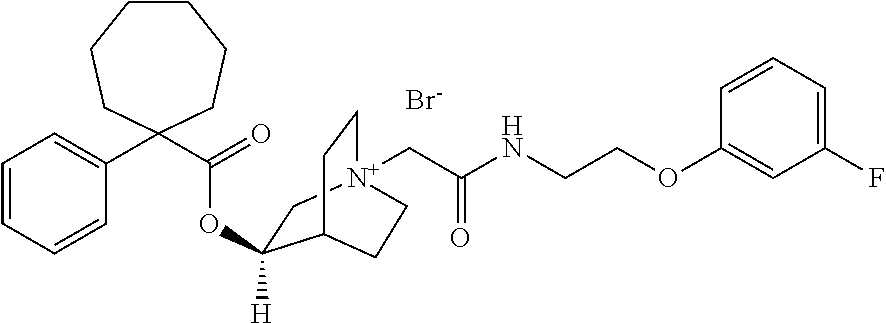


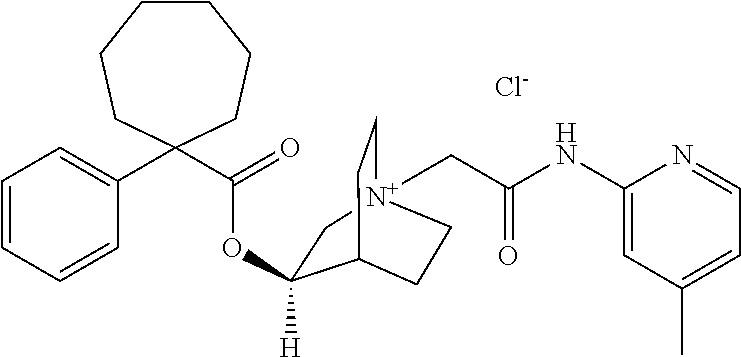


| TABLE 1 | |||
| Compound of | |||
| Example No. | pIC50 | ||
| 1 | 9.1 | ||
| 5 | 9.4 | ||
| 13 | 10.1 | ||
Table 2 gives IC50 strengths for the compounds of the examples.
| TABLE 2 | |||||||
| M3 | M3 | M3 | |||||
| Example | binding | Example | binding | Example | binding | ||
| No. | IC50 | No. | IC50 | No. | IC50 | ||
| 1 | +++ | 21 | +++ | 41 | ++ | ||
| 2 | +++ | 22 | +++ | 42 | ++ | ||
| 3 | ++ | 23 | +++ | 43 | ++ | ||
| 4 | +++ | 24 | +++ | 44 | ++ | ||
| 5 | +++ | 25 | +++ | 45 | +++ | ||
| 6 | +++ | 26 | +++ | 46 | ++ | ||
| 7 | ++ | 27 | ++ | 47 | ++ | ||
| 8 | +++ | 28 | ++ | 48 | ++ | ||
| 9 | +++ | 29 | ++ | 49 | +++ | ||
| 10 | +++ | 30 | +++ | 50 | +++ | ||
| 11 | +++ | 31 | ++ | 51 | ++ | ||
| 12 | +++ | 32 | ++ | 52 | +++ | ||
| 13 | +++ | 33 | ++ | 53 | ++ | ||
| 14 | +++ | 34 | ++ | 54 | +++ | ||
| 15 | +++ | 35 | ++ | 55 | ++ | ||
| 16 | +++ | 36 | ++ | 56 | ++ | ||
| 17 | +++ | 37 | +++ | 57 | ++ | ||
| 18 | +++ | 38 | +++ | 58 | +++ | ||
| 19 | +++ | 39 | ++ | 59 | ++ | ||
| 20 | +++ | 40 | +++ | 60 | +++ | ||
| 61 | +++ | ||||||
| M3 Binding IC50 < 2nM “+++”; | |||||||
| IC50 2-10 nM “++”; | |||||||
| IC50 > 10 nM “+”; | |||||||
| NT—Not Tested. | |||||||
Measurement of Plasma Protein Binding
| TABLE 3 | |||
| Compound of | % | ||
| Example No. | bound | ||
| 11 | 95.2 | ||
| 13 | 93.2 | ||
| 15 | 96.1 | ||
| 17 | 97.6 | ||
| 20 | 98.2 | ||
| 21 | 99.4 | ||
Methacholine Induced Bronchoconstriction in Vivo
Inhibition of Pilocarpine Induced Salivation by i.n. Administered Compounds.
(1−(Test-baseline)/(Veh-baseline))*100.
Claims (7)


Applications Claiming Priority (1)
| Application Number | Priority Date | Filing Date | Title |
|---|---|---|---|
| PCT/GB2008/001647 WO2009138707A1 (en) | 2008-05-13 | 2008-05-13 | Quinuclidine derivatives as muscarinic m3 receptor antagonists |
Publications (2)
| Publication Number | Publication Date |
|---|---|
| US20110172237A1 US20110172237A1 (en) | 2011-07-14 |
| US8329729B2 true US8329729B2 (en) | 2012-12-11 |
Family
ID=40361403
Family Applications (2)
| Application Number | Title | Priority Date | Filing Date |
|---|---|---|---|
| US12/992,045 Expired - Fee Related US8329729B2 (en) | 2008-05-13 | 2008-05-13 | Quinuclidine derivatives as muscarinic M3 receptor antagonists |
| US13/564,194 Abandoned US20130030001A1 (en) | 2008-05-13 | 2012-08-01 | Quinuclidine derivatives as muscarinic m3 receptor antagonists |
Family Applications After (1)
| Application Number | Title | Priority Date | Filing Date |
|---|---|---|---|
| US13/564,194 Abandoned US20130030001A1 (en) | 2008-05-13 | 2012-08-01 | Quinuclidine derivatives as muscarinic m3 receptor antagonists |
Country Status (17)
| Country | Link |
|---|---|
| US (2) | US8329729B2 (en) |
| EP (1) | EP2300464A1 (en) |
| JP (1) | JP4837800B2 (en) |
| CN (1) | CN102089304A (en) |
| AU (1) | AU2008356409B2 (en) |
| BR (1) | BRPI0822693A2 (en) |
| CA (1) | CA2723981A1 (en) |
| CL (1) | CL2009001137A1 (en) |
| EA (1) | EA017627B1 (en) |
| EC (1) | ECSP10010606A (en) |
| HN (1) | HN2010002403A (en) |
| IL (1) | IL209126A0 (en) |
| MX (1) | MX2010012189A (en) |
| NI (1) | NI201000195A (en) |
| NZ (1) | NZ589091A (en) |
| WO (1) | WO2009138707A1 (en) |
| ZA (1) | ZA201007988B (en) |
Cited By (1)
| Publication number | Priority date | Publication date | Assignee | Title |
|---|---|---|---|---|
| US5807670A (en) * | 1995-08-14 | 1998-09-15 | Abbott Laboratories | Detection of hepatitis GB virus genotypes |
Families Citing this family (8)
| Publication number | Priority date | Publication date | Assignee | Title |
|---|---|---|---|---|
| TW200825084A (en) | 2006-11-14 | 2008-06-16 | Astrazeneca Ab | New compounds 521 |
| NZ589091A (en) | 2008-05-13 | 2011-07-29 | Astrazeneca Ab | Quinuclidine derivatives as muscarinic m3 receptor antagonists |
| CN102908624A (en) * | 2008-05-13 | 2013-02-06 | 阿斯利康(瑞典)有限公司 | Pharmaceutical product comprising a muscarinic receptor antagonist and a beta2-adrenoceptor agonist |
| TW201036957A (en) | 2009-02-20 | 2010-10-16 | Astrazeneca Ab | Novel salt 628 |
| GB201016912D0 (en) | 2010-10-07 | 2010-11-24 | Astrazeneca Ab | Novel combination |
| CN103265478B (en) * | 2013-05-20 | 2015-09-30 | 中国人民解放军第二军医大学 | Mercaptonicotinic acid compounds and preparation method thereof |
| CN114716380B (en) * | 2022-04-01 | 2024-06-21 | 新乡医学院 | A phase transfer catalyzed asymmetric fluorination method for 4-substituted pyrazolone compounds |
| WO2025171311A1 (en) * | 2024-02-09 | 2025-08-14 | University Of Florida Research Foundation, Incorporated | Aryl and pyridyl amide pesticides and compositions thereof |
Citations (81)
| Publication number | Priority date | Publication date | Assignee | Title |
|---|---|---|---|---|
| US2404588A (en) | 1942-12-16 | 1946-07-23 | Geigy Ag J R | Basic esters of 1-aryl-cycloalkyl-1-carboxylic acids and a process for their manufacture |
| FR2123519A1 (en) | 1971-01-29 | 1972-09-08 | Knoll Ag | |
| FR2155927A1 (en) | 1971-10-15 | 1973-05-25 | Synthelabo | 1-phenylcyclo hexane carboxylic acid esters - with antispasmodic and anticholinergic activity |
| FR2168881A1 (en) | 1972-01-25 | 1973-09-07 | Synthelabo | Tropanol 1-phenylcycloalkane carboxylic ester salts - spasmolytics and cholinergics |
| FR2208649A1 (en) | 1972-12-01 | 1974-06-28 | Synthelabo | 1-(2-Thienyl)cycloalkane carboxylic ester salts - with spasmolytic and anticholinergic activity |
| US4579854A (en) | 1983-12-24 | 1986-04-01 | Tanabe Seiyaku Co., Ltd. | Bronchodilating 8-hydroxy-5-{(1R)-1-hydroxy-2-[N-((1R)-2-(p-methoxyphenyl)-1-methylethyl)-amino]ethyl} carbostyril |
| DE4129535A1 (en) | 1990-09-07 | 1992-03-12 | Elmu Sa | Novel PREGNA-1,4-DIEN-3,20-DION-16-17-ACETAL-21-ESTERS, METHOD FOR THE PREPARATION, COMPOSITION, AND METHODS OF TREATMENT |
| WO1992005147A1 (en) | 1990-09-26 | 1992-04-02 | Aktiebolaget Astra | New process for preparing formoterol and related compounds |
| WO1998004517A1 (en) | 1996-07-29 | 1998-02-05 | Pharmacia & Upjohn Ab | Arylcycloalkane carboxylic esters, their use, pharmaceutical compositions and preparation |
| WO1998021183A1 (en) | 1996-11-11 | 1998-05-22 | Noe Christian R | Pure enantiomer basic aryl-cycloalkyl-hydroxycarboxylic acid esters, process for preparing the same and their use in medicaments |
| WO2001004118A2 (en) | 1999-07-14 | 2001-01-18 | Almirall Prodesfarma S.A. | Quinuclidine derivatives and their use as muscarinic m3 receptor ligands |
| WO2002000679A2 (en) | 2000-06-28 | 2002-01-03 | Novartis Ag | 9.alpha.-chloro-6.alpha.-fluoro-17.alpha.-hydroxy-16-methyl-17-beta-methoxycarbonyl-androst-1,4-dienes esterified in position 17.alpha. by a cyclic acyl group |
| WO2002053564A2 (en) | 2000-12-28 | 2002-07-11 | Almirall Prodesfarma Ag | Quinuclidine derivatives and their use as m3 antagonists |
| WO2002076933A1 (en) | 2001-03-22 | 2002-10-03 | Glaxo Group Limited | Formailide derivatives as beta2-adrenoreceptor agonists |
| WO2002088167A1 (en) | 2001-04-30 | 2002-11-07 | Glaxo Group Limited | Anti-inflammatory 17.beta.-carbothioate ester derivatives of androstane with a cyclic ester group in position 17.alpha |
| US20020169208A1 (en) | 2001-04-03 | 2002-11-14 | Pascal Druzgala | Novel anticholinergic compounds and methods of use |
| US20020173536A1 (en) | 1996-11-11 | 2002-11-21 | Christian Noe And Ernst Mutschler | Enantiomerically pure basic arylcycloalkylhydroxycarboxylic esters, processes for their preparation and their use in medicaments |
| WO2003042164A1 (en) | 2001-11-13 | 2003-05-22 | Theravance, Inc | Aryl aniline beta-2 adrenergic receptor agonists |
| WO2003087094A2 (en) | 2002-04-16 | 2003-10-23 | Almirall Prodesfarma Ag | Pyrrolidinium derivatives as antagonists of m3 muscarinic receptors |
| DE10216333A1 (en) | 2002-04-13 | 2003-10-30 | Boehringer Ingelheim Pharma | New diarylacetic acid quaternized azabicycloheptyl esters, are anticholinergic agents useful e.g. for treating asthma, chronic obstructive pulmonary disease, arrhythmia or menstrual disorders |
| WO2004032921A1 (en) | 2002-10-11 | 2004-04-22 | Pfizer Limited | Indole derivatives as beta-2 agonists |
| WO2004096800A2 (en) | 2003-05-02 | 2004-11-11 | Novartis Ag | Quinuclidine derivatives binding to mucarinic m3 receptors |
| WO2005000815A2 (en) | 2003-06-24 | 2005-01-06 | Novartis Ag | Piperidinium and pyrrolidinium derivatives as ligands for the muscarinic m3 receptor |
| WO2005025555A2 (en) | 2003-05-08 | 2005-03-24 | Theravance, Inc. | Combinations of an aryl aniline beta-2 adrenergic receptor agonist and a corticosteroid |
| WO2005041980A1 (en) | 2003-11-03 | 2005-05-12 | Ivax Corporation | Soft steroid compositions for use in dry powder inhalers |
| US20050222144A1 (en) | 2002-11-15 | 2005-10-06 | Boehringer Ingelheim Pharma Gmbh & Co. Kg | Medicaments for the treatment of chronic obstructive pulmonary disease |
| WO2006035303A1 (en) | 2004-09-29 | 2006-04-06 | Ranbaxy Laboratories Limited | Muscarinic receptor antagonists |
| WO2006046916A1 (en) | 2004-10-29 | 2006-05-04 | Astrazeneca Ab | Novel sulphonamide derivatives as glucocorticoid receptor modulators for the treatment of inflammatory diseases |
| WO2006048225A1 (en) | 2004-11-02 | 2006-05-11 | Novartis Ag | Quinuclidine derivatives and their use as muscarinic m3 receptor antagonists |
| WO2006066928A1 (en) | 2004-12-24 | 2006-06-29 | Novartis Ag | Pyrrolinidium derivatives as m3 muscarinic receptors |
| WO2006112778A1 (en) | 2005-04-20 | 2006-10-26 | Astrazeneca Ab | New muscarinic receptor antagonists |
| WO2007015667A1 (en) | 2005-08-02 | 2007-02-08 | Astrazeneca Ab | New salt ii |
| WO2007015664A1 (en) | 2005-08-01 | 2007-02-08 | Astrazeneca Ab | Novel piperidine derivatives as chemokine receptor modulators useful for the treatment of respiratory diseases. |
| WO2007017670A1 (en) | 2005-08-08 | 2007-02-15 | Argenta Discovery Ltd. | Bicyclo[2.2.]hept-7-ylamine derivatives and their uses |
| WO2007018461A1 (en) | 2005-08-09 | 2007-02-15 | Astrazeneca Ab | Novel benzothiazolone derivatives |
| WO2007017669A1 (en) | 2005-08-08 | 2007-02-15 | Argenta Discovery Ltd. | Azole and thiazole derivatives and their use |
| WO2007027134A1 (en) | 2005-08-29 | 2007-03-08 | Astrazeneca Ab | 7-(2-AMINO-1-HYDROXY-ETHYL)-4-HYDROXYBENZOTHIAZOL-2(3H)-ONE-DERIVATIVES AS β2 ADRENOCEPTOR AGONISTS |
| EP1785421A1 (en) | 2004-08-30 | 2007-05-16 | Ono Pharmaceutical Co., Ltd. | Tropan compound |
| WO2007068929A1 (en) | 2005-12-16 | 2007-06-21 | Argenta Discovery Ltd. | Cyclic amine derivatives and their uses |
| WO2007123465A1 (en) | 2006-04-24 | 2007-11-01 | Astrazeneca Ab | New alkyl esters of cyclic amino alcohols with muscarinic m3 receptor antagonist activity, useful for treating e.g. chronic bronchial obstruction, asthma and overactive bladder |
| WO2008010765A1 (en) | 2006-07-19 | 2008-01-24 | Astrazeneca Ab | Novel tricyclic spiropiperidine compounds, their synthesis and their uses as modulators of chemokine receptor activity |
| WO2008017827A2 (en) | 2006-08-08 | 2008-02-14 | Argenta Discovery Limited | Azole and thiazole derivatives and their uses |
| WO2008017824A1 (en) | 2006-08-08 | 2008-02-14 | Argenta Discovery Limited | Bicyclo [2. 2. 1] hept-7-ylamine derivatives and their use |
| WO2008023157A1 (en) | 2006-08-21 | 2008-02-28 | Argenta Discovery Limited | Nitrogen containing heterocyclic compounds useful as m3-receptor modulators |
| EP1894568A1 (en) | 2006-08-31 | 2008-03-05 | Novartis AG | Pharmaceutical compositions for the treatment of inflammatory or obstructive airway diseases |
| WO2008059239A1 (en) | 2006-11-14 | 2008-05-22 | Astrazeneca Ab | Novel compounds 514 |
| WO2008059245A1 (en) | 2006-11-14 | 2008-05-22 | Astrazeneca Ab | Quiniclidine derivatives of (hetero) arylcycloheptanecarboxylic acid as muscarinic receptor antagonists |
| WO2008075006A1 (en) | 2006-12-19 | 2008-06-26 | Astrazeneca Ab | Piperldinum compounds for treatment of obstructive pulmonary diseases ( copd) |
| WO2008075005A1 (en) | 2006-12-19 | 2008-06-26 | Astrazeneca Ab | Quinuclidinol derivatives as muscarinic receptor antagonists |
| WO2008075026A1 (en) | 2006-12-20 | 2008-06-26 | Astrazeneca Ab | 4-hydr0xy-2-0x0-2, 3 -dihydro- 1, 3-benzothiazol- 7yl compounds for modulation of b2-adrenoreceptor activity |
| WO2008096127A2 (en) | 2007-02-07 | 2008-08-14 | Argenta Discovery Ltd | Bicyclo[2.2.1]hept-7-ylamine derivatives and their use as m3 muscarinic receptor modulators |
| WO2008096121A1 (en) | 2007-02-08 | 2008-08-14 | Astrazeneca Ab | Combinations of beta-2-adrenoceptor agonistic benzothiazolone |
| WO2008096094A1 (en) | 2007-02-06 | 2008-08-14 | Argenta Discovery Ltd. | Bicyclor[2.2.1]hept-7-ylamine derivatives as muscarinic m3 receptor modulators |
| WO2008096126A1 (en) | 2007-02-07 | 2008-08-14 | Argenta Discovery Ltd | Combination of a muscarinic receptor antagonist and a beta-2-adrenoceptor agonist |
| WO2008096129A1 (en) | 2007-02-07 | 2008-08-14 | Argenta Discovery Ltd | Nitrogen containing hetrocyclic compounds useful as bifunctional modulators of m3 receptors and beta- 2 receptors |
| WO2008096136A1 (en) | 2007-02-07 | 2008-08-14 | Argenta Discovery Ltd | Combinations with a muscarinic receptor antagonist |
| WO2008096111A1 (en) | 2007-02-08 | 2008-08-14 | Astrazeneca Ab | Combinations of beta- 2 -adrenoceptor agonistic benzothiazolone |
| WO2008096128A1 (en) | 2007-02-07 | 2008-08-14 | Argenta Discovery Ltd | Oxazole and thiazole derivatives and their uses 2 |
| WO2008096093A1 (en) | 2007-02-06 | 2008-08-14 | Argenta Discovery Ltd. | Oxazole and thiazole derivatives and their uses |
| WO2008096149A2 (en) | 2007-02-07 | 2008-08-14 | Argenta Discovery Ltd | Napadisylate salt of a muscarinic m3 antagonist |
| WO2008096143A1 (en) | 2007-02-07 | 2008-08-14 | Argenta Discovery Ltd | Napadisylate salt of a muscarinic m3 antagonist |
| WO2008099186A1 (en) | 2007-02-15 | 2008-08-21 | Argenta Discovery Limited | Heterocyclic derivatives as m3 muscarinic receptors |
| WO2008104790A1 (en) | 2007-03-01 | 2008-09-04 | Astrazeneca Ab | Salts of a selective beta-2 andrenoceptor agonist |
| WO2008149110A1 (en) | 2007-06-08 | 2008-12-11 | Argenta Discovery Limited | Bicyclor [2.2.1] hept-7-ylamine derivatives and their use in the treatment of diseases and conditions in which m3 muscarinic receptor activity and beta-adrenergic activity are implicated |
| WO2008149053A1 (en) | 2007-06-08 | 2008-12-11 | Argenta Discovery Ltd. | Bicycl0 [2. 2. 1] he pt- 2-ylamine derivates and their use |
| WO2009098453A1 (en) | 2008-02-06 | 2009-08-13 | Astrazeneca Ab | Azonia bicycloalkanes as m3 muscarinic acetylcholin receptor antagonists |
| WO2009098448A1 (en) | 2008-02-06 | 2009-08-13 | Astrazeneca Ab | Compounds |
| WO2009098455A1 (en) | 2008-02-06 | 2009-08-13 | Astrazeneca Ab | 2- (9h-xanthen-9-yl) -oxazol derivatives as m3 muscarinic receptor antagonists for the treatment of asthma and chronic obstructive lung disease |
| WO2009139708A1 (en) | 2008-05-13 | 2009-11-19 | Astrazeneca Ab | PHARMACEUTICAL PRODUCT COMPRISING A MUSCARINIC RECEPTOR ANTAGONIST AND A β2-ADRENOCEPTOR AGONIST |
| WO2009139709A1 (en) | 2008-05-13 | 2009-11-19 | Astrazeneca Ab | Quinuclidine derivatives and their use as muscarinic receptor antagonists for the treatment of asthma and chronic obstructive pulmonary disease (copd) |
| WO2009138707A1 (en) | 2008-05-13 | 2009-11-19 | Astrazeneca Ab | Quinuclidine derivatives as muscarinic m3 receptor antagonists |
| WO2009139710A1 (en) | 2008-05-13 | 2009-11-19 | Astrazeneca Ab | Quinuclidine derivatives and their use as muscarinic receptor antagonists |
| WO2009139707A1 (en) | 2008-05-13 | 2009-11-19 | Astrazeneca Ab | Pharmaceutical product comprising a muscarinic receptor antagonist and a second active ingredient |
| WO2009154554A1 (en) | 2008-06-17 | 2009-12-23 | Astrazeneca Ab | Pharmaceutical product comprising a muscarinic receptor antagonist and a second active ingredient |
| WO2009153536A1 (en) | 2008-06-17 | 2009-12-23 | Argenta Discovery Limited | 1-aza-bicyclo [2.2.2] octane derivatives useful as muscarinic receptor antagonists |
| WO2009154555A1 (en) | 2008-06-17 | 2009-12-23 | Astrazeneca Ab | Pharmaceutical product comprising a muscarinic receptor antagonist and a beta2-adrenoceptor agonist |
| WO2010015792A1 (en) | 2008-08-06 | 2010-02-11 | Argenta Discovery Limited | Nitrogen containing heterocyclic compounds useful as bifunctional modulators of m3 receptors and beta-2 receptors |
| WO2010018352A1 (en) | 2008-08-12 | 2010-02-18 | Argenta Discovery Limited | Heterocyclic compounds used in the treatment of diseases where enhanced m3 receptor activation is implicated |
| WO2010019097A1 (en) | 2008-08-12 | 2010-02-18 | Astrazeneca Ab | Pharmaceutical product comprising a muscarinic receptor antagonist and a second active ingredient |
| WO2010019098A1 (en) | 2008-08-12 | 2010-02-18 | Astrazeneca Ab | Pharmaceutical product comprising a muscarinic receptor antagonist and a beta-2-adrenoceptor agonist |
| WO2010019099A1 (en) | 2008-08-12 | 2010-02-18 | Astrazeneca Ab | 2-hydroxy-ethanesulfonate salt |
-
2008
- 2008-05-13 NZ NZ589091A patent/NZ589091A/en not_active IP Right Cessation
- 2008-05-13 CA CA2723981A patent/CA2723981A1/en not_active Abandoned
- 2008-05-13 EA EA201001645A patent/EA017627B1/en not_active IP Right Cessation
- 2008-05-13 BR BRPI0822693-8A patent/BRPI0822693A2/en not_active IP Right Cessation
- 2008-05-13 EP EP08750581A patent/EP2300464A1/en not_active Withdrawn
- 2008-05-13 AU AU2008356409A patent/AU2008356409B2/en not_active Ceased
- 2008-05-13 US US12/992,045 patent/US8329729B2/en not_active Expired - Fee Related
- 2008-05-13 JP JP2011508991A patent/JP4837800B2/en not_active Expired - Fee Related
- 2008-05-13 MX MX2010012189A patent/MX2010012189A/en not_active Application Discontinuation
- 2008-05-13 CN CN2008801303428A patent/CN102089304A/en active Pending
- 2008-05-13 WO PCT/GB2008/001647 patent/WO2009138707A1/en not_active Ceased
-
2009
- 2009-05-11 CL CL2009001137A patent/CL2009001137A1/en unknown
-
2010
- 2010-11-04 IL IL209126A patent/IL209126A0/en unknown
- 2010-11-08 ZA ZA2010/07988A patent/ZA201007988B/en unknown
- 2010-11-12 HN HN2010002403A patent/HN2010002403A/en unknown
- 2010-11-12 NI NI201000195A patent/NI201000195A/en unknown
- 2010-11-12 EC EC2010010606A patent/ECSP10010606A/en unknown
-
2012
- 2012-08-01 US US13/564,194 patent/US20130030001A1/en not_active Abandoned
Patent Citations (86)
| Publication number | Priority date | Publication date | Assignee | Title |
|---|---|---|---|---|
| US2404588A (en) | 1942-12-16 | 1946-07-23 | Geigy Ag J R | Basic esters of 1-aryl-cycloalkyl-1-carboxylic acids and a process for their manufacture |
| FR2123519A1 (en) | 1971-01-29 | 1972-09-08 | Knoll Ag | |
| GB1320069A (en) | 1971-01-29 | 1973-06-13 | Knoll Ag | 1-methyl-4-piperidyl exo 2-phenylbicyclo 2,2,1 heptane-2- carboxylate and the salts thereof |
| DE2104179C3 (en) | 1971-01-29 | 1980-10-02 | Knoll Ag, 6700 Ludwigshafen | exo-2-phenyl-bicyclo- [2,2,1] -heptane-2- (N-methylpiperidol-4) -carboxylic acid ester and its salts, processes for their preparation and medicaments containing them |
| FR2155927A1 (en) | 1971-10-15 | 1973-05-25 | Synthelabo | 1-phenylcyclo hexane carboxylic acid esters - with antispasmodic and anticholinergic activity |
| FR2168881A1 (en) | 1972-01-25 | 1973-09-07 | Synthelabo | Tropanol 1-phenylcycloalkane carboxylic ester salts - spasmolytics and cholinergics |
| FR2208649A1 (en) | 1972-12-01 | 1974-06-28 | Synthelabo | 1-(2-Thienyl)cycloalkane carboxylic ester salts - with spasmolytic and anticholinergic activity |
| US4579854A (en) | 1983-12-24 | 1986-04-01 | Tanabe Seiyaku Co., Ltd. | Bronchodilating 8-hydroxy-5-{(1R)-1-hydroxy-2-[N-((1R)-2-(p-methoxyphenyl)-1-methylethyl)-amino]ethyl} carbostyril |
| DE4129535A1 (en) | 1990-09-07 | 1992-03-12 | Elmu Sa | Novel PREGNA-1,4-DIEN-3,20-DION-16-17-ACETAL-21-ESTERS, METHOD FOR THE PREPARATION, COMPOSITION, AND METHODS OF TREATMENT |
| US5482934A (en) | 1990-09-07 | 1996-01-09 | Especialidades Latinas Medicamentos Universales, S.A. (Elmu, S.A.) | Pregna-1,4-diene3,20-dione-16-17-acetal-21 esters, process for their preparation, composition, and methods for the treatment of inflammatory conditions |
| WO1992005147A1 (en) | 1990-09-26 | 1992-04-02 | Aktiebolaget Astra | New process for preparing formoterol and related compounds |
| WO1998004517A1 (en) | 1996-07-29 | 1998-02-05 | Pharmacia & Upjohn Ab | Arylcycloalkane carboxylic esters, their use, pharmaceutical compositions and preparation |
| WO1998021183A1 (en) | 1996-11-11 | 1998-05-22 | Noe Christian R | Pure enantiomer basic aryl-cycloalkyl-hydroxycarboxylic acid esters, process for preparing the same and their use in medicaments |
| US20020173536A1 (en) | 1996-11-11 | 2002-11-21 | Christian Noe And Ernst Mutschler | Enantiomerically pure basic arylcycloalkylhydroxycarboxylic esters, processes for their preparation and their use in medicaments |
| WO2001004118A2 (en) | 1999-07-14 | 2001-01-18 | Almirall Prodesfarma S.A. | Quinuclidine derivatives and their use as muscarinic m3 receptor ligands |
| WO2002000679A2 (en) | 2000-06-28 | 2002-01-03 | Novartis Ag | 9.alpha.-chloro-6.alpha.-fluoro-17.alpha.-hydroxy-16-methyl-17-beta-methoxycarbonyl-androst-1,4-dienes esterified in position 17.alpha. by a cyclic acyl group |
| WO2002053564A2 (en) | 2000-12-28 | 2002-07-11 | Almirall Prodesfarma Ag | Quinuclidine derivatives and their use as m3 antagonists |
| WO2002076933A1 (en) | 2001-03-22 | 2002-10-03 | Glaxo Group Limited | Formailide derivatives as beta2-adrenoreceptor agonists |
| US20020169208A1 (en) | 2001-04-03 | 2002-11-14 | Pascal Druzgala | Novel anticholinergic compounds and methods of use |
| WO2002096855A2 (en) | 2001-04-03 | 2002-12-05 | Aryx Therapeutics | Anticholinergic compounds and methods of use |
| WO2002088167A1 (en) | 2001-04-30 | 2002-11-07 | Glaxo Group Limited | Anti-inflammatory 17.beta.-carbothioate ester derivatives of androstane with a cyclic ester group in position 17.alpha |
| WO2003042164A1 (en) | 2001-11-13 | 2003-05-22 | Theravance, Inc | Aryl aniline beta-2 adrenergic receptor agonists |
| DE10216333A1 (en) | 2002-04-13 | 2003-10-30 | Boehringer Ingelheim Pharma | New diarylacetic acid quaternized azabicycloheptyl esters, are anticholinergic agents useful e.g. for treating asthma, chronic obstructive pulmonary disease, arrhythmia or menstrual disorders |
| WO2003087094A2 (en) | 2002-04-16 | 2003-10-23 | Almirall Prodesfarma Ag | Pyrrolidinium derivatives as antagonists of m3 muscarinic receptors |
| WO2004032921A1 (en) | 2002-10-11 | 2004-04-22 | Pfizer Limited | Indole derivatives as beta-2 agonists |
| US20050222144A1 (en) | 2002-11-15 | 2005-10-06 | Boehringer Ingelheim Pharma Gmbh & Co. Kg | Medicaments for the treatment of chronic obstructive pulmonary disease |
| WO2004096800A2 (en) | 2003-05-02 | 2004-11-11 | Novartis Ag | Quinuclidine derivatives binding to mucarinic m3 receptors |
| WO2005025555A2 (en) | 2003-05-08 | 2005-03-24 | Theravance, Inc. | Combinations of an aryl aniline beta-2 adrenergic receptor agonist and a corticosteroid |
| WO2005000815A2 (en) | 2003-06-24 | 2005-01-06 | Novartis Ag | Piperidinium and pyrrolidinium derivatives as ligands for the muscarinic m3 receptor |
| WO2005041980A1 (en) | 2003-11-03 | 2005-05-12 | Ivax Corporation | Soft steroid compositions for use in dry powder inhalers |
| EP1785421A1 (en) | 2004-08-30 | 2007-05-16 | Ono Pharmaceutical Co., Ltd. | Tropan compound |
| WO2006035303A1 (en) | 2004-09-29 | 2006-04-06 | Ranbaxy Laboratories Limited | Muscarinic receptor antagonists |
| WO2006046916A1 (en) | 2004-10-29 | 2006-05-04 | Astrazeneca Ab | Novel sulphonamide derivatives as glucocorticoid receptor modulators for the treatment of inflammatory diseases |
| WO2006048225A1 (en) | 2004-11-02 | 2006-05-11 | Novartis Ag | Quinuclidine derivatives and their use as muscarinic m3 receptor antagonists |
| WO2006066928A1 (en) | 2004-12-24 | 2006-06-29 | Novartis Ag | Pyrrolinidium derivatives as m3 muscarinic receptors |
| WO2006112778A1 (en) | 2005-04-20 | 2006-10-26 | Astrazeneca Ab | New muscarinic receptor antagonists |
| WO2007015664A1 (en) | 2005-08-01 | 2007-02-08 | Astrazeneca Ab | Novel piperidine derivatives as chemokine receptor modulators useful for the treatment of respiratory diseases. |
| WO2007015667A1 (en) | 2005-08-02 | 2007-02-08 | Astrazeneca Ab | New salt ii |
| WO2007017670A1 (en) | 2005-08-08 | 2007-02-15 | Argenta Discovery Ltd. | Bicyclo[2.2.]hept-7-ylamine derivatives and their uses |
| WO2007017669A1 (en) | 2005-08-08 | 2007-02-15 | Argenta Discovery Ltd. | Azole and thiazole derivatives and their use |
| WO2007018461A1 (en) | 2005-08-09 | 2007-02-15 | Astrazeneca Ab | Novel benzothiazolone derivatives |
| WO2007027134A1 (en) | 2005-08-29 | 2007-03-08 | Astrazeneca Ab | 7-(2-AMINO-1-HYDROXY-ETHYL)-4-HYDROXYBENZOTHIAZOL-2(3H)-ONE-DERIVATIVES AS β2 ADRENOCEPTOR AGONISTS |
| WO2007068929A1 (en) | 2005-12-16 | 2007-06-21 | Argenta Discovery Ltd. | Cyclic amine derivatives and their uses |
| WO2007123465A1 (en) | 2006-04-24 | 2007-11-01 | Astrazeneca Ab | New alkyl esters of cyclic amino alcohols with muscarinic m3 receptor antagonist activity, useful for treating e.g. chronic bronchial obstruction, asthma and overactive bladder |
| WO2008010765A1 (en) | 2006-07-19 | 2008-01-24 | Astrazeneca Ab | Novel tricyclic spiropiperidine compounds, their synthesis and their uses as modulators of chemokine receptor activity |
| WO2008017827A2 (en) | 2006-08-08 | 2008-02-14 | Argenta Discovery Limited | Azole and thiazole derivatives and their uses |
| WO2008017824A1 (en) | 2006-08-08 | 2008-02-14 | Argenta Discovery Limited | Bicyclo [2. 2. 1] hept-7-ylamine derivatives and their use |
| WO2008023157A1 (en) | 2006-08-21 | 2008-02-28 | Argenta Discovery Limited | Nitrogen containing heterocyclic compounds useful as m3-receptor modulators |
| EP1894568A1 (en) | 2006-08-31 | 2008-03-05 | Novartis AG | Pharmaceutical compositions for the treatment of inflammatory or obstructive airway diseases |
| WO2008059239A1 (en) | 2006-11-14 | 2008-05-22 | Astrazeneca Ab | Novel compounds 514 |
| WO2008059245A1 (en) | 2006-11-14 | 2008-05-22 | Astrazeneca Ab | Quiniclidine derivatives of (hetero) arylcycloheptanecarboxylic acid as muscarinic receptor antagonists |
| US20100029713A1 (en) | 2006-11-14 | 2010-02-04 | Astrazeneca Ab | Quiniclidine derivatives of (hetero) arylcycloheptanecarboxylic acid as muscarinic receptor antagonists |
| WO2008075006A1 (en) | 2006-12-19 | 2008-06-26 | Astrazeneca Ab | Piperldinum compounds for treatment of obstructive pulmonary diseases ( copd) |
| WO2008075005A1 (en) | 2006-12-19 | 2008-06-26 | Astrazeneca Ab | Quinuclidinol derivatives as muscarinic receptor antagonists |
| WO2008075026A1 (en) | 2006-12-20 | 2008-06-26 | Astrazeneca Ab | 4-hydr0xy-2-0x0-2, 3 -dihydro- 1, 3-benzothiazol- 7yl compounds for modulation of b2-adrenoreceptor activity |
| WO2008096093A1 (en) | 2007-02-06 | 2008-08-14 | Argenta Discovery Ltd. | Oxazole and thiazole derivatives and their uses |
| WO2008096094A1 (en) | 2007-02-06 | 2008-08-14 | Argenta Discovery Ltd. | Bicyclor[2.2.1]hept-7-ylamine derivatives as muscarinic m3 receptor modulators |
| WO2008096149A2 (en) | 2007-02-07 | 2008-08-14 | Argenta Discovery Ltd | Napadisylate salt of a muscarinic m3 antagonist |
| WO2008096143A1 (en) | 2007-02-07 | 2008-08-14 | Argenta Discovery Ltd | Napadisylate salt of a muscarinic m3 antagonist |
| WO2008096136A1 (en) | 2007-02-07 | 2008-08-14 | Argenta Discovery Ltd | Combinations with a muscarinic receptor antagonist |
| WO2008096129A1 (en) | 2007-02-07 | 2008-08-14 | Argenta Discovery Ltd | Nitrogen containing hetrocyclic compounds useful as bifunctional modulators of m3 receptors and beta- 2 receptors |
| WO2008096128A1 (en) | 2007-02-07 | 2008-08-14 | Argenta Discovery Ltd | Oxazole and thiazole derivatives and their uses 2 |
| WO2008096126A1 (en) | 2007-02-07 | 2008-08-14 | Argenta Discovery Ltd | Combination of a muscarinic receptor antagonist and a beta-2-adrenoceptor agonist |
| WO2008096127A2 (en) | 2007-02-07 | 2008-08-14 | Argenta Discovery Ltd | Bicyclo[2.2.1]hept-7-ylamine derivatives and their use as m3 muscarinic receptor modulators |
| WO2008096121A1 (en) | 2007-02-08 | 2008-08-14 | Astrazeneca Ab | Combinations of beta-2-adrenoceptor agonistic benzothiazolone |
| WO2008096111A1 (en) | 2007-02-08 | 2008-08-14 | Astrazeneca Ab | Combinations of beta- 2 -adrenoceptor agonistic benzothiazolone |
| WO2008099186A1 (en) | 2007-02-15 | 2008-08-21 | Argenta Discovery Limited | Heterocyclic derivatives as m3 muscarinic receptors |
| WO2008104790A1 (en) | 2007-03-01 | 2008-09-04 | Astrazeneca Ab | Salts of a selective beta-2 andrenoceptor agonist |
| WO2008149110A1 (en) | 2007-06-08 | 2008-12-11 | Argenta Discovery Limited | Bicyclor [2.2.1] hept-7-ylamine derivatives and their use in the treatment of diseases and conditions in which m3 muscarinic receptor activity and beta-adrenergic activity are implicated |
| WO2008149053A1 (en) | 2007-06-08 | 2008-12-11 | Argenta Discovery Ltd. | Bicycl0 [2. 2. 1] he pt- 2-ylamine derivates and their use |
| WO2009098453A1 (en) | 2008-02-06 | 2009-08-13 | Astrazeneca Ab | Azonia bicycloalkanes as m3 muscarinic acetylcholin receptor antagonists |
| WO2009098448A1 (en) | 2008-02-06 | 2009-08-13 | Astrazeneca Ab | Compounds |
| WO2009098455A1 (en) | 2008-02-06 | 2009-08-13 | Astrazeneca Ab | 2- (9h-xanthen-9-yl) -oxazol derivatives as m3 muscarinic receptor antagonists for the treatment of asthma and chronic obstructive lung disease |
| WO2009139708A1 (en) | 2008-05-13 | 2009-11-19 | Astrazeneca Ab | PHARMACEUTICAL PRODUCT COMPRISING A MUSCARINIC RECEPTOR ANTAGONIST AND A β2-ADRENOCEPTOR AGONIST |
| WO2009138707A1 (en) | 2008-05-13 | 2009-11-19 | Astrazeneca Ab | Quinuclidine derivatives as muscarinic m3 receptor antagonists |
| WO2009139710A1 (en) | 2008-05-13 | 2009-11-19 | Astrazeneca Ab | Quinuclidine derivatives and their use as muscarinic receptor antagonists |
| WO2009139707A1 (en) | 2008-05-13 | 2009-11-19 | Astrazeneca Ab | Pharmaceutical product comprising a muscarinic receptor antagonist and a second active ingredient |
| WO2009139709A1 (en) | 2008-05-13 | 2009-11-19 | Astrazeneca Ab | Quinuclidine derivatives and their use as muscarinic receptor antagonists for the treatment of asthma and chronic obstructive pulmonary disease (copd) |
| WO2009154554A1 (en) | 2008-06-17 | 2009-12-23 | Astrazeneca Ab | Pharmaceutical product comprising a muscarinic receptor antagonist and a second active ingredient |
| WO2009153536A1 (en) | 2008-06-17 | 2009-12-23 | Argenta Discovery Limited | 1-aza-bicyclo [2.2.2] octane derivatives useful as muscarinic receptor antagonists |
| WO2009154555A1 (en) | 2008-06-17 | 2009-12-23 | Astrazeneca Ab | Pharmaceutical product comprising a muscarinic receptor antagonist and a beta2-adrenoceptor agonist |
| WO2010015792A1 (en) | 2008-08-06 | 2010-02-11 | Argenta Discovery Limited | Nitrogen containing heterocyclic compounds useful as bifunctional modulators of m3 receptors and beta-2 receptors |
| WO2010018352A1 (en) | 2008-08-12 | 2010-02-18 | Argenta Discovery Limited | Heterocyclic compounds used in the treatment of diseases where enhanced m3 receptor activation is implicated |
| WO2010019097A1 (en) | 2008-08-12 | 2010-02-18 | Astrazeneca Ab | Pharmaceutical product comprising a muscarinic receptor antagonist and a second active ingredient |
| WO2010019098A1 (en) | 2008-08-12 | 2010-02-18 | Astrazeneca Ab | Pharmaceutical product comprising a muscarinic receptor antagonist and a beta-2-adrenoceptor agonist |
| WO2010019099A1 (en) | 2008-08-12 | 2010-02-18 | Astrazeneca Ab | 2-hydroxy-ethanesulfonate salt |
Non-Patent Citations (12)
| Title |
|---|
| "8,8-Dimethyl-3alpha-isovaleryloxy-6beta-(1-phenylcyclopentylcarbonyloxy)-8-azoniabicyclo[3.2.1]octan", XP-002469597, Beilstein Registry No. 1558578, Boll. Chim. Farm. (1964), vol. 103, pp. 576-582, abstract. |
| "8,8-Dimethyl-3α-isovaleryloxy-6β-(1-phenylcyclopentylcarbonyloxy)-8-azoniabicyclo[3.2.1]octan", XP-002469597, Beilstein Registry No. 1558578, Boll. Chim. Farm. (1964), vol. 103, pp. 576-582, abstract. |
| Casarosa et al.; The Constitutive Activity of the Human Muscarinic M3 Receptor Unmasks Differences in the Pharmacology of Anticholinergics. The Journal of Pharmacology and Experimental Therapeutics; 2010; pp. 201-209; vol. 333, No. 1. |
| Cazzola, M., et al., "Ultra long-acting beta2-agonists in development for asthma and chronic obstructive pulmonary disease," Expert Opin. Investig. Drugs (2005), vol. 14, No. 7, pp. 775-783. |
| Cazzola, M., et al., "Ultra long-acting β2-agonists in development for asthma and chronic obstructive pulmonary disease," Expert Opin. Investig. Drugs (2005), vol. 14, No. 7, pp. 775-783. |
| Hackam, et al. JAMA, 296(14), 2006, 1731-1732. * |
| International Search Report of PCT/GB2008/001647, mailed Mar. 9, 2009. |
| Jordan, V. C. Nature Reviews: Drug Discovery, 2, 2003, 205. * |
| Lee, A.M., et al., "Selective muscarinic receptor antagonists for airway diseases," Current Opinion in Pharmacology (2001), vol. 1, pp. 223-229. |
| Mikhlina, E.E., et al., "Synthesis and cholinolytic properties of esters of 3-hydroxyquinuclidine," Pharmaceutical Chemistry Journal (1981), vol. 15, No. 8, pp. 569-572, example IX. |
| Navratil et al; Solvent Extraction of some Incapacitating Agents; Journal of Radioanalytical and Nuclear Chemistry; 2004; pp. 429-432; vol. 262, No. 2. |
| Stubbins, J.F., et al., "Muscarinic M1 and M2 binding affinity of cyclic amine derivatives of caramiphen and dicyclomine," Med Chem Res (1992), vol. 2, pp. 384-393. |
Cited By (1)
| Publication number | Priority date | Publication date | Assignee | Title |
|---|---|---|---|---|
| US5807670A (en) * | 1995-08-14 | 1998-09-15 | Abbott Laboratories | Detection of hepatitis GB virus genotypes |
Also Published As
| Publication number | Publication date |
|---|---|
| EA017627B1 (en) | 2013-01-30 |
| WO2009138707A9 (en) | 2010-01-28 |
| BRPI0822693A2 (en) | 2015-07-07 |
| ECSP10010606A (en) | 2010-12-30 |
| CL2009001137A1 (en) | 2009-11-27 |
| EA201001645A1 (en) | 2011-06-30 |
| CA2723981A1 (en) | 2009-11-19 |
| CN102089304A (en) | 2011-06-08 |
| HN2010002403A (en) | 2013-01-28 |
| ZA201007988B (en) | 2011-07-27 |
| MX2010012189A (en) | 2011-03-02 |
| NZ589091A (en) | 2011-07-29 |
| AU2008356409A1 (en) | 2009-11-19 |
| AU2008356409B2 (en) | 2012-01-19 |
| US20130030001A1 (en) | 2013-01-31 |
| US20110172237A1 (en) | 2011-07-14 |
| IL209126A0 (en) | 2011-01-31 |
| EP2300464A1 (en) | 2011-03-30 |
| NI201000195A (en) | 2012-08-16 |
| JP4837800B2 (en) | 2011-12-14 |
| JP2011520853A (en) | 2011-07-21 |
| WO2009138707A1 (en) | 2009-11-19 |
Similar Documents
| Publication | Publication Date | Title |
|---|---|---|
| US8207193B2 (en) | Quiniclidine derivatives of (hetero) arylcycloheptanecarboxylic acid as muscarinic receptor antagonists | |
| EP2121137B1 (en) | Quinuclidinol derivatives as muscarinic receptor antagonists | |
| US20130030001A1 (en) | Quinuclidine derivatives as muscarinic m3 receptor antagonists | |
| WO2009139709A1 (en) | Quinuclidine derivatives and their use as muscarinic receptor antagonists for the treatment of asthma and chronic obstructive pulmonary disease (copd) | |
| WO2010067102A1 (en) | Diazaspiro [5.5] undecane derivatives and related compounds as muscarinic-receptor antagonists and beta-adrenoreceptor agonists for the treatment of pulmonary disorders | |
| US20090233965A1 (en) | Alkyl Esters Of Cyclic Amino Alcohols With Muscarinic M3 Receptor Antagonist Activity, Useful For Treating E.G. Chronic Bronchial Obstruction, Asthma And Overactive Bladder | |
| WO2009139710A1 (en) | Quinuclidine derivatives and their use as muscarinic receptor antagonists | |
| WO2008059239A1 (en) | Novel compounds 514 | |
| WO2008075006A1 (en) | Piperldinum compounds for treatment of obstructive pulmonary diseases ( copd) | |
| WO2009153536A1 (en) | 1-aza-bicyclo [2.2.2] octane derivatives useful as muscarinic receptor antagonists | |
| WO2010018352A1 (en) | Heterocyclic compounds used in the treatment of diseases where enhanced m3 receptor activation is implicated | |
| JP2011195593A (en) | Quinuclidine derivative as muscarinic m3 receptor antagonist | |
| HK1148001A (en) | Quiniclidine derivatives of (hetero) arylcycloheptanecarboxylic acid as muscarinic receptor antagonists | |
| HK1134091B (en) | Quiniclidine derivatives of (hetero) arylcycloheptanecarboxylic acid as muscarinic receptor antagonists | |
| HK1158205A (en) | Quinuclidine derivatives as muscarinic m3 receptor antagonists |
Legal Events
| Date | Code | Title | Description |
|---|---|---|---|
| AS | Assignment |
Owner name: ASTRAZENECA AB, SWEDEN Free format text: ASSIGNMENT OF ASSIGNORS INTEREST;ASSIGNOR:ASTRAZENECA UK LIMITED;REEL/FRAME:027631/0338 Effective date: 20110112 Owner name: PULMAGEN THERAPEUTICS (SYNERGY) LIMITED, UNITED KI Free format text: ASSIGNMENT OF ASSIGNORS INTEREST;ASSIGNOR:PULMAGEN THERAPEUTICS (SYNERGY) LIMITED;REEL/FRAME:027631/0274 Effective date: 20101110 Owner name: ASTRAZENECA AB, SWEDEN Free format text: ASSIGNMENT OF ASSIGNORS INTEREST;ASSIGNOR:PULMAGEN THERAPEUTICS (SYNERGY) LIMITED;REEL/FRAME:027631/0274 Effective date: 20101110 Owner name: ASTRAZENECA UK LIMITED, UNITED KINGDOM Free format text: ASSIGNMENT OF ASSIGNORS INTEREST;ASSIGNORS:FORD, RHONAN LEE;MATHER, ANDREW NIGEL;METE, ANTONIO;REEL/FRAME:027631/0179 Effective date: 20101110 Owner name: PULMAGEN THERAPEUTICS (SYNERGY) LIMITED, UNITED KI Free format text: ASSIGNMENT OF ASSIGNORS INTEREST;ASSIGNOR:ASTRAZENECA AB;REEL/FRAME:027631/0388 Effective date: 20101110 Owner name: ASTRAZENECA AB, SWEDEN Free format text: ASSIGNMENT OF ASSIGNORS INTEREST;ASSIGNOR:ASTRAZENECA AB;REEL/FRAME:027631/0388 Effective date: 20101110 Owner name: PULMAGEN THERAPEUTICS (SYNERGY) LIMITED, UNITED KI Free format text: ASSIGNMENT OF ASSIGNORS INTEREST;ASSIGNORS:BULL, RICHARD JAMES;SKIDMORE, ELIZABETH ANNE;REEL/FRAME:027631/0250 Effective date: 20101110 |
|
| REMI | Maintenance fee reminder mailed | ||
| LAPS | Lapse for failure to pay maintenance fees | ||
| STCH | Information on status: patent discontinuation |
Free format text: PATENT EXPIRED DUE TO NONPAYMENT OF MAINTENANCE FEES UNDER 37 CFR 1.362 |
|
| STCH | Information on status: patent discontinuation |
Free format text: PATENT EXPIRED DUE TO NONPAYMENT OF MAINTENANCE FEES UNDER 37 CFR 1.362 |
|
| FP | Lapsed due to failure to pay maintenance fee |
Effective date: 20161211 |