US8327380B2 - Method and interprocess communication driver for managing requests of a database client to a database server - Google Patents
Method and interprocess communication driver for managing requests of a database client to a database server Download PDFInfo
- Publication number
- US8327380B2 US8327380B2 US12/457,811 US45781109A US8327380B2 US 8327380 B2 US8327380 B2 US 8327380B2 US 45781109 A US45781109 A US 45781109A US 8327380 B2 US8327380 B2 US 8327380B2
- Authority
- US
- United States
- Prior art keywords
- database
- database server
- buffers
- request
- routine
- Prior art date
- Legal status (The legal status is an assumption and is not a legal conclusion. Google has not performed a legal analysis and makes no representation as to the accuracy of the status listed.)
- Active, expires
Links
Images




Classifications
-
- G—PHYSICS
- G06—COMPUTING OR CALCULATING; COUNTING
- G06F—ELECTRIC DIGITAL DATA PROCESSING
- G06F9/00—Arrangements for program control, e.g. control units
- G06F9/06—Arrangements for program control, e.g. control units using stored programs, i.e. using an internal store of processing equipment to receive or retain programs
- G06F9/46—Multiprogramming arrangements
- G06F9/54—Interprogram communication
- G06F9/544—Buffers; Shared memory; Pipes
-
- G—PHYSICS
- G06—COMPUTING OR CALCULATING; COUNTING
- G06F—ELECTRIC DIGITAL DATA PROCESSING
- G06F16/00—Information retrieval; Database structures therefor; File system structures therefor
- G06F16/20—Information retrieval; Database structures therefor; File system structures therefor of structured data, e.g. relational data
- G06F16/25—Integrating or interfacing systems involving database management systems
- G06F16/252—Integrating or interfacing systems involving database management systems between a Database Management System and a front-end application
-
- G—PHYSICS
- G06—COMPUTING OR CALCULATING; COUNTING
- G06F—ELECTRIC DIGITAL DATA PROCESSING
- G06F2209/00—Indexing scheme relating to G06F9/00
- G06F2209/54—Indexing scheme relating to G06F9/54
- G06F2209/541—Client-server
Definitions
- the present invention relates to a method and an interprocess communication driver for managing requests of a database client to a database server.
- Database management systems usually comprise one or more database servers which execute queries or updates based on requests sent by database clients.
- a database server may also return a response to the database client comprising the query results.
- a database request may comprise several buffers.
- One of the critical performance issues is how fast these buffers are communicated from the client process to the server process and how fast the response buffers are communicated from the server process to the client process.
- Prior art approaches for the communication of the buffers are typically based on operating system message queues or a network protocol. Some operating systems provide network protocols such as TCP for the communication between processes, although the client and server process may reside on the same machine.
- the client process inserts the buffers of the request into its endpoint of the message queue or the network connection.
- the server process waits for incoming request buffers on its message queue or network connection endpoint. After having processed the request, the server process returns the result buffers via the message queue or the network connection (see FIGS. 2 a and 2 b ).
- the U.S. Pat. No. 7,246,167 B2 discloses a communications multiplexor within a database system.
- the communications multiplexor comprises a multitude of different processes such as a listener process, dispatcher processes and agent processes in order to pass a client connection to a database. It describes TCP/IP messages as one possibility to pass the client connections as well as sockets, which may be used as an implementation of the above described operating system message queues.
- the U.S. Pat. No. 7,249,227 B1 discloses a system for propagating write operations from a client to a server within a file storage system in a storage area network (SAN) or a network attached storage (NAS).
- SAN storage area network
- NAS network attached storage
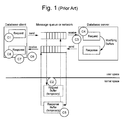
- the message queue interfaces of the operating system may only allow for a single buffer to be transferred with one call. If there is more than one client request buffer, the buffers at first have to be concatenated into a single temporary buffer (cf. the first copy operation C 1 in FIG. 1 ). The message queue implementation in the operating system may then copy this temporary user buffer into a message buffer within the operating system address space (second copy operation C 2 ). On the receiving side, the operating system message buffer may be copied into a temporary user buffer (third copy operation C 3 ) and from there it may be finally copied into the server process address space (fourth copy operation C 4 ). As apparent from FIG. 1 , four copy operations are needed for the first half of the communication. Another four copy operations are needed for the response (C 5 -C 8 ). If the buffers are of reasonable size, this is very time and computation extensive, leading to poor overall performance of the database system.
- This problem is according to one aspect of the invention solved by a method for managing the interprocess communication between at least one database client process and at least one database server process in a database system.
- the at least one database client process sends at least one request to the at least one database server process and the at least one request comprises one or more buffers.
- the method comprises the steps of:
- the request buffers provided by the database client process are first copied directly into a special buffer area. Because this copy step transfers all of the buffers in a single step, it substitutes the copy steps C 1 and C 2 of the prior art approach in FIG. 1 . Furthermore, the prior art copy steps C 3 and C 4 are obsolete, since the database server process has direct access to the special buffer area, so that it may directly manipulate the buffers. Similarly, after the database server process has processed the request, the buffers are copied back to the database client process within a single step, so that only two copy operations are necessary to achieve the whole client/server communication, compared to eight copy operations in the prior art approach (see above).
- the above described method defines the interprocess communication between database client processes and database server processes which are preferably located on the same physical machine.
- a database client process may also serve as a “proxy” for one or more remote clients, i.e. the local database client process handles the interprocess communication for one or more database clients which are located on physical machines different from the database server.
- more than one database server process may run on more than one physical machine and each of the database server processes may utilize the present invention.
- the method may further comprise the step of blocking the at least one database server process, if a request queue is empty, and provide the at least one database server process with a handle to the one or more buffers in the buffer area.
- step a. may comprise the further steps of inserting an element into the request queue and unblocking the at least one database server process.
- the purpose of the request queue is to indicate that an incoming request is to be processed by the database server process.
- the database server process may, e.g. when it is started, inspect the request queue in order to determine if requests are pending. If no requests are pending, i.e. the request queue is empty, the database server is forced to block.
- the database server process is unblocked again and subsequently gets a handle to the one or more buffers in the special buffer area.
- a handle may e.g. be a reference or a pointer to the address space of the buffers in the buffer area. Via the handle, the database server process may thus identify the new incoming request and execute it.
- step b. comprises blocking the at least one database client process, if a response queue is empty.
- the method may comprise the steps of inserting an element into the response queue and unblocking the at least one database client process when the request has been processed.
- the database client process may block if a response queue is empty.
- the database client process is unblocked and may proceed with the rest of step b., i.e. copying the buffers back to the database client process as described above.
- the invention further relates to a computer program comprising instructions for implementing any of the above aspects.
- an interprocess communication driver for managing the interprocess communication between at least one database client process and at least one database server process in a database system.
- the at least one database client process sends at least one request to the at least one database server process and the at least one request comprises one or more buffers.
- the IPC driver comprises:
- the interprocess communication between the database server process and the client process is done by an IPC driver.
- the communication is based on a piece of memory which is shared by the database server process and the IPC driver and a set of routines provided by the IPC driver.
- the routine copies the database client buffers directly into the buffer area in a single step.
- the buffers are copied back to the database client process within a single step using the second routine (subsequently called client read routine).
- the IPC driver further comprises a third routine adapted for being called by the at least one database client process and further adapted for blocking the database server process, if a request queue within the memory is empty, and for providing the database server process with a handle to the one or more buffers in the buffer area.
- the first routine may be further adapted for inserting an element into the request queue and for unblocking the at least one database server process.
- the third routine forces the database server process to block, i.e. to wait until a request is to be processed and further provides the database server process a handle, i.e. a pointer or a reference, to the buffers of the request within the buffer area.
- the second routine is further adapted for blocking the database client process if a response queue within the memory is empty. This forces the database client process to wait for a response in the client read routine.
- the IPC driver may comprise a fourth routine adapted for being called by the at least one database server process and further adapted for inserting an element into the response queue and for unblocking the at least one database client process.
- the fourth routine (subsequently called server write) is to be called by the database server process after it has processed the request, i.e. after it has manipulated the buffers in the buffer area.
- the database client process may finally proceed its execution and retrieve the response.
- the IPC driver is a UNIX kernel extension
- the first routine is adapted for calling a UNIX writev system call
- the second routine is adapted for calling a UNIX readv system call.
- the interprocess communication between the database server process and the database client process is done by an operating system kernel extension, i.e. a pseudo device driver.
- the buffers provided by the database client process are transferred to the IPC driver via a write system call.
- the writev and readv system calls may be used. These system calls provide support for reading and writing buffers from and to the UNIX kernel respectively, while the buffers are not necessarily in a contiguous memory space on the client side.
- the readv system call allows to read a buffer from the kernel and to distribute it into non-contiguous memory areas on the client site in one step.
- the writev system call allows to write the contents of non-contiguous memory areas on the client side to the kernel in one step.
- a database system comprising at least one database client process, at least one database server process and an interprocess communication driver (IPC driver) with any of the above described characteristics.
- the database system further comprises a memory adapted for being directly accessible by the IPC driver and the at least one database server process and the database client process is adapted for calling the first routine and the second routine of the IPC driver.
- the at least one database server process is adapted for calling the third routine, for reading the one or more buffers determined by the handle, for executing the request, for writing a response into the one or more buffers and for calling the fourth routine. Accordingly, the database server process gets a handle to the buffers in the buffer area from the server read routine as soon as a request is pending. Because the database server process shares the buffer area with the IPC driver, there is no need for another copy operation. Via the handle obtained from the IPC driver, the database server process identifies the new incoming request and executes it. When the request processing is finished which may involve manipulating the buffers in the buffer area, the database server process passes the handle back to the driver and calls the server write routine in order to unblock the database client process.
- the above database system is a UNIX system
- the at least one database client process and the at least one database server process are UNIX user processes and the memory is a shared kernel memory.
- FIG. 1 A schematic view of a prior art approach to communicating requests between a database client and a database server;
- FIG. 2 a A flow diagram describing the tasks performed by a database client according to the prior art
- FIG. 2 b A flow diagram describing the tasks performed by a database server according to the prior art
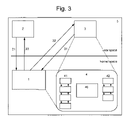
- FIG. 3 A schematic view of a database system according to an embodiment of the present invention.
- FIG. 4 A flow diagram describing the tasks performed by a database client according to an embodiment of the present invention
- FIG. 5 A flow diagram describing the tasks performed by the IPC driver in response to a client write call
- FIG. 6 A flow diagram describing the tasks performed by the IPC driver in reponse to a client read call
- FIG. 7 A flow diagram describing the tasks performed by the IPC driver in reponse to a server read call
- FIG. 8 A flow diagram describing the tasks performed by the IPC driver in reponse to a server write call
- FIG. 9 A flow diagram describing the interworking of the tasks performed by the IPC driver.
- the database system 5 comprises a database client process 2 and a database server process 3 .
- the database system 5 further comprises an IPC driver 1 and a memory 4 , wherein the memory 4 is shared between the IPC driver 1 and the database server process 3 , i.e. both have direct access to the memory 4 , and the memory 4 further comprises a buffer area 40 , a request queue 41 and a response queue 42 .
- the IPC driver 1 preferably offers at least four routines to the database client process 2 and the database server process 3 : a client write routine 21 , a client read routine 22 , a server write routine 31 and a server read routine 32 .
- the four routines are defined for enabling the interprocess communication between the database client process 2 and the database server process 3 and will be described in the following.
- the database server process 3 calls the server read routine 32 of the IPC driver 1 in order to obtain requests. Since the request queue 41 is still empty in step 321 (because no database client process has sent a request yet), the database server process 3 is blocked and remains in step 322 .
- the database client process 2 wants to send a request and therefore calls the client write routine 21 of the IPC driver 1 .
- the request buffers are copied into the buffer area 40 in step 211 and an element is inserted into the request queue 41 in step 212 .
- the database server process 3 is unblocked in step 213 .
- the database client process 2 calls the client read routine 22 of the IPC driver 1 . Since the response queue 42 is still empty in step 221 (since the database server process 3 has not processed the request yet) the database client process 2 is blocked in step 222 .
- step 323 the next element is fetched from the request queue 41 by the IPC driver 1 and a handle to the buffers of the corresponding request is provided to the database server process 3 in step 324 .
- the database server process 3 may now execute the request according to the contents of the request buffers in the buffer area 40 (not depicted in FIG. 9 ).
- the database server process 3 writes the results of the execution of the request back into the buffers within the buffer area 40 .
- the database server process 3 calls the server write routine 31 of the IPC driver 1 .
- the IPC driver 1 thus inserts an entry into the response queue 42 in step 311 and unblocks the database client process 2 in step 312 .
- the unblocked database client process may now finish its client read call, in that the buffers in the buffer area 40 are copied back to the database client process in step 223 .
- the database system 5 is implemented on a UNIX operating system.
- UNIX is only one of a wide variety of operating systems and that the present invention may be implemented on any operating system satisfying the requirements of the invention.
- a UNIX system is generally comprised of three layers: hardware, kernel and user mode software.
- the system hardware comprises e.g. the CPU, memory, serial devices, disk controllers disks and other peripheral devices such as graphics displays.
- the kernel layer serves for isolating higher level programs like application programs from the specific hardware and for controlling the physical access to the hardware components.
- the kernel further provides services to the higher level software layers through so called system calls. Thus, the only way for user programs to access system resources is through system calls.
- the upper-most user mode software layer finally comprises the user software.
- a device driver does not necessarily need to control a physical device. Instead, it might simply utilize the UNIX driver framework to provide special or additional functionality to user programs. Such drivers are called pseudo device drivers.
- the IPC driver 1 is in one embodiment of the present invention implemented as such a pseudo device driver so that it can directly access the memory 4 of the database system 5 .
- the memory 4 is located in the kernel space.
- the IPC driver 1 uses the writev system call provided by the UNIX database system 5 .
- the writev system call is a variant of the write call which allows specifying multiple buffers to be transferred within a single call.
- the single step of copying the buffers from the buffer area 40 back to the database client process 2 is facilitated by the readv system call of the UNIX database system 5 .
- the readv system call allows to read a buffer from the kernel and to distribute it into non-contiguous memory areas on the client side in one step.
- FIG. 4 illustrates this approach from the viewpoint of the database client process 2 .
- the database client process 2 first sends its request, which internally results in a writev system call in step 60 .
- the database client process then waits for a response in step 61 and finally receives the response in step 62 , which is internally facilitated by a readv system call.
Landscapes
- Engineering & Computer Science (AREA)
- Theoretical Computer Science (AREA)
- Databases & Information Systems (AREA)
- Physics & Mathematics (AREA)
- General Engineering & Computer Science (AREA)
- General Physics & Mathematics (AREA)
- Software Systems (AREA)
- Data Mining & Analysis (AREA)
- Information Retrieval, Db Structures And Fs Structures Therefor (AREA)
- Multi Processors (AREA)
- Hardware Redundancy (AREA)
Applications Claiming Priority (3)
| Application Number | Priority Date | Filing Date | Title |
|---|---|---|---|
| EP08014366.2 | 2008-08-12 | ||
| EP08014366A EP2154615B1 (de) | 2008-08-12 | 2008-08-12 | Verfahren und Interprozess-Kommunikationstreiber zum Verwalten von Anfragen eines Datenbank-Clients an einen Datenbank-Server |
| EP08014366 | 2008-08-12 |
Publications (2)
| Publication Number | Publication Date |
|---|---|
| US20100042679A1 US20100042679A1 (en) | 2010-02-18 |
| US8327380B2 true US8327380B2 (en) | 2012-12-04 |
Family
ID=39832217
Family Applications (1)
| Application Number | Title | Priority Date | Filing Date |
|---|---|---|---|
| US12/457,811 Active 2031-08-10 US8327380B2 (en) | 2008-08-12 | 2009-06-22 | Method and interprocess communication driver for managing requests of a database client to a database server |
Country Status (3)
| Country | Link |
|---|---|
| US (1) | US8327380B2 (de) |
| EP (1) | EP2154615B1 (de) |
| AT (1) | ATE543136T1 (de) |
Families Citing this family (4)
| Publication number | Priority date | Publication date | Assignee | Title |
|---|---|---|---|---|
| CN104268025B (zh) * | 2014-09-30 | 2018-11-27 | 珠海市君天电子科技有限公司 | 一种进程间通信的方法及系统、服务器 |
| CN105550047A (zh) * | 2015-12-11 | 2016-05-04 | 深圳市佳创视讯技术股份有限公司 | 基于数据库通信的方法及系统 |
| CN113608674B (zh) * | 2021-06-25 | 2024-02-23 | 济南浪潮数据技术有限公司 | 一种实现分布式块存储系统读写的方法及装置 |
| CN114281438A (zh) * | 2021-12-30 | 2022-04-05 | 杭州云合智网技术有限公司 | 对sonic设备间通信模型改进的方法 |
Citations (4)
| Publication number | Priority date | Publication date | Assignee | Title |
|---|---|---|---|---|
| US6526494B1 (en) * | 1994-07-22 | 2003-02-25 | Sun Microsystems, Inc. | Method and apparatus for space-efficient inter-process communication |
| US20040122953A1 (en) | 2002-12-23 | 2004-06-24 | International Business Machines Corporation | Communication multiplexor for use with a database system implemented on a data processing system |
| US20050050553A1 (en) * | 2003-09-03 | 2005-03-03 | Intel Corporation | Method, system, and program for accessing device driver functions |
| US20070011687A1 (en) * | 2005-07-08 | 2007-01-11 | Microsoft Corporation | Inter-process message passing |
Family Cites Families (1)
| Publication number | Priority date | Publication date | Assignee | Title |
|---|---|---|---|---|
| US7249227B1 (en) | 2003-12-29 | 2007-07-24 | Network Appliance, Inc. | System and method for zero copy block protocol write operations |
-
2008
- 2008-08-12 EP EP08014366A patent/EP2154615B1/de active Active
- 2008-08-12 AT AT08014366T patent/ATE543136T1/de active
-
2009
- 2009-06-22 US US12/457,811 patent/US8327380B2/en active Active
Patent Citations (4)
| Publication number | Priority date | Publication date | Assignee | Title |
|---|---|---|---|---|
| US6526494B1 (en) * | 1994-07-22 | 2003-02-25 | Sun Microsystems, Inc. | Method and apparatus for space-efficient inter-process communication |
| US20040122953A1 (en) | 2002-12-23 | 2004-06-24 | International Business Machines Corporation | Communication multiplexor for use with a database system implemented on a data processing system |
| US20050050553A1 (en) * | 2003-09-03 | 2005-03-03 | Intel Corporation | Method, system, and program for accessing device driver functions |
| US20070011687A1 (en) * | 2005-07-08 | 2007-01-11 | Microsoft Corporation | Inter-process message passing |
Non-Patent Citations (2)
| Title |
|---|
| "A High Performance Configurable Storage Manager", Biliris et al., 1995 IEEE, Mar. 6, 1995, pp. 35-43. |
| "Querying very Large Multi-Dimensional Datasets in ADR", Kurc et al., Proceedings of the ACM/IEEE SC 99 Conference, Nov. 13-18, 1999, pp. 1-15. |
Also Published As
| Publication number | Publication date |
|---|---|
| EP2154615A1 (de) | 2010-02-17 |
| EP2154615B1 (de) | 2012-01-25 |
| ATE543136T1 (de) | 2012-02-15 |
| US20100042679A1 (en) | 2010-02-18 |
Similar Documents
| Publication | Publication Date | Title |
|---|---|---|
| US12373437B1 (en) | Method and system for transparent database query caching | |
| US6044415A (en) | System for transferring I/O data between an I/O device and an application program's memory in accordance with a request directly over a virtual connection | |
| EP3776162B1 (de) | Gruppenbasierte datenreplikation in speichersystemen mit mehreren teilnehmern | |
| US7233984B2 (en) | Light weight file I/O over system area networks | |
| US7415470B2 (en) | Capturing and re-creating the state of a queue when migrating a session | |
| JP5214473B2 (ja) | ハードウェアデバイスなどのリソースを有する仮想マシンの移動システム | |
| US8131814B1 (en) | Dynamic pinning remote direct memory access | |
| US5991797A (en) | Method for directing I/O transactions between an I/O device and a memory | |
| US8190743B2 (en) | Most eligible server in a common work queue environment | |
| US9244881B2 (en) | Facilitating, at least in part, by circuitry, accessing of at least one controller command interface | |
| US6622259B1 (en) | Non-disruptive migration of coordinator services in a distributed computer system | |
| US8874638B2 (en) | Interactive analytics processing | |
| US20100325329A1 (en) | Multiprocessor system, and method for shared use of devices among operating systems of multiprocessor system | |
| US9390036B2 (en) | Processing data packets from a receive queue in a remote direct memory access device | |
| US20050091239A1 (en) | Queue bank repository and method for sharing limited queue banks in memory | |
| US8849905B2 (en) | Centralized computing | |
| CN110532106A (zh) | 进程间的通讯方法、装置、设备和存储介质 | |
| US8327380B2 (en) | Method and interprocess communication driver for managing requests of a database client to a database server | |
| US7383312B2 (en) | Application and verb resource management | |
| US6668279B1 (en) | User level web server in-kernel network I/O accelerator | |
| Argyroulis | Recent advancements in distributed system communications | |
| US20090271802A1 (en) | Application and verb resource management | |
| US20060206453A1 (en) | Dynamically Sizing Buffers to Optimal Size in Network Layers When Supporting Data Transfers Related to Database Applications | |
| US20060242258A1 (en) | File sharing system, file sharing program, management server and client terminal | |
| US12182429B2 (en) | Hierarchical file block variant tracking for performance in parallelism at multi-disk arrays |
Legal Events
| Date | Code | Title | Description |
|---|---|---|---|
| AS | Assignment |
Owner name: SOFTWARE AG,GERMANY Free format text: ASSIGNMENT OF ASSIGNORS INTEREST;ASSIGNORS:GREINER, MARKUS;SCHULER, KLAUS;REEL/FRAME:023188/0144 Effective date: 20090803 Owner name: SOFTWARE AG, GERMANY Free format text: ASSIGNMENT OF ASSIGNORS INTEREST;ASSIGNORS:GREINER, MARKUS;SCHULER, KLAUS;REEL/FRAME:023188/0144 Effective date: 20090803 |
|
| FEPP | Fee payment procedure |
Free format text: PAYOR NUMBER ASSIGNED (ORIGINAL EVENT CODE: ASPN); ENTITY STATUS OF PATENT OWNER: LARGE ENTITY |
|
| STCF | Information on status: patent grant |
Free format text: PATENTED CASE |
|
| CC | Certificate of correction | ||
| FPAY | Fee payment |
Year of fee payment: 4 |
|
| MAFP | Maintenance fee payment |
Free format text: PAYMENT OF MAINTENANCE FEE, 8TH YEAR, LARGE ENTITY (ORIGINAL EVENT CODE: M1552); ENTITY STATUS OF PATENT OWNER: LARGE ENTITY Year of fee payment: 8 |
|
| MAFP | Maintenance fee payment |
Free format text: PAYMENT OF MAINTENANCE FEE, 12TH YEAR, LARGE ENTITY (ORIGINAL EVENT CODE: M1553); ENTITY STATUS OF PATENT OWNER: LARGE ENTITY Year of fee payment: 12 |
|
| AS | Assignment |
Owner name: MOSEL BIDCO AG, GERMANY Free format text: MERGER;ASSIGNOR:SOFTWARE AG;REEL/FRAME:070095/0634 Effective date: 20240822 Owner name: SOFTWARE GMBH, GERMANY Free format text: CHANGE OF NAME;ASSIGNOR:MOSEL BIDCO AG;REEL/FRAME:069715/0415 Effective date: 20240919 |