US8310217B2 - Power conversion circuit for decentralizing input current - Google Patents

Power conversion circuit for decentralizing input current Download PDF

Info

Publication number
US8310217B2
US8310217B2 US12/467,056 US46705609A US8310217B2 US 8310217 B2 US8310217 B2 US 8310217B2 US 46705609 A US46705609 A US 46705609A US 8310217 B2 US8310217 B2 US 8310217B2
Authority
US
United States
Prior art keywords
circuit
power conversion
inductor
switching circuit
current
Prior art date
Legal status (The legal status is an assumption and is not a legal conclusion. Google has not performed a legal analysis and makes no representation as to the accuracy of the status listed.)
Expired - Fee Related, expires
Application number
US12/467,056
Other versions
US20100214806A1 (en
Inventor
Shih-Hsien Chang
Jian-Feng Tsai
Current Assignee (The listed assignees may be inaccurate. Google has not performed a legal analysis and makes no representation or warranty as to the accuracy of the list.)
Delta Electronics Inc
Original Assignee
Delta Electronics Inc
Priority date (The priority date is an assumption and is not a legal conclusion. Google has not performed a legal analysis and makes no representation as to the accuracy of the date listed.)
Filing date
Publication date
Application filed by Delta Electronics Inc filed Critical Delta Electronics Inc
Assigned to DELTA ELECTRONICS, INC. reassignment DELTA ELECTRONICS, INC. ASSIGNMENT OF ASSIGNORS INTEREST (SEE DOCUMENT FOR DETAILS). Assignors: CHANG, SHIH-HSIEN, TSAI, JIAN-FENG
Publication of US20100214806A1 publication Critical patent/US20100214806A1/en
Application granted granted Critical
Publication of US8310217B2 publication Critical patent/US8310217B2/en
Expired - Fee Related legal-status Critical Current
Adjusted expiration legal-status Critical

Links

Images

Classifications

    • HELECTRICITY
    • H02GENERATION; CONVERSION OR DISTRIBUTION OF ELECTRIC POWER
    • H02MAPPARATUS FOR CONVERSION BETWEEN AC AND AC, BETWEEN AC AND DC, OR BETWEEN DC AND DC, AND FOR USE WITH MAINS OR SIMILAR POWER SUPPLY SYSTEMS; CONVERSION OF DC OR AC INPUT POWER INTO SURGE OUTPUT POWER; CONTROL OR REGULATION THEREOF
    • H02M1/00Details of apparatus for conversion
    • H02M1/42Circuits or arrangements for compensating for or adjusting power factor in converters or inverters
    • H02M1/4208Arrangements for improving power factor of AC input
    • H02M1/4225Arrangements for improving power factor of AC input using a non-isolated boost converter
    • HELECTRICITY
    • H02GENERATION; CONVERSION OR DISTRIBUTION OF ELECTRIC POWER
    • H02MAPPARATUS FOR CONVERSION BETWEEN AC AND AC, BETWEEN AC AND DC, OR BETWEEN DC AND DC, AND FOR USE WITH MAINS OR SIMILAR POWER SUPPLY SYSTEMS; CONVERSION OF DC OR AC INPUT POWER INTO SURGE OUTPUT POWER; CONTROL OR REGULATION THEREOF
    • H02M3/00Conversion of DC power input into DC power output
    • H02M3/02Conversion of DC power input into DC power output without intermediate conversion into AC
    • H02M3/04Conversion of DC power input into DC power output without intermediate conversion into AC by static converters
    • H02M3/10Conversion of DC power input into DC power output without intermediate conversion into AC by static converters using discharge tubes with control electrode or semiconductor devices with control electrode
    • H02M3/145Conversion of DC power input into DC power output without intermediate conversion into AC by static converters using discharge tubes with control electrode or semiconductor devices with control electrode using devices of a triode or transistor type requiring continuous application of a control signal
    • H02M3/155Conversion of DC power input into DC power output without intermediate conversion into AC by static converters using discharge tubes with control electrode or semiconductor devices with control electrode using devices of a triode or transistor type requiring continuous application of a control signal using semiconductor devices only
    • H02M3/156Conversion of DC power input into DC power output without intermediate conversion into AC by static converters using discharge tubes with control electrode or semiconductor devices with control electrode using devices of a triode or transistor type requiring continuous application of a control signal using semiconductor devices only with automatic control of output voltage or current, e.g. switching regulators
    • H02M3/158Conversion of DC power input into DC power output without intermediate conversion into AC by static converters using discharge tubes with control electrode or semiconductor devices with control electrode using devices of a triode or transistor type requiring continuous application of a control signal using semiconductor devices only with automatic control of output voltage or current, e.g. switching regulators including plural semiconductor devices as final control devices for a single load
    • H02M3/1584Conversion of DC power input into DC power output without intermediate conversion into AC by static converters using discharge tubes with control electrode or semiconductor devices with control electrode using devices of a triode or transistor type requiring continuous application of a control signal using semiconductor devices only with automatic control of output voltage or current, e.g. switching regulators including plural semiconductor devices as final control devices for a single load with a plurality of power processing stages connected in parallel
    • YGENERAL TAGGING OF NEW TECHNOLOGICAL DEVELOPMENTS; GENERAL TAGGING OF CROSS-SECTIONAL TECHNOLOGIES SPANNING OVER SEVERAL SECTIONS OF THE IPC; TECHNICAL SUBJECTS COVERED BY FORMER USPC CROSS-REFERENCE ART COLLECTIONS [XRACs] AND DIGESTS
    • Y02TECHNOLOGIES OR APPLICATIONS FOR MITIGATION OR ADAPTATION AGAINST CLIMATE CHANGE
    • Y02BCLIMATE CHANGE MITIGATION TECHNOLOGIES RELATED TO BUILDINGS, e.g. HOUSING, HOUSE APPLIANCES OR RELATED END-USER APPLICATIONS
    • Y02B70/00Technologies for an efficient end-user side electric power management and consumption
    • Y02B70/10Technologies improving the efficiency by using switched-mode power supplies [SMPS], i.e. efficient power electronics conversion e.g. power factor correction or reduction of losses in power supplies or efficient standby modes

Definitions

  • the present invention relates to a power conversion circuit, and more particularly to a power conversion circuit for decentralizing an input current.
  • An electronic device comprises a plurality of electronic components.
  • different kinds of electronic components are operated by using different voltages.
  • a power supply is essential for many electronic devices such as personal computers, industrial computers, servers, communication products or network products.
  • the user may simply plug a power supply into an AC wall outlet commonly found in most homes or offices so as to receive an AC voltage.
  • the power supply will convert the AC voltage into a regulated DC output voltage for powering the electronic device.
  • the regulated DC output voltage is transmitted to the electronic device through a power cable.
  • FIG. 1 is a schematic block diagram of a conventional power conversion circuit.
  • the conventional power conversion circuit 1 of FIG. 1 is a buck-type power conversion circuit.
  • an AC input voltage V IN (e.g. from a utility power source) is converted into an output voltage V o .
  • the power conversion circuit 1 principally comprises a rectifier circuit 11 , a bootstrap circuit 12 , a control circuit 13 , a switching circuit 14 , a feedback circuit 15 , a diode D, an inductor L, a capacitor C and a current transformer CT.
  • the AC input voltage V IN is rectified by the rectifier circuit 11 into a rectified voltage.
  • the switching circuit 14 includes a switch element Q. A first terminal of the switching circuit 14 is connected to the output terminal of the rectifier circuit 11 . A second terminal of the switching circuit 14 is connected to the bootstrap circuit 12 .
  • the switching circuit 14 is driven by the bootstrap circuit 12 so as to be conducted or shut off.
  • the detecting terminal of the current transformer CT is connected to the switching circuit 14 and the inductor L.
  • the output terminal of the current transformer CT is connected to the control circuit 13 and a common terminal COM.
  • the current transformer CT can detect the current flowing through the switching circuit 14 , thereby generating a detecting current signal to the control circuit 13 .
  • the inductor L is connected to the detecting terminal of the current transformer CT and the output terminal of the power conversion circuit 1 .
  • the switching circuit 14 When the switching circuit 14 is conducted, electric energy is stored in the inductor L. Whereas, when the switching circuit 14 is shut off, the inductor L discharges the stored electric energy so as to generate the output voltage V o .
  • An end of the capacitor C is connected to the inductor L and the output terminal of the power conversion circuit 1 .
  • the other end of the capacitor C is connected to the common terminal COM.
  • the capacitor C is used for filtering the output voltage V o that is generated by the inductor L.
  • the cathode of the diode D is connected to the inductor L and the current transformer CT and the anode of the diode D is connected to the common terminal COM, thereby forming a discharging path.
  • the feedback circuit 15 is connected to the output terminal of the power conversion circuit 1 and the control circuit 13 . According to the output voltage V o , the feedback circuit 15 generates a feedback signal to the control circuit 13 .
  • the control circuit 13 is connected to the bootstrap circuit 12 , the output terminal of the current transformer CT and the feedback circuit 15 .
  • the control circuit 13 can generate a control signal. According to the control signal, the operation of the switching circuit 14 is driven by the bootstrap circuit 12 . Furthermore, according to the detecting current signal transmitted from the current transformer CT, the control circuit 13 can detect whether an over-current phenomenon occurs. If the over-current phenomenon occurs, the switching circuit 14 is driven by the bootstrap circuit 12 to be shut off according to the control signal. According to the feedback signal transmitted from the feedback circuit 15 , the duty cycle of the switching circuit 14 is adjusted, so that the magnitude of the output voltage V o is maintained above a threshold value.
  • the conventional power conversion circuit 1 is effective to convert the AC input voltage into the output voltage, there are still some drawbacks.
  • the switching circuit 14 of the power conversion circuit 1 is connected to the high-voltage terminal, the bootstrap circuit 12 is required to drive the switching circuit 14 .
  • the switching circuit 14 is very costly and thus the overall cost of the power conversion circuit 1 increases.
  • the power conversion circuit 1 has an electromagnetic interference (EMI) filter circuit (not shown) connected to the input terminal of the power conversion circuit 1 .
  • EMI electromagnetic interference
  • the distribution of the AC input current is very centralized during operation of the conventional power conversion circuit 1 and the peak values are relatively higher, higher harmonic waves are possibly generated.
  • the conventional power conversion circuit 1 should have a large-sized electromagnetic interference filter circuit for filtering the harmonic waves and reducing the electromagnetic interference.
  • the use of the large-sized electromagnetic interference filter circuit will increase the fabricating cost of the conventional power conversion circuit 1 .
  • the power factor of the power conversion circuit 1 is too low. Due to the low power factor, the apparent input power is high and more power loss of the power conversion circuit 1 is consumed.
  • the conventional power conversion circuit 1 Since the conventional power conversion circuit 1 generates the output voltage V o by means of the single switching circuit 14 and the single inductor L, a great amount of heat is generated by the switching circuit 14 and the inductor L when the output voltage V o is used for driving a high-power electronic device. Under this circumstance, the switching circuit 14 and the inductor L are possibly damaged due to an over-heating effect and the power conversion circuit 1 fails to be normally operated.
  • An object of the present invention provides a power conversion circuit for decentralizing an input current, in which the switching circuit is no longer connected to the high-voltage terminal so as to reduce the overall cost.
  • Another object of the present invention provides a power conversion circuit for decentralizing an input current, thereby reducing the heat generation.
  • a further object of the present invention provides a power conversion circuit for decentralizing an input current, thereby providing a power factor correction function and reducing the power loss without the need of using a large-sized electromagnetic interference filter circuit.
  • a power conversion circuit for decentralizing input current.
  • the power conversion circuit generates an output voltage between a first output terminal and a second output terminal.
  • the power conversion circuit includes a capacitor, a first inductor, a first switching circuit, a first discharging circuit, a second inductor, a second switching circuit, a second discharging circuit, and a control circuit.
  • the capacitor is connected to the first output terminal and the second output terminal of the power conversion circuit.
  • the first inductor is connected to the capacitor.
  • the first switching circuit is connected to the first inductor and a common terminal.
  • the first discharging circuit is connected to the first inductor, the first switching circuit and the first output terminal.
  • the second inductor is connected to the capacitor and the first inductor.
  • the second switching circuit is connected to the second inductor and the common terminal.
  • the second discharging circuit is connected to the second inductor, the second switching circuit and the first output terminal.
  • the control circuit is connected to the first switching circuit and the second switching circuit for controlling on/off statuses of the first switching circuit and the second switching circuit, so that the first inductor and the second inductor perform a charging operation or a discharging operation and power conversion circuit generates the output voltage through the first inductor and the second inductor. Under control of the control circuit, the first switching circuit and the second switching circuit are alternately conducted, and the second switching circuit is successively conducted when the first switching circuit is shut off.
  • FIG. 1 is a schematic block diagram of a conventional power conversion circuit
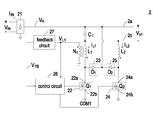
  • FIG. 2 is a schematic circuit diagram illustrating a power conversion circuit for decentralizing an input current according to an embodiment of the present invention
  • FIG. 3 is a timing waveform diagram illustrating the corresponding voltage signals and current signals processed in the power conversion circuit of the present invention.
  • FIG. 4 is a schematic circuit diagram illustrating a power conversion circuit for decentralizing an input current according to another embodiment of the present invention.
  • FIG. 2 is a schematic circuit diagram illustrating a power conversion circuit for decentralizing an input current according to an embodiment of the present invention.
  • the power conversion circuit 2 of FIG. 2 is a buck-type power conversion circuit.
  • the power conversion circuit 2 can generate an output voltage V o1 between a first output terminal 2 a and a second output terminal 2 b .
  • the power conversion circuit 2 principally comprises a capacitor C 1 , a first inductor L 1 , a first switching circuit 22 , a first discharging circuit 23 , a second inductor L 2 , a second switching circuit 24 , a second discharging circuit 25 and a control circuit 26 .
  • a first terminal of the capacitor C 1 is connected to the second output terminal 2 b of the power conversion circuit 2 , a first terminal of the first inductor L 1 , and a first terminal of the second inductor L 2 .
  • the first terminal of the first inductor L 1 is connected to the first terminal of the capacitor C 1 and the second output terminal 2 b of the power conversion circuit 2 .
  • a second terminal of the first inductor L 1 is connected to a first conducting terminal 22 a of the first switching circuit 22 and a first terminal of the first discharging circuit 23 .
  • the first conducting terminal 22 a of the first switching circuit 22 is connected to the second terminal of the first inductor L 1 and the first terminal of the first discharging circuit 23 .
  • a second conducting terminal 22 b of the first switching circuit 22 is connected to a common terminal COM 1 .
  • a control terminal of the first switching circuit 22 is connected to the control circuit 26 .
  • the first switching circuit 22 is conducted (on status) or shut off (off status), so that the first inductor L 1 performs a charging operation or a discharging operation.
  • the first terminal of the first discharging circuit 23 is interconnected between the first inductor L 1 and the first switching circuit 22 .
  • the second terminal of the first discharging circuit 23 is connected to the first output terminal 2 a of the power conversion circuit 2 .
  • the first discharging circuit 23 is used for providing a discharging path of the first inductor L 1 .
  • the first terminal of the second inductor L 2 is connected to the first terminal of the capacitor C 1 and the second output terminal 2 b of the power conversion circuit 2 .
  • a second terminal of the second inductor L 2 is connected to a first conducting terminal 24 a of the second switching circuit 24 and a first terminal of the second discharging circuit 25 .
  • a second conducting terminal 24 b of the second switching circuit 24 is connected to the common terminal COM 1 .
  • a control terminal of the second switching circuit 24 is connected to the control circuit 26 . Under control of the control circuit 26 , the second switching circuit 24 is conducted or shut off, so that the second inductor L 2 performs a charging operation or a discharging operation.
  • the first terminal of the second discharging circuit 25 is interconnected between the second inductor L 2 and the second switching circuit 24 .
  • the second terminal of the second discharging circuit 25 is connected to the first output terminal 2 a of the power conversion circuit 2 .
  • the second discharging circuit 25 is used for providing a discharging path of the second inductor L 2 .
  • the control circuit 26 is connected to the control terminal of the first switching circuit 22 and the control terminal of the second switching circuit 24 .
  • the control circuit 26 can generate a pulse width modulation (PWM) signal to control on/off statuses of the first switching circuit 22 and the second switching circuit 24 .
  • PWM pulse width modulation
  • the first inductor L 1 and the second inductor L 2 respectively performs a charging operation or a discharging operation.
  • the power conversion circuit 2 generates the output voltage V o1 between the first output terminal 2 a and the second output terminal 2 b .
  • the heat generated by the first switching circuit 22 or the second switching circuit 24 during operation of the power conversion circuit 2 is less than that generated by the single switching circuit of the conventional power conversion circuit.
  • the heat generated by the first inductor L 1 or the second inductor L 2 during operation of the power conversion circuit 2 is less than that generated by the single inductor of the conventional power conversion circuit.
  • the first switching circuit 22 and the second switching circuit 24 are alternately conducted under control of the control circuit 26 .
  • the second switching circuit 24 is successively conducted when the first switching circuit 22 is shut off.
  • an input current I IN e.g. an AC input current
  • the power conversion circuit 2 further includes a feedback circuit 27 .
  • the first inductor L 1 further includes a current-induction winding N c .
  • a first terminal of the current-induction winding N c is connected to the control circuit 26 and the feedback circuit 27 .
  • a second terminal of the current-induction winding N c is connected to the common terminal COM 1 .
  • the current-induction winding N c is used for inducing a first current I L1 of the first inductor L 1 and issuing a corresponding first current inducing signal V L1 to the control circuit 26 .
  • the first switching circuit 22 When the first switching circuit 22 is shut off, the first current I L1 is zero because the first inductor L 1 discharges.
  • the control circuit 26 detects that the first current I L1 is zero and thus controls the first switching circuit 22 to be conducted again.
  • the input terminal of the feedback circuit 27 is connected to the current-induction winding N c .
  • the output terminal of the feedback circuit 27 is connected to the control circuit 26 .
  • the feedback circuit 27 According to the first current inducing signal V L1 transmitted from the current-induction winding N c , the feedback circuit 27 generates a feedback signal V FB to the control circuit 26 .
  • the control circuit 26 controls the on duration of the first switching circuit 22 .
  • the on duration of the second switching circuit 24 is adjusted to be substantially equal to the on duration of the first switching circuit 22 .
  • the magnitude of the output voltage V o generated by the power conversion circuit 2 is maintained above the threshold value.
  • the input voltage V IN received by the power conversion circuit 2 is not limited to an AC input voltage.
  • the power conversion circuit 2 further includes a rectifier circuit 21 .
  • An example of the rectifier circuit 21 includes but is not limited to a bridge rectifier circuit.
  • the output terminal of the rectifier circuit 21 is connected to the second terminal of the capacitor C 1 and the first output terminal 2 a of the power conversion circuit 2 .
  • the AC input voltage V IN is rectified by the rectifier circuit 21 into a rectified voltage V R .
  • the input voltage V IN received by the power conversion circuit 2 is a DC input voltage
  • the rectifier circuit 21 is exempted from the power conversion circuit 2 .
  • FIG. 3 is a timing waveform diagram illustrating the corresponding voltage signals and current signals processed in the power conversion circuit of the present invention.
  • the first switching circuit 22 is conducted under control of the control circuit 26 . Meanwhile, the input current I IN begins to charge the first inductor L 1 . That is, the first current I L1 of the first inductor L 1 will successively pass through the capacitor C 1 , the first inductor L 1 and the first switching circuit 22 , so that the first inductor L 1 is charged by the first current I L1 . During the charging process, the magnitude of the first current I L1 of the first inductor L 1 gradually increases.
  • the first switching circuit 22 Since the on duration of the first switching circuit 22 is controlled by the control circuit 26 according to the feedback signal V FB , the first switching circuit 22 is switched from the on status to the off status after an on duration T A of the first switching circuit 22 (i.e. from the time spot T 1 to the time spot T 2 ). At the time spot T 2 , the first inductor L 1 begins to discharge the stored electric energy through the discharging path offered by the first discharging circuit 23 . As such, the magnitude of the first current I L1 of the first inductor L 1 begins to decrease. In addition, when the first switching circuit 22 is shut off, the second switching circuit 24 is successively conducted under control of the control circuit 26 .
  • the second switching circuit 24 is conducted at the time spot T 2 , and the input current I IN begins to charge the second inductor L 2 . That is, the second current I L2 of the second inductor L 2 will successively pass through the capacitor C 1 , the second inductor L 2 and the second switching circuit 24 , so that the second inductor L 2 is charged by the second current I L2 . During the charging process, the magnitude of the second current I L2 of the second inductor L 2 gradually increases.
  • the on duration of the second switching circuit 24 is substantially equal to the on duration of the first switching circuit 22 under control of the control circuit 26 .
  • T B is substantially equal to T A .
  • the second inductor L 2 begins to discharge the stored electric energy through the discharging path offered by the second discharging circuit 25 . As such, the magnitude of the second current I L2 of the second inductor L 2 begins to decrease.
  • the on duration of the second switching circuit 24 may be different from the on duration of the first switching circuit 22 under control of the control circuit 26 .
  • the inductance value of the first current I L1 is equal to the inductance value of the second inductor L 2
  • on duration of the second switching circuit 24 and the on duration of the first switching circuit 22 are adjustable.
  • the control circuit 26 detects that the magnitude of the first current I L1 of the first inductor L 1 decreases to zero according to the first current inducing signal V L1 . Meanwhile, the first switching circuit 22 is switched from the off status to the on status, and the input current I IN begins to recharge the first inductor L 1 . As such, the magnitude of the first current I L1 of the first inductor L 1 gradually increases.
  • the power conversion circuit 2 Under control of the control circuit 26 , the first switching circuit 22 and the second switching circuit 24 are alternately conducted, and the second switching circuit 24 is successively conducted when the first switching circuit 22 is shut off. As a consequence, the AC input current I IN of the power conversion circuit 2 is decentralized by alternately conducting the first switching circuit 22 and the second switching circuit 24 . In comparison with the transient response of the AC input current of the conventional power conversion circuit, the transient response of the AC input current of the present power conversion circuit has lower and more decentralized peak values and smaller harmonic waves. For filtering the harmonic waves and reducing the electromagnetic interference, the power conversion circuit 2 further includes a small-sized electromagnetic interference filter circuit 20 (see FIG. 4 ). As shown in FIG.
  • the envelop curve of the AC input current I IN of the power conversion circuit 2 (as is indicated as a dotted line) is similar to the waveform of the AC input voltage V IN .
  • the power conversion circuit 2 has a power factor correction function, and the power loss during operation of the power conversion circuit 2 is reduced.
  • the first switching circuit 22 includes a first switch element Q 1 and the second switching circuit 24 includes a second switch element Q 2 .
  • Each of the first switch element Q 1 and the second switch element Q 2 includes but is not limited to a metal oxide semiconductor field effect transistor (MOSFET) or a bipolar junction transistor (BJT).
  • MOSFET metal oxide semiconductor field effect transistor
  • BJT bipolar junction transistor
  • the first discharging circuit 23 and the second switching circuit 24 are implemented by a first diode D 1 and a second diode D 2 , respectively.
  • FIG. 4 is a schematic circuit diagram illustrating a power conversion circuit for decentralizing an input current according to another embodiment of the present invention.
  • the power conversion circuit 2 further includes an electromagnetic interference filter circuit 20 , a first current-detecting circuit 28 and a second current-detecting circuit 29 .
  • the electromagnetic interference filter circuit 20 is connected to the input terminal of the filter circuit 21 for filtering the harmonic waves and reducing the electromagnetic interference.
  • the first current-detecting circuit 28 is interconnected between the first switching circuit 22 and the common terminal COM 1 in series for detecting the current flowing through the first switching circuit 22 . According to the current flowing through the first switching circuit 22 , the first current-detecting circuit 28 issues a first current-detecting signal to the control circuit 26 .
  • the second current-detecting circuit 29 is interconnected between the second switching circuit 24 and the common terminal COM 1 in series for detecting the current flowing through the second switching circuit 24 . According to the current flowing through the second switching circuit 24 , the second current-detecting circuit 29 issues a second current-detecting signal to the control circuit 26 . If an over-current phenomenon occurs when the current flowing through the second switching circuit 24 , the control circuit 26 will control the second switching circuit 24 to be shut off.
  • the first current-detecting circuit 28 and the second current-detecting circuit 29 are implemented by a first resistor R 1 and a second resistor R 2 , respectively.
  • the first current-detecting circuit 28 and the second current-detecting circuit 29 are current transformers.
  • the first switching circuit and the second switching circuit of the power conversion circuit of the present invention is connected to the low-voltage terminal, no bootstrap circuit is required to drive the switching circuits and the fabricating cost is reduced. Moreover, since the power conversion circuit of the present invention generates the output voltage by means of the first switching circuit, the second switching circuit, the first inductor and the second inductor, the heat generated by the first switching circuit, the second switching circuit, the first inductor and the second inductor during operation of the power conversion circuit is less than that generated by the single switching circuit and the single inductor of the conventional power conversion circuit. Under this circumstance, the possibility of causing damage from over-heating will be minimized.
  • the AC input current of the power conversion circuit is decentralized.
  • the transient response of the AC input current of the conventional power conversion circuit has lower and more decentralized peak values and smaller harmonic waves.
  • the power conversion circuit of the present invention has a power factor correction function. Under this circumstance, a small-sized electromagnetic interference filter circuit is used for filtering the harmonic waves and reducing the electromagnetic interference, and thus the fabricating cost of the power conversion circuit is further reduced.

Landscapes

  • Engineering & Computer Science (AREA)
  • Power Engineering (AREA)
  • Dc-Dc Converters (AREA)

Abstract

A power conversion circuit for decentralizing input current includes a capacitor, a first inductor, a first switching circuit, a first discharging circuit, a second inductor, a second switching circuit, a second discharging circuit, and a control circuit. Under control of the control circuit, the first switching circuit and the second switching circuit are alternately conducted, and the second switching circuit is successively conducted when the first switching circuit is shut off.

Description

FIELD OF THE INVENTION
The present invention relates to a power conversion circuit, and more particularly to a power conversion circuit for decentralizing an input current.
BACKGROUND OF THE INVENTION
With increasing industrial development, diverse electronic devices are used to achieve various purposes. An electronic device comprises a plurality of electronic components. Generally, different kinds of electronic components are operated by using different voltages.
As known, a power supply is essential for many electronic devices such as personal computers, industrial computers, servers, communication products or network products. Usually, the user may simply plug a power supply into an AC wall outlet commonly found in most homes or offices so as to receive an AC voltage. The power supply will convert the AC voltage into a regulated DC output voltage for powering the electronic device. The regulated DC output voltage is transmitted to the electronic device through a power cable.
FIG. 1 is a schematic block diagram of a conventional power conversion circuit. The conventional power conversion circuit 1 of FIG. 1 is a buck-type power conversion circuit. By the power conversion circuit 1, an AC input voltage VIN (e.g. from a utility power source) is converted into an output voltage Vo. As shown in FIG. 1, the power conversion circuit 1 principally comprises a rectifier circuit 11, a bootstrap circuit 12, a control circuit 13, a switching circuit 14, a feedback circuit 15, a diode D, an inductor L, a capacitor C and a current transformer CT. The AC input voltage VIN is rectified by the rectifier circuit 11 into a rectified voltage. The switching circuit 14 includes a switch element Q. A first terminal of the switching circuit 14 is connected to the output terminal of the rectifier circuit 11. A second terminal of the switching circuit 14 is connected to the bootstrap circuit 12. The switching circuit 14 is driven by the bootstrap circuit 12 so as to be conducted or shut off.
The detecting terminal of the current transformer CT is connected to the switching circuit 14 and the inductor L. The output terminal of the current transformer CT is connected to the control circuit 13 and a common terminal COM. When the switching circuit 14 is conducted, the current transformer CT can detect the current flowing through the switching circuit 14, thereby generating a detecting current signal to the control circuit 13. The inductor L is connected to the detecting terminal of the current transformer CT and the output terminal of the power conversion circuit 1. When the switching circuit 14 is conducted, electric energy is stored in the inductor L. Whereas, when the switching circuit 14 is shut off, the inductor L discharges the stored electric energy so as to generate the output voltage Vo. An end of the capacitor C is connected to the inductor L and the output terminal of the power conversion circuit 1. The other end of the capacitor C is connected to the common terminal COM. The capacitor C is used for filtering the output voltage Vo that is generated by the inductor L. The cathode of the diode D is connected to the inductor L and the current transformer CT and the anode of the diode D is connected to the common terminal COM, thereby forming a discharging path.
The feedback circuit 15 is connected to the output terminal of the power conversion circuit 1 and the control circuit 13. According to the output voltage Vo, the feedback circuit 15 generates a feedback signal to the control circuit 13. The control circuit 13 is connected to the bootstrap circuit 12, the output terminal of the current transformer CT and the feedback circuit 15. The control circuit 13 can generate a control signal. According to the control signal, the operation of the switching circuit 14 is driven by the bootstrap circuit 12. Furthermore, according to the detecting current signal transmitted from the current transformer CT, the control circuit 13 can detect whether an over-current phenomenon occurs. If the over-current phenomenon occurs, the switching circuit 14 is driven by the bootstrap circuit 12 to be shut off according to the control signal. According to the feedback signal transmitted from the feedback circuit 15, the duty cycle of the switching circuit 14 is adjusted, so that the magnitude of the output voltage Vo is maintained above a threshold value.
Although the conventional power conversion circuit 1 is effective to convert the AC input voltage into the output voltage, there are still some drawbacks. For example, since the switching circuit 14 of the power conversion circuit 1 is connected to the high-voltage terminal, the bootstrap circuit 12 is required to drive the switching circuit 14. As known, the switching circuit 14 is very costly and thus the overall cost of the power conversion circuit 1 increases. Furthermore, for filtering the harmonic waves and reducing the electromagnetic interference, the power conversion circuit 1 has an electromagnetic interference (EMI) filter circuit (not shown) connected to the input terminal of the power conversion circuit 1.
Furthermore, the distribution of the AC input current is very centralized during operation of the conventional power conversion circuit 1 and the peak values are relatively higher, higher harmonic waves are possibly generated. As such, the conventional power conversion circuit 1 should have a large-sized electromagnetic interference filter circuit for filtering the harmonic waves and reducing the electromagnetic interference. The use of the large-sized electromagnetic interference filter circuit will increase the fabricating cost of the conventional power conversion circuit 1. Moreover, since the distribution of the AC input current is very centralized, the power factor of the power conversion circuit 1 is too low. Due to the low power factor, the apparent input power is high and more power loss of the power conversion circuit 1 is consumed. Since the conventional power conversion circuit 1 generates the output voltage Vo by means of the single switching circuit 14 and the single inductor L, a great amount of heat is generated by the switching circuit 14 and the inductor L when the output voltage Vo is used for driving a high-power electronic device. Under this circumstance, the switching circuit 14 and the inductor L are possibly damaged due to an over-heating effect and the power conversion circuit 1 fails to be normally operated.
There is a need of providing a power conversion circuit for decentralizing an input current so as to obviate the drawbacks encountered from the prior art.
SUMMARY OF THE INVENTION
An object of the present invention provides a power conversion circuit for decentralizing an input current, in which the switching circuit is no longer connected to the high-voltage terminal so as to reduce the overall cost.
Another object of the present invention provides a power conversion circuit for decentralizing an input current, thereby reducing the heat generation.
A further object of the present invention provides a power conversion circuit for decentralizing an input current, thereby providing a power factor correction function and reducing the power loss without the need of using a large-sized electromagnetic interference filter circuit.
In accordance with an aspect of the present invention, there is provided a power conversion circuit for decentralizing input current. The power conversion circuit generates an output voltage between a first output terminal and a second output terminal. The power conversion circuit includes a capacitor, a first inductor, a first switching circuit, a first discharging circuit, a second inductor, a second switching circuit, a second discharging circuit, and a control circuit. The capacitor is connected to the first output terminal and the second output terminal of the power conversion circuit. The first inductor is connected to the capacitor. The first switching circuit is connected to the first inductor and a common terminal. The first discharging circuit is connected to the first inductor, the first switching circuit and the first output terminal. The second inductor is connected to the capacitor and the first inductor. The second switching circuit is connected to the second inductor and the common terminal. The second discharging circuit is connected to the second inductor, the second switching circuit and the first output terminal. The control circuit is connected to the first switching circuit and the second switching circuit for controlling on/off statuses of the first switching circuit and the second switching circuit, so that the first inductor and the second inductor perform a charging operation or a discharging operation and power conversion circuit generates the output voltage through the first inductor and the second inductor. Under control of the control circuit, the first switching circuit and the second switching circuit are alternately conducted, and the second switching circuit is successively conducted when the first switching circuit is shut off.
The above contents of the present invention will become more readily apparent to those ordinarily skilled in the art after reviewing the following detailed description and accompanying drawings, in which:
BRIEF DESCRIPTION OF THE DRAWINGS
FIG. 1 is a schematic block diagram of a conventional power conversion circuit;
FIG. 2 is a schematic circuit diagram illustrating a power conversion circuit for decentralizing an input current according to an embodiment of the present invention;
FIG. 3 is a timing waveform diagram illustrating the corresponding voltage signals and current signals processed in the power conversion circuit of the present invention; and
FIG. 4 is a schematic circuit diagram illustrating a power conversion circuit for decentralizing an input current according to another embodiment of the present invention.
DETAILED DESCRIPTION OF THE PREFERRED EMBODIMENT
The present invention will now be described more specifically with reference to the following embodiments. It is to be noted that the following descriptions of preferred embodiments of this invention are presented herein for purpose of illustration and description only. It is not intended to be exhaustive or to be limited to the precise form disclosed.
FIG. 2 is a schematic circuit diagram illustrating a power conversion circuit for decentralizing an input current according to an embodiment of the present invention. The power conversion circuit 2 of FIG. 2 is a buck-type power conversion circuit. The power conversion circuit 2 can generate an output voltage Vo1 between a first output terminal 2 a and a second output terminal 2 b. As shown in FIG. 2, the power conversion circuit 2 principally comprises a capacitor C1, a first inductor L1, a first switching circuit 22, a first discharging circuit 23, a second inductor L2, a second switching circuit 24, a second discharging circuit 25 and a control circuit 26. A first terminal of the capacitor C1 is connected to the second output terminal 2 b of the power conversion circuit 2, a first terminal of the first inductor L1, and a first terminal of the second inductor L2.
The first terminal of the first inductor L1 is connected to the first terminal of the capacitor C1 and the second output terminal 2 b of the power conversion circuit 2. A second terminal of the first inductor L1 is connected to a first conducting terminal 22 a of the first switching circuit 22 and a first terminal of the first discharging circuit 23. The first conducting terminal 22 a of the first switching circuit 22 is connected to the second terminal of the first inductor L1 and the first terminal of the first discharging circuit 23. A second conducting terminal 22 b of the first switching circuit 22 is connected to a common terminal COM1. A control terminal of the first switching circuit 22 is connected to the control circuit 26. Under control of the control circuit 26, the first switching circuit 22 is conducted (on status) or shut off (off status), so that the first inductor L1 performs a charging operation or a discharging operation. The first terminal of the first discharging circuit 23 is interconnected between the first inductor L1 and the first switching circuit 22. The second terminal of the first discharging circuit 23 is connected to the first output terminal 2 a of the power conversion circuit 2. The first discharging circuit 23 is used for providing a discharging path of the first inductor L1.
The first terminal of the second inductor L2 is connected to the first terminal of the capacitor C1 and the second output terminal 2 b of the power conversion circuit 2. A second terminal of the second inductor L2 is connected to a first conducting terminal 24 a of the second switching circuit 24 and a first terminal of the second discharging circuit 25. A second conducting terminal 24 b of the second switching circuit 24 is connected to the common terminal COM1. A control terminal of the second switching circuit 24 is connected to the control circuit 26. Under control of the control circuit 26, the second switching circuit 24 is conducted or shut off, so that the second inductor L2 performs a charging operation or a discharging operation. The first terminal of the second discharging circuit 25 is interconnected between the second inductor L2 and the second switching circuit 24. The second terminal of the second discharging circuit 25 is connected to the first output terminal 2 a of the power conversion circuit 2. The second discharging circuit 25 is used for providing a discharging path of the second inductor L2.
The control circuit 26 is connected to the control terminal of the first switching circuit 22 and the control terminal of the second switching circuit 24. The control circuit 26 can generate a pulse width modulation (PWM) signal to control on/off statuses of the first switching circuit 22 and the second switching circuit 24. According to the on/off statuses of the first switching circuit 22 and the second switching circuit 24, the first inductor L1 and the second inductor L2 respectively performs a charging operation or a discharging operation. In other words, according to the actions of the first switching circuit 22, the second switching circuit 24, the first inductor L1 and the second inductor L2, the power conversion circuit 2 generates the output voltage Vo1 between the first output terminal 2 a and the second output terminal 2 b. As a consequence, the heat generated by the first switching circuit 22 or the second switching circuit 24 during operation of the power conversion circuit 2 is less than that generated by the single switching circuit of the conventional power conversion circuit. Similarly, the heat generated by the first inductor L1 or the second inductor L2 during operation of the power conversion circuit 2 is less than that generated by the single inductor of the conventional power conversion circuit. Under this circumstance, the possibility of causing damage of the first switching circuit 22 and the second switching circuit 24, the first inductor L1 or the second inductor L2 from over-heating will be minimized. Hence, the quality of the power conversion circuit 2 is enhanced.
In this embodiment, the first switching circuit 22 and the second switching circuit 24 are alternately conducted under control of the control circuit 26. Under control of the control circuit 26, the second switching circuit 24 is successively conducted when the first switching circuit 22 is shut off. As a consequence, an input current IIN (e.g. an AC input current) is decentralized by the power conversion circuit 2.
In this embodiment, the power conversion circuit 2 further includes a feedback circuit 27. The first inductor L1 further includes a current-induction winding Nc. A first terminal of the current-induction winding Nc is connected to the control circuit 26 and the feedback circuit 27. A second terminal of the current-induction winding Nc is connected to the common terminal COM1. The current-induction winding Nc is used for inducing a first current IL1 of the first inductor L1 and issuing a corresponding first current inducing signal VL1 to the control circuit 26. When the first switching circuit 22 is shut off, the first current IL1 is zero because the first inductor L1 discharges. According to the first current inducing signal VL1, the control circuit 26 detects that the first current IL1 is zero and thus controls the first switching circuit 22 to be conducted again.
The input terminal of the feedback circuit 27 is connected to the current-induction winding Nc. The output terminal of the feedback circuit 27 is connected to the control circuit 26. According to the first current inducing signal VL1 transmitted from the current-induction winding Nc, the feedback circuit 27 generates a feedback signal VFB to the control circuit 26. According to the feedback signal VFB, the control circuit 26 controls the on duration of the first switching circuit 22. Under control of the control circuit 26, the on duration of the second switching circuit 24 is adjusted to be substantially equal to the on duration of the first switching circuit 22. According to the actions of the first switching circuit 22, the second switching circuit 24, the first inductor L1 and the second inductor L2, the magnitude of the output voltage Vo generated by the power conversion circuit 2 is maintained above the threshold value.
The input voltage VIN received by the power conversion circuit 2 is not limited to an AC input voltage. In a case that the input voltage VIN is an AC input voltage, the power conversion circuit 2 further includes a rectifier circuit 21. An example of the rectifier circuit 21 includes but is not limited to a bridge rectifier circuit. The output terminal of the rectifier circuit 21 is connected to the second terminal of the capacitor C1 and the first output terminal 2 a of the power conversion circuit 2. The AC input voltage VIN is rectified by the rectifier circuit 21 into a rectified voltage VR. In some embodiments, the input voltage VIN received by the power conversion circuit 2 is a DC input voltage, and the rectifier circuit 21 is exempted from the power conversion circuit 2.
Hereinafter, the operations of the power conversion circuit 2 will be illustrated with reference to FIGS. 2 and 3. FIG. 3 is a timing waveform diagram illustrating the corresponding voltage signals and current signals processed in the power conversion circuit of the present invention.
At the time spot T1, the first switching circuit 22 is conducted under control of the control circuit 26. Meanwhile, the input current IIN begins to charge the first inductor L1. That is, the first current IL1 of the first inductor L1 will successively pass through the capacitor C1, the first inductor L1 and the first switching circuit 22, so that the first inductor L1 is charged by the first current IL1. During the charging process, the magnitude of the first current IL1 of the first inductor L1 gradually increases.
Since the on duration of the first switching circuit 22 is controlled by the control circuit 26 according to the feedback signal VFB, the first switching circuit 22 is switched from the on status to the off status after an on duration TA of the first switching circuit 22 (i.e. from the time spot T1 to the time spot T2). At the time spot T2, the first inductor L1 begins to discharge the stored electric energy through the discharging path offered by the first discharging circuit 23. As such, the magnitude of the first current IL1 of the first inductor L1 begins to decrease. In addition, when the first switching circuit 22 is shut off, the second switching circuit 24 is successively conducted under control of the control circuit 26. In other words, the second switching circuit 24 is conducted at the time spot T2, and the input current IIN begins to charge the second inductor L2. That is, the second current IL2 of the second inductor L2 will successively pass through the capacitor C1, the second inductor L2 and the second switching circuit 24, so that the second inductor L2 is charged by the second current IL2. During the charging process, the magnitude of the second current IL2 of the second inductor L2 gradually increases.
In this embodiment, the on duration of the second switching circuit 24 is substantially equal to the on duration of the first switching circuit 22 under control of the control circuit 26. After an on duration TB of the second switching circuit 24 (i.e. from the time spot T2 to the time spot T3), the second switching circuit 24 is switched from the on status to the off status under control of the control circuit 26. In this embodiment, TB is substantially equal to TA. At the time spot T3, the second inductor L2 begins to discharge the stored electric energy through the discharging path offered by the second discharging circuit 25. As such, the magnitude of the second current IL2 of the second inductor L2 begins to decrease.
Alternatively, the on duration of the second switching circuit 24 may be different from the on duration of the first switching circuit 22 under control of the control circuit 26. According to the practical requirements of the power conversion circuit 2, if the inductance value of the first current IL1 is equal to the inductance value of the second inductor L2, on duration of the second switching circuit 24 and the on duration of the first switching circuit 22 are adjustable.
At the time spot T4, the control circuit 26 detects that the magnitude of the first current IL1 of the first inductor L1 decreases to zero according to the first current inducing signal VL1. Meanwhile, the first switching circuit 22 is switched from the off status to the on status, and the input current IIN begins to recharge the first inductor L1. As such, the magnitude of the first current IL1 of the first inductor L1 gradually increases.
Please refer to FIGS. 3 and 2 again. Under control of the control circuit 26, the first switching circuit 22 and the second switching circuit 24 are alternately conducted, and the second switching circuit 24 is successively conducted when the first switching circuit 22 is shut off. As a consequence, the AC input current IIN of the power conversion circuit 2 is decentralized by alternately conducting the first switching circuit 22 and the second switching circuit 24. In comparison with the transient response of the AC input current of the conventional power conversion circuit, the transient response of the AC input current of the present power conversion circuit has lower and more decentralized peak values and smaller harmonic waves. For filtering the harmonic waves and reducing the electromagnetic interference, the power conversion circuit 2 further includes a small-sized electromagnetic interference filter circuit 20 (see FIG. 4). As shown in FIG. 3, the envelop curve of the AC input current IIN of the power conversion circuit 2 (as is indicated as a dotted line) is similar to the waveform of the AC input voltage VIN. As consequence, the power conversion circuit 2 has a power factor correction function, and the power loss during operation of the power conversion circuit 2 is reduced.
In the above embodiments, the first switching circuit 22 includes a first switch element Q1 and the second switching circuit 24 includes a second switch element Q2. Each of the first switch element Q1 and the second switch element Q2 includes but is not limited to a metal oxide semiconductor field effect transistor (MOSFET) or a bipolar junction transistor (BJT). Furthermore, the first discharging circuit 23 and the second switching circuit 24 are implemented by a first diode D1 and a second diode D2, respectively.
FIG. 4 is a schematic circuit diagram illustrating a power conversion circuit for decentralizing an input current according to another embodiment of the present invention. As shown in FIG. 4, the power conversion circuit 2 further includes an electromagnetic interference filter circuit 20, a first current-detecting circuit 28 and a second current-detecting circuit 29. The electromagnetic interference filter circuit 20 is connected to the input terminal of the filter circuit 21 for filtering the harmonic waves and reducing the electromagnetic interference. The first current-detecting circuit 28 is interconnected between the first switching circuit 22 and the common terminal COM1 in series for detecting the current flowing through the first switching circuit 22. According to the current flowing through the first switching circuit 22, the first current-detecting circuit 28 issues a first current-detecting signal to the control circuit 26. If an over-current phenomenon occurs when the current flowing through the first switching circuit 22, the control circuit 26 will control the first switching circuit 22 to be shut off. The second current-detecting circuit 29 is interconnected between the second switching circuit 24 and the common terminal COM1 in series for detecting the current flowing through the second switching circuit 24. According to the current flowing through the second switching circuit 24, the second current-detecting circuit 29 issues a second current-detecting signal to the control circuit 26. If an over-current phenomenon occurs when the current flowing through the second switching circuit 24, the control circuit 26 will control the second switching circuit 24 to be shut off. In this embodiment, the first current-detecting circuit 28 and the second current-detecting circuit 29 are implemented by a first resistor R1 and a second resistor R2, respectively. Alternatively, the first current-detecting circuit 28 and the second current-detecting circuit 29 are current transformers.
From the above description, since the first switching circuit and the second switching circuit of the power conversion circuit of the present invention is connected to the low-voltage terminal, no bootstrap circuit is required to drive the switching circuits and the fabricating cost is reduced. Moreover, since the power conversion circuit of the present invention generates the output voltage by means of the first switching circuit, the second switching circuit, the first inductor and the second inductor, the heat generated by the first switching circuit, the second switching circuit, the first inductor and the second inductor during operation of the power conversion circuit is less than that generated by the single switching circuit and the single inductor of the conventional power conversion circuit. Under this circumstance, the possibility of causing damage from over-heating will be minimized. Moreover, since the first switching circuit and the second switching circuit are alternately conducted and the second switching circuit is successively conducted when the first switching circuit is shut off under control of the control circuit, the AC input current of the power conversion circuit is decentralized. In comparison with the transient response of the AC input current of the conventional power conversion circuit, the transient response of the AC input current of the present power conversion circuit has lower and more decentralized peak values and smaller harmonic waves. Moreover, since the envelop curve of the AC input current is similar to the waveform of the AC input voltage, the power conversion circuit of the present invention has a power factor correction function. Under this circumstance, a small-sized electromagnetic interference filter circuit is used for filtering the harmonic waves and reducing the electromagnetic interference, and thus the fabricating cost of the power conversion circuit is further reduced.
While the invention has been described in terms of what is presently considered to be the most practical and preferred embodiments, it is to be understood that the invention needs not be limited to the disclosed embodiment. On the contrary, it is intended to cover various modifications and similar arrangements included within the spirit and scope of the appended claims which are to be accorded with the broadest interpretation so as to encompass all such modifications and similar structures.
Claims (13)

1. A power conversion circuit for decentralizing input current, said power conversion circuit generating an output voltage between a first output terminal and a second output terminal, said power conversion circuit comprising:
a capacitor connected to said first output terminal and said second output terminal of said power conversion circuit;
a first inductor connected to said capacitor;
a first switching circuit connected to said first inductor and a common terminal;
a first discharging circuit connected to said first inductor, said first switching circuit and said first output terminal;
a second inductor connected to said capacitor and said first inductor, wherein said second inductor is connected in parallel with said first inductor;
a second switching circuit connected to said second inductor and said common terminal;
a second discharging circuit connected to said second inductor, said second switching circuit and said first output terminal; and
a control circuit connected to said first switching circuit and said second switching circuit for controlling on/off statuses of said first switching circuit and said second switching circuit, so that said first inductor and said second inductor perform a charging operation or a discharging operation and said power conversion circuit generates said output voltage through said first inductor and said second inductor,
wherein under control of said control circuit, said first switching circuit and said second switching circuit are alternately conducted, and said second switching circuit is successively conducted when said first switching circuit is shut off, and said first inductor is connected between said capacitor and an input terminal of said first discharging circuit, and said second inductor is connected between said capacitor and an input terminal of said second discharging circuit.
2. The power conversion circuit according to claim 1 wherein said power conversion circuit is a buck-type power conversion circuit.
3. The power conversion circuit according to claim 1 wherein said first switching circuit and said second switching circuit include a first switch element and a second switch element, respectively.
4. The power conversion circuit according to claim 1 wherein said first discharging circuit and said second discharging circuit are implemented by a first diode and a second diode, respectively.
5. The power conversion circuit according to claim 1 further comprising a rectifier circuit, wherein an output terminal of said rectifier circuit is connected to said capacitor and said first output terminal of said power conversion circuit for rectifying an AC input voltage into a rectified voltage.
6. The power conversion circuit according to claim 1 further comprising an electromagnetic interference filter circuit for filtering harmonic waves.
7. The power conversion circuit according to claim 1 wherein an on duration of said first switching circuit is equal to an on duration of said second switching circuit under control of said control circuit.
8. The power conversion circuit according to claim 1 wherein said first inductor further includes a current-induction winding connected to said control circuit and said common terminal for inducing a first current of said first inductor and issuing a first current inducing signal to said control circuit according to said first current, wherein when said first current is zero, said control circuit controls said first switching circuit to be conducted according to said first current inducing signal.
9. The power conversion circuit according to claim 8 further comprising a feedback circuit connected to said current-induction winding and said control circuit for generating a feedback signal to said control circuit according to said first current inducing signal, so that said control circuit controls an on duration of said first switching circuit according to said feedback signal.
10. The power conversion circuit according to claim 1 further comprising a first current-detecting circuit interconnected between said first switching circuit and said common terminal for detecting a current flowing through said first switching circuit, thereby generating a corresponding first current-detecting signal to said control circuit, wherein said first switching circuit is shut off under control of said control circuit if an over-current phenomenon of said first switching circuit occurs.
11. The power conversion circuit according to claim 10 wherein said first current-detecting circuit includes a first resistor.
12. The power conversion circuit according to claim 1 further comprising a second current-detecting circuit interconnected between said second switching circuit and said common terminal for detecting the current flowing through said second switching circuit, thereby generating a corresponding second current-detecting signal to said control circuit, wherein said second switching circuit is shut off under control of said control circuit if an over-current phenomenon of said second switching circuit occurs.
13. The power conversion circuit according to claim 12 wherein said second current-detecting circuit includes a second resistor.
US12/467,056 2009-02-23 2009-05-15 Power conversion circuit for decentralizing input current Expired - Fee Related US8310217B2 (en)

Applications Claiming Priority (3)

Application Number Priority Date Filing Date Title
TW098105705A TW201032448A (en) 2009-02-23 2009-02-23 Power conversion circuit capable of distributing input current
TW098105705 2009-02-23
TW98105705A 2009-02-23

Publications (2)

Publication Number Publication Date
US20100214806A1 US20100214806A1 (en) 2010-08-26
US8310217B2 true US8310217B2 (en) 2012-11-13

Family

ID=42630821

Family Applications (1)

Application Number Title Priority Date Filing Date
US12/467,056 Expired - Fee Related US8310217B2 (en) 2009-02-23 2009-05-15 Power conversion circuit for decentralizing input current

Country Status (2)

Country Link
US (1) US8310217B2 (en)
TW (1) TW201032448A (en)

Families Citing this family (2)

* Cited by examiner, † Cited by third party
Publication number Priority date Publication date Assignee Title
TWI651911B (en) * 2017-11-13 2019-02-21 國立清華大學 Series power conversion device
JP2024064507A (en) * 2022-10-28 2024-05-14 富士電機株式会社 Switching control circuit, control circuit, power supply circuit

Citations (15)

* Cited by examiner, † Cited by third party
Publication number Priority date Publication date Assignee Title
JPH06217531A (en) 1992-09-28 1994-08-05 Sgs Thomson Microelettronica Spa High reliability and low waste type boost circuit
US5359281A (en) * 1992-06-08 1994-10-25 Motorola, Inc. Quick-start and overvoltage protection for a switching regulator circuit
US5847949A (en) * 1997-10-07 1998-12-08 Lucent Technologies Inc. Boost converter having multiple outputs and method of operation thereof
CN1202759A (en) 1998-05-13 1998-12-23 深圳市华为通信股份有限公司 Soft switch circuit topology for power conversion
US20020154521A1 (en) * 2000-07-06 2002-10-24 Ugo Francescutti Electronic transformer
US20060012348A1 (en) * 2000-04-27 2006-01-19 Qun Zhao Coupled inductor DC/DC converter
US20060050539A1 (en) * 2004-09-09 2006-03-09 Ta-Yung Yang Switching control circuit with variable switching frequency for primary-side-controlled power converters
US20060152204A1 (en) * 2004-12-03 2006-07-13 Dragan Maksimovic Determining dead times in switched-mode DC-DC converters
US20060284606A1 (en) * 2005-06-20 2006-12-21 Tien-Tzu Chen Buck-boost voltage converter
US20070096703A1 (en) * 2005-10-31 2007-05-03 Praveen Jain Dynamic conversion circuit for a voltage regulator module
US20070096700A1 (en) 2005-11-01 2007-05-03 Asustek Computer Inc. Boost converter
US20080013345A1 (en) * 2006-07-14 2008-01-17 Mitsumi Electric Co. Ltd. DC-DC converter and power supply apparatus
US7498783B2 (en) * 2005-07-06 2009-03-03 Dell Products L.P. Extending the continuous mode of operation for a buck converter
US7579814B2 (en) * 2007-01-12 2009-08-25 Potentia Semiconductor Corporation Power converter with snubber
US7915872B2 (en) * 2008-05-14 2011-03-29 Astec International Limited Switching power converters with diode reverse current suppression

Patent Citations (15)

* Cited by examiner, † Cited by third party
Publication number Priority date Publication date Assignee Title
US5359281A (en) * 1992-06-08 1994-10-25 Motorola, Inc. Quick-start and overvoltage protection for a switching regulator circuit
JPH06217531A (en) 1992-09-28 1994-08-05 Sgs Thomson Microelettronica Spa High reliability and low waste type boost circuit
US5847949A (en) * 1997-10-07 1998-12-08 Lucent Technologies Inc. Boost converter having multiple outputs and method of operation thereof
CN1202759A (en) 1998-05-13 1998-12-23 深圳市华为通信股份有限公司 Soft switch circuit topology for power conversion
US20060012348A1 (en) * 2000-04-27 2006-01-19 Qun Zhao Coupled inductor DC/DC converter
US20020154521A1 (en) * 2000-07-06 2002-10-24 Ugo Francescutti Electronic transformer
US20060050539A1 (en) * 2004-09-09 2006-03-09 Ta-Yung Yang Switching control circuit with variable switching frequency for primary-side-controlled power converters
US20060152204A1 (en) * 2004-12-03 2006-07-13 Dragan Maksimovic Determining dead times in switched-mode DC-DC converters
US20060284606A1 (en) * 2005-06-20 2006-12-21 Tien-Tzu Chen Buck-boost voltage converter
US7498783B2 (en) * 2005-07-06 2009-03-03 Dell Products L.P. Extending the continuous mode of operation for a buck converter
US20070096703A1 (en) * 2005-10-31 2007-05-03 Praveen Jain Dynamic conversion circuit for a voltage regulator module
US20070096700A1 (en) 2005-11-01 2007-05-03 Asustek Computer Inc. Boost converter
US20080013345A1 (en) * 2006-07-14 2008-01-17 Mitsumi Electric Co. Ltd. DC-DC converter and power supply apparatus
US7579814B2 (en) * 2007-01-12 2009-08-25 Potentia Semiconductor Corporation Power converter with snubber
US7915872B2 (en) * 2008-05-14 2011-03-29 Astec International Limited Switching power converters with diode reverse current suppression

Also Published As

Publication number Publication date
US20100214806A1 (en) 2010-08-26
TW201032448A (en) 2010-09-01

Similar Documents

Publication Publication Date Title
US8194417B2 (en) Two-stage switching power supply
US20110025289A1 (en) Two-stage switching power supply
US9800160B2 (en) Switched mode power supply, inverter and string monitoring assembly comprising said type of switched mode power supply
US9444246B2 (en) Power converter with switching element
US20050174813A1 (en) High efficiency power converter with synchronous rectification
JP6134479B2 (en) Active step-down power factor correction device
US9071161B2 (en) Single stage PFC power supply
CN102377358B (en) System and method for reducing standby power consumption of power converter with switching mode
US9130472B2 (en) High efficient single switch single stage power factor correction power supply
JP2022122847A (en) Converter and power adapter
US7830674B2 (en) Single-stage switching power supply
US8310217B2 (en) Power conversion circuit for decentralizing input current
CN114070104B (en) Forward switching power supply, forward system control device, control method and chip
CN111106660B (en) High-integration control chip and power circuit with same
JP3031782B2 (en) Power supply for magnetron drive
CN212572167U (en) High-integration control chip and power supply circuit with same
CN210693791U (en) A switching power supply circuit, semiconductor chip and power supply device
US20060062027A1 (en) High efficiency switching power converter
US8754705B2 (en) Audio amplifier power supply with inherent power factor correction
CN115706531A (en) Power converter controller, power converter and method for operating power converter
US10439487B2 (en) Voltage converter circuit and method for operating a voltage converter circuit
CN111541371A (en) Direct current electric energy generation circuit for new energy application
KR100971291B1 (en) Power factor correction circuit and its method
CN218694785U (en) Arc striking and stabilizing circuit, arc striking and stabilizing device and arc welding machine
CN101820217B (en) Power Conversion Circuit with Distributed Input Current Function

Legal Events

Date Code Title Description
AS Assignment

Owner name: DELTA ELECTRONICS, INC., TAIWAN

Free format text: ASSIGNMENT OF ASSIGNORS INTEREST;ASSIGNORS:CHANG, SHIH-HSIEN;TSAI, JIAN-FENG;REEL/FRAME:022693/0077

Effective date: 20090325

STCF Information on status: patent grant

Free format text: PATENTED CASE

FPAY Fee payment

Year of fee payment: 4

FEPP Fee payment procedure

Free format text: MAINTENANCE FEE REMINDER MAILED (ORIGINAL EVENT CODE: REM.); ENTITY STATUS OF PATENT OWNER: LARGE ENTITY

LAPS Lapse for failure to pay maintenance fees

Free format text: PATENT EXPIRED FOR FAILURE TO PAY MAINTENANCE FEES (ORIGINAL EVENT CODE: EXP.); ENTITY STATUS OF PATENT OWNER: LARGE ENTITY

STCH Information on status: patent discontinuation

Free format text: PATENT EXPIRED DUE TO NONPAYMENT OF MAINTENANCE FEES UNDER 37 CFR 1.362

FP Lapsed due to failure to pay maintenance fee

Effective date: 20201113