US8301499B2 - Product-based advertising - Google Patents
Product-based advertising Download PDFInfo
- Publication number
- US8301499B2 US8301499B2 US11/321,540 US32154005A US8301499B2 US 8301499 B2 US8301499 B2 US 8301499B2 US 32154005 A US32154005 A US 32154005A US 8301499 B2 US8301499 B2 US 8301499B2
- Authority
- US
- United States
- Prior art keywords
- seller
- identification
- entry
- entries
- computer
- Prior art date
- Legal status (The legal status is an assumption and is not a legal conclusion. Google has not performed a legal analysis and makes no representation as to the accuracy of the status listed.)
- Active, expires
Links
Images



Classifications
-
- G—PHYSICS
- G06—COMPUTING OR CALCULATING; COUNTING
- G06Q—INFORMATION AND COMMUNICATION TECHNOLOGY [ICT] SPECIALLY ADAPTED FOR ADMINISTRATIVE, COMMERCIAL, FINANCIAL, MANAGERIAL OR SUPERVISORY PURPOSES; SYSTEMS OR METHODS SPECIALLY ADAPTED FOR ADMINISTRATIVE, COMMERCIAL, FINANCIAL, MANAGERIAL OR SUPERVISORY PURPOSES, NOT OTHERWISE PROVIDED FOR
- G06Q30/00—Commerce
- G06Q30/02—Marketing; Price estimation or determination; Fundraising
- G06Q30/0241—Advertisements
- G06Q30/0249—Advertisements based upon budgets or funds
-
- G—PHYSICS
- G06—COMPUTING OR CALCULATING; COUNTING
- G06Q—INFORMATION AND COMMUNICATION TECHNOLOGY [ICT] SPECIALLY ADAPTED FOR ADMINISTRATIVE, COMMERCIAL, FINANCIAL, MANAGERIAL OR SUPERVISORY PURPOSES; SYSTEMS OR METHODS SPECIALLY ADAPTED FOR ADMINISTRATIVE, COMMERCIAL, FINANCIAL, MANAGERIAL OR SUPERVISORY PURPOSES, NOT OTHERWISE PROVIDED FOR
- G06Q30/00—Commerce
- G06Q30/02—Marketing; Price estimation or determination; Fundraising
-
- G—PHYSICS
- G06—COMPUTING OR CALCULATING; COUNTING
- G06Q—INFORMATION AND COMMUNICATION TECHNOLOGY [ICT] SPECIALLY ADAPTED FOR ADMINISTRATIVE, COMMERCIAL, FINANCIAL, MANAGERIAL OR SUPERVISORY PURPOSES; SYSTEMS OR METHODS SPECIALLY ADAPTED FOR ADMINISTRATIVE, COMMERCIAL, FINANCIAL, MANAGERIAL OR SUPERVISORY PURPOSES, NOT OTHERWISE PROVIDED FOR
- G06Q30/00—Commerce
- G06Q30/02—Marketing; Price estimation or determination; Fundraising
- G06Q30/0241—Advertisements
- G06Q30/0247—Calculate past, present or future revenues
-
- G—PHYSICS
- G06—COMPUTING OR CALCULATING; COUNTING
- G06Q—INFORMATION AND COMMUNICATION TECHNOLOGY [ICT] SPECIALLY ADAPTED FOR ADMINISTRATIVE, COMMERCIAL, FINANCIAL, MANAGERIAL OR SUPERVISORY PURPOSES; SYSTEMS OR METHODS SPECIALLY ADAPTED FOR ADMINISTRATIVE, COMMERCIAL, FINANCIAL, MANAGERIAL OR SUPERVISORY PURPOSES, NOT OTHERWISE PROVIDED FOR
- G06Q30/00—Commerce
- G06Q30/02—Marketing; Price estimation or determination; Fundraising
- G06Q30/0241—Advertisements
- G06Q30/0251—Targeted advertisements
- G06Q30/0254—Targeted advertisements based on statistics
-
- G—PHYSICS
- G06—COMPUTING OR CALCULATING; COUNTING
- G06Q—INFORMATION AND COMMUNICATION TECHNOLOGY [ICT] SPECIALLY ADAPTED FOR ADMINISTRATIVE, COMMERCIAL, FINANCIAL, MANAGERIAL OR SUPERVISORY PURPOSES; SYSTEMS OR METHODS SPECIALLY ADAPTED FOR ADMINISTRATIVE, COMMERCIAL, FINANCIAL, MANAGERIAL OR SUPERVISORY PURPOSES, NOT OTHERWISE PROVIDED FOR
- G06Q30/00—Commerce
- G06Q30/02—Marketing; Price estimation or determination; Fundraising
- G06Q30/0241—Advertisements
- G06Q30/0251—Targeted advertisements
- G06Q30/0255—Targeted advertisements based on user history
- G06Q30/0256—User search
-
- G—PHYSICS
- G06—COMPUTING OR CALCULATING; COUNTING
- G06Q—INFORMATION AND COMMUNICATION TECHNOLOGY [ICT] SPECIALLY ADAPTED FOR ADMINISTRATIVE, COMMERCIAL, FINANCIAL, MANAGERIAL OR SUPERVISORY PURPOSES; SYSTEMS OR METHODS SPECIALLY ADAPTED FOR ADMINISTRATIVE, COMMERCIAL, FINANCIAL, MANAGERIAL OR SUPERVISORY PURPOSES, NOT OTHERWISE PROVIDED FOR
- G06Q30/00—Commerce
- G06Q30/02—Marketing; Price estimation or determination; Fundraising
- G06Q30/0241—Advertisements
- G06Q30/0273—Determination of fees for advertising
-
- G—PHYSICS
- G06—COMPUTING OR CALCULATING; COUNTING
- G06Q—INFORMATION AND COMMUNICATION TECHNOLOGY [ICT] SPECIALLY ADAPTED FOR ADMINISTRATIVE, COMMERCIAL, FINANCIAL, MANAGERIAL OR SUPERVISORY PURPOSES; SYSTEMS OR METHODS SPECIALLY ADAPTED FOR ADMINISTRATIVE, COMMERCIAL, FINANCIAL, MANAGERIAL OR SUPERVISORY PURPOSES, NOT OTHERWISE PROVIDED FOR
- G06Q30/00—Commerce
- G06Q30/02—Marketing; Price estimation or determination; Fundraising
- G06Q30/0241—Advertisements
- G06Q30/0273—Determination of fees for advertising
- G06Q30/0275—Auctions
-
- G—PHYSICS
- G06—COMPUTING OR CALCULATING; COUNTING
- G06Q—INFORMATION AND COMMUNICATION TECHNOLOGY [ICT] SPECIALLY ADAPTED FOR ADMINISTRATIVE, COMMERCIAL, FINANCIAL, MANAGERIAL OR SUPERVISORY PURPOSES; SYSTEMS OR METHODS SPECIALLY ADAPTED FOR ADMINISTRATIVE, COMMERCIAL, FINANCIAL, MANAGERIAL OR SUPERVISORY PURPOSES, NOT OTHERWISE PROVIDED FOR
- G06Q30/00—Commerce
- G06Q30/02—Marketing; Price estimation or determination; Fundraising
- G06Q30/0241—Advertisements
- G06Q30/0276—Advertisement creation
-
- G—PHYSICS
- G06—COMPUTING OR CALCULATING; COUNTING
- G06Q—INFORMATION AND COMMUNICATION TECHNOLOGY [ICT] SPECIALLY ADAPTED FOR ADMINISTRATIVE, COMMERCIAL, FINANCIAL, MANAGERIAL OR SUPERVISORY PURPOSES; SYSTEMS OR METHODS SPECIALLY ADAPTED FOR ADMINISTRATIVE, COMMERCIAL, FINANCIAL, MANAGERIAL OR SUPERVISORY PURPOSES, NOT OTHERWISE PROVIDED FOR
- G06Q30/00—Commerce
- G06Q30/02—Marketing; Price estimation or determination; Fundraising
- G06Q30/0241—Advertisements
- G06Q30/0277—Online advertisement
Definitions
- sellers may offer products and services to buyers for purchase, either directly, or at auction.
- the seller relies on the selection of one or more keywords by the potential buyer, entered into a search engine, to locate the product or service offered for sale, perhaps as displayed within an advertisement or “ad.”
- One business model invites the seller to purchase keywords that might be deemed relevant to potential buyers.
- the seller offers to pay a fee to a third party provider when the keywords have been viewed or clicked-through by interested buyers (e.g., buyers that have viewed the ad or that click through the ad displayed).
- the keyword purchase model leads to several considerations by the seller.
- the technical challenges presented include, for example, how to select keywords that are most relevant to potential buyers of a particular product? How many keywords should be purchased? What price should be paid for the keywords? If the seller chooses keywords that are irrelevant, then sales are likely to be lost. On the other hand, if relevant keywords are chosen, and the keyword price is set at auction, the price paid may be so high that only minimal profits for the seller are returned.
- a system to identify seller ads to potential buyers within a network includes an interface to receive a request from a seller.
- the request may include, but is not limited to, a product identification (e.g., a product title for display in a seller ad, a product identification number, a barcode number) and one or more financial metrics (e.g., the cost of goods sold, expected sales price, desired gross profit after the sale, the price the seller is ready to pay for each advertisement displayed to the end user, or the price the seller is ready to pay for each click-through, or lead generated through his ad).
- a product identification e.g., a product title for display in a seller ad, a product identification number, a barcode number
- financial metrics e.g., the cost of goods sold, expected sales price, desired gross profit after the sale, the price the seller is ready to pay for each advertisement displayed to the end user, or the price the seller is ready to pay for each click-through, or lead generated through his ad.
- the system may also have a catalog component including a set of identification entries that identify a standard plurality of products, as well as an advertising module to assign to each product identification of the seller, a matching identification entry included in the set of identification entries, based on a distance function and the product identification.
- the advertising module may also operate to identify one or more seller ads associated with the matching identification entry, as determined by a relevance function based on the distance measured between the matching identification entry and at least one extracted identification entry taken from a selected content page and included in the set of identification entries (and perhaps some of the financial metrics).
- FIG. 1 is a is a network diagram depicting a system, according to one example embodiment of the invention.
- FIG. 2 is a block diagram illustrating multiple commerce and payment applications
- FIG. 3 is a block diagram illustrating advertising applications
- FIGS. 4A-4B are block diagrams of pre-processing and ad processing activities, respectively, according to various embodiments of the invention.
- FIG. 5 is a high-level tabular entity relationship diagram
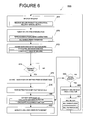
- FIG. 6 is a high-level flowchart of several methods according to various embodiments of the invention.
- FIG. 7 is a block diagram of a machine for performing any one of the example methods described herein.
- FIG. 1 is a network diagram depicting a system 10 , according to one example embodiment of the invention, using a client-server architecture.
- a network-based commerce system 12 e.g., a network-based commerce system facilitating transactions between multiple sellers and multiple buyers
- provides server-side functionality via a network 14 e.g., the Internet
- a network 14 e.g., the Internet
- clients such as a web client 16 (e.g., a browser, such as the Internet Explorer browser developed by Microsoft Corporation of Redmond, Wash. or the FireFox browser provided by Mozilla Corporation of Mountain View, Calif., or a wireless browser, as is used in the case of certain cellular telephones), and a programmatic client 18 executing on respective client machines 20 and 22 .
- a web client 16 e.g., a browser, such as the Internet Explorer browser developed by Microsoft Corporation of Redmond, Wash. or the FireFox browser provided by Mozilla Corporation of Mountain View, Calif., or a wireless browser, as is used in the case of certain
- Each of the clients 16 or 18 may further include (or provide access to) communications applications (e.g., email, instant messaging, text chat, or Voice over IP (VoIP) applications), enabling users of the commerce system 12 to communicate.
- An Application Program Interface (API) server 24 and a web server 26 may be coupled, and provide program and web interfaces respectively, to one or more application servers 28 .
- the application servers 28 may host one or more commerce applications 30 and payment applications 32 .
- the application servers 28 may, in turn, be coupled to one or more databases servers 34 that facilitate access to one or more databases 36 .
- the commerce applications 30 provide a number of commerce functions and services to users that access the commerce system 12 .
- the payment applications 32 likewise provide a number of payment services and functions to those users.
- the payment applications 32 may allow users to qualify for, and accumulate, value (e.g., in a commercial currency, such as the U.S. dollar, or a proprietary currency, such as “points”) in accounts, and then later to redeem the accumulated value for products (e.g., goods or services) that are made available via the commerce applications 30 .
- value e.g., in a commercial currency, such as the U.S. dollar, or a proprietary currency, such as “points”
- the payment applications 32 may form part of a payment service that is separate and distinct from the commerce system 12 .
- system 10 shown in FIG. 1 employs a client-server architecture
- embodiments of the invention are not limited to such, and may just as well utilize a distributed, or peer-to-peer, architecture.
- the various commerce and payment applications 30 and 32 can also be implemented as standalone software programs, with or without individual networking capabilities.
- the web client 16 may access the various commerce and payment applications 30 and 32 via the web interface supported by the web server 26 .
- the programmatic client 18 can access the various services and functions provided by the commerce and payment applications 30 and 32 via the program interface of the API server 24 .
- the programmatic client 18 may, for example, comprise a seller application (e.g., the TurboLister application developed by eBay Inc., of San Jose, Calif.) to enable sellers to author and manage listings on the commerce system 12 in an off-line manner, and to perform batch-mode communications between the programmatic client 18 and the network-based commerce system 12 .
- a seller application e.g., the TurboLister application developed by eBay Inc., of San Jose, Calif.
- a third party application 38 executing on a third party server machine 40 , may also have programmed (e.g., computer-implemented) access to the network-based commerce system 12 via the program interface of the API server 24 .
- the third party application 38 may, utilizing information retrieved from the network-based commerce system 12 , support one or more features or functions on a website hosted by the third party.
- the third party website may, for example, provide one or more promotional, commerce, or payment functions that are supported by the relevant applications of the network-based commerce system 12 .
- the third party server machine 40 may be used to host a variety of content pages 120 , such as on-line magazines, newspapers, blogs, individual web sites, and the like.
- the information included in the content pages 120 may be transmitted to the network-based commerce system 12 on a periodic basis, on request by the system 12 , or whenever new information becomes available.
- Advertising (or ads) may be transmitted from the network-based commerce system 12 to be placed in the content pages 120 according to the operation of the systems and methods described herein.
- FIG. 2 is a block diagram illustrating multiple commerce and payment applications 30 and 32 that, in an example embodiment of the invention, are provided as part of the network-based commerce system 12 .
- the commerce system 12 may provide a number of listing and price-setting mechanisms whereby a seller may list items, e.g., goods or services, for sale, a buyer can express interest in or indicate a desire to purchase such items, and a price can be set for a transaction associated with the items.
- the commerce applications 30 are shown to include one or more auction applications 44 which support auction-format listing and price setting mechanisms (e.g., English, Dutch, Vickrey, Chinese, Double, and Reverse auctions etc.).
- the various auction applications 44 may also provide a number of features in support of such auction-format listings, such as a reserve price specification feature whereby a seller may specify a reserve price in association with a listing and a proxy-bidding feature whereby a bidder may invoke automated proxy bidding.
- a reserve price specification feature whereby a seller may specify a reserve price in association with a listing
- a proxy-bidding feature whereby a bidder may invoke automated proxy bidding.
- a number of fixed-price applications 46 may support fixed-price listing formats (e.g., the traditional classified advertisement-type listing or a catalogue listing) and buyout-type listings.
- buyout-type listings e.g., including the Buy-It-Now (BIN) technology developed by eBay Inc., of San Jose, Calif.
- BIN Buy-It-Now
- auction-format listing may be offered in conjunction with an auction-format listing, and allow a buyer to purchase goods or services, which are also being offered for sale via an auction, for a fixed-price that is typically higher than the starting price of the auction.
- Store applications 48 allow sellers to group their listings within a “virtual” store, which may be branded and otherwise personalized by and for the sellers. Such a virtual store may also offer promotions, incentives and features that are specific and personalized to a relevant seller.
- Reputation applications 50 allow parties that engage in transactions utilizing the network-based commerce system 12 to establish, build, and maintain reputations, which may be made available and published to potential trading partners. For example, where the network-based commerce system 12 supports person-to-person trading, users may have no history or other reference information whereby the trustworthiness and credibility of potential trading partners may be assessed.
- the reputation applications 50 allow a user, for example through feedback provided by other transaction partners, to establish a reputation within the network-based commerce system 12 over time. Other potential trading partners may then reference the established reputation to assess credibility and trustworthiness.
- Personalization applications 52 allow users of the commerce system 12 to personalize various aspects of their interactions with the commerce system 12 . For example a user may, utilizing an appropriate personalization application 52 , create a personalized reference page where information regarding transactions, to which the user is (or has been) a party, may be viewed. Further, a personalization application 52 may enable a user to personalize listings and other aspects of their interactions with the commerce system 12 and other parties.
- the network-based commerce system 12 may support a number of commerce systems that are customized, for example, for specific geographic regions. Thus, a version of the commerce system 12 may be customized for the United Kingdom, whereas another version of the commerce system 12 may be customized for the United States. Each of these versions may operate as an independent commerce system 12 , or may be provided as customized (or internationalized) presentations associated with a single common underlying commerce system 12 .
- Navigating the network-based commerce system 12 can be facilitated by one or more navigation applications 56 .
- a search application may enable key word searches of listings published via the commerce system 12 .
- a browser application may permit users to browse various category, catalogue, or inventory data structures that operate to classify listings within the commerce system 12 .
- Various other navigation applications may be provided to supplement the search and browsing applications.
- the commerce applications 30 may include one or more imaging applications 58 that can be used to upload images for inclusion within item listings.
- An imaging application 58 may also operate to incorporate images within viewed listings.
- the imaging applications 58 can support one or more promotional features, including image galleries that are presented to potential buyers. For example, sellers may pay an additional fee to have an image included within a gallery of images for promoted items.
- Listing creation applications 60 may allow sellers to author listings having information associated with selected goods or services that are to be offered for sale as part of transactions conducted within the commerce system 12 . These listing creation applications 60 may receive offer data associated with offerings from a plurality of potential sellers.
- Listing management applications 62 allow sellers to manage one or more of the listings that may have been created using a variety of mechanisms, including the listing creation applications 60 described above. Specifically, where a particular seller has authored and/or published a large number of listings, the management of such listings may present a challenge.
- the listing management applications 62 may provide a number of features (e.g., auto-relisting, inventory level monitors, etc.) to assist the seller in managing such listings.
- One or more post-listing management applications 64 can also assist sellers with a number of activities that typically occur after an item or service has been sold. For example, upon completion of an auction facilitated by one or more auction applications 44 , a seller may wish to leave feedback regarding a particular buyer that can be accessed by other users of the system 12 . To this end, a post-listing management application 64 may provide an interface to one or more reputation applications 50 , as a convenient way for the seller to provide feedback regarding one or more buyers which have interacted with that seller.
- Messaging applications 70 can be used to generate and deliver messages to users of the network-based commerce system 12 . Such messages may be used, for example, to advise users regarding the status of item listings within the commerce system 12 (e.g., providing “you have been outbid” notices to bidders during an auction process, or to provide promotional and merchandising information to users).
- Such messages may be used, for example, to advise users regarding the status of item listings within the commerce system 12 (e.g., providing “you have been outbid” notices to bidders during an auction process, or to provide promotional and merchandising information to users).
- Merchandising applications 72 may be used to support various merchandising functions that enable sellers to increase their level of sales via the commerce system 12 .
- the merchandising applications 80 also operate the various merchandising features that may be invoked by sellers, and may be used to monitor the success of various merchandising strategies employed by sellers.
- the network-based commerce system 12 itself, or one or more parties that enter transactions using the commerce system 12 may operate loyalty programs supported by one or more loyalty/promotions applications 74 .
- a buyer may earn loyalty or promotion points for each transaction established and/or concluded with a particular seller, and offered rewards that can be redeemed using some number of accumulated loyalty points.
- Advertising applications 76 which may form a part of the merchandising applications 72 , may be used to identify seller ads to potential buyers within the system 10 . In some embodiments, a series of three operations are used to identify the ads for display.
- a request from the seller is received, perhaps including a product identification (e.g., the title of an item to be offered for sale via advertising).
- the request may also include one or more financial metrics (e.g., price at which a product is to be sold, expected gross margin, price the seller is ready to pay to display an ad for that product (e.g., display price), or price the seller is ready to pay for each end user that would click-through his ad (e.g., click-through price), price the seller is ready to pay for each lead the advertisement system sends him (e.g., lead price), etc.).
- financial metrics e.g., price at which a product is to be sold, expected gross margin, price the seller is ready to pay to display an ad for that product (e.g., display price), or price the seller is ready to pay for each end user that would click-through his ad (e.g., click-through price), price the seller is ready to pay for each lead the advertisement system sends him (e.g
- one or more identification entries matching the product identification are located in a catalog of identification entries. At least one of these is assigned to the seller, based on the use of a distance function.
- the matching identification entries, determined by the system 12 may be viewed as taking the place of “key words” selected manually by sellers in conventional systems.
- a seller ad that includes the matching identification entry is identified (and perhaps displayed) as determined by a relevance function (e.g., determined by the distance between the matching identification entry and an entry extracted from a third party content page, such as a web site page, that matches an identification entry in the catalog).
- a relevance function e.g., determined by the distance between the matching identification entry and an entry extracted from a third party content page, such as a web site page, that matches an identification entry in the catalog.
- FIG. 3 shows a block diagram of a request reception module 78 , a matching identification module 80 , an extraction module 82 , an ad identification module 86 , and a communication module 88 that may form part of the advertising applications 76 .
- FIGS. 4A and 4B are block diagrams of seller information pre-processing and ad processing activities, respectively, according to various embodiments of the invention.
- the request reception module 78 receives a request from the potential seller that includes the product identification (e.g., an item title that the seller proposes to associate with the item for sale, such as “Grayco Baby Stroller”).
- the request may also include a financial metric (e.g., $100 sale price, 10% gross profit, 5% net profit, $5 USD profit, 10 items sold with ⁇ $10 profit and 100 items sold with $10 profit, $5 for each lead received through the system (e.g., $5 lead price), $4 for each phone call received by a buyer that saw the corresponding ad (e.g., $4 phone-in price), etc.).
- Examples of potential product identification text are shown in block 130 of FIG. 4 A.
- the product identification provided by a seller may include any number of identifying elements, such as a picture, a list of attributes, and/or a title of the item to be offered for sale.
- the financial metric may include any kind of indication of the profit expected by the seller. If the financial metric is an absolute amount (e.g., $10 USD sales price), then perhaps only one number is needed. However, in some cases, the financial metric will comprise two or more numbers, such as a selected minimum price, a selling price, the cost of goods sold, a number of units to be sold at a selected loss amount, a gross profit margin, a net profit margin, a manufacturer's suggested retail price, or a target sales price, among others.
- an absolute amount e.g. $10 USD sales price
- the financial metric will comprise two or more numbers, such as a selected minimum price, a selling price, the cost of goods sold, a number of units to be sold at a selected loss amount, a gross profit margin, a net profit margin, a manufacturer's suggested retail price, or a target sales price, among others.
- the financial metric itself can be used to compute an equivalent bid/price to be paid by the seller and thus, to determine whether or not the seller's ad is the most appropriate for placement within a particular content page 120 .
- the matching identification module 80 may receive the product identification from the request reception module 78 and operate to match the product identification text with entries in a standardized catalog 132 of identification entries.
- the product identification may be “tokenized” or broken down into separate terms to accomplish this function. For example, if the item identification is “A-1 Grayco® Baby Stroller” then the resulting tokens produced by the parsing module might be: “a” and “1” and “grayco” and “baby” and “stroller”. That is, the tokenizing process may operate to accomplish any of the following actions: (a) remove all non-alphanumeric characters from the item identification; (b) change any upper-case characters to lower-case characters; and (c) extract the remaining individual terms as tokens.
- the product identification of “Xbox 2005” in block 130 may be matched with the catalog entry “2005 Xbox” in the catalog 132 .
- Matching occurs as a result of implementing a distance function, described in block 134 . That is, the product identification is compared against all of the entries in the catalog, and the entry or entries having the shortest distance from the product identification can be selected as “matching” identification entries. If there is no exact match (e.g., where the distance is zero), then the closest match will be selected (e.g., where the distance is shorter than any other comparison distance).
- the product identification supplied by the seller may comprise one or more stock keeping units (SKUs), brands, manufacturer's part numbers, a generic identification (e.g., “shoe” or “jacket”), a list of similar seller stock units, or a list of similar catalog entries included in the set of identification entries maintained in the catalog 132 .
- SKUs stock keeping units
- brand brands
- manufacturer's part numbers e.g., “shoe” or “jacket”
- a generic identification e.g., “shoe” or “jacket”
- a list of similar seller stock units e.g., “shoe” or “jacket”
- a list of similar catalog entries included in the set of identification entries maintained in the catalog 132 .
- the distance function can also be based on categories.
- categories One example of a category is “clothing and accessories.” Others, include, but are certainly not limited to: “computers and office equipment,” “motor vehicles,” and “toys.”
- the categories may be accessible in the form of a category listing tree, including sub-categories.
- sub-categories for the “computers and office equipment” category may include, but are not limited to: “laptop computers” and “desktop computers”.
- Leaf categories for laptop computers may include, but are not limited to: “14′′ screen or smaller” and “15′′ screen or larger.”
- a cluster of similar items may be located. That is, the matching identification entry may comprise a specific product identification entry, or a cluster of similar identification entries. For example, if the product identification provided by the seller is “The Best Black Leather Jacket”, then the product identification may be matched to a cluster titled “black leather jacket”, instead of trying to match up the product identification with a specific one of 10,000 types different of leather jackets. As another example, consider the product identification “Xbox 2005”; the closest clusters might be “console games,” “entertainment,” and/or “consumer electronics.”
- a search engine component 84 may be included in the matching identification module 80 to locate matching identification entries and/or clusters in the catalog 132 .
- the search engine component 84 may comprise any number and type of search engines known to those of skill in the art.
- the extraction module 82 operates to extract catalog 132 identification entries from content pages 120 . For example, if a third party maintains content pages 120 on a network, and has an advertising arrangement with the provider of the network-based commerce system 12 (see FIG. 1 ), then the third party may make advertising space available to the provider within the content pages 120 . To determine which ads will be placed in the content pages 120 , identification entries (taken from the same set of catalog 132 entries that have been matched to seller product identifications, or at least, to those identification entries and/or clusters closest in distance to them) are extracted from the information contained in the content pages 120 .
- the information on the content pages 120 might be “fan of xbox games”.
- the most relevant entries in the catalog 132 might be “Xbox” (more relevant) and “Playstation” (less relevant).
- the ad identification module 86 may now operate to compute, for each product identified by the product extractor function 144 , the most relevant ads for those products. Identification involves the use of a relevance function that depends on the financial metric (e.g., how much the seller willing to pay to have his ad placed on a content page 120 or how much he is ready to pay for each lead sent to him as a result of displaying his ad) and a distance measured between the matching identification entries shown in the catalog 132 of FIGS. 4A-4B , and one or more of the extracted identification entries that have been extracted from the content pages 120 (and are included in the set of identification entries of the catalog 132 ).
- a relevance function that depends on the financial metric (e.g., how much the seller willing to pay to have his ad placed on a content page 120 or how much he is ready to pay for each lead sent to him as a result of displaying his ad) and a distance measured between the matching identification entries shown in the catalog 132 of FIGS. 4A
- the ad identification module 86 may include one or more search engine components 84 to locate relevant seller ads for placement on the content pages 120 . Ads may also be deemed more relevant when the advertised items contained therein are part of a selected product cluster, such as a product cluster that has been extracted from the content pages 120 .
- Euclidean space is a generalization of the 2- and 3-dimensional spaces studied by Euclid.
- the generalization applies Euclid's concept of distance, and the related concepts of length and angle, to a coordinate system in any number of dimensions. It is an example of a finite-dimensional, real, inner product space.
- an apparatus and system can map all the N possible product attributes (e.g., color, size, category, condition (e.g., new or used), location, shipping costs, etc.) into an N-dimensional Euclid space. Then the distance function can be defined in the Euclidean N-space.
- weights may be added for specific attributes according to relative importance with respect to distance and to the designer of the apparatus and systems described (e.g., for instance, the distance or difference between two items of two different categories may be much more important than the distance/difference between of the same items having two different colors).
- the communication module 88 which may form a part of the messaging applications 70 (shown in FIG. 2 ), may be used to communicate requests, or parts of requests (e.g., the product identification, such as the item title; and the financial metric) to the request reception module 78 .
- the communication module 88 may also be used to receive and communicate ads selected for display at block 146 (as determined by the relevance function of block 148 ) to the third party that maintains content pages 120 having available advertising space.
- a system 12 may include an interface (e.g., the request reception module 78 ) to receive one or more requests from a seller. Each request may include a product identification and/or a financial metric.
- the system 12 may include a catalog component including a set of identification entries (e.g., the catalog 132 ).
- the system 12 may also include one or more modules (e.g., such as an advertising module 330 shown in FIG. 6 , perhaps included as part of the application server(s) 28 ) to assign to the seller, based on a distance function and the product identification, a matching identification entry included in the set of identification entries. That is, the distance function may be used to indicate the degree of similarity between the product identification received from the seller, and the numerous identification entries in the catalog 132 .
- the module 330 may also operate to identify one or more seller ads associated with the matching identification entry, determined by a relevance function based on the financial metric and a distance measured between the matching identification entry and the extracted identification entries extracted from the content pages 120 (and included in the set of identification entries in the catalog 123 ).
- the interface may comprise a network communications interface, such as a computer, a server, or a network interface card, either wired or wireless.
- the system 12 may include one or more database components, including tables (e.g., the tables 90 shown in FIG. 4 which may be stored and accessed as part of the database server(s) 34 and/or database(s) 36 of FIG. 1 ).
- the system 12 may also include one or more search engine components (e.g., search engine component 84 ) to locate matching identifications, and relevant seller ads.
- the system 12 may have one or more servers (e.g., database server(s) 34 in FIG. 1 ) that include the catalog component 132 (of FIGS. 4A-4B ).
- the system 12 may also have one or more servers that include the interface to receive the request from the seller (e.g., the web server 26 in FIG. 1 ).
- the seller e.g., the web server 26 in FIG. 1
- Many other arrangements are possible.
- FIG. 5 is a high-level entity-relationship diagram, illustrating various tables 90 that may be maintained within the database servers 34 and databases 36 , and that are utilized by the commerce and payment applications 30 and 32 .
- a user table 92 may contain one or more records for each registered user of the network-based commerce system 12 , and may include identifier, address and financial instrument information pertaining to each such registered user.
- a user may, it will be appreciated, operate as a seller, a buyer, or both, within the network-based commerce system 12 .
- a buyer is a user that has accumulated value (e.g., commercial or proprietary currency), and is then able to exchange the accumulated value for items that are offered for sale within the network-based commerce system 12 .
- a user may also be a seller.
- a seller is a user that has at least one item to offer for sale within the network-based commerce system 12 . At different times, sellers may register as buyers, and buyers may register as sellers. Separate tables 90 may be maintained for buyers and sellers.
- the tables 90 also include an items table 94 in which are maintained item records for offerings, i.e. goods and services that are available to be, or have been, sold, via the commerce system 12 .
- Each item record within the items table 94 may furthermore be linked to one or more user records within the user table 92 , so as to associate a seller and one or more actual or potential buyers with each item record.
- Each item record includes offer data which includes seller identification data (linked or obtained from the user table 92 ) and offering identification data that provides detailed information on each offering, such as the seller product identification. For example, a description of the goods or service offered or sold (e.g., item title) may be provided, together with a photograph or other information relating to the offering.
- a transaction table 96 contains a record for each transaction (e.g., a purchase transaction) pertaining to items for which records exist within the items table 94 .
- An order table 98 is populated with order records, each order record being associated with an order. Each order, in turn, may be associated with one or more transactions for which records exist within the transactions table 96 .
- One or more attributes tables 106 may be used to record attribute information pertaining to items for which records exist within the items table 94 .
- the attributes tables 106 may indicate a brand attribute associated with a particular item, the brand attribute identifying a licensor or manufacturer of the relevant item as specified by a seller.
- Other attributes may include size, shape, color, construction material, country of manufacture, etc.
- the catalog 108 may form a part of the items table 94 , or exist as a separate entity. In some embodiments, the catalog 108 includes identification entries for some or all of the items that have been sold within the network-based commerce system 12 .
- the catalog 108 may be similar to or identical to the catalog 132 shown in FIGS. 4A-4B .
- the seller table 110 may be populated with a list of sellers, their associated financial metrics, and/or their associated ads (that are used to advertise the items for sale, previously identified by product identifications).
- the system 12 may include a catalog component 108 , 132 , perhaps maintained as a database in database(s) 36 and/or database server(s) 34 , that include at least a portion of the set of identification entries, which may comprise some or all of the items that have been sold, and/or currently offered for sale within the network-based commerce system 12 .
- the system 12 may include one or more search components (e.g., the navigation applications 56 shown in FIG. 1 , or one or more search engine components 84 as shown in FIG. 3 ) to locate matching identification entries included in the set of identification entries, as well as to locate relevant ads for placement within contact pages 120 .
- search components e.g., the navigation applications 56 shown in FIG. 1 , or one or more search engine components 84 as shown in FIG. 3
- the method 500 may begin with receiving a request from a seller that includes the product identification at block 568 .
- the request may also include a desired financial metric.
- the product identification (e.g., the item title) may be tokenized, or partitioned into tokens.
- the process of tokenizing the product identification may include removing all non-alphanumeric characters and/or converting all characters to lower-case characters.
- the method 500 may include parsing the product identification to identify one or more tokens, which may in turn include removing non-alphanumeric characters from the item identification or tokens (if the tokens have already been extracted by parsing), and/or converting all remaining characters in the item identification or tokens to lower case characters.
- Table I illustrates a few examples of seller product identifications, and the equivalent token content:
- the method 500 may include assigning to the seller a matching identification entry included in a set of identification entries.
- the assignment may be based on a distance function and the product identification, that is, a measure of the distance between the product identification and the various entries in the catalog of identification entries.
- the identification entry in the catalog that is the shortest distance from the product identification should be chosen.
- assigning the matching identification entry to the seller may include selecting the matching identification entry from a specific product identification entry, or a cluster of similar identification entries if no specific product identification entry is closer in distance to the product identification provided by the seller.
- the distance function may be calculated based on product categories associated with the matching identification entry.
- the distance function may also be calculated based on product attributes associated with the matching identification entry and/or product attribute values associated with the matching identification entry.
- the method 500 may continue at block 574 with receiving a request to fill advertising space included in a content page. If no request is received the method 500 will continue at block 574 until a request is received.
- the method 500 may continue at block 576 with extracting information in the form of an extracted identification entry included in the set of identification entries (e.g., from the catalog 108 of FIG. 5 ) from the content page that is associated with a request for ad placement.
- the method 500 may also include extracting one or more additional identification entries included in the set of identification entries (in the catalog).
- the method 500 may include ranking the extracted identification entry and the additional identification entries at block 578 based on relevance of the extracted entries to the set of identification entries included in the catalog. For example, if the catalog identification entry term “playstation” appears 10 times in the content page, while the term “xbox” appears five times, and the term “gamestation” appears only once, then ranking the identification entries in this case might include placing “playstation” first, “xbox” second, and “gamestation” third.
- the method 500 may include, at block 582 , comparing a bill to be sent to the seller to the budget remaining for that seller.
- the budget comparison may also be made in response to receiving a selection of an item associated with the product identification, as may occur when the initial request for ad placement in a content page is received.
- the item selected in this case would be associated with one of the entries in the catalog of item identifications.
- a new ad (e.g., associated with the same seller and a different financial metric, or even another seller) may be identified at block 580 . If the bill is within the seller's budget, as determined at block 586 , then the method 500 may continue with placing the ad in the content page associated with the request and conducting a sale of the seller's item on-line at block 588 , either directly, or perhaps using an auction format. Thus, the method 500 may include conducting an on-line auction within a network-based commerce system with respect to a plurality of products including one or more items associated with the product identification provided by the seller at block 568 .
- the method 500 may include billing the seller according to the financial metric when an item offered for sale by the seller (and associated with the product identification) is advertised on the selected content page (i.e., when the ad is placed).
- the method 500 may also include billing the seller according to the financial metric when an item offered for sale by the seller (and associated with the product identification) is purchased via the selected content page (i.e., when the item offered for sale is purchased), among others.
- FIG. 7 shows a block diagram of a machine in the example form of a computer system 300 within which a set of instructions 324 , for causing the machine to perform any one or more of the methods discussed herein, may be stored, accessed, and executed.
- the machine operates as a standalone device or may be connected (e.g., networked) to other machines.
- the machine may operate in the capacity of a server machine, or as a client machine in server-client network environment, or even as a peer machine in a peer-to-peer (or distributed) network environment.
- the example computer system 300 includes one or more processors 302 (e.g., one or more central processing units (CPUs) and a graphics processing unit (GPU), or both), a main memory 304 and a static memory 306 , which may communicate with each other directly, or using a bus 308 .
- the computer system 300 may further include a video display unit 310 (e.g., a flat panel display, such as a liquid crystal display (LCD), or a cathode ray tube (CRT)).
- the disk drive unit 316 may include one or more machine-readable media 322 having one or more sets of instructions 324 (e.g., software) stored thereon, embodying any one or more of the methods or functions described herein.
- the instructions 324 may also reside, completely or at least partially, within the main memory 304 and/or within the processor 302 during execution thereof by the computer system 300 , the main memory 304 and the processor 302 also constituting machine-readable media.
- the instructions 324 may further be transmitted or received over a network 326 via the network interface device 320 .
- the network 326 may be similar to or identical to the network 14 of FIG. 1 .
- machine-readable medium may be used herein interchangeably with the term “computer-readable medium.”
- the system 10 may include a computer-readable medium having instructions 324 stored thereon which, when executed by a computer, cause the computer to perform any of the methods described herein.
- the computer-readable medium may be located in a desktop computer, a server, a laptop computer, or a cellular telephone, among other items.
- a system 12 and method 500 to identify seller ads to potential buyers within a network-based commerce system have been described.
- Implementing the system 12 and method 500 may result in the ability to select seller ads for placement within content pages without the manual selection of key words by the seller.
Landscapes
- Business, Economics & Management (AREA)
- Strategic Management (AREA)
- Engineering & Computer Science (AREA)
- Accounting & Taxation (AREA)
- Development Economics (AREA)
- Finance (AREA)
- Physics & Mathematics (AREA)
- Economics (AREA)
- Game Theory and Decision Science (AREA)
- Marketing (AREA)
- Entrepreneurship & Innovation (AREA)
- General Business, Economics & Management (AREA)
- General Physics & Mathematics (AREA)
- Theoretical Computer Science (AREA)
- Probability & Statistics with Applications (AREA)
- Management, Administration, Business Operations System, And Electronic Commerce (AREA)
Priority Applications (8)
| Application Number | Priority Date | Filing Date | Title |
|---|---|---|---|
| US11/321,540 US8301499B2 (en) | 2005-12-29 | 2005-12-29 | Product-based advertising |
| EP06839147A EP1938263A4 (de) | 2005-12-29 | 2006-12-07 | Produktbasierte reklame |
| PCT/US2006/046698 WO2007078561A2 (en) | 2005-12-29 | 2006-12-07 | Product-based advertising |
| US13/659,143 US8515812B2 (en) | 2005-12-29 | 2012-10-24 | Product-based advertising |
| US13/891,272 US8775239B2 (en) | 2005-12-29 | 2013-05-10 | Product-based advertising |
| US14/292,007 US9280786B2 (en) | 2005-12-29 | 2014-05-30 | Product-based advertising |
| US15/063,176 US10586248B2 (en) | 2005-12-29 | 2016-03-07 | Product-based content |
| US16/801,897 US10902460B2 (en) | 2005-12-29 | 2020-02-26 | Product-based advertising |
Applications Claiming Priority (1)
| Application Number | Priority Date | Filing Date | Title |
|---|---|---|---|
| US11/321,540 US8301499B2 (en) | 2005-12-29 | 2005-12-29 | Product-based advertising |
Related Child Applications (1)
| Application Number | Title | Priority Date | Filing Date |
|---|---|---|---|
| US13/659,143 Continuation US8515812B2 (en) | 2005-12-29 | 2012-10-24 | Product-based advertising |
Publications (2)
| Publication Number | Publication Date |
|---|---|
| US20070156516A1 US20070156516A1 (en) | 2007-07-05 |
| US8301499B2 true US8301499B2 (en) | 2012-10-30 |
Family
ID=38225722
Family Applications (6)
| Application Number | Title | Priority Date | Filing Date |
|---|---|---|---|
| US11/321,540 Active 2031-02-10 US8301499B2 (en) | 2005-12-29 | 2005-12-29 | Product-based advertising |
| US13/659,143 Expired - Fee Related US8515812B2 (en) | 2005-12-29 | 2012-10-24 | Product-based advertising |
| US13/891,272 Expired - Lifetime US8775239B2 (en) | 2005-12-29 | 2013-05-10 | Product-based advertising |
| US14/292,007 Active 2026-06-27 US9280786B2 (en) | 2005-12-29 | 2014-05-30 | Product-based advertising |
| US15/063,176 Active 2028-02-01 US10586248B2 (en) | 2005-12-29 | 2016-03-07 | Product-based content |
| US16/801,897 Expired - Lifetime US10902460B2 (en) | 2005-12-29 | 2020-02-26 | Product-based advertising |
Family Applications After (5)
| Application Number | Title | Priority Date | Filing Date |
|---|---|---|---|
| US13/659,143 Expired - Fee Related US8515812B2 (en) | 2005-12-29 | 2012-10-24 | Product-based advertising |
| US13/891,272 Expired - Lifetime US8775239B2 (en) | 2005-12-29 | 2013-05-10 | Product-based advertising |
| US14/292,007 Active 2026-06-27 US9280786B2 (en) | 2005-12-29 | 2014-05-30 | Product-based advertising |
| US15/063,176 Active 2028-02-01 US10586248B2 (en) | 2005-12-29 | 2016-03-07 | Product-based content |
| US16/801,897 Expired - Lifetime US10902460B2 (en) | 2005-12-29 | 2020-02-26 | Product-based advertising |
Country Status (3)
| Country | Link |
|---|---|
| US (6) | US8301499B2 (de) |
| EP (1) | EP1938263A4 (de) |
| WO (1) | WO2007078561A2 (de) |
Cited By (13)
| Publication number | Priority date | Publication date | Assignee | Title |
|---|---|---|---|---|
| US20100131966A1 (en) * | 2008-11-21 | 2010-05-27 | Samsung Electronics Co., Ltd. | Flat or extended architecture using an integrated application and operating system component for computing systems and environments |
| US20120066055A1 (en) * | 2010-09-13 | 2012-03-15 | Ebay Inc. | Generating a user interface based on predicted revenue yield |
| US8515812B2 (en) | 2005-12-29 | 2013-08-20 | Ebay Inc. | Product-based advertising |
| US20140316853A1 (en) * | 2013-04-23 | 2014-10-23 | Philip Scott Lyren | Determine a Product from Private Information of a User |
| US9953085B1 (en) | 2013-05-31 | 2018-04-24 | Google Llc | Feed upload for search entity based content selection |
| US10586127B1 (en) | 2011-11-14 | 2020-03-10 | Google Llc | Extracting audiovisual features from content elements on online documents |
| US10943184B2 (en) * | 2017-09-14 | 2021-03-09 | Amadeus S.A.S. | Machine learning methods and systems for predicting online user interactions |
| US11030239B2 (en) | 2013-05-31 | 2021-06-08 | Google Llc | Audio based entity-action pair based selection |
| US11087424B1 (en) | 2011-06-24 | 2021-08-10 | Google Llc | Image recognition-based content item selection |
| US11093692B2 (en) | 2011-11-14 | 2021-08-17 | Google Llc | Extracting audiovisual features from digital components |
| US11100538B1 (en) | 2011-06-24 | 2021-08-24 | Google Llc | Image recognition based content item selection |
| US11120480B2 (en) | 2017-09-14 | 2021-09-14 | Amadeus S.A.S. | Systems and methods for real-time online traveler segmentation using machine learning |
| US11949733B2 (en) | 2016-12-30 | 2024-04-02 | Google Llc | Audio-based data structure generation |
Families Citing this family (38)
| Publication number | Priority date | Publication date | Assignee | Title |
|---|---|---|---|---|
| US7801949B2 (en) * | 2006-06-09 | 2010-09-21 | Ebay Inc. | Configurable interfaces |
| US9804861B2 (en) * | 2006-06-09 | 2017-10-31 | Paypal, Inc. | Configurable interfaces |
| US20080109274A1 (en) * | 2006-11-03 | 2008-05-08 | Yahoo! Inc. | System and method for predicting a casing variation of a term |
| US9186073B2 (en) * | 2006-11-15 | 2015-11-17 | Measurement Ltd. | Removable handheld unit |
| US20080208674A1 (en) * | 2007-02-27 | 2008-08-28 | Hamilton Rick A | Targeting advertising content in a virtual universe (vu) |
| US8347235B2 (en) | 2008-09-26 | 2013-01-01 | International Business Machines Corporation | Method and system of providing information during content breakpoints in a virtual universe |
| US20100138227A1 (en) * | 2008-12-01 | 2010-06-03 | International Business Machines Corporation | System and method to dynamically place products in a virtual universe |
| US20100153278A1 (en) * | 2008-12-16 | 2010-06-17 | Farsedakis Lewis E | Web sites that introduce a seller to a universe of buyers, web sites that receive a buyer's listing of what he wants to buy, other introduction web sites, systems using introduction web sites and internet-based introductions |
| US8788524B1 (en) * | 2009-05-15 | 2014-07-22 | Wolfram Alpha Llc | Method and system for responding to queries in an imprecise syntax |
| US20100299213A1 (en) * | 2009-05-21 | 2010-11-25 | Shervin Yeganeh | System and method for providing internet based advertising in a retail environment |
| CN101923619A (zh) * | 2009-06-15 | 2010-12-22 | 鸿富锦精密工业(深圳)有限公司 | 密码按键伪装系统及方法 |
| US20110213661A1 (en) * | 2010-03-01 | 2011-09-01 | Joseph Milana | Computer-Implemented Method For Enhancing Product Sales |
| US8682883B2 (en) * | 2011-04-14 | 2014-03-25 | Predictix Llc | Systems and methods for identifying sets of similar products |
| US9734252B2 (en) | 2011-09-08 | 2017-08-15 | Wolfram Alpha Llc | Method and system for analyzing data using a query answering system |
| US9111290B2 (en) * | 2011-11-30 | 2015-08-18 | Microsoft Technology Licensing, Llc | Managing targeted customer loyalty promotions |
| US20130218685A1 (en) * | 2012-02-16 | 2013-08-22 | Telefonaktiebolaget L M Ericsson (Publ) | Offering an Object For Sale |
| US9336302B1 (en) | 2012-07-20 | 2016-05-10 | Zuci Realty Llc | Insight and algorithmic clustering for automated synthesis |
| US20150058119A1 (en) * | 2013-08-22 | 2015-02-26 | SocialWire, Inc. | Automated Advertisement of Products on Online Sites |
| CN105450583B (zh) | 2014-07-03 | 2019-07-05 | 阿里巴巴集团控股有限公司 | 一种信息认证的方法及装置 |
| CN105446992A (zh) * | 2014-07-08 | 2016-03-30 | 阿里巴巴集团控股有限公司 | 建立商品对象回收信息数据库、确定价值信息方法及装置 |
| CN105450411B (zh) | 2014-08-14 | 2019-01-08 | 阿里巴巴集团控股有限公司 | 利用卡片特征进行身份验证的方法、装置及系统 |
| CN105719183A (zh) | 2014-12-03 | 2016-06-29 | 阿里巴巴集团控股有限公司 | 定向转账方法及其装置 |
| CN105869043A (zh) | 2015-01-19 | 2016-08-17 | 阿里巴巴集团控股有限公司 | 分散热点的数据库账户转入、转出的记账方法及装置 |
| CN105989467A (zh) | 2015-02-03 | 2016-10-05 | 阿里巴巴集团控股有限公司 | 无线支付方法与装置及交通工具乘坐费检验方法与系统 |
| KR20160098706A (ko) * | 2015-02-11 | 2016-08-19 | 에스케이플래닛 주식회사 | 사물 인식 기반 리타게팅 광고 상품 추천 단말과 서버, 그를 포함하는 광고 상품 추천 시스템, 그의 제어 방법 및 컴퓨터 프로그램이 기록된 기록매체 |
| KR20160129234A (ko) * | 2015-04-30 | 2016-11-09 | 에스케이플래닛 주식회사 | 리타게팅 광고 상품 추천 사용자 장치와 서비스 제공 장치, 그를 포함하는 광고 상품 추천 시스템, 그의 제어 방법 및 컴퓨터 프로그램이 기록된 기록매체 |
| CN106570009B (zh) | 2015-10-09 | 2020-07-28 | 阿里巴巴集团控股有限公司 | 导航类目更新方法及装置 |
| US10129107B2 (en) | 2015-11-16 | 2018-11-13 | Hipmunk, Inc. | Interactive sharing of sharable item |
| US9965149B2 (en) | 2015-11-16 | 2018-05-08 | Hipmunk Inc. | Linking allocable region of graphical user interface |
| US11205103B2 (en) | 2016-12-09 | 2021-12-21 | The Research Foundation for the State University | Semisupervised autoencoder for sentiment analysis |
| US10481199B2 (en) * | 2017-12-01 | 2019-11-19 | Applied Materials, Inc. | Data analytics and computational analytics for semiconductor process control |
| CN108734371A (zh) | 2018-02-12 | 2018-11-02 | 阿里巴巴集团控股有限公司 | 一种针对风控指令的处理方法、装置及设备 |
| CN112818250B (zh) | 2018-03-07 | 2024-03-08 | 创新先进技术有限公司 | 一种内容推荐方法、装置、电子设备及系统 |
| CN108632348B (zh) | 2018-03-19 | 2020-02-18 | 阿里巴巴集团控股有限公司 | 一种业务校验方法和装置 |
| US10706275B2 (en) * | 2018-05-02 | 2020-07-07 | Informed, Inc. | System and method for stipulation collection using a short message service (SMS) and mobile device cameras with real-time analysis of documents |
| US11257100B2 (en) * | 2018-12-18 | 2022-02-22 | Sap Se | Product optimization crawler and monitor |
| US11928878B2 (en) | 2020-08-26 | 2024-03-12 | Informed, Inc. | System and method for domain aware document classification and information extraction from consumer documents |
| KR102610033B1 (ko) * | 2023-01-26 | 2023-12-05 | 주식회사 코니아랩 | 이커머스 기반의 예상 수익 정보 제공 방법 및 이를 수행하기 위한 컴퓨팅 장치 |
Citations (4)
| Publication number | Priority date | Publication date | Assignee | Title |
|---|---|---|---|---|
| US20010032128A1 (en) * | 1999-12-23 | 2001-10-18 | Jonathan Kepecs | Techniques for optimizing promotion delivery |
| US20020077901A1 (en) * | 2000-12-19 | 2002-06-20 | Catalina Marketing International, Inc. | Paired promotion architecture |
| US20050065811A1 (en) * | 2003-09-24 | 2005-03-24 | Verizon Directories Corporation | Business rating placement heuristic |
| WO2007078561A2 (en) | 2005-12-29 | 2007-07-12 | Ebay Inc. | Product-based advertising |
Family Cites Families (2)
| Publication number | Priority date | Publication date | Assignee | Title |
|---|---|---|---|---|
| US7047236B2 (en) | 2002-12-31 | 2006-05-16 | International Business Machines Corporation | Method for automatic deduction of rules for matching content to categories |
| US7870031B2 (en) | 2005-12-22 | 2011-01-11 | Ebay Inc. | Suggested item category systems and methods |
-
2005
- 2005-12-29 US US11/321,540 patent/US8301499B2/en active Active
-
2006
- 2006-12-07 WO PCT/US2006/046698 patent/WO2007078561A2/en not_active Ceased
- 2006-12-07 EP EP06839147A patent/EP1938263A4/de not_active Withdrawn
-
2012
- 2012-10-24 US US13/659,143 patent/US8515812B2/en not_active Expired - Fee Related
-
2013
- 2013-05-10 US US13/891,272 patent/US8775239B2/en not_active Expired - Lifetime
-
2014
- 2014-05-30 US US14/292,007 patent/US9280786B2/en active Active
-
2016
- 2016-03-07 US US15/063,176 patent/US10586248B2/en active Active
-
2020
- 2020-02-26 US US16/801,897 patent/US10902460B2/en not_active Expired - Lifetime
Patent Citations (5)
| Publication number | Priority date | Publication date | Assignee | Title |
|---|---|---|---|---|
| US20010032128A1 (en) * | 1999-12-23 | 2001-10-18 | Jonathan Kepecs | Techniques for optimizing promotion delivery |
| US20020077901A1 (en) * | 2000-12-19 | 2002-06-20 | Catalina Marketing International, Inc. | Paired promotion architecture |
| US20050065811A1 (en) * | 2003-09-24 | 2005-03-24 | Verizon Directories Corporation | Business rating placement heuristic |
| WO2007078561A2 (en) | 2005-12-29 | 2007-07-12 | Ebay Inc. | Product-based advertising |
| WO2007078561A3 (en) | 2005-12-29 | 2007-11-22 | Ebay Inc | Product-based advertising |
Non-Patent Citations (3)
| Title |
|---|
| Hawking, David, et al., "Relevance Weighting Using Distance Between Term Occurrences", TR-CS-96-08, The Australian National University, Joint Computer Science Technical Report Series,(Aug. 1996),1-20. |
| Hertz, Tomer, et al., "Boosting Margin Based Distance Functions for Clustering", Proceedings of the Twenty-First International Conference on Machine Learning, (1-8),2004. |
| Wilson, D. R., et al., "Improved Heterogeneous Distance Functions", Journal of Artificial Intelligence Research, 6, (1997),1-34. |
Cited By (20)
| Publication number | Priority date | Publication date | Assignee | Title |
|---|---|---|---|---|
| US9280786B2 (en) | 2005-12-29 | 2016-03-08 | Ebay Inc. | Product-based advertising |
| US10902460B2 (en) | 2005-12-29 | 2021-01-26 | Ebay Inc. | Product-based advertising |
| US8515812B2 (en) | 2005-12-29 | 2013-08-20 | Ebay Inc. | Product-based advertising |
| US8775239B2 (en) | 2005-12-29 | 2014-07-08 | Ebay Inc. | Product-based advertising |
| US10586248B2 (en) | 2005-12-29 | 2020-03-10 | Ebay Inc. | Product-based content |
| US8924987B2 (en) * | 2008-11-21 | 2014-12-30 | Samsung Electronics Co., Ltd. | Flat or extended architecture using an integrated application and operating system component for computing systems and environments |
| US20100131966A1 (en) * | 2008-11-21 | 2010-05-27 | Samsung Electronics Co., Ltd. | Flat or extended architecture using an integrated application and operating system component for computing systems and environments |
| US20120066055A1 (en) * | 2010-09-13 | 2012-03-15 | Ebay Inc. | Generating a user interface based on predicted revenue yield |
| US11593906B2 (en) | 2011-06-24 | 2023-02-28 | Google Llc | Image recognition based content item selection |
| US11100538B1 (en) | 2011-06-24 | 2021-08-24 | Google Llc | Image recognition based content item selection |
| US11087424B1 (en) | 2011-06-24 | 2021-08-10 | Google Llc | Image recognition-based content item selection |
| US11093692B2 (en) | 2011-11-14 | 2021-08-17 | Google Llc | Extracting audiovisual features from digital components |
| US10586127B1 (en) | 2011-11-14 | 2020-03-10 | Google Llc | Extracting audiovisual features from content elements on online documents |
| US20140316853A1 (en) * | 2013-04-23 | 2014-10-23 | Philip Scott Lyren | Determine a Product from Private Information of a User |
| US11030239B2 (en) | 2013-05-31 | 2021-06-08 | Google Llc | Audio based entity-action pair based selection |
| US10007703B1 (en) | 2013-05-31 | 2018-06-26 | Google Llc | Feed upload for search entity based content selection |
| US9953085B1 (en) | 2013-05-31 | 2018-04-24 | Google Llc | Feed upload for search entity based content selection |
| US11949733B2 (en) | 2016-12-30 | 2024-04-02 | Google Llc | Audio-based data structure generation |
| US10943184B2 (en) * | 2017-09-14 | 2021-03-09 | Amadeus S.A.S. | Machine learning methods and systems for predicting online user interactions |
| US11120480B2 (en) | 2017-09-14 | 2021-09-14 | Amadeus S.A.S. | Systems and methods for real-time online traveler segmentation using machine learning |
Also Published As
| Publication number | Publication date |
|---|---|
| US20200265469A1 (en) | 2020-08-20 |
| US20130246172A1 (en) | 2013-09-19 |
| EP1938263A4 (de) | 2009-11-18 |
| US10586248B2 (en) | 2020-03-10 |
| EP1938263A2 (de) | 2008-07-02 |
| WO2007078561A2 (en) | 2007-07-12 |
| US8515812B2 (en) | 2013-08-20 |
| US8775239B2 (en) | 2014-07-08 |
| US20140278988A1 (en) | 2014-09-18 |
| US9280786B2 (en) | 2016-03-08 |
| US20070156516A1 (en) | 2007-07-05 |
| US20130054321A1 (en) | 2013-02-28 |
| US20160189208A1 (en) | 2016-06-30 |
| US10902460B2 (en) | 2021-01-26 |
| WO2007078561A3 (en) | 2007-11-22 |
Similar Documents
| Publication | Publication Date | Title |
|---|---|---|
| US10902460B2 (en) | Product-based advertising | |
| US20250068636A1 (en) | Selective presentation of data items | |
| US7870031B2 (en) | Suggested item category systems and methods | |
| US20220230150A1 (en) | Application recommendation engine | |
| US7980466B2 (en) | Point-of-sale promotions | |
| US8694363B2 (en) | Dynamically creating a context based advertisement | |
| US20080183596A1 (en) | Bid system for presentation of data items | |
| US20050144071A1 (en) | Method and apparatus to facilitate the electronic accumulation and redemption of a value in an account | |
| US9460212B2 (en) | System and method for personalized search | |
| US20130054325A1 (en) | Mobile platform for redeeming deals | |
| US20040015415A1 (en) | System, program product, and method for comparison shopping with dynamic pricing over a network | |
| US20120197722A1 (en) | Group buying search | |
| US20130073335A1 (en) | System and method for linking keywords with user profiling and item categories | |
| US11756088B2 (en) | Displaying listings based on listing activity | |
| US20080120160A1 (en) | Method and system for listing an item | |
| US10311488B2 (en) | System and method for providing automatic high-value listing feeds for online computer users | |
| US20060271387A1 (en) | System for providing a user with shipping information | |
| US20130091020A1 (en) | System and method for enabling revenue from advertisers to publishers in an ad network |
Legal Events
| Date | Code | Title | Description |
|---|---|---|---|
| AS | Assignment |
Owner name: EBAY INC., CALIFORNIA Free format text: ASSIGNMENT OF ASSIGNORS INTEREST;ASSIGNORS:MOISSINAC, HENRI;PEILE, LAURA ROBYN;WONG, JEFFREY;REEL/FRAME:017425/0460;SIGNING DATES FROM 20051221 TO 20051227 Owner name: EBAY INC., CALIFORNIA Free format text: ASSIGNMENT OF ASSIGNORS INTEREST;ASSIGNORS:MOISSINAC, HENRI;PEILE, LAURA ROBYN;WONG, JEFFREY;SIGNING DATES FROM 20051221 TO 20051227;REEL/FRAME:017425/0460 |
|
| AS | Assignment |
Owner name: EBAY INC., CALIFORNIA Free format text: ASSIGNMENT OF ASSIGNORS INTEREST;ASSIGNOR:AQRAOU, JACOB;REEL/FRAME:017979/0794 Effective date: 20060406 |
|
| FEPP | Fee payment procedure |
Free format text: PAYOR NUMBER ASSIGNED (ORIGINAL EVENT CODE: ASPN); ENTITY STATUS OF PATENT OWNER: LARGE ENTITY |
|
| STCF | Information on status: patent grant |
Free format text: PATENTED CASE |
|
| CC | Certificate of correction | ||
| FPAY | Fee payment |
Year of fee payment: 4 |
|
| MAFP | Maintenance fee payment |
Free format text: PAYMENT OF MAINTENANCE FEE, 8TH YEAR, LARGE ENTITY (ORIGINAL EVENT CODE: M1552); ENTITY STATUS OF PATENT OWNER: LARGE ENTITY Year of fee payment: 8 |
|
| MAFP | Maintenance fee payment |
Free format text: PAYMENT OF MAINTENANCE FEE, 12TH YEAR, LARGE ENTITY (ORIGINAL EVENT CODE: M1553); ENTITY STATUS OF PATENT OWNER: LARGE ENTITY Year of fee payment: 12 |