US8280897B2 - Methods and systems for assessing project management offices - Google Patents
Methods and systems for assessing project management offices Download PDFInfo
- Publication number
- US8280897B2 US8280897B2 US12/363,419 US36341909A US8280897B2 US 8280897 B2 US8280897 B2 US 8280897B2 US 36341909 A US36341909 A US 36341909A US 8280897 B2 US8280897 B2 US 8280897B2
- Authority
- US
- United States
- Prior art keywords
- maturity
- project management
- capabilities
- information
- pmo
- Prior art date
- Legal status (The legal status is an assumption and is not a legal conclusion. Google has not performed a legal analysis and makes no representation as to the accuracy of the status listed.)
- Expired - Fee Related, expires
Links
Images




Classifications
-
- G—PHYSICS
- G06—COMPUTING OR CALCULATING; COUNTING
- G06Q—INFORMATION AND COMMUNICATION TECHNOLOGY [ICT] SPECIALLY ADAPTED FOR ADMINISTRATIVE, COMMERCIAL, FINANCIAL, MANAGERIAL OR SUPERVISORY PURPOSES; SYSTEMS OR METHODS SPECIALLY ADAPTED FOR ADMINISTRATIVE, COMMERCIAL, FINANCIAL, MANAGERIAL OR SUPERVISORY PURPOSES, NOT OTHERWISE PROVIDED FOR
- G06Q10/00—Administration; Management
- G06Q10/10—Office automation; Time management
Definitions
- Methods and systems consistent with embodiments of the present invention relate to assessing and evaluating Project Management Offices of organizations, and providing recommendations for making improvements thereto.
- PMOs Project Management Offices
- Project Management Offices exist in numerous forms, and are given different names, within organizations. While the name Project Management Office is most commonly used to refer to PMOs, other names include Project Office, Project Department, Project Support Office, Program Management Office, and Center of Excellence. Other organizations give PMOs no name at all.
- a PMO is an entity within or parallel to an organization that has responsibilities related to the design, implementation, or review of a project undertaken by the organization. Responsibilities of a typical PMO include initiating and staffing a project, assessing progress made on the project, making decisions relating to the implementation of the project, providing project updates to other entities within or outside the organization, and coordinating or integrating one project with other projects, among many other responsibilities. In some PMOs, only a single project is managed. In other PMOs, multiple projects—perhaps even all of an organization's projects—are managed simultaneously. PMOs also differ in whether they include project managers, as opposed to only non-manager workers.
- PMOs exist in a wide variety of organizational settings. From for-profit businesses, to non-profit organizations, to governmental agencies, PMOs are establishing a growing presence in today's world. While the specific responsibilities of PMOs in different organizational settings often differ, the basic functionality of PMOs is similar in most settings. At their core, PMOs exist to manage projects being undertaken by the organization with which they are associated.
- PMOs project management offices
- embodiments consistent with the present invention provide ways to analyze PMOs that take into account each PMO's unique situation, draw on extensive benchmark information and accumulated knowledge and experience, and produce useful and standardized evaluations and recommendations.
- PMO assessments are performed without the benefit of fully integrated knowledge and experience gained from other PMO assessments and other applicable experience. As a result, obtaining and applying knowledge and experience to a given PMO is often an inefficient and error-prone process. PMO assessments also lack standardization, because the knowledge and experience on which they are based is not consolidated and organized for use in the assessment. Further, the process of PMO assessment, and the form of results provided, often lack standardization. Consequently, PMO assessments suffer from relativism and ambiguity, and organizations have trouble determining how their PMO compares to those of their peers.
- information relating to a PMO's current capabilities, the maturities of its capabilities, and its other aspects may be obtained.
- the information obtained may be compared with benchmark and best practices information and with a consolidated grouping of knowledge and experience applicable to the PMO.
- the capabilities, maturities, and other aspects of the PMO may then be evaluated based on the benchmarks and knowledge and experience.
- one or more scores may be given to the PMO in various categories.
- the scores may be either quantitative or qualitative.
- the scores represent the assessment of the PMO based on the benchmarks and the consolidated knowledge and experience.
- target scores may be provided, which represent levels of capabilities, maturities, and other aspects of the PMO that the PMO should strive to attain.
- the scores are provided by means of graphical representation.
- Recommendations may be provided to the PMO concerning ways in which it can improve its capabilities, maturities, and its other aspects that were evaluated.
- the recommendations may be provided to the PMO together with the graphical representations of the scores.
- FIG. 1 is a diagram showing non-exhaustive, exemplary functions that a PMO may perform, consistent with principles of the present invention.
- FIG. 2 is a diagram showing non-exhaustive, exemplary PMO capabilities that may be assessed, consistent with principles of the present invention.
- FIG. 3 is an exemplary flowchart depicting, in general terms, one exemplary embodiment of a PMO assessment process, consistent with principles of the present invention.
- FIG. 4 is an exemplary depiction of a user interface to a tool for assessing PMOs, including a non-exhaustive listing of selectable navigation fields and fields associated with assessment forms, consistent with principles of the present invention.
- FIG. 5 is an exemplary depiction of a user interface to a tool for assessing PMOs, including a non-exhaustive group of pre-defined fields for information relating to the PMO capability being assessed, consistent with principles of the present invention.
- FIG. 6A is an exemplary depiction of a user interface to a tool for assessing PMOs, including an exemplary description of the PMO capability relating to risks management and selectable fields for inputting information relating to the PMO's capabilities, consistent with principles of the present invention.
- FIG. 6B is an exemplary depiction of a user interface to a tool for assessing PMOs, including a comments field and chart for depicting the maturity of the PMO's capabilities alone or in relation to target maturity levels, consistent with principles of the present invention.
- FIG. 7 is an exemplary depiction of a user interface to a tool for assessing PMOs, including a non-exhaustive listing of pre-defined levels of maturity for a PMO's current capabilities, and fields for selecting pre-defined levels of maturity, consistent with principles of the present invention.
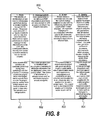
- FIG. 8 is an exemplary depiction of a user interface to a tool for assessing PMOs, including fields in which information relating to industry best practices and/or maturity information may be entered, consistent with principles of the present invention.
- FIG. 9 is an exemplary flowchart depicting, in general terms, one exemplary embodiment of a process of gap analysis, consistent with principles of the present invention.
- FIG. 10 is an exemplary flowchart depicting, in general terms, one exemplary embodiment of a process for producing an evaluation of a PMO's capabilities, consistent with principles of the present invention.
- FIG. 11 is an exemplary depiction of a user interface to a tool for assessing PMOs, including quantitative scores produced during a PMO assessment, consistent with principles of the present invention.
- FIG. 12 is an exemplary depiction of a user interface to a tool for assessing PMOs, including a graphical representation of quantitative scores produced during a PMO assessment, consistent with principles of the present invention.
- FIG. 13 is an illustration of an exemplary computing system that may be used to implement embodiments of the invention.
- FIG. 1 represents exemplary functions 100 that a PMO may perform, consistent with principles of the present invention. While many PMOs perform most of these functions 100 , some PMOs perform more or less functions depending on their role and the needs of the organization with which they are associated.
- FIG. 2 An exemplary list of PMO capabilities 200 that may be assessed and evaluated is shown in FIG. 2 .
- systems and methods for assessing and evaluating capabilities, such as capabilities 200 , of PMOs are provided. The assessment of a PMO may focus on some or all of these capabilities 200 , and may also focus on additional capabilities as well.
- FIG. 3 presents an exemplary flowchart 300 generally depicting one exemplary embodiment of a PMO assessment process, consistent with principles of the present invention.
- information relating to the PMO's current capabilities 200 is obtained and input 301 into an appropriate place or field.
- Information relating to best practices and/or maturity information may then be retrieved 302 .
- a gap analysis 303 may be performed on the information relating to the PMO's current capabilities 200 and the best practices and/or maturity information.
- the PMO's current capabilities 200 may then be evaluated 304 based on the gap analysis 303 .
- recommendations may be created 305 for improvements to the PMO's current capabilities.
- FIG. 3 is discussed further below.
- Process 300 is an example of one embodiment consistent with the invention, and it may have stages added, deleted, reordered, or modified without departing from principles of the invention.
- the PMO assessment begins by gathering and inputting 301 information relating to the PMO's capabilities 200 .
- This information may be obtainable in several ways.
- One way to obtain the information is to conduct an interview with the PMO's managers or other employees.
- the PMO members may provide information relating to various aspects of the PMO's current capabilities 200 , such as risk management, scope management, time management, cost management, quality management, document and/or knowledge management, sustainability management, resources management, communication management, and procurement management.
- various degrees and quantities of information relating to the PMO's current capabilities 200 may be obtained.
- the PMO may obtain and input 301 the above-mentioned information about its own capabilities 200 .
- the PMO can proceed to perform an assessment of its own current capabilities 200 . It may alternatively communicate the information to a third-party (e.g., a consulting firm, auditing company, joint venture partner, etc.), which may perform the assessment.
- a third-party e.g., a consulting firm, auditing company, joint venture partner, etc.
- some or all of the stages of the process 300 shown in FIG. 3 may be implemented using a computing system programmed with appropriate software.
- the software may be in the form of a tool or application that accepts input, stores data, retrieves stored data, performs calculations, implements algorithms, and produces outputs as described with respect to FIG. 3 and throughout this specification.
- FIG. 4 is an exemplary depiction of a software-implemented user interface 400 to a tool for assessing PMOs, including a non-exhaustive listing of selectable navigation fields and fields associated with assessment forms 401 - 405 , consistent with principles of the present invention.
- a user interface such as the one shown may be used to implement stage 301 of FIG. 3 .
- the user interface 400 may contain a list of selectable fields 401 corresponding to PMO capabilities 200 to be assessed.
- Other selectable fields may allow the user to access help information 402 about the PMO assessment software, databases 403 containing stored information concerning project management, different versions of the user interface 404 , and contact information 405 for the developers or providers of the assessment tool.
- the information relating to the PMO's capabilities 200 may be obtained and retained manually by the user.
- selecting one of the fields 401 corresponding to PMO capabilities 200 to be assessed may present the user with one or more fields in which information relating to the PMO's capabilities 200 may be input. For instance, referring to the exemplary user interface 400 shown in FIG. 4 , a user may select the selectable field 401 for time management. The user would then be presented with one or more fields for time management information. In this example, the user could enter information about the PMO's current capabilities 200 in the area of time management in the fields provided.
- FIG. 5 is an exemplary depiction of an organization scheme for a user interface 500 to a tool for assessing PMOs, including a non-exhaustive group of pre-defined fields for information relating to the PMO capability 200 being assessed, consistent with principles of the present invention.
- the PMO capability 200 of time management may be assessed.
- the user interface 500 may be organized to provide fields representing the name 501 of the PMO capability 200 being assessed (time management), and a description 502 thereof.
- the user interface 500 may also present information concerning the various components 503 of the capability 200 of time management, such as defining a project's tasks, scheduling tasks and/or estimating task durations, analyzing project schedules, and controlling and/or monitoring project schedules.
- a definition 504 of various components of the PMO capability 200 being assessed 501 may also be provided.
- the user interface 500 may provide a field in which the user may input information relating to the PMO's current capabilities 505 .
- the user may enter this information into the field 505 , for example, by typing on a computer keyboard, speaking while using voice-recognition software, or comparable means.
- the user may select pre-defined information for the field 505 by selecting from a list of choices of pre-defined information relating to the PMO capability 200 being assessed.
- the fields 501 - 505 are customizable by the user to contain pre-formatted fields specifically tailored for a particular PMO assessment.
- a user interface such as the one shown may be used to implement stage 301 of FIG. 3 .
- the fields 501 - 505 may contain pre-formatted sub-fields associated with more specific information related to a PMO's capabilities 200 .
- one field 505 may be pre-formatted for information indicating whether a PMO adequately controls and/or manages project schedules.
- pre-formatted sub-fields for this field 505 may be provided to indicate whether the PMO has, for example, established sufficient processes for monitoring and controlling the project schedule, and whether there are tools to support the project processes. The user may enter information into the sub-fields in a fashion similar to the entry of information into the fields described above.
- a sub-field of a field may correspond to information stating whether the PMO has tools to support the project processes.
- a sub-field of this sub-field may allow the user to indicate the name of any tools utilized (e.g., Microsoft® Project, Oracle® Primavera, etc.).
- This field structure of inputting information may contain as many layers of fields as needed for a given PMO assessment, and may be customized by the user.
- FIG. 6A is an exemplary depiction of a user interface 600 to a tool for assessing PMOs, including an exemplary description 601 of the PMO capability 200 relating to risks management, consistent with principles of the present invention.
- a user interface such as the one shown may be used to implement stage 301 of FIG. 3 .
- selectable fields are provided corresponding to assessment scores 602 for the PMO's capabilities 200 and target scores 603 representing industry best practices or desired or recommended levels of maturity to be reached for the PMO capability being assessed 200 . Examples of these scores are addressed more fully below.
- the user interface 600 may also contain an area for the user to include comments 604 regarding the PMO's capabilities.
- assessment scores 602 are represented graphically in relation to target scores 603 in a charted results 605 section. Graphical representations of scores are discussed more fully below.
- FIG. 7 is an exemplary depiction of a user interface to a tool for assessing PMOs, including a non-exhaustive listing of pre-defined levels of maturity for a PMO's current capabilities, and fields for selecting pre-defined levels of maturity, consistent with principles of the present invention.
- industry best practices information 701 A and maturity information 701 B are explained below, however, in the embodiment shown in FIG. 7 , both are represented by the same exemplary field, because in this embodiment, the two forms of information are combined for purposes of performing a PMO assessment.
- industry best practices information 701 A and maturity information 701 B are combined to produce the “benchmark” information shown.
- industry best practices 701 A and maturity information 701 B may be kept separate and perform separate roles in a PMO assessment.
- Industry best practices information 701 A may include guidelines, recommendations, principles, goals, or rules established by an organization, committee, or group of observers concerning one or more aspects of project management. In some cases, industry best practices information 701 A is published in print or electronically. Less commonly, industry best practices information 701 A is generated by a single organization or a limited group of organizations and withheld from the general public. Examples of industry best practices information 701 A include the various Standards and other publications of the Project Management Institute, available at http://www.pmi.org. The intent of many providers of industry best practices information 701 A is to provide a basis for improving or standardizing business processes across industries. The providers often desire that industry participants emulate the best practices information 701 A and thereby improve their performance.
- FIG. 8 is an exemplary depiction of an organization scheme for a user interface 800 to a tool for assessing PMOs, including fields in which information relating to industry best practices 701 A and maturity 701 B information may be entered, consistent with principles of the present invention.
- Industry best practices information 701 A may be stored in a fashion similar to that for information relating to a PMO capability 200 , as described above. Once industry best practices information 701 A is obtained, it may be stored either electronically or in non-electronic form. If stored electronically, for example in fields similar to those shown in FIG. 8 , the information may be organized in terms of different capabilities 200 of project management.
- industry best practices information 701 A relating to risks management 801 can be stored within one organizational category
- industry best practices management information 701 A relating to scope management 803 can be stored within another organizational category. The same may be done for communications management information 802 , quality management information 804 , and numerous other areas of the PMO's capabilities 200 .
- Various forms of data storage and access software can be used to store and access the industry best practices information 701 A, as discussed in further detail below.
- the fields described in various embodiments of the invention may correspond to locations in a database, or may correspond to higher level software commands that in turn update or otherwise alter a database.
- the information may be arranged so that industry best practices information 701 A is associated with corresponding information relating to the capabilities 200 of the PMO being assessed.
- the industry best practices information 701 A may include similar fields and sub-fields, thus facilitating comparison between the information relating to capabilities 200 of the PMO and the industry best practices information 701 A.
- the industry best practices information 701 A may be updated regularly to reflect changes, if any, in the information. For example, if a provider of best practices information 701 A amended several of its best practices guidelines, the amended guidelines may be obtained by the user and used in place of the prior guidelines. If the industry best practices information 701 A is stored electronically, updates may be made to the fields described above to reflect the changes in the guidelines.
- Maturity information 701 B relating to PMOs includes the information, knowledge, experience, lessons learned, insights, and tips that users have acquired from current and prior PMO assessments and related activities. This information concerns individual project management capabilities or combinations of different capabilities.
- the maturity information 701 B may relate solely to communication management, or it may relate to the interrelationships between procurement management, quality management, and cost management. In some embodiments, maturity information 701 B is obtained corresponding to the capabilities 200 of a PMO to be assessed.
- maturity information 701 B may be stored electronically or non-electronically. The same forms of information categorization and the same methods of data storage and access may also be used for maturity information 701 B.
- the industry best practices information 701 A may be stored in fields separate from the fields containing maturity information 701 B, or the two forms of information may be stored together in the same field(s).
- maturity information 701 B may be updated in a process similar to that of industry best practices information 701 A.
- One way in which maturity information 701 B may be updated is for individual or institutional users to update the fields containing the maturity information 701 B when they have new information to add.
- the user may update the fields to reflect that knowledge or experience.
- the user may update the fields to reflect that knowledge or experience.
- the user may update the fields to reflect that knowledge or experience.
- the industry best practices information 701 A may be merged with the maturity information 701 B.
- a user may obtain industry best practices information 701 A for one or more capabilities 200 of PMOs.
- the user may also have acquired maturity information 701 B through means such as attending a conference, conducting research, consulting with others in the same or related professions, or reading literature related to project management, that may supplement the industry best practices information 701 A.
- the user may augment or otherwise modify the information it has relating to industry best practices 701 A to reflect the acquired knowledge and experience.
- the industry best practices information 701 A and maturity information 701 B are stored in fields, this may be accomplished by updating the fields. Preferably, the fields are updated in this way regularly to contain the most accurate and helpful information for future PMO assessments.
- FIG. 9 provides an exemplary flowchart depicting, in general terms, a process of gap analysis, consistent with principles of the invention.
- process 900 is used to implement stage 303 of FIG. 3 .
- Gap analysis sometimes referred to as “benchmark analysis,” “benchmarking,” “comparison,” “taking a differential,” or “assessment,” etc., begins, in the embodiment shown, by determining 901 whether a PMO's capabilities fall short of, meet, or exceed information relating to best practices 701 A. Alternatively or in addition, it is determined 902 whether the maturity of the PMO's capabilities fall short of, meet, or exceed maturity information 701 B. In one embodiment of gap analysis, a pre-defined level of maturity is then selected 903 to represent the maturity of the PMO under evaluation, based on the determinations 901 - 902 made.
- the selection of the pre-defined levels of maturity may be performed manually by the user, or may be performed automatically based on the information concerning the PMO's capabilities that the user has entered.
- An exemplary pre-defined level of maturity for a low (or “basic”) level of maturity 703 in a PMO is shown in FIG. 7 .
- FIG. 7 provides an exemplary pre-defined level of maturity for a medium (“consistent”) level of maturity 702 , and for a high (“benchmark”) level of maturity 701 A, 701 B.
- a gap analysis of a PMO's risks management capabilities is being performed.
- the analysis involves determining whether the PMO's risks management capabilities fall short of, meet, or exceed the applicable industry best practices information 701 A and maturity information 701 B for risks management.
- the appropriate pre-defined level of maturity for risks management may be automatically selected based on risks management information inputted by the user.
- the information input into the fields and subfields may correspond to a pre-defined level of maturity, and that pre-defined level of maturity may be automatically selected.
- the correspondence may be determined in several ways. For example, in an embodiment where the user inputs information relating to the PMO's risks management capabilities by selecting pre-defined levels of maturity, there may be a finite number of fields and sub-fields, and hence a finite number of combinations of information relating to the PMO's risks management capabilities. Each combination could be associated, via programming commands, with an appropriate pre-defined level of maturity for risks management. In another embodiment, each pre-defined level of maturity could be represented by a range of quantitative scores.
- each field and sub-field containing information relating to the PMO's risks management capabilities could be given a simple or a weighted score.
- the user's selection of fields and sub-fields may be represented quantitatively by the scores associated with each field and sub-field.
- the resulting aggregated scores would then fall within one of the ranges of scores for pre-defined levels of maturity of risks management. In this way, the user's selection of fields and sub-fields representing information about risks management capabilities could automatically produce a pre-defined level of maturity for the PMO's risks management capabilities.
- the user may manually select the appropriate pre-defined level of maturity for the PMO's risks management capabilities. For example, if the user concludes, based on the user's comparison of the PMO's risks management capabilities with risks management best practices and the user's knowledge and experience, that the PMO's risks management capabilities correspond to a certain pre-defined level of maturity, the user may select that pre-defined level of maturity.
- FIG. 10 is an exemplary flowchart 1000 depicting, in general terms, one exemplary embodiment of a process for producing an evaluation of a PMO's capabilities, consistent with principles of the present invention.
- process 1000 is used to implement stage 304 of FIG. 3 .
- a score for the maturity of the PMO's capabilities may be determined 1001 .
- a target score for the PMO's capabilities may be determined 1002 .
- a graphical representation of the scores may be produced 1003 . Numerous means of producing the quantitative scores and the graphical representations thereof may be utilized, as discussed below.
- FIG. 11 is an exemplary depiction of a user interface 1100 to a tool for assessing PMOs, including quantitative scores 1101 - 1104 produced during a PMO assessment, consistent with principles of the present invention.
- the assessment includes producing a quantitative and/or qualitative score, and/or recommendations for improvements to the PMO.
- An example of a qualitative score is written assessments of the capabilities 200 of project management that were assessed.
- An example of a quantitative score is a numerical score for the capabilities 200 of project management that were assessed.
- the system may provide numerical scores 1102 representing levels of maturity of project management capabilities 200 corresponding to full compliance with industry best practices information 701 A and maturity information 701 B (called “target” or “best practice” scores), and numerical scores representing the current levels of maturity attained by the PMO 1101 .
- numerical scores can be provided corresponding to the difference between the former scores 1102 and the latter scores 1101 .
- ranges of numerical scores 1101 may be provided for each of the capabilities 200 of project management that were assessed. A score within the range may be selected based on the gap analysis.
- the numerical scores for the PMO's current capabilities 1101 are derived by selecting pre-formatted categories describing PMO capabilities 200 .
- the user may select a pre-formatted category corresponding to the PMO's current capabilities 200 .
- selecting a pre-formatted category would in turn indicate the score to be given to the PMO being assessed.
- the score may be weighted to reflect the relative significance of the capability 200 .
- several categories, and/or sub-categories describing PMO capabilities 200 are provided. Based on the categories and/or sub-categories selected, a score 1101 is calculated based on the weight assigned to each category and/or sub-category.
- the categories and/or sub-categories correspond to the fields and sub-fields described above.
- a total score 1103 for the PMO's scores 1101 and a total score 1104 for the target scores 1102 are also presented.
- the total scores may be calculated by averaging their constituent scores or by a method of weighted averaging.
- the numerical scores 1101 are presented simply as numbers, as shown in FIG. 11 . In other embodiments, the numerical scores 1101 are presented graphically.
- FIG. 12 is an exemplary depiction of a user interface 1200 displaying a graphical representation 1201 of quantitative scores produced during a PMO assessment, consistent with principles of the present invention.
- FIG. 12 shows how, in one embodiment, numerical scores 1101 may be graphically presented in relation to their associated target scores 1102 .
- Examples of graphical presentations 1201 may include, but are not limited to, line graphs, bar graphs, pictographs, pie charts, cosmographs, Venn diagrams, radar graphs, and area graphs.
- a single graphical presentation 1201 is used to present the scores of all of the project management areas that were assessed, although individual graphical representations 1201 may be used for each score as well.
- recommendations are provided to the PMO based on the assessment.
- the recommendations may be provided along with, or separate from, the scores described above.
- recommendations may be stored data files that provide specific guidance, advice, proposals, targets, or suggestions to the PMO for improving the PMO's capabilities 200 .
- the system may choose the appropriate file(s) to output based on the gap analysis evaluation. For example, if the assessment revealed that the PMO lacked adequate maturity in the area of cost management, the recommendations may include suggestions for improving cost management within the PMO.
- the recommendations relate to multiple capabilities 200 of the PMO. For instance, some recommendations may address procurement management jointly with health, safety, and environmental management.
- the recommendations are based on assessments involving both industry best practices 701 A and maturity information 701 B.
- the scores and the recommendations are provided to the PMO in a single report.
- FIG. 13 is an illustration of an exemplary computing system 1300 that may be used to implement embodiments of the invention.
- the components and arrangement, however, may be varied within principles of the present invention.
- Data processing or computing system 1300 includes a number of components, such as a central processing unit (CPU) 1301 , a memory 1302 , an input/output (I/O) device(s) 1305 , a nonvolatile storage device 1304 , and a database 1306 .
- System 1300 can be implemented in various ways.
- an integrated platform such as a workstation, personal computer, laptop, etc.
- components 1301 , 1302 , 1304 , and 1305 may connect through a local bus interface and access database 1306 (shown implemented as a separate database system) via an external connection.
- This connection may be implemented through a direct communication link, a local area network (LAN), a wide area network (WAN) and/or other suitable connections.
- System 1300 may be standalone or it may be part of a subsystem, which may, in turn, be part of a larger system, such as document screening system.
- CPU 1301 may be one or more known processing devices, such as a microprocessor from the PentiumTM family manufactured by IntelTM or the TurionTM family manufactured by AMDTM.
- Memory 1302 may be one or more storage devices configured to store information used by CPU 1301 to perform certain functions related to embodiments of the present invention.
- Storage 1304 may be a volatile or non-volatile, magnetic, semiconductor, tape, optical, removable, nonremovable, or other type of storage device or computer-readable medium.
- memory 1302 includes one or more programs or subprograms 1303 loaded from storage 1304 or elsewhere that, when executed by CPU 1301 , perform various procedures, operations, or processes consistent with the present invention.
- memory 1302 may include one or more software programs 1303 implementing the processes and methods for PMO assessments and evaluations described above.
- the software programs may provide the aforementioned user interfaces and fields, and perform bookkeeping tasks, (such as storing inputted PMO, best practices, and maturity information, to support roll-back, storing the user's input, etc.), perform analysis and evaluation algorithms, manage the document screening process, and provide user guidance and help.
- Memory 1302 may also include other programs that perform other functions and processes, such as programs that provide communication support, Internet access, etc.
- the software programs 1303 may be created using numerous programs and languages, including but not limited to Microsoft Excel, C, C++, C#, Lisp, HTML, XSLT, Java, JavaScript, Perl, PHP, Python, Ruby, and SQL, combinations thereof, and/or customized software developed by the user.
- memory 1302 may be configured with a program 1303 that performs several functions when executed by CPU 1301 .
- memory 1302 may include a single program 1303 that performs the functions of PMO assessment and evaluation, as well as other functions.
- CPU 1301 may execute one or more programs located remotely from system 1300 .
- system 1300 may access one or more remote programs that, when executed, perform functions related to embodiments of the present invention.
- Memory 1302 may be also be configured with an operating system (not shown) that performs several functions well known in the art when executed by CPU 1301 .
- the operating system may be Microsoft WindowsTM, UnixTM, LinuxTM, an Apple Computers operating system, Personal Digital Assistant operating system such as Microsoft CETM, or other operating system.
- Microsoft WindowsTM UnixTM
- LinuxTM an Apple Computers operating system
- Microsoft CETM Personal Digital Assistant operating system
- the choice of operating system, and even to the use of an operating system, is not critical to the invention.
- I/O device(s) 1305 may comprise one or more input/output devices that allow data to be received and/or transmitted by system 1300 .
- I/O device 1305 may include one or more input devices, such as a keyboard, touch screen, mouse, and the like, that enable data to be input from a user, such as PMO capability information, best practices information, maturity information, etc.
- I/O device 1305 may include one or more output devices, such as a display screen, CRT monitor, LCD monitor, plasma display, printer, speaker devices, and the like, that enable data to be output or presented to a user.
- I/O device 1305 may also include one or more digital and/or analog communication input/output devices that allow computing system 1300 to communicate with other machines and devices.
- System 1300 may input data from external machines and devices and output data to external machines and devices via I/O device 1305 .
- the configuration and number of input and/or output devices incorporated in I/O device 1305 are not critical to the invention.
- System 1300 may also be communicatively connected to a database 1306 .
- Database 1306 may comprise one or more databases that store information and are accessed and/or managed through system 1300 .
- database 1306 may be an OracleTM database, a SybaseTM database, or other relational database.
- Database 1306 may include, for example, data and information related to one or more PMO's current or historical capabilities 200 , current and prior versions of best practices information 901 A, and current and prior versions of maturity information 901 B.
- Systems and methods of the present invention are not limited to separate databases or even to the use of a database.
Landscapes
- Engineering & Computer Science (AREA)
- Business, Economics & Management (AREA)
- Strategic Management (AREA)
- Entrepreneurship & Innovation (AREA)
- Human Resources & Organizations (AREA)
- Operations Research (AREA)
- Economics (AREA)
- Marketing (AREA)
- Data Mining & Analysis (AREA)
- Quality & Reliability (AREA)
- Tourism & Hospitality (AREA)
- Physics & Mathematics (AREA)
- General Business, Economics & Management (AREA)
- General Physics & Mathematics (AREA)
- Theoretical Computer Science (AREA)
- Management, Administration, Business Operations System, And Electronic Commerce (AREA)
Abstract
Description
Claims (20)
Priority Applications (3)
| Application Number | Priority Date | Filing Date | Title |
|---|---|---|---|
| US12/363,419 US8280897B2 (en) | 2009-01-30 | 2009-01-30 | Methods and systems for assessing project management offices |
| AU2010200158A AU2010200158B2 (en) | 2009-01-30 | 2010-01-15 | Methods and systems for assessing project management offices |
| BRPI1015523A BRPI1015523A8 (en) | 2009-01-30 | 2010-01-18 | PROJECT MANAGEMENT OFFICE ASSESSMENT METHODS |
Applications Claiming Priority (1)
| Application Number | Priority Date | Filing Date | Title |
|---|---|---|---|
| US12/363,419 US8280897B2 (en) | 2009-01-30 | 2009-01-30 | Methods and systems for assessing project management offices |
Publications (2)
| Publication Number | Publication Date |
|---|---|
| US20100198847A1 US20100198847A1 (en) | 2010-08-05 |
| US8280897B2 true US8280897B2 (en) | 2012-10-02 |
Family
ID=42398554
Family Applications (1)
| Application Number | Title | Priority Date | Filing Date |
|---|---|---|---|
| US12/363,419 Expired - Fee Related US8280897B2 (en) | 2009-01-30 | 2009-01-30 | Methods and systems for assessing project management offices |
Country Status (3)
| Country | Link |
|---|---|
| US (1) | US8280897B2 (en) |
| AU (1) | AU2010200158B2 (en) |
| BR (1) | BRPI1015523A8 (en) |
Cited By (1)
| Publication number | Priority date | Publication date | Assignee | Title |
|---|---|---|---|---|
| US20110066476A1 (en) * | 2009-09-15 | 2011-03-17 | Joseph Fernard Lewis | Business management assessment and consulting assistance system and associated method |
Families Citing this family (1)
| Publication number | Priority date | Publication date | Assignee | Title |
|---|---|---|---|---|
| CN103455596B (en) * | 2013-09-02 | 2016-11-02 | 广东省科技基础条件平台中心 | A kind of method of science and technology items based on big data project verification assessment |
Citations (3)
| Publication number | Priority date | Publication date | Assignee | Title |
|---|---|---|---|---|
| US20030050814A1 (en) * | 2001-03-08 | 2003-03-13 | Stoneking Michael D. | Computer assisted benchmarking system and method using induction based artificial intelligence |
| US20040260588A1 (en) * | 2003-06-23 | 2004-12-23 | Katherin Bowen | Method and system for business planning and improved business performance |
| US20050071737A1 (en) * | 2003-09-30 | 2005-03-31 | Cognos Incorporated | Business performance presentation user interface and method for presenting business performance |
-
2009
- 2009-01-30 US US12/363,419 patent/US8280897B2/en not_active Expired - Fee Related
-
2010
- 2010-01-15 AU AU2010200158A patent/AU2010200158B2/en not_active Ceased
- 2010-01-18 BR BRPI1015523A patent/BRPI1015523A8/en not_active Application Discontinuation
Patent Citations (3)
| Publication number | Priority date | Publication date | Assignee | Title |
|---|---|---|---|---|
| US20030050814A1 (en) * | 2001-03-08 | 2003-03-13 | Stoneking Michael D. | Computer assisted benchmarking system and method using induction based artificial intelligence |
| US20040260588A1 (en) * | 2003-06-23 | 2004-12-23 | Katherin Bowen | Method and system for business planning and improved business performance |
| US20050071737A1 (en) * | 2003-09-30 | 2005-03-31 | Cognos Incorporated | Business performance presentation user interface and method for presenting business performance |
Non-Patent Citations (2)
| Title |
|---|
| Hobbs, Brian, The Multi-Project PMO: A Global Analysis of the Current State of Practice, a White Paper Prepared for Project Management Institute, Jun. 2007, Project Management Institute (44 pgs.). |
| Thomas, Janice L. and Mullaly, Mark E., Researching the Value of Project Management, PMI Research Conference, Warsaw Poland, Jul. 2008, Project Management Institute (28 pgs.). |
Cited By (1)
| Publication number | Priority date | Publication date | Assignee | Title |
|---|---|---|---|---|
| US20110066476A1 (en) * | 2009-09-15 | 2011-03-17 | Joseph Fernard Lewis | Business management assessment and consulting assistance system and associated method |
Also Published As
| Publication number | Publication date |
|---|---|
| BRPI1015523A2 (en) | 2014-01-07 |
| BRPI1015523A8 (en) | 2017-10-10 |
| AU2010200158B2 (en) | 2012-11-01 |
| US20100198847A1 (en) | 2010-08-05 |
| AU2010200158A1 (en) | 2010-08-19 |
Similar Documents
| Publication | Publication Date | Title |
|---|---|---|
| US9691042B2 (en) | E-Business value web | |
| Hadad et al. | A decision-making support system module for project manager selection according to past performance | |
| CA2946306C (en) | Resource evaluation for complex task execution | |
| US9767436B2 (en) | System for managing formal mentoring programs | |
| US20170147960A1 (en) | Systems and Methods for Project Planning and Management | |
| Nurimansjah et al. | Application of the simple additive weighting method in developing employee assessment decision support system in marketplace company Bukalapak | |
| US20080243581A1 (en) | Personnel management method and system | |
| US20150269512A1 (en) | Productivity Assessment and Rewards Systems and Processes Therefor | |
| WO2001026011A1 (en) | Method and estimator for providing operation management strategic planning | |
| JP6648896B2 (en) | Organization improvement activity support system, information processing device, method and program | |
| Berhe et al. | Development, validation and verification of innovative integrated Kaizen philosophy (CI) framework and its implementation procedure for enhancing manufacturing industries sustainable competitiveness | |
| Morrison et al. | Integration of behavioral and operational elements through system dynamics | |
| Ciucan-Rusu et al. | Low-code solutions integration for digital process automation-application in management | |
| Burnay et al. | User-experience in business intelligence-a quality construct and model to design supportive BI dashboards | |
| US8280897B2 (en) | Methods and systems for assessing project management offices | |
| Rust et al. | Dynamic analysis of healthcare service delivery: application of lean and agile concepts | |
| US20120116987A1 (en) | Dynamic Process Modeling Assembly and Method of Use | |
| Sezenias et al. | A holistic business performance measurement framework | |
| JP6659034B2 (en) | Organization improvement activity support system, information processing device, method and program | |
| US20200202279A1 (en) | System and Method for Improving Sales Force Performance | |
| Suakanto et al. | Cloud-Enabled Human Resource and Payroll System to Enhance Operational Efficiency in Micro and Small Enterprises | |
| US20220292428A1 (en) | System and method for improving sales force performance | |
| Hadinata | Risk Analysis of Implementation Odoo System At Xyz Convection SME Using The House Of Risk (HOR) Method | |
| US8626546B2 (en) | Process for computer-implemented management of one or more target agreements and a target agreement computer system | |
| Prasetyaji et al. | Improvement of Project Monitoring Model Using A Combination of Quality Function Deployment and Lean Six Sigma at PT TEC |
Legal Events
| Date | Code | Title | Description |
|---|---|---|---|
| AS | Assignment |
Owner name: ACCENTURE GLOBAL SERVICES GMBH, SWITZERLAND Free format text: ASSIGNMENT OF ASSIGNORS INTEREST;ASSIGNORS:ROCHA, ANDRE L;ROCHA, GUILHERME B;VEROL, MARCUS VA;SIGNING DATES FROM 20090123 TO 20090130;REEL/FRAME:022183/0983 |
|
| AS | Assignment |
Owner name: ACCENTURE GLOBAL SERVICES LIMITED, IRELAND Free format text: ASSIGNMENT OF ASSIGNORS INTEREST;ASSIGNOR:ACCENTURE GLOBAL SERVICES GMBH;REEL/FRAME:025700/0287 Effective date: 20100901 |
|
| FEPP | Fee payment procedure |
Free format text: PAYOR NUMBER ASSIGNED (ORIGINAL EVENT CODE: ASPN); ENTITY STATUS OF PATENT OWNER: LARGE ENTITY |
|
| STCF | Information on status: patent grant |
Free format text: PATENTED CASE |
|
| FPAY | Fee payment |
Year of fee payment: 4 |
|
| MAFP | Maintenance fee payment |
Free format text: PAYMENT OF MAINTENANCE FEE, 8TH YEAR, LARGE ENTITY (ORIGINAL EVENT CODE: M1552); ENTITY STATUS OF PATENT OWNER: LARGE ENTITY Year of fee payment: 8 |
|
| FEPP | Fee payment procedure |
Free format text: MAINTENANCE FEE REMINDER MAILED (ORIGINAL EVENT CODE: REM.); ENTITY STATUS OF PATENT OWNER: LARGE ENTITY |
|
| LAPS | Lapse for failure to pay maintenance fees |
Free format text: PATENT EXPIRED FOR FAILURE TO PAY MAINTENANCE FEES (ORIGINAL EVENT CODE: EXP.); ENTITY STATUS OF PATENT OWNER: LARGE ENTITY |
|
| STCH | Information on status: patent discontinuation |
Free format text: PATENT EXPIRED DUE TO NONPAYMENT OF MAINTENANCE FEES UNDER 37 CFR 1.362 |
|
| FP | Lapsed due to failure to pay maintenance fee |
Effective date: 20241002 |