US8183365B2 - Synthetic method for ceratamine A and B and analogs thereof - Google Patents
Synthetic method for ceratamine A and B and analogs thereof Download PDFInfo
- Publication number
- US8183365B2 US8183365B2 US12/721,886 US72188610A US8183365B2 US 8183365 B2 US8183365 B2 US 8183365B2 US 72188610 A US72188610 A US 72188610A US 8183365 B2 US8183365 B2 US 8183365B2
- Authority
- US
- United States
- Prior art keywords
- formula
- compound
- salt
- mixture
- preparing
- Prior art date
- Legal status (The legal status is an assumption and is not a legal conclusion. Google has not performed a legal analysis and makes no representation as to the accuracy of the status listed.)
- Active, expires
Links
- RZOKKBYKKXSVOL-UHFFFAOYSA-N [H]N1C=CC2=NC(C)=NC2=C(C)C1=O Chemical compound [H]N1C=CC2=NC(C)=NC2=C(C)C1=O RZOKKBYKKXSVOL-UHFFFAOYSA-N 0.000 description 4
- PYHGMRKLQZOTIR-UHFFFAOYSA-N CC(C)(C)OC(N/C(/NC(CCNC(C1Cc(cc2Br)cc(Br)c2OC)=O)C1=O)=N/C(OC(C)(C)C)=O)=O Chemical compound CC(C)(C)OC(N/C(/NC(CCNC(C1Cc(cc2Br)cc(Br)c2OC)=O)C1=O)=N/C(OC(C)(C)C)=O)=O PYHGMRKLQZOTIR-UHFFFAOYSA-N 0.000 description 3
- OQONPKFYUUPXEU-UHFFFAOYSA-N [H]N1C=CC2=NC(C)=NC2=C(CC2=CC(Br)=C(C)C(Br)=C2)C1=O Chemical compound [H]N1C=CC2=NC(C)=NC2=C(CC2=CC(Br)=C(C)C(Br)=C2)C1=O OQONPKFYUUPXEU-UHFFFAOYSA-N 0.000 description 3
- CUJWMYSEHVADQA-UHFFFAOYSA-N [H]N1CCC2=C(N=C(C)N2)C(C)C1=O Chemical compound [H]N1CCC2=C(N=C(C)N2)C(C)C1=O CUJWMYSEHVADQA-UHFFFAOYSA-N 0.000 description 3
- 0 CC(*)(*)c1cc(*)c(*)c(*)c1 Chemical compound CC(*)(*)c1cc(*)c(*)c(*)c1 0.000 description 2
- BFIMMTCNYPIMRN-UHFFFAOYSA-N CC1=CC(C)=C(C)C(C)=C1 Chemical compound CC1=CC(C)=C(C)C(C)=C1 BFIMMTCNYPIMRN-UHFFFAOYSA-N 0.000 description 2
- NNIGNVSXHXGYMX-RUDMXATFSA-N [H]N1CCC(Br)C(=O)/C(=C\C2=CC(Br)=C(C)C(Br)=C2)C1=O Chemical compound [H]N1CCC(Br)C(=O)/C(=C\C2=CC(Br)=C(C)C(Br)=C2)C1=O NNIGNVSXHXGYMX-RUDMXATFSA-N 0.000 description 2
- BDJIARSBHFNJIN-XBXARRHUSA-N [H]N1CCC(Br)C(=O)/C(=C\C2=CC(Br)=C(OC)C(Br)=C2)C1=O Chemical compound [H]N1CCC(Br)C(=O)/C(=C\C2=CC(Br)=C(OC)C(Br)=C2)C1=O BDJIARSBHFNJIN-XBXARRHUSA-N 0.000 description 2
- CKEYRSOBYYDBHP-UHFFFAOYSA-N [H]N1CCC(Br)C(=O)C(CC2=CC(Br)=C(C)C(Br)=C2)C1=O Chemical compound [H]N1CCC(Br)C(=O)C(CC2=CC(Br)=C(C)C(Br)=C2)C1=O CKEYRSOBYYDBHP-UHFFFAOYSA-N 0.000 description 2
- LZRSZWUIIYZSRQ-UHFFFAOYSA-N [H]N1CCC(Br)C(=O)C(CC2=CC(Br)=C(OC)C(Br)=C2)C1=O Chemical compound [H]N1CCC(Br)C(=O)C(CC2=CC(Br)=C(OC)C(Br)=C2)C1=O LZRSZWUIIYZSRQ-UHFFFAOYSA-N 0.000 description 2
- VGEXWKIRDIPKCW-UHFFFAOYSA-N [H]N1CCC(N=[N+]=[N-])C(=O)C(CC2=CC(Br)=C(OC)C(Br)=C2)C1=O Chemical compound [H]N1CCC(N=[N+]=[N-])C(=O)C(CC2=CC(Br)=C(OC)C(Br)=C2)C1=O VGEXWKIRDIPKCW-UHFFFAOYSA-N 0.000 description 2
- CTYXPLLNQYEZCZ-WEVVVXLNSA-N [H]N1CCCC(=O)/C(=C\C2=CC(Br)=C(OC)C(Br)=C2)C1=O Chemical compound [H]N1CCCC(=O)/C(=C\C2=CC(Br)=C(OC)C(Br)=C2)C1=O CTYXPLLNQYEZCZ-WEVVVXLNSA-N 0.000 description 2
- IYEMEMODUWHQPG-UHFFFAOYSA-N CC.COC1=C(Br)C=C(CC2=C3N=C(C)N=C3C=CN(C)C2=O)C=C1Br Chemical compound CC.COC1=C(Br)C=C(CC2=C3N=C(C)N=C3C=CN(C)C2=O)C=C1Br IYEMEMODUWHQPG-UHFFFAOYSA-N 0.000 description 1
- YYPZFRTWAJNQIK-UHFFFAOYSA-N CC.[H]N1C=CC2=NC(C)=NC2=C(CC2=CC(Br)=C(OC)C(Br)=C2)C1=O Chemical compound CC.[H]N1C=CC2=NC(C)=NC2=C(CC2=CC(Br)=C(OC)C(Br)=C2)C1=O YYPZFRTWAJNQIK-UHFFFAOYSA-N 0.000 description 1
- LWDJVXUDNDZUDS-UHFFFAOYSA-N CCOC(=O)C1=C(C)N=C(C)C(C(C)=O)=C1 Chemical compound CCOC(=O)C1=C(C)N=C(C)C(C(C)=O)=C1 LWDJVXUDNDZUDS-UHFFFAOYSA-N 0.000 description 1
- HPFCQGBEEIVUCQ-UHFFFAOYSA-N COC1=C(Br)C=C(CC2=C3N=C(C)N=C3C=CN(C)C2=O)C=C1Br Chemical compound COC1=C(Br)C=C(CC2=C3N=C(C)N=C3C=CN(C)C2=O)C=C1Br HPFCQGBEEIVUCQ-UHFFFAOYSA-N 0.000 description 1
- UQJXXWHAJKRDKY-UHFFFAOYSA-N CS/C(=N\C(=O)OC(C)(C)C)NC(=O)OC(C)(C)C Chemical compound CS/C(=N\C(=O)OC(C)(C)C)NC(=O)OC(C)(C)C UQJXXWHAJKRDKY-UHFFFAOYSA-N 0.000 description 1
- UVOHXDKCCXANDH-UHFFFAOYSA-N O=C1CI(=O)(O)C2=C1C=CC=C2 Chemical compound O=C1CI(=O)(O)C2=C1C=CC=C2 UVOHXDKCCXANDH-UHFFFAOYSA-N 0.000 description 1
- OCROBBGTPGAELX-UHFFFAOYSA-N [H]N1C=CC2=NC(C)=NC2=C(CC2=CC(Br)=C(OC)C(Br)=C2)C1=O Chemical compound [H]N1C=CC2=NC(C)=NC2=C(CC2=CC(Br)=C(OC)C(Br)=C2)C1=O OCROBBGTPGAELX-UHFFFAOYSA-N 0.000 description 1
- ZVUHJZUOGFKRKC-UHFFFAOYSA-N [H]N1CCC(N)C(=O)C(CC2=CC(Br)=C(C)C(Br)=C2)C1=O Chemical compound [H]N1CCC(N)C(=O)C(CC2=CC(Br)=C(C)C(Br)=C2)C1=O ZVUHJZUOGFKRKC-UHFFFAOYSA-N 0.000 description 1
- PJZKPVDYTOYGIF-UHFFFAOYSA-N [H]N1CCC(N)C(=O)C(CC2=CC(Br)=C(OC)C(Br)=C2)C1=O Chemical compound [H]N1CCC(N)C(=O)C(CC2=CC(Br)=C(OC)C(Br)=C2)C1=O PJZKPVDYTOYGIF-UHFFFAOYSA-N 0.000 description 1
- PLQWFNRFROXHIJ-UHFFFAOYSA-N [H]N1CCC(N/C(=N/C(=O)OC(C)(C)C)NC(=O)OC(C)(C)C)C(=O)C(CC2=CC(Br)=C(C)C(Br)=C2)C1=O Chemical compound [H]N1CCC(N/C(=N/C(=O)OC(C)(C)C)NC(=O)OC(C)(C)C)C(=O)C(CC2=CC(Br)=C(C)C(Br)=C2)C1=O PLQWFNRFROXHIJ-UHFFFAOYSA-N 0.000 description 1
- ZRIRRQLNUGJRQY-UHFFFAOYSA-N [H]N1CCC2=C(N=C(C)N2)C(CC2=CC(Br)=C(OC)C(Br)=C2)C1=O Chemical compound [H]N1CCC2=C(N=C(C)N2)C(CC2=CC(Br)=C(OC)C(Br)=C2)C1=O ZRIRRQLNUGJRQY-UHFFFAOYSA-N 0.000 description 1
- RETSCNMYVJSGEE-UHFFFAOYSA-N [H]N1CCC2=C(N=C(N)N2)C(CC2=CC(Br)=C(OC)C(Br)=C2)C1=O Chemical compound [H]N1CCC2=C(N=C(N)N2)C(CC2=CC(Br)=C(OC)C(Br)=C2)C1=O RETSCNMYVJSGEE-UHFFFAOYSA-N 0.000 description 1
- HHJAXUCIQGAICD-UHFFFAOYSA-N [H]N1CCC2=C(N=C(NC)N2)C(CC2=CC(Br)=C(OC)C(Br)=C2)C1=O Chemical compound [H]N1CCC2=C(N=C(NC)N2)C(CC2=CC(Br)=C(OC)C(Br)=C2)C1=O HHJAXUCIQGAICD-UHFFFAOYSA-N 0.000 description 1
- IRSLHFZTRANCOL-UHFFFAOYSA-N [H]N1CCCC(=O)CC1=O Chemical compound [H]N1CCCC(=O)CC1=O IRSLHFZTRANCOL-UHFFFAOYSA-N 0.000 description 1
- ZHQNCVSUZIZVDB-UHFFFAOYSA-N [H]N1CCCC(OCC)=CC1=O Chemical compound [H]N1CCCC(OCC)=CC1=O ZHQNCVSUZIZVDB-UHFFFAOYSA-N 0.000 description 1
Classifications
-
- C—CHEMISTRY; METALLURGY
- C07—ORGANIC CHEMISTRY
- C07D—HETEROCYCLIC COMPOUNDS
- C07D223/00—Heterocyclic compounds containing seven-membered rings having one nitrogen atom as the only ring hetero atom
- C07D223/02—Heterocyclic compounds containing seven-membered rings having one nitrogen atom as the only ring hetero atom not condensed with other rings
- C07D223/06—Heterocyclic compounds containing seven-membered rings having one nitrogen atom as the only ring hetero atom not condensed with other rings with hetero atoms or with carbon atoms having three bonds to hetero atoms with at the most one bond to halogen, e.g. ester or nitrile radicals, directly attached to ring carbon atoms
- C07D223/08—Oxygen atoms
-
- C—CHEMISTRY; METALLURGY
- C07—ORGANIC CHEMISTRY
- C07D—HETEROCYCLIC COMPOUNDS
- C07D487/00—Heterocyclic compounds containing nitrogen atoms as the only ring hetero atoms in the condensed system, not provided for by groups C07D451/00 - C07D477/00
- C07D487/02—Heterocyclic compounds containing nitrogen atoms as the only ring hetero atoms in the condensed system, not provided for by groups C07D451/00 - C07D477/00 in which the condensed system contains two hetero rings
- C07D487/04—Ortho-condensed systems
Definitions
- the specific double dehydrogenation reaction afforded by the reaction of molecules of formula (IV) in IBX is remarkable in light of the large number of potentially oxidizable sites in molecules of formula (IV).
- the mechanistic pathways may include an oxidation at the benzylic position followed by elimination, by oxidation at the carbon ⁇ to the carbonyl group, or by oxidation of the imidazole ring.
- a molecule of formula (IIIA), wherein R 1 is methyl, is known also as ceratamine A.
- a molecule of formula (IIIA), wherein R 1 is hydrogen, is known also as the des-methyl analog of ceratamine A.
- Molecules of formula (IIIA) may be prepared by first dehydrogenating a compound of formula (IV)
Landscapes
- Chemical & Material Sciences (AREA)
- Organic Chemistry (AREA)
- Pharmaceuticals Containing Other Organic And Inorganic Compounds (AREA)
Abstract
Description

wherein X1 is an aryl hydrocarbon group optionally substituted with one or more groups independently selected from —R, —NH2, —NHR, —NR2, —OH, —OR, —F, —Cl, —Br, —I, —CF3, —C(═O)OH, —C(═O)OR, —C(═O)NH2, —C(═O)NHR, and —C(═O)NR2; X2 is —H, —R, —NH2, —NHR, —NR2, —OR, —F, —Cl, —Br, or —I; and R is C1 to C10 hydrocarbyl. Molecules of formula (I) define a class of molecules generally referred to herein as “ceratamine analogs.” In the methods for preparing compound of formula (I), a compound of the general formula (II)

or a salt thereof, with X1, X2, and R defined as in formula (I), may be reacted with 2-iodoxybenzoic acid in an organic solvent to effect a double dehydrogenation of the lactam ring.
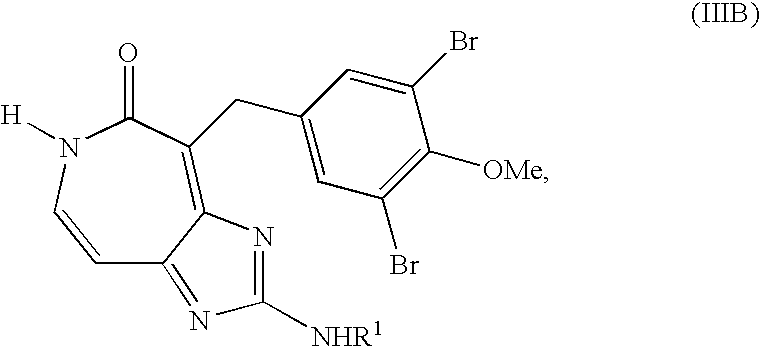
wherein group R1 is hydrogen or methyl. Compounds of formula (IIIB) may be prepared by dehydrogenating a compound of formula (IV)

with R1 defined as in formula (IIIB), or a suitable salt thereof, with 2-iodoxybenzoic acid in an organic solvent. The method may further comprise preparing the compound of formula (IV) and may comprise additionally preparing one or more precursors to the compound of formula (IV).

wherein R1 is hydrogen or methyl. Compounds of formula (IIIB) may be prepared by first dehydrogenating a compound of formula (IV)

or a suitable salt thereof, with 2-iodoxybenzoic acid in an organic solvent to form a compound of formula (IIIB)

Subsequently, the lactam nitrogen of compound of formula (IIIB) may be methylated to form the compound of formula (IIIA).

wherein X1 is an aryl hydrocarbon group optionally substituted with one or more groups independently selected from —R, —NH2, —NHR, —NR2, —OH, —OR, —F, —Cl, —Br, —I, —CF3, —C(═O)OH, —C(═O)OR, —C(═O)NH2, —C(═O)NHR, and —C(═O)NR2; X2 is —H, —R, —NH2, —NHR, —NR2, —OR, —F, —Cl, —Br, or —I; and R is C1 to C10 hydrocarbyl, alternatively C1 to C6 hydrocarbyl, alternatively C1 to C3 hydrocarbyl. Molecules of formula (I) define a class of molecules generally referred to herein as “ceratamine analogs.” As used herein, the term “hydrocarbyl” encompasses linear groups, branched groups, or cyclic groups, each consisting of carbon and hydrogen atoms, wherein any two neighboring carbon atoms may be joined by a single bond or a double bond. The term “C1 to C10 hydrocarbyl” refers to hydrocarbyl groups having from 1 to 10 carbon atoms. Thus, example groups R1 include, but are not limited to, methyl, ethyl, vinyl, propyl, 1-methylethyl(isopropyl), butyl, 1-methylpropyl, 2-methylpropyl, 1,1-dimethylethyl, pentyl, 1-methylbutyl, 1-ethylpropyl, 2-methylbutyl, 3-methylbutyl, 1,2-dimethylpropyl, 2,2-dimethylpropyl, hexyl, heptyl, octyl, nonyl, decyl, cyclopentyl, cyclohexyl, cyclohexenyl, phenyl, benzyl, tolyl, and naphthyl.

wherein each X3 is independently —H, —F, —Cl, —Br, or —I, and X4 is —H, —CF3, or —OR. In specific example embodiments, each X3 is independently —Cl or —Br or both groups X3 are —Br. In further example embodiments, group X4 is —H, —OMe, or —OEt, where “Me” represents a methyl group and “Et” represents an ethyl group. In yet another example embodiment, each X3 and X4 are H, such that X1 would represent an unsubstituted phenyl group.

or a salt thereof, with X1, X2, and R defined as in formula (I), may be reacted with 2-iodoxybenzoic acid in an organic solvent to effect a double dehydrogenation of the lactam ring. In non-limiting embodiments, suitable salts of the compound of formula (IV) may include salts having a pKa, less than the pKa of a protonated imidazole ring on the compound of formula (IV). Specific examples of suitable salts include, but are not limited to, trifluoroacetate salts, hydrochloride salts, and hydrobromide salts. The 2-iodoxybenzoic acid, also known as o-iodoxybenzoic acid or, as referred to hereinafter “IBX,” is an iodine(V) reagent having the formula
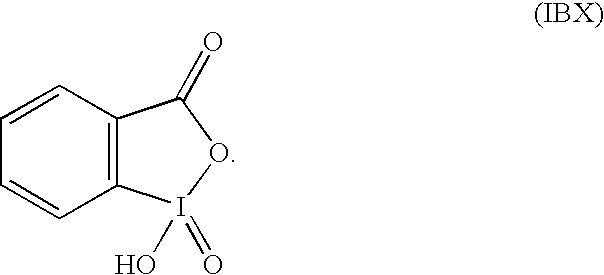
Example organic solvents suitable for the double dehydrogenation reaction include, but are not limited to, dimethylsulfoxide (DMSO), and mixtures of DMSO and a second solvent such as, for example, pyridine. Further details of the double dehydrogenation reaction are illustrated below through specific example embodiments and working Examples, without intent to limit the scope of the present invention to only the compounds described in the example embodiments and working Examples.

wherein group R1 is hydrogen or methyl. A molecule of formula (IIIB), wherein R1 is methyl, is known also as ceratamine B. A molecule of formula (IIIB), wherein R1 is hydrogen, is known also as the des-methyl analog of ceratamine B. Molecules of formula (IIIB) may be prepared by dehydrogenating a compound of formula (IV)

with R1 defined as in formula (IIIB), or a suitable salt thereof, with IBX in an organic solvent. In non-limiting embodiments, suitable salts of the compound of formula (IV) may include salts having a pKa, less than the pKa of a protonated imidazole ring on the compound of formula (IV). Specific examples of suitable salts include, but are not limited to, trifluoroacetate salts, hydrochloride salts, and hydrobromide salts. In specific examples, the organic solvent may comprise DMSO of mixtures of DMSO with a second solvent such as, for example, pyridine.

to form a compound of formula (IV) with R1 as methyl. Thereafter, the compound of formula (IV) may be dehydrogenated in IBX. As part of a preparation of a compound of formula (IIIB) with R1 as methyl from a compound of formula (IV) with R1 as hydrogen (i.e., a compound of formula (XI)), methylation of the amino group of the compound of formula (IV) with R1 as hydrogen preferably is accomplished before the dehydrogenation step. Generally, methylation of the amino group in compounds of the formula (IIIB) with R1 as hydrogen is impractical using reductive alkylation conditions, owing substantially to the sensitivity toward reduction of fully oxidized, heterocyclic ring systems such as those present in compounds of formula (IIIB).

The annulation may be accomplished by first introducing a suitably protected amidine group onto the amino group of the compound of formula (IX). One non-limiting example of a suitable protecting group is Boc, a tert-butyl carbamate (—C(═O)OC(CH3)3). In a specific embodiment, the compound of formula (IX) may be reacted with a bis-Boc-protected S-methylisothiourea in an amine base such as triethylamine

to form a compound of formula (X)

Thereupon, the bis-Boc-protected compound of formula (X) may be deprotected during a concomitant condensation reaction that results in a ring closing to form the compound of formula (XI).

to form the compound of formula (IX). The hydrogenolysis may be conducted by exposing the compound of formula (VIII) to hydrogen at a suitable pressure and temperature, for a suitable amount of time. The hydrogenolysis may be facilitated by employing a supported noble-metal catalyst. The supported noble-metal catalyst may comprise a noble metal such as, for example, platinum or palladium, supported on an alkaline earth metal salt. In specific example embodiments, the hydrogenolysis may be conducted using a palladium catalyst adsorbed onto BaSO4. With such a catalyst, the compound of formula (VIII) may be exposed to about 1 atm of hydrogen in, for example, a hydrogenation solvent such as methanol, at about room temperature for about 2 hours to yield the compound of formula (IX). In all instances, the selection of pressure, temperature, time, and catalyst must take include consideration of the need to avoid appreciable hydrogenolysis of the aryl bromides from the compound of formula (VIII). Although metal-catalyzed hydrogenolysis of the azide may not represent the most readily apparent and straightforward pathway because of the potentially labile aryl bromides, use of the reductant Ph3P in an alternate embodiment is not preferred, because the adjacent ketone may intercept the intermediate phosphinimine to form a stable oxazaphospholidine.

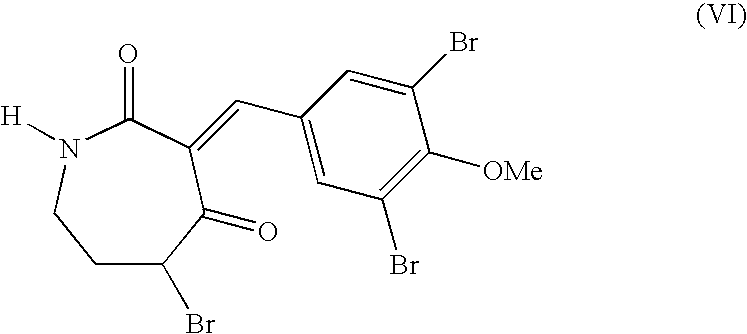
wherein the compound of formula (V) first is reacted with a brominating agent in a suitable solvent. A non-limiting example of a suitable brominating agent may include N-bromosuccinimide or bromine (Br2), for which a suitable solvent may include, for example, ethyl acetate or acetic acid. The bromination may be facilitated by adding catalysts such as Amberlyst-15 and brominating at about room temperature for about 24 hours. The bromination of the compound of formula (V) thus results in a compound of formula (VI)


When Hantzsch ester is used as the conjugate reduction agent, a non-limiting example suitable solvent system may comprise ethanol and benzene. The conjugate reduction of the compound of formula (VI) may result in a compound of formula (VII)

in high yield (25° C., 12 hours) without over-reduction of the α-bromide. Thereupon, the compound of formula (VII), may be reacted with an azide source in a polar aprotic solvent to form the compound of formula (VIII) in substantially quantitative yield. In a non-limiting specific example, sodium azide may be used as the azide source. Non-limiting examples of aprotic solvents include dimethylsulfoxide, dimethylformamide, acetonitrile, and acetone. In a specific example embodiment, the azide source may comprise sodium azide and the aprotic solvent may comprise DMSO.

wherein R1 is hydrogen or methyl. A molecule of formula (IIIA), wherein R1 is methyl, is known also as ceratamine A. A molecule of formula (IIIA), wherein R1 is hydrogen, is known also as the des-methyl analog of ceratamine A. Molecules of formula (IIIA) may be prepared by first dehydrogenating a compound of formula (IV)

or a salt thereof, with IBX in an organic solvent to form a compound of formula (IIIB)

In non-limiting embodiments, suitable salts of the compound of formula (IV) may include salts having a pKa less than the pKa of a protonated imidazole ring on the compound of formula (IV). Specific examples of suitable salts include, but are not limited to, trifluoroacetate salts, hydrochloride salts, and hydrobromide salts. In example embodiments, the organic solvent may be selected from the group consisting of dimethylsulfoxide and mixtures of dimethylsulfoxide and a second solvent such as, for example, pyridine.




Claims (20)


Priority Applications (1)
| Application Number | Priority Date | Filing Date | Title |
|---|---|---|---|
| US12/721,886 US8183365B2 (en) | 2009-03-11 | 2010-03-11 | Synthetic method for ceratamine A and B and analogs thereof |
Applications Claiming Priority (2)
| Application Number | Priority Date | Filing Date | Title |
|---|---|---|---|
| US15910809P | 2009-03-11 | 2009-03-11 | |
| US12/721,886 US8183365B2 (en) | 2009-03-11 | 2010-03-11 | Synthetic method for ceratamine A and B and analogs thereof |
Publications (2)
| Publication Number | Publication Date |
|---|---|
| US20100234588A1 US20100234588A1 (en) | 2010-09-16 |
| US8183365B2 true US8183365B2 (en) | 2012-05-22 |
Family
ID=42731242
Family Applications (1)
| Application Number | Title | Priority Date | Filing Date |
|---|---|---|---|
| US12/721,886 Active 2030-11-24 US8183365B2 (en) | 2009-03-11 | 2010-03-11 | Synthetic method for ceratamine A and B and analogs thereof |
Country Status (1)
| Country | Link |
|---|---|
| US (1) | US8183365B2 (en) |
Families Citing this family (2)
| Publication number | Priority date | Publication date | Assignee | Title |
|---|---|---|---|---|
| TW201536795A (en) | 2013-05-31 | 2015-10-01 | Medeia Therapeutics Ltd | Use of arylthiazine compounds as cytoprotectants |
| WO2021031984A1 (en) * | 2019-08-16 | 2021-02-25 | 沈阳中化农药化工研发有限公司 | Carboxylic acid oxime ester compound and use thereof |
Citations (1)
| Publication number | Priority date | Publication date | Assignee | Title |
|---|---|---|---|---|
| US20080255090A1 (en) | 2003-09-15 | 2008-10-16 | The University Of British Columbia | Ceratamines A and B, and Analogues, Syntheses and Pharmaceutical Compositions Thereof |
-
2010
- 2010-03-11 US US12/721,886 patent/US8183365B2/en active Active
Patent Citations (1)
| Publication number | Priority date | Publication date | Assignee | Title |
|---|---|---|---|---|
| US20080255090A1 (en) | 2003-09-15 | 2008-10-16 | The University Of British Columbia | Ceratamines A and B, and Analogues, Syntheses and Pharmaceutical Compositions Thereof |
Non-Patent Citations (21)
| Title |
|---|
| Anna Aiello, Ernesto Fattorusso, Marialuisa Menna, and Maurizio Pansini; Chemistry of Verongida Sponges -V.* Brominated Metabolites from the Caribbean Sponge Pseudoceratina sp.; Biochem. Syst. Ecol. 1995, vol. 23, pp. 377-381. |
| Collison, C. G.; Chen, J.; Walvoord, R.; The First Total Synthesis of the Proposed Structure of Montiporyne E; Synthesis 2006, pp. 2319-2322. |
| Crochet, R. A., Jr.; Blanton, C. D., Jr.; N-Monoalkylation of Primary Aromatic and Heteroaromatic Amines with Trialkyl Orthocarobxylates and Sodium Borohydride; Syntheis 1974, pp. 55-56. |
| Emiliano Manzo, Rob Van Soest,Lohi Matainaho, Michel Roberge, and Raymond J. Andersen; Ceratamines A and B, Antimitotic Heterocyclic Alkaloids Isolated from the Marine Sponge Pseudoceratina sp. Collected in Papua New Guinea; Organic Letters 2003; Received Sep. 8, 2003; vol. 5, No. 24 4591-4594. |
| Garden, S. J.; Guimaraes, C. R. W.; Correa, M. B.; De Oliveira, C. A. F.; Pinto, A. C.; De Alencastro, R. B.; Synthetic and Theoretical Studies on the Reduction of Electron Withdrawing Group Conjugated Olefins Using the Hantzsch 1,4-Dihydropyridine Ester; Journal of Organic Chemistry. 2003, vol. 68, pp. 8815-8822. |
| Geoffrey Karjala, Queenie Chan, Emiliano Manzo, Raymond J. Andersen, and Michel Roberge; Ceratamines, Structurally Simple Microtubule-Stabilizing Antimitotic Agents with Unusual Cellular Effects; Cancer Res 2005; Received Apr. 15, 2005; vol. 65, No. 8 pp. 3040-3043. |
| Guo, Z. X.; Cammidge, A. N.; Horwell, D. C.; A Convenient and Versatile Method for the Synthesis of Protected Guanjdines; Synthesis Communications 2000, vol. 30, pp. 2933-2943. |
| Keiko Hirano, Takaaki Kubota, Masashi Tsuda, Kenji Watanabe, Jane Fromont, and Jun'Ichi Kobayashi; Ma'edamines A and B, Cytotoxic Bromotyrosine Alkaloids with a Unique 2(1H)Pyrazinone Ring from Sponge Suberea sp.; Tetrahedron 2000, vol. 56, pp. 8107-8110. |
| Legters, J.; Thijs, L.; Zwanenburg, B.; A Convenient Syntheses of Optically Active IH-Aziridine-2-Carboxylic Acids (Esters); Tetrahedron Letters. 1989, vol. 30, pp. 4881-4884. |
| Lewin, A. H.; Szewczyk, J.; Wilson, J. W.; Carroll, F. I.; Galanthamine analogs: 6H-benzofuro[3a,3,2,-e,f][1]benzazepine and 6H-benzofuro[3a,3,2-e, f][3]benzazepine; Tetrahedron 2005, vol. 61, pp. 7144-7152. |
| Meshram, H. M.; Reddy, P. N.; Sadashiv, K.; Yadav, J. S.; Amberlyst-15-promoted efficient 2-halogenation of 1,3-keto-esters and cyclic ketones using N-halosuccinimides; Tetrahedron Letters 2005, vol. 46, pp. 623-626. |
| Nicolaou, K. C.; Mathison, C. J. N.; Montagnon, T.; New Reactions of IBX: Oxidation of Nitrogen and Sulfur-Containing Substrates to Afford Useful Synthetic Intermediates; Angewandte Chemie, Int. Ed. 2003, vol. 42, pp. 4077-4082. |
| Nicolaou, K. C.; Mathison, C. J. N.; Synthesis of Imides, N-Acyl Vinylogous Carbamates and Ureas, and Nitriles by Oxidation of Amides and Amines with Dess-Martin Periodinane; Angewandte Chemie, Int. Ed. 2005, vol. 44, pp. 5992-5997. |
| Nicolaou, K. C.; Montagnon, T.; Baran, P. S.; Modulation of the Reactivity Profile of IBX by Ligand Complexation: Ambient Temperature Dehydrogenation of Aldehydes and Ketones to,-Unsaturated Carbonyl Compounds; Angewandte Chemie, Int. Ed. 2002, vol. 41, pp. 993-996. |
| Nodwell, M.; Pereira, A.; Riffell, J. L.; Zimmerman, C.; Patrick, B. O.; Roberge, M.; Andersen, R. J.; Synthetic Approaches to the Microtubule-Stabilizing Sponge Alkaloid Ceratamine A and Desbromo Analogues; Journal of Organic Chemistry. 2009, vol. 74, pp. 995-1006. |
| Nodwell, M.; Riffell, J. L.; Roberge, M.; Andersen, R. J.; Synthesis of Antimitotic Analogs of the Microtubule Stabilizing Sponge Alkaloid Ceratamine A; Organic Letters 2008, vol. 10, pp. 1051-1054. |
| Piña, I. C.; Gautschi, J. T.; Wang, G.-Y.-S.; Sanders, M. L.; Schmitz, F. J.; France, D.; Cornell-Kennon, S.; Sambucetti, L. C.; Remiszewski, S. W.; Perez, L. B.; Bair, K. W.; Crews, P.; Psammaplins from the Sponge Pseudoceratina purpurea: Inhibition of Both Histone Deacetylase and DNA Methyltransferase; Journal of Organic Chemistry. 2003, vol. 68, pp. 3866-3873. |
| Roberts, R. M.; Vogt, P. J.; Ortho Esters, Imidic Esters and Amidines. VII. N-Alkylformanilides from Alkyl Orthoformates and Primary Aromatic Amines; Rearrangement of Alkyl N-Arylformimidates; Journal of the American Chemical Society. 1956, vol. 78, pp. 4778-4782. |
| Waly, M. A., Synthesis of the Imidazo[4,5-d]Azepine Ring System, Journal für praktische Chemie 1994, vol. 336, pp. 86-88. |
| Yang, J. W.; Hechavarria Fonseca, M. T.; List, B.; A Metal-Free Transfer Hydrogenation: Organocatalytic Conjugate Reduction of a,b-Unsaturated Aldehydes; Angewandte Chemie, Int. Ed. 2004, vol. 43, pp. 6660-6662. |
| Zolfigol, M. A.; Safaiee, M.; Synthesis of 1,4-Dihydropyridines under Solyent-free Conditions; Synlett 2004, vol. 5, pp. 827-828. |
Also Published As
| Publication number | Publication date |
|---|---|
| US20100234588A1 (en) | 2010-09-16 |
Similar Documents
| Publication | Publication Date | Title |
|---|---|---|
| EP3527573B9 (en) | Synthesis of polycyclic-carbamoylpyridone compounds | |
| US7038043B1 (en) | Glycosylated indolocarbazole synthesis | |
| EP1560826B1 (en) | Pyridopyrimidinone compounds, method for production thereof and medicaments comprising the same | |
| KR20100127822A (en) | New Ruthenium Complexes as Catalysts for Metathesis Reactions | |
| US20090054662A1 (en) | Process for synthesizing a substituted pyrazole | |
| US4609494A (en) | 5-acetyl-3,4,5,6-tetrahydro-4-oxo-2,6-methano-2H-1,3,5-benzothiazocine(benzodiazocine)-11-carboxylates useful as calcium channel blockers | |
| US20100234588A1 (en) | Synthetic method for ceratamine a and b and analogs thereof | |
| JP2707936B2 (en) | β-oxo-β-benzenepropanethioamide derivative | |
| FI62074C (en) | PHARMACEUTICAL FORM OF PHARMACOLOGICAL ACTIVE 5-PHENYL-OXAZOLIDINONE-2-FORM | |
| FI63402C (en) | PROCEDURE FOR FRAMSTATING AV THERAPEUTIC ANVAENDBARA D- OCH D1-TRANS-5-PHENYL 2,3,4,4A, 5,9B-HEXAHYDRO-1H-PYRIDO (4,3-B) INDOLDERIVAT | |
| CA2767893A1 (en) | New method for the synthesis of ivabradine and the pharmaceutically acceptable acid addition salts thereof | |
| EP0432209B1 (en) | Phenylpyrrolic compounds used as drugs, their preparation and application | |
| JPH09216881A (en) | Triazolone compound and production of the same | |
| EP0220653B1 (en) | 3-aminocarbonyl-1,4-dihydropyridine-5-carboxylic acid compounds, process for preparation and use thereof, and pharmaceutical composition containing the same | |
| HU194173B (en) | Process for preparing substituted pyridine | |
| EP1486503B1 (en) | Derivatives of benzothiazine and benzothiadiazine, procedure for their preparation and pharmaceutical compositions containing them | |
| US6562975B1 (en) | Process for preparing zolpidem | |
| EP0030371B1 (en) | N-substituted imidazole derivatives, a process for their preparation, antifungal compositions comprising them and their use for preparing such compositions | |
| US7705161B2 (en) | Process for producing nitrogenous 5-membered cyclic compound | |
| EP0968997A2 (en) | Process for S-aryl-L-cysteine and derivatives | |
| KR910006646B1 (en) | Method for preparing 4,7-dihydropyrazole [3,4-b] pyridine derivative | |
| KR101318092B1 (en) | Process for the preparation of phenyl 2-pyrimidinyl ketones and their novel intermediates | |
| US4136174A (en) | Benzimidazolecarbamates and method | |
| KR930005625B1 (en) | Process for producing amino-ketones | |
| KR850000261B1 (en) | Method for preparing benzazine derivatives |
Legal Events
| Date | Code | Title | Description |
|---|---|---|---|
| AS | Assignment |
Owner name: THE OHIO STATE UNIVERSITY, OHIO Free format text: ASSIGNMENT OF ASSIGNORS INTEREST;ASSIGNORS:COLEMAN, ROBERT S.;CAMPBELL, ERICA L.;CARPER, DANIEL J.;REEL/FRAME:024414/0552 Effective date: 20100312 |
|
| STCF | Information on status: patent grant |
Free format text: PATENTED CASE |
|
| FPAY | Fee payment |
Year of fee payment: 4 |
|
| MAFP | Maintenance fee payment |
Free format text: PAYMENT OF MAINTENANCE FEE, 8TH YR, SMALL ENTITY (ORIGINAL EVENT CODE: M2552); ENTITY STATUS OF PATENT OWNER: SMALL ENTITY Year of fee payment: 8 |
|
| MAFP | Maintenance fee payment |
Free format text: PAYMENT OF MAINTENANCE FEE, 12TH YR, SMALL ENTITY (ORIGINAL EVENT CODE: M2553); ENTITY STATUS OF PATENT OWNER: SMALL ENTITY Year of fee payment: 12 |