US8124784B2 - Palladium metal complex - Google Patents
Palladium metal complex Download PDFInfo
- Publication number
- US8124784B2 US8124784B2 US12/867,188 US86718809A US8124784B2 US 8124784 B2 US8124784 B2 US 8124784B2 US 86718809 A US86718809 A US 86718809A US 8124784 B2 US8124784 B2 US 8124784B2
- Authority
- US
- United States
- Prior art keywords
- group
- metal complex
- light
- substituted
- emitting device
- Prior art date
- Legal status (The legal status is an assumption and is not a legal conclusion. Google has not performed a legal analysis and makes no representation as to the accuracy of the status listed.)
- Expired - Fee Related
Links
- 0 [1*]C1=NNC([3*])=C1[2*].[1*]c1nnc([3*])c1[2*] Chemical compound [1*]C1=NNC([3*])=C1[2*].[1*]c1nnc([3*])c1[2*] 0.000 description 7
- BCYXJOZHCXKXAM-CEWNVPMOSA-J C.C#N.CC#N.CC#N.CC1=CC(C)=N([Pd@]2(Cl)N3=C(C)C=C(C)N3N23([Au]2N/C(C)=C\C(C)=N\[Pd](Cl)(/N=C(C)/C=C(/C)N)N/C(C)=C\C(C)=N[Au]2)N=C(C)C=C3C)N1.CC1=CC(C)=NN1.CCN(CC)CC.C[Pd](Cl)Cl Chemical compound C.C#N.CC#N.CC#N.CC1=CC(C)=N([Pd@]2(Cl)N3=C(C)C=C(C)N3N23([Au]2N/C(C)=C\C(C)=N\[Pd](Cl)(/N=C(C)/C=C(/C)N)N/C(C)=C\C(C)=N[Au]2)N=C(C)C=C3C)N1.CC1=CC(C)=NN1.CCN(CC)CC.C[Pd](Cl)Cl BCYXJOZHCXKXAM-CEWNVPMOSA-J 0.000 description 1
Images
Classifications
-
- C—CHEMISTRY; METALLURGY
- C07—ORGANIC CHEMISTRY
- C07F—ACYCLIC, CARBOCYCLIC OR HETEROCYCLIC COMPOUNDS CONTAINING ELEMENTS OTHER THAN CARBON, HYDROGEN, HALOGEN, OXYGEN, NITROGEN, SULFUR, SELENIUM OR TELLURIUM
- C07F15/00—Compounds containing elements of Groups 8, 9, 10 or 18 of the Periodic Table
- C07F15/0006—Compounds containing elements of Groups 8, 9, 10 or 18 of the Periodic Table compounds of the platinum group
- C07F15/006—Palladium compounds
- C07F15/0066—Palladium compounds without a metal-carbon linkage
-
- C—CHEMISTRY; METALLURGY
- C07—ORGANIC CHEMISTRY
- C07D—HETEROCYCLIC COMPOUNDS
- C07D231/00—Heterocyclic compounds containing 1,2-diazole or hydrogenated 1,2-diazole rings
- C07D231/02—Heterocyclic compounds containing 1,2-diazole or hydrogenated 1,2-diazole rings not condensed with other rings
- C07D231/10—Heterocyclic compounds containing 1,2-diazole or hydrogenated 1,2-diazole rings not condensed with other rings having two or three double bonds between ring members or between ring members and non-ring members
- C07D231/12—Heterocyclic compounds containing 1,2-diazole or hydrogenated 1,2-diazole rings not condensed with other rings having two or three double bonds between ring members or between ring members and non-ring members with only hydrogen atoms, hydrocarbon or substituted hydrocarbon radicals, directly attached to ring carbon atoms
-
- C—CHEMISTRY; METALLURGY
- C07—ORGANIC CHEMISTRY
- C07F—ACYCLIC, CARBOCYCLIC OR HETEROCYCLIC COMPOUNDS CONTAINING ELEMENTS OTHER THAN CARBON, HYDROGEN, HALOGEN, OXYGEN, NITROGEN, SULFUR, SELENIUM OR TELLURIUM
- C07F1/00—Compounds containing elements of Groups 1 or 11 of the Periodic Table
- C07F1/12—Gold compounds
-
- C—CHEMISTRY; METALLURGY
- C09—DYES; PAINTS; POLISHES; NATURAL RESINS; ADHESIVES; COMPOSITIONS NOT OTHERWISE PROVIDED FOR; APPLICATIONS OF MATERIALS NOT OTHERWISE PROVIDED FOR
- C09K—MATERIALS FOR MISCELLANEOUS APPLICATIONS, NOT PROVIDED FOR ELSEWHERE
- C09K11/00—Luminescent materials, e.g. electroluminescent or chemiluminescent
- C09K11/06—Luminescent materials, e.g. electroluminescent or chemiluminescent containing organic luminescent materials
-
- H—ELECTRICITY
- H05—ELECTRIC TECHNIQUES NOT OTHERWISE PROVIDED FOR
- H05B—ELECTRIC HEATING; ELECTRIC LIGHT SOURCES NOT OTHERWISE PROVIDED FOR; CIRCUIT ARRANGEMENTS FOR ELECTRIC LIGHT SOURCES, IN GENERAL
- H05B33/00—Electroluminescent light sources
- H05B33/12—Light sources with substantially two-dimensional [2D] radiating surfaces
- H05B33/14—Light sources with substantially two-dimensional [2D] radiating surfaces characterised by the chemical or physical composition or the arrangement of the electroluminescent material, or by the simultaneous addition of the electroluminescent material in or onto the light source
-
- H—ELECTRICITY
- H10—SEMICONDUCTOR DEVICES; ELECTRIC SOLID-STATE DEVICES NOT OTHERWISE PROVIDED FOR
- H10K—ORGANIC ELECTRIC SOLID-STATE DEVICES
- H10K50/00—Organic light-emitting devices
-
- H—ELECTRICITY
- H10—SEMICONDUCTOR DEVICES; ELECTRIC SOLID-STATE DEVICES NOT OTHERWISE PROVIDED FOR
- H10K—ORGANIC ELECTRIC SOLID-STATE DEVICES
- H10K50/00—Organic light-emitting devices
- H10K50/10—OLEDs or polymer light-emitting diodes [PLED]
- H10K50/11—OLEDs or polymer light-emitting diodes [PLED] characterised by the electroluminescent [EL] layers
-
- H—ELECTRICITY
- H10—SEMICONDUCTOR DEVICES; ELECTRIC SOLID-STATE DEVICES NOT OTHERWISE PROVIDED FOR
- H10K—ORGANIC ELECTRIC SOLID-STATE DEVICES
- H10K85/00—Organic materials used in the body or electrodes of devices covered by this subclass
- H10K85/30—Coordination compounds
- H10K85/361—Polynuclear complexes, i.e. complexes comprising two or more metal centers
-
- C—CHEMISTRY; METALLURGY
- C09—DYES; PAINTS; POLISHES; NATURAL RESINS; ADHESIVES; COMPOSITIONS NOT OTHERWISE PROVIDED FOR; APPLICATIONS OF MATERIALS NOT OTHERWISE PROVIDED FOR
- C09K—MATERIALS FOR MISCELLANEOUS APPLICATIONS, NOT PROVIDED FOR ELSEWHERE
- C09K2211/00—Chemical nature of organic luminescent or tenebrescent compounds
- C09K2211/10—Non-macromolecular compounds
- C09K2211/1003—Carbocyclic compounds
- C09K2211/1007—Non-condensed systems
-
- C—CHEMISTRY; METALLURGY
- C09—DYES; PAINTS; POLISHES; NATURAL RESINS; ADHESIVES; COMPOSITIONS NOT OTHERWISE PROVIDED FOR; APPLICATIONS OF MATERIALS NOT OTHERWISE PROVIDED FOR
- C09K—MATERIALS FOR MISCELLANEOUS APPLICATIONS, NOT PROVIDED FOR ELSEWHERE
- C09K2211/00—Chemical nature of organic luminescent or tenebrescent compounds
- C09K2211/10—Non-macromolecular compounds
- C09K2211/1018—Heterocyclic compounds
- C09K2211/1025—Heterocyclic compounds characterised by ligands
- C09K2211/1044—Heterocyclic compounds characterised by ligands containing two nitrogen atoms as heteroatoms
-
- C—CHEMISTRY; METALLURGY
- C09—DYES; PAINTS; POLISHES; NATURAL RESINS; ADHESIVES; COMPOSITIONS NOT OTHERWISE PROVIDED FOR; APPLICATIONS OF MATERIALS NOT OTHERWISE PROVIDED FOR
- C09K—MATERIALS FOR MISCELLANEOUS APPLICATIONS, NOT PROVIDED FOR ELSEWHERE
- C09K2211/00—Chemical nature of organic luminescent or tenebrescent compounds
- C09K2211/18—Metal complexes
- C09K2211/185—Metal complexes of the platinum group, i.e. Os, Ir, Pt, Ru, Rh or Pd
-
- C—CHEMISTRY; METALLURGY
- C09—DYES; PAINTS; POLISHES; NATURAL RESINS; ADHESIVES; COMPOSITIONS NOT OTHERWISE PROVIDED FOR; APPLICATIONS OF MATERIALS NOT OTHERWISE PROVIDED FOR
- C09K—MATERIALS FOR MISCELLANEOUS APPLICATIONS, NOT PROVIDED FOR ELSEWHERE
- C09K2211/00—Chemical nature of organic luminescent or tenebrescent compounds
- C09K2211/18—Metal complexes
- C09K2211/188—Metal complexes of other metals not provided for in one of the previous groups
-
- H—ELECTRICITY
- H10—SEMICONDUCTOR DEVICES; ELECTRIC SOLID-STATE DEVICES NOT OTHERWISE PROVIDED FOR
- H10K—ORGANIC ELECTRIC SOLID-STATE DEVICES
- H10K2101/00—Properties of the organic materials covered by group H10K85/00
- H10K2101/10—Triplet emission
-
- H—ELECTRICITY
- H10—SEMICONDUCTOR DEVICES; ELECTRIC SOLID-STATE DEVICES NOT OTHERWISE PROVIDED FOR
- H10K—ORGANIC ELECTRIC SOLID-STATE DEVICES
- H10K85/00—Organic materials used in the body or electrodes of devices covered by this subclass
- H10K85/30—Coordination compounds
- H10K85/341—Transition metal complexes, e.g. Ru(II)polypyridine complexes
-
- H—ELECTRICITY
- H10—SEMICONDUCTOR DEVICES; ELECTRIC SOLID-STATE DEVICES NOT OTHERWISE PROVIDED FOR
- H10K—ORGANIC ELECTRIC SOLID-STATE DEVICES
- H10K85/00—Organic materials used in the body or electrodes of devices covered by this subclass
- H10K85/30—Coordination compounds
- H10K85/371—Metal complexes comprising a group IB metal element, e.g. comprising copper, gold or silver
Definitions
- the present invention relates to a palladium mixed-metal complex.
- Palladium mixed-metal complexes have been actively developed because they are useful as materials of organic electroluminescent light-emitting devices and the like.
- the present invention provides a metal complex comprising a composition represented by the following formula (a): [(Pd II ) 2 (M I ) 2 (X) 2 (L) 4 (L′) 2 ] (a) wherein M I represents Ag I , Au I , or Cu I ; X represents Cl, Br, or I; L is represented by the following formula (1); and L′ is represented by the following formula (2). Where two M I s may be the same or different, four Ls may be the same or different, and two L's may be the same or different.
- the formulas (1) and (2) are given by:
- R 1 , R 2 , and R 3 each independently represent a hydrogen atom, a halogen atom, a hydroxy group, an alkyl group which may be substituted, an aryl group which may be substituted, or a monovalent heterocyclic group which may be substituted.
- the present invention provides a light-emitting device comprising a light-emitting layer comprising the metal complex.
- the present invention provides a display comprising the light-emitting device.
- the metal complex of the present invention exhibits excellent light emission properties and is a new metal complex. Further, the metal complex of the present invention is particularly useful for a light-emitting device, a light-emitting apparatus, and the like, and a light-emitting device and a light-emitting apparatus using this metal complex also have excellent light emission properties.
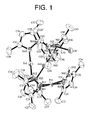
- FIG. 1 is an ORTEP diagram showing the molecular structure of a metal complex A.
- the metal complex of the present invention is a metal complex comprising the composition represented by the above formula (a).
- M I represents Ag I , Au I , or Cu I , and is preferably Au I .
- X represents Cl, Br, or I, and is preferably Cl.
- L is represented by the above formula (1)
- L′ is represented by the above formula (2).
- R 1 , R 2 , and R 3 each independently represent a hydrogen atom, a halogen atom, a hydroxy group, an alkyl group which may be substituted, an aryl group which may be substituted, or a monovalent heterocyclic group which may be substituted.
- at least one of R 1 , R 2 , and R 3 is a halogen atom, a hydroxy group, an alkyl group which may be substituted, an aryl group which may be substituted, or a monovalent heterocyclic group which may be substituted (that is, at least one of R 1 , R 2 , and R 3 is not a hydrogen atom). More preferably, at least one of R 1 , R 2 , and R 3 is an alkyl group which may be substituted, or an aryl group which may be substituted.
- halogen atom examples include a fluorine atom, a chlorine atom, a bromine atom, and an iodine atom.
- the above halogen atom is preferably a chlorine atom.
- the above alkyl group which may be substituted usually has about 1 to 6 carbon atoms, preferably 1 to 4 carbon atoms.
- Examples of the above alkyl group which may be substituted include unsubstituted alkyl groups, such as a methyl group, an ethyl group, a propyl group, an isopropyl group, a butyl group, an isobutyl group, a t-butyl group, a pentyl group, a hexyl group, and a cyclohexyl group; and substituted alkyl groups (particularly, alkyl groups substituted with a halogen atom, such as a fluorine atom), such as a trifluoromethyl group, a pentafluoroethyl group, a perfluorobutyl group, a perfluorohexyl group, and a perfluorooctyl group.
- the above aryl group which may be substituted is an atomic group formed by removing one hydrogen atom from an aromatic hydrocarbon which may be substituted.
- the above aromatic hydrocarbon includes those having a condensed ring, and those in which two or more independent benzene rings or condensed rings are bonded directly or via a group, such as vinylene.
- the above aryl group which may be substituted usually has about 6 to 20 carbon atoms, preferably 6 to 10 carbon atoms.
- aryl group which may be substituted examples include unsubstituted aryl groups, such as a phenyl group, a C 1 to C 4 alkoxyphenyl group (“C 1 to C 4 alkoxy” indicates that the alkoxy portion has 1 to 4 carbon atoms. The same applies hereinafter.), a C 1 to C 4 alkylphenyl group (“C 1 to C 4 alkyl” indicates that the alkyl portion has 1 to 4 carbon atoms.
- a 1-naphthyl group, and a 2-naphthyl group and substituted aryl groups (particularly, aryl groups substituted with a halogen atom, such as a fluorine atom), such as a pentafluorophenyl group.
- aryl groups substituted with a halogen atom, such as a fluorine atom such as a pentafluorophenyl group.
- a phenyl group, a methylphenyl group, and a t-butylphenyl group are preferred.
- the above monovalent heterocyclic group which may be substituted means a group formed by removing one atom or group from a heterocyclic compound in which elements constituting a ring are not limited to a carbon atom and which contains a nitrogen atom, an oxygen atom, a sulfur atom, and the like as a heteroatom in the ring.
- a monovalent aromatic heterocyclic group which may be substituted is preferred as the above monovalent heterocyclic group which may be substituted.
- Examples of the above L represented by the above formula (1) include pyrazolate (a monovalent anion formed by the dissociation of a hydrogen ion from a pyrazole compound). Specific examples of the above formula (1) include the following:
- R 2 has the same meaning as described above, Me represents a methyl group, Et represents an ethyl group, n-Pr represents an n-propyl group, and n-Bu represents an n-butyl group.
- Examples of L′ represented by the above formula (2) include the following:
- R 2 has the same meaning as described above, Me represents a methyl group, Et represents an ethyl group, n-Pr represents an n-propyl group, and n-Bu represents an n-butyl group.
- R 1 , R 2 , and R 3 in the above formulas (1) and (2) may be the same or different in each of L and L′.
- a pyrazole compound (B) can be synthesized by obtaining a diketone compound (A) as an intermediate by the method described in J. Am. Chem. Soc., 72, 1352-1356 (1950), and reacting the diketone compound (A) with hydrazine or hydrazine monohydrate by the methods described in Bull. Soc. Chim., 45, 877-884 (1929), Chem. Abstr., 24, 7541 (1930), Tetrahedron, 42, 15, 4253-4257 (1986), and Heterocycles, 53, 1285 (2000) (the following Scheme 1).
- the above diketone compound (A) may be synthesized, for example, by the oxidation reaction of a ⁇ -unsaturated ketone, or the reaction of a ketocarboxylic acid with a Grignard reagent from alkyl bromide.
- the above L′ may also be synthesized by the method described in J. Heterocyclic Chem., 35, 1377 (1998).
- the metal complex of the present invention is preferably a metal complex comprising a composition represented by the following formula (b) as the composition represented by the above formula (a): [ ⁇ (Pd II )(M I )(X)(L) 2 (L′) ⁇ 2 ] (b) wherein M I , X, L, and L′ represent the same meanings as described above.
- the metal complex comprising the composition represented by the above formula (b) can be regarded as one in which two ⁇ (Pd II )(M I )(X)(L) 2 (L′) ⁇ units are dimerized, comprises a metal complex in which L bridges Pd II and M I and the metal atoms interact with each other in the ground state or the excited state, and has, for example, a structure represented by the following formula (3) or (4):
- M I , X, L, and L′ represent the same meanings as described above.
- a case where a two-fold rotation axis passing through the midpoint of a line segment connecting two Pd II s and the midpoint of a line segment connecting two M I s is present in the molecule in this case, R 1 and R 3 in the above L are the same
- a case where the two-fold rotation axis is not present in this case, R 1 and R 3 in the above L are different
- the case where the two-fold rotation axis is present is preferred.
- the above two-fold rotation axis When the above two-fold rotation axis is not present, various geometrical isomers having different L and L′ can be present, and the geometrical isomers have different light emission energy levels.
- the above two-fold rotation axis can be present in the structure represented by the above formula (3), and the above two-fold rotation axis is not present in the structure represented by the above formula (4).
- the metal complex of the present invention may be synthesized by any method.
- a metal complex comprising a composition represented by the formula: [Pd 2 Au 2 Cl 2 ( ⁇ -dmpz) 4 (dmpzH) 2 ] can be synthesized by reacting [PdCl 2 (CH 3 CN) 2 ], dmpzH, and AuCl(SC 4 H 8 ) in the presence of triethylamine.
- [Pd 2 Au 2 Cl 2 ( ⁇ -dmpz) 4 (dmpzH) 2 ] is a metal complex in which part of dmpzH ligands are not deprotonated and are coordinated in an uncharged state.
- [Pd 2 Au 2 Br 2 ( ⁇ -dmpz) 4 (dmpzH) 2 ] and [Pd 2 Au 2 I 2 ( ⁇ -dmpz) 4 (dmpzH) 2 ] can also be similarly synthesized.
- “dmpzH” represents 3,5-dimethylpyrazole
- “dmpz” represents 3,5-dimethylpyrazolate (a monovalent anion formed by the dissociation of a hydrogen ion from 3,5-dimethylpyrazole).
- the metal complex of the present invention is particularly useful as a light-emitting material contained in the light-emitting layer of a light-emitting device, such as an organic electroluminescent device, and is also useful for sensors for organic molecules, gas molecules, and the like, antitumor agents, paints that are usually colorless and transparent but emit light only during ultraviolet light irradiation, and the like.
- the light-emitting device of the present invention is not particularly limited as long as it has a light-emitting layer comprising the above metal complex.
- the light-emitting device of the present invention is a light-emitting device in which an anode, a hole injection layer, a hole transport layer, a light-emitting layer, an electron transport layer, an electron injection layer, and a cathode are formed in this order on a transparent substrate.
- the light-emitting device of the present invention is not limited to this five-layer light-emitting device and may be a four-layer light-emitting device in which the electron transport layer is omitted from the five-layer light-emitting device, a three-layer light-emitting device in which the hole injection layer and the electron injection layer are omitted from the five-layer light-emitting device, a two-layer light-emitting device in which the light-emitting layer and electron transport layer of the three-layer light-emitting device are used as one layer in combination, or a single-layer light-emitting device in which only a light-emitting layer is formed between an anode and a cathode.
- This metal complex can be used for both the single-layer light-emitting device and the multilayer light-emitting device. But, when the metal complex is used for the single-layer light-emitting device, it tends to be easy to obtain more excellent light emission properties.
- a light-emitting device to which the above metal complex can be advantageously applied is a light-emitting device comprising the above metal complex in a light-emitting layer and is usually a multilayer light-emitting device comprising an anode to which positive voltage is applied, a cathode to which negative voltage is applied, a hole injection layer and a hole transport layer for injecting holes from the anode and transporting the holes, an electron injection layer and an electron transport layer for injecting electrons from the cathode and transporting the electrons, and a light-emitting layer for recombining holes and electrons and providing light emission.
- the above metal complex is useful as a host light-emitting material in the light-emitting device.
- the above metal complex can also be used as materials of the hole injection layer, the hole transport layer, the electron injection layer, the electron transport layer, and the like.
- other host light-emitting materials including metal complexes containing 8-quinolinols as ligands, such as tris(8-hydroxyquinolinato)aluminum, also function as guest light-emitting materials for improving the light emission efficiency and emission spectrum, by doping in a slight amount.
- the metal complex of the present invention can also be used as a composition in combination with, for example, other light-emitting materials, such as dicyanomethylenes (DCMs), coumarins, perylenes, and rubrenes, and the materials of the hole injection layer, the hole transport layer, the electron injection layer, the electron transport layer, and the like.
- DCMs dicyanomethylenes
- coumarins coumarins
- perylenes coumarins
- rubrenes a materials of the hole injection layer, the hole transport layer, the electron injection layer, the electron transport layer, and the like.
- the light-emitting device of the present invention can be used in a display.
- the display of the present invention is a display comprising the above light-emitting device.
- This metal complex A was identified by an IR spectrum, elementary analysis, 1 H NMR, and FAB-MS, and found to be [Pd 2 Au 2 Cl 2 ( ⁇ -dmpz) 4 (dmpzH) 2 ].
- the solubility of the metal complex A in organic solvents was tested.
- the metal complex A was soluble in chloroform and methylene chloride, slightly soluble in toluene and benzene, and insoluble in ethanol, acetone, diethyl ether, methanol, acetonitrile, and hexane.
- FIG. 1 An ORTEP diagram showing the molecular structure of the metal complex A ([Pd 2 Au 2 Cl 2 ( ⁇ -dmpz) 4 (dmpzH) 2 ]) is shown in FIG. 1 .
- the element symbols H, Cl, Pd, and Au followed by numbers are given to represent atoms constituting the metal complex A.
- the metal complex A is a tetranuclear complex composed of two Pd II ions, two Au I ions, two chloride ions, four dmpz ligands, and two dmpzH ligands.
- each Pd atom bridges the Pd atom and the Au atoms, and one Cl atom and one dmpzH ligand respectively coordinate to the remaining coordination sites of each palladium (Pd) atom. Furthermore, each Cl atom forms a hydrogen bond with a dmpzH ligand coordinating to the other Pd atom.
- a pseudo two-fold rotation axis perpendicular to the Pd . . . Pd axis is present in the molecule.
- the Pd . . . Pd distance is 4.5330(5) ⁇
- the Au . . . Au distance is 3.5319(3) ⁇
- Au distances are in the range of 3.4144(4) to 3.5556(4) ⁇ . Also, the Pd—Cl distances are 2.306(1) ⁇ and 2.313(1) ⁇ , the Pd—N distances are in the range of 1.995(4) to 2.027(4) ⁇ , and the Au—N distances are in the range of 2.001(4) to 2.009(4) ⁇ .
- the metal complex A exhibited orange emission in the solid state by irradiation with ultraviolet light at 254 nm or 365 nm.
Landscapes
- Chemical & Material Sciences (AREA)
- Organic Chemistry (AREA)
- Physics & Mathematics (AREA)
- Engineering & Computer Science (AREA)
- Materials Engineering (AREA)
- Optics & Photonics (AREA)
- High Energy & Nuclear Physics (AREA)
- Inorganic Chemistry (AREA)
- Electroluminescent Light Sources (AREA)
Abstract

Description
- NON-PATENT DOCUMENT 1: G A. Ardizzoia, G La Monica, S. Cenini, M. Moret, N. Masciocchi, J. Chem. Soc., Dalton Trans. 1996, 1351-1357.
[(PdII)2(MI)2(X)2(L)4(L′)2] (a)
wherein MI represents AgI, AuI, or CuI; X represents Cl, Br, or I; L is represented by the following formula (1); and L′ is represented by the following formula (2). Where two MIs may be the same or different, four Ls may be the same or different, and two L's may be the same or different.
The formulas (1) and (2) are given by:

wherein R1, R2, and R3 each independently represent a hydrogen atom, a halogen atom, a hydroxy group, an alkyl group which may be substituted, an aryl group which may be substituted, or a monovalent heterocyclic group which may be substituted.

wherein R2 has the same meaning as described above, Me represents a methyl group, Et represents an ethyl group, n-Pr represents an n-propyl group, and n-Bu represents an n-butyl group.

wherein R2 has the same meaning as described above, Me represents a methyl group, Et represents an ethyl group, n-Pr represents an n-propyl group, and n-Bu represents an n-butyl group.

[{(PdII)(MI)(X)(L)2(L′)}2] (b)
wherein MI, X, L, and L′ represent the same meanings as described above.

wherein MI, X, L, and L′ represent the same meanings as described above.

| TABLE 1 |
| 1H NMR Data of [Pd2Au2Cl2(μ-dmpz)4(dmpzH)2](CDCl3, |
| TMS, 300 MHz) |
| Form of | |||
| δ (ppm) | signal | Intensity | Assignment |
| 12.01 | s | 1 | NH |
| 5.81 | s | 1 | H4 |
| 5.76 | s | 1 | H4 |
| 5.57 | d | 1 | H4 |
| 2.75 | s | 3 | CH3 |
| 2.17 | s | 3 | CH3 |
| 2.11 | s | 3 | CH3 |
| 1.89 | s | 3 | CH3 |
| 1.72 | s | 3 | CH3 |
| 1.65 | s | 3 | CH3 |
| TABLE 2 |
| Crystallographic Data of [Pd2Au2Cl2(μ-dmpz)4(dmpzH)2]•CH3CN |
| [Pd2Au2Cl2(μ-dmpz)4(dmpzH)2]•CH3CN | ||
| Empirical formula | C32H47Au2Cl2N13Pd2 |
| Formula weight | 1291.45 |
| Measurement temperature (K) | 296 |
| X-ray wavelength (Å) | 0.71070 (MoKα ray) |
| Crystal system | Monoclinic system |
| Space group | P21/c (#14) |
| Lattice constant | |
| a(Å) | 11.5302 (4) |
| b(Å) | 16.4579 (5) |
| c(Å) | 22.4499 (7) |
| α(deg) | 90 |
| β(deg) | 90.5665 (4) |
| γ(deg) | 90 |
| Lattice volume (Å3) | 4259.9 (2) |
| Z value | 4 |
| Density (calculated) (gm−3) | 2.013 |
| Linear absorption coefficient | 78.87 |
| μ(Mo Kα), cm−1 | |
| The number of independent | 9677 (Rint = 0.035) |
| reflections | |
| The number of data and the | 9677/0/460 |
| number of parameters | |
| Final R value [I > 2σ(I)] | R1 = 0.029 |
| R value when total reflection | R = 0.048, Rw = 0.066 |
| is used | |
| GOF value | 0.92 |
Claims (7)
[(PdII)2(MI)2(X)2(L)4(L′)2] (a)

[{(PdII)(MI)(X)(L)2(L′)}2] (b)
Applications Claiming Priority (3)
| Application Number | Priority Date | Filing Date | Title |
|---|---|---|---|
| JP2008034306A JP5188829B2 (en) | 2008-02-15 | 2008-02-15 | Palladium metal complex |
| JP2008-034306 | 2008-02-15 | ||
| PCT/JP2009/052288 WO2009101966A1 (en) | 2008-02-15 | 2009-02-12 | Palladium metal complex |
Publications (2)
| Publication Number | Publication Date |
|---|---|
| US20100311982A1 US20100311982A1 (en) | 2010-12-09 |
| US8124784B2 true US8124784B2 (en) | 2012-02-28 |
Family
ID=40956996
Family Applications (1)
| Application Number | Title | Priority Date | Filing Date |
|---|---|---|---|
| US12/867,188 Expired - Fee Related US8124784B2 (en) | 2008-02-15 | 2009-02-12 | Palladium metal complex |
Country Status (5)
| Country | Link |
|---|---|
| US (1) | US8124784B2 (en) |
| JP (1) | JP5188829B2 (en) |
| KR (1) | KR20100136447A (en) |
| CN (1) | CN101945854B (en) |
| WO (1) | WO2009101966A1 (en) |
Families Citing this family (3)
| Publication number | Priority date | Publication date | Assignee | Title |
|---|---|---|---|---|
| WO2012039347A1 (en) * | 2010-09-21 | 2012-03-29 | 国立大学法人 長崎大学 | Metal complex, light emitting element, and display device |
| JP5765764B2 (en) * | 2011-03-08 | 2015-08-19 | 国立大学法人 長崎大学 | Metal complex, light emitting element, display device |
| WO2023070473A1 (en) * | 2021-10-28 | 2023-05-04 | 京东方科技集团股份有限公司 | Quantum dot light-emitting device and preparation method therefor, display substrate, and display device |
Citations (3)
| Publication number | Priority date | Publication date | Assignee | Title |
|---|---|---|---|---|
| JP2006028101A (en) | 2004-07-16 | 2006-02-02 | Saitama Univ | Organometallic complex and organic electroluminescent device |
| US20090167157A1 (en) | 2005-09-21 | 2009-07-02 | Takeshi Murakami | Organic electroluminescent device |
| US20090198069A1 (en) | 2005-03-25 | 2009-08-06 | Nagasaki University, National University Corporati | Metal complex, light-emitting device and display |
-
2008
- 2008-02-15 JP JP2008034306A patent/JP5188829B2/en not_active Expired - Fee Related
-
2009
- 2009-02-12 US US12/867,188 patent/US8124784B2/en not_active Expired - Fee Related
- 2009-02-12 KR KR1020107017801A patent/KR20100136447A/en not_active Withdrawn
- 2009-02-12 WO PCT/JP2009/052288 patent/WO2009101966A1/en not_active Ceased
- 2009-02-12 CN CN200980104920.5A patent/CN101945854B/en not_active Expired - Fee Related
Patent Citations (3)
| Publication number | Priority date | Publication date | Assignee | Title |
|---|---|---|---|---|
| JP2006028101A (en) | 2004-07-16 | 2006-02-02 | Saitama Univ | Organometallic complex and organic electroluminescent device |
| US20090198069A1 (en) | 2005-03-25 | 2009-08-06 | Nagasaki University, National University Corporati | Metal complex, light-emitting device and display |
| US20090167157A1 (en) | 2005-09-21 | 2009-07-02 | Takeshi Murakami | Organic electroluminescent device |
Non-Patent Citations (16)
| Title |
|---|
| 55th JSCC Symposium Abstract, p. 16, 11E-19 (2005) with translation. |
| 55th JSCC Symposium Abstract, p. 354, PE-015 (2005) with translation. |
| 56th JSCC Symposium Abstract, p. 195, 1PB114 (2006) with translation. |
| 56th JSCC Symposium Abstract, p. 366, 2PE235 (2006) with translation. |
| 56th JSCC Symposium Abstract, p. 366, 2PE236 (2006) with translation. |
| A. Gonzalez et al., "Metal Complexes in Organic Synthesis.", Tetrahedron, 1986, pp. 4253-4257, vol. 42, No. 15. |
| Chem. Abstr., 24, 1930, p. 7541. |
| Chiara B. Vicentini et al., "Chemoselective Synthesis of 3- and 5-Pyrazolylacetates", Heterocycles, 2000, pp. 1285-1292, vol. 53, No. 6. |
| Enzo Sottofattori et al.,"Synthesis of New Heterocyclic Derivatives of Retinoids", Journal of Heterocyclic Chemistry, Nov.-Dec. 1998, vol. 35, No. 6. |
| Frederic W. Swamer et al. "Claisen Acylations and Carbethoxylations of Ketones and Esthers by Means of Sodium Hydride", Journal of the American Chemical Society, Mar. 1950, pp. 1352-1356, vol. 72, No. 3. |
| G. Attilio Ardizzoia et al., Polynuclear pyrazolato complexes. Synthesis, chemical reactivity and crystal structures of [{Pd(dmpz)2(Hdmpz)2}2] and [{PdAg2(dmpz)4}2] (Hdmpz = 3,5-dimethypyrazole), Journal of Chemical Society, Dalton Transactions, 1996, pp. 1351-1357, vol. 7. |
| Juan Fornies et al., "Polynuclear Palladium Complexes with 3,5-Dimethylpyrazolate Exhibiting Three Different Coordination Modes", Chemical A European Journal, 2003, pp. 3427-3435, vol. 9, No. 14. |
| Keisuke Umakoshi et al., "Heteropolynuclear Palladium Complexes with Pyrazolate and its 3-tert-Butyl Derivatives: The Effect of Heterometal Ions on the Rate of Isomerization", Chemistry A European Journal, 2006, pp. 5094-5104, vol. 12, No. 19. |
| Keisuke Umakoshi et al., "Pyrazolato-Bridged Polynuclear Palladium and Platinum Complexes. Synthesis, Structure, and Reactivity.", Inorganic Chemistry, 2003, pp. 3907-3916, vol. 42, No. 12. |
| Mm. G. Bertrand et al., Bulletin de la Societe Chimique de France, (1929), pp. 877-884. |
| Office Action issued Sep. 30, 2011, in corresponding Chinese Patent Application No. 200980104920.5 with English translation. |
Also Published As
| Publication number | Publication date |
|---|---|
| JP5188829B2 (en) | 2013-04-24 |
| CN101945854A (en) | 2011-01-12 |
| WO2009101966A1 (en) | 2009-08-20 |
| KR20100136447A (en) | 2010-12-28 |
| JP2009191027A (en) | 2009-08-27 |
| US20100311982A1 (en) | 2010-12-09 |
| CN101945854B (en) | 2013-04-03 |
Similar Documents
| Publication | Publication Date | Title |
|---|---|---|
| EP1486552B1 (en) | Organic electroluminescent material, organic electroluminescent device, and heterocycle-containing iridium complex compound | |
| JP5836275B2 (en) | Organic electronic devices and dopants for doping organic semiconductor matrix materials | |
| Ahmed et al. | Efficient photoluminescent complexes of 400–1800 nm wavelength emitting lanthanides containing organic sensitizers for optoelectronic devices | |
| JP2013539455A (en) | Singlet trapping by soluble copper(I) complexes for optoelectronic devices | |
| JP2008227541A (en) | Rhenium compound | |
| Al-Busaidi et al. | Utilization of a Pt (II) di-yne chromophore incorporating a 2, 2′-bipyridine-5, 5′-diyl spacer as a chelate to synthesize a green and red emitting d–f–d heterotrinuclear complex | |
| Tordera et al. | Efficient orange light-emitting electrochemical cells | |
| US7973167B2 (en) | Metal complex, light-emitting device and display | |
| US8124784B2 (en) | Palladium metal complex | |
| US20090198069A1 (en) | Metal complex, light-emitting device and display | |
| US7893611B2 (en) | Metal complex, light-emitting device and display | |
| JP5142118B2 (en) | Metal complex, light emitting element, display device | |
| Senthan et al. | Synthesis, luminescence, and electrochemical studies of a new series of octanuclear ruthenium (II) complexes of tolylterpyridine appended calixresorcarenes | |
| JP2011190180A (en) | Metal complex, light emitting element, and display | |
| JP2009215277A (en) | Metal complex, light-emitting element, display device | |
| JP5924691B2 (en) | Metal complex, light emitting element, display device | |
| CN119462776B (en) | A spirofluorene metal platinum complex containing N heteroatom and its electroluminescent device | |
| Chernyadyev et al. | Synthesis, Structure, and Comparative Analysis of Photo-and Electroluminescence Spectra of Vanadyl Mesoporphyrinate in PVK: PBD Composite | |
| Jiang et al. | Luminescent “Chugaev-type” cyclometalated iridium (III) complexes synthesized by nucleophilic addition of hydrazine | |
| US9269913B2 (en) | Thiolate-bridged multinuclear copper(I) complex | |
| KR100580815B1 (en) | Electroluminescent iridium compound and display element employing the same as light emitting dopant | |
| KR100729741B1 (en) | Metal compound and organic electroluminescent device comprising same | |
| JP2015096492A (en) | Molecular mixture metal complex and organic electroluminescent element using the same | |
| KR20180092902A (en) | Development of indium-salen luminophores |
Legal Events
| Date | Code | Title | Description |
|---|---|---|---|
| AS | Assignment |
Owner name: NAGASAKI UNIVERSITY, JAPAN Free format text: ASSIGNMENT OF ASSIGNORS INTEREST;ASSIGNORS:UMAKOSHI, KEISUKE;KIMURA, KAZUTOYO;ONISHI, MASAYOSHI;AND OTHERS;SIGNING DATES FROM 20100701 TO 20100727;REEL/FRAME:024825/0345 Owner name: SUMITOMO CHEMICAL COMPANY, LIMITED, JAPAN Free format text: ASSIGNMENT OF ASSIGNORS INTEREST;ASSIGNORS:UMAKOSHI, KEISUKE;KIMURA, KAZUTOYO;ONISHI, MASAYOSHI;AND OTHERS;SIGNING DATES FROM 20100701 TO 20100727;REEL/FRAME:024825/0345 |
|
| REMI | Maintenance fee reminder mailed | ||
| LAPS | Lapse for failure to pay maintenance fees | ||
| STCH | Information on status: patent discontinuation |
Free format text: PATENT EXPIRED DUE TO NONPAYMENT OF MAINTENANCE FEES UNDER 37 CFR 1.362 |
|
| STCH | Information on status: patent discontinuation |
Free format text: PATENT EXPIRED DUE TO NONPAYMENT OF MAINTENANCE FEES UNDER 37 CFR 1.362 |
|
| FP | Lapsed due to failure to pay maintenance fee |
Effective date: 20160228 |