US8098177B2 - Mapping alphabetic characters to a numeric keypad - Google Patents
Mapping alphabetic characters to a numeric keypad Download PDFInfo
- Publication number
- US8098177B2 US8098177B2 US12/189,072 US18907208A US8098177B2 US 8098177 B2 US8098177 B2 US 8098177B2 US 18907208 A US18907208 A US 18907208A US 8098177 B2 US8098177 B2 US 8098177B2
- Authority
- US
- United States
- Prior art keywords
- key
- letters
- assigned
- frequently used
- alphabetic
- Prior art date
- Legal status (The legal status is an assumption and is not a legal conclusion. Google has not performed a legal analysis and makes no representation as to the accuracy of the status listed.)
- Expired - Fee Related, expires
Links
Images




Classifications
-
- G—PHYSICS
- G06—COMPUTING OR CALCULATING; COUNTING
- G06F—ELECTRIC DIGITAL DATA PROCESSING
- G06F3/00—Input arrangements for transferring data to be processed into a form capable of being handled by the computer; Output arrangements for transferring data from processing unit to output unit, e.g. interface arrangements
- G06F3/01—Input arrangements or combined input and output arrangements for interaction between user and computer
- G06F3/02—Input arrangements using manually operated switches, e.g. using keyboards or dials
- G06F3/0202—Constructional details or processes of manufacture of the input device
-
- G—PHYSICS
- G06—COMPUTING OR CALCULATING; COUNTING
- G06F—ELECTRIC DIGITAL DATA PROCESSING
- G06F3/00—Input arrangements for transferring data to be processed into a form capable of being handled by the computer; Output arrangements for transferring data from processing unit to output unit, e.g. interface arrangements
- G06F3/01—Input arrangements or combined input and output arrangements for interaction between user and computer
- G06F3/02—Input arrangements using manually operated switches, e.g. using keyboards or dials
- G06F3/023—Arrangements for converting discrete items of information into a coded form, e.g. arrangements for interpreting keyboard generated codes as alphanumeric codes, operand codes or instruction codes
- G06F3/0233—Character input methods
Definitions
- the present disclosure relates generally to numeric keypads and more particularly to mapping alphabetic letters in a certain language to a numeric keypad used on a telephonic device, for example.
- Numeric keypads on mobile telephones are generally used for dialing a phone number.
- text messages i.e., texting
- a standard numeric keypad has at least 10 numeric keys, such that there is a one-to-one relationship between each key on the numeric keypad and a digit in the range from 0 to 9.
- the letters of alphabet are displayed on each key.
- more than one letter of the alphabet has to be assigned to each key in order to enable a full alphabetic keypad.
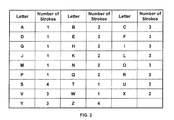
- FIG. 2 illustrates the number of key strokes associated with the letters of the English alphabet according to a standard mapping to a numeric keypad. As shown, the number of strokes for most letters is larger than one, requiring a user to interact excessively with the keypad in order to input a text message. The above-noted problem further leads to user frustration and errors. Methods and systems are needed than can overcome said problems.
- a keypad mapping method comprises mapping keys on a numeric keypad to letters of alphabet in a language, wherein a plurality of alphabetic letters are assigned to at least one key on the numeric keypad; wherein a first alphabetic letter is selected from among the plurality of alphabetic letters assigned to the key, in response to a first interaction with said key, such that the first alphabetic letter is the first most frequently used letter from among said plurality of letters assigned to the key in said language; and wherein a second alphabetic letter is selected from among the plurality of alphabetic letters assigned to the key, in response to a second interaction with said key, such that the second alphabetic letter is the second most frequently used letter from among said plurality of letters assigned to the key in said language.
- the plurality of alphabetic letters assigned to the key are displayed on a surface of the key in an order associated with frequency of use of each of said plurality of alphabetic letters in said language.
- the plurality of alphabetic letters is displayed on the surface of the key in a descending order with respect to highest frequency of use.
- the plurality of alphabetic letters assigned to the key are displayed on a surface of the key in a stylized manner reflecting frequency of use of each of said plurality of alphabetic letters in said language, such that more frequently used letters are styled in a more ubiquitous manner in comparison to less frequently used letters.
- a color coding scheme may be used to distinguish more frequently used characters from less frequently used letters.
- the most frequently used letter may be displayed in a first color, and a less frequently used letter is displayed in a second color different from the first color.
- a font visualization scheme is used to distinguish more frequently used characters from less frequently used letters.
- the most frequently used scheme is displayed in a first font, and a less frequently used scheme is displayed in a second font different from the first font.
- the most frequently used letter is displayed in a first size, and a less frequently used letter is displayed in a second size different from the first size.
- the first size may be larger than the second size.
- a system comprising one or more logic units.
- the one or more logic units are configured to perform the functions and operations associated with the above-disclosed methods.
- a computer program product comprising a computer useable medium having a computer readable program is provided. The computer readable program when executed on a computer causes the computer to perform the functions and operations associated with the above-disclosed methods.
- FIG. 1 illustrates a conventional numeric keypad used on a telephonic device.
- FIG. 2 is a table showing the number of keystrokes required to select a letter in the English alphabet, if the numeric keypad of FIG. 1 is used.
- FIG. 3 illustrates the frequency of use of various alphabetic letters in the English language, in accordance with one embodiment.
- FIG. 4 is a table mapping the number of keystrokes to a letter in the English alphabet, where the numeric keypad of FIG. 5 or 6 A-C is used, in accordance with one embodiment.
- FIGS. 5 and 6 A-C illustrate exemplary embodiments of a numeric keypad with multiple alphabetic letters mapped to individual numeric keys, in accordance with one embodiment.
- the present invention is directed to methods and systems for mapping alphabetic characters or letters in a certain language to keys on a numeric keypad.
- keys on a numeric keypad may be mapped to letters of alphabet in a language such that a plurality of alphabetic letters are assigned to at least one key on the numeric keypad, where a first alphabetic letter may be selected from among the plurality of alphabetic letters assigned to the key, in response to a first interaction with said key, and a second alphabetic letter may be selected from among the plurality of alphabetic letters assigned to the key, in response to a second interaction with said key.
- the first alphabetic letter is the first most frequently used letter from among said plurality of letters assigned to the key in said language
- the second alphabetic letter is the second most frequently used letter from among said plurality of letters assigned to the key in said language.
- the plurality of alphabetic letters assigned to the key may be displayed on a surface of the key in an order associated with frequency of use of each of said plurality of alphabetic letters in said language.
- the plurality of alphabetic letters may be displayed on the surface of the key in a descending order with respect to highest frequency of use.
- one or more embodiments are disclosed as applicable to the letters of alphabet in the English language. It is noteworthy however that such embodiments are provided by way of example, and therefore the concepts and implementations disclosed herein may be applied to letters of alphabet used in any other language.
- FIGS. 3-5 for example, the frequency of use of various alphabetic letters in the English language, in accordance with one embodiment, are taken into account to help reduce the overall number of keystrokes on a numeric keypad.
- the level (i.e., frequency, percentage or probability) of use of various letters of the alphabet in a particular language can be determined according to linguistic studies.
- the letter A is used about 8.17% of the words
- letter B is used in about 1.49% of the words, and so on (see FIG. 3 ).
- the probability of occurrence of the letter A may be considered to be higher than that of letter B. Accordingly, if the mapping of the alphabet letters to the number keys is based on the level of usage of the letters, then the probability of the user striking a key more than once to select (i.e., input) a letter in a word is minimized.
- reordering the mapping of the alphabetic letters based on a mapping scheme that takes into account the probability of appearance of an alphabetic letter in a word may reduce the average number of strokes by a user interacting with a numeric keypad for the purpose of text entry.
- the letters having a lower probability of use or occurrence are arranged on the numeric keypad in association with a higher number of key strokes.
- letters with a higher probability of use or occurrence are arranged on the numeric keypad in association with a lower number of key strokes.
- the arrangement is such that the mapping of the letters to a key remains the same as a traditional numeric keypad, with the exception of the order of assignment of the letters to the sequence of strokes.
- the letters, “p”, “q”, “r”, and “s”, are mapped to the number key “7” such that selecting the letter “s” requires four strokes of the number key “7”, while selecting the letter “p” requires one stroke (see FIG. 2 ).
- the same letters “p”, “q”, “r”, and “s” are assigned to the same number key (e.g., key 7) the order in which the letters are selected based on a sequence of key strokes may be changed, so that a more probable (i.e., more frequently used) letter is selected earlier in response to a user striking the respective numeric key.
- “s” is a more frequently used letter in the English language with the statistical use frequency of 6.33% in comparison with either “p” with 1.93% or “q” with 0.10% statistical use frequency. Therefore, to take advantage of the above-noted usage frequencies, in one embodiment, the letter of alphabet with a higher use frequency (e.g., “s”) is mapped to a position on an assigned numeric key which is more advanced (i.e., requires a smaller number of key strokes) than the letters of alphabet (e.g., “p”, “q” or “r”) that are assigned to the same key but which have a lower use frequency.
- a traditional keypad without considering the use frequency of letters on average tends to increase the number of key strokes needed to select a letter of alphabet.
- the letters as mapped in a conventional keypad may be reordered based on the use frequencies of each letter as assigned to the same number key to reduce the number of key strokes on average.
- the most frequently used alphabet letter assigned to a number key may be positioned in advance of the other three or four letters assigned to the same key, so that it can be selected by a single stroke.
- the less frequently used letters assigned to the number key are placed in less advanced positions in the order of their use frequency, so that selecting such letters will require 2, 3 or 4 strokes respectively.
- the plurality of alphabetic letters assigned to the key are displayed on a surface of the key in a stylized manner reflecting frequency of use of each of said plurality of alphabetic letters in said language, such that more frequently used letters are styled in a more ubiquitous manner in comparison to less frequently used letters.
- a color coding scheme may be used to distinguish more frequently used characters from less frequently used letters. The most frequently used letter may be displayed in a first color, and a less frequently used letter is displayed in a second color different from the first color.
- FIG. 5 illustrates a simple exemplary embodiment for the manner in which a numeric keypad may be labeled, according to the novel mapping scheme disclosed herein, to show the mapping arrangement (i.e., reordering) for selecting a letter of alphabet based on a sequence of key strikes.
- FIGS. 6A-6C provide alternative exemplary embodiments. As shown, the alphabet letters can be can be distinguished by different styles, colors, fonts or sizes (with or without reordering), or any combination of the above.
- a font visualization scheme may be used to distinguish more frequently used characters from less frequently used letters, such that the most frequently used scheme is displayed in a first font, and a less frequently used scheme is displayed in a second font different from the first font.
- the most frequently used letter is displayed in a first size
- a less frequently used letter is displayed in a second size different from the first size.
- the first size may be larger than the second size, for example. It is noteworthy that other distinctive look and feel arrangement is also possible. Therefore, the scope of the invention should not be construed as limited to the particular embodiments disclosed herein.
- the above-noted remapping does not require substantive changes in system hardware or software of a telephonic device, since it changes the mapping order of alphabet locally with respect to a number key, such that the same letters remain assigned to the same key as in a traditional keypad, with the exception of a change in the order in which the letters are selected in response to the sequence of strokes.
- the implementation of the novel scheme is not expensive as it does not require extensive redesign in the manufacturing steps.
- the present invention can take the form of an entirely hardware embodiment, an entirely software embodiment or an embodiment containing both hardware and software elements.
- a software embodiment may include, but not be limited to, to firmware, resident software, microcode, etc.
- the invention can take the form of a computer program product accessible from a computer-usable or computer-readable medium providing program code for use by or in connection with a computer or any instruction execution system.
- a computer-usable or computer readable medium can be any apparatus that can contain, store, communicate, propagate, or transport the program for use by or in connection with the instruction execution system, apparatus, or device.
- a data processing system suitable for storing and/or executing program code will include at least one processor coupled directly or indirectly to memory elements through a system bus.
- the memory elements can include local memory employed during actual execution of the program code, bulk storage, and cache memories which provide temporary storage of at least some program code in order to reduce the number of times code must be retrieved from bulk storage during execution.
- I/O devices including but not limited to keyboards, displays, pointing devices, etc.
- I/O controllers can be coupled to the system either directly or through intervening I/O controllers.
- Network adapters e.g., modem, cable modem, Ethernet cards
- logic code programs, modules, processes, methods, and the order in which the respective elements of each method are performed are purely exemplary. Depending on the implementation, they may be performed in any order or in parallel, unless indicated otherwise in the present disclosure. Further, the logic code is not related, or limited to any particular programming language, and may be comprise one or more modules that execute on one or more processors in a distributed, non-distributed, or multiprocessing environment.
- the method as described above may be used in the fabrication of integrated circuit chips.
- the resulting integrated circuit chips can be distributed by the fabricator in raw wafer form (that is, as a single wafer that has multiple unpackaged chips), as a bare die, or in a packaged form.
- the chip is mounted in a single chip package (such as a plastic carrier, with leads that are affixed to a motherboard or other higher level carrier) or in a multi-chip package (such as a ceramic carrier that has either or both surface interconnections of buried interconnections).
- the chip is then integrated with other chips, discrete circuit elements, and/or other signal processing devices as part of either (a) an intermediate product, such as a motherboard, or (b) and end product.
- the end product can be any product that includes integrated circuit chips, ranging from toys and other low-end applications to advanced computer products having a display, a keyboard or other input device, and a central processor.
Landscapes
- Engineering & Computer Science (AREA)
- General Engineering & Computer Science (AREA)
- Theoretical Computer Science (AREA)
- Human Computer Interaction (AREA)
- Physics & Mathematics (AREA)
- General Physics & Mathematics (AREA)
- Input From Keyboards Or The Like (AREA)
Abstract
Description
Claims (14)
Priority Applications (1)
| Application Number | Priority Date | Filing Date | Title |
|---|---|---|---|
| US12/189,072 US8098177B2 (en) | 2007-08-24 | 2008-08-08 | Mapping alphabetic characters to a numeric keypad |
Applications Claiming Priority (2)
| Application Number | Priority Date | Filing Date | Title |
|---|---|---|---|
| US95780407P | 2007-08-24 | 2007-08-24 | |
| US12/189,072 US8098177B2 (en) | 2007-08-24 | 2008-08-08 | Mapping alphabetic characters to a numeric keypad |
Publications (2)
| Publication Number | Publication Date |
|---|---|
| US20090051572A1 US20090051572A1 (en) | 2009-02-26 |
| US8098177B2 true US8098177B2 (en) | 2012-01-17 |
Family
ID=40381650
Family Applications (1)
| Application Number | Title | Priority Date | Filing Date |
|---|---|---|---|
| US12/189,072 Expired - Fee Related US8098177B2 (en) | 2007-08-24 | 2008-08-08 | Mapping alphabetic characters to a numeric keypad |
Country Status (3)
| Country | Link |
|---|---|
| US (1) | US8098177B2 (en) |
| CN (1) | CN101785286A (en) |
| WO (1) | WO2009028797A1 (en) |
Cited By (1)
| Publication number | Priority date | Publication date | Assignee | Title |
|---|---|---|---|---|
| US8654079B1 (en) * | 2009-11-12 | 2014-02-18 | Sprint Communications Company L.P. | Inputting data into a mobile device using a dynamically configured number pad |
Families Citing this family (2)
| Publication number | Priority date | Publication date | Assignee | Title |
|---|---|---|---|---|
| US8687238B2 (en) | 2009-04-30 | 2014-04-01 | Hewlett-Packard Development Company, L.P. | Determine modified printer profile by selectively changing color saturation to balance ink usage |
| CN102185973B (en) * | 2011-04-28 | 2013-08-28 | 宇龙计算机通信科技(深圳)有限公司 | Method and device for quickly adding recipients |
Citations (7)
| Publication number | Priority date | Publication date | Assignee | Title |
|---|---|---|---|---|
| KR20010025429A (en) | 2000-12-27 | 2001-04-06 | 김병훈 | Method for inputting english using the compact key-pad |
| KR20030000712A (en) | 2001-06-26 | 2003-01-06 | 엘지전자 주식회사 | The method of arrangement English letter key pad in Global System for Mobile Communications mobile phone and English letter key pad in Global System for Mobile Communications mobile phone |
| KR20030043532A (en) | 2001-11-28 | 2003-06-02 | 박성환 | Alphabet input device and method in a small apparatus |
| US6643371B2 (en) * | 2001-08-31 | 2003-11-04 | Wildseed Ltd. | Method and apparatus for alphanumeric data entry |
| US6765556B2 (en) | 2001-11-16 | 2004-07-20 | International Business Machines Corporation | Two-key input per character text entry apparatus and method |
| US20070279256A1 (en) * | 2004-04-27 | 2007-12-06 | Wildseed Ltd. | Reduced Keypad for Multi-Tap Input |
| US20080136682A1 (en) * | 2001-11-16 | 2008-06-12 | International Business Machines Corporation | Apparatus and method using color-coded or pattern-coded keys in two-key input per character text entry |
-
2008
- 2008-07-21 WO PCT/KR2008/004250 patent/WO2009028797A1/en not_active Ceased
- 2008-07-21 CN CN200880104204A patent/CN101785286A/en active Pending
- 2008-08-08 US US12/189,072 patent/US8098177B2/en not_active Expired - Fee Related
Patent Citations (7)
| Publication number | Priority date | Publication date | Assignee | Title |
|---|---|---|---|---|
| KR20010025429A (en) | 2000-12-27 | 2001-04-06 | 김병훈 | Method for inputting english using the compact key-pad |
| KR20030000712A (en) | 2001-06-26 | 2003-01-06 | 엘지전자 주식회사 | The method of arrangement English letter key pad in Global System for Mobile Communications mobile phone and English letter key pad in Global System for Mobile Communications mobile phone |
| US6643371B2 (en) * | 2001-08-31 | 2003-11-04 | Wildseed Ltd. | Method and apparatus for alphanumeric data entry |
| US6765556B2 (en) | 2001-11-16 | 2004-07-20 | International Business Machines Corporation | Two-key input per character text entry apparatus and method |
| US20080136682A1 (en) * | 2001-11-16 | 2008-06-12 | International Business Machines Corporation | Apparatus and method using color-coded or pattern-coded keys in two-key input per character text entry |
| KR20030043532A (en) | 2001-11-28 | 2003-06-02 | 박성환 | Alphabet input device and method in a small apparatus |
| US20070279256A1 (en) * | 2004-04-27 | 2007-12-06 | Wildseed Ltd. | Reduced Keypad for Multi-Tap Input |
Cited By (1)
| Publication number | Priority date | Publication date | Assignee | Title |
|---|---|---|---|---|
| US8654079B1 (en) * | 2009-11-12 | 2014-02-18 | Sprint Communications Company L.P. | Inputting data into a mobile device using a dynamically configured number pad |
Also Published As
| Publication number | Publication date |
|---|---|
| WO2009028797A1 (en) | 2009-03-05 |
| CN101785286A (en) | 2010-07-21 |
| US20090051572A1 (en) | 2009-02-26 |
Similar Documents
| Publication | Publication Date | Title |
|---|---|---|
| US7949513B2 (en) | Language module and method for use with text processing devices | |
| US8159371B2 (en) | Systems and methods for semi-automatic dialing from a mixed entry sequence having numeric and non-numeric data | |
| US20040067762A1 (en) | Method and device for entering text | |
| US20050270270A1 (en) | Hand-held communication device having navigation key-based predictive text entry | |
| US8098177B2 (en) | Mapping alphabetic characters to a numeric keypad | |
| CN101741948A (en) | Method for automatically matching inputted digits with contact persons for information receiver | |
| US20040253973A1 (en) | Method and apparatus for providing efficient text entry using a keypad | |
| US7574183B2 (en) | System and method for rapid text entry in telephone | |
| US9465859B2 (en) | Computer-implemented method of arranging text items in a predefined order | |
| EP1540452B1 (en) | System and method for intelligent text input in a mobile device | |
| CN101359257A (en) | Method and apparatus for inputting words by numeric keyboard | |
| WO2007105850A1 (en) | Apparatus and method for character entry in a portable terminal | |
| JP2008521096A (en) | Mechanism and method for inputting data | |
| US20080309520A1 (en) | Communication device input system | |
| CN100530050C (en) | Cellphone and keypad input device and method | |
| CN1290881A (en) | Pictophonetic digit code input method for Chinese character | |
| CN103248745A (en) | Method, device and mobile terminal for dialing phone number | |
| KR20110089381A (en) | Smart letters and numbers input method and device on screen or digital keypad | |
| WO2007046567A1 (en) | Method for inputting words in an electronic appliance with buttons of inputting words | |
| WO2011001361A1 (en) | Dual script text entry and key highlighting function | |
| CN109189242A (en) | A kind of key board unit and working method based on PS2 agreement | |
| CN100431326C (en) | Dialing method and device | |
| KR20100090850A (en) | Method, terminal and recording medium for inputting character | |
| US20060047628A1 (en) | System and method for managing databases in a handheld electronic device | |
| CN1940826A (en) | Device and method for inputting character by digital keyboard |
Legal Events
| Date | Code | Title | Description |
|---|---|---|---|
| AS | Assignment |
Owner name: LG ELECTRONICS INC., KOREA, REPUBLIC OF Free format text: ASSIGNMENT OF ASSIGNORS INTEREST;ASSIGNORS:YI, BYUNG K.;MIN, JUNGWON;REEL/FRAME:021373/0069;SIGNING DATES FROM 20080807 TO 20080808 Owner name: LG ELECTRONICS INC., KOREA, REPUBLIC OF Free format text: ASSIGNMENT OF ASSIGNORS INTEREST;ASSIGNORS:YI, BYUNG K.;MIN, JUNGWON;SIGNING DATES FROM 20080807 TO 20080808;REEL/FRAME:021373/0069 |
|
| ZAAA | Notice of allowance and fees due |
Free format text: ORIGINAL CODE: NOA |
|
| ZAAB | Notice of allowance mailed |
Free format text: ORIGINAL CODE: MN/=. |
|
| FEPP | Fee payment procedure |
Free format text: PAYOR NUMBER ASSIGNED (ORIGINAL EVENT CODE: ASPN); ENTITY STATUS OF PATENT OWNER: LARGE ENTITY |
|
| STCF | Information on status: patent grant |
Free format text: PATENTED CASE |
|
| FPAY | Fee payment |
Year of fee payment: 4 |
|
| MAFP | Maintenance fee payment |
Free format text: PAYMENT OF MAINTENANCE FEE, 8TH YEAR, LARGE ENTITY (ORIGINAL EVENT CODE: M1552); ENTITY STATUS OF PATENT OWNER: LARGE ENTITY Year of fee payment: 8 |
|
| FEPP | Fee payment procedure |
Free format text: MAINTENANCE FEE REMINDER MAILED (ORIGINAL EVENT CODE: REM.); ENTITY STATUS OF PATENT OWNER: LARGE ENTITY |
|
| LAPS | Lapse for failure to pay maintenance fees |
Free format text: PATENT EXPIRED FOR FAILURE TO PAY MAINTENANCE FEES (ORIGINAL EVENT CODE: EXP.); ENTITY STATUS OF PATENT OWNER: LARGE ENTITY |
|
| STCH | Information on status: patent discontinuation |
Free format text: PATENT EXPIRED DUE TO NONPAYMENT OF MAINTENANCE FEES UNDER 37 CFR 1.362 |
|
| FP | Lapsed due to failure to pay maintenance fee |
Effective date: 20240117 |